International Research Journal of Environment Sciences________________________________ ISSN 2319–1414
Vol. 2(2), 44-47, February (2013) Int. Res. J. Environment Sci.
International Science Congress Association 44
Characteristic Change of Effluent from a Chlor-alkali Industry of
India due to Process Modification
Subrata Basu1
, Swapan Kumar Mukhopadhyay2
, Amitava Gangopadhyay3
and Sujata G. Dastidar4
1
PhD Research Scholar, Department of Civil Engineering, Jadavpur University, Kolkata, INDIA
2,3
Faculty Member, Department of Civil Engineering, Jadavpur University, Kolkata, INDIA
4
Dept. of Microbiology, Herbicure Healthcare Bio-Herbal Research Foundation, Metro Garden City, Pailan, D.H. Road, Kolkata, INDIA
Available online at: www.isca.in
Received 25th
January 2013, revised 5th
February 2013, accepted 18th
February 2013
Abstract
This paper highlights different techniques used for waste minimization in one of the units of a chlor-alkali plant in
Uttarpradesh, India. This paper points out various possibilities to reuse the waste produced in the above-mentioned unit.
The main focus of this paper is on the evaluation of waste minimization at source due to process modification. The possible
improvement of the treatment of effluent is also duly considered.
Key words: Brine solution, chlor-alkali plant, pH, process modification, waste minimization.
Introduction
In a chlor-alkali industry, Chlorine (Cl2) and sodium
hydroxide (NaOH) are manufactured by electrolysis of a salt
solution. The chlor-alkali process is the most economically
important electro-synthetic process. Chlorine is needed in the
production of 85% of all pharmaceuticals, 98% for water
disinfection1
. Out of the 112 elements that make up the world
we live in, 99% of earth’s crust, atmosphere and oceans
comprise just 12 elements and one of them is chlorine2
. In
chlor-alkali industry, power consumption accounts for
approximately 60 to 70% of the total cost 3
. The chlor-alkali
industry is an energy intensive process and it is the second
largest consumer of electricity, 2400 billion kWh, among all
the electrolyte industries4
. Three processes viz. mercury,
diaphragm and membrane cell electrolysis are generally
adopted5
. The membrane cell electrolytic process is most
modern and has economic and environmental advantages. In
the membrane cell process, the chlorine discharges at the
anode and the hydrogen discharges at the cathode are kept
apart by a selective polymer membrane that allows sodium
ions to pass into cathode compartment and react with hydroxyl
ions to form caustic soda6, 7
. The main input of raw material is
sodium chloride (NaCl). Caustic soda, chlorine gas and
hydrogen gas are produced simultaneously by the electrolysis
of purified brine solution in membrane cell electrolytic
process. Sodium chloride contains chlorine which is removed
at the anode, chloride (Cl-
) is oxidized to chlorine. The ion-
selective membrane allows the counter ion Na+
to freely flow
across, but prevents anions, hydroxyl (OH-
) and chloride from
diffusing across. At the cathode, water is reduced to hydroxide
and hydrogen gas. At the cathode, positive hydrogen ions
pulled from water molecules are reduced by the electrons
provided by the electrolytic current, to hydrogen gas, releasing
hydroxide ions into the solution.
The non-permeable ion exchange membrane at the centre of the
cell allows the sodium ions (Na+
) to pass to the second chamber
where they react with the hydroxide ions to produce caustic
soda (NaOH).
In primary brine plant, saturation of brine, purification of brine,
settling, filtration, acidification, de-chlorination are performed.
The return brine from cell plant (190-200 gpl) is re-saturated in
the saturator by addition of NaCl / KCl salt to achieve brine
concentration of 300gpl to 315gpl. The salt contains unwanted
impurities Ca2+
, Mg2+
and SO4
2-
. These impurities are removed
by adding Na2CO3, NaOH and BaCO3. The mixture are agitated
and allowed for coagulating the precipitate. The precipitated
impurities are dragged towards the settler bottom by the rotation
of the arm. The settled liquid is allowed to overflow through the
launder into the surge tank. The settled precipitates are
periodically removed.
The clarified brine from the settler is pumped to the filters from
the surge tank. The suspended particles are filtered in brine
tanks. Filters are periodically backwashed to remove the
arrested impurities.
In membrane system, the stored brine is sent to secondary brine
plant for further treatment (to convert the brine to ppb quality).
The feed brine after electrolysis gets depleted to 50 gpl and also
gets contaminated with free Cl2 to the extent of 500-600 ppm.
Hence de-chlorination system for removal of free Cl2.
Dechlorination is done by vacuum system. Return brine from
cell plant is acidified to pH 2.0 and collected in lean brine tank
where from it is pumped into the saturator after neutralization.
This cycle is continued.
The settler unit is the prime source of sludge generation. The
sludge generated is around 1500 MT on a monthly basis. It is
International Research Journal of Environment Sciences______________________________________________ ISSN 2319–1414
Vol. 2(2), 44-47, February (2013) Int. Res. J. Environment Sci.
International Science Congress Association 45
inorganic brine sludge containing mud, NaCl, KCl, water,
CaSO4, BaSO4, Mg (OH) 2, caustic soda/potash, Na2CO3.
Present investigator suggests using this sludge as compost and
as fertilizer.
In the chlor-alkali process the wastewaters are generated from
Aluminum Chloride plant, Stable bleaching plant, Membrane
plant, CSF plant, Hypochlorite plant, Brine purification plant
and from domestic uses. All these wastewaters are coming
finally to the effluent treatment plant.
Chlor-alkali industry, being red category industry, generating
huge wastewater and solid waste like brine mud. High TDS,
TSS, Chloride, free chlorine are the main problem. Mercury is
present in the waste generated from mercury and diaphragm
process.
Extensive studies are conducted by many researchers to evaluate
the characteristics of effluent from chlor-alkali process and the
prospective waste minimization approaches are also identified.
Attempts are also made to suitably use the waste products
generated from this industry.
Out of all the industrial waste minimization processes carried
out in Chlor-alkali plants, source reduction is usually the lowest
cost alternate, particularly for improving production process8
.
A chlor-alkali plant of Chile recycles the brine sediment as
mineral additive in compost and uses it as sorbent for removal
of heavy metals from wastewater9
. The major waste stream from
the chlor-alkali process consisting of brine muds are filtered or
settled, the supernatant is recycled and the mud is dried and
landfilled10
. The modern membrane electrolysis process uses
large cells to produce chlor-alkali product without
environmental repercussions. A single cell can be up to 5m2
in
size and can produce 0.65 mg/day of chlorine11
. Studies show
that anode and cathode reactions in chlor-alkali process can be
enhanced significantly by magnetic modification of electrode
surfaces and it is observed that the flux (current density) by
magnetic modified electrode is larger than the flux of non-
magnetically modified electrodes12
by a factor of 3.22+0.08.
The Olin Chlor-alkali Becancour Plant reduced waste by 80%
by installing membrane electrolysis, a new hydrochloric acid
burner and a new membrane evaporator (Olin Chlor-Alkali)13
.
The brine sludge generated in membrane cell plant is non-
hazardous, but diaphragm and mercury cell plant is hazardous.
Approximately one lakh metric ton of brine sludge is
generated from all units in India. It is, therefore, essential to
find alternate use of brine sludge instead of storing on land.
Fly ash generated in captive power plants of Chlor-alkali
industry is required to be used, not to be disposed on land. 8
units of 11 captive power plants generated around 8.18 lakh
metric ton of fly ash per annum. All the fly ash had been
utilized in cement manufacturing, brick manufacturing and
road construction14
.
1886.37 MW energy saving per annum was achieved by design
modification at chlorine compressor discharge in a chlor-alkali
plant of Dahej of India15
.
By replacement of 2nd
generation elements with latest 5th
generation elements H electrolyser, savings of 28, 02,000
KWh/Annum were achieved in a chlor-alkali plant of Madhya
Pradesh of India16
.
The objective of the present paper is to study on waste
minimization in a basic drug plant producing sodium hydroxide
and prospective measures to be undertaken to meet the need of
proper environmental management. Corrective actions are taken
to reduce wastage and to improve characteristics of wastewater
by process modifications.
Material and Methods
The present study was conducted in a bulk drug industry (Chlor-
alkali plant) producing chlorine (Cl2) and sodium hydroxide
(NaOH). The selected Chlor-alkali plant was visited in two
subsequent years (2011 and 2012). In the first visit, extensive
studies of the in-plant processes were made. Samples were
collected from the final effluent stream and analyzed for the
parameters pH, TSS, TDS, COD, BOD, Mercury, and Free
Chlorine. Thorough study of the in-plant processes revealed
that there was enough scope of process changes to minimize
waste generation and accordingly some suggestions were put
forward to the management of the industry by the present
investigator. The suggestions were followed in toto. After one
year, similar observations were made regarding the quantity and
quality of the effluent generated from the same industry. Some
of the important recommendations were the following. i. Most
of the equipments in the primary brine like settler, purifier are
kept open. A fraction of solution is evaporated and dropping out
causing process losses and increase wastewater load. Suggestion
was to cover the equipment to prevent losses. ii. Highly
concentrated Sulphuric acid (92-98%) is used to dry chlorine. 20
kg Sulphuric acid is consumed per metric ton of chlorine
produced. Spent acids were wasted in wastewater. Suggestion
was made either to sell the spent acids to another industry which
will use it or to re-concentrate the acid and use it again in the
plant process itself by the same industry. iii. The waste gas
containing chlorine used to emanate during normal operation
and large amount of chlorine gas was emitted to the
environment during irregular plant operation and in
emergencies. Suggestion was made to use weak caustic soda
solution to absorb the same to produce sodium hypochlorite. iv.
Present investigator suggested providing suitable dosing of
hydrogen peroxide and sodium bisulphate to neutralize and
reduce chlorine content in wastewater. v. The then practice was
to bring together wastewater streams from stable bleaching
powder and from aluminum chloride and the pH of mixed
wastewater would stand at 11-12. This was further neutralized
with 26 liter of commercial hydrochloric acid daily. Similarly,
wastewater stream from membrane plant and brine purification
International Research Journal of Environment Sciences______________________________________________ ISSN 2319–1414
Vol. 2(2), 44-47, February (2013) Int. Res. J. Environment Sci.
International Science Congress Association 46
plant having low pH of 3-4 was neutralized with 32 kg soda ash
daily. Present investigator altogether stopped acid/alkali
consumption, instead all wastewater streams are suggested to
mix in primary ETP for intermixing and automatic
neutralization. vi. Present investigator suggests using the sludge
generated in the treatment plant as compost, as fertilizer and
also using it as a feed material in cement manufacturing, brick
manufacturing and road construction. vii. Aim should be for
zero emission of hydrogen as using hydrogen to generate DC
power within cell house should be explored in hydrogen based
fuel cell 17
.
Results and Discussion
Results of implementation of suggestions provided by the
present researcher were observed after one year. It was seen that
both the quantity and the quality of the effluent generated from
the industry showed remarkably improved condition.
The equipments are covered now to retain process fluid and to
save process loss thereby reducing wastewater quantity also.
This spent acid is now being sold to an agent who has accepted
this quality. Simultaneously, industry is also attempting to re-
concentration the used and diluted acid in closed loop system
and thereafter consumption has reduced to 0.1 kg of Sulphuric
acid per metric ton of chlorine produced. Emission of chlorine
gas is stopped by absorbing chlorine in weak caustic soda.
Intermixing of waste streams automatically neutralizes each
other and the pH stands at 7 to 9.
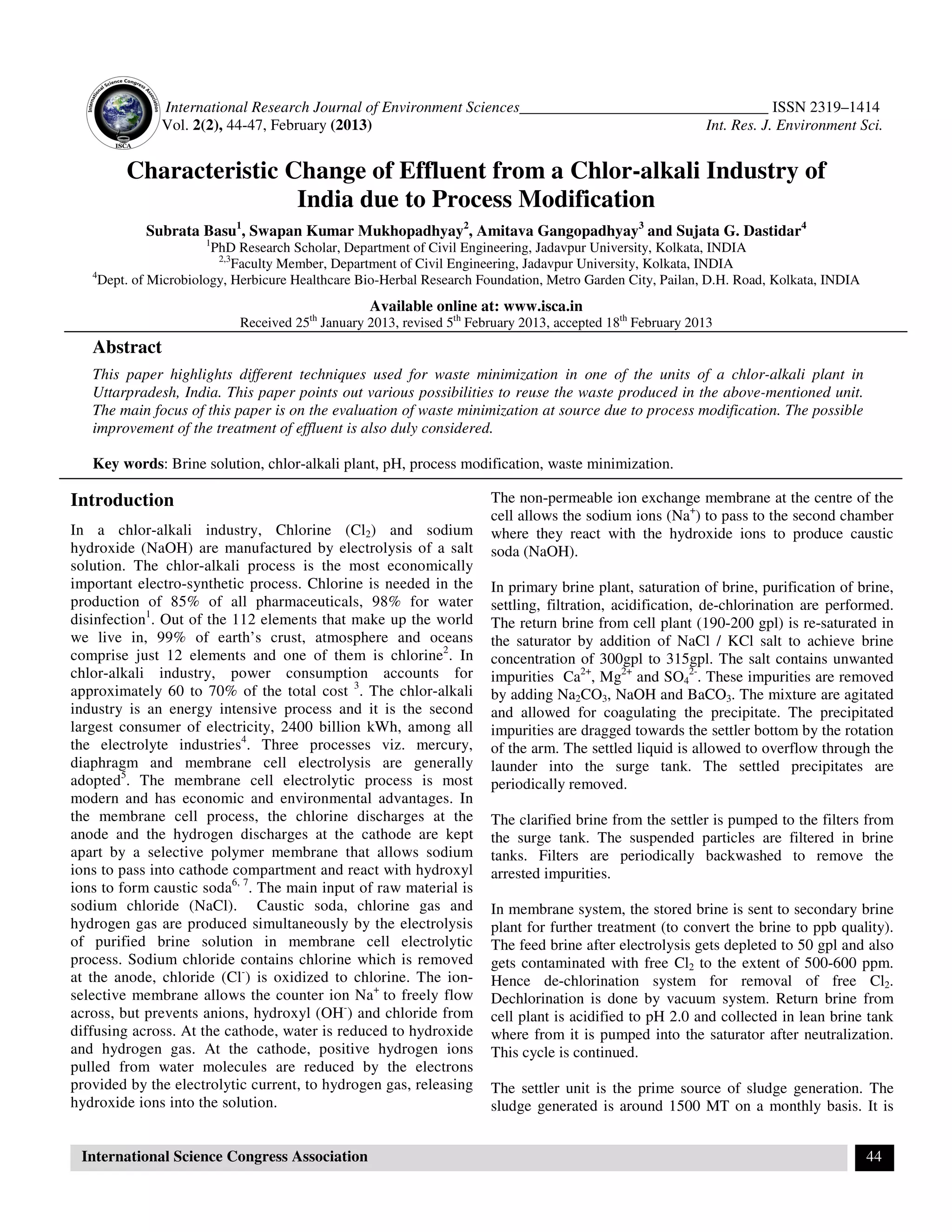
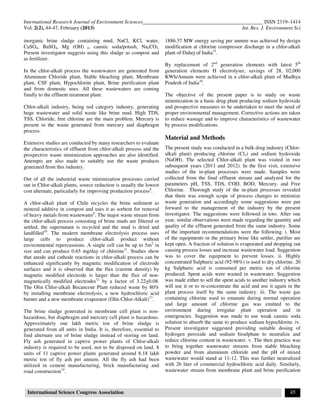
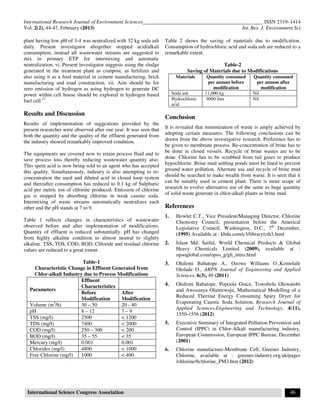
Table 1 reflects changes in characteristics of wastewater
observed before and after implementation of modifications.
Quantity of effluent is reduced substantially. pH has changed
from highly alkaline condition to almost neutral to slightly
alkaline. TSS, TDS, COD, BOD, Chloride and residual chlorine
values are reduced to a great extent.
Table-1
Characteristic Change in Effluent Generated from
Chlor-alkali Industry due to Process Modifications
Parameters
Effluent
Characteristics
Before
Modification
After
Modification
Volume (m3
/h) 30 – 50 20 - 40
pH 8 – 12 7 – 9
TSS (mg/l) 2500 < 1200
TDS (mg/l) 7400 < 2000
COD (mg/l) 250 – 300 < 200
BOD (mg/l) 35 – 55 < 35
Mercury (mg/l) 0.001 0.001
Chlorides (mg/l) 4800 < 1000
Free Chlorine (mg/l) 1000 < 400
Table 2 shows the saving of materials due to modification.
Consumption of hydrochloric acid and soda ash are reduced to a
remarkable extent.
Table-2
Saving of Materials due to Modifications
Materials Quantity consumed
per annum before
modification
Quantity consumed
per annum after
modification
Soda ash 11,000 kg Nil
Hydrochloric
acid
9000 liter Nil
Conclusion
It is revealed that minimization of waste is amply achieved by
adopting certain measures. The following conclusions can be
drawn from the above investigative research. Preference has to
be given to membrane process. Re-concentration of brine has to
be done in closed vessels. Recycle of brine wastes are to be
done. Chlorine has to be scrubbed from tail gases to produce
hypochlorite. Brine mud settling ponds must be lined to prevent
ground water pollution. Alternate use and recycle of brine mud
should be searched to make wealth from waste. It is seen that it
can be suitably used in cement plant. There is more scope of
research to evolve alternative use of the same as huge quantity
of solid waste generate in chlor-alkali plants as brine mud.
References
1. Howlet C.T., Vice President/Managing Director, Chlorine
Chemistry Council, presentation before the Americal
Legislative Council, Washington, D.C., 7th
December,
(1995) Available at : kbda.com/c3/library/cth3.html
2. Islam Md. Saiful, World Chemical Products & Global
Heavy Chemicals Limited (2009), available at :
opsoglobal.com/opso_g/gh_intro.html
3. Olufemi Babatope A., Ozowe Williams O.,Komolafe
Ololade O., ARPN Journal of Engineering and Applied
Sciences, 6(3), 49 (2011)
4. Olufemi Babatope, Popoola Grace, Towobola Oluwatobi
and Awosanya Olanrewaju, Mathematical Modelling of a
Reduced Thermal Energy Consuming Spary Dryer for
Evaporating Caustic Soda Solution, Research Journal of
Applied Sciences,Engineering and Technology, 4(11),
1550-1556 (2012)
5. Executive Summary of Integrated Pollution Prevention and
Control (IPPC) in Chlor-Alkali manufacturing industry,
European Commission, European IPPC Bureau, December
(2001)
6. Chlorine manufacture-Membrane Cell, Greener Industry,
Chlorine, available at : greener-industry.org.uk/pages
/chlorine/8chlorine_PM3.htm (2012)
International Research Journal of Environment Sciences______________________________________________ ISSN 2319–1414
Vol. 2(2), 44-47, February (2013) Int. Res. J. Environment Sci.
International Science Congress Association 47
7. Grotheer Morris, Alkire Richard and Varjian Richard,
Industrial Electrolysis and Electrochemical Engineering,
The Electrochemical Society, Interface (2006)
8. Gupta Amit & Rajurkar Prashant, Waste Minimisation in a
Chlor-Alkali Plant, Department of Chemical Engineering,
Indian Institute of Technology, Mumbai-400076,India, 14th
July (2001). Available at : iitsine.org/awards /a2001/
wasteminimisation.pdf.
9. Munoz E, Navia R, Life cycle assessment of solid waste
management strategies in a chlor-alkali production facility,
Waste Manage. Res., 29, 634-43(2011)
10. Chlor-Alkali Plants, Pollution Prevention and Abatement
Handbook, World Bank Group (1998)
11. Chlor-Alkali Plant Expansion, Frankfurt Hoechst,
Germany-Chemical Technology, Akzo Nobel (2004)
www.chemicals-technology.com/projects/chlor_alkali.
12. Minteer Shelley D, Dittman Mark R., Pasek Sarah J. and
Reidy Shana ; Magnetic Field Effects on Electrosynthetis
Processes, Department of Chemistry, Saint Louis
University, 3501, Laclede Ave., St.Louis, MO 63103
(2012)
13. Olin Chlor Alkali Products, Becancour, QC,
Montreal,Canada (2003), available at: olinchloralkali.com
/Locations/BecancourQC.aspx
14. Guideline document on Benchmarking of SHE Activities
of Chlor-Alkali Units, 12 (2011), Alkali Manufacturers
Association of India,3rd
floor, Pankaj Chambers, Preet
Vihar Commercial complex, Vikas Marg, Delhi – 110092.
15. Das Shantunu, Babu C.S., Kumar Sushil, The success story
of energy saving by design modification at chlorine
compressor discharge at chlor-alkali plant,RIL, Dahej,
page 2, available at : energymanage Training.com
/announcement/../Shantunu Das (2012)
16. Chloralkali, Grasim India Limited, Chemical Division,
Nagda, Madhya Pradesh, Major Project Implemented for
Energy Conservation, page131(2008), available at : emt-
india.net/eca2008/ Awardbooklet2008/05chlor_Alkali.pdf
17. Parikh P.N., Improvement initiatives for chlor-alkali sector
@ PAT scheme of Govt. of India, Potential assessment
from baseline EA, EE Technologies, Waste minimization
& Energy Productivity (2012)

10.1.1.1062.5005.pdf

  • 1.
    International Research Journalof Environment Sciences________________________________ ISSN 2319–1414 Vol. 2(2), 44-47, February (2013) Int. Res. J. Environment Sci. International Science Congress Association 44 Characteristic Change of Effluent from a Chlor-alkali Industry of India due to Process Modification Subrata Basu1 , Swapan Kumar Mukhopadhyay2 , Amitava Gangopadhyay3 and Sujata G. Dastidar4 1 PhD Research Scholar, Department of Civil Engineering, Jadavpur University, Kolkata, INDIA 2,3 Faculty Member, Department of Civil Engineering, Jadavpur University, Kolkata, INDIA 4 Dept. of Microbiology, Herbicure Healthcare Bio-Herbal Research Foundation, Metro Garden City, Pailan, D.H. Road, Kolkata, INDIA Available online at: www.isca.in Received 25th January 2013, revised 5th February 2013, accepted 18th February 2013 Abstract This paper highlights different techniques used for waste minimization in one of the units of a chlor-alkali plant in Uttarpradesh, India. This paper points out various possibilities to reuse the waste produced in the above-mentioned unit. The main focus of this paper is on the evaluation of waste minimization at source due to process modification. The possible improvement of the treatment of effluent is also duly considered. Key words: Brine solution, chlor-alkali plant, pH, process modification, waste minimization. Introduction In a chlor-alkali industry, Chlorine (Cl2) and sodium hydroxide (NaOH) are manufactured by electrolysis of a salt solution. The chlor-alkali process is the most economically important electro-synthetic process. Chlorine is needed in the production of 85% of all pharmaceuticals, 98% for water disinfection1 . Out of the 112 elements that make up the world we live in, 99% of earth’s crust, atmosphere and oceans comprise just 12 elements and one of them is chlorine2 . In chlor-alkali industry, power consumption accounts for approximately 60 to 70% of the total cost 3 . The chlor-alkali industry is an energy intensive process and it is the second largest consumer of electricity, 2400 billion kWh, among all the electrolyte industries4 . Three processes viz. mercury, diaphragm and membrane cell electrolysis are generally adopted5 . The membrane cell electrolytic process is most modern and has economic and environmental advantages. In the membrane cell process, the chlorine discharges at the anode and the hydrogen discharges at the cathode are kept apart by a selective polymer membrane that allows sodium ions to pass into cathode compartment and react with hydroxyl ions to form caustic soda6, 7 . The main input of raw material is sodium chloride (NaCl). Caustic soda, chlorine gas and hydrogen gas are produced simultaneously by the electrolysis of purified brine solution in membrane cell electrolytic process. Sodium chloride contains chlorine which is removed at the anode, chloride (Cl- ) is oxidized to chlorine. The ion- selective membrane allows the counter ion Na+ to freely flow across, but prevents anions, hydroxyl (OH- ) and chloride from diffusing across. At the cathode, water is reduced to hydroxide and hydrogen gas. At the cathode, positive hydrogen ions pulled from water molecules are reduced by the electrons provided by the electrolytic current, to hydrogen gas, releasing hydroxide ions into the solution. The non-permeable ion exchange membrane at the centre of the cell allows the sodium ions (Na+ ) to pass to the second chamber where they react with the hydroxide ions to produce caustic soda (NaOH). In primary brine plant, saturation of brine, purification of brine, settling, filtration, acidification, de-chlorination are performed. The return brine from cell plant (190-200 gpl) is re-saturated in the saturator by addition of NaCl / KCl salt to achieve brine concentration of 300gpl to 315gpl. The salt contains unwanted impurities Ca2+ , Mg2+ and SO4 2- . These impurities are removed by adding Na2CO3, NaOH and BaCO3. The mixture are agitated and allowed for coagulating the precipitate. The precipitated impurities are dragged towards the settler bottom by the rotation of the arm. The settled liquid is allowed to overflow through the launder into the surge tank. The settled precipitates are periodically removed. The clarified brine from the settler is pumped to the filters from the surge tank. The suspended particles are filtered in brine tanks. Filters are periodically backwashed to remove the arrested impurities. In membrane system, the stored brine is sent to secondary brine plant for further treatment (to convert the brine to ppb quality). The feed brine after electrolysis gets depleted to 50 gpl and also gets contaminated with free Cl2 to the extent of 500-600 ppm. Hence de-chlorination system for removal of free Cl2. Dechlorination is done by vacuum system. Return brine from cell plant is acidified to pH 2.0 and collected in lean brine tank where from it is pumped into the saturator after neutralization. This cycle is continued. The settler unit is the prime source of sludge generation. The sludge generated is around 1500 MT on a monthly basis. It is
  • 2.
    International Research Journalof Environment Sciences______________________________________________ ISSN 2319–1414 Vol. 2(2), 44-47, February (2013) Int. Res. J. Environment Sci. International Science Congress Association 45 inorganic brine sludge containing mud, NaCl, KCl, water, CaSO4, BaSO4, Mg (OH) 2, caustic soda/potash, Na2CO3. Present investigator suggests using this sludge as compost and as fertilizer. In the chlor-alkali process the wastewaters are generated from Aluminum Chloride plant, Stable bleaching plant, Membrane plant, CSF plant, Hypochlorite plant, Brine purification plant and from domestic uses. All these wastewaters are coming finally to the effluent treatment plant. Chlor-alkali industry, being red category industry, generating huge wastewater and solid waste like brine mud. High TDS, TSS, Chloride, free chlorine are the main problem. Mercury is present in the waste generated from mercury and diaphragm process. Extensive studies are conducted by many researchers to evaluate the characteristics of effluent from chlor-alkali process and the prospective waste minimization approaches are also identified. Attempts are also made to suitably use the waste products generated from this industry. Out of all the industrial waste minimization processes carried out in Chlor-alkali plants, source reduction is usually the lowest cost alternate, particularly for improving production process8 . A chlor-alkali plant of Chile recycles the brine sediment as mineral additive in compost and uses it as sorbent for removal of heavy metals from wastewater9 . The major waste stream from the chlor-alkali process consisting of brine muds are filtered or settled, the supernatant is recycled and the mud is dried and landfilled10 . The modern membrane electrolysis process uses large cells to produce chlor-alkali product without environmental repercussions. A single cell can be up to 5m2 in size and can produce 0.65 mg/day of chlorine11 . Studies show that anode and cathode reactions in chlor-alkali process can be enhanced significantly by magnetic modification of electrode surfaces and it is observed that the flux (current density) by magnetic modified electrode is larger than the flux of non- magnetically modified electrodes12 by a factor of 3.22+0.08. The Olin Chlor-alkali Becancour Plant reduced waste by 80% by installing membrane electrolysis, a new hydrochloric acid burner and a new membrane evaporator (Olin Chlor-Alkali)13 . The brine sludge generated in membrane cell plant is non- hazardous, but diaphragm and mercury cell plant is hazardous. Approximately one lakh metric ton of brine sludge is generated from all units in India. It is, therefore, essential to find alternate use of brine sludge instead of storing on land. Fly ash generated in captive power plants of Chlor-alkali industry is required to be used, not to be disposed on land. 8 units of 11 captive power plants generated around 8.18 lakh metric ton of fly ash per annum. All the fly ash had been utilized in cement manufacturing, brick manufacturing and road construction14 . 1886.37 MW energy saving per annum was achieved by design modification at chlorine compressor discharge in a chlor-alkali plant of Dahej of India15 . By replacement of 2nd generation elements with latest 5th generation elements H electrolyser, savings of 28, 02,000 KWh/Annum were achieved in a chlor-alkali plant of Madhya Pradesh of India16 . The objective of the present paper is to study on waste minimization in a basic drug plant producing sodium hydroxide and prospective measures to be undertaken to meet the need of proper environmental management. Corrective actions are taken to reduce wastage and to improve characteristics of wastewater by process modifications. Material and Methods The present study was conducted in a bulk drug industry (Chlor- alkali plant) producing chlorine (Cl2) and sodium hydroxide (NaOH). The selected Chlor-alkali plant was visited in two subsequent years (2011 and 2012). In the first visit, extensive studies of the in-plant processes were made. Samples were collected from the final effluent stream and analyzed for the parameters pH, TSS, TDS, COD, BOD, Mercury, and Free Chlorine. Thorough study of the in-plant processes revealed that there was enough scope of process changes to minimize waste generation and accordingly some suggestions were put forward to the management of the industry by the present investigator. The suggestions were followed in toto. After one year, similar observations were made regarding the quantity and quality of the effluent generated from the same industry. Some of the important recommendations were the following. i. Most of the equipments in the primary brine like settler, purifier are kept open. A fraction of solution is evaporated and dropping out causing process losses and increase wastewater load. Suggestion was to cover the equipment to prevent losses. ii. Highly concentrated Sulphuric acid (92-98%) is used to dry chlorine. 20 kg Sulphuric acid is consumed per metric ton of chlorine produced. Spent acids were wasted in wastewater. Suggestion was made either to sell the spent acids to another industry which will use it or to re-concentrate the acid and use it again in the plant process itself by the same industry. iii. The waste gas containing chlorine used to emanate during normal operation and large amount of chlorine gas was emitted to the environment during irregular plant operation and in emergencies. Suggestion was made to use weak caustic soda solution to absorb the same to produce sodium hypochlorite. iv. Present investigator suggested providing suitable dosing of hydrogen peroxide and sodium bisulphate to neutralize and reduce chlorine content in wastewater. v. The then practice was to bring together wastewater streams from stable bleaching powder and from aluminum chloride and the pH of mixed wastewater would stand at 11-12. This was further neutralized with 26 liter of commercial hydrochloric acid daily. Similarly, wastewater stream from membrane plant and brine purification
  • 3.
    International Research Journalof Environment Sciences______________________________________________ ISSN 2319–1414 Vol. 2(2), 44-47, February (2013) Int. Res. J. Environment Sci. International Science Congress Association 46 plant having low pH of 3-4 was neutralized with 32 kg soda ash daily. Present investigator altogether stopped acid/alkali consumption, instead all wastewater streams are suggested to mix in primary ETP for intermixing and automatic neutralization. vi. Present investigator suggests using the sludge generated in the treatment plant as compost, as fertilizer and also using it as a feed material in cement manufacturing, brick manufacturing and road construction. vii. Aim should be for zero emission of hydrogen as using hydrogen to generate DC power within cell house should be explored in hydrogen based fuel cell 17 . Results and Discussion Results of implementation of suggestions provided by the present researcher were observed after one year. It was seen that both the quantity and the quality of the effluent generated from the industry showed remarkably improved condition. The equipments are covered now to retain process fluid and to save process loss thereby reducing wastewater quantity also. This spent acid is now being sold to an agent who has accepted this quality. Simultaneously, industry is also attempting to re- concentration the used and diluted acid in closed loop system and thereafter consumption has reduced to 0.1 kg of Sulphuric acid per metric ton of chlorine produced. Emission of chlorine gas is stopped by absorbing chlorine in weak caustic soda. Intermixing of waste streams automatically neutralizes each other and the pH stands at 7 to 9. Table 1 reflects changes in characteristics of wastewater observed before and after implementation of modifications. Quantity of effluent is reduced substantially. pH has changed from highly alkaline condition to almost neutral to slightly alkaline. TSS, TDS, COD, BOD, Chloride and residual chlorine values are reduced to a great extent. Table-1 Characteristic Change in Effluent Generated from Chlor-alkali Industry due to Process Modifications Parameters Effluent Characteristics Before Modification After Modification Volume (m3 /h) 30 – 50 20 - 40 pH 8 – 12 7 – 9 TSS (mg/l) 2500 < 1200 TDS (mg/l) 7400 < 2000 COD (mg/l) 250 – 300 < 200 BOD (mg/l) 35 – 55 < 35 Mercury (mg/l) 0.001 0.001 Chlorides (mg/l) 4800 < 1000 Free Chlorine (mg/l) 1000 < 400 Table 2 shows the saving of materials due to modification. Consumption of hydrochloric acid and soda ash are reduced to a remarkable extent. Table-2 Saving of Materials due to Modifications Materials Quantity consumed per annum before modification Quantity consumed per annum after modification Soda ash 11,000 kg Nil Hydrochloric acid 9000 liter Nil Conclusion It is revealed that minimization of waste is amply achieved by adopting certain measures. The following conclusions can be drawn from the above investigative research. Preference has to be given to membrane process. Re-concentration of brine has to be done in closed vessels. Recycle of brine wastes are to be done. Chlorine has to be scrubbed from tail gases to produce hypochlorite. Brine mud settling ponds must be lined to prevent ground water pollution. Alternate use and recycle of brine mud should be searched to make wealth from waste. It is seen that it can be suitably used in cement plant. There is more scope of research to evolve alternative use of the same as huge quantity of solid waste generate in chlor-alkali plants as brine mud. References 1. Howlet C.T., Vice President/Managing Director, Chlorine Chemistry Council, presentation before the Americal Legislative Council, Washington, D.C., 7th December, (1995) Available at : kbda.com/c3/library/cth3.html 2. Islam Md. Saiful, World Chemical Products & Global Heavy Chemicals Limited (2009), available at : opsoglobal.com/opso_g/gh_intro.html 3. Olufemi Babatope A., Ozowe Williams O.,Komolafe Ololade O., ARPN Journal of Engineering and Applied Sciences, 6(3), 49 (2011) 4. Olufemi Babatope, Popoola Grace, Towobola Oluwatobi and Awosanya Olanrewaju, Mathematical Modelling of a Reduced Thermal Energy Consuming Spary Dryer for Evaporating Caustic Soda Solution, Research Journal of Applied Sciences,Engineering and Technology, 4(11), 1550-1556 (2012) 5. Executive Summary of Integrated Pollution Prevention and Control (IPPC) in Chlor-Alkali manufacturing industry, European Commission, European IPPC Bureau, December (2001) 6. Chlorine manufacture-Membrane Cell, Greener Industry, Chlorine, available at : greener-industry.org.uk/pages /chlorine/8chlorine_PM3.htm (2012)
  • 4.
    International Research Journalof Environment Sciences______________________________________________ ISSN 2319–1414 Vol. 2(2), 44-47, February (2013) Int. Res. J. Environment Sci. International Science Congress Association 47 7. Grotheer Morris, Alkire Richard and Varjian Richard, Industrial Electrolysis and Electrochemical Engineering, The Electrochemical Society, Interface (2006) 8. Gupta Amit & Rajurkar Prashant, Waste Minimisation in a Chlor-Alkali Plant, Department of Chemical Engineering, Indian Institute of Technology, Mumbai-400076,India, 14th July (2001). Available at : iitsine.org/awards /a2001/ wasteminimisation.pdf. 9. Munoz E, Navia R, Life cycle assessment of solid waste management strategies in a chlor-alkali production facility, Waste Manage. Res., 29, 634-43(2011) 10. Chlor-Alkali Plants, Pollution Prevention and Abatement Handbook, World Bank Group (1998) 11. Chlor-Alkali Plant Expansion, Frankfurt Hoechst, Germany-Chemical Technology, Akzo Nobel (2004) www.chemicals-technology.com/projects/chlor_alkali. 12. Minteer Shelley D, Dittman Mark R., Pasek Sarah J. and Reidy Shana ; Magnetic Field Effects on Electrosynthetis Processes, Department of Chemistry, Saint Louis University, 3501, Laclede Ave., St.Louis, MO 63103 (2012) 13. Olin Chlor Alkali Products, Becancour, QC, Montreal,Canada (2003), available at: olinchloralkali.com /Locations/BecancourQC.aspx 14. Guideline document on Benchmarking of SHE Activities of Chlor-Alkali Units, 12 (2011), Alkali Manufacturers Association of India,3rd floor, Pankaj Chambers, Preet Vihar Commercial complex, Vikas Marg, Delhi – 110092. 15. Das Shantunu, Babu C.S., Kumar Sushil, The success story of energy saving by design modification at chlorine compressor discharge at chlor-alkali plant,RIL, Dahej, page 2, available at : energymanage Training.com /announcement/../Shantunu Das (2012) 16. Chloralkali, Grasim India Limited, Chemical Division, Nagda, Madhya Pradesh, Major Project Implemented for Energy Conservation, page131(2008), available at : emt- india.net/eca2008/ Awardbooklet2008/05chlor_Alkali.pdf 17. Parikh P.N., Improvement initiatives for chlor-alkali sector @ PAT scheme of Govt. of India, Potential assessment from baseline EA, EE Technologies, Waste minimization & Energy Productivity (2012)