100% Code Coverage via automated tests
in Symfony applications
Symfony User Group Cologne
2017-04-26
Wir entwickeln weiter
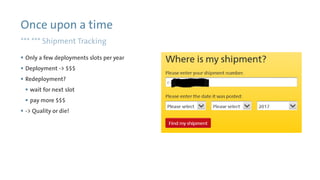
Once upon a time
*** *** Shipment Tracking
 Only a few deployments slots per year
 Deployment -> $$$
 Redeployment?
 wait for next slot
 pay more $$$
 -> Quality or die!
Automated Testing & Metrics
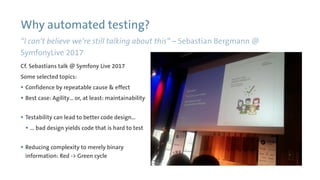
Why automated testing?
“I can‘t believe we‘re still talking about this“ – Sebastian Bergmann @
SymfonyLive 2017
Cf. Sebastians talk @ Symfony Live 2017
Some selected topics:
 Confidence by repeatable cause & effect
 Best case: Agility… or, at least: maintainability
 Testability can lead to better code design…
 … bad design yields code that is hard to test
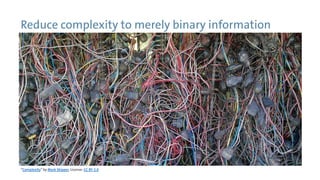
 Reducing complexity to merely binary
information: Red -> Green cycle
Reduce complexity to merely binary information
”Complexity” by Mark Skipper, License: CC BY 2.0
© mensemedia Gesellschaft für Neue Medien mbH 7www.mensemedia.net
© mensemedia Gesellschaft für Neue Medien mbH 8www.mensemedia.net
© mensemedia Gesellschaft für Neue Medien mbH 9www.mensemedia.net
Code Coverage
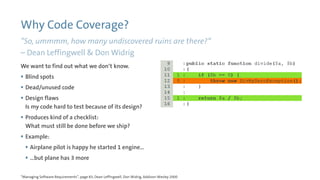
Why Code Coverage?
”So, ummmm, how many undiscovered ruins are there?“
– Dean Leffingwell & Don Widrig
We want to find out what we don‘t know.
 Blind spots
 Dead/unused code
 Design flaws
Is my code hard to test because of its design?
 Produces kind of a checklist:
What must still be done before we ship?
 Example:
 Airplane pilot is happy he started 1 engine…
 …but plane has 3 more
“Managing Software Requirements”, page 83, Dean Leffingwell, Don Widrig, Addison-Wesley 2000
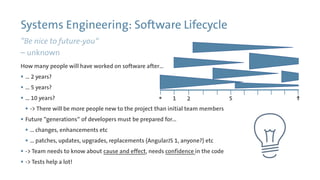
Systems Engineering: Software Lifecycle
”Be nice to future-you“
– unknown
How many people will have worked on software after…
 … 2 years?
 … 5 years?
 … 10 years?
 -> There will be more people new to the project than initial team members
 Future “generations“ of developers must be prepared for…
 … changes, enhancements etc
 … patches, updates, upgrades, replacements (AngularJS 1, anyone?) etc
 -> Team needs to know about cause and effect, needs confidence in the code
 -> Tests help a lot!
1 2 5 †*
But why the fudge 100%???
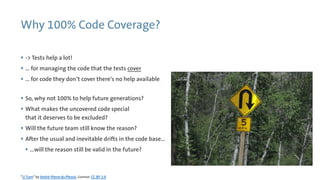
Why 100% Code Coverage?
 -> Tests help a lot!
 … for managing the code that the tests cover
 … for code they don‘t cover there‘s no help available
 So, why not 100% to help future generations?
 What makes the uncovered code special
that it deserves to be excluded?
 Will the future team still know the reason?
 After the usual and inevitable drifts in the code base…
 …will the reason still be valid in the future?
”U Turn“ by André-Pierre du Plessis, License: CC BY 2.0
Why 100% Code Coverage?
 Problem distribution:
 Bug density is often not distributed homogeneously
 “90% of problems are caused by 10% of the code“
 What if these 10% are in your uncovered code?
 No? R u sure? Really?
 How can you be sure when you don‘t have tests?
 … after all, tests make you durably confident
 Or, which code will likely cause more problems:
 highly tested code?
 untested, potentially even untestable code?
”Detective with pipe and magnifzing glass“ by Juhele, https://openclipart.org/detail/254342/detective-with-pipe-and-magnifying-glass
”Confidence is ignorance. If you're feeling cocky, it's because there's
something you don't know“ – Eoin Colfer, Artemis Fowl
Why 100% Code Coverage?
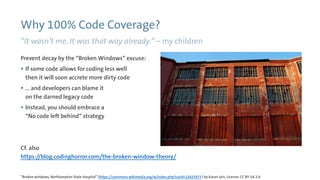
”It wasn’t me. It was that way already.“ – my children
Prevent decay by the “Broken Windows“ excuse:
 If some code allows for coding less well
then it will soon accrete more dirty code
 … and developers can blame it
on the darned legacy code
 Instead, you should embrace a
“No code left behind“ strategy
Cf. also
https://blog.codinghorror.com/the-broken-window-theory/
“Broken windows, Northampton State Hospital” (https://commons.wikimedia.org/w/index.php?curid=22625973 ) by Karan Jain, License: CC BY-SA 2.0
Why 100% Code Coverage?
Use the power of metrics
 It‘s rules that everyone needs to stick to
 … objectively measured by a 3rd party
 -> No more discussions about the relevance of some code
 … that only waste time and energy
 Exceptions to the rules will add even MORE complexity
 Instead…
 … let the metric “reward“ the team when at 100%
and boost it with extra motivation
 … use the metric to reduce complexity to…
… Red and Green
“Complexity kills. It sucks the life out of developers […]“ – Ray Ozzie
Source: Geek & Poke http://geek-and-poke.com/geekandpoke/2017/2/18/50-shades-part-2
© mensemedia Gesellschaft für Neue Medien mbH 17www.mensemedia.net
© mensemedia Gesellschaft für Neue Medien mbH 18www.mensemedia.net
Let‘s talk about accountability
© mensemedia Gesellschaft für Neue Medien mbH 21www.mensemedia.net
Uncovered Code can have impact on
quality,
maintenance, training and onboarding cost,
eventually leading to technical debt.
© mensemedia Gesellschaft für Neue Medien mbH 22www.mensemedia.net
Quality, cost and task planning
are BUSINESS issues,
and only the PO can do a trade off.
© mensemedia Gesellschaft für Neue Medien mbH 23www.mensemedia.net
For professional developers*,
automated testing is an obligation.
Uncovered Code does not comply
to that obligation.
* especially in interpreted or dynamically typed langages
But wait, that‘s not feasible!
!
Or is it?
?
Advice #1:
Start @ 100%, Stay @ 100%
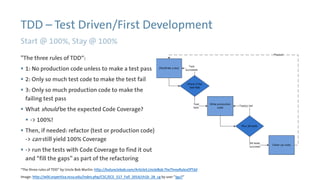
TDD – Test Driven/First Development
Start @ 100%, Stay @ 100%
“The three rules of TDD“ by Uncle Bob Martin: http://butunclebob.com/ArticleS.UncleBob.TheThreeRulesOfTdd
Image: http://wiki.expertiza.ncsu.edu/index.php/CSC/ECE_517_Fall_2014/ch1b_28_cg by user “Jgu7“
”The three rules of TDD“:
 1: No production code unless to make a test pass
 2: Only so much test code to make the test fail
 3: Only so much production code to make the
failing test pass
 What should be the expected Code Coverage?
 -> 100%!
 Then, if needed: refactor (test or production code)
-> can still yield 100% Coverage
 -> run the tests with Code Coverage to find it out
and “fill the gaps” as part of the refactoring
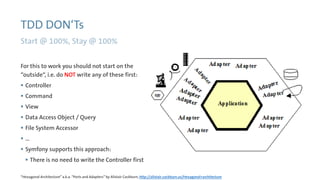
TDD DON‘Ts
Start @ 100%, Stay @ 100%
“Hexagonal Architecture” a.k.a. “Ports and Adapters” by Alistair Cockburn, http://alistair.cockburn.us/Hexagonal+architecture
For this to work you should not start on the
“outside“, i.e. do NOT write any of these first:
 Controller
 Command
 View
 Data Access Object / Query
 File System Accessor
 …
 Symfony supports this approach:
 There is no need to write the Controller first
© mensemedia Gesellschaft für Neue Medien mbH 29www.mensemedia.net
Also, it‘s a psych thing
If you start on the outside you will likely experience:
 the need for non-Unit tests (i.e. slow tests)
 the need to mock stuff (mocks are evil)
 slow progress
 a Code Coverage below 100%
 less motivation because you‘re always “in debt“,
i.e. < 100%
https://de.wikipedia.org/wiki/Datei:Sigmund_Freud_LIFE.jpg
© mensemedia Gesellschaft für Neue Medien mbH 30www.mensemedia.net
Also, it‘s a psych thing
If you start on the outside you will likely experience:
 a tendency to do the wrong things…
 … a.k.a.“Coder‘s Stockholm-Syndrome“
 the urge to put more into the class, e.g. the
Controller, than you should…
 … to kind of make the effort spent on the
Controller “pay off“
 … potentially leading to
higher coupling and less cohesion
https://de.wikipedia.org/wiki/Datei:Sigmund_Freud_LIFE.jpg
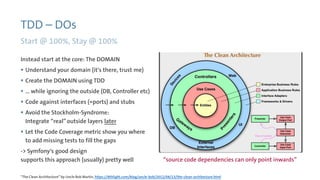
TDD – DOs
Start @ 100%, Stay @ 100%
“The Clean Architecture” by Uncle Bob Martin, https://8thlight.com/blog/uncle-bob/2012/08/13/the-clean-architecture.html
Instead start at the core: The DOMAIN
 Understand your domain (it‘s there, trust me)
 Create the DOMAIN using TDD
 … while ignoring the outside (DB, Controller etc)
 Code against interfaces (=ports) and stubs
 Avoid the Stockholm-Syndrome:
Integrate “real”outside layers later
 Let the Code Coverage metric show you where
to add missing tests to fill the gaps
-> Symfony‘s good design
supports this approach (usually) pretty well “source code dependencies can only point inwards”
There is no reason why you
SHOULDN‘T WANT 100% Code Coverage.
(There may be reasons why you
CAN‘T get to 100%, though…)
Code Coverage is a fallacy just a tool.lielie fallacy
It depends on what you use it for.
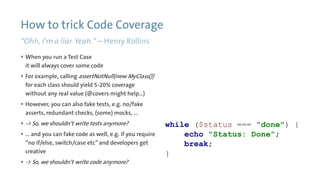
How to trick Code Coverage
“Ohh, I‘m a liar. Yeah.“ – Henry Rollins
 When you run a Test Case
it will always cover some code
 For example, calling assertNotNull(new MyClass())
for each class should yield 5-20% coverage
without any real value (@covers might help…)
 However, you can also fake tests, e.g. no/fake
asserts, redundant checks, (some) mocks, …
 -> So, we shouldn‘t write tests anymore?
 … and you can fake code as well, e.g. if you require
“no if/else, switch/case etc”and developers get
creative
 -> So, we shouldn‘t write code anymore?
while ($status === "done") {
echo "Status: Done";
break;
}
Just because Code Coverage can be faked
does not mean it is irrelevant.
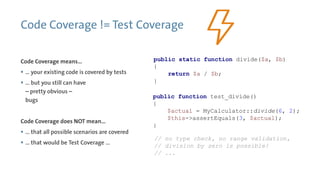
Code Coverage != Test Coverage
Code Coverage means…
 … your existing code is covered by tests
 … but you still can have
– pretty obvious –
bugs
Code Coverage does NOT mean…
 … that all possible scenarios are covered
 … that would be Test Coverage …
public static function divide($a, $b)
{
return $a / $b;
}
public function test_divide()
{
$actual = MyCalculator::divide(6, 2);
$this->assertEquals(3, $actual);
}
// no type check, no range validation,
// division by zero is possible!
// ...
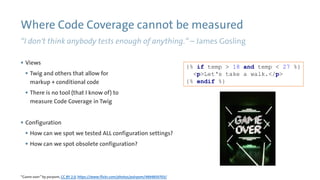
Where Code Coverage cannot be measured
“I don't think anybody tests enough of anything.“ – James Gosling
 Views
 Twig and others that allow for
markup + conditional code
 There is no tool (that I know of) to
measure Code Coverage in Twig
 Configuration
 How can we spot we tested ALL configuration settings?
 How can we spot obsolete configuration?
“Game over” by porpom, CC BY 2.0, https://www.flickr.com/photos/poirpom/4894850703/
{% if temp > 18 and temp < 27 %}
<p>Let‘s take a walk.</p>
{% endif %}
Where Code Coverage breaks:
Aliens, Trade Offs & Lack of Knowledge
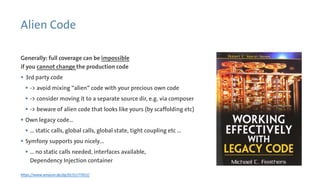
Alien Code
Generally: full coverage can be impossible
if you cannot change the production code
 3rd party code
 -> avoid mixing “alien“ code with your precious own code
 -> consider moving it to a separate source dir, e.g. via composer
 -> beware of alien code that looks like yours (by scaffolding etc)
 Own legacy code…
 … static calls, global calls, global state, tight coupling etc …
 Symfony supports you nicely…
 … no static calls needed, interfaces available,
Dependency Injection container
https://www.amazon.de/dp/0131177052/
Conscious Trade Offs
Proofs of Concept (PoC)
 … basically: “I don‘t really know…
 … what I want yet.“
 … how to do it yet.“
 -> TDD and Code Coverage don‘t make much sense
when you don‘t know what to assert
 However, professionals should create PoCs only as throw-away code
Lack of Knowledge
 Things you don‘t know how to test (yet)
 Sometimes you need to master the technology first
 It may take some time to find solutions for testing
 -> Don‘t write testing off for good, keep looking for solutions
Lack of Knowledge
 Insufficiently designed code that…
 … you haven‘t realized to be poorly designed yet
 … you don‘t know how to fix yet
 … don‘t blame the test for not covering badly designed code
 … don‘t declare badly designed code as a “special case“
that may be excluded from the rule
 -> trust the test
Advice #2: When in doubt,
trust the test
Trust the test
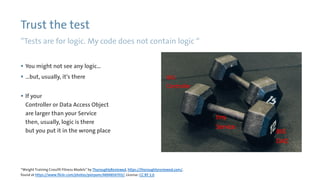
”Tests are for logic. My code does not contain logic “
 You might not see any logic…
 …but, usually, it‘s there
 If your
Controller or Data Access Object
are larger than your Service
then, usually, logic is there
but you put it in the wrong place
BIG
Controller
BIG
DAO
tiny
Service
“Weight Training Crossfit Fitness Models” by ThoroughlyReviewed, https://thoroughlyreviewed.com/,
found at https://www.flickr.com/photos/poirpom/4894850703/, License: CC BY 2.0
Trust the test
”Tests are for logic. My code does not contain logic“
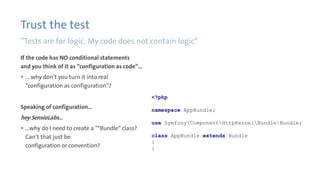
If the code has NO conditional statements
and you think of it as “configuration as code“…
 … why don‘t you turn it into real
“configuration as configuration“?
Speaking of configuration…
hey SensioLabs…
 …why do I need to create a “*Bundle“ class?
Can‘t that just be
configuration or convention?
<?php
namespace AppBundle;
use SymfonyComponentHttpKernelBundleBundle;
class AppBundle extends Bundle
{
}
© mensemedia Gesellschaft für Neue Medien mbH 46www.mensemedia.net
Trust the test:
If (your own) code is hard to test
then it likely has a design problem.
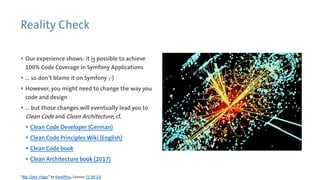
Reality Check
 Our experience shows: it is possible to achieve
100% Code Coverage in Symfony Applications
 … so don‘t blame it on Symfony ;-)
 However, you might need to change the way you
code and design
 … but those changes will eventually lead you to
Clean Code and Clean Architecture, cf.
 Clean Code Developer (German)
 Clean Code Principles Wiki (English)
 Clean Code book
 Clean Architecture book (2017)
“Big_Data_Higgs” by KamiPhuc, License: CC BY 2.0
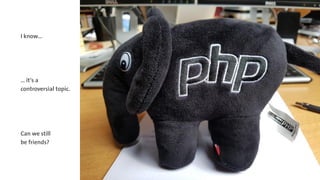
I know…
… it‘s a
controversial topic.
Can we still
be friends?
THANKS!
Questions?
Feedback?
-> Please contact us!
mensemedia Gesellschaft für Neue Medien mbH
Neumannstraße 10
D- 40235 Düsseldorf
mail@mensemedia.net
www.mensemedia.net
Andreas Czakaj
Managing Director IT / CTO
Tel +49.211.55 04 78-25
andreas.czakaj@mensemedia.net
Twitter: AndreasCzakaj

100% Code Coverage in Symfony applications

  • 1.
    100% Code Coveragevia automated tests in Symfony applications Symfony User Group Cologne 2017-04-26
  • 2.
  • 3.
    Once upon atime *** *** Shipment Tracking  Only a few deployments slots per year  Deployment -> $$$  Redeployment?  wait for next slot  pay more $$$  -> Quality or die!
  • 4.
  • 5.
    Why automated testing? “Ican‘t believe we‘re still talking about this“ – Sebastian Bergmann @ SymfonyLive 2017 Cf. Sebastians talk @ Symfony Live 2017 Some selected topics:  Confidence by repeatable cause & effect  Best case: Agility… or, at least: maintainability  Testability can lead to better code design…  … bad design yields code that is hard to test  Reducing complexity to merely binary information: Red -> Green cycle
  • 6.
    Reduce complexity tomerely binary information ”Complexity” by Mark Skipper, License: CC BY 2.0
  • 7.
    © mensemedia Gesellschaftfür Neue Medien mbH 7www.mensemedia.net
  • 8.
    © mensemedia Gesellschaftfür Neue Medien mbH 8www.mensemedia.net
  • 9.
    © mensemedia Gesellschaftfür Neue Medien mbH 9www.mensemedia.net Code Coverage
  • 10.
    Why Code Coverage? ”So,ummmm, how many undiscovered ruins are there?“ – Dean Leffingwell & Don Widrig We want to find out what we don‘t know.  Blind spots  Dead/unused code  Design flaws Is my code hard to test because of its design?  Produces kind of a checklist: What must still be done before we ship?  Example:  Airplane pilot is happy he started 1 engine…  …but plane has 3 more “Managing Software Requirements”, page 83, Dean Leffingwell, Don Widrig, Addison-Wesley 2000
  • 11.
    Systems Engineering: SoftwareLifecycle ”Be nice to future-you“ – unknown How many people will have worked on software after…  … 2 years?  … 5 years?  … 10 years?  -> There will be more people new to the project than initial team members  Future “generations“ of developers must be prepared for…  … changes, enhancements etc  … patches, updates, upgrades, replacements (AngularJS 1, anyone?) etc  -> Team needs to know about cause and effect, needs confidence in the code  -> Tests help a lot! 1 2 5 †*
  • 12.
    But why thefudge 100%???
  • 13.
    Why 100% CodeCoverage?  -> Tests help a lot!  … for managing the code that the tests cover  … for code they don‘t cover there‘s no help available  So, why not 100% to help future generations?  What makes the uncovered code special that it deserves to be excluded?  Will the future team still know the reason?  After the usual and inevitable drifts in the code base…  …will the reason still be valid in the future? ”U Turn“ by André-Pierre du Plessis, License: CC BY 2.0
  • 14.
    Why 100% CodeCoverage?  Problem distribution:  Bug density is often not distributed homogeneously  “90% of problems are caused by 10% of the code“  What if these 10% are in your uncovered code?  No? R u sure? Really?  How can you be sure when you don‘t have tests?  … after all, tests make you durably confident  Or, which code will likely cause more problems:  highly tested code?  untested, potentially even untestable code? ”Detective with pipe and magnifzing glass“ by Juhele, https://openclipart.org/detail/254342/detective-with-pipe-and-magnifying-glass ”Confidence is ignorance. If you're feeling cocky, it's because there's something you don't know“ – Eoin Colfer, Artemis Fowl
  • 15.
    Why 100% CodeCoverage? ”It wasn’t me. It was that way already.“ – my children Prevent decay by the “Broken Windows“ excuse:  If some code allows for coding less well then it will soon accrete more dirty code  … and developers can blame it on the darned legacy code  Instead, you should embrace a “No code left behind“ strategy Cf. also https://blog.codinghorror.com/the-broken-window-theory/ “Broken windows, Northampton State Hospital” (https://commons.wikimedia.org/w/index.php?curid=22625973 ) by Karan Jain, License: CC BY-SA 2.0
  • 16.
    Why 100% CodeCoverage? Use the power of metrics  It‘s rules that everyone needs to stick to  … objectively measured by a 3rd party  -> No more discussions about the relevance of some code  … that only waste time and energy  Exceptions to the rules will add even MORE complexity  Instead…  … let the metric “reward“ the team when at 100% and boost it with extra motivation  … use the metric to reduce complexity to… … Red and Green “Complexity kills. It sucks the life out of developers […]“ – Ray Ozzie Source: Geek & Poke http://geek-and-poke.com/geekandpoke/2017/2/18/50-shades-part-2
  • 17.
    © mensemedia Gesellschaftfür Neue Medien mbH 17www.mensemedia.net
  • 18.
    © mensemedia Gesellschaftfür Neue Medien mbH 18www.mensemedia.net
  • 19.
    Let‘s talk aboutaccountability
  • 20.
    © mensemedia Gesellschaftfür Neue Medien mbH 21www.mensemedia.net Uncovered Code can have impact on quality, maintenance, training and onboarding cost, eventually leading to technical debt.
  • 21.
    © mensemedia Gesellschaftfür Neue Medien mbH 22www.mensemedia.net Quality, cost and task planning are BUSINESS issues, and only the PO can do a trade off.
  • 22.
    © mensemedia Gesellschaftfür Neue Medien mbH 23www.mensemedia.net For professional developers*, automated testing is an obligation. Uncovered Code does not comply to that obligation. * especially in interpreted or dynamically typed langages
  • 23.
    But wait, that‘snot feasible! !
  • 24.
  • 25.
    Advice #1: Start @100%, Stay @ 100%
  • 26.
    TDD – TestDriven/First Development Start @ 100%, Stay @ 100% “The three rules of TDD“ by Uncle Bob Martin: http://butunclebob.com/ArticleS.UncleBob.TheThreeRulesOfTdd Image: http://wiki.expertiza.ncsu.edu/index.php/CSC/ECE_517_Fall_2014/ch1b_28_cg by user “Jgu7“ ”The three rules of TDD“:  1: No production code unless to make a test pass  2: Only so much test code to make the test fail  3: Only so much production code to make the failing test pass  What should be the expected Code Coverage?  -> 100%!  Then, if needed: refactor (test or production code) -> can still yield 100% Coverage  -> run the tests with Code Coverage to find it out and “fill the gaps” as part of the refactoring
  • 27.
    TDD DON‘Ts Start @100%, Stay @ 100% “Hexagonal Architecture” a.k.a. “Ports and Adapters” by Alistair Cockburn, http://alistair.cockburn.us/Hexagonal+architecture For this to work you should not start on the “outside“, i.e. do NOT write any of these first:  Controller  Command  View  Data Access Object / Query  File System Accessor  …  Symfony supports this approach:  There is no need to write the Controller first
  • 28.
    © mensemedia Gesellschaftfür Neue Medien mbH 29www.mensemedia.net Also, it‘s a psych thing If you start on the outside you will likely experience:  the need for non-Unit tests (i.e. slow tests)  the need to mock stuff (mocks are evil)  slow progress  a Code Coverage below 100%  less motivation because you‘re always “in debt“, i.e. < 100% https://de.wikipedia.org/wiki/Datei:Sigmund_Freud_LIFE.jpg
  • 29.
    © mensemedia Gesellschaftfür Neue Medien mbH 30www.mensemedia.net Also, it‘s a psych thing If you start on the outside you will likely experience:  a tendency to do the wrong things…  … a.k.a.“Coder‘s Stockholm-Syndrome“  the urge to put more into the class, e.g. the Controller, than you should…  … to kind of make the effort spent on the Controller “pay off“  … potentially leading to higher coupling and less cohesion https://de.wikipedia.org/wiki/Datei:Sigmund_Freud_LIFE.jpg
  • 30.
    TDD – DOs Start@ 100%, Stay @ 100% “The Clean Architecture” by Uncle Bob Martin, https://8thlight.com/blog/uncle-bob/2012/08/13/the-clean-architecture.html Instead start at the core: The DOMAIN  Understand your domain (it‘s there, trust me)  Create the DOMAIN using TDD  … while ignoring the outside (DB, Controller etc)  Code against interfaces (=ports) and stubs  Avoid the Stockholm-Syndrome: Integrate “real”outside layers later  Let the Code Coverage metric show you where to add missing tests to fill the gaps -> Symfony‘s good design supports this approach (usually) pretty well “source code dependencies can only point inwards”
  • 31.
    There is noreason why you SHOULDN‘T WANT 100% Code Coverage. (There may be reasons why you CAN‘T get to 100%, though…)
  • 32.
    Code Coverage isa fallacy just a tool.lielie fallacy It depends on what you use it for.
  • 33.
    How to trickCode Coverage “Ohh, I‘m a liar. Yeah.“ – Henry Rollins  When you run a Test Case it will always cover some code  For example, calling assertNotNull(new MyClass()) for each class should yield 5-20% coverage without any real value (@covers might help…)  However, you can also fake tests, e.g. no/fake asserts, redundant checks, (some) mocks, …  -> So, we shouldn‘t write tests anymore?  … and you can fake code as well, e.g. if you require “no if/else, switch/case etc”and developers get creative  -> So, we shouldn‘t write code anymore? while ($status === "done") { echo "Status: Done"; break; }
  • 34.
    Just because CodeCoverage can be faked does not mean it is irrelevant.
  • 35.
    Code Coverage !=Test Coverage Code Coverage means…  … your existing code is covered by tests  … but you still can have – pretty obvious – bugs Code Coverage does NOT mean…  … that all possible scenarios are covered  … that would be Test Coverage … public static function divide($a, $b) { return $a / $b; } public function test_divide() { $actual = MyCalculator::divide(6, 2); $this->assertEquals(3, $actual); } // no type check, no range validation, // division by zero is possible! // ...
  • 36.
    Where Code Coveragecannot be measured “I don't think anybody tests enough of anything.“ – James Gosling  Views  Twig and others that allow for markup + conditional code  There is no tool (that I know of) to measure Code Coverage in Twig  Configuration  How can we spot we tested ALL configuration settings?  How can we spot obsolete configuration? “Game over” by porpom, CC BY 2.0, https://www.flickr.com/photos/poirpom/4894850703/ {% if temp > 18 and temp < 27 %} <p>Let‘s take a walk.</p> {% endif %}
  • 37.
    Where Code Coveragebreaks: Aliens, Trade Offs & Lack of Knowledge
  • 38.
    Alien Code Generally: fullcoverage can be impossible if you cannot change the production code  3rd party code  -> avoid mixing “alien“ code with your precious own code  -> consider moving it to a separate source dir, e.g. via composer  -> beware of alien code that looks like yours (by scaffolding etc)  Own legacy code…  … static calls, global calls, global state, tight coupling etc …  Symfony supports you nicely…  … no static calls needed, interfaces available, Dependency Injection container https://www.amazon.de/dp/0131177052/
  • 39.
    Conscious Trade Offs Proofsof Concept (PoC)  … basically: “I don‘t really know…  … what I want yet.“  … how to do it yet.“  -> TDD and Code Coverage don‘t make much sense when you don‘t know what to assert  However, professionals should create PoCs only as throw-away code
  • 40.
    Lack of Knowledge Things you don‘t know how to test (yet)  Sometimes you need to master the technology first  It may take some time to find solutions for testing  -> Don‘t write testing off for good, keep looking for solutions
  • 41.
    Lack of Knowledge Insufficiently designed code that…  … you haven‘t realized to be poorly designed yet  … you don‘t know how to fix yet  … don‘t blame the test for not covering badly designed code  … don‘t declare badly designed code as a “special case“ that may be excluded from the rule  -> trust the test
  • 42.
    Advice #2: Whenin doubt, trust the test
  • 43.
    Trust the test ”Testsare for logic. My code does not contain logic “  You might not see any logic…  …but, usually, it‘s there  If your Controller or Data Access Object are larger than your Service then, usually, logic is there but you put it in the wrong place BIG Controller BIG DAO tiny Service “Weight Training Crossfit Fitness Models” by ThoroughlyReviewed, https://thoroughlyreviewed.com/, found at https://www.flickr.com/photos/poirpom/4894850703/, License: CC BY 2.0
  • 44.
    Trust the test ”Testsare for logic. My code does not contain logic“ If the code has NO conditional statements and you think of it as “configuration as code“…  … why don‘t you turn it into real “configuration as configuration“? Speaking of configuration… hey SensioLabs…  …why do I need to create a “*Bundle“ class? Can‘t that just be configuration or convention? <?php namespace AppBundle; use SymfonyComponentHttpKernelBundleBundle; class AppBundle extends Bundle { }
  • 45.
    © mensemedia Gesellschaftfür Neue Medien mbH 46www.mensemedia.net Trust the test: If (your own) code is hard to test then it likely has a design problem.
  • 46.
    Reality Check  Ourexperience shows: it is possible to achieve 100% Code Coverage in Symfony Applications  … so don‘t blame it on Symfony ;-)  However, you might need to change the way you code and design  … but those changes will eventually lead you to Clean Code and Clean Architecture, cf.  Clean Code Developer (German)  Clean Code Principles Wiki (English)  Clean Code book  Clean Architecture book (2017) “Big_Data_Higgs” by KamiPhuc, License: CC BY 2.0
  • 47.
    I know… … it‘sa controversial topic. Can we still be friends?
  • 48.
    THANKS! Questions? Feedback? -> Please contactus! mensemedia Gesellschaft für Neue Medien mbH Neumannstraße 10 D- 40235 Düsseldorf mail@mensemedia.net www.mensemedia.net Andreas Czakaj Managing Director IT / CTO Tel +49.211.55 04 78-25 andreas.czakaj@mensemedia.net Twitter: AndreasCzakaj