10 steps to creating a
B2B content strategy
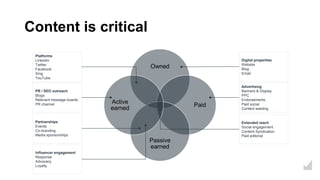
Content is critical
Owned
Paid
Passive
earned
Active
earned
Advertising
Banners & Display
PPC
Endorsements
Paid social
Content seeding
Partnerships
Events
Co-branding
Media sponsorships
Influencer engagement
Response
Advocacy
Loyalty
PR / SEO outreach
Blogs
Relevant message boards
PR channel
Platforms
LinkedIn
Twitter
Facebook
Xing
YouTube
Digital properties
Website
Blog
Email
Extended reach
Social engagement
Content Syndication
Paid editorial
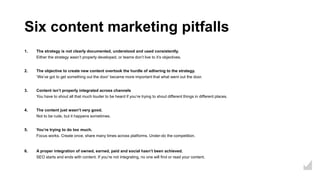
Six content marketing pitfalls
1. The strategy is not clearly documented, understood and used consistently.
Either the strategy wasn’t properly developed, or teams don’t live to it’s objectives.
2. The objective to create new content overtook the hurdle of adhering to the strategy.
‘We’ve got to get something out the door’ became more important that what went out the door.
3. Content isn’t properly integrated across channels
You have to shout all that much louder to be heard if you’re trying to shout different things in different places.
4. The content just wasn’t very good.
Not to be rude, but it happens sometimes.
5. You’re trying to do too much.
Focus works. Create once, share many times across platforms. Under-do the competition.
6. A proper integration of owned, earned, paid and social hasn’t been achieved.
SEO starts and ends with content. If you’re not integrating, no one will find or read your content.
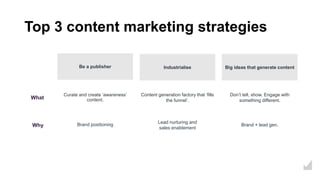
Top 3 content marketing strategies
Be a publisher Industrialise Big ideas that generate content
Curate and create ‘awareness’
content.
Content generation factory that ‘fills
the funnel’.
Don’t tell, show. Engage with
something different.
What
Why Brand positioning
Lead nurturing and
sales enablement
Brand + lead gen.
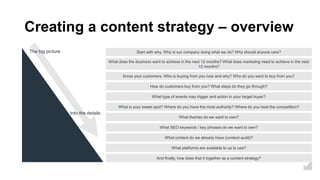
Creating a content strategy – overview
Start with why. Why is our company doing what we do? Why should anyone care?
Know your customers. Who is buying from you now and why? Who do you want to buy from you?
What does the business want to achieve in the next 12 months? What does marketing need to achieve in the next
12 months?
How do customers buy from you? What steps do they go through?
What type of events may trigger and action in your target buyer?
What is your sweet spot? Where do you have the most authority? Where do you beat the competition?
What themes do we want to own?
What SEO keywords / key phrases do we want to own?
What content do we already have (content audit)?
What platforms are available to us to use?
And finally, how does that it together as a content strategy?
The big picture
Into the details
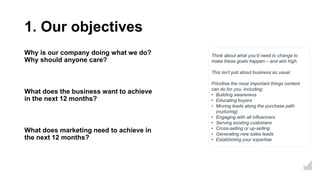
1. Our objectives
Why is our company doing what we do?
Why should anyone care?
What does the business want to achieve
in the next 12 months?
What does marketing need to achieve in
the next 12 months?
Think about what you’d need to change to
make these goals happen – and aim high.
This isn’t just about business as usual.
Prioritise the most important things content
can do for you, including:
• Building awareness
• Educating buyers
• Moving leads along the purchase path
(nurturing)
• Engaging with all influencers
• Serving existing customers
• Cross-selling or up-selling
• Generating new sales leads
• Establishing your expertise
2. Our audience
Who is buying from us now and why?
Who do you want to buy from you?
What does our ideal customer look like?
Create short, visual personas that describe
buyers.
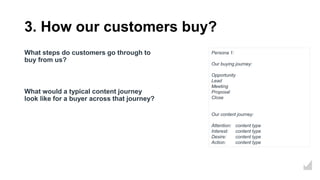
3. How our customers buy?
What steps do customers go through to
buy from us?
What would a typical content journey
look like for a buyer across that journey?
Persona 1:
Our buying journey:
Opportunity
Lead
Meeting
Proposal
Close
Our content journey:
Attention: content type
Interest: content type
Desire: content type
Action: content type
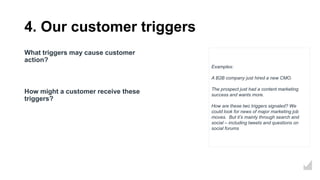
4. Our customer triggers
What triggers may cause customer
action?
How might a customer receive these
triggers?
Examples:
A B2B company just hired a new CMO.
The prospect just had a content marketing
success and wants more.
How are these two triggers signaled? We
could look for news of major marketing job
moves. But it’s mainly through search and
social – including tweets and questions on
social forums
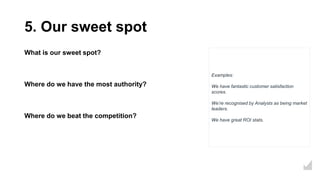
5. Our sweet spot
What is our sweet spot?
Where do we have the most authority?
Where do we beat the competition?
Examples:
We have fantastic customer satisfaction
scores.
We’re recognised by Analysts as being market
leaders.
We have great ROI stats.
6. Our themes
What themes do we want to own?
What themes are in our sweet spot?
What themes will trigger customer action?
Themes are bigger than topics – they
represent a whole area that we want to own,
and may embrace multiple sub-topics
7. Our key phrases
What SEO keywords / key phrases do we
want to own?
Are there priorities within this list?
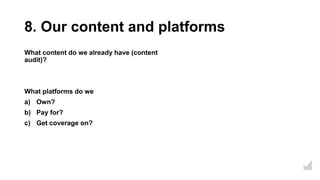
8. Our content and platforms
What content do we already have (content
audit)?
What platforms do we
a) Own?
b) Pay for?
c) Get coverage on?
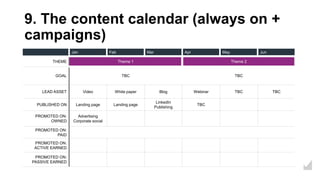
9. The content calendar (always on +
campaigns)
Jan Feb Mar Apr May Jun
THEME Theme 1 Theme 2
GOAL TBC TBC
LEAD ASSET Video White paper Blog Webinar TBC TBC
PUBLISHED ON Landing page Landing page
LinkedIn
Publishing
TBC
PROMOTED ON:
OWNED
Advertising
Corporate social
PROMOTED ON:
PAID
PROMOTED ON:
ACTIVE EARNED
PROMOTED ON:
PASSIVE EARNED
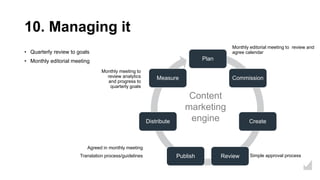
10. Managing it
• Quarterly review to goals
• Monthly editorial meeting Plan
Commission
Create
ReviewPublish
Distribute
Measure
Content
marketing
engine
Monthly editorial meeting to review and
agree calendar
Simple approval process
Monthly meeting to
review analytics
and progress to
quarterly goals
Agreed in monthly meeting
Translation process/guidelines
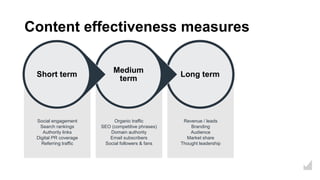
Organic traffic
SEO (competitive phrases)
Domain authority
Email subscribers
Social followers & fans
Revenue / leads
Branding
Audience
Market share
Thought leadership
Social engagement
Search rankings
Authority links
Digital PR coverage
Referring traffic
Content effectiveness measures
Long term
Medium
term
Short term
For more information, please contact: linkedin.com/in/cjbailey

10 steps to creating a B2B content strategy

  • 1.
    10 steps tocreating a B2B content strategy
  • 2.
    Content is critical Owned Paid Passive earned Active earned Advertising Banners& Display PPC Endorsements Paid social Content seeding Partnerships Events Co-branding Media sponsorships Influencer engagement Response Advocacy Loyalty PR / SEO outreach Blogs Relevant message boards PR channel Platforms LinkedIn Twitter Facebook Xing YouTube Digital properties Website Blog Email Extended reach Social engagement Content Syndication Paid editorial
  • 3.
    Six content marketingpitfalls 1. The strategy is not clearly documented, understood and used consistently. Either the strategy wasn’t properly developed, or teams don’t live to it’s objectives. 2. The objective to create new content overtook the hurdle of adhering to the strategy. ‘We’ve got to get something out the door’ became more important that what went out the door. 3. Content isn’t properly integrated across channels You have to shout all that much louder to be heard if you’re trying to shout different things in different places. 4. The content just wasn’t very good. Not to be rude, but it happens sometimes. 5. You’re trying to do too much. Focus works. Create once, share many times across platforms. Under-do the competition. 6. A proper integration of owned, earned, paid and social hasn’t been achieved. SEO starts and ends with content. If you’re not integrating, no one will find or read your content.
  • 4.
    Top 3 contentmarketing strategies Be a publisher Industrialise Big ideas that generate content Curate and create ‘awareness’ content. Content generation factory that ‘fills the funnel’. Don’t tell, show. Engage with something different. What Why Brand positioning Lead nurturing and sales enablement Brand + lead gen.
  • 5.
    Creating a contentstrategy – overview Start with why. Why is our company doing what we do? Why should anyone care? Know your customers. Who is buying from you now and why? Who do you want to buy from you? What does the business want to achieve in the next 12 months? What does marketing need to achieve in the next 12 months? How do customers buy from you? What steps do they go through? What type of events may trigger and action in your target buyer? What is your sweet spot? Where do you have the most authority? Where do you beat the competition? What themes do we want to own? What SEO keywords / key phrases do we want to own? What content do we already have (content audit)? What platforms are available to us to use? And finally, how does that it together as a content strategy? The big picture Into the details
  • 6.
    1. Our objectives Whyis our company doing what we do? Why should anyone care? What does the business want to achieve in the next 12 months? What does marketing need to achieve in the next 12 months? Think about what you’d need to change to make these goals happen – and aim high. This isn’t just about business as usual. Prioritise the most important things content can do for you, including: • Building awareness • Educating buyers • Moving leads along the purchase path (nurturing) • Engaging with all influencers • Serving existing customers • Cross-selling or up-selling • Generating new sales leads • Establishing your expertise
  • 7.
    2. Our audience Whois buying from us now and why? Who do you want to buy from you? What does our ideal customer look like? Create short, visual personas that describe buyers.
  • 8.
    3. How ourcustomers buy? What steps do customers go through to buy from us? What would a typical content journey look like for a buyer across that journey? Persona 1: Our buying journey: Opportunity Lead Meeting Proposal Close Our content journey: Attention: content type Interest: content type Desire: content type Action: content type
  • 9.
    4. Our customertriggers What triggers may cause customer action? How might a customer receive these triggers? Examples: A B2B company just hired a new CMO. The prospect just had a content marketing success and wants more. How are these two triggers signaled? We could look for news of major marketing job moves. But it’s mainly through search and social – including tweets and questions on social forums
  • 10.
    5. Our sweetspot What is our sweet spot? Where do we have the most authority? Where do we beat the competition? Examples: We have fantastic customer satisfaction scores. We’re recognised by Analysts as being market leaders. We have great ROI stats.
  • 11.
    6. Our themes Whatthemes do we want to own? What themes are in our sweet spot? What themes will trigger customer action? Themes are bigger than topics – they represent a whole area that we want to own, and may embrace multiple sub-topics
  • 12.
    7. Our keyphrases What SEO keywords / key phrases do we want to own? Are there priorities within this list?
  • 13.
    8. Our contentand platforms What content do we already have (content audit)? What platforms do we a) Own? b) Pay for? c) Get coverage on?
  • 14.
    9. The contentcalendar (always on + campaigns) Jan Feb Mar Apr May Jun THEME Theme 1 Theme 2 GOAL TBC TBC LEAD ASSET Video White paper Blog Webinar TBC TBC PUBLISHED ON Landing page Landing page LinkedIn Publishing TBC PROMOTED ON: OWNED Advertising Corporate social PROMOTED ON: PAID PROMOTED ON: ACTIVE EARNED PROMOTED ON: PASSIVE EARNED
  • 15.
    10. Managing it •Quarterly review to goals • Monthly editorial meeting Plan Commission Create ReviewPublish Distribute Measure Content marketing engine Monthly editorial meeting to review and agree calendar Simple approval process Monthly meeting to review analytics and progress to quarterly goals Agreed in monthly meeting Translation process/guidelines
  • 16.
    Organic traffic SEO (competitivephrases) Domain authority Email subscribers Social followers & fans Revenue / leads Branding Audience Market share Thought leadership Social engagement Search rankings Authority links Digital PR coverage Referring traffic Content effectiveness measures Long term Medium term Short term
  • 17.
    For more information,please contact: linkedin.com/in/cjbailey