© Xtage Technologies Pvt Ltd
XTAGE
Analyze. Predict. Improve.
Gurgaon, India
10 step guide to using analytics
Kumar Kashyap
Arijit Ganguly
© Xtage Technologies Pvt Ltd 2
INTRODUCTION
Analytics is all about using data to identify trends, validate
hypotheses, and predict future outcomes. Communication of results
through charts and graphs is a part of data visualizations.
With all the buzz around data & big data technologies these days, it is
very easy to go overboard – without you and your organization being
ready to unlock the true potential of data. Here is a quick and easy
10-step guide to using analytics.
You can read the complete article on our blog.
© Xtage Technologies Pvt Ltd 3
1NE
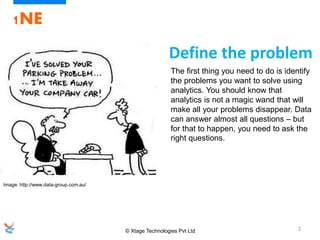
The first thing you need to do is identify
the problems you want to solve using
analytics. You should know that
analytics is not a magic wand that will
make all your problems disappear. Data
can answer almost all questions – but
for that to happen, you need to ask the
right questions.
Define the problem
Image: http://www.data-group.com.au/
© Xtage Technologies Pvt Ltd 4
2WO
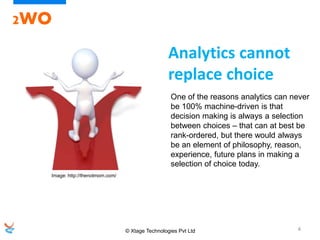
One of the reasons analytics can never
be 100% machine-driven is that
decision making is always a selection
between choices – that can at best be
rank-ordered, but there would always
be an element of philosophy, reason,
experience, future plans in making a
selection of choice today.
Analytics cannot
replace choice
Image: http://thenotmom.com/
© Xtage Technologies Pvt Ltd 5
3HREE
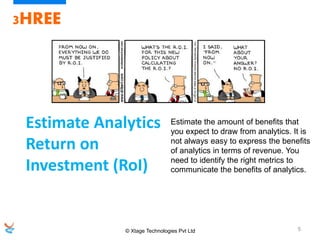
Estimate the amount of benefits that
you expect to draw from analytics. It is
not always easy to express the benefits
of analytics in terms of revenue. You
need to identify the right metrics to
communicate the benefits of analytics.
Estimate Analytics
Return on
Investment (RoI)
© Xtage Technologies Pvt Ltd 6
4OUR
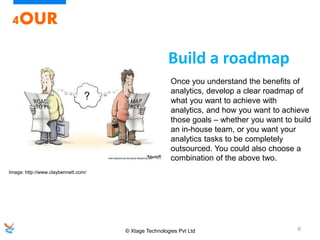
Once you understand the benefits of
analytics, develop a clear roadmap of
what you want to achieve with
analytics, and how you want to achieve
those goals – whether you want to build
an in-house team, or you want your
analytics tasks to be completely
outsourced. You could also choose a
combination of the above two.
Build a roadmap
Image: http://www.claybennett.com/
© Xtage Technologies Pvt Ltd 7
5IVE
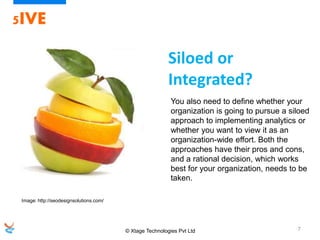
You also need to define whether your
organization is going to pursue a siloed
approach to implementing analytics or
whether you want to view it as an
organization-wide effort. Both the
approaches have their pros and cons,
and a rational decision, which works
best for your organization, needs to be
taken.
Siloed or
Integrated?
Image: http://seodesignsolutions.com/
© Xtage Technologies Pvt Ltd 8
6IX
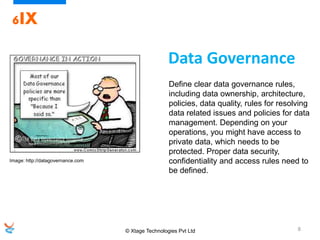
Define clear data governance rules,
including data ownership, architecture,
policies, data quality, rules for resolving
data related issues and policies for data
management. Depending on your
operations, you might have access to
private data, which needs to be
protected. Proper data security,
confidentiality and access rules need to
be defined.
Data Governance
Image: http://datagovernance.com
© Xtage Technologies Pvt Ltd 9
7EVEN
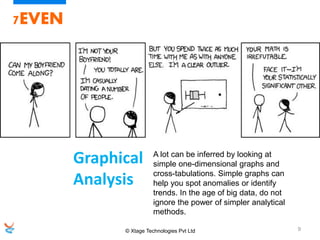
A lot can be inferred by looking at
simple one-dimensional graphs and
cross-tabulations. Simple graphs can
help you spot anomalies or identify
trends. In the age of big data, do not
ignore the power of simpler analytical
methods.
Graphical
Analysis
© Xtage Technologies Pvt Ltd 10
8IGHT
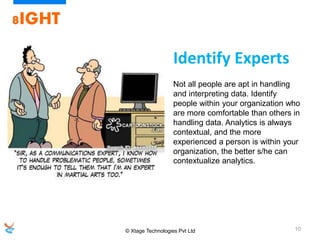
Not all people are apt in handling
and interpreting data. Identify
people within your organization who
are more comfortable than others in
handling data. Analytics is always
contextual, and the more
experienced a person is within your
organization, the better s/he can
contextualize analytics.
Identify Experts
© Xtage Technologies Pvt Ltd 11
9INE
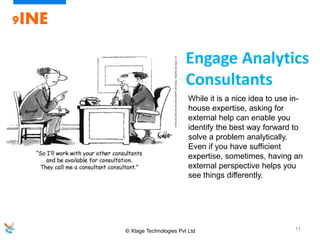
While it is a nice idea to use in-
house expertise, asking for
external help can enable you
identify the best way forward to
solve a problem analytically.
Even if you have sufficient
expertise, sometimes, having an
external perspective helps you
see things differently.
Engage Analytics
Consultants
© Xtage Technologies Pvt Ltd 12
10EN
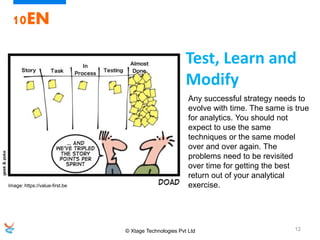
Any successful strategy needs to
evolve with time. The same is true
for analytics. You should not
expect to use the same
techniques or the same model
over and over again. The
problems need to be revisited
over time for getting the best
return out of your analytical
exercise.
Test, Learn and
Modify
Image: https://value-first.be
© Xtage Technologies Pvt Ltd 13
THANK YOU
Please send any questions / feedback to
kumar.kashyap@xtagelabs.com
arijit.ganguly@xtagelabs.com
Check out more examples and case
studies on how we help organizations
using data, analytics and visualization.

10 Step Guide to Analytics

  • 1.
    © Xtage TechnologiesPvt Ltd XTAGE Analyze. Predict. Improve. Gurgaon, India 10 step guide to using analytics Kumar Kashyap Arijit Ganguly
  • 2.
    © Xtage TechnologiesPvt Ltd 2 INTRODUCTION Analytics is all about using data to identify trends, validate hypotheses, and predict future outcomes. Communication of results through charts and graphs is a part of data visualizations. With all the buzz around data & big data technologies these days, it is very easy to go overboard – without you and your organization being ready to unlock the true potential of data. Here is a quick and easy 10-step guide to using analytics. You can read the complete article on our blog.
  • 3.
    © Xtage TechnologiesPvt Ltd 3 1NE The first thing you need to do is identify the problems you want to solve using analytics. You should know that analytics is not a magic wand that will make all your problems disappear. Data can answer almost all questions – but for that to happen, you need to ask the right questions. Define the problem Image: http://www.data-group.com.au/
  • 4.
    © Xtage TechnologiesPvt Ltd 4 2WO One of the reasons analytics can never be 100% machine-driven is that decision making is always a selection between choices – that can at best be rank-ordered, but there would always be an element of philosophy, reason, experience, future plans in making a selection of choice today. Analytics cannot replace choice Image: http://thenotmom.com/
  • 5.
    © Xtage TechnologiesPvt Ltd 5 3HREE Estimate the amount of benefits that you expect to draw from analytics. It is not always easy to express the benefits of analytics in terms of revenue. You need to identify the right metrics to communicate the benefits of analytics. Estimate Analytics Return on Investment (RoI)
  • 6.
    © Xtage TechnologiesPvt Ltd 6 4OUR Once you understand the benefits of analytics, develop a clear roadmap of what you want to achieve with analytics, and how you want to achieve those goals – whether you want to build an in-house team, or you want your analytics tasks to be completely outsourced. You could also choose a combination of the above two. Build a roadmap Image: http://www.claybennett.com/
  • 7.
    © Xtage TechnologiesPvt Ltd 7 5IVE You also need to define whether your organization is going to pursue a siloed approach to implementing analytics or whether you want to view it as an organization-wide effort. Both the approaches have their pros and cons, and a rational decision, which works best for your organization, needs to be taken. Siloed or Integrated? Image: http://seodesignsolutions.com/
  • 8.
    © Xtage TechnologiesPvt Ltd 8 6IX Define clear data governance rules, including data ownership, architecture, policies, data quality, rules for resolving data related issues and policies for data management. Depending on your operations, you might have access to private data, which needs to be protected. Proper data security, confidentiality and access rules need to be defined. Data Governance Image: http://datagovernance.com
  • 9.
    © Xtage TechnologiesPvt Ltd 9 7EVEN A lot can be inferred by looking at simple one-dimensional graphs and cross-tabulations. Simple graphs can help you spot anomalies or identify trends. In the age of big data, do not ignore the power of simpler analytical methods. Graphical Analysis
  • 10.
    © Xtage TechnologiesPvt Ltd 10 8IGHT Not all people are apt in handling and interpreting data. Identify people within your organization who are more comfortable than others in handling data. Analytics is always contextual, and the more experienced a person is within your organization, the better s/he can contextualize analytics. Identify Experts
  • 11.
    © Xtage TechnologiesPvt Ltd 11 9INE While it is a nice idea to use in- house expertise, asking for external help can enable you identify the best way forward to solve a problem analytically. Even if you have sufficient expertise, sometimes, having an external perspective helps you see things differently. Engage Analytics Consultants
  • 12.
    © Xtage TechnologiesPvt Ltd 12 10EN Any successful strategy needs to evolve with time. The same is true for analytics. You should not expect to use the same techniques or the same model over and over again. The problems need to be revisited over time for getting the best return out of your analytical exercise. Test, Learn and Modify Image: https://value-first.be
  • 13.
    © Xtage TechnologiesPvt Ltd 13 THANK YOU Please send any questions / feedback to kumar.kashyap@xtagelabs.com arijit.ganguly@xtagelabs.com Check out more examples and case studies on how we help organizations using data, analytics and visualization.