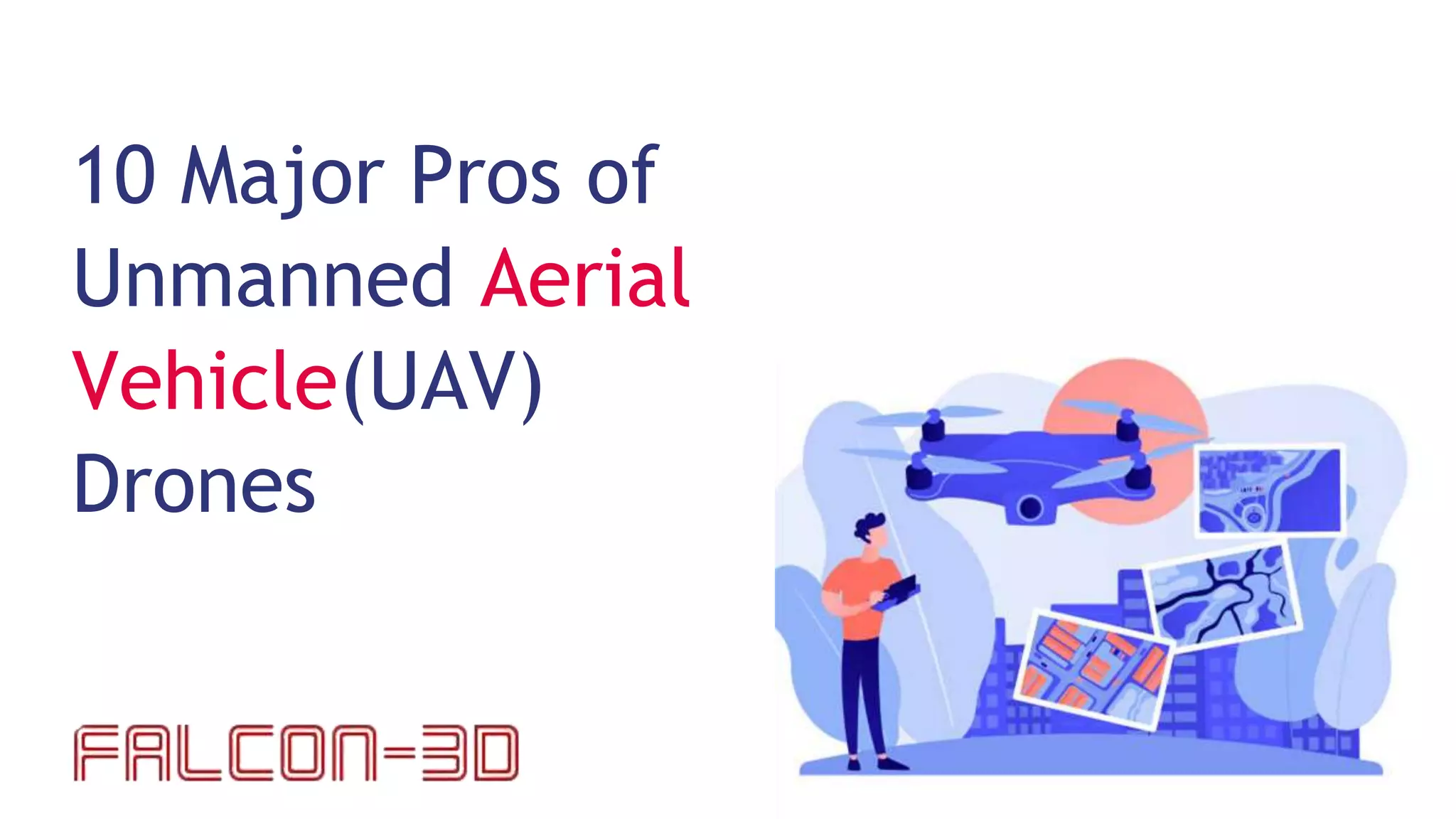
10 Major Pros of
Unmanned Aerial
Vehicle(UAV)
Drones
Drones that master the art of data collection efficiently are now part
of the current inspection standard. The use of unmanned aerial
vehicles (UAVs) has prompted various businesses to adopt new
methods. However, all of the benefits come with a few drawbacks.
Even while Drones strive toward perfection, they aren't perfect.
Examine the following 10 key Pros and Cons of Unmanned Aerial
Vehicles (UAVs) to learn more about what drones can do.
Pros of Unmanned Aerial
Vehicle
● Maintaining A Safe Environment
● Cost Saving Technology
● Quality Of Aerial Imaging
● Precision
● Easy To Control Or Deploy
● Security
● Minimizes Obvious Danger And Health
Risks
● Install In-Depth And Detailed Data
● Flexibility For Quick Inspections
● Reach Hazardous Areas
Maintaining A Safe Environment
Because of their improved safety, UAVs are used in a variety of
situations. Drones use their remote control capabilities to monitor
sites, communicate potential hazards, and alert people to
potentially dangerous situations. refineries, pipelines, and flare
stacks, to name a few. Not only that but drone technology is also
used by the military during high-risk situations. Their features
enable them to collect real-time data in order to develop and
maintain a secure environment.
Cost Saving Technology
As the range of applications for drones expands, so does their
pricing, which is becoming more affordable. Drones are
currently being purchased not only for industrial purposes but
also to satisfy the desires of tech-savvy gadget enthusiasts.
UAVs are no longer limited to the military, law enforcement, or
the wealthy. Many costs are saved in commercial applications
since UAVs take over multiple workforces, vehicles, and
operating operations. For inspections, for example, a Drone is
less expensive to purchase, maintain, and fuel than an
aeroplane. You also won't need to hire a ladder, aerial lifts, or
any other heavy machinery.
UAVs can capture outstanding aerial photographs, and aerial films, and
collect vast amounts of correct data thanks to their high-resolution
cameras equipped with top-notch sensors. For a thorough study, the data is
turned into detailed 3D Maps and 3D Models. In catastrophe situations, 3D
mapping is very useful for revealing fissures, damages, and other
potentially dangerous aspects. Drones are well-known for live streaming
key events such as entertainment, personal, political, and world issues
when combined with high-resolution photos or 4K video capabilities.
Quality Of Aerial Imaging
Because UAVs use GPS (Global Positioning System) in their software,
they may be programmed and steered to specified places with pinpoint
accuracy. In Precision Agriculture, for example, a Drone Aircraft is used
to execute a variety of tasks such as pesticide spraying, weed
identification, crop health monitoring, crop damage assessment, crop
evaluation, field soil analysis, and irrigation monitoring. Farmers can
save time and money by utilising the GPS precision feature.
Precision
Drone-control technology is constantly improving,
allowing operators with little technical knowledge to
easily deploy and operate drones. Drones are accessible
to a wide range of operators due to the wide range of
low-cost drones available for a variety of uses. When
compared to a crewed aircraft, unmanned aerial vehicles
(UAVs) have a wider range of motion, fly lower in all
directions, and navigate more easily.
Easy To Control Or Deploy
Another benefit that balances out the
benefits and drawbacks of drones is the
security that surrounds them. Drone
operators can use an Unmanned Aircraft
System (UAS) to provide safety and
surveillance to private organisations,
possible venues, and other expenses
with the appropriate approvals and
licences.
Security
Numerous concerns that crew members formerly faced, such
as elevation, wind, weather, and radiation, have been replaced
with more feasible and safer choices thanks to the assistance
of a Drone. Drones make inspections of tall and sophisticated
structures like oil and gas refineries, flare stacks, and pipelines
simple and secure.
Minimizes Obvious Danger And Health
Risks
Numerous concerns that crew members formerly faced, such
as elevation, wind, weather, and radiation, have been replaced
with more feasible and safer choices thanks to the assistance
of a Drone. Drones make inspections of tall and sophisticated
structures like oil and gas refineries, flare stacks, and pipelines
simple and secure.
Minimizes Obvious Danger And Health
Risks
Drones are available in a variety of configurations, and some
can do high or low altitude inspections. These qualities'
adaptability allows clients to easily tailor the tools for their
tasks. Drones are appropriate for both routine and emergency
situations, and the construction industry, particularly building
developers, recognises these benefits. Drones can do a variety
of tasks, including taking high-quality photos, films, and
thermal scans, among others. In contrast to the time-
consuming traditional method, this data is instantaneously
delivered and processed.
Flexibility For Quick Inspections
For industry specialists, gathering efficient data from difficult-
to-reach regions is a piece of cake with UAVs. It is the best
option for overcoming the limits of traditional approaches in
terms of worker safety, particularly in hazardous scenarios
such as radiation monitoring and high-voltage line inspection.
Drones also offer a more cost-effective approach to these
examinations.
Reach Hazardous Areas
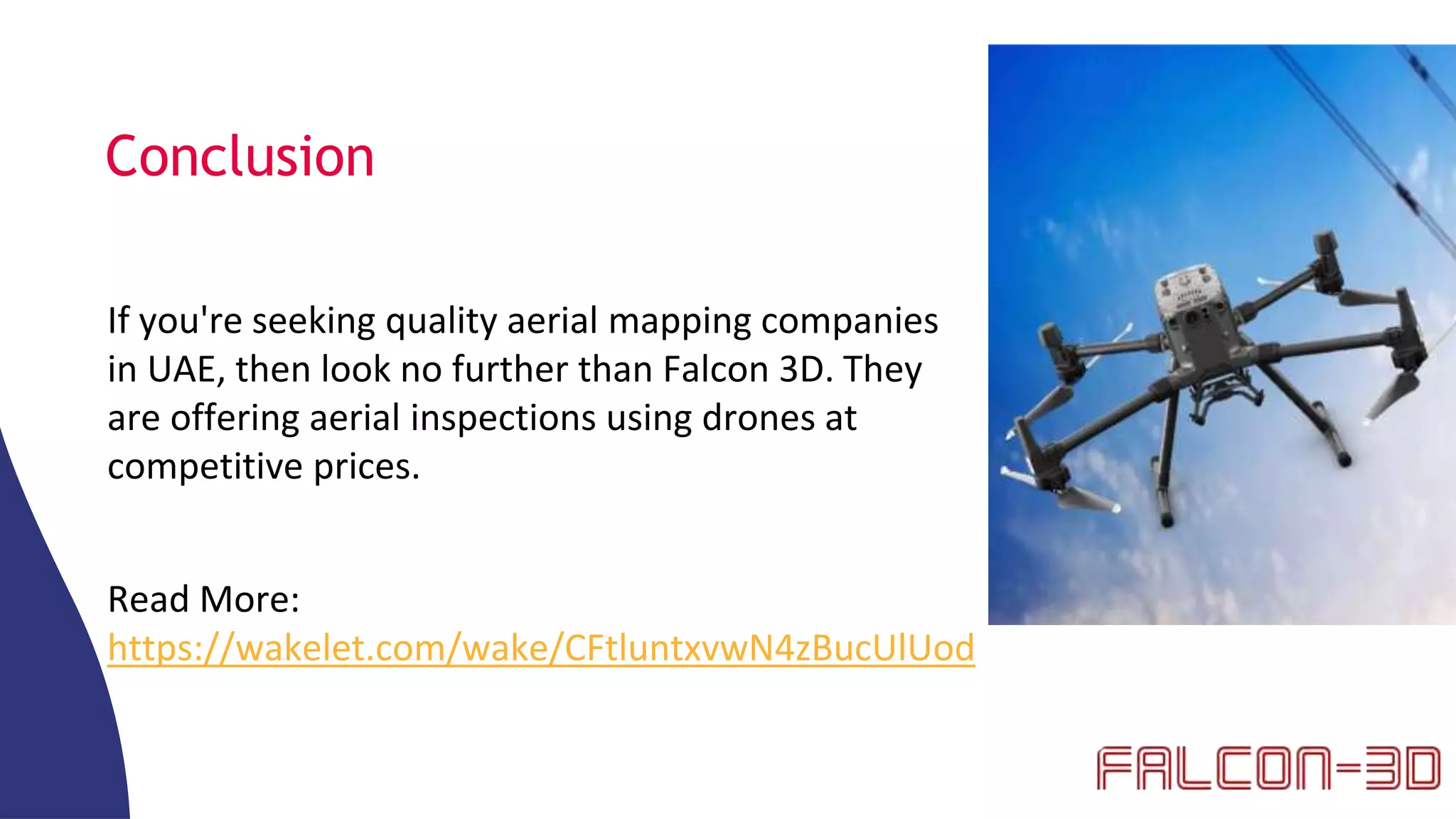
If you're seeking quality aerial mapping companies
in UAE, then look no further than Falcon 3D. They
are offering aerial inspections using drones at
competitive prices.
Conclusion
Read More:
https://wakelet.com/wake/CFtluntxvwN4zBucUlUod
Suite #209, Apricot Tower, Dubai
Silicon Oasis, P.O. Box: 238544
Dubai, United Arab Emirates
+97143271414
info@falconsurveyme.com
Contact Details:
Address
Phone
Email
Thanks

10 Major Pros of Unmanned Aerial Vehicle(UAV) Drones.pptx

  • 1.
    10 Major Prosof Unmanned Aerial Vehicle(UAV) Drones
  • 2.
    Drones that masterthe art of data collection efficiently are now part of the current inspection standard. The use of unmanned aerial vehicles (UAVs) has prompted various businesses to adopt new methods. However, all of the benefits come with a few drawbacks. Even while Drones strive toward perfection, they aren't perfect. Examine the following 10 key Pros and Cons of Unmanned Aerial Vehicles (UAVs) to learn more about what drones can do.
  • 3.
    Pros of UnmannedAerial Vehicle ● Maintaining A Safe Environment ● Cost Saving Technology ● Quality Of Aerial Imaging ● Precision ● Easy To Control Or Deploy ● Security ● Minimizes Obvious Danger And Health Risks ● Install In-Depth And Detailed Data ● Flexibility For Quick Inspections ● Reach Hazardous Areas
  • 4.
    Maintaining A SafeEnvironment Because of their improved safety, UAVs are used in a variety of situations. Drones use their remote control capabilities to monitor sites, communicate potential hazards, and alert people to potentially dangerous situations. refineries, pipelines, and flare stacks, to name a few. Not only that but drone technology is also used by the military during high-risk situations. Their features enable them to collect real-time data in order to develop and maintain a secure environment.
  • 5.
    Cost Saving Technology Asthe range of applications for drones expands, so does their pricing, which is becoming more affordable. Drones are currently being purchased not only for industrial purposes but also to satisfy the desires of tech-savvy gadget enthusiasts. UAVs are no longer limited to the military, law enforcement, or the wealthy. Many costs are saved in commercial applications since UAVs take over multiple workforces, vehicles, and operating operations. For inspections, for example, a Drone is less expensive to purchase, maintain, and fuel than an aeroplane. You also won't need to hire a ladder, aerial lifts, or any other heavy machinery.
  • 6.
    UAVs can captureoutstanding aerial photographs, and aerial films, and collect vast amounts of correct data thanks to their high-resolution cameras equipped with top-notch sensors. For a thorough study, the data is turned into detailed 3D Maps and 3D Models. In catastrophe situations, 3D mapping is very useful for revealing fissures, damages, and other potentially dangerous aspects. Drones are well-known for live streaming key events such as entertainment, personal, political, and world issues when combined with high-resolution photos or 4K video capabilities. Quality Of Aerial Imaging
  • 7.
    Because UAVs useGPS (Global Positioning System) in their software, they may be programmed and steered to specified places with pinpoint accuracy. In Precision Agriculture, for example, a Drone Aircraft is used to execute a variety of tasks such as pesticide spraying, weed identification, crop health monitoring, crop damage assessment, crop evaluation, field soil analysis, and irrigation monitoring. Farmers can save time and money by utilising the GPS precision feature. Precision
  • 8.
    Drone-control technology isconstantly improving, allowing operators with little technical knowledge to easily deploy and operate drones. Drones are accessible to a wide range of operators due to the wide range of low-cost drones available for a variety of uses. When compared to a crewed aircraft, unmanned aerial vehicles (UAVs) have a wider range of motion, fly lower in all directions, and navigate more easily. Easy To Control Or Deploy
  • 9.
    Another benefit thatbalances out the benefits and drawbacks of drones is the security that surrounds them. Drone operators can use an Unmanned Aircraft System (UAS) to provide safety and surveillance to private organisations, possible venues, and other expenses with the appropriate approvals and licences. Security
  • 10.
    Numerous concerns thatcrew members formerly faced, such as elevation, wind, weather, and radiation, have been replaced with more feasible and safer choices thanks to the assistance of a Drone. Drones make inspections of tall and sophisticated structures like oil and gas refineries, flare stacks, and pipelines simple and secure. Minimizes Obvious Danger And Health Risks
  • 11.
    Numerous concerns thatcrew members formerly faced, such as elevation, wind, weather, and radiation, have been replaced with more feasible and safer choices thanks to the assistance of a Drone. Drones make inspections of tall and sophisticated structures like oil and gas refineries, flare stacks, and pipelines simple and secure. Minimizes Obvious Danger And Health Risks
  • 12.
    Drones are availablein a variety of configurations, and some can do high or low altitude inspections. These qualities' adaptability allows clients to easily tailor the tools for their tasks. Drones are appropriate for both routine and emergency situations, and the construction industry, particularly building developers, recognises these benefits. Drones can do a variety of tasks, including taking high-quality photos, films, and thermal scans, among others. In contrast to the time- consuming traditional method, this data is instantaneously delivered and processed. Flexibility For Quick Inspections
  • 13.
    For industry specialists,gathering efficient data from difficult- to-reach regions is a piece of cake with UAVs. It is the best option for overcoming the limits of traditional approaches in terms of worker safety, particularly in hazardous scenarios such as radiation monitoring and high-voltage line inspection. Drones also offer a more cost-effective approach to these examinations. Reach Hazardous Areas
  • 14.
    If you're seekingquality aerial mapping companies in UAE, then look no further than Falcon 3D. They are offering aerial inspections using drones at competitive prices. Conclusion Read More: https://wakelet.com/wake/CFtluntxvwN4zBucUlUod
  • 15.
    Suite #209, ApricotTower, Dubai Silicon Oasis, P.O. Box: 238544 Dubai, United Arab Emirates +97143271414 info@falconsurveyme.com Contact Details: Address Phone Email
  • 16.