Ten Key Differences
Between eDiscovery and
Information Governance
10
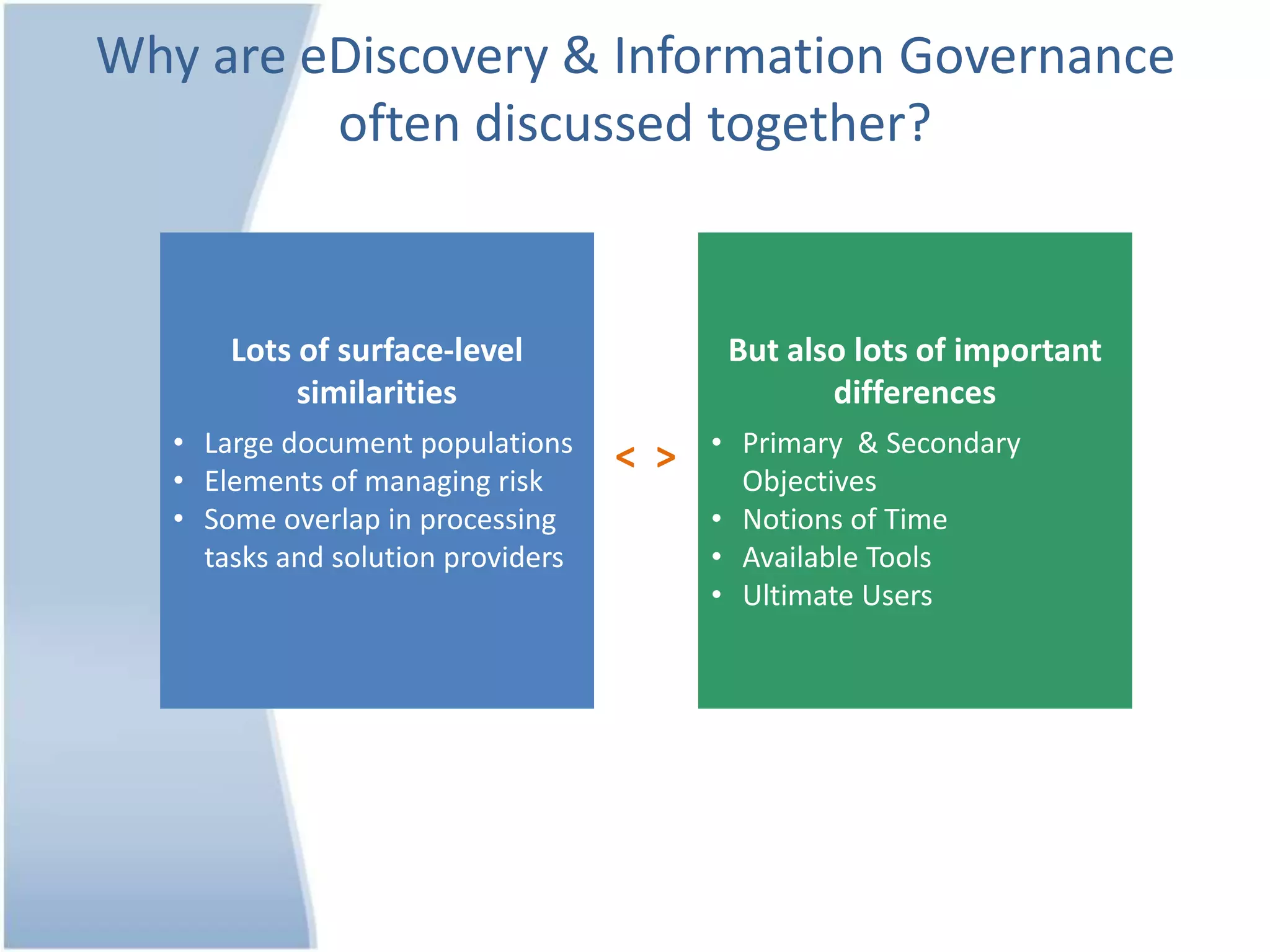
Why are eDiscovery & Information Governance
often discussed together?
Lots of surface-level
similarities
• Large document populations
• Elements of managing risk
• Some overlap in processing
tasks and solution providers
But also lots of important
differences
• Primary & Secondary
Objectives
• Notions of Time
• Available Tools
• Ultimate Users
< >
Quick definitions
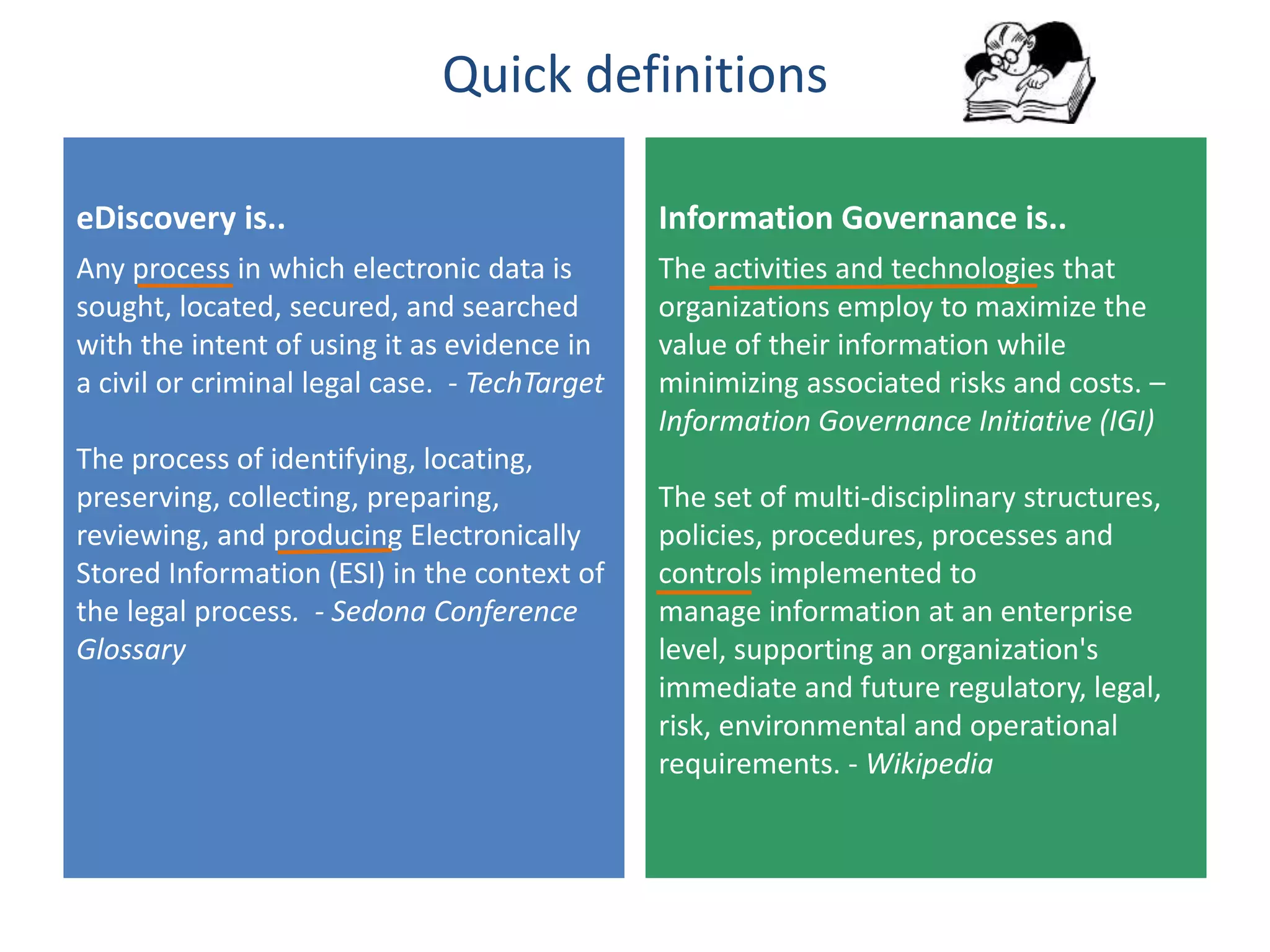
eDiscovery is..
Any process in which electronic data is
sought, located, secured, and searched
with the intent of using it as evidence in
a civil or criminal legal case. - TechTarget
The process of identifying, locating,
preserving, collecting, preparing,
reviewing, and producing Electronically
Stored Information (ESI) in the context of
the legal process. - Sedona Conference
Glossary
Information Governance is..
The activities and technologies that
organizations employ to maximize the
value of their information while
minimizing associated risks and costs. –
Information Governance Initiative (IGI)
The set of multi-disciplinary structures,
policies, procedures, processes and
controls implemented to
manage information at an enterprise
level, supporting an organization's
immediate and future regulatory, legal,
risk, environmental and operational
requirements. - Wikipedia
Key Difference #1: Primary Objective
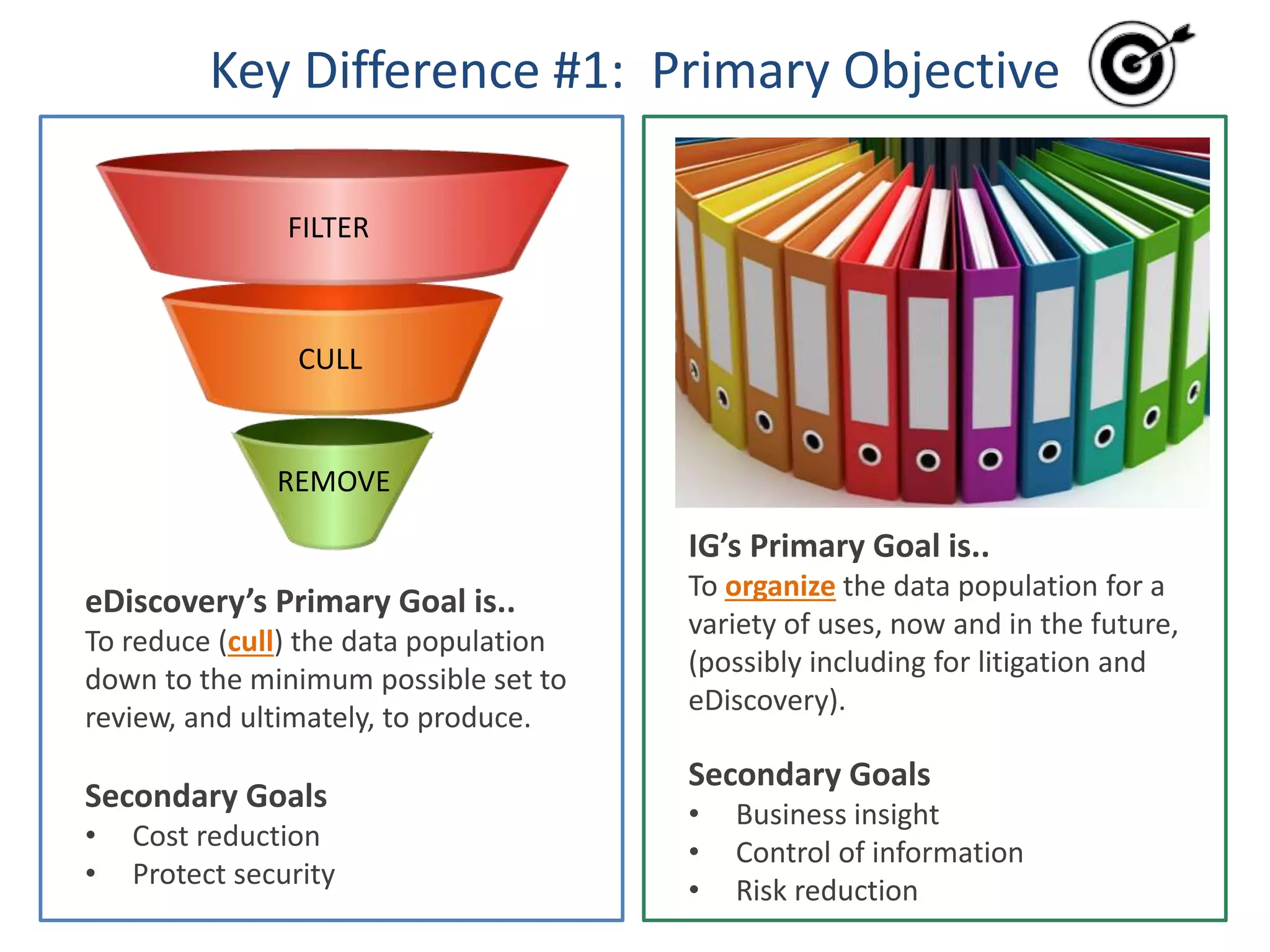
eDiscovery’s Primary Goal is..
To reduce (cull) the data population
down to the minimum possible set to
review, and ultimately, to produce.
Secondary Goals
• Cost reduction
• Protect security
FILTER
CULL
REMOVE
IG’s Primary Goal is..
To organize the data population for a
variety of uses, now and in the future,
(possibly including for litigation and
eDiscovery).
Secondary Goals
• Business insight
• Control of information
• Risk reduction
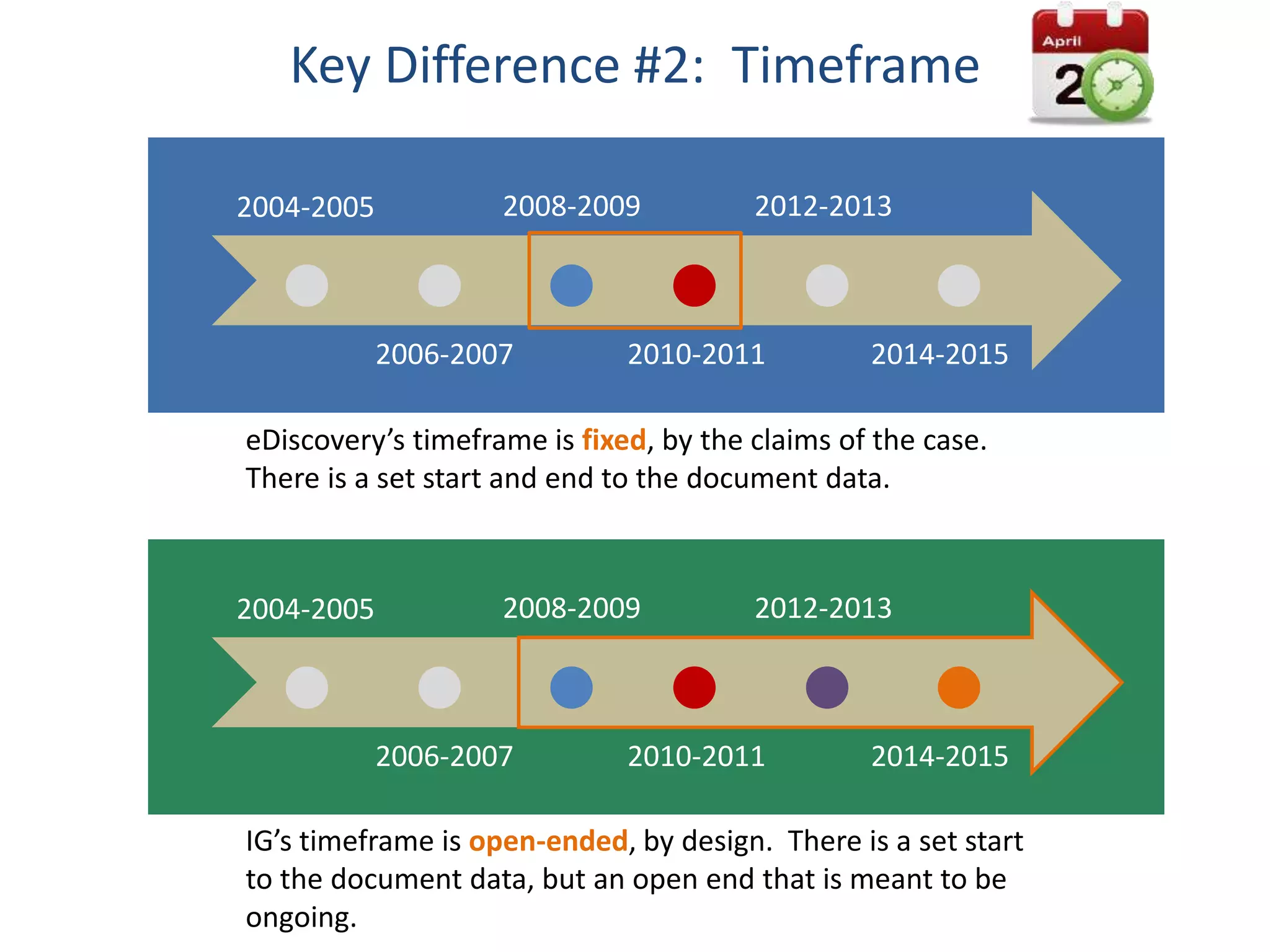
Key Difference #2: Timeframe
2004-2005
2006-2007
2008-2009
2010-2011
2012-2013
2014-2015
eDiscovery’s timeframe is fixed, by the claims of the case.
There is a set start and end to the document data.
2004-2005
2006-2007
2008-2009
2010-2011
2012-2013
2014-2015
IG’s timeframe is open-ended, by design. There is a set start
to the document data, but an open end that is meant to be
ongoing.
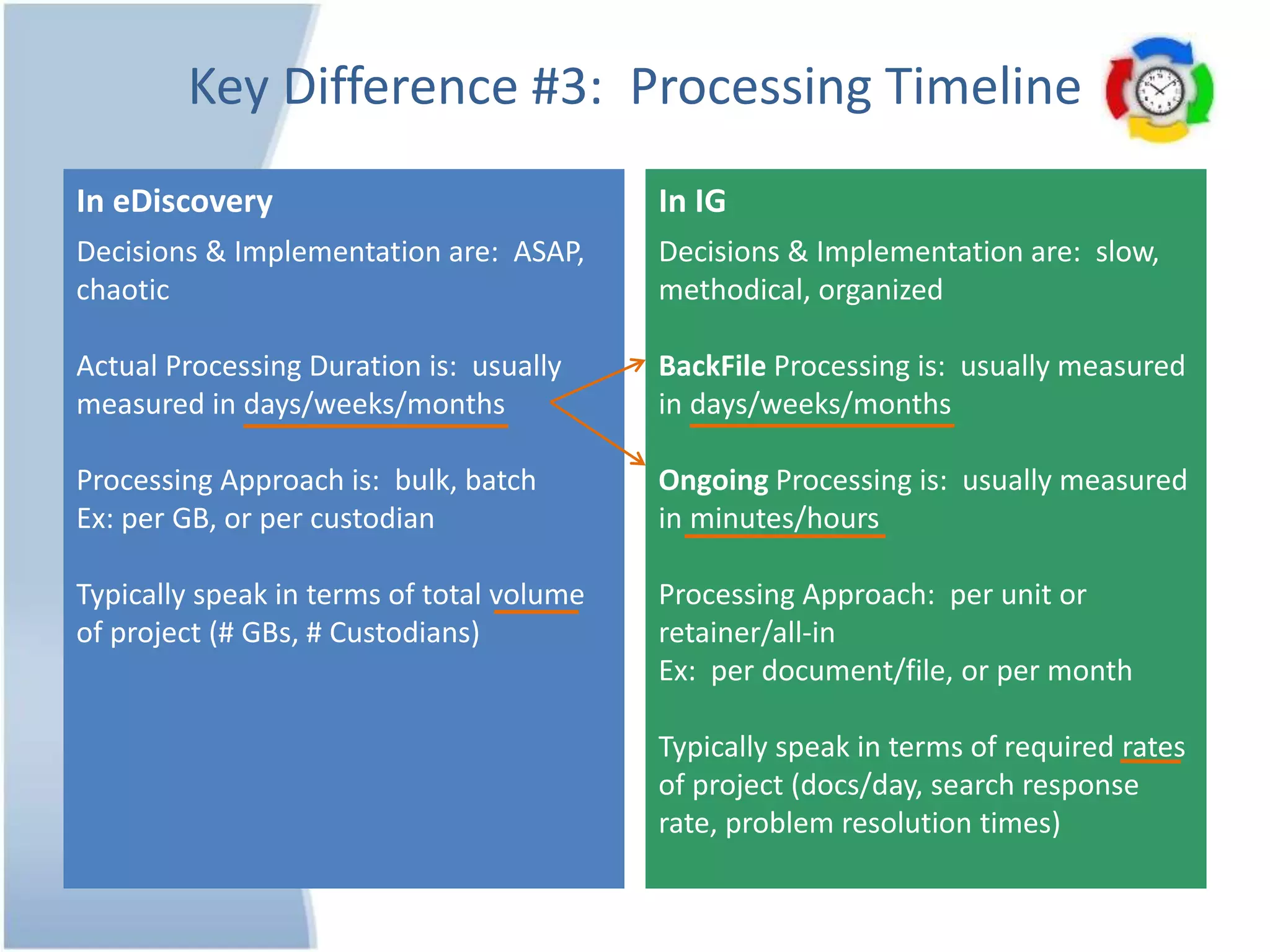
Key Difference #3: Processing Timeline
In eDiscovery
Decisions & Implementation are: ASAP,
chaotic
Actual Processing Duration is: usually
measured in days/weeks/months
Processing Approach is: bulk, batch
Ex: per GB, or per custodian
Typically speak in terms of total volume
of project (# GBs, # Custodians)
In IG
Decisions & Implementation are: slow,
methodical, organized
BackFile Processing is: usually measured
in days/weeks/months
Ongoing Processing is: usually measured
in minutes/hours
Processing Approach: per unit or
retainer/all-in
Ex: per document/file, or per month
Typically speak in terms of required rates
of project (docs/day, search response
rate, problem resolution times)
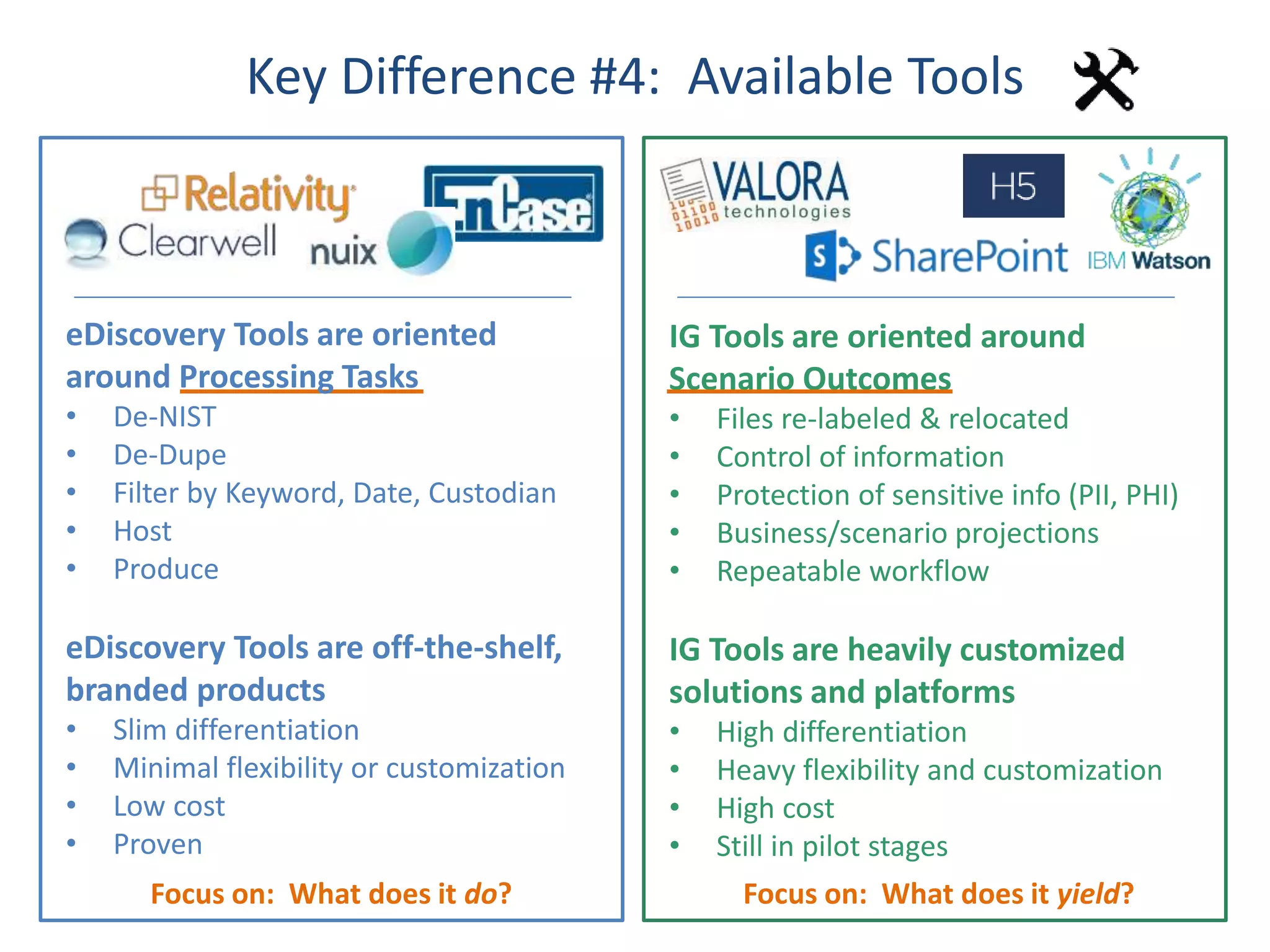
Key Difference #4: Available Tools
eDiscovery Tools are oriented
around Processing Tasks
• De-NIST
• De-Dupe
• Filter by Keyword, Date, Custodian
• Host
• Produce
eDiscovery Tools are off-the-shelf,
branded products
• Slim differentiation
• Minimal flexibility or customization
• Low cost
• Proven
IG Tools are oriented around
Scenario Outcomes
• Files re-labeled & relocated
• Control of information
• Protection of sensitive info (PII, PHI)
• Business/scenario projections
• Repeatable workflow
IG Tools are heavily customized
solutions and platforms
• High differentiation
• Heavy flexibility and customization
• High cost
• Still in pilot stages
Focus on: What does it do? Focus on: What does it yield?
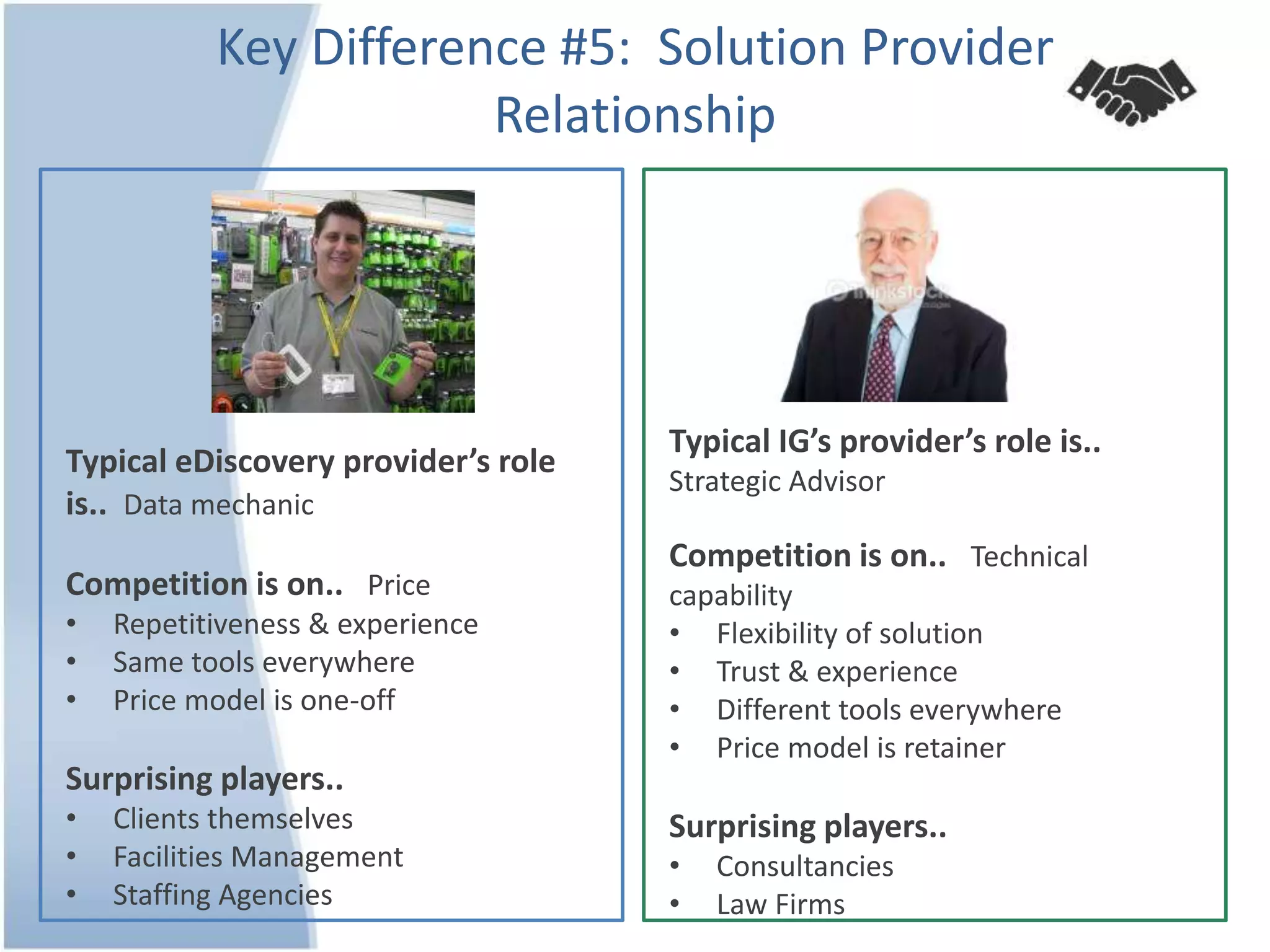
Key Difference #5: Solution Provider
Relationship
Typical eDiscovery provider’s role
is.. Data mechanic
Competition is on.. Price
• Repetitiveness & experience
• Same tools everywhere
• Price model is one-off
Surprising players..
• Clients themselves
• Facilities Management
• Staffing Agencies
Typical IG’s provider’s role is..
Strategic Advisor
Competition is on.. Technical
capability
• Flexibility of solution
• Trust & experience
• Different tools everywhere
• Price model is retainer
Surprising players..
• Consultancies
• Law Firms
Key Difference #6: Starting Data &
Document Organization
• Intake vs. collection
– eDiscovery undertakes a sophisticated and detailed effort of
carefully executed collections, often involving custodian
interviews, data maps and targeted, forensic collections
– IG typically utilizes a batch collection/migration approach for
existing data (Backfile)
– IG also creates an ongoing Intake system for new documents or
files as they are created/submitted/decommissioned, etc.
Intake typically includes:
• ESI: Email transmission (w/ attachments)
• ESI: Drag & Drop web-based submission
• Paper: Fax, Mail and in-person
START
Key Difference #6: Starting Data &
Document Organization
• Live Documents vs. Copies
– eDiscovery uses forensic (or
scanned) copies of files,
rather than the actual
“active” files.
• Copied files are used in a
separate, litigation-specific
database for off-line, non-
active usage
– IG typically utilizes “live”
documents, in the systems in
which the documents
typically reside and are
actively used
• Sophisticated requirements
for version control and
check-in/-out
• Organized by Custodian
(Source) or by Topic
(Classification)
– eDiscovery organizes files by
their source, or custodian
• Documents are rarely
moved from one source to
another and are specifically
not renamed or altered in
any way.
– IG organizes files by their
contents, or key topics
• Documents are frequently
moved from one area to
another and are
intentionally renamed,
removed, restricted or
altered as required.
START
Key Difference #7: Ending Data &
Document Organization
• Same as Outset or Changed
from Original?
– eDiscovery does NOT change
the original files
• Simply stored temporarily in
a litigation database
– IG DOES change the original
files
• Dispose of or keep?
– At matter end, the eDiscovery
database is deleted.
– IG keeps documents in a
document management
system, indefinitely.
FINISH
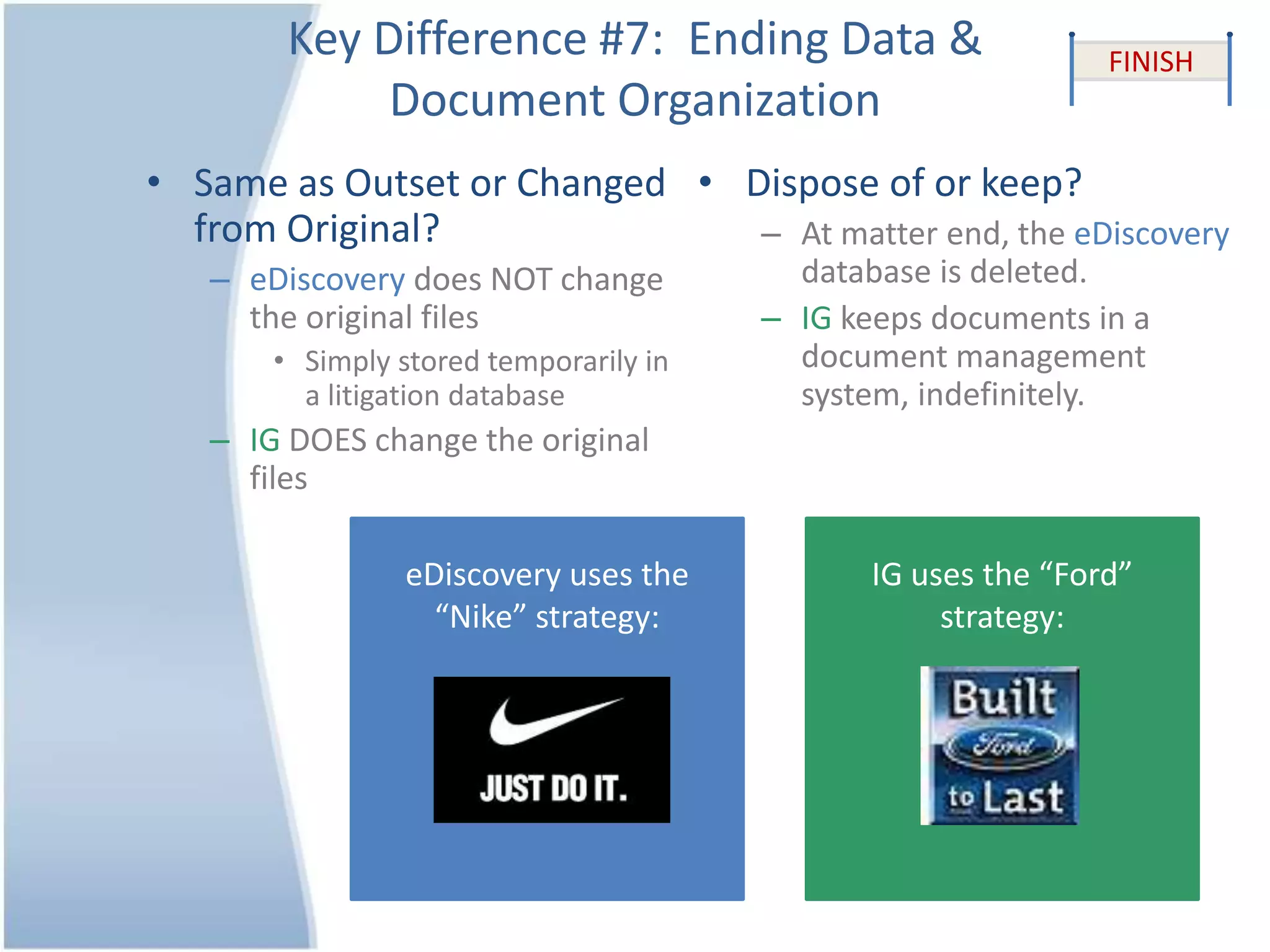
eDiscovery uses the
“Nike” strategy:
IG uses the “Ford”
strategy:
Key Difference #8: Users
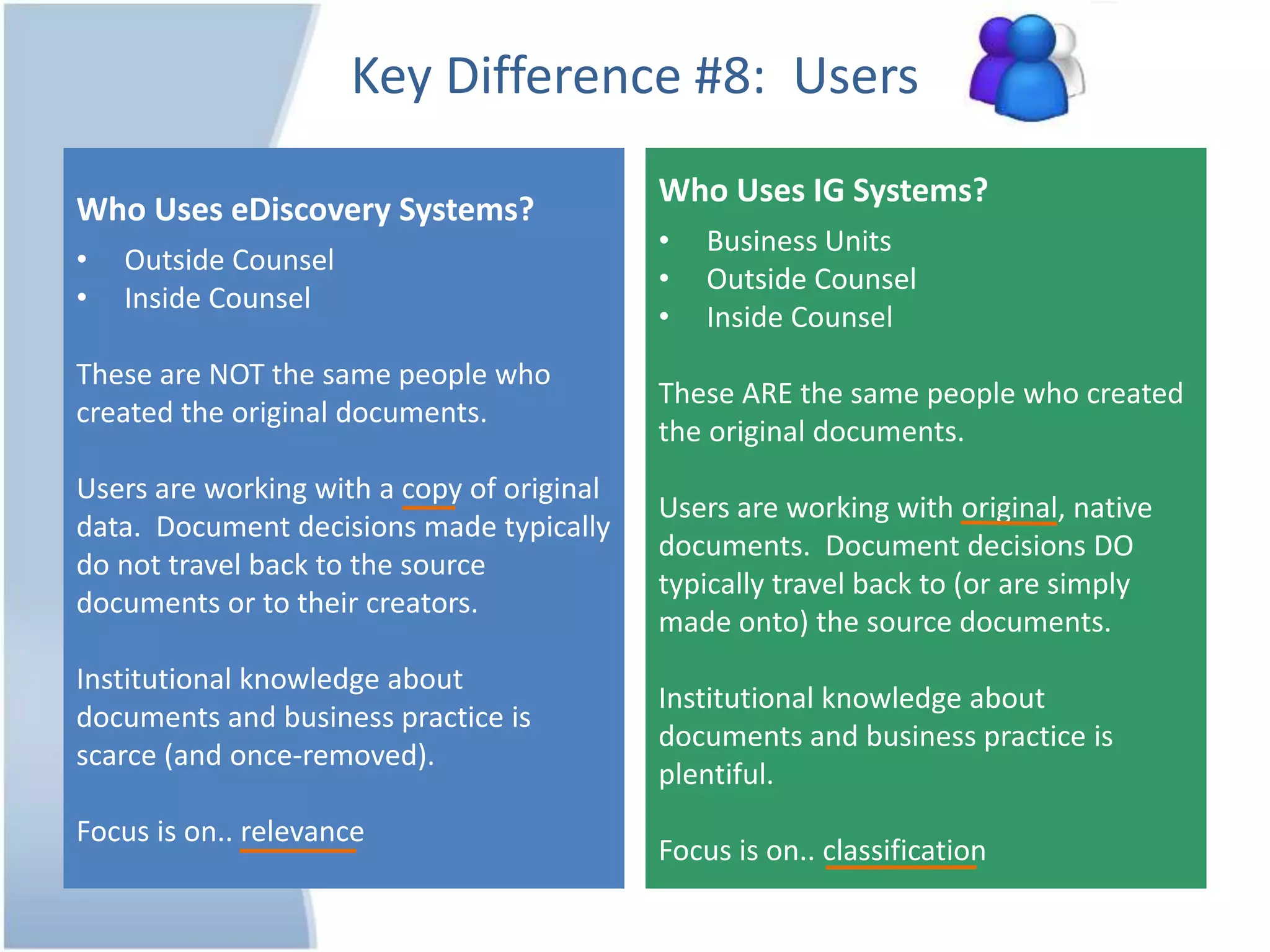
Who Uses eDiscovery Systems?
• Outside Counsel
• Inside Counsel
These are NOT the same people who
created the original documents.
Users are working with a copy of original
data. Document decisions made typically
do not travel back to the source
documents or to their creators.
Institutional knowledge about
documents and business practice is
scarce (and once-removed).
Focus is on.. relevance
Who Uses IG Systems?
• Business Units
• Outside Counsel
• Inside Counsel
These ARE the same people who created
the original documents.
Users are working with original, native
documents. Document decisions DO
typically travel back to (or are simply
made onto) the source documents.
Institutional knowledge about
documents and business practice is
plentiful.
Focus is on.. classification
Key Difference #9: Error Tolerance
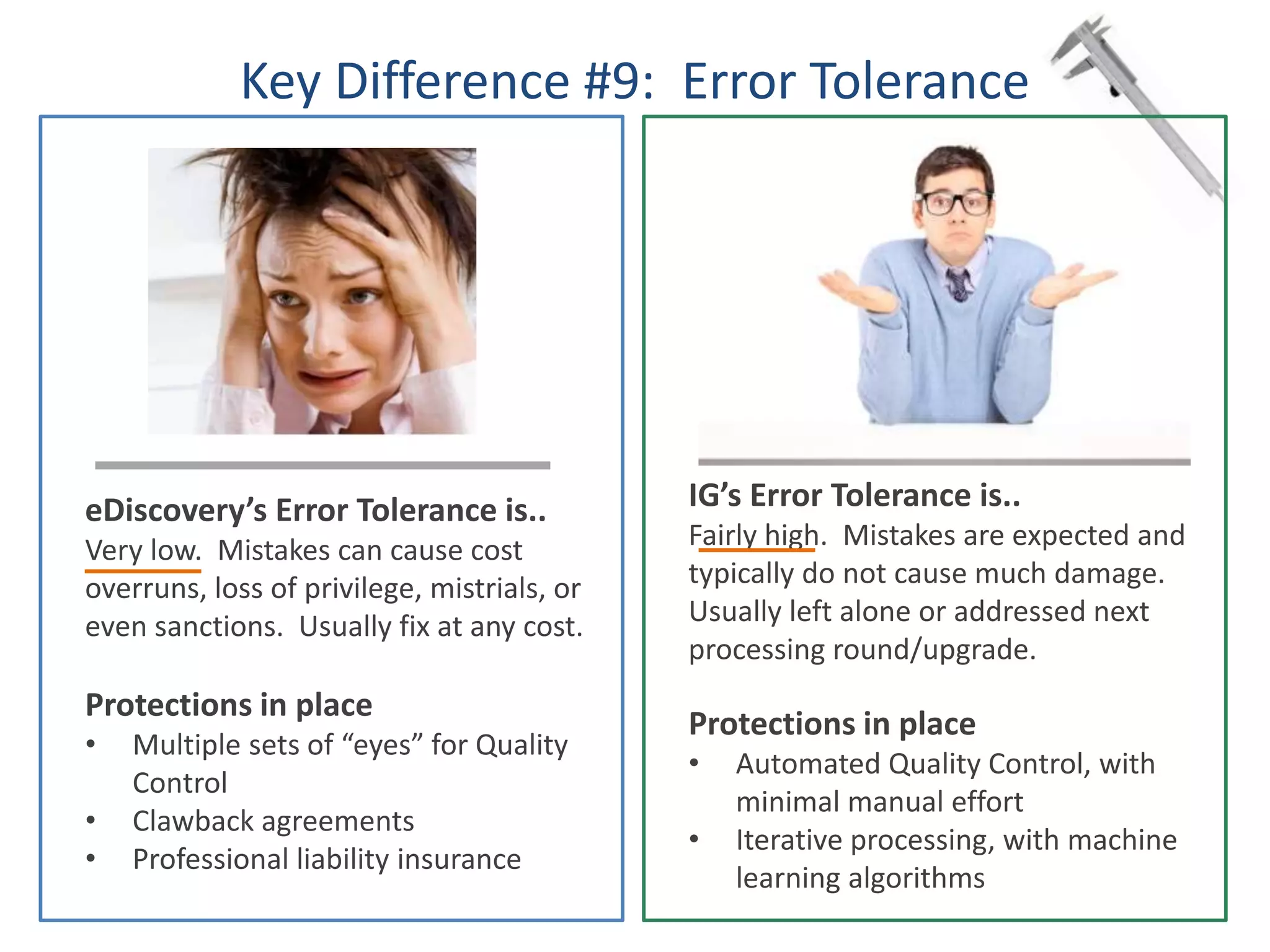
eDiscovery’s Error Tolerance is..
Very low. Mistakes can cause cost
overruns, loss of privilege, mistrials, or
even sanctions. Usually fix at any cost.
Protections in place
• Multiple sets of “eyes” for Quality
Control
• Clawback agreements
• Professional liability insurance
IG’s Error Tolerance is..
Fairly high. Mistakes are expected and
typically do not cause much damage.
Usually left alone or addressed next
processing round/upgrade.
Protections in place
• Automated Quality Control, with
minimal manual effort
• Iterative processing, with machine
learning algorithms
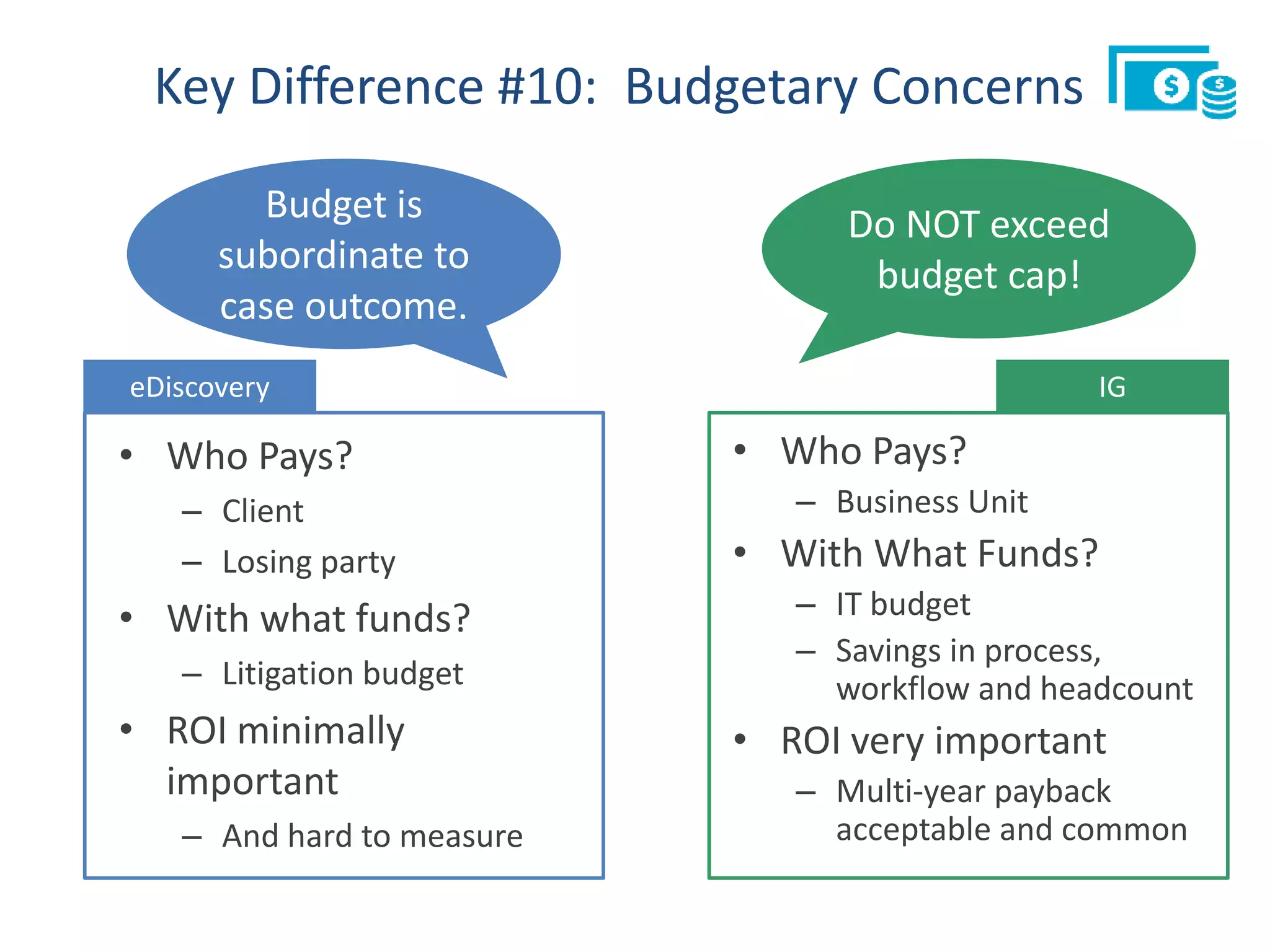
Key Difference #10: Budgetary Concerns
• Who Pays?
– Client
– Losing party
• With what funds?
– Litigation budget
• ROI minimally
important
– And hard to measure
• Who Pays?
– Business Unit
• With What Funds?
– IT budget
– Savings in process,
workflow and headcount
• ROI very important
– Multi-year payback
acceptable and common
Do NOT exceed
budget cap!
Budget is
subordinate to
case outcome.
IGeDiscovery
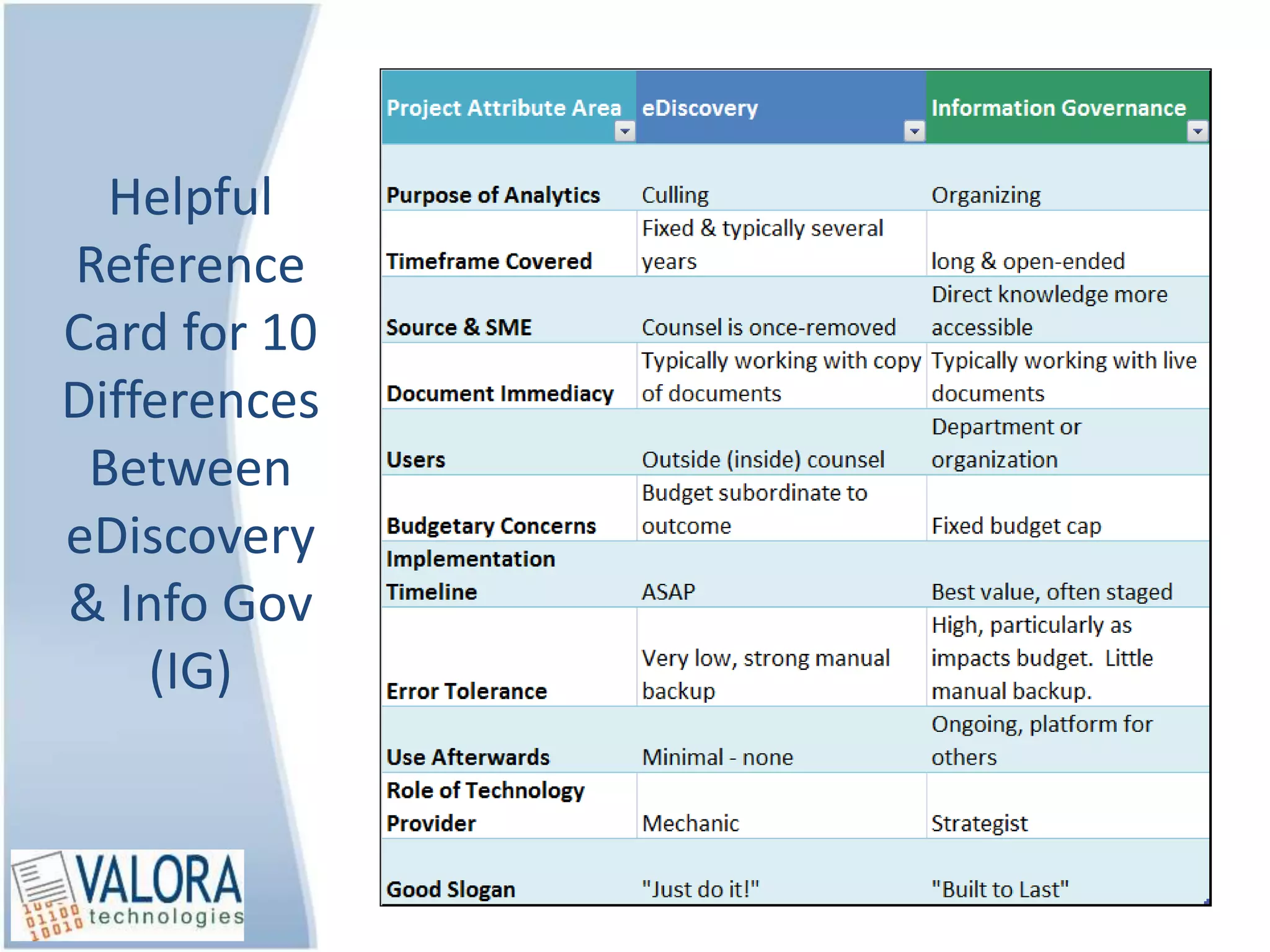
Helpful
Reference
Card for 10
Differences
Between
eDiscovery
& Info Gov
(IG)
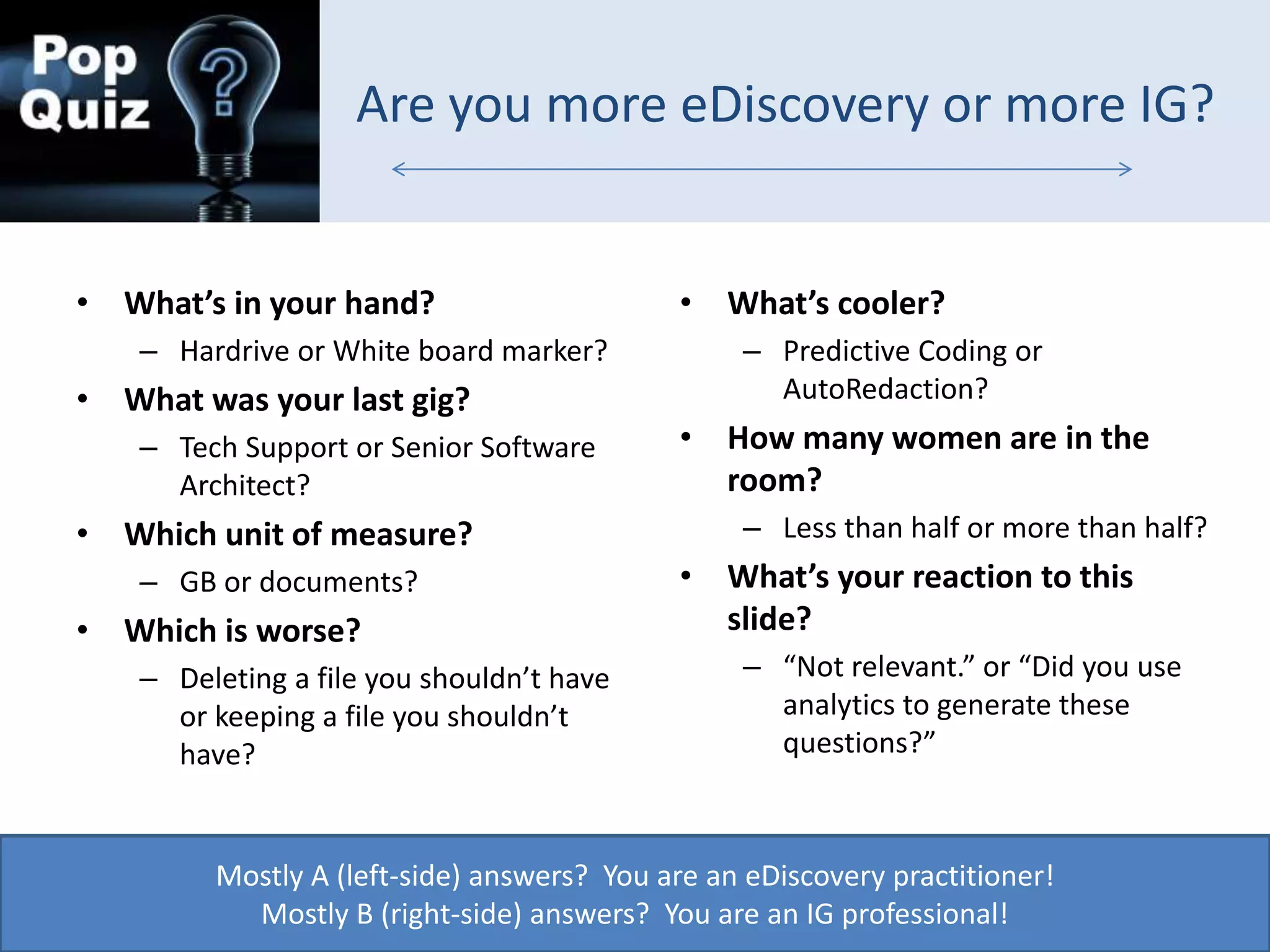
Are you more eDiscovery or more IG?
• What’s in your hand?
– Hardrive or White board marker?
• What was your last gig?
– Tech Support or Senior Software
Architect?
• Which unit of measure?
– GB or documents?
• Which is worse?
– Deleting a file you shouldn’t have
or keeping a file you shouldn’t
have?
• What’s cooler?
– Predictive Coding or
AutoRedaction?
• How many women are in the
room?
– Less than half or more than half?
• What’s your reaction to this
slide?
– “Not relevant.” or “Did you use
analytics to generate these
questions?”
Mostly A (left-side) answers? You are an eDiscovery practitioner!
Mostly B (right-side) answers? You are an IG professional!
Thank You!
For More Information:
Valora Technologies, Inc.
101 Great Road, Suite 220
Bedford, MA 01730
781.229.2265
www.valoratech.com
info@valoratech.com

10 Differences Between eDiscovery & Information Governance

  • 1.
    Ten Key Differences BetweeneDiscovery and Information Governance 10
  • 2.
    Why are eDiscovery& Information Governance often discussed together? Lots of surface-level similarities • Large document populations • Elements of managing risk • Some overlap in processing tasks and solution providers But also lots of important differences • Primary & Secondary Objectives • Notions of Time • Available Tools • Ultimate Users < >
  • 3.
    Quick definitions eDiscovery is.. Anyprocess in which electronic data is sought, located, secured, and searched with the intent of using it as evidence in a civil or criminal legal case. - TechTarget The process of identifying, locating, preserving, collecting, preparing, reviewing, and producing Electronically Stored Information (ESI) in the context of the legal process. - Sedona Conference Glossary Information Governance is.. The activities and technologies that organizations employ to maximize the value of their information while minimizing associated risks and costs. – Information Governance Initiative (IGI) The set of multi-disciplinary structures, policies, procedures, processes and controls implemented to manage information at an enterprise level, supporting an organization's immediate and future regulatory, legal, risk, environmental and operational requirements. - Wikipedia
  • 4.
    Key Difference #1:Primary Objective eDiscovery’s Primary Goal is.. To reduce (cull) the data population down to the minimum possible set to review, and ultimately, to produce. Secondary Goals • Cost reduction • Protect security FILTER CULL REMOVE IG’s Primary Goal is.. To organize the data population for a variety of uses, now and in the future, (possibly including for litigation and eDiscovery). Secondary Goals • Business insight • Control of information • Risk reduction
  • 5.
    Key Difference #2:Timeframe 2004-2005 2006-2007 2008-2009 2010-2011 2012-2013 2014-2015 eDiscovery’s timeframe is fixed, by the claims of the case. There is a set start and end to the document data. 2004-2005 2006-2007 2008-2009 2010-2011 2012-2013 2014-2015 IG’s timeframe is open-ended, by design. There is a set start to the document data, but an open end that is meant to be ongoing.
  • 6.
    Key Difference #3:Processing Timeline In eDiscovery Decisions & Implementation are: ASAP, chaotic Actual Processing Duration is: usually measured in days/weeks/months Processing Approach is: bulk, batch Ex: per GB, or per custodian Typically speak in terms of total volume of project (# GBs, # Custodians) In IG Decisions & Implementation are: slow, methodical, organized BackFile Processing is: usually measured in days/weeks/months Ongoing Processing is: usually measured in minutes/hours Processing Approach: per unit or retainer/all-in Ex: per document/file, or per month Typically speak in terms of required rates of project (docs/day, search response rate, problem resolution times)
  • 7.
    Key Difference #4:Available Tools eDiscovery Tools are oriented around Processing Tasks • De-NIST • De-Dupe • Filter by Keyword, Date, Custodian • Host • Produce eDiscovery Tools are off-the-shelf, branded products • Slim differentiation • Minimal flexibility or customization • Low cost • Proven IG Tools are oriented around Scenario Outcomes • Files re-labeled & relocated • Control of information • Protection of sensitive info (PII, PHI) • Business/scenario projections • Repeatable workflow IG Tools are heavily customized solutions and platforms • High differentiation • Heavy flexibility and customization • High cost • Still in pilot stages Focus on: What does it do? Focus on: What does it yield?
  • 8.
    Key Difference #5:Solution Provider Relationship Typical eDiscovery provider’s role is.. Data mechanic Competition is on.. Price • Repetitiveness & experience • Same tools everywhere • Price model is one-off Surprising players.. • Clients themselves • Facilities Management • Staffing Agencies Typical IG’s provider’s role is.. Strategic Advisor Competition is on.. Technical capability • Flexibility of solution • Trust & experience • Different tools everywhere • Price model is retainer Surprising players.. • Consultancies • Law Firms
  • 9.
    Key Difference #6:Starting Data & Document Organization • Intake vs. collection – eDiscovery undertakes a sophisticated and detailed effort of carefully executed collections, often involving custodian interviews, data maps and targeted, forensic collections – IG typically utilizes a batch collection/migration approach for existing data (Backfile) – IG also creates an ongoing Intake system for new documents or files as they are created/submitted/decommissioned, etc. Intake typically includes: • ESI: Email transmission (w/ attachments) • ESI: Drag & Drop web-based submission • Paper: Fax, Mail and in-person START
  • 10.
    Key Difference #6:Starting Data & Document Organization • Live Documents vs. Copies – eDiscovery uses forensic (or scanned) copies of files, rather than the actual “active” files. • Copied files are used in a separate, litigation-specific database for off-line, non- active usage – IG typically utilizes “live” documents, in the systems in which the documents typically reside and are actively used • Sophisticated requirements for version control and check-in/-out • Organized by Custodian (Source) or by Topic (Classification) – eDiscovery organizes files by their source, or custodian • Documents are rarely moved from one source to another and are specifically not renamed or altered in any way. – IG organizes files by their contents, or key topics • Documents are frequently moved from one area to another and are intentionally renamed, removed, restricted or altered as required. START
  • 11.
    Key Difference #7:Ending Data & Document Organization • Same as Outset or Changed from Original? – eDiscovery does NOT change the original files • Simply stored temporarily in a litigation database – IG DOES change the original files • Dispose of or keep? – At matter end, the eDiscovery database is deleted. – IG keeps documents in a document management system, indefinitely. FINISH eDiscovery uses the “Nike” strategy: IG uses the “Ford” strategy:
  • 12.
    Key Difference #8:Users Who Uses eDiscovery Systems? • Outside Counsel • Inside Counsel These are NOT the same people who created the original documents. Users are working with a copy of original data. Document decisions made typically do not travel back to the source documents or to their creators. Institutional knowledge about documents and business practice is scarce (and once-removed). Focus is on.. relevance Who Uses IG Systems? • Business Units • Outside Counsel • Inside Counsel These ARE the same people who created the original documents. Users are working with original, native documents. Document decisions DO typically travel back to (or are simply made onto) the source documents. Institutional knowledge about documents and business practice is plentiful. Focus is on.. classification
  • 13.
    Key Difference #9:Error Tolerance eDiscovery’s Error Tolerance is.. Very low. Mistakes can cause cost overruns, loss of privilege, mistrials, or even sanctions. Usually fix at any cost. Protections in place • Multiple sets of “eyes” for Quality Control • Clawback agreements • Professional liability insurance IG’s Error Tolerance is.. Fairly high. Mistakes are expected and typically do not cause much damage. Usually left alone or addressed next processing round/upgrade. Protections in place • Automated Quality Control, with minimal manual effort • Iterative processing, with machine learning algorithms
  • 14.
    Key Difference #10:Budgetary Concerns • Who Pays? – Client – Losing party • With what funds? – Litigation budget • ROI minimally important – And hard to measure • Who Pays? – Business Unit • With What Funds? – IT budget – Savings in process, workflow and headcount • ROI very important – Multi-year payback acceptable and common Do NOT exceed budget cap! Budget is subordinate to case outcome. IGeDiscovery
  • 15.
  • 16.
    Are you moreeDiscovery or more IG? • What’s in your hand? – Hardrive or White board marker? • What was your last gig? – Tech Support or Senior Software Architect? • Which unit of measure? – GB or documents? • Which is worse? – Deleting a file you shouldn’t have or keeping a file you shouldn’t have? • What’s cooler? – Predictive Coding or AutoRedaction? • How many women are in the room? – Less than half or more than half? • What’s your reaction to this slide? – “Not relevant.” or “Did you use analytics to generate these questions?” Mostly A (left-side) answers? You are an eDiscovery practitioner! Mostly B (right-side) answers? You are an IG professional!
  • 17.
    Thank You! For MoreInformation: Valora Technologies, Inc. 101 Great Road, Suite 220 Bedford, MA 01730 781.229.2265 www.valoratech.com info@valoratech.com