 SAP AG 2004, VIL Organization Structure, 1
Videocon Industries Limited
 SAP AG 2004, VIL Organization Structure, 2
Videocon Industries Limited
WELCOME
TO
End User Training July 2006
Sales & Distribution (Mfg)
Hemant Aundhekar
(Lead Consultant)
Satish Kullu
(Junior Consultant)
 SAP AG 2004, VIL Organization Structure, 3
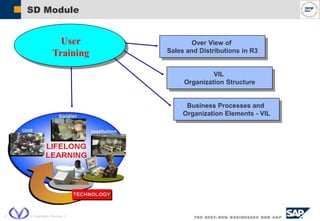
SD Module
User
Training
Business Processes and
Organization Elements - VIL
Over View of
Sales and Distributions in R3
VIL
Organization Structure
 SAP AG 2004, VIL Organization Structure, 4
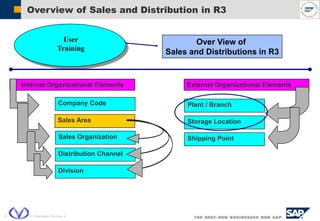
Overview of Sales and Distribution in R3
User
Training
Internal Organizational Elements
Company Code
Sales Organization
Division
Distribution Channel
Sales Area
External Organizational Elements
Shipping Point
Storage Location
Plant / Branch
Over View of
Sales and Distributions in R3
 SAP AG 2004, VIL Organization Structure, 5
Overview of Sales and Distribution in R3
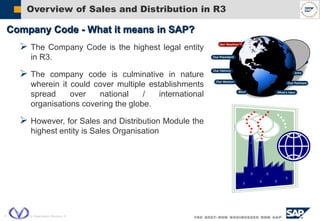
Company Code - What it means in SAP?
 The Company Code is the highest legal entity
in R3.
 The company code is culminative in nature
wherein it could cover multiple establishments
spread over national / international
organisations covering the globe.
 However, for Sales and Distribution Module the
highest entity is Sales Organisation
 SAP AG 2004, VIL Organization Structure, 6
Overview of Sales and Distribution in R3
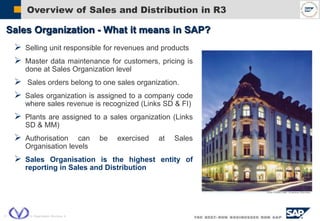
 Selling unit responsible for revenues and products
 Master data maintenance for customers, pricing is
done at Sales Organization level
 Sales orders belong to one sales organization.
 Sales organization is assigned to a company code
where sales revenue is recognized (Links SD & FI)
 Plants are assigned to a sales organization (Links
SD & MM)
 Authorisation can be exercised at Sales
Organisation levels
 Sales Organisation is the highest entity of
reporting in Sales and Distribution
Sales Organization - What it means in SAP?
 SAP AG 2004, VIL Organization Structure, 7
Overview of Sales and Distribution in R3
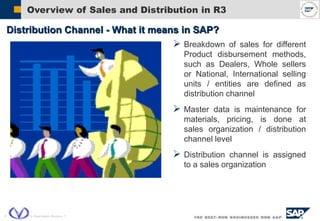
 Breakdown of sales for different
Product disbursement methods,
such as Dealers, Whole sellers
or National, International selling
units / entities are defined as
distribution channel
 Master data is maintenance for
materials, pricing, is done at
sales organization / distribution
channel level
 Distribution channel is assigned
to a sales organization
Distribution Channel - What it means in SAP?
 SAP AG 2004, VIL Organization Structure, 8
Overview of Sales and Distribution in R3
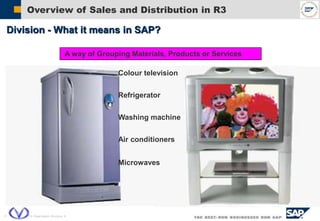
Division - What it means in SAP?
Colour television
Refrigerator
Washing machine
Air conditioners
Microwaves
A way of Grouping Materials, Products or Services
 SAP AG 2004, VIL Organization Structure, 9
Overview of Sales and Distribution in R3
Sales Area is a Combination of:
Sales Organization
Distribution Channel
Division
 Used to view sales-related
master data, reporting and
analysis
Sales Area – What it means in SAP ?
 SAP AG 2004, VIL Organization Structure, 10
Overview of Sales and Distribution in R3
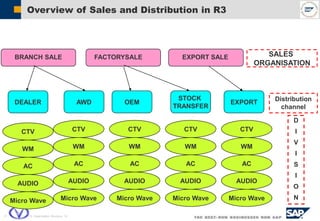
BRANCH SALE SALES
ORGANISATION
FACTORYSALE EXPORT SALE
DEALER
STOCK
TRANSFER
EXPORT
AWD OEM
CTV
WM
AC
AUDIO
Micro Wave
CTV
WM
AC
AUDIO
Micro Wave
CTV
WM
AC
AUDIO
Micro Wave
CTV
WM
AC
AUDIO
Micro Wave
CTV
WM
AC
AUDIO
Micro Wave
Distribution
channel
D
I
V
I
S
I
O
N
 SAP AG 2004, VIL Organization Structure, 11
Overview of Sales and Distribution in R3
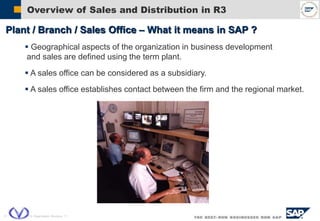
 Geographical aspects of the organization in business development
and sales are defined using the term plant.
 A sales office can be considered as a subsidiary.
 A sales office establishes contact between the firm and the regional market.
Plant / Branch / Sales Office – What it means in SAP ?
 SAP AG 2004, VIL Organization Structure, 12
Overview of Sales and Distribution in R3
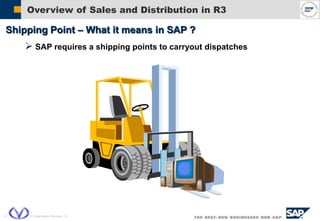
 SAP requires a shipping points to carryout dispatches
Shipping Point – What it means in SAP ?
 SAP AG 2004, VIL Organization Structure, 13
Overview of Sales and Distribution in R3
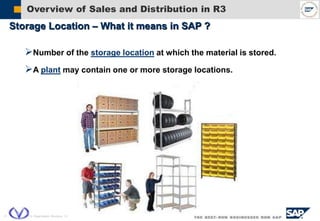
Number of the storage location at which the material is stored.
A plant may contain one or more storage locations.
Storage Location – What it means in SAP ?
 SAP AG 2004, VIL Organization Structure, 14
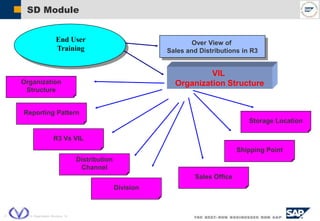
SD Module
End User
Training
Over View of
Sales and Distributions in R3
VIL
Organization Structure
Shipping Point
Division
Distribution
Channel
R3 Vs VIL
Reporting Pattern
Organization
Structure
Storage Location
Sales Office
 SAP AG 2004, VIL Organization Structure, 15
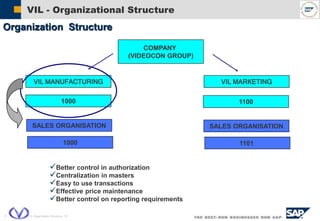
VIL - Organizational Structure
Better control in authorization
Centralization in masters
Easy to use transactions
Effective price maintenance
Better control on reporting requirements
COMPANY
(VIDEOCON GROUP)
VIL MANUFACTURING VIL MARKETING
1000 1100
SALES ORGANISATION
1000
Organization Structure
SALES ORGANISATION
1101
 SAP AG 2004, VIL Organization Structure, 16
VIL - Organizational Structure
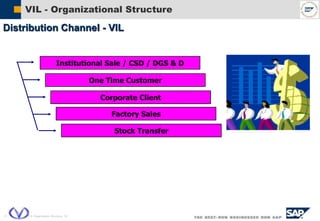
Institutional Sale / CSD / DGS & D
One Time Customer
Corporate Client
Factory Sales
Stock Transfer
Distribution Channel - VIL
 SAP AG 2004, VIL Organization Structure, 17
VIL - Organizational Structure
 All the plants have been defined as shipping points
Shipping Point - VIL
 SAP AG 2004, VIL Organization Structure, 18
VIL - Organizational Elements - SD
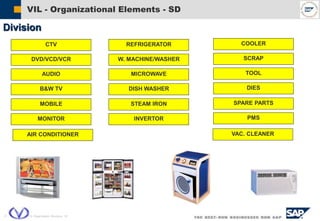
CTV
DVD/VCD/VCR
AUDIO
B&W TV
MOBILE
MONITOR
COOLER
SCRAP
TOOL
DIES
SPARE PARTS
PMS
REFRIGERATOR
W. MACHINE/WASHER
MICROWAVE
DISH WASHER
STEAM IRON
INVERTOR
AIR CONDITIONER VAC. CLEANER
Division
 SAP AG 2004, VIL Organization Structure, 19
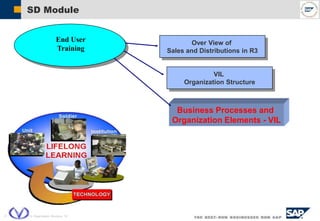
SD Module
End User
Training
Business Processes and
Organization Elements - VIL
Over View of
Sales and Distributions in R3
VIL
Organization Structure
 SAP AG 2004, VIL Organization Structure, 20
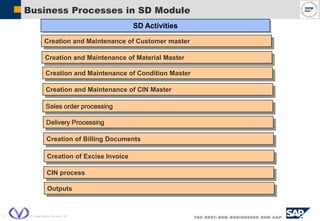
Business Processes in SD Module
SD Activities
Creation of Billing Documents
Creation and Maintenance of Customer master
Creation and Maintenance of Material Master
Creation and Maintenance of Condition Master
Creation and Maintenance of CIN Master
Sales order processing
Outputs
Creation of Excise Invoice
CIN process
Delivery Processing
 SAP AG 2004, VIL Organization Structure, 21
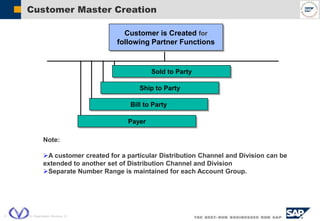
Customer Master Creation
Customer is Created for
following Partner Functions
Sold to Party
Ship to Party
Bill to Party
Payer
Note:
A customer created for a particular Distribution Channel and Division can be
extended to another set of Distribution Channel and Division
Separate Number Range is maintained for each Account Group.
 SAP AG 2004, VIL Organization Structure, 22
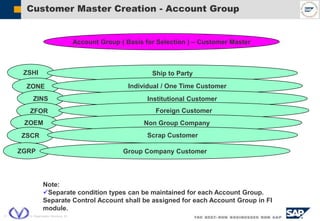
Customer Master Creation - Account Group
ZSHI
ZONE
ZINS
ZFOR
ZOEM
ZSCR
ZGRP
Ship to Party
Individual / One Time Customer
Institutional Customer
Foreign Customer
Non Group Company
Scrap Customer
Group Company Customer
Account Group ( Basis for Selection ) – Customer Master
Note:
Separate condition types can be maintained for each Account Group.
Separate Control Account shall be assigned for each Account Group in FI
module.
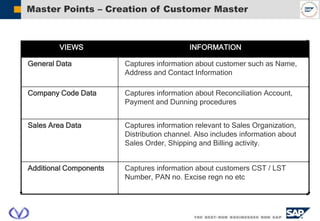
Master Points – Creation of Customer Master
VIEWS INFORMATION
General Data Captures information about customer such as Name,
Address and Contact Information
Company Code Data Captures information about Reconciliation Account,
Payment and Dunning procedures
Sales Area Data Captures information relevant to Sales Organization,
Distribution channel. Also includes information about
Sales Order, Shipping and Billing activity.
Additional Components Captures information about customers CST / LST
Number, PAN no. Excise regn no etc
 SAP AG 2004, VIL Organization Structure, 24
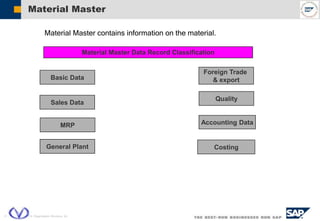
Material Master
Basic Data
Sales Data
MRP
General Plant Costing
Foreign Trade
& export
Quality
Accounting Data
Material Master Data Record Classification
Material Master contains information on the material.
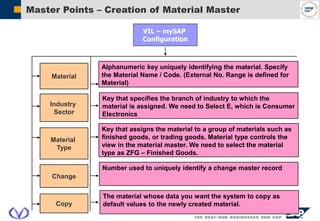
VIL – mySAP
Configuration
Material
Alphanumeric key uniquely identifying the material. Specify
the Material Name / Code. (External No. Range is defined for
Material)
Industry
Sector
Material
Type
Change
Key that specifies the branch of industry to which the
material is assigned. We need to Select E, which is Consumer
Electronics
Number used to uniquely identify a change master record
Master Points – Creation of Material Master
Key that assigns the material to a group of materials such as
finished goods, or trading goods. Material type controls the
view in the material master. We need to select the material
type as ZFG – Finished Goods.
Copy
The material whose data you want the system to copy as
default values to the newly created material.
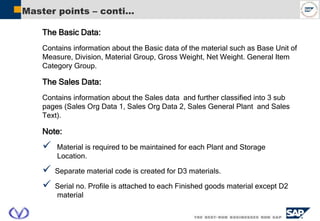
The Basic Data:
Contains information about the Basic data of the material such as Base Unit of
Measure, Division, Material Group, Gross Weight, Net Weight. General Item
Category Group.
The Sales Data:
Contains information about the Sales data and further classified into 3 sub
pages (Sales Org Data 1, Sales Org Data 2, Sales General Plant and Sales
Text).
Note:
 Material is required to be maintained for each Plant and Storage
Location.
 Separate material code is created for D3 materials.
 Serial no. Profile is attached to each Finished goods material except D2
material
Master points – conti…
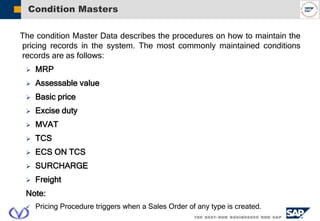
Condition Masters
The condition Master Data describes the procedures on how to maintain the
pricing records in the system. The most commonly maintained conditions
records are as follows:
 MRP
 Assessable value
 Basic price
 Excise duty
 MVAT
 TCS
 ECS ON TCS
 SURCHARGE
 Freight
Note:
 Pricing Procedure triggers when a Sales Order of any type is created.
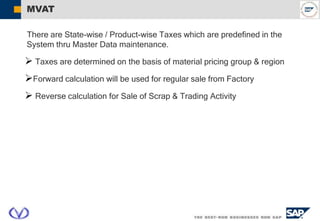
MVAT
There are State-wise / Product-wise Taxes which are predefined in the
System thru Master Data maintenance.
 Taxes are determined on the basis of material pricing group & region
Forward calculation will be used for regular sale from Factory
 Reverse calculation for Sale of Scrap & Trading Activity
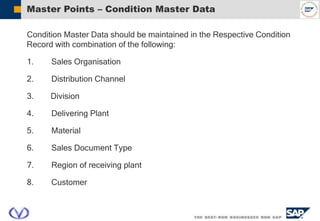
Master Points – Condition Master Data
Condition Master Data should be maintained in the Respective Condition
Record with combination of the following:
1. Sales Organisation
2. Distribution Channel
3. Division
4. Delivering Plant
5. Material
6. Sales Document Type
7. Region of receiving plant
8. Customer
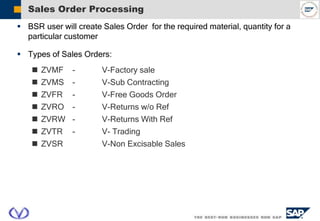
Sales Order Processing
 BSR user will create Sales Order for the required material, quantity for a
particular customer
 Types of Sales Orders:
 ZVMF - V-Factory sale
 ZVMS - V-Sub Contracting
 ZVFR - V-Free Goods Order
 ZVRO - V-Returns w/o Ref
 ZVRW - V-Returns With Ref
 ZVTR - V- Trading
 ZVSR V-Non Excisable Sales
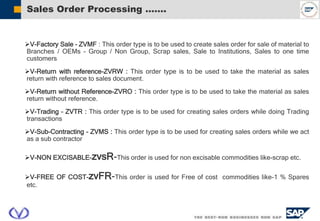
Sales Order Processing …….
V-Factory Sale – ZVMF : This order type is to be used to create sales order for sale of material to
Branches / OEMs – Group / Non Group, Scrap sales, Sale to Institutions, Sales to one time
customers
V-Return with reference-ZVRW : This order type is to be used to take the material as sales
return with reference to sales document.
V-Return without Reference-ZVRO : This order type is to be used to take the material as sales
return without reference.
V-Trading – ZVTR : This order type is to be used for creating sales orders while doing Trading
transactions
V-Sub-Contracting - ZVMS : This order type is to be used for creating sales orders while we act
as a sub contractor
V-NON EXCISABLE-zvsR-This order is used for non excisable commodities like-scrap etc.
V-FREE OF COST-zvFR-This order is used for Free of cost commodities like-1 % Spares
etc.
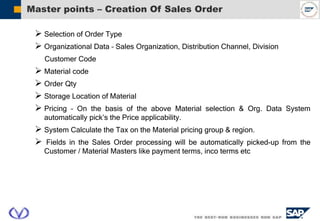
Master points – Creation Of Sales Order
 Selection of Order Type
 Organizational Data – Sales Organization, Distribution Channel, Division
Customer Code
 Material code
 Order Qty
 Storage Location of Material
 Pricing – On the basis of the above Material selection & Org. Data System
automatically pick’s the Price applicability.
 System Calculate the Tax on the Material pricing group & region.
 Fields in the Sales Order processing will be automatically picked-up from the
Customer / Material Masters like payment terms, inco terms etc
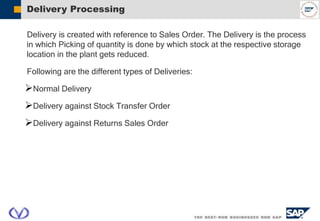
Delivery Processing
Delivery is created with reference to Sales Order. The Delivery is the process
in which Picking of quantity is done by which stock at the respective storage
location in the plant gets reduced.
Following are the different types of Deliveries:
Normal Delivery
Delivery against Stock Transfer Order
Delivery against Returns Sales Order
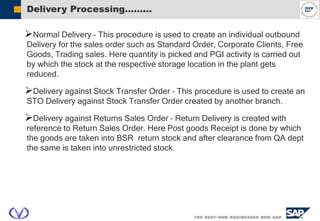
Delivery Processing………
Normal Delivery – This procedure is used to create an individual outbound
Delivery for the sales order such as Standard Order, Corporate Clients, Free
Goods, Trading sales. Here quantity is picked and PGI activity is carried out
by which the stock at the respective storage location in the plant gets
reduced.
Delivery against Stock Transfer Order – This procedure is used to create an
STO Delivery against Stock Transfer Order created by another branch.
Delivery against Returns Sales Order – Return Delivery is created with
reference to Return Sales Order. Here Post goods Receipt is done by which
the goods are taken into BSR return stock and after clearance from QA dept
the same is taken into unrestricted stock.
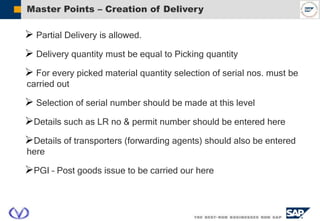
Master Points – Creation of Delivery
 Partial Delivery is allowed.
 Delivery quantity must be equal to Picking quantity
 For every picked material quantity selection of serial nos. must be
carried out
 Selection of serial number should be made at this level
Details such as LR no & permit number should be entered here
Details of transporters (forwarding agents) should also be entered
here
PGI – Post goods issue to be carried our here
Creation of Billing documents
 This procedure is used to create an individual Billing document after the
order has been delivered & Post Goods Issue (PGI) activity is completed.
 Billing document is created with reference to Delivery document. But in
some cases the Billing document is created with reference to Sales Order
number (Sales Returns process & Credit memo request).
 Prices / Taxes can be re-determined in the Billing document.
 The Release to Accounting is done automatically after the billing document
is prepared. But in Billing document of Return Delivery (credit memo) the user
has to do the Release to accounting activity.
Freight is to be maintained in this procedure enabling the user to calculate
the cost per piece incurred while transporting the material
Creation of Excise Invoice
 This procedure is used to create an excise invoice with reference to a
particular Billing document
The following types of Excise invoice series are being maintained :
Tax Invoice
Non - Tax Invoice
Trading Invoice
‘S’ Trading Invoice
Export Invoice
Outputs
Following output can be generated thru system:
- Billing Document
- Excise Invoice
- Delivery challan
- Commercial invoice
Thank you

1-SAP-SD-General overall functionalities

  • 1.
     SAP AG2004, VIL Organization Structure, 1 Videocon Industries Limited
  • 2.
     SAP AG2004, VIL Organization Structure, 2 Videocon Industries Limited WELCOME TO End User Training July 2006 Sales & Distribution (Mfg) Hemant Aundhekar (Lead Consultant) Satish Kullu (Junior Consultant)
  • 3.
     SAP AG2004, VIL Organization Structure, 3 SD Module User Training Business Processes and Organization Elements - VIL Over View of Sales and Distributions in R3 VIL Organization Structure
  • 4.
     SAP AG2004, VIL Organization Structure, 4 Overview of Sales and Distribution in R3 User Training Internal Organizational Elements Company Code Sales Organization Division Distribution Channel Sales Area External Organizational Elements Shipping Point Storage Location Plant / Branch Over View of Sales and Distributions in R3
  • 5.
     SAP AG2004, VIL Organization Structure, 5 Overview of Sales and Distribution in R3 Company Code - What it means in SAP?  The Company Code is the highest legal entity in R3.  The company code is culminative in nature wherein it could cover multiple establishments spread over national / international organisations covering the globe.  However, for Sales and Distribution Module the highest entity is Sales Organisation
  • 6.
     SAP AG2004, VIL Organization Structure, 6 Overview of Sales and Distribution in R3  Selling unit responsible for revenues and products  Master data maintenance for customers, pricing is done at Sales Organization level  Sales orders belong to one sales organization.  Sales organization is assigned to a company code where sales revenue is recognized (Links SD & FI)  Plants are assigned to a sales organization (Links SD & MM)  Authorisation can be exercised at Sales Organisation levels  Sales Organisation is the highest entity of reporting in Sales and Distribution Sales Organization - What it means in SAP?
  • 7.
     SAP AG2004, VIL Organization Structure, 7 Overview of Sales and Distribution in R3  Breakdown of sales for different Product disbursement methods, such as Dealers, Whole sellers or National, International selling units / entities are defined as distribution channel  Master data is maintenance for materials, pricing, is done at sales organization / distribution channel level  Distribution channel is assigned to a sales organization Distribution Channel - What it means in SAP?
  • 8.
     SAP AG2004, VIL Organization Structure, 8 Overview of Sales and Distribution in R3 Division - What it means in SAP? Colour television Refrigerator Washing machine Air conditioners Microwaves A way of Grouping Materials, Products or Services
  • 9.
     SAP AG2004, VIL Organization Structure, 9 Overview of Sales and Distribution in R3 Sales Area is a Combination of: Sales Organization Distribution Channel Division  Used to view sales-related master data, reporting and analysis Sales Area – What it means in SAP ?
  • 10.
     SAP AG2004, VIL Organization Structure, 10 Overview of Sales and Distribution in R3 BRANCH SALE SALES ORGANISATION FACTORYSALE EXPORT SALE DEALER STOCK TRANSFER EXPORT AWD OEM CTV WM AC AUDIO Micro Wave CTV WM AC AUDIO Micro Wave CTV WM AC AUDIO Micro Wave CTV WM AC AUDIO Micro Wave CTV WM AC AUDIO Micro Wave Distribution channel D I V I S I O N
  • 11.
     SAP AG2004, VIL Organization Structure, 11 Overview of Sales and Distribution in R3  Geographical aspects of the organization in business development and sales are defined using the term plant.  A sales office can be considered as a subsidiary.  A sales office establishes contact between the firm and the regional market. Plant / Branch / Sales Office – What it means in SAP ?
  • 12.
     SAP AG2004, VIL Organization Structure, 12 Overview of Sales and Distribution in R3  SAP requires a shipping points to carryout dispatches Shipping Point – What it means in SAP ?
  • 13.
     SAP AG2004, VIL Organization Structure, 13 Overview of Sales and Distribution in R3 Number of the storage location at which the material is stored. A plant may contain one or more storage locations. Storage Location – What it means in SAP ?
  • 14.
     SAP AG2004, VIL Organization Structure, 14 SD Module End User Training Over View of Sales and Distributions in R3 VIL Organization Structure Shipping Point Division Distribution Channel R3 Vs VIL Reporting Pattern Organization Structure Storage Location Sales Office
  • 15.
     SAP AG2004, VIL Organization Structure, 15 VIL - Organizational Structure Better control in authorization Centralization in masters Easy to use transactions Effective price maintenance Better control on reporting requirements COMPANY (VIDEOCON GROUP) VIL MANUFACTURING VIL MARKETING 1000 1100 SALES ORGANISATION 1000 Organization Structure SALES ORGANISATION 1101
  • 16.
     SAP AG2004, VIL Organization Structure, 16 VIL - Organizational Structure Institutional Sale / CSD / DGS & D One Time Customer Corporate Client Factory Sales Stock Transfer Distribution Channel - VIL
  • 17.
     SAP AG2004, VIL Organization Structure, 17 VIL - Organizational Structure  All the plants have been defined as shipping points Shipping Point - VIL
  • 18.
     SAP AG2004, VIL Organization Structure, 18 VIL - Organizational Elements - SD CTV DVD/VCD/VCR AUDIO B&W TV MOBILE MONITOR COOLER SCRAP TOOL DIES SPARE PARTS PMS REFRIGERATOR W. MACHINE/WASHER MICROWAVE DISH WASHER STEAM IRON INVERTOR AIR CONDITIONER VAC. CLEANER Division
  • 19.
     SAP AG2004, VIL Organization Structure, 19 SD Module End User Training Business Processes and Organization Elements - VIL Over View of Sales and Distributions in R3 VIL Organization Structure
  • 20.
     SAP AG2004, VIL Organization Structure, 20 Business Processes in SD Module SD Activities Creation of Billing Documents Creation and Maintenance of Customer master Creation and Maintenance of Material Master Creation and Maintenance of Condition Master Creation and Maintenance of CIN Master Sales order processing Outputs Creation of Excise Invoice CIN process Delivery Processing
  • 21.
     SAP AG2004, VIL Organization Structure, 21 Customer Master Creation Customer is Created for following Partner Functions Sold to Party Ship to Party Bill to Party Payer Note: A customer created for a particular Distribution Channel and Division can be extended to another set of Distribution Channel and Division Separate Number Range is maintained for each Account Group.
  • 22.
     SAP AG2004, VIL Organization Structure, 22 Customer Master Creation - Account Group ZSHI ZONE ZINS ZFOR ZOEM ZSCR ZGRP Ship to Party Individual / One Time Customer Institutional Customer Foreign Customer Non Group Company Scrap Customer Group Company Customer Account Group ( Basis for Selection ) – Customer Master Note: Separate condition types can be maintained for each Account Group. Separate Control Account shall be assigned for each Account Group in FI module.
  • 23.
    Master Points –Creation of Customer Master VIEWS INFORMATION General Data Captures information about customer such as Name, Address and Contact Information Company Code Data Captures information about Reconciliation Account, Payment and Dunning procedures Sales Area Data Captures information relevant to Sales Organization, Distribution channel. Also includes information about Sales Order, Shipping and Billing activity. Additional Components Captures information about customers CST / LST Number, PAN no. Excise regn no etc
  • 24.
     SAP AG2004, VIL Organization Structure, 24 Material Master Basic Data Sales Data MRP General Plant Costing Foreign Trade & export Quality Accounting Data Material Master Data Record Classification Material Master contains information on the material.
  • 25.
    VIL – mySAP Configuration Material Alphanumerickey uniquely identifying the material. Specify the Material Name / Code. (External No. Range is defined for Material) Industry Sector Material Type Change Key that specifies the branch of industry to which the material is assigned. We need to Select E, which is Consumer Electronics Number used to uniquely identify a change master record Master Points – Creation of Material Master Key that assigns the material to a group of materials such as finished goods, or trading goods. Material type controls the view in the material master. We need to select the material type as ZFG – Finished Goods. Copy The material whose data you want the system to copy as default values to the newly created material.
  • 26.
    The Basic Data: Containsinformation about the Basic data of the material such as Base Unit of Measure, Division, Material Group, Gross Weight, Net Weight. General Item Category Group. The Sales Data: Contains information about the Sales data and further classified into 3 sub pages (Sales Org Data 1, Sales Org Data 2, Sales General Plant and Sales Text). Note:  Material is required to be maintained for each Plant and Storage Location.  Separate material code is created for D3 materials.  Serial no. Profile is attached to each Finished goods material except D2 material Master points – conti…
  • 27.
    Condition Masters The conditionMaster Data describes the procedures on how to maintain the pricing records in the system. The most commonly maintained conditions records are as follows:  MRP  Assessable value  Basic price  Excise duty  MVAT  TCS  ECS ON TCS  SURCHARGE  Freight Note:  Pricing Procedure triggers when a Sales Order of any type is created.
  • 28.
    MVAT There are State-wise/ Product-wise Taxes which are predefined in the System thru Master Data maintenance.  Taxes are determined on the basis of material pricing group & region Forward calculation will be used for regular sale from Factory  Reverse calculation for Sale of Scrap & Trading Activity
  • 29.
    Master Points –Condition Master Data Condition Master Data should be maintained in the Respective Condition Record with combination of the following: 1. Sales Organisation 2. Distribution Channel 3. Division 4. Delivering Plant 5. Material 6. Sales Document Type 7. Region of receiving plant 8. Customer
  • 30.
    Sales Order Processing BSR user will create Sales Order for the required material, quantity for a particular customer  Types of Sales Orders:  ZVMF - V-Factory sale  ZVMS - V-Sub Contracting  ZVFR - V-Free Goods Order  ZVRO - V-Returns w/o Ref  ZVRW - V-Returns With Ref  ZVTR - V- Trading  ZVSR V-Non Excisable Sales
  • 31.
    Sales Order Processing……. V-Factory Sale – ZVMF : This order type is to be used to create sales order for sale of material to Branches / OEMs – Group / Non Group, Scrap sales, Sale to Institutions, Sales to one time customers V-Return with reference-ZVRW : This order type is to be used to take the material as sales return with reference to sales document. V-Return without Reference-ZVRO : This order type is to be used to take the material as sales return without reference. V-Trading – ZVTR : This order type is to be used for creating sales orders while doing Trading transactions V-Sub-Contracting - ZVMS : This order type is to be used for creating sales orders while we act as a sub contractor V-NON EXCISABLE-zvsR-This order is used for non excisable commodities like-scrap etc. V-FREE OF COST-zvFR-This order is used for Free of cost commodities like-1 % Spares etc.
  • 32.
    Master points –Creation Of Sales Order  Selection of Order Type  Organizational Data – Sales Organization, Distribution Channel, Division Customer Code  Material code  Order Qty  Storage Location of Material  Pricing – On the basis of the above Material selection & Org. Data System automatically pick’s the Price applicability.  System Calculate the Tax on the Material pricing group & region.  Fields in the Sales Order processing will be automatically picked-up from the Customer / Material Masters like payment terms, inco terms etc
  • 33.
    Delivery Processing Delivery iscreated with reference to Sales Order. The Delivery is the process in which Picking of quantity is done by which stock at the respective storage location in the plant gets reduced. Following are the different types of Deliveries: Normal Delivery Delivery against Stock Transfer Order Delivery against Returns Sales Order
  • 34.
    Delivery Processing……… Normal Delivery– This procedure is used to create an individual outbound Delivery for the sales order such as Standard Order, Corporate Clients, Free Goods, Trading sales. Here quantity is picked and PGI activity is carried out by which the stock at the respective storage location in the plant gets reduced. Delivery against Stock Transfer Order – This procedure is used to create an STO Delivery against Stock Transfer Order created by another branch. Delivery against Returns Sales Order – Return Delivery is created with reference to Return Sales Order. Here Post goods Receipt is done by which the goods are taken into BSR return stock and after clearance from QA dept the same is taken into unrestricted stock.
  • 35.
    Master Points –Creation of Delivery  Partial Delivery is allowed.  Delivery quantity must be equal to Picking quantity  For every picked material quantity selection of serial nos. must be carried out  Selection of serial number should be made at this level Details such as LR no & permit number should be entered here Details of transporters (forwarding agents) should also be entered here PGI – Post goods issue to be carried our here
  • 36.
    Creation of Billingdocuments  This procedure is used to create an individual Billing document after the order has been delivered & Post Goods Issue (PGI) activity is completed.  Billing document is created with reference to Delivery document. But in some cases the Billing document is created with reference to Sales Order number (Sales Returns process & Credit memo request).  Prices / Taxes can be re-determined in the Billing document.  The Release to Accounting is done automatically after the billing document is prepared. But in Billing document of Return Delivery (credit memo) the user has to do the Release to accounting activity. Freight is to be maintained in this procedure enabling the user to calculate the cost per piece incurred while transporting the material
  • 37.
    Creation of ExciseInvoice  This procedure is used to create an excise invoice with reference to a particular Billing document The following types of Excise invoice series are being maintained : Tax Invoice Non - Tax Invoice Trading Invoice ‘S’ Trading Invoice Export Invoice
  • 38.
    Outputs Following output canbe generated thru system: - Billing Document - Excise Invoice - Delivery challan - Commercial invoice
  • 39.