THE NERVOUS SYSTEM
Organisation, general function, classification.
GENERAL DESIGN OF THE NERVOUS
SYSTEM
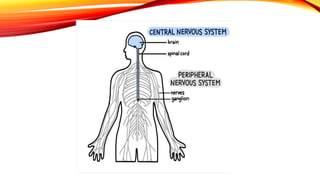
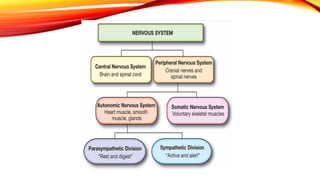
The central nervous system
Receives information from different sensory nerves and sensory organs then
integrates all these to determine response to be made by the body
The central nervous system works closely with the peripheral nervous system
allowing the body to control and react to stimuli.
The CNS controls our body’s voluntary (e.g. walking) and involuntary (e.g.
breathing) functions. The brain is responsible for generating our thoughts as
well as interpreting information from the PNS and responding appropriately.
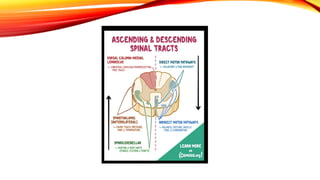
This process is made possible by tracts of nerve cells in the spinal cord which
connect the brain to the PNS.
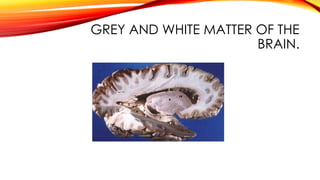
GREY AND WHITE MATTER
The brain and spinal cord are made up of:
1.Gray matter: named for its pinkish-gray color, is home to neural cell bodies,
axon terminals, and dendrites, as well as all nerve synapses. This brain tissue is
abundant in the cerebellum, cerebrum, and brain stem. It also forms a
butterfly-shaped portion of the central spinal cord.
2.White matter: composed of bundles of axons. These axons are coated with
myelin, a mixture of proteins and lipids, that helps conduct nerve signals and
protect the axons. White matter conducts, processes, and send nerve signals
up and down the spinal cord
GREY AND WHITE MATTER OF THE
BRAIN.
• The tracts each have a different function and can be broadly split
into Ascending and Descending. The ascending tracts are responsible for
relaying sensory information from the PNS to the brain whereas the
descending tracts send motor signals from the brain to lower motor neurones
(which then go on to synapse with muscles to produce movement).
ORGANISATION
• The peripheral nervous system (PNS) is a nervous system component that
connects the central nervous system (CNS) to the rest of the body. It consists
of nerves and ganglia transmitting signals between the CNS, organs, limbs,
and skin.
• The PNS is divided into sensory and motor divisions, which carry information
to and from the CNS. It is critical in bodily functions like movement, sensation,
and autonomic processes.
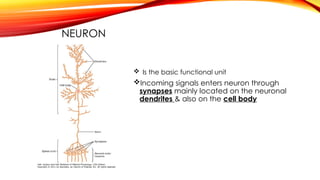
NEURON
 Is the basic functional unit
Incoming signals enters neuron through
synapses mainly located on the neuronal
dendrites & also on the cell body
1.SENSORY PART OF THE CNS
•Sensory receptors
• Most activities of the CNS are initiated by sensory experiences that excite sensory
receptors
• visual receptors in the eyes
• Auditory receptors in the ears
• Tactile receptors on the surface of the body
• Etc
• These sensory experiences can either cause
• immediate reactions from the brain
• memories of the experiences can be stored in the brain for
• minutes, weeks, months, years
• determine bodily reactions at some future date
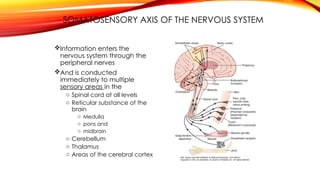
SOMATOSENSORY AXIS OF THE NERVOUS SYSTEM
Information enters the
nervous system through the
peripheral nerves
And is conducted
immediately to multiple
sensory areas in the
o Spinal cord at all levels
o Reticular substance of the
brain
o Medulla
o pons and
o midbrain
o Cerebellum
o Thalamus
o Areas of the cerebral cortex
2. MOTOR PART OF THE CENTRAL NERVOUS SYSTEM
Effectors
These are actual anatomical structures that perform the function dictated by
nerve signals
Muscles & glands
The most eventual role of the CNS is to control various body activities
This is achieved by controlling
o Contraction of appropriate skeletal muscles thru out the body
o Contraction of smooth muscles in the internal organs
o Secretion of active chemical substances by both exocrine & endocrine glands
o These activities are collectively called the motor actions of the nervous
system
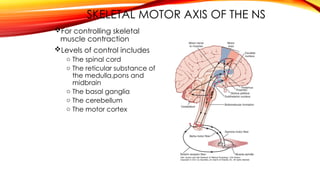
SKELETAL MOTOR AXIS OF THE NS
For controlling skeletal
muscle contraction
Levels of control includes
o The spinal cord
o The reticular substance of
the medulla,pons and
midbrain
o The basal ganglia
o The cerebellum
o The motor cortex
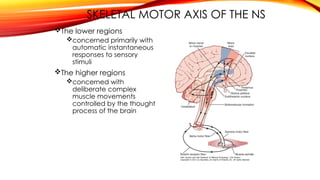
SKELETAL MOTOR AXIS OF THE NS
The lower regions
concerned primarily with
automatic instantaneous
responses to sensory
stimuli
The higher regions
concerned with
deliberate complex
muscle movements
controlled by the thought
process of the brain
3. PROCESSING OF INFORMATION
• Integrative Function of the Nervous System
• The incoming information is processed in such a way that
appropriate mental and motor responses will occur
• More than 99% of all sensory information is discarded by the
brain as irrelevant and unimportant
• Important sensory information that excites the mind is
channeled into proper integrative and motor regions of the
brain to cause a desired response
• Integration is the channeling and processing of
information
ROLE OF SYNAPSES IN PROCESSING
OF THE INFORMATION
Synapse
Is a junction point from one neuron to the next
Determine the directions that the nervous signals will spread through the nervous
system
Synaptic transmission
Can also be controlled from other areas of the CNS
Facilitatory- open up synapses for transmission
Inhibitory-closes up the synapses
In addition some postsynaptic neurons respond with
Large numbers of out put impulses
Few numbers of output impulses
NEURAL ADAPTATION
• Neural adaptation or sensory adaptation is a gradual decrease over time in
the responsiveness of the sensory system to a constant stimulus. It is
usually experienced as a change in the stimulus. For example, if a hand is
rested on a table, the table's surface is immediately felt against the skin.
Subsequently, however, the sensation of the table surface against the skin
gradually diminishes until it is virtually unnoticeable. The sensory neurons that
initially respond are no longer stimulated to respond; this is an example of
neural adaptation.
GENERAL DESIGN OF THE NERVOUS SYSTEM
• Storage of Information (Memory)
a. Information stored for future control of motor
activities and for use in the thinking process is
stored in the cerebral cortex
b. Facilitation-each time a synapse transfer info, the
synapses become more and more capable
MAJOR LEVELS OF CNS FUNCTION
1. Spinal Cord Level
a. A conduit for information to travel from the
periphery of the body to the brain and vice versa
b. Can cause walking movements
c. Withdrawal reflexes
d. Reflexes that stiffen the legs to support the body
against gravity
e. Reflexes that control local blood vessels, G.I.
movements, and urinary excretion
MAJOR LEVELS OF CNS FUNCTION
2. Lower Brain or Subcortical Level
a. Control of most of the “subconscious” activities
b. Arterial pressure and respiration
c. Control of equilibrium
d. Feeding reflexes
e. Many emotional patterns (anger, excitement,
sexual response, reaction to pain and pleasure)
MAJOR LEVELS OF CNS FUNCTION
3. Higher Brain or Cortical Level
a. Cerebral cortex is an extremely large memory
storehouse
b. Never functions alone but in association with
lower centers of the nervous system
c. Essential for most thought processes

1 Nervous System Introduction anatomy.pptx

  • 1.
    THE NERVOUS SYSTEM Organisation,general function, classification.
  • 2.
    GENERAL DESIGN OFTHE NERVOUS SYSTEM The central nervous system Receives information from different sensory nerves and sensory organs then integrates all these to determine response to be made by the body The central nervous system works closely with the peripheral nervous system allowing the body to control and react to stimuli. The CNS controls our body’s voluntary (e.g. walking) and involuntary (e.g. breathing) functions. The brain is responsible for generating our thoughts as well as interpreting information from the PNS and responding appropriately. This process is made possible by tracts of nerve cells in the spinal cord which connect the brain to the PNS.
  • 3.
    GREY AND WHITEMATTER The brain and spinal cord are made up of: 1.Gray matter: named for its pinkish-gray color, is home to neural cell bodies, axon terminals, and dendrites, as well as all nerve synapses. This brain tissue is abundant in the cerebellum, cerebrum, and brain stem. It also forms a butterfly-shaped portion of the central spinal cord. 2.White matter: composed of bundles of axons. These axons are coated with myelin, a mixture of proteins and lipids, that helps conduct nerve signals and protect the axons. White matter conducts, processes, and send nerve signals up and down the spinal cord
  • 4.
    GREY AND WHITEMATTER OF THE BRAIN.
  • 5.
    • The tractseach have a different function and can be broadly split into Ascending and Descending. The ascending tracts are responsible for relaying sensory information from the PNS to the brain whereas the descending tracts send motor signals from the brain to lower motor neurones (which then go on to synapse with muscles to produce movement).
  • 9.
    ORGANISATION • The peripheralnervous system (PNS) is a nervous system component that connects the central nervous system (CNS) to the rest of the body. It consists of nerves and ganglia transmitting signals between the CNS, organs, limbs, and skin. • The PNS is divided into sensory and motor divisions, which carry information to and from the CNS. It is critical in bodily functions like movement, sensation, and autonomic processes.
  • 10.
    NEURON  Is thebasic functional unit Incoming signals enters neuron through synapses mainly located on the neuronal dendrites & also on the cell body
  • 11.
    1.SENSORY PART OFTHE CNS •Sensory receptors • Most activities of the CNS are initiated by sensory experiences that excite sensory receptors • visual receptors in the eyes • Auditory receptors in the ears • Tactile receptors on the surface of the body • Etc • These sensory experiences can either cause • immediate reactions from the brain • memories of the experiences can be stored in the brain for • minutes, weeks, months, years • determine bodily reactions at some future date
  • 12.
    SOMATOSENSORY AXIS OFTHE NERVOUS SYSTEM Information enters the nervous system through the peripheral nerves And is conducted immediately to multiple sensory areas in the o Spinal cord at all levels o Reticular substance of the brain o Medulla o pons and o midbrain o Cerebellum o Thalamus o Areas of the cerebral cortex
  • 13.
    2. MOTOR PARTOF THE CENTRAL NERVOUS SYSTEM Effectors These are actual anatomical structures that perform the function dictated by nerve signals Muscles & glands The most eventual role of the CNS is to control various body activities This is achieved by controlling o Contraction of appropriate skeletal muscles thru out the body o Contraction of smooth muscles in the internal organs o Secretion of active chemical substances by both exocrine & endocrine glands o These activities are collectively called the motor actions of the nervous system
  • 14.
    SKELETAL MOTOR AXISOF THE NS For controlling skeletal muscle contraction Levels of control includes o The spinal cord o The reticular substance of the medulla,pons and midbrain o The basal ganglia o The cerebellum o The motor cortex
  • 15.
    SKELETAL MOTOR AXISOF THE NS The lower regions concerned primarily with automatic instantaneous responses to sensory stimuli The higher regions concerned with deliberate complex muscle movements controlled by the thought process of the brain
  • 16.
    3. PROCESSING OFINFORMATION • Integrative Function of the Nervous System • The incoming information is processed in such a way that appropriate mental and motor responses will occur • More than 99% of all sensory information is discarded by the brain as irrelevant and unimportant • Important sensory information that excites the mind is channeled into proper integrative and motor regions of the brain to cause a desired response • Integration is the channeling and processing of information
  • 17.
    ROLE OF SYNAPSESIN PROCESSING OF THE INFORMATION Synapse Is a junction point from one neuron to the next Determine the directions that the nervous signals will spread through the nervous system Synaptic transmission Can also be controlled from other areas of the CNS Facilitatory- open up synapses for transmission Inhibitory-closes up the synapses In addition some postsynaptic neurons respond with Large numbers of out put impulses Few numbers of output impulses
  • 18.
    NEURAL ADAPTATION • Neuraladaptation or sensory adaptation is a gradual decrease over time in the responsiveness of the sensory system to a constant stimulus. It is usually experienced as a change in the stimulus. For example, if a hand is rested on a table, the table's surface is immediately felt against the skin. Subsequently, however, the sensation of the table surface against the skin gradually diminishes until it is virtually unnoticeable. The sensory neurons that initially respond are no longer stimulated to respond; this is an example of neural adaptation.
  • 19.
    GENERAL DESIGN OFTHE NERVOUS SYSTEM • Storage of Information (Memory) a. Information stored for future control of motor activities and for use in the thinking process is stored in the cerebral cortex b. Facilitation-each time a synapse transfer info, the synapses become more and more capable
  • 20.
    MAJOR LEVELS OFCNS FUNCTION 1. Spinal Cord Level a. A conduit for information to travel from the periphery of the body to the brain and vice versa b. Can cause walking movements c. Withdrawal reflexes d. Reflexes that stiffen the legs to support the body against gravity e. Reflexes that control local blood vessels, G.I. movements, and urinary excretion
  • 21.
    MAJOR LEVELS OFCNS FUNCTION 2. Lower Brain or Subcortical Level a. Control of most of the “subconscious” activities b. Arterial pressure and respiration c. Control of equilibrium d. Feeding reflexes e. Many emotional patterns (anger, excitement, sexual response, reaction to pain and pleasure)
  • 22.
    MAJOR LEVELS OFCNS FUNCTION 3. Higher Brain or Cortical Level a. Cerebral cortex is an extremely large memory storehouse b. Never functions alone but in association with lower centers of the nervous system c. Essential for most thought processes