Dr Mekuanint D. (OBGY year II Resident )
Modulator: Dr Tizita (OBGY Consultant)
Yekatit 12 HMC/Abebech Gobena /
April,2021
Management of preeclampsia and
Eclampsia
Outline
 Introduction
 Incidence
 Classification
 Risk factors
 Etiopathogenesis
 Management
 Eclampsia
2
INTRODUCTION
 Preeclampsia is a multisystem, progressive disorder
characterized by
 new onset of hypertension and proteinuria or
 hypertension and end-organ dysfunction with or without
proteinuria in the last half of pregnancy
 A key focus of routine prenatal care is monitoring
pregnancies for signs and symptoms of preeclampsia.
3
Incidence
 Most common medical complications of pregnancy
 5% and 10%
 5 percent in white, 9 percent in Hispanic, and 11 percent in
African-American women
4
Classification
 Preeclampsia and eclampsia syndrome
 Chronic hypertension of any etiology
 Preeclampsia superimposed on chronic hypertension
 Gestational hypertension
5
Diagnosis
6
Indicators of Severity
7
Risk Factors
High risk
8
 >= 1
 Low dose Asprine
Moderate risk
9
 More than one
 Consider low dose
Asprine
Low risk
10
 Previously uncomplicated
full term delivery
 Asprine is Not
recommended
ETIOPATHOGENESIS
Develop in women with the following characteristics:
 exposed to chorionic villi for the first time
 exposed to a superabundance of chorionic villi, as with twins or hydatidiform
mole
 preexisting conditions associated with endothelial cell activation or
inflammation,
 diabetes,
 obesity,
 cardiovascular or renal disease,
 immunological disorders, or
 hereditary influences
 genetically predisposed to hypertension developing during pregnancy.
11
 A fetus is not a requisite for preeclampsia to develop.
 although chorionic villi are essential, they need not be
intrauterine.
12
…Etiology
 Placental implantation with abnormal trophoblastic invasion of
uterine vessels
 Immunological maladaptive tolerance between maternal,
paternal (placental), and fetal tissues
 Maternal maladaptation to cardiovascular or inflammatory
changes of normal pregnancy
 Genetic factors including inherited predisposing genes and
epigenetic influences.
13
14
…Pathogenesis
 Regardless of precipitating etiology,
 cascade,
 systemic vascular endothelial damage with resultant
 vasospasm,
 transudation of plasma,and
 ischemic and
 thrombotic sequelae
15
Management
 Management varies depending
 gestational age
 severity
 Preeclampsia with features of severe disease
 <28 week –Termination
 28-34 week-expectant management is recommended
 34-37 week--expectant management may be recommended
16
…
17
 Preeclampsia without features of severe disease
 <37 week-- expectant
 ≥37 weeks —termination
Treatment of hypertension
 Severe hypertension should be treated to prevent maternal
vascular complications (eg, stroke, heart failure)
 systolic pressure is ≥160 mmHg or diastolic pressure is ≥105
to 110 mmHg
18
Choice of drug and dose
 two settings
 Acute management of severe hypertension, which may require
parenteral therapy, and
 Longer-term blood pressure control during expectant
management of severe preeclampsia
19
Acute therapy
 intravenous labetalol or hydralazine as first-line agents
 Nifedipine
20
Labetalol
 effective, has a rapid onset of action, and a good safety
profile.
 Begin with 20 mg intravenously over 2 minutes followed at
10-minute intervals by doses of 20 to 80 mg up to a
maximum total cumulative dose of 300 mg, if blood pressure
remains above target level
 A constant infusion of 1 to 2 mg/min can be used
 The fall in blood pressure begins within 5 to 10 minutes and
lasts from 3 to 6 hours
21
Hydralazine
 5 mg intravenously over 1 to 2 minutes
 If a total dose of 30 mg does not achieve optimal blood
pressure control, another agent should be used.
 The fall in blood pressure begins within 10 to 30 minutes and
lasts from 2 to 4 hours.
22
 Calcium channel blockers
Nifedipine
 30 mg sustained release tablet
Nitroglycerin
 hypertension associated with pulmonary edema
 It is given as an intravenous infusion of 5 mcg/min and
gradually increased every 3 to 5 minutes to a maximum dose of
100 mcg/min.
23
Long-term oral therapy
 Nifedipine
 Alpha methyldopa
•Administer 250-750 mg every six to eight hours.
 The maximum dose is 3000 mg per 24 hours
24
Seizure prophylaxis
 Candidates for seizure prophylaxis
 Intrapartum and postpartum seizure prophylaxis to all women
with preeclampsia,
 Drug of choice:
 Magnesium sulfate
25
Dosing
 loading dose of 6 g of a 10 percent solution intravenously
over 15 to 20 minutes followed by 2 g/hour as a continuous
infusion
 5 g of a 50 percent solution intramuscularly into each
buttock (total of 10 g) followed by 5 g intramuscularly every
four hours
 therapeutic range of 4.8 to 8.4 mg/dL (2.0 to 3.5 mmol/L)
26
 Renal insufficiency
 Magnesium sulfate is excreted by the kidneys.
 Women with renal insufficiency should receive a standard
loading dose
 Reduced maintenance dose.
 1 g/hour if the serum creatinine is >1.2 and <2.5 mg/dL
 no maintenance dose if the serum creatinine is ≥2.5 mg/dL or
magnesium toxicity is suspected
27
Timing of Magnesium sulfate
 at the onset of labor or induction, or prior to a cesarean
delivery
 while they are being considered for conservative
management.
 Prolonged antepartum therapy??
28
Side effects
 Rapid infusion of magnesium sulfate causes peripheral
vasodilation and a drop in blood pressure.
diaphoresis
flushing, and
warmth
Nausea
vomiting
29
headache
muscle weakness
visual disturbances, and
palpitations
 Transient reduction of total and ionized serum calcium
concentration due to rapid suppression of parathyroid
hormone release
30
Toxicity
 Magnesium toxicity is uncommon in women with good renal
function
 loss of deep tendon reflexes occurs at 7 to 10 mEq/L
 respiratory paralysis at 10 to 13 mEq/L
 cardiac conduction is altered at >15 mEq/L
 cardiac arrest occurs at >25 mEq/L
31
When to check magnesium levels
 every six hours
 A seizure while receiving magnesium sulfate
 Clinical signs/symptoms suggestive of magnesium toxicity
 Renal insufficiency (creatinine >1.2 mg/dL [106 micromol/L)
32
 Antidote
 Calcium gluconate
33
Preterm pregnancies:
 Conservative management
 the risks of serious sequelae from disease progression need to
be balanced with the risks of preterm birth
34
Indications for Delivery in Women <34
Weeks
 Uncontrolled severe hypertension
 Eclampsia
 Pulmonary edema
 Disseminated intravascular coagulation
 Placental abruption
 Nonreassuring fetal status
 Fetal demise
35
Corticosteroid—Delay Delivery 48 hr
 Preterm ruptured membranes or labor
 Thrombocytopenia <100,000/μL
 Hepatic transaminase levels twice upper limit of normal
 Fetal-growth restriction
 Oligohydramnios
 Reversed end-diastolic Doppler flow in umbilical artery
 Worsening renal dysfunction
36
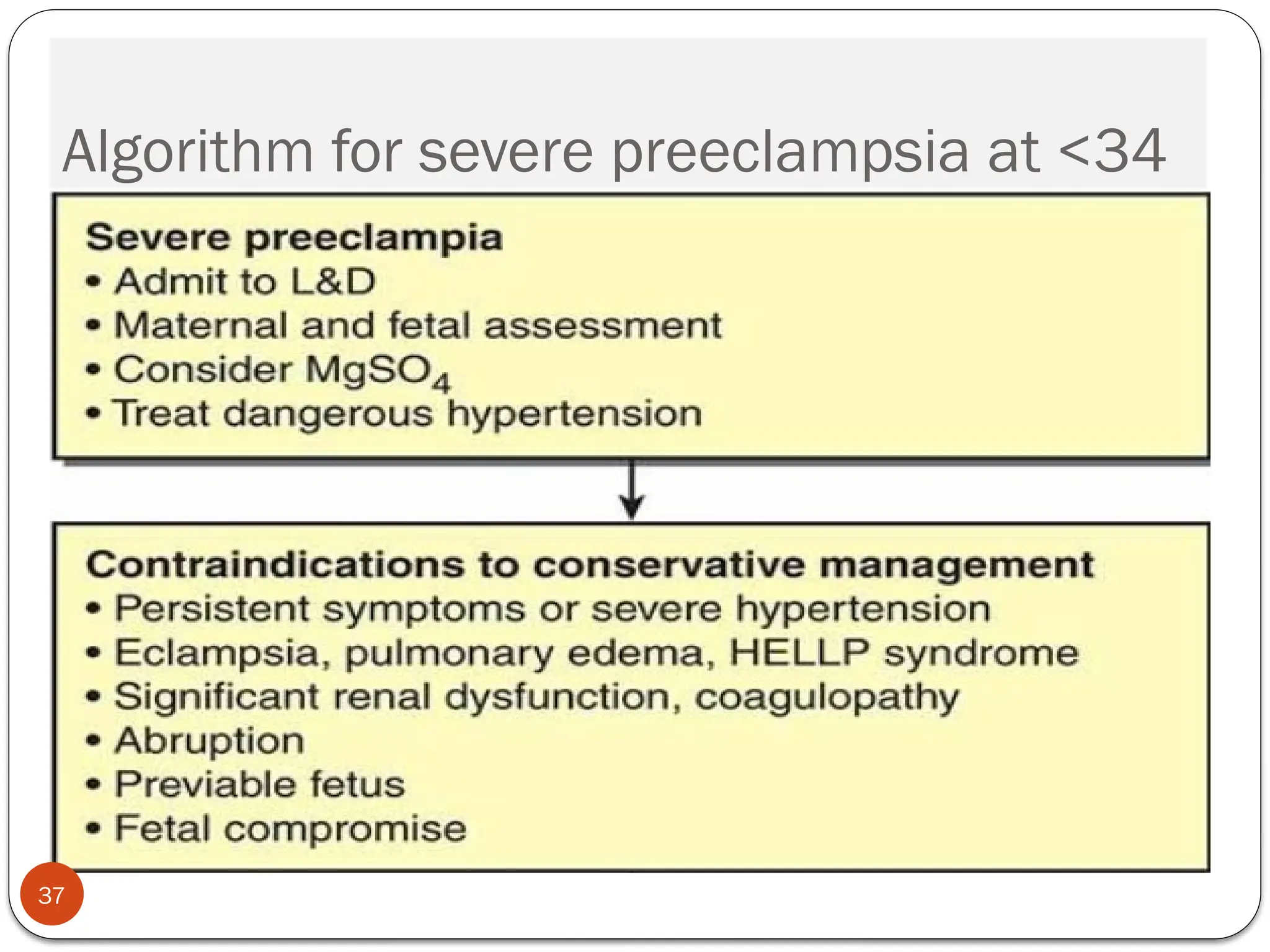
Algorithm for severe preeclampsia at <34
37
38
39
Eclampsia :
40
 Development of convulsions or unexplained
coma during pregnancy or postpartum in
patients with signs and symptoms of PE.
 Excluding other posible cause of convulsion
Incidence
41
 1 in 2000 to 1 in 3448 pregnancies.
 2-3 % in PE with SF
 0.6% in PE without SF
 higher in
 tertiary referral centers
 Multifetal gestation
 in those without prenatal care
Pathophysiology
42
 The precise cause of seizures in preeclamptic women is not
clearly understood.
1. hypertension causes a breakdown of the autoregulatory
system of the cerebral circulation,
 hyperperfusion,
 endothelial dysfunction, and
 vasogenic and/or cytotoxic edema.
Pathophysiology…
43
2. hypertension causes activation of the autoregulatory system,
leading to vasoconstriction of cerebral vessels
 hypoperfusion,
 localized ischemia,
 endothelial dysfunction, and
 vasogenic and/or cytotoxic edema
CLINICAL PRESENTATION AND FINDINGS
44
 generalized tonic-clonic seizure or coma
 premonitory signs/symptoms
 Hypertension (75 percent)
 Headache
 Visual disturbances (27 percent)
 Right upper quadrant or epigastric pain (25 percent)
 Asymptomatic (25 percent)
Diagnosis
45
 convulsions
 hypertension,
 proteinuria, and
 However
 16% of cases, hypertension may be absent
 14% of the cases proteinuria may be absent
Diagnosis …
46
 Several clinical symptoms are potentially helpful
 persistent occipital or frontal headaches,
 blurred vision,
 photophobia,
 epigastric or right upper quadrant pain, and
 altered mental status.
Time of Onset
47
 Antepartum …
 Intrapartum
 postpartum period.
 first 48 hours
 beyond 48 hours
 extensive neurologic evaluation may be required to rule out the
presence of other cerebral pathology
Time of Onset …
48
 Almost all cases of eclampsia (91%) develop in the third
trimester (≥28 weeks).
 21 and 27 weeks’ gestation (7.5%)
 before 20 weeks’ gestation (1.5%)
MANAGEMENT
49
 maintaining airway patency and preventing
aspiration
 The woman should be rolled onto her left side.
Prevention of maternal hypoxia and trauma
Treatment of severe hypertension
Prevention of recurrent seizures
Evaluation for prompt delivery
Treatment of hypertension
50
 To prevent stroke, which accounts for 15 to 20 percent of
deaths from eclampsia.
 diastolic pressures greater than 105 to 110 mmHg or
 systolic blood pressures ≥160 mmHg
 Drugs
 Hydralazine
 Labetalol
 Nifidipine
51
Diuretics
 Potent loop diuretics can further compromise placental
perfusion.
 before delivery, diuretics are not used to lower blood
pressure
Prevention of recurrent seizures
52
 Treatment is primarily directed at prevention of recurrent
seizures and the possible complications
 10 percent of eclamptic women will have repeated seizures
 The anticonvulsive drug of choice is magnesium sulfate.
53
Loading dose
 4 to 6 g intravenously are commonly used
 5 g intramuscularly into each buttock for a total of 10 g;
 the onset of a therapeutic effect will be slower and
intramuscular injection is painful.
 These loading doses may be given safely to patients with
renal insufficiency.
54
Maintenance dose
 1 to 3 g/hour are commonly used.
 5 g can be given intramuscularly every four hours;
 a lower dose maintenance regimen (2.5 g intramuscularly
every four hours)
 The maintenance phase is given only if a
 patellar reflex
 respirations are greater than 12 per minute, and
 urine output is over 100 mL in four hours
Management of persistent seizures
55
 Additional bolus of 2 g magnesium sulfate over 5 to 10
minutes
 Frequent monitoring for signs of magnesium toxicity
 If two such boluses do not control seizures, then other drugs
should be given.
 Diazepam or lorazepam is a common choice
Response to therapy
56
 Women who do not improve within 10 to 20 minutes
following control of hypertension and seizures and
 those with neurologic deficits
 should be evaluated by a neurologist
may have ongoing nonconvulsive seizures or
underlying structural pathology,
 such as hemorrhage
Evaluation for prompt delivery
57
 Contraindication to expectant management
 The definitive treatment for eclampsia
 prompt delivery;After maternal stabilization,
58
 mode of delivery
 gestational age
 cervical status
 whether the patient is in labor, and
 fetal condition and position
complications of seizure
59
 Neuronal death
 Rhabdomyolysis
 Metabolic acidosis
 Aspiration pneumonitis
 Neurogenic pulmonary edema
 Respiratory failure
Prevention
60
 use of antihypertensive
 timely delivery, and
 prophylactic use of magnesium sulfate during labor and
immediately postpartum in those considered to have PE
Reference
61
 William’s obstetrics, 25th
ed.
 Gabbe obstetrics, 7th
ed.
 Up to date 2018
 ACOG PRACTICE BULLETIN
 MANAGEMENT PROTOCOL ON
SELECTED OBSTETRICSTOPICS FOR
HOSPITALS, Ministry of Health Ethiopia,2020
Thank you !!!
62
HAPPY ESTER!
63

1.Management of preeclampsia and Eclampsia.pptx

  • 1.
    Dr Mekuanint D.(OBGY year II Resident ) Modulator: Dr Tizita (OBGY Consultant) Yekatit 12 HMC/Abebech Gobena / April,2021 Management of preeclampsia and Eclampsia
  • 2.
    Outline  Introduction  Incidence Classification  Risk factors  Etiopathogenesis  Management  Eclampsia 2
  • 3.
    INTRODUCTION  Preeclampsia isa multisystem, progressive disorder characterized by  new onset of hypertension and proteinuria or  hypertension and end-organ dysfunction with or without proteinuria in the last half of pregnancy  A key focus of routine prenatal care is monitoring pregnancies for signs and symptoms of preeclampsia. 3
  • 4.
    Incidence  Most commonmedical complications of pregnancy  5% and 10%  5 percent in white, 9 percent in Hispanic, and 11 percent in African-American women 4
  • 5.
    Classification  Preeclampsia andeclampsia syndrome  Chronic hypertension of any etiology  Preeclampsia superimposed on chronic hypertension  Gestational hypertension 5
  • 6.
  • 7.
  • 8.
    Risk Factors High risk 8 >= 1  Low dose Asprine
  • 9.
    Moderate risk 9  Morethan one  Consider low dose Asprine
  • 10.
    Low risk 10  Previouslyuncomplicated full term delivery  Asprine is Not recommended
  • 11.
    ETIOPATHOGENESIS Develop in womenwith the following characteristics:  exposed to chorionic villi for the first time  exposed to a superabundance of chorionic villi, as with twins or hydatidiform mole  preexisting conditions associated with endothelial cell activation or inflammation,  diabetes,  obesity,  cardiovascular or renal disease,  immunological disorders, or  hereditary influences  genetically predisposed to hypertension developing during pregnancy. 11
  • 12.
     A fetusis not a requisite for preeclampsia to develop.  although chorionic villi are essential, they need not be intrauterine. 12
  • 13.
    …Etiology  Placental implantationwith abnormal trophoblastic invasion of uterine vessels  Immunological maladaptive tolerance between maternal, paternal (placental), and fetal tissues  Maternal maladaptation to cardiovascular or inflammatory changes of normal pregnancy  Genetic factors including inherited predisposing genes and epigenetic influences. 13
  • 14.
  • 15.
    …Pathogenesis  Regardless ofprecipitating etiology,  cascade,  systemic vascular endothelial damage with resultant  vasospasm,  transudation of plasma,and  ischemic and  thrombotic sequelae 15
  • 16.
    Management  Management variesdepending  gestational age  severity  Preeclampsia with features of severe disease  <28 week –Termination  28-34 week-expectant management is recommended  34-37 week--expectant management may be recommended 16
  • 17.
    … 17  Preeclampsia withoutfeatures of severe disease  <37 week-- expectant  ≥37 weeks —termination
  • 18.
    Treatment of hypertension Severe hypertension should be treated to prevent maternal vascular complications (eg, stroke, heart failure)  systolic pressure is ≥160 mmHg or diastolic pressure is ≥105 to 110 mmHg 18
  • 19.
    Choice of drugand dose  two settings  Acute management of severe hypertension, which may require parenteral therapy, and  Longer-term blood pressure control during expectant management of severe preeclampsia 19
  • 20.
    Acute therapy  intravenouslabetalol or hydralazine as first-line agents  Nifedipine 20
  • 21.
    Labetalol  effective, hasa rapid onset of action, and a good safety profile.  Begin with 20 mg intravenously over 2 minutes followed at 10-minute intervals by doses of 20 to 80 mg up to a maximum total cumulative dose of 300 mg, if blood pressure remains above target level  A constant infusion of 1 to 2 mg/min can be used  The fall in blood pressure begins within 5 to 10 minutes and lasts from 3 to 6 hours 21
  • 22.
    Hydralazine  5 mgintravenously over 1 to 2 minutes  If a total dose of 30 mg does not achieve optimal blood pressure control, another agent should be used.  The fall in blood pressure begins within 10 to 30 minutes and lasts from 2 to 4 hours. 22
  • 23.
     Calcium channelblockers Nifedipine  30 mg sustained release tablet Nitroglycerin  hypertension associated with pulmonary edema  It is given as an intravenous infusion of 5 mcg/min and gradually increased every 3 to 5 minutes to a maximum dose of 100 mcg/min. 23
  • 24.
    Long-term oral therapy Nifedipine  Alpha methyldopa •Administer 250-750 mg every six to eight hours.  The maximum dose is 3000 mg per 24 hours 24
  • 25.
    Seizure prophylaxis  Candidatesfor seizure prophylaxis  Intrapartum and postpartum seizure prophylaxis to all women with preeclampsia,  Drug of choice:  Magnesium sulfate 25
  • 26.
    Dosing  loading doseof 6 g of a 10 percent solution intravenously over 15 to 20 minutes followed by 2 g/hour as a continuous infusion  5 g of a 50 percent solution intramuscularly into each buttock (total of 10 g) followed by 5 g intramuscularly every four hours  therapeutic range of 4.8 to 8.4 mg/dL (2.0 to 3.5 mmol/L) 26
  • 27.
     Renal insufficiency Magnesium sulfate is excreted by the kidneys.  Women with renal insufficiency should receive a standard loading dose  Reduced maintenance dose.  1 g/hour if the serum creatinine is >1.2 and <2.5 mg/dL  no maintenance dose if the serum creatinine is ≥2.5 mg/dL or magnesium toxicity is suspected 27
  • 28.
    Timing of Magnesiumsulfate  at the onset of labor or induction, or prior to a cesarean delivery  while they are being considered for conservative management.  Prolonged antepartum therapy?? 28
  • 29.
    Side effects  Rapidinfusion of magnesium sulfate causes peripheral vasodilation and a drop in blood pressure. diaphoresis flushing, and warmth Nausea vomiting 29 headache muscle weakness visual disturbances, and palpitations
  • 30.
     Transient reductionof total and ionized serum calcium concentration due to rapid suppression of parathyroid hormone release 30
  • 31.
    Toxicity  Magnesium toxicityis uncommon in women with good renal function  loss of deep tendon reflexes occurs at 7 to 10 mEq/L  respiratory paralysis at 10 to 13 mEq/L  cardiac conduction is altered at >15 mEq/L  cardiac arrest occurs at >25 mEq/L 31
  • 32.
    When to checkmagnesium levels  every six hours  A seizure while receiving magnesium sulfate  Clinical signs/symptoms suggestive of magnesium toxicity  Renal insufficiency (creatinine >1.2 mg/dL [106 micromol/L) 32
  • 33.
  • 34.
    Preterm pregnancies:  Conservativemanagement  the risks of serious sequelae from disease progression need to be balanced with the risks of preterm birth 34
  • 35.
    Indications for Deliveryin Women <34 Weeks  Uncontrolled severe hypertension  Eclampsia  Pulmonary edema  Disseminated intravascular coagulation  Placental abruption  Nonreassuring fetal status  Fetal demise 35
  • 36.
    Corticosteroid—Delay Delivery 48hr  Preterm ruptured membranes or labor  Thrombocytopenia <100,000/μL  Hepatic transaminase levels twice upper limit of normal  Fetal-growth restriction  Oligohydramnios  Reversed end-diastolic Doppler flow in umbilical artery  Worsening renal dysfunction 36
  • 37.
    Algorithm for severepreeclampsia at <34 37
  • 38.
  • 39.
  • 40.
    Eclampsia : 40  Developmentof convulsions or unexplained coma during pregnancy or postpartum in patients with signs and symptoms of PE.  Excluding other posible cause of convulsion
  • 41.
    Incidence 41  1 in2000 to 1 in 3448 pregnancies.  2-3 % in PE with SF  0.6% in PE without SF  higher in  tertiary referral centers  Multifetal gestation  in those without prenatal care
  • 42.
    Pathophysiology 42  The precisecause of seizures in preeclamptic women is not clearly understood. 1. hypertension causes a breakdown of the autoregulatory system of the cerebral circulation,  hyperperfusion,  endothelial dysfunction, and  vasogenic and/or cytotoxic edema.
  • 43.
    Pathophysiology… 43 2. hypertension causesactivation of the autoregulatory system, leading to vasoconstriction of cerebral vessels  hypoperfusion,  localized ischemia,  endothelial dysfunction, and  vasogenic and/or cytotoxic edema
  • 44.
    CLINICAL PRESENTATION ANDFINDINGS 44  generalized tonic-clonic seizure or coma  premonitory signs/symptoms  Hypertension (75 percent)  Headache  Visual disturbances (27 percent)  Right upper quadrant or epigastric pain (25 percent)  Asymptomatic (25 percent)
  • 45.
    Diagnosis 45  convulsions  hypertension, proteinuria, and  However  16% of cases, hypertension may be absent  14% of the cases proteinuria may be absent
  • 46.
    Diagnosis … 46  Severalclinical symptoms are potentially helpful  persistent occipital or frontal headaches,  blurred vision,  photophobia,  epigastric or right upper quadrant pain, and  altered mental status.
  • 47.
    Time of Onset 47 Antepartum …  Intrapartum  postpartum period.  first 48 hours  beyond 48 hours  extensive neurologic evaluation may be required to rule out the presence of other cerebral pathology
  • 48.
    Time of Onset… 48  Almost all cases of eclampsia (91%) develop in the third trimester (≥28 weeks).  21 and 27 weeks’ gestation (7.5%)  before 20 weeks’ gestation (1.5%)
  • 49.
    MANAGEMENT 49  maintaining airwaypatency and preventing aspiration  The woman should be rolled onto her left side. Prevention of maternal hypoxia and trauma Treatment of severe hypertension Prevention of recurrent seizures Evaluation for prompt delivery
  • 50.
    Treatment of hypertension 50 To prevent stroke, which accounts for 15 to 20 percent of deaths from eclampsia.  diastolic pressures greater than 105 to 110 mmHg or  systolic blood pressures ≥160 mmHg  Drugs  Hydralazine  Labetalol  Nifidipine
  • 51.
    51 Diuretics  Potent loopdiuretics can further compromise placental perfusion.  before delivery, diuretics are not used to lower blood pressure
  • 52.
    Prevention of recurrentseizures 52  Treatment is primarily directed at prevention of recurrent seizures and the possible complications  10 percent of eclamptic women will have repeated seizures  The anticonvulsive drug of choice is magnesium sulfate.
  • 53.
    53 Loading dose  4to 6 g intravenously are commonly used  5 g intramuscularly into each buttock for a total of 10 g;  the onset of a therapeutic effect will be slower and intramuscular injection is painful.  These loading doses may be given safely to patients with renal insufficiency.
  • 54.
    54 Maintenance dose  1to 3 g/hour are commonly used.  5 g can be given intramuscularly every four hours;  a lower dose maintenance regimen (2.5 g intramuscularly every four hours)  The maintenance phase is given only if a  patellar reflex  respirations are greater than 12 per minute, and  urine output is over 100 mL in four hours
  • 55.
    Management of persistentseizures 55  Additional bolus of 2 g magnesium sulfate over 5 to 10 minutes  Frequent monitoring for signs of magnesium toxicity  If two such boluses do not control seizures, then other drugs should be given.  Diazepam or lorazepam is a common choice
  • 56.
    Response to therapy 56 Women who do not improve within 10 to 20 minutes following control of hypertension and seizures and  those with neurologic deficits  should be evaluated by a neurologist may have ongoing nonconvulsive seizures or underlying structural pathology,  such as hemorrhage
  • 57.
    Evaluation for promptdelivery 57  Contraindication to expectant management  The definitive treatment for eclampsia  prompt delivery;After maternal stabilization,
  • 58.
    58  mode ofdelivery  gestational age  cervical status  whether the patient is in labor, and  fetal condition and position
  • 59.
    complications of seizure 59 Neuronal death  Rhabdomyolysis  Metabolic acidosis  Aspiration pneumonitis  Neurogenic pulmonary edema  Respiratory failure
  • 60.
    Prevention 60  use ofantihypertensive  timely delivery, and  prophylactic use of magnesium sulfate during labor and immediately postpartum in those considered to have PE
  • 61.
    Reference 61  William’s obstetrics,25th ed.  Gabbe obstetrics, 7th ed.  Up to date 2018  ACOG PRACTICE BULLETIN  MANAGEMENT PROTOCOL ON SELECTED OBSTETRICSTOPICS FOR HOSPITALS, Ministry of Health Ethiopia,2020
  • 62.
  • 63.