Keur Knowledge Centre Article # 2019/01
www.keur.in
LEAN, Six Sigma, TOC or something else?
However, each method is especially suited for
reducing only specific types of wastes /
inefficiencies & not for all. For eg.
1) Lean – reduces non-value added activities
2) Theory Of Constraints – exploits current
constraints
3) 6 Sigma – reduces process variations
4) 5-S – eliminates time wasted in searching for
things
………….. & so on, for various methods.
How should you choose which methods to
use?
1) Specify business parameters that you are
trying to improve
2) Identify problems that are preventing you
from improving these business parameters
3) Identify which types of wastes / inefficiencies
are causing those problems
Pick & apply methods best suited to reduce the
types of wastes / inefficiencies identified in step 3
above
Word of caution:
1) There is not a single method or tool which is
best for reducing all types of wastes /
inefficiencies
2) Many times, there is more than one type of
waste / inefficiency that needs to be
reduced. Hence, you will have to use
different methods concurrently.
3) Don’t use a method simply because
someone else has used it & got good results
or because it is the current fad in your
industry.
If a wrong method is chosen & applied, it
results into lot of wastage of company’s
resources (time, money & efforts) without
getting much payback.
Companies are always trying to improve their
performance on several business parameters, like –
• On Time Delivery
• Productivity
• Inventory turns
• Sales
• Working Capital
• Quality
• Cost
………… & many more.
If an attempt is being made to improve a particular
business parameter, it automatically means that
current level of performance with respect to that
business parameter is not satisfactory.
What limits performance to current level?
In most cases, it is due to some types of wastes /
inefficiencies in the system.
How can you reduce these?
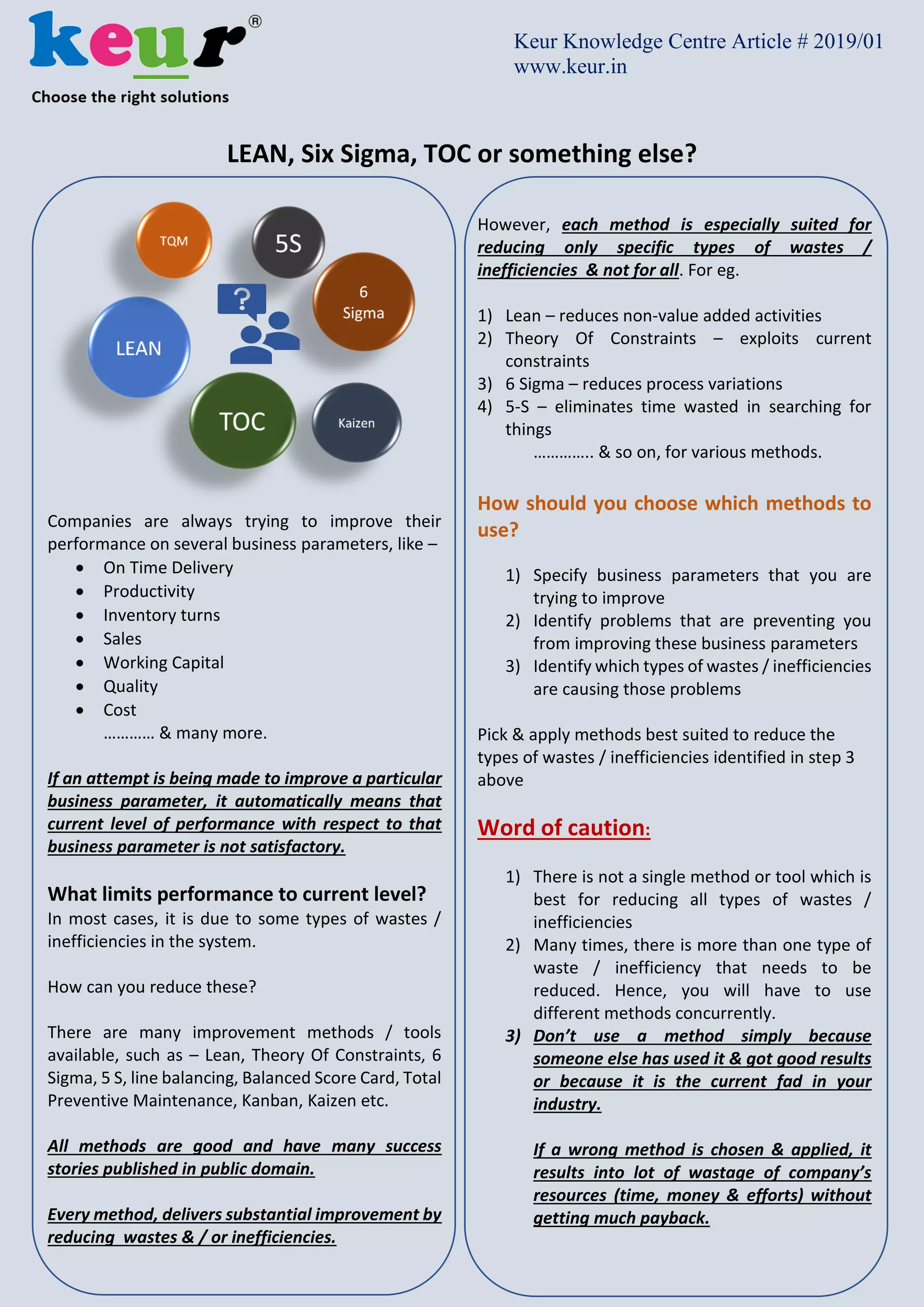
There are many improvement methods / tools
available, such as – Lean, Theory Of Constraints, 6
Sigma, 5 S, line balancing, Balanced Score Card, Total
Preventive Maintenance, Kanban, Kaizen etc.
All methods are good and have many success
stories published in public domain.
Every method, delivers substantial improvement by
reducing wastes & / or inefficiencies.

1. lean, six sigma, toc or something else

  • 1.
    Keur Knowledge CentreArticle # 2019/01 www.keur.in LEAN, Six Sigma, TOC or something else? However, each method is especially suited for reducing only specific types of wastes / inefficiencies & not for all. For eg. 1) Lean – reduces non-value added activities 2) Theory Of Constraints – exploits current constraints 3) 6 Sigma – reduces process variations 4) 5-S – eliminates time wasted in searching for things ………….. & so on, for various methods. How should you choose which methods to use? 1) Specify business parameters that you are trying to improve 2) Identify problems that are preventing you from improving these business parameters 3) Identify which types of wastes / inefficiencies are causing those problems Pick & apply methods best suited to reduce the types of wastes / inefficiencies identified in step 3 above Word of caution: 1) There is not a single method or tool which is best for reducing all types of wastes / inefficiencies 2) Many times, there is more than one type of waste / inefficiency that needs to be reduced. Hence, you will have to use different methods concurrently. 3) Don’t use a method simply because someone else has used it & got good results or because it is the current fad in your industry. If a wrong method is chosen & applied, it results into lot of wastage of company’s resources (time, money & efforts) without getting much payback. Companies are always trying to improve their performance on several business parameters, like – • On Time Delivery • Productivity • Inventory turns • Sales • Working Capital • Quality • Cost ………… & many more. If an attempt is being made to improve a particular business parameter, it automatically means that current level of performance with respect to that business parameter is not satisfactory. What limits performance to current level? In most cases, it is due to some types of wastes / inefficiencies in the system. How can you reduce these? There are many improvement methods / tools available, such as – Lean, Theory Of Constraints, 6 Sigma, 5 S, line balancing, Balanced Score Card, Total Preventive Maintenance, Kanban, Kaizen etc. All methods are good and have many success stories published in public domain. Every method, delivers substantial improvement by reducing wastes & / or inefficiencies.