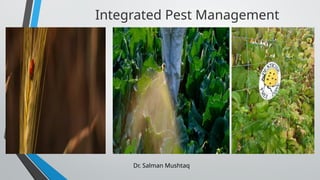
Integrated Pest Management
Dr. Salman Mushtaq
IPM Approach
• When modern pesticides were first developed, they were used extensively. Pests
susceptible to a pesticide were quickly killed, leaving resistant ones to breed and
multiply.
• It became clear that pesticides alone would not solve all pest problems.
• Scientists began to develop a new approach to pest control. This new approach
was described as integrated pest management (IPM).
• Integrated refers to the fact that all control measures (mechanical, cultural,
biological, and chemical) are considered and used as appropriate.
• Pests are much less likely to survive a program that uses many different methods
of reducing their populations.
Integrated Pest Management
• Integrated pest management (IPM), an approach that uses knowledge about
pests and their life cycles, cultural practices, nonchemical methods, and
pesticides to manage pest problems.
• IPM focuses on preventing pest problems before they occur. When pest
problems do arise, management options focus on those with the least possible
impact on human health and the environment.
• An IPM plan may be slower to show results and could require more effort
than spraying a chemical, but the reduced impact on the environment can be
worth the investment.
Methods to control Pests
Pest Management
Cultural Management
Mechanical Management
Biological Management
Chemical Management
Pest Management
• Prevention is the first tool in pest management because it is the most effective, least expensive, most
environmentally friendly solution.
• Second is choosing a healthy plant which can minimizes pest problems.
• Best practice is early intervention. Being present and observant in the garden ensures early detection.
Reacting to problems quickly, before they have time to multiply, requires a less dramatic intervention.
• The third important tool is recordkeeping; tracking what happens in the garden enables a gardener to
recognize patterns and make informed decisions.
• Record planting dates, varieties, purchase location, dates of problem onset, weather conditions,
management strategies.
Cultural Management
• The most effective and most important of all practices is to observe what is going
on in the garden.
• Many serious disease or insect problems can be halted or slowed by regularly
visiting the garden, knowing what to look for, recognizing potential problems, and
intervening early.
• Cultural methods includes preparing the soil, choosing tolerant plant varieties,
rotating crops, interplanting, timing planting dates to avoid pests, managing
weeds, and planting "trap" crops.
Limitations of Cultural Management
• The use of cultural controls for pest management requires advanced planning
on the gardener’s part. Specific resistant varieties must be located and
purchased in advance. In some cases, varieties may not be available locally.
• Crop rotation is a valuable cultural method for reducing insect and disease
issues, but many gardeners do not have the room to sufficiently implement this
practice. Consider raised beds with new soil or plant in containers when you
know a disease problem exists. Skip growing the same crop or family with
pest issue.
Mechanical Management
• Hand picking: Inspect plants regularly for eggs, immatures, or
adults and upon identification of harmful to the plant hand­
pick as
many as possible. You can also give a dish detergent wash.
• Use of Pheromone traps: are used for detecting the presence of
pests or sometimes for disrupting insect mating habits.
• Net-covered cages over young seedlings help prevent insect, bird,
and rabbit damage.
• Pruning: Some pests like stem borer and the dogwood club gall can be
managed by pruning infected twigs out of infested plants and destroying
them.
• Raking: the fallen twigs of pecans, oaks, elms, hickories, and other
shade trees in the fall removes the larvae of twig girdlers.
• Strong stream of water spray: (with hose adapters) can dislodges
and kills many spider mites, aphids, and other relatively fragile
insects.
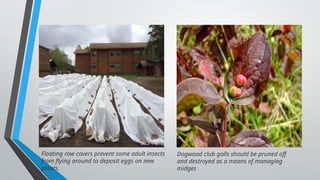
Floating row covers prevent some adult insects
from flying around to deposit eggs on new
plants.
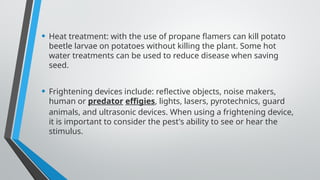
Dogwood club galls should be pruned off
and destroyed as a means of managing
midges
• Heat treatment: with the use of propane flamers can kill potato
beetle larvae on potatoes without killing the plant. Some hot
water treatments can be used to reduce disease when saving
seed.
• Frightening devices include: reflective objects, noise makers,
human or predator effigies, lights, lasers, pyrotechnics, guard
animals, and ultrasonic devices. When using a frightening device,
it is important to consider the pest's ability to see or hear the
stimulus.
Limitations of Mechanical Management
Mechanical methods require time and can be
more practical for small gardens.
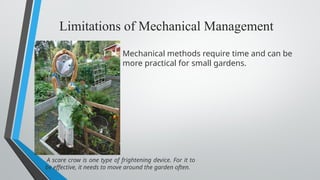
A scare crow is one type of frightening device. For it to
be effective, it needs to move around the garden often.
Biological Management
• Biological management is the process of reducing a pest population by
using predators, parasites, or disease organisms that ordinarily occur in
nature.
• Predators are insects (or other animals, such as spiders, frogs, and
birds) that catch and devour other creatures (called prey).
• Parasites are organisms that live on or in the body of a living organism
(called a host).
• Pathogens are disease-causing organisms, including viruses, bacteria,
and fungi that kill or debilitate their hosts. Killing of caterpillar with the
help of bacteria.
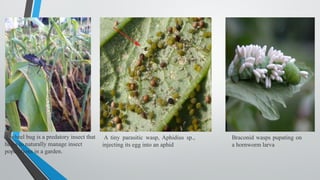
A wheel bug is a predatory insect that
helps to naturally manage insect
populations in a garden.
A tiny parasitic wasp, Aphidius sp.,
injecting its egg into an aphid
Braconid wasps pupating on
a hornworm larva
Limitations of Biological Management
• Biological management can be an effective means of killing harmful pests.
Timing, however, can be a challenge. Predator must be stored until the pest
appears, and it may have a short shelf life.
• Purchased natural predators are often effective for only a short period because
they tend to move out of the area in which they are released
• Natural predators can be very effective in greenhouses where they are held
captive.
Chemical Management
• If the pest has been correctly identified and is still a problem after other
management strategies have been implemented, chemical options may be
considered as a last resort.
• Herbicides are available to kill weeds, insecticides to kill insects, and
fungicides and antibiotics to manage diseases.
• All users are legally required to follow the instructions on the pesticide label
including the amount and timing of application.
Limitations of Chemical Management
• Misuse of pesticides can result in killing all of the insects vulnerable to the
active ingredients, leaving only the strongest to mate and reproduce.
• This results in pests quickly evolving resistance to the chemicals.
• In addition, pesticides can kill beneficial insects as well as pest species.
• Potential problems with chemical management are direct hazards to the user
and secondary exposure of family, friends, and pets to pesticide residue.
Formulating an IPM Plan
• IPM combines background information about a pest problem with a strategy
that fits the situation. It will help a gardener decide:
1. Which pests are present and if they are in high enough concentrations to
cause problems.
2. Which control measures should be taken to manage a problem.
3. How to evaluate the success of the control measures.
An IPM plan has five steps:
• Step 1: Monitor. Inspect plants on a regular basis.
• Step 2: Identify. Accurately diagnose the problem using information about the plant, the
environment, and the pest.
• Step 3: Assess. Use thresholds to determine if action is necessary. Will the plant survive?
Will yield decrease or will the appearance be compromised beyond your threshold level?
• Step 4: Implement. Formulate an action strategy based on all options available. This is
the “integrated” part of IPM. Consider what is economical, physically feasible, effective,
and least toxic.
• Step 5: Evaluate. What were the results of the action? Did it produce the desired results?
• Follow the steps listed here to create an IPM plan.
You tube Videos
• https://www.youtube.com/watch?v=mLaZvS5gEic
• https://www.youtube.com/watch?v=UZPeanRqW5s
References
• Frank, S., L.K. Bradley, and K.A. Moore. 2022. Integrated Pest
Management, Chapter 8. In: K.A. Moore, and L.K. Bradley
(eds). North Carolina Extension Gardener Handbook, 2nd ed. NC
State Extension, Raleigh, NC
• <http://content.ces.ncsu.edu/8-integrated-pest-management-
ipm>

1.Integrated Pest Management techniques.pptx

  • 1.
  • 2.
    IPM Approach • Whenmodern pesticides were first developed, they were used extensively. Pests susceptible to a pesticide were quickly killed, leaving resistant ones to breed and multiply. • It became clear that pesticides alone would not solve all pest problems. • Scientists began to develop a new approach to pest control. This new approach was described as integrated pest management (IPM). • Integrated refers to the fact that all control measures (mechanical, cultural, biological, and chemical) are considered and used as appropriate. • Pests are much less likely to survive a program that uses many different methods of reducing their populations.
  • 3.
    Integrated Pest Management •Integrated pest management (IPM), an approach that uses knowledge about pests and their life cycles, cultural practices, nonchemical methods, and pesticides to manage pest problems. • IPM focuses on preventing pest problems before they occur. When pest problems do arise, management options focus on those with the least possible impact on human health and the environment. • An IPM plan may be slower to show results and could require more effort than spraying a chemical, but the reduced impact on the environment can be worth the investment.
  • 4.
    Methods to controlPests Pest Management Cultural Management Mechanical Management Biological Management Chemical Management
  • 5.
    Pest Management • Preventionis the first tool in pest management because it is the most effective, least expensive, most environmentally friendly solution. • Second is choosing a healthy plant which can minimizes pest problems. • Best practice is early intervention. Being present and observant in the garden ensures early detection. Reacting to problems quickly, before they have time to multiply, requires a less dramatic intervention. • The third important tool is recordkeeping; tracking what happens in the garden enables a gardener to recognize patterns and make informed decisions. • Record planting dates, varieties, purchase location, dates of problem onset, weather conditions, management strategies.
  • 6.
    Cultural Management • Themost effective and most important of all practices is to observe what is going on in the garden. • Many serious disease or insect problems can be halted or slowed by regularly visiting the garden, knowing what to look for, recognizing potential problems, and intervening early. • Cultural methods includes preparing the soil, choosing tolerant plant varieties, rotating crops, interplanting, timing planting dates to avoid pests, managing weeds, and planting "trap" crops.
  • 7.
    Limitations of CulturalManagement • The use of cultural controls for pest management requires advanced planning on the gardener’s part. Specific resistant varieties must be located and purchased in advance. In some cases, varieties may not be available locally. • Crop rotation is a valuable cultural method for reducing insect and disease issues, but many gardeners do not have the room to sufficiently implement this practice. Consider raised beds with new soil or plant in containers when you know a disease problem exists. Skip growing the same crop or family with pest issue.
  • 8.
    Mechanical Management • Handpicking: Inspect plants regularly for eggs, immatures, or adults and upon identification of harmful to the plant hand­ pick as many as possible. You can also give a dish detergent wash. • Use of Pheromone traps: are used for detecting the presence of pests or sometimes for disrupting insect mating habits. • Net-covered cages over young seedlings help prevent insect, bird, and rabbit damage.
  • 9.
    • Pruning: Somepests like stem borer and the dogwood club gall can be managed by pruning infected twigs out of infested plants and destroying them. • Raking: the fallen twigs of pecans, oaks, elms, hickories, and other shade trees in the fall removes the larvae of twig girdlers. • Strong stream of water spray: (with hose adapters) can dislodges and kills many spider mites, aphids, and other relatively fragile insects.
  • 10.
    Floating row coversprevent some adult insects from flying around to deposit eggs on new plants. Dogwood club galls should be pruned off and destroyed as a means of managing midges
  • 11.
    • Heat treatment:with the use of propane flamers can kill potato beetle larvae on potatoes without killing the plant. Some hot water treatments can be used to reduce disease when saving seed. • Frightening devices include: reflective objects, noise makers, human or predator effigies, lights, lasers, pyrotechnics, guard animals, and ultrasonic devices. When using a frightening device, it is important to consider the pest's ability to see or hear the stimulus.
  • 12.
    Limitations of MechanicalManagement Mechanical methods require time and can be more practical for small gardens. A scare crow is one type of frightening device. For it to be effective, it needs to move around the garden often.
  • 13.
    Biological Management • Biologicalmanagement is the process of reducing a pest population by using predators, parasites, or disease organisms that ordinarily occur in nature. • Predators are insects (or other animals, such as spiders, frogs, and birds) that catch and devour other creatures (called prey). • Parasites are organisms that live on or in the body of a living organism (called a host). • Pathogens are disease-causing organisms, including viruses, bacteria, and fungi that kill or debilitate their hosts. Killing of caterpillar with the help of bacteria.
  • 14.
    A wheel bugis a predatory insect that helps to naturally manage insect populations in a garden. A tiny parasitic wasp, Aphidius sp., injecting its egg into an aphid Braconid wasps pupating on a hornworm larva
  • 15.
    Limitations of BiologicalManagement • Biological management can be an effective means of killing harmful pests. Timing, however, can be a challenge. Predator must be stored until the pest appears, and it may have a short shelf life. • Purchased natural predators are often effective for only a short period because they tend to move out of the area in which they are released • Natural predators can be very effective in greenhouses where they are held captive.
  • 16.
    Chemical Management • Ifthe pest has been correctly identified and is still a problem after other management strategies have been implemented, chemical options may be considered as a last resort. • Herbicides are available to kill weeds, insecticides to kill insects, and fungicides and antibiotics to manage diseases. • All users are legally required to follow the instructions on the pesticide label including the amount and timing of application.
  • 17.
    Limitations of ChemicalManagement • Misuse of pesticides can result in killing all of the insects vulnerable to the active ingredients, leaving only the strongest to mate and reproduce. • This results in pests quickly evolving resistance to the chemicals. • In addition, pesticides can kill beneficial insects as well as pest species. • Potential problems with chemical management are direct hazards to the user and secondary exposure of family, friends, and pets to pesticide residue.
  • 18.
    Formulating an IPMPlan • IPM combines background information about a pest problem with a strategy that fits the situation. It will help a gardener decide: 1. Which pests are present and if they are in high enough concentrations to cause problems. 2. Which control measures should be taken to manage a problem. 3. How to evaluate the success of the control measures.
  • 19.
    An IPM planhas five steps: • Step 1: Monitor. Inspect plants on a regular basis. • Step 2: Identify. Accurately diagnose the problem using information about the plant, the environment, and the pest. • Step 3: Assess. Use thresholds to determine if action is necessary. Will the plant survive? Will yield decrease or will the appearance be compromised beyond your threshold level? • Step 4: Implement. Formulate an action strategy based on all options available. This is the “integrated” part of IPM. Consider what is economical, physically feasible, effective, and least toxic. • Step 5: Evaluate. What were the results of the action? Did it produce the desired results? • Follow the steps listed here to create an IPM plan.
  • 20.
    You tube Videos •https://www.youtube.com/watch?v=mLaZvS5gEic • https://www.youtube.com/watch?v=UZPeanRqW5s
  • 21.
    References • Frank, S.,L.K. Bradley, and K.A. Moore. 2022. Integrated Pest Management, Chapter 8. In: K.A. Moore, and L.K. Bradley (eds). North Carolina Extension Gardener Handbook, 2nd ed. NC State Extension, Raleigh, NC • <http://content.ces.ncsu.edu/8-integrated-pest-management- ipm>