© 2015 CEB. All rights reserved
CEB Corporate Leadership Council
HIPO Rotational Program Strategy Template
© 2015 CEB. All rights reserved
2
INTRODUCTION
What it does:
The HIPO Rotational Program Strategy Template helps you document the key components of your rotational program strategy.
How to Use it:
Populate this template using tools and templates from the accompanying CEB IgnitionTM
Guide, then share with business leaders
and other relevant stakeholders to obtain buy-in and understanding.
© 2015 CEB. All rights reserved
3
INSTRUCTIONS
Page
Number
Page Title Data Source Tool
5 What Makes a High-Potential (HIPO) Employee? HIPO Rotational Program Business Case
6 Importance of Developing HIPOs Now HIPO Rotational Program Business Case
7-9 Benefits of HIPO Rotational Programs HIPO Rotational Program Business Case
10 Addressing Common HIPO Rotational Program Concerns HIPO Rotational Program Business Case
12 Design of Our HIPO Rotational Program CEB IgnitionTM
Project Manager
11-12 Strategy of Our HIPO Rotational Program Objective-Setting Template
16-19 Structure of Our HIPO Rotational Program Structure-Setting Template
21 HIPO Rotational Program Communication Plan Communication Plan Template
22 What You Can Do CEB IgnitionTM
Project Manager and Structure-Setting Template
24 HIPO Rotational Program Resources Templates from Steps 3-4 of CEB IgnitionTM
Guide
This template will help you document the key components of your HIPO rotational program strategy. Please refer to the table
below to identify the tools and templates from the accompanying CEB IgnitionTM
guide that will serve as inputs and help you
populate this template.
© 2015 CEB. All rights reserved
4
AGENDA
Program Strategy Program Structure Communication
Plan
Business Case HIPO Rotational
Program
Resources
© 2015 CEB. All rights reserved
5
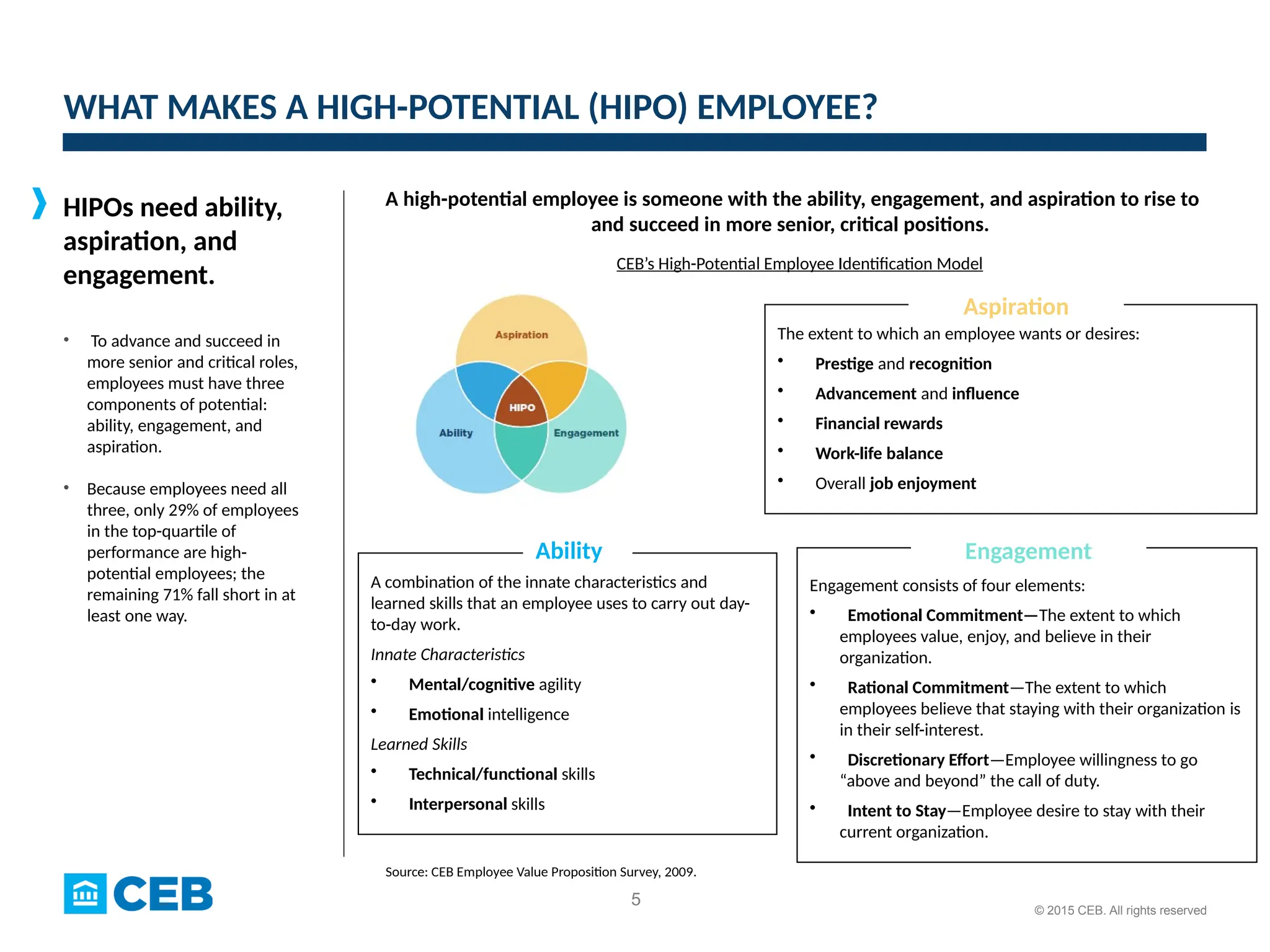
HIPOs need ability,
aspiration, and
engagement.
• To advance and succeed in
more senior and critical roles,
employees must have three
components of potential:
ability, engagement, and
aspiration.
• Because employees need all
three, only 29% of employees
in the top-quartile of
performance are high-
potential employees; the
remaining 71% fall short in at
least one way.
WHAT MAKES A HIGH-POTENTIAL (HIPO) EMPLOYEE?
A high-potential employee is someone with the ability, engagement, and aspiration to rise to
and succeed in more senior, critical positions.
Engagement consists of four elements:
• Emotional Commitment—The extent to which
employees value, enjoy, and believe in their
organization.
• Rational Commitment—The extent to which
employees believe that staying with their organization is
in their self-interest.
• Discretionary Effort—Employee willingness to go
“above and beyond” the call of duty.
• Intent to Stay—Employee desire to stay with their
current organization.
Engagement
The extent to which an employee wants or desires:
• Prestige and recognition
• Advancement and influence
• Financial rewards
• Work-life balance
• Overall job enjoyment
Aspiration
A combination of the innate characteristics and
learned skills that an employee uses to carry out day-
to-day work.
Innate Characteristics
• Mental/cognitive agility
• Emotional intelligence
Learned Skills
• Technical/functional skills
• Interpersonal skills
Ability
Source: CEB Employee Value Proposition Survey, 2009.
CEB’s High-Potential Employee Identification Model
© 2015 CEB. All rights reserved
6
Organizations must
strategically develop
HIPOs given their
high business
impact, increased
retention risk, and
relative scarcity.
IMPORTANCE OF DEVELOPING HIPOs NOW
HIPOs can enhance business outcomes by more than 50% (compared to non-HIPOs), as they exhibit 21% higher
performance levels. However, HIPOs are much harder to retain than core employees due to the attractiveness
of their skill sets in the market. Additionally, very few employees are high-potential, as detailed below:
Source: CEB Corporate Leadership Council, Realizing the Full Potential of Rising Talent Volume I: A Quantitative Analysis of the Identification and
Development of High-Potential Employees.
Importance of HIPO Development and Retention
Distribution of Workforce Probability of Successfully Performing in a More Senior, Critical Role
Number
of
Employees
Current Probability of Success in a More Senior, Critical Role
© 2015 CEB. All rights reserved
7
Rotational programs
can improve HIPO
ability, engagement,
and aspiration.
BENEFITS OF HIPO ROTATIONAL PROGRAMS
Enhance HIPO
Ability
HIPO rotational programs provide HIPOs with a series of critical on-the-job learning
experiences they cannot get in traditional roles.
Case-in-Point: Focused and targeted on-the-job development plans can improve
employee knowledge and skills by up to 16%.
Improve HIPO
Engagement
HIPO rotational programs match HIPOS to important and challenging opportunities that
align not only with their development needs, but also their career goals.
Case-in-Point: Matching development opportunities to personal career goals
increases engagement by 35%.
Fulfill HIPO
Aspiration
HIPO rotational programs place HIPOs in situations where they have greater
accountability, develop new skills, and work in high-stakes situations that reinforce
aspiration.
Case-in-Point: Assignments designed around targeted development plans that also
reinforce aspiration increase the appetite for more senior roles by 23%
Source: CEB Corporate Leadership Council research and SHL Talent Measurement Improving the Odds Report.
Key Benefits of HIPO Rotational Programs
Note: Adjust this page
based on the objectives
you have defined in the
Objective-Setting
Template and/or your
own data.
Additional Benefits of Rotational Experiences to the Organization
 Builds workforce flexibility
 Improves bench strength
 Increases loyalty to the organization
 Helps share and retain knowledge
 Creates a culture of development
 Increases cross-organizational communication
© 2015 CEB. All rights reserved
8
Rotational programs
can increase HIPO
job satisfaction and
security, and
accelerate
development.
ROTATIONAL PROGRAM BENEFITS FOR HIPOs
Improves Job
Security
Rotational experiences provide HIPOs with opportunities to improves their skills,
understanding of different parts of the organization, and networks, all of which
increase their employability within and outside of the organization.
Case-in-Point: Day-to-day jobs that require employees to adapt work to changing
circumstances, like in rotations, can drive potential up to 15%.
Accelerates
Development
Rotational experiences are matched to each HIPO based on his/her development
needs and career aspirations to ensure rapid development of core skills required to
succeed at the next level.
Case-in-Point: On-the-job learning, like that experienced in rotational programs, can
have three times more impact on employee performance than formal training
programs.
Increases Job
Satisfaction
Rotational programs provide challenges and opportunities to learn new skills that,
especially important when promotions are not readily available.
Case-in-Point: Diverse career opportunities is the top driver of HIPO career
satisfaction, and job rotations can impact HIPO career satisfaction by 17.5%.
Additional Benefits of Rotational Experiences to HIPOs
 Expand leadership abilities
 Receive regular feedback
 Identify alternate career paths
 Reflect on career aspirations
 Diversify skillsets and networks
 Increase adaptability
HIPO Rotational Program Impact on HIPOs
Source: CEB Employment Value Proposition Survey2010; CEB Learning and Development research; CEB Corporate Leadership Council research.
Note: Adjust this page
based on the objectives
you have defined in the
Objective-Setting
Template and/or your
own data.
© 2015 CEB. All rights reserved
9
Rotational programs
can increase
competitive
advantage and
bench strength, and
create a culture of
development in
participating
business units.
ROTATIONAL PROGRAM BENEFITS FOR BUSINESS LEADERS
Increase
Competitive
Advantage
Rotational programs allow business units to leverage fresh perspectives of high-
performers from across the organization, increasing the innovation and drive on their
teams to improve business products and processes.
Case-in-Point: Companies pursuing breakthrough ideas are able to generate up to
twice the product sales of their peers.
Create Culture of
Development
Participation in rotational programs demonstrates a commitment to employee
development and career progression, increasing potential in employees and making the
business even more attractive to top talent.
Case-in-Point: Organizations whose executive leaders demonstrate a sincere
commitment to employee development drive their employees’ potential by as much as
29%.
By exposing HIPOs from across the organization to critical roles, institutional knowledge
increases with employees gaining more knowledge about the business and more
diverse skillsets.
Case-in-Point: Organizations with access to talent across organizational silos have 30%
stronger leadership benches than organizations with little transparency.
Increase Bench
Strength
Additional Benefits of Rotational Experiences to Business Leaders
 Accelerate best practice sharing
 Exposure of team to high-quality leaders
 Better cooperation with other business units
 Personal challenge of managing a high-performer
 Increased awareness of development
opportunities among employees
 Faster time-to-fill in key positions
HIPO Rotational Program Impact on Participating Business Units
Sources: CEB Research & Technology Executive Council; CEB 2005 High-Potential Management Survey; CEB 2013 Succession Management Survey.
Note: Adjust this page
based on the objectives
you have defined in the
Objective-Setting
Template and/or your
own data.
© 2015 CEB. All rights reserved
10
ADDRESSING COMMON HIPO ROTATIONAL PROGRAM CONCERNS
Concerns from HIPOs
Note: Adjust this page
based on concerns raised
during your feedback
collection.
Concerns from Business Leaders
I am already on a track to
promotion in my current
role and don’t want to
derail my progress.
I don’t want to appear
disloyal to my current
team and manager.
I don’t want to fail in a
position I am not familiar
with and risk my career
progression.
I don’t want to give up
my best talent. I need my
HIPO to continue in
his/her role.
Bringing in a new
employee, no matter
their skill level, causes a
reduction in performance
due to time for upskilling.
I don’t want my
employees who aren’t
offered a rotation to feel
like they don’t have
development
opportunities.
Job rotations are matched to
employees based on development
needs and skill gaps. Participating in a
rotation will help you close the skill
gaps you have and make you an even
better candidate for promotion.
We will work with business leaders to
ensure employee transfers do not
disrupt scheduled projects and
workflows. Sharing talent across the
organization is the best way to ensure
our entire business is set up for
success in the future.
Participating in the program not only
accelerates your development but also
ensures that we, as an organization,
have the right talent in place at the
right times—it’s a win-win. Managers
will also be involved in the selection of
participants to ensure their support.
We don’t see failures during rotations
as a career barrier. The programs are
designed to help you develop and help
us assess your continued development
needs. If you are unsuccessful, you
will work with your managers and HR
team to understand why and make
plans to close any further skill gaps.
It’s true that bringing in a new
employee will require time for
upskilling. However, we will be
assessing all participants to ensure
they have the skills and experiences
necessary to quickly succeed in the
role.
Although rotational opportunities are
only offered to a set of employees, we
have many different development
opportunities to offer other
employees. We encourage all leaders
and managers to use the rotational
program as a prompt for development
discussions with all employees.
© 2015 CEB. All rights reserved
11
AGENDA
Program Strategy Program Structure Communication
Plan
Business Case HIPO Rotational
Program
Resources
© 2015 CEB. All rights reserved
12
DESIGN OF OUR HIPO ROTATIONAL PROGRAM
Our Process For Establishing a HIPO Rotational Program
• Completed thorough analysis of critical skills the organization will need for future success
to ensure HIPO development aligns with organizational strategy.
• Based on senior leader feedback, identified HIPO skill gaps the rotational program will
address.
• Developed program structure based on organizational needs and best practices.
Set Objectives and Structure
• All potential participants will complete a self-assessment to build accountability for career
growth and ensure engagement in the program.
• Managers of potential participants will also assess their HIPOs to provide a complete
understanding of the HIPOs strengths and development needs.
Identify Participants
• Rotational experiences will be selected primarily based on the opportunities they provide
employees to develop critical skills.
• Rotations will be evaluated to ensure they provide employees with experiences that align
to overall talent strategy.
Identify Rotational Opportunities
• Careful evaluation of HIPO rotational experience matches will ensure HIPOs are matched
to opportunities that meet their expectations and interests, provide relevant
development, and align with HIPO career aspirations.
• Matches will also ensure that HIPOs have the skills and experiences needed to perform in
assigned roles.
Match HIPOs to Opportunities
• HIPOs will be supported my a team of individuals from across the organization to ensure
continual support and tracking of progress.
• Managers and HIPOs will both receive tools and HR support to establish objectives and
development goals, as well as understand how to maximize time in the rotation.
Support HIPO Development Throughout Rotation
• HIPO performance will be reviewed throughout the rotation to ensure performance
derailers are addressed quickly.
• A panel of individuals the HIPO has worked with during and before the rotation will
evaluate the HIPO’s progress at the end of the rotation and provide guidance on next
career steps.
Review HIPO Performance and Career Path
© 2015 CEB. All rights reserved
13
STRATEGY OF OUR HIPO ROTATIONAL PROGRAM
Skill Gaps and Development Needs Addressed by HIPO Rotational
Program
Capability How the Rotational Experience Will Build the Capability
1. [Insert a capability or skill the rotational program is designed to
build among HIPOs.]
[Describe the experiences associated with a rotational program you
will use to build the capability.]
2. [Insert a capability or skill the rotational program is designed to
build among HIPOs.]
3. [Insert a capability or skill the rotational program is designed to
build among HIPOs.]
4. [Insert a capability or skill the rotational program is designed to
build among HIPOs.]
5. [Insert a capability or skill the rotational program is designed to
build among HIPOs.]
© 2015 CEB. All rights reserved
14
STRATEGY OF OUR HIPO ROTATIONAL PROGRAM (CON’T)
HIPO Rotational Program Success Measures
Success Measure Expected Result
1. [Insert success measure you will use to evaluate the effectiveness
of your HIPO Rotational Program.]
[Insert the goal related to this success measure you hope to achieve.]
2. [Insert success measure you will use to evaluate the effectiveness
of your HIPO Rotational Program.]
3. [Insert success measure you will use to evaluate the effectiveness
of your HIPO Rotational Program.]
4. [Insert success measure you will use to evaluate the effectiveness
of your HIPO Rotational Program.]
5. [Insert success measure you will use to evaluate the effectiveness
of your HIPO Rotational Program.]
© 2015 CEB. All rights reserved
15
AGENDA
Program Strategy Program Structure Communication
Plan
Business Case HIPO Rotational
Program
Resources
© 2015 CEB. All rights reserved
16
STRUCTURE OF OUR HIPO ROTATIONAL PROGRAM
HIPO Rotational Program Participant Profile
Level:
Mid-Level
Skills:
• Manage direct reports
• [Insert required skill for
HIPO to participate.]
Experience
• P&L responsibility
• [Insert required
experience for HIPO to
participate.]
Criteria Used to Match Participants:
[Insert criteria you will use to match participants to rotational
experiences.]
Nomination Method for Participation:
[Describe how participants will be nominated for the program.]
© 2015 CEB. All rights reserved
17
STRUCTURE OF OUR HIPO ROTATIONAL PROGRAM (CON’T)
HIPO Rotational Program Details
Number
of
Participa
nts: 20
Length of
Rotational
Program:
2 years
Length of
Each
Rotation:
6 months
Types of
Rotations:
Cross-
functional
Number of
Rotations: 4
Program
Start Date:
July 30
© 2015 CEB. All rights reserved
18
STRUCTURE OF OUR HIPO ROTATIONAL PROGRAM (CON’T)
HIPO Rotational Program Roles and Responsibilities
P
a
r
t
i
c
i
p
a
n
t
N
o
t
i
f
i
c
a
t
i
o
n
:
L
i
n
e
M
a
n
a
g
e
r
s
R
o
t
a
t
i
o
n
a
l
P
r
o
g
r
a
m
M
a
n
a
g
e
m
e
n
t
:
L
&
D
B
u
d
g
e
t
:
B
u
s
i
n
e
s
s
U
n
i
t
s
T
r
a
c
k
i
n
g
S
u
c
c
e
s
s
:
H
R
A
n
a
l
y
t
i
c
s
Roles and
Responsibilities
© 2015 CEB. All rights reserved
19
STRUCTURE OF OUR HIPO ROTATIONAL PROGRAM (CON’T)
HIPO Management Responsibilities During the Rotational Program
Role Responsibilities Owner
1. Role Builder
Determines the scope and
responsibilities of the HIPO’s role and
how those might change over the
rotation
[Example: HIPO Manager During
Rotation]
2. Day-to-Day Project Manager
Oversees the HIPO’s projects during
the rotation on a day-to-day basis
[Example: HIPO Manager During
Rotation]
3. Feedback Deliverer
Provides formal and informal
feedback to HIPOS during and at the
end of the rotation
[Example: HIPO Manager During
Rotation]
4. Development Planner
Works with HIPOs, HR, and Hiring Managers to
create challenging and attainable learning and
performance goals across rotations [Example: HIPO Development Coach]
5. Reflection Facilitator
Forces HIPOs to reflect on their experiences and
ensure that they are learning during the program [Example: HIPO Development Coach]
6. Feedback Coach
Helps HIPOs to internalize feedback and change
their behavior accordingly during the program [Example: HIPO Development Coach]
7. Learning Accelerator
Works with line managers to customize the scope
and learning components of roles to increase
learning opportunities across rotations
[Example: HIPO Development Coach]
8. Development Advisor
Serves as a mentor in development-planning
meetings and provides informal feedback and
support across the rotation
[Example: Senior Executive]
© 2015 CEB. All rights reserved
20
AGENDA
Program Strategy Program Structure Communication
Plan
Business Case HIPO Rotational
Program
Resources
© 2015 CEB. All rights reserved
21
HIPO ROTATIONAL PROGRAM COMMUNICATION PLAN
Audience Communication Goals Level of Detail Needed Communication
Delivery Method
Target Date or
Frequency
HIPOs 1. [Goal]
2. [Goal]
• [Level of Detail] • [Communication
channel]
• [Date or Frequency]
HIPOs’ Managers
1. [Goal]
2. [Goal] • [Level of Detail]
• [Communication
channel] • [Date or Frequency]
HR Staff 1. [Goal]
2. [Goal]
• [Level of Detail] • [Communication
channel]
• [Date or Frequency]
Business Unit Leaders 1. [Goal]
2. [Goal]
• [Level of Detail] • [Communication
channel]
• [Date or Frequency]
© 2015 CEB. All rights reserved
22
WHAT YOU CAN DO
HIPOs
•Self-assess your
development needs and
career aspirations
•Speak to your manager
about interest in the
program
•Set clear development goals
•Monitor your own progress
against goals
•Ask your manager for
support when needed
•Discuss your career next
steps with your manager and
HR partner
HIPOs’ Managers
•Assess your HIPOs’ strengths
and development needs
•Encourage your HIPOs to
participate in the program
•Prepare your HIPOs’
rotational manager for
working with your HIPO
•Help HIPOs set clear
objectives and development
goals
•Evaluate HIPOs’ progress
•Participate in career
discussions with HIPOs
•Welcome HIPOs back to your
team
HR Staff
•Nominate HIPOs who would
benefit from the program
•Spread word about the
program to managers
•Identify potential rotational
program opportunities with
business leaders
•Help match employees to
rotational opportunities
•Support managers and HIPOs
in their rotations
•Encourage managers and
HIPOs to access rotational
program resources
•Participate in career
discussions with HIPOs
Business Unit Leaders
•Encourage HIPOs and their
managers to consider
participation
•Nominate HPOs for rotations
•Identify potential rotational
opportunities in your
business unit
•Help select employees to
participate in rotations in
your business
•Welcome HIPOs to your
business unit
•Encourage managers of
rotational participants to
foster HIPO development
•Evaluate HIPOs’ progress
where applicable
•Serve as a mentor to HIPOs
Before Rotations Before Rotations Before Rotations Before Rotations
During Rotations
During Rotations
During Rotations
During Rotations
After Rotations After Rotations
After Rotations
© 2015 CEB. All rights reserved
23
AGENDA
Program Strategy Program Structure Communication
Plan
Business Case HIPO Rotational
Program
Resources
© 2015 CEB. All rights reserved
24
HIPO ROTATIONAL PROGRAM RESOURCES
Before Rotations
FOR MANAGERS: Manager Nomination Form—Use this form to evaluate your employees’ relative performance, future career interests, and
their suitability to participate in a rotational program.
FOR BUSINESS LEADERS AND HR: HIPO Rotation Job Design Template—Use this tool to outline available rotational experiences, define key
learning components of each rotation, and establish necessary capabilities participants require to succeed in the rotation.
FOR HIPOs and MANAGERS: Rotation Introduction Guide—Use this guide to have a discussion around expectations for the rotational
opportunity, including objectives, responsibilities, and development goals.
FOR HIPOs: Employee Guide to Rotational Programs—Use this guide to manage and accelerate your own development throughout the
rotational program.
FOR MANAGERS: Manager Guide to Rotational Programs—View this guide to facilitate a smooth transition for HIPOs from their previous
roles to their new roles in the rotational program and support them throughout the rotation.
FOR MANAGERS: HIPO Performance Evaluation--Use this template to evaluate high-potential employees’ performance after the completion
of each rotation.
FOR MANAGERS AND HR: Panel Review Discussion Guide—Use this discussion guide to gather inputs on the HIPOs’ performance from all
key stakeholders in order to assess learning progress, performance, derailers, potential, and next steps for each HIPO at the end of each
rotation.
FOR HR: HIPO Profile Builder—Use this template to track educational qualifications, performance levels, promotability, and future career
aspirations of high-potential employees to align aspiration and ability to future career and development experiences.
FOR HIPOs: HIPO Self-Assessment Questionnaire—Use this template to identify your strengths and development areas so that HR can
determine the appropriate rotational opportunity for you.
FOR HR: HIPO Rotation Matching Tool—Use this tool to match HIPOs to available rotational opportunities based on their expectations and
development needs.
During Rotations
After Rotations
FOR HIPOs and Managers: HIPO Career Planning Discussion Guide—Use this tool to drive an effective conversation around career
management towards the end of a HIPO’s rotational program.

1 HIPO Rotational Program Strategy Template.pptx

  • 1.
    © 2015 CEB.All rights reserved CEB Corporate Leadership Council HIPO Rotational Program Strategy Template
  • 2.
    © 2015 CEB.All rights reserved 2 INTRODUCTION What it does: The HIPO Rotational Program Strategy Template helps you document the key components of your rotational program strategy. How to Use it: Populate this template using tools and templates from the accompanying CEB IgnitionTM Guide, then share with business leaders and other relevant stakeholders to obtain buy-in and understanding.
  • 3.
    © 2015 CEB.All rights reserved 3 INSTRUCTIONS Page Number Page Title Data Source Tool 5 What Makes a High-Potential (HIPO) Employee? HIPO Rotational Program Business Case 6 Importance of Developing HIPOs Now HIPO Rotational Program Business Case 7-9 Benefits of HIPO Rotational Programs HIPO Rotational Program Business Case 10 Addressing Common HIPO Rotational Program Concerns HIPO Rotational Program Business Case 12 Design of Our HIPO Rotational Program CEB IgnitionTM Project Manager 11-12 Strategy of Our HIPO Rotational Program Objective-Setting Template 16-19 Structure of Our HIPO Rotational Program Structure-Setting Template 21 HIPO Rotational Program Communication Plan Communication Plan Template 22 What You Can Do CEB IgnitionTM Project Manager and Structure-Setting Template 24 HIPO Rotational Program Resources Templates from Steps 3-4 of CEB IgnitionTM Guide This template will help you document the key components of your HIPO rotational program strategy. Please refer to the table below to identify the tools and templates from the accompanying CEB IgnitionTM guide that will serve as inputs and help you populate this template.
  • 4.
    © 2015 CEB.All rights reserved 4 AGENDA Program Strategy Program Structure Communication Plan Business Case HIPO Rotational Program Resources
  • 5.
    © 2015 CEB.All rights reserved 5 HIPOs need ability, aspiration, and engagement. • To advance and succeed in more senior and critical roles, employees must have three components of potential: ability, engagement, and aspiration. • Because employees need all three, only 29% of employees in the top-quartile of performance are high- potential employees; the remaining 71% fall short in at least one way. WHAT MAKES A HIGH-POTENTIAL (HIPO) EMPLOYEE? A high-potential employee is someone with the ability, engagement, and aspiration to rise to and succeed in more senior, critical positions. Engagement consists of four elements: • Emotional Commitment—The extent to which employees value, enjoy, and believe in their organization. • Rational Commitment—The extent to which employees believe that staying with their organization is in their self-interest. • Discretionary Effort—Employee willingness to go “above and beyond” the call of duty. • Intent to Stay—Employee desire to stay with their current organization. Engagement The extent to which an employee wants or desires: • Prestige and recognition • Advancement and influence • Financial rewards • Work-life balance • Overall job enjoyment Aspiration A combination of the innate characteristics and learned skills that an employee uses to carry out day- to-day work. Innate Characteristics • Mental/cognitive agility • Emotional intelligence Learned Skills • Technical/functional skills • Interpersonal skills Ability Source: CEB Employee Value Proposition Survey, 2009. CEB’s High-Potential Employee Identification Model
  • 6.
    © 2015 CEB.All rights reserved 6 Organizations must strategically develop HIPOs given their high business impact, increased retention risk, and relative scarcity. IMPORTANCE OF DEVELOPING HIPOs NOW HIPOs can enhance business outcomes by more than 50% (compared to non-HIPOs), as they exhibit 21% higher performance levels. However, HIPOs are much harder to retain than core employees due to the attractiveness of their skill sets in the market. Additionally, very few employees are high-potential, as detailed below: Source: CEB Corporate Leadership Council, Realizing the Full Potential of Rising Talent Volume I: A Quantitative Analysis of the Identification and Development of High-Potential Employees. Importance of HIPO Development and Retention Distribution of Workforce Probability of Successfully Performing in a More Senior, Critical Role Number of Employees Current Probability of Success in a More Senior, Critical Role
  • 7.
    © 2015 CEB.All rights reserved 7 Rotational programs can improve HIPO ability, engagement, and aspiration. BENEFITS OF HIPO ROTATIONAL PROGRAMS Enhance HIPO Ability HIPO rotational programs provide HIPOs with a series of critical on-the-job learning experiences they cannot get in traditional roles. Case-in-Point: Focused and targeted on-the-job development plans can improve employee knowledge and skills by up to 16%. Improve HIPO Engagement HIPO rotational programs match HIPOS to important and challenging opportunities that align not only with their development needs, but also their career goals. Case-in-Point: Matching development opportunities to personal career goals increases engagement by 35%. Fulfill HIPO Aspiration HIPO rotational programs place HIPOs in situations where they have greater accountability, develop new skills, and work in high-stakes situations that reinforce aspiration. Case-in-Point: Assignments designed around targeted development plans that also reinforce aspiration increase the appetite for more senior roles by 23% Source: CEB Corporate Leadership Council research and SHL Talent Measurement Improving the Odds Report. Key Benefits of HIPO Rotational Programs Note: Adjust this page based on the objectives you have defined in the Objective-Setting Template and/or your own data. Additional Benefits of Rotational Experiences to the Organization  Builds workforce flexibility  Improves bench strength  Increases loyalty to the organization  Helps share and retain knowledge  Creates a culture of development  Increases cross-organizational communication
  • 8.
    © 2015 CEB.All rights reserved 8 Rotational programs can increase HIPO job satisfaction and security, and accelerate development. ROTATIONAL PROGRAM BENEFITS FOR HIPOs Improves Job Security Rotational experiences provide HIPOs with opportunities to improves their skills, understanding of different parts of the organization, and networks, all of which increase their employability within and outside of the organization. Case-in-Point: Day-to-day jobs that require employees to adapt work to changing circumstances, like in rotations, can drive potential up to 15%. Accelerates Development Rotational experiences are matched to each HIPO based on his/her development needs and career aspirations to ensure rapid development of core skills required to succeed at the next level. Case-in-Point: On-the-job learning, like that experienced in rotational programs, can have three times more impact on employee performance than formal training programs. Increases Job Satisfaction Rotational programs provide challenges and opportunities to learn new skills that, especially important when promotions are not readily available. Case-in-Point: Diverse career opportunities is the top driver of HIPO career satisfaction, and job rotations can impact HIPO career satisfaction by 17.5%. Additional Benefits of Rotational Experiences to HIPOs  Expand leadership abilities  Receive regular feedback  Identify alternate career paths  Reflect on career aspirations  Diversify skillsets and networks  Increase adaptability HIPO Rotational Program Impact on HIPOs Source: CEB Employment Value Proposition Survey2010; CEB Learning and Development research; CEB Corporate Leadership Council research. Note: Adjust this page based on the objectives you have defined in the Objective-Setting Template and/or your own data.
  • 9.
    © 2015 CEB.All rights reserved 9 Rotational programs can increase competitive advantage and bench strength, and create a culture of development in participating business units. ROTATIONAL PROGRAM BENEFITS FOR BUSINESS LEADERS Increase Competitive Advantage Rotational programs allow business units to leverage fresh perspectives of high- performers from across the organization, increasing the innovation and drive on their teams to improve business products and processes. Case-in-Point: Companies pursuing breakthrough ideas are able to generate up to twice the product sales of their peers. Create Culture of Development Participation in rotational programs demonstrates a commitment to employee development and career progression, increasing potential in employees and making the business even more attractive to top talent. Case-in-Point: Organizations whose executive leaders demonstrate a sincere commitment to employee development drive their employees’ potential by as much as 29%. By exposing HIPOs from across the organization to critical roles, institutional knowledge increases with employees gaining more knowledge about the business and more diverse skillsets. Case-in-Point: Organizations with access to talent across organizational silos have 30% stronger leadership benches than organizations with little transparency. Increase Bench Strength Additional Benefits of Rotational Experiences to Business Leaders  Accelerate best practice sharing  Exposure of team to high-quality leaders  Better cooperation with other business units  Personal challenge of managing a high-performer  Increased awareness of development opportunities among employees  Faster time-to-fill in key positions HIPO Rotational Program Impact on Participating Business Units Sources: CEB Research & Technology Executive Council; CEB 2005 High-Potential Management Survey; CEB 2013 Succession Management Survey. Note: Adjust this page based on the objectives you have defined in the Objective-Setting Template and/or your own data.
  • 10.
    © 2015 CEB.All rights reserved 10 ADDRESSING COMMON HIPO ROTATIONAL PROGRAM CONCERNS Concerns from HIPOs Note: Adjust this page based on concerns raised during your feedback collection. Concerns from Business Leaders I am already on a track to promotion in my current role and don’t want to derail my progress. I don’t want to appear disloyal to my current team and manager. I don’t want to fail in a position I am not familiar with and risk my career progression. I don’t want to give up my best talent. I need my HIPO to continue in his/her role. Bringing in a new employee, no matter their skill level, causes a reduction in performance due to time for upskilling. I don’t want my employees who aren’t offered a rotation to feel like they don’t have development opportunities. Job rotations are matched to employees based on development needs and skill gaps. Participating in a rotation will help you close the skill gaps you have and make you an even better candidate for promotion. We will work with business leaders to ensure employee transfers do not disrupt scheduled projects and workflows. Sharing talent across the organization is the best way to ensure our entire business is set up for success in the future. Participating in the program not only accelerates your development but also ensures that we, as an organization, have the right talent in place at the right times—it’s a win-win. Managers will also be involved in the selection of participants to ensure their support. We don’t see failures during rotations as a career barrier. The programs are designed to help you develop and help us assess your continued development needs. If you are unsuccessful, you will work with your managers and HR team to understand why and make plans to close any further skill gaps. It’s true that bringing in a new employee will require time for upskilling. However, we will be assessing all participants to ensure they have the skills and experiences necessary to quickly succeed in the role. Although rotational opportunities are only offered to a set of employees, we have many different development opportunities to offer other employees. We encourage all leaders and managers to use the rotational program as a prompt for development discussions with all employees.
  • 11.
    © 2015 CEB.All rights reserved 11 AGENDA Program Strategy Program Structure Communication Plan Business Case HIPO Rotational Program Resources
  • 12.
    © 2015 CEB.All rights reserved 12 DESIGN OF OUR HIPO ROTATIONAL PROGRAM Our Process For Establishing a HIPO Rotational Program • Completed thorough analysis of critical skills the organization will need for future success to ensure HIPO development aligns with organizational strategy. • Based on senior leader feedback, identified HIPO skill gaps the rotational program will address. • Developed program structure based on organizational needs and best practices. Set Objectives and Structure • All potential participants will complete a self-assessment to build accountability for career growth and ensure engagement in the program. • Managers of potential participants will also assess their HIPOs to provide a complete understanding of the HIPOs strengths and development needs. Identify Participants • Rotational experiences will be selected primarily based on the opportunities they provide employees to develop critical skills. • Rotations will be evaluated to ensure they provide employees with experiences that align to overall talent strategy. Identify Rotational Opportunities • Careful evaluation of HIPO rotational experience matches will ensure HIPOs are matched to opportunities that meet their expectations and interests, provide relevant development, and align with HIPO career aspirations. • Matches will also ensure that HIPOs have the skills and experiences needed to perform in assigned roles. Match HIPOs to Opportunities • HIPOs will be supported my a team of individuals from across the organization to ensure continual support and tracking of progress. • Managers and HIPOs will both receive tools and HR support to establish objectives and development goals, as well as understand how to maximize time in the rotation. Support HIPO Development Throughout Rotation • HIPO performance will be reviewed throughout the rotation to ensure performance derailers are addressed quickly. • A panel of individuals the HIPO has worked with during and before the rotation will evaluate the HIPO’s progress at the end of the rotation and provide guidance on next career steps. Review HIPO Performance and Career Path
  • 13.
    © 2015 CEB.All rights reserved 13 STRATEGY OF OUR HIPO ROTATIONAL PROGRAM Skill Gaps and Development Needs Addressed by HIPO Rotational Program Capability How the Rotational Experience Will Build the Capability 1. [Insert a capability or skill the rotational program is designed to build among HIPOs.] [Describe the experiences associated with a rotational program you will use to build the capability.] 2. [Insert a capability or skill the rotational program is designed to build among HIPOs.] 3. [Insert a capability or skill the rotational program is designed to build among HIPOs.] 4. [Insert a capability or skill the rotational program is designed to build among HIPOs.] 5. [Insert a capability or skill the rotational program is designed to build among HIPOs.]
  • 14.
    © 2015 CEB.All rights reserved 14 STRATEGY OF OUR HIPO ROTATIONAL PROGRAM (CON’T) HIPO Rotational Program Success Measures Success Measure Expected Result 1. [Insert success measure you will use to evaluate the effectiveness of your HIPO Rotational Program.] [Insert the goal related to this success measure you hope to achieve.] 2. [Insert success measure you will use to evaluate the effectiveness of your HIPO Rotational Program.] 3. [Insert success measure you will use to evaluate the effectiveness of your HIPO Rotational Program.] 4. [Insert success measure you will use to evaluate the effectiveness of your HIPO Rotational Program.] 5. [Insert success measure you will use to evaluate the effectiveness of your HIPO Rotational Program.]
  • 15.
    © 2015 CEB.All rights reserved 15 AGENDA Program Strategy Program Structure Communication Plan Business Case HIPO Rotational Program Resources
  • 16.
    © 2015 CEB.All rights reserved 16 STRUCTURE OF OUR HIPO ROTATIONAL PROGRAM HIPO Rotational Program Participant Profile Level: Mid-Level Skills: • Manage direct reports • [Insert required skill for HIPO to participate.] Experience • P&L responsibility • [Insert required experience for HIPO to participate.] Criteria Used to Match Participants: [Insert criteria you will use to match participants to rotational experiences.] Nomination Method for Participation: [Describe how participants will be nominated for the program.]
  • 17.
    © 2015 CEB.All rights reserved 17 STRUCTURE OF OUR HIPO ROTATIONAL PROGRAM (CON’T) HIPO Rotational Program Details Number of Participa nts: 20 Length of Rotational Program: 2 years Length of Each Rotation: 6 months Types of Rotations: Cross- functional Number of Rotations: 4 Program Start Date: July 30
  • 18.
    © 2015 CEB.All rights reserved 18 STRUCTURE OF OUR HIPO ROTATIONAL PROGRAM (CON’T) HIPO Rotational Program Roles and Responsibilities P a r t i c i p a n t N o t i f i c a t i o n : L i n e M a n a g e r s R o t a t i o n a l P r o g r a m M a n a g e m e n t : L & D B u d g e t : B u s i n e s s U n i t s T r a c k i n g S u c c e s s : H R A n a l y t i c s Roles and Responsibilities
  • 19.
    © 2015 CEB.All rights reserved 19 STRUCTURE OF OUR HIPO ROTATIONAL PROGRAM (CON’T) HIPO Management Responsibilities During the Rotational Program Role Responsibilities Owner 1. Role Builder Determines the scope and responsibilities of the HIPO’s role and how those might change over the rotation [Example: HIPO Manager During Rotation] 2. Day-to-Day Project Manager Oversees the HIPO’s projects during the rotation on a day-to-day basis [Example: HIPO Manager During Rotation] 3. Feedback Deliverer Provides formal and informal feedback to HIPOS during and at the end of the rotation [Example: HIPO Manager During Rotation] 4. Development Planner Works with HIPOs, HR, and Hiring Managers to create challenging and attainable learning and performance goals across rotations [Example: HIPO Development Coach] 5. Reflection Facilitator Forces HIPOs to reflect on their experiences and ensure that they are learning during the program [Example: HIPO Development Coach] 6. Feedback Coach Helps HIPOs to internalize feedback and change their behavior accordingly during the program [Example: HIPO Development Coach] 7. Learning Accelerator Works with line managers to customize the scope and learning components of roles to increase learning opportunities across rotations [Example: HIPO Development Coach] 8. Development Advisor Serves as a mentor in development-planning meetings and provides informal feedback and support across the rotation [Example: Senior Executive]
  • 20.
    © 2015 CEB.All rights reserved 20 AGENDA Program Strategy Program Structure Communication Plan Business Case HIPO Rotational Program Resources
  • 21.
    © 2015 CEB.All rights reserved 21 HIPO ROTATIONAL PROGRAM COMMUNICATION PLAN Audience Communication Goals Level of Detail Needed Communication Delivery Method Target Date or Frequency HIPOs 1. [Goal] 2. [Goal] • [Level of Detail] • [Communication channel] • [Date or Frequency] HIPOs’ Managers 1. [Goal] 2. [Goal] • [Level of Detail] • [Communication channel] • [Date or Frequency] HR Staff 1. [Goal] 2. [Goal] • [Level of Detail] • [Communication channel] • [Date or Frequency] Business Unit Leaders 1. [Goal] 2. [Goal] • [Level of Detail] • [Communication channel] • [Date or Frequency]
  • 22.
    © 2015 CEB.All rights reserved 22 WHAT YOU CAN DO HIPOs •Self-assess your development needs and career aspirations •Speak to your manager about interest in the program •Set clear development goals •Monitor your own progress against goals •Ask your manager for support when needed •Discuss your career next steps with your manager and HR partner HIPOs’ Managers •Assess your HIPOs’ strengths and development needs •Encourage your HIPOs to participate in the program •Prepare your HIPOs’ rotational manager for working with your HIPO •Help HIPOs set clear objectives and development goals •Evaluate HIPOs’ progress •Participate in career discussions with HIPOs •Welcome HIPOs back to your team HR Staff •Nominate HIPOs who would benefit from the program •Spread word about the program to managers •Identify potential rotational program opportunities with business leaders •Help match employees to rotational opportunities •Support managers and HIPOs in their rotations •Encourage managers and HIPOs to access rotational program resources •Participate in career discussions with HIPOs Business Unit Leaders •Encourage HIPOs and their managers to consider participation •Nominate HPOs for rotations •Identify potential rotational opportunities in your business unit •Help select employees to participate in rotations in your business •Welcome HIPOs to your business unit •Encourage managers of rotational participants to foster HIPO development •Evaluate HIPOs’ progress where applicable •Serve as a mentor to HIPOs Before Rotations Before Rotations Before Rotations Before Rotations During Rotations During Rotations During Rotations During Rotations After Rotations After Rotations After Rotations
  • 23.
    © 2015 CEB.All rights reserved 23 AGENDA Program Strategy Program Structure Communication Plan Business Case HIPO Rotational Program Resources
  • 24.
    © 2015 CEB.All rights reserved 24 HIPO ROTATIONAL PROGRAM RESOURCES Before Rotations FOR MANAGERS: Manager Nomination Form—Use this form to evaluate your employees’ relative performance, future career interests, and their suitability to participate in a rotational program. FOR BUSINESS LEADERS AND HR: HIPO Rotation Job Design Template—Use this tool to outline available rotational experiences, define key learning components of each rotation, and establish necessary capabilities participants require to succeed in the rotation. FOR HIPOs and MANAGERS: Rotation Introduction Guide—Use this guide to have a discussion around expectations for the rotational opportunity, including objectives, responsibilities, and development goals. FOR HIPOs: Employee Guide to Rotational Programs—Use this guide to manage and accelerate your own development throughout the rotational program. FOR MANAGERS: Manager Guide to Rotational Programs—View this guide to facilitate a smooth transition for HIPOs from their previous roles to their new roles in the rotational program and support them throughout the rotation. FOR MANAGERS: HIPO Performance Evaluation--Use this template to evaluate high-potential employees’ performance after the completion of each rotation. FOR MANAGERS AND HR: Panel Review Discussion Guide—Use this discussion guide to gather inputs on the HIPOs’ performance from all key stakeholders in order to assess learning progress, performance, derailers, potential, and next steps for each HIPO at the end of each rotation. FOR HR: HIPO Profile Builder—Use this template to track educational qualifications, performance levels, promotability, and future career aspirations of high-potential employees to align aspiration and ability to future career and development experiences. FOR HIPOs: HIPO Self-Assessment Questionnaire—Use this template to identify your strengths and development areas so that HR can determine the appropriate rotational opportunity for you. FOR HR: HIPO Rotation Matching Tool—Use this tool to match HIPOs to available rotational opportunities based on their expectations and development needs. During Rotations After Rotations FOR HIPOs and Managers: HIPO Career Planning Discussion Guide—Use this tool to drive an effective conversation around career management towards the end of a HIPO’s rotational program.