And Notetaking
 Partner and discuss your work on the 4cs Graphic Organizer for “America Before
Columbus” Reading, pp. 2-9
 Use the College Board description of the four historical reasoning skills to guide
your thoughts.
 With your partner also discuss “APUSH Homework Assignment Instructions and
Expectations” handout and brainstorm 1-2 ways that you could take notes while
reading the Brinkley text.
 Before Reading:
 Focus on an essential question that the text helps answer
 Preview the text to determine the topic and the text’s structure and purpose
(e.g., argument, narrative, explanation)
 Use the title and preview of the text to activate prior knowledge
 Develop questions about the text and/or its topic that might be answered when
reading
 During Reading
 Monitor reading to ensure comprehension
 Answer questions developed before reading
 Annotate the text for main ideas, answers to questions, interesting or
surprising aspects of the text, or parts that are difficult to understand
 Periodically stop and reflect on what’s being read and how it fits with prior
knowledge and the other parts of the text
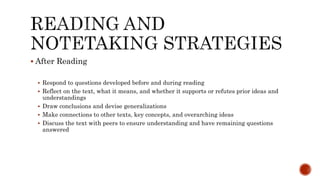
 After Reading
 Respond to questions developed before and during reading
 Reflect on the text, what it means, and whether it supports or refutes prior ideas and
understandings
 Draw conclusions and devise generalizations
 Make connections to other texts, key concepts, and overarching ideas
 Discuss the text with peers to ensure understanding and have remaining questions
answered
APUSH Historical Reasoning Skill
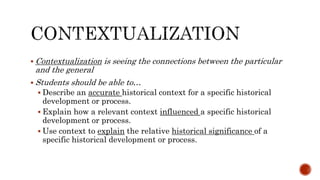
 Contextualization is seeing the connections between the particular
and the general
 Students should be able to…
 Describe an accurate historical context for a specific historical
development or process.
 Explain how a relevant context influenced a specific historical
development or process.
 Use context to explain the relative historical significance of a
specific historical development or process.
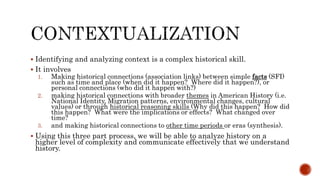
 Identifying and analyzing context is a complex historical skill.
 It involves
1. Making historical connections (association links) between simple facts (SFI)
such as time and place (when did it happen? Where did it happen?), or
personal connections (who did it happen with?)
2. making historical connections with broader themes in American History (i.e.
National Identity, Migration patterns, environmental changes, cultural
values) or through historical reasoning skills (Why did this happen? How did
this happen? What were the implications or effects? What changed over
time?
3. and making historical connections to other time periods or eras (synthesis).
 Using this three part process, we will be able to analyze history on a
higher level of complexity and communicate effectively that we understand
history.
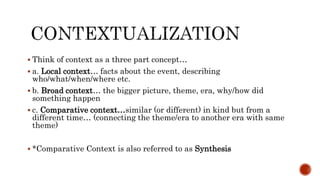
 Think of context as a three part concept…
 a. Local context… facts about the event, describing
who/what/when/where etc.
 b. Broad context… the bigger picture, theme, era, why/how did
something happen
 c. Comparative context…similar (or different) in kind but from a
different time… (connecting the theme/era to another era with same
theme)
 *Comparative Context is also referred to as Synthesis
 For example, if determining the context of English mercantilism using the three step process of Local,
Broad, and Other, we may come up with something like this:
 Local context: Who?/What?/When?/Where?: During the Colonial Era of the 17th and 18th Centuries, the
British Empire developed an economic policy of mercantilism which dictated that power and strength
came from government regulated trade. Colonies served the mother country by supplying raw materials
and providing markets, and the accumulation of wealth was an ultimate goal. Regulations beginning with
the Trade and Navigation Acts of 1651 were numerous and served to support the growth of a self-sufficient
empire.
 Broad context: Big Picture/Themes: The creation of colonies was motivated by economics. Colonial
economies developed and operated inside a system of rules, regulations, expectations that served the
mother country. Also, when regulations were more tightly enforced, the colonists became resentful as they
had experienced a period of Salutary Neglect. The implementation of mercantilism had the unintended
consequence of inspiring rebellion. The development of American identity and political systems that
embodied direct representation and self-rule did not align with mercantilism. Thus, the tight enforcement
of a series of Navigation Acts and taxes after the French and Indian War would lead to rebellion.
 Comparative context: Similar (or Different) in Kind but from a different time (Synthesis): Today, the
United States operates in a global economy that has far fewer regulations and restrictions and more
emphasis on reducing trade barriers like tariffs and encourages the buying and selling of goods across the
globe. This economic policy is much different from the mercantile policies of Britain during the Colonial
Era.
 When in doubt use the 20-20 Rule to distinguish between Contextualization &
Synthesis
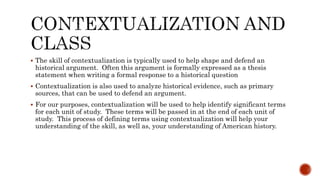
 The skill of contextualization is typically used to help shape and defend an
historical argument. Often this argument is formally expressed as a thesis
statement when writing a formal response to a historical question
 Contextualization is also used to analyze historical evidence, such as primary
sources, that can be used to defend an argument.
 For our purposes, contextualization will be used to help identify significant terms
for each unit of study. These terms will be passed in at the end of each unit of
study. This process of defining terms using contextualization will help your
understanding of the skill, as well as, your understanding of American history.
 Review the Top Ten Identifications Guidelines for APUSH
 Define yourself using the guidelines provided
 Complete the Graphic organizer provided using information from the following
sources:
 Brinkley notes from guided reading (pp. 2-23)
 Alfred Crosby essay on “The Columbian Exchange” (see unit 1 Resource Page)
 Visual of the Columbian Exchange
1 contextualization.pptx

1 contextualization.pptx

  • 1.
  • 2.
     Partner anddiscuss your work on the 4cs Graphic Organizer for “America Before Columbus” Reading, pp. 2-9  Use the College Board description of the four historical reasoning skills to guide your thoughts.  With your partner also discuss “APUSH Homework Assignment Instructions and Expectations” handout and brainstorm 1-2 ways that you could take notes while reading the Brinkley text.
  • 3.
     Before Reading: Focus on an essential question that the text helps answer  Preview the text to determine the topic and the text’s structure and purpose (e.g., argument, narrative, explanation)  Use the title and preview of the text to activate prior knowledge  Develop questions about the text and/or its topic that might be answered when reading
  • 4.
     During Reading Monitor reading to ensure comprehension  Answer questions developed before reading  Annotate the text for main ideas, answers to questions, interesting or surprising aspects of the text, or parts that are difficult to understand  Periodically stop and reflect on what’s being read and how it fits with prior knowledge and the other parts of the text
  • 5.
     After Reading Respond to questions developed before and during reading  Reflect on the text, what it means, and whether it supports or refutes prior ideas and understandings  Draw conclusions and devise generalizations  Make connections to other texts, key concepts, and overarching ideas  Discuss the text with peers to ensure understanding and have remaining questions answered
  • 6.
  • 7.
     Contextualization isseeing the connections between the particular and the general  Students should be able to…  Describe an accurate historical context for a specific historical development or process.  Explain how a relevant context influenced a specific historical development or process.  Use context to explain the relative historical significance of a specific historical development or process.
  • 8.
     Identifying andanalyzing context is a complex historical skill.  It involves 1. Making historical connections (association links) between simple facts (SFI) such as time and place (when did it happen? Where did it happen?), or personal connections (who did it happen with?) 2. making historical connections with broader themes in American History (i.e. National Identity, Migration patterns, environmental changes, cultural values) or through historical reasoning skills (Why did this happen? How did this happen? What were the implications or effects? What changed over time? 3. and making historical connections to other time periods or eras (synthesis).  Using this three part process, we will be able to analyze history on a higher level of complexity and communicate effectively that we understand history.
  • 9.
     Think ofcontext as a three part concept…  a. Local context… facts about the event, describing who/what/when/where etc.  b. Broad context… the bigger picture, theme, era, why/how did something happen  c. Comparative context…similar (or different) in kind but from a different time… (connecting the theme/era to another era with same theme)  *Comparative Context is also referred to as Synthesis
  • 10.
     For example,if determining the context of English mercantilism using the three step process of Local, Broad, and Other, we may come up with something like this:  Local context: Who?/What?/When?/Where?: During the Colonial Era of the 17th and 18th Centuries, the British Empire developed an economic policy of mercantilism which dictated that power and strength came from government regulated trade. Colonies served the mother country by supplying raw materials and providing markets, and the accumulation of wealth was an ultimate goal. Regulations beginning with the Trade and Navigation Acts of 1651 were numerous and served to support the growth of a self-sufficient empire.  Broad context: Big Picture/Themes: The creation of colonies was motivated by economics. Colonial economies developed and operated inside a system of rules, regulations, expectations that served the mother country. Also, when regulations were more tightly enforced, the colonists became resentful as they had experienced a period of Salutary Neglect. The implementation of mercantilism had the unintended consequence of inspiring rebellion. The development of American identity and political systems that embodied direct representation and self-rule did not align with mercantilism. Thus, the tight enforcement of a series of Navigation Acts and taxes after the French and Indian War would lead to rebellion.  Comparative context: Similar (or Different) in Kind but from a different time (Synthesis): Today, the United States operates in a global economy that has far fewer regulations and restrictions and more emphasis on reducing trade barriers like tariffs and encourages the buying and selling of goods across the globe. This economic policy is much different from the mercantile policies of Britain during the Colonial Era.
  • 11.
     When indoubt use the 20-20 Rule to distinguish between Contextualization & Synthesis
  • 12.
     The skillof contextualization is typically used to help shape and defend an historical argument. Often this argument is formally expressed as a thesis statement when writing a formal response to a historical question  Contextualization is also used to analyze historical evidence, such as primary sources, that can be used to defend an argument.  For our purposes, contextualization will be used to help identify significant terms for each unit of study. These terms will be passed in at the end of each unit of study. This process of defining terms using contextualization will help your understanding of the skill, as well as, your understanding of American history.
  • 13.
     Review theTop Ten Identifications Guidelines for APUSH  Define yourself using the guidelines provided
  • 14.
     Complete theGraphic organizer provided using information from the following sources:  Brinkley notes from guided reading (pp. 2-23)  Alfred Crosby essay on “The Columbian Exchange” (see unit 1 Resource Page)  Visual of the Columbian Exchange