Prof. Amira Fawzy Almaz.
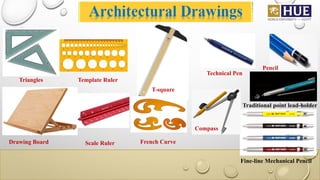
Triangles Template Ruler
Drawing Board Scale Ruler
T-square
Pencil
Traditional point lead-holder
Fine-line Mechanical Pencil
Technical Pen
Compass
French Curve
The architectural drawing is a visual language
that is rigorously used in both architectural
practice and education, however there is little
research and investigation surrounding this
subject beyond the construction and
presentation of a drawing.
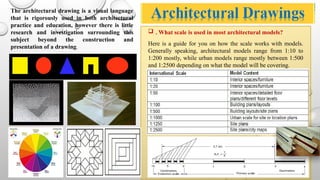
 . What scale is used in most architectural models?
Here is a guide for you on how the scale works with models.
Generally speaking, architectural models range from 1:10 to
1:200 mostly, while urban models range mostly between 1:500
and 1:2500 depending on what the model will be covering.
ARCHITECTURAL DRAFTING
Fixing the Drawing Paper
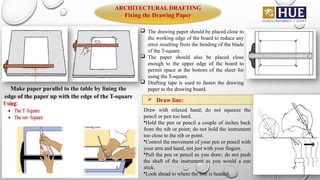
Make paper parallel to the table by lining the
edge of the paper up with the edge of the T-square
 The drawing paper should be placed close to
the working edge of the board to reduce any
error resulting from the bending of the blade
of the T-square.
 The paper should also be placed close
enough to the upper edge of the board to
permit space at the bottom of the sheet for
using the T-square.
 Drafting tape is used to fasten the drawing
paper to the drawing board.
 Draw line:
Draw with relaxed hand; do not squeeze the
pencil or pen too hard.
•Hold the pen or pencil a couple of inches back
from the nib or point; do not hold the instrument
too close to the nib or point.
•Control the movement of your pen or pencil with
your arm and hand, not just with your fingers.
•Pull the pen or pencil as you draw; do not push
the shaft of the instrument as you would a cue
stick.
•Look ahead to where the line is headed.
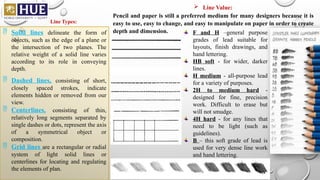
Line Types:
 Solid lines delineate the form of
objects, such as the edge of a plane or
the intersection of two planes. The
relative weight of a solid line varies
according to its role in conveying
depth.
 Dashed lines, consisting of short,
closely spaced strokes, indicate
elements hidden or removed from our
view.
 Centerlines, consisting of thin,
relatively long segments separated by
single dashes or dots, represent the axis
of a symmetrical object or
composition.
 Grid lines are a rectangular or radial
system of light solid lines or
centerlines for locating and regulating
the elements of plan.
 Line Value:
Pencil and paper is still a preferred medium for many designers because it is
easy to use, easy to change, and easy to manipulate on paper in order to create
depth and dimension. F and H –general purpose
grades of lead suitable for
layouts, finish drawings, and
hand lettering.
HB soft - for wider, darker
lines.
H medium - all-purpose lead
for a variety of purposes.
2H to medium hard -
designed for fine, precision
work. Difficult to erase but
will not smudge.
4H hard - for any lines that
need to be light (such as
guidelines).
B – this soft grade of lead is
used for very dense line work
and hand lettering.

1. Architectural drawing visual language

  • 1.
  • 2.
    Triangles Template Ruler DrawingBoard Scale Ruler T-square Pencil Traditional point lead-holder Fine-line Mechanical Pencil Technical Pen Compass French Curve
  • 3.
    The architectural drawingis a visual language that is rigorously used in both architectural practice and education, however there is little research and investigation surrounding this subject beyond the construction and presentation of a drawing.  . What scale is used in most architectural models? Here is a guide for you on how the scale works with models. Generally speaking, architectural models range from 1:10 to 1:200 mostly, while urban models range mostly between 1:500 and 1:2500 depending on what the model will be covering.
  • 4.
    ARCHITECTURAL DRAFTING Fixing theDrawing Paper Make paper parallel to the table by lining the edge of the paper up with the edge of the T-square  The drawing paper should be placed close to the working edge of the board to reduce any error resulting from the bending of the blade of the T-square.  The paper should also be placed close enough to the upper edge of the board to permit space at the bottom of the sheet for using the T-square.  Drafting tape is used to fasten the drawing paper to the drawing board.  Draw line: Draw with relaxed hand; do not squeeze the pencil or pen too hard. •Hold the pen or pencil a couple of inches back from the nib or point; do not hold the instrument too close to the nib or point. •Control the movement of your pen or pencil with your arm and hand, not just with your fingers. •Pull the pen or pencil as you draw; do not push the shaft of the instrument as you would a cue stick. •Look ahead to where the line is headed.
  • 5.
    Line Types:  Solidlines delineate the form of objects, such as the edge of a plane or the intersection of two planes. The relative weight of a solid line varies according to its role in conveying depth.  Dashed lines, consisting of short, closely spaced strokes, indicate elements hidden or removed from our view.  Centerlines, consisting of thin, relatively long segments separated by single dashes or dots, represent the axis of a symmetrical object or composition.  Grid lines are a rectangular or radial system of light solid lines or centerlines for locating and regulating the elements of plan.  Line Value: Pencil and paper is still a preferred medium for many designers because it is easy to use, easy to change, and easy to manipulate on paper in order to create depth and dimension. F and H –general purpose grades of lead suitable for layouts, finish drawings, and hand lettering. HB soft - for wider, darker lines. H medium - all-purpose lead for a variety of purposes. 2H to medium hard - designed for fine, precision work. Difficult to erase but will not smudge. 4H hard - for any lines that need to be light (such as guidelines). B – this soft grade of lead is used for very dense line work and hand lettering.