History of Pakistani Fashion
By: Iman Nadeem Zoqi
Today fashion in Pakistan rolls through our
lives like a well-oiled machine that is
fuelled by a prolific industry and
maintained by active consumers. An
overactive media makes sure fashion is
always in the picture. Collections are
unveiled every six months and vibrant
campaigns launched with them. Business
is generated to the tune of well over seven-
digit-figures and mega deals are struck
around it.
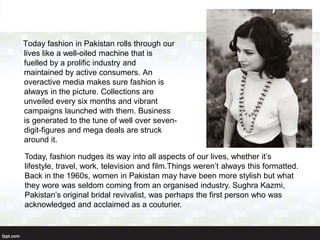
Today, fashion nudges its way into all aspects of our lives, whether it’s
lifestyle, travel, work, television and film.Things weren’t always this formatted.
Back in the 1960s, women in Pakistan may have been more stylish but what
they wore was seldom coming from an organised industry. Sughra Kazmi,
Pakistan’s original bridal revivalist, was perhaps the first person who was
acknowledged and acclaimed as a couturier.
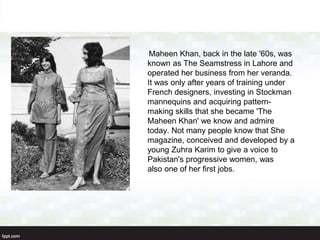
Maheen Khan, back in the late '60s, was
known as The Seamstress in Lahore and
operated her business from her veranda.
It was only after years of training under
French designers, investing in Stockman
mannequins and acquiring pattern-
making skills that she became 'The
Maheen Khan' we know and admire
today. Not many people know that She
magazine, conceived and developed by a
young Zuhra Karim to give a voice to
Pakistan's progressive women, was
also one of her first jobs.
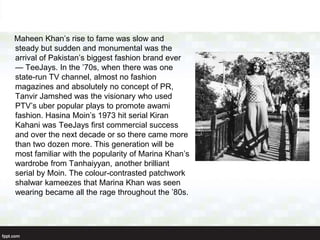
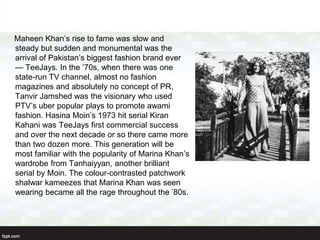
Maheen Khan’s rise to fame was slow and
steady but sudden and monumental was the
arrival of Pakistan’s biggest fashion brand ever
— TeeJays. In the ’70s, when there was one
state-run TV channel, almost no fashion
magazines and absolutely no concept of PR,
Tanvir Jamshed was the visionary who used
PTV’s uber popular plays to promote awami
fashion. Hasina Moin’s 1973 hit serial Kiran
Kahani was TeeJays first commercial success
and over the next decade or so there came more
than two dozen more. This generation will be
most familiar with the popularity of Marina Khan’s
wardrobe from Tanhaiyyan, another brilliant
serial by Moin. The colour-contrasted patchwork
shalwar kameezes that Marina Khan was seen
wearing became all the rage throughout the ’80s.
Maheen Khan’s rise to fame was slow and
steady but sudden and monumental was the
arrival of Pakistan’s biggest fashion brand ever
— TeeJays. In the ’70s, when there was one
state-run TV channel, almost no fashion
magazines and absolutely no concept of PR,
Tanvir Jamshed was the visionary who used
PTV’s uber popular plays to promote awami
fashion. Hasina Moin’s 1973 hit serial Kiran
Kahani was TeeJays first commercial success
and over the next decade or so there came more
than two dozen more. This generation will be
most familiar with the popularity of Marina Khan’s
wardrobe from Tanhaiyyan, another brilliant
serial by Moin. The colour-contrasted patchwork
shalwar kameezes that Marina Khan was seen
wearing became all the rage throughout the ’80s.
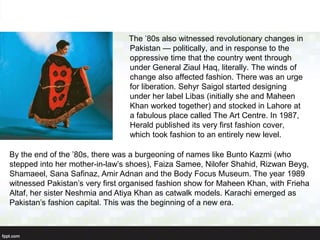
The ’80s also witnessed revolutionary changes in
Pakistan — politically, and in response to the
oppressive time that the country went through
under General Ziaul Haq, literally. The winds of
change also affected fashion. There was an urge
for liberation. Sehyr Saigol started designing
under her label Libas (initially she and Maheen
Khan worked together) and stocked in Lahore at
a fabulous place called The Art Centre. In 1987,
Herald published its very first fashion cover,
which took fashion to an entirely new level.
By the end of the ’80s, there was a burgeoning of names like Bunto Kazmi (who
stepped into her mother-in-law’s shoes), Faiza Samee, Nilofer Shahid, Rizwan Beyg,
Shamaeel, Sana Safinaz, Amir Adnan and the Body Focus Museum. The year 1989
witnessed Pakistan’s very first organised fashion show for Maheen Khan, with Frieha
Altaf, her sister Neshmia and Atiya Khan as catwalk models. Karachi emerged as
Pakistan’s fashion capital. This was the beginning of a new era.
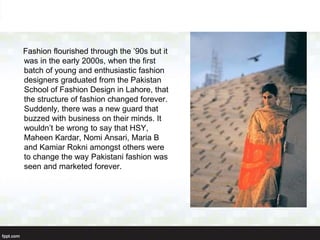
Fashion flourished through the ’90s but it
was in the early 2000s, when the first
batch of young and enthusiastic fashion
designers graduated from the Pakistan
School of Fashion Design in Lahore, that
the structure of fashion changed forever.
Suddenly, there was a new guard that
buzzed with business on their minds. It
wouldn’t be wrong to say that HSY,
Maheen Kardar, Nomi Ansari, Maria B
and Kamiar Rokni amongst others were
to change the way Pakistani fashion was
seen and marketed forever.
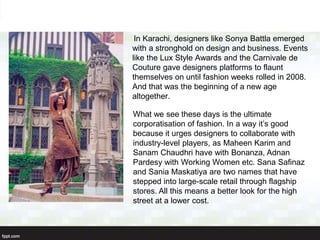
In Karachi, designers like Sonya Battla emerged
with a stronghold on design and business. Events
like the Lux Style Awards and the Carnivale de
Couture gave designers platforms to flaunt
themselves on until fashion weeks rolled in 2008.
And that was the beginning of a new age
altogether.
What we see these days is the ultimate
corporatisation of fashion. In a way it’s good
because it urges designers to collaborate with
industry-level players, as Maheen Karim and
Sanam Chaudhri have with Bonanza, Adnan
Pardesy with Working Women etc. Sana Safinaz
and Sania Maskatiya are two names that have
stepped into large-scale retail through flagship
stores. All this means a better look for the high
street at a lower cost.

History of Pakistani Fashion

  • 1.
    History of PakistaniFashion By: Iman Nadeem Zoqi
  • 2.
    Today fashion inPakistan rolls through our lives like a well-oiled machine that is fuelled by a prolific industry and maintained by active consumers. An overactive media makes sure fashion is always in the picture. Collections are unveiled every six months and vibrant campaigns launched with them. Business is generated to the tune of well over seven- digit-figures and mega deals are struck around it. Today, fashion nudges its way into all aspects of our lives, whether it’s lifestyle, travel, work, television and film.Things weren’t always this formatted. Back in the 1960s, women in Pakistan may have been more stylish but what they wore was seldom coming from an organised industry. Sughra Kazmi, Pakistan’s original bridal revivalist, was perhaps the first person who was acknowledged and acclaimed as a couturier.
  • 3.
    Maheen Khan, backin the late '60s, was known as The Seamstress in Lahore and operated her business from her veranda. It was only after years of training under French designers, investing in Stockman mannequins and acquiring pattern- making skills that she became 'The Maheen Khan' we know and admire today. Not many people know that She magazine, conceived and developed by a young Zuhra Karim to give a voice to Pakistan's progressive women, was also one of her first jobs.
  • 4.
    Maheen Khan’s riseto fame was slow and steady but sudden and monumental was the arrival of Pakistan’s biggest fashion brand ever — TeeJays. In the ’70s, when there was one state-run TV channel, almost no fashion magazines and absolutely no concept of PR, Tanvir Jamshed was the visionary who used PTV’s uber popular plays to promote awami fashion. Hasina Moin’s 1973 hit serial Kiran Kahani was TeeJays first commercial success and over the next decade or so there came more than two dozen more. This generation will be most familiar with the popularity of Marina Khan’s wardrobe from Tanhaiyyan, another brilliant serial by Moin. The colour-contrasted patchwork shalwar kameezes that Marina Khan was seen wearing became all the rage throughout the ’80s.
  • 5.
    Maheen Khan’s riseto fame was slow and steady but sudden and monumental was the arrival of Pakistan’s biggest fashion brand ever — TeeJays. In the ’70s, when there was one state-run TV channel, almost no fashion magazines and absolutely no concept of PR, Tanvir Jamshed was the visionary who used PTV’s uber popular plays to promote awami fashion. Hasina Moin’s 1973 hit serial Kiran Kahani was TeeJays first commercial success and over the next decade or so there came more than two dozen more. This generation will be most familiar with the popularity of Marina Khan’s wardrobe from Tanhaiyyan, another brilliant serial by Moin. The colour-contrasted patchwork shalwar kameezes that Marina Khan was seen wearing became all the rage throughout the ’80s.
  • 6.
    The ’80s alsowitnessed revolutionary changes in Pakistan — politically, and in response to the oppressive time that the country went through under General Ziaul Haq, literally. The winds of change also affected fashion. There was an urge for liberation. Sehyr Saigol started designing under her label Libas (initially she and Maheen Khan worked together) and stocked in Lahore at a fabulous place called The Art Centre. In 1987, Herald published its very first fashion cover, which took fashion to an entirely new level. By the end of the ’80s, there was a burgeoning of names like Bunto Kazmi (who stepped into her mother-in-law’s shoes), Faiza Samee, Nilofer Shahid, Rizwan Beyg, Shamaeel, Sana Safinaz, Amir Adnan and the Body Focus Museum. The year 1989 witnessed Pakistan’s very first organised fashion show for Maheen Khan, with Frieha Altaf, her sister Neshmia and Atiya Khan as catwalk models. Karachi emerged as Pakistan’s fashion capital. This was the beginning of a new era.
  • 7.
    Fashion flourished throughthe ’90s but it was in the early 2000s, when the first batch of young and enthusiastic fashion designers graduated from the Pakistan School of Fashion Design in Lahore, that the structure of fashion changed forever. Suddenly, there was a new guard that buzzed with business on their minds. It wouldn’t be wrong to say that HSY, Maheen Kardar, Nomi Ansari, Maria B and Kamiar Rokni amongst others were to change the way Pakistani fashion was seen and marketed forever.
  • 8.
    In Karachi, designerslike Sonya Battla emerged with a stronghold on design and business. Events like the Lux Style Awards and the Carnivale de Couture gave designers platforms to flaunt themselves on until fashion weeks rolled in 2008. And that was the beginning of a new age altogether. What we see these days is the ultimate corporatisation of fashion. In a way it’s good because it urges designers to collaborate with industry-level players, as Maheen Karim and Sanam Chaudhri have with Bonanza, Adnan Pardesy with Working Women etc. Sana Safinaz and Sania Maskatiya are two names that have stepped into large-scale retail through flagship stores. All this means a better look for the high street at a lower cost.