1
General Financial Rules 2017
Ministry of Finance
Department of Expenditure
January, 2018
2
 Issued in March, 2017. General provisions to be
followed in Government of India (GOI) on financial
matters.
 These are executive instructions.
 GFRs were first issued in 1947. Revised in 1963
and 2005.
 Broad procurement rules are covered under GFRs
 Respective procuring entities may issue detail
instructions regarding procurement broadly in
conformity with GFRs (Rule 142)
 Applicability of GFR
General Financial Rules
2017
3
 Applicable for both the procuring entity and the bidder.
 Code of Integrity prohibits
 Making offer, solicitation or acceptance of bribed
 Any misrepresentation that attempts to mislead
 Collusion, bid rigging, anti competitive approach
 Coercion or threat to impair or harm
 Disclosure of Conflict of Interest (Guidance will be in
Manuals)
 Disclosure of any previous transgression by the bidder
 Procuring entity may take appropriate measures
including debarment of bidder.
Code of Integrity (Rule 175)
4
Debarment Provision(Rule 151)
Under the Prevention of Corruption Act, 1988; the
Indian Penal Code or any other law for the time
being in force, debarment of bidder for a period not
exceeding three years commencing from the date
of debarment (for all Departments)
On breach of code of integrity bidder may be
debarred from participating in any procurement
process undertaken for a period not exceeding two
years.
The bidder shall not be debarred unless such bidder
has been given a reasonable opportunity to
represent against such debarment.
5
 MSME Policy
 358 reserved items
 20% procurement through MSE if they
quote within L1+15% and match price of L1
 By providing a notification,
Government may
 Make mandatory procurement of any goods
or services from any category of bidders.
 Make preference to bidders for promoting
locally manufactured goods.
Purchase Preference
(Rule 153)
6
 Mandatory for all Ministries/
Departments to publish and receive bids
through e-procurement.
 Central Public Procurement Portal
(CPPP) developed by NIC
(www.eprocure.gov.in) may be used
by procuring entities that do not have
their own e-procurement portals.
 Exemptions
 National Security
 Global Tenders
Electronic Procurement
7
 Publication in newspaper and ITJ is no more
mandatory
 Advertisement should be on Central Public
Procurement Portal (CPPP) and on GeM.
 An organisation having its own web site should
also publish all its advertised tender enquiries
on the web site.
 No cost of tender document may be charged
for tender documents downloaded by the
bidders.
Advertisement requirement
in Newspapers waived
8
 In place Bid Security, procuring entities may
require bidders to sign the Bid Securing
Declaration.
 As per the declaration Bidders are suspended
from participating in future bidding processes of
procuring entity for the period of time specified
in the request for bid document if:
 bidders withdraw or modify their bids,
 fail to sign the contract or
 fail to submit a performance security.
Bid Security (Rule 170)
9
Rule 171
 5 to 10 % of contract value
 Unlike contracts of Works and Plants, in
case of contracts for goods, the need for
the Performance Security depends on
the market conditions and
commercial practice for the particular
kind of goods.
Performance Security
10
 The condition of prior turn over and prior
experience may be relaxed for Start-
ups, subject to meeting of quality &
technical specifications and making
suitable provisions in the bidding
documents.
 Startups as defined as DIPP
 Not more than 5 years old
 Turnover in any year less than 25 cr
 Certification that working for innovation,
intellectual property
Relaxation for Startups
(Rule 173 (i)
11
 An online real-time purchasing method, which
involves presentation by bidders of successively
more favorable bids during a scheduled period
of time and automatic evaluation of bids;
 Purchasing through reverse auction is applicable
when
 Detailed description of the subject matter of
the procurement is available;
 There is competitive market
 CVC Approval in 2003
 To be decided at the tender issuing stage itself.
Electronic Reverse Auction
(Rule 167)
12
 Where it is not possible to formulate
details specifications without inputs
 Rapid Technological advances or
market fluctuations or both
 For research, development or study
 Bidder is expected to carry out
detailed survey and assessment of
risks, costs and obligations
Two Stage Bidding
( Rule 164)
13
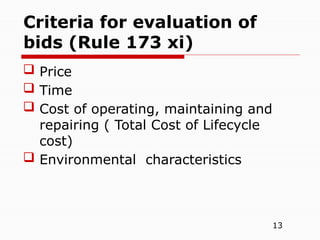
 Price
 Time
 Cost of operating, maintaining and
repairing ( Total Cost of Lifecycle
cost)
 Environmental characteristics
Criteria for evaluation of
bids (Rule 173 xi)
14
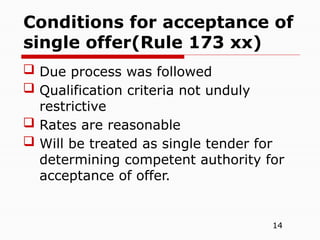
 Due process was followed
 Qualification criteria not unduly
restrictive
 Rates are reasonable
 Will be treated as single tender for
determining competent authority for
acceptance of offer.
Conditions for acceptance of
single offer(Rule 173 xx)
15
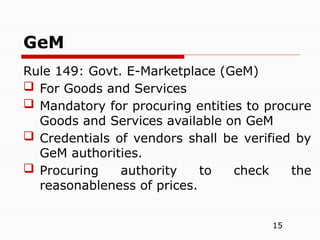
Rule 149: Govt. E-Marketplace (GeM)
 For Goods and Services
 Mandatory for procuring entities to procure
Goods and Services available on GeM
 Credentials of vendors shall be verified by
GeM authorities.
 Procuring authority to check the
reasonableness of prices.
GeM
16
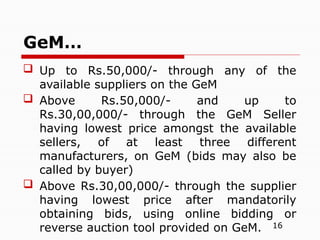
 Up to Rs.50,000/- through any of the
available suppliers on the GeM
 Above Rs.50,000/- and up to
Rs.30,00,000/- through the GeM Seller
having lowest price amongst the available
sellers, of at least three different
manufacturers, on GeM (bids may also be
called by buyer)
 Above Rs.30,00,000/- through the supplier
having lowest price after mandatorily
obtaining bids, using online bidding or
reverse auction tool provided on GeM.
GeM…
17
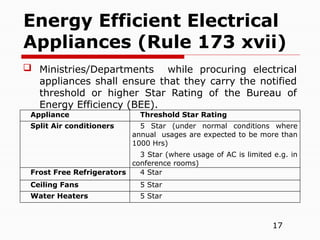
 Ministries/Departments while procuring electrical
appliances shall ensure that they carry the notified
threshold or higher Star Rating of the Bureau of
Energy Efficiency (BEE).
Energy Efficient Electrical
Appliances (Rule 173 xvii)
Appliance Threshold Star Rating
Split Air conditioners 5 Star (under normal conditions where
annual usages are expected to be more than
1000 Hrs)
3 Star (where usage of AC is limited e.g. in
conference rooms)
Frost Free Refrigerators 4 Star
Ceiling Fans 5 Star
Water Heaters 5 Star
18
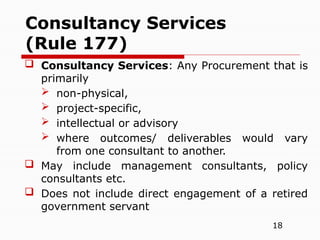
 Consultancy Services: Any Procurement that is
primarily
 non-physical,
 project-specific,
 intellectual or advisory
 where outcomes/ deliverables would vary
from one consultant to another.
 May include management consultants, policy
consultants etc.
 Does not include direct engagement of a retired
government servant
Consultancy Services
(Rule 177)
19
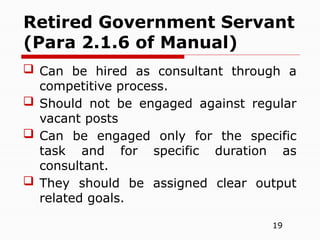
 Can be hired as consultant through a
competitive process.
 Should not be engaged against regular
vacant posts
 Can be engaged only for the specific
task and for specific duration as
consultant.
 They should be assigned clear output
related goals.
Retired Government Servant
(Para 2.1.6 of Manual)
20
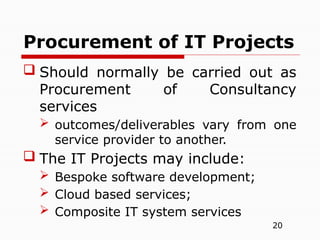
 Should normally be carried out as
Procurement of Consultancy
services
 outcomes/deliverables vary from one
service provider to another.
 The IT Projects may include:
 Bespoke software development;
 Cloud based services;
 Composite IT system services
Procurement of IT Projects
21
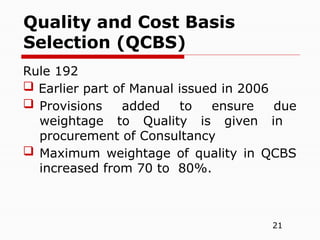
Rule 192
 Earlier part of Manual issued in 2006
 Provisions added to ensure due
weightage to Quality is given in
procurement of Consultancy
 Maximum weightage of quality in QCBS
increased from 70 to 80%.
Quality and Cost Basis
Selection (QCBS)
22
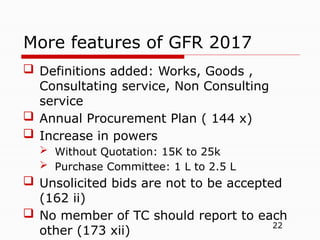
 Definitions added: Works, Goods ,
Consultating service, Non Consulting
service
 Annual Procurement Plan ( 144 x)
 Increase in powers
 Without Quotation: 15K to 25k
 Purchase Committee: 1 L to 2.5 L
 Unsolicited bids are not to be accepted
(162 ii)
 No member of TC should report to each
other (173 xii)
More features of GFR 2017
23
Thank you !!

1.1.Sanjay Aggrawal -General FR_2017_CPPP.pptx

  • 1.
    1 General Financial Rules2017 Ministry of Finance Department of Expenditure January, 2018
  • 2.
    2  Issued inMarch, 2017. General provisions to be followed in Government of India (GOI) on financial matters.  These are executive instructions.  GFRs were first issued in 1947. Revised in 1963 and 2005.  Broad procurement rules are covered under GFRs  Respective procuring entities may issue detail instructions regarding procurement broadly in conformity with GFRs (Rule 142)  Applicability of GFR General Financial Rules 2017
  • 3.
    3  Applicable forboth the procuring entity and the bidder.  Code of Integrity prohibits  Making offer, solicitation or acceptance of bribed  Any misrepresentation that attempts to mislead  Collusion, bid rigging, anti competitive approach  Coercion or threat to impair or harm  Disclosure of Conflict of Interest (Guidance will be in Manuals)  Disclosure of any previous transgression by the bidder  Procuring entity may take appropriate measures including debarment of bidder. Code of Integrity (Rule 175)
  • 4.
    4 Debarment Provision(Rule 151) Underthe Prevention of Corruption Act, 1988; the Indian Penal Code or any other law for the time being in force, debarment of bidder for a period not exceeding three years commencing from the date of debarment (for all Departments) On breach of code of integrity bidder may be debarred from participating in any procurement process undertaken for a period not exceeding two years. The bidder shall not be debarred unless such bidder has been given a reasonable opportunity to represent against such debarment.
  • 5.
    5  MSME Policy 358 reserved items  20% procurement through MSE if they quote within L1+15% and match price of L1  By providing a notification, Government may  Make mandatory procurement of any goods or services from any category of bidders.  Make preference to bidders for promoting locally manufactured goods. Purchase Preference (Rule 153)
  • 6.
    6  Mandatory forall Ministries/ Departments to publish and receive bids through e-procurement.  Central Public Procurement Portal (CPPP) developed by NIC (www.eprocure.gov.in) may be used by procuring entities that do not have their own e-procurement portals.  Exemptions  National Security  Global Tenders Electronic Procurement
  • 7.
    7  Publication innewspaper and ITJ is no more mandatory  Advertisement should be on Central Public Procurement Portal (CPPP) and on GeM.  An organisation having its own web site should also publish all its advertised tender enquiries on the web site.  No cost of tender document may be charged for tender documents downloaded by the bidders. Advertisement requirement in Newspapers waived
  • 8.
    8  In placeBid Security, procuring entities may require bidders to sign the Bid Securing Declaration.  As per the declaration Bidders are suspended from participating in future bidding processes of procuring entity for the period of time specified in the request for bid document if:  bidders withdraw or modify their bids,  fail to sign the contract or  fail to submit a performance security. Bid Security (Rule 170)
  • 9.
    9 Rule 171  5to 10 % of contract value  Unlike contracts of Works and Plants, in case of contracts for goods, the need for the Performance Security depends on the market conditions and commercial practice for the particular kind of goods. Performance Security
  • 10.
    10  The conditionof prior turn over and prior experience may be relaxed for Start- ups, subject to meeting of quality & technical specifications and making suitable provisions in the bidding documents.  Startups as defined as DIPP  Not more than 5 years old  Turnover in any year less than 25 cr  Certification that working for innovation, intellectual property Relaxation for Startups (Rule 173 (i)
  • 11.
    11  An onlinereal-time purchasing method, which involves presentation by bidders of successively more favorable bids during a scheduled period of time and automatic evaluation of bids;  Purchasing through reverse auction is applicable when  Detailed description of the subject matter of the procurement is available;  There is competitive market  CVC Approval in 2003  To be decided at the tender issuing stage itself. Electronic Reverse Auction (Rule 167)
  • 12.
    12  Where itis not possible to formulate details specifications without inputs  Rapid Technological advances or market fluctuations or both  For research, development or study  Bidder is expected to carry out detailed survey and assessment of risks, costs and obligations Two Stage Bidding ( Rule 164)
  • 13.
    13  Price  Time Cost of operating, maintaining and repairing ( Total Cost of Lifecycle cost)  Environmental characteristics Criteria for evaluation of bids (Rule 173 xi)
  • 14.
    14  Due processwas followed  Qualification criteria not unduly restrictive  Rates are reasonable  Will be treated as single tender for determining competent authority for acceptance of offer. Conditions for acceptance of single offer(Rule 173 xx)
  • 15.
    15 Rule 149: Govt.E-Marketplace (GeM)  For Goods and Services  Mandatory for procuring entities to procure Goods and Services available on GeM  Credentials of vendors shall be verified by GeM authorities.  Procuring authority to check the reasonableness of prices. GeM
  • 16.
    16  Up toRs.50,000/- through any of the available suppliers on the GeM  Above Rs.50,000/- and up to Rs.30,00,000/- through the GeM Seller having lowest price amongst the available sellers, of at least three different manufacturers, on GeM (bids may also be called by buyer)  Above Rs.30,00,000/- through the supplier having lowest price after mandatorily obtaining bids, using online bidding or reverse auction tool provided on GeM. GeM…
  • 17.
    17  Ministries/Departments whileprocuring electrical appliances shall ensure that they carry the notified threshold or higher Star Rating of the Bureau of Energy Efficiency (BEE). Energy Efficient Electrical Appliances (Rule 173 xvii) Appliance Threshold Star Rating Split Air conditioners 5 Star (under normal conditions where annual usages are expected to be more than 1000 Hrs) 3 Star (where usage of AC is limited e.g. in conference rooms) Frost Free Refrigerators 4 Star Ceiling Fans 5 Star Water Heaters 5 Star
  • 18.
    18  Consultancy Services:Any Procurement that is primarily  non-physical,  project-specific,  intellectual or advisory  where outcomes/ deliverables would vary from one consultant to another.  May include management consultants, policy consultants etc.  Does not include direct engagement of a retired government servant Consultancy Services (Rule 177)
  • 19.
    19  Can behired as consultant through a competitive process.  Should not be engaged against regular vacant posts  Can be engaged only for the specific task and for specific duration as consultant.  They should be assigned clear output related goals. Retired Government Servant (Para 2.1.6 of Manual)
  • 20.
    20  Should normallybe carried out as Procurement of Consultancy services  outcomes/deliverables vary from one service provider to another.  The IT Projects may include:  Bespoke software development;  Cloud based services;  Composite IT system services Procurement of IT Projects
  • 21.
    21 Rule 192  Earlierpart of Manual issued in 2006  Provisions added to ensure due weightage to Quality is given in procurement of Consultancy  Maximum weightage of quality in QCBS increased from 70 to 80%. Quality and Cost Basis Selection (QCBS)
  • 22.
    22  Definitions added:Works, Goods , Consultating service, Non Consulting service  Annual Procurement Plan ( 144 x)  Increase in powers  Without Quotation: 15K to 25k  Purchase Committee: 1 L to 2.5 L  Unsolicited bids are not to be accepted (162 ii)  No member of TC should report to each other (173 xii) More features of GFR 2017
  • 23.

Editor's Notes

  • #3 ip
  • #10 An entity shall be considered as a 'startup'- a) Up to five years from the date of its incorporation/registration, b) If its turnover for any of the financial years has not exceeded Rupees 25 crore c) It is working towards innovation, development, deployment or commercializalion of new products, processes or services driven by technology or intellectual property; Provided further that in order to obtain benefits a startup so identified under the above definition shall be required to obtain a certificate of an eligible business from the lnter-Ministerial Board of Certification.