Data Structures and Algorithms in Java 1/10
Introduction to
Data Structures &
Algorithms
Data Structures and Algorithms in Java 2/10
What is data structure?
In computer science, simply speaking a data structure is a way of
storing data in a computer so that it can be used efficiently. A
data structure is a way of organizing data that considers not only
the items stored, but also their relationship to each other.
Advance knowledge about the relationship between data items
allows designing of efficient algorithms for the manipulation of data.
Often a carefully chosen data structure will allow a more
efficient algorithm to be used. The choice of the data structure
often begins from the choice of an abstract data structure. A well-
designed data structure allows a variety of critical operations to be
performed on using as little resources, both execution time and
memory space, as possible.
Different kinds of data structures are suited to different kinds of
applications, and some are highly specialized to certain tasks. For
example, B-trees are particularly well-suited for implementation of
databases, while compiler implementations usually use hash tables
to look up identifiers.
Data Structures and Algorithms in Java 3/10
Why data structure is important in
computer science?
Data structures are used in almost every program or software
system. Data structures provide a means to manage huge
amounts of data efficiently, such as large databases and
internet indexing services. Usually, efficient data structures are
a key to designing efficient algorithms. Some formal design
methods and programming languages emphasize data
structures, rather than algorithms, as the key organizing factor
in software design. Niklaus Emil Wirth (born February 15,
1934) is a Swiss computer scientist said:
Algorithms + Data Structures = Programs
Data Structures and Algorithms in Java 4/10
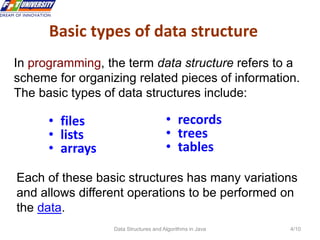
Basic types of data structure
• files
• lists
• arrays
In programming, the term data structure refers to a
scheme for organizing related pieces of information.
The basic types of data structures include:
Each of these basic structures has many variations
and allows different operations to be performed on
the data.
• records
• trees
• tables
Data Structures and Algorithms in Java 5/10
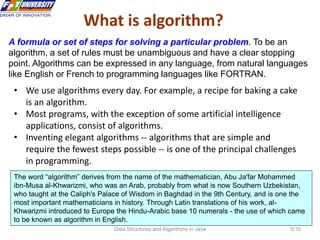
What is algorithm?
A formula or set of steps for solving a particular problem. To be an
algorithm, a set of rules must be unambiguous and have a clear stopping
point. Algorithms can be expressed in any language, from natural languages
like English or French to programming languages like FORTRAN.
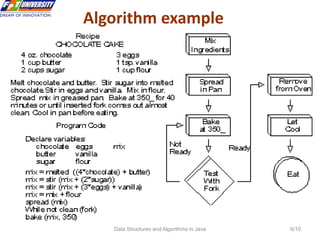
• We use algorithms every day. For example, a recipe for baking a cake
is an algorithm.
• Most programs, with the exception of some artificial intelligence
applications, consist of algorithms.
• Inventing elegant algorithms -- algorithms that are simple and
require the fewest steps possible -- is one of the principal challenges
in programming.
The word “algorithm” derives from the name of the mathematician, Abu Ja'far Mohammed
ibn-Musa al-Khwarizmi, who was an Arab, probably from what is now Southern Uzbekistan,
who taught at the Caliph's Palace of Wisdom in Baghdad in the 9th Century, and is one the
most important mathematicians in history. Through Latin translations of his work, al-
Khwarizmi introduced to Europe the Hindu-Arabic base 10 numerals - the use of which came
to be known as algorithm in English.
Data Structures and Algorithms in Java 6/10
Algorithm example
Data Structures and Algorithms in Java 7/10
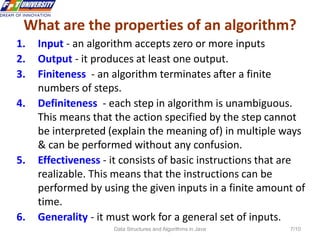
What are the properties of an algorithm?
1. Input - an algorithm accepts zero or more inputs
2. Output - it produces at least one output.
3. Finiteness - an algorithm terminates after a finite
numbers of steps.
4. Definiteness - each step in algorithm is unambiguous.
This means that the action specified by the step cannot
be interpreted (explain the meaning of) in multiple ways
& can be performed without any confusion.
5. Effectiveness - it consists of basic instructions that are
realizable. This means that the instructions can be
performed by using the given inputs in a finite amount of
time.
6. Generality - it must work for a general set of inputs.
Data Structures and Algorithms in Java 8/10
How to represent algorithms?
• Use natural languages
– too verbose
– too "context-sensitive"- relies on experience of reader
• Use formal programming languages
– too low level
– requires us to deal with complicated syntax of programming
language
• Pseudo-Code (alias programming language) - natural language
constructs modeled to look like statements available in many
programming languages.
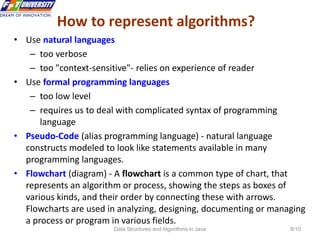
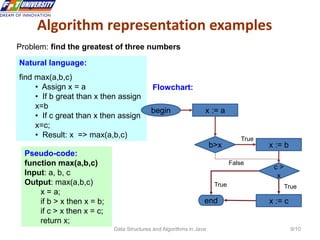
• Flowchart (diagram) - A flowchart is a common type of chart, that
represents an algorithm or process, showing the steps as boxes of
various kinds, and their order by connecting these with arrows.
Flowcharts are used in analyzing, designing, documenting or managing
a process or program in various fields.
Data Structures and Algorithms in Java 9/10
Algorithm representation examples
Natural language:
find max(a,b,c)
• Assign x = a
• If b great than x then assign
x=b
• If c great than x then assign
x=c;
• Result: x => max(a,b,c)
Pseudo-code:
function max(a,b,c)
Input: a, b, c
Output: max(a,b,c)
x = a;
if b > x then x = b;
if c > x then x = c;
return x;
x := a
b>x x := b
c >
x
x := c
end
begin
True
False
True
True
Flowchart:
Problem: find the greatest of three numbers
Data Structures and Algorithms in Java 10/10
Data Structures and Algorithms
• Most algorithms operate on data collections,
so define
• Collection Abstract Data Type (ADT)
– Methods
• Constructor / Destructor
• Add / Edit / Delete
• Find
• Sort
• ….

0-IntroductionToDSA.ppt

  • 1.
    Data Structures andAlgorithms in Java 1/10 Introduction to Data Structures & Algorithms
  • 2.
    Data Structures andAlgorithms in Java 2/10 What is data structure? In computer science, simply speaking a data structure is a way of storing data in a computer so that it can be used efficiently. A data structure is a way of organizing data that considers not only the items stored, but also their relationship to each other. Advance knowledge about the relationship between data items allows designing of efficient algorithms for the manipulation of data. Often a carefully chosen data structure will allow a more efficient algorithm to be used. The choice of the data structure often begins from the choice of an abstract data structure. A well- designed data structure allows a variety of critical operations to be performed on using as little resources, both execution time and memory space, as possible. Different kinds of data structures are suited to different kinds of applications, and some are highly specialized to certain tasks. For example, B-trees are particularly well-suited for implementation of databases, while compiler implementations usually use hash tables to look up identifiers.
  • 3.
    Data Structures andAlgorithms in Java 3/10 Why data structure is important in computer science? Data structures are used in almost every program or software system. Data structures provide a means to manage huge amounts of data efficiently, such as large databases and internet indexing services. Usually, efficient data structures are a key to designing efficient algorithms. Some formal design methods and programming languages emphasize data structures, rather than algorithms, as the key organizing factor in software design. Niklaus Emil Wirth (born February 15, 1934) is a Swiss computer scientist said: Algorithms + Data Structures = Programs
  • 4.
    Data Structures andAlgorithms in Java 4/10 Basic types of data structure • files • lists • arrays In programming, the term data structure refers to a scheme for organizing related pieces of information. The basic types of data structures include: Each of these basic structures has many variations and allows different operations to be performed on the data. • records • trees • tables
  • 5.
    Data Structures andAlgorithms in Java 5/10 What is algorithm? A formula or set of steps for solving a particular problem. To be an algorithm, a set of rules must be unambiguous and have a clear stopping point. Algorithms can be expressed in any language, from natural languages like English or French to programming languages like FORTRAN. • We use algorithms every day. For example, a recipe for baking a cake is an algorithm. • Most programs, with the exception of some artificial intelligence applications, consist of algorithms. • Inventing elegant algorithms -- algorithms that are simple and require the fewest steps possible -- is one of the principal challenges in programming. The word “algorithm” derives from the name of the mathematician, Abu Ja'far Mohammed ibn-Musa al-Khwarizmi, who was an Arab, probably from what is now Southern Uzbekistan, who taught at the Caliph's Palace of Wisdom in Baghdad in the 9th Century, and is one the most important mathematicians in history. Through Latin translations of his work, al- Khwarizmi introduced to Europe the Hindu-Arabic base 10 numerals - the use of which came to be known as algorithm in English.
  • 6.
    Data Structures andAlgorithms in Java 6/10 Algorithm example
  • 7.
    Data Structures andAlgorithms in Java 7/10 What are the properties of an algorithm? 1. Input - an algorithm accepts zero or more inputs 2. Output - it produces at least one output. 3. Finiteness - an algorithm terminates after a finite numbers of steps. 4. Definiteness - each step in algorithm is unambiguous. This means that the action specified by the step cannot be interpreted (explain the meaning of) in multiple ways & can be performed without any confusion. 5. Effectiveness - it consists of basic instructions that are realizable. This means that the instructions can be performed by using the given inputs in a finite amount of time. 6. Generality - it must work for a general set of inputs.
  • 8.
    Data Structures andAlgorithms in Java 8/10 How to represent algorithms? • Use natural languages – too verbose – too "context-sensitive"- relies on experience of reader • Use formal programming languages – too low level – requires us to deal with complicated syntax of programming language • Pseudo-Code (alias programming language) - natural language constructs modeled to look like statements available in many programming languages. • Flowchart (diagram) - A flowchart is a common type of chart, that represents an algorithm or process, showing the steps as boxes of various kinds, and their order by connecting these with arrows. Flowcharts are used in analyzing, designing, documenting or managing a process or program in various fields.
  • 9.
    Data Structures andAlgorithms in Java 9/10 Algorithm representation examples Natural language: find max(a,b,c) • Assign x = a • If b great than x then assign x=b • If c great than x then assign x=c; • Result: x => max(a,b,c) Pseudo-code: function max(a,b,c) Input: a, b, c Output: max(a,b,c) x = a; if b > x then x = b; if c > x then x = c; return x; x := a b>x x := b c > x x := c end begin True False True True Flowchart: Problem: find the greatest of three numbers
  • 10.
    Data Structures andAlgorithms in Java 10/10 Data Structures and Algorithms • Most algorithms operate on data collections, so define • Collection Abstract Data Type (ADT) – Methods • Constructor / Destructor • Add / Edit / Delete • Find • Sort • ….