RESPONSE TO AUGUST 29, 2012
     EQUAL EMPLOYMENT OPPORTUNITY COMMISSION
            LETTER FROM WILMA L. JAVEY - -
        REITERATION TO BE NOTIFIED OF ANY/ALL
               CONFLICT-OF INTERESTS1

                                               Submitted September 28, 2012

SUBMITTED TO:                    VIA U.S. PRIORITY MAIL – RECEIPT NO. 0311 2550 0003 1737 3108
                                 United States Department of Labor
                                 U.S. Equal Employment Opportunity Commission (“EEOC”)
                                 ATTN: U.S. Secretary of Labor – Hilda L. Solis
                                 Frances Perkins Building
                                 200 Constitution Ave., NW
                                 Washington, DC 20210

                                 VIA U.S. PRIORITY MAIL – RECEIPT NO. 0311 0240 0001 0055 0473
                                 Ohio Civil Rights Commission (“OCRC”)
                                 Central Office
                                 ATTN: G. Michael Payton, Esq. (Executive Director)
                                 30 East Broad Street, 5th Floor
                                 Columbus, Ohio 43215

EEOC COMPLAINT(S):               Charge No. 473-2012-00832 (The Garretson Firm Resolution Group, Inc.)

                                 Charge No. 473-2012-00837 (Messina Staffing/Messina Management Systems)

         1
            Newsome relied upon legal resources (i.e. such as PREVIOUS EEOC DECISIONS, PREVIOUS OHIO CIVIL RIGHTS
COMMISSION DECISIONS, EEOC Compliance Manual, United States Code Annotated, Supreme Court of the United States decisions,
United States District Court(s) – Ohio decisions, etc.) in the preparation of this Response. Boldface, underline, italics, HIGHLIGHTS,
caps/small caps added for emphasis.

                                                              Page 1 of 9
Complainant/Employee:           Vogel Denise Newsome (“Newsome”)
                                Post Office Box 14731
                                Cincinnati, Ohio 45250
                                Phone: (513) 680-2922

Respondent(s)/                  The Garretson Firm Resolution Group, Inc.
Employer(s):                    Attn: Sandy Sullivan (Human Resources Representative)
                                Attn: Matthew Garretson (Founder/Chief Executive Officer)
                                7775 Cooper Road
                                Phone: (513) 575-7167 or (513) 794-0400/(888) 556-7526
                                County: Hamilton County, Ohio
                                **Ohio Office Having 50+ employees

                                Messina Staffing/Messina Management Systems
                                Attn: Vince Messina (President)
                                11811 Mason-Montgomery Road
                                Cincinnati, Ohio 45249
                                (513) 774-9187


        COMES NOW Complainant Vogel Denise Newsome (“Newsome) and submits this her “RESPONSE TO

THE AUGUST 29, 2012 EQUAL EMPLOYMENT OPPORTUNITY COMMISSION LETTER FROM WILMA

L.   JAVEY       -     -   REITERATION      To Be     NOTIFIED        Of   ANY/ALL   CONFLICT-OF-INTERESTS”

(“RT082912EEOCLetter”) in regards to the above referenced Equal Employment Opportunity Commission

(“EEOC”) Complaints and the

                     “OFFICIAL COMPLAINT/CHARGE OF DISCRIMINATION FILED OF AND AGAINST
                     THE GARRETSON FIRM RESOLUTION GROUP INC. AND/OR MESSINA
                     STAFFING/MESSINA MANAGEMENT SYSTEMS WITH UNITED STATES DEPARTMENT
                     OF LABOR - UNITED STATES EQUAL EMPLOYMENT OPPORTUNITY COMMISSION –
                     CINCINNATI AREA OFFICE and OHIO CIVIL RIGHTS COMMISSION – CENTRAL OFFICE;
                     AND REQUEST FOR COMMISSIONER CHARGE TO BE ISSUED SUBMITTED FOR FILING
                     ON APRIL 30, 2012” (hereinafter “Official Complaint/Charge Of Discrimination”)

in these actions.

        Attached please find a copy of the EEOC’s letter dated August 29, 2012, from Wilma L. Javey (Director –

Cincinnati, Ohio Area Office) at EXHIBIT “A” attached hereto and incorporated by reference.

        In accordance with the statutes and laws governing said matters, this instant “RT082912EEOCLetter” is

submitted to support Newsome’s TIMELY response as well as for purposes of PRESERVING issues raised in the

“Official Complaint/Charge Of Discrimination” and those in her subsequent filings/responses.

        Secretary Hilda Solis, as you know, Newsome DEMANDED “to be advised of the „STATUS‟ of the

MANDATORY Deferral of this instant Equal Employment Opportunity Commission Complaint/Charge to the


                                                        Page 2 of 9
Ohio Civil Rights Commission pursuant to 29 § 1601.13 and other statutes/laws governing said matters. For

instance 29 § 1604.8 addresses how matters are to be handled that involves claims falling within the jurisdiction of

the EEOC and the Ohio Civil Rights Commission” and provided a link of the referenced Statute (29 § 1604.8)

should        there      be     any     questions     at:           http://www.slideshare.net/VogelDenise/29-cfr-16048-

processingcompltateagency-highlighted; however, to date, you have DELIBRATELY with MALICIOUS intent

FAILED to DEFER the Complaint(s) to the Ohio Civil Rights Commission.                         As a matter of FEDERAL

Statutes/Laws, Secretary Solis, you are MANDATORILY required to refer/defer Newsome’s Complaints/Charges:

                      Charge No. 473-2012-00832 (The Garretson Firm Resolution Group, Inc.)

                      Charge No. 473-2012-00837 (Messina Staffing/Messina Management Systems)

to the Ohio Civil Rights Commission. In further support of this instant “RT082912EEOCLetter” the following

FACTS remain UNDISPUTED and, therefore, sustains that yours and the EEOC’s actions are ARBITRARY

and/or CAPRICIOUS Newsome states:


         a)      That the Equal Employment Opportunity Commission HAS Jurisdiction over Newsome’s
                 Charge/Complaint and that it has been TIMELY FILED.

         b)      That DEFERRAL of Newsome’s Charges/Complaints to the Ohio Civil Rights Commission
                 because it involves claim(s) of AGE DISCRIMINATION, etc.; therefore, deferral is
                 MANDATORY and NOT a discretionary act to be determined by neither you NOR the
                 EEOC. Nevertheless, the EEOC has WITH MALICIOUS intent FAILED to defer
                 Newsome’s Charge/Complaint to the Ohio Civil Rights Commission which has cause
                 Newsome IRREPABLE injury/harm and deprived her rights secured/guaranteed under the
                 Civil Rights Act, United States Constitution and other statutes/laws governing said matters.
                 Moreover, depriving Newsome EQUAL protection of the laws, EQUAL privileges and
                 immunities under the laws and DUE PROCESS of laws.

         c)      Secretary Solis, while you are DELIBERATELY and with MALICIOUS intent attempting
                 to get Newsome to file a Civil Action in Federal Court in regards to her Complaints/Charges,
                 said Court(s) LACK jurisdiction act as stated in Newsome’s June 21, 2012 pleading entitled,

                              ADMINISTRATIVE PROCEDURE ACT REQUESTS: MANDATORY
                              DEFERRAL TO THE OHIO CIVIL RIGHTS COMMISSION PURSUANT TO
                              29 CFR §1601.13/1604.8 AND OTHER GOVERNING STATUTES/LAWS,
                              MANDATORY COMMISSIONER CHARGE TO ISSUE PURSUANT TO 29
                              CFR § 1601.6 AND OTHER GOVERNING STATUTES/LAWS, AND
                              MANDATORY FINDINGS OF FACT CONCLUSION OF LAW REQUESTED
                              PURSUANT TO OHIO REVISED CODE § 2315.19/FEDERAL RULES OF
                              CIVIL    PROCEDURE       RULE 52 AND   OTHER   GOVERNING
                              STATUTES/LAWS – COURT’S LACK OF JURISDICTION FOR FAILURE
                              TO DEFER; REITERATION OF OBJECTIONS AND REITERATION FOR
                              REQUESTS TO BE ADVISED OF ALL “CONFLICT-OF-INTERESTS”
                              (“RT06-14-12EEOCLetter”)


                                                            Page 3 of 9
A copy of which may also be obtained from the Internet at:
     http://www.slideshare.net/VogelDenise/062112-response-to-eeoc-061412-letter

     Secretary Solis, according to the United States Postal Service records, supporting delivery:
     http://www.slideshare.net/VogelDenise/062112-usps-proof-of-mailing-receipt-hilda-solis-g-
     michael-payton

     Wherein Newsome incorporates by reference the same defenses set forth in her June 21,
     2012 pleading and previous filings.

               Morris v. Kaiser Engineers, Inc., 471 N.E.2d 471 (Ohio,1984) – State filing is a
               mandatory prerequisite to Age Discrimination in Employment Act action. Age
               Discrimination in Employment Act of 1967, § 14, 29 U.S.C.A. § 633.

               Piecuch v. Gulf & Western Mfg. Co., 626 F.Supp. 65 (N.D.Ohio.E.Div.,1985) -
               District court lacked jurisdiction over age discrimination action, where plaintiff
               had not filed his charge with Ohio Civil Rights Commission. Age Discrimination
               in Employment Act of 1967, § 14(b), 29 U.S.C.A. § 633(b).

     Furthermore see the following case law:

               Ruth Dunn vs. Medina General Hospital, 917 F.Supp. 1185 (N.D. Ohio 1996) -
               [3] Ohio is deferral state within meaning of statute mandating that in deferral
               states, i.e. states where established agencies are empowered to remedy age
               discrimination in employment, person may not bring suit in federal court under
               ADEA unless person has commenced proceeding with appropriate state agency.
               Age Discrimination in Employment Act of 1967, § 14(b), 29 USCA § 633(b). . . .


                         [3] The Supreme Court has held that 29 U.S.C. § 633(b) mandates that
               in states where established agencies are empowered to remedy age discrimination
               in employment (deferral states), a person may not bring a suit in federal court
               under the ADEA unless she has commenced a proceeding with the appropriate
               state agency. Oscar Mayer and Co. v. Evans, 441 U.S. 750, 99 S.Ct. 2066, 60
               L.Ed.2d 609 (1979) (emphasis added). . . .Ohio is a deferral state within the
               meaning of § 14(b) of the ADEA. Brownlow v. Edgcomb Metals Co., 573 F.Supp.
               679, 683 (N.D.Ohio 1983).

     EXHIBIT “B” attached hereto and incorporated by reference as if set forth in full herein.

d)   Under the Federal Rules of Civil Procedure (“FRCP”) Rule 11, Newsome is PROHIBITED
     from bring a Lawsuit in which it is KNOWN to her as well as the EEOC and parties involved
     that the Court(s) LACK Jurisdiction. Furthermore, Newsome as a matter of the FRCP is
     MANDATORILY required to MITIGATE damages and the filing of a Lawsuit in which you
     (Secretary Solis) and the EEOC is FULLY aware of CANNOT be filed for LACK of
     Jurisdiction because of your DELIBERATE and MALICIOUS FAILURE to defer/refer the
     Complaints/Charges regarding this instant matter to the Ohio Civil Rights Commission.

e)   UNDISPUTED are the statutes/laws governing said matters supporting that the EEOC is
     MANDATORILY required to defer Newsome’s Complaints/Charges to the Ohio Civil
     Rights Commission for COST-EFFICIENT purposes and handling. However, Secretary
     Solis, you and the EEOC have FAILED to comply and are in violation of the Administrative
     Procedure Act and other statutes/laws governing said issues. The Ohio Federal Court(s) are
     clear on the MANDATORY requirements of DEFERRAL/REFERRAL. See for instance the
     following case(s):


                                               Page 4 of 9
Alsup vs. International Union of Bricklayers, 679 F.Supp. 716 (N.D. Ohio 1987) -
         [11] In “deferral states” such as Ohio, where the EEOC defers to the state
         agency established to investigate charges of discrimination, an EEOC charge
         must be filed within 300 days after the alleged unlawful act. Civil Rights Act of
         1964, § 706(e), as amended, 42 U.S.C.A. § 2000e–5(f)(1).

                  [12] When a charge of discrimination is submitted to both the Equal
         Employment Opportunity Commission and state agency in a “deferral state,” the
         EEOC will not formally file its charge of discrimination until after the state
         agency has terminated its proceedings or 60 days have elapsed since filing of state
         administrative charge, whichever occurs earlier; therefore, state administrative
         charge of discrimination must generally be filed within 240 days of the alleged
         unlawful practice in order to preserve claimant's right to file a Title VII lawsuit in
         federal court. Civil Rights Act of 1964, § 706(e), as amended, 42 U.S.C.A. §
         2000e–5(f)(1).

See EXHIBIT “C” attached hereto and incorporated by reference as if set forth in full
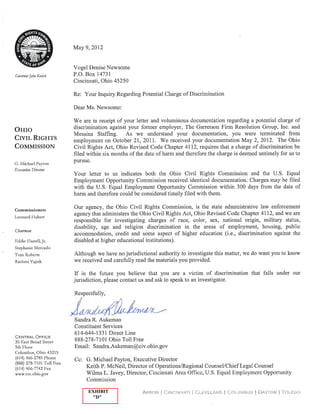
herein. In the May 9, 2012 correspondence from the Ohio Civil Rights Commission’s
Sandra R. Aukeman, it ERRONOUSLY stated that Newsome’s Complaint/Charge was
UNTIMELY filed in that it applied the 180-DAY/SIX MONTHS statute of limitations,
stating,

                  "The Ohio Civil Rights Act, Ohio Revised Code Chapter 4112, requires
         that a charge of discrimination be filed within six months of the date of harm and
         therefore the charge is deemed untimely for us to pursue.
                  Your letter to us indicates both the Ohio Civil Rights Commission and the
         U.S. Equal Employment Opportunity Commission received identical
         documentation.      Charges may be filed with the U.S. Equal Employment
         Opportunity Commission within 300 days from the date of harm and therefore could
         be considered timely filed with them.
                  Our agency, the Ohio Civil Rights Commission, is the state admiinistrative
         law enforcement agency that administers the Ohio Civiil Rights Act, Ohio Revised
         Code Chapter 4112 and we are responsible for investigating charges of RACE,
         color, sex, national origin, military status, disability, AGE and religion
         discrimination in the areas of employment . . ."

See EXHIBIT “D” attached hereto and incorporated by reference as if set forth in full
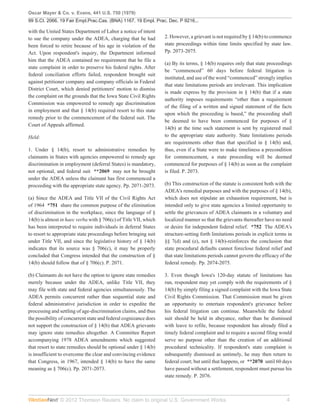
herein. The Supreme Court of the United States’ decision in Oscar Mayer & Co. vs. Joseph
Evans, 99 S.Ct. 2066 (1979) is clear that:

         [2] Though the Age Discrimination in Employment Act makes resort to
         administrative remedies mandatory in states with agencies empowered to
         remedy age discrimination in employment, a person aggrieved by alleged age
         discrimination is not required by the ADEA to commence the state proceedings
         within the time limit specified by state law. Age Discrimination in Employment
         Act of 1967, §§ 7(c), 14(b), 29 U.S.C.A. §§ 626(c), 633(b). . .
                  [1][2] We hold that that § 14(b) mandates that a grievant not bring suit
         in federal court under § 7(c) of the ADEA until he has first resorted to
         appropriate state administrative proceedings. We also hold, however, that the
         grievant is not required by § 14(b) to commence the state proceedings within
         time limits specified by state law. In light of these holdings, it is not necessary to
         address the question of the circumstances, if any, in which failure to comply with
         § 14(b) may be excused.

         [12] Even though the 120-day . . .statute of limitations on age discrimination
         claims had run, complainant could comply with the mandatory requirement of
         the Age Discrimination in Employment Act that he first resort to state


                                          Page 5 of 9
administrative remedies by filing a signed complaint with the . . . State Civil
              Rights Commission. Age Discrimination in Employment Act of 1967, § 14(b), 29
              U.S.C.A. § 633(b). . . .

                       [12] We therefore hold that respondent may yet comply with the
              requirements of § 14(b) by simply filing a signed complaint with the . . . State
              Civil Rights Commission. That Commission must be given an opportunity to
              entertain respondent's grievance before his federal litigation can continue. . . .
                       Section 14(b) of the Age Discrimination in Employment Act of 1967, 81
              Stat. 601, 607, 29 U.S.C. § 633(b), explicitly states that "no suit may be brought"
              under the Act until the individual has resorted to the appropriate state remedies. .
              . this means that his suit should not have been brought and should now be
              dismissed.

     EXHIBIT “D” attached hereto and incorporated by reference as if set forth in full herein.
     Even the SIXTH Circuit Court of Appeals has decided said issue to support that the Ohio
     Civil Rights Commission ERRED in its failure to retain jurisdiction over Newsome’s
     “Official Complaint/ Charge Of Discrimination” alleging 180-day statute had expired with
     KNOWLEDGE and/or should have known that it was subject to the 240-day statute of
     limitations.

              Rasimas v. Michigan Dept. of Mental Health, 714 F.2d 614 (6th Cir. 1983) -
              United States Supreme Court decision interpreting statutory Title VII filing
              requirement to preclude charges being filed with Equal Employment
              Opportunity Commission in deferral states until 60 days after state fair
              employment agency has received notice of allegations may not be applied
              retroactively, and therefore instant action, where plaintiff initiated complaint with
              EEOC and state civil rights commission 244 days after he was terminated, was
              timely filed. Civil Rights Act of 1964, §§ 701 et seq., 706(b), as amended, 42
              U.S.C.A. §§ 2000e et seq., 2000e-5(c).

     Nevertheless, here are approximately FIVE (5) MONTHS later and Secretary Solis, you and
     the EEOC have FAILED to defer/refer Newsome’s Complaint/Charges to the Ohio Civil
     Rights Commission.

f)   It is UNDISPUTED that United States of America President Barack Obama is also an
     Attorney (i.e. licensed to practice law – in fact CONSTITUTIONAL Law as he likes to
     share) and has KNOWLEDGE that Newsome’s arguments are SOUND in statutes/laws
     governing said issues.

g)   It is UNDISPUTED that G. Michael Payton (Executive Director of the Ohio Civil Rights
     Commission) is also an attorney. Therefore, it is NOT clear why Secretary Solis, President
     Barack Obama, and Mr. Payton have not resolved the issues presented to get the
     Complaints/Charges filed with the Ohio Civil Rights Commission.

h)   Secretary Solis, you DO NOT dispute the ERROR by the Ohio Civil Rights Commission;
     however, you have FAILED to defer/refer this matter to the Ohio Civil Rights Commission
     although there is EVIDENCE that the EEOC has KNOWLEDGE of the MANDATORY
     “Deferral/Referral” requirements. See For instance Pitts vs. Dayton Power & Light Co.:

              Arthur Pitts vs. Dayton Power & Light Co., 748 F.Supp. 527 (1989) - [1]
              Terminated employee met requirements for bringing of action under the Age
              Discrimination in Employment Act (ADEA) when the Equal Employment
              Opportunity Commission referred the employee's charge to the Ohio Civil Rights
              Commission (OCRC) to meet the referral requirements of the ADEA, and the
              employee commenced the action under the ADEA more than 60 days after

                                               Page 6 of 9
proceedings were commenced with the OCRC. Age Discrimination in
                Employment Act of 1967, §§ 14, 14(b), 29 U.S.C.A. §§ 633, 633(b). . . .

                         Section 633(b) of Title 29 of the United States Code provides in
                pertinent part:

                        In the case of an alleged unlawful practice occurring in a State
                        which has a law prohibiting discrimination in employment
                        because of age and establishing or authorizing a State authority
                        to grant or seek relief from such discriminatory practice, no suit
                        may be brought under Section 626 of this title before the
                        expiration of sixty days after proceedings have been
                        commenced under the State law, unless such proceedings have
                        been earlier terminated....

                the EEOC referred Plaintiff's EEOC charge to the OCRC in order to meet the
                referral requirements of § 14 of the ADEA (Doc. # 14, Exh. A) . . .

See EXHIBIT “F” attached hereto and incorporated by reference as if set forth in full herein.

i)    Secretary Solis you and the EEOC neither DISPUTE that said issue(s) was raised and
      preserved through Newsome June 8, 2012 filing entitled,

                REQUEST FOR RECONSIDERATION OF DISMISSAL AND NOTICE OF
                RIGHTS, NOTIFICATION OF ADMINISTRATIVE PROCEDURE ACT
                VIOLATIONS, REQUEST FOR EEOC‟S “WRITTEN” DETERMINATION
                – FINDINGS OF FACT AND CONCLUSION OF LAW, REQUEST FOR
                “WRITTEN” TITLE VII INTERPRETATION/OPINION, REQUEST FOR
                DEFERRAL TO THE OHIO CIVIL RIGHTS COMMISSION, REQUEST
                FOR STATUS OF COMMISSION CHARGE TO ISSUE; OBJECTIONS TO
                EMPLOYMENT OPPORTUNITY COMMISSION‟S MAY 31, 2012
                DISMISSAL AND NOTICE OF RIGHTS; RESPONSE TO OHIO CIVIL
                RIGHTS COMMISSION‟S LETTER DATED MAY 9, 2012 REGARDING
                “YOUR INQUIRY REGARDING POTENTIAL CHARGE OF
                DISCRIMINATION;” and 2ND REQUEST TO BE ADVISED OF ALL
                “CONFLICT-OF-INTERESTS” (hereinafter “RFROD&NOR. . .”)

      A copy which may also be obtained from the Internet:
      http://www.slideshare.net/VogelDenise/060812-eeoc-response-final-13269482

      Newsome TIMELY, PROPERLY and ADEQUATELY preserved this issue and set forth
      demand and RIGHTS to have this instant EEOC Complaint/Charge deferred to the Ohio
      Civil Rights Commission through her “RFROD&NOR. . .” See at Pages/Paragraphs: 7/¶ 8,
      8/¶ 13, 11/¶ 24, 15/¶33, 18/¶42, 20/¶49 and Pages 29-30 IV.

                REQUEST FOR DEFFERAL TO THE OHIO CIVIL RIGHTS
                COMMISSION:

                http://www.slideshare.net/VogelDenise/060812-eeoc-response-final-13269482

                https://secure.filesanywhere.com/fs/v.aspx?v=8a70678e5d5f70afac9c

j)    Newsome hereby DEMANDS that the Equal Employment Opportunity Commission’s
      Secretary of Labor Hilda Solis (i.e. NOT the Little “Want-To-BeChiefs” as Wilma L.
      Javey) advise her in “WRITING” as to whether or not the instant Complaint/Charge brought
      against Respondents (The Garretson Firm Resolution Group Inc. and Messina


                                               Page 7 of 9
Staffing/Messina Management Systems) has been DEFERRED to the Ohio Civil Rights
             Commission as MANDATORILY required by STATUTES/LAWS.

             Secretary Solis you and the EEOC have a MANDATORY duty/obligation to MITIGATE
             costs in the handling of Newsome’s Complaints/Charges. Have you and the EEOC
             done so? NO! Instead, Secretary Solis, you insist on SUBJECTING Newsome to
             further INJURY/HARM!

       k)    In REITERATING Newsome’s DEMAND at Page 7 and Paragraph 7 of “RT06-14-
             12EEOCLetter,” Newsome DEMANDS to be advised of the:

                      “STATUS” of the MANDATORY issuance of COMMISSIONER CHARGE
                      of this instant Equal Employment Opportunity Commission Complaint/Charge
                      pursuant to 29 CFR § 1601.6 and other statutes/laws governing said matters.
                      Newsome’s       Complaint/Charge    and    the     issues   brought  through
                      pleadings/documents provided clearly support the issuance of COMMISSIONER
                      Charge. In support of the Equal Employment Commission's KNOWLEDGE that
                      Newsome’s Complaint/Charge and request set forth therein for the issuance of
                      COMMISSIONER CHARGE, information may be obtained at the following
                      links:

                      http://www.slideshare.net/VogelDenise/commissioner-charge-systematic-task-
                      force-reporteeoc-highlighted

       l)    Secretary Solis it is UNDISPUTED that in accordance with the EEOC Guidelines governing
             said matters that Newsome is ENTITLED to IMMEDIATE payment of Back Wages of
             approximately $29,400 and does NOT have to wait until the completion of this matter;
             moreover, yours, the EEOC and President Barack Obama’s efforts to wait until she has
             EXHAUSTED her UNEMPLOYMENT Benefits!

       m)    UNDISPUTED is the fact that the record evidence supports/sustains “INDIVIDUAL” and
             “SYSTEMATIC” DISCRIMINATORY practices leveled AGAINST Vogel Denise
             Newsome and, therefore, warranting COMMISSIONER CHARGE to issue pursuant to 29
             CFR § 1601.6 and other statutes/laws governing said matters . Please advise
             Newsome whether or not the COMMISSIONER CHARGE that is also MANDATORILY
             required to issue has been implemented. See also “RFROD&NOR. . .” Page 38 at Section
             VII (REQUEST OF STATUS OF COMMISSIONER CHARGE TO ISSUE) as well as
             Pages 4 – 6 at Section I.

                      EEOC      Document:      http://www.slideshare.net/VogelDenise/commissioner-
                      charge-systematic-task-force-reporteeoc-highlighted


       WHEREFORE, PREMISES considered, Newsome is DEMANDING that Secretary of Labor Hilda Solis

provide her with a “WRITTEN RESPONSE” by TUESDAY, October 16, 2012, to this instant submittal and

advises that she does NOT waive any rights to have this matter DEFERRED to the Ohio Civil Rights Commission

and DEMANDS that the COMMISSIONER CHARGE issue in this matter.


                                                    Page 8 of 9
EXHIBIT
 "A"
Dunn v. Medina General Hosp., 917 F.Supp. 1185 (1996)
68 Empl. Prac. Dec. P 44,208


                                                                           2 Cases that cite this headnote


                                                                     [2]   Administrative Law and Procedure
                                                                              Exhaustion of Administrative Remedies
                                                                           Civil Rights
                                                                                Exhaustion of State or Local Remedies
                                                                           Employee exhausted her administrative remedies,
                                                                           and thus fulfilled necessary jurisdictional
                                                                           prerequisites for ADEA retaliation claim, where
Employee brought action against employer for age                           she filed retaliation charge with Ohio Civil Rights
discrimination under Age Discrimination in Employment Act                  Commission (OCRC) and waited 60 days before
(ADEA) and Ohio law, and against hospital and individuals                  filing suit in federal court; employee was not
for intentional infliction of emotional distress under Ohio                required to pursue OCRC claim to its conclusion.
law. On motion by hospital and individuals for summary                     Age Discrimination in Employment Act of 1967,
judgment, the District Court, Economus, J., held that: (1)                 § 14(b), 29 U.S.C.A. § 633(b).
90–day limitations period applied to all ADEA actions filed
after enactment of Civil Rights Act of 1991; (2) employee
exhausted her administrative remedies, and thus fulfilled            [3]   Civil Rights
necessary jurisdictional prerequisites for ADEA retaliation                     Deferral to State Agencies; Time
claim, where she filed retaliation charge with Ohio Civil                  Ohio is deferral state within meaning of statute
Rights Commission (OCRC) and waited 60 days before filing                  mandating that in deferral states, i.e., states where
suit in federal court; (3) 180–day statute of limitations applied          established agencies are empowered to remedy
to Ohio age discrimination claim; (4) even if ADEA claim                   age discrimination in employment, person may
were not timebarred, employee failed to establish prima                    not bring suit in federal court under ADEA
facie hostile environment claim, since no respondeat superior              unless person has commenced proceeding with
liability existed on part of employer; (5) even if ADEA                    appropriate state agency. Age Discrimination in
claim were not timebarred, employee failed to establish prima              Employment Act of 1967, § 14(b), 29 U.S.C.A.
facie hostile environment claim, since no materially adverse               § 633(b).
change in terms or conditions of employee's employment
occurred; and (6) evidence was insufficient to support claim
that supervisors engaged in extreme and outrageous conduct           [4]   Civil Rights
that would support finding of liability for intentional infliction              Existence of Other Remedies; Exclusivity
of emotional distress.
                                                                           While it was intent of Congress to encourage
Motion granted.                                                            resolution of age discrimination disputes
                                                                           on state level through recourse to state
                                                                           administrative remedies, Congress also intended
 West Headnotes (19)                                                       to make remedies of ADEA complementary and
                                                                           supplementary to state administrative remedies,
[1]     Civil Rights                                                       and not mutually exclusive. Age Discrimination
             Time for Proceedings; Limitations                             in Employment Act of 1967, § 2 et seq., 29
                                                                           U.S.C.A. § 621 et seq.
        Ninety-day limitations period applies to all
        ADEA actions filed after enactment of Civil
        Rights Act of 1991. Age Discrimination in
        Employment Act of 1967, §§ 2 et seq., 7(e), 29               [5]   Civil Rights
        U.S.C.A. §§ 621 et seq., 626(e).                                        Time for Proceedings; Limitations


                                                                                                                                       EXHIBIT
                                                                                                                                        "B"

                © 2012 Thomson Reuters. No claim to original U.S. Government Works.                                                1
Dunn v. Medina General Hosp., 917 F.Supp. 1185 (1996)
68 Empl. Prac. Dec. P 44,208

       Under Ohio law, general six-year statute of
       limitations applies to gender discrimination
       claims, since no provision in chapter governing        [9]    Civil Rights
       Civil Rights Commission, other than provision                      Harassment; Work Environment
       authorizing civil action for damages for violations
                                                                     Hostile work environment allegations are equally
       of chapter, creates civil liability for gender-based
                                                                     cognizable in age discrimination context as well
       claims. Ohio R.C. §§ 4112.01 et seq., 4112.99.
                                                                     as in situations involving title 7 claimants. Age
                                                                     Discrimination in Employment Act of 1967, § 2 et
                                                                     seq., 29 U.S.C.A. § 621 et seq.; Civil Rights Act
[6]    Civil Rights                                                  of 1964, § 701 et seq., as amended, 42 U.S.C.A.
            Employment Practices                                     § 2000e et seq.
       Statutes
            General and Special Statutes
       Under Ohio law, 180–day statute of limitations         [10]   Civil Rights
       applied to age discrimination claim, since specific                Harassment; Work Environment
       provision in chapter governing Civil Rights                   Hostile work environment theory requires that
       Commission set forth such limitations period,                 employee show that: (1) he or she was member
       and prevailed over conflicting provision setting              of protected class; (2) he or she was subject
       forth general six-year statute of limitations for             to unwelcome harassment; (3) harassment was
       violations of chapter. Ohio R.C. §§ 4112.01 et                prompted solely because of employee's age;
       seq., 4112.02(N), 4112.99.                                    (4) harassment affected term, condition, or
                                                                     privilege of employment; and (5) existence of
       4 Cases that cite this headnote
                                                                     respondeat superior liability. Age Discrimination
                                                                     in Employment Act of 1967, § 2 et seq., 29
[7]    Civil Rights                                                  U.S.C.A. § 621 et seq.; Civil Rights Act of 1964,
            Hostile Environment; Severity,                           § 701 et seq., as amended, 42 U.S.C.A. § 2000e
       Pervasiveness, and Frequency                                  et seq.
       Hostile work environment requires existence
       of severe or pervasive and unwelcome
       verbal or physical harassment because of               [11]   Civil Rights
       employee's membership in protected class. Age                      Vicarious Liability; Respondeat Superior
       Discrimination in Employment Act of 1967, § 2 et              No respondeat superior liability existed on
       seq., 29 U.S.C.A. § 621 et seq.; Civil Rights Act             part of employer in connection with alleged
       of 1964, § 701 et seq., as amended, 42 U.S.C.A.               harassment based on age, and employee thus
       § 2000e et seq.                                               failed to establish fifth element of ADEA hostile
                                                                     environment claim; employee did not complain
                                                                     about alleged harassment and, when co-worker
[8]    Civil Rights                                                  brought similar concerns to employer's attention,
            Harassment; Work Environment                             offending supervisor was sent to management
       No reasons exists to differentiate between age                sensitivity training seminars. Age Discrimination
       discrimination claimants and members of other                 in Employment Act of 1967, § 2 et seq., 29
       protected groups for purposes of bringing hostile             U.S.C.A. § 621 et seq.
       work environment claim, since there is virtually
                                                                     2 Cases that cite this headnote
       little or no difference between ADEA and Title
       VII. Age Discrimination in Employment Act of
       1967, § 2 et seq., 29 U.S.C.A. § 621 et seq.; Civil    [12]   Civil Rights
       Rights Act of 1964, § 701 et seq., as amended, 42                  Vicarious Liability; Respondeat Superior
       U.S.C.A. § 2000e et seq.


              © 2012 Thomson Reuters. No claim to original U.S. Government Works.                                        2
Dunn v. Medina General Hosp., 917 F.Supp. 1185 (1996)
68 Empl. Prac. Dec. P 44,208

       To show respondeat superior liability in co-                  whether employee has established prima
       worker discrimination cases, employee must                    facie case of retaliation, involved objective
       prove that employer, through its agents or                    determination of whether conduct of employee's
       supervisory personnel, knew or should have                    supervisor and coworkers created such difficult
       known of charged harassment and failed to                     or unpleasant working conditions that reasonable
       implement prompt and appropriate corrective                   person in employee's shoes could not tolerate
       action. Age Discrimination in Employment Act of               them. Age Discrimination in Employment Act of
       1967, § 2 et seq., 29 U.S.C.A. § 621 et seq.; Civil           1967, § 2 et seq., 29 U.S.C.A. § 621 et seq.
       Rights Act of 1964, § 701 et seq., as amended, 42
       U.S.C.A. § 2000e et seq.
                                                              [16]   Damages
                                                                        Labor and Employment
[13]   Civil Rights                                                  Under Ohio law, negligent infliction of emotional
            Practices Prohibited or Required in General;             distress is not recognized in employment context.
       Elements
       Elements of prima facie case of retaliation are: (1)          1 Cases that cite this headnote
       that employee engaged in protected activity; (2)
       that exercise of employee's protected rights was       [17]   Damages
       known to employer; (3) that employer thereafter                  Elements in General
       took employment action adverse to employee;
                                                                     Under Ohio law, to support claim for tort of
       and (4) that there was causal connection between
                                                                     intentional infliction of emotional distress, four
       protected activity and adverse employment
                                                                     elements must be proved: (1) that actor either
       action. Age Discrimination in Employment Act
                                                                     intended to cause emotional distress or knew
       of 1967, § 2 et seq., 29 U.S.C.A. § 621 et seq.
                                                                     or should have known that actions taken would
                                                                     result in serious emotional distress plaintiff; (2)
                                                                     that actor's conduct was extreme and outrageous,
[14]   Civil Rights                                                  that it went beyond all possible bounds of
            Particular Cases                                         decency, and that it can be considered as utterly
       Civil Rights                                                  intolerable in civilized community; (3) that
            Discipline                                               actor's actions were proximate cause of plaintiff's
       No materially adverse change in terms or                      psychic injury; and (4) that mental anguish
       conditions of employee's employment occurred,                 suffered by plaintiff is serious and of nature that
       and employee thus failed to establish third                   no reasonable person could be expected to endure
       element of ADEA retaliation claim; employee                   it.
       could not recall if her discipline was result of
                                                                     1 Cases that cite this headnote
       her mistakes, employee could not recall jokes
       about old persons allegedly made by co-workers,
       and employee was not demoted, threatened with          [18]   Damages
       dismissal, or forced to take cut in pay. Age                     Nature of Injury or Threat
       Discrimination in Employment Act of 1967, § 2                 Damages
       et seq., 29 U.S.C.A. § 621 et seq.                               Humiliation, Insults, and Indignities
                                                                     Under Ohio law, liability for intentional infliction
                                                                     of emotional distress does not extend to mere
[15]   Civil Rights                                                  insults, indignities, threats, annoyances, petty
            Adverse Actions in General                               oppressions, or other trivialities.
       Determining whether there was material
       adverse change in terms or conditions of
       employment, for purposes of determining                [19]   Damages


              © 2012 Thomson Reuters. No claim to original U.S. Government Works.                                           3
Dunn v. Medina General Hosp., 917 F.Supp. 1185 (1996)
68 Empl. Prac. Dec. P 44,208

             Mental Suffering and Emotional Distress          informed Ms. Dunn that she had ninety days within which to
        Under Ohio law, assuming that claim for               file an action in federal court.
        intentional infliction of emotional distress is
                                                              In April, 1993, Ms. Dunn filed a second charge with the
        recognized in employment context, evidence was
                                                              OCRC and the EEOC alleging retaliation by the Hospital.
        insufficient to support employee's claim that
                                                              The OCRC found probable cause that the Hospital retaliated
        supervisors engaged in extreme and outrageous
                                                              against her.
        conduct that would support finding of liability;
        although employee complained of comments              On November 15, 1994, Ms. Dunn filed this action
        related to her age, exclusion from office parties,    alleging causes of action under the Age Discrimination in
        increase in work load, cursing by supervisor,         Employment Act (ADEA), 42 U.S.C. § 1983, as well as age
        and dumping of her birthday cake into trash,          discrimination and intentional infliction of emotional distress
        employee did not go to any medical provider           claims under Ohio law. Some of these claims have been
        other than for annual check-up, and employee did      dismissed and thus the claims that are before the Court at this
        not miss any work because of stress.                  time are the following: Count One (ADEA as to the Hospital),
                                                              Count Two (alleged violation by the Hospital of Ohio Revised
                                                              Code §§ 4112.02 and 4112.99), and Count Three (intentional
                                                              infliction of emotional distress as to all defendants). 1
Attorneys and Law Firms                                       In her complaint and affidavit, Ms. Dunn claims she
                                                              experienced numerous actions and comments related directly
*1188 Edward L. Gilbert, Law Offices Of Edward L.
                                                              to her age around the time the new patient accounts manager,
Gilbert, Akron, OH, for Ruth Ann Dunn.
                                                              Defendant Darla Kennedy, began working at the Hospital.
Joel R. Hlavaty, Richard V. Whelan, Jr., Thompson, Hine &     These included the older workers in the department being
Flory, Cleveland, OH, for Medina General Hospital, Darla      excluded from office parties, additional duties assigned to
Kermendy, Kenneth Milligan.                                   older workers which were not assigned to the younger
                                                              workers, auditing of the older employees' work by the
Stephanie Dutchess Trudeau, Ulmer & Berne, Cleveland,         younger workers, and other preferential treatment of the
OH, for Stephanie Dutchess Trudeau.                           younger workers. In essence she claims that her working
                                                              environment consisted of preferential treatment of younger
Opinion
                                                              workers and demeaning treatment of older workers.

              MEMORANDUM OPINION                               *1189 The Defendant has moved for summary judgment
                                                              on numerous grounds which the Court will address as raised
ECONOMUS, District Judge.                                     within the motion.

This matter is before the Court on motion by the Defendants   I. Plaintiff's First EEOC Charge is Time–Barred
for summary judgment. Having reviewed the record and
considered the facts in a light most favorable to the non-    The Hospital first argues that Ms. Dunn's ADEA claim for
movant Plaintiff, the Court will grant summary judgment.      actions complained of in her first complaint to the EEOC is
                                                              time-barred. The Hospital cites to 29 U.S.C. § 626(e), which
Plaintiff, Ruth Dunn, has been employed by the                provides as follows:
Medina General Hospital (Hospital) as a commercial
biller since 1969. On June 25, 1992, Ms. Dunn filed                        If a charge filed with the Commission
a charge of age discrimination with the Ohio Civil                         under this chapter is dismissed or
Rights Commission (OCRC) and the Equal Employment                          the proceedings of the Commission
Opportunity Commission (EEOC). In November of 1992,                        are otherwise terminated by the
the OCRC found that it was not probable that the Hospital                  Commission, the Commission shall
had discriminated against her and dismissed the charge. On                 notify the person aggrieved. A civil
February 24, 1993, the EEOC also dismissed the charge and                  action may be brought under this
                                                                           section by a person defined in


               © 2012 Thomson Reuters. No claim to original U.S. Government Works.                                        4
Dunn v. Medina General Hosp., 917 F.Supp. 1185 (1996)
68 Empl. Prac. Dec. P 44,208

            section 630(a) of this title against the              Court. The Second, Fifth, and Eighth Circuits have concluded
            respondent in the charge within 90                    that § 626(e) applies to actions such as this one. See Vernon
            days after the date of the receipt of                 v. Cassadaga Valley Cent. School Dist., 49 F.3d 886, 889–
            such notice.                                          91 (2d Cir.1995); St. Louis v. Texas Worker's Compensation
                                                                  Commission, 65 F.3d 43, 45–46 (5th Cir.1995); Garfield v.
On February 24, 1993, the EEOC notified Ms. Dunn by               J.C. Nichols Real Estate, 57 F.3d 662, 664–65 (8th Cir.), cert.
letter of her right to sue. The letter contained the following    denied, 516 U.S. 944, 116 S.Ct. 380, 133 L.Ed.2d 303 (1995).
language:
                                                                   [1] Each of the above cases held that the Civil Rights
            A      lawsuit    under     the     Age               Act of 1991 amended 29 U.S.C. § 626(e) by eliminating
            Discrimination in Employment Act                      the two or three year limitations period and that § 626(e)
            (“ADEA”) ordinarily must be filed                     now provides the exclusive limitations period for claims
            within two years of the date of                       brought under the ADEA. Both the language and legislative
            discrimination alleged in the charge.                 history of § 626(e) support this conclusion. The statute states
            On November 21, 1991, the ADEA                        clearly that a complainant may file suit within ninety days
            was amended to eliminate this two                     after the date of the receipt of a right-to-sue letter from
            year limit. An ADEA lawsuit may now                   the EEOC. The legislative history indicates that the two or
            be filed any time from 60 days after a                three year statute of limitations incorporated into the former
            charge is filed to 90 days after receipt              § 626(e) does not survive the passage of the 1991 Act. In
            of notice that EEOC has completed                     the 1991 Act, Congress deleted from the former § 626(e)
            action on the charge.                                 the express reference to § 255 of the Portal–to–Portal Pay
                                                                  Act which provided for the two or three year limitations
Because Ms. Dunn did not file her complaint until November
                                                                  period. This Court agrees with the interpretation of the
15, 1994, the Hospital argues that the claim is now time-
                                                                  legislative history of § 626(e) set forth in *1190 McCray
barred by § 626(e).
                                                                  v. Corry Mfg. Co., 872 F.Supp. 209 (W.D.Pa.1994), aff'd 61
Plaintiff argues that this claim is governed by the statute of    F.3d 224 (3rd Cir.1995) where the court concluded that the
limitations in effect under the ADEA prior to the enactment       legislative history “demonstrates that the purpose of the 1991
of the Civil Rights Act of 1991. Under the rules in place         Amendment to § 626(e) was to create a ninety-day window
prior to the Civil Rights Act of 1991, a plaintiff in an age      within which plaintiffs must file suit under the ADEA or lose
discrimination case generally had two years after the action      their right to do so.”
accrued to file a claim, and three years if the claim alleged a
                                                                  The analysis of the Vernon, St. Louis, and Garfield decisions
“willful violation.” Plaintiff further argues that the language
                                                                  is persuasive. Further, the Simmons case relied upon by
of the statute is permissive and provides merely that an ADEA
                                                                  Plaintiff was accurately criticized in McCray and that case
suit could, but did not have to be filed within 90 days.
                                                                  provides a helpful analysis of this issue. The language of §
The word “may” in § 626(e), Plaintiff contends, indicates
                                                                  626(e), the legislative history, and the weight of authority
the intent of Congress to supplement rather than replace the
                                                                  among the courts all support the conclusion that the statute of
three-year limitations period. Thus, as long as her suit was
                                                                  limitations of § 626(e) is applicable to Plaintiff's first ADEA
filed within the three-year statute of limitations for willful
                                                                  claim. Ms. Dunn was required to file her action within ninety
violations, her ADEA action is not time-barred. Plaintiff
                                                                  days of having received the February 23, 1993 right-to-sue
relies on Simmons v. Al Smith Buick Co., Inc., 841 F.Supp.
                                                                  notice. She did not do so. Consequently, this claim is time-
168 (E.D.N.C.1993) as authority that the 90–day limit was not
                                                                  barred.
intended to be the only limit in ADEA cases and to replace
the previous two and three year rules, and urges this Court to    II. Exhaustion of Administrative Remedies
adopt its reasoning.
                                                                   [2] As to Ms. Dunn's second EEOC charge for retaliation,
The issue is therefore whether the amended statute of             the Hospital contends that the claim must be dismissed
limitations period applies to all civil actions filed after the   because she has failed to exhaust her administrative
enactment of the 1991 Civil Rights Act. The Sixth Circuit         remedies. Upon the EEOC's denial of her first claim of age
has not addressed this issue but a review of the law of the       discrimination, Ms. Dunn returned to work. She subsequently
circuits which have considered it will serve as a guide to this


               © 2012 Thomson Reuters. No claim to original U.S. Government Works.                                            5
Dunn v. Medina General Hosp., 917 F.Supp. 1185 (1996)
68 Empl. Prac. Dec. P 44,208

filed a second charge with the OCRC for retaliation. In
accordance with the relevant filing guidelines, she filed her       III. Plaintiff's Ohio Age Claims are Time–Barred
lawsuit more than sixty days later. During this interim period,
                                                                    Defendant next claims that Plaintiff's state claims of age
she did not pursue her claim with the OCRC and did not
                                                                    discrimination are time barred because Section 4112.02(N) of
respond to its requests for interrogatories or interviews. The
                                                                    the Ohio Revised Code provides that any civil action brought
OCRC therefore recommended dismissal of her charge due
                                                                    under § 4112.02 must be instituted within 180 days after
to lack of cooperation with the discovery process. Defendants
                                                                    the alleged unlawful discriminatory practice. Defendants also
equate this failure to cooperate with a failure to exhaust
                                                                    contend that the continuing violations theory *1191 is not
administrative remedies, thereby mandating dismissal of the
                                                                    applicable and thus cannot toll the limitations period. Plaintiff
claim.
                                                                    argues that the Bellian decision relied upon by Defendants
 [3] The Supreme Court has held that 29 U.S.C. § 633(b)             was overruled by the Ohio Supreme Court in Cosgrove v.
mandates that in states where established agencies are              Williamsburg of Cincinnati Management Co. Inc., 70 Ohio
empowered to remedy age discrimination in employment                St.3d 281, 638 N.E.2d 991 (1994).
(deferral states), a person may not bring a suit in federal court
                                                                    The Ohio Supreme Court has held that the time period
under the ADEA unless she has commenced a proceeding
                                                                    of limitations of Section 4112.02(N) applies to age
with the appropriate state agency. Oscar Mayer and Co.
                                                                    discrimination actions brought under § 4112.99. Bellian v.
v. Evans, 441 U.S. 750, 99 S.Ct. 2066, 60 L.Ed.2d 609
                                                                    Bicron Corp., 69 Ohio St.3d 517, 634 N.E.2d 608 (1994)
(1979) (emphasis added). The Ohio Civil Rights Commission
                                                                    In Bellian, the Ohio Supreme Court held that an age
(OCRC) is Ohio's agency which is empowered to remedy age
                                                                    discrimination claim premised on a violation of § 4112.99
discrimination in employment. Ohio is a deferral state within
                                                                    had to comply with the 180–day limitations period despite the
the meaning of § 14(b) of the ADEA. Brownlow v. Edgcomb
                                                                    employee's assertion that the claim should be governed by the
Metals Co., 573 F.Supp. 679, 683 (N.D.Ohio 1983).
                                                                    general six-year limitations period. Plaintiff here makes the
 [4] While it was the intent of Congress to encourage               same argument in support of the six-year limitations period,
the resolution of age discrimination disputes on the state          citing Cosgrove.
level through recourse to state administrative remedies, it is
                                                                    The syllabus by the Court in Cosgrove states that “R.C.
equally clear that Congress intended to make the remedies
                                                                    4112.99 is a remedial statute, and is thus subject to R.C.
of the ADEA complementary and supplementary to state
                                                                    2305.07's six-year statute of limitations.” The syllabus in
administrative remedies, and not mutually exclusive. Oscar
                                                                    Bellian reads: “Any age discrimination claim, premised on
Mayer, 441 U.S. at 764, 99 S.Ct. at 2075. Moreover,
                                                                    a violation described in R.C. Chapter 4112, must comply
the holding in Oscar Mayer was that a filing of a state
                                                                    with the one-hundred-eighty-day statute of limitations period
administrative complaint after the state statute of limitations
                                                                    set forth in former R.C. 4112.02(N).” Justice Alice Robie
for that filing had run did not prevent an age discrimination
                                                                    Resnick provides an important distinction in her concurring
plaintiff from proceeding with a claim under the ADEA,
                                                                    opinion to Cosgrove to explain the apparent inconsistency
even though the filing had therefore been merely perfunctory.
                                                                    between the holdings of the Ohio Supreme Court in Bellian
Id. The plaintiff need only wait sixty days before bringing
                                                                    and Cosgrove.
suit in federal court, even if the filing is merely formal and
ineffective for state administrative purposes. Id. at 762, 99       The essential distinction between the two cases is that Bellian
S.Ct. at 2074–2075.                                                 was an age discrimination case while Cosgrove was a gender-
                                                                    based discrimination claim. In Bellian the court recognized
This reasoning is applicable here. Ms. Dunn “commenced”
                                                                    that there may be other provisions in R.C. Chapter 4112 that
state proceedings with the appropriate administrative agency,
                                                                    permit aggrieved individuals to enforce specific rights under
the OCRC. The holding of Oscar Mayer does not require
                                                                    Chapter 4112 by instituting a civil action. To the extent that
her to pursue that claim with the administrative agency to its
                                                                    other specific provisions set forth a statute of limitations, a
conclusion. By waiting sixty days before filing her lawsuit
                                                                    conflict could exist between such specific provisions and R.C.
in federal court, she has fulfilled the necessary jurisdictional
                                                                    4112.99, relative to the applicable statute of limitations. “In
prerequisites and her second claim for retaliation is now
                                                                    such an event, pursuant to R.C. 1.51, the specific provision's
properly before this Court.
                                                                    statute of limitations must prevail.” Bellian, 69 Ohio St.3d at
                                                                    519, 634 N.E.2d 608.


                © 2012 Thomson Reuters. No claim to original U.S. Government Works.                                               6
Dunn v. Medina General Hosp., 917 F.Supp. 1185 (1996)
68 Empl. Prac. Dec. P 44,208


The plaintiff in Bellian brought an age-based employment                       An aggrieved individual may enforce
discrimination claim that purported to be based on R.C.                        his rights relative to discrimination of
4112.99. However, the only provision in R.C. Chapter 4112                      the basis of age as provided for in this
that recognizes discrimination based on age is R.C. 4112.02.                   section by instituting a civil action,
Therefore, the plaintiff must have been referring to the                       within one hundred eighty days after
form of age-based discrimination identified in R.C. 4112.02.                   the alleged unlawful discriminatory
Cosgrove, 70 Ohio St.3d at 290, 638 N.E.2d 991. R.C.                           practice occurred, in any court with
4112.02(N) specifically authorized civil actions for age-based                 jurisdiction for any legal or equitable
employment discrimination claims and contained a 180–day                       relief that will effectuate his rights.
statute of limitations. Consequently, its statute of limitations
prevailed over that of R.C. 4112.99.                              When Plaintiff filed this action she was not in compliance
                                                                  with the 180–day limitations period established by this
 [5]     [6] The plaintiff in Cosgrove brought a gender- section. For this reason, her claims for age discrimination
based employment discrimination claim, also pursuant to           under Ohio Revised Code §§ 4211.02 and 4211.99 are time
R.C. 4112.99. As in Bellian, the only provision in R.C.           barred and must be dismissed.
Chapter 4112 that proscribes gender-based employment
discrimination is R.C. 4112.02. Unlike the situation in           Having determined that these claims are time barred, it is
Bellian, however, there is no R.C. Chapter 4112 provision,        not necessary for the Court to address Defendants' argument
other than R.C. 4112.99, that creates civil liability for gender- that Plaintiff's age claims under Ohio law are barred by her
based employment discrimination claims. R.C. 4112.02(N)           election of remedies.
only authorizes civil actions relative to discrimination on the
                                                                  IV. Prima Facie Case of Age Discrimination
basis of age. Thus, there is no specific R.C. Chapter 4112
provision which conflicts with R.C. 4112.99. Accordingly,         Although the Court has ruled that Plaintiff's age
the six-year statute of limitations set forth in R.C. 2305.07     discrimination claim is time-barred under 29 U.S.C. § 626(e),
and not the 180–day statute of limitations contained in           an analysis of the evidence presented reveals that even if she
R.C. 4112.02(N) applies to gender discrimination claims.          could proceed with her claim, she cannot establish a prima
Cosgrove, 70 Ohio St.3d at 291, 638 N.E.2d 991. This              facie case.
analysis governs the situation before this Court. Because
this is an action alleging age discrimination, the 180–day        Plaintiff has essentially alleged a claim of age discrimination
limitations period of R.C. 4112.02(N) is applicable to the state  on the basis of a hostile work environment theory. Defendants
claims of Ms. Dunn.                                               argue that the evidence presented is insufficient to support
                                                                  such a claim and at most merely reflects hostility between co-
Even if the 180–day limitations period is applicable, Plaintiff   workers rather than an age-hostile environment.
maintains that the statute of limitations is tolled under the
continuing violation theory because the statutory six-month       Fed.R.Civ.P. 56(c) governs summary judgment and provides:
period begins to run anew with each new discriminatory act.
                                                                                The judgment sought shall be rendered
The Court is not aware of any Ohio state courts having                          forthwith if the pleadings, depositions,
addressed the question of whether the continuing violations                     answers to interrogatories, and
rationale applies to age-based discrimination claims under                      admissions on file, together with the
R.C. 4112.99 or R.C. 4112.02. Since R.C. 2305 is not                            affidavits, if any, show that there is no
applicable here, any tolling *1192 provision within that                        genuine issue as to any material fact
section cannot be applied either so as to encompass Plaintiff's                 and that the moving party is entitled to
claims within the statutory period.                                             judgment as a matter of law ...

Plaintiff's administrative claims were filed in June 1992 and      The party moving for summary judgment bears the burden
April 1993. Plaintiff alleges that the discriminatory actions      of showing the absence of a genuine issue as to any material
of the Defendants have been continual since June 1, 1991.          fact, and for these purposes, the evidence submitted must be
She filed this cause of action on November 15, 1994. R.C.          viewed in the light most favorable to the nonmoving party
4112.02(N) reads:                                                  to determine whether a genuine issue of material fact exists.


                © 2012 Thomson Reuters. No claim to original U.S. Government Works.                                           7
Dunn v. Medina General Hosp., 917 F.Supp. 1185 (1996)
68 Empl. Prac. Dec. P 44,208

Talley v. Bravo Pitino Restaurant, Ltd., 61 F.3d 1241, 1245        class; (2) she was subject to unwelcome harassment; (3)
(6th Cir.1995).                                                    the harassment was prompted solely because of her age; (4)
                                                                   the harassment affected a term, condition, or privilege of
“The burden on the nonmoving party may be discharged               her employment; and (5) existence of respondeat superior
if the moving party demonstrates that the nonmoving party          liability. Kotcher v. Rosa and Sullivan Appliance Center, Inc.,
has failed to establish an essential element of his or her         957 F.2d 59 (2d Cir.1992).
case for which he or she bears the ultimate burden of proof
at trial.” Morales v. American Honda Motor Co., Inc., 71      Defendants argue that Ms. Dunn has failed to present
F.3d 531, 535 (6th Cir.1995). If the moving party meets this  sufficient facts to show that she was a victim of a hostile
burden, only then must the nonmoving party present more       environment based on age. It is clear that plaintiff is within
than a scintilla of evidence in support of his or her position.
                                                              the protected class. Viewing the workplace incidents alleged
Anderson v. Liberty Lobby, Inc., 477 U.S. 242, 252, 106 S.Ct. in a light most favorable to plaintiff, she was subjected
2505, 2512, 91 L.Ed.2d 202 (1986). Summary judgment must      to unwelcome harassment. A reasonable inference may be
be granted unless there is sufficient evidence favoring the   drawn by a jury, based upon Ms. Dunn's deposition and
nonmoving party for a judge or jury to return a verdict for that
                                                              affidavit, that the harassment was because of her age. There
party. Id. at 249, 106 S.Ct. at 2510–2511.                    is also sufficient evidence to establish a question of fact as
                                                              to whether the terms and conditions of her employment were
 [7]    [8]     [9] A hostile work environment requires the affected.
existence of severe or pervasive and unwelcome verbal or
physical harassment because of a plaintiff's membership in    Defendants make much of the fact that some of the other
a protected class. Meritor Sav. Bank, FSB v. Vinson, 477      employees were also over forty years of age. The fact
U.S. 57, 66–67, 106 S.Ct. 2399, 2405–2406, 91 L.Ed.2d 49      that some employees are over forty does not correspond
(1986). Title VII of the Civil Rights Act makes it illegal    to an automatic lack of discrimination so as to preclude
for an employer to “discriminate against any individual with  summary judgment. Defendant also emphasizes that isolated
respect to his compensation, terms, conditions, or privileges statements by a supervisor are insufficient to create an issue
of employment because of such individual's race, color,       of material fact. Here, the record, when considered as a whole,
religion, sex, or national origin.” 42 U.S.C. § 2000e–2(a)    contains sufficient outstanding issues of material fact with
(1). The ADEA forbids the identical conduct when the          respect to her claim that she was subjected to a hostile work
discrimination is “because of such individual's age.” 29      environment due to her age.
U.S.C. § 623(a)(1). With virtually little or no difference
between the ADEA and Title VII, there is no reason             [11]     [12] However, Plaintiff encounters difficulties in
to differentiate between age discrimination claimants and     demonstrating the last requirement of a valid hostile
members of *1193 other protected groups for purposes          work environment action, i.e. respondeat superior liability.
of bringing a hostile work environment claim; an age          To show respondeat superior liability in co-worker
claimant's rights are simply protected by the ADEA rather     discrimination cases, a plaintiff must prove that the employer,
than Title VII. Drez v. E.R. Squibb & Sons, Inc., 674 F.Supp. through its agents or supervisory personnel, knew or
1432, 1436–37 (D.Kan.1987). Several courts have recognized    should have known of the charged harassment and failed
that a plaintiff may establish violations of the ADEA         to implement prompt and appropriate corrective action.
by proving the existence of a hostile work environment.       Kauffman v. Allied Signal, Inc., Autolite Div., 970 F.2d 178,
See Clemmer v. Enron Corp. et al., No. Civ. A. H–             183 (6th Cir.1992), cert. denied, 506 U.S. 1041, 113 S.Ct.
93–3550, 1995 WL 334372 (S.D.Tex., March 27, 1995);           831, 121 L.Ed.2d 701.
Eggleston v. South Bend Community Sch. Corp., 858 F.Supp.
                                                                   Here, Ms. Dunn admitted that she did not complain about
841, 847 (N.D.Ind.1994); Spence v. Maryland Cas. Co.,
                                                                   the alleged incidents which serve as the basis for her action.
803 F.Supp. 649, 671 (W.D.N.Y.1992), aff'd. 995 F.2d
                                                                   Additionally, when a fellow co-worker brought similar
1147 (2d Cir.1993). Accordingly, hostile work environment
                                                                   concerns to the attention of the Hospital, the offending
allegations are equally cognizable in the age discrimination
                                                                   supervisor was sent to “management sensitivity” training
context as well as in situations involving Title VII claimants.
                                                                   seminars. Therefore, the Hospital, if it indeed had knowledge
 [10] A hostile work environment theory requires that the          of the incidents, did take prompt and appropriate corrective
plaintiff show that (1) she was a member of protected


                © 2012 Thomson Reuters. No claim to original U.S. Government Works.                                            8
Dunn v. Medina General Hosp., 917 F.Supp. 1185 (1996)
68 Empl. Prac. Dec. P 44,208

action. Because a prima facie case for age discrimination            so unpleasant that a reasonable person could not tolerate
cannot be established, summary judgment must be granted.             it. Consequently, the facts do not constitute a materially
                                                                     adverse change in the terms or conditions of employment and
V. Prima Facie Case of Retaliation                                   summary judgment must be granted.
 [13] The elements of a prima facie case of retaliation are          VI. Intentional Infliction of Emotional Distress Claim
(1) that a plaintiff engaged in a protected activity; (2) that the
exercise of her protected rights was known to the defendants;         [16] Negligent infliction of emotional distress is not
(3) that the defendants thereafter took an employment action         recognized in the employment context in Ohio. See Antalis v.
adverse to plaintiff; and (4) that there was a causal connection     Department of Commerce, 68 Ohio App.3d 650, 589 N.E.2d
between the protected activity and the adverse employment            429 (Ohio Ct.App. 10th Cir.1990).
action. Canitia v. Yellow Freight System, Inc., 903 F.2d 1064,
1066 (6th Cir.) (per curiam), cert. denied, 498 U.S. 984, 111         [17]     [18] To support a claim for the tort of intentional
S.Ct. 516, 112 L.Ed.2d 528 (1990).                                   infliction of emotional distress under Ohio law, four elements
                                                                     must be proved:
 [14] Ms. Dunn claims that after she filed her first
discrimination complaint, the previous harassment she                  (1) that the actor either intended to cause emotional distress
suffered from other employees and supervisors intensified.                or knew or should have known that actions taken would
She also claims that she was retaliated against *1194                     result in serious emotional distress to the plaintiff;
through reprimands for her mistakes, a poor performance
                                                                       (2) that the actor's conduct was extreme and outrageous,
review, a temporary reduction in the number of commercial
                                                                          that it went beyond all possible bounds of decency
billers in the department, and being questioned about leaving
                                                                          and that it can be considered as utterly intolerable in a
work early one day. Upon investigating her complaint, the
                                                                          civilized community;
OCRC determined that it was probable that the Hospital
engaged in unlawful discrimination practices. Defendants               (3) that the actor's actions were the proximate cause of the
argue that there is no evidence of any adverse employment                 plaintiff's psychic injury; and
action.
                                                                       (4) that the mental anguish suffered by plaintiff is serious
 [15] Determining whether there was a materially adverse                  and of a nature that no reasonable person could be
change in the terms or conditions of employment involves an               expected to endure it.
objective determination of whether the conduct of Ms. Dunn's
supervisor and coworkers created such difficult or unpleasant        Bellios v. Victor Balata Belting Co., 724 F.Supp. 514,
working conditions that a reasonable person in Ms. Dunn's            520 (S.D.Ohio 1989). See also Yeager v. Local Union
shoes could not tolerate them. Wilson v. Firestone Tire &            No. 20, Teamsters, Chauffeurs Warehousemen, & Helpers
Rubber Co., 932 F.2d 510, 515 (6th Cir.1991). The facts              of America, 6 Ohio St.3d 369, 453 N.E.2d 666 (1983).
alleged in support of the retaliation claim are essentially the      Liability does not extend to mere insults, indignities, threats,
same as those alleged in support of the age discrimination           annoyances, petty oppressions, or other trivialities. Yeager, 6
claim. However, as with Plaintiff's age discrimination claim,        Ohio St.3d at 375, 453 N.E.2d 666.
the following facts indicate that there is insufficient evidence
to establish a prima facie case for retaliation.                      [19] Ms. Dunn has complained of comments which were
                                                                     directly related to her age, exclusion from office parties,
For instance, Ms. Dunn cannot recall if she was disciplined          increase in work load, cursing by her supervisor, the
as a result of her mistakes. She cannot recall any of the            dumping of her birthday cake into the trash, and other
“old” jokes made by co-workers. She did not report the               insults or indignities. These incidents, she alleges, caused or
comments or whistling to a supervisor. The billers in the            contributed to her stress and emotional distress. However, she
business office were seated by financial groups with older           did not go to any medical provider other than her general
and younger billers on both sides of the room. The billers           practitioner physician for her annual check-up. Further, she
were temporarily reduced for business reasons. She was not           did not miss any work because of the stress or her working
demoted, threatened with dismissal, or forced to take a cut          environment.
in pay. This evidence, when considered cumulatively, cannot
support a finding that Ms. Dunn's working environment was


                © 2012 Thomson Reuters. No claim to original U.S. Government Works.                                               9
Dunn v. Medina General Hosp., 917 F.Supp. 1185 (1996)
68 Empl. Prac. Dec. P 44,208

Following the above standards, and even assuming that Ohio            IT IS SO ORDERED.
recognizes the tort of intentional infliction of emotional
distress in the employment context, there is insufficient
evidence to show that the conduct Ms. Dunn complained                                             ORDER
of was extreme and outrageous. *1195 The incidents
                                                                      In accordance with the memorandum opinion this day filed,
complained of are not of the type to be considered as “utterly
                                                                      the Defendants Motion for Summary Judgment (Dkt. # 38)
intolerable in a civilized society.” Again, these facts suggest
                                                                      is GRANTED and the claims against the Defendants are
a likelihood of hostilities among co-workers rather than
                                                                      dismissed with prejudice. This is a final and appealable order
intentional conduct by these defendants. Summary judgment
                                                                      and there is no just cause for delay.
must be granted in favor of all the defendants on this issue.
                                                                      IT IS SO ORDERED.
VI. CONCLUSION
                                                                      Parallel Citations
For the reasons stated in this memorandum, Defendants'
motion for summary judgment is GRANTED. An                            68 Empl. Prac. Dec. P 44,208
appropriate order will accompany this memorandum opinion.


Footnotes
1      Judge Paul R. Matia granted in part Defendants' motion to dismiss, dismissing Plaintiff's claims as to all defendants under § 1983
       and the Ohio Rev.Code § 4101.17, and dismissing the age claims in Count I and II as to the individual defendants.


End of Document                                                   © 2012 Thomson Reuters. No claim to original U.S. Government Works.


               © 2012 Thomson Reuters. No claim to original U.S. Government Works.                                                  10
Alsup v. International Union of Bricklayers and Allied..., 679 F.Supp. 716 (1987)
45 Fair Empl.Prac.Cas. (BNA) 287, 45 Empl. Prac. Dec. P 37,687

                                                                        of conspiracy and invidiously discriminating
                                                                        actions. 42 U.S.C.A. § 1985(3).

                                                                        2 Cases that cite this headnote


                                                                  [3]   Conspiracy
                                                                            Pleading
                                                                        Complaint which alleged that joint apprenticeship
                                                                        committee and union engaged in practice of
                                                                        racial discrimination in the bricklayer trade in
                                                                        the Toledo area failed to state a cause of action
                                                                        under § 1985(2); complaint did not sufficiently
                                                                        allege necessary elements of conspiracy or any
Twenty-nine individuals who were bricklayers or wished to               nexus with an ongoing federal court proceeding.
be bricklayers sued bricklayers union, its joint apprenticeship         42 U.S.C.A. § 1985(2).
committee, two contractor's associations, and six masonry or
general contractors. The suit alleged a pattern or practice of          2 Cases that cite this headnote
racial discrimination in the bricklayer trade in the Toledo
area. On defendants' motions for summary judgment or, in
                                                                  [4]   Federal Courts
the alternative, motions to dismiss, the District Court, John
                                                                            Abatement and Revival
W. Potter, J., held that: (1) complaint failed to state a claim
under § 1985(3); (2) complaint failed to state a claim under            Whether a § 1981 claim of a deceased plaintiff
§ 1985(2); (3) claims of deceased plaintiffs abated pursuant            survives his death is governed by state law. 42
to Ohio statute; and (4) holding of the Sixth Circuit that Ohio         U.S.C.A. § 1981.
statute of limitations for § 1981 actions is one year would be
                                                                        3 Cases that cite this headnote
retroactively applied.

Motions granted.                                                  [5]   Abatement and Revival
                                                                            Actions and Proceedings Which Abate
 West Headnotes (13)                                                    Section 1981 claims of plaintiffs were personal
                                                                        to plaintiffs, and therefore abated at their deaths,
                                                                        pursuant to Ohio statute. 42 U.S.C.A. § 1981;
[1]     Conspiracy                                                      Ohio R.C. § 2311.21.
            Conspiracy to Interfere with Civil Rights
        An action under § 1985(2) necessarily must                      3 Cases that cite this headnote
        involve the intimidation of witnesses, parties,
        or court officers in an ongoing federal court             [6]   Federal Civil Procedure
        proceeding. 42 U.S.C.A. § 1985(2).                                  Failure to Appear or Testify; Sanctions
                                                                        Federal Civil Procedure
                                                                            Failure to Answer; Sanctions
[2]     Conspiracy
                                                                        A party's complaint may be dismissed for failing
            Pleading
                                                                        to appear for a properly noticed deposition
        Complaint alleging that joint apprenticeship                    or for failing to respond to properly served
        committee and union engaged in pattern or                       interrogatories; court may impose sanction
        practice of racial discrimination in the bricklayer             directly, without first issuing an order to compel
        trade in the Toledo area failed to state a cause of             discovery. Fed.Rules Civ.Proc.Rule 37(a), 28
        action under § 1985(3); count failed to adequately              U.S.C.A.
        allege with particularity the necessary elements

                                                                                                                               EXHIBIT
                                                                                                                                "C"

               © 2012 Thomson Reuters. No claim to original U.S. Government Works.                                             1
Alsup v. International Union of Bricklayers and Allied..., 679 F.Supp. 716 (1987)
45 Fair Empl.Prac.Cas. (BNA) 287, 45 Empl. Prac. Dec. P 37,687

                                                                             Deferral to State Agencies; Time
[7]    Civil Rights
                                                                        In “deferral states” such as Ohio, where the
            Disparate Treatment
                                                                        EEOC defers to the state agency established to
       A black employee suing his employer under                        investigate charges of discrimination, an EEOC
       § 1981 must prove not only that he was                           charge must be filed within 300 days after the
       treated differently than white employees, but also               alleged unlawful act. Civil Rights Act of 1964, §
       that his different treatment was the result of                   706(e), as amended, 42 U.S.C.A. § 2000e–5(f)(1).
       discriminatory purpose. 42 U.S.C.A. § 1981.


                                                                 [12]   Civil Rights
[8]    Civil Rights                                                          Deferral to State Agencies; Time
            Prima Facie Case
                                                                        When a charge of discrimination is submitted
       Under Title VII, burden of proof is placed upon                  to both the Equal Employment Opportunity
       job applicant to prove a prima facie case of racial              Commission and state agency in a “deferral
       discrimination by showing: that he belongs to a                  state,” the EEOC will not formally file its
       racial minority; that he applied and was qualified               charge of discrimination until after the state
       for a job for which employer was seeking                         agency has terminated its proceedings or 60 days
       applicants; that, despite his qualifications, he was             have elapsed since filing of state administrative
       rejected; and that after his rejection, position                 charge, whichever occurs earlier; therefore, state
       remained open and employer continued to seek                     administrative charge of discrimination must
       applicants from persons with his qualifications.                 generally be filed within 240 days of the alleged
       Civil Rights Act of 1964, § 701 et seq., as                      unlawful practice in order to preserve claimant's
       amended, 42 U.S.C.A. § 2000e et seq.                             right to file a Title VII lawsuit in federal court.
                                                                        Civil Rights Act of 1964, § 706(e), as amended,
                                                                        42 U.S.C.A. § 2000e–5(f)(1).
[9]    Civil Rights
            Presumptions, Inferences, and Burden of
       Proof                                                     [13]   Courts
       In order to raise an inference of discrimination                     In General; Retroactive or Prospective
       under Title VII, a job applicant must eliminate                  Operation
       the two most common reasons why an applicant                     Holding of the Sixth Circuit that appropriate
       for employment is rejected: either lack of                       Ohio statute of limitations for § 1981 actions
       qualifications or lack of work. Civil Rights Act of              is one year would be retroactively applied to
       1964, § 701 et seq., as amended, 42 U.S.C.A. §                   employment discrimination claims; since the law
       2000e et seq.                                                    on the subject had been erratic and inconsistent,
                                                                        and without clear precedent on which plaintiffs
                                                                        could reasonably rely, retroactive application of
[10]   Civil Rights                                                     the holding was not unfair. Ohio R.C. § 2305.11;
            Exhaustion of Administrative Remedies                       42 U.S.C.A. § 1981.
       Before Resort to Courts
                                                                        1 Cases that cite this headnote
       Prior to filing a Title VII suit claimant must file
       an administrative charge of discrimination with
       the Equal Employment Opportunity Commission.
       Civil Rights Act of 1964, § 701 et seq., as
       amended, 42 U.S.C.A. § 2000e et seq.                   Attorneys and Law Firms

                                                               *718 Wilbur Jacobs, William J. Peters, Toledo, Ohio, for
                                                              plaintiffs.
[11]   Civil Rights


              © 2012 Thomson Reuters. No claim to original U.S. Government Works.                                             2
Alsup v. International Union of Bricklayers and Allied..., 679 F.Supp. 716 (1987)
45 Fair Empl.Prac.Cas. (BNA) 287, 45 Empl. Prac. Dec. P 37,687

                                                                    claim alleges that defendants denied them the right to contract
Joseph W. Westmeyer, Jr., Joseph W. Westmeyer, Jr. Co.,             for employment, in violation of 42 U.S.C. § 1981.
Joseph J. Allotta, Allotta, Singer & Farley Co., Toledo, Ohio,
for defendants.                                                     JAC and Local 3, pursuant to Fed.R.Civ.P. 12(b)(6), move to
                                                                    dismiss Counts I and II of the complaint for failure to state a
Opinion                                                             claim upon which relief can be granted. A motion to dismiss
                                                                    for failure to state a claim should not be granted unless “it
                  OPINION AND ORDER                                 appears beyond doubt that plaintiffs can prove no set of facts
                                                                    in support of their claim which would entitle them to relief.”
JOHN W. POTTER, District Judge:                                     Banks v. City of Forest Park, 599 F.Supp. 465, 468 (S.D.Ohio
                                                                    1984). The factual allegations in the complaint are considered
This matter is before the Court on defendants Bricklayers           as true and all reasonable inferences are construed in favor
Joint Apprenticeship Committee (JAC) and International              of the non-moving party. Id. at 468. However, the court is
Union of Bricklayers and Allied Craftsmen of Toledo, Ohio,          “required to accept only well pleaded facts as true ... not the
Local Union No. 3 (Local 3) motions for summary judgment            legal conclusions that may be alleged or that may be drawn
or, in the alternative, motions to dismiss plaintiffs Lonnie        from the pleaded facts.” Blackburn v. Fisk University, 443
R. Alsup (Alsup), Washington Brown Sr. (Brown Sr.),                 F.2d 121, 124 (6th Cir.1971). Furthermore,
Willie Brown, Jr. (Brown Jr.), Robert Cantrell (Cantrell),
Jeffrey E. Clint (Clint), Charles Foster (Foster), William            [a] plaintiff pursuing a theory of conspiracy under the
Garcia (Garcia), Sylvester M. Gould Sr. (Gould), Charles              civil rights act is “bound to do more than merely state
Harris (Harris), Lester Hollis (Hollis), Edward Holmes                vague and conclusory allegations respecting that existence
(Holmes), John L. Hughes (Hughes), Richard Hunter                     of a conspiracy. It [is] incumbent upon him to allege
(Hunter), Marion Legare (Legare), Frederick Mars (Mars),              with at least some degree of particularity overt acts which
Oneis McNeil (McNeil), Lloyd A. Meacham (Meacham),                    defendants engaged in which were reasonably related to the
Roy Meredith (Meredith), Thomas A. Mullins (Mullins),                 promotion of the claimed conspiracy.”
Robert Pack (Pack), James Proctor (Proctor), Lemoria
Robertson (Robertson), Angelo Robinson (Angelo), Will A.            Taylor v. Flint Osteopathic Hospital, Inc., 561 F.Supp.
Robinson (Will), Robert Singletary (Singletary), Paul T.            1152, 1156 (E.D.Mich.1983) (citations omitted). The
Sledge (Sledge), Ezra Wallace (Wallace), Robert Walker              complaint must also contain specific allegations regarding the
(Walker) and Isaac Watson (Watson), plaintiffs' opposition to       involvement of each defendant. Oldland v. Kurtz, 528 F.Supp.
                                                                    316, 322 (D.Colo.1981).
Local 3's motion and Local 3's reply. 1
                                                                    Counts I and II of plaintiffs' complaint states as follows:
As originally filed, this was an action in which 29 men
who were bricklayers or wished to be bricklayers sued                 The     defendant     contractors      Associations,   the
Local 3, JAC, two contractors' associations, The Toledo Area          Administrative Committee and Executive Director of
Hometown Plan, and six masonry or general contractors.                the Toledo Area Hometown Plan have entered into a
Plaintiffs' suit alleges a pattern or practice of racial              conspiracy for the purpose of depriving blacks of their
discrimination in the bricklayer trade in the Toledo area.            civil rights and privileges as citizens of the United
                                                                      States. Since 1977 the Contractors Association has
Plaintiffs' first claim alleges that the contractors associations
                                                                      financed the Hometown Plan and paid the salaries of its
and The Hometown Plan entered into a conspiracy depriving
                                                                      employees. Under the plan individual contractors submit
blacks of their civil rights and privileges. This claim is made
                                                                      a monthly statistical profile of their workforce including
under *719 42 U.S.C. § 1985(3). Plaintiffs' second claim
                                                                      those contractors who have government contracts to
for relief alleges that the contractors associations and The
                                                                      the Executive Director of the Hometown Plan. The
Hometown Plan interfered with the access by blacks to federal
                                                                      Administrative Committee's function is to monitor and
court, in violation of 42 U.S.C. § 1985(2). Plaintiffs' third
                                                                      enforce the Department of Labor's guidelines but it
cause of action alleges a claim of racial discrimination in
                                                                      has failed to do so. Despite the knowledge that all
employment against all defendants under Title VII of the 1964
                                                                      mason contractors are discriminating in employment, the
Civil Rights Act, 42 U.S.C. § 2000e et seq. Plaintiffs' final
                                                                      Administrative Committee and its Director has failed to
                                                                      inform the OFCCP of the underutilization of blacks and


                © 2012 Thomson Reuters. No claim to original U.S. Government Works.                                               3
Alsup v. International Union of Bricklayers and Allied..., 679 F.Supp. 716 (1987)
45 Fair Empl.Prac.Cas. (BNA) 287, 45 Empl. Prac. Dec. P 37,687

  has failed to recommend that any sanctions be taken                clause the courts have required a connection between the
  against the contractors. The result of this conspiracy             proscribed activities and a specific federal proceeding, and
  by the Contractors Associations and the Administrative             a connection between the conspiratorial conduct and the
  Committee has been to injure blacks, union members, and            witness, party, or juror. See, e.g., Bradt v. Smith, 634 F.2d
  potential black applicants to the exercise of their civil rights   796, 801 (5th Cir.), cert. denied, 454 U.S. 830, 102 S.Ct. 125,
  and privileges as citizens of the United States.                   70 L.Ed.2d 106 (1981) (“no nexus whatsoever ... between the
                                                                     alleged conspiracy and any federal proceeding”); Brawer v.
  The Contractors Associations and the Administrative                Horowitz, 535 F.2d 830, 840 (3rd Cir.1976).
  Committee of the Toledo Area Hometown Plan by
  secreting all the contractors EEO reports showing                   [2]     [3] Counts I and II of plaintiffs' complaint fail to
  underutilization and violations of Executive Order No.             state a cause of action against JAC and Local 3. Counts
  11246, Title VII and 42 U.S.C. Section 1981, have                  I and II of plaintiffs' complaint fail to specifically make
  interfered with the access by blacks to the federal court.         any allegations against JAC and Local 3. Count I fails to
                                                                     adequately allege with particularity the necessary elements of
Complaint at ¶ 44–45.                                                conspiracy and invidiously discriminating actions as required
                                                                     by Griffin. Furthermore, Count II does not sufficiently allege
Count I of plaintiffs' complaint purportedly alleges a violation
                                                                     the necessary elements of conspiracy or any nexus with
of 42 U.S.C. § 1985(3). A claim under 42 U.S.C. § 1985(3)
                                                                     any ongoing court proceeding. Therefore, pursuant to the
must allege:
                                                                     criteria of Fed.R.Civ.P. 12(b)(6), Counts I and II of plaintiffs'
  the defendants did (1) “conspire or go in disguise on the          complaint fail to state a cause of action upon which relief may
  highway or on the premises of another” (2) “for the purpose        be granted and JAC and Local 3's motions to dismiss Counts
  of depriving, either directly or indirectly, any person or         I and II are well taken.
  class of persons of the equal protection of the laws, or of
                                                                      [4] JAC and Local 3 contend that the claims of McNeil,
  equal privileges and immunities under the laws.” It must
                                                                     Pack and Singletary have abated by reason of their deaths
  then assert that one or *720 more of the conspirators
                                                                     and therefore these claims should be dismissed. Whether a 42
  (3) did, or caused to be done, “any act in furtherance of
                                                                     U.S.C. § 1981 claim of a deceased plaintiff survives his death
  the object of [the] conspiracy,” whereby another was (4a)
                                                                     is governed by state law. Gee v. CBS, Inc., 471 F.Supp. 600,
  “injured in his person or property” or (4b) “deprived of
                                                                     614 (E.D.Pa.), aff'd mem., 612 F.2d 572 (3rd Cir.1979). Two
  having and exercising any right or privilege of a citizen of
                                                                     Ohio statutes govern the claims of deceased plaintiffs. The
  the United States.”
                                                                     first, Ohio Rev.Code § 2305.21, states as follows:
Griffin v. Breckenridge, 403 U.S. 88, 102–03, 91 S.Ct. 1790,
                                                                                 [i]n addition to the causes of action
1798–99, 29 L.Ed.2d 338 (1971).
                                                                                 which survive at common law, causes
Count II of plaintiffs' complaint purportedly alleges a                          of action for mesne profits, or injuries
violation of 42 U.S.C. § 1985(2). The intent of § 1985(2) is                     to the person or property, or for
to prevent conspiracies “the object of which is intimidation                     deceit or fraud also shall survive;
of or retaliation against parties or witnesses, or grand or petit                and such actions may be brought
jurors, in any court of the United States.” Brawer v. Horowitz,                  notwithstanding the death of the
535 F.2d 830, 840 (3rd Cir.1976); Hahn v. Sargent, 523                           person entitled or liable thereto.
F.2d 461, 469 (1st Cir.1975), cert. denied, 425 U.S. 904, 96
                                                                     Ohio Rev.Code Ann. § 2305.21 (Anderson 1981). The
S.Ct. 1495, 47 L.Ed.2d 754 (1976). The statute's concern is
                                                                     second, Ohio Rev.Code § 2311.21, identifies those actions
with conspiracies involving perjury, subornation or perjury,
                                                                     which abate at the time of a plaintiff's death:
or criminal obstruction of justice. McCord v. Bailey, 636 F.2d
606, 614–17 (D.C.Cir.1980), cert. denied, 451 U.S. 983, 101                      [u]nless otherwise provided, no action
S.Ct. 2314, 68 L.Ed.2d 839 (1981).                                               or proceeding pending in any court
                                                                                 shall abate by the death of either or
 [1] Thus an action under § 1985(2) necessarily must involve
                                                                                 both of the parties thereto, except
the intimidation of witnesses, parties, or court officers in
                                                                                 actions for libel, slander, malicious
an ongoing federal court proceeding. In interpreting this
                                                                                 prosecution, for a nuisance, or against


                © 2012 Thomson Reuters. No claim to original U.S. Government Works.                                              4
Alsup v. International Union of Bricklayers and Allied..., 679 F.Supp. 716 (1987)
45 Fair Empl.Prac.Cas. (BNA) 287, 45 Empl. Prac. Dec. P 37,687

             a judge of a county court for                          order on June 12, 1987 ordering plaintiffs “to answer [JAC
             misconduct in office, which shall abate                and Local 3's] interrogatories on or before July 20, 1987.
             by the death of either party.                          Plaintiffs' failure to comply with this order may result in
                                                                    dismissal of plaintiffs' complaint against [JAC and Local 3].”
Ohio Rev.Code Ann. § 2311.21 (Anderson 1981).
                                                                     [7] Section 1981 of Title 42 states in pertinent part that
A claim for relief under Section 1981 is considered to be           “[a]ll persons within the jurisdiction of the United States
personal in nature. Carter v. City of Emporia, 543 F.Supp.          shall have the same right in every State and Territory
354, 356 (D.Kan.1982). As such, it is similar to actions            to make and enforce contracts ... as is enjoyed by white
for libel, slander and malicious prosecution which abate at         citizens.” An employee suing his employer under Section
the time of the plaintiff's death pursuant to Ohio Rev.Code         1981 must prove not only that he was treated differently
§ 2311.21. Under the survival and abatement statutes of             than white employees, but also that this different treatment
Kansas, which are nearly identical to the statutes of Ohio, the     was the result of discriminatory purpose. See General
court *721 concluded that plaintiff's claims under 42 U.S.C.        Building Contractors Association v. Pennsylvania, 458 U.S.
§ 1981 were personal to the plaintiff and therefore abated          375, 391, 102 S.Ct. 3141, 3150, 73 L.Ed.2d 835 (1982);
at his death. Id. at 356. Furthermore, when a defendant is          Smith v. Pan Am World Airways, 706 F.2d 771 (6th
unaware of a plaintiff's death before an answer is filed, the       Cir.1983). According to the United States Supreme Court,
action is a nullity as to that plaintiff and should be dismissed.   discriminatory purpose “implies that the decisionmaker ...
7C C. Wright, A Miller, & M. Kane, Federal Practice and             selected or reaffirmed a particular course of action at least in
Procedure § 1951 at 522 & n. 12 (2d ed 1986).                       part ‘because of,’ not merely ‘in spite of’ its adverse effects
                                                                    upon an identifiable group.” Personnel Administrator of
 [5] McNeil died on October 22, 1985. See Rudolph/Libbe,
                                                                    Massachusetts v. Feeney, 442 U.S. 256, 279, 99 S.Ct. 2282,
Inc. (Rudolph) Motion for Summary Judgment and Dismissal
                                                                    2296, 60 L.Ed.2d 870 (1979).
against McNeil. Pack died on January 27, 1986. See Rudolph
Motion for Dismissal and Summary Judgment against Pack.             The Sixth Circuit Court of Appeals has stated that proof
Singletary died on April 15, 1985. See Rudolph Motion for           of a prima facie case under Title VII raises a rebuttable
Summary Judgment against Singletary. Since these claims             presumption of purposeful racial discrimination under
have abated by reason of their deaths, JAC and Local                Section 1981. Jackson v. RKO Bottlers of Toledo, Inc., 743
3's motions to dismiss and/or summary judgment against              F.2d 370, 378 (6th Cir.1984). Therefore, liability under Title
McNeil, Pack and Singletary are well taken.                         VII and under Section 1981 rests on the same proof. Cooper
                                                                    v. City of North Olmsted, 795 F.2d 1265, 1270 n. 3 (6th
JAC and Local 3's motions for summary judgment against the
                                                                    Cir.1986).
remaining plaintiffs seek dismissal because plaintiffs failed
to respond to discovery requests, plaintiffs cannot establish        [8]   [9] Under Title VII, the burden of proof is placed
a prima facie case of discrimination under Title VII or 42          upon the plaintiff to prove a prima facie case of racial
U.S.C. § 1981 and/or plaintiffs' claims are barred by the           discrimination by showing the following:
applicable statute of limitations.
                                                                      (1) that he belongs to a racial minority;
 [6] JAC and Local 3 contend that plaintiffs' failure to comply
with discovery merits dismissal of their claims. Pursuant to          (2) that he applied and was qualified for a job for which the
Fed.R.Civ.P. 37(a), a party's complaint may be dismissed              employer was seeking applicants;
for failing to appear for a properly noticed deposition or
for failing to respond to properly served interrogatories. The        (3) that, despite his qualifications, he was rejected; and
Court may impose this sanction directly, without first issuing
                                                                       *722 (4) that after his rejection, the position remained
an order to compel discovery. Charter House Insurance
                                                                      open and the employer continued to seek applicants from
Brokers, Ltd. v. New Hampshire Insurance Co., 667 F.2d 600,
                                                                      persons of complainant's qualifications.
604 (7th Cir.1981). Cf. Bell & Beckwith v. United States of
America, Internal Revenue Service, 766 F.2d 910, 912 (6th           McDonnell Douglas Corp. v. Green, 411 U.S. 792, 802,
Cir.1985) (no abuse of discretion in dismissing a claim for         93 S.Ct. 1817, 1824, 36 L.Ed.2d 668 (1973). Therefore, in
failure to appear at deposition even though there was no order      order to raise an inference of discrimination, a plaintiff must
compelling attendance). Furthermore, this Court issued an


                © 2012 Thomson Reuters. No claim to original U.S. Government Works.                                                5
Alsup v. International Union of Bricklayers and Allied..., 679 F.Supp. 716 (1987)
45 Fair Empl.Prac.Cas. (BNA) 287, 45 Empl. Prac. Dec. P 37,687

eliminate the two most common reasons why an applicant                        provided in this rule, an adverse
for employment is rejected—either lack of qualifications or                   party may not rest upon the mere
lack of work. Gay v. Waiters' & Lunchmen's Union, Local                       allegations or denials of the adverse
No. 30, 694 F.2d 531, 547 (9th Cir.1982), citing International                party's pleading, but the adverse
Brotherhood of Teamsters v. United States, 431 U.S. 324,                      party's response, by affidavits or as
325, 358 n. 44, 97 S.Ct. 1843, 1849–50, 1866 n. 44, 52                        otherwise provided in this rule, must
L.Ed.2d 396 (1977).                                                           set forth specific facts showing that
                                                                              there is a genuine issue for trial. If
Plaintiffs allege that Local 3's failure to refer black                       the adverse party does not so respond,
brickmasons for work constitutes a racially discriminatory                    summary judgment, if appropriate,
practice. However, the collective bargaining agreement                        shall be entered against the adverse
does not provide Local 3 with any involvement in the                          party.
hiring process. Local 3 does not have a referral procedure.
Therefore, contractors are not required to contact the union      Fed.R.Civ.P. 56(e).
for new employees. Many of plaintiffs' alleged claims of
discrimination stem from an out-of-work list. However, the        Therefore, once JAC and Local 3 have made and supported
list was discontinued in May, 1984. See JAC and Local 3           their motions for summary judgment, plaintiffs may not rest
Motions, Cappelletty Affidavit. Furthermore, any claims of        upon their pleadings but must set forth specific facts, thereby
discriminatory treatment regarding pension fund benefits are      creating a genuine issue for trial.
within the preview of the fund administrator and not within
                                                                   [10] [11] However, prior to filing a lawsuit under Title
the control of Local 3. Id.
                                                                  VII of the 1964 Civil Rights Act, 42 U.S.C. § 2000e
Plaintiffs contend that the Supreme Court's decision in           et seq., the claimant must file an administrative charge
Goodman v. Lukens Steel Co., 482 U.S. 656, 107 S.Ct. 2617,        of discrimination with the Equal Employment Opportunity
96 L.Ed.2d 572 (June 19, 1987) has a severe impact on             Commission (EEOC). Rasimas v. Michigan Department of
the issues in this case. However, plaintiffs incorrectly state    Mental Health, 714 F.2d 614, 620 (6th Cir.1983), cert.
that this decision holds that the union violates both Title       denied, 466 U.S. 950, 104 S.Ct. 2151, 80 L.Ed.2d 537 (1984).
VII and Section 1981 by passively sitting by and failing          In “deferral states” such as Ohio, where the EEOC defers to
to affirmatively oppose racially discriminatory employment        the state agency established to investigate such charges of
practices. Plaintiffs' Opposition to Defendant Union's Motion     discrimination, the EEOC charge must be filed within 300
for Summary Judgment at 2. The Supreme Court explicitly           days after the alleged unlawful act. *723 42 U.S.C. § 2000e–
stated that “[w]e need not discuss this rather abstract           5(e) (1981); Rasimas, 714 F.2d at 621.
observation, for the court went on to say that the evidence
                                                                   [12] When a charge is submitted to both the EEOC and
proves ‘far more’ than mere passivity.” Id. 482 U.S. at ––––,
                                                                  the OCRC, the EEOC will not formally file its charge of
107 S.Ct. at 2623. The Court's holding in Goodman is that a
                                                                  discrimination until after the state agency has terminated
union may not fail to pursue properly submitted grievances
                                                                  its proceedings or 60 days have elapsed since the filing
“solely because the claims assert racial bias and would be
                                                                  of the state administrative charge, whichever occurs earlier.
very troublesome to process.” Id. 482 U.S. at ––––, 107
                                                                  Rasimas, 714 F.2d at 621. Therefore, the state administrative
S.Ct. at 2625. In their responsive motion plaintiffs have
                                                                  charge of discrimination must generally be filed within 240
not specifically identified any instance in which Local 3
                                                                  days of the alleged unlawful practice in order to preserve the
failed to pursue a properly submitted grievance. Furthermore,
                                                                  claimant's right to file a Title VII lawsuit in federal court.
Local 3 has never refused to assert any grievance claiming
                                                                  Mohasco Corp. v. Silver, 447 U.S. 807, 814 n. 16, 100 S.Ct.
discriminatory treatment by an employer nor have any of
                                                                  2486, 2491 n. 16, 65 L.Ed.2d 532 (1980).
these plaintiffs filed such a grievance with Local 3. See Local
3 Motion, Cappalletty Affidavit.                                  The claimant in an EEOC administrative proceeding may
                                                                  bring a civil action in federal court against the respondent
Pursuant to the criteria of Fed.R.Civ.P. 56(e);
                                                                  named in the charge of discrimination within ninety days
            [w]hen a motion for summary                           after issuance by the EEOC of a right to sue letter, which the
            judgment is made and supported as                     EEOC issues either if it dismisses the charge or if it fails to


               © 2012 Thomson Reuters. No claim to original U.S. Government Works.                                            6
Alsup v. International Union of Bricklayers and Allied..., 679 F.Supp. 716 (1987)
45 Fair Empl.Prac.Cas. (BNA) 287, 45 Empl. Prac. Dec. P 37,687

commence a civil action itself within the statutory period. 42     dismissal for failure to comply with this Court's order and the
U.S.C. § 2000e–5(f)(1) (1981).                                     rules of civil procedure. Therefore, JAC and Local 3's motions
                                                                   pertaining to Brown Sr. are well taken.
 [13] Section 1981 of Title 42 has no direct statute of
limitations. Therefore, the federal courts are required to         Plaintiff Brown Jr. has no claim of discrimination against
apply the closest analogous state statute of limitations. The      JAC. Brown Jr. Deposition at 25. Brown has had no contact
Sixth Circuit Court of Appeals has held that in Ohio the           with Local 3 since 1977. Id. at 29. Since any claims of
appropriate statute of limitations is the one year statute for     discrimination against Local 3 occurred before 1977, Brown
certain torts, Ohio Rev.Code § 2305.11. Demery v. City of          Jr.'s claims of discrimination against Local 3 are barred by
Youngstown, 818 F.2d 1257 (6th Cir.1987). In Demery, the           the statute of limitations. Therefore, *724 JAC and Local 3's
court recognized that the statute of limitations in § 1981         motions pertaining to Brown Jr. are well taken.
actions was not a settled issue in the Sixth Circuit. Demery,
at 1261–62 (Guy, J., concurring); Mason v. Owens–Illinois,         Plaintiff Cantrell has no claim of discrimination against JAC.
Inc., 517 F.2d 520 (6th Cir.1975) (application of the six-year     Cantrell Deposition at 46–47. Cantrell claims that Local 3
statute of limitations); Sutton v. Bloom, 710 F.2d 1188 (6th       discriminated against him on two occasions, both of which
Cir.1983), cert. denied, 464 U.S. 1073, 104 S.Ct. 985, 79          occurred before 1983. Id. at 57–58. Cantrell filed a charge
L.Ed.2d 221 (1984), (application of the six-month statute of       of discrimination with the EEOC on May 3, 1985. Cantrell's
limitations). Furthermore, after Wilson v. Garcia, 471 U.S.        claims of discrimination against Local 3 are barred by the
261, 105 S.Ct. 1938, 85 L.Ed.2d 254 (1985), was decided,           applicable statute of limitations. Therefore, JAC and Local 3's
the statute of limitations in § 1983 and § 1981 actions            motions pertaining to Cantrell are well taken.
became less clear in each circuit. Therefore, since the law
                                                                   Plaintiff Clint claims that JAC discriminated against Clint
has been “erratic and inconsistent, without clear precedent
                                                                   by not accepting him for the apprenticeship program in
on which plaintiff could reasonably rely in waiting to file
                                                                   1980. Clint Deposition at 37–38. Clint claims that Local 3
suit,” Goodman v. Lukens Steel Co., 482 U.S. 656, ––––, 107
                                                                   discriminated against him in connection with JAC's failure
S.Ct. 2617, 2622 n. 8, 96 L.Ed.2d 572 (1987), the retroactive
                                                                   to accept him into the apprenticeship program in 1980. Id.
application of Demery to this proceeding is not unfair or
                                                                   at 39. Clint filed a charge of discrimination with the EEOC
otherwise violative of the principles of Chevron Oil Co. v.
                                                                   on June 24, 1985. Clint failed to answer JAC and Local
Huson, 404 U.S. 97, 92 S.Ct. 349, 30 L.Ed.2d 296 (1971). See
                                                                   3's interrogatories. Clint's claims of discrimination against
also McSurely v. Hutchison, 823 F.2d 1002 (6th Cir. July 24,
                                                                   JAC and Local 3 are barred by the applicable statute of
1987); Saint Francis College v. Majid Ghaidon Al–Khazraji,
                                                                   limitations. Furthermore, Clint is subject to dismissal for his
481 U.S. 604, 107 S.Ct. 2022, 95 L.Ed.2d 582 (May 18, 1957)
                                                                   failure to comply with this Court's order and the rules of civil
(clearly establish precedent thereby negating the application
                                                                   procedure. Therefore, JAC and Local 3's motions pertaining
of retroactivity).
                                                                   to Clint are well taken.
Plaintiff Alsup has no claim of discrimination against JAC.
                                                                   Plaintiff Foster has no claim of discrimination against JAC.
Alsup Deposition at 20. Alsup's claims of discrimination
                                                                   Foster Deposition at 17. Foster's claims of discrimination
against Local 3 occurred in 1982. Id. at 21, 24 & 30. Alsup's
                                                                   against Local 3 occurred in 1971–74 as a result of Local 3's
claims of discrimination against Local 3 are barred by the
                                                                   failure to reimburse Foster for the partial payment of initiation
statute of limitations. Therefore, JAC and Local 3's motions
                                                                   fees. Id. at 17–18. Foster's claims of discrimination against
pertaining to Alsup are well taken.
                                                                   Local 3 are barred by the statute of limitations. Therefore,
Plaintiff Brown Sr. has no claim of discrimination against         JAC and Local 3's motions pertaining to Foster are well taken.
JAC. Brown Sr. Deposition at 8–9. Brown Sr. has had
                                                                   Since plaintiff Garcia's application with JAC in 1953–54,
no contact with Local 3 since before 1975. Id. at 12–13.
                                                                   Garcia has had no contact with JAC. Garcia Deposition at
Furthermore, Brown Sr. has failed to answer JAC or Local
                                                                   30. Garcia has had no claim of discrimination against Local 3
3's interrogatories. Brown Sr. filed a charge of discrimination
                                                                   since 1979. Id. at 32. Garcia's claims of discrimination against
with the EEOC on May 23, 1985. Since any claim of
                                                                   JAC and Local 3 are barred by the statute of limitations.
discrimination against Local 3 occurred before 1975, Brown
                                                                   Therefore, JAC and Local 3's motions pertaining to Garcia
Sr.'s claims of discrimination against Local 3 are barred by the
                                                                   are well taken.
applicable statute of limitations. Also, Brown Sr. is subject to


                © 2012 Thomson Reuters. No claim to original U.S. Government Works.                                              7
Alsup v. International Union of Bricklayers and Allied..., 679 F.Supp. 716 (1987)
45 Fair Empl.Prac.Cas. (BNA) 287, 45 Empl. Prac. Dec. P 37,687

                                                                   May 23, 1985. Hunter's claims of discrimination against JAC
Plaintiff Gould has never applied to JAC and has had               and Local 3 are barred by the applicable statute of limitations.
no claim of discrimination or mistreatment by JAC since            Therefore, JAC and Local 3's motions pertaining to Hunter
1979. Gould Deposition at 12. Gould has had no claim of            are well taken.
discrimination against Local 3 since 1979. Gould's claims of
discrimination against JAC and Local 3 are barred by the           Plaintiff Legare has no claim of discrimination against JAC.
statute of limitations. Therefore, JAC and Local 3's motions       Legare Deposition at 17. Since 1979 Legare has had no claim
pertaining to Gould are well taken.                                of discrimination against Local 3. Legare filed a charge of
                                                                   discrimination with the EEOC on May 23, 1985. Legare's
Plaintiff Harris has no claim of discrimination against JAC.       claims of discrimination against Local 3 are barred by the
Harris Deposition at 13–14. Harris' claims of discrimination       applicable statute of limitations. Therefore, JAC and Local 3's
against Local 3 regard Local 3's referral procedure and the        motions pertaining to Legare are well taken.
out-of-work list. The out-of-work list was discontinued in
1984. Therefore, any claims of discrimination regarding the        Plaintiff Mars has had no claim of discrimination against
out-of-work list are barred by the statute of limitations.         JAC since 1979. Mars Deposition at 66. Mars' claims of
Furthermore, Local 3 is not a referral hall. See Cappelletty       discrimination against Local 3 involve the out-of-work list
Affidavit. Therefore, pursuant to the criteria of Fed.R.Civ.P.     which was discontinued in 1984. Id. at 66. Also, Mars
56, there is no genuine issue of material fact regarding Harris'   claims discrimination while working at The University of
claims of discrimination agains Local 3. JAC and Local 3's         Toledo in 1983. Id. at 73–77. Mars charges Local 3 with
motions pertaining to Harris are well taken.                       discriminating against him by never appointing him to a
                                                                   committee. However, Mars never asked for an appointment.
Plaintiff Hollis has no claim of discrimination against JAC.       Id. at 38. Mars' claims of discrimination against Local 3 are
Hollis Deposition at 15. Hollis' claim of discrimination           barred by the statute of limitations. Furthermore, pursuant to
against Local 3 occurred in 1982. Id. at 17–18. Hollis filed       the criteria of Fed.R.Civ.P. 56, Mars has failed to establish
a charge of discrimination with the EEOC on May 3, 1985.           a genuine issue of material fact to support his claim of
Hollis' claims of discrimination against Local 3 are barred        discrimination against Local 3. Therefore, JAC and Local 3's
by the applicable statute of limitations. Therefore, JAC and       motions pertaining to Mars are well taken.
Local 3's motions pertaining to Hollis are well taken.
                                                                   Plaintiffs Meacham and Walker failed to appear at their
Plaintiff Holmes failed to appear at the properly noticed          scheduled depositions. Also, Meacham and Walker failed to
deposition. In answers to interrogatories, Holmes revealed         respond to JAC and Local 3's interrogatories. Therefore, since
that he never applied to JAC and the only claim of                 Meacham and Walker failed to comply with this Court's order
discrimination against Local 3 occurred in 1944. Holmes is         and failed to attend the properly noticed deposition, JAC and
subject to dismissal for failure to appear at the deposition.      Local 3's motions pertaining to Meacham and Walker are well
Furthermore, any claims of discrimination against Local 3 are      taken.
barred by the statute of limitations. Therefore, JAC and Local
3's motions pertaining to Holmes are well taken.                   Plaintiff Meredith has had no claim of discrimination against
                                                                   JAC since 1979. Meredith Deposition at 10. Meredith's claims
Plaintiff Hughes' claims of discrimination against JAC             of discrimination against Local 3 regard Local 3's failure to
occurred between 1972– *725 75. Hughes Deposition at               refer him for employment. Id. at 10–11 & 15. However, since
33 & 35. Holmes claim of discrimination against Local              Local 3 is not a hiring hall, Meredith has failed to establish
3 occurred during Holmes' apprenticeship between 1972              a genuine issue of fact to support his claim of discrimination
and 1974 or 1975. Id. at 36. Hughes filed a charge of              against Local 3. See Cappalletty Affidavit. Furthermore,
discrimination with the EEOC on May 3, 1985. Hughes'               Meredith's claims of discrimination against JAC are barred
claims of discrimination are barred by the applicable statute of   by the statute of limitations. Therefore, JAC and Local 3's
limitations. Therefore, JAC and Local 3's motions pertaining       motions pertaining to Meredith are well taken.
to Hughes are well taken.
                                                                   Plaintiff Mullins has had no claim of discrimination against
Plaintiff Hunter has had no claim of discrimination against        JAC or Local 3 since 1979. Mullins Deposition at 13–16.
JAC or Local 3 since 1979. Hunter Deposition at 29 & 26–           Mullins' claims of discrimination against JAC or Local 3 are
27. Hunter filed a charge of discrimination with the EEOC on


                © 2012 Thomson Reuters. No claim to original U.S. Government Works.                                             8
Alsup v. International Union of Bricklayers and Allied..., 679 F.Supp. 716 (1987)
45 Fair Empl.Prac.Cas. (BNA) 287, 45 Empl. Prac. Dec. P 37,687

                                                                          charge of discrimination with the EEOC on May 3, 1985.
barred by the statute of limitations. Therefore, JAC and Local
                                                                          Since Local 3 was not a hiring hall, Sledge has failed to
3's motions pertaining to Mullins are well taken.
                                                                          establish a genuine issue of material fact to support his claim
Plaintiff Proctor has no claim of discrimination or unfair                of discrimination against Local 3. See Cappelletty Affidavit.
treatment against JAC. Proctor Deposition at 12–13. Since                 Furthermore, Sledge's claims of discrimination against JAC
1979, Proctor has had no claim of discrimination against                  are barred by the applicable statute of limitations. Therefore,
Local except he feels he is entitled to additional pension fund           JAC and Local 3's motions pertaining to Sledge are well
benefits. Id. at 15–17. Proctor filed a charge of discrimination          taken.
with the EEOC on May 3, 1985. However, since Local 3 has
                                                                          Plaintiff Wallace has no claim of discrimination against JAC.
no involvement in the pension fund benefits, pursuant to the
                                                                          Wallace Deposition at 38. Wallace retired as a brick mason in
criteria of Fed.R.Civ.P. 56, Proctor has failed to establish a
                                                                          1979 and has had no contact with Local 3 since 1979. Id. at
genuine issue of fact to support his claim fo discrimination
                                                                          38. Any claims of discrimination against Local 3 are barred
against Local 3. See Cappelletty Affidavit. Furthermore, any
                                                                          by the statute of limitations. Therefore, JAC and Local 3's
claims of discrimination by Local 3 occurring before 1979 are
                                                                          motions pertaining to Wallace are well taken.
barred by the statute of limitations. Therefore, JAC and Local
3's motions pertaining to Proctor are well taken.                         Plaintiff Watson has no claim of discrimination against
                                                                          JAC. Watson Deposition at 38. Furthermore, Watson cannot
Plaintiff Robertson has no claim of discrimination against
                                                                          identify any specific acts of discrimination by Local 3 except
JAC or Local 3. Robertson Deposition at 15 & 22. Therefore,
                                                                          a comment by a Local 3 agent asking Watson why he had
 *726 JAC and Local 3's motions pertaining to Robertson are
                                                                          not retired. Id. at 47, 52 & 44. Since the comment does not
well taken.
                                                                          establish any genuine issue of fact to support Watson's claims
Plaintiff Angelo failed to appear at the properly noticed                 of discrimination and since Watson cannot identify any other
deposition. However, in response to JAC's interrogatories,                incidents, Watson has failed to establish a genuine issue
Angelo admitted that he never applied to JAC. In response                 of material fact pursuant to the criteria of Fed.R.Civ.P. 56.
to Local 3's interrogatories, Angelo's claims of discrimination           Therefore, JAC and Local 3's motions pertaining to Watson
against Local 3 are in connection with the out-of-work list and           are well taken.
discriminatory testing prior to 1950. Angelo filed a charge
                                                                          THEREFORE, for the foregoing reasons, good cause
of discrimination with the EEOC on May 3, 1985. Since the
                                                                          appearing, it is
out-of-work list was discontinued in 1984, Angelo's claims
of discrimination are barred by the statute of limitations.               ORDERED that JAC's motion for summary judgment or,
Therefore, JAC and Local 3's motions pertaining to Angelo                 in the alternative, motion to dismiss be, and hereby is,
are well taken.                                                           GRANTED; and it is
Plaintiff Will has no claim of discrimination against JAC.                FURTHER ORDERED that Local 3's motion for summary
Will Deposition at 14. Will has had no claim of discrimination            judgment or, in the alternative, motion to dismiss be, and
against Local 3 since 1978. Id. at 23. Will's claims of                   hereby is, GRANTED; and it is
discrimination against Local 3 are barred by the statute of
limitations. Therefore, JAC and Local 3's motions pertaining              FURTHER ORDERED that JAC and Local 3's motion to
to Will are well taken.                                                   vacate the trial date be, and hereby is, DENIED as moot.

Plaintiff Sledge has had no claim of discrimination against               Parallel Citations
JAC since 1979. Sledge Deposition at 29–30. Sledge's claims
of discrimination against Local 3 regard Local 3's failure                45 Fair Empl.Prac.Cas. (BNA) 287, 45 Empl. Prac. Dec. P
to refer him for employment. Id. at 45–49. Sledge filed a                 37,687


Footnotes
1      Plaintiffs have not opposed JAC's motion. On August 25, 1987, plaintiffs' response to Local 3's motion was filed. Plaintiffs' response
       was filed twenty-five days after Local 3's motion was filed. Pursuant to L.Civ.R. 3.01(3) “each party opposing this motion shall serve
       and file within ten (10) days thereafter a brief written statement of reasons in opposition to the motion and a list of the authorities on


                © 2012 Thomson Reuters. No claim to original U.S. Government Works.                                                           9
Alsup v. International Union of Bricklayers and Allied..., 679 F.Supp. 716 (1987)
45 Fair Empl.Prac.Cas. (BNA) 287, 45 Empl. Prac. Dec. P 37,687

       which he relies.” (Emphasis added.) L.Civ.R. 3.01(3). Therefore, pursuant to L.Civ.R. 3.01(3), which must be read in conjunction
       with Fed.R.Civ.P. 6(a), plaintiffs were required to file their brief within 10 days. Since plaintiffs have not requested an extension of
       time in which to file their response, this response is not timely.


End of Document                                                      © 2012 Thomson Reuters. No claim to original U.S. Government Works.


               © 2012 Thomson Reuters. No claim to original U.S. Government Works.                                                        10
EXHIBIT
 "D"
Oscar Mayer & Co. v. Evans, 441 U.S. 750 (1979)
99 S.Ct. 2066, 19 Fair Empl.Prac.Cas. (BNA) 1167, 19 Empl. Prac. Dec. P 9216...


                                                                West Headnotes (12)


                                                               [1]     Civil Rights
                                                                            Exhaustion of state or local remedies
                                                                       Under the section of the Age Discrimination
                                                                       in Employment Act which provides that in the
                                                                       case of an alleged unlawful practice occurring
                                                                       in a state which has a law prohibiting age
                                                                       discrimination in employment and authorizing a
Involuntarily retired employee brought suit against his
                                                                       state authority to grant or seek relief from such
former employer, charging that he had been forced to retire
                                                                       discriminatory practice, no suit may be brought
because of his age in violation of the Age Discrimination in
                                                                       under the ADEA before the expiration of 60 days
Employment Act. The United States District Court for the
                                                                       after proceedings have been commenced under
Southern District of Iowa denied the employer's motion to
                                                                       the state law, an aggrieved person must resort
dismiss, and the employer appealed. The Court of Appeals,
                                                                       to appropriate state remedies before bringing
580 F.2d 298, affirmed. Certiorari was granted, and the
                                                                       age discrimination suit in federal court. Age
United States Supreme Court, Mr. Justice Brennan, held
                                                                       Discrimination in Employment Act of 1967, §§
that: (1) under the Age Discrimination in Employment Act,
                                                                       7(c), 14(b), 29 U.S.C.A. §§ 626(c), 633(b).
resort to administrative remedies by claimants in states
with agencies empowered to remedy age discrimination is                54 Cases that cite this headnote
mandatory, not optional, and suit in federal court may not
be brought under the ADEA unless the claimant has first
                                                               [2]     Civil Rights
commenced a proceeding with the appropriate state agency;
                                                                            Deferral to state agencies; time
(2) the fact that age discrimination complainants may file
complaints with state and federal agencies simultaneously              Civil Rights
does not permit age discrimination complainants to ignore                   Exhaustion of state or local remedies
state remedies; (3) though the ADEA requires that the                  Though the Age Discrimination in Employment
complainant commence state proceedings it does not require             Act makes resort to administrative remedies
that the complainant commence those proceedings within                 mandatory in states with agencies empowered
the time period allotted by state law in order to preserve a           to remedy age discrimination in employment, a
right of action under the ADEA, and (4) the complainant                person aggrieved by alleged age discrimination is
could comply with ADEA requirements by filing a signed                 not required by the ADEA to commence the state
complaint with the Iowa State Civil Rights Commission,                 proceedings within the time limit specified by
even though the 120-day Iowa limitations period of age                 state law. Age Discrimination in Employment Act
discrimination claims had passed.                                      of 1967, §§ 7(c), 14(b), 29 U.S.C.A. §§ 626(c),
                                                                       633(b).
Judgment of the Court of Appeals reversed and remanded.
                                                                       41 Cases that cite this headnote
Mr. Justice Blackmun concurred and filed opinion.

Opinion on remand, 602 F.2d 183.                               [3]     Civil Rights
                                                                            Exhaustion of state or local remedies
Mr. Justice Stevens concurred in part and dissented in part
                                                                       Civil Rights
and filed opinion in which Mr. Chief Justice Burger and Mr.
                                                                            Time for proceedings; limitations
Justice Powell and Mr. Justice Rehnquist joined.
                                                                       By enacting the section of the Civil Rights Act
                                                                       of 1964 which provides that in the case of an
                                                                       alleged unlawful employment practice occurring
                                                                       in a state which has a law prohibiting the alleged
                                                                                                                            EXHIBIT
                                                                                                                             "E"

               © 2012 Thomson Reuters. No claim to original U.S. Government Works.                                          1
Oscar Mayer & Co. v. Evans, 441 U.S. 750 (1979)
99 S.Ct. 2066, 19 Fair Empl.Prac.Cas. (BNA) 1167, 19 Empl. Prac. Dec. P 9216...

       unlawful practice and establishing or authorizing               settled to the satisfaction of the grievant in state
       a state authority to grant or seek relief from                  proceedings. Age Discrimination in Employment
       such a practice, no charge may be filed before                  Act of 1967, § 14(b), 29 U.S.C.A. § 633(b); Civil
       the expiration of 60 days after proceedings                     Rights Act of 1964, § 706(b) as amended 42
       have been commenced under state law, Congress                   U.S.C.A. § 2000e-5(c).
       intended to screen from the federal courts those
       civil rights problems that could be settled to                  18 Cases that cite this headnote
       the satisfaction of the grievant in a voluntary
       and localized manner; the section is intended           [6]     Civil Rights
       to give state agencies a limited opportunity to                      Existence of other remedies; exclusivity
       resolve problems of employment discrimination
                                                                       Civil Rights
       and thereby to make resort to federal relief
                                                                            Existence of other remedies; exclusivity
       unnecessary. Civil Rights Act of 1964, § 706(b)
                                                                       The Age Discrimination in Employment Act
       as amended 42 U.S.C.A. § 2000e-5(c).
                                                                       permits grievants to file with state and federal
       114 Cases that cite this headnote                               agencies simultaneously in order to expedite
                                                                       the processing of age discrimination claims;
                                                                       the premise for this difference is that the
[4]    Statutes
                                                                       delay inherent in sequential state and federal
            Statutes Relating to the Same Subject Matter
                                                                       administrative jurisdiction would be particularly
       in General
                                                                       prejudicial to the rights of older citizens to whom
       In view of fact that Title VII and the Age                      relatively few productive years are left. Age
       Discrimination in Employment Act share the                      Discrimination in Employment Act of 1967, §§
       common purpose to eliminate discrimination in                   7(d), 14(a, b), 29 U.S.C.A. §§ 626(d), 633(a, b).
       the work place and where the language of a
       certain section of the ADEA was almost in                       15 Cases that cite this headnote
       haec verba with a section of Title VII and
       the legislative history of the ADEA provision
                                                               [7]     Statutes
       indicated that its source was the Title VII
                                                                            Legislative construction
       provision, court was warranted in concluding that
                                                                       For purposes of statutory construction, legislative
       Congress intended that construction of the ADEA
                                                                       observations made years after the enactment of
       provision follow that of the parallel section of
                                                                       a statute are in no sense part of the legislative
       Title VII. Age Discrimination in Employment Act
                                                                       history; it is the intent of the Congress that
       of 1967, § 14(b), 29 U.S.C.A. § 633(b); Civil
                                                                       enacted the section that controls.
       Rights Act of 1964, § 706(b) as amended 42
       U.S.C.A. § 2000e-5(c).                                          22 Cases that cite this headnote
       254 Cases that cite this headnote
                                                               [8]     Statutes
                                                                            Legislative hearings, reports, etc
[5]    Civil Rights
            Exhaustion of state or local remedies                      Whatever evidence concerning Congress' intent
                                                                       in enacting a certain provision might be provided
       Like the parallel section of the Civil Rights Act
                                                                       by a committee report written 11 years later
       of 1964, the section of the Age Discrimination
                                                                       was plainly insufficient to overcome clear and
       in Employment Act which sets forth mandatory
                                                                       convincing evidence concerning congressional
       procedures to be followed by age discrimination
                                                                       intent at the time of the enactment.
       complainants in states with agencies empowered
       to remedy age discrimination in employment                      28 Cases that cite this headnote
       was intended to screen from federal courts
       those discrimination complaints that might be
                                                               [9]     Civil Rights


              © 2012 Thomson Reuters. No claim to original U.S. Government Works.                                             2
Oscar Mayer & Co. v. Evans, 441 U.S. 750 (1979)
99 S.Ct. 2066, 19 Fair Empl.Prac.Cas. (BNA) 1167, 19 Empl. Prac. Dec. P 9216...

            Time for proceedings; limitations                          explicit terms and that those periods adequately
       For purposes of the section of the Age                          protected defendants against stale claims, the
       Discrimination in Employment Act which                          Supreme Court would not attribute to Congress
       provides that if a state authority imposes                      an intent to add to those explicit requirements by
       requirements other than a requirement of the                    implication and to incorporate by reference into
       filing of a written and signed statement of the                 the ADEA the various state age discrimination
       facts upon which the proceeding is based, an                    statutes of limitations. Age Discrimination in
       age discrimination proceeding shall be deemed                   Employment Act of 1967, §§ 7(d, e), 14(b), 29
       to have commenced at the time such statement                    U.S.C.A. §§ 626(d, e), 633(b).
       is sent by registered mail to the appropriate
                                                                       30 Cases that cite this headnote
       state authority, state limitations periods are
       requirements “other than a requirement of the
       filing of a written and signed statement of the         [12]    Civil Rights
       facts” and, therefore, even if a state were to make                  Time for proceedings; limitations
       timeliness a precondition for commencement,                     Even though the 120-day Iowa statute of
       rather than following the more typical pattern                  limitations on age discrimination claims had run,
       of making untimeliness an affirmative defense, a                complainant could comply with the mandatory
       state proceeding would nevertheless be deemed                   requirement of the Age Discrimination in
       commenced for purposes of the ADEA as soon                      Employment Act that he first resort to state
       as the complaint is filed. Age Discrimination in                administrative remedies by filing a signed
       Employment Act of 1967, § 14(b), 29 U.S.C.A.                    complaint with the Iowa State Civil Rights
       § 633(b).                                                       Commission. Age Discrimination in Employment
                                                                       Act of 1967, § 14(b), 29 U.S.C.A. § 633(b).
       126 Cases that cite this headnote
                                                                       23 Cases that cite this headnote
[10]   Civil Rights
            Exhaustion of state or local remedies
       The section of the Age Discrimination
       in Employment Act which requires an
       aggrieved person to resort to appropriate state                            **2068 *750 Syllabus *
       administrative proceedings before bringing suit
                                                               Section 14(b) of the Age Discrimination in Employment Act
       in federal court was intended only to give state
                                                               of 1967 (ADEA) provides that in the case of an alleged
       agencies a limited opportunity to settle grievances
                                                               unlawful practice occurring in a State which has a law
       of ADEA claimants in a voluntary and localized
                                                               prohibiting discrimination in employment because of age
       manner so that the claimants thereafter have no
                                                               and authorizing a state authority to grant and seek relief
       need or desire for independent federal relief;
                                                               from such discriminatory practice, no suit may be brought
       individuals should not be penalized if states
                                                               under § 7(c) of the ADEA before the expiration of 60 days
       decline, for whatever reason, to take advantage
                                                               after proceedings have been commenced under the state
       of these opportunities. Age Discrimination in
                                                               law, unless such proceedings have been earlier terminated.
       Employment Act of 1967, § 14(b), 29 U.S.C.A.
                                                               Section 14(b) also provides that if any requirement for the
       § 633(b).
                                                               commencement of such proceedings is imposed by a state
       118 Cases that cite this headnote                       authority other than a requirement of a filing of a written
                                                               and signed statement of the facts upon which the proceeding
                                                               is based, the proceeding shall be deemed to have been
[11]   Civil Rights                                            commenced for the purposes of § 14(b) at the time such
            Time for proceedings; limitations                  statement is sent by registered mail to the appropriate state
       In view of fact that the Age Discrimination in          authority. Respondent, who had been involuntarily retired
       Employment Act set forth limitations periods in         after 23 years of employment by petitioner company, filed


              © 2012 Thomson Reuters. No claim to original U.S. Government Works.                                           3
Oscar Mayer & Co. v. Evans, 441 U.S. 750 (1979)
99 S.Ct. 2066, 19 Fair Empl.Prac.Cas. (BNA) 1167, 19 Empl. Prac. Dec. P 9216...

with the United States Department of Labor a notice of intent
to sue the company under the ADEA, charging that he had           2. However, a grievant is not required by § 14(b) to commence
been forced to retire because of his age in violation of the      state proceedings within time limits specified by state law.
Act. Upon respondent's inquiry, the Department informed           Pp. 2073-2075.
him that the ADEA contained no requirement that he file a
                                                                  (a) By its terms, § 14(b) requires only that state proceedings
state complaint in order to preserve his federal rights. After
                                                                  be “commenced” 60 days before federal litigation is
federal conciliation efforts failed, respondent brought suit
                                                                  instituted, and use of the word “commenced” strongly implies
against petitioner company and company officials in Federal
                                                                  that state limitations periods are irrelevant. This implication
District Court, which denied petitioners' motion to dismiss
                                                                  is made express by the provision in § 14(b) that if a state
the complaint on the grounds that the Iowa State Civil Rights
                                                                  authority imposes requirements “other than a requirement
Commission was empowered to remedy age discrimination
                                                                  of the filing of a written and signed statement of the facts
in employment and that § 14(b) required resort to this state
                                                                  upon which the proceeding is based,” the proceeding shall
remedy prior to the commencement of the federal suit. The
                                                                  be deemed to have been commenced for purposes of §
Court of Appeals affirmed.
                                                                  14(b) at the time such statement is sent by registered mail
Held:                                                             to the appropriate state authority. State limitations periods
                                                                  are requirements other than that specified in § 14(b) and,
1. Under § 14(b), resort to administrative remedies by            thus, even if a State were to make timeliness a precondition
claimants in States with agencies empowered to remedy age         for commencement, a state proceeding will be deemed
discrimination in employment (deferral States) is mandatory,      commenced for purposes of § 14(b) as soon as the complaint
not optional, and federal suit **2069 may not be brought          is filed. P. 2073.
under the ADEA unless the claimant has first commenced a
proceeding with the appropriate state agency. Pp. 2071-2073.      (b) This construction of the statute is consistent both with the
                                                                  ADEA's remedial purposes and with the purposes of § 14(b),
(a) Since the ADEA and Title VII of the Civil Rights Act          which does not stipulate an exhaustion requirement, but is
of 1964 *751 share the common purpose of the elimination          intended only to give state agencies a limited opportunity to
of discrimination in the workplace, since the language of §       settle the grievances of ADEA claimants in a voluntary and
14(b) is almost in haec verba with § 706(c) of Title VII, which   localized manner so that the grievants thereafter have no need
has been interpreted to require individuals in deferral States    or desire for independent federal relief. *752 The ADEA's
to resort to appropriate state proceedings before bringing suit   structure-setting forth limitations periods in explicit terms in
under Title VII, and since the legislative history of § 14(b)     §§ 7(d) and (e), not § 14(b)-reinforces the conclusion that
indicates that its source was § 706(c), it may be properly        state procedural defaults cannot foreclose federal relief and
concluded that Congress intended that the construction of §       that state limitations periods cannot govern the efficacy of the
14(b) should follow that of § 706(c). P. 2071.                    federal remedy. Pp. 2074-2075.

(b) Claimants do not have the option to ignore state remedies     3. Even though Iowa's 120-day statute of limitations has
merely because under the ADEA, unlike Title VII, they             run, respondent may yet comply with the requirements of §
may file with state and federal agencies simultaneously. The      14(b) by simply filing a signed complaint with the Iowa State
ADEA permits concurrent rather than sequential state and          Civil Rights Commission. That Commission must be given
federal administrative jurisdiction in order to expedite the      an opportunity to entertain respondent's grievance before
processing and settling of age-discrimination claims, and thus    his federal litigation can continue. Meanwhile the federal
the possibility of concurrent state and federal cognizance does   suit should be held in abeyance, rather than be dismissed
not support the construction of § 14(b) that ADEA grievants       with leave to refile, because respondent has already filed a
may ignore state remedies altogether. A Committee Report          timely federal complaint and to require a second filing would
accompanying 1978 ADEA amendments which suggested                 serve no purpose other than the creation of an additional
that resort to state remedies should be optional under § 14(b)    procedural technicality. If respondent's state complaint is
is insufficient to overcome the clear and convincing evidence     subsequently dismissed as untimely, he may then return to
that Congress, in 1967, intended § 14(b) to have the same         federal court; but until that happens, or **2070 until 60 days
meaning as § 706(c). Pp. 2071-2073.                               have passed without a settlement, respondent must pursue his
                                                                  state remedy. P. 2076.


               © 2012 Thomson Reuters. No claim to original U.S. Government Works.                                             4
Oscar Mayer & Co. v. Evans, 441 U.S. 750 (1979)
99 S.Ct. 2066, 19 Fair Empl.Prac.Cas. (BNA) 1167, 19 Empl. Prac. Dec. P 9216...

                                                                   holdings, it is not *754 necessary to address the question of
580 F.2d 298, reversed and remanded.                               the circumstances, if any, in which failure to comply with §
                                                                   14(b) may be excused.
Attorneys and Law Firms

James W. Gladden, Jr., Chicago, Ill., for petitioners.                                            I
Allan A. Ryan, Jr., Washington, D. C., for the U. S., as amicus    Respondent Joseph Evans was employed by petitioner Oscar
curiae, supporting respondent, by special leave of Court.          Mayer & Co. for 23 years until his involuntary retirement in
                                                                   January 1976. On March 10, 1976, respondent filed with the
Mark W. Bennett, Des Moines, Iowa, for respondent.
                                                                   United States Department of Labor a notice of intent to sue
Opinion                                                            the company under the ADEA. Respondent charged that he
                                                                   had been forced to retire because of his age in violation of the
*753 Mr. Justice BRENNAN delivered the opinion of the              Act. At approximately this time respondent inquired of the
Court.                                                             Department whether he was obliged to file a state complaint in
                                                                   order to preserve his federal rights. The Department informed
Section 14(b) of the Age Discrimination in Employment Act          respondent that the ADEA contained no such requirement.
of 1967 (ADEA), 81 Stat. 607, as set forth in 29 U.S.C. §          Relying on this official advice, respondent refrained from
633(b), provides in pertinent part:                                resorting to state proceedings. On March 7, 1977, after federal
                                                                   conciliation efforts had failed, respondent brought suit against
“In the case of an alleged unlawful practice occurring
                                                                   petitioner company and company officials in the United
in a State which has a law prohibiting discrimination in
                                                                   States District Court for the Southern District of Iowa.
employment because of age and establishing or authorizing a
State authority to grant or seek relief from such discriminatory   Petitioners moved to dismiss the complaint on the grounds
practice, no suit may be brought under section 626 of this         that the Iowa State Civil Rights Commission was empowered
title before the expiration of sixty days after proceedings        to remedy age discrimination in employment and that §
have been commenced under the State law, unless such               14(b) required resort to this state remedy prior to the
proceedings have been earlier terminated: Provided, . . . [i]f     commencement of the federal suit. The District Court denied
any requirement for the commencement of such proceedings           the motion, and the Court of Appeals for the **2071
is imposed by a State authority other than a requirement
                                                                   Eighth Circuit affirmed. 1 580 F.2d 298 (1978). We granted
of the filing of a written and signed statement of the facts
                                                                   certiorari, 439 U.S. 925, 99 S.Ct. 308, 58 L.Ed.2d 318 (1978).
upon which the proceeding is based, the proceeding shall be
                                                                   We reverse.
deemed to have been commenced for the purposes of this
subsection at the time such statement is sent by registered mail
to the appropriate State authority.”                                                             II

This case presents three questions under that section. First,   Petitioners argue that § 14(b) mandates that in States
whether § 14(b) requires an aggrieved person to resort to       with agencies empowered to remedy age discrimination in
appropriate state remedies before bringing suit under § 7(c)    employment (deferral States) a grievant may not bring suit
of the ADEA, 29 U.S.C. § 626(c). Second, if so, whether,         *755 under the ADEA unless he has first commenced a
the state proceedings must be commenced within time limits      proceeding with the appropriate state agency. Respondent,
specified by state law in order to preserve the federal right ofon the other hand, argues that the grievant has the option
action. Third, if so, whether any circumstances may excuse      of whether to resort to state proceedings, and that § 14(b)
the failure to commence timely state proceedings.               requires only that grievants choosing to resort to state
                                                                remedies wait 60 days before bringing suit in federal court.
 [1]    [2] We hold that § 14(b) mandates that a grievant The question of construction is close, but we conclude that
not bring suit in federal court under § 7(c) of the ADEA        petitioners are correct.
until he has first resorted to appropriate state administrative
proceedings. We also hold, however, that the grievant is         [3] Section 14(b) of the ADEA was patterned after and
not required by § 14(b) to commence the state proceedings       is virtually in haec verba with § 706(c) of Title VII of the
within time limits specified by state law. In light of these    Civil Rights Act of 1964 (formerly 706(b)), 78 Stat. 259, as


                © 2012 Thomson Reuters. No claim to original U.S. Government Works.                                             5
Oscar Mayer & Co. v. Evans, 441 U.S. 750 (1979)
99 S.Ct. 2066, 19 Fair Empl.Prac.Cas. (BNA) 1167, 19 Empl. Prac. Dec. P 9216...

redesignated, 86 Stat. 104, 42 U.S.C. § 2000e-5(c). 2 The        the ADEA, by contrast, grievants may file with state and
relevant portion of § 706(c) reads as follows:                   federal agencies simultaneously. See 29 U.S.C. §§ 626(d)
                                                                 and 633(b). 4 From this respondent concludes that the
“In the case of an alleged unlawful employment practice          ADEA pays less deference to state agencies and that, as a
occurring in a State, . . . which has a . . . law prohibiting    consequence, ADEA claimants have the option to ignore state
the unlawful employment practice alleged and establishing        remedies.
or authorizing a State . . . authority to grant or seek relief
from such practice . . ., no charge may be filed . . . by the     *757 [6] We disagree. The ADEA permits concurrent
person aggrieved before the expiration of sixty days after       rather than sequential state and federal administrative
proceedings have been commenced under the State . . . law,       jurisdiction in order to expedite the processing of age-
unless such proceedings have been earlier terminated . . . .”    discrimination claims. The premise for this difference is that
                                                                 the delay inherent in sequential jurisdiction is particularly
Congress intended through § 706(c) to screen from the federal    prejudicial to the rights of “older citizens to whom, by
courts those problems of civil rights that could be settled to   definition, relatively few productive years are left.” 113
the satisfaction of the grievant in “a voluntary and localized   Cong.Rec. 7076 (1967) (remarks of Sen. Javits).
manner.” See 110 Cong. Rec. 12725 (1964) (remarks of Sen.
Humphrey). The section is intended to give state agencies        The purpose of expeditious disposition would not be
a limited opportunity to resolve problems of employment          frustrated were ADEA claimants required to pursue state
discrimination and thereby to make unnecessary, resort to        and federal administrative remedies simultaneously. Indeed,
federal relief by victims of the discrimination. See Voutsis     simultaneous state and federal conciliation efforts may well
v. Union Carbide Corp., 452 F.2d 889 (CA2 1971). *756            facilitate rapid settlements. There is no reason to conclude,
Because state agencies cannot even attempt to resolve            therefore, that the possibility of concurrent state and federal
discrimination complaints not brought to their attention,        cognizance supports the construction of § 14(b) that ADEA
the section has been interpreted to require individuals in       grievants may ignore state remedies altogether.
deferral States to resort to appropriate state proceedings
before bringing suit under Title VII. See Love v. Pullman Co., Respondent notes a second difference between the ADEA
404 U.S. 522, 92 S.Ct. 616, 30 L.Ed.2d 679 (1972); Olson v.    and Title VII. Section 14(a) of the ADEA, 29 U.S.C. §
                                                               633(a), for which Title VII has no counterpart, provides that
Rembrandt Printing Co., 511 F.2d 1228 (CA8 1975). 3
                                                               upon commencement of an action under ADEA, all state
 [4] [5] Since the ADEA and Title VII share a common proceedings are superseded. From this, respondent concludes
purpose, the elimination of discrimination in the workplace,   that it would be an exercise in futility to require aggrieved
since the language of § 14(b) is almost in haec verba with §   persons to file state complaints since those persons may, after
706(c), and since the legislative history of § 14(b) indicates only 60 days, abort their involuntary state proceeding by
that its source was § 706(c), we may properly conclude that    filing a federal suit.
Congress intended that the construction of § 14(b) should
                                                               We find no merit in the argument. Unless § 14(b) is to
follow that of § 706(c). See Northcross v. Memphis Board
                                                               be stripped of all meaning, state agencies must be given at
of Education, 412 U.S. 427, 428, 93 S.Ct. 2201, 2202, 37
                                                               least some opportunity to solve problems of discrimination.
L.Ed.2d 48 (1973). We therefore conclude that § 14(b),
                                                               While 60 days provides a limited time for the state agency to
like § 706(c), is intended to screen from the federal courts
                                                               act, that was a decision for Congress to make and Congress
those discrimination complaints that might be settled to the
                                                               apparently thought it sufficient. As Senator Dirksen told the
satisfaction of the grievant in state proceedings. We further
                                                               Senate during the debates on § 14(b)'s predecessor, § 706(c)
conclude that prior resort to appropriate state proceedings is
                                                               of Title VII:
required under § 14(b), just as under § 706(c).
                                                                 “[A]t the local level . . . many cases are disposed of in a matter
 **2072 The contrary arguments advanced by respondent
                                                                 of days, and certainly not more than a few weeks. *758 In the
in support of construing § 14(b) as merely optional are
                                                                 case of California, FEPC cases are disposed of in an average
not persuasive. Respondent notes first that under Title VII
                                                                 of about 5 days. In my own State it is approximately 14 days.”
persons aggrieved must file with a state antidiscrimination
                                                                 110 Cong.Rec. 13087 (1964).
agency before filing with the Equal Employment Opportunity
Commission (EEOC). See 42 U.S.C. § 2000e-5(c). Under


               © 2012 Thomson Reuters. No claim to original U.S. Government Works.                                              6
Oscar Mayer & Co. v. Evans, 441 U.S. 750 (1979)
99 S.Ct. 2066, 19 Fair Empl.Prac.Cas. (BNA) 1167, 19 Empl. Prac. Dec. P 9216...


Respondent argues finally that a Committee Report                 We start with the language of the section. Section 14(b)
that accompanied 1978 ADEA amendments supports his                provides, in relevant part, that
construction of § 14(b). 5 This Committee Report suggested
                                                                  “no suit may be brought . . . before the expiration of sixty
that resort to state remedies should be optional under §
                                                                  days after proceedings have been commenced under the State
14(b). See S.Rep.No. 95-493, pp. 6-7 (1978), adopted in
                                                                  law, unless such proceedings have been earlier terminated.”
Joint Explanatory Statement of the Committee of Conference,
                                                                  29 U.S.C. § 633(b) (emphasis added).
H.R.Conf.Rep.No. 95-950, pp. 7, 12 (1978); U.S.Code Cong.
& Admin.News 1978, pp. 528, 534.                                 By its terms, then, the section requires only that state
                                                                 proceedings be commenced 60 days before federal litigation
 [7] [8] We are not persuaded. Senate Report No. 95-493
                                                                 is instituted; besides commencement no other obligation is
was written 11 years after the ADEA was passed in 1967,
                                                                 placed upon the ADEA grievant. In particular, there is no
and such “[l]egislative observations . . . are in no sense part
                                                                 requirement that, in order to commence state proceedings and
of the legislative history.” United Airlines, Inc. v. McMann,
                                                                 thereby preserve federal rights, the grievant must file with the
434 U.S. 192, 200 n. 7, 98 S.Ct. 444, 449, 54 L.Ed.2d 402
                                                                 State within whatever time limits are specified by state law.
(1977). “It is the intent of the Congress that enacted [the
                                                                 Rather, use of the word “commenced” strongly implies the
section] . . . that controls.” **2073 Teamsters v. United
                                                                 opposite-that state limitations periods are irrelevant-since, by
States, 431 U.S. 324, 354 n. 39, 97 S.Ct. 1843, 1864,
                                                                 way of analogy, under the Federal Rules of Civil Procedure
52 L.Ed.2d 396 (1977). Whatever evidence is provided by
                                                                 even a time-barred action may be “commenced” by the filing
the 1978 Committee Report of the intent of Congress in
                                                                 of a complaint. See Fed.Rule Civ.Proc. 3; Magalotti v. Ford
1967, it is plainly insufficient to overcome the clear and
                                                                 Motor Co., 418 F.Supp. 430, 434 (ED Mich.1976).
convincing evidence that Congress intended § 14(b) to have
the same meaning as § 706(c). We therefore hold that under        *760 [9] This implication is made express by the last
§ 14(b) of the ADEA, as under § 706(c) of Title VII, resort      sentence of § 14(b), which specifically provides:
to administrative remedies in deferral States by individual
claimants is mandatory, not optional. 6                          “If any requirement for the commencement of such
                                                                 proceedings is imposed by a State authority other than a
                                                                 requirement of the filing of a written and signed statement of
                              III                                the facts upon which the proceeding is based, the proceeding
                                                                 shall be deemed to have been commenced for the purposes of
We consider now the consequences of respondent's failure
                                                                 this subsection at the time such statement is sent by registered
to file a complaint with the Iowa State Civil Rights
                                                                 mail to the appropriate State authority.” 29 U.S.C. § 633(b).
Commission. Petitioners argue that since Iowa's 120-day
age-discrimination *759 statute of limitations has run,          State limitations periods are, of course, requirements “other
see Iowa Code §§ 601A.14(1), (15) (1975), it is now too          than a requirement of the filing of a written and signed
late for respondent to remedy his procedural omission and        statement of the facts upon which the proceeding is based.”
that respondent's federal action is therefore jurisdictionally   Therefore, even if a State were to make timeliness a
barred. Respondent pleads that since his failure to file was due precondition for commencement, rather than follow the more
to incorrect advice by the Department of Labor, his tardiness    typical pattern of making untimeliness an affirmative defense,
should be excused.                                               a state proceeding will be deemed commenced for purposes
                                                                  of § 14(b) as soon as the complaint is filed.
Both arguments miss the mark. Neither questions of
jurisdiction nor questions of excuse arise unless Congress         **2074 This has been the prevailing interpretation of §
mandated that resort to state proceedings must be within time     14(b). See Nickel v. Shatterproof Glass Corp., 424 F.Supp.
limits specified by the State. We do not construe § 14(b) to
                                                                  884 (ED Mich.1976); Magalotti v. Ford Motor Co., supra. 7
make that requirement. Section 14(b) requires only that the
                                                                  It is also the prevailing interpretation of § 14(b)'s counterpart,
grievant commence state proceedings. Nothing whatever in
                                                                  § 706(c) of Title VII, which contains an identical definition
the section requires the respondent here to commence those
                                                                  of commencement. See Davis v. Valley Distributing Co.,
proceedings within the 120 days allotted by Iowa law in order
                                                                  522 F.2d 827, 831-833 (CA9 1975), cert. denied, *761 429
to preserve a right of action under § 7(c).
                                                                  U.S. 1090, 97 S.Ct. 1099, 51 L.Ed.2d 535 (1977); Olson


               © 2012 Thomson Reuters. No claim to original U.S. Government Works.                                               7
Oscar Mayer & Co. v. Evans, 441 U.S. 750 (1979)
99 S.Ct. 2066, 19 Fair Empl.Prac.Cas. (BNA) 1167, 19 Empl. Prac. Dec. P 9216...

v. Rembrandt Printing Co., 511 F.2d, at 1232; Pinckney v.          97 S.Ct. 2447, 2457, 53 L.Ed.2d 402 (1977). Congress could
County of Northampton, 433 F.Supp. 373, 376 n. 1 (ED               not have intended to consign federal lawsuits to the “vagaries
Pa.1976); McAdams v. Thermal Industries, Inc., 428 F.Supp.         of diverse state limitations statutes,” ibid., particularly since,
156, 161 (WD Pa.1977); De Gideo v. Sperry-Univac Co.,              in many States, including Iowa, the limitations periods
415 F.Supp. 227, 229 (ED Pa.1976); see also White v. Dallas        are considerably shorter than the 180-day period allowed
Independent School Dist., 581 F.2d 556, 562 n. 10 (CA5             grievants in nondeferral States by 29 U.S.C. § 626(d)(1). See
1978) (en banc) (filing with EEOC tolls state limitations          De Gideo v. Sperry-Univac Co., supra, 415 F.Supp., at 231
period for federal purposes); Ferguson v. Kroger Co., 545          n.9.
F.2d 1034 (CA6 1976) (EEOC's negligent failure to refer
charge to state agency within state limitations period does not    That Congress regarded incorporation as inconsistent with
foreclose federal claim). But see Richardson v. Miller, 446        the federal scheme is made clear by the legislative history of
F.2d 1247 (CA3 1971).                                              § 706(c)'s definition of commencement-the same definition
                                                                   later used in § 14(b). Proponents of Title VII were concerned
It is also the EEOC's interpretation of § 14(b), see Case No.      that localities hostile to civil rights might enact sham
KC7-5-315, CCH EEOC Decisions (1973) ¶ 6024 (1969), and            discrimination ordinances for the purpose of frustrating the
as such is “entitled to great deference.” Griggs v. Duke Power     vindication of federal rights. See 2 B. Schwartz, Statutory
Co., 401 U.S. 424, 434, 91 S.Ct. 849, 855, 28 L.Ed.2d 128          History of the United States: Civil Rights 1330 (1970). The
(1971).                                                            statutory definition of commencement as requiring the filing
                                                                   of a state complaint and nothing more was intended to meet
This construction of the statute is fully consistent with the      this concern while at the same time avoiding burdensome
ADEA's remedial purposes and is particularly appropriate “in       case-by-case inquiry into the reasonableness of various state
a statutory scheme in which laymen, unassisted by trained          procedural requirements. Cf. NAACP v. Alabama ex rel.
lawyers initiate the process.” Love v. Pullman Co., 404 U.S.,      Patterson, 357 U.S. 449, 78 S.Ct. 1163, 2 L.Ed.2d 1488
at 527, 92 S.Ct., at 619.                                          (1958). As Senator Humphrey explained to the Senate:

 [10] It is also consistent with the purposes of § 14(b).          “[T]o avoid the possible imposition of onerous State
Section 14(b) does not stipulate an exhaustion requirement.        requirements for initiating a proceeding, subsection (b)
The section is intended only to give state agencies a limited      provides that to comply with the requirement of prior resort
opportunity to settle the grievances of ADEA claimants             to the State agency, an individual need merely send a written
in a voluntary and localized manner so that the grievants          statement of the facts to the State agency by registered mail.”
thereafter have no need or desire for independent federal          2 Schwartz, supra, at 1352.
relief. Individuals should not be penalized if States decline,
for whatever reason, to take advantage of these opportunities.     The strongest argument against this construction of the statute
See Pacific Maritime Assn. v. Quinn, 465 F.2d 108 (CA9             is that it would permit grievants to avoid state intervention
1972). Congress did not intend to foreclose federal relief          *764 by waiting until the state statute of limitations has
simply because state relief was also foreclosed. See Voutsis       expired and then filing federal suit, thus frustrating the intent
v. Union Carbide Corp., 452 F.2d, at 893. 8                        of Congress that federal litigation be used as a last resort.

 *762 [11] The structure of the ADEA reinforces the                No reason suggests itself, however, why an employee would
conclusion that state procedural defaults cannot foreclose         wish to forgo an available state remedy. Prior resort to
federal relief and that state limitations periods cannot govern    the state remedy would not impair the availability of the
the efficacy of the federal remedy. The ADEA's limitations         federal remedy, for the two are supplementary, not mutually
                                                                   exclusive. A complainant would save no time by bypassing
periods are set forth in explicit terms in 29 U.S.C. §§ 626(d) 9
                                                                   the state remedy since the federal court must, in any event,
and **2075 (e), 10 not § 14(b), 29 U.S.C. § 633(b). Sections       defer to the State for 60 days, and is required to defer no
626(d) and (e) adequately *763 protect defendants against          longer. See Davis v. Valley Distributing Co., 522 F.2d 827
stale claims. We will not attribute to Congress an intent          (CA9 1975); Nickel v. Shatterproof Glass Corp., 424 F.Supp.
through § 14(b) to add to these explicit requirements by
                                                                   884 (ED Mich. 1976). 11
implication and to incorporate by reference into the ADEA
the various state age-discrimination statutes of limitations.
Cf. Occidental Life Ins. Co. v. EEOC, 432 U.S. 355, 371,


                © 2012 Thomson Reuters. No claim to original U.S. Government Works.                                               8
Oscar Mayer & Co. v. Evans, 441 U.S. 750 (1979)
99 S.Ct. 2066, 19 Fair Empl.Prac.Cas. (BNA) 1167, 19 Empl. Prac. Dec. P 9216...

                                                                      side of the respondent also affords some indication of the
 **2076 [12] We therefore hold that respondent may                    intended interplay of the federal and state legislation.
yet comply with the requirements of § 14(b) by simply
filing a signed complaint with the Iowa State Civil                   The court acknowledges that the “question of construction
Rights Commission. That Commission must be given an                   is close.” Ante, at 2071. But this is one of those cases
opportunity to entertain respondent's grievance before his            that occasionally appears in the procedural area where it is
federal litigation can continue. Meanwhile, the federal suit          more important that it be decided (in order to dispel existing
should be held in abeyance. If, as respondent fears, his state        conflict, see ante, at 2073, and n.7) than that it be decided
complaint is subsequently dismissed as untimely, respondent           correctly.
may then return to federal *765 court. 12 But until that
                                                                       *767 Inasmuch as I feel that I can live with the Court's
happens, or until 60 days have passed without a settlement,
                                                                      decision in this case and that, in the long run, justice will not
respondent must pursue his state remedy.
                                                                      be denied to anyone possessed of a valid claim, I join the
Accordingly, the judgment of the Court of Appeals is                  Court's opinion and its judgment.
reversed, and the case is remanded to that Court with
                                                                      Mr. Justice STEVENS, with whom THE CHIEF JUSTICE,
instructions to enter an order directing the District Court
                                                                      Mr. Justice POWELL, and Mr. Justice REHNQUIST join,
to hold respondent's suit in abeyance until respondent has
                                                                      concurring in part and dissenting in part.
complied with the mandate of § 14(b). 13
                                                                      Section 14(b) of the Age Discrimination in Employment
It is so ordered.                                                     Act of 1967, 81 Stat. 607, 29 U.S.C. § 633(b), explicitly
                                                                      states that “no suit may be brought” under the Act until the
Mr. Justice BLACKMUN, concurring.
                                                                      individual has first resorted to appropriate state remedies.
My preference in this case would have been to affirm the              Respondent has concededly never resorted to state remedies.
judgment of the Court of Appeals. I am so inclined because            In my judgment, this means that his suit should not have been
I regard the Age Discrimination in Employment Act to be a             brought and should now be dismissed.
remedial statute that is to be liberally construed, and because
                                                                      Throughout this litigation both parties have assumed that
 *766 I feel that an affirmance would give full recognition
                                                                      dismissal would be required if § 14(b) is construed to mandate
to that remedial character. In addition, I could be persuaded
                                                                      individual resort to state remedies in deferral States. In Part II
that state procedures and remedies in existence at the time
                                                                      of its opinion, which I join, the Court so construes the statute.
the Act was passed in 1967 were not particularly helpful for
                                                                      However, in Part III of its opinion, the Court volunteers some
the complainant and were procedurally frustrating; that the
                                                                      detailed legal advice about the effect of a suggested course of
fact that a federal proceeding supersedes one on the state side
                                                                      conduct that respondent may now pursue and then orders that
indicates which is to be dominant; that ADEA proceedings
                                                                      his suit be held in abeyance while he follows that advice.
have their analogy in Fair Labor Standards Act litigation and
not in Title VII proceedings; that no waiting period is required      Regardless of whether the Court's advice is accurate-a
before a complainant may resort to a federal remedy (whereas,         question that should not be answered until some litigant has
in striking contrast, under Title VII, state jurisdiction is          raised it-I am unable to join Part III. If respondent should
exclusive for 60 days); that one could reasonably regard the          decide at this point to resort to state remedies, and if his
statute as affording a complainant the option of filing either        complaint there is found to be time barred, and if he should
on the state side or on the federal **2077 side, and the              then seek relief in federal court, the question addressed in
constraints of § 14(b) as applicable only if he pursues the           Part III of the Court's opinion-whether § 14(b) requires resort
state remedy; that it seems so needless to require an untimely        to state remedies “within time limits specified by the State”-
state filing that inevitably, and automatically, is to be rejected;   would then be presented. But that question is not presented
that the legislative history of the 1978 amendments, see              now, and I decline to join or to render an advisory opinion on
ante, at 2072-2073, * while of course not conclusive, might           its merits. I would simply order that this suit be dismissed in
well be regarded, because of its positiveness and clarity, as         accordance with “the mandate of § 14(b).” Ante, at 2076.
shedding at least some helpful illumination upon persistent
and continuing congressional intent in and since 1967; and
that the Government's participation as amicus curiae on the


                © 2012 Thomson Reuters. No claim to original U.S. Government Works.                                                  9
Oscar Mayer & Co. v. Evans, 441 U.S. 750 (1979)
99 S.Ct. 2066, 19 Fair Empl.Prac.Cas. (BNA) 1167, 19 Empl. Prac. Dec. P 9216...

Parallel Citations

99 S.Ct. 2066, 19 Fair Empl.Prac.Cas. (BNA) 1167, 19 Empl.
Prac. Dec. P 9216, 60 L.Ed.2d 609


Footnotes
*      The syllabus constitutes no part of the opinion of the Court but has been prepared by the Reporter of Decisions for the convenience
       of the reader. See United States v. Detroit Lumber Co., 200 U.S. 321, 337, 26 S.Ct. 282, 287, 50 L.Ed. 499.
1      The Court of Appeals initially reversed the District Court but on rehearing withdrew its opinion and substituted an opinion affirming
       the District Court.
2      See Hearings on S. 830 et al. before the Subcommittee on Labor of the Senate Committee on Labor and Public Welfare, 90th Cong.,
       1st Sess., 102 (1967) (testimony of Mr. Biemiller); id., at 228 (1967) (testimony of Mr. Conway).
3      Even respondent concedes that under § 706(c) resort to appropriate state proceedings is mandatory, not optional. See Brief for
       Respondent 18.
4      ADEA grievants may file with the State before or after they file with the Secretary of Labor.
5      Respondent concedes that the amendments themselves “are not relevant to the questions raised in this case.” Brief for Respondent
       3 n. 1.
6      This rule, of course, governs only claims for individual relief, such as the present case. Nothing in our decision in anywise disturbs
       the rule of Albemarle Paper Co. v. Moody, 422 U.S. 405, 414 n. 8, 95 S.Ct. 2362, 2370 n. 8, 45 L.Ed.2d 280 (1975), concerning the
       rights of unnamed parties in plaintiff class actions.
7      A number of cases have reached a similar result upon slightly different theories. See e. g., Skoglund v. Singer Co., 403 F.Supp.
       797 (N.H.1975) (timely state complaint not required unless there has been a deliberate bypass of state procedure); Bertsch v. Ford
       Motor Co., 415 F.Supp. 619 (ED Mich.1976) (timely state complaint not required if state limitations period significantly shorter than
       180 days). See also Vaughn v. Chrysler Corp., 382 F.Supp. 143 (ED Mich.1974) (timely state complaint not required if claimant
       detrimentally relied upon mistaken official advice). Two cases have reached contrary results. See Graham v. Chrysler Corp., 15 FEP
       Cases 876 (ED Mich.1976); McGhee v. Ford Motor Co., 15 FEP Cases 869 (ED Mich.1976).
8      This is made clear by Senator Humphrey's remarks to the Senate concerning the limits of federal deference under § 706(c):
       “[W]e recognized the absolute necessity of providing the Federal Government with authority to act in instances where States and
       localities did not choose to exercise these opportunities to solve the problem of civil rights in a voluntary and localized manner. The
       basic rights protected by [Title VII] are rights which accrue to citizens of the United States; the Federal Government has the clear
       obligation to see that these rights are fully protected. In instances where States are unable or unwilling to provide this protection, the
       Federal Government must have the authority to act.” 110 Cong.Rec. 12725 (1964).
9      Title 29 U.S.C. § 626(d) provides:
       “No civil action may be commenced by any individual under this section until the individual has given the Secretary not less than
       sixty days' notice of an intent to file such action. Such notice shall be filed-
       “(1) within one hundred and eighty days after the alleged unlawful practice occurred, or
       “(2) in a case to which section 633(b) of this title applies, within three hundred days after the alleged unlawful practice occurred or
       within thirty days after receipt by the individual of notice of termination of proceedings under State law, whichever is earlier.
       “Upon receiving a notice of intent to sue, the Secretary shall promptly notify all persons named therein as prospective defendants
       in the action and shall promptly seek to eliminate any alleged unlawful practice by informal methods of conciliation, conference,
       and persuasion.”
10     Title 29 U.S.C. § 626(e) provides:
       “Sections 255 and 259 of this title shall apply to actions under this chapter.”
       Title 29 U.S.C. § 255 provides in relevant part:
       “Any action commenced on or after May 14, 1947 . . .
       “(a) if the cause of action accrues on or after May 14, 1947-may be commenced within two years after the cause of action accrued,
       and every such action shall be forever barred unless commenced within two years after the cause of action accrued, except that a
       cause of action arising out of a willful violation may be commenced within three years after the cause of action accrued.”
11     Moreover, even the danger that state remedies will be inadvertently bypassed by otherwise proper ADEA plaintiffs will soon
       become nonexistent. After July 1, 1979, the EEOC will administer the ADEA. See Reorg. Plan No. 1 of 1978, 3 CFR 321 (1979).
       Discrimination charges will have to be filed with the EEOC within time limits specified by federal law, and the EEOC already has a
       regular procedure whereby discrimination complaints are automatically referred to appropriate agencies as soon as they are received.


                © 2012 Thomson Reuters. No claim to original U.S. Government Works.                                                         10
Oscar Mayer & Co. v. Evans, 441 U.S. 750 (1979)
99 S.Ct. 2066, 19 Fair Empl.Prac.Cas. (BNA) 1167, 19 Empl. Prac. Dec. P 9216...

       See Love v. Pullman, 404 U.S. 522, 92 S.Ct. 616, 30 L.Ed.2d 679 (1972); 29 CFR § 1601.13 (1978). Thus, the deference to state
       agencies required by § 14(b) will soon become automatic.
       In any event, even if the risk of bypass of state agencies were real, which it is not, States could readily avoid the possibility by
       extending their limitations periods to 180 days and by tolling their statutes of limitations upon the filing of a timely charge with the
       Department of Labor. See Davis v. Valley Distributing Co. Cf. Burnett v. New York Central R. Co., 380 U.S. 424, 85 S.Ct. 1050,
       13 L.Ed.2d 941 (1965).
12     Whether Iowa may toll its statute of limitations from the date that respondent contacted the Department of Labor is a question of
       Iowa law not for our decision. See Iowa Civil Rights Comm'n v. Massey-Ferguson, Inc., 207 N.W.2d 5, 8 (Iowa 1973).
13     Suspension of proceedings is preferable to dismissal with leave to refile. Respondent's timely complaint has already satisfied the
       requirements of 29 U.S.C. § 626(e). “To require a second ‘filing’ by the aggrieved party after termination of state proceedings would
       serve no purpose other than the creation of an additional procedural technicality. Such technicalities are particularly inappropriate
       in a statutory scheme in which laymen, unassisted by trained lawyers initiate the process.” Love v. Pullman Co., supra, 404 U.S., at
       526-527, 92 S.Ct., at 619 (charge may be held in suspended animation during deferral period). For this reason, suspension pending
       deferral is the preferred practice in the federal courts. See Crosslin v. Mountain States Tel. & Tel. Co., 400 U.S. 1004, 91 S.Ct.
       562, 27 L.Ed.2d 618 (1971) (judgment of dismissal for want of jurisdiction arising from failure to defer vacated; case remanded
       for consideration of stay pending deferral); Gabriele v. Chrysler Corp., 573 F.2d 949, 956 n. 18 (CA6 1978); Oubichon v. North
       American Rockwell Corp., 482 F.2d 569, 571 (CA9 1973); Parker v. General Telephone Co. of the Northwest, Inc., 476 F.2d 595,
       596 (CA9 1973); Mitchell v. Mid-Continent Spring Co. of Ky., 466 F.2d 24, 26-27 (CA6 1972), cert. denied, 410 U.S. 928, 93 S.Ct.
       1363, 35 L.Ed.2d 589 (1973); Motorola, Inc. v. EEOC, 460 F.2d 1245, 1246 (CA9 1972); Bertrand v. Orkin Exterminating Co., Inc.,
       419 F.Supp. 1123, 1130 (ND Ill.1976); Winsey v. Pace College, 394 F.Supp. 1324, 1329 (SDNY1975).
*      “[A]n individual who has been discriminated against because of age is free to proceed either under state law or under federal law.
       The choice is up to the individual.” S.Rep.No.95-493, p. 7 (1978), adopted in Joint Explanatory Statement of the Committee of
       Conference, H.R.Conf.Rep.No.95-950, pp. 7, 12 (1978); U.S.Code Cong. & Admin.News 1978, p. 510.


End of Document                                                      © 2012 Thomson Reuters. No claim to original U.S. Government Works.


               © 2012 Thomson Reuters. No claim to original U.S. Government Works.                                                        11
Pitts v. Dayton Power & Light Co., 748 F.Supp. 527 (1989)
53 Fair Empl.Prac.Cas. (BNA) 1762, 56 Empl. Prac. Dec. P 40,693


                                                                      6 Cases that cite this headnote


                                                                [2]   Civil Rights
                                                                           Taxation
                                                                      Discharged employee who brought action under
                                                                      Age Discrimination in Employment Act was
                                                                      required to file a specific request accompanied
                                                                      by an affidavit setting forth computation in terms
                                                                      of hours expended, hourly rate and specific
                                                                      reason for which each item of time that was
Discharged employee brought action under Ohio law and the
                                                                      expended, on the employee's request that court
Age Discrimination in Employment Act (ADEA), alleging
                                                                      award him reasonable attorney fees in defending
that he was discharged due to his age. On, inter alia,
                                                                      against employer's motion to dismiss or stay for
employer's motion to dismiss or stay, and for preliminary
                                                                      failure to meet jurisdictional requirements. Age
injunction or summary judgment, the District Court, Rice,
                                                                      Discrimination in Employment Act of 1967, §§
J., held that: (1) employee met requirements of ADEA by
                                                                      14, 14(b), 29 U.S.C.A. §§ 633, 633(b).
filing action under the ADEA more than 60 days after his
proceedings were commenced with the Ohio Civil Rights                 1 Cases that cite this headnote
Commission; (2) under Ohio law, an age discrimination
claimant who has previously filed a claim with the Ohio
Civil Rights Commission for purposes of meeting the             [3]   Civil Rights
requirements of the (ADEA) is not precluded from filing an                 Existence of other remedies; exclusivity
age discrimination action under Ohio statute addressed solely         Election of Remedies
to age discrimination; and (3) material issues of fact as to               Acts Constituting Election
whether employee acted under economic duress in executing             Under Ohio law, an age discrimination claimant
waiver of his right to sue employer precluded summary                 who has previously filed a claim with the Ohio
judgment.                                                             Civil Rights Commission for purposes of meeting
                                                                      the requirements of the Age Discrimination in
Motion denied.
                                                                      Employment Act is not precluded from filing
                                                                      an age discrimination action under Ohio statute
 West Headnotes (7)                                                   addressed solely to age discrimination. Age
                                                                      Discrimination in Employment Act of 1967, § 2
                                                                      et seq., 29 U.S.C.A. § 621 et seq.; Ohio R.C. §
[1]     Civil Rights                                                  4101.17.
             Deferral to state agencies; time
        Terminated employee met requirements for                      4 Cases that cite this headnote
        bringing of action under the Age Discrimination
        in Employment Act (ADEA) when the Equal                 [4]   Release
        Employment Opportunity Commission referred                        Sufficiency in General
        the employee's charge to the Ohio Civil
                                                                      Discharged employee's waiver of his right to
        Rights Commission (OCRC) to meet the
                                                                      sue his employer was supported by adequate
        referral requirements of the ADEA, and the
                                                                      consideration, where, under terms of the waiver
        employee commenced the action under the
                                                                      executed by the employee, the employee would
        ADEA more than 60 days after proceedings were
                                                                      serve as a paid consultant to the employer
        commenced with the OCRC. Age Discrimination
                                                                      for a period of five months, during which
        in Employment Act of 1967, §§ 14, 14(b), 29
                                                                      time employer would continue to provide the
        U.S.C.A. §§ 633, 633(b).
                                                                      employee with health and life insurance.

                                                                                                                           EXHIBIT
                                                                                                                            "F"

                 © 2012 Thomson Reuters. No claim to original U.S. Government Works.                                       1
Pitts v. Dayton Power & Light Co., 748 F.Supp. 527 (1989)
53 Fair Empl.Prac.Cas. (BNA) 1762, 56 Empl. Prac. Dec. P 40,693


       1 Cases that cite this headnote                       Neil F. Freund, Dayton, Ohio, Thomas J. Manley, Raleigh,
                                                             N.C., David M. Duwell, Dayton Power & Light Co., Dayton,
                                                             Ohio, for defendant.
[5]    Release
           Reality of assent in general                      Opinion
       Discharged employee knowingly waived his right
       to sue his employer under the Age Discrimination
                                                                   DECISION AND ENTRY OVERRULING
       in Employment Act, where employee believed
                                                                  DEFENDANT'S MOTION TO DISMISS OR
       at time he was discharged it was because of his
                                                                 STAY (DOC. ## 12); DECISION AND ENTRY
       age, and employee understood that in executing
                                                                OVERRULING DEFENDANT'S MOTION TO
       waiver he was waiving right to sue employer. Age
                                                              DISMISS COUNT III OF PLAINTIFF'S AMENDED
       Discrimination in Employment Act of 1967, §§ 2
                                                              COMPLAINT (DOC. # 15); DECISION AND ENTRY
       et seq., 14(b), 29 U.S.C.A. §§ 621 et seq., 633(b).
                                                                OVERRULING DEFENDANT'S MOTION FOR
                                                               PRELIMINARY INJUNCTION OR SUMMARY
                                                                 JUDGMENT IN PART AND FINDING SAME
[6]    Release                                                  TO BE MOOT IN PART (DOC. # 19); ORDER
           Duress                                               STAYING TRIAL ON PLAINTIFF'S CLAIMS
       Statements of discharged employee's superior            OF AGE DISCRIMINATION PENDING TRIAL
       that if employee failed to sign waiver to sue             ON THE QUESTION OF THE VALIDITY OF
       agreement employee would receive no additional            THE RELEASE EXECUTED BY PLAINTIFF
       compensation from the employer were not
       sufficient to support the defense of economic         RICE, District Judge.
       duress, to the validity of the waiver agreement.
                                                             This case is before the Court on the Motions of the Defendant,
                                                             Dayton Power & Light Company, to Dismiss or Stay (Doc. #
                                                             12), to Dismiss Count III of Plaintiff's Amended Complaint
[7]    Federal Civil Procedure
                                                             (Doc. # 15), and for Preliminary Injunction or Summary
            Employees and Employment
                                                             Judgment (Doc. # 19). For the reasons briefly set forth below,
       Discrimination, Actions Involving
                                                             the Court concludes that Defendant's Motion to Dismiss
       Material issues of fact as to whether a discharged    or Stay (Doc. # 12) must be overruled in its entirety;
       employee acted under economic duress in               Defendant's Motion to Dismiss Count III of Plaintiff's
       executing a waiver of his right to sue his employer   Amended Complaint (Doc. # 15) must be overruled in its
       because he feared he would be unable to secure        entirety; and Defendant's Motion for Preliminary Injunction
       another job precluded summary judgment in             or Summary Judgment (Doc. ## 19) must be overruled in part
       favor of the employer on the employee's action        and deemed moot in part.
       under the Age Discrimination in Employment
       Act. Age Discrimination in Employment Act of          In his Amended Complaint (Doc. # 10), Plaintiff, Arthur
       1967, §§ 2 et seq., 14(b), 29 U.S.C.A. §§ 621 et      M. Pitts, asserts that “[o]n January 18, 1965, Plaintiff was
       seq., 633(b).                                         hired as an employee by Defendant where he remained
                                                             until Plaintiff's employment was terminated by Defendant.
       1 Cases that cite this headnote                       His employment was terminated on October 11, 1985 when
                                                             he was forced to resign under duress by Defendant and
                                                             its agents.” (Doc. # 10, at ¶ 5). Plaintiff further contends
                                                             that “Defendant has arbitrarily, intentionally and willfully
Attorneys and Law Firms                                      discriminated against Plaintiff *529 on the basis of his age
                                                             concerning Plaintiff's termination of employment.” (Doc. #
*528 Charles F. Geidner, Thomas Angelo, III, Dayton,         10, at ¶ 6). In Count I of his Amended Complaint, Plaintiff
Ohio, for plaintiff.                                         asserts that Defendant's actions toward Plaintiff violate 29
                                                             U.S.C. § 621, et seq. (Doc. # 10, at ¶ 7). Count II of


              © 2012 Thomson Reuters. No claim to original U.S. Government Works.                                       2
Pitts v. Dayton Power & Light Co., 748 F.Supp. 527 (1989)
53 Fair Empl.Prac.Cas. (BNA) 1762, 56 Empl. Prac. Dec. P 40,693

Plaintiff's Amended Complaint contains Plaintiff's assertion                   establishing or authorizing a State
that Defendant's actions resulted in a breach of contract (Doc.                authority to grant or seek relief from
# 10, at ¶ 15). Finally, in Count III of his Amended Complaint,                such discriminatory practice, no suit
Plaintiff asserts that Defendant's actions towards Plaintiff                   may be brought under Section 626
violate Ohio Rev.Code § 4101.17 (Doc. ### 10, at ¶ 18).                        of this title before the expiration
                                                                               of sixty days after proceedings have
In its Motion to Dismiss or Stay (Doc. # 12), Defendant                        been commenced under the State law,
asserts that Plaintiff has failed to meet the requirements of                  unless such proceedings have been
§ 14(b) of the Age Discrimination in Employment Act of                         earlier terminated....
1967 (ADEA), in that Plaintiff allegedly failed to resort to
the appropriate state remedies prior to filing suit under the      Basically, Defendant contends that although the state of Ohio
ADEA. As a result of said failure, Defendant asserts that this     does have a law prohibiting discrimination in employment
action must be dismissed or these proceedings must be stayed.      because of age and has established a state authority (the
                                                                   Ohio Civil Rights Commission (OCRC)) to grant relief,
In its Motion to Dismiss Count III of Plaintiff's Amended          the Plaintiff has failed to commence proceedings with said
Complaint (Doc. ## 15), Defendant asserts that Plaintiff has       authority. This Court finds Defendant's argument to be
elected to pursue an administrative remedy with the Ohio           without merit.
Civil Rights Commission (OCRC), and thus, as a matter of
Ohio law, he is barred from pursuing the judicial remedy           On April 4, 1986, the EEOC referred Plaintiff's EEOC charge
provided by Ohio Rev.Code § 4101.17.                               to the OCRC in order to meet the referral requirements of § 14
                                                                   of the ADEA (Doc. # 14, Exh. A). Plaintiff's Complaint in this
Finally, in its Motion for Preliminary Injunction or Summary       action was not filed until June 12, 1986, more than sixty days
Judgment (Doc. ## 19), Defendant asserts that “[i]n return for     after proceedings were commenced with the OCRC. Thus,
valuable consideration, Plaintiff knowingly and voluntarily        Plaintiff has met the requirements of 29 U.S.C. § 633(b).
executed a contract waiving any and all claims he might            Accordingly, the Court concludes that Defendant's Motion to
have against the Defendant arising out of his employment.”         Dismiss or Stay (Doc. # 12), must be and hereby is overruled
Defendant contends that there is no genuine issue of material      in its entirety.
fact as to the validity of the agreement signed by Plaintiff and
that Defendant is entitled to enforcement of the agreement as       [2] In his Memorandum in Opposition to Defendant's
a matter of law. In the alternative, Defendant contends that it    Motion to Dismiss or Stay (Doc. # 14), Plaintiff asserts
is at least entitled to a preliminary injunction until such time   that Defendant's claim regarding Plaintiff's alleged failure
as the validity of the contract can be determined. The Court       to meet the requirements of *530 29 U.S.C. § 633(b) was
will consider each of Defendant's motions seriatim.                patently frivolous and that Defendant continued to prosecute
                                                                   said claim even after the EEOC's notice of referral to the
                                                                   OCRC was hand-delivered to defense counsel. As a result
                      I. DISCUSSION
                                                                   of Defendant's actions in continuing to prosecute said claim,
A. Defendant's Motion to Dismiss or Stay (Doc. # 12)               Plaintiff asks this Court to award him reasonable attorney's
                                                                   fees in defending against Defendant's Motion to Dismiss
 [1] The Court will first consider Defendant's Motion to           or Stay. If Plaintiff still desires such a sanction, Plaintiff
Dismiss or Stay (Doc. # 12). As previously discussed, in said      should file a specific request with this Court accompanied by
motion Defendant asserts that Plaintiff has failed to meet the     an affidavit setting forth the computation in terms of hours
requirements of § 14(b) of the ADEA as set forth in 29 U.S.C.      expended, hourly rate and the specific reason for which each
§ 633(b).                                                          item of time was expended.

Section 633(b) of Title 29 of the United States Code provides      B. Defendant's Motion to Dismiss Count III of Plaintiff's
in pertinent part:                                                 Amended Complaint (Doc. # 15)

             In the case of an alleged unlawful                     [3] The Court will next consider Defendant's Motion to
             practice occurring in a State which                   Dismiss Count III of Plaintiff's Amended Complaint (Doc. #
             has a law prohibiting discrimination                  15). Basically, Defendant argues that the fact that a charge
             in employment because of age and                      was filed on Plaintiff's behalf with the OCRC (pursuant to


                © 2012 Thomson Reuters. No claim to original U.S. Government Works.                                           3
Pitts v. Dayton Power & Light Co., 748 F.Supp. 527 (1989)
53 Fair Empl.Prac.Cas. (BNA) 1762, 56 Empl. Prac. Dec. P 40,693

Ohio Rev.Code § 4112.05) precludes Plaintiff's claim under         Court has dealt with a situation in which a filing pursuant
Ohio Rev.Code § 4101.17. For the reasons briefly set forth         to Ohio Rev.Code § 4101.17 was followed by a filing under
below, the Court concludes that Defendant's argument is            Ohio Rev.Code § 4112.05. In Morris, the Ohio Supreme
without merit.                                                     Court held that “[a] claimant who has previously filed an
                                                                   age discrimination action under R.C. 4101.17 is not barred
As noted by the Ohio Supreme Court:                                from filing a claim with the Ohio Civil Rights Commission
                                                                   pursuant to R.C. 4112.05 in order to satisfy the mandatory
             The Ohio statutory scheme concerning
                                                                   prerequisite to an action under the federal Age Discrimination
             discrimination is somewhat unusual.
                                                                   in Employment Act.” Id. at 45, 471 N.E.2d at 472 (syllabus)
             Three sections of the Revised
                                                                   (emphasis added). Thus, while as a general rule, it is true
             Code provide remedies for age-
                                                                   that “Ohio's statutory scheme requires an election” between
             based employment discrimination.
                                                                   Ohio Rev.Code § 4112.05 and Ohio Rev.Code § 4101.17, the
             R.C. 4101.17 is addressed solely to
                                                                   Ohio Supreme Court appears to have carved out an exception
             age discrimination and allows an
                                                                   in situations in which the filing under § 4112.05 is merely
             aggrieved employee to institute a civil
                                                                   intended to meet the requirements of the ADEA. Id. at 46, 471
             action in any court of competent
                                                                   N.E.2d at 473–74. If this Court were to accept Defendant's
             jurisdiction. R.C. 4112.02 is a more
                                                                   position, an Ohio plaintiff's ability to join state and federal
             inclusive anti-discrimination statute
                                                                   claims for age discrimination would be solely dependent upon
             and also provides a private cause of
                                                                   whether or not the plaintiff first filed his/her state judicial
             action for age discrimination. Finally,
                                                                   claim. *531 This Court finds such a distinction to be absurd.
             R.C. 4112.05 allows an individual to
             enforce those rights created by R.C.                  Based upon the foregoing, the Court concludes that if
             4112.02 administratively rather than                  faced with the issue before this Court, the Ohio Supreme
             judicially by filing a charge with                    Court would conclude that a claimant who has previously
             the OCRC. Each of these avenues                       filed a claim with the OCRC for purposes of meeting
             of relief provides that it is exclusive               the requirements of the ADEA, is not precluded from
             and, that once an action is instituted                filing an age discrimination action under Ohio Rev.Code §
             thereunder, a plaintiff is barred from
                                                                   4101.17. 1 Based upon the foregoing, the Court concludes
             bringing an action under either of
                                                                   that Defendant's Motion to Dismiss Count III of Plaintiff's
             the other two provisions. Thus, Ohio's
                                                                   Amended Complaint must be and hereby is overruled in its
             statutory scheme requires an election
                                                                   entirety.
             from among these remedies.
                                                                   C. Defendant's Motion for Preliminary Injunction or
Morris v. Kaiser Engineers, Inc., 14 Ohio St.3d 45, 46,
                                                                   Summary Judgment (Doc. ## 19)
471 N.E.2d 471, 473 (Ohio 1984). Defendant contends that
when the EEOC referred Plaintiff's charge to the OCRC, said        Finally, the Court will consider Defendant's Motion for
referral constituted a filing under Ohio Rev.Code § 4112.05.       Preliminary Injunction or Summary Judgment (Doc. # 19). In
In other words, Defendant asserts that Plaintiff elected to seek   said motion, Defendant asserts that “[i]n return for valuable
an administrative remedy under Ohio Rev.Code § 4112.05,            consideration, Plaintiff knowingly and voluntarily executed
and thus, is precluded from seeking a judicial remedy under        a contract waiving any and all claims he might have against
4101.17. The key issue with regard to this motion is whether       the Defendant arising out of his employment.” (Doc. # 19).
or not a charge filed with the OCRC solely for purposes of         Defendant contends that “there is no genuine issue of material
meeting the requirements of § 14 of the ADEA, precludes a          fact and DP & L [therefore] is entitled to enforcement of the
plaintiff from subsequently seeking a judicial remedy under        agreement as a matter of law.” (Doc. # 19, at 4, n. 2). For
Ohio Rev.Code § 4101.17.                                           the reasons briefly set forth below, this Court concludes that
                                                                   genuine issues of material fact do exist as to the validity of the
While the Ohio Supreme Court has not been faced with the
                                                                   agreement, and thus, Defendant is not entitled to enforcement
situation in which a plaintiff first filed with the OCRC (for
purposes of meeting the requirements of the ADEA) and then         of the agreement as a matter of law. 2
filed suit under § 4101.17 of the Ohio Revised Code, the
                                                                   1. The Applicable Law


                © 2012 Thomson Reuters. No claim to original U.S. Government Works.                                               4
Pitts v. Dayton Power & Light Co., 748 F.Supp. 527 (1989)
53 Fair Empl.Prac.Cas. (BNA) 1762, 56 Empl. Prac. Dec. P 40,693


Rule 56 of the Federal Rules of Civil Procedure governs the         In determining whether or not the waiver executed by the
disposition of motions for summary judgment. Rule 56(c)             Plaintiff in this case was in fact valid, the Court must consider
states in pertinent part:                                           three issues. First, the Court must examine whether or not the
                                                                    alleged waiver was “supported by adequate consideration.”
             The [summary] judgment sought                          Runyan v. NCR Corp., 573 F.Supp. 1454, 1459 (S.D.Ohio
             shall be rendered forthwith if the                     1983) (Runyan I), aff'd, 787 F.2d 1039 (6th Cir.1986),
             pleadings, depositions, answers to                     cert. denied, 479 U.S. 850, 107 S.Ct. 178, 93 L.Ed.2d
             interrogatories, and admissions on file,               114 (1986). Second, the Court must consider whether or
             together with the affidavits, if any,                  not the waiver was “knowingly” executed by the Plaintiff.
             show that there is no genuine issue                    Runyan v. National Cash Register Corp., 787 F.2d 1039,
             as to any material fact and that the                   1044 (6th Cir.1986) (Runyan II) cert. denied, 479 U.S. 850,
             moving party is entitled to a judgment                 107 S.Ct. 178, 93 L.Ed.2d 114 (1986). The Sixth Circuit
             as a matter of law.                                    simply does not wish those who have “little education and
                                                                    little understanding of their legal rights” to be taken advantage
The United States Supreme Court has concluded that “the
                                                                    of by a more sophisticated employer. Id. Third, the Court
plain language of Rule 56(c) mandates the entry of summary
                                                                    must consider whether or not the waiver executed by Plaintiff
judgment, after adequate time for discovery and upon motion,
                                                                    was deliberately/voluntarily executed by the Plaintiff. Id. The
against a party who fails to make a showing sufficient to
                                                                    Sixth Circuit will “not allow employers to compromise the
establish the existence of an element essential to that party's
                                                                    underlying policies of the ADEA by taking advantage of a
case, and on which that party will bear the burden of proof at
                                                                    superior bargaining position or by overreaching.” Id. at 1044–
trial.” Celotex Corp. v. Catrett, 477 U.S. 317, 322, 106 S.Ct.
                                                                    45. In other words, a waiver executed under duress is not
2548, 2552, 91 L.Ed.2d 265 (1986). Thus, in the case at bar,
                                                                    valid.
this Court must determine whether genuine issues of material
fact exist as to the validity of the agreement allegedly entered     [4] The Court will first consider the question of whether
into between Plaintiff and Defendant.                               Plaintiff's waiver “is supported by adequate consideration.”
                                                                    Runyan I, 573 F.Supp. at 1459. In Runyan I, this Court
2. A Brief Overview of Facts
                                                                    concluded that in determining the adequacy of consideration,
Defendant's Motion for Summary Judgment is based upon               the Court must consider whether the employee “received
the existence and validity of a waiver executed by Plaintiff.       something to which he did not already have an absolute
There appears to be no dispute between the parties with regard      right.” Id. at 1460. Under the terms of the waiver executed by
to certain facts related to the circumstances surrounding the       Plaintiff, Plaintiff would serve as a consultant to Defendant
execution of said waiver. On October 11, 1985, Plaintiff, an        for a period of five months (Doc. # 19, Pitts' deposition,
employee of DP & L, was informed of his termination by              Exh. 6). During that period, Plaintiff would receive payments
his *532 superior, Willie Hall (Doc. # 19, at 2; Doc. # 20,         of $3,054.09 and the Defendant would continue to provide
at 1). During his termination interview, Plaintiff was given a      Plaintiff with health and life insurance. (Doc. # 19, Pitts'
copy of the alleged waiver (Doc. # 19, at 2; Doc. # 20, at 2).      deposition, Exh. 6). The agreement specifically stated that
Plaintiff's termination occurred on a Friday and he was given       “[i]n consideration for the payments to you mentioned above,
at least until the following Monday (October 14, 1985) to           this letter agreement will also constitute a complete waiver
return the waiver to Mr. Hall (Doc. # 19, at 3; Doc. # 20, at 2).   and release of any and all claims of whatever nature you
Subsequently, Plaintiff took the waiver home, discussed its         might have against the Company arising directly or indirectly
terms with his wife, and signed it (Doc. # 19, at 3; Doc. # 20,     from your employment as Supervisor.” (Doc. ## 19, Pitts'
at 3). On October 12, 1985, Plaintiff placed the signed waiver      deposition, Exh. 6). In this case, the Plaintiff clearly received
on Mr. Hall's desk (Doc. # 19, at 3; Doc. # 20, at 3). Over         something to which “he did not already have an absolute
the next five months, Plaintiff accepted the funds provided for     right.” Id. In the absence of the agreement signed by Plaintiff,
under the waiver (Doc. # 19, at 3; Doc. # 20, at 3).                Plaintiff would not have had the right to employment as
                                                                    a consultant or to the payments and fringe benefits which
3. The Validity of Plaintiff's Waiver                               accompanied said employment.


                © 2012 Thomson Reuters. No claim to original U.S. Government Works.                                               5
Pitts v. Dayton Power & Light Co., 748 F.Supp. 527 (1989)
53 Fair Empl.Prac.Cas. (BNA) 1762, 56 Empl. Prac. Dec. P 40,693

                                                                  business compulsion. See Andres v. City of Perrysburg, 47
 [5] The Court will next consider whether the Plaintiff           Ohio App.3d 51, 546 N.E.2d 1377; Mastran Associates v.
knowingly executed the waiver agreement. In considering           State, slip op., 1987 WL 9489 (Ohio Ct.App. Mar. 31, 1987)
whether the Plaintiff knowingly waived his rights under the       (LEXIS; States library; Ohio file); Mancino v. Friedman, 69
ADEA, the Court finds several factors to be important. First,     Ohio App.2d 30, 429 N.E.2d 1181, 1186 (Ohio Ct.App.1980).
the Court notes that at the time Plaintiff executed his waiver,   “[T]he defense of economic duress, or business compulsion,
a “bona fide factual dispute” existed between Plaintiff and       arises where one individual, acting upon another's fear of
Defendant as to whether Defendant had violated the ADEA.          impending financial injury, unlawfully coerces the latter
Runyan II, 787 F.2d at 1044. Plaintiff admits that at the         to perform an act under circumstances which prevent his
time that he executed the waiver, he believed that he had         exercise of free will.” Mancino, 69 Ohio App.2d at 36, 429
been terminated because of his age, and he knew that such a       N.E.2d at 1186 (emphasis added). Thus, in the case at bar,
termination was illegal (Doc. # 19, Pitts' deposition, at 56–     the Court must consider whether there is a genuine issue
57). In other words, Plaintiff understood that he did have        of material fact as to the following issues. First, whether
the right to sue Defendant. Second, the Court notes that          in executing the waiver, Plaintiff was acting under fear of
Plaintiff understood that in executing the waiver, *533 he        impending financial injury. Id. at 37, 429 N.E.2d at 1186.
was waiving his right to sue the Defendant. Plaintiff admits      Second, whether the Defendant “effectively prevented ...
that he knew that the agreement he signed “constituted a          [plaintiff] from exercising his free will in this matter.”
waiver of ... [his] claims against the company, including         Id. Third, whether the method of coercion utilized by the
any age claim.” (Doc. # 19, Pitts' deposition, at 73). This       Defendant was unlawful. Id.
admission is corroborated by the fact that the language of
the agreement signed by Plaintiff was clear. 3 Plaintiff's        Plaintiff asserts that he “was coerced and placed under
admission is further corroborated by the fact that Plaintiff is   economic duress by Defendant and by the job consulting
a well-educated person who is experienced in the ways of the      firm it hired.” (Doc. # 20, at 7). Plaintiff's claims of
business world. (Doc. # 19, Pitts' deposition, at 31–36; Doc.     duress are based upon the comments of Mr. Hall during
# 19, Pitts deposition, Exh. 4). Based upon the foregoing, the    Plaintiff's termination interview of October 11, 1985, and
Court concludes that there is no genuine issue of material        the information provided by two job placement consultants
fact as to the fact that Plaintiff knew that he had a claim for   from Challenger, Gray and Christmas, who spoke with
age discrimination against Defendant and that he knew that        the Plaintiff immediately after his termination interview.
in executing the agreement provided by Defendant, he was          Plaintiff contends that Mr. Hall placed Plaintiff under duress
waiving said claim.                                               by informing Plaintiff that if he did not sign the waiver
                                                                  agreement, he would be terminated on October 14, 1985,
Finally, the Court must consider whether or not Plaintiff         and would receive no further compensation. Plaintiff further
voluntarily executed the waiver. As noted by the Sixth Circuit    asserts that the job placement consultants were acting as the
“[i]n determining whether an ADEA settlement and release          agents of Defendant when they informed the Plaintiff that
is valid, a court should apply the principles expressed by        he should not call an attorney or initiate a law suit against
Justice Frankfurter that encourage ‘amicable settlement of        Defendant.
honest differences ... where overreaching or exploitation is
not inherent in the situation.’ ” Runyan II, 787 F.2d at 1045.     *534 [6] The Court first notes that it cannot conclude
In determining whether or not Plaintiff voluntarily waived        that the statements of Mr. Hall, the Plaintiff's superior, are
his rights under the ADEA, this Court must apply ordinary         sufficient to support the defense of economic duress. As
contract principles. Id. at 1044 n. 10.                           previously discussed, one of the elements of economic duress
                                                                  is unlawful coercion.
When considering the validity of a contract, the Ohio courts
have long recognized the defense of duress. The Ohio                          “Duress involves illegality, and
Supreme Court has recognized that “[t]he real and ultimate                    implies that a person has been
fact to be determined in every case is whether the party                      unlawfully constrained by another to
affected really had a choice; whether he had his freedom                      perform an act under circumstances
of exercising his will.” Tallmadge v. Robinson, 158 Ohio                      which prevent the exercise of free will,
St. 333, 340, 109 N.E.2d 496, 500 (1952). Several appellate                   and it can never constitute fraud or
courts have recognized the defense of economic duress, or                     duress to do as and what a person


               © 2012 Thomson Reuters. No claim to original U.S. Government Works.                                           6
Pitts v. Dayton Power & Light Co., 748 F.Supp. 527 (1989)
53 Fair Empl.Prac.Cas. (BNA) 1762, 56 Empl. Prac. Dec. P 40,693

             has the legal right to do, whatever                     Based upon the evidence on the record, the Plaintiff may
             the pecuniary consequences may be to                    well have executed the waiver because he feared impending
             those with whom he deals.”                              financial injury, i.e., the inability to secure another job.
                                                                     Further, it can be reasonably inferred that the Defendant
Id. at 36, 429 N.E.2d at 1186 (quoting Bartlett v. Richardson
                                                                     effectively prevented the Plaintiff from exercising his free
Co., 27 Ohio App. 263, 270–271, 161 N.E. 403 (1927)).
                                                                     will. In other words, it may reasonably be inferred that
Even assuming arguendo, that Mr. Hall did tell Plaintiff
                                                                     Plaintiff feared that if he took legal action, Defendant would
that if he failed to sign the waiver agreement, he would
                                                                     retaliate and prevent Plaintiff from getting another job.
receive no additional compensation from the Defendant,
                                                                     Finally, if the Defendant was indeed threatening to retaliate
Plaintiff's claim of economic duress is without merit for Mr.
                                                                     against Plaintiff for Plaintiff's exercise of his rights under
Hall's statement was not unlawful. Defendant was simply not
obligated to provide Plaintiff with compensation following           the ADEA, Defendant's threat was indeed unlawful. 4 It
his termination.                                                     can reasonably be inferred from the statements of the job
                                                                     placement consultants that any attempt *535 by Plaintiff to
 [7] While the Court concludes that the statements of Mr.            enforce his rights would result in attempts by Defendant to
Hall, the Plaintiff's superior, are not sufficient to support a
                                                                     sabotage future employment. 5
defense of economic duress, the Court concludes that there
are genuine issues of material fact as to whether or not             Based upon the foregoing, the Court concludes that genuine
the statements of the job placement consultants and/or the           issues of material fact do exist as to whether or not Plaintiff
information provided by said consultants are sufficient to           executed the waiver agreement while under economic duress.
support a defense of economic duress. There is no dispute            Accordingly, as this Court cannot conclude that Plaintiff's
as to the fact that the services of the job consultants were         waiver was valid as a matter of law, the Court concludes
provided by Defendant. This Court concludes that a genuine           that Defendant's Motion for Summary Judgment must be
issue of material fact does exist as to whether or not the
                                                                     overruled in its entirety. 6
consultants were acting as the agents of Defendant. The
Plaintiff testified that when he brought up the issue of age         In conclusion, this Court finds that Plaintiff's claims of age
discrimination at his initial meeting with the job placement         discrimination cannot be considered until the validity of
consultants, the consultants told him “You should do nothing.        the waiver signed by Plaintiff has been determined. As this
If you do anything, you'll never get a job.” (Doc. # 19,             Court has determined that Plaintiff knowingly waived his
Pitts deposition, at 56). Plaintiff further testified that the job   right to sue Defendant as a matter of law, the only issue
placement consultants stated “Don't consult an attorney. Just        remaining before the Court regarding Plaintiff's waiver is
—because if you do, you are dead.” (Doc. ### 19, Pitts               the issue of duress. The Court had previously set this action
deposition, at 57). It is Plaintiff's contention that when he        for trial on January 23, 1989. Trial will indeed begin on
mentioned age discrimination, the job placement consultants          that date, but, solely on the issue of duress. If the jury
said “Don't because if—if we get you a job and they consult          concludes that Plaintiff acted under economic duress in
Dayton Power & Light, you are a non-entity.” (Doc. # 19, Pitts       executing the waiver, trial will be set for Plaintiff's claims of
deposition, at 57). With regard to the waiver itself, Plaintiff      age discrimination. If, on the other hand, the jury concludes
testified that the job placement consultants indicated to him        that Plaintiff did not act under economic duress in executing
that “if you [Plaintiff] don't sign it, you are not going to get     the waiver, this action will be terminated upon the docket
a job.” (Doc. ## 19, Pitts deposition, at 62). Plaintiff asserts     records of the United States District Court for the Southern
that he feared that if he did not sign the waiver, he would not      District of Ohio, Western Division.
be able to obtain employment with another firm. (Doc. # 19,
Pitts deposition, at 63). The point is, that taken as a whole,       Parallel Citations
the statements which Plaintiff attributes to the job placement
                                                                     53 Fair Empl.Prac.Cas. (BNA) 1762, 56 Empl. Prac. Dec. P
consultants could be construed as a veiled threat of retaliation.
                                                                     40,693


Footnotes


                © 2012 Thomson Reuters. No claim to original U.S. Government Works.                                                7
Pitts v. Dayton Power & Light Co., 748 F.Supp. 527 (1989)
53 Fair Empl.Prac.Cas. (BNA) 1762, 56 Empl. Prac. Dec. P 40,693

1      The Court finds support for its conclusion in the recent case of Lafferty v. Coopers & Lybrand, 841 F.2d 1126 (6th Cir.1988) (table)
       (LEXIS, Genfed library, Courts file). In Lafferty, the Sixth Circuit concluded that “[t]here is no indication that Ohio intended to
       bar a plaintiff who went to the EEOC, seeking no remedy from the Ohio Civil Rights Commission, from pursuing a claim under
       section 4101.17 where filing with the EEOC is required for the filing of a federal claim.” The court specifically noted that such an
       “interpretation would effectively mean that Ohio barred federal court pendent jurisdiction of claims under section 4101.17.” The
       Sixth Circuit simply could not believe that such was “the result envisioned by the Ohio legislature.”
2      The Court notes that the Defendant moved in the alternative for a preliminary injunction enjoining Plaintiff from pursuing his claims
       against Defendant until the validity of the parties' agreement may be finally adjudged (Doc. # 19, at 1). As the Court this day has
       determined that it will stay trial on the underlying age discrimination claim pending trial on the question of the validity of the parties'
       agreement/release, the Court concludes that Defendant's Motion for a Preliminary Injunction must be and hereby is deemed moot.
3      The agreement signed by Plaintiff states in pertinent part:
            In consideration for the payments to you mentioned above, this letter agreement will also constitute a complete waiver and
            release of any and all claims of whatever nature you might have against the Company arising directly or indirectly from your
            employment as Supervisor.
          (Doc. # 19, Pitts' deposition, Exh. 6).
4      Section 623(d) of Title 29 of the United States Code states:
            It shall be unlawful for an employer to discriminate against any of his employees or applicants for employment, for an
            employment agency to discriminate against any individual, or for a labor organization to discriminate against any member
            thereof or applicant for membership, because such individual, member or applicant for membership has opposed any practice
            made unlawful by this section, or because such individual, member or applicant for membership has made a charge, testified,
            assisted, or participated in any manner in an investigation, proceeding, or litigation under this chapter.
5      The Court notes that the job placement consultants allegedly warned Plaintiff that even the mere act of consulting an attorney would
       harm his future employment prospects. (Doc. # 19, Pitts deposition, at 57). This Court questions how, in the absence of some retaliatory
       action by the Defendant, the mere act of consulting an attorney could possibly harm Plaintiff's chances of obtaining new employment.
       The only way that a potential employer could discover such a consultation (or for that matter any legal action taken by Plaintiff
       against Defendant) would be if Defendant told said potential employer of Plaintiff's actions.
6      Defendant asserts that even if the Plaintiff “could prove he signed the release under duress, his subsequent acceptance of the benefits
       of the agreement without objection constituted a ratification of the release.” (Doc. # 19, at 13 n. 4). The Court finds this argument
       to be without merit. There is no indication that if Plaintiff was in fact under duress when he signed the waiver, he was ever released
       from said duress. See generally Doolittle & Chamberlain v. McCullough, 7 Ohio St. 299, 307 (1857). There is no indication that if
       Plaintiff feared retaliatory action by Defendant that said fear was ever removed.


End of Document                                                       © 2012 Thomson Reuters. No claim to original U.S. Government Works.


                © 2012 Thomson Reuters. No claim to original U.S. Government Works.                                                            8

09/28/12 EEOC Response & Exhibits

  • 1.
    RESPONSE TO AUGUST29, 2012 EQUAL EMPLOYMENT OPPORTUNITY COMMISSION LETTER FROM WILMA L. JAVEY - - REITERATION TO BE NOTIFIED OF ANY/ALL CONFLICT-OF INTERESTS1 Submitted September 28, 2012 SUBMITTED TO: VIA U.S. PRIORITY MAIL – RECEIPT NO. 0311 2550 0003 1737 3108 United States Department of Labor U.S. Equal Employment Opportunity Commission (“EEOC”) ATTN: U.S. Secretary of Labor – Hilda L. Solis Frances Perkins Building 200 Constitution Ave., NW Washington, DC 20210 VIA U.S. PRIORITY MAIL – RECEIPT NO. 0311 0240 0001 0055 0473 Ohio Civil Rights Commission (“OCRC”) Central Office ATTN: G. Michael Payton, Esq. (Executive Director) 30 East Broad Street, 5th Floor Columbus, Ohio 43215 EEOC COMPLAINT(S): Charge No. 473-2012-00832 (The Garretson Firm Resolution Group, Inc.) Charge No. 473-2012-00837 (Messina Staffing/Messina Management Systems) 1 Newsome relied upon legal resources (i.e. such as PREVIOUS EEOC DECISIONS, PREVIOUS OHIO CIVIL RIGHTS COMMISSION DECISIONS, EEOC Compliance Manual, United States Code Annotated, Supreme Court of the United States decisions, United States District Court(s) – Ohio decisions, etc.) in the preparation of this Response. Boldface, underline, italics, HIGHLIGHTS, caps/small caps added for emphasis. Page 1 of 9
  • 2.
    Complainant/Employee: Vogel Denise Newsome (“Newsome”) Post Office Box 14731 Cincinnati, Ohio 45250 Phone: (513) 680-2922 Respondent(s)/ The Garretson Firm Resolution Group, Inc. Employer(s): Attn: Sandy Sullivan (Human Resources Representative) Attn: Matthew Garretson (Founder/Chief Executive Officer) 7775 Cooper Road Phone: (513) 575-7167 or (513) 794-0400/(888) 556-7526 County: Hamilton County, Ohio **Ohio Office Having 50+ employees Messina Staffing/Messina Management Systems Attn: Vince Messina (President) 11811 Mason-Montgomery Road Cincinnati, Ohio 45249 (513) 774-9187 COMES NOW Complainant Vogel Denise Newsome (“Newsome) and submits this her “RESPONSE TO THE AUGUST 29, 2012 EQUAL EMPLOYMENT OPPORTUNITY COMMISSION LETTER FROM WILMA L. JAVEY - - REITERATION To Be NOTIFIED Of ANY/ALL CONFLICT-OF-INTERESTS” (“RT082912EEOCLetter”) in regards to the above referenced Equal Employment Opportunity Commission (“EEOC”) Complaints and the “OFFICIAL COMPLAINT/CHARGE OF DISCRIMINATION FILED OF AND AGAINST THE GARRETSON FIRM RESOLUTION GROUP INC. AND/OR MESSINA STAFFING/MESSINA MANAGEMENT SYSTEMS WITH UNITED STATES DEPARTMENT OF LABOR - UNITED STATES EQUAL EMPLOYMENT OPPORTUNITY COMMISSION – CINCINNATI AREA OFFICE and OHIO CIVIL RIGHTS COMMISSION – CENTRAL OFFICE; AND REQUEST FOR COMMISSIONER CHARGE TO BE ISSUED SUBMITTED FOR FILING ON APRIL 30, 2012” (hereinafter “Official Complaint/Charge Of Discrimination”) in these actions. Attached please find a copy of the EEOC’s letter dated August 29, 2012, from Wilma L. Javey (Director – Cincinnati, Ohio Area Office) at EXHIBIT “A” attached hereto and incorporated by reference. In accordance with the statutes and laws governing said matters, this instant “RT082912EEOCLetter” is submitted to support Newsome’s TIMELY response as well as for purposes of PRESERVING issues raised in the “Official Complaint/Charge Of Discrimination” and those in her subsequent filings/responses. Secretary Hilda Solis, as you know, Newsome DEMANDED “to be advised of the „STATUS‟ of the MANDATORY Deferral of this instant Equal Employment Opportunity Commission Complaint/Charge to the Page 2 of 9
  • 3.
    Ohio Civil RightsCommission pursuant to 29 § 1601.13 and other statutes/laws governing said matters. For instance 29 § 1604.8 addresses how matters are to be handled that involves claims falling within the jurisdiction of the EEOC and the Ohio Civil Rights Commission” and provided a link of the referenced Statute (29 § 1604.8) should there be any questions at: http://www.slideshare.net/VogelDenise/29-cfr-16048- processingcompltateagency-highlighted; however, to date, you have DELIBRATELY with MALICIOUS intent FAILED to DEFER the Complaint(s) to the Ohio Civil Rights Commission. As a matter of FEDERAL Statutes/Laws, Secretary Solis, you are MANDATORILY required to refer/defer Newsome’s Complaints/Charges: Charge No. 473-2012-00832 (The Garretson Firm Resolution Group, Inc.) Charge No. 473-2012-00837 (Messina Staffing/Messina Management Systems) to the Ohio Civil Rights Commission. In further support of this instant “RT082912EEOCLetter” the following FACTS remain UNDISPUTED and, therefore, sustains that yours and the EEOC’s actions are ARBITRARY and/or CAPRICIOUS Newsome states: a) That the Equal Employment Opportunity Commission HAS Jurisdiction over Newsome’s Charge/Complaint and that it has been TIMELY FILED. b) That DEFERRAL of Newsome’s Charges/Complaints to the Ohio Civil Rights Commission because it involves claim(s) of AGE DISCRIMINATION, etc.; therefore, deferral is MANDATORY and NOT a discretionary act to be determined by neither you NOR the EEOC. Nevertheless, the EEOC has WITH MALICIOUS intent FAILED to defer Newsome’s Charge/Complaint to the Ohio Civil Rights Commission which has cause Newsome IRREPABLE injury/harm and deprived her rights secured/guaranteed under the Civil Rights Act, United States Constitution and other statutes/laws governing said matters. Moreover, depriving Newsome EQUAL protection of the laws, EQUAL privileges and immunities under the laws and DUE PROCESS of laws. c) Secretary Solis, while you are DELIBERATELY and with MALICIOUS intent attempting to get Newsome to file a Civil Action in Federal Court in regards to her Complaints/Charges, said Court(s) LACK jurisdiction act as stated in Newsome’s June 21, 2012 pleading entitled, ADMINISTRATIVE PROCEDURE ACT REQUESTS: MANDATORY DEFERRAL TO THE OHIO CIVIL RIGHTS COMMISSION PURSUANT TO 29 CFR §1601.13/1604.8 AND OTHER GOVERNING STATUTES/LAWS, MANDATORY COMMISSIONER CHARGE TO ISSUE PURSUANT TO 29 CFR § 1601.6 AND OTHER GOVERNING STATUTES/LAWS, AND MANDATORY FINDINGS OF FACT CONCLUSION OF LAW REQUESTED PURSUANT TO OHIO REVISED CODE § 2315.19/FEDERAL RULES OF CIVIL PROCEDURE RULE 52 AND OTHER GOVERNING STATUTES/LAWS – COURT’S LACK OF JURISDICTION FOR FAILURE TO DEFER; REITERATION OF OBJECTIONS AND REITERATION FOR REQUESTS TO BE ADVISED OF ALL “CONFLICT-OF-INTERESTS” (“RT06-14-12EEOCLetter”) Page 3 of 9
  • 4.
    A copy ofwhich may also be obtained from the Internet at: http://www.slideshare.net/VogelDenise/062112-response-to-eeoc-061412-letter Secretary Solis, according to the United States Postal Service records, supporting delivery: http://www.slideshare.net/VogelDenise/062112-usps-proof-of-mailing-receipt-hilda-solis-g- michael-payton Wherein Newsome incorporates by reference the same defenses set forth in her June 21, 2012 pleading and previous filings. Morris v. Kaiser Engineers, Inc., 471 N.E.2d 471 (Ohio,1984) – State filing is a mandatory prerequisite to Age Discrimination in Employment Act action. Age Discrimination in Employment Act of 1967, § 14, 29 U.S.C.A. § 633. Piecuch v. Gulf & Western Mfg. Co., 626 F.Supp. 65 (N.D.Ohio.E.Div.,1985) - District court lacked jurisdiction over age discrimination action, where plaintiff had not filed his charge with Ohio Civil Rights Commission. Age Discrimination in Employment Act of 1967, § 14(b), 29 U.S.C.A. § 633(b). Furthermore see the following case law: Ruth Dunn vs. Medina General Hospital, 917 F.Supp. 1185 (N.D. Ohio 1996) - [3] Ohio is deferral state within meaning of statute mandating that in deferral states, i.e. states where established agencies are empowered to remedy age discrimination in employment, person may not bring suit in federal court under ADEA unless person has commenced proceeding with appropriate state agency. Age Discrimination in Employment Act of 1967, § 14(b), 29 USCA § 633(b). . . . [3] The Supreme Court has held that 29 U.S.C. § 633(b) mandates that in states where established agencies are empowered to remedy age discrimination in employment (deferral states), a person may not bring a suit in federal court under the ADEA unless she has commenced a proceeding with the appropriate state agency. Oscar Mayer and Co. v. Evans, 441 U.S. 750, 99 S.Ct. 2066, 60 L.Ed.2d 609 (1979) (emphasis added). . . .Ohio is a deferral state within the meaning of § 14(b) of the ADEA. Brownlow v. Edgcomb Metals Co., 573 F.Supp. 679, 683 (N.D.Ohio 1983). EXHIBIT “B” attached hereto and incorporated by reference as if set forth in full herein. d) Under the Federal Rules of Civil Procedure (“FRCP”) Rule 11, Newsome is PROHIBITED from bring a Lawsuit in which it is KNOWN to her as well as the EEOC and parties involved that the Court(s) LACK Jurisdiction. Furthermore, Newsome as a matter of the FRCP is MANDATORILY required to MITIGATE damages and the filing of a Lawsuit in which you (Secretary Solis) and the EEOC is FULLY aware of CANNOT be filed for LACK of Jurisdiction because of your DELIBERATE and MALICIOUS FAILURE to defer/refer the Complaints/Charges regarding this instant matter to the Ohio Civil Rights Commission. e) UNDISPUTED are the statutes/laws governing said matters supporting that the EEOC is MANDATORILY required to defer Newsome’s Complaints/Charges to the Ohio Civil Rights Commission for COST-EFFICIENT purposes and handling. However, Secretary Solis, you and the EEOC have FAILED to comply and are in violation of the Administrative Procedure Act and other statutes/laws governing said issues. The Ohio Federal Court(s) are clear on the MANDATORY requirements of DEFERRAL/REFERRAL. See for instance the following case(s): Page 4 of 9
  • 5.
    Alsup vs. InternationalUnion of Bricklayers, 679 F.Supp. 716 (N.D. Ohio 1987) - [11] In “deferral states” such as Ohio, where the EEOC defers to the state agency established to investigate charges of discrimination, an EEOC charge must be filed within 300 days after the alleged unlawful act. Civil Rights Act of 1964, § 706(e), as amended, 42 U.S.C.A. § 2000e–5(f)(1). [12] When a charge of discrimination is submitted to both the Equal Employment Opportunity Commission and state agency in a “deferral state,” the EEOC will not formally file its charge of discrimination until after the state agency has terminated its proceedings or 60 days have elapsed since filing of state administrative charge, whichever occurs earlier; therefore, state administrative charge of discrimination must generally be filed within 240 days of the alleged unlawful practice in order to preserve claimant's right to file a Title VII lawsuit in federal court. Civil Rights Act of 1964, § 706(e), as amended, 42 U.S.C.A. § 2000e–5(f)(1). See EXHIBIT “C” attached hereto and incorporated by reference as if set forth in full herein. In the May 9, 2012 correspondence from the Ohio Civil Rights Commission’s Sandra R. Aukeman, it ERRONOUSLY stated that Newsome’s Complaint/Charge was UNTIMELY filed in that it applied the 180-DAY/SIX MONTHS statute of limitations, stating, "The Ohio Civil Rights Act, Ohio Revised Code Chapter 4112, requires that a charge of discrimination be filed within six months of the date of harm and therefore the charge is deemed untimely for us to pursue. Your letter to us indicates both the Ohio Civil Rights Commission and the U.S. Equal Employment Opportunity Commission received identical documentation. Charges may be filed with the U.S. Equal Employment Opportunity Commission within 300 days from the date of harm and therefore could be considered timely filed with them. Our agency, the Ohio Civil Rights Commission, is the state admiinistrative law enforcement agency that administers the Ohio Civiil Rights Act, Ohio Revised Code Chapter 4112 and we are responsible for investigating charges of RACE, color, sex, national origin, military status, disability, AGE and religion discrimination in the areas of employment . . ." See EXHIBIT “D” attached hereto and incorporated by reference as if set forth in full herein. The Supreme Court of the United States’ decision in Oscar Mayer & Co. vs. Joseph Evans, 99 S.Ct. 2066 (1979) is clear that: [2] Though the Age Discrimination in Employment Act makes resort to administrative remedies mandatory in states with agencies empowered to remedy age discrimination in employment, a person aggrieved by alleged age discrimination is not required by the ADEA to commence the state proceedings within the time limit specified by state law. Age Discrimination in Employment Act of 1967, §§ 7(c), 14(b), 29 U.S.C.A. §§ 626(c), 633(b). . . [1][2] We hold that that § 14(b) mandates that a grievant not bring suit in federal court under § 7(c) of the ADEA until he has first resorted to appropriate state administrative proceedings. We also hold, however, that the grievant is not required by § 14(b) to commence the state proceedings within time limits specified by state law. In light of these holdings, it is not necessary to address the question of the circumstances, if any, in which failure to comply with § 14(b) may be excused. [12] Even though the 120-day . . .statute of limitations on age discrimination claims had run, complainant could comply with the mandatory requirement of the Age Discrimination in Employment Act that he first resort to state Page 5 of 9
  • 6.
    administrative remedies byfiling a signed complaint with the . . . State Civil Rights Commission. Age Discrimination in Employment Act of 1967, § 14(b), 29 U.S.C.A. § 633(b). . . . [12] We therefore hold that respondent may yet comply with the requirements of § 14(b) by simply filing a signed complaint with the . . . State Civil Rights Commission. That Commission must be given an opportunity to entertain respondent's grievance before his federal litigation can continue. . . . Section 14(b) of the Age Discrimination in Employment Act of 1967, 81 Stat. 601, 607, 29 U.S.C. § 633(b), explicitly states that "no suit may be brought" under the Act until the individual has resorted to the appropriate state remedies. . . this means that his suit should not have been brought and should now be dismissed. EXHIBIT “D” attached hereto and incorporated by reference as if set forth in full herein. Even the SIXTH Circuit Court of Appeals has decided said issue to support that the Ohio Civil Rights Commission ERRED in its failure to retain jurisdiction over Newsome’s “Official Complaint/ Charge Of Discrimination” alleging 180-day statute had expired with KNOWLEDGE and/or should have known that it was subject to the 240-day statute of limitations. Rasimas v. Michigan Dept. of Mental Health, 714 F.2d 614 (6th Cir. 1983) - United States Supreme Court decision interpreting statutory Title VII filing requirement to preclude charges being filed with Equal Employment Opportunity Commission in deferral states until 60 days after state fair employment agency has received notice of allegations may not be applied retroactively, and therefore instant action, where plaintiff initiated complaint with EEOC and state civil rights commission 244 days after he was terminated, was timely filed. Civil Rights Act of 1964, §§ 701 et seq., 706(b), as amended, 42 U.S.C.A. §§ 2000e et seq., 2000e-5(c). Nevertheless, here are approximately FIVE (5) MONTHS later and Secretary Solis, you and the EEOC have FAILED to defer/refer Newsome’s Complaint/Charges to the Ohio Civil Rights Commission. f) It is UNDISPUTED that United States of America President Barack Obama is also an Attorney (i.e. licensed to practice law – in fact CONSTITUTIONAL Law as he likes to share) and has KNOWLEDGE that Newsome’s arguments are SOUND in statutes/laws governing said issues. g) It is UNDISPUTED that G. Michael Payton (Executive Director of the Ohio Civil Rights Commission) is also an attorney. Therefore, it is NOT clear why Secretary Solis, President Barack Obama, and Mr. Payton have not resolved the issues presented to get the Complaints/Charges filed with the Ohio Civil Rights Commission. h) Secretary Solis, you DO NOT dispute the ERROR by the Ohio Civil Rights Commission; however, you have FAILED to defer/refer this matter to the Ohio Civil Rights Commission although there is EVIDENCE that the EEOC has KNOWLEDGE of the MANDATORY “Deferral/Referral” requirements. See For instance Pitts vs. Dayton Power & Light Co.: Arthur Pitts vs. Dayton Power & Light Co., 748 F.Supp. 527 (1989) - [1] Terminated employee met requirements for bringing of action under the Age Discrimination in Employment Act (ADEA) when the Equal Employment Opportunity Commission referred the employee's charge to the Ohio Civil Rights Commission (OCRC) to meet the referral requirements of the ADEA, and the employee commenced the action under the ADEA more than 60 days after Page 6 of 9
  • 7.
    proceedings were commencedwith the OCRC. Age Discrimination in Employment Act of 1967, §§ 14, 14(b), 29 U.S.C.A. §§ 633, 633(b). . . . Section 633(b) of Title 29 of the United States Code provides in pertinent part: In the case of an alleged unlawful practice occurring in a State which has a law prohibiting discrimination in employment because of age and establishing or authorizing a State authority to grant or seek relief from such discriminatory practice, no suit may be brought under Section 626 of this title before the expiration of sixty days after proceedings have been commenced under the State law, unless such proceedings have been earlier terminated.... the EEOC referred Plaintiff's EEOC charge to the OCRC in order to meet the referral requirements of § 14 of the ADEA (Doc. # 14, Exh. A) . . . See EXHIBIT “F” attached hereto and incorporated by reference as if set forth in full herein. i) Secretary Solis you and the EEOC neither DISPUTE that said issue(s) was raised and preserved through Newsome June 8, 2012 filing entitled, REQUEST FOR RECONSIDERATION OF DISMISSAL AND NOTICE OF RIGHTS, NOTIFICATION OF ADMINISTRATIVE PROCEDURE ACT VIOLATIONS, REQUEST FOR EEOC‟S “WRITTEN” DETERMINATION – FINDINGS OF FACT AND CONCLUSION OF LAW, REQUEST FOR “WRITTEN” TITLE VII INTERPRETATION/OPINION, REQUEST FOR DEFERRAL TO THE OHIO CIVIL RIGHTS COMMISSION, REQUEST FOR STATUS OF COMMISSION CHARGE TO ISSUE; OBJECTIONS TO EMPLOYMENT OPPORTUNITY COMMISSION‟S MAY 31, 2012 DISMISSAL AND NOTICE OF RIGHTS; RESPONSE TO OHIO CIVIL RIGHTS COMMISSION‟S LETTER DATED MAY 9, 2012 REGARDING “YOUR INQUIRY REGARDING POTENTIAL CHARGE OF DISCRIMINATION;” and 2ND REQUEST TO BE ADVISED OF ALL “CONFLICT-OF-INTERESTS” (hereinafter “RFROD&NOR. . .”) A copy which may also be obtained from the Internet: http://www.slideshare.net/VogelDenise/060812-eeoc-response-final-13269482 Newsome TIMELY, PROPERLY and ADEQUATELY preserved this issue and set forth demand and RIGHTS to have this instant EEOC Complaint/Charge deferred to the Ohio Civil Rights Commission through her “RFROD&NOR. . .” See at Pages/Paragraphs: 7/¶ 8, 8/¶ 13, 11/¶ 24, 15/¶33, 18/¶42, 20/¶49 and Pages 29-30 IV. REQUEST FOR DEFFERAL TO THE OHIO CIVIL RIGHTS COMMISSION: http://www.slideshare.net/VogelDenise/060812-eeoc-response-final-13269482 https://secure.filesanywhere.com/fs/v.aspx?v=8a70678e5d5f70afac9c j) Newsome hereby DEMANDS that the Equal Employment Opportunity Commission’s Secretary of Labor Hilda Solis (i.e. NOT the Little “Want-To-BeChiefs” as Wilma L. Javey) advise her in “WRITING” as to whether or not the instant Complaint/Charge brought against Respondents (The Garretson Firm Resolution Group Inc. and Messina Page 7 of 9
  • 8.
    Staffing/Messina Management Systems)has been DEFERRED to the Ohio Civil Rights Commission as MANDATORILY required by STATUTES/LAWS. Secretary Solis you and the EEOC have a MANDATORY duty/obligation to MITIGATE costs in the handling of Newsome’s Complaints/Charges. Have you and the EEOC done so? NO! Instead, Secretary Solis, you insist on SUBJECTING Newsome to further INJURY/HARM! k) In REITERATING Newsome’s DEMAND at Page 7 and Paragraph 7 of “RT06-14- 12EEOCLetter,” Newsome DEMANDS to be advised of the: “STATUS” of the MANDATORY issuance of COMMISSIONER CHARGE of this instant Equal Employment Opportunity Commission Complaint/Charge pursuant to 29 CFR § 1601.6 and other statutes/laws governing said matters. Newsome’s Complaint/Charge and the issues brought through pleadings/documents provided clearly support the issuance of COMMISSIONER Charge. In support of the Equal Employment Commission's KNOWLEDGE that Newsome’s Complaint/Charge and request set forth therein for the issuance of COMMISSIONER CHARGE, information may be obtained at the following links: http://www.slideshare.net/VogelDenise/commissioner-charge-systematic-task- force-reporteeoc-highlighted l) Secretary Solis it is UNDISPUTED that in accordance with the EEOC Guidelines governing said matters that Newsome is ENTITLED to IMMEDIATE payment of Back Wages of approximately $29,400 and does NOT have to wait until the completion of this matter; moreover, yours, the EEOC and President Barack Obama’s efforts to wait until she has EXHAUSTED her UNEMPLOYMENT Benefits! m) UNDISPUTED is the fact that the record evidence supports/sustains “INDIVIDUAL” and “SYSTEMATIC” DISCRIMINATORY practices leveled AGAINST Vogel Denise Newsome and, therefore, warranting COMMISSIONER CHARGE to issue pursuant to 29 CFR § 1601.6 and other statutes/laws governing said matters . Please advise Newsome whether or not the COMMISSIONER CHARGE that is also MANDATORILY required to issue has been implemented. See also “RFROD&NOR. . .” Page 38 at Section VII (REQUEST OF STATUS OF COMMISSIONER CHARGE TO ISSUE) as well as Pages 4 – 6 at Section I. EEOC Document: http://www.slideshare.net/VogelDenise/commissioner- charge-systematic-task-force-reporteeoc-highlighted WHEREFORE, PREMISES considered, Newsome is DEMANDING that Secretary of Labor Hilda Solis provide her with a “WRITTEN RESPONSE” by TUESDAY, October 16, 2012, to this instant submittal and advises that she does NOT waive any rights to have this matter DEFERRED to the Ohio Civil Rights Commission and DEMANDS that the COMMISSIONER CHARGE issue in this matter. Page 8 of 9
  • 10.
  • 13.
    Dunn v. MedinaGeneral Hosp., 917 F.Supp. 1185 (1996) 68 Empl. Prac. Dec. P 44,208 2 Cases that cite this headnote [2] Administrative Law and Procedure Exhaustion of Administrative Remedies Civil Rights Exhaustion of State or Local Remedies Employee exhausted her administrative remedies, and thus fulfilled necessary jurisdictional prerequisites for ADEA retaliation claim, where Employee brought action against employer for age she filed retaliation charge with Ohio Civil Rights discrimination under Age Discrimination in Employment Act Commission (OCRC) and waited 60 days before (ADEA) and Ohio law, and against hospital and individuals filing suit in federal court; employee was not for intentional infliction of emotional distress under Ohio required to pursue OCRC claim to its conclusion. law. On motion by hospital and individuals for summary Age Discrimination in Employment Act of 1967, judgment, the District Court, Economus, J., held that: (1) § 14(b), 29 U.S.C.A. § 633(b). 90–day limitations period applied to all ADEA actions filed after enactment of Civil Rights Act of 1991; (2) employee exhausted her administrative remedies, and thus fulfilled [3] Civil Rights necessary jurisdictional prerequisites for ADEA retaliation Deferral to State Agencies; Time claim, where she filed retaliation charge with Ohio Civil Ohio is deferral state within meaning of statute Rights Commission (OCRC) and waited 60 days before filing mandating that in deferral states, i.e., states where suit in federal court; (3) 180–day statute of limitations applied established agencies are empowered to remedy to Ohio age discrimination claim; (4) even if ADEA claim age discrimination in employment, person may were not timebarred, employee failed to establish prima not bring suit in federal court under ADEA facie hostile environment claim, since no respondeat superior unless person has commenced proceeding with liability existed on part of employer; (5) even if ADEA appropriate state agency. Age Discrimination in claim were not timebarred, employee failed to establish prima Employment Act of 1967, § 14(b), 29 U.S.C.A. facie hostile environment claim, since no materially adverse § 633(b). change in terms or conditions of employee's employment occurred; and (6) evidence was insufficient to support claim that supervisors engaged in extreme and outrageous conduct [4] Civil Rights that would support finding of liability for intentional infliction Existence of Other Remedies; Exclusivity of emotional distress. While it was intent of Congress to encourage Motion granted. resolution of age discrimination disputes on state level through recourse to state administrative remedies, Congress also intended West Headnotes (19) to make remedies of ADEA complementary and supplementary to state administrative remedies, [1] Civil Rights and not mutually exclusive. Age Discrimination Time for Proceedings; Limitations in Employment Act of 1967, § 2 et seq., 29 U.S.C.A. § 621 et seq. Ninety-day limitations period applies to all ADEA actions filed after enactment of Civil Rights Act of 1991. Age Discrimination in Employment Act of 1967, §§ 2 et seq., 7(e), 29 [5] Civil Rights U.S.C.A. §§ 621 et seq., 626(e). Time for Proceedings; Limitations EXHIBIT "B" © 2012 Thomson Reuters. No claim to original U.S. Government Works. 1
  • 14.
    Dunn v. MedinaGeneral Hosp., 917 F.Supp. 1185 (1996) 68 Empl. Prac. Dec. P 44,208 Under Ohio law, general six-year statute of limitations applies to gender discrimination claims, since no provision in chapter governing [9] Civil Rights Civil Rights Commission, other than provision Harassment; Work Environment authorizing civil action for damages for violations Hostile work environment allegations are equally of chapter, creates civil liability for gender-based cognizable in age discrimination context as well claims. Ohio R.C. §§ 4112.01 et seq., 4112.99. as in situations involving title 7 claimants. Age Discrimination in Employment Act of 1967, § 2 et seq., 29 U.S.C.A. § 621 et seq.; Civil Rights Act [6] Civil Rights of 1964, § 701 et seq., as amended, 42 U.S.C.A. Employment Practices § 2000e et seq. Statutes General and Special Statutes Under Ohio law, 180–day statute of limitations [10] Civil Rights applied to age discrimination claim, since specific Harassment; Work Environment provision in chapter governing Civil Rights Hostile work environment theory requires that Commission set forth such limitations period, employee show that: (1) he or she was member and prevailed over conflicting provision setting of protected class; (2) he or she was subject forth general six-year statute of limitations for to unwelcome harassment; (3) harassment was violations of chapter. Ohio R.C. §§ 4112.01 et prompted solely because of employee's age; seq., 4112.02(N), 4112.99. (4) harassment affected term, condition, or privilege of employment; and (5) existence of 4 Cases that cite this headnote respondeat superior liability. Age Discrimination in Employment Act of 1967, § 2 et seq., 29 [7] Civil Rights U.S.C.A. § 621 et seq.; Civil Rights Act of 1964, Hostile Environment; Severity, § 701 et seq., as amended, 42 U.S.C.A. § 2000e Pervasiveness, and Frequency et seq. Hostile work environment requires existence of severe or pervasive and unwelcome verbal or physical harassment because of [11] Civil Rights employee's membership in protected class. Age Vicarious Liability; Respondeat Superior Discrimination in Employment Act of 1967, § 2 et No respondeat superior liability existed on seq., 29 U.S.C.A. § 621 et seq.; Civil Rights Act part of employer in connection with alleged of 1964, § 701 et seq., as amended, 42 U.S.C.A. harassment based on age, and employee thus § 2000e et seq. failed to establish fifth element of ADEA hostile environment claim; employee did not complain about alleged harassment and, when co-worker [8] Civil Rights brought similar concerns to employer's attention, Harassment; Work Environment offending supervisor was sent to management No reasons exists to differentiate between age sensitivity training seminars. Age Discrimination discrimination claimants and members of other in Employment Act of 1967, § 2 et seq., 29 protected groups for purposes of bringing hostile U.S.C.A. § 621 et seq. work environment claim, since there is virtually 2 Cases that cite this headnote little or no difference between ADEA and Title VII. Age Discrimination in Employment Act of 1967, § 2 et seq., 29 U.S.C.A. § 621 et seq.; Civil [12] Civil Rights Rights Act of 1964, § 701 et seq., as amended, 42 Vicarious Liability; Respondeat Superior U.S.C.A. § 2000e et seq. © 2012 Thomson Reuters. No claim to original U.S. Government Works. 2
  • 15.
    Dunn v. MedinaGeneral Hosp., 917 F.Supp. 1185 (1996) 68 Empl. Prac. Dec. P 44,208 To show respondeat superior liability in co- whether employee has established prima worker discrimination cases, employee must facie case of retaliation, involved objective prove that employer, through its agents or determination of whether conduct of employee's supervisory personnel, knew or should have supervisor and coworkers created such difficult known of charged harassment and failed to or unpleasant working conditions that reasonable implement prompt and appropriate corrective person in employee's shoes could not tolerate action. Age Discrimination in Employment Act of them. Age Discrimination in Employment Act of 1967, § 2 et seq., 29 U.S.C.A. § 621 et seq.; Civil 1967, § 2 et seq., 29 U.S.C.A. § 621 et seq. Rights Act of 1964, § 701 et seq., as amended, 42 U.S.C.A. § 2000e et seq. [16] Damages Labor and Employment [13] Civil Rights Under Ohio law, negligent infliction of emotional Practices Prohibited or Required in General; distress is not recognized in employment context. Elements Elements of prima facie case of retaliation are: (1) 1 Cases that cite this headnote that employee engaged in protected activity; (2) that exercise of employee's protected rights was [17] Damages known to employer; (3) that employer thereafter Elements in General took employment action adverse to employee; Under Ohio law, to support claim for tort of and (4) that there was causal connection between intentional infliction of emotional distress, four protected activity and adverse employment elements must be proved: (1) that actor either action. Age Discrimination in Employment Act intended to cause emotional distress or knew of 1967, § 2 et seq., 29 U.S.C.A. § 621 et seq. or should have known that actions taken would result in serious emotional distress plaintiff; (2) that actor's conduct was extreme and outrageous, [14] Civil Rights that it went beyond all possible bounds of Particular Cases decency, and that it can be considered as utterly Civil Rights intolerable in civilized community; (3) that Discipline actor's actions were proximate cause of plaintiff's No materially adverse change in terms or psychic injury; and (4) that mental anguish conditions of employee's employment occurred, suffered by plaintiff is serious and of nature that and employee thus failed to establish third no reasonable person could be expected to endure element of ADEA retaliation claim; employee it. could not recall if her discipline was result of 1 Cases that cite this headnote her mistakes, employee could not recall jokes about old persons allegedly made by co-workers, and employee was not demoted, threatened with [18] Damages dismissal, or forced to take cut in pay. Age Nature of Injury or Threat Discrimination in Employment Act of 1967, § 2 Damages et seq., 29 U.S.C.A. § 621 et seq. Humiliation, Insults, and Indignities Under Ohio law, liability for intentional infliction of emotional distress does not extend to mere [15] Civil Rights insults, indignities, threats, annoyances, petty Adverse Actions in General oppressions, or other trivialities. Determining whether there was material adverse change in terms or conditions of employment, for purposes of determining [19] Damages © 2012 Thomson Reuters. No claim to original U.S. Government Works. 3
  • 16.
    Dunn v. MedinaGeneral Hosp., 917 F.Supp. 1185 (1996) 68 Empl. Prac. Dec. P 44,208 Mental Suffering and Emotional Distress informed Ms. Dunn that she had ninety days within which to Under Ohio law, assuming that claim for file an action in federal court. intentional infliction of emotional distress is In April, 1993, Ms. Dunn filed a second charge with the recognized in employment context, evidence was OCRC and the EEOC alleging retaliation by the Hospital. insufficient to support employee's claim that The OCRC found probable cause that the Hospital retaliated supervisors engaged in extreme and outrageous against her. conduct that would support finding of liability; although employee complained of comments On November 15, 1994, Ms. Dunn filed this action related to her age, exclusion from office parties, alleging causes of action under the Age Discrimination in increase in work load, cursing by supervisor, Employment Act (ADEA), 42 U.S.C. § 1983, as well as age and dumping of her birthday cake into trash, discrimination and intentional infliction of emotional distress employee did not go to any medical provider claims under Ohio law. Some of these claims have been other than for annual check-up, and employee did dismissed and thus the claims that are before the Court at this not miss any work because of stress. time are the following: Count One (ADEA as to the Hospital), Count Two (alleged violation by the Hospital of Ohio Revised Code §§ 4112.02 and 4112.99), and Count Three (intentional infliction of emotional distress as to all defendants). 1 Attorneys and Law Firms In her complaint and affidavit, Ms. Dunn claims she experienced numerous actions and comments related directly *1188 Edward L. Gilbert, Law Offices Of Edward L. to her age around the time the new patient accounts manager, Gilbert, Akron, OH, for Ruth Ann Dunn. Defendant Darla Kennedy, began working at the Hospital. Joel R. Hlavaty, Richard V. Whelan, Jr., Thompson, Hine & These included the older workers in the department being Flory, Cleveland, OH, for Medina General Hospital, Darla excluded from office parties, additional duties assigned to Kermendy, Kenneth Milligan. older workers which were not assigned to the younger workers, auditing of the older employees' work by the Stephanie Dutchess Trudeau, Ulmer & Berne, Cleveland, younger workers, and other preferential treatment of the OH, for Stephanie Dutchess Trudeau. younger workers. In essence she claims that her working environment consisted of preferential treatment of younger Opinion workers and demeaning treatment of older workers. MEMORANDUM OPINION *1189 The Defendant has moved for summary judgment on numerous grounds which the Court will address as raised ECONOMUS, District Judge. within the motion. This matter is before the Court on motion by the Defendants I. Plaintiff's First EEOC Charge is Time–Barred for summary judgment. Having reviewed the record and considered the facts in a light most favorable to the non- The Hospital first argues that Ms. Dunn's ADEA claim for movant Plaintiff, the Court will grant summary judgment. actions complained of in her first complaint to the EEOC is time-barred. The Hospital cites to 29 U.S.C. § 626(e), which Plaintiff, Ruth Dunn, has been employed by the provides as follows: Medina General Hospital (Hospital) as a commercial biller since 1969. On June 25, 1992, Ms. Dunn filed If a charge filed with the Commission a charge of age discrimination with the Ohio Civil under this chapter is dismissed or Rights Commission (OCRC) and the Equal Employment the proceedings of the Commission Opportunity Commission (EEOC). In November of 1992, are otherwise terminated by the the OCRC found that it was not probable that the Hospital Commission, the Commission shall had discriminated against her and dismissed the charge. On notify the person aggrieved. A civil February 24, 1993, the EEOC also dismissed the charge and action may be brought under this section by a person defined in © 2012 Thomson Reuters. No claim to original U.S. Government Works. 4
  • 17.
    Dunn v. MedinaGeneral Hosp., 917 F.Supp. 1185 (1996) 68 Empl. Prac. Dec. P 44,208 section 630(a) of this title against the Court. The Second, Fifth, and Eighth Circuits have concluded respondent in the charge within 90 that § 626(e) applies to actions such as this one. See Vernon days after the date of the receipt of v. Cassadaga Valley Cent. School Dist., 49 F.3d 886, 889– such notice. 91 (2d Cir.1995); St. Louis v. Texas Worker's Compensation Commission, 65 F.3d 43, 45–46 (5th Cir.1995); Garfield v. On February 24, 1993, the EEOC notified Ms. Dunn by J.C. Nichols Real Estate, 57 F.3d 662, 664–65 (8th Cir.), cert. letter of her right to sue. The letter contained the following denied, 516 U.S. 944, 116 S.Ct. 380, 133 L.Ed.2d 303 (1995). language: [1] Each of the above cases held that the Civil Rights A lawsuit under the Age Act of 1991 amended 29 U.S.C. § 626(e) by eliminating Discrimination in Employment Act the two or three year limitations period and that § 626(e) (“ADEA”) ordinarily must be filed now provides the exclusive limitations period for claims within two years of the date of brought under the ADEA. Both the language and legislative discrimination alleged in the charge. history of § 626(e) support this conclusion. The statute states On November 21, 1991, the ADEA clearly that a complainant may file suit within ninety days was amended to eliminate this two after the date of the receipt of a right-to-sue letter from year limit. An ADEA lawsuit may now the EEOC. The legislative history indicates that the two or be filed any time from 60 days after a three year statute of limitations incorporated into the former charge is filed to 90 days after receipt § 626(e) does not survive the passage of the 1991 Act. In of notice that EEOC has completed the 1991 Act, Congress deleted from the former § 626(e) action on the charge. the express reference to § 255 of the Portal–to–Portal Pay Act which provided for the two or three year limitations Because Ms. Dunn did not file her complaint until November period. This Court agrees with the interpretation of the 15, 1994, the Hospital argues that the claim is now time- legislative history of § 626(e) set forth in *1190 McCray barred by § 626(e). v. Corry Mfg. Co., 872 F.Supp. 209 (W.D.Pa.1994), aff'd 61 Plaintiff argues that this claim is governed by the statute of F.3d 224 (3rd Cir.1995) where the court concluded that the limitations in effect under the ADEA prior to the enactment legislative history “demonstrates that the purpose of the 1991 of the Civil Rights Act of 1991. Under the rules in place Amendment to § 626(e) was to create a ninety-day window prior to the Civil Rights Act of 1991, a plaintiff in an age within which plaintiffs must file suit under the ADEA or lose discrimination case generally had two years after the action their right to do so.” accrued to file a claim, and three years if the claim alleged a The analysis of the Vernon, St. Louis, and Garfield decisions “willful violation.” Plaintiff further argues that the language is persuasive. Further, the Simmons case relied upon by of the statute is permissive and provides merely that an ADEA Plaintiff was accurately criticized in McCray and that case suit could, but did not have to be filed within 90 days. provides a helpful analysis of this issue. The language of § The word “may” in § 626(e), Plaintiff contends, indicates 626(e), the legislative history, and the weight of authority the intent of Congress to supplement rather than replace the among the courts all support the conclusion that the statute of three-year limitations period. Thus, as long as her suit was limitations of § 626(e) is applicable to Plaintiff's first ADEA filed within the three-year statute of limitations for willful claim. Ms. Dunn was required to file her action within ninety violations, her ADEA action is not time-barred. Plaintiff days of having received the February 23, 1993 right-to-sue relies on Simmons v. Al Smith Buick Co., Inc., 841 F.Supp. notice. She did not do so. Consequently, this claim is time- 168 (E.D.N.C.1993) as authority that the 90–day limit was not barred. intended to be the only limit in ADEA cases and to replace the previous two and three year rules, and urges this Court to II. Exhaustion of Administrative Remedies adopt its reasoning. [2] As to Ms. Dunn's second EEOC charge for retaliation, The issue is therefore whether the amended statute of the Hospital contends that the claim must be dismissed limitations period applies to all civil actions filed after the because she has failed to exhaust her administrative enactment of the 1991 Civil Rights Act. The Sixth Circuit remedies. Upon the EEOC's denial of her first claim of age has not addressed this issue but a review of the law of the discrimination, Ms. Dunn returned to work. She subsequently circuits which have considered it will serve as a guide to this © 2012 Thomson Reuters. No claim to original U.S. Government Works. 5
  • 18.
    Dunn v. MedinaGeneral Hosp., 917 F.Supp. 1185 (1996) 68 Empl. Prac. Dec. P 44,208 filed a second charge with the OCRC for retaliation. In accordance with the relevant filing guidelines, she filed her III. Plaintiff's Ohio Age Claims are Time–Barred lawsuit more than sixty days later. During this interim period, Defendant next claims that Plaintiff's state claims of age she did not pursue her claim with the OCRC and did not discrimination are time barred because Section 4112.02(N) of respond to its requests for interrogatories or interviews. The the Ohio Revised Code provides that any civil action brought OCRC therefore recommended dismissal of her charge due under § 4112.02 must be instituted within 180 days after to lack of cooperation with the discovery process. Defendants the alleged unlawful discriminatory practice. Defendants also equate this failure to cooperate with a failure to exhaust contend that the continuing violations theory *1191 is not administrative remedies, thereby mandating dismissal of the applicable and thus cannot toll the limitations period. Plaintiff claim. argues that the Bellian decision relied upon by Defendants [3] The Supreme Court has held that 29 U.S.C. § 633(b) was overruled by the Ohio Supreme Court in Cosgrove v. mandates that in states where established agencies are Williamsburg of Cincinnati Management Co. Inc., 70 Ohio empowered to remedy age discrimination in employment St.3d 281, 638 N.E.2d 991 (1994). (deferral states), a person may not bring a suit in federal court The Ohio Supreme Court has held that the time period under the ADEA unless she has commenced a proceeding of limitations of Section 4112.02(N) applies to age with the appropriate state agency. Oscar Mayer and Co. discrimination actions brought under § 4112.99. Bellian v. v. Evans, 441 U.S. 750, 99 S.Ct. 2066, 60 L.Ed.2d 609 Bicron Corp., 69 Ohio St.3d 517, 634 N.E.2d 608 (1994) (1979) (emphasis added). The Ohio Civil Rights Commission In Bellian, the Ohio Supreme Court held that an age (OCRC) is Ohio's agency which is empowered to remedy age discrimination claim premised on a violation of § 4112.99 discrimination in employment. Ohio is a deferral state within had to comply with the 180–day limitations period despite the the meaning of § 14(b) of the ADEA. Brownlow v. Edgcomb employee's assertion that the claim should be governed by the Metals Co., 573 F.Supp. 679, 683 (N.D.Ohio 1983). general six-year limitations period. Plaintiff here makes the [4] While it was the intent of Congress to encourage same argument in support of the six-year limitations period, the resolution of age discrimination disputes on the state citing Cosgrove. level through recourse to state administrative remedies, it is The syllabus by the Court in Cosgrove states that “R.C. equally clear that Congress intended to make the remedies 4112.99 is a remedial statute, and is thus subject to R.C. of the ADEA complementary and supplementary to state 2305.07's six-year statute of limitations.” The syllabus in administrative remedies, and not mutually exclusive. Oscar Bellian reads: “Any age discrimination claim, premised on Mayer, 441 U.S. at 764, 99 S.Ct. at 2075. Moreover, a violation described in R.C. Chapter 4112, must comply the holding in Oscar Mayer was that a filing of a state with the one-hundred-eighty-day statute of limitations period administrative complaint after the state statute of limitations set forth in former R.C. 4112.02(N).” Justice Alice Robie for that filing had run did not prevent an age discrimination Resnick provides an important distinction in her concurring plaintiff from proceeding with a claim under the ADEA, opinion to Cosgrove to explain the apparent inconsistency even though the filing had therefore been merely perfunctory. between the holdings of the Ohio Supreme Court in Bellian Id. The plaintiff need only wait sixty days before bringing and Cosgrove. suit in federal court, even if the filing is merely formal and ineffective for state administrative purposes. Id. at 762, 99 The essential distinction between the two cases is that Bellian S.Ct. at 2074–2075. was an age discrimination case while Cosgrove was a gender- based discrimination claim. In Bellian the court recognized This reasoning is applicable here. Ms. Dunn “commenced” that there may be other provisions in R.C. Chapter 4112 that state proceedings with the appropriate administrative agency, permit aggrieved individuals to enforce specific rights under the OCRC. The holding of Oscar Mayer does not require Chapter 4112 by instituting a civil action. To the extent that her to pursue that claim with the administrative agency to its other specific provisions set forth a statute of limitations, a conclusion. By waiting sixty days before filing her lawsuit conflict could exist between such specific provisions and R.C. in federal court, she has fulfilled the necessary jurisdictional 4112.99, relative to the applicable statute of limitations. “In prerequisites and her second claim for retaliation is now such an event, pursuant to R.C. 1.51, the specific provision's properly before this Court. statute of limitations must prevail.” Bellian, 69 Ohio St.3d at 519, 634 N.E.2d 608. © 2012 Thomson Reuters. No claim to original U.S. Government Works. 6
  • 19.
    Dunn v. MedinaGeneral Hosp., 917 F.Supp. 1185 (1996) 68 Empl. Prac. Dec. P 44,208 The plaintiff in Bellian brought an age-based employment An aggrieved individual may enforce discrimination claim that purported to be based on R.C. his rights relative to discrimination of 4112.99. However, the only provision in R.C. Chapter 4112 the basis of age as provided for in this that recognizes discrimination based on age is R.C. 4112.02. section by instituting a civil action, Therefore, the plaintiff must have been referring to the within one hundred eighty days after form of age-based discrimination identified in R.C. 4112.02. the alleged unlawful discriminatory Cosgrove, 70 Ohio St.3d at 290, 638 N.E.2d 991. R.C. practice occurred, in any court with 4112.02(N) specifically authorized civil actions for age-based jurisdiction for any legal or equitable employment discrimination claims and contained a 180–day relief that will effectuate his rights. statute of limitations. Consequently, its statute of limitations prevailed over that of R.C. 4112.99. When Plaintiff filed this action she was not in compliance with the 180–day limitations period established by this [5] [6] The plaintiff in Cosgrove brought a gender- section. For this reason, her claims for age discrimination based employment discrimination claim, also pursuant to under Ohio Revised Code §§ 4211.02 and 4211.99 are time R.C. 4112.99. As in Bellian, the only provision in R.C. barred and must be dismissed. Chapter 4112 that proscribes gender-based employment discrimination is R.C. 4112.02. Unlike the situation in Having determined that these claims are time barred, it is Bellian, however, there is no R.C. Chapter 4112 provision, not necessary for the Court to address Defendants' argument other than R.C. 4112.99, that creates civil liability for gender- that Plaintiff's age claims under Ohio law are barred by her based employment discrimination claims. R.C. 4112.02(N) election of remedies. only authorizes civil actions relative to discrimination on the IV. Prima Facie Case of Age Discrimination basis of age. Thus, there is no specific R.C. Chapter 4112 provision which conflicts with R.C. 4112.99. Accordingly, Although the Court has ruled that Plaintiff's age the six-year statute of limitations set forth in R.C. 2305.07 discrimination claim is time-barred under 29 U.S.C. § 626(e), and not the 180–day statute of limitations contained in an analysis of the evidence presented reveals that even if she R.C. 4112.02(N) applies to gender discrimination claims. could proceed with her claim, she cannot establish a prima Cosgrove, 70 Ohio St.3d at 291, 638 N.E.2d 991. This facie case. analysis governs the situation before this Court. Because this is an action alleging age discrimination, the 180–day Plaintiff has essentially alleged a claim of age discrimination limitations period of R.C. 4112.02(N) is applicable to the state on the basis of a hostile work environment theory. Defendants claims of Ms. Dunn. argue that the evidence presented is insufficient to support such a claim and at most merely reflects hostility between co- Even if the 180–day limitations period is applicable, Plaintiff workers rather than an age-hostile environment. maintains that the statute of limitations is tolled under the continuing violation theory because the statutory six-month Fed.R.Civ.P. 56(c) governs summary judgment and provides: period begins to run anew with each new discriminatory act. The judgment sought shall be rendered The Court is not aware of any Ohio state courts having forthwith if the pleadings, depositions, addressed the question of whether the continuing violations answers to interrogatories, and rationale applies to age-based discrimination claims under admissions on file, together with the R.C. 4112.99 or R.C. 4112.02. Since R.C. 2305 is not affidavits, if any, show that there is no applicable here, any tolling *1192 provision within that genuine issue as to any material fact section cannot be applied either so as to encompass Plaintiff's and that the moving party is entitled to claims within the statutory period. judgment as a matter of law ... Plaintiff's administrative claims were filed in June 1992 and The party moving for summary judgment bears the burden April 1993. Plaintiff alleges that the discriminatory actions of showing the absence of a genuine issue as to any material of the Defendants have been continual since June 1, 1991. fact, and for these purposes, the evidence submitted must be She filed this cause of action on November 15, 1994. R.C. viewed in the light most favorable to the nonmoving party 4112.02(N) reads: to determine whether a genuine issue of material fact exists. © 2012 Thomson Reuters. No claim to original U.S. Government Works. 7
  • 20.
    Dunn v. MedinaGeneral Hosp., 917 F.Supp. 1185 (1996) 68 Empl. Prac. Dec. P 44,208 Talley v. Bravo Pitino Restaurant, Ltd., 61 F.3d 1241, 1245 class; (2) she was subject to unwelcome harassment; (3) (6th Cir.1995). the harassment was prompted solely because of her age; (4) the harassment affected a term, condition, or privilege of “The burden on the nonmoving party may be discharged her employment; and (5) existence of respondeat superior if the moving party demonstrates that the nonmoving party liability. Kotcher v. Rosa and Sullivan Appliance Center, Inc., has failed to establish an essential element of his or her 957 F.2d 59 (2d Cir.1992). case for which he or she bears the ultimate burden of proof at trial.” Morales v. American Honda Motor Co., Inc., 71 Defendants argue that Ms. Dunn has failed to present F.3d 531, 535 (6th Cir.1995). If the moving party meets this sufficient facts to show that she was a victim of a hostile burden, only then must the nonmoving party present more environment based on age. It is clear that plaintiff is within than a scintilla of evidence in support of his or her position. the protected class. Viewing the workplace incidents alleged Anderson v. Liberty Lobby, Inc., 477 U.S. 242, 252, 106 S.Ct. in a light most favorable to plaintiff, she was subjected 2505, 2512, 91 L.Ed.2d 202 (1986). Summary judgment must to unwelcome harassment. A reasonable inference may be be granted unless there is sufficient evidence favoring the drawn by a jury, based upon Ms. Dunn's deposition and nonmoving party for a judge or jury to return a verdict for that affidavit, that the harassment was because of her age. There party. Id. at 249, 106 S.Ct. at 2510–2511. is also sufficient evidence to establish a question of fact as to whether the terms and conditions of her employment were [7] [8] [9] A hostile work environment requires the affected. existence of severe or pervasive and unwelcome verbal or physical harassment because of a plaintiff's membership in Defendants make much of the fact that some of the other a protected class. Meritor Sav. Bank, FSB v. Vinson, 477 employees were also over forty years of age. The fact U.S. 57, 66–67, 106 S.Ct. 2399, 2405–2406, 91 L.Ed.2d 49 that some employees are over forty does not correspond (1986). Title VII of the Civil Rights Act makes it illegal to an automatic lack of discrimination so as to preclude for an employer to “discriminate against any individual with summary judgment. Defendant also emphasizes that isolated respect to his compensation, terms, conditions, or privileges statements by a supervisor are insufficient to create an issue of employment because of such individual's race, color, of material fact. Here, the record, when considered as a whole, religion, sex, or national origin.” 42 U.S.C. § 2000e–2(a) contains sufficient outstanding issues of material fact with (1). The ADEA forbids the identical conduct when the respect to her claim that she was subjected to a hostile work discrimination is “because of such individual's age.” 29 environment due to her age. U.S.C. § 623(a)(1). With virtually little or no difference between the ADEA and Title VII, there is no reason [11] [12] However, Plaintiff encounters difficulties in to differentiate between age discrimination claimants and demonstrating the last requirement of a valid hostile members of *1193 other protected groups for purposes work environment action, i.e. respondeat superior liability. of bringing a hostile work environment claim; an age To show respondeat superior liability in co-worker claimant's rights are simply protected by the ADEA rather discrimination cases, a plaintiff must prove that the employer, than Title VII. Drez v. E.R. Squibb & Sons, Inc., 674 F.Supp. through its agents or supervisory personnel, knew or 1432, 1436–37 (D.Kan.1987). Several courts have recognized should have known of the charged harassment and failed that a plaintiff may establish violations of the ADEA to implement prompt and appropriate corrective action. by proving the existence of a hostile work environment. Kauffman v. Allied Signal, Inc., Autolite Div., 970 F.2d 178, See Clemmer v. Enron Corp. et al., No. Civ. A. H– 183 (6th Cir.1992), cert. denied, 506 U.S. 1041, 113 S.Ct. 93–3550, 1995 WL 334372 (S.D.Tex., March 27, 1995); 831, 121 L.Ed.2d 701. Eggleston v. South Bend Community Sch. Corp., 858 F.Supp. Here, Ms. Dunn admitted that she did not complain about 841, 847 (N.D.Ind.1994); Spence v. Maryland Cas. Co., the alleged incidents which serve as the basis for her action. 803 F.Supp. 649, 671 (W.D.N.Y.1992), aff'd. 995 F.2d Additionally, when a fellow co-worker brought similar 1147 (2d Cir.1993). Accordingly, hostile work environment concerns to the attention of the Hospital, the offending allegations are equally cognizable in the age discrimination supervisor was sent to “management sensitivity” training context as well as in situations involving Title VII claimants. seminars. Therefore, the Hospital, if it indeed had knowledge [10] A hostile work environment theory requires that the of the incidents, did take prompt and appropriate corrective plaintiff show that (1) she was a member of protected © 2012 Thomson Reuters. No claim to original U.S. Government Works. 8
  • 21.
    Dunn v. MedinaGeneral Hosp., 917 F.Supp. 1185 (1996) 68 Empl. Prac. Dec. P 44,208 action. Because a prima facie case for age discrimination so unpleasant that a reasonable person could not tolerate cannot be established, summary judgment must be granted. it. Consequently, the facts do not constitute a materially adverse change in the terms or conditions of employment and V. Prima Facie Case of Retaliation summary judgment must be granted. [13] The elements of a prima facie case of retaliation are VI. Intentional Infliction of Emotional Distress Claim (1) that a plaintiff engaged in a protected activity; (2) that the exercise of her protected rights was known to the defendants; [16] Negligent infliction of emotional distress is not (3) that the defendants thereafter took an employment action recognized in the employment context in Ohio. See Antalis v. adverse to plaintiff; and (4) that there was a causal connection Department of Commerce, 68 Ohio App.3d 650, 589 N.E.2d between the protected activity and the adverse employment 429 (Ohio Ct.App. 10th Cir.1990). action. Canitia v. Yellow Freight System, Inc., 903 F.2d 1064, 1066 (6th Cir.) (per curiam), cert. denied, 498 U.S. 984, 111 [17] [18] To support a claim for the tort of intentional S.Ct. 516, 112 L.Ed.2d 528 (1990). infliction of emotional distress under Ohio law, four elements must be proved: [14] Ms. Dunn claims that after she filed her first discrimination complaint, the previous harassment she (1) that the actor either intended to cause emotional distress suffered from other employees and supervisors intensified. or knew or should have known that actions taken would She also claims that she was retaliated against *1194 result in serious emotional distress to the plaintiff; through reprimands for her mistakes, a poor performance (2) that the actor's conduct was extreme and outrageous, review, a temporary reduction in the number of commercial that it went beyond all possible bounds of decency billers in the department, and being questioned about leaving and that it can be considered as utterly intolerable in a work early one day. Upon investigating her complaint, the civilized community; OCRC determined that it was probable that the Hospital engaged in unlawful discrimination practices. Defendants (3) that the actor's actions were the proximate cause of the argue that there is no evidence of any adverse employment plaintiff's psychic injury; and action. (4) that the mental anguish suffered by plaintiff is serious [15] Determining whether there was a materially adverse and of a nature that no reasonable person could be change in the terms or conditions of employment involves an expected to endure it. objective determination of whether the conduct of Ms. Dunn's supervisor and coworkers created such difficult or unpleasant Bellios v. Victor Balata Belting Co., 724 F.Supp. 514, working conditions that a reasonable person in Ms. Dunn's 520 (S.D.Ohio 1989). See also Yeager v. Local Union shoes could not tolerate them. Wilson v. Firestone Tire & No. 20, Teamsters, Chauffeurs Warehousemen, & Helpers Rubber Co., 932 F.2d 510, 515 (6th Cir.1991). The facts of America, 6 Ohio St.3d 369, 453 N.E.2d 666 (1983). alleged in support of the retaliation claim are essentially the Liability does not extend to mere insults, indignities, threats, same as those alleged in support of the age discrimination annoyances, petty oppressions, or other trivialities. Yeager, 6 claim. However, as with Plaintiff's age discrimination claim, Ohio St.3d at 375, 453 N.E.2d 666. the following facts indicate that there is insufficient evidence to establish a prima facie case for retaliation. [19] Ms. Dunn has complained of comments which were directly related to her age, exclusion from office parties, For instance, Ms. Dunn cannot recall if she was disciplined increase in work load, cursing by her supervisor, the as a result of her mistakes. She cannot recall any of the dumping of her birthday cake into the trash, and other “old” jokes made by co-workers. She did not report the insults or indignities. These incidents, she alleges, caused or comments or whistling to a supervisor. The billers in the contributed to her stress and emotional distress. However, she business office were seated by financial groups with older did not go to any medical provider other than her general and younger billers on both sides of the room. The billers practitioner physician for her annual check-up. Further, she were temporarily reduced for business reasons. She was not did not miss any work because of the stress or her working demoted, threatened with dismissal, or forced to take a cut environment. in pay. This evidence, when considered cumulatively, cannot support a finding that Ms. Dunn's working environment was © 2012 Thomson Reuters. No claim to original U.S. Government Works. 9
  • 22.
    Dunn v. MedinaGeneral Hosp., 917 F.Supp. 1185 (1996) 68 Empl. Prac. Dec. P 44,208 Following the above standards, and even assuming that Ohio IT IS SO ORDERED. recognizes the tort of intentional infliction of emotional distress in the employment context, there is insufficient evidence to show that the conduct Ms. Dunn complained ORDER of was extreme and outrageous. *1195 The incidents In accordance with the memorandum opinion this day filed, complained of are not of the type to be considered as “utterly the Defendants Motion for Summary Judgment (Dkt. # 38) intolerable in a civilized society.” Again, these facts suggest is GRANTED and the claims against the Defendants are a likelihood of hostilities among co-workers rather than dismissed with prejudice. This is a final and appealable order intentional conduct by these defendants. Summary judgment and there is no just cause for delay. must be granted in favor of all the defendants on this issue. IT IS SO ORDERED. VI. CONCLUSION Parallel Citations For the reasons stated in this memorandum, Defendants' motion for summary judgment is GRANTED. An 68 Empl. Prac. Dec. P 44,208 appropriate order will accompany this memorandum opinion. Footnotes 1 Judge Paul R. Matia granted in part Defendants' motion to dismiss, dismissing Plaintiff's claims as to all defendants under § 1983 and the Ohio Rev.Code § 4101.17, and dismissing the age claims in Count I and II as to the individual defendants. End of Document © 2012 Thomson Reuters. No claim to original U.S. Government Works. © 2012 Thomson Reuters. No claim to original U.S. Government Works. 10
  • 23.
    Alsup v. InternationalUnion of Bricklayers and Allied..., 679 F.Supp. 716 (1987) 45 Fair Empl.Prac.Cas. (BNA) 287, 45 Empl. Prac. Dec. P 37,687 of conspiracy and invidiously discriminating actions. 42 U.S.C.A. § 1985(3). 2 Cases that cite this headnote [3] Conspiracy Pleading Complaint which alleged that joint apprenticeship committee and union engaged in practice of racial discrimination in the bricklayer trade in the Toledo area failed to state a cause of action under § 1985(2); complaint did not sufficiently allege necessary elements of conspiracy or any Twenty-nine individuals who were bricklayers or wished to nexus with an ongoing federal court proceeding. be bricklayers sued bricklayers union, its joint apprenticeship 42 U.S.C.A. § 1985(2). committee, two contractor's associations, and six masonry or general contractors. The suit alleged a pattern or practice of 2 Cases that cite this headnote racial discrimination in the bricklayer trade in the Toledo area. On defendants' motions for summary judgment or, in [4] Federal Courts the alternative, motions to dismiss, the District Court, John Abatement and Revival W. Potter, J., held that: (1) complaint failed to state a claim under § 1985(3); (2) complaint failed to state a claim under Whether a § 1981 claim of a deceased plaintiff § 1985(2); (3) claims of deceased plaintiffs abated pursuant survives his death is governed by state law. 42 to Ohio statute; and (4) holding of the Sixth Circuit that Ohio U.S.C.A. § 1981. statute of limitations for § 1981 actions is one year would be 3 Cases that cite this headnote retroactively applied. Motions granted. [5] Abatement and Revival Actions and Proceedings Which Abate West Headnotes (13) Section 1981 claims of plaintiffs were personal to plaintiffs, and therefore abated at their deaths, pursuant to Ohio statute. 42 U.S.C.A. § 1981; [1] Conspiracy Ohio R.C. § 2311.21. Conspiracy to Interfere with Civil Rights An action under § 1985(2) necessarily must 3 Cases that cite this headnote involve the intimidation of witnesses, parties, or court officers in an ongoing federal court [6] Federal Civil Procedure proceeding. 42 U.S.C.A. § 1985(2). Failure to Appear or Testify; Sanctions Federal Civil Procedure Failure to Answer; Sanctions [2] Conspiracy A party's complaint may be dismissed for failing Pleading to appear for a properly noticed deposition Complaint alleging that joint apprenticeship or for failing to respond to properly served committee and union engaged in pattern or interrogatories; court may impose sanction practice of racial discrimination in the bricklayer directly, without first issuing an order to compel trade in the Toledo area failed to state a cause of discovery. Fed.Rules Civ.Proc.Rule 37(a), 28 action under § 1985(3); count failed to adequately U.S.C.A. allege with particularity the necessary elements EXHIBIT "C" © 2012 Thomson Reuters. No claim to original U.S. Government Works. 1
  • 24.
    Alsup v. InternationalUnion of Bricklayers and Allied..., 679 F.Supp. 716 (1987) 45 Fair Empl.Prac.Cas. (BNA) 287, 45 Empl. Prac. Dec. P 37,687 Deferral to State Agencies; Time [7] Civil Rights In “deferral states” such as Ohio, where the Disparate Treatment EEOC defers to the state agency established to A black employee suing his employer under investigate charges of discrimination, an EEOC § 1981 must prove not only that he was charge must be filed within 300 days after the treated differently than white employees, but also alleged unlawful act. Civil Rights Act of 1964, § that his different treatment was the result of 706(e), as amended, 42 U.S.C.A. § 2000e–5(f)(1). discriminatory purpose. 42 U.S.C.A. § 1981. [12] Civil Rights [8] Civil Rights Deferral to State Agencies; Time Prima Facie Case When a charge of discrimination is submitted Under Title VII, burden of proof is placed upon to both the Equal Employment Opportunity job applicant to prove a prima facie case of racial Commission and state agency in a “deferral discrimination by showing: that he belongs to a state,” the EEOC will not formally file its racial minority; that he applied and was qualified charge of discrimination until after the state for a job for which employer was seeking agency has terminated its proceedings or 60 days applicants; that, despite his qualifications, he was have elapsed since filing of state administrative rejected; and that after his rejection, position charge, whichever occurs earlier; therefore, state remained open and employer continued to seek administrative charge of discrimination must applicants from persons with his qualifications. generally be filed within 240 days of the alleged Civil Rights Act of 1964, § 701 et seq., as unlawful practice in order to preserve claimant's amended, 42 U.S.C.A. § 2000e et seq. right to file a Title VII lawsuit in federal court. Civil Rights Act of 1964, § 706(e), as amended, 42 U.S.C.A. § 2000e–5(f)(1). [9] Civil Rights Presumptions, Inferences, and Burden of Proof [13] Courts In order to raise an inference of discrimination In General; Retroactive or Prospective under Title VII, a job applicant must eliminate Operation the two most common reasons why an applicant Holding of the Sixth Circuit that appropriate for employment is rejected: either lack of Ohio statute of limitations for § 1981 actions qualifications or lack of work. Civil Rights Act of is one year would be retroactively applied to 1964, § 701 et seq., as amended, 42 U.S.C.A. § employment discrimination claims; since the law 2000e et seq. on the subject had been erratic and inconsistent, and without clear precedent on which plaintiffs could reasonably rely, retroactive application of [10] Civil Rights the holding was not unfair. Ohio R.C. § 2305.11; Exhaustion of Administrative Remedies 42 U.S.C.A. § 1981. Before Resort to Courts 1 Cases that cite this headnote Prior to filing a Title VII suit claimant must file an administrative charge of discrimination with the Equal Employment Opportunity Commission. Civil Rights Act of 1964, § 701 et seq., as amended, 42 U.S.C.A. § 2000e et seq. Attorneys and Law Firms *718 Wilbur Jacobs, William J. Peters, Toledo, Ohio, for plaintiffs. [11] Civil Rights © 2012 Thomson Reuters. No claim to original U.S. Government Works. 2
  • 25.
    Alsup v. InternationalUnion of Bricklayers and Allied..., 679 F.Supp. 716 (1987) 45 Fair Empl.Prac.Cas. (BNA) 287, 45 Empl. Prac. Dec. P 37,687 claim alleges that defendants denied them the right to contract Joseph W. Westmeyer, Jr., Joseph W. Westmeyer, Jr. Co., for employment, in violation of 42 U.S.C. § 1981. Joseph J. Allotta, Allotta, Singer & Farley Co., Toledo, Ohio, for defendants. JAC and Local 3, pursuant to Fed.R.Civ.P. 12(b)(6), move to dismiss Counts I and II of the complaint for failure to state a Opinion claim upon which relief can be granted. A motion to dismiss for failure to state a claim should not be granted unless “it OPINION AND ORDER appears beyond doubt that plaintiffs can prove no set of facts in support of their claim which would entitle them to relief.” JOHN W. POTTER, District Judge: Banks v. City of Forest Park, 599 F.Supp. 465, 468 (S.D.Ohio 1984). The factual allegations in the complaint are considered This matter is before the Court on defendants Bricklayers as true and all reasonable inferences are construed in favor Joint Apprenticeship Committee (JAC) and International of the non-moving party. Id. at 468. However, the court is Union of Bricklayers and Allied Craftsmen of Toledo, Ohio, “required to accept only well pleaded facts as true ... not the Local Union No. 3 (Local 3) motions for summary judgment legal conclusions that may be alleged or that may be drawn or, in the alternative, motions to dismiss plaintiffs Lonnie from the pleaded facts.” Blackburn v. Fisk University, 443 R. Alsup (Alsup), Washington Brown Sr. (Brown Sr.), F.2d 121, 124 (6th Cir.1971). Furthermore, Willie Brown, Jr. (Brown Jr.), Robert Cantrell (Cantrell), Jeffrey E. Clint (Clint), Charles Foster (Foster), William [a] plaintiff pursuing a theory of conspiracy under the Garcia (Garcia), Sylvester M. Gould Sr. (Gould), Charles civil rights act is “bound to do more than merely state Harris (Harris), Lester Hollis (Hollis), Edward Holmes vague and conclusory allegations respecting that existence (Holmes), John L. Hughes (Hughes), Richard Hunter of a conspiracy. It [is] incumbent upon him to allege (Hunter), Marion Legare (Legare), Frederick Mars (Mars), with at least some degree of particularity overt acts which Oneis McNeil (McNeil), Lloyd A. Meacham (Meacham), defendants engaged in which were reasonably related to the Roy Meredith (Meredith), Thomas A. Mullins (Mullins), promotion of the claimed conspiracy.” Robert Pack (Pack), James Proctor (Proctor), Lemoria Robertson (Robertson), Angelo Robinson (Angelo), Will A. Taylor v. Flint Osteopathic Hospital, Inc., 561 F.Supp. Robinson (Will), Robert Singletary (Singletary), Paul T. 1152, 1156 (E.D.Mich.1983) (citations omitted). The Sledge (Sledge), Ezra Wallace (Wallace), Robert Walker complaint must also contain specific allegations regarding the (Walker) and Isaac Watson (Watson), plaintiffs' opposition to involvement of each defendant. Oldland v. Kurtz, 528 F.Supp. 316, 322 (D.Colo.1981). Local 3's motion and Local 3's reply. 1 Counts I and II of plaintiffs' complaint states as follows: As originally filed, this was an action in which 29 men who were bricklayers or wished to be bricklayers sued The defendant contractors Associations, the Local 3, JAC, two contractors' associations, The Toledo Area Administrative Committee and Executive Director of Hometown Plan, and six masonry or general contractors. the Toledo Area Hometown Plan have entered into a Plaintiffs' suit alleges a pattern or practice of racial conspiracy for the purpose of depriving blacks of their discrimination in the bricklayer trade in the Toledo area. civil rights and privileges as citizens of the United States. Since 1977 the Contractors Association has Plaintiffs' first claim alleges that the contractors associations financed the Hometown Plan and paid the salaries of its and The Hometown Plan entered into a conspiracy depriving employees. Under the plan individual contractors submit blacks of their civil rights and privileges. This claim is made a monthly statistical profile of their workforce including under *719 42 U.S.C. § 1985(3). Plaintiffs' second claim those contractors who have government contracts to for relief alleges that the contractors associations and The the Executive Director of the Hometown Plan. The Hometown Plan interfered with the access by blacks to federal Administrative Committee's function is to monitor and court, in violation of 42 U.S.C. § 1985(2). Plaintiffs' third enforce the Department of Labor's guidelines but it cause of action alleges a claim of racial discrimination in has failed to do so. Despite the knowledge that all employment against all defendants under Title VII of the 1964 mason contractors are discriminating in employment, the Civil Rights Act, 42 U.S.C. § 2000e et seq. Plaintiffs' final Administrative Committee and its Director has failed to inform the OFCCP of the underutilization of blacks and © 2012 Thomson Reuters. No claim to original U.S. Government Works. 3
  • 26.
    Alsup v. InternationalUnion of Bricklayers and Allied..., 679 F.Supp. 716 (1987) 45 Fair Empl.Prac.Cas. (BNA) 287, 45 Empl. Prac. Dec. P 37,687 has failed to recommend that any sanctions be taken clause the courts have required a connection between the against the contractors. The result of this conspiracy proscribed activities and a specific federal proceeding, and by the Contractors Associations and the Administrative a connection between the conspiratorial conduct and the Committee has been to injure blacks, union members, and witness, party, or juror. See, e.g., Bradt v. Smith, 634 F.2d potential black applicants to the exercise of their civil rights 796, 801 (5th Cir.), cert. denied, 454 U.S. 830, 102 S.Ct. 125, and privileges as citizens of the United States. 70 L.Ed.2d 106 (1981) (“no nexus whatsoever ... between the alleged conspiracy and any federal proceeding”); Brawer v. The Contractors Associations and the Administrative Horowitz, 535 F.2d 830, 840 (3rd Cir.1976). Committee of the Toledo Area Hometown Plan by secreting all the contractors EEO reports showing [2] [3] Counts I and II of plaintiffs' complaint fail to underutilization and violations of Executive Order No. state a cause of action against JAC and Local 3. Counts 11246, Title VII and 42 U.S.C. Section 1981, have I and II of plaintiffs' complaint fail to specifically make interfered with the access by blacks to the federal court. any allegations against JAC and Local 3. Count I fails to adequately allege with particularity the necessary elements of Complaint at ¶ 44–45. conspiracy and invidiously discriminating actions as required by Griffin. Furthermore, Count II does not sufficiently allege Count I of plaintiffs' complaint purportedly alleges a violation the necessary elements of conspiracy or any nexus with of 42 U.S.C. § 1985(3). A claim under 42 U.S.C. § 1985(3) any ongoing court proceeding. Therefore, pursuant to the must allege: criteria of Fed.R.Civ.P. 12(b)(6), Counts I and II of plaintiffs' the defendants did (1) “conspire or go in disguise on the complaint fail to state a cause of action upon which relief may highway or on the premises of another” (2) “for the purpose be granted and JAC and Local 3's motions to dismiss Counts of depriving, either directly or indirectly, any person or I and II are well taken. class of persons of the equal protection of the laws, or of [4] JAC and Local 3 contend that the claims of McNeil, equal privileges and immunities under the laws.” It must Pack and Singletary have abated by reason of their deaths then assert that one or *720 more of the conspirators and therefore these claims should be dismissed. Whether a 42 (3) did, or caused to be done, “any act in furtherance of U.S.C. § 1981 claim of a deceased plaintiff survives his death the object of [the] conspiracy,” whereby another was (4a) is governed by state law. Gee v. CBS, Inc., 471 F.Supp. 600, “injured in his person or property” or (4b) “deprived of 614 (E.D.Pa.), aff'd mem., 612 F.2d 572 (3rd Cir.1979). Two having and exercising any right or privilege of a citizen of Ohio statutes govern the claims of deceased plaintiffs. The the United States.” first, Ohio Rev.Code § 2305.21, states as follows: Griffin v. Breckenridge, 403 U.S. 88, 102–03, 91 S.Ct. 1790, [i]n addition to the causes of action 1798–99, 29 L.Ed.2d 338 (1971). which survive at common law, causes Count II of plaintiffs' complaint purportedly alleges a of action for mesne profits, or injuries violation of 42 U.S.C. § 1985(2). The intent of § 1985(2) is to the person or property, or for to prevent conspiracies “the object of which is intimidation deceit or fraud also shall survive; of or retaliation against parties or witnesses, or grand or petit and such actions may be brought jurors, in any court of the United States.” Brawer v. Horowitz, notwithstanding the death of the 535 F.2d 830, 840 (3rd Cir.1976); Hahn v. Sargent, 523 person entitled or liable thereto. F.2d 461, 469 (1st Cir.1975), cert. denied, 425 U.S. 904, 96 Ohio Rev.Code Ann. § 2305.21 (Anderson 1981). The S.Ct. 1495, 47 L.Ed.2d 754 (1976). The statute's concern is second, Ohio Rev.Code § 2311.21, identifies those actions with conspiracies involving perjury, subornation or perjury, which abate at the time of a plaintiff's death: or criminal obstruction of justice. McCord v. Bailey, 636 F.2d 606, 614–17 (D.C.Cir.1980), cert. denied, 451 U.S. 983, 101 [u]nless otherwise provided, no action S.Ct. 2314, 68 L.Ed.2d 839 (1981). or proceeding pending in any court shall abate by the death of either or [1] Thus an action under § 1985(2) necessarily must involve both of the parties thereto, except the intimidation of witnesses, parties, or court officers in actions for libel, slander, malicious an ongoing federal court proceeding. In interpreting this prosecution, for a nuisance, or against © 2012 Thomson Reuters. No claim to original U.S. Government Works. 4
  • 27.
    Alsup v. InternationalUnion of Bricklayers and Allied..., 679 F.Supp. 716 (1987) 45 Fair Empl.Prac.Cas. (BNA) 287, 45 Empl. Prac. Dec. P 37,687 a judge of a county court for order on June 12, 1987 ordering plaintiffs “to answer [JAC misconduct in office, which shall abate and Local 3's] interrogatories on or before July 20, 1987. by the death of either party. Plaintiffs' failure to comply with this order may result in dismissal of plaintiffs' complaint against [JAC and Local 3].” Ohio Rev.Code Ann. § 2311.21 (Anderson 1981). [7] Section 1981 of Title 42 states in pertinent part that A claim for relief under Section 1981 is considered to be “[a]ll persons within the jurisdiction of the United States personal in nature. Carter v. City of Emporia, 543 F.Supp. shall have the same right in every State and Territory 354, 356 (D.Kan.1982). As such, it is similar to actions to make and enforce contracts ... as is enjoyed by white for libel, slander and malicious prosecution which abate at citizens.” An employee suing his employer under Section the time of the plaintiff's death pursuant to Ohio Rev.Code 1981 must prove not only that he was treated differently § 2311.21. Under the survival and abatement statutes of than white employees, but also that this different treatment Kansas, which are nearly identical to the statutes of Ohio, the was the result of discriminatory purpose. See General court *721 concluded that plaintiff's claims under 42 U.S.C. Building Contractors Association v. Pennsylvania, 458 U.S. § 1981 were personal to the plaintiff and therefore abated 375, 391, 102 S.Ct. 3141, 3150, 73 L.Ed.2d 835 (1982); at his death. Id. at 356. Furthermore, when a defendant is Smith v. Pan Am World Airways, 706 F.2d 771 (6th unaware of a plaintiff's death before an answer is filed, the Cir.1983). According to the United States Supreme Court, action is a nullity as to that plaintiff and should be dismissed. discriminatory purpose “implies that the decisionmaker ... 7C C. Wright, A Miller, & M. Kane, Federal Practice and selected or reaffirmed a particular course of action at least in Procedure § 1951 at 522 & n. 12 (2d ed 1986). part ‘because of,’ not merely ‘in spite of’ its adverse effects upon an identifiable group.” Personnel Administrator of [5] McNeil died on October 22, 1985. See Rudolph/Libbe, Massachusetts v. Feeney, 442 U.S. 256, 279, 99 S.Ct. 2282, Inc. (Rudolph) Motion for Summary Judgment and Dismissal 2296, 60 L.Ed.2d 870 (1979). against McNeil. Pack died on January 27, 1986. See Rudolph Motion for Dismissal and Summary Judgment against Pack. The Sixth Circuit Court of Appeals has stated that proof Singletary died on April 15, 1985. See Rudolph Motion for of a prima facie case under Title VII raises a rebuttable Summary Judgment against Singletary. Since these claims presumption of purposeful racial discrimination under have abated by reason of their deaths, JAC and Local Section 1981. Jackson v. RKO Bottlers of Toledo, Inc., 743 3's motions to dismiss and/or summary judgment against F.2d 370, 378 (6th Cir.1984). Therefore, liability under Title McNeil, Pack and Singletary are well taken. VII and under Section 1981 rests on the same proof. Cooper v. City of North Olmsted, 795 F.2d 1265, 1270 n. 3 (6th JAC and Local 3's motions for summary judgment against the Cir.1986). remaining plaintiffs seek dismissal because plaintiffs failed to respond to discovery requests, plaintiffs cannot establish [8] [9] Under Title VII, the burden of proof is placed a prima facie case of discrimination under Title VII or 42 upon the plaintiff to prove a prima facie case of racial U.S.C. § 1981 and/or plaintiffs' claims are barred by the discrimination by showing the following: applicable statute of limitations. (1) that he belongs to a racial minority; [6] JAC and Local 3 contend that plaintiffs' failure to comply with discovery merits dismissal of their claims. Pursuant to (2) that he applied and was qualified for a job for which the Fed.R.Civ.P. 37(a), a party's complaint may be dismissed employer was seeking applicants; for failing to appear for a properly noticed deposition or for failing to respond to properly served interrogatories. The (3) that, despite his qualifications, he was rejected; and Court may impose this sanction directly, without first issuing *722 (4) that after his rejection, the position remained an order to compel discovery. Charter House Insurance open and the employer continued to seek applicants from Brokers, Ltd. v. New Hampshire Insurance Co., 667 F.2d 600, persons of complainant's qualifications. 604 (7th Cir.1981). Cf. Bell & Beckwith v. United States of America, Internal Revenue Service, 766 F.2d 910, 912 (6th McDonnell Douglas Corp. v. Green, 411 U.S. 792, 802, Cir.1985) (no abuse of discretion in dismissing a claim for 93 S.Ct. 1817, 1824, 36 L.Ed.2d 668 (1973). Therefore, in failure to appear at deposition even though there was no order order to raise an inference of discrimination, a plaintiff must compelling attendance). Furthermore, this Court issued an © 2012 Thomson Reuters. No claim to original U.S. Government Works. 5
  • 28.
    Alsup v. InternationalUnion of Bricklayers and Allied..., 679 F.Supp. 716 (1987) 45 Fair Empl.Prac.Cas. (BNA) 287, 45 Empl. Prac. Dec. P 37,687 eliminate the two most common reasons why an applicant provided in this rule, an adverse for employment is rejected—either lack of qualifications or party may not rest upon the mere lack of work. Gay v. Waiters' & Lunchmen's Union, Local allegations or denials of the adverse No. 30, 694 F.2d 531, 547 (9th Cir.1982), citing International party's pleading, but the adverse Brotherhood of Teamsters v. United States, 431 U.S. 324, party's response, by affidavits or as 325, 358 n. 44, 97 S.Ct. 1843, 1849–50, 1866 n. 44, 52 otherwise provided in this rule, must L.Ed.2d 396 (1977). set forth specific facts showing that there is a genuine issue for trial. If Plaintiffs allege that Local 3's failure to refer black the adverse party does not so respond, brickmasons for work constitutes a racially discriminatory summary judgment, if appropriate, practice. However, the collective bargaining agreement shall be entered against the adverse does not provide Local 3 with any involvement in the party. hiring process. Local 3 does not have a referral procedure. Therefore, contractors are not required to contact the union Fed.R.Civ.P. 56(e). for new employees. Many of plaintiffs' alleged claims of discrimination stem from an out-of-work list. However, the Therefore, once JAC and Local 3 have made and supported list was discontinued in May, 1984. See JAC and Local 3 their motions for summary judgment, plaintiffs may not rest Motions, Cappelletty Affidavit. Furthermore, any claims of upon their pleadings but must set forth specific facts, thereby discriminatory treatment regarding pension fund benefits are creating a genuine issue for trial. within the preview of the fund administrator and not within [10] [11] However, prior to filing a lawsuit under Title the control of Local 3. Id. VII of the 1964 Civil Rights Act, 42 U.S.C. § 2000e Plaintiffs contend that the Supreme Court's decision in et seq., the claimant must file an administrative charge Goodman v. Lukens Steel Co., 482 U.S. 656, 107 S.Ct. 2617, of discrimination with the Equal Employment Opportunity 96 L.Ed.2d 572 (June 19, 1987) has a severe impact on Commission (EEOC). Rasimas v. Michigan Department of the issues in this case. However, plaintiffs incorrectly state Mental Health, 714 F.2d 614, 620 (6th Cir.1983), cert. that this decision holds that the union violates both Title denied, 466 U.S. 950, 104 S.Ct. 2151, 80 L.Ed.2d 537 (1984). VII and Section 1981 by passively sitting by and failing In “deferral states” such as Ohio, where the EEOC defers to to affirmatively oppose racially discriminatory employment the state agency established to investigate such charges of practices. Plaintiffs' Opposition to Defendant Union's Motion discrimination, the EEOC charge must be filed within 300 for Summary Judgment at 2. The Supreme Court explicitly days after the alleged unlawful act. *723 42 U.S.C. § 2000e– stated that “[w]e need not discuss this rather abstract 5(e) (1981); Rasimas, 714 F.2d at 621. observation, for the court went on to say that the evidence [12] When a charge is submitted to both the EEOC and proves ‘far more’ than mere passivity.” Id. 482 U.S. at ––––, the OCRC, the EEOC will not formally file its charge of 107 S.Ct. at 2623. The Court's holding in Goodman is that a discrimination until after the state agency has terminated union may not fail to pursue properly submitted grievances its proceedings or 60 days have elapsed since the filing “solely because the claims assert racial bias and would be of the state administrative charge, whichever occurs earlier. very troublesome to process.” Id. 482 U.S. at ––––, 107 Rasimas, 714 F.2d at 621. Therefore, the state administrative S.Ct. at 2625. In their responsive motion plaintiffs have charge of discrimination must generally be filed within 240 not specifically identified any instance in which Local 3 days of the alleged unlawful practice in order to preserve the failed to pursue a properly submitted grievance. Furthermore, claimant's right to file a Title VII lawsuit in federal court. Local 3 has never refused to assert any grievance claiming Mohasco Corp. v. Silver, 447 U.S. 807, 814 n. 16, 100 S.Ct. discriminatory treatment by an employer nor have any of 2486, 2491 n. 16, 65 L.Ed.2d 532 (1980). these plaintiffs filed such a grievance with Local 3. See Local 3 Motion, Cappalletty Affidavit. The claimant in an EEOC administrative proceeding may bring a civil action in federal court against the respondent Pursuant to the criteria of Fed.R.Civ.P. 56(e); named in the charge of discrimination within ninety days [w]hen a motion for summary after issuance by the EEOC of a right to sue letter, which the judgment is made and supported as EEOC issues either if it dismisses the charge or if it fails to © 2012 Thomson Reuters. No claim to original U.S. Government Works. 6
  • 29.
    Alsup v. InternationalUnion of Bricklayers and Allied..., 679 F.Supp. 716 (1987) 45 Fair Empl.Prac.Cas. (BNA) 287, 45 Empl. Prac. Dec. P 37,687 commence a civil action itself within the statutory period. 42 dismissal for failure to comply with this Court's order and the U.S.C. § 2000e–5(f)(1) (1981). rules of civil procedure. Therefore, JAC and Local 3's motions pertaining to Brown Sr. are well taken. [13] Section 1981 of Title 42 has no direct statute of limitations. Therefore, the federal courts are required to Plaintiff Brown Jr. has no claim of discrimination against apply the closest analogous state statute of limitations. The JAC. Brown Jr. Deposition at 25. Brown has had no contact Sixth Circuit Court of Appeals has held that in Ohio the with Local 3 since 1977. Id. at 29. Since any claims of appropriate statute of limitations is the one year statute for discrimination against Local 3 occurred before 1977, Brown certain torts, Ohio Rev.Code § 2305.11. Demery v. City of Jr.'s claims of discrimination against Local 3 are barred by Youngstown, 818 F.2d 1257 (6th Cir.1987). In Demery, the the statute of limitations. Therefore, *724 JAC and Local 3's court recognized that the statute of limitations in § 1981 motions pertaining to Brown Jr. are well taken. actions was not a settled issue in the Sixth Circuit. Demery, at 1261–62 (Guy, J., concurring); Mason v. Owens–Illinois, Plaintiff Cantrell has no claim of discrimination against JAC. Inc., 517 F.2d 520 (6th Cir.1975) (application of the six-year Cantrell Deposition at 46–47. Cantrell claims that Local 3 statute of limitations); Sutton v. Bloom, 710 F.2d 1188 (6th discriminated against him on two occasions, both of which Cir.1983), cert. denied, 464 U.S. 1073, 104 S.Ct. 985, 79 occurred before 1983. Id. at 57–58. Cantrell filed a charge L.Ed.2d 221 (1984), (application of the six-month statute of of discrimination with the EEOC on May 3, 1985. Cantrell's limitations). Furthermore, after Wilson v. Garcia, 471 U.S. claims of discrimination against Local 3 are barred by the 261, 105 S.Ct. 1938, 85 L.Ed.2d 254 (1985), was decided, applicable statute of limitations. Therefore, JAC and Local 3's the statute of limitations in § 1983 and § 1981 actions motions pertaining to Cantrell are well taken. became less clear in each circuit. Therefore, since the law Plaintiff Clint claims that JAC discriminated against Clint has been “erratic and inconsistent, without clear precedent by not accepting him for the apprenticeship program in on which plaintiff could reasonably rely in waiting to file 1980. Clint Deposition at 37–38. Clint claims that Local 3 suit,” Goodman v. Lukens Steel Co., 482 U.S. 656, ––––, 107 discriminated against him in connection with JAC's failure S.Ct. 2617, 2622 n. 8, 96 L.Ed.2d 572 (1987), the retroactive to accept him into the apprenticeship program in 1980. Id. application of Demery to this proceeding is not unfair or at 39. Clint filed a charge of discrimination with the EEOC otherwise violative of the principles of Chevron Oil Co. v. on June 24, 1985. Clint failed to answer JAC and Local Huson, 404 U.S. 97, 92 S.Ct. 349, 30 L.Ed.2d 296 (1971). See 3's interrogatories. Clint's claims of discrimination against also McSurely v. Hutchison, 823 F.2d 1002 (6th Cir. July 24, JAC and Local 3 are barred by the applicable statute of 1987); Saint Francis College v. Majid Ghaidon Al–Khazraji, limitations. Furthermore, Clint is subject to dismissal for his 481 U.S. 604, 107 S.Ct. 2022, 95 L.Ed.2d 582 (May 18, 1957) failure to comply with this Court's order and the rules of civil (clearly establish precedent thereby negating the application procedure. Therefore, JAC and Local 3's motions pertaining of retroactivity). to Clint are well taken. Plaintiff Alsup has no claim of discrimination against JAC. Plaintiff Foster has no claim of discrimination against JAC. Alsup Deposition at 20. Alsup's claims of discrimination Foster Deposition at 17. Foster's claims of discrimination against Local 3 occurred in 1982. Id. at 21, 24 & 30. Alsup's against Local 3 occurred in 1971–74 as a result of Local 3's claims of discrimination against Local 3 are barred by the failure to reimburse Foster for the partial payment of initiation statute of limitations. Therefore, JAC and Local 3's motions fees. Id. at 17–18. Foster's claims of discrimination against pertaining to Alsup are well taken. Local 3 are barred by the statute of limitations. Therefore, Plaintiff Brown Sr. has no claim of discrimination against JAC and Local 3's motions pertaining to Foster are well taken. JAC. Brown Sr. Deposition at 8–9. Brown Sr. has had Since plaintiff Garcia's application with JAC in 1953–54, no contact with Local 3 since before 1975. Id. at 12–13. Garcia has had no contact with JAC. Garcia Deposition at Furthermore, Brown Sr. has failed to answer JAC or Local 30. Garcia has had no claim of discrimination against Local 3 3's interrogatories. Brown Sr. filed a charge of discrimination since 1979. Id. at 32. Garcia's claims of discrimination against with the EEOC on May 23, 1985. Since any claim of JAC and Local 3 are barred by the statute of limitations. discrimination against Local 3 occurred before 1975, Brown Therefore, JAC and Local 3's motions pertaining to Garcia Sr.'s claims of discrimination against Local 3 are barred by the are well taken. applicable statute of limitations. Also, Brown Sr. is subject to © 2012 Thomson Reuters. No claim to original U.S. Government Works. 7
  • 30.
    Alsup v. InternationalUnion of Bricklayers and Allied..., 679 F.Supp. 716 (1987) 45 Fair Empl.Prac.Cas. (BNA) 287, 45 Empl. Prac. Dec. P 37,687 May 23, 1985. Hunter's claims of discrimination against JAC Plaintiff Gould has never applied to JAC and has had and Local 3 are barred by the applicable statute of limitations. no claim of discrimination or mistreatment by JAC since Therefore, JAC and Local 3's motions pertaining to Hunter 1979. Gould Deposition at 12. Gould has had no claim of are well taken. discrimination against Local 3 since 1979. Gould's claims of discrimination against JAC and Local 3 are barred by the Plaintiff Legare has no claim of discrimination against JAC. statute of limitations. Therefore, JAC and Local 3's motions Legare Deposition at 17. Since 1979 Legare has had no claim pertaining to Gould are well taken. of discrimination against Local 3. Legare filed a charge of discrimination with the EEOC on May 23, 1985. Legare's Plaintiff Harris has no claim of discrimination against JAC. claims of discrimination against Local 3 are barred by the Harris Deposition at 13–14. Harris' claims of discrimination applicable statute of limitations. Therefore, JAC and Local 3's against Local 3 regard Local 3's referral procedure and the motions pertaining to Legare are well taken. out-of-work list. The out-of-work list was discontinued in 1984. Therefore, any claims of discrimination regarding the Plaintiff Mars has had no claim of discrimination against out-of-work list are barred by the statute of limitations. JAC since 1979. Mars Deposition at 66. Mars' claims of Furthermore, Local 3 is not a referral hall. See Cappelletty discrimination against Local 3 involve the out-of-work list Affidavit. Therefore, pursuant to the criteria of Fed.R.Civ.P. which was discontinued in 1984. Id. at 66. Also, Mars 56, there is no genuine issue of material fact regarding Harris' claims discrimination while working at The University of claims of discrimination agains Local 3. JAC and Local 3's Toledo in 1983. Id. at 73–77. Mars charges Local 3 with motions pertaining to Harris are well taken. discriminating against him by never appointing him to a committee. However, Mars never asked for an appointment. Plaintiff Hollis has no claim of discrimination against JAC. Id. at 38. Mars' claims of discrimination against Local 3 are Hollis Deposition at 15. Hollis' claim of discrimination barred by the statute of limitations. Furthermore, pursuant to against Local 3 occurred in 1982. Id. at 17–18. Hollis filed the criteria of Fed.R.Civ.P. 56, Mars has failed to establish a charge of discrimination with the EEOC on May 3, 1985. a genuine issue of material fact to support his claim of Hollis' claims of discrimination against Local 3 are barred discrimination against Local 3. Therefore, JAC and Local 3's by the applicable statute of limitations. Therefore, JAC and motions pertaining to Mars are well taken. Local 3's motions pertaining to Hollis are well taken. Plaintiffs Meacham and Walker failed to appear at their Plaintiff Holmes failed to appear at the properly noticed scheduled depositions. Also, Meacham and Walker failed to deposition. In answers to interrogatories, Holmes revealed respond to JAC and Local 3's interrogatories. Therefore, since that he never applied to JAC and the only claim of Meacham and Walker failed to comply with this Court's order discrimination against Local 3 occurred in 1944. Holmes is and failed to attend the properly noticed deposition, JAC and subject to dismissal for failure to appear at the deposition. Local 3's motions pertaining to Meacham and Walker are well Furthermore, any claims of discrimination against Local 3 are taken. barred by the statute of limitations. Therefore, JAC and Local 3's motions pertaining to Holmes are well taken. Plaintiff Meredith has had no claim of discrimination against JAC since 1979. Meredith Deposition at 10. Meredith's claims Plaintiff Hughes' claims of discrimination against JAC of discrimination against Local 3 regard Local 3's failure to occurred between 1972– *725 75. Hughes Deposition at refer him for employment. Id. at 10–11 & 15. However, since 33 & 35. Holmes claim of discrimination against Local Local 3 is not a hiring hall, Meredith has failed to establish 3 occurred during Holmes' apprenticeship between 1972 a genuine issue of fact to support his claim of discrimination and 1974 or 1975. Id. at 36. Hughes filed a charge of against Local 3. See Cappalletty Affidavit. Furthermore, discrimination with the EEOC on May 3, 1985. Hughes' Meredith's claims of discrimination against JAC are barred claims of discrimination are barred by the applicable statute of by the statute of limitations. Therefore, JAC and Local 3's limitations. Therefore, JAC and Local 3's motions pertaining motions pertaining to Meredith are well taken. to Hughes are well taken. Plaintiff Mullins has had no claim of discrimination against Plaintiff Hunter has had no claim of discrimination against JAC or Local 3 since 1979. Mullins Deposition at 13–16. JAC or Local 3 since 1979. Hunter Deposition at 29 & 26– Mullins' claims of discrimination against JAC or Local 3 are 27. Hunter filed a charge of discrimination with the EEOC on © 2012 Thomson Reuters. No claim to original U.S. Government Works. 8
  • 31.
    Alsup v. InternationalUnion of Bricklayers and Allied..., 679 F.Supp. 716 (1987) 45 Fair Empl.Prac.Cas. (BNA) 287, 45 Empl. Prac. Dec. P 37,687 charge of discrimination with the EEOC on May 3, 1985. barred by the statute of limitations. Therefore, JAC and Local Since Local 3 was not a hiring hall, Sledge has failed to 3's motions pertaining to Mullins are well taken. establish a genuine issue of material fact to support his claim Plaintiff Proctor has no claim of discrimination or unfair of discrimination against Local 3. See Cappelletty Affidavit. treatment against JAC. Proctor Deposition at 12–13. Since Furthermore, Sledge's claims of discrimination against JAC 1979, Proctor has had no claim of discrimination against are barred by the applicable statute of limitations. Therefore, Local except he feels he is entitled to additional pension fund JAC and Local 3's motions pertaining to Sledge are well benefits. Id. at 15–17. Proctor filed a charge of discrimination taken. with the EEOC on May 3, 1985. However, since Local 3 has Plaintiff Wallace has no claim of discrimination against JAC. no involvement in the pension fund benefits, pursuant to the Wallace Deposition at 38. Wallace retired as a brick mason in criteria of Fed.R.Civ.P. 56, Proctor has failed to establish a 1979 and has had no contact with Local 3 since 1979. Id. at genuine issue of fact to support his claim fo discrimination 38. Any claims of discrimination against Local 3 are barred against Local 3. See Cappelletty Affidavit. Furthermore, any by the statute of limitations. Therefore, JAC and Local 3's claims of discrimination by Local 3 occurring before 1979 are motions pertaining to Wallace are well taken. barred by the statute of limitations. Therefore, JAC and Local 3's motions pertaining to Proctor are well taken. Plaintiff Watson has no claim of discrimination against JAC. Watson Deposition at 38. Furthermore, Watson cannot Plaintiff Robertson has no claim of discrimination against identify any specific acts of discrimination by Local 3 except JAC or Local 3. Robertson Deposition at 15 & 22. Therefore, a comment by a Local 3 agent asking Watson why he had *726 JAC and Local 3's motions pertaining to Robertson are not retired. Id. at 47, 52 & 44. Since the comment does not well taken. establish any genuine issue of fact to support Watson's claims Plaintiff Angelo failed to appear at the properly noticed of discrimination and since Watson cannot identify any other deposition. However, in response to JAC's interrogatories, incidents, Watson has failed to establish a genuine issue Angelo admitted that he never applied to JAC. In response of material fact pursuant to the criteria of Fed.R.Civ.P. 56. to Local 3's interrogatories, Angelo's claims of discrimination Therefore, JAC and Local 3's motions pertaining to Watson against Local 3 are in connection with the out-of-work list and are well taken. discriminatory testing prior to 1950. Angelo filed a charge THEREFORE, for the foregoing reasons, good cause of discrimination with the EEOC on May 3, 1985. Since the appearing, it is out-of-work list was discontinued in 1984, Angelo's claims of discrimination are barred by the statute of limitations. ORDERED that JAC's motion for summary judgment or, Therefore, JAC and Local 3's motions pertaining to Angelo in the alternative, motion to dismiss be, and hereby is, are well taken. GRANTED; and it is Plaintiff Will has no claim of discrimination against JAC. FURTHER ORDERED that Local 3's motion for summary Will Deposition at 14. Will has had no claim of discrimination judgment or, in the alternative, motion to dismiss be, and against Local 3 since 1978. Id. at 23. Will's claims of hereby is, GRANTED; and it is discrimination against Local 3 are barred by the statute of limitations. Therefore, JAC and Local 3's motions pertaining FURTHER ORDERED that JAC and Local 3's motion to to Will are well taken. vacate the trial date be, and hereby is, DENIED as moot. Plaintiff Sledge has had no claim of discrimination against Parallel Citations JAC since 1979. Sledge Deposition at 29–30. Sledge's claims of discrimination against Local 3 regard Local 3's failure 45 Fair Empl.Prac.Cas. (BNA) 287, 45 Empl. Prac. Dec. P to refer him for employment. Id. at 45–49. Sledge filed a 37,687 Footnotes 1 Plaintiffs have not opposed JAC's motion. On August 25, 1987, plaintiffs' response to Local 3's motion was filed. Plaintiffs' response was filed twenty-five days after Local 3's motion was filed. Pursuant to L.Civ.R. 3.01(3) “each party opposing this motion shall serve and file within ten (10) days thereafter a brief written statement of reasons in opposition to the motion and a list of the authorities on © 2012 Thomson Reuters. No claim to original U.S. Government Works. 9
  • 32.
    Alsup v. InternationalUnion of Bricklayers and Allied..., 679 F.Supp. 716 (1987) 45 Fair Empl.Prac.Cas. (BNA) 287, 45 Empl. Prac. Dec. P 37,687 which he relies.” (Emphasis added.) L.Civ.R. 3.01(3). Therefore, pursuant to L.Civ.R. 3.01(3), which must be read in conjunction with Fed.R.Civ.P. 6(a), plaintiffs were required to file their brief within 10 days. Since plaintiffs have not requested an extension of time in which to file their response, this response is not timely. End of Document © 2012 Thomson Reuters. No claim to original U.S. Government Works. © 2012 Thomson Reuters. No claim to original U.S. Government Works. 10
  • 33.
  • 34.
    Oscar Mayer &Co. v. Evans, 441 U.S. 750 (1979) 99 S.Ct. 2066, 19 Fair Empl.Prac.Cas. (BNA) 1167, 19 Empl. Prac. Dec. P 9216... West Headnotes (12) [1] Civil Rights Exhaustion of state or local remedies Under the section of the Age Discrimination in Employment Act which provides that in the case of an alleged unlawful practice occurring in a state which has a law prohibiting age discrimination in employment and authorizing a Involuntarily retired employee brought suit against his state authority to grant or seek relief from such former employer, charging that he had been forced to retire discriminatory practice, no suit may be brought because of his age in violation of the Age Discrimination in under the ADEA before the expiration of 60 days Employment Act. The United States District Court for the after proceedings have been commenced under Southern District of Iowa denied the employer's motion to the state law, an aggrieved person must resort dismiss, and the employer appealed. The Court of Appeals, to appropriate state remedies before bringing 580 F.2d 298, affirmed. Certiorari was granted, and the age discrimination suit in federal court. Age United States Supreme Court, Mr. Justice Brennan, held Discrimination in Employment Act of 1967, §§ that: (1) under the Age Discrimination in Employment Act, 7(c), 14(b), 29 U.S.C.A. §§ 626(c), 633(b). resort to administrative remedies by claimants in states with agencies empowered to remedy age discrimination is 54 Cases that cite this headnote mandatory, not optional, and suit in federal court may not be brought under the ADEA unless the claimant has first [2] Civil Rights commenced a proceeding with the appropriate state agency; Deferral to state agencies; time (2) the fact that age discrimination complainants may file complaints with state and federal agencies simultaneously Civil Rights does not permit age discrimination complainants to ignore Exhaustion of state or local remedies state remedies; (3) though the ADEA requires that the Though the Age Discrimination in Employment complainant commence state proceedings it does not require Act makes resort to administrative remedies that the complainant commence those proceedings within mandatory in states with agencies empowered the time period allotted by state law in order to preserve a to remedy age discrimination in employment, a right of action under the ADEA, and (4) the complainant person aggrieved by alleged age discrimination is could comply with ADEA requirements by filing a signed not required by the ADEA to commence the state complaint with the Iowa State Civil Rights Commission, proceedings within the time limit specified by even though the 120-day Iowa limitations period of age state law. Age Discrimination in Employment Act discrimination claims had passed. of 1967, §§ 7(c), 14(b), 29 U.S.C.A. §§ 626(c), 633(b). Judgment of the Court of Appeals reversed and remanded. 41 Cases that cite this headnote Mr. Justice Blackmun concurred and filed opinion. Opinion on remand, 602 F.2d 183. [3] Civil Rights Exhaustion of state or local remedies Mr. Justice Stevens concurred in part and dissented in part Civil Rights and filed opinion in which Mr. Chief Justice Burger and Mr. Time for proceedings; limitations Justice Powell and Mr. Justice Rehnquist joined. By enacting the section of the Civil Rights Act of 1964 which provides that in the case of an alleged unlawful employment practice occurring in a state which has a law prohibiting the alleged EXHIBIT "E" © 2012 Thomson Reuters. No claim to original U.S. Government Works. 1
  • 35.
    Oscar Mayer &Co. v. Evans, 441 U.S. 750 (1979) 99 S.Ct. 2066, 19 Fair Empl.Prac.Cas. (BNA) 1167, 19 Empl. Prac. Dec. P 9216... unlawful practice and establishing or authorizing settled to the satisfaction of the grievant in state a state authority to grant or seek relief from proceedings. Age Discrimination in Employment such a practice, no charge may be filed before Act of 1967, § 14(b), 29 U.S.C.A. § 633(b); Civil the expiration of 60 days after proceedings Rights Act of 1964, § 706(b) as amended 42 have been commenced under state law, Congress U.S.C.A. § 2000e-5(c). intended to screen from the federal courts those civil rights problems that could be settled to 18 Cases that cite this headnote the satisfaction of the grievant in a voluntary and localized manner; the section is intended [6] Civil Rights to give state agencies a limited opportunity to Existence of other remedies; exclusivity resolve problems of employment discrimination Civil Rights and thereby to make resort to federal relief Existence of other remedies; exclusivity unnecessary. Civil Rights Act of 1964, § 706(b) The Age Discrimination in Employment Act as amended 42 U.S.C.A. § 2000e-5(c). permits grievants to file with state and federal 114 Cases that cite this headnote agencies simultaneously in order to expedite the processing of age discrimination claims; the premise for this difference is that the [4] Statutes delay inherent in sequential state and federal Statutes Relating to the Same Subject Matter administrative jurisdiction would be particularly in General prejudicial to the rights of older citizens to whom In view of fact that Title VII and the Age relatively few productive years are left. Age Discrimination in Employment Act share the Discrimination in Employment Act of 1967, §§ common purpose to eliminate discrimination in 7(d), 14(a, b), 29 U.S.C.A. §§ 626(d), 633(a, b). the work place and where the language of a certain section of the ADEA was almost in 15 Cases that cite this headnote haec verba with a section of Title VII and the legislative history of the ADEA provision [7] Statutes indicated that its source was the Title VII Legislative construction provision, court was warranted in concluding that For purposes of statutory construction, legislative Congress intended that construction of the ADEA observations made years after the enactment of provision follow that of the parallel section of a statute are in no sense part of the legislative Title VII. Age Discrimination in Employment Act history; it is the intent of the Congress that of 1967, § 14(b), 29 U.S.C.A. § 633(b); Civil enacted the section that controls. Rights Act of 1964, § 706(b) as amended 42 U.S.C.A. § 2000e-5(c). 22 Cases that cite this headnote 254 Cases that cite this headnote [8] Statutes Legislative hearings, reports, etc [5] Civil Rights Exhaustion of state or local remedies Whatever evidence concerning Congress' intent in enacting a certain provision might be provided Like the parallel section of the Civil Rights Act by a committee report written 11 years later of 1964, the section of the Age Discrimination was plainly insufficient to overcome clear and in Employment Act which sets forth mandatory convincing evidence concerning congressional procedures to be followed by age discrimination intent at the time of the enactment. complainants in states with agencies empowered to remedy age discrimination in employment 28 Cases that cite this headnote was intended to screen from federal courts those discrimination complaints that might be [9] Civil Rights © 2012 Thomson Reuters. No claim to original U.S. Government Works. 2
  • 36.
    Oscar Mayer &Co. v. Evans, 441 U.S. 750 (1979) 99 S.Ct. 2066, 19 Fair Empl.Prac.Cas. (BNA) 1167, 19 Empl. Prac. Dec. P 9216... Time for proceedings; limitations explicit terms and that those periods adequately For purposes of the section of the Age protected defendants against stale claims, the Discrimination in Employment Act which Supreme Court would not attribute to Congress provides that if a state authority imposes an intent to add to those explicit requirements by requirements other than a requirement of the implication and to incorporate by reference into filing of a written and signed statement of the the ADEA the various state age discrimination facts upon which the proceeding is based, an statutes of limitations. Age Discrimination in age discrimination proceeding shall be deemed Employment Act of 1967, §§ 7(d, e), 14(b), 29 to have commenced at the time such statement U.S.C.A. §§ 626(d, e), 633(b). is sent by registered mail to the appropriate 30 Cases that cite this headnote state authority, state limitations periods are requirements “other than a requirement of the filing of a written and signed statement of the [12] Civil Rights facts” and, therefore, even if a state were to make Time for proceedings; limitations timeliness a precondition for commencement, Even though the 120-day Iowa statute of rather than following the more typical pattern limitations on age discrimination claims had run, of making untimeliness an affirmative defense, a complainant could comply with the mandatory state proceeding would nevertheless be deemed requirement of the Age Discrimination in commenced for purposes of the ADEA as soon Employment Act that he first resort to state as the complaint is filed. Age Discrimination in administrative remedies by filing a signed Employment Act of 1967, § 14(b), 29 U.S.C.A. complaint with the Iowa State Civil Rights § 633(b). Commission. Age Discrimination in Employment Act of 1967, § 14(b), 29 U.S.C.A. § 633(b). 126 Cases that cite this headnote 23 Cases that cite this headnote [10] Civil Rights Exhaustion of state or local remedies The section of the Age Discrimination in Employment Act which requires an aggrieved person to resort to appropriate state **2068 *750 Syllabus * administrative proceedings before bringing suit Section 14(b) of the Age Discrimination in Employment Act in federal court was intended only to give state of 1967 (ADEA) provides that in the case of an alleged agencies a limited opportunity to settle grievances unlawful practice occurring in a State which has a law of ADEA claimants in a voluntary and localized prohibiting discrimination in employment because of age manner so that the claimants thereafter have no and authorizing a state authority to grant and seek relief need or desire for independent federal relief; from such discriminatory practice, no suit may be brought individuals should not be penalized if states under § 7(c) of the ADEA before the expiration of 60 days decline, for whatever reason, to take advantage after proceedings have been commenced under the state of these opportunities. Age Discrimination in law, unless such proceedings have been earlier terminated. Employment Act of 1967, § 14(b), 29 U.S.C.A. Section 14(b) also provides that if any requirement for the § 633(b). commencement of such proceedings is imposed by a state 118 Cases that cite this headnote authority other than a requirement of a filing of a written and signed statement of the facts upon which the proceeding is based, the proceeding shall be deemed to have been [11] Civil Rights commenced for the purposes of § 14(b) at the time such Time for proceedings; limitations statement is sent by registered mail to the appropriate state In view of fact that the Age Discrimination in authority. Respondent, who had been involuntarily retired Employment Act set forth limitations periods in after 23 years of employment by petitioner company, filed © 2012 Thomson Reuters. No claim to original U.S. Government Works. 3
  • 37.
    Oscar Mayer &Co. v. Evans, 441 U.S. 750 (1979) 99 S.Ct. 2066, 19 Fair Empl.Prac.Cas. (BNA) 1167, 19 Empl. Prac. Dec. P 9216... with the United States Department of Labor a notice of intent to sue the company under the ADEA, charging that he had 2. However, a grievant is not required by § 14(b) to commence been forced to retire because of his age in violation of the state proceedings within time limits specified by state law. Act. Upon respondent's inquiry, the Department informed Pp. 2073-2075. him that the ADEA contained no requirement that he file a (a) By its terms, § 14(b) requires only that state proceedings state complaint in order to preserve his federal rights. After be “commenced” 60 days before federal litigation is federal conciliation efforts failed, respondent brought suit instituted, and use of the word “commenced” strongly implies against petitioner company and company officials in Federal that state limitations periods are irrelevant. This implication District Court, which denied petitioners' motion to dismiss is made express by the provision in § 14(b) that if a state the complaint on the grounds that the Iowa State Civil Rights authority imposes requirements “other than a requirement Commission was empowered to remedy age discrimination of the filing of a written and signed statement of the facts in employment and that § 14(b) required resort to this state upon which the proceeding is based,” the proceeding shall remedy prior to the commencement of the federal suit. The be deemed to have been commenced for purposes of § Court of Appeals affirmed. 14(b) at the time such statement is sent by registered mail Held: to the appropriate state authority. State limitations periods are requirements other than that specified in § 14(b) and, 1. Under § 14(b), resort to administrative remedies by thus, even if a State were to make timeliness a precondition claimants in States with agencies empowered to remedy age for commencement, a state proceeding will be deemed discrimination in employment (deferral States) is mandatory, commenced for purposes of § 14(b) as soon as the complaint not optional, and federal suit **2069 may not be brought is filed. P. 2073. under the ADEA unless the claimant has first commenced a proceeding with the appropriate state agency. Pp. 2071-2073. (b) This construction of the statute is consistent both with the ADEA's remedial purposes and with the purposes of § 14(b), (a) Since the ADEA and Title VII of the Civil Rights Act which does not stipulate an exhaustion requirement, but is of 1964 *751 share the common purpose of the elimination intended only to give state agencies a limited opportunity to of discrimination in the workplace, since the language of § settle the grievances of ADEA claimants in a voluntary and 14(b) is almost in haec verba with § 706(c) of Title VII, which localized manner so that the grievants thereafter have no need has been interpreted to require individuals in deferral States or desire for independent federal relief. *752 The ADEA's to resort to appropriate state proceedings before bringing suit structure-setting forth limitations periods in explicit terms in under Title VII, and since the legislative history of § 14(b) §§ 7(d) and (e), not § 14(b)-reinforces the conclusion that indicates that its source was § 706(c), it may be properly state procedural defaults cannot foreclose federal relief and concluded that Congress intended that the construction of § that state limitations periods cannot govern the efficacy of the 14(b) should follow that of § 706(c). P. 2071. federal remedy. Pp. 2074-2075. (b) Claimants do not have the option to ignore state remedies 3. Even though Iowa's 120-day statute of limitations has merely because under the ADEA, unlike Title VII, they run, respondent may yet comply with the requirements of § may file with state and federal agencies simultaneously. The 14(b) by simply filing a signed complaint with the Iowa State ADEA permits concurrent rather than sequential state and Civil Rights Commission. That Commission must be given federal administrative jurisdiction in order to expedite the an opportunity to entertain respondent's grievance before processing and settling of age-discrimination claims, and thus his federal litigation can continue. Meanwhile the federal the possibility of concurrent state and federal cognizance does suit should be held in abeyance, rather than be dismissed not support the construction of § 14(b) that ADEA grievants with leave to refile, because respondent has already filed a may ignore state remedies altogether. A Committee Report timely federal complaint and to require a second filing would accompanying 1978 ADEA amendments which suggested serve no purpose other than the creation of an additional that resort to state remedies should be optional under § 14(b) procedural technicality. If respondent's state complaint is is insufficient to overcome the clear and convincing evidence subsequently dismissed as untimely, he may then return to that Congress, in 1967, intended § 14(b) to have the same federal court; but until that happens, or **2070 until 60 days meaning as § 706(c). Pp. 2071-2073. have passed without a settlement, respondent must pursue his state remedy. P. 2076. © 2012 Thomson Reuters. No claim to original U.S. Government Works. 4
  • 38.
    Oscar Mayer &Co. v. Evans, 441 U.S. 750 (1979) 99 S.Ct. 2066, 19 Fair Empl.Prac.Cas. (BNA) 1167, 19 Empl. Prac. Dec. P 9216... holdings, it is not *754 necessary to address the question of 580 F.2d 298, reversed and remanded. the circumstances, if any, in which failure to comply with § 14(b) may be excused. Attorneys and Law Firms James W. Gladden, Jr., Chicago, Ill., for petitioners. I Allan A. Ryan, Jr., Washington, D. C., for the U. S., as amicus Respondent Joseph Evans was employed by petitioner Oscar curiae, supporting respondent, by special leave of Court. Mayer & Co. for 23 years until his involuntary retirement in January 1976. On March 10, 1976, respondent filed with the Mark W. Bennett, Des Moines, Iowa, for respondent. United States Department of Labor a notice of intent to sue Opinion the company under the ADEA. Respondent charged that he had been forced to retire because of his age in violation of the *753 Mr. Justice BRENNAN delivered the opinion of the Act. At approximately this time respondent inquired of the Court. Department whether he was obliged to file a state complaint in order to preserve his federal rights. The Department informed Section 14(b) of the Age Discrimination in Employment Act respondent that the ADEA contained no such requirement. of 1967 (ADEA), 81 Stat. 607, as set forth in 29 U.S.C. § Relying on this official advice, respondent refrained from 633(b), provides in pertinent part: resorting to state proceedings. On March 7, 1977, after federal conciliation efforts had failed, respondent brought suit against “In the case of an alleged unlawful practice occurring petitioner company and company officials in the United in a State which has a law prohibiting discrimination in States District Court for the Southern District of Iowa. employment because of age and establishing or authorizing a State authority to grant or seek relief from such discriminatory Petitioners moved to dismiss the complaint on the grounds practice, no suit may be brought under section 626 of this that the Iowa State Civil Rights Commission was empowered title before the expiration of sixty days after proceedings to remedy age discrimination in employment and that § have been commenced under the State law, unless such 14(b) required resort to this state remedy prior to the proceedings have been earlier terminated: Provided, . . . [i]f commencement of the federal suit. The District Court denied any requirement for the commencement of such proceedings the motion, and the Court of Appeals for the **2071 is imposed by a State authority other than a requirement Eighth Circuit affirmed. 1 580 F.2d 298 (1978). We granted of the filing of a written and signed statement of the facts certiorari, 439 U.S. 925, 99 S.Ct. 308, 58 L.Ed.2d 318 (1978). upon which the proceeding is based, the proceeding shall be We reverse. deemed to have been commenced for the purposes of this subsection at the time such statement is sent by registered mail to the appropriate State authority.” II This case presents three questions under that section. First, Petitioners argue that § 14(b) mandates that in States whether § 14(b) requires an aggrieved person to resort to with agencies empowered to remedy age discrimination in appropriate state remedies before bringing suit under § 7(c) employment (deferral States) a grievant may not bring suit of the ADEA, 29 U.S.C. § 626(c). Second, if so, whether, *755 under the ADEA unless he has first commenced a the state proceedings must be commenced within time limits proceeding with the appropriate state agency. Respondent, specified by state law in order to preserve the federal right ofon the other hand, argues that the grievant has the option action. Third, if so, whether any circumstances may excuse of whether to resort to state proceedings, and that § 14(b) the failure to commence timely state proceedings. requires only that grievants choosing to resort to state remedies wait 60 days before bringing suit in federal court. [1] [2] We hold that § 14(b) mandates that a grievant The question of construction is close, but we conclude that not bring suit in federal court under § 7(c) of the ADEA petitioners are correct. until he has first resorted to appropriate state administrative proceedings. We also hold, however, that the grievant is [3] Section 14(b) of the ADEA was patterned after and not required by § 14(b) to commence the state proceedings is virtually in haec verba with § 706(c) of Title VII of the within time limits specified by state law. In light of these Civil Rights Act of 1964 (formerly 706(b)), 78 Stat. 259, as © 2012 Thomson Reuters. No claim to original U.S. Government Works. 5
  • 39.
    Oscar Mayer &Co. v. Evans, 441 U.S. 750 (1979) 99 S.Ct. 2066, 19 Fair Empl.Prac.Cas. (BNA) 1167, 19 Empl. Prac. Dec. P 9216... redesignated, 86 Stat. 104, 42 U.S.C. § 2000e-5(c). 2 The the ADEA, by contrast, grievants may file with state and relevant portion of § 706(c) reads as follows: federal agencies simultaneously. See 29 U.S.C. §§ 626(d) and 633(b). 4 From this respondent concludes that the “In the case of an alleged unlawful employment practice ADEA pays less deference to state agencies and that, as a occurring in a State, . . . which has a . . . law prohibiting consequence, ADEA claimants have the option to ignore state the unlawful employment practice alleged and establishing remedies. or authorizing a State . . . authority to grant or seek relief from such practice . . ., no charge may be filed . . . by the *757 [6] We disagree. The ADEA permits concurrent person aggrieved before the expiration of sixty days after rather than sequential state and federal administrative proceedings have been commenced under the State . . . law, jurisdiction in order to expedite the processing of age- unless such proceedings have been earlier terminated . . . .” discrimination claims. The premise for this difference is that the delay inherent in sequential jurisdiction is particularly Congress intended through § 706(c) to screen from the federal prejudicial to the rights of “older citizens to whom, by courts those problems of civil rights that could be settled to definition, relatively few productive years are left.” 113 the satisfaction of the grievant in “a voluntary and localized Cong.Rec. 7076 (1967) (remarks of Sen. Javits). manner.” See 110 Cong. Rec. 12725 (1964) (remarks of Sen. Humphrey). The section is intended to give state agencies The purpose of expeditious disposition would not be a limited opportunity to resolve problems of employment frustrated were ADEA claimants required to pursue state discrimination and thereby to make unnecessary, resort to and federal administrative remedies simultaneously. Indeed, federal relief by victims of the discrimination. See Voutsis simultaneous state and federal conciliation efforts may well v. Union Carbide Corp., 452 F.2d 889 (CA2 1971). *756 facilitate rapid settlements. There is no reason to conclude, Because state agencies cannot even attempt to resolve therefore, that the possibility of concurrent state and federal discrimination complaints not brought to their attention, cognizance supports the construction of § 14(b) that ADEA the section has been interpreted to require individuals in grievants may ignore state remedies altogether. deferral States to resort to appropriate state proceedings before bringing suit under Title VII. See Love v. Pullman Co., Respondent notes a second difference between the ADEA 404 U.S. 522, 92 S.Ct. 616, 30 L.Ed.2d 679 (1972); Olson v. and Title VII. Section 14(a) of the ADEA, 29 U.S.C. § 633(a), for which Title VII has no counterpart, provides that Rembrandt Printing Co., 511 F.2d 1228 (CA8 1975). 3 upon commencement of an action under ADEA, all state [4] [5] Since the ADEA and Title VII share a common proceedings are superseded. From this, respondent concludes purpose, the elimination of discrimination in the workplace, that it would be an exercise in futility to require aggrieved since the language of § 14(b) is almost in haec verba with § persons to file state complaints since those persons may, after 706(c), and since the legislative history of § 14(b) indicates only 60 days, abort their involuntary state proceeding by that its source was § 706(c), we may properly conclude that filing a federal suit. Congress intended that the construction of § 14(b) should We find no merit in the argument. Unless § 14(b) is to follow that of § 706(c). See Northcross v. Memphis Board be stripped of all meaning, state agencies must be given at of Education, 412 U.S. 427, 428, 93 S.Ct. 2201, 2202, 37 least some opportunity to solve problems of discrimination. L.Ed.2d 48 (1973). We therefore conclude that § 14(b), While 60 days provides a limited time for the state agency to like § 706(c), is intended to screen from the federal courts act, that was a decision for Congress to make and Congress those discrimination complaints that might be settled to the apparently thought it sufficient. As Senator Dirksen told the satisfaction of the grievant in state proceedings. We further Senate during the debates on § 14(b)'s predecessor, § 706(c) conclude that prior resort to appropriate state proceedings is of Title VII: required under § 14(b), just as under § 706(c). “[A]t the local level . . . many cases are disposed of in a matter **2072 The contrary arguments advanced by respondent of days, and certainly not more than a few weeks. *758 In the in support of construing § 14(b) as merely optional are case of California, FEPC cases are disposed of in an average not persuasive. Respondent notes first that under Title VII of about 5 days. In my own State it is approximately 14 days.” persons aggrieved must file with a state antidiscrimination 110 Cong.Rec. 13087 (1964). agency before filing with the Equal Employment Opportunity Commission (EEOC). See 42 U.S.C. § 2000e-5(c). Under © 2012 Thomson Reuters. No claim to original U.S. Government Works. 6
  • 40.
    Oscar Mayer &Co. v. Evans, 441 U.S. 750 (1979) 99 S.Ct. 2066, 19 Fair Empl.Prac.Cas. (BNA) 1167, 19 Empl. Prac. Dec. P 9216... Respondent argues finally that a Committee Report We start with the language of the section. Section 14(b) that accompanied 1978 ADEA amendments supports his provides, in relevant part, that construction of § 14(b). 5 This Committee Report suggested “no suit may be brought . . . before the expiration of sixty that resort to state remedies should be optional under § days after proceedings have been commenced under the State 14(b). See S.Rep.No. 95-493, pp. 6-7 (1978), adopted in law, unless such proceedings have been earlier terminated.” Joint Explanatory Statement of the Committee of Conference, 29 U.S.C. § 633(b) (emphasis added). H.R.Conf.Rep.No. 95-950, pp. 7, 12 (1978); U.S.Code Cong. & Admin.News 1978, pp. 528, 534. By its terms, then, the section requires only that state proceedings be commenced 60 days before federal litigation [7] [8] We are not persuaded. Senate Report No. 95-493 is instituted; besides commencement no other obligation is was written 11 years after the ADEA was passed in 1967, placed upon the ADEA grievant. In particular, there is no and such “[l]egislative observations . . . are in no sense part requirement that, in order to commence state proceedings and of the legislative history.” United Airlines, Inc. v. McMann, thereby preserve federal rights, the grievant must file with the 434 U.S. 192, 200 n. 7, 98 S.Ct. 444, 449, 54 L.Ed.2d 402 State within whatever time limits are specified by state law. (1977). “It is the intent of the Congress that enacted [the Rather, use of the word “commenced” strongly implies the section] . . . that controls.” **2073 Teamsters v. United opposite-that state limitations periods are irrelevant-since, by States, 431 U.S. 324, 354 n. 39, 97 S.Ct. 1843, 1864, way of analogy, under the Federal Rules of Civil Procedure 52 L.Ed.2d 396 (1977). Whatever evidence is provided by even a time-barred action may be “commenced” by the filing the 1978 Committee Report of the intent of Congress in of a complaint. See Fed.Rule Civ.Proc. 3; Magalotti v. Ford 1967, it is plainly insufficient to overcome the clear and Motor Co., 418 F.Supp. 430, 434 (ED Mich.1976). convincing evidence that Congress intended § 14(b) to have the same meaning as § 706(c). We therefore hold that under *760 [9] This implication is made express by the last § 14(b) of the ADEA, as under § 706(c) of Title VII, resort sentence of § 14(b), which specifically provides: to administrative remedies in deferral States by individual claimants is mandatory, not optional. 6 “If any requirement for the commencement of such proceedings is imposed by a State authority other than a requirement of the filing of a written and signed statement of III the facts upon which the proceeding is based, the proceeding shall be deemed to have been commenced for the purposes of We consider now the consequences of respondent's failure this subsection at the time such statement is sent by registered to file a complaint with the Iowa State Civil Rights mail to the appropriate State authority.” 29 U.S.C. § 633(b). Commission. Petitioners argue that since Iowa's 120-day age-discrimination *759 statute of limitations has run, State limitations periods are, of course, requirements “other see Iowa Code §§ 601A.14(1), (15) (1975), it is now too than a requirement of the filing of a written and signed late for respondent to remedy his procedural omission and statement of the facts upon which the proceeding is based.” that respondent's federal action is therefore jurisdictionally Therefore, even if a State were to make timeliness a barred. Respondent pleads that since his failure to file was due precondition for commencement, rather than follow the more to incorrect advice by the Department of Labor, his tardiness typical pattern of making untimeliness an affirmative defense, should be excused. a state proceeding will be deemed commenced for purposes of § 14(b) as soon as the complaint is filed. Both arguments miss the mark. Neither questions of jurisdiction nor questions of excuse arise unless Congress **2074 This has been the prevailing interpretation of § mandated that resort to state proceedings must be within time 14(b). See Nickel v. Shatterproof Glass Corp., 424 F.Supp. limits specified by the State. We do not construe § 14(b) to 884 (ED Mich.1976); Magalotti v. Ford Motor Co., supra. 7 make that requirement. Section 14(b) requires only that the It is also the prevailing interpretation of § 14(b)'s counterpart, grievant commence state proceedings. Nothing whatever in § 706(c) of Title VII, which contains an identical definition the section requires the respondent here to commence those of commencement. See Davis v. Valley Distributing Co., proceedings within the 120 days allotted by Iowa law in order 522 F.2d 827, 831-833 (CA9 1975), cert. denied, *761 429 to preserve a right of action under § 7(c). U.S. 1090, 97 S.Ct. 1099, 51 L.Ed.2d 535 (1977); Olson © 2012 Thomson Reuters. No claim to original U.S. Government Works. 7
  • 41.
    Oscar Mayer &Co. v. Evans, 441 U.S. 750 (1979) 99 S.Ct. 2066, 19 Fair Empl.Prac.Cas. (BNA) 1167, 19 Empl. Prac. Dec. P 9216... v. Rembrandt Printing Co., 511 F.2d, at 1232; Pinckney v. 97 S.Ct. 2447, 2457, 53 L.Ed.2d 402 (1977). Congress could County of Northampton, 433 F.Supp. 373, 376 n. 1 (ED not have intended to consign federal lawsuits to the “vagaries Pa.1976); McAdams v. Thermal Industries, Inc., 428 F.Supp. of diverse state limitations statutes,” ibid., particularly since, 156, 161 (WD Pa.1977); De Gideo v. Sperry-Univac Co., in many States, including Iowa, the limitations periods 415 F.Supp. 227, 229 (ED Pa.1976); see also White v. Dallas are considerably shorter than the 180-day period allowed Independent School Dist., 581 F.2d 556, 562 n. 10 (CA5 grievants in nondeferral States by 29 U.S.C. § 626(d)(1). See 1978) (en banc) (filing with EEOC tolls state limitations De Gideo v. Sperry-Univac Co., supra, 415 F.Supp., at 231 period for federal purposes); Ferguson v. Kroger Co., 545 n.9. F.2d 1034 (CA6 1976) (EEOC's negligent failure to refer charge to state agency within state limitations period does not That Congress regarded incorporation as inconsistent with foreclose federal claim). But see Richardson v. Miller, 446 the federal scheme is made clear by the legislative history of F.2d 1247 (CA3 1971). § 706(c)'s definition of commencement-the same definition later used in § 14(b). Proponents of Title VII were concerned It is also the EEOC's interpretation of § 14(b), see Case No. that localities hostile to civil rights might enact sham KC7-5-315, CCH EEOC Decisions (1973) ¶ 6024 (1969), and discrimination ordinances for the purpose of frustrating the as such is “entitled to great deference.” Griggs v. Duke Power vindication of federal rights. See 2 B. Schwartz, Statutory Co., 401 U.S. 424, 434, 91 S.Ct. 849, 855, 28 L.Ed.2d 128 History of the United States: Civil Rights 1330 (1970). The (1971). statutory definition of commencement as requiring the filing of a state complaint and nothing more was intended to meet This construction of the statute is fully consistent with the this concern while at the same time avoiding burdensome ADEA's remedial purposes and is particularly appropriate “in case-by-case inquiry into the reasonableness of various state a statutory scheme in which laymen, unassisted by trained procedural requirements. Cf. NAACP v. Alabama ex rel. lawyers initiate the process.” Love v. Pullman Co., 404 U.S., Patterson, 357 U.S. 449, 78 S.Ct. 1163, 2 L.Ed.2d 1488 at 527, 92 S.Ct., at 619. (1958). As Senator Humphrey explained to the Senate: [10] It is also consistent with the purposes of § 14(b). “[T]o avoid the possible imposition of onerous State Section 14(b) does not stipulate an exhaustion requirement. requirements for initiating a proceeding, subsection (b) The section is intended only to give state agencies a limited provides that to comply with the requirement of prior resort opportunity to settle the grievances of ADEA claimants to the State agency, an individual need merely send a written in a voluntary and localized manner so that the grievants statement of the facts to the State agency by registered mail.” thereafter have no need or desire for independent federal 2 Schwartz, supra, at 1352. relief. Individuals should not be penalized if States decline, for whatever reason, to take advantage of these opportunities. The strongest argument against this construction of the statute See Pacific Maritime Assn. v. Quinn, 465 F.2d 108 (CA9 is that it would permit grievants to avoid state intervention 1972). Congress did not intend to foreclose federal relief *764 by waiting until the state statute of limitations has simply because state relief was also foreclosed. See Voutsis expired and then filing federal suit, thus frustrating the intent v. Union Carbide Corp., 452 F.2d, at 893. 8 of Congress that federal litigation be used as a last resort. *762 [11] The structure of the ADEA reinforces the No reason suggests itself, however, why an employee would conclusion that state procedural defaults cannot foreclose wish to forgo an available state remedy. Prior resort to federal relief and that state limitations periods cannot govern the state remedy would not impair the availability of the the efficacy of the federal remedy. The ADEA's limitations federal remedy, for the two are supplementary, not mutually exclusive. A complainant would save no time by bypassing periods are set forth in explicit terms in 29 U.S.C. §§ 626(d) 9 the state remedy since the federal court must, in any event, and **2075 (e), 10 not § 14(b), 29 U.S.C. § 633(b). Sections defer to the State for 60 days, and is required to defer no 626(d) and (e) adequately *763 protect defendants against longer. See Davis v. Valley Distributing Co., 522 F.2d 827 stale claims. We will not attribute to Congress an intent (CA9 1975); Nickel v. Shatterproof Glass Corp., 424 F.Supp. through § 14(b) to add to these explicit requirements by 884 (ED Mich. 1976). 11 implication and to incorporate by reference into the ADEA the various state age-discrimination statutes of limitations. Cf. Occidental Life Ins. Co. v. EEOC, 432 U.S. 355, 371, © 2012 Thomson Reuters. No claim to original U.S. Government Works. 8
  • 42.
    Oscar Mayer &Co. v. Evans, 441 U.S. 750 (1979) 99 S.Ct. 2066, 19 Fair Empl.Prac.Cas. (BNA) 1167, 19 Empl. Prac. Dec. P 9216... side of the respondent also affords some indication of the **2076 [12] We therefore hold that respondent may intended interplay of the federal and state legislation. yet comply with the requirements of § 14(b) by simply filing a signed complaint with the Iowa State Civil The court acknowledges that the “question of construction Rights Commission. That Commission must be given an is close.” Ante, at 2071. But this is one of those cases opportunity to entertain respondent's grievance before his that occasionally appears in the procedural area where it is federal litigation can continue. Meanwhile, the federal suit more important that it be decided (in order to dispel existing should be held in abeyance. If, as respondent fears, his state conflict, see ante, at 2073, and n.7) than that it be decided complaint is subsequently dismissed as untimely, respondent correctly. may then return to federal *765 court. 12 But until that *767 Inasmuch as I feel that I can live with the Court's happens, or until 60 days have passed without a settlement, decision in this case and that, in the long run, justice will not respondent must pursue his state remedy. be denied to anyone possessed of a valid claim, I join the Accordingly, the judgment of the Court of Appeals is Court's opinion and its judgment. reversed, and the case is remanded to that Court with Mr. Justice STEVENS, with whom THE CHIEF JUSTICE, instructions to enter an order directing the District Court Mr. Justice POWELL, and Mr. Justice REHNQUIST join, to hold respondent's suit in abeyance until respondent has concurring in part and dissenting in part. complied with the mandate of § 14(b). 13 Section 14(b) of the Age Discrimination in Employment It is so ordered. Act of 1967, 81 Stat. 607, 29 U.S.C. § 633(b), explicitly states that “no suit may be brought” under the Act until the Mr. Justice BLACKMUN, concurring. individual has first resorted to appropriate state remedies. My preference in this case would have been to affirm the Respondent has concededly never resorted to state remedies. judgment of the Court of Appeals. I am so inclined because In my judgment, this means that his suit should not have been I regard the Age Discrimination in Employment Act to be a brought and should now be dismissed. remedial statute that is to be liberally construed, and because Throughout this litigation both parties have assumed that *766 I feel that an affirmance would give full recognition dismissal would be required if § 14(b) is construed to mandate to that remedial character. In addition, I could be persuaded individual resort to state remedies in deferral States. In Part II that state procedures and remedies in existence at the time of its opinion, which I join, the Court so construes the statute. the Act was passed in 1967 were not particularly helpful for However, in Part III of its opinion, the Court volunteers some the complainant and were procedurally frustrating; that the detailed legal advice about the effect of a suggested course of fact that a federal proceeding supersedes one on the state side conduct that respondent may now pursue and then orders that indicates which is to be dominant; that ADEA proceedings his suit be held in abeyance while he follows that advice. have their analogy in Fair Labor Standards Act litigation and not in Title VII proceedings; that no waiting period is required Regardless of whether the Court's advice is accurate-a before a complainant may resort to a federal remedy (whereas, question that should not be answered until some litigant has in striking contrast, under Title VII, state jurisdiction is raised it-I am unable to join Part III. If respondent should exclusive for 60 days); that one could reasonably regard the decide at this point to resort to state remedies, and if his statute as affording a complainant the option of filing either complaint there is found to be time barred, and if he should on the state side or on the federal **2077 side, and the then seek relief in federal court, the question addressed in constraints of § 14(b) as applicable only if he pursues the Part III of the Court's opinion-whether § 14(b) requires resort state remedy; that it seems so needless to require an untimely to state remedies “within time limits specified by the State”- state filing that inevitably, and automatically, is to be rejected; would then be presented. But that question is not presented that the legislative history of the 1978 amendments, see now, and I decline to join or to render an advisory opinion on ante, at 2072-2073, * while of course not conclusive, might its merits. I would simply order that this suit be dismissed in well be regarded, because of its positiveness and clarity, as accordance with “the mandate of § 14(b).” Ante, at 2076. shedding at least some helpful illumination upon persistent and continuing congressional intent in and since 1967; and that the Government's participation as amicus curiae on the © 2012 Thomson Reuters. No claim to original U.S. Government Works. 9
  • 43.
    Oscar Mayer &Co. v. Evans, 441 U.S. 750 (1979) 99 S.Ct. 2066, 19 Fair Empl.Prac.Cas. (BNA) 1167, 19 Empl. Prac. Dec. P 9216... Parallel Citations 99 S.Ct. 2066, 19 Fair Empl.Prac.Cas. (BNA) 1167, 19 Empl. Prac. Dec. P 9216, 60 L.Ed.2d 609 Footnotes * The syllabus constitutes no part of the opinion of the Court but has been prepared by the Reporter of Decisions for the convenience of the reader. See United States v. Detroit Lumber Co., 200 U.S. 321, 337, 26 S.Ct. 282, 287, 50 L.Ed. 499. 1 The Court of Appeals initially reversed the District Court but on rehearing withdrew its opinion and substituted an opinion affirming the District Court. 2 See Hearings on S. 830 et al. before the Subcommittee on Labor of the Senate Committee on Labor and Public Welfare, 90th Cong., 1st Sess., 102 (1967) (testimony of Mr. Biemiller); id., at 228 (1967) (testimony of Mr. Conway). 3 Even respondent concedes that under § 706(c) resort to appropriate state proceedings is mandatory, not optional. See Brief for Respondent 18. 4 ADEA grievants may file with the State before or after they file with the Secretary of Labor. 5 Respondent concedes that the amendments themselves “are not relevant to the questions raised in this case.” Brief for Respondent 3 n. 1. 6 This rule, of course, governs only claims for individual relief, such as the present case. Nothing in our decision in anywise disturbs the rule of Albemarle Paper Co. v. Moody, 422 U.S. 405, 414 n. 8, 95 S.Ct. 2362, 2370 n. 8, 45 L.Ed.2d 280 (1975), concerning the rights of unnamed parties in plaintiff class actions. 7 A number of cases have reached a similar result upon slightly different theories. See e. g., Skoglund v. Singer Co., 403 F.Supp. 797 (N.H.1975) (timely state complaint not required unless there has been a deliberate bypass of state procedure); Bertsch v. Ford Motor Co., 415 F.Supp. 619 (ED Mich.1976) (timely state complaint not required if state limitations period significantly shorter than 180 days). See also Vaughn v. Chrysler Corp., 382 F.Supp. 143 (ED Mich.1974) (timely state complaint not required if claimant detrimentally relied upon mistaken official advice). Two cases have reached contrary results. See Graham v. Chrysler Corp., 15 FEP Cases 876 (ED Mich.1976); McGhee v. Ford Motor Co., 15 FEP Cases 869 (ED Mich.1976). 8 This is made clear by Senator Humphrey's remarks to the Senate concerning the limits of federal deference under § 706(c): “[W]e recognized the absolute necessity of providing the Federal Government with authority to act in instances where States and localities did not choose to exercise these opportunities to solve the problem of civil rights in a voluntary and localized manner. The basic rights protected by [Title VII] are rights which accrue to citizens of the United States; the Federal Government has the clear obligation to see that these rights are fully protected. In instances where States are unable or unwilling to provide this protection, the Federal Government must have the authority to act.” 110 Cong.Rec. 12725 (1964). 9 Title 29 U.S.C. § 626(d) provides: “No civil action may be commenced by any individual under this section until the individual has given the Secretary not less than sixty days' notice of an intent to file such action. Such notice shall be filed- “(1) within one hundred and eighty days after the alleged unlawful practice occurred, or “(2) in a case to which section 633(b) of this title applies, within three hundred days after the alleged unlawful practice occurred or within thirty days after receipt by the individual of notice of termination of proceedings under State law, whichever is earlier. “Upon receiving a notice of intent to sue, the Secretary shall promptly notify all persons named therein as prospective defendants in the action and shall promptly seek to eliminate any alleged unlawful practice by informal methods of conciliation, conference, and persuasion.” 10 Title 29 U.S.C. § 626(e) provides: “Sections 255 and 259 of this title shall apply to actions under this chapter.” Title 29 U.S.C. § 255 provides in relevant part: “Any action commenced on or after May 14, 1947 . . . “(a) if the cause of action accrues on or after May 14, 1947-may be commenced within two years after the cause of action accrued, and every such action shall be forever barred unless commenced within two years after the cause of action accrued, except that a cause of action arising out of a willful violation may be commenced within three years after the cause of action accrued.” 11 Moreover, even the danger that state remedies will be inadvertently bypassed by otherwise proper ADEA plaintiffs will soon become nonexistent. After July 1, 1979, the EEOC will administer the ADEA. See Reorg. Plan No. 1 of 1978, 3 CFR 321 (1979). Discrimination charges will have to be filed with the EEOC within time limits specified by federal law, and the EEOC already has a regular procedure whereby discrimination complaints are automatically referred to appropriate agencies as soon as they are received. © 2012 Thomson Reuters. No claim to original U.S. Government Works. 10
  • 44.
    Oscar Mayer &Co. v. Evans, 441 U.S. 750 (1979) 99 S.Ct. 2066, 19 Fair Empl.Prac.Cas. (BNA) 1167, 19 Empl. Prac. Dec. P 9216... See Love v. Pullman, 404 U.S. 522, 92 S.Ct. 616, 30 L.Ed.2d 679 (1972); 29 CFR § 1601.13 (1978). Thus, the deference to state agencies required by § 14(b) will soon become automatic. In any event, even if the risk of bypass of state agencies were real, which it is not, States could readily avoid the possibility by extending their limitations periods to 180 days and by tolling their statutes of limitations upon the filing of a timely charge with the Department of Labor. See Davis v. Valley Distributing Co. Cf. Burnett v. New York Central R. Co., 380 U.S. 424, 85 S.Ct. 1050, 13 L.Ed.2d 941 (1965). 12 Whether Iowa may toll its statute of limitations from the date that respondent contacted the Department of Labor is a question of Iowa law not for our decision. See Iowa Civil Rights Comm'n v. Massey-Ferguson, Inc., 207 N.W.2d 5, 8 (Iowa 1973). 13 Suspension of proceedings is preferable to dismissal with leave to refile. Respondent's timely complaint has already satisfied the requirements of 29 U.S.C. § 626(e). “To require a second ‘filing’ by the aggrieved party after termination of state proceedings would serve no purpose other than the creation of an additional procedural technicality. Such technicalities are particularly inappropriate in a statutory scheme in which laymen, unassisted by trained lawyers initiate the process.” Love v. Pullman Co., supra, 404 U.S., at 526-527, 92 S.Ct., at 619 (charge may be held in suspended animation during deferral period). For this reason, suspension pending deferral is the preferred practice in the federal courts. See Crosslin v. Mountain States Tel. & Tel. Co., 400 U.S. 1004, 91 S.Ct. 562, 27 L.Ed.2d 618 (1971) (judgment of dismissal for want of jurisdiction arising from failure to defer vacated; case remanded for consideration of stay pending deferral); Gabriele v. Chrysler Corp., 573 F.2d 949, 956 n. 18 (CA6 1978); Oubichon v. North American Rockwell Corp., 482 F.2d 569, 571 (CA9 1973); Parker v. General Telephone Co. of the Northwest, Inc., 476 F.2d 595, 596 (CA9 1973); Mitchell v. Mid-Continent Spring Co. of Ky., 466 F.2d 24, 26-27 (CA6 1972), cert. denied, 410 U.S. 928, 93 S.Ct. 1363, 35 L.Ed.2d 589 (1973); Motorola, Inc. v. EEOC, 460 F.2d 1245, 1246 (CA9 1972); Bertrand v. Orkin Exterminating Co., Inc., 419 F.Supp. 1123, 1130 (ND Ill.1976); Winsey v. Pace College, 394 F.Supp. 1324, 1329 (SDNY1975). * “[A]n individual who has been discriminated against because of age is free to proceed either under state law or under federal law. The choice is up to the individual.” S.Rep.No.95-493, p. 7 (1978), adopted in Joint Explanatory Statement of the Committee of Conference, H.R.Conf.Rep.No.95-950, pp. 7, 12 (1978); U.S.Code Cong. & Admin.News 1978, p. 510. End of Document © 2012 Thomson Reuters. No claim to original U.S. Government Works. © 2012 Thomson Reuters. No claim to original U.S. Government Works. 11
  • 45.
    Pitts v. DaytonPower & Light Co., 748 F.Supp. 527 (1989) 53 Fair Empl.Prac.Cas. (BNA) 1762, 56 Empl. Prac. Dec. P 40,693 6 Cases that cite this headnote [2] Civil Rights Taxation Discharged employee who brought action under Age Discrimination in Employment Act was required to file a specific request accompanied by an affidavit setting forth computation in terms of hours expended, hourly rate and specific reason for which each item of time that was Discharged employee brought action under Ohio law and the expended, on the employee's request that court Age Discrimination in Employment Act (ADEA), alleging award him reasonable attorney fees in defending that he was discharged due to his age. On, inter alia, against employer's motion to dismiss or stay for employer's motion to dismiss or stay, and for preliminary failure to meet jurisdictional requirements. Age injunction or summary judgment, the District Court, Rice, Discrimination in Employment Act of 1967, §§ J., held that: (1) employee met requirements of ADEA by 14, 14(b), 29 U.S.C.A. §§ 633, 633(b). filing action under the ADEA more than 60 days after his proceedings were commenced with the Ohio Civil Rights 1 Cases that cite this headnote Commission; (2) under Ohio law, an age discrimination claimant who has previously filed a claim with the Ohio Civil Rights Commission for purposes of meeting the [3] Civil Rights requirements of the (ADEA) is not precluded from filing an Existence of other remedies; exclusivity age discrimination action under Ohio statute addressed solely Election of Remedies to age discrimination; and (3) material issues of fact as to Acts Constituting Election whether employee acted under economic duress in executing Under Ohio law, an age discrimination claimant waiver of his right to sue employer precluded summary who has previously filed a claim with the Ohio judgment. Civil Rights Commission for purposes of meeting the requirements of the Age Discrimination in Motion denied. Employment Act is not precluded from filing an age discrimination action under Ohio statute West Headnotes (7) addressed solely to age discrimination. Age Discrimination in Employment Act of 1967, § 2 et seq., 29 U.S.C.A. § 621 et seq.; Ohio R.C. § [1] Civil Rights 4101.17. Deferral to state agencies; time Terminated employee met requirements for 4 Cases that cite this headnote bringing of action under the Age Discrimination in Employment Act (ADEA) when the Equal [4] Release Employment Opportunity Commission referred Sufficiency in General the employee's charge to the Ohio Civil Discharged employee's waiver of his right to Rights Commission (OCRC) to meet the sue his employer was supported by adequate referral requirements of the ADEA, and the consideration, where, under terms of the waiver employee commenced the action under the executed by the employee, the employee would ADEA more than 60 days after proceedings were serve as a paid consultant to the employer commenced with the OCRC. Age Discrimination for a period of five months, during which in Employment Act of 1967, §§ 14, 14(b), 29 time employer would continue to provide the U.S.C.A. §§ 633, 633(b). employee with health and life insurance. EXHIBIT "F" © 2012 Thomson Reuters. No claim to original U.S. Government Works. 1
  • 46.
    Pitts v. DaytonPower & Light Co., 748 F.Supp. 527 (1989) 53 Fair Empl.Prac.Cas. (BNA) 1762, 56 Empl. Prac. Dec. P 40,693 1 Cases that cite this headnote Neil F. Freund, Dayton, Ohio, Thomas J. Manley, Raleigh, N.C., David M. Duwell, Dayton Power & Light Co., Dayton, Ohio, for defendant. [5] Release Reality of assent in general Opinion Discharged employee knowingly waived his right to sue his employer under the Age Discrimination DECISION AND ENTRY OVERRULING in Employment Act, where employee believed DEFENDANT'S MOTION TO DISMISS OR at time he was discharged it was because of his STAY (DOC. ## 12); DECISION AND ENTRY age, and employee understood that in executing OVERRULING DEFENDANT'S MOTION TO waiver he was waiving right to sue employer. Age DISMISS COUNT III OF PLAINTIFF'S AMENDED Discrimination in Employment Act of 1967, §§ 2 COMPLAINT (DOC. # 15); DECISION AND ENTRY et seq., 14(b), 29 U.S.C.A. §§ 621 et seq., 633(b). OVERRULING DEFENDANT'S MOTION FOR PRELIMINARY INJUNCTION OR SUMMARY JUDGMENT IN PART AND FINDING SAME [6] Release TO BE MOOT IN PART (DOC. # 19); ORDER Duress STAYING TRIAL ON PLAINTIFF'S CLAIMS Statements of discharged employee's superior OF AGE DISCRIMINATION PENDING TRIAL that if employee failed to sign waiver to sue ON THE QUESTION OF THE VALIDITY OF agreement employee would receive no additional THE RELEASE EXECUTED BY PLAINTIFF compensation from the employer were not sufficient to support the defense of economic RICE, District Judge. duress, to the validity of the waiver agreement. This case is before the Court on the Motions of the Defendant, Dayton Power & Light Company, to Dismiss or Stay (Doc. # 12), to Dismiss Count III of Plaintiff's Amended Complaint [7] Federal Civil Procedure (Doc. # 15), and for Preliminary Injunction or Summary Employees and Employment Judgment (Doc. # 19). For the reasons briefly set forth below, Discrimination, Actions Involving the Court concludes that Defendant's Motion to Dismiss Material issues of fact as to whether a discharged or Stay (Doc. # 12) must be overruled in its entirety; employee acted under economic duress in Defendant's Motion to Dismiss Count III of Plaintiff's executing a waiver of his right to sue his employer Amended Complaint (Doc. # 15) must be overruled in its because he feared he would be unable to secure entirety; and Defendant's Motion for Preliminary Injunction another job precluded summary judgment in or Summary Judgment (Doc. ## 19) must be overruled in part favor of the employer on the employee's action and deemed moot in part. under the Age Discrimination in Employment Act. Age Discrimination in Employment Act of In his Amended Complaint (Doc. # 10), Plaintiff, Arthur 1967, §§ 2 et seq., 14(b), 29 U.S.C.A. §§ 621 et M. Pitts, asserts that “[o]n January 18, 1965, Plaintiff was seq., 633(b). hired as an employee by Defendant where he remained until Plaintiff's employment was terminated by Defendant. 1 Cases that cite this headnote His employment was terminated on October 11, 1985 when he was forced to resign under duress by Defendant and its agents.” (Doc. # 10, at ¶ 5). Plaintiff further contends that “Defendant has arbitrarily, intentionally and willfully Attorneys and Law Firms discriminated against Plaintiff *529 on the basis of his age concerning Plaintiff's termination of employment.” (Doc. # *528 Charles F. Geidner, Thomas Angelo, III, Dayton, 10, at ¶ 6). In Count I of his Amended Complaint, Plaintiff Ohio, for plaintiff. asserts that Defendant's actions toward Plaintiff violate 29 U.S.C. § 621, et seq. (Doc. # 10, at ¶ 7). Count II of © 2012 Thomson Reuters. No claim to original U.S. Government Works. 2
  • 47.
    Pitts v. DaytonPower & Light Co., 748 F.Supp. 527 (1989) 53 Fair Empl.Prac.Cas. (BNA) 1762, 56 Empl. Prac. Dec. P 40,693 Plaintiff's Amended Complaint contains Plaintiff's assertion establishing or authorizing a State that Defendant's actions resulted in a breach of contract (Doc. authority to grant or seek relief from # 10, at ¶ 15). Finally, in Count III of his Amended Complaint, such discriminatory practice, no suit Plaintiff asserts that Defendant's actions towards Plaintiff may be brought under Section 626 violate Ohio Rev.Code § 4101.17 (Doc. ### 10, at ¶ 18). of this title before the expiration of sixty days after proceedings have In its Motion to Dismiss or Stay (Doc. # 12), Defendant been commenced under the State law, asserts that Plaintiff has failed to meet the requirements of unless such proceedings have been § 14(b) of the Age Discrimination in Employment Act of earlier terminated.... 1967 (ADEA), in that Plaintiff allegedly failed to resort to the appropriate state remedies prior to filing suit under the Basically, Defendant contends that although the state of Ohio ADEA. As a result of said failure, Defendant asserts that this does have a law prohibiting discrimination in employment action must be dismissed or these proceedings must be stayed. because of age and has established a state authority (the Ohio Civil Rights Commission (OCRC)) to grant relief, In its Motion to Dismiss Count III of Plaintiff's Amended the Plaintiff has failed to commence proceedings with said Complaint (Doc. ## 15), Defendant asserts that Plaintiff has authority. This Court finds Defendant's argument to be elected to pursue an administrative remedy with the Ohio without merit. Civil Rights Commission (OCRC), and thus, as a matter of Ohio law, he is barred from pursuing the judicial remedy On April 4, 1986, the EEOC referred Plaintiff's EEOC charge provided by Ohio Rev.Code § 4101.17. to the OCRC in order to meet the referral requirements of § 14 of the ADEA (Doc. # 14, Exh. A). Plaintiff's Complaint in this Finally, in its Motion for Preliminary Injunction or Summary action was not filed until June 12, 1986, more than sixty days Judgment (Doc. ## 19), Defendant asserts that “[i]n return for after proceedings were commenced with the OCRC. Thus, valuable consideration, Plaintiff knowingly and voluntarily Plaintiff has met the requirements of 29 U.S.C. § 633(b). executed a contract waiving any and all claims he might Accordingly, the Court concludes that Defendant's Motion to have against the Defendant arising out of his employment.” Dismiss or Stay (Doc. # 12), must be and hereby is overruled Defendant contends that there is no genuine issue of material in its entirety. fact as to the validity of the agreement signed by Plaintiff and that Defendant is entitled to enforcement of the agreement as [2] In his Memorandum in Opposition to Defendant's a matter of law. In the alternative, Defendant contends that it Motion to Dismiss or Stay (Doc. # 14), Plaintiff asserts is at least entitled to a preliminary injunction until such time that Defendant's claim regarding Plaintiff's alleged failure as the validity of the contract can be determined. The Court to meet the requirements of *530 29 U.S.C. § 633(b) was will consider each of Defendant's motions seriatim. patently frivolous and that Defendant continued to prosecute said claim even after the EEOC's notice of referral to the OCRC was hand-delivered to defense counsel. As a result I. DISCUSSION of Defendant's actions in continuing to prosecute said claim, A. Defendant's Motion to Dismiss or Stay (Doc. # 12) Plaintiff asks this Court to award him reasonable attorney's fees in defending against Defendant's Motion to Dismiss [1] The Court will first consider Defendant's Motion to or Stay. If Plaintiff still desires such a sanction, Plaintiff Dismiss or Stay (Doc. # 12). As previously discussed, in said should file a specific request with this Court accompanied by motion Defendant asserts that Plaintiff has failed to meet the an affidavit setting forth the computation in terms of hours requirements of § 14(b) of the ADEA as set forth in 29 U.S.C. expended, hourly rate and the specific reason for which each § 633(b). item of time was expended. Section 633(b) of Title 29 of the United States Code provides B. Defendant's Motion to Dismiss Count III of Plaintiff's in pertinent part: Amended Complaint (Doc. # 15) In the case of an alleged unlawful [3] The Court will next consider Defendant's Motion to practice occurring in a State which Dismiss Count III of Plaintiff's Amended Complaint (Doc. # has a law prohibiting discrimination 15). Basically, Defendant argues that the fact that a charge in employment because of age and was filed on Plaintiff's behalf with the OCRC (pursuant to © 2012 Thomson Reuters. No claim to original U.S. Government Works. 3
  • 48.
    Pitts v. DaytonPower & Light Co., 748 F.Supp. 527 (1989) 53 Fair Empl.Prac.Cas. (BNA) 1762, 56 Empl. Prac. Dec. P 40,693 Ohio Rev.Code § 4112.05) precludes Plaintiff's claim under Court has dealt with a situation in which a filing pursuant Ohio Rev.Code § 4101.17. For the reasons briefly set forth to Ohio Rev.Code § 4101.17 was followed by a filing under below, the Court concludes that Defendant's argument is Ohio Rev.Code § 4112.05. In Morris, the Ohio Supreme without merit. Court held that “[a] claimant who has previously filed an age discrimination action under R.C. 4101.17 is not barred As noted by the Ohio Supreme Court: from filing a claim with the Ohio Civil Rights Commission pursuant to R.C. 4112.05 in order to satisfy the mandatory The Ohio statutory scheme concerning prerequisite to an action under the federal Age Discrimination discrimination is somewhat unusual. in Employment Act.” Id. at 45, 471 N.E.2d at 472 (syllabus) Three sections of the Revised (emphasis added). Thus, while as a general rule, it is true Code provide remedies for age- that “Ohio's statutory scheme requires an election” between based employment discrimination. Ohio Rev.Code § 4112.05 and Ohio Rev.Code § 4101.17, the R.C. 4101.17 is addressed solely to Ohio Supreme Court appears to have carved out an exception age discrimination and allows an in situations in which the filing under § 4112.05 is merely aggrieved employee to institute a civil intended to meet the requirements of the ADEA. Id. at 46, 471 action in any court of competent N.E.2d at 473–74. If this Court were to accept Defendant's jurisdiction. R.C. 4112.02 is a more position, an Ohio plaintiff's ability to join state and federal inclusive anti-discrimination statute claims for age discrimination would be solely dependent upon and also provides a private cause of whether or not the plaintiff first filed his/her state judicial action for age discrimination. Finally, claim. *531 This Court finds such a distinction to be absurd. R.C. 4112.05 allows an individual to enforce those rights created by R.C. Based upon the foregoing, the Court concludes that if 4112.02 administratively rather than faced with the issue before this Court, the Ohio Supreme judicially by filing a charge with Court would conclude that a claimant who has previously the OCRC. Each of these avenues filed a claim with the OCRC for purposes of meeting of relief provides that it is exclusive the requirements of the ADEA, is not precluded from and, that once an action is instituted filing an age discrimination action under Ohio Rev.Code § thereunder, a plaintiff is barred from 4101.17. 1 Based upon the foregoing, the Court concludes bringing an action under either of that Defendant's Motion to Dismiss Count III of Plaintiff's the other two provisions. Thus, Ohio's Amended Complaint must be and hereby is overruled in its statutory scheme requires an election entirety. from among these remedies. C. Defendant's Motion for Preliminary Injunction or Morris v. Kaiser Engineers, Inc., 14 Ohio St.3d 45, 46, Summary Judgment (Doc. ## 19) 471 N.E.2d 471, 473 (Ohio 1984). Defendant contends that when the EEOC referred Plaintiff's charge to the OCRC, said Finally, the Court will consider Defendant's Motion for referral constituted a filing under Ohio Rev.Code § 4112.05. Preliminary Injunction or Summary Judgment (Doc. # 19). In In other words, Defendant asserts that Plaintiff elected to seek said motion, Defendant asserts that “[i]n return for valuable an administrative remedy under Ohio Rev.Code § 4112.05, consideration, Plaintiff knowingly and voluntarily executed and thus, is precluded from seeking a judicial remedy under a contract waiving any and all claims he might have against 4101.17. The key issue with regard to this motion is whether the Defendant arising out of his employment.” (Doc. # 19). or not a charge filed with the OCRC solely for purposes of Defendant contends that “there is no genuine issue of material meeting the requirements of § 14 of the ADEA, precludes a fact and DP & L [therefore] is entitled to enforcement of the plaintiff from subsequently seeking a judicial remedy under agreement as a matter of law.” (Doc. # 19, at 4, n. 2). For Ohio Rev.Code § 4101.17. the reasons briefly set forth below, this Court concludes that genuine issues of material fact do exist as to the validity of the While the Ohio Supreme Court has not been faced with the agreement, and thus, Defendant is not entitled to enforcement situation in which a plaintiff first filed with the OCRC (for purposes of meeting the requirements of the ADEA) and then of the agreement as a matter of law. 2 filed suit under § 4101.17 of the Ohio Revised Code, the 1. The Applicable Law © 2012 Thomson Reuters. No claim to original U.S. Government Works. 4
  • 49.
    Pitts v. DaytonPower & Light Co., 748 F.Supp. 527 (1989) 53 Fair Empl.Prac.Cas. (BNA) 1762, 56 Empl. Prac. Dec. P 40,693 Rule 56 of the Federal Rules of Civil Procedure governs the In determining whether or not the waiver executed by the disposition of motions for summary judgment. Rule 56(c) Plaintiff in this case was in fact valid, the Court must consider states in pertinent part: three issues. First, the Court must examine whether or not the alleged waiver was “supported by adequate consideration.” The [summary] judgment sought Runyan v. NCR Corp., 573 F.Supp. 1454, 1459 (S.D.Ohio shall be rendered forthwith if the 1983) (Runyan I), aff'd, 787 F.2d 1039 (6th Cir.1986), pleadings, depositions, answers to cert. denied, 479 U.S. 850, 107 S.Ct. 178, 93 L.Ed.2d interrogatories, and admissions on file, 114 (1986). Second, the Court must consider whether or together with the affidavits, if any, not the waiver was “knowingly” executed by the Plaintiff. show that there is no genuine issue Runyan v. National Cash Register Corp., 787 F.2d 1039, as to any material fact and that the 1044 (6th Cir.1986) (Runyan II) cert. denied, 479 U.S. 850, moving party is entitled to a judgment 107 S.Ct. 178, 93 L.Ed.2d 114 (1986). The Sixth Circuit as a matter of law. simply does not wish those who have “little education and little understanding of their legal rights” to be taken advantage The United States Supreme Court has concluded that “the of by a more sophisticated employer. Id. Third, the Court plain language of Rule 56(c) mandates the entry of summary must consider whether or not the waiver executed by Plaintiff judgment, after adequate time for discovery and upon motion, was deliberately/voluntarily executed by the Plaintiff. Id. The against a party who fails to make a showing sufficient to Sixth Circuit will “not allow employers to compromise the establish the existence of an element essential to that party's underlying policies of the ADEA by taking advantage of a case, and on which that party will bear the burden of proof at superior bargaining position or by overreaching.” Id. at 1044– trial.” Celotex Corp. v. Catrett, 477 U.S. 317, 322, 106 S.Ct. 45. In other words, a waiver executed under duress is not 2548, 2552, 91 L.Ed.2d 265 (1986). Thus, in the case at bar, valid. this Court must determine whether genuine issues of material fact exist as to the validity of the agreement allegedly entered [4] The Court will first consider the question of whether into between Plaintiff and Defendant. Plaintiff's waiver “is supported by adequate consideration.” Runyan I, 573 F.Supp. at 1459. In Runyan I, this Court 2. A Brief Overview of Facts concluded that in determining the adequacy of consideration, Defendant's Motion for Summary Judgment is based upon the Court must consider whether the employee “received the existence and validity of a waiver executed by Plaintiff. something to which he did not already have an absolute There appears to be no dispute between the parties with regard right.” Id. at 1460. Under the terms of the waiver executed by to certain facts related to the circumstances surrounding the Plaintiff, Plaintiff would serve as a consultant to Defendant execution of said waiver. On October 11, 1985, Plaintiff, an for a period of five months (Doc. # 19, Pitts' deposition, employee of DP & L, was informed of his termination by Exh. 6). During that period, Plaintiff would receive payments his *532 superior, Willie Hall (Doc. # 19, at 2; Doc. # 20, of $3,054.09 and the Defendant would continue to provide at 1). During his termination interview, Plaintiff was given a Plaintiff with health and life insurance. (Doc. # 19, Pitts' copy of the alleged waiver (Doc. # 19, at 2; Doc. # 20, at 2). deposition, Exh. 6). The agreement specifically stated that Plaintiff's termination occurred on a Friday and he was given “[i]n consideration for the payments to you mentioned above, at least until the following Monday (October 14, 1985) to this letter agreement will also constitute a complete waiver return the waiver to Mr. Hall (Doc. # 19, at 3; Doc. # 20, at 2). and release of any and all claims of whatever nature you Subsequently, Plaintiff took the waiver home, discussed its might have against the Company arising directly or indirectly terms with his wife, and signed it (Doc. # 19, at 3; Doc. # 20, from your employment as Supervisor.” (Doc. ## 19, Pitts' at 3). On October 12, 1985, Plaintiff placed the signed waiver deposition, Exh. 6). In this case, the Plaintiff clearly received on Mr. Hall's desk (Doc. # 19, at 3; Doc. # 20, at 3). Over something to which “he did not already have an absolute the next five months, Plaintiff accepted the funds provided for right.” Id. In the absence of the agreement signed by Plaintiff, under the waiver (Doc. # 19, at 3; Doc. # 20, at 3). Plaintiff would not have had the right to employment as a consultant or to the payments and fringe benefits which 3. The Validity of Plaintiff's Waiver accompanied said employment. © 2012 Thomson Reuters. No claim to original U.S. Government Works. 5
  • 50.
    Pitts v. DaytonPower & Light Co., 748 F.Supp. 527 (1989) 53 Fair Empl.Prac.Cas. (BNA) 1762, 56 Empl. Prac. Dec. P 40,693 business compulsion. See Andres v. City of Perrysburg, 47 [5] The Court will next consider whether the Plaintiff Ohio App.3d 51, 546 N.E.2d 1377; Mastran Associates v. knowingly executed the waiver agreement. In considering State, slip op., 1987 WL 9489 (Ohio Ct.App. Mar. 31, 1987) whether the Plaintiff knowingly waived his rights under the (LEXIS; States library; Ohio file); Mancino v. Friedman, 69 ADEA, the Court finds several factors to be important. First, Ohio App.2d 30, 429 N.E.2d 1181, 1186 (Ohio Ct.App.1980). the Court notes that at the time Plaintiff executed his waiver, “[T]he defense of economic duress, or business compulsion, a “bona fide factual dispute” existed between Plaintiff and arises where one individual, acting upon another's fear of Defendant as to whether Defendant had violated the ADEA. impending financial injury, unlawfully coerces the latter Runyan II, 787 F.2d at 1044. Plaintiff admits that at the to perform an act under circumstances which prevent his time that he executed the waiver, he believed that he had exercise of free will.” Mancino, 69 Ohio App.2d at 36, 429 been terminated because of his age, and he knew that such a N.E.2d at 1186 (emphasis added). Thus, in the case at bar, termination was illegal (Doc. # 19, Pitts' deposition, at 56– the Court must consider whether there is a genuine issue 57). In other words, Plaintiff understood that he did have of material fact as to the following issues. First, whether the right to sue Defendant. Second, the Court notes that in executing the waiver, Plaintiff was acting under fear of Plaintiff understood that in executing the waiver, *533 he impending financial injury. Id. at 37, 429 N.E.2d at 1186. was waiving his right to sue the Defendant. Plaintiff admits Second, whether the Defendant “effectively prevented ... that he knew that the agreement he signed “constituted a [plaintiff] from exercising his free will in this matter.” waiver of ... [his] claims against the company, including Id. Third, whether the method of coercion utilized by the any age claim.” (Doc. # 19, Pitts' deposition, at 73). This Defendant was unlawful. Id. admission is corroborated by the fact that the language of the agreement signed by Plaintiff was clear. 3 Plaintiff's Plaintiff asserts that he “was coerced and placed under admission is further corroborated by the fact that Plaintiff is economic duress by Defendant and by the job consulting a well-educated person who is experienced in the ways of the firm it hired.” (Doc. # 20, at 7). Plaintiff's claims of business world. (Doc. # 19, Pitts' deposition, at 31–36; Doc. duress are based upon the comments of Mr. Hall during # 19, Pitts deposition, Exh. 4). Based upon the foregoing, the Plaintiff's termination interview of October 11, 1985, and Court concludes that there is no genuine issue of material the information provided by two job placement consultants fact as to the fact that Plaintiff knew that he had a claim for from Challenger, Gray and Christmas, who spoke with age discrimination against Defendant and that he knew that the Plaintiff immediately after his termination interview. in executing the agreement provided by Defendant, he was Plaintiff contends that Mr. Hall placed Plaintiff under duress waiving said claim. by informing Plaintiff that if he did not sign the waiver agreement, he would be terminated on October 14, 1985, Finally, the Court must consider whether or not Plaintiff and would receive no further compensation. Plaintiff further voluntarily executed the waiver. As noted by the Sixth Circuit asserts that the job placement consultants were acting as the “[i]n determining whether an ADEA settlement and release agents of Defendant when they informed the Plaintiff that is valid, a court should apply the principles expressed by he should not call an attorney or initiate a law suit against Justice Frankfurter that encourage ‘amicable settlement of Defendant. honest differences ... where overreaching or exploitation is not inherent in the situation.’ ” Runyan II, 787 F.2d at 1045. *534 [6] The Court first notes that it cannot conclude In determining whether or not Plaintiff voluntarily waived that the statements of Mr. Hall, the Plaintiff's superior, are his rights under the ADEA, this Court must apply ordinary sufficient to support the defense of economic duress. As contract principles. Id. at 1044 n. 10. previously discussed, one of the elements of economic duress is unlawful coercion. When considering the validity of a contract, the Ohio courts have long recognized the defense of duress. The Ohio “Duress involves illegality, and Supreme Court has recognized that “[t]he real and ultimate implies that a person has been fact to be determined in every case is whether the party unlawfully constrained by another to affected really had a choice; whether he had his freedom perform an act under circumstances of exercising his will.” Tallmadge v. Robinson, 158 Ohio which prevent the exercise of free will, St. 333, 340, 109 N.E.2d 496, 500 (1952). Several appellate and it can never constitute fraud or courts have recognized the defense of economic duress, or duress to do as and what a person © 2012 Thomson Reuters. No claim to original U.S. Government Works. 6
  • 51.
    Pitts v. DaytonPower & Light Co., 748 F.Supp. 527 (1989) 53 Fair Empl.Prac.Cas. (BNA) 1762, 56 Empl. Prac. Dec. P 40,693 has the legal right to do, whatever Based upon the evidence on the record, the Plaintiff may the pecuniary consequences may be to well have executed the waiver because he feared impending those with whom he deals.” financial injury, i.e., the inability to secure another job. Further, it can be reasonably inferred that the Defendant Id. at 36, 429 N.E.2d at 1186 (quoting Bartlett v. Richardson effectively prevented the Plaintiff from exercising his free Co., 27 Ohio App. 263, 270–271, 161 N.E. 403 (1927)). will. In other words, it may reasonably be inferred that Even assuming arguendo, that Mr. Hall did tell Plaintiff Plaintiff feared that if he took legal action, Defendant would that if he failed to sign the waiver agreement, he would retaliate and prevent Plaintiff from getting another job. receive no additional compensation from the Defendant, Finally, if the Defendant was indeed threatening to retaliate Plaintiff's claim of economic duress is without merit for Mr. against Plaintiff for Plaintiff's exercise of his rights under Hall's statement was not unlawful. Defendant was simply not obligated to provide Plaintiff with compensation following the ADEA, Defendant's threat was indeed unlawful. 4 It his termination. can reasonably be inferred from the statements of the job placement consultants that any attempt *535 by Plaintiff to [7] While the Court concludes that the statements of Mr. enforce his rights would result in attempts by Defendant to Hall, the Plaintiff's superior, are not sufficient to support a sabotage future employment. 5 defense of economic duress, the Court concludes that there are genuine issues of material fact as to whether or not Based upon the foregoing, the Court concludes that genuine the statements of the job placement consultants and/or the issues of material fact do exist as to whether or not Plaintiff information provided by said consultants are sufficient to executed the waiver agreement while under economic duress. support a defense of economic duress. There is no dispute Accordingly, as this Court cannot conclude that Plaintiff's as to the fact that the services of the job consultants were waiver was valid as a matter of law, the Court concludes provided by Defendant. This Court concludes that a genuine that Defendant's Motion for Summary Judgment must be issue of material fact does exist as to whether or not the overruled in its entirety. 6 consultants were acting as the agents of Defendant. The Plaintiff testified that when he brought up the issue of age In conclusion, this Court finds that Plaintiff's claims of age discrimination at his initial meeting with the job placement discrimination cannot be considered until the validity of consultants, the consultants told him “You should do nothing. the waiver signed by Plaintiff has been determined. As this If you do anything, you'll never get a job.” (Doc. # 19, Court has determined that Plaintiff knowingly waived his Pitts deposition, at 56). Plaintiff further testified that the job right to sue Defendant as a matter of law, the only issue placement consultants stated “Don't consult an attorney. Just remaining before the Court regarding Plaintiff's waiver is —because if you do, you are dead.” (Doc. ### 19, Pitts the issue of duress. The Court had previously set this action deposition, at 57). It is Plaintiff's contention that when he for trial on January 23, 1989. Trial will indeed begin on mentioned age discrimination, the job placement consultants that date, but, solely on the issue of duress. If the jury said “Don't because if—if we get you a job and they consult concludes that Plaintiff acted under economic duress in Dayton Power & Light, you are a non-entity.” (Doc. # 19, Pitts executing the waiver, trial will be set for Plaintiff's claims of deposition, at 57). With regard to the waiver itself, Plaintiff age discrimination. If, on the other hand, the jury concludes testified that the job placement consultants indicated to him that Plaintiff did not act under economic duress in executing that “if you [Plaintiff] don't sign it, you are not going to get the waiver, this action will be terminated upon the docket a job.” (Doc. ## 19, Pitts deposition, at 62). Plaintiff asserts records of the United States District Court for the Southern that he feared that if he did not sign the waiver, he would not District of Ohio, Western Division. be able to obtain employment with another firm. (Doc. # 19, Pitts deposition, at 63). The point is, that taken as a whole, Parallel Citations the statements which Plaintiff attributes to the job placement 53 Fair Empl.Prac.Cas. (BNA) 1762, 56 Empl. Prac. Dec. P consultants could be construed as a veiled threat of retaliation. 40,693 Footnotes © 2012 Thomson Reuters. No claim to original U.S. Government Works. 7
  • 52.
    Pitts v. DaytonPower & Light Co., 748 F.Supp. 527 (1989) 53 Fair Empl.Prac.Cas. (BNA) 1762, 56 Empl. Prac. Dec. P 40,693 1 The Court finds support for its conclusion in the recent case of Lafferty v. Coopers & Lybrand, 841 F.2d 1126 (6th Cir.1988) (table) (LEXIS, Genfed library, Courts file). In Lafferty, the Sixth Circuit concluded that “[t]here is no indication that Ohio intended to bar a plaintiff who went to the EEOC, seeking no remedy from the Ohio Civil Rights Commission, from pursuing a claim under section 4101.17 where filing with the EEOC is required for the filing of a federal claim.” The court specifically noted that such an “interpretation would effectively mean that Ohio barred federal court pendent jurisdiction of claims under section 4101.17.” The Sixth Circuit simply could not believe that such was “the result envisioned by the Ohio legislature.” 2 The Court notes that the Defendant moved in the alternative for a preliminary injunction enjoining Plaintiff from pursuing his claims against Defendant until the validity of the parties' agreement may be finally adjudged (Doc. # 19, at 1). As the Court this day has determined that it will stay trial on the underlying age discrimination claim pending trial on the question of the validity of the parties' agreement/release, the Court concludes that Defendant's Motion for a Preliminary Injunction must be and hereby is deemed moot. 3 The agreement signed by Plaintiff states in pertinent part: In consideration for the payments to you mentioned above, this letter agreement will also constitute a complete waiver and release of any and all claims of whatever nature you might have against the Company arising directly or indirectly from your employment as Supervisor. (Doc. # 19, Pitts' deposition, Exh. 6). 4 Section 623(d) of Title 29 of the United States Code states: It shall be unlawful for an employer to discriminate against any of his employees or applicants for employment, for an employment agency to discriminate against any individual, or for a labor organization to discriminate against any member thereof or applicant for membership, because such individual, member or applicant for membership has opposed any practice made unlawful by this section, or because such individual, member or applicant for membership has made a charge, testified, assisted, or participated in any manner in an investigation, proceeding, or litigation under this chapter. 5 The Court notes that the job placement consultants allegedly warned Plaintiff that even the mere act of consulting an attorney would harm his future employment prospects. (Doc. # 19, Pitts deposition, at 57). This Court questions how, in the absence of some retaliatory action by the Defendant, the mere act of consulting an attorney could possibly harm Plaintiff's chances of obtaining new employment. The only way that a potential employer could discover such a consultation (or for that matter any legal action taken by Plaintiff against Defendant) would be if Defendant told said potential employer of Plaintiff's actions. 6 Defendant asserts that even if the Plaintiff “could prove he signed the release under duress, his subsequent acceptance of the benefits of the agreement without objection constituted a ratification of the release.” (Doc. # 19, at 13 n. 4). The Court finds this argument to be without merit. There is no indication that if Plaintiff was in fact under duress when he signed the waiver, he was ever released from said duress. See generally Doolittle & Chamberlain v. McCullough, 7 Ohio St. 299, 307 (1857). There is no indication that if Plaintiff feared retaliatory action by Defendant that said fear was ever removed. End of Document © 2012 Thomson Reuters. No claim to original U.S. Government Works. © 2012 Thomson Reuters. No claim to original U.S. Government Works. 8