Democracy and Civil Society in Arab Political Thought: Transcultural Possibilities
Michaelle L.Browers
The Education of Women and The Vices of Men: Two Qajar Tracts
Hasan Javadi and Willem Floor, trans.
The Essentials of Ibadi Islam
Valerie J.Hoffman
A Guerrilla Odyssey: Modernization, Secularism, Democracy, and the Fadai Period of National
Liberation in Iran, 1971-1979
Peyman Vahabzadeh
The International Politics of the Persian Gulf
Mehran Kamrava, ed.
The Kurdish Quasi-State: Development and Dependency in Post-Gulf War Iraq
Denise Natali
Modernity, Sexuality, and Ideology in Iran: The Life and Legacy of a Popular Female Artist
Kamran Talattof
Pax Syriana: Elite Politics in Postwar Lebanon
Rola el-Husseini
Pious Citizens: Reforming Zoroastrianism in India and Iran
Monica M.Ringer
The Urban Social History of the Middle East, 1750-1950
Peter Sluglett, ed.
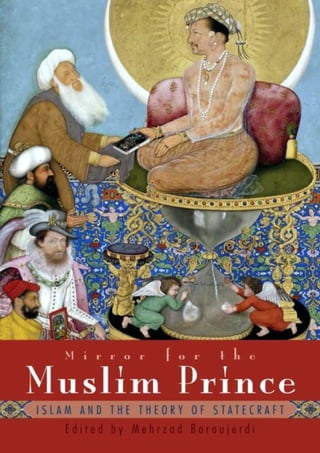
Mirror for the
Islam and the Theory of Statecraft
Edited by Mehrzad Boroujerdi
To those who employ the pen to inscribe ethics in the register of politics
"Historia est Magistra Vitae" (History is life's teacher).
-CICERO, De Oratore
Acknowledgments
A Note on the Text
Contributors
1. Introduction
Mehrzad Boroujerdi
2. Maslahah as a Political Concept
Asma Afsaruddin
3. Sa`di's Treatise on Advice to the Kings
Alireza Shomali and Mehrzad Boroujerdi
4. Perso-Islamicate Political Ethic in Relation to the Sources of Islamic Law
Said Amir Arjomand
5. An Anomaly in the History of Persian Political Thought
Javad Tabatabai
6. Teaching Wisdom
A Persian Work of Advice for AtabegAhmad of Luristan
Louise Marlow
7. A Muslim State in a Non-Muslim Context
The Mughal Case
Muzaffar Alam
8. Al-Tahtawi's Trip to Paris in Light of Recent Historical Analysis
Travel Literature or a Mirror for Princes?
Peter Gran
9. Law and the Common Good
To Bring about a Virtuous City or Preserve the Old Order?
Charles E.Butterworth
10. What Do Egypt's Islamists Want?
Moderate Islam and the Rise of Islamic Constitutionalism in Mubarak's Egypt
Bruce K.Rutherford
11. The Body Corporate and the Social Body
Serif Mardin
12. Cosmopolitanism Past and Present, Muslim and Western
Roxanne L.Euben
13. God's Caravan
Topoi and Schemata in the History of Muslim Political Thought
Aziz Al-Azmeh
Works Cited
Index
THE IDEA FOR THIS BOOK germinated during a conference I had organized at Syracuse
University in 2006. All the distinguished contributors to this volume presented papers at this event
and in the ensuing years revised their papers to make them suitable for publication. The chapter by
Shomali and Boroujerdi and the one by Rutherford were not part of the conference but were added
later to address certain lacunae in the project. I want to sincerely thank each and every one of the
contributors for their graciousness and patience as this manuscript went through the travails of the
publication process. Gratitude is also due Zayde Antrim, M.Si kri Hanioglu, Naeem Inayatullah,
Tazim Kassam, David S.Powers, and Robert Rubinstein, whose participation, presentations, and
comments enriched the quality of this project.
I would like to thank Syracuse University's "Ray Smith Symposium" and the Maxwell School
of Citizenship and Public Affairs for providing financial support for the conference and to
Smithsonian Freer Gallery of Art and Arthur M.Sackler Gallery for the book cover. I also would
like to gratefully acknowledge Middle East Journal, Princeton University Press, and Central
European University Press for permissions to use modified and abridged sections from the
following earlier texts by Bruce K.Rutherford ("What Do Egypt's Islamists Want? Moderate Islam
and the Rise of Islamic Constitutionalism"); Roxanne L.Euben (Journeys to the Other Shore:
Muslim and Western Travelers in Search of Knowledge); and Aziz alAzmeh (The Times of
History: Universal Topics in Islamic Historiography).
I owe special thanks to John Fruehwirth for ameliorating this manuscript with his meticulous
attention to thorny details as only he can and to Mary Selden Evans for her eagerness to see this
volume published. I also owe a great deal to my friend and colleague Alireza Shomali, and to my
able research assistants Todd Fine, Joanna Palmer, Nicholas Patriciu, Roya Soleimani, and Kate
Vasharakorn for their administrative support and for tracking down missing references in every
possible way.
EMPLOYING A TRANSLITERATION SYSTEM in a bulky book where some thirteen scholars
use more than half a dozen languages to analyze ancient, medieval, and modern treaties proved a
formidable task. It soon became clear that adopting a rigid transliteration system can be
problematical. Hence it was decided that while we employed-as a heuristic device-the
transliteration system laid out by the Library of Congress, certain exceptions had to be made for
the sake of accuracy, accessibility, or deference to the respective authors' preferred spelling of
names. All the diacritical marks for Persian and Arabic terms were dispensed with-with the
exception of ayn and hamza, which are dropped only at the initial position. However, the full range
of diacritics was retained for Turkish names and terms. Anglicized words that appear in the
English dictionary (such as A'isha, Ali, Arab, ibn, Umar, and Uthman) have been granted
preference where appropriate. Familiar geographical names have been provided in their common
spelling. We aimed to have one style convention for punctuation, spelling, capitalization,
hyphenation, italicization, numbers, and abbreviations.
In the body of the texts and the notes we have dropped the equivalent Hijrah dates for the
sources cited and have only provided the Christian Era dates. Finally, all translations from non-
English sources are those of the respective authors unless otherwise indicated.
ASMAAFSARUDDIN is Professor of Islamic Studies and Chairperson of the Department of Near
Eastern Languages and Cultures at Indiana University (Bloomington). She is the author of The First
Muslims: History and Memory and Excellence and Precedence: Medieval Islamic Discourse on
Legitimate Leadership as well as editor of Hermeneutics and Honor: Negotiation of Female
"Public" Space in Islamic/ate Societies; and coeditor of Humanism, Culture, and Language in the
Near East: Essays in Honor of Georg Krotkoff (with Mathias Zahniser).
MUZAFFAR ALAM is the George V.Bobrinskoy Professor in South Asian languages and
civilizations at the University of Chicago. His main publications include The Crisis of Empire in
Mughal North India; The Mughal State, 1526-1750 (edited with Sanjay Subrahmanyam); A
European Experience of the Mughal Orient (with Seema Alavi); Languages of Political Islam:
India 1200-1800; Writing the Mughal World: Studies in Political Culture (with Sanjay
Subrahmanyam); and Indo-Persian Travels in the Age of Discoveries, 1400-1800 (with Sanjay
Subrahmanyam).
SAID AMIR ARJ0MAND is Distinguished Service Professor of Sociology and director of the
Institute for Global Studies at State University of New York at Stony Brook. He is the author of
The Shadow of God and the Hidden Imam; The Turban for the Crown; and After Khomeini; and
editor of Constitutional Politics in the Middle East and the Journal of Persianate Studies.
AZIZ AL-AzMEH is university professor in the School of History at the Central European
University (Budapest, Hungary). He is the author of Arabic Thought and Islamic Society; Muslim
Kingship: Power and the Sacred in Muslim, Christian, and Pagan Polities; Ibn Khaldun: An Essay
in Reinterpretation; The Times of History: Universal Topics in Islamic Historiography; and Islams
and Modernities.
MEHRZAD B0R0UJERDI is associate professor of political science and director of the Middle
Eastern Studies Program at Syracuse University. He is the author of Iranian Intellectuals and the
West: The Tormented Triumph of Nativism and Essay on Iranian Politics and Identity (in Persian).
CHARLES E.BUTTERWORTH is emeritus professor of government and politics at the University
of Maryland College Park. He is coauthor of The Introduction of Arabic Philosophy into Europe
and Between the State and Islam; and the editor/translator of Averroes' Middle Commentary on
Aristotle's "Categories" and "De Interpretatione"; Averroes' Middle Commentary on Aristotle's
`Poetics" Alfarabi: The Political Writings: "Selected Aphorisms" and Other Texts; and Averroes'
Decisive Treatise and Epistle Dedicatory.
RoxANNE L.EUBEN is the Ralph Emerson and Alice Freeman Palmer Professor of Political
Science at Wellesley College. She is the author of Enemy in the Mirror: Islamic Fundamentalism
and the Limits ofModern Rationalism; Journeys to the Other Shore: Muslim and Western Travelers
in Search of Knowledge; and (with Muhammad Qasim Zaman) Princeton Readings in Islamist
Thought: Texts and Contexts from Al-Banna to Bin Laden.
PETER GRAN is professor of history at Temple University. He is the author of Islamic Roots of
Capitalism: Egypt, 1760-1840; Beyond Eurocentrism: A New View of Modern World History;
and The Rise of the Rich.
SERIF MARDIN is emeritus professor of political science at Sabanci University (Istanbul,
Turkey). He is the author of The Genesis of Young Ottoman Thought; Religion and Social Change
in Modern Turkey; and Religion, Society, and Modernity in Turkey; and editor of Cultural
Transitions in the Middle East.
L0UISE MARLow is professor of religion at Wellesley College. Her publications include Writers
and Rulers: Perspectives from Abbasid to Safavid Times, coedited with Beatrice Gruendler; and
Hierarchy and Egalitarianism in Islamic Thought.
BRUCE K.RUTHERF0RD is associate professor of political science at Colgate University and
director of the university's Program in Middle Eastern Studies and Islamic Civilization. He is the
author of Egypt after Mubarak: Liberalism, Islam, and Democracy in the Arab World.
ALIREZA SH0MALI is associate professor of political science at Wheaton College in
Massachusetts. He is the author of Politics and the Criteria of Truth.
JAVAD TABATABAI is a former professor of political science at Tehran University. He is the
author of Philosophical Introduction to the History of Political Thought in Iran; Decline of Political
Thought in Iran; Essay on Ibn Khaldun: Impossibility of Social Sciences in Islam; Nizam al-Mulk
and Iranian Political Thought: Essay on the Continuity of the Iranian Thought; and Reflections on
Persia (all in Persian).
MEHRZAD BOROUJERDI
THE STRING OF POPULAR UPRISINGS, commonly referred to as "the Arab Spring," that jolted
the Arab and Muslim worlds in 2010 and 2011 came as a shock to most political observers. The
toppling of Zine El Abidine Ben Ali (r. 1987-2011), Hosni Mubarak (r. 1981-2011), Ali Abdullah
Saleh (r. 1978-2011), and Muammar al-Qadhafi (r. 1969-2011), who collectively had ruled for
more than a century, called into question many shibboleths about Arabs and Muslims such as their
fatalism and aversion to democratic politics. The Arab Spring has also forced the Middle Eastern
scholarly community to reexamine a host of its assumptions and theories! The future of these
countries is unknown at this conjuncture. Some may be heading toward a more democratic future,
while others may head toward resurrected dictatorships or other uncertain outcomes. Yet one can
say with a certain degree of confidence that these societies will inevitably draw on the collective
wisdom of their populations. Having seen the debris of the atavistic solutions offered by nativism,'
and the pitfall of unbridled cosmopolitanism, one hopes that the intellectual elite in these societies
will try to reanimate their communities by careful deconstruction and reconstruction of their
intellectual traditions. The (re)reading of the Islamic traditions is a part of the responsibility of
intellectuals who wish to help future generations of Muslims contemplate a more humane style of
statecraft. Contemporary Muslim intellectuals such as Muhammad Abed al-Jabri (1999) have
insisted on the need for a "critique of Arab reason," whereas the Moroccan sociologist Abd al-
Kabir al-Khatibi has argued that contemporary Arab knowledge that is stamped by the ideology of
Islam "should be subjected to deconstruction in order to show that its concepts are historical
products that have taken their particular structures in relation to a specific way of thinking and
specific events in time and space."3
In this volume, a group of distinguished scholars tries to reinterpret concepts and canons of
Islamic thought in Arab, Persian, South Asian, and Turkish traditions and to demonstrate that there
is no unitary "Islamic" position on important issues of statecraft and governance. They recognize
that Islam is a discursive site marked by silences, agreements, and animated controversies (not to
mention denunciation and persecutions). There is no shortage of disagreements among Islam's
clerical literati and their lay counterparts about the authenticity of hadiths and the partisanship of
historiographies. Rigorous debates and profound disagreements among Muslim theologians,
philosophers, and literati (and their Western interlocutors) have taken place over such questions
as: What is an Islamic state? Was the state ever viewed as an independent political institution in
the Islamic tradition of political thought? Is it possible that a religion that places an inordinate
emphasis upon the importance of good deeds does not indeed have a vigorous notion of "public
interest" or a systematic theory of government (a la Hobbes, Mills, or Rawls)? Does Islam provide
an edifice, a common idiom, and an ideological mooring for premodern and modern Muslim rulers
alike? Are Islam and democracy compatible?
The volume begins both thematically and historically with Asma Afsaruddin's chapter
concentrating on the explicit and implicit invocations of the concept of maslahah (translated as
"public interest;" "utility," or "expediency") in Islamic history. She maintains that even though it
was not termed as such, maslahah as a political concept existed from almost the onset of Islam.
Grounding her argument on hadith sources and historical/political treaties, Afsaruddin argues that
the sociopolitical principle of maslahah has been utilized in both Sunni and Shi'i exegetical
works.4 She points to Ayatollah Khomeini's theory of wilayat-i faqih (the guardianship of the
jurist) as one of the latest works in which maslahah serves as the cardinal principle of legislation.'
The concept of maslahah has profound implications for modern Islamic political thought and for
the type of political systems Muslim societies may wish to embrace. Considerations of "public
interest" by religious scholars can enhance the effectiveness of democratic discourse and the
compromises that are invariably required in any modern state. But what if the theologians were to
insist that they were the only legitimate class of interpreters of maslahah or that one among them
who was primus inter pares (first among equals) had to serve as an inalienable sovereign?6
Already in Iran, dissenting voices like those of Mahdi Ha'iriYazdi (1923-1999), Mohsen Kadivar
(1959-), Muhammad MujtahidShabistari (1936-), and Abdulkarim Soroush (1945-) have
complained that the doctrine of wilayat-i faqih is destroying the sacredness of Islam as
jurisprudence and theology have become intertwined with state power, material interest, and
political considerations.' Some have even argued, in a counterintuitive fashion, that the theory of
wilayat-i faqih is the last and most important attempt at secularization of Shia jurisprudence. The
argument goes like this: since the state is the guardian of the national interest and since the
protection of national interest requires the acceptance of maslahah as a principle of statecraft, the
pragmatist logic of wilayat-i faqih opens the gate for all types of evolution within sharia. When a
religious system moves toward the formation of a state, it becomes incumbent upon it to modify its
religious laws in accordance with the new conditions at hand. A prerequisite for doing so is to
prepare a strong digestive system to swallow an entity referred to as the "state." Secularization is
the catalyst that enables religion to digest the state and, in turn, precipitates the absorption of
religion within the machinery of the state (Salihpur 1995, 18).8
We then turn our attention to five chapters that discuss the contributions of some of the
medieval Perso-Islamicate works on political ethics and statecraft. Goethe referred to Persia as
the Land of Poetry par excellence, and the chapter by Shomali and Boroujerdi concentrates on
Sa`di Shirazi (1209-1291), who has earned the accolade of "Master of Prose and Poetry" in Iran.
However, instead of concentrating on his poetry, the authors provide a full and original translation
of the celebrated poet's Treatise on Advice to the Kings (Nasihat al-Muluk). The chapter also
ventures a reconstruction of a number of elements in medieval Persian political philosophy that
appeared in this work and in Sa`di's other literary opuses. As scholars like Abdullahi An-Na`im
(2010) and Bassam Tibi (2012) argue, the ideology of Islamism and the concept of the Islamic
theocratic state whose sole purpose is implementation of the shari'a are but modern and
postcolonial phenomena in the Middle East.9 It is philosophically mistaken-and politically
dangerous-to commit the fallacy of anachronism and read the history of political thought in the
Islamic world in terms of an unfolding of "perennial" ideas such as theocratic statecraft or
political Islam. The authors' reconstruction of the political philosophical elements in Sa`di's
thought offers a counterexample, which is by no means unique and exceptional, to the radical
Islamist claim and also to the oversimplifying generalizations by figures such as Ann Lambton
(1981, xiv), who argues that Muslim political theorists never ask why the state exists in the first
place since it is taken for granted that it is needed to promote and protect God's law. Far from
claiming that Sa`di has articulated a systematically consistent political theory, the authors highlight
Sa`di's predominantly pragmatic and secular beliefs about statecraft and situate him within a broad
conception of social contract. Sa'di, the authors argue, does ask why the state exists and adopts a
language of social contract to formulate his response. In Sa'di's view, the king does not own the
people and is not God's representative on earth. Rather, he is an employee hired by the people to
protect their welfare and security. The chapter concludes with the point that Sa'di's works reflect
"a sketchy conceptualization of a humane type of politics incorporating elements of pragmatism,
secular statecraft, and public interest." Sa'di "views governance as a rational contract between the
sovereign and the people without having to reject Deity or embrace theocracy."
Said Amir Arjomand's chapter takes us into the midst of another serious ongoing debate as to
whether we are dealing with "Islamic political thought" or "concepts of politics held or advocated
by Muslims." The proponents of the latter approach are preoccupied with what they consider the
quintessence of Islam and tend to separate Islam as an idea from the social milieu in which it
developed. The exponents of the former view contend that political thought and utterances of
Muslims should be reckoned Islamic so far as their endeavor is to denote a religious understanding
o f political praxis. Arjomand-who in his earlier works had rebuffed the thesis that the state is
unavoidably illegitimate in Shi`ism-embraces this more expansive viewpoint and calls into
question the contention of such scholars as H.A.R.Gibb and Patricia Crone who maintain that the
literature on statecraft and political ethics was somehow "un-Islamic" and was implanted upon the
more authentic Islamic shari'a. He does this by providing a reading of some seminal Persian texts
on political ethics from the medieval period and advancing the idea that far from being alien to
Islamic precepts, the architects of this tradition were able to rest their claims on the scriptural
sources of Islamic law. Arjomand's analysis maintains that civilizational encounters allow for
intellectual loans and crossfertilization of ideas rather than rigid ideological separations of what is
purportedly Islamic and what is not. Hence he writes, "from the tenth century onward, the legal
order of the caliphate had two normatively autonomous components: monarchy and the shari'a."
The political theorist Javad Tabatabai follows in the footsteps of Richard N.Frye and
Marshall Hodgson, who before him had challenged the Arabistic bias of Islamic studies by
highlighting the significant contribution of Persianate philosophers, mystics, jurists, poets, and
statesmen.10 Tabatabai draws attention to the fact that the Islamic theory of the caliphate never
resonated with Iranian thinkers and that indeed in the annals of the history of Persian political
thought in the Islamic period, "no treatise on the Islamic theory of politics was ever written by an
Iranian political thinker or scribe." Tabatabai, who in an earlier work (1996, 130) had labeled the
celebrated Seljuq vizier Nizam al-Mulk's Siyasat-namah (Book of Government) as the most
important manifesto of an attempt to reconnect with the legacy of Iranian political thought in the
Islamic period, here argues that the book has "no trace of the caliphate theory" and that it "follows
the tradition of Persian advice literature and criticizes the Seljuq style of governance." Like
Arjomand, Tabatabai draws our attention to the continuing infatuation of Persian political thought
with pre-Islamic moral codes and conceptual schemes (including the ancient theory of kingship).
Arabic might have become the lingua franca of the conquered Persian Empire but the Persian
mawali (Non-Arab Muslims) continued to write all their political advice treatises in the Persian
language. In other words, cultural integration of Persia proved much more difficult than its
political domination.
Louise Marlow continues the rereading project of this volume by suggesting that the "Mirror
for the Prince" literature should not be merely scrutinized for its "political" content but rather
should be valued for its literary expression and historiography as well. The "mirror" genre is not
just a branch of political thought but also an important cultural artifact that has enriched the adab
(belles lettres) tradition. To demonstrate this argument, Marlow examines a work of counsel
literature entitled Tuhfeh (The gift) that was dedicated to a fourteenth-century Persian ruler, Nusrat
al-din Ahmad. Her approach succeeds in making the reader better comprehend the restraints and
plasticity of the advice literature.
Muzaffar Alam's chapter introduces us to the Indo-Persianate tradition of statecraft and
political ethics between approximately 1550 and 1750. His main claim is that the Mughals
managed to create a high political culture in a non-Muslim setting thanks to "Nasirean akhlaq
norms of governance, traditions of mysticism, and Persian literary culture." Like Marlow, Alam
pays ample attention to the significance of the Persian literary dimension, and similar to Arjomand
and Tabatabai, he emphasizes the significant role of the ethical discourse of statecraft, this time by
concentrating on the teachings of Nasir al-Din Tusi (d. 1274). The period covered by Alam is
momentous because the sixteenth century marks a crucial stage in the growth of imperial political
culture and ideology in the Indian subcontinent. The sixteenth century was also important in Persia
because of the coming to power of the Safavid dynasty that made Shi'ism the country's state
religion, as well as in Europe as it marked the emergence of Protestantism. As pointed out by
H.R.Trevor-Roper (1959, 42), "the sixteenth century was an age of economic expansion. It was the
century when, for the first time, Europe was living on Asia, Africa and America." Trevor-Roper
argues that the "Renaissance State" that emerged created a new machinery of government with an
ever-expanding bureaucracy. In his discussing of "governmentality," Michel Foucault (1991, 87)
writes,
Throughout the Middle Ages and classical antiquity, we find a multitude of treaties presented
as "advice to the prince," concerning his acceptance and respect of his subjects, the love of
God and obedience to him, the application of divine law to the cities of men, etc. But a more
striking fact is that, from the middle of the sixteenth century to the end of the eighteenth, there
develops and flourishes a notable series of political treaties that are no longer exactly
"advice to the prince," and not yet treaties of political science, but are instead presented as
works on the "art of government." Government as a general problem seems to me to explode
in the sixteenth century, posed by discussions of quite diverse questions.
Following a theme developed in his other works, Alam shows how by patronizing Arab, Persian,
and Central Asian traditions the predominantly Muslim Mughal elite managed to rule over a
largely non-Muslim population. While one cannot speak of a single "Muslim" view of kingship,"
the Mughals embraced the idea of a just worldly potentate.12 The Mughal kings were able to enjoy
such boasting titles as the "Refuge of Islam;" "Propagator of the Muslim Religion," and "Shadow
of God."13
The next three chapters examine the intellectual oeuvre of Islamic intellectuals in the Arab
world during the last two centuries. Peter Gran takes a new look at one of the seminal writings of
Rifa`ah Rafi' al-Tahtawi (1801-1873), who was the leading Egyptian intellectual of his time. He
maintains that Tahtawi's account of his five-year sojourn (1825-31) in Paris as recounted in
Takhlis al-ibrizfi talkhis Bariz is more an example of a Mirror for the Prince literature than a
simple travelogue. Gran, who has a long-standing interest in history and political economy,
situates Tahtawi and his text in the body of literature about hegemony in Middle Eastern history.
He specifically makes use of the "Italian Road" theory of hegemony-which he had developed in a
prior work14-and maintains that this theory does a better job than Oriental Despotism in
accounting for the development of Egypt during the crucial period from 1760 to 1860 when the
contradictions between the North and the South in Egypt were deepened. This, of course, happens
to be the period in which Tahtawi was writing and in which the "modern national hegemony of
Egypt was coming into being." Gran considers this Egyptian political reformer and scholar as a
"Southern Intellectual" who was writing for the khedive of Egypt, Muhammad Ali Pasha. Like
many other reformist Islamic thinkers of his era, Tahtawi believed in educational reform as a
necessity and indeed wrote Takhlis to awaken his compatriots. As C.Ernest Dawn (1991, 5) has
quoted him, Tahtawi described the purpose of writing his book in the following way: "I made it to
speak to stimulate the lands of Islam to investigate the foreign sciences, arts, and industries, for the
perfection of that in the land of the Franks is a well-known certainty, and the truth deserves to be
followed... By the Eternal God! During my stay in this country I was in pain because of its
enjoyment of that [perfection] and its absence from the lands of Islam."
Charles Butterworth continues Gran's endeavor of rereading a seminal text by examining the
travails of another Muslim scholar who sought to reform the religion and politics of the Muslim
world: Ali Abd al-Raziq (1888-1966). In 1925, less than a month after John T.Scopes was found
guilty in Tennessee on a charge of teaching Darwinism in a state-funded school, Abd al-Raziq was
denounced by al-Azhar hierarchy in Egypt for the publication of his al-Islam wa usul al-hukm
(Islam and Roots of Governance). Leonard Binder (1988, 130), quoting Albert Hourani, writes,
"Abd al-Raziq's book... raised in a vivid way the most fundamental question involved: is the
caliphate really necessary?... is there such a thing as an Islamic system of government? Abd al-
Raziq grants that `some sort of political authority is indeed necessary, but it need not be of a
specific kind.' And even more far-reaching: `It is not even necessary that the umma should be
politically united."'
Abd al-Raziq's book did not appear out of thin air. A year earlier the institution of caliphate
had been abolished in Turkey and now a man who himself was a shari'a judge was being censured
for maintaining that Islam neither requires nor rejects the rule of a caliph or an imam. Moreover,
he argued that the annals of Islamic history demonstrate that the institution of caliphate, which was
not instituted by the Prophet, has brought horror and disaster to the umma and as such there is no
need for its reestablishment. Abd al-Raziq insisted that it was the message of Islam that was
important and not the form of government that was established. Muhammad was a "`warner' or a
`reminder,' not a `warden' or a `guardian"' (Kurzman 2002, 20). He was a "messenger with a
religious calling" rather than a "master of a political state," "the leader of a religious group" rather
than "the ruler of a government."
Contrary to scholars like Michaelle Browers (2006, 35) who consider Abd al-Raziq to be
advocating secularism, Butterworth undertakes a careful reexamination of al-Islam wa usul al-
hukm and reaches the conclusion that he was writing from within the religious tradition and was
trying "to show clearly how much religion has to gain by distancing itself from politics and how
politics will gain in justice and wisdom as it distances itself from religion." According to
Butterworth, Abd al-Raziq was not calling passionately for secularization but was articulating a
case for why religion and politics should be separated.15 Yet Butterworth is not in agreement with
Abd al-Raziq's bold critique and feels that a more conciliatory argument about the contentious
issue of how Islam can be enamored or be complicit with political power could have been more
politically and pedagogically efficacious. Butterworth also faults Abd al-Raziq for his omission of
the ninth-century philosopher Farabi (d. 950) and the eleventh-century jurist al-Mawardi (d. 1058)
who should have been central to Abd al-Raziq's argument.16 As Richard Walzer (1963, 45) has
argued, Farabi wished to restore the caliphate through philosophy. Writing more than 1,200 years
after Plato, Farabi believed that the shari'a is a subdivision of the practical rationality and that
philosophers had a crucial role to play. Fauzi M.Najjar (1958, 102) sums up the gist of Farabi's
views on this subject matter as follows: "If the philosopher cannot rule the city, he must act as an
adviser to the ruler. Thus Farabi makes the distinction between the `king of the city' and the
`manager-mudabbir-of the king of the city.' The mudabbir is none but the philosopher himself."
Abd al-Raziq's dismissal of the caliphate and the imamate did not sit well with his
contemporary Rashid Rida (1865-1935), who strongly believed in the need to restore the caliphate
to achieve Islamic unity. Rida's ideas on the Islamic state came to resonate with the Muslim
Brotherhood (MB), which is the subject of the following chapter by Bruce Rutherford. On June 30,
2012, Muhammed Morsi (b. 1951) of the MB was elected the first civilian president of Egypt after
a long and bumpy ride by his organization to political power. Rutherford's essay, written six years
before this watershed event, interrogates the type of political order Egypt's most prominent
contemporary Islamic thinkers (clerical and lay) have been striving to create. Through an
examination of the writings of Yusuf alQaradawi (b. 1926), Kamal Abu al-Majd (b. 1930), Tariq
al-Bishri (b. 1933), and Muhammad Salim al-Awwa (b. 1942), Rutherford maintains that they
have managed to articulate a distinctly Islamic conception of constitutionalism and that their ideas
have left an indelible mark on the political agenda of the MB. These thinkers share with classical
liberalism such notions as support for "the rule of law, constraints on state power, and the
protection of many civil and political rights." Rutherford argues, however, that there are
"decidedly illiberal" aspects to their ideas as vast differences emerge when we examine such
issues as the purpose of the state, the role of the individual in politics, and the function of law.
Serif Mardin draws our attention to a hitherto unexamined question. What happens when the
"Jacobin corporate" understanding of the millet (populace or nation) as embraced by the political
elite of modern Turkey since its inception is forced upon a people who operate on the basis of the
notions of "Islamic bonding" or "sociability" discernible among Islamic groups?" Mardin
maintains that the conception of corporate personality/ public domain that was developed in
nineteenth - and twentieth-century Turkish history-along the lines of Western European law-was
discordant with the notion of "bonding" and "sociability," which is "the deepest foundation of
Islamic political theory." Tanzimat-era bureaucrats could have easily penned encomiums about
sultanic majesty and authority,18 as well as fictitious accounts of a "corporate body" that was
inherently weak. Here Mardin relies partly on the works of Timur Kuran (2004; 2010), who has
argued that the nonrecognition of corporate entities (as both an economic and a legal construct)
came to impede the development of capitalism in the Middle East. According to Kuran, such
central features of modern capitalism as private capital accumulation, investment, profit sharing,
and impersonal exchange were discouraged, blocked, or slowed down by Islamic legal
institutions. Mardin ends his chapter by referring to the Gillen movement as an example of an
"Islamic Freemasonry" that makes excellent use of the "cementing" mechanisms of Islamic
solidarity.
The last two chapters in the book deal with broad isssues of historiography and political
theory. Roxanne L.Euben's "Cosmopolitanisms Past and Present, Muslim and Western" more fully
addresses the subject of travel previously touched upon in the chapter by Peter Gran. Euben takes
to task the literature of "new cosmopolitanism" that maintains that thanks to the deterritorialization
of politics human beings now constitute a supranational throng tied by moral, legal, and political
commitments transcending the modern nation-state. She maintains that despite its promising
scholarship this literature still suffers from a presentist bias and a historical and cultural
parochialism since it largely proceeds in European analytical and temporal terms that belie its
ideal ecumenicalism. Euben's charge is similar to the one articulated by Dipesh Chakrabarty in
Provincializing Europe, who argued that "Europe remains the sovereign, theoretical subject of all
histories" and that "it works as a silent referent in historical knowledge" (2000, 27-28). Moving
beyond the pantheon of Western embedded criteria, exemplars, idioms, and imaginaries is needed
if one is to recenter the debate on cosmopolitanism. Euben undertakes the task of divesting the
vocabulary and historiography of new cosmopolitanism from its blatant limitations by tracing the
alternative genealogy of "Muslim cosmopolitanism." She refutes the arguments of scholars such as
Bernard Lewis who argue that whereas the "Westerners" were curious to learn about other people,
the Muslims were insular and noninquisitive. Instead, Euben demonstrates that there has been an
"Islamic ethos of travel in search of knowledge" that has marked the social imaginary of Muslims
past and present.
The last contribution to this volume is by Aziz Al-Azmeh, who scans the field of "Islamic
political thought" by closely scrutinizing two important works, namely Anthony Black's The
History of Islamic Political Thought and Patricia Crone's God's Rule-Government and Islam. Al-
Azmeh objects to a long list of methodological and epistemological premises and to
historiographical narratives in the above books as well as those of other like-minded scholars. He
maintains that Black and Crone
(a)have reified the word Islam so much so that for them history happens "in Islam" rather than in
"territories with determinate characteristics and traditions";
(b)have neglected the fact that Islam is "not a product of the early polity of Muhammad's Arabia"
but a product of history and geography;
(c)have narrated Islamic history in terms of "measure of fidelity to origins"
(d)have depicted Islamic political theory as "somehow essentially sui generis" and have thus
assigned a "hyperdoctrinaire character" to it;
(e)failed to realize that the principal concern of Islamic political thinking is not "legitimacy" but
the problem of public order;
(f)have overstated the "illegitimacy" of sultans;
(g)have presumed that Islam was "the main source" of the state and that the umma was nothing but
"congregation and state rolled into 11 ;
(h)have privileged the Arabs and imputed to them a unitary ethos of egalitarianism and anti-
statism;
(i)did not recognize that "the ulama were not only ulama" and that they were not "congenitally
opposed to the state."
The above points raised by Al-Azmeh underline a number of methodological and theoretical
weaknesses of the scholarship in the field of Islamic political thought that this volume and its
contributors have wished to partly rectify. We hope that the erudite scholarship assembled here
spawns further studies of the topics covered in this book. After all, like citizenship, history
necessitates listening to a multiplicity of voices.
ASMA AFSARUDDIN
THE ARABIC TERM Maslahah is usually translated as "welfare," "public interest or utility," and
"common good" in various contexts. A single, concise definition is not possible in English, but all
the above meanings may be encompassed by the Arabic term. At the basic semantic level,
maslahah connotes being the source of what is sound, beneficial, and conducive to peace (sulh).
In premodern Islamic thought, maslahah was considered primarily a juridical term. In the early
centuries of Islam, the term istislah appears to have been more common than maslahah. Istislah
was a procedure common among the Medinese jurists, including Malik b. Anas (d. 795), and
among the Iraqi Hanafis of the eighth century. These jurists relied heavily on reasoning and
discretionary opinion (ra'y) in order to devise legal rulings that promoted the public interest in the
absence of specific scriptural injunctions (Hallaq 2005, 145). Early sources confirm widespread
recourse to istislah to derive legal rulings in the second and third centuries of Islam. Thus
Muhammad b. Ahmad al-Khwarazmi (d. after 997) lists istislah in his well-known work Mafatih
al-ulum as one of the sources of law for the Maliki school (1895, 9). The gifted belletrist and
secretary Ibn al-Mugaffa` (d. ca. 757) recommends the use of istislah by jurists in the absence of
specific textual prescriptions to derive legal rulings (1966, 360).
By the eleventh century, maslahah appears to have become the preferred term to connote
public interest or good and became foregrounded as a juridical principle in relation to the
"objectives of the law" (maqasid al-shari`a). The impetus for this further development of the
principle of maslahah was provided by the Shafi'i jurist Abu Hamid Muhammad al-Ghazali (d.
1111) in his work al-Mustasfa min ilm al-usul. Al-Ghazali divides the objectives of the law into
two types: religious (dini) and worldly (dunyawi). Both types of objectives are concerned with
securing (tahsil) and preserving (ibga) the public interest or maslahah. Maslahah is thus ultimately
what allows for the acquisition of benefit (manfa`ah) and the avoidance of harm or injury
(madarrah) (al-Ghazali 1877, 1:286).
The worldly objectives of the shari'a are distilled by al-Ghazali into "five necessities" (al-
daruriyat al-khamsah), which guarantee, for each individual, preservation of religion (din), life
(nafs), progeny (nasl), intellect (aql), and property (mal). These primary objectives of the law are
followed by supplementary objectives in descending order of importance: "needs" (hajat) and
"ease" (tawassu` and taysir) (al-Ghazali 1877, 1:161-62). Al-Ghazali's concept of maslahah and
its link to the maqasid al-shari'a proved to be seminal and was discussed by practically every
major jurist afterward, especially al-Tufi (d. 1316) and al-Shatibi (d. 1388). These concepts have
enjoyed a resurgence in the contemporary period as the notion of the shari'a and its objectives are
revisited, particularly by modernists and reformists.
Maslahah as a Political Concept in the Early Period
In comparison with its use as a juridical term, maslahah as a political concept per se receives
scant discussion in the early literature. Its pervasiveness as a political concept has to be inferred
from various genres of works that discuss the early caliphate as a historical phenomenon and
conceptualize legitimate political leadership. The term maslahah or istislah need not be explicitly
used for us to be able to assert that it was a principle broadly recognized in the early period in the
sense that al-Ghazali had defined it in the legal context in the eleventh century, that is, as a
principle that allowed for the acquisition of benefit (manfa`ah) and the avoidance of harm or injury
(madarrah).
Three primary types of literature have been consulted in this chapter to determine the
importance of maslahah as a general political and social organizational principle in the premodern
period: historical works, Qur'an exegetical works, and political treatises. Some of these works are
now discussed in greater detail below.
Historical and Exegetical Works: Sunni Views
Most Sunni historical works present the institution of the office of the caliph as a pragmatic
response to the special circumstances that ensued after the sudden death of the Prophet Muhammad
in Medina in 632 CE. As the sources inform us, it was clear to a majority of the Companions that
no successor had been explicitly designated by the Prophet. The Companions were confused as to
how to proceed to select a leader and maintain political stability. A significant number of people
converged at a portico in Medina to attend a hastily convened meeting in order to select a leader.
The procedure, the sources tell us, entailed debating rather noisily and heatedly the merits of some
of the obvious contenders for the office of the caliph, who included Abu Bakr, Umar, and Ali, the
Prophet's cousin and son-in-law. The matter was resolved by Umar's offering his allegiance to
Abu Bakr, his older friend, and asking the crowd to follow suit. According to several sources,
Umar prefaced his offer of allegiance by reciting before the gathered audience an impressive
resume of meritorious deeds that Abu Bakr had performed during Muhammad's lifetime (al-Nasa'i
1984, 55-56). This resume convinced the assembly of people to recognize Abu Bakr as the
Prophet's first successor, and they thronged toward him to offer their allegiance, which he
accepted with some diffidence and considerable humility, as the various versions of his inaugural
speech testify (al-Tabari 1987, 242-43). When asked later to reflect on the process of Abu Bakr's
election, some of the sources report that Umar described it as afaltah (al-Baladhuri 1960, 1:581-
83; al-Tabari n.d., 2:242).
The Arabic word faltah in this context means a "happenstance" or an "unpremeditated event."
Umar was essentially describing the process of Abu Bakr's election as something that had
happened on the spot, in reaction to the exigencies of the situation. The situation, in fact, was quite
serious. Believing that their fealty to the government had lapsed on the Prophet's death, some Arab
tribes had risen in revolt against the Medinan government, and they refused to pay the obligatory
alms or taxes, known as the zakat. These tribes had to be brought back into the fold, and Abu
Bakr's skills as a master genealogist-predicated on expert knowledge of tribal relationships and
the tribe-based alliances of pre-Islamic Arabiawere greatly in demand.
The broad circumstances of Abu Bakr's election as depicted in the historical sources make it
clear that, in these early political deliberations, the Companions resorted to human reasoning and
interpretation of general Qur'anic notions such as "precedence" or "priority" in Islam (Ar. sabiqah)
and "virtue/moral excellence" (Ar. fadl/fadilah), as well as the concept of "consultation" (shura).
On the basis of such broad, general concepts, they devised the solution regarded as the most apt
and in the best interests of the community after the somewhat unexpected death of the Prophet.
Faltah in this context is a purely descriptive term and contains no moral valuation (at least in most
Sunni sources) of Abu Bakr's selection as the Prophet's successor in such a spontaneous and
unpremeditated manner.'
Sunni sources are practically in agreement that Abu Bakr's superior and appropriate
knowledge about genealogies and religious matters in general contributed to the greater welfare of
the polity in this critical period and was, therefore, the most important consideration in his
selection as the caliph. In his firaq work, the Andalusian jurist Ibn Hazm (d. 1064) states that
although Abu Bakr lived a mere two and a half years after the Prophet's death, he transmitted 142
hadiths from Muhammad and issued numerous fatwas. In contrast, Ali, who lived thirty years
beyond the Prophet's death, transmitted 586 hadiths, out of which only 50 are sahih. If their life
spans after the advent of Islam and the number of hadiths related by each are compared, Ibn Hazm
maintains, Abu Bakr was far more prolific in the transmission of traditions and in the issuance of
fatwas. This comparison establishes beyond a doubt Abu Bakr's greater excellence in this regard
because "someone with any degree of knowledge knows that what Abu Bakr possessed of
knowledge was several multiples more than what Ali possessed" (Ibn Hazm 1928, 4:108).
Furthermore, Ibn Hazm remarks that the Prophet's appointment of Abu Bakr as the prayer leader
during his final illness proves that he was so appointed on account of his superior knowledge of
the prayer rituals. Similarly, the Prophet appointed Abu Bakr to collect alms (al-sadaqat), to lead
the hajj, and to conduct several military expeditions (al-bu'uth), all of which testify to his greater
knowledge regarding prayer, alms-giving, the pilgrimage, and jihad, which "are the support (umda)
of religion" (1928, 4:108). Because of this unique constellation of virtues and aptitudes, Abu Bakr
is presented as having been exceptionally qualified to come to the defense of the nascent Islamic
polity during one of its most critical periods.
Abu Bakr's success in quelling the riddah uprisings is lavishly praised by later authors, who
see in it a testimonial to his greater mental acumen and political skills and, consequently, to his
greater moral excellence visa-vis other Companions. Al-Tabari, for example, relates how Abu
Bakr's sound judgment prevailed during the riddah wars when he asserted the necessity of fighting
those tribes that were resisting the Medinan government. He reports that Abu Bakr stated, "God
will not assemble you in error and, by the One in whose hand is my soul, I do not see a matter
more excellent with regard to myself than fighting those who withhold from us a camel's hobble on
which the Messenger of God, peace and blessings be upon him, used to take [what was due upon
it]."
Al-Tabari continues, "The Muslims acceded to Abu Bakr's opinion, for they saw that it was
better than their opinion and thus Abu Bakr dispatched at that time Usamah b. Zayd" (1:119).
In a hadith recorded by al-Muttaqi al-Hindi (d. 1567), the Prophet states, "I am the sword of
Islam and Abu Bakr is the sword of the riddah" (al-Hindi n.d., 6:2251), while another, recorded
by Ibn Abd al-Barr in the eleventh century, states that Abu Bakr "undertook the fighting of the
people of the riddah, and the excellence of his opinion became manifest in that, and his firmness
along with his gentleness which was inestimable. Thus God proclaimed His religion through him
and slew through his hands and His grace all those who had rebelled against the religion of God
until the matter of God became manifest while they were resistant" (Ibn Abd al-Barr n.d., 3:977).
The exegete al-Khazin al-Baghdadi (d. 1341) relates a report from Abu Bakr b. Ayyash,2 to
the effect that there was no one more excellent than Abu Bakr born after the Prophet and that in
fighting the "people of rebellion" (ahl al-riddah), Abu Bakr had attained the position of "a prophet
from among the prophets" (Al-Khazin al-Baghdadi 1961, 2:54).
Such generous praise by various authors highlights Abu Bakr's specific attributes and skills,
which were deemed to be the best suited to the times, resulting in maximum benefit for the people.
Here the benefit is clearly construed in a pragmatic, political sense. During the two years of Abu
Bakr's caliphate, the unity of the polity was of overriding concern. Secession of the rebellious
Arab tribes represented a threat primarily to the political well-being of the people. Even though
the uprising was termed riddah and unfortunately translated consistently into English as "apostasy,"
it had in fact only slight religious overtones. The rebellious tribes refused to pay taxes to the
changed government in Medina not because they had "apostasized" from Islam but because they
considered their allegiance to the Prophet to have lapsed upon his death. This practice was in
accordance with the nature of tribal agreements in this period, which were usually considered to
be personal in nature. The rebellious tribes were thus guilty of political disloyalty to the Medinan
government. Political stability was held to be the necessary prerequisite for an ordered religious
community and, at this juncture in history, restoring harmonious tribal relationships while
attempting to replace narrow tribal assumptions of political fealty with allegiance to the
supratribal umma was the highest priority. Abu Bakr with his intimate knowledge of tribal
alliances was clearly the man of the hour.
Following Abu Bakr's brief two-year tenure as caliph, Umar assumed the caliphate, having
been designated as such by Abu Bakr. In the descriptions of Umar's ten-year tenure as caliph we
see maslahah deployed as a broad sociopolitical organizational principle that determined the
overall orientation of the Muslim polity. The early literature does not, however, explicitly refer to
maslahah or istislah in these sociopolitical contexts. Rather, it maintains that Umar was duly
selected as the second caliph on account of his greater precedence in serving Islam in the early
period (asbaq) and his greater moral excellence (afdal) compared to the other Companions.
During Umar's longer tenure as caliph, the broad Qur'anic principles of sabiqah
(precedence/priority) and fadilah (moral excellence/virtue) often found reflection in highly
pragmatic measures, which reflected a deep concern for the public, political good. For example,
Umar's establishment of the diwan, the register of pensions, embodied both worldly savoir faire
and Qur'anic ideals of religious merit (al-Baladhuri 1866, 448f.; Yusuf Ya`qub 1985, 140-44; Ibn
Sa`d 1997, 3:224; Abu Ubayd al-Qasim ibn Sallam 1988, 266ff.). This institution borrowed from
the Persians allowed Umar to recognize the exceptional contributions of the early Muslims to the
community on the basis of sabiqah and fadilah and to arrange for an equitable, albeit merit-based,
distribution of the revenues pouring into the Medinan coffers.
The establishment of the diwan and its organizational principle met with some initial
resistance, but later historians applaud the shrewd intelligence and good sense apparent in Umar's
recognition of the religious and praxis-based merit of the earliest and most loyal Muslims in this
manner. Abu Yusuf (d. 798) in his Kitab al-kharaj mentions that when Umar assumed the caliphate,
he refused to place those who had fought against the Prophet on the same level as those who had
fought with him and, therefore, awarded larger stipends to "the people of precedences and
priority" (ahl al-sawabiq wa al-qadam) from among the Muhajirun and the Ansar who had
witnessed Badr (Yusuf Ya`qub 1985, 140; Ibn Sa`d 1997, 3:225). Abu Ubayd al-Qasim ibn Sallam
(d. 838) states that both Abu Bakr and Ali believed in egalitarianism (al-taswiyah) in the
disbursement of pensions, while Umar resorted to preferential treatment (al-tafdil) "based on
precedences and indispensable service to Islam" (ala al-sawabiq wa al-ghina' an al-islam) (Abu
Ubayd al-Qasim ibn Sallam 1988, 267-68; Ibn Sa`d 1997, 3:225; Hinds 1971, 366). Abu Ubayd
further reports that Abu Bakr declined to rank people in terms of their excellences, demurring that
"their excellences were with [known to] God" (fada'iluhum inda Allah) and that the system of
pensions (al-ma`ash) was better served by the principle of al-taswiyah (Abu Ubayd al-Qasim ibn
Sallam 1988, 267; Yusuf Ya`qub 1985, 140).3 Abu Bakr's and Umar's divergent views on how
state pensions should be disbursed was then a function of their individual understanding of what
was in the best interests of the community during their reign. It appears that differentiation on the
basis of merit would have proved even more divisive during the riddah wars, prompting Abu Bakr
to maintain equality in the disbursement of stipends. With internal unity more or less restored and
perhaps even to boost the morale of the most pious Muslims, Umar felt that it redounded to the
greater benefit of the community to institute a merit-based system of pensions.
The invocation of "excellence" and "precedence" as essential traits possessed not only by the
caliph/imam but also by lesser rulers and administrators is ubiquitous throughout the literature that
deals with these issues and establishes their perceived strong connection with effective, pragmatic
leadership in various social and political contexts. It appears that in the early period, moral
excellence as manifested particularly in mastery of the Qur'an sometimes led to positions of
political and social leadership. A well-known hadith is related by the Companion Abu Masud
alAnsari in which Muhammad says, "The best reciter of them [specifically, the people] of the
Book of God will lead the people. If they should be equal with regard to [proficiency in] reciting,
then the most knowledgeable of them with regard to the sunna" (al-Fasawi 1976, 1:449-50; al-Razi
1994, 97ff.). It is not surprising that both Sunni and Shi'i authors cite this report as evidence in
favor of the superior qualifications of Abu Bakr and Ali respectively for the caliphate/imamate on
account of each being the best reciter of the Qur'an.4
Other kinds of expertise in relation to the Qur'an conferred various kinds of authority on the
individual. Thus the moral excellence and precedence of the famous Companion Abd Allah b.
Masud derived not only from his acknowledged superior exegesis of the Qur'an but also from his
status as the first Companion who had publicly propagated the Qur'an (afsha 'l-Qur'an) (Ibn Sa`d
1997, 3:112). A broad recognition of his moral excellence and precedence in Islam led to several
important political appointments for Ibn Masud. Sabiqah became in fact a highly emotive term in
the early period, pregnant with sociopolitical implications for those who possessed it.
Particularly illustrative of this semantic and functional connection between sabiqah and
sociopolitical status is a report recorded by the well-known exegete and scholar al-Razi in a work
he composed on the excellences of the Qur'an. In the section significantly titled "Chapter regarding
those who are the most deserving among the people of leadership on account of their memorization
of the Qur'an," we find the following report, according to which Nafi' b. Abd al-Hariths met Umar
b. al-Khattab, who asked the former, "Whom did you leave in charge of Mecca?" The answer was
Ibn Abza. Umar asked, "[Is he] a mawla [nonArab Muslim convert]?" Nafi' replied, "Yes, he is a
reciter of the Book of God the Exalted." Umar said, "God enhances [the status] of certain people
by this Qur'an and diminishes [that of] others by it" (al-Razi 1994, 100; Ibn Majah 1983, 1:42).
This well-attested report underscores unambiguously that a non-Arab could have precedence over
an Arab on account of the former's superior knowledge of the Qur'an, which established his greater
moral excellence over others. In this report, Umar's true intention in adhering to the principle of
sabiqah becomes clear: in the case of a non-Muhajir Arab and a non-Arab, one had precedence
over the other only on the basis of moral excellence, gauged by one's superior religious knowledge
of the Qur'an in this case. In both this incident and the report cited earlier concerning Ibn Masud,
we discern a radical religious egalitarian attitude subversive of socially and culturally constructed
superiorities based on ethnic and tribal considerations (Marlow 1997, esp. 114ff.). Such
"subversive" appointments drove home in the early period the intimate connection between
individual moral virtue and its worldly pragmatic consequences, particularly in the promotion of
the public good.
The combination of sabiqah and fadilah was particularly important in the general discourse on
legitimate leadership of the polity and in SunniShi'i dialectics on the caliphate/imamate. This leads
us next to a consideration of whether the early Shia also had similar conceptions of maslahah as a
sociopolitical principle.
Shi'i Views
It is generally assumed that the Shia have always subscribed to a legitimist view of religiopolitical
leadership and have insisted that the ruler of the Muslim polity be a blood relative of the Prophet
Muhammad. However, early Shi'i sources sometimes offer a different perspective and suggest that
we must be wary of retrojecting later assumptions back into the very early period.
For example, when comparing early and later Shi'i sources, we notice a certain evolution in
Shi'i interpretation of the key Qur'anic term sabiqun, which has important implications for political
thought. Early Shi'i views appear to be similar to the general Sunni understanding of this term
while later views (roughly after the tenth century) on the sabiqun became markedly different from
the Sunni perspective. The typical (and expected) Shi'i view is that the term sabiqun refers only to
the Prophet and "his legatee" (wasiyyihi), in other words, Ali-and ipso facto excludes all the other
Companions. However, in his commentary on Qur'an 46:10, the ninth century Shi'i exegete al-
Qummi says that, according to the Companion Hudhayfah b. al-Yaman, the Prophet referred only to
himself as "one of those who preceded and who was the best among them" (al-Qummi 1966,
2:347). The tenth century Shi'i scholar al-Kulayni says in exegesis of Qur'an 9:100 that the verse
assigns the highest rank to the earliest Muhajirun, second place to the Ansar (thanna bi-al-ansar),
and third place to the Successors (thallatha bi-al-tabi`in), a view that is in complete accordance
with the general Sunni perception of sabiqah (al-Kulayni 1990, 2:48). Chronology is, after all, the
essence of sabiqah.
A well-known report, attributed to the sixth Shi'i Imam Ja`far al-Sadiq and frequently cited in
Sunni sources, quotes the Prophet as saying, "The best of people (khayr al-nas) are from my
generation (qarni), then from the second [generation], then from the third; then will come a group
of people in whom there will be no good" (al-Tabarani 1995, 3:339, #3336; for variants, see 2:27,
#1122; 8:358, #8868). The people from the Prophet's generation would, undoubtedly, include all
his Companions.6 Another tenth century Shi'i author, Abu al-QasimAli b. Ahmad al-Kufi (d. 963),
comments that it is possible to interpret al-sabiqun in Qur'an 9:100 as a reference to the
Aqabiyyun, the seventy people who came to Mecca one night and pledged their allegiance to the
Prophet in the house of Abd alMuttalib in Aqabah (al-Kufi 1980, 69). This view is also in
accordance with that of a number of Sunni scholars, even though the lists of these men and women
are sometimes different in the sources.
This early trend in Shi'i political thought concerning the sabiqun has several significant
ramifications. A number of early Shi'i exegetical works state that the sabiqun referred to the pious
Muslims of the first generation, which signifies that the proto-Shi'a of the early period apparently
made no distinction between those Companions who were blood relatives of the Prophet (notably
Ali) and those who were not. This perception is further bolstered by the fact that a number of Shi'i
authors relate that some of the earliest pro-Alid supporters were vigorous participants in the
debates regarding the qualifications of Abu Bakr and Ali for the caliphate/imamate. According to
the pro-Alid Mu`tazili scholar Ibn Abi al-Hadid (d. 1257), immediately after the death of the
Prophet the partisans of Ali were the first to put into circulation reports that praised their preferred
candidate's unique virtues. In response, Abu Bakr's partisans, the Bakriyah,? are said to have come
forth with traditions of their own, which espoused the merits of their candidate, thus creating this
distinctive manaqib genre within the evolving hadith corpus (cited by Juynboll 1983, 12-13 and
n10). Other sources, mainly Shi'i, mention that when Abu Bakr entered the mosque at Medina after
having been appointed the first caliph, twelve men from among the Muhajirun rose up one after the
other to recite the excellences of Ali and proclaim his right to the imamate.8 Ibn Abi al-Hadid
commented on this episode by maintaining that the events of the Saqifa could not have transpired if
the Prophet had explicitly designated his successor. The fact, he says, that a debate centered
around the key concepts of "precedences, excellences, and relationship [to the Prophet]" did ensue
regarding a successor and that there was no mention of nass (explicit designation) in this debate
logically leads one to conclude that there was no explicit designation either of Abu Bakr or of Ali
as Muhammad's successor (Ibn Abi al-Hadid 1963, 2:267).
The retrieval of this early pro-Alid discourse based on excellence and precedence in the
context of political leadership makes it possible to remark that the proto-Shi'a also stressed the
public good of the polity as an important consideration in the selection of the first caliph/imam.
They maintained, in tandem with the proto-Sunnis, that greater moral excellence and precedence as
exemplified in Ali's track record of vigorous service to the polity redounded to the greater
sociopolitical benefit of its members. Ali's priority in Islam and his exceptional moral attributes
were unmatched by any other Companion, they asserted, and thus uniquely qualified him to be the
first successor to the Prophet. An extensive literature developed in the subsequent centuries
establishing Ali's repertoire of singular moral excellences greater than those of any other
Companion and thus his greater qualifications for the imamate. We see a similar development
among the Sunnis in regard to Abu Bakr and Umar.
Among Ali's moral excellences were his capacious learning, wisdom, and eloquence. Since
pre-Islamic times, there has been an intimate connection between these attributes and effective
leadership in the Arab cultural milieu. The leader of the tribe in the Jahiliyah was frequently
selected for his dexterity with words and was often referred to as a khatib (orator) or za'im
(spokesman).9 Since the Arabic language as the vehicle of divine revelation became the sacralized
medium of Islam (cf. al-Sayyid 1993, 126), mastery of Arabic became equated with moral
excellence and indicated superior knowledge and, therefore, often superior qualifications for
positions of leadership, as we saw earlier in the case of Ibn Abza.10 The word za'im, in fact,
remains to this day one of the Arabic words to refer to a leader in various situations.
Ali's exceptional knowledge in fact established his claim nonpareil to the caliphate/imamate
according to his supporters. Indeed, many Shi'i scholars affirm that various branches of learning
derive directly fromAli's wide-ranging knowledge. Thus al-Allamah al-Hilli maintains that kalam
originated with Ali as did Sufism, eloquent speech (fasahah), grammar, tafsir, and filth. Major
schools of thought, including the four Sunni legal madhahib and Ash'arism, are said to derive from
al-Hilli (1986, 1:177-80). Al-Sharif al-Murtada states that the Mu'tazili concepts of adl and
tawhid had been borrowed from Ali b. Abi Talib himself, since Ali is the true founder of the
discipline of kalam. This is so because the Mu`tazilah belong to the school of Wasil b. Ata', who
was the student of Abu HashimAbd Allah b. Muhammad b. al-Hanafiyah. Abu Hashim in turn was
the student of his father, Muhammad b. al-Hanafiyah, who was a student of Ali. Al-Murtada, like
al-Hilli above, similarly states that the learning of the four eponyms of the Sunni madhahib
ultimately derives from Ali (alMurtada 1967, 1:148), while Ibn Abi al-Hadid declared Ali to be
the true founder of Ash'arism and Zaydism (Ibn Abi al-Hadid 1963, 1:35-36).
In contrast to the early reports and exegeses that reference proto-Shi'i discourses within the
paradigm of sabiqah and fadilah, later Shi'i understanding of certain relevant Qur'anic verses
became markedly partisan. The twelfth century Shi'i commentator al-Tabarsi reports that
Muhammad himself in exegesis of Qur'an 9:100 and 56:10 commented that these verses referred to
the prophets and their legatees; he added, "And I am the most excellent of the prophets and
messengers of God and Ali b. Abi Talib, upon whom be peace, my legatee, is the most excellent of
legatees."" One report quoted in later Shi'i and Sunni manaqib works on Ali is attributed to Ibn
Abbas, who states in exegesis of 56:10 that the sabiqun were only three: Yusha'a b. Nun, who was
the first to reach (sabaqa ila) Moses; the Companion (sahib) mentioned in Ya Sin, who was the
first to reach Jesus; and Ali, who was the first to reach Muhammad.12 This kind of "preelection"
of Ali as Muhammad's successor, which these reports convey, became linked over time to the
former's blood kinship with the latter. Ali's exceptional personal attributes also become a function
of his lineal descent, and it is his genealogy (and that of the subsequent imams) that became
subsequently advanced as an ontological moral excellence superior to other virtues.
The classic Imami (Twelver) Shi'i belief that only the rightful imam of the age (sahib al-
zaman) may legitimately rule the polity was challenged and successfully revised only in the
twentieth century with the promulgation of the theory of the wilayat-i faqih (the guardianship of the
jurist) by Ayatollah Ruhollah Khomeini (d. 1989).13 This theory is clearly predicated on
pragmatic considerations of the public good and political expediency. Because the rightful imam is
still in occultation and the earth is, in the meantime, in need of righteous, just rulers, the jurists
(fugaha) were the logical and legitimate representatives of the hidden imam. The jurists, after all,
can claim to be the most knowledgeable among the faithful just as Ali was among the Companions;
thus, they too "inherit" the right to legitimately rule the polity on behalf of the occulted imam.
A full-scale exposition and analysis of this innovative political doctrine is beyond the purview
of this chapter. Suffice it to say that by formulating this theory, Khomeini may be regarded as
having retrieved an earlier strand of pragmatism that had informed Shi'i political thinking.
Maslahah was the cornerstone of this bold new doctrine. In this sense, the doctrine of wilayat-i
faqih harks back to proto-Shi'i considerations of the public good, which, as we discerned,
undergirded early debates about succession to the Prophet among the supporters of both Abu Bakr
and Ali.
Political Treatises
The Arabic word fitnah is generally, and particularly in the political realm, understood to connote
"disorder" and "chaos."14 Disorder is to be prevented at all costs because it militates against the
peaceful, just, and law-abiding society that the Qur'an envisions for humankind. Apart from
espousing that disorder be contained and that believers must be continuously engaged in promoting
what is right and forbidding what is wrong with a variety of means (cf. Qur'an 3:110; 3:114; 9:71;
22:41, etc.), the Qur'an or the sunna do not prescribe the establishment of any formal mechanism or
a specific governing body to achieve this end.
Most of the historical sources inform us that the earliest Muslims perceived the need for a
ruler or a ruling council in view of the rather dire circumstances immediately following the
Prophet's death, as we have already indicated. This view became encoded as political dictum in
the eleventh century by the well-known Shafi'i jurist and political theorist al-Mawardi (d. 1058) in
his influential work al-Ahkam al-sultaniyah. In this work he described the imamate as necessary
both for the "protection of religion" (hirasat al-din) and for the proper administration of the world
(siyasat al-dunya) (al-Mawardi 1996, 13ff.). Considerations of maslahah, both in a religious and a
sociopolitical sense, continued, therefore, to be uppermost in the selection and appointment of the
imam. Al-Mawardi points to the existence of two camps in his day on the question of the imamate,
one of which believed that the office was mandated rationally while the other subscribed to the
position that the office was decreed by the revealed law (al-Shar'). According to the first,
rationalist, camp, all intelligent people conceded the importance of submitting to a leader who
would prevent them from oppressing one another and keep them from disputing with one another.
In the absence of rulers (al-wulat) in general, there would be disorder and general pandemonium.
In this context, he cites a line of verse by the pre-Islamic poet al-Afwah al-Awdi, who wrote,
The second camp consisted of people who insisted that the imamate was ordained by
revelation alone because the imam undertook matters decreed by the religious law. However, even
this camp conceded a major role to reason in matters that had to be decided by the imam. Thus,
according to al-Mawardi, this second group, like the first group, maintained that human
intelligence prevented individuals from wronging one another and helped to enforce the criterion
of justice in relations with one another. The revealed law delegated these matters to the ruler
according to Qur'anic verse 4:59, which states, "0 those who believe, obey God and obey the
messenger, and those possessing authority among you" (1996, 13).
Thus al-Mawardi subscribes to a position that emphasizes both religious and rational
imperatives for selecting the caliph in order to safeguard the well-being of the community. It is
clear from his appeal to pre-Islamic poetry as proof-text that ultimately he believed that there
should be a ruler to contain chaos and regulate society on the basis of common sense, reason, and
tradition. Once installed, the caliph is deserving of the obedience of his people, in support of
which belief he adduces Qur'an 4:59 as proof-text.
Mu'tazili Thought
Al-Jahiz's Views
A number of Muslims in the formative period remained unconvinced, however, that they needed a
ruler or any form of government at all to contain disorder. This attitude would become most
pronounced among the Mu`tazilah, the rationalist theologians of the eighth and ninth centuries.
Among this group of scholars and theologians were several individuals who thought that a caliph
was unnecessary as long as the Muslims obeyed the religious law. Most prominent among them
were Abu Bakr al-Asamm (d. 816) and Abu Ishaq al-Nazzam (d. ca. 835) (al-Ash'ari 1929-33,
460).
An early Mu`tazili political treatise, the Risalah al-Uthmaniyah of the celebrated belletrist
Amr b. Bahr al-Jahiz (d. 869), embodies this utilitarian attitude toward the caliphate quite
strongly. In this work, written to refute the Shi`i notion of the divinely ordained imamate, the author
compares the qualifications of Abu Bakr and Ali for the office of the caliph in the immediate
aftermath of the Prophet's death. Al-Jahiz makes his case by emphasizing Abu Bakr's moral virtues
and pragmatic qualities, which uniquely qualified him for the caliphate. Among the constellation of
virtues that distinguished Abu Bakr from the rest of the Companions were his greater maturity vis-
a-vis Ali; his knowledge, both religious and practical; and his courage, both on and off the
battlefield. Like the authors and historians mentioned earlier, al-Jahiz praises Abu Bakr's
exceptional knowledge of genealogy as well as his religious knowledge, which allowed him to act
decisively during this crisis-ridden period.
Al-Jahiz records several other closely related events to drive home this point. For example, he
relates that on the day Muhammad died, Uthman b. Affan and Umar b. al-Khattab stood by the door
of A'isha's room, loudly proclaiming their disbelief that the Prophet had passed away. The people
who had gathered grew agitated, and Umar forbade them on threat of dire consequences to say that
the Prophet had died. It was Abu Bakr who took control of the situation and affirmed that
Muhammad was indeed dead, "for death spares no one" (al-Jahiz 1955, 80; cf. Ibn Sa`d 1997,
2:205).
Another incident concerned those rebellious tribes who resolved after the Prophet's death to
offer the prayers but not the zakat. Abu Bakr responded firmly that were the hobble of a young
camel (iqal ba'ir) to be withheld in payment of zakat, he would fight those dissenters. The
Muhajirun and the Ansar protested this decision, saying that Muhammad had declared that he had
been commanded to fight people only until they said, "There is no god but God"; the utterance of
the shahadah alone made their lives and property inviolate." Abu Bakr said, however, that the
hadith continued with "illa bi-haqqiha" (except for what is due upon it).16 All then acknowledged
that Abu Bakr had spoken the truth; al-Jahiz comments that he thus taught the people what they did
not know and steered them toward the correct understanding of the Prophet's statement (alJahiz
1955, 81). Furthermore, al-Jahiz continues, Abu Bakr's sound judgment and wisdom are reflected
in his appointment of Khalid b. al-Walid to lead the attack upon the false prophets, Musaylimah
and Tulayhah, and to conduct the riddah wars, in all of which Khalid met with remarkable
successes. These attributes are further affirmed in his selection of Umar, who as his successor
subsequently went on to consolidate and expand the territories of Islam (1955, 86-87). All these
incidents provide strong examples of Abu Bakr's unique foresight and pragmatism, which stood the
Muslims in good stead during his crisis-ridden caliphate.17
Like the overwhelming majority of Sunni scholars preceding and following him, al-Jahiz too
lays great emphasis on the immediately beneficial consequences of Abu Bakr's mature knowledge
of worldly, political matters in the critical period that ensued after the Prophet's death. In contrast,
Ali's youth at this time and, therefore, the assumed corresponding lack of political sophistication
on his part were perceived by many to be serious impediments to his candidacy for the office of
the caliph/imam. Sunni discourses on this topic generally emphasize Abu Bakr's seniority over Ali
and the inevitably positive consequences of this basic fact. Thus the wellknown exegete Ibn Kathir
(d. 1373) cites a hadith ("the soundness of which is agreed upon by the scholars") in which the
Prophet states that the best reader/reciter of the Qur'an should lead the people. Should there be
several equally proficient readers of the Qur'an, one who was the most knowledgeable of them of
the sunna should lead. If there are several candidates equally knowledgeable about the sunna, "then
the older of them in age" (fa-akbaruhum sinnan) should assume leadership of the community
(IbnKathir 1966, 5:236). Umar b. al-Khattab is reported to have said, "Man has ten character
traits, nine of which are good and one of which is bad and leads to evil." Then he warned,
"Beware of the folly of youthfulness!" (Muslim ibn Hajjaj 1995, 3:310) These reports establish
that a very clear equation was thus drawn between mature age and effective political leadership,
which ultimately had repercussions for the commonweal of Muslims.
Diversity of Views on the Necessity of the Caliphate
The diversity of opinions in the first three centuries of Islam regarding the office of the
caliph/imam is attested to by the rationalist theologian Abd al-Jabbar (d. 1095), who identifies
three broad trends of thought in his time on the issue of the caliphate. The first, a minority, held that
the caliphate was not necessary; the second believed that it was required on the basis of reason;
and the third maintained that it was necessary according to the religious law.18 This range of
thought testifies to the active engagement of many thinkers with the critical issues of sound
governance and sociopolitical administration, unfettered by an assumed religious mandate for a
specific political institution. Their suggestions and solutions were clearly the product of rational
deliberation and philosophical reflection, based on the perception of the public good in their own
times and circumstances.
The early literature records these debates matter-of-factly and nonjudgmentally, in
contradistinction to the later, particularly heresiographical, literature that tends to treat the
Mu`tazili as dissenters,19 given that a broad consensus (ijma`) had developed among the later
scholars about the necessity of a (preferably single) ruler for the polity. In fact, it is rather this
consensus, which by the fourth century of Islam (tenth century CE) had evolved through natural and
deliberative historical processes, that ultimately, and somewhat ironically, conferred on the office
of the caliph the imprimatur of a divinely ordained institution. By this time, Muslims (or more
accurately Muslim scholars) had developed the conviction that their consensus was reflective of
the divine will. In other words, it was the rational and utilitarian necessity of providing for law
and order, which in turn was held to ensure the moral and material welfare of the polity, that led to
a consensus on the necessity of the caliphate. Once this consensus developed, an alternate situation
seemed no longer politically viable or morally desirable, although dissenting voices continued to
be heard through the premodern period. Thus the famous tenth-century Sunni theologian alAsh'ari
(d. 935) formulated the doctrine that the caliphate (or the imamate as it was often called) was a
requirement of the religious law, but the later scholar Adud al-Din al-Iji (d. 1355) maintained that
popular consensus from the time of Abu Bakr onward and social utility, rather than religious
doctrine, had established the necessity of this institution (al-Iji 1983, 396-97). Al-Ash'ari's
position would, however, be accepted by most Sunni scholars as axiomatic.
Ibn Taymiyya's Views
In the fourteenth century, the Hanbali theologian Taqi al-Din Ibn Taymiyya (d. 1328) in his well-
known work al-Siyasah al-shar'iyah explicitly invokes the concept of maslahah as a political
concept undergirding the era of the Rashidun caliphs. Maslahah as political expediency and public
interest is particularly evident in the political appointments made by both Abu Bakr and Umar b.
al-Khattab, according to Ibn Taymiyya. The ideal, our author says, is to appoint the individual who
is most qualified (alaslah) for a particular position, but such qualifications have to be assessed in
view of who would best serve the public interest. This discussion occurs in the context of debating
the following question: who among the following two men should be appointed to a public office:
the one who is the most trustworthy (ahaduhuma a`zamu amanatan) or the one who is the strongest
(a`zamu quwwatan)? (Ibn Taymiyya n.d., 22). The answer, according to Ibn Taymiyya, is the
individual from whose appointment the greatest benefit may be derived and the least harm may
occur in a particular position. Thus, for the position of a military commander, the strongest and the
most courageous man should be picked, even though he may have moral failings (wa in kana fihi
fujur), over the weaker and less capable man, even though he may be more trustworthy. Here he
cites the opinion of Ahmad Ibn Hanbal, who had been questioned regarding the appointment of a
military commander from among two possible candidates. One was strong but morally deficient
while the other was virtuous but weakwho should be selected in this case? Ibn Hanbal replied that
the morally inferior individual should be chosen "for his physical strength was for [the benefit of]
Muslims and his moral failings were to his discredit only. As for the virtuous but weak individual,
his virtue was for the benefit of his soul and weakness to the disadvantage of the Muslims." Thus
Ibn Hanbal recommended that the strong but morally deficient man be selected as the military
commander (22).
Ibn Taymiyya then goes on to cite a hadith in which the Prophet states, "Indeed God
strengthens this religion with the morally deficient man." This report serves as a proof-text
validating Ibn Hanbal's opinion. It is for this reason, Ibn Taymiyya affirms, that Muhammad
appointed Khalid b. al-Walid as a military commander after his acceptance of Islam, even though
the latter was guilty of a number of misdeeds and the Prophet clearly disapproved of them. In spite
of this, the Prophet made use of Khalid's martial skills because, Ibn Taymiyya comments, "he was
more qualified (aslah) than others in this regard" (23). Thus, Abu Dharr al-Ghifari, who was more
trustworthy and truthful than Khalid, was not appointed by the Prophet to any position of
leadership because he perceived him to be physically weak. Out of similar considerations for the
greater public good (li-maslahah rajihah), Ibn Taymiyya affirms, Muhammad appointed Amr b. al-
As and Usamah b. Zayd as military commanders, even though there were others who were more
knowledgeable in religious matters and more pious than they (25).
After the Prophet, both Abu Bakr and Umar b. al-Khattab made political and military
appointments on the basis of public interest as they perceived it in their own time. Thus, while Abu
Bakr deemed it wise to retain Khalid in his leadership position, Umar did not and had him
removed and replaced with Abu Ubaydah b. al-Jarrah. One of the reasons for this change was that
the formidable Khalid was an appropriate counterfoil to the gentle Abu Bakr while the stern Umar
was better counterbalanced by the more lenient Abu Ubaydah (26).
When the objectives of good governance in certain matters were better served through the
selection of someone who was trustworthy and honest, such as in financial matters, then a person
endowed with such qualities was to be preferred. Ibn Taymiyya also suggests that in military
matters, if the ruler were to consult with learned religious scholars, then he would advance the
public good even more. In other matters as well, he states, sometimes the public good was more
effectively served through a council of administrators rather than through one individual alone
(26).
It is in the al-Siyasah al-shar'iyah of Ibn Taymiyya that we see the strongest and clearest
articulation of maslahah as a political concept, according to which pragmatic, mundane
considerations of public benefit and communal welfare take priority over idealized notions of
moral leadership.
Modern Discourses
The views on good governance of twentieth-century exegete and scholar Rashid Rida (and of
Muhammad Abduh as well)20 may be derived to a great extent from his treatment of Qur'an 4:59 in
the exegetical work Tafsir al-Manar. Qur'an 4:59 states, "Obey God and His Messenger, and those
possessing authority among you." The early Qur'an commentator Mujahid b. Jabr (d. 720) had
understood this phrase as referring primarily to an amorphous group of learned scholars, or more
literally, "those possessing critical insight into religion and reason" (uli al fi al-din wa al-aql)
(Mujahid ibn Jabr 1977, 1:62). Rashid Rida expands on this idea and comments that the phrase uli
al-amr refers to the political rulers (umara), the judges (al-hukkam), the religious scholars (ulama),
the chiefs of the army (ru'asa' aljund), and the rest of the rulers and leaders (sa'ir al-ru'asa' wa al-
zu'ama') among Muslims, to whom, he says, people resort in their need and for their general
welfare (Rida 1999, 5:147). Rida warns, however, that Qur'an 4:59 does not call for obedience to
the uli al-amr but only to God and His Messenger, the reason being that the verse continues with
"And if you should differ with regard to a matter, then refer it to God and His Messenger." If the
uli al-amr rule according to the precepts of God and the sunna, then obedience is due to them; if
they do not and in fact resort to tyranny and oppression (zulm), then obedience is no longer an
obligatory duty (wajiba gat`an), but is rather forbidden (muharramah) (1999, 5:150). He continues
by saying that the actions of the temporal political rulers (al-umara' wa al-salatin) are bound by the
legal opinions (fatawa) of the scholars (ulama), for the ulama are in fact "the leaders of the
leaders" (umara' al-umara).
In this interpretation, Rida is echoing in part the exegesis of the ninthcentury commentator
Muqatil b. Sulayman, who had similarly understood the verse as enjoining obedience to God and
His Messenger only and not to the uli al-amr as well (al-Balkhi 1969, 1:246). The uli al-amr have
primarily a consultative role; their counsel is to be solicited when the Qur'an and the sunna do not
provide categorical answers in certain matters. Acting upon the uli al-amr's recommendations is
consequently a discretionary option rather than binding. These conclusions are implicit in
Muqatil's exegesis but more explicitly formulated in Rida's.
Further on, Rida equates the uli al-amr with the "people who loosen and bind" (ahl al-hall wa
al-aqd), thus broadening the description of this group of people in a modernist vein. The "people
who loosen and bind" include all those in whom the Muslim community, the umma, have faith: they
would include the scholars, the leaders of the army, and the leaders of various sectors of society
who promote the general interests of the people (al-masalih al-ammah). Among these sectors are
trade, industry, and agriculture. Therefore, labor union leaders, political party leaders, and
members of the editorial boards of respectable newspapers and their chief editors are all included
in the category of the people "who loosen and bind" (Rida 1999, 5:152). Thus Rida explicitly
yokes the concept of maslahah/masalih to the Qur'anic phrase uli al-amr and includes within the
latter phrase those groups of people with combined specialized expertise, most of which is not
explicitly religious but contributes to the overall commonweal of the polity. We may say here that
Rida secularizes the concept of uli al-amr to a considerable extent.
Contemporary Modernist Discourses
Muslim modernist political discourses today specifically focus on the issue of democracy and
democratization in the Islamic heartlands. A number of modernist scholars and political thinkers
today are advocating democratic reform in Muslim-majority countries by invoking the twin
concepts of shura and maslahah. The word shura occurs in the Qur'an and means "consultation" in
general. Two verses specifically refer to this concept: the first (3:158-59) states, "So pass over
[their faults], and ask for [God's] forgiveness and consult them in matters; then, when you have
made a decision, put your trust in God." The second verse (42:38) runs, "[The believers are] those
who answer the call of their Lord and perform prayer, and who conduct their affairs by mutual
consultation, and who spend of what We have bestowed upon them." Consultation on various
matters has been considered obligatory by many scholars through time while others have tended to
regard it as a highly recommended practice. The predominant sentiment in the sources-theological,
juridical, ethical, and administrative-is that shura as mutual consultation in various spheres
(political, communal, social, military, familial) is the preferred and desirable method of resolving
matters because it reflects the public will and results in greater public benefit. As dynastic rule
became the norm after the death of Ali in 661, invocation of shura as a desirable and even
mandated social and political practice became a way of registering disapproval of a political
culture that had progressively grown more authoritarian by the Abbasid period (750-1258).
Qur'an commentaries and certain genres of ethical and humanistic literature (adab) continued
to extol the merits of consultation in various spheres-particularly the bureaucratic, military, and
political-throughout the premodern period. Representing a fairly common perspective on the
concept of shura, the Qur'an commentator Muhammad al-Qurtubi (d. 1273), in his exegesis of
Qur'an 3:158-59, records that "it is the obligation of the rulers to consult the scholars on matters
unknown to them and in religious matters not clear to them. [They should] consult the leaders of the
army in matters having to do with war, and leaders of the people in administrative issues, as well
as teachers, ministers, and governors in matters that have to do with the welfare of the polity and
its development" (alQurtubi 1967, 2:1491-92). In the twelfth century, the Andalusian scholar Ibn
Atiyya (d. 1146) was of the opinion that consultation was one of the pillars of the religious law
and of judicial activity and "whoever did not consult with the people of knowledge and religion
should be subject to removal [specifically, from public office]" (1967, 2:1491). Nonconsultative,
dynastic rule was regarded in most circles as un-Islamic and as a betrayal of the early Islamic
ideal of collective decision-making that was deemed to have contributed to the greater welfare of
the populace.
To this day, therefore, the concept of shura resonates strongly with a significant cross-section
of Muslims, which they understand as leading the way to just and consultative power-sharing in
accordance with Qur'anic precept in contrast to arbitrary despotism (Ar. istibdad). In the
contemporary period, modernist and reform-minded Muslims have tended to conflate shura with
modern notions of democracy.21 Thus the well-known modernist scholar Fazlur Rahman stated
that "Muslim critics are... obviously wrong in rejecting democracy, which is positively and
patently enjoined by the Qur'an as the moral foundation of the Community's life" (Rahman 1983). A
wide range of Muslim scholars and public intellectuals, such as the Tunisian political dissident
and activist Rachid Ghannouchi (1993), Muhammad Imara (1979), Said al-Ashmawi,22 and
Azizah al-Hibri (1992) have supported the compatibility of traditional notions of shura with
modern democratic ones, emphasizing maslahah as one of the main reasons for doing so. For most
reform-minded Muslim thinkers, democracy does not imply full-fledged secularism and a total
evacuation of religious values from the public sphere. The prominent Iranian scholar Abdulkarim
Soroush has in fact maintained that for a democracy to live up to its name in most Muslim majority
societies, it has to be accommodating of religious values and sentiment, if this be reflective of the
popular will. "Indeed, in such a society any purely secular government would be undemocratic,"
he says, voicing the concern that a government that is not reflective of the popular will is not
conducive to the public commonweal.
From a younger generation of contemporary modernist scholars, Khaled Abou el Fadl,
Muqtedar Khan, and Tariq Ramadan have been among the most insistent in drawing parallels
between shura and some form of a democratic system of government (procedural, constitutional,
liberal, and so forth), which through recourse to consultative and collective political decision-
making maximizes the sociopolitical well-being of Muslims. Abou el Fadl derives the basis, even
the imperative, for democratic governance, not only from a historic and juristic understanding of
shura but also from related concepts such as ijtihad (independent reasoning); the rights of people
(huquq al-insan), which take precedence over the rights of God (huquq Allah); and the
responsiveness of the shari'a, contingent as it is upon human interpretation to changing
circumstances (Abou el Fadl 2004, 3-36). Ramadan more forcefully establishes a link between
good governance, which in the contemporary period means democratic governance, and al-masalih
al-mursalah (public interest). He refers to the well-known legal maxim "maqasid al-ahkam masalih
al-anam" (the objective of legal rulings is the welfare of humankind) and extrapolates from it a
broad sociopolitical mandate for effecting reform in Muslim societies. Ramadan remarks,
"Muslims have a duty to make an appropriate study of their society in order to determine the
features of the common good (al-maslahah), the main achievements to be preserved, the injustices
to be fought as a priority, and the means at their disposal and, at the same time, to identify the
actors and the key points in the social and political dynamics of their society" (Ramadan 2004,
162) .23 Similarly, Khan makes an explicit connection between shura and the possibility of
democratic political reform and emphasizes the flexibility of the shari'a. He states that "for the
liberal Muslim theorists, Shura is paramount and Sharia too must be arrived at through consultative
processes and not taken as given" (M.Khan 2006, 160). In my own writings, I have similarly
pointed to the salience of the concept of shura in Muslim conceptualizations of good governance
over time (Afsaruddin 2006, 153-73).
Conclusion
Even from this brief survey it is rather clear that maslahah as an implicit political and social
organizational concept was already shaping the decisions of the early leaders of the Muslim
community, even when this term was not explicitly invoked as such. In the early period, discourse
regarding legitimate and beneficial leadership tended to be phrased in terms of two key
Qur'anically inspired concepts: sabiqah and fadl/fadilah. However, when we look at the historical
narratives that employ these terms in relation to the first generation of Muslims, it is clear that the
authors of these narratives extol the possession of these attributes by the most prominent
Companions precisely because the synergy of these two virtues led to the most beneficial
consequences for the polity. Both the early Sunnis and the Shia subscribed to common standards of
moral excellence and precedence, which were invoked to gauge the superior qualifications of their
respective candidates for the caliphate/imamate. In this early period, maslahah was not explicitly
stated as the intended objective of the various sociopolitical measures adopted in the early period.
Rather it was implicitly articulated within the context of describing and eulogizing the manifold
beneficial consequences of appointing a specific caliph/imam and other lesser rulers. Even though
later Shi'i theological works foregrounded Ali's blood-kinship to Muhammad (and the moral
excellences thereby implied) as his supreme qualification for the caliphate/imamate, early Shi'i
works sometimes focused more on Ali's personal moral attributes, such as courage and generosity,
rather than on his kinship, in supporting his candidacy for the caliphate/imamate. This tendency
suggests an early pragmatic emphasis on considerations of communal welfare rather than
subscription to a legitimist perspective on political authority in the early period. It was suggested
that this early proto-Shi'i perspective on leadership finds amplification in the revolutionary
concept of the wilayat-i faqih promulgated by Ayatollah Khomeini in the last quarter of the
twentieth century.
Among the authors of political treatises in the premodern period, the Mu`tazili author al-Jahiz
in the ninth century placed considerable stress on the practical and religious knowledge of Abu
Bakr, which stood the community in good stead in the immediate aftermath of the Prophet's death.
In the eleventh century, al-Mawardi referred to two early competing schools of thought, one of
which believed that reason decreed that there be a ruler of the polity after the death of the Prophet
while the other believed that this was so decreed through revelation. Both schools concurred that
in either case social harmony and the public good were served by appointing a ruler who could
contain chaos and adjudicate disputes. By Ibn Taymiyya's time we see maslahah specifically cited
as one of the main reasons, if not the main reason, for considering the rule of the RightlyGuided
caliphs as paradigmatic for later Muslims. In his usage, maslahah is both "public good/interest"
and "political expediency," judicious recourse to which enhanced the well-being of the early
polity as was the case with the Rightly-Guided caliphs and their successors. In the early modern
period, Rashid Rida regarded a wide range of people who possess expertise in traditional fields
(such as jurisprudence) to modern sciences (such as horticulture) to share in a broadly defined
notion of socio-political-intellectual authority. He maintained that to fail to consult the proper
expert at the proper time is to fail in proper administration of the polity. Since the late twentieth
century and continuing into the present one, modernist and reformist Muslim scholars, as we saw,
have been emphasizing the concept of maslahah and, in conjunction with traditional concepts such
as shura and ijtihad, are establishing a theoretical basis for the legitimation of representative and
democratic governments.
Interpretations of what exactly constituted the public good/interest and how it was to be
achieved remained diverse through time, but that the public good must be served has remained a
central and stable concern of Islamic discourses on legitimate leadership and political ethics since
the formative period.
ALIREZA SHOMALI
AND MEHRZAD BOROUJERDI
We wish to thank Ebrahim Khalifeh-Soltani for his valuable comments on an earlier draft of this
chapter.
Cherish the poor, and seek not thine own comfort. The shepherd should not sleep
while the wolf is among the sheep. Protect the needy, for a king wears his crown
for the sake of his subjects. The people are as the root and the king is as the tree;
and the tree, 0 son, gains strength from the root. He who has fear of injury to his
kingdom should not oppress the people. Seek not plenteousness in that land where
the people are afflicted by the king.
-King Anushirvan's deathbed counsel to his son Hormuz (Sa'di's opening remark in
Bustan, chapter 1)
THE NINTH to the thirteenth centuries AD represent the "golden age" of Iranian culture and
Islamic philosophy. Emblematic of an awakening self-consciousness in the Islamic world, which
some have referred to as "medieval Enlightenment,"1 rationalism emerged within this period as a
powerful discourse that could capably rival the dominant jurisprudential discourse. Accordingly, a
whole range of important philosophers, scientists, historians, poets, and statesmen plunged
themselves into new endeavors and contemplated different and novel questions.'
Muslih al-Din Sa`di's (1209-1291) opening passage from the first chapter of Bustan, where he
approvingly quotes counsel from the preIslamic King Anushirvan,3 cleverly embodies elements of
the type of rationalism that emerged during this era.' Despite Sa'di's extensive training in Islamic
theology and jurisprudence, there is a curious absence of jurisprudential language in his
deliberations on statecraft. Why, one might ask? In this chapter we will address this question by
(a) highlighting Sa'di's predominantly pragmatic and secular beliefs about statecraft, and (b)
situating him within a broad conception of social contract. The Sa'di that emerges is one who
adopts a language of social contract in which the king does not own the people and is not God's
representative on earth. Rather, he is an employee hired by the people to protect their welfare and
security.5
Far from claiming that Sa`di has articulated a systematically consistent political theory, we
offer a series of observations concerning his seminal work on a manual for the prince, Nasihah al-
muluk, and suggest a (re)reading of Sa`di as part of the responsibility of intellectuals to revive and
refurbish possibilities that are latent in the Islamic tradition. The tradition is pregnant with a whole
host of potentialities that might help future generations of Muslims contemplate a nontheocratic
statecraft.
On Secular Reasoning and Justice
Sa'di overtly differentiates between the realm of politics and practical wisdom on the one hand
and the domain of individual life on the other. He believes that while the individuals must follow
the shari'a in their daily prayers and interactions, the supplications of the king are qualitatively
different from those of clerics and ordinary subjects. For Sa'di, a just king who serves his subjects
by protecting them from harm and secures a just society is simultaneously praying to God (see
#94).6 Sa`di's background in Islamic mysticism leads him to differentiate between two types of
religiosity corresponding to two distinct modes of a man-God relationship: the shari'a and the
tariqah [path to God]. While the universal rules of jurisprudence dominate the former, singularity
and virtue uphold the realm of the latter. Underscoring this distinction, Sa'di elevates the king's
proper fulfillment of his mandate as the king's admission into the realm of tariqah, thereby
guaranteeing his ultimate salvation. In contradistinction to mainstream mysticism,' Sa'di maintains
that the king's application of secular-practical reasoning in serving the people inducts the king into
the realm of tarigah.8
One place in which Sa'di makes this point explicit is in the story of Atabeg Tuklah,9 as
narrated in Bustan:
10. Sa`di 1997, 233-34. Parts of this translation were transcribed from The Bustan of Sa'di
prepared by the Iran Chamber Society (2010).
The above poem demonstrates how in the poet's eyes, a wise king who acts justly is striding
toward God. Furthermore, following a causal logic, Sa`di believes that the king's justice
guarantees the city's well-being and in turn secures the prosperity of his state. In other words, the
king's primary self-interest (that is, power and sovereignty) becomes conditional upon meeting the
primary interest of the subjects (that is, security and prosperity) (see #95). Sa'di invokes this
language of causal relationship when he maintains that a city's reputation for justice and security
lures traders to its shores to invest (see #1, 43, 44). And, on the contrary, the king's injustice is
tantamount to self-destruction, like a lumber thief who saws a tree's branch while sitting on it.
Observing this thief, the "owner of the garden," who is a metaphor for the people, concludes that,
more than harming me, this thief is wounding himself (Sa`di 1997, 239-41; also see #103).
Furthermore, Sa`di's idea of justice does not derive from any specific religion. Instead, it is
imbued with secular/pragmatic (or utilitarian) implications (see #79). The pagan King Anushirvan
secures a place in glorious Paradise by choosing justice (Sa'di 1906, 35, 40), that is, by not being
kind to criminals or tormenting the innocent (see #29).
In the spirit of the Golden Rule of ethics, Sa`di counsels the king, "Hold sway over others such
that if you were one of them, you could tolerate such reign" (#121). And, "rule in such manner that
if dethroned you would neither feel ashamed of your track record nor be treated unkindly by
people" (#142). In other words, practical reason, including ethics, alone discerns what justice is.
Moreover, Sa'di (1997, 228) adds that just kings are simultaneously "cultivators of religion," that
is, if justice with its metareligious definition is promoted, religion will be shielded. Using this
subtle meaning or distinction, Sa'di's king becomes a servant of religion. Such a king serves faith
not by establishing theocracy but by addressing the demands of universal and metareligious justice,
which human reason discloses. Borrowing Isaiah Berlin's terminology, we may state that Sa`di's
king is akin to a "night-watchman"11 with a clearly defined duty of securing the neighborhood/city
and protecting its inhabitants from the wicked inside and outside its boundaries.
In Sa`di's eyes, the otherworldly good is the dependent variable whereas the worldly good
(read security and justice in society) is the independent variable. The happiness in the afterlife for
the king and his lieutenants follows the worldly happiness of the people;" that is, their consent,
security, and prosperity-the very secular measures of affluence in the city-are the sign of the
otherworldly redemption. Accordingly, God's consent-that is, the warranty of the king and his
subjects' salvation in the hereafter-naturally follows the execution of justice.
Sa'di on Social Contract
The king's service to the people entitles him to receive a wage for his service. The compensation
he receives is indeed what empowers the king to perform his duty in the first place. Sa'di calls this
reward authority, which demands the subjects' actual obedience (see #89). Let us lay out the logic
of protection/obedience in Sa'di's treatment of authority at greater length (see #93). This logic is
the rationale that underwrites the tacit contract between the king and his subjects. The king guards
(see #12) the latter against harm, provided that he receives obedience from them, and in their turn
people offer obedience to the king on condition that they receive security. For Thomas Hobbes,
such rationality of exchange results in a covenant among the people (and not between the people
and the king). According to this covenant, the people relinquish all of their rights before the state
and unreservedly obey the Leviathan, which, consequently, emerges as the Absolutist State
(Hobbes 1966, 157). In contradistinction to Hobbes, Sa'di's works harbor an implicit
contractbased concept of governance that does not result in the absolute authority of the king.
Perhaps the difference can be attributed to, among other things, the presence of a third factor in
Sa'di's worldview (and its absence in Hobbes's), that is, God.
There is a philosophy hidden behind Sa`di's application of the famous metaphor of king as
shepherd. This age-old metaphor can be understood in at least two different ways. First, the king is
the shepherd and the subjects are his sheep, akin to a master who owns his slaves. The shepherd
unilaterally decides what is best for the sheep while the latter have no say regarding their own
well-being. The shepherd-king thus is a master who has the right to command, establish the law,
and demand obedience while the subjects have no right but the duty of compliance."
Sa`di presents the shepherd-king metaphor in a second way, one in which the king is a
shepherd who is hired by the people to protect their life and belongings. As he emphatically states
in Golestan (Sa'di 1997, 52), "the sole purpose for having kings is protection of people":
And on another occasion, he continues (Sa`di 1949, 27), "the king is more needful of having
subjects than the subjects are in need of a king. The subjects can live with or without a king while
kingship is not imaginable without subjects." To further assert his position, Sa`di immediately
adds, "An apt analogy for the king and the subjects is that of the shepherd whose wage would be
haram should he fail to take proper care of the herd" (Sa`di 1949, 27).14 In this more humane and
rational interpretation of the king-shepherd allegory, the central point of analogy is not ownership
but employment; the shepherd does not own the sheep; rather, he is merely a hired agent. In the
presence of someone of the stature of Sultan Abaqa Khan, the representative and son of the Mughal
emperor Hulagu Khan, Sa'di recites the following lines:
15. Sa`di 1997, 1182. Abaqa Khan (also spelled Abaga) (1234-1282) reigned over the Tabriz
principality from 1265 to 1282.
What emerges as a recurring theme in Sa'di's conception of statecraft is a contract whereby the
king is the employee16 and the people are the employers. In other words, Sa'di's expression "the
shepherd of the people" denotes a servant of the people who is hired to protect the latter's
security/property (that is, the herd).17 The shepherd's income (authority) is considered haram
(illegitimate) if he is (a) unable to perform his job in protecting the flock, (b) capable of protecting
the sheep but refuses to do so, or (c) the wolf in the cloak of the shepherd (see #33). In all of the
above scenarios, the king has violated his obligations toward the people by depriving them of their
right to be protected. Such conduct is not only illegitimate but also unvirtuous (see #97).
Sa'di's Realism
As a man of the world, Sa'di is not a utopian thinker necessarily intent on changing it. Having
probed into the nature of man and society, he is aware that human nature, unlike molding clay,
cannot be radically altered. Sa'di acknowledges that man is motivated by self-interest and that
politics cannot be understood without taking this fact into consideration. Almost two centuries
before Machiavelli (1469-1527) and three hundred years before Hobbes (1588-1679), he
acknowledges that kings are first and foremost interested in their own well-being and self-
preservation. In Nasihah almuluk, he devotes the lion's share of his advice to the reason of the state
and the type of conduct that the sovereign should undertake to preserve his throne. Consider the
following:
On statecraft, see #7, 21, 40, 48, 54, 70, 135.
On staffing the state, see #8, 10, 14, 24, 25, 59, 104, 106, 150.
On dealing with enemies, see #38, 39, 55, 72, 83, 87, 102, 105, 132, 133, 134, 149.18
On political economy, see #15, 17, 37, 43, 44, 88, 103, 110, 120.
On judicial affairs, see #14, 16, 26, 27, 35, 41, 46, 58, 65, 67, 74, 75, 81, 107.
As a further sign of realism, Sa'di's state administers the city and regulates peoples' lives
based on secular human intellect; not by religious provisions. His city flourishes and collapses
from material, not metaphysical, causes (see #1). Article #30 indicates human experience and
rational consultation should steer the machinery of the state.19 Furthermore, as stated in the advice
treaty to Sultan Ankiyanu, once the king has articulated the state interest in such a fashion it is
incumbent upon all to follow it. Sa'di immediately adds that, on issues pertaining to the interest of
religion, however, the verdicts of [clerical]-judges take precedence. "Otherwise both will ruin."
This last sentence can be interpreted in two radically different manners. One interpretation implies
that, if the citizens were not to follow the commands of kings and [clerical]-judges in their
respective domains of authority, chaos would ensue. A second interpretation warns that mixing the
mandates of religion and state will result in ruin to both."
Within the universe of Sa'di's realism, self-interest is not given free rein. He articulates at
least three arguments that admonish the king against turning self-interest into a destructive force.
Sa`di's method of taming the sovereign is to warn him about worldly and otherworldly losses. He
reminds his king of the following points:
The Mutual Self-interest of the King and the Public. "Under a king totally preoccupied with
securing his self-interest, the public interest is not realized. Accordingly, the interest of all parties
including the king will perish" (#95). In other words, Sa'di reminds the sovereign that the
durability of office is contingent upon mass consent more than the state's coercion. In Golestan he
writes,
The Requisite of Good Repute. Appealing to the human desire to master death by
immortalizing one's reputation, Sa`di writes to the king, "Among your possessions it is only your
good repute that lasts with you after your departure; poor is he who does not leave a good repute
behind" (#111; see also 113, 114, 119, 129). Invoking Prophet Abraham's prayer narrated in the
Qur'an,21 Sa`di reminds the statesman, "Life may leave you with but two achievements: good
repute and spiritual reward. Beyond these two, everything else shall perish" (Sa`di 1997, 930). In
other words, injustice is the corrosion of a good reputation while justice is the adornment of
loyalty.
The Weight of the Day of Judgment. Perhaps more than any other Persian thinker, Sa`di
conjures up the theme of Judgment Day for a blatantly political purpose. His works are filled with
references to death, afterlife, and perdition in order to plant fear into the heart of the sovereign lest
he commit injustice (see #80, 82, 124, 125, 130). He intermittently counsels the king to read the
chronicles of earlier kings and to commit to memory those passages about the transitory nature of
power (and how everything scatters to the winds) (see #21, 116, 131).22
But what happens if the king is not tamed by the above three provisions? Can the people then
rise up against him? The Hobbesian theory of social contract leaves no room for legitimate
rebellion and overthrow of the Leviathan because the people have relinquished a priori all their
citizenry rights. However, one can deduce a notion of legitimate rebellion within the confines of a
non-Hobbesian contract such as Sa`di's. If one side of the contract, that is, the king, fails to meet
his obligation of protection, the subjects have the right to withhold his payment, that is, their
obedience. Moreover, because the contract is sanctioned by God, a king who breaks his covenant
with the people simultaneously garners the wrath of God.23
Sa`di's nonutopianism, however, prevents him from enthusiastically embracing a theory and
practice of rebellion. If confronted with the above questions, Sa`di would probably have
maintained that the three aforementioned provisions are the only choices left to the public and that
prudence does not permit more. There is no guarantee that through revolution people will not make
their condition even worse.24 Moreover, God may vanquish an unjust king through the might of an
adversary or exact his justice in the afterlife.
As mentioned above, the presence of God is one of the ways in which one can distinguish
Sa`di's contract from that of Hobbes. According to the theistic worldview that dominates Sa`di's
era, God has created the cosmos and has entrusted human beings with a social nature. The God-
created nature of humans calls for collective life, security, and governance. If in response to this
call the people enter into a contract that helps them fulfill the above requirements, God will
bestow his sanction on them because the contract is rational and accordingly in harmony with the
state of nature. Moreover, the omnipotence of God precludes entrusting the king with as much
absolute power as Hobbes's Leviathan enjoys (see #2, 3, 35, 151). Within the universe of Sa'di's
theistic weltanschauung, the king and the subjects must all be God-fearing creatures (see #101).
While Nasihah al-muluk contains numerous articles about the kingpublic relationship, only a
few articles address the king-clergyman liaison. Sa'di states that the king must act and speak
respectfully in the presence of religious leaders (#20), exalt and dignify them (#136), and
recognize the sovereignty of the jurist's jail as a parallel judicial organ (#41).25 While the above
three articles are still compatible with a secular reading of Sa`di's notion of statecraft, the article
that seems most pertinent is article #4: "The ruler must treat religious leaders and clergymen with
reverence and offer them a prominent seat, and rule as they deem it advisable so that kingship is in
compliance with the shari'a and not vice versa."
The above article is open to a number of different interpretations. One can view it as yet
another manipulation by Sa'di to curtail the emergence of absolutist kings. A second interpretation
suggests that "compliance with the shari'a" does not necessarily rule out the practicality and
desirability of a wide range of secular undertakings, which do not fall under the jurisprudential
label of haram.26 In this sense, kingship is not theocratic but still in compliance with the shari'a.
Yet a third interpretation is one that calls for the establishment of a theocracy.27
The reading of Sa`di presented in this chapter does not present him as a modern thinker with a
well-developed political philosophy or a champion of revolutionary politics. Sa'di, living in the
thirteenth century, did not develop a systematic political theory of statecraft akin to the yet-to-
emerge school of social contract represented by Thomas Hobbes, John Locke, and Jean-Jacques
Rousseau. Indeed, the intellectual paradigm of his time could not have found the modern theory of
social contract relevant simply because the latter is "modern" in its philosophically secular and
nonreligious worldview. In other words, Sa`di is not the forefather of the modern school of social
contract. And this is entirely appropriate for the time.
Nevertheless, what makes Sa'di's deliberations so intriguing is a sketchy conceptualization of
a humane type of politics incorporating elements of pragmatism, secular statecraft, and public
interest. He views governance as a rational contract between the sovereign and the people without
having to reject Deity or embrace theocracy.
Sa'di's Treatise on Advice to the Kings
Translated by Alireza Shomali and Mehrzad Boroujerdi
Introduction
Sa`di, a celebrated Persian poet and writer, was born in Shiraz. His poetical nom de plume, Sa`di,
was derived from Atabeg Sa`d ibn Abu Bakr ibn Sa'd ibn Zangi.28 As a young man Sa`di studied
Islamic theology and jurisprudence in the prestigious Nizzamiya school in Baghdad. He reportedly
traveled extensively through such regions as Anatolia, Arabia, Caucasus, the Fertile Crescent,
North Africa, and South Asia. In addition to his worldly excursions (sayr-i afaq), Sa'di also
undertook inward sojourns (sayr-i anfus) into the realm of the human mind and mysticism. These
travels endowed him with a wealth of practical wisdom and deliberation on the economic,
political, and social experiences of those with whom he rubbed shoulders. Bustan and Golestan,29
which exhibit Sa'di's intellectual maturity in his most eloquent manner, provide the reader with a
treasure trove of practical advice concerning morality, politics, and humane living.
Sa`di's Nasihah al-muluk (Treatise on advice to the kings) encapsulates his lifetime
deliberations on the above themes succinctly and lucidly. Although it is not clear exactly when this
treatise was penned, its content demonstrates the maturity of thought that is evident in Sa`di's
Bustan and Golestan. Rather than directed at any particular ruler, the treatise provides a set of
broad moral-political insights and instructions for present and future rulers. These instructions are
also consistent with his other shorter advice treatises dedicated to Sultan Ankiyanu (Sa'di 1949,
27-28)30 and to Sultan Abaqa Khan (Sa`di 1997, 1181-82).
Convinced of the canonical role of Nasihah al-muluk in illuminating Sa'di's political
philosophy, we have undertaken a full translation of this treatise from Persian into English. In
translating this text we relied upon Sa'di's primary text (1997, 1117-37) as our main source. This
version is meticulously edited by the erudite scholar and politician Muhammad Ali Furughi (1878-
1942), who based it upon more than twelve of the earliest editions dating back to the fourteenth
century (see Sa`di 1997, viii-ix)." In addition to Furughi's version, we examined four other
editions of this treatise and took note of the minor differences between them inasmuch as they
could alter the meaning of some of the statements.32 These differences are highlighted in the
footnotes.
Treatise on Advice to the Kings
May all praises be to God who alone and self-sufficiently watches over His creatures. May all
thanks be to Him for His grace. I beg for more of His grace and declare that there is no God but He
who is known as the absolute and eternal and that Muhammad is His servant and messenger who
traversed the heaven.
After paying tribute to the lord of existence and commending the best among Adam's progeny-
God's blessing and peace be upon him-we begin to offer advice to statesmen, responding to a dear
friend who requested a lucid treatise on this subject. I wrote to this friend-may the noble moments
of his life be sustained by God's grace and sanctioned by serving the Almighty Lord-that God in the
Holy Book states, "[God orders you] when ruling over and judging among the people, to do it
justly," and on another occasion, "God orders you [the people] to act toward others based on
justice and grace." God Almighty phrased it succinctly, and yet the elaboration of God's words
exceeds books. However, within the capacity of our intellect, we shall offer a few words on
justice and grace, and we trust God in this task because our success is in His hands.
1- Kings who attend to their subjects are, in fact, guardians of their own state and status because
the kings' justice, grace, and fairness result in security and harmony among his subjects, breed
civil prosperity, and boost productivity. Consequently, the excellent repute of the king and of
his subjects' comfort-together with news about the security and affordability of major staples
within the territorytravels around the world. The travelers and traders, therefore, will be
encouraged to trade fabrics, grains, and other goods. The State and the country will
subsequently thrive. The State coffers will be filled; soldiers and State servants will prosper;
worldly goods will abound, and [hence] otherworldly salvation will be obtained. The king
who follows the path of injustice forfeits all these achievements at once.
33. In Sa`di 1876, 27, the poem reads instead,
Look at the mistake [or the mischief] of the unjust
The world [that he conquered] survives, yet he departed carrying but the burden of
his ill-repute.
2- One of the chief qualities of the kings should be that, in their nightly solitude, they beg at the
Almighty's doorsill, while during the day, they resume their statesmanship. It is said that
Sultan Mahmud-i Sabuktakin34-may God's blessing be upon him-removed his attire every
sunset and assumed the garb of the dervish and humbly prostrated to God, crying, "0 Almighty
Lord! authority and State are truly yours, and I am your servant. Authority has not come to me
by my might and sword; you blessed me with this kingdom, and I pray that you empower me
and assist me since you are the compassionate." Umar ibn Abd al-Aziz35-may God's blessing
be upon him-also prayed to God each dawn, while praising God's grace and requesting from
Him his subjects' security and harmony. He would say, "0 Almighty Lord! you have entrusted
this weak servant with an arduous task that exceeds his capacity. Pray, assist me to be just,
gracious, and fair; and save me from treating people unjustly; pray, relieve me from the vice
of people and relieve people from my vice. Pray, do not let my behavior injure a heart or let
an indignant heart curse me.
3- The king must continuously contemplate God's omnipotence and permanence [as opposed to
man's ephemeral power]; be cautious about the sport of fortune; and, finally, ponder the
frequent transition of power from one group to another, lest [the king] deceive himself by the
fleeting moments of his worldly sojourn or take solace in his short-lived status.
One of the caliphs requested advice from Bohlul.36 The latter replied, "Thou canst bear
nothing with thee from this world to the next, save a recompense or a punishment, and the choice
rests with thee."37
4- The ruler must treat religious leaders and clergymen with reverence, offer them a prominent
seat, and rule as they deem it advisable so that kingship is in compliance with the shari'a and
not vice versa.
5- Among the most important tasks of the State is the construction of mosques, houses of
dervishes, bridges, water reservoirs, and roadside wells.
6- Cater to the needs of God-fearing people and consider your service as an opportunity, for the
prayers of the pious assist government and nourish the State. The sages have advised that
durability of the State and the augmentation of its power depend on the king's attendance to the
destitute and assistance to the desolate.
7- An astute king should keenly probe the disposition and temperament of his companions and
subsequently win them over in proportion to their merit, and not as to what the greedy expect.
Otherwise, the State's reserves dwindle before the thirst of those fallen into greed's snare is
quenched. Self-respecting souls would never engage in selfpromotion or send an advocate to
negotiate on their behalf. Therefore, those who truly deserve the king's esteem will receive it
without having to demean themselves by uttering their needs. Consequently, the dignified will
not solicit, and the greedy will not submit to avarice.
8- The king should provide for the aged servants of the State and not expect further service from
them since their dawn prayer exceeds their daytime service in value.
9- To ensure that his own achievements live on posthumously, a newly minted ruler should not
demolish the worthy relics of past kings.
10- The associate of the court must be wise, handsome, pious, of noble birth and good name,
propitious, experienced, and competent so that his conduct is nothing but praiseworthy.
11- A minister worthy of the designation is concerned first and foremost with the king's salvation
and not with his property. He should consider the king's maltreatment of his subjects as a
more severe problem than the king's being wronged by his subjects.
12- The king should incessantly attend to the weak and aged, to widows, orphans, the needy, and
strangers. As advised by the sages, the king who does not care for his subjects is not worthy
of the name of master, and his mastery will not last.
13- The king is the father of the orphan. He should care for the orphan better than his own
biological parents so that one can clearly see the difference between having a poor father and
having the king for a father.
It is reported that someone left behind a child and a bag of gold. The ruler sent an envoy to
the guardian to confiscate the gold. The guardian placed the gold next to the child and took them
to the ruler's court. "This gold is not mine," said the guardian, "as it belongs to this orphan. If you
are taking it away, take it from him so that you know to whom it should be returned on the Day of
Judgment." The ruler was in tears, and kissing the eyes of the orphan, said, "How can I defend
myself against the charges of this orphan on the Day of Judgment?" The ruler handed over the bag
o f gold to the guardian and provided for the livelihood of the orphan until he reached
adolescence.
14- The openly corrupt must not be embraced or appeased by the ruler because the companion of
the criminal is a criminal too and deserves punishment.
15- Generosity when your expenses exceed revenue is blameworthy; squandering and stinginess
are equally culpable. Find the path in between.
16- Benevolence and noblesse oblige have limits; too much clemency may empower the wicked
and kindle their avarice. Earning a reputation for magnanimity does not imply tolerating the
transgressors' injustice. The wise do not find such tolerance virtuous, only fatuous.
17- Generosity is praiseworthy as long as it does not weaken state power or cause it harm.
Reducing state expenditures is prudent as long as the soldiers and state servants do not suffer
financially.
18- The king's manifest wrath and obduracy are effective as long as they do not plant the seeds of
hatred in people's hearts. His jubilance and jesting are permissible as long as they do not
suggest that the king's behavior is frivolous.
19- Piety and abstinence are commendable so long as they do not hamper life for the sovereign
and his associates. Relaxation and joy are acceptable so long as such practices do not distract
the king from attending to his religious obligations or upholding the interests of the citizenry.
20- The king should observe prayer times and, out of respect, refrain from drinking or other
indecent acts during such times. [Similarly], in the presence of the pious and religious
leaders, he should speak and act in accord with their view.
21- The king must immerse himself in the history of former kings so that he may imitate their
noble practices, ponder the vicissitudes of their times, and not be deceived by status, prestige,
and power.
22- The king should not always preoccupy himself with entertainers, chess and backgammon
players, performers, poets, storytellers, magicians, and the like. Although entertainment is
occasionally permissible to lift the king's spirits, excessive leisure can have its toll on the
king's judgment. It is reported that Shibli-may God's blessing be upon him-entered the court
and saw the king and his vizier playing chess.38 "Bravo," Shibli remarked sarcastically, "you
are placed here to act [seriously] and righteously. Instead you are playing chess?"
23- The administration of the State is a tremendous responsibility. It requires vigilance and
prudence and, also, continuous prayer to God so that what happens by the king's will, tongue,
hands, and pen will be productive to the dominion and to religion and [thus] accord with
God's consent.
24- Do not entrust the novice and the untested with crucial tasks if you do not wish to regret your
decision later.
25- Do not enlist those branded as impious among your companions because their vicious temper
can spoil your soul. Even if it doesn't, such companionship encourages people to reproach
you, and it takes away your justification to penalize those who choose to have wicked
companions.
26- Do not listen to the accusation of treason from a claimant whose piety you have not
ascertained. Nor issue a verdict unless you have carefully established the nature and
magnitude of the alleged treason.
27- Do not allow your friends to intercede in matters pertaining to the execution of murderers and
the dismemberment of thieves.
28- There are two types of thieves: those with bows and arrows in deserts and those with scale
and standard in bazaars. It is imperative to vanquish them both.
29- King Anushirvan the Just,39 who was reputed to be irreligious, is said to have been seen in a
dream residing happily in a paradise-like garden. "How and on what basis have you received
this status?" the dreamer asked Anushirvan. The king responded that he was never kind to the
criminal or a tormentor of the innocent.
30- When an idea that sounds beneficial to the country percolates in the king's mind, he should
not rush to action. Rather, the king must first ponder it and then consult about it, and only then,
if his intellect deems it reasonable, should he enact it with trust in God and in His name. [As
the Qur'anic verse goes], "when you resolve to do it, then trust God [and enact your will]."
31- The king should expect contemplation and foresight from the sagacious elder as he would
expect nothing but ill-considered demands for war from the imprudent youngster.
32- Respond positively to a wronged subject's plea for justice so that transgressors are not
encouraged. As the saying goes, the sultan who does not vanquish the thieves is, in reality, the
thief of the caravan.
33- The king's joy [of power] and ambition [for authority] are halal only if he manages to protect
his people against the wicked, like a shepherd who effectively shields the sheep against
wolves. If the shepherd was unable to guard the flock and, consequently, did not save the
sheep from harm, the wage he had received would be haram. Now consider how much more
illegitimate his wages would become had the shepherd been indeed capable of protecting the
flock but did not rescue them from harm!
The sage Zunnun al-Misri complained to a king that an agent he had dispatched to a certain
province acts unjustly toward the subjects and illegally appropriates their property.40 The king
said that he would punish the agent someday. "Yes," the sage replied, "you will punish your agent
when he has already appropriated all of the subjects' possessions, and then through torture and
confiscation, you will expropriate these possessions and add them to your own treasury. Tell me,
what benefit would the poor subjects receive from such an act?" The king was embarrassed and
put an end to the abuses of the agent at once.
The shepherd shall behead the wolf at the outset
Not when the beast has already torn apart the people's sheep.
34- The king's punishment of the debauched and the corrupt is praiseworthy only if he inwardly
resists the impulse to commit the same mischief.
It is reported that a king ordered the destruction of a wine cellar and the same night ordered
his servants to crush the grapes in one of his gardens. The news reached a connoisseur who
observed, "0 you! who forbid the vice, follow your own bid."
35- It is unbecoming a king to express unjustified wrath. When rightfully angry, the king should
exact fair revenge because, should he exceed what is prudent, the king would become the
offender-and the punished person the claimant.
36- Follow the path of beneficence in treating your friends and foes alike. Favors bestowed on
friends augment sympathy and when transferred to enemies will diminish hatred and hostility.
37- The State coffer should be kept filled at all times. Refrain from [a torrent of] improper
expenditures, and keep in mind that unforeseen incidents do occur and that enemies are
always ready to take advantage of your vulnerabilities.
38- Never feel impervious to conspiracy and disloyalty. Meditate upon your affairs in order to
undercut the sinister plots of the envious.
39- The king should investigate his lieutenants' servants and associates. He must know their
names and scrutinize their lineage so as to acquire meticulous and reliable information about
them all, lest the enemy manage to infiltrate spies and assassins into the court.
40- The king shall appoint undercover informants to every high-ranking State official so that he
may discover each official's vice and virtue and detect potential conspiracies.
41- The king should command the chief of police to review the prisoners' files every other month
or so, release the innocent, and pardon those guilty of petty crimes who have served a few
days of incarceration. The chief of police will also ensure that the same procedure is
followed in the jurists' prison.
42- If the borrower is incapable of repayment and the lender's livelihood does not depend on
timely repayment, command them both to be patient and work out an installment plan. If both
sides are desperate and the state coffers are full, consider paying the loan out of the State's
funds. On the surface, it appears that soldiers and financial wealth protect the State while, in
reality, it is the prayers of the disenfranchised.
43- One of the most crucial obligations of the ruler is to provide for those [merchants] whose
caravan has been raided, whose ship has sunk, and whose wealth has suffered, no matter how
large or small their loss may be.
44- The contractors who work on court properties [such as farmers and gardeners] and whose
income does not rise to the level of profit promised to the court should not be pressured for
payment. Rather, the king may compromise in closing the case and indeed offer them a more
lucrative contract the next time around.
45- The king should pay tribute to the erudite and the artisan so that those deficient in such
qualities feel inspired and will patronize art and science. Consequently, learning will spread
and boost the glory of the country.
46- The king may reappoint an employee with a positive record of service who has been
dismissed due to some shortcoming and who has already been punished by eviction from the
court. Providing occupation for the unemployed is as worthy as releasing innocent prisoners.
47- The king may call to service those who have suffered hardship. Such people will sincerely
and tirelessly serve the State, lest their destitution recur.
48- Attend to the welfare of the soldiers and win over their hearts through your affability
expressed in different ways. Since all your enemies are united in their enmity toward you,
your friends should not be divided in their friendship.
49- The soldier who runs away from the enemy in the battlefield should be executed since he has
already received his blood money from the king in advance. The bread [livelihood] that the
king gives the soldier is the latter's blood money; hence, if the soldier absconds with it, the
king has the right to demand his blood.
50- Remove the unjust official from office and entrust him with no more responsibility, for the
complaints and curses of those who have been wronged do not extend to such an official
alone. And you know what I mean by being accursed!
51- One of the responsibilities of a newly crowned heir is to value his predecessor's friends and
companions and provide for them.
52- The kings owe their throne to their subjects. Sovereigns become enemy of their own throne
once they ill-treat people.
53- Kings are to subjects as heads are to bodies. Only a truly stupid head would tear apart its
body with its teeth.
54- A secret that should not reach the public should not be communicated to even your closest
associates. For, close associates have close associates ad infinitum.
55- Do not reveal everything about yourself to your friends because friends can turn into enemies.
56- Do not ignore the agonizing accounts and distressing appeals from the poverty-stricken.
Address them tenderly and listen to them sympathetically.
57- A ruler should carry the burden of his subjects so that their interests are preserved. Inquire
about their aspirations and needs and gratify the desires of your subjects as you deem it
conducive to their interest. A quicktempered and morose ruler does not deserve a leadership
position.
Once a plaintiff petitioned Hajjaj ibn Yusuf and was ignored by him.41 The frustrated man
walked out muttering that Hajjaj is more arrogant than the Almighty. Hajjaj heard the grumbling
and asked the plaintiff to explain why. "Because," the man replied, "the Almighty conversed with
Moses and you cannot make yourself talk to one of God's creatures." Hajjaj accepted the
comment and treated the man fairly.
58- If someone accuses another without proof, the ruler should hand over the claimant to the
accused so that the latter may take full vengeance on the former. Let the accuser's ill-fate be a
lesson to others.
59- Relocate or assign a state clerk periodically to a new office so that if he has embezzled, his
fraud will be discovered.
60- The sultan should reward those who bring him gifts, offerings, and young servants, and he
should reciprocate with gifts in kind-and do so promptly.
61- Before strangers, the king must appear majestic and display severity. Yet, in private and in
the midst of intimate companions, the same king is advised to appear cheerful, amicable, and
blithesome.
62- Appoint two agents who are not friendly toward each other as partners in the same office so
that they will not conspire.
63- A wise king42 shall not torment his subjects because he will forfeit their support vis-a-vis
his domestic rivals in the midst of an attack by his foreign enemies.
64- Command the border guards not to plunder the residents of the adjacent territory so that the
country is safe within and without.
65- If, because of gross misconduct, the tenure of a State servant must be terminated, [the king]
should not further abolish the servant's entitlements that are warranted by his previous
services.
66- Considering the lineage and dignity of a [public] servant's ancestors, the king is justified in
pardoning the servant's multiple transgressions and flaws.
67- When issuing a death warrant for a felonious public servant, the king must provide for the
criminal's wife and children so that they will not be left without livelihood.
68- The king should unreservedly provide for the spouse and children of his soldiers who died
on the battlefield.
69- As much as possible be modest and friendly toward foreigners and acquaintances, strangers
and citizens alike, so that you may endear yourself to them. Friendship will not harm your rule
[and helps you apprehend how the subjects really think].
70- When the king decides to forgive a wrongdoer, he should delicately reveal hints of grace so
that the astute nobleman comprehends the king's true wish and intercedes. Having considered
the mediator's pledge, the subject's penitence, and the overall merit of the case, the king may
pardon the subject.
71- When a man of high status is imprisoned, the king should hold the detainee in esteem and
provide him with the clothing, food, drink, spouse, servants, and other necessities of life
commensurate with his status. Such is expected from the principle of magnanimity.43 And
remember your life is but two days; one auspicious and the other ominous [lest you
experience misery in your second day].
72- A wise king does not provoke a mighty foe, nor will he perpetrate injustice toward a weak
enemy. It is not prudent to clash with a greater power, nor is it virtuous to harass the weak.
73- Breaking the heart of your friends is tantamount to fulfilling the wishes of your enemy.
74- Blatant injustice is when the king refuses to punish a courtier for his transgressions yet
beheads a layman for the very same offense."
75- A just ruler/judge is like a fortified wall; if it leans toward one side [of a quarrel], know that
the wall is failing.
76- Exhort your close associates to be virtuous before reprimanding others. Your most intimate
associate is your own self. Your words do not have an effect on others if your deeds belie
your words.
77- He whose inner self does not abide by the commands of shari'a is not worthy of leadership
and his State will not endure.
78- Forbearance and not acting hastily are commendable at all times except on those occasions
when delay can cause irreversible damage, such as rescuing people from fire or drowning.
79- Religion without knowledge and governance without moderation will fade away.
80- Avoid sin as much as possible and if-God forbid!-you succumb to iniquity, pay alms to the
destitute so that God may forgive you.
81- Pardon a condemned person whose release will be met with grateful prayers by all rather
than the sole prayer of the offender.
82- Tomorrow, on the Day of judgment, all will be fearful except those who fear God today and
haven't caused harm to people.
It is reported that the Caliph Harun al-Rashid 45-may God bless his soul-used to invoke this
prayer: "0 Lord! don't let any day that I have committed a sin come to an end without me asking
for forgiveness from you and sending alms to the needy." His wife, Zubaydah'46 would
constantly pray to God and ask him to forgive and conceal her flaws.
A righteous official of Alexander the Great engaged in an argument with the latter. Alexander
asked him, "Are you not afraid of me?"
"Why should I be afraid?" responded the official. "One who does right won't fear God
because you fear either your own mischief or your Lord's injustice, and my mind is at ease about
both."
A king confided to a pious man his deep angst about his destiny on the Day of Judgment. The
man advised, "Be fearful of God Almighty today, and don't fear tomorrow."
It is reported that a caliph dismissed an official because of embezzling only one dinar. After
a few days some noblemen pleaded with the caliph not to deprive the official of service because
of such a meager misappropriation. The caliph responded that what is at stake is not the amount
but the fact that an officer who dares to steal money dares to shed the subjects' blood with no
remorse.
83- Do not feel secure before the one whose mind is not at peace with you; the snake attacks
when fearing for his life. It is unwise to excavate the base of a wall and still sit in its shadow,
or to kill the baby snake and leave its parents alive.
84- Avoid the one who gives accounts of others' misdeeds in their absence. Such a person will
flatter you in your presence and reveal your defects behind your back.47
85- The saying "the statements of kings are the king of statements" should not be trusted. Speak
judiciously, reflectively, and meaningfully so that if your statement is recited in your absence,
the taunter cannot scoff at it. Make utterances that, if voiced by others, you too would find
appropriate.
86- A dervish of inward repose looks down at the king's wealth and power. However, a king of
meager soul covets his subjects' property.
It is reported that a merchant had a chest full of jewelry for sale. The sultan dispatched an envoy
and asked the merchant to bring his merchandise to the court whereupon he demanded the goods
at a cheap price. The merchant responded, "I have been away from my abode for more than a
year and upon my departure my spouse pleaded that I transact only with one who is fearful of
God, faithful, and trustworthy." The sultan was receptive to his point and told the merchant to
leave. "I will buy these jewels only when I see myself in possession of these three virtues," the
sultan vowed.
87- It is considered a weakness for the king if he downplays the potential danger of his weak
enemy or grants his friends so much latitude that, if tempted to harm the king, they prove
capable.4S
88- Prudence demands that you reap profits tomorrow by planting seeds today and not postpone
today's tasks to tomorrow.49
89- A master has the right to demand obedience and service from his servants. However, a
virtuous master is appreciative of his subjects' obedience and service and does not hold them
in servitude.50
An unjust king asked a pious man what is the fate of kings on the Day of Judgment. The pious
man responded, "A just sultan who is fair, who does not mistreat his subjects, and who does not
desire the riches of his wealthy subjects is king of both realms."
90- So long as the enemy's harm can be forestalled by gold, war is not recommended because
blood is nobler than gold. As the Arabic proverb goes, "Sword is the last resort," that is, war
is justified only when all other options are exhausted. Turning one's back [in flight] on the
enemy is better than fighting the enemy without a sword.
91- A true aficionado of the king discloses the king's defects to his faceso that rectification may
follow his master's dismay-and conceals the king's defects in his absence so as to preserve
the sovereign's reputation.
92- The dignity of the wealthy and those of rank emanates from the fact that they may use their
affluence to serve the people. Acting to the contrary divests them of their dignity.
93- The king and the army exist for the protection of the public so that the strong may not wrong
the weak. Hence, if the king failed to prevent such a transgression or he himself transgressed,
such a king would then be useless. Consequently, his reign would necessarily decline.
94- Each and every blessing calls for its corresponding type of appreciation. The gratitude for
wealth is benefaction; for kingship, it is service to the people; for being an elite, it is
advocating the public's interest; for bliss, it is compassion for the wretched; and for power, it
is assisting the powerless.
95- Under a king totally preoccupied with securing his self-interest, the public interest is not
realized. Accordingly, the interest of all parties including the king will perish.
96- The king's emissary must consider God's consent over the king's command so as to truly
benefit from his vicinity to him/Him.
97- Virtue demands that, when receiving a favor, the recipient acknowledge the right of the
benefactor to be praised and also recognize his duty-bound obligation to reciprocate the
favor. Kings owe their State and status to their subjects because without a people there would
be no governance. Therefore, it is utterly unvirtuous if a king does not acknowledge the rights
of his subjects and his resulting obligation to provide for their well-being.
98- Whoever sets a bad precedent inadvertently brings about his own destruction.
99- The [smiting] swords of the enemy battalion are less perilous to the king than the anguished
sighs of children and the cries of the aged.
100- The king should not belittle the moans of the destitute when a single blaze may burst the
whole city into flames.
101- Considering that a State official can always betray the king's trust without the king realizing
the treachery, the State official's heartfelt fear of the almighty God is a necessity [for the well-
being of the State and society].
102- To chastise the wicked briefly and then to set him free is tantamount to capturing a wolf and
releasing it upon the beast's oath!
103- The king who makes trouble for the merchants closes the door of prosperity and prominence
on his own city and territory.
104- As a general principle, do not trust the neophyte.
105- If wickedness is discovered in a man, the king should execute, and not exile, him; it is
unwise to capture a snake or scorpion and toss it into the neighbor's house.
106- Entrust with a mission those who are equipped with power, wealth, and the wherewithal.
Otherwise, you will not see any real progress, only empty promises.
107- Graciousness demands that the sovereign pardon a misdemeanor done unintentionally.
However, if the transgressor committed the offense intentionally, the ruler should frighten the
criminal over his first transgression and execute him if he dares to repeat it. The rotten root
does not fruit.
108- Do not hasten to make judgments while angry. It is always possible to put the living to
death; however, it is not possible to revive the dead. You are able to smash a precious stone
but incapable of restoring it.
109- Virility is not aggressiveness. It is about the ability to hold yourself in check at times of
wrath and not violate the parameters of fairness.
110- Leave to the orphans what they have inherited. It is unbecoming of a king to take possession
of such assets. It is inauspicious too.
111- Among your possessions it is only your good repute that lasts with you after your departure;
poor is he who does not leave a good reputation behind.
112- Wealth, if spent, can turn foes into friends. Yet, if kept, it can turn friends into enemies.
Even one's son, if deprived of the father's wealth, may wish his death.
113- A ruler who is unjust and expects his name to be remembered for his goodness is like he
who plants barley and expects wheat.
114- Oh, you who desire wealth for the sake of glory adopt the path of magnanimity and modesty
because there is no glory higher than being loved and praised by the people.
115- Hunger is nobler than enriching yourself by feasting on the desolate.
51. 'Anqa was a fabled bird.
116- You occupy the throne of those who came before you and of those who are yet to come.
Such short-lived existence between two nonexistents is not worth much.
117- Virility is not conquering new lands but properly administrating your own territory. The
wise take over the world and administrate it, and the unwise ruin the world."
118- The king should position himself such that he can directly hear the pleas of his subjects
because courtiers and officers do not always transfer the public's concerns and pleas to him.
It is reported that Anushirvan the just extended a cord between his bed and the city square so
that people could ring the chamber bells and demand the king's attention when they had a concern.
It is reported that an Arab monarch would patrol his city incognito so that he could correct
wrongs, and he would also dispatch agents to various villages and neighborhoods for the same
purpose.
119- Those from whom people do not receive benefits are all but dead, even if they still breathe.
On the other hand, those who do good works may die, but their good name remains.
120- The requisite gratitude for opulence is to support the populace and to refrain from stealing
from the poor.
121- Hold sway over others such that if you were one of them, you could tolerate such a reign.
122- The accumulated grievances of the helpless wound more severely than the elbow of
champions.
123- The elapse of time makes remorse for missed opportunities futile. Seize every chance to
attend to the wronged and pull out the teeth of the unjust.
124- 0 you who are enjoying your slumber should think of those who are homeless; 0 you who
can move should accommodate the handicapped; 0 you who are prosperous should assist the
needy. Did you see what the ancients accomplished and what they took with them? They
departed and their injustice against the innocent is now over, but the burden of injustice is on
their shoulders. It is better to be a dervish with a clear conscious than a sovereign chastised
for injustice.s3
125- If you are enlightened, you will hear dead bones speak to you: "I was once a human being
like you; yet I did not realize the value of my days and threw my life away."
126- One who does not torment others fears no soul. The scorpion flees and fears everyone
because of its own wicked conduct; the cat is safe within the confines of the house because it
is harmless; the wolf is not safe in the desert owing to its bad behavior; the minds of city
beggars are at ease because of their decency; and the thieves hide in mountains and deserts
because of their roguery.
127- Be cautious against a frail foe who, fearing his life, will resort to the most extreme
measures against you. Although weak, the feeble cat wrestling a lion will not shy away from
injuring the lion's eyes.
128- The king's confidant should befriend the nobleman and the commoner alike. He should not
assume that, being under the king's patronage, no one will defy him. If a wicked person killed
the reckless confidant and the vengeful king set the country on fire, this action would not bring
the confidant back to life.
129- Behave in such manner that people praise you in absentia, because in your presence they
will eulogize you out of fear or avarice.
130- While alive, take every effort to precede others in good deeds, prudence, and generosity; in
death, kings and paupers are the same. Open the graves of a king and a dirt farmer, and
witness that one cannot differentiate between the two bodies [enveloped in the earth].
131 - Happy are those sages who, upon realizing that in death one has to leave the world to
others, did so while still alive.
132- The king cannot divide his united enemies without making friends with some among them.
133- Instigate one enemy against another so that, following either one's conquest, you emerge as
the true winner.
134- Do not let the enemy grow and emerge out of childhood, and don't let the feeble piyadeh
[pawn] of chess reach the other side to become farzin [queen].
135- Win over hearts during easy times so that they are useful to you in times of hardship.
136- Exalt and dignify the great figures and leaders of all different religions.
137- A king will soon witness the downfall of his country if he spends all in lust and license,
neglects the interest of the State, and delegates the important matters of statecraft to various
secretaries who in turn privilege their own personal interests over the public's.
138- Do not blame those who highlight your vices because you are the guilty one. Why don't you
change your ways so that your virtues are highlighted?
139- Celebrate your enemy's death on condition that your own death is surely postponed forever!
140- Eat only when the appetite is fully ripe, speak only when necessary, go to bed only when
sleepy, and engage in feasting and drinking only when utterly craving.
141- Take seriously the pain that is inflicted upon people's hearts during your watch. United, a
community of tiny ants can frustrate the lion, and a swarm of mosquitoes can kill the elephant.
142- Rule in such manner that if dethroned you would neither feel ashamed of your record nor be
treated unkindly by the people. Remember that the bee is trampled upon once it is seen as frail
and fallen.
143- Be as vigilant against the inner pain and sighs of the wounded and broken-hearted and the
curses of the maltreated as you are against poison, conspiracy, betrayal, assassins, and night
assaults. The Sultan of Ghazni used to say, "I don't fear the spear of men as much as I fear the
spindle of women," that is, the desolation in their hearts.
144- Do not be troubled so much by the [mythical] demons under the earth as by the real demons
on earth, that is, vicious men.
145- If you dislike being reprimanded by others, scrutinize and contemplate your actions before
undertaking them.
146- Do not inquire about your defects from your friends because they may refuse to point them
out. Discover what your enemies say about you instead.
147- In circumstances where tenderness is called for, do not invoke harsh language, because the
noose is appropriate for taming only the wild. And where roughness is required, do not resort
to using a delicate tone because sweet sugar is no substitute for bitter scammony when only
the latter helps the patient.
148- If you are fearful of God, who is your true commander, be nice to whomever you commands'
149- Always be seated on your throne as though the enemy is at your doorstep [that is, an attack
is imminent] so that if they entered [your domain], you won't be caught off guard.ss
150- Do not trust anyone unless you have subjected them to multiple tests.
151- If there is a threat that is causing you anxiety, ask God for assistance and victory at night
when the people have fallen asleep. Then pay a visit to the pious to seek their prayers and
attend to their requests from you. Then visit the holy shrines and request absolution. Show
special mercy toward orphans, the weak, the disenfranchised, and the needy. Release some
prisoners, vow and distribute charity, further oblige the soldiers and promise them more
perks. Then take measures to handle the threat through deliberation and consultation with wise
and loyal friends. Once you have attained your aim, thank God for his mercy, and do not
attribute your success to your own efficiency and power. Finally, fulfill your vows and give
thanks so that, when faced with the next threat, the people are desirous and hopeful for your
victory.
The king should apply Sa`di's advice truthfully and cordially so that, with the help of God
Almighty, his State and faith remain safe, his soul and offspring stay healthy, and his wishes for
this world and the next come true. And God knows what is best, and to Him returns everything.
SAID AMIR ARJOMAND
THERE IS AN ALARMING TENDENCY in the conventional wisdom to identify what is
"Islamic" in the Persianate, and more generally the Islamicate,l culture and civilization by deriving
it from Islamic jurisprudence (fiqh). This practice is true for what is usually called Islamic
political thought but should more accurately be considered Perso-Islamicate political ethic and
public law. For centuries, the readings for moral education in Iran began with Kalilah wa Demnah
and the Golestan of Sa`di, and this continued to be the case after the educational reforms and the
establishment of the modern national schools under Reza Shah in the 1920s. Excerpts from these
books were accordingly included in literature textbooks for the new high schools, as were
selections from the Four Essays (Chahar maqalah) of the Seljuq secretary, Nizami Arudi
Samarqandi. Anyone who read the fiqh books in Arabic would not have expected to find a section
on Islamic government for his or her moral education; even if they had intentionally sought such a
section, they would not have found one.
I began my academic career by rejecting a thesis on the allegedly inescapable illegitimacy of
the state in Twelver Shi'ism as elaborated by A. K. S.Lambton and Hamid Algar and affirmed by
Nikki Keddie (Arjomand 1979). It did not occur to me at the time that some Orientalists also came
close to considering all historical and actual states "un-Islamic" and virtually illegitimate in Sunni
Islam as well. The Abbasid accusation against the Umayyads that they had degenerated the
caliphate into kingship (mulk) was implicitly or explicitly taken to have essentialist, transhistorical
reality, ignoring not only the ruler's regular titles (malik, sultan, shah) but also the lavish overlay of
such imperial titles as padshah, shahanshah, khaqan, and finally khalifah. Only the idealized
picture of the caliphate was considered "Islamic" and therefore truly legitimate. The implication of
this view is that not only the subjects of the Safavids but also those of the Mughals and the
Ottomans-and just about any Muslim government in the preceding half-millennium-considered them
illegitimate! Such flight from history and sociology was made possible by the Orientalist
privileging of a narrow genre of "Islamic" juristic writing that was completely marginal to the fiqh
corpus itself, not to mention the literature on ethics, evident most notably in H.A.R.Gibb's 1955
essay on "constitutional organization," and following him, A.K.S.Lambton (1981). More recently,
Patricia Crone (2004a), the erstwhile Orientalist enfant terrible, decided to mark her return to the
fold by introducing an element of diversity into Islamic political theory of "God's government."
She has done so by extending Gibb's privileged body of texts, which she considers Sunni
"constitutional law," by adding "sectarian" doctrines of the imamate as their presumed
counterparts, that is, as statements of theories of government. The result has been a completely
distorted and ahistorical picture of the political ethic and public law of the Muslim world in this
new thesis of the inescapably un-Islamic character of all Muslim governments. The situation is
exacerbated by the discovery of the same marginal genre, namely the al-Ahkam al-sultaniyah and a
small number of works on al-Siyasah al-shar`iyah2 by the contemporary Islamists who consider
secular governments illegitimate.'
I have tried to show in my own work of the last few years on this subject that the idea and
normative principles of monarchy were elaborated on in the literature of ethics and statecraft-
called advice literature in Louise Marlow's chapter in the present volume-and they were fully
integrated into Islam by the time of the development of the ethicolegal order based on the shari `a
around the tenth century CE. Of the two normative systems, monarchy and the ethicolegal order,
monarchy developed faster by absorbing the Persian political tradition. The idea was firmly
established that God had chosen two classes of mankind above the rest, the prophets to guide
mankind to salvation and the kings to preserve order as the prerequisite for the pursuit of salvation.
This idea allowed for the legal pluralism of the Islamic Empire. One could pursue salvation under
a just ruler through the Islamic shari'a or the Christian shari'a, or the Jewish shari'a, or those of the
Zoroastrians, Sabians, and other honorary "peoples of the Book." I have called this a "theory of the
two powers," with deliberately provocative intent (Arjomand 2003). I would readily admit that the
institutional framework of Muslim polities did not show the same dualism, except much later and
only in Iran with the emergence of an independent Shiite hierocracy in the late eighteenth century.
But this historical condition will not, I think, affect the particular argument I want to make in this
chapter. Monarchy as temporal power rested on the fundamental conception of a circle of justice,
which predated Islam, and reflected the dependence of the agrarian state on its taxpaying subjects
and the corresponding need to deliver justice to them (Darling 2008).
Independent royal dynasties were established in Iran and in Egypt in the latter part of the ninth
century. The Shiite Buyids, who captured Baghdad in the mid-tenth century, became the first of a
series of secular independent rulers to assume the title of sultan and, in Iran, shahanshah. The
bifurcation of sovereignty into caliphate and sultanate was a dramatic expression of the autonomy
of the political order in the form of monarchy from the caliphate (Bartold 1963). But this autonomy
had in fact existed since the last quarter of the ninth century, that is, about the same time as the
consolidation of the normative autonomy of the shari'a. In other words, from the tenth century
onward, the legal order of the caliphate had two normatively autonomous components: monarchy
and the shari'a. I have referred to these as the political order and the shar'i order, respectively.
This duality is reflected in the medieval literature on statecraft and kingship as a theory of the two
powers: prophecy and kingship. This, I maintain, is the common framework within which
geographical variations and inflections occur from India to Morocco.
The absorption of Perso-Indian political ideas is evident in the opening chapter (entitled the
"Book of Sovereignty" [sultan]) of Uyun al-akhbar by Ibn Qutaybah al-Dinawari (d. 889-90),
which reproduces many of the political aphorisms of Ibn al-Mugaffa` and quotes very extensively
from the Persian and Indian books on statecraft. Ibn Qutaybah devotes the aforementioned chapter
to "the ruler, his sirah [manner, way], and his policy [siyasah]" (al-Dinawari 1986, 1:53). This is
typical of the works on statecraft and customs of the ancient kings, which used the same normative
vocabulary as the works of the early jurists, the two key words being sunna (custom or tradition)
and sirah.4 With the eventual triumph of Muhammad b. Idris al-Shafi'i and his school of law, these
terms were exclusively appropriated for the Prophet. But the customs and the traditions of the
ancient kings were given a similar normative status by the use of identical vocabulary. The title of
"History of the Prophets and the Kings" ("Tarikh al-rusul wa' 1-muluk") is attested several times,
the most notable instance being the great universal history by Abu Ja`far Muhammad b. Jarir al-
Tabari in the early tenth century. Abu Rayhan Biruni (1879, 108) mentions five early books on the
Persian kings with the title of siyar al-muluk.
The theory of the two powers was a consequence of the reception of the Indo-Persian tradition
of statecraft and political ethic. Before long, it was amplified by the selective reception of the
Greek political science.' In the great synthesis of these traditions as "eternal wisdom" (javidan
khirad), Ibn Miskawayh (1952, 179) presented a key maxim of the Persianate political ethic as a
tradition of the Prophet:
The ruler is the shadow of God on earth, with whom the oppressed among his creatures take
refuge. If he rules with justice, for him is the reward and, upon the subjects [riaya], gratitude.
If he is oppressive, for him is the punishment, and upon the subjects, patience.
It is true that Ibn Miskawayh relativized the traditions of the Prophet by including them in "the
Arab wisdom," alongside the Persian, the Indian, and the Greek (Ibn Miskawayh 1952, 101-208).
But he is exceptional in this respect, and others continued to privilege the words of God and His
Prophet over the wisdom of the other nations and, thus, remain in line with their colleagues in
Islamic jurisprudence. A key figure in the latter group, which sought to integrate the Greek wisdom
into the theory of the two powers, is Abu al-Hasan al-Amiri (d. 991). He diverges from Farabi in
differentiating prophecy and kingship, which, incidentally, allowed for a more harmonious
reconciliation of Islam and philosophy. In the chapter on "the excellence of Islam in relation to
kingship" in his Virtues of Islam (Kitab al-i'lam bi-manaqib al-Islam) (1967, 152), al-Amiri backs
his statement of the theory of two powers with verse 5:20 of the Qur'an: "Remember the favor
[God] bestowed upon you when He made prophets appear among you, and made you kings." He
considers prophecy and kingship the two institutions fundamental for the preservation of the world:
"There is no authority in learning and wisdom higher than prophecy. There is no higher authority in
power and majesty than kingship.... It is related from Moses when addressing his people:
`Remember the favor [God] bestowed upon you when He made prophets appear among you, and
made you kings"' (Q.5:20).6
In this chapter I will examine the role, in the normative hermeneutic of Persianate political
ethic, of the two scriptural sources it shares with Islamic law, namely the Qur'an and the hadith.
My evidence will be drawn from two sources of medieval Persianate political ethic and public
law: (1) books on ethics and statecraft written for the education of the princes and officials of their
chanceries, and (2) actual and model royal decrees collected for the education and training of the
bureaucratic class of secretaries and administrators. I think the model and actual decrees of the
royal chanceries presented in the insha' literature of the twelfth and early thirteenth centuries are
valuable additions to the works on statecraft and ethics.7 My main focus will therefore be on this
literature in order to rectify the current misconceptions and paint a more accurate picture of the
medieval Persianate political ethic and public law. But let me first turn to the literature on ethics
and statecraft and examine Persian texts on the subject from the Seljuq and Il-Khanid period, the
formative period of Persianate Islam.
Literature on Political Ethic and Statecraft
I have argued that the Indian concept of punishment (danda) was transmitted through Persian
translations and became central to the Muslim conception of government, so much so that the same
term siyasah came to mean "policy" as well as "punishment." This transmission is evident in the
collections of tales on statecraft from the mid-twelfth and early thirteenth centuries, which I have
cited elsewhere (Arjomand 2001), the most important being the translation of the above-mentioned
Kalilah wa Demnah. In an elaborate preface on the theory of government to his amplified
translation of this work, Nasr Allah Munshi (the scribe), an official of the late Qaznavid state,
typically integrates the idea of punishment into the theory of kingship based on justice as a
commentary on Qur'an 57:25: "Indeed, we sent our Messengers with clear signs, and We sent
down with them the Book and the Balance so that men might uphold justice. And we sent down
iron, wherein is great might, and many uses for men." He affirms that the book, the scale, and the
sword are brought into unity through the function of kingship because "the explanation of the laws
[sharayi] is through the book, the passing of the gates of justice and equity through the scale, and
the inspection and enforcement of the above through the sword. As it is established that the
interests of religion are not observed without the majesty of the kings, and the putting out of the fire
of rebellion is impossible without the dripping sword, the incumbency of obedience to the kings ...
becomes evident" (Nasr Allah Munshi 1998, 20). Nasr Allah Munshi follows this affirmation with
the central maxim of Persian statecraft, which was also represented as "the circle of justice" and is
attributed to the founder of the Sassanian Empire, Ardashir: "there is no kingdom except through
men, and no men except through wealth, and no wealth except through cultivation [imara], and no
cultivation except through justice and punishment [siyasah]." Munshi explains that wealth is the
means for conquering the world, and justice and punishment are the elixir of wealth. Peace and
security of roads and the preservation of the realm depend on punishment, hence, the priority of
justice and punishment in the ethic of the kings (1998, 21). This is followed by another maxim,
"religion and kingship are twin-born." Once again, Munshi is careful to offer a synthesis of Islam
and statecraft with a number of citations from the Qur'an, including "the authority verse" 4:59, and
from the Traditions of the Prophet to prove that "the kings of Islam are the shadow of the Creator"
(1998, 21).
In Makarim-i akhlaq, a book on ethics from the second half of the twelfth century, Razi al-Din
Muhammad Nishaburi (d. 1201-2) alternates between the Qur'anic verses with their traditions of
the Prophet and the Persian and Greek wisdom and the tradition of kings in their normative
hermeneutics. His key chapter "On Justice and Its Opposite" (Nishaburi 1962, 125) begins with
three Qur'anic verses, interspersed with two traditions of the Prophet: "I was born in the age of the
just king, Anushirvan" and "Kingdom will remain with infidelity but not with tyranny!" A
somewhat unusual feature of this work is the inclusion of the early Turkish figures among the
exemplary kings. In fact, "the circle of justice" maxim is put in the mouth of a queen of Turkistan
visiting the last Umayyad governor of Khurasan, Nasr b. Sayyar (Nishaburi 1962, 126), and an
interesting implicit social contract is attributed to Afrasiyab: "I have not written this covenant
explicitly, but whoever undertakes the covenant of kingship [bay'at-i padshahi]... has made a
covenant to obliterate injustice [jawr]" (Nishaburi 1962, 73).
In the second quarter of the thirteenth century, Nasir al-Din Tusi was much more systematic in
ranking the scriptural and wisdom sources as the fundamentals of ethics. His Akhlaq-i Muhtashami
is a collection of Qur'anic verses, traditions, and maxims from the wisdom literature arranged in
order of priority in each of the forty topical chapters and translated into simple Persian. Some
revealed verses are also integrated into the maxims of wisdom. An interesting example (Tusi
1960, 141) is Qur'an 57:25, and it is cited in exactly the same context as in the preface to Nasr
Allah Munshi's Kalilah wa Demnah: "The foundations of justice and policy [siyasah] are three:
The law [namus], the ruler and the scale; or in other words, the pen and the book, the sword, and
the scale. The divine book has confirmed this in His words, `Indeed, we sent our Messengers with
clear signs, and We sent down with them the Book and the Balance so that men might uphold
justice. And we sent down iron, wherein is great might and many uses for men"' (Q.57:25).
The "shadow of God" tradition is cited (Tusi 1960, 137) exactly as in Ibn Miskawayh, from
whom a number of other traditions attributed to the Prophet were taken, with a variant cited as a
maxim of the wisdom literature (Tusi 1960, 23). These variants are supplemented by the response
of a Greek sage to Alexander: "When the subjects obey their king and the king exercises
punishment/policy and justice, the kingdom will indeed stand firm and kingship be rectified"
(1960, 400). None of these traditions and maxims, as is well known, allows the right to rebellion
if the ruler deviates from justice and is tyrannical. "Oppression [zulm] is the darkness of the Day
of judgment; [and] there is no appeal from prayer of the oppressed" (1960, 136). Dire punishment
may await the oppressive ruler in the other world, but in this world patience and prayer are the
subjects' only remedy. The Akhlaq-i Muhtashami is also very interesting for demonstrating, as
does the reception of Tusi's greater classic Akhlaq-i Nasiri, that there is absolutely no sectarian
difference between the Shiite and the Sunni conceptions of statecraft and political ethic. The
normative hermeneutic is identical in both cases. As an Ismaili, Tusi simply extends the tradition
of the Prophet with those of Alid imams and, at the lower level of normativity, with the wisdom of
the Greeks and the Persians to include a few directives from the Fatimid caliphs and Ismaili
missionaries.
The absence of sectarian difference is evident if we take a Sunni book on ethics from the late-
Timurid period, which was similarly presented as a hadith collection and commentary, with
frequent backing by Qur'anic verses. The chapter on monarchy begins with Qur'an 16:90 as the
backing for the shadow of God hadith, with the word just added to the ruler, making "al-sultan al-
adil" the shadow of God, which is followed by another famous hadith, "an hour of justice is better
than sixty years of worship." The author then moves on to other hadiths and then to political
maxims, citing, among other things, Anushirvan's testament to his son as versified by Sa`di,
including the maxim "the subjects are the root and the ruler the tree" (Kashifi Bayhaqi 1965, 240).
The author of a book on the vizierate to be discussed later tells us that he fled from strife and
calamity in his beloved Isfahan to Fars, "the abode of justice [adlabad]" (Isfahani 1985, 22). He
arrived there early in the long reign of Atabeg Sa'd ibn Zangi, a half-century or more before Sadi
dedicated Golestan to the same ruler (1258), a book on ethics that begins with the chapter "On the
Tradition of Kings" (dar sirat-i padshahan) and aims, among other things, to "increase the
eloquence of the secretaries [mutarassailan]." The Mongol devastation had intervened, making the
prosperity and political stability of Fars and the just rule of Atabeg Sad even more exceptional.
Sa'di typically calls his royal patron "the king of Islam" and praises him as "the lieutenant of
Solomon's kingdom and the helper of the people of Iran, the great shahanshah and the magnificent
Atabeg, Abu Bakr Sa'd ibn Zangi," through whose justice God will protect the blessed territory of
Shiraz until the end of time:
Like earlier and less distinguished books on ethics, such as Makarim-i akhlaq, Sa'di's normative
hermeneutics combines the Qur'anic verses and the traditions of the Prophet eclectically with the
Persian and Greek wisdom and the tradition of kings, albeit with his distinctive and exceptional
genius for highlighting the paradoxes and moral ambiguities in statecraft and political ethic.
Some of the most important works in the Persian literature on political ethic and statecraft,
including Munshi's Kalilah wa Demnah and the Jawami' al-hikayat of Sadid al-Din Muhammad
Awfi, were produced at the courts of the later Ghaznavids and the Ghurids who succeeded them.
This PersoIslamicate political thought and ethic was disseminated by the sultans of Delhi in India
in the thirteenth century. A key work in this transmission, the Adab al-harb wa al-shuja`ah of
Muhammad ibn Mansur Mubarakshah, written in the early decades of the thirteenth century in
Lahore and dedicated to Sultan Iltutmesh of Delhi (d. 1235-36), merits special attention.
Mubarakshah's preface contains a half-dozen Qur'anic verses and as many traditions of the
Prophet, including Qur'an 57:25 on the book, the sword, and the scale (Mubarakshah 1967), which
is reinforced later by a hadith to reemphasize the link between justice and punishment
(Mubarakshah 1967, 15). But the tradition of the mythical Persian kings is also fundamentally
normative and is reported especially to highlight the link between justice and economic/urban
development (Mubarakshah 1967, 6-7, 12) and the institution of the social hierarchy (by Jamshid)
(Mubarakshah 1967, 7-8). The "circle of justice" maxim is also duly attributed to Ardashir
(Mubarakshah 1967, 120). The most important chapters on political ethic begin with a scriptural
citation, preferably a revealed verse.
The distinctive feature of this work, however, is the integration of military organization and its
normative regulation into statecraft: "As the reins of world-conquest [jahangiri] and rulership
[saltanat] and military campaigns and punishment and justice and kindness are entrusted to kings,
and such critical task cannot be ordered and rectified except through men and horse, the world-
conqueror and army leader must know [the organization of] the army [lashkar] military
organization and warfare" (Mubarakshah 1967, 19).
What is more remarkable is that here too supportive traditions abound, and traditional
precedents are sought wherever possible in the practice of the early prophets, beginning with
Adam (Mubarakshah 1967, 240).
Two-thirds of this book is in fact about the Prophet and the rightly guided commanders of the
faithful, Abu Bakr, Umar, Uthman, and Ali (Mubarakshah 1967, 265, 294-95, 336-38), while other
nations and practices are also included. This ample reference to the practice of the Prophet and the
rightly guided caliphs makes for the properly "Islamic" normative regulation of military action and
organization. Of particular interest is the grounding of his chapter 8 on the horse in two traditions
from the Prophet, followed by a very extensive one from Ali (Mubarakshah 1967, 176-77).8
The transmission of Perso-Islamicate political ethic to India continued beyond and after the
Delhi sultanate into the Mughal Empire. The old historian and bureaucrat from Timurid Herat,
Ghiyath al-Din Khwandamir, who had remained there to record the fall of its last Timurid ruler
and the rise of the new Safavid dynasty in Iran, migrated to India, a year after it was conquered in
1527 by the Timurid Babur, and was received at his court. In Herat, he had composed a Dastur al-
vuzara' in 1500 (and updated it eight years later) and had abridged his great history, Habib al-
siyar, under the significant title of Athar al-muluk wa al-anbiya' (Traditions of kings and prophets)
in 1525. He must have taken these works with him to India. More important, he composed a
special book on the rule of statecraft for Babur's successor, Humayun, which was appropriately
entitled Qanun-i humayuni (also known as Humayun-namah). This work is particularly emphatic on
the Qur'anic legitimation of monarchy and in resting the theory of the two powers firmly on the
word of God. Khwandamir describes his last royal patron, Humayun, as the embodiment of the
saying "the ruler is the shadow of God" (Khwandamir 1993, 272). After the death of Babur, "the
messenger angel of the absolute 'possessor of kingship' [God] whispered the delightful call of
`verily I have appointed thee a deputy [khalifah] upon the earth' (Q.38:25) in the inner ear of the
deserving king.... and clad this land-conquering Khusrau with the august garment of `Thou givest
kingship to whom Thy wilt"' (Q.3:26) (Khwandamir 1993, 258). As for the two divinely
sanctioned powers, Khwandamir tells us that, among the humankind, God
has honored and made powerful two classes.... First, the messenger prophets by whom those
close to the divine court and the wayfarers along the path [of salvation] are guided....
Second, the kings and rulers whose command is legitimate for the ordering of the conditions
of groups of people.... He distinguished and made exceptional those charged with the
ordering of the matter of prophethood by election, according to the miraculous [divine]
words, "Verily God has elected [istafa'] Adam and Noah and the House of Abraham and the
House of Imran (Moses) upon the worlds" (Q.3:3)... and made those elevated to the office of
monarchy and Caliphate the cause of order in all that is produced and renovated, according
to the vouchsafing Verse, "then we appointed you deputies upon the earth." (Q.10:15;
Khwandamir 1993, 251)9
Literature from the Chanceries (Insha')
The three typical components of the epistolary collections of the period are (1) the actual and
model decrees of the chancelleries of Seljugs and Khwarazmshahs, or manshurat; (2) the
diplomatic correspondence with the other rulers, or sultaniyat; and (3) the secretaries' letters to
individual dignitaries and petitioners, or ikhwaniyat (Paul 1995; Foruzani 2000). The first
component has constituted a major source for administrative history (Horst 1964; Lambton 1988),
and Jurgen Paul (1995) has effectively drawn on the third component to throw light on the
conditions of the administered, the subjects. Here I want to query the important collection of
decrees by Baha' al-Din Muhammad ibn Mu'ayyad Baghdadi, head of the chancellery of Ala' al-
Din Takash Khwarazmshah (1172-1200), which was compiled in the last quarter of the twelfth
century (in 1182-84, according to Rypka 1968b, 621) and recognized as a model by
contemporaries (Marzban-namah; Lubab al-albab). These decrees contain elaborate statements of
the principles of statecraft, which I equate with the pre-Mongol Persianate public law and the
political ethic in which it was embedded.
Mu'ayyad Baghdadi opens his collection with a decree he had drafted early in his career
(Baghdadi 1937, 13). It is the decree issued by Takash,lo appointing his son, Malikshah, to the
governorship of the city of Jand, and it contains a concise mirror for the prince (Baghdadi 1937,
13-38), instructing him in statecraft in order to "revive the firm tradition [sunna]... of the martyred
Lord [khudawand-i shahid]" (Baghdadi 1937, 15), whom I take to be the prince's namesake, the
Seljuq Malikshah. Other statements in the insha' collections from Khwarazm leave little room for
doubting that the chancellery of the Khwarazmshahs saw itself as belonging to the administrative
tradition of the Great Seljuqs founded by Nizam al-Mulk.
The instructions to the prince on the art of government begin with the praise of God as the
grantor of kingship (Q.3:2) and source of authority (Q.4:59), who bestowed upon the king the
status of the shadow of God [upon the earth] for the maintenance of order on the basis of justice
and the observance of the interests of the subjects (masalih-i ri`aya) (Baghdadi 1937, 13).
Protection of religion and the reading of the Book of God to ascertain the shari'a and Islam's
commandments are a necessary means for royal government based on justice. But the core of royal
justice is the maintenance of the social hierarchy, and its chief instrument the exercise of the sword
for punishment (siyasat) (Baghdadi 1937, 17-26). It is evident from all the insha' collections, as
from the books on ethics (Marlow 1997), that the maintenance of the social hierarchy meant the
acknowledgment of the priority of the notables' established families for administrative and
judiciary appointments.
Punishment, to be carried out by the royal sword, is the danda of the Indian statecraft,
transmitted through the Sassanian political lore (Arjomand 2001) and reinforced by the Qur'anic
verse 2:179 (175): "In retaliation there is life for you" (Baghdadi 1937, 26). Another decree,
granting the igta` of Nesa, instructs its holders to make sure their subordinates observe the "laws of
punishments" (qawanin-i siyasat) and applies a different verse to highway robbers, Q.5:33 (37):
"This is the recompense for those who fight against God and His Messenger, and hasten about the
earth, to do corruption there: they shall be slaughtered, or crucified" (Baghdadi 1937, 35-36)."
The mirror contained in the decree enumerates eight classes of the social hierarchy, the
maintenance of whose status and position in society is required by justice: the descendants of the
Prophet (sadat), the imams and ulama, the judges (quzat), the Sufi masters, the elite of the subjects,
the farmers, the craftsmen, and finally, the tribesmen and/or the military (Baghdadi 1937, 20-22).
The maintenance of justice among these classes requires both punishment and economic
development (imarat) according to the above-mentioned fundamental maxim of Persianate
statecraft: "No kingdom except through men, and no men except through wealth, and no wealth
except through development, and no development except through justice by means of punishment"
(Baghdadi 1937, 22) .12 In Jami` al-ulum, the Khwarazmshah's protege Fakhr al-Din Razi
represents this maxim in a more elaborate graphical form, taken from the tenth-century
pseudoAristotelian Secret of Secrets, as a circle with eight segments.
Furthermore, justice is equated with the Aristotelian [golden] mean and opposed to tyranny or
wrongdoing (zulm). Tyranny is highlighted in another decree by citing another maxim of statecraft:
"The kingdom will last with infidelity but will not last with tyranny." The decree of appointment of
a viceroy and judge of (the Persian) Iraq, included in a different collection, defines the
maintenance of order by kings and rulers as "putting everything in its place (wad` al-shay` fi
mawdi`ihi], which is the opposite of tyranny/wrongdoing (zulm)" (Nur al-Din Munshi 2002, 49).
The king's need for the advice of his counselors is backed by one of the Qur'anic "Consultation
Verses," Q.3:159 (Baghdadi 1937, 27). Other notable aphorisms of statecraft cited in the
collection are "Religion and kingship are twins" (Baghdadi 1937, 102) and, in a curiously corrupt
form, "The kingdom [mulk] is the foundation and religion [din] is its guardian; and what has no
guardian is destroyed!"13 (Baghdadi 1937, 57, 102). The one principle of Persianate statecraft not
specifically mentioned in the mirror is the importance of the use of spies, which is mentioned in
other decrees (Baghdadi 1937, 41), notably in a decree of appointment to the diwan-i arz, which
was responsible for the royal intelligence service (Nur al-Din Munshi 2002, 99).
Mu'ayyad Baghdadi does not explicitly claim the authority of the Prophet for the title of
"shadow of God," as does Nur al-Din Munshi after him by citing the hadith-"the ruler is the
shadow of God upon the earth" (Nur al-Din Munshi 2002, 14)-nor does he explicitly claim
religious authority for his royal patron, as Rashid al-Din Watwat had done for Atsiz b.
Khwarazmshah, whom he had called "the shadow of God upon the earth and the deputy of the
Prophet" (Watwat 2004, 9) and also "the commander of the faithful" (Watwat 2004, 68).14
Nevertheless, he considers the royal charisma (farr-i padshahi) and significantly also the charisma
of the [dynasty's] turn in power (farr-i dawlat) to be a divine emanation (Baghdadi 1937, 29). He
also considers the temporal authority of the king absolute and his decrees "enforced by God"
(Baghdadi 1937, 78). A vizierate decree in a different collection shows that the authority
delegated by the king was equally absolute, as all the officials of the realm were urged "to
recognize [the authority of the vizier] as absolute on behalf of our majesty Paz hazrat-i ma mutlaq
shenasand]" (Nur al-Din Munshi 2002, 44).
The principles of statecraft stated fairly comprehensively for the instruction of the prince-
governor of Jand are elaborated separately in other decrees, as appropriate to the function of the
appointed official. The vizierate comes next in importance, and it seems fruitful to examine the
norms and rules the viziers were instructed to observe in their appointment decrees. The two such
decrees included in al-Tawassul ila al-tarassul underscore that the craft of the vizier is based on
reason, in contrast to that of the judge, which rests on tradition. I have argued that this conception
shows the influence of the Greek political science as the rational art of government (Arjomand
2001). The primary function of the vizier is the maintenance of the body politics' well-being
through the "operational laws of royal government [qawanin-i kar-i padshahi] and the rules for the
well-being of the kingdom." It is exercised by "the methods of justice, punishment, and through the
path of reason and acuity [madhahibi adl wa siyasat, wa shari`at-i aql wa kiyasat]" (Baghdadi
1937, 75). The second decree, appointing a vizier to the above-mentioned Prince Malikshah,
considers the foundations of monarchy and the stability of the state crucially dependent on "a vizier
adorned with the manifestations of reason" (Baghdadi 1937, 70). His action should be based on "a
firm principle and comprehensive law [qanun-i rashad], leaving the derivation of such acts from
principles and the varieties of their conditions to reason and the intellect [aql wa khirad]"
(Baghdadi 1937, 83). Malikshah is urged to make no decision "without consultation with the
perfect reason and the comprehensive intellect," meaning the vizier (Baghdadi 1937, 84).
A decree of vizierate in a different collection underlines the importance of the maintenance of
the social hierarchy by offering the following justification of it that stresses the interdependence of
the elite and the masses:
The wisdom of our divine Lord ordained that the population should not sit in equal degrees
but be ordered in different ranks, and that different classes should appear;... one group to
enjoy wealth and maximum of prosperity, another to be afflicted with penury; one class be
ensconced at the height of honor, another be isolated in the lows of squalor and abjection, so
that they would always be interdependent through need... and the path of cooperation among
them thus be kept open. The shepherds cannot neglect the flock/subjects as the stability of
their position and fulfillment of their comportment depend on the latter, and the common
masses will not disobey the elite because the currency of their affairs and prosperity of their
crafts depend on that class. (Nur al-Din Munshi 2002, 40-41)15
Embedded in the political ethic of Persianate patrimonial monarchy that is centered on justice
and the welfare of the subjects16 are two concepts that can be translated as "public law": dastur
and qanun. The first term is much vaguer and more abstract, referring to a general constitutional
principle as well as to the person of the vizier, probably on account of his turban (dastar). The
second term is used both abstractly in the sense of public law and concretely to refer to fiscal
regulations. In the above-discussed mirror for Prince Malikshah, the term qanun appears in
connection with the land tax,17 but the term is also represented as the expression of justice and the
mean (hukm-i ma'dalat) (Baghdadi 1937, 28). In either case, the legitimacy of the qanun is
enhanced if it is old, reflecting ancient, unaltered custom. In an igta` grant from the crown lands in
favor of another prince, the latter is instructed to make sure his agents do not deviate from the
"customary regulations" (gawanin-i muta`arif) and "ancient rules of transaction" (qawa'id-i
mu`amilat-i qadim) (Baghdadi 1937, 93). In a decree of appointment of a chief judge to the
position of his father, who had resigned, the judge is also instructed to make certain that the agents
administering the land and endowments belonging to the judiciary diwan observe "the customary
dues [marsum] and the customs [rusum] that were included in the ancient law [qanun-i qadim]"
(Baghdadi 1937, 74). The decree is appropriately couched in the need for the observance of the
shari'a and independent legal judgment (ijtihad). The term could also denote public law in the
abstract, as in the hyperbolic claim made by the last Khwarazmshah, Jalal al-Din, while retreating
south from the Mongol onslaught in an advance proclamation to secure the province of Kirman, that
"the secretaries of the chancellery of the heavens [diwan-ifalak] have inscribed the law [qanun] of
his kingdom [mamlakat]" (Nur al-Din Munshi 2002, 74).1S His chief secretary, who accompanied
him during his long flight from the Mongol army, Shahab al-Din Muhammad Nasawi, who had
interspersed his account of his desperate flight with Qur'anic verses as much as literary citations,
saw the collapse of religion and statecraft as the one and the same consequence of Mongol victory:
"the laws [qawanin] of Islam have been completely shaken,... the rules of the kingdom have fallen
into disorder and the contracts of the state [dawlat] have totally disappeared" (Nasawi 1991, 94).
Taking all the decrees collected by Mu'ayyad Baghdadi in part 1 of al-Tawassul ila al-tarassul
(13-125),19 it can be said that, alongside the authority verse (Q.4:59) and just as frequently if not
more,20 we have verse Q.3:26, "Thou givest the kingdom to whom Thou Wilt" and its variant
(Q.5:54, 57:21, and 62:4),21 and verse 3.159, "And consult them in the affair." Also conspicuous
in these decrees, and even more so elsewhere (Juwayni 1950, 70, 74, 80), is "Surely God bids to
justice and good-doing" (Q.16:90 [92]). This verse, and on occasion (Baghdadi 1937, 19, 53)
verse Q.38.26, "David, behold, We have appointed thee a viceroy in the earth; therefore judge
between men justly," are adduced to highlight justice as the cardinal principle of statecraft.
Finally, verse Q.4:58, "God commands you to deliver trusts back to their owners" is adduced to
establish the officials' duty to return what they are entrusted with to the people (Baghdadi 1937,
70). Other Qur'anic verses, as we have seen, are cited ad hoc for normative as well as stylistic
purposes. The most frequently cited and significant hadith is "You are all shepherds, and all of you
are responsible for your flock" (kullukum ra`wa kullukum mas'ul an ra'iyatihi) (Baghdadi 1937, 40,
98). Another important cited tradition is "The people have the religion of their kings" (Baghdadi
1937, 116). Other sayings of the Prophet are adduced ad hoc.
It is evident from the insha' literature surveyed above (see also, Nur al-Din Munshi 2002,
index of Qur'anic verses, 373-93, and of traditions, 394-97) that the secretaries were eager to
establish the principles of statecraft as their own normative tradition (sunna) and that, like the
jurists, they drew extensively on the Qur'an, and to a lesser extent the hadith, in their elaborations
of the maxims of royal government and justice. The same bureaucratic class was engaged in
creating a tradition of administration with generally accepted grounds for legitimation and shared
principles of normative hermeneutics. In this way, the main sources of Islamic law were added to
the tradition of kings and the maxims of statecraft to complete the normative hermeneutic of
Persianate political ethic.
Formation of an Administrative Tradition and Obstacles Thereto
In his Mafatih al-ulum (Keys to the sciences), written in the latter part of the tenth century by
Muhammad b. Ahmad Katib Khwarazmi, the craft of the secretaries, alongside jurisprudence
(fiqh), is included among the six "sciences of the shari`a," in contrast to the nine sciences
emanating from the Greeks and other nations.22 The two bureaucratic and clerical professions
were still not completely separated three centuries later: Nur al-Din Munshi, the secretary to the
last Khwarazmshah and the compiler of Wasa'il al-rasa'il wa dala'il alfaza'il, was a cleric, as had
been the famous Qur'an commentator Zamakhshari, from whom Rashid al-Din Watwat had hoped
to learn the craft of the secretary (Watwat 2004, intro.). The differential success of the jurists and
the scribes in legitimating their respective crafts and professional identities was far from evident,
especially in light of the serious challenge of the Sufis to juristic authority. The formation of a
juristic tradition in Islam is well studied, while the attempt to create a parallel administrative
tradition has received scant attention.
The great Seljuq vizier, Nizam al-Mulk Tusi, took a major step toward the formation of an
Islamically legitimated administrative tradition by integrating the vizierate into the dual theory of
power. Nizam al-Mulk, whose Nizamiyah colleges throughout the Seljuq Empire were the main
agency of "the Sunni restoration," was certainly aware of the value of traditional legitimation, as
was demonstrated by his symbolic gesture of holding a session to personally dictate hadith in the
library of the Nizamiyah during his last visit to Baghdad in 1091 (Arjomand 1999). In his
trailblazing Siyar al-muluk (Nizam al-Mulk 1978, 233-34), he was careful in his choice of words
to adduce both traditions of the kings and the prophets to legitimate the authority of the vizier:
"Every king who has attained greatness... has had good viziers, as have had the great prophets."
Great kings such as Khusrau I Anushirvan and the Ghaznavid sultan Mahmud have appointed great
viziers and "the sunna [custom or tradition] of the prophets and the sirah of the kings have thus
become well-known tales."
Nizam al-Mulk's project of creating an administrative tradition of the secretaries alongside the
legal tradition of the ulama gave birth to a new genre in Persian literature, the history of the
viziers, modeled on the earlier Arabic kitab/akhbar al-vuzara' (for a bibliographic survey by
M.T.Danishpazhuh, see Qumi 1985, 18-24). In the following century Najm al-Din Abu al-Raja'
Qumi wrote an extremely detailed history of the Seljuq viziers in the fifty years preceding the
publication of his Tarikh al-vuzara' in 1188.23 Qumi's concern is not so much with the normative
hermeneutics but with actual administrative history, which could serve as a reliable record of
precedents to guide administration. In Dastur al-vuzara, written in the following decade, a major
concern of the author, by contrast, is the legitimation of administrative authority in terms of the
traditions of the kings on the one hand and of the Prophet and his caliphs on the other. To justify a
tradition of vizierate on the basis of the tradition of kings, Mahmud ibn Muhammad Isfahani
equates the turban of the vizier with the crown to signify the delegation of royal authority to him,
and he sees it as adorning the head of "the lord of vizierate and the mufti of the seat of the shari at"
(Isfahani 1985, 40). What is more interesting from my point of view is that Qur'anic verses and
traditions from the Prophet and his disciples (sahabah) are cited very frequently and given
normative priority over the maxims of statecraft and poetry. Of some fifty-five verses cited (listed
in Isfahani 1985, 246-48), Q.3:26 ("Thou givest the kingdom to whom Thou wilt, and takest away
from whom Thou wilt!") occurs most frequently (four times). Perhaps the most pertinent of the
cited traditions is the saying of the Prophet: "For him who institutes a good tradition [man sanna
sunnah hasanah], there is a reward, and a reward for whoever acts according to it" (Isfahani 1985,
29). The goal of this solid traditional backing is, however, to justify and elaborate an autonomous
administrative tradition with whose foundation he credits Nizam al-Mulk (Isfahani 1985, 67). The
norms of giving gifts to the king, for instance, are said to amount to "an approved tradition [sunna]"
with respect to which the viziers have made "the law of their predecessors [qanun-i aslaf] their
own regulation [dastur]." Several traditions from the Prophet, one from Abd Allah ibn Abbas and
one from Ali, are cited in support of this (Isfahani 1985, 110-11).
Nizami Arudi begins his book, written around 1154, with "the authority verse," Q.4:59 (1962,
3), and inserts the caliph/imam into the chain of derivation of kingship from God to enhance its
legitimacy, but in substance it only affirms the theory of the two powers. The Prophet needs a
deputy (na'ib) "to sustain his law and tradition [shar` wa sunna]" who is called the imam and in
turn needs a deputy with executive power "who is called malik, meaning padshah [king]."
Therefore the king is the deputy of the imam, and the imam is the deputy of the Messenger and
the Messenger is the deputy of God Most High. Firdawsi has said this well: "Know that
kingship and prophethood are two stones in the one ring."
And as the Lord of the sons of Adam [i.e., Muhammad] himself says, "Religion and
monarchy are twins." (Nizami 1962, 10-11)
His four essays in the book are devoted to justifying the four crafts whose practitioners are the
counselors of the kings and pillars of the kingdom: the secretaries, the poets, the astronomers, and
the physicians. The first and most important, the craft of the secretary (dabir), on whom depends
the establishment of the kingdom (qawam-i mulk) (Nizami Arudi 1962, 11), requires dexterity in
the citation of the Qur'an and traditions (Nizami Arudi 1962, 14, 25). It is interesting to note in
passing that Nizami Arudi, who practiced all the four crafts (Nizami Arudi 1962, 87), claims that
his master in astronomy, Umar Khayyam, who dutifully performed his function of casting
horoscopes for his royal patrons to determine auspicious hours, "did not at all believe in
horoscopes/astral determination [ahkam-i nujum], and I have not seen or heard of any of the great
men who believes in them!" (Nizami Arudi 1962, 63). Great men, at any rate, are not cultural
dupes.
Mubarakshah also has an important chapter (5) on the vizierate, in which the vizierate is given
revealed and traditional sanction and indeed derives from prophethood. God's appointment of
Aaron as the vizier (helper) of Moses (Q.25:35) is paraphrased as a request: "Make him my
partner in whatever task you ordain for me, meaning prophecy. This would be right because the
vizier is the partner in kingship and his transactions (binding and loosening) in the kingdom are
more current than those of the king because the well-being of the kingdom is entrusted to him."
Muhammad is also reported to say, "I have two viziers in heavens [Gabriel and Michael] and
two on earth [Umar and Abu Bakr]" (Mubarakshah 1967, 129), and the chapter ends with a citation
from Ali (Mubarakshah 1967, 139).
From the Il-Khanid period, too, we have a number of histories of the vizierate that fortify
administrative history and legitimate administrative practice with occasional, apposite adducing of
supportive Qur'anic verses and prophetic traditions. Hindushah Nakhjavani, known as Sahibi,
wrote a greatly expanded translation/adaptation of Ibn al-Tiqtaqa's book on the caliphs and
viziers, Kitab al-Fakhri (written in 1301-2),24 barely a quartercentury later in 1324. Sahibi, who
belonged to an old bureaucratic family and served as deputy governor of the city of Kashan on
behalf of his brother, is the father of the author of the best-known fourteenth-century manual on
administration, Dastur al-katib. He was a graduate of the Mustansariyah college in Baghdad and
had also studied with the masters of the Nizamiyah of that city. He was evidently aware of the
importance of building a well-legitimated tradition in the ethics of statecraft, especially the norms
of vizierate. He begins with the Prophet and his caliphs, and offers a history of the viziers who
served them, taking care to adduce some twenty-five Qur'anic verses in addition to the usual
smattering of traditions and maxims. It should be noted that he does not deal with preIslamic
kingship, although he has no hesitation about including the viziers of the Fatimids, the Buyids, and
the Seljuqs.
In another, more original book on the history of the vizierate written in 1325, Nasa'im al-ashar
min lata'im al-akhbar (Kermani 1959, 136), dedicated to "the shadow of the merciful God, Sultan
son of Sultan Abu Said Bahadur Khan," Nasir al-Din Munshi Kermani cites the same Qur'anic
verse and tradition as Mubarakshah as well as a few others to legitimate the vizierate (Kermani
1959, 2-4). He explains the goal of his historical research as "the collection of the traditions
[akhbar] and works of the class of viziers... and investigation of their biographies and exploration
of their customs [siyar]... since the dawning of the vanguard of the army of the Muhammadan reign
[dawlat] and the sunrise of the nation [millat] of Ahmad" (Kermani 1959, 5). He begins his treatise
with the viziers of the rightly guided caliphs and emphasizes that the greatest of the viziers, Nizam
al-Mulk, was the vizier of the caliph and the sultan at the same time (Kermani 1959, 12, 31). More
than once, this valuable historical record of the Gaznavid, Seljuq, and Il-Khanid vizierate offers an
important insight to the stunted growth of the administrative tradition of the viziers in comparison
to the legal one of the ulama. Surveying the long history of the caliphate that had been overthrown
seven decades before his writing, our Munshi from Kerman offers the following reflection:
"During those four hundred years, only these four viziers died in office, and all the rest were either
put to the sword or, after dismissal, incurred the wrath of kings or in jail succumbed to fate and
were trodden down by fear and danger" (Kermani 1959, 31).
Conclusion
Expressing his horror at what he took to be the pollution of an Islam born fully formed into history
by the non-Arab clients (mawali) (who were in fact its chief architects as a world religion), Gibb
(1962, 72) asserted that the reception of the Sassanian political tradition, which evolved into the
Perso-Islamicate political ethic examined in this chapter, "introduced into Islamic society a kernel
of derangement" because the strands thus "woven into the fabric of Muslim thought were, and
remained, foreign to its native constitution." Echoing the same sentiment of horror at the corruption
of pristine, "tribal" Islam in her recent restatement of the Orientalist conventional wisdom on the
illegitimacy of government in Islam, Patricia Crone has this to say about the "men who styled
themselves amirs, kings, and sultans": "Devoid of legal status and moral significance, they were
rulers of the type that the Muslims had initially seen themselves as called upon to eliminate, and
though they learnt to live with them, they could never see them as intrinsically Islamic" (Crone
2004b, 146).
The very short preface to Khwandamir's Qanun-i humayuni is grounded in eight Qur'anic
verses that are universally recognized by all Muslims as the word of God and ultimate source of
authority. What right do Gibb and Crone have to consider it deranged and not "intrinsically
Islamic"? Neither Crone nor I have any direct evidence for what "the Muslims" really thought, and
we both must infer such evidence from a body of texts assumed to have been read by the literate.
My opening remarks about the texts read in Iranian schools down to World War II was a statement
about the wide, inferred readership of the texts chosen as my sources. The evidence I have
presented on the care taken by the architects of the PersoIslamicate tradition of political ethic and
statecraft to justify that tradition as Islamic by resting it on the two scriptural sources of Islamic
law suggests that the proponents of the thesis of the inescapably un-Islamic character of all Muslim
governments are barking up the wrong tree. Rather than taking comfort in the Islamists' tendentious
neglect of history, they should have the humility to let the Muslim historical subjects speak for
themselves, or at any rate through the texts catered for their readership.
JAVAD TABATABAI
THE HIST0RY of Persian political thinking is generally considered to be an integral part of the
study of Islamic political thought. By generalizing the specificities of so-called Islamic political
thought, historians of Islamic studies tend to focus on the dominance of the Islamic paradigm in
Persian political thinking. According to this approach, Persian society became increasingly
Islamized as a result of the Arab conquest, and it was organized and ruled by Islamic law with a
political theory drawn from the Qur'an and Islamic tradition. Although Persia, along with many
other regions of the Islamic Empire, formally became Islamized to some extent, this Islamization
was a much more complicated process than is often assumed. For this reason, general studies of
Islamic political thought must be examined using a country-specific analysis. Thanks to many
careful studies of Islamic political thought produced over the past two centuries, we not only know
much about this subject's sources, representatives, and trends, but we also have a thorough
understanding of its intellectual arguments. However, most of our knowledge about the varieties of
political thought in different regions of the Islamic world is still contingent on Islamic studies in
the broader sense.
Before I begin this discussion, I would like to draw the readers' attention to the history of the
Persian historiography in the Islamic period. Indeed, pre-Islamic "advice literature" and historical
writings were closely associated, and following Islam's advent, the main sources of Persian
historiography also constituted sources of political thought. Between Franz Rosenthal's classical
study A History of Muslim Historiography (1968) and Chase F.Robinson's Islamic Historiography
(2003), much research has been conducted, but it is astonishing that there is little or no mention of
the Persian school of historiography from the tenth century to the Mongol invasion. Most of these
works by historians are in Arabic, and Persian historians attract little attention if they do not write
in Arabic. The Persian histories written in Persian such as Bayhaqi's and Juwayni's works (1989
and 1958 respectively) remain a corps etranger among the general scholarship in Islamic studies.'
By confining their research to works in Arabic, these scholars are limiting themselves to a partial
perspective or view of their subject. Indeed, in the Persian school of historiography (especially in
the writings of Ibn Miskawayh and Bayhaqi), the influence of traditionalism was held in check, and
reason became the foundation of their approach. These two historians do not include prophecies,
miracles, or nonfactual events in their examination and analyses. Bayhaqi's commitment (1989,
149) to write a "fundamental history," in contrast to histories that use fictional sources, and Ibn
Miskawayh's attempt (1990, 1:51-53) to purge all imaginative or nonrational events from his
history indicate important steps taken toward achieving what has been called "the renaissance of
Islam" or "the golden age of Persia" (Frye 1975a). In my view, this "golden age" was made
possible by the reemergence of "reason" as an explanatory paradigm and with its line drawn
against traditionalism in modern scholarship.
Even if political thought had had quite a different evolution in Persia, one can observe the
same distancing of Islamic traditionalism in the elaboration of a new political discourse
independent from the Qur'an and the traditions. I do not contest the assertion that Islam is an
eminently political religion, but I would like to draw attention to the fact that the first treatise on
politics drawn from the Qur'an and the traditions was not written until the mid-eleventh century
when the caliphate was in deep crisis and an efficient political institution in the Islamic Empire
was about to vanish. The history of Persian political thought, which cannot be reduced to an
epiphenomenon, reflects a different approach for the early centuries of Islam. Before internal
conflict among different religious sects was understood in terms of political theory, the practice
and theory of governance were important and necessary parts of the Persian legacy. Of all the
prophets in the Qur'an, it is significant that only the Israeli king-prophets, like David and Moses,
are depicted as kings, while Muhammad is only depicted as God's messenger. In the language of
Islam's primary sources, such as the shari `a and the positive law, statements having a political
connotation are less frequent than those found in the language of ethical-civil law. I will
demonstrate, however, that the Sassanid legacy was eminently political, and this legacy survived
until the collapse of the Persian Empire.
The Arab military conquest of the Persian Empire was completed rather early, in the middle of
the seventh century, and for about two hundred years Persia was dominated by the caliphs and
merged into the Islamic Empire. Persia lost its national identity for a significant period of time and
its religious identity permanently. Considering the scale of the military defeat, the complete
collapse of the Persian Empire, and its total absorption into the Islamic fold, the Persian elite were
expected to assimilate rather than exile themselves. Although the elite were integrated at the
earliest moments into the fabric of the Islamic Empire, the complete annihilation of all aspects of
Persian culture was not as easy to achieve. However, until the restoration of the Persian monarchy,
some political integration occurred, although outbreaks of cultural tension flared up and served to
block efforts to annihilate completely the Persian Empire. The actual cultural integration of Persia
into the Islamic fabric turned out to be more difficult than its political domination. In addition to
the massive presence of Persian elite, who eventually took part in a revival movement of Persian
culture, some of the cities of the Sassanid Empire, which had been important cultural centers, were
located in the eastern regions of the caliphate, including the capital of the Sassanid Empire and its
administrative center.
The first step in the resistance against the Islamic Empire's cultural domination was an attempt
to save Persian as the national language. Soon, especially under the auspices of the dihkans, "the
lesser feudal nobility of Sasanian Persia" (Lambton 1984b), these cities became the focus of
Persian cultural revivalism. The collapse of the Persian Empire during the massive conversion of
its population had made it impossible to organize religious resistance, and the contentious
relationship between Persians and Arabs remained and intensified. This conflict facilitated the
preservation of a new Persian as the first national language within the Islamic world and acquired
more national character through the restoration of the Persian monarchy. The emergence of a new
Persian language and the restoration of the Persian form of government are well-known events of
Persian history. But of utmost importance is the fact that the restoration of the Persian monarchy
and the maintenance of the Persian language were not possible without a renewal of some aspects
of Persian culture. Even though Islamized Persia was under the domination of the caliph's authority
and it is difficult to separate the historical evolution of Persia from that of the Islamic Empire,' the
cultural battles began to use and promote Persian as the second language of Islam. The battle to
save the Persian language was not mere resistance against speaking Arabic; it was more a battle to
save Persian culture under the guise of language.
The emergence of the new Persian language was the first step toward Persia's independence
within the Islamic Empire, and it was considered the vehicle of Persian culture. In the first three
centuries of the Islamic era, several important attempts at Persian cultural revival were made,
specifically, the rewriting of the lost Sassanid Pahlavi texts and their translation, thus facilitating
their use for a new generation of Persian scholars and scribes. At the end of the ninth century,
considerable work to restore Persian culture had begun, and important efforts toward its full
elaboration were under way. Thus there was interest in not only refining the newly elaborated
synthesis of what one could call the new Persian culture but also in creating from it a paradigm for
the interpretation of the Islamic precepts on ethics and politics. In this respect, the Abbasid
revolution could be considered a turning point. In addition to the attempts to formulate a political
framework drawn from the Islamic precepts, the Persian tradition of advice literature began
increasingly to dominate reflections on governance after the Abbasid revolution and especially
from the restoration of the Persian monarchy onward. In fact, the Persian Empire came into the
Islamic Empire to carry out its own cultural legacy. The importance of this cultural continuity has
been studied in some areas of Persian culture, but the persistence of the Persian political thought
can be used to illustrate the significance of this cultural continuity as an important component of
Persian culture, although Islam was the official religion.
The Islamic version of Greek political philosophy as founded by Farabi lost its importance
from the late tenth century onward, and some Persian political philosophers, including Abu al-
Hasan al-Amiri, made an attempt to create a synthesis of Greek political philosophy and Persian
advice literature. Although the influence of Greek political philosophy was long-lasting, especially
in Persia where it had an influence even into the nineteenth century, it existed more as part of
traditional scholarship than as a reflection of political reality. The fate of that other major trend in
political thought, the theory of the caliphate, was quite different and also deserves to be examined
in detail. The constellation of the triple "Persian legacy," namely, the new Persian language,
Persian kingship, and the renewal of advice literature, stood in the way of the "islamization" of
Persian politics. In the mid-eleventh century, Ali ibn Muhammad alMawardi (1973) developed his
theory of the caliphate. At the same time in Persia, the advice literature had not only acquired a
dominant role in political thought, but "persianate" thought also became the principal content of
almost all scholarly works in Persia.' The case of Firdawsi's Book of Kings is too well known to
be invoked here, but the fact is that Firdawsi's work, in which he articulated a deep-rooted
sentiment of national identity, gathered and presented a synthesis of all "persianate" thought,
especially the Persian conception of ideal kingship. Firdawsi's Book of Kings is not only the
"Persian national epic" (Noldeke 1920), it is also a compilation of all the sources of Persian
political thought and historical records of the Sassanid kings that were accessible in the late fourth
century. Although the Book of Kings is clearly a literary masterpiece, as a history of Persian
political thought it is also more revealing than any other advice book. In fact, the Book of Kings
gives an overview of the non-Islamic nature of Persian political thought through a literary
presentation of Persian mythology and history of the Sassanid Empire. Even if the general tone of
the Book of Kings is not anti-Islamic, Firdawsi's attempt to sustain the Persian advice legacy
barely concealed his intentions to prepare the groundwork for an anticaliphal system of political
thought, which could serve as the missing ideology for the restored Persian monarchy.
Firdawsi was not only a poet belonging to the dihkan families of Khurasan and imbued with
the Persian, anti-Arab elements of Shu`ubi ideas (see Mottahedeh 1976); he was also a member of
the Persian revivalist movement, and his poetry was considered an act of political resistance to
caliphal domination. The case of Firdawsi is not isolated in the history of Persian political
thought. More revealing is the case of Nizam al-Mulk's Siyasat-namah (Book of government)
(1962). As I mentioned before, Firdawsi was more a "political" opponent, if not a resister,
belonging to the crypto-shi'a milieus, while as the grand vizier, Nizam al-Mulk was an orthodox
Sunni in the service of the Seljuq sultans and not in political opposition to the caliphate authority.
As the founder of the Nizamiyah theological seminaries tasked to propagate the orthodox version
of Islamic faith, Nizam al-Mulk was closer to the caliph's polity, but nothing in his internal polity
or in his political thought was drawn from canonical texts or from the caliphs' tradition of
government. Apart from some accounts of the caliphs, no trace of the caliphate theory can be found
in his Book of Government. Elaborating a theory of ideal kingship, his work closely follows the
tradition of Persian advice literature and criticizes the Seljuq style of governance. I shall now
examine some preliminary subjects before I return to this point.
Until the Abbasid revolution, the principal organizing idea of the Islamic Empire during its
first two centuries was the vicegerency of the Prophet. But, with the advent of the first Persian
royal houses and the context of the Persian political reality, many Islamic views on politics gave
way to a theory of Persian kingship alien to the Islamic ideal of government.' Thus, the Persian
advice literature, by acquiring a dominant role in discussions on governance, became not only a
mere component of the Islamic synthesis of a new political thought, but also, at least for the
Persian cultural arena, the paradigm for interpretation. Despite the importance of the early
discussions on the vicegerency of Muhammad and the persistence of Greek political philosophy
after the ninth century, Persian advice literature remained the conceptual framework for the
renewal of the Persian kingship. Increasingly, from the tenth century onward, the conceptual
framework of Persian advice literature extended to the two other trends of political thought. In
Persia, with the restoration of the monarchy, the caliphal institution no longer played the role it
was supposed to according to the theory of caliphate. On the other hand, with Farabi, Greek
political philosophy had taken up a prominent place in the new Islamic scholarship, although it
remained alien to both the caliphate tradition and Persian kingship.
While examining the continuity of Persian political thought, a nuanced approach is needed for
the first historical attempt, which only touches the surface of events. In the history of Persian
political thought, one needs, as Oleg Graber states about the prominence of Persian art in the
Islamic world, "some sort of hypothesis about what happened during the first centuries."5 In the
history of Persian political thought, the historical-and philological-approaches have prevailed so
far, and almost all of the research remains predominantly descriptive, mere philological study of
the related themes with variations. What one could expect from the history of Persian political
thought and its place in the Islamic arena is no more than a political theory subordinated to Islamic
theology. In addition to Ann Lambton, Erwin Rosenthal has asserted that "an independent political
theory cannot... be expected in Islam" and that in all three trends of political thought in Islam,
especially in juristic theory, "the connection with theology is close" (1971, 17). According to
Lambton (1962, 92), "political science did not exist as an independent discipline in Islam; and so
far as it exists at all it was a department of theology." In her survey of the three trends in Islamic
political thought (especially of what she calls "juristic theories"), Lambton says in a very
confusing assertion, "of all the constitutional theories the juristic theory is the most purely Islamic;
and to a greater or lesser degree it moulded and influenced the thinking of all Muslim political
thinkers" (1962, 92).
In this context, the label "Muslim political thinkers" is extremely confusing for the three major
trends in the history of Islamic political thought; neither political philosophy nor advice literature
is "a department of theology," and neither was molded by the "juristic theories." By reasoning this
way, Lambton trusts the appearance, according to which "the ideal in each of the three
formulations... was inspired by Islam," and claims that "all assumed the ultimate source of power
to be divine, and to come from God through the ruler, be he caliph or king, which made the
problem of tyrannical ruler insoluble" (1974, 422). Lambton takes the unity of Islamic political
thought for granted and believes that "[plower was not a central problem for any of them" for "the
keyword of all these formulations was justice, which medieval Islamic political thought
understood to be harmonious relationship of society in a divinely appointed system, the component
parts of which were in perfect equilibrium" (1974, 422). In view of our sources and in the light of
this new hypothesis, all these assertions are unconfirmed and contested.
Despite the advent of Islam in the Persian cultural arena, the Islamic theory of the caliphate
was never taken seriously. From the very beginning of the Islamic era, a new synthesis of rescued
sources was made possible, and a new Persian political discourse emerged. In this respect, it is
surprising that, throughout the long history of Persian political thought in the Islamic period, no
treatise on the Islamic theory of politics was ever written by an Iranian political thinker or scribe.
With the restoration of the monarchy, all the resources of the ancient theory of kingship were
embodied in a new theory of kingship. Moreover, although during the early Islamic period the
scholarly lingua franca in Persia was Arabic and the first generations of scribes, such as Ibn al-
Mugaffa`, wrote in Arabic, from the tenth century onward, most texts in the tradition of advice
literature and political treatises on kingship were written in Persian and in a newly developed
style.
In order to understand the specificity of Persia within the Islamic Empire, one must examine
the emergence of this new Persian political discourse and analyze the reasons Persian remained
the sole language of this theory of kingship. From a purely Islamic point of view, these two facts
seem to be an "anomaly," but they can also be considered as the key to some salient aspects of
Persian history. The hypothesis I propose is that the political discourse that emerged during the
Islamic period of Persia cannot be considered a component of so-called Islamic political thought.
Instead, it was elaborated through the blending of materials of the Sassanid era written in middle
Persian and should be considered as a continuum of pre-Islamic political thought. As paradoxical
as it may seem, it was only in the aftermath of the Mongol invasion and under the impact of the
predominance of mystical ideas that this political discourse became increasingly imbued by some
"Islamic" themes.
Before returning to the theoretical aspects of the Persian kingship, I have to point out one of the
most important aspects of the Persian cultural revival. During the first and second centuries,
especially after the Abbasid revolution and prior to the emergence of the new Persian, texts of the
Persian advice literature were translated into Arabic as a part of Iranian national revival. This
safeguarding of the texts, which made the transmission of Persian political thought possible, was
an important step in its development during the Islamic period. Even during the Arabic phase of
transmission and under the concealment of overlapping Islam, the spirit of the political treatises
remained essentially Persian, and this was of utmost importance. The striking example for this
period is Ibn al-Mugaffa"s treatise, Risalah fi al-sahabah, which is "a memorandum on
government" (Goitein 1968, 150) to the caliph al-Mansur, and apparently an Islamic document.6
But, as Shaul Shaked had shown comparing the treatise to the Pahlavi texts written before and after
Islam and placing their ideas in context, major motifs coincide with the Sassanid ones. Affirming
that "human endeavor has been established by God to revolve about two concepts, religion and
reason" (al-din wa al-aql), Ibn al-Mugaffa` uses the Arabic din. But, as Shaked (1995, 35-36)
points out, referring to the similar contexts in Pahlavi texts where the term den occurs, this use of
din as a "notion relating to the psychology of the individual" is "somewhat unusual in Islamic
writing." According to Shaked, in the context of al-Muqaffa"s treatise the coupling "religion and
reason" renders den and xrat of the Pahlavi texts, which "designate powers of the human soul."
Hence the meanings of these words should not be understood in an "institutional sense."'
Ibn al-Mugaffa` asked the caliph to write and publish an aman for the military corps (Ibn al-
Mugaffa` 1976; Arabic text, §llff.). The Arabic term was translated into French as catechisme or
reglement clair et succinct (1976, 6, 24), but, according to the context, the corresponding terms for
aman in the middle Persian and Sassanid models, as Shaked suggests, translate Pahlavi zinhar as
"security, pact, and pledge," which is very close in sense to the Arabic word used and which
seems to have been used in a much broader range of meaning than that usually assigned to aman in
Arabic (1995, 34-35).
Another revealing fact in Ibn al-Mugaffa"s treatise, which was written for a caliph, is the
dominant use of imam to designate the "chief of community"-nineteen times-in place of caliph,
which is used no more than four times (Ibn al-Muqaffa' 1976, 8). The use of the term imam in this
context is important because in Islamic political philosophy, this term is considered by Farabi to
represent inter alia the "king in the sense used by the ancients [Persians]" (Farabi 1987, 152).
The Persian political discourse, in its inner structure as elaborated after the advent of Islam
and even in its early treatises, is not only quite different from the theory of caliphate but is
fundamentally its opposite. It is understood that in all premodern political theories all power
comes from God. But, while in the Qur'an there is no specific mention of the transmission of
political power from God to His messenger, in Persian political discourse kings are mentioned as
chosen by God himself. In the Qur'an, Muhammad is the messenger of God, but it does not tell us if
he is also the political guide of the community as well. The fact that the Qur'an remains silent on
this important issue, as it does about what political power entails, is very significant to the theory
and practice of the caliphate. Even more ambiguous is the problem of the vicegerency of God's
messenger that gave rise to the first religious schisms. While some verses about the Jewish
prophets qualified them as "kings," in verses concerning Muhammad there is no explicit mention of
the kingship as a supplementary dimension of the prophecy. Because political Islam has prevailed
as the sole authorized interpretation of Islam, less and less attention has been paid to this fact. But,
even in the tenth century, the philosopher Abu al-Hasan alAmiri, referring to the above-mentioned
verses, distinguished two kinds of supreme mastership, true prophecy and true kingship. According
to alAmiri, kings are the masters of "authority," and prophets are the masters of "science and
wisdom." These masteries can only be granted by the will of God (al-Amiri 1988, 254).8
In his interpretation, al-Amiri follows the commonly accepted opinion of the adab literature in
which kings and prophets are ontologically at the same level in creation. All adab literature,
especially historiography and the mirror for princes, shares the principle that "religion and
kingship are twins," and, according to Hamzah al-Isfahani, acts "of the kings of the earth and the
prophets" should be valued equally (Tabari 1879-1901; al-Isfahani 1921-22). This vision had
prevailed in the Eastern countries of Islam, but Persian advice literature goes further and, by
emphasizing that kings are elected directly by God, confers higher dignity on the king. Nizam al-
Mulk, a grand vizier but also a very strict Sunni and founder of the Nizamiyah madrasa for the
defense of Sunni orthodoxy, describes the king as a prophet. Nizam al-Mulk follows precisely the
Persian theory of kingship, which is obviously in contradiction with Islamic precepts. He says, "In
every age and time God... chooses one member of human race and, having endowed him with
godly and kingly virtues, entrusts him with the interests of the world and well-being of His
servants" (Nizam alMulk 1978, 9).9 Prophets are elected as God's messengers; they command for
good and forbid the prohibited, but they do not necessarily possess the majestas that is
indispensable for a king's mission. In other words, according to the advice writers, kings and
prophets both have auctoritas but only kings have potestas. Nizam al-Mulk continues, "He [God]
charges that person to close the doors of corruption, confusion, and discord, and He imparts to him
such dignity and majesty in the eyes and hearts of men, that under his just rule [he] may live in
constant security and ever wish for his reign to continue" (Nizam al-Mulk 1978, 9).
Nizam al-Mulk's Book of Government considers all editions of preIslamic advice literature
and develops a new theory of Persian kingship that, despite some references to Islam, the Qur'an,
the traditions, and the records of the caliphs, remains essentially alien to the caliphate. By
definition, the caliphate is a rule of shari'a and thus a rule of law; a caliph himself is nothing but
the vicegerent of Muhammad, who supervises the former's praxis. Even Muhammad himself is not
a lawmaker but only the messenger. In advice literature, the king is elected by God and in his
ambiguous ontological status he is the incarnation of law if not of God himself. Nizam al-Mulk
emphasizes this aspect of Persian kingship by declaring that his subjects and the continued
existence of the kingdom are dependent on the king's actions. God "entrusts the king with the
interests of the world," said Nizam al-Mulk, but if any disobedience or disregard of divine law
occurs, the good kingship disappears, and in its absence a civil war is launched. Later, when the
evil times have passed, God elects a just and good king, giving him the power to vanquish his
enemies (Nizam al-Mulk 1978, 139). The mystical version of the Persian advice literature is more
revealing, especially concerning the status of the kingship. An Iranian Sufi master of the thirteenth
century, Najm al-Din Razi (known as Dayeh) emphasized that, according to Muhammad, a king is a
"shadow of God upon earth," stating that "kingship is vicegerency and lieutenancy of God" (Najm
alDin Razi 1986, 412).
Obviously, Najm al-Din Razi's paradigm for the interpretation of kingship is his theory of the
prophecy. According to Razi, it can be argued that, following the closure of the cycle of prophecy,
the cycle of kingship begins. Hence the vicegerency of God on earth is always necessary, and the
vicegerent is viewed as the manifestation of God's glory and dominant attributes. In other words, a
king is the prophet of the times when prophets no longer exist. As Razi says, "[O]ne could only be
king with the status and dignity of the prophets" (Najm al-Din Razi 1986, 416).10 Quoting verse
38:35 in which Solomon asks God to give him "a kingship," Razi adds that he asked God for a
kingship and not "the wisdom of prophecy" (1986, 417). Razi's exegesis of verse 2:30 ("I am
placing a vicegerent on earth") sums up his opinion on the relationship between prophecy and
kingship: "He [God] said `I am placing a vicegerent on earth and nominating a lieutenant in the
kingdom of world,' rather than say `I am creating a prophet or man of science or ascetic.' He also
said to David, `I am placing you as vicegerent on earth' rather than say `a prophet or messenger or
man of science, for the kingship includes caliphate"' (1986, 417-18).
We can understand why, in the advice literature, there is no room for caliphs. Nizam al-Mulk's
theory of kingship is certainly the most elaborate one, but his interpretation is confirmed by all of
the other Persian sources that are at our disposal. Although Nizam al-Mulk refers to the acts of
caliphs and cites them, he never depicts a caliph as having both auctoritas and potestas. The
caliphate, as an actual institution, is tolerated de facto because "religion and kingship are twins,"
but its theory is missing in advice literature. Except for al-Ghazali's treatise against Shia sects in
which he includes a defense of the caliphs' dignity, there is no treatise on the caliphate in the
history of Persian political thought." So far, this aspect of the Persian "anomaly" has not drawn
much attention from historians.
There is also another aspect of this "anomaly" worthy of comment. Beginning with the Mongol
invasion, there is yet one more important period in the history of political thought. Mysticism
became a refuge for the rescued population, and, after the conversion of the Mongol khans to Islam,
a syncretism of Sunni Islam, mysticism, and elements of Mongol popular beliefs replaced the
official religion. Mir Sayyid Sharif, one of the great ulama, claimed that, according to the Prophet's
tradition, Tamerlane was not only a king of Islam on earth but also the renewer of the fourteenth
century (Sharif 1963, 18-20). Sharif was a jurist and Sufi master, and, moreover, he was
Tamerlane's own mentor. In a letter to Khan, which is cited by Tamerlane himself, Sharif
compares "the fabric (karkhaneh) of kingship to the fabric of God," asking him to imitate God's
direction in governing the kingdom (Sharif 1963, 200-202).
With the fall of Baghdad to the Mongols and the collapse of caliphate, the political situation in
the Eastern lands of Islam became more complicated. Al-Ghazali's synthesis of legalitarian Islam
and Sufi principles prevailed, and, with the conversion of the Mongols to Islam, the idea of
harmonization of the caliph and the kingship functions became a central trope of political theory.
Few political treatises were written during the Mongol period, but political theory gained
favorable ground through the historiography of the period. Some of the most important histories of
the era contain a full chapter on political thought and give an eclectic overview of Persian advice
literature, along with elements of caliphate theory and of the mystical idea of the king-caliph.
Mongol historians, using ambiguous word choice, attempted to harmonize a new concept of ruler
in which Mongol rulers were depicted as "king-caliphs"12 elected by God to rule Persia as well
as Turkistan (Shami 1984 [1937], 171). Kamal al-Din al-Samarqandi (1946, 6), speaking about
Shahrukh Mirza, compares the king-caliph to the sun and adds, "Since the throne of kingship was
illuminated by the glory of the kings, such a felicitous sun had never shined at the zenith of the
firmament of the caliphate."
Between the Mongol invasion and the advent of the Safavids, the Persian theory of kingship
increasingly lost its idealism. The synthesis of three major trends of political thought, with Islamic
elements preeminent in this synthesis, occurred in the aftermath of the caliphate's collapse, while
the Persian theory of kingship was integrated within a toned-down version of caliphate theory.
This new synthesis was part of a body of scholarship and unrelated to the reality of Iranian
politics. Eclectic philosophers from Qutb al-Din Shirazi to Jalal al-Din Dawwani in the sixteenth
century, along with other treatises in the Qajar period, scrambled all the genres. Advice literature
became caliphate theory and caliphate theory became political philosophy. This evolution created
a void in which the theory of Islamic revolution was bound to emerge and develop. This remains
another aspect of the Iranian anomaly.
A Persian Work of Advice for Atabeg Ahmad of Luristan
LOUISE MARLOW
NUSRAT AL-DIN AHMAD (r. 1296-1330 or 1333)1 of Greater Luristan (Lur-i buzurg) was
known, like earlier members of the Hazaraspid or Fazlavi dynasty to which he belonged, by the
title of Atabeg.2 In contrast to some of his predecessors, and in particular his brother Afrasiyab,
whose reign immediately preceded his own, Ahmad was almost uniformly portrayed as an
exemplary ruler, praised for his wisdom and justice by his contemporaries and by posterity. This
chapter is concerned with the distinctive political culture in which Atabeg Ahmad participated, the
historical conditions that shaped it, and the literary forms that sustained it, especially as
exemplified in the Tuhfeh (The gift), a little-studied Persian work of counsel dedicated to him.
In order to situate the Tuhfeh as fully as possible in its historical and cultural context, I shall
begin with a discussion of the book's recipient, Atabeg Ahmad, as he is depicted in contemporary
accounts, especially those written in the regions of western and northwestern Iran. Next, I shall
address the cultural forms that Ahmad promoted, as far as they can be reconstructed from the
surviving literary works that bear his name. In the second half of the chapter, I shall discuss the
Tuhfeh itself, with attention to its functions and significance in the environment of the Atabeg's
court, and to the author's careful use of certain literary strategies in order to communicate most
effectively with his audience. I shall be especially concerned with the close relationship between
advisory and historiographical types of writing, and with the common representation of Ahmad as
a model ruler across this literary continuum.
The Atabeg Nusrat al-Din Ahmad
In a variety of literary sources dating from the period of his lifetime and after his death, the Atabeg
Ahmad is depicted in conformity with the established Perso-Islamicate image of the model ruler.
He is praised in effusive terms for his personal piety and devotion to ethical conduct, as well as
for his political choices and actions. Hamd Allah Mustawfi Qazvini completed his Tarikh-i
guzidah in 1329-30, toward the end of Ahmad's long reign; the historian dedicated his work to
Ghiyath al-Din Muhammad, the vizier of the 11-Khan Abu Said (r. 1317-35), who knew Ahmad
well and held him in high esteem. Mustawfi described Ahmad as "a king of pleasing conduct"
(Qazvini 1983-84, 548; cf. Mirkhwand 2001, 7:3634). Among other contemporary admirers of
Ahmad was Ibn Battuta (1304-68), who visited the regions of the Atabeg's kingdom in
approximately 1326-27 and made a second visit on his return in 1347.3 In his subsequent narrative
Ibn Battuta reports that Ahmad was a righteous king (malik salih) and a self-denying and upright
man (zahid salih) (Ibn Battuta 1992, 210-11). Strikingly, even after his eventual return to his own
land of Morocco, and having encountered and heard about countless rulers in the course of the
thirty years of his travels, Ibn Battuta (1992, 671) remembered Atabeg Ahmad with undiminished
admiration and invoked him in his encomium to his own ruler and patron, Abu `Ivan. The poet and
historian Muhammad b. Ali Shabankarah'i (d. 1358), as his nisba implies, hailed from
Shabankarah in Eastern Fars. Well acquainted with conditions in his own region, on which he
provides information derived from oral sources, Shabankarah'i observed the political life of the Il-
Khanid camp from a provincial vantage point (Aubin 1981; Aigle 2005, 66).' In an allusion to the
Atabeg's reputation for piety, Shabankarah'i (n.d., 208-9) refers to Ahmad as Pir-i Ahmad, and
describes him as of "angelic conduct." He asserts that in no age had Iran seen a ruler to equal him
in his disposition to kindness and his sound religious conviction (n.d., 208).5
According to many sources, including the Tarikh-i guzideh composed during the Atabeg's
lifetime, among the most celebrated accomplishments of his reign was his support of the religious
law. Mustawfi reports that on his accession, the Atabeg took great pains to enact the commands
and prohibitions of the shari'a. His efforts were so effective that thirtyfive years later, at the time
when Mustawfi was composing his history, the historian reports that he found nothing contrary to
the religious law in the Atabeg's domains (Qazvini 1983-84, 548-49; see also Shabankarah'i n.d.,
fol. 144b; Mirkhwand 2001, 7:3634; Khwandamir 1983, 3:32). Sharaf al-Din Bidlisi (1543-
1603), whose Sharaf-namah, a history of the Kurds, broadly follows the account of Mustawfi in
this section, likewise reports that Ahmad "opened the gates of justice and equity" by his efforts to
run affairs according to the shari'a throughout his reign of thirty-eight years (Bidlisi 1994, 55).
Shabankarah'i (n.d., 208) similarly refers to the Atabeg's justice and equity, and compares him to
the caliph Umar in this regard.6 Natanzi describes Ahmad's skill, justice, and compassion, by
which he quickly restored the land after his brother's depredations and brought it into better
condition than before (Natanzi 1957, 48).
A further mark of the Atabeg's devotion to religious values, for his contemporaries, was his
exceptionally generous support of scholars, shaikhs, members of religious (mystical)
organizations, and the institutions associated with them. On his first visit to Luristan, Ibn Battuta
stayed at the capital, Idhaj, also called Mal al-Amir, where he was received graciously by the
leading shaikh.7 The traveler was greatly impressed by the evidence of the Atabeg's extraordinary
expenditures on public works, especially on madrasahs and zawiyahs (hospices). He reports
having heard that Ahmad had established 160 hospices in his territories, 44 of them in Idhaj (Ibn
Battuta 1992, 210; Gibb 1959, 288).8 Ibn Battuta himself observed that of the Atabeg's public
works (min atharihi al-saliha), the majority were amid lofty mountain ranges but had been made
accessible through roads, wide enough for transport animals, hewn out of the rocks. At each station
in these mountains there was a hospice where travelers were given food and fodder for their
animals, whether they asked for it or not. All of these facilities were supported by the Atabeg's
endowments (awqaf) (Ibn Battuta 1992, 210).
By other contemporary accounts, the Atabeg's generosity was by no means restricted to
religious institutions and their personnel. He was also exceptionally liberal toward his notables,
administrators, officials, courtiers, and servants. Invoking another attribute of the model ruler,
Shabankarah'i praises Ahmad's fairness and generosity toward the noble and humble, nomads and
settled alike (Shabankarah'i n.d., fol. 144b-145a), and witnessed firsthand the lavishness of
Ahmad's stipends, charitable donations, and gifts. He likens the Atabeg to the Barmakids in his
liberality, manliness (muruwwat), and generosity and claims that Ahmad eclipsed the reputations
of those paragons of largesse Hatim [alTa'i] and Ma'n ibn Za'idah. The historian was especially
impressed by Ahmad's custom of bestowing greater gifts on persons of eminent families whose
position had declined to a lowly and impoverished status (az dawlat bi mihnat wa az tawangari bi
darwishi). As examples of Ahmad's exceptional generosity, Shabankarah'i reports that it was the
Atabeg's custom to record the names and districts of all persons who had served him for a year as
eligible for permanent stipends; if they returned the following year to collect their allowances, they
would receive them; if they did not appear, these allowances were sent on to their districts. Once a
stipend had been delivered to the appropriate district, if the individual entitled to it were alive, he
received it; if he had died, it went to his heirs and relatives. The Atabeg, according to
Shabankarah'i, employed over five hundred secretaries to maintain the accounts of his
disbursements in gifts and charitable donations, which were never worth less than five hundred
dinars and were sometimes worth as much as ten thousand dinars (n.d., 208-9; see further fol.
144b-145a).9
The idealizing depiction that emerges from contemporary and later sources regarding Ahmad
is thrown into greater relief by the contrasting models of rulership associated with other Atabegs
of the Hazaraspid dynasty. In particular, Atabeg Ahmad's exemplary leadership is contrasted with
the oppressive and capricious exercise of power said to have been exhibited by his brother
Afrasiyab. Afrasiyab had acceded to the throne on the death of their father Yusufshah (r. ca. 1274-
88) and had immediately sent his brother Ahmad in attendance (mulazim) to the IlKhanid court of
Arghun (r. 1284-91) (Qazvini 1983-84, 546; Bidlisi 1994, 52).10 Such arrangements, whereby
tributary rulers sent their sons or other close relatives to the Il-Khanid court, were intended to
consolidate the ties between the two houses and to guarantee the cooperation of the subordinate
dynasty. Mustawfi characterizes Afrasiyab's reign as one of injustice and oppression (jawr and
zulm) and notes especially the ruler's (false) suspicions of former officials, "like Yusuf's wolf"
(Qazvini 1983-84, 546 [the reference is to Q.12:13-17]; see also Mirkhwand 2001, 7:3632;
Khwandamir 1973, 3:327). Bidlisi (1994, 52) similarly states that Afrasiyab pursued a
disagreeable path of oppression (zulm) and hostility ('udvan). According to Mustawfi, following
his accession, Afrasiyab set about mistreating his subjects near and far and mulcting officials who
had served the dynasty since the days of their eponymous founder Hazarasp, during whose reign in
the first half of the seventh/thirteenth century large numbers of tribal groupings had migrated to
Luristan (Qazvini 1983-84, 540-42; Bidlisi 1994, 47-48; Natanzi 1957, 40-41). Several relatives
of those afflicted in this purge sought refuge in Isfahan, where Afrasiyab sent Qizil, his father's
cousin, in pursuit (Qazvini 1983-84, 546; Bidlisi 1994, 52-53; Natanzi 1957, 46). By such
conduct, Mustawfi comments, Afrasiyab brought ruin to his own kingdom. He also challenged the
Il-Khanid state. On hearing of the death of the 11-Khan Arghun, Qizil executed Baydu, the Mongol
shahna of Isfahan, and Afrasiyab took the opportunity to extend his territories. He dispatched
various relatives to take control of regions stretching from Hamadan to the Persian Gulf, and at
Darband, his forces defeated a Mongol garrison and plundered Mongol houses. The Mongol
retribution was swift and severe: it was said that a single woman killed ten men of Lur (Qazvini
1983-84, 547; Bidlisi 1994, 53; Natanzi 1957, 46). Afrasiyab fled but was brought to Arghun's
successor, Gaykhatu Khan (r. 1291-95). Two women of the khan's household, Uruk Khatun and
Padshah Khatun Kirmani, remembering the services of Afrasiyab's father Yusufshah, successfully
interceded for the Atabeg. In consequence, Afrasiyab was reinstated over Luristan, while his
brother Ahmad remained in compulsory attendance at the Il-Khanid court. Afrasiyab ordered the
execution of several of his own relatives and administrators, all of whom possessed sound
judgment in matters of administration (Qazvini 1983-84, 547-48; Bidlisi 1994, 53-54). Finally,
Ghazan Khan (r. 1295-1304) had Afrasiyab put to death in 1296 or 1297 (Qazvini 1983-84, 548;
Bidlisi 1994, 54-55; Natanzi 1957, 47).11
In Mustawfi's narrative, Afrasiyab is portrayed according to the paradigm of royal injustice:
he is oppressive, acquisitive, disloyal, opportunistic, poor in judgment, ungrateful to his overlords
despite their repeated clemency and to his servants despite their years of loyal service.12 His
brother Ahmad, by contrast, is depicted according to the image of the just, generous, and
magnanimous ruler. Despite the damage done by Afrasiyab, Mustawfi reports that Ahmad quickly
returned affairs to their best condition, the kingdom was brought under cultivation once again, the
subjects were treated kindly, and the treasuries were filled (Qazvini 198384, 548). Ibn Battuta
also drew explicit contrasts between Ahmad's virtuous rule and the corruption of other members of
the Hazaraspid dynasty. Ibn Battuta, presumably on his return journey in 1347, reproached one of
Ahmad's successors (possibly Muzaffar al-Din Afrasiyab II, grandson of Ahmad), whom he
describes as a notorious drinker, with the words "You are one of the sons of the sultan Atabeg
Ahmad, who was celebrated for self-restraint [zuhd] and piety [salah]; yet there is nothing that
impairs your authority [as much as] this," and he indicated two goblets (Ibn Battuta 1992, 212-
13).13
According to these laudatory portrayals, a central factor in Atabeg Ahmad's successful and
popular rule was his maintenance of excellent relations with the Il-Khanid court. As mentioned
above, Ahmad had been brought up at the Il-Khanid court, having been sent there by his brother
Afrasiyab following the death of their father, Yusufshah. In the cordiality of his relations with his
Il-Khanid suzerains, Ahmad recapitulated his father's mode of conduct. Yusufshah had also been in
attendance at the court of Abaqa Khan (r. 1265-82), who had invested him with a yarligh, a decree
or rescript, for the government of Luristan. Furthermore, Yusufshah had supplied troops to assist
the 11-Khan in his campaigns and distinguished himself in battle, for which Abaqa Khan had
rewarded him with additional territories (Qazvini 1983-84, 545; Bidlisi 1994, 50-51; Mirkhwand
2001, 7:3631-32; Natanzi 1957, 44-45). After Abaqa's death, when Ahmad Khan (r. 1282-84) and
Arghun Khan were struggling for supremacy, Yusufshah, according to Mustawfi's report, out of
loyalty sent troops to assist Ahmad Khan in response to the latter's request (Qazvini 1983-84, 545-
46; Natanzi 1957, 45; cf. Hafiz-i Abru 1999, 2:182-83). After Ahmad Khan's defeat and Arghun
Khan's accession, however, Yusufshah presented himself to the new 11-Khan, who instructed him
to bring to the court the Khwajah Shams al-Din Muhammad Juwayni, the Sahib-Diwan under
Abaqa. Shams al-Din had assisted Ahmad Khan against Arghun and had since taken refuge in
Luristan; he duly accompanied Yusufshah to the 11-Khan's presence and married the Atabeg to one
of his daughters.14 Yusufshah attempted to intercede for Shams al-Din, although the latter,
apparently unable to raise the necessary ransom for himself and his family, was subsequently
executed in 1284. Yusufshah himself was permitted by Arghun Khan to return to Luristan, where he
died soon after, following a bad dream (Qazvini 1983-84, 546).15
In conformity with his father's pattern of cordial relations with the 11Khans, Ahmad, after his
accession as Atabeg, maintained his personal connections with the court through frequent visits
and the sending of tribute and lavish gifts. According to Ibn Battuta, he used to send a gift to the
IlKhan every year and often went to visit him in person (wafada alayh bi nafsih). He divided the
revenue from his territories into three parts, one-third of which he allocated for the upkeep of the
zawiyahs and madrasahs, onethird for his troops' salaries, and one-third for the maintenance of his
own household; from these funds he sent a large annual tribute to the 11-Khan (Ibn Battuta 1992,
210-11).16 Again following his father's custom, Ahmad and the Lurs sometimes provided the 11-
Khan with military support, such as their joining a campaign in Kirman under Ghazan (Hafiz-i
Abru 1999, 3:92). As C.E.Bosworth points out, the dynasty managed to survive through a
combination of "skillful diplomacy, submission to superior force, and the timely payment of tribute
to stronger neighbors" (2004, 93).
It is reported that the 11-Khan Abu Said, like other contemporaries, held Ahmad in high
esteem. Abu Said was noted for his own cultivation of poetry, music, and calligraphy, and for the
respect and favor that he extended toward scholars and artists (Natanzi 1957, 142). The 11-Khan's
respect and affection for Ahmad are portrayed as deriving in considerable measure from the
Atabeg's reputation for personal probity and his consistent devotion to high moral values. Ibn
Battuta relates how the Atabeg used to wear a hair shirt for purposes of self-mortification. On one
occasion when he arrived at the Il-Khanid court, the 11-Khan's attendants caught sight of the
garment and mistook it for a cuirass. When they informed the 11-Khan of their suspicions, Abu
Said instructed them to look into the matter. It emerged that the Atabeg was wearing a hair shirt.
The 11-Khan was deeply moved, embraced him, and said to Ahmad, "You are [as] my father" (sen
ata). Furthermore, the 11-Khan returned to him the value of his gift many times over and wrote him
a yarligh to the effect that neither he nor his descendants should henceforth be required to render
tribute to the Il-Khanid court (Ibn Battuta 1992, 210-11).
Ahmad's cordial relations with the Il-Khanid court brought a number of rewards to his
subjects. Bertold Spuler observes that Ahmad's avoidance of conflicts with the Mongols, together
with the insignificant military role played by Luristan during his reign, allowed for a quieter
development of "the inner life" of the kingdom (Spuler 1985, 135). Furthermore Ahmad, by
reputation, was a ruler who administered justice in his domains, treated his administrators and
servants with generosity, and was liberal in his support of institutions, and his kingdom in Greater
Luristan attracted numerous scholars, contemplatives, poets, and men of letters. Mustawfi remarks
that in Ahmad's reign, Luristan became "the envy of the multitudes" (Qazvini 1983-84, 548), and
Shabankarah'i reports that people flocked to Ahmad's court from all directions and were never
disappointed (Shabankarah'i n.d., 208-9).
As these descriptions indicate, the depiction of Atabeg Ahmad that predominates in the
historiographical literature and in the narrative of Ibn Battuta is shaped to a considerable degree
by prevailing ideals of leadership and governance. Invocations of such paradigmatic figures as
Hatim al-Ta'i and Umar and the selection of anecdotes that demonstrate accepted virtues constitute
overt allusions to these ideals. The somewhat divergent point of view conveyed in the Selected
History of Natanzi highlights the exemplary nature of the accounts of Mustawfi, Ibn Battuta,
Shabankarah'i, and Bidlisi.
Atabeg Ahmad and Persian Literature
As Abbas Iqbal observes, the Atabeg Ahmad is remembered favorably in Persian literary history
on account of three works dedicated to him (Iqbal 1962, 447; 1999, 524). The first of these works
is the Tajarib alsalaf of Hindushah b. Sanjar (also known as Hindushah Nakhjavani), a history of
the Islamic era, from the life of the Prophet to the end of the Abbasid caliphate in 1258. This
history, composed in the first quarter of the eighth/fourteenth century, is based loosely on a version
of the Arabic work known as the Kitab al-Fakhri of Ibn al-Tiqtaqa, expanded to include
considerable supplementary material.17 The second work, also a history, is the Mujam fi athar
muluk al-Ajam by Sharaf al-Din Fazl Allah Qazvini (d. 1339). The third work dedicated to Atabeg
Ahmad is the Miyar-i Nusrati of Shams-i Fakhri, a work on Persian prosody composed in about
1313 (Iqbal 1999, 507, 524; 1962, 337). To these titles provided by Iqbal may be added the
Tuhfeh, the work of counsel that forms the focus of the second half of this chapter.
The three compositions noted by Iqbal provide context for an exploration of the Tuhfeh.
Together, the Tajarib al-salaf, the Mujam fi athar muluk al-Ajam, and the Mi`yar-i Nusrati suggest
the cultural milieu in which Ahmad participated. In particular, they indicate an emphasis among the
elites that surrounded Ahmad on the writing and reception of history and the skillful use of Persian
artistic prose.
As has long been recognized, the writing of history in Persian assumed a high level of
importance in the Il-Khanid era as a whole; the Tarikh-i jahangusha (completed 1260) of Ata
Malik Juwayni (1226-1283) and the Jami`al-tawarikh (completed 1310-11) of Rashid al-Din Fazl
Allah (d. 1318) are only the best known examples of Persian historiography in the period. Ahmad
himself was shaped by a culture in which the value attached to history and its lessons served to
consolidate the standing of the courtly elite. The Atabeg, as already noted, was related to the
family of Juwayni through his father Yusufshah's marriage to the historian's niece, a daughter of
Shams al-Din, the Sahib-Diwan.18 It is also highly likely that Ahmad, through his long-standing
presence at the Il-Khanid court, was acquainted with Rashid al-Din and his son Ghiyath al-Din (d.
1336), both of whom served as viziers to the Il-Khans and were great patrons of scholarship,
including historical writing and other literary and artistic activities. The two works of history
known to have been dedicated to Atabeg Ahmad, the Tajarib al-salaf and the Mujam fi athar muluk
al-Ajam, attest to his cultivation of an environment in which the preservation and transmission of
historical knowledge and an appreciation of the instructiveness of the past flourished. It might be
added that according to the predominant portrayal of Ahmad, discussed above, the Atabeg heeded
the lessons of history in his decision to follow his father's path of accommodation with and loyalty
to the Il-Khans as opposed to his brother's reported opportunism and disloyalty (cf. Spuler 1985,
897).
The third work known to have been dedicated to Ahmad, the Mi `yar-i Nusrati of the poet
Shams al-Din b. Fakhr al-Din Fakhri Isfahani, suggests an appreciation of the Persian literary arts.
A keen interest in the adept and subtle use of the Persian language is suggested by the Atabeg's
patronage of several poets and literary specialists. Shams-i Fakhri himself lived in his youth at the
court of the Atabeg and completed his book on the art of prosody in Luristan in 1313.19 Another
eminent poet who wrote panegyrics for Atabeg Ahmad as well as for Ghazan Khan and Oljeitii (r.
1304-17) was Sa'd al-Din Said Haravi (d. 1364-65), a few of whose poems survive, although his
diwan has been lost (Nafisi 1984, 1:175). Furthermore, Sharaf al-Din Fazl Allah Qazvini, author
of the history al-Mujam fi athar muluk al-Ajam, also wrote panegyric poetry for the Atabeg, as
well as for the viziers Shams al-Din Bughal and Ghiyath al-Din Muhammad (Jajarmi 1959, 1,
chap. 11).
This group of works shows Atabeg Ahmad to have been fully engaged in the cultural
production of his time and region and to have shared in the role of patron with the major sponsors
of cultural activities of the age, among them the vizier Ghiyath al-Din. The books written for
Ahmad exhibit a combined interest in historiography and the literary arts, a trend represented in
many works of the Il-Khanid period. As M.G.S.Hodgson noted, "History was felt to be fine
literature and was expected to be artfully constructed and adorned, after the increasingly elaborate
style that had already made an appearance in the Earlier Middle Period" (Hodgson 1974, 2:486).
The popularity of versified histories, such as the Zafar-namah (1334-35) of Mustawfi (Qazvini
2001), the Shahan shah-namah (commissioned by Abu Said, completed 1337-38) of Ahmad-i
Tabrizi (Tabrizi n.d.), and the Ghazan-namah (ca. 1357) (Nur al-Din 2001) of Nur al-Din b. Shams
al-Din is a particularly striking feature of the period under discussion in this chapter. But even
works of historiography written in prose in this era often displayed, in places, an adept use of the
artistic style associated with the literary production of the chancery.20 Probably the best known
example of this form of Persian prose in a historiographical context is the Tajziyah al-amsar wa
tazjiyah al-a'sar, known as the Tarikh-i Vassaf, of Vassaf al-Hazrat (1264-1334), widely
considered among modern scholars to be at once an invaluable source of historical information
and virtually impenetrable in its use of language (Browne 1928, 3:67-68; Rypka 1968b, 314;
Hodgson 1974, 2:486; Spuler 1985, 7; Iqbal 1999, 524). Significantly, the Tarikh-i Vassaf bears
some resemblance to one of the historiographical works dedicated to the Atabeg, the previously
mentioned Mujam fi athar muluk al-Ajam of Fazl Allah Qazvini. E.G.Browne describes the Mujam
as "a highly rhetorical account of the ancient Kings of Persia," "a quasi-historical work similar in
style but far inferior in value" to the work of Vassaf (Browne 1928, 3:67-68). Perhaps reflecting
earlier perceptions of similarities between the two works of history, the great Ottoman
bibliographer Katib celebi Hajji Khalifa (1609-1657) reported, without endorsing, the opinion
that Qazvini was Vassaf's father (celebi 1943, 1:1736).21
While the involved, often highly figurative prose of the era's chancery style may lack appeal
for many modern readers, it was greatly prized in the Atabeg's time. Hodgson situates the
popularity of this ornate Persian style not only in the context of cycles of literary preference but
also in the context of Persian's function as a lingua franca, a second language to many persons who
wrote and read it, and who were conscious of using "a more or less artificial instrument for
delimited social purposes. The language was expected to conform to the canons of courtly civility"
(Hodgson 1974, 2:487). The development of the cultivated style was linked, as it had been in
earlier periods, to the specialized character of the bureaucracies of the Il-Khanid and tributary
states'22 and perhaps also to the important role of poetry, especially panegyric, in gaining access
to the court and to the ruler: it is noticeable that Vassaf, Shabankarah'i, Fazl Allah Qazvini, and
other writers who employed the chancery style in their prose also composed panegyric poetry.
Artistic prose was appreciated as a kind of literary display that engaged its audience through its
apposite citations, allusions, tropes, and metaphors and evoked pleasure by means of particular
literary effects.23 In social and cultural terms, the production and appreciation of artistic prose
was closely linked to the affirmation of a set of cultural-ethical ideals and constituted a mark of
belonging to the courtly elite.
In this context, it is no surprise that the Atabeg, like other patrons of his time, was the recipient
of works composed in the ornate chancery style. A prime example, as Browne noted, was the
Mujam fi athar muluk al-Ajam of Fazl Allah Qazvini. This history draws attention to its stylistic
virtuosity in its title, which, as Muhammad Taqi Bahar indicated, alludes in a conscious gesture of
deference and imitation to the celebrated Mu`jam fi ma`athir ash `ar al-Ajam (completed in
neighboring Fars in about 1232- 33) of Shams al-Din Muhammad b. Qays Razi, known as Shams-i
Qays.24 Another example of the conscious employment of the decorated style for particular
purposes is the Tuhfeh, which forms the subject of the remainder of this chapter.
The Tuhfeh
Authorship and Genre
The book known simply as Tuhfeh, or The Gift, was dedicated to the Atabeg by an author whose
name does not appear in the text. In the single known manuscript of the Tuhfeh, the space in which
the author's name would have been inscribed has been left blank (Tuhfeh, 6).25 Consideration of
the book's relationship to works of known authorship also written for Ahmad has allowed for some
conjectures regarding the Tuhfeh's possible authorship.
M.T.Danishpazhuh, who edited and published the text of the Tuhfeh, has proposed that it may
be the work of Sharaf al-Din Fazl Allah b. Abdullah Qazvini, whose al-Mujam fi athar muluk al-
Ajam, as indicated above, was likewise dedicated to the Atabeg Ahmad (Danishpazhuh 1962, 12-
14).26 Danishpazhuh advanced this proposal in part on the basis of suggestive remarks in
Qazvini's introduction to the Mujam. The proposition finds further support in the occurrence of
certain metaphors and allusions in both works, especially in their introductory sections, where the
same phrases occasionally appear.27
Danishpazhuh has also pointed to the relationship between the historical section of the Tuhfeh,
which will be discussed below, and the Tajarib al-salaf, similarly dedicated to Ahmad. For
instance, in one place the author of the Tuhfeh refers to an individual, apparently a poet, as "a dear
one" (azizi); the poem in question appears in the identical location in the Tajarib al-salaf, and may
be assumed to be by Hindushah himself (Tuhfeh, 174; Nakhjavani 1965, 81). On the basis of these
textual commonalities, Danishpazhuh has proposed that both the Mujam and the Tuhfeh must have
been written after Hindushah completed his Tajarib al-salaf but before the Atabeg's death
(Danishpazhuh 1962, 13-14).28 A closer examination of the Tuhfeh suggests a relationship with
the Kitab al-Fakhri (or rather, its later adaptation, the Munyah al fuzala' fi tarikh al-khulafa' wa al-
vuzara'), perhaps independently of the Tajarib al-salaf, and Danishpazhuh also proposed that in
certain places the Tuhfeh and the Tajarib al-salaf may have drawn on a common source
(Danishpazhuh 1962, 14). Whether or not Sharaf al-Din Fazl Allah Qazvini wrote the Tuhfeh, the
intertextual relationships and similarities among the various works dedicated to Atabeg Ahmad
illuminate the context that gave rise to them all.
The author of the Tuhfeh refers to his book as a mukhtasar, that is, a short work or
abridgement. The ninth and longest chapter of the book, which constitutes a summary of the history
of the caliphs, indeed resembles an abridgement, possibly of the Tajarib al-salaf or of a common
source, the previously mentioned Munyah al-fuzala'. If Danishpazhuh's suggestion that the Tuhfeh is
the work of Fazl Allah Qazvini is correct, it is possible that the writer composed it as a brief
companion to the longer and more elaborate, and apparently more widely circulated, Mu`jam fi
athar muluk al-Ajam.29 The Tuhfeh complements the longer work in that the Mu`jam deals with the
history of Iran from Gayumarth to Anushirvan (531-79), whereas the Tuhfeh, in its historical
section, addresses only the Islamic era, beginning with the birth of the Prophet in the reign of
Anushirvan. The two works thus draw on different historiographical repertoires, a contrast that is
perhaps reflected in slight differences of emphasis in other aspects of their composition as well.
Whereas the preface to the Mu`jam draws heavily on poetic quotations, the preface to the Tuhfeh,
while citing some lines of verse, gives precedence to Qur'anic texts. In the Mu`jam, Ahmad is
referred to as "the greatest sovereign, the ruler of the Persian kings, the Chosroes of Iran, heir to
the Kayanid sovereignty, the Jamshid of the age, the Darius of the time, eraser of the traces of the
Barmakids" (padshah-i a`zam wa shahriyar-i muluk-i Ajam, khusrau-i Iran wa varith-i mulk-i
Kayan, Jamshid-i zaman, Dara-yi dawran, nasikh-i athar-i Barmak)-all epithets that emphasize the
Iranian cultural context and are in keeping with the history of Iran that constitutes the subject of the
book (Qazvini 2004-5, 18). The Tuhfeh, on the other hand, is dedicated to the Atabeg as "the
Emperor of Islam [padshah-i Islam], the refuge of the people of faith, the mighty sovereign,
shadow of the favor of God, the most perfect guardian among the Sons of Adam, caliph of the
Ajam, heir to the kingship of Jam[shid], an Alexander in judgment, a sun with regard to the lawful,
a Buzurgmihr in administration, a luminary in mind, of finest qualities, exalted aspiration, a
Chosroes among kings, Nusrat al-Dunya wa al-Din, supporter of the Muslims"-epithets that draw
on multiple cultural traditions and place greater emphasis on Islamic categories than was apparent
in the dedication in the Mu`jam (Tuhfeh, 5). The dedication in the Tajarib al-salaf, it may be noted,
invokes the Kayanids, Jamshid, and Darius, and addresses Ahmad as "supporter of the Muslim
foundations, protector of the area of certainty, guardian of the heartlands of religion" (mu'ayyid-i
qawa'id-i musalmani, hami-yi hawzeh-i yaqin, ra'i-yi bayzehi din) (Nakhjavani 1965, 2-3). The
difference in emphasis among these dedicatory passages is likely to be related to the different
subject matters of the books being introduced, serving to situate the royal patron in the traditions of
Iranian kings and Muslim rulers alike.
The title Tuhfeh reveals nothing of the book's contents, nor of the genre to which it might
belong; it suggests only that it was written with a presentational function in mind. At the beginning
and end of the manuscript, the copyist referred to the work as Kitab Nasihat al-muluk, "Book of
counsel for kings" (Tuhfeh, 15, 239), an indication that in his view, the work's central purpose was
to provide counsels and instructions regarding royal conduct. A perusal of the work reveals that,
as the copyist's description would imply, it contains many counsels and instructions regarding the
conduct of rulers and viziers. But the book's contents are not limited to these topics. As already
mentioned, an especially striking feature of the work is a chapter entitled "On Islamic History,"
significantly placed in the penultimate position among the ten chapters that comprise the book.
Probably noting this feature, a later owner, librarian, or reader has inscribed the manuscript with
the descriptive label Kitab al-Tuhfeh fi al-nasa'ih wa al-tawarikh (The gift: moral counsels and
historical narratives) (Danishpazhuh 1962, 15).
THE ToPiCs of the ten chapters are as follows:
(1)The virtues of just rulers;
(2)The close ties between kings and their subjects;
(3)Justice and injustice;
(4)Knowledge of the qualities on which the order of the state depends, and with which felicity in
this world and the next is bound up, such as forgiveness, force, resolve, and vigilance;
(5)The accomplishments (ma of kings in their sovereignty;
(6)The fine sayings and witticisms of kings;
(7)The conditions of viziers and a portion of the choicest stories concerning them;
(8)The consequences of viziers' reflections and their wise sayings;
(9)On Islamic history;
(10)Exhortations for kings (Tuhfeh, 7).
The Tuhfeh thus belongs to the genre of the work of advice for rulers. It is a "mirror for
princes;' but, this genre being characterized by considerable fluidity, it readily accommodates the
particular interests of author and patron. In this case, the role of history is assigned a prominent
position. Of equal importance and inseparable from the author's communication of moral
instruction through historical narrative is his deft use of the chancery style, or artistic prose. In
fact, the Tuhfeh combines the prevalent interest in history and the attention to style, already noted
in connection with the Atabeg, with a third element, an emphasis on moral counsel for holders of
political authority. I shall consider these various dimensions of the text with particular reference to
its preface and its distinctive ninth chapter.
The Preface
The Tuhfeh's preface, composed in rhyming prose, employs Qur'anic quotations as units of
reference and lines of poetry chosen to heighten the import of or comment on the author's points.
Meanings are rendered more complex, for purposes of accentuation or nuance, through the
dexterous use of homonyms, synonyms, and antonyms. The work opens as follows:
Most abundant thanks, that in the places where the robe of "If you are grateful, then I shall
increase you" (Q.7:14) is graciously accepted, He increases life in the excellence of
existence; and richest praise, that when He breathes from the most precious heights He makes
the horizons [of the created world] and the souls [of humankind] resplendent-are due to the
sacred presence of the Possessor of Sovereignty, who is the Creator of the World and the
Holder of the Earth and the Heavens. A countenance of fresh petals, its rose-colored beauty
at the top of the branch, is the ornament of His creation, and the lustrous curling ringlet from
the bridal attire of the wind in spring is the adornment of His power. Every [being] that steps
onto the desert of existence, out of the concealment of non-being into the world of generation
and corruption, releases its tongue in praise and reverence for the ineffable Originator, "For
there is nothing but that it sings His praises" (Q.44:17).
A Wise One who illumined the hardness of the sky of [humanity's] inner nature [fitrat]
with the jewel of the planets of prophecy, and gave beauty and adornment to the gardens of
the earthly globe through the flowers of the trees and the varied lights of the equity [ma`dalat]
of just kings [muluk-i ba-dad], and perfumed the minds and lives of those on earth with the
gentle breezes of the favor of their justice, and made their rank to follow that of the guides on
the paths and the leaders among the prophets, so that by the signs of right guidance and the
ornaments of the stars of prophecy they deliver the path of those wearied in the wilderness of
confusion to the safe haven of faith, and the straying of corrupters remains banished to the
extremities of the world by the bright tips of the life-taking spears of sultans.
The best of wishes and purest of prayers be upon the purified grave and perfumed place
of martyrdom of the choicest of beings and the epitome of existent beings, the possessor of
the highest portico of prophethood, the most exquisite couplet of the ode in the diwan of
greatness, Chosroes of the kingdoms of prophecy, the traveler on the routes of generosity
[futuwwat], the Seal of the Prophets, Muhammad the Chosen, God's prayers be upon him,
who delivered those drowning in the seas of (humanity's) innate nature [fitrat] from the
shipwreck of aberration to the shore of guidance by the ship of following him, and quenched
the thirst of those parched in the desert of waywardness from the living fountain of his
message by the pure water of his generosity; and on the members of his Family and his
Friends, who are the stars of the firmament of Islam and the keys to the doors of faith, [as in
the] verse:
For the masters of perspicacity it is confirmed with evident signs, and for the possessors
of knowledge it is confirmed by clear proofs that the human species, in accordance with
"And We have ennobled the Sons of Adam" (Q.70:17), are the noblest of creatures and the
most eminent of beings fashioned (by God); and the maintenance of humankind's livelihoods
and the contract for their provision would be prevented and impossible were it not for the
justice-spreading sultan.
Thus, the choicest and noblest of existent beings may be the persons of kings endowed
with justice. Authority [saltanat] and dominion [dawlat] depend on the worldly and the other-
worldly, and the just ruler by dispensing mercy and spreading equity possesses the reins of
these two realms [dawlat]; and whoever embraces the dominion of these two kingdoms, of
necessity his virtue will be higher than that of all existent beings except for prophets.
Justice is a fragrant tree: its roots lie in the meadow of power [qudrat] and might
[kamgari], and its branches reach up to the mountain-peaks of authority [saltanat] and
sovereignty [jahandari]. Every king who, in his appreciation of this state and his nurturing of
this young seedling, sets an example in the path of perfection and the law of equilibrium
[qanun-i i`tidal], must make obligatory the seeking of permanence for the principles of good
fortune and the stability of unceasing dominion from the presence of the Possessor of Glory,
the source of religious obligation.
Today, by the praise of God Almighty, the ear and neck of fortune are adorned with the
gem of justice and the compassion of the Emperor of Islam [padshah-i Islam], the refuge of
the people of faith, the mighty sovereign, shadow of the favor of God, the most perfect
guardian among the Sons of Adam, caliph of the Ajam, heir to the kingship of Jam, an
Alexander in judgment, a sun with regard to the lawful, a Buzurgmihr in administration, a
luminary in mind, of finest qualities, exalted aspiration, a Chosroes among kings, Nusrat al-
Dunya wa al-Din, supporter of the Muslims, the Most Mighty Atabeg Ahmad, son of the
Exalted Atabeg Yusufshah, son of the Ennobled Atabeg Shams al-Din Alp Arghun b.
Hazarasp, may God make eternal his dominion and elevate his estate in the East and the
West. And the desire of the life of the world is sweetened by the taste of noble
characteristics.
These opening sections of the preface are shaped by a vision of royal authority in which the
ruler plays a central role in the divinely designed, hierarchically structured order of the world.
Within this order, just kings occupy a station immediately after prophets, both of them being
divinely chosen. The author employs a rich vocabulary of Persian and Arabic words to convey the
notions of ornament and adornment, which he applies in close succession to prophets and just
kings. His vivid language evokes the pleasures of the senses, especially the olfactory delight given
by fragrance and the visual delights of jewels and the sky at night. He produces these evocations
not by direct or explicit means but through the use of rhetorical figures, including a variety of
metaphors: justice is evoked by the image of a fragrant tree; the prophets are linked to planets and
stars that decorate and illumine the sky; parallel to them, just kings are associated with perfumed
breezes in the earth. The author employs figurative language to convey right guidance and rectitude
on the one hand and loss of direction and moral confusion on the other. His images are drawn from
the flourishing beauty of the divinely made natural world and the sensory delights it affords to
humankind, contrasted with the parched conditions of the desert and the disorienting vastness of the
wilderness, and from the orderly perfections of architectural forms and literary compositions,
contrasted with the peril of being lost at sea.
Later in his preface, the author, having established his facility with the production of artistic
prose, moves from his praise of God and the Prophet to address his personal situation and to
introduce his book. He praises the Atabeg Ahmad for having transformed the city of Shushtar (Ar.
Tustar), the major town in Khuzistan, from a place of hostility into one of security:
The author... [lacuna]... of this brief work writes as follows: For a long period and an
extended period the workings of [my] mind were searching for the intermediacy of an
expedient that would attain the honor of an audience in the elevated presence of that exalted
one of the court. The hindrances of the age of the concealment of veils were not lifted by way
of my desire, and connections without number showed negligence in realizing this goal, until
the time came when the place of Shushtar was honored by the right flank of the august legions
of that religion-nurturing and justice-spreading king, and its localities and environs, that had
been the stopping places of the saddle bags of hostility, became the campground of safety and
security and the envy of the garden of contentment. Then this greatly desired bride showed
her face from the veil of fortunate opportunity and by that dominion [dawlat], which is the
most highly praised objective of the intelligent and the most delightful gift of the virtuous,
found happiness. I said to myself [in verse]:
30. The final verse (reading alfa'l for al-qal) is again in Arabic.
In this passage, the author again employs figurative language to evoke the ruler's
inaccessibility, which is likened to the remoteness of the beloved, until by good fortune the author
gains an audience with the hitherto secluded ruler just as the bridegroom finally comes face to face
with the bride. These metaphors, it should be noted, were well established, familiar to and even
anticipated by the author's audience. It was their skillful use that demonstrated the author's fluency
in the literary arts and his ability to communicate effectively in the particular courtly milieu to
which, as his preface indicates, he sought entry.
Like Fazl Allah Qazvini in his evocative naming of his Mujam fi athar muluk al-Ajam, the
Tuhfeh's author, whose awareness of literary devices has already been suggested, drew attention to
its style. Further still into his introduction, like other writers in the tradition of adab, the author of
the Tuhfeh listed the literary materials that he intended to include in his work.31 More than this,
however, the author of the Tuhfeh proceeds to identify a number of literary techniques, for which
he uses the appropriate technical terminology:
[The author of this brief work]... has written a few sections on the ways of kings [siyar-i
muluk], the histories of the caliphs [tawarikh-i khulafa], pieces of advice [nasa'ih] and
admonition [mawa'iz], a portion of choice materials related to the conditions of viziers and
their eloquent sayings [zarf], witticisms (lata'if] and memorable utterances [ma'athir]. He has
called this brief work [mukhtasar] The Gift, and has embellished [muwashshah gardanid] it
with the ornaments of beautiful Qur'anic passages [ayah], reports [akhbar], wise sayings
[hikam], stories [hikayat], proverbs [amthal], poems [ash ar], and verses [abyat]. As far as
his ability allows and in accordance with his capacity and capability, he has adorned the
bride of the word [sukhan] with a range of beautiful ornaments, and with the garments [hulal]
of internal rhyme [tarsi'], paronomasia (tajnis], rhymed prose [saj], brevity [ijaz], concision
[ikhtisar], metaphors [isti arah], pleasing qualities [mahasin], and unusual allusions
[ghara'ib-i kinayat]: "And he whose sustenance is abundant, let him spend of that which God
has given him" (Q.65:7). (Tuhfeh, 6-7)32
As has been suggested, the author indeed employs these rhetorical devices in many instances
throughout his text. In the passages already cited, several instances of specific literary techniques
may be noted. Among these strategies are the use of saj, rhyming prose, throughout much of the
preface; iqtibas, that is, references to Qur'anic verses that are not explicitly identified as
quotations (as in malik al-mulk [Q.3:26]); sequences of words in which similar letters are
juxtaposed (anwa'-i anwar); rhyming words used in immediate succession (kakh-i shakh, adam
qadam, azhar-i ashjar) and other forms of internal rhyme (bar marqad-i mutahhar wa mashhad-i
mu`attar-i khulasih-i ka'inat wa zubdih-i mawjudat; iwan-i risalat // diwan-i jalalat, mamalik-i
nubuwwat masalik-i futuwwat; qawa'id-i iqbal // dawlat-i bi zawal az hazrat-i dhi al-jalal);
alliteration (zib wa zinat, ma'dalat-i muluk, nujum-i nubuwwat, gush wa gardan-i gardun); the use
of lexical items derived from the same Arabic root (anfas // anfus // tanaffus; lata'if-i lutf-i
ma'dalat-i ishan; bi barahin-i qati'-i mubarhan); and the quotation of lines of poetry, as well as
Qur'anic verses.33
These features of the preface, however, are not employed in a uniform manner throughout the
book. The Tuhfeh exhibits a range of literary styles, depending on the subject matter under
discussion and its position in the structure of the composition. In prefaces, the use of the ornate,
often quasipoetic chancery style was common, even expected, in this period. In Arabic, the use of
rhymed prose in prefaces dates from the ninth century,34 with authors writing in Persian following
the Arabic model from about a century later. The principal medium of expression for most works
of advice literature is prose, but saj` is often adopted in prefaces to works of advice as to works of
so many other genres, and poetry is interwoven with prose throughout such works. From the tenth
and eleventh centuries and later, prose and poetry are interlinked in a close, cross-referential
relationship in many Persian writings, including advice literature.3s
In the Tuhfeh, the author's preface prefigures and prepares the reader for the main body of the
work.36 The vision of order and authority indicated in the preface has already been mentioned.
For the Atabeg and his court, it was a familiar order, in which just kings occupied a station just
below that of prophets; unjust kings, by contrast, awaited eternal punishment for the sufferings they
had inflicted on, or failed to avert from, their subjects. These themes, alluded to in the author's
preface, did not require full explication, but they are reiterated in the body of the work. The author
links the themes of divine reward and punishment with the pivotal role of the ruler, who is
responsible for maintaining justice in his kingdom by preserving balance and harmony among the
different groups of his subjects. He expresses this vision, with which his audience was already
conversant, more explicitly in the opening section of his first chapter, "On the Virtues of Just
Rulers." He writes,
God Almighty has said, "Were it not for God's defense of some people against others, the
world would fall into ruin" (Q.2:251). The Prophet, peace be upon him, said, "Were it not
for authority (sultan), some people would consume others." The Glorious and Almighty Truth
raised the foundation of the pillars of kings' sovereignty by the execution of commands and
prohibitions in order that they should adorn the heartland [bayzeh] of the kingdom and the
core [hawzeh] of the sultanate with the ornament of the goodness of equity and the felicity of
justice, and that they should provide a refuge for the weak among the subjects from the
assault of the strong, and nurture [them] in the fortress of compassion and the cradle of
mercy, just like a tender mother; that they should keep the vicinities of the roads and the
regions of the realm free of the wickedness of tyrants and the onslaught of fearless rebels
[bughat]. For if the rose garden of the kingdom remains devoid of the gusts of the breeze of
the ruler's justice, the rose of the heart of the weak will become, like the heart of the rose, a
part of the thorn of the oppressors' cruelty. And if the water lily of the dazzling sword of just
kings does not raise its head above the pool of the gardens of governance, they will draw
forth the arm of the oppression of the lilytongued rebels like a violet from the nape of the
neck. For this reason He has manifested their existence on the stage of favor to the world's
people, as He said, "But God is possessed of goodness over the people" (Q.2:251), that is,
by the establishment of authority the people will thrive. (Tuhfeh, 8)
Like the preface, this opening passage of the first chapter contains many rhetorical figures,
including tabdil, the inversion of terms (heart and rose) ; the use of metaphor, here drawn
especially from a variety of flowers; the repetition of sounds (bi nawafidh-i avamir wa nawahi;
zawahi-yi masalik wa nawahi-yi mamalik); and the balance of phrases that are virtually
synonymous. Also evident is the copious use of Arabic lexical items, a prominent feature of the
cultivated prose of the period (Rypka 1968a, 220, 317).37 The passage depicts more fully the
political culture of the court that was implicit in much of the preface. It does so by extending the
metaphors already encountered in the introduction, where the kingdom is likened to a rose garden
and the ruler's justice to a gentle breeze, the cultivation of the garden's blooms and the judicious
pruning of its thorns alike dependent on the sovereign's equity.
The Ninth Chapter
Among the most striking features of the Tuhfeh, as noted above, is its inclusion of a
disproportionately long chapter "on Islamic history" (dar tarikh-i islami); this penultimate chapter
is more than three times longer than any of the others. The inclusion of historical material in works
of advice was by no means unusual, especially in this period (see further F. Rosenthal 1968, 115,
118). The interplay between historiography and moral instruction allowed for the image of the
ideal ruler, explored in mirrors, to inform works of history, which sometimes incorporated entire
advisory texts, and for the explication of moral lessons through historical narratives in works of
advice. In this way, single works quite frequently brought together one or more "genres" in
structural combinations that attested to the widespread conception of history as exemplary. As
Julie Scott Meisami has demonstrated in a number of publications, from the eleventh century
onward, if not even earlier, many Persian historiographical works display an emphasis on the
moral dimensions implicit in the unfolding of history (1992, 1995, 1999; see also Busse 1968, 18).
Just as historians frequently composed their narrative accounts to didactic effect, authors of
advice literature related historical episodes in ways that conveyed their discursive intentions.38
Furthermore, as in the case of the Tuhfeh, some authors of mirrors incorporated substantial
chapters devoted to historical subjects. For example, as Danishpazhuh has noted, the Nasihat al-
muluk ascribed to al-Ghazali includes a section devoted to "the genealogies, conduct, and histories
of the kings" (dhikr ansab al-muluk wa siyarihim wa tawarikhihim) (Danishpazhuh 1962, 12).'9
This "historical" section of the Nasihat al-muluk differs considerably, however, from the ninth
chapter of the Tuhfeh. The former provides a sketchy account of the pre-Islamic Iranian past only,
whereas the Tuhfeh supplies a comprehensive treatment of the history of the Islamic era, from the
birth of the Prophet to the end of the Abbasid caliphate. The two authors' approaches to their
historical materials are also quite different. (Pseudo-) Ghazali's account is relatively brief and
provides little detail. After reaching the point of the Muslim conquest, the author abandons his
roughly chronological approach for a series of anecdotes and aphorisms concerning various
exemplary rulers of the Islamic and pre-Islamic eras; as F. R. C.Bagley has put it, his purpose
appears to have been "only to recapitulate the moral character traditionally assigned to each king"
(al-Ghazali [Bagley] 1964, 47n2). The author of the Tuhfeh, by contrast, follows in his much fuller
account the clearly structured, sequential pattern of a caliphal history. He treats the reign of each
caliph, and in each section he includes, as well as narratives of events, particular kinds of
information, such as the dates of the beginning and end of the caliph's reign, the caliph's age at his
accession and when he died, the duration of his reign in years and months, and the names of his
viziers (see further Robinson 2003, 74-79).
In a format that recapitulates the model established by the Kitab alFakhri (or the Munyah al-
fuzala') and the Tajarib al-salaf, the author of the Tuhfeh begins his historical section, the ninth
chapter of his book, with the birth of the Prophet in the Year of the Elephant in the reign of
Anushirvan. He narrates the life of the Prophet, with the genealogies of his parents, including his
father's genealogy through Ishmael and Abraham back to Adam, his divine inspiration in his
fortieth year, with Abu Bakr being the first man, Khadija the first woman, and Ali the first child to
recognize his prophecy. He explains how, as long as Abu Talib was alive, Quraysh were unable to
hurt him, and how, following Abu Talib's death, his uncle Abbas protected him against Quraysh;
after the hijra to Medina, "Islam became manifest and strong." He lists the battles with Quraysh
and the Prophet's wives, children, and secretaries. He describes the Prophet's physical appearance
and the impact of his beauty on those who beheld him. He describes in detail the disagreement
among the Prophet's Companions surrounding the leadership of the community after his death and
the negotiations that ensued (Tuhfeh, 130-33).
The author then asserts that there are two kinds of dominion (dawlat): "original" or "principal"
(ash) and "subsidiary" (far'i). "Original" dominions have themselves been of three kinds only:
first, that of "the five caliphs": Abu Bakr, Umar, Uthman, Ali, and Hasan b. Ali; this dominion
came to an end with Hasan b. Ali's peace settlement with Mu`awiyah (the author cites an Arabic
verse at this point); second, the dominion of the Umayyads; third, the dominion of the Abbasids,
which ended with the martyrdom of the caliph Musta`sim. The "subsidiary" dominions have also
been of three kinds: first, that of the Alavis in Egypt; second, that of the Buyids; third, that of the
Seljuks. The author explains his treatment of history in this fashion by observing that other than
these three dominions, no other dynasty succeeded in gaining predominance over the caliphate,
even if their territory was extensive (Tuhfeh, 133-34). The author's typology of rulership, together
with his decision to conclude his historical narrative with the demise of the Abbasid caliphate,
precluded the inclusion of an account of his patron's dynasty, yet his description provides a
referential framework for and a prefiguration of contemporary conditions.
The author then provides an account of the caliphates of Abu Bakr, Umar, Uthman, Ali, and
Hasan b. Ali. (The fluidity or perhaps irrelevance of sectarian boundaries suggested in the author's
reading of Islamic history is consistent with the impression conveyed in other sources for the
region in this period.) A Persian poem, to which I shall return shortly, on the fourteen Umayyad
caliphs concludes the section and anticipates the upcoming treatment of the Umayyad dynasty
(Tuhfeh, 134-54).
The author asserts that the Umayyads were despised by Muslims, all of whom longed for their
passing. He details the rule of Mu`awiyah, whom he describes, evoking the lapse from khilafa
(caliphate) to mulk (sovereignty), as a "sovereignty-holding king" (padshahi mulk-dar); he narrates
Mu`awiyah's advice to his son Yazid as his death approached, noting that he had built a foundation
and warning him to preserve it against ruin, and specifically warning him against strife with four
persons, the last of whom is Hussein; this "testament" foreshadows the disasters and tragedies of
Yazid's caliphate (Tuhfeh, 154-57).40 The author also records how Yazid tricks Amr b. al-As into
pledging allegiance to him, as well as other accounts concerning Abu Sufyan at the conquest of
Mecca. He provides a dramatic narrative of the caliphate of Yazid. Next, he treats Mu`awiyah b.
Yazid, Marwan, Abd al-Malik, Walid, Sulayman, Umar b. Abd al-Aziz, Yazid b. Abd al-Malik,
and so on down to Marwan "the Donkey." At this point he cites the Persian poem of "a dear one,"
apparently Hindushah, in which the names of the Abbasid caliphs are recorded (Tuhfeh, 157-
75).41 He then recounts the caliphates of each of the Abbasid caliphs, from Abu 1-Abbas to
Musta`sim. After stating the length of Musta`sim's caliphate and the names of his viziers, the author
concludes "God knows best" and narrates nothing further (Tuhfeh, 174-218).
In much of this chapter, the structure and even wording of the Tuhfeh resemble those of the
Tajarib al-salaf. Notably, Hindushah's dawlat-i awwal consists of the same five caliphs, and he
too uses the phrase dawlat-i Alawiyyan in connection with the Fatimids (Nakhjavani 1965, 174).
The author's style in this chapter is simple and for the most part unadorned, quite different from the
complex and allusive prose of the preface and from the varied styles employed in earlier chapters.
One of the few literary devices employed in this historical narrative is the insertion of poems,
which are cited to serve specific purposes. For example, as mentioned previously, an unattributed
poem (in Persian) precedes the account of the Umayyads:
42. Danishpazhuh has observed that the same poem appears in the Athar al-vuzara' of Sayf al-
Din Aqili ('Uqayli) 1958, 22-23 (Tuhfeh, 154n1). A different Persian poem appears at the
comparable point in the Tajarib al-salaf (Nakhjavani 1965, 74).
Like the other complete poems that appear between major sections of the narrative, this
example serves as a transitional device that marks the end of the author's discussion of one of his
three "principal" dominions and the beginning of the next. The poem functions as a mnemonic and,
at the same time, stresses the author's central moral point regarding the Umayyads: that their
seizure and exercise of power was usurpatory and unjust. To render this point entirely explicit, the
author concludes this section, after his relating of the poem, with the final sentence: "It should be
known that the Umayyad state was detested [mabghud] among the Muslims, and the entirety of the
people anticipated and looked forward to the demise of that state" (Tuhfeh, 154).43
The author's use of history to point moral lessons is perhaps particularly evident in his account
of the ending of the Abbasid caliphate. In this narrative, which in several places resembles the
account of Ibn al-Tiqtaqa more closely than that of Hindushah, the author emphasizes the personal
failures of al-Musta'sim in the face of the advancing Mongol armies:
He [al-Musta`sim] was a fine-souled and religious man [mardi niknafs wa mutadayyin], but
he possessed no judgment, and was inclined toward pleasure and amusement. Most of the
time he went to his library and sat there, but not in such a way that he benefited in knowledge
by so doing....
After [receiving the bay`ah] he remained neglectful of the administration of the realm,
and took to the path of diversion. The vizier [Ibn alAlqami, d. 1258] sometimes told him that
the Mongol army had seized the entire world, and that their numbers were too great for the
Commander of the Faithful to be able to confront them. But however much the vizier talked in
this fashion, it was to no avail. The pillars of the state said, "The vizier is trying to frighten
you," and behaved in such a way that he [the caliph] paid no attention to his [the vizier's]
words and considered the matter unimportant. They behaved [in this way] until the moment
when Hulegu took Baghdad and the caliph stood in the presence of the Sovereign. Hulegu
said, "What kind of man are you, and what intellect and experience of affairs [tadbir] do you
possess, that you neither gathered an army to confront us, nor pursued [a policy of]
graciousness and moderation with us?"
In sum, day by day his negligence grew. Mu'ayyad al-Din, the vizier [Ibn] Alqami, when
he saw that the matter was hopeless, sent an embassy in secret to the presence of the
Sovereign of the World: "If the Blessed Emperor sets off on the march for Iraq, I will arrange
for half of Iraq to fall under the rule of the Sovereign, and half under the rule of the caliph."
And he made it clear that the caliph would not listen to advice. The Sovereign was pleased
by Ibn Alqami's overture, and said, "He is an intelligent man; he attends both to our interests
and to those of his own master."
Then, in accordance with a yarligh from the World-Conqueror, Bayju-Noyan reached
Takrit with thirty thousand cavalry, and came to Baghdad from the western side. They
approached the capital by way of Raqqa [?], and an army arrived in uninterrupted order from
the eastern side. On Thursday [the fourth of Muharram] in the year 656, a great cloud of dust
arose from the road to Ba`quba. The people climbed onto minarets and roofs to watch. The
victorious banners of the Sovereign of the World Hulegu Khan arrived, and Nasir al-Din
Tusi, Ala' al-Din, and Shams al-Din, his brother, were in attendance on the Sovereign.
When the troops of the Sovereign reached the outskirts of Baghdad, [the city] was
surrounded by the army on all sides, and the caliph commanded that the army of Baghdad,
which amounted to all of 11,000 cavalry, climb the ramparts of the city, and fight, until the
nineteenth of Muharram. All at once the army of the Sovereign seized a tower, and the army
entered Baghdad from that side. There was so much killing and plundering that no heart could
bear even a brief explanation of it, and as for the details (they were beyond what could be
endured). A yarligh was issued to the effect that they should bring the caliph, with his women
and children, outside Baghdad, and a decree was then promulgated that Musta`sim, with two
of his sons, Abu al-Abbas Ahmad and Abu al-Fada'il Abd al-Rahman, should be executed.
The three were martyred on Thursday, the fourth of Safar, and the state of the Abbasids was
cut off, after 520 years. Glory to Him whose dominion never ends. (Tuhfeh, 215-18)44
This narrative, clear and direct in its use of language and generally favorable in its portrayal
of Hulegu and the Ilkhans, conveys the tragic results of a ruler's unwillingness to pay attention to
affairs or to heed advice, even in the face of impending disaster for himself, his family, and his
subjects. Of the various protagonists in the narrative, it is the vizier Ibn Alqami alone among the
caliph's entourage who is portrayed as reasonable, sagacious, and loyal45 The author's
interpretation of events is expressed forcefully through his poignant references to moments when
the worst might yet have been averted, had the caliph behaved sensibly and responsibly in his
decision-making.
Without drawing explicit parallels, the author's account of the caliph's dealings with Hulegu
are likely to have carried particular meanings in the context of Atabeg Ahmad's court. Drawing on
relatively recent events, the author's narrative serves to affirm the path of accommodation that had
been pursued by Ahmad and his father Yusufshah when faced with a similar situation of
asymmetrical power in their relations with Hulegu's descendants. The account casts an
appreciative light on the wise and pragmatic conduct of Atabeg Ahmad himself, who cultivated
close relations with the 11-Khans, who were now padshahan-i Islam (among the epithets used of
Atabeg Ahmad himself) as well as padshahan-i jahan. Additionally, the narrative implies strongly
that the caliph's perdition was largely owing to his failure to heed the advice of his sagacious and
loyal vizier. This aspect of the story evokes the contrasting behavior of Ahmad's brother
Afrasiyab, who, presented in conformity with the topos of ill-judged, impulsive, and excessive
punishment, had mulcted and executed families of administrators who had served the dynasty
loyally, and was eventually executed himself. By inference, the account of Musta'sim's final weeks
serves to reinforce the generous and forbearing conduct of Ahmad toward servants of the state. It is
worth noting that other viziers or vizierlike figures, such as Nasir al-Din Tusi and the Juwayni
brothers, are depicted in the company of Hulegu and, like Ibn Alqami, emerge as men of intellect
and judgment who had accepted and adjusted to the new historical circumstances. To make these
points still more evident, this account appears at the very end of the long ninth chapter.
Accordingly, it is followed immediately by the tenth and final chapter, "Admonitions for Kings."
Conclusion
As these various, contrasting sections of the Tuhfeh illustrate, the relationship of history and
counsel is a very close one in the cultural setting to which the book belongs. In this environment,
the categories of historical narrative and moral counsel constitute less distinct genres than variants
of a single literary continuum that served to define, consolidate, and perpetuate a distinct cultural-
political elite.
As the Tuhfeh demonstrates, authors of works of advice seek to communicate their counsels
through the effective use of rhetorical techniques. A deft demonstration of literary skill established
the writer's claim to participation in the maintenance of the courtly elite and might secure for him
the practical benefits of a generous reward or an offer of employment. The Tuhfeh, whose author
sought access to the Atabeg's court, provides an example of such attention to literary strategies.
As literary texts, works of advice fulfilled social and cultural as well as intellectual functions.
Written as complete works, they follow generic patterns adapted to suit the author's own purposes
and were usually intended for presentation as books, that is, in their entirety. The literary qualities
of works of advice literature have long been recognized among modern scholars. Indeed, in their
pioneering studies of "Mirror for the Princes" literature, Gustav Richter (1932, 35), Erwin
I.J.Rosenthal (1962, 77), and A.K.S.Lambton (1970, 419)46 all acknowledged the genre's
affinities with the broader literary category of adab. The same scholars chose, however, to
emphasize the "political" content of mirrors in their work; as Lambton put it, her interest lay not in
"the literary aspect of mirrors" but rather "the political ideals put forward in them" (Lambton
1970, 419).47 In their focus on the political perspectives that shaped the writing of mirrors, these
scholars followed the predominant approach among scholars of the corresponding literary forms of
the European Middle Ages: several of the most extensive and foundational studies of European
mirrors stressed above all the image of the ideal ruler and conceptions of the ethics of kingship as
they were presented explicitly or implicitly in the literature (Berges 1938; Anton 1968; Hadot
1972; see also Skinner 1987, 1:88-128).
In both the medieval European and West Asian contexts, this approach has been a productive
one. It has brought advice literature from a marginal to a more widely valued position in the study
of intellectual and cultural history and has greatly enriched the scholarly conceptualization of
"political thought," the construction of which, in the Islamic context, has otherwise tended to
bestow an especially privileged status on the writings of jurists and philosophers 48
In recent decades, scholars of the European and West Asian mirrors have paid renewed
attention to their functions as integrated literary artifacts in which the "political" content is
inseparable from the literary vehicle that conveys it.49 In the preceding discussion of the Tuhfeh, I
have attempted to demonstrate that each complete work of counsel constitutes an integrated whole
that, to a greater degree in some cases than others, is somewhat artificially dismantled in the
process of extracting its "political" content. The Tuhfeh attests, as much through allusion as
explication, to a cultural vision that supported royal rule, confirmed the ruler's role and
responsibilities, assured him of earthly appreciation and eternal rewards for his justice and
generosity, and encouraged and admonished him to virtue. Like other works of adab, the Tuhfeh
seeks to offer moral instruction and to entertain and delight. It emanates from and addresses a
courtly elite whose culture it serves to reinforce and perpetuate.
At the same time, the Tuhfeh reflects and responds to a highly specific historical context. The
Atabeg Ahmad, whose kingdom was situated relatively close to the Il-Khanid capital, was obliged
to balance a number of objectives: the maintenance of his relationship with the Il-Khanid court, the
preservation of his own authority, and the fulfillment of the requirements of legitimacy in his own
regional and cultural context. Toward these goals, Ahmad is reported to have cultivated personal
relations with the 11-Khans and those around them, supported the religious and cultural elites
within his domains, created generous endowments for the institutions associated with them,
distributed gifts and stipends to all persons who participated in his administration, maintained
justice, and rewarded liberally the scholars, poets, and men of letters at his court. The reports of
these efforts, conveyed in the image of the model ruler, earned Ahmad the lasting praise and
admiration of his contemporaries and successive generations. The historiographical and advisory
writings that reflect and promote this image constitute a continuous cultural seam. In an example of
this continuum, the Tuhfeh contributed to the building and maintaining of a complex culture in a
specific set of circumstances-a project in which author and audience, historians and counselors,
courtiers, administrators, and the Atabeg all participated.
The Mughal Case
MUZAFFAR ALAM
IN THE SIXTEENTH CENTURY with the ascendancy of the Mughals, an important step in the
development of imperial political culture and ideology occurred in South Asia. Power in the
Indian countryside was mostly in the hands of large and small Hindu family and kin groups. These
groups had emerged as the great consolidated Rajput caste, spread over a very large part of
northern India and incorporating the various erstwhile ruling elements and the newly brahmanized
tribal/pastoral chiefs. They enjoyed claims over the surplus produced by the peasants and were
masters of their respective territories. The Mughals referred to them as zamindar, a generic term
whose earliest reference occurs in the fourteenth century. Caste cohesion and caste affinity had
encouraged conditions in which members of a subcaste lived close to each other in a cluster of
villages, known in Mughal India as pargana. Caste, zamindari, and pargana boundaries often
coexisted (Habib and Raychaudhuri 1982, 244-49; Habib 1965).
The conditions created by the expansion of the Mughal state after 1560 enabled a new set of
assumptions to emerge from political questions that had been debated in South Asia since at least
1200 and the founding of the sultanate of Delhi. In particular, how was one to resolve the demands
of an imperial center with powerful local and regional traditions? How could the existing ideas
deriving from Arabo-Persian and Central Asian traditions be adapted to a situation in which a
predominantly Muslim group ruled over a largely non-Muslim population? Political management
in the Mughal Empire, thus, required the integration of very diverse cultural groups into a political
community.
This problem of cultural diversity was by no means unique to the Mughals, but it was
somewhat exaggerated because as a Muslim ruling group they were a distinct minority in a realm
predominantly Hindu among significant other minority groups. In the thirteenth and fourteenth
centuries, Muslim authors such as Fakhr-i Mudabbir and Ziya' Barani had written treatises on how
Muslims should govern non-Muslim peoples.' Since Tughluq times (fourteenth century) Hindus had
begun to appear in state service. Sikandar Lodi (r. 1489-1517), generally remembered otherwise
for his bigotry, did encourage the Hindus to learn Persian high positions in the state, and the rise to
power of the Sur sultan Sher Khan (r. 1540-45) depended considerably on his ability to integrate
the Rajputs into his army (Hasan 1963, 311-39; Kolff 1990, 71-116). By the time of the early
Mughals (Babur, r. 1526-30, and Humayun, r. 1530-40 and 1555- 56), Hindu presence in the
Muslim state was so pronounced that it began to threaten some sections of the Muslim notables
(shurafa) (I.A.Khan 1977). Furthermore, much of the strength of the regional sultanates seems to
have depended on the sultans' ability to coordinate their relations with the territorial Hindu
magnates.2
Under Akbar and his successors, the Mughals reinforced this coordination and developed a
new political vocabulary and syntax to legitimate it. Indeed, so successfully did the Mughals wed
existing political discourse with innovations that many of the local Hindu elites began to identify
themselves, to a certain degree, not simply with the Mughal state system but also with the Mughal
Persian culture. There were three important idioms, namely, the Sufi ideology and practice, the
Nasirean akhlaqi norms, and a Persian cosmopolis. The Mughals used them to articulate and
reinforce their political management. This chapter is an attempt to understand these idioms,
focusing in particular on how Nasirean akhlaq shaped and influenced the course of Mughal
politics.
Pre-Mughal Beginnings
Early in the thirteenth century, after the establishment of the Turkish sultanate in northern India, a
delegation of eminent theologians approached Sultan Iltutmish with a demand to implement the
shari `a in his sultanate. The infidels, according to the theologians' shari`a, were to be given the
option of "Islam or death" (imma al-Islam, imma al-qatl). In the assessment of the sultan and his
nobles, the theologians' demand was clearly impossible to carry out. It was, however, also
difficult to simply set it aside. His response was somewhat evasive.
The sultan realized the nature of the conflict between the narrowly defined shari'a and the
demands of governance. He feared he might lose the support of the ulama. There was little help in
the manner in which Fakhr-i Mudabbir and Ziya' Barani, the early two Muslim political theorists,
carried the siyasah al-shar'iyah discourse from the Islamic lands. Indeed, Barani's plea was for
repudiating outright all that he saw as nonIslamic. In his Fatawa-i Jahandari, he sketches a rather
impractical framework for governance and insists that the ruler who does not follow it does not
deserve to be called a Muslim (Barani 1972; Habib and Khan 1961, 40). The Muslim king should
not be content with merely levying the jizyah and kharaj from the Hindus. He should establish the
supreme position of Islam by overthrowing infidelity and by slaughtering its leaders (imams), the
Brahmans (Barani 1972, 165-66; Habib and Khan 1961, 46). There is a place for exceptions by
the ruler (zawabit) in Barani, but he makes it very clear that zawabit were to be justified on
grounds of political expediency in a situation when Muslim rulers were unable to implement the
regulations of the shari'a in full. The aim of framing the zawabit was to reinforce the shari`a, to
recuperate and complement it; the zawabit were not to work separately from or contrary to the
shari'a (Barani 1972, 217; Habib and Khan 1961, 64).
We may also consider here briefly the work by Sayyid Ali ibn Shahab Hamadani (d. 1384)
titled Zakhirah al-muluk (Hamadani n.d., fol. 2a, 6a, 19b), even though it is not strictly an Indo-
Islamic text. Hamadani's name, however, is often associated with the history of Islam in Kashmir
(Rafiqi 1972, 28-85).3 Hamadani wrote the Zakhirah with an aim to discuss and elaborate the
principles of both the form and the substance of power and governance (lawazim-i qawa'id-i
saltanat-i suwari wa ma'nawi) for the Muslim rulers and state officials who wish to set right the
affairs of religion (istislah-i umur-i din). The thrust and the contents of the passages on principles
of saltanat, the qualities and duties recommended for the king, and the categories of the people or
ri`aya are all discussed with reference to shari'a. He divides the ri'aya into kafir and Muslim and
dwells only on the category of the latter (ahl-i iman) (Hamadani n.d., fol. 19b, 92). The rights of
the ri'aya, according to Hamadani, should follow their religions. The Muslims and the kafirs both
enjoy the Divine compassion (rahmat-i Haqq). Nonetheless, they have to be treated differently by
the Muslim rulers. The kafirs living in a Muslim territory are ahl-i zimmah; the Muslim rulers
should protect their lives and properties, provided they (ahl-i zimmah) maintain the conditions laid
down in the agreement (ahdnamah) that the Second Pious Caliph Umar made with the People of the
Book and the fire worshippers (majus wa ahl-i kitab) (Zakhirah al-muluk, fol. 99, 91a).
For Barani, kingship with all its attendant attributes was a sin for which the king must make
compensation (kaffarah) (Barani 1972, 277). In the process, bigotry and narrow religious
sectarianism became integral to his political theory. Hamadani's prime concern, wherever he
discussed statecraft, was to advise a Muslim ruler to ensure the welfare of the people of the Faith.
They all saw the king as a Muslim ruler, to manage in the first place the interests of the Muslims.
Besides the kharaj, jizyah, and jihad, there was not much in their writings to help the ruler to
negotiate a political settlement with his non-Muslim subjects.
The Sufis and the Sultans
The sultan thus looked for legitimacy from the Sufis, who by then had amply demonstrated that
truth, the Islamic truth, was not confined to the pages of a book on shari'a alone. Sufism was now
growing into a system and had its own social mission. Sufis had now their own paths and orders
(tariqah) and had also served the sultans outside India in their political missions (Trimingham
1971, 1-30; Eaton 1978, xiii-xxxii). In India, they encouraged and promoted many things held in
common by local communities and the Muslims. Besides, even among those Sufis who were
puritanical in their attitudes and uncompromising on questions of adherence to shari'a in purely
juridical terms, there were examples of general charity and tolerance. They shunned ritualism and
ceremonialism, spoke the language of the commoners, and gave impetus to linguistic and cultural
assimilation. All this represented a deliberate Sufi intervention in politics and an attempt at
defining its direction. Later, the sultan tried to establish his links with the Sufis in a rather
exaggerated way. Soon the Sufis' support to the sultan acquired a clearly articulated ideological
basis as Sufic beliefs and practices centered around the doctrine of wahdat-i wujud (Unity of
being).
In the sixteenth century, the influence of the ideology of wahdat-i wujud was very strong in
northern India. For example, Muhammad Ashraf Simnani, the ancestor of the famous saintly family
of Kachhauchha (in the modern district of Faizabad), was an eloquent defender of the doctrine.
Besides writing a number of treatises to explain it, Simnani popularized the use of the expression
Hamah Ust (All is He), thus emphasizing the belief that anything other than God did not exist.
Rudauli (in the modern district of Barabanki, Uttar Pradesh) was another major Sufi center where
the doctrine received unusual nourishment. The khanqah of Shaikh Ahmad Abd al-Haqq (d. 1434)
has been mentioned as the "clearinghouse" of Hindu yogis and sanyasis. Shaikh Abd al-Quddus
Gangohi (d. 1537) was among the eminent Sufis who later became associated with this khanqah.
Among his significant writings is listed Rushd-namah (Gangohi n.d.), a treatise on tawhid
(monotheism) that consists of his own Hindavi verses and those of his preceptor (pir-i dastagir),
together with the Persian and Hindavi verses of other saints including the noted twelfth-century
Persian saint and poet Shaikh Farid al-Din Attar. The Rushd-namah identified Sufi beliefs based
on wahdat-i wujud with the philosophy and practices of the Hindu Shaivite Gorakhnath and
received inspiration from the "syncretistic" religious milieu of Rudauli. Some of these verses with
slight variations often appear in the Nath poetry as well as in the doha verses of the weavermystic
Kabir. Several important issues are discussed in this treatise. These include the origins of the
universe, the purpose of the creation of Man, the "path" or "direction" (nahw, samt) to the Truth,
the real nature of life, the sama` or spiritual music, the Truth (haqq) as it is illumined in the heart of
a mystic, and the justification for prostration (sijdah) before one's spiritual master-all adumbrated
as illustrations of tauhid.4
Rushd-namah represented an important Sufi trend. The sentiments and philosophical
approaches enumerated therein found a fascinating expression in the mid-sixteenth century in
another Chishti treatise, Haqa'iq-i Hindi of Mir Abd al-Wahid Bilgrami (d. 1608), in which
Bilgrami sought to reconcile Vaishnava symbols and the terms and ideas used in Hindu devotional
songs with orthodox Muslim beliefs. According to Bilgrami, Krishna, a Hindu deity, and other
names used in such verses symbolized the Prophet Muhammad, or "Perfect Man," or even
sometimes the reality of human being (haqiqat-i insan) in relation to the abstract notion of oneness
(ahadiyat) of the Divine Essence. Krishna's female devotees, the gopis, sometimes stood, Bilgrami
wrote, for angels, sometimes for the human race in relation to the relative unity (wahidiyat) of the
Divine attributes. Braj and Gokul signified the different Sufi notions of the world (alam) in
different contexts, while the Yamuna and the Ganga stood for the sea of unity (wahdat) and the
ocean of gnosis (ma'rifat), or otherwise the river of hads (origination) and imkan (contingent or
potential existence); the murali (Krishna's flute) represented the appearance of entity out of
nonentity and so on (Bilgrami 1957; Rizvi 1965, 60-62).5
All this became acceptable in the context of the Sufi doctrine of wahdati wujud, popular then
with the Chishtis. There is an unmistakable imprint of the doctrine on the ideas of Abu al-Fazl (d.
1602), the noted ideologue of the Mughal emperor Akbar (r. 1556-1605), as well (Nizami 1972,
33-44; Rizvi 1975, 339-73; Habib 1998, 332-53). It is not necessary for us to go into the details of
the influence of these mystic developments on Abu alFazl. A number of measures and innovations
of the time of Akbar and his successor Jahangir (r. 1605-27) were inspired by this doctrine. Akbar
had shown a keen interest in local culture and mystic traditions. He invited some Hindu scholars to
his court and inquired about their religions and philosophy. He is reported to have organized a
separate quarter for the yogis in Agra (Bada'uni 1865-69, 2:324-25; Engl. trans., 334-35). The
support for the doctrine of wahdat-i wujud or the unity of being, and the associated philosophy and
practice of generous accommodativeness to the local social beliefs and customs, continued through
the seventeenth century. Following the example set by Akbar, Jahangir also had close contacts with
Hindu scholars and yogis (Mubed 1983, 1:94; Engl. trans. Shea and Troyer 1843, 164). Jahangir
often held discussions around spiritual and religious matters with Jadrup, the noted Vaishnavite
divine at Ujjain and Mathura. The result of all these discussions was a belief that the Vedantic
philosophy of the Hindus and Sufi ideas were more or less identical among the Muslims (Jahangir
1864, 250-51, 252-53, 279, 280, 281; Jahangir 1968, pt. 2, 49, 52-53, 104, 105, 108; Mubed
1983, 1:184-86, 1:159; Engl. trans. Shea and Troyer 1843, 2:159; Mu'tamad Khan 1865, 543-44,
556-57).6
It is well known that the Sufistic leanings of the seventeenth-century Mughal prince Dara
Shukoh led him to explore the depths of Hindu religion. By his patronage and partly through his
own efforts, several Sanskrit works were translated into Persian (compare Hasrat 1953, 174-292;
a n d Qanungo 1952, 241-68). These works include Bhagavadgita, Yoga Vasistha, and
Prabodhacandrodaya. Dara himself is reported to have translated the Upanishads, and to
emphasize that the Hindu scriptures are also sacred and divine, he named the translation Sirr-i
Akbar (Divine secret). After a critical examination of Hindu religions, he found that all religions
are identical and lead to the same goal. His work Majma' al-bahrayn is devoted to highlighting the
similarity between the beliefs and practices prescribed in Islamic tasawwuf and those of Hindu
Yoga.7 The author of the Dabistan-i mazahib prepared a new translation of Amrit Kund and named
it Khawas al-Hayat (Mubed 1983, 182). The celebrated seventeenthcentury savant Chandra Bhan
"Brahman" compiled a treatise known as Mukalmah-i Dara Shukoh wa Baba Lal, focusing on the
discussion the prince had had with the saint of that name.'
Among the best interpreters and defenders of the doctrine of wahdat-i wujud during this
century were Shaikh Muhibb Allah (d. 1648) and Shaikh Abd al-Rahman Chishti (d. ca. 1683).
The reputation of some of the treatises Shaikh Muhibb Allah wrote to expose and elaborate on the
doctrine brought him into close contact with Prince Dara Shukoh. His Risalah-i taswiyah (Treatise
on equality) (Muhibb Allah n.d.) evoked a storm of opposition in orthodox circles and later under
Aurangzeb (r. 1658-1707), who is reported to have taken strong exception to its contents. The text
was ordered to be burnt in public. Shaikh Muhibb Allah also laid emphasis on the acquisition of
mystic knowledge from Hindu yogis. One of his eminent disciples, Shaikh Muhammadi, undertook
study and training in yoga from Brahmans after he had perfected his grounding in Islamic Sufism
under Shaikh Muhibb Allah (Rizvi 1965, 340).1
In another case, Shaikh Abd al-Rahman Chishti, a descendant of Shaikh Abd al-Haqq of
Rudauli (d. 1434), commented on the text of the Yoga Vasistha and other materials in a treatise he
wrote under the title of Mir'at al-makhluqat (Mirror of the creatures), framed as a conversation
between Mahadev, Parvati, and the sage Vasishta. Abd al-Rahman sought to explain at some length
the Hindu legends and, as Rizvi points out, made a plea for them to be adapted to Muslim ideas
and beliefs. He also prepared a recension in Persian of the Gita entitled Mir'at al-haqa'iq (Mirror
of realities), presenting it as an ideal exposition of the doctrine of Hamah Ust (Rieu 1885,
3:1034).10 Abd al-Rahman's attitude in these texts is somewhat complex, however; if his
translations show appreciation for Hindu scriptures, they also read like a kind of polemic (Alam
2012).
In the early eighteenth century, the implication of these doctrines and the Sufi endeavor to
define the larger political and social trajectory is well illustrated by the career of Shah Abd al-
Razzaq Bansawi from the province of Awadh. Aurangzeb's bigotry and the association of the
Mughal state with Sunni orthodoxy then threatened a serious rupture in the relationship between the
communities in the province. The clashes of Rajput zamindars with the Muslim revenue-grantees
were a major source of tension in the countryside. The keepers of the symbols of Islam (sha`a'iri
Islam) and the shurafa' encountered serious threats from the "infidels" surrounding their habitats.
Strong-arm tactics in the handling of the "rebel" zamindars had further aggravated the problem
(Alam 1996). This tension was to be resolved only by a policy of adjustment of the claims of the
dominant Rajputs on the one hand and the Muslims and non-Rajput Hindus on the other. This
political balancing received strength from the prevailing Sufi ideology of the region, which, even
if it had received a temporary setback (in the seventeenth century), was repeated with remarkable
dexterity by Sayyid Shah Abd al-Razzaq Bansawi, the founder of a Qadiri Sufi center in Bansa, a
small town near Lucknow.
Nasir al-Din Tusi and His Akhlaq in Mughal India
However, while the doctrine of wahdat-i wujud continued to support accommodation between the
sections of Hindus and Muslims, a tradition within the Sufi circle also emerged in the seventeenth
century that contested the legitimacy of the doctrine of wahdat-i wujud. During the century, Shaikh
Ahmad Sirhindi (d. 1624), the noted disciple and the khalifa of Khwaja Baqi Billah (d. 1603) and
the founder of the Mujaddidiya branch of the Naqshbandiya silsila, is said to have commanded
considerable reputation in Mughal Muslim society. He rejected the doctrine of wahdat-i wujud and
rearticulated Shaikh Ala al-Dawlah Simnani's (d. 1336) doctrine of wahdat-i shuhud (Friedmann
1971, 23-31). His influence on Mughal politics, however, was of little consequence until the end
of Shah Jahan's reign (1627-58) (Friedmann 1971, 77-86; Habib 1960, 209-23). The participation
of the Hindus in state management remained unprecedented. This participation, I would suggest,
became possible in part because the mythic code of normative behavior among the Mughals, the
Tura-i Chengizi or Yasa-i Chengizi, weakened the determining role of the shari'a. But more
important, it was the tradition of the akhlaqi norm of governance (mamlikatdari), as reflected in
Nasir al-Din Tusi's Akhlaq, that influenced and shaped state building under the Mughals. Akhlaq-i
Nasiri, as we know, drew on Ibn Miskawayh's Tahzib al-akhlaq or Kitab al-taharah. But the book
was much more than a mere translation. Besides the first discourse, which was a summary of Ibn
Miskawayh's Tahzib arranged anew, Tusi added two new discourses, one on household and family
management (tadbir-i manzil) and another on politics (siyasat-i mudun), as parts of practical
wisdom (hikmat-i amali) drawing on the Greco-Hellenic philosophical writings and blending them
with his own "Islamic" view of man and society. In his discussion on the categories of social
order, Tusi followed the classification of the noted tenth-century Muslim philosopher Farabi. The
civil society (tamaddun), according to him, is first to be divided into two categories: (1) the ideal
or excellent city and state (al-madinah al-fazilah) and (2) the bad or unrighteous city. The second
type was again divided, this time into three categories: the astray-going or misguided city (al-
madinah al-zallah), the evildoing city (al-madinah alfasigah), and the ignorant city (al-madinah al-
jahilah) (Sharif 1966, 1:704-14). Like Farabi, Tusi also suggested that it was possible for the
ideal city to be composed of peoples with diverse social and religious practices.11 The leader of
the ideal city was ideally to be the philosopher-king under whose care and protection each
member of the society, secure in the place best suited for him, was to aspire and struggle to
achieve perfection (Tusi 1976, 286, 288).
The Akhlaq-i Nasiri is a work of theory, idealistic and normative in character. It is difficult to
take the text as evidence of the circumstances that actually prevailed when it was prepared. Still,
one is tempted to point to the fact that the book was composed at a time when the kings' religious
views did not correspond with those of a large number of their subjects. In 1235, Tusi dedicated
the book to an Isma'ili prince of a region that in Nizam al-Mulk's Siyasat-namah was identified as
an especially disturbed and misguided one (Tusi 1964, 262-67). Later, when the Mongols' power
increased within the world of Islam, Tusi wrote a new preface without changing its contents and
dedicated it to the pagan Mongol king of Maraghah. The region was in such turbulence that Tusi
envisaged an ideal ruler to ensure uniformity, harmony, and a coordination of the conflicting
interests of the diverse social and religious groups in the state. The crisis the Muslim world
encountered in the face of the Mongol disaster created conditions for the acceptability of Tusi's
idea.
There is not much in available medieval Indian intellectual and literary history to indicate the
exact time and the place of the first entry of Tusi's Akhlaq into the subcontinent. The book was,
however, widely read in Mughal India. The Mughals received and appropriated Nasirean ethics as
part of the legacy of Babur, the founder of their rule in India, who in turn inherited it from the
Timurids of Herat after their extirpation at the hands of the Shaybanis. Sultan Hussein Bayqara (r.
1470-1506), the last great Timurid in Herat, even though a Sunni, seems to have disapproved of
his government's being run exclusively on narrow Sunni Islamic lines.12 This attitude is supported
by his policy that at least two versions of Tusi's work, Akhlaq-i Muhsini by Mulla Hussein Wa'iz
al-Kashifi and Dastur al-vizarah, better known as Akhlaq-i humayuni, by Qazi Ikhtiyar al-Din
Hasan bin Ghiyath al-Din al-Husseini, were prepared at his behest.13 Of these two, a tour of
Ikhtiyar al-Husseini's treatise helps us, in particular, to identify some reasons for Tusi's special
status in Mughal Persian reading lists.
Akhlaq-i humayuni was first titled as Dastur al-vizarah and is a book of modest size on ethics
and politics. The author claims he has described in tabulated form and summed up in an "elegant"
Persian the subtle, abstruse, and complex discourses on human nature, family, household, and
governance (ba ikhtisar rashahat-i masa'il ra dar mashari`-i jadawil jaryan dad) that he had read in
numerous books including, and in particular, the works by Ibn Miskawayh and Nasir al-Din Tusi.
The purpose of writing this book was to provide a manual for day-to-day activities (dastur al-
amal-i ruznamah-i ayyam) for state officials (ashab-i riyasat wa arbab-i siyasat) as a means to
manage their religious and worldly fortunes as well as to promote the stability of the state (sabab-i
salah wafalah-i suwari wa ma'nawi wa ba'is-i dawam wa khulud-i mulk wa dawlat).
The author, Ikhtiyar al-Din al-Husseini, the chief qazi of Herat and a vizier in the time of the
Timurid sultan Hussein Bayqara, came from an eminent family of the ulama of Turbat-i Jam, who
held high positions in Timurid Central Asia (Khwandamir 1973, 4:355-56, 311, 376, 377, 382,
298, 514, 685; see also Blochet 1905-34, 2:37). He prepared the earlier version of the book in the
time of Sultan Abu Said Mirza (r. 1459-69) for the young prince Hussein Mirza (later Sultan
Hussein Bayqara), who was then the chief prop and support of the saltanat and acted virtually like
the vizier (Akhlaq-i humayuni, fols. 4a- 6b). Later, after the collapse of Timurid power in Herat,
al-Husseini-lucky to escape the fate of many of his contemporaries (imprisonment and execution) -
chose a life of retirement in his hometown, Turbat, "accompanied and favoured there by the souls
of the great saints and of his ancestors."14 Then a day came when he heard that "the lamp of the
illustrious Timurid house" was again alight in Kabul with the valiant efforts of Zahir al-Din
Muhammad Babur. Subsequently he arrived at the court of Babur, accompanied by several princes.
The young Babur impressed al-Husseini with his unusual accomplishments, specifically his
support for learning and his active participation in learned debates. Ikhtiyar himself had long
discussions with Babur on diverse branches of sciences and on the laws and forms (qawanin wa
adab) of government. The result, as the author claims in the second preface to the book, was a
treatise with the title that he thought very appropriately should be Akhlaq-i humayuni because it
represented the high ethical ideals of the king Babur (chun in risalah partawist az nataij-i akhlaq-i
humayuni-i hazrat-i ali, an ra Risalah-i Akhlaq-i humayuni nam nihad). We know that this treatise
was the same as the one that the author had earlier compiled for Prince Hussein Mizra. At any rate,
al-Husseini was very conscious of the value of his work, and, just as he had earlier advised
Hussein Mizra to keep it always with him, he now hoped it to be a source of strength for Babur, as
well as later for his "illustrious descendants" in running the government (Akhlaq-i humayuni, fols.
2a-6a).
The main part of akhlaq texts generally begins with a discussion on human dispositions and the
necessity of disciplining and sublimation. The discussion is interspersed with the Qur'anic verses
and the traditions of the Prophet, with a bearing on universal human values. Thus the reference
points are unequivocally the man (bashar, insan, bani adam), his living (amr-i ma`ash), and the
world (alam, afaq). The perfection of man according to the authors of these texts is to be acquired
through admiration and adulation of Divinity, but it is impossible to be achieved without a
peaceful social organization where everyone could earn a living though cooperation and mutual
assistance.
The goal of discourse on political organization in akhlaq literature is thus "cooperation," to be
achieved through justice (adl) administered in accord with law, protected and promoted by the
king, whose principal instrument of control should be affection and favors (rafat wa imtinan), not
command and obedience (amr wa imtisal). The shari'a here refers to an elaboration not strictly
based on the Islamic law. The reader here is reminded of the Qur'anic verse that there is a single
God who has sent prophets to different communities, with shari'as to suit their times and climes.
Justice (adl) emerges as the cornerstone of the social organization. But how the "cooperation"
was sought as a valuable destination could be gauged from the fact that Tusi initially suggests
mutual love (mahabbat), a much higher and nobler means, as the ultimate and the most powerful
guarantor of this cooperation. Justice occupied second place in the order of Tusi's preferences; it
was an artificial way to create social balance, as it could be attained only through the king's
exercise of power and through the coercive means of government machinery.
Justice leads to artificial union, whereas love generates natural unity, and the artificial in
relation to the natural is compulsory, like an imposition. The artificial comes after the natural, and
thus it is obvious that the need for justice, which is the most accomplished human virtue, is
because of the absence of love. If love among the people were available, insaf (justice) would not
have been needed. "[The word] insaf comes from nasf [which means taking the half, reaching to the
middle]. The munsif [the dispenser of justice] is called so [because he] divides the disputed object
into two equal parts [munasafah]; division into halves [tansif] implies multiplicity [takassur]
whereas love is the cause of oneness" (Tusi 1976, 258-59).15
The akhlaq literature recommends the evaluation and treatment of man on the strength and level
of his natural goodness or his malady (khair wa sharr-i taba'i) (Akhlaq-i humayuni, fols. 37b-38b).
The rights of the ri'aya do not follow their religions. The Muslim and the kafir both enjoy Divine
compassion (rahmat-i Haqq). For that reason, categories such as kafir, kufr, zimmah, and
discrimination find no place in akhlaq treatises. The true representative, the shadow of God on
earth, is the king who could guarantee the undisturbed management of the affaire of His (God's)
"slaves," so that each could achieve perfection (kamal) according to his competence and ability.
This pattern of governance is called siyasat-i fazilah (the ideal politics), which establishes on firm
foundation the leadership (imamat) of the king. There is also a flawed and blemished politics
(siyasat-i naqisah), against which the ruler is warned to guard himself, because faulty and
perfunctory politics leads eventually to the ruination of the country and its people (Akhlaq-i
humayuni, fol. 28b).
The man of ideal politics is always on the right path and considers the ri'aya as his sons and
friends. His intellect enables him to refrain from greed and lust (hirs wa shahwat). The man of
faulty politics resorts to coercion, regards the ri'aya as his slaves (even as women), while in
actuality such a man is himself a slave of greed, lust, and desire for wealth (Akhlaq-i humayuni,
fol. 29a).
In akhlaq texts justice is defined as social harmony, the coordinated balance of the conflicting
claims of the diverse interest-groups that may as well adhere to more than one religion in an ideal
state. The ruler, like a good physician, must know the disease of the society, its symptoms and its
correct treatment. Because society is composed of groups of diverse interests and of individuals of
conflicting dispositions, the king must take all possible care to ensure justice (adl) and a balance
of their interests (i'tidal) in the society. This is how all parts of the body politic are held together
into a healthy single unit. Divergence from adl causes conflict and eventually destruction. No one
should get less or more than what he deserves in terms of his class. Excess, shortage, or defect
(ifrat wa tafrit) dislocate the union and the relations of companionship (Akhlaq-i humayuni, fols.
30a-b). The emphasis in akhlaq texts was on the maintenance of balance in society and not on the
eradication of infidelity and idolatry. One of the primary items of advice to the king was to
consider subjects as "sons and friends" irrespective of their faith. Against this background, it was
a matter of considerable significance that these treatises began over time to be taught at the Sunni
madrasas in Mughal India.
Nasirean Ethics and Mughal Politics
Babur's "illustrious descendants," however, did not relish much of Ikhtiyar al-Husseini's
simplified recension of the works of Ibn Miskawayh and Tusi. Introduced as they were now
through Akhlaq-i humayuni, they preferred to read and understand by themselves the fuller, even if
"convoluted," original texts. Akhlaq digests were among the most widely read and cited texts in
Mughal India. Tusi's book was not simply among the five most important books that Abu al-Fazl
wanted to be read before the Emperor Akbar regularly: it was among the most favorite readings of
the Mughal political elites. The emperor issued instruction to his officials to read Tusi and Rumi in
particular.
Furthermore, in the discourses on justice, i'tidal, harmony, siyasat, reason, and religion, the
influence of akhlaq literature is unmistakable in a large number of Mughal edicts and texts (Rizvi
1975, 197, 355-56, 366-69). To illustrate this influence, I quote an extensive passage from an
imperial order from the collection of Abu al-Fazi's insha' (epistolography). The order is referred
to as a proclamation of the royal code of conduct and a working manual (Manshur al-adab-i ilahi
wa dastur al-amal-i agahi) issued by the Emperor Akbar to the managers (muntaziman) and
officials (karpardazan), including the princes, the high nobles, the mansabdars, the amils, and the
kotwals in charge of the towns and the villages throughout the empire. It runs as follows:
In all works, from the routine and mundane duties to prayers, they should endeavor to please
God.... They should not seek solitude [khalwat-dust] like the recluses, nor should they mix
freely with the commoners as the people of bazaar do; they should always adhere to the
balanced middle and should never abandon the path of equipoise [miyanah-rawi, sarrishtah-i
i`tidal]....
When they are free from the public work, they should read books written by the pious
and saintly, like the ones on akhlaq that cure moral and spiritual ailments.... They should
appreciate what religion [dindari] in truth is so that they do not fall into the impostors' trap
[arbab-i tazwir wa khud
The best prayer is service to humanity. They should welcome all with generosity,
whether they are friends, foes, relatives, or strangers; in particular, they should be nice to the
recluse and seek the company and advice of the pious.
They should investigate judiciously the nature of the crimes and offenses of the people
[ba mizan-i adalat], and they should assess which of these offenses is worth punishing [saza-
dadani], which one is forgivable and is to be ignored [pushidani wa guzashtani]. Most of the
crimes which look to be of lesser magnitude require to be dealt with drastically, while most
others, which appear large and serious, should just be ignored. They should first try to
admonish and reprove the culpable, should resort to tying, beating, severing of limbs, and
execution only after they fail to correct them by admonition and reproof. They should never
encourage killing and should refer the cases of execution to the royal court, even if they fear
mischief [due to delay in execution caused] by their dispatch and imprisonment. They should
refrain from skinning and trampling the offenders under the feet of the elephant and from the
other practices of the barbarous rulers. The punishment should be commensurate with the
nature of the offender, for an angry look [niqah-i tund] works better on the good than killing,
while for the ignoble even a severe blow (lakad] is ineffective.
They should not encourage flattery; most of the works are left undone because of [the evil
influence of] the flatterers. They should personally look into the grievances of the people,
should note the names of the aggrieved, and should not allow delay in providing them with
redress....
In moments of anger they should not give up the thread of reason [sarrishtah-i aql]. They
should instruct the wise among their servants to check them when they are full of rage or are
overwhelmed with grief [darzaman-i hujum-i gham wa ghussah]. They should not swear
habitually, as this inspires lack of trust [saugand khurdan khud ra muttaham dash tan ast]; they
should not resort to abusive words which behove only the ignoble. Their troopers should not
occupy the houses of the people without their consent.... They should ever be watchful about
the conditions of the people, the big and the small. Leadership or rulership means to guard
and protect [the people] [sardari ibarat azpasbani ast].
And they should not interfere [muta`arriz] in any person's religion [din wa mazhab]. For,
wise people in this worldly matter, which is transient, do not choose a thing that harms. How
can they then choose to inflict losses on themselves in matters of faith which pertain to the
world of eternity? If he is right, they [the state officials] would oppose the truth [in case they
interfere]; and if they have the truth with them and he is unwittingly on the wrong side, he is a
victim of ignorance [bimar-i nadani] and deserves compassion and help, not interference and
indignation [mahall-i tarahhum wa inayat ast na ja-i ta`arruz wa inkar]. They should be fair,
well-disposed, and friendly to all [neku-kar, khayr-andish wa dustdar-i harguruh]....
They should not eat like an animal, beyond the necessary limit. They should not indulge
in jocularity and frivolousness. They should regularly receive information through more than
one purveyor of intelligence and should never rely on the information given by one person,
because people are generally not absolutely honest and free from greed. The intelligence
people should follow and check each other without their knowing that each of them is under
surveillance [bar har amr chand jasus ta`y'in kunad ki az yek digar khabardar nabashand].
They should not let the wicked and ill-natured men come close to them, even as such men are
useful and could be utilized in chastising the other evildoers. They should be careful that
those who are close to them should not be oppressive, and they should refrain from the
company of the unsound and glib-tongued [charb-zaban-i nadurust] who are dangerous and
w ho are an enemy in the guise of a friend. There should be adequate arrangement to
disseminate and promote learning, to encourage generously the learned and the
accomplished, and to tutor and train [the scions of] the reputed, literally, "ancient" families.
The expenditure should always be less than the income. Those who spend in excess of
their income are fools, while those whose expenses equal their income are neither fools nor
wise. And they should not lie and should always honor their word. They should go hunting
only occasionally to pass time and for the drilling and exercise of the soldiers.
In each town [gasabah], city [shahr], and village [dih], the officials should work in
tandem to find out the number and the kind of the inhabitants there, depute the mir [chief] of
the mahallah [quarter, locality] to supervise the local business, and appoint intelligence
persons to supply news of daily developments. They should see that, in case of mishap or
fire, the neighbors should help each other; in case of theft, that goods stolen should be
recovered and that if they fail in this, they should lose their job. They should see that the
property of deceased and missing persons goes to their rightful heirs or else is deposited in
the treasury. The sale, distillation, and drinking of wine should be allowed only as a
medicine. They should try to ensure a reasonable price [arzani-i nirkh] for goods and should
not allow the practice of repricing. (Abu al-Fazl 1863, 57-67)
Clearly, this imperial dastur is inspired by the akhlaq texts. A close examination might
possibly show that even the wording, language, and style of the Mughal political writings bear the
impact of the akhlaq texts. The following passage from Akhlaq-i humayuni (fols. 37b-38b), which
relates to the manual for the king, demonstrates the nature and extent of such influence:16
In each matter which the king takes up, he should regard himself as a subject and the other as
the king. He should not tolerate for others what he considers improper for himself. He should
not wait for the time for the needy to approach his court. He should not be given totally to
bodily joys and pleasures. Benevolence and favor and not force and violence should be the
cornerstone of his activities.
He should endeavour to please his people for God's sake. He should not disobey God for
people's sake. He should be just and fair when people ask from him his decision, and be
forgiving when they expect mercy from him.
He should seek the company of the pious and thus obtain peace of heart. Each should be
kept within the limits of his ability. It is not enough that he is not a tyrant. He should manage
the country in a manner that none in his territory can afford to be cruel.
The Mughals' concern for akhlaqi norms is also reflected in their extraordinary interest in
facilitating conditions for their subjects (jumhuri anam) to appreciate each other's religion and
tradition. It is interesting to note here the terms in which Abu al-Fazl accounts for Akbar's
encouragement of the translation of the Hindu scriptures. In his introduction to the Sanskrit epic
Mahabharat's Persian translation, he writes,
The generous heart [of His Excellency] is naturally inclined toward the well-being of all the
classes of the people [islah-i ahwal-i jami`-i tabagati baraya]; friend and foe, relations and
strangers are all equal in his farsighted view. This [consideration for all] is the best method
for the physicians of bodies, should be highly appropriate for the physician of the soul [as
well]. Why should this beneficence then not be the [distinctive] feature of [His Excellency],
the chief physician of the chronic ailments of the human soul (pashima-i karima-i sar-i daftar-
i mu'alijan-i amraz-i muzmanah-i nufus chira nabashad)? He noticed the increasing conflict
[niza] between the different sects of the Muslims (farai'q-i millat-i Muhammadi], on the one
hand, and the Jews and the Hindus [Juhud-wa Hunud] on the other, and also the endless
efforts to deny each other's [faith] among them. The sagacious mind [of His Excellency] then
decided to arrange the translations of the sacred books of both communities [fariqayn], so
that with the blessing of the most revered and perfect soul [the emperor] of the age, they both
refrain from indulging in hostility and disputes, seek truth, find out each other's virtues and
vices, and endeavor to correct themselves. Also in each community (ta'ifah] a group of
illiterates, fanatics, and petty-minded people have gained prominence. Pretending to be
leaders of religion, they have misguided the people with their frauds and fallacies [tazwirat
wa talbisat] to treat as significant those matters which are far from the path of wisdom and
prudence. These inauspicious impostors [muzawwiran-i bi sa`adat], because of their
ignorance or dishonesty, hankering after their carnal desires, misinterpret the ancient
scriptures, the wise sayings and doings of the sages of the past. When the books of both these
communities are rendered into simple, clear, and pleasant style, simple-hearted folks would
appreciate the truth and be free from the [traps of] trivialities [fuzuliyat] of the fools who go
around pretending to be learned and wise [nadanan-i dana-nama]. It was therefore ordered
that a translation in a plain style of Mahabharat, which consists of most of the basic
principles and rites of the Brahmans of India and is their most honored, most sacred, and
most detailed book, be prepared in collaboration with the experts of [both the Persian and the
Sanskrit] languages and under the judicious scrutiny of the learned and the wise of both the
communities. (Qazvini 1979, 18-19)
It is difficult to measure the exact impact of the translations of such books on the manner in
which the two communities viewed each other. It is noteworthy that in seventeenth-century Mughal
India, a number of Muslim scholars included the pre-Muslim Indian past in the histories they wrote
and thus instructed their readers to appreciate and appropriate Indian tradition as part of human
history. Indeed, Abu al-Fazl stated that this too was one of the objectives of the translation of
Mahabharat. He wanted the Muslims in general, who believed that the world is only seven
thousand years old, to know the age of the history of the world and the people (kuhnagi-i alam wa
alamiyan). Further, he wanted the kings, who loved to listen to histories, to learn from the
experiences of the past (Qazvini 1979, 19).
Among such histories is Rawzah al-tahirin, compiled in 1603 by one Tahir Muhammad Imad
al-Din Hasan Sabzawari. The book is divided into five chapters. The first chapter deals with the
histories of the preIslamic prophets, the Greek philosophers, and the Persian and Arab kings. The
second chapter then describes the histories of the Pious Muslim caliphs and the subsequent
developments in the lands of Islam. The third describes the history of the Turks and the Mongols.
The fourth gives the histories of the pre-Islamic Indian rulers; a summary of the Mahabharat;
lineages of the Surajbansi and Chandrabansi (solar and lunar) kings and their successors; an
account of Nandghosh, Gautam, and their sons; an account of Kamdev; and the histories of Bengal,
Pegu, Ceylon, Martaban, and other islands. The fifth and final chapter is a history of the Muslim
rulers in India down to the age of Akbar with an account of the contemporary nobles, scholars, and
poets (Sabzawari 1603, author's preface). It is noteworthy that all those whom Sabzawari included
in his history were, as the title suggests, intended to be among the tahirin, that is, the pure, clean,
and holy. Sabzawari's book was a history of mankind, and the author saw himself as an inheritor of
the heritage of all of humankind.
Thus the tradition of Nasirean ethics contested the norms of governance mentioned earlier in
Barani's Fatawa (1972); it proved to be an important support to facilitate stable and enduring
Mughal rule in the complex religiocultural conditions of India. The Mughals took pride in the fact
that the followers of different religions lived in peace in their empire. Jahangir (1864, 16)
contrasts this peaceful coexistence boastfully with the conditions of "intolerance and bigotry" in
the territories in control of the Uzbeks and the Safavids in Central Asia and Iran. In the assessment
of a noted religious divine and Chishti Sufi, Shaikh Abd al-Rahman, the Mughals ensured the
supremacy of din with their exaggerated concern for social harmony (mashrab-i i'tidal). In Mughal
India, he noted, unlike in Uzbek Central Asia and Safavid Iran, the followers of all religions
(adyan wa mazahib) lived in peace and performed their rites and social practices freely. And yet
the Mughals acted in complete accord with the injunctions of their faith (nusus) (Chishti n.d., fol.
507a).
The manuals on Nasirean ethics contributed significantly to the making of an intellectual milieu
in which nonsectarianism and a serious concern for justice and harmony among the elite were
desired, especially noticed, and highlighted. The seventeenth-century noble Shayistah Khan,
according to the compiler of the author of a Mughal political treatise, Intikhab-i Shayistah Khani,
rose head and shoulders above his contemporaries because he was totally free from bigotry, was a
man of sulh-i kul (universal peace), and saw all as his friends and possible allies, whatever their
personal faiths and religions (Intikhab-i Shayistah Khani, fol. 3a). Shayistah Khan's din (faith) was
thus not in conflict with his liberal and open-ended approach.
Also noteworthy here are two contemporary observations on the existing atmosphere of the
high Mughal period. They help us understand the extent to which the Mughal state either followed
or disregarded the demands of narrow religious considerations. An example of this extent is a
remark of Abd al-Qadir Bada'uni, the noted historian of Akbar's time, about the reception
accorded in India to Mir Muhammad Sharif Amuli, the Iranian scholar and leader of the deviant
Nuqtawi sect, who had to flee Iran for fear of persecution. Bada'uni, as we know, was narrow-
minded and an orthodox and conservative Sunni. He detested the nonorthodox ideas of Amuli and
disapproved of the prevailing situation in which deviants like Amuli were welcome. He writes,
"Hindustan is a wide place, where there is an open field for all licentiousness, and no one
interferes in another's business, so that every one can do just as he pleases" (Bada'uni 1865-69,
2:253). Relevant for us are also the observations of the French traveler Francois Bernier, who
visited India decades later in Aurangzeb's time. After commenting disapprovingly on "strange"
Hindu beliefs and rituals regarding the eclipse, he remarks, "The Great Mogol, though a
Mahometan, permits these ancient and superstitious practices; not wishing, or not daring, to disturb
the Gentiles in the free exercise of their religion" (Bernier 1972, 303). Even in matters such as sati
(the immolation of widows), the Mughals intervened only indirectly; Bernier writes that "[t]hey
[the Mughals] do not, indeed, forbid it [sati] by a positive law because it is a part of their policy to
leave the idolatrous population, which is so much more numerous than their own, in the free
exercise of its religion; but the practice is checked by indirect means" (1972, 306).
The Mughal Persian (osmopolis
The Persian cosmopolis was the third important idiom to reinforce the Mughal political discourse.
The resources for the development of this Indo-Muslim imperial idiom, which we will consider
briefly, came from the world of Persian literary culture. The Mughals showed a rather
unprecedented interest in patronizing Persian literary culture under their rule. Mughal India has
hence been particularly noted for its extraordinary achievements in poetry and a wide range of
prose writings in Persian. In terms of sheer profusion and variety of themes, this literary output
was probably incomparable with that under any other Muslim dynasty. The Mughals were, of
course, Chaghatay Turks by origin, and we know that, unlike the Mughals, the other Turkic rulers
outside of Iran, like the Ottomans in Asia Minor and the Uzbeks in Central Asia, were not quite so
enthusiastic about Persian. Indeed, in India too, Persian did not appear to occupy such a position of
dominance at the court of the early Mughals. It is noteworthy that Babur recounted the story of his
exploits in Turkish (the Babur-namah) and that Turkish poetry enjoyed an appreciable audience at
his son Humayun's court even after his return from Iran (Reis 1975, 47, 49-51, 52-53).
Nonetheless, it was not Turkish but Persian that came to symbolise the Mughal triumph in
India. One may conjecture that in matters of language, the Mughals had no other choice and that
they simply inherited a legacy and continued with it. Such a conjecture sounds somewhat plausible.
Persian had established itself in a large part of northern India as the language of the Muslim elite
(Ghani 1941, 152-233, 381-485). The famous line of Hafiz of Shiraz (d. 1398), "All the Indian
parrots will turn to crunching sugar with this Persian candy which goes to Bengal" (Hafiz [Shirazi]
1967; 1972), was a testimony to the receptive audience that Persian poetry had in India. However,
there seems to have been a setback in the subsequent trajectory of Persian. India had hardly any
notable Persian writers in the fifteenth or early sixteenth centuries'17 while in Hindavi, texts such
as Malik Muhammad Jayasi's Padmavat represented the best expression of Muslim Sufi ideas. Use
of Persian did not appear to be very strong under the Afghans from whom the Mughals assumed the
reins of power. Most of the Afghans, Babur writes, could not speak Persian. Hindavi was
recognized as a semiofficial language by the Sur sultans (1540-55), and their chancellery scripts
even bore transcriptions in the Devanagari script. This practice is said to have been introduced by
the Lodi sultans, who had been the Mughals' immediate predecessors (Mohiuddin 1971, 28).1S
For the extraordinary rise of Persian under the Mughals, the explanation may be found more in a
convergence of factors within the Mughal regime than in the Indo-Persian heritage of earlier
Muslim regimes.
The Mughals were not content with establishing a mere paramount and imperial authority over
the numerous local and regional power groups. They aspired also to evolve a political culture, as
we have seen earlier, arching over the diverse religious and cultural identities. Persian in the
existing circumstances promised to be the most appropriate vehicle to communicate and sustain
such an ideal. Persian was known to the Indians, from the banks of the River Sind to the Bay of
Bengal. If Amir Khusrau (d. 1325) is to be believed, as early as in the fourteenth century "Persian
parlance enjoyed uniformity of idiom throughout the length of four thousand leagues [parasangs],
unlike the Hindavi tongue, which had no settled idiom and varied after every hundred miles and
with every group of people" (Khusrau 1950, preface, 173). As late as the eighteenth century,
Hindavi had not evolved a uniform idiom even in northern India. Siraj al-Din Ali Khan Arzu (d.
1756), a noted eighteenth-century poet, writer, and lexicographer, mentions Gwaliyari, Braj,
Rajputi, Kashmiri, Haryanavi, Hindi, and Punjabi as diverse authentic forms of Hindavi in
addition to the dialects of Shahjahanabad Delhi and Akbarabad Agra (cited in Abdullah 1968, 75).
Sanskrit, or Hindi-ye kitabi (Hindi of the Book) as Khan-i Arzu calls it, might have been a
candidate to replace Persian as the empire's language. But Sanskrit, as Mirza Khan, the author of
Tuhfah al-Hind, noted in Aurangzeb's time, was not taken as an ordinary human tongue; it was a
deva-bani (language of the gods) and akash-bani (language of the firmament). The language was
too sacred, too divine. No mlechha (polluted outsider) would perhaps have been allowed to
contaminate it by choosing it as a symbol and vehicle of his power. The mlechha could not have
used it to create the world of his vision. On the contrary, Prakrit, which was a patal-bani, the
language of the underground and of the snakes, was considered too low by the Mughals to be
appropriated for lofty ideals. Braj or Bhakha, the language of this world, was also a regional
dialect. Furthermore, in the Mughal view, Bhakha was suitable only for music and love poetry
(Muhammad 1977, 1:51-52).
Persian poetry had integrated many things from pre-Islamic Persia, and poetry had already
been an important vehicle of liberalism in the medieval Muslim world, as illustrated earlier in the
verses of Amir Khusrau and Hasan Sijzi Dihlawi (d. 1336). In Mughal India, Persian poetry
helped significantly in encouraging and promoting conditions to accommodate diverse religious
and cultural traditions. Among the Persian books that Akbar had read aloud to the emperor every
night was the Masnawi of Jalal al-Din Rumi (d. 1273). The emperor's nonsectarianism must have
been inspired by Rumi's verses such as the following (Rumi 1976, 2:173):19
The echoes of these messages and the general suspicion of mere "formalism" of the faith are
unmistakable in the Mughal Persian poetry as well. Faizi (d. 1595), the Mughal ideologue, poet
laureate, and brother of Abu alFazl, had the ambition of building "a new Ka'ba" with stones from
the Sinai:
The idol (but) to the poet was the symbol of Divine beauty; idolatry (butparasti) represented the
love of the Absolute. The Brahman deserves a high stature because of his sincerity, devotion, and
faithfulness to the idol. Furthermore, the poet is also delighted to be privileged with a love for the
idol that made him embrace the religion of the Brahman (Faizi 1983, 53).
The temple (dair, but-kadah) and the wine house (mai-khanah) were the same to the Mughal poet
Urfi (d. 1591) as the mosque and the Ka'ba. The Divine Spirit pervaded everywhere (Urfi Shirazi
1915, 445).
This feature of Persian poetry remained unimpaired even when Aurangzeb tried to associate
the Mughal state with Sunni orthodoxy. Nasir Ali Sirhindi (d. 1696), a major poet of his time,
echoed Urfi's message with real enthusiasm (Ali Sirhindi 1872, 15).
In fact, neither the mosque nor the temple was illumined by Divine beauty; it is the heart (dil)
of the true lover wherein lies its abode. The message was thus to aspire for the high place that
lovers occupy. Talib Amuli (d. 1626) called for transcending the difference in names (Amuli
1967, 688):
In this milieu the plea to the conqueror was for conquest and dominance without staining the
victor's skirts with the blood of the vanquished (Urfi Shirazi 1915, 3):
The desire to build an empire where both Shaikh and Brahman could live with the least
possible degree of conflict also necessitated the generation of adequate information about the
diverse traditions of the land. Akbar's historian, Abu al-Fazl, is not content in his Akbar-namah
with a mere description of the heroic achievements of his master; he concludes his book with what
he calls the A'in (institutes) of Akbar. The A'in contains a survey of the land, the revenues, the
peoples of the empire, and, above all, an empathetic treatment of the social conditions and the
literary activity, especially in philosophy and law, of the Hindus, who "form the bulk of the
population, and in whose political advancement the emperor saw the guarantee of the stability of
his realm" (Abu al-Fazl 1965, v-ix). Moreover, in order to make the major local texts accessible
to the Muslims and thus to dispel their ignorance about the local traditions, Akbar took special
care in rendering the Indian scriptures into Persian. The translations of these religious texts were
followed in Akbar's own time and later in the seventeenth and eighteenth centuries by Persian
renderings of a large number of texts on "Hindu" religion, law, ethics, mathematics, medicine,
astronomy, romances, moral fables, and music (Rizvi 1975, 203-22; Mujtabai 1978, 70-91).
Persian thus promoted conditions in which the Mughals could build a class of their allies out
of heterogeneous social and religious groups. While this class cherished universalistic human
values and visions, the emperor was seen, in the words of the noted late sixteenth-early-
seventeenthcentury Hindi poet Keshavdas, as duhu din ko sahib (the master of both religions),
possessing the attributes of Vishnu, the Hindu god (Keshavdas 1969). Din in this atmosphere
assumed a new meaning; the king could blend "Hindu" social practices and Rajput court rituals
with his Islam at the Mughal court. These practices ranged from applying tika (the vermilion mark)
on the foreheads of his political subordinates, to tuladan (the weighing ceremony), and to jharoka
darshan (the early morning appearance of the emperor on the palace balcony) (Sharma 1972, 30-
74). Again, as Abu al-Fazl emphasized the legendary origins of the Mughals from light, he intended
perhaps to highlight their affinity with new local allies, the Rajputs, in whose legends fire and light
occupied a special position (compare Abu al-Fazl 1873-86, 1:122). True, the influence of the
illuminationist philosophy of Shihab al-Din Suhrawardi Maqtul (d. 1191) on Abu al-Fazl cannot
be underestimated (Richards 1998). The Mughals married Rajput princesses and allowed them to
observe their rituals ceremoniously in their palaces. However, the alliance also received
nourishment from the local Hindu culture in Rajputana and developments within the Rajput society.
The Rajput saw the Mughals as a subcategory of their own jati. In their tradition, the Mughal
emperor held a high rank, was held in high esteem, and was often equated with Ram (Zeigler
1998), the prominent Kshatriya cultural hero and ideal and exemplary king of Hindu tradition. The
Rajputs began to identify themselves with the Mughal house, to be defended in the same way as
their own families and houses.20
Conclusion
My purpose in this chapter has been to touch upon a number of resources that the Mughals
mobilized to construct and extend their notion of an inclusive polity in a society that had a high
potential for conflict and was outside the conventional domain of Islam. These included the
Nasirean akhlaqi norms of governance, traditions of mysticism, and Persian literary culture. All
these were seen, both in Mughal times and later-when historians and others looked back on the
Mughals-as part of the peculiar political synthesis that helped constitute imperial identity under
their rule. In stressing elements of accommodation and creative synthesis, it has not been my
intention to claim that no conflicts took place under the Mughals, whether in the towns or in the
countryside. Such conflicts were many, whether in the time of Akbar or under later rulers.
However, the existence of such conflicts should not lead us to neglect the fact that the Mughals
built a high political culture that was meant to incorporate and extend, that is, to draw the ri'aya in,
rather than to control them by mere force. The Mughals, as much as any other early modern
dynasty, wanted to be seen by their very diverse subjects as legitimate rulers. The long period
between the actual seizure of power by the English East India Company in 1765 of an important
region of the empire and their displacement of the Mughal emperor in 1857 suggests that they did
succeed in good measure in this difficult task.
Travel Literature or a Mirror for Princes?
PETER GRAN
Postscript: Two recent publications of interest are Tageldin 2011 and Coller 2011. The former
sheds further light on the life and work of Joseph Agoub, who influenced alTahtawi's translation
theory during his stay in Paris. The latter discusses the Marseille Arabs of that period.
RIFA'AH RAFI' AL-TAHTAWI'S Takhlis (al-Tahtawi 1834) is traditionally studied as travel
literature not so much because of its contribution to that genre but because of its content.' Its
importance rests on the fact or, more precisely, on the scholarly assumption of its being an early if
not the first example of the Arab discovery of modern Europe. This assumption affects how the
book has long been read. The present chapter, basing itself on recent developments in Egyptian
studies, proposes that the Takhlis might be better understood as an example of Mirror for Princes
literature or advice literature with the travel dimension being a subordinate feature.
Modern historical analysis of al-Tahtawi's period in Egyptian history (1801-73) suggests that
Egyptians and Europeans were acquainted with each other and that therefore al-Tahtawi would not
have been traveling into the unknown as has long been claimed. Rather he would have been making
a trip (1826-31) to a fairly familiar destination on behalf of a ruler whom he, of course, supported
but about whose policies he nonetheless had some criticisms. This is why the "mirror for princes"
characterization of the Takhlis is more useful than the rihlah (trip or book of travels) one. It allows
us to understand why certain aspects of France were of interest to him and not others, why, for
example, Paris and not other cities, why the parliamentary tradition and not the Bourbon
Restoration. It was all related to his perception of Muhammad Ali's policies in Egypt.
To pursue this line of interpretation, one needs to make a number of claims about Egyptian
history, claims about what kind of system was emerging in Egypt at this time as well as claims
about what al-Tahtawi's position was in it and therefore what sort of advice he would have been
likely to give and why. This chapter spells these out. Egypt, it is suggested, is not an example of an
Oriental Despotism as has generally been assumed, but rather an example of an "Italian Road"
regime, a description that makes use of a model of political analysis developed by the Italian
writer Antonio Gramsci. Al-Tahtawi's place in this regime was that of a "Southern Intellectual,"
the Takhlis becoming a Sa`idi (Upper Egyptian) Mirror for Princes, one that was written for
Muhammad Ali Pasha.
To pursue this line of interpretation, this chapter is divided into sections. Following an
opening section introducing the subject of hegemony analysis as it would relate to Egypt, the
second section turns to the economic and political dynamics of Egypt in the period of al-Tahtawi's
life. The third section then proceeds to consider Egyptian cultural history and al-Tahtawi's place in
it within this set of dynamics. The next sections examine the wider implications of adopting an
Italian Road model for the study of Egyptian history by addressing the period after 1860 and the
institution of the Southern Intellectual as a part of that wider history. Once this "groundwork" has
been laid, al-Tahtawi's Takhlis will best be understood, I propose, as a mirror for princes of the
sort just mentioned. The chapter concludes with a consideration of the existing historiography on
al-Tahtawi. What I establish is that, over the past century, there has been a rise and then more
recently a decline of the traditional rihlah (book of travels) paradigm. This article can be
understood as a part of the latter trend.
Hegemony Analysis with Reference to Egypt
Hegemony analysis is an approach to analyzing political dynamics that brings together insights
from politics, sociology, and history. Hegemony analysis differs from the traditional study of
government in fields such as political science not only by including the dialectic of ruler and ruled
but including the strategies employed by both. Writers who have worked with the concept of
hegemony have produced a considerable body of writing (Bocock 1986). Traditionally, the subject
has had a liberal center of gravity owing much to the work of Max Weber and a Marxist one owing
much to the work of Gramsci. With the rise of globalist and transnationalist analysis in recent
years, writers have attempted to fuse these approaches, doing so, for example, in fields such as
neo-Gramscian international relations.2 My work follows this tack in a general way, but it is
centered in the discipline of history and political economy and not international relations. Despite
the existence of transnational linkages as a part of the world system, it is assumed that the nation-
state remains the political backbone of capitalism. Therefore, one needs to inquire into the
particular form of the nation-state at hand. Al-Tahtawi's trip to France, one might understand, does
not have the same significance as those of his Moroccan and Lebanese contemporaries, individuals
who also wrote about Paris, in part at least because the form of hegemony of Egypt was different
from those of Morocco and Lebanon.
I spell all this out because the study of hegemony in the subfield of Middle Eastern history
remains a fairly new endeavor. Until now, the study of hegemony is more commonly found in the
study of Europe and in parts of the Third World other than in the Middle East. In the study of
Egypt, scholars have generally assumed that hegemony simply meant Oriental Despotism.
Overwhelmingly, scholarly writing on modern Egypt follows the Oriental Despotism model.
Following the Oriental Despotism model, the later eighteenth century in Egypt becomes a period of
chaos and decline followed by a partial awakening with the coming of Napoleon in 1798. This in
turn is followed by the reconstruction of a modernized version of the Oriental Despot system. The
study of hegemony in the sense intended here, which is termed "Italian Road" hegemony, calls this
tradition into question.
Following an Italian Road approach, the study of Egypt (1760-1860) witnessed a deepening
contradiction between the North and the South in Egypt, one that would play an even larger role in
the years that were to follow. It is this point that leads to the characterization of Egypt as Italian
Road. In other words, in this period, the strategy of maintaining order by playing class against
region had come into being. Eventually it would become a fully developed system based on
playing the Northern worker off against the Southern peasant. This is the main feature of the Italian
Road form of hegemony. By 1860 the outlines of a system of this sort were apparent with the
coming of Khedive Ismail.
Economic and Political Dynamics in Egypt in the Period of al-Tahtawi's Life
Al-Tahtawi was born in 1801 in the midst of considerable changes in Egypt. The state that had
existed in the last years of the eighteenth century based on the indigenous mercantile capitalist
sector had suffered a blow as the world market forced its way into the country and redefined its
economics and politics. As this took place, there was a protracted social crisis; many individuals
were driven into poverty. As this crisis grew, it gradually reached threatening proportions, and the
existing political system lost its legitimacy. As a result, Muhammad Ali, an Albanian adventurer,
was able to rise to power. Growing up when he did, al-Tahtawi had no real choice but to work for
Muhammad Ali.
As late as the middle of the eighteenth century, this dramatic series of events could hardly have
been anticipated. Up to that point, artisanal production, a strategic location on trade and pilgrimage
routes, renowned institutions of learning, and the potentiality of producing products sought in
Europe and elsewhere had supported what might have been a transformation from mercantilism to
modern capitalism of a very different sorthad circumstances allowed.
The leading sector of the economy, scholarship shows, was that rooted in the artisanal guilds
and merchant groupings, the two often linked together through their overlapping memberships in
Sufi turuq (mystical confraternities or orders). These were dynamic institutions; they were
continuously adjusting to market conditions, continuously in motion. Some stayed in a single
location; others spread through Egypt and beyond. In modern scholarship, religionists lead the way
in analyzing these developments. In their scholarship, the spread of the Sufi orders has been
observed as an "Islamic Enlightenment."3 Certainly for historians, the spread of the orders over
vast distances, such as the Khalwati order, draws one's attention. For example, at one point in the
eighteenth century, the Khalwatis expanded all the way from Cairo to Upper Egypt. Upper Egypt
was opening up; there were new opportunities. Ali Bey al-Kabir (1728-73), the ruler in Cairo, had
recently defeated the leader of Upper Egypt, the Hawwara chief Shaikh al-Arab Hammam (1709-
69). The region as a whole could therefore potentially be exploited by the North of Egypt (Ahmad
1987). Sufis, local merchants, and others all began to arrive.
As this North-South dynamic was progressing, a deepening struggle among groups seeking to
dominate the Egyptian market in the North (Haridi 2004) was also occurring. The outcome of that
struggle, as earlier noted, was one that would bring in world market forces and new political
actors. In effect, as the indigenous capitalist sector fought it out and lost and the Mamluks went into
crisis, commercial minorities allied to European powers became the indispensable middlemen
benefiting from the fact that Europe opposed the formation of Muslim merchant establishments not
only in Europe but even in Egypt. As a result, the Greek, Jewish, Armenian, and Syrian Christian
communities in Egypt grew in importance. From this period of the later eighteenth century onward,
it might also be noted that rulers in Egypt chose to play or were forced to play a facilitating role in
these developments as well. They allowed the indigenous production and trade to wither away;
they allowed artisanal workshops to collapse, leaving many workers unemployed. Foreign goods
were allowed to flood the markets.
A question that the scholarly literature has never adequately addressed is that of "why?"
Moving beyond older explanations of decline on cultural grounds, it seems that what took place
can be better understood in material terms. In this period in history, rulers were becoming a part of
the worldwide phenomenon of the "Rise of the Rich." With the new options created by the world
market at this point, rulers stood to gain handsomely by collaborating with other rulers worldwide
against even their own people. Through this system of mutual cooperation, each ruler could finally
introduce a system of capitalist relations and, in doing so, derive far more wealth and power than
they could from the older mercantilist system of tribute and taxes prevailing up to that point in
time. To effect this transformation, rulers made available to each other sophisticated weapons and
technology, loans, and credit, not to mention luxury goods useful as bribes. Progressively from this
period, rulers worldwide appear to grow richer and more powerful in relation to their own
people, a trend continuing until our own day. This was the case in Egypt. If the Ottoman Walis of
the sixteenth century lived in barracks in the Citadel in Cairo, the leading eighteenth-century
Mamluks built lavish private homes. Later, the nineteenth-century rulers built palaces; twentieth-
century rulers added to the palaces a variety of villas, chalets, and foreign residences.
Capitalist development has always been by its nature uneven. In the case of Egypt, political
and economic factors favored the development of the Delta (North Egypt) over that of the Said (the
South of Egypt, also called Upper Egypt). In the second half of the eighteenth century, the Delta
exported rice and wheat to France; France in turn sold Egypt finished cloth and luxuries. The
balance of trade favored the Egyptians to an extreme degree, and this imbalance led to crises when
the French could not pay. Partly as a result of these crises, France invaded Egypt in 1798 under the
command of Napoleon Bonaparte. Upon their arrival, the French set out to gain access to the rice
fields of the Egyptian Delta. To this end, Napoleon had one of his generals convert to Islam and
marry the daughter of an influential local farmer from that region. While the invasion itself only
lasted a short period of time, the French managed to establish enduring links to the local power
structure. Through an agent, Bernardino Drovetti (1776-1852), France was able to influence the
course of events that followed (Ridley 1998). For example, France helped Muhammad Ali come to
power in 1805. France helped Muhammad Ali defeat all his potential rivals, even Muhammad Alfi
Bey, the Mamluk known for his ties to Britain and to Upper Egypt. This was obviously to the
detriment of the Upper Egyptian region from which al-Tahtawi hailed.
And while France played a role, the dynamics in Egypt itself were decisive. Thus what
actually lay behind Muhammad Ali's rise to power was the social crisis in the Delta, the one that
had begun back in the 1780s. In other words, there was a lot more than simply the growth of
poverty that we had mentioned before. Peasants were protesting the breakdown of village life as
the Delta region was integrated into the market. As a result, the interests of dominant groups, both
regional and national ones, were threatened. Landlords dreaded peasant protests. Ulama rushed to
the area from Cairo to intercede. The conflict, however, would not go away; soon it spread to
Cairo itself, attracting artisans whose world was also threatened by the rise of the open market. As
this occurred, a local political "Jacobinism" arose. In the 1790s, it was spearheaded in Cairo by
the followers of Shaikh Ali al-Bayyumi, the late shaikh of the guild of the water-carriers, along
with various other workers and artisans. Later, this political radicalism carried over into the
resistance to the French occupation (1798-1801) and into the movement in support of Umar
Makram (1755-1822) in the early nineteenth century. Umar Makram, it appears, would have been
the popular choice for ruler of Egypt over any Ottoman nominee and even over Muhammad Ali
himself. It was not to be; Jacobinism in Egypt as elsewhere went down to defeat. Muhammad Ali
was politically more adroit than was Umar Makram. He was able to build relations with Drovetti
and to play the fears of the Egyptian landlords against their sympathy for their peasants, splitting
any potential alliance in the making that might have emerged to unify these groups against him.
Thereafter, Muhammad Ali was able to overwhelm the remaining Mamluks and to capture the
entire country. Umar Makram ended up in forced retirement in the Delta far from his native Asyut;
most of the Mamluks wound up dead.
Muhammad Ali was a notable figure in modern world history (Batou 1991; 1993) in the view
of contemporary scholars. Not only did he seek to wipe out the tradition of Egyptian radical
protest just referred to, he set out to have Egypt escape from the periphery of the world market,
which was the fate of all late joiners. To this end he worked closely with the French to build up
his army and industry. In return, he supplied the market with long staple cotton, which was quickly
becoming the principal export crop of Egypt. As was noted before, Muhammad Ali rose to power
by benefiting from the unrest in Egypt. Once in power, however, he quickly set out to try to bring
an end to this unrest, first by drafting large numbers of landless peasants and poor artisans into his
army and shipping them abroad in wars of expansion from which many never returned, and then by
using direct repression. Thus, for example, he crushed a number of peasant uprisings, and he
brutally punished draft resisters and tax evaders. The upshot for our purposes is that Muhammad
Ali wound up dealing with or papering over the existing political problems. He did so chiefly by
concentrating Egyptian industry in the Delta and leaving Upper Egypt to stagnate, in other words,
deepening the already-existing divisions of North and South.
Muhammad Ali attracts the attention of most scholars today largely because he progressed so
far toward his goal. Few of the dozen or more other attempts on the part of rulers from the
periphery met with the same success as did his. It is thus not surprising that his regime had an
almost magnetic appeal for various highly skilled European technicians who were frustrated by the
policies of their own countries and who as a result were willing to go abroad and to serve foreign
governments such as that of Muhammad Ali's for the sake of promoting technical development.
Chief among these skilled technical people who came to Egypt were the Saint-Simonians. A
number of Saint-Simonians worked in Egypt at least for a short period of time. Had the Saint-
Simonians stayed in Egypt for a longer period of time, history today might have been different. But
they could not. All this is duly noted in the scholarship on Muhammad Ali and is generally
explained as follows. The problem for Muhammad Ali, it is frequently claimed, was ultimately a
problem with England. England saw no need to weaken the Ottomans who were holding Russia at
bay, nor to allow the development of a power that blocked the way to India, nor to develop a rival
for its own textile industry. For all these reasons in the later 1830s, England turned against
Egyptian development. It had become a potential threat.
At this point (1838-40), however, one comes perhaps to a clearer understanding of the Pasha's
true motivations. Egyptian development was for him a means to an end. When he could not reach
that end by pursuing Egyptian development, he pursued it in other ways. At that point, Muhammad
Ali's behavior represented what one could term an example of the "Rise of the Rich." With an
undefeated army in the field, one that had crushed the Ottomans in battle, he ordered a retreat and a
policy of deindustrialization and demilitarization, doing so in return for a promise from the
Ottomans and the English to recognize himself and his family as the legitimate rulers of Egypt in
perpetuity. Personal power and, to a lesser extent, class interests trumped dreams of national
development.
As some have noted, with this shift in strategy came the end of his support for industry and
education. And as other have noted, Egypt at this point had taken another step toward a free market
economy. Left unexplained in the critical literature, however, is how this dissolution and shrinkage
of the army, factory system, and educational system were achieved without major incident. One
possible explanation might lie in Muhammad Ali's success in inducing a number of Egyptians and
Europeans to join with him prospecting for mineral wealth in the Sudan. This undertaking required
a certain military presence, and it occupied many Egyptians through the nineteenth century,
imperialism coming to serve as a substitute for national development. Many Egyptians served in
the lower echelons of the armies of exploration and occupation. Some of them even came from the
tribal levies of the South.
What is also noticeable is that, from this point onward, Egyptian rulers tried to deepen market
relations in the country. Whether or not this resulted in development became a secondary issue.
What the market brought was increased profit for those who could benefit from it. It also brought
social unrest. To the extent possible, the rulers in this period in Egypt as elsewhere tried to ignore
this unrest and even tried to speed up the full and complete introduction of private property in land.
And this sometimes succeeded at least part of the time up through the 1850s. In the 1850s,
however, much of the Said arose in a movement led by Ahmad al-Tayyib, a leading figure of the
Hawwara Confederation. This movement could not be ignored. The Hawwara were the dominant
group around Minya and Asyut. The government had to attack them, and this it did. Crushed
militarily in a battle in 1865, Al-Tayyib was forced to flee for a time to Libya. More unrest,
however, followed; political order would take a long time to reestablish. Ultimately, it required
concessions to the southern ruling class. Ahmad al-Tayyib eventually returned in triumph. As this
took place, the regime in Cairo seemed to solidify itself, taking its particular hegemonic form with
the rise to power of the Khedive Ismail (1863-79). This one could term an example of "Passive
Revolution."
Egyptian Cultural History: AI-Tahtawi's Place within It
In this section, I discuss al-Tahtawi's place in Egyptian cultural history and argue that the old
interpretation is clearly inadequate and that a new one is required. The old interpretation was one
that pictured Egypt as a static Oriental Despotism, that is, a country with little or no cultural
activity. The only hope for change would depend on the arrival of the West. According to this old
interpretation, al-Tahtawi was among the first Egyptians to appreciate the significance of the West
and to avail himself of the new opportunities it afforded. The newer interpretation of al-Tahtawi is
one premised on the assumption of a continuing vitality of the existing cultural dynamic. Al-
Tahtawi found himself a Southern Intellectual, by virtue of his background in the intellectual class
of Upper Egypt and by virtue of his success at finding his way into and then out of al-Azhar and
then into government service. This success meant that he gained an opportunity to be quite
influential in Egyptian affairs, but at a certain price. He would have to defend the regime and not
directly acknowledge that it was oppressing the people of his home region. In return, he would be
honored for his services. Al-Tahtawi accepted the offer but did so conditionally.
Scholars have long wondered why al-Tahtawi emerged as such a dominant figure. His
background reveals the answer. Al-Tahtawi had grown up in a well-known family spread between
Tahta and other towns of Upper Egypt. Following the early death of his father, he was raised by
relatives and given a good education by them in the years before he and his mother moved to Cairo
in his late teens. This is an important point because conventional wisdom would scarcely lead one
to think of Upper Egypt as a center of culture. Yet, in Ottoman times, it was. During al-Tahtawi's
youth, its center was the city of Girga. Girga was the southern capital of Egypt and, at that time,
had become a cosmopolitan city with links to the Hidjaz and to the Sudan and Cairo. While Girga
has not been well studied, we know some things about it from the books of a local historian,
Muhammad al-Jirjawi, one of which was edited and published in 1998 (alJirjawi 1998). From this
book, it is obvious that the city produced many writers, including poets and theologians; we can
also infer that al-Tahtawi was exposed to such works during this formative period. When al-
Tahtawi moved to Cairo and began as a student in al-Azhar, he was thus not surprisingly
considered a very advanced student. We know, for example, that al-Tahtawi tutored students who
were ahead of him in age to earn money.
It should also be noted that al-Tahtawi's al-Azhar education, along with what may have
occurred before it, often gets ignored in the studies of al-Tahtawi because he is so often associated
in scholarship with secular culture, and many scholars seem to doubt-and I believe without good
reason-that al-Azhar offered secular culture. The Fahrasah then in use clearly included a number of
examples of such subjects (Shalash 1981).
The traditional view is not entirely wrong because at the particular time that Al-Tahtawi
arrived it is true that secular culture was less in evidence than it had been in the late eighteenth
century. For the late eighteenth century, the picture we have of the al-Azhar is one of a precocious,
frustrated, and ultimately defeated group of intellectuals who were promoting a pragmatic
modernizing approach to culture. During this late eighteenth-century period, significant works in
lexicography, grammar, literature, and history appeared. These works underlay the new journalism
and the translation movement, which were to arrive during the Muhammad Ali period. They may
have some features of religious learning in them but they are essentially secular. By the early
nineteenth century, al-Azhar's repertoire, however, seems more limited.
Scholars are thus correct in their observation that much of the cultural production in the
eighteenth century was largely derivative of what had come earlier. Dozens of works of the era,
for example the glosses or the textbooks, were simply copies of what went before, leaving us with
the question of how one should characterize the more scholarly works that were produced. Until
the 1990s, there was no easy way to answer that question. In Islamic Roots of Capitalism, I had
experimented with the use of the term "neo-classical revival" as a kind of "low-level" descriptor
(Gran 1979).
In the 1990s, students of the eighteenth-century Enlightenment in different countries began to
point out that the Enlightenment had many varieties and patterns and that, for example, the well-
known instance of the French Enlightenment was simply one among them. Thus while
Enlightenment remains a fusion of middle-class and elite production of culture in contrast to the
fusion of middle-class and popular culture found in the seventeenth century, what the recent
developments in scholarship demonstrated were that there existed a number of different versions.
Because of this recent scholarship, one can provisionally characterize Egyptian cultural
history as a part of the Italian Road. The Egyptians' concern was not in playing off secularism
against clericalism (as occurred among the French) so much as a recognition of a scholastic
modernism (as seen among the Italians). Put in other terms, it was not a question of rejecting what
France could offer but of how to integrate it. It was how the new knowledge of the Muhammad Ali
period was to be integrated that was so controversial with the Azharites, less so the knowledge
itself. To summarize, it appears that Egypt went through a long period of enlightenment of this
integrative sort first under the later Mamluks and then under Muhammad Ali.
In analyzing Egyptian culture of the nineteenth century, the Italian model is influential for yet
another reason, namely, that of regionalism and regional culture. Regionalism, it appears, played a
distinctive role in Egyptian culture as it did in politics. Again, as with Italy, the cosmopolitan
belletrists and linguists of Egypt seem to come mainly from the South. Thus, for example, in the
new institutions of the 1820s and 1830s, such as the Egyptian Gazette, the Bulaq Press, and the
Language School, one encounters several Upper Egyptian belletrists working as writers and
linguists. The technical cadre, however, which would serve the army and the factories, appears to
have come from elsewhere, either from the Ottoman Diaspora or from the Delta.
A few years earlier during the late eighteenth century, regionalism was not that pronounced,
and the language question had not become that political. From the earlier period, one encounters
the last main attempt in Egypt at a dictionary of classical Arabic as a living language; it was the
Taj al-arus of Muhammad Murtada al-Zabidi (1732-1791). What stands out concerning this work
compared to others that appeared even earlier was the author's concentration on actual word
usages instead of possible or potential word usage, that is, a preference for useful, empirically
based knowledge of a living language over speculative usages or over classicism. To acquire this
knowledge, al-Zabidi traveled around Egypt sampling actual usages. As some have noted, he
tended to resist the colloquial he encountered although some of that is registered as well. The main
point is that such data collection was something that was still possible to do; the boundaries
between city and town, town and village, and Upper and Lower Egypt were still not that rigid. As
one finds with a number of other eighteenth-century reference books worldwide, Italy included, the
Taj was not just a dictionary; it was an encyclopedia as well. For our purposes here, al-Tahtawi
was quite familiar with the Taj, as was his contemporary Edward Lane, who was working on his
own classically oriented dictionary.
The late eighteenth century also saw the production of a great history book, one also rooted in
much empirical knowledge. This work was Abd alRahman al-Jabarti's Aja'ib al-athar (1754-
1822?). Still read with admiration as the greatest work on modern Egyptian history, it represents a
high point of the Enlightenment, one of the relatively few works in the history of history-writing on
Egypt in which the author succeeds in discussing both the power of the state and, at the same time,
the power of civil society (see al-Jabarti 1880). In his later years, the author al-Jabarti, the
historian just referred to, became alienated by the policies of Muhammad Ali, especially by the
latter's confiscation of the wealth of the ulama. And, while his life is not known in great detail,' it
is believed that he may have met with Wahhabi sympathizers at a time when Muhammad Ali was at
war with the Wahhabis. Later, al-Jabarti was murdered by unknown persons, and no one
investigated this crime. Some have speculated that Muhammad Ali may have had him killed. In any
case, there is no doubt that his history of Egypt was another influence on the Takhlis, and no doubt
that al-Tahtawi took cognizance of what befell al-Jabarti in the crafting of his own work. Al-
Tahtawi would be less direct in his criticisms than was al-Jabarti.
A major figure in grammar and literature from the late eighteenthcentury period was Hasan al-
Attar (1766-1835). Al-Attar achieved many things in his career in the area of language and
grammar. Historians have not given him his due. Al-Attar has often been identified simply in terms
of his influence on al-Tahtawi. This, however, is less than accurate. As was noted before, al-
Tahtawi's major formative influence was his own extended family. According to his own words,
his relationship to al-Attar was, first, that he read a number of books with al-Attar in the latter's
home (they were not taught at al-Azhar at that time), and second, al-Attar supported his career,
recommending that Muhammad Ali appoint him as the imam-translator for the Paris Translation
Mission. It might also be noted that al-Tahtawi did not study the subjects that al-Attar generally
taught, such as Arabic language and grammar. Those subjects he already knew. Exactly how one
would characterize the relation of al-Attar to al-Tahtawi is, therefore, a bit more ambiguous.
"Junior colleague" might be a better characterization than "major formative influence," the phrase
most commonly invoked.
As I have suggested in this chapter, the century of 1760 to 1860 was one of transition for Egypt
into an Italian Road-type regime. It contained two overlapping phases of enlightenment. The
Muhammad Ali period represents the second phase of the Enlightenment, the one that was more
directly inspired by contact with Europe than was the first. During it, Muhammad Ali sent student
missions to Paris to learn science and to translate European language texts into Arabic. These
works Muhammad Ali then published in the new government printing press at Bulaq. The most
famous individual associated with the missions and with the translations was al-Tahtawi. From
1835 onward following his return from Paris, he ran the school for translators in Cairo.
Al-Tahtawi, one needs to make clear, was a supporter of Muhammad Ali. His first position
after al-Azhar was that of an army imam, a government appointment. The nature of this appointment
needs to be underscored because in al-Tahtawi's time al-Azhar was a major center of opposition
to the government. Not all shaikhs were against the government, but most of the leading ones were.
And this reaction was not surprising because Muhammad Ali, as mentioned earlier, had
confiscated most of al-Azhar's wealth. As a result, al-Azhar opposed many of the government's
initiatives, which denied them the ordinary rewards they would have otherwise received. Given
al-Tahtawi's desire for a career in government, it is obvious why he did not seriously consider at
the same time a career as an al-Azhar shaikh.
From what is known, although al-Tahtawi appears to have always planned to make his career
in the service of Muhammad Ali, he also had hoped that the reformist party in the government
would remain influential. This, however, was not destined to be the case, and, as a result, in the
period extending from the 1840s until the 1860s, al-Tahtawi's career suffered. He could neither
work for the government nor for al-Azhar.
The Italian Road Form of Hegemony in Egypt from al-Tahtawi's Time Onward (An Aside)
The argument for Egypt as an example of the Italian Road form of hegemony is one based primarily
on a consideration of the country's history during the period 1860 to the present. To do the
argument of this chapter justice, therefore, it is necessary to consider at least parts of that wider
history. This section attempts to do that. I begin with some general points applicable to many
countries in modern times and then progress to some specific features of Egypt that support this
hypothesis.
While it is true al-Tahtawi happened to live into the early part of this later period, that is, into
the 1860s and beyond for some years, the purpose for including this section, I repeat, is more to
show how the Italian Road approach would work than to show the course of al-Tahtawi's later
years, as my focus in this chapter is on the Takhlis, which was written earlier in al-Tahtawi's life.
For historians today, Egypt 1860 to the present is the account of Egypt as a modern capitalist
nation-state. Some of its dynamics were those of most other states of the period, and some were
not. On the economic level, Egypt passed through the same three economic phases that most other
countries in the world did and in the same sequence: classical liberalism lasted from 1860 to
1952, corporatism from 1952 to 1970, and neoliberalism from 1970 onward. Like most other
countries, Egypt has had to depend on one main crop, cotton.
Cotton in the Egyptian case produced immense wealth, but its production brought many
problems. Cotton was a product that required an immense infrastructure as well as an immense
labor force, and it also required a specialized system of finance. It is this latter system that attracts
one's attention in particular. Up to the 1952 Revolution, bankers and moneylenders were a
conspicuous part of the structure. Farmers could not farm without credit; they needed this credit
because of the vagaries of the growing season and of the actual market itself. Even the state had its
debts. As a result, bankers and moneylenders occupied center stage when it came to economic
power and to policy-making in Egypt, and this position was scarcely in Egypt's national interest.
Under such conditions, it was difficult to escape from debt, much less to forge a national economic
policy. It was difficult as well for the country to adjust to the declining position of cotton in the
world market, which occurred after the rise of synthetics, a situation making it all the more
difficult to justify the continuing investments needed for the infrastructure. But to change the
economy from agriculture to industry, which was one solution, would have required extraordinary
political change. The middle classes and the workers would have had to play a role in politics.
Would this have been possible given the obligation to pay off the debts? The answer is probably in
the negative. Italy faced some of the same problems during this period and resolved them through
fascism.
Under classical liberalism, which was what prevailed during the nineteenth century in both
countries, the approach to politics was that of the minimal state, the state as a "night watchman." In
this type of arrangement, there was little room for middle strata to develop. There was in effect no
need for it. Thus, on the one hand, one finds a small ruling class, on the other, a large peasantry.
Typically, however, periods of classical liberalism led fairly rapidly to social crises. For
governments to cope with these crises, they needed to be able to smooth over the rough edges left
by the market, and this typically led to their bringing elements of the middle strata and upper
working class into the political system at least for awhile. The entrance of these classes and strata
into the dominant bloc strengthened it politically and brought it the skills it needed for its survival.
The entrance of these classes and strata also allowed for new directions in politics and economics.
Scholars use the term populist or corporatist or simply cross-class to characterize this shift in
strategy. A large body of scholarship drawn from the study of Latin Europe examines these
phenomena in considerable detail. As for countries that were colonized, such as Egypt, the
development of populism and cross-class alliances were also important. They simply reached this
phase in political economy more slowly than did the others. In the wake of the 1919 Revolution,
there was little question that Egypt was ready for populism, but populism actually only fully
arrived some thirty-three years later in the 1952 Revolution. The probable reason for the delay
was colonialism.
Egypt was a colony for much of its modern history. Even in al-Tahtawi's time there was
already a semicolonial dimension affecting Egypt's development. It is this factor among others that
adds to the complexity of interpreting the Takhlis. How does one read the political writing of
semicolonialism? Did M.Jomard, the Savants and the other French with whom al-Tahtawi
associated kibitz in the writing of this book, and if so, to what end? This cannot be known without
pursuing the career of these individuals through state papers and private papers and without
considerably more theorizing. All this has yet to be done.
Colonialism, it was observed, bolstered the existing structure, making the classical liberal age
last longer in Egypt than it did in most of the countries that were not colonized. Rather than relying
on the local middle classes, which was what commonly took place, rulers in colonies such as
Egypt often relied on Europeans who made their careers serving the local bureaucracy. Europeans
became a surrogate middle-strata service structure. As a result, what was insidious about
colonialism was not that a country like Egypt would be left undeveloped but that Egyptians would
not be involved in that development. In the particular case of Egypt, this trend was exacerbated by
the sheer size of the European communities resident in Egypt, communities fully possessing the
skills needed to manage the country's business and professional life. While, in some cases, these
communities had actually been a part of Egypt for centuries, the conjunction of circumstances that
came with the modern nation-state and with colonialism encouraged their growth and made them
suitable allies of the British, and thus by extension made them appear as antinational to most other
Egyptians. This alliance was beginning to become noticeable much earlier, even when al-Tahtawi
wrote the Takhlis.
As I noted, crises in classical liberal regimes were common. It was a very unstable type of
system. This instability was certainly the case for Egypt and one might add for Italy among many
other countries as well. In the case of Egypt, the introduction of classical liberalism led to the rise
of a nationalist movement. This movement in turn triggered fears on the part of the European
bondholders for their investments. This fear gave the Egyptian ruling class and the European
residents in Egypt (the so-called "Men on the Spot") a certain leverage to bring about a colonial
regime. And this leverage they used. Egyptian nationalism was a threat to the bondholders, they
claimed; the Great Powers must send an army. Such statements no doubt contributed to the decision
of the English prime minister, Gladstone, to take action. From sending a few senior advisors to the
Egyptian government over the years, suddenly the English government progressed to sending an
army to occupy Egypt, and occupy the country it did. Soon a second "threat" developed, this one
apparently contrived by various interested parties as well, perhaps out of a fear of a British
withdrawal from Egypt. The Mahdi of the Sudan, it was declared, had now become a threat to the
Nile Valley. It would be necessary for the British and the Egyptians to invade the Sudan and to
overthrow him. And this too came to pass, with verbal threats leading to actual policy decisions
and these in turn leading eventually to the creation of the Anglo-Egyptian Sudan.
Here one sees the completion of a process that had been going on through much of al-Tahtawi's
life. In the course of a century, the Sudan had gone from being a major trading partner with Girga,
to being a hinterland, and then to being a colony of the Egyptians and the English. This transition
had been facilitated by people such as al-Tahtawi, who threw in his lot with the government in
Cairo. When by chance he was exiled for a period to the Sudan, he was miserable, feeling out of
place.
Anglo-Egyptian Sudan, as the name suggests, serves as one example of what were a number of
unequal partnerships among ruling classes in the period of the late nineteenth and early twentieth
centuries. It required of Egypt, the weaker partner, an immense contribution in manpower and
service to the British, and this was rendered. Not much was given in return. Britain in fact took
much of the Middle East for herself more or less as she took the Sudan. This extreme exploitation
of Egypt not surprisingly produced a reaction. Even segments of the ruling class could not abide by
what was happening. The Wafd Party led by Sa'd Zaghlul Pasha (1859-1927) created the 1919
Revolution. This time, England was left in a weak position. Except for the royal family, British
colonialism in Egypt at that point had few defenders compared to the situation from 1879 to 1880.
To hold onto their overall position, the British were thus finally obliged to acknowledge the rights
of Egyptians to sovereignty and to an eventual timetable of decolonization. Once again the regional
factor stands out. The bulk of the nationalist movement was in the Delta. Perhaps, as a result, it
was not altogether accidental that the king, who supported the British, seemed to relish his
honorific title Amir al-Sa'id (ruler of Upper Egypt). In the 1930s, he made a famous tour of that
region. In the Italian case, colonialism was not taken away from them by a stronger power but
rather they were left to shoulder the responsibilities themselves, and this they did. In both cases,
one could tell the monarchy was on its way out.
When one arrives at the twentieth century, the conventional historiography of most countries,
Egypt and Italy included, emphasizes change and progress. This change is the case even where one
finds historians making use of the Oriental Despotism model. In the case of Egypt, however, a
deeper look suggests that the country had reached the age of Ismail in the 1860s with a severe
regional imbalance between North and South. As we come to the twentieth century it became clear,
at least to Upper Egyptians, that the maintenance of regional inequality was a part of the strategy of
the hegemony. One could go from ruler to ruler and from colonialism to independence as political
historians do with whatever change that might entail, but still there was a system based on region.
What seems likely is that the ruling class found it useful to exploit the regional inequality to split
the mass population of the country, making it difficult for opposition movements to arise. What
seems likely as well is that for a long time, the maintenance of regional inequality assured the
dominant region a supply of migrant labor (tarahil) for harvest seasons. Still, as more recent
history bears witness, with or without this cheap labor, the system I term Italian Road would live
on. Until today, one finds its presence on all levels, not just in economics but in politics, in law,
and even in the humor of daily life. The proverbial jokes about the Saidi's stupidity and his accent
remain until today as a part of the culture of regional oppression, a culture contributing to keeping
the system in place. For details about the Italian case, the reader need only turn to the life and
writings of the Italian communist Antonio Gramsci.
Exploitation requires desensitization. It demands a desensitizing of the general population of
the North in regard to the well-being of the Upper Egyptians, and there is evidence to show this
desensitizing had happened. As far back as the 1870s, for example, starvation appeared in Upper
Egypt. For a period of several years, this starvation was left to progress around Asyut with no help
coming from the central government or from the Delta. This neglect suggests a fairly considerable
desensitization. Was it surprising that the British and Egyptian ruling classes could fear a possible
pro-Mahdist orientation concentrated in that region a few years later? Nor was this neglect an
isolated occurrence. When a cholera epidemic broke out in Upper Egypt in the 1940s-no doubt
also related to the widespread malnutrition-the American Rockefeller Foundation became
involved, as did even the Egyptian royal family, but not the rank-and-file Egyptian nationalists of
Cairo. Egyptian nationalists of the period were busy beating the drum for Egyptian independence
from the British.
In 1952 independence came and with it land reform and the nationalization of industry, but still
Upper Egypt continued to suffer as most of the reforms were carried out in the Delta. Later in the
1960s, Nasir placed the High Dam in Aswan, disrupting the lives of thousands of Nubians there. In
the 1967 War, many Upper Egyptians served in the infantry of an army whose officer corps was
trained in the Delta. Mortality, it might be added, was very high in that war on the level of the
infantry.
Still later with neoliberalism in the ascendancy, Upper Egypt became a place for foreign
chemical waste sites. At least once, a chemical waste dump created a poisonous flood emergency
around the city of Suhaj in Upper Egypt. In recent times, the struggle of the Sa`idis has taken the
form of mass out-migration from the South to such cities as Cairo and Alexandria. The population
of these cities has mushroomed as a result. In recent times, radical Islamism emanating from Upper
Egypt suggests yet another level of struggle.
The Southern Intellectual as an Institution of the Modern Egyptian Political Economy
This section-a continuation of the preceding one-shows that while alTahtawi may be considered to
have been the first of what I term the Southern Intellectuals, there were quite a few other Upper
Egyptian intellectuals who followed him, all of whom served the regime in similar capacities.
Why has this fairly obvious point been ignored? The biographical details of the famous figures are
widely known.
This question brings us back to interpretation. Many of the great analysts of Egypt in modern
times have been Marxists. And, although Marxists are very interested in the role of the intellectual
in history, in general their interpretation is drawn from Lenin, not Gramsci. From a Leninist
perspective, intellectuals are an elite; they are the bearers of the high culture, which gradually
trickles down to the lower level of the rural mass. Here, by way of contrast, the spotlight is shone
on the issue of region. Intellectuals are assumed to be tied to power blocs, some of which are
regionally based.
Identifying a few examples of these prominent intellectuals in terms of their regional
background will make this contrast clear. Following al-Tahtawi, in the twentieth century, came the
legal reformer Ali Abd al-Raziq, the literary critic Mahmud Abbas al-Aqqad (1889-1964), and the
educator and litterateur Taha Hussein (1889-1973). These talented individuals, all of Upper
Egyptian background, were given a seemingly virtual free hand in their areas of specialization,
apparently in return for their political stance on the question of region. As a result, it was they who
influenced the development of the secular education system, for example the law and the shape of
modern Arabic culture in Egypt more generally. The point here is that the country had many other
talented individuals, but it is these men whose lives and writings we study, hence the idea of the
Southern Intellectual. Lenin did not use this term, presumably because it was not compatible with
his approach.6 He preferred terms such as "internal colonialism" and "comprador."
In the 1920s, Gramsci characterized the philosopher Benedetto Croce and his role in Italian
society (both as an individual and as a set of institutions that supported him) as that of a Southern
Intellectual. At the time, Gramsci was trying to explain why Croce, who was a liberal, was given
an opportunity to deflect the radical critics of fascism, especially those of the South, by turning
their criticism toward liberalism. What Gramsci wanted to understand was why Croce's liberal
values were praised by politicians who did not share them, for example, Mussolini. The answer
lay, he decided, in the Italian Road system. As an aside, but a fairly important one, Gramsci's
theory even in the Italian left was not widely accepted. The Italian left, like the Egyptian left, on
the whole preferred Leninism.
There is a possible second reason for why the term "Southern Intellectual" is so little used, be
it for al-Tahtawi or more generally, one more technical than philosophical. In Gramsci's own
writings, the Southern Intellectual as a subject is treated as a part of the study of many fields, fields
such as philology, folklore, the philosophy of education, and others. This mixture makes it difficult
to reduce it to one thing or another, which would be needed were it to have a wide circulation.
This chapter picks up one small piece of the subject, that is, the use the Southern Intellectual makes
of the ideology of secular culture (for example, cosmopolitanism) as a foil against the narrow
nationalism and business orientation of the dominant northern region. And while this is only one
piece, it is a significant one and not just for al-Tahtawi or the others who have been referred to.
For, if one were to pursue the matter of the social origins of Egyptian professional communities,
one could show that many diplomats, translators, media personalities, and multilingual
cosmopolitan people arose in the South or came from Southern families resident in the North and
then gained national prominence. What one understands from this is that the Italian Road type of
power structure predictably creates a certain niche for Southerners in these areas while on the
whole retaining a monopoly of the political and economic decision-making in the hands of
Northerners. In this regard, what Gramsci wrote about Croce thus serves to allow us to return to
the subject of al-Tahtawi, an Upper Egyptian, one who emerged as the leading Egyptian
intellectual of his time, as a major translator, writer on subjects French, and cultural emissary of
Egypt to France in the period when the relationship between Egypt and France was most important.
Al-Tahtawi was thus a cosmopolitan in Gramsci's sense, as were others who came later.
As many others were as well, al-Tahtawi was a belletrist. He translated a number of works
including literary ones into Arabic from French. And there were others too, for example, Taha
Hussein. Taha Hussein wrote that Egypt was a part of the Mediterranean, this at a time when many
especially in the North of the country looked at Egypt as Arab Islamic. He was perhaps the
quintessential example of a cosmopolitan belletrist in modern Egyptian history.
Al-Tahtawi's Takhlis aI-Ibriz as an Upper Egyptian Mirror for Princes
In taking the Takhlis as a Mirror for Princes,' this article overlaps partly with the received
interpretation, but it goes beyond it. It overlaps with itto give credit where credit is due-inasmuch
as most modern commentators note some element of advice with regard to educational reform.
There was more behind the Takhlis, however, than educational reform; there was a regionalist
agenda, even one including a veiled threat.
Al-Tahtawi was a political reformer. From the Takhlis it is clear that alTahtawi stood for
republicanism, for the educated citizen, and for modern liberal education for boys and girls. The
Takhlis was among the first works to take up these subjects in Arabic. As a result, it is not
surprising that it has been closely read by scholars for a long time. It is also not surprising, given
the influence of the Oriental Despotism model, that a great deal of the scholarly commentary on
this book has dwelt on what was understood to be France's role in his education. The problem
with this-repeating earlier points-is not about this emphasis per se but about the assumption
accompanying it-that al-Tahtawi was being modernized by going to France. More likely what was
happening was al-Tahtawi's use of his visit to France to point to certain empirical details about
France in a discussion that was actually about Egyptian policies. He was not simply learning new
things and reporting on them.
Given the conventional reading, several important points as a result have drawn little if any
attention. This omission is unfortunate as these points appear to bear directly on what al-Tahtawi
actually intended to convey. The first of these points is inserted in his description of his arrival in
Marseille on his way to Paris. Here, near the very beginning of the book, he tells us that he
unexpectedly met some Egyptians, among them a member of his own extended family from Upper
Egypt, a man who claimed to have become adjusted to life in France. The most plausible reason
for why one would find this point placed at the beginning of the book is to eliminate the
expectation that this was going to be a book about the unknown. The fact that al-Tahtawi
encountered a relative from Upper Egypt who had adjusted to life in France seems like a
deliberate way to make this clear. A second point, again one that has generally been ignored in the
commentary literature, is of a similar sort. I refer to one particular comment about democracy and
republicanism. In dealing with the subject of democratic and republican forms of government
found in France, one might have expected al-Tahtawi to categorize them as something new or
foreign. Most writers who were not French or English tended to do so. Al-Tahtawi's approach was
a bit more cosmopolitan. He began by making reference to the experiment of Shaikh al-Hammam,
understanding it to be an Upper Egyptian example from the 1700s of a republican and democratic
sort (al-Tahtawi 1973, 2:201).$ To the Egyptian reader who had heard about the Tahtawi family,
this would bring to mind a time and place when that family was prominent. While these references
leave much unresolved, it is clear and unambiguous that when al-Tahtawi used terms like
jumhuriyah (republic), he was thinking in Upper Egyptian as well as in global terms. Here was
Egyptian cosmopolitanism.
Al-Tahtawi was no doubt hoping to bring about actual reforms in Egypt. The Takhlis was in
this sense a reformist tract. Education, he more or less said, would bring change, political and
otherwise. Moreover, al-Tahtawi makes clear he was thinking here of the education of both men
and women. What is certain is that when al-Tahtawi came back to Cairo, he championed the idea
of founding a university, but as is also well known, the Madrasah al-Alsun (his translation school),
which was to serve as a basis for the proposed university, did not become one for another century
when Ayn Shams University absorbed it. In fact, there was no serious contemplation of the idea of
any university in Egypt for many years to come. Had a university been founded in this period, many
Upper Egyptians might have found positions in it. This is the regionalist implication in what he
wrote. Another implication, a historiographical one, is that, despite the considerable amount of
scholarship on the subject of education in the Muhammad Ali period, it is still not exactly clear
what Muhammad Ali's concerns about education were. One wonders as well if al-Tahtawi had a
strategy in place for when Muhammad Ali might resist the further development of education. The
answer to this question is uncertain.
One other point stands out in this book, that of the advice or threat dimension. Many authors
have given advice and even warnings to rulers if they had the standing to do so. Few books written
by a relative outsider and addressed to a ruler, however, contain threats. If the people want
something, al-Tahtawi wrote, they could overthrow a ruler who denied it to them. This belief can
be found in his comments on the Revolution of 1830 in France and the French invasion of Algeria
of the same year. The Algerian ruler, he observed, left with his personal wealth while King Louis
XVIII (Louis the Last) did not.' Here al-Tahtawi was taking chances. He was not an adviser of the
ruler, nor was he a social intimate. Furthermore, he knew what had befallen al-Jabarti.
The Rise and Decline of the Traditional View of Rifa'ah al-Tahtawi in Scholarship
The traditional approach to al-Tahtawi as the author of a rihlah outlined above appears in recent
years to be slowly breaking down. A review of the scholarship from the past century suggests this.
Although the process has been a gradual one, the groundwork has clearly been laid for the
development of a more complex view of this remarkable figure.
Apart from reference works, nineteenth-century writing about alTahtawi was confined to a
single, somewhat hagiographic work written by a former student, al-Sayyid Salih al-Majdi (1827-
1881), in his Hilyah al-zaman bi manaqib khadim al-watan; sirah Rifa`ah Rafi' al-Tahtawi (1958).
Between the 1940s and the 1980s, al-Tahtawi was incorporated into the scholarship of the Nahda
(or Arab Renaissance), and he became an icon of the rising corporatist culture. In this period, what
has been termed the dominant paradigm solidified itself. It seems clear that alTahtawi's work in
education, language, translation, and modernization clearly resonated with the concerns of many of
the important scholars. One could mention as examples the work by the late Alexandria professor
Jamal al-Din al-Shayyal (1945) and the work of Cairo University professor Mahmud Fahmi Hijazi
(1974). Still later, the well-known Nahdah writer Hussein Fawzi al-Najjar (b. 1918) issued his
Rifa`ah al-Tahtawi, ra'id fikr wa al-imam nahdah (1987). With the coming of neoliberalism in the
1970s, one finds subtle shifts in the scholarship reflecting changes at that point. For example, more
specialized works appeared, works on his poetry and then even on his contribution to language
development, for example, al-Badrawi Zahran (1983). The idea of the Nahdah was by this time in
disarray, and al-Tahtawi's putative relationship to it was starting to be downplayed.
Before pursuing these more recent developments in the historiography, one needs to make
mention of the work of one major Tahtawi scholar in particular, that of Muhammad Imara. In the
1970s, Muhammad Imara tried in a five-volume collection of texts to bring together the main
works of al-Tahtawi. He may not have entirely succeeded because Al-Tahtawi wrote a good
number of books, which could not be located easily, but what Imara did achieve was to make the
general reader aware that al-Tahtawi had a profound interest in religion and religious history and
not simply in Europe and in secularism. Imara's work represented a turning point in the
historiography. The conventional approach to reading al-Tahtawi in terms of his two most
European-oriented and secular books would not suffice. Thus it is not surprising to find that in
1990 came an edited edition with comments on al-Tahtawi's work on the Islamic state (al-Tahtawi
1990). This edition was followed two years later by Sulayman Khatib's Al-Din wa al-hadarah fi
fikr al-Tahtawi: giro ah Islamiyah (1992). The most important recent publication on al-Tahtawi is
the three-volume manuscript catalog of his private library in Tahta (now in Suhaj) prepared by
Yusuf Zaydan (1996). As one can see from a perusal of this work, the library is made up entirely
of Islamic heritage books. If one pursues the books listed by Zaydan, a more complex picture of al-
Tahtawi should emerge. As for the currently dominant tanwir paradigm, it goes back to Rifa`ah al-
Tahtawi: ra'id al-tanwir (Imara 1984).
To sum up, I have set out in this chapter to offer a somewhat revisionist reading of al-
Tahtawi's famous travel work the Takhlis with the suggestion that it might be looked at profitably
not simply as rihlah literature but also as an example of Mirror for Princes literature, a genre that
was still being composed at the time when the modern national hegemony of Egypt was coming
into being. This chapter then examined what advice was being conveyed and concluded that there
was a dimension of regionalism involved. I argued that this detail was probably one of the real
keys to the text because, as I postulated, Egypt was an Italian Road regime and not, as is commonly
supposed, an Oriental Despotism. To pursue this line of thought, the chapter went on to consider in
some greater detail whether Egyptian history could be treated as Italian Road and found that it
could. On this basis, I conclude that the Takhlis is best understood as a Mirror for Princes written
by a Southern Intellectual and not in the more conventional way as a voyage to the unknown by a
young author from a backward country.
To Bring about a Virtuous City or Preserve the Old Order?
CHARLES E.BUTTERWORTH
This chapter is dedicated to the memory of Louis J.Cantori, fellow teacher and scholar, dear
friend, and constant advocate for truth and justice.
THERE IS NO AVOIDING IT. Once the name of Ali Abd al-Raziq is mentioned today, one
immediately associates it with the idea of secularism or, at least, the secular interpretation of
politics in Islam. For most people interested in contemporary politics in the world of Islam,
something is fundamentally problematic about Ali Abd al-Raziq's-or anybody else's for that
matter-attempt to separate Islam from politics. To do so is to introduce a nonreligious, a secular
perspective. The criticisms, even the legal accusations Abd al-Raziq had to face immediately upon
the publication of his famous book al-Islam wa usul al-hukm (Islam and the roots of governance),'
are well known. And they continue until this day. So learned a scholar as Parvez Manzoor thinks it
perfectly reasonable to refer to Abd al-Raziq's book as a "scandalous work" insofar as it called
for "a separation of religion and state in Islam" (Manzoor 1990, 84). Indeed, such an argument
appears to be the height of secularism-of bringing the standards of the temporal, limited world to
bear upon the eternal precepts of revealed religion.2
It is usual, moreover, to take Abd al-Raziq's silence about such matters after the travails
following his book's publication as a sign that he decided to abandon his standing as a religious
scholar, as an alim. To be sure, he was forced to resign from his position as a judge in the shari'a
court by the August 12, 1925, decision of al-Azhar-a decision rendered a mere four months after
the book had first been published. Talk about critical reviews!
But is that perspective of the book's teaching and the consequences to which it led correct? Is
not Abd al-Raziq, much like a medieval predecessor of whose writing he seems to have no idea,
merely trying to speak about the obvious limits of religion from within the religious tradition?
Would it not be more accurate to speak of him as following in the steps of Marsilius of Padua (not
to mention jean of Jandun and John of Salisbury) by trying to show why it is better for religion to
be limited to spiritual concerns and for politics not to intrude on the sphere of religion? If so, does
such an undertaking not contribute more to the defense of religion and to its spiritual enhancement
by setting firm limits on religion's political role?
These are the questions to be addressed in what follows. They have been ignored by those
who have attempted to analyze Ali Abd al-Raziq's fascinating little book heretofore, primarily
because most interpreters are intent upon determining what the book contributes to the
contemporary fascination with Islamic governance. Whether one looks at Muhammad Imara, Albert
Hourani, or Leonard Binder, the response is the same: such obvious and textual lines of inquiry are
cast aside so that those promising political relevance may be pursued. The same holds for the
analysis set forth by Hamid Enayat, even though he pays more attention to the particulars of Abd
al-Raziq's book. Indeed, he begins by noting that it "marked the highest point in the debate" and
showing some of its major arguments. But he then turns away from a consideration of what Abd al-
Raziq actually said in order to focus on the reactions it provoked (Enayat 1982, 62-68). Given the
responses and vociferous debate the book has engendered among so many people, including those
not familiar with Arabic, it is all the more striking that the only Western European language into
which it has been translated is French-and this twice in almost six decades.' The introduction by
the most recent of these two translators, Abdou FilaliAnsary, rich and nuanced though it is, carries
on the same tendency to focus on what the book contributes to the contemporary political scene
(Abd al-Raziq 1994, 7-30).
Abd al-Raziq's desire to question the tradition from within and to fathom its meaning on its
own terms is evident from the emphasis he places on traditional terminology in the very title of the
book. It is, after all, Islam and the Roots of Governance. Any number of his fellow ulama or
clerics (that is, certified scholars in the Islamic sciences of jurisprudence or theology) habitually
wrote about "roots of jurisprudence." The term, central to the traditional Islamic presentation of
Islam as a religion, is precisely the one Abd al-Raziq chooses to situate his argument. And the
titles he assigns to the books, chapters, and sections of his treatise evoke religion as well.
Far from seeking to distance himself from religion, Ali Abd al-Raziq aims in this work to
show clearly how much religion has to gain by distancing itself from politics and how politics will
gain in justice and wisdom as it distances itself from religion. Separation, then, for love and
preservation, as well as because it has become clear to Abd al-Raziq that governing is not now
and never has been a proper concern for religion.
What Is Islamic Governance?
Abd al-Raziq was at his provocative best in an interview with an unnamed journalist from the
Bourse Egyptienne on the day after the senior clerics of al-Azhar had expelled him from his
position of shari'a court judge as well as from that of cleric in al-Azhar and from any other future
statesponsored employment, "religious or nonreligious." Asked to provide the substance of his
book, Abd al-Raziq replied, "The basic point of the book, on account of which I was judged, is
that Islam did not determine a precise order of government; nor did it impose a particular order on
Muslims by the requirements of which they must be governed. Rather, it left us with absolute
freedom to order the state according to the conditions of thought, society, and economy in which
we find ourselves, taking into account our social development and the requirements of the times."
He went on to note how he had maintained that the caliphate had no basis in religion, being
neither commanded nor counseled by the Qur'an. For him, there was no doubt but that Muslims
were free to found government as they saw fit. The caliphate was not set in place by the Prophet,
for he "was not a king in any way at all and had not tried in any way at all to found a government or
state; he was a messenger sent by God and not a political leader" (Abd al-Raziq 1972, 92-93; see
also Binder 1988, 131-32).
And Abd al-Raziq was equally direct in the opening lines of his book. After a traditional, but
nonetheless pointedly pious, declaration of allegiance to God and an equally traditional, but still
effusive, homage to Muhammad, Abd al-Raziq comes to the main issue. As a judge, he is
necessarily concerned with Islamic government. Though the judiciary is only one branch of
government, it is still the primary mainstay of Islamic government. "The foundation of all
governance in Islam is the most august Caliphate and Imamate," he says, but then quickly adds,
"according to what they say" (ala ma yaqulun). This, then, must be investigated. To that
investigation, acknowledges Abd al-Raziq, he has already devoted several years. He speaks at
some length about his toils in writing the book and notes how he laid it aside several times for long
periods. Yet something kept drawing him back to the task, that something most likely being the
importance of the subject. After all, it is most important for every Muslim to know whether the
caliphate and the imamate are the foundation of governance in Islam or not.
The treatise itself is divided into three books, each book into three chapters, and each chapter
into several sections. The first two books are aimed at showing that nothing in Islam allows for the
particular instance of rulership-the caliphate-and, more important, for rulership or government in
general. Once these points have been settled on theoretical grounds, Abd al-Raziq returns to
consider how such an error could ever have arisen among the faithful. He enumerates the fateful
steps taken at various periods that inevitably led to the error he is now combating.4
To be sure, Abd al-Raziq's exposition is at times repetitive, and his penchant for castigating
those whom he opposes by returning again and again to snippets of their arguments heightens that
sense of repetitiveness or redundancy. This style may have tempted commentators such as Enayat,
Hourani, and Binder to ignore the formal structure of the book and seek instead to capture its
overarching argument in a sentence or two.' That is a pity, for Abd al-Raziq has quite clearly
organized his argument with a view to addressing distinct sets of opinions about the caliphate and
to moving the reader from the more general to the more particular. Moreover, to guide the reader
and facilitate understanding through each step of his argument, while discerning its different
threads, Abd al-Raziq provides a short indication at the head of each chapter of the subjects to be
discussed in the sections to come and numbers each of the sections. Finally, at the conclusion of
every chapter but two, he summarizes the chapter's basic argument.6
However, the introductory list of topics does not always correspond to those treated in the
chapter, nor does the concluding summary fully state the chapter's argument and implications. At
the beginning of chapter 1 of book 1, "The Caliphate and Islam" (al-Khilafah wa al-Islam), for
example, Abd al-Raziq enumerates six short phrases about the caliphate. Many have to do with the
way the caliphate is understood by the jurists. But he actually begins the chapter with a short
discussion of what the term "caliphate" (khilafah) means in Arabic and the various senses of the
verb on which it is based. The bulk of the chapter focuses on the way "caliphate" has been
understood or interpreted by jurists through the ages as well as by the famous Ibn Khaldun. At the
very end of the chapter, he says nothing about the term's linguistic features and merely expresses
the hope that the reader will discern now that the misunderstandings attaching to the way the
caliphate and the imamate are viewed must be traced back to the jurists. It is they who have made
these offices a "general rulership with respect to religion and this world, a caliphate from the
Prophet."7 As we shall see subsequently, he will show the many errors in this interpretation
foisted upon the Muslim community by the jurists and their cohorts.
The Argument of Book One
Abd al-Raziq begins by pointing to the manners in which the caliphate and the imamate resemble
kingship, then attempts to show that they, like kingship, have no place in a well-governed polity.
Above all, they are like kingship with respect to the way they are constituted. That, for Abd
alRaziq, is their nature, and he notes in passing how fully and accurately Ibn Khaldun depicted
them, treating him as merely another jurist, albeit a somewhat more famous one. Yet, when
referring to Ibn Khaldun and citing passages from his Muqaddimah, Abd al-Raziq neglects or
overlooks that Ibn Khaldun was presenting a portrait of the caliphate and imamate and contrasting
them to kingship in order to explain the way social organization develops, rises to a certain level
of complexity, and then declines. His critical portrait of the caliphate and the imamate was
intended as a clear indication that even these forms of government, however highly revered by the
community of Muslims and in spite of whether they are inspired by God or not, also necessarily
fell prey to the tendency of solidarity (asabiyah) to grow old and then weaken. The portrait is not
intended as praise or indictment of rule by one, for Ibn Khaldun argued that all forms of political
organization wax and wane. In this respect, such constructed organisms follow very much the same
rules as natural ones. Indeed, the reader approaching Ibn Khaldun's text without predispositions
will find the analysis maddeningly dispassionate. Ibn Khaldun was interested in showing how
civilization functions, not in identifying which forms of it are better or worse. Abd al-Raziq is not,
however, that kind of a reader and thus depicts Ibn Khaldun as a partisan of kingship, then blames
him accordingly.'
Abd al-Raziq focuses special attention on two sections in chapter 3 of the Muqaddimah,
sections in which Ibn Khaldun explains first what considerations justify an institution such as the
caliphate and then painstakingly notes how those charged with carrying out its goals have
transformed and distorted it so that it no longer performs its proper function of helping people
abide by the religious laws that will help them achieve their best interests in the life to come (Ibn
Khaldun 1958, 1:385-88, 414-28; 1970, 1:342-44, 364-76). Even so, he reads them all too loosely
and thus misses an important point on which they both agree, namely, the inevitable decline of the
caliphate into unjust monarchical rule. Apparently, agreement on that point is too minor an issue.
Whatever the merit of Ibn Khaldun's understanding of the way rulership degenerates, his
acceptance of the notion that the Prophet Muhammad was a ruler-as were all other prophets-and
his ready identification of caliphs as substituting for prophets to look after the welfare of the
people is not acceptable (1958, 1:387/22-23, 388/4-6; 1970, 1:344/1, 8-9). Worse, it is precisely
the premise that Abd al-Raziq vehemently and repeatedly contests.
Abd al Raziq cites the writings of the jurists about the character of the caliphate and the
imamate along with verses of the poets who attempted to portray different rulers continuing the
task assigned to the Prophet Muhammad, and he demonstrates the way these rulers have
exaggerated the qualities of the office. For him, the caliphate and the imamate can be justified in
only two ways. They must either be based on something like divine will or on something like
popular will. And here, what is supposedly unique about Islam and the rulership exercised over
Muslims becomes very similar to what has occurred among the Europeans with respect to
kingship. If justification for these political institutions is to be traced back to divine will, then it
becomes very similar to the one used by Thomas Hobbes with respect to kingship. The only other
ground for such institutions is something akin to popular will. Were recourse to be had to the
notion that the rulers derive their being from the will of Muslims as a community, then they can be
defended by arguments like those used by John Locke (Abd al-Raziq 1972, bk. 1, chap. 1, sec. 11,
120:15-19).
Abd al-Raziq refers only obliquely to Thomas Hobbes and John Locke here. He does no more
than note the parallel, even larger, argument with the debate over kingship in Europe and then
identifies each thinker as the source for one or the other approach. Nor does he explain why he
deems such a digression relevant. He says nothing to suggest the incorrectness of either argument
or that the position of one defender is to be preferred over the other. The footnote that ostensibly
identifies where Hobbes and Locke set forth such arguments sheds no light on this question either,
for the book referenced in support of what is said about Hobbes and Locke is one written by
neither. Rather, it is a general textbook about the history of philosophy.
In chapter 2, Abd al-Raziq narrows his focus in order to address the matter at hand: Islamic
governance. No matter where one turns, there is no source for either the caliphate or the imamate
in Islam. It is not to be found in the Qur'an, nor in the sunna, and certainly not in consensus. There
are no verses that can be found in the Qur'an to justify either institution, and those that tell people
to obey the authorities are not to be understood as telling people to obey the caliph or to institute a
caliphate (1972, bk. 1, chap. 2, secs. 4-5, 122:7-10, 11-24, plus 123:4-5 with special reference to
the Qur'an, 4:59 and 83).
At this point, the tone of the exposition changes dramatically. Proclaiming his thorough
familiarity with all of the traditional sourcesthat is, the very ones to which a cleric should turn to
figure these things out-Abd al-Raziq asserts that there is nothing solid in them. His tone is
aggressive and peremptory. He is audacious in his categorical rejection of any argument that
fellow jurists might bring forth, but he shows beyond a doubt that he has given thoughtful
consideration to the arguments of his opponents. For him, their defense of the caliphate rests either
on the notion that it has come about through consensus on the part of the early Muslims or is
derived from some kind of syllogistic reasoning that is based on intellectual judgments.
Clearly it is now imperative to ask why such an error has arisen. Why has the umma been
subjected to rule by one when there is no textual or valid traditional justification for it? And why
has taking care of religion been identified with taking care of political well-being? In an almost
exasperated tone, Abd al-Raziq notes that anyone desiring further evidence of what he has been
claiming need only look at the book on the caliphate by the noted Sir Thomas Arnold.' Even more,
were one to study carefully the Qur'an from the first surah to the last, there would be found "no
mention of this general imamate or caliphate" (1972, bk. 1, chap. 2, sec. 5, 123:13-16).10
Those such as Rashid Rida who rely upon the sunna to defend the caliphate and the imamate
are also in error. Seizing upon a tradition about the Prophet urging people to give allegiance to a
ruler, they draw the false conclusion that this signals the Prophet's endorsement of the caliphate.
Conceding-at least for the sake of the argument-that the tradition is perfectly sound, Abd al-Raziq
denies the significance Rida and others attach to it. To be sure, the Prophet may well have urged
Muslims to give the allegiance in question. But he did nothing more. And he certainly did not urge
the early Muslims to institute a caliph to rule over them any more than Jesus endorsed the rule of
Caesar or called for the institution of that kind of rule when he spoke of rendering unto Caesar
what is Caesar's and unto God what is God's (1972, bk. 1, chap. 2, sec. 7, 125:11-21; see also
123:22-125:10).
That dismissal-although too quick, almost to the point of glibnesspoints to where Abd al-
Raziq's argument must go. By distinguishing between what belongs to divine and what to earthly
power, Jesus relinquishes the latter to concentrate on the former. This is precisely what Abd al-
Raziq thinks Muhammad sought to do, and this is what he must eventually prove. In doing so, he
must also contend that the whole history of Islamic civilization until now has rested upon an error.
Moreover, it is incumbent upon him to show what kind of rule can replace the old, mistaken one.
For now, however, it is sufficient for him to insist on the importance of the caliphate and the
imamate and the consequent necessity for their proponents to adduce proofs of their conformity
with Islamic doctrine superior to the rhetorical ones he has now refuted. The problem is that there
are no such proofs. About that, Abd al-Raziq is categorical. Arnold is equally firm about there
being no Qur'anic justification for the caliphate and about the Prophet's having died without
providing for a successor. But he does offer reasons for the opinions he sets forth. Thoroughly
conversant with the historical studies of nineteenth - and early twentiethcentury European
Orientalists as well with the writings of several Arab and Muslim historians from the early years
of Islam, he traces the choice of Abu Bakr as Muhammad's successor to Arab tribal practices and
deems the explanations offered by his successor, Umar, for his own appointment to be without
foundation. Moreover, his skepticism about the reliability of tradition or hadith keeps him from
accepting arguments based on it.
Chapter 3 begins on what seems at first to be a more conciliatory note, for Abd al-Raziq
agrees that there was some consensus among Muslims to have someone like Abu Bakr take the
place of Muhammad as leader of the religious community. But he then notes adamantly that to be
leader of the religious community is not the same as being leader of the political community. Nor
can the silence and acquiescence of the first followers be cited to support the claim that they held
Abu Bakr to be the duly appointed political leader. Neither silence nor acquiescence to a status
quo is equivalent to consensus (1972, bk. 1, chap. 3, sec. 12, esp. 133:5-9). The denial, adamant
as it is, nonetheless reveals that Abd al-Raziq is thoroughly familiar with the arguments based on
history and precedent in favor of the caliphate. And this position explains his embrace of Arnold;
although coming to the subject from quite different perspectives, both Abd al-Raziq and Arnold
reach the same conclusions about what the history of Islamic civilization says concerning this
institution.
For Abd al-Raziq, part of the problem facing the Muslim world at the time he is writing is that
Muslims have always tended to accord politics-that is, the study of politics-too little attention. The
reason is that caliphs and other rulers, who maintain their status by force, discourage such study
(1972, bk. 1, chap. 3, secs. 6 and 12, 128:12-18, 132:19-134:4). In this sweeping generalization,
Abd al-Raziq neglects al-Farabi and all those who succeed him. He even fails to mention al-
Mawardi. Along the way, he makes a most interesting-albeit misleading, even false-observation,
namely, that political philosophy flourished in democratic Greece. If truth be told, it did not.
Perhaps in oligarchic Greece and certainly, at least with respect to Aristotle, in a tyrannically
ruled Greece, but not in democratic Greece. To the contrary, it was the people of Athens who in
solemn assembly sentenced Socrates to death.
Still, the more salient point for his argument is his insistence on how the caliphate, imamate,
and kingship in general depend upon coercion and domination. To make this argument, he speaks
openly and most critically of the king of Egypt. Whatever stifling effect rule by one is supposed to
have upon the general body of the citizens, it is patent that Abd al-Raziq fears the royal authority of
his day not in the least (1972, bk. 1, chap. 3, sec. 7, esp. 129:15-28; see also sec. 19, 137:10-
138:5)."
He raises the issue about coercion and domination as mainstays of rule by one in order to
contrast those forms of governance with Islam. It differs from them insofar as its primary features
are brotherhood, equality, and freedom (1972, bk. 1, chap. 3, sec. 8, 130:1-25).12 Consequently,
to link Islam with the caliphate and the imamate is a fundamental contradiction in principles.
Finally, even though it is obvious that all people need government, Abd al-Raziq notes that the
caliphate is not the only form of rule. And he closes the chapter by reiterating the earlier claim that
there is no proof of the caliphate and the imamate being God's will for Muslims. No Qur'anic
verses back it up. Nor can any sayings recorded in hadith be cited to favor it. And there is no
consensus for such rule. In sum, the caliphate is without religious foundation. Worse, it is an
unmitigated disaster for Muslims (1972, bk. 1, chap. 3, sec. 16, 136:4-10, esp. 136:7-10).
There is another feature of the conclusion to chapter 3 of part 1, and thus to part 1 as a whole,
that is worth noting. Throughout this chapter (as, indeed, throughout the preceding chapters and the
book as a whole), Abd al-Raziq addresses himself to an unspecified reader in the first person
singular. Now, in closing the chapter as well as the first book of the treatise, he engages that reader
in a long peroration:
Perhaps you will be persuaded by what we have advanced that what they call caliphate or
the great imamate is in no way based on a foundation taken from upright creed or sound
intellect and you will find, when you reflect upon it, that what they claim as proof for it is
anything but a proof.
It may be that you have a right to ask now about our particular opinion with respect to the
caliphate and its origin. And it falls upon us to accede to you in explaining that, relying upon
God, may His undertakings be magnified, for fine assistance, guidance, and success. (1972,
bk. 1, chap. 3, sec. 20, 138:10-15)
Having shown why the claims of those who seek to defend the caliphate or the imamate are
inadequate and false, Abd al-Raziq now intends to show how government functioned in the early
days of Islam-that is, during the life of the Prophet-and what that says about the way it should have
continued after his death. The reader addressed in such familiar terms is every concerned Muslim
wishing to understand better the roots of governance within Islam.
The Argument of Book Two
Calling on studies he has undertaken previously in order to learn about the status of the judiciary at
the time of the Prophet, Abd al-Raziq begins chapter 1 of book 2 by noting how much confusion
and obscurity there is about the events that occurred then. Many sources offer reports of the
Prophet's sending one person or another to settle a problem in a distant area. And while it is well
known that at the beginning he was the sole person to whom Muslims turned to adjudicate disputes,
it is equally well known that he soon found it necessary to enlist the assistance of distinguished
fellow Muslims both at home and in the more distant areas inhabited by Muslims. It is also beyond
doubt that all those involved in disputes were accustomed to seeking out an adjudicator, a task that
most often fell to a tribal chief.
But these sources provide no clear explanation of what extrajudicial tasks the Prophet
assigned these adjudicators, if any, or whether he instructed the adjudicators to settle some
particular disputes and then return or to remain where they were sent and carry out other duties
(1972, bk. 2, chap. 1, secs. 1-7, 139:8-143:13). Given such difficulties, Abd al-Raziq despairs of
gaining clarity about the Prophet's precise intention in dispatching individuals to one place or
another and thus of discerning what political objectives he might have had in mind. Yet any attempt
to claim that the caliphate and the imamate originated with the Prophet must show clearly that he
did have a precise political vision for the community of Muslims. That has not yet been done, nor
does Abd al-Raziq think it can be done. Too little is known about the way the fledgling community
of Muslims functioned in Mecca, Medina, and elsewhere, that is, about whether or how they
governed Mecca and interacted with the rulers of other cities and provinces. Abd al-Raziq does
not belabor the point. Instead, setting aside the difficulties of piercing through the muddled
historical record-if any even exists-and his doubts that any single individual could do so, he poses
the basic question with respect to Muhammad in as clear and uncompromising a fashion as he
possibly can: "[W]as he the master of a political state and the ruler of a government in the same
way that he was the messenger with a religious calling and the leader of a religious group, or not?"
(1972, bk. 2, chap. 1, sec. 9, 144:11-12).
So posed, one might well answer in the manner of Ibn Khaldun that the Prophet was both. That
is an opinion held by almost all Muslims, and they can point to several things the Prophet did and
spurred others to do as signs of its veracity. Moreover, they can point to Joseph and Jesus as being
messengers as well as political leaders of their respective Jewish and Christian religious
communities. Yet it is also known that Joseph allowed his interest in politics to eclipse his
spreading of the message, and Jesus explicitly turned away from political rule (1972, bk. 2, chap.
2, secs. 1-8, 144:23-148:25). In other words, the difficulty, perhaps the impossibility, of knowing
with certainty what the Prophet was intent upon accomplishing with his little community of
believers cannot be evaded.
It is known, however, that he led the newly formed Muslim community in military encounters,
or acts of jihad. So, too, did he establish ways to raise money through different kinds of taxes and
encourage charity as well as appoint judges and assign them to precise places in Yemen and Saudi
Arabia. All the same, notes Abd al-Raziq, these kinds of activities might well have been
undertaken in order to protect the fledgling community of the faithful, not to expand it. Thus one
might urge that they are to be viewed not as political acts, but rather as actions a religious leader
carries out in the course of his religious stewardship.
Still, the absence of precise knowledge about what was happening at the time of the Prophet
prompts Abd al-Raziq to refrain from embracing that notion. It also keeps him from siding with
those who insist on viewing the Prophet as the founder of a political regime. Given what Abd al-
Raziq eventually had to endure, the gentleness is striking as he turns away from this opinion and
explains that its proponents are not to be considered as any less faithful Muslims. A final
possibility is also rejected by him, namely, viewing the absence of formal offices and other details
of rule as signs that the Prophet sought to establish only a simple and natural political order. In the
end, it is clear to him that the lack of prescriptions and of organization are signs not of
Muhammad's desiring simplified government, but rather of his not wanting to countenance
government of any sort (1972, bk. 2, chap. 2, secs. 9, 10-17, and 18, 148:26-149:12, 149:13-
153:12, and 153:13-26, esp. 13-15).13
The gentleness of tone comes to an abrupt halt in the final chapter of book 2, when Abd al-
Raziq balances his earlier denial that any Qur'anic verse or reliable hadith could be adduced in
favor of Muhammad's having been designated a ruler by God with a plethora of citations from
these two sources to prove that he is definitely never identified as a ruler. No obedience is due
him, nor is there any indication that he ever sought the trappings usually associated with temporal
rule. Similarly, he never focused on the issues that so preoccupy ordinary political rulers. To the
contrary, Muhammad's greatest concern was for the spiritual well-being of those to whom he
brought his message (1972, bk. 2, chap. 3, secs. 3-4, 156:6-10 and 157:12-17).
Throughout this chapter, Abd al-Raziq insists on setting Islam and its messenger apart from
ordinary rule and those who assume its tasks. Thus Islam is portrayed as speaking first and
foremost to the ultimate happiness of human beings, to their religious desires, and not to their
material well-being except insofar as this is necessary for them to attain eternal bliss. Whereas the
whole world might fall under the sway of a single religion, it is not conceivable that a single
government would ever be able to rule over all human beings or satisfy their needs (1972, bk. 2,
chap. 3, sec. 8, 164:14-17 and 165:9-11). Yet it cannot be denied that some of the activities
undertaken by the Prophet are similar to those undertaken by secular rulers, and chief among these
is armed combat or jihad. As in the preceding chapter, so here, this is an issue to which Abd al-
Raziq must respond. He does so by pointing out that all of these apparently political actions, even
warfare, are means for the Prophet to establish the religion and promulgate his religious call. Thus,
because "evil is sometimes necessary for good" to come about and destruction is needed in order
to complete civilization, war is justified (1972, bk. 2, chap. 3, sec. 9, 166:10-16).
That argument and the many citations from the Qur'an and hadith notwithstanding, one begins to
wonder whether Muhammad's rulership is really the issue. After all, even if Abd al-Raziq is
perfectly correct in his insistence that Muhammad was not a ruler and was never designated as one
by God, his successors were. Caliphs, or rulers who sought to combine religious and secular
concerns, arose almost immediately after Muhammad's death. How did this happen? That is the
question Abd alRaziq must address in the final book.
Before turning to that exposition, it seems appropriate to reflect upon the way the people of the
two other Abrahamic faiths have responded to this question of rulership. In four of the five books
attributed to Moses, that is, the Torah or Pentateuch, he is portrayed as the ruler of the Jews. He
first comes to notice for standing up to Pharaoh's tyranny and then for leading the Jews out of
Egypt, both under divine prompting and guidance. First and foremost a spiritual ruler, Moses is
also the one who organizes the Jewish people during their days of wandering in the Sinai, keeps
them in line, and establishes laws by which they conduct their affairs and lead their lives, always
acting in response to divine instruction. The books of scripture following the Torah relate how the
Jews rebelled against the successors whom Moses appointed to carry on his precepts after his
death and how they cried out for a king. Not heeding the advice of other prophets who warned how
much they would suffer under kingly rule, the people prevailed. Long, detailed accounts of evils
wrought by the kings of Israel follow. They are interspersed with records of the way yet other
prophets harangued those kings and the people, all to little or no avail. Indeed, even such revered
figures as David and Solomon were guilty of major infractions against the laws first established by
Moses. Eventually the Jewish people fell into a new servitude, saw their homes and places of
worship destroyed, and were driven from their promised land. Even when some were
subsequently able to return to it and rebuild their places of worship, especially the great temple in
Jerusalem, the egregious wrongs of their rulers once again brought them into subjection. This time,
however, those who had returned to that land were allowed to remain, albeit as subjects of others.
Although Abd al-Raziq might have made a powerful argument against the notion that kingly
rule is part of divine order by pointing to the sad experiences of the Jews, he does not. Nor does
he draw the most salient lesson from the experience of Jesus, namely, that he did not have to
contend against Jewish kings; they were past history. And since his focus was on the life to come,
he could ignore Caesar. Differently stated, Jesus could ignore secular rulership with impunity. So,
too, could Muhammad. Had Abd al-Raziq pointed to the parallel between Jesus and Muhammad,
had he argued that the successors to Muhammad erred in seeking to replace the guidance of the
Prophet by lessons rooted in statecraft-as some groups of early Muslims did argue-Abd al-Raziq
might have been more successful in persuading his fellow religious scholars that Islam has nothing
to do with secular rule.
Let it also be said here in passing, for anything more would take the argument too far afield,
that Abd al-Raziq could also have learned much about these matters from Marsilius of Padua. In
the first chapter of his famous Defender of the Peace, Marsilius sets peace down as the greatest
good and urges that discord, the opposite of peace, leads to great evils in civil regimes or states.
He then identifies a new cause of discord and strife, one not foreseen by Aristotle or any other
philosopher of earlier times, namely, the belief of the Roman prelates that they have plenitude of
power, that is, power over all kings, princes, communities, and groups (Marsilius 2001, discourse
1, chap. 1, secs. 1-3 and 6-8; also discourse 1, chap. 19, secs. 9-12 and 13). This is the opinion he
rails against throughout his book, seeking to prove that the clergy should follow the example of
Jesus and focus their thoughts as well as their actions solely on the spiritual wellbeing of
Christians. So intent should they be on ministering to the spiritual needs of the faithful that they
have no leisure for political activity.
The Argument of Book Three
Clearly Abd al-Raziq holds an opinion about the mission of Muhammad and thus of his true
successors or representatives that accords with the opinion of Marsilius about the mission of Jesus
and the proper task of his representatives. The whole of chapter 1, book 3, is devoted to showing
that Muhammad's goal was the spiritual well-being of those who accepted his message, that there
is nothing in his actions or speech nor in the revelation he received to suggest he had a political
role or goal of any kind. To be sure, the Prophet did bring Arabs of many tribes and backgrounds
together. But he brought them together into a unified religious group, not a unified political group.
Nothing in his teaching directs believers to change their political ways or to adopt new ones.
Indeed, so focused was the Prophet on forming a religious community-one he alone was qualified
to form insofar as he alone had been designated as the messenger of God to the Arabs-that he
named no successor. This fact alone ought to indicate that Muhammad had no intention of forming a
political entity that would continue his call after his death (Abd al-Raziq 1972, bk. 3, chap. 1,
secs. 3, 4, 6-7, and 9, 169:23-26, 170:18-31, 171:20-24, 172:6-9, and 173:16-19).14
If the Prophet's success in bringing the previously dispersed and opposing Arab tribes and
peoples together as a community of believers gave rise to political aspirations, that success was
merely by accident. Nothing that Abd al-Raziq can point to in the Prophet's speech or actions
provides the slightest indication that this was Muhammad's goal. Only with Abu Bakr, and then
only owing to the aspirations of a few of those originally closest to the Prophet, did the notion of
forming a political entity arise. For Abd al-Raziq, the request that members of the Muslim
community take an oath of allegiance to Abu Bakr is the first sign that a political goal has come to
replace the religious one that had so consumed all of Muhammad's time and efforts. Indeed, what is
known of the discussions that occurred then and of the refusal by some to declare such allegiance
to Abu Bakr without thereby wishing to separate from the community of Muslims is for Abd al-
Raziq powerful evidence that political considerations had come to replace religious ones. Equally
important as evidence is Abu Bakr's own declaration, as reported by al-Tabari, that he had no
intention of replacing Muhammad in any of his spiritual functions (1972, bk. 3, chap. 2, secs. 2-4,
174:22-26, 175:13-23, and 176:11-14 and 20-25).15
For Abd al-Raziq, there is no good reason that any particular significance should have been
attached to Abu Bakr's nomination as the successor or representative (khalifah) of Muhammad. To
be sure, among all of those closest to the Prophet, he was clearly the most prominent. And that he
was so designated must have been in recognition of the esteem in which he was held by both the
Prophet and his companions. But in principle, things should have gone no further. Abu Bakr should
merely have focused on keeping the community together as a group of believers following out the
tenets of Muhammad's revelation. Instead, once that title was accorded Abu Bakr and he began to
rule the fledgling community of Muslims, what can only be described as political considerations
came to the fore. These are most evident in the refusal to tolerate those who balked at accepting his
rule, especially in their coming to be viewed and then castigated as apostates. The politicization of
the community was a fatal and unnecessary, even a wrong, step. All that has ensued as the
successorship or caliphate developed into simple, unjust, and despotic monarchy could have been
avoided. "In truth, the religion of Islam is exempt from this caliphate that Muslims have become
acquainted with, exempt from the desires, fears, might, and power that have grown up around it.
The caliphate has nothing to do with religious precepts, no more than do judges or others
employed in government and state institutions" (1972, bk. 3, chap. 3, sec. 12, 182:1-4; see also
secs. 1-2, 6-7, 10 and 11, 177:7-16, 179:3-5, 12-14, 21-23, and 171:6-11 and 22-26).
Without the caliphate, without dependence on a corrupt form of rule, Muslims could be free to
use their reason and thus to vie with the other nations of the world as they develop their social and
political life in new ways. "Nothing in their religion prevents Muslims from vying with the other
nations in all of the social and political sciences or from destroying that antiquated order that has
debased them and held them down. Then they might found principles of rulership and an order of
government based on the most recent conclusions from human intellects as well as what has been
proven through the experience of nations to be the best sources of governance" (1972, bk. 3, chap.
3, sec. 12, 182:10-13).
Holding out this promise of a brilliant future, Abd al-Raziq concludes his book with a pious
declaration of gratitude for the divine guidance he has received. It, like the pious invocation with
which he opens the book, is to be taken at face value. Whatever shortcomings the book may have in
terms of intemperately expressed arguments and even arrogant displays of knowledge about Islam
and its sources, there is no reason to suspect its author of insincerity. The issue, rather, is whether
he is correct in his understanding of the Prophet and the ultimate goal of his mission. Alas, that
issue has never been properly addressed.
Conclusion
In sum, Ali Abd al-Raziq has made here a passionate, heated attack upon the notion of the
caliphate and the imamate. He has shown that they are not required, that in many respects they are
an aberration. And he goes on to explain that Muhammad's sole concern was for the well-being,
the religious well-being, of those to whom he came with a distinct message about how to live to
merit a good life on the day of judgment. By no means is this call for religion and politics to be
separated tantamount to speaking on behalf of secularization, but-as is made ever so clear in the
closing words to the book-it is a passionate call for reform and modernization.
Not only did no one respond to the call, it spurred almost everyone who heard it to attack its
author. Founded in error or not, the caliphate and the imamate are institutions central to the history
of Islam, ones with which Muslims identify and in which they trace the glorious days of Muslim
might. Caesar and all that Caesar stands for remain distinct from Jesus and Christian religion,
whereas caliphs and imams-all caliphs and all imams, regardless of their personal or political
qualities-are never separate from Islam nor from Muhammad. That is a simple fact Abd alRaziq
should have noted and in awareness of which he should have constructed a much more conciliatory
argument.
Had he simply started from the major event of his day, the abolition of the caliphate, and
spoken to the modernizing reforms he wished to introduce, he would most likely have achieved his
goal and would have found supporters as well as allies rather than detractors and enemies. The
change he wishes to effect is in no way dependent upon understanding whether rule in bygone eras
was legitimate or not. Rather, it depends on identifying the opinions and practices that stifle
modernization and then on removing or otherwise neutralizing them. Abd al-Raziq failed to pay
sufficient attention to the opinions of his fellow Muslims and to the origins of those opinions.
The change, reform, and modernization he calls for are, as he rightly notes, quite in keeping
with the Prophet's understanding of Islam. Abd al-Raziq could have urged regime change, even the
replacement of particular rulers. And he would have had a very good chance of succeeding in such
a politically oriented call, at least as long as he kept that call distinct from time-honored opinions
and beliefs about the Prophet's uniquely just form of rulership. His failure has had grave
consequences insofar as it has inspired critics who deny the wisdom of separating politics from
religion and inadvertently make it appear that a call for separation is nothing more than a plea for
secularism or for a politics rooted in it.
Those critics have had an easy time largely because Abd al-Raziq is so vague about what he
means by change, reform, and modernization. At no point does he identify the kind of political or
social organizations he desires or thinks Muslims now need. It seems that all he really desires is
an end to the tyranny of monarchical rule, whether it be by a caliph or a king. That, after all, is the
only kind of rule he explicitly criticizes. Nor does he insist on a point that is central to his whole
analysis, namely, that separating religion and politics is beneficial to both. Here, as noted, greater
familiarity with the argument of Marsilius of Padua would have been useful. Or he could simply
have pointed to the reforms initiated by Muhammad as he brought his message to fellow Arabs and
helped them improve their lives as individuals and members of families as well as tribes.
But Abd al-Raziq is not solely to blame for the failure of his important undertaking. As he so
correctly notes in his letter to Abd al-Aziz Fahmi, he has been wronged insofar as he has not been
accorded the simple privilege of expressing his own opinion with impunity. There is nothing in
that opinion and certainly nothing in the careful, generally respectful way in which it is expressed
that threatens religion, casts aspersion upon the character of the Prophet, or denigrates any of the
revered sources of spiritual guidance. Just as the Prophet and the early adherents to Islam suffered
for expressing new and unsettling opinions, so does Ali Abd alRaziq suffer for his daring critique
of the way those opinions seem to have been misinterpreted throughout the history of Islam.
Moderate Islam and the Rise of Islamic Constitutionalism in Mubarak's Egypt
BRUCE K.RUTHERFORD
An earlier version of this chapter was published as "What Do Egypt's Islamists Want? Moderate
Islam and the Rise of Islamic Constitutionalism," Middle East Journal 60(4): 707-31. This earlier
version was written while the author was a research fellow in the Islamic Legal Studies Program
at Harvard Law School. He is grateful to Frank Vogel and Peri Bearman for their encouragement
and support. He is also grateful to Ismail Fayed and Naseema Noor for research assistance and to
Nathan Brown for comments on an earlier draft. In addition, it should be noted that this chapter
does not attempt to study the development of Islamic Constitutionalism (IC) since the removal of
Hosni Mubarak. Rather, it focuses on the rise of IC in the last two decades of Mubarak's rule.
IN RESPONSE to both external and internal pressures, many Arab regimes undertook reforms in
the 1990s and 2000s that allowed greater political competition. The primary beneficiaries of these
reforms were Islamist groups. In the 2000s, Islamists achieved unexpected success at the ballot
box in countries as diverse as Morocco, Egypt, Palestine, Iraq, and Lebanon.
As Islamist groups gained more political power, an obvious question arose: what type of
political order did these groups seek to create? The Egyptian case provided particular insight into
this question. It offered the best-developed discourse on Islamic law and governance of any
country in the Arab world. This discourse was led by a vibrant and vocal group of Islamic thinkers
whose ideas were influential throughout the region. In addition, Egypt had a popular and well-
organized Islamist movement, the Muslim Brotherhood (MB), that sought to translate the
theoretical principles of Islamic governance into a practical political platform. The MB showed
considerable flexibility and originality in its efforts to develop a viable conception of Islamic
governance.' Thus a close analysis of the Egyptian experience allows us to study both the theory
and the substance of Islamic constitutionalism.
This chapter begins with an assessment of the conception of constitutionalism articulated by
Egypt's most influential contemporary Islamic thinkers. It then examines how these ideas were
translated into a specific political agenda by the Muslim Brotherhood, particularly during the 2005
parliamentary elections. It concludes with a discussion of the likely impact of Islamic
constitutionalism on democratization in Egypt.
The Theory of Islamic Constitutionalism in Contemporary Egypt
For well over a century, Egypt has been an important center for legal thinkers seeking to adapt
Islam to the challenges of contemporary governance. This effort began in the late nineteenth and
early twentieth centuries with the works of Jamal al-Din al-Afghani, Muhammad Abduh, and
Rashid Rida. It moved forward with Abd al-Razzaq al-Sanhuri's remarkable synthesis of Islamic
and French law in the Egyptian civil code. It continued during the Mubarak era with a new
generation of Islamic thinkers.
The most important figures in this effort were Yusuf al-Qaradawi, Tariq al-Bishri, Kamal Abu
al-Majd, and Muhammad Salim al-Awwa. These writers have varied backgrounds. Al-Qaradawi
received formal training in Islamic law at al-Azhar University in the 1950s and 1960s, eventually
earning a doctorate in 1973 with a thesis that examined the legal and social foundations of zakat.
He worked briefly at the Egyptian Ministry of Religious Endowments before moving to Qatar,
where he established the faculty of shari`a and Islamic studies at the University of Qatar. He has
authored more than fifty books and is one of the most widely read contemporary Islamic thinkers in
the Arab world. He also hosts a weekly call-in show (Islamic Law and Life) on the satellite
channel al-Jazeera, which further broadens his reach and influence.' Tariq alBishri's background is
somewhat more eclectic. He was trained as a lawyer in the early 1950s and began public life as a
secular intellectual with leftist leanings. He embarked on a successful career in the judiciary
where he eventually rose to the post of first deputy president of the State Council, one of the most
senior positions in the administrative judiciary. While pursuing these judicial duties, he also found
time to write several highly regarded books on Egyptian history. His best-known books deal with
the emergence of Egyptian nationalism and the historical significance of the 1952 Revolution (al-
Bishri 1983; 1991). These works return constantly to the themes of reviving Egypt's cultural
identity, building national unity, and increasing the country's independence. Al-Bishri argues that
strengthening the role of Islam in Egyptian society is essential to achieving each of these goals.'
Most of his scholarly works since the early 1990s have focused on this issue, with particular
emphasis on the question of how to apply Islamic law to contemporary Egyptian society and
politics.4
Abu al-Majd also has a strong legal background. He earned a PhD in law from Cairo
University and an MA in comparative law from the University of Michigan. He served as minister
of youth and minister of information in the early 1970s before moving to Kuwait to serve as legal
advisor for the crown prince. He returned to Egypt in the late 1980s and entered private practice.
He has been appointed to several prestigious public bodies, including the Institute of Islamic
Research at al-Azhar University and the government-sponsored Egyptian Society for Human
Rights.' Al-Awwa followed a similar path of advanced legal training in Egypt, supplemented by
doctoral studies in comparative law at the University of London. He served as a law professor in
Saudi Arabia from 1974 through 1985, then returned to Egypt and joined the law faculty at Zagazig
University. He is well known for his lengthy book on Islamic criminal law (al-Awwa 1979),
which established his reputation as one of the leading academic specialists on shari'a. He has also
been active in efforts to create a moderate Islamic political party in Egypt. Toward this end, he
helped to build the al-Wasat party in the mid-1990s and remains one of its most important
advocates.6 After Hosni Mubarak's removal from power, he announced his candidacy for the
presidency but lost badly in the first round of the presidential election in May 2012.
Each of these authors has written extensively on Islam and governance. Their works are
widely read in Egypt and throughout the Islamic world. They are also influential among the
leadership of the Muslim Brotherhood, particularly the "new guard" of younger leaders who have
grown more powerful within the organization in recent years. Nathan Brown observes that these
four thinkers are part of an "emerging consensus" regarding the application of Islamic law and
tradition to contemporary governance (2002, 161-93). Raymond Baker argues that they constitute a
distinctive school of Islamic reformist thought that he calls the "New Islamists" (2003, 1). As
noted below, these thinkers do not march in lockstep. However, their works are sufficiently
similar that they collectively define a coherent view of Islamic constitutionalism.
In order to understand this view, the following analysis will focus on these writers' treatment
of four topics: the source and purpose of law; constraints on state power; public participation in
politics; and protection of basic civil and political rights. This is certainly not an exhaustive list of
issues relevant to a discussion of constitutionalism. However, these topics define the core features
of a political order. They allow us to delineate the essential characteristics of Islamic
constitutionalism and its philosophical foundations.
The Source and Purpose of Law
Islamic constitutionalist thinkers emphasize that the Islamic faith is based upon the revelation and
enforcement of law. Muhammad's primary mission was to convey laws and norms through the
Qur'an and the sunna. These legal principles became the shari'a. Obedience to shari'a is the key to
a righteous life and admittance to paradise. Al-Awwa is particularly clear on this point, writing
that "[r]eligion is law in practice" (1999, 2) and "[t]he government of Islam is the government of
law" (1999, 6).
In this view, the state is created in order to implement shari'a. Its primary function is to
enforce divine law and, by so doing, to create a community of believers under the governance of
Islam (hukm al-Islam). This social and legal community is essential to the full practice of the faith.
Al-Qaradawi, for example, writes that a believer must live within a community governed by
Islamic law in order to fully integrate the principles of the faith into his life. In his opinion,
"Muslims are sinners until they live within hukm al-Islam" (al-Qaradawi 1997, 15).
From the perspective of the Islamic constitutionalists, the Islamic world is in decline because
rulers have wavered from the shari'a and the community of believers has failed to set them back on
the correct course. These problems began when non-Arabs (particularly Persians and Turks)
assumed positions of leadership in the Islamic world, starting in the ninth century. These non-
Arabs lacked sufficient knowledge of the Arabic language to fully understand the divine
obligations embodied in the shari'a. In some cases, they also lacked a moral and spiritual
commitment to Islam. Instead of implementing shari'a, they manipulated it to serve their personal
ambitions for wealth and power. Their machinations led to the steady distortion and corruption of
shari'a. This problem was aggravated by the influx of European culture in the nineteenth century.
Reformist leaders in Egypt and elsewhere tried to modernize their societies by emulating European
institutions in fields such as education, medicine, and government. This process included a
widespread effort to transfer European laws to Islamic countries, which had profound
repercussions for Islamic societies. As al-Bishri writes, emulation of European laws "drove a
wedge between governments and their peoples" as citizens increasingly felt that the laws of the
land failed to reflect their values and their sense of justice. This situation produced a demoralized
and fragmented society that was unable to resist the continued onslaughts of Europe (al-Bishri
1987, 174-75; 2003, 32-35).
Islamic constitutionalists argue that the renewal of shari'a is essential for reviving the dignity
and strength of the Islamic world. The starting point for this effort is the realization that Islam
contains two types of laws: those that are clearly stated in the Qur'an and the sunna (the shari'a);
and those that apply the principles of shari'a to specific problems and contexts. There is no room
for man-made law in those areas where the Qur'an and sunna are clear, such as the performance of
prayers five times a day, fasting, and the payment of the zakat (poor tax). But on all other issues,
the theorists under discussion favor the creation of man-made laws that are compatible with
shari'a.
The Qur'an and sunna are silent on many specifics of running a state, and thus man-made law is
needed to manage the details of day-to-day governance. The skillful practice of ijtihad is the key to
this lawmaking process. Those who exercise ijtihad and draft laws should aim to serve the best
interests of the community (al-maslahah) while not directly contradicting the shari'a. New laws
should respond to the needs of the community (darurah) and the distinctive circumstances (zuruf) of
a particular moment in time (Abu al-Majd 1962, 4). The primary tools for generating law are the
same tools used for exercising ijtihad, including consensus (ijma) among believers, analogy
(qiyas) to legal principles clearly presented in the shari`a, and the synthesis (talfiq) of ideas from
multiple schools of law. The persons drafting law should draw on whatever sources serve the best
interests of the community. These include any of the four schools of Sunni law, as well as Shia
thought (al-Bishri 2003, 48). In addition, Abu al-Majd (1962, 2, 4) and al-Awwa (1989, 141) call
for utilizing those elements of non-Muslim law that do not contradict shari'a.
The theorists also discuss the question of who should be empowered to draft man-made laws.
There is agreement that it should not be the ruler alone. Abu al-Majd (1962, 7) particularly
stresses that the leader of the Islamic community has no special relationship with God and, thus, no
special capacity to interpret the shari'a and create law. Religious scholars (ulama) should play a
role, but they should not be the primary drafters of law. Indeed, several of the theorists have
serious reservations about the ulama, owing to their closeness to political power and their
willingness to legitimate autocratic rulers. Furthermore, the ulama have failed to educate the
people fully in Islam and, as a consequence, bear some responsibility for the weakness of the
Islamic world (al-Qaradawi 1997, 98).
As a result of these concerns, each of the theorists calls for including persons other than the
ulama in the drafting of laws. There is agreement that the drafting process should involve those
with the most relevant knowledge. This may be a person with formal religious training. Or
depending on the topic, it may be a person with secular technical training who has the most
appropriate expertise regarding the issue at hand. If the law in question deals with the well-being
of the entire community, the public as a whole should be involved (Abu al-Majd 1962, 20-21; al-
Bishri 1991, 154; al-Qaradawi 1997, 38-39). The specific institutions for drafting laws will vary
depending upon the distinctive characteristics and needs of each community.
This approach to law and its role in society essentially restates the views of earlier Islamic
reformist thinkers, particularly Muhammad Abduh and Rashid Rida. As Malcolm Kerr notes, it is
not a fully developed theory of law (1966, 209-23). However, it delineates several fundamental
premises: the state is defined and constrained by law; citizens participate in producing at least
some of this law; and law applies equally to ruler and ruled. These principles provide a
conceptual foundation for Islamic constitutionalist thinkers, which they build upon in their analysis
of the three other dimensions of constitutionalism.
Constraints on State Power
As the preceding discussion indicates, Islamic constitutionalists emphasize a fundamental
constraint on state power: the shari'a. If the ruler violates shari'a, citizens are free to disregard the
ruler's edicts and, under certain conditions, remove him from office. Abu al-Majd argues that
shari'a plays the same role in Islamic legal thought that natural law plays in the Western
constitutional tradition. It defines the purposes of state power and delineates its boundaries (Abu
al-Majd 1962, 13-14; alQaradawi 1997, 38). Within these boundaries, rulers and citizens are free
to develop specific laws that respond to the needs of their community.
The Islamic constitutionalists point to several other features of classical Islamic thought that
constrain the power of the ruler. They make frequent reference to the concept of aqd (contract),
which dates to the earliest days of Islamic government in the seventh century. This concept held
that an individual could assume power only after reaching a firm understanding with the senior
members of the community (umma) regarding the style and goals of his leadership. Once this
agreement was reached, the senior members of the umma swore an oath of allegiance (baya`ah) to
the leader that was conditioned on the leader's fulfilling the terms of the Aqd. Abu al-Majd
observes that these principles were used in the formation of the first Islamic state by Muhammad in
Medina. The Prophet negotiated a "Constitution of Medina" that defined the relationship among the
Muslims, the residents of Medina, and the other communities in the area. The document also
specified the procedure for reconciling disputes among these groups. Abu al-Majd argues that this
document constitutes "the first example in human history" of a political community's being created
through a contract (Abu al-Majd 1962, 14; al-Awwa 1989, 61). Similarly, al-Qaradawi writes that
the concept of baya`ah embodies the principle that believers join an Islamic state through a
voluntary expression of allegiance. Their obedience to the state is conditioned on the ruler's acting
in accordance with the law and the community's will (al-Qaradawi 1997, 30-32). The institutional
details of how these constraints on state power actually operate are left undefined in classical
Islamic thought. However, the theorists argue that these ideas provide doctrinal support for the
principle that the leader is chosen through the consent of the people and that he is accountable to
them.
Several of the theorists also discuss the Islamic foundations for governmental accountability.
They stress that shura (consultation) is the guiding precept of Islamic governance. Shura is
mentioned in the Qur'an and stipulates that the leader consult with senior members of the umma on
issues of importance. The theorists argue that, unlike in the classical period, shura is an obligation
(fard) of both the ruler and the ruled. They often quote the Qur'anic passages that call on
Muhammad to consult with the community. They note that if a leader with the stature of the Prophet
was required to consult with his followers, then the average Muslim ruler bears an even stronger
obligation to do so. They also cite statements by the first four rightly guided caliphs that
demonstrate the importance of consultation in Islamic governance. A quote from Abu Bakr is
particularly common, to the effect that he would "gather the people together and consult them"
(Abu al-Majd 1962, 19; al-Qaradawi 1997, 34) on any issue where the Qur'an and sunna are
unclear. He further stated that "I have been given authority over you, but I am not the best of you. If
I do well, help me. If I do ill, put me right" (al-Awwa 1989, 233; al-Qaradawi 1997, 34, 59). A
quote from the caliph Umar is also mentioned, which states that "all Muslims have the right to be
consulted on matters that affect them" (Abu al-Majd 1962, 19).
The concept of governmental accountability is also derived from the principle that "political
authority (sulta) lies with the community (umma)" (al-Qaradawi 1997, 62). The people create the
state in order to more fully implement the law, both divine and man-made. This state is
accountable to them and serves them. Al-Qaradawi, for example, writes that the ruler is the "agent"
(wakil) of the umma. The people hire him, and he has the same obligations toward the people as an
employee toward his employer (1997, 35). If a ruler becomes corrupt, the community may remove
him through legislative action, the use of armed force, or the mobilization of the masses (1997,
117).7 In order to give this principle greater practical force, the theorists argue that each Muslim
has an obligation to monitor the behavior and policies of the ruler. This obligation is derived from
each Muslim's duty to "enjoin good and forbid evil" among all members of the community,
including the ruler. As al-Awwa puts it, "The right of shura... and the obligation of each believer to
enjoin good and forbid evil constitute a duty by every member of the umma to question the ruler"
(1989, 232).8
The Islamic constitutionalists also support the creation of an independent judiciary that can
constrain state power. Al-Bishri argues that judicial independence is a fundamental and immutable
feature of an Islamic political order. Although judges may be appointed by the executive, they are
obligated to interpret the law in accordance with shari'a. The shari'a, in turn, is separate from the
executive and cannot be altered by any human ruler. As a consequence, judges enjoy a structural
separation from executive power that is divinely sanctioned and unchangeable (al-Bishri 1987,
166, 170, 184-90; al-Bishri 2005, 63-64). Abu al-Majd makes a similar argument and adds that
independent judicial institutions should be created to constrain the power of the legislative branch
and ensure that the laws adopted by the majority still conform with the principles of shari'a (1962,
26-27; al-Qaradawi 1997, 31). Al-Awwa agrees, concluding that the judiciary has an obligation
independent of the executive to enjoin good and forbid evil through its interpretation and
application of law (1999, 7; 1998, 10, 35).
In addition, several of the theorists endorse the creation of civil society organizations that
constrain the state. Al-Qaradawi advocates a multiparty political system in which each party offers
a different view regarding the best strategy for serving the interests of the umma and implementing
shari'a (1997, 151, 153).9 Al-Bishri (1987, 229-31; 2005, 51-54) calls for a rich network of
syndicates and other associations that coordinate the actions of individual citizens and enable them
to challenge executive power more effectively.
Public Participation in Politics
The theorists of Islamic constitutionalism emphasize that political authority lies with the people. In
their view, the Qur'an, the sunna, and the historical experiences of the Rashidun caliphs all confirm
that the people are entitled to select their ruler. Al-Qaradawi argues that this idea lies at the
foundation of the faith. It is most clearly captured in the Prophet's statement that Muslims are
empowered to choose who will lead them in prayer (al-Qaradawi 1997, 132). Al-Awwa writes
that the public's right to choose the ruler can be traced back to the selection of Abu Bakr as the first
successor to Muhammad. The history of this event states that Abu Bakr ascended to power through
the following process: two prominent members of the community (Umar and Abu Ubaidah)
showed their support for him by expressing an oath of loyalty (baya'ah); then, the community
showed its support through its expression of baya`ah. Al-Awwa argues that the first baya'ah
constituted a nomination, while the second was a referendum (1989, 71). He concludes that "one of
the most significant results of this event was the decision that a ruler can be chosen only by
consulting Muslims" (al-Awwa 1989, 79).
The theorists further propose that the public should participate in day-to-day governance. They
develop this argument by returning to the concept of shura (consultation). They also invoke ijma',
or the building of consensus among believers on those matters where the shari'a is unclear. In the
view of the theorists, these ideas are best realized in contemporary political life through
democratic institutions. These institutions include:
Elections. Each of the thinkers expresses support for selecting public officials through free
elections. Al-Qaradawi develops this point in the greatest depth. He writes that voting is
analogous to testifying in a court of law, since it entails expressing one's personal witness to the
moral and professional suitability of a candidate. He then cites a Qur'anic passage to the effect that
each believer is obligated to testify in court if he has information relevant to a case. Thus, by
analogy, each citizen has a religious obligation to vote, since he has a religious duty to convey his
knowledge of the candidate for office (al-Qaradawi 1997, 138). Al-Awwa holds a similar view,
invoking the Qur'anic proclamation "Do not conceal testimony, for he who conceals it has a sinful
heart" (1999, 209).10
Political Parties. As noted earlier, the theorists also endorse the creation of multiple political
parties. For al-Qaradawi, they resemble the multiple schools of law within Islam that reflect
different perspectives on understanding and implementing the Qur'an and the sunna. He assumes
that all political parties share the goal of deepening the religiosity of the community. Their
different perspectives ensure that the community achieves this goal, while also preventing the
emergence of tyranny (al-Qaradawi 1997, 142-43, 151)." For al-Bishri, multiple parties reflect the
varied interests that naturally emerge in society. Social order and harmony require that these
interests be given expression through parties as well as through other civil society institutions (al-
Bishri 1987, 225-26). Al-Awwa adds that the presence of multiple parties reflects the principle of
tolerance of dissent, which he considers fundamental to the faith. He notes that the caliph Ali
tolerated the Kharijites, despite their sharp differences with him (al-Awwa 1989, 105-6). He
proposes that God intentionally created differing groups and views in order to better serve his will
(al-Awwa 1999, 9, 13-14). He concludes that "the existence of political parties... is necessary for
the advancement [of Islamic societies] and for freedom of opinion within [them], and to ensure the
absence of oppression" (al-Awwa 1999, 14).
Parliament. The Islamic constitutionalists argue that a parliament is the most effective
institution for enabling the public to participate in the drafting of laws in those areas where the
shari'a is silent. Al-Qaradawi observes that Parliament may legislate in any area where multiple
opinions are possible (1997, 142). The range of topics is vast, from traffic laws to taxation to the
decision to wage war.
These institutions are clearly borrowed from Western democracies. However, this borrowing
is carried out in a highly selective manner. AlQaradawi's view is typical when he writes that the
Islamic world must "take the best elements of democracy without seeking to duplicate it" (1997,
36). The central goals of an Islamic state are to enhance justice and oppose tyranny. At this
moment in history, democratic institutions are the best means for achieving these goals and, thus,
democracy "is the form of government that is closest to Islam" (1997, 9). However, democracy in
an Islamic context must operate within the ethical framework defined by shari'a. It must not lead to
laws that allow what is forbidden in Islam (such as adultery or alcohol consumption) or prohibit
what is required (such as prayer, zakat, or pilgrimage) (1997, 138).
Protection of Civil and Political Rights
When discussing the issue of individual rights, the theorists begin by stressing the importance of
justice in Islam. According to al-Qaradawi, the Qur'an's emphasis on justice enabled Islam to
assert the basic rights of individuals "1000 years before [these rights] appeared in the West" (al-
Qaradawi 1997, 37, 49). A wide range of rights are derived from this principle, including the right
to "life, dignity, and property" (Abu al-Majd 1962, 23); "security and sufficiency" (al-Qaradawi
1997, 49); and "consultation, justice, freedom, equality, and the accountability of the ruler" (al-
Awwa 1989, 179).
Beyond these general rights, the Islamic constitutionalists elaborate several specific liberties
that are protected by Islam. Freedom of choice is considered particularly important. Al-Awwa
notes that the very first human being whom God created, Adam, was given the power to choose
between obeying God and not obeying. In his view, this fact shows that freedom of choice is a
fundamental feature of humanity that has been part of each human being's character since the dawn
of creation. Furthermore, the Qur'an stresses that each believer must voluntarily choose to submit
to the will of God. In order for this choice to have meaning, believers must also be free to choose
not to submit. Thus, choice is at the core of what defines an Islamic community (1989, 211-12).
However, al-Awwa adds an important caveat: the freedom to leave the Islamic faith is restricted.
The Qur'an clearly declares that apostasy is a sin, although it does not specify a penalty (1998, 65-
72).12
Al-Awwa further argues that each Muslim is obligated to exercise ijtihad, which he defines as
a personal struggle to understand Islam. This struggle requires reason, reflection, and dialogue
with fellow believers. As a consequence, freedom of thought, inquiry, and speech are essential to
the full expression of each Muslim's faith (1989, 210-25). In addition, AlAwwa proposes that each
Muslim bears an obligation to "enjoin good and forbid evil" within the community. In order to
fulfill this obligation, each Muslim must be free to speak out against evil and corruption. Speaking
out against these transgressions is a religious duty, and thus freedom of speech is divinely
sanctioned and mandated.13 Al-Awwa concludes that freedom of speech and thought are
"commandments in Islam... [they are] inviolable basic rights of man (1989, 211, 213)." Al-
Qaradawi holds a similar view. He observes that Islam has a long history of multiple schools of
law, jurisprudence, and interpretation. Dialog and debate among them are essential to the
functioning of a devout community (al-Qaradawi 1997, 49-50, 151-54).
Each of the theorists also addresses women's rights. Al-Qaradawi offers the most detailed
discussion of this topic. He stresses that women have the same duties as men and that they play an
important role in the life of the community. Trying to exclude them from public life "is like trying
to breathe with one lung or fly with one wing" (1997, 82). In his view, women should be allowed
to vote and to hold public office. They should also be permitted to hold positions of authority,
including the posts of judge and head of state (al-Qaradawi 1997, 165-66, 175-76; al-Awwa 1999,
7). However, these rights are bounded by a traditional view of a woman's role in society. A
woman's first duty is child rearing. She should embark on public life only if she has no children or
if her children are grown (alQaradawi 1997, 173). Also, al-Qaradawi makes no effort to challenge
the discrimination against women found in the Qur'an and the sunna. This discrimination includes
assigning less weight to a woman's testimony in court, granting women less right to inherit than
men, and prohibiting women from leading prayer or leading the umma (1997, 161-63).14
The theorists also advocate protecting the rights of non-Muslims. They argue that differences
in religion were created by God and, as such, should be respected and protected. Al-Bishri (2004)
pays particular attention to this topic in a lengthy book on the relationship between Muslims and
Copts in Egypt. He argues that Egypt's unique historical experience has produced a national
identity that embraces both Muslims and Copts. Islam is part of this Egyptian identity, but it does
not dominate it and does not define Copts as second-class citizens.15 A strengthening of Islam's
role in society need not threaten Copts, so long as the country's shared Egyptian identity is
preserved. Copts are further protected by the Qur'an's respect for religious difference and its
commandment that there is "no compulsion in religion" (2:256) (al-Bishri 2004, 161-92, 803-86).
Al-Awwa makes essentially the same argument, and proposes that sectarian strife has risen in
recent years because of political opportunism by troublemakers on both sides. These tensions do
not reflect any fundamental incompatibility between Muslims and Copts and can be resolved
through "dialog and popular action" (al-Awwa 1987, 62). Al-Qaradawi holds a similar view. He
writes that Muslims and Copts constitute a shared "national brotherhood" that is grounded in
respect and tolerance. He argues that Copts are equal to Muslims before the law on civil and
criminal matters and that they are entitled to practice their own laws on matters of creed, worship,
and personal status. Copts may also hold senior positions in government, serve in the bureaucracy,
and participate in Parliament. However, the post of president must always be held by a Muslim in
order to ensure that the polity remains an Islamic state. For the same reason, Muslims must also
hold a majority in Parliament (al-Qaradawi 1997, 32, 195).16
The works of these theorists define a conception of Islamic constitutionalism that shares many
characteristics with classical liberalism.17 They support the rule of law, constraints on state
power, and the protection of many civil and political rights. They also advocate broad public
participation in politics. However, the theorists are vague on many of the details of how Islamic
government should function. For example, they answer the question "who is sovereign in an
Islamic state" by proposing that God is sovereign but that authority (and thus some law-making
power) resides with the umma and its representatives. This view provides a clear doctrinal
foundation for man-made law. However, it does not specify who holds the power to determine
which topics are subject to man-made legislation. Similarly, they accept that laws should be
written by an elected Parliament. But, they are unclear on the specific procedures for electing
members of Parliament (MPs), how long these MPs should serve, and the extent of their power.
The theorists also do not spell out the institutional relationships that create an effective balance of
power among the branches of government and constrain the executive. In addition, they frequently
write that laws should serve "the best interests of the community." However, they provide no
criteria or procedures for determining the community's interests at a given point in time.
Furthermore, they write that the ruler is accountable to the people and that an unjust ruler should be
dismissed. But, they fail to specify how this accountability occurs or the procedures for removing
a ruler.18
Several of the theorists acknowledge that their work is unclear regarding these details of
governance. They consider this vagueness unavoidable and argue that the institutional
characteristics of Islamic governance will vary depending on the specific features of each Islamic
polity. AlQaradawi's view is typical. He writes that Islam offers the essential principles of
democratic governance, but it leaves the details of how it will work "to the ijtihad of Muslims... to
be worked out according to time and place and determined by the conditions of mankind at that
moment" (al-Qaradawi 1997, 137). Al-Awwa agrees: "The Prophet left the matter of choosing the
ruler and determining the system of government to Muslims to decide according to their interests
and the requirements of time, place, and circumstance... nothing decreed is binding on them, except
the general rules of Islamic law and the high moral values that the Prophet exhibited... during the
Medinan period" (al-Awwa 1989, 67).
In essence, one cannot gain a clear understanding of contemporary Islamic constitutionalism by
simply reading the works of theorists. One must examine how these ideas are given substance by
Islamic political actors in a specific context. With this goal in mind, we turn to the political agenda
of the movement in Egypt that tries to give practical meaning to the abstract ideas articulated by
these theorists: the Muslim Brotherhood.
Adapting Islamic Constitutionalism to Contemporary Egypt: The Muslim Brotherhood's 2005
Electoral Campaign
After suffering fierce repression during the Nasser era, the Muslim Brotherhood began to
reorganize in the 1970s. Its members won seats in Parliament through alliances with the Wafd,
Liberal, and Labor parties in the 1980s. It dominated elections for university student unions
throughout the 1980s and 1990s. Its activists also won control of the governing boards of most of
the major professional syndicates in the 1980s and 1990s.19
As its power grew, the Brotherhood remained reluctant to state its political objectives.
Leaders of the organization claimed that this vagueness was a logical response to the country's
harsh political climate. In their view, a clear Brotherhood political agenda would be interpreted
by the regime as an immediate threat to its power and would lead to a vigorous crackdown. Others
argued that the MB's ideological haziness was a product of internal divisions along philosophical,
generational, and family lines. According to this perspective, the Brotherhood refrained from
developing detailed plans for political reform in order to avoid the divisive internal debates that
would undoubtedly ensue (Baker 1990, 243-70; alAwadi 2004).
The Brotherhood began to articulate its political goals more clearly in the mid-1990s. This
shift partly reflected the rise of a younger generation of activists who were better educated and
more pragmatic than their elders (el-Ghobashy 2005, 381-85). They authored pamphlets on several
controversial topics, such as the rights of women, the role of Copts in Egyptian society, and the
importance of political competition. These documents presented a moderate and conciliatory
political agenda. However, the regime was not in the mood to listen. The distribution of these
pamphlets was tightly restricted. Many of the leaders who wrote them were imprisoned. The
student unions and professional syndicates where the Brotherhood enjoyed such success were
either closed or crippled through legal and extralegal measures. As the repression intensified, the
internal tensions within the Brotherhood sharpened, and the efforts to define a clear political
agenda came to a halt.20
This situation began to change slowly in 2001 and 2002, when several younger MB leaders
imprisoned in 1995 were released and resumed their positions in the organization. Another turning
point occurred in 2004, when the eighty-four-year-old General Guide (Ma'mun al-Hudaybi) passed
away. The General Guide holds considerable power. He is the senior leader of the MB and its
most prominent spokesman. He also plays a critical role in the appointment of leaders at all levels
of the organization. Al-Hudaybi used this power to ensure that the old guard controlled the MB.
His death marked the beginning of a transition toward a new generation of leadership. While the
younger generation was not permitted to take the top spot, two of its most respected leaders,
Muhammad Habib and Khayrat al-Shatir, were promoted to the position of Deputy General Guide.
The new General Guide, Muhammad Akif, publicly endorsed the moderate political views
articulated by the younger generation (el-Ghobashy 2005, 389).
These internal changes in the Brotherhood coincided with the regime's decision to allow a
relatively free parliamentary election in 2005. The campaigning phase of the election unfolded
with far less repression than in previous contests.21 The Brotherhood was allowed to compete
openly using its own name and to support a group of independent candidates. It was able to publish
a "Reform Initiative" (in March 2004), issue a campaign platform (in October 2005), publicize its
agenda through pamphlets and newspaper articles (particularly in its de facto newspaper, Afaq
Arabiyah), and explain its views in numerous interviews to the media. These documents provided
an unprecedented opportunity to examine how the Brotherhood adapts the general principles of
Islamic constitutionalism to the specific conditions of contemporary Egypt.
According to the MB's reform initiative, the organization sought to create a "republican system
of government that is democratic, constitutional, and parliamentary and that conforms with Islamic
principles" (Mubadirat al-Ikhwan al-Muslimin hawwal Mabad' al-Islah fi Misr 2004, 12-13). The
MB's campaign documents elaborated on the details of this regime by addressing each of the four
aspects of constitutionalism discussed above:
Law. Like the theorists discussed earlier, the Brotherhood's 2005 campaign documents
stressed the centrality of law to the political order that they hoped to create. Law applies equally
to ruler and ruled and is the primary means for achieving a more just society. Mahmoud Ghazlan, a
senior leader of the MB, wrote that Parliament should draft laws that are "within the framework
[itaar] of Islamic shari'a" (Ghazlan 2005, 5).22 This framework was to be delineated by elected
representatives of the people. These representatives may consult with religious scholars (ulama),
but the ulama had no authority to issue legislation or to declare laws invalid. The only body with
the authority to oversee legislation was the Supreme Constitutional Court, which evaluated laws
based upon their conformity with the Constitution (2005, 5). Parliament may not adopt legislation
that "sanctions what is prohibited [haram] or prohibits what is permissible [halal]" (Akif 2005).
As examples, the MB specified that the Parliament may not issue laws that allow adultery or that
interfere with prayer or with the performance of the Haj.23 The elected representatives of the
people were free to legislate in all other areas. The MB's campaign literature placed particular
emphasis on adopting laws that strengthened the protection of civil and political rights because, in
the words of the General Guide, respect for these rights "is shari'a... which considers freedom a
religious obligation" (el-Hennawy 2006, 32).
Constraints on State Power. The Brotherhood's 2005 campaign documents asserted that
governments are formed through a contract between ruler and ruled that is "established by the
umma and carried out by the civil institutions of the state" (Al-Barnamaj al-Intikhabi lil-Ikhwan
alMuslimin 2005). Within this arrangement, the ruler functions as an agent (wakil) of the people
(Al-Barnamaj al-Intikhabi... 2005; Ghazlan 2005, 5). The MB provided no further details on how
this contract would be drafted under current conditions or whether the existing constitution was
considered a contract. However, there was extensive discussion of the need to constrain and
regulate state power. The Brotherhood placed particular emphasis on limiting the power of the
president. It called for converting the presidency into a largely ceremonial post with no executive
power in order to ensure that the president was "a symbol for all Egyptians and not the head of any
political party" (Mubadirat al-Ikhwan al-Muslimin ... 2004, 16). It proposed that the president be
chosen through multicandidate elections and that he be prohibited from serving consecutive terms
(2004, 16).24 The MB also called for replacing the emergency law with a new law that placed
sharp restrictions on the executive. In the MB's view, a state of emergency should be declared only
in response to an active war or a natural disaster. The period of emergency should be limited and
its renewal should be subject to clearly specified and stringent conditions. The law should prohibit
the president from suspending the constitution during an emergency and from compromising the
basic rights of citizens (Ghazlan 2005, 5).
The MB also sought to restructure the executive branch in order to limit its power. For
example, the MB advocated an end to state involvement in the operations of al-Azhar University.
In its view, the president should no longer have the authority to appoint the shaikh of al-Azhar.
Rather, the shaikh should be elected by senior clerics. Revenue from religious endowments
(awqaf) should no longer be channeled through the state budget but should pass directly to al-
Azhar. And, the executive should cease its practice of telling imams and preachers what they
should say to their followers (Mubadirat al-Ikhwan al-Muslimin... 2004, 31-32). The MB also
insisted that the military remain uninvolved in politics and that all ministers be civilians.
Similarly, it stressed that the police and the internal security forces should be civilian and that they
"not be used by the government to secure its stay in power or suppress the opposition" (2004, 16).
These agencies should be "barred from intervening in public activities and elections" (2004, 16).
In addition, the MB wanted to decentralize power by granting provincial governments the authority
to impose taxes and to make local policy decisions (Al-Barnamaj al-Intikhabi... 2005).
The MB placed considerable emphasis on strengthening the autonomy of the judiciary. In its
view, the judiciary was the "safety valve" that allowed for the resolution of disputes before they
led to violence or social disorder. The judiciary must be independent in order to play this role
effectively. The MB supported the revised judicial law proposed by the Judges Club in 1991 and
reissued in 2004, which aimed to strengthen the judiciary's budgetary independence and give it
complete control over the hiring and promotion of judges. In the words of the General Guide, this
proposed law would "give these noble men their independence so they can perform their duty to
defend justice, truth, and honor" (Akif 2005). In addition, the Brotherhood supported two reforms
long advocated by the Judges Club: a firm guarantee that citizens will be tried before their "natural
judge," which effectively means an end to the use of exceptional courts and military courts to try
civilians, and a clear separation between the office of the prosecutor (niyabah) and the Ministry of
justice to ensure that the prosecutorial process is not tainted by political considerations
(Mubadirat al-Ikhwan al-Muslimin... 2004, 18).
In addition to these measures, the Brotherhood sought to strengthen the Parliament and make it
a more effective check on executive power. The MB supported increasing the Parliament's budget
and staffing, as well as expanding its power to initiate laws, review the state's budget, and
investigate the decisions and conduct of ministers (Akif 2005). The Brotherhood also called for
dramatic expansion of civil society, which it considered a "strategic partner" in its efforts to
achieve reform and development (Al-Barnamaj al-Intikhabi... 2005). In pursuit of this goal, it
advocated repealing laws that interfere with the formation, funding, and operation of civil society
groups.
Public Participation in Politics. In this arena, the MB reiterated the broad themes mentioned by
the theorists above: the people are the source of political authority; free elections are the only
legitimate method for selecting a leader; leaders are required to consult with the people or their
representatives; and citizens can dismiss a ruler who fails to heed their wishes (Mubadirat al-
Ikhwan al-Muslimin... 2004, 12-17; Ghazlan 2005, 5). The MB's 2005 electoral program stated
that "Shura is a fundamental concept in Islam, and democracy is its most appropriate mechanism
within the modern state" (Al-Barnamaj al-Intikhabi... 2005). The representatives of the people
should be chosen through free elections that are organized by a neutral agency (Mubadirat al-
Ikhwan al-Muslimin... 2004, 15). Each citizen has a right to vote and to run for office (2004, 15).
Beyond these broad principles, the Brotherhood called for specific reforms that would render
elections freer and fairer. Security agencies and the Ministry of justice should be barred from any
involvement in elections. The judiciary should supervise the entire electoral process, from the
drawing up of voter lists through balloting, counting the ballots, and declaring the results. And
there should be no restrictions on campaigning. Candidates should be free to hold rallies,
distribute leaflets, and hang posters without interference (Mubadirat al-Ikhwan al-Muslimin...
2004, 19-20).
The MB also advocated greater use of elections within al-Azhar, including the creation of a
"senior clerics council" whose members would be elected by all clerics. This council would, in
turn, elect the shaikh of al-Azhar from among its members. The Brotherhood further called for
reducing the power of senior clerics at al-Azhar and granting greater freedom to imams and
preachers to explain the principles and values of Islam (Mubadirat al-Ikhwan al-Muslimin... 2004,
30-32).
Finally, the MB sought to strengthen political parties by removing impediments to the
formation of parties and ending government interference in their operation. Toward this end, it
supported the creation of a Coptic political party.25 However, the Brotherhood's leadership was
divided over whether to create their own political party. The General Guide stated during the
parliamentary campaign that the organization should wait until all the existing laws that interfere
with the operation of parties were repealed (el-Hennawy 2006, 32). The Brotherhood's
spokesman, Isam al-Iryan, wanted the MB to move more quickly to establish a political party with
a "civil character" that would be open to membership by all citizens (including Copts). This type
of party would mobilize more citizens into the political process, build trust between Muslims and
Copts, and strengthen national unity.26
Civil and Political Rights. The Brotherhood's 2005 campaign documents addressed a wide
range of individual rights. They supported freedom of speech "within the limits of public order,
social decorum, and society's constants" (Mubadirat al-Ikhwan al-Muslimin... 2004, 14). The
freedom to own and use different forms of media was also advocated. Freedom of assembly was
supported "within the limits of the safety of society and public security" (Mubadirat al-Ikhwan al-
Muslimin... 2004, 14). The MB further advocated "canceling all laws that restrict freedom,"
including the emergency law and the laws dealing with political parties, the socialist public
prosecutor, political rights, the press, and professional syndicates (Mubadirat al-Ikhwan al-
Muslimin... 2004, 16-17; Al-Barnamaj al-Intikhabi... 2005). It called for reviewing all the past
verdicts issued by military courts and exceptional courts and, where necessary, ordering new trials
before ordinary tribunals. It also supported the release of all political prisoners and a firm ban on
torture.27
The Brotherhood's 2005 campaign literature discussed the rights of women and Copts in
considerable depth. It stressed that men and women hold the same spiritual and moral value in the
eyes of God. Women should be treated equally in criminal, civil, and financial matters. They
should also be allowed to participate fully in Parliament and other elected institutions (Mubadirat
al-Ikhwan al-Muslimin... 2004, 35-37; Al-Barnamaj al-Intikhabi... 2005). They can be appointed
to all public posts except the presidency, so long as the post does not compromise a woman's
"chastity, morality, or honor" (Mubadirat al-Ikhwan al-Muslimin... 2004, 36). In an interview, the
General Guide claimed that the Brotherhood wanted to run twenty-five female candidates in the
2005 parliamentary elections. However, the husbands of most of these women would not allow
their wives to enter the elections for fear they might be injured or otherwise mistreated by the
security forces (Akif 2005).28
The MB's 2005 campaign literature showed a similar degree of attention to the rights of Copts.
The Reform Initiative stated that Copts are an integral part of the social fabric and "partners in the
nation [al-watan]" (Mubadirat al-Ikhwan al-Muslimin... 2004, 37). The electoral platform stated
that the MB considers all Egyptians to be equal as citizens, regardless of religion (Al-Barnamaj
al-Intikhabi... 2005).29 As a consequence, Copts have the same rights and duties as Muslims. They
have full freedom of belief and worship and may utilize their own religious law in matters related
to personal status. They are also permitted to engage in conduct that is forbidden to Muslims, such
as consuming alcohol and pork (Ghazlan 2005, 5). The Brotherhood's electoral platform also cited
a passage from the Qur'an that reaffirms freedom of religious belief (Al-Barnamaj al-Intikhabi...
2005). During the campaign, MB candidates stressed that their organization sought to represent the
entire nation and that the Brotherhood would provide services to all citizens, both Muslim and
Coptic.3o Brotherhood leaders also supported the formation of a Coptic political party that would
defend and promote the interests of Copts.31 Some Coptic leaders were skeptical of these
promises.32 However, the Brotherhood's campaign documents went to considerable lengths to
reassure the Coptic community that it respects their rights.
As this discussion suggests, the Brotherhood's political agenda in 2005 incorporated many of the
principles of Islamic constitutionalism. The organization articulated this moderate view with
remarkable consistency throughout the 2005 campaign. It was stated clearly in the official
campaign documents that were approved by the MB's governing body (the Guidance Office
[Maktab al-Irshad]). It was also presented in myriad interviews and editorials by the
organization's leaders. The MB maintained a similarly united front during the May 2007 Shura
Council elections. Although the regime worked vigorously to exclude the Brotherhood from these
elections, the MB still issued a campaign platform that reiterated almost word-for-word the
documents from the 2005 parliamentary campaign (Al-Barnamaj al-Intikhabi lil-Ikhwan al-
Muslimin fi Majlis alShura 2007). Observers sometimes wondered whether this moderate posture
reflected the views of the entire organization. However, if there was dissent, the Brotherhood's
leadership concealed it from public view.
The first evidence of internal disagreements within the MB emerged in the summer and fall of
2007. The Guidance Office formed a committee to draft a preliminary party platform, in
preparation for formally declaring an MB political party. The large majority of this 128-page
document was a faithful restatement of the positions put forward in the 2005 campaign materials. It
expressed the MB's support for the rule of law, constraints on state power, and protection of basic
civil and political rights. In many areas, it used language identical to that employed in the 2005
documents.33 However, it contained several passages that reflected the reservations of some
Brotherhood leaders toward unrestricted democracy. For example, the Brotherhood's documents
from 2005 spoke in general terms about MPs consulting with religious scholars in order to ensure
that legislation did not violate the principles of shari'a. The 2007 draft party platform gave this
concept greater specificity by proposing the establishment of a "council of senior religious
scholars."34 Members of this council would be selected by their fellow ulama in "free and direct
elections" (Bar namaj Hizb al-Ikhwan al-Muslimin: al-Isdar al-Awwal 2007, 10).35 The council
would study proposed legislation and offer opinions on whether it conformed to shari'a. However,
the draft platform was vague regarding the degree of influence that these opinions would carry. It
suggested that the council's views would be binding on legislators in those areas where the
meaning of shari'a is "certain and unchanging" (Barnamaj Hizb alIkhwan al-Muslimin: al-Isdar al-
Awwal 2007, 10). These areas were not spelled out.36 On all other topics (i.e., those where
devout Muslims can disagree), the council's opinions would be nonbinding. The legislature would
be required to consider the council's views, but it would be free to reach its own decision based
on majority vote. The clause's imprecision regarding the scope of the council's powers provoked a
sharp response within the Brotherhood and in Egyptian society as a whole. There was particular
concern that the council would be empowered to veto legislation that it deemed incompatible with
Islam. In subsequent interviews, the presumed author of the passage-Muhammad Habib, the Deputy
General Guide of the MB37-emphasized that the council's powers would be only advisory.18 It
would provide "expert advice" on issues of Islamic law, which legislators could then utilize
during their deliberations. This view was shared by the General Guide, Muhammad Akif, who
stated that the council of religious scholars would only issue advisory opinions to the Parliament.
He further stressed that the Parliament should have unrestricted power to draft and adopt
legislation.39
The issue at stake here was quite fundamental: how would the principles of shari'a be
translated into specific legislation? The theorists discussed earlier argue that this important task is
accomplished through the deliberations of an elected Parliament that functions as the modern-day
counterpart to the "people who loose and bind" in classical thought. The Brotherhood adopted this
view in its 2005 campaign documents. It reiterated this view in the portion of the draft platform
that deals with political institutions, in a discussion that runs over thirteen pages (Barnamaj Hizb
al-Ikhwan al-Muslimin: al-Isdar al-Awwal 2007, 11-24). However, the passage inserted by
Habib, which consisted of only four lines at the beginning of the document, demonstrated that some
Brotherhood leaders were not entirely comfortable with this formulation. This brief passage
clearly was not an effort to reject the lengthy and detailed support for an elected Parliament that
appeared later in the draft platform and was emphasized in subsequent interviews with senior MB
leaders. However, the passage reflected an underlying concern about democracy that persists
within parts of the leadership and the rank and file. They fear that elected representatives may
adopt legislation that is at odds with the core principles of the faith. As noted earlier, this concern
was also expressed by some of the theorists of Islamic constitutionalism-particularly al-Qaradawi
and Abu al-Majd. The council of religious scholars would provide expertise and advice that
addressed this concern.
The draft platform contained another feature that further demonstrated the reservations of some
Brotherhood leaders toward unrestricted democracy. While the draft platform reiterated the MB's
long-standing view that Copts enjoy "full rights and duties" as citizens, it added an important
caveat: a non-Muslim should not hold the post of president or prime minister (Barnamaj Hizb al-
Ikhwan al-Muslimin: al-Isdar al-Awwal 2007, 15).40 It explained this stance by arguing that the
country's most senior political leaders play an important role in ensuring the Islamic character of
the state and society. A non-Muslim lacks the religious knowledge and personal convictions
needed to perform this role effectively. This issue was discussed by some of the theorists of
Islamic constitutionalism analyzed earlier. Al-Qaradawi, for example, writes that the president
should be Muslim and that the majority of Parliament should be Muslim (alQaradawi 1997, 32,
195). However, this view had not appeared previously in the MB's political documents. In a like
vein, the draft platform reiterated that women have full legal equality and the right to vote and to
run for office. However, it added a similar caveat: a woman should not serve as president
(Barnamaj Hizb al-Ikhwan al-Muslimin: al-Isdar al-Awwal 2007, 103). This position was
justified through reference to a woman's primary role as mother and wife, which renders her
unsuited for the demanding responsibilities of the presidency. Significantly, this was a deviation
from the views of the theorists discussed earlier. Al-Qaradawi, in particular, emphasizes that
women are prohibited only from serving as head of the umma (the entire community of Muslims).
He argues that an individual nation-state is only a small subset of the umma, and therefore the
prohibition on women serving as leader of the umma does not apply (al-Qaradawi 1997, 165, 175-
76). Despite al-Qaradawi's view, the Brotherhood expressed its opposition to a woman's holding
the presidency in the 2004 reform initiative. While some MB members claimed that this position
was required by shari`a, most of the organization's leaders explained that this stance was a
reflection of the values that prevail in contemporary Egypt.41 Patriarchy is a well-entrenched
norm in Egypt, particularly among the socially conservative segments of society that support the
Brotherhood. The MB's leaders were responding to this sentiment among the rank and file.
It should be noted that this draft platform was not endorsed by the leadership body of the MB
(the Guidance Office).42 It also was not endorsed by the General Guide, Muhammad Akif, who
emphasized that the draft platform was only a means to air ideas and to gain feedback from
intellectuals and others on the best political direction for the organization.41 Furthermore, the draft
platform clearly was not a renunciation of the moderate views articulated in the 2005 campaign
documents. Indeed, one of the striking features of the draft platform is the extent to which it
incorporates these earlier documents. Rather, the three controversial positions mentioned above
were adopted in order to affirm that a democratic political order would still respect and defend
the core principles of shari'a. These positions were also designed to demonstrate that the
Brotherhood's leadership still shares the conservative social values held by many of the
organization's members, particularly with regard to the role of women in society.
The Uniqueness of Islamic Constitutionalism: The State and Social Transformation
The Brotherhood's 2005 campaign literature and 2007 draft party platform indicate that the
organization conceptualized Islamic constitutionalism in a manner that resembled classical
liberalism. The MB advocated the adoption of laws that apply equally to ruler and ruled, the
creation of institutions that regulate and constrain state power, and the protection of many civil and
political rights. Yet there were some features of the MB's agenda that were decidedly illiberal.
These features were most apparent in the frequent references to the transformational character of
the Brotherhood's political mission. In the MB's view, Egypt was weak because Egyptians had
abandoned the principles of Islam (Mubadirat alIkhwan al-Muslimin... 2004, 11). This moral and
spiritual decline could be reversed only by "transform[ing] the individual from within" (Ghazlan
2005, 5). This process did not simply entail self-reflection and deeper personal spirituality. The
Brotherhood believed that an individual's character was shaped by the community in which he
lived. In order to transform the individual, one must transform every dimension of communal life-
cultural, economic, legal, and political (Mubadirat al-Ikhwan al-Muslimin... 2004, 9-10; Ghazlan
2005, 5). A truly Islamic community would emerge only through the purposeful construction of the
Muslim individual, home, and society (Mubadirat al-Ikhwan al-Muslimin... 2004, 9-10).
Furthermore, the state plays the central role in this process of transformation. It is the
mechanism for ensuring that people "worship, practice good manners, and act honorably"
(Mubadirat al-Ikhwan al-Muslimin... 2004, 12). It protects the morality of individual Muslims by
"purging the media of material that runs counter to the rules of Islam and the values that it instills"
(Mubadirat al-Ikhwan al-Muslimin... 2004, 12; Al-Barnamaj al-Intikhabi... 2005). It achieves
"godliness and religiosity in society" by "constructing an individual with Islamic principles and
values that are deeply rooted in his character" (Mubadirat al-Ikhwan al-Muslimin... 2004, 34, 38)
and by "protecting values, ethics, and manners" (Akif 2005).
This conception of the state as a moral actor received its clearest statement in the
Brotherhood's call for reviving the doctrine of hisba.44 This is an ancient principle in Islam that
dates back to the earliest days of the faith.45 It mandates that each individual has a duty to
strengthen the religiosity of his fellow Muslims and, thereby, to build a stronger and more pious
community. As Michael Cook points out, the obligation of hisbah became grafted onto the duties of
the state during the early decades of Islamic history. The state assumed the obligation to "enjoin
good and forbid evil" in each member of the community (Cook 2000, 470-79; Cook 2003, 65-72).
This obligation involved not only the obvious task of enforcing a wide range of laws governing
personal behavior. It also included designing the education system, selecting judges, and
appointing officials at all levels of society with the goal of enhancing the piety of the community.
In order to perform these tasks, the Islamic community required a state that was far more invasive
than that found in classical liberalism or democratic theory.
The theorists discussed earlier also address the concept of hisbah and the type of state that
implements it. Al-Bishri (2005, 72) writes at some length about hisbah as an "obligation of the
entire community." However, each person is permitted to delegate this obligation to another. He
notes that, in practice, it has been delegated to the state (al-Bishri 2005, 74). He adds that many
rulers created a specific post, muhtasib, to carry out this duty (al-Bishri 2005, 74).46 Al-
Qaradawi argues that the state in Islam is "not simply a state that maintains order" (al-Qaradawi
1997, 19-20). Rather, it is "an intellectual creedal state," a state based upon a creed that it
promotes by "creating an atmosphere that converts the teachings of Islam into tangible reality"
(1997, 19-20). In his view, the state "represents the justice of God on earth" and, through its
actions, "deepens the Islamic character of the people and spreads Islam" (1997, 51, 41). Al-Awwa
adds that the state creates the Islamic community by enforcing Islamic law. It gives the abstract
moral precepts of Islam practical substance that shapes the lives of individual Muslims and
deepens their conviction to the faith (al-Awwa 1989, 137-38).
The fact that both the theorists and the Brotherhood place the concept of hisbah alongside the
institutions of constitutionalism is quite striking. In essence, they make a long and detailed case for
creating institutions that are normally associated with constraining and limiting state power. Then,
in the next breath, they invoke the concept of hisbah and its dramatic expansion of the state's power
to interfere in the private lives of citizens.
How can we explain this juxtaposition of seemingly contradictory ideas? One possibility is
that the Brotherhood and the theorists were trying to deceive their audience. They invoked the
rhetoric of liberal institutions and procedures, perhaps to calm the fears of domestic and
international critics. But, at heart, they were actually committed to an autocratic form of rule based
upon a powerful state that enjoys divine sanction and few constraints on its power. If this was their
strategy, it was executed with remarkable clumsiness. The Brotherhood made no secret of its goal
of transforming Egyptian society. This objective was stated in the first paragraph of its reform
initiative and appeared repeatedly in its 2005 campaign platform and its 2007 draft party platform.
Similarly, the central role of the state in carrying out this transformation was presented openly and
repeatedly. The theorists also presented their views on hisbah and the transformational role of the
state clearly and explicitly.
There is a certain inconsistency to the claim that the liberal rhetoric of Islamists was merely a
smokescreen for an underlying autocratic agenda. On the one hand, it implies considerable
intelligence and skill among Islamist leaders. They presented well-crafted arguments, complete
with numerous Qur'anic citations and references from the hadith, that articulated a plausible case
for liberal political institutions derived from Islamic sources. They repeated this case consistently
in many different settings, with minor adjustments to address the concerns of specific audiences.
This conceptual sophistication and coherence suggests that the leaders of the movement were
smart, disciplined, and well organized. And yet, if the "smokescreen" theory is correct, these same
individuals were also capable of remarkable ineptness. They revealed their supposedly secret
agenda of transforming individuals and society in every public forum available to them. They also
openly made the case for a powerful state that guides this process. In order to conclude that the
Islamists discussed above were engaged in an elaborate charade, one must believe that they were
capable of great cleverness and great stupidity at the same time. This is certainly possible.
However, it is unlikely. We need to look for a more plausible explanation.
The other possibility is that the institutions of constitutionalism play a different role in the
thinking of Islamists than they do in classical liberalism. In classical liberal thought,
constitutionalism begins from the assumption that the state is a threatening institution. Its control
over vast resources and personnel gives it enormous potential to trespass on the rights and
liberties of citizens. The purpose of constitutionalism is to create institutions that limit state power
in order to protect individual rights, private property, and the private sphere."
For the Muslim Brotherhood and the theorists discussed above, the nature of the state is
fundamentally different. From their standpoint, the state is a good institution. Through its
enforcement of shari'a, it brings the Islamic community into being and ensures that this community
remains pious. Through its implementation of the doctrine of hisbah, it strengthens the morality and
spirituality of individual Muslims. It also performs other functions fundamental to Islam such as the
collection of zakat, the reconciling of tensions within the community, the protection of the umma
from external threats, and the spreading of the faith. From this perspective, constraints on state
power play a different role than they play in classical liberalism. The institutions of
constitutionalism are not intended to erect a barrier that prevents the state from interfering in the
private lives of citizens. Rather, their purpose is to direct state power toward the goal of
transforming individual Muslims and society.
Phrased differently, the metaphor for classical liberal constitutionalism is a wall built around
the state. This wall constrains the state, limits its power, and protects citizens from unwelcome
intrusions into their private lives. In contrast, the metaphor for Islamic constitutionalism is a
carefully maintained path that directs state power toward the transformation of individual Muslims
and the creation of a more pious community. Within this framework, the institutions of
constitutionalism ensure that the state stays on this path and fully achieves its potential to change
individuals and society.
If the Islamic constitutionalism described above were fully implemented, it would probably
include many of the institutions of Western democracy such as an independent judiciary, a
Parliament with considerable power and autonomy, and an executive accountable to at least part of
the citizenry. However, the net result of these constitutional features would be a state that is far
more invasive than that found in Western liberal regimes. The purpose of law, police, and courts
would not be simply to maintain order. They would also be tasked with monitoring and changing
the moral character of the community. The state would play an active role in shaping educational
curricula to convey a specific set of moral and religious values. It would also monitor
publications, scholarship, the arts, and other forms of expression that shape the morality of the
community. In addition, there would be less protection of civil and political rights in some areas.
For example, freedom of speech with regard to religious and moral matters would be constrained.
Freedom of religious choice would be limited, to the extent that Muslims would not be allowed to
choose a different faith. Non-Muslims would probably face some discrimination in economic life
and in politics. And women would probably enjoy fewer rights than men.
It should be noted that Islamic constitutionalism is not a doctrine that supports a totalitarian
conception of the state. It does not assert that the state holds a monopoly on truth and that it
imposes this truth on the citizenry. Rather, Islamic constitutionalism is based on a collaborative
relationship between state and society. It is grounded in the premise that both state and society
seek to create a pious community. Individual citizens, as well as the state, carry the obligation to
improve the moral character of the community. As a consequence, society constrains and monitors
the state in order to ensure that it plays its role as effectively as possible and stays "on the true path
of Islam" (al-Qaradawi 1997, 30). The resulting regime is participatory and bound by law. But it
serves different objectives than in the West.
Furthermore, it would be inaccurate to conceptualize this moral role for the state as simply the
"unification of church and state." The Islamic constitutionalists argue that their goal is a "civil state
governed by Islam" (1997, 30). To a reader grounded in Western political thought, this phrase is
self-contradictory. However, the Islamic constitutionalists use this formulation to emphasize that
their goal is not a religious state in the Western sense of the term. They do not call for the state to
act on behalf of a religious body or class, nor do they support empowering the state to implement
the conception of religious law adopted by the ruler.48 Rather, they advocate a "civil state" in the
sense that it is created by citizens to serve their goals and is accountable to them. The state is not
divine, nor does it exercise divine power. However, its fundamental goal is to implement shari'a
and, thereby, to create a more pious community. Thus it serves a religious purpose. A state with a
religious purpose is not a divine state that is beyond criticism and constraint. To the contrary, the
fact that the state has a religious mission in which society also participates means that the state
faces two fundamental constraints: the religious law that it is created to enforce, and the public's
understanding of this law, which is ascertained through the mechanism of shura (consultation). The
institutions that create this form of government are spelled out in broad terms: an executive elected
through popular vote, an elected Parliament that issues legislation, and an independent judiciary
that monitors whether man-made law conforms to the prevailing understanding of the Qur'an and
the sunna.
An obvious question to consider is whether Islamic constitutionalism can support democracy.
If democracy is a set of institutions that constrain the state, enforce law, and allow public
participation in politics, then Islamic constitutionalism is fully compatible with democracy.
However, if one views democracy as the adoption and promotion of a set of values-such as
individual liberty, freedom of choice, popular sovereignty, and a minimalist state-then the
conclusion with regard to Islamic constitutionalism is more ambiguous. The Islamic thinkers
discussed above place less emphasis on individual rights than one finds in the West. The
individual is not the center of the political and legal universe. Rather, the focus is on building a
pious community. In pursuit of this goal, the state assumes an invasive role in the lives of its
citizens. The purpose of the institutions of constitutionalism is to enhance and refine this invasive
role rather than to limit it.
Finally, it is important to realize that many key aspects of Islamic constitutionalism have not
yet been fully articulated. This conception of political order is still under development and is
shaped by a wide range of political ideas in contemporary Egypt. It is particularly influenced by
liberal conceptions of constitutionalism, which are advocated with growing force and clarity by
the judiciary and some prominent political actors. As the Egyptian political system becomes more
open and as the autocratic institutions of the current regime erode, we are likely to see increased
interaction between advocates of liberal constitutionalism and Islamic constitutionalism. This
interaction is likely to produce a distinctive form of democracy that resembles Western democracy
in institutional terms but differs with regard to the purpose of the state, the role of the individual in
politics and society, and the character and function of law.
SERIF MARDIN
Postscript: This paper was written in 2008.
TODAY, the leader of the Turkish Adalet ve Kalktnma Partisi, Prime Minister Recep Tayyip
Erdogan, often refers to his legislative initiatives as legitimized by the party's control of a large
majority in Parliament and the popular support he detects behind it. He thereafter goes on to state
that his policies are based on the will of the people, or millet, the populus an ambiguous concept
that is also used in Turkish for "nation." Opponents see this type of legitimation as taking its
strength from a tacit compact with the mass of the voters as an undemocratic use of the majority
postulate to steamroll issues through Parliament. Notwithstanding Erdogan's often needlessly
defensive swagger, his outrage at such accusations seems to have an element of sincerity that needs
explanation. I think what we can detect here is a real misunderstanding: Erdogan refers to millet as
representing a society composed of Islamic bonding and sociability among Muslims;' his
opponents see millet as a corporate entity. The confusion is understandable when one recollects
the means by which, in Turkey, the republican, Jacobin corporate understanding of the nation has
been repeatedly forced into a different "nation" operating on the basis of what in the most general
sense can be named a sociality made up of "Islamic solidarity groups"' The difference is that in the
latter case the central social "cement" consists of a series of social bonds rather than a single,
large corporate legal framework. Although the contrast is important, it is usually not spelled out
and is kept a tacit, unexplained component of Turkish politics. The recurring salience of this tacit
element of Turkish political ideologies reminds me that long ago I had already encountered another
version of such conceptual ambiguity in my study of the Young Ottoman movement.
In fact, one conclusion of my book The Genesis of Young Ottoman Thought (Mardin 1962) has
never attracted the importance I gave it personally, namely, that the Young Ottoman democratic
theory lacked a key political instrument, which I described at the time as the "corporate nature of
the state" (Mardin 1962, 399).
In the book I elaborated the idea as follows:
Paradoxically enough, while the Young Ottomans ran into difficulties because they had no
room for atomistic individualism, they also ran into difficulties because they did not dispose
of a theory as to the corporate nature of the state. For in some respects liberal thought rested
on non-individualistic conceptions. This is particularly true of the theory of representation.
Otto von Gierke traced the theory to Roman conceptions which were taken over in Europe in
the Middle Ages, specifically to the Roman theory of corporate personality. [That] thesis
was advanced by Gierke as part of the general theory that the medieval world was on the
way to, but never quite achieved, an organic theory of society. (Mardin 1962, 400)
What Gierke saw as a missing link in medieval history did, however, develop in the field of
private and commercial law but also, beginning in the sixteenth century, in the European theory of
politics.
In modern Turkey, the difference between Islamic bonding and kamu, the corporate staatsrecht,
a product of the nineteenth-century Ottoman reform policy, has had at least two consequences: one
related to private law and the second related to conceptualizations of state authority, political
representation, and constitutionalism. The problem is made even more difficult by the hybrid
nature of Ottoman state practice.
We may place my argument about corporateness into the contemporary Turkish everyday
environment by referring to a point made by Ay§e Saktanber (2006) in an article. The major issue
underlined in that article is the current proscription of the headscarf in the Turkish "public
domain." Saktanber shows a caricature of a woman wearing a scarf and riding in a minibus
anxiously asking the driver to let her off because the bus is entering the public domain. The
situation described in the caricature underlines not only the confusion created by the abstraction
(public domain) among ordinary Turkish citizens but also the use of a concept by republican
zealots that has entered Turkish law only recently, in the late nineteenth century and early twentieth
century. It reminds us that such abstractions are not part of the ideas available to a Turkish
citizenship that still has much to learn about authority and power. Rather than explained as fitting
within the framework of a systematic theory, Kemalist views of public law have to be hunted for in
the interstices of a brackish ideology. In fact, the concept of the public domain (kamu) stands in
stark contrast to basic Islamic political conceptualizations. I shall argue that sociability is the
deepest foundation of Islamic political theory and that the minibus, along with the lady's anxiety,
also reveals a popular yet amorphous meaning substantiating and validating the idea of law and
political theory.
Halil Inalctk (1998) has shown that in the Ottoman Empire all agricultural lands were
available for redistribution by the state. This practice is considerably different from the Jacobin
elaboration of an abstract area of forbidden practices, a sacralization of political space.3 It is true
that the Ottomans used a mixture of religious and secular laws and that they promoted a conception
of the state (devlet) that had a number of secular connotations. Nevertheless, by 1839, the date of
the inception of political reform in the Ottoman Empire, there still was no clear concept of an
abstract public domain in Ottoman state law although the right of eminent domain was an age-old
Ottoman practice.
The best way to introduce this issue is to refer to the detailed article by Timur Kuran in which
he describes the Islamic, Western European, and Ottoman practices regarding the concept of a
public domain in its interrelation with the concept of corporate personality, an element he shows to
be missing in Islamic legal theory.
In the following pages, I shall also elaborate on Timur Kuran's argument by bringing in a
number of extant analytical distinctions concerning the history of the concept of corporate
personality in the West. Finally I shall attempt to describe how a conception of corporate
personality/public domain was very gradually developed in Turkey during the era of reforms
(Tanzimat) and was finally brought to light at the very end of the nineteenth century by Ottoman
jurists who took their inspiration from Western European state law. This concept was paralleled
by a neglect in theory and practice of the "bonding" elements in Islamic practice.'
The first point to be retrieved, an argument developed by Harold Berman, is the peculiarity of
the Western concept of corporate personality. This peculiarity has important consequences
regarding the character of the modern European state (Berman 1983).5 Quentin Skinner's work, by
contrast, allows us to retrieve the steps by which, in parallel to the development of the concept of
corporate personality in private law, the idea of the state as a corporate unit was developed
(Skinner 1978; Kuran 2004). The point is that, if we follow Skinner's argument, we achieve an
understanding of modern politics as the forging of a new conceptual space, that of the state in its
ultimate secular-transcendental version. Hanna Fenichel Pitkin gives us a detailed description of
the various meanings attributed to political representation in Europe, some of which derive from
corporate ideas. I shall first summarize Kuran's thesis. Kuran explains the ways in which the
concept of corporation was developed in the West in civil law and the reasons why it never
developed in the framework of Islamic culture.
Kuran begins by describing how in 1851 the first predominantly Muslim-owned joint-stock
company of the Ottoman Empire, ~irket-i Hayriye, was founded (Kuran 2004, 1). This step was
taken because "the political elites of the mid-nineteenth century had come to consider partnerships
based on classical Islamic law ill-suited to the emerging banking, mass transportation and
manufacturing sectors" (2004, 1).
This change, however, did not go as far as creating a business corporation, that is, "a profit-
seeking legal entity whose standing before the law is independent of the natural individuals who
enter in relations with it" (2004, 2). This difference meant that where Islamic culture and its law
prevailed, foreigners and non-Muslim subjects were better equipped "to constitute large and
durable enterprises" (2004, 2). In Europe, however, "as early as the twelfth century a key
difference involved the scope of personhood. [The] Western legal system came to differentiate
between a `natural person' and a `legal person'-the former a flesh-and-bones individual, the latter a
collectivity or organization considered an individual fictitiously for purposes of the law" (2004, 2-
3).
To recapture the dynamic of the difference between Islamic-Middle Eastern and Ottoman
views, Kuran uses the concept of "historical" paths, earlier developed by Alexander Gerschenkron
(1962) for the study of capitalism. In the Middle Ages, although there existed a Roman legal
tradition, some facets of which could be used to promote corporate personality, no use was made
of it in early medieval times. The growth of private associations in the medieval West eventually
led to the vesting of such corporate rights on the firm, the city, and commercial enterprises; all
gained recognition as corporations (2004, 4). Between 1075 and 1122, even the Roman Catholic
Church began to call itself a corporation. This was part of the construction of a "systematized
central body of law" (2004, 5). Thousands of towns followed suit, and commercially flourishing
Italian cities bolstered their emerging prestige by forcing the recognition of a legal personhood by
the city fathers. I skip the extremely detailed history of business concerns in Italy presented by
Kuran and simply highlight his conclusions.
The innovations of profit-making enterprises fed on advances in corporate governance within
the broader social system. In a large organization, insisting on unanimity will usually
paralyze governance. Requiring only majority approval, or the decision of a representative
body, enhances organizational responsiveness to changing opportunities and group needs.
Parliamentary democracy, the crowning political achievement of Western Europe, rests on a
separation between the electoral rights of the voters and the legislative and executive rights
o f their elected representatives. Revealingly, the papal assemblies and parliaments of the
thirteenth century were considered corporations. The emergence of parliamentary democracy
moved European citizens away from the Roman maxim, Quod omnes tangit ab omnibus
approbetur [sic] - what touches all must be decided by all. (2004, 10)
A new development in the business history of the West was the establishment "of large and
effectively permanent companies specializing in trade with a specific region outside of Western
Europe" (2004, 11). In a number of instances the state "implicitly" granted them legal personhood.
A number of sequences intervened in the expansion of this process. "As the Industrial Revolution
unfolded, the corporate form proved useful. In fact, it gave entrepreneurs the means to pursue
commercial and financial ventures once unimaginable" (2004, 16).
Kuran then analyzes the Islamic historical process. Although "during the seventh through tenth
centuries, the period when classical Islamic law took shape, the idea of a corporation was
available to the Middle East, even if in rudimentary form the concept never developed" (2004,
18). In Islam a bifurcation set the Middle East on a different course. According to Kuran this
course was the result of a strategy targeted to eliminate tribal strife and "the weakening of real or
imaginary kinship bonds" (2004, 19) by promoting "a concept of community based on religion
rather than descent" (2004, 19). He elaborates this insight as follows:
Islam's initial emphasis on community building is reflected in the duties enunciated in the
Qur'an. Eight of its verses call for "commanding right and forbidding wrong." Four of these
assign this obligation to individuals, the remainder to the collectivity of Muslims [umma].
None imposes the duty on a subgroup of the community, such as an assembly of elites or
elders. In fact the Qur'an contains no reference to the internal organization of the Muslim
community. Although it does not ban associations formed to pursue legitimate ends, it
intimates that all Muslims, provided they are sane, are to participate in the regulation of
public conduct, in all spheres of activity. But they must do so as individuals, except as they
act as a community." (2004, 19; suras 3: 104; 3:110; 3:114; 7:157; 9:71; 9:112; 22:41;
31:17)
Kuran goes on to retrieve a number of items in the legal and economic history of Islam such as
the "unfulfilled potential of the wagf' (Kuran 2004, 28) that set up a path in Islam diverging from
the socioeconomic history of Western Europe.
According to Kuran, a key cumulative factor leading to a similar bifurcation was the policy of
the Ottoman state. "A path to organizational modernization was blocked by a state focused on
protecting sources of revenue and unconcerned with organizational opportunities, except insofar as
they affected its own ability to govern in transparent ways" (2004, 36).
Altogether, Kuran's argument is solid with regard to history. Pitkin's enables us to translate
Kuran's intimation about medieval representation into the history of modern representation.
Here we may, as a first requisite of a comparison between Islam and the West, proceed from
the point at which Kuran left us, that is, from the European thirteenth century to ideas of virtual
representation in sixteenth-century England as studied by Pitkin:
Both the formalistic sense of representation and its substantive correlate, "acting for,"
emerged during this period [i.e., 1650s] apparently by the way of the idea that Parliament
represented the whole realm, which, in turn began in the notion of a mystic or symbolic
"standing for..."
The etymological development of this period is confused, and the available evidence is
not conclusive, but it suggests that terms like "represent" were first applied to the Parliament
as an image of the whole nation.
This entire development took place when the individual member of Parliament was
becoming less and less an agent of his constituency. The individual member is sent to
"represent" only after he has come to be thought of as acting for the whole nation. (Pitkin
1972, 250, 251)
An additional aspect of corporateness is the image of the "mystical" nature of the nation. This
concept was developed further in the political thought of nineteenth-century German idealists such
as Fichte and has a tacit residue in our present idea of representation.6 This abstraction of
representation sets the stage for transcending the simpler idea of a proxy and the elaboration of a
secular transcendental space for politics. The simpler idea of a proxy becomes so complex and
contradictory that Rousseau comes to the conclusion that representation is impossible (Pitkin 1967,
207). But Rousseau has a substitute for the old idea of corporateness-a new concept of
corporateness emerges from his ideas in the form of the "general will." Surveying the wider of
scope of Rousseau's ideas, however, we find an additional element in his theory: the unity
suggested by corporateness is also deconstructed to bring in a more "organic" element, that is, the
social bond as one of the foundations of society (Bloom 1987). Rousseau's theory may therefore be
seen as embodying two levels: first, a level of abstraction, that is, the general will is not something
material. At a second level, the bond reconstituted is an actual emotional-bodily attachment.
Joseph de Maistre picked up this element in Rousseau in his explanation of the foundation of
society as sociability.' This second aspect of group formation, the nature of the bond and its
projection into social movements, is an emphasis that contemporary sociology has brought back to
the study of social movements (Bayat 1997; Benford and Hunt 1995; Joas 1996; Hetherington
1998; Urry 2000, McDonald 2002). This approach is a groundbreaking development that sheds
much light on the organizational potential of sociability and sociality compared to corporateness,
one I shall use throughout this chapter.
We may use the dual system we see in Rousseau, that is, abstraction versus bonding, to gauge
some of the developments that characterize the modernization of the Ottoman Empire.
"Traditional" Ottoman political theory did not address the idea of clear representation of a
population, but it approached the idea through the status it gave to such units as tribes and religious
minority groups, all of these components cemented by Islam, the sultanic idea, and the three
"orders" of the Ottoman Empire. What is important in this synthesis is that Islam does not
participate as a corporate element. Rather its role is to provide leadership for organized political
activity, the role of the imam providing not only leadership but constructing the bond of sociability.
"Without the imam social institutions stop functioning" (Crone 2004b, 22, my italics).
When we look at the reforms of the Tanzimat era, we see from the beginning an attempt to
construct a new fictive Ottoman social body, the foundational base of the reform policy of the
Tanzimat. Somewhat of an idea of a public is introduced during the Tanzimat by the 1851 creation
of the position of a public proscenter (Bozkurt 1996, 99-100), which was almost impossible to fill
because of the specific ways in which public law was conceptualized in the Ottoman world. The
unstated premise of the Tanzimat reforming thrust was taken over by Young Ottomans in the 1860s
who went on to give it a new definition through the concept of vatan (the fatherland). The
representation they imagined was a representation of vatan in which Islam was seen as the deeper
foundation of political legitimation and the foundation of political ethics. In other words, what they
achieved was an artful way of combining the principle of bonding (that is, Islam and its social
institutions) with a demand for the representation of the vatan. Namik Kemal stated, "Man is
naturally endowed with freedom [hiirriyet] by God and therefore has to profit from this gift. The
freedom of all [hurriyet-i dmme] is preserved in the community (cemiyyet spelled without an elf
i.e., not cemaat, i.e., the society; in other words, the community as the public, a linguistic
improvisation to introduce a new concept, that of society). The continuity of humanity [be~erin
bekasi] depends on the community because the [only] dominant force [kuvve-i galibiye] that keeps
individuals from hurting each others is found in the public [dmme]."8
Notice first of all the subtle shift in Kemal's vocabulary from umma (the religious community)
to dmme ("public" in the sense it acquired after the sixteenth century in Europe). Even while using
an Islamic foundation, Namik Kemal feels the need to secularize umma: "Since the majority
[umum] has no means of undertaking those obligations [vezdif] which are part of its natural rights
[hakk-i mukteseb], the appointment [tayin] of a community leader [imam] and the constitution of a
government (te~kilat-t hukumet] become necessary. And this simply means that to enable the
cemaat (the community) to perform [its] duties, it has to give its procuration [tevkil] to certain
persons."9
In the meantime, the Tanzimat went on to develop national institutions that acquired their
theoretical legitimation from the fiction of a corporate body. Included were the new institutions
such as province administrative law, a new legal framework for schools and for the reform of the
judicial apparatus-again, a change based on new statute law (Inalcik 2006; Akyildiz 1993). As in
Europe, within the Ottoman Empire the "intendants" were also taking over, and in their wake
raison d'etat was assuming a new form (see Downing 1992, 124). Often the direction of reforms
destroyed former mechanisms of bonding and emotional attachment. One young officer sent to Urfa
as an enforcer of the Tanzimat fiscal reforms described these traditional (political) bonds as they
operated around Urfa (Karal 1942). In his case, however, he did not use the traditional mechanism
of assessing taxes by bargaining with the leaders of groups, such as the tribes, but was able to
extract some taxes due by means of his sympathetic appeal. Martin Van Bruinessen (1992) has
shown how the elimination of traditional patterns of Ottoman solidarity groups and their leadership
by a newly invasive state resulted in anarchy in the Kurdish region of the Ottoman Empire.
At various junctures the Young Ottomans did understand the distinction between the
mechanism of social bonding and corporateness and commented on it (Mardin 1962). However,
they seem to have believed that, with Islam once pigeonholed as a foundation of the fictitious state,
the new value of patriotism that they introduced would make up for the loss of bonding. Selim
Deringil (1998) has shown that Sultan Abdulhamid once again concentrated on the creation of a
unitary Ottoman state by various means. Although the sultan clearly dismissed formal
representation, he seems to have believed, just as in the case of the Young Ottomans, that a unitary
Islam, shorn of its warts, could promote both representation and the bonding aspect of unity he was
pursuing. Within thirty years, representation was once again taken up by the generation that
succeeded the Young Ottomans, that of the Young Turks as their major aim in politics. In the
meantime, in the 1890s the social structure of the empire had once again changed. The success of
administrative reforms required that administrative law should exist for the settlement of disputes
of an administrative type. The centralization derives from the Tanzimat, and its innovations
demanded that a central administrative mechanism be established. Reforms had been carried out
on the basis of semiconstitutional edicts (the Hatti Humayun of Gi lhane and the reform of 1956)
(Findley 1989). The first theoretical unifiying statement was the book of Ibrahim Hakki Pa§a on the
foundations of administrative law.10 The central process of integration within a unified empire
was very gradually being undermined by emerging separatist currents in the empire. Although it
has been argued that the dissolution of the principle of bargaining with blocs of Ottoman society
(that is, solidarity groups, such as tribes and religioethnic parties) was the work of Young Turks in
power, a contrary argument now seems to have considerable merit. It is not entirely true that the
fanaticism of the Young Turks led to the separation of such elements from the Ottoman Empire. As
shown by David Dean Commins, in Syria Islamic reform was itself promoting new centers of
identity and bonding around the Arabic language." The dual emphasis on tacit corporateness versus
bonding can also be observed in Sultan Abdulhamid's policies and in the plans of his successors,
the Young Turks, and the Turkish Republic. At this time, the representation of a corporate entity (of
sorts) was part of the foundation of the republican regime. The element of bonding, on the other
hand, was to be achieved by Turkish nationalism. What had been neglected in this equation was the
impressive power of a rival bonding institution, the Nakshbandi Order and its Islamic revivalism
in Anatolia in the nineteenth century." The policy of the Republic placed this bonding element in
the position of the underground "Other." And that "Other" now had new organizational resources,
which were opened up by the relative modernization of the Turkish social structure in the early
twentieth century.
I once described the struggle between the two principles of corporateness and bonding as
showing itself in a struggle between the center and the periphery (Mardin 1973). I admit that
nowadays there may be better explanations, especially in terms of some of the new theoretical
developments in social theory. Observers of Turkish Islam who never seriously subscribed to the
long-term history of Islam's revival in Turkey now seem faced with a new dual task: they will not
only have to take up the study of Turkish Islam, as the result of a path-directed past with all the
historical knowledge that such an approach requires, but, in addition, they will also have to study
sociability as a bonding element, exploring its similarity with the internal solidarity one finds in
the Falun Gong (Keith and Lin 2003) in China or the Chiapas movement in Mexico. The theoretical
insights about these bonding mechanisms made by the scholars we have discussed will have to
figure in future surveys of Turkish Islam.
Mr. Erdogan's invocation of the bonding mechanism in order to legitimate his policies and its
lack of fit with the republican corporate framework demonstrate an element that is repeatedly
observed in Islamic "fundamentalist" movements, namely, the firmer foundation of their Islamically
inspired solidarity and an ability to better use basic "cementing" mechanisms compared to those
legislative initiatives that, in a democratic or quasidemocratic system, are linked formally to a
corporate understanding of lawmaking in Parliament. This foundation of sociability and bonding
appears in much clearer outlines in an organization that may be best described as an Islamic
Freemasonry with a mission to build an educational empire. I have in mind Fethullah Gillen, a
somewhat mysterious personage who has attracted attention for the last decade through his
achievements as the head of an international educational empire.
Who then is Fethullah Gillen and how shall we form an estimate of the size of his movement?
Available biographies stress his background in a family that was not only pious but also part of the
loose Islamic structure of prayer leaders and Sufis so often found in provincial towns in East
Turkey. As a prayer leader, Gillen was for many years an employee of the Turkish state's
Directory General of Religious Affairs. Eventually he was appointed to Tzmir, Turkey's second
commercial metropolis after Istanbul. There Gillen was assigned to teach Qur'anic courses and
went on to organize groups of young Muslims in "schools, dormitories, summer camps," attracting
a number of devotees who eventually established what amounted to a religious community. His
courses, known as "lighthouses," also brought in a number of university students. Gi len's
reputation as a preacher with a score of disciples enabled him to tap into local, unofficial sources
of financial support using the opportunities created by the new law on charitable foundations. The
sympathetic response he received from the then leader of the Motherland Party, Turgut Ozal,
allowed him to expand the scope of his activities and go on to establish his own secondary-level,
private educational institutions (Acar 2002; Sezal and Dagi 2001).
Today this undertaking, much expanded and diversified, has become an enormous educational
federacy comprising university, secondary, and primary schools, reaching to Albania, the Balkans,
Brazil, Uzbekistan, and Kazakhstan. The Gillen enterprise sponsors seventy-nine university
preparatory courses (the door to success in Turkey's university entrance examination system) as
well as fifty secondary schools and many private dormitories for university students. Core courses
in these institutions emphasize science and are in English; religion is less conspicuous in the
curriculum. Students of such Gillen colleges have won many prizes in international competitions in
science.
Especially because he has distanced himself from party politics, Gillen can stress his role as a
teacher primarily interested in expanding the knowledge of science to all. In this respect he
appears paradoxically to have adopted the fundamental motto of the secular Turkish Republic,
"science is the only true guide in life." However, his promotion of science has more complex
origins, which will become evident in the next sections.
The End of the Ulama
The most important preliminary consideration in the evaluation of the Gillen movement is a very
simple one, namely, that Turkey has no ulama, no religious establishment using Islamic law to
cover such civil institutions as marriage, divorce, or economic transactions. This unusual
phenomenon immediately distances Turkey from almost all other countries with a majoritarian
Islamic culture-and that includes ironically the former Soviet Union, which, after the revolution,
had kept the Islamic religious hierarchy of its Muslim minority with some modifications. In Turkey
a law was passed on March 3, 1924, that did four things simultaneously: it abolished the caliphate,
it abolished the Ministry of Religious Affairs, it established the monopoly of the state over all
educational activities, and it vested the power to rule on religious matters to a General Directorate
of Religious Affairs, which functioned under the prime minister's office. This law, known as the
Law on the Unification of Education,13 resulted in the historical religious establishment's ceasing
to exist and in religion and education completely controlled by the state. However, in time new
opportunities became open to religious associations created under the Turkish Law of
Associations. Some Turkish Islamists bewailed the disappearance of the medrese, the Islamic
seminary and site where both legal and religious issues could be adjudicated within the frame of
Islam. The Muslim population's liturgical needs were now to be met by a new institution, the
General Directorate of Religious Affairs. There was a positive outcome of this secularization
introduced by the March 3, 1924, law. If a religious association could show that under Turkish law
it did not pursue a political objective or endanger the foundation of the Republic, it could organize
more freely than if it was subject to control as a full-fledged religious establishment. The
expansion of the scope of the statute on charitable and other foundations in the 1990s opened up
additional opportunities for groups like those of Gi len's.
We may state then without exaggeration that under the present circumstances the various
republican statutes governing private education associations, publications, and the benefaction of
students paradoxically can be interpreted as veritable gifts of the secular republic to Gi len's
association. The value of the gift is not diminished by Gi len's well-known support of the state. His
pro-state position probably resulted from a necessary cautiousness. I believe, however, that Gi
len's position regarding the state is much better understood as an aspect of his "Ottomanism." One
of the central themes in Gi len's ideas is the uniqueness of an Ottoman-Turkish construction of
Islam. Gillen seems to have attained these ideas or beliefs after spending some time in the Hijaz,
possibly in Mecca. As someone who has published an article on this subject, I can only say that
such an OttomanTurkish variant of Islam seems to have some substance, although we still need
more research to fill in the gaps. Gi len's religiosity is inspired by the difference between what he
would describe as the narrow provincialism of the Arab-Wahhabi interpretation of Islam and what
we see as the relaxed, tolerant, multifaceted Ottoman Empire. Usually Gi len's Ottomanism is seen
as a retrieval of Ottoman culture, but I would propose that his movement also has a structural
foundation that rests on what I have described as the Islamic social "cement" that is made up of a
number of elements working as traces of Ottoman history (Duara 1995). Connected to this view of
Islam is Giilen's use of a mystical Islamic approach based on the many dimensions of love, an idea
that he often echoes.
A Few Words about Structural Elements
All the constituent elements that enter into the extraordinary expanse of the Gillen movement point
to some internal structure, but the real nature of this structure is difficult to fathom. Despite the
manifest activism, organizational competence, and leadership his endeavor shows, Gillen has
repeatedly and vehemently rejected the attribution of being the leader of an Islamic tarika, or
brotherhood, and he also denies being vested with shaikhly authority, or barakah. His followers'
use of hoca or "teacher" to refer to him reinforces this persona of a teacher. It is here that the
Ottoman principle of sociability, still a latent element in Mr. Erdogan's thought, emerges once
again.
A Peaceable Kingdom
Studying the internal dynamic of the Gillen movement, however, involves a reconsideration of how
an extraordinary number of Turks from all classes embraced him in the mid-1990s. A first step in
reconstructing the origins of Gi len's kingdom (an approach that has not been pursued) is the
exploration of Turkey as a "chip on the shoulder society" (as the late anthropologist A.P.Stirling
[1965] has stated). Turkey can be seen as a society in which the love of handguns exceeds even
that of the American West. Another anthropologist, Michael Meeker, has underscored the special
role of the hero in Turkish society (see Mardin 1978). Much has been written about the way in
which Mustafa Kemal Atati rk fits into this role of the eponymal hero. But an aspect of his
charisma less often investigated is his role in overcoming conflict. In reality, the lineaments of the
social habitus in Turkish society allow for a perpetuation of incipient conflict only held in
abeyance by structures of authority. We may, at this point, recall the recent autobiography of the
former Turkish Islamist activist Mehmet Metiner. Metiner (2004) paints an extraordinary picture
of his birthplace, Kahta, where the only means for a fifteen-year-old adolescent to integrate
himself into the culture of this provincial town-in other words, to playwas to join one of two
existing conflict groups, either the Muslims who were the conservatives or the Communists who
represented the secular republicans. One is reminded here of Lewis Coser and his study The
Functions of Social Conflict.
One of the elements in Coser's thesis is the idea of nonrealistic conflict, conflict that does not
pit opposing interests against each other. Here is how Coser explains this type of conflict:
"Nonrealistic conflicts... are not occasioned by the rival end of the antagonism, but by the need for
tension release of one or both of them. In this case conflict is not oriented towards the attainment of
specific results. Insofar as unrealistic conflict is an end in itself, insofar as it affords only tension
release the chosen antagonist can be substituted for by any other `suitable' target" (Coser 1956).
One reason why this disposition toward conflict in Turkish society has been considered very
little in the scholarly literature centers on the optimistic assessment of Turkey's being placed in the
stream of "civilization," and this view has had priority over other judgments. Even the role of the
so-called "deep-state" in Kurdish disappearances has been chronicled as a failure of the structure
of the Turkish state and not as the cumulative product of deep-lying social structural elements of
conflict and politics.
Again, the overwhelming explanation for the anti-Alevi "defenestration" of Sivas in 1993
(Buyuktamr 2006; Kaleli 1995) has been about Sunni "fanaticism," once more an assessment based
on interfaith conflict and not on the shared disposition to social conflict that precipitated the frenzy
of the crowd. Yet Turks have much to remember about conflict. Between 1975 and 1980 about four
thousand Turks lost their lives in left-right, Alevi-Sunni, Turk-Kurd conflicts. The military
intervention of September 1980 was a convenient way to end the conflict by incarcerating many
more men than had died. It is no coincidence that the rise of Gi len's movement and the support he
received coincides with those years: in reality Gillen was seen as a peacemaker by a society that
was riddled with conflict, with maiming and death, and this attribution endures today. This image
is where the often overly sweet discourse of Gillen functions as some kind of social balm. And
this example once again shows an aspect of the Islamic ideological mechanism of social
integration that I have attempted to highlight here. The attempt to contravene deep-lying elements of
social conflict with reference to Islamic solidarity seems to be at the real core of Gi len's
contribution. However, hope, faith, and charity, prominent as they are in Gi len's peace offering,
do not exhaust the questions that are raised by his success. Other elements have to be brought in to
understand the deeper foundation of his praxis and what Hans Joas (1996) has described as the
"creativity of action." Once again, this example in the study of "bonding" as an aspect of structure
underscores the theme I have pursued throughout this chapter.
Let me approach somewhat obliquely an element that has always made me uncomfortable, the
impression of insubstantiality in the bonds that keep the Gillen group together-and Gi len's own
repeated claim of faith and love as the only elements of internal cohesiveness. I believe this is a
true description of at least one layer of the element of "bonding" of the Gillen crowd. Max Weber,
writing on mysticism, charisma, and the exemplary prophet, provides us with a clue to the force of
compact involved:
Wherever genuine mysticism did give rise to communal action, such action was characterized
by the acosmism of the mystical feeling of love. Mysticism may exert this kind of
psychological effect, thus tendingdespite the apparent demands of logic-to favor the creation
of communities (gem einschaftsbildend). The core of the mystical conception of ... brotherly
love, when sufficiently strong and pure, must necessarily lead to unity in all things, even in
dogmatic beliefs. In other words, men who sufficiently love one another... will also think
alike and, because of the very irrationality of their common feeling, act in a solidary fashion
which is pleasing to God. (Weber 1968, 283)
Here we can find an explanation of Islamic revival that today we would place within "social
theory." For the study of Islam, we need to be receptive to these new ideas by promoters of social
theory with an emphasis on bonding and consider them in tandem with political theory.
ROXANNE L.EUBEN
An earlier version of part of this chapter appeared previously in my book journeys to the Other
Shore: Muslim and Western Travelers in Search of Knowledge, published in 2006 by Princeton
Univ. Press and reprinted here with permission.
IT HAS BECOME almost common scholarly wisdom that the progressively dizzying flows of
people, knowledge, and information characteristic of the contemporary world have inaugurated an
unprecedented deterritorialization of politics. We are now said to live in a world in which
"borders have stopped marking the limits where politics ends because the community ends," our
identities not only shaped by particular places and spaces such as nation and domicile, but also
subjected to the multiple crosscurrents and exposures created by rapid economic globalization and
cultural hybridization (Balibar 1998, 220). As is often noted, such developments have not only
rendered national borders increasingly permeable but have also called into question the
preeminence of the modern nation-state as the dominant frame and unit of political analysis. In turn,
such changes have precipitated a reevaluation of the spatial and conceptual parameters that have
governed most scholarly inquiries into statecraft, sovereignty, citizenship, identity, and rights since
the seventeenth century.
Such a reassessment is particularly evident in the wide array of political and social theorists
who have engaged in debates about the "new cosmopolitanism," a protean category that signals an
attempt to rethink the scope and scale of moral, legal, and political obligations among human
beings whose identities and loyalties are no longer-if they ever werecoextensive with the modern
nation-state. This scholarship may register as just one among many by-products of the rapid
transfigurations in culture and knowledge brought about by globalization. Yet arguments about the
new cosmopolitanism are establishing many of the scholarly terms in which the deterritorialization
of politics is defined, and delineating the range of moral, political, and economic practices that do
or should flow from it. Consequently, such debates are significant not only because of the way they
reflect this historical moment but also because they are helping to determine how and in what
terms we come to understand it.
This chapter is an analysis of how this otherwise promising scholarship often enacts a cultural
and historical parochialism that inadvertently conceals cosmopolitan genealogies located beyond a
series of "Western" figures and philosophical touchstones.' As a partial antidote to this
provincialism, I sketch the outlines of an Islamic ethos of travel in search of knowledge. The
contours of this ethos, I argue, illuminate a genealogy of Muslim cosmopolitanism, one woven
from a variety of doctrinal sources as well as from disparate practices, moments, and ideas that
punctuate the history of Muslim societies. This countergenealogy, as it were, brings into focus the
historical and normative resources that inform and transform the ways in which the umma (Muslim
community) is continually reimag fined as a moral, political, and now even virtual oikoumene
(Greek for the word ecumene, meaning "entire world").2
In a geopolitical landscape that has been reshaped by a War on Terror, such a genealogy has a
particular political import. It not only underscores the unnecessarily narrow parameters of the
current debate about the new cosmopolitanism, but it also brings into sharp relief the range of
cultural, historical, and political forces that collude (intentionally or unintentionally) to erase these
more ecumenical precedents and practices from view. At the same time, this genealogy helps
disrupt Manichean narratives about a world divided into "us" and "them," "the West" and "Islam,"
by disclosing significant moments of cross-cultural commonality, as well as many of the
intracultural dynamics that continually transform the contours and political purchase of Muslim
cosmopolitanism.'
Cosmopolitan Itineraries
In the last twenty years, there has been a virtual explosion of scholarship on the "new
cosmopolitanism."4 This scholarship is simultaneously a response to the economic and cultural
transformations associated with rapid globalization and the renascence of an ancient idea with a
very uneven career in Euro-American history. As is often noted, the word cosmopolitan comes
from the ancient Greek for "citizen of the world," and its elaboration as a way of being is usually
traced to the Stoics (although at least one scholar traces it to ancient Egypt).' Yet from the time of
the Romans to that of Rousseau, cosmopolitanism has been construed quite differently in different
epochs, serving at one moment to valorize the aspiration to love strangers as one's own, at another
to vilify various undesirables as deracinated parasites, and at yet another to cloak in politically
palatable garb a universalism "tainted" by association with Western imperialist ventures.
At once derived from and critical of this uneven past, the new cosmopolitanism is itself
difficult to pin down, as it has been debated, restated, and endlessly qualified by a dizzying array
of modifiers-discrepant, rooted, comparative, vernacular, critical, and actually existing, among
others. As Pratap Mehta (2000, 621-22) points out, these proliferating cosmopolitanisms have
many valences-aesthetic, existential, moral and legal-but at the very least they express a "suspicion
of closed horizons... a willingness to engage with the 'Other'... [and] an aesthetic and intellectual
openness to diverse strivings, cultures, and forms of reasoning." Convinced that cosmopolitanism
is "the sensibility of our moment," most proponents are concerned with the extent to which
proliferating experiences of displacement may be mobilized for the kind of dialogue productive of
genuine engagement with unfamiliar cultural forms as well as critical purchase on one's own
commitments (Robbins 1992, 183). Despite-or perhaps because of-the ways in which increasing
contact among peoples has produced as much hostility as hybridity, scholars of cosmopolitanism
also tend to nurture the hope that politics itself can be transformed by way of such engagements,
"stretched" to meet the challenge of the times by being "forced to include the variable power of
sympathetic imagination to define collectivities of belonging and responsibility in the absence of
that long history of face-to-face interaction that Dewey thought was necessary to community....
[t]he opportunities for turning distant economic interdependence into conscious political
cooperation have never been so promising. The time for cosmopolitics is now" (Robbins 1998, 8-
10).
It is beyond the focus of this chapter to track the shifting fortunes of cosmopolitanism over
time, survey the various understandings of cosmopolitanism currently in vogue, or adjudicate
among the complex claims for and against it. Instead, I approach the proliferating meanings of the
new cosmopolitanism as symptomatic of a moment in which increasing awareness of contact
among peoples, cultures, and ideas has engendered new efforts to theorize the politics of mobility
and the mobility of politics. In this light, the new cosmopolitanism is perhaps most usefully
understood as signaling entry into a debate about the actual or desirable relationship between the
local and the global, rootedness and detachment, particularism and universalism, rather than as a
consistent set of empirical claims and normative arguments. The debate itself is, however,
animated by some common concerns, including the need to keep apace of the speed of current
structural and cultural transformations and to develop conceptual tools capable not only of
recognizing but of theorizing new identities, interstitial public spaces, and deterritorialized
cultures. The stakes of such concerns, moreover, are simultaneously intellectual, moral, and
political: for many participants in these debates, there is an urgent need to summon any and all
ethical practices and precedents capable of countering "dramatic nostalgia politics" unleashed by
globalization, ranging from ethnic cleansing to revanchist nationalism to violent strands of religio-
political fundamentalism (Nederveen Pieterse 1995, 62).
While poised to meet the multiple challenges of what appears to be an unprecedented level of
contact and exchange among peoples and information, however, current "analyses of
cosmopolitanism are themselves rarely cosmopolitan," simultaneously enacting and disavowing a
provincialism that is at once historical and cultural (Pollock 2000, 596). To begin with, the
parameters of the debate are decidedly "presentist," not only in the sense that those engaged in
these debates are animated by a concern with the world as it currently is, but also in the ways
localism and globalism, particular and universal, vernacular and cosmopolitan, are largely
rendered coextensive with what happen to be their contemporary expressions. Discussions about
the reach and limits of local and translocal attachments, for example, are almost entirely organized
in terms of the nation-state, a distinctively modern invention, however "modernity" is defined.6
Some participants in these debates seek to shore up the centrality of the nation-state and the
"societal culture" it is said to demarcate; others aim to document or facilitate its decline (Kymlicka
1995, 76ff.). But in either case, politics, identities, allegiances, and communities under pressures
conjured by the globalization of capital are invariably transnational, subnational, postnational,
international, or multinational. Whether conceptualized as a way of being in the contemporary
world, an array of moral obligations to those beyond our national borders, or a set of legal
relationships among sovereign nations, cosmopolitanism in this way becomes a continual comment
on the state of the nation-state. This is why, despite a variety of translocalisms and
cosmopolitanisms of earlier epochs, one scholar would describe modernity, globalization, and
cosmopolitanism as "concepts whose meanings and projects... largely overlap and coincide at the
level of procedures and operational modes" (Diouf 2000, 679).
Yet the dynamics of fragmentation and unification, antagonism and melange so closely
associated with the whirl of contemporary life represent an extension, not a replacement, of the
structural globalization of earlier epochs, those in part constituted by "long-distance cross-cultural
trade, religious organizations and knowledge networks" (Nederveen Pieterse 1995, 46). The
fluidity of identities and attachments now associated with the postcolonial world thus has a long
history and is not merely the product of the spread of Western cultural and economic power
throughout the globe. In a sense, then, "globalization is a very old story that is yet to be fully
remembered" (Bamyeh 2004, 218; Reichmuth 1998, 37-38). This is not to deny that technological
innovations in travel, communication, trade, and exchange have brought about mobilities and
exposures that are most certainly new at least in terms of scope, scale, and speed.7 Yet a longer
view draws attention to historical precedents that, when they register at all in the current
scholarship, largely serve as evidence for the radical break in space and time wrought by
globalization.
Just a quick view across history reveals that collective experience "has been in motion all
along and the fixities of nation, community, ethnicity, and class have been grids superimposed upon
experiences" too complex and subtle to be accommodated therein (Nederveen Pieterse 1995, 64).
While the ahistoricism characteristic of many analyses of cosmopolitanism might appear to be an
expression of what Norbert Elias once called the social science "retreat into the present" (1987),
the disciplines of political and social theory are unusually attentive to ideas of the past. In this
case, such ahistoricism does not derive from a preoccupation with the present but rather from a
somewhat Eurocentric genealogy in which the thread that begins with the Stoics, proceeds through
the usual suspects such as Rousseau and Kant, and culminates in the work of scholars such as
Nussbaum, Waldron, and others to become the history of cosmopolitanism tout court.8
The presentism of the current debate thus expresses and compounds a cultural provincialism
that has several dimensions. First, it tends to be organized around an exclusively Western pantheon
of figures and touchstones-or touchstones and figures rendered "Western" after the fact.9 Second
and relatedly, as Sheldon Pollock points out, the new cosmopolitanism debate largely proceeds
within "European analytical and temporal frameworks.... [D]iscussion typically takes place on a
highly localized conceptual terrain and in a very vernacular idiom constituted by European
culture" (Pollock 2000, 595-96). Such a vernacular idiom both expresses and reinforces the
valorization of skepticism toward certain modes of belonging and knowing, particularly those that
conjure the ghosts of a premodern European "dark ages" associated with religious superstition and
ecclesiastical power. Both the presumptive value of skepticism and the allegiances said to be
particularly suspect thus derive from a genealogy rooted in a specific culture and religious
tradition.10 So understood, the universalization of this skeptical stance as a way of being in the
world particularly appropriate to our time entails a double move: it renders as a model to all a
mode of self-understanding that emerged out of historically specific conditions and erases
cosmopolitan precedents that transpire beyond the coordinates of Euro-American time and space.
Most advocates of the new cosmopolitanism seek to enact a stance of openness in their own
work. Among other things, this means that they tend to ground openness to "diverse strivings" in a
dialectic of local and attenuated attachments and generally avoid the claim that such
ecumenicalism can or should be predicated on relinquishing all forms of belonging." Yet
cosmopolitanism, as it is currently articulated, privileges a particular form of belonging over
others, one that enacts a stance of ironic distance toward one's own community and commitments.
It does this often without taking serious account of the inequalities of power that make such a
stance a luxury rarely enjoyed by those whose place and identity is historically marginal or
continually in jeopardy. The crux of the problem here is not the celebration of openness to others
per se, for this often (although not always) expresses the aspiration to extend to all humans qua
humans a certain imaginative generosity it would be churlish to impugn and distasteful to disavow.
The problem is, rather, that this celebration is rarely accompanied by close attention to how
history, culture, and power inflect the very meaning and value of "openness" in ways that can
render it politically suspect or untenable, even or especially to those whose mobility is extensive
and encounters with what is unfamiliar are many.
"Western" Curiosity versus "Islamic" Insularity
Questions about the context and content of "openness," to what and to whom, become particularly
salient whenever the topic turns to Islam and Muslims. For despite the fact that large numbers of
Muslims live in Europe, that Islam is one of the fastest growing religions in the United States, and
that there is a mutual cultural and intellectual debt between Europe and Islam dating back
centuries, Islam is consistently associated with a world "over there," home of an explosive anti-
Western rage, the front line of conflict in a post-Cold War world increasingly defined by a clash of
civilizations between "the West and the Rest" (Mahbubani 1993; Huntington 1996). In the post-
September 11 world in particular, the most ubiquitous image of Muslim travel is the mobile
mujahid (one engaged in jihad) who moves from Saudi Arabia to Pakistan to Africa to the United
States and back with terrifying speed and ease. Such an image sharpens the anxiety that when non-
Westerners-and Muslims in particulartravel to unfamiliar cultures and places, it is less to learn
about the world than to disrupt or destroy it.
The claim that Muslims are captured by a particularly insular and mythic worldview has a
particularly long and distinguished pedigree (Renan 1883). In recent years, it has enjoyed a new
prominence among policymakers, scholars, and journalists who regard the commitment to
unfettered intellectual curiosity as a predominantly Western cultural trait.12 Such claims can even
be found in the work of experts on Muslim societies. A case in point is Bernard Lewis, whose
arguments about Islam have found a particularly sympathetic audience among the architects of
post-9/11 U.S. foreign policy. As first outlined in depth in The Muslim Discovery of Europe
almost a quarter of a century ago, Lewis argues that Europeans sought to acquire knowledge of the
languages, politics, culture, and economics of Muslim lands not only to fulfill the practical
demands of commerce and diplomacy but also to "gratify the boundless intellectual curiosity
unleashed by the Renaissance" (Lewis 1982, 80).13 By contrast, Lewis repeatedly notes a lack of
Muslim curiosity or desire for knowledge about languages, literatures, religions, or cultures
beyond Islamic lands, a narrowness attributable to the Muslim world's "belief in its own
selfsufficiency and superiority as the one repository of the true faith andwhich for Muslims meant
the same thing-of the civilized way of life" (1982, 280). It was only under duress that a Muslim
world in the shadow of Western power began to show interest in matters European, Lewis
contends, but then only for purely practical purposes. Thus it "was not until Renaissance and post-
Renaissance Europe that a human society for the first time developed the sophistication, the
detachment and, above all, the curiosity to study and appreciate the cultures of alien and even
hostile societies" (1982, 75, 87).
Lewis here appears to equate curiosity about Europe with curiosity per se, yet his claims
about Muslim parochialism past and present can be challenged on several different grounds.14 At
the point in history when European interest in Islamic cultures was particularly unrequited, for
example, scholars point out that Muslims were, in fact, borrowing from China (Hodgson 1974,
2:362). Moreover, Lewis's argument that a sense of Muslim superiority prior to the nineteenth
century meant that the "question of travel for study did not arise, since clearly there was nothing to
be learnt from the benighted infidels of the outer wilderness" is belied by recent studies of Muslim
travels and travel narratives (Lewis 2004, 132). Nabil Matar's work on sixteenth - and
seventeenth-century Arabic travel texts shows, for instance, that while travelers to non-Muslim
lands often felt the need to "temper exhilaration with denunciation" for the consumption of Arab
rulers, such strategic gestures often went hand in hand with a keen appreciation of non-Muslim
societies and practices (Matar 2003, xxxvi).15 Indeed, such texts reveal not only the largely
unrecognized extent of Arab travel writing about Europe but also an intense curiosity about it on
the part of the travelers themselves. These documents show Arab travelers eager to record,
measure, and evaluate their observations about Europeans and quite able to differentiate among,
rather than essentialize, the peoples of bilad al-nasara (lands of the Christians).16 Ironically, given
Lewis's claims, Matar suggests that it was often Christian antipathy to "Mahumetans" that deterred
or constrained the mobility of Muslims who wished to travel to Europe, ranging from English
seamen unwilling to transport "infidels" on their ships to the fear of violence regularly unleashed
by Christians against Muslims (Matar 2003, xxv-xxviii).17
Further complicating Lewis's arguments, encounters with what is foreign have been
accompanied as much by anxiety and ambivalence as by curiosity within Western traditions past
and present.18 But what is perhaps most striking in Lewis's argument is the almost offhand remark
in which he draws a distinction between an "appetite for wonders and marvels" and genuine
knowledge. Here the line between history-as-knowledge and fiction-as-fantasy is fixed and bright,
a reiteration of the age-old epistemological distinction Cicero drew between history, which aims
at truth, and poetry, the purpose of which is pleasure (Cicero 1928, 301). For Lewis, this
epistemological distinction maps onto a civilizational divide between modern Islam and
Christendom in particular.19 Muslims gather factual information about the unfamiliar for purely
instrumental purposes, but their curiosity is reserved for the realm of fantasy and imagination. By
contrast, the pursuit of knowledge about others for its own sake-knowledge that is, to borrow from
James Clifford, scientific and ennobling-is a distinctively European phenomenon (Clifford 1992,
105).20
A Cosmopolitan Ethos of Talab al-ilm
In contrast to such presumptions about a uniquely Western openness to and curiosity about what is
unfamiliar, there is a fair amount of scholarship on non-Western cultural traditions demonstrating
that a more capacious understanding of cosmopolitanism is long overdue. For example, Sheldon
Pollock has drawn on his knowledge of South Asia to argue that cosmopolitanism should be
understood as an "action rather than idea, as something people do rather than something they
declare, as practice rather than proposition (least of all, philosophical proposition)" (2000, 593).
Such a shift in the conceptualization of cosmopolitanism from "professions of moral commitment"
to particular practices that transpire under specific circumstances makes visible a variety of ways
of being and moving in the world that are cosmopolitan without explicit justification or systematic
articulation (Pollock 2000, 602). This shift, in turn, makes possible an inquiry into the
presuppositions and political import of a variety of cosmopolitanisms that can-and in many ways
already do-serve as resources for the reworking of contemporary social imaginaries.21
As "religious communities are among the oldest of the transnationals" (Rudolph and Piscatori
1997, 1), the networked nature of Muslim travel throughout history reveals a particularly rich set
of precedents and normative resources for contemporary cosmopolitan imaginaries. Indeed, recent
scholarship on Arab and Muslim travel amply demonstrates that the association of curiosity,
travel, and knowledge is particularly prevalent in both Muslim doctrinal sources and historical
practice." The religious imprimatur for such travel is grounded, in part, in the now legendary
peregrinations punctuating the highly contested life of the Prophet Muhammad, from his nocturnal
journey (isra) to Jerusalem in the company of the angel Gabriel to the hijrah, the migration from
Mecca to Medina that inaugurates the Islamic calendar. In a general sense, as historian Franz
Rosenthal (1997, 54) points out, the "ancient use of travel as a metaphor to describe man's sojourn
on earth was widely accepted in Islam" and is evident in several Qur'anic verses, including one
that states that `Allah's is the Sovereignty of the heavens and the earth and all that is between them,
and unto Him is the journeying (masir)."23 Some Sufi mystics would even transform the
metaphorical rendering of life as a journey into an embrace of perpetual homelessness, an
exhortation to live as a stranger through constant travel (F.Rosenthal 1997, 42, 54, 58).24
The specific association between travel and knowledge is evident in several Qur'anic verses
that exhort readers to "travel on the earth and see" both how the end comes to the unjust and "how
He originated creation."25 As Qur'an 22:46 asks, "Have they not traveled in the land that they
could have the heart to understand, and ears to hear?" The hadith literature, the reports of the
words and deeds of the Prophet, elaborates on this Qur'anic thread. Al-Suyuti (d. 1505) relates a
now famous narrative in which Muhammad is said to have exhorted his followers to seek
knowledge as far as China (al-Suyuti 1979-81, vol. 1, 3207, 3208, 618). Several hadiths link
travel to God's pleasure, including three related by alTirmidhi (d. 892), one in which the Prophet
characterized the search for knowledge as expiation for past deeds and two others in which
Muhammad reportedly said that "those who go out in search of knowledge will be in the path of
God until they return" and "wisdom is the lost property of a believer, it is his, wherever he may
find it" (al-Tirmidhi 1965, vol. 4, 2:2785, 137; 2:2786, 138). Yet another hadith related by Ibn
Majah (d. 886) states, "God makes the path to paradise easy for him who travels a road in search
of knowledge, and the angels spread their wings for the pleasure of the seeker of knowledge. All
those in heaven and earth will seek forgiveness from those who pursue knowledge, even the
serpents in the water. The learned person is superior to the worshipper just as the moon has
precedence over the rest of the stars" (Ibn Majah 1972, vol. 1, hadith no. 223, 81).
The knowledge (ilm) here is unquestionably religious, but a hard and fast distinction between
secular and religious knowledge misses the scope of ilm.26 Within the terms of Islam, all things in
the world are themselves aspects of divine creation, and thus all human knowledgewhether of
things divine or purely mundane-ultimately derives from God (F.Rosenthal 1970, 28-32).27 The
scope of what humans can know is, of course, clearly delimited by the Qur'an, which repeatedly
invokes God's omniscience and cautions believers to remember that "God knows, but/and you do
not know" (3:66). Yet when joined to the exhortation to travel and learn, the invocation of God's
omniscience serves not to arrest human inquiry but to insist upon its limits; it prescribes humility
rather than ignorance.28 The insistence that only God knows the secrets of the universe
presupposes the finitude of human understanding and suggests, much as Socrates had argued, that
specifically human wisdom lies not only in what one knows but also in recognizing what one does
not know.
Both the translation of ilm as knowledge broadly understood and the connection between
learning and mobility are suggested by the very etymological commonality between ilm
(knowledge) and ma`lam (road sign), both derived from the same Arabic root (ayn-lam-mim).29
Such connections and connotations are reflected in historical practice. As one scholar of the rihlah
(trip or book of travels) in Andalusia demonstrates, Muslim travelers were concerned with secular
and religious disciplines alike: "far from being restricted to the search and study of Tradition...
[the rihlah] was a many-sided intellectual endeavor, true `Wanderjahre' spent with the best
scholars in various parts of [the] Islamic world." As a motive for travel, then, talab al-ilm
"surpassed in significance all other incentives including the pilgrimage itself... [T]he seeking of
knowledge is a lifetime mission rather than a short term goal motivated by practicality" (Lenker
1982, 189, 194-95, 224).30
The scope of ilm in the exhortations to travel in search of knowledge is further expressed in
the many formal categories of Muslim travel, any one of which may entail both physical movement
and spiritual transformation: the hajj (pilgrimage to Mecca, one of the pillars of Islam), hijrah
(emigration, modeled on the Prophetic journey), rihlah, and ziyarah (visits to shrines). These
categories encompass many kinds of Islam, from what is often called orthodox to mystical, popular
to elite; thus a single journey may well incorporate all four of these purposes and traverse different
religious expressions. This mobility suggests, of course, that such carefully differentiated terms
can never fully capture the varieties of historical experience, for "the practice and significance of
Islamic faith in any given historical setting cannot readily be predicted from first principles of
dogma or belief" (Eickelman and Piscatori 1990, 18). Like any other people, Muslims have
traveled for a wide array of reasons, including jobseeking, trade, diplomatic missions for sultans,
desire for status, or just plain curiosity, and wanderers throughout the Dar al-Islam have included
beggars, slaves, soldiers, crooks, and entertainers, as well as pilgrims, merchants, students, poets,
and fortune hunters.
Yet it is also the case that the plural purposes of Muslim travel can be usefully understood in
terms of a vast web of transnational networks whose content and reach have been established
through "trade, language, Sufism and scholarship but above all... common moral ideals and social
codes" that at once facilitate and are themselves reshaped by mobility (Cooke and Lawrence 2005,
5). Such common codes and norms range from the religious imprimatur for travel in search of
knowledge to the Islamic exhortation to extend protection (ijarah) and hospitality to strangers and
travelers, an exhortation captured in a hadith stating that "Islam began as a stranger and it will
return as it began, [as] a stranger. Blessed are the strangers" (Wahidi and al-Farmawi 1994, 1:253;
Watt 1999).31 As Miriam Cooke and Bruce Lawrence (2005, 1-28) argue, Muslim networks can
be understood simultaneously as a medium of travel, a method for analyzing the constant refiguring
of the transnational umma, and a metaphor for the fluidity, contingency, and variety of exchange
among Muslims across time and space, from traffic along fourteenth-century trade routes to
cybernauts engaged in virtual hajj.32
Understood in these terms, Muslim networks are particularly evident in the mobility of those,
such as Ibn Battuta, whose fourteenth-century travels proceed along well-established routes of
trade, study, and pilgrimage. Ibn Battuta's voyages were punctuated by the many brotherhoods
(turuq), associations, and hospices (manazil) dedicated to extending travelers hospitality, and his
emergence as a qadi (Muslim judge) initiated him into a "shared and longstanding language of
discourse and meaning, of shared ideas about what constituted valuable knowledge and how such
knowledge was articulated, preserved, transmitted" (Zaman 2003, 84). Yet the networked nature of
Muslim mobility extends well beyond such established routes and purposes to "privilege travel of
all kinds to many places," as is evident in the nineteenth-century voyage of Rifa'ah Rafi' alTahtawi
to Paris in search of knowledge abroad (al-Tahtawi 1834; Cooke and Lawrence 2005, 3; Euben
2006).
Viewed through the prism of Muslim networks as medium, method, and metaphor then, travel
in pursuit of knowledge may be said to constitute a central component of mainstream and popular
Islam past and present. Talab al-ilm is thus best characterized as an ethos, an ethical practice more
ordinary and elastic than a doctrine, yet more continuous and systematically articulated than either
a recurrent theme or an occasional activity of Muslims. Sanctioned by divine exhortations, tied to
the promise of barakah ("blessings" but also charisma), and nourished by a complex and
cosmopolitan civilization "which in the fullest sense owed its vibrancy to constant movement"
(Gellens 1990, 51),33 this ethos captures the ways in which the exhortation to seek knowledge
informs Muslim social imaginaries even as it is, in turn, reshaped by contemporary Muslim travel
within, along, and beyond the borders of the umma.34
What I am calling an Islamic ethos of travel in search of knowledge does not presuppose an
essential "Islam" constituted by fixed and selfevident truths located in texts insulated from power,
history, and human interests-a presumption shared, paradoxically, by many Orientalist and Islamist
narratives. There is no doubt that a singular Islam captures and organizes the subjectivities of
millions who self-identify as Muslim (among other things). Yet much like "the West," what travels
under the rubric of Islam is inescapably diverse, multiethnic, and defined as much by disagreement
as by consensus. Just as the Torah and the Bible lend themselves to at times radically divergent
interpretations of what it means to be Jewish or Christian, the Qur'an and hadith are complex and
indeterminate, susceptible to even contradictory enactments. In this light, Islam is less a fixed
essence than a living tradition that captures what is imagined as continuous and unitary in
dialectical relationship to those concrete articulations and practices by which it is transformed and
adapted in different contexts for plural purposes.
So understood, this elaboration of an Islamic ethos in search of knowledge does not depend
upon establishing, for example, the authenticity of the hadith encouraging travel "as far as China."
Nor does it presume, in the absence of such evidence, that such an ethos nevertheless expresses
"the true Islam." In fact, my arguments here are a deliberate attempt to shift the focus from
unresolvable questions about what Islam "really" is to an investigation of how and under what
conditions particular narratives and practices reflect and sustain such an ethos; this approach, in
turn, enables an inquiry into the actual or potential relationship between Islam and
cosmopolitanism.
Toward this end, I want to suggest that an Islamic ethos in search of knowledge expresses a
particularly rich countergenealogy of cosmopolitanism to the one that currently prevails, one
woven from a variety of doctrinal sources and historical practices. The threads of this genealogy
include the array of exhortations to Muslims to seek wisdom wherever it resides. It also includes
the emphasis on the moral significance of the diversity of mankind in the Qur'an exemplified in
verse 5:48-49: "To each of you We have given a law and a way and a pattern of life. If God had
pleased He could surely have made you one people (professing one faith). But He wished to try
and test you by that which He has given each of you. So try to excel in good deeds. To Him will
you all return in the end; it is He that will show you the truth of the matters in which you
dispute."35 This emphasis is echoed in the hadith in which Muhammad was said to have
characterized difference of opinion (ikhtilaf) within the umma (community) as a source of mercy
(rahmah) (al-Jarrahi 1979, 1:66-68).36 Along with the humility commanded by the reminder that
"God knows, but/ and you do not know," such sources encourage what Sohail Hashmi calls a
"maximalist ethic of tolerance," one that not only entails respect for plural perspectives but also a
willingness to engage with them (Hashmi 2003, 82).37 Hashmi further argues that, in the context of
an integrated reading of the Qur'an as a whole, verse 5:48 in particular encourages Muslims to see
in such plurality both God's creative hand and His inscrutable design:
Though each community advances along its own path toward a common goal, it is not the
goal but the journey that is the real focus of this verse. The journey is the test, and this test is
not only of conflict among rival and competing faiths struggling for hegemony. Nor is it a
religious cold war, a journey of the deaf and mute. In this verse, the Qur'an affirms that the
problem of religious and moral diversity is not a hindrance to be overcome, but an advantage
to be embraced-a necessary facet of God's unknown plan for humanity. The journey can be
meaningful only if there are a number of travellers, for just as human beings urge each other
toward evil, so human beings urge each other toward the good. (Hashmi 2003, 100-101)
Such doctrinal sources inform and are themselves reinterpreted in and through a variety of
practices, moments, and ideas that punctuate the history of Muslim societies and continually shape
collective memory. A countergenealogy of cosmopolitanism might thus include, for instance, the
cosmopolitan context of the Abbasid Dynasty in which Islamic law can itself be understood as a
response to a fluid, syncretic milieu; the specific cultural, linguistic, and religious melange of
Umayyad Andalusia; the interconnectivity of the transhemispheric oikoumene of the Islamic
Middle Periods; and the interchange among the multiethnic Ottoman, Safavid, and Mughal empires
(Gallois 2005, 59-109; F.Robinson 1997, 151-84). It would also encompass the work of those
Hellenized Muslim philosophers insistent that the Qur'an itself is a spur to philosophical
reflection, the interest in and preservation of aspects of Stoic cosmopolitanism in Middle Period
Arabo-Muslim thought, and the emergence and dissemination of particularly ecumenical
interpretations of Sufi theosophy. Finally, such a genealogy would attend to the ecumenical
possibilities of practices ranging from an intensely cosmopolitan hajj past and present to a virtual
umma at once enacted and refigured electronically by Muslims around the world (Levtzion and
Weigert 1998; Reichmuth 1998, 21f.; Zubaida 1999, 19; Averroes 2001, 2; Bianchi 2004; Gallois
2005).3S
I deliberately use the term "genealogy" here, for all genealogies are by definition selective and
contingent rather than exhaustive or inevitable.39 These eclectic precedents do not, for example,
erase the bloodshed that often accompanied the expansionist ambitions of various Muslim states
throughout history any more than the new cosmopolitanism can efface the marks of violence from
the rise and fall of Western empires and nation-states. Even now, the potential of the Internet to
mobilize virtual communities of Muslims in the struggle against radical Islamist violence is
continually offset by transnational cyber-networks committed to deeply xenophobic versions of
political Islam. What this genealogy does do is foreground a cosmopolitan social imaginary
perhaps best captured by the image of crisscrossing networks of mobile Muslims with multiple
nodes serving plural purposes. Such an image is quite different from that, for example, of empire,
whether defined in terms of the domination of the periphery by the center or as a deterritorialized,
impersonal, and homogenizing world market (Hardt and Negri 2000).
The threads of this genealogy thus sustain the image of an umma in which extensive Muslim
social networks largely flourished independently of territorially based state power, where
institutions of the state constituted but one of "the dense knots where many network lines crossed"
(Lapidus 1975, 34, 40). This is an umma whose preeminence in the Middle Periods was secured
less by the systematic consolidation of political power than by the extensive social and cultural
mobility of Muslims bearing a moral code at once fixed and flexible enough to apply "wherever
Muslims were to be found in sufficient numbers, being dependent upon no territorial establishment
nor even on any official continuity of personnel, but only on the presence, among Muslims
committed to it, of someone at least minimally versed in it to see to its application" (Hodgson
1974, 2:349). Here is a "global civil society" before the age of globalization, one constituted in
part by a principle of free movement that simultaneously confounded state aspirations to total
control and conferred legitimacy upon those empires willing and able to safeguard routes of trade
and pilgrimage (Bamyeh 2004, 220-22).40 And here is an organizing image of "networks" that
actually corresponds to the "conceptual world of Islamic culture... [where] society is an ever
living, never completed network of actions" (Lapidus 1975, 40-41).
The Politics of Cosmopolitanism
These are just a few threads of one possible genealogy of cosmopolitanism counter to the one that
currently prevails; one might "begin" earlier, later, or elsewhere.41 Yet wherever one begins, such
historical precedents are not merely matters of antiquarian interest, reducible to the plaint that
"there are Muslim cosmopolitanisms too." These touchstones and precedents are the terms in
which the umma has been and continues to be reimagined as a moral, political, and even virtual
oikoumene, a cultural imaginary undimmed and in some ways even intensified (albeit in complex
ways) by the advance of European colonialism, the rise of the nation-state, and now the march of
globalization.42 Such an imaginary informs a range of current practices and discourses, from
transnational Sufi networks to those virtual communities constituted by Muslims from all over the
world engaging in interpretive debates on-line (e-ijtihad) (Masud 1990; Werbner 1999;
Mandaville 2002; Bunt 2005).
What is at stake in recuperating such countergenealogies is the very possibility of recognizing
a more capacious cosmopolitanism, one that makes room for ecumenical practices and
exhortations to engagement derived from cultural imaginaries located beyond the unnecessarily
narrow temporal and analytic parameters of the current debate. Such recognition challenges the
ways in which ecumenicalism is often implicitly understood in terms of openness to the West by
foregrounding how Muslim cosmopolitanism is continually defined and reworked by way of
intracultural encounters across time and space. A case in point is the fourteenth-century Dar al-
Islam of Ibn Battuta, whose travels reveal what historians characterize as a transhemispheric Afro-
Eurasian civilization in almost continuous intercommunication by way of an extraordinary fluidity
of people and knowledge across political, cultural, and linguistic boundaries. This was a time in
which the religious community was almost completely liberated from dependence on any
territorial state, a development rooted in the mercantile, metropolitan, and cosmopolitan
tendencies of an "Islamicate culture" in the process of expanding to become an "intercivilizational
entity" encompassing both urban-based and pastoral nomadic communities (Voll 1994, 217).43 In
this context, cross-pollination was not solely the product of Muslim/non-Muslim exchange but also
of literal and imaginative interaction among Muslims located in different cultural milieus,
encounters that at various moments articulated and occasioned a reworking of racial, religious, and
geographic frontiers.
Such an intracultural dynamic is also evident at later moments in Islamic history.
Concentrating on the period up to the nineteenth century, for example, Francis Robinson (1997)
points to the cosmopolitanism of a Sunni world in part constituted by itinerant scholars,
individuals, and families whose mobility not only forged channels of interconnection but produced
in communal institutions a shared body of knowledge across the Ottoman, Safavid, and Mughal
empires. Here, then, is another instance in which a continuous Islamic cosmopolitan imaginary is
at once enacted and reworked by Muslims committed implicitly or explicitly to "the initial creative
events and to the succeeding dialogue" about both the meaning of those events and methods
reworking them (Hodgson 1974, 2:336).
Taken together, these moments are particularly instructive points of comparison to what some
are calling this current, "postnational" epoch. This is because they disclose ways of being, acting,
and encountering others in a deterritorialized world in which engagement with others flows from
deeply held local attachments and sodalities that travel and are themselves reworked by mobility,
rather than requiring or producing a stance of ironic distance from too much-or the wrong kind of-
belonging. As Mohammed Bamyeh aptly puts it, here cosmopolitanism is "not a product of
induction from the comforts of a sedentary hiding place but an outcome of conducting one's life on
a route to a number of destinations" (2000, 103).
These instances also suggest that the channels of such mobility, the paths by which such
attachments are reworked, and the knowledge such itinerants carry, acquire, and rearticulate by
way of human exchange are intimately related to the experience of cultural power or its perceived
loss. In this connection, it is instructive to consider Tarif Khalidi's argument that an early
confidence in the providential significance of the Islamic umma "gave medieval Muslim
civilization an unparalleled capacity to learn from other cultures, an open and oft-expressed
willingness to acknowledge its cultural debt to Indians, Persians, and Greeks" at odds with the
current tendency to read all of Islamic history through the juridical distinction between Dar al-
Islam (Abode of Islam) and Dar al-Harb (Abode of War) (Khalidi 1995, 35-36). Here a
willingness to learn actively from, rather than merely coexist with, diverse cultural formations is
derived from a cultural confidence in Islam as "the final heir of the world's cultures" (Khalidi
1995, 35) rather than from, for example, a Lockean principle of toleration.
The connection between knowledge and ascendant large-scale cultural imaginaries is further
illustrated by Robinson's analysis of how shifts in the political power of Muslim empires
contributed to the wax and wane of ecumenical forms of knowledge. In his study of knowledge in
the Ottoman, Safavid, and Mughal empires, Robinson tracks the balance among the rational
sciences (logic, philosophy, mathematics, many derived from ancient Greece), those "transmitted
subjects" concerned with authenticating and interpreting the meaning and implications of the sacred
texts, and, finally, the resources for esoteric understanding (for example, mysticism). Robinson is
careful not to overstate his conclusions and notes that "great scholarly traditions might have a life
of their own regardless of the political context" (1997, 173). Yet he persuasively argues that when
"Muslims were confidently in power" during the growth and consolidation of these empires, a
Sufism conducive to discerning divinity even among nonMuslims flourished. Under these
circumstances, the rational subjects also flourished and, in turn, often served as a bulwark against
a congealing orthodoxy grounded in the transmitted subjects (Robinson 1997, 163, 172). By
contrast, when Muslim power and ascendance were felt to be in jeopardy, either from within or
without, these moments coincided with the suppression of these ecumenical knowledges in favor of
renewed emphasis on transmitted subjects seen as conducive to "socio-moral reconstruction"
(Robinson 1997, 172).
It is well established that empires and states at the height of powerRoman, Christian, and
Muslim alike-frequently demonstrated an insular refusal to tolerate "diverse strivings" beyond or
within their borders, at times inventing a sense of crisis for political purposes, just as in
contemporary American politics the religious right has repeatedly mobilized followers with the
specter of a Christianity imperiled from all directions.44 Yet the extent to which propensities
toward ecumenicalism reflect and are reshaped by shifts in cultural confidence depends upon the
experience of loss or threat, regardless of whether this sense can be corroborated or measured by
empirical indices. The connection I am suggesting between ecumenicalism and power is thus
speculative rather than causal, culturally and historically contingent rather than predictable.
Yet even such tentative connections can help illuminate a geopolitical landscape in which the
legacy of specific historical asymmetries and current global inequalities continually reproduce a
sense of Muslim powerlessness relative to the West. Indeed, a radical disparity in awareness of
the Other is itself a symptom of such global inequalities: while those who live in postcolonial
societies have long contended with the universalization of "Occidental" culture, it is only recently
and as a result of acts of horrific violence that grievances rooted in poorly understood historical
narratives of marginalization and persecution have come to press upon European and American
political consciousness in unprecedented ways. It is precisely these narratives that help determine
how the inexorable forces of globalization are experienced by those on "the periphery"; constrain
the terms in which questions about openness can be asked and answered; and inflect how
purportedly ecumenical calls for a "cosmopolitan sensibility" are received by those for whom
hybridization looks more like a cultural invasion than a proliferation of restaurant options.
Coca-(ola-ization?
In an article in Al-Ahram, Egyptian journalist Fahmi Huwaydi argued that Coca-Cola is only the
most visible sign of a much more corrosive phenomenon: "Is the goal Coca-Cola-ization of the
world, such that CocaCola becomes the pre-eminent drink among human beings, leading the roster
[of what is] imposed on everyone, from hamburgers to jeans and the songs of Madonna and
Michael Jackson? In other words, is this the meaning of globalization: that Western taste and its
[entire] way of life be imposed on the world?!" (Huwaydi 1995). Huwaydi's view is echoed by
many for whom, as Sami Zubaida (1999, 15-16) puts it, the connotation of cosmopolitanism is "not
the fact of multi-cultural coexistence, but the development of ways of living and thinking, styles of
life which are deracinated from communities and cultures of origin, from conventional living, from
family and home-centredness, and have developed into a culturally promiscuous life, drawing on
diverse ideas, traditions and innovations." The very language of "deracination" and "promiscuity"
already suggests a view of cosmopolitanism and its multiple attachments less as an ecumenical
way of being in the world than, in Jeremy Waldron's words, "a shallow and inauthentic way of
living... [an embodiment of] all the worst aspects of classic liberalism-atomism, abstraction,
alienation from one's roots, vacuity of commitment, indeterminacy of character, and ambivalence
toward the good" (1995, 102).
In the contemporary political climate, such objections and perspectives are easily assimilated
into an ongoing narrative about an essential Muslim insularity and reflexive xenophobia. This brief
discussion of Muslim cosmopolitanism points to a different conclusion. It suggests that whether
cosmopolitanism denotes imaginative generosity or inauthentic deracination depends less on the
religion to which one belongs than on the range of available narrative scripts produced by the
dialectical interplay between a discursive religious tradition (Asad 1986) conducive to diverse
enactments and specific historical, political, and economic relations of power. In the post-
September 11 world in particular, coerced and inescapable hybridization from the "outside"
conjures new emphases on authenticities and purities that never were. Such emphases render the
costs of publicly advocating openness to aspects of Western culture in particular increasingly high-
where costs are measured not in hard currency but in lost livelihoods and lives. This condition
grants an outsized voice to those who seek to erase the ecumenical practices and precedents
constitutive of Muslim cosmopolitanism in favor of an ahistorical "authentic" Islamic umma
vigorously demarcated and vigilantly policed by highly mobile mujahidin moving with ease across
and within communal borders.
Even attempts to reconcile the counterveiling pressures of global engagement and communal
closure reveal how thoroughly anxieties about cultural corrosion have set the terms of the debate.
Just as some Euro-American scholars argue that "the only way to be universal now is to be
national," for example, there are many Muslim thinkers for whom reclamation of certain kinds of
Islamic authenticity is "not only a prerequisite for self-development, but also a precondition for
dealing with the West on an equal footing... [T]rue contact can only be attained through
authenticity" (Pollock 2000, 622). Taken together, these arguments suggest how and why the path
to, and course of, reflective dialogue so dear to proponents of the new cosmopolitanism are ragged
and contingent rather than linear and inevitable (P.Mehta 2000, 631, 632). They further confirm
what ought to be by now self-evident: the causes and consequences of intensifying contact among
different peoples are irreducibly unpredictable, a complex and mercurial interaction of the
personal, political, cultural, historical, and institutional more suggestive of loose patterns than of
scientific paradigms capable of predicting which journeys and conditions will produce a critically
reflective or tolerant "attitude."
The previous discussion brings one pattern into particularly stark relief, however: the extent to
which ecumenical forms of knowledge reflect radical shifts in the relative confidence of large-
scale social imaginaries. Such a pattern underscores the intangible yet powerful ways
contemporary inequalities between and within regions and nations compound the legacy of
historical asymmetries to continually frame and constrain the possibility of deriving "sympathetic
imagination" from diverse experiences of displacement. Given these conditions, the very future of
"reflective dialogue" requires attending to the complex nexus of power, history, and culture that
differentially constrains potential participants to any "cosmopolitan conversation," and establishes
the grammar in terms of which such engagement at least initially proceeds. It also requires critical
reflection on exclusions at once enacted and concealed by the current parameters of the
cosmopolitan debate.
Such reflection, in turn, makes possible a more capacious cosmopolitanism. It does so, in part,
by bringing into view ecumenical practices and exhortations to engagement derived from many
cultural imaginaries-whether it is the revitalized Stoicism of Martha Nussbaum; the insistence by
Tariq Ramadan that European Muslims inhabit not Dar al-Harb [Abode of War] but rather Dar al-
Shahadah (Abode of Testimony), a "space of responsibility" requiring "permanent involvement
and an infinite selfsacrifice for social justice, the welfare of mankind, the environment... good and
equity through human brotherhood"; or the argument by Hasan al-Turabi that global engagement
and partnership between Muslims and non-Muslims is a duty not only sanctioned by Allah but
presaged by a long Islamic history of "intercivilizational dialogue" (Nussbaum and Cohen 1996;
Ramadan 1999, 149-50, emphasis in the original; Sadiki 2004, 362). The actual or potential
commensurability of such understandings of ecumenicalism and the conceptions of moral
obligations said to flow from them cannot be determined a priori, just as questions about to what
and to whom, precisely, we must be open or obligated cannot be specified in the abstract.
Ultimately, these are inescapably political questions, the answers to which can only be elaborated
through sustained political engagement.
Topoi and Schemata in the History of Muslim Political Thought
AZIZ AL-AZMEH
An earlier version of part of this chapter appeared in my collection of essays The Times of
History: Universal Topics in Islamic Historiography, published in 2007 by Central European
University Press, and reprinted here with permission.
IT IS LITTLE SURPRISING that conceptions of power and political thought elaborated in the
course of Muslim histories, in modern times no less than in the classical and medieval periods, are
fields of study that have continued to attract attention in recent years in this field of scholarship,
which had rarely entertained the idea of a world disenchanted.' Yet these conceptions have not
been generally well served by scholarship except within the rather narrow constraints of political
history and of the dogmatic history of Muslim sects and insofar as a small number of individual
thinkers have been the objects of particular interest. Basic research and monographic studies in
this field have generally been rather sparse and, partly as a consequence, systematic and synthetic
studies-as opposed to summary statements-have been few and far between. Such studies as are
available have, moreover, generally been incomplete, often appearing to drift toward formulations
and inflections that tend to reconfirm unreflected and untested general assumptions and
presumptions held by the general public about the course of Islamic history.
It is therefore to be welcomed that two general and systematic studies in English, by Anthony
Black and Patricia Crone, have appeared in print.2 They provide the opportunity to consider and
assess the state of the field in the study of the history of Islamic political conceptions and to
consider what progress might have been made since the appearance almost forty years ago of a
book also intended as a teaching manual, by the veteran scholar William Montgomery Watt (2003),
and what avenues of research might be thereby opened or foreclosed.
Correlatively, the discussion to follow will attempt to clarify issues, attempt to set and reset
research questions, and help to define or redefine the field of Islamic political thought. It will
describe, first of all, some generative historiographic parameters-narrative, conceptual,
institutional, and public-that act as a grid for the study of Islamic political thought. These
parameters yield thematic elements that are regarded to be of central relevance, and exclude
others, thereby orienting the perspectives adopted in the two books, which are taken here as
describing the state of the field. One assumes that a field of research gains a specific consistency
and coherence when set in general treatments and works meant as textbooks. This assumption does
not deny that the field has not been otherwise approached; but general statements of the kind
treated in this chapter represent a different degree and manner of diffusion and accessibility.
The pages that follow will then go on to examine substantive historical and conceptual themes
that arise from the frames of reference discussed. It will doubtless be noted that this article will be
constrained by the structure and thematic content of the two books discussed here, and that an
alternative approach cannot be adequately articulated. Finally, the thematic and conceptual
dimensions of an object of study, which we might term "Islamic political thought" and necessitating
clear definitions of the field of the political and how such might be delimited as "Islamic" (with
the kinds of sources that would be appropriate for its study), are matters that will be taken up at a
variety of points. This treatment is an important issue. Civilizations preceding the periods of
modernity, including classical and medieval Arabic and Islamic civilization, produced discourses
on matters that in early modern and modern times came to be seen as those pertaining to political
science and political thought. Yet the domains of politics and political thought as understood today
were not absent, albeit conceived hitherto as belonging to other discursive genres, such as
philosophy, political theology, law, history, mythology, and works of advice for princes, and it
would not be illegitimate to assume that a distinctive domain called "political thought" as it came
to be constituted later already existed, anywhere, in classical or medieval times.
Historiographic Schemata: fhronotopoi of Singular Origins, Rise and Decline
Substantial progress has doubtlessly been made in some respects since the publication of Watt's
book. It is clear that the range of themes treated by Black and by Crone and the historical and
geographical parameters the authors adopt enhance Watt's slender empirical base very
substantially. Crone's is a work of substantial erudition and range. The command of her material is
much firmer and the coherence of her arguments is far firmer than Black's, whose chronological
range is nevertheless longer, she stopping with the thirteenth century and he, with considerable
learning, following up the matter until today.'
Unfortunately, it is equally clear that this treatment in the Crone and Black works is unmatched
by progress of historiographic import. Crucial assumptions relative to periodization, to thematic
divisions and conceptual configurations, and to topics identified as salient to Islamic political
thought remain largely the same, unresponsive to the enhanced empirical base. These assumptions
derive seemingly from the once-standard tropes, habits, and historiographic presumptions that
constituted, until recently, inertial energy of the Islamic Studies institution in Western universities,
and from more demotic assumptions as well. Watt's book consists of a sequence of brief and often
simplistic stereotyped outlines of selected historical moments, organized by an implicit but
substantive periodization according to a simple pattern of sudden rise and protracted decline. This
is a narrative structure, an historiographic schema, familiar alike from textbooks and from popular
treatments of and pronouncements on Muslim history, and is largely repeated, far more elaborately,
in Crone's and Black's construals of the history of Islamic political thought.4
Both works postulate a pattern of Muslim history and a correlative pattern of political thought
that begins with defining a history utterly apart and singular, ex nihilo in structural terms. This
approach then is seen to lead to the uncommonly rapid elaboration of a religious culture that settles
into patterns, which are to last for centuries and which prescribe the mainsprings of cultural
production, including political thought. But this approach is chronologically correlated with a
decline in historical energy and the entry of entropy into a structure fully energized at its beginning.
From this perspective, Islamic political thought is constituted whole, coterminously with its
moment of origin, and subsequent political thought devolves to devising ways of coping with
political atrophy and with the incommensurability between original religiopolitical ideals
henceforth sustained in the imagination and the realities of political life. The ex nihilo character of
this beginning, and the self-enclosed, sui generis character of the "culture" it produces, are thus
reinforced by the elision of the geographical dimension in historical analysis and the conditions
obtaining in the territories where Islamic political conceptions were conceived-the eastern
territories of Late Antiquity-are obscured from view and overdetermined by their Arabian-Muslim
origin. Things happen not in territories with determinate characteristics and traditions, but "in
Islam," here become an extraterritorial substitute for space, just as "beginnings" are a substitute for
historical time. Consequently, one might characterize this historiography as proceeding not with
the diachronic comparativism generally called periodization, but with the succession of
Chronotopoi-slices of time responding more to prior patterned narrative exigencies than to the
desiderata of history.
Assumptions of Singularity
That Black is neither an Arabist nor a Persianist and that he is rather a scholar of medieval
European political thought is signally courageous and particularly welcome. This circumstance
arouses in the reader the reasonable anticipation that the history of Islamic political thought might
at last have attracted the attention of the mainstream in medieval studies and in the history of
political thought and that the history of Islamic political thought might at last have been
conceptually naturalized, subjected to the standard methods and conceptual equipment of the
historical sciences, beyond presumptions of exoticism, of Muslim exceptionalism, and of historical
self-enclosure.
But, on the whole, such anticipation is unfortunately thwarted. For all the range of his reading,
Black seems at once to defer uncritically to once-common Islamic Studies institutional and
demotic cliches. In all, the books under discussion constitute conceptually congruent variants on a
number of common standard themes and historiographic orientations, with some technical
differences and variations of emphasis. All share the assumption that Islamic political theory, and
Islamic history more generally understood, is somehow essentially sui generis, that it derives from
a definitively constituted, predominantly scriptural and to a smaller extent Arabian "core," that it is
fundamentally self-referential, and that it is sans pareille and therefore ultimately admits of no truly
systematic or systemic comparisons with other histories of political thought. Commonalities are
reduced to influences, to survivals, to vicarious concordances, not to affinities, generic conceptual
unities, or historical continuities, acculturations, contrary to evidence.' Black's ingenuous
expressions of surprise at finding in Islamic political thought ideas to be encountered in medieval
Latin political thought arise from this.
Our authors present their overpatterned histories as books put before an equally overpatterned
reader, explicitly called "the Western reader." This reader is offered details and specifications on
themes and arguments that may often be unfamiliar, but hardly anything is offered that might appear
counterintuitive even to the average reader of newspapers or to the spectator of television
programs. It is therefore perhaps unsurprising that some distinguished modern scholarship in
Arabic on the topics treated, some quoted below, has not been taken into account.
This target reader is enjoined, in different individual tonalities, to access a history that differs
"completely" (Watt 2003, 64) from that of Europe, including Byzantine and medieval Western
Europe. He or she is advised that Islam "comprises a distinct and self-contained cultural unit" with
"a coherent... tradition, separate from the West and with a logic of its own" (Black 2001, 1), which
nevertheless, and perhaps not too incongruously in a mood of political correctness, might elicit a
benign regard for "the kinship of the different" (1). Islam, though not a place, is put forward as "the
paradigmatic alternative to Europe" (3). It resulted from an event, Muhammad and his Qur'an, that
marks "a decisive break in human thinking about politics and society" (9), and that sets the scene
for the formation of "a type of society" that is "generically different from Greek, Roman, or Euro-
Christian civilization" (12). The consequence is that "our" political language "equips us poorly" to
understand it (13).
More concretely, the difficulty "the Western reader" would have in understanding political
thought in medieval Islam arises partly from the entirely unquestioned presumption that the religion
of Islam was "the main source" of the state (Crone 2004a, viii), as this strange historical itinerary
"began with the Qur'an" (Black 2001, 10). Of course, if that were indeed the case, if Islamic
history and the political thought it produced were indeed spawned by a book as Eve emerged from
Adam's rib, it would be truly peculiar and out of line with human history overall, and would
confirm the claims to uniqueness propounded by Muslim religious traditions. It is proposed that the
"fusion"-the term implies indistinction, yielding vagueness and indeterminacy, and the rhetorical
occasion for asserting everything and nothing-of religion and politics is not only complete but also
in its consummateness unique among complex societies, and that there were no precedents for this
in the Near East prior to the advent of Islam (Crone 2004a, 14f). This presumption of
exceptionalism is a matter that will be addressed presently in broad perspective, and I must rest
content here with further specifying the presumed title to singularity attributed to Islamic history.
This singularity is grounded in a basic assumption, what Crone (2004a, 396) calls the "perfect
identity" of religion, state, and society.6 It is of course extremely difficult to envisage such a
"perfect identity" in the course of any history. Moreover, Crone's justifiable source-critical
skepticism about what knowledge of this "beginning"-in Crone somewhat more extended and more
complex than Black's but still nevertheless brief, and a germinal repository of the future-may admit
of empirical reconstruction (2004a, 21) that would itself vitiate the very possibility of making
assertions about an initial condition retained as the mainspring of what followed. The Muslim
community, or umma, is nevertheless seen as having been ab initio an "all-purpose community,"
congregation and state rolled into one (13, 15), related by disjunction to the actually existing
imperial Arab-Muslim state, the substrate of its history.
In a way, this all-purpose community-this ekklesia-is more reminiscent, in its claim for
sociohistorical collectivities without functional and other internal differentiations, of the self-
conception of radical Protestant communities, and their modern Muslim fundamentalist ideological
analogues, than of Late Antique and medieval Muslim empires. Clearly, the late antique aspect
would have been crucial to the historiography of Muslim political conceptions, as they took shape
in the central territories of Late Antiquity. Yet the fairly standard presumption of such "perfect
identity"7 and the correlative procedure of reading history from texts and other forms of
ideological expression and discursive sublimation (to derive the latter from political events)s are
crucial components implicit in the historiographic approach of the books under discussion. The
identification between text and event, their consubstantiality, makes it very difficult to specify the
parameters of "political thought" as a specific topic of study distinct from other enunciations made
in the course of addressing political events.
Scripturalist Assumptions
A comparison between aspects of the Reformation and ostensibly Muslim conceptions of all-
purpose community might have been interesting for the history of religions had it not been for the
two important facts that render such an approach anachronistic, and this becomes the first general
comment to be made on the historiography of Islamic political thought. For one thing, Calvin and
other figures of the Reformation had a well-defined scripture. They also had well-established
textual, Patristic, and ecclesiastical traditions. Early Muslims at the "beginning," in contrast, had a
fragmentary scripture to which no definitive tradition of practice or interpretation had yet
crystallized as tradition. Yet to this uncertain beginning much of Western and Muslim scholarship
has ascribed a stupendous, logocentric internal coherence and a sense of definitive
accomplishment, buttressed by what is generally taken as an ab initio monocratic order of
Levitical resonance called shari`a. Ultimately, this monocratic reading of Islam and the Qur'an is
modeled on a strand of nineteenth-century scholarship on Judaism in general and Rabbinism in
particular, despite the fact that there is no Qur'anic equivalent for the legislative sweep of
Leviticus, Numbers, or Deuteronomy and that Muslim jurisprudence (filth) is in decided measure
extra-Qur'anic and noncanonical, despite its haggadic form.
More important is an anachronism of broader sweep, which would concern not only "the
beginning" but also the entire course of Muslim history up to the nineteenth century and Christian
history to the Reformation. This anachronism has to do with the conception of the canonical text
and the techniques of reading and handling scriptural traditions in the context of considering the
common assumption that the Qur'an is not only the fount of Muslim political theory but also an
integral "blueprint for life." Together with the Reformation, the antiquarian humanism of the
sixteenth and seventeenth centuries produced a philological notion of text that allowed for
scriptures to be regarded as definitive and unmediated repositories of sense, to be approached
integrally with the slogan adfontes, accessible to a person, not so much lay as initiated, eschewing
all but sola scriptura sancta. Yet Late Antique and medieval Muslim or Christian veneration for
scripture did not allow for a meaningful Procrustean management of this ubiquitous slogan as
would be required by what might broadly be termed fundamentalism. Like other seemingly simple
principles, the sola scriptura slogan itself and the appeal adfontes were in practice, and beyond an
almost cultic bibliolatry (the term is Lessing's) highly polysemic and multivalent, textually and
historically, reflecting the vast complexity of the Reformation itself.9
Premodern rhetorical and philological techniques of reading precluded treating texts as
monological, and this fact is underlined by recent studies of canonicity. Texts, including scriptures,
were determinedly regarded in practice as intertextual, densely woven through the unflinching
prism of commentary and of tradition, replete with different possibilities of reading yielded by
linguistic, semantic, and conceptual elements internal to different commentarial traditions that, like
interpretive traditions overall, covered a vast range varying between the kerygmatic and that which
assumes an inherent objectivity of sense (Ricoeur 1970, 26-27),10 usually seen as lexical,
grammatical, syntactical, and more generally proto-philological, but also as historical, as in the
exegetical genre of asbab al-nuzul (circumstances of Revelation, circumstanciae scribentis).
It is not surprising in these circumstances that no medieval Muslim divine [cleric] was driven
to claim that the Qur'an, for all its exemplary force, is a total "blueprint for life"; this would have
meant nothing to him. No medieval Muslim divine derived the state, political thought, or an entire
blueprint for society from the canon-this was possible only for modern fundamentalism building
upon modern historiographic possibilities. The derision of commentaries, glosses, summaries,
exegeses, and similar textual procedures of aggiornamento is, in religious discourse, associated
with the Reformation, and, in historical scholarship, with nineteenth-century positivism, in which
text-critical procedures sought original documents and ostensibly the original meanings deposited
therein.
What mattered to medieval Muslim divines was what a canonical text might yield for a variety
of genres, purposes, and contexts; in short, the Qur'an was invoked, not "applied." The crucial
matter was not the simple announcement of some notion of adfontes, ubiquitous in Islam,
Christianity, and Judaism, but the recognition that such an announcement would be either
meaningless or inconsequential if unaccompanied by an hermeneutical or pragmatic program. In
the case of the Qur'an, these contexts and purposes of the canon might be devotional, ritual,
dogmatic, oracular, recitational, homiletic, incantatory, commentarial, exegetical, magical,
apotropaic, fetishistic, linguistic, literary, rhetorical, ideological, legal, theological,
pseudohistorical (legendary, mythological, and genealogical), salvation-historical, political, and
ethical, and for the sumptuous display of precious manuscripts. Each of these posed and still poses
specific problems of interpretation.
Moreover, the Muslim canon also comprised prophetic traditions, both canonized and
uncanonized or "apocryphal," related to the Qur'an in a variety of complex ways, including the
possibility that such traditions might override the Qur'anic text by means of the complex concept of
naskh, usually rendered as "abrogation." There were also various layers of consensus. No effort at
summary simplification is thinkable in this regard, or in regard to the relation between prophetic
traditions, the Qur'an, and traditions of consensus.
What mattered about the Muslim canon for medieval authors, then, was not a notion of
semantic objectivity inherent in the canonical text and disembodied from textual transmission,
recitation, commentary, and use; such required a notion of semantic objectivity that was
unavailable to Muslims before the nineteenth century." Hence, skeptical statements made by
medieval Muslim divines about the veracity of traditional accounts relating to early Islam went
uncontested. The literal veracity of prophetic traditions, for instance, was subject to healthy
skepticism, but it was thought unwise to mount cognitive challenges to matters that had become
components of a Great Tradition and had acquired practical consequence, which necessitated the
practical suspension of skepticism.12 Hence also the probabilistic character of Sunni legal
traditions and their conception of legal judgment, the contention that, contrary to the possibility and
necessity of certainty in matters of dogma, legal judgments can only be probable, and liable to
contestation (Al-Azmeh 1994, 180ff.; Al-Azmeh 1986, 87ff.).
This said, one might proceed further and state that, in the books under scrutiny, there are three
sources of canonical status attributed to Islamic political thought: the Qur'an, prophetic actions and
pronouncements (the hadith), and historical experience. The Qur'an is indeed ubiquitously quoted
by Muslim authors on matters political as on other matters, and thus topologically used like all
other scriptures, as proof-texts. But it is a seldom appreciated fact that political exegesis of the
Qur'an, that is, reading the Qur'an as a whole for the purpose of constructing political theory, is a
twentieth-century phenomenon associated with integralist Islamic fundamentalism, without
precedent in the classical and medieval periods, just as today's ubiquitous slogan that Islam is at
once "religion and state" is a product of the twentieth century. In classical and medieval Muslim
traditions, the Qur'an was not the object of sustained political meditation; Qur'anic proof-texts with
their extraordinary standing and weight were interpreted to support very contradictory political
views, and solicited for authority and support. This practice is, of course, also the case with all
solicitation of and appeal to the biblical scripture in other monotheistic religions in premodern
times (Buc 1994, passim).
The same approach would apply to the second component of the Muslim canon, the hadith: this
is not so much a "source" of Muslim political thought as a quarry for quotations that sustained
positions arising from the conceptions and practices of Muslim kingship and political thought
associated with it and spawned by it and, in large measure, persisting in continuity with Late
Antique notions of kingship and ecumenical monarchy. In these quotations, the caliphate was an
historical and a technical legal specification, to be discussed below (Al-Azmeh 1997, 163ff.).
The third canonical component is history: The construal of sectarian differences as crucial
points of departure for the genesis of political theory is questionable for parallel considerations.
Although there is some truth to Watt's statement that Muslims tend to express political theory in the
form of history (Watt 2003, 36-37), this statement is true only in the sense that present differences
and political ideas in place sometimes tend to be recast in or to be associated with the form of
elegiac or revanchist recollections of and meditations upon ancestral justices and injustices. Thus,
as with the solicitation of and appeal to the canon, past events are quoted in support of or in
opposition to this or that position, and a line of filiation is made into a justificatory argument. One
would certainly have wished that scholars dealing with the political teachings of Muslim sects
were aware of the distinctions it makes between the sociological and the historical on the one hand
and the dogmatic and the theological on the other (Troeltsch 1912).
The readiness to tolerate anachronism and other departures from the standard requirements of
historical scholarship overall in studies of Islamic history arises from the exigencies of a
particular narrative construction and conceptual apprehension of this history. The coherence of this
approach requires the often counterfactual and implausible reiteration and reassertion of certain
motifs and patterns for conceiving the succession and concatenation of major historical events. It
occasions the correlative marginalization of central facts and patterns of eventsbroadly conceived,
in all manner of duration-and will become readily apparent from what follows. "Islamic" history is
generally construed as the sudden, unearthly explosion of a religion and a massive movement of
conquest upon the face of a very large part of the world, comprehended by "religion" lodged in a
Book and other canon and, in lesser proportion, "Arabian traditions," both components acting as a
kind of genetic program arising from the moment of origin. Being complete at its bibliocentric and
Arabian tribal beginning, and having been entirely constrained by the conditions of its scriptural
and geoethnological genesis, its subsequent history is implicitly seen to be a series of glosses on
these beginnings, a drama with predetermined roles, and sometimes an almost self-parodic
psychodrama, resulting in an historical narrative structured along the lines that mirror the epic
genre, as an antiepic-very much like satire, caricature, and polemic. Epic and its negative double
operate by an exaggeration in the scale of selected episodic elements and fragments, which are
then taken to stand for the whole (cf. Olrik 1965, 137).
Snares of Origins
What was said above in the course of sketching the chronological narrative components of the
books under consideration devolves therefore, more substantively, into the following. "Islamic"
history is seen to have been born somehow complete, its early energies spent within a short time,
with little to sustain them along the course of time but with various forms of repetition that, with
the effects of entropy, can then be comprehended by categories of disorientation ("coping"),
decrepitude, sclerosis, and decline." Thus typically, in commonly used textbooks such as in the
books under consideration here, a skeletal narrative structure with much uneven flesh is put forth
as a chronotopical backbone from which political theories, like religious and other histories, are
elicited in corresponding sequence, as direct manifestations and epiphenomena. This structure is in
turn grafted upon two unreflected periodizations woven together, the one dynastic and the other a
scheme of rise and decline. The former is common in the writing of political history, the latter in
sketching cultural and religious histories that are not often distinguished enough.
According to this image, diagrammatically represented in structural outline, Muhammad and
his immediate successors appear, Book in one hand and Bedouins towed by the other. They
explode upon the vista of world history, set up a polity in Medina and ultimately a tribal state in
Damascus, enter into internecine bloody conflicts that spawn sects with attendant politico-
religious views; these views come to serve as "political thought" in works such as those under
discussion here. Then the Abbasids appear, reckon unsuccessfully and ambivalently with the
mixed heritage of their Medinan and Umayyad epigones, lose control of both Book (to the ulama
and their shari'a) and tribal muscle (to Turkic Praetorians and foreign dynasts). They thus come
rapidly to occupy a world of make-believe, while the original genetic impulse, which is Islam,
congeals ponderously into unworldly, pious malaise and is played out on the street, now that
people have become Muslims led by the ulama who, by virtue of speaking for the Book, husband
the imprint of Muslim origins upon the masses, setting Muslims against the state, or at the very
least disconnect them from it, and propound an outlook of autocephalic disengagement. Politics
wallows in bloody, un-Islamic vainglory, greed, injustice, and hubris, while what the books under
discussion describe as "Islamic political thought" devolves rather into what might more
appropriately be likened to a carping, apolitical ecclesiology.
From this narrative scheme of the history of Islam derives a particular specification of Islamic
political thought: its topics are derived from the worldly misadventures of the Muslim religion
over time. Starting with dogma and legal institutes ostensibly associated with it, Islamic political
thought at once emanates from and is spawned by sectarian impulses and by what religion is
presumed scripturally to require, and it rapidly and determinedly settles into largely apolitical
morosity on the part of the ulama, while tyrannical praetorian parvenus and conquering princes
from the east luxuriate in un-Islamic theories of kingship and suspend the caliphate in an ethereal
unreality. In response to this, some of the ulama again try to recover what might be salvaged of the
imprints of origin, by producing for the caliphs wildly dreamy and ultimately opportunistic
theories about the public order, with their imagination the only means they have of "coping" with
new circumstances. It is clear that this pattern of the history of Islamic political thought, following
on the heels of the broader historical narrative skeleton outlined, is fully reflected in the books
under discussion here.
Albert Hourani had many years ago made the link, however implicitly, between periodization
in terms of the chronotopoi of rise and decline and conceiving the historical category "Islam" as a
persistent "culture" (Hourani 1976, 114-15), commonly reduced to religious beliefs and summary
commands and prohibitions, with the history of Muslims overdetermined by the full amplitude of
their religion's definitive beginning. This link was confirmed and made in more explicit detail by
other writings subsequent to Hourani (Olender 1992, 54ff.; Al-Azmeh 2004a, 72ff.). In this
perspective, historical causality, being endogenous to Islam as such and governed by a genetic
imperative, devolves to what biblical scholarship knows as typology, and the history subsequent to
the moment of genesis stands as so many diminished figures of this very beginning. Thus one of our
authors quotes with approval V.S.Naipaul's insistence on "the flow of origins" throughout Islamic
history (Black 2001, 341), what the renowned scholar H.A.R.Gibb, with exquisite censoriousness,
called the "kernel of derangement [in] Islamic society" (Gibb 1962, 14). If one wished to
investigate genealogies of this perspective, one would need to look closely into positions
developed in the nineteenth century, very well exemplified by Wilhelm von Humboldt and Ernest
Renan, in which racial stock, language, and religious characteristics are coterminous and
deterministic, with germinal origins playing a very decidedly predestinarian role with respects to
terminal outcomes.14 Paradoxically, this perspective construes the ethnogenetic beginnings of
Islam and the course and outcomes of Muslim history to be conceptually equivalent; historical
developments embody at best the unstable results of clashes and of maladroit adjustments to
ambient reality, but they have no consequence for the construal of the impulse of origins or its
imprint.
Unsurprisingly given the hypercoherence attributed to Islam ab initio, its condition of
perpetual decline, when no allowance is made for the complexity of historical periodization, can
only be catastrophic or alternatively long-drawn and pathetic. In the schema under discussion, the
former applies to politics, the latter to political thought and to culture more generally, and it
appears on close scrutiny to be less a process than a permanent condition.
Historiographic Lineages and Methodological Commonplaces
There is indeed a very distinguished lineage to views of Islamic history just outlined, in which
heroic moment of the beginning rapidly becomes the antiheroic narrative of misadventure
stretching over many centuries. We find such views expressed by Voltaire, Herder, and Hegel,
who ought not to be underestimated as historians, and by Ranke, Renan, and Burkhardt, among
many others. In terms of historical doctrine, what we have in the books under discussion is the
implicit restatement of the romantic, vitalist philosophy of history out of which emerged, most
rigorously in Germany from the late eighteenth century, variants of politico-historical scholarship
on cultural morphology known as Kulturkreistheorie and Weltanschauungslehre.15
Each such "cultural sphere," such as "Islam" or "the West," is essentially homeostatic and
possesses a constant culture-morphological pattern. Its history is essentially the measure of fidelity
to origins, here the Qur'an and the Muhammadan example, allied to tribesmen, with history
replaced by an ethnology of "cultural patterns." History is construed endogenously,
chronologically and geographically adjacent histories being adjudged incommensurable. History
becomes a vast space of ethnological classification (Al-Azmeh 1998b, chap. 1). That which is out
of conformity with supposed primal impulses and energies lodged in the culture-morphological
pattern is taken for being merely exogenous, the corrupting or otherwise complicating "influence"
of heterogeneous impurity, and historical transformations are denuded of their specific gravities
and taken for variations on an invariant origin, or otherwise as what Spengler termed
pseudomorphism, Hellenism in medieval Islam and "Westernization" in modern times.16
That this deeply conservative theory of history should form the renewed basis of writing the
history of Islamic political thought is perhaps to be expected at a time of neoconservatism of
various hues-neoconservatism being here understood as the recuperation of concepts discredited
until recently and their tart and sometimes almost festive reassertion-as if this were a triumph for
what had always been obvious but had been in abeyance because of the deleterious impact of
leftists, antiorientalists, and other assorted sources of mystification. Neoconservatism in Western
Islamic studies is here the reassertion of an older inertia internal to the Islamic Studies
establishment after a period of experimentation, often innovative if sometimes with dubious
cognitive results, that followed the publication in 1978 of Edward Said's Orientalism against the
backdrop of a culturalist and civilizational turn in the humanities, a turn not unrelated to
conceptions (and some practices) of international politics.
In this culturalist and civilizational perspective on history, in which both xenophobia and
xenophilia mirror one another in their claim for generic differentiation between Islam and West,
the related notions of incommensurability and immemorial incompatibility are figures of the
imagination, which often structure conceptually both the multiculturalist and the exclusivist or
social-Darwinist parties (of the latter, for instance: Professor Bernard Lewis and assorted
Evangelical ministers and neoconservatives in the United States") to this civilizational turn (Al-
Azmeh 2001). For the latter, a martial or potentially martial perspective on present-day
international politics (clash or war of civilizations) is correlated to an historical narrative of
perennial adversarialism born of generic incompatibility, in the form of an historical account of
"Islamic" civilization so radically exotic, irrational, and menacing as to require a very special
effort to render it comprehensible to the "Western reader."
One last observation concerning this neoconservatism is in order before going further. This
concerns the general antipathy of venerable vintage, still persisting among some scholars of Islam,
to what is vaguely known with disparagement and alarm as "theory." This attitude demonstrates an
insular inclination to, and a preference for, a cherished marginality arising partly from the
undemanding comforts of institutional marginality in which Islamic Studies had for long found
itself, recently encouraged by demands from the public for knowledge of the apparently strange
phenomenon of Islam, appearing to this general public as daily becoming more and more eccentric
and perplexing.
The effects of conceptual and institutional marginality had already been noted by Hourani and
others. Such marginality yielded work by scholars of Muslim history who, in Hourani's words,
"other historians would [not] recognize as historians sharing in their historical culture," taking
over the "commonplaces of the general culture and information of their age" (Hourani 1976, 98ff.,
113; Rodinson 1988, 117ff.)-what Marcel Mauss (1930, 94) had long ago termed a "sociologie
inconsciente qui encombre l'histoire vulgaire." Thus, common demotic assumptions about Islamic
history, and particularly assumptions of incommensurable exoticism, are still given expert voice
by some representatives of Islamic Studies institutions, and they make their way into the
mainstream of scholarship, even of usually discerning and critical scholarship, deferentially
content with unexamined certainties emerging from this particular field of study and general
expertise.18
A corollary, crucial for the purpose of this chapter, of the romantic historical doctrine that has
just been discussed is that the categorization of empirical materials whose history is written, that
is, the construction of historical objects and topics, is still seen by some, despite recent advances
in orientalist scholarship, to yield a unique culture called Islam, from which follows the implicit
proposition that the history of political thought must spring from this culture-just as did "Islamic
society," "Islamic economics," and the "Islamic city" in a previous time of scholarship. All of
these outcomes, and their cognates, are habitually deduced from texts of a religious character,
which come to stand in for the history implicitly thought to mirror them. Histories of this kind are
endogenetic, with outcomes decided by geneses yielding continuity and repetition, consideration of
which replaces historical causality. This approach amounts to anachronism and reflects more the
conceptual apparatus that structures traditions internally than the historical concepts that are called
upon to explain these.19
One final point of method needs to be addressed briefly at this stage. This point concerns the
way in which the history of political thought, and intellectual history more broadly considered, are
approached in the books under consideration. We find that the history of Islamic political thought
as expressed in the books discussed here is written according to canons of intellectual history that
prevailed before the discovery of historical anthropology, the history of religions, the sociology of
knowledge, the techniques of textual analysis (conceptual and rhetorical), and the pragmatics of
discourse beyond what the elementary positivistic philology that predominated in Islamic studies
permitted (Rodinson 1988, 85ff.). Thus the contextualization of political ideas in this respect might
be termed lazy contextualization, generally done with implicit reference to a very "soft" conception
of ideology as the simple mechanism of instrumentalization and justification, without recourse to
the more elaborate and more effective manners of approaching this important topic.20 Little
deliberate attention is paid to the complexities of intellectual history or the history of ideas in
general, or to correlative techniques of reading,21 with little distinction made between topoi,
articulated concepts, symbolic notions used as ritual refrains, and stock phrases; hardly any
attention is directed to historical-anthropological approaches, to notions of mentality, to the import
of political ritual, and much more. Little distinction is made between ideas of seemingly uniform
propositional content that may be expressed in different settings and discursive locations. The
complex discursive and sociopolitical relation between descriptivism and prescriptivism in
medieval Muslim writings on politics is simplified to the polarity of identity and contradiction.
One need not hold a particularly abstruse view of textuality in order to realize that a text (including
a text discussing matters political) is more than the sum of its discrete statements and that it is more
than an archive.
The self-presentation of a group holding particular ideas is thus taken as an adequate study of
these ideas, in keeping, in this particular case, with the perfect correspondence of "Muslim
society" to the political ideas it spawned, to the extent that the statements of Watt and Crone that
they seek to read ideas into political practices and to uncover implicit assumptions (Watt 2003, x;
Crone 2004a, ix) transpires to be less the reading of practice than radical simplification of the
relationship between theory and practice, by postulating correspondence between them. Black
expresses such implicit assumptions well when he states that, with respect to Muhammad's polity,
"the irony was that the Muslims had little in the way of political theory to inform what they were
doing" (Black 2001, 10). What remains is religion, articulated in this kind of historical writing as
an imperative and unvarying cultural pattern closer to instinct than to deliberative action in
political, social, cultural, doctrinal, and imperial contexts.
In light of the above, we might usefully move on to the categorization of an historical object
called "Islamic political thought." The key to this categorization lies in the Islamic character
attributed to it as its constitutive differentia. Islam thereby not only constitutes historical objects
but also renders them self-explanatory qua Islamic. Islamic political thought starts with Islam, not
with the history of political ideas nor from political practices, almost as if the name, Islam,
conjures up a history. "Theologocentrism" had for long been a common preference in Western
studies of Islam (Rodinson 1988, 104). Now Islam is, of course, indubitably a religion. But it is
also a name attributed, often as shorthand or for some other convenience, including ideological
convenience, to a certain historical order, to a presumed culture and civilization, to a presumed
form of social organization, to certain peoples, and to much else. Moreover, religion, including
Islam, is not only canon and interpretation (and not merely catechism and simple litany) but also
bespeaks cult, devotional styles, dogmas over which discord is lively, social institutions, forms of
authority, ethical precepts, myth, magic, and much else, all of which vary greatly over time, place,
social group, and according to a variety of other criteria.
All these distinctions are to a considerable degree effaced if Islamic history, culture, and
society were to be reduced to the religion whose name they are made to bear-and most particularly
effaced if this religion is in turn reduced to its canon, heedless of Arnold Toynbee's prescient
proposition that the Qur'an is but "stony ground" for institutional and legal development (1951,
2:53). This interpretation is also heedless of Albert Hourani's gentle warning that "words like
Islamic history do not mean the same things in different contexts... in no context are they enough in
themselves to explain all that exists. In other words, `Islam' and the terms derived from it are
`ideal types,' to be used subtly, with infinite reservations and adjustments of meaning, and in
conjunction with other ideal types, if they are to serve as principles of historical explanation." He
adds with approval, as a corrective, the suggestion made by Claude Cahen that historical
categorization in terms of concrete geographical or temporal qualifiers such as medieval,
preindustrial, Mediterranean, or Near Eastern would be far more adequate than "Islamic" (Hourani
1976, 117). Clearly, careful consideration of the complexity of large-scale historical units is an
essential desideratum that is not met with sufficient frequency.22 After all, one rarely reads of
Christian political thought, except for certain theologically focused political writings of the Church
Fathers, but rather of Late Antique, Byzantine, and medieval political thought, even with reference
to the political writings of monks writing for other monks, and one reads not of religion
constituting imperial political thought, but of religion and the rhetoric of empire (for instance,
Cameron et al. 1992).
In light of the above, a more precise orientation in the accounts of Islamic political thought
might have been obtained had their subjects been properly constituted, not of putative continuities
with and variations on canonical texts but in terms of spatial or temporal parameters: political
thought under the Baghdad caliphate in its various phases and places, for instance, or notions of
worldly authority propounded by various Muslim sects, or concepts of royalty in relation to
ceremonial. In the books under discussion, the political thought of Muslim sects is put forth as
"Islamic political thought" tout court, in distinction to un-Islamic influences on "Islamic" political
thought. The chance to constitute the topics in political thought properly speaking in social,
discursive, political, and other contexts of their deployment-power, order, monarchy, empire,
authority, and allied topics-is thereby lost.
As in medieval Latin political thought (Buc 1994, 19), Islamic "political thought" is not
defined and delimited in terms that came attached to it with its constitution as an academic
discipline, awaiting scholars of the twenty-first century to summarize it. Medieval Muslims'
political notions and the topics they treat need to be reconstructed from a wide variety of writings,
not all political nor necessarily religious, but comprising also belles lettres, epistolary literature,
poetry, legal works, philosophy, historical writings, official documents, courtly ceremonial,
numismatic evidence, and much more. Out of these can emerge notions of the state (dawla), of
politics as statecraft, as politike techne, of hierarchy, of order, of empire, all of which would be
truncated if they were not regarded as transversal themes cutting across sectarian divisions and as
being born of political conceptions properly speaking in connection with practices. "Political
thought" is not as apt in this regard as political conceptions or political enunciations (Al-Azmeh
1997, chap. 5 and pt. 2, passim).23
This reductive, origin-obsessed approach to political thought, schematizing by repeating the
refrains of the Sunni mainstream and of various sectaries, has as a most significant result, then, the
obscuring of overarching and transversal themes: conceptions of power, of order, of ecumenical
empire, of authority. While sectaries dwelt at length on ancestral disputes, on themes of
legitimism, on various instances of justice and injustice that might be the subject of works of
social, political history and religious history, the more interesting topics pertaining to political
thought properly so called are not generally given the centrality due to them in the works giving
occasion to this discussion: themes of monarchy, of universal salvation history, of imperialist
universalism, of social order, generally treated in the books under discussion simply as functions
of sectarian difference or of religious thought without proper systematic consideration in terms of
political thought. The theme of monarchy in relation to salvation history is especially crucial for
the proper appreciation of classical and medieval Muslim political conceptions, as of the
Christian, in which imitatio Christi or Christomimesis, the Imitation of Christ, plays an important
role. This is a scheme in which caliphal monarchy stands for, and figures prophecy in, the medium
of historical time, all the while deriving direct sustenance and election from God. But this theme of
typology is almost virtually absent from standard scholarship.
As has been suggested, this kind of treatment of historical materials pertaining to Islamic
political thought is to some extent related to a direct and fairly elementary philological approach to
reading medieval texts, generally eschewing textual and conceptual analysis in favor of paraphrase
or lexical explication. Thus, for instance, with respect to the all-important notion of dawlah, a
politico-historical notion indicating "dominion," "reign," "Reich," "dynasty," and generally
translated as "state," the very first citation in Crone's book (2004a, 4), in what is perhaps
appropriate homage, follows Professor Lewis in giving this crucial notion short shrift by blithely
deferring the matter of meaning not so much to the history of usage but to the senses conveyed by
the Arabic trilateral root d-w-l, which yields the sense of "a turn of fortune," among many others.
Thus resting content with vague semantic associations rather than closer scrutiny of the complex
relation between Arabic morphology and the Arabic lexicon in effect empties the term dawlah of
determinate historical sense or conceptual shape, much like scrutinizing the notion of revolution in
the political thought of the nineteenth century by baldly stating it "meant" return to a point of
departure. But the history of concepts, or indeed of institutions, cannot be derived from the history
of words, let alone in facile manner from Arabic trilateral roots.24 An analysis of the historical,
discursive, institutional, and political uses of this term, as a bearer of semantic fields, as a concept
of order, as a technical administrative term, as an historiographic category inserting politics in the
medium of time, would have yielded far richer material for the analysis of medieval Islamic
political thought, both at certain crucial junctures (Al-Azmeh 1997, passim; AlAzmeh 1982, 27ff.,
passim; Al-Azmeh 1995, 71ff.) and with reference to notions of the state, of monarchy, and of
dynasticism. Conceptions of the state are, partly as a result, conspicuously absent from Crone's
book, and indeed from Black's, who does however use the word "state" in entitling a major portion
of his book. Full treatment of the term siyasah, politics and statecraft, would have been another
desideratum.
Thematic Commonplaces and the Frames of History
Egalitarian Arabs and Muslim Empires
It has been suggested that works on Islamic political thought under discussion habitually start their
solicitation of Muslim origins' indelible mark with the paleo-Islamic polity of Muhammad and his
immediate successors. In terms of supposed Arabian traditions, these are usually characterized as
communitarian and egalitarian, with the polity headed by a primus inter pares. It is also presumed
that this polity answered to the social patterns of nomadic tribesmen, despite the well-known
antipathy of Muhammad and his companions (townsfolk to the man) toward nomads, regarded as
fractious and congenitally godless.
Thus the conditions that made for the genesis of Islamic political thought are confined to
vaguely conceived religious precepts and to "Arabian traditions," deleting in effect the crucial
salience of the apparently "foreign" Persian norms and practices and universalist notions of the
Panbasilea and its historical and political theology. This position is crucial to the formation of the
narratives of Islamic political thought under scrutiny and necessarily precludes the scrutiny of
historical growth, interaction, and transformations, great and small, apart from the contrastive
register of the supposedly native and autochthonous and the influence coming from "outside."
Historical scrutiny properly conceived would by contrast regard Islam and Islamic political
thought as historical movements occurring wherever Muslim polities took root, rather than as
autarchic phenomena emanating from a book and the desert.
In this process of adaptation, acculturation, growth, and transformation, out of which Islamic
political thought emerged, ab initio in forms and by conceptual means not specifically Islamic,
history has none but symbolic loyalty to origins, particularly as interaction and acculturation was
as intense as it was in the case of the Arab conquests and their imperial aftermath. History rather
voraciously acquires and digests unfamiliar matters and elements that are not "original" and, with
time (with the passage of centuries in the case of Islamic political thought [Al-Azmeh 1997,
101ff]) endows them with homely genealogies. There is much more to the name "Islam" than a few
vaguely defined marks of origin. Furthermore, apart from the bare text of the Qur'an and some
prophetic traditions of ascertainable authenticity, there is little in Islam as an historical
phenomenon that is uniquely Arabian, Arab, or "original." Rather, a more historical model of
interpretation would be one in which an imperial and royalist koine was commandeered to
construct Islamic political concepts, much like the koine of Roman provincial law that led to the
formation of certain legal traditions (Crone 1987, 93, 99, passim): conceptual Islamization was
retroactive, a work of the imaginary, and a telescoped political genealogy.
Where the much-vaunted Arab traditions are concerned, scholars of Islamic political thought
have clearly preferred to share with their readers an implicit cliche of the proud and frugal
egalitarian Arab (Henninger 1989, 26ff.) than to consider more exact ethnographic and historical
studies of Arab tribalism. The Arabs of Muhammad's time were various, with city-dwellers,
nomads, and tillers, with different forms of social and political organization, extending over a vast
geographical zone. Some groups were relatively autarchic, isolated, and primitive; others divided
among aristocrats and a variety of lower orders; while yet others had lived under elementary
monarchical regimes and sustained royalist and quasiroyalist arrangements, notions of kingship of
various descriptions, phylarchies, and many other polities. To impute to them all a unitary ethos
and an idyllic and vigorous egalitarianism is implausible. When and where this confluence of
tribalism and sectarianism occurred, as with the marginal Kharijites who have been a favored
object of study for European scholars of Islamic political thought, it was the result of competition
for resources and influence within the state, without which tribes as political actors would be
inconceivable, rather than of continuity with a supposed initial condition of origin.
It is worth repeating that sectarianism was less the result of congenital "egalitarian"
behavioral patterns than of balances of political forces and alliances within the state-alliances of
"tribes" whose names may have been ancient but whose alliances, and sometimes whose very
existence as specifically named political entities and certainly their genealogies, were subject to
shifts, internal differentiation, adjustments, and telescoping in the context of changing conditions.
Genealogies connected with the reconfiguration and consolidation of politico-genealogical groups
were a function of migrations associated with the Arab conquests and resultant changing alliances,
the formulation of which is perhaps inconceivable and irretrievable "in the wild," outside the
ambit of state histories and particularly of the state register of soldiery and of pensions (diwan)
and the context of genealogical literature, as recognized by both classical Arabic and modern
scholarship. Genealogies are performative texts in the form of aetiological tales, like other
denominators of identity, including "Islam."25 It should be stressed, moreover, that it was not
"tribes" that became Kharijites, but certain clans and sections thereof, according to geographical
location, political involvement, socioeconomic position, and much else, that constitute the social
elements of sectarian movements, without a serious consideration of which sectarianism would not
be amenable to the historical understanding.26 Yet this topos of tribesmen fulfills a specific
function in the construals of Islamic political thought under discussion here, where it appears as a
refrain much too often, without regard to time or place. This discursive function is one of
simplification upon which is premised the attribution to Muslims of a congenital communalist
ethic, and to flatten out Islamic political thought in general and endow it with a core of
declamatory pietism.
It is therefore important to realize that a perspective such as that outlined obscures, in the name
of originality and autochthony, the mainsprings of the historical elaborations of the Muslim religion
and, by the same token, the mainsprings of the political thought spawned by Muslim polities.
According to the normal conceptions one would associate with historical writing, political thought
under the Islamic signature would be sought rather in the widening circles of acculturation and the
elaboration and interpretation of the emergent canon in light of political practices and ideas in
place, rather than in contracting the remit to Arabia: this place being not so much Medina and
Mecca as Damascus and Baghdad, heirs to very ancient royalist and monarchical traditions,
institutional, symbolic, and discursive, in the light of which later developments were construed as
original.
Thus for example political and gnomological literature attributed to Greek and Persian sages
came with time to be attributed to Muslim authorities, in the same way as prophetic traditions
generated in the eighth century were attributed to earlier times, and in which the persons of
Muhammad, Ali, and others themselves became topoi to which were attached current practices,
and indeed as hadith itself is a mass of exempla attributing to Muhammad later practices, dogmatic
statements, and myths. There is a strong case for looking at Islamic political thought as an
interpretatio Islamica of Late Antique kingship and at classical Islamic culture as interpretatio
Islamica of cultures in place, just as in the process of acculturation natural to human societies as
they change, triumphant Christianity produced an interpretatio christiana of what was in place,
including exempla and political arrangements.27 That very many aspects of Arab imperial culture
and society, Umayyad and Abbasid, are in fact an interpretatio islamica of Late Antiquity is a line
of research that has reached critical mass and now requires an initial systematic statement.28
It is not so much constraint within a poor and rather primitive original scheme of tribalism and
elementary monotheism that is crucial, but the way in which traditions, and most particularly
royalist, absolutist traditions and traditions of sacral kingship in place came to be symbolically
inserted in an Islamic textual and historical genealogy, and came to constitute "memory," and
historical "memory," itself has a history, constituted of practice, fancy, desire, interest,
abbreviation, oblivion, and the imaginary. This is the case with all traditions with their telescoping
and rhetorical procedures and indeed with their invention, a theme that has become standard in
modern historical scholarship. And although it be true, as books under discussion would have it
insistently, that some Muslim divines did execrate kingship, this remained largely a pietistic
polemical motif for use in jeremiads and does not constitute political thought any more than does
the execration of kingship in the Bible (for instance, and very famously, 1 Samuel 8) found
Byzantine or Latin theories of kingship. But what this means and implies seems altogether to have
escaped discussions of this theme: what was the target of antiroyalist polemic for a variety of
reasons was the title malik, usually translated as "king." But this title was infrequently used before
it became rather common in Syria and Egypt from the twelfth century-it might be interesting to note
that the title of the famous pietistic and eminently Sunni Furstenspiegel of al-Turtushi (d. 1126 or
thereafter) is generically and unapologetic ally addressed to muluk, the plural form of malik, as
was that of al-Ghazali, much quoted by Crone. One might note, moreover, that the kings of Saudi
Arabia and their Wahhabi ulama, rigorously pietistic and traditionalist, inflexibly Sunni and not
given to self-irony, have no problem with kingship or with the term malik.
Nevertheless, some modern scholarship has taken the facile but entirely illegitimate route of
making the term malik cover all supreme instances of political authority, thus misdirecting the gaze
and entirely misconceiving the whole question, and indeed unconscionably proposing a false
question, inferences from which went on to cast a mystifying historical argument that permeates
and in many ways structures the books under discussion. The anti-malik polemic by no means
vitiated the construal and veneration of Muslim monarchy and royalty, of caliphism and sultanism,
both forms of mulk, royalty and royal authority, nor does it justify downgrading or otherwise
rendering marginal or "inauthentic" the producers of political thought other than that of some
Muslim divines. Equally unjustifiable is it to ride roughshod over the fact that caliphs, though
sometimes referred to individually as sultan, were not regarded merely as kings, but as sovereign
emperors of a universal state whose royal dominion is a legacy they received from God, the
Prophet, and their own ancestors. Not dissimilar controversies took place over the title Basileus
as applied to Christ in the Patristic period, the New Testament being replete with royalist epithets
of Christ. But he did ultimately become, quite uncontroversially, the Pantocrator (Beskow 1962,
173ff.).
This tendency to prejudge historical developments is perhaps most explicitly evident in Black,
in a manner that, if applied to medieval Europe, might have proceeded by quoting the New
Testament (for instance, Acts 5:29: "we must obey God rather than man," or Rom. 13:1: "for there
is no authority except from God") in order to demonstrate that kingship was merely a polemical
topos with no salience to political thought and except insofar as it kept the clergy in a position of
radical social, political, and intellectual separation from the exercise of power. But such a
procedure is evident in both books under consideration and leads to the almost irrepressible
inclination to ignore material evidence that speaks against such prejudgments and against the
overpatterning and the stereotypes to which it gives rise or reconfirms. For instance, as already
mentioned, Black frequently expresses surprise at finding in Islamic political thought matters he
would have expected only in what he takes to be generically distinct "Euro-Christian" traditions.
He asserts, for instance, that in contrast to Europe, Islamic political theory did not develop an
organismic conception of the state (2001, 53). Yet the texts he quotes and lists in his bibliography,
perhaps most notably the writings of Ibn Khaldun, are replete with this organismic conception:
metaphors abound in which different functions of the state are compared to different parts and
organs of the body, more systematically discussed in the medical terms, with the state giving
coherence to the body-social organism, just as the predominant humor of a particular body may be
described as choleric or sanguine and give that body a particular humoral consistency (Al-Azmeh
1997, 119ff.). Furthermore, Black finds in the conception of human society of Ibn al-Mugaffa` (d.
759) a view that is "strangely Hobbesian" (2001, 21). Yet all Muslim theories of the state and of
order generally speaking, almost without exception, were explicitly based on such a bleak view of
human nature.
Black's surprise and his denial alike sustain an a priori understanding of Islamic political
thought that, as we have noted, is seen to arise from "Muslim societies," having themselves
"emerged out of the Islamic faith" (2001, 15), in a history that "began with the Qur'an" (9), in
which perspective it is unthinkable that certain crucial ideas in political thought might be shared by
other histories. For "Islamic society" is "dedicated to the pursuit of religious knowledge" (26), and
Islam developed as a "stateless praxis" in a revolt against Roman and Persian etatism (10). In the
case of Islamic history, norms developed "from below," thus, against all historical evidence,
undermining the project of monarchical authority (33) and vitiating the possibilities of historical
comparison.
There are in this conception distinct echoes of Walter Ullmann's portrayal of medieval
European political thought as structured along "ascending" and "descending" schemes, bracketing
for the moment the points from which these schemes are said to commence their ascent. Quite apart
from the fact that Ullmann's conception itself is somewhat summary and in need of serious
revision,29 although it might be of didactic value and to some extent of heuristic value, it is
interesting that the denial of commensurability to Islamic political thought should be accompanied
with implicit conceptual comparison with the "ascending" medieval European scheme. One might,
if Medieval Latin cognates were to be sought, have more appropriately looked in another, more
Platonic direction, and looked rather at the political-theological scheme proposed by Carl
Schmitt.3o
Without begging the question of how such antistatist Muslim societies managed to produce far-
flung absolutist empires and a formidable succession of vigorous absolutist dynasties, some of
extraordinary longevity, it can be noted that these assumptions simply do not stand up to historical
examination. Furthermore, having dissipated the possible leads to the core of political thought
produced under Muslim polities provided by Ibn al-Muqaffa"s "strangely Hobbesian" perspective,
Black clearly dissipated the possibility of examining clearly, seriously, and deliberately the
theories of state, authority, patrimonialism (which cannot be reduced to tribalism), and royalty,
whose connections underpin the main thrust of Islamic political thought and constitute its lynchpin,
the point around which it coheres.
Such counterfactual assertions as Black's arise from a desire to construe Islamic political
thought as at once sui generis and, captive to religious belief very vaguely conceived, as
determined by the canon and to a smaller extent Arabian and supposedly nomadic origins that
survived as "Islamic post-tribalism," which, in the view of Black and in keeping with desiderata
of widespread cliches about nomads, were adventitiously tempered by patrimonialist ideas and
practices (2001, 20). Thus, according to this conception, Muslim empires and dynasties, caliphal
and sultanic, in view of their presumed sui generis propensity to decline, were based on societies
communally strong but with weak and transient political structures, characterized more eloquently
by Hegel as "destitute of the bond of an organic firmness: the kingdoms, therefore, did nothing but
degenerate," devolving to what he so felicitously termed "ease and repose" (Gemdchlichkeit and
Ruhe) admixed with abstract violence and fanaticism (Hegel 1956, 358, 360).31 Politics being
inexistent in such circumstances, it is not surprising that Black-and others-embark upon writing a
history not especially of political thought, but of apolitical and counterpolitical thought.
As might be expected, this entire history, for all its complexity, is that of a Muslim nation
"transcended at the moment it was created," which continued in the project of transferring power
"from empire to Prophet," such that a community was created based on the shari'a designed "to
determine morals, law, religious belief and ritual, marriage, sex, trade and society" (Black 2001,
9)-a mirror-image of Ullmann's image of the medieval papacy. Hence Black's contention that "the
irony was that the Muslims had little in the way of political theory to inform what they were doing"
(2001, 10).
Against such a common view, one would argue that Islamic political thought cannot really be
said to have emerged before state formation or outside of it, and that the state in question is not
Muhammad's but that of the Umayyads and the Abbasids: remote historically, geographically,
culturally, and socially from Muhammad; inheritors of great empires; continuators of imperial
ecumenism; legatees of a relatively short timespan of intensely accelerated history, despite their
Arcadian idyll of desert Arabhood. Its idyll rather demonstrates nostalgia and underlines distance.
For though the Umayyads and Abbasids were Arab Muslims, their Islam, unlike that of
Muhammad, for centuries incorporated imperial peoples along with the territories, polities, and
cultures of erstwhile empires, the Sassanid and the Byzantine that Black scarcely ever mentions
and that he tends to dissolve into a "Euro-Christian" tradition. Behind both lay the whole antique
and Late Antique ecumenical imperial tradition, without which no consideration of Byzantine or
medieval Latin political thought is thinkable. It will not do to search for the roots of "theocracy" in
the Bible or in the Qur'an,32 although one will surely find textual support for it. It should come as
no surprise that, being in the business of ruling, Arab dynasties first incorporated the
administrative and ideological appurtenances of kingship left behind by retreating or defeated
empires. "Stateless practice," if such were to be thinkable, only came in under circumstances when
imperial authority receded, as in tenth - and eleventh-century Syria, for instance, when local urban
patriciates, which included ulama, often in alliance with plebeian fraternities, ruled briefly in
urban political systems not unlike those of contemporary Italian city-states (Cahen 1958-59; Sabari
1981).
Black does acknowledge that the Umayyads tapped into the Middle Eastern rhetoric of
monarchy, but he claims that this had little support outside court circles and that the Islamic
mainstream remained antimonarchic (2001, 18-19). It is very odd to write off "courtly circles" in
this fashion when speaking of politics and of political thought. Indeed, if popular conceptions of
political order were to be pursued, it is most likely that they will appear to be not populist but
rather patrimonialist, rising from the local to the ultimate instance of patrimonialism, this last being
monarchy, sacred and profane, with notions of justice and equity allied to concepts of honor and
manliness reflected in popular culture, rarely implicating shariist notions and ending in divine
justice and retribution dispensed by the monarch. There is no evidence that popular movements of
protest (some, but certainly not all sectarian movements) carried a notion of polity and of political
leadership that was conceptually at variance with the absolutism of the caliphate, most particularly
of the sacral character of supreme leadership and the status of the supreme office as the fount and
guarantor of justice and equity and the instance of last resort (al-Najjar 1981, 90ff., passim).
Caliphs were the real and the imaginary, proximate or distant instance of appeals for justice, favor,
and much else, very much like the Roman emperor (Millar 1992, chap. 7). If anything, this was
accentuated by Shiite sectaries of all hues.
Black's argument that an imperial state ideology could not develop under Muslim polities, and
that the caliphate therefore "failed" from the mid-ninth century (2001, 29-30), when the age of
praetorian anarchy began, is clearly at variance with historical fact. This is so not only because
there were periods of caliphal reassertion following the age of praetorian anarchy, some of them
quite vigorous and effective, but also because, with the exception of short periods of eclipse and
humiliating control, caliphal authority was exercised at a number of levels and in a variety of
ways, some symbolic and some institutional, and yet others military and political. This authority
was no less real for having receded during periods of relative military powerlessness (Al-Azmeh
1997, 131ff., chap. 7, passim), and bears comparison with certain moments in the history of
Byzantine emperors besieged by vigorous Bulgar and Serb kings or indeed of various Augusti in
fifth-century Ravenna and Constantinople threatened by Germanic princes like Stilicho, Arbogast,
Alaric, or Ricimer who wanted to be incorporated into Romanitas, an accommodation eventually
successful under Theodoric and his immediate successors. No moment in the history of the
caliphate was nearly as chaotic and anarchic as during certain periods of the history of Rome East
and West, but this circumstance is not considered by historians to be sufficient reason to decree the
Roman Empire and its imperial ideology a sham; instability does not necessarily imply atrophy
except in the perspective of the trope of rise and decline.
The source of this imperialist authority was precisely what scholars so often deny: that the
Abbasids had an hegemonic universalist and arguably theocratic imperial ideology and sustained a
presumption of the sacral character of the caliphate that with time was elevated to ever more
hallucinatory heights, ceremonially and in terms of courtly culture expressed in a variety of genres,
reproduced in independent and semi-independent provinces, some very remote, in imitation of and
in the name of the caliphate, and down the line of social hierarchy. Caliphal authority was not
confined to "tacit consent" for the application of penalties and the validity of contracts under
caliphal control (Black 2001, 30). Caliphal control over legal institutions was never contested,
despite attempts to diminish its extent in practice by overpowering princes.
In short, the situation was neither monochromatic nor melodramatic; it was dynamic and
rapidly changing, and is clearly resistant to being cut to Procrustean measure as required by the
scholarly vulgate under discussion. The caliphate was a most resilient institution; it is this that is
interesting and salient to political thought, not the vagaries of events. Ecumenical, imperial
caliphal ideology, moreover, was not only disseminated in court, but also in the marketplace
reflected in popular literature, and its expression involved the very ulama whom the vulgate takes
as the mainsprings of antistate, "post-tribalist" communitarianism. All evidence points to the fact
that the ulama bought into caliphal authority and that, rather than emerging "from below," which
some undoubtedly did, they were not outside the ambit of caliphal institutions and lines of
patronage. Crone proposes that the ulama came into their own against the state with the early
Abbasids, and particularly with the famous persecution (al-mihna) of al-Ma'mun and his
immediate successors, in which the divines were compelled to embrace the doctrine of the
createdness of the Qur'an in time and to abjure the thesis that it is coeternal with God.
Autocephalic Hierocracts?
But this common assertion is surely vitiated, not only by the fact that this was not a persecution of
"Sunnis" who then came to the fore, but also because the mihna was put into effect by the ulama
themselves, notably by Ibn Abi Du'ad (d. 854), against other ulama. There is no reason, apart from
retrospective heresiographic assumptions and contemporary scholarship, which often tends to
embrace them uncritically, to adjudge Ibn Du'ad and his associates any less "Sunni" than Ibn
Hanbal (d. 855) and others victims of this persecution; historical accounts of these events have
tended to be stylized, dramatized, with decidedly legendary elements.33 Neither is there reason to
attribute to Sunnism of the time a distinctiveness it acquired only later, a distinctiveness that
nonetheless did not prevent it from being very much a broad church, ultimately not so much
"orthodox" as catholic in outlook. What might arguably be described as proto-Sunnism came in
many hues, among which Hanbalite literalism and pietism was for long a minority position, which
only crystallized much later and remained a minority position throughout the classical period and
the Middle Ages of Islam. That pietists sometimes refused payment for acting as judges or prayer
leaders or teachers, or even refused official appointment altogether, is incontestable; there was
indeed, throughout the classical and medieval Muslim periods, a pious genre of lamentation with
reference alienation (ghurba) in an impious world buttressed by a prophetic Tradition of uncertain
provenance, but it was by no means central to any social or cultural processes. The correlative
discourse on fasad al-zaman, the corruption of the present time, the discontents of civilization, and
preference for the elemental is in any case quite ubiquitous and pervasive universally. But scrutiny
of such cases of deliberate disengagement from the state would reveal that this condition was in
great measure correlated with an attitude of patrician piety and haughty aloofness on the part of
divines who disposed of private incomes. For the rest, and as Ibn Khaldun realized long ago in a
famous chapter of his Muqaddimah, the cultivation of learning of a religious nature (ilm) was
always a manner of gaining livelihood. Very much unlike mendicant friars, the ulama generally
engaged in gainful employment, occasionally in trade. Remuneration for judges and other ulama,
their institutional organization, and their financial functions (supervision of awgaf, endowment
properties) goes back to a very early period in Muslim history (Mu`ayatah 2000, 230, 234ff.).
What rudimentary social history of Muslim societies that exists tells us indeed is that there were
veritable, long-lived dynasties of ulama in state service (for instance, Robinson 2003, 162ff.).
When this pietistic and theologically fideist (but by not of necessity literalist) tendency did
come into prominence (but by no means to predominance), it did so when it crystallized as legal
schools and theological creeds under caliphal patronage. This was a time, under the Buyid
occupation of Baghdad in the late tenth and through the first half of the eleventh century, when the
caliphate was under siege with varying degrees of severity, and in the face of Buyid
encouragement of plebeian Shi'ism and the consequent civil disturbances in the caliphal capital,
the caliphate tended to adopt increasingly less latitudinarian positions on matters doctrinal.
Hanbalite patrician divines, favored by the caliphate at one point, produced official caliphal
creeds and were integrated into court, like the celebrated divine Abu Ala' ibn al-Farra' (d. 1066),
who acted as judge of the caliphal harem and produced a legal treatise on government in which the
prerogatives of the caliphate were sustained fully.
And although Shi'ism developed as a coherent phenomenon in some but not all respects earlier
than Sunnism, what has been said about the flowering of Sunnism under caliphal patronage would
apply equally to Shiite patricians at the time, divines as well as litterateurs and Alid aristocrats, in
Baghdad at least, although Shi'ism is, with Crone as well as others, regarded as the very
quintessence of contentions that the caliphate is illegitimate and is to be shunned. One might
mention here al-Sharif al-Radi (d. 1009-10) and al-Sharif al-Murtada (d. 1044), Shiite patricians
who were appointed to high position-such as naqib al-ashraf, Syndic of the Ashraf (descendants
from Muhammad through his daughter, who enjoyed a number of privileges, including tax
privileges and state subventions) and leaders of the annual pilgrimage processions (amir alhajj)-
and wore the black cloaks and turbans of caliphal service. It is not surprising that Shiite patricians,
like their Sunni counterparts, should maintain their connection with the most patrician of patrician
families (the Abbasids) at a time when the caliphal and imperial capital Baghdad had been
occupied by parvenu interlopers, that is, semibarbarian princes and their troops seeking a political
foothold among the ragged, unwashed commoners and their semicriminal fraternities.
Yet Crone, although aware of some of these matters, clearly prefers not to draw historical
conclusions that might be arrived at from them (conclusions that might have ameliorated her
account) and favors the constricting simplifications and the summary polemical labels of medieval
polemicists, pietists, and heresiographers. She insists that "critical distancing" from the state must
be taken at face value. What "critical distancing" (2004a, 38) existed on the part of certain sections
of traditionalist pietists cannot be legitimately overdrawn or construed as a total model. There is
no evidence for the claim that the ulama-eminently practical men, here summarily reduced to
unworldly pietism or pietist activism-were the "acknowledged moral and religious leaders of the
majority of Muslims" (33), a corollary to the unfounded contention that they were estranged from
the state. With regard to "critical distancing," one might usefully compare this theory in some
respects to the reserve of even state secretaries toward dealings with the moody, arbitrary,
disloyal, and hazardous life at court and to their construal of the uncertainties of courtly
employment as a professional hazard and an affliction with sometimes mortifying and fatal
consequences to which ulama, including Ibn Abi Du'ad and his sons, also fell victim.
The social, cultural, and ideological histories of the ulama across the vast scale of medieval
Muslim polities is still to be written. Hourani already warned that the fact that the ulama were
ulama is not sufficient to explain their historical roles, being groups of persons who held offices,
enjoyed privileges, controlled massive endowments, and had specific links to various social
groups (Hourani 1976, 119). The assertion that Islamic political thought was predominantly
religious calls up naturally the question of its agents and carriers, mainly the ulama according to
this conception. One needs in this case to discuss the question of the Muslim hierocracy, an
institution that Crone for one prefers to neutralize by referring to its members as "scholars,"
thereby lodging them in a ponderous, logomaniacal ethereality that conjures up images of remote
yeshivot or seminar rooms.
In studying the ulama, one might with very many qualifications liken them to a Rabbinate,34
though I prefer the term "priesthood" because it indicates a certain historical development that
started in the eleventh century and culminated in the state priesthoods of the Ottoman and Safavid
states (a Shiite priesthood created almost from scratch, with personnel imported from eastern
Arabia and south Lebanon in the later instance when the Safavids imposed Shi'ism as the state
religion of Iran). Another consideration of primary salience is that this social category, cohesive
or inchoate in different measures according to time and place, fulfilled specific functions assigned
to priesthoods by the history of religions and by historical sociology, especially Weber's,
constituting what he called a "sodality." No religion can persist, maintain its devotional
arrangements and credal armature, and police its canonical integrity and continuity without a
priestly class, a class of religious specialists and professionals. That Islam did not have a
priesthood-understood as a social function, not exclusively as a sacerdotal group-is an idea that
can be dated to Muslim Reformism at the end of the nineteenth century. In contrast, medieval
Muslim divines were quite aware of their very distinctive corporate and soteriological status and
were (and still are) distinguished by special dress. With Crone (2004a, 395) as well as others, the
denial of a Muslim priesthood underpins the contention that Islam is entirely sui generis, lacking
the Christian separation of church and state. This was a separation that was asserted despite the
medieval European grafting of different measures of sacredness upon the gladius and with the
royalization of the papal office, such that the sacerdotium acquired an "imperial appearance" and
the regnum a "clerical touch" (Kantorowicz 1957, 193), despite the Byzantine experience (on
which, see especially Dagron 1996). It is meant generically and rhetorically to demarcate Muslims
and their history, rather than to scrutinize closely the actual and changing relations between
religious institutions, sacerdotal or not, and the state.
What is demonstrable in this regard, moreover, is that the ulama lacked social, political, and
corporate cohesion before being transformed by sultanic states between the twelfth and thirteenth
centuries, in the central lands of Islam, into a professionalized and cohesive force. Their upper
echelons were to some but not considerable extent distinct from local merchant patriciates with
which they were socially intertwined and eventually felt entitled to claim that they, rather than
political authorities, were collectively the true inheritors of Prophecy as a normative system after
the waning of the caliphate-all the while affirming that the order chosen by God for the world
could only be guaranteed by the state, be it caliphal or sultanic. The ulama were not only ulama;
they were stratified, as was society, and belonged to a variety of social groups. They performed
cultic, legal, educational, administrative, and cultural functions and fulfilled magical, mystagogic,
and thaumaturgical roles as well. These functions were configured differently at different times
and places. They were patronized by sovereigns who controlled the cultic and legal institution and
by political and military grandees as well as by patricians who founded and funded educational
institutions that qualified them, employed them, and gave them prominence. They were
distinguished by dress and educational formation and controlled vast properties (waqf
endowments). Their entry into political life and their contribution to political thought were
correlated with these circumstances, and they cannot summarily be reduced to populists, pietists,
and moralists. Ultimately they derived their official standing and authority from the caliphate,
which was the ultimate authority that certified and legitimated the legal and devotional institutions,
de jure and de facto to the extent that this was possible, given medieval conditions of control and
communications. The sultanic successor-states of the caliphate perpetuated the function of political
instance as the highest institutional authority in the legal and cultic systems.
Yet the anachronism and the confusion between times that regard the ulama as having been
corporately constituted centuries before they were to be so do not seem to dent the tropes Black
wishes to sustain, with contrafactual insistence on regarding the development of Muslim
jurisprudence a successful act of establishing an authority alternative to that of the state and its
imperialist and royalist ideology. For this to be possible, Muslim jurisprudence must be regarded
more as a pietistic and moralistic corpus of commands and prohibitions, in which the ideological
takes precedence over the legal and in which reference to the canon is taken as literalist rather than
hermeneutical, symbolic, and traditionalist.35 Correlatively, Black insists on a contrast between
neotribalism and patrimonialism (2001, 350ff.). Thus, for all his wide reading and some fine
observations on matters of detail, the overall picture painted by him forestalls the possible
understanding of the Sunni theory of the caliphate and deals with this important subject on
predictable traditional lines, which will be discussed below.
God's Caravan
Crone reproduces in more ample compass most of the arguments stated already and, following her,
it would be appropriate to begin at the beginning and with the Beginning, indeed with Adam and
Eve. She proposes that this might be seen as an ancestral time when, according to Muslims, a
certain foundational "paradigm" for Islamic political thought was set. Crone composes an Islamic
myth of creation from a variety of disparate sources, connects them in a specific narrative
confected for this particular purpose, and declares this to be canonical and original, despite the
interesting and complex variety of creation myths in circulation, which would require careful
handling and could call up a variety of associations, contexts of deployment, and interpretive
possibilities,36 and not all of which were of old-testamental origin.37 Be that as it may, Crone's
myth overinterprets this supposed Beginning to make government an inescapable feature of the
universe, perhaps more in the spirit of Calvin's Institutes of the Christian Religion (bk. 1, chap. 5)
than in that of medieval Muslim divines. Crone sees this Muslim myth declare, definitively and
once and for all, all government that is not God's to be deviant and ipso facto illegitimate, not
unlike Black's assertion of a "contradiction" between "Islam" and kingship. It is curious that this
argument from primordialism is made a point of contrast between Islam and Christianity: medieval
Christian conceptions of politics are not generally seen to be overdetermined by such
primordialism when a similar argument might be made for a similar Christian deduction of
political authority from the Fall (Buc 1994, 71ff.),3S or from the royal figure of Christ in the New
Testament that, in the full ness of time, was to become a political theology with Eusebius and
others, a liturgical element under Theodosius, and indeed a constant iconographic motif of the
Pantocrator from the fourth century onward (Beskow 1962, 33ff., 123ff., 261ff., 295ff., 313ff.).
On the face of it, Crone's assertion that medieval Muslim political thinkers believed
government to be coeval with Creation might well be unobjectionable. I will not go into the
question of how legitimate it might be to posit this version of Muslim myths of creation as the
starting point of political thought rather than to regard it as an argument for pious Weltschmerz and
a component of Heilsgeschichte with implications for eschatology. Nor can I inquire, as Crone
might well have done, into precisely when and in what sorts of contexts or genres of writing this
myth, and the notion that creation and political power are coeval, were deployed. Nor again can I
discuss that other relevant question, that of the interfaces between Islamic mythology and Islamic
political theory, most saliently the typological use made in Islamic political thought of the figure of
prophecy in connection with the caliphate, and even more so with the Shiite imamate; this is a
matter of capital importance for Islamic political thought that is nowhere explored in the books
under consideration. Yet it would be well to be attentive to the conclusion the author draws from
her assertions and into the way in which this conclusion is made to convey the overall argument of
the book.
Crone's conclusion is that only tyranny and anarchy are to be had without God's sole
government, as mediated by His Messengers, the last of whom was Muhammad. Right from the
start, this conclusion renders almost entirely redundant the main preoccupations of Islamic
political thought, which is that of political order in general and the myriad connections between the
sovereign and divinity, rather than the question of legitimacy or rather problem of illegitimacy,
which Crone's consideration of myth is intended to render central. For quite apart from
commandeering the appropriate Qur'anic verse, that God was said to have set up Adam and by
extension later prophets as His deputies on earth (and noting that this was often stated in works
about politics to be the origin of polity), the solicitation by Islamic political theory of such myths,
when in evidence, is due precisely to the fact that the principal preoccupation of Muslim political
thinking was exercised by the problem of order rather than of legitimacy, order being equivalent to
what Byzantine political thought termed taxiarchia (Al-Azmeh 1997, pt. 2, passim; Abd al-Latif
1999, 108ff.), and of the way in which God continued to govern beyond the time of Muhammad,
through the caliphs and the imams.
This topic in its turn is related to the "strangely Hobbesian" pessimistic anthropology already
mentioned, and the consequent need of humankind for the imposition of order in a manner
indivisible, reminiscent of God's indivisible suzerainty, His monarchia. Prophets were sent to
advert and warn, messengers to convey dispensations in the form of laws for the proper regulation
of human sociality, and righteous monarchs to rule, at moments when the perennial human
propensity to recidivism became unmanageable and humans were in danger of returning to their
fractious and savage state of nature-a conception contrary to Crone's claim that the Muslims
generally saw the state of nature as having come to an end when divine mercy provided them with
the Muhammad (2004a, 263).
Yet overall, order of the prophetic type imposed by messengers was not the only serviceable
one to humankind, and in this context prophetic order appears as at once an historical specification
of the broader category of workable order, which was of necessity monarchical and absolutist, and
which almost invariably has divine sanction despite the protestations of some marginal pietists. It
was also a soteriological preference, although a prophetic order was, by the broad consensus of
writers on politics and history, uncommon. Indeed, the Muhammadan moment itself was usually
pronounced to be peculiar, exceptional, miraculous, and out of keeping with the normal course of
things, to be replayed only with the advent of the Messiah. For the rest, the perennial question of
the need for order to be imposed upon an unreceptive and incorrigible humanity was central to
political thought under the caliphate and its successors. It is a question to which no perfect solution
was possible, given that sociality was an unnatural union imposed upon mankind by unsocial
means. This position was not unique to Islamic political thought but was also prominent, for
instance, in Augustine's notion of violence as an instrument of salvation (Morrison 1982, 82-93).
Most important of all, it seems that the conclusion Crone derives from the mythological
"paradigm" she constructs is seriously skewed: the conclusion that might legitimately have been
drawn, and which was continually drawn by Muslim writers on politics, does not have to do with
legitimacy, nor does it claim that only God's government is legitimate, but rather that given the
unregenerate nature of humankind, they must be ruled, and ruled continuously, by rulers who may
not be God's anointed, but who are otherwise God's appointed, if human sociality is to continue,
with legitimacy and salvation an optional extra that is not always available.
Nevertheless, Crone insists on the model of political thought whereby polity is conceived as
an "all-purpose community" led by an "imam": this last is a very complex term historically and
semantically, as complex as its cognates princeps and pontifex, but which in this book is left
captive to pietistic or, in the case of Shiites, vatic resonances and implications it did have but
under very determinate conditions and contexts of use. What makes Islam and the political thought
it produced unique, according to this reading by Crone and Black, is that the primary and axial
concern of Muslim political ideas was not the ubiquity of government-its forms, mechanisms, and
origins-but the ubiquity of illegitimacy, including the illegitimacy, or the ambiguous legitimacy, of
all Muslim governments except those at the very earliest period of Islam. And it should be added:
in the messianic future to come, a point to which Crone does not do justice.
The theology of history, and salvation history in particular, gives great weight to typologies,
and Muslim typologies deployed in political discourses are far broader in remit and salience than
establishing Qur'anic relations, as Crone does, between Muhammad and Moses (2004a, 16), or
indeed than taking account of the Shiite stress on the pairs Moses/Aaron and Muhammad/Ali,
which she does not mention.39 But this cannot be seen reasonably to lead to the conclusion that the
main concern of Islamic political thought is the question of legitimacy, or rather of illegitimacy.
Legitimism and theories of the nature and functions of government are quite distinct matters,
despite their occasional conjunctions. Crone is perfectly well aware that Muslim Sunni divines,
and with some ambivalence in Shiites as well, regarded all but manifestly and determinedly
impious and antinomian authority to be legitimate or at least necessary for the good order of the
world, and it is vexing that she inhibits herself from drawing the appropriate conclusion from this,
and rather implies this could be relegated to incapacity, timidity, hypocrisy, or worse, rather than
to the very foundation of their political culture.
Nevertheless, the question of legitimacy, making reference to arguments of an historical or
quasihistorical character, did exercise the early sectaries. But the inordinate space given to early
politico-religious sectarianism, in this and many other works on Islamic political thought, tends to
underline the hyperdoctrinaire character imputed to Islamic political thought and to the
predominance, presumed to be real rather than virtual or symbolic, of its marks of origin over its
actual history, topics, and concepts. In all, the two elements of this position, attributing to Islam
and its political theory an autarchic character, and confining its definition of politics to pious
heresiographic positions, singly and together provide a perspective that renders inaccessible and
unthinkable both the major concepts that structure Islamic political thought and its actual history,
which starts not with the Arabs and their Qur'an but with the Late Antique traditions of monarchy
(Al-Azmeh 1997, passim).40
Thus taking sectarian self-narratives for objective historical reconstruction, sectarian political
thought is removed from the history proper to political thought and reduced to a political history of
sects forlornly or neurotically pondering origins, bemoaning their loss, and in some cases seeking
irredentist restitution by force. In this regard, matters not manifestly apparent to a surface reading
of the Muslim canon or irreducible to presumed Arabian beginnings, that is, most dramatically
certain aspects of Shiite messianism, are explained in terms of extraneous contamination, by the
malign Gnostic "virus," for instance (Crone 2004a, 81) so that the doxography in this book
becomes construed as a heresiography, clearly here in the spirit of the connoisseur rather than that
of the censorious divine but to the same unhistorical effect.
Clearly the model of interpretation deployed is that of accretions to and subversions of a clear
Beginning, while much analytical and historical clarity might have been obtained from a reversal
of perspective. The contrast with historical scholarship might be illustrated by scholarship on
early Christian dogmas, in which Neoplatonism and other elements are regarded as integral
components in a process of growth, development, incorporation, adjustment, and differentiation,
and not adjudged as primarily inauthentic and un-Christian. This contrast applies also, and most
saliently for the purposes of this article, to Christian-Byzantine political conceptions in connection
with their late pagan and Late Antique heritage.41
The locus classicus for the trope of Muslims as super-Muslims irrepressibly given to brooding
over origins, subversions, and imperfections are two collateral questions. The first is, as we have
seen, that of legitimacy as, according to Crone, no mere human had the legitimate right to impose
obligations upon others (2004a, 315, passim), this being the exclusive prerogative of the Divinity.
This first question makes the main preoccupation of political thought that of tyranny-defined as
ungodliness or nongodliness-and how to avoid it, in presumed continuity with ostensible Arab
habits, now that proud tribesmen have been transformed into miserable subjects (145).
Apparently as a consequence, political thought, contrafactually unless political thought be
confined to heresiography, is said to have become dominated by ulama. This is the second
question. Crone is well aware that a "civilian elite" of courtly literati was active in generating
political thought, but this group is, contrary to evidence, said to have flourished only from the third
Muslim century, in conformity with the story of atavistic Arab purity in decline. In all, Crone's
discussion of the rise of "scholars" under the Umayyads (2004a, 42ff.) is impressionistic and
unconvincing, with the issue prejudged rather than argued in terms of social history. The lettered
classes-the intellectuals-of the early centuries are identified by her with Muslim divines, and no
incongruity is discerned in the assertion of a purely sectarian understanding of politics, by divines,
in the first two centuries, and the simultaneous assertion that these early intellectuals also
comprised philologists, antiquarians, and others (146-47), without due mention of poets who were
such important spokesmen of sacral kingship, much like state secretaries, often with a literary bent,
descendants of the grammatikoi, and indeed courtly theologians and jurists. Understanding the
social history of political thought in Muslim polities would have been greatly aided by a
discussion of three types of cultural production under the late Umayyads and the Abbasids: belles
lettres (adab), "wisdom" (hikmah: medicine, philosophy and the natural sciences), and religious
sciences (ilm). Such an understanding would have been enhanced by giving consideration to the
social and political bearers of these three genres, their relations to court, the types of writings on
politics they produced, and the areas in which such writings were disseminated and the pragmatics
of their reception, in different times and places.
But Crone insists a priori on the presumed dominance of the ulama, and on the assertion that
they were somehow congenitally opposed to the state, contrary to evidence that they cannot be
understood apart from the state, even the most pietistic ahl al-hadith,42 as we have seen. Such an
insistence seems to be a desideratum of the historiographic model structuring this book, from
which the idea arises, in the work of some scholars if not to the protagonists themselves, that the
rulers in place, caliphs and sultans alike, had "no legal status," that they were not "intrinsically
Islamic" now that government was no longer a "mere branch of religion" (2004a, 146). Without
considering historically the question of what might have been "intrinsically" or "extrinsically"
Islamic or if these categories were indeed of analytical or historiographic as distinct from
polemical relevance-and resting content with presumed marks of origin and of authenticity-Crone
makes the strange assertion that, by the tenth century, only among the marginal Zaydis and
Kharijites was the "pan-Islamic heritage" of "multipurpose communities" still alive in its
appropriate tribal environment (212).
It seems peculiar that the carriers of the "pan-Islamic heritage" should be identified with the
ostensibly pristine reservation of outback sectarians, except that this manner of transforming a
historical fragment into a total historical type is unfortunately all too common. Yet the
historiographic and narrative purposes served by this world stood upon its head are quite clear. It
is thus not unnatural that the more properly historical and central "pan-Islamic heritage,"
exemplified by imperial and urban Sunnism-for the Sunni, imperial ulama are nevertheless also
said to carry this heritage-is construed along lines arguably more appropriate for marginal,
isolated sectaries dwelling in this remote fastness or that.
This point brings our discussion to the second of the two collateral questions that constitute the
locus classicus for the trope of Muslims as super-Muslims beholden to tribalist egalitarianism, that
of self-regulating communalism, the cognate of Black's "Muslim post-tribalism." Crone believes,
apparently but in all likelihood not entirely in a spirit of didacticism, that her "Western reader"
will be best placed to understand the Muslim umma or community if he or she envisages it
pictorially, as a stock scenario of Araby, according to a once apparently gorgeous, if by now
musty, metaphor, that of the caravan (2004a, 21ff., passim).
For not only in the beginning are Muslims said to regard themselves to be primarily members
of an umma, but much later, in the eleventh and twelfth centuries, they also saw themselves
exclusively as such. All forms of social organization-kin groups, legal schools, mystical
brotherhoods, doctrinal movements, and much more-were "simply" subdivisions of the umma.
According to this conception, "Muslim society," in the singular, was "an assembly devoted to
worship" (Crone 2004a, 397). No mention is made in this context of social stratification, status
groups, professional groups, residential groups, urban or rural households, bureaucracies, armies,
or subjects of various states, among very many other things or "identities."43 In this ethereal
world, Muslims are supposed to have set themselves up as an acephalic community, remote from
the state, either brooding about the past as they worship or work with downcast eyes and broken
spirits, or conducting themselves with exemplary piety, cultivating the dubious "long tradition" of
reading the Qur'an in an antiauthoritarian vein (230), all the while vesting authority in nothing but
religious knowledge.
This last, religious knowledge, was supposed to be dispersed equally among the believers at
large, even among greengrocers from Kufa (128); it was this dispersal that constituted, according
to Crone, the notion of consensus, ijma`.14 I need not go into the intricacies of this notion of great
conceptual, legal, and historical complexity or into its social histories and the social, political,
cultural, and other uses to which it was put, topics that have not yet been attempted by scholarship
that has not yet even occupied itself properly with the social mechanisms of consensus over the
canonical variants of the Qur'an and traditions. What is salient, though, is not only that the notion of
consensus presumes in historical fact a consensus on the fact of and, to some, the necessity of
disagreement and of mutual acceptance within given parameters of such disagreement-the
assumption is that the Muslim community is collectively guarded from error, not unlike Gratian's
concordia discordantium canonum. While the latter is premised on an inner unity emerging from
inspiration by the Holy Spirit (Schlosser 1977, 11ff.), the former is self-ratifying, a Great
Tradition socially constituted-unlike magical constitution and certification adumbrated by Gratian-
although behind the self-constitution of Muslim consensus lurks distantly some form of inspiration
or at least a vague notion of theodicy or of grace expressed in a well-known prophetic hadith.41
The notion of consensus, crucially for this argument, was also traditionally regarded not as that
of the masses but as that of the ulama. The ulama generally held the common mass in disdain or at
best with great diffidence and, not unnaturally given their social role and status, excelled
themselves in advocating the withholding of religious knowledge-as distinct from ritual practices
and the simple profession of faith-from the common run of humanity. The Qur'an itself was
generally considered to be a text with varying grades of semantic accessibility, a fact that
expresses a worldly hierarchy of knowledge and of differential capacities for understanding and
does not suggest a diffused knowledge open to all and sundry.46 Not unnaturally, the ulama also
generally restricted the profession and discussion of dogmatic matters to those duly qualified and
certified (by a formal license, ijaza, and peer acceptance47), and the saying was very common that
he who has no proper instructor had the Devil as his instructor ("man la shaikh lah shaikhah al-
shaitan"). The state as represented by the caliph was often called upon to suppress unlicensed
preaching. Even with respect to knowledge of the very Qur'an, it must be stressed that, in legal
terms, proper textual knowledge of it, its preservation and retention, was a collective duty
incumbent upon the collectivity of Muslims, not an individual obligation incumbent upon Kufa
greengrocers, however meritorious (al-Suyuti 1949, 101). The divines who asserted this included
the great al-Ghazali (d. 1111), to whom Crone devotes a protracted discussion, who famously
spoke in terms of "bridling" (iljam) the commoners and preventing their access to theology. Not
unnaturally, Crone like many others confines this reticence, which is in fact more a determined
position associated with a severely hierarchical vision of society and its associated proprieties
and improprieties than a reticence toward the philosophers (2004a, 187). These last are said,
without good reason but in line with the polemics of a medieval antiphilosophical current of
opinion, to be "inauthentic" or insufficiently Islamic, alienated and rejected or at best marginalized
"within Islam," and thus fearful of the purportedly cohesive and closed all-purpose community.48
Generally speaking, Crone's treatment of the central topic of hierarchy in Islamic political thought
(2004a, 334ff.) is patchy and unsatisfactory.
So even on Crone's assumptions, it would appear that this supposedly acephalic community
turns out decisively to have a head in the shape of the priestly institution, and to be so headed in a
manner that is authoritarian or at best paternalistic rather than populist. We might add that this
priestly institution, in its various times and places, is unthinkable without the state, including
tensions with and ambivalences toward the state by certain of its sections and indeed with
ambivalences and ambiguities in the course of the lives of many individuals who belonged to it. It
will not do at all simply to describe the situation as one in which the caliphs were "the arm" of the
"scholars" (2004a, 133). Clearly, when Muslim divines spoke about the equality of Muslims, they
could have meant no more and no less than what would have been intended by Christian priests,
monks, bishops, popes, and kings when they spoke of brotherhood in Christ.
Such matters are only the tip of the iceberg of obscure social history of religion in the Muslim
classical period and in the Muslim middle ages. One unexplored area of special pertinence is the
degrees, modalities, and social and political settings of religious observance and personal
behavior. It is not uncommonly asserted, and this is clearly and continuously reiterated by the
books under discussion, that Muslims were and are obsessed with piety. The picture of society that
emerges in works of law and other literature written by the ulama tend to construe society,
prescriptively rather than descriptively, as being determinedly and almost exclusively religious,
and regulated by the shari'a, such that "the burden of social obligations that a medieval Muslim had
to bear for the sake of general welfare and public propriety far exceeds anything imaginable to a
modern Westerner" (2004a, 184). But this is apologetic self-representation of, and special
pleading by, the ulama, not social history.
Quite apart from the fact that such a burden is equally attributable to other communities,
including substantial Christian communities today who would presumably count among Crone's
"Western readers," the point made is never demonstrated with reference to social history and is in
the nature of an a priori presumption: any study of medieval compendia of legal rescripts and
responsa (fatwa), of medieval contemporary history, of books of market inspection (hisba), and
any attempt to look into the actual competence and reach of the central and formal legal institution
in an age of difficult communication and difficult central control, or of the complex relations
between local customs and bookish regulations, would alert the reader to the fact that things could
not conceivably have been as claimed and that the social history of religion is, to say the least,
exceedingly complex and should be approached with very scrupulous care.49
If one were at this juncture again to join Crone in her appreciation of Islamic political thought,
to behold the spectacle of her caravan, and to note with her that autocephalic people banding
together in this way necessarily required guidance (2004a, 21), and if the caraveneer be the
"scholar," then one would find paradoxically that the main disciplining instrument at the disposal
of this caraveneer is a notion of communalist nomocracy, dispersed among Muslims, the
prerogative of no one. Implicitly following a model of arid Judaic legalism, which spread with
deleterious analytical and scholarly consequences from earlier notions by Schleiermacher and
Wellhausen,50 and habitually, almost by somatic reflex, generalized to Islam, this nomocratic
order, sometimes referred to in the literature as orthopraxy, is generally called the shari'a of which
the ulama, in this conception, would be not so much the movers or the agents as the vehicles of its
demotic and autarchic self-regulation. Given the simplicity ascribed to this "Islamic post-tribal"
situation, this shari'a, "sealed in the past," can only be an all-purpose comprehensive codified
"constitution" (2004a, 281ff.) to which adherence must in the very nature of things be blind.
Nomocratic Desires
It is regrettable that Crone's awareness of the complexities of Muslim theology (2004a, 219) does
not appear to have produced a sensibility toward consequences of such an awareness and that it
does not seem to extend to the internal complexity and diversity of Muslim law. The author gives
preference to the assertion that all one needed from religion was the minimal knowledge contained
in old wives' religiosity, the religiosity of the goodly but despised rustics, idiotes or idiota to
antique and medieval European letters,51 an attitude to religious doctrine occasionally praised by
some Muslim theologians hankering after peace and uniformity in moments of disorder, just as
some Fathers of the Church tended toward favoring apophatic theology and stressed the primacy of
devotional practice in the face of endemic dialectical disputes (Lim 1994, 153ff., passim). Indeed,
some jurists and divines, like Juwayni (d. 1085), al-Ghazali's teacher who is also much quoted by
Crone, or Ibn Babawayh (d. 991) for the Shia a century earlier, did write handbooks of basic
devotions and dogmas to guide the perplexed in conditions where there was no central control and
no correlative juridical system in regular operation. But such works in themselves presupposed
that the demos was, on its own, incapable of selfregulation or of correct belief. There were even
juristic debates about the very legality of holding congregational Friday prayers without the
authorization of the caliphate (Calder 1986, 35-47).
These considerations are important for assessing the twin presumptions of internal
homogeneity and of self-enclosure that undergird Crone's notion of shari'a to be examined in the
paragraphs to follow. On these presumptions, crucial matters for Islamic political thought are
summarily dismissed. One of these is the question of non-shariist regimes that nevertheless assure
the proper workings of human sociality, the lack of salvific prospects notwithstanding. This topic
is not uncommon in Muslim writings about politics, and it does contain much material for theories
of political order. What might plausibly be described as a conception of natural law avant la lettre,
obeyed by human societies not blessed by a divine dispensation, is said to be absent. But such a
notion of a human condition innately regulated by dispensation innocent of revelation [bara'ah
asliyya, fitra], indistinct in outline and substance but nevertheless implied as a concept, was
clearly there.52 It bears some comparison to traditions of Stoic natural law (and to some extent
Old Testament pseudoepigraphical and later Talmudic references of an unwritten law) concerning
the regulation of human societies before revelation, perhaps most famously expressed in St. Paul's
reference (Rom. 2:12-15) to a period ante legem when a dispensation natural to humankind was
inscribed in the syneidesis.53 Indeed such a notion developed a variety of discussions pertaining
to the general theory of legal purpose, especially in works of jurisprudence, usul al and including
most coherently al-Ghazali's Mustafa, Averroes's (d. 1198) commentaries on Plato's Republic and
Aristotle's Rhetoric, and al-Shatibi's (d. 1388) Muwafaqat. It is implicit in the ubiquitous
discussions of rational polities (al-siyasah al-agliyyah) as most decidedly distinct at once from the
religious and the tyrannical, of which the best known is that of Ibn Khaldun. When Crone does
mention such matters, these occur as afterthoughts (2004a, 268).
By way of amplifying the remit of aversion to everything non-shariist and "non-Muslim" she
attributes to Muslims, Crone unfortunately resorts to rhetorical arguments for the obsessive
introversion of Muslims-without qualification-in common currency. Thus, for instance, Arabic
philosophy, fairly competently if selectively paraphrased in the relevant sections, is set at a
distance as not having been sufficiently Islamic (for a corrective, see Murad 1999). This setting
apart serves equally to highlight the division between what is "authentically" Muslim and what is
not. In a way, Farabi (d. 950) seems to be disqualified from inclusion in Muslim political thought
on account of having learned philosophy from Christians who, contrary to what we know about
most of them and about the great philosopher himself, are said to have "worked on the margins of
high society" (Crone 2004a, 188). Nevertheless, Farabi is quite correctly regarded as having
worked in terms of important themes pertaining to Hellenistic theories of kingship (2004a, 193ff.).
Yet no appreciation is evident of the salience of this theme, central, as has been suggested many
times above, to Islamic political thought philosophical and otherwise, nor are appropriate
conclusions, connections, and comparisons drawn (Al-Azmeh 1997, 190ff., passim).
These and other matters are declared extraneous to shari'a, and therefore of little relevance to
Islamic political thought. They are to be assessed, according to the works under discussion, by the
shari'a's simple functions of inclusion into the autocephalic community and exclusion from it, and
to be, on behalf of medieval Muslim thinkers, accepted as valid or rejected insofar as they did or
did not relate to the shari'a's alleged status as "a moral order" defining "the moral status of acts in
the eyes of God" (Crone 2004a, 286-87, 9). Quite apart from the fact that Allah is not a moralist
but an exacting and sometimes capricious yet compassionate judge and taskmaster, it is important
to note that the presumption that the shari'a is a moral code is a very common misconception that
plays an important role in defining Islamic political thought as conceived in the works under
discussion.
The shari'a, however, is in fact not so much a code of law as a general title for good order and
an ideological sign, like nomos or dharma, and neither of the authors of the books under discussion
has gone beyond the ideological use of the term made by medieval sources and modern
neotraditionalism to look into the precise uses and possible senses in which it is used. Shari`a is a
term best avoided in concrete historical discussions, where attention needs to be directed to
concrete expressions of it, namely, in Muslim jurisprudence (fiqh), which is very much unlike a
code. It is rather a corpus of precedents, many of them contradictory but all equally valid under the
principle of consensus, and is a body of hermeneutical procedures for interpreting both precedent
and canon. It is clear that attributing to this the character of a code is meant not to describe or
inform but rather rhetorically to suggest Levitical precision, definitiveness, and immobility, all of
which features are out of keeping with historical reality and which are indeed anachronistic.
As for morality, Crone's argument under review, which is quite common in Islamic Studies
scholarship but not among Muslim divines and for which there is little evidence in the classical
sources, tends to gloss over the problems presented by considering the relationship between law
and morality in any legal or social setting, in none of which is there a uniform pattern, let alone a
correspondence between the two. It appears, moreover, that the insistence that shari'a be a moral
code is a topos used to connote-but neither to describe nor to illustrate-the communitarian and
acephalous model of "Islamic society," a ubiquitous caravan uniform over time and space, in
which social practice is construed as conforming to law and in which law is presumed to emanate
from uniform "Muslim" social practice, the two arising out of a religion that is the sum total of
social life, and that fashions society as no more nor less than a congregation. The social and
institutional modalities of legal precepts, institutions, and practices; their geographical and social
reach; and their relation to custom and to mazalim courts run directly by political authorities; and
collateral matters including, most crucially, the political, institutional, and ideological relationship
between the legal system and the state; and the complex interrelations between morality, law, and
religion: all these need to be studied in historical terms rather than as archetypes passing for ideal
types and studied historically rather than solicited through ideological statements that might convey
the impression of a utopian order (Powers 2002).
Rather than being a moral code or a set of moral precepts, the shari'a as concretely expressed
in jurisprudence is a technical repertoire of law, although this did in many instances, in medieval
Muslim history and in other histories as well, have moral and social force whose incidence and
mechanisms must be scanned historically rather than be taken for granted as a priori assumptions.
Works of Muslim jurisprudence often open with an elaborate discussion of the nature of technical
vocabularies intended to disallow the terms used in jurisprudence from being used in a
commonsense way, and it might legitimately be surmised that one reason scholarship has not
frequently enough addressed the distinction between law and morality properly but rather
identified the two is the lack of technical expertise and of patience to read through treatises of law
and legal method. It is curious that the very substantive advances in scholarship on classical
Muslim law produced in the past two decades, which give little credence to the image in common
currency, are not often noted enough, as if with a will to denial.
In the eyes of jurisprudence, including Muslim jurisprudence, acts may be adjudged legal yet
be in themselves immoral, and the task of lawyers, professionals of practical intelligence, was to
translate norma normans, considered in strictly legalistic terms, into norma normata, which
mediates legalism and practical legality. Casuistical means of getting around the prohibition of
interest, for instance, were perfectly legal, and marital repudiation, which may be unfair and
immoral and is indeed generally classified by legists as reprehensible (makruh), is nevertheless in
its turn perfectly legal. Muslim divines in the Middle Ages, like lawyers everywhere, were well
aware of the distinction between morality and legality." As practical lawyers and casuists, Muslim
divines did not conflate legality with righteousness, and worked by discrimination, not by
generalization in the manner of moral philosophers overall.
For their part, morality and ethics were discussed in a variety of medieval Arabic literary
genres, including philosophy, sententious literature, and biography, which are of decided
relevance to political thought. But they form no part of legal literature, in which the criteria of
judgment are technical rather than moral. They do form an important component in Furstenspiegel,
where they are treated in a fashion neither homiletic nor legalistic but rather utilitarian,
occasionally with a breath of philosophical ethics but altogether as a component in the art of
politics, of human husbandry (Abd al-Latif 1999, 76ff., 186ff.; Subtelny 2002, passim). Fi
rstenspiegel authored by later ulama did enjoin rulers to take the counsel from the ulama, and
reminded them of their mortality and their duties to God, but they did not conflate figh with
morality.
This egregious simplification of Muslim law, both as to its structure and nature as a legal
corpus and as social practice, the former simple, closed, and conclusive and the latter a simple
matter of blind adherence, is clearly crucial to the image of the "Islamic post-tribal" caravan and
allpurpose community as described. The denial of history-and claims for the prodigious stability
of Muslim law over timers-lends metahistorical stability and coherence to this presumed
community and lends a certain glib cogency to its discursive redaction, in legal, political, and
other writing. It is therefore not unnatural that Crone should write of the functions and duties of
government in Islamic political thought exclusively in terms of restrictive monocratic prescriptions
arising from the shari'a or the absence of such prescriptions.
The specific division of governmental functions between those that are shariist and those that
are not is almost entirely Crone's. Her account of them (2004a, chap. 18) is enumerative and
involves neither conceptual nor historical analysis, nor does it look into the important matter of the
sacralization of the public order that takes place in the genre of al-siyasah al-shar'iyah, where it
properly belongs (Al-Azmeh 1997, 101ff.; Abd alLatif 1999, 145ff.). Not much is made in Crone's
discussion of manuals and other works of Muslim law (fiqh), nor indeed of al-Mawardi's
systematic discussion of these matters. It is odd that a book that makes so much of Islamic law
should refer hardly at all to legal literature, to manuals and collections of fiqh, or to the very
important theoretical literature on the principles of jurisprudence. Crone's discussion amounts to a
combination of prescriptive statements trawled from sundry sources and anecdotal accounts of
certain practices randomly assembled from historical works.
Among shariist functions discussed by Crone are the validation of the community, the
execution of law, jihad (a good discussion on pp. 369f1., rebutting many stereotyped
conceptions56), al-amr bi al-ma'ruf wa al-nahy an al-munkar) (commanding righteousness and
forbidding iniquity), the preservation of religion, and certain fiscal services: in short, matters that
are of concern to shariism as defined by the author, although we have no explanation as to why
fiscal services for instance are included here or in the original sources. Commanding righteousness
and forbidding iniquity are only rarely mentioned in legal works, and the issue appears more
frequently as a topic in theological or homiletic works. That this theme finds its place in this
discussion of Crone's is likely to be connected rather with the author's vision of autarchic
communitarianism, in which public prerogatives devolve into the demos, to such an extent that she
can state, with little justification, that it was meritorious "or even obligatory for private citizens to
take the duty of enforcing public morality upon themselves" (2004a, 301).
Historical works are replete with accounts of the bad ends to which many such persons came,
but there is no evidence that they were so plentiful as to constitute a distinct social practice at any
stage in the history of Muslims. In the sources, the performance of such acts is in stereotypical
fashion attributed to the rare persons who founded states or movements of revivalism (such as Ibn
Tumart [d. 1130], founder of the Almohad Empire in North Africa and Spain). The difference is
that the former unfortunates acted quite often in the informal and habitual ways of public
vigilantism in moments of disorder and anomie, an extraordinary circumstance given that social
control was generally exercised in the standard way common to all societies, by social relations
and conventions, personal example, and police action. In any case, traditions about enjoining the
righteousness and forbidding iniquity are meant for what in contemporary terms might be called
pietist self-awareness. But being the work of practical men, such traditions were always glossed
with an eye to the public interest. Such traditions indeed generally call on the vast majority of
people to act against iniquity not necessarily with their hands, nor necessarily with their tongues,
but in their hearts; apart from exceptional cases (such as Wahhabism or Talibanism), the tradition
in question incited the moderation of peaceable piety, not vigilantism and zealotry. Clearly, here as
elsewhere in this and other books under discussion, textual fragments are made to yield total social
histories and comprehensive ethnological types.
But all this, the overdramatization included, still does not satisfy the inquiry into what relation
shar'ist duties might entertain with public authorities and with topics proper to political thought.
Yet Islamic political thought cannot be legitimately conceived without them. Without inquiring into
this relationship, what we will have is inevitably an arbitrary miscellany, as in chapter 18 of
Crone's book, where "internal security" and charity, axial functions of government in Islamic
political thought, including the Muslim juristic theory of the caliphate propounded by al-Mawardi,
are for no apparent reason pronounced to be nonshariist, and they are lumped together with the
provision of medical services, the construction of roads and other infrastructure, education, and
culture, containing potted information on this or that aspect of these topics, all of them important
for social and institutional history and for the public/private interface of philanthropy and public
work but not to political thought. Public order is a prime component of Islamic political thought,
juristic and otherwise, and cannot be dismissed as being merely a desideratum of "non-legal
literature" (Crone 2004a, 305).
The Spectral Caliphate
Having discussed the notion of autarchic, acephalic communalism and its supposed legal and other
manifestations, we must continue following Crone's categorical assumptions. The shariist
community is said to have existed in fact, with historical predominance, even in capital cities and
metropolises far removed from the Kharijites and the Zaydis, although the latter are incongruously
also seen as its only remaining repositories. But this was also a world of make-believe. The
Abbasid Empire, the erstwhile repository of legitimacy, no matter how dubious to Crone's
presumed actors and in her own estimation, is said to have come to an "effective end" in 861
(2004a, 88). With the empire no longer one vast all-purpose community incongruously modeled on
a small tribal unit, Muslims had to "cope with a fragmented world" but without so much as a
glance beyond the facts of political fragmentation to the idea of an ecumenical empire that the
Abbasids embodied, despite myriad troubles, for nearly four hundred years after 861.
The story starts with the "end of simplicity," which came with the arrival of the Abbasids
(2004a, 32): this was when caliphs were, according to Crone and against evidence, no longer
vehicles of collective salvation or continuators of soteriological genealogy but merely guardians
of the community, thus becoming quasicaliphs, unlike their Umayyad predecessors, the picture of
whom as it appears here often lacks coherence and conviction (2004a, 30). The caliphate is said to
have henceforth become "a surrogate institution." A surrogate institution being better than none, the
disconsolate Sunni hierocracy, their supposed antipathy to the state notwithstanding, therefore
opted for a discourse on the caliphate that was like an insurance policy "without the small print,"
consisting of rules without qualifications, "even though the qualifications are sometimes such as to
undermine the rules altogether" (2004a, 224).
Framing the Sunni legal theory of the caliphate in this way eradicates altogether the imprint of
history and simultaneously substitutes the small print of quotations from here and there for the
overall theory of the caliphate: this theory is embedded in a conception of power, order, and
authority in the context of which legal theory is a specific technical elaboration. And the small
print of actual history consists in the practices and theories of the supreme office that cannot with
any justice be confined to works of doxography, heresiography, and theology, the mainsprings of
Crone's discussion. The small print of legal treatises on the caliphate, so important for Crone's
topic, demonstrates moreover, and quite unambiguously, that these treatises consist, not of
prescriptive and idealizing maxims and requirements animated by a supine attitude of piety, but
rather of technical legal discourse, which has little to do with communalist moralism and which
consisted largely of "small print" (Al-Azmeh 1997, 99ff., chap. 7, passim).
The most salient case in point of this technical discourse is the most representative and
influential treatise of the caliphal counselor, diplomat, jurist, and judge, al-Mawardi (d. 1058). He
takes up the various prerogatives and functions of the supreme office, in a manner that integrates
both shariist sources of public authority, such as interpretations of the Muslim canon, and previous
Abbasid practice in areas such as war and peace, the delegation of authority, and public order. It
is clearly incorrect to claim that the caliphate had not been previously covered in legal handbooks:
the caliphate in general had not been so covered, being preserved in Palatine institutes, in the
administration, in works of history and belles lettres, in works on politics. Yet some aspects of its
functions had been the subject of juristic elaboration, such as finance and taxation as treated in
Kitab al-amwal of Abu Yusuf (d. 798) some three centuries before al-Mawardi. These topics were
in both cases presented, not as "constitutional law" (Crone 2004a, 222ff.), but in the manner usual
in works of jurisprudence: as a repertoire of texts, precedents, and practices relating to the
thematic cluster that makes up the juristic topic of the caliphate, from which the sovereign might
choose according to the small print of circumstances and according to his appreciation of the
public interest. The public interest here is not that of an acephalic "Islamic post-tribal" community
but of the Abbasid state and its subjects, a universal Muslim empire working toward both worldly
order and salvation.
What al-Mawardi did was not to try and "preserve" the "constitution" (Crone 2004a, 223),
which did not in fact exist. What al-Mawardi accomplished in effect was to draw up a systematic
legal repertoire of possible procedures for discharging the duties of the caliphate, to state
comprehensively the legal aspects of public authority in systematic compass. The structure and
purpose of his oft-quoted al-Ahkam al-Sultaniyah (1996) is that of a technical legal treatises? In
line with genre-specific properties, to each topic treated (for example, taxation, non-Muslims,
manumission, the fisc, public charity, and the delegation of authority) a number of different
options, interpretations, and former practices and preferences are cited, and a number of analogies
are made with a variety of contractual and other legal transactional forms. The final decision
devolved to the caliph, here acting in his capacity as the head of the legal institution. Muslim
jurisprudence has generally the character of judges' law.58
The treatise was moreover written under circumstances when the worst was about to be over
for the caliphate and when it was about to embark upon renewing itself, benefiting from long
historical experience, taking stock of Abbasid practice and of legal arrangements available, after
two centuries of serious disturbance and varying degrees of military and political
disempowerment. It was unsurprising that this was a time when the caliphate continued and indeed
intensified the ceremonial and literary expression of the lofty and sacral and sometimes
soteriological aspects that it has always had. These last are given very little or no attention in the
books under discussion and most likely reflect an aversion to nontheological and nonhomiletic
works, as reflecting their "un-Islamic" origin in the civilian rather than the priestly elite, although
the priestly elite, including al-Mawardi, were more often than not fully complicit in this
ecumenical and monarchical caliphal ideology and counted as members of court. After all, they
were all equally believers in an ecumenical Muslim empire, unthinkable without its supreme
office. There is no justification for claiming that al-Mawardi's enterprise was doomed ab initio
and that his "solution" was undermined by the Saljugs (Crone 2004a, 234): historical
developments speak to the contrary, and the claim makes no sense except as an a priori supposition
dictated by the historiography of malediction that has already been reviewed.
Al-Mawardi was a contemporary of the last Buyids (for a century or so the overlords of
Baghdad) and of the early Saljuqs. After a short initial period during which some of their princes
behaved like callow parvenus, they preserved and at times indeed elevated the caliphal office, no
matter how symbolically; having been originally Condottieri, they were "used to keep their
religious convictions private, so they allowed the Abbasid caliphate to continue" (Crone 2004a,
220). They were born and raised in an atmosphere of imperial ecumenism embodied by the
caliphal office wherein resided legitimacy, without which the world would have been
inconceivable and in the context of which their indistinct Shi'ism clearly seemed irrelevant. The
vast majority of them purposefully nurtured and perpetuated the caliphal office, for such continuity
was not necessarily premised on caliphal empowerment but on ecumenical empowerment. Indeed,
they did support the caliphs "in return for legitimation," and this is precisely the point of
importance, provided we understand by legitimation the conferment of legality within a technical
system of law. The connection between legitimacy and legality parallels that between morality and
law that has already been discussed. The caliph was the ultimate arbiter of legality. The Buyids
rooted themselves in imperial institutions, their private courts apart, which in any case calqued the
administrative and other apparatuses of the supreme office. The caliphs were not simply "high
priests" in their pay, high priests who, Crone claims contrary to evidence, no longer had religious
authority (Crone 2004a, 222).
It was participation in imperial, ecumenical, and Muslim legitimacy, drawing on the
prodigious symbolic capital of Abbasid caliphal imperialism, that the Buyids (and the Saljuqs, as
well as the distant Ghaznavids, Ayyubids, and others) sought, as did Serb, Rus, and Bulgar princes
with regard to Byzantium. This is why Crone's claim and that of Gibb and many others, that all this
was just pusillanimous legalistic genuflection, is quite beside the point. The famous imarat al-
istila' of al-Mawardi, often highlighted in Islamic Studies scholarship, whereby overpowering
princes were mandated by the caliph with a multiplicity of caliphal duties and prerogatives, was in
technical juristic terms in line with a variety of previous Abbasid precedents, including the office
of the vizierate, and not the work of craven jurists in the service of desperately solicitous caliphs
keen merely to cultivate a charade. Its legal basis was the juristic notion of delegation and
representation common in legal transactions, which varied between the delegation of very specific
tasks and a mandate of broader sweep. The caliph decided the extent to which his authority and
functions were to be delegated in light of circumstances (including circumstances of his
impuissance), and broadly conceived delegations of authority resulted not only from diminished
caliphal circumstances but also from decisions of earlier, strong, and very effective caliphs, such
as al-Ma'mun during the vizierate of al-Fadl b. Sahl. Whatever extent to which the caliphate at
certain points in its very long history was a shadow of earlier moments of glory, this shadow still
remained the shadow of God on earth.
It was, for Crone, just brute force, in the form of kingship, that became predominant at the end
of the period she covers. She vastly overstates the "illegitimacy" of sultans and, as we have seen,
vastly exaggerates and overdramatizes the importance, salience, and consistency of the negligible
few who sustained such a position (Crone 2004a, 45ff.). She consequently inclines to the view that
kingship reared its unseemly head and came into its own only toward the end of the period in
association with the waning of religion (153ff.). She finds in the Furstenspiegel59 a sacralization
of kingship, and concludes that "to early Muslims, kings were usurpers of God's power. To later
Muslims, by contrast, they typified it" (2004a, 164). There is no justification in history for such a
conclusion, quite apart from the question of which "Muslims" are indicated here; both caliphs and
sultans were conceived generically according to conceptions of monarchy divinely sanctioned.
In point of fact, there was no "return" in later Muslim kingship to "local Persian traditions"
like Zoroastrianism, Neoplatonism, and Gnosticism (Crone 2004a, 164). This position can only be
maintained if one were to suppose that, after the passage of five centuries of Muslim rule, Islamic
traditions remained foreign to Persia and that traditions in place since the seventh century
remained unchanged. The fact is that we know earlier Persian political writings only from later
and reworked versions in Arabic, not from their Pahlavi originals. The caliphs were almost from
the very beginning conceived in the Hellenistic mold of sacral kingship, unsurprising as Islam is a
product of history as well as of geography, the history and geography of Late Antiquity in the Near
East, and not a product of the early polity of Muhammad's Arabia, except insofar as this last is
presented as a genealogical charter.
Crone does mention, almost as an afterthought, that Late Antique notions were active in the
early claim by the Umayyads to sacral office without any sense of incongruity, as they were far
more "tribal" and "Arabian" than their successors and would not therefore, according to the
interpretative themes of this book, be expected to be so sullied. Nevertheless, it is maintained that
these claims were ostensibly severed with the coming of the Abbasids and compromised by her
assumption, unfounded as we saw, that the ulama thenceforth became the central social fact.
Crone's discussion of the Umayyads is somewhat ambiguous and in part uncertain, portraying them
as at once the end of early Muhammadan religious charisma and as continuators of Late Antique
royalism and allowing them no legacy to later political thinking. This displays a characteristic
reluctance to see the two-Muhammadan charisma along dynastic lines and Late Antique
monarchism-as confluent and indeed correlative. Like the Umayyads, the Abbasids continued until
the very end to be God's direct deputies and appointees, and Muhammad's legatees and kinsmen as
well (Crone 2004a, 195n113). That some ulama objected to this mattered little and cannot
legitimately be made into the centerpiece of "Islamic political thought." Similarly, that the pope is
not St. Peter but his vicar does not prevent the former from carrying the keys to heaven, nor does
the fact that an icon is a mere figure diminish its magical effectiveness.
For a proper appreciation of the history of Islamic political thought, a major shift of
perspective is required, one in which it matters little conceptually whether the supreme political
instance is occupied by a king or by a caliph: the two were grafted one upon the other as to their
monarchical descriptions, prerogatives, epithets, and functions. Indeed, the caliphate was a
technical juristic specification within the generic instance of monarchy, adding to it a genealogy of
blood, of kinship with the Prophet, and the charisma of his apostolate. A technical specification is
precisely what is explicitly offered: at the very beginning of his Akham, al-Mawardi mentions
briefly the rational justification of monarchy, which we have seen to be grounded in the crooked
timber of humanity, and the resultant problem of order and its maintenance, which can only be
assured by overpowering authority. But he says that for his purpose, for the purpose of a legal
treatise, these considerations are irrelevant, as legal institutes are derived from distinctive sources
using particular procedural rules building upon traditions, not least because the imam has to fulfill
certain obligations of a devotional nature that might not in themselves be called for rationally (al-
Mawardi 1973, 3). By the same token, we find that salvation-historical arguments are absent from
this account, except insofar as there is reference to Muhammad's prophecy. Such irrelevance is
genre-specific: the purely rational, anthropological argument is not untrue, nor incorrect, certainly
not false or otherwise irrelevant, but its place is not in legal treatises but in other genres, like
advice literature, to which al-Mawardi himself contributed. The imperative of monarchy is an a
priori ground for order in the world overall. The specification of the caliphal form of monarchy in
terms of Muslim jurisprudence is a technical one, albeit the ground for the best of all possible
worlds.
Conclusion
It may be said that if the study of Islamic political thought is to be pursued according to a way that
is recognizably historical, and in order for it to be appropriate to the frame of historical inquiry,
historical material pertaining to it needs to be configured, in its emphases, in a manner
corresponding to what the present state of historical knowledge and historical method requires and
allows. Otherwise the history of political conceptions under the Muslim empires would remain
largely the terra obscura that we gather from the books under discussion. We have seen how
certain matters are amplified beyond measure in order to fit a preconceived pattern and narrative
of rise and decline, how marginal matters are overinterpreted, how central matters are registered
as afterthoughts and underinterpreted, and how the history of Islamic political thought and of its
central concepts are construed in a manner so contrafactual, improbable, and tendentious as to
produce an image unrecognizable to the frame of history and resistant to the basic requirements of
historical scholarship. That the books discussed above are meant to be textbooks and that
textbooks are meant to simplify is something quite other than making them the occasion for
uncritically and unreflectively restating and perpetuating an old doxa.
We have seen how claims for exceptionalism are used to justify an egregious disregard for
both the normal equipment of the historical science and the usual workings of human societies, and
how there is instead an insistence on a predictable, well-defined, stable homo islamicus, who may
surprise but who must be prevented from speaking in any tongue but that of the shibboleth. "Islam"
becomes thereby a denominative category that runs amok, calling up common cliches with which to
fill itself. In this way, a paradigmatic grid of misapprehension, sometimes almost willful, is
perpetuated in textbook form.
It has been suggested that this state of affairs with the current historiography of Islamic
political thought is a function of overpatterning and of the primacy of cliches and stereotypes,
untempered by an undeniable measure of historical knowledge. As a consequence, I should suggest
that, in redressing the situation, historical scholarship needs to go beyond the name of Islam taken
as a grid of historical categorization and a means of historical explanation. "Islam" appears in the
literature surveyed as a categorical fallacy, as a vast error of historical categorization, and needs
to be decomposed to other categories amenable to historical treatment. One could then avoid
skewed emphases, repetitive cliches, and missed opportunities for proper historical narrative and
interpretation afforded by the sources, and disallowed, as we have seen, by being simply ignored.
Above all, for the study of Islamic political conceptions to go forward, I hope that it is clear
from the above that it would need properly to define its subject matter and the topics crucial for its
understanding, and not to rest content with recourse to the paraphrase and the common cliche,
which can only result when attempts are not made to go beyond the smoke screen of the medieval
sources. And these topics would need to be integrated within the broader historical swell that gave
rise to them and beyond divisions of East and West, Christendom and Islam-beyond an ideological
and culturalist historiography that conjures up historical entities by naming them. In this
connection, this broad historical swell is that of Near Eastern, Hellenistic, and Late Antique
conceptions of monotheistic monarchy as inflected by ecumenical imperialism and wedded to
Muslim genealogies-the double genealogy of the caliphate, at once directly connected to divine
dispensation, and to Muhammad's dispensation, figuring at once as charisma, legal order, and
blood relation, but also inserted in a universal history of salvation.
Clearly, an appropriate starting point here might be the imaginative, innovative, and erudite
scholarship spawned in recent decades by studies of Late Antiquity, which has brought under
critical scrutiny most of the commonplaces concerning late Rome and Byzantium, and early
medieval Europe as well, and opened the way to a reconsideration of periodization in terms of a
very fruitful comparativism, beyond the conjuration of labels and dewy-eyed classicism. Finally,
the appeal to Late Antiquity is not yet another search in the quest for origins; it is an inquiry into
conditions of possibility and the starting point of a comparativism and of a periodization.
Abd al-Jabbar al-Asadabadi al-Qadi. 1966. Tathbit dala'il al-nubuwwah. Edited by Abd al-Karim
Uthman. Beirut: Dar al-Arabiyah.
. n.d. Al-Mughni fi al-adl wa'l-tawhid. Edited by Abd al-Halim Mahmud and Sulayman Dunya.
Cairo: Al-Dar al-Misriyah lil-Ta'lif wa al-Tarjamah.
Abd al-Latif, Kamal. 1999. Fi tashrih usul al-istibdad: gira'ah fi nizam al-adab al-sultaniyah.
Beirut: Dar al-Tali'ah lil-Tiba`ah wa al-Nashr.
Abd al-Raziq, Ali. 1933-34. "L'Islam etles bases dupouvoir, par Ali Abdurraziq." Translated by
Leon Bercher. Revue des Etudes Islamiques 7(3): 353-91 and 8(2): 163-222.
1972. Al-Islam wa usul al-hukm. Beirut: Al-Mu'assasah al-Arabiyah lilDirasat wa al-Nashr.
. 1994. L'Islam et les fondements du pouvoir. Translated by Abdou FilaliAnsary. Paris: Editions
La Decouverte.
Abdel Razek, Ali. 2012. Islam and the Foundations of Political Power. Edited by Abdou Filali-
Ansary, translated by Maryam Loutfi. Edinburgh: Edinburgh Univ.
Abdullah, Sayyid Muhammad. 1968. Mabahis. Delhi: Kutub Khanah Naziriyah.
Abou el Fadl, Khaled M. 2001. And God Knows the Soldiers: The Authoritative and the
Authoritarian in Islamic Discourses. Lanham, MD: Univ. Press of America.
2004. Islam and the Challenge of Democracy. Princeton, NJ: Princeton Univ. Press.
Abu al-Fazl. 1863. Insha'-i Abu al-Fazl. Lucknow, India: Newalkishor.
1965[1872, 2005]. A'in-i Akbari, I.Translated by Henry Blochmann. Delhi: Oriental Reprints.
[Also 1872 edition. Edited by Heinrich Blochmann. Calcutta: Bibliotheca Indica. Reprint,
2005. Aligarh: Sir Syed Academy.]
1873-86. Akbar-namah. Edited by Agha Ahmad Ali and Abdur Rahim. Calcutta: Bibliotheca
Indica. [Also 1998 edition. Translated by Henry Beveridge. Delhi: Low Price Publications.]
Abu al-Majd, Ahmad Kamal. 1962. Nazarat hawla al al-dusturi fi al-Islam. Cairo: Matba`ah al-
Azhar.
Abu Ubayd al-Qasim ibn Sallam. 1988. Kitab al-amwal. Edited by Abd al-Amir Ali Muhanna.
Beirut: Dar al-Hadathah.
Acar, Feride. 2002. "Turgut Ozal: Pious Agent of Liberal Transformation." In Political Leaders
and Democracy in Turkey, edited by Metin Heper and Sabri Sayari, 163-80. Lanham, MD:
Lexington Books.
Afsaruddin, Asma. 1999. "In Praise of the Caliphs: Recreating History from the Manaqib
Literature." International Journal of Middle East Studies 31(3): 329-50.
2006. "The `Islamic State': Genealogy, Facts, and Myths." Journal of Church and State 48(1): 153-
73.
Ahmad, Aziz. 1969. An Intellectual History of Islam in India. Edinburgh: Edinburgh Univ. Press.
Ahmad, Layla Abd al-Latif. 1987. Al-Sa'idfi ahd Shaikh al-Arab Hammam. Cairo: al-Hay'ah al-
Misriyah al-Ammah lil-Kitab.
Aigle, Denise. 2005. Le Fars sous la domination mongole. Politique et fiscalite (XIIIe XIVe s.).
Paris: Association pour l'avancement des etudes iraniennes.
Ajina, Muhammad. 1994. Mawsu`at asatir al-Arab an al-jahiliyah. Beirut: Dar al-Farabi.
Akif, Muhammad Mahdi. 2005. "Fi hiwar shamil: al-Murshid al-amm lil-Ikhwan al-Muslimin."
Afaq Arabiyah, Dec. 22.
Akyildiz, Ali. 1993. TanzimatDoneminde Osmanli Merkezi Te¢kilatinda Reform: 1836-1856.
Istanbul: Eren.
Alam, Muzaffar. 1996. "Assimilation from a Distance: Confrontation and Sufi Accommodation in
Awadh Society." In Tradition, Dissent and Ideology: Essays in Honour of Romila Thapar,
edited by R.Champakalakshmi and Sarvepalli Gopal, 164-94. Delhi: Oxford Univ. Press.
2012. "Strategy and Imagination in a Mughal Sufi Story of Creation." Indian Economic and Social
History Review 49(2): 151-95.
Algar, Hamid. 1990. "Political Aspects of Naqshbandi History." Naqshibandis. Istanbul: ISIS:
123-52.
Ali, Ahmed, trans. 1984. Al-Qur'an. Princeton, NJ: Princeton Univ. Press.
Ali Sirhindi, Nasir. 1872. Diwan-i Nasir Ali. Lucknow, India: Newalkishor.
Allievi, Stefano, and Jorgen Nielsen, eds. 2003. Muslim Networks and Transnational Communities
in and Across Europe. Boston: E.J.Brill.
al-Amiri al-Nishaburi, Abu al-Hasan Muhammad ibn Yusuf. 1967. Kitab al-i'lam bimanaqib al-
Islam. Edited by Ahmad Abd al-Hamid Ghurab. Cairo: Dar alkatib al-Arabi. Reprint, 1988.
Tehran: Markaz Nashr-i Danishgahi.
Amuli, Talib. 1967. Kulliyat-i ashar-i Malik al-Shu'ra Talib Amuli. Edited by Muhammad Tahiri
Shihab. Tehran: Sandi.
Anderson, Benedict. 1992. Imagined Communities: Reflections on the Origin and Spread of
Nationalism. London: Verso.
Anderson, Jon W. 2005. "Wiring Up: The Internet Difference for Muslim Networks." In Muslim
Networks: From Hajj to Hiphop, edited by Miriam Cooke and Bruce B.Lawrence, 252-63.
Chapel Hill: Univ. of North Carolina Press.
Anidjar, Gil. 2003. The Jew, the Arab: A History of the Enemy. Stanford, CA: Stanford Univ.
Press.
An-Na`im, Abdullahi Ahmad. 2010. Islam and the Secular State: Negotiating the Future of Shari`a.
Cambridge, MA: Harvard Univ. Press.
Anton, Hans Hubert. 1968. Furstenspiegel and Herrscherethos in derKarolingerzeit. Bonn:
Rohrscheid.
Aqili, Sayf al-Din Haji ibn Nizam. 1958. Asar al-vuzara'. Edited by Mir Jalal alDin Hussein
Urmavi. Tehran: Intisharat-i Danishgah-i Tehran.
Arjomand, S. A. 1979. "Religion and Ideology in the Constitutional Revolution." Iranian Studies
12(4): 283-91.
1999. "The Law, Agency, and Policy in Medieval Islamic Society: Development of the Institutions
of Learning from the Tenth to the Fifteenth Century." Comparative Studies in Society and
History 41(2): 263-93.
2001. "Perso-Indian Statecraft, Greek Political Science and the Muslim Idea of Government."
International Sociology 16(3): 455-73.
2003. "Medieval Persianate Political Ethic." Studies on Persianate Societies 1(1): 3-28.
Arnold, Thomas W. 1924. The Caliphate. Oxford, UK: Clarendon Press.
al-Arwi, Abd Allah. 1992. Mafhum al-tarikh. Beirut: al-Markaz al-Thaqafi al-Arabi.
Asad, Talal. 1986. "The Idea of an Anthropology of Islam." Center for Contemporary Arab Studies
Occasional Paper Series. Washington, DC: Georgetown University.
al-Ash `ari, Abu al-Hasan Ali b. Ismail. 1929-33. Maqalat al-Islamiyyin. Edited by Helmut Ritter.
Istanbul: Devlet Matbaasi.
al-Ashmawi, Muhammad Said. 1987. Al-Islam al-siyasi. Cairo: Sina lil-Nashr.
Assmann, Jan. 2000. Herrschaft and Heil. Politische Theologie in Altagypten, Israel and Europa.
Munich: Carl Hanser.
Aubin, Jean. 1981. "Un chroniqueur meconnu, Sabankarai." Studio Iranica 10(2): 213-24.
. 1995. Emirs Mongols et vizirs persons dans les remous de l'acculturation. Paris: Association
pour l'avancement des etudes iraniennes.
Averroes. 2001. Decisive Treatise and Epistle Dedicatory. Translated by Charles E. Butterworth.
Provo, UT: Brigham Young Univ. Press.
Al-Awadi, Hesham. 2004. In Pursuit of Legitimacy: The Muslim Brothers and Mubarak, 1982-
2000. London: I.B.Tauris.
al-Awwa, Muhammad Salim. 1979. Fi usul al-nizam al-jina'i al-Islami: dirasah muqaranah. Cairo:
Dar al-Ma`arif.
1987. Al-Agbat wa al-Islam. Cairo: Dar al-Shuruq.
1989. Fi al-nizam al-siyasi lil-dawla al-Islamiyah. Cairo: Dar al-Shuruq.
1998. Al-Haqq Fi al-ta`abir. Cairo: Dar al-Shuruq.
1999. Religion and Political Structures: An Islamic Viewpoint. Occasional Papers no. 3.
Birmingham, UK: Centre for the Study of Islam and ChristianMuslim Relations.
Azad Bilgrami, Mir Ghulam Ali. 1910. Ma'asir al-kiram. Hyderabad: Kutub Khanah Asifiyah.
al-Azm, Sadik Jalal. 1969. Naqd al-fikr al-dini. Beirut: Dar al-Tali'ah.
Al-Azmeh, Aziz. 1982. Ibn Khaldun: An Essay in Reinterpretation. London: Frank Cass.
1986. Arabic Thought and Islamic Societies. London: Groom Helm.
1993. Islams and Modernities. London: Verso.
1994. "Chronophagous Discourse: A Study of Clerico-Legal Appropriation of the World in a
Muslim Tradition." In Religion and Practical Reason, edited by Frank E.Reynolds and David
Tracey, 163-212. Albany: State Univ. of New York Press.
1995. Al-Kitabah al-tarikhiyah wa al-ma'rifah al-tarikiyah. Beirut: Dar al-Tali'ah.
1997. Muslim Kingship: Power and the Sacred in Muslim, Christian, and Pagan Polities. London:
I.B.Tauris.
1998a. "The Muslim Canon from Late Antiquity to the Era of Modernism." In Canonisation
andDecanonisation, edited by A. van der Kooij and K. van der Toorn, 191-228. Leiden:
E.J.Brill.
1998b. "Geschichte, Kultur and die Suche nach dem Organischen." In Die Vielfalt der Kulturen:
Erinnerung, Geschichte, Identitat 4, edited by Jorn Riisen, Michael Gottlob, and Achim Mittag,
74-114. Frankfurt: Suhrkamp.
. 2001. "Civilization, Culture, and the New Barbarians." International Sociology 16(1): 75-93.
2004a. "Islam and the History of Civilisations." Tidskrift for Mellanoststudier 11(2): 61-87.
2004b. "Monotheistic Kingship." In Monotheistic Kingship: The Medieval Variants, edited by
J.Bak and A.Al-Azmeh, 9-29. Budapest: Central European Univ. Press.
2006. The Times of History: Universal Topics in Islamic Historiography. Budapest: Central
European Univ. Press.
Babur, Zahir al-Din Muhammad. 1970. Babur-namah. Translated by Annette S. Beveridge. Delhi:
Oriental Reprints.
Bada'uni, Abd al-Qadir. 1865-69[1973]. Muntakhab al-tawarikh. 3 vols. Edited by Kabir al-Din
Ahmad, Ahmad Ali, and W.N.Lees. Calcutta: Bibliotheca Indica. Reprint, Delhi: Oriental
Reprints. [Also see English translations: Vol. 1 by G.S.A.Ranking; Vol. 2 by W.H.Lowe; Vol.
3, by T.W.Haig.]
al-Baghdadi, Abd al-Qahir ibn Tahir. 1970. Kitab al-milal wa al-nihal. Edited by Albir Nasri
Nadir. Beirut: Dar al-Mashriq.
Baghdadi, Baha' al-Din Muhammad b. Mu'ayyad. 1937. Al-Tawassul ila al-tarassul. Edited by
Ahmad Bahmanyar. Tehran: N.p.
al-Baghdadi, Ismail Pasa. 1951-55. Hadiyat al-arifin. Istanbul: Tubi'a bi-inayat wakalat al-ma`arif
fi matba`atiha.
Bahar, Muhammad Taqi. 1958. Sabkshinasi ya tarikh-i tatawwur-i nasr-i farsi. Tehran: Amir
Kabir.
Baker, Raymond William. 1990. Sadat and After: Struggles for Egypt's Political Soul. Cambridge,
MA: Harvard Univ. Press.
2003. Islam without Fear: Egypt and the New Islamists. Cambridge, MA: Harvard Univ. Press.
al-Bakkay, Latifah. 2001. Harakah al-Khawarij: nash'atuha wa tatawwuruha ila nihayah al-ahd al-
Umawi. Beirut: Dar al-Tali'ah lil-Tiba`ah wa al-Nashr.
al-Baladhuri, Ahmad ibn Yahya. 1866. Futuh al-Buldan. Edited by M. J. de Goeje. Leiden:
E.J.Brill.
1960. Ansab al-ashraf. Edited by Muhammad Hamid Allah. Cairo: Dar al-Ma`rif.
1968. Liber expugnationis regionum. Edited by M. J. de Goeje. Lugduni Batavorum: E.J.Brill.
Balibar, Etienne. 1998. "The Borders of Europe." In Cosmopolitics: Thinking and Feeling Beyond
the Nation, edited by Pheng Cheah and Bruce Robbins, 216- 29. Minneapolis: Univ. of
Minnesota Press.
al-Balkhi, Muqatil ibn Sulayman. 1969. Tafsir muqatil ibn Sulayman. Edited by Abd Allah
Mahmud Shihatah. Cairo: Al-Mu'assasah al-Halabi.
Bamyeh, Mohammed A. 2000. The Ends of Globalization. Minneapolis: Univ. of Minnesota Press.
2004. "Global Order and the Historical Structures of Dar al-Islam." In Rethinking Globalism,
edited by Manfred Steger, 217-30. Lanham, MD: Rowman and Littlefield.
Barani, Ziya'. 1860-62[2005]. Tarikh-i Firuz Shahi. Calcutta: Asiatic Society. Reprint, Aligarh:
Sir Syed Academy.
1972. Fatawa-i Jahandari. Edited by Afsar Salim Khan. Lahore: Research Society of Pakistan.
Al-Barnamaj al-intikhabi lil-Ikhwan al-Muslimin. 2005. Cairo: N.p. Issued Oct. 15.
Al-Barnamaj al-intikhabi lil-Ikhwan al-Musliminfi Majlis al-Shura. 2007. Cairo: N.p. Issued May
14.
Barnamaj Hizb al-Ikhwan al-Muslimin: al-isdar al-awwal. 2007. Cairo: N.p. Issued Aug. 25.
Bartold, Vasily Vladimirovich. 1963. "Caliph and Sultan." Islamic Quarterly 7:117-35.
Batou, Jean. 1991. Escapes from the Periphery. Geneva: Droz.
1993. "Nineteenth Century Attempted Escapes from the Periphery: The Cases of Egypt and
Paraguay." Review (Fernand Braudel Center) 16(3): 279-318.
Bayat, Asef. 1997. "Un-civil Society: The Politics of the `Informal People."' Third World
Quarterly 18(1): 53-72.
Bayhaqi, Abu al-Fazl Muhammad ibn Hussein. 1989. Tarikh-i Bayhaqi. Vol. 1. Tehran: Sa`di.
Beck, Edmund. 1976. "Iblis and Mensch, Satan and Adam: Der Werdegang einer koranischen
Erzahlung." Le Museon 89:195-244.
Beckingham, Charles. 1977. "In Search of Ibn Battuta." Journal of the Royal Society for Asian
Affairs 8(3): 263-77.
Bellin, Eva. 2012. "Reconsidering the Robustness of Authoritarianism in the Middle East: Lessons
from the Arab Spring." Comparative Politics (Jan.): 127-49.
Beltz, Walter. 1980. Die Mythen des Korans. Der Schlussel zum Islam. Dusseldorf: Claassen.
Benford, Robert, and Scott Hunt. 1995. "Dramaturgy and Social Movements: The Social
Construction and Communication of Power." In Social Movements: Critiques, Concepts, Case-
Studies, edited by Stanford Lyman. London: MacMillan. Reprinted from Sociological Inquiry
62(1) (Feb. 1992): 36-55.
Berges, Wilhelm. 1938. Die Furstenspiegel des hohen and spaten Mittelalters. Leipzig:
K.W.Hiersemann.
Berlin, Isaiah. 2000. The Proper Study of Mankind: An Anthology of Essays. Edited by Henry
Hardy. New York: Farrar, Straus and Giroux.
Berman, Harold Joseph. 1983. Law and Revolution: The Formation of the Western Legal
Tradition. Cambridge, MA: Harvard Univ. Press.
Bernier, Francois. 1972. Travels in the Mogul Empire, 1656-1668. Translated by A. Constable.
New Delhi: S.Chand.
Beskow, Per. 1962. Rex Gloriae: The Kingship of Christ in the Early Church. Stockholm:
Almquist and Wiksell.
Bianchi, Robert. 2004. Guests of God: Pilgrimage and Politics in the Islamic World. New York:
Oxford Univ. Press.
Bidlisi, Amir Sharaf Khan. 1994. Sharaf-namah. Edited by M.Abbasi. Tehran: Hadith.
Bieler, Andreas, and Adam D.Morton. 2001. Social Forces in the Making of the New Europe: The
Restructuring of European Social Relations in the Global Political Economy. Basingstoke,
UK: Palgrave.
Bilgrami, Mir Abd al-Wahid. 1957. Haqa'iq-i Hindi. Translated by S.A.A.Rizvi. Aligarh: Aligarh
Muslim Univ., Maulana Azad Library. [Also Bilgrami, Mir Abd al-Wahid. 1957. Haqa'iq-i
Hindi. Translated by S.A.A.Rizvi. Kashi: Nagri Pracharini Sabha.]
Binder, Leonard. 1988. Islamic Liberalism: A Critique of Development Ideologies. Chicago:
Univ. of Chicago Press.
Biruni, Abu Rayhan. 1879. Al-Athar al-bagiyah. Edited by C.E.Sachau. London: William H.Allen.
al-Bishri, Tariq. 1983. Al-Haraka al-siyasiyahfi Misr, 1945-1952. 2nd ed. Cairo: Dar al-Shuruq.
1987. Dirasat fi al-dimuqratiyah al-Misriyah. Cairo: Dar al-Shuruq.
1991. Al-Dimuqratiyah wa nizam 23 Yuliyu, 1952-1970. Cairo: Dar al-Hilal.
2003. Al-Wad' al-qanuni bayn al-sharia al-Islamiyah wa al-qanun alwad'i. Cairo: Dar al-Shuruq.
2004. Al-Muslimun wa al-agbatfi itar aljamaah al-wataniyah. Cairo: Dar al-Shuruq.
. 2005. Manhaj al-nazarfi al-nuzum al-siyasiyah al-mu`asirah li-buldan al'alam al-Islami. Cairo:
Dar al-Shuruq.
Black, Anthony. 2001. The History of Islamic Political Thought: From the Prophet to the Present.
Edinburgh: Edinburgh Univ. Press.
Blochet, Edgar. 1905-34. Catalogue des manuscrits persans de la Bibliotheque nationale. Vol. 2.
Paris: Imprimerie nationale.
Bloom, Allan. 1987. "Jean-Jacques Rousseau." In History of Political Philosophy, edited by Leo
Strauss and Joseph Cropsey, 559-81. Chicago: Univ. of Chicago Press.
Bocock, Robert. 1986. Hegemony. Chichester, UK: Tavistock Publications.
Boroujerdi, Mehrzad. 1996. Iranian Intellectuals and the West: The Tormented Triumph of
Nativism. Syracuse, NY: Syracuse Univ. Press.
Bossuet, Jacques Benigne. 1990. Politics Drawn from the Very Words of Holy Scripture.
Translated by Patrick Riley. Cambridge, UK: Cambridge Univ. Press.
Bosworth, C. E., and P.Jackson. 1997. "Shabankara'i." In Encyclopedia of Islam. 2nd ed., 9:158-
59. Leiden: E.J.Brill.
2004. "Hazaraspids." In Encyclopedia of Islam. 2nd ed., 12:93. Leiden: E.J.Brill.
Boullata, Issa J. 1990. Trends and Issues in Contemporary Arab Thought. Albany: State Univ. of
New York Press.
Boyarin, Daniel. 2004. Border Lines: The Partition of Judaeo-Christianity. Philadelphia: Univ. of
Pennsylvania Press.
Boyer, Pascal. 1990. Tradition as Truth and Communication: A Cognitive Description of
Traditional Discourse. Cambridge, UK: Cambridge Univ. Press.
Boyle, John A. 1961. "The Death of the Last 'Abbasid Caliph: A Contemporary Muslim Account."
Journal of Semitic Studies 6(2): 145-61. Reprint, 1977. In The Mongol World Empire 1206-
1370. Vol. 11. London: Variorum Reprints.
1968. "Dynastic and Political History of the II-Khans." In The Cambridge History of Iran. Vol. 5,
The Saljuq and Mongol Periods, edited by J.A.Boyle, 303-421. Cambridge, UK: Cambridge
Univ. Press.
Bozkurt, Giilnihal. 1996. Bati Hukukunun Turkiye'de Benimsenmesi. Ankara: Turk Tarih Kurumu.
Braunlich, Erich, 1934. "Beitrage zur Gesellschaftsordnung der arabischen Beduinenstamme."
Islamica 6:68-111, 182-229.
Breckenridge, Carol A., et al. 2002. Cosmopolitanism. Durham, NC: Duke Univ. Press.
Browers, Michaelle L. 2006. Democracy and Civil Society in Arab Political Thought:
Transcultural Possibilities. Syracuse, NY: Syracuse Univ. Press.
Brown, Nathan J. 2002. Constitutions in a Nonconstitutional World: Arab Basic Laws and the
Prospects for Accountable Government. Albany: State Univ. of New York Press.
Brown, Nathan J., and Amr Hamzawy. 2008. The Draft Party Platform of the Egyptian Muslim
Brotherhood: Foray into Political Integration or Retreat into Old Positions? Washington, DC:
Carnegie Endowment for International Peace.
Brown, Peter, et al. 1997. "The World of Late Antiquity Revisited." Symbolae Osloensis 72:5-90.
Browne, Edward G. 1928. A Literary History of Persia. Vol. 3, The Tartar Dominion (1265-
1502). Cambridge, UK: Cambridge Univ. Press.
Bruell, Christopher. 1988. "On the Original Meaning of Political Philosophy: An Interpretation of
Plato's Lovers." In The Roots of Political Philosophy: Ten Forgotten Socratic Dialogues,
edited by Thomas L.Pangle, 91-110. Ithaca, NY: Cornell Univ. Press.
van Bruinessen, Martin. 1992. Agha, Shaikh, and State: The Social and Political Structures of
Kurdistan. London: Zed Books.
Brunschvig, Robert, and G. E. von Grunebaum, eds. 1957. Classicisme et declin culturel dans
l'histoire de l'Islam. Paris: Besson, Chantemerle.
Buc, Philippe. 1994. L'ambiguite du livre: Prince, pouvoir etpeuple dans les commentaires de la
Bible an moyen age. Paris: Beauchesne.
2001. The Dangers of Ritual: Between Early Medieval Texts and Social Scientific Theory.
Princeton, NJ: Princeton Univ. Press.
Bulliet, Richard. 1989. "Travel and Transport, Islamic." In Dictionary of the Middle Ages. Vol.
12, 379-80. New York: Scribner.
Bultmann, Rudolf. 1980. Theologie des Neuen Testaments. Tubingen: J.S.B.Mohr.
Bunt, Gary. 2003. Islam in the Digital Age: E-Jihad, Online Fatwas, and Cyber Islamic
Environments. London: Pluto Press.
2005. "Defining Islamic Interconnectivity." In Muslim Networks: From Hajj to Hiphop, 235-51.
Chapel Hill: Univ. of North Carolina Press.
Burke, P. 2002. "Context in Context." Common Knowledge 8(1): 152-77.
Busse, Heribert. 1968. "Fiirstenspiegel and Fdrstenethik im Islam." Bustan 9:12-19.
Biiyiiktamr, Zeki. 2006. Madimak cigligi. Istanbul: Can Yayinlari.
Cahen, Claude. 1958-59. "Mouvements populaires et autonomisme urbain dans l'Asie Musulmane
du Moyen Age." Arabica 5(3): 225-50; 6(1): 25-56; 6(3): 223-65.
1977. Les peuples musulmans dans l'histoire medievale. Damascus: Institut Francais.
Calder, Norman. 1983. "Ikhtilaf and Ijma` in Shafi`i's Risala." Studia Islamica 58:55-81.
1986. "Friday Prayer and the Juristic Theory of Government: Sarakhsi, Shirazi, Mawardi."
Bulletin of the School of Oriental and African Studies 49(1): 35-47.
Calmard, Jean. 1993. "Les rituels shi'ites et le pouvoir: L'imposition du shi'ism safavide, eulogies
et maledictions canoniques." In Etudes Safavides, edited by Jean Calmard, 109-51. Paris:
Institut Francais de Recherche en Iran.
Cameron, Averil. 1983. "Eusebius of Caesarea and the Rethinking of History." In Tria Corda:
Scritti in onore di Arnaldo Momigliano, edited by Emilio Gabba, 71-88. Como, Italy: Edizioni
New Press.
1987. "The Construction of Court Ritual: The Byzantine Book of Ceremonies." In Rituals of
Royalty: Power and Ceremonial in Traditional Societies, edited by David Cannadine and
S.R.F.Price, 106-36. Cambridge, UK: Cambridge Univ. Press.
Cameron, Averil, Lawrence I.Conrad, and G.R.D.King, eds. 1992. The Byzantine and Early
Islamic Near East: Papers of the First Workshop on Late Antiquity and Early Islam. Princeton,
NJ: Darwin Press.
Cantarino, Vicente. 1975. Arabic Poetics in the Golden Age. Leiden: E.J.Brill.
Cantineau, J. 1949. "Racines et schemes dans les langues semitiques." In Actes du XXIe Congres
International des Orientalistes. Paris, July 23-31, 1948, 93-95.
Caskel, Werner. 1953. Die Bedeutung derBeduinen in der Geschichte derAraber. Cologne:
Westdeutscher Verlag.
1962. "Der arabische Stamm vor dem Islam." In Atti del convegno internazionale sul terra Dalla
tribu allo stato, 139-51. Rome: Accademia nazionale dei Lincei.
trans. 1966. Gamharat an-nasab: Das genealogische Werk des Hisam Ibn Muhammad al-Kalbi.
Leiden: E.J.Brill.
celebi, Hajji Khalifa Katib. 1943. Kashf al-zunun an asami al-kutub wa al-funun. Istanbul: Maarif
Matbaasi.
Chakrabarty, Dipesh. 2000. Provincializing Europe: Postcolonial Thought and Historical
Difference. Princeton, NJ: Princeton Univ. Press.
Chamberlain, Michael. 1994. Knowledge and Social Practice in Medieval Damascus, 1190-1350.
Cambridge, UK: Cambridge Univ. Press.
Chapman, Stephen. 2003. "How the Biblical Canon Began." In Homer, the Bible and Beyond:
Literary and Religious Canons in the Ancient World, edited by Margalit Finkelberg and Guy
G.Stroumsa, 29-51. Leiden: E.J.Brill.
Chaunu, Pierre. 1981. Histoire et decadence. Paris: Perrin.
Chehata, Chafik. 1973. "La religion et les fondements du droit en Islam." Archives de Philosophic
de Droit 18(18): 17-25.
Chejne, Anwar G. 1962. "Travel Books in Modern Arabic Literature." Muslim World 52(3): 207-
15.
Chishti, Abd al-Rahman. n.d. "Mir'at al-asrar." London: British Museum, Or. 216.
Cicero. 1928. De Re Publica, De Legibus. Translated by Clinton Walker Keyes. London: William
Heinemann.
Clifford, James. 1992. "Traveling Cultures." In Cultural Studies, edited by Lawrence Grossberg,
Cary Nelson, and Paula A.Treichler, 96-117. New York: Routledge.
Coller, Ian. 2011. Arab France. Berkeley: Univ. of California Press.
Commins, David Dean. 1990. Islamic Reform: Politics and Social Change in Late Ottoman Syria.
New York: Oxford Univ. Press.
Connolly, William. 1999. Why 1 Am Not a Secularist. Minneapolis: Univ. of Minnesota Press.
Cook, Michael. 2000. Commanding Right and Forbidding Wrong in Islamic Thought. New York:
Cambridge Univ. Press.
2003. Forbidding Wrong in Islam: An Introduction. New York: Cambridge Univ. Press.
Cooke, Miriam, and Bruce B.Lawrence. 2005. Muslim Networks: From Hajj to Hiphop. Chapel
Hill: Univ. of North Carolina Press.
Coser, Lewis. 1956. The Functions of Social Conflict. Glencoe, IL: Free Press.
Cowgill, George L., and Norman Yoffee, eds. 1991. The Collapse of Ancient States and
Civilizations. Tucson: Univ. of Arizona Press.
Crone, Patricia. 1987. Roman, Provincial and Islamic Law: The Origins of the Islamic Patronate.
Cambridge, UK: Cambridge Univ. Press.
1994. "Two Legal Problems Bearing on the Early History of the Qur'an." Jerusalem Studies in
Arabic and Islam 18:1-37.
2004a. Medieval Islamic Political Thought. Edinburgh: Edinburgh Univ. Press.
2004b. God's Rule-Government and Islam: Six Centuries of Medieval Islamic Political Thought.
New York: Columbia Univ. Press.
Dabashi, Hamid. 1996. "The Philosopher/Vizier: Khwaja Nasir ad-Din Tusi and the Isma'ilis." In
Medieval Isma'ili History and Thought, edited by Farhad Daftary, 231-44. Cambridge, UK:
Cambridge Univ. Press.
Dagron, Gilbert. 1996. Empereur etpretre: etude sur le "cesaropapisme" byzantin. Paris:
Gallimard.
Dakhlia, Jocelyne. 1998. Le divan des rois: le politique et le religieux dans l'islam. Paris: Aubier.
Danishpazhuh, Muhammad Taqi. 1962. "Editor's Introduction." In Tuhfeh [dar akhlaq va-siyasat].
Tehran: Bungah-i Tarjumah wa Nashr-i Kitab.
Darling, L. T. 2008. "Islamic Empires, the Ottoman Empire, and the Circle of Justice." In
Constitutional Politics in the Middle East, edited by S.A.Arjomand, 11-32. London: Hart.
Dawn, C.Ernest. 1991. "The Origins of Arab Nationalism." In The Origins of Arab Nationalism,
edited by Rashid Khalidi, Lisa Anderson, Muhammad Muslih, and Reeva S.Simon. New York:
Columbia Univ. Press.
Deconchy, Jean-Pierre. 1980. Orthodoxie religieuse et sciences humaines; suivi de (Religious)
orthodoxy, rationality, and scientific knowledge. La Haye: Mouton.
Demandt, Alexander. 1984. Der Fall Roms: Die Auflosung des romischen Reiches im Urteil der
Nachwelt. Munich: C.H.Beck.
Deringil, Selim. 1998. The Well protected Domains: Ideology and the Legitimation of Power in
the Ottoman Empire, 1876-1909. London: I.B.Tauris.
Digby, Simon. 1975. "`Abd al-Quddus Gangohi (1456-1537 A.D.): The Personality and Attitudes
of a Medieval Indian Sufi." In Medieval India: A Miscellany. Vol. 3, 1-66. Bombay: Asia
Publishing House.
al-Dinawari, ibn Qutaybah. 1986. Uyun al-akhbar. 2 vols. Edited by Y.A.Tawil. Beirut: Dar al-
Kitab al-Ilmiyah.
Diouf, Mamadou. 2000. "The Senegalese Murid Trade Diaspora and the Making of a Vernacular
Cosmopolitanism." Public Culture 12(3): 679-702.
Donner, Fred. 1981. The Early Islamic Conquests. Princeton, NJ: Princeton Univ. Press.
Downing, Brian M. 1992. The Military Revolution and Political Change: Origins of Democracy
and Autocracy in Early Modern Europe. Princeton, NJ: Princeton Univ. Press.
Duara, Presenjit. 1995. Rescuing History from the Nation: Questioning Narratives of Modern
China. Chicago: Univ. of Chicago Press.
Duby, Georges. 1978. Les trois ordres on l'imaginaire du feodalisme. Paris: Gallimard.
Dunya, Sulayman, ed. 1958[1873]. Al-Shaykh Muhammad Abduh bayna alfalasifah wa al-
kalamiyyin, 1-29. Cairo: Isa al-Babi al-Halabi. [For Abduh's original essay, see Abduh,
Muhammad. 1873. "Al-Hashiyah ala sharh alDawwani." In Hashiyatay al-allamah al-
muhaqqiq Abd al-Hakim al-Siyalkuti wa al-allamah al-mudaqqiqfadalah al-shaikh Muhammad
Abduh mufti al-diyar al-Misriyah kilahuma ala sharh al-imam al-fadil al-mawla Muhammad b.
Asad al-siddiqa al-shahir bi al-Jalal al-Dawwani ala al-Aga'id alAdudiyah. Cairo: N.p.
Eaton, Richard Maxwell. 1978. Sufis ofBijapur, 1300-1700: Social Roles of Sufis in Medieval
India. Princeton, NJ: Princeton Univ. Press.
Eickelman, Dale F., and James P.Piscatori, eds. 1990. Muslim Travellers: Pilgrimage, Migration,
and the Religious Imagination. Berkeley: Univ. of California Press.
Elias, Norbert. 1987. "The Retreat of Sociologists into the Present." In Modern German Sociology,
edited by Volker Meja, Dieter Misgeld, and Nico Stehr, 150-72. New York: Columbia Univ.
Press.
Enayat, Hamid. 1982. Modern Islamic Political Thought. Austin: Univ. of Texas Press.
Encyclopedia of Islam. 2nd ed. Leiden: E.J.Brill.
van Ess, Josef. 1977. Anfange muslimischer Theologie: zwei antiqadaritische Traktate aus dem
ersten Jahrhundert der Higra. Beirut: Orient-Institut.
1991-97. Theologie and Gesellschaft im 2. and 3. Jahrhundert Hidschra. Eine Geschichte des
religiosen Denkens im fruhen Islam. Band 3. Berlin: De Gruyter.
Euben, Roxanne L. 2006. Journeys to the Other Shore: Muslim and Western Travelers in Search of
Knowledge. Princeton, NJ: Princeton Univ. Press.
Evans-Pritchard, Edward E. 1949. The Sanusi of Cyrenaica. Oxford, UK: Clarendon Press.
Faizi Fayyazi, Abu al-Faiz. 1983. Diwan. Edited by A.D.Arshad. Lahore: Punjab Univ./Tehran:
Furughi.
Farabi, Abu Nasr. 1987. Al-Siyasah al-madaniyah. Edited by Fauzi M.Najjar. Tehran: Al-Zahra.
al-Fasawi, Sufyan. 1976. Kitab al-ma`rifa wa al-tarikh. Edited by Akram al-Diya' al-Asmari.
Baghdad: Ri'asat Diwan al-Awqaf.
al-Fasi, ibn al-Hajj. n.d. Al-Madkhal. 4 vols. Cairo: Maktabah Dar al-Turath.
Ferster, Judith. 1996. Fictions of Advice: The Literature and Politics of Counsel in Late Medieval
England. Philadelphia: Univ. of Pennsylvania Press.
Filali-Ansary, Abdou, ed. 2003. Reformer l'Islam? Une introduction aux debats contemporains.
Paris: Editions la Decouverte.
Findley, Carter. 1989. Ottoman Civil Officialdom: A Social History. Princeton, NJ: Princeton
Univ. Press.
Fischer, Jurgen, 1957. Oriens-Occidens-Europa. Begriff and Gedanke "Europa" in der spaten
Antike and im fruhen Mittelalter. Wiesbaden: F.Steiner.
Fleischer, Cornell H. 1986. Bureaucrat and Intellectual in the Ottoman Empire: The Historian
Mustafa Ali (1541-1600). Princeton, NJ: Princeton Univ. Press.
Forschner, Maximilian, 1998. Uber das Handeln im Einklang mit der Natur: Grundlagen ethischer
Verstandigung. Darmstadt: Primus.
Foruzani, A. Q. 2000. "Al-Tawassul ila al-tarassul, majmu'ah-i geranqadr az Baha' al-Din
Muhammad b. Mu'ayyad Baghdadi." Kitab-i Mah: Tarikh wa Joghrafiya 32:13-15.
Foucault, Michel. 1972. The Archaeology of Knowledge. Translated by A.M.Sheridan Smith.
London: Tavistock.
1977. "Nietzsche, Genealogy, History." In Language, Counter-Memory, Practice, translated by
Donald F.Bouchard, 139-64. Ithaca, NY: Cornell Univ. Press.
1991. "Governmentality." In The Foucault Effect: Studies in Governmentality, edited by Graham
Burchell, Colin Gordon, and Peter Miller, 87-104. Chicago: Univ. of Chicago Press.
de Fouchecour, Charles-Henri. 1986. Moralia. Les notions morales dans la litterature persane du
3e/9e an 7e/13 siecle. Paris: Institut Francais de Recherche en Iran.
Fowden, Elizabeth Key. 1999. The Barbarian Plain: Saint Sergius between Rome and Iran.
Berkeley: Univ. of California Press.
Fowden, Garth. 1993. Empire to Commonwealth: The Consequences of Monotheism in Late
Antiquity. Princeton, NJ: Princeton Univ. Press.
2004. Qusayr Amra: Art and the Umayyad Elite in Late Antique Syria. Berkeley: Univ. of
California Press.
Fraenkel, Pierre. 1961. Testimonia Patrum: The Function of the Patristic Argument in the Theology
of Philip Melanchthon. Geneva: E.Droz.
Freimark, Peter. 1967. "Das Vorwort als literarische Form in der arabischen Literatur." PhD diss.,
Univ. of Munster, Germany.
Friedmann, Yohanan. 1971. Shaykh Ahmad Sirhindi: An Outline of His Thought and a Study of His
Image in the Eyes of Posterity. Montreal: McGill-Queens Univ. Press, Institute of Islamic
Studies.
Friedrich, Manfred. 1992. Geschichte der Deutchen Staatsrechtswissenschaft. Berlin: Duncker and
Humblot.
Frye, Richard Nelson. 1965. "The New Persian Renaissance in Western Iran." In Arabic and
Islamic Studies in Honor of Hamilton A.R.Gibb, edited by George Makdisi, 225-31.
Cambridge, MA: Harvard Univ. Press.
1975a. The Golden Age of Persia: The Arabs in the East. New York: Barnes and Noble Books.
1975b. Preface to From the Arab Invasion to the Saljuqs. Vol. 4 of The Cambridge History of Iran.
Cambridge, UK: Cambridge Univ. Press.
Funkenstein, Amos. 1965. Heilsplan and naturliche Entwicklung. Form en der
Gegenwartsbestimmung im Geschichtsdenken des hohen Mittelalters. Munich: Nymphenburger.
Furuzanfar, Badi`al-Zaman. 1972. Majmu`ah magalat wa ash'ar. Edited by Inayat Allah Majidi.
Tehran: Dihkhuda.
Fustel De Coulanges, Numa Denis. 1956. The Ancient City: A Study on the Religion, Laws, and
Institutions of Greece and Rome. Garden City, NY: Doubleday Anchor Books.
al-Futuh, Abd al-Mon'am Abu. 2006. "Reformist Islam: How Gray Are the Gray Zones?" Arab
Reform Bulletin 4(6) (July): 1-2.
Futuhi Nasab, Ahmad. 2004-5. "Editor's Introduction." In Sharaf al-Din Fazl Allah Husseini
Qazvini's "al-Mu`jam fi athar muluk al-ajam," xiii-xlix. Tehran: Anjuman-i Asar wa Mafakhir-
i Farhangi.
Gallois, William. 2005. "Andalusi Cosmopolitanism in World History." In Cultural Contacts in
Building a Universal Civilisation: Islamic Contributions, edited by Ekmeleddin Ihsanoglu, 68-
74. Istanbul: Research Center for Islamic History, Art, and Culture.
Gangohi, Shaikh Abd al-Quddus. n.d. "Rushd-namah." Staatbibliothek, Berlin MS. Sprenger 827.
Gardet, Louis. 1967. La cite musulmane; vie sociale etpolitique. Paris: J.Vrin.
Gauchet, Marcel. 1985. Le desenchantement du monde: une histoirepolitique de la religion. Paris:
Gallimard.
Geary, Patrick J. 2002. The Myth of Nations: The Medieval Origins of Europe. Princeton, NJ:
Princeton Univ. Press.
van Gelder, G. J. H. 1998. "Ijaz." In Encyclopedia of Arabic Literature, edited by P. Starkey and
J.S.Meisami, 1:390. London: Routledge.
2004. "Poetry in Historiography: Some Observations." In Problems in Arabic Literature, edited by
Miklos Maroth, 1-13. Piliscsaba, Hungary: Avicenna Institute of Middle Eastern Studies.
Gellens, Sam. 1990. "The Search for Knowledge in Medieval Muslim Societies." In Muslim
Travellers: Pilgrimage, Migration, and the Religious Imagination, edited by Dale F.Eickelman
and James P.Piscatori, 50-65. Berkeley: Univ. of California Press.
Gereby, G. 2004. "Carl Schmitt and Eric Peterson on the Problem of Political Theology: A
Footnote to Kantorowicz." In Monotheistic Kingship: The Medieval Variants, edited by Janos
Bak and Aziz Al-Azmeh, 31-61. Budapest: Central European Univ. Press.
Gerschenkron, Alexander. 1962. Economic Backwardness in Historical Perspective: A Book of
Essays. Cambridge, MA: Belknap Press.
Ghani, Muhammad Abdul. 1941. Pre-Mughal Persian in Hindustan: A Critical Survey of the
Growth of Persian Language and Literature in India from the Earliest Times to the Advent of
the Mughal Rule. Allahabad: Allahabad Law Journal Press.
Ghanim, Ibrahim al-Bayyumi. 1999. Tariq al-Bishri: al-qadi al-mufakkir. Cairo: Dar al-Shuruq.
al-Ghannouchi, Rachid. 1993. Al-Hurriyah al-ammahfi al-dawlah al-Islamiyah. Beirut: Markaz
Dirasat al-Wahda al-Islamiyah.
al-Ghashi, Mustapha. 2003. "Al-Rihlah al-Maghribiyah wa al-sharq al-Uthmani, muhawalah fi
bina' al-surah." PhD diss., Univ. Muhammad V, Faculty of Arts, Rabat, Morocco.
al-Ghazali, Abu Hamed Muhammad ibn Muhammad. 1877. al-Mustafa min ilm al-usul. Baghdad:
N.p.
1937. al-Mustafa min ilm al-usul. Cairo: al-Maktaba at-Tijariyah.
1956. Streitschrift des Gazali gegen die Batinijja-Sekte. Edited by Ignac Goldziher. Leiden:
E.J.Brill.
. 1964. Ghazalis'Book of Counsel for Kings (Nasihat al-muluk). Translated by F.R.C.Bagley.
London: Oxford Univ. Press.
1972. Nasihat al-muluk. Edited by Jalal al-Din Huma'i. Tehran: Anjuman-i Asar-i Milli.
1982. Ihya'ulum al-din. 4 vols. Edited by Fazlul Karim. New Delhi: Kitab Bhavan.
Ghazlan, Mahmud. 2005. "Khamsah asbab`dat ila nijah murashahin fi Mu'atham al-Dawa'ir." Afaq
Arabiyah, Dec. 10.
el-Ghobashy, Mona. 2005. "The Metamorphosis of the Egyptian Muslim Brothers." International
Journal of Middle East Studies 37(3): 373-95.
Gibb, H. A. R. 1955. "Constitutional Organization." In Law in the Middle East, edited by
M.Khadduri and H.J.Liebesney, 3-27. Washington, DC: Middle East Institute.
1959. The Travels of Ibn Battuta, A.D. 1325-1354. Vol. 2. Cambridge, UK: Cambridge Univ.
Press.
1962. Studies on the Civilization of Islam. Edited by Stanford J.Shaw and William Roe Polk.
Boston: Beacon Press.
Gillespie, Michael. 1999. "Liberal Education and the Idea of the West." In America, the West, and
Liberal Education, edited by Ralph C.Hancock, 7-26. Lanham, MD: Rowman and Littlefield.
Gilmartin, David. 2005. "A Networked Civilization?" In Muslim Networks: From Hajj to Hiphop,
edited by Miriam Cooke and Bruce B.Lawrence, 51-68. Chapel Hill: Univ. of North Carolina
Press.
Ginzburg, Carlo. 1976. "High and Low: The Theme of Forbidden Knowledge in the Sixteenth and
Seventeenth Centuries." Past and Present 73:28-41.
Goitein, Solomon D. 1968. Studies in Islamic History and Institutions. Leiden: E. J.Brill.
Goldziher, Ignaz. 1971. Muslim Studies. Vol. 2. Translated by C.R.Barber and S. M.Stern.
London: George Allen and Unwin.
Grabar, Oleg. 1973. The Formation of Islamic Art. New Haven: Yale Univ. Press.
Graham, William A. 1987. Beyond the Written Word: Oral Aspects of Scripture in the History of
Religion. Cambridge, UK: Cambridge Univ. Press.
Gramsci, Antonio. 1978. "Some Aspects of the Southern Question (1926)." In Selections from
Political Writings (1921-1926), edited by Quintin Hoare. New York: International Publishers.
Gran, Peter. 1979. Islamic Roots of Capitalism: Egypt, 1760-1840. Austin: Univ. of Texas Press.
1996. Beyond Eurocentrism: A New View of Modern World History. Syracuse, NY: Syracuse
Univ. Press.
1999. "Quest for a Historical Interpretation of the Life of Shaykh alAzhar Ibrahim al-Bajuri (1784-
1860): An Agenda Article." In Islah am tahdith? Misr fi asr Muhammad Ali, edited by Ra'uf
Abbas, 59-93. Cairo: al-Majlis al-Ala.
2001. "Modern Middle Eastern History Beyond Oriental Despotism, World History Beyond
Hegel: An Agenda Article." Cairo Papers in Social Science 23(2): 162-99.
. 2002. "`Passive Revolution' as a Possible Model for Nineteenth-Century Egyptian History." In
Money, Land, and Trade: An Economic History of the Muslim Mediterranean, edited by Nelly
Hanna, 84-100. London: I. B. Tauris.
2004. "Upper Egypt in Modern History: A `Southern Question." In Upper Egypt: Identity and
Change, edited by Nicholas Hopkins and Reem Saad, chap. 4. Cairo: American Univ. of Cairo
Press.
2005. "Egypt and Italy, 1760-1850: Toward a Comparative History." In Society and Economy in
Egypt and the Eastern Mediterranean, 1600-1900, edited by Nelly Hanna and Ra'uf Abbas
Hamid, 11-40. Cairo: American Univ. of Cairo Press.
. 2006. "Egyptian History." In World and Its Peoples. Vol. 8, 1060-65. New York: Marshall
Cavendish.
. 2007. "Modern World History as the Rise of the Rich: A New Paradigm." History Compass 5(3):
1026-49.
Grosrichard, Alain. 1979. Structure du serail: la fiction du despotisme asiatique clans l'Occident
classique. Paris: Seuil.
von Grunebaum, Gustave E. 1953. Medieval Islam: A Study in Cultural Orientation. 2nd ed.
Chicago: Univ. of Chicago Press.
Gutas, Dimitri. 1998. Greek Thought, Arabic Culture: The Graeco-Arabic Translation Movement
in Baghdad and Early Abbasid Society (2nd-4th/8th-10th centuries). London: Routledge.
2000. Greek Philosophers in the Arabic Tradition. Aldershot, UK: Ashgate Variorum.
. 2002. "The Study of Arabic Philosophy in the Twentieth Century: An Essay in the Historiography
of Arabic Philosophy." British Society for Middle East Studies Bulletin 29(1): 5-25.
Habermas, Jurgen. 1998. "Remarks on Legitimation through Human Rights." Philosophy and Social
Criticism 24(2/3): 157-71.
Habib, Irfan. 1960. "Political Role of Shaikh Ahmad Sirhindi and Shah Waliullah." In Proceedings
of the Indian History Congress. Aligarh: Indian History Congress.
1965. "Distribution of Landed Property in Pre-British India." Enquiry 2(3): 59-108.
1998. "A Political Theory for the Mughal Empire: A Study of the Ideas of Abu'l Fazl." In
Proceedings of the Indian History Congress, 59th sess., Patiala, 332-53.
Habib, Irfan, and Tapan Raychaudhuri, eds. 1982. The Cambridge Economic History of India. Vol.
1. Cambridge, UK: Cambridge Univ. Press.
Habib, Mohammad, and Afsar Salim Khan. 1961. The Political Theory of the Delhi Sultanate.
Allahabad: Kitab Mahal.
al-Haddad, Muhammad. 2003. Muhammad Abduh: gira'ah jadidah fi khitab alislah al-Islami.
Beirut: Dar al-Tali'ah lil-Tiba`ah wa al-Nashr.
Hadot, Pierre. 1972. "Fiirstenspiegel." In Reallexikon fur Antike and Christentum, edited by Ernst
Dassmann and Theodor Klauser, 555-632. Stuttgart: Hiersemann.
Hafiz [Shirazi]. 1967. Diwan. Edited by Qazi Sajjad Hussein. Delhi: Sabrang Kitab Ghar.
1972. Diwan. Translated and edited by Sajjad Hussein. Delhi. Sabrang Kitab Ghar.
Hafiz-i Abru. 1999. Jughrafiya-yi Hafiz-i Abru. 3 vols. Edited by Sadiq Sajjadi. Tehran: A'ineh-i
Mirath.
Ha'iri-Yazdi, Mahdi. 1995. Hikmat wa Hukumat. N.p.: Shadi.
Hakki, Ibrahim Pasa. 1889. Hukuk-i idare. 2 vols. Istanbul: Karabet Matbaasi.
Halbertal, Moshe. 1997. People of the Book: Canon, Meaning, and Authority. Cambridge, MA:
Harvard Univ. Press.
Hallaq, Wael B. 1984. "Was the Gate of Ijtihad Closed?" International Journal of Middle East
Studies 16(1): 3-41.
1990. "The Use and Abuse of Evidence: The Question of Provincial and Roman Influences on
Early Islamic Law." Journal of the American Oriental Society 110(1): 79-91.
2005. The Origins and Evolution of Islamic Law. Cambridge, UK: Cambridge Univ. Press.
Hamadani, Mir Sayyid Ali ibn Shahab. n.d. Zakhirah al-Muluk. MS. 760. Paris: Bibliotheque
Nationale de France.
al-Hamawi, Yaqut b. Abd Allah. 1982. Irshad al-arib ila ma'rifah al-adib. Edited by
D.S.Margoliouth. 3 vols. New Delhi: Kitab Bhawan.
Hammam, Muhammad, ed. 2003. Al-Rihlah bayn al-sharq wa al-gharb. Rabat, Morocco: Kulliyat
al-Adab wa al-Ulum al-Insaniyah bi al-Rabat.
Hamori, Andras. 1994. "Going Down in Style: The Pseudo-Ibn Qutayba's Story of the Fall of the
Barmakis." Princeton Papers in Near Eastern Studies 3:89-125.
Hamzawy, Amr, and Dina Bishara. 2006. Islamist Movements in the Arab World and the 2006
Lebanon War. Carnegie Paper no. 75 (Nov.). Washington, DC: Carnegie Endowment for
International Peace.
Hardt, Michael, and Antonio Negri. 2000. Empire. Cambridge, MA: Harvard Univ. Press.
Haridi, Salah Ahmad. 2004. Al-Jaliyah fi madinah al-Iskandariyah fi al-asr alUthmani, 923-1213
H/1517-1798 M: dirasah watha'iqiyah min sijillat almahkamah al-shar'iyah. al-Haram [Giza]:
Ayn lil-Dirasat wa al-Buhuth al-Insaniyah wa al-Ijtima`iyah.
Harris, Hugh. 1927. "The Greek Origins of the Idea of Cosmopolitanism." International Journal of
Ethics 38(1): 1-10.
Hasan, Agha Mahdi. 1963. The Tughlaq Dynasty. Calcutta: Thacker Spink.
Hashmi, Sohail H. 2003. "The Qur'an and Tolerance: An Interpretive Essay on Verse 5:48."
Journal of Human Rights 2(1): 81-103.
Hasrat, Bikrama lit. 1953. Dara Shikuh: Life and Works. Calcutta: Visvabharati.
Hegel, Georg Wilhelm Friedrich. 1956. The Philosophy of History. Translated by J.Sibree. New
York: Dover.
Heinrichs, W. P. 1998a. "Metaphor." In Encyclopedia of Arabic Literature, edited by P.Starkey
and J.S.Meisami, 2:522-24. London: Routledge.
1998b. "Rhetorical Figures." In Encyclopedia of Arabic Literature, edited by P.Starkey and
J.S.Meisami, 2:656-62. London: Routledge.
Helms, Mary W. 1988. Ulysses'Sail: An Ethnographic Odyssey of Power, Knowledge, and
Geographical Distance. Princeton, NJ: Princeton Univ. Press.
el-Hennawy, Noha. 2006. "Around the Bloc: Mohammed Mehdi Akef." Egypt Today, Jan.
Henninger, Joseph. 1989. Arabica Varia: Aufsatze zur Kulturgeschichte Arabiens and seiner
Randgebiete. Gottingen: Vandenhoeck and Ruprecht.
Hetherington, Kevin. 1998. Expression of Identity: Space, Performance, Politics. Thousand Oaks,
CA: Sage.
al-Hibri, Azizah Y. 1992. "Islamic Constitutionalism and the Concept of Democracy." Case
Western Reserve Journal of International Law 24(1): 1-27.
Hijazi, Mahmud Fahmi. 1974. Usul al-fikr al-Arabi al-hadith inda al-Tahtawi, ma'a al-nass al-
kamil li-kitabihi "Takhlis al-Ibriz." Cairo: al-Hay'ah alMisriyah al-Ammah lil-Kitab.
al-Hilli, al-Allamah. 1986. "Minhaj al-karama." In Ibn Taymiyya. Minhaj al-sunna al-nabawiyah,
edited by Muhammad Rashad Salim. Saudi Arabia: N.p.
al-Hindi, al-Muttaqi. n.d. Kanz al-ummalfi sunan al-agwal wa al-af'al. Aleppo: Maktabah al-
Turath al-Islami.
Hinds, Martin. 1971. "Kufan Political Alignments and Their Background in the Mid-Seventh
Century A.D." International Journal of Middle East Studies 2(4): 346-67.
Hobbes, Thomas. 1966. "Leviathan; Or the Matter, Form, and Power of the Commonwealth,
Ecclesiastical and Civil." In The English Works of Thomas Hobbes ofMalmesbury, edited by
William Molesworth. London: John Bohn.
Hodgson, Marshall G. S. 1974. The Venture of Islam: Conscience and History in a World
Civilization. 3 vols. Chicago: Univ. of Chicago Press.
Holt, Peter M., and Bernard Lewis, eds. 1962. Historians of the Middle East. London: Oxford
Univ. Press.
Holton, Robert John. 2002. "Cosmopolitanism or Cosmopolitanisms? The Universal Races
Congress of 1911." Global Networks 2(2): 153-70.
Horst, Heribert. 1964. Die Staatsverwaltung der Grosselguqen and Horazmsahs, 1038-1231.
Wiesbaden: F.Steiner.
Hourani, Albert H. 1976. "History." In The Study of the Middle East: Research and Scholarship in
the Humanities and the Social Sciences, edited by Leonard Binder, 97-136. New York: Wiley.
1980. Europe and the Middle East. Berkeley: Univ. of California Press.
1983. Arabic Thought in the Liberal Age, 1798-1939. Cambridge, UK: Cambridge Univ. Press.
1991. Islam in European Thought. Cambridge, UK: Cambridge Univ. Press.
Hrbek, Ivan. 1962. "The Chronology of Ibn Battuta's Travels." Arch iv Orientalni 30:409-86.
Huntington, Samuel. 1996. The Clash of Civilizations and the Remaking of World Order. New
York: Simon and Schuster.
Husaini, Syeda Bilqis Fatema. 1988. A Critical Study of Indo-Persian Literature During Sayyid
and Lodi Period, 1414-1526A.D. New Delhi: CAAL/School of Languages, Jawaharlal Nehru
Univ.
al-Husseini, Ikhtiyar al-Din. n.d. Akhlaq-i humayuni. MS. 768. Paris: Bibliotheque Nationale de
France.
Dastur al-vizarah. MS. 768. Paris: Bibliotheque Nationale de France.
Huwaydi, Fahmi. 1995. "Didd kawkalat al-alam!" Al-Ahram, Oct. 10, 11.
Ibish, Yusuf. 1977. "Ibn 'Arabi's Theory of Journeying." In Traditional Modes of Contemplation
and Action, edited by Y.Ibish and P.L.Wilson, 441-49. Tehran: Imperial Iranian Academy of
Philosophy.
Ibn Abd al-Barr, Yusuf ibn Abd Allah. n.d. Al-Isti`ab fi ma'rifah al-ashab. Edited by Ali
Muhammad al-Bajawi. 4 vols. Cairo: Maktabat Nahdah Misr.
Ibn Abi al-Hadid, Abu Hamid ibn Hibah Allah. 1963. Sharh Nahj al-Balagha, edited by Hasan
Tamim. Beirut: Dar al-Ihya' al-Kutub al-Arabiyah.
Ibn Battuta. 1992. Tuhfah al-nuzzarfi ghara'ib al-amsar [Rihlah]. Beirut: Dar alKutub al-Ilmiyah.
Ibn Hajar al-Asqalani, Ahmad ibn Ali. 1995-96. Lisan al-mizan. Edited by Muhammad Abd al-
Rahman Mar'ashli. 8 vols. Beirut: Dar al-Ihya' al-Turath al-Arabi.
Ibn Hazm, Ali ibn Ahmad, Abd al-Rahman Khalifah. 1928. Al-Fisal fi al-milal wa al-ahwa' wa al-
nihal. Cairo: Tutlab min Maktabah wa Matba`ah Muhammad Ali Subayh.
Ibn al-Jawzi, Abu al-Faraj Abd al-Rahman ibn Ali. 1986. Al Du fa' wa al-matrukin. Edited by Abu
al-Fida' Abd Allah al-Qadi. Beirut: Dar al-Kutub al-Ilmiyah.
Ibn Kathir, Abu al-Fida' Ismail ibn Umar al-Shafi'i. 1966. Al-bidayah wa alnihayah. Beirut:
Maktabah al-Ma`arif.
Ibn Khaldun, Abd al-Rahman. 1958. The Muqaddimah: An Introduction to History. Translated by
Franz Rosenthal. New York: Pantheon.
[1858] 1970. Mugaddimat Ibn Khaldun, Prolegomenes d'Ebn-Khaldoun, Texte Arabe, Publie,
DApres les Manuscrits de la Bibliotheque Imperiale. Edited by M.Quatremere. Paris:
Benjamin Duprat. Reprint, Beirut: Maktaba Lubnan.
Ibn al-Maghazili. 1974. Manaqib Ali b. Abi Talib. Tehran: al-Maktabah al-Islamiyah.
Ibn Majah, Muhammad ibn Yazid. 1972. Sunan. 2 vols. Cairo: Isa al-Babi al-Halabi.
1983. Sunan Abi Abd Allah Muhammad ibn Yazid al-Qazvini ibn Majah. Riyadh: M. M. al-
A'zami.
Ibn Miskawayh, Ahmad ibn Muhammad. 1952. Al-Hikmah al-khalidah: Javidan khirad. Edited by
Abd al-Rahman Badawi. Cairo: Maktabat al-Nahdah al-Misriyah.
1990. Tajarib al-umam. Edited by A.Imami. Tehran: Surush.
Ibn al-Mugaffa`. 1966. Athar ibn al-Muga$a`: Kalilah wa Dimnah. al-Adab al-kabir. al-Adab al-
saghir. al-Durrah al-yatimah. Risalah fi al-Sahabah. al-Athar alukhra. Qaddama lil-tabah wa
ashraf alayha Umar Abu al-Nasr. Edited by Umar Abu al-Nasr. Beirut: Dar Maktabah al-
Hayah.
1976. Conseiller du Calife. Translated by Charles Pellat. Paris: Maisonneuve et Larose.
Ibn Sa`d, Muhammad. 1990. Al-Tabagat al-kubra. Edited by Muhammad Abd al-Qadir Ata. Beirut:
Dar al-Kutub al-Ilmiyah.
1997. Al-Tabagat al-Kubra. Beirut: Dar al-Sadir.
Ibn Tawus, Ahmad ibn Musa. 1990. Bina'al-maqalah al-Fatimiyah fi naqd alrisalah al-Uthmaniyah.
Edited by Ali al-Adnani al-Ghurayfi. Qum: alMu'assasah Al al-Bayt li-Ihya' al-Turath.
Ibn Taymiyya, Taqi al-Din. n.d. Al-Siyasah al-shar`iyah fi islah al-ra`i wa alra`iyah. Beirut: Dar
al-Katib al-Arabi.
Ibn al-Tiqtaqa, Muhammad b. Ali. 1980. Kitab al-Fakhrifi al-adab al-sultaniyah wa al-duwal al-
Islamiyah. Beirut: Dar Beirut lil-Tiba`ah wa al-Nashr.
al-Iji, Adud al-Din. 1983. Al-Mawaqif fi ilm al-kalam. Cairo: Maktabah al-Mutanabbi.
Imara, Muhammad. 1979. Al-Islam wa al-sultah al-diniyah. Cairo: Dar al-Thaqafah al-Gadidah.
1984. Rifa`ah al-Tahtawi: ra'id al-tanwirfi al-asr al-hadith. Cairo: Dar al-Mustaqbal al-Arabi.
Inalcik, Halil. 1998. Essays in Ottoman History. Istanbul: Eren Yayincilik.
2006. Tanzimat: degi¢im surecinde Osmanli Imparatorlugu. Ankara: Phoenix Yayinevi.
Inalcik, Halil, and Donald Quataert, eds. 1994. An Economic and Social History of Ottoman
Empire, 1300-1914. New York: Cambridge Univ. Press.
Inglebert, Herve. 2001. Interpretatio christiana: Les mutations des savoirs, cosmographie,
geographie, ethnographie, histoire, dans l'antiquite chretienne, 30-630 apres J.-C. Paris:
Institut d'etudes augustiniennes.
Iqbal, Abbas. 1962. Tarikh-i mufassal-i Iran az istila'-i Mughul to Ilan-i Mashrutiyat. 2nd ed.
Tehran: Amir Kabir.
1981. "Editor's Introduction." In Nakhjavani, Hindushah ibn Sanjar ibn Abd Allah al-Sahibi,
Tajarib al-salaf. Edited by A.Hasan Rawzati, 341-54. Isfahan: Nashr-i Nafa'is-i Makhtutat.
1999. Tarikh-i Iran pas az Islam. Tehran: Namak.
Iran Chamber Society. 2010. The Bostan of Saadi. Accessed July 27. http://www
.iranchamber.com/literature/ saadi/books/bostan_saadi.pdf.
al-Isfahani, Hamzah ibn al-Hasan. 1921-22. Tarikh sani muluk al-ard wa alanbiya. Edited by
Javad Irani. Berlin: Kaviani Verlag. [Also published in 1961, Beirut: Dar al-Maktabah al-
Hayah.]
Isfahani, Mahmud ibn Muhammad ibn al-Hussein. 1985. Dastur al-vizarah. Edited by Riza
Anzabinizhad. Tehran: Amir Kabir.
al-Jabarti, Abd al-Rahman. 1880. Aja'ib al-athar fi al-tarajim wa al-akhbar. 4 vols. Cairo: Bulaq
[Also see English translation by Thomas Philip and Moshe Perlman, Stuttgart: Steiner, 1994.]
al-Jabri, Mohammed Abed. 1999. Arab-Islamic Philosophy: A Contemporary Critique. Translated
by Aziz Abbassi. Austin: Center for Middle Eastern Studies, Univ. of Texas at Austin.
Jacob, Christian. 1999. "Du livre au texte: pour une histoire comparee des philologies." Diogenes
47(186): 4-22.
Jad'an, Fahmi. 1989. Al-Mihna: bahth fi jadaliyah al-dini wa-al-siyasifi al-Islam. Amman: Dar al-
Shuruq.
Jahangir, Nur al-Din. 1864[2005]. Tuzak-i Jahangiri. Edited by Sayyid Ahmad Khan. Aligarh:
Scientific Society. Reprint, Aligarh: Sir Syed Academy.
1968. Tuzak-i Jahangiri. Translated by Alexander Rogers and Henry Beveridge. Delhi: Munshiram
Manoharlal.
al-Jahiz. 1955. Risalah al-Uthmaniyah. Edited by Abd al-Salam Muhammad Harun. Cairo: Dar al-
Kitab al-Arabi.
1985. Al-Bayan wa al-tab'in. 4 vols. Edited by Abd al-Salam Muhammad Harun. Cairo: Maktabah
al-Khanji.
Jajarmi, Muhammad ibn Badr al-Din. 1959. Munis al-ahrarfi daqa'iq al-ash`ar. Tehran: Ittihad.
al-Jarrahi, Ismail ibn Muhammad al-Ajluni. 1979. Kashf al-khafa' wa Muzil alIlbas. 2 vols.
Beirut: Mu'assasah al-Risalah.
Jaspers, Karl. 1959. The Idea of the University. Edited by Karl W.Deutsch. Boston: Beacon Press.
al-Jirjawi, Muhammad ibn Hamid al-Maraghi. 1998. Tarikh wilayah al-sa`id fi al-asrayn al-
Mamluki wa al-Uthmani: al-musamma bi-nur al-uyunfi dhikr Jirja min ahd thalathah qurun.
Edited by Ahmad Hussein al-Namki. Cairo: Maktabat al-Nahdah al-Misriyah.
Joas, Hans. 1996. The Creativity of Action. Translated by Jeremy Gaines and Paul Keast.
Cambridge, UK: Polity Press.
Johansen, Baber. 1988. "Die sundige, gesunde Amme. Moral and gesetzliche Bestimmung (hukm)
im islamischen Recht." Die Welt des Islams 28:264-82.
Jonsson, Einar Mar. 1987. "La situation du Speculum regale dans la litterature occidentale."
Etudes Germaniques 4:391-408.
Juwayni, 'Ala' al-Din 'Ata Malik. 1958. Genghis Kahn: The History of the World Conqueror.
Translated by L.A.Boyle. Manchester, UK: Univ. of Manchester Press.
Juwayni, Muntajab al-Din Badi' Atabak. 1950. Kitab atabat al-katabah: majmu'ah-i murasalat-i
diwan-i Sultan Sanjar. Edited by Muhammad Qazvini and Abbas Iqbal. Tehran: Sihami.
Juynboll, G. H. A. 1983. Muslim Tradition: Studies in Chronology, Provenance and Authorship of
Early Hadith. Cambridge, UK: Cambridge Univ. Press.
Kaleli, Ldtfi. 1995. Sivas Katliami ve ~eriat. Istanbul: Alev Yayinlari.
Kantorowicz, Ernst Hartwig. 1957. The King's Two Bodies: A Study in Mediaeval Political
Theology. Princeton, NJ: Princeton Univ. Press.
Karal, Enver Ziya. 1942. "Zarif Pasa Hatirati, 1816-1862." Belleten 4(16): 443-94.
Karim, Karim H. 2002. "Muslim Encounters with New Media: Towards an InterCivilizational
Discourse on Globality?" In Islam Encountering Globalization, edited by Ali Mohammadi, 36-
60. New York: RoutledgeCurzon.
Kashifi, Hussein Wa'iz. 1774. Akhlaq-i muhsini. Lucknow: N.p.
Kashifi Bayhaqi, Kamal al-Din Hussein. 1965. Al-Risalah al-aliyah fi al-ahadith al-Nabawiyah.
Edited by Jalal al-Din H.Muhaddis Urmavi. Tehran: Bungah-i Tarjomah wa Nashr-i Kitab.
Kazemi, Muhammad. 2011. "Andarz-namah-i siyasi dar adab-i farsi: ba mehwariyat-i barrasi
shah-armani dar se kitab-i Shah-namah-i Firdawsi, Siyastnamah-i Khwajah Nizam al-Mulk
Tusi wa Nasihah al-muluk-i Ghazzali." MA thesis, Shahid Beheshti Univ.
Keith, Ronald C., and Zhiqui Lin. 2003. "`The Falun Gong Problem': Politics and the Struggle for
the Rule of Law in China." China Quarterly 175(1): 623-42.
Kemp, Anthony. 1991. The Estrangement of the Past: A Study in the Origins of Modern Historical
Consciousness. New York: Oxford Univ. Press.
Kermani, Nasir al-Din Munshi. 1959. Nasa'im al-ashar min lata'im al-akhbar: dar tarikh-i vuzara'.
Edited by Jalal al-Din H.Muhaddis Urmavi. Tehran: Intisharat-i Danishgah-i Tehran.
Kerr, Malcolm H. 1966. Islamic Reform: The Political and Legal Theories of Muhammad Abduh
and Rashid Rida. Berkeley: Univ. of California Press.
Keshavdas, 1969. Keshav Granthavali. Edited by V.P.Mishra. Varanasi: NPS.
Khalidi, Tarif. 1995. "Islamic Views of the West in the Middle Ages." Studies in Interreligious
Dialogue 5(1): 31-42.
Khan, Iqtidar Alam. 1977. "Shaikh Abdul Quddus Gangohi's Relations with Political Authorities:
A Reappraisal." In Medieval India: A Miscellany. Vol. 4, 73-90. Bombay: Asia Publishing
House.
Khan, M.A.Muqtedar, ed. 2006. Islamic Democratic Discourse: Theory, Debates, and
Philosophical Perspectives. Lanham, MD: Lexington Books.
Khan, M.Ishaq. 1994. Kashmir's Transition to Islam: The Role of Muslim Rishis, Fifteenth to
Eighteenth Century. New Delhi: Manohar.
Khatib, Sulayman. 1992. Al-Din wa al-hadarah fi fikr al-Tahtawi: gira'ah Islamiyah. Cairo: al-
Markaz al-Islami lil-Dirasat al-Hadarah.
al-Khazin al-Baghdadi, Ali ibn Muhammad. 1961. Lubab al-ta'wil. Cairo: alMaktabah al-Tijariyah
al-Kubra.
Khomeini, Ruhollah. 1981. Islam and Revolution: Writings and Declarations of Imam Khomeini.
Translated by Hamid Algar. Berkeley: Mizan Press.
Khusrau, Amir. 1950. Nuh sipihr. Edited by Wahid Mirza. Oxford, UK: Oxford Univ. Press.
Khwafi, Fasih al-Din. 1962. Mujmal-i Fasihi. Mashhad: Bastan.
Khwandamir, Ghiyath al-Din ibn Humam al-Din. 1973. Tarikh-i habib al-siyar. Tehran: Khayyam.
1983. Tarikh-i habib al-siyar. Tehran: Khayyam.
1993. "Qanun-i humayuni." In Ma'asir al-muluk, edited by Mir Hashim Muhaddis, 257-307.
Tehran: Mu'assasah-i Khadamat-i Farhangi-i Rasa.
Khwarazmi, Muhammad ibn Ahmad. 1895. Liber Mafatih al-olum, explicans vocabula technica
scientiarum tam Arabum quam peregrinorum. Edited by Gerlof van Vloten. Lugduni-
Batavorum: E.J.Brill.
Kinra, Rajeev. 2006. "The Mirror Has Both Luminous and Blind Sides: Dara Shukoh's
Conversations with Baba Lal Dayal." Paper Presented at the 35th Annual Conference on South
Asia, Univ. of Wisconsin, Madison, Oct. 21.
Kleingeld, Pauline. 1999. "Six Varieties of Cosmopolitanism in Late EighteenthCentury Germany."
Journal of the History of Ideas 60(3): 505-24.
Knysh, Alexander. 1992. "Irfan Revisited: Khomeini and the Legacy of Islamic Mystical
Philosophy." Middle East Journal 46(2) (Autumn): 631-53.
Kolff, Dirk H. A. 1990. Naukar, Rajput and Sepoy: The Ethnohistory of the Military Labour
Market in Hindustan, 1450-1850. Cambridge, UK: Cambridge Univ. Press.
Koselleck, Reinhart, and Paul Widmer, eds. 1980. Niedergang: Studien zu einem geschichtlichen
Them a. Stuttgart: Klett-Cotta.
Koselleck, Reinhart, et al., ed. 1972-2004. Geschichtliche Grundbegriffe. 8 vols. Stuttgart: Klett-
Cotta.
Kraemer, Joel L. 1986. Humanism in the Renaissance of Islam: The Cultural Revival during the
Buyid Age. Leiden: E.J.Brill.
Kramer, Martin S. 2001. Ivory Towers on Sand: The Failure of Middle Eastern Studies in
America. Washington, DC: Washington Institute for Near East Policy.
Krieger, Leonard. 1973. "The Autonomy of Intellectual History." Journal of the History of Ideas
34(4): 499-516.
al-Kufi, Ahmad b. Ali. 1980. Al-Istighatha fi bida` al-thalathah. Sargudha, Pakistan: Ihqaq al-
Haqq.
al-Kulayni. 1990. Usul al-kafi. Edited by Muhammad Ja`far Shams al-Din. Beirut: Dar al-Ta'aruf
lil-Matbu'at.
Kuran, Timur. 2004. Why the Islamic Middle East Did Not Generate an Indigenous Corporate
Law. Law and Economics Working Paper Series, Paper 16. Los Angeles: Univ. of Southern
California Law School.
2010. The Long Divergence: How Islamic Law Held Back the Middle East. Princeton, NJ:
Princeton Univ. Press.
Kurzman, Charles, ed. 2002. Modernist Islam 1840-1940: A Sourcebook. New York: Oxford
Univ. Press.
Kymlicka, Will. 1995. Multicultural Citizenship: A Liberal Theory of Minority Rights. Oxford,
UK: Clarendon Press.
Laissus, Yves. 2004. Jomard: le dernier Egyptien (1777-1862). Paris: Fayard.
Lambert, Jean. 1995. Le Dieu distribue. Une anthropologie comparee des monotheismes. Paris:
Cerf.
Lambton, Ann K. S. 1962. "Justice in the Medieval Persian Theory of Kingship." Studia Islamica
17:91-119.
. 1970. "Islamic Mirrors for Princes." In La Persia nel Medioevo, 419-42. Rome: Accademia
nazionale dei Lincei.
1974. "Islamic Political Thought." In The Legacy of Islam, edited by J. Schacht and C.E.Bosworth,
404-24. Oxford, UK: Oxford Univ. Press.
1981. State and Government in Medieval Islam: An Introduction to the Study of Islamic Political
Theory. Oxford, UK: Oxford Univ. Press.
1984a. "The Dilemma of Government in Islamic Persia: The Siyasatnama of Nizam al-Molk." Iran
22:55-66.
1984b. "Dihkan." In Encyclopedia of Islam. 2nd ed. Vol. 2. Leiden: E. J. Brill.
1988. Continuity and Change in Medieval Persia: Aspects ofAdministrative, Economic, and Social
History, 11th-14th Century. Albany, NY: Bibliotheca Persica.
Lammens, Henri. 1914. Le berceau de l'Islam. Rome: Sumptibus Pontificii Instituti Biblici.
Laoust, Henri. 1959. "Le Hanbalisme sous le Califat de Baghdad (241/855- 656/1258)." Revue
des Etudes Islamiques 27:67-128.
1960. "Le Hanbalisme sous les Mamlouks Bahrides (658-784/1260- 1382)" Revue des Etudes
Islamiques 28:1-71.
1968. "La pensee et faction politique d'Al-Mawardi (364/450-974/1058)" Revue des Etudes
Islamiques 36:11-92.
. 1983. Pluralismes dans l'Islam. Paris: P.Geuthner.
Lapidus, Ira M. 1967. Muslim Cities in the Later Middle Ages. Cambridge, MA: Harvard Univ.
Press.
. 1975. "Hierarchies and Networks: A Comparison of Chinese and Islamic Societies." In Conflict
and Control in Late Imperial China, edited by Frederic Wakeman Jr. and Carolyn Grant, 26-
42. Berkeley: Univ. of California Press.
1992. "The Golden Age: The Political Concepts of Islam." Annals of the American Academy of
Political and Social Science 524 (Nov.): 13-25.
Larcher, P. 1995. "Ou it est montre qu'en arabe classique la racine n'a pas de sens et qu'il n'y a pas
de sens a deriver d'elle." Arabica 42(3): 291-314.
Laroui, Abdallah. 1976. "The Arabs and Cultural Anthropology: Notes on the Method of Gustave
von Grunebaum." In The Crisis of the Arab Intellectual: Traditionalism or Historicism?,
translated by Diarmid Cammell. Berkeley: Univ. of California Press.
Leask, Nigel. 2004. Curiosity and the Aesthetics of Travel Writing, 1770-1840. Oxford, UK:
Oxford Univ. Press.
Legendre, Pierre. 1974. L'amour du censeur: Essai sur l'ordre dogmatique. Paris: Editions du
Seuil.
Lenker, Michael. 1982. "The Importance of the Rihla for the Islamization of Spain." PhD diss.,
Univ. of Pennsylvania.
Levend, Agah Sirri. 1962. "Siyaset-nameler." Turk Dili Arastirmalari Ytlligi 217:167-94.
Levtzion, Nehemia, and Gideon Weigert. 1998. "The Muslim Holy Cities and Foci of Islamic
Revivalism in the Eighteenth Century." In Sacred Space: Shrine, City, Land, edited by
Benjamin Z.Kedar and R.J.Zwi Werblowsky, 259-77. New York: New York Univ. Press.
Levy, Reuben. 1930-33. An Introduction to the Sociology of Islam. 2 vols. London: Williams and
Norgate.
Lewis, Bernard. 1982. The Muslim Discovery of Europe. New York: W.W.Norton.
2004. From Babel to Dragomans: Interpreting the Middle East. New York: Oxford Univ. Press.
Lim, Richard. 1994. Public Disputation, Power, and Social Order in Late Antiquity. Berkeley:
Univ. of California Press.
Little, Lester K. 2004. "Cypress Beams, Kufic Script, and Cut Stone: Rebuilding the Master
Narrative of European History." Speculum 79(4): 909-28.
Lockman, Zachary. 2004. Contending Visions of the Middle East: The History and Politics of
Orientalism. Cambridge, UK: Cambridge Univ. Press.
Lubeck, Paul. 1999. Antinomies of Islamic Movements under Globalization. Center for Global
International and Regional Studies Working Paper Series, WP#99-1. Santa Cruz: Univ. of
California Press.
Luther, K.Allin. 1990. "Islamic Rhetoric and the Persian Historians, 1000-1300 A.D." In Studies
in Near Eastern Culture and History in Memory of Ernest T. Abdel-Massih, 90-98. Ann Arbor:
Univ. of Michigan.
Madigan, Daniel A. 2001. The Qur'an's Self-Image: Writing and Authority in Islam's Scripture.
Princeton, NJ: Princeton Univ. Press.
Mahbubani, Kishore. 1993. "The Dangers of Decadence." Foreign Affairs 72(4): 10-14.
Mahdjoub, Muhammad Dja`farr. 1988. "The Evolution of Popular Eulogy of the Imams among the
Shi'a." In Authority and Political Culture in Shi`ism, edited by Said Amir Arjomand, 54-79.
Albany: State Univ. of New York Press.
al-Majdi, al-Sayyid Salih. 1958. Hilyah al-zaman bi manaqib khadim al-watan; sirah Rifa`ah Rafi`
al-Tahtawi. Cairo: Maktabah Mustafa al-Babi al-Halabi.
Makdisi, George. 1963. IbnAqil et la resurgence de l'Islam traditionaliste an XIe siecle.
Damascus: Institut Francais de Damas.
1981. The Rise of Colleges: Institutions of Learning in Islam and the West. Edinburgh: Edinburgh
Univ. Press.
Mandaville, Peter G. 2002. "Reimagining the Ummah? Information Technology and the Changing
Boundaries of Political Islam." In Islam Encountering Globalization, edited by Ali
Mohammadi, 61-90. New York: RoutledgeCurzon.
Mansour, Kamil. 1975. L'Autorite dans la pensee musulmane. Le concept d'Ijma (consensus) et la
problematique de l'autorite. Paris: J.Vrin.
Manzoor, Parvez. 1990. "Islamic Liberalism and Beyond." American Journal of Islamic Social
Sciences 17(1): 77-88.
Mardin, Serif. 1962. The Genesis of Young Ottoman Thought: A Study in the Modernization of
Turkish Political Ideas. Princeton, NJ: Princeton Univ. Press.
1973. "Center-Periphery Relations: A Key to Turkish Politics." Daedalus 102(1): 169-90.
1978. "Youth and Violence in Turkey." European Journal of Sociology 19(2): 229-54.
Marlow, Louise. 1997. Hierarchy and Egalitarianism in Islamic Thought. New York: Cambridge
Univ. Press.
Marrou, Henri Irenee. 1983. SaintAugustin et la fin de la culture antique. Paris: E. de Boccard.
Marsilius of Padua. 2001. Defensor Pacis. Translated by Alan Gewirth. New York: Columbia
Univ. Press.
Martensson, Ulrika. 2001. "The True New Testament: Sealing the Heart in al-Tabari's Ta'rikh al-
Rusul wa'l-Muluk" PhD diss., Dept. of Theology, Uppsala Univ.
al-Marwazi, Ahmad b. Ali. 1970. Musnad Abi Bakr al-Siddiq. Edited by Shu'ayb al-Arnaut.
Beirut: al-Maktab al-Islami.
Masud, Muhammad Khalid. 1990. "The Obligation to Migrate: The Doctrine of Hijra in Islamic
Law." In Muslim Travellers: Pilgrimage, Migration, and the Religious Imagination, edited by
Dale F.Eickelman and James P.Piscatori, 29-49. Berkeley: Univ. of California Press.
al-Mas'udi, Abul Hasan Ali. 1893. Kitab al-tanbih wa al-ishraf. Edited by M. J. de Goeje. Leiden:
E.J.Brill.
Masuzawa, Tomoko. 2005. The Invention of World Religions; or, How European Universalism
Was Preserved in the Language of Pluralism. Chicago: Univ. of Chicago Press.
Matar, Nabil I. 1999. Turks, Moors and Englishmen in the Age of Discovery. New York:
Columbia Univ. Press.
2003. In the Lands of the Christians: Arabic Travel Writing in the Seventeenth Century. New York:
Routledge.
2008. Europe Through Arab Eyes, 1578-1727. New York: Columbia University Press.
Mattar, Philip, ed. 2004. Encyclopedia of the Modern Middle East and North Africa. 2nd ed.
Detroit: Macmillan Reference USA.
Mauss, Marcel. 1930. Civilisation. Le mot et l'idee. Edited by Lucien Febvre, Emile Tonnelat,
Marcel Mauss, Adfredo Niceforo, and Louis Weber. Centre International de Synthese,
Premiere Semaine internationale de synthese. Paris: La Renaissance du livre.
al-Mawardi, Ali ibn Muhammad. 1973. Al-Ahkam al-sultaniyah wa al-wilayah al-diniyah. Edited
by M. al-Saqq. Cairo: Mustafa al-Babi al-Halabi. [Another edition was published in 1978,
edited by Isam Faris al-Harastani and Muhammad Ibrahim al-Zaghli. Beirut: Dar al-Kutub al-
Ilmiyah.]
1996. The Ordinances of Government (Al-Ahkam al-Sultaniyya w'alWilayat al-Diniyya). Edited
by Wafaa H.Wahba. Reading, UK: Garnet.
McAuliffe, J.Dammen. 2000. "Text and Textuality: Q.3:7 as a Point of Intersection." In Literary
Structures of Religious Meaning in the Qur'an, edited by Issa J.Boullata, 56-76. London:
Curzon.
McDonald, Kevin. 2002. "From Solidarity to Fluidarity: Social Movements Beyond `Collective
Identity': The Case of Globalization Conflicts." Social Movements Studies 1(2): 109-28.
McGrath, Alister. 1987. The Intellectual Origins of the European Reformation. Oxford, UK:
Oxford Univ. Press.
Mehta, Pratap. 2000. "Cosmopolitanism and the Circle of Reason." Political Theory 28(5): 619-
39.
Mehta, Uday Singh. 1999. Liberalism and Empire: A Study in Nineteenth-Century British Liberal
Thought. Chicago: Univ. of Chicago Press.
Meinecke, Friedrich. 1924. Der Idee der Staatsraison in der Neueren Geschicte. Munich:
Oldenbourg.
Meisami, Julie Scott. 1991. The Sea of Precious Virtues (Bahr al-Fava'id): A Medieval Islamic
Mirror for Princes. Salt Lake City: Univ. of Utah Press.
. 1992. "Ravandi's Rahatal-sudur: History or Hybrid?" Edebiyat5:181-215.
1995. "Exemplary Lives, Exemplary Deaths: The Execution of Hasanak." Actas, XVI Congreso
UEAI, 357-64. Salamanca, Spain: Union Europeenne d'Arabisants et d'Islamisants.
1997. "Mixed Prose and Verse in Medieval Persian Literature." In Prosimetrum: Crosscultural
Perspectives on Narrative in Prose and Verse, edited by J.Harris and K.Reichl, 295-322.
Cambridge, UK: Cambridge Univ. Press.
1998. "Artistic Prose." In Encyclopedia of Arabic Literature, edited by P. Starkey and
J.S.Meisami, 1:105-6. London: Routledge.
1999. Persian Historiography to the End of the Twelfth Century. Edinburgh: Edinburgh Univ.
Press.
Meisami, Julie Scott, and Paul Starkey, eds. 1998. Encyclopedia of Arabic Literature. London:
Routledge.
Melchert, Christopher. 1996. "Religious Policies of the Caliphs from al-Mutawakkil to al-
Muqtadir, A.H. 232-295/A.D. 847-908." Islamic Law and Society 3(3): 316-42.
Melikian-Chirvani, Assadullah-Souren. 1997. "Conscience du passe et resistance culturelle dans
l'Iran mongol." In L'Iran face a la domination mongole, edited by Denise Aigle, 135-77.
Tehran: Institut Francais de Recherche en Iran.
Melville, Charles. 1998. "Ebn al-Teqteqa." In Encyclopedia of Islam. 2nd ed., 18:58-59.
Metiner, Mehmet. 2004. Yemyesil seriat, bembeyaz demokrasi. Istanbul: Dogan Kitap.
Millar, Fergus. 1992. The Emperor in the Roman World (31 B.C.-A.D. 337). London: Duckworth.
Miller, David, et al., eds. 1991. The Blackwell Encyclopedia of Political Thought. Oxford, UK:
Blackwell Publishing.
Minorsky, Vladimir. 1986. "Lur-i buzurg." In Encyclopedia of Islam. 2nd ed., 5:826-28. Leiden:
E.J.Brill.
Miquel, Andre. 1967. La geographie humaine du monde musulman jusqu'au milieu du Ile siecle. 2
vols. Paris: La Haye, Mouton.
Mirkhwand, Muhammad b. Khawandshah. 2001. Tarikh-i rawzah al-safa. Tehran: Asatir.
Mohiuddin, Momin. 1971. The Chancellery and Persian Epistolography under the Mughals, from
Babur to Shah Jahan, 1526-1658: A Study on Insha, Dar alInsha, and Munshis Based on
Original Documents. Calcutta: Iran Society.
Morony, Michael G., Donald S.Whitcomb, and Irene A.Bierman. 1995. Identity and Material
Culture in the Early Islamic World. UCLA Near East Center Colloquium Series. Los Angeles:
Center for Near Eastern Studies, UCLA.
Morrison, K. F. 1982. The Mimetic Tradition of Reform in the West. Princeton, NJ: Princeton
Univ. Press.
Morton, Adam. 2007. Unraveling Gramsci: Hegemony and Passive Revolution in the Global
Political Economy. London: Pluto Press.
Mottahedeh, Roy. 1976. "The Shu'ubiyah Controversy and the Social History of Early Islamic
Iran." International Journal of Middle East Studies 7(2): 161-82.
2001. Loyalty and Leadership in an Early Islamic Society. London: I. B. Tauris.
el-Moudden, Abderrahmane. 1995. Al-Badawi al-Maghribiyah qabl al-isti'mar: qaba'il inawan wa
al-Makhzan bayn al-qarn al-sadis 'ashar wa al-tasi`ashar. Rabat, Morocco: Jami'ah
Muhammad al-Khamis, Kuliyyat al-Adab wa alUlum al-Insaniyah bi al-Rabat.
Mu'ayatah, Zarif Marzuq. 2000. Nash'ah al-dawawin wa tatawwuruha fi sadr alIslam. Al-Ayn:
Markaz Zayid lil-Turath wa al-Tarikh.
Mubadirat al-Ikhwan al-Muslimin hawwal Mabad' al-Isiah fi Misr. 2004. Cairo: Dar al-Manarah.
Mubarakshah, Muhammad b. Mansur b. Said. 1967. Adab al-harb wa al-shuja`ah. Edited by
Ahmad S.Khwansari. Tehran: Iqbal.
Mubed, Zulfaqar. 1843. Dabistan-i mazahib. 3 vols. Translated by David Shea and Anthony
Troyer. London: Oriental Translation Fund of Great Britain and Ireland.
. 1983. Dabistan-i mazahib. 2 vols. Edited by Rahim Rizazadeh Malik. Tehran: Tahuri.
Muhammad, Mirza Khan ibn Fakhr al-Din. 1977. Tuhfah al-Hind. Edited by Nur al-Hasan Ansari.
Tehran: Bunyad Farhang-i Iran.
Muhibb Allah. n.d. Risalah-i taswiyah [Sharh-i taswiyah]. MS. India office, D.P., 1167B.
. n.d. "Maktub Banam Mulla Jaunpur." Maulana Azad Library, Aligarh, Zakhira-i Ahsan, no.
297.7/37, Farsi Tasawwuf.
Mujahid ibn Jabr. 1977. Tafsir mujahid. Edited by Abd al-Rahman al-Tahir ibn Muhammad al-
Suwarti. 2 vols. Beirut: al-Manshurat al-Ilmiyah.
Mujtabai, Fathullah. 1978. Aspects of Hindu-Muslim Cultural Relations. New Delhi: National
Book Bureau.
Munawwar, Muhammad ibn. 1998. Asrar al-tawhidfi maqamat al-Shaikh Abi Said. Edited by
Muhammad Reza Shafi'i Kadkani. Tehran: Agah.
Munshi, Nasr Allah 1998. Kalilah wa Demnah. Edited by Muhammad Taqi Danishpazhuh. Tehran:
Hirmand.
Munshi, Nur al-Din. 2002. Wasa'il al-rasa'il wa dala'il al-faza'il. Edited by R. Sami'zadah.
Tehran: Anjuman-i Asar wa Mafakhir-i Farhangi.
Murad, Ali Abbas. 1999. Dawlah al-shari'a: gira'ah fi jadaliyat al-din wa al-siyasa inda Ibn Sina.
Beirut: Dar al-Tali'ah.
Murphy, Walter F. 1993. "Constitutions, Constitutionalism, and Democracy." In Constitutionalism
and Democracy: Transitions in the Contemporary World, edited by Douglas Greenberg,
Stanley N.Katz, Melanie Beth Oliviero, and Steven C.Wheatley, 3-25. New York: Oxford
Univ. Press.
[Sharif] al-Murtada, Ali ibn al-Hussein al-Musawi al-Alawi. 1967. Amali alMurtada: ghurar
alfawa'id wa al-durar al-qala'id. Edited by Muhammad Abu al-Fadl Ibrahim. Beirut: Dar al-
Kitab al-Arabi.
Musawi Bojnurdi, Kazem, ed. 1994. The Great Islamic Encyclopaedia. Vol. 6. Tehran: Center for
the Great Islamic Encyclopaedia.
al-Musawi, Muhsin. 2006. "Pre-modern Belletristic Prose." In Arabic Literature in the Post-
classical Period, edited by Roger Allen and D.S.Richards, 101-33. Cambridge, UK:
Cambridge Univ. Press.
Muslim ibn al-Hajjaj. 1994. Sahih Muslim [bi sharh al-Nawawi]. Edited by Isam al-Sababiti,
Hazim Muhammad, and Imad Amir. Beirut: Dar al-Ma`rifah [1995 version, Beirut: Ibn Hazm].
Mu'tamad Khan, Mirza Muhammad. 1865. Igbal-namah-i Jahangiri. Edited by Abd al-Hay, Ahmad
Ali, and W.Nassau Lees. Calcutta: Bibliotheca Indica.
Nafisi, Said. 1984. Tarikh-i nazm wa nathr dar Iran wa dar zaban-i Farsi: to payan-i qarn-i dahum-
i hijri. 2nd ed. Tehran: Furughi.
Nagel, Tilman. 1981. Stoat and Glaubensgemeinschaft im Islam: Geschichte der politischen
Ordnungsvorstellungen der Muslime. Zurich: Artemis.
Najjar, Fauzi M. 1958. "Al-Farabi on Political Science." Muslim World 48(2) (Apr.): 94-103.
. 1996. "The Debate on Islam and Secularism in Egypt." Arab Studies Quarterly 18(2): 1-21.
al-Najjar, Hussein Fawzi. 1987. Rifa`ah al-Tahtawi, ra'id fikr wa al-imam nahdah. Cairo: al-
Hay'ah al-Misriyah al-Ammah lil-Kitab.
al-Najjar, Muhammad Rajab. 1981. Hikayah al-shuttar wa al-ayyarin fi al-turath al-Arabi. Kuwait:
Al-Majlis al-Ala lil-Thaqafah.
Najm al-Din Razi, Abd Allah ibn Muhammad. 1986. Mirsad al-ibad min al-mabda' ila al-Ma`ad.
Edited by Muhammad Amin Riyahi. Tehran: Ilmi wa Farhangi.
Nakhjavani [Sahibi], Hindushah ibn Sanjar ibn Abd Allah. 1965. Tajarib al-salaf dar tarikh.
Edited by Abbas Iqbal. Tehran: Tahuri [1981 edition, edited by A. Hasan Rawzati].
al-Nasa'i, Ahmad ibn Shu'ayb. 1930. Al-Sunan al-kubra. Edited by Hasan Muhammad al-Mas'udi.
Cairo: N.p.
1984. Fada'il al-sahabah. Edited by Faruq Hamadah. Casablanca, al-Dar al-Baida': Dar al-
Thaqafah.
Nasawi, Shahab al-Din Muhammad. 1991. Nafsah al-masdur. Edited by Amir Hasan Yazdgirdi.
Tehran: Virastar.
Nasr, S. H., ed. 1977. Ismaili Contributions to Islamic Culture. Tehran: Imperial Iranian Academy
of Philosophy.
Natanzi, Mu'in al-Din. 1957. Muntakhab al-tawarikh-i Mu'ini. Edited by Jean Aubin. Tehran:
Khayyam.
Nederveen Pieterse, Jan. 1995. "Globalization as Hybridization." In Global Modernities, edited by
Mike Featherstone, Scott Lash, and Roland Robertson, 45-68. London: Sage.
Nelson, Janet. 1976. "Symbols in Context: Inauguration Rituals in Byzantium and the West in the
Early Middle Ages." Studies in Church History 13:97-111.
1977. "Kingship, Law, and Liturgy in the Political Thought of Hincmar of Rheims." English
Historical Review 92(363): 241-79.
1994. "Kingship and Empire." In Carolingian Culture: Emulation and Innovation, edited by
Rosamond McKitterick, 52-87. Cambridge, UK: Cambridge Univ. Press.
1997. "Review of Joseph Canning's A History of Medieval Political Thought, 300-1450." Institute
of Historical Research. http://www.history.ac .uk/reviews/ paper/jinty.html.
1999. "Kingship and Government." In New Cambridge Medieval History, edited by Timothy
Reuter, 3:95-129. Cambridge, UK: Cambridge Univ. Press.
Netton, Ian Richard, ed. 1993. Golden Roads: Migration, Pilgrimage, and Travel in Mediaeval and
Modern Islam. Richmond, UK: Curzon Press.
Neusner, Jacob. 1987. "Rabbinic Judaism in Late Antiquity." In Encyclopedia of Religion, edited
by Mircea Eliade, Charles J.Adams, et al., 12:184-92. New York: Macmillan.
Nietzsche, Friedrich. 1968. The Will to Power. Translated by Walter Kaufmann and
R.J.Hollingdale. Edited by Walter Kaufmann. New York: Vintage Books.
Nishaburi, Razi al-Din Muhammad. 1962. "Makarim-i akhlaq." In Du Risalah dar akhlaq. Vol. 1,
edited by Muhammad Taqi Danishpazhuh. Tehran: Intisharat-i Danishgah-i Tehran.
Nizam al-Mulk [Tusi]. 1962. Siyasat-namah (Siyar al-muluk). Tehran: Bungah-i Tarjamah wa
Nashr-i Kitab. [Also see the 1976 version.]
1978. The Book of Government or Rules for Kings. Translated by Hubert Darke. London:
Routledge and Kegan Paul.
Nizami Arudi, Ahmad b. Umar b. Ali. 1962. Chahar maqalah. Edited by Muhammad Qazvini.
Tehran: Zawwar.
Nizami, Azra. 1972. Socio-religious Outlook of Abu'l Fazl. Bombay: Asia Publishing House.
Noldeke, Theodor. 1920. Das Iranische Nationalepos. Berlin: De Gruyter.
Nu'man ibn Muhammad, Abu Hanifah. 2002. The Pillars of Islam: Laws Pertaining to Human
Intercourse/Da`a'im al-Islam of al-Qadi al-Nu'man. 2 vols. Translated by Asaf A.A.Fyzee.
New Delhi: Oxford Univ. Press.
Nur al-Din b. Shams al-Din. 2001. Ghazan-namah. Tehran: N.p.
Nussbaum, Martha, and Joshua Cohen, eds. 1996. For Love of Country: Debating the Limits of
Patriotism. Boston: Beacon Press.
Oakley, Francis. 1973. "Celestial Hierarchies Revisited: Walter Ullmann's Vision of Medieval
Politics." Past and Present 60:3-48.
1996. "`Anxieties of Influence': Skinner, Figgis, Conciliarism and Early Modern
Constitutionalism." Past and Present 151:60-110.
Okandan, Recai Galip. 1949. "Devletin Sahsiyeti." Istanbul Universitesi Hukuk Fakultesi
Mecmuasi 15:483-523.
1950. "Devletin Sahsiyetinin Muessese Fikriyle Izahi'." Istanbul Universitesi Hukuk Fakultesi
Mecmuasi 16(1-2): 88-96.
Olender, Maurice. 1992. The Languages of Paradise: Race, Religion, and Philology in the
Nineteenth Century. Translated by A.Goldhammer. Cambridge, MA: Harvard Univ. Press.
Olrik, Axel. 1965. "Epic Laws of Folk Narrative." In The Study of Folklore, edited by A.Dundes,
129-41. Englewood Cliffs, NJ: Prentice-Hall.
Omar, Irfan. 2005. "Dara Shukoh's Islamization of the Upanishads: An Exploration of the Qur'anic
Notion of a 'Book Kept Hidden."' Paper presented at the 34th Annual Conference on South
Asia, Oct. 2005, Madison, WI.
Parham, Baqir. 1998. Ba Nigah-i Firdawsi: mabani-i naqd-i khirad-i siyasi dar Iran. 2nd ed.
Tehran: Markaz.
Paul, Jurgen. 1995. "Insha' Collections as a Source on Iranian History." In Proceedings of the
Second European Conference on Iranian Studies, edited by B.G.Fragner et al., 535-50. Rome:
Istituto Italiano per it Medio ed Estremo Oriente.
1998. "Ensha`." In Encyclopedia of Islam. 2nd ed., 8:455-57. Leiden: E. J. Brill.
Peterson, Erik. 1935. Der Monotheism us als politisches Problem: Ein Beitrag zur Geschichte
derpolitischen Theologie im Imperium Romanum. Leipzig: Hegner.
Pickthall, Marmaduke William. 2000. The Glorious Qur'an: Translation. Elmhurst, NY: Tahrike
Tarsile Qur'an.
Pitkin, Hanna Fenichel. 1972. The Concept of Representation. Berkeley: Univ. of California Press.
[Also see the 1967 edition.]
Pollock, Sheldon. 2000. "Cosmopolitan and Vernacular in History." Public Culture 12(3): 591-
625.
Powers, David Stephan. 2002. Law, Society, and Culture in the Maghrib, 1300- 1500. Cambridge,
UK: Cambridge Univ. Press.
Prenner, Karl. 1986. Muhammad and Musa: Struktur-analytische and theologiegeschichtliche
Untersuchungen zu den mekkanischen Musa-Perikopen des Qur'an. Altenberge: Verlag fur
Christlich-Islamisches Schrifttum.
Qadduri, Abd al-Majid. 1995. Sufara'maghariba fi Urubba, 1610-1922:fi al-wa`ybi al-tafawut.
Rabat, Morocco: al-Mamlaka al-Maghribiyah, Jami'ah Muhammad al-Khamis, Kulliyat al-
Adab wa-al-Ulum al-Insaniyah bi al-Rabat.
Qanungo, Kalika Ranjan. 1952. Dara Shukoh. Calcutta: S.C.Sarkar.
al-Qaradawi, Yusu£ 1997. Min filth al-dawlah fi al-Islam. Cairo: Dar al-Shuruq.
Qazvini, Hamd Allah Mustawfi. 1983-84. Tarikh-i guzidah. Edited by Abd alHussein Nava'i.
Tehran: Amir Kabir.
. 2001. Zafar-namah: qism al-Islamiyah. Edited by Mahdi Mada'ini. Tehran: Pizhuhishgah-i Ulum-i
Insani wa Mutala`at-i Farhangi.
Qazvini [Naqib Khan], Mir Ghiyath al-Din. 1979. Mahabharat. Persian translation. Edited by
M.R.Jalali Na'ini and N.S.Shukla. Tehran: Tahuri.
Qazvini, Sharaf al-Din Fazl Allah Husseini. 2004-5. al-Mujam fi athar muluk al-ajam. Edited by
Ahmad Futuhi Nasab. Tehran: Anjuman-i Asar wa Mafakhir-i Farhangi.
Qumi, Najm al-Din Abu al-Raja'. 1985. Tarikh al-vuzara'. Edited by Muhammad Taqi
Danishpazhuh. Tehran: Mu'assasah-i Mutala`at wa Tahqiqat-i Farhangi.
al-Qummi, Ali ibn Ibrahim. 1966. Tafsir al-Qummi. Edited by Tayyib al-Musawi Jaza'iri. Al-
Najaf: Maktabah al-Huda.
al-Qurtubi, Muhammad. 1967. Tafsir al-Qurtubi. Cairo: Dar al-Katib al-Arabi.
Rafiqi, Abdul Qaiyum. 1972. Sufism in Kashmir, from Fourteenth to Sixteenth Century. Varanasi:
Bharatiya Publishing House.
Rahman, Fazlur. 1983. "Some Key Ethical Concepts of the Qur'an." Journal of Religious Ethics
11(2): 170-85.
Rahmuni, Muhammad al-Sharif. 2002. Al-Jihad: min al-hijrah ila al-da`wah ila al-dawlah: bahth fi
mawagif al-ulama al-Muslimin fi al-qarnayn al-rabi`wa al-khamis lil-hijrah, edited by Abd al-
Majid Sharafi. Beirut: Dar al-Tali'ah lil-Tiba`ah wa al-Nashr.
Ramadan, Tariq. 1999. To Be a European Muslim: A Study of Islamic Sources in the European
Context. Leicester, UK: Islamic Foundation.
2004. Western Muslims and the Future of Islam. Oxford, UK: Oxford Univ. Press.
Rashid al-Din, Tabib. 1945. Mukatabat-i Rashidi, edited by M.Shafi. Lahore: N.p.
1994. Jami`al-tawarikh. Tehran: Alburz.
Rawzati, A.Hasan. 1981. "Editor's Introduction." In Hindushah ibn Sanjar alSahibi, Tajarib al-
salaf dar tarikh. Isfahan: Nashr-i Nafa'is-i Makhtutat.
Razi, Abd al-Jalil. 1952. Kitab al-nagdh. Edited by Jalal al-Din H.Muhaddis Urmavi. Tehran:
Sipihr.
al-Razi, Abd al-Rahman ibn Ahmad. 1994. Kitabfada'il al-Qur'an wa tilawatuh: wa khasa'is
tulatihi wa hamalatih, edited by Amir Hasan Sabri. Beirut: Dar al-Basha'ir al-Islamiyah.
al-Razi, Fakhr al-Din Muhammad ibn Umar. 1980-89. Mafatih al-ghayb. Cairo: Dar al-Ihya' al-
Turath al-Arabi.
Reichmuth, Stefan. 1998. "The Interplay of Local Developments and Transnational Relations in the
Islamic World: Perceptions and Perspectives." In Inter-regional and Inter-ethnic Relations.
Vol. 2 of Muslim Culture in Russia and Central Asia from the Eighteenth to the Early
Twentieth Centuries, edited by Anke von Kugelgen, Michael Kemper, and Allen J.Frank, 5-38.
Berlin: Klaus Schwarz.
. 2004. "Murtada al-Zabidi (1732-91) and the Africans: Islamic Discourse and Scholarly
Networks in the Late Eighteenth Century." In The Transmission of Learning in Islamic Africa,
edited by Scott R.Reese, 121-53. Leiden: E.J.Brill.
Reis, Sidi Ali. 1975. The Travels and Adventurers of Turkish Admiral Sidi Ali Reis. Translated
by A.Vambery. Lahore: Al-Biruni.
Renan, Ernest. 1883. L'Islamisme et la science: Conference faite a la Sorbonne le 20 mars 1883.
Paris: Calmann Levy.
Richards, John F. 1998. "The Formulation of Imperial Authority under Akbar and Jahangir." In The
Mughal State, 1526-1750, edited by Muzaffar Alam and Sanjay Subrahmanyam, 126-67.
Delhi: Oxford Univ. Press.
Richter, Gustav. 1932. Studien zur Geschichte der klteren arabischen Furstenspiegel. Leipzig:
J.C.Hinrischs'sche Buchhandlung.
Ricoeur, Paul. 1970. Freud and Philosophy: An Essay on Interpretation. New Haven: Yale Univ.
Press.
Rida, Muhammad Rashid. 1999. Tafsir al-Qur'an al-hakim al-mashhur bi-Tafsir al-Manar. Edited
by Ibrahim Shams al-Din. 12 vols. Beirut: Dar al-Kutub al-Ilmiyah.
Ridley, Ronald. 1998. Napoleon's Proconsul in Egypt: The Life and Times of Bernardino Drovetti.
London: Rubicon Press.
Rieu, Charles. 1885. Catalogue of the Persian Manuscripts in the British Museum. Vol. 3. London:
British Museum.
Ritter, Hellmut. 1948. "Irrational Solidarity Groups: A Socio-psychological Study in Connection
with Ibn Khaldun." Oriens 1(1): 1-44.
Rizvi, Saiyid Athar Abbas. 1965. Muslim Revivalist Movements in Northern India in the Sixteenth
and the Seventeenth Centuries. Allahabad: Balkrishna Book Co.
1975. Religious and Intellectual History of the Muslims in Akbar's Reign, with Special Reference
to Abu'l Fazl, 1556-1605. New Delhi: Munshiram Manoharlal.
1978. A History of Sufism in India. Vol. 2. New Delhi: Munshiram Manoharlal.
1986. A Socio-Intellectual History of the Isna Ashari Shi in India. Canberra: Ma'rifat Publications.
Robbins, Bruce. 1992. "Comparative Cosmopolitanisms." Social Text 31/32: 169-86.
1998. "Actually Existing Cosmopolitanism." In Cosmopolitics: Thinking and Feeling Beyond the
Nation, edited by Pheng Cheah and Bruce Robbins, 1-19. Minneapolis: Univ. of Minnesota
Press.
Robinson, Chase F. 2003. Islamic Historiography. Cambridge, UK: Cambridge Univ. Press.
Robinson, Francis. 1997. "Ottomans-Safavids-Mughals: Shared Knowledge and Connective
Systems." Journal of Islamic Studies 8(2): 151-84.
Rodinson, Maxime. 1988. Europe and the Mystique of Islam. Translated by Roger Veinus. London:
I.B.Tauris.
Roemer, Hans Robert. 1971. "Insha'." In Encyclopedia of Islam. 2nd ed., 3:1241- 44. Leiden:
E.J.Brill.
Rorty, Richard, and Gianni Vattimo. 2005. The Future of Religion. Edited by Santiago Zabala.
New York: Columbia Univ. Press.
Rosefsky Wickham, Carrie. 2002. Mobilizing Islam: Religion, Activism, and Political Change in
Egypt. New York: Columbia Univ. Press.
Rosenthal, Erwin Isak Jakob. 1948. "Some Aspects of Islamic Political Thought." Studia Islamica
(Hyderabad) 22:1-17.
1962. Political Thought in Medieval Islam: An Introductory Outline. Cambridge, UK: Cambridge
Univ. Press.
. 1971. Studia Semitica. Vol. 2, Islamic Themes. Cambridge, UK: Cambridge Univ. Press.
Rosenthal, Franz. 1968. A History of Muslim Historiography. Leiden: E.J.Brill.
1970. Knowledge Triumphant: The Concept of Knowledge in Medieval Islam. Leiden: E.J.Brill.
1990. Greek Philosophy in the Arab World: A Collection of Essays. Aldershot, UK: Variorium.
1997. "The Stranger in Medieval Islam." Arabica 44(1): 35-75.
Rowson, E. K. 1998. "Saj'." In Encyclopedia of Arabic Literature, edited by P.Starkey and
J.S.Meisami, 2:677-78. London: Routledge.
Roy, Oliver. 2002. "Soviet Legacies and Western Aid Imperatives in the New Central Asia." In
Civil Society in the Muslim World: Contemporary Perspectives, edited by Amyn B.Sajoo,
123-48. London: I.B.Tauris.
Rudolph, Susan Hoeber, and James Piscatori, eds. 1997. Transnational Religion and Fading
States. Boulder, CO: Westview Press.
Rumi [Jalal al-Din], Maulana. 1976. Masnavi Maulana Rumi. Edited by Qazi Sajjad Husain.
Delhi: Sabrang Kitabghar.
Rutherford, Bruce K. 2006. "What Do Egypt's Islamists Want? Moderate Islam and the Rise of
Islamic Constitutionalism." Middle East Journal 60(4): 707-31.
2008. Egypt after Mubarak: Liberalism, Islam, and Democracy in the Arab World. Princeton, NJ:
Princeton Univ. Press.
Rypka, Jan. 1968a. History of Iranian Literature. Edited by Karl Jahn. Dordrecht: D.Reidel.
1968b. "Poets and Prose Writers of the Late Saljuq and Mongol Periods." In The Cambridge
History of Iran, edited by J.A.Boyle, 5:550-625. Cambridge, UK: Cambridge Univ. Press.
Sabari, Simha. 1981. Mouvements populaires a Bagdad a l'epoque abbaside IXeXIe siecles.
Paris: Librairie d'Amerique et d'Orient.
Sabzawari, Tahir Muhammad Imad al-Din Hasan. 1603. Rawzah al-tahirin. Bodleian Library,
Oxford MS, Arch Swinton, Eliott 314.
Sa`di [Shirazi], Muslih al-Din. 1876. Majmueh kulliyat-i nazm wa nasr-i Sa'di. India: Odeh
Akhbar.
1906. Sadi's Scroll of Wisdom. Edited by L.Cranmer-Byng and S. A. Kapadia. London: John
Murry.
1917. Kulliyat. Bombay: Muzaffari.
1949. Kulliyat-i nafis-i hazrat-i Shaikh Muslih al-Din Sa'di Shirazi. Tehran: Amir Kabir.
. 1997. Kulliyat-i Sa'di. Edited by Muhammad Ali Furughi. 6th ed. Tehran: Quqnus.
Sadiki, Larbi. 2004. The Search for Arab Democracy: Discourses and Counter-Discourses. New
York: Columbia Univ. Press.
al-SA, Wahid. 2001. Al-Ajib wa al-gharib fi kutub tafsir al-Qur'an: tafsir ibn Kathir anmudhajan.
Tunis: Tibr al-Zaman.
Said, Edward W. 2000. "Orientalism Reconsidered." In Orientalism: A Reader, edited by
Alexandar L.Macfie, 345-64. New York: New York Univ. Press.
Said, Muhammad. 2005. Al-Nasab wa al-qarabah fi al-mujtama`al-Arabi gabl al-Islam. Beirut:
Dar al-Saqi.
Saktanber, Ayse. 2006. "Women and the Iconography of Fear: Islamization in Post-Islamist
Turkey." Signs 32(1): 21-31.
Salah, Muhammad. 2006. "Murshid al-Ikhwan al-Muslimin: musta`iddun li-irsal 10,000 Mujahid
ila Lubnan." al-Hayat, Aug. 4.
Salame, Ghassane. 2005. Quand l'Amerique refait le monde. Paris: Fayard.
Saleh, Walid A. 2004. The formation of the classical tafsir tradition: The Qur'an commentary of
al-Tha`labi (d. 427/1035) by Walid A.Saleh. Boston: E. J. Brill.
Salihpur, Jahangir. 1995. "Farayand-i urfi shudan-i fiqh-i Shi'i." Kayan 24 (Apr.May): 17-23.
al-Samarqandi, Abd al-Razzaq Kamal al-Din ibn Ishaq. 1946. Matla` al-sa`dayn wa majma` al-
bahrayn. Edited by Muhammad Shafi. Lahore: Chapkhan-ye Gailani.
Sarkar, Jadunath. 1919. History of Aurangzib, Based on Original Sources. 5 vols. Calcutta:
M.C.Sarkar.
Sartain, E. M. 1996. "Medieval Muslim-European Relations: Islamic Juristic Theory and
Chancery Practice." In Images of the Other: Europe and the Muslim World Before 1700, edited
by David Blanks. Cairo Papers in Social Science. Vol. 19, monograph 2, 81-95. Cairo:
American Univ. in Cairo Press.
al-Sayyid, Radwan. 1993. Mafahim aljama`ah fi al-Islam: Dirasatfi al-susyulujiyah al-tarikhiyah
lil-ijtima` al-Arabi al-Islami. Beirut: Dar al-Muntakhab al-Arabi.
Schimmel, Annemarie. 1973. "Islamic Literature in India." In A History of Indian Literature, edited
by Jan Gonda. Vol. 7, pt. 5. Wiesbaden: Otto Harrassowitz.
1975. Mystical Dimensions of Islam. Chapel Hill: Univ. of North Carolina Press.
2004. The Empire of the Great Mughals: History, Art and Culture. London: Reaktion Books.
Schlosser, Hermann. 1977. Der Primat der heiligen Schrift als theologisches and kanonistisches
Problem im Spatmittelalter. Wiesbaden: F.Steiner.
Schulze, Reinhard. 1996. "Was ist die islamische Aufklarung?" Die Welt des Islams 36(3): 276-
325.
Senellart, Michel. 1995. Les arts degouverner: du regimen medieval an concept de gouvernement.
Paris: Editions du Seuil.
1999. "Justice et bien-titre dans les Miroirs des princes de Osse et Seckendorff." In Specula
principum, edited by Angela De Benedictus. Frankfurt: Klostermann.
Sezal, Ihsan, and Ihsan Dagi, eds. 2001. Kim Bu Ozal? Siyaset, Iktisat, Zihniyet. Istanbul: Boyut
Yayincilik.
Shaban, Muhammad `Abd al-Hayy Muhammad. 1971. Islamic History: A New Interpretation. Vol.
1. Cambridge, UK: Cambridge Univ. Press.
Shabankarah'i, Muhammad b. Ali. n.d. Majma`al-ansab. MS. (References to folio numbers are to
Persian manuscript 15, Royal Asiatic Society [see W.H.Morley. 1854. A Descriptive
Catalogue of the Historical Manuscripts in the Arabic and Persian Languages Preserved in the
Library of the RoyalAsiatic Society, London]).
al-Shahrastani, Muhammad. 1995. Kitab al-milal wa al-nihal. Edited by Amir Ali Muhanna and
Ali Hussein Fa`ur. 2 vols. Beirut: Dar al-Ma`rifah.
Shaked, Shaul. 1995. From Zoroastrian Iran to Islam: Studies in Religious History and
Intercultural Contacts. Brookfield, VT: Variorum.
Shalash, Hashim Taha. 1981. "Al-Zabidi fi kitabih Taj al-arus." PhD diss., Jami'ah Baghdad.
Shami, Nizam al-Din. 1984. Zafar-namah: Tarikh-i futuhat-i Amir Taymur Gurkani, majara-i
khunintarin qatl-i am-i shahrha-i Iran. Tehran: Bamdad. [Also see the 1937 version published
in Beirut.]
Sharif, Mian Mohammed. 1966. A History of Muslim Philosophy. 2 vols. Wiesbaden: Otto
Harrassowitz.
Sharif, Mir Seyed. 1963. Tuzukat-e Timuri. Tehran: Asadi. [The Persian translation was provided
by Abu Talib Husseini from the original Moghul language version, edited by Major Davy and
published by India Office in 1773].
Sharma, Sri Ram. 1972. The Religious Policy of the Mughal Emperors. New York: Asia
Publishing House.
al-Shatibi, Ibrahim ibn Musa. 1922. Al-Muwafagat fi usul al-ahkam. Edited by M.Munr. Cairo:
N.p.
Shaybub, Khalil. 1948. Abd al-Rahman al-Jabarti. Cairo: Dar al-Ma`arif.
Shayyal, Jamal al-Din. 1945. Rifa`ah al-Tahtawi za'im al-nahdah al--fzkriyah fi asr Muhammad
Ali. Cairo: Dar al-Ihya' al-Kutub al-Arabiyah.
Shea, David, and Anthony Troyer, trans. 1843. The Dabistan or School of Manners. London:
Oriental Translation Fund of Great Britain and Ireland.
Sheikh, Samira. 2006. "Religious Difference and Political Institutions in Gujarat, c. 1400-1700."
Paper presented at the 35th Annual Conference on South Asia, Univ. of Wisconsin, Madison,
Oct. 20-22.
Sherwani, Haroon Khan, Ghulam Yazdani, and P.M.Joshi. 1973. History ofMedieval Deccan,
1295-1724. Hyderabad [copies can be obtained from Director of Printing and Publication
Bureau, Govt. of Andhra Pradesh].
Shichor, Yitzhak. 2003. "Virtual Transnationalism: Uygur Communities in Europe and the Quest
for Eastern Turkestan Independence." In Muslim Networks and Transnational Communities in
and across Europe, edited by Stefano Allievi and Jorgen Nielsen, 281-311. Boston: E.J.Brill.
Shils, Edward. 1957. "Primordial, Personal, Sacred, and Civil Ties." British Journal of Sociology
8(2): 130-45.
Simidchieva, Marta. 2004. "Kingship and Legitimacy as Reflected in Nezam alMolk's
Siyasatnama, Fifth/Eleventh Century." In Writers and Rulers: Perspectives on Their
Relationships from Abbasid to Safavid Times, edited by Louise Marlow and Beatrice
Gruendler, 97-131. Wiesbaden: Reichert.
Skinner, Quentin. 1969. "Meaning and Understanding in the History of Ideas." History and Theory
8(1): 3-53.
1978. The Foundation of Modern Political Thought. Cambridge, UK: Cambridge Univ. Press.
[Also see 1987 edition.]
Smith, W. C. 1980. "The True Meaning of Scripture: An Empirical Historian's Nonreductionist
Interpretation of the Qur'an." International Journal of Middle East Studies 11:487-505.
Spiegel, Gabrielle M. 1990. "History, Historicism, and the Social Logic of the Text in the Middle
Ages." Speculum 65(1): 59-86.
Spuler, Bertold. 1971. "Hazaraspids." In Encyclopedia of Islam. 2nd ed., 3:336-37. Leiden:
E.J.Brill.
. 1985. Die Mongolen in Iran: Politik, Verwaltung and Kultur der Ilchanzeit 1220-1350. Leiden:
E.J.Brill.
Starn, Randolph. 1975. "Meaning-Levels in the Theme of Historical Decline." History and Theory
14(1): 1-31.
Stetkevych, Jaroslav. 1996. Muhammad and the Golden Bough: Reconstructing Arabian Myth.
Bloomington: Indiana Univ. Press.
Stierle, Beate. 1971. "Schriftauslegung der Reformationszeit." Verkundigung and Forschung 16(1):
55-88.
Stirling, Arthur Paul. 1965. Turkish Village. London: Weidenfeld and Nicolson.
Stock, Brian. 1983. The Implications of Literacy: Written Language and Models of Interpretation
in the Eleventh and Twelfth Centuries. Princeton, NJ: Princeton Univ. Press.
1990. Listening for the Text: On the Uses of the Past. Baltimore, MD: Johns Hopkins Univ. Press.
. 1996. Augustine the Reader: Meditation, Self-Knowledge, and the Ethics of Interpretation.
Cambridge, UK: Cambridge Univ. Press.
Storey, Charles A. 1953. Persian Literature: A Bio-bibliographical Survey. London: Luzac.
Strauss, Leo. 1991. On Tyranny, edited by Victor Gourevitch and Michaele S. Roth. New York:
Free Press.
1995. Philosophy and Law: Contribution to the Understanding of Maimon ides and His
Predecessors. Translated by Eve Adler. Albany: State Univ. of New York Press.
Streusand, Douglas E. 2006. "Sir Hamilton A.R.Gibb, Abu Yusuf, and the Concept of Islamic
Civilization." In History and Historiography of PostMongol Central Asia and the Middle East:
Studies in Honor of John E. Woods, edited by Judith Pfeiffer and Sholeh A.Quinn, 542-54.
Wiesbaden: Harrassowitz.
al-Subki, Taj al-Din. 1908. Mu'id al-ni am wa mubid al-nigam. Edited by D. W. Myhrman.
London: Luzac.
Subrahmanyam, Sanjay. 1997. "Connected Histories: Notes Towards a Reconfiguration of Early
Modern Eurasia." Modern Asian Studies 31(3): 735-62.
Subtelny, Maria. 2002. Le monde est un jardin: aspects de l'histoire culturelle de l'Iran medieval.
Paris: Association pour l'avancement des etudes iraniennes.
al-Suyuti, Jalal al-Din. 1949. al-Itgan fi ulum al-Qur'an. Edited by Muhammad ibn al-Tayyib
Baqillani. Cairo: al-Maktabah al-Tijariyah al-Kubra.
1979-81. Jami`al-ahadith lil-Jami` al-Saghir wa zawa'idihi wa al-Jami' al-Kabir. 9 vols.
Damascus: Matba`ah Muhammad Hashim al-Kutubi.
Szombathy, Zoltan. 2002. "Genealogy in Medieval Muslim Societies." Studia Islamica 95:5-36.
al-Tabarani, Sulayman ibn Ahmad. 1995. Al-Mujam al-awsat. Edited by Tariq b. Iwad Allah b.
Muhammad and Abd al-Muhsin b. Ibrahim al-Husseini. Cairo: Dar al-Haramayn.
al-Tabari, Abu Ja`far Muhammad ibn Jarir. 1879-1901. Annales quos scripsitAbu Djafar
Mohammed ibn Djarir at-Tabari cum aliis. Edited by Michael Jan de Goeje. 12 vols. Leiden:
E.J.Brill. [Also published as The History of al-Tabari ("Ta'rikh al-rusul wa'l-muluk"]. 40
vols. Albany: State Univ. of New York Press, 1989-2007.)]
. 1987. Tarikh al-umam wa al-muluk. Vol. 2. Beirut: Dar al-Kutub al-Ilmiyah.
al-Tabarsi, Ahmad b. Ali b. Abi Talib. 1965-67. Kitab al-ihtijaj. Edited by Muhammad Baqir al-
Khrasan. 2 vols. Najaf: Matba`at al-Nu'man.
Tabatabai, Javad. 1996. Khwajah Nizam al-Mulk. Tehran: Tarh-i Naw.
Tabrizi, Ahmad. "Shahanshah-namah." Unpublished manuscript in the British Museum, London.
Tageldin, Shaden. 2011. Disarming Words. Berkeley: Univ. of California Press.
al-Tahtawi, Rifa`ah Rafi'. 1834. Takhlis al-ibriz fi talkhis Bariz aw al-diwan alnafis bi-iwan
Baris. Egypt: Dar al-Taqaddum.
1973. Al-A'mal al-kamilah lil-Rifa`ah Rafi`al-Tahtawi. Edited byMuhammad Imarah. Beirut: Al-
Mu'assasah al-Arabiyah lil-Dirasah wa al-Nashr.
1990. A-Dawlah al-Islamiyah: nizamuha wa 'amalatuha: wa huwa almutammim li-kitab Nihayah
al-Ijazfi Sirah Sakin al-Hijaz. Edited by Abd alRahman Hasan Mahmud and Faruq Hamid
Badr. Cairo: Maktabah al-Adab.
Tainter, Joseph A. 1988. The Collapse of Complex Societies. Cambridge, UK: Cambridge Univ.
Press.
Tavakoli-Targhi, Mohamad. 1998. "Modernity, Heterotopia, and Homeless Texts." Comparative
Studies of South Asia, Africa, and the Middle East 18(2): 2-13.
. 2001. Refashioning Iran: Orientalism, Occidentalism, and Historiography. New York: Palgrave.
Taylor, Charles. 2004. Modern Social Imaginaries. Durham, NC: Duke Univ. Press.
Tibi, Bassam. 2012. Islamism and Islam. New Haven: Yale Univ. Press.
al-Tirmidhi, Muhammad ibn Isa. 1965. Sunan al-Tirmidhi wa huwa al-Jami` alSahih. Edited by
Abd al-Wahhab Abd al-Latif and Abd al-Rahman Muhammad Uthman. 5 vols. al-Madinah al-
Munawwarah: al-Maktabah al-Salafiyah.
Todorov, Tzvetan. 1978. Symbolisme et interpretation. Paris: Seuil.
Toynbee, A. J. 1951. A Study of History. Oxford, UK: Oxford Univ. Press.
Trevor-Roper, H. R. 1959. "The General Crisis of the 17th Century." Past and Present 16 (Nov.):
31-64.
Trimingham, J.Spencer. 1971. The Sufi Orders in Islam. Oxford, UK: Clarendon Press.
Tripathi, Ram Prasad. 1998. "The Turco-Mongol Theory of Kingship." In The Mughal State, 1526-
1750, edited by Muzaffar Alam and Sanjay Subrahmanyam, 115-67. Delhi: Oxford Univ.
Press.
Troeltsch, Ernst. 1912. Die Soziallehren der christlichen Kirchen and Gruppen. Tubingen:
J.C.B.Mohr.
Turki, Abdel-Magid. 2002. "Aggiornamento juridique: continuite et creativite ou fiction de la
fermeture de la porte de l'Ijtihad?" Studia Islamica 94:5-65.
Tusi, Nasir al-Din. 1960. Akhlaq-i Muhtashami. Edited by Muhammad Taqi Danishpazhuh.
Tehran: Intisharat-i Danishgah-i Tehran.
1964. The Nasirean Ethics. Translated by G.M.Wickens. London: Allen and Unwin.
1976. Akhlaq-i Nasiri. Edited by Mujtaba Minuvi and Ali Riza Haydari. Tehran: Khwarazmi.
Ullmann, Walter. 1966. Principles of Government and Politics in the Middle Ages. New York:
Barnes and Noble.
Urfi Shirazi, Muhammad. 1915. Diwan-i Urfi Shirazi. Kanpur: Matba`i Munshi Naval Kishur.
Urry, John. 2000. Sociology Beyond Societies: Mobilities for the Twenty-First Century. London:
Routledge.
Vassie, Roderic. 1988. "Persian Interpretations of the Bhagvadgita in the Mughal Period with
Special Reference to the Version of Abd al-Rahman Chishti." PhD diss., School of Oriental
and African Studies, Univ. of London.
. 1999. "Abd al-Rahman Chishti and the Bhagavadgita: `Unity of Religion' Theory in Practice." In
The Heritage of Sufism, edited by Leonard Lewisohn, 2:367-78. Oxford, UK: Oneworld.
van der Veer, Peter. 2001. Transnational Religion. Working Paper for the Center for Migration and
Development. Princeton, NJ: Princeton Univ., July.
Voll, John. 1994. "Islam as a Special World-System." Journal of World History 5(2): 213-26.
al-Wahidi, Ali ibn Ahmad al-Nisaburi Abu al-Hasan, and Abd al-Hayy alFarmawi. 1994. Al-
Wasitfi tafsir al-qur'an al-majid. 4 vols. Beirut: Dar alKutub al-Ilmiyah.
Waldman, Marilyn Robinson. 1980. Toward a Theory of Historical Narrative: A Case Study in
Perso-Islamicate Historiography. Columbus: Ohio State Univ. Press.
Waldron, Jeremy. 1995. "Minority Cultures and the Cosmopolitan Alternative." In The Rights of
Minority Cultures, edited by Will Kymlicka, 93-119. Oxford, UK: Oxford Univ. Press.
Wallraff, Martin. 2001. Christus versus Sol. Sonnenverehrung and Christentum in der Spatantike.
Munster: Aschendorff.
Walzer, Richard. 1963. "Aspects of Islamic Political Thought: Al-Farabi and Ibn Xaldun." Oriens
16:40-60.
Watt, W.Montgomery. 1973. The Formative Period of Islamic Thought. Edinburgh: Edinburgh
Univ. Press.
1999. "Idjara." In Encyclopedia of Islam. 2nd ed. Leiden: E.J.Brill.
2003. Islamic Political Thought. Edinburgh: Edinburgh Univ. Press.
Watwat, Rashid al-Din Muhammad ibn Muhammad. 2004. Namaha-i Rashid alDin Watwat. Edited
by Qasim Tuysirkani. Tehran: Intisharat-i Danishgah-i Tehran.
Weber, Max. 1968. On Charisma and Institution Building: Selected Papers. Edited by
S.N.Eisenstadt. Chicago: Univ. of Chicago Press.
1978. Economy and Society: An Outline of Interpretive Sociology. Edited by Guenther Roth and
Claus Wittich. Berkeley: Univ. of California Press.
Weismann, Itzchak. 2001. Taste of Modernity: Sufism, Salafiyya, and Arabism in Late Ottoman
Damascus. Leiden: E.J.Brill.
Werbner, Pnina. 1999. "Global Pathways: Working Class Cosmopolitans and the Creation of
Transnational Ethnic Worlds." Social Anthropology 7(1): 17-35.
Wheeler, Brannon M. 1996. Applying the Canon in Islam: The Authorization and Maintenance of
Interpretive Reasoning in Hanafi Scholarship. Albany: State Univ. of New York Press.
Wiedenhofer, Siegfried. 1992. "Tradition, Traditionalismus." In Geschichtliche Grundbegriffe,
edited by R.Koselleck et al. 4th ed. Vol. 6, 607-49. Stuttgart: E.Klett.
Ya`qubi, Ahmad ibn Abi Ya`qub. 1883. Tarikh. Edited by Martijn Theodor Houtsma. 2 vols.
Lugduni Batavorum: E.J.Brill.
Yavari, Neguin. 2004. "Polysemous Texts and Reductionist Readings: Women and Heresy in the
Siyar al-Muluk." In Views from the Edge: Essays in Honor of Richard W.Bulliet, edited by
Neguin Yavari, Lawrence G.Potter, and Jean-Marc Ran Oppenheim, 322-46. New York:
Columbia Univ. Press for the Middle East Institute.
Ydcer, Hdr Mahmut. 2003. Osmanli Toplumunda Tasavvuf. 19. Yuzyil. Istanbul: Insan.
Yunis Ali, Mohamed Mohamed. 2000. Medieval Islamic Pragmatics: Sunni Legal Theorists'
Models of Textual Communication. Surrey, UK: Curzon.
Yusuf Ya`qub, Abu. 1985. Kitab al-kharaj. Edited by Ihsan Abbas. Beirut: Dar al-Shuruq.
Zahran, al-Badrawi. 1983. Rifa`ah al-Tahtawi wa waqfah ma`a al-dirasah allughawiyah al-
hadithah: ma`a tahqiq nass kitabihi al-Tuhfah al-Maktabiyah. Cairo: Dar al-Ma`arif.
Zaman, Muhammad Qasim. 1997. Religion and Politics under the Early Abbasids: The Emergence
of the Proto-Sunni Elite. Leiden: E.J.Brill.
2003. "The Scope and Limits of Islamic Cosmopolitanism and the 'Discursive Language' of the
`Ulama." In Muslim Networks: From Hajj to Hiphop, edited by Miriam Cooke and Bruce
B.Lawrence, 84-106. Chapel Hill: Univ. of North Carolina Press.
Zambaur, Eduard Karl Max von. 1927[1955]. Manuel de genealogie et de chronologie pour
l'histoire de l'Islam, avec 20 tableauxgenealogiques hors texte et 5 cartes. Hanover: H.Lafaire.
Zaydan, Yusuf. 1996. Fihris makhtutat maktabah Rifa`ah al-Tahtawi. 3 vols. Cairo: Ma`had al-
Makhtutat al-Arabiyah, al-Munazzamah al-Arabiyah lilTarbiyah wa al-Thaqafah.
Zeigler, Norman P. 1998. "Some Notes on Rajput Loyalties During the Mughal Period." In The
Mughal State: 1526-1750, edited by Muzaffar Alam and Sanjay Subrahmanyam, 168-210.
Delhi: Oxford Univ. Press.
Zubaida, Sami. 1999. "Cosmopolitanism and the Middle East." In Cosmopolitanism, Identity, and
Authenticity in the Middle East, edited by Roel Meijer, 15-33. Surrey, UK: Curzon.
1. For one such example, see Bellin 2012.
2. For a critical discussion of nativism, see Boroujerdi 1996.
3. Cited in Boullata 1990, 115.
4. Two other philosophers not discussed by Afsaruddin whose works implicitly recognize the
concept of public interest are Muhammad ibn Zakariya Razi (865-925) and Farabi (ca. 872-951).
6. Years ago Karl Jaspers (1959, 85-86) wrote, "Theology [which aims at the eternal
salvation of the soul through an understanding of religious revelation] touches upon the supra-
rational realm but through rational means. Now, instead of rationally developing the meaning of
revelation, theology can develop a passion for `the absurd.' Selfcontradiction is then supposed to
confirm the very truth of an assertion; the enslavement of reason to confirm the very truth of faith;
and arbitrary submission to an authority, even though in reality it exists in the world in the form of
judgments and expressions, which are supposed to be the true way of life. Brutality, fanaticism,
inquisition, and 'lovelessness'-these make up this theological fury."
5. For an excellent discussion of the mystical influences on Khomeini, see Knysh 1992.
7. Ayatollah Ha'iri-Yazdi (1995) has argued that "[g]overnment is representation [wikalah not
Wilayah] and nothing else and anytime you feel that your representatives have betrayed you, you
can impeach them."
9. Lapidus (1992, 16) writes, "Muslim political theorists, such as al-Baqillani, alMawardi,
and Ibn Taimiyya, devised a theory of the caliphate that symbolized the ideal existence of the
unified umma, while at the same time allowing for historical actualities. The conclusion of their
theorizing was that the state was not a direct expression of Islam but a secular institution whose
duty it was to uphold Islam."
8. On the other hand, Albert Hourani and Aziz al-Azmeh have both criticized the zeal of
revivalist Muslims of the ilk of Muhammad Abduh to present such a reading of Islam as to make it
look consistent with guiding principles of European thought. Hourani (1983, 344) writes, "Ibn
Khaldun's `umran gradually turned into Guizot's `civilization; the maslahah of the Maliki jurists and
Ibn Taymiyya into the `utility' of John Stuart Mill, the ijma' of Islamic jurisprudence into the
`public opinion' of democratic theory, and `those who bind and loose' into members of
parliament." Meanwhile, discussing the various forms this "authentication" has taken in the hands
of revivalist Muslims, al-Azmeh (1993, 56) writes, "Thus parliamentary democracy is presented
as a simple revalorization of the shura, a process of consulting clan chiefs in early Islamic times,
and rationality becomes a reclamation of the work of Averroes and of Ibn Khaldun, while freedom
becomes a repetition of Mu`tazilite theological theses on free will, and socialism is made to stand
in direct continuity with peasant rebellions of the tenth and eleventh centuries." According to
Hourani, by equating Islam with whatever form of politics that served the public interest, Islamist
reformers of the "liberal age" inadvertently opened "another door to secular nationalism'
10. Among them one can mention Muhammad ibn Zakariya Razi (d. 932), Rudaki (d. 940),
Farabi (d. 950), Firdawsi (d. 1020), Biruni (d. 1030), Avicenna (d. 1037), Farrukhi (d. 1037),
Nasir Khusrau (d. 1077), Nizam al-Mulk (d. 1092), Khayyam (d. 1131), Ayn al-quzat-i Hamadani
(d. 1131), Sana'i (d. 1131), Anvari (d. 1190), Suhrawardi (d. 1191), Nizami (d. 1209), Fakhr al-
Din Razi (d. 1210), Attar (d. 1230), Jalal al-Din Rumi (d. 1273), Nasir al-Din Tusi (d. 1274), and
Hafiz (d. 1390). For works that deal with some of these authors, see Walzer 1963, Dabashi 1996,
and Kazemi 2011.
13. On medieval Indian kingly theories, see Richards 1998 and Tripathi 1998, and for
discussions of courtly ritual in Mughal India, see Schimmel 2004.
12. Mottahedeh (2001, 175) writes, "The role of arbiter, distant from the society for which it
arbitrated, known to live largely for its own interest and not for any particular interest, was the
role of the king. The king who fulfilled this role and saw that each interest got its due, but no more
than its due, was 'just."'
11. The notion of kingship has been rather contested in Islam. While some viewed it as anti-
Islamic and deemed courtly power and splendor as contaminating the purity of the ruler's soul,
others did not see anything wrong with the sinecures of the state or proximity to the pomp and
power of the Muslim king, padshah, malik, sultan, and zil allah (shadow of God).
14. Gran (1996, 88) defines the "Italian Road" as a common form of hegemony in which "the
ruling class plays off the mass population of one region against the mass population of another to
disguise the class conflict existing in the country as a whole. In this hegemony, the ruling class, or
at least the part of it that comes from the economically dominant region, not only wants to divide
the working classes to weaken them politically but [desires] to gain access on favorable terms to
the labor force of the weaker region of the country. To achieve this goal, this part of the ruling
class is prepared to share power with the ruling class of the weaker region..."
15. A better example of a secularist thinker impugning religious thought was Sadik Jalal al-
Azm's Naqd al-fikr al-dini (1969), which caused a controversy in the Arab world upon its
publication. Alas, sixty-eight years after Abd al-Raziq's case, another Islamic reformist thinker,
Nasr Hamid Abu Zayd (1943-2010), found himself in trouble for challenging the writ of
established Islamic doctrines.
16. Afsaruddin discusses the important contributions of al-Mawardi in chapter 2 in this
volume.
18. The bureaucratic class, of course, has long been subjected to criticism for their unsavory
character, debauchery, and convoluted language. In the medieval Ismaili "encyclopedia" entitled
Rasa'il ikhwan al-safa wa khullan al-wafa (Epistles of the pure brethren and the sincere friends),
"the bureaucrats (ashab al-dawawin) are lampooned for their skill in causing unmatched mischief
thanks to their `acuteness of intelligence, excellence of discernment, subtlety of artifices, length of
tongue, and effectiveness of speech'. So by using `rhymed prose, sweet words and eloquent
oration' they deceive the people while conspiring to injure them behind their backs, registering the
deeds of confiscation, and finding excuses for the seizure of their properties" (Nasr 1977, 37).
17. This problem is not without its precedents in Islamic history. Tribal solidarity may have
been frowned upon by the Prophet as an obstacle to Islamic unity, but as Afsaruddin reminds us in
her chapter it took all the skills of a "master genealogist" like Abu Bakr to bring the tribes back
into the Islamic fold and avoid a catastrophic split asunder in the Islamic umma. Moreover, as
pointed out by Walzer (1963, 56) in his magnum opus, The Muqaddimah, Ibn Khaldun took "to task
Averroes... for having been unaware in politics of anything but urbanized life, as it existed in
Muslim Spain in his day, and for having neglected the special features of tribal life which make up
such a considerable part of the political reality of Islam throughout the centuries."
1. See, however, al-Baladhuri 1968, 1:584 for a dissenting view.
2. See Ibn al-Jawzi 1986, 2:228, #3893, where he is identified as a Qur'an reciter and a
mawla of Wasil b. Hayyan. His ism is listed variously as Shu`ba, Muhammad, Salim, or Abu Bakr
itself. Cf. also Ibn Hajar al-Asqalani 1995-96, 7:18, where the author admits ignorance of his true
identity.
3. See also Ibn Sad 1997, 3:144, where A'isha reports that in his first year as caliph, Abu Bakr
distributed the fay' equally, giving ten shares to every free man and woman, male and female slave.
The following year everyone received twenty shares.
4. For example, Ibn Tawus 1990, 287.
5. For whom, see Ibn Hajar al-Asgalani 1995-96, 6:226, #8651.
6. Cf. van Ess 1977, 4, where he points to an early Shi'i positive attitude toward Abu Bakr and
Umar.
8. See Razi 1952, 656-64; also cited by Mahdjoub 1988, 54. Ahmad b. Ali b. Abi Talib al-
Tabarsi mentions in his Kitab al-ihtijaj (1965-67, 1:97), that twelve men divided equally between
the Muhajirun and the Ansar repudiated Abu Bakr. Ya'qubi in his Tarikh (1883, 2:137) briefly
refers to this incident.
7. It should be pointed out that the appellation "Bakriyah" is used with some imprecision in
our literature and appears to have been applied to two primary groups of different provenance.
The first reference is to an earlier amorphous group from the seventh century and is said to have
sprung up immediately after the Prophet's death and proclaimed Abu Bakr's greater precedence in
claiming the caliphate, as already indicated. The Shia in particular tended to use Bakriyah in this
sense; see Watt 1973, 362nl9. The same name was applied to a later group that emerged in the
eighth century, followers of a man called Bakr b. Ukht Abd al-Wah.id b. Zayd (d. 793); for the
Bakriyah in this usage, see al-Ash`ari 1929-33, 273-74; al-Baghdadi 1970, 146; al-Mas'udi 1893,
337; van Ess 1991-97, 2:108-18. See also my article "In Praise of the Caliphs: Recreating History
from the Manaqib Literature," International Journal of Middle East Studies 31 (1999): 329-50.
9. See, for example, Lammens 19 14, 222; Cantarino 1975, 21-22; "Sha`ir" in The
Encyclopedia of Islam, new ed., 9:226 (Leiden: E.J.Brill). Al-Razi in his Mafatih al-ghayb
(198089) relates that the Abbasid caliph al-Ma'mun's chief vizier counseled his sons to "learn how
to speak well, for man's superiority over all other beings is through speech; and the more skillful
you are in speaking, the more worthy you are of humanity" (1980-89, 6:43-44).
10. Ibn Qutaybah, for example, relates an anecdote in which Ibn Hubayra the senior (al-akbar)
declared that the pious man who spoke Arabic correctly possessed greater merit both in this world
and the next than the pious man who did not; see al-Hamawi 1982, vol. 1, 23.
12. See, for example, Ibn al-Maghazili 1974, 320.
11. See al-Tabarsi 1965-67, 1:213. For Shi'i invocation of these verses in support of the
notion of sabq/sabigah, see al-Kulayni 1990, 2:45-47.
13. For a discussion of this principle, see Khomeini 1981.
14. Among the other meanings assigned to this word are "temptation" and "polytheism."
17. Among modern historians who have emphasized the relevance of this aspect of Abu Bakr's
knowledge, especially his prominence as a genealogist, are Shaban 1971, 1:18-19; and Donner
1981, 84-85.
16. For this version of the tradition, see Muslim ibn Hajjaj 1995, 4:1491, #33; al-Nasa'i 1930,
6:6; al-Marwazi 1970, 145-46, 108.
15. Cf. Ibn Abd al-Barr n.d., 2:85, 102; Abd al-Jabbar 1966, 227-28.
18. See Abd al-Jabbar n.d., 20:16. I owe this reference to Hayrettin Yucesoy's unpublished
paper "Is Political Leadership Necessary? Religious and Rational Morality in Islamic Political
Thought," delivered at the annual conference of the Middle East Studies Association, Anchorage,
Alaska, Nov. 2003.
19. This attitude is quite evident in the later heresiographical works; see, for example, al-
Shahrastani 1995, 1:56ff.
20. Muhammad Abduh, the brilliant rector of al-Azhar University, died in 1905 before the
Tafsir al-Manar was completed.
21. Not all those described as Islamists reject the equation between shura and democracy; thus
Yusuf al-Qaradawi sees little dissonance between a shura-based government and a democratic
one; see his influential tract Min filth al-dawlah fi al-Islam (1997). For a fairly wide-ranging
discussion of this topic, see the published volume of essays Islam and the Challenge of
Democracy, edited by Khaled Abou el Fadl (2004).
22. His views are primarily expressed in the important work Al-Islam al-siyasi (alAshmawi
1987).
23. For a general, concise discussion of maslahah, see Ramadan 2004, 38-43.
1. See Strauss 1991, 205-6; and Strauss 1995, 152-53. From the ninth through the eleventh
centuries, western Iran under the Persian Buyids and eastern Iran-i.e., Khurasan and Transoxiana-
under the Samanids witnessed what scholars identify as the "new Persian Renaissance" or the
"Renaissance of Islam." See Fry 1965 and Kraemer 1986.
5. In the canons of Islamic law and jurisprudence, the concept of ijarah also includes the
meaning "to hire" or "to employ." This age-old concept plays an important role in shedding light on
the idea of social contract.
3. Anushirvan (surnamed "the just") (ca. 501-579) was the twenty-second Sassanid emperor of
Persia, who ruled from 531 to 579.
2. To name but a few, Muhammad ibn Jarir Tabari (ca. 841-922), Muhammad ibn Zakariya
Razi (865-925/932), Rudaki Samarqandi (858-941), Abu Nasr Farabi (874-950), Firdawsi (940-
1020), Avicenna (980-1037), Farrukhi Sistani (960-1037), Abu Rayhan Biruni (973-1048), Nasir
Khusrau Qubadiyani (1004-1088), Nizam al-Mulk (1017-1092), Khayyam (1048-1131), Anwari
Abiwardi (1126-1190), Shahab al-Din Suhrawardi (1154- 1191), Averroes (1126-1198), Nizami
Ganjawi (1141-1209), Fakhr al-Din Razi (1149-1209), Attar Nishaburi (1145-1230), Ibn Arabi
(1165-1240), Jalal al-Din Rumi (1207-1273), Sadr ad-Din Qunawi (d. 1273/5), and Nasir al-Din
Tusi (1201-1274).
4. According to medieval Enlightenment, reason incorporates both theoretical and practical
wisdom (hikmat-i nazari and hikmat-i amali). Politics, ethics, and economics are the three
constitutive elements of practical wisdom. Political philosophy in its original meaning, which
embodies Socrates's philosophic life, probes into the nature of good and evil and applies this
knowledge in order to make noble life possible in the just polis. Political philosophy, therefore, is
based on practical wisdom (for more on this see Bruell 1988). A second meaning of rationalism
suggests something that promotes a means to an end. This is also the definition of pragmatic
rationality. In this chapter rationalism connotes both practical wisdom and pragmatic rationality,
and the expression "secular reasoning" is used interchangeably with it. Secular or practical
reasoning should not be confused with philosophical secularism, which is a type of metaphysics
that belongs to theoretical wisdom.
8. Similar to Sa`di, the Persian mystics Abu Said ibn Abi al-Khayr (967-1049) and Abu Hafs
Umar Suhrawardi (1144-1234) also equate the tariqah with serving the public. See Munawwar
1998. Sa'di's novelty, however, resides in the fact that he ties tariqah with political service to the
people. Badi' al-Zaman Furuzanfar (1904-1970), the renowned scholar of Islamic mysticism,
confirms the point that Sa`di moves beyond the abovementioned interpretations and offers yet a
fourth alternative that links tariqah with political service (79-80).
6. The numbers refer to the 151 articles of Sa'di's Treatise on Advice to the Kings, whose
English translation constitutes the second part of this chapter.
7. According to different schools within mainstream mysticism, following tariqah can be
realized through (a) solitude and abnegation of worldly affairs advocated by Bayazid Bastami
(804-874), (b) self-control and inward monitoring advocated by Junayd Nahavandi (830-910), and
(c) love and compassion championed by Jalal al-Din Rumi (for more information see Furuzanfar
1972).
9. Muzaffar al-Din Tuklah ibn Zangi (d. 1195) was one of the sultans of the Salghurid dynasty
who ruled from 1175 to 1195. He had a reputation for justice and mystical devotion. See Musawi
Bojnurdi 1994, 492.
11. See Berlin 2000, 75 and 199.
12. Article #96 reads, "The king's emissary must consider God's consent over the king's
command so as to truly benefit from his vicinity to him/Him." Obeying God's commands, as stated
in the preamble of Nasihah al-muluk, and obtaining God's consent are conditional upon acting
justly and not obeying the king blindly.
14. In general, the term haram implies what is sanctioned as illegitimate by God. In the lexicon
of Islamic jurisprudence, it is the opposite of halal.
13. This viewpoint is discernible in the medieval theory of the divine rights of king as well as
in modern secular dictatorships where the ruler sits on the throne vacated by God.
16. In other words, he is the "shepherd of the people."
17. Compare Sa'di's to Nietzsche's lines: "On the sovereign types.-The `shepherd' as opposed
to the `master' (-the former a means of preserving the herd; the latter the end for which the herd
exists)" (Nietzsche 1968, 479).
18. Furthermore, in Sa'di's advice to Sultan Ankiyanu (1949, 27), it reads, "Make strong allies
to weaken your strong enemies." This same statement can also be interpreted as follows:
"Strengthen your allies in order to weaken your strong enemies."
19. Similar to Sa`di, Iran's national poet Firdawsi (940-1020) considers secular practical
reasoning as the crux of statecraft. See Parham 1998, 88-125.
20. The exact text reads, "The king's decree on what constitutes State interest must necessarily
be followed. And, the [clerical]-judges' decree on what constitutes the interest of religion must
necessarily be followed. Otherwise, both will [end in] ruin" (Sa`di 1949, 27).
21. "Grant me honorable mention on the tongue of truth among the latest [generations]." Qur'an
26:84.
22. For examples of Sa'di's emotive depiction of death while counseling the king, see the odes
and exhortations section, especially the ode addressed to Sultan Ankiyanu (Sa`di 1997, 912-14).
23. This same logic is also applicable to people whenever they fail to fulfill their part of the
contract in obeying a just king. Such conduct disappoints God, the guarantor of the contract. A
contract-based interpretation, therefore, sheds new light on the traditional divine dicta about
following the king: people should obey the king and please God not because the king is His
representative on earth but because they have signed a contract.
24. In The Revival of Religious Sciences (Ihya'ulum al-din), Sa`di's intellectual mentor, Abu
Hamed Ghazali (1058-1111), states in a jurisprudential decree that the people may at best softly
admonish the unjust king and shall never draw swords against him to cause bloodshed (see Ghazali
1982, 2nd quarter, bk. 19).
25. The jurist's jail was used to hold civil law offenders while the king's penitentiary
incarcerated those guilty of penal offenses. See al-Mawardi 1996.
26. Islamic jurisprudence has a notion of the discretionary sphere of the law (mintaqah al
which can host the secular and practical reasoning of the State.
27. The same ambiguity is also present in article #77. In light of our interpretation of all the
other articles of Nasihah al-muluk, we prefer the first and second interpretations when addressing
articles #4 and 77.
28. Atabeg Sa'd bin Abu Bakr ibn Sa`d ibn Zangi (1223-1260) was one of the sultans of the
Salghurid dynasty, who officially ruled for only eighteen days before succumbing to illness. See
Musawi Bojnurdi 1994, 495.
29. Sa'di started writing these two books respectively in 1257 and 1258.
30. The Mughal-era governor of Fars province from 1268 to 1272.
32. See citations under Sa'di in the Works Cited section of this book. In addition, we also
consulted Sa'di 1906 to find equivalent terms for a few Persian expressions.
31. Furughi confirms both the authenticity of Nasihah al-muluk and its conformity with the
scroll of wisdom that unfolds in Golestan and especially in Bustan (Sa`di 1997, 876).
36. Abu Wahib Bohlul ibn Amr al-Seyrafi al-Kufi (died ca. 806), also known as Bohlul the
Majnun, was a wise man pretending to be mad. He is famous for his clever remarks.
37. Translation taken from Sa`di 1906, 19-20.
34. Sultan Mahmud Ghaznavi (971-1030) was the most prominent ruler of the Ghaznavid
dynasty, who ruled from 998 to 1030 and died in Ghazni, in today's Afghanistan.
35. Umar ibn Abd al-Aziz (ca. 682-720) was an Umayyad caliph who ruled from 717 to 720
and died in Halab, in today's Syria.
38. Abu Bakr Shibli (861-946) was a renowned pious and Sufi master. Of Persian
background, he was born in Samarra (present-day Iraq), became a governor of the Damavand
region in Persia, and later left office to follow the path of asceticism.
39. See footnote 3.
40. Zunnun al-Misri (796-859) was an Egyptian Sufi sage and a follower of Gnosticism.
41. Hajjaj ibn Yusuf al-Thagafi (661-714) was reportedly a cruel governor of Iraq during the
Umayyad dynasty.
42. In Sa`di 1876, 28, the word used isfarehmand [charismatic] rather than khiradmand [wise],
which better indicates Sa`di's emphasis on mass consent as a pillar of the king's charisma.
43. This sentence is added in Sa'di 1876, 29.
44. Sa`di 1876, 29, reads, "Blatant injustice in the eyes of a layman occurs when the king
beheads a subject arbitrarily whereas in the eyes of the courtiers the king's ignorance of them
constitutes blatant ignorance."
45. Harun al-Rashid (763-809) was the fifth Abbasid caliph, who ruled from 786 to 809.
46. Zubaydah bint Ja`far (d. 832) was a descendent of the Abbasid caliph al-Mansur and
married Harun al-Rashid in 781.
47. Sa`di 1876, 30, reads, "Do not feel safe from, do not socialize, and do not consult with
whoever speaks ill of others in their absence. Whoever mentions others' fault to you will no doubt
reveal your fault to others."
48. Sa'di 1876, 30, reads, "It is wise for the king not to unnecessarily preoccupy himself with
his weak enemy or to grant his friends so much latitude that if tempted to harm the king, they prove
capable."
49. Sa`di 1876, 30, reads, "Prudence demands that you neither spend tomorrow's income today
nor postpone today's tasks to tomorrow."
50. Another possible translation of this advice reads, "A master has the right to demand
obedience and service from his underlings. However, a virtuous master is one who appreciates the
opportunity of serving his subjects and does not hold them in servitude."
52. The last sentence is taken from Sa'di 1876, 33, and Sa`di 1917, 23.
53. In translating this sentence we followed Sa'di 1917, 27, which uses the term malamat
[chastising] instead of alamat [sign] in Sa`di 1997, 1134.
54. The original text can also be interpreted in the following manner: "If you are concerned
about your commander's loyalty, try to win over the hearts of his inferiors directly."
55. Sa'di 1949, 24, reads, "Always be seated on your throne as though the enemy is at your
doorstep [i.e., an attack is imminent] so that if they entered, you are already standing on guard!"
2. This genre developed in certain western Muslim lands but not much in the eastern lands.
1. I use these terms as conceptualized by Hodgson 1974.
3. Aziz Al-Azmeh 1997 has done much to inject a dose of historical reality into the
conventional wisdom with his Muslim Kingship, but much more remains to be done.
4. Among the early jurists, Abu Yusuf used sunna in the sense of approved tradition and urged
the caliph to institute good ones; Ibn Ishaq, Shaybani, and others use siyar as normative models.
Streusand 2006 shows how Gibb is misreading Abu Yusuf's celebrated work of jurisprudence,
Kitab al-kharaj, which is in fact fully consistent with mirrors for the princes in statecraft.
5. The most glaring omission in this reception, I have argued, was the neglect of Aristotle's
Politics (Arjomand 2001).
6. Al-Amiri goes even further (1967, 119) and tries to reconcile religious jurisprudence and
statecraft based on political science in view of the overlap between the religious and the political
spheres.
7. The historical as distinct from pedagogical value of this literature has been highlighted by a
number of scholars (Roemer 1971 and Paul 1995) but does not concern us here.
8. Curiously, Mubarakshah's first chapter on the generosity and clemency of kings consists
mainly of the stories about the Prophet, the descendants of Ali, Hasan, "the commander of the
faithful Hussein" [sic], and Muhammad al-Baqir (Mubarakshah 1967, 28), and those of Hajjaj,
Abu Muslim, and the Abbasids.
9. Here, as with Abu al-Hasan al-Amiri five centuries earlier, there can be no question about
an invidious contrast between prophets and kings, as the same class of persons happen to be
holders of both offices by God.
10. An added reason for the significance of this decree was that the conquest of Jand marked
the ascendance of Takash to the throne (Baghdadi 1937, 14). The city was completely destroyed by
the Mongols and never rebuilt.
12. The maxim is cited again in a slightly abbreviated form in another decree (Baghdadi 1937,
110).
13. In the correct form, religion is the foundation and the king (malik) the guardian.
11. The same verse is adduced to justify the punishment of highway robbers in Juwayni 1950,
25, 79.
14. It should be noted that this appropriation of the caliphal title of "the commander of the
faithful" occurred long before the clash between the Khwarazmshahs and the caliph.
15. One of Watwat's decrees provides a contrasting political division of the population into
three classes, those loyal to the dynasty, the dissidents engaged in opposition and conspiracy
against it, "and the third class which are called the `commoners of the city'... This class consists of
the masters of the crafts and the people of cultivation; they know neither loyalty to kings, nor
treachery... The short of their preoccupation is with the provision of livelihood and the
management of their family [wife and children], and they therefore always keep away from trouble,
and are close to [political] health" (Watwat 2004, 45).
16. Here, as elsewhere, I find Max Weber's (1978, 2:1006-69) ideal type of patrimonialism
applicable to Persianate monarchies. His characterization of its ethos in terms of concern for
substantive justice (Weber 1978, 2:856-57), i.e., fairness to the subjects and promotion of their
welfare, is particularly apposite.
17. The precise expression is 'ganun-i muayyan wa mal-i mugannan'; cf. "qanun-i mu'ayyan wa
kharaj-i mubin" in Baghdadi 1937, 35, and "dasturat-i... mu amilat wa gawanin-i muhasibat" and
"dasturat-i qadim wa qawanin-i muta`arif" in Watwat 2004, 79.
20. In Nur al-Din Munshi 2002, Q.3:26 and its variant are cited more than Q.5:49.
21. Yet another variant, "[God] grants wisdom to whom He wills" (Q.2:269), is also quoted
twice (Baghdadi 1937, 52, 101) but with reference to a member of the religious elite, the ulama.
19. For the purpose at hand, I am excluding the two proclamations of victory (fathnamah) and
an oath of loyalty by a local ruler to Khwarazmshah Il-Arslan included in part 1 (Baghdadi 1937,
125-44).
18. It must be emphasized that the concern for the well-being of the subjects is conspicuous in
all these decrees, where the mention of the subjects/flock (ra'iyah, ri'aya) is frequently qualified by
the phrase "may God be their shepherd" (ra`ahum Allah) (Baghdadi 1937, 94, 109, 121; also
Juwayni 1950, 71). They are frequently addressed in the decrees, and as Paul notes (1995, 544-
45), some appointments were made upon their request. The paper can be expanded by a section on
the subjects, drawing on the ikhwaniyat sections of the insha' collections, and put in the context of
my contention (1999) that the relative strength of civil society in relation to the patrimonial state
should be treated as a historical variable and that it was considerably greater in the Qaznavid and
Seljuq Iran than after the Mongol invasion.
22. He also significantly defines insha' as the draft prepared by a secretary for submission to
the diwan.
23. A similar work was written a half-century earlier but is no longer extant (Qumi 1985, 24).
24. It is nearly three times the size of the original.
1. There are some exceptions: Marilyn Robinson Waldman's book (1980) on Bayhaqi is an
interesting one. Juwayni's Mongol history is translated in English (1958). Also, Holt and Lewis
1962 is useful on some aspects of Persian historiography.
2. "The period of Iran's history from the Arab conquest to the Seljuq expansion is very difficult
to separate from general history of the Islamic oecumene" (Frye 1975b, xi).
3. "Most of the more local languages of high culture that later emerged among Muslims
likewise depend upon Persian, wholly or in part, for their prime literary inspiration. We may call
all these cultural traditions, carried in Persian or reflecting Persian inspiration, `Persianate' by
extension" (Hodgson 1974, 2:304).
5. "The later importance of Iran in Moslem culture and especially in Islamic art is so great as
almost to demand some sort of hypothesis about what happened during the first centuries of
Moslem rule" (Grabar 1973, 9-10).
4. We have to distinguish three trends in the history of political thought in Islam prior to the
nineteenth century: the juristic theory, political philosophy, and "mirror for prince." Cf. Erwin
I.J.Rosenthal 1948 and 1971; Lambton 1974.
6. Arabic text is in Ibn al-Muqaffa' 1966; French translation by Charles Pellat (Ibn al-Muqaffa'
1976).
7. Shaked (1995, 36), citing a passage of the Dinkart, states, "Den and its Arabic rendering din
is not `religion' in the institutional sense of the term, but rather a disposition of the soul."
8. The verses to which he refers explicitly are the following: "So Moses told his people: my
people remember God's favor towards you when He planned prophets among you and set you up
as kings; and gave you what no one else in the Universe had ever been given" (Qur'an 6:20; Cf.
also "great kingdom" or Lo_ in 5:54).
9. Persian text reads 3 jLi j.__i where Hubert Darke translates "entrusts."
12. "~jLea
11. Arabic text and German commentary in al-Ghazali 1956.
2. Abu Tahir, the founder of the dynasty, is reported to have adopted the title Atabeg after
establishing himself in Lur. The Hazaraspids were not, in fact, tutors to princes, as the term atabeg
would imply; they adopted the title in a nominal fashion (ja'li), as Bidlisi puts it (1994, 46-47).
Additionally, the rulers of the dynasty sometimes used the title malik (see, for example, Rashid al-
Din 1945, 255).
1. The uncertainty of Ahmad's regnal dates reflects a lack of unanimity in the sources regarding
the overall chronology of the Hazaraspid dynasty. According to Shabankarah'i (n.d., 209), Ahmad
died in 732; Bidlisi (1994, 209) states that he died in 733; as do Mirkhwand (2001, 7:3635) and
Khwandamir (1973, 3:328). Among modern scholars, Iqbal (1962, 447-48; 1999, 504) adopts the
date of 730; Spuler (1971, 337; 1985, 897) records both 730 and 733, as does Minorsky (1986,
827). Other publications give 733 alone (Spuler 1985, 135; Zambaur 1927, 234).
5. Shabankarah'i describes him as niku-i'tiqad.
3. There is, as Gibb has noted, some confusion as to which Atabeg(s) Ibn Battuta encountered
on his visit(s) to Luristan. The traveler reports that at the time of his initial arrival in the
Hazaraspid capital of Idhaj, the city was ruled by the sultan Atabeg Afrasiyab, whom he describes
as the son of Atabeg Ahmad. Yet if his visit occurred in 1326-27, as seems likely, Ahmad himself
would have been the reigning Atabeg, despite the fact that Ibn Battuta's remarks regarding Ahmad
are reported as hearsay. Ahmad was succeeded by his son Rukn al-Din Yusufshah II, then by
Muzaffar al-Din Afrasiyab II. It is possible that it was Afrasiyab II whom Ibn Battuta encountered
on his return journey. See Gibb 1959, 288n59 and below; and for a full discussion, see Hrbek
1962, 427-33.
4. The Majma` al-ansab has survived in several manuscripts, many of them partial, and only
the second half of the work, covering the period from the Saffarids onward, has been published.
The published section reflects the author's second redaction, completed in 1337. According to
Shabankarah'i's account in the published edition of the text, he had dedicated the initial version,
composed in 1332-33, to Abu Said and entrusted the work to Abu Sa`id's vizier Ghiyath al-Din,
but before the latter had been able to convey it to the Il-Khan, Abu Said died. The book was
subsequently lost, but in 1342-43, Shabankarah'i rewrote the work and added an account of the
reign of Abu Said. This later, surviving version of the work includes in its preface much praise of
Ghiyath al-Din, the author stating also in his text itself that the vizier's accomplishments eclipsed
those of his illustrious predecessors the Sahib-i Abbad and Yahya the Barmakid (see
Shabankarah'i n.d., 272-73, 279-80). Later still, Shabankarah'i created a further version, dated
1342-43, which survives in full and in abridged forms (see Aubin 1981). Storey, on the basis of
other manuscripts, states that the first version of the Majma' al-ansab was dedicated to Ghiyath al-
Din and that it was lost when the vizier's house was pillaged in 1336 (Storey 1953, 85; Bosworth
and Jackson 1997, 158). See further Aubin 1981.
6. According to Minorsky (1986, 827), Spuler (1971, 337), and Iqbal (1962, 447), Ahmad
also introduced some Mongol customs (a'in-i mughul) into Luristan. Minorsky's account suggests
that this information, which does not appear in the printed edition of the Majma` al-ansab, derives
from the manuscript preserved in the Royal Asiatic Society, one of the abridged forms of
Shabankarah' i's third redaction. The manuscript, like others that preserve the abridged version,
includes an account of the atabegs of Luristan in a section appended to the end of the main text (fol.
142b-145b). Its treatment of Ahmad (referred to as Pir-i Ahmad and Qurrat al-ayn of the Lur) is
highly laudatory. Ahmad is credited with the introduction of certain Mongol customs (a'in-i
mughulan) (fol. 144b).
7. According to Natanzi, it was Atabeg Shams al-Din Alp Arghun who had, to the benefit of
the soldiery and subjects alike, adopted the Mongol custom of designating winter and summer
pastures; accordingly, Idhaj and Shushtar constituted the Lurs' winter quarters and Mt. Zardak, the
source of the Zendeh-Rud, became their summer quarters (Natanzi 1957, 44).
9. Fazl Allah Qazvini, a contemporary writer who, as will be seen below, enjoyed the
Atabeg's patronage, similarly remarks on the Atabeg's liberality, especially toward scholars,
mystics, descendants of the Prophet, and specialists in the Qur'an and hadith (Qazvini 2004-5, 25-
26).
8. Reading, with Iqbal and Minorsky, 160 for 460: Iqbal, whose account follows that of Ibn
Battuta quite closely, states that Ahmad constructed nearly 160 zawiyahs in various areas, of
which 34 were in the capital (1999, 507; 1962, 447); Minorsky (1986, 827), also citing Ibn
Battuta, reports 160 madrasahs, of which 44 were in Idhaj. (According to Ibn Battuta, in this
region the customary term for a zawiyah was madrasah.)
11. For other accounts of these events, see Rashid al-Din, Jami` al-tawarikh, 1994, 2:1270-72;
Hafiz-i Abru 1999, 2:193-94.
10. According to Natanzi, Afrasiyab himself had been in attendance at the Il-Khanid camp,
while Ahmad had been with his father (Natanzi 1957, 45).
12. By contrast, Natanzi describes Afrasiyab as having rendered pleasing service and having
won the favor of Arghun Khan and his leading commanders prior to his father's death and his own
accession (Natanzi 1957, 45-46). In this instance and in some others, Natanzi diverges from the
perspective carried in the accounts of Mustawfi, Bidlisi, and other historians, whose depictions of
Afrasiyab evoke the archetype of the unjust ruler.
13. As noted in footnote 3, it is not entirely clear which Atabeg Ibn Battuta encountered in this
episode. If the Atabeg in question was indeed a son of Ahmad, the traveler's poor opinion was not
shared by Shabankarah'i, who described each of Ahmad's sons as a "Faridun of the age."
Shabankarah'i (n.d., 209) remarks that Rukn al-Din, who succeeded his father, was no less skilled
than Ahmad himself and that he strived to maintain his father's principles and effectively
maintained his standards of justice. Natanzi, in his account of the reigns of Ahmad's two sons
Yusufshah and Afrasiyab, ascribes a territorial acquisitiveness to Yusufshah and great good works
and generosity to Afrasiyab and his vizier (Natanzi 1957, 48-49). Hrbek's analysis suggests that as
far as the dating of Ibn Battuta's travels is concerned, the Atabeg in question would indeed have
been Afrasiyab, whom the traveler would have encountered on his return journey in 1347 (Hrbek
1962, 429-30).
15. According to Mustawfi, Yusufshah died in 680. Bidlisi (1994, 50-52) gives substantially
the same account as Mustawfi but dates Yusufshah's death to 684. Natanzi records the year of the
Atabeg's death as 685 (1957, 45). See also Iqbal 1999, 506.
14. For other accounts of the demise of the Sahib-Diwan Shams al-Din, see Rashid al-Din
1994, 2:1110-15, 1158-59; Khwafi 1962, 2:354-56; Natanzi 1957, 45. According to some of these
accounts, Shams al-Din was in Qum, and according to Natanzi, Yusufshah had to bring him to the
11-Khan's court by force, an act that met with Arghun Khan's approval. See further the discussion
in Aubin 1995, especially 29-36, and MelikianChirvani 1997, especially 160-63.
16. Spuler specifies that Ahmad's annual tribute amounted to 91,000 dinars (1971, 337; 1985,
273; see also Iqbal 1999, 507; 1962, 447). On the position of subordinate kingdoms and their
rulers during the period of the 11-Khans, see Spuler 1985, 297-99.
17. There is disagreement among scholars regarding the date of the Tajarib al-salaf's
composition. Abbas Iqbal, on the basis of the manuscripts used in the preparation of his edition of
the text (Nakhjavani 1965), dates its completion to 1324 (see Iqbal 198 1, 34154), a dating
followed by Danishpazhuh in his introduction to the Tuhfeh (1962, 13-14). Rawzati (1981, 14-15),
who published a facsimile of an earlier manuscript, adopts the date of 1314, a dating followed in
Melville 1998, 58. Hindushah, it is important to note, does not refer to the Kitab al-Fakhri but to
the Munyah alfuzala' tawarikh al-khulafa' wa al-vuzara', a later, considerably revised version of
Ibn al-Tiqtaqa's work, the first version of which had been completed in 1302 and dedicated to
Fakhr al-Din Isa of Mosul. The Munyah al fuzala', according to Hindushah, was written by Ibn al-
Tiqtaqa for Zangishah b. Badr al-Din Hasan of Damghan (Nakhjavani 1965, 4). On the relationship
of the Kitab al-Fakhri and the Tajarib al-salaf see Iqbal 1981, 342-44.
18. Such marriages among local dynasties and vizieral families were not uncommon in this
period; for an example of marriage ties between the Inju dynasty of Shiraz and the family of
Ghiyath al-Din Muhammad, son of Rashid al-Din, see Aigle 2005, 159.
19. Shams-i Fakhri moved subsequently to the court of the vizier Ghiyath al-Din and later still
entered the service of Shaikh Abu Ishaq Inju (1321-59), the patron of Hafez. He also wrote, while
in Qum in 1331-32, a celebrated ode in praise of Ghiyath al-Din, and in 1344-45 a work on
prosody, the Mi`yar-i jamali wa miftah-i Abu Ishaqi, dedicated to Abu Ishaq Inju (Nafisi 1984,
1:148-49).
21. Katib Celebi dates the composition of the Mujam to around 1256-57, a date that, in view
of the book's dedication, cannot be correct. On the ascription to Vassaf, see further Futuhi Nasab
2004-5, xviii-xx. The Mujam is listed as the work of Fazl Allah b. Abdullah al-Shirazi in al-
Baghdadi 1951-55, 2:821.
20. On artistic prose in Arabic, see Meisami 1998, 1:105-6, and references there cited; and
see further Roemer 1971; Paul 1998, 455-57.
22. Luther 1990; Meisami 1992. On this aspect of premodern belletristic prose in Arabic, see
al-Musawi 2006, 101-33.
23. Cf., with reference to Arabic prose in an earlier period, Hamori 1994, 99.
24. Bahar 1958, 3:105-6, cited in Futuhi Nasab 2004-5, vi-vii.
25. Such lacunae appear not infrequently in manuscripts of advice literature in cases in which,
presumably, the authorship of the work was not known to the copyist. In fact, many mirrors were
written for whom the authors are not known; for several examples in Arabic, Persian, and Turkish,
see Levend 1962, 181, 183, 188-89.
26. Cf. Nafisi 1984, 2:760, where the work is listed as anonymous.
27. For example, in both texts, the author introduces his reasons for writing with the
expression az muddati madid wa ahdi ba'id; see Qazvini 2004-5, 28; Tuhfeh, 6.
28. Danishpazhuh takes 724 as the date of the completion of the Tajarib al-salaf and thus
places the composition of the Tuhfeh between 724 and 733, when the Atabeg died. As mentioned
above, however, there is some uncertainty surrounding both dates.
29. Whereas only one manuscript of the Tuhfeh has been found, the Mu`jam survives in many
copies (Futuhi Nasab 2004-5, xli-xlii). Furthermore, Katib celebi reports that the Mu`jam was
translated on the order of Mahmud Pasha, vizier to Sultan Muhammad Khan (Mehmed II, r. 1444-
46, 1451-81), under the title Tarjuman al-balagha (celebi 1943, 1:1736). On the high regard in
which the Persian histories of the Mongol period were held among Ottoman writers and patrons,
see Fleischer 1986, 240.
31. The itemizing of materials occurs in prefaces to works of many genres. For a discussion of
this feature in the geographical work of Ibn al-Faqih, see Miquel 1967, 154.
32. On these literary devices, many of which are adopted from Arabic, see van Gelder 1998;
Heinrichs 1998a; 1998b; Rowson 1998.
33. For an analysis of the use of these rhetorical features in the Mu`jam, see Futuhi Nasab
2004-5, xxxiii and following.
34. For the use of rhymed prose in Arabic prefaces, see Freimark 1967, 16-17, 20-21.
36. Among numerous parallel examples, see Schimmel 1975, 163, for a discussion of the role
of the poem of invocation in prefiguring the themes of epic poetry.
35. For an insightful exploration of prosimetrum in Persian literature, see Meisami 1997, 295-
319.
37. On the extensive use of Arabic in the Mu'jam as well, see Nafisi 1984, 1:144.
38. For a skillful demonstration of Nizam al-Mulk's shaping of historical narrative in the
Siyasat-namah, see Simidchieva 2004.
39. See al-Ghazali 1972, 84-99.
40. For the words of the dying Mu`awiyah (r. 661-80) to his successor Yazid (r. 680- 83), see
also al-Jahiz 1985, 2:131.
41. Thep oem appears in the Tajarib al-salaf (Nakhjavani 1965, 81).
43. The word that appears as mahfuf has been left untranslated. On the use of poetry in Arabic
historiography, see van Gelder 2004.
44. For fuller accounts of these events, see Boyle 1968, 345-49; and Boyle 1961, 145-61.
Compare Ibn al-Tiqtaqa 1980, 333-36, and Nakhjavani 1965, 317-23, where the narrative
diverges considerably from that in the Tuhfeh from p. 321. The dates supplied in the Tuhfeh differ
from those found in other accounts (e.g., Boyle 1961; Rashid al-Din 1994, 2:1004-21), but they
appear in Ibn Tiqtaqa's account.
45. For other accounts in which Ibn al-Algami is portrayed in a similar manner, see Boyle
1961, 152-53; Ibn al-Tiqtaqa 1980, 337-39. Ibn al-Alqami's role has been presented far less
positively elsewhere; see Browne 1928, 2:464-66.
46. Lambton opened her article "Islamic Mirrors for Princes" with the statement "Mirrors for
princes are an important and characteristic branch of Persian belles lettres. Many of them are
written in elegant and pleasing prose and illustrated by anecdotes and stories which, at their best,
are graphic and revealing pictures of contemporary society" (Lambton 1970, 419).
47. See also Lambton 1981, xvi-xvii; 1984a, 55-66.
49. Examples include Jonsson 1987; de Fouchecour 1986; Meisami 1991; Senellart 1995;
Yavari 2004.
48. For a recent treatment of medieval political thought that encompasses a particularly wide
range of materials and perspectives, see Crone 2004b. See also the comments of Senellart 1999,
244.
2. For some relevant references, see Sherwani, Yazdani, and Joshi 1973, 1:289-490; and
Sheikh 2006.
1. Fakhr-i Mudabbir, also known as Fakhr al-Din ibn Mubarak Shah (d. early thirteenth
century), and Ziya' al-Din Barani (d. ca. 1360) were among the early Muslim thinkers and
historians in India. Fakhr-i Mudabbir's major works included Adab al-harb wa al-shuja'ah, while
Ziya' Barani is best known for his history, Tarikh-i Firuz Shahi (1860-62[2005]), and a treatise on
political theory, Fatawa-i Jahandari (1972). Cf. Aziz Ahmad 1969, 79, 80.
3. For a different view of the spread of Islam in Kashmir, see M.Ishaq Khan 1994, 1-21.
4. Compare Rushd-namah (Gangohi n.d.), fol. 2a, 35b, 39a-43a, 43b, 45b, and 49a, for
instance. See also Digby 1975, 1-66; Rizvi 1978, 1:335-40.
5. For Bilgrami's biography, see Azad Bilgrami 1910, 3:65-66.
7. For a critique of Dara Shukoh's approach, see Omar 2005.
6. Jadrup died in AD 1637.
9. For an interesting discussion on the theme, see Muhibb Allah, n.d.
8. For a discussion on this text, see Kinra 2006.
11. "The People of the Virtuous City, however, albeit diversified throughout the world, are in
reality agreed, for their hearts are upright one toward another and they are adorned with love for
each other. In their close-knit affection they are like one individual." Cf. Tusi 1976, 286-87; 1964,
215.
10. For a discussion on the Mir'at al-makhluqat's translation, see Vassie 1988; 1999.
13. Hussein Wa'iz Kashifi's Akhlaq-i muhsini is available in print; among its several editions
is the one published from among its early editions from Newalkishor, Lucknow, in 1774/AH 1291.
Husseini's Akhlaq-i humayuni, also known as Dastur al-vizarah, has not been published; a
manuscript copy (no. 768) is preserved in Bibliotheque Nationale de France, Paris. See Blochet
1905-34, 2:37-38.
12. According to S.A.A.Rizvi, Sultan Hussein Bayqara had decided to have the khutbah read
in the names of the Twelve Imams, but his prime minister Mir Ali Sher Nawa'i (d. 1501) and some
other authorities stopped him from doing so. Compare Rizvi 1986, 1:165-66. Rizvi cites Nur Allah
Shushtari's Majalis al-mu'minin. Using several contemporary chronicles, Jean Calmard has
recently shown that Bayqara discouraged strict legalistic Sunni Islam, had Shiite leanings, and also
proposed to proclaim Shi'ism as the state religion. See Calmard 1993, 113.
14. Khwandamir says that Abu al-Fath Muhammad Shaybani retained him in the office of qazi.
But after his death he was dismissed. Husseini then retired to Turbat to lead the life of an
agriculturist (Khwandamir 1973, 4:355).
15. For further elaboration and a discussion on different categories of love, see Tusi 1976,
251-74; and Tusi 1964, 196, 195-211.
16. al-Husseini n.d., fols. 37b-38b.
17. For the history of Persian in the period, see Husaini 1988; Schimmel 1973, 21.
18. Mohiuddin cites from Maulavi Muhammad Shaft's article in Oriental College Magazine
(Lahore), May 1933, for a reference to UP State Archives Document no. 318, an edict of Sher Shah
dated AH 947. For Babur's remark about the Persian of the Afghans, see Babur 1970, 459-60.
(Also see John Leyden and William Erskine's 1921 edition [Oxford, UK: Oxford Univ. Press] and
W.M.Thackston's 1996 edition [Washington DC: Smithsonian Institution, and New York: Oxford
Univ. Press]).
19. For Akbar's administration and fondness for the masnawi of Maulana Rumi, see Abu al-
Fazl 1873-86, 1:271.
20. This identification is best illustrated in Raja Ram Singh Hara's reported response to the
anxiety expressed by Prince Muhammad A`zam's wife (a Safavid princess), who asked what the
Raja was planning to defend her with against the Marathas who were threatening her party. The
Raja, who was then escorting the princess from the emperor's camp to the camp of Muhammad
A'zam, exclaimed, "the honor of the Chaghtais is one with the honor of the Rajputs." Cf. Sarkar
1919, 4:302.
1. This chapter is based on several previous pieces of work and on some ongoing research
(Gran 1979; 1996). Articles I drew on here were Gran 1999 and Gran 2001, which present a map
of specific hegemonies, the countries they illustrate, and why. "Tahtawi in Paris," Ahram Weekly,
no. 568, Jan. 10, 2002, 14, presents a revisionist reading of alTahtawi. Articles on state formation
include Gran 2002 and Gran 2004. For articles of a more general and comparative nature, see
Gran 2006 and Gran 2005. For a sketch of an outline of world history going beyond Hegel, see
Gran 2007.
2. For neo-Gramscian international relations, see, for example, Bieler and Morton 2001 and
Morton 2007.
3. Concerning the main reaction to the hypothesis of an Islamic Enlightenment as propounded
by Reinhard Schulze (1996), see the special issue of Die Welt des Islams 36, no. 3 (Nov. 1996).
4. The main biography of al-Jabarti is still Shaybub 1948.
5. On M.Edme-Francois Jomard, see Laissus 2004.
6. On the Southern Intellectual, see Gramsci 1978.
7. On the Mirror for Princes genre, see Ferster 1996 among others.
8. This sentence is missing from the edition published by the Ministry of Culture and National
Guidance in 1958, edited by Anwar Luqa, Mahdi Allam, and Ahmad Badawi. In Imara's 1984
biography of al-Tahtawi, there is still a bit of his socialism (299ff.).
9. On the dignity of the Algerian ruler leaving with his personal wealth versus the French ruler
leaving without his, see al-Tahtawi 1973, 219.
2. Fauzi Najjar characterizes Abd al-Raziq and his book as follows: "The first Muslim
religious scholar to advocate secularism was Shaykh Ali Abd al-Raziq (1888-1966) in his al-
Islam wa usul al-hukm, published in 1925. In that famous and controversial work, Abd al-Raziq
asserted that Islam was a religion and not a state, a message not a government, a spiritual edifice
not a political institution, a proposition that led to his defrocking by the Azharite Committee of
Ulema" (Najjar 1996, 1). Najjar's subsequent analyses of the way different thinkers return again
and again to Abd al-Raziq are especially important.
1. Note that "roots of governance" far more accurately renders "usul al-hukm" than "bases du
pouvoir" (Abd al-Raziq 1933-34), "fundamentals of government" (Enayat 1982, 62), "bases of
political authority" (Hourani 1983, 183), "sources of political authority" (Binder 1988, 129),
"fondements du pouvoir" (Abd al-Raziq 1994), or even "foundations of political power" (Abdel
Razet 2012).
3. See Abd al-Raziq 1933 -34 and Abd al-Raziq 1994. Of the two, the Bercher translation is
the most reliable. Although Filali-Ansary's translation (20 03) is often inaccurate to the point of
misleading, his footnote explanations of Abd al-Raziq's sometimes opaque references are quite
helpful. Recently, an English version of Filali-Ansary's has been published (Abdel Razek 2012).
6. Bk. 1, chap. 3, and bk. 3, chap. 3, are the exceptions.
7. See Abd al-Raziq 1972, bk. 1, chap. 1, sec. 11, 120:20-22 (these last numbers refer to the
pages and lines of the book). The first chapter of book 1 is entitled "The Caliphate and Its Nature"
(al-khilafah wa tabi'atuha).
8. The way Abd al-Raziq refers to sources is almost cavalier, a vestige perhaps of the
approach he uses for citing juridical sources. The latter are so well known and the texts so familiar
that normal scholarly conventions can perhaps be ignored. Even though that cannot be the case with
Ibn Khaldun and his text, Abd al-Raziq approaches it as though it were. Worse, he drops words
from passages quoted, runs phrases together without indicating that he has omitted words and
clauses, and adds formulaic religious phrases or references. It is possible, all the same, that these
errors originate in the text on which he relies and are not of his own making.
10. He adds, "about that, there is matter for discussion."
9. Thomas Walker Arnold (1864-1930) taught at the Muhammedan Anglo-Oriental College,
Aligarh, from 1888 to 1898, then became professor ofphilosophy at the Government College,
Lahore, and eventually dean of the Oriental faculty at Punjab University. After various
governmental positions associated with the India Office, he served as professor of Arabic and
Islamic studies at the School of Oriental Studies, University of London, from 1921 until his death.
His book, The Caliphate, had been published only the year before Abd al-Raziq's own. At Abd al-
Raziq 1972, bk. 1, chap. 2, sec. 5, 123:4-5, Abd al-Raziq urges the reader to consider chapters 2
through 3 of Arnold's book, those dealing with how the caliphate came about and the putative
sources for it in the Qur'an and sunna.
12. Abd al-Raziq does not elaborate on his choice of these three characteristics or attributes.
Witting choice or not, they call to mind the key themes of the French revolution-liberte, egalite,
fraternite-and thus to the way others have distanced religion from politics.
11. All the same, Abd al-Raziq's penchant for openly challenging royal authority was surely
misguided. His book follows upon Mustafa Kemal Atatiirk's abolition of the caliphate on March 3,
1924. Had Egypt's King Fuad been thinking of claiming title to the caliphate, Abd al-Raziq's book
posed a hurdle to be overcome. The trial and judgment against Abd al-Raziq succeeded in blunting
the challenge posed by the book.
13. His September 3, 1925, letter to Abd al-Aziz Fahmi, minister of justice, contesting the
decree issued by the Commission of Senior Clerics of al-Azhar University that removed him from
his position as a cleric and judge is also worth considering with respect to this question. In calm,
measured tones, Abd al-Raziq (1972, 100-101) notes, first, that the decision is null because al-
Azhar University has no authority over the Ministry of Justice of which Abd al-Raziq is a
functionary; and, second, that it is unconstitutional because it seeks to stifle the expression of
opinion, a right guaranteed by the Egyptian constitution.
14. In peremptorily rejecting the Shi'ite arguments for Muhammad's having designated Ali as
his successor, Abd al-Raziq cites Ibn Khaldun with approval for the first, but not the only, time;
see Abd al-Raziq 1972, bk. 3, chap. 2, sec. 8, 172:18-20 and 21-23 with Ibn Khaldun 1958,
1:403:3-10; and 1970, 1:355:10-14.
15. Even more telling is Abu Bakr's declaration, at least according to Ibn Khaldun- that he was
the successor or representative (khalifah), not of God, but of Muhammad. See Abd al-Raziq 1972,
bk. 3, chap. 3, sec. 3, 177:27-178:1 and Ibn Khaldun 1958, 1:389:11-14; and 1970, 1:345:4-5.
4. For further detail on al-Bishri's background and views, see Ghanim 1999.
1. This flexibility did not extended to its foreign policy. The Muslim Brotherhood remained
highly critical of the status quo in the Middle East. For example, the Brotherhood's leader,
Muhammad Mahdi Akif, called for sending ten thousand MB fighters to Lebanon to assist
Hizballah in its clash with Israel during the summer of 2006. See Muhammad Salah, "Murshid al-
Ikhwan al-Muslimin: musta'iddun li-irsal 10,000 Mujahid ila Lubnan" (Guide of the Muslim
Brotherhood: We are prepared to send 10,000 Jihadists to Lebanon), al-Hayat, Aug. 4, 2006. For
further discussion of the Brotherhood's foreign policy, see Hamzawy and Bishara 2006.
6. For further details on al-Awwa's background, see his official website: http:// www.el-
awa.com/. Also see Baker 2003. In addition, al-Awwa was the driving force behind a new
nongovernmental organization, the Egyptian Society for Culture and Dialogue. The group had close
ties with al-Wasat and aimed to "support the culture of dialogue in a society in which violence
prevails" (Rosefsky Wickham 2002, 220).
2. For further information on al-Qaradawi, see the websites that he helped to found:
http://www.islamonline. net/arabic and www.qaradawi.net. Also see the entry about him in
Encyclopedia of the Modern Middle East and North Africa (Mattar 2004).
3. Al-Bishri (1983, 1-68) explains this point in greater detail in the introduction to the second
edition of his book on pre-1952 Egyptian politics.
5. For further information, see the brief biography of Abu al-Majd at http://www
.un.org/Dialogue/ Aboulmagd.html. Also see the biography of him posted on the website of the
Egyptian state information service at http://www.sis.gov.eg/. Both sites accessed June 27, 2007.
8. Al-Qaradawi makes a similar point (1997, 36). Al-Awwa invokes additional evidence
from the period of the Rashidun caliphs to support this position. He observes that the caliphs
sought the opinion of the people regarding the appointment and performance of provincial
governors. If the people of a region were dissatisfied with their governor, the caliphs replaced
him. Al-Awwa argues that this principle was soon extended to the caliphate and constituted the
basis for some Muslims to demand the dismissal of the caliph Uthman for alleged corruption (al-
Awwa 1989, 87-88).
7. If these options are not available, the believers should wait, resist the leader by whatever
means are available, and gradually build the broad public support needed to change the regime.
They should be careful not to overthrow the leader if this action is likely to lead to civil disorder
(fitnah).
9. He stresses that these parties should not represent competing interests of individuals. Al-
Awwa holds a similar view (1999, 13-14).
10. See also Abu al-Majd 1962, 20-21.
11. Al-Qaradawi adds that all parties must acknowledge Islam and work to strengthen it. He
would not allow areligious or atheistic parties or parties that "contradict Islam" (1997, 154).
12. This book consists primarily of al-Awwa's views on the case of Nasr Hamid Abu Zayd, a
controversial scholar of the Qur'an who was accused of apostasy by some Islamic thinkers.
13. In al-Awwa's view, "public declaration of opinion is obligatory and not simply permitted"
(al-Awwa 1999, 11).
14. However, in al-Qaradawi's view, a woman's testimony on matters related to child rearing
should carry the same weight as a man's. And, a woman is permitted to serve as head of state of a
country. Women are only prohibited from leading the entire religious community of Muslims
(umma).
16. Al-Awwa agrees that non-Muslim judges may preside over cases involving Muslims in all
areas of law except personal status (1999, 8).
15. Al-Bishri writes that many Copts in the past have embraced the Islamic tradition as part of
their Egyptian identity. He notes with particular approval a prominent scholar of shari`a, Shafiq
Shehata, who was a Copt (2003, 47).
18. Al-Qaradawi writes that if a ruler acts improperly, the "people who loose and bind"
should meet, discuss the matter, and issue their opinion. The ruler should then heed their opinion.
He provides no further detail on who convenes the "people who loose and bind," how their
deliberations unfold, or how their opinion is enforced if the ruler refuses to comply (al-Qaradawi
1997, 66).
17. It should be noted that these thinkers do not describe their ideas as "liberal." In
contemporary Egyptian discourse, this term is often associated with Western political thought and,
particularly, with the British colonial presence in the interwar period. It is also associated with the
relatively lax moral standards of the West. The Islamic constitutionalists emphasize that their ideas
are derived entirely from Islamic sources and are not drawn from any Western inspiration.
Nonetheless, the specific institutional reforms that they advocate can be usefully described as
"liberal" in the sense that they incorporate the key features of classical liberalism. These key
features include a clear and unbiased legal code, the separation of powers, checks and balances
among these powers, an independent judiciary, and the protection of many civil and political
rights.
19. For more detailed discussion of these developments, see Rosefsky Wickham 2002.
20. El-Ghobashy provides a thoughtful overview of this period (2005, 385-87). Also see
Rutherford 2008, 91-99.
21. The 2005 parliamentary election consisted of three rounds. The first round was relatively
clean. The subsequent rounds suffered from substantial violence and vote rigging. When the dust
settled, the Brotherhood had won eighty-eight seats, roughly 20 percent of the total. See
Independent Committee for Elections Monitoring, "A Testimony for History: Monitoring the
Egyptian 2005 Parliamentary Elections" (Cairo: ICEM, Dec. 2005).
23. The Brotherhood's General Guide stated that the organization would not seek the adoption
of strict Islamic criminal punishments (hudud) (Akif 2005).
22. Mahmoud Ghazlan was a prominent member of the Brotherhood's governing body, the
Guidance Office (Maktab al-Irshad).
24. The Brotherhood's stand regarding restrictions on the president's term in office varied.
Akif (2005) and Ghazlan (2005, 5) said that he should be limited to two four-year terms.
25. Personal interview with Isam al-Iryan, Cairo, Dec. 21, 2005.
26. Al-Iryan wanted the Brotherhood to separate its religious and political activities. Its
religious (da'wah) activity would focus on education and seek to spread the faith, in cooperation
with al-Azhar University's da`wah programs. The political party would pursue a conservative
social agenda that would appeal to both Muslims and Copts. Al-Iryan argued that the party should
be modeled on similar Islamic parties that have emerged in Jordan, Morocco, Pakistan, Malaysia,
and Indonesia (personal interview, Dec. 21, 2005).
27. The General Guide also stated that the furtherance of basic rights should be the primary
focus of the MB's parliamentary delegation. More specifically, the MB should concentrate on
"freedom abolition of the emergency law, military courts, limiting the president's power, and
amending articles 76 and 77 of the Constitution (which dealt with the election and term of the
president)." Muhammad Mahdi Akif, "Interview: We Take Nobody's Permission," al-Ahram
Weekly, Dec. 15-21, 2005.
28. This fear of violence had a solid factual basis, as the security forces had used violence
against MB candidates and their supporters in the past. The Brotherhood ultimately ran only one
female candidate in the election. She lost her race.
29. One of the members of the Brotherhood's Guidance Office, Abd al-Mun' im Abu al-Futuh,
wrote after the election that "the citizen is considered the foundation of society, regardless of
religion or color." He added that the jizyah (tax on non-Muslims) and the concept of dhimmi
(separate legal status assigned to non-Muslims) were "historical terms only, which have been
replaced by the concept of citizenship-based democracy in a nation of justice and law" (al-Futuh
2006).
31. Personal interview with Isam al-Iryan, Dec. 21, 2005.
32. See, for example, Majdi Khalil, "Al-Ikhwan fi al-Barlaman al-Misri" (The Brotherhood in
the Egyptian parliament), al-Watani, Dec. 4, 2005.
30. This theme appeared repeatedly in the coverage of the MB's campaign by its de facto
weekly newspaper, Afaq Arabiyah. See the issues from Nov 10 through Dec. 29, 2005.
39. "Hiwar ma`a Murshid al-Ikhwan al-Muslimin Mahdi Akif" (Dialog with the Guide of the
Muslim Brotherhood, Mahdi Akif), al-Misri al-Youm, Nov. 24, 2007.
35. The Parliament would define the general qualifications for participation on the council. It
would also determine the council's precise responsibilities (Barnamaj Hizb alIkhwan al-
Muslimin: al-Isdar al-Awwal 2007, 10).
36. The idea that shari'a contains core principles whose meaning cannot be disputed by devout
Muslims is mentioned in the 2004 Reform Initiative. In that document, the five pillars of Islam are
identified as definitive components of shari'a (the statement of witness, prayer five times per day,
alms-giving [zakat], participation in the pilgrimage [haj], and fasting during Ramadan). An Islamic
government could not take any action that restricted a Muslim's capacity to perform these duties. In
addition, an Islamic government could not adopt legislation that allowed Muslims to consume
alcohol or engage in adultery. The draft party platform did not explicitly state any additional
definitive features of shari'a. However, subsequent discussion of the platform indicated that some
of the Brotherhood's members believed there was at least one other issue in which shari'a is
definitive: women and nonMuslims may not hold the most senior political posts in an Islamic state.
37. Other MB leaders who supported this passage include Muhammad Morsi and Mahmud
Izzat (Brown and Hamzawy 2008, 7).
33. This is particularly the case for the portion of the document that discusses political
institutions (Barnamaj Hizb al-Ikhwan al-Muslimin: al-Isdar al-Awwal 2007, 11-24).
34. The precise phrase is hay'ah min kibar ulama. As noted earlier, a council of religious
scholars was mentioned in the 2004 Reform Initiative in the context of reforming al-Azhar. In this
earlier document, the council was to be selected by a vote among all the ulama. It would then be
responsible for choosing the shaikh of al-Azhar from among its members (Mubadirat al-Ikhwan al-
Muslimin... 2004, 31).
38. Abdo Zina, "Ikhwan Misr y'atarifun bi-Ikhta' fi Barnamajhum lil-Hizb alsiyasi hawwal
Hay'ah al-ulama al-muqtarahah" (Brotherhood of Egypt admit mistake in their political party
platform regarding the suggested board of scholars), al-Sharq alAwsat, Oct. 16, 2007; "Nass
Hadith Dr. Muhammad Habib ila Ikhwan Web" (Text of Dr. Muhammad Habib's conversation with
Ikhwan Web), www.ikhwanonline.com, Nov. 11, 2007; "Nass Hiwar Dr. Muhammad Habib"
(Text of dialogue with Dr. Muhammad Habib), www.ikhwanonline.com, Dec. 6, 2007.
41. "Nass Hiwar Dr. Muhammad Habib" (Text of dialogue with Dr. Muhammad Habib),
www.ikhwanonline.com, Dec. 6, 2007; Muhammad Gharib, "al-Iryan: Al-Waqi' la yasmah illa bi
4 sayyidat wa 4 Masihiyun fi al-Barlaman" (Al-Iryan: The reality does not allow more than four
women and four Christians in Parliament), al-Misri al-Youm, Oct. 29, 2007. Also, Khalil al-
Anani, "Khilafat dakhiliyah tathayyar takhminat hawwal mustaqbal al-Jama'ah: Ikhwan Misr wa
hikayah hakimiyah al-mar'ah wa al-Aqbat" (Internal differences stir predictions about the future of
the group: The Brotherhood of Egypt and the story of rule of women and Copts), al-Hayat, Nov. 7,
2007.
40. The draft platform did not propose the adoption of legislation that prohibited Copts from
holding these posts. Rather, it simply expressed the MB's view that only Muslims should hold
these positions. Habib and other Brotherhood leaders indicated in subsequent interviews that,
while they would not support a Copt for these posts, they would accept this outcome if it was the
result of a free election. Ahmad al-Khatib, "AlIkhwan yattajihun lil-muwafiqah ala tarshih Qubti
lil-ra'asah fi al-nuskhah al-niha'iyah Ii Barnamaj al-Hizb" (The Brotherhood leans toward agreeing
on nominating a Copt to presidency in the final draft of the platform of the Party), al-Misri al-
Youm, Oct. 23, 2007; "Hiwar ma'a Murshid al-Ikhwan al-Muslimin Mahdi Akif" (Dialog with the
Guide of the Muslim Brotherhood, Mahdi Akif), al-Misri al-Youm, Nov. 24, 2007; Islam Abd al-
Aziz, "Al-Ikhwan: La iqsa Ii Iryan wa hasamna wilayah al-Qubti" (The Brothers: No firing of al-
Iryan and we settled the ruling of a Copt), www.islamonline.net, Nov. 7, 2007; Adil alDarjali,
"Sa`ah harrah... Abu al-Futuh: Al-Masihi istahal an yakun ra'is... wa Jama`ah al-Ikhwan istiqrrat
Ala huqq al-mawatinah" (Heated hour... Abu al-Fatuh: Impossible for a Christian to be president...
and the Brotherhood settles on the right of citizenship), al-Masri al-Youm, Aug. 22, 2007;
"Representatives of the Brotherhood: We Agree to the Candidacy of a Copt for the Presidency of
the Republic So Long as He Fulfills the [Constitutional] Requirements," al-Misri al-Youm, Sept.
13, 2006.
42. The leader of the Brotherhood stated that the organization would analyze the many
comments on the draft party platform and then issue a final platform that reflected the official
views of the Guidance Office. "Hiwar ma'a murshid al-Ikhwan al-Muslimin Mahdi Akif" (Dialog
with the Guide of the Muslim Brotherhood, Mahdi Akif), al-Misri al-Youm, Nov. 24, 2007.
However, this final version of the platform was not issued. After the fall of Hosni Mubarak in
February 2011, the Brotherhood formed the Freedom and Justice Party. This party issued a
platform in June 2011.
43. "Hiwar ma`a murshid al-Ikhwan al-Muslimin Mahdi Akif" (Dialog with the Guide of the
Muslim Brotherhood, Mahdi Akif), al-Misri al-Youm, Nov 24, 2007; Islam Abd alAziz, "Al-
Ikhwan: La iqsa Ii Iryan wa hasamna wilayah al-Qubti" (The Brothers: No firing of al-Iryan and
we settled the ruling of a Copt), www.islamonline.net, Nov. 7, 2007.
44. This call is present in the Reform Initiative (Mubadirat al-Ikhwan al-Muslimin... 2004, 34)
as well as in the Brotherhood's campaign platform (Al-Barnamaj alIntikhabi... 2005).
45. The obligation to enjoin good and forbid evil appears in eight Qur'anic verses: 3:104;
3:110; 3:114; 7:157; 9:71; 9:112; 22:41; and 31:17. However, the use of the term hisbah to
describe this obligation was adopted only in the eleventh century. Al-Ghazali was the first to
utilize it (Cook 2000, 13, 449). For a useful summary of al-Ghazali's conception of hisbah, see
Cook 2000, 428-59.
46. Cook translates muhtasib as "official censor" (2000, 448). The root meaning is derived
from the term for keeping an account-in this case, an account of the moral shortcomings of one's
fellow Muslims.
47. For a useful summary of the classical liberal conception of constitutionalism and its role in
democracy, see Murphy 1993.
48. Al-Qaradawi argues that secular observers of the Islamic world often have this
misperception owing to their misunderstanding of the term al-hakimiyah al-Islamiyah. He
emphasizes that this term does not mean the rule of God. Rather, it means rule in accordance with
God's law. This law constrains the ruler as well as the subject (alQaradawi 1997, 61-62).
1. On bonding, see Shils 1957.
2. See Roy 2002, 126. According to Presnjit Duara, these solidarity groups perpetuated
themselves through traces left in history by large-scale communities (Duara 1995, 72). For
solidarity groups, see also Ritter 1948. See also Fustel De Coulanges 1956 for "fraternal
associations."
3. For Miri lands, see Inalctk and Quataert 1994, 105-13.
5. Berman is a pioneer in the history of medieval corporatism.
4. I use four sources to study the development of corporate theory in the West and to contrast it
with the Islamic deficit I underline: Pitkin 1967; Berman 1983; Skinner 1978; Kuran 2004.
6. Johann Gottlieb Fichte (1762-1814) in Miller et al. 1991, 164. For later developments, see
also Meinecke 1924 and Friedrich 1992. "Droit public" was only gradually constructed in
Germany with 1871 as a key date.
7. See "Joseph de Maistre," in Miller et al. 1991, 310.
8. "Wa Shawirhum Fi'1-`Amr," Hurriyet, 30 Temmuz 1285 (1868), in Kulliyyat-1 Kemal,
Birinci Tertip (3) Makaldt-i Siyasiye ve Edebiye Cuz 2 (Istanbul, Selanik: Selanik Matbaasi, 1327
[1911]), 165-75, here 165-66. The study of public law later came under the heading of amme
hukuku. See Okandan 1950 and Okandan 1949.
9. See footnote 8 for complete documentation.
10. Hakki 1889. Here Ibrahim Pala also explains the European concept of "droit publique," p.
6.
11. Commins 1990. Ibn Arabi's mysticism was another indication of the attempts at creating an
Arab renaissance. See Weismann 2001.
12. Yiicer 2003. See also Algar 1990. Also as a basic reference, see "Tarika" in the 2nd
edition of Encyclopedia of Islam (Gibb et al., 1960-2005, 10:243-57), where the more
organizational active Tarika structure is described as "energetic colonization" (254).
13. Law on Unification of National Education No. 430 was put into force on Mar. 3, 1924.
2. Oikoumene in Greek originally referred to the inhabited as opposed to the uninhabited
world, an opposition that corresponded roughly to the distinction between the Hellenic world and
the world of "barbarians." The term eventually came to include both Greeks and some non-Greeks
as part of the "inhabited world" and would later denote an even more expansive understanding of
"the whole." It is the etymological precursor to "ecumenical," meaning "belonging to the whole
world."
1. Oppositions such as West/non-West and West/Islam carve up the world in ways that
obscure the fissures within each category, erase their mutual historical indebtedness, and deny the
cross-pollination of the present. Given the frequency with which these terms are invoked by
people all over the world and the very real allegiances and enmities they evoke, however,
scholars engaged directly or indirectly with the dilemmas of contemporary politics cannot simply
dispense with such categories by reference to all that they miss, distort, or exclude. As the current
political climate attests, there is much more at stake here than whether or not categories such as
Islam and the West are accurate, in the sense of corresponding, more or less precisely, to actual
geographic, political, historical, and/or normative borders in the world. I will thus retain
references to these terms without quotation marks, but they should be understood as political
constructions rather than historical, cultural, or territorial descriptions.
4. The literature here is too extensive to list, but those that have informed my account include
Martha Nussbaum's argument for cosmopolitanism and responses to it initially published in the
Boston Review (19 [5] [Oct./Nov. 1994]), subsequently published as Nussbaum and Cohen 1996;
P.Mehta 2000; Waldron 1995; Pollock 2000; Robbins 1992; Breckenridge 2002.
3. These arguments are drawn from Euben 2006.
5. Harris refers to inscriptions at Tell-el-Amarna that indicate that Akhnaton, pharaoh of Egypt
from 1375 to 1358 BCE, viewed "himself as owing the same duties to all men, irrespective of race
or nationality." Harris quickly concludes, however, that "this was an isolated phenomenon, without
any apparent influence on the subsequent history of human thought.... the ancient Greeks were the
first of Europeans to promulgate this idea, and it is from them that Western civilization has directly
inherited it" (Harris 1927, 1-2).
6. There are, of course, various accounts of the precise "origins" of the nation that presuppose
different national ontologies. Here I rely on Benedict Anderson's account of nations as "imagined
communities" initially consolidated in Europe by the emergence of print capitalism and the decline
of belief in divine providence characteristic of a postEnlightenment world, and often established
elsewhere by colonial fiat (B.Anderson 1992).
7. Some go so far as to argue that the current conditions have produced the "death of distance"
(van der Veer 2001, 3).
8. It also erases the many fissures within this tradition. See, for example, U.Mehta 1999, 20-
23; and Kleingeld 1999.
10. Van der Veer (2001, 15) points out, for example, that nineteenth-century European
cosmopolitanism was "always complemented by a Christian cosmopolitanism of both the Catholic
and Protestant kind... Liberal cosmopolitanism and Evangelical cosmopolitanism developed side
by side in the colonial era."
9. In this connection, it is instructive to recall that the West is a category of relatively recent
provenance through which history and geography have been retroactively organized. The ancient
Greeks, for example, understood themselves as geographically west of the barbarians but not
Western in the contemporary sense. See, for example, Gillespie 1999, 7-10.
11. For arguments that do imply such relinquishment and strenuous claims to the contrary, see
Martha Nussbaum (1996). For an adjudication between two positions often portrayed as
antithetical, see Waldron 1995.
13. Lewis reiterates versions of this thesis in many different places, including various essays
in Lewis 2004.
12. The examples are too numerous to list, but it is perhaps worth noting here that ideologues
and political pundits do not have the monopoly on such assumptions. They are also evident in the
work of well-respected scholars, from Jurgen Habermas's contention (1998, 162) that "[t]o gain
distance from one's own traditions and broaden limited perspectives is the advantage of
Occidental rationalism" to Richard Rorty's assertion (Rorty and Vattimo 2005, 72) that "the idea of
dialogue with Islam is pointless."
15. See also Matar 1999 and 2008.
16. Other scholarship further challenges Lewis's assertion that as "Islam was conceived as a
single entity, it was natural to think of the House of War in the same terms. The subdivisions
among the infidels, particularly those of them who lived beyond the Islamic frontier, were of no
interest or significance" (1982, 202). A case in point: E.M.Sartain (1996) discerns in twelfth to
fifteenth-century Muslim officialdom an understanding of Europe less as a coherent entity and more
as a conglomeration of warring and culturally and linguistically distinct kingdoms.
17. This observation affirms anthropologist Mary Helms's argument that curiosity about
cultural others, along with an emphasis on the intrinsic value of knowledge gleaned from travel to
"geographically distant places," is common to a remarkably wide array of preindustrial cultural
traditions and practices (1988). See also Subrahmanyam 1997, 737.
14. Said, among others, has taken aim at Lewis's repeated insistence that "the western quest for
knowledge about other societies is unique, that it is motivated by pure curiosity, and that in
contrast Muslims neither were able nor interested in acquiring knowledge about Europe, as if
knowledge about Europe was the only acceptable criterion for true knowledge" (Said 2000, 351).
18. Nigel Leask shows that there are multiple valences to "curiosity" within the West, and
travel in the name of curiosity occasioned a diversity of responses, not all of them celebratory
(2004, 4, chap. 1).
19. Lewis does not attribute any inherent superiority to Europeans, yet he goes on to note that
while Europe had "shared the general lack of curiosity concerning strange peoples," the combined
impact of the discovery of the New World, the Renaissance, and the Reformation produced a spirit
of "intellectual curiosity and scientific inquiry" in direct contrast to the Muslim world (1982, 300-
301).
20. Clifford is being ironic in this description.
21. Here I draw upon Charles Taylor's definition of social imaginaries as the "ways people
imagine their social existence, how they fit together with others, how things go on between them
and their fellows, the expectations that are normally met, and the deeper normative notions and
images that underlie these expectations" (Taylor 2004, 23).
23. Qur'an 5:18. See also Q.2:156; 50:43; 42:53 (Pickthall 2000).
24. See, for example, Ibish 1977. For the particular significance of networks of Sufi turuq to
the practice of travel and the emergence of Muslim interregional unity in the wake of the Abbasid
caliphate, see Voll 1994, 221-22. See also Reichmuth 1998.
22. In addition to Matar's work, see, for example, Euben 2006; the work of Abdenbi Daker as
well as Eickelman and Piscatori 1990; Miquel 1967; Chejne 1962; el-Moudden 1995; Hammam
2003; Qadduri 1995; Netton 1993; Subrahmanyam 1997; Tavakoli-Targhi 1998 and 2001; the
series on Muslim and Arab voyagers called Irtiyad al-Afaq, jointly published by Dar al-Suwaydi
lil-Nashr wa-al-tawzi and Al-Mu'assasah al-Arabiyah lilDirasat wa al-Nashr 2009; and al-Ghashi
2003.
25. Qur'an 3:137; 6:11; 12:109; 16:36; 29:20; 30:9; 30:42; and 29:20 (Ali 1984).
26. Even among Euro-American political theorists, the divide between the religious and the
secular is increasingly permeable, from William Connolly's Why I Am Not a Secularist (1999) to
the rediscovery of Walter Benjamin's interest in the Kabbalah to the Old Testament sources of
Emmanuel Levinas's work.
27. Rosenthal (1970, 2) goes as far as arguing that "there is no other concept that has been
operative as a determinant of Muslim civilization in all its aspects to the same extent as ilm,"
which is "something of supreme value for Muslim being."
28. As Carlo Ginzburg (1976, 28-30) shows, there was a similar tendency to read the Pauline
warning against moral arrogance in his Epistle to the Romans (xi. 20) as a condemnation of
intellectual curiosity.
30. Lenker's study is particularly useful in challenging Ignaz Goldziher's restriction of ilm to
the study of hadith and sunna (Goldziher 1971, 2:164-80). Goldziher himself (1971, 178-79)
seems to recognize the wider scope of ilm when he notes that an ijazah (authorization or license)
was often given no matter "whether the book concerned belonged to the class of religious or
profane literature."
29. Encyclopedia of Islam, CD-ROM ed., vol. 1.0 (Leiden: Brill, 1999), "ilm." According to
Rosenthal (1970, 10), the etymological connect ion is rooted in pre-Islamic Arabia, where such
signposts were "characteristic marks in the desert, which guided [the Bedouin] on his travels and
in the execution of his da ily tasks" and thus constituted "the kind of knowledge on which his life
and well-being principally depended."
31. Indeed, drawing on the sunna, Qadi al-Nu`man (d. 974) distinguishes between two kinds of
etiquette (muru'ah), one that governs "settled habitation," the other that governs travel. The latter
consists of "generosity in spending provisions, abstaining from discord with fellow travellers and
transmitting reports from them" when they part ways (Nu`man ibn Muhammad 2002, 1:431-32). I
am grateful to Ali Aslam for bringing this to my attention.
32. For the usefulness of a "network model" of Islamic societies, see Lapidus 1975; Allievi
and Nielsen 2003; Levtzion and Weigert 1998; Voll 1994; and Reichmuth 1998 and 2004.
33. Barakah is a complex term with multiple valences that are beyond the focus of this chapter.
In connection with Ibn Battuta, Charles Beckingham (1977, 267) describes it as "the blessings both
in this world and the next which would come from visiting holy places and obtaining the blessings
of saintly men."
34. Importantly, as Eickelman and Piscatori (1990, xvii, 5) note, "Muslims share more explicit
doctrinal tenets enjoining movement than do the followers of other major religious traditions...
[but] such phenomena need not be seen as unique to the Muslim world in order for their
significance to be affirmed."
36. Joseph Schacht traces this expression to Abu Hanifa and argues that it was attributed to the
Prophet only later. "Ikhtilaf." J.Schacht, Encyclopaedia of Islam, CDROM ed., vol. 1.0 (Leiden:
Brill, 1999). For a discussion of ikhtilaf and counterveiling impulses toward consensus, unity, and
uniformity among Muslim scholars, see Abou el Fadl 2001, esp. 24-25.
37. This, of course, entails an interpretation of the Qur'an at odds with what Hashmi calls the
prevailing "master narrative" rooted in a primarily chronological reading of the revelations.
35. Also Qur'an 49:13: "We created you from a male and female and formed you into nations
and tribes that you may recognize each other. Verily, the most honored of you in the sight of God is
he who is the most righteous."
39. Here I rely upon the understanding of genealogy as articulated by Foucault and Nietzsche.
See, for example, Foucault 1977.
38. See also Hassan M.Fattah, "Islamic Pilgrims Bring Cosmopolitan Air to Unlikely City,"
New York Times, Jan. 20, 2005, A4. Rosenthal (1990, 3:473nl) points out the popularity of
Diogenes in particular at the time, as well the "disproportionate amount of space" devoted to the
Epicureans, Sceptics, and Cynics in the introductions to Arabic translations of Aristotle. For an
extensive treatment of this subject, see Gutas 2000, 475-518. There is a burgeoning literature on
"digital Islam"; see, for example, Karim 2002 and Mandaville 2002; Bunt 2003 and 2005;
J.Anderson 2005; and Shichor 2003.
40. Richard Bulliet (1989, 147) similarly suggests that a "standard indicator of the strength
and prosperity of an Islamic state is the remark that the routes were so secure that travelers could
move wherever they wished without molestation.... [u]nhindered travel appears to have been a
goal of medieval Islamic government."
41. In his macrohistory of the dynamic of cosmopolitanism and vernacularism in South Asia,
for example, Sheldon Pollock (2000) traces another countergenealogy, and there are others still.
See also Holton 2002.
42. David Gilmartin, for example, argues that this gap between state power and a moral
community "defined by networks and cutting across political systems and political boundaries"
became more rather than less marked with the advance of European colonialism and the rise of the
nation-state, but in complex and distinctive ways (Gilmartin 2005, 54). In a similar vein, Paul
Lubeck (1999) delineates a correlation between globalization and the strength of transnational
Islamic movements. Research on Muslim transnationalism in Europe is particularly revealing in
this regard. See, for example, the special issue "Islam, Transnationalism and the Public Sphere in
Western Europe," Journal of Ethnic and Migration Studies 30(5) (2004).
43. The term "Islamicate Culture" is Hodgson's; see Hodgson 1974, 349-50.
44. There is, moreover, a crucial difference between the ebb and flow of ecumenical attitudes
on the one hand and, on the other, cosmopolitan practices that persist in spite of, and in some cases
because of, shifts in political and cultural power. As Sami Zubaida (1999, 21) points out, for
example, particular aspects of the rise of European power and dominance in the nineteenth century
actually produced rather than inhibited "the formation of social milieus and personalities which
may be identified as cosmopolitan" in Ottoman societies. Indeed, even in the current climate of
what some characterize as neoimperialist globalization, cosmopolitan practices-virtual and
physical-proliferate like wildfire under the radar or beyond the coercive control of embattled
Middle Eastern regimes.
1. I am most grateful to a number of friends and colleagues who have read and commented
upon an earlier version of this chapter: Said Arjomand, Nadia al-Bagdadi, Janos Bak, Yehuda
Elkana, Garth Fowden, Wael Hallaq, Almut Hoefert, Janet Nelson, David Powers, Walid Saleh,
and Hayden White.
2. The following works will be discussed in the course of this chapter: Anthony Black, The
History of Islamic Political Thought from the Prophet to the Present (2001); and Patricia Crone,
Medieval Islamic Political Thought (2004a). A U.S. edition of the Crone book was published as
God's Rule: Government and Islam (2004b).
3. There are few, but not insignificant, technical, linguistic, and factual errors in Crone's book;
Black's publishers have clearly not served their author as well as they might and allowed the book
to appear with an unusual body of errors. These lapses, with respect to both books, are discussed
in the appendix to the longer version of this chapter, published in Al-Azmeh 2006.
4. This historiography, with variants, is generally repeated in German scholarship as well. See
Tilman Nagel, Staat and Glaubensgemeinschaft im Islam (1981), whose title already announces a
historiographic program. Scholarship in French is generally more adventurous. See, for instance,
Dakhlia 1998, which has broader anthropological and thematic orientations and a greater
methodological sophistication, despite a certain furtiveness and an incomplete control of historical
material.
5. See Crone (1987, 2ff., passim) for a good argument, empirical and conceptual at the same
time, against these institutional habits in the field of the emergence of Islamic law, both generally
and with specific regard to law governing patronage, refuting claims for its "parthenogenesis." The
overall thesis has attracted criticism; see Hallaq 1990.
6. The locus classicus is von Grunebaum 1953. On the trope of such "perfect identity"-an alias
for indistinction-in scholarship on Islam, see Laroui 1976. This rhetorical trope is, of course, an
important component in the culture-morphological approach to history that predominates in the
writing of Islamic history.
7. Perhaps most systematically, see Levy 1930-33 (2nd ed. published by Cambridge Univ.
Press as The Social Structure of Islam in 1957 and reprinted in 1962). In the field of Islamic
political and social thought, with an almost sentimentalist appreciation energized by distant echoes
of St. Augustine, see Gardet 1967.
8. For a very clear warning about these excesses of such a reductive procedure in which the
world is stood upon its head, and for an exemplary historical sense, see "Considerations sur
l'utilisation des ouvrages de droit musulman par l'historien," in Cahen 1977, 81-90.
9. The literature on these matters is very large. See especially Stierle 1971 for a review of
issues and McGrath 1987, chaps. 4-7. For overall historical considerations, see especially Kemp
1991, 81ff. For analytical studies, see in particular Todorov 1978, pt. 2, B; Jacob 1999, and the
special issue of Speculum 65, no. 1 (1990) [on the New Philology]. For Muslim texts, where
research into this matter is in its infancy, see particularly al-Haddad 2003, 78ff.; and Smith 1980.
10. See the interpretation of this passage with regard to medieval European letters in Stock
1990, 39-40.
12. See Al-Azmeh 1998a, 202-3. For similar skepticism on the part of a modern Muslim
reformist transiting to the philological from the prephilological notions of text, see Dunya
1958[1873], 1-29. This uncertain manner of dealing with incompatibilities between the rational
and the traditionally doxographic is not unique to Islam, but it is ubiquitous in traditionalist
discourse. For the workings of this manner in Judaism, see Halbertal 1997, 29ff. For an example
of a similar disjunction between the cognitive and the traditionally normative in Christianity, see
Fraenkel 1961, 312ff. and passim. For this disjunction more generally formulated, see Deconchy
1980, 35ff.
11. See Graham 1987; Wheeler 1996; Yunis All 2000; Madigan 2001; Saleh 2004. Yet,
despite this practice and despite the techniques of reading the canon through a variety of traditions,
many modern scholars impatiently seem to deride these contexts and techniques of interpretation,
blaming medieval Muslim exegetes for not having had proper instruction in nineteenth-century
positivist philology, taking such simplistic summary styles for intellectual robustness. Thus, see
Crone (1994, 2) for an example of missing the point of medieval techniques of reading and notions
of foundational text: "Given that the entire exegetical tradition is characterized by a proliferation
of diverse interpretations, it is legitimate to wonder whether guesswork did not play as great a role
in its creation as did recollection."
13. The unreflected trope of decline has been subject to much analysis, contestation, and
precision in the past half-century, not least in the context of imperial histories and particularly the
paradigmatic case of Rome, which led to the recent flowering of Late Antique historiography. It
will suffice here for purposes of general orientation to mention Starn 1975; Koselleck and Widmer
1980, 214ff., passim; Chaunu 1981, passim; Cowgill and Yoffe 1988; Tainter 1988; Demandt
1984, esp. 431 ff., 586ff. for a discussion of the culture-morphological notions of decline under
discussion here; and pt. 4, passim, for a systematic consideration of this paradigmatic case
overall-the other, not unrelated theme of Ottoman decline would repay systematic and detailed
consideration. For the "decline of Islam," the classical repertoire of studies is still Brunschvig and
von Grunebaum 1957, with papers and discussions on this topic by scholars who reacted with
incomprehending horror to the suggestion by the representative of a more developed field of
scholarship, H.I.Marron, that "decline" might be a complex matter and that popular conceptions of
Roman history may not be used as an exemplary case in point (109-23). See Al-Azmeh 2004a,
68ff. For the theme of decline and the rise of the historiography of Late Antiquity, see Peter Brown
et al. 1997.
14. There is much interesting scholarship on this subject and on the correlation between Islam
and its Arabian moment of inception. See, most recently, Masuzawa 2005, 171ff., 186ff., 192ff.,
and chap. 5, passim. Friedrich Max Muller had already most thoroughly questioned such views,
not least the poetical obscurantism they subtend (Masuzawa 2005, 218ff.).
15. See, in particular, Hourani 1980, chap. 2; Hourani 1991, chap. 1, 7-61; Rodinson 1988,
85ff.; Anidjar 2003, 120ff.; Al-Azmeh 2004a, 75ff.
16. The latter is seen typically as provoking a "crisis of identity" leading to a "return" to Islam
of which fundamentalism is an extreme but adequate manifestation-heedless of the problems
attendant upon using transhistorical notions of identity, or of the fact that Islamic civilization, like
the Greek or the Roman, no longer exists except as a bookish memory. It is such a conception that
renders Black's (2001) (and others') treatment of modern "Islamic political thought" very
questionable.
17. Professor Lewis is one of very few academics singled out for approval by a shrill and
denunciatory U.S. neoconservative politico-academic lobby on Middle East studies
(www.campus-watch.org/recommends.php). Among the few others singled out for approval on
grounds of reliability is Professor Crone. See the clarion-call of Kramer 2001 and Lewis 2004
(which contains the notorious "The Roots of Muslim Rage"). See also the comments of Lockman
2004, 130ff., 173ff., 251ff., chap. 7, passim; Salame 2005, 440ff.
18. Even discerning, erudite, and conceptually aware scholars seem to be almost automatically
susceptible to such demotic commonplaces and move imperceptibly from summary statements to
the summary dismissal of entire histories, their designation as irrelevant for conceptual or
comparative purposes, as if by a scoffing legerdemain in the guise of recognition. For some
examples, almost at random, see Assmann 2000, 27n4l; Lambert 1995, 245ff.; Little 2004, 928.
19. For instance, see Skinner 1969, 10ff.; Foucault 1972, 3ff., 11ff., 21ff., 141ff.; alArwi
1992, 283ff. For "radical anteriority" as a principle of order in the history of religions, of
considerable relevance to the structure of traditions religious and otherwise, see, in particular,
Gauchet 1985, xvff., chap. 2, chap. 3, passim. On the notion of tradition overall, see most
especially Wiedenhofer 1992; Boyer 1990, 2ff., 10, 32ff., 79ff., 118.
21. The literature is substantial and rich. See, for instance, Krieger 1973 and crucially Burke
2002. For a balanced view of recent developments, see Spiegel 1990. Of course, these concerns
are not entirely new and not confined to poststructuralist notions of text and textuality; see, for
instance, Marrou 1983, 665ff.; and Stock 1996, 138ff.
20. In the cognate fields of Late Antique and medieval European political thought, for instance,
see work as rich and as different as that of Georges Duby (particularly 1978), Janet Nelson 1976;
1977; 1994; and 1999; and Averil Cameron 1983 and 1987.
22. On this complexity, see especially "Reich," in Geschichtliche Grundbegriffe, ed.
Koselleck et al. 1972-2004, 5:423-24 and passim; and Fischer 1957.
23. This book is the source of much of what will be said in what follows on Islamic political
conceptions.
24. There is a general assumption, often simplistically conceived, that semantic elements are
intrinsically embedded in Semitic consonantal trilateral roots into which various vowel patterns
are interdigitated, rather than considering the idea that the semantic treatment of the trilateral
scheme might have been a device for the learned lexical and morphological elaboration of Semitic
languages. For a crisp classic expression of the standard position, see, for instance, Cantineau
1949, 93-95. See also the arguments of Larcher 1995.
25. The literature is considerable. Suffice it in this context to refer to Braunlich 1934;
Henninger 1989, 54, 49-82, passim; Caskel 1953, llff.; 1962; 1966, 1:19ff., 27ff., 31ff., 38ff.,
57ff., 64ff.; 2:417, passim. For very useful general considerations, see Szombathy 2002. Also see
M.Said 2005 for a painstaking and most perceptive investigation, at once historical and
historiographic, of Arab genealogical literature, with results of salience for much broader fields of
early Islamic history and early Arab historical writing. For not dissimilar conditions in barbarian
Europe, see Geary 2002, the Arabian equivalent of which is still to be written.
26. For a proper consideration of some of these elements, see al-Bakkay 2001, 74ff. and
passim. One might verywell, mutatis mutandis and for comparative orientation, refer to more
general anthropological and historical studies. Of the former, see, most notably, Evans-Pritchard
1949.
27. See Inglebert 2001, 326ff. for the Christianization of pagan exempla. For the Islamization
of exempla in Islamic political thought, see Al-Azmeh 1997, 104ff.
28. The work of Peter Brown has, of course, been a prime inspiration for opening out the
notion of Late Antiquity and assimilating some crucial aspects of Islamic history to its vast swell
(see footnote 13). See, in particular and by way of example, G.Fowden 1993; 2004; E.K.Fowden
1999, chap. 6; Morony et al. 1995; Cameron, Conrad, and King 1992.
29. There are echoes of other Ullmannesque conceptions elsewhere in Black's treatment of
Islamic political thought-the emphasis on legal texts, on church-state relations, the contention that
the "lag" between theory and practice reflects incoherence in political theory itself rather than a
consideration of political theory's politico-discursive complexity and the locations and
complexities of its social embeddedness and reception. See Oakley 1973; 1996, 96, 106-7; Nelson
1997; Ullmann 1966.
30. These two views reflect, of course, like the scholarship under discussion, historiographic
orientations, Romantic and otherwise, and associated ideological drifts. See the perceptive
remarks of Stock 1990, esp. 63ff. These are clearly associated with political inclinations. For
Schmitt, Peterson, Kantorowicz, and the overall problematic of medieval political theology, see
Buc 2001, 212, 229ff.; Gereby 2004.
31. For this trope, see Grosrichard 1979.
32. This is signally missing from Ullmann. See Oakley 1973, 24ff.
33. See comments of van Ess 1991-97, 456ff., 481, 486, 502ff. This persecution is generally
treated very summarily, despite its great complexity. For an impression of this complexity, see van
Ess, 1991-97, chap. 3, passim; and Jad'an 1989.
34. The analogy is quite common in the literature. The simple image of the Rabbinate as an
autocephalous community leadership seeking to "rabbinise" the Israelites collectively (Neusner
1987, 189ff.) and transform them into a community devoted to the study of the Talmud in
anticipation of deliverance seems to undergird the conception of the ulama. But the history of the
medieval Rabbinate is a complex one. They performed a wide array of functions, social,
devotional, legal, educational, and magical, and they were collectively and gradually
professionalized in the course of the Middle Ages. There were significant differences between
those under the authority of the Babylonian Geonim, the Spaniards, and the Europeans, all of which
was a function of political arrangements under which they were active. The simpler image seems
to derive principally from the Tosefists of France and Germany. Rabbinical autocephaly was
highly mitigated by the varying degrees of central control, perhaps most pronounced among those
subject to the Geonim, whose prerogatives included certification and ordination. See Halbertal
1997, 96ff. In contrast, the ulama represented imperial religion and its legal and other institutions.
35. See esp. Legendre 1974, passim, and, for a perspective from experimental social
psychology, Deconchy 1980, 7ff.
36. An idea of these possibilities might be obtained fromAjina 1994, 1:170ff. On the creation
of mankind, see Ajina 2:64ff. On Satan, see al-Sa`fi 2001, 83ff.; and Beck 1976. See also Beltz
1980.
37. For instance, see autochthonous Arabian myths deployed typologically to ground
Muhammad's priestly-prophetic authority in Stetkevych 1996, 112, passim.
38. For a notion of God's government much closer in letter and spirit to that Crone infers from
her myth than to medieval Muslim notions, see Bossuet 1990, 1, 39-40.
39. For a rich view of this, see Martensson 2001. On Muhammad and Moses, see Prenner
1986. On monotheistic political typologies, see Al-Azmeh 1997, 41ff.; on Muslim typologies in
general, see Al-Azmeh 1995, chap. 3.
40. In shorter compass, see Al-Azmeh 2004b.
41. See Peterson 1935. More recently, and by way of example of the possibilities opened by
such a perspective, see Beskow 1962, esp. 313ff.; and Wallraff 2001.
42. See, in particular, the convincing contrary conclusions of Zaman 1997 for an early period
commonly regarded as the point at which the "divorce" between state and society and between
caliphate and ulama occurred. Similarly, historical fact disproves the contention of a "triumph" of
the literalist and pietistic party from this point onward, specifically, Melchert 1996. For later
periods, see in particular Makdisi 1963, passim; Laoust 1959; 1960; 1968, reprinted in
Pluralismes dans IIslam (Paris: N.p., 1983), 177-258-this last reference is a crucially important
study not mentioned by Crone and cited but not used by Black.
43. Such a notion has decided consequences for the study of the ulama. In light of it, these are
seen as a socially nonspecific, all-purpose, fairly homogenous and protean social actor performing
its all-purpose role by virtue of authority arising, naturally, from religion in a society seen as
essentially unstructured by anything but "primary" relations and "primordial" loyalties and by
definition estranged from the state and thus united by nothing except religion represented by the
ulama. Thus, for instance, in the much-quoted work of Lapidus 1967 and in the postmodern
expression of similar ideas by Chamberlain 1994.
44. An impression of the complexity of this important notion may be gathered from Mansour
1975 and Calder 1983.
48. This view reflects an extremely resilient prejudice in studies of medieval Arabic
philosophy. For a systematic corrective, see Gutas 1998; 2002.
46. Possible citations are innumerable. See McAuliffe 2000, 61ff.
47. On certification, see Makdisi 1981, 140ff. This book will also give the reader an
appreciation of the overall educational process in question, of its techniques, structures, and
complexities.
45. This collective self-ratification invites some comparison with the Rabbinate, which is
similarly self-certifying and which is similarly sensible to internal diversity resulting from the
"ultimate contingency of all truth claims." See Boyarin 2004, 152-53.
49. Apart from works of hisba and collections of concrete responsa (fatawa-most notably the
North African and Andalusian collection of Wansharisi [d. 1508] - on which work is based
Powers' book [2002]), a start might be made with medieval works by jurists that take up the
iniquities of the ulama themselves, such as al-Subki 1908, and works that discuss common
practices in terms of the fiqh, such as al-Madkhal [The preface] of Ibn al-Hajj al-Fasi (n.d., 4
vols.).
50. See the comments of Chapman 2003, 43ff. It is little noted in this regard that whereas, in
Rabbinical Judaism, the legal rulings of the Talmud do constitute part of the inspired canon, the
same cannot be said for Muslim legal works.
51. The attitudes are comparable and ubiquitous. See Stock 1983, 28-30.
52. See esp. al-Shatibi 1922, 2:225ff., 3:7; and al-Ghazali 1937, 1:63, 174.
53. See particularly Bultmann 1980, 218-19; Funkenstein 1965, 78-79, 129-30n27; Forschner
1998, 16-17, 74. I am grateful to Matthias Riedl for directing me to these references.
54. See, for instance, Johansen 1988 and Chehata 1973, 19ff.
55. This claim is normally officiated by means of the trope of the "closure of the Gate of
Ijtihad," repeated by Crone, Black, and many others. See Hallaq 1984 and Turki 2002.
56. For an historical approach, see Rahmuni 2002.
58. No reference is made here to Weber's notion of Kadijustiz.
57. It never ceases to amaze me that most discussions of al-Mawardi's legal elaboration of the
caliphate give the impression that his admittedly dry Ahkam, on certain passages from which most
discussions of his political thought are usually based, had not actually been read through and that it
is unusual to find reference to his legal compendium or his Qur'anic exegesis.
59. Like Black, Crone dates Arabic mirrors for princes too late, and regards them with no
good reason as being "overwhelmingly" communitarian (Crone 2004a, 152), thus excluding, among
other things, the very early works of Ibn al-Mugaffa` and Abd alHamid b. Yahya al - Katib (d.
750), and texts such as Ahd Ardashir, all much earlier than the eleventh century, not counting later
works.
4. Here is a summary outline of the book according to its different formal parts: Book One:
The Caliphate and Islam
a.Chapter One: The Caliphate and Its Nature
b.Chapter Two: Governance of the Caliphate
c.Chapter Three: The Caliphate from the Social Perspective, Completion of the
Investigation
Book Two: Government and Islam
a.Chapter One: The Organization of Governance During the Era of the Prophet
b.Chapter Two: The Message and Governance
c.Chapter Three: Message, not Governance-and Religion, not State
Book Three: The Caliphate and Government in History
a.Chapter One: Religious Unity and the Arabs
b.Chapter Two: The Arab State
c.Chapter Three: The Islamic Caliphate
5. Filali-Ansary stands alone in noting the passionate argument that is almost completely
obfuscated by the terse, juridical language in which it is presented (Abd al-Raziq 1994, b).

Muslim Prince

  • 4.
    Democracy and CivilSociety in Arab Political Thought: Transcultural Possibilities Michaelle L.Browers The Education of Women and The Vices of Men: Two Qajar Tracts Hasan Javadi and Willem Floor, trans. The Essentials of Ibadi Islam Valerie J.Hoffman A Guerrilla Odyssey: Modernization, Secularism, Democracy, and the Fadai Period of National Liberation in Iran, 1971-1979 Peyman Vahabzadeh The International Politics of the Persian Gulf Mehran Kamrava, ed. The Kurdish Quasi-State: Development and Dependency in Post-Gulf War Iraq Denise Natali Modernity, Sexuality, and Ideology in Iran: The Life and Legacy of a Popular Female Artist Kamran Talattof Pax Syriana: Elite Politics in Postwar Lebanon Rola el-Husseini Pious Citizens: Reforming Zoroastrianism in India and Iran Monica M.Ringer The Urban Social History of the Middle East, 1750-1950 Peter Sluglett, ed. Mirror for the
  • 5.
    Islam and theTheory of Statecraft Edited by Mehrzad Boroujerdi To those who employ the pen to inscribe ethics in the register of politics "Historia est Magistra Vitae" (History is life's teacher). -CICERO, De Oratore
  • 7.
    Acknowledgments A Note onthe Text Contributors 1. Introduction Mehrzad Boroujerdi 2. Maslahah as a Political Concept Asma Afsaruddin 3. Sa`di's Treatise on Advice to the Kings Alireza Shomali and Mehrzad Boroujerdi 4. Perso-Islamicate Political Ethic in Relation to the Sources of Islamic Law Said Amir Arjomand 5. An Anomaly in the History of Persian Political Thought Javad Tabatabai 6. Teaching Wisdom A Persian Work of Advice for AtabegAhmad of Luristan Louise Marlow 7. A Muslim State in a Non-Muslim Context The Mughal Case Muzaffar Alam 8. Al-Tahtawi's Trip to Paris in Light of Recent Historical Analysis Travel Literature or a Mirror for Princes? Peter Gran 9. Law and the Common Good
  • 8.
    To Bring abouta Virtuous City or Preserve the Old Order? Charles E.Butterworth 10. What Do Egypt's Islamists Want? Moderate Islam and the Rise of Islamic Constitutionalism in Mubarak's Egypt Bruce K.Rutherford 11. The Body Corporate and the Social Body Serif Mardin 12. Cosmopolitanism Past and Present, Muslim and Western Roxanne L.Euben 13. God's Caravan Topoi and Schemata in the History of Muslim Political Thought Aziz Al-Azmeh Works Cited Index
  • 9.
    THE IDEA FORTHIS BOOK germinated during a conference I had organized at Syracuse University in 2006. All the distinguished contributors to this volume presented papers at this event and in the ensuing years revised their papers to make them suitable for publication. The chapter by Shomali and Boroujerdi and the one by Rutherford were not part of the conference but were added later to address certain lacunae in the project. I want to sincerely thank each and every one of the contributors for their graciousness and patience as this manuscript went through the travails of the publication process. Gratitude is also due Zayde Antrim, M.Si kri Hanioglu, Naeem Inayatullah, Tazim Kassam, David S.Powers, and Robert Rubinstein, whose participation, presentations, and comments enriched the quality of this project. I would like to thank Syracuse University's "Ray Smith Symposium" and the Maxwell School of Citizenship and Public Affairs for providing financial support for the conference and to Smithsonian Freer Gallery of Art and Arthur M.Sackler Gallery for the book cover. I also would like to gratefully acknowledge Middle East Journal, Princeton University Press, and Central European University Press for permissions to use modified and abridged sections from the following earlier texts by Bruce K.Rutherford ("What Do Egypt's Islamists Want? Moderate Islam and the Rise of Islamic Constitutionalism"); Roxanne L.Euben (Journeys to the Other Shore: Muslim and Western Travelers in Search of Knowledge); and Aziz alAzmeh (The Times of History: Universal Topics in Islamic Historiography). I owe special thanks to John Fruehwirth for ameliorating this manuscript with his meticulous attention to thorny details as only he can and to Mary Selden Evans for her eagerness to see this volume published. I also owe a great deal to my friend and colleague Alireza Shomali, and to my able research assistants Todd Fine, Joanna Palmer, Nicholas Patriciu, Roya Soleimani, and Kate Vasharakorn for their administrative support and for tracking down missing references in every possible way.
  • 10.
    EMPLOYING A TRANSLITERATIONSYSTEM in a bulky book where some thirteen scholars use more than half a dozen languages to analyze ancient, medieval, and modern treaties proved a formidable task. It soon became clear that adopting a rigid transliteration system can be problematical. Hence it was decided that while we employed-as a heuristic device-the transliteration system laid out by the Library of Congress, certain exceptions had to be made for the sake of accuracy, accessibility, or deference to the respective authors' preferred spelling of names. All the diacritical marks for Persian and Arabic terms were dispensed with-with the exception of ayn and hamza, which are dropped only at the initial position. However, the full range of diacritics was retained for Turkish names and terms. Anglicized words that appear in the English dictionary (such as A'isha, Ali, Arab, ibn, Umar, and Uthman) have been granted preference where appropriate. Familiar geographical names have been provided in their common spelling. We aimed to have one style convention for punctuation, spelling, capitalization, hyphenation, italicization, numbers, and abbreviations. In the body of the texts and the notes we have dropped the equivalent Hijrah dates for the sources cited and have only provided the Christian Era dates. Finally, all translations from non- English sources are those of the respective authors unless otherwise indicated.
  • 11.
    ASMAAFSARUDDIN is Professorof Islamic Studies and Chairperson of the Department of Near Eastern Languages and Cultures at Indiana University (Bloomington). She is the author of The First Muslims: History and Memory and Excellence and Precedence: Medieval Islamic Discourse on Legitimate Leadership as well as editor of Hermeneutics and Honor: Negotiation of Female "Public" Space in Islamic/ate Societies; and coeditor of Humanism, Culture, and Language in the Near East: Essays in Honor of Georg Krotkoff (with Mathias Zahniser). MUZAFFAR ALAM is the George V.Bobrinskoy Professor in South Asian languages and civilizations at the University of Chicago. His main publications include The Crisis of Empire in Mughal North India; The Mughal State, 1526-1750 (edited with Sanjay Subrahmanyam); A European Experience of the Mughal Orient (with Seema Alavi); Languages of Political Islam: India 1200-1800; Writing the Mughal World: Studies in Political Culture (with Sanjay Subrahmanyam); and Indo-Persian Travels in the Age of Discoveries, 1400-1800 (with Sanjay Subrahmanyam). SAID AMIR ARJ0MAND is Distinguished Service Professor of Sociology and director of the Institute for Global Studies at State University of New York at Stony Brook. He is the author of The Shadow of God and the Hidden Imam; The Turban for the Crown; and After Khomeini; and editor of Constitutional Politics in the Middle East and the Journal of Persianate Studies. AZIZ AL-AzMEH is university professor in the School of History at the Central European University (Budapest, Hungary). He is the author of Arabic Thought and Islamic Society; Muslim Kingship: Power and the Sacred in Muslim, Christian, and Pagan Polities; Ibn Khaldun: An Essay in Reinterpretation; The Times of History: Universal Topics in Islamic Historiography; and Islams and Modernities. MEHRZAD B0R0UJERDI is associate professor of political science and director of the Middle Eastern Studies Program at Syracuse University. He is the author of Iranian Intellectuals and the West: The Tormented Triumph of Nativism and Essay on Iranian Politics and Identity (in Persian). CHARLES E.BUTTERWORTH is emeritus professor of government and politics at the University of Maryland College Park. He is coauthor of The Introduction of Arabic Philosophy into Europe and Between the State and Islam; and the editor/translator of Averroes' Middle Commentary on Aristotle's "Categories" and "De Interpretatione"; Averroes' Middle Commentary on Aristotle's `Poetics" Alfarabi: The Political Writings: "Selected Aphorisms" and Other Texts; and Averroes' Decisive Treatise and Epistle Dedicatory. RoxANNE L.EUBEN is the Ralph Emerson and Alice Freeman Palmer Professor of Political Science at Wellesley College. She is the author of Enemy in the Mirror: Islamic Fundamentalism and the Limits ofModern Rationalism; Journeys to the Other Shore: Muslim and Western Travelers in Search of Knowledge; and (with Muhammad Qasim Zaman) Princeton Readings in Islamist
  • 12.
    Thought: Texts andContexts from Al-Banna to Bin Laden. PETER GRAN is professor of history at Temple University. He is the author of Islamic Roots of Capitalism: Egypt, 1760-1840; Beyond Eurocentrism: A New View of Modern World History; and The Rise of the Rich. SERIF MARDIN is emeritus professor of political science at Sabanci University (Istanbul, Turkey). He is the author of The Genesis of Young Ottoman Thought; Religion and Social Change in Modern Turkey; and Religion, Society, and Modernity in Turkey; and editor of Cultural Transitions in the Middle East. L0UISE MARLow is professor of religion at Wellesley College. Her publications include Writers and Rulers: Perspectives from Abbasid to Safavid Times, coedited with Beatrice Gruendler; and Hierarchy and Egalitarianism in Islamic Thought. BRUCE K.RUTHERF0RD is associate professor of political science at Colgate University and director of the university's Program in Middle Eastern Studies and Islamic Civilization. He is the author of Egypt after Mubarak: Liberalism, Islam, and Democracy in the Arab World. ALIREZA SH0MALI is associate professor of political science at Wheaton College in Massachusetts. He is the author of Politics and the Criteria of Truth. JAVAD TABATABAI is a former professor of political science at Tehran University. He is the author of Philosophical Introduction to the History of Political Thought in Iran; Decline of Political Thought in Iran; Essay on Ibn Khaldun: Impossibility of Social Sciences in Islam; Nizam al-Mulk and Iranian Political Thought: Essay on the Continuity of the Iranian Thought; and Reflections on Persia (all in Persian).
  • 14.
    MEHRZAD BOROUJERDI THE STRINGOF POPULAR UPRISINGS, commonly referred to as "the Arab Spring," that jolted the Arab and Muslim worlds in 2010 and 2011 came as a shock to most political observers. The toppling of Zine El Abidine Ben Ali (r. 1987-2011), Hosni Mubarak (r. 1981-2011), Ali Abdullah Saleh (r. 1978-2011), and Muammar al-Qadhafi (r. 1969-2011), who collectively had ruled for more than a century, called into question many shibboleths about Arabs and Muslims such as their fatalism and aversion to democratic politics. The Arab Spring has also forced the Middle Eastern scholarly community to reexamine a host of its assumptions and theories! The future of these countries is unknown at this conjuncture. Some may be heading toward a more democratic future, while others may head toward resurrected dictatorships or other uncertain outcomes. Yet one can say with a certain degree of confidence that these societies will inevitably draw on the collective wisdom of their populations. Having seen the debris of the atavistic solutions offered by nativism,' and the pitfall of unbridled cosmopolitanism, one hopes that the intellectual elite in these societies will try to reanimate their communities by careful deconstruction and reconstruction of their intellectual traditions. The (re)reading of the Islamic traditions is a part of the responsibility of intellectuals who wish to help future generations of Muslims contemplate a more humane style of statecraft. Contemporary Muslim intellectuals such as Muhammad Abed al-Jabri (1999) have insisted on the need for a "critique of Arab reason," whereas the Moroccan sociologist Abd al- Kabir al-Khatibi has argued that contemporary Arab knowledge that is stamped by the ideology of Islam "should be subjected to deconstruction in order to show that its concepts are historical products that have taken their particular structures in relation to a specific way of thinking and specific events in time and space."3 In this volume, a group of distinguished scholars tries to reinterpret concepts and canons of Islamic thought in Arab, Persian, South Asian, and Turkish traditions and to demonstrate that there is no unitary "Islamic" position on important issues of statecraft and governance. They recognize that Islam is a discursive site marked by silences, agreements, and animated controversies (not to mention denunciation and persecutions). There is no shortage of disagreements among Islam's clerical literati and their lay counterparts about the authenticity of hadiths and the partisanship of historiographies. Rigorous debates and profound disagreements among Muslim theologians, philosophers, and literati (and their Western interlocutors) have taken place over such questions as: What is an Islamic state? Was the state ever viewed as an independent political institution in the Islamic tradition of political thought? Is it possible that a religion that places an inordinate emphasis upon the importance of good deeds does not indeed have a vigorous notion of "public interest" or a systematic theory of government (a la Hobbes, Mills, or Rawls)? Does Islam provide
  • 15.
    an edifice, acommon idiom, and an ideological mooring for premodern and modern Muslim rulers alike? Are Islam and democracy compatible? The volume begins both thematically and historically with Asma Afsaruddin's chapter concentrating on the explicit and implicit invocations of the concept of maslahah (translated as "public interest;" "utility," or "expediency") in Islamic history. She maintains that even though it was not termed as such, maslahah as a political concept existed from almost the onset of Islam. Grounding her argument on hadith sources and historical/political treaties, Afsaruddin argues that the sociopolitical principle of maslahah has been utilized in both Sunni and Shi'i exegetical works.4 She points to Ayatollah Khomeini's theory of wilayat-i faqih (the guardianship of the jurist) as one of the latest works in which maslahah serves as the cardinal principle of legislation.' The concept of maslahah has profound implications for modern Islamic political thought and for the type of political systems Muslim societies may wish to embrace. Considerations of "public interest" by religious scholars can enhance the effectiveness of democratic discourse and the compromises that are invariably required in any modern state. But what if the theologians were to insist that they were the only legitimate class of interpreters of maslahah or that one among them who was primus inter pares (first among equals) had to serve as an inalienable sovereign?6 Already in Iran, dissenting voices like those of Mahdi Ha'iriYazdi (1923-1999), Mohsen Kadivar (1959-), Muhammad MujtahidShabistari (1936-), and Abdulkarim Soroush (1945-) have complained that the doctrine of wilayat-i faqih is destroying the sacredness of Islam as jurisprudence and theology have become intertwined with state power, material interest, and political considerations.' Some have even argued, in a counterintuitive fashion, that the theory of wilayat-i faqih is the last and most important attempt at secularization of Shia jurisprudence. The argument goes like this: since the state is the guardian of the national interest and since the protection of national interest requires the acceptance of maslahah as a principle of statecraft, the pragmatist logic of wilayat-i faqih opens the gate for all types of evolution within sharia. When a religious system moves toward the formation of a state, it becomes incumbent upon it to modify its religious laws in accordance with the new conditions at hand. A prerequisite for doing so is to prepare a strong digestive system to swallow an entity referred to as the "state." Secularization is the catalyst that enables religion to digest the state and, in turn, precipitates the absorption of religion within the machinery of the state (Salihpur 1995, 18).8 We then turn our attention to five chapters that discuss the contributions of some of the medieval Perso-Islamicate works on political ethics and statecraft. Goethe referred to Persia as the Land of Poetry par excellence, and the chapter by Shomali and Boroujerdi concentrates on Sa`di Shirazi (1209-1291), who has earned the accolade of "Master of Prose and Poetry" in Iran. However, instead of concentrating on his poetry, the authors provide a full and original translation of the celebrated poet's Treatise on Advice to the Kings (Nasihat al-Muluk). The chapter also ventures a reconstruction of a number of elements in medieval Persian political philosophy that appeared in this work and in Sa`di's other literary opuses. As scholars like Abdullahi An-Na`im (2010) and Bassam Tibi (2012) argue, the ideology of Islamism and the concept of the Islamic
  • 16.
    theocratic state whosesole purpose is implementation of the shari'a are but modern and postcolonial phenomena in the Middle East.9 It is philosophically mistaken-and politically dangerous-to commit the fallacy of anachronism and read the history of political thought in the Islamic world in terms of an unfolding of "perennial" ideas such as theocratic statecraft or political Islam. The authors' reconstruction of the political philosophical elements in Sa`di's thought offers a counterexample, which is by no means unique and exceptional, to the radical Islamist claim and also to the oversimplifying generalizations by figures such as Ann Lambton (1981, xiv), who argues that Muslim political theorists never ask why the state exists in the first place since it is taken for granted that it is needed to promote and protect God's law. Far from claiming that Sa`di has articulated a systematically consistent political theory, the authors highlight Sa`di's predominantly pragmatic and secular beliefs about statecraft and situate him within a broad conception of social contract. Sa'di, the authors argue, does ask why the state exists and adopts a language of social contract to formulate his response. In Sa'di's view, the king does not own the people and is not God's representative on earth. Rather, he is an employee hired by the people to protect their welfare and security. The chapter concludes with the point that Sa'di's works reflect "a sketchy conceptualization of a humane type of politics incorporating elements of pragmatism, secular statecraft, and public interest." Sa'di "views governance as a rational contract between the sovereign and the people without having to reject Deity or embrace theocracy." Said Amir Arjomand's chapter takes us into the midst of another serious ongoing debate as to whether we are dealing with "Islamic political thought" or "concepts of politics held or advocated by Muslims." The proponents of the latter approach are preoccupied with what they consider the quintessence of Islam and tend to separate Islam as an idea from the social milieu in which it developed. The exponents of the former view contend that political thought and utterances of Muslims should be reckoned Islamic so far as their endeavor is to denote a religious understanding o f political praxis. Arjomand-who in his earlier works had rebuffed the thesis that the state is unavoidably illegitimate in Shi`ism-embraces this more expansive viewpoint and calls into question the contention of such scholars as H.A.R.Gibb and Patricia Crone who maintain that the literature on statecraft and political ethics was somehow "un-Islamic" and was implanted upon the more authentic Islamic shari'a. He does this by providing a reading of some seminal Persian texts on political ethics from the medieval period and advancing the idea that far from being alien to Islamic precepts, the architects of this tradition were able to rest their claims on the scriptural sources of Islamic law. Arjomand's analysis maintains that civilizational encounters allow for intellectual loans and crossfertilization of ideas rather than rigid ideological separations of what is purportedly Islamic and what is not. Hence he writes, "from the tenth century onward, the legal order of the caliphate had two normatively autonomous components: monarchy and the shari'a." The political theorist Javad Tabatabai follows in the footsteps of Richard N.Frye and Marshall Hodgson, who before him had challenged the Arabistic bias of Islamic studies by highlighting the significant contribution of Persianate philosophers, mystics, jurists, poets, and statesmen.10 Tabatabai draws attention to the fact that the Islamic theory of the caliphate never
  • 17.
    resonated with Iranianthinkers and that indeed in the annals of the history of Persian political thought in the Islamic period, "no treatise on the Islamic theory of politics was ever written by an Iranian political thinker or scribe." Tabatabai, who in an earlier work (1996, 130) had labeled the celebrated Seljuq vizier Nizam al-Mulk's Siyasat-namah (Book of Government) as the most important manifesto of an attempt to reconnect with the legacy of Iranian political thought in the Islamic period, here argues that the book has "no trace of the caliphate theory" and that it "follows the tradition of Persian advice literature and criticizes the Seljuq style of governance." Like Arjomand, Tabatabai draws our attention to the continuing infatuation of Persian political thought with pre-Islamic moral codes and conceptual schemes (including the ancient theory of kingship). Arabic might have become the lingua franca of the conquered Persian Empire but the Persian mawali (Non-Arab Muslims) continued to write all their political advice treatises in the Persian language. In other words, cultural integration of Persia proved much more difficult than its political domination. Louise Marlow continues the rereading project of this volume by suggesting that the "Mirror for the Prince" literature should not be merely scrutinized for its "political" content but rather should be valued for its literary expression and historiography as well. The "mirror" genre is not just a branch of political thought but also an important cultural artifact that has enriched the adab (belles lettres) tradition. To demonstrate this argument, Marlow examines a work of counsel literature entitled Tuhfeh (The gift) that was dedicated to a fourteenth-century Persian ruler, Nusrat al-din Ahmad. Her approach succeeds in making the reader better comprehend the restraints and plasticity of the advice literature. Muzaffar Alam's chapter introduces us to the Indo-Persianate tradition of statecraft and political ethics between approximately 1550 and 1750. His main claim is that the Mughals managed to create a high political culture in a non-Muslim setting thanks to "Nasirean akhlaq norms of governance, traditions of mysticism, and Persian literary culture." Like Marlow, Alam pays ample attention to the significance of the Persian literary dimension, and similar to Arjomand and Tabatabai, he emphasizes the significant role of the ethical discourse of statecraft, this time by concentrating on the teachings of Nasir al-Din Tusi (d. 1274). The period covered by Alam is momentous because the sixteenth century marks a crucial stage in the growth of imperial political culture and ideology in the Indian subcontinent. The sixteenth century was also important in Persia because of the coming to power of the Safavid dynasty that made Shi'ism the country's state religion, as well as in Europe as it marked the emergence of Protestantism. As pointed out by H.R.Trevor-Roper (1959, 42), "the sixteenth century was an age of economic expansion. It was the century when, for the first time, Europe was living on Asia, Africa and America." Trevor-Roper argues that the "Renaissance State" that emerged created a new machinery of government with an ever-expanding bureaucracy. In his discussing of "governmentality," Michel Foucault (1991, 87) writes, Throughout the Middle Ages and classical antiquity, we find a multitude of treaties presented as "advice to the prince," concerning his acceptance and respect of his subjects, the love of
  • 18.
    God and obedienceto him, the application of divine law to the cities of men, etc. But a more striking fact is that, from the middle of the sixteenth century to the end of the eighteenth, there develops and flourishes a notable series of political treaties that are no longer exactly "advice to the prince," and not yet treaties of political science, but are instead presented as works on the "art of government." Government as a general problem seems to me to explode in the sixteenth century, posed by discussions of quite diverse questions. Following a theme developed in his other works, Alam shows how by patronizing Arab, Persian, and Central Asian traditions the predominantly Muslim Mughal elite managed to rule over a largely non-Muslim population. While one cannot speak of a single "Muslim" view of kingship," the Mughals embraced the idea of a just worldly potentate.12 The Mughal kings were able to enjoy such boasting titles as the "Refuge of Islam;" "Propagator of the Muslim Religion," and "Shadow of God."13 The next three chapters examine the intellectual oeuvre of Islamic intellectuals in the Arab world during the last two centuries. Peter Gran takes a new look at one of the seminal writings of Rifa`ah Rafi' al-Tahtawi (1801-1873), who was the leading Egyptian intellectual of his time. He maintains that Tahtawi's account of his five-year sojourn (1825-31) in Paris as recounted in Takhlis al-ibrizfi talkhis Bariz is more an example of a Mirror for the Prince literature than a simple travelogue. Gran, who has a long-standing interest in history and political economy, situates Tahtawi and his text in the body of literature about hegemony in Middle Eastern history. He specifically makes use of the "Italian Road" theory of hegemony-which he had developed in a prior work14-and maintains that this theory does a better job than Oriental Despotism in accounting for the development of Egypt during the crucial period from 1760 to 1860 when the contradictions between the North and the South in Egypt were deepened. This, of course, happens to be the period in which Tahtawi was writing and in which the "modern national hegemony of Egypt was coming into being." Gran considers this Egyptian political reformer and scholar as a "Southern Intellectual" who was writing for the khedive of Egypt, Muhammad Ali Pasha. Like many other reformist Islamic thinkers of his era, Tahtawi believed in educational reform as a necessity and indeed wrote Takhlis to awaken his compatriots. As C.Ernest Dawn (1991, 5) has quoted him, Tahtawi described the purpose of writing his book in the following way: "I made it to speak to stimulate the lands of Islam to investigate the foreign sciences, arts, and industries, for the perfection of that in the land of the Franks is a well-known certainty, and the truth deserves to be followed... By the Eternal God! During my stay in this country I was in pain because of its enjoyment of that [perfection] and its absence from the lands of Islam." Charles Butterworth continues Gran's endeavor of rereading a seminal text by examining the travails of another Muslim scholar who sought to reform the religion and politics of the Muslim world: Ali Abd al-Raziq (1888-1966). In 1925, less than a month after John T.Scopes was found guilty in Tennessee on a charge of teaching Darwinism in a state-funded school, Abd al-Raziq was denounced by al-Azhar hierarchy in Egypt for the publication of his al-Islam wa usul al-hukm (Islam and Roots of Governance). Leonard Binder (1988, 130), quoting Albert Hourani, writes,
  • 19.
    "Abd al-Raziq's book...raised in a vivid way the most fundamental question involved: is the caliphate really necessary?... is there such a thing as an Islamic system of government? Abd al- Raziq grants that `some sort of political authority is indeed necessary, but it need not be of a specific kind.' And even more far-reaching: `It is not even necessary that the umma should be politically united."' Abd al-Raziq's book did not appear out of thin air. A year earlier the institution of caliphate had been abolished in Turkey and now a man who himself was a shari'a judge was being censured for maintaining that Islam neither requires nor rejects the rule of a caliph or an imam. Moreover, he argued that the annals of Islamic history demonstrate that the institution of caliphate, which was not instituted by the Prophet, has brought horror and disaster to the umma and as such there is no need for its reestablishment. Abd al-Raziq insisted that it was the message of Islam that was important and not the form of government that was established. Muhammad was a "`warner' or a `reminder,' not a `warden' or a `guardian"' (Kurzman 2002, 20). He was a "messenger with a religious calling" rather than a "master of a political state," "the leader of a religious group" rather than "the ruler of a government." Contrary to scholars like Michaelle Browers (2006, 35) who consider Abd al-Raziq to be advocating secularism, Butterworth undertakes a careful reexamination of al-Islam wa usul al- hukm and reaches the conclusion that he was writing from within the religious tradition and was trying "to show clearly how much religion has to gain by distancing itself from politics and how politics will gain in justice and wisdom as it distances itself from religion." According to Butterworth, Abd al-Raziq was not calling passionately for secularization but was articulating a case for why religion and politics should be separated.15 Yet Butterworth is not in agreement with Abd al-Raziq's bold critique and feels that a more conciliatory argument about the contentious issue of how Islam can be enamored or be complicit with political power could have been more politically and pedagogically efficacious. Butterworth also faults Abd al-Raziq for his omission of the ninth-century philosopher Farabi (d. 950) and the eleventh-century jurist al-Mawardi (d. 1058) who should have been central to Abd al-Raziq's argument.16 As Richard Walzer (1963, 45) has argued, Farabi wished to restore the caliphate through philosophy. Writing more than 1,200 years after Plato, Farabi believed that the shari'a is a subdivision of the practical rationality and that philosophers had a crucial role to play. Fauzi M.Najjar (1958, 102) sums up the gist of Farabi's views on this subject matter as follows: "If the philosopher cannot rule the city, he must act as an adviser to the ruler. Thus Farabi makes the distinction between the `king of the city' and the `manager-mudabbir-of the king of the city.' The mudabbir is none but the philosopher himself." Abd al-Raziq's dismissal of the caliphate and the imamate did not sit well with his contemporary Rashid Rida (1865-1935), who strongly believed in the need to restore the caliphate to achieve Islamic unity. Rida's ideas on the Islamic state came to resonate with the Muslim Brotherhood (MB), which is the subject of the following chapter by Bruce Rutherford. On June 30, 2012, Muhammed Morsi (b. 1951) of the MB was elected the first civilian president of Egypt after a long and bumpy ride by his organization to political power. Rutherford's essay, written six years
  • 20.
    before this watershedevent, interrogates the type of political order Egypt's most prominent contemporary Islamic thinkers (clerical and lay) have been striving to create. Through an examination of the writings of Yusuf alQaradawi (b. 1926), Kamal Abu al-Majd (b. 1930), Tariq al-Bishri (b. 1933), and Muhammad Salim al-Awwa (b. 1942), Rutherford maintains that they have managed to articulate a distinctly Islamic conception of constitutionalism and that their ideas have left an indelible mark on the political agenda of the MB. These thinkers share with classical liberalism such notions as support for "the rule of law, constraints on state power, and the protection of many civil and political rights." Rutherford argues, however, that there are "decidedly illiberal" aspects to their ideas as vast differences emerge when we examine such issues as the purpose of the state, the role of the individual in politics, and the function of law. Serif Mardin draws our attention to a hitherto unexamined question. What happens when the "Jacobin corporate" understanding of the millet (populace or nation) as embraced by the political elite of modern Turkey since its inception is forced upon a people who operate on the basis of the notions of "Islamic bonding" or "sociability" discernible among Islamic groups?" Mardin maintains that the conception of corporate personality/ public domain that was developed in nineteenth - and twentieth-century Turkish history-along the lines of Western European law-was discordant with the notion of "bonding" and "sociability," which is "the deepest foundation of Islamic political theory." Tanzimat-era bureaucrats could have easily penned encomiums about sultanic majesty and authority,18 as well as fictitious accounts of a "corporate body" that was inherently weak. Here Mardin relies partly on the works of Timur Kuran (2004; 2010), who has argued that the nonrecognition of corporate entities (as both an economic and a legal construct) came to impede the development of capitalism in the Middle East. According to Kuran, such central features of modern capitalism as private capital accumulation, investment, profit sharing, and impersonal exchange were discouraged, blocked, or slowed down by Islamic legal institutions. Mardin ends his chapter by referring to the Gillen movement as an example of an "Islamic Freemasonry" that makes excellent use of the "cementing" mechanisms of Islamic solidarity. The last two chapters in the book deal with broad isssues of historiography and political theory. Roxanne L.Euben's "Cosmopolitanisms Past and Present, Muslim and Western" more fully addresses the subject of travel previously touched upon in the chapter by Peter Gran. Euben takes to task the literature of "new cosmopolitanism" that maintains that thanks to the deterritorialization of politics human beings now constitute a supranational throng tied by moral, legal, and political commitments transcending the modern nation-state. She maintains that despite its promising scholarship this literature still suffers from a presentist bias and a historical and cultural parochialism since it largely proceeds in European analytical and temporal terms that belie its ideal ecumenicalism. Euben's charge is similar to the one articulated by Dipesh Chakrabarty in Provincializing Europe, who argued that "Europe remains the sovereign, theoretical subject of all histories" and that "it works as a silent referent in historical knowledge" (2000, 27-28). Moving beyond the pantheon of Western embedded criteria, exemplars, idioms, and imaginaries is needed
  • 21.
    if one isto recenter the debate on cosmopolitanism. Euben undertakes the task of divesting the vocabulary and historiography of new cosmopolitanism from its blatant limitations by tracing the alternative genealogy of "Muslim cosmopolitanism." She refutes the arguments of scholars such as Bernard Lewis who argue that whereas the "Westerners" were curious to learn about other people, the Muslims were insular and noninquisitive. Instead, Euben demonstrates that there has been an "Islamic ethos of travel in search of knowledge" that has marked the social imaginary of Muslims past and present. The last contribution to this volume is by Aziz Al-Azmeh, who scans the field of "Islamic political thought" by closely scrutinizing two important works, namely Anthony Black's The History of Islamic Political Thought and Patricia Crone's God's Rule-Government and Islam. Al- Azmeh objects to a long list of methodological and epistemological premises and to historiographical narratives in the above books as well as those of other like-minded scholars. He maintains that Black and Crone (a)have reified the word Islam so much so that for them history happens "in Islam" rather than in "territories with determinate characteristics and traditions"; (b)have neglected the fact that Islam is "not a product of the early polity of Muhammad's Arabia" but a product of history and geography; (c)have narrated Islamic history in terms of "measure of fidelity to origins" (d)have depicted Islamic political theory as "somehow essentially sui generis" and have thus assigned a "hyperdoctrinaire character" to it; (e)failed to realize that the principal concern of Islamic political thinking is not "legitimacy" but the problem of public order; (f)have overstated the "illegitimacy" of sultans; (g)have presumed that Islam was "the main source" of the state and that the umma was nothing but "congregation and state rolled into 11 ; (h)have privileged the Arabs and imputed to them a unitary ethos of egalitarianism and anti- statism; (i)did not recognize that "the ulama were not only ulama" and that they were not "congenitally opposed to the state." The above points raised by Al-Azmeh underline a number of methodological and theoretical weaknesses of the scholarship in the field of Islamic political thought that this volume and its contributors have wished to partly rectify. We hope that the erudite scholarship assembled here spawns further studies of the topics covered in this book. After all, like citizenship, history necessitates listening to a multiplicity of voices.
  • 23.
    ASMA AFSARUDDIN THE ARABICTERM Maslahah is usually translated as "welfare," "public interest or utility," and "common good" in various contexts. A single, concise definition is not possible in English, but all the above meanings may be encompassed by the Arabic term. At the basic semantic level, maslahah connotes being the source of what is sound, beneficial, and conducive to peace (sulh). In premodern Islamic thought, maslahah was considered primarily a juridical term. In the early centuries of Islam, the term istislah appears to have been more common than maslahah. Istislah was a procedure common among the Medinese jurists, including Malik b. Anas (d. 795), and among the Iraqi Hanafis of the eighth century. These jurists relied heavily on reasoning and discretionary opinion (ra'y) in order to devise legal rulings that promoted the public interest in the absence of specific scriptural injunctions (Hallaq 2005, 145). Early sources confirm widespread recourse to istislah to derive legal rulings in the second and third centuries of Islam. Thus Muhammad b. Ahmad al-Khwarazmi (d. after 997) lists istislah in his well-known work Mafatih al-ulum as one of the sources of law for the Maliki school (1895, 9). The gifted belletrist and secretary Ibn al-Mugaffa` (d. ca. 757) recommends the use of istislah by jurists in the absence of specific textual prescriptions to derive legal rulings (1966, 360). By the eleventh century, maslahah appears to have become the preferred term to connote public interest or good and became foregrounded as a juridical principle in relation to the "objectives of the law" (maqasid al-shari`a). The impetus for this further development of the principle of maslahah was provided by the Shafi'i jurist Abu Hamid Muhammad al-Ghazali (d. 1111) in his work al-Mustasfa min ilm al-usul. Al-Ghazali divides the objectives of the law into two types: religious (dini) and worldly (dunyawi). Both types of objectives are concerned with securing (tahsil) and preserving (ibga) the public interest or maslahah. Maslahah is thus ultimately what allows for the acquisition of benefit (manfa`ah) and the avoidance of harm or injury (madarrah) (al-Ghazali 1877, 1:286). The worldly objectives of the shari'a are distilled by al-Ghazali into "five necessities" (al- daruriyat al-khamsah), which guarantee, for each individual, preservation of religion (din), life (nafs), progeny (nasl), intellect (aql), and property (mal). These primary objectives of the law are followed by supplementary objectives in descending order of importance: "needs" (hajat) and "ease" (tawassu` and taysir) (al-Ghazali 1877, 1:161-62). Al-Ghazali's concept of maslahah and its link to the maqasid al-shari'a proved to be seminal and was discussed by practically every major jurist afterward, especially al-Tufi (d. 1316) and al-Shatibi (d. 1388). These concepts have enjoyed a resurgence in the contemporary period as the notion of the shari'a and its objectives are
  • 24.
    revisited, particularly bymodernists and reformists. Maslahah as a Political Concept in the Early Period In comparison with its use as a juridical term, maslahah as a political concept per se receives scant discussion in the early literature. Its pervasiveness as a political concept has to be inferred from various genres of works that discuss the early caliphate as a historical phenomenon and conceptualize legitimate political leadership. The term maslahah or istislah need not be explicitly used for us to be able to assert that it was a principle broadly recognized in the early period in the sense that al-Ghazali had defined it in the legal context in the eleventh century, that is, as a principle that allowed for the acquisition of benefit (manfa`ah) and the avoidance of harm or injury (madarrah). Three primary types of literature have been consulted in this chapter to determine the importance of maslahah as a general political and social organizational principle in the premodern period: historical works, Qur'an exegetical works, and political treatises. Some of these works are now discussed in greater detail below. Historical and Exegetical Works: Sunni Views Most Sunni historical works present the institution of the office of the caliph as a pragmatic response to the special circumstances that ensued after the sudden death of the Prophet Muhammad in Medina in 632 CE. As the sources inform us, it was clear to a majority of the Companions that no successor had been explicitly designated by the Prophet. The Companions were confused as to how to proceed to select a leader and maintain political stability. A significant number of people converged at a portico in Medina to attend a hastily convened meeting in order to select a leader. The procedure, the sources tell us, entailed debating rather noisily and heatedly the merits of some of the obvious contenders for the office of the caliph, who included Abu Bakr, Umar, and Ali, the Prophet's cousin and son-in-law. The matter was resolved by Umar's offering his allegiance to Abu Bakr, his older friend, and asking the crowd to follow suit. According to several sources, Umar prefaced his offer of allegiance by reciting before the gathered audience an impressive resume of meritorious deeds that Abu Bakr had performed during Muhammad's lifetime (al-Nasa'i 1984, 55-56). This resume convinced the assembly of people to recognize Abu Bakr as the Prophet's first successor, and they thronged toward him to offer their allegiance, which he accepted with some diffidence and considerable humility, as the various versions of his inaugural speech testify (al-Tabari 1987, 242-43). When asked later to reflect on the process of Abu Bakr's election, some of the sources report that Umar described it as afaltah (al-Baladhuri 1960, 1:581- 83; al-Tabari n.d., 2:242). The Arabic word faltah in this context means a "happenstance" or an "unpremeditated event." Umar was essentially describing the process of Abu Bakr's election as something that had happened on the spot, in reaction to the exigencies of the situation. The situation, in fact, was quite serious. Believing that their fealty to the government had lapsed on the Prophet's death, some Arab
  • 25.
    tribes had risenin revolt against the Medinan government, and they refused to pay the obligatory alms or taxes, known as the zakat. These tribes had to be brought back into the fold, and Abu Bakr's skills as a master genealogist-predicated on expert knowledge of tribal relationships and the tribe-based alliances of pre-Islamic Arabiawere greatly in demand. The broad circumstances of Abu Bakr's election as depicted in the historical sources make it clear that, in these early political deliberations, the Companions resorted to human reasoning and interpretation of general Qur'anic notions such as "precedence" or "priority" in Islam (Ar. sabiqah) and "virtue/moral excellence" (Ar. fadl/fadilah), as well as the concept of "consultation" (shura). On the basis of such broad, general concepts, they devised the solution regarded as the most apt and in the best interests of the community after the somewhat unexpected death of the Prophet. Faltah in this context is a purely descriptive term and contains no moral valuation (at least in most Sunni sources) of Abu Bakr's selection as the Prophet's successor in such a spontaneous and unpremeditated manner.' Sunni sources are practically in agreement that Abu Bakr's superior and appropriate knowledge about genealogies and religious matters in general contributed to the greater welfare of the polity in this critical period and was, therefore, the most important consideration in his selection as the caliph. In his firaq work, the Andalusian jurist Ibn Hazm (d. 1064) states that although Abu Bakr lived a mere two and a half years after the Prophet's death, he transmitted 142 hadiths from Muhammad and issued numerous fatwas. In contrast, Ali, who lived thirty years beyond the Prophet's death, transmitted 586 hadiths, out of which only 50 are sahih. If their life spans after the advent of Islam and the number of hadiths related by each are compared, Ibn Hazm maintains, Abu Bakr was far more prolific in the transmission of traditions and in the issuance of fatwas. This comparison establishes beyond a doubt Abu Bakr's greater excellence in this regard because "someone with any degree of knowledge knows that what Abu Bakr possessed of knowledge was several multiples more than what Ali possessed" (Ibn Hazm 1928, 4:108). Furthermore, Ibn Hazm remarks that the Prophet's appointment of Abu Bakr as the prayer leader during his final illness proves that he was so appointed on account of his superior knowledge of the prayer rituals. Similarly, the Prophet appointed Abu Bakr to collect alms (al-sadaqat), to lead the hajj, and to conduct several military expeditions (al-bu'uth), all of which testify to his greater knowledge regarding prayer, alms-giving, the pilgrimage, and jihad, which "are the support (umda) of religion" (1928, 4:108). Because of this unique constellation of virtues and aptitudes, Abu Bakr is presented as having been exceptionally qualified to come to the defense of the nascent Islamic polity during one of its most critical periods. Abu Bakr's success in quelling the riddah uprisings is lavishly praised by later authors, who see in it a testimonial to his greater mental acumen and political skills and, consequently, to his greater moral excellence visa-vis other Companions. Al-Tabari, for example, relates how Abu Bakr's sound judgment prevailed during the riddah wars when he asserted the necessity of fighting those tribes that were resisting the Medinan government. He reports that Abu Bakr stated, "God will not assemble you in error and, by the One in whose hand is my soul, I do not see a matter
  • 26.
    more excellent withregard to myself than fighting those who withhold from us a camel's hobble on which the Messenger of God, peace and blessings be upon him, used to take [what was due upon it]." Al-Tabari continues, "The Muslims acceded to Abu Bakr's opinion, for they saw that it was better than their opinion and thus Abu Bakr dispatched at that time Usamah b. Zayd" (1:119). In a hadith recorded by al-Muttaqi al-Hindi (d. 1567), the Prophet states, "I am the sword of Islam and Abu Bakr is the sword of the riddah" (al-Hindi n.d., 6:2251), while another, recorded by Ibn Abd al-Barr in the eleventh century, states that Abu Bakr "undertook the fighting of the people of the riddah, and the excellence of his opinion became manifest in that, and his firmness along with his gentleness which was inestimable. Thus God proclaimed His religion through him and slew through his hands and His grace all those who had rebelled against the religion of God until the matter of God became manifest while they were resistant" (Ibn Abd al-Barr n.d., 3:977). The exegete al-Khazin al-Baghdadi (d. 1341) relates a report from Abu Bakr b. Ayyash,2 to the effect that there was no one more excellent than Abu Bakr born after the Prophet and that in fighting the "people of rebellion" (ahl al-riddah), Abu Bakr had attained the position of "a prophet from among the prophets" (Al-Khazin al-Baghdadi 1961, 2:54). Such generous praise by various authors highlights Abu Bakr's specific attributes and skills, which were deemed to be the best suited to the times, resulting in maximum benefit for the people. Here the benefit is clearly construed in a pragmatic, political sense. During the two years of Abu Bakr's caliphate, the unity of the polity was of overriding concern. Secession of the rebellious Arab tribes represented a threat primarily to the political well-being of the people. Even though the uprising was termed riddah and unfortunately translated consistently into English as "apostasy," it had in fact only slight religious overtones. The rebellious tribes refused to pay taxes to the changed government in Medina not because they had "apostasized" from Islam but because they considered their allegiance to the Prophet to have lapsed upon his death. This practice was in accordance with the nature of tribal agreements in this period, which were usually considered to be personal in nature. The rebellious tribes were thus guilty of political disloyalty to the Medinan government. Political stability was held to be the necessary prerequisite for an ordered religious community and, at this juncture in history, restoring harmonious tribal relationships while attempting to replace narrow tribal assumptions of political fealty with allegiance to the supratribal umma was the highest priority. Abu Bakr with his intimate knowledge of tribal alliances was clearly the man of the hour. Following Abu Bakr's brief two-year tenure as caliph, Umar assumed the caliphate, having been designated as such by Abu Bakr. In the descriptions of Umar's ten-year tenure as caliph we see maslahah deployed as a broad sociopolitical organizational principle that determined the overall orientation of the Muslim polity. The early literature does not, however, explicitly refer to maslahah or istislah in these sociopolitical contexts. Rather, it maintains that Umar was duly
  • 27.
    selected as thesecond caliph on account of his greater precedence in serving Islam in the early period (asbaq) and his greater moral excellence (afdal) compared to the other Companions. During Umar's longer tenure as caliph, the broad Qur'anic principles of sabiqah (precedence/priority) and fadilah (moral excellence/virtue) often found reflection in highly pragmatic measures, which reflected a deep concern for the public, political good. For example, Umar's establishment of the diwan, the register of pensions, embodied both worldly savoir faire and Qur'anic ideals of religious merit (al-Baladhuri 1866, 448f.; Yusuf Ya`qub 1985, 140-44; Ibn Sa`d 1997, 3:224; Abu Ubayd al-Qasim ibn Sallam 1988, 266ff.). This institution borrowed from the Persians allowed Umar to recognize the exceptional contributions of the early Muslims to the community on the basis of sabiqah and fadilah and to arrange for an equitable, albeit merit-based, distribution of the revenues pouring into the Medinan coffers. The establishment of the diwan and its organizational principle met with some initial resistance, but later historians applaud the shrewd intelligence and good sense apparent in Umar's recognition of the religious and praxis-based merit of the earliest and most loyal Muslims in this manner. Abu Yusuf (d. 798) in his Kitab al-kharaj mentions that when Umar assumed the caliphate, he refused to place those who had fought against the Prophet on the same level as those who had fought with him and, therefore, awarded larger stipends to "the people of precedences and priority" (ahl al-sawabiq wa al-qadam) from among the Muhajirun and the Ansar who had witnessed Badr (Yusuf Ya`qub 1985, 140; Ibn Sa`d 1997, 3:225). Abu Ubayd al-Qasim ibn Sallam (d. 838) states that both Abu Bakr and Ali believed in egalitarianism (al-taswiyah) in the disbursement of pensions, while Umar resorted to preferential treatment (al-tafdil) "based on precedences and indispensable service to Islam" (ala al-sawabiq wa al-ghina' an al-islam) (Abu Ubayd al-Qasim ibn Sallam 1988, 267-68; Ibn Sa`d 1997, 3:225; Hinds 1971, 366). Abu Ubayd further reports that Abu Bakr declined to rank people in terms of their excellences, demurring that "their excellences were with [known to] God" (fada'iluhum inda Allah) and that the system of pensions (al-ma`ash) was better served by the principle of al-taswiyah (Abu Ubayd al-Qasim ibn Sallam 1988, 267; Yusuf Ya`qub 1985, 140).3 Abu Bakr's and Umar's divergent views on how state pensions should be disbursed was then a function of their individual understanding of what was in the best interests of the community during their reign. It appears that differentiation on the basis of merit would have proved even more divisive during the riddah wars, prompting Abu Bakr to maintain equality in the disbursement of stipends. With internal unity more or less restored and perhaps even to boost the morale of the most pious Muslims, Umar felt that it redounded to the greater benefit of the community to institute a merit-based system of pensions. The invocation of "excellence" and "precedence" as essential traits possessed not only by the caliph/imam but also by lesser rulers and administrators is ubiquitous throughout the literature that deals with these issues and establishes their perceived strong connection with effective, pragmatic leadership in various social and political contexts. It appears that in the early period, moral excellence as manifested particularly in mastery of the Qur'an sometimes led to positions of political and social leadership. A well-known hadith is related by the Companion Abu Masud
  • 28.
    alAnsari in whichMuhammad says, "The best reciter of them [specifically, the people] of the Book of God will lead the people. If they should be equal with regard to [proficiency in] reciting, then the most knowledgeable of them with regard to the sunna" (al-Fasawi 1976, 1:449-50; al-Razi 1994, 97ff.). It is not surprising that both Sunni and Shi'i authors cite this report as evidence in favor of the superior qualifications of Abu Bakr and Ali respectively for the caliphate/imamate on account of each being the best reciter of the Qur'an.4 Other kinds of expertise in relation to the Qur'an conferred various kinds of authority on the individual. Thus the moral excellence and precedence of the famous Companion Abd Allah b. Masud derived not only from his acknowledged superior exegesis of the Qur'an but also from his status as the first Companion who had publicly propagated the Qur'an (afsha 'l-Qur'an) (Ibn Sa`d 1997, 3:112). A broad recognition of his moral excellence and precedence in Islam led to several important political appointments for Ibn Masud. Sabiqah became in fact a highly emotive term in the early period, pregnant with sociopolitical implications for those who possessed it. Particularly illustrative of this semantic and functional connection between sabiqah and sociopolitical status is a report recorded by the well-known exegete and scholar al-Razi in a work he composed on the excellences of the Qur'an. In the section significantly titled "Chapter regarding those who are the most deserving among the people of leadership on account of their memorization of the Qur'an," we find the following report, according to which Nafi' b. Abd al-Hariths met Umar b. al-Khattab, who asked the former, "Whom did you leave in charge of Mecca?" The answer was Ibn Abza. Umar asked, "[Is he] a mawla [nonArab Muslim convert]?" Nafi' replied, "Yes, he is a reciter of the Book of God the Exalted." Umar said, "God enhances [the status] of certain people by this Qur'an and diminishes [that of] others by it" (al-Razi 1994, 100; Ibn Majah 1983, 1:42). This well-attested report underscores unambiguously that a non-Arab could have precedence over an Arab on account of the former's superior knowledge of the Qur'an, which established his greater moral excellence over others. In this report, Umar's true intention in adhering to the principle of sabiqah becomes clear: in the case of a non-Muhajir Arab and a non-Arab, one had precedence over the other only on the basis of moral excellence, gauged by one's superior religious knowledge of the Qur'an in this case. In both this incident and the report cited earlier concerning Ibn Masud, we discern a radical religious egalitarian attitude subversive of socially and culturally constructed superiorities based on ethnic and tribal considerations (Marlow 1997, esp. 114ff.). Such "subversive" appointments drove home in the early period the intimate connection between individual moral virtue and its worldly pragmatic consequences, particularly in the promotion of the public good. The combination of sabiqah and fadilah was particularly important in the general discourse on legitimate leadership of the polity and in SunniShi'i dialectics on the caliphate/imamate. This leads us next to a consideration of whether the early Shia also had similar conceptions of maslahah as a sociopolitical principle. Shi'i Views
  • 29.
    It is generallyassumed that the Shia have always subscribed to a legitimist view of religiopolitical leadership and have insisted that the ruler of the Muslim polity be a blood relative of the Prophet Muhammad. However, early Shi'i sources sometimes offer a different perspective and suggest that we must be wary of retrojecting later assumptions back into the very early period. For example, when comparing early and later Shi'i sources, we notice a certain evolution in Shi'i interpretation of the key Qur'anic term sabiqun, which has important implications for political thought. Early Shi'i views appear to be similar to the general Sunni understanding of this term while later views (roughly after the tenth century) on the sabiqun became markedly different from the Sunni perspective. The typical (and expected) Shi'i view is that the term sabiqun refers only to the Prophet and "his legatee" (wasiyyihi), in other words, Ali-and ipso facto excludes all the other Companions. However, in his commentary on Qur'an 46:10, the ninth century Shi'i exegete al- Qummi says that, according to the Companion Hudhayfah b. al-Yaman, the Prophet referred only to himself as "one of those who preceded and who was the best among them" (al-Qummi 1966, 2:347). The tenth century Shi'i scholar al-Kulayni says in exegesis of Qur'an 9:100 that the verse assigns the highest rank to the earliest Muhajirun, second place to the Ansar (thanna bi-al-ansar), and third place to the Successors (thallatha bi-al-tabi`in), a view that is in complete accordance with the general Sunni perception of sabiqah (al-Kulayni 1990, 2:48). Chronology is, after all, the essence of sabiqah. A well-known report, attributed to the sixth Shi'i Imam Ja`far al-Sadiq and frequently cited in Sunni sources, quotes the Prophet as saying, "The best of people (khayr al-nas) are from my generation (qarni), then from the second [generation], then from the third; then will come a group of people in whom there will be no good" (al-Tabarani 1995, 3:339, #3336; for variants, see 2:27, #1122; 8:358, #8868). The people from the Prophet's generation would, undoubtedly, include all his Companions.6 Another tenth century Shi'i author, Abu al-QasimAli b. Ahmad al-Kufi (d. 963), comments that it is possible to interpret al-sabiqun in Qur'an 9:100 as a reference to the Aqabiyyun, the seventy people who came to Mecca one night and pledged their allegiance to the Prophet in the house of Abd alMuttalib in Aqabah (al-Kufi 1980, 69). This view is also in accordance with that of a number of Sunni scholars, even though the lists of these men and women are sometimes different in the sources. This early trend in Shi'i political thought concerning the sabiqun has several significant ramifications. A number of early Shi'i exegetical works state that the sabiqun referred to the pious Muslims of the first generation, which signifies that the proto-Shi'a of the early period apparently made no distinction between those Companions who were blood relatives of the Prophet (notably Ali) and those who were not. This perception is further bolstered by the fact that a number of Shi'i authors relate that some of the earliest pro-Alid supporters were vigorous participants in the debates regarding the qualifications of Abu Bakr and Ali for the caliphate/imamate. According to the pro-Alid Mu`tazili scholar Ibn Abi al-Hadid (d. 1257), immediately after the death of the Prophet the partisans of Ali were the first to put into circulation reports that praised their preferred candidate's unique virtues. In response, Abu Bakr's partisans, the Bakriyah,? are said to have come
  • 30.
    forth with traditionsof their own, which espoused the merits of their candidate, thus creating this distinctive manaqib genre within the evolving hadith corpus (cited by Juynboll 1983, 12-13 and n10). Other sources, mainly Shi'i, mention that when Abu Bakr entered the mosque at Medina after having been appointed the first caliph, twelve men from among the Muhajirun rose up one after the other to recite the excellences of Ali and proclaim his right to the imamate.8 Ibn Abi al-Hadid commented on this episode by maintaining that the events of the Saqifa could not have transpired if the Prophet had explicitly designated his successor. The fact, he says, that a debate centered around the key concepts of "precedences, excellences, and relationship [to the Prophet]" did ensue regarding a successor and that there was no mention of nass (explicit designation) in this debate logically leads one to conclude that there was no explicit designation either of Abu Bakr or of Ali as Muhammad's successor (Ibn Abi al-Hadid 1963, 2:267). The retrieval of this early pro-Alid discourse based on excellence and precedence in the context of political leadership makes it possible to remark that the proto-Shi'a also stressed the public good of the polity as an important consideration in the selection of the first caliph/imam. They maintained, in tandem with the proto-Sunnis, that greater moral excellence and precedence as exemplified in Ali's track record of vigorous service to the polity redounded to the greater sociopolitical benefit of its members. Ali's priority in Islam and his exceptional moral attributes were unmatched by any other Companion, they asserted, and thus uniquely qualified him to be the first successor to the Prophet. An extensive literature developed in the subsequent centuries establishing Ali's repertoire of singular moral excellences greater than those of any other Companion and thus his greater qualifications for the imamate. We see a similar development among the Sunnis in regard to Abu Bakr and Umar. Among Ali's moral excellences were his capacious learning, wisdom, and eloquence. Since pre-Islamic times, there has been an intimate connection between these attributes and effective leadership in the Arab cultural milieu. The leader of the tribe in the Jahiliyah was frequently selected for his dexterity with words and was often referred to as a khatib (orator) or za'im (spokesman).9 Since the Arabic language as the vehicle of divine revelation became the sacralized medium of Islam (cf. al-Sayyid 1993, 126), mastery of Arabic became equated with moral excellence and indicated superior knowledge and, therefore, often superior qualifications for positions of leadership, as we saw earlier in the case of Ibn Abza.10 The word za'im, in fact, remains to this day one of the Arabic words to refer to a leader in various situations. Ali's exceptional knowledge in fact established his claim nonpareil to the caliphate/imamate according to his supporters. Indeed, many Shi'i scholars affirm that various branches of learning derive directly fromAli's wide-ranging knowledge. Thus al-Allamah al-Hilli maintains that kalam originated with Ali as did Sufism, eloquent speech (fasahah), grammar, tafsir, and filth. Major schools of thought, including the four Sunni legal madhahib and Ash'arism, are said to derive from al-Hilli (1986, 1:177-80). Al-Sharif al-Murtada states that the Mu'tazili concepts of adl and tawhid had been borrowed from Ali b. Abi Talib himself, since Ali is the true founder of the discipline of kalam. This is so because the Mu`tazilah belong to the school of Wasil b. Ata', who
  • 31.
    was the studentof Abu HashimAbd Allah b. Muhammad b. al-Hanafiyah. Abu Hashim in turn was the student of his father, Muhammad b. al-Hanafiyah, who was a student of Ali. Al-Murtada, like al-Hilli above, similarly states that the learning of the four eponyms of the Sunni madhahib ultimately derives from Ali (alMurtada 1967, 1:148), while Ibn Abi al-Hadid declared Ali to be the true founder of Ash'arism and Zaydism (Ibn Abi al-Hadid 1963, 1:35-36). In contrast to the early reports and exegeses that reference proto-Shi'i discourses within the paradigm of sabiqah and fadilah, later Shi'i understanding of certain relevant Qur'anic verses became markedly partisan. The twelfth century Shi'i commentator al-Tabarsi reports that Muhammad himself in exegesis of Qur'an 9:100 and 56:10 commented that these verses referred to the prophets and their legatees; he added, "And I am the most excellent of the prophets and messengers of God and Ali b. Abi Talib, upon whom be peace, my legatee, is the most excellent of legatees."" One report quoted in later Shi'i and Sunni manaqib works on Ali is attributed to Ibn Abbas, who states in exegesis of 56:10 that the sabiqun were only three: Yusha'a b. Nun, who was the first to reach (sabaqa ila) Moses; the Companion (sahib) mentioned in Ya Sin, who was the first to reach Jesus; and Ali, who was the first to reach Muhammad.12 This kind of "preelection" of Ali as Muhammad's successor, which these reports convey, became linked over time to the former's blood kinship with the latter. Ali's exceptional personal attributes also become a function of his lineal descent, and it is his genealogy (and that of the subsequent imams) that became subsequently advanced as an ontological moral excellence superior to other virtues. The classic Imami (Twelver) Shi'i belief that only the rightful imam of the age (sahib al- zaman) may legitimately rule the polity was challenged and successfully revised only in the twentieth century with the promulgation of the theory of the wilayat-i faqih (the guardianship of the jurist) by Ayatollah Ruhollah Khomeini (d. 1989).13 This theory is clearly predicated on pragmatic considerations of the public good and political expediency. Because the rightful imam is still in occultation and the earth is, in the meantime, in need of righteous, just rulers, the jurists (fugaha) were the logical and legitimate representatives of the hidden imam. The jurists, after all, can claim to be the most knowledgeable among the faithful just as Ali was among the Companions; thus, they too "inherit" the right to legitimately rule the polity on behalf of the occulted imam. A full-scale exposition and analysis of this innovative political doctrine is beyond the purview of this chapter. Suffice it to say that by formulating this theory, Khomeini may be regarded as having retrieved an earlier strand of pragmatism that had informed Shi'i political thinking. Maslahah was the cornerstone of this bold new doctrine. In this sense, the doctrine of wilayat-i faqih harks back to proto-Shi'i considerations of the public good, which, as we discerned, undergirded early debates about succession to the Prophet among the supporters of both Abu Bakr and Ali. Political Treatises The Arabic word fitnah is generally, and particularly in the political realm, understood to connote
  • 32.
    "disorder" and "chaos."14Disorder is to be prevented at all costs because it militates against the peaceful, just, and law-abiding society that the Qur'an envisions for humankind. Apart from espousing that disorder be contained and that believers must be continuously engaged in promoting what is right and forbidding what is wrong with a variety of means (cf. Qur'an 3:110; 3:114; 9:71; 22:41, etc.), the Qur'an or the sunna do not prescribe the establishment of any formal mechanism or a specific governing body to achieve this end. Most of the historical sources inform us that the earliest Muslims perceived the need for a ruler or a ruling council in view of the rather dire circumstances immediately following the Prophet's death, as we have already indicated. This view became encoded as political dictum in the eleventh century by the well-known Shafi'i jurist and political theorist al-Mawardi (d. 1058) in his influential work al-Ahkam al-sultaniyah. In this work he described the imamate as necessary both for the "protection of religion" (hirasat al-din) and for the proper administration of the world (siyasat al-dunya) (al-Mawardi 1996, 13ff.). Considerations of maslahah, both in a religious and a sociopolitical sense, continued, therefore, to be uppermost in the selection and appointment of the imam. Al-Mawardi points to the existence of two camps in his day on the question of the imamate, one of which believed that the office was mandated rationally while the other subscribed to the position that the office was decreed by the revealed law (al-Shar'). According to the first, rationalist, camp, all intelligent people conceded the importance of submitting to a leader who would prevent them from oppressing one another and keep them from disputing with one another. In the absence of rulers (al-wulat) in general, there would be disorder and general pandemonium. In this context, he cites a line of verse by the pre-Islamic poet al-Afwah al-Awdi, who wrote, The second camp consisted of people who insisted that the imamate was ordained by revelation alone because the imam undertook matters decreed by the religious law. However, even this camp conceded a major role to reason in matters that had to be decided by the imam. Thus, according to al-Mawardi, this second group, like the first group, maintained that human intelligence prevented individuals from wronging one another and helped to enforce the criterion of justice in relations with one another. The revealed law delegated these matters to the ruler according to Qur'anic verse 4:59, which states, "0 those who believe, obey God and obey the messenger, and those possessing authority among you" (1996, 13). Thus al-Mawardi subscribes to a position that emphasizes both religious and rational imperatives for selecting the caliph in order to safeguard the well-being of the community. It is clear from his appeal to pre-Islamic poetry as proof-text that ultimately he believed that there should be a ruler to contain chaos and regulate society on the basis of common sense, reason, and tradition. Once installed, the caliph is deserving of the obedience of his people, in support of which belief he adduces Qur'an 4:59 as proof-text.
  • 33.
    Mu'tazili Thought Al-Jahiz's Views Anumber of Muslims in the formative period remained unconvinced, however, that they needed a ruler or any form of government at all to contain disorder. This attitude would become most pronounced among the Mu`tazilah, the rationalist theologians of the eighth and ninth centuries. Among this group of scholars and theologians were several individuals who thought that a caliph was unnecessary as long as the Muslims obeyed the religious law. Most prominent among them were Abu Bakr al-Asamm (d. 816) and Abu Ishaq al-Nazzam (d. ca. 835) (al-Ash'ari 1929-33, 460). An early Mu`tazili political treatise, the Risalah al-Uthmaniyah of the celebrated belletrist Amr b. Bahr al-Jahiz (d. 869), embodies this utilitarian attitude toward the caliphate quite strongly. In this work, written to refute the Shi`i notion of the divinely ordained imamate, the author compares the qualifications of Abu Bakr and Ali for the office of the caliph in the immediate aftermath of the Prophet's death. Al-Jahiz makes his case by emphasizing Abu Bakr's moral virtues and pragmatic qualities, which uniquely qualified him for the caliphate. Among the constellation of virtues that distinguished Abu Bakr from the rest of the Companions were his greater maturity vis- a-vis Ali; his knowledge, both religious and practical; and his courage, both on and off the battlefield. Like the authors and historians mentioned earlier, al-Jahiz praises Abu Bakr's exceptional knowledge of genealogy as well as his religious knowledge, which allowed him to act decisively during this crisis-ridden period. Al-Jahiz records several other closely related events to drive home this point. For example, he relates that on the day Muhammad died, Uthman b. Affan and Umar b. al-Khattab stood by the door of A'isha's room, loudly proclaiming their disbelief that the Prophet had passed away. The people who had gathered grew agitated, and Umar forbade them on threat of dire consequences to say that the Prophet had died. It was Abu Bakr who took control of the situation and affirmed that Muhammad was indeed dead, "for death spares no one" (al-Jahiz 1955, 80; cf. Ibn Sa`d 1997, 2:205). Another incident concerned those rebellious tribes who resolved after the Prophet's death to offer the prayers but not the zakat. Abu Bakr responded firmly that were the hobble of a young camel (iqal ba'ir) to be withheld in payment of zakat, he would fight those dissenters. The Muhajirun and the Ansar protested this decision, saying that Muhammad had declared that he had been commanded to fight people only until they said, "There is no god but God"; the utterance of the shahadah alone made their lives and property inviolate." Abu Bakr said, however, that the hadith continued with "illa bi-haqqiha" (except for what is due upon it).16 All then acknowledged that Abu Bakr had spoken the truth; al-Jahiz comments that he thus taught the people what they did not know and steered them toward the correct understanding of the Prophet's statement (alJahiz 1955, 81). Furthermore, al-Jahiz continues, Abu Bakr's sound judgment and wisdom are reflected
  • 34.
    in his appointmentof Khalid b. al-Walid to lead the attack upon the false prophets, Musaylimah and Tulayhah, and to conduct the riddah wars, in all of which Khalid met with remarkable successes. These attributes are further affirmed in his selection of Umar, who as his successor subsequently went on to consolidate and expand the territories of Islam (1955, 86-87). All these incidents provide strong examples of Abu Bakr's unique foresight and pragmatism, which stood the Muslims in good stead during his crisis-ridden caliphate.17 Like the overwhelming majority of Sunni scholars preceding and following him, al-Jahiz too lays great emphasis on the immediately beneficial consequences of Abu Bakr's mature knowledge of worldly, political matters in the critical period that ensued after the Prophet's death. In contrast, Ali's youth at this time and, therefore, the assumed corresponding lack of political sophistication on his part were perceived by many to be serious impediments to his candidacy for the office of the caliph/imam. Sunni discourses on this topic generally emphasize Abu Bakr's seniority over Ali and the inevitably positive consequences of this basic fact. Thus the wellknown exegete Ibn Kathir (d. 1373) cites a hadith ("the soundness of which is agreed upon by the scholars") in which the Prophet states that the best reader/reciter of the Qur'an should lead the people. Should there be several equally proficient readers of the Qur'an, one who was the most knowledgeable of them of the sunna should lead. If there are several candidates equally knowledgeable about the sunna, "then the older of them in age" (fa-akbaruhum sinnan) should assume leadership of the community (IbnKathir 1966, 5:236). Umar b. al-Khattab is reported to have said, "Man has ten character traits, nine of which are good and one of which is bad and leads to evil." Then he warned, "Beware of the folly of youthfulness!" (Muslim ibn Hajjaj 1995, 3:310) These reports establish that a very clear equation was thus drawn between mature age and effective political leadership, which ultimately had repercussions for the commonweal of Muslims. Diversity of Views on the Necessity of the Caliphate The diversity of opinions in the first three centuries of Islam regarding the office of the caliph/imam is attested to by the rationalist theologian Abd al-Jabbar (d. 1095), who identifies three broad trends of thought in his time on the issue of the caliphate. The first, a minority, held that the caliphate was not necessary; the second believed that it was required on the basis of reason; and the third maintained that it was necessary according to the religious law.18 This range of thought testifies to the active engagement of many thinkers with the critical issues of sound governance and sociopolitical administration, unfettered by an assumed religious mandate for a specific political institution. Their suggestions and solutions were clearly the product of rational deliberation and philosophical reflection, based on the perception of the public good in their own times and circumstances. The early literature records these debates matter-of-factly and nonjudgmentally, in contradistinction to the later, particularly heresiographical, literature that tends to treat the Mu`tazili as dissenters,19 given that a broad consensus (ijma`) had developed among the later scholars about the necessity of a (preferably single) ruler for the polity. In fact, it is rather this
  • 35.
    consensus, which bythe fourth century of Islam (tenth century CE) had evolved through natural and deliberative historical processes, that ultimately, and somewhat ironically, conferred on the office of the caliph the imprimatur of a divinely ordained institution. By this time, Muslims (or more accurately Muslim scholars) had developed the conviction that their consensus was reflective of the divine will. In other words, it was the rational and utilitarian necessity of providing for law and order, which in turn was held to ensure the moral and material welfare of the polity, that led to a consensus on the necessity of the caliphate. Once this consensus developed, an alternate situation seemed no longer politically viable or morally desirable, although dissenting voices continued to be heard through the premodern period. Thus the famous tenth-century Sunni theologian alAsh'ari (d. 935) formulated the doctrine that the caliphate (or the imamate as it was often called) was a requirement of the religious law, but the later scholar Adud al-Din al-Iji (d. 1355) maintained that popular consensus from the time of Abu Bakr onward and social utility, rather than religious doctrine, had established the necessity of this institution (al-Iji 1983, 396-97). Al-Ash'ari's position would, however, be accepted by most Sunni scholars as axiomatic. Ibn Taymiyya's Views In the fourteenth century, the Hanbali theologian Taqi al-Din Ibn Taymiyya (d. 1328) in his well- known work al-Siyasah al-shar'iyah explicitly invokes the concept of maslahah as a political concept undergirding the era of the Rashidun caliphs. Maslahah as political expediency and public interest is particularly evident in the political appointments made by both Abu Bakr and Umar b. al-Khattab, according to Ibn Taymiyya. The ideal, our author says, is to appoint the individual who is most qualified (alaslah) for a particular position, but such qualifications have to be assessed in view of who would best serve the public interest. This discussion occurs in the context of debating the following question: who among the following two men should be appointed to a public office: the one who is the most trustworthy (ahaduhuma a`zamu amanatan) or the one who is the strongest (a`zamu quwwatan)? (Ibn Taymiyya n.d., 22). The answer, according to Ibn Taymiyya, is the individual from whose appointment the greatest benefit may be derived and the least harm may occur in a particular position. Thus, for the position of a military commander, the strongest and the most courageous man should be picked, even though he may have moral failings (wa in kana fihi fujur), over the weaker and less capable man, even though he may be more trustworthy. Here he cites the opinion of Ahmad Ibn Hanbal, who had been questioned regarding the appointment of a military commander from among two possible candidates. One was strong but morally deficient while the other was virtuous but weakwho should be selected in this case? Ibn Hanbal replied that the morally inferior individual should be chosen "for his physical strength was for [the benefit of] Muslims and his moral failings were to his discredit only. As for the virtuous but weak individual, his virtue was for the benefit of his soul and weakness to the disadvantage of the Muslims." Thus Ibn Hanbal recommended that the strong but morally deficient man be selected as the military commander (22). Ibn Taymiyya then goes on to cite a hadith in which the Prophet states, "Indeed God strengthens this religion with the morally deficient man." This report serves as a proof-text validating Ibn Hanbal's opinion. It is for this reason, Ibn Taymiyya affirms, that Muhammad
  • 36.
    appointed Khalid b.al-Walid as a military commander after his acceptance of Islam, even though the latter was guilty of a number of misdeeds and the Prophet clearly disapproved of them. In spite of this, the Prophet made use of Khalid's martial skills because, Ibn Taymiyya comments, "he was more qualified (aslah) than others in this regard" (23). Thus, Abu Dharr al-Ghifari, who was more trustworthy and truthful than Khalid, was not appointed by the Prophet to any position of leadership because he perceived him to be physically weak. Out of similar considerations for the greater public good (li-maslahah rajihah), Ibn Taymiyya affirms, Muhammad appointed Amr b. al- As and Usamah b. Zayd as military commanders, even though there were others who were more knowledgeable in religious matters and more pious than they (25). After the Prophet, both Abu Bakr and Umar b. al-Khattab made political and military appointments on the basis of public interest as they perceived it in their own time. Thus, while Abu Bakr deemed it wise to retain Khalid in his leadership position, Umar did not and had him removed and replaced with Abu Ubaydah b. al-Jarrah. One of the reasons for this change was that the formidable Khalid was an appropriate counterfoil to the gentle Abu Bakr while the stern Umar was better counterbalanced by the more lenient Abu Ubaydah (26). When the objectives of good governance in certain matters were better served through the selection of someone who was trustworthy and honest, such as in financial matters, then a person endowed with such qualities was to be preferred. Ibn Taymiyya also suggests that in military matters, if the ruler were to consult with learned religious scholars, then he would advance the public good even more. In other matters as well, he states, sometimes the public good was more effectively served through a council of administrators rather than through one individual alone (26). It is in the al-Siyasah al-shar'iyah of Ibn Taymiyya that we see the strongest and clearest articulation of maslahah as a political concept, according to which pragmatic, mundane considerations of public benefit and communal welfare take priority over idealized notions of moral leadership. Modern Discourses The views on good governance of twentieth-century exegete and scholar Rashid Rida (and of Muhammad Abduh as well)20 may be derived to a great extent from his treatment of Qur'an 4:59 in the exegetical work Tafsir al-Manar. Qur'an 4:59 states, "Obey God and His Messenger, and those possessing authority among you." The early Qur'an commentator Mujahid b. Jabr (d. 720) had understood this phrase as referring primarily to an amorphous group of learned scholars, or more literally, "those possessing critical insight into religion and reason" (uli al fi al-din wa al-aql) (Mujahid ibn Jabr 1977, 1:62). Rashid Rida expands on this idea and comments that the phrase uli al-amr refers to the political rulers (umara), the judges (al-hukkam), the religious scholars (ulama), the chiefs of the army (ru'asa' aljund), and the rest of the rulers and leaders (sa'ir al-ru'asa' wa al- zu'ama') among Muslims, to whom, he says, people resort in their need and for their general
  • 37.
    welfare (Rida 1999,5:147). Rida warns, however, that Qur'an 4:59 does not call for obedience to the uli al-amr but only to God and His Messenger, the reason being that the verse continues with "And if you should differ with regard to a matter, then refer it to God and His Messenger." If the uli al-amr rule according to the precepts of God and the sunna, then obedience is due to them; if they do not and in fact resort to tyranny and oppression (zulm), then obedience is no longer an obligatory duty (wajiba gat`an), but is rather forbidden (muharramah) (1999, 5:150). He continues by saying that the actions of the temporal political rulers (al-umara' wa al-salatin) are bound by the legal opinions (fatawa) of the scholars (ulama), for the ulama are in fact "the leaders of the leaders" (umara' al-umara). In this interpretation, Rida is echoing in part the exegesis of the ninthcentury commentator Muqatil b. Sulayman, who had similarly understood the verse as enjoining obedience to God and His Messenger only and not to the uli al-amr as well (al-Balkhi 1969, 1:246). The uli al-amr have primarily a consultative role; their counsel is to be solicited when the Qur'an and the sunna do not provide categorical answers in certain matters. Acting upon the uli al-amr's recommendations is consequently a discretionary option rather than binding. These conclusions are implicit in Muqatil's exegesis but more explicitly formulated in Rida's. Further on, Rida equates the uli al-amr with the "people who loosen and bind" (ahl al-hall wa al-aqd), thus broadening the description of this group of people in a modernist vein. The "people who loosen and bind" include all those in whom the Muslim community, the umma, have faith: they would include the scholars, the leaders of the army, and the leaders of various sectors of society who promote the general interests of the people (al-masalih al-ammah). Among these sectors are trade, industry, and agriculture. Therefore, labor union leaders, political party leaders, and members of the editorial boards of respectable newspapers and their chief editors are all included in the category of the people "who loosen and bind" (Rida 1999, 5:152). Thus Rida explicitly yokes the concept of maslahah/masalih to the Qur'anic phrase uli al-amr and includes within the latter phrase those groups of people with combined specialized expertise, most of which is not explicitly religious but contributes to the overall commonweal of the polity. We may say here that Rida secularizes the concept of uli al-amr to a considerable extent. Contemporary Modernist Discourses Muslim modernist political discourses today specifically focus on the issue of democracy and democratization in the Islamic heartlands. A number of modernist scholars and political thinkers today are advocating democratic reform in Muslim-majority countries by invoking the twin concepts of shura and maslahah. The word shura occurs in the Qur'an and means "consultation" in general. Two verses specifically refer to this concept: the first (3:158-59) states, "So pass over [their faults], and ask for [God's] forgiveness and consult them in matters; then, when you have made a decision, put your trust in God." The second verse (42:38) runs, "[The believers are] those who answer the call of their Lord and perform prayer, and who conduct their affairs by mutual consultation, and who spend of what We have bestowed upon them." Consultation on various matters has been considered obligatory by many scholars through time while others have tended to
  • 38.
    regard it asa highly recommended practice. The predominant sentiment in the sources-theological, juridical, ethical, and administrative-is that shura as mutual consultation in various spheres (political, communal, social, military, familial) is the preferred and desirable method of resolving matters because it reflects the public will and results in greater public benefit. As dynastic rule became the norm after the death of Ali in 661, invocation of shura as a desirable and even mandated social and political practice became a way of registering disapproval of a political culture that had progressively grown more authoritarian by the Abbasid period (750-1258). Qur'an commentaries and certain genres of ethical and humanistic literature (adab) continued to extol the merits of consultation in various spheres-particularly the bureaucratic, military, and political-throughout the premodern period. Representing a fairly common perspective on the concept of shura, the Qur'an commentator Muhammad al-Qurtubi (d. 1273), in his exegesis of Qur'an 3:158-59, records that "it is the obligation of the rulers to consult the scholars on matters unknown to them and in religious matters not clear to them. [They should] consult the leaders of the army in matters having to do with war, and leaders of the people in administrative issues, as well as teachers, ministers, and governors in matters that have to do with the welfare of the polity and its development" (alQurtubi 1967, 2:1491-92). In the twelfth century, the Andalusian scholar Ibn Atiyya (d. 1146) was of the opinion that consultation was one of the pillars of the religious law and of judicial activity and "whoever did not consult with the people of knowledge and religion should be subject to removal [specifically, from public office]" (1967, 2:1491). Nonconsultative, dynastic rule was regarded in most circles as un-Islamic and as a betrayal of the early Islamic ideal of collective decision-making that was deemed to have contributed to the greater welfare of the populace. To this day, therefore, the concept of shura resonates strongly with a significant cross-section of Muslims, which they understand as leading the way to just and consultative power-sharing in accordance with Qur'anic precept in contrast to arbitrary despotism (Ar. istibdad). In the contemporary period, modernist and reform-minded Muslims have tended to conflate shura with modern notions of democracy.21 Thus the well-known modernist scholar Fazlur Rahman stated that "Muslim critics are... obviously wrong in rejecting democracy, which is positively and patently enjoined by the Qur'an as the moral foundation of the Community's life" (Rahman 1983). A wide range of Muslim scholars and public intellectuals, such as the Tunisian political dissident and activist Rachid Ghannouchi (1993), Muhammad Imara (1979), Said al-Ashmawi,22 and Azizah al-Hibri (1992) have supported the compatibility of traditional notions of shura with modern democratic ones, emphasizing maslahah as one of the main reasons for doing so. For most reform-minded Muslim thinkers, democracy does not imply full-fledged secularism and a total evacuation of religious values from the public sphere. The prominent Iranian scholar Abdulkarim Soroush has in fact maintained that for a democracy to live up to its name in most Muslim majority societies, it has to be accommodating of religious values and sentiment, if this be reflective of the popular will. "Indeed, in such a society any purely secular government would be undemocratic," he says, voicing the concern that a government that is not reflective of the popular will is not conducive to the public commonweal.
  • 39.
    From a youngergeneration of contemporary modernist scholars, Khaled Abou el Fadl, Muqtedar Khan, and Tariq Ramadan have been among the most insistent in drawing parallels between shura and some form of a democratic system of government (procedural, constitutional, liberal, and so forth), which through recourse to consultative and collective political decision- making maximizes the sociopolitical well-being of Muslims. Abou el Fadl derives the basis, even the imperative, for democratic governance, not only from a historic and juristic understanding of shura but also from related concepts such as ijtihad (independent reasoning); the rights of people (huquq al-insan), which take precedence over the rights of God (huquq Allah); and the responsiveness of the shari'a, contingent as it is upon human interpretation to changing circumstances (Abou el Fadl 2004, 3-36). Ramadan more forcefully establishes a link between good governance, which in the contemporary period means democratic governance, and al-masalih al-mursalah (public interest). He refers to the well-known legal maxim "maqasid al-ahkam masalih al-anam" (the objective of legal rulings is the welfare of humankind) and extrapolates from it a broad sociopolitical mandate for effecting reform in Muslim societies. Ramadan remarks, "Muslims have a duty to make an appropriate study of their society in order to determine the features of the common good (al-maslahah), the main achievements to be preserved, the injustices to be fought as a priority, and the means at their disposal and, at the same time, to identify the actors and the key points in the social and political dynamics of their society" (Ramadan 2004, 162) .23 Similarly, Khan makes an explicit connection between shura and the possibility of democratic political reform and emphasizes the flexibility of the shari'a. He states that "for the liberal Muslim theorists, Shura is paramount and Sharia too must be arrived at through consultative processes and not taken as given" (M.Khan 2006, 160). In my own writings, I have similarly pointed to the salience of the concept of shura in Muslim conceptualizations of good governance over time (Afsaruddin 2006, 153-73). Conclusion Even from this brief survey it is rather clear that maslahah as an implicit political and social organizational concept was already shaping the decisions of the early leaders of the Muslim community, even when this term was not explicitly invoked as such. In the early period, discourse regarding legitimate and beneficial leadership tended to be phrased in terms of two key Qur'anically inspired concepts: sabiqah and fadl/fadilah. However, when we look at the historical narratives that employ these terms in relation to the first generation of Muslims, it is clear that the authors of these narratives extol the possession of these attributes by the most prominent Companions precisely because the synergy of these two virtues led to the most beneficial consequences for the polity. Both the early Sunnis and the Shia subscribed to common standards of moral excellence and precedence, which were invoked to gauge the superior qualifications of their respective candidates for the caliphate/imamate. In this early period, maslahah was not explicitly stated as the intended objective of the various sociopolitical measures adopted in the early period. Rather it was implicitly articulated within the context of describing and eulogizing the manifold beneficial consequences of appointing a specific caliph/imam and other lesser rulers. Even though
  • 40.
    later Shi'i theologicalworks foregrounded Ali's blood-kinship to Muhammad (and the moral excellences thereby implied) as his supreme qualification for the caliphate/imamate, early Shi'i works sometimes focused more on Ali's personal moral attributes, such as courage and generosity, rather than on his kinship, in supporting his candidacy for the caliphate/imamate. This tendency suggests an early pragmatic emphasis on considerations of communal welfare rather than subscription to a legitimist perspective on political authority in the early period. It was suggested that this early proto-Shi'i perspective on leadership finds amplification in the revolutionary concept of the wilayat-i faqih promulgated by Ayatollah Khomeini in the last quarter of the twentieth century. Among the authors of political treatises in the premodern period, the Mu`tazili author al-Jahiz in the ninth century placed considerable stress on the practical and religious knowledge of Abu Bakr, which stood the community in good stead in the immediate aftermath of the Prophet's death. In the eleventh century, al-Mawardi referred to two early competing schools of thought, one of which believed that reason decreed that there be a ruler of the polity after the death of the Prophet while the other believed that this was so decreed through revelation. Both schools concurred that in either case social harmony and the public good were served by appointing a ruler who could contain chaos and adjudicate disputes. By Ibn Taymiyya's time we see maslahah specifically cited as one of the main reasons, if not the main reason, for considering the rule of the RightlyGuided caliphs as paradigmatic for later Muslims. In his usage, maslahah is both "public good/interest" and "political expediency," judicious recourse to which enhanced the well-being of the early polity as was the case with the Rightly-Guided caliphs and their successors. In the early modern period, Rashid Rida regarded a wide range of people who possess expertise in traditional fields (such as jurisprudence) to modern sciences (such as horticulture) to share in a broadly defined notion of socio-political-intellectual authority. He maintained that to fail to consult the proper expert at the proper time is to fail in proper administration of the polity. Since the late twentieth century and continuing into the present one, modernist and reformist Muslim scholars, as we saw, have been emphasizing the concept of maslahah and, in conjunction with traditional concepts such as shura and ijtihad, are establishing a theoretical basis for the legitimation of representative and democratic governments. Interpretations of what exactly constituted the public good/interest and how it was to be achieved remained diverse through time, but that the public good must be served has remained a central and stable concern of Islamic discourses on legitimate leadership and political ethics since the formative period.
  • 41.
    ALIREZA SHOMALI AND MEHRZADBOROUJERDI We wish to thank Ebrahim Khalifeh-Soltani for his valuable comments on an earlier draft of this chapter. Cherish the poor, and seek not thine own comfort. The shepherd should not sleep while the wolf is among the sheep. Protect the needy, for a king wears his crown for the sake of his subjects. The people are as the root and the king is as the tree; and the tree, 0 son, gains strength from the root. He who has fear of injury to his kingdom should not oppress the people. Seek not plenteousness in that land where the people are afflicted by the king. -King Anushirvan's deathbed counsel to his son Hormuz (Sa'di's opening remark in Bustan, chapter 1) THE NINTH to the thirteenth centuries AD represent the "golden age" of Iranian culture and Islamic philosophy. Emblematic of an awakening self-consciousness in the Islamic world, which some have referred to as "medieval Enlightenment,"1 rationalism emerged within this period as a powerful discourse that could capably rival the dominant jurisprudential discourse. Accordingly, a whole range of important philosophers, scientists, historians, poets, and statesmen plunged themselves into new endeavors and contemplated different and novel questions.' Muslih al-Din Sa`di's (1209-1291) opening passage from the first chapter of Bustan, where he approvingly quotes counsel from the preIslamic King Anushirvan,3 cleverly embodies elements of the type of rationalism that emerged during this era.' Despite Sa'di's extensive training in Islamic theology and jurisprudence, there is a curious absence of jurisprudential language in his deliberations on statecraft. Why, one might ask? In this chapter we will address this question by (a) highlighting Sa'di's predominantly pragmatic and secular beliefs about statecraft, and (b) situating him within a broad conception of social contract. The Sa'di that emerges is one who adopts a language of social contract in which the king does not own the people and is not God's representative on earth. Rather, he is an employee hired by the people to protect their welfare and security.5 Far from claiming that Sa`di has articulated a systematically consistent political theory, we
  • 42.
    offer a seriesof observations concerning his seminal work on a manual for the prince, Nasihah al- muluk, and suggest a (re)reading of Sa`di as part of the responsibility of intellectuals to revive and refurbish possibilities that are latent in the Islamic tradition. The tradition is pregnant with a whole host of potentialities that might help future generations of Muslims contemplate a nontheocratic statecraft. On Secular Reasoning and Justice Sa'di overtly differentiates between the realm of politics and practical wisdom on the one hand and the domain of individual life on the other. He believes that while the individuals must follow the shari'a in their daily prayers and interactions, the supplications of the king are qualitatively different from those of clerics and ordinary subjects. For Sa'di, a just king who serves his subjects by protecting them from harm and secures a just society is simultaneously praying to God (see #94).6 Sa`di's background in Islamic mysticism leads him to differentiate between two types of religiosity corresponding to two distinct modes of a man-God relationship: the shari'a and the tariqah [path to God]. While the universal rules of jurisprudence dominate the former, singularity and virtue uphold the realm of the latter. Underscoring this distinction, Sa'di elevates the king's proper fulfillment of his mandate as the king's admission into the realm of tariqah, thereby guaranteeing his ultimate salvation. In contradistinction to mainstream mysticism,' Sa'di maintains that the king's application of secular-practical reasoning in serving the people inducts the king into the realm of tarigah.8 One place in which Sa'di makes this point explicit is in the story of Atabeg Tuklah,9 as narrated in Bustan:
  • 43.
    10. Sa`di 1997,233-34. Parts of this translation were transcribed from The Bustan of Sa'di prepared by the Iran Chamber Society (2010). The above poem demonstrates how in the poet's eyes, a wise king who acts justly is striding toward God. Furthermore, following a causal logic, Sa`di believes that the king's justice guarantees the city's well-being and in turn secures the prosperity of his state. In other words, the king's primary self-interest (that is, power and sovereignty) becomes conditional upon meeting the primary interest of the subjects (that is, security and prosperity) (see #95). Sa'di invokes this language of causal relationship when he maintains that a city's reputation for justice and security lures traders to its shores to invest (see #1, 43, 44). And, on the contrary, the king's injustice is tantamount to self-destruction, like a lumber thief who saws a tree's branch while sitting on it. Observing this thief, the "owner of the garden," who is a metaphor for the people, concludes that, more than harming me, this thief is wounding himself (Sa`di 1997, 239-41; also see #103). Furthermore, Sa`di's idea of justice does not derive from any specific religion. Instead, it is imbued with secular/pragmatic (or utilitarian) implications (see #79). The pagan King Anushirvan secures a place in glorious Paradise by choosing justice (Sa'di 1906, 35, 40), that is, by not being kind to criminals or tormenting the innocent (see #29). In the spirit of the Golden Rule of ethics, Sa`di counsels the king, "Hold sway over others such that if you were one of them, you could tolerate such reign" (#121). And, "rule in such manner that if dethroned you would neither feel ashamed of your track record nor be treated unkindly by people" (#142). In other words, practical reason, including ethics, alone discerns what justice is. Moreover, Sa'di (1997, 228) adds that just kings are simultaneously "cultivators of religion," that is, if justice with its metareligious definition is promoted, religion will be shielded. Using this subtle meaning or distinction, Sa'di's king becomes a servant of religion. Such a king serves faith not by establishing theocracy but by addressing the demands of universal and metareligious justice,
  • 44.
    which human reasondiscloses. Borrowing Isaiah Berlin's terminology, we may state that Sa`di's king is akin to a "night-watchman"11 with a clearly defined duty of securing the neighborhood/city and protecting its inhabitants from the wicked inside and outside its boundaries. In Sa`di's eyes, the otherworldly good is the dependent variable whereas the worldly good (read security and justice in society) is the independent variable. The happiness in the afterlife for the king and his lieutenants follows the worldly happiness of the people;" that is, their consent, security, and prosperity-the very secular measures of affluence in the city-are the sign of the otherworldly redemption. Accordingly, God's consent-that is, the warranty of the king and his subjects' salvation in the hereafter-naturally follows the execution of justice. Sa'di on Social Contract The king's service to the people entitles him to receive a wage for his service. The compensation he receives is indeed what empowers the king to perform his duty in the first place. Sa'di calls this reward authority, which demands the subjects' actual obedience (see #89). Let us lay out the logic of protection/obedience in Sa'di's treatment of authority at greater length (see #93). This logic is the rationale that underwrites the tacit contract between the king and his subjects. The king guards (see #12) the latter against harm, provided that he receives obedience from them, and in their turn people offer obedience to the king on condition that they receive security. For Thomas Hobbes, such rationality of exchange results in a covenant among the people (and not between the people and the king). According to this covenant, the people relinquish all of their rights before the state and unreservedly obey the Leviathan, which, consequently, emerges as the Absolutist State (Hobbes 1966, 157). In contradistinction to Hobbes, Sa'di's works harbor an implicit contractbased concept of governance that does not result in the absolute authority of the king. Perhaps the difference can be attributed to, among other things, the presence of a third factor in Sa'di's worldview (and its absence in Hobbes's), that is, God. There is a philosophy hidden behind Sa`di's application of the famous metaphor of king as shepherd. This age-old metaphor can be understood in at least two different ways. First, the king is the shepherd and the subjects are his sheep, akin to a master who owns his slaves. The shepherd unilaterally decides what is best for the sheep while the latter have no say regarding their own well-being. The shepherd-king thus is a master who has the right to command, establish the law, and demand obedience while the subjects have no right but the duty of compliance." Sa`di presents the shepherd-king metaphor in a second way, one in which the king is a shepherd who is hired by the people to protect their life and belongings. As he emphatically states in Golestan (Sa'di 1997, 52), "the sole purpose for having kings is protection of people": And on another occasion, he continues (Sa`di 1949, 27), "the king is more needful of having
  • 45.
    subjects than thesubjects are in need of a king. The subjects can live with or without a king while kingship is not imaginable without subjects." To further assert his position, Sa`di immediately adds, "An apt analogy for the king and the subjects is that of the shepherd whose wage would be haram should he fail to take proper care of the herd" (Sa`di 1949, 27).14 In this more humane and rational interpretation of the king-shepherd allegory, the central point of analogy is not ownership but employment; the shepherd does not own the sheep; rather, he is merely a hired agent. In the presence of someone of the stature of Sultan Abaqa Khan, the representative and son of the Mughal emperor Hulagu Khan, Sa'di recites the following lines: 15. Sa`di 1997, 1182. Abaqa Khan (also spelled Abaga) (1234-1282) reigned over the Tabriz principality from 1265 to 1282. What emerges as a recurring theme in Sa'di's conception of statecraft is a contract whereby the king is the employee16 and the people are the employers. In other words, Sa'di's expression "the shepherd of the people" denotes a servant of the people who is hired to protect the latter's security/property (that is, the herd).17 The shepherd's income (authority) is considered haram (illegitimate) if he is (a) unable to perform his job in protecting the flock, (b) capable of protecting the sheep but refuses to do so, or (c) the wolf in the cloak of the shepherd (see #33). In all of the above scenarios, the king has violated his obligations toward the people by depriving them of their right to be protected. Such conduct is not only illegitimate but also unvirtuous (see #97). Sa'di's Realism As a man of the world, Sa'di is not a utopian thinker necessarily intent on changing it. Having probed into the nature of man and society, he is aware that human nature, unlike molding clay, cannot be radically altered. Sa'di acknowledges that man is motivated by self-interest and that politics cannot be understood without taking this fact into consideration. Almost two centuries before Machiavelli (1469-1527) and three hundred years before Hobbes (1588-1679), he acknowledges that kings are first and foremost interested in their own well-being and self- preservation. In Nasihah almuluk, he devotes the lion's share of his advice to the reason of the state and the type of conduct that the sovereign should undertake to preserve his throne. Consider the following: On statecraft, see #7, 21, 40, 48, 54, 70, 135. On staffing the state, see #8, 10, 14, 24, 25, 59, 104, 106, 150. On dealing with enemies, see #38, 39, 55, 72, 83, 87, 102, 105, 132, 133, 134, 149.18
  • 46.
    On political economy,see #15, 17, 37, 43, 44, 88, 103, 110, 120. On judicial affairs, see #14, 16, 26, 27, 35, 41, 46, 58, 65, 67, 74, 75, 81, 107. As a further sign of realism, Sa'di's state administers the city and regulates peoples' lives based on secular human intellect; not by religious provisions. His city flourishes and collapses from material, not metaphysical, causes (see #1). Article #30 indicates human experience and rational consultation should steer the machinery of the state.19 Furthermore, as stated in the advice treaty to Sultan Ankiyanu, once the king has articulated the state interest in such a fashion it is incumbent upon all to follow it. Sa'di immediately adds that, on issues pertaining to the interest of religion, however, the verdicts of [clerical]-judges take precedence. "Otherwise both will ruin." This last sentence can be interpreted in two radically different manners. One interpretation implies that, if the citizens were not to follow the commands of kings and [clerical]-judges in their respective domains of authority, chaos would ensue. A second interpretation warns that mixing the mandates of religion and state will result in ruin to both." Within the universe of Sa'di's realism, self-interest is not given free rein. He articulates at least three arguments that admonish the king against turning self-interest into a destructive force. Sa`di's method of taming the sovereign is to warn him about worldly and otherworldly losses. He reminds his king of the following points: The Mutual Self-interest of the King and the Public. "Under a king totally preoccupied with securing his self-interest, the public interest is not realized. Accordingly, the interest of all parties including the king will perish" (#95). In other words, Sa'di reminds the sovereign that the durability of office is contingent upon mass consent more than the state's coercion. In Golestan he writes, The Requisite of Good Repute. Appealing to the human desire to master death by immortalizing one's reputation, Sa`di writes to the king, "Among your possessions it is only your good repute that lasts with you after your departure; poor is he who does not leave a good repute behind" (#111; see also 113, 114, 119, 129). Invoking Prophet Abraham's prayer narrated in the Qur'an,21 Sa`di reminds the statesman, "Life may leave you with but two achievements: good repute and spiritual reward. Beyond these two, everything else shall perish" (Sa`di 1997, 930). In other words, injustice is the corrosion of a good reputation while justice is the adornment of loyalty. The Weight of the Day of Judgment. Perhaps more than any other Persian thinker, Sa`di conjures up the theme of Judgment Day for a blatantly political purpose. His works are filled with
  • 47.
    references to death,afterlife, and perdition in order to plant fear into the heart of the sovereign lest he commit injustice (see #80, 82, 124, 125, 130). He intermittently counsels the king to read the chronicles of earlier kings and to commit to memory those passages about the transitory nature of power (and how everything scatters to the winds) (see #21, 116, 131).22 But what happens if the king is not tamed by the above three provisions? Can the people then rise up against him? The Hobbesian theory of social contract leaves no room for legitimate rebellion and overthrow of the Leviathan because the people have relinquished a priori all their citizenry rights. However, one can deduce a notion of legitimate rebellion within the confines of a non-Hobbesian contract such as Sa`di's. If one side of the contract, that is, the king, fails to meet his obligation of protection, the subjects have the right to withhold his payment, that is, their obedience. Moreover, because the contract is sanctioned by God, a king who breaks his covenant with the people simultaneously garners the wrath of God.23 Sa`di's nonutopianism, however, prevents him from enthusiastically embracing a theory and practice of rebellion. If confronted with the above questions, Sa`di would probably have maintained that the three aforementioned provisions are the only choices left to the public and that prudence does not permit more. There is no guarantee that through revolution people will not make their condition even worse.24 Moreover, God may vanquish an unjust king through the might of an adversary or exact his justice in the afterlife. As mentioned above, the presence of God is one of the ways in which one can distinguish Sa`di's contract from that of Hobbes. According to the theistic worldview that dominates Sa`di's era, God has created the cosmos and has entrusted human beings with a social nature. The God- created nature of humans calls for collective life, security, and governance. If in response to this call the people enter into a contract that helps them fulfill the above requirements, God will bestow his sanction on them because the contract is rational and accordingly in harmony with the state of nature. Moreover, the omnipotence of God precludes entrusting the king with as much absolute power as Hobbes's Leviathan enjoys (see #2, 3, 35, 151). Within the universe of Sa'di's theistic weltanschauung, the king and the subjects must all be God-fearing creatures (see #101). While Nasihah al-muluk contains numerous articles about the kingpublic relationship, only a few articles address the king-clergyman liaison. Sa'di states that the king must act and speak respectfully in the presence of religious leaders (#20), exalt and dignify them (#136), and recognize the sovereignty of the jurist's jail as a parallel judicial organ (#41).25 While the above three articles are still compatible with a secular reading of Sa`di's notion of statecraft, the article that seems most pertinent is article #4: "The ruler must treat religious leaders and clergymen with reverence and offer them a prominent seat, and rule as they deem it advisable so that kingship is in compliance with the shari'a and not vice versa." The above article is open to a number of different interpretations. One can view it as yet another manipulation by Sa'di to curtail the emergence of absolutist kings. A second interpretation
  • 48.
    suggests that "compliancewith the shari'a" does not necessarily rule out the practicality and desirability of a wide range of secular undertakings, which do not fall under the jurisprudential label of haram.26 In this sense, kingship is not theocratic but still in compliance with the shari'a. Yet a third interpretation is one that calls for the establishment of a theocracy.27 The reading of Sa`di presented in this chapter does not present him as a modern thinker with a well-developed political philosophy or a champion of revolutionary politics. Sa'di, living in the thirteenth century, did not develop a systematic political theory of statecraft akin to the yet-to- emerge school of social contract represented by Thomas Hobbes, John Locke, and Jean-Jacques Rousseau. Indeed, the intellectual paradigm of his time could not have found the modern theory of social contract relevant simply because the latter is "modern" in its philosophically secular and nonreligious worldview. In other words, Sa`di is not the forefather of the modern school of social contract. And this is entirely appropriate for the time. Nevertheless, what makes Sa'di's deliberations so intriguing is a sketchy conceptualization of a humane type of politics incorporating elements of pragmatism, secular statecraft, and public interest. He views governance as a rational contract between the sovereign and the people without having to reject Deity or embrace theocracy. Sa'di's Treatise on Advice to the Kings Translated by Alireza Shomali and Mehrzad Boroujerdi Introduction Sa`di, a celebrated Persian poet and writer, was born in Shiraz. His poetical nom de plume, Sa`di, was derived from Atabeg Sa`d ibn Abu Bakr ibn Sa'd ibn Zangi.28 As a young man Sa`di studied Islamic theology and jurisprudence in the prestigious Nizzamiya school in Baghdad. He reportedly traveled extensively through such regions as Anatolia, Arabia, Caucasus, the Fertile Crescent, North Africa, and South Asia. In addition to his worldly excursions (sayr-i afaq), Sa'di also undertook inward sojourns (sayr-i anfus) into the realm of the human mind and mysticism. These travels endowed him with a wealth of practical wisdom and deliberation on the economic, political, and social experiences of those with whom he rubbed shoulders. Bustan and Golestan,29 which exhibit Sa'di's intellectual maturity in his most eloquent manner, provide the reader with a treasure trove of practical advice concerning morality, politics, and humane living. Sa`di's Nasihah al-muluk (Treatise on advice to the kings) encapsulates his lifetime deliberations on the above themes succinctly and lucidly. Although it is not clear exactly when this treatise was penned, its content demonstrates the maturity of thought that is evident in Sa`di's Bustan and Golestan. Rather than directed at any particular ruler, the treatise provides a set of broad moral-political insights and instructions for present and future rulers. These instructions are also consistent with his other shorter advice treatises dedicated to Sultan Ankiyanu (Sa'di 1949,
  • 49.
    27-28)30 and toSultan Abaqa Khan (Sa`di 1997, 1181-82). Convinced of the canonical role of Nasihah al-muluk in illuminating Sa'di's political philosophy, we have undertaken a full translation of this treatise from Persian into English. In translating this text we relied upon Sa'di's primary text (1997, 1117-37) as our main source. This version is meticulously edited by the erudite scholar and politician Muhammad Ali Furughi (1878- 1942), who based it upon more than twelve of the earliest editions dating back to the fourteenth century (see Sa`di 1997, viii-ix)." In addition to Furughi's version, we examined four other editions of this treatise and took note of the minor differences between them inasmuch as they could alter the meaning of some of the statements.32 These differences are highlighted in the footnotes. Treatise on Advice to the Kings May all praises be to God who alone and self-sufficiently watches over His creatures. May all thanks be to Him for His grace. I beg for more of His grace and declare that there is no God but He who is known as the absolute and eternal and that Muhammad is His servant and messenger who traversed the heaven. After paying tribute to the lord of existence and commending the best among Adam's progeny- God's blessing and peace be upon him-we begin to offer advice to statesmen, responding to a dear friend who requested a lucid treatise on this subject. I wrote to this friend-may the noble moments of his life be sustained by God's grace and sanctioned by serving the Almighty Lord-that God in the Holy Book states, "[God orders you] when ruling over and judging among the people, to do it justly," and on another occasion, "God orders you [the people] to act toward others based on justice and grace." God Almighty phrased it succinctly, and yet the elaboration of God's words exceeds books. However, within the capacity of our intellect, we shall offer a few words on justice and grace, and we trust God in this task because our success is in His hands. 1- Kings who attend to their subjects are, in fact, guardians of their own state and status because the kings' justice, grace, and fairness result in security and harmony among his subjects, breed civil prosperity, and boost productivity. Consequently, the excellent repute of the king and of his subjects' comfort-together with news about the security and affordability of major staples within the territorytravels around the world. The travelers and traders, therefore, will be encouraged to trade fabrics, grains, and other goods. The State and the country will subsequently thrive. The State coffers will be filled; soldiers and State servants will prosper; worldly goods will abound, and [hence] otherworldly salvation will be obtained. The king who follows the path of injustice forfeits all these achievements at once.
  • 50.
    33. In Sa`di1876, 27, the poem reads instead, Look at the mistake [or the mischief] of the unjust The world [that he conquered] survives, yet he departed carrying but the burden of his ill-repute. 2- One of the chief qualities of the kings should be that, in their nightly solitude, they beg at the Almighty's doorsill, while during the day, they resume their statesmanship. It is said that Sultan Mahmud-i Sabuktakin34-may God's blessing be upon him-removed his attire every sunset and assumed the garb of the dervish and humbly prostrated to God, crying, "0 Almighty Lord! authority and State are truly yours, and I am your servant. Authority has not come to me by my might and sword; you blessed me with this kingdom, and I pray that you empower me and assist me since you are the compassionate." Umar ibn Abd al-Aziz35-may God's blessing be upon him-also prayed to God each dawn, while praising God's grace and requesting from Him his subjects' security and harmony. He would say, "0 Almighty Lord! you have entrusted this weak servant with an arduous task that exceeds his capacity. Pray, assist me to be just, gracious, and fair; and save me from treating people unjustly; pray, relieve me from the vice of people and relieve people from my vice. Pray, do not let my behavior injure a heart or let an indignant heart curse me. 3- The king must continuously contemplate God's omnipotence and permanence [as opposed to man's ephemeral power]; be cautious about the sport of fortune; and, finally, ponder the frequent transition of power from one group to another, lest [the king] deceive himself by the fleeting moments of his worldly sojourn or take solace in his short-lived status. One of the caliphs requested advice from Bohlul.36 The latter replied, "Thou canst bear nothing with thee from this world to the next, save a recompense or a punishment, and the choice rests with thee."37 4- The ruler must treat religious leaders and clergymen with reverence, offer them a prominent seat, and rule as they deem it advisable so that kingship is in compliance with the shari'a and not vice versa. 5- Among the most important tasks of the State is the construction of mosques, houses of dervishes, bridges, water reservoirs, and roadside wells. 6- Cater to the needs of God-fearing people and consider your service as an opportunity, for the prayers of the pious assist government and nourish the State. The sages have advised that durability of the State and the augmentation of its power depend on the king's attendance to the destitute and assistance to the desolate. 7- An astute king should keenly probe the disposition and temperament of his companions and subsequently win them over in proportion to their merit, and not as to what the greedy expect.
  • 51.
    Otherwise, the State'sreserves dwindle before the thirst of those fallen into greed's snare is quenched. Self-respecting souls would never engage in selfpromotion or send an advocate to negotiate on their behalf. Therefore, those who truly deserve the king's esteem will receive it without having to demean themselves by uttering their needs. Consequently, the dignified will not solicit, and the greedy will not submit to avarice. 8- The king should provide for the aged servants of the State and not expect further service from them since their dawn prayer exceeds their daytime service in value. 9- To ensure that his own achievements live on posthumously, a newly minted ruler should not demolish the worthy relics of past kings. 10- The associate of the court must be wise, handsome, pious, of noble birth and good name, propitious, experienced, and competent so that his conduct is nothing but praiseworthy. 11- A minister worthy of the designation is concerned first and foremost with the king's salvation and not with his property. He should consider the king's maltreatment of his subjects as a more severe problem than the king's being wronged by his subjects. 12- The king should incessantly attend to the weak and aged, to widows, orphans, the needy, and strangers. As advised by the sages, the king who does not care for his subjects is not worthy of the name of master, and his mastery will not last. 13- The king is the father of the orphan. He should care for the orphan better than his own biological parents so that one can clearly see the difference between having a poor father and having the king for a father. It is reported that someone left behind a child and a bag of gold. The ruler sent an envoy to the guardian to confiscate the gold. The guardian placed the gold next to the child and took them to the ruler's court. "This gold is not mine," said the guardian, "as it belongs to this orphan. If you are taking it away, take it from him so that you know to whom it should be returned on the Day of Judgment." The ruler was in tears, and kissing the eyes of the orphan, said, "How can I defend myself against the charges of this orphan on the Day of Judgment?" The ruler handed over the bag o f gold to the guardian and provided for the livelihood of the orphan until he reached adolescence. 14- The openly corrupt must not be embraced or appeased by the ruler because the companion of the criminal is a criminal too and deserves punishment. 15- Generosity when your expenses exceed revenue is blameworthy; squandering and stinginess are equally culpable. Find the path in between.
  • 52.
    16- Benevolence andnoblesse oblige have limits; too much clemency may empower the wicked and kindle their avarice. Earning a reputation for magnanimity does not imply tolerating the transgressors' injustice. The wise do not find such tolerance virtuous, only fatuous. 17- Generosity is praiseworthy as long as it does not weaken state power or cause it harm. Reducing state expenditures is prudent as long as the soldiers and state servants do not suffer financially. 18- The king's manifest wrath and obduracy are effective as long as they do not plant the seeds of hatred in people's hearts. His jubilance and jesting are permissible as long as they do not suggest that the king's behavior is frivolous. 19- Piety and abstinence are commendable so long as they do not hamper life for the sovereign and his associates. Relaxation and joy are acceptable so long as such practices do not distract the king from attending to his religious obligations or upholding the interests of the citizenry. 20- The king should observe prayer times and, out of respect, refrain from drinking or other indecent acts during such times. [Similarly], in the presence of the pious and religious leaders, he should speak and act in accord with their view. 21- The king must immerse himself in the history of former kings so that he may imitate their noble practices, ponder the vicissitudes of their times, and not be deceived by status, prestige, and power. 22- The king should not always preoccupy himself with entertainers, chess and backgammon players, performers, poets, storytellers, magicians, and the like. Although entertainment is occasionally permissible to lift the king's spirits, excessive leisure can have its toll on the king's judgment. It is reported that Shibli-may God's blessing be upon him-entered the court and saw the king and his vizier playing chess.38 "Bravo," Shibli remarked sarcastically, "you are placed here to act [seriously] and righteously. Instead you are playing chess?" 23- The administration of the State is a tremendous responsibility. It requires vigilance and prudence and, also, continuous prayer to God so that what happens by the king's will, tongue, hands, and pen will be productive to the dominion and to religion and [thus] accord with God's consent. 24- Do not entrust the novice and the untested with crucial tasks if you do not wish to regret your decision later. 25- Do not enlist those branded as impious among your companions because their vicious temper can spoil your soul. Even if it doesn't, such companionship encourages people to reproach you, and it takes away your justification to penalize those who choose to have wicked companions.
  • 53.
    26- Do notlisten to the accusation of treason from a claimant whose piety you have not ascertained. Nor issue a verdict unless you have carefully established the nature and magnitude of the alleged treason. 27- Do not allow your friends to intercede in matters pertaining to the execution of murderers and the dismemberment of thieves. 28- There are two types of thieves: those with bows and arrows in deserts and those with scale and standard in bazaars. It is imperative to vanquish them both. 29- King Anushirvan the Just,39 who was reputed to be irreligious, is said to have been seen in a dream residing happily in a paradise-like garden. "How and on what basis have you received this status?" the dreamer asked Anushirvan. The king responded that he was never kind to the criminal or a tormentor of the innocent. 30- When an idea that sounds beneficial to the country percolates in the king's mind, he should not rush to action. Rather, the king must first ponder it and then consult about it, and only then, if his intellect deems it reasonable, should he enact it with trust in God and in His name. [As the Qur'anic verse goes], "when you resolve to do it, then trust God [and enact your will]." 31- The king should expect contemplation and foresight from the sagacious elder as he would expect nothing but ill-considered demands for war from the imprudent youngster. 32- Respond positively to a wronged subject's plea for justice so that transgressors are not encouraged. As the saying goes, the sultan who does not vanquish the thieves is, in reality, the thief of the caravan. 33- The king's joy [of power] and ambition [for authority] are halal only if he manages to protect his people against the wicked, like a shepherd who effectively shields the sheep against wolves. If the shepherd was unable to guard the flock and, consequently, did not save the sheep from harm, the wage he had received would be haram. Now consider how much more illegitimate his wages would become had the shepherd been indeed capable of protecting the flock but did not rescue them from harm! The sage Zunnun al-Misri complained to a king that an agent he had dispatched to a certain province acts unjustly toward the subjects and illegally appropriates their property.40 The king said that he would punish the agent someday. "Yes," the sage replied, "you will punish your agent when he has already appropriated all of the subjects' possessions, and then through torture and confiscation, you will expropriate these possessions and add them to your own treasury. Tell me, what benefit would the poor subjects receive from such an act?" The king was embarrassed and put an end to the abuses of the agent at once. The shepherd shall behead the wolf at the outset
  • 54.
    Not when thebeast has already torn apart the people's sheep. 34- The king's punishment of the debauched and the corrupt is praiseworthy only if he inwardly resists the impulse to commit the same mischief. It is reported that a king ordered the destruction of a wine cellar and the same night ordered his servants to crush the grapes in one of his gardens. The news reached a connoisseur who observed, "0 you! who forbid the vice, follow your own bid." 35- It is unbecoming a king to express unjustified wrath. When rightfully angry, the king should exact fair revenge because, should he exceed what is prudent, the king would become the offender-and the punished person the claimant. 36- Follow the path of beneficence in treating your friends and foes alike. Favors bestowed on friends augment sympathy and when transferred to enemies will diminish hatred and hostility. 37- The State coffer should be kept filled at all times. Refrain from [a torrent of] improper expenditures, and keep in mind that unforeseen incidents do occur and that enemies are always ready to take advantage of your vulnerabilities. 38- Never feel impervious to conspiracy and disloyalty. Meditate upon your affairs in order to undercut the sinister plots of the envious. 39- The king should investigate his lieutenants' servants and associates. He must know their names and scrutinize their lineage so as to acquire meticulous and reliable information about them all, lest the enemy manage to infiltrate spies and assassins into the court. 40- The king shall appoint undercover informants to every high-ranking State official so that he may discover each official's vice and virtue and detect potential conspiracies. 41- The king should command the chief of police to review the prisoners' files every other month or so, release the innocent, and pardon those guilty of petty crimes who have served a few days of incarceration. The chief of police will also ensure that the same procedure is followed in the jurists' prison. 42- If the borrower is incapable of repayment and the lender's livelihood does not depend on timely repayment, command them both to be patient and work out an installment plan. If both sides are desperate and the state coffers are full, consider paying the loan out of the State's funds. On the surface, it appears that soldiers and financial wealth protect the State while, in reality, it is the prayers of the disenfranchised. 43- One of the most crucial obligations of the ruler is to provide for those [merchants] whose caravan has been raided, whose ship has sunk, and whose wealth has suffered, no matter how large or small their loss may be.
  • 55.
    44- The contractorswho work on court properties [such as farmers and gardeners] and whose income does not rise to the level of profit promised to the court should not be pressured for payment. Rather, the king may compromise in closing the case and indeed offer them a more lucrative contract the next time around. 45- The king should pay tribute to the erudite and the artisan so that those deficient in such qualities feel inspired and will patronize art and science. Consequently, learning will spread and boost the glory of the country. 46- The king may reappoint an employee with a positive record of service who has been dismissed due to some shortcoming and who has already been punished by eviction from the court. Providing occupation for the unemployed is as worthy as releasing innocent prisoners. 47- The king may call to service those who have suffered hardship. Such people will sincerely and tirelessly serve the State, lest their destitution recur. 48- Attend to the welfare of the soldiers and win over their hearts through your affability expressed in different ways. Since all your enemies are united in their enmity toward you, your friends should not be divided in their friendship. 49- The soldier who runs away from the enemy in the battlefield should be executed since he has already received his blood money from the king in advance. The bread [livelihood] that the king gives the soldier is the latter's blood money; hence, if the soldier absconds with it, the king has the right to demand his blood. 50- Remove the unjust official from office and entrust him with no more responsibility, for the complaints and curses of those who have been wronged do not extend to such an official alone. And you know what I mean by being accursed! 51- One of the responsibilities of a newly crowned heir is to value his predecessor's friends and companions and provide for them. 52- The kings owe their throne to their subjects. Sovereigns become enemy of their own throne once they ill-treat people. 53- Kings are to subjects as heads are to bodies. Only a truly stupid head would tear apart its body with its teeth. 54- A secret that should not reach the public should not be communicated to even your closest associates. For, close associates have close associates ad infinitum. 55- Do not reveal everything about yourself to your friends because friends can turn into enemies. 56- Do not ignore the agonizing accounts and distressing appeals from the poverty-stricken.
  • 56.
    Address them tenderlyand listen to them sympathetically. 57- A ruler should carry the burden of his subjects so that their interests are preserved. Inquire about their aspirations and needs and gratify the desires of your subjects as you deem it conducive to their interest. A quicktempered and morose ruler does not deserve a leadership position. Once a plaintiff petitioned Hajjaj ibn Yusuf and was ignored by him.41 The frustrated man walked out muttering that Hajjaj is more arrogant than the Almighty. Hajjaj heard the grumbling and asked the plaintiff to explain why. "Because," the man replied, "the Almighty conversed with Moses and you cannot make yourself talk to one of God's creatures." Hajjaj accepted the comment and treated the man fairly. 58- If someone accuses another without proof, the ruler should hand over the claimant to the accused so that the latter may take full vengeance on the former. Let the accuser's ill-fate be a lesson to others. 59- Relocate or assign a state clerk periodically to a new office so that if he has embezzled, his fraud will be discovered. 60- The sultan should reward those who bring him gifts, offerings, and young servants, and he should reciprocate with gifts in kind-and do so promptly. 61- Before strangers, the king must appear majestic and display severity. Yet, in private and in the midst of intimate companions, the same king is advised to appear cheerful, amicable, and blithesome. 62- Appoint two agents who are not friendly toward each other as partners in the same office so that they will not conspire. 63- A wise king42 shall not torment his subjects because he will forfeit their support vis-a-vis his domestic rivals in the midst of an attack by his foreign enemies. 64- Command the border guards not to plunder the residents of the adjacent territory so that the country is safe within and without. 65- If, because of gross misconduct, the tenure of a State servant must be terminated, [the king] should not further abolish the servant's entitlements that are warranted by his previous services.
  • 57.
    66- Considering thelineage and dignity of a [public] servant's ancestors, the king is justified in pardoning the servant's multiple transgressions and flaws. 67- When issuing a death warrant for a felonious public servant, the king must provide for the criminal's wife and children so that they will not be left without livelihood. 68- The king should unreservedly provide for the spouse and children of his soldiers who died on the battlefield. 69- As much as possible be modest and friendly toward foreigners and acquaintances, strangers and citizens alike, so that you may endear yourself to them. Friendship will not harm your rule [and helps you apprehend how the subjects really think]. 70- When the king decides to forgive a wrongdoer, he should delicately reveal hints of grace so that the astute nobleman comprehends the king's true wish and intercedes. Having considered the mediator's pledge, the subject's penitence, and the overall merit of the case, the king may pardon the subject. 71- When a man of high status is imprisoned, the king should hold the detainee in esteem and provide him with the clothing, food, drink, spouse, servants, and other necessities of life commensurate with his status. Such is expected from the principle of magnanimity.43 And remember your life is but two days; one auspicious and the other ominous [lest you experience misery in your second day]. 72- A wise king does not provoke a mighty foe, nor will he perpetrate injustice toward a weak enemy. It is not prudent to clash with a greater power, nor is it virtuous to harass the weak. 73- Breaking the heart of your friends is tantamount to fulfilling the wishes of your enemy. 74- Blatant injustice is when the king refuses to punish a courtier for his transgressions yet beheads a layman for the very same offense." 75- A just ruler/judge is like a fortified wall; if it leans toward one side [of a quarrel], know that the wall is failing. 76- Exhort your close associates to be virtuous before reprimanding others. Your most intimate associate is your own self. Your words do not have an effect on others if your deeds belie your words. 77- He whose inner self does not abide by the commands of shari'a is not worthy of leadership
  • 58.
    and his Statewill not endure. 78- Forbearance and not acting hastily are commendable at all times except on those occasions when delay can cause irreversible damage, such as rescuing people from fire or drowning. 79- Religion without knowledge and governance without moderation will fade away. 80- Avoid sin as much as possible and if-God forbid!-you succumb to iniquity, pay alms to the destitute so that God may forgive you. 81- Pardon a condemned person whose release will be met with grateful prayers by all rather than the sole prayer of the offender. 82- Tomorrow, on the Day of judgment, all will be fearful except those who fear God today and haven't caused harm to people. It is reported that the Caliph Harun al-Rashid 45-may God bless his soul-used to invoke this prayer: "0 Lord! don't let any day that I have committed a sin come to an end without me asking for forgiveness from you and sending alms to the needy." His wife, Zubaydah'46 would constantly pray to God and ask him to forgive and conceal her flaws. A righteous official of Alexander the Great engaged in an argument with the latter. Alexander asked him, "Are you not afraid of me?" "Why should I be afraid?" responded the official. "One who does right won't fear God because you fear either your own mischief or your Lord's injustice, and my mind is at ease about both." A king confided to a pious man his deep angst about his destiny on the Day of Judgment. The man advised, "Be fearful of God Almighty today, and don't fear tomorrow." It is reported that a caliph dismissed an official because of embezzling only one dinar. After a few days some noblemen pleaded with the caliph not to deprive the official of service because of such a meager misappropriation. The caliph responded that what is at stake is not the amount but the fact that an officer who dares to steal money dares to shed the subjects' blood with no remorse. 83- Do not feel secure before the one whose mind is not at peace with you; the snake attacks when fearing for his life. It is unwise to excavate the base of a wall and still sit in its shadow, or to kill the baby snake and leave its parents alive. 84- Avoid the one who gives accounts of others' misdeeds in their absence. Such a person will flatter you in your presence and reveal your defects behind your back.47
  • 59.
    85- The saying"the statements of kings are the king of statements" should not be trusted. Speak judiciously, reflectively, and meaningfully so that if your statement is recited in your absence, the taunter cannot scoff at it. Make utterances that, if voiced by others, you too would find appropriate. 86- A dervish of inward repose looks down at the king's wealth and power. However, a king of meager soul covets his subjects' property. It is reported that a merchant had a chest full of jewelry for sale. The sultan dispatched an envoy and asked the merchant to bring his merchandise to the court whereupon he demanded the goods at a cheap price. The merchant responded, "I have been away from my abode for more than a year and upon my departure my spouse pleaded that I transact only with one who is fearful of God, faithful, and trustworthy." The sultan was receptive to his point and told the merchant to leave. "I will buy these jewels only when I see myself in possession of these three virtues," the sultan vowed. 87- It is considered a weakness for the king if he downplays the potential danger of his weak enemy or grants his friends so much latitude that, if tempted to harm the king, they prove capable.4S 88- Prudence demands that you reap profits tomorrow by planting seeds today and not postpone today's tasks to tomorrow.49 89- A master has the right to demand obedience and service from his servants. However, a virtuous master is appreciative of his subjects' obedience and service and does not hold them in servitude.50 An unjust king asked a pious man what is the fate of kings on the Day of Judgment. The pious man responded, "A just sultan who is fair, who does not mistreat his subjects, and who does not desire the riches of his wealthy subjects is king of both realms." 90- So long as the enemy's harm can be forestalled by gold, war is not recommended because blood is nobler than gold. As the Arabic proverb goes, "Sword is the last resort," that is, war is justified only when all other options are exhausted. Turning one's back [in flight] on the enemy is better than fighting the enemy without a sword. 91- A true aficionado of the king discloses the king's defects to his faceso that rectification may follow his master's dismay-and conceals the king's defects in his absence so as to preserve
  • 60.
    the sovereign's reputation. 92-The dignity of the wealthy and those of rank emanates from the fact that they may use their affluence to serve the people. Acting to the contrary divests them of their dignity. 93- The king and the army exist for the protection of the public so that the strong may not wrong the weak. Hence, if the king failed to prevent such a transgression or he himself transgressed, such a king would then be useless. Consequently, his reign would necessarily decline. 94- Each and every blessing calls for its corresponding type of appreciation. The gratitude for wealth is benefaction; for kingship, it is service to the people; for being an elite, it is advocating the public's interest; for bliss, it is compassion for the wretched; and for power, it is assisting the powerless. 95- Under a king totally preoccupied with securing his self-interest, the public interest is not realized. Accordingly, the interest of all parties including the king will perish. 96- The king's emissary must consider God's consent over the king's command so as to truly benefit from his vicinity to him/Him. 97- Virtue demands that, when receiving a favor, the recipient acknowledge the right of the benefactor to be praised and also recognize his duty-bound obligation to reciprocate the favor. Kings owe their State and status to their subjects because without a people there would be no governance. Therefore, it is utterly unvirtuous if a king does not acknowledge the rights of his subjects and his resulting obligation to provide for their well-being. 98- Whoever sets a bad precedent inadvertently brings about his own destruction. 99- The [smiting] swords of the enemy battalion are less perilous to the king than the anguished sighs of children and the cries of the aged. 100- The king should not belittle the moans of the destitute when a single blaze may burst the whole city into flames. 101- Considering that a State official can always betray the king's trust without the king realizing the treachery, the State official's heartfelt fear of the almighty God is a necessity [for the well- being of the State and society]. 102- To chastise the wicked briefly and then to set him free is tantamount to capturing a wolf and releasing it upon the beast's oath! 103- The king who makes trouble for the merchants closes the door of prosperity and prominence on his own city and territory.
  • 61.
    104- As ageneral principle, do not trust the neophyte. 105- If wickedness is discovered in a man, the king should execute, and not exile, him; it is unwise to capture a snake or scorpion and toss it into the neighbor's house. 106- Entrust with a mission those who are equipped with power, wealth, and the wherewithal. Otherwise, you will not see any real progress, only empty promises. 107- Graciousness demands that the sovereign pardon a misdemeanor done unintentionally. However, if the transgressor committed the offense intentionally, the ruler should frighten the criminal over his first transgression and execute him if he dares to repeat it. The rotten root does not fruit. 108- Do not hasten to make judgments while angry. It is always possible to put the living to death; however, it is not possible to revive the dead. You are able to smash a precious stone but incapable of restoring it. 109- Virility is not aggressiveness. It is about the ability to hold yourself in check at times of wrath and not violate the parameters of fairness. 110- Leave to the orphans what they have inherited. It is unbecoming of a king to take possession of such assets. It is inauspicious too. 111- Among your possessions it is only your good repute that lasts with you after your departure; poor is he who does not leave a good reputation behind. 112- Wealth, if spent, can turn foes into friends. Yet, if kept, it can turn friends into enemies. Even one's son, if deprived of the father's wealth, may wish his death. 113- A ruler who is unjust and expects his name to be remembered for his goodness is like he who plants barley and expects wheat. 114- Oh, you who desire wealth for the sake of glory adopt the path of magnanimity and modesty because there is no glory higher than being loved and praised by the people. 115- Hunger is nobler than enriching yourself by feasting on the desolate. 51. 'Anqa was a fabled bird. 116- You occupy the throne of those who came before you and of those who are yet to come. Such short-lived existence between two nonexistents is not worth much.
  • 62.
    117- Virility isnot conquering new lands but properly administrating your own territory. The wise take over the world and administrate it, and the unwise ruin the world." 118- The king should position himself such that he can directly hear the pleas of his subjects because courtiers and officers do not always transfer the public's concerns and pleas to him. It is reported that Anushirvan the just extended a cord between his bed and the city square so that people could ring the chamber bells and demand the king's attention when they had a concern. It is reported that an Arab monarch would patrol his city incognito so that he could correct wrongs, and he would also dispatch agents to various villages and neighborhoods for the same purpose. 119- Those from whom people do not receive benefits are all but dead, even if they still breathe. On the other hand, those who do good works may die, but their good name remains. 120- The requisite gratitude for opulence is to support the populace and to refrain from stealing from the poor. 121- Hold sway over others such that if you were one of them, you could tolerate such a reign. 122- The accumulated grievances of the helpless wound more severely than the elbow of champions. 123- The elapse of time makes remorse for missed opportunities futile. Seize every chance to attend to the wronged and pull out the teeth of the unjust. 124- 0 you who are enjoying your slumber should think of those who are homeless; 0 you who can move should accommodate the handicapped; 0 you who are prosperous should assist the needy. Did you see what the ancients accomplished and what they took with them? They departed and their injustice against the innocent is now over, but the burden of injustice is on their shoulders. It is better to be a dervish with a clear conscious than a sovereign chastised for injustice.s3 125- If you are enlightened, you will hear dead bones speak to you: "I was once a human being like you; yet I did not realize the value of my days and threw my life away." 126- One who does not torment others fears no soul. The scorpion flees and fears everyone because of its own wicked conduct; the cat is safe within the confines of the house because it is harmless; the wolf is not safe in the desert owing to its bad behavior; the minds of city beggars are at ease because of their decency; and the thieves hide in mountains and deserts
  • 63.
    because of theirroguery. 127- Be cautious against a frail foe who, fearing his life, will resort to the most extreme measures against you. Although weak, the feeble cat wrestling a lion will not shy away from injuring the lion's eyes. 128- The king's confidant should befriend the nobleman and the commoner alike. He should not assume that, being under the king's patronage, no one will defy him. If a wicked person killed the reckless confidant and the vengeful king set the country on fire, this action would not bring the confidant back to life. 129- Behave in such manner that people praise you in absentia, because in your presence they will eulogize you out of fear or avarice. 130- While alive, take every effort to precede others in good deeds, prudence, and generosity; in death, kings and paupers are the same. Open the graves of a king and a dirt farmer, and witness that one cannot differentiate between the two bodies [enveloped in the earth]. 131 - Happy are those sages who, upon realizing that in death one has to leave the world to others, did so while still alive. 132- The king cannot divide his united enemies without making friends with some among them. 133- Instigate one enemy against another so that, following either one's conquest, you emerge as the true winner. 134- Do not let the enemy grow and emerge out of childhood, and don't let the feeble piyadeh [pawn] of chess reach the other side to become farzin [queen]. 135- Win over hearts during easy times so that they are useful to you in times of hardship. 136- Exalt and dignify the great figures and leaders of all different religions. 137- A king will soon witness the downfall of his country if he spends all in lust and license, neglects the interest of the State, and delegates the important matters of statecraft to various secretaries who in turn privilege their own personal interests over the public's. 138- Do not blame those who highlight your vices because you are the guilty one. Why don't you change your ways so that your virtues are highlighted? 139- Celebrate your enemy's death on condition that your own death is surely postponed forever!
  • 64.
    140- Eat onlywhen the appetite is fully ripe, speak only when necessary, go to bed only when sleepy, and engage in feasting and drinking only when utterly craving. 141- Take seriously the pain that is inflicted upon people's hearts during your watch. United, a community of tiny ants can frustrate the lion, and a swarm of mosquitoes can kill the elephant. 142- Rule in such manner that if dethroned you would neither feel ashamed of your record nor be treated unkindly by the people. Remember that the bee is trampled upon once it is seen as frail and fallen. 143- Be as vigilant against the inner pain and sighs of the wounded and broken-hearted and the curses of the maltreated as you are against poison, conspiracy, betrayal, assassins, and night assaults. The Sultan of Ghazni used to say, "I don't fear the spear of men as much as I fear the spindle of women," that is, the desolation in their hearts. 144- Do not be troubled so much by the [mythical] demons under the earth as by the real demons on earth, that is, vicious men. 145- If you dislike being reprimanded by others, scrutinize and contemplate your actions before undertaking them. 146- Do not inquire about your defects from your friends because they may refuse to point them out. Discover what your enemies say about you instead. 147- In circumstances where tenderness is called for, do not invoke harsh language, because the noose is appropriate for taming only the wild. And where roughness is required, do not resort to using a delicate tone because sweet sugar is no substitute for bitter scammony when only the latter helps the patient. 148- If you are fearful of God, who is your true commander, be nice to whomever you commands' 149- Always be seated on your throne as though the enemy is at your doorstep [that is, an attack is imminent] so that if they entered [your domain], you won't be caught off guard.ss 150- Do not trust anyone unless you have subjected them to multiple tests. 151- If there is a threat that is causing you anxiety, ask God for assistance and victory at night when the people have fallen asleep. Then pay a visit to the pious to seek their prayers and attend to their requests from you. Then visit the holy shrines and request absolution. Show special mercy toward orphans, the weak, the disenfranchised, and the needy. Release some prisoners, vow and distribute charity, further oblige the soldiers and promise them more perks. Then take measures to handle the threat through deliberation and consultation with wise and loyal friends. Once you have attained your aim, thank God for his mercy, and do not attribute your success to your own efficiency and power. Finally, fulfill your vows and give
  • 65.
    thanks so that,when faced with the next threat, the people are desirous and hopeful for your victory. The king should apply Sa`di's advice truthfully and cordially so that, with the help of God Almighty, his State and faith remain safe, his soul and offspring stay healthy, and his wishes for this world and the next come true. And God knows what is best, and to Him returns everything.
  • 66.
    SAID AMIR ARJOMAND THEREIS AN ALARMING TENDENCY in the conventional wisdom to identify what is "Islamic" in the Persianate, and more generally the Islamicate,l culture and civilization by deriving it from Islamic jurisprudence (fiqh). This practice is true for what is usually called Islamic political thought but should more accurately be considered Perso-Islamicate political ethic and public law. For centuries, the readings for moral education in Iran began with Kalilah wa Demnah and the Golestan of Sa`di, and this continued to be the case after the educational reforms and the establishment of the modern national schools under Reza Shah in the 1920s. Excerpts from these books were accordingly included in literature textbooks for the new high schools, as were selections from the Four Essays (Chahar maqalah) of the Seljuq secretary, Nizami Arudi Samarqandi. Anyone who read the fiqh books in Arabic would not have expected to find a section on Islamic government for his or her moral education; even if they had intentionally sought such a section, they would not have found one. I began my academic career by rejecting a thesis on the allegedly inescapable illegitimacy of the state in Twelver Shi'ism as elaborated by A. K. S.Lambton and Hamid Algar and affirmed by Nikki Keddie (Arjomand 1979). It did not occur to me at the time that some Orientalists also came close to considering all historical and actual states "un-Islamic" and virtually illegitimate in Sunni Islam as well. The Abbasid accusation against the Umayyads that they had degenerated the caliphate into kingship (mulk) was implicitly or explicitly taken to have essentialist, transhistorical reality, ignoring not only the ruler's regular titles (malik, sultan, shah) but also the lavish overlay of such imperial titles as padshah, shahanshah, khaqan, and finally khalifah. Only the idealized picture of the caliphate was considered "Islamic" and therefore truly legitimate. The implication of this view is that not only the subjects of the Safavids but also those of the Mughals and the Ottomans-and just about any Muslim government in the preceding half-millennium-considered them illegitimate! Such flight from history and sociology was made possible by the Orientalist privileging of a narrow genre of "Islamic" juristic writing that was completely marginal to the fiqh corpus itself, not to mention the literature on ethics, evident most notably in H.A.R.Gibb's 1955 essay on "constitutional organization," and following him, A.K.S.Lambton (1981). More recently, Patricia Crone (2004a), the erstwhile Orientalist enfant terrible, decided to mark her return to the fold by introducing an element of diversity into Islamic political theory of "God's government." She has done so by extending Gibb's privileged body of texts, which she considers Sunni "constitutional law," by adding "sectarian" doctrines of the imamate as their presumed counterparts, that is, as statements of theories of government. The result has been a completely
  • 67.
    distorted and ahistoricalpicture of the political ethic and public law of the Muslim world in this new thesis of the inescapably un-Islamic character of all Muslim governments. The situation is exacerbated by the discovery of the same marginal genre, namely the al-Ahkam al-sultaniyah and a small number of works on al-Siyasah al-shar`iyah2 by the contemporary Islamists who consider secular governments illegitimate.' I have tried to show in my own work of the last few years on this subject that the idea and normative principles of monarchy were elaborated on in the literature of ethics and statecraft- called advice literature in Louise Marlow's chapter in the present volume-and they were fully integrated into Islam by the time of the development of the ethicolegal order based on the shari `a around the tenth century CE. Of the two normative systems, monarchy and the ethicolegal order, monarchy developed faster by absorbing the Persian political tradition. The idea was firmly established that God had chosen two classes of mankind above the rest, the prophets to guide mankind to salvation and the kings to preserve order as the prerequisite for the pursuit of salvation. This idea allowed for the legal pluralism of the Islamic Empire. One could pursue salvation under a just ruler through the Islamic shari'a or the Christian shari'a, or the Jewish shari'a, or those of the Zoroastrians, Sabians, and other honorary "peoples of the Book." I have called this a "theory of the two powers," with deliberately provocative intent (Arjomand 2003). I would readily admit that the institutional framework of Muslim polities did not show the same dualism, except much later and only in Iran with the emergence of an independent Shiite hierocracy in the late eighteenth century. But this historical condition will not, I think, affect the particular argument I want to make in this chapter. Monarchy as temporal power rested on the fundamental conception of a circle of justice, which predated Islam, and reflected the dependence of the agrarian state on its taxpaying subjects and the corresponding need to deliver justice to them (Darling 2008). Independent royal dynasties were established in Iran and in Egypt in the latter part of the ninth century. The Shiite Buyids, who captured Baghdad in the mid-tenth century, became the first of a series of secular independent rulers to assume the title of sultan and, in Iran, shahanshah. The bifurcation of sovereignty into caliphate and sultanate was a dramatic expression of the autonomy of the political order in the form of monarchy from the caliphate (Bartold 1963). But this autonomy had in fact existed since the last quarter of the ninth century, that is, about the same time as the consolidation of the normative autonomy of the shari'a. In other words, from the tenth century onward, the legal order of the caliphate had two normatively autonomous components: monarchy and the shari'a. I have referred to these as the political order and the shar'i order, respectively. This duality is reflected in the medieval literature on statecraft and kingship as a theory of the two powers: prophecy and kingship. This, I maintain, is the common framework within which geographical variations and inflections occur from India to Morocco. The absorption of Perso-Indian political ideas is evident in the opening chapter (entitled the "Book of Sovereignty" [sultan]) of Uyun al-akhbar by Ibn Qutaybah al-Dinawari (d. 889-90), which reproduces many of the political aphorisms of Ibn al-Mugaffa` and quotes very extensively from the Persian and Indian books on statecraft. Ibn Qutaybah devotes the aforementioned chapter
  • 68.
    to "the ruler,his sirah [manner, way], and his policy [siyasah]" (al-Dinawari 1986, 1:53). This is typical of the works on statecraft and customs of the ancient kings, which used the same normative vocabulary as the works of the early jurists, the two key words being sunna (custom or tradition) and sirah.4 With the eventual triumph of Muhammad b. Idris al-Shafi'i and his school of law, these terms were exclusively appropriated for the Prophet. But the customs and the traditions of the ancient kings were given a similar normative status by the use of identical vocabulary. The title of "History of the Prophets and the Kings" ("Tarikh al-rusul wa' 1-muluk") is attested several times, the most notable instance being the great universal history by Abu Ja`far Muhammad b. Jarir al- Tabari in the early tenth century. Abu Rayhan Biruni (1879, 108) mentions five early books on the Persian kings with the title of siyar al-muluk. The theory of the two powers was a consequence of the reception of the Indo-Persian tradition of statecraft and political ethic. Before long, it was amplified by the selective reception of the Greek political science.' In the great synthesis of these traditions as "eternal wisdom" (javidan khirad), Ibn Miskawayh (1952, 179) presented a key maxim of the Persianate political ethic as a tradition of the Prophet: The ruler is the shadow of God on earth, with whom the oppressed among his creatures take refuge. If he rules with justice, for him is the reward and, upon the subjects [riaya], gratitude. If he is oppressive, for him is the punishment, and upon the subjects, patience. It is true that Ibn Miskawayh relativized the traditions of the Prophet by including them in "the Arab wisdom," alongside the Persian, the Indian, and the Greek (Ibn Miskawayh 1952, 101-208). But he is exceptional in this respect, and others continued to privilege the words of God and His Prophet over the wisdom of the other nations and, thus, remain in line with their colleagues in Islamic jurisprudence. A key figure in the latter group, which sought to integrate the Greek wisdom into the theory of the two powers, is Abu al-Hasan al-Amiri (d. 991). He diverges from Farabi in differentiating prophecy and kingship, which, incidentally, allowed for a more harmonious reconciliation of Islam and philosophy. In the chapter on "the excellence of Islam in relation to kingship" in his Virtues of Islam (Kitab al-i'lam bi-manaqib al-Islam) (1967, 152), al-Amiri backs his statement of the theory of two powers with verse 5:20 of the Qur'an: "Remember the favor [God] bestowed upon you when He made prophets appear among you, and made you kings." He considers prophecy and kingship the two institutions fundamental for the preservation of the world: "There is no authority in learning and wisdom higher than prophecy. There is no higher authority in power and majesty than kingship.... It is related from Moses when addressing his people: `Remember the favor [God] bestowed upon you when He made prophets appear among you, and made you kings"' (Q.5:20).6 In this chapter I will examine the role, in the normative hermeneutic of Persianate political ethic, of the two scriptural sources it shares with Islamic law, namely the Qur'an and the hadith. My evidence will be drawn from two sources of medieval Persianate political ethic and public law: (1) books on ethics and statecraft written for the education of the princes and officials of their chanceries, and (2) actual and model royal decrees collected for the education and training of the
  • 69.
    bureaucratic class ofsecretaries and administrators. I think the model and actual decrees of the royal chanceries presented in the insha' literature of the twelfth and early thirteenth centuries are valuable additions to the works on statecraft and ethics.7 My main focus will therefore be on this literature in order to rectify the current misconceptions and paint a more accurate picture of the medieval Persianate political ethic and public law. But let me first turn to the literature on ethics and statecraft and examine Persian texts on the subject from the Seljuq and Il-Khanid period, the formative period of Persianate Islam. Literature on Political Ethic and Statecraft I have argued that the Indian concept of punishment (danda) was transmitted through Persian translations and became central to the Muslim conception of government, so much so that the same term siyasah came to mean "policy" as well as "punishment." This transmission is evident in the collections of tales on statecraft from the mid-twelfth and early thirteenth centuries, which I have cited elsewhere (Arjomand 2001), the most important being the translation of the above-mentioned Kalilah wa Demnah. In an elaborate preface on the theory of government to his amplified translation of this work, Nasr Allah Munshi (the scribe), an official of the late Qaznavid state, typically integrates the idea of punishment into the theory of kingship based on justice as a commentary on Qur'an 57:25: "Indeed, we sent our Messengers with clear signs, and We sent down with them the Book and the Balance so that men might uphold justice. And we sent down iron, wherein is great might, and many uses for men." He affirms that the book, the scale, and the sword are brought into unity through the function of kingship because "the explanation of the laws [sharayi] is through the book, the passing of the gates of justice and equity through the scale, and the inspection and enforcement of the above through the sword. As it is established that the interests of religion are not observed without the majesty of the kings, and the putting out of the fire of rebellion is impossible without the dripping sword, the incumbency of obedience to the kings ... becomes evident" (Nasr Allah Munshi 1998, 20). Nasr Allah Munshi follows this affirmation with the central maxim of Persian statecraft, which was also represented as "the circle of justice" and is attributed to the founder of the Sassanian Empire, Ardashir: "there is no kingdom except through men, and no men except through wealth, and no wealth except through cultivation [imara], and no cultivation except through justice and punishment [siyasah]." Munshi explains that wealth is the means for conquering the world, and justice and punishment are the elixir of wealth. Peace and security of roads and the preservation of the realm depend on punishment, hence, the priority of justice and punishment in the ethic of the kings (1998, 21). This is followed by another maxim, "religion and kingship are twin-born." Once again, Munshi is careful to offer a synthesis of Islam and statecraft with a number of citations from the Qur'an, including "the authority verse" 4:59, and from the Traditions of the Prophet to prove that "the kings of Islam are the shadow of the Creator" (1998, 21). In Makarim-i akhlaq, a book on ethics from the second half of the twelfth century, Razi al-Din Muhammad Nishaburi (d. 1201-2) alternates between the Qur'anic verses with their traditions of the Prophet and the Persian and Greek wisdom and the tradition of kings in their normative
  • 70.
    hermeneutics. His keychapter "On Justice and Its Opposite" (Nishaburi 1962, 125) begins with three Qur'anic verses, interspersed with two traditions of the Prophet: "I was born in the age of the just king, Anushirvan" and "Kingdom will remain with infidelity but not with tyranny!" A somewhat unusual feature of this work is the inclusion of the early Turkish figures among the exemplary kings. In fact, "the circle of justice" maxim is put in the mouth of a queen of Turkistan visiting the last Umayyad governor of Khurasan, Nasr b. Sayyar (Nishaburi 1962, 126), and an interesting implicit social contract is attributed to Afrasiyab: "I have not written this covenant explicitly, but whoever undertakes the covenant of kingship [bay'at-i padshahi]... has made a covenant to obliterate injustice [jawr]" (Nishaburi 1962, 73). In the second quarter of the thirteenth century, Nasir al-Din Tusi was much more systematic in ranking the scriptural and wisdom sources as the fundamentals of ethics. His Akhlaq-i Muhtashami is a collection of Qur'anic verses, traditions, and maxims from the wisdom literature arranged in order of priority in each of the forty topical chapters and translated into simple Persian. Some revealed verses are also integrated into the maxims of wisdom. An interesting example (Tusi 1960, 141) is Qur'an 57:25, and it is cited in exactly the same context as in the preface to Nasr Allah Munshi's Kalilah wa Demnah: "The foundations of justice and policy [siyasah] are three: The law [namus], the ruler and the scale; or in other words, the pen and the book, the sword, and the scale. The divine book has confirmed this in His words, `Indeed, we sent our Messengers with clear signs, and We sent down with them the Book and the Balance so that men might uphold justice. And we sent down iron, wherein is great might and many uses for men"' (Q.57:25). The "shadow of God" tradition is cited (Tusi 1960, 137) exactly as in Ibn Miskawayh, from whom a number of other traditions attributed to the Prophet were taken, with a variant cited as a maxim of the wisdom literature (Tusi 1960, 23). These variants are supplemented by the response of a Greek sage to Alexander: "When the subjects obey their king and the king exercises punishment/policy and justice, the kingdom will indeed stand firm and kingship be rectified" (1960, 400). None of these traditions and maxims, as is well known, allows the right to rebellion if the ruler deviates from justice and is tyrannical. "Oppression [zulm] is the darkness of the Day of judgment; [and] there is no appeal from prayer of the oppressed" (1960, 136). Dire punishment may await the oppressive ruler in the other world, but in this world patience and prayer are the subjects' only remedy. The Akhlaq-i Muhtashami is also very interesting for demonstrating, as does the reception of Tusi's greater classic Akhlaq-i Nasiri, that there is absolutely no sectarian difference between the Shiite and the Sunni conceptions of statecraft and political ethic. The normative hermeneutic is identical in both cases. As an Ismaili, Tusi simply extends the tradition of the Prophet with those of Alid imams and, at the lower level of normativity, with the wisdom of the Greeks and the Persians to include a few directives from the Fatimid caliphs and Ismaili missionaries. The absence of sectarian difference is evident if we take a Sunni book on ethics from the late- Timurid period, which was similarly presented as a hadith collection and commentary, with frequent backing by Qur'anic verses. The chapter on monarchy begins with Qur'an 16:90 as the
  • 71.
    backing for theshadow of God hadith, with the word just added to the ruler, making "al-sultan al- adil" the shadow of God, which is followed by another famous hadith, "an hour of justice is better than sixty years of worship." The author then moves on to other hadiths and then to political maxims, citing, among other things, Anushirvan's testament to his son as versified by Sa`di, including the maxim "the subjects are the root and the ruler the tree" (Kashifi Bayhaqi 1965, 240). The author of a book on the vizierate to be discussed later tells us that he fled from strife and calamity in his beloved Isfahan to Fars, "the abode of justice [adlabad]" (Isfahani 1985, 22). He arrived there early in the long reign of Atabeg Sa'd ibn Zangi, a half-century or more before Sadi dedicated Golestan to the same ruler (1258), a book on ethics that begins with the chapter "On the Tradition of Kings" (dar sirat-i padshahan) and aims, among other things, to "increase the eloquence of the secretaries [mutarassailan]." The Mongol devastation had intervened, making the prosperity and political stability of Fars and the just rule of Atabeg Sad even more exceptional. Sa'di typically calls his royal patron "the king of Islam" and praises him as "the lieutenant of Solomon's kingdom and the helper of the people of Iran, the great shahanshah and the magnificent Atabeg, Abu Bakr Sa'd ibn Zangi," through whose justice God will protect the blessed territory of Shiraz until the end of time: Like earlier and less distinguished books on ethics, such as Makarim-i akhlaq, Sa'di's normative hermeneutics combines the Qur'anic verses and the traditions of the Prophet eclectically with the Persian and Greek wisdom and the tradition of kings, albeit with his distinctive and exceptional genius for highlighting the paradoxes and moral ambiguities in statecraft and political ethic. Some of the most important works in the Persian literature on political ethic and statecraft, including Munshi's Kalilah wa Demnah and the Jawami' al-hikayat of Sadid al-Din Muhammad Awfi, were produced at the courts of the later Ghaznavids and the Ghurids who succeeded them. This PersoIslamicate political thought and ethic was disseminated by the sultans of Delhi in India in the thirteenth century. A key work in this transmission, the Adab al-harb wa al-shuja`ah of Muhammad ibn Mansur Mubarakshah, written in the early decades of the thirteenth century in Lahore and dedicated to Sultan Iltutmesh of Delhi (d. 1235-36), merits special attention. Mubarakshah's preface contains a half-dozen Qur'anic verses and as many traditions of the Prophet, including Qur'an 57:25 on the book, the sword, and the scale (Mubarakshah 1967), which is reinforced later by a hadith to reemphasize the link between justice and punishment (Mubarakshah 1967, 15). But the tradition of the mythical Persian kings is also fundamentally normative and is reported especially to highlight the link between justice and economic/urban development (Mubarakshah 1967, 6-7, 12) and the institution of the social hierarchy (by Jamshid) (Mubarakshah 1967, 7-8). The "circle of justice" maxim is also duly attributed to Ardashir (Mubarakshah 1967, 120). The most important chapters on political ethic begin with a scriptural
  • 72.
    citation, preferably arevealed verse. The distinctive feature of this work, however, is the integration of military organization and its normative regulation into statecraft: "As the reins of world-conquest [jahangiri] and rulership [saltanat] and military campaigns and punishment and justice and kindness are entrusted to kings, and such critical task cannot be ordered and rectified except through men and horse, the world- conqueror and army leader must know [the organization of] the army [lashkar] military organization and warfare" (Mubarakshah 1967, 19). What is more remarkable is that here too supportive traditions abound, and traditional precedents are sought wherever possible in the practice of the early prophets, beginning with Adam (Mubarakshah 1967, 240). Two-thirds of this book is in fact about the Prophet and the rightly guided commanders of the faithful, Abu Bakr, Umar, Uthman, and Ali (Mubarakshah 1967, 265, 294-95, 336-38), while other nations and practices are also included. This ample reference to the practice of the Prophet and the rightly guided caliphs makes for the properly "Islamic" normative regulation of military action and organization. Of particular interest is the grounding of his chapter 8 on the horse in two traditions from the Prophet, followed by a very extensive one from Ali (Mubarakshah 1967, 176-77).8 The transmission of Perso-Islamicate political ethic to India continued beyond and after the Delhi sultanate into the Mughal Empire. The old historian and bureaucrat from Timurid Herat, Ghiyath al-Din Khwandamir, who had remained there to record the fall of its last Timurid ruler and the rise of the new Safavid dynasty in Iran, migrated to India, a year after it was conquered in 1527 by the Timurid Babur, and was received at his court. In Herat, he had composed a Dastur al- vuzara' in 1500 (and updated it eight years later) and had abridged his great history, Habib al- siyar, under the significant title of Athar al-muluk wa al-anbiya' (Traditions of kings and prophets) in 1525. He must have taken these works with him to India. More important, he composed a special book on the rule of statecraft for Babur's successor, Humayun, which was appropriately entitled Qanun-i humayuni (also known as Humayun-namah). This work is particularly emphatic on the Qur'anic legitimation of monarchy and in resting the theory of the two powers firmly on the word of God. Khwandamir describes his last royal patron, Humayun, as the embodiment of the saying "the ruler is the shadow of God" (Khwandamir 1993, 272). After the death of Babur, "the messenger angel of the absolute 'possessor of kingship' [God] whispered the delightful call of `verily I have appointed thee a deputy [khalifah] upon the earth' (Q.38:25) in the inner ear of the deserving king.... and clad this land-conquering Khusrau with the august garment of `Thou givest kingship to whom Thy wilt"' (Q.3:26) (Khwandamir 1993, 258). As for the two divinely sanctioned powers, Khwandamir tells us that, among the humankind, God has honored and made powerful two classes.... First, the messenger prophets by whom those close to the divine court and the wayfarers along the path [of salvation] are guided.... Second, the kings and rulers whose command is legitimate for the ordering of the conditions
  • 73.
    of groups ofpeople.... He distinguished and made exceptional those charged with the ordering of the matter of prophethood by election, according to the miraculous [divine] words, "Verily God has elected [istafa'] Adam and Noah and the House of Abraham and the House of Imran (Moses) upon the worlds" (Q.3:3)... and made those elevated to the office of monarchy and Caliphate the cause of order in all that is produced and renovated, according to the vouchsafing Verse, "then we appointed you deputies upon the earth." (Q.10:15; Khwandamir 1993, 251)9 Literature from the Chanceries (Insha') The three typical components of the epistolary collections of the period are (1) the actual and model decrees of the chancelleries of Seljugs and Khwarazmshahs, or manshurat; (2) the diplomatic correspondence with the other rulers, or sultaniyat; and (3) the secretaries' letters to individual dignitaries and petitioners, or ikhwaniyat (Paul 1995; Foruzani 2000). The first component has constituted a major source for administrative history (Horst 1964; Lambton 1988), and Jurgen Paul (1995) has effectively drawn on the third component to throw light on the conditions of the administered, the subjects. Here I want to query the important collection of decrees by Baha' al-Din Muhammad ibn Mu'ayyad Baghdadi, head of the chancellery of Ala' al- Din Takash Khwarazmshah (1172-1200), which was compiled in the last quarter of the twelfth century (in 1182-84, according to Rypka 1968b, 621) and recognized as a model by contemporaries (Marzban-namah; Lubab al-albab). These decrees contain elaborate statements of the principles of statecraft, which I equate with the pre-Mongol Persianate public law and the political ethic in which it was embedded. Mu'ayyad Baghdadi opens his collection with a decree he had drafted early in his career (Baghdadi 1937, 13). It is the decree issued by Takash,lo appointing his son, Malikshah, to the governorship of the city of Jand, and it contains a concise mirror for the prince (Baghdadi 1937, 13-38), instructing him in statecraft in order to "revive the firm tradition [sunna]... of the martyred Lord [khudawand-i shahid]" (Baghdadi 1937, 15), whom I take to be the prince's namesake, the Seljuq Malikshah. Other statements in the insha' collections from Khwarazm leave little room for doubting that the chancellery of the Khwarazmshahs saw itself as belonging to the administrative tradition of the Great Seljuqs founded by Nizam al-Mulk. The instructions to the prince on the art of government begin with the praise of God as the grantor of kingship (Q.3:2) and source of authority (Q.4:59), who bestowed upon the king the status of the shadow of God [upon the earth] for the maintenance of order on the basis of justice and the observance of the interests of the subjects (masalih-i ri`aya) (Baghdadi 1937, 13). Protection of religion and the reading of the Book of God to ascertain the shari'a and Islam's commandments are a necessary means for royal government based on justice. But the core of royal justice is the maintenance of the social hierarchy, and its chief instrument the exercise of the sword for punishment (siyasat) (Baghdadi 1937, 17-26). It is evident from all the insha' collections, as from the books on ethics (Marlow 1997), that the maintenance of the social hierarchy meant the acknowledgment of the priority of the notables' established families for administrative and
  • 74.
    judiciary appointments. Punishment, tobe carried out by the royal sword, is the danda of the Indian statecraft, transmitted through the Sassanian political lore (Arjomand 2001) and reinforced by the Qur'anic verse 2:179 (175): "In retaliation there is life for you" (Baghdadi 1937, 26). Another decree, granting the igta` of Nesa, instructs its holders to make sure their subordinates observe the "laws of punishments" (qawanin-i siyasat) and applies a different verse to highway robbers, Q.5:33 (37): "This is the recompense for those who fight against God and His Messenger, and hasten about the earth, to do corruption there: they shall be slaughtered, or crucified" (Baghdadi 1937, 35-36)." The mirror contained in the decree enumerates eight classes of the social hierarchy, the maintenance of whose status and position in society is required by justice: the descendants of the Prophet (sadat), the imams and ulama, the judges (quzat), the Sufi masters, the elite of the subjects, the farmers, the craftsmen, and finally, the tribesmen and/or the military (Baghdadi 1937, 20-22). The maintenance of justice among these classes requires both punishment and economic development (imarat) according to the above-mentioned fundamental maxim of Persianate statecraft: "No kingdom except through men, and no men except through wealth, and no wealth except through development, and no development except through justice by means of punishment" (Baghdadi 1937, 22) .12 In Jami` al-ulum, the Khwarazmshah's protege Fakhr al-Din Razi represents this maxim in a more elaborate graphical form, taken from the tenth-century pseudoAristotelian Secret of Secrets, as a circle with eight segments. Furthermore, justice is equated with the Aristotelian [golden] mean and opposed to tyranny or wrongdoing (zulm). Tyranny is highlighted in another decree by citing another maxim of statecraft: "The kingdom will last with infidelity but will not last with tyranny." The decree of appointment of a viceroy and judge of (the Persian) Iraq, included in a different collection, defines the maintenance of order by kings and rulers as "putting everything in its place (wad` al-shay` fi mawdi`ihi], which is the opposite of tyranny/wrongdoing (zulm)" (Nur al-Din Munshi 2002, 49). The king's need for the advice of his counselors is backed by one of the Qur'anic "Consultation Verses," Q.3:159 (Baghdadi 1937, 27). Other notable aphorisms of statecraft cited in the collection are "Religion and kingship are twins" (Baghdadi 1937, 102) and, in a curiously corrupt form, "The kingdom [mulk] is the foundation and religion [din] is its guardian; and what has no guardian is destroyed!"13 (Baghdadi 1937, 57, 102). The one principle of Persianate statecraft not specifically mentioned in the mirror is the importance of the use of spies, which is mentioned in other decrees (Baghdadi 1937, 41), notably in a decree of appointment to the diwan-i arz, which was responsible for the royal intelligence service (Nur al-Din Munshi 2002, 99). Mu'ayyad Baghdadi does not explicitly claim the authority of the Prophet for the title of "shadow of God," as does Nur al-Din Munshi after him by citing the hadith-"the ruler is the shadow of God upon the earth" (Nur al-Din Munshi 2002, 14)-nor does he explicitly claim religious authority for his royal patron, as Rashid al-Din Watwat had done for Atsiz b. Khwarazmshah, whom he had called "the shadow of God upon the earth and the deputy of the
  • 75.
    Prophet" (Watwat 2004,9) and also "the commander of the faithful" (Watwat 2004, 68).14 Nevertheless, he considers the royal charisma (farr-i padshahi) and significantly also the charisma of the [dynasty's] turn in power (farr-i dawlat) to be a divine emanation (Baghdadi 1937, 29). He also considers the temporal authority of the king absolute and his decrees "enforced by God" (Baghdadi 1937, 78). A vizierate decree in a different collection shows that the authority delegated by the king was equally absolute, as all the officials of the realm were urged "to recognize [the authority of the vizier] as absolute on behalf of our majesty Paz hazrat-i ma mutlaq shenasand]" (Nur al-Din Munshi 2002, 44). The principles of statecraft stated fairly comprehensively for the instruction of the prince- governor of Jand are elaborated separately in other decrees, as appropriate to the function of the appointed official. The vizierate comes next in importance, and it seems fruitful to examine the norms and rules the viziers were instructed to observe in their appointment decrees. The two such decrees included in al-Tawassul ila al-tarassul underscore that the craft of the vizier is based on reason, in contrast to that of the judge, which rests on tradition. I have argued that this conception shows the influence of the Greek political science as the rational art of government (Arjomand 2001). The primary function of the vizier is the maintenance of the body politics' well-being through the "operational laws of royal government [qawanin-i kar-i padshahi] and the rules for the well-being of the kingdom." It is exercised by "the methods of justice, punishment, and through the path of reason and acuity [madhahibi adl wa siyasat, wa shari`at-i aql wa kiyasat]" (Baghdadi 1937, 75). The second decree, appointing a vizier to the above-mentioned Prince Malikshah, considers the foundations of monarchy and the stability of the state crucially dependent on "a vizier adorned with the manifestations of reason" (Baghdadi 1937, 70). His action should be based on "a firm principle and comprehensive law [qanun-i rashad], leaving the derivation of such acts from principles and the varieties of their conditions to reason and the intellect [aql wa khirad]" (Baghdadi 1937, 83). Malikshah is urged to make no decision "without consultation with the perfect reason and the comprehensive intellect," meaning the vizier (Baghdadi 1937, 84). A decree of vizierate in a different collection underlines the importance of the maintenance of the social hierarchy by offering the following justification of it that stresses the interdependence of the elite and the masses: The wisdom of our divine Lord ordained that the population should not sit in equal degrees but be ordered in different ranks, and that different classes should appear;... one group to enjoy wealth and maximum of prosperity, another to be afflicted with penury; one class be ensconced at the height of honor, another be isolated in the lows of squalor and abjection, so that they would always be interdependent through need... and the path of cooperation among them thus be kept open. The shepherds cannot neglect the flock/subjects as the stability of their position and fulfillment of their comportment depend on the latter, and the common masses will not disobey the elite because the currency of their affairs and prosperity of their crafts depend on that class. (Nur al-Din Munshi 2002, 40-41)15 Embedded in the political ethic of Persianate patrimonial monarchy that is centered on justice
  • 76.
    and the welfareof the subjects16 are two concepts that can be translated as "public law": dastur and qanun. The first term is much vaguer and more abstract, referring to a general constitutional principle as well as to the person of the vizier, probably on account of his turban (dastar). The second term is used both abstractly in the sense of public law and concretely to refer to fiscal regulations. In the above-discussed mirror for Prince Malikshah, the term qanun appears in connection with the land tax,17 but the term is also represented as the expression of justice and the mean (hukm-i ma'dalat) (Baghdadi 1937, 28). In either case, the legitimacy of the qanun is enhanced if it is old, reflecting ancient, unaltered custom. In an igta` grant from the crown lands in favor of another prince, the latter is instructed to make sure his agents do not deviate from the "customary regulations" (gawanin-i muta`arif) and "ancient rules of transaction" (qawa'id-i mu`amilat-i qadim) (Baghdadi 1937, 93). In a decree of appointment of a chief judge to the position of his father, who had resigned, the judge is also instructed to make certain that the agents administering the land and endowments belonging to the judiciary diwan observe "the customary dues [marsum] and the customs [rusum] that were included in the ancient law [qanun-i qadim]" (Baghdadi 1937, 74). The decree is appropriately couched in the need for the observance of the shari'a and independent legal judgment (ijtihad). The term could also denote public law in the abstract, as in the hyperbolic claim made by the last Khwarazmshah, Jalal al-Din, while retreating south from the Mongol onslaught in an advance proclamation to secure the province of Kirman, that "the secretaries of the chancellery of the heavens [diwan-ifalak] have inscribed the law [qanun] of his kingdom [mamlakat]" (Nur al-Din Munshi 2002, 74).1S His chief secretary, who accompanied him during his long flight from the Mongol army, Shahab al-Din Muhammad Nasawi, who had interspersed his account of his desperate flight with Qur'anic verses as much as literary citations, saw the collapse of religion and statecraft as the one and the same consequence of Mongol victory: "the laws [qawanin] of Islam have been completely shaken,... the rules of the kingdom have fallen into disorder and the contracts of the state [dawlat] have totally disappeared" (Nasawi 1991, 94). Taking all the decrees collected by Mu'ayyad Baghdadi in part 1 of al-Tawassul ila al-tarassul (13-125),19 it can be said that, alongside the authority verse (Q.4:59) and just as frequently if not more,20 we have verse Q.3:26, "Thou givest the kingdom to whom Thou Wilt" and its variant (Q.5:54, 57:21, and 62:4),21 and verse 3.159, "And consult them in the affair." Also conspicuous in these decrees, and even more so elsewhere (Juwayni 1950, 70, 74, 80), is "Surely God bids to justice and good-doing" (Q.16:90 [92]). This verse, and on occasion (Baghdadi 1937, 19, 53) verse Q.38.26, "David, behold, We have appointed thee a viceroy in the earth; therefore judge between men justly," are adduced to highlight justice as the cardinal principle of statecraft. Finally, verse Q.4:58, "God commands you to deliver trusts back to their owners" is adduced to establish the officials' duty to return what they are entrusted with to the people (Baghdadi 1937, 70). Other Qur'anic verses, as we have seen, are cited ad hoc for normative as well as stylistic purposes. The most frequently cited and significant hadith is "You are all shepherds, and all of you are responsible for your flock" (kullukum ra`wa kullukum mas'ul an ra'iyatihi) (Baghdadi 1937, 40, 98). Another important cited tradition is "The people have the religion of their kings" (Baghdadi 1937, 116). Other sayings of the Prophet are adduced ad hoc.
  • 77.
    It is evidentfrom the insha' literature surveyed above (see also, Nur al-Din Munshi 2002, index of Qur'anic verses, 373-93, and of traditions, 394-97) that the secretaries were eager to establish the principles of statecraft as their own normative tradition (sunna) and that, like the jurists, they drew extensively on the Qur'an, and to a lesser extent the hadith, in their elaborations of the maxims of royal government and justice. The same bureaucratic class was engaged in creating a tradition of administration with generally accepted grounds for legitimation and shared principles of normative hermeneutics. In this way, the main sources of Islamic law were added to the tradition of kings and the maxims of statecraft to complete the normative hermeneutic of Persianate political ethic. Formation of an Administrative Tradition and Obstacles Thereto In his Mafatih al-ulum (Keys to the sciences), written in the latter part of the tenth century by Muhammad b. Ahmad Katib Khwarazmi, the craft of the secretaries, alongside jurisprudence (fiqh), is included among the six "sciences of the shari`a," in contrast to the nine sciences emanating from the Greeks and other nations.22 The two bureaucratic and clerical professions were still not completely separated three centuries later: Nur al-Din Munshi, the secretary to the last Khwarazmshah and the compiler of Wasa'il al-rasa'il wa dala'il alfaza'il, was a cleric, as had been the famous Qur'an commentator Zamakhshari, from whom Rashid al-Din Watwat had hoped to learn the craft of the secretary (Watwat 2004, intro.). The differential success of the jurists and the scribes in legitimating their respective crafts and professional identities was far from evident, especially in light of the serious challenge of the Sufis to juristic authority. The formation of a juristic tradition in Islam is well studied, while the attempt to create a parallel administrative tradition has received scant attention. The great Seljuq vizier, Nizam al-Mulk Tusi, took a major step toward the formation of an Islamically legitimated administrative tradition by integrating the vizierate into the dual theory of power. Nizam al-Mulk, whose Nizamiyah colleges throughout the Seljuq Empire were the main agency of "the Sunni restoration," was certainly aware of the value of traditional legitimation, as was demonstrated by his symbolic gesture of holding a session to personally dictate hadith in the library of the Nizamiyah during his last visit to Baghdad in 1091 (Arjomand 1999). In his trailblazing Siyar al-muluk (Nizam al-Mulk 1978, 233-34), he was careful in his choice of words to adduce both traditions of the kings and the prophets to legitimate the authority of the vizier: "Every king who has attained greatness... has had good viziers, as have had the great prophets." Great kings such as Khusrau I Anushirvan and the Ghaznavid sultan Mahmud have appointed great viziers and "the sunna [custom or tradition] of the prophets and the sirah of the kings have thus become well-known tales." Nizam al-Mulk's project of creating an administrative tradition of the secretaries alongside the legal tradition of the ulama gave birth to a new genre in Persian literature, the history of the viziers, modeled on the earlier Arabic kitab/akhbar al-vuzara' (for a bibliographic survey by M.T.Danishpazhuh, see Qumi 1985, 18-24). In the following century Najm al-Din Abu al-Raja'
  • 78.
    Qumi wrote anextremely detailed history of the Seljuq viziers in the fifty years preceding the publication of his Tarikh al-vuzara' in 1188.23 Qumi's concern is not so much with the normative hermeneutics but with actual administrative history, which could serve as a reliable record of precedents to guide administration. In Dastur al-vuzara, written in the following decade, a major concern of the author, by contrast, is the legitimation of administrative authority in terms of the traditions of the kings on the one hand and of the Prophet and his caliphs on the other. To justify a tradition of vizierate on the basis of the tradition of kings, Mahmud ibn Muhammad Isfahani equates the turban of the vizier with the crown to signify the delegation of royal authority to him, and he sees it as adorning the head of "the lord of vizierate and the mufti of the seat of the shari at" (Isfahani 1985, 40). What is more interesting from my point of view is that Qur'anic verses and traditions from the Prophet and his disciples (sahabah) are cited very frequently and given normative priority over the maxims of statecraft and poetry. Of some fifty-five verses cited (listed in Isfahani 1985, 246-48), Q.3:26 ("Thou givest the kingdom to whom Thou wilt, and takest away from whom Thou wilt!") occurs most frequently (four times). Perhaps the most pertinent of the cited traditions is the saying of the Prophet: "For him who institutes a good tradition [man sanna sunnah hasanah], there is a reward, and a reward for whoever acts according to it" (Isfahani 1985, 29). The goal of this solid traditional backing is, however, to justify and elaborate an autonomous administrative tradition with whose foundation he credits Nizam al-Mulk (Isfahani 1985, 67). The norms of giving gifts to the king, for instance, are said to amount to "an approved tradition [sunna]" with respect to which the viziers have made "the law of their predecessors [qanun-i aslaf] their own regulation [dastur]." Several traditions from the Prophet, one from Abd Allah ibn Abbas and one from Ali, are cited in support of this (Isfahani 1985, 110-11). Nizami Arudi begins his book, written around 1154, with "the authority verse," Q.4:59 (1962, 3), and inserts the caliph/imam into the chain of derivation of kingship from God to enhance its legitimacy, but in substance it only affirms the theory of the two powers. The Prophet needs a deputy (na'ib) "to sustain his law and tradition [shar` wa sunna]" who is called the imam and in turn needs a deputy with executive power "who is called malik, meaning padshah [king]." Therefore the king is the deputy of the imam, and the imam is the deputy of the Messenger and the Messenger is the deputy of God Most High. Firdawsi has said this well: "Know that kingship and prophethood are two stones in the one ring." And as the Lord of the sons of Adam [i.e., Muhammad] himself says, "Religion and monarchy are twins." (Nizami 1962, 10-11) His four essays in the book are devoted to justifying the four crafts whose practitioners are the counselors of the kings and pillars of the kingdom: the secretaries, the poets, the astronomers, and the physicians. The first and most important, the craft of the secretary (dabir), on whom depends the establishment of the kingdom (qawam-i mulk) (Nizami Arudi 1962, 11), requires dexterity in the citation of the Qur'an and traditions (Nizami Arudi 1962, 14, 25). It is interesting to note in passing that Nizami Arudi, who practiced all the four crafts (Nizami Arudi 1962, 87), claims that
  • 79.
    his master inastronomy, Umar Khayyam, who dutifully performed his function of casting horoscopes for his royal patrons to determine auspicious hours, "did not at all believe in horoscopes/astral determination [ahkam-i nujum], and I have not seen or heard of any of the great men who believes in them!" (Nizami Arudi 1962, 63). Great men, at any rate, are not cultural dupes. Mubarakshah also has an important chapter (5) on the vizierate, in which the vizierate is given revealed and traditional sanction and indeed derives from prophethood. God's appointment of Aaron as the vizier (helper) of Moses (Q.25:35) is paraphrased as a request: "Make him my partner in whatever task you ordain for me, meaning prophecy. This would be right because the vizier is the partner in kingship and his transactions (binding and loosening) in the kingdom are more current than those of the king because the well-being of the kingdom is entrusted to him." Muhammad is also reported to say, "I have two viziers in heavens [Gabriel and Michael] and two on earth [Umar and Abu Bakr]" (Mubarakshah 1967, 129), and the chapter ends with a citation from Ali (Mubarakshah 1967, 139). From the Il-Khanid period, too, we have a number of histories of the vizierate that fortify administrative history and legitimate administrative practice with occasional, apposite adducing of supportive Qur'anic verses and prophetic traditions. Hindushah Nakhjavani, known as Sahibi, wrote a greatly expanded translation/adaptation of Ibn al-Tiqtaqa's book on the caliphs and viziers, Kitab al-Fakhri (written in 1301-2),24 barely a quartercentury later in 1324. Sahibi, who belonged to an old bureaucratic family and served as deputy governor of the city of Kashan on behalf of his brother, is the father of the author of the best-known fourteenth-century manual on administration, Dastur al-katib. He was a graduate of the Mustansariyah college in Baghdad and had also studied with the masters of the Nizamiyah of that city. He was evidently aware of the importance of building a well-legitimated tradition in the ethics of statecraft, especially the norms of vizierate. He begins with the Prophet and his caliphs, and offers a history of the viziers who served them, taking care to adduce some twenty-five Qur'anic verses in addition to the usual smattering of traditions and maxims. It should be noted that he does not deal with preIslamic kingship, although he has no hesitation about including the viziers of the Fatimids, the Buyids, and the Seljuqs. In another, more original book on the history of the vizierate written in 1325, Nasa'im al-ashar min lata'im al-akhbar (Kermani 1959, 136), dedicated to "the shadow of the merciful God, Sultan son of Sultan Abu Said Bahadur Khan," Nasir al-Din Munshi Kermani cites the same Qur'anic verse and tradition as Mubarakshah as well as a few others to legitimate the vizierate (Kermani 1959, 2-4). He explains the goal of his historical research as "the collection of the traditions [akhbar] and works of the class of viziers... and investigation of their biographies and exploration of their customs [siyar]... since the dawning of the vanguard of the army of the Muhammadan reign [dawlat] and the sunrise of the nation [millat] of Ahmad" (Kermani 1959, 5). He begins his treatise with the viziers of the rightly guided caliphs and emphasizes that the greatest of the viziers, Nizam
  • 80.
    al-Mulk, was thevizier of the caliph and the sultan at the same time (Kermani 1959, 12, 31). More than once, this valuable historical record of the Gaznavid, Seljuq, and Il-Khanid vizierate offers an important insight to the stunted growth of the administrative tradition of the viziers in comparison to the legal one of the ulama. Surveying the long history of the caliphate that had been overthrown seven decades before his writing, our Munshi from Kerman offers the following reflection: "During those four hundred years, only these four viziers died in office, and all the rest were either put to the sword or, after dismissal, incurred the wrath of kings or in jail succumbed to fate and were trodden down by fear and danger" (Kermani 1959, 31). Conclusion Expressing his horror at what he took to be the pollution of an Islam born fully formed into history by the non-Arab clients (mawali) (who were in fact its chief architects as a world religion), Gibb (1962, 72) asserted that the reception of the Sassanian political tradition, which evolved into the Perso-Islamicate political ethic examined in this chapter, "introduced into Islamic society a kernel of derangement" because the strands thus "woven into the fabric of Muslim thought were, and remained, foreign to its native constitution." Echoing the same sentiment of horror at the corruption of pristine, "tribal" Islam in her recent restatement of the Orientalist conventional wisdom on the illegitimacy of government in Islam, Patricia Crone has this to say about the "men who styled themselves amirs, kings, and sultans": "Devoid of legal status and moral significance, they were rulers of the type that the Muslims had initially seen themselves as called upon to eliminate, and though they learnt to live with them, they could never see them as intrinsically Islamic" (Crone 2004b, 146). The very short preface to Khwandamir's Qanun-i humayuni is grounded in eight Qur'anic verses that are universally recognized by all Muslims as the word of God and ultimate source of authority. What right do Gibb and Crone have to consider it deranged and not "intrinsically Islamic"? Neither Crone nor I have any direct evidence for what "the Muslims" really thought, and we both must infer such evidence from a body of texts assumed to have been read by the literate. My opening remarks about the texts read in Iranian schools down to World War II was a statement about the wide, inferred readership of the texts chosen as my sources. The evidence I have presented on the care taken by the architects of the PersoIslamicate tradition of political ethic and statecraft to justify that tradition as Islamic by resting it on the two scriptural sources of Islamic law suggests that the proponents of the thesis of the inescapably un-Islamic character of all Muslim governments are barking up the wrong tree. Rather than taking comfort in the Islamists' tendentious neglect of history, they should have the humility to let the Muslim historical subjects speak for themselves, or at any rate through the texts catered for their readership.
  • 81.
    JAVAD TABATABAI THE HIST0RYof Persian political thinking is generally considered to be an integral part of the study of Islamic political thought. By generalizing the specificities of so-called Islamic political thought, historians of Islamic studies tend to focus on the dominance of the Islamic paradigm in Persian political thinking. According to this approach, Persian society became increasingly Islamized as a result of the Arab conquest, and it was organized and ruled by Islamic law with a political theory drawn from the Qur'an and Islamic tradition. Although Persia, along with many other regions of the Islamic Empire, formally became Islamized to some extent, this Islamization was a much more complicated process than is often assumed. For this reason, general studies of Islamic political thought must be examined using a country-specific analysis. Thanks to many careful studies of Islamic political thought produced over the past two centuries, we not only know much about this subject's sources, representatives, and trends, but we also have a thorough understanding of its intellectual arguments. However, most of our knowledge about the varieties of political thought in different regions of the Islamic world is still contingent on Islamic studies in the broader sense. Before I begin this discussion, I would like to draw the readers' attention to the history of the Persian historiography in the Islamic period. Indeed, pre-Islamic "advice literature" and historical writings were closely associated, and following Islam's advent, the main sources of Persian historiography also constituted sources of political thought. Between Franz Rosenthal's classical study A History of Muslim Historiography (1968) and Chase F.Robinson's Islamic Historiography (2003), much research has been conducted, but it is astonishing that there is little or no mention of the Persian school of historiography from the tenth century to the Mongol invasion. Most of these works by historians are in Arabic, and Persian historians attract little attention if they do not write in Arabic. The Persian histories written in Persian such as Bayhaqi's and Juwayni's works (1989 and 1958 respectively) remain a corps etranger among the general scholarship in Islamic studies.' By confining their research to works in Arabic, these scholars are limiting themselves to a partial perspective or view of their subject. Indeed, in the Persian school of historiography (especially in the writings of Ibn Miskawayh and Bayhaqi), the influence of traditionalism was held in check, and reason became the foundation of their approach. These two historians do not include prophecies, miracles, or nonfactual events in their examination and analyses. Bayhaqi's commitment (1989, 149) to write a "fundamental history," in contrast to histories that use fictional sources, and Ibn Miskawayh's attempt (1990, 1:51-53) to purge all imaginative or nonrational events from his
  • 82.
    history indicate importantsteps taken toward achieving what has been called "the renaissance of Islam" or "the golden age of Persia" (Frye 1975a). In my view, this "golden age" was made possible by the reemergence of "reason" as an explanatory paradigm and with its line drawn against traditionalism in modern scholarship. Even if political thought had had quite a different evolution in Persia, one can observe the same distancing of Islamic traditionalism in the elaboration of a new political discourse independent from the Qur'an and the traditions. I do not contest the assertion that Islam is an eminently political religion, but I would like to draw attention to the fact that the first treatise on politics drawn from the Qur'an and the traditions was not written until the mid-eleventh century when the caliphate was in deep crisis and an efficient political institution in the Islamic Empire was about to vanish. The history of Persian political thought, which cannot be reduced to an epiphenomenon, reflects a different approach for the early centuries of Islam. Before internal conflict among different religious sects was understood in terms of political theory, the practice and theory of governance were important and necessary parts of the Persian legacy. Of all the prophets in the Qur'an, it is significant that only the Israeli king-prophets, like David and Moses, are depicted as kings, while Muhammad is only depicted as God's messenger. In the language of Islam's primary sources, such as the shari `a and the positive law, statements having a political connotation are less frequent than those found in the language of ethical-civil law. I will demonstrate, however, that the Sassanid legacy was eminently political, and this legacy survived until the collapse of the Persian Empire. The Arab military conquest of the Persian Empire was completed rather early, in the middle of the seventh century, and for about two hundred years Persia was dominated by the caliphs and merged into the Islamic Empire. Persia lost its national identity for a significant period of time and its religious identity permanently. Considering the scale of the military defeat, the complete collapse of the Persian Empire, and its total absorption into the Islamic fold, the Persian elite were expected to assimilate rather than exile themselves. Although the elite were integrated at the earliest moments into the fabric of the Islamic Empire, the complete annihilation of all aspects of Persian culture was not as easy to achieve. However, until the restoration of the Persian monarchy, some political integration occurred, although outbreaks of cultural tension flared up and served to block efforts to annihilate completely the Persian Empire. The actual cultural integration of Persia into the Islamic fabric turned out to be more difficult than its political domination. In addition to the massive presence of Persian elite, who eventually took part in a revival movement of Persian culture, some of the cities of the Sassanid Empire, which had been important cultural centers, were located in the eastern regions of the caliphate, including the capital of the Sassanid Empire and its administrative center. The first step in the resistance against the Islamic Empire's cultural domination was an attempt to save Persian as the national language. Soon, especially under the auspices of the dihkans, "the lesser feudal nobility of Sasanian Persia" (Lambton 1984b), these cities became the focus of Persian cultural revivalism. The collapse of the Persian Empire during the massive conversion of
  • 83.
    its population hadmade it impossible to organize religious resistance, and the contentious relationship between Persians and Arabs remained and intensified. This conflict facilitated the preservation of a new Persian as the first national language within the Islamic world and acquired more national character through the restoration of the Persian monarchy. The emergence of a new Persian language and the restoration of the Persian form of government are well-known events of Persian history. But of utmost importance is the fact that the restoration of the Persian monarchy and the maintenance of the Persian language were not possible without a renewal of some aspects of Persian culture. Even though Islamized Persia was under the domination of the caliph's authority and it is difficult to separate the historical evolution of Persia from that of the Islamic Empire,' the cultural battles began to use and promote Persian as the second language of Islam. The battle to save the Persian language was not mere resistance against speaking Arabic; it was more a battle to save Persian culture under the guise of language. The emergence of the new Persian language was the first step toward Persia's independence within the Islamic Empire, and it was considered the vehicle of Persian culture. In the first three centuries of the Islamic era, several important attempts at Persian cultural revival were made, specifically, the rewriting of the lost Sassanid Pahlavi texts and their translation, thus facilitating their use for a new generation of Persian scholars and scribes. At the end of the ninth century, considerable work to restore Persian culture had begun, and important efforts toward its full elaboration were under way. Thus there was interest in not only refining the newly elaborated synthesis of what one could call the new Persian culture but also in creating from it a paradigm for the interpretation of the Islamic precepts on ethics and politics. In this respect, the Abbasid revolution could be considered a turning point. In addition to the attempts to formulate a political framework drawn from the Islamic precepts, the Persian tradition of advice literature began increasingly to dominate reflections on governance after the Abbasid revolution and especially from the restoration of the Persian monarchy onward. In fact, the Persian Empire came into the Islamic Empire to carry out its own cultural legacy. The importance of this cultural continuity has been studied in some areas of Persian culture, but the persistence of the Persian political thought can be used to illustrate the significance of this cultural continuity as an important component of Persian culture, although Islam was the official religion. The Islamic version of Greek political philosophy as founded by Farabi lost its importance from the late tenth century onward, and some Persian political philosophers, including Abu al- Hasan al-Amiri, made an attempt to create a synthesis of Greek political philosophy and Persian advice literature. Although the influence of Greek political philosophy was long-lasting, especially in Persia where it had an influence even into the nineteenth century, it existed more as part of traditional scholarship than as a reflection of political reality. The fate of that other major trend in political thought, the theory of the caliphate, was quite different and also deserves to be examined in detail. The constellation of the triple "Persian legacy," namely, the new Persian language, Persian kingship, and the renewal of advice literature, stood in the way of the "islamization" of Persian politics. In the mid-eleventh century, Ali ibn Muhammad alMawardi (1973) developed his
  • 84.
    theory of thecaliphate. At the same time in Persia, the advice literature had not only acquired a dominant role in political thought, but "persianate" thought also became the principal content of almost all scholarly works in Persia.' The case of Firdawsi's Book of Kings is too well known to be invoked here, but the fact is that Firdawsi's work, in which he articulated a deep-rooted sentiment of national identity, gathered and presented a synthesis of all "persianate" thought, especially the Persian conception of ideal kingship. Firdawsi's Book of Kings is not only the "Persian national epic" (Noldeke 1920), it is also a compilation of all the sources of Persian political thought and historical records of the Sassanid kings that were accessible in the late fourth century. Although the Book of Kings is clearly a literary masterpiece, as a history of Persian political thought it is also more revealing than any other advice book. In fact, the Book of Kings gives an overview of the non-Islamic nature of Persian political thought through a literary presentation of Persian mythology and history of the Sassanid Empire. Even if the general tone of the Book of Kings is not anti-Islamic, Firdawsi's attempt to sustain the Persian advice legacy barely concealed his intentions to prepare the groundwork for an anticaliphal system of political thought, which could serve as the missing ideology for the restored Persian monarchy. Firdawsi was not only a poet belonging to the dihkan families of Khurasan and imbued with the Persian, anti-Arab elements of Shu`ubi ideas (see Mottahedeh 1976); he was also a member of the Persian revivalist movement, and his poetry was considered an act of political resistance to caliphal domination. The case of Firdawsi is not isolated in the history of Persian political thought. More revealing is the case of Nizam al-Mulk's Siyasat-namah (Book of government) (1962). As I mentioned before, Firdawsi was more a "political" opponent, if not a resister, belonging to the crypto-shi'a milieus, while as the grand vizier, Nizam al-Mulk was an orthodox Sunni in the service of the Seljuq sultans and not in political opposition to the caliphate authority. As the founder of the Nizamiyah theological seminaries tasked to propagate the orthodox version of Islamic faith, Nizam al-Mulk was closer to the caliph's polity, but nothing in his internal polity or in his political thought was drawn from canonical texts or from the caliphs' tradition of government. Apart from some accounts of the caliphs, no trace of the caliphate theory can be found in his Book of Government. Elaborating a theory of ideal kingship, his work closely follows the tradition of Persian advice literature and criticizes the Seljuq style of governance. I shall now examine some preliminary subjects before I return to this point. Until the Abbasid revolution, the principal organizing idea of the Islamic Empire during its first two centuries was the vicegerency of the Prophet. But, with the advent of the first Persian royal houses and the context of the Persian political reality, many Islamic views on politics gave way to a theory of Persian kingship alien to the Islamic ideal of government.' Thus, the Persian advice literature, by acquiring a dominant role in discussions on governance, became not only a mere component of the Islamic synthesis of a new political thought, but also, at least for the Persian cultural arena, the paradigm for interpretation. Despite the importance of the early discussions on the vicegerency of Muhammad and the persistence of Greek political philosophy after the ninth century, Persian advice literature remained the conceptual framework for the
  • 85.
    renewal of thePersian kingship. Increasingly, from the tenth century onward, the conceptual framework of Persian advice literature extended to the two other trends of political thought. In Persia, with the restoration of the monarchy, the caliphal institution no longer played the role it was supposed to according to the theory of caliphate. On the other hand, with Farabi, Greek political philosophy had taken up a prominent place in the new Islamic scholarship, although it remained alien to both the caliphate tradition and Persian kingship. While examining the continuity of Persian political thought, a nuanced approach is needed for the first historical attempt, which only touches the surface of events. In the history of Persian political thought, one needs, as Oleg Graber states about the prominence of Persian art in the Islamic world, "some sort of hypothesis about what happened during the first centuries."5 In the history of Persian political thought, the historical-and philological-approaches have prevailed so far, and almost all of the research remains predominantly descriptive, mere philological study of the related themes with variations. What one could expect from the history of Persian political thought and its place in the Islamic arena is no more than a political theory subordinated to Islamic theology. In addition to Ann Lambton, Erwin Rosenthal has asserted that "an independent political theory cannot... be expected in Islam" and that in all three trends of political thought in Islam, especially in juristic theory, "the connection with theology is close" (1971, 17). According to Lambton (1962, 92), "political science did not exist as an independent discipline in Islam; and so far as it exists at all it was a department of theology." In her survey of the three trends in Islamic political thought (especially of what she calls "juristic theories"), Lambton says in a very confusing assertion, "of all the constitutional theories the juristic theory is the most purely Islamic; and to a greater or lesser degree it moulded and influenced the thinking of all Muslim political thinkers" (1962, 92). In this context, the label "Muslim political thinkers" is extremely confusing for the three major trends in the history of Islamic political thought; neither political philosophy nor advice literature is "a department of theology," and neither was molded by the "juristic theories." By reasoning this way, Lambton trusts the appearance, according to which "the ideal in each of the three formulations... was inspired by Islam," and claims that "all assumed the ultimate source of power to be divine, and to come from God through the ruler, be he caliph or king, which made the problem of tyrannical ruler insoluble" (1974, 422). Lambton takes the unity of Islamic political thought for granted and believes that "[plower was not a central problem for any of them" for "the keyword of all these formulations was justice, which medieval Islamic political thought understood to be harmonious relationship of society in a divinely appointed system, the component parts of which were in perfect equilibrium" (1974, 422). In view of our sources and in the light of this new hypothesis, all these assertions are unconfirmed and contested. Despite the advent of Islam in the Persian cultural arena, the Islamic theory of the caliphate was never taken seriously. From the very beginning of the Islamic era, a new synthesis of rescued sources was made possible, and a new Persian political discourse emerged. In this respect, it is surprising that, throughout the long history of Persian political thought in the Islamic period, no
  • 86.
    treatise on theIslamic theory of politics was ever written by an Iranian political thinker or scribe. With the restoration of the monarchy, all the resources of the ancient theory of kingship were embodied in a new theory of kingship. Moreover, although during the early Islamic period the scholarly lingua franca in Persia was Arabic and the first generations of scribes, such as Ibn al- Mugaffa`, wrote in Arabic, from the tenth century onward, most texts in the tradition of advice literature and political treatises on kingship were written in Persian and in a newly developed style. In order to understand the specificity of Persia within the Islamic Empire, one must examine the emergence of this new Persian political discourse and analyze the reasons Persian remained the sole language of this theory of kingship. From a purely Islamic point of view, these two facts seem to be an "anomaly," but they can also be considered as the key to some salient aspects of Persian history. The hypothesis I propose is that the political discourse that emerged during the Islamic period of Persia cannot be considered a component of so-called Islamic political thought. Instead, it was elaborated through the blending of materials of the Sassanid era written in middle Persian and should be considered as a continuum of pre-Islamic political thought. As paradoxical as it may seem, it was only in the aftermath of the Mongol invasion and under the impact of the predominance of mystical ideas that this political discourse became increasingly imbued by some "Islamic" themes. Before returning to the theoretical aspects of the Persian kingship, I have to point out one of the most important aspects of the Persian cultural revival. During the first and second centuries, especially after the Abbasid revolution and prior to the emergence of the new Persian, texts of the Persian advice literature were translated into Arabic as a part of Iranian national revival. This safeguarding of the texts, which made the transmission of Persian political thought possible, was an important step in its development during the Islamic period. Even during the Arabic phase of transmission and under the concealment of overlapping Islam, the spirit of the political treatises remained essentially Persian, and this was of utmost importance. The striking example for this period is Ibn al-Mugaffa"s treatise, Risalah fi al-sahabah, which is "a memorandum on government" (Goitein 1968, 150) to the caliph al-Mansur, and apparently an Islamic document.6 But, as Shaul Shaked had shown comparing the treatise to the Pahlavi texts written before and after Islam and placing their ideas in context, major motifs coincide with the Sassanid ones. Affirming that "human endeavor has been established by God to revolve about two concepts, religion and reason" (al-din wa al-aql), Ibn al-Mugaffa` uses the Arabic din. But, as Shaked (1995, 35-36) points out, referring to the similar contexts in Pahlavi texts where the term den occurs, this use of din as a "notion relating to the psychology of the individual" is "somewhat unusual in Islamic writing." According to Shaked, in the context of al-Muqaffa"s treatise the coupling "religion and reason" renders den and xrat of the Pahlavi texts, which "designate powers of the human soul." Hence the meanings of these words should not be understood in an "institutional sense."' Ibn al-Mugaffa` asked the caliph to write and publish an aman for the military corps (Ibn al- Mugaffa` 1976; Arabic text, §llff.). The Arabic term was translated into French as catechisme or
  • 87.
    reglement clair etsuccinct (1976, 6, 24), but, according to the context, the corresponding terms for aman in the middle Persian and Sassanid models, as Shaked suggests, translate Pahlavi zinhar as "security, pact, and pledge," which is very close in sense to the Arabic word used and which seems to have been used in a much broader range of meaning than that usually assigned to aman in Arabic (1995, 34-35). Another revealing fact in Ibn al-Mugaffa"s treatise, which was written for a caliph, is the dominant use of imam to designate the "chief of community"-nineteen times-in place of caliph, which is used no more than four times (Ibn al-Muqaffa' 1976, 8). The use of the term imam in this context is important because in Islamic political philosophy, this term is considered by Farabi to represent inter alia the "king in the sense used by the ancients [Persians]" (Farabi 1987, 152). The Persian political discourse, in its inner structure as elaborated after the advent of Islam and even in its early treatises, is not only quite different from the theory of caliphate but is fundamentally its opposite. It is understood that in all premodern political theories all power comes from God. But, while in the Qur'an there is no specific mention of the transmission of political power from God to His messenger, in Persian political discourse kings are mentioned as chosen by God himself. In the Qur'an, Muhammad is the messenger of God, but it does not tell us if he is also the political guide of the community as well. The fact that the Qur'an remains silent on this important issue, as it does about what political power entails, is very significant to the theory and practice of the caliphate. Even more ambiguous is the problem of the vicegerency of God's messenger that gave rise to the first religious schisms. While some verses about the Jewish prophets qualified them as "kings," in verses concerning Muhammad there is no explicit mention of the kingship as a supplementary dimension of the prophecy. Because political Islam has prevailed as the sole authorized interpretation of Islam, less and less attention has been paid to this fact. But, even in the tenth century, the philosopher Abu al-Hasan alAmiri, referring to the above-mentioned verses, distinguished two kinds of supreme mastership, true prophecy and true kingship. According to alAmiri, kings are the masters of "authority," and prophets are the masters of "science and wisdom." These masteries can only be granted by the will of God (al-Amiri 1988, 254).8 In his interpretation, al-Amiri follows the commonly accepted opinion of the adab literature in which kings and prophets are ontologically at the same level in creation. All adab literature, especially historiography and the mirror for princes, shares the principle that "religion and kingship are twins," and, according to Hamzah al-Isfahani, acts "of the kings of the earth and the prophets" should be valued equally (Tabari 1879-1901; al-Isfahani 1921-22). This vision had prevailed in the Eastern countries of Islam, but Persian advice literature goes further and, by emphasizing that kings are elected directly by God, confers higher dignity on the king. Nizam al- Mulk, a grand vizier but also a very strict Sunni and founder of the Nizamiyah madrasa for the defense of Sunni orthodoxy, describes the king as a prophet. Nizam al-Mulk follows precisely the Persian theory of kingship, which is obviously in contradiction with Islamic precepts. He says, "In every age and time God... chooses one member of human race and, having endowed him with
  • 88.
    godly and kinglyvirtues, entrusts him with the interests of the world and well-being of His servants" (Nizam alMulk 1978, 9).9 Prophets are elected as God's messengers; they command for good and forbid the prohibited, but they do not necessarily possess the majestas that is indispensable for a king's mission. In other words, according to the advice writers, kings and prophets both have auctoritas but only kings have potestas. Nizam al-Mulk continues, "He [God] charges that person to close the doors of corruption, confusion, and discord, and He imparts to him such dignity and majesty in the eyes and hearts of men, that under his just rule [he] may live in constant security and ever wish for his reign to continue" (Nizam al-Mulk 1978, 9). Nizam al-Mulk's Book of Government considers all editions of preIslamic advice literature and develops a new theory of Persian kingship that, despite some references to Islam, the Qur'an, the traditions, and the records of the caliphs, remains essentially alien to the caliphate. By definition, the caliphate is a rule of shari'a and thus a rule of law; a caliph himself is nothing but the vicegerent of Muhammad, who supervises the former's praxis. Even Muhammad himself is not a lawmaker but only the messenger. In advice literature, the king is elected by God and in his ambiguous ontological status he is the incarnation of law if not of God himself. Nizam al-Mulk emphasizes this aspect of Persian kingship by declaring that his subjects and the continued existence of the kingdom are dependent on the king's actions. God "entrusts the king with the interests of the world," said Nizam al-Mulk, but if any disobedience or disregard of divine law occurs, the good kingship disappears, and in its absence a civil war is launched. Later, when the evil times have passed, God elects a just and good king, giving him the power to vanquish his enemies (Nizam al-Mulk 1978, 139). The mystical version of the Persian advice literature is more revealing, especially concerning the status of the kingship. An Iranian Sufi master of the thirteenth century, Najm al-Din Razi (known as Dayeh) emphasized that, according to Muhammad, a king is a "shadow of God upon earth," stating that "kingship is vicegerency and lieutenancy of God" (Najm alDin Razi 1986, 412). Obviously, Najm al-Din Razi's paradigm for the interpretation of kingship is his theory of the prophecy. According to Razi, it can be argued that, following the closure of the cycle of prophecy, the cycle of kingship begins. Hence the vicegerency of God on earth is always necessary, and the vicegerent is viewed as the manifestation of God's glory and dominant attributes. In other words, a king is the prophet of the times when prophets no longer exist. As Razi says, "[O]ne could only be king with the status and dignity of the prophets" (Najm al-Din Razi 1986, 416).10 Quoting verse 38:35 in which Solomon asks God to give him "a kingship," Razi adds that he asked God for a kingship and not "the wisdom of prophecy" (1986, 417). Razi's exegesis of verse 2:30 ("I am placing a vicegerent on earth") sums up his opinion on the relationship between prophecy and kingship: "He [God] said `I am placing a vicegerent on earth and nominating a lieutenant in the kingdom of world,' rather than say `I am creating a prophet or man of science or ascetic.' He also said to David, `I am placing you as vicegerent on earth' rather than say `a prophet or messenger or man of science, for the kingship includes caliphate"' (1986, 417-18). We can understand why, in the advice literature, there is no room for caliphs. Nizam al-Mulk's
  • 89.
    theory of kingshipis certainly the most elaborate one, but his interpretation is confirmed by all of the other Persian sources that are at our disposal. Although Nizam al-Mulk refers to the acts of caliphs and cites them, he never depicts a caliph as having both auctoritas and potestas. The caliphate, as an actual institution, is tolerated de facto because "religion and kingship are twins," but its theory is missing in advice literature. Except for al-Ghazali's treatise against Shia sects in which he includes a defense of the caliphs' dignity, there is no treatise on the caliphate in the history of Persian political thought." So far, this aspect of the Persian "anomaly" has not drawn much attention from historians. There is also another aspect of this "anomaly" worthy of comment. Beginning with the Mongol invasion, there is yet one more important period in the history of political thought. Mysticism became a refuge for the rescued population, and, after the conversion of the Mongol khans to Islam, a syncretism of Sunni Islam, mysticism, and elements of Mongol popular beliefs replaced the official religion. Mir Sayyid Sharif, one of the great ulama, claimed that, according to the Prophet's tradition, Tamerlane was not only a king of Islam on earth but also the renewer of the fourteenth century (Sharif 1963, 18-20). Sharif was a jurist and Sufi master, and, moreover, he was Tamerlane's own mentor. In a letter to Khan, which is cited by Tamerlane himself, Sharif compares "the fabric (karkhaneh) of kingship to the fabric of God," asking him to imitate God's direction in governing the kingdom (Sharif 1963, 200-202). With the fall of Baghdad to the Mongols and the collapse of caliphate, the political situation in the Eastern lands of Islam became more complicated. Al-Ghazali's synthesis of legalitarian Islam and Sufi principles prevailed, and, with the conversion of the Mongols to Islam, the idea of harmonization of the caliph and the kingship functions became a central trope of political theory. Few political treatises were written during the Mongol period, but political theory gained favorable ground through the historiography of the period. Some of the most important histories of the era contain a full chapter on political thought and give an eclectic overview of Persian advice literature, along with elements of caliphate theory and of the mystical idea of the king-caliph. Mongol historians, using ambiguous word choice, attempted to harmonize a new concept of ruler in which Mongol rulers were depicted as "king-caliphs"12 elected by God to rule Persia as well as Turkistan (Shami 1984 [1937], 171). Kamal al-Din al-Samarqandi (1946, 6), speaking about Shahrukh Mirza, compares the king-caliph to the sun and adds, "Since the throne of kingship was illuminated by the glory of the kings, such a felicitous sun had never shined at the zenith of the firmament of the caliphate." Between the Mongol invasion and the advent of the Safavids, the Persian theory of kingship increasingly lost its idealism. The synthesis of three major trends of political thought, with Islamic elements preeminent in this synthesis, occurred in the aftermath of the caliphate's collapse, while the Persian theory of kingship was integrated within a toned-down version of caliphate theory. This new synthesis was part of a body of scholarship and unrelated to the reality of Iranian politics. Eclectic philosophers from Qutb al-Din Shirazi to Jalal al-Din Dawwani in the sixteenth century, along with other treatises in the Qajar period, scrambled all the genres. Advice literature
  • 90.
    became caliphate theoryand caliphate theory became political philosophy. This evolution created a void in which the theory of Islamic revolution was bound to emerge and develop. This remains another aspect of the Iranian anomaly.
  • 91.
    A Persian Workof Advice for Atabeg Ahmad of Luristan LOUISE MARLOW NUSRAT AL-DIN AHMAD (r. 1296-1330 or 1333)1 of Greater Luristan (Lur-i buzurg) was known, like earlier members of the Hazaraspid or Fazlavi dynasty to which he belonged, by the title of Atabeg.2 In contrast to some of his predecessors, and in particular his brother Afrasiyab, whose reign immediately preceded his own, Ahmad was almost uniformly portrayed as an exemplary ruler, praised for his wisdom and justice by his contemporaries and by posterity. This chapter is concerned with the distinctive political culture in which Atabeg Ahmad participated, the historical conditions that shaped it, and the literary forms that sustained it, especially as exemplified in the Tuhfeh (The gift), a little-studied Persian work of counsel dedicated to him. In order to situate the Tuhfeh as fully as possible in its historical and cultural context, I shall begin with a discussion of the book's recipient, Atabeg Ahmad, as he is depicted in contemporary accounts, especially those written in the regions of western and northwestern Iran. Next, I shall address the cultural forms that Ahmad promoted, as far as they can be reconstructed from the surviving literary works that bear his name. In the second half of the chapter, I shall discuss the Tuhfeh itself, with attention to its functions and significance in the environment of the Atabeg's court, and to the author's careful use of certain literary strategies in order to communicate most effectively with his audience. I shall be especially concerned with the close relationship between advisory and historiographical types of writing, and with the common representation of Ahmad as a model ruler across this literary continuum. The Atabeg Nusrat al-Din Ahmad In a variety of literary sources dating from the period of his lifetime and after his death, the Atabeg Ahmad is depicted in conformity with the established Perso-Islamicate image of the model ruler. He is praised in effusive terms for his personal piety and devotion to ethical conduct, as well as for his political choices and actions. Hamd Allah Mustawfi Qazvini completed his Tarikh-i guzidah in 1329-30, toward the end of Ahmad's long reign; the historian dedicated his work to Ghiyath al-Din Muhammad, the vizier of the 11-Khan Abu Said (r. 1317-35), who knew Ahmad well and held him in high esteem. Mustawfi described Ahmad as "a king of pleasing conduct" (Qazvini 1983-84, 548; cf. Mirkhwand 2001, 7:3634). Among other contemporary admirers of Ahmad was Ibn Battuta (1304-68), who visited the regions of the Atabeg's kingdom in approximately 1326-27 and made a second visit on his return in 1347.3 In his subsequent narrative Ibn Battuta reports that Ahmad was a righteous king (malik salih) and a self-denying and upright
  • 92.
    man (zahid salih)(Ibn Battuta 1992, 210-11). Strikingly, even after his eventual return to his own land of Morocco, and having encountered and heard about countless rulers in the course of the thirty years of his travels, Ibn Battuta (1992, 671) remembered Atabeg Ahmad with undiminished admiration and invoked him in his encomium to his own ruler and patron, Abu `Ivan. The poet and historian Muhammad b. Ali Shabankarah'i (d. 1358), as his nisba implies, hailed from Shabankarah in Eastern Fars. Well acquainted with conditions in his own region, on which he provides information derived from oral sources, Shabankarah'i observed the political life of the Il- Khanid camp from a provincial vantage point (Aubin 1981; Aigle 2005, 66).' In an allusion to the Atabeg's reputation for piety, Shabankarah'i (n.d., 208-9) refers to Ahmad as Pir-i Ahmad, and describes him as of "angelic conduct." He asserts that in no age had Iran seen a ruler to equal him in his disposition to kindness and his sound religious conviction (n.d., 208).5 According to many sources, including the Tarikh-i guzideh composed during the Atabeg's lifetime, among the most celebrated accomplishments of his reign was his support of the religious law. Mustawfi reports that on his accession, the Atabeg took great pains to enact the commands and prohibitions of the shari'a. His efforts were so effective that thirtyfive years later, at the time when Mustawfi was composing his history, the historian reports that he found nothing contrary to the religious law in the Atabeg's domains (Qazvini 1983-84, 548-49; see also Shabankarah'i n.d., fol. 144b; Mirkhwand 2001, 7:3634; Khwandamir 1983, 3:32). Sharaf al-Din Bidlisi (1543- 1603), whose Sharaf-namah, a history of the Kurds, broadly follows the account of Mustawfi in this section, likewise reports that Ahmad "opened the gates of justice and equity" by his efforts to run affairs according to the shari'a throughout his reign of thirty-eight years (Bidlisi 1994, 55). Shabankarah'i (n.d., 208) similarly refers to the Atabeg's justice and equity, and compares him to the caliph Umar in this regard.6 Natanzi describes Ahmad's skill, justice, and compassion, by which he quickly restored the land after his brother's depredations and brought it into better condition than before (Natanzi 1957, 48). A further mark of the Atabeg's devotion to religious values, for his contemporaries, was his exceptionally generous support of scholars, shaikhs, members of religious (mystical) organizations, and the institutions associated with them. On his first visit to Luristan, Ibn Battuta stayed at the capital, Idhaj, also called Mal al-Amir, where he was received graciously by the leading shaikh.7 The traveler was greatly impressed by the evidence of the Atabeg's extraordinary expenditures on public works, especially on madrasahs and zawiyahs (hospices). He reports having heard that Ahmad had established 160 hospices in his territories, 44 of them in Idhaj (Ibn Battuta 1992, 210; Gibb 1959, 288).8 Ibn Battuta himself observed that of the Atabeg's public works (min atharihi al-saliha), the majority were amid lofty mountain ranges but had been made accessible through roads, wide enough for transport animals, hewn out of the rocks. At each station in these mountains there was a hospice where travelers were given food and fodder for their animals, whether they asked for it or not. All of these facilities were supported by the Atabeg's endowments (awqaf) (Ibn Battuta 1992, 210). By other contemporary accounts, the Atabeg's generosity was by no means restricted to
  • 93.
    religious institutions andtheir personnel. He was also exceptionally liberal toward his notables, administrators, officials, courtiers, and servants. Invoking another attribute of the model ruler, Shabankarah'i praises Ahmad's fairness and generosity toward the noble and humble, nomads and settled alike (Shabankarah'i n.d., fol. 144b-145a), and witnessed firsthand the lavishness of Ahmad's stipends, charitable donations, and gifts. He likens the Atabeg to the Barmakids in his liberality, manliness (muruwwat), and generosity and claims that Ahmad eclipsed the reputations of those paragons of largesse Hatim [alTa'i] and Ma'n ibn Za'idah. The historian was especially impressed by Ahmad's custom of bestowing greater gifts on persons of eminent families whose position had declined to a lowly and impoverished status (az dawlat bi mihnat wa az tawangari bi darwishi). As examples of Ahmad's exceptional generosity, Shabankarah'i reports that it was the Atabeg's custom to record the names and districts of all persons who had served him for a year as eligible for permanent stipends; if they returned the following year to collect their allowances, they would receive them; if they did not appear, these allowances were sent on to their districts. Once a stipend had been delivered to the appropriate district, if the individual entitled to it were alive, he received it; if he had died, it went to his heirs and relatives. The Atabeg, according to Shabankarah'i, employed over five hundred secretaries to maintain the accounts of his disbursements in gifts and charitable donations, which were never worth less than five hundred dinars and were sometimes worth as much as ten thousand dinars (n.d., 208-9; see further fol. 144b-145a).9 The idealizing depiction that emerges from contemporary and later sources regarding Ahmad is thrown into greater relief by the contrasting models of rulership associated with other Atabegs of the Hazaraspid dynasty. In particular, Atabeg Ahmad's exemplary leadership is contrasted with the oppressive and capricious exercise of power said to have been exhibited by his brother Afrasiyab. Afrasiyab had acceded to the throne on the death of their father Yusufshah (r. ca. 1274- 88) and had immediately sent his brother Ahmad in attendance (mulazim) to the IlKhanid court of Arghun (r. 1284-91) (Qazvini 1983-84, 546; Bidlisi 1994, 52).10 Such arrangements, whereby tributary rulers sent their sons or other close relatives to the Il-Khanid court, were intended to consolidate the ties between the two houses and to guarantee the cooperation of the subordinate dynasty. Mustawfi characterizes Afrasiyab's reign as one of injustice and oppression (jawr and zulm) and notes especially the ruler's (false) suspicions of former officials, "like Yusuf's wolf" (Qazvini 1983-84, 546 [the reference is to Q.12:13-17]; see also Mirkhwand 2001, 7:3632; Khwandamir 1973, 3:327). Bidlisi (1994, 52) similarly states that Afrasiyab pursued a disagreeable path of oppression (zulm) and hostility ('udvan). According to Mustawfi, following his accession, Afrasiyab set about mistreating his subjects near and far and mulcting officials who had served the dynasty since the days of their eponymous founder Hazarasp, during whose reign in the first half of the seventh/thirteenth century large numbers of tribal groupings had migrated to Luristan (Qazvini 1983-84, 540-42; Bidlisi 1994, 47-48; Natanzi 1957, 40-41). Several relatives of those afflicted in this purge sought refuge in Isfahan, where Afrasiyab sent Qizil, his father's cousin, in pursuit (Qazvini 1983-84, 546; Bidlisi 1994, 52-53; Natanzi 1957, 46). By such conduct, Mustawfi comments, Afrasiyab brought ruin to his own kingdom. He also challenged the
  • 94.
    Il-Khanid state. Onhearing of the death of the 11-Khan Arghun, Qizil executed Baydu, the Mongol shahna of Isfahan, and Afrasiyab took the opportunity to extend his territories. He dispatched various relatives to take control of regions stretching from Hamadan to the Persian Gulf, and at Darband, his forces defeated a Mongol garrison and plundered Mongol houses. The Mongol retribution was swift and severe: it was said that a single woman killed ten men of Lur (Qazvini 1983-84, 547; Bidlisi 1994, 53; Natanzi 1957, 46). Afrasiyab fled but was brought to Arghun's successor, Gaykhatu Khan (r. 1291-95). Two women of the khan's household, Uruk Khatun and Padshah Khatun Kirmani, remembering the services of Afrasiyab's father Yusufshah, successfully interceded for the Atabeg. In consequence, Afrasiyab was reinstated over Luristan, while his brother Ahmad remained in compulsory attendance at the Il-Khanid court. Afrasiyab ordered the execution of several of his own relatives and administrators, all of whom possessed sound judgment in matters of administration (Qazvini 1983-84, 547-48; Bidlisi 1994, 53-54). Finally, Ghazan Khan (r. 1295-1304) had Afrasiyab put to death in 1296 or 1297 (Qazvini 1983-84, 548; Bidlisi 1994, 54-55; Natanzi 1957, 47).11 In Mustawfi's narrative, Afrasiyab is portrayed according to the paradigm of royal injustice: he is oppressive, acquisitive, disloyal, opportunistic, poor in judgment, ungrateful to his overlords despite their repeated clemency and to his servants despite their years of loyal service.12 His brother Ahmad, by contrast, is depicted according to the image of the just, generous, and magnanimous ruler. Despite the damage done by Afrasiyab, Mustawfi reports that Ahmad quickly returned affairs to their best condition, the kingdom was brought under cultivation once again, the subjects were treated kindly, and the treasuries were filled (Qazvini 198384, 548). Ibn Battuta also drew explicit contrasts between Ahmad's virtuous rule and the corruption of other members of the Hazaraspid dynasty. Ibn Battuta, presumably on his return journey in 1347, reproached one of Ahmad's successors (possibly Muzaffar al-Din Afrasiyab II, grandson of Ahmad), whom he describes as a notorious drinker, with the words "You are one of the sons of the sultan Atabeg Ahmad, who was celebrated for self-restraint [zuhd] and piety [salah]; yet there is nothing that impairs your authority [as much as] this," and he indicated two goblets (Ibn Battuta 1992, 212- 13).13 According to these laudatory portrayals, a central factor in Atabeg Ahmad's successful and popular rule was his maintenance of excellent relations with the Il-Khanid court. As mentioned above, Ahmad had been brought up at the Il-Khanid court, having been sent there by his brother Afrasiyab following the death of their father, Yusufshah. In the cordiality of his relations with his Il-Khanid suzerains, Ahmad recapitulated his father's mode of conduct. Yusufshah had also been in attendance at the court of Abaqa Khan (r. 1265-82), who had invested him with a yarligh, a decree or rescript, for the government of Luristan. Furthermore, Yusufshah had supplied troops to assist the 11-Khan in his campaigns and distinguished himself in battle, for which Abaqa Khan had rewarded him with additional territories (Qazvini 1983-84, 545; Bidlisi 1994, 50-51; Mirkhwand 2001, 7:3631-32; Natanzi 1957, 44-45). After Abaqa's death, when Ahmad Khan (r. 1282-84) and Arghun Khan were struggling for supremacy, Yusufshah, according to Mustawfi's report, out of
  • 95.
    loyalty sent troopsto assist Ahmad Khan in response to the latter's request (Qazvini 1983-84, 545- 46; Natanzi 1957, 45; cf. Hafiz-i Abru 1999, 2:182-83). After Ahmad Khan's defeat and Arghun Khan's accession, however, Yusufshah presented himself to the new 11-Khan, who instructed him to bring to the court the Khwajah Shams al-Din Muhammad Juwayni, the Sahib-Diwan under Abaqa. Shams al-Din had assisted Ahmad Khan against Arghun and had since taken refuge in Luristan; he duly accompanied Yusufshah to the 11-Khan's presence and married the Atabeg to one of his daughters.14 Yusufshah attempted to intercede for Shams al-Din, although the latter, apparently unable to raise the necessary ransom for himself and his family, was subsequently executed in 1284. Yusufshah himself was permitted by Arghun Khan to return to Luristan, where he died soon after, following a bad dream (Qazvini 1983-84, 546).15 In conformity with his father's pattern of cordial relations with the 11Khans, Ahmad, after his accession as Atabeg, maintained his personal connections with the court through frequent visits and the sending of tribute and lavish gifts. According to Ibn Battuta, he used to send a gift to the IlKhan every year and often went to visit him in person (wafada alayh bi nafsih). He divided the revenue from his territories into three parts, one-third of which he allocated for the upkeep of the zawiyahs and madrasahs, onethird for his troops' salaries, and one-third for the maintenance of his own household; from these funds he sent a large annual tribute to the 11-Khan (Ibn Battuta 1992, 210-11).16 Again following his father's custom, Ahmad and the Lurs sometimes provided the 11- Khan with military support, such as their joining a campaign in Kirman under Ghazan (Hafiz-i Abru 1999, 3:92). As C.E.Bosworth points out, the dynasty managed to survive through a combination of "skillful diplomacy, submission to superior force, and the timely payment of tribute to stronger neighbors" (2004, 93). It is reported that the 11-Khan Abu Said, like other contemporaries, held Ahmad in high esteem. Abu Said was noted for his own cultivation of poetry, music, and calligraphy, and for the respect and favor that he extended toward scholars and artists (Natanzi 1957, 142). The 11-Khan's respect and affection for Ahmad are portrayed as deriving in considerable measure from the Atabeg's reputation for personal probity and his consistent devotion to high moral values. Ibn Battuta relates how the Atabeg used to wear a hair shirt for purposes of self-mortification. On one occasion when he arrived at the Il-Khanid court, the 11-Khan's attendants caught sight of the garment and mistook it for a cuirass. When they informed the 11-Khan of their suspicions, Abu Said instructed them to look into the matter. It emerged that the Atabeg was wearing a hair shirt. The 11-Khan was deeply moved, embraced him, and said to Ahmad, "You are [as] my father" (sen ata). Furthermore, the 11-Khan returned to him the value of his gift many times over and wrote him a yarligh to the effect that neither he nor his descendants should henceforth be required to render tribute to the Il-Khanid court (Ibn Battuta 1992, 210-11). Ahmad's cordial relations with the Il-Khanid court brought a number of rewards to his subjects. Bertold Spuler observes that Ahmad's avoidance of conflicts with the Mongols, together with the insignificant military role played by Luristan during his reign, allowed for a quieter development of "the inner life" of the kingdom (Spuler 1985, 135). Furthermore Ahmad, by
  • 96.
    reputation, was aruler who administered justice in his domains, treated his administrators and servants with generosity, and was liberal in his support of institutions, and his kingdom in Greater Luristan attracted numerous scholars, contemplatives, poets, and men of letters. Mustawfi remarks that in Ahmad's reign, Luristan became "the envy of the multitudes" (Qazvini 1983-84, 548), and Shabankarah'i reports that people flocked to Ahmad's court from all directions and were never disappointed (Shabankarah'i n.d., 208-9). As these descriptions indicate, the depiction of Atabeg Ahmad that predominates in the historiographical literature and in the narrative of Ibn Battuta is shaped to a considerable degree by prevailing ideals of leadership and governance. Invocations of such paradigmatic figures as Hatim al-Ta'i and Umar and the selection of anecdotes that demonstrate accepted virtues constitute overt allusions to these ideals. The somewhat divergent point of view conveyed in the Selected History of Natanzi highlights the exemplary nature of the accounts of Mustawfi, Ibn Battuta, Shabankarah'i, and Bidlisi. Atabeg Ahmad and Persian Literature As Abbas Iqbal observes, the Atabeg Ahmad is remembered favorably in Persian literary history on account of three works dedicated to him (Iqbal 1962, 447; 1999, 524). The first of these works is the Tajarib alsalaf of Hindushah b. Sanjar (also known as Hindushah Nakhjavani), a history of the Islamic era, from the life of the Prophet to the end of the Abbasid caliphate in 1258. This history, composed in the first quarter of the eighth/fourteenth century, is based loosely on a version of the Arabic work known as the Kitab al-Fakhri of Ibn al-Tiqtaqa, expanded to include considerable supplementary material.17 The second work, also a history, is the Mujam fi athar muluk al-Ajam by Sharaf al-Din Fazl Allah Qazvini (d. 1339). The third work dedicated to Atabeg Ahmad is the Miyar-i Nusrati of Shams-i Fakhri, a work on Persian prosody composed in about 1313 (Iqbal 1999, 507, 524; 1962, 337). To these titles provided by Iqbal may be added the Tuhfeh, the work of counsel that forms the focus of the second half of this chapter. The three compositions noted by Iqbal provide context for an exploration of the Tuhfeh. Together, the Tajarib al-salaf, the Mujam fi athar muluk al-Ajam, and the Mi`yar-i Nusrati suggest the cultural milieu in which Ahmad participated. In particular, they indicate an emphasis among the elites that surrounded Ahmad on the writing and reception of history and the skillful use of Persian artistic prose. As has long been recognized, the writing of history in Persian assumed a high level of importance in the Il-Khanid era as a whole; the Tarikh-i jahangusha (completed 1260) of Ata Malik Juwayni (1226-1283) and the Jami`al-tawarikh (completed 1310-11) of Rashid al-Din Fazl Allah (d. 1318) are only the best known examples of Persian historiography in the period. Ahmad himself was shaped by a culture in which the value attached to history and its lessons served to consolidate the standing of the courtly elite. The Atabeg, as already noted, was related to the family of Juwayni through his father Yusufshah's marriage to the historian's niece, a daughter of
  • 97.
    Shams al-Din, theSahib-Diwan.18 It is also highly likely that Ahmad, through his long-standing presence at the Il-Khanid court, was acquainted with Rashid al-Din and his son Ghiyath al-Din (d. 1336), both of whom served as viziers to the Il-Khans and were great patrons of scholarship, including historical writing and other literary and artistic activities. The two works of history known to have been dedicated to Atabeg Ahmad, the Tajarib al-salaf and the Mujam fi athar muluk al-Ajam, attest to his cultivation of an environment in which the preservation and transmission of historical knowledge and an appreciation of the instructiveness of the past flourished. It might be added that according to the predominant portrayal of Ahmad, discussed above, the Atabeg heeded the lessons of history in his decision to follow his father's path of accommodation with and loyalty to the Il-Khans as opposed to his brother's reported opportunism and disloyalty (cf. Spuler 1985, 897). The third work known to have been dedicated to Ahmad, the Mi `yar-i Nusrati of the poet Shams al-Din b. Fakhr al-Din Fakhri Isfahani, suggests an appreciation of the Persian literary arts. A keen interest in the adept and subtle use of the Persian language is suggested by the Atabeg's patronage of several poets and literary specialists. Shams-i Fakhri himself lived in his youth at the court of the Atabeg and completed his book on the art of prosody in Luristan in 1313.19 Another eminent poet who wrote panegyrics for Atabeg Ahmad as well as for Ghazan Khan and Oljeitii (r. 1304-17) was Sa'd al-Din Said Haravi (d. 1364-65), a few of whose poems survive, although his diwan has been lost (Nafisi 1984, 1:175). Furthermore, Sharaf al-Din Fazl Allah Qazvini, author of the history al-Mujam fi athar muluk al-Ajam, also wrote panegyric poetry for the Atabeg, as well as for the viziers Shams al-Din Bughal and Ghiyath al-Din Muhammad (Jajarmi 1959, 1, chap. 11). This group of works shows Atabeg Ahmad to have been fully engaged in the cultural production of his time and region and to have shared in the role of patron with the major sponsors of cultural activities of the age, among them the vizier Ghiyath al-Din. The books written for Ahmad exhibit a combined interest in historiography and the literary arts, a trend represented in many works of the Il-Khanid period. As M.G.S.Hodgson noted, "History was felt to be fine literature and was expected to be artfully constructed and adorned, after the increasingly elaborate style that had already made an appearance in the Earlier Middle Period" (Hodgson 1974, 2:486). The popularity of versified histories, such as the Zafar-namah (1334-35) of Mustawfi (Qazvini 2001), the Shahan shah-namah (commissioned by Abu Said, completed 1337-38) of Ahmad-i Tabrizi (Tabrizi n.d.), and the Ghazan-namah (ca. 1357) (Nur al-Din 2001) of Nur al-Din b. Shams al-Din is a particularly striking feature of the period under discussion in this chapter. But even works of historiography written in prose in this era often displayed, in places, an adept use of the artistic style associated with the literary production of the chancery.20 Probably the best known example of this form of Persian prose in a historiographical context is the Tajziyah al-amsar wa tazjiyah al-a'sar, known as the Tarikh-i Vassaf, of Vassaf al-Hazrat (1264-1334), widely considered among modern scholars to be at once an invaluable source of historical information and virtually impenetrable in its use of language (Browne 1928, 3:67-68; Rypka 1968b, 314;
  • 98.
    Hodgson 1974, 2:486;Spuler 1985, 7; Iqbal 1999, 524). Significantly, the Tarikh-i Vassaf bears some resemblance to one of the historiographical works dedicated to the Atabeg, the previously mentioned Mujam fi athar muluk al-Ajam of Fazl Allah Qazvini. E.G.Browne describes the Mujam as "a highly rhetorical account of the ancient Kings of Persia," "a quasi-historical work similar in style but far inferior in value" to the work of Vassaf (Browne 1928, 3:67-68). Perhaps reflecting earlier perceptions of similarities between the two works of history, the great Ottoman bibliographer Katib celebi Hajji Khalifa (1609-1657) reported, without endorsing, the opinion that Qazvini was Vassaf's father (celebi 1943, 1:1736).21 While the involved, often highly figurative prose of the era's chancery style may lack appeal for many modern readers, it was greatly prized in the Atabeg's time. Hodgson situates the popularity of this ornate Persian style not only in the context of cycles of literary preference but also in the context of Persian's function as a lingua franca, a second language to many persons who wrote and read it, and who were conscious of using "a more or less artificial instrument for delimited social purposes. The language was expected to conform to the canons of courtly civility" (Hodgson 1974, 2:487). The development of the cultivated style was linked, as it had been in earlier periods, to the specialized character of the bureaucracies of the Il-Khanid and tributary states'22 and perhaps also to the important role of poetry, especially panegyric, in gaining access to the court and to the ruler: it is noticeable that Vassaf, Shabankarah'i, Fazl Allah Qazvini, and other writers who employed the chancery style in their prose also composed panegyric poetry. Artistic prose was appreciated as a kind of literary display that engaged its audience through its apposite citations, allusions, tropes, and metaphors and evoked pleasure by means of particular literary effects.23 In social and cultural terms, the production and appreciation of artistic prose was closely linked to the affirmation of a set of cultural-ethical ideals and constituted a mark of belonging to the courtly elite. In this context, it is no surprise that the Atabeg, like other patrons of his time, was the recipient of works composed in the ornate chancery style. A prime example, as Browne noted, was the Mujam fi athar muluk al-Ajam of Fazl Allah Qazvini. This history draws attention to its stylistic virtuosity in its title, which, as Muhammad Taqi Bahar indicated, alludes in a conscious gesture of deference and imitation to the celebrated Mu`jam fi ma`athir ash `ar al-Ajam (completed in neighboring Fars in about 1232- 33) of Shams al-Din Muhammad b. Qays Razi, known as Shams-i Qays.24 Another example of the conscious employment of the decorated style for particular purposes is the Tuhfeh, which forms the subject of the remainder of this chapter. The Tuhfeh Authorship and Genre The book known simply as Tuhfeh, or The Gift, was dedicated to the Atabeg by an author whose name does not appear in the text. In the single known manuscript of the Tuhfeh, the space in which the author's name would have been inscribed has been left blank (Tuhfeh, 6).25 Consideration of
  • 99.
    the book's relationshipto works of known authorship also written for Ahmad has allowed for some conjectures regarding the Tuhfeh's possible authorship. M.T.Danishpazhuh, who edited and published the text of the Tuhfeh, has proposed that it may be the work of Sharaf al-Din Fazl Allah b. Abdullah Qazvini, whose al-Mujam fi athar muluk al- Ajam, as indicated above, was likewise dedicated to the Atabeg Ahmad (Danishpazhuh 1962, 12- 14).26 Danishpazhuh advanced this proposal in part on the basis of suggestive remarks in Qazvini's introduction to the Mujam. The proposition finds further support in the occurrence of certain metaphors and allusions in both works, especially in their introductory sections, where the same phrases occasionally appear.27 Danishpazhuh has also pointed to the relationship between the historical section of the Tuhfeh, which will be discussed below, and the Tajarib al-salaf, similarly dedicated to Ahmad. For instance, in one place the author of the Tuhfeh refers to an individual, apparently a poet, as "a dear one" (azizi); the poem in question appears in the identical location in the Tajarib al-salaf, and may be assumed to be by Hindushah himself (Tuhfeh, 174; Nakhjavani 1965, 81). On the basis of these textual commonalities, Danishpazhuh has proposed that both the Mujam and the Tuhfeh must have been written after Hindushah completed his Tajarib al-salaf but before the Atabeg's death (Danishpazhuh 1962, 13-14).28 A closer examination of the Tuhfeh suggests a relationship with the Kitab al-Fakhri (or rather, its later adaptation, the Munyah al fuzala' fi tarikh al-khulafa' wa al- vuzara'), perhaps independently of the Tajarib al-salaf, and Danishpazhuh also proposed that in certain places the Tuhfeh and the Tajarib al-salaf may have drawn on a common source (Danishpazhuh 1962, 14). Whether or not Sharaf al-Din Fazl Allah Qazvini wrote the Tuhfeh, the intertextual relationships and similarities among the various works dedicated to Atabeg Ahmad illuminate the context that gave rise to them all. The author of the Tuhfeh refers to his book as a mukhtasar, that is, a short work or abridgement. The ninth and longest chapter of the book, which constitutes a summary of the history of the caliphs, indeed resembles an abridgement, possibly of the Tajarib al-salaf or of a common source, the previously mentioned Munyah al-fuzala'. If Danishpazhuh's suggestion that the Tuhfeh is the work of Fazl Allah Qazvini is correct, it is possible that the writer composed it as a brief companion to the longer and more elaborate, and apparently more widely circulated, Mu`jam fi athar muluk al-Ajam.29 The Tuhfeh complements the longer work in that the Mu`jam deals with the history of Iran from Gayumarth to Anushirvan (531-79), whereas the Tuhfeh, in its historical section, addresses only the Islamic era, beginning with the birth of the Prophet in the reign of Anushirvan. The two works thus draw on different historiographical repertoires, a contrast that is perhaps reflected in slight differences of emphasis in other aspects of their composition as well. Whereas the preface to the Mu`jam draws heavily on poetic quotations, the preface to the Tuhfeh, while citing some lines of verse, gives precedence to Qur'anic texts. In the Mu`jam, Ahmad is referred to as "the greatest sovereign, the ruler of the Persian kings, the Chosroes of Iran, heir to the Kayanid sovereignty, the Jamshid of the age, the Darius of the time, eraser of the traces of the Barmakids" (padshah-i a`zam wa shahriyar-i muluk-i Ajam, khusrau-i Iran wa varith-i mulk-i
  • 100.
    Kayan, Jamshid-i zaman,Dara-yi dawran, nasikh-i athar-i Barmak)-all epithets that emphasize the Iranian cultural context and are in keeping with the history of Iran that constitutes the subject of the book (Qazvini 2004-5, 18). The Tuhfeh, on the other hand, is dedicated to the Atabeg as "the Emperor of Islam [padshah-i Islam], the refuge of the people of faith, the mighty sovereign, shadow of the favor of God, the most perfect guardian among the Sons of Adam, caliph of the Ajam, heir to the kingship of Jam[shid], an Alexander in judgment, a sun with regard to the lawful, a Buzurgmihr in administration, a luminary in mind, of finest qualities, exalted aspiration, a Chosroes among kings, Nusrat al-Dunya wa al-Din, supporter of the Muslims"-epithets that draw on multiple cultural traditions and place greater emphasis on Islamic categories than was apparent in the dedication in the Mu`jam (Tuhfeh, 5). The dedication in the Tajarib al-salaf, it may be noted, invokes the Kayanids, Jamshid, and Darius, and addresses Ahmad as "supporter of the Muslim foundations, protector of the area of certainty, guardian of the heartlands of religion" (mu'ayyid-i qawa'id-i musalmani, hami-yi hawzeh-i yaqin, ra'i-yi bayzehi din) (Nakhjavani 1965, 2-3). The difference in emphasis among these dedicatory passages is likely to be related to the different subject matters of the books being introduced, serving to situate the royal patron in the traditions of Iranian kings and Muslim rulers alike. The title Tuhfeh reveals nothing of the book's contents, nor of the genre to which it might belong; it suggests only that it was written with a presentational function in mind. At the beginning and end of the manuscript, the copyist referred to the work as Kitab Nasihat al-muluk, "Book of counsel for kings" (Tuhfeh, 15, 239), an indication that in his view, the work's central purpose was to provide counsels and instructions regarding royal conduct. A perusal of the work reveals that, as the copyist's description would imply, it contains many counsels and instructions regarding the conduct of rulers and viziers. But the book's contents are not limited to these topics. As already mentioned, an especially striking feature of the work is a chapter entitled "On Islamic History," significantly placed in the penultimate position among the ten chapters that comprise the book. Probably noting this feature, a later owner, librarian, or reader has inscribed the manuscript with the descriptive label Kitab al-Tuhfeh fi al-nasa'ih wa al-tawarikh (The gift: moral counsels and historical narratives) (Danishpazhuh 1962, 15). THE ToPiCs of the ten chapters are as follows: (1)The virtues of just rulers; (2)The close ties between kings and their subjects; (3)Justice and injustice; (4)Knowledge of the qualities on which the order of the state depends, and with which felicity in this world and the next is bound up, such as forgiveness, force, resolve, and vigilance; (5)The accomplishments (ma of kings in their sovereignty;
  • 101.
    (6)The fine sayingsand witticisms of kings; (7)The conditions of viziers and a portion of the choicest stories concerning them; (8)The consequences of viziers' reflections and their wise sayings; (9)On Islamic history; (10)Exhortations for kings (Tuhfeh, 7). The Tuhfeh thus belongs to the genre of the work of advice for rulers. It is a "mirror for princes;' but, this genre being characterized by considerable fluidity, it readily accommodates the particular interests of author and patron. In this case, the role of history is assigned a prominent position. Of equal importance and inseparable from the author's communication of moral instruction through historical narrative is his deft use of the chancery style, or artistic prose. In fact, the Tuhfeh combines the prevalent interest in history and the attention to style, already noted in connection with the Atabeg, with a third element, an emphasis on moral counsel for holders of political authority. I shall consider these various dimensions of the text with particular reference to its preface and its distinctive ninth chapter. The Preface The Tuhfeh's preface, composed in rhyming prose, employs Qur'anic quotations as units of reference and lines of poetry chosen to heighten the import of or comment on the author's points. Meanings are rendered more complex, for purposes of accentuation or nuance, through the dexterous use of homonyms, synonyms, and antonyms. The work opens as follows: Most abundant thanks, that in the places where the robe of "If you are grateful, then I shall increase you" (Q.7:14) is graciously accepted, He increases life in the excellence of existence; and richest praise, that when He breathes from the most precious heights He makes the horizons [of the created world] and the souls [of humankind] resplendent-are due to the sacred presence of the Possessor of Sovereignty, who is the Creator of the World and the Holder of the Earth and the Heavens. A countenance of fresh petals, its rose-colored beauty at the top of the branch, is the ornament of His creation, and the lustrous curling ringlet from the bridal attire of the wind in spring is the adornment of His power. Every [being] that steps onto the desert of existence, out of the concealment of non-being into the world of generation and corruption, releases its tongue in praise and reverence for the ineffable Originator, "For there is nothing but that it sings His praises" (Q.44:17). A Wise One who illumined the hardness of the sky of [humanity's] inner nature [fitrat] with the jewel of the planets of prophecy, and gave beauty and adornment to the gardens of the earthly globe through the flowers of the trees and the varied lights of the equity [ma`dalat] of just kings [muluk-i ba-dad], and perfumed the minds and lives of those on earth with the gentle breezes of the favor of their justice, and made their rank to follow that of the guides on
  • 102.
    the paths andthe leaders among the prophets, so that by the signs of right guidance and the ornaments of the stars of prophecy they deliver the path of those wearied in the wilderness of confusion to the safe haven of faith, and the straying of corrupters remains banished to the extremities of the world by the bright tips of the life-taking spears of sultans. The best of wishes and purest of prayers be upon the purified grave and perfumed place of martyrdom of the choicest of beings and the epitome of existent beings, the possessor of the highest portico of prophethood, the most exquisite couplet of the ode in the diwan of greatness, Chosroes of the kingdoms of prophecy, the traveler on the routes of generosity [futuwwat], the Seal of the Prophets, Muhammad the Chosen, God's prayers be upon him, who delivered those drowning in the seas of (humanity's) innate nature [fitrat] from the shipwreck of aberration to the shore of guidance by the ship of following him, and quenched the thirst of those parched in the desert of waywardness from the living fountain of his message by the pure water of his generosity; and on the members of his Family and his Friends, who are the stars of the firmament of Islam and the keys to the doors of faith, [as in the] verse: For the masters of perspicacity it is confirmed with evident signs, and for the possessors of knowledge it is confirmed by clear proofs that the human species, in accordance with "And We have ennobled the Sons of Adam" (Q.70:17), are the noblest of creatures and the most eminent of beings fashioned (by God); and the maintenance of humankind's livelihoods and the contract for their provision would be prevented and impossible were it not for the justice-spreading sultan. Thus, the choicest and noblest of existent beings may be the persons of kings endowed with justice. Authority [saltanat] and dominion [dawlat] depend on the worldly and the other- worldly, and the just ruler by dispensing mercy and spreading equity possesses the reins of these two realms [dawlat]; and whoever embraces the dominion of these two kingdoms, of necessity his virtue will be higher than that of all existent beings except for prophets. Justice is a fragrant tree: its roots lie in the meadow of power [qudrat] and might [kamgari], and its branches reach up to the mountain-peaks of authority [saltanat] and sovereignty [jahandari]. Every king who, in his appreciation of this state and his nurturing of this young seedling, sets an example in the path of perfection and the law of equilibrium [qanun-i i`tidal], must make obligatory the seeking of permanence for the principles of good fortune and the stability of unceasing dominion from the presence of the Possessor of Glory, the source of religious obligation. Today, by the praise of God Almighty, the ear and neck of fortune are adorned with the gem of justice and the compassion of the Emperor of Islam [padshah-i Islam], the refuge of
  • 103.
    the people offaith, the mighty sovereign, shadow of the favor of God, the most perfect guardian among the Sons of Adam, caliph of the Ajam, heir to the kingship of Jam, an Alexander in judgment, a sun with regard to the lawful, a Buzurgmihr in administration, a luminary in mind, of finest qualities, exalted aspiration, a Chosroes among kings, Nusrat al- Dunya wa al-Din, supporter of the Muslims, the Most Mighty Atabeg Ahmad, son of the Exalted Atabeg Yusufshah, son of the Ennobled Atabeg Shams al-Din Alp Arghun b. Hazarasp, may God make eternal his dominion and elevate his estate in the East and the West. And the desire of the life of the world is sweetened by the taste of noble characteristics. These opening sections of the preface are shaped by a vision of royal authority in which the ruler plays a central role in the divinely designed, hierarchically structured order of the world. Within this order, just kings occupy a station immediately after prophets, both of them being divinely chosen. The author employs a rich vocabulary of Persian and Arabic words to convey the notions of ornament and adornment, which he applies in close succession to prophets and just kings. His vivid language evokes the pleasures of the senses, especially the olfactory delight given by fragrance and the visual delights of jewels and the sky at night. He produces these evocations not by direct or explicit means but through the use of rhetorical figures, including a variety of metaphors: justice is evoked by the image of a fragrant tree; the prophets are linked to planets and stars that decorate and illumine the sky; parallel to them, just kings are associated with perfumed breezes in the earth. The author employs figurative language to convey right guidance and rectitude on the one hand and loss of direction and moral confusion on the other. His images are drawn from the flourishing beauty of the divinely made natural world and the sensory delights it affords to humankind, contrasted with the parched conditions of the desert and the disorienting vastness of the wilderness, and from the orderly perfections of architectural forms and literary compositions, contrasted with the peril of being lost at sea. Later in his preface, the author, having established his facility with the production of artistic prose, moves from his praise of God and the Prophet to address his personal situation and to introduce his book. He praises the Atabeg Ahmad for having transformed the city of Shushtar (Ar. Tustar), the major town in Khuzistan, from a place of hostility into one of security: The author... [lacuna]... of this brief work writes as follows: For a long period and an extended period the workings of [my] mind were searching for the intermediacy of an expedient that would attain the honor of an audience in the elevated presence of that exalted one of the court. The hindrances of the age of the concealment of veils were not lifted by way of my desire, and connections without number showed negligence in realizing this goal, until the time came when the place of Shushtar was honored by the right flank of the august legions of that religion-nurturing and justice-spreading king, and its localities and environs, that had
  • 104.
    been the stoppingplaces of the saddle bags of hostility, became the campground of safety and security and the envy of the garden of contentment. Then this greatly desired bride showed her face from the veil of fortunate opportunity and by that dominion [dawlat], which is the most highly praised objective of the intelligent and the most delightful gift of the virtuous, found happiness. I said to myself [in verse]: 30. The final verse (reading alfa'l for al-qal) is again in Arabic. In this passage, the author again employs figurative language to evoke the ruler's inaccessibility, which is likened to the remoteness of the beloved, until by good fortune the author gains an audience with the hitherto secluded ruler just as the bridegroom finally comes face to face with the bride. These metaphors, it should be noted, were well established, familiar to and even anticipated by the author's audience. It was their skillful use that demonstrated the author's fluency in the literary arts and his ability to communicate effectively in the particular courtly milieu to which, as his preface indicates, he sought entry. Like Fazl Allah Qazvini in his evocative naming of his Mujam fi athar muluk al-Ajam, the Tuhfeh's author, whose awareness of literary devices has already been suggested, drew attention to its style. Further still into his introduction, like other writers in the tradition of adab, the author of the Tuhfeh listed the literary materials that he intended to include in his work.31 More than this, however, the author of the Tuhfeh proceeds to identify a number of literary techniques, for which he uses the appropriate technical terminology: [The author of this brief work]... has written a few sections on the ways of kings [siyar-i muluk], the histories of the caliphs [tawarikh-i khulafa], pieces of advice [nasa'ih] and admonition [mawa'iz], a portion of choice materials related to the conditions of viziers and their eloquent sayings [zarf], witticisms (lata'if] and memorable utterances [ma'athir]. He has called this brief work [mukhtasar] The Gift, and has embellished [muwashshah gardanid] it with the ornaments of beautiful Qur'anic passages [ayah], reports [akhbar], wise sayings [hikam], stories [hikayat], proverbs [amthal], poems [ash ar], and verses [abyat]. As far as his ability allows and in accordance with his capacity and capability, he has adorned the bride of the word [sukhan] with a range of beautiful ornaments, and with the garments [hulal] of internal rhyme [tarsi'], paronomasia (tajnis], rhymed prose [saj], brevity [ijaz], concision [ikhtisar], metaphors [isti arah], pleasing qualities [mahasin], and unusual allusions [ghara'ib-i kinayat]: "And he whose sustenance is abundant, let him spend of that which God has given him" (Q.65:7). (Tuhfeh, 6-7)32 As has been suggested, the author indeed employs these rhetorical devices in many instances throughout his text. In the passages already cited, several instances of specific literary techniques
  • 105.
    may be noted.Among these strategies are the use of saj, rhyming prose, throughout much of the preface; iqtibas, that is, references to Qur'anic verses that are not explicitly identified as quotations (as in malik al-mulk [Q.3:26]); sequences of words in which similar letters are juxtaposed (anwa'-i anwar); rhyming words used in immediate succession (kakh-i shakh, adam qadam, azhar-i ashjar) and other forms of internal rhyme (bar marqad-i mutahhar wa mashhad-i mu`attar-i khulasih-i ka'inat wa zubdih-i mawjudat; iwan-i risalat // diwan-i jalalat, mamalik-i nubuwwat masalik-i futuwwat; qawa'id-i iqbal // dawlat-i bi zawal az hazrat-i dhi al-jalal); alliteration (zib wa zinat, ma'dalat-i muluk, nujum-i nubuwwat, gush wa gardan-i gardun); the use of lexical items derived from the same Arabic root (anfas // anfus // tanaffus; lata'if-i lutf-i ma'dalat-i ishan; bi barahin-i qati'-i mubarhan); and the quotation of lines of poetry, as well as Qur'anic verses.33 These features of the preface, however, are not employed in a uniform manner throughout the book. The Tuhfeh exhibits a range of literary styles, depending on the subject matter under discussion and its position in the structure of the composition. In prefaces, the use of the ornate, often quasipoetic chancery style was common, even expected, in this period. In Arabic, the use of rhymed prose in prefaces dates from the ninth century,34 with authors writing in Persian following the Arabic model from about a century later. The principal medium of expression for most works of advice literature is prose, but saj` is often adopted in prefaces to works of advice as to works of so many other genres, and poetry is interwoven with prose throughout such works. From the tenth and eleventh centuries and later, prose and poetry are interlinked in a close, cross-referential relationship in many Persian writings, including advice literature.3s In the Tuhfeh, the author's preface prefigures and prepares the reader for the main body of the work.36 The vision of order and authority indicated in the preface has already been mentioned. For the Atabeg and his court, it was a familiar order, in which just kings occupied a station just below that of prophets; unjust kings, by contrast, awaited eternal punishment for the sufferings they had inflicted on, or failed to avert from, their subjects. These themes, alluded to in the author's preface, did not require full explication, but they are reiterated in the body of the work. The author links the themes of divine reward and punishment with the pivotal role of the ruler, who is responsible for maintaining justice in his kingdom by preserving balance and harmony among the different groups of his subjects. He expresses this vision, with which his audience was already conversant, more explicitly in the opening section of his first chapter, "On the Virtues of Just Rulers." He writes, God Almighty has said, "Were it not for God's defense of some people against others, the world would fall into ruin" (Q.2:251). The Prophet, peace be upon him, said, "Were it not for authority (sultan), some people would consume others." The Glorious and Almighty Truth raised the foundation of the pillars of kings' sovereignty by the execution of commands and prohibitions in order that they should adorn the heartland [bayzeh] of the kingdom and the core [hawzeh] of the sultanate with the ornament of the goodness of equity and the felicity of justice, and that they should provide a refuge for the weak among the subjects from the assault of the strong, and nurture [them] in the fortress of compassion and the cradle of
  • 106.
    mercy, just likea tender mother; that they should keep the vicinities of the roads and the regions of the realm free of the wickedness of tyrants and the onslaught of fearless rebels [bughat]. For if the rose garden of the kingdom remains devoid of the gusts of the breeze of the ruler's justice, the rose of the heart of the weak will become, like the heart of the rose, a part of the thorn of the oppressors' cruelty. And if the water lily of the dazzling sword of just kings does not raise its head above the pool of the gardens of governance, they will draw forth the arm of the oppression of the lilytongued rebels like a violet from the nape of the neck. For this reason He has manifested their existence on the stage of favor to the world's people, as He said, "But God is possessed of goodness over the people" (Q.2:251), that is, by the establishment of authority the people will thrive. (Tuhfeh, 8) Like the preface, this opening passage of the first chapter contains many rhetorical figures, including tabdil, the inversion of terms (heart and rose) ; the use of metaphor, here drawn especially from a variety of flowers; the repetition of sounds (bi nawafidh-i avamir wa nawahi; zawahi-yi masalik wa nawahi-yi mamalik); and the balance of phrases that are virtually synonymous. Also evident is the copious use of Arabic lexical items, a prominent feature of the cultivated prose of the period (Rypka 1968a, 220, 317).37 The passage depicts more fully the political culture of the court that was implicit in much of the preface. It does so by extending the metaphors already encountered in the introduction, where the kingdom is likened to a rose garden and the ruler's justice to a gentle breeze, the cultivation of the garden's blooms and the judicious pruning of its thorns alike dependent on the sovereign's equity. The Ninth Chapter Among the most striking features of the Tuhfeh, as noted above, is its inclusion of a disproportionately long chapter "on Islamic history" (dar tarikh-i islami); this penultimate chapter is more than three times longer than any of the others. The inclusion of historical material in works of advice was by no means unusual, especially in this period (see further F. Rosenthal 1968, 115, 118). The interplay between historiography and moral instruction allowed for the image of the ideal ruler, explored in mirrors, to inform works of history, which sometimes incorporated entire advisory texts, and for the explication of moral lessons through historical narratives in works of advice. In this way, single works quite frequently brought together one or more "genres" in structural combinations that attested to the widespread conception of history as exemplary. As Julie Scott Meisami has demonstrated in a number of publications, from the eleventh century onward, if not even earlier, many Persian historiographical works display an emphasis on the moral dimensions implicit in the unfolding of history (1992, 1995, 1999; see also Busse 1968, 18). Just as historians frequently composed their narrative accounts to didactic effect, authors of advice literature related historical episodes in ways that conveyed their discursive intentions.38 Furthermore, as in the case of the Tuhfeh, some authors of mirrors incorporated substantial chapters devoted to historical subjects. For example, as Danishpazhuh has noted, the Nasihat al- muluk ascribed to al-Ghazali includes a section devoted to "the genealogies, conduct, and histories of the kings" (dhikr ansab al-muluk wa siyarihim wa tawarikhihim) (Danishpazhuh 1962, 12).'9
  • 107.
    This "historical" sectionof the Nasihat al-muluk differs considerably, however, from the ninth chapter of the Tuhfeh. The former provides a sketchy account of the pre-Islamic Iranian past only, whereas the Tuhfeh supplies a comprehensive treatment of the history of the Islamic era, from the birth of the Prophet to the end of the Abbasid caliphate. The two authors' approaches to their historical materials are also quite different. (Pseudo-) Ghazali's account is relatively brief and provides little detail. After reaching the point of the Muslim conquest, the author abandons his roughly chronological approach for a series of anecdotes and aphorisms concerning various exemplary rulers of the Islamic and pre-Islamic eras; as F. R. C.Bagley has put it, his purpose appears to have been "only to recapitulate the moral character traditionally assigned to each king" (al-Ghazali [Bagley] 1964, 47n2). The author of the Tuhfeh, by contrast, follows in his much fuller account the clearly structured, sequential pattern of a caliphal history. He treats the reign of each caliph, and in each section he includes, as well as narratives of events, particular kinds of information, such as the dates of the beginning and end of the caliph's reign, the caliph's age at his accession and when he died, the duration of his reign in years and months, and the names of his viziers (see further Robinson 2003, 74-79). In a format that recapitulates the model established by the Kitab alFakhri (or the Munyah al- fuzala') and the Tajarib al-salaf, the author of the Tuhfeh begins his historical section, the ninth chapter of his book, with the birth of the Prophet in the Year of the Elephant in the reign of Anushirvan. He narrates the life of the Prophet, with the genealogies of his parents, including his father's genealogy through Ishmael and Abraham back to Adam, his divine inspiration in his fortieth year, with Abu Bakr being the first man, Khadija the first woman, and Ali the first child to recognize his prophecy. He explains how, as long as Abu Talib was alive, Quraysh were unable to hurt him, and how, following Abu Talib's death, his uncle Abbas protected him against Quraysh; after the hijra to Medina, "Islam became manifest and strong." He lists the battles with Quraysh and the Prophet's wives, children, and secretaries. He describes the Prophet's physical appearance and the impact of his beauty on those who beheld him. He describes in detail the disagreement among the Prophet's Companions surrounding the leadership of the community after his death and the negotiations that ensued (Tuhfeh, 130-33). The author then asserts that there are two kinds of dominion (dawlat): "original" or "principal" (ash) and "subsidiary" (far'i). "Original" dominions have themselves been of three kinds only: first, that of "the five caliphs": Abu Bakr, Umar, Uthman, Ali, and Hasan b. Ali; this dominion came to an end with Hasan b. Ali's peace settlement with Mu`awiyah (the author cites an Arabic verse at this point); second, the dominion of the Umayyads; third, the dominion of the Abbasids, which ended with the martyrdom of the caliph Musta`sim. The "subsidiary" dominions have also been of three kinds: first, that of the Alavis in Egypt; second, that of the Buyids; third, that of the Seljuks. The author explains his treatment of history in this fashion by observing that other than these three dominions, no other dynasty succeeded in gaining predominance over the caliphate, even if their territory was extensive (Tuhfeh, 133-34). The author's typology of rulership, together with his decision to conclude his historical narrative with the demise of the Abbasid caliphate,
  • 108.
    precluded the inclusionof an account of his patron's dynasty, yet his description provides a referential framework for and a prefiguration of contemporary conditions. The author then provides an account of the caliphates of Abu Bakr, Umar, Uthman, Ali, and Hasan b. Ali. (The fluidity or perhaps irrelevance of sectarian boundaries suggested in the author's reading of Islamic history is consistent with the impression conveyed in other sources for the region in this period.) A Persian poem, to which I shall return shortly, on the fourteen Umayyad caliphs concludes the section and anticipates the upcoming treatment of the Umayyad dynasty (Tuhfeh, 134-54). The author asserts that the Umayyads were despised by Muslims, all of whom longed for their passing. He details the rule of Mu`awiyah, whom he describes, evoking the lapse from khilafa (caliphate) to mulk (sovereignty), as a "sovereignty-holding king" (padshahi mulk-dar); he narrates Mu`awiyah's advice to his son Yazid as his death approached, noting that he had built a foundation and warning him to preserve it against ruin, and specifically warning him against strife with four persons, the last of whom is Hussein; this "testament" foreshadows the disasters and tragedies of Yazid's caliphate (Tuhfeh, 154-57).40 The author also records how Yazid tricks Amr b. al-As into pledging allegiance to him, as well as other accounts concerning Abu Sufyan at the conquest of Mecca. He provides a dramatic narrative of the caliphate of Yazid. Next, he treats Mu`awiyah b. Yazid, Marwan, Abd al-Malik, Walid, Sulayman, Umar b. Abd al-Aziz, Yazid b. Abd al-Malik, and so on down to Marwan "the Donkey." At this point he cites the Persian poem of "a dear one," apparently Hindushah, in which the names of the Abbasid caliphs are recorded (Tuhfeh, 157- 75).41 He then recounts the caliphates of each of the Abbasid caliphs, from Abu 1-Abbas to Musta`sim. After stating the length of Musta`sim's caliphate and the names of his viziers, the author concludes "God knows best" and narrates nothing further (Tuhfeh, 174-218). In much of this chapter, the structure and even wording of the Tuhfeh resemble those of the Tajarib al-salaf. Notably, Hindushah's dawlat-i awwal consists of the same five caliphs, and he too uses the phrase dawlat-i Alawiyyan in connection with the Fatimids (Nakhjavani 1965, 174). The author's style in this chapter is simple and for the most part unadorned, quite different from the complex and allusive prose of the preface and from the varied styles employed in earlier chapters. One of the few literary devices employed in this historical narrative is the insertion of poems, which are cited to serve specific purposes. For example, as mentioned previously, an unattributed poem (in Persian) precedes the account of the Umayyads:
  • 109.
    42. Danishpazhuh hasobserved that the same poem appears in the Athar al-vuzara' of Sayf al- Din Aqili ('Uqayli) 1958, 22-23 (Tuhfeh, 154n1). A different Persian poem appears at the comparable point in the Tajarib al-salaf (Nakhjavani 1965, 74). Like the other complete poems that appear between major sections of the narrative, this example serves as a transitional device that marks the end of the author's discussion of one of his three "principal" dominions and the beginning of the next. The poem functions as a mnemonic and, at the same time, stresses the author's central moral point regarding the Umayyads: that their seizure and exercise of power was usurpatory and unjust. To render this point entirely explicit, the author concludes this section, after his relating of the poem, with the final sentence: "It should be known that the Umayyad state was detested [mabghud] among the Muslims, and the entirety of the people anticipated and looked forward to the demise of that state" (Tuhfeh, 154).43 The author's use of history to point moral lessons is perhaps particularly evident in his account of the ending of the Abbasid caliphate. In this narrative, which in several places resembles the account of Ibn al-Tiqtaqa more closely than that of Hindushah, the author emphasizes the personal failures of al-Musta'sim in the face of the advancing Mongol armies: He [al-Musta`sim] was a fine-souled and religious man [mardi niknafs wa mutadayyin], but he possessed no judgment, and was inclined toward pleasure and amusement. Most of the time he went to his library and sat there, but not in such a way that he benefited in knowledge by so doing.... After [receiving the bay`ah] he remained neglectful of the administration of the realm, and took to the path of diversion. The vizier [Ibn alAlqami, d. 1258] sometimes told him that the Mongol army had seized the entire world, and that their numbers were too great for the Commander of the Faithful to be able to confront them. But however much the vizier talked in this fashion, it was to no avail. The pillars of the state said, "The vizier is trying to frighten you," and behaved in such a way that he [the caliph] paid no attention to his [the vizier's] words and considered the matter unimportant. They behaved [in this way] until the moment when Hulegu took Baghdad and the caliph stood in the presence of the Sovereign. Hulegu said, "What kind of man are you, and what intellect and experience of affairs [tadbir] do you possess, that you neither gathered an army to confront us, nor pursued [a policy of] graciousness and moderation with us?" In sum, day by day his negligence grew. Mu'ayyad al-Din, the vizier [Ibn] Alqami, when
  • 110.
    he saw thatthe matter was hopeless, sent an embassy in secret to the presence of the Sovereign of the World: "If the Blessed Emperor sets off on the march for Iraq, I will arrange for half of Iraq to fall under the rule of the Sovereign, and half under the rule of the caliph." And he made it clear that the caliph would not listen to advice. The Sovereign was pleased by Ibn Alqami's overture, and said, "He is an intelligent man; he attends both to our interests and to those of his own master." Then, in accordance with a yarligh from the World-Conqueror, Bayju-Noyan reached Takrit with thirty thousand cavalry, and came to Baghdad from the western side. They approached the capital by way of Raqqa [?], and an army arrived in uninterrupted order from the eastern side. On Thursday [the fourth of Muharram] in the year 656, a great cloud of dust arose from the road to Ba`quba. The people climbed onto minarets and roofs to watch. The victorious banners of the Sovereign of the World Hulegu Khan arrived, and Nasir al-Din Tusi, Ala' al-Din, and Shams al-Din, his brother, were in attendance on the Sovereign. When the troops of the Sovereign reached the outskirts of Baghdad, [the city] was surrounded by the army on all sides, and the caliph commanded that the army of Baghdad, which amounted to all of 11,000 cavalry, climb the ramparts of the city, and fight, until the nineteenth of Muharram. All at once the army of the Sovereign seized a tower, and the army entered Baghdad from that side. There was so much killing and plundering that no heart could bear even a brief explanation of it, and as for the details (they were beyond what could be endured). A yarligh was issued to the effect that they should bring the caliph, with his women and children, outside Baghdad, and a decree was then promulgated that Musta`sim, with two of his sons, Abu al-Abbas Ahmad and Abu al-Fada'il Abd al-Rahman, should be executed. The three were martyred on Thursday, the fourth of Safar, and the state of the Abbasids was cut off, after 520 years. Glory to Him whose dominion never ends. (Tuhfeh, 215-18)44 This narrative, clear and direct in its use of language and generally favorable in its portrayal of Hulegu and the Ilkhans, conveys the tragic results of a ruler's unwillingness to pay attention to affairs or to heed advice, even in the face of impending disaster for himself, his family, and his subjects. Of the various protagonists in the narrative, it is the vizier Ibn Alqami alone among the caliph's entourage who is portrayed as reasonable, sagacious, and loyal45 The author's interpretation of events is expressed forcefully through his poignant references to moments when the worst might yet have been averted, had the caliph behaved sensibly and responsibly in his decision-making. Without drawing explicit parallels, the author's account of the caliph's dealings with Hulegu are likely to have carried particular meanings in the context of Atabeg Ahmad's court. Drawing on relatively recent events, the author's narrative serves to affirm the path of accommodation that had been pursued by Ahmad and his father Yusufshah when faced with a similar situation of asymmetrical power in their relations with Hulegu's descendants. The account casts an appreciative light on the wise and pragmatic conduct of Atabeg Ahmad himself, who cultivated
  • 111.
    close relations withthe 11-Khans, who were now padshahan-i Islam (among the epithets used of Atabeg Ahmad himself) as well as padshahan-i jahan. Additionally, the narrative implies strongly that the caliph's perdition was largely owing to his failure to heed the advice of his sagacious and loyal vizier. This aspect of the story evokes the contrasting behavior of Ahmad's brother Afrasiyab, who, presented in conformity with the topos of ill-judged, impulsive, and excessive punishment, had mulcted and executed families of administrators who had served the dynasty loyally, and was eventually executed himself. By inference, the account of Musta'sim's final weeks serves to reinforce the generous and forbearing conduct of Ahmad toward servants of the state. It is worth noting that other viziers or vizierlike figures, such as Nasir al-Din Tusi and the Juwayni brothers, are depicted in the company of Hulegu and, like Ibn Alqami, emerge as men of intellect and judgment who had accepted and adjusted to the new historical circumstances. To make these points still more evident, this account appears at the very end of the long ninth chapter. Accordingly, it is followed immediately by the tenth and final chapter, "Admonitions for Kings." Conclusion As these various, contrasting sections of the Tuhfeh illustrate, the relationship of history and counsel is a very close one in the cultural setting to which the book belongs. In this environment, the categories of historical narrative and moral counsel constitute less distinct genres than variants of a single literary continuum that served to define, consolidate, and perpetuate a distinct cultural- political elite. As the Tuhfeh demonstrates, authors of works of advice seek to communicate their counsels through the effective use of rhetorical techniques. A deft demonstration of literary skill established the writer's claim to participation in the maintenance of the courtly elite and might secure for him the practical benefits of a generous reward or an offer of employment. The Tuhfeh, whose author sought access to the Atabeg's court, provides an example of such attention to literary strategies. As literary texts, works of advice fulfilled social and cultural as well as intellectual functions. Written as complete works, they follow generic patterns adapted to suit the author's own purposes and were usually intended for presentation as books, that is, in their entirety. The literary qualities of works of advice literature have long been recognized among modern scholars. Indeed, in their pioneering studies of "Mirror for the Princes" literature, Gustav Richter (1932, 35), Erwin I.J.Rosenthal (1962, 77), and A.K.S.Lambton (1970, 419)46 all acknowledged the genre's affinities with the broader literary category of adab. The same scholars chose, however, to emphasize the "political" content of mirrors in their work; as Lambton put it, her interest lay not in "the literary aspect of mirrors" but rather "the political ideals put forward in them" (Lambton 1970, 419).47 In their focus on the political perspectives that shaped the writing of mirrors, these scholars followed the predominant approach among scholars of the corresponding literary forms of the European Middle Ages: several of the most extensive and foundational studies of European mirrors stressed above all the image of the ideal ruler and conceptions of the ethics of kingship as they were presented explicitly or implicitly in the literature (Berges 1938; Anton 1968; Hadot
  • 112.
    1972; see alsoSkinner 1987, 1:88-128). In both the medieval European and West Asian contexts, this approach has been a productive one. It has brought advice literature from a marginal to a more widely valued position in the study of intellectual and cultural history and has greatly enriched the scholarly conceptualization of "political thought," the construction of which, in the Islamic context, has otherwise tended to bestow an especially privileged status on the writings of jurists and philosophers 48 In recent decades, scholars of the European and West Asian mirrors have paid renewed attention to their functions as integrated literary artifacts in which the "political" content is inseparable from the literary vehicle that conveys it.49 In the preceding discussion of the Tuhfeh, I have attempted to demonstrate that each complete work of counsel constitutes an integrated whole that, to a greater degree in some cases than others, is somewhat artificially dismantled in the process of extracting its "political" content. The Tuhfeh attests, as much through allusion as explication, to a cultural vision that supported royal rule, confirmed the ruler's role and responsibilities, assured him of earthly appreciation and eternal rewards for his justice and generosity, and encouraged and admonished him to virtue. Like other works of adab, the Tuhfeh seeks to offer moral instruction and to entertain and delight. It emanates from and addresses a courtly elite whose culture it serves to reinforce and perpetuate. At the same time, the Tuhfeh reflects and responds to a highly specific historical context. The Atabeg Ahmad, whose kingdom was situated relatively close to the Il-Khanid capital, was obliged to balance a number of objectives: the maintenance of his relationship with the Il-Khanid court, the preservation of his own authority, and the fulfillment of the requirements of legitimacy in his own regional and cultural context. Toward these goals, Ahmad is reported to have cultivated personal relations with the 11-Khans and those around them, supported the religious and cultural elites within his domains, created generous endowments for the institutions associated with them, distributed gifts and stipends to all persons who participated in his administration, maintained justice, and rewarded liberally the scholars, poets, and men of letters at his court. The reports of these efforts, conveyed in the image of the model ruler, earned Ahmad the lasting praise and admiration of his contemporaries and successive generations. The historiographical and advisory writings that reflect and promote this image constitute a continuous cultural seam. In an example of this continuum, the Tuhfeh contributed to the building and maintaining of a complex culture in a specific set of circumstances-a project in which author and audience, historians and counselors, courtiers, administrators, and the Atabeg all participated.
  • 113.
    The Mughal Case MUZAFFARALAM IN THE SIXTEENTH CENTURY with the ascendancy of the Mughals, an important step in the development of imperial political culture and ideology occurred in South Asia. Power in the Indian countryside was mostly in the hands of large and small Hindu family and kin groups. These groups had emerged as the great consolidated Rajput caste, spread over a very large part of northern India and incorporating the various erstwhile ruling elements and the newly brahmanized tribal/pastoral chiefs. They enjoyed claims over the surplus produced by the peasants and were masters of their respective territories. The Mughals referred to them as zamindar, a generic term whose earliest reference occurs in the fourteenth century. Caste cohesion and caste affinity had encouraged conditions in which members of a subcaste lived close to each other in a cluster of villages, known in Mughal India as pargana. Caste, zamindari, and pargana boundaries often coexisted (Habib and Raychaudhuri 1982, 244-49; Habib 1965). The conditions created by the expansion of the Mughal state after 1560 enabled a new set of assumptions to emerge from political questions that had been debated in South Asia since at least 1200 and the founding of the sultanate of Delhi. In particular, how was one to resolve the demands of an imperial center with powerful local and regional traditions? How could the existing ideas deriving from Arabo-Persian and Central Asian traditions be adapted to a situation in which a predominantly Muslim group ruled over a largely non-Muslim population? Political management in the Mughal Empire, thus, required the integration of very diverse cultural groups into a political community. This problem of cultural diversity was by no means unique to the Mughals, but it was somewhat exaggerated because as a Muslim ruling group they were a distinct minority in a realm predominantly Hindu among significant other minority groups. In the thirteenth and fourteenth centuries, Muslim authors such as Fakhr-i Mudabbir and Ziya' Barani had written treatises on how Muslims should govern non-Muslim peoples.' Since Tughluq times (fourteenth century) Hindus had begun to appear in state service. Sikandar Lodi (r. 1489-1517), generally remembered otherwise for his bigotry, did encourage the Hindus to learn Persian high positions in the state, and the rise to power of the Sur sultan Sher Khan (r. 1540-45) depended considerably on his ability to integrate the Rajputs into his army (Hasan 1963, 311-39; Kolff 1990, 71-116). By the time of the early Mughals (Babur, r. 1526-30, and Humayun, r. 1530-40 and 1555- 56), Hindu presence in the
  • 114.
    Muslim state wasso pronounced that it began to threaten some sections of the Muslim notables (shurafa) (I.A.Khan 1977). Furthermore, much of the strength of the regional sultanates seems to have depended on the sultans' ability to coordinate their relations with the territorial Hindu magnates.2 Under Akbar and his successors, the Mughals reinforced this coordination and developed a new political vocabulary and syntax to legitimate it. Indeed, so successfully did the Mughals wed existing political discourse with innovations that many of the local Hindu elites began to identify themselves, to a certain degree, not simply with the Mughal state system but also with the Mughal Persian culture. There were three important idioms, namely, the Sufi ideology and practice, the Nasirean akhlaqi norms, and a Persian cosmopolis. The Mughals used them to articulate and reinforce their political management. This chapter is an attempt to understand these idioms, focusing in particular on how Nasirean akhlaq shaped and influenced the course of Mughal politics. Pre-Mughal Beginnings Early in the thirteenth century, after the establishment of the Turkish sultanate in northern India, a delegation of eminent theologians approached Sultan Iltutmish with a demand to implement the shari `a in his sultanate. The infidels, according to the theologians' shari`a, were to be given the option of "Islam or death" (imma al-Islam, imma al-qatl). In the assessment of the sultan and his nobles, the theologians' demand was clearly impossible to carry out. It was, however, also difficult to simply set it aside. His response was somewhat evasive. The sultan realized the nature of the conflict between the narrowly defined shari'a and the demands of governance. He feared he might lose the support of the ulama. There was little help in the manner in which Fakhr-i Mudabbir and Ziya' Barani, the early two Muslim political theorists, carried the siyasah al-shar'iyah discourse from the Islamic lands. Indeed, Barani's plea was for repudiating outright all that he saw as nonIslamic. In his Fatawa-i Jahandari, he sketches a rather impractical framework for governance and insists that the ruler who does not follow it does not deserve to be called a Muslim (Barani 1972; Habib and Khan 1961, 40). The Muslim king should not be content with merely levying the jizyah and kharaj from the Hindus. He should establish the supreme position of Islam by overthrowing infidelity and by slaughtering its leaders (imams), the Brahmans (Barani 1972, 165-66; Habib and Khan 1961, 46). There is a place for exceptions by the ruler (zawabit) in Barani, but he makes it very clear that zawabit were to be justified on grounds of political expediency in a situation when Muslim rulers were unable to implement the regulations of the shari'a in full. The aim of framing the zawabit was to reinforce the shari`a, to recuperate and complement it; the zawabit were not to work separately from or contrary to the shari'a (Barani 1972, 217; Habib and Khan 1961, 64). We may also consider here briefly the work by Sayyid Ali ibn Shahab Hamadani (d. 1384) titled Zakhirah al-muluk (Hamadani n.d., fol. 2a, 6a, 19b), even though it is not strictly an Indo-
  • 115.
    Islamic text. Hamadani'sname, however, is often associated with the history of Islam in Kashmir (Rafiqi 1972, 28-85).3 Hamadani wrote the Zakhirah with an aim to discuss and elaborate the principles of both the form and the substance of power and governance (lawazim-i qawa'id-i saltanat-i suwari wa ma'nawi) for the Muslim rulers and state officials who wish to set right the affairs of religion (istislah-i umur-i din). The thrust and the contents of the passages on principles of saltanat, the qualities and duties recommended for the king, and the categories of the people or ri`aya are all discussed with reference to shari'a. He divides the ri'aya into kafir and Muslim and dwells only on the category of the latter (ahl-i iman) (Hamadani n.d., fol. 19b, 92). The rights of the ri'aya, according to Hamadani, should follow their religions. The Muslims and the kafirs both enjoy the Divine compassion (rahmat-i Haqq). Nonetheless, they have to be treated differently by the Muslim rulers. The kafirs living in a Muslim territory are ahl-i zimmah; the Muslim rulers should protect their lives and properties, provided they (ahl-i zimmah) maintain the conditions laid down in the agreement (ahdnamah) that the Second Pious Caliph Umar made with the People of the Book and the fire worshippers (majus wa ahl-i kitab) (Zakhirah al-muluk, fol. 99, 91a). For Barani, kingship with all its attendant attributes was a sin for which the king must make compensation (kaffarah) (Barani 1972, 277). In the process, bigotry and narrow religious sectarianism became integral to his political theory. Hamadani's prime concern, wherever he discussed statecraft, was to advise a Muslim ruler to ensure the welfare of the people of the Faith. They all saw the king as a Muslim ruler, to manage in the first place the interests of the Muslims. Besides the kharaj, jizyah, and jihad, there was not much in their writings to help the ruler to negotiate a political settlement with his non-Muslim subjects. The Sufis and the Sultans The sultan thus looked for legitimacy from the Sufis, who by then had amply demonstrated that truth, the Islamic truth, was not confined to the pages of a book on shari'a alone. Sufism was now growing into a system and had its own social mission. Sufis had now their own paths and orders (tariqah) and had also served the sultans outside India in their political missions (Trimingham 1971, 1-30; Eaton 1978, xiii-xxxii). In India, they encouraged and promoted many things held in common by local communities and the Muslims. Besides, even among those Sufis who were puritanical in their attitudes and uncompromising on questions of adherence to shari'a in purely juridical terms, there were examples of general charity and tolerance. They shunned ritualism and ceremonialism, spoke the language of the commoners, and gave impetus to linguistic and cultural assimilation. All this represented a deliberate Sufi intervention in politics and an attempt at defining its direction. Later, the sultan tried to establish his links with the Sufis in a rather exaggerated way. Soon the Sufis' support to the sultan acquired a clearly articulated ideological basis as Sufic beliefs and practices centered around the doctrine of wahdat-i wujud (Unity of being). In the sixteenth century, the influence of the ideology of wahdat-i wujud was very strong in northern India. For example, Muhammad Ashraf Simnani, the ancestor of the famous saintly family
  • 116.
    of Kachhauchha (inthe modern district of Faizabad), was an eloquent defender of the doctrine. Besides writing a number of treatises to explain it, Simnani popularized the use of the expression Hamah Ust (All is He), thus emphasizing the belief that anything other than God did not exist. Rudauli (in the modern district of Barabanki, Uttar Pradesh) was another major Sufi center where the doctrine received unusual nourishment. The khanqah of Shaikh Ahmad Abd al-Haqq (d. 1434) has been mentioned as the "clearinghouse" of Hindu yogis and sanyasis. Shaikh Abd al-Quddus Gangohi (d. 1537) was among the eminent Sufis who later became associated with this khanqah. Among his significant writings is listed Rushd-namah (Gangohi n.d.), a treatise on tawhid (monotheism) that consists of his own Hindavi verses and those of his preceptor (pir-i dastagir), together with the Persian and Hindavi verses of other saints including the noted twelfth-century Persian saint and poet Shaikh Farid al-Din Attar. The Rushd-namah identified Sufi beliefs based on wahdat-i wujud with the philosophy and practices of the Hindu Shaivite Gorakhnath and received inspiration from the "syncretistic" religious milieu of Rudauli. Some of these verses with slight variations often appear in the Nath poetry as well as in the doha verses of the weavermystic Kabir. Several important issues are discussed in this treatise. These include the origins of the universe, the purpose of the creation of Man, the "path" or "direction" (nahw, samt) to the Truth, the real nature of life, the sama` or spiritual music, the Truth (haqq) as it is illumined in the heart of a mystic, and the justification for prostration (sijdah) before one's spiritual master-all adumbrated as illustrations of tauhid.4 Rushd-namah represented an important Sufi trend. The sentiments and philosophical approaches enumerated therein found a fascinating expression in the mid-sixteenth century in another Chishti treatise, Haqa'iq-i Hindi of Mir Abd al-Wahid Bilgrami (d. 1608), in which Bilgrami sought to reconcile Vaishnava symbols and the terms and ideas used in Hindu devotional songs with orthodox Muslim beliefs. According to Bilgrami, Krishna, a Hindu deity, and other names used in such verses symbolized the Prophet Muhammad, or "Perfect Man," or even sometimes the reality of human being (haqiqat-i insan) in relation to the abstract notion of oneness (ahadiyat) of the Divine Essence. Krishna's female devotees, the gopis, sometimes stood, Bilgrami wrote, for angels, sometimes for the human race in relation to the relative unity (wahidiyat) of the Divine attributes. Braj and Gokul signified the different Sufi notions of the world (alam) in different contexts, while the Yamuna and the Ganga stood for the sea of unity (wahdat) and the ocean of gnosis (ma'rifat), or otherwise the river of hads (origination) and imkan (contingent or potential existence); the murali (Krishna's flute) represented the appearance of entity out of nonentity and so on (Bilgrami 1957; Rizvi 1965, 60-62).5 All this became acceptable in the context of the Sufi doctrine of wahdati wujud, popular then with the Chishtis. There is an unmistakable imprint of the doctrine on the ideas of Abu al-Fazl (d. 1602), the noted ideologue of the Mughal emperor Akbar (r. 1556-1605), as well (Nizami 1972, 33-44; Rizvi 1975, 339-73; Habib 1998, 332-53). It is not necessary for us to go into the details of the influence of these mystic developments on Abu alFazl. A number of measures and innovations of the time of Akbar and his successor Jahangir (r. 1605-27) were inspired by this doctrine. Akbar
  • 117.
    had shown akeen interest in local culture and mystic traditions. He invited some Hindu scholars to his court and inquired about their religions and philosophy. He is reported to have organized a separate quarter for the yogis in Agra (Bada'uni 1865-69, 2:324-25; Engl. trans., 334-35). The support for the doctrine of wahdat-i wujud or the unity of being, and the associated philosophy and practice of generous accommodativeness to the local social beliefs and customs, continued through the seventeenth century. Following the example set by Akbar, Jahangir also had close contacts with Hindu scholars and yogis (Mubed 1983, 1:94; Engl. trans. Shea and Troyer 1843, 164). Jahangir often held discussions around spiritual and religious matters with Jadrup, the noted Vaishnavite divine at Ujjain and Mathura. The result of all these discussions was a belief that the Vedantic philosophy of the Hindus and Sufi ideas were more or less identical among the Muslims (Jahangir 1864, 250-51, 252-53, 279, 280, 281; Jahangir 1968, pt. 2, 49, 52-53, 104, 105, 108; Mubed 1983, 1:184-86, 1:159; Engl. trans. Shea and Troyer 1843, 2:159; Mu'tamad Khan 1865, 543-44, 556-57).6 It is well known that the Sufistic leanings of the seventeenth-century Mughal prince Dara Shukoh led him to explore the depths of Hindu religion. By his patronage and partly through his own efforts, several Sanskrit works were translated into Persian (compare Hasrat 1953, 174-292; a n d Qanungo 1952, 241-68). These works include Bhagavadgita, Yoga Vasistha, and Prabodhacandrodaya. Dara himself is reported to have translated the Upanishads, and to emphasize that the Hindu scriptures are also sacred and divine, he named the translation Sirr-i Akbar (Divine secret). After a critical examination of Hindu religions, he found that all religions are identical and lead to the same goal. His work Majma' al-bahrayn is devoted to highlighting the similarity between the beliefs and practices prescribed in Islamic tasawwuf and those of Hindu Yoga.7 The author of the Dabistan-i mazahib prepared a new translation of Amrit Kund and named it Khawas al-Hayat (Mubed 1983, 182). The celebrated seventeenthcentury savant Chandra Bhan "Brahman" compiled a treatise known as Mukalmah-i Dara Shukoh wa Baba Lal, focusing on the discussion the prince had had with the saint of that name.' Among the best interpreters and defenders of the doctrine of wahdat-i wujud during this century were Shaikh Muhibb Allah (d. 1648) and Shaikh Abd al-Rahman Chishti (d. ca. 1683). The reputation of some of the treatises Shaikh Muhibb Allah wrote to expose and elaborate on the doctrine brought him into close contact with Prince Dara Shukoh. His Risalah-i taswiyah (Treatise on equality) (Muhibb Allah n.d.) evoked a storm of opposition in orthodox circles and later under Aurangzeb (r. 1658-1707), who is reported to have taken strong exception to its contents. The text was ordered to be burnt in public. Shaikh Muhibb Allah also laid emphasis on the acquisition of mystic knowledge from Hindu yogis. One of his eminent disciples, Shaikh Muhammadi, undertook study and training in yoga from Brahmans after he had perfected his grounding in Islamic Sufism under Shaikh Muhibb Allah (Rizvi 1965, 340).1 In another case, Shaikh Abd al-Rahman Chishti, a descendant of Shaikh Abd al-Haqq of Rudauli (d. 1434), commented on the text of the Yoga Vasistha and other materials in a treatise he wrote under the title of Mir'at al-makhluqat (Mirror of the creatures), framed as a conversation
  • 118.
    between Mahadev, Parvati,and the sage Vasishta. Abd al-Rahman sought to explain at some length the Hindu legends and, as Rizvi points out, made a plea for them to be adapted to Muslim ideas and beliefs. He also prepared a recension in Persian of the Gita entitled Mir'at al-haqa'iq (Mirror of realities), presenting it as an ideal exposition of the doctrine of Hamah Ust (Rieu 1885, 3:1034).10 Abd al-Rahman's attitude in these texts is somewhat complex, however; if his translations show appreciation for Hindu scriptures, they also read like a kind of polemic (Alam 2012). In the early eighteenth century, the implication of these doctrines and the Sufi endeavor to define the larger political and social trajectory is well illustrated by the career of Shah Abd al- Razzaq Bansawi from the province of Awadh. Aurangzeb's bigotry and the association of the Mughal state with Sunni orthodoxy then threatened a serious rupture in the relationship between the communities in the province. The clashes of Rajput zamindars with the Muslim revenue-grantees were a major source of tension in the countryside. The keepers of the symbols of Islam (sha`a'iri Islam) and the shurafa' encountered serious threats from the "infidels" surrounding their habitats. Strong-arm tactics in the handling of the "rebel" zamindars had further aggravated the problem (Alam 1996). This tension was to be resolved only by a policy of adjustment of the claims of the dominant Rajputs on the one hand and the Muslims and non-Rajput Hindus on the other. This political balancing received strength from the prevailing Sufi ideology of the region, which, even if it had received a temporary setback (in the seventeenth century), was repeated with remarkable dexterity by Sayyid Shah Abd al-Razzaq Bansawi, the founder of a Qadiri Sufi center in Bansa, a small town near Lucknow. Nasir al-Din Tusi and His Akhlaq in Mughal India However, while the doctrine of wahdat-i wujud continued to support accommodation between the sections of Hindus and Muslims, a tradition within the Sufi circle also emerged in the seventeenth century that contested the legitimacy of the doctrine of wahdat-i wujud. During the century, Shaikh Ahmad Sirhindi (d. 1624), the noted disciple and the khalifa of Khwaja Baqi Billah (d. 1603) and the founder of the Mujaddidiya branch of the Naqshbandiya silsila, is said to have commanded considerable reputation in Mughal Muslim society. He rejected the doctrine of wahdat-i wujud and rearticulated Shaikh Ala al-Dawlah Simnani's (d. 1336) doctrine of wahdat-i shuhud (Friedmann 1971, 23-31). His influence on Mughal politics, however, was of little consequence until the end of Shah Jahan's reign (1627-58) (Friedmann 1971, 77-86; Habib 1960, 209-23). The participation of the Hindus in state management remained unprecedented. This participation, I would suggest, became possible in part because the mythic code of normative behavior among the Mughals, the Tura-i Chengizi or Yasa-i Chengizi, weakened the determining role of the shari'a. But more important, it was the tradition of the akhlaqi norm of governance (mamlikatdari), as reflected in Nasir al-Din Tusi's Akhlaq, that influenced and shaped state building under the Mughals. Akhlaq-i Nasiri, as we know, drew on Ibn Miskawayh's Tahzib al-akhlaq or Kitab al-taharah. But the book was much more than a mere translation. Besides the first discourse, which was a summary of Ibn Miskawayh's Tahzib arranged anew, Tusi added two new discourses, one on household and family
  • 119.
    management (tadbir-i manzil)and another on politics (siyasat-i mudun), as parts of practical wisdom (hikmat-i amali) drawing on the Greco-Hellenic philosophical writings and blending them with his own "Islamic" view of man and society. In his discussion on the categories of social order, Tusi followed the classification of the noted tenth-century Muslim philosopher Farabi. The civil society (tamaddun), according to him, is first to be divided into two categories: (1) the ideal or excellent city and state (al-madinah al-fazilah) and (2) the bad or unrighteous city. The second type was again divided, this time into three categories: the astray-going or misguided city (al- madinah al-zallah), the evildoing city (al-madinah alfasigah), and the ignorant city (al-madinah al- jahilah) (Sharif 1966, 1:704-14). Like Farabi, Tusi also suggested that it was possible for the ideal city to be composed of peoples with diverse social and religious practices.11 The leader of the ideal city was ideally to be the philosopher-king under whose care and protection each member of the society, secure in the place best suited for him, was to aspire and struggle to achieve perfection (Tusi 1976, 286, 288). The Akhlaq-i Nasiri is a work of theory, idealistic and normative in character. It is difficult to take the text as evidence of the circumstances that actually prevailed when it was prepared. Still, one is tempted to point to the fact that the book was composed at a time when the kings' religious views did not correspond with those of a large number of their subjects. In 1235, Tusi dedicated the book to an Isma'ili prince of a region that in Nizam al-Mulk's Siyasat-namah was identified as an especially disturbed and misguided one (Tusi 1964, 262-67). Later, when the Mongols' power increased within the world of Islam, Tusi wrote a new preface without changing its contents and dedicated it to the pagan Mongol king of Maraghah. The region was in such turbulence that Tusi envisaged an ideal ruler to ensure uniformity, harmony, and a coordination of the conflicting interests of the diverse social and religious groups in the state. The crisis the Muslim world encountered in the face of the Mongol disaster created conditions for the acceptability of Tusi's idea. There is not much in available medieval Indian intellectual and literary history to indicate the exact time and the place of the first entry of Tusi's Akhlaq into the subcontinent. The book was, however, widely read in Mughal India. The Mughals received and appropriated Nasirean ethics as part of the legacy of Babur, the founder of their rule in India, who in turn inherited it from the Timurids of Herat after their extirpation at the hands of the Shaybanis. Sultan Hussein Bayqara (r. 1470-1506), the last great Timurid in Herat, even though a Sunni, seems to have disapproved of his government's being run exclusively on narrow Sunni Islamic lines.12 This attitude is supported by his policy that at least two versions of Tusi's work, Akhlaq-i Muhsini by Mulla Hussein Wa'iz al-Kashifi and Dastur al-vizarah, better known as Akhlaq-i humayuni, by Qazi Ikhtiyar al-Din Hasan bin Ghiyath al-Din al-Husseini, were prepared at his behest.13 Of these two, a tour of Ikhtiyar al-Husseini's treatise helps us, in particular, to identify some reasons for Tusi's special status in Mughal Persian reading lists. Akhlaq-i humayuni was first titled as Dastur al-vizarah and is a book of modest size on ethics and politics. The author claims he has described in tabulated form and summed up in an "elegant"
  • 120.
    Persian the subtle,abstruse, and complex discourses on human nature, family, household, and governance (ba ikhtisar rashahat-i masa'il ra dar mashari`-i jadawil jaryan dad) that he had read in numerous books including, and in particular, the works by Ibn Miskawayh and Nasir al-Din Tusi. The purpose of writing this book was to provide a manual for day-to-day activities (dastur al- amal-i ruznamah-i ayyam) for state officials (ashab-i riyasat wa arbab-i siyasat) as a means to manage their religious and worldly fortunes as well as to promote the stability of the state (sabab-i salah wafalah-i suwari wa ma'nawi wa ba'is-i dawam wa khulud-i mulk wa dawlat). The author, Ikhtiyar al-Din al-Husseini, the chief qazi of Herat and a vizier in the time of the Timurid sultan Hussein Bayqara, came from an eminent family of the ulama of Turbat-i Jam, who held high positions in Timurid Central Asia (Khwandamir 1973, 4:355-56, 311, 376, 377, 382, 298, 514, 685; see also Blochet 1905-34, 2:37). He prepared the earlier version of the book in the time of Sultan Abu Said Mirza (r. 1459-69) for the young prince Hussein Mirza (later Sultan Hussein Bayqara), who was then the chief prop and support of the saltanat and acted virtually like the vizier (Akhlaq-i humayuni, fols. 4a- 6b). Later, after the collapse of Timurid power in Herat, al-Husseini-lucky to escape the fate of many of his contemporaries (imprisonment and execution) - chose a life of retirement in his hometown, Turbat, "accompanied and favoured there by the souls of the great saints and of his ancestors."14 Then a day came when he heard that "the lamp of the illustrious Timurid house" was again alight in Kabul with the valiant efforts of Zahir al-Din Muhammad Babur. Subsequently he arrived at the court of Babur, accompanied by several princes. The young Babur impressed al-Husseini with his unusual accomplishments, specifically his support for learning and his active participation in learned debates. Ikhtiyar himself had long discussions with Babur on diverse branches of sciences and on the laws and forms (qawanin wa adab) of government. The result, as the author claims in the second preface to the book, was a treatise with the title that he thought very appropriately should be Akhlaq-i humayuni because it represented the high ethical ideals of the king Babur (chun in risalah partawist az nataij-i akhlaq-i humayuni-i hazrat-i ali, an ra Risalah-i Akhlaq-i humayuni nam nihad). We know that this treatise was the same as the one that the author had earlier compiled for Prince Hussein Mizra. At any rate, al-Husseini was very conscious of the value of his work, and, just as he had earlier advised Hussein Mizra to keep it always with him, he now hoped it to be a source of strength for Babur, as well as later for his "illustrious descendants" in running the government (Akhlaq-i humayuni, fols. 2a-6a). The main part of akhlaq texts generally begins with a discussion on human dispositions and the necessity of disciplining and sublimation. The discussion is interspersed with the Qur'anic verses and the traditions of the Prophet, with a bearing on universal human values. Thus the reference points are unequivocally the man (bashar, insan, bani adam), his living (amr-i ma`ash), and the world (alam, afaq). The perfection of man according to the authors of these texts is to be acquired through admiration and adulation of Divinity, but it is impossible to be achieved without a peaceful social organization where everyone could earn a living though cooperation and mutual assistance.
  • 121.
    The goal ofdiscourse on political organization in akhlaq literature is thus "cooperation," to be achieved through justice (adl) administered in accord with law, protected and promoted by the king, whose principal instrument of control should be affection and favors (rafat wa imtinan), not command and obedience (amr wa imtisal). The shari'a here refers to an elaboration not strictly based on the Islamic law. The reader here is reminded of the Qur'anic verse that there is a single God who has sent prophets to different communities, with shari'as to suit their times and climes. Justice (adl) emerges as the cornerstone of the social organization. But how the "cooperation" was sought as a valuable destination could be gauged from the fact that Tusi initially suggests mutual love (mahabbat), a much higher and nobler means, as the ultimate and the most powerful guarantor of this cooperation. Justice occupied second place in the order of Tusi's preferences; it was an artificial way to create social balance, as it could be attained only through the king's exercise of power and through the coercive means of government machinery. Justice leads to artificial union, whereas love generates natural unity, and the artificial in relation to the natural is compulsory, like an imposition. The artificial comes after the natural, and thus it is obvious that the need for justice, which is the most accomplished human virtue, is because of the absence of love. If love among the people were available, insaf (justice) would not have been needed. "[The word] insaf comes from nasf [which means taking the half, reaching to the middle]. The munsif [the dispenser of justice] is called so [because he] divides the disputed object into two equal parts [munasafah]; division into halves [tansif] implies multiplicity [takassur] whereas love is the cause of oneness" (Tusi 1976, 258-59).15 The akhlaq literature recommends the evaluation and treatment of man on the strength and level of his natural goodness or his malady (khair wa sharr-i taba'i) (Akhlaq-i humayuni, fols. 37b-38b). The rights of the ri'aya do not follow their religions. The Muslim and the kafir both enjoy Divine compassion (rahmat-i Haqq). For that reason, categories such as kafir, kufr, zimmah, and discrimination find no place in akhlaq treatises. The true representative, the shadow of God on earth, is the king who could guarantee the undisturbed management of the affaire of His (God's) "slaves," so that each could achieve perfection (kamal) according to his competence and ability. This pattern of governance is called siyasat-i fazilah (the ideal politics), which establishes on firm foundation the leadership (imamat) of the king. There is also a flawed and blemished politics (siyasat-i naqisah), against which the ruler is warned to guard himself, because faulty and perfunctory politics leads eventually to the ruination of the country and its people (Akhlaq-i humayuni, fol. 28b). The man of ideal politics is always on the right path and considers the ri'aya as his sons and friends. His intellect enables him to refrain from greed and lust (hirs wa shahwat). The man of faulty politics resorts to coercion, regards the ri'aya as his slaves (even as women), while in actuality such a man is himself a slave of greed, lust, and desire for wealth (Akhlaq-i humayuni, fol. 29a).
  • 122.
    In akhlaq textsjustice is defined as social harmony, the coordinated balance of the conflicting claims of the diverse interest-groups that may as well adhere to more than one religion in an ideal state. The ruler, like a good physician, must know the disease of the society, its symptoms and its correct treatment. Because society is composed of groups of diverse interests and of individuals of conflicting dispositions, the king must take all possible care to ensure justice (adl) and a balance of their interests (i'tidal) in the society. This is how all parts of the body politic are held together into a healthy single unit. Divergence from adl causes conflict and eventually destruction. No one should get less or more than what he deserves in terms of his class. Excess, shortage, or defect (ifrat wa tafrit) dislocate the union and the relations of companionship (Akhlaq-i humayuni, fols. 30a-b). The emphasis in akhlaq texts was on the maintenance of balance in society and not on the eradication of infidelity and idolatry. One of the primary items of advice to the king was to consider subjects as "sons and friends" irrespective of their faith. Against this background, it was a matter of considerable significance that these treatises began over time to be taught at the Sunni madrasas in Mughal India. Nasirean Ethics and Mughal Politics Babur's "illustrious descendants," however, did not relish much of Ikhtiyar al-Husseini's simplified recension of the works of Ibn Miskawayh and Tusi. Introduced as they were now through Akhlaq-i humayuni, they preferred to read and understand by themselves the fuller, even if "convoluted," original texts. Akhlaq digests were among the most widely read and cited texts in Mughal India. Tusi's book was not simply among the five most important books that Abu al-Fazl wanted to be read before the Emperor Akbar regularly: it was among the most favorite readings of the Mughal political elites. The emperor issued instruction to his officials to read Tusi and Rumi in particular. Furthermore, in the discourses on justice, i'tidal, harmony, siyasat, reason, and religion, the influence of akhlaq literature is unmistakable in a large number of Mughal edicts and texts (Rizvi 1975, 197, 355-56, 366-69). To illustrate this influence, I quote an extensive passage from an imperial order from the collection of Abu al-Fazi's insha' (epistolography). The order is referred to as a proclamation of the royal code of conduct and a working manual (Manshur al-adab-i ilahi wa dastur al-amal-i agahi) issued by the Emperor Akbar to the managers (muntaziman) and officials (karpardazan), including the princes, the high nobles, the mansabdars, the amils, and the kotwals in charge of the towns and the villages throughout the empire. It runs as follows: In all works, from the routine and mundane duties to prayers, they should endeavor to please God.... They should not seek solitude [khalwat-dust] like the recluses, nor should they mix freely with the commoners as the people of bazaar do; they should always adhere to the balanced middle and should never abandon the path of equipoise [miyanah-rawi, sarrishtah-i i`tidal].... When they are free from the public work, they should read books written by the pious and saintly, like the ones on akhlaq that cure moral and spiritual ailments.... They should
  • 123.
    appreciate what religion[dindari] in truth is so that they do not fall into the impostors' trap [arbab-i tazwir wa khud The best prayer is service to humanity. They should welcome all with generosity, whether they are friends, foes, relatives, or strangers; in particular, they should be nice to the recluse and seek the company and advice of the pious. They should investigate judiciously the nature of the crimes and offenses of the people [ba mizan-i adalat], and they should assess which of these offenses is worth punishing [saza- dadani], which one is forgivable and is to be ignored [pushidani wa guzashtani]. Most of the crimes which look to be of lesser magnitude require to be dealt with drastically, while most others, which appear large and serious, should just be ignored. They should first try to admonish and reprove the culpable, should resort to tying, beating, severing of limbs, and execution only after they fail to correct them by admonition and reproof. They should never encourage killing and should refer the cases of execution to the royal court, even if they fear mischief [due to delay in execution caused] by their dispatch and imprisonment. They should refrain from skinning and trampling the offenders under the feet of the elephant and from the other practices of the barbarous rulers. The punishment should be commensurate with the nature of the offender, for an angry look [niqah-i tund] works better on the good than killing, while for the ignoble even a severe blow (lakad] is ineffective. They should not encourage flattery; most of the works are left undone because of [the evil influence of] the flatterers. They should personally look into the grievances of the people, should note the names of the aggrieved, and should not allow delay in providing them with redress.... In moments of anger they should not give up the thread of reason [sarrishtah-i aql]. They should instruct the wise among their servants to check them when they are full of rage or are overwhelmed with grief [darzaman-i hujum-i gham wa ghussah]. They should not swear habitually, as this inspires lack of trust [saugand khurdan khud ra muttaham dash tan ast]; they should not resort to abusive words which behove only the ignoble. Their troopers should not occupy the houses of the people without their consent.... They should ever be watchful about the conditions of the people, the big and the small. Leadership or rulership means to guard and protect [the people] [sardari ibarat azpasbani ast]. And they should not interfere [muta`arriz] in any person's religion [din wa mazhab]. For, wise people in this worldly matter, which is transient, do not choose a thing that harms. How can they then choose to inflict losses on themselves in matters of faith which pertain to the world of eternity? If he is right, they [the state officials] would oppose the truth [in case they interfere]; and if they have the truth with them and he is unwittingly on the wrong side, he is a victim of ignorance [bimar-i nadani] and deserves compassion and help, not interference and indignation [mahall-i tarahhum wa inayat ast na ja-i ta`arruz wa inkar]. They should be fair,
  • 124.
    well-disposed, and friendlyto all [neku-kar, khayr-andish wa dustdar-i harguruh].... They should not eat like an animal, beyond the necessary limit. They should not indulge in jocularity and frivolousness. They should regularly receive information through more than one purveyor of intelligence and should never rely on the information given by one person, because people are generally not absolutely honest and free from greed. The intelligence people should follow and check each other without their knowing that each of them is under surveillance [bar har amr chand jasus ta`y'in kunad ki az yek digar khabardar nabashand]. They should not let the wicked and ill-natured men come close to them, even as such men are useful and could be utilized in chastising the other evildoers. They should be careful that those who are close to them should not be oppressive, and they should refrain from the company of the unsound and glib-tongued [charb-zaban-i nadurust] who are dangerous and w ho are an enemy in the guise of a friend. There should be adequate arrangement to disseminate and promote learning, to encourage generously the learned and the accomplished, and to tutor and train [the scions of] the reputed, literally, "ancient" families. The expenditure should always be less than the income. Those who spend in excess of their income are fools, while those whose expenses equal their income are neither fools nor wise. And they should not lie and should always honor their word. They should go hunting only occasionally to pass time and for the drilling and exercise of the soldiers. In each town [gasabah], city [shahr], and village [dih], the officials should work in tandem to find out the number and the kind of the inhabitants there, depute the mir [chief] of the mahallah [quarter, locality] to supervise the local business, and appoint intelligence persons to supply news of daily developments. They should see that, in case of mishap or fire, the neighbors should help each other; in case of theft, that goods stolen should be recovered and that if they fail in this, they should lose their job. They should see that the property of deceased and missing persons goes to their rightful heirs or else is deposited in the treasury. The sale, distillation, and drinking of wine should be allowed only as a medicine. They should try to ensure a reasonable price [arzani-i nirkh] for goods and should not allow the practice of repricing. (Abu al-Fazl 1863, 57-67) Clearly, this imperial dastur is inspired by the akhlaq texts. A close examination might possibly show that even the wording, language, and style of the Mughal political writings bear the impact of the akhlaq texts. The following passage from Akhlaq-i humayuni (fols. 37b-38b), which relates to the manual for the king, demonstrates the nature and extent of such influence:16 In each matter which the king takes up, he should regard himself as a subject and the other as the king. He should not tolerate for others what he considers improper for himself. He should not wait for the time for the needy to approach his court. He should not be given totally to bodily joys and pleasures. Benevolence and favor and not force and violence should be the cornerstone of his activities. He should endeavour to please his people for God's sake. He should not disobey God for
  • 125.
    people's sake. Heshould be just and fair when people ask from him his decision, and be forgiving when they expect mercy from him. He should seek the company of the pious and thus obtain peace of heart. Each should be kept within the limits of his ability. It is not enough that he is not a tyrant. He should manage the country in a manner that none in his territory can afford to be cruel. The Mughals' concern for akhlaqi norms is also reflected in their extraordinary interest in facilitating conditions for their subjects (jumhuri anam) to appreciate each other's religion and tradition. It is interesting to note here the terms in which Abu al-Fazl accounts for Akbar's encouragement of the translation of the Hindu scriptures. In his introduction to the Sanskrit epic Mahabharat's Persian translation, he writes, The generous heart [of His Excellency] is naturally inclined toward the well-being of all the classes of the people [islah-i ahwal-i jami`-i tabagati baraya]; friend and foe, relations and strangers are all equal in his farsighted view. This [consideration for all] is the best method for the physicians of bodies, should be highly appropriate for the physician of the soul [as well]. Why should this beneficence then not be the [distinctive] feature of [His Excellency], the chief physician of the chronic ailments of the human soul (pashima-i karima-i sar-i daftar- i mu'alijan-i amraz-i muzmanah-i nufus chira nabashad)? He noticed the increasing conflict [niza] between the different sects of the Muslims (farai'q-i millat-i Muhammadi], on the one hand, and the Jews and the Hindus [Juhud-wa Hunud] on the other, and also the endless efforts to deny each other's [faith] among them. The sagacious mind [of His Excellency] then decided to arrange the translations of the sacred books of both communities [fariqayn], so that with the blessing of the most revered and perfect soul [the emperor] of the age, they both refrain from indulging in hostility and disputes, seek truth, find out each other's virtues and vices, and endeavor to correct themselves. Also in each community (ta'ifah] a group of illiterates, fanatics, and petty-minded people have gained prominence. Pretending to be leaders of religion, they have misguided the people with their frauds and fallacies [tazwirat wa talbisat] to treat as significant those matters which are far from the path of wisdom and prudence. These inauspicious impostors [muzawwiran-i bi sa`adat], because of their ignorance or dishonesty, hankering after their carnal desires, misinterpret the ancient scriptures, the wise sayings and doings of the sages of the past. When the books of both these communities are rendered into simple, clear, and pleasant style, simple-hearted folks would appreciate the truth and be free from the [traps of] trivialities [fuzuliyat] of the fools who go around pretending to be learned and wise [nadanan-i dana-nama]. It was therefore ordered that a translation in a plain style of Mahabharat, which consists of most of the basic principles and rites of the Brahmans of India and is their most honored, most sacred, and most detailed book, be prepared in collaboration with the experts of [both the Persian and the Sanskrit] languages and under the judicious scrutiny of the learned and the wise of both the communities. (Qazvini 1979, 18-19) It is difficult to measure the exact impact of the translations of such books on the manner in which the two communities viewed each other. It is noteworthy that in seventeenth-century Mughal
  • 126.
    India, a numberof Muslim scholars included the pre-Muslim Indian past in the histories they wrote and thus instructed their readers to appreciate and appropriate Indian tradition as part of human history. Indeed, Abu al-Fazl stated that this too was one of the objectives of the translation of Mahabharat. He wanted the Muslims in general, who believed that the world is only seven thousand years old, to know the age of the history of the world and the people (kuhnagi-i alam wa alamiyan). Further, he wanted the kings, who loved to listen to histories, to learn from the experiences of the past (Qazvini 1979, 19). Among such histories is Rawzah al-tahirin, compiled in 1603 by one Tahir Muhammad Imad al-Din Hasan Sabzawari. The book is divided into five chapters. The first chapter deals with the histories of the preIslamic prophets, the Greek philosophers, and the Persian and Arab kings. The second chapter then describes the histories of the Pious Muslim caliphs and the subsequent developments in the lands of Islam. The third describes the history of the Turks and the Mongols. The fourth gives the histories of the pre-Islamic Indian rulers; a summary of the Mahabharat; lineages of the Surajbansi and Chandrabansi (solar and lunar) kings and their successors; an account of Nandghosh, Gautam, and their sons; an account of Kamdev; and the histories of Bengal, Pegu, Ceylon, Martaban, and other islands. The fifth and final chapter is a history of the Muslim rulers in India down to the age of Akbar with an account of the contemporary nobles, scholars, and poets (Sabzawari 1603, author's preface). It is noteworthy that all those whom Sabzawari included in his history were, as the title suggests, intended to be among the tahirin, that is, the pure, clean, and holy. Sabzawari's book was a history of mankind, and the author saw himself as an inheritor of the heritage of all of humankind. Thus the tradition of Nasirean ethics contested the norms of governance mentioned earlier in Barani's Fatawa (1972); it proved to be an important support to facilitate stable and enduring Mughal rule in the complex religiocultural conditions of India. The Mughals took pride in the fact that the followers of different religions lived in peace in their empire. Jahangir (1864, 16) contrasts this peaceful coexistence boastfully with the conditions of "intolerance and bigotry" in the territories in control of the Uzbeks and the Safavids in Central Asia and Iran. In the assessment of a noted religious divine and Chishti Sufi, Shaikh Abd al-Rahman, the Mughals ensured the supremacy of din with their exaggerated concern for social harmony (mashrab-i i'tidal). In Mughal India, he noted, unlike in Uzbek Central Asia and Safavid Iran, the followers of all religions (adyan wa mazahib) lived in peace and performed their rites and social practices freely. And yet the Mughals acted in complete accord with the injunctions of their faith (nusus) (Chishti n.d., fol. 507a). The manuals on Nasirean ethics contributed significantly to the making of an intellectual milieu in which nonsectarianism and a serious concern for justice and harmony among the elite were desired, especially noticed, and highlighted. The seventeenth-century noble Shayistah Khan, according to the compiler of the author of a Mughal political treatise, Intikhab-i Shayistah Khani, rose head and shoulders above his contemporaries because he was totally free from bigotry, was a man of sulh-i kul (universal peace), and saw all as his friends and possible allies, whatever their
  • 127.
    personal faiths andreligions (Intikhab-i Shayistah Khani, fol. 3a). Shayistah Khan's din (faith) was thus not in conflict with his liberal and open-ended approach. Also noteworthy here are two contemporary observations on the existing atmosphere of the high Mughal period. They help us understand the extent to which the Mughal state either followed or disregarded the demands of narrow religious considerations. An example of this extent is a remark of Abd al-Qadir Bada'uni, the noted historian of Akbar's time, about the reception accorded in India to Mir Muhammad Sharif Amuli, the Iranian scholar and leader of the deviant Nuqtawi sect, who had to flee Iran for fear of persecution. Bada'uni, as we know, was narrow- minded and an orthodox and conservative Sunni. He detested the nonorthodox ideas of Amuli and disapproved of the prevailing situation in which deviants like Amuli were welcome. He writes, "Hindustan is a wide place, where there is an open field for all licentiousness, and no one interferes in another's business, so that every one can do just as he pleases" (Bada'uni 1865-69, 2:253). Relevant for us are also the observations of the French traveler Francois Bernier, who visited India decades later in Aurangzeb's time. After commenting disapprovingly on "strange" Hindu beliefs and rituals regarding the eclipse, he remarks, "The Great Mogol, though a Mahometan, permits these ancient and superstitious practices; not wishing, or not daring, to disturb the Gentiles in the free exercise of their religion" (Bernier 1972, 303). Even in matters such as sati (the immolation of widows), the Mughals intervened only indirectly; Bernier writes that "[t]hey [the Mughals] do not, indeed, forbid it [sati] by a positive law because it is a part of their policy to leave the idolatrous population, which is so much more numerous than their own, in the free exercise of its religion; but the practice is checked by indirect means" (1972, 306). The Mughal Persian (osmopolis The Persian cosmopolis was the third important idiom to reinforce the Mughal political discourse. The resources for the development of this Indo-Muslim imperial idiom, which we will consider briefly, came from the world of Persian literary culture. The Mughals showed a rather unprecedented interest in patronizing Persian literary culture under their rule. Mughal India has hence been particularly noted for its extraordinary achievements in poetry and a wide range of prose writings in Persian. In terms of sheer profusion and variety of themes, this literary output was probably incomparable with that under any other Muslim dynasty. The Mughals were, of course, Chaghatay Turks by origin, and we know that, unlike the Mughals, the other Turkic rulers outside of Iran, like the Ottomans in Asia Minor and the Uzbeks in Central Asia, were not quite so enthusiastic about Persian. Indeed, in India too, Persian did not appear to occupy such a position of dominance at the court of the early Mughals. It is noteworthy that Babur recounted the story of his exploits in Turkish (the Babur-namah) and that Turkish poetry enjoyed an appreciable audience at his son Humayun's court even after his return from Iran (Reis 1975, 47, 49-51, 52-53). Nonetheless, it was not Turkish but Persian that came to symbolise the Mughal triumph in India. One may conjecture that in matters of language, the Mughals had no other choice and that they simply inherited a legacy and continued with it. Such a conjecture sounds somewhat plausible.
  • 128.
    Persian had establisheditself in a large part of northern India as the language of the Muslim elite (Ghani 1941, 152-233, 381-485). The famous line of Hafiz of Shiraz (d. 1398), "All the Indian parrots will turn to crunching sugar with this Persian candy which goes to Bengal" (Hafiz [Shirazi] 1967; 1972), was a testimony to the receptive audience that Persian poetry had in India. However, there seems to have been a setback in the subsequent trajectory of Persian. India had hardly any notable Persian writers in the fifteenth or early sixteenth centuries'17 while in Hindavi, texts such as Malik Muhammad Jayasi's Padmavat represented the best expression of Muslim Sufi ideas. Use of Persian did not appear to be very strong under the Afghans from whom the Mughals assumed the reins of power. Most of the Afghans, Babur writes, could not speak Persian. Hindavi was recognized as a semiofficial language by the Sur sultans (1540-55), and their chancellery scripts even bore transcriptions in the Devanagari script. This practice is said to have been introduced by the Lodi sultans, who had been the Mughals' immediate predecessors (Mohiuddin 1971, 28).1S For the extraordinary rise of Persian under the Mughals, the explanation may be found more in a convergence of factors within the Mughal regime than in the Indo-Persian heritage of earlier Muslim regimes. The Mughals were not content with establishing a mere paramount and imperial authority over the numerous local and regional power groups. They aspired also to evolve a political culture, as we have seen earlier, arching over the diverse religious and cultural identities. Persian in the existing circumstances promised to be the most appropriate vehicle to communicate and sustain such an ideal. Persian was known to the Indians, from the banks of the River Sind to the Bay of Bengal. If Amir Khusrau (d. 1325) is to be believed, as early as in the fourteenth century "Persian parlance enjoyed uniformity of idiom throughout the length of four thousand leagues [parasangs], unlike the Hindavi tongue, which had no settled idiom and varied after every hundred miles and with every group of people" (Khusrau 1950, preface, 173). As late as the eighteenth century, Hindavi had not evolved a uniform idiom even in northern India. Siraj al-Din Ali Khan Arzu (d. 1756), a noted eighteenth-century poet, writer, and lexicographer, mentions Gwaliyari, Braj, Rajputi, Kashmiri, Haryanavi, Hindi, and Punjabi as diverse authentic forms of Hindavi in addition to the dialects of Shahjahanabad Delhi and Akbarabad Agra (cited in Abdullah 1968, 75). Sanskrit, or Hindi-ye kitabi (Hindi of the Book) as Khan-i Arzu calls it, might have been a candidate to replace Persian as the empire's language. But Sanskrit, as Mirza Khan, the author of Tuhfah al-Hind, noted in Aurangzeb's time, was not taken as an ordinary human tongue; it was a deva-bani (language of the gods) and akash-bani (language of the firmament). The language was too sacred, too divine. No mlechha (polluted outsider) would perhaps have been allowed to contaminate it by choosing it as a symbol and vehicle of his power. The mlechha could not have used it to create the world of his vision. On the contrary, Prakrit, which was a patal-bani, the language of the underground and of the snakes, was considered too low by the Mughals to be appropriated for lofty ideals. Braj or Bhakha, the language of this world, was also a regional dialect. Furthermore, in the Mughal view, Bhakha was suitable only for music and love poetry (Muhammad 1977, 1:51-52).
  • 129.
    Persian poetry hadintegrated many things from pre-Islamic Persia, and poetry had already been an important vehicle of liberalism in the medieval Muslim world, as illustrated earlier in the verses of Amir Khusrau and Hasan Sijzi Dihlawi (d. 1336). In Mughal India, Persian poetry helped significantly in encouraging and promoting conditions to accommodate diverse religious and cultural traditions. Among the Persian books that Akbar had read aloud to the emperor every night was the Masnawi of Jalal al-Din Rumi (d. 1273). The emperor's nonsectarianism must have been inspired by Rumi's verses such as the following (Rumi 1976, 2:173):19 The echoes of these messages and the general suspicion of mere "formalism" of the faith are unmistakable in the Mughal Persian poetry as well. Faizi (d. 1595), the Mughal ideologue, poet laureate, and brother of Abu alFazl, had the ambition of building "a new Ka'ba" with stones from the Sinai: The idol (but) to the poet was the symbol of Divine beauty; idolatry (butparasti) represented the love of the Absolute. The Brahman deserves a high stature because of his sincerity, devotion, and faithfulness to the idol. Furthermore, the poet is also delighted to be privileged with a love for the idol that made him embrace the religion of the Brahman (Faizi 1983, 53). The temple (dair, but-kadah) and the wine house (mai-khanah) were the same to the Mughal poet Urfi (d. 1591) as the mosque and the Ka'ba. The Divine Spirit pervaded everywhere (Urfi Shirazi 1915, 445).
  • 130.
    This feature ofPersian poetry remained unimpaired even when Aurangzeb tried to associate the Mughal state with Sunni orthodoxy. Nasir Ali Sirhindi (d. 1696), a major poet of his time, echoed Urfi's message with real enthusiasm (Ali Sirhindi 1872, 15). In fact, neither the mosque nor the temple was illumined by Divine beauty; it is the heart (dil) of the true lover wherein lies its abode. The message was thus to aspire for the high place that lovers occupy. Talib Amuli (d. 1626) called for transcending the difference in names (Amuli 1967, 688): In this milieu the plea to the conqueror was for conquest and dominance without staining the victor's skirts with the blood of the vanquished (Urfi Shirazi 1915, 3): The desire to build an empire where both Shaikh and Brahman could live with the least possible degree of conflict also necessitated the generation of adequate information about the diverse traditions of the land. Akbar's historian, Abu al-Fazl, is not content in his Akbar-namah with a mere description of the heroic achievements of his master; he concludes his book with what he calls the A'in (institutes) of Akbar. The A'in contains a survey of the land, the revenues, the peoples of the empire, and, above all, an empathetic treatment of the social conditions and the literary activity, especially in philosophy and law, of the Hindus, who "form the bulk of the population, and in whose political advancement the emperor saw the guarantee of the stability of his realm" (Abu al-Fazl 1965, v-ix). Moreover, in order to make the major local texts accessible to the Muslims and thus to dispel their ignorance about the local traditions, Akbar took special care in rendering the Indian scriptures into Persian. The translations of these religious texts were
  • 131.
    followed in Akbar'sown time and later in the seventeenth and eighteenth centuries by Persian renderings of a large number of texts on "Hindu" religion, law, ethics, mathematics, medicine, astronomy, romances, moral fables, and music (Rizvi 1975, 203-22; Mujtabai 1978, 70-91). Persian thus promoted conditions in which the Mughals could build a class of their allies out of heterogeneous social and religious groups. While this class cherished universalistic human values and visions, the emperor was seen, in the words of the noted late sixteenth-early- seventeenthcentury Hindi poet Keshavdas, as duhu din ko sahib (the master of both religions), possessing the attributes of Vishnu, the Hindu god (Keshavdas 1969). Din in this atmosphere assumed a new meaning; the king could blend "Hindu" social practices and Rajput court rituals with his Islam at the Mughal court. These practices ranged from applying tika (the vermilion mark) on the foreheads of his political subordinates, to tuladan (the weighing ceremony), and to jharoka darshan (the early morning appearance of the emperor on the palace balcony) (Sharma 1972, 30- 74). Again, as Abu al-Fazl emphasized the legendary origins of the Mughals from light, he intended perhaps to highlight their affinity with new local allies, the Rajputs, in whose legends fire and light occupied a special position (compare Abu al-Fazl 1873-86, 1:122). True, the influence of the illuminationist philosophy of Shihab al-Din Suhrawardi Maqtul (d. 1191) on Abu al-Fazl cannot be underestimated (Richards 1998). The Mughals married Rajput princesses and allowed them to observe their rituals ceremoniously in their palaces. However, the alliance also received nourishment from the local Hindu culture in Rajputana and developments within the Rajput society. The Rajput saw the Mughals as a subcategory of their own jati. In their tradition, the Mughal emperor held a high rank, was held in high esteem, and was often equated with Ram (Zeigler 1998), the prominent Kshatriya cultural hero and ideal and exemplary king of Hindu tradition. The Rajputs began to identify themselves with the Mughal house, to be defended in the same way as their own families and houses.20 Conclusion My purpose in this chapter has been to touch upon a number of resources that the Mughals mobilized to construct and extend their notion of an inclusive polity in a society that had a high potential for conflict and was outside the conventional domain of Islam. These included the Nasirean akhlaqi norms of governance, traditions of mysticism, and Persian literary culture. All these were seen, both in Mughal times and later-when historians and others looked back on the Mughals-as part of the peculiar political synthesis that helped constitute imperial identity under their rule. In stressing elements of accommodation and creative synthesis, it has not been my intention to claim that no conflicts took place under the Mughals, whether in the towns or in the countryside. Such conflicts were many, whether in the time of Akbar or under later rulers. However, the existence of such conflicts should not lead us to neglect the fact that the Mughals built a high political culture that was meant to incorporate and extend, that is, to draw the ri'aya in, rather than to control them by mere force. The Mughals, as much as any other early modern dynasty, wanted to be seen by their very diverse subjects as legitimate rulers. The long period between the actual seizure of power by the English East India Company in 1765 of an important
  • 132.
    region of theempire and their displacement of the Mughal emperor in 1857 suggests that they did succeed in good measure in this difficult task.
  • 133.
    Travel Literature ora Mirror for Princes? PETER GRAN Postscript: Two recent publications of interest are Tageldin 2011 and Coller 2011. The former sheds further light on the life and work of Joseph Agoub, who influenced alTahtawi's translation theory during his stay in Paris. The latter discusses the Marseille Arabs of that period. RIFA'AH RAFI' AL-TAHTAWI'S Takhlis (al-Tahtawi 1834) is traditionally studied as travel literature not so much because of its contribution to that genre but because of its content.' Its importance rests on the fact or, more precisely, on the scholarly assumption of its being an early if not the first example of the Arab discovery of modern Europe. This assumption affects how the book has long been read. The present chapter, basing itself on recent developments in Egyptian studies, proposes that the Takhlis might be better understood as an example of Mirror for Princes literature or advice literature with the travel dimension being a subordinate feature. Modern historical analysis of al-Tahtawi's period in Egyptian history (1801-73) suggests that Egyptians and Europeans were acquainted with each other and that therefore al-Tahtawi would not have been traveling into the unknown as has long been claimed. Rather he would have been making a trip (1826-31) to a fairly familiar destination on behalf of a ruler whom he, of course, supported but about whose policies he nonetheless had some criticisms. This is why the "mirror for princes" characterization of the Takhlis is more useful than the rihlah (trip or book of travels) one. It allows us to understand why certain aspects of France were of interest to him and not others, why, for example, Paris and not other cities, why the parliamentary tradition and not the Bourbon Restoration. It was all related to his perception of Muhammad Ali's policies in Egypt. To pursue this line of interpretation, one needs to make a number of claims about Egyptian history, claims about what kind of system was emerging in Egypt at this time as well as claims about what al-Tahtawi's position was in it and therefore what sort of advice he would have been likely to give and why. This chapter spells these out. Egypt, it is suggested, is not an example of an Oriental Despotism as has generally been assumed, but rather an example of an "Italian Road" regime, a description that makes use of a model of political analysis developed by the Italian writer Antonio Gramsci. Al-Tahtawi's place in this regime was that of a "Southern Intellectual," the Takhlis becoming a Sa`idi (Upper Egyptian) Mirror for Princes, one that was written for Muhammad Ali Pasha.
  • 134.
    To pursue thisline of interpretation, this chapter is divided into sections. Following an opening section introducing the subject of hegemony analysis as it would relate to Egypt, the second section turns to the economic and political dynamics of Egypt in the period of al-Tahtawi's life. The third section then proceeds to consider Egyptian cultural history and al-Tahtawi's place in it within this set of dynamics. The next sections examine the wider implications of adopting an Italian Road model for the study of Egyptian history by addressing the period after 1860 and the institution of the Southern Intellectual as a part of that wider history. Once this "groundwork" has been laid, al-Tahtawi's Takhlis will best be understood, I propose, as a mirror for princes of the sort just mentioned. The chapter concludes with a consideration of the existing historiography on al-Tahtawi. What I establish is that, over the past century, there has been a rise and then more recently a decline of the traditional rihlah (book of travels) paradigm. This article can be understood as a part of the latter trend. Hegemony Analysis with Reference to Egypt Hegemony analysis is an approach to analyzing political dynamics that brings together insights from politics, sociology, and history. Hegemony analysis differs from the traditional study of government in fields such as political science not only by including the dialectic of ruler and ruled but including the strategies employed by both. Writers who have worked with the concept of hegemony have produced a considerable body of writing (Bocock 1986). Traditionally, the subject has had a liberal center of gravity owing much to the work of Max Weber and a Marxist one owing much to the work of Gramsci. With the rise of globalist and transnationalist analysis in recent years, writers have attempted to fuse these approaches, doing so, for example, in fields such as neo-Gramscian international relations.2 My work follows this tack in a general way, but it is centered in the discipline of history and political economy and not international relations. Despite the existence of transnational linkages as a part of the world system, it is assumed that the nation- state remains the political backbone of capitalism. Therefore, one needs to inquire into the particular form of the nation-state at hand. Al-Tahtawi's trip to France, one might understand, does not have the same significance as those of his Moroccan and Lebanese contemporaries, individuals who also wrote about Paris, in part at least because the form of hegemony of Egypt was different from those of Morocco and Lebanon. I spell all this out because the study of hegemony in the subfield of Middle Eastern history remains a fairly new endeavor. Until now, the study of hegemony is more commonly found in the study of Europe and in parts of the Third World other than in the Middle East. In the study of Egypt, scholars have generally assumed that hegemony simply meant Oriental Despotism. Overwhelmingly, scholarly writing on modern Egypt follows the Oriental Despotism model. Following the Oriental Despotism model, the later eighteenth century in Egypt becomes a period of chaos and decline followed by a partial awakening with the coming of Napoleon in 1798. This in turn is followed by the reconstruction of a modernized version of the Oriental Despot system. The study of hegemony in the sense intended here, which is termed "Italian Road" hegemony, calls this tradition into question.
  • 135.
    Following an ItalianRoad approach, the study of Egypt (1760-1860) witnessed a deepening contradiction between the North and the South in Egypt, one that would play an even larger role in the years that were to follow. It is this point that leads to the characterization of Egypt as Italian Road. In other words, in this period, the strategy of maintaining order by playing class against region had come into being. Eventually it would become a fully developed system based on playing the Northern worker off against the Southern peasant. This is the main feature of the Italian Road form of hegemony. By 1860 the outlines of a system of this sort were apparent with the coming of Khedive Ismail. Economic and Political Dynamics in Egypt in the Period of al-Tahtawi's Life Al-Tahtawi was born in 1801 in the midst of considerable changes in Egypt. The state that had existed in the last years of the eighteenth century based on the indigenous mercantile capitalist sector had suffered a blow as the world market forced its way into the country and redefined its economics and politics. As this took place, there was a protracted social crisis; many individuals were driven into poverty. As this crisis grew, it gradually reached threatening proportions, and the existing political system lost its legitimacy. As a result, Muhammad Ali, an Albanian adventurer, was able to rise to power. Growing up when he did, al-Tahtawi had no real choice but to work for Muhammad Ali. As late as the middle of the eighteenth century, this dramatic series of events could hardly have been anticipated. Up to that point, artisanal production, a strategic location on trade and pilgrimage routes, renowned institutions of learning, and the potentiality of producing products sought in Europe and elsewhere had supported what might have been a transformation from mercantilism to modern capitalism of a very different sorthad circumstances allowed. The leading sector of the economy, scholarship shows, was that rooted in the artisanal guilds and merchant groupings, the two often linked together through their overlapping memberships in Sufi turuq (mystical confraternities or orders). These were dynamic institutions; they were continuously adjusting to market conditions, continuously in motion. Some stayed in a single location; others spread through Egypt and beyond. In modern scholarship, religionists lead the way in analyzing these developments. In their scholarship, the spread of the Sufi orders has been observed as an "Islamic Enlightenment."3 Certainly for historians, the spread of the orders over vast distances, such as the Khalwati order, draws one's attention. For example, at one point in the eighteenth century, the Khalwatis expanded all the way from Cairo to Upper Egypt. Upper Egypt was opening up; there were new opportunities. Ali Bey al-Kabir (1728-73), the ruler in Cairo, had recently defeated the leader of Upper Egypt, the Hawwara chief Shaikh al-Arab Hammam (1709- 69). The region as a whole could therefore potentially be exploited by the North of Egypt (Ahmad 1987). Sufis, local merchants, and others all began to arrive. As this North-South dynamic was progressing, a deepening struggle among groups seeking to dominate the Egyptian market in the North (Haridi 2004) was also occurring. The outcome of that
  • 136.
    struggle, as earliernoted, was one that would bring in world market forces and new political actors. In effect, as the indigenous capitalist sector fought it out and lost and the Mamluks went into crisis, commercial minorities allied to European powers became the indispensable middlemen benefiting from the fact that Europe opposed the formation of Muslim merchant establishments not only in Europe but even in Egypt. As a result, the Greek, Jewish, Armenian, and Syrian Christian communities in Egypt grew in importance. From this period of the later eighteenth century onward, it might also be noted that rulers in Egypt chose to play or were forced to play a facilitating role in these developments as well. They allowed the indigenous production and trade to wither away; they allowed artisanal workshops to collapse, leaving many workers unemployed. Foreign goods were allowed to flood the markets. A question that the scholarly literature has never adequately addressed is that of "why?" Moving beyond older explanations of decline on cultural grounds, it seems that what took place can be better understood in material terms. In this period in history, rulers were becoming a part of the worldwide phenomenon of the "Rise of the Rich." With the new options created by the world market at this point, rulers stood to gain handsomely by collaborating with other rulers worldwide against even their own people. Through this system of mutual cooperation, each ruler could finally introduce a system of capitalist relations and, in doing so, derive far more wealth and power than they could from the older mercantilist system of tribute and taxes prevailing up to that point in time. To effect this transformation, rulers made available to each other sophisticated weapons and technology, loans, and credit, not to mention luxury goods useful as bribes. Progressively from this period, rulers worldwide appear to grow richer and more powerful in relation to their own people, a trend continuing until our own day. This was the case in Egypt. If the Ottoman Walis of the sixteenth century lived in barracks in the Citadel in Cairo, the leading eighteenth-century Mamluks built lavish private homes. Later, the nineteenth-century rulers built palaces; twentieth- century rulers added to the palaces a variety of villas, chalets, and foreign residences. Capitalist development has always been by its nature uneven. In the case of Egypt, political and economic factors favored the development of the Delta (North Egypt) over that of the Said (the South of Egypt, also called Upper Egypt). In the second half of the eighteenth century, the Delta exported rice and wheat to France; France in turn sold Egypt finished cloth and luxuries. The balance of trade favored the Egyptians to an extreme degree, and this imbalance led to crises when the French could not pay. Partly as a result of these crises, France invaded Egypt in 1798 under the command of Napoleon Bonaparte. Upon their arrival, the French set out to gain access to the rice fields of the Egyptian Delta. To this end, Napoleon had one of his generals convert to Islam and marry the daughter of an influential local farmer from that region. While the invasion itself only lasted a short period of time, the French managed to establish enduring links to the local power structure. Through an agent, Bernardino Drovetti (1776-1852), France was able to influence the course of events that followed (Ridley 1998). For example, France helped Muhammad Ali come to power in 1805. France helped Muhammad Ali defeat all his potential rivals, even Muhammad Alfi Bey, the Mamluk known for his ties to Britain and to Upper Egypt. This was obviously to the
  • 137.
    detriment of theUpper Egyptian region from which al-Tahtawi hailed. And while France played a role, the dynamics in Egypt itself were decisive. Thus what actually lay behind Muhammad Ali's rise to power was the social crisis in the Delta, the one that had begun back in the 1780s. In other words, there was a lot more than simply the growth of poverty that we had mentioned before. Peasants were protesting the breakdown of village life as the Delta region was integrated into the market. As a result, the interests of dominant groups, both regional and national ones, were threatened. Landlords dreaded peasant protests. Ulama rushed to the area from Cairo to intercede. The conflict, however, would not go away; soon it spread to Cairo itself, attracting artisans whose world was also threatened by the rise of the open market. As this occurred, a local political "Jacobinism" arose. In the 1790s, it was spearheaded in Cairo by the followers of Shaikh Ali al-Bayyumi, the late shaikh of the guild of the water-carriers, along with various other workers and artisans. Later, this political radicalism carried over into the resistance to the French occupation (1798-1801) and into the movement in support of Umar Makram (1755-1822) in the early nineteenth century. Umar Makram, it appears, would have been the popular choice for ruler of Egypt over any Ottoman nominee and even over Muhammad Ali himself. It was not to be; Jacobinism in Egypt as elsewhere went down to defeat. Muhammad Ali was politically more adroit than was Umar Makram. He was able to build relations with Drovetti and to play the fears of the Egyptian landlords against their sympathy for their peasants, splitting any potential alliance in the making that might have emerged to unify these groups against him. Thereafter, Muhammad Ali was able to overwhelm the remaining Mamluks and to capture the entire country. Umar Makram ended up in forced retirement in the Delta far from his native Asyut; most of the Mamluks wound up dead. Muhammad Ali was a notable figure in modern world history (Batou 1991; 1993) in the view of contemporary scholars. Not only did he seek to wipe out the tradition of Egyptian radical protest just referred to, he set out to have Egypt escape from the periphery of the world market, which was the fate of all late joiners. To this end he worked closely with the French to build up his army and industry. In return, he supplied the market with long staple cotton, which was quickly becoming the principal export crop of Egypt. As was noted before, Muhammad Ali rose to power by benefiting from the unrest in Egypt. Once in power, however, he quickly set out to try to bring an end to this unrest, first by drafting large numbers of landless peasants and poor artisans into his army and shipping them abroad in wars of expansion from which many never returned, and then by using direct repression. Thus, for example, he crushed a number of peasant uprisings, and he brutally punished draft resisters and tax evaders. The upshot for our purposes is that Muhammad Ali wound up dealing with or papering over the existing political problems. He did so chiefly by concentrating Egyptian industry in the Delta and leaving Upper Egypt to stagnate, in other words, deepening the already-existing divisions of North and South. Muhammad Ali attracts the attention of most scholars today largely because he progressed so far toward his goal. Few of the dozen or more other attempts on the part of rulers from the periphery met with the same success as did his. It is thus not surprising that his regime had an
  • 138.
    almost magnetic appealfor various highly skilled European technicians who were frustrated by the policies of their own countries and who as a result were willing to go abroad and to serve foreign governments such as that of Muhammad Ali's for the sake of promoting technical development. Chief among these skilled technical people who came to Egypt were the Saint-Simonians. A number of Saint-Simonians worked in Egypt at least for a short period of time. Had the Saint- Simonians stayed in Egypt for a longer period of time, history today might have been different. But they could not. All this is duly noted in the scholarship on Muhammad Ali and is generally explained as follows. The problem for Muhammad Ali, it is frequently claimed, was ultimately a problem with England. England saw no need to weaken the Ottomans who were holding Russia at bay, nor to allow the development of a power that blocked the way to India, nor to develop a rival for its own textile industry. For all these reasons in the later 1830s, England turned against Egyptian development. It had become a potential threat. At this point (1838-40), however, one comes perhaps to a clearer understanding of the Pasha's true motivations. Egyptian development was for him a means to an end. When he could not reach that end by pursuing Egyptian development, he pursued it in other ways. At that point, Muhammad Ali's behavior represented what one could term an example of the "Rise of the Rich." With an undefeated army in the field, one that had crushed the Ottomans in battle, he ordered a retreat and a policy of deindustrialization and demilitarization, doing so in return for a promise from the Ottomans and the English to recognize himself and his family as the legitimate rulers of Egypt in perpetuity. Personal power and, to a lesser extent, class interests trumped dreams of national development. As some have noted, with this shift in strategy came the end of his support for industry and education. And as other have noted, Egypt at this point had taken another step toward a free market economy. Left unexplained in the critical literature, however, is how this dissolution and shrinkage of the army, factory system, and educational system were achieved without major incident. One possible explanation might lie in Muhammad Ali's success in inducing a number of Egyptians and Europeans to join with him prospecting for mineral wealth in the Sudan. This undertaking required a certain military presence, and it occupied many Egyptians through the nineteenth century, imperialism coming to serve as a substitute for national development. Many Egyptians served in the lower echelons of the armies of exploration and occupation. Some of them even came from the tribal levies of the South. What is also noticeable is that, from this point onward, Egyptian rulers tried to deepen market relations in the country. Whether or not this resulted in development became a secondary issue. What the market brought was increased profit for those who could benefit from it. It also brought social unrest. To the extent possible, the rulers in this period in Egypt as elsewhere tried to ignore this unrest and even tried to speed up the full and complete introduction of private property in land. And this sometimes succeeded at least part of the time up through the 1850s. In the 1850s, however, much of the Said arose in a movement led by Ahmad al-Tayyib, a leading figure of the Hawwara Confederation. This movement could not be ignored. The Hawwara were the dominant
  • 139.
    group around Minyaand Asyut. The government had to attack them, and this it did. Crushed militarily in a battle in 1865, Al-Tayyib was forced to flee for a time to Libya. More unrest, however, followed; political order would take a long time to reestablish. Ultimately, it required concessions to the southern ruling class. Ahmad al-Tayyib eventually returned in triumph. As this took place, the regime in Cairo seemed to solidify itself, taking its particular hegemonic form with the rise to power of the Khedive Ismail (1863-79). This one could term an example of "Passive Revolution." Egyptian Cultural History: AI-Tahtawi's Place within It In this section, I discuss al-Tahtawi's place in Egyptian cultural history and argue that the old interpretation is clearly inadequate and that a new one is required. The old interpretation was one that pictured Egypt as a static Oriental Despotism, that is, a country with little or no cultural activity. The only hope for change would depend on the arrival of the West. According to this old interpretation, al-Tahtawi was among the first Egyptians to appreciate the significance of the West and to avail himself of the new opportunities it afforded. The newer interpretation of al-Tahtawi is one premised on the assumption of a continuing vitality of the existing cultural dynamic. Al- Tahtawi found himself a Southern Intellectual, by virtue of his background in the intellectual class of Upper Egypt and by virtue of his success at finding his way into and then out of al-Azhar and then into government service. This success meant that he gained an opportunity to be quite influential in Egyptian affairs, but at a certain price. He would have to defend the regime and not directly acknowledge that it was oppressing the people of his home region. In return, he would be honored for his services. Al-Tahtawi accepted the offer but did so conditionally. Scholars have long wondered why al-Tahtawi emerged as such a dominant figure. His background reveals the answer. Al-Tahtawi had grown up in a well-known family spread between Tahta and other towns of Upper Egypt. Following the early death of his father, he was raised by relatives and given a good education by them in the years before he and his mother moved to Cairo in his late teens. This is an important point because conventional wisdom would scarcely lead one to think of Upper Egypt as a center of culture. Yet, in Ottoman times, it was. During al-Tahtawi's youth, its center was the city of Girga. Girga was the southern capital of Egypt and, at that time, had become a cosmopolitan city with links to the Hidjaz and to the Sudan and Cairo. While Girga has not been well studied, we know some things about it from the books of a local historian, Muhammad al-Jirjawi, one of which was edited and published in 1998 (alJirjawi 1998). From this book, it is obvious that the city produced many writers, including poets and theologians; we can also infer that al-Tahtawi was exposed to such works during this formative period. When al- Tahtawi moved to Cairo and began as a student in al-Azhar, he was thus not surprisingly considered a very advanced student. We know, for example, that al-Tahtawi tutored students who were ahead of him in age to earn money. It should also be noted that al-Tahtawi's al-Azhar education, along with what may have occurred before it, often gets ignored in the studies of al-Tahtawi because he is so often associated
  • 140.
    in scholarship withsecular culture, and many scholars seem to doubt-and I believe without good reason-that al-Azhar offered secular culture. The Fahrasah then in use clearly included a number of examples of such subjects (Shalash 1981). The traditional view is not entirely wrong because at the particular time that Al-Tahtawi arrived it is true that secular culture was less in evidence than it had been in the late eighteenth century. For the late eighteenth century, the picture we have of the al-Azhar is one of a precocious, frustrated, and ultimately defeated group of intellectuals who were promoting a pragmatic modernizing approach to culture. During this late eighteenth-century period, significant works in lexicography, grammar, literature, and history appeared. These works underlay the new journalism and the translation movement, which were to arrive during the Muhammad Ali period. They may have some features of religious learning in them but they are essentially secular. By the early nineteenth century, al-Azhar's repertoire, however, seems more limited. Scholars are thus correct in their observation that much of the cultural production in the eighteenth century was largely derivative of what had come earlier. Dozens of works of the era, for example the glosses or the textbooks, were simply copies of what went before, leaving us with the question of how one should characterize the more scholarly works that were produced. Until the 1990s, there was no easy way to answer that question. In Islamic Roots of Capitalism, I had experimented with the use of the term "neo-classical revival" as a kind of "low-level" descriptor (Gran 1979). In the 1990s, students of the eighteenth-century Enlightenment in different countries began to point out that the Enlightenment had many varieties and patterns and that, for example, the well- known instance of the French Enlightenment was simply one among them. Thus while Enlightenment remains a fusion of middle-class and elite production of culture in contrast to the fusion of middle-class and popular culture found in the seventeenth century, what the recent developments in scholarship demonstrated were that there existed a number of different versions. Because of this recent scholarship, one can provisionally characterize Egyptian cultural history as a part of the Italian Road. The Egyptians' concern was not in playing off secularism against clericalism (as occurred among the French) so much as a recognition of a scholastic modernism (as seen among the Italians). Put in other terms, it was not a question of rejecting what France could offer but of how to integrate it. It was how the new knowledge of the Muhammad Ali period was to be integrated that was so controversial with the Azharites, less so the knowledge itself. To summarize, it appears that Egypt went through a long period of enlightenment of this integrative sort first under the later Mamluks and then under Muhammad Ali. In analyzing Egyptian culture of the nineteenth century, the Italian model is influential for yet another reason, namely, that of regionalism and regional culture. Regionalism, it appears, played a distinctive role in Egyptian culture as it did in politics. Again, as with Italy, the cosmopolitan belletrists and linguists of Egypt seem to come mainly from the South. Thus, for example, in the
  • 141.
    new institutions ofthe 1820s and 1830s, such as the Egyptian Gazette, the Bulaq Press, and the Language School, one encounters several Upper Egyptian belletrists working as writers and linguists. The technical cadre, however, which would serve the army and the factories, appears to have come from elsewhere, either from the Ottoman Diaspora or from the Delta. A few years earlier during the late eighteenth century, regionalism was not that pronounced, and the language question had not become that political. From the earlier period, one encounters the last main attempt in Egypt at a dictionary of classical Arabic as a living language; it was the Taj al-arus of Muhammad Murtada al-Zabidi (1732-1791). What stands out concerning this work compared to others that appeared even earlier was the author's concentration on actual word usages instead of possible or potential word usage, that is, a preference for useful, empirically based knowledge of a living language over speculative usages or over classicism. To acquire this knowledge, al-Zabidi traveled around Egypt sampling actual usages. As some have noted, he tended to resist the colloquial he encountered although some of that is registered as well. The main point is that such data collection was something that was still possible to do; the boundaries between city and town, town and village, and Upper and Lower Egypt were still not that rigid. As one finds with a number of other eighteenth-century reference books worldwide, Italy included, the Taj was not just a dictionary; it was an encyclopedia as well. For our purposes here, al-Tahtawi was quite familiar with the Taj, as was his contemporary Edward Lane, who was working on his own classically oriented dictionary. The late eighteenth century also saw the production of a great history book, one also rooted in much empirical knowledge. This work was Abd alRahman al-Jabarti's Aja'ib al-athar (1754- 1822?). Still read with admiration as the greatest work on modern Egyptian history, it represents a high point of the Enlightenment, one of the relatively few works in the history of history-writing on Egypt in which the author succeeds in discussing both the power of the state and, at the same time, the power of civil society (see al-Jabarti 1880). In his later years, the author al-Jabarti, the historian just referred to, became alienated by the policies of Muhammad Ali, especially by the latter's confiscation of the wealth of the ulama. And, while his life is not known in great detail,' it is believed that he may have met with Wahhabi sympathizers at a time when Muhammad Ali was at war with the Wahhabis. Later, al-Jabarti was murdered by unknown persons, and no one investigated this crime. Some have speculated that Muhammad Ali may have had him killed. In any case, there is no doubt that his history of Egypt was another influence on the Takhlis, and no doubt that al-Tahtawi took cognizance of what befell al-Jabarti in the crafting of his own work. Al- Tahtawi would be less direct in his criticisms than was al-Jabarti. A major figure in grammar and literature from the late eighteenthcentury period was Hasan al- Attar (1766-1835). Al-Attar achieved many things in his career in the area of language and grammar. Historians have not given him his due. Al-Attar has often been identified simply in terms of his influence on al-Tahtawi. This, however, is less than accurate. As was noted before, al- Tahtawi's major formative influence was his own extended family. According to his own words, his relationship to al-Attar was, first, that he read a number of books with al-Attar in the latter's
  • 142.
    home (they werenot taught at al-Azhar at that time), and second, al-Attar supported his career, recommending that Muhammad Ali appoint him as the imam-translator for the Paris Translation Mission. It might also be noted that al-Tahtawi did not study the subjects that al-Attar generally taught, such as Arabic language and grammar. Those subjects he already knew. Exactly how one would characterize the relation of al-Attar to al-Tahtawi is, therefore, a bit more ambiguous. "Junior colleague" might be a better characterization than "major formative influence," the phrase most commonly invoked. As I have suggested in this chapter, the century of 1760 to 1860 was one of transition for Egypt into an Italian Road-type regime. It contained two overlapping phases of enlightenment. The Muhammad Ali period represents the second phase of the Enlightenment, the one that was more directly inspired by contact with Europe than was the first. During it, Muhammad Ali sent student missions to Paris to learn science and to translate European language texts into Arabic. These works Muhammad Ali then published in the new government printing press at Bulaq. The most famous individual associated with the missions and with the translations was al-Tahtawi. From 1835 onward following his return from Paris, he ran the school for translators in Cairo. Al-Tahtawi, one needs to make clear, was a supporter of Muhammad Ali. His first position after al-Azhar was that of an army imam, a government appointment. The nature of this appointment needs to be underscored because in al-Tahtawi's time al-Azhar was a major center of opposition to the government. Not all shaikhs were against the government, but most of the leading ones were. And this reaction was not surprising because Muhammad Ali, as mentioned earlier, had confiscated most of al-Azhar's wealth. As a result, al-Azhar opposed many of the government's initiatives, which denied them the ordinary rewards they would have otherwise received. Given al-Tahtawi's desire for a career in government, it is obvious why he did not seriously consider at the same time a career as an al-Azhar shaikh. From what is known, although al-Tahtawi appears to have always planned to make his career in the service of Muhammad Ali, he also had hoped that the reformist party in the government would remain influential. This, however, was not destined to be the case, and, as a result, in the period extending from the 1840s until the 1860s, al-Tahtawi's career suffered. He could neither work for the government nor for al-Azhar. The Italian Road Form of Hegemony in Egypt from al-Tahtawi's Time Onward (An Aside) The argument for Egypt as an example of the Italian Road form of hegemony is one based primarily on a consideration of the country's history during the period 1860 to the present. To do the argument of this chapter justice, therefore, it is necessary to consider at least parts of that wider history. This section attempts to do that. I begin with some general points applicable to many countries in modern times and then progress to some specific features of Egypt that support this hypothesis.
  • 143.
    While it istrue al-Tahtawi happened to live into the early part of this later period, that is, into the 1860s and beyond for some years, the purpose for including this section, I repeat, is more to show how the Italian Road approach would work than to show the course of al-Tahtawi's later years, as my focus in this chapter is on the Takhlis, which was written earlier in al-Tahtawi's life. For historians today, Egypt 1860 to the present is the account of Egypt as a modern capitalist nation-state. Some of its dynamics were those of most other states of the period, and some were not. On the economic level, Egypt passed through the same three economic phases that most other countries in the world did and in the same sequence: classical liberalism lasted from 1860 to 1952, corporatism from 1952 to 1970, and neoliberalism from 1970 onward. Like most other countries, Egypt has had to depend on one main crop, cotton. Cotton in the Egyptian case produced immense wealth, but its production brought many problems. Cotton was a product that required an immense infrastructure as well as an immense labor force, and it also required a specialized system of finance. It is this latter system that attracts one's attention in particular. Up to the 1952 Revolution, bankers and moneylenders were a conspicuous part of the structure. Farmers could not farm without credit; they needed this credit because of the vagaries of the growing season and of the actual market itself. Even the state had its debts. As a result, bankers and moneylenders occupied center stage when it came to economic power and to policy-making in Egypt, and this position was scarcely in Egypt's national interest. Under such conditions, it was difficult to escape from debt, much less to forge a national economic policy. It was difficult as well for the country to adjust to the declining position of cotton in the world market, which occurred after the rise of synthetics, a situation making it all the more difficult to justify the continuing investments needed for the infrastructure. But to change the economy from agriculture to industry, which was one solution, would have required extraordinary political change. The middle classes and the workers would have had to play a role in politics. Would this have been possible given the obligation to pay off the debts? The answer is probably in the negative. Italy faced some of the same problems during this period and resolved them through fascism. Under classical liberalism, which was what prevailed during the nineteenth century in both countries, the approach to politics was that of the minimal state, the state as a "night watchman." In this type of arrangement, there was little room for middle strata to develop. There was in effect no need for it. Thus, on the one hand, one finds a small ruling class, on the other, a large peasantry. Typically, however, periods of classical liberalism led fairly rapidly to social crises. For governments to cope with these crises, they needed to be able to smooth over the rough edges left by the market, and this typically led to their bringing elements of the middle strata and upper working class into the political system at least for awhile. The entrance of these classes and strata into the dominant bloc strengthened it politically and brought it the skills it needed for its survival. The entrance of these classes and strata also allowed for new directions in politics and economics. Scholars use the term populist or corporatist or simply cross-class to characterize this shift in strategy. A large body of scholarship drawn from the study of Latin Europe examines these
  • 144.
    phenomena in considerabledetail. As for countries that were colonized, such as Egypt, the development of populism and cross-class alliances were also important. They simply reached this phase in political economy more slowly than did the others. In the wake of the 1919 Revolution, there was little question that Egypt was ready for populism, but populism actually only fully arrived some thirty-three years later in the 1952 Revolution. The probable reason for the delay was colonialism. Egypt was a colony for much of its modern history. Even in al-Tahtawi's time there was already a semicolonial dimension affecting Egypt's development. It is this factor among others that adds to the complexity of interpreting the Takhlis. How does one read the political writing of semicolonialism? Did M.Jomard, the Savants and the other French with whom al-Tahtawi associated kibitz in the writing of this book, and if so, to what end? This cannot be known without pursuing the career of these individuals through state papers and private papers and without considerably more theorizing. All this has yet to be done. Colonialism, it was observed, bolstered the existing structure, making the classical liberal age last longer in Egypt than it did in most of the countries that were not colonized. Rather than relying on the local middle classes, which was what commonly took place, rulers in colonies such as Egypt often relied on Europeans who made their careers serving the local bureaucracy. Europeans became a surrogate middle-strata service structure. As a result, what was insidious about colonialism was not that a country like Egypt would be left undeveloped but that Egyptians would not be involved in that development. In the particular case of Egypt, this trend was exacerbated by the sheer size of the European communities resident in Egypt, communities fully possessing the skills needed to manage the country's business and professional life. While, in some cases, these communities had actually been a part of Egypt for centuries, the conjunction of circumstances that came with the modern nation-state and with colonialism encouraged their growth and made them suitable allies of the British, and thus by extension made them appear as antinational to most other Egyptians. This alliance was beginning to become noticeable much earlier, even when al-Tahtawi wrote the Takhlis. As I noted, crises in classical liberal regimes were common. It was a very unstable type of system. This instability was certainly the case for Egypt and one might add for Italy among many other countries as well. In the case of Egypt, the introduction of classical liberalism led to the rise of a nationalist movement. This movement in turn triggered fears on the part of the European bondholders for their investments. This fear gave the Egyptian ruling class and the European residents in Egypt (the so-called "Men on the Spot") a certain leverage to bring about a colonial regime. And this leverage they used. Egyptian nationalism was a threat to the bondholders, they claimed; the Great Powers must send an army. Such statements no doubt contributed to the decision of the English prime minister, Gladstone, to take action. From sending a few senior advisors to the Egyptian government over the years, suddenly the English government progressed to sending an army to occupy Egypt, and occupy the country it did. Soon a second "threat" developed, this one
  • 145.
    apparently contrived byvarious interested parties as well, perhaps out of a fear of a British withdrawal from Egypt. The Mahdi of the Sudan, it was declared, had now become a threat to the Nile Valley. It would be necessary for the British and the Egyptians to invade the Sudan and to overthrow him. And this too came to pass, with verbal threats leading to actual policy decisions and these in turn leading eventually to the creation of the Anglo-Egyptian Sudan. Here one sees the completion of a process that had been going on through much of al-Tahtawi's life. In the course of a century, the Sudan had gone from being a major trading partner with Girga, to being a hinterland, and then to being a colony of the Egyptians and the English. This transition had been facilitated by people such as al-Tahtawi, who threw in his lot with the government in Cairo. When by chance he was exiled for a period to the Sudan, he was miserable, feeling out of place. Anglo-Egyptian Sudan, as the name suggests, serves as one example of what were a number of unequal partnerships among ruling classes in the period of the late nineteenth and early twentieth centuries. It required of Egypt, the weaker partner, an immense contribution in manpower and service to the British, and this was rendered. Not much was given in return. Britain in fact took much of the Middle East for herself more or less as she took the Sudan. This extreme exploitation of Egypt not surprisingly produced a reaction. Even segments of the ruling class could not abide by what was happening. The Wafd Party led by Sa'd Zaghlul Pasha (1859-1927) created the 1919 Revolution. This time, England was left in a weak position. Except for the royal family, British colonialism in Egypt at that point had few defenders compared to the situation from 1879 to 1880. To hold onto their overall position, the British were thus finally obliged to acknowledge the rights of Egyptians to sovereignty and to an eventual timetable of decolonization. Once again the regional factor stands out. The bulk of the nationalist movement was in the Delta. Perhaps, as a result, it was not altogether accidental that the king, who supported the British, seemed to relish his honorific title Amir al-Sa'id (ruler of Upper Egypt). In the 1930s, he made a famous tour of that region. In the Italian case, colonialism was not taken away from them by a stronger power but rather they were left to shoulder the responsibilities themselves, and this they did. In both cases, one could tell the monarchy was on its way out. When one arrives at the twentieth century, the conventional historiography of most countries, Egypt and Italy included, emphasizes change and progress. This change is the case even where one finds historians making use of the Oriental Despotism model. In the case of Egypt, however, a deeper look suggests that the country had reached the age of Ismail in the 1860s with a severe regional imbalance between North and South. As we come to the twentieth century it became clear, at least to Upper Egyptians, that the maintenance of regional inequality was a part of the strategy of the hegemony. One could go from ruler to ruler and from colonialism to independence as political historians do with whatever change that might entail, but still there was a system based on region. What seems likely is that the ruling class found it useful to exploit the regional inequality to split the mass population of the country, making it difficult for opposition movements to arise. What seems likely as well is that for a long time, the maintenance of regional inequality assured the
  • 146.
    dominant region asupply of migrant labor (tarahil) for harvest seasons. Still, as more recent history bears witness, with or without this cheap labor, the system I term Italian Road would live on. Until today, one finds its presence on all levels, not just in economics but in politics, in law, and even in the humor of daily life. The proverbial jokes about the Saidi's stupidity and his accent remain until today as a part of the culture of regional oppression, a culture contributing to keeping the system in place. For details about the Italian case, the reader need only turn to the life and writings of the Italian communist Antonio Gramsci. Exploitation requires desensitization. It demands a desensitizing of the general population of the North in regard to the well-being of the Upper Egyptians, and there is evidence to show this desensitizing had happened. As far back as the 1870s, for example, starvation appeared in Upper Egypt. For a period of several years, this starvation was left to progress around Asyut with no help coming from the central government or from the Delta. This neglect suggests a fairly considerable desensitization. Was it surprising that the British and Egyptian ruling classes could fear a possible pro-Mahdist orientation concentrated in that region a few years later? Nor was this neglect an isolated occurrence. When a cholera epidemic broke out in Upper Egypt in the 1940s-no doubt also related to the widespread malnutrition-the American Rockefeller Foundation became involved, as did even the Egyptian royal family, but not the rank-and-file Egyptian nationalists of Cairo. Egyptian nationalists of the period were busy beating the drum for Egyptian independence from the British. In 1952 independence came and with it land reform and the nationalization of industry, but still Upper Egypt continued to suffer as most of the reforms were carried out in the Delta. Later in the 1960s, Nasir placed the High Dam in Aswan, disrupting the lives of thousands of Nubians there. In the 1967 War, many Upper Egyptians served in the infantry of an army whose officer corps was trained in the Delta. Mortality, it might be added, was very high in that war on the level of the infantry. Still later with neoliberalism in the ascendancy, Upper Egypt became a place for foreign chemical waste sites. At least once, a chemical waste dump created a poisonous flood emergency around the city of Suhaj in Upper Egypt. In recent times, the struggle of the Sa`idis has taken the form of mass out-migration from the South to such cities as Cairo and Alexandria. The population of these cities has mushroomed as a result. In recent times, radical Islamism emanating from Upper Egypt suggests yet another level of struggle. The Southern Intellectual as an Institution of the Modern Egyptian Political Economy This section-a continuation of the preceding one-shows that while alTahtawi may be considered to have been the first of what I term the Southern Intellectuals, there were quite a few other Upper Egyptian intellectuals who followed him, all of whom served the regime in similar capacities. Why has this fairly obvious point been ignored? The biographical details of the famous figures are widely known.
  • 147.
    This question bringsus back to interpretation. Many of the great analysts of Egypt in modern times have been Marxists. And, although Marxists are very interested in the role of the intellectual in history, in general their interpretation is drawn from Lenin, not Gramsci. From a Leninist perspective, intellectuals are an elite; they are the bearers of the high culture, which gradually trickles down to the lower level of the rural mass. Here, by way of contrast, the spotlight is shone on the issue of region. Intellectuals are assumed to be tied to power blocs, some of which are regionally based. Identifying a few examples of these prominent intellectuals in terms of their regional background will make this contrast clear. Following al-Tahtawi, in the twentieth century, came the legal reformer Ali Abd al-Raziq, the literary critic Mahmud Abbas al-Aqqad (1889-1964), and the educator and litterateur Taha Hussein (1889-1973). These talented individuals, all of Upper Egyptian background, were given a seemingly virtual free hand in their areas of specialization, apparently in return for their political stance on the question of region. As a result, it was they who influenced the development of the secular education system, for example the law and the shape of modern Arabic culture in Egypt more generally. The point here is that the country had many other talented individuals, but it is these men whose lives and writings we study, hence the idea of the Southern Intellectual. Lenin did not use this term, presumably because it was not compatible with his approach.6 He preferred terms such as "internal colonialism" and "comprador." In the 1920s, Gramsci characterized the philosopher Benedetto Croce and his role in Italian society (both as an individual and as a set of institutions that supported him) as that of a Southern Intellectual. At the time, Gramsci was trying to explain why Croce, who was a liberal, was given an opportunity to deflect the radical critics of fascism, especially those of the South, by turning their criticism toward liberalism. What Gramsci wanted to understand was why Croce's liberal values were praised by politicians who did not share them, for example, Mussolini. The answer lay, he decided, in the Italian Road system. As an aside, but a fairly important one, Gramsci's theory even in the Italian left was not widely accepted. The Italian left, like the Egyptian left, on the whole preferred Leninism. There is a possible second reason for why the term "Southern Intellectual" is so little used, be it for al-Tahtawi or more generally, one more technical than philosophical. In Gramsci's own writings, the Southern Intellectual as a subject is treated as a part of the study of many fields, fields such as philology, folklore, the philosophy of education, and others. This mixture makes it difficult to reduce it to one thing or another, which would be needed were it to have a wide circulation. This chapter picks up one small piece of the subject, that is, the use the Southern Intellectual makes of the ideology of secular culture (for example, cosmopolitanism) as a foil against the narrow nationalism and business orientation of the dominant northern region. And while this is only one piece, it is a significant one and not just for al-Tahtawi or the others who have been referred to. For, if one were to pursue the matter of the social origins of Egyptian professional communities, one could show that many diplomats, translators, media personalities, and multilingual cosmopolitan people arose in the South or came from Southern families resident in the North and
  • 148.
    then gained nationalprominence. What one understands from this is that the Italian Road type of power structure predictably creates a certain niche for Southerners in these areas while on the whole retaining a monopoly of the political and economic decision-making in the hands of Northerners. In this regard, what Gramsci wrote about Croce thus serves to allow us to return to the subject of al-Tahtawi, an Upper Egyptian, one who emerged as the leading Egyptian intellectual of his time, as a major translator, writer on subjects French, and cultural emissary of Egypt to France in the period when the relationship between Egypt and France was most important. Al-Tahtawi was thus a cosmopolitan in Gramsci's sense, as were others who came later. As many others were as well, al-Tahtawi was a belletrist. He translated a number of works including literary ones into Arabic from French. And there were others too, for example, Taha Hussein. Taha Hussein wrote that Egypt was a part of the Mediterranean, this at a time when many especially in the North of the country looked at Egypt as Arab Islamic. He was perhaps the quintessential example of a cosmopolitan belletrist in modern Egyptian history. Al-Tahtawi's Takhlis aI-Ibriz as an Upper Egyptian Mirror for Princes In taking the Takhlis as a Mirror for Princes,' this article overlaps partly with the received interpretation, but it goes beyond it. It overlaps with itto give credit where credit is due-inasmuch as most modern commentators note some element of advice with regard to educational reform. There was more behind the Takhlis, however, than educational reform; there was a regionalist agenda, even one including a veiled threat. Al-Tahtawi was a political reformer. From the Takhlis it is clear that alTahtawi stood for republicanism, for the educated citizen, and for modern liberal education for boys and girls. The Takhlis was among the first works to take up these subjects in Arabic. As a result, it is not surprising that it has been closely read by scholars for a long time. It is also not surprising, given the influence of the Oriental Despotism model, that a great deal of the scholarly commentary on this book has dwelt on what was understood to be France's role in his education. The problem with this-repeating earlier points-is not about this emphasis per se but about the assumption accompanying it-that al-Tahtawi was being modernized by going to France. More likely what was happening was al-Tahtawi's use of his visit to France to point to certain empirical details about France in a discussion that was actually about Egyptian policies. He was not simply learning new things and reporting on them. Given the conventional reading, several important points as a result have drawn little if any attention. This omission is unfortunate as these points appear to bear directly on what al-Tahtawi actually intended to convey. The first of these points is inserted in his description of his arrival in Marseille on his way to Paris. Here, near the very beginning of the book, he tells us that he unexpectedly met some Egyptians, among them a member of his own extended family from Upper Egypt, a man who claimed to have become adjusted to life in France. The most plausible reason for why one would find this point placed at the beginning of the book is to eliminate the
  • 149.
    expectation that thiswas going to be a book about the unknown. The fact that al-Tahtawi encountered a relative from Upper Egypt who had adjusted to life in France seems like a deliberate way to make this clear. A second point, again one that has generally been ignored in the commentary literature, is of a similar sort. I refer to one particular comment about democracy and republicanism. In dealing with the subject of democratic and republican forms of government found in France, one might have expected al-Tahtawi to categorize them as something new or foreign. Most writers who were not French or English tended to do so. Al-Tahtawi's approach was a bit more cosmopolitan. He began by making reference to the experiment of Shaikh al-Hammam, understanding it to be an Upper Egyptian example from the 1700s of a republican and democratic sort (al-Tahtawi 1973, 2:201).$ To the Egyptian reader who had heard about the Tahtawi family, this would bring to mind a time and place when that family was prominent. While these references leave much unresolved, it is clear and unambiguous that when al-Tahtawi used terms like jumhuriyah (republic), he was thinking in Upper Egyptian as well as in global terms. Here was Egyptian cosmopolitanism. Al-Tahtawi was no doubt hoping to bring about actual reforms in Egypt. The Takhlis was in this sense a reformist tract. Education, he more or less said, would bring change, political and otherwise. Moreover, al-Tahtawi makes clear he was thinking here of the education of both men and women. What is certain is that when al-Tahtawi came back to Cairo, he championed the idea of founding a university, but as is also well known, the Madrasah al-Alsun (his translation school), which was to serve as a basis for the proposed university, did not become one for another century when Ayn Shams University absorbed it. In fact, there was no serious contemplation of the idea of any university in Egypt for many years to come. Had a university been founded in this period, many Upper Egyptians might have found positions in it. This is the regionalist implication in what he wrote. Another implication, a historiographical one, is that, despite the considerable amount of scholarship on the subject of education in the Muhammad Ali period, it is still not exactly clear what Muhammad Ali's concerns about education were. One wonders as well if al-Tahtawi had a strategy in place for when Muhammad Ali might resist the further development of education. The answer to this question is uncertain. One other point stands out in this book, that of the advice or threat dimension. Many authors have given advice and even warnings to rulers if they had the standing to do so. Few books written by a relative outsider and addressed to a ruler, however, contain threats. If the people want something, al-Tahtawi wrote, they could overthrow a ruler who denied it to them. This belief can be found in his comments on the Revolution of 1830 in France and the French invasion of Algeria of the same year. The Algerian ruler, he observed, left with his personal wealth while King Louis XVIII (Louis the Last) did not.' Here al-Tahtawi was taking chances. He was not an adviser of the ruler, nor was he a social intimate. Furthermore, he knew what had befallen al-Jabarti. The Rise and Decline of the Traditional View of Rifa'ah al-Tahtawi in Scholarship The traditional approach to al-Tahtawi as the author of a rihlah outlined above appears in recent
  • 150.
    years to beslowly breaking down. A review of the scholarship from the past century suggests this. Although the process has been a gradual one, the groundwork has clearly been laid for the development of a more complex view of this remarkable figure. Apart from reference works, nineteenth-century writing about alTahtawi was confined to a single, somewhat hagiographic work written by a former student, al-Sayyid Salih al-Majdi (1827- 1881), in his Hilyah al-zaman bi manaqib khadim al-watan; sirah Rifa`ah Rafi' al-Tahtawi (1958). Between the 1940s and the 1980s, al-Tahtawi was incorporated into the scholarship of the Nahda (or Arab Renaissance), and he became an icon of the rising corporatist culture. In this period, what has been termed the dominant paradigm solidified itself. It seems clear that alTahtawi's work in education, language, translation, and modernization clearly resonated with the concerns of many of the important scholars. One could mention as examples the work by the late Alexandria professor Jamal al-Din al-Shayyal (1945) and the work of Cairo University professor Mahmud Fahmi Hijazi (1974). Still later, the well-known Nahdah writer Hussein Fawzi al-Najjar (b. 1918) issued his Rifa`ah al-Tahtawi, ra'id fikr wa al-imam nahdah (1987). With the coming of neoliberalism in the 1970s, one finds subtle shifts in the scholarship reflecting changes at that point. For example, more specialized works appeared, works on his poetry and then even on his contribution to language development, for example, al-Badrawi Zahran (1983). The idea of the Nahdah was by this time in disarray, and al-Tahtawi's putative relationship to it was starting to be downplayed. Before pursuing these more recent developments in the historiography, one needs to make mention of the work of one major Tahtawi scholar in particular, that of Muhammad Imara. In the 1970s, Muhammad Imara tried in a five-volume collection of texts to bring together the main works of al-Tahtawi. He may not have entirely succeeded because Al-Tahtawi wrote a good number of books, which could not be located easily, but what Imara did achieve was to make the general reader aware that al-Tahtawi had a profound interest in religion and religious history and not simply in Europe and in secularism. Imara's work represented a turning point in the historiography. The conventional approach to reading al-Tahtawi in terms of his two most European-oriented and secular books would not suffice. Thus it is not surprising to find that in 1990 came an edited edition with comments on al-Tahtawi's work on the Islamic state (al-Tahtawi 1990). This edition was followed two years later by Sulayman Khatib's Al-Din wa al-hadarah fi fikr al-Tahtawi: giro ah Islamiyah (1992). The most important recent publication on al-Tahtawi is the three-volume manuscript catalog of his private library in Tahta (now in Suhaj) prepared by Yusuf Zaydan (1996). As one can see from a perusal of this work, the library is made up entirely of Islamic heritage books. If one pursues the books listed by Zaydan, a more complex picture of al- Tahtawi should emerge. As for the currently dominant tanwir paradigm, it goes back to Rifa`ah al- Tahtawi: ra'id al-tanwir (Imara 1984). To sum up, I have set out in this chapter to offer a somewhat revisionist reading of al- Tahtawi's famous travel work the Takhlis with the suggestion that it might be looked at profitably not simply as rihlah literature but also as an example of Mirror for Princes literature, a genre that was still being composed at the time when the modern national hegemony of Egypt was coming
  • 151.
    into being. Thischapter then examined what advice was being conveyed and concluded that there was a dimension of regionalism involved. I argued that this detail was probably one of the real keys to the text because, as I postulated, Egypt was an Italian Road regime and not, as is commonly supposed, an Oriental Despotism. To pursue this line of thought, the chapter went on to consider in some greater detail whether Egyptian history could be treated as Italian Road and found that it could. On this basis, I conclude that the Takhlis is best understood as a Mirror for Princes written by a Southern Intellectual and not in the more conventional way as a voyage to the unknown by a young author from a backward country.
  • 152.
    To Bring abouta Virtuous City or Preserve the Old Order? CHARLES E.BUTTERWORTH This chapter is dedicated to the memory of Louis J.Cantori, fellow teacher and scholar, dear friend, and constant advocate for truth and justice. THERE IS NO AVOIDING IT. Once the name of Ali Abd al-Raziq is mentioned today, one immediately associates it with the idea of secularism or, at least, the secular interpretation of politics in Islam. For most people interested in contemporary politics in the world of Islam, something is fundamentally problematic about Ali Abd al-Raziq's-or anybody else's for that matter-attempt to separate Islam from politics. To do so is to introduce a nonreligious, a secular perspective. The criticisms, even the legal accusations Abd al-Raziq had to face immediately upon the publication of his famous book al-Islam wa usul al-hukm (Islam and the roots of governance),' are well known. And they continue until this day. So learned a scholar as Parvez Manzoor thinks it perfectly reasonable to refer to Abd al-Raziq's book as a "scandalous work" insofar as it called for "a separation of religion and state in Islam" (Manzoor 1990, 84). Indeed, such an argument appears to be the height of secularism-of bringing the standards of the temporal, limited world to bear upon the eternal precepts of revealed religion.2 It is usual, moreover, to take Abd al-Raziq's silence about such matters after the travails following his book's publication as a sign that he decided to abandon his standing as a religious scholar, as an alim. To be sure, he was forced to resign from his position as a judge in the shari'a court by the August 12, 1925, decision of al-Azhar-a decision rendered a mere four months after the book had first been published. Talk about critical reviews! But is that perspective of the book's teaching and the consequences to which it led correct? Is not Abd al-Raziq, much like a medieval predecessor of whose writing he seems to have no idea, merely trying to speak about the obvious limits of religion from within the religious tradition? Would it not be more accurate to speak of him as following in the steps of Marsilius of Padua (not to mention jean of Jandun and John of Salisbury) by trying to show why it is better for religion to be limited to spiritual concerns and for politics not to intrude on the sphere of religion? If so, does such an undertaking not contribute more to the defense of religion and to its spiritual enhancement by setting firm limits on religion's political role? These are the questions to be addressed in what follows. They have been ignored by those who have attempted to analyze Ali Abd al-Raziq's fascinating little book heretofore, primarily because most interpreters are intent upon determining what the book contributes to the
  • 153.
    contemporary fascination withIslamic governance. Whether one looks at Muhammad Imara, Albert Hourani, or Leonard Binder, the response is the same: such obvious and textual lines of inquiry are cast aside so that those promising political relevance may be pursued. The same holds for the analysis set forth by Hamid Enayat, even though he pays more attention to the particulars of Abd al-Raziq's book. Indeed, he begins by noting that it "marked the highest point in the debate" and showing some of its major arguments. But he then turns away from a consideration of what Abd al- Raziq actually said in order to focus on the reactions it provoked (Enayat 1982, 62-68). Given the responses and vociferous debate the book has engendered among so many people, including those not familiar with Arabic, it is all the more striking that the only Western European language into which it has been translated is French-and this twice in almost six decades.' The introduction by the most recent of these two translators, Abdou FilaliAnsary, rich and nuanced though it is, carries on the same tendency to focus on what the book contributes to the contemporary political scene (Abd al-Raziq 1994, 7-30). Abd al-Raziq's desire to question the tradition from within and to fathom its meaning on its own terms is evident from the emphasis he places on traditional terminology in the very title of the book. It is, after all, Islam and the Roots of Governance. Any number of his fellow ulama or clerics (that is, certified scholars in the Islamic sciences of jurisprudence or theology) habitually wrote about "roots of jurisprudence." The term, central to the traditional Islamic presentation of Islam as a religion, is precisely the one Abd al-Raziq chooses to situate his argument. And the titles he assigns to the books, chapters, and sections of his treatise evoke religion as well. Far from seeking to distance himself from religion, Ali Abd al-Raziq aims in this work to show clearly how much religion has to gain by distancing itself from politics and how politics will gain in justice and wisdom as it distances itself from religion. Separation, then, for love and preservation, as well as because it has become clear to Abd al-Raziq that governing is not now and never has been a proper concern for religion. What Is Islamic Governance? Abd al-Raziq was at his provocative best in an interview with an unnamed journalist from the Bourse Egyptienne on the day after the senior clerics of al-Azhar had expelled him from his position of shari'a court judge as well as from that of cleric in al-Azhar and from any other future statesponsored employment, "religious or nonreligious." Asked to provide the substance of his book, Abd al-Raziq replied, "The basic point of the book, on account of which I was judged, is that Islam did not determine a precise order of government; nor did it impose a particular order on Muslims by the requirements of which they must be governed. Rather, it left us with absolute freedom to order the state according to the conditions of thought, society, and economy in which we find ourselves, taking into account our social development and the requirements of the times." He went on to note how he had maintained that the caliphate had no basis in religion, being neither commanded nor counseled by the Qur'an. For him, there was no doubt but that Muslims
  • 154.
    were free tofound government as they saw fit. The caliphate was not set in place by the Prophet, for he "was not a king in any way at all and had not tried in any way at all to found a government or state; he was a messenger sent by God and not a political leader" (Abd al-Raziq 1972, 92-93; see also Binder 1988, 131-32). And Abd al-Raziq was equally direct in the opening lines of his book. After a traditional, but nonetheless pointedly pious, declaration of allegiance to God and an equally traditional, but still effusive, homage to Muhammad, Abd al-Raziq comes to the main issue. As a judge, he is necessarily concerned with Islamic government. Though the judiciary is only one branch of government, it is still the primary mainstay of Islamic government. "The foundation of all governance in Islam is the most august Caliphate and Imamate," he says, but then quickly adds, "according to what they say" (ala ma yaqulun). This, then, must be investigated. To that investigation, acknowledges Abd al-Raziq, he has already devoted several years. He speaks at some length about his toils in writing the book and notes how he laid it aside several times for long periods. Yet something kept drawing him back to the task, that something most likely being the importance of the subject. After all, it is most important for every Muslim to know whether the caliphate and the imamate are the foundation of governance in Islam or not. The treatise itself is divided into three books, each book into three chapters, and each chapter into several sections. The first two books are aimed at showing that nothing in Islam allows for the particular instance of rulership-the caliphate-and, more important, for rulership or government in general. Once these points have been settled on theoretical grounds, Abd al-Raziq returns to consider how such an error could ever have arisen among the faithful. He enumerates the fateful steps taken at various periods that inevitably led to the error he is now combating.4 To be sure, Abd al-Raziq's exposition is at times repetitive, and his penchant for castigating those whom he opposes by returning again and again to snippets of their arguments heightens that sense of repetitiveness or redundancy. This style may have tempted commentators such as Enayat, Hourani, and Binder to ignore the formal structure of the book and seek instead to capture its overarching argument in a sentence or two.' That is a pity, for Abd al-Raziq has quite clearly organized his argument with a view to addressing distinct sets of opinions about the caliphate and to moving the reader from the more general to the more particular. Moreover, to guide the reader and facilitate understanding through each step of his argument, while discerning its different threads, Abd al-Raziq provides a short indication at the head of each chapter of the subjects to be discussed in the sections to come and numbers each of the sections. Finally, at the conclusion of every chapter but two, he summarizes the chapter's basic argument.6 However, the introductory list of topics does not always correspond to those treated in the chapter, nor does the concluding summary fully state the chapter's argument and implications. At the beginning of chapter 1 of book 1, "The Caliphate and Islam" (al-Khilafah wa al-Islam), for example, Abd al-Raziq enumerates six short phrases about the caliphate. Many have to do with the way the caliphate is understood by the jurists. But he actually begins the chapter with a short
  • 155.
    discussion of whatthe term "caliphate" (khilafah) means in Arabic and the various senses of the verb on which it is based. The bulk of the chapter focuses on the way "caliphate" has been understood or interpreted by jurists through the ages as well as by the famous Ibn Khaldun. At the very end of the chapter, he says nothing about the term's linguistic features and merely expresses the hope that the reader will discern now that the misunderstandings attaching to the way the caliphate and the imamate are viewed must be traced back to the jurists. It is they who have made these offices a "general rulership with respect to religion and this world, a caliphate from the Prophet."7 As we shall see subsequently, he will show the many errors in this interpretation foisted upon the Muslim community by the jurists and their cohorts. The Argument of Book One Abd al-Raziq begins by pointing to the manners in which the caliphate and the imamate resemble kingship, then attempts to show that they, like kingship, have no place in a well-governed polity. Above all, they are like kingship with respect to the way they are constituted. That, for Abd alRaziq, is their nature, and he notes in passing how fully and accurately Ibn Khaldun depicted them, treating him as merely another jurist, albeit a somewhat more famous one. Yet, when referring to Ibn Khaldun and citing passages from his Muqaddimah, Abd al-Raziq neglects or overlooks that Ibn Khaldun was presenting a portrait of the caliphate and imamate and contrasting them to kingship in order to explain the way social organization develops, rises to a certain level of complexity, and then declines. His critical portrait of the caliphate and the imamate was intended as a clear indication that even these forms of government, however highly revered by the community of Muslims and in spite of whether they are inspired by God or not, also necessarily fell prey to the tendency of solidarity (asabiyah) to grow old and then weaken. The portrait is not intended as praise or indictment of rule by one, for Ibn Khaldun argued that all forms of political organization wax and wane. In this respect, such constructed organisms follow very much the same rules as natural ones. Indeed, the reader approaching Ibn Khaldun's text without predispositions will find the analysis maddeningly dispassionate. Ibn Khaldun was interested in showing how civilization functions, not in identifying which forms of it are better or worse. Abd al-Raziq is not, however, that kind of a reader and thus depicts Ibn Khaldun as a partisan of kingship, then blames him accordingly.' Abd al-Raziq focuses special attention on two sections in chapter 3 of the Muqaddimah, sections in which Ibn Khaldun explains first what considerations justify an institution such as the caliphate and then painstakingly notes how those charged with carrying out its goals have transformed and distorted it so that it no longer performs its proper function of helping people abide by the religious laws that will help them achieve their best interests in the life to come (Ibn Khaldun 1958, 1:385-88, 414-28; 1970, 1:342-44, 364-76). Even so, he reads them all too loosely and thus misses an important point on which they both agree, namely, the inevitable decline of the caliphate into unjust monarchical rule. Apparently, agreement on that point is too minor an issue. Whatever the merit of Ibn Khaldun's understanding of the way rulership degenerates, his acceptance of the notion that the Prophet Muhammad was a ruler-as were all other prophets-and
  • 156.
    his ready identificationof caliphs as substituting for prophets to look after the welfare of the people is not acceptable (1958, 1:387/22-23, 388/4-6; 1970, 1:344/1, 8-9). Worse, it is precisely the premise that Abd al-Raziq vehemently and repeatedly contests. Abd al Raziq cites the writings of the jurists about the character of the caliphate and the imamate along with verses of the poets who attempted to portray different rulers continuing the task assigned to the Prophet Muhammad, and he demonstrates the way these rulers have exaggerated the qualities of the office. For him, the caliphate and the imamate can be justified in only two ways. They must either be based on something like divine will or on something like popular will. And here, what is supposedly unique about Islam and the rulership exercised over Muslims becomes very similar to what has occurred among the Europeans with respect to kingship. If justification for these political institutions is to be traced back to divine will, then it becomes very similar to the one used by Thomas Hobbes with respect to kingship. The only other ground for such institutions is something akin to popular will. Were recourse to be had to the notion that the rulers derive their being from the will of Muslims as a community, then they can be defended by arguments like those used by John Locke (Abd al-Raziq 1972, bk. 1, chap. 1, sec. 11, 120:15-19). Abd al-Raziq refers only obliquely to Thomas Hobbes and John Locke here. He does no more than note the parallel, even larger, argument with the debate over kingship in Europe and then identifies each thinker as the source for one or the other approach. Nor does he explain why he deems such a digression relevant. He says nothing to suggest the incorrectness of either argument or that the position of one defender is to be preferred over the other. The footnote that ostensibly identifies where Hobbes and Locke set forth such arguments sheds no light on this question either, for the book referenced in support of what is said about Hobbes and Locke is one written by neither. Rather, it is a general textbook about the history of philosophy. In chapter 2, Abd al-Raziq narrows his focus in order to address the matter at hand: Islamic governance. No matter where one turns, there is no source for either the caliphate or the imamate in Islam. It is not to be found in the Qur'an, nor in the sunna, and certainly not in consensus. There are no verses that can be found in the Qur'an to justify either institution, and those that tell people to obey the authorities are not to be understood as telling people to obey the caliph or to institute a caliphate (1972, bk. 1, chap. 2, secs. 4-5, 122:7-10, 11-24, plus 123:4-5 with special reference to the Qur'an, 4:59 and 83). At this point, the tone of the exposition changes dramatically. Proclaiming his thorough familiarity with all of the traditional sourcesthat is, the very ones to which a cleric should turn to figure these things out-Abd al-Raziq asserts that there is nothing solid in them. His tone is aggressive and peremptory. He is audacious in his categorical rejection of any argument that fellow jurists might bring forth, but he shows beyond a doubt that he has given thoughtful consideration to the arguments of his opponents. For him, their defense of the caliphate rests either on the notion that it has come about through consensus on the part of the early Muslims or is
  • 157.
    derived from somekind of syllogistic reasoning that is based on intellectual judgments. Clearly it is now imperative to ask why such an error has arisen. Why has the umma been subjected to rule by one when there is no textual or valid traditional justification for it? And why has taking care of religion been identified with taking care of political well-being? In an almost exasperated tone, Abd al-Raziq notes that anyone desiring further evidence of what he has been claiming need only look at the book on the caliphate by the noted Sir Thomas Arnold.' Even more, were one to study carefully the Qur'an from the first surah to the last, there would be found "no mention of this general imamate or caliphate" (1972, bk. 1, chap. 2, sec. 5, 123:13-16).10 Those such as Rashid Rida who rely upon the sunna to defend the caliphate and the imamate are also in error. Seizing upon a tradition about the Prophet urging people to give allegiance to a ruler, they draw the false conclusion that this signals the Prophet's endorsement of the caliphate. Conceding-at least for the sake of the argument-that the tradition is perfectly sound, Abd al-Raziq denies the significance Rida and others attach to it. To be sure, the Prophet may well have urged Muslims to give the allegiance in question. But he did nothing more. And he certainly did not urge the early Muslims to institute a caliph to rule over them any more than Jesus endorsed the rule of Caesar or called for the institution of that kind of rule when he spoke of rendering unto Caesar what is Caesar's and unto God what is God's (1972, bk. 1, chap. 2, sec. 7, 125:11-21; see also 123:22-125:10). That dismissal-although too quick, almost to the point of glibnesspoints to where Abd al- Raziq's argument must go. By distinguishing between what belongs to divine and what to earthly power, Jesus relinquishes the latter to concentrate on the former. This is precisely what Abd al- Raziq thinks Muhammad sought to do, and this is what he must eventually prove. In doing so, he must also contend that the whole history of Islamic civilization until now has rested upon an error. Moreover, it is incumbent upon him to show what kind of rule can replace the old, mistaken one. For now, however, it is sufficient for him to insist on the importance of the caliphate and the imamate and the consequent necessity for their proponents to adduce proofs of their conformity with Islamic doctrine superior to the rhetorical ones he has now refuted. The problem is that there are no such proofs. About that, Abd al-Raziq is categorical. Arnold is equally firm about there being no Qur'anic justification for the caliphate and about the Prophet's having died without providing for a successor. But he does offer reasons for the opinions he sets forth. Thoroughly conversant with the historical studies of nineteenth - and early twentiethcentury European Orientalists as well with the writings of several Arab and Muslim historians from the early years of Islam, he traces the choice of Abu Bakr as Muhammad's successor to Arab tribal practices and deems the explanations offered by his successor, Umar, for his own appointment to be without foundation. Moreover, his skepticism about the reliability of tradition or hadith keeps him from accepting arguments based on it. Chapter 3 begins on what seems at first to be a more conciliatory note, for Abd al-Raziq
  • 158.
    agrees that therewas some consensus among Muslims to have someone like Abu Bakr take the place of Muhammad as leader of the religious community. But he then notes adamantly that to be leader of the religious community is not the same as being leader of the political community. Nor can the silence and acquiescence of the first followers be cited to support the claim that they held Abu Bakr to be the duly appointed political leader. Neither silence nor acquiescence to a status quo is equivalent to consensus (1972, bk. 1, chap. 3, sec. 12, esp. 133:5-9). The denial, adamant as it is, nonetheless reveals that Abd al-Raziq is thoroughly familiar with the arguments based on history and precedent in favor of the caliphate. And this position explains his embrace of Arnold; although coming to the subject from quite different perspectives, both Abd al-Raziq and Arnold reach the same conclusions about what the history of Islamic civilization says concerning this institution. For Abd al-Raziq, part of the problem facing the Muslim world at the time he is writing is that Muslims have always tended to accord politics-that is, the study of politics-too little attention. The reason is that caliphs and other rulers, who maintain their status by force, discourage such study (1972, bk. 1, chap. 3, secs. 6 and 12, 128:12-18, 132:19-134:4). In this sweeping generalization, Abd al-Raziq neglects al-Farabi and all those who succeed him. He even fails to mention al- Mawardi. Along the way, he makes a most interesting-albeit misleading, even false-observation, namely, that political philosophy flourished in democratic Greece. If truth be told, it did not. Perhaps in oligarchic Greece and certainly, at least with respect to Aristotle, in a tyrannically ruled Greece, but not in democratic Greece. To the contrary, it was the people of Athens who in solemn assembly sentenced Socrates to death. Still, the more salient point for his argument is his insistence on how the caliphate, imamate, and kingship in general depend upon coercion and domination. To make this argument, he speaks openly and most critically of the king of Egypt. Whatever stifling effect rule by one is supposed to have upon the general body of the citizens, it is patent that Abd al-Raziq fears the royal authority of his day not in the least (1972, bk. 1, chap. 3, sec. 7, esp. 129:15-28; see also sec. 19, 137:10- 138:5)." He raises the issue about coercion and domination as mainstays of rule by one in order to contrast those forms of governance with Islam. It differs from them insofar as its primary features are brotherhood, equality, and freedom (1972, bk. 1, chap. 3, sec. 8, 130:1-25).12 Consequently, to link Islam with the caliphate and the imamate is a fundamental contradiction in principles. Finally, even though it is obvious that all people need government, Abd al-Raziq notes that the caliphate is not the only form of rule. And he closes the chapter by reiterating the earlier claim that there is no proof of the caliphate and the imamate being God's will for Muslims. No Qur'anic verses back it up. Nor can any sayings recorded in hadith be cited to favor it. And there is no consensus for such rule. In sum, the caliphate is without religious foundation. Worse, it is an unmitigated disaster for Muslims (1972, bk. 1, chap. 3, sec. 16, 136:4-10, esp. 136:7-10).
  • 159.
    There is anotherfeature of the conclusion to chapter 3 of part 1, and thus to part 1 as a whole, that is worth noting. Throughout this chapter (as, indeed, throughout the preceding chapters and the book as a whole), Abd al-Raziq addresses himself to an unspecified reader in the first person singular. Now, in closing the chapter as well as the first book of the treatise, he engages that reader in a long peroration: Perhaps you will be persuaded by what we have advanced that what they call caliphate or the great imamate is in no way based on a foundation taken from upright creed or sound intellect and you will find, when you reflect upon it, that what they claim as proof for it is anything but a proof. It may be that you have a right to ask now about our particular opinion with respect to the caliphate and its origin. And it falls upon us to accede to you in explaining that, relying upon God, may His undertakings be magnified, for fine assistance, guidance, and success. (1972, bk. 1, chap. 3, sec. 20, 138:10-15) Having shown why the claims of those who seek to defend the caliphate or the imamate are inadequate and false, Abd al-Raziq now intends to show how government functioned in the early days of Islam-that is, during the life of the Prophet-and what that says about the way it should have continued after his death. The reader addressed in such familiar terms is every concerned Muslim wishing to understand better the roots of governance within Islam. The Argument of Book Two Calling on studies he has undertaken previously in order to learn about the status of the judiciary at the time of the Prophet, Abd al-Raziq begins chapter 1 of book 2 by noting how much confusion and obscurity there is about the events that occurred then. Many sources offer reports of the Prophet's sending one person or another to settle a problem in a distant area. And while it is well known that at the beginning he was the sole person to whom Muslims turned to adjudicate disputes, it is equally well known that he soon found it necessary to enlist the assistance of distinguished fellow Muslims both at home and in the more distant areas inhabited by Muslims. It is also beyond doubt that all those involved in disputes were accustomed to seeking out an adjudicator, a task that most often fell to a tribal chief. But these sources provide no clear explanation of what extrajudicial tasks the Prophet assigned these adjudicators, if any, or whether he instructed the adjudicators to settle some particular disputes and then return or to remain where they were sent and carry out other duties (1972, bk. 2, chap. 1, secs. 1-7, 139:8-143:13). Given such difficulties, Abd al-Raziq despairs of gaining clarity about the Prophet's precise intention in dispatching individuals to one place or another and thus of discerning what political objectives he might have had in mind. Yet any attempt to claim that the caliphate and the imamate originated with the Prophet must show clearly that he did have a precise political vision for the community of Muslims. That has not yet been done, nor does Abd al-Raziq think it can be done. Too little is known about the way the fledgling community
  • 160.
    of Muslims functionedin Mecca, Medina, and elsewhere, that is, about whether or how they governed Mecca and interacted with the rulers of other cities and provinces. Abd al-Raziq does not belabor the point. Instead, setting aside the difficulties of piercing through the muddled historical record-if any even exists-and his doubts that any single individual could do so, he poses the basic question with respect to Muhammad in as clear and uncompromising a fashion as he possibly can: "[W]as he the master of a political state and the ruler of a government in the same way that he was the messenger with a religious calling and the leader of a religious group, or not?" (1972, bk. 2, chap. 1, sec. 9, 144:11-12). So posed, one might well answer in the manner of Ibn Khaldun that the Prophet was both. That is an opinion held by almost all Muslims, and they can point to several things the Prophet did and spurred others to do as signs of its veracity. Moreover, they can point to Joseph and Jesus as being messengers as well as political leaders of their respective Jewish and Christian religious communities. Yet it is also known that Joseph allowed his interest in politics to eclipse his spreading of the message, and Jesus explicitly turned away from political rule (1972, bk. 2, chap. 2, secs. 1-8, 144:23-148:25). In other words, the difficulty, perhaps the impossibility, of knowing with certainty what the Prophet was intent upon accomplishing with his little community of believers cannot be evaded. It is known, however, that he led the newly formed Muslim community in military encounters, or acts of jihad. So, too, did he establish ways to raise money through different kinds of taxes and encourage charity as well as appoint judges and assign them to precise places in Yemen and Saudi Arabia. All the same, notes Abd al-Raziq, these kinds of activities might well have been undertaken in order to protect the fledgling community of the faithful, not to expand it. Thus one might urge that they are to be viewed not as political acts, but rather as actions a religious leader carries out in the course of his religious stewardship. Still, the absence of precise knowledge about what was happening at the time of the Prophet prompts Abd al-Raziq to refrain from embracing that notion. It also keeps him from siding with those who insist on viewing the Prophet as the founder of a political regime. Given what Abd al- Raziq eventually had to endure, the gentleness is striking as he turns away from this opinion and explains that its proponents are not to be considered as any less faithful Muslims. A final possibility is also rejected by him, namely, viewing the absence of formal offices and other details of rule as signs that the Prophet sought to establish only a simple and natural political order. In the end, it is clear to him that the lack of prescriptions and of organization are signs not of Muhammad's desiring simplified government, but rather of his not wanting to countenance government of any sort (1972, bk. 2, chap. 2, secs. 9, 10-17, and 18, 148:26-149:12, 149:13- 153:12, and 153:13-26, esp. 13-15).13 The gentleness of tone comes to an abrupt halt in the final chapter of book 2, when Abd al- Raziq balances his earlier denial that any Qur'anic verse or reliable hadith could be adduced in favor of Muhammad's having been designated a ruler by God with a plethora of citations from
  • 161.
    these two sourcesto prove that he is definitely never identified as a ruler. No obedience is due him, nor is there any indication that he ever sought the trappings usually associated with temporal rule. Similarly, he never focused on the issues that so preoccupy ordinary political rulers. To the contrary, Muhammad's greatest concern was for the spiritual well-being of those to whom he brought his message (1972, bk. 2, chap. 3, secs. 3-4, 156:6-10 and 157:12-17). Throughout this chapter, Abd al-Raziq insists on setting Islam and its messenger apart from ordinary rule and those who assume its tasks. Thus Islam is portrayed as speaking first and foremost to the ultimate happiness of human beings, to their religious desires, and not to their material well-being except insofar as this is necessary for them to attain eternal bliss. Whereas the whole world might fall under the sway of a single religion, it is not conceivable that a single government would ever be able to rule over all human beings or satisfy their needs (1972, bk. 2, chap. 3, sec. 8, 164:14-17 and 165:9-11). Yet it cannot be denied that some of the activities undertaken by the Prophet are similar to those undertaken by secular rulers, and chief among these is armed combat or jihad. As in the preceding chapter, so here, this is an issue to which Abd al- Raziq must respond. He does so by pointing out that all of these apparently political actions, even warfare, are means for the Prophet to establish the religion and promulgate his religious call. Thus, because "evil is sometimes necessary for good" to come about and destruction is needed in order to complete civilization, war is justified (1972, bk. 2, chap. 3, sec. 9, 166:10-16). That argument and the many citations from the Qur'an and hadith notwithstanding, one begins to wonder whether Muhammad's rulership is really the issue. After all, even if Abd al-Raziq is perfectly correct in his insistence that Muhammad was not a ruler and was never designated as one by God, his successors were. Caliphs, or rulers who sought to combine religious and secular concerns, arose almost immediately after Muhammad's death. How did this happen? That is the question Abd alRaziq must address in the final book. Before turning to that exposition, it seems appropriate to reflect upon the way the people of the two other Abrahamic faiths have responded to this question of rulership. In four of the five books attributed to Moses, that is, the Torah or Pentateuch, he is portrayed as the ruler of the Jews. He first comes to notice for standing up to Pharaoh's tyranny and then for leading the Jews out of Egypt, both under divine prompting and guidance. First and foremost a spiritual ruler, Moses is also the one who organizes the Jewish people during their days of wandering in the Sinai, keeps them in line, and establishes laws by which they conduct their affairs and lead their lives, always acting in response to divine instruction. The books of scripture following the Torah relate how the Jews rebelled against the successors whom Moses appointed to carry on his precepts after his death and how they cried out for a king. Not heeding the advice of other prophets who warned how much they would suffer under kingly rule, the people prevailed. Long, detailed accounts of evils wrought by the kings of Israel follow. They are interspersed with records of the way yet other prophets harangued those kings and the people, all to little or no avail. Indeed, even such revered figures as David and Solomon were guilty of major infractions against the laws first established by Moses. Eventually the Jewish people fell into a new servitude, saw their homes and places of
  • 162.
    worship destroyed, andwere driven from their promised land. Even when some were subsequently able to return to it and rebuild their places of worship, especially the great temple in Jerusalem, the egregious wrongs of their rulers once again brought them into subjection. This time, however, those who had returned to that land were allowed to remain, albeit as subjects of others. Although Abd al-Raziq might have made a powerful argument against the notion that kingly rule is part of divine order by pointing to the sad experiences of the Jews, he does not. Nor does he draw the most salient lesson from the experience of Jesus, namely, that he did not have to contend against Jewish kings; they were past history. And since his focus was on the life to come, he could ignore Caesar. Differently stated, Jesus could ignore secular rulership with impunity. So, too, could Muhammad. Had Abd al-Raziq pointed to the parallel between Jesus and Muhammad, had he argued that the successors to Muhammad erred in seeking to replace the guidance of the Prophet by lessons rooted in statecraft-as some groups of early Muslims did argue-Abd al-Raziq might have been more successful in persuading his fellow religious scholars that Islam has nothing to do with secular rule. Let it also be said here in passing, for anything more would take the argument too far afield, that Abd al-Raziq could also have learned much about these matters from Marsilius of Padua. In the first chapter of his famous Defender of the Peace, Marsilius sets peace down as the greatest good and urges that discord, the opposite of peace, leads to great evils in civil regimes or states. He then identifies a new cause of discord and strife, one not foreseen by Aristotle or any other philosopher of earlier times, namely, the belief of the Roman prelates that they have plenitude of power, that is, power over all kings, princes, communities, and groups (Marsilius 2001, discourse 1, chap. 1, secs. 1-3 and 6-8; also discourse 1, chap. 19, secs. 9-12 and 13). This is the opinion he rails against throughout his book, seeking to prove that the clergy should follow the example of Jesus and focus their thoughts as well as their actions solely on the spiritual wellbeing of Christians. So intent should they be on ministering to the spiritual needs of the faithful that they have no leisure for political activity. The Argument of Book Three Clearly Abd al-Raziq holds an opinion about the mission of Muhammad and thus of his true successors or representatives that accords with the opinion of Marsilius about the mission of Jesus and the proper task of his representatives. The whole of chapter 1, book 3, is devoted to showing that Muhammad's goal was the spiritual well-being of those who accepted his message, that there is nothing in his actions or speech nor in the revelation he received to suggest he had a political role or goal of any kind. To be sure, the Prophet did bring Arabs of many tribes and backgrounds together. But he brought them together into a unified religious group, not a unified political group. Nothing in his teaching directs believers to change their political ways or to adopt new ones. Indeed, so focused was the Prophet on forming a religious community-one he alone was qualified to form insofar as he alone had been designated as the messenger of God to the Arabs-that he named no successor. This fact alone ought to indicate that Muhammad had no intention of forming a
  • 163.
    political entity thatwould continue his call after his death (Abd al-Raziq 1972, bk. 3, chap. 1, secs. 3, 4, 6-7, and 9, 169:23-26, 170:18-31, 171:20-24, 172:6-9, and 173:16-19).14 If the Prophet's success in bringing the previously dispersed and opposing Arab tribes and peoples together as a community of believers gave rise to political aspirations, that success was merely by accident. Nothing that Abd al-Raziq can point to in the Prophet's speech or actions provides the slightest indication that this was Muhammad's goal. Only with Abu Bakr, and then only owing to the aspirations of a few of those originally closest to the Prophet, did the notion of forming a political entity arise. For Abd al-Raziq, the request that members of the Muslim community take an oath of allegiance to Abu Bakr is the first sign that a political goal has come to replace the religious one that had so consumed all of Muhammad's time and efforts. Indeed, what is known of the discussions that occurred then and of the refusal by some to declare such allegiance to Abu Bakr without thereby wishing to separate from the community of Muslims is for Abd al- Raziq powerful evidence that political considerations had come to replace religious ones. Equally important as evidence is Abu Bakr's own declaration, as reported by al-Tabari, that he had no intention of replacing Muhammad in any of his spiritual functions (1972, bk. 3, chap. 2, secs. 2-4, 174:22-26, 175:13-23, and 176:11-14 and 20-25).15 For Abd al-Raziq, there is no good reason that any particular significance should have been attached to Abu Bakr's nomination as the successor or representative (khalifah) of Muhammad. To be sure, among all of those closest to the Prophet, he was clearly the most prominent. And that he was so designated must have been in recognition of the esteem in which he was held by both the Prophet and his companions. But in principle, things should have gone no further. Abu Bakr should merely have focused on keeping the community together as a group of believers following out the tenets of Muhammad's revelation. Instead, once that title was accorded Abu Bakr and he began to rule the fledgling community of Muslims, what can only be described as political considerations came to the fore. These are most evident in the refusal to tolerate those who balked at accepting his rule, especially in their coming to be viewed and then castigated as apostates. The politicization of the community was a fatal and unnecessary, even a wrong, step. All that has ensued as the successorship or caliphate developed into simple, unjust, and despotic monarchy could have been avoided. "In truth, the religion of Islam is exempt from this caliphate that Muslims have become acquainted with, exempt from the desires, fears, might, and power that have grown up around it. The caliphate has nothing to do with religious precepts, no more than do judges or others employed in government and state institutions" (1972, bk. 3, chap. 3, sec. 12, 182:1-4; see also secs. 1-2, 6-7, 10 and 11, 177:7-16, 179:3-5, 12-14, 21-23, and 171:6-11 and 22-26). Without the caliphate, without dependence on a corrupt form of rule, Muslims could be free to use their reason and thus to vie with the other nations of the world as they develop their social and political life in new ways. "Nothing in their religion prevents Muslims from vying with the other nations in all of the social and political sciences or from destroying that antiquated order that has debased them and held them down. Then they might found principles of rulership and an order of government based on the most recent conclusions from human intellects as well as what has been
  • 164.
    proven through theexperience of nations to be the best sources of governance" (1972, bk. 3, chap. 3, sec. 12, 182:10-13). Holding out this promise of a brilliant future, Abd al-Raziq concludes his book with a pious declaration of gratitude for the divine guidance he has received. It, like the pious invocation with which he opens the book, is to be taken at face value. Whatever shortcomings the book may have in terms of intemperately expressed arguments and even arrogant displays of knowledge about Islam and its sources, there is no reason to suspect its author of insincerity. The issue, rather, is whether he is correct in his understanding of the Prophet and the ultimate goal of his mission. Alas, that issue has never been properly addressed. Conclusion In sum, Ali Abd al-Raziq has made here a passionate, heated attack upon the notion of the caliphate and the imamate. He has shown that they are not required, that in many respects they are an aberration. And he goes on to explain that Muhammad's sole concern was for the well-being, the religious well-being, of those to whom he came with a distinct message about how to live to merit a good life on the day of judgment. By no means is this call for religion and politics to be separated tantamount to speaking on behalf of secularization, but-as is made ever so clear in the closing words to the book-it is a passionate call for reform and modernization. Not only did no one respond to the call, it spurred almost everyone who heard it to attack its author. Founded in error or not, the caliphate and the imamate are institutions central to the history of Islam, ones with which Muslims identify and in which they trace the glorious days of Muslim might. Caesar and all that Caesar stands for remain distinct from Jesus and Christian religion, whereas caliphs and imams-all caliphs and all imams, regardless of their personal or political qualities-are never separate from Islam nor from Muhammad. That is a simple fact Abd alRaziq should have noted and in awareness of which he should have constructed a much more conciliatory argument. Had he simply started from the major event of his day, the abolition of the caliphate, and spoken to the modernizing reforms he wished to introduce, he would most likely have achieved his goal and would have found supporters as well as allies rather than detractors and enemies. The change he wishes to effect is in no way dependent upon understanding whether rule in bygone eras was legitimate or not. Rather, it depends on identifying the opinions and practices that stifle modernization and then on removing or otherwise neutralizing them. Abd al-Raziq failed to pay sufficient attention to the opinions of his fellow Muslims and to the origins of those opinions. The change, reform, and modernization he calls for are, as he rightly notes, quite in keeping with the Prophet's understanding of Islam. Abd al-Raziq could have urged regime change, even the replacement of particular rulers. And he would have had a very good chance of succeeding in such a politically oriented call, at least as long as he kept that call distinct from time-honored opinions and beliefs about the Prophet's uniquely just form of rulership. His failure has had grave
  • 165.
    consequences insofar asit has inspired critics who deny the wisdom of separating politics from religion and inadvertently make it appear that a call for separation is nothing more than a plea for secularism or for a politics rooted in it. Those critics have had an easy time largely because Abd al-Raziq is so vague about what he means by change, reform, and modernization. At no point does he identify the kind of political or social organizations he desires or thinks Muslims now need. It seems that all he really desires is an end to the tyranny of monarchical rule, whether it be by a caliph or a king. That, after all, is the only kind of rule he explicitly criticizes. Nor does he insist on a point that is central to his whole analysis, namely, that separating religion and politics is beneficial to both. Here, as noted, greater familiarity with the argument of Marsilius of Padua would have been useful. Or he could simply have pointed to the reforms initiated by Muhammad as he brought his message to fellow Arabs and helped them improve their lives as individuals and members of families as well as tribes. But Abd al-Raziq is not solely to blame for the failure of his important undertaking. As he so correctly notes in his letter to Abd al-Aziz Fahmi, he has been wronged insofar as he has not been accorded the simple privilege of expressing his own opinion with impunity. There is nothing in that opinion and certainly nothing in the careful, generally respectful way in which it is expressed that threatens religion, casts aspersion upon the character of the Prophet, or denigrates any of the revered sources of spiritual guidance. Just as the Prophet and the early adherents to Islam suffered for expressing new and unsettling opinions, so does Ali Abd alRaziq suffer for his daring critique of the way those opinions seem to have been misinterpreted throughout the history of Islam.
  • 166.
    Moderate Islam andthe Rise of Islamic Constitutionalism in Mubarak's Egypt BRUCE K.RUTHERFORD An earlier version of this chapter was published as "What Do Egypt's Islamists Want? Moderate Islam and the Rise of Islamic Constitutionalism," Middle East Journal 60(4): 707-31. This earlier version was written while the author was a research fellow in the Islamic Legal Studies Program at Harvard Law School. He is grateful to Frank Vogel and Peri Bearman for their encouragement and support. He is also grateful to Ismail Fayed and Naseema Noor for research assistance and to Nathan Brown for comments on an earlier draft. In addition, it should be noted that this chapter does not attempt to study the development of Islamic Constitutionalism (IC) since the removal of Hosni Mubarak. Rather, it focuses on the rise of IC in the last two decades of Mubarak's rule. IN RESPONSE to both external and internal pressures, many Arab regimes undertook reforms in the 1990s and 2000s that allowed greater political competition. The primary beneficiaries of these reforms were Islamist groups. In the 2000s, Islamists achieved unexpected success at the ballot box in countries as diverse as Morocco, Egypt, Palestine, Iraq, and Lebanon. As Islamist groups gained more political power, an obvious question arose: what type of political order did these groups seek to create? The Egyptian case provided particular insight into this question. It offered the best-developed discourse on Islamic law and governance of any country in the Arab world. This discourse was led by a vibrant and vocal group of Islamic thinkers whose ideas were influential throughout the region. In addition, Egypt had a popular and well- organized Islamist movement, the Muslim Brotherhood (MB), that sought to translate the theoretical principles of Islamic governance into a practical political platform. The MB showed considerable flexibility and originality in its efforts to develop a viable conception of Islamic governance.' Thus a close analysis of the Egyptian experience allows us to study both the theory and the substance of Islamic constitutionalism. This chapter begins with an assessment of the conception of constitutionalism articulated by Egypt's most influential contemporary Islamic thinkers. It then examines how these ideas were translated into a specific political agenda by the Muslim Brotherhood, particularly during the 2005 parliamentary elections. It concludes with a discussion of the likely impact of Islamic constitutionalism on democratization in Egypt. The Theory of Islamic Constitutionalism in Contemporary Egypt For well over a century, Egypt has been an important center for legal thinkers seeking to adapt
  • 167.
    Islam to thechallenges of contemporary governance. This effort began in the late nineteenth and early twentieth centuries with the works of Jamal al-Din al-Afghani, Muhammad Abduh, and Rashid Rida. It moved forward with Abd al-Razzaq al-Sanhuri's remarkable synthesis of Islamic and French law in the Egyptian civil code. It continued during the Mubarak era with a new generation of Islamic thinkers. The most important figures in this effort were Yusuf al-Qaradawi, Tariq al-Bishri, Kamal Abu al-Majd, and Muhammad Salim al-Awwa. These writers have varied backgrounds. Al-Qaradawi received formal training in Islamic law at al-Azhar University in the 1950s and 1960s, eventually earning a doctorate in 1973 with a thesis that examined the legal and social foundations of zakat. He worked briefly at the Egyptian Ministry of Religious Endowments before moving to Qatar, where he established the faculty of shari`a and Islamic studies at the University of Qatar. He has authored more than fifty books and is one of the most widely read contemporary Islamic thinkers in the Arab world. He also hosts a weekly call-in show (Islamic Law and Life) on the satellite channel al-Jazeera, which further broadens his reach and influence.' Tariq alBishri's background is somewhat more eclectic. He was trained as a lawyer in the early 1950s and began public life as a secular intellectual with leftist leanings. He embarked on a successful career in the judiciary where he eventually rose to the post of first deputy president of the State Council, one of the most senior positions in the administrative judiciary. While pursuing these judicial duties, he also found time to write several highly regarded books on Egyptian history. His best-known books deal with the emergence of Egyptian nationalism and the historical significance of the 1952 Revolution (al- Bishri 1983; 1991). These works return constantly to the themes of reviving Egypt's cultural identity, building national unity, and increasing the country's independence. Al-Bishri argues that strengthening the role of Islam in Egyptian society is essential to achieving each of these goals.' Most of his scholarly works since the early 1990s have focused on this issue, with particular emphasis on the question of how to apply Islamic law to contemporary Egyptian society and politics.4 Abu al-Majd also has a strong legal background. He earned a PhD in law from Cairo University and an MA in comparative law from the University of Michigan. He served as minister of youth and minister of information in the early 1970s before moving to Kuwait to serve as legal advisor for the crown prince. He returned to Egypt in the late 1980s and entered private practice. He has been appointed to several prestigious public bodies, including the Institute of Islamic Research at al-Azhar University and the government-sponsored Egyptian Society for Human Rights.' Al-Awwa followed a similar path of advanced legal training in Egypt, supplemented by doctoral studies in comparative law at the University of London. He served as a law professor in Saudi Arabia from 1974 through 1985, then returned to Egypt and joined the law faculty at Zagazig University. He is well known for his lengthy book on Islamic criminal law (al-Awwa 1979), which established his reputation as one of the leading academic specialists on shari'a. He has also been active in efforts to create a moderate Islamic political party in Egypt. Toward this end, he helped to build the al-Wasat party in the mid-1990s and remains one of its most important advocates.6 After Hosni Mubarak's removal from power, he announced his candidacy for the
  • 168.
    presidency but lostbadly in the first round of the presidential election in May 2012. Each of these authors has written extensively on Islam and governance. Their works are widely read in Egypt and throughout the Islamic world. They are also influential among the leadership of the Muslim Brotherhood, particularly the "new guard" of younger leaders who have grown more powerful within the organization in recent years. Nathan Brown observes that these four thinkers are part of an "emerging consensus" regarding the application of Islamic law and tradition to contemporary governance (2002, 161-93). Raymond Baker argues that they constitute a distinctive school of Islamic reformist thought that he calls the "New Islamists" (2003, 1). As noted below, these thinkers do not march in lockstep. However, their works are sufficiently similar that they collectively define a coherent view of Islamic constitutionalism. In order to understand this view, the following analysis will focus on these writers' treatment of four topics: the source and purpose of law; constraints on state power; public participation in politics; and protection of basic civil and political rights. This is certainly not an exhaustive list of issues relevant to a discussion of constitutionalism. However, these topics define the core features of a political order. They allow us to delineate the essential characteristics of Islamic constitutionalism and its philosophical foundations. The Source and Purpose of Law Islamic constitutionalist thinkers emphasize that the Islamic faith is based upon the revelation and enforcement of law. Muhammad's primary mission was to convey laws and norms through the Qur'an and the sunna. These legal principles became the shari'a. Obedience to shari'a is the key to a righteous life and admittance to paradise. Al-Awwa is particularly clear on this point, writing that "[r]eligion is law in practice" (1999, 2) and "[t]he government of Islam is the government of law" (1999, 6). In this view, the state is created in order to implement shari'a. Its primary function is to enforce divine law and, by so doing, to create a community of believers under the governance of Islam (hukm al-Islam). This social and legal community is essential to the full practice of the faith. Al-Qaradawi, for example, writes that a believer must live within a community governed by Islamic law in order to fully integrate the principles of the faith into his life. In his opinion, "Muslims are sinners until they live within hukm al-Islam" (al-Qaradawi 1997, 15). From the perspective of the Islamic constitutionalists, the Islamic world is in decline because rulers have wavered from the shari'a and the community of believers has failed to set them back on the correct course. These problems began when non-Arabs (particularly Persians and Turks) assumed positions of leadership in the Islamic world, starting in the ninth century. These non- Arabs lacked sufficient knowledge of the Arabic language to fully understand the divine obligations embodied in the shari'a. In some cases, they also lacked a moral and spiritual commitment to Islam. Instead of implementing shari'a, they manipulated it to serve their personal
  • 169.
    ambitions for wealthand power. Their machinations led to the steady distortion and corruption of shari'a. This problem was aggravated by the influx of European culture in the nineteenth century. Reformist leaders in Egypt and elsewhere tried to modernize their societies by emulating European institutions in fields such as education, medicine, and government. This process included a widespread effort to transfer European laws to Islamic countries, which had profound repercussions for Islamic societies. As al-Bishri writes, emulation of European laws "drove a wedge between governments and their peoples" as citizens increasingly felt that the laws of the land failed to reflect their values and their sense of justice. This situation produced a demoralized and fragmented society that was unable to resist the continued onslaughts of Europe (al-Bishri 1987, 174-75; 2003, 32-35). Islamic constitutionalists argue that the renewal of shari'a is essential for reviving the dignity and strength of the Islamic world. The starting point for this effort is the realization that Islam contains two types of laws: those that are clearly stated in the Qur'an and the sunna (the shari'a); and those that apply the principles of shari'a to specific problems and contexts. There is no room for man-made law in those areas where the Qur'an and sunna are clear, such as the performance of prayers five times a day, fasting, and the payment of the zakat (poor tax). But on all other issues, the theorists under discussion favor the creation of man-made laws that are compatible with shari'a. The Qur'an and sunna are silent on many specifics of running a state, and thus man-made law is needed to manage the details of day-to-day governance. The skillful practice of ijtihad is the key to this lawmaking process. Those who exercise ijtihad and draft laws should aim to serve the best interests of the community (al-maslahah) while not directly contradicting the shari'a. New laws should respond to the needs of the community (darurah) and the distinctive circumstances (zuruf) of a particular moment in time (Abu al-Majd 1962, 4). The primary tools for generating law are the same tools used for exercising ijtihad, including consensus (ijma) among believers, analogy (qiyas) to legal principles clearly presented in the shari`a, and the synthesis (talfiq) of ideas from multiple schools of law. The persons drafting law should draw on whatever sources serve the best interests of the community. These include any of the four schools of Sunni law, as well as Shia thought (al-Bishri 2003, 48). In addition, Abu al-Majd (1962, 2, 4) and al-Awwa (1989, 141) call for utilizing those elements of non-Muslim law that do not contradict shari'a. The theorists also discuss the question of who should be empowered to draft man-made laws. There is agreement that it should not be the ruler alone. Abu al-Majd (1962, 7) particularly stresses that the leader of the Islamic community has no special relationship with God and, thus, no special capacity to interpret the shari'a and create law. Religious scholars (ulama) should play a role, but they should not be the primary drafters of law. Indeed, several of the theorists have serious reservations about the ulama, owing to their closeness to political power and their willingness to legitimate autocratic rulers. Furthermore, the ulama have failed to educate the people fully in Islam and, as a consequence, bear some responsibility for the weakness of the Islamic world (al-Qaradawi 1997, 98).
  • 170.
    As a resultof these concerns, each of the theorists calls for including persons other than the ulama in the drafting of laws. There is agreement that the drafting process should involve those with the most relevant knowledge. This may be a person with formal religious training. Or depending on the topic, it may be a person with secular technical training who has the most appropriate expertise regarding the issue at hand. If the law in question deals with the well-being of the entire community, the public as a whole should be involved (Abu al-Majd 1962, 20-21; al- Bishri 1991, 154; al-Qaradawi 1997, 38-39). The specific institutions for drafting laws will vary depending upon the distinctive characteristics and needs of each community. This approach to law and its role in society essentially restates the views of earlier Islamic reformist thinkers, particularly Muhammad Abduh and Rashid Rida. As Malcolm Kerr notes, it is not a fully developed theory of law (1966, 209-23). However, it delineates several fundamental premises: the state is defined and constrained by law; citizens participate in producing at least some of this law; and law applies equally to ruler and ruled. These principles provide a conceptual foundation for Islamic constitutionalist thinkers, which they build upon in their analysis of the three other dimensions of constitutionalism. Constraints on State Power As the preceding discussion indicates, Islamic constitutionalists emphasize a fundamental constraint on state power: the shari'a. If the ruler violates shari'a, citizens are free to disregard the ruler's edicts and, under certain conditions, remove him from office. Abu al-Majd argues that shari'a plays the same role in Islamic legal thought that natural law plays in the Western constitutional tradition. It defines the purposes of state power and delineates its boundaries (Abu al-Majd 1962, 13-14; alQaradawi 1997, 38). Within these boundaries, rulers and citizens are free to develop specific laws that respond to the needs of their community. The Islamic constitutionalists point to several other features of classical Islamic thought that constrain the power of the ruler. They make frequent reference to the concept of aqd (contract), which dates to the earliest days of Islamic government in the seventh century. This concept held that an individual could assume power only after reaching a firm understanding with the senior members of the community (umma) regarding the style and goals of his leadership. Once this agreement was reached, the senior members of the umma swore an oath of allegiance (baya`ah) to the leader that was conditioned on the leader's fulfilling the terms of the Aqd. Abu al-Majd observes that these principles were used in the formation of the first Islamic state by Muhammad in Medina. The Prophet negotiated a "Constitution of Medina" that defined the relationship among the Muslims, the residents of Medina, and the other communities in the area. The document also specified the procedure for reconciling disputes among these groups. Abu al-Majd argues that this document constitutes "the first example in human history" of a political community's being created through a contract (Abu al-Majd 1962, 14; al-Awwa 1989, 61). Similarly, al-Qaradawi writes that the concept of baya`ah embodies the principle that believers join an Islamic state through a voluntary expression of allegiance. Their obedience to the state is conditioned on the ruler's acting
  • 171.
    in accordance withthe law and the community's will (al-Qaradawi 1997, 30-32). The institutional details of how these constraints on state power actually operate are left undefined in classical Islamic thought. However, the theorists argue that these ideas provide doctrinal support for the principle that the leader is chosen through the consent of the people and that he is accountable to them. Several of the theorists also discuss the Islamic foundations for governmental accountability. They stress that shura (consultation) is the guiding precept of Islamic governance. Shura is mentioned in the Qur'an and stipulates that the leader consult with senior members of the umma on issues of importance. The theorists argue that, unlike in the classical period, shura is an obligation (fard) of both the ruler and the ruled. They often quote the Qur'anic passages that call on Muhammad to consult with the community. They note that if a leader with the stature of the Prophet was required to consult with his followers, then the average Muslim ruler bears an even stronger obligation to do so. They also cite statements by the first four rightly guided caliphs that demonstrate the importance of consultation in Islamic governance. A quote from Abu Bakr is particularly common, to the effect that he would "gather the people together and consult them" (Abu al-Majd 1962, 19; al-Qaradawi 1997, 34) on any issue where the Qur'an and sunna are unclear. He further stated that "I have been given authority over you, but I am not the best of you. If I do well, help me. If I do ill, put me right" (al-Awwa 1989, 233; al-Qaradawi 1997, 34, 59). A quote from the caliph Umar is also mentioned, which states that "all Muslims have the right to be consulted on matters that affect them" (Abu al-Majd 1962, 19). The concept of governmental accountability is also derived from the principle that "political authority (sulta) lies with the community (umma)" (al-Qaradawi 1997, 62). The people create the state in order to more fully implement the law, both divine and man-made. This state is accountable to them and serves them. Al-Qaradawi, for example, writes that the ruler is the "agent" (wakil) of the umma. The people hire him, and he has the same obligations toward the people as an employee toward his employer (1997, 35). If a ruler becomes corrupt, the community may remove him through legislative action, the use of armed force, or the mobilization of the masses (1997, 117).7 In order to give this principle greater practical force, the theorists argue that each Muslim has an obligation to monitor the behavior and policies of the ruler. This obligation is derived from each Muslim's duty to "enjoin good and forbid evil" among all members of the community, including the ruler. As al-Awwa puts it, "The right of shura... and the obligation of each believer to enjoin good and forbid evil constitute a duty by every member of the umma to question the ruler" (1989, 232).8 The Islamic constitutionalists also support the creation of an independent judiciary that can constrain state power. Al-Bishri argues that judicial independence is a fundamental and immutable feature of an Islamic political order. Although judges may be appointed by the executive, they are obligated to interpret the law in accordance with shari'a. The shari'a, in turn, is separate from the executive and cannot be altered by any human ruler. As a consequence, judges enjoy a structural separation from executive power that is divinely sanctioned and unchangeable (al-Bishri 1987,
  • 172.
    166, 170, 184-90;al-Bishri 2005, 63-64). Abu al-Majd makes a similar argument and adds that independent judicial institutions should be created to constrain the power of the legislative branch and ensure that the laws adopted by the majority still conform with the principles of shari'a (1962, 26-27; al-Qaradawi 1997, 31). Al-Awwa agrees, concluding that the judiciary has an obligation independent of the executive to enjoin good and forbid evil through its interpretation and application of law (1999, 7; 1998, 10, 35). In addition, several of the theorists endorse the creation of civil society organizations that constrain the state. Al-Qaradawi advocates a multiparty political system in which each party offers a different view regarding the best strategy for serving the interests of the umma and implementing shari'a (1997, 151, 153).9 Al-Bishri (1987, 229-31; 2005, 51-54) calls for a rich network of syndicates and other associations that coordinate the actions of individual citizens and enable them to challenge executive power more effectively. Public Participation in Politics The theorists of Islamic constitutionalism emphasize that political authority lies with the people. In their view, the Qur'an, the sunna, and the historical experiences of the Rashidun caliphs all confirm that the people are entitled to select their ruler. Al-Qaradawi argues that this idea lies at the foundation of the faith. It is most clearly captured in the Prophet's statement that Muslims are empowered to choose who will lead them in prayer (al-Qaradawi 1997, 132). Al-Awwa writes that the public's right to choose the ruler can be traced back to the selection of Abu Bakr as the first successor to Muhammad. The history of this event states that Abu Bakr ascended to power through the following process: two prominent members of the community (Umar and Abu Ubaidah) showed their support for him by expressing an oath of loyalty (baya'ah); then, the community showed its support through its expression of baya`ah. Al-Awwa argues that the first baya'ah constituted a nomination, while the second was a referendum (1989, 71). He concludes that "one of the most significant results of this event was the decision that a ruler can be chosen only by consulting Muslims" (al-Awwa 1989, 79). The theorists further propose that the public should participate in day-to-day governance. They develop this argument by returning to the concept of shura (consultation). They also invoke ijma', or the building of consensus among believers on those matters where the shari'a is unclear. In the view of the theorists, these ideas are best realized in contemporary political life through democratic institutions. These institutions include: Elections. Each of the thinkers expresses support for selecting public officials through free elections. Al-Qaradawi develops this point in the greatest depth. He writes that voting is analogous to testifying in a court of law, since it entails expressing one's personal witness to the moral and professional suitability of a candidate. He then cites a Qur'anic passage to the effect that each believer is obligated to testify in court if he has information relevant to a case. Thus, by analogy, each citizen has a religious obligation to vote, since he has a religious duty to convey his
  • 173.
    knowledge of thecandidate for office (al-Qaradawi 1997, 138). Al-Awwa holds a similar view, invoking the Qur'anic proclamation "Do not conceal testimony, for he who conceals it has a sinful heart" (1999, 209).10 Political Parties. As noted earlier, the theorists also endorse the creation of multiple political parties. For al-Qaradawi, they resemble the multiple schools of law within Islam that reflect different perspectives on understanding and implementing the Qur'an and the sunna. He assumes that all political parties share the goal of deepening the religiosity of the community. Their different perspectives ensure that the community achieves this goal, while also preventing the emergence of tyranny (al-Qaradawi 1997, 142-43, 151)." For al-Bishri, multiple parties reflect the varied interests that naturally emerge in society. Social order and harmony require that these interests be given expression through parties as well as through other civil society institutions (al- Bishri 1987, 225-26). Al-Awwa adds that the presence of multiple parties reflects the principle of tolerance of dissent, which he considers fundamental to the faith. He notes that the caliph Ali tolerated the Kharijites, despite their sharp differences with him (al-Awwa 1989, 105-6). He proposes that God intentionally created differing groups and views in order to better serve his will (al-Awwa 1999, 9, 13-14). He concludes that "the existence of political parties... is necessary for the advancement [of Islamic societies] and for freedom of opinion within [them], and to ensure the absence of oppression" (al-Awwa 1999, 14). Parliament. The Islamic constitutionalists argue that a parliament is the most effective institution for enabling the public to participate in the drafting of laws in those areas where the shari'a is silent. Al-Qaradawi observes that Parliament may legislate in any area where multiple opinions are possible (1997, 142). The range of topics is vast, from traffic laws to taxation to the decision to wage war. These institutions are clearly borrowed from Western democracies. However, this borrowing is carried out in a highly selective manner. AlQaradawi's view is typical when he writes that the Islamic world must "take the best elements of democracy without seeking to duplicate it" (1997, 36). The central goals of an Islamic state are to enhance justice and oppose tyranny. At this moment in history, democratic institutions are the best means for achieving these goals and, thus, democracy "is the form of government that is closest to Islam" (1997, 9). However, democracy in an Islamic context must operate within the ethical framework defined by shari'a. It must not lead to laws that allow what is forbidden in Islam (such as adultery or alcohol consumption) or prohibit what is required (such as prayer, zakat, or pilgrimage) (1997, 138). Protection of Civil and Political Rights When discussing the issue of individual rights, the theorists begin by stressing the importance of justice in Islam. According to al-Qaradawi, the Qur'an's emphasis on justice enabled Islam to assert the basic rights of individuals "1000 years before [these rights] appeared in the West" (al- Qaradawi 1997, 37, 49). A wide range of rights are derived from this principle, including the right
  • 174.
    to "life, dignity,and property" (Abu al-Majd 1962, 23); "security and sufficiency" (al-Qaradawi 1997, 49); and "consultation, justice, freedom, equality, and the accountability of the ruler" (al- Awwa 1989, 179). Beyond these general rights, the Islamic constitutionalists elaborate several specific liberties that are protected by Islam. Freedom of choice is considered particularly important. Al-Awwa notes that the very first human being whom God created, Adam, was given the power to choose between obeying God and not obeying. In his view, this fact shows that freedom of choice is a fundamental feature of humanity that has been part of each human being's character since the dawn of creation. Furthermore, the Qur'an stresses that each believer must voluntarily choose to submit to the will of God. In order for this choice to have meaning, believers must also be free to choose not to submit. Thus, choice is at the core of what defines an Islamic community (1989, 211-12). However, al-Awwa adds an important caveat: the freedom to leave the Islamic faith is restricted. The Qur'an clearly declares that apostasy is a sin, although it does not specify a penalty (1998, 65- 72).12 Al-Awwa further argues that each Muslim is obligated to exercise ijtihad, which he defines as a personal struggle to understand Islam. This struggle requires reason, reflection, and dialogue with fellow believers. As a consequence, freedom of thought, inquiry, and speech are essential to the full expression of each Muslim's faith (1989, 210-25). In addition, AlAwwa proposes that each Muslim bears an obligation to "enjoin good and forbid evil" within the community. In order to fulfill this obligation, each Muslim must be free to speak out against evil and corruption. Speaking out against these transgressions is a religious duty, and thus freedom of speech is divinely sanctioned and mandated.13 Al-Awwa concludes that freedom of speech and thought are "commandments in Islam... [they are] inviolable basic rights of man (1989, 211, 213)." Al- Qaradawi holds a similar view. He observes that Islam has a long history of multiple schools of law, jurisprudence, and interpretation. Dialog and debate among them are essential to the functioning of a devout community (al-Qaradawi 1997, 49-50, 151-54). Each of the theorists also addresses women's rights. Al-Qaradawi offers the most detailed discussion of this topic. He stresses that women have the same duties as men and that they play an important role in the life of the community. Trying to exclude them from public life "is like trying to breathe with one lung or fly with one wing" (1997, 82). In his view, women should be allowed to vote and to hold public office. They should also be permitted to hold positions of authority, including the posts of judge and head of state (al-Qaradawi 1997, 165-66, 175-76; al-Awwa 1999, 7). However, these rights are bounded by a traditional view of a woman's role in society. A woman's first duty is child rearing. She should embark on public life only if she has no children or if her children are grown (alQaradawi 1997, 173). Also, al-Qaradawi makes no effort to challenge the discrimination against women found in the Qur'an and the sunna. This discrimination includes assigning less weight to a woman's testimony in court, granting women less right to inherit than men, and prohibiting women from leading prayer or leading the umma (1997, 161-63).14
  • 175.
    The theorists alsoadvocate protecting the rights of non-Muslims. They argue that differences in religion were created by God and, as such, should be respected and protected. Al-Bishri (2004) pays particular attention to this topic in a lengthy book on the relationship between Muslims and Copts in Egypt. He argues that Egypt's unique historical experience has produced a national identity that embraces both Muslims and Copts. Islam is part of this Egyptian identity, but it does not dominate it and does not define Copts as second-class citizens.15 A strengthening of Islam's role in society need not threaten Copts, so long as the country's shared Egyptian identity is preserved. Copts are further protected by the Qur'an's respect for religious difference and its commandment that there is "no compulsion in religion" (2:256) (al-Bishri 2004, 161-92, 803-86). Al-Awwa makes essentially the same argument, and proposes that sectarian strife has risen in recent years because of political opportunism by troublemakers on both sides. These tensions do not reflect any fundamental incompatibility between Muslims and Copts and can be resolved through "dialog and popular action" (al-Awwa 1987, 62). Al-Qaradawi holds a similar view. He writes that Muslims and Copts constitute a shared "national brotherhood" that is grounded in respect and tolerance. He argues that Copts are equal to Muslims before the law on civil and criminal matters and that they are entitled to practice their own laws on matters of creed, worship, and personal status. Copts may also hold senior positions in government, serve in the bureaucracy, and participate in Parliament. However, the post of president must always be held by a Muslim in order to ensure that the polity remains an Islamic state. For the same reason, Muslims must also hold a majority in Parliament (al-Qaradawi 1997, 32, 195).16 The works of these theorists define a conception of Islamic constitutionalism that shares many characteristics with classical liberalism.17 They support the rule of law, constraints on state power, and the protection of many civil and political rights. They also advocate broad public participation in politics. However, the theorists are vague on many of the details of how Islamic government should function. For example, they answer the question "who is sovereign in an Islamic state" by proposing that God is sovereign but that authority (and thus some law-making power) resides with the umma and its representatives. This view provides a clear doctrinal foundation for man-made law. However, it does not specify who holds the power to determine which topics are subject to man-made legislation. Similarly, they accept that laws should be written by an elected Parliament. But, they are unclear on the specific procedures for electing members of Parliament (MPs), how long these MPs should serve, and the extent of their power. The theorists also do not spell out the institutional relationships that create an effective balance of power among the branches of government and constrain the executive. In addition, they frequently write that laws should serve "the best interests of the community." However, they provide no criteria or procedures for determining the community's interests at a given point in time. Furthermore, they write that the ruler is accountable to the people and that an unjust ruler should be dismissed. But, they fail to specify how this accountability occurs or the procedures for removing a ruler.18 Several of the theorists acknowledge that their work is unclear regarding these details of
  • 176.
    governance. They considerthis vagueness unavoidable and argue that the institutional characteristics of Islamic governance will vary depending on the specific features of each Islamic polity. AlQaradawi's view is typical. He writes that Islam offers the essential principles of democratic governance, but it leaves the details of how it will work "to the ijtihad of Muslims... to be worked out according to time and place and determined by the conditions of mankind at that moment" (al-Qaradawi 1997, 137). Al-Awwa agrees: "The Prophet left the matter of choosing the ruler and determining the system of government to Muslims to decide according to their interests and the requirements of time, place, and circumstance... nothing decreed is binding on them, except the general rules of Islamic law and the high moral values that the Prophet exhibited... during the Medinan period" (al-Awwa 1989, 67). In essence, one cannot gain a clear understanding of contemporary Islamic constitutionalism by simply reading the works of theorists. One must examine how these ideas are given substance by Islamic political actors in a specific context. With this goal in mind, we turn to the political agenda of the movement in Egypt that tries to give practical meaning to the abstract ideas articulated by these theorists: the Muslim Brotherhood. Adapting Islamic Constitutionalism to Contemporary Egypt: The Muslim Brotherhood's 2005 Electoral Campaign After suffering fierce repression during the Nasser era, the Muslim Brotherhood began to reorganize in the 1970s. Its members won seats in Parliament through alliances with the Wafd, Liberal, and Labor parties in the 1980s. It dominated elections for university student unions throughout the 1980s and 1990s. Its activists also won control of the governing boards of most of the major professional syndicates in the 1980s and 1990s.19 As its power grew, the Brotherhood remained reluctant to state its political objectives. Leaders of the organization claimed that this vagueness was a logical response to the country's harsh political climate. In their view, a clear Brotherhood political agenda would be interpreted by the regime as an immediate threat to its power and would lead to a vigorous crackdown. Others argued that the MB's ideological haziness was a product of internal divisions along philosophical, generational, and family lines. According to this perspective, the Brotherhood refrained from developing detailed plans for political reform in order to avoid the divisive internal debates that would undoubtedly ensue (Baker 1990, 243-70; alAwadi 2004). The Brotherhood began to articulate its political goals more clearly in the mid-1990s. This shift partly reflected the rise of a younger generation of activists who were better educated and more pragmatic than their elders (el-Ghobashy 2005, 381-85). They authored pamphlets on several controversial topics, such as the rights of women, the role of Copts in Egyptian society, and the importance of political competition. These documents presented a moderate and conciliatory political agenda. However, the regime was not in the mood to listen. The distribution of these pamphlets was tightly restricted. Many of the leaders who wrote them were imprisoned. The
  • 177.
    student unions andprofessional syndicates where the Brotherhood enjoyed such success were either closed or crippled through legal and extralegal measures. As the repression intensified, the internal tensions within the Brotherhood sharpened, and the efforts to define a clear political agenda came to a halt.20 This situation began to change slowly in 2001 and 2002, when several younger MB leaders imprisoned in 1995 were released and resumed their positions in the organization. Another turning point occurred in 2004, when the eighty-four-year-old General Guide (Ma'mun al-Hudaybi) passed away. The General Guide holds considerable power. He is the senior leader of the MB and its most prominent spokesman. He also plays a critical role in the appointment of leaders at all levels of the organization. Al-Hudaybi used this power to ensure that the old guard controlled the MB. His death marked the beginning of a transition toward a new generation of leadership. While the younger generation was not permitted to take the top spot, two of its most respected leaders, Muhammad Habib and Khayrat al-Shatir, were promoted to the position of Deputy General Guide. The new General Guide, Muhammad Akif, publicly endorsed the moderate political views articulated by the younger generation (el-Ghobashy 2005, 389). These internal changes in the Brotherhood coincided with the regime's decision to allow a relatively free parliamentary election in 2005. The campaigning phase of the election unfolded with far less repression than in previous contests.21 The Brotherhood was allowed to compete openly using its own name and to support a group of independent candidates. It was able to publish a "Reform Initiative" (in March 2004), issue a campaign platform (in October 2005), publicize its agenda through pamphlets and newspaper articles (particularly in its de facto newspaper, Afaq Arabiyah), and explain its views in numerous interviews to the media. These documents provided an unprecedented opportunity to examine how the Brotherhood adapts the general principles of Islamic constitutionalism to the specific conditions of contemporary Egypt. According to the MB's reform initiative, the organization sought to create a "republican system of government that is democratic, constitutional, and parliamentary and that conforms with Islamic principles" (Mubadirat al-Ikhwan al-Muslimin hawwal Mabad' al-Islah fi Misr 2004, 12-13). The MB's campaign documents elaborated on the details of this regime by addressing each of the four aspects of constitutionalism discussed above: Law. Like the theorists discussed earlier, the Brotherhood's 2005 campaign documents stressed the centrality of law to the political order that they hoped to create. Law applies equally to ruler and ruled and is the primary means for achieving a more just society. Mahmoud Ghazlan, a senior leader of the MB, wrote that Parliament should draft laws that are "within the framework [itaar] of Islamic shari'a" (Ghazlan 2005, 5).22 This framework was to be delineated by elected representatives of the people. These representatives may consult with religious scholars (ulama), but the ulama had no authority to issue legislation or to declare laws invalid. The only body with the authority to oversee legislation was the Supreme Constitutional Court, which evaluated laws based upon their conformity with the Constitution (2005, 5). Parliament may not adopt legislation
  • 178.
    that "sanctions whatis prohibited [haram] or prohibits what is permissible [halal]" (Akif 2005). As examples, the MB specified that the Parliament may not issue laws that allow adultery or that interfere with prayer or with the performance of the Haj.23 The elected representatives of the people were free to legislate in all other areas. The MB's campaign literature placed particular emphasis on adopting laws that strengthened the protection of civil and political rights because, in the words of the General Guide, respect for these rights "is shari'a... which considers freedom a religious obligation" (el-Hennawy 2006, 32). Constraints on State Power. The Brotherhood's 2005 campaign documents asserted that governments are formed through a contract between ruler and ruled that is "established by the umma and carried out by the civil institutions of the state" (Al-Barnamaj al-Intikhabi lil-Ikhwan alMuslimin 2005). Within this arrangement, the ruler functions as an agent (wakil) of the people (Al-Barnamaj al-Intikhabi... 2005; Ghazlan 2005, 5). The MB provided no further details on how this contract would be drafted under current conditions or whether the existing constitution was considered a contract. However, there was extensive discussion of the need to constrain and regulate state power. The Brotherhood placed particular emphasis on limiting the power of the president. It called for converting the presidency into a largely ceremonial post with no executive power in order to ensure that the president was "a symbol for all Egyptians and not the head of any political party" (Mubadirat al-Ikhwan al-Muslimin ... 2004, 16). It proposed that the president be chosen through multicandidate elections and that he be prohibited from serving consecutive terms (2004, 16).24 The MB also called for replacing the emergency law with a new law that placed sharp restrictions on the executive. In the MB's view, a state of emergency should be declared only in response to an active war or a natural disaster. The period of emergency should be limited and its renewal should be subject to clearly specified and stringent conditions. The law should prohibit the president from suspending the constitution during an emergency and from compromising the basic rights of citizens (Ghazlan 2005, 5). The MB also sought to restructure the executive branch in order to limit its power. For example, the MB advocated an end to state involvement in the operations of al-Azhar University. In its view, the president should no longer have the authority to appoint the shaikh of al-Azhar. Rather, the shaikh should be elected by senior clerics. Revenue from religious endowments (awqaf) should no longer be channeled through the state budget but should pass directly to al- Azhar. And, the executive should cease its practice of telling imams and preachers what they should say to their followers (Mubadirat al-Ikhwan al-Muslimin... 2004, 31-32). The MB also insisted that the military remain uninvolved in politics and that all ministers be civilians. Similarly, it stressed that the police and the internal security forces should be civilian and that they "not be used by the government to secure its stay in power or suppress the opposition" (2004, 16). These agencies should be "barred from intervening in public activities and elections" (2004, 16). In addition, the MB wanted to decentralize power by granting provincial governments the authority to impose taxes and to make local policy decisions (Al-Barnamaj al-Intikhabi... 2005). The MB placed considerable emphasis on strengthening the autonomy of the judiciary. In its
  • 179.
    view, the judiciarywas the "safety valve" that allowed for the resolution of disputes before they led to violence or social disorder. The judiciary must be independent in order to play this role effectively. The MB supported the revised judicial law proposed by the Judges Club in 1991 and reissued in 2004, which aimed to strengthen the judiciary's budgetary independence and give it complete control over the hiring and promotion of judges. In the words of the General Guide, this proposed law would "give these noble men their independence so they can perform their duty to defend justice, truth, and honor" (Akif 2005). In addition, the Brotherhood supported two reforms long advocated by the Judges Club: a firm guarantee that citizens will be tried before their "natural judge," which effectively means an end to the use of exceptional courts and military courts to try civilians, and a clear separation between the office of the prosecutor (niyabah) and the Ministry of justice to ensure that the prosecutorial process is not tainted by political considerations (Mubadirat al-Ikhwan al-Muslimin... 2004, 18). In addition to these measures, the Brotherhood sought to strengthen the Parliament and make it a more effective check on executive power. The MB supported increasing the Parliament's budget and staffing, as well as expanding its power to initiate laws, review the state's budget, and investigate the decisions and conduct of ministers (Akif 2005). The Brotherhood also called for dramatic expansion of civil society, which it considered a "strategic partner" in its efforts to achieve reform and development (Al-Barnamaj al-Intikhabi... 2005). In pursuit of this goal, it advocated repealing laws that interfere with the formation, funding, and operation of civil society groups. Public Participation in Politics. In this arena, the MB reiterated the broad themes mentioned by the theorists above: the people are the source of political authority; free elections are the only legitimate method for selecting a leader; leaders are required to consult with the people or their representatives; and citizens can dismiss a ruler who fails to heed their wishes (Mubadirat al- Ikhwan al-Muslimin... 2004, 12-17; Ghazlan 2005, 5). The MB's 2005 electoral program stated that "Shura is a fundamental concept in Islam, and democracy is its most appropriate mechanism within the modern state" (Al-Barnamaj al-Intikhabi... 2005). The representatives of the people should be chosen through free elections that are organized by a neutral agency (Mubadirat al- Ikhwan al-Muslimin... 2004, 15). Each citizen has a right to vote and to run for office (2004, 15). Beyond these broad principles, the Brotherhood called for specific reforms that would render elections freer and fairer. Security agencies and the Ministry of justice should be barred from any involvement in elections. The judiciary should supervise the entire electoral process, from the drawing up of voter lists through balloting, counting the ballots, and declaring the results. And there should be no restrictions on campaigning. Candidates should be free to hold rallies, distribute leaflets, and hang posters without interference (Mubadirat al-Ikhwan al-Muslimin... 2004, 19-20). The MB also advocated greater use of elections within al-Azhar, including the creation of a "senior clerics council" whose members would be elected by all clerics. This council would, in turn, elect the shaikh of al-Azhar from among its members. The Brotherhood further called for
  • 180.
    reducing the powerof senior clerics at al-Azhar and granting greater freedom to imams and preachers to explain the principles and values of Islam (Mubadirat al-Ikhwan al-Muslimin... 2004, 30-32). Finally, the MB sought to strengthen political parties by removing impediments to the formation of parties and ending government interference in their operation. Toward this end, it supported the creation of a Coptic political party.25 However, the Brotherhood's leadership was divided over whether to create their own political party. The General Guide stated during the parliamentary campaign that the organization should wait until all the existing laws that interfere with the operation of parties were repealed (el-Hennawy 2006, 32). The Brotherhood's spokesman, Isam al-Iryan, wanted the MB to move more quickly to establish a political party with a "civil character" that would be open to membership by all citizens (including Copts). This type of party would mobilize more citizens into the political process, build trust between Muslims and Copts, and strengthen national unity.26 Civil and Political Rights. The Brotherhood's 2005 campaign documents addressed a wide range of individual rights. They supported freedom of speech "within the limits of public order, social decorum, and society's constants" (Mubadirat al-Ikhwan al-Muslimin... 2004, 14). The freedom to own and use different forms of media was also advocated. Freedom of assembly was supported "within the limits of the safety of society and public security" (Mubadirat al-Ikhwan al- Muslimin... 2004, 14). The MB further advocated "canceling all laws that restrict freedom," including the emergency law and the laws dealing with political parties, the socialist public prosecutor, political rights, the press, and professional syndicates (Mubadirat al-Ikhwan al- Muslimin... 2004, 16-17; Al-Barnamaj al-Intikhabi... 2005). It called for reviewing all the past verdicts issued by military courts and exceptional courts and, where necessary, ordering new trials before ordinary tribunals. It also supported the release of all political prisoners and a firm ban on torture.27 The Brotherhood's 2005 campaign literature discussed the rights of women and Copts in considerable depth. It stressed that men and women hold the same spiritual and moral value in the eyes of God. Women should be treated equally in criminal, civil, and financial matters. They should also be allowed to participate fully in Parliament and other elected institutions (Mubadirat al-Ikhwan al-Muslimin... 2004, 35-37; Al-Barnamaj al-Intikhabi... 2005). They can be appointed to all public posts except the presidency, so long as the post does not compromise a woman's "chastity, morality, or honor" (Mubadirat al-Ikhwan al-Muslimin... 2004, 36). In an interview, the General Guide claimed that the Brotherhood wanted to run twenty-five female candidates in the 2005 parliamentary elections. However, the husbands of most of these women would not allow their wives to enter the elections for fear they might be injured or otherwise mistreated by the security forces (Akif 2005).28 The MB's 2005 campaign literature showed a similar degree of attention to the rights of Copts. The Reform Initiative stated that Copts are an integral part of the social fabric and "partners in the
  • 181.
    nation [al-watan]" (Mubadiratal-Ikhwan al-Muslimin... 2004, 37). The electoral platform stated that the MB considers all Egyptians to be equal as citizens, regardless of religion (Al-Barnamaj al-Intikhabi... 2005).29 As a consequence, Copts have the same rights and duties as Muslims. They have full freedom of belief and worship and may utilize their own religious law in matters related to personal status. They are also permitted to engage in conduct that is forbidden to Muslims, such as consuming alcohol and pork (Ghazlan 2005, 5). The Brotherhood's electoral platform also cited a passage from the Qur'an that reaffirms freedom of religious belief (Al-Barnamaj al-Intikhabi... 2005). During the campaign, MB candidates stressed that their organization sought to represent the entire nation and that the Brotherhood would provide services to all citizens, both Muslim and Coptic.3o Brotherhood leaders also supported the formation of a Coptic political party that would defend and promote the interests of Copts.31 Some Coptic leaders were skeptical of these promises.32 However, the Brotherhood's campaign documents went to considerable lengths to reassure the Coptic community that it respects their rights. As this discussion suggests, the Brotherhood's political agenda in 2005 incorporated many of the principles of Islamic constitutionalism. The organization articulated this moderate view with remarkable consistency throughout the 2005 campaign. It was stated clearly in the official campaign documents that were approved by the MB's governing body (the Guidance Office [Maktab al-Irshad]). It was also presented in myriad interviews and editorials by the organization's leaders. The MB maintained a similarly united front during the May 2007 Shura Council elections. Although the regime worked vigorously to exclude the Brotherhood from these elections, the MB still issued a campaign platform that reiterated almost word-for-word the documents from the 2005 parliamentary campaign (Al-Barnamaj al-Intikhabi lil-Ikhwan al- Muslimin fi Majlis alShura 2007). Observers sometimes wondered whether this moderate posture reflected the views of the entire organization. However, if there was dissent, the Brotherhood's leadership concealed it from public view. The first evidence of internal disagreements within the MB emerged in the summer and fall of 2007. The Guidance Office formed a committee to draft a preliminary party platform, in preparation for formally declaring an MB political party. The large majority of this 128-page document was a faithful restatement of the positions put forward in the 2005 campaign materials. It expressed the MB's support for the rule of law, constraints on state power, and protection of basic civil and political rights. In many areas, it used language identical to that employed in the 2005 documents.33 However, it contained several passages that reflected the reservations of some Brotherhood leaders toward unrestricted democracy. For example, the Brotherhood's documents from 2005 spoke in general terms about MPs consulting with religious scholars in order to ensure that legislation did not violate the principles of shari'a. The 2007 draft party platform gave this concept greater specificity by proposing the establishment of a "council of senior religious scholars."34 Members of this council would be selected by their fellow ulama in "free and direct elections" (Bar namaj Hizb al-Ikhwan al-Muslimin: al-Isdar al-Awwal 2007, 10).35 The council would study proposed legislation and offer opinions on whether it conformed to shari'a. However,
  • 182.
    the draft platformwas vague regarding the degree of influence that these opinions would carry. It suggested that the council's views would be binding on legislators in those areas where the meaning of shari'a is "certain and unchanging" (Barnamaj Hizb alIkhwan al-Muslimin: al-Isdar al- Awwal 2007, 10). These areas were not spelled out.36 On all other topics (i.e., those where devout Muslims can disagree), the council's opinions would be nonbinding. The legislature would be required to consider the council's views, but it would be free to reach its own decision based on majority vote. The clause's imprecision regarding the scope of the council's powers provoked a sharp response within the Brotherhood and in Egyptian society as a whole. There was particular concern that the council would be empowered to veto legislation that it deemed incompatible with Islam. In subsequent interviews, the presumed author of the passage-Muhammad Habib, the Deputy General Guide of the MB37-emphasized that the council's powers would be only advisory.18 It would provide "expert advice" on issues of Islamic law, which legislators could then utilize during their deliberations. This view was shared by the General Guide, Muhammad Akif, who stated that the council of religious scholars would only issue advisory opinions to the Parliament. He further stressed that the Parliament should have unrestricted power to draft and adopt legislation.39 The issue at stake here was quite fundamental: how would the principles of shari'a be translated into specific legislation? The theorists discussed earlier argue that this important task is accomplished through the deliberations of an elected Parliament that functions as the modern-day counterpart to the "people who loose and bind" in classical thought. The Brotherhood adopted this view in its 2005 campaign documents. It reiterated this view in the portion of the draft platform that deals with political institutions, in a discussion that runs over thirteen pages (Barnamaj Hizb al-Ikhwan al-Muslimin: al-Isdar al-Awwal 2007, 11-24). However, the passage inserted by Habib, which consisted of only four lines at the beginning of the document, demonstrated that some Brotherhood leaders were not entirely comfortable with this formulation. This brief passage clearly was not an effort to reject the lengthy and detailed support for an elected Parliament that appeared later in the draft platform and was emphasized in subsequent interviews with senior MB leaders. However, the passage reflected an underlying concern about democracy that persists within parts of the leadership and the rank and file. They fear that elected representatives may adopt legislation that is at odds with the core principles of the faith. As noted earlier, this concern was also expressed by some of the theorists of Islamic constitutionalism-particularly al-Qaradawi and Abu al-Majd. The council of religious scholars would provide expertise and advice that addressed this concern. The draft platform contained another feature that further demonstrated the reservations of some Brotherhood leaders toward unrestricted democracy. While the draft platform reiterated the MB's long-standing view that Copts enjoy "full rights and duties" as citizens, it added an important caveat: a non-Muslim should not hold the post of president or prime minister (Barnamaj Hizb al- Ikhwan al-Muslimin: al-Isdar al-Awwal 2007, 15).40 It explained this stance by arguing that the country's most senior political leaders play an important role in ensuring the Islamic character of
  • 183.
    the state andsociety. A non-Muslim lacks the religious knowledge and personal convictions needed to perform this role effectively. This issue was discussed by some of the theorists of Islamic constitutionalism analyzed earlier. Al-Qaradawi, for example, writes that the president should be Muslim and that the majority of Parliament should be Muslim (alQaradawi 1997, 32, 195). However, this view had not appeared previously in the MB's political documents. In a like vein, the draft platform reiterated that women have full legal equality and the right to vote and to run for office. However, it added a similar caveat: a woman should not serve as president (Barnamaj Hizb al-Ikhwan al-Muslimin: al-Isdar al-Awwal 2007, 103). This position was justified through reference to a woman's primary role as mother and wife, which renders her unsuited for the demanding responsibilities of the presidency. Significantly, this was a deviation from the views of the theorists discussed earlier. Al-Qaradawi, in particular, emphasizes that women are prohibited only from serving as head of the umma (the entire community of Muslims). He argues that an individual nation-state is only a small subset of the umma, and therefore the prohibition on women serving as leader of the umma does not apply (al-Qaradawi 1997, 165, 175- 76). Despite al-Qaradawi's view, the Brotherhood expressed its opposition to a woman's holding the presidency in the 2004 reform initiative. While some MB members claimed that this position was required by shari`a, most of the organization's leaders explained that this stance was a reflection of the values that prevail in contemporary Egypt.41 Patriarchy is a well-entrenched norm in Egypt, particularly among the socially conservative segments of society that support the Brotherhood. The MB's leaders were responding to this sentiment among the rank and file. It should be noted that this draft platform was not endorsed by the leadership body of the MB (the Guidance Office).42 It also was not endorsed by the General Guide, Muhammad Akif, who emphasized that the draft platform was only a means to air ideas and to gain feedback from intellectuals and others on the best political direction for the organization.41 Furthermore, the draft platform clearly was not a renunciation of the moderate views articulated in the 2005 campaign documents. Indeed, one of the striking features of the draft platform is the extent to which it incorporates these earlier documents. Rather, the three controversial positions mentioned above were adopted in order to affirm that a democratic political order would still respect and defend the core principles of shari'a. These positions were also designed to demonstrate that the Brotherhood's leadership still shares the conservative social values held by many of the organization's members, particularly with regard to the role of women in society. The Uniqueness of Islamic Constitutionalism: The State and Social Transformation The Brotherhood's 2005 campaign literature and 2007 draft party platform indicate that the organization conceptualized Islamic constitutionalism in a manner that resembled classical liberalism. The MB advocated the adoption of laws that apply equally to ruler and ruled, the creation of institutions that regulate and constrain state power, and the protection of many civil and political rights. Yet there were some features of the MB's agenda that were decidedly illiberal. These features were most apparent in the frequent references to the transformational character of the Brotherhood's political mission. In the MB's view, Egypt was weak because Egyptians had
  • 184.
    abandoned the principlesof Islam (Mubadirat alIkhwan al-Muslimin... 2004, 11). This moral and spiritual decline could be reversed only by "transform[ing] the individual from within" (Ghazlan 2005, 5). This process did not simply entail self-reflection and deeper personal spirituality. The Brotherhood believed that an individual's character was shaped by the community in which he lived. In order to transform the individual, one must transform every dimension of communal life- cultural, economic, legal, and political (Mubadirat al-Ikhwan al-Muslimin... 2004, 9-10; Ghazlan 2005, 5). A truly Islamic community would emerge only through the purposeful construction of the Muslim individual, home, and society (Mubadirat al-Ikhwan al-Muslimin... 2004, 9-10). Furthermore, the state plays the central role in this process of transformation. It is the mechanism for ensuring that people "worship, practice good manners, and act honorably" (Mubadirat al-Ikhwan al-Muslimin... 2004, 12). It protects the morality of individual Muslims by "purging the media of material that runs counter to the rules of Islam and the values that it instills" (Mubadirat al-Ikhwan al-Muslimin... 2004, 12; Al-Barnamaj al-Intikhabi... 2005). It achieves "godliness and religiosity in society" by "constructing an individual with Islamic principles and values that are deeply rooted in his character" (Mubadirat al-Ikhwan al-Muslimin... 2004, 34, 38) and by "protecting values, ethics, and manners" (Akif 2005). This conception of the state as a moral actor received its clearest statement in the Brotherhood's call for reviving the doctrine of hisba.44 This is an ancient principle in Islam that dates back to the earliest days of the faith.45 It mandates that each individual has a duty to strengthen the religiosity of his fellow Muslims and, thereby, to build a stronger and more pious community. As Michael Cook points out, the obligation of hisbah became grafted onto the duties of the state during the early decades of Islamic history. The state assumed the obligation to "enjoin good and forbid evil" in each member of the community (Cook 2000, 470-79; Cook 2003, 65-72). This obligation involved not only the obvious task of enforcing a wide range of laws governing personal behavior. It also included designing the education system, selecting judges, and appointing officials at all levels of society with the goal of enhancing the piety of the community. In order to perform these tasks, the Islamic community required a state that was far more invasive than that found in classical liberalism or democratic theory. The theorists discussed earlier also address the concept of hisbah and the type of state that implements it. Al-Bishri (2005, 72) writes at some length about hisbah as an "obligation of the entire community." However, each person is permitted to delegate this obligation to another. He notes that, in practice, it has been delegated to the state (al-Bishri 2005, 74). He adds that many rulers created a specific post, muhtasib, to carry out this duty (al-Bishri 2005, 74).46 Al- Qaradawi argues that the state in Islam is "not simply a state that maintains order" (al-Qaradawi 1997, 19-20). Rather, it is "an intellectual creedal state," a state based upon a creed that it promotes by "creating an atmosphere that converts the teachings of Islam into tangible reality" (1997, 19-20). In his view, the state "represents the justice of God on earth" and, through its actions, "deepens the Islamic character of the people and spreads Islam" (1997, 51, 41). Al-Awwa adds that the state creates the Islamic community by enforcing Islamic law. It gives the abstract
  • 185.
    moral precepts ofIslam practical substance that shapes the lives of individual Muslims and deepens their conviction to the faith (al-Awwa 1989, 137-38). The fact that both the theorists and the Brotherhood place the concept of hisbah alongside the institutions of constitutionalism is quite striking. In essence, they make a long and detailed case for creating institutions that are normally associated with constraining and limiting state power. Then, in the next breath, they invoke the concept of hisbah and its dramatic expansion of the state's power to interfere in the private lives of citizens. How can we explain this juxtaposition of seemingly contradictory ideas? One possibility is that the Brotherhood and the theorists were trying to deceive their audience. They invoked the rhetoric of liberal institutions and procedures, perhaps to calm the fears of domestic and international critics. But, at heart, they were actually committed to an autocratic form of rule based upon a powerful state that enjoys divine sanction and few constraints on its power. If this was their strategy, it was executed with remarkable clumsiness. The Brotherhood made no secret of its goal of transforming Egyptian society. This objective was stated in the first paragraph of its reform initiative and appeared repeatedly in its 2005 campaign platform and its 2007 draft party platform. Similarly, the central role of the state in carrying out this transformation was presented openly and repeatedly. The theorists also presented their views on hisbah and the transformational role of the state clearly and explicitly. There is a certain inconsistency to the claim that the liberal rhetoric of Islamists was merely a smokescreen for an underlying autocratic agenda. On the one hand, it implies considerable intelligence and skill among Islamist leaders. They presented well-crafted arguments, complete with numerous Qur'anic citations and references from the hadith, that articulated a plausible case for liberal political institutions derived from Islamic sources. They repeated this case consistently in many different settings, with minor adjustments to address the concerns of specific audiences. This conceptual sophistication and coherence suggests that the leaders of the movement were smart, disciplined, and well organized. And yet, if the "smokescreen" theory is correct, these same individuals were also capable of remarkable ineptness. They revealed their supposedly secret agenda of transforming individuals and society in every public forum available to them. They also openly made the case for a powerful state that guides this process. In order to conclude that the Islamists discussed above were engaged in an elaborate charade, one must believe that they were capable of great cleverness and great stupidity at the same time. This is certainly possible. However, it is unlikely. We need to look for a more plausible explanation. The other possibility is that the institutions of constitutionalism play a different role in the thinking of Islamists than they do in classical liberalism. In classical liberal thought, constitutionalism begins from the assumption that the state is a threatening institution. Its control over vast resources and personnel gives it enormous potential to trespass on the rights and liberties of citizens. The purpose of constitutionalism is to create institutions that limit state power in order to protect individual rights, private property, and the private sphere."
  • 186.
    For the MuslimBrotherhood and the theorists discussed above, the nature of the state is fundamentally different. From their standpoint, the state is a good institution. Through its enforcement of shari'a, it brings the Islamic community into being and ensures that this community remains pious. Through its implementation of the doctrine of hisbah, it strengthens the morality and spirituality of individual Muslims. It also performs other functions fundamental to Islam such as the collection of zakat, the reconciling of tensions within the community, the protection of the umma from external threats, and the spreading of the faith. From this perspective, constraints on state power play a different role than they play in classical liberalism. The institutions of constitutionalism are not intended to erect a barrier that prevents the state from interfering in the private lives of citizens. Rather, their purpose is to direct state power toward the goal of transforming individual Muslims and society. Phrased differently, the metaphor for classical liberal constitutionalism is a wall built around the state. This wall constrains the state, limits its power, and protects citizens from unwelcome intrusions into their private lives. In contrast, the metaphor for Islamic constitutionalism is a carefully maintained path that directs state power toward the transformation of individual Muslims and the creation of a more pious community. Within this framework, the institutions of constitutionalism ensure that the state stays on this path and fully achieves its potential to change individuals and society. If the Islamic constitutionalism described above were fully implemented, it would probably include many of the institutions of Western democracy such as an independent judiciary, a Parliament with considerable power and autonomy, and an executive accountable to at least part of the citizenry. However, the net result of these constitutional features would be a state that is far more invasive than that found in Western liberal regimes. The purpose of law, police, and courts would not be simply to maintain order. They would also be tasked with monitoring and changing the moral character of the community. The state would play an active role in shaping educational curricula to convey a specific set of moral and religious values. It would also monitor publications, scholarship, the arts, and other forms of expression that shape the morality of the community. In addition, there would be less protection of civil and political rights in some areas. For example, freedom of speech with regard to religious and moral matters would be constrained. Freedom of religious choice would be limited, to the extent that Muslims would not be allowed to choose a different faith. Non-Muslims would probably face some discrimination in economic life and in politics. And women would probably enjoy fewer rights than men. It should be noted that Islamic constitutionalism is not a doctrine that supports a totalitarian conception of the state. It does not assert that the state holds a monopoly on truth and that it imposes this truth on the citizenry. Rather, Islamic constitutionalism is based on a collaborative relationship between state and society. It is grounded in the premise that both state and society seek to create a pious community. Individual citizens, as well as the state, carry the obligation to improve the moral character of the community. As a consequence, society constrains and monitors the state in order to ensure that it plays its role as effectively as possible and stays "on the true path
  • 187.
    of Islam" (al-Qaradawi1997, 30). The resulting regime is participatory and bound by law. But it serves different objectives than in the West. Furthermore, it would be inaccurate to conceptualize this moral role for the state as simply the "unification of church and state." The Islamic constitutionalists argue that their goal is a "civil state governed by Islam" (1997, 30). To a reader grounded in Western political thought, this phrase is self-contradictory. However, the Islamic constitutionalists use this formulation to emphasize that their goal is not a religious state in the Western sense of the term. They do not call for the state to act on behalf of a religious body or class, nor do they support empowering the state to implement the conception of religious law adopted by the ruler.48 Rather, they advocate a "civil state" in the sense that it is created by citizens to serve their goals and is accountable to them. The state is not divine, nor does it exercise divine power. However, its fundamental goal is to implement shari'a and, thereby, to create a more pious community. Thus it serves a religious purpose. A state with a religious purpose is not a divine state that is beyond criticism and constraint. To the contrary, the fact that the state has a religious mission in which society also participates means that the state faces two fundamental constraints: the religious law that it is created to enforce, and the public's understanding of this law, which is ascertained through the mechanism of shura (consultation). The institutions that create this form of government are spelled out in broad terms: an executive elected through popular vote, an elected Parliament that issues legislation, and an independent judiciary that monitors whether man-made law conforms to the prevailing understanding of the Qur'an and the sunna. An obvious question to consider is whether Islamic constitutionalism can support democracy. If democracy is a set of institutions that constrain the state, enforce law, and allow public participation in politics, then Islamic constitutionalism is fully compatible with democracy. However, if one views democracy as the adoption and promotion of a set of values-such as individual liberty, freedom of choice, popular sovereignty, and a minimalist state-then the conclusion with regard to Islamic constitutionalism is more ambiguous. The Islamic thinkers discussed above place less emphasis on individual rights than one finds in the West. The individual is not the center of the political and legal universe. Rather, the focus is on building a pious community. In pursuit of this goal, the state assumes an invasive role in the lives of its citizens. The purpose of the institutions of constitutionalism is to enhance and refine this invasive role rather than to limit it. Finally, it is important to realize that many key aspects of Islamic constitutionalism have not yet been fully articulated. This conception of political order is still under development and is shaped by a wide range of political ideas in contemporary Egypt. It is particularly influenced by liberal conceptions of constitutionalism, which are advocated with growing force and clarity by the judiciary and some prominent political actors. As the Egyptian political system becomes more open and as the autocratic institutions of the current regime erode, we are likely to see increased interaction between advocates of liberal constitutionalism and Islamic constitutionalism. This
  • 188.
    interaction is likelyto produce a distinctive form of democracy that resembles Western democracy in institutional terms but differs with regard to the purpose of the state, the role of the individual in politics and society, and the character and function of law.
  • 189.
    SERIF MARDIN Postscript: Thispaper was written in 2008. TODAY, the leader of the Turkish Adalet ve Kalktnma Partisi, Prime Minister Recep Tayyip Erdogan, often refers to his legislative initiatives as legitimized by the party's control of a large majority in Parliament and the popular support he detects behind it. He thereafter goes on to state that his policies are based on the will of the people, or millet, the populus an ambiguous concept that is also used in Turkish for "nation." Opponents see this type of legitimation as taking its strength from a tacit compact with the mass of the voters as an undemocratic use of the majority postulate to steamroll issues through Parliament. Notwithstanding Erdogan's often needlessly defensive swagger, his outrage at such accusations seems to have an element of sincerity that needs explanation. I think what we can detect here is a real misunderstanding: Erdogan refers to millet as representing a society composed of Islamic bonding and sociability among Muslims;' his opponents see millet as a corporate entity. The confusion is understandable when one recollects the means by which, in Turkey, the republican, Jacobin corporate understanding of the nation has been repeatedly forced into a different "nation" operating on the basis of what in the most general sense can be named a sociality made up of "Islamic solidarity groups"' The difference is that in the latter case the central social "cement" consists of a series of social bonds rather than a single, large corporate legal framework. Although the contrast is important, it is usually not spelled out and is kept a tacit, unexplained component of Turkish politics. The recurring salience of this tacit element of Turkish political ideologies reminds me that long ago I had already encountered another version of such conceptual ambiguity in my study of the Young Ottoman movement. In fact, one conclusion of my book The Genesis of Young Ottoman Thought (Mardin 1962) has never attracted the importance I gave it personally, namely, that the Young Ottoman democratic theory lacked a key political instrument, which I described at the time as the "corporate nature of the state" (Mardin 1962, 399). In the book I elaborated the idea as follows: Paradoxically enough, while the Young Ottomans ran into difficulties because they had no room for atomistic individualism, they also ran into difficulties because they did not dispose of a theory as to the corporate nature of the state. For in some respects liberal thought rested on non-individualistic conceptions. This is particularly true of the theory of representation.
  • 190.
    Otto von Gierketraced the theory to Roman conceptions which were taken over in Europe in the Middle Ages, specifically to the Roman theory of corporate personality. [That] thesis was advanced by Gierke as part of the general theory that the medieval world was on the way to, but never quite achieved, an organic theory of society. (Mardin 1962, 400) What Gierke saw as a missing link in medieval history did, however, develop in the field of private and commercial law but also, beginning in the sixteenth century, in the European theory of politics. In modern Turkey, the difference between Islamic bonding and kamu, the corporate staatsrecht, a product of the nineteenth-century Ottoman reform policy, has had at least two consequences: one related to private law and the second related to conceptualizations of state authority, political representation, and constitutionalism. The problem is made even more difficult by the hybrid nature of Ottoman state practice. We may place my argument about corporateness into the contemporary Turkish everyday environment by referring to a point made by Ay§e Saktanber (2006) in an article. The major issue underlined in that article is the current proscription of the headscarf in the Turkish "public domain." Saktanber shows a caricature of a woman wearing a scarf and riding in a minibus anxiously asking the driver to let her off because the bus is entering the public domain. The situation described in the caricature underlines not only the confusion created by the abstraction (public domain) among ordinary Turkish citizens but also the use of a concept by republican zealots that has entered Turkish law only recently, in the late nineteenth century and early twentieth century. It reminds us that such abstractions are not part of the ideas available to a Turkish citizenship that still has much to learn about authority and power. Rather than explained as fitting within the framework of a systematic theory, Kemalist views of public law have to be hunted for in the interstices of a brackish ideology. In fact, the concept of the public domain (kamu) stands in stark contrast to basic Islamic political conceptualizations. I shall argue that sociability is the deepest foundation of Islamic political theory and that the minibus, along with the lady's anxiety, also reveals a popular yet amorphous meaning substantiating and validating the idea of law and political theory. Halil Inalctk (1998) has shown that in the Ottoman Empire all agricultural lands were available for redistribution by the state. This practice is considerably different from the Jacobin elaboration of an abstract area of forbidden practices, a sacralization of political space.3 It is true that the Ottomans used a mixture of religious and secular laws and that they promoted a conception of the state (devlet) that had a number of secular connotations. Nevertheless, by 1839, the date of the inception of political reform in the Ottoman Empire, there still was no clear concept of an abstract public domain in Ottoman state law although the right of eminent domain was an age-old Ottoman practice. The best way to introduce this issue is to refer to the detailed article by Timur Kuran in which he describes the Islamic, Western European, and Ottoman practices regarding the concept of a
  • 191.
    public domain inits interrelation with the concept of corporate personality, an element he shows to be missing in Islamic legal theory. In the following pages, I shall also elaborate on Timur Kuran's argument by bringing in a number of extant analytical distinctions concerning the history of the concept of corporate personality in the West. Finally I shall attempt to describe how a conception of corporate personality/public domain was very gradually developed in Turkey during the era of reforms (Tanzimat) and was finally brought to light at the very end of the nineteenth century by Ottoman jurists who took their inspiration from Western European state law. This concept was paralleled by a neglect in theory and practice of the "bonding" elements in Islamic practice.' The first point to be retrieved, an argument developed by Harold Berman, is the peculiarity of the Western concept of corporate personality. This peculiarity has important consequences regarding the character of the modern European state (Berman 1983).5 Quentin Skinner's work, by contrast, allows us to retrieve the steps by which, in parallel to the development of the concept of corporate personality in private law, the idea of the state as a corporate unit was developed (Skinner 1978; Kuran 2004). The point is that, if we follow Skinner's argument, we achieve an understanding of modern politics as the forging of a new conceptual space, that of the state in its ultimate secular-transcendental version. Hanna Fenichel Pitkin gives us a detailed description of the various meanings attributed to political representation in Europe, some of which derive from corporate ideas. I shall first summarize Kuran's thesis. Kuran explains the ways in which the concept of corporation was developed in the West in civil law and the reasons why it never developed in the framework of Islamic culture. Kuran begins by describing how in 1851 the first predominantly Muslim-owned joint-stock company of the Ottoman Empire, ~irket-i Hayriye, was founded (Kuran 2004, 1). This step was taken because "the political elites of the mid-nineteenth century had come to consider partnerships based on classical Islamic law ill-suited to the emerging banking, mass transportation and manufacturing sectors" (2004, 1). This change, however, did not go as far as creating a business corporation, that is, "a profit- seeking legal entity whose standing before the law is independent of the natural individuals who enter in relations with it" (2004, 2). This difference meant that where Islamic culture and its law prevailed, foreigners and non-Muslim subjects were better equipped "to constitute large and durable enterprises" (2004, 2). In Europe, however, "as early as the twelfth century a key difference involved the scope of personhood. [The] Western legal system came to differentiate between a `natural person' and a `legal person'-the former a flesh-and-bones individual, the latter a collectivity or organization considered an individual fictitiously for purposes of the law" (2004, 2- 3). To recapture the dynamic of the difference between Islamic-Middle Eastern and Ottoman views, Kuran uses the concept of "historical" paths, earlier developed by Alexander Gerschenkron
  • 192.
    (1962) for thestudy of capitalism. In the Middle Ages, although there existed a Roman legal tradition, some facets of which could be used to promote corporate personality, no use was made of it in early medieval times. The growth of private associations in the medieval West eventually led to the vesting of such corporate rights on the firm, the city, and commercial enterprises; all gained recognition as corporations (2004, 4). Between 1075 and 1122, even the Roman Catholic Church began to call itself a corporation. This was part of the construction of a "systematized central body of law" (2004, 5). Thousands of towns followed suit, and commercially flourishing Italian cities bolstered their emerging prestige by forcing the recognition of a legal personhood by the city fathers. I skip the extremely detailed history of business concerns in Italy presented by Kuran and simply highlight his conclusions. The innovations of profit-making enterprises fed on advances in corporate governance within the broader social system. In a large organization, insisting on unanimity will usually paralyze governance. Requiring only majority approval, or the decision of a representative body, enhances organizational responsiveness to changing opportunities and group needs. Parliamentary democracy, the crowning political achievement of Western Europe, rests on a separation between the electoral rights of the voters and the legislative and executive rights o f their elected representatives. Revealingly, the papal assemblies and parliaments of the thirteenth century were considered corporations. The emergence of parliamentary democracy moved European citizens away from the Roman maxim, Quod omnes tangit ab omnibus approbetur [sic] - what touches all must be decided by all. (2004, 10) A new development in the business history of the West was the establishment "of large and effectively permanent companies specializing in trade with a specific region outside of Western Europe" (2004, 11). In a number of instances the state "implicitly" granted them legal personhood. A number of sequences intervened in the expansion of this process. "As the Industrial Revolution unfolded, the corporate form proved useful. In fact, it gave entrepreneurs the means to pursue commercial and financial ventures once unimaginable" (2004, 16). Kuran then analyzes the Islamic historical process. Although "during the seventh through tenth centuries, the period when classical Islamic law took shape, the idea of a corporation was available to the Middle East, even if in rudimentary form the concept never developed" (2004, 18). In Islam a bifurcation set the Middle East on a different course. According to Kuran this course was the result of a strategy targeted to eliminate tribal strife and "the weakening of real or imaginary kinship bonds" (2004, 19) by promoting "a concept of community based on religion rather than descent" (2004, 19). He elaborates this insight as follows: Islam's initial emphasis on community building is reflected in the duties enunciated in the Qur'an. Eight of its verses call for "commanding right and forbidding wrong." Four of these assign this obligation to individuals, the remainder to the collectivity of Muslims [umma]. None imposes the duty on a subgroup of the community, such as an assembly of elites or elders. In fact the Qur'an contains no reference to the internal organization of the Muslim community. Although it does not ban associations formed to pursue legitimate ends, it
  • 193.
    intimates that allMuslims, provided they are sane, are to participate in the regulation of public conduct, in all spheres of activity. But they must do so as individuals, except as they act as a community." (2004, 19; suras 3: 104; 3:110; 3:114; 7:157; 9:71; 9:112; 22:41; 31:17) Kuran goes on to retrieve a number of items in the legal and economic history of Islam such as the "unfulfilled potential of the wagf' (Kuran 2004, 28) that set up a path in Islam diverging from the socioeconomic history of Western Europe. According to Kuran, a key cumulative factor leading to a similar bifurcation was the policy of the Ottoman state. "A path to organizational modernization was blocked by a state focused on protecting sources of revenue and unconcerned with organizational opportunities, except insofar as they affected its own ability to govern in transparent ways" (2004, 36). Altogether, Kuran's argument is solid with regard to history. Pitkin's enables us to translate Kuran's intimation about medieval representation into the history of modern representation. Here we may, as a first requisite of a comparison between Islam and the West, proceed from the point at which Kuran left us, that is, from the European thirteenth century to ideas of virtual representation in sixteenth-century England as studied by Pitkin: Both the formalistic sense of representation and its substantive correlate, "acting for," emerged during this period [i.e., 1650s] apparently by the way of the idea that Parliament represented the whole realm, which, in turn began in the notion of a mystic or symbolic "standing for..." The etymological development of this period is confused, and the available evidence is not conclusive, but it suggests that terms like "represent" were first applied to the Parliament as an image of the whole nation. This entire development took place when the individual member of Parliament was becoming less and less an agent of his constituency. The individual member is sent to "represent" only after he has come to be thought of as acting for the whole nation. (Pitkin 1972, 250, 251) An additional aspect of corporateness is the image of the "mystical" nature of the nation. This concept was developed further in the political thought of nineteenth-century German idealists such as Fichte and has a tacit residue in our present idea of representation.6 This abstraction of representation sets the stage for transcending the simpler idea of a proxy and the elaboration of a secular transcendental space for politics. The simpler idea of a proxy becomes so complex and contradictory that Rousseau comes to the conclusion that representation is impossible (Pitkin 1967, 207). But Rousseau has a substitute for the old idea of corporateness-a new concept of corporateness emerges from his ideas in the form of the "general will." Surveying the wider of scope of Rousseau's ideas, however, we find an additional element in his theory: the unity
  • 194.
    suggested by corporatenessis also deconstructed to bring in a more "organic" element, that is, the social bond as one of the foundations of society (Bloom 1987). Rousseau's theory may therefore be seen as embodying two levels: first, a level of abstraction, that is, the general will is not something material. At a second level, the bond reconstituted is an actual emotional-bodily attachment. Joseph de Maistre picked up this element in Rousseau in his explanation of the foundation of society as sociability.' This second aspect of group formation, the nature of the bond and its projection into social movements, is an emphasis that contemporary sociology has brought back to the study of social movements (Bayat 1997; Benford and Hunt 1995; Joas 1996; Hetherington 1998; Urry 2000, McDonald 2002). This approach is a groundbreaking development that sheds much light on the organizational potential of sociability and sociality compared to corporateness, one I shall use throughout this chapter. We may use the dual system we see in Rousseau, that is, abstraction versus bonding, to gauge some of the developments that characterize the modernization of the Ottoman Empire. "Traditional" Ottoman political theory did not address the idea of clear representation of a population, but it approached the idea through the status it gave to such units as tribes and religious minority groups, all of these components cemented by Islam, the sultanic idea, and the three "orders" of the Ottoman Empire. What is important in this synthesis is that Islam does not participate as a corporate element. Rather its role is to provide leadership for organized political activity, the role of the imam providing not only leadership but constructing the bond of sociability. "Without the imam social institutions stop functioning" (Crone 2004b, 22, my italics). When we look at the reforms of the Tanzimat era, we see from the beginning an attempt to construct a new fictive Ottoman social body, the foundational base of the reform policy of the Tanzimat. Somewhat of an idea of a public is introduced during the Tanzimat by the 1851 creation of the position of a public proscenter (Bozkurt 1996, 99-100), which was almost impossible to fill because of the specific ways in which public law was conceptualized in the Ottoman world. The unstated premise of the Tanzimat reforming thrust was taken over by Young Ottomans in the 1860s who went on to give it a new definition through the concept of vatan (the fatherland). The representation they imagined was a representation of vatan in which Islam was seen as the deeper foundation of political legitimation and the foundation of political ethics. In other words, what they achieved was an artful way of combining the principle of bonding (that is, Islam and its social institutions) with a demand for the representation of the vatan. Namik Kemal stated, "Man is naturally endowed with freedom [hiirriyet] by God and therefore has to profit from this gift. The freedom of all [hurriyet-i dmme] is preserved in the community (cemiyyet spelled without an elf i.e., not cemaat, i.e., the society; in other words, the community as the public, a linguistic improvisation to introduce a new concept, that of society). The continuity of humanity [be~erin bekasi] depends on the community because the [only] dominant force [kuvve-i galibiye] that keeps individuals from hurting each others is found in the public [dmme]."8 Notice first of all the subtle shift in Kemal's vocabulary from umma (the religious community)
  • 195.
    to dmme ("public"in the sense it acquired after the sixteenth century in Europe). Even while using an Islamic foundation, Namik Kemal feels the need to secularize umma: "Since the majority [umum] has no means of undertaking those obligations [vezdif] which are part of its natural rights [hakk-i mukteseb], the appointment [tayin] of a community leader [imam] and the constitution of a government (te~kilat-t hukumet] become necessary. And this simply means that to enable the cemaat (the community) to perform [its] duties, it has to give its procuration [tevkil] to certain persons."9 In the meantime, the Tanzimat went on to develop national institutions that acquired their theoretical legitimation from the fiction of a corporate body. Included were the new institutions such as province administrative law, a new legal framework for schools and for the reform of the judicial apparatus-again, a change based on new statute law (Inalcik 2006; Akyildiz 1993). As in Europe, within the Ottoman Empire the "intendants" were also taking over, and in their wake raison d'etat was assuming a new form (see Downing 1992, 124). Often the direction of reforms destroyed former mechanisms of bonding and emotional attachment. One young officer sent to Urfa as an enforcer of the Tanzimat fiscal reforms described these traditional (political) bonds as they operated around Urfa (Karal 1942). In his case, however, he did not use the traditional mechanism of assessing taxes by bargaining with the leaders of groups, such as the tribes, but was able to extract some taxes due by means of his sympathetic appeal. Martin Van Bruinessen (1992) has shown how the elimination of traditional patterns of Ottoman solidarity groups and their leadership by a newly invasive state resulted in anarchy in the Kurdish region of the Ottoman Empire. At various junctures the Young Ottomans did understand the distinction between the mechanism of social bonding and corporateness and commented on it (Mardin 1962). However, they seem to have believed that, with Islam once pigeonholed as a foundation of the fictitious state, the new value of patriotism that they introduced would make up for the loss of bonding. Selim Deringil (1998) has shown that Sultan Abdulhamid once again concentrated on the creation of a unitary Ottoman state by various means. Although the sultan clearly dismissed formal representation, he seems to have believed, just as in the case of the Young Ottomans, that a unitary Islam, shorn of its warts, could promote both representation and the bonding aspect of unity he was pursuing. Within thirty years, representation was once again taken up by the generation that succeeded the Young Ottomans, that of the Young Turks as their major aim in politics. In the meantime, in the 1890s the social structure of the empire had once again changed. The success of administrative reforms required that administrative law should exist for the settlement of disputes of an administrative type. The centralization derives from the Tanzimat, and its innovations demanded that a central administrative mechanism be established. Reforms had been carried out on the basis of semiconstitutional edicts (the Hatti Humayun of Gi lhane and the reform of 1956) (Findley 1989). The first theoretical unifiying statement was the book of Ibrahim Hakki Pa§a on the foundations of administrative law.10 The central process of integration within a unified empire was very gradually being undermined by emerging separatist currents in the empire. Although it has been argued that the dissolution of the principle of bargaining with blocs of Ottoman society
  • 196.
    (that is, solidaritygroups, such as tribes and religioethnic parties) was the work of Young Turks in power, a contrary argument now seems to have considerable merit. It is not entirely true that the fanaticism of the Young Turks led to the separation of such elements from the Ottoman Empire. As shown by David Dean Commins, in Syria Islamic reform was itself promoting new centers of identity and bonding around the Arabic language." The dual emphasis on tacit corporateness versus bonding can also be observed in Sultan Abdulhamid's policies and in the plans of his successors, the Young Turks, and the Turkish Republic. At this time, the representation of a corporate entity (of sorts) was part of the foundation of the republican regime. The element of bonding, on the other hand, was to be achieved by Turkish nationalism. What had been neglected in this equation was the impressive power of a rival bonding institution, the Nakshbandi Order and its Islamic revivalism in Anatolia in the nineteenth century." The policy of the Republic placed this bonding element in the position of the underground "Other." And that "Other" now had new organizational resources, which were opened up by the relative modernization of the Turkish social structure in the early twentieth century. I once described the struggle between the two principles of corporateness and bonding as showing itself in a struggle between the center and the periphery (Mardin 1973). I admit that nowadays there may be better explanations, especially in terms of some of the new theoretical developments in social theory. Observers of Turkish Islam who never seriously subscribed to the long-term history of Islam's revival in Turkey now seem faced with a new dual task: they will not only have to take up the study of Turkish Islam, as the result of a path-directed past with all the historical knowledge that such an approach requires, but, in addition, they will also have to study sociability as a bonding element, exploring its similarity with the internal solidarity one finds in the Falun Gong (Keith and Lin 2003) in China or the Chiapas movement in Mexico. The theoretical insights about these bonding mechanisms made by the scholars we have discussed will have to figure in future surveys of Turkish Islam. Mr. Erdogan's invocation of the bonding mechanism in order to legitimate his policies and its lack of fit with the republican corporate framework demonstrate an element that is repeatedly observed in Islamic "fundamentalist" movements, namely, the firmer foundation of their Islamically inspired solidarity and an ability to better use basic "cementing" mechanisms compared to those legislative initiatives that, in a democratic or quasidemocratic system, are linked formally to a corporate understanding of lawmaking in Parliament. This foundation of sociability and bonding appears in much clearer outlines in an organization that may be best described as an Islamic Freemasonry with a mission to build an educational empire. I have in mind Fethullah Gillen, a somewhat mysterious personage who has attracted attention for the last decade through his achievements as the head of an international educational empire. Who then is Fethullah Gillen and how shall we form an estimate of the size of his movement? Available biographies stress his background in a family that was not only pious but also part of the loose Islamic structure of prayer leaders and Sufis so often found in provincial towns in East Turkey. As a prayer leader, Gillen was for many years an employee of the Turkish state's
  • 197.
    Directory General ofReligious Affairs. Eventually he was appointed to Tzmir, Turkey's second commercial metropolis after Istanbul. There Gillen was assigned to teach Qur'anic courses and went on to organize groups of young Muslims in "schools, dormitories, summer camps," attracting a number of devotees who eventually established what amounted to a religious community. His courses, known as "lighthouses," also brought in a number of university students. Gi len's reputation as a preacher with a score of disciples enabled him to tap into local, unofficial sources of financial support using the opportunities created by the new law on charitable foundations. The sympathetic response he received from the then leader of the Motherland Party, Turgut Ozal, allowed him to expand the scope of his activities and go on to establish his own secondary-level, private educational institutions (Acar 2002; Sezal and Dagi 2001). Today this undertaking, much expanded and diversified, has become an enormous educational federacy comprising university, secondary, and primary schools, reaching to Albania, the Balkans, Brazil, Uzbekistan, and Kazakhstan. The Gillen enterprise sponsors seventy-nine university preparatory courses (the door to success in Turkey's university entrance examination system) as well as fifty secondary schools and many private dormitories for university students. Core courses in these institutions emphasize science and are in English; religion is less conspicuous in the curriculum. Students of such Gillen colleges have won many prizes in international competitions in science. Especially because he has distanced himself from party politics, Gillen can stress his role as a teacher primarily interested in expanding the knowledge of science to all. In this respect he appears paradoxically to have adopted the fundamental motto of the secular Turkish Republic, "science is the only true guide in life." However, his promotion of science has more complex origins, which will become evident in the next sections. The End of the Ulama The most important preliminary consideration in the evaluation of the Gillen movement is a very simple one, namely, that Turkey has no ulama, no religious establishment using Islamic law to cover such civil institutions as marriage, divorce, or economic transactions. This unusual phenomenon immediately distances Turkey from almost all other countries with a majoritarian Islamic culture-and that includes ironically the former Soviet Union, which, after the revolution, had kept the Islamic religious hierarchy of its Muslim minority with some modifications. In Turkey a law was passed on March 3, 1924, that did four things simultaneously: it abolished the caliphate, it abolished the Ministry of Religious Affairs, it established the monopoly of the state over all educational activities, and it vested the power to rule on religious matters to a General Directorate of Religious Affairs, which functioned under the prime minister's office. This law, known as the Law on the Unification of Education,13 resulted in the historical religious establishment's ceasing to exist and in religion and education completely controlled by the state. However, in time new opportunities became open to religious associations created under the Turkish Law of Associations. Some Turkish Islamists bewailed the disappearance of the medrese, the Islamic
  • 198.
    seminary and sitewhere both legal and religious issues could be adjudicated within the frame of Islam. The Muslim population's liturgical needs were now to be met by a new institution, the General Directorate of Religious Affairs. There was a positive outcome of this secularization introduced by the March 3, 1924, law. If a religious association could show that under Turkish law it did not pursue a political objective or endanger the foundation of the Republic, it could organize more freely than if it was subject to control as a full-fledged religious establishment. The expansion of the scope of the statute on charitable and other foundations in the 1990s opened up additional opportunities for groups like those of Gi len's. We may state then without exaggeration that under the present circumstances the various republican statutes governing private education associations, publications, and the benefaction of students paradoxically can be interpreted as veritable gifts of the secular republic to Gi len's association. The value of the gift is not diminished by Gi len's well-known support of the state. His pro-state position probably resulted from a necessary cautiousness. I believe, however, that Gi len's position regarding the state is much better understood as an aspect of his "Ottomanism." One of the central themes in Gi len's ideas is the uniqueness of an Ottoman-Turkish construction of Islam. Gillen seems to have attained these ideas or beliefs after spending some time in the Hijaz, possibly in Mecca. As someone who has published an article on this subject, I can only say that such an OttomanTurkish variant of Islam seems to have some substance, although we still need more research to fill in the gaps. Gi len's religiosity is inspired by the difference between what he would describe as the narrow provincialism of the Arab-Wahhabi interpretation of Islam and what we see as the relaxed, tolerant, multifaceted Ottoman Empire. Usually Gi len's Ottomanism is seen as a retrieval of Ottoman culture, but I would propose that his movement also has a structural foundation that rests on what I have described as the Islamic social "cement" that is made up of a number of elements working as traces of Ottoman history (Duara 1995). Connected to this view of Islam is Giilen's use of a mystical Islamic approach based on the many dimensions of love, an idea that he often echoes. A Few Words about Structural Elements All the constituent elements that enter into the extraordinary expanse of the Gillen movement point to some internal structure, but the real nature of this structure is difficult to fathom. Despite the manifest activism, organizational competence, and leadership his endeavor shows, Gillen has repeatedly and vehemently rejected the attribution of being the leader of an Islamic tarika, or brotherhood, and he also denies being vested with shaikhly authority, or barakah. His followers' use of hoca or "teacher" to refer to him reinforces this persona of a teacher. It is here that the Ottoman principle of sociability, still a latent element in Mr. Erdogan's thought, emerges once again. A Peaceable Kingdom Studying the internal dynamic of the Gillen movement, however, involves a reconsideration of how an extraordinary number of Turks from all classes embraced him in the mid-1990s. A first step in
  • 199.
    reconstructing the originsof Gi len's kingdom (an approach that has not been pursued) is the exploration of Turkey as a "chip on the shoulder society" (as the late anthropologist A.P.Stirling [1965] has stated). Turkey can be seen as a society in which the love of handguns exceeds even that of the American West. Another anthropologist, Michael Meeker, has underscored the special role of the hero in Turkish society (see Mardin 1978). Much has been written about the way in which Mustafa Kemal Atati rk fits into this role of the eponymal hero. But an aspect of his charisma less often investigated is his role in overcoming conflict. In reality, the lineaments of the social habitus in Turkish society allow for a perpetuation of incipient conflict only held in abeyance by structures of authority. We may, at this point, recall the recent autobiography of the former Turkish Islamist activist Mehmet Metiner. Metiner (2004) paints an extraordinary picture of his birthplace, Kahta, where the only means for a fifteen-year-old adolescent to integrate himself into the culture of this provincial town-in other words, to playwas to join one of two existing conflict groups, either the Muslims who were the conservatives or the Communists who represented the secular republicans. One is reminded here of Lewis Coser and his study The Functions of Social Conflict. One of the elements in Coser's thesis is the idea of nonrealistic conflict, conflict that does not pit opposing interests against each other. Here is how Coser explains this type of conflict: "Nonrealistic conflicts... are not occasioned by the rival end of the antagonism, but by the need for tension release of one or both of them. In this case conflict is not oriented towards the attainment of specific results. Insofar as unrealistic conflict is an end in itself, insofar as it affords only tension release the chosen antagonist can be substituted for by any other `suitable' target" (Coser 1956). One reason why this disposition toward conflict in Turkish society has been considered very little in the scholarly literature centers on the optimistic assessment of Turkey's being placed in the stream of "civilization," and this view has had priority over other judgments. Even the role of the so-called "deep-state" in Kurdish disappearances has been chronicled as a failure of the structure of the Turkish state and not as the cumulative product of deep-lying social structural elements of conflict and politics. Again, the overwhelming explanation for the anti-Alevi "defenestration" of Sivas in 1993 (Buyuktamr 2006; Kaleli 1995) has been about Sunni "fanaticism," once more an assessment based on interfaith conflict and not on the shared disposition to social conflict that precipitated the frenzy of the crowd. Yet Turks have much to remember about conflict. Between 1975 and 1980 about four thousand Turks lost their lives in left-right, Alevi-Sunni, Turk-Kurd conflicts. The military intervention of September 1980 was a convenient way to end the conflict by incarcerating many more men than had died. It is no coincidence that the rise of Gi len's movement and the support he received coincides with those years: in reality Gillen was seen as a peacemaker by a society that was riddled with conflict, with maiming and death, and this attribution endures today. This image is where the often overly sweet discourse of Gillen functions as some kind of social balm. And this example once again shows an aspect of the Islamic ideological mechanism of social integration that I have attempted to highlight here. The attempt to contravene deep-lying elements of
  • 200.
    social conflict withreference to Islamic solidarity seems to be at the real core of Gi len's contribution. However, hope, faith, and charity, prominent as they are in Gi len's peace offering, do not exhaust the questions that are raised by his success. Other elements have to be brought in to understand the deeper foundation of his praxis and what Hans Joas (1996) has described as the "creativity of action." Once again, this example in the study of "bonding" as an aspect of structure underscores the theme I have pursued throughout this chapter. Let me approach somewhat obliquely an element that has always made me uncomfortable, the impression of insubstantiality in the bonds that keep the Gillen group together-and Gi len's own repeated claim of faith and love as the only elements of internal cohesiveness. I believe this is a true description of at least one layer of the element of "bonding" of the Gillen crowd. Max Weber, writing on mysticism, charisma, and the exemplary prophet, provides us with a clue to the force of compact involved: Wherever genuine mysticism did give rise to communal action, such action was characterized by the acosmism of the mystical feeling of love. Mysticism may exert this kind of psychological effect, thus tendingdespite the apparent demands of logic-to favor the creation of communities (gem einschaftsbildend). The core of the mystical conception of ... brotherly love, when sufficiently strong and pure, must necessarily lead to unity in all things, even in dogmatic beliefs. In other words, men who sufficiently love one another... will also think alike and, because of the very irrationality of their common feeling, act in a solidary fashion which is pleasing to God. (Weber 1968, 283) Here we can find an explanation of Islamic revival that today we would place within "social theory." For the study of Islam, we need to be receptive to these new ideas by promoters of social theory with an emphasis on bonding and consider them in tandem with political theory.
  • 201.
    ROXANNE L.EUBEN An earlierversion of part of this chapter appeared previously in my book journeys to the Other Shore: Muslim and Western Travelers in Search of Knowledge, published in 2006 by Princeton Univ. Press and reprinted here with permission. IT HAS BECOME almost common scholarly wisdom that the progressively dizzying flows of people, knowledge, and information characteristic of the contemporary world have inaugurated an unprecedented deterritorialization of politics. We are now said to live in a world in which "borders have stopped marking the limits where politics ends because the community ends," our identities not only shaped by particular places and spaces such as nation and domicile, but also subjected to the multiple crosscurrents and exposures created by rapid economic globalization and cultural hybridization (Balibar 1998, 220). As is often noted, such developments have not only rendered national borders increasingly permeable but have also called into question the preeminence of the modern nation-state as the dominant frame and unit of political analysis. In turn, such changes have precipitated a reevaluation of the spatial and conceptual parameters that have governed most scholarly inquiries into statecraft, sovereignty, citizenship, identity, and rights since the seventeenth century. Such a reassessment is particularly evident in the wide array of political and social theorists who have engaged in debates about the "new cosmopolitanism," a protean category that signals an attempt to rethink the scope and scale of moral, legal, and political obligations among human beings whose identities and loyalties are no longer-if they ever werecoextensive with the modern nation-state. This scholarship may register as just one among many by-products of the rapid transfigurations in culture and knowledge brought about by globalization. Yet arguments about the new cosmopolitanism are establishing many of the scholarly terms in which the deterritorialization of politics is defined, and delineating the range of moral, political, and economic practices that do or should flow from it. Consequently, such debates are significant not only because of the way they reflect this historical moment but also because they are helping to determine how and in what terms we come to understand it. This chapter is an analysis of how this otherwise promising scholarship often enacts a cultural and historical parochialism that inadvertently conceals cosmopolitan genealogies located beyond a series of "Western" figures and philosophical touchstones.' As a partial antidote to this provincialism, I sketch the outlines of an Islamic ethos of travel in search of knowledge. The
  • 202.
    contours of thisethos, I argue, illuminate a genealogy of Muslim cosmopolitanism, one woven from a variety of doctrinal sources as well as from disparate practices, moments, and ideas that punctuate the history of Muslim societies. This countergenealogy, as it were, brings into focus the historical and normative resources that inform and transform the ways in which the umma (Muslim community) is continually reimag fined as a moral, political, and now even virtual oikoumene (Greek for the word ecumene, meaning "entire world").2 In a geopolitical landscape that has been reshaped by a War on Terror, such a genealogy has a particular political import. It not only underscores the unnecessarily narrow parameters of the current debate about the new cosmopolitanism, but it also brings into sharp relief the range of cultural, historical, and political forces that collude (intentionally or unintentionally) to erase these more ecumenical precedents and practices from view. At the same time, this genealogy helps disrupt Manichean narratives about a world divided into "us" and "them," "the West" and "Islam," by disclosing significant moments of cross-cultural commonality, as well as many of the intracultural dynamics that continually transform the contours and political purchase of Muslim cosmopolitanism.' Cosmopolitan Itineraries In the last twenty years, there has been a virtual explosion of scholarship on the "new cosmopolitanism."4 This scholarship is simultaneously a response to the economic and cultural transformations associated with rapid globalization and the renascence of an ancient idea with a very uneven career in Euro-American history. As is often noted, the word cosmopolitan comes from the ancient Greek for "citizen of the world," and its elaboration as a way of being is usually traced to the Stoics (although at least one scholar traces it to ancient Egypt).' Yet from the time of the Romans to that of Rousseau, cosmopolitanism has been construed quite differently in different epochs, serving at one moment to valorize the aspiration to love strangers as one's own, at another to vilify various undesirables as deracinated parasites, and at yet another to cloak in politically palatable garb a universalism "tainted" by association with Western imperialist ventures. At once derived from and critical of this uneven past, the new cosmopolitanism is itself difficult to pin down, as it has been debated, restated, and endlessly qualified by a dizzying array of modifiers-discrepant, rooted, comparative, vernacular, critical, and actually existing, among others. As Pratap Mehta (2000, 621-22) points out, these proliferating cosmopolitanisms have many valences-aesthetic, existential, moral and legal-but at the very least they express a "suspicion of closed horizons... a willingness to engage with the 'Other'... [and] an aesthetic and intellectual openness to diverse strivings, cultures, and forms of reasoning." Convinced that cosmopolitanism is "the sensibility of our moment," most proponents are concerned with the extent to which proliferating experiences of displacement may be mobilized for the kind of dialogue productive of genuine engagement with unfamiliar cultural forms as well as critical purchase on one's own commitments (Robbins 1992, 183). Despite-or perhaps because of-the ways in which increasing contact among peoples has produced as much hostility as hybridity, scholars of cosmopolitanism
  • 203.
    also tend tonurture the hope that politics itself can be transformed by way of such engagements, "stretched" to meet the challenge of the times by being "forced to include the variable power of sympathetic imagination to define collectivities of belonging and responsibility in the absence of that long history of face-to-face interaction that Dewey thought was necessary to community.... [t]he opportunities for turning distant economic interdependence into conscious political cooperation have never been so promising. The time for cosmopolitics is now" (Robbins 1998, 8- 10). It is beyond the focus of this chapter to track the shifting fortunes of cosmopolitanism over time, survey the various understandings of cosmopolitanism currently in vogue, or adjudicate among the complex claims for and against it. Instead, I approach the proliferating meanings of the new cosmopolitanism as symptomatic of a moment in which increasing awareness of contact among peoples, cultures, and ideas has engendered new efforts to theorize the politics of mobility and the mobility of politics. In this light, the new cosmopolitanism is perhaps most usefully understood as signaling entry into a debate about the actual or desirable relationship between the local and the global, rootedness and detachment, particularism and universalism, rather than as a consistent set of empirical claims and normative arguments. The debate itself is, however, animated by some common concerns, including the need to keep apace of the speed of current structural and cultural transformations and to develop conceptual tools capable not only of recognizing but of theorizing new identities, interstitial public spaces, and deterritorialized cultures. The stakes of such concerns, moreover, are simultaneously intellectual, moral, and political: for many participants in these debates, there is an urgent need to summon any and all ethical practices and precedents capable of countering "dramatic nostalgia politics" unleashed by globalization, ranging from ethnic cleansing to revanchist nationalism to violent strands of religio- political fundamentalism (Nederveen Pieterse 1995, 62). While poised to meet the multiple challenges of what appears to be an unprecedented level of contact and exchange among peoples and information, however, current "analyses of cosmopolitanism are themselves rarely cosmopolitan," simultaneously enacting and disavowing a provincialism that is at once historical and cultural (Pollock 2000, 596). To begin with, the parameters of the debate are decidedly "presentist," not only in the sense that those engaged in these debates are animated by a concern with the world as it currently is, but also in the ways localism and globalism, particular and universal, vernacular and cosmopolitan, are largely rendered coextensive with what happen to be their contemporary expressions. Discussions about the reach and limits of local and translocal attachments, for example, are almost entirely organized in terms of the nation-state, a distinctively modern invention, however "modernity" is defined.6 Some participants in these debates seek to shore up the centrality of the nation-state and the "societal culture" it is said to demarcate; others aim to document or facilitate its decline (Kymlicka 1995, 76ff.). But in either case, politics, identities, allegiances, and communities under pressures conjured by the globalization of capital are invariably transnational, subnational, postnational, international, or multinational. Whether conceptualized as a way of being in the contemporary
  • 204.
    world, an arrayof moral obligations to those beyond our national borders, or a set of legal relationships among sovereign nations, cosmopolitanism in this way becomes a continual comment on the state of the nation-state. This is why, despite a variety of translocalisms and cosmopolitanisms of earlier epochs, one scholar would describe modernity, globalization, and cosmopolitanism as "concepts whose meanings and projects... largely overlap and coincide at the level of procedures and operational modes" (Diouf 2000, 679). Yet the dynamics of fragmentation and unification, antagonism and melange so closely associated with the whirl of contemporary life represent an extension, not a replacement, of the structural globalization of earlier epochs, those in part constituted by "long-distance cross-cultural trade, religious organizations and knowledge networks" (Nederveen Pieterse 1995, 46). The fluidity of identities and attachments now associated with the postcolonial world thus has a long history and is not merely the product of the spread of Western cultural and economic power throughout the globe. In a sense, then, "globalization is a very old story that is yet to be fully remembered" (Bamyeh 2004, 218; Reichmuth 1998, 37-38). This is not to deny that technological innovations in travel, communication, trade, and exchange have brought about mobilities and exposures that are most certainly new at least in terms of scope, scale, and speed.7 Yet a longer view draws attention to historical precedents that, when they register at all in the current scholarship, largely serve as evidence for the radical break in space and time wrought by globalization. Just a quick view across history reveals that collective experience "has been in motion all along and the fixities of nation, community, ethnicity, and class have been grids superimposed upon experiences" too complex and subtle to be accommodated therein (Nederveen Pieterse 1995, 64). While the ahistoricism characteristic of many analyses of cosmopolitanism might appear to be an expression of what Norbert Elias once called the social science "retreat into the present" (1987), the disciplines of political and social theory are unusually attentive to ideas of the past. In this case, such ahistoricism does not derive from a preoccupation with the present but rather from a somewhat Eurocentric genealogy in which the thread that begins with the Stoics, proceeds through the usual suspects such as Rousseau and Kant, and culminates in the work of scholars such as Nussbaum, Waldron, and others to become the history of cosmopolitanism tout court.8 The presentism of the current debate thus expresses and compounds a cultural provincialism that has several dimensions. First, it tends to be organized around an exclusively Western pantheon of figures and touchstones-or touchstones and figures rendered "Western" after the fact.9 Second and relatedly, as Sheldon Pollock points out, the new cosmopolitanism debate largely proceeds within "European analytical and temporal frameworks.... [D]iscussion typically takes place on a highly localized conceptual terrain and in a very vernacular idiom constituted by European culture" (Pollock 2000, 595-96). Such a vernacular idiom both expresses and reinforces the valorization of skepticism toward certain modes of belonging and knowing, particularly those that conjure the ghosts of a premodern European "dark ages" associated with religious superstition and ecclesiastical power. Both the presumptive value of skepticism and the allegiances said to be
  • 205.
    particularly suspect thusderive from a genealogy rooted in a specific culture and religious tradition.10 So understood, the universalization of this skeptical stance as a way of being in the world particularly appropriate to our time entails a double move: it renders as a model to all a mode of self-understanding that emerged out of historically specific conditions and erases cosmopolitan precedents that transpire beyond the coordinates of Euro-American time and space. Most advocates of the new cosmopolitanism seek to enact a stance of openness in their own work. Among other things, this means that they tend to ground openness to "diverse strivings" in a dialectic of local and attenuated attachments and generally avoid the claim that such ecumenicalism can or should be predicated on relinquishing all forms of belonging." Yet cosmopolitanism, as it is currently articulated, privileges a particular form of belonging over others, one that enacts a stance of ironic distance toward one's own community and commitments. It does this often without taking serious account of the inequalities of power that make such a stance a luxury rarely enjoyed by those whose place and identity is historically marginal or continually in jeopardy. The crux of the problem here is not the celebration of openness to others per se, for this often (although not always) expresses the aspiration to extend to all humans qua humans a certain imaginative generosity it would be churlish to impugn and distasteful to disavow. The problem is, rather, that this celebration is rarely accompanied by close attention to how history, culture, and power inflect the very meaning and value of "openness" in ways that can render it politically suspect or untenable, even or especially to those whose mobility is extensive and encounters with what is unfamiliar are many. "Western" Curiosity versus "Islamic" Insularity Questions about the context and content of "openness," to what and to whom, become particularly salient whenever the topic turns to Islam and Muslims. For despite the fact that large numbers of Muslims live in Europe, that Islam is one of the fastest growing religions in the United States, and that there is a mutual cultural and intellectual debt between Europe and Islam dating back centuries, Islam is consistently associated with a world "over there," home of an explosive anti- Western rage, the front line of conflict in a post-Cold War world increasingly defined by a clash of civilizations between "the West and the Rest" (Mahbubani 1993; Huntington 1996). In the post- September 11 world in particular, the most ubiquitous image of Muslim travel is the mobile mujahid (one engaged in jihad) who moves from Saudi Arabia to Pakistan to Africa to the United States and back with terrifying speed and ease. Such an image sharpens the anxiety that when non- Westerners-and Muslims in particulartravel to unfamiliar cultures and places, it is less to learn about the world than to disrupt or destroy it. The claim that Muslims are captured by a particularly insular and mythic worldview has a particularly long and distinguished pedigree (Renan 1883). In recent years, it has enjoyed a new prominence among policymakers, scholars, and journalists who regard the commitment to unfettered intellectual curiosity as a predominantly Western cultural trait.12 Such claims can even be found in the work of experts on Muslim societies. A case in point is Bernard Lewis, whose
  • 206.
    arguments about Islamhave found a particularly sympathetic audience among the architects of post-9/11 U.S. foreign policy. As first outlined in depth in The Muslim Discovery of Europe almost a quarter of a century ago, Lewis argues that Europeans sought to acquire knowledge of the languages, politics, culture, and economics of Muslim lands not only to fulfill the practical demands of commerce and diplomacy but also to "gratify the boundless intellectual curiosity unleashed by the Renaissance" (Lewis 1982, 80).13 By contrast, Lewis repeatedly notes a lack of Muslim curiosity or desire for knowledge about languages, literatures, religions, or cultures beyond Islamic lands, a narrowness attributable to the Muslim world's "belief in its own selfsufficiency and superiority as the one repository of the true faith andwhich for Muslims meant the same thing-of the civilized way of life" (1982, 280). It was only under duress that a Muslim world in the shadow of Western power began to show interest in matters European, Lewis contends, but then only for purely practical purposes. Thus it "was not until Renaissance and post- Renaissance Europe that a human society for the first time developed the sophistication, the detachment and, above all, the curiosity to study and appreciate the cultures of alien and even hostile societies" (1982, 75, 87). Lewis here appears to equate curiosity about Europe with curiosity per se, yet his claims about Muslim parochialism past and present can be challenged on several different grounds.14 At the point in history when European interest in Islamic cultures was particularly unrequited, for example, scholars point out that Muslims were, in fact, borrowing from China (Hodgson 1974, 2:362). Moreover, Lewis's argument that a sense of Muslim superiority prior to the nineteenth century meant that the "question of travel for study did not arise, since clearly there was nothing to be learnt from the benighted infidels of the outer wilderness" is belied by recent studies of Muslim travels and travel narratives (Lewis 2004, 132). Nabil Matar's work on sixteenth - and seventeenth-century Arabic travel texts shows, for instance, that while travelers to non-Muslim lands often felt the need to "temper exhilaration with denunciation" for the consumption of Arab rulers, such strategic gestures often went hand in hand with a keen appreciation of non-Muslim societies and practices (Matar 2003, xxxvi).15 Indeed, such texts reveal not only the largely unrecognized extent of Arab travel writing about Europe but also an intense curiosity about it on the part of the travelers themselves. These documents show Arab travelers eager to record, measure, and evaluate their observations about Europeans and quite able to differentiate among, rather than essentialize, the peoples of bilad al-nasara (lands of the Christians).16 Ironically, given Lewis's claims, Matar suggests that it was often Christian antipathy to "Mahumetans" that deterred or constrained the mobility of Muslims who wished to travel to Europe, ranging from English seamen unwilling to transport "infidels" on their ships to the fear of violence regularly unleashed by Christians against Muslims (Matar 2003, xxv-xxviii).17 Further complicating Lewis's arguments, encounters with what is foreign have been accompanied as much by anxiety and ambivalence as by curiosity within Western traditions past and present.18 But what is perhaps most striking in Lewis's argument is the almost offhand remark in which he draws a distinction between an "appetite for wonders and marvels" and genuine
  • 207.
    knowledge. Here theline between history-as-knowledge and fiction-as-fantasy is fixed and bright, a reiteration of the age-old epistemological distinction Cicero drew between history, which aims at truth, and poetry, the purpose of which is pleasure (Cicero 1928, 301). For Lewis, this epistemological distinction maps onto a civilizational divide between modern Islam and Christendom in particular.19 Muslims gather factual information about the unfamiliar for purely instrumental purposes, but their curiosity is reserved for the realm of fantasy and imagination. By contrast, the pursuit of knowledge about others for its own sake-knowledge that is, to borrow from James Clifford, scientific and ennobling-is a distinctively European phenomenon (Clifford 1992, 105).20 A Cosmopolitan Ethos of Talab al-ilm In contrast to such presumptions about a uniquely Western openness to and curiosity about what is unfamiliar, there is a fair amount of scholarship on non-Western cultural traditions demonstrating that a more capacious understanding of cosmopolitanism is long overdue. For example, Sheldon Pollock has drawn on his knowledge of South Asia to argue that cosmopolitanism should be understood as an "action rather than idea, as something people do rather than something they declare, as practice rather than proposition (least of all, philosophical proposition)" (2000, 593). Such a shift in the conceptualization of cosmopolitanism from "professions of moral commitment" to particular practices that transpire under specific circumstances makes visible a variety of ways of being and moving in the world that are cosmopolitan without explicit justification or systematic articulation (Pollock 2000, 602). This shift, in turn, makes possible an inquiry into the presuppositions and political import of a variety of cosmopolitanisms that can-and in many ways already do-serve as resources for the reworking of contemporary social imaginaries.21 As "religious communities are among the oldest of the transnationals" (Rudolph and Piscatori 1997, 1), the networked nature of Muslim travel throughout history reveals a particularly rich set of precedents and normative resources for contemporary cosmopolitan imaginaries. Indeed, recent scholarship on Arab and Muslim travel amply demonstrates that the association of curiosity, travel, and knowledge is particularly prevalent in both Muslim doctrinal sources and historical practice." The religious imprimatur for such travel is grounded, in part, in the now legendary peregrinations punctuating the highly contested life of the Prophet Muhammad, from his nocturnal journey (isra) to Jerusalem in the company of the angel Gabriel to the hijrah, the migration from Mecca to Medina that inaugurates the Islamic calendar. In a general sense, as historian Franz Rosenthal (1997, 54) points out, the "ancient use of travel as a metaphor to describe man's sojourn on earth was widely accepted in Islam" and is evident in several Qur'anic verses, including one that states that `Allah's is the Sovereignty of the heavens and the earth and all that is between them, and unto Him is the journeying (masir)."23 Some Sufi mystics would even transform the metaphorical rendering of life as a journey into an embrace of perpetual homelessness, an exhortation to live as a stranger through constant travel (F.Rosenthal 1997, 42, 54, 58).24 The specific association between travel and knowledge is evident in several Qur'anic verses
  • 208.
    that exhort readersto "travel on the earth and see" both how the end comes to the unjust and "how He originated creation."25 As Qur'an 22:46 asks, "Have they not traveled in the land that they could have the heart to understand, and ears to hear?" The hadith literature, the reports of the words and deeds of the Prophet, elaborates on this Qur'anic thread. Al-Suyuti (d. 1505) relates a now famous narrative in which Muhammad is said to have exhorted his followers to seek knowledge as far as China (al-Suyuti 1979-81, vol. 1, 3207, 3208, 618). Several hadiths link travel to God's pleasure, including three related by alTirmidhi (d. 892), one in which the Prophet characterized the search for knowledge as expiation for past deeds and two others in which Muhammad reportedly said that "those who go out in search of knowledge will be in the path of God until they return" and "wisdom is the lost property of a believer, it is his, wherever he may find it" (al-Tirmidhi 1965, vol. 4, 2:2785, 137; 2:2786, 138). Yet another hadith related by Ibn Majah (d. 886) states, "God makes the path to paradise easy for him who travels a road in search of knowledge, and the angels spread their wings for the pleasure of the seeker of knowledge. All those in heaven and earth will seek forgiveness from those who pursue knowledge, even the serpents in the water. The learned person is superior to the worshipper just as the moon has precedence over the rest of the stars" (Ibn Majah 1972, vol. 1, hadith no. 223, 81). The knowledge (ilm) here is unquestionably religious, but a hard and fast distinction between secular and religious knowledge misses the scope of ilm.26 Within the terms of Islam, all things in the world are themselves aspects of divine creation, and thus all human knowledgewhether of things divine or purely mundane-ultimately derives from God (F.Rosenthal 1970, 28-32).27 The scope of what humans can know is, of course, clearly delimited by the Qur'an, which repeatedly invokes God's omniscience and cautions believers to remember that "God knows, but/and you do not know" (3:66). Yet when joined to the exhortation to travel and learn, the invocation of God's omniscience serves not to arrest human inquiry but to insist upon its limits; it prescribes humility rather than ignorance.28 The insistence that only God knows the secrets of the universe presupposes the finitude of human understanding and suggests, much as Socrates had argued, that specifically human wisdom lies not only in what one knows but also in recognizing what one does not know. Both the translation of ilm as knowledge broadly understood and the connection between learning and mobility are suggested by the very etymological commonality between ilm (knowledge) and ma`lam (road sign), both derived from the same Arabic root (ayn-lam-mim).29 Such connections and connotations are reflected in historical practice. As one scholar of the rihlah (trip or book of travels) in Andalusia demonstrates, Muslim travelers were concerned with secular and religious disciplines alike: "far from being restricted to the search and study of Tradition... [the rihlah] was a many-sided intellectual endeavor, true `Wanderjahre' spent with the best scholars in various parts of [the] Islamic world." As a motive for travel, then, talab al-ilm "surpassed in significance all other incentives including the pilgrimage itself... [T]he seeking of knowledge is a lifetime mission rather than a short term goal motivated by practicality" (Lenker 1982, 189, 194-95, 224).30
  • 209.
    The scope ofilm in the exhortations to travel in search of knowledge is further expressed in the many formal categories of Muslim travel, any one of which may entail both physical movement and spiritual transformation: the hajj (pilgrimage to Mecca, one of the pillars of Islam), hijrah (emigration, modeled on the Prophetic journey), rihlah, and ziyarah (visits to shrines). These categories encompass many kinds of Islam, from what is often called orthodox to mystical, popular to elite; thus a single journey may well incorporate all four of these purposes and traverse different religious expressions. This mobility suggests, of course, that such carefully differentiated terms can never fully capture the varieties of historical experience, for "the practice and significance of Islamic faith in any given historical setting cannot readily be predicted from first principles of dogma or belief" (Eickelman and Piscatori 1990, 18). Like any other people, Muslims have traveled for a wide array of reasons, including jobseeking, trade, diplomatic missions for sultans, desire for status, or just plain curiosity, and wanderers throughout the Dar al-Islam have included beggars, slaves, soldiers, crooks, and entertainers, as well as pilgrims, merchants, students, poets, and fortune hunters. Yet it is also the case that the plural purposes of Muslim travel can be usefully understood in terms of a vast web of transnational networks whose content and reach have been established through "trade, language, Sufism and scholarship but above all... common moral ideals and social codes" that at once facilitate and are themselves reshaped by mobility (Cooke and Lawrence 2005, 5). Such common codes and norms range from the religious imprimatur for travel in search of knowledge to the Islamic exhortation to extend protection (ijarah) and hospitality to strangers and travelers, an exhortation captured in a hadith stating that "Islam began as a stranger and it will return as it began, [as] a stranger. Blessed are the strangers" (Wahidi and al-Farmawi 1994, 1:253; Watt 1999).31 As Miriam Cooke and Bruce Lawrence (2005, 1-28) argue, Muslim networks can be understood simultaneously as a medium of travel, a method for analyzing the constant refiguring of the transnational umma, and a metaphor for the fluidity, contingency, and variety of exchange among Muslims across time and space, from traffic along fourteenth-century trade routes to cybernauts engaged in virtual hajj.32 Understood in these terms, Muslim networks are particularly evident in the mobility of those, such as Ibn Battuta, whose fourteenth-century travels proceed along well-established routes of trade, study, and pilgrimage. Ibn Battuta's voyages were punctuated by the many brotherhoods (turuq), associations, and hospices (manazil) dedicated to extending travelers hospitality, and his emergence as a qadi (Muslim judge) initiated him into a "shared and longstanding language of discourse and meaning, of shared ideas about what constituted valuable knowledge and how such knowledge was articulated, preserved, transmitted" (Zaman 2003, 84). Yet the networked nature of Muslim mobility extends well beyond such established routes and purposes to "privilege travel of all kinds to many places," as is evident in the nineteenth-century voyage of Rifa'ah Rafi' alTahtawi to Paris in search of knowledge abroad (al-Tahtawi 1834; Cooke and Lawrence 2005, 3; Euben 2006). Viewed through the prism of Muslim networks as medium, method, and metaphor then, travel
  • 210.
    in pursuit ofknowledge may be said to constitute a central component of mainstream and popular Islam past and present. Talab al-ilm is thus best characterized as an ethos, an ethical practice more ordinary and elastic than a doctrine, yet more continuous and systematically articulated than either a recurrent theme or an occasional activity of Muslims. Sanctioned by divine exhortations, tied to the promise of barakah ("blessings" but also charisma), and nourished by a complex and cosmopolitan civilization "which in the fullest sense owed its vibrancy to constant movement" (Gellens 1990, 51),33 this ethos captures the ways in which the exhortation to seek knowledge informs Muslim social imaginaries even as it is, in turn, reshaped by contemporary Muslim travel within, along, and beyond the borders of the umma.34 What I am calling an Islamic ethos of travel in search of knowledge does not presuppose an essential "Islam" constituted by fixed and selfevident truths located in texts insulated from power, history, and human interests-a presumption shared, paradoxically, by many Orientalist and Islamist narratives. There is no doubt that a singular Islam captures and organizes the subjectivities of millions who self-identify as Muslim (among other things). Yet much like "the West," what travels under the rubric of Islam is inescapably diverse, multiethnic, and defined as much by disagreement as by consensus. Just as the Torah and the Bible lend themselves to at times radically divergent interpretations of what it means to be Jewish or Christian, the Qur'an and hadith are complex and indeterminate, susceptible to even contradictory enactments. In this light, Islam is less a fixed essence than a living tradition that captures what is imagined as continuous and unitary in dialectical relationship to those concrete articulations and practices by which it is transformed and adapted in different contexts for plural purposes. So understood, this elaboration of an Islamic ethos in search of knowledge does not depend upon establishing, for example, the authenticity of the hadith encouraging travel "as far as China." Nor does it presume, in the absence of such evidence, that such an ethos nevertheless expresses "the true Islam." In fact, my arguments here are a deliberate attempt to shift the focus from unresolvable questions about what Islam "really" is to an investigation of how and under what conditions particular narratives and practices reflect and sustain such an ethos; this approach, in turn, enables an inquiry into the actual or potential relationship between Islam and cosmopolitanism. Toward this end, I want to suggest that an Islamic ethos in search of knowledge expresses a particularly rich countergenealogy of cosmopolitanism to the one that currently prevails, one woven from a variety of doctrinal sources and historical practices. The threads of this genealogy include the array of exhortations to Muslims to seek wisdom wherever it resides. It also includes the emphasis on the moral significance of the diversity of mankind in the Qur'an exemplified in verse 5:48-49: "To each of you We have given a law and a way and a pattern of life. If God had pleased He could surely have made you one people (professing one faith). But He wished to try and test you by that which He has given each of you. So try to excel in good deeds. To Him will you all return in the end; it is He that will show you the truth of the matters in which you
  • 211.
    dispute."35 This emphasisis echoed in the hadith in which Muhammad was said to have characterized difference of opinion (ikhtilaf) within the umma (community) as a source of mercy (rahmah) (al-Jarrahi 1979, 1:66-68).36 Along with the humility commanded by the reminder that "God knows, but/ and you do not know," such sources encourage what Sohail Hashmi calls a "maximalist ethic of tolerance," one that not only entails respect for plural perspectives but also a willingness to engage with them (Hashmi 2003, 82).37 Hashmi further argues that, in the context of an integrated reading of the Qur'an as a whole, verse 5:48 in particular encourages Muslims to see in such plurality both God's creative hand and His inscrutable design: Though each community advances along its own path toward a common goal, it is not the goal but the journey that is the real focus of this verse. The journey is the test, and this test is not only of conflict among rival and competing faiths struggling for hegemony. Nor is it a religious cold war, a journey of the deaf and mute. In this verse, the Qur'an affirms that the problem of religious and moral diversity is not a hindrance to be overcome, but an advantage to be embraced-a necessary facet of God's unknown plan for humanity. The journey can be meaningful only if there are a number of travellers, for just as human beings urge each other toward evil, so human beings urge each other toward the good. (Hashmi 2003, 100-101) Such doctrinal sources inform and are themselves reinterpreted in and through a variety of practices, moments, and ideas that punctuate the history of Muslim societies and continually shape collective memory. A countergenealogy of cosmopolitanism might thus include, for instance, the cosmopolitan context of the Abbasid Dynasty in which Islamic law can itself be understood as a response to a fluid, syncretic milieu; the specific cultural, linguistic, and religious melange of Umayyad Andalusia; the interconnectivity of the transhemispheric oikoumene of the Islamic Middle Periods; and the interchange among the multiethnic Ottoman, Safavid, and Mughal empires (Gallois 2005, 59-109; F.Robinson 1997, 151-84). It would also encompass the work of those Hellenized Muslim philosophers insistent that the Qur'an itself is a spur to philosophical reflection, the interest in and preservation of aspects of Stoic cosmopolitanism in Middle Period Arabo-Muslim thought, and the emergence and dissemination of particularly ecumenical interpretations of Sufi theosophy. Finally, such a genealogy would attend to the ecumenical possibilities of practices ranging from an intensely cosmopolitan hajj past and present to a virtual umma at once enacted and refigured electronically by Muslims around the world (Levtzion and Weigert 1998; Reichmuth 1998, 21f.; Zubaida 1999, 19; Averroes 2001, 2; Bianchi 2004; Gallois 2005).3S I deliberately use the term "genealogy" here, for all genealogies are by definition selective and contingent rather than exhaustive or inevitable.39 These eclectic precedents do not, for example, erase the bloodshed that often accompanied the expansionist ambitions of various Muslim states throughout history any more than the new cosmopolitanism can efface the marks of violence from the rise and fall of Western empires and nation-states. Even now, the potential of the Internet to mobilize virtual communities of Muslims in the struggle against radical Islamist violence is continually offset by transnational cyber-networks committed to deeply xenophobic versions of political Islam. What this genealogy does do is foreground a cosmopolitan social imaginary
  • 212.
    perhaps best capturedby the image of crisscrossing networks of mobile Muslims with multiple nodes serving plural purposes. Such an image is quite different from that, for example, of empire, whether defined in terms of the domination of the periphery by the center or as a deterritorialized, impersonal, and homogenizing world market (Hardt and Negri 2000). The threads of this genealogy thus sustain the image of an umma in which extensive Muslim social networks largely flourished independently of territorially based state power, where institutions of the state constituted but one of "the dense knots where many network lines crossed" (Lapidus 1975, 34, 40). This is an umma whose preeminence in the Middle Periods was secured less by the systematic consolidation of political power than by the extensive social and cultural mobility of Muslims bearing a moral code at once fixed and flexible enough to apply "wherever Muslims were to be found in sufficient numbers, being dependent upon no territorial establishment nor even on any official continuity of personnel, but only on the presence, among Muslims committed to it, of someone at least minimally versed in it to see to its application" (Hodgson 1974, 2:349). Here is a "global civil society" before the age of globalization, one constituted in part by a principle of free movement that simultaneously confounded state aspirations to total control and conferred legitimacy upon those empires willing and able to safeguard routes of trade and pilgrimage (Bamyeh 2004, 220-22).40 And here is an organizing image of "networks" that actually corresponds to the "conceptual world of Islamic culture... [where] society is an ever living, never completed network of actions" (Lapidus 1975, 40-41). The Politics of Cosmopolitanism These are just a few threads of one possible genealogy of cosmopolitanism counter to the one that currently prevails; one might "begin" earlier, later, or elsewhere.41 Yet wherever one begins, such historical precedents are not merely matters of antiquarian interest, reducible to the plaint that "there are Muslim cosmopolitanisms too." These touchstones and precedents are the terms in which the umma has been and continues to be reimagined as a moral, political, and even virtual oikoumene, a cultural imaginary undimmed and in some ways even intensified (albeit in complex ways) by the advance of European colonialism, the rise of the nation-state, and now the march of globalization.42 Such an imaginary informs a range of current practices and discourses, from transnational Sufi networks to those virtual communities constituted by Muslims from all over the world engaging in interpretive debates on-line (e-ijtihad) (Masud 1990; Werbner 1999; Mandaville 2002; Bunt 2005). What is at stake in recuperating such countergenealogies is the very possibility of recognizing a more capacious cosmopolitanism, one that makes room for ecumenical practices and exhortations to engagement derived from cultural imaginaries located beyond the unnecessarily narrow temporal and analytic parameters of the current debate. Such recognition challenges the ways in which ecumenicalism is often implicitly understood in terms of openness to the West by foregrounding how Muslim cosmopolitanism is continually defined and reworked by way of intracultural encounters across time and space. A case in point is the fourteenth-century Dar al-
  • 213.
    Islam of IbnBattuta, whose travels reveal what historians characterize as a transhemispheric Afro- Eurasian civilization in almost continuous intercommunication by way of an extraordinary fluidity of people and knowledge across political, cultural, and linguistic boundaries. This was a time in which the religious community was almost completely liberated from dependence on any territorial state, a development rooted in the mercantile, metropolitan, and cosmopolitan tendencies of an "Islamicate culture" in the process of expanding to become an "intercivilizational entity" encompassing both urban-based and pastoral nomadic communities (Voll 1994, 217).43 In this context, cross-pollination was not solely the product of Muslim/non-Muslim exchange but also of literal and imaginative interaction among Muslims located in different cultural milieus, encounters that at various moments articulated and occasioned a reworking of racial, religious, and geographic frontiers. Such an intracultural dynamic is also evident at later moments in Islamic history. Concentrating on the period up to the nineteenth century, for example, Francis Robinson (1997) points to the cosmopolitanism of a Sunni world in part constituted by itinerant scholars, individuals, and families whose mobility not only forged channels of interconnection but produced in communal institutions a shared body of knowledge across the Ottoman, Safavid, and Mughal empires. Here, then, is another instance in which a continuous Islamic cosmopolitan imaginary is at once enacted and reworked by Muslims committed implicitly or explicitly to "the initial creative events and to the succeeding dialogue" about both the meaning of those events and methods reworking them (Hodgson 1974, 2:336). Taken together, these moments are particularly instructive points of comparison to what some are calling this current, "postnational" epoch. This is because they disclose ways of being, acting, and encountering others in a deterritorialized world in which engagement with others flows from deeply held local attachments and sodalities that travel and are themselves reworked by mobility, rather than requiring or producing a stance of ironic distance from too much-or the wrong kind of- belonging. As Mohammed Bamyeh aptly puts it, here cosmopolitanism is "not a product of induction from the comforts of a sedentary hiding place but an outcome of conducting one's life on a route to a number of destinations" (2000, 103). These instances also suggest that the channels of such mobility, the paths by which such attachments are reworked, and the knowledge such itinerants carry, acquire, and rearticulate by way of human exchange are intimately related to the experience of cultural power or its perceived loss. In this connection, it is instructive to consider Tarif Khalidi's argument that an early confidence in the providential significance of the Islamic umma "gave medieval Muslim civilization an unparalleled capacity to learn from other cultures, an open and oft-expressed willingness to acknowledge its cultural debt to Indians, Persians, and Greeks" at odds with the current tendency to read all of Islamic history through the juridical distinction between Dar al- Islam (Abode of Islam) and Dar al-Harb (Abode of War) (Khalidi 1995, 35-36). Here a willingness to learn actively from, rather than merely coexist with, diverse cultural formations is derived from a cultural confidence in Islam as "the final heir of the world's cultures" (Khalidi
  • 214.
    1995, 35) ratherthan from, for example, a Lockean principle of toleration. The connection between knowledge and ascendant large-scale cultural imaginaries is further illustrated by Robinson's analysis of how shifts in the political power of Muslim empires contributed to the wax and wane of ecumenical forms of knowledge. In his study of knowledge in the Ottoman, Safavid, and Mughal empires, Robinson tracks the balance among the rational sciences (logic, philosophy, mathematics, many derived from ancient Greece), those "transmitted subjects" concerned with authenticating and interpreting the meaning and implications of the sacred texts, and, finally, the resources for esoteric understanding (for example, mysticism). Robinson is careful not to overstate his conclusions and notes that "great scholarly traditions might have a life of their own regardless of the political context" (1997, 173). Yet he persuasively argues that when "Muslims were confidently in power" during the growth and consolidation of these empires, a Sufism conducive to discerning divinity even among nonMuslims flourished. Under these circumstances, the rational subjects also flourished and, in turn, often served as a bulwark against a congealing orthodoxy grounded in the transmitted subjects (Robinson 1997, 163, 172). By contrast, when Muslim power and ascendance were felt to be in jeopardy, either from within or without, these moments coincided with the suppression of these ecumenical knowledges in favor of renewed emphasis on transmitted subjects seen as conducive to "socio-moral reconstruction" (Robinson 1997, 172). It is well established that empires and states at the height of powerRoman, Christian, and Muslim alike-frequently demonstrated an insular refusal to tolerate "diverse strivings" beyond or within their borders, at times inventing a sense of crisis for political purposes, just as in contemporary American politics the religious right has repeatedly mobilized followers with the specter of a Christianity imperiled from all directions.44 Yet the extent to which propensities toward ecumenicalism reflect and are reshaped by shifts in cultural confidence depends upon the experience of loss or threat, regardless of whether this sense can be corroborated or measured by empirical indices. The connection I am suggesting between ecumenicalism and power is thus speculative rather than causal, culturally and historically contingent rather than predictable. Yet even such tentative connections can help illuminate a geopolitical landscape in which the legacy of specific historical asymmetries and current global inequalities continually reproduce a sense of Muslim powerlessness relative to the West. Indeed, a radical disparity in awareness of the Other is itself a symptom of such global inequalities: while those who live in postcolonial societies have long contended with the universalization of "Occidental" culture, it is only recently and as a result of acts of horrific violence that grievances rooted in poorly understood historical narratives of marginalization and persecution have come to press upon European and American political consciousness in unprecedented ways. It is precisely these narratives that help determine how the inexorable forces of globalization are experienced by those on "the periphery"; constrain the terms in which questions about openness can be asked and answered; and inflect how purportedly ecumenical calls for a "cosmopolitan sensibility" are received by those for whom hybridization looks more like a cultural invasion than a proliferation of restaurant options.
  • 215.
    Coca-(ola-ization? In an articlein Al-Ahram, Egyptian journalist Fahmi Huwaydi argued that Coca-Cola is only the most visible sign of a much more corrosive phenomenon: "Is the goal Coca-Cola-ization of the world, such that CocaCola becomes the pre-eminent drink among human beings, leading the roster [of what is] imposed on everyone, from hamburgers to jeans and the songs of Madonna and Michael Jackson? In other words, is this the meaning of globalization: that Western taste and its [entire] way of life be imposed on the world?!" (Huwaydi 1995). Huwaydi's view is echoed by many for whom, as Sami Zubaida (1999, 15-16) puts it, the connotation of cosmopolitanism is "not the fact of multi-cultural coexistence, but the development of ways of living and thinking, styles of life which are deracinated from communities and cultures of origin, from conventional living, from family and home-centredness, and have developed into a culturally promiscuous life, drawing on diverse ideas, traditions and innovations." The very language of "deracination" and "promiscuity" already suggests a view of cosmopolitanism and its multiple attachments less as an ecumenical way of being in the world than, in Jeremy Waldron's words, "a shallow and inauthentic way of living... [an embodiment of] all the worst aspects of classic liberalism-atomism, abstraction, alienation from one's roots, vacuity of commitment, indeterminacy of character, and ambivalence toward the good" (1995, 102). In the contemporary political climate, such objections and perspectives are easily assimilated into an ongoing narrative about an essential Muslim insularity and reflexive xenophobia. This brief discussion of Muslim cosmopolitanism points to a different conclusion. It suggests that whether cosmopolitanism denotes imaginative generosity or inauthentic deracination depends less on the religion to which one belongs than on the range of available narrative scripts produced by the dialectical interplay between a discursive religious tradition (Asad 1986) conducive to diverse enactments and specific historical, political, and economic relations of power. In the post- September 11 world in particular, coerced and inescapable hybridization from the "outside" conjures new emphases on authenticities and purities that never were. Such emphases render the costs of publicly advocating openness to aspects of Western culture in particular increasingly high- where costs are measured not in hard currency but in lost livelihoods and lives. This condition grants an outsized voice to those who seek to erase the ecumenical practices and precedents constitutive of Muslim cosmopolitanism in favor of an ahistorical "authentic" Islamic umma vigorously demarcated and vigilantly policed by highly mobile mujahidin moving with ease across and within communal borders. Even attempts to reconcile the counterveiling pressures of global engagement and communal closure reveal how thoroughly anxieties about cultural corrosion have set the terms of the debate. Just as some Euro-American scholars argue that "the only way to be universal now is to be national," for example, there are many Muslim thinkers for whom reclamation of certain kinds of Islamic authenticity is "not only a prerequisite for self-development, but also a precondition for dealing with the West on an equal footing... [T]rue contact can only be attained through
  • 216.
    authenticity" (Pollock 2000,622). Taken together, these arguments suggest how and why the path to, and course of, reflective dialogue so dear to proponents of the new cosmopolitanism are ragged and contingent rather than linear and inevitable (P.Mehta 2000, 631, 632). They further confirm what ought to be by now self-evident: the causes and consequences of intensifying contact among different peoples are irreducibly unpredictable, a complex and mercurial interaction of the personal, political, cultural, historical, and institutional more suggestive of loose patterns than of scientific paradigms capable of predicting which journeys and conditions will produce a critically reflective or tolerant "attitude." The previous discussion brings one pattern into particularly stark relief, however: the extent to which ecumenical forms of knowledge reflect radical shifts in the relative confidence of large- scale social imaginaries. Such a pattern underscores the intangible yet powerful ways contemporary inequalities between and within regions and nations compound the legacy of historical asymmetries to continually frame and constrain the possibility of deriving "sympathetic imagination" from diverse experiences of displacement. Given these conditions, the very future of "reflective dialogue" requires attending to the complex nexus of power, history, and culture that differentially constrains potential participants to any "cosmopolitan conversation," and establishes the grammar in terms of which such engagement at least initially proceeds. It also requires critical reflection on exclusions at once enacted and concealed by the current parameters of the cosmopolitan debate. Such reflection, in turn, makes possible a more capacious cosmopolitanism. It does so, in part, by bringing into view ecumenical practices and exhortations to engagement derived from many cultural imaginaries-whether it is the revitalized Stoicism of Martha Nussbaum; the insistence by Tariq Ramadan that European Muslims inhabit not Dar al-Harb [Abode of War] but rather Dar al- Shahadah (Abode of Testimony), a "space of responsibility" requiring "permanent involvement and an infinite selfsacrifice for social justice, the welfare of mankind, the environment... good and equity through human brotherhood"; or the argument by Hasan al-Turabi that global engagement and partnership between Muslims and non-Muslims is a duty not only sanctioned by Allah but presaged by a long Islamic history of "intercivilizational dialogue" (Nussbaum and Cohen 1996; Ramadan 1999, 149-50, emphasis in the original; Sadiki 2004, 362). The actual or potential commensurability of such understandings of ecumenicalism and the conceptions of moral obligations said to flow from them cannot be determined a priori, just as questions about to what and to whom, precisely, we must be open or obligated cannot be specified in the abstract. Ultimately, these are inescapably political questions, the answers to which can only be elaborated through sustained political engagement.
  • 217.
    Topoi and Schematain the History of Muslim Political Thought AZIZ AL-AZMEH An earlier version of part of this chapter appeared in my collection of essays The Times of History: Universal Topics in Islamic Historiography, published in 2007 by Central European University Press, and reprinted here with permission. IT IS LITTLE SURPRISING that conceptions of power and political thought elaborated in the course of Muslim histories, in modern times no less than in the classical and medieval periods, are fields of study that have continued to attract attention in recent years in this field of scholarship, which had rarely entertained the idea of a world disenchanted.' Yet these conceptions have not been generally well served by scholarship except within the rather narrow constraints of political history and of the dogmatic history of Muslim sects and insofar as a small number of individual thinkers have been the objects of particular interest. Basic research and monographic studies in this field have generally been rather sparse and, partly as a consequence, systematic and synthetic studies-as opposed to summary statements-have been few and far between. Such studies as are available have, moreover, generally been incomplete, often appearing to drift toward formulations and inflections that tend to reconfirm unreflected and untested general assumptions and presumptions held by the general public about the course of Islamic history. It is therefore to be welcomed that two general and systematic studies in English, by Anthony Black and Patricia Crone, have appeared in print.2 They provide the opportunity to consider and assess the state of the field in the study of the history of Islamic political conceptions and to consider what progress might have been made since the appearance almost forty years ago of a book also intended as a teaching manual, by the veteran scholar William Montgomery Watt (2003), and what avenues of research might be thereby opened or foreclosed. Correlatively, the discussion to follow will attempt to clarify issues, attempt to set and reset research questions, and help to define or redefine the field of Islamic political thought. It will describe, first of all, some generative historiographic parameters-narrative, conceptual, institutional, and public-that act as a grid for the study of Islamic political thought. These parameters yield thematic elements that are regarded to be of central relevance, and exclude others, thereby orienting the perspectives adopted in the two books, which are taken here as describing the state of the field. One assumes that a field of research gains a specific consistency and coherence when set in general treatments and works meant as textbooks. This assumption does not deny that the field has not been otherwise approached; but general statements of the kind
  • 218.
    treated in thischapter represent a different degree and manner of diffusion and accessibility. The pages that follow will then go on to examine substantive historical and conceptual themes that arise from the frames of reference discussed. It will doubtless be noted that this article will be constrained by the structure and thematic content of the two books discussed here, and that an alternative approach cannot be adequately articulated. Finally, the thematic and conceptual dimensions of an object of study, which we might term "Islamic political thought" and necessitating clear definitions of the field of the political and how such might be delimited as "Islamic" (with the kinds of sources that would be appropriate for its study), are matters that will be taken up at a variety of points. This treatment is an important issue. Civilizations preceding the periods of modernity, including classical and medieval Arabic and Islamic civilization, produced discourses on matters that in early modern and modern times came to be seen as those pertaining to political science and political thought. Yet the domains of politics and political thought as understood today were not absent, albeit conceived hitherto as belonging to other discursive genres, such as philosophy, political theology, law, history, mythology, and works of advice for princes, and it would not be illegitimate to assume that a distinctive domain called "political thought" as it came to be constituted later already existed, anywhere, in classical or medieval times. Historiographic Schemata: fhronotopoi of Singular Origins, Rise and Decline Substantial progress has doubtlessly been made in some respects since the publication of Watt's book. It is clear that the range of themes treated by Black and by Crone and the historical and geographical parameters the authors adopt enhance Watt's slender empirical base very substantially. Crone's is a work of substantial erudition and range. The command of her material is much firmer and the coherence of her arguments is far firmer than Black's, whose chronological range is nevertheless longer, she stopping with the thirteenth century and he, with considerable learning, following up the matter until today.' Unfortunately, it is equally clear that this treatment in the Crone and Black works is unmatched by progress of historiographic import. Crucial assumptions relative to periodization, to thematic divisions and conceptual configurations, and to topics identified as salient to Islamic political thought remain largely the same, unresponsive to the enhanced empirical base. These assumptions derive seemingly from the once-standard tropes, habits, and historiographic presumptions that constituted, until recently, inertial energy of the Islamic Studies institution in Western universities, and from more demotic assumptions as well. Watt's book consists of a sequence of brief and often simplistic stereotyped outlines of selected historical moments, organized by an implicit but substantive periodization according to a simple pattern of sudden rise and protracted decline. This is a narrative structure, an historiographic schema, familiar alike from textbooks and from popular treatments of and pronouncements on Muslim history, and is largely repeated, far more elaborately, in Crone's and Black's construals of the history of Islamic political thought.4 Both works postulate a pattern of Muslim history and a correlative pattern of political thought
  • 219.
    that begins withdefining a history utterly apart and singular, ex nihilo in structural terms. This approach then is seen to lead to the uncommonly rapid elaboration of a religious culture that settles into patterns, which are to last for centuries and which prescribe the mainsprings of cultural production, including political thought. But this approach is chronologically correlated with a decline in historical energy and the entry of entropy into a structure fully energized at its beginning. From this perspective, Islamic political thought is constituted whole, coterminously with its moment of origin, and subsequent political thought devolves to devising ways of coping with political atrophy and with the incommensurability between original religiopolitical ideals henceforth sustained in the imagination and the realities of political life. The ex nihilo character of this beginning, and the self-enclosed, sui generis character of the "culture" it produces, are thus reinforced by the elision of the geographical dimension in historical analysis and the conditions obtaining in the territories where Islamic political conceptions were conceived-the eastern territories of Late Antiquity-are obscured from view and overdetermined by their Arabian-Muslim origin. Things happen not in territories with determinate characteristics and traditions, but "in Islam," here become an extraterritorial substitute for space, just as "beginnings" are a substitute for historical time. Consequently, one might characterize this historiography as proceeding not with the diachronic comparativism generally called periodization, but with the succession of Chronotopoi-slices of time responding more to prior patterned narrative exigencies than to the desiderata of history. Assumptions of Singularity That Black is neither an Arabist nor a Persianist and that he is rather a scholar of medieval European political thought is signally courageous and particularly welcome. This circumstance arouses in the reader the reasonable anticipation that the history of Islamic political thought might at last have attracted the attention of the mainstream in medieval studies and in the history of political thought and that the history of Islamic political thought might at last have been conceptually naturalized, subjected to the standard methods and conceptual equipment of the historical sciences, beyond presumptions of exoticism, of Muslim exceptionalism, and of historical self-enclosure. But, on the whole, such anticipation is unfortunately thwarted. For all the range of his reading, Black seems at once to defer uncritically to once-common Islamic Studies institutional and demotic cliches. In all, the books under discussion constitute conceptually congruent variants on a number of common standard themes and historiographic orientations, with some technical differences and variations of emphasis. All share the assumption that Islamic political theory, and Islamic history more generally understood, is somehow essentially sui generis, that it derives from a definitively constituted, predominantly scriptural and to a smaller extent Arabian "core," that it is fundamentally self-referential, and that it is sans pareille and therefore ultimately admits of no truly systematic or systemic comparisons with other histories of political thought. Commonalities are reduced to influences, to survivals, to vicarious concordances, not to affinities, generic conceptual unities, or historical continuities, acculturations, contrary to evidence.' Black's ingenuous
  • 220.
    expressions of surpriseat finding in Islamic political thought ideas to be encountered in medieval Latin political thought arise from this. Our authors present their overpatterned histories as books put before an equally overpatterned reader, explicitly called "the Western reader." This reader is offered details and specifications on themes and arguments that may often be unfamiliar, but hardly anything is offered that might appear counterintuitive even to the average reader of newspapers or to the spectator of television programs. It is therefore perhaps unsurprising that some distinguished modern scholarship in Arabic on the topics treated, some quoted below, has not been taken into account. This target reader is enjoined, in different individual tonalities, to access a history that differs "completely" (Watt 2003, 64) from that of Europe, including Byzantine and medieval Western Europe. He or she is advised that Islam "comprises a distinct and self-contained cultural unit" with "a coherent... tradition, separate from the West and with a logic of its own" (Black 2001, 1), which nevertheless, and perhaps not too incongruously in a mood of political correctness, might elicit a benign regard for "the kinship of the different" (1). Islam, though not a place, is put forward as "the paradigmatic alternative to Europe" (3). It resulted from an event, Muhammad and his Qur'an, that marks "a decisive break in human thinking about politics and society" (9), and that sets the scene for the formation of "a type of society" that is "generically different from Greek, Roman, or Euro- Christian civilization" (12). The consequence is that "our" political language "equips us poorly" to understand it (13). More concretely, the difficulty "the Western reader" would have in understanding political thought in medieval Islam arises partly from the entirely unquestioned presumption that the religion of Islam was "the main source" of the state (Crone 2004a, viii), as this strange historical itinerary "began with the Qur'an" (Black 2001, 10). Of course, if that were indeed the case, if Islamic history and the political thought it produced were indeed spawned by a book as Eve emerged from Adam's rib, it would be truly peculiar and out of line with human history overall, and would confirm the claims to uniqueness propounded by Muslim religious traditions. It is proposed that the "fusion"-the term implies indistinction, yielding vagueness and indeterminacy, and the rhetorical occasion for asserting everything and nothing-of religion and politics is not only complete but also in its consummateness unique among complex societies, and that there were no precedents for this in the Near East prior to the advent of Islam (Crone 2004a, 14f). This presumption of exceptionalism is a matter that will be addressed presently in broad perspective, and I must rest content here with further specifying the presumed title to singularity attributed to Islamic history. This singularity is grounded in a basic assumption, what Crone (2004a, 396) calls the "perfect identity" of religion, state, and society.6 It is of course extremely difficult to envisage such a "perfect identity" in the course of any history. Moreover, Crone's justifiable source-critical skepticism about what knowledge of this "beginning"-in Crone somewhat more extended and more complex than Black's but still nevertheless brief, and a germinal repository of the future-may admit of empirical reconstruction (2004a, 21) that would itself vitiate the very possibility of making
  • 221.
    assertions about aninitial condition retained as the mainspring of what followed. The Muslim community, or umma, is nevertheless seen as having been ab initio an "all-purpose community," congregation and state rolled into one (13, 15), related by disjunction to the actually existing imperial Arab-Muslim state, the substrate of its history. In a way, this all-purpose community-this ekklesia-is more reminiscent, in its claim for sociohistorical collectivities without functional and other internal differentiations, of the self- conception of radical Protestant communities, and their modern Muslim fundamentalist ideological analogues, than of Late Antique and medieval Muslim empires. Clearly, the late antique aspect would have been crucial to the historiography of Muslim political conceptions, as they took shape in the central territories of Late Antiquity. Yet the fairly standard presumption of such "perfect identity"7 and the correlative procedure of reading history from texts and other forms of ideological expression and discursive sublimation (to derive the latter from political events)s are crucial components implicit in the historiographic approach of the books under discussion. The identification between text and event, their consubstantiality, makes it very difficult to specify the parameters of "political thought" as a specific topic of study distinct from other enunciations made in the course of addressing political events. Scripturalist Assumptions A comparison between aspects of the Reformation and ostensibly Muslim conceptions of all- purpose community might have been interesting for the history of religions had it not been for the two important facts that render such an approach anachronistic, and this becomes the first general comment to be made on the historiography of Islamic political thought. For one thing, Calvin and other figures of the Reformation had a well-defined scripture. They also had well-established textual, Patristic, and ecclesiastical traditions. Early Muslims at the "beginning," in contrast, had a fragmentary scripture to which no definitive tradition of practice or interpretation had yet crystallized as tradition. Yet to this uncertain beginning much of Western and Muslim scholarship has ascribed a stupendous, logocentric internal coherence and a sense of definitive accomplishment, buttressed by what is generally taken as an ab initio monocratic order of Levitical resonance called shari`a. Ultimately, this monocratic reading of Islam and the Qur'an is modeled on a strand of nineteenth-century scholarship on Judaism in general and Rabbinism in particular, despite the fact that there is no Qur'anic equivalent for the legislative sweep of Leviticus, Numbers, or Deuteronomy and that Muslim jurisprudence (filth) is in decided measure extra-Qur'anic and noncanonical, despite its haggadic form. More important is an anachronism of broader sweep, which would concern not only "the beginning" but also the entire course of Muslim history up to the nineteenth century and Christian history to the Reformation. This anachronism has to do with the conception of the canonical text and the techniques of reading and handling scriptural traditions in the context of considering the common assumption that the Qur'an is not only the fount of Muslim political theory but also an integral "blueprint for life." Together with the Reformation, the antiquarian humanism of the
  • 222.
    sixteenth and seventeenthcenturies produced a philological notion of text that allowed for scriptures to be regarded as definitive and unmediated repositories of sense, to be approached integrally with the slogan adfontes, accessible to a person, not so much lay as initiated, eschewing all but sola scriptura sancta. Yet Late Antique and medieval Muslim or Christian veneration for scripture did not allow for a meaningful Procrustean management of this ubiquitous slogan as would be required by what might broadly be termed fundamentalism. Like other seemingly simple principles, the sola scriptura slogan itself and the appeal adfontes were in practice, and beyond an almost cultic bibliolatry (the term is Lessing's) highly polysemic and multivalent, textually and historically, reflecting the vast complexity of the Reformation itself.9 Premodern rhetorical and philological techniques of reading precluded treating texts as monological, and this fact is underlined by recent studies of canonicity. Texts, including scriptures, were determinedly regarded in practice as intertextual, densely woven through the unflinching prism of commentary and of tradition, replete with different possibilities of reading yielded by linguistic, semantic, and conceptual elements internal to different commentarial traditions that, like interpretive traditions overall, covered a vast range varying between the kerygmatic and that which assumes an inherent objectivity of sense (Ricoeur 1970, 26-27),10 usually seen as lexical, grammatical, syntactical, and more generally proto-philological, but also as historical, as in the exegetical genre of asbab al-nuzul (circumstances of Revelation, circumstanciae scribentis). It is not surprising in these circumstances that no medieval Muslim divine [cleric] was driven to claim that the Qur'an, for all its exemplary force, is a total "blueprint for life"; this would have meant nothing to him. No medieval Muslim divine derived the state, political thought, or an entire blueprint for society from the canon-this was possible only for modern fundamentalism building upon modern historiographic possibilities. The derision of commentaries, glosses, summaries, exegeses, and similar textual procedures of aggiornamento is, in religious discourse, associated with the Reformation, and, in historical scholarship, with nineteenth-century positivism, in which text-critical procedures sought original documents and ostensibly the original meanings deposited therein. What mattered to medieval Muslim divines was what a canonical text might yield for a variety of genres, purposes, and contexts; in short, the Qur'an was invoked, not "applied." The crucial matter was not the simple announcement of some notion of adfontes, ubiquitous in Islam, Christianity, and Judaism, but the recognition that such an announcement would be either meaningless or inconsequential if unaccompanied by an hermeneutical or pragmatic program. In the case of the Qur'an, these contexts and purposes of the canon might be devotional, ritual, dogmatic, oracular, recitational, homiletic, incantatory, commentarial, exegetical, magical, apotropaic, fetishistic, linguistic, literary, rhetorical, ideological, legal, theological, pseudohistorical (legendary, mythological, and genealogical), salvation-historical, political, and ethical, and for the sumptuous display of precious manuscripts. Each of these posed and still poses specific problems of interpretation.
  • 223.
    Moreover, the Muslimcanon also comprised prophetic traditions, both canonized and uncanonized or "apocryphal," related to the Qur'an in a variety of complex ways, including the possibility that such traditions might override the Qur'anic text by means of the complex concept of naskh, usually rendered as "abrogation." There were also various layers of consensus. No effort at summary simplification is thinkable in this regard, or in regard to the relation between prophetic traditions, the Qur'an, and traditions of consensus. What mattered about the Muslim canon for medieval authors, then, was not a notion of semantic objectivity inherent in the canonical text and disembodied from textual transmission, recitation, commentary, and use; such required a notion of semantic objectivity that was unavailable to Muslims before the nineteenth century." Hence, skeptical statements made by medieval Muslim divines about the veracity of traditional accounts relating to early Islam went uncontested. The literal veracity of prophetic traditions, for instance, was subject to healthy skepticism, but it was thought unwise to mount cognitive challenges to matters that had become components of a Great Tradition and had acquired practical consequence, which necessitated the practical suspension of skepticism.12 Hence also the probabilistic character of Sunni legal traditions and their conception of legal judgment, the contention that, contrary to the possibility and necessity of certainty in matters of dogma, legal judgments can only be probable, and liable to contestation (Al-Azmeh 1994, 180ff.; Al-Azmeh 1986, 87ff.). This said, one might proceed further and state that, in the books under scrutiny, there are three sources of canonical status attributed to Islamic political thought: the Qur'an, prophetic actions and pronouncements (the hadith), and historical experience. The Qur'an is indeed ubiquitously quoted by Muslim authors on matters political as on other matters, and thus topologically used like all other scriptures, as proof-texts. But it is a seldom appreciated fact that political exegesis of the Qur'an, that is, reading the Qur'an as a whole for the purpose of constructing political theory, is a twentieth-century phenomenon associated with integralist Islamic fundamentalism, without precedent in the classical and medieval periods, just as today's ubiquitous slogan that Islam is at once "religion and state" is a product of the twentieth century. In classical and medieval Muslim traditions, the Qur'an was not the object of sustained political meditation; Qur'anic proof-texts with their extraordinary standing and weight were interpreted to support very contradictory political views, and solicited for authority and support. This practice is, of course, also the case with all solicitation of and appeal to the biblical scripture in other monotheistic religions in premodern times (Buc 1994, passim). The same approach would apply to the second component of the Muslim canon, the hadith: this is not so much a "source" of Muslim political thought as a quarry for quotations that sustained positions arising from the conceptions and practices of Muslim kingship and political thought associated with it and spawned by it and, in large measure, persisting in continuity with Late Antique notions of kingship and ecumenical monarchy. In these quotations, the caliphate was an historical and a technical legal specification, to be discussed below (Al-Azmeh 1997, 163ff.).
  • 224.
    The third canonicalcomponent is history: The construal of sectarian differences as crucial points of departure for the genesis of political theory is questionable for parallel considerations. Although there is some truth to Watt's statement that Muslims tend to express political theory in the form of history (Watt 2003, 36-37), this statement is true only in the sense that present differences and political ideas in place sometimes tend to be recast in or to be associated with the form of elegiac or revanchist recollections of and meditations upon ancestral justices and injustices. Thus, as with the solicitation of and appeal to the canon, past events are quoted in support of or in opposition to this or that position, and a line of filiation is made into a justificatory argument. One would certainly have wished that scholars dealing with the political teachings of Muslim sects were aware of the distinctions it makes between the sociological and the historical on the one hand and the dogmatic and the theological on the other (Troeltsch 1912). The readiness to tolerate anachronism and other departures from the standard requirements of historical scholarship overall in studies of Islamic history arises from the exigencies of a particular narrative construction and conceptual apprehension of this history. The coherence of this approach requires the often counterfactual and implausible reiteration and reassertion of certain motifs and patterns for conceiving the succession and concatenation of major historical events. It occasions the correlative marginalization of central facts and patterns of eventsbroadly conceived, in all manner of duration-and will become readily apparent from what follows. "Islamic" history is generally construed as the sudden, unearthly explosion of a religion and a massive movement of conquest upon the face of a very large part of the world, comprehended by "religion" lodged in a Book and other canon and, in lesser proportion, "Arabian traditions," both components acting as a kind of genetic program arising from the moment of origin. Being complete at its bibliocentric and Arabian tribal beginning, and having been entirely constrained by the conditions of its scriptural and geoethnological genesis, its subsequent history is implicitly seen to be a series of glosses on these beginnings, a drama with predetermined roles, and sometimes an almost self-parodic psychodrama, resulting in an historical narrative structured along the lines that mirror the epic genre, as an antiepic-very much like satire, caricature, and polemic. Epic and its negative double operate by an exaggeration in the scale of selected episodic elements and fragments, which are then taken to stand for the whole (cf. Olrik 1965, 137). Snares of Origins What was said above in the course of sketching the chronological narrative components of the books under consideration devolves therefore, more substantively, into the following. "Islamic" history is seen to have been born somehow complete, its early energies spent within a short time, with little to sustain them along the course of time but with various forms of repetition that, with the effects of entropy, can then be comprehended by categories of disorientation ("coping"), decrepitude, sclerosis, and decline." Thus typically, in commonly used textbooks such as in the books under consideration here, a skeletal narrative structure with much uneven flesh is put forth as a chronotopical backbone from which political theories, like religious and other histories, are elicited in corresponding sequence, as direct manifestations and epiphenomena. This structure is in
  • 225.
    turn grafted upontwo unreflected periodizations woven together, the one dynastic and the other a scheme of rise and decline. The former is common in the writing of political history, the latter in sketching cultural and religious histories that are not often distinguished enough. According to this image, diagrammatically represented in structural outline, Muhammad and his immediate successors appear, Book in one hand and Bedouins towed by the other. They explode upon the vista of world history, set up a polity in Medina and ultimately a tribal state in Damascus, enter into internecine bloody conflicts that spawn sects with attendant politico- religious views; these views come to serve as "political thought" in works such as those under discussion here. Then the Abbasids appear, reckon unsuccessfully and ambivalently with the mixed heritage of their Medinan and Umayyad epigones, lose control of both Book (to the ulama and their shari'a) and tribal muscle (to Turkic Praetorians and foreign dynasts). They thus come rapidly to occupy a world of make-believe, while the original genetic impulse, which is Islam, congeals ponderously into unworldly, pious malaise and is played out on the street, now that people have become Muslims led by the ulama who, by virtue of speaking for the Book, husband the imprint of Muslim origins upon the masses, setting Muslims against the state, or at the very least disconnect them from it, and propound an outlook of autocephalic disengagement. Politics wallows in bloody, un-Islamic vainglory, greed, injustice, and hubris, while what the books under discussion describe as "Islamic political thought" devolves rather into what might more appropriately be likened to a carping, apolitical ecclesiology. From this narrative scheme of the history of Islam derives a particular specification of Islamic political thought: its topics are derived from the worldly misadventures of the Muslim religion over time. Starting with dogma and legal institutes ostensibly associated with it, Islamic political thought at once emanates from and is spawned by sectarian impulses and by what religion is presumed scripturally to require, and it rapidly and determinedly settles into largely apolitical morosity on the part of the ulama, while tyrannical praetorian parvenus and conquering princes from the east luxuriate in un-Islamic theories of kingship and suspend the caliphate in an ethereal unreality. In response to this, some of the ulama again try to recover what might be salvaged of the imprints of origin, by producing for the caliphs wildly dreamy and ultimately opportunistic theories about the public order, with their imagination the only means they have of "coping" with new circumstances. It is clear that this pattern of the history of Islamic political thought, following on the heels of the broader historical narrative skeleton outlined, is fully reflected in the books under discussion here. Albert Hourani had many years ago made the link, however implicitly, between periodization in terms of the chronotopoi of rise and decline and conceiving the historical category "Islam" as a persistent "culture" (Hourani 1976, 114-15), commonly reduced to religious beliefs and summary commands and prohibitions, with the history of Muslims overdetermined by the full amplitude of their religion's definitive beginning. This link was confirmed and made in more explicit detail by other writings subsequent to Hourani (Olender 1992, 54ff.; Al-Azmeh 2004a, 72ff.). In this perspective, historical causality, being endogenous to Islam as such and governed by a genetic
  • 226.
    imperative, devolves towhat biblical scholarship knows as typology, and the history subsequent to the moment of genesis stands as so many diminished figures of this very beginning. Thus one of our authors quotes with approval V.S.Naipaul's insistence on "the flow of origins" throughout Islamic history (Black 2001, 341), what the renowned scholar H.A.R.Gibb, with exquisite censoriousness, called the "kernel of derangement [in] Islamic society" (Gibb 1962, 14). If one wished to investigate genealogies of this perspective, one would need to look closely into positions developed in the nineteenth century, very well exemplified by Wilhelm von Humboldt and Ernest Renan, in which racial stock, language, and religious characteristics are coterminous and deterministic, with germinal origins playing a very decidedly predestinarian role with respects to terminal outcomes.14 Paradoxically, this perspective construes the ethnogenetic beginnings of Islam and the course and outcomes of Muslim history to be conceptually equivalent; historical developments embody at best the unstable results of clashes and of maladroit adjustments to ambient reality, but they have no consequence for the construal of the impulse of origins or its imprint. Unsurprisingly given the hypercoherence attributed to Islam ab initio, its condition of perpetual decline, when no allowance is made for the complexity of historical periodization, can only be catastrophic or alternatively long-drawn and pathetic. In the schema under discussion, the former applies to politics, the latter to political thought and to culture more generally, and it appears on close scrutiny to be less a process than a permanent condition. Historiographic Lineages and Methodological Commonplaces There is indeed a very distinguished lineage to views of Islamic history just outlined, in which heroic moment of the beginning rapidly becomes the antiheroic narrative of misadventure stretching over many centuries. We find such views expressed by Voltaire, Herder, and Hegel, who ought not to be underestimated as historians, and by Ranke, Renan, and Burkhardt, among many others. In terms of historical doctrine, what we have in the books under discussion is the implicit restatement of the romantic, vitalist philosophy of history out of which emerged, most rigorously in Germany from the late eighteenth century, variants of politico-historical scholarship on cultural morphology known as Kulturkreistheorie and Weltanschauungslehre.15 Each such "cultural sphere," such as "Islam" or "the West," is essentially homeostatic and possesses a constant culture-morphological pattern. Its history is essentially the measure of fidelity to origins, here the Qur'an and the Muhammadan example, allied to tribesmen, with history replaced by an ethnology of "cultural patterns." History is construed endogenously, chronologically and geographically adjacent histories being adjudged incommensurable. History becomes a vast space of ethnological classification (Al-Azmeh 1998b, chap. 1). That which is out of conformity with supposed primal impulses and energies lodged in the culture-morphological pattern is taken for being merely exogenous, the corrupting or otherwise complicating "influence" of heterogeneous impurity, and historical transformations are denuded of their specific gravities and taken for variations on an invariant origin, or otherwise as what Spengler termed
  • 227.
    pseudomorphism, Hellenism inmedieval Islam and "Westernization" in modern times.16 That this deeply conservative theory of history should form the renewed basis of writing the history of Islamic political thought is perhaps to be expected at a time of neoconservatism of various hues-neoconservatism being here understood as the recuperation of concepts discredited until recently and their tart and sometimes almost festive reassertion-as if this were a triumph for what had always been obvious but had been in abeyance because of the deleterious impact of leftists, antiorientalists, and other assorted sources of mystification. Neoconservatism in Western Islamic studies is here the reassertion of an older inertia internal to the Islamic Studies establishment after a period of experimentation, often innovative if sometimes with dubious cognitive results, that followed the publication in 1978 of Edward Said's Orientalism against the backdrop of a culturalist and civilizational turn in the humanities, a turn not unrelated to conceptions (and some practices) of international politics. In this culturalist and civilizational perspective on history, in which both xenophobia and xenophilia mirror one another in their claim for generic differentiation between Islam and West, the related notions of incommensurability and immemorial incompatibility are figures of the imagination, which often structure conceptually both the multiculturalist and the exclusivist or social-Darwinist parties (of the latter, for instance: Professor Bernard Lewis and assorted Evangelical ministers and neoconservatives in the United States") to this civilizational turn (Al- Azmeh 2001). For the latter, a martial or potentially martial perspective on present-day international politics (clash or war of civilizations) is correlated to an historical narrative of perennial adversarialism born of generic incompatibility, in the form of an historical account of "Islamic" civilization so radically exotic, irrational, and menacing as to require a very special effort to render it comprehensible to the "Western reader." One last observation concerning this neoconservatism is in order before going further. This concerns the general antipathy of venerable vintage, still persisting among some scholars of Islam, to what is vaguely known with disparagement and alarm as "theory." This attitude demonstrates an insular inclination to, and a preference for, a cherished marginality arising partly from the undemanding comforts of institutional marginality in which Islamic Studies had for long found itself, recently encouraged by demands from the public for knowledge of the apparently strange phenomenon of Islam, appearing to this general public as daily becoming more and more eccentric and perplexing. The effects of conceptual and institutional marginality had already been noted by Hourani and others. Such marginality yielded work by scholars of Muslim history who, in Hourani's words, "other historians would [not] recognize as historians sharing in their historical culture," taking over the "commonplaces of the general culture and information of their age" (Hourani 1976, 98ff., 113; Rodinson 1988, 117ff.)-what Marcel Mauss (1930, 94) had long ago termed a "sociologie inconsciente qui encombre l'histoire vulgaire." Thus, common demotic assumptions about Islamic history, and particularly assumptions of incommensurable exoticism, are still given expert voice
  • 228.
    by some representativesof Islamic Studies institutions, and they make their way into the mainstream of scholarship, even of usually discerning and critical scholarship, deferentially content with unexamined certainties emerging from this particular field of study and general expertise.18 A corollary, crucial for the purpose of this chapter, of the romantic historical doctrine that has just been discussed is that the categorization of empirical materials whose history is written, that is, the construction of historical objects and topics, is still seen by some, despite recent advances in orientalist scholarship, to yield a unique culture called Islam, from which follows the implicit proposition that the history of political thought must spring from this culture-just as did "Islamic society," "Islamic economics," and the "Islamic city" in a previous time of scholarship. All of these outcomes, and their cognates, are habitually deduced from texts of a religious character, which come to stand in for the history implicitly thought to mirror them. Histories of this kind are endogenetic, with outcomes decided by geneses yielding continuity and repetition, consideration of which replaces historical causality. This approach amounts to anachronism and reflects more the conceptual apparatus that structures traditions internally than the historical concepts that are called upon to explain these.19 One final point of method needs to be addressed briefly at this stage. This point concerns the way in which the history of political thought, and intellectual history more broadly considered, are approached in the books under consideration. We find that the history of Islamic political thought as expressed in the books discussed here is written according to canons of intellectual history that prevailed before the discovery of historical anthropology, the history of religions, the sociology of knowledge, the techniques of textual analysis (conceptual and rhetorical), and the pragmatics of discourse beyond what the elementary positivistic philology that predominated in Islamic studies permitted (Rodinson 1988, 85ff.). Thus the contextualization of political ideas in this respect might be termed lazy contextualization, generally done with implicit reference to a very "soft" conception of ideology as the simple mechanism of instrumentalization and justification, without recourse to the more elaborate and more effective manners of approaching this important topic.20 Little deliberate attention is paid to the complexities of intellectual history or the history of ideas in general, or to correlative techniques of reading,21 with little distinction made between topoi, articulated concepts, symbolic notions used as ritual refrains, and stock phrases; hardly any attention is directed to historical-anthropological approaches, to notions of mentality, to the import of political ritual, and much more. Little distinction is made between ideas of seemingly uniform propositional content that may be expressed in different settings and discursive locations. The complex discursive and sociopolitical relation between descriptivism and prescriptivism in medieval Muslim writings on politics is simplified to the polarity of identity and contradiction. One need not hold a particularly abstruse view of textuality in order to realize that a text (including a text discussing matters political) is more than the sum of its discrete statements and that it is more than an archive. The self-presentation of a group holding particular ideas is thus taken as an adequate study of
  • 229.
    these ideas, inkeeping, in this particular case, with the perfect correspondence of "Muslim society" to the political ideas it spawned, to the extent that the statements of Watt and Crone that they seek to read ideas into political practices and to uncover implicit assumptions (Watt 2003, x; Crone 2004a, ix) transpires to be less the reading of practice than radical simplification of the relationship between theory and practice, by postulating correspondence between them. Black expresses such implicit assumptions well when he states that, with respect to Muhammad's polity, "the irony was that the Muslims had little in the way of political theory to inform what they were doing" (Black 2001, 10). What remains is religion, articulated in this kind of historical writing as an imperative and unvarying cultural pattern closer to instinct than to deliberative action in political, social, cultural, doctrinal, and imperial contexts. In light of the above, we might usefully move on to the categorization of an historical object called "Islamic political thought." The key to this categorization lies in the Islamic character attributed to it as its constitutive differentia. Islam thereby not only constitutes historical objects but also renders them self-explanatory qua Islamic. Islamic political thought starts with Islam, not with the history of political ideas nor from political practices, almost as if the name, Islam, conjures up a history. "Theologocentrism" had for long been a common preference in Western studies of Islam (Rodinson 1988, 104). Now Islam is, of course, indubitably a religion. But it is also a name attributed, often as shorthand or for some other convenience, including ideological convenience, to a certain historical order, to a presumed culture and civilization, to a presumed form of social organization, to certain peoples, and to much else. Moreover, religion, including Islam, is not only canon and interpretation (and not merely catechism and simple litany) but also bespeaks cult, devotional styles, dogmas over which discord is lively, social institutions, forms of authority, ethical precepts, myth, magic, and much else, all of which vary greatly over time, place, social group, and according to a variety of other criteria. All these distinctions are to a considerable degree effaced if Islamic history, culture, and society were to be reduced to the religion whose name they are made to bear-and most particularly effaced if this religion is in turn reduced to its canon, heedless of Arnold Toynbee's prescient proposition that the Qur'an is but "stony ground" for institutional and legal development (1951, 2:53). This interpretation is also heedless of Albert Hourani's gentle warning that "words like Islamic history do not mean the same things in different contexts... in no context are they enough in themselves to explain all that exists. In other words, `Islam' and the terms derived from it are `ideal types,' to be used subtly, with infinite reservations and adjustments of meaning, and in conjunction with other ideal types, if they are to serve as principles of historical explanation." He adds with approval, as a corrective, the suggestion made by Claude Cahen that historical categorization in terms of concrete geographical or temporal qualifiers such as medieval, preindustrial, Mediterranean, or Near Eastern would be far more adequate than "Islamic" (Hourani 1976, 117). Clearly, careful consideration of the complexity of large-scale historical units is an essential desideratum that is not met with sufficient frequency.22 After all, one rarely reads of Christian political thought, except for certain theologically focused political writings of the Church
  • 230.
    Fathers, but ratherof Late Antique, Byzantine, and medieval political thought, even with reference to the political writings of monks writing for other monks, and one reads not of religion constituting imperial political thought, but of religion and the rhetoric of empire (for instance, Cameron et al. 1992). In light of the above, a more precise orientation in the accounts of Islamic political thought might have been obtained had their subjects been properly constituted, not of putative continuities with and variations on canonical texts but in terms of spatial or temporal parameters: political thought under the Baghdad caliphate in its various phases and places, for instance, or notions of worldly authority propounded by various Muslim sects, or concepts of royalty in relation to ceremonial. In the books under discussion, the political thought of Muslim sects is put forth as "Islamic political thought" tout court, in distinction to un-Islamic influences on "Islamic" political thought. The chance to constitute the topics in political thought properly speaking in social, discursive, political, and other contexts of their deployment-power, order, monarchy, empire, authority, and allied topics-is thereby lost. As in medieval Latin political thought (Buc 1994, 19), Islamic "political thought" is not defined and delimited in terms that came attached to it with its constitution as an academic discipline, awaiting scholars of the twenty-first century to summarize it. Medieval Muslims' political notions and the topics they treat need to be reconstructed from a wide variety of writings, not all political nor necessarily religious, but comprising also belles lettres, epistolary literature, poetry, legal works, philosophy, historical writings, official documents, courtly ceremonial, numismatic evidence, and much more. Out of these can emerge notions of the state (dawla), of politics as statecraft, as politike techne, of hierarchy, of order, of empire, all of which would be truncated if they were not regarded as transversal themes cutting across sectarian divisions and as being born of political conceptions properly speaking in connection with practices. "Political thought" is not as apt in this regard as political conceptions or political enunciations (Al-Azmeh 1997, chap. 5 and pt. 2, passim).23 This reductive, origin-obsessed approach to political thought, schematizing by repeating the refrains of the Sunni mainstream and of various sectaries, has as a most significant result, then, the obscuring of overarching and transversal themes: conceptions of power, of order, of ecumenical empire, of authority. While sectaries dwelt at length on ancestral disputes, on themes of legitimism, on various instances of justice and injustice that might be the subject of works of social, political history and religious history, the more interesting topics pertaining to political thought properly so called are not generally given the centrality due to them in the works giving occasion to this discussion: themes of monarchy, of universal salvation history, of imperialist universalism, of social order, generally treated in the books under discussion simply as functions of sectarian difference or of religious thought without proper systematic consideration in terms of political thought. The theme of monarchy in relation to salvation history is especially crucial for the proper appreciation of classical and medieval Muslim political conceptions, as of the Christian, in which imitatio Christi or Christomimesis, the Imitation of Christ, plays an important
  • 231.
    role. This isa scheme in which caliphal monarchy stands for, and figures prophecy in, the medium of historical time, all the while deriving direct sustenance and election from God. But this theme of typology is almost virtually absent from standard scholarship. As has been suggested, this kind of treatment of historical materials pertaining to Islamic political thought is to some extent related to a direct and fairly elementary philological approach to reading medieval texts, generally eschewing textual and conceptual analysis in favor of paraphrase or lexical explication. Thus, for instance, with respect to the all-important notion of dawlah, a politico-historical notion indicating "dominion," "reign," "Reich," "dynasty," and generally translated as "state," the very first citation in Crone's book (2004a, 4), in what is perhaps appropriate homage, follows Professor Lewis in giving this crucial notion short shrift by blithely deferring the matter of meaning not so much to the history of usage but to the senses conveyed by the Arabic trilateral root d-w-l, which yields the sense of "a turn of fortune," among many others. Thus resting content with vague semantic associations rather than closer scrutiny of the complex relation between Arabic morphology and the Arabic lexicon in effect empties the term dawlah of determinate historical sense or conceptual shape, much like scrutinizing the notion of revolution in the political thought of the nineteenth century by baldly stating it "meant" return to a point of departure. But the history of concepts, or indeed of institutions, cannot be derived from the history of words, let alone in facile manner from Arabic trilateral roots.24 An analysis of the historical, discursive, institutional, and political uses of this term, as a bearer of semantic fields, as a concept of order, as a technical administrative term, as an historiographic category inserting politics in the medium of time, would have yielded far richer material for the analysis of medieval Islamic political thought, both at certain crucial junctures (Al-Azmeh 1997, passim; AlAzmeh 1982, 27ff., passim; Al-Azmeh 1995, 71ff.) and with reference to notions of the state, of monarchy, and of dynasticism. Conceptions of the state are, partly as a result, conspicuously absent from Crone's book, and indeed from Black's, who does however use the word "state" in entitling a major portion of his book. Full treatment of the term siyasah, politics and statecraft, would have been another desideratum. Thematic Commonplaces and the Frames of History Egalitarian Arabs and Muslim Empires It has been suggested that works on Islamic political thought under discussion habitually start their solicitation of Muslim origins' indelible mark with the paleo-Islamic polity of Muhammad and his immediate successors. In terms of supposed Arabian traditions, these are usually characterized as communitarian and egalitarian, with the polity headed by a primus inter pares. It is also presumed that this polity answered to the social patterns of nomadic tribesmen, despite the well-known antipathy of Muhammad and his companions (townsfolk to the man) toward nomads, regarded as fractious and congenitally godless. Thus the conditions that made for the genesis of Islamic political thought are confined to
  • 232.
    vaguely conceived religiousprecepts and to "Arabian traditions," deleting in effect the crucial salience of the apparently "foreign" Persian norms and practices and universalist notions of the Panbasilea and its historical and political theology. This position is crucial to the formation of the narratives of Islamic political thought under scrutiny and necessarily precludes the scrutiny of historical growth, interaction, and transformations, great and small, apart from the contrastive register of the supposedly native and autochthonous and the influence coming from "outside." Historical scrutiny properly conceived would by contrast regard Islam and Islamic political thought as historical movements occurring wherever Muslim polities took root, rather than as autarchic phenomena emanating from a book and the desert. In this process of adaptation, acculturation, growth, and transformation, out of which Islamic political thought emerged, ab initio in forms and by conceptual means not specifically Islamic, history has none but symbolic loyalty to origins, particularly as interaction and acculturation was as intense as it was in the case of the Arab conquests and their imperial aftermath. History rather voraciously acquires and digests unfamiliar matters and elements that are not "original" and, with time (with the passage of centuries in the case of Islamic political thought [Al-Azmeh 1997, 101ff]) endows them with homely genealogies. There is much more to the name "Islam" than a few vaguely defined marks of origin. Furthermore, apart from the bare text of the Qur'an and some prophetic traditions of ascertainable authenticity, there is little in Islam as an historical phenomenon that is uniquely Arabian, Arab, or "original." Rather, a more historical model of interpretation would be one in which an imperial and royalist koine was commandeered to construct Islamic political concepts, much like the koine of Roman provincial law that led to the formation of certain legal traditions (Crone 1987, 93, 99, passim): conceptual Islamization was retroactive, a work of the imaginary, and a telescoped political genealogy. Where the much-vaunted Arab traditions are concerned, scholars of Islamic political thought have clearly preferred to share with their readers an implicit cliche of the proud and frugal egalitarian Arab (Henninger 1989, 26ff.) than to consider more exact ethnographic and historical studies of Arab tribalism. The Arabs of Muhammad's time were various, with city-dwellers, nomads, and tillers, with different forms of social and political organization, extending over a vast geographical zone. Some groups were relatively autarchic, isolated, and primitive; others divided among aristocrats and a variety of lower orders; while yet others had lived under elementary monarchical regimes and sustained royalist and quasiroyalist arrangements, notions of kingship of various descriptions, phylarchies, and many other polities. To impute to them all a unitary ethos and an idyllic and vigorous egalitarianism is implausible. When and where this confluence of tribalism and sectarianism occurred, as with the marginal Kharijites who have been a favored object of study for European scholars of Islamic political thought, it was the result of competition for resources and influence within the state, without which tribes as political actors would be inconceivable, rather than of continuity with a supposed initial condition of origin. It is worth repeating that sectarianism was less the result of congenital "egalitarian" behavioral patterns than of balances of political forces and alliances within the state-alliances of
  • 233.
    "tribes" whose namesmay have been ancient but whose alliances, and sometimes whose very existence as specifically named political entities and certainly their genealogies, were subject to shifts, internal differentiation, adjustments, and telescoping in the context of changing conditions. Genealogies connected with the reconfiguration and consolidation of politico-genealogical groups were a function of migrations associated with the Arab conquests and resultant changing alliances, the formulation of which is perhaps inconceivable and irretrievable "in the wild," outside the ambit of state histories and particularly of the state register of soldiery and of pensions (diwan) and the context of genealogical literature, as recognized by both classical Arabic and modern scholarship. Genealogies are performative texts in the form of aetiological tales, like other denominators of identity, including "Islam."25 It should be stressed, moreover, that it was not "tribes" that became Kharijites, but certain clans and sections thereof, according to geographical location, political involvement, socioeconomic position, and much else, that constitute the social elements of sectarian movements, without a serious consideration of which sectarianism would not be amenable to the historical understanding.26 Yet this topos of tribesmen fulfills a specific function in the construals of Islamic political thought under discussion here, where it appears as a refrain much too often, without regard to time or place. This discursive function is one of simplification upon which is premised the attribution to Muslims of a congenital communalist ethic, and to flatten out Islamic political thought in general and endow it with a core of declamatory pietism. It is therefore important to realize that a perspective such as that outlined obscures, in the name of originality and autochthony, the mainsprings of the historical elaborations of the Muslim religion and, by the same token, the mainsprings of the political thought spawned by Muslim polities. According to the normal conceptions one would associate with historical writing, political thought under the Islamic signature would be sought rather in the widening circles of acculturation and the elaboration and interpretation of the emergent canon in light of political practices and ideas in place, rather than in contracting the remit to Arabia: this place being not so much Medina and Mecca as Damascus and Baghdad, heirs to very ancient royalist and monarchical traditions, institutional, symbolic, and discursive, in the light of which later developments were construed as original. Thus for example political and gnomological literature attributed to Greek and Persian sages came with time to be attributed to Muslim authorities, in the same way as prophetic traditions generated in the eighth century were attributed to earlier times, and in which the persons of Muhammad, Ali, and others themselves became topoi to which were attached current practices, and indeed as hadith itself is a mass of exempla attributing to Muhammad later practices, dogmatic statements, and myths. There is a strong case for looking at Islamic political thought as an interpretatio Islamica of Late Antique kingship and at classical Islamic culture as interpretatio Islamica of cultures in place, just as in the process of acculturation natural to human societies as they change, triumphant Christianity produced an interpretatio christiana of what was in place, including exempla and political arrangements.27 That very many aspects of Arab imperial culture
  • 234.
    and society, Umayyadand Abbasid, are in fact an interpretatio islamica of Late Antiquity is a line of research that has reached critical mass and now requires an initial systematic statement.28 It is not so much constraint within a poor and rather primitive original scheme of tribalism and elementary monotheism that is crucial, but the way in which traditions, and most particularly royalist, absolutist traditions and traditions of sacral kingship in place came to be symbolically inserted in an Islamic textual and historical genealogy, and came to constitute "memory," and historical "memory," itself has a history, constituted of practice, fancy, desire, interest, abbreviation, oblivion, and the imaginary. This is the case with all traditions with their telescoping and rhetorical procedures and indeed with their invention, a theme that has become standard in modern historical scholarship. And although it be true, as books under discussion would have it insistently, that some Muslim divines did execrate kingship, this remained largely a pietistic polemical motif for use in jeremiads and does not constitute political thought any more than does the execration of kingship in the Bible (for instance, and very famously, 1 Samuel 8) found Byzantine or Latin theories of kingship. But what this means and implies seems altogether to have escaped discussions of this theme: what was the target of antiroyalist polemic for a variety of reasons was the title malik, usually translated as "king." But this title was infrequently used before it became rather common in Syria and Egypt from the twelfth century-it might be interesting to note that the title of the famous pietistic and eminently Sunni Furstenspiegel of al-Turtushi (d. 1126 or thereafter) is generically and unapologetic ally addressed to muluk, the plural form of malik, as was that of al-Ghazali, much quoted by Crone. One might note, moreover, that the kings of Saudi Arabia and their Wahhabi ulama, rigorously pietistic and traditionalist, inflexibly Sunni and not given to self-irony, have no problem with kingship or with the term malik. Nevertheless, some modern scholarship has taken the facile but entirely illegitimate route of making the term malik cover all supreme instances of political authority, thus misdirecting the gaze and entirely misconceiving the whole question, and indeed unconscionably proposing a false question, inferences from which went on to cast a mystifying historical argument that permeates and in many ways structures the books under discussion. The anti-malik polemic by no means vitiated the construal and veneration of Muslim monarchy and royalty, of caliphism and sultanism, both forms of mulk, royalty and royal authority, nor does it justify downgrading or otherwise rendering marginal or "inauthentic" the producers of political thought other than that of some Muslim divines. Equally unjustifiable is it to ride roughshod over the fact that caliphs, though sometimes referred to individually as sultan, were not regarded merely as kings, but as sovereign emperors of a universal state whose royal dominion is a legacy they received from God, the Prophet, and their own ancestors. Not dissimilar controversies took place over the title Basileus as applied to Christ in the Patristic period, the New Testament being replete with royalist epithets of Christ. But he did ultimately become, quite uncontroversially, the Pantocrator (Beskow 1962, 173ff.). This tendency to prejudge historical developments is perhaps most explicitly evident in Black, in a manner that, if applied to medieval Europe, might have proceeded by quoting the New
  • 235.
    Testament (for instance,Acts 5:29: "we must obey God rather than man," or Rom. 13:1: "for there is no authority except from God") in order to demonstrate that kingship was merely a polemical topos with no salience to political thought and except insofar as it kept the clergy in a position of radical social, political, and intellectual separation from the exercise of power. But such a procedure is evident in both books under consideration and leads to the almost irrepressible inclination to ignore material evidence that speaks against such prejudgments and against the overpatterning and the stereotypes to which it gives rise or reconfirms. For instance, as already mentioned, Black frequently expresses surprise at finding in Islamic political thought matters he would have expected only in what he takes to be generically distinct "Euro-Christian" traditions. He asserts, for instance, that in contrast to Europe, Islamic political theory did not develop an organismic conception of the state (2001, 53). Yet the texts he quotes and lists in his bibliography, perhaps most notably the writings of Ibn Khaldun, are replete with this organismic conception: metaphors abound in which different functions of the state are compared to different parts and organs of the body, more systematically discussed in the medical terms, with the state giving coherence to the body-social organism, just as the predominant humor of a particular body may be described as choleric or sanguine and give that body a particular humoral consistency (Al-Azmeh 1997, 119ff.). Furthermore, Black finds in the conception of human society of Ibn al-Mugaffa` (d. 759) a view that is "strangely Hobbesian" (2001, 21). Yet all Muslim theories of the state and of order generally speaking, almost without exception, were explicitly based on such a bleak view of human nature. Black's surprise and his denial alike sustain an a priori understanding of Islamic political thought that, as we have noted, is seen to arise from "Muslim societies," having themselves "emerged out of the Islamic faith" (2001, 15), in a history that "began with the Qur'an" (9), in which perspective it is unthinkable that certain crucial ideas in political thought might be shared by other histories. For "Islamic society" is "dedicated to the pursuit of religious knowledge" (26), and Islam developed as a "stateless praxis" in a revolt against Roman and Persian etatism (10). In the case of Islamic history, norms developed "from below," thus, against all historical evidence, undermining the project of monarchical authority (33) and vitiating the possibilities of historical comparison. There are in this conception distinct echoes of Walter Ullmann's portrayal of medieval European political thought as structured along "ascending" and "descending" schemes, bracketing for the moment the points from which these schemes are said to commence their ascent. Quite apart from the fact that Ullmann's conception itself is somewhat summary and in need of serious revision,29 although it might be of didactic value and to some extent of heuristic value, it is interesting that the denial of commensurability to Islamic political thought should be accompanied with implicit conceptual comparison with the "ascending" medieval European scheme. One might, if Medieval Latin cognates were to be sought, have more appropriately looked in another, more Platonic direction, and looked rather at the political-theological scheme proposed by Carl Schmitt.3o
  • 236.
    Without begging thequestion of how such antistatist Muslim societies managed to produce far- flung absolutist empires and a formidable succession of vigorous absolutist dynasties, some of extraordinary longevity, it can be noted that these assumptions simply do not stand up to historical examination. Furthermore, having dissipated the possible leads to the core of political thought produced under Muslim polities provided by Ibn al-Muqaffa"s "strangely Hobbesian" perspective, Black clearly dissipated the possibility of examining clearly, seriously, and deliberately the theories of state, authority, patrimonialism (which cannot be reduced to tribalism), and royalty, whose connections underpin the main thrust of Islamic political thought and constitute its lynchpin, the point around which it coheres. Such counterfactual assertions as Black's arise from a desire to construe Islamic political thought as at once sui generis and, captive to religious belief very vaguely conceived, as determined by the canon and to a smaller extent Arabian and supposedly nomadic origins that survived as "Islamic post-tribalism," which, in the view of Black and in keeping with desiderata of widespread cliches about nomads, were adventitiously tempered by patrimonialist ideas and practices (2001, 20). Thus, according to this conception, Muslim empires and dynasties, caliphal and sultanic, in view of their presumed sui generis propensity to decline, were based on societies communally strong but with weak and transient political structures, characterized more eloquently by Hegel as "destitute of the bond of an organic firmness: the kingdoms, therefore, did nothing but degenerate," devolving to what he so felicitously termed "ease and repose" (Gemdchlichkeit and Ruhe) admixed with abstract violence and fanaticism (Hegel 1956, 358, 360).31 Politics being inexistent in such circumstances, it is not surprising that Black-and others-embark upon writing a history not especially of political thought, but of apolitical and counterpolitical thought. As might be expected, this entire history, for all its complexity, is that of a Muslim nation "transcended at the moment it was created," which continued in the project of transferring power "from empire to Prophet," such that a community was created based on the shari'a designed "to determine morals, law, religious belief and ritual, marriage, sex, trade and society" (Black 2001, 9)-a mirror-image of Ullmann's image of the medieval papacy. Hence Black's contention that "the irony was that the Muslims had little in the way of political theory to inform what they were doing" (2001, 10). Against such a common view, one would argue that Islamic political thought cannot really be said to have emerged before state formation or outside of it, and that the state in question is not Muhammad's but that of the Umayyads and the Abbasids: remote historically, geographically, culturally, and socially from Muhammad; inheritors of great empires; continuators of imperial ecumenism; legatees of a relatively short timespan of intensely accelerated history, despite their Arcadian idyll of desert Arabhood. Its idyll rather demonstrates nostalgia and underlines distance. For though the Umayyads and Abbasids were Arab Muslims, their Islam, unlike that of Muhammad, for centuries incorporated imperial peoples along with the territories, polities, and cultures of erstwhile empires, the Sassanid and the Byzantine that Black scarcely ever mentions and that he tends to dissolve into a "Euro-Christian" tradition. Behind both lay the whole antique
  • 237.
    and Late Antiqueecumenical imperial tradition, without which no consideration of Byzantine or medieval Latin political thought is thinkable. It will not do to search for the roots of "theocracy" in the Bible or in the Qur'an,32 although one will surely find textual support for it. It should come as no surprise that, being in the business of ruling, Arab dynasties first incorporated the administrative and ideological appurtenances of kingship left behind by retreating or defeated empires. "Stateless practice," if such were to be thinkable, only came in under circumstances when imperial authority receded, as in tenth - and eleventh-century Syria, for instance, when local urban patriciates, which included ulama, often in alliance with plebeian fraternities, ruled briefly in urban political systems not unlike those of contemporary Italian city-states (Cahen 1958-59; Sabari 1981). Black does acknowledge that the Umayyads tapped into the Middle Eastern rhetoric of monarchy, but he claims that this had little support outside court circles and that the Islamic mainstream remained antimonarchic (2001, 18-19). It is very odd to write off "courtly circles" in this fashion when speaking of politics and of political thought. Indeed, if popular conceptions of political order were to be pursued, it is most likely that they will appear to be not populist but rather patrimonialist, rising from the local to the ultimate instance of patrimonialism, this last being monarchy, sacred and profane, with notions of justice and equity allied to concepts of honor and manliness reflected in popular culture, rarely implicating shariist notions and ending in divine justice and retribution dispensed by the monarch. There is no evidence that popular movements of protest (some, but certainly not all sectarian movements) carried a notion of polity and of political leadership that was conceptually at variance with the absolutism of the caliphate, most particularly of the sacral character of supreme leadership and the status of the supreme office as the fount and guarantor of justice and equity and the instance of last resort (al-Najjar 1981, 90ff., passim). Caliphs were the real and the imaginary, proximate or distant instance of appeals for justice, favor, and much else, very much like the Roman emperor (Millar 1992, chap. 7). If anything, this was accentuated by Shiite sectaries of all hues. Black's argument that an imperial state ideology could not develop under Muslim polities, and that the caliphate therefore "failed" from the mid-ninth century (2001, 29-30), when the age of praetorian anarchy began, is clearly at variance with historical fact. This is so not only because there were periods of caliphal reassertion following the age of praetorian anarchy, some of them quite vigorous and effective, but also because, with the exception of short periods of eclipse and humiliating control, caliphal authority was exercised at a number of levels and in a variety of ways, some symbolic and some institutional, and yet others military and political. This authority was no less real for having receded during periods of relative military powerlessness (Al-Azmeh 1997, 131ff., chap. 7, passim), and bears comparison with certain moments in the history of Byzantine emperors besieged by vigorous Bulgar and Serb kings or indeed of various Augusti in fifth-century Ravenna and Constantinople threatened by Germanic princes like Stilicho, Arbogast, Alaric, or Ricimer who wanted to be incorporated into Romanitas, an accommodation eventually successful under Theodoric and his immediate successors. No moment in the history of the
  • 238.
    caliphate was nearlyas chaotic and anarchic as during certain periods of the history of Rome East and West, but this circumstance is not considered by historians to be sufficient reason to decree the Roman Empire and its imperial ideology a sham; instability does not necessarily imply atrophy except in the perspective of the trope of rise and decline. The source of this imperialist authority was precisely what scholars so often deny: that the Abbasids had an hegemonic universalist and arguably theocratic imperial ideology and sustained a presumption of the sacral character of the caliphate that with time was elevated to ever more hallucinatory heights, ceremonially and in terms of courtly culture expressed in a variety of genres, reproduced in independent and semi-independent provinces, some very remote, in imitation of and in the name of the caliphate, and down the line of social hierarchy. Caliphal authority was not confined to "tacit consent" for the application of penalties and the validity of contracts under caliphal control (Black 2001, 30). Caliphal control over legal institutions was never contested, despite attempts to diminish its extent in practice by overpowering princes. In short, the situation was neither monochromatic nor melodramatic; it was dynamic and rapidly changing, and is clearly resistant to being cut to Procrustean measure as required by the scholarly vulgate under discussion. The caliphate was a most resilient institution; it is this that is interesting and salient to political thought, not the vagaries of events. Ecumenical, imperial caliphal ideology, moreover, was not only disseminated in court, but also in the marketplace reflected in popular literature, and its expression involved the very ulama whom the vulgate takes as the mainsprings of antistate, "post-tribalist" communitarianism. All evidence points to the fact that the ulama bought into caliphal authority and that, rather than emerging "from below," which some undoubtedly did, they were not outside the ambit of caliphal institutions and lines of patronage. Crone proposes that the ulama came into their own against the state with the early Abbasids, and particularly with the famous persecution (al-mihna) of al-Ma'mun and his immediate successors, in which the divines were compelled to embrace the doctrine of the createdness of the Qur'an in time and to abjure the thesis that it is coeternal with God. Autocephalic Hierocracts? But this common assertion is surely vitiated, not only by the fact that this was not a persecution of "Sunnis" who then came to the fore, but also because the mihna was put into effect by the ulama themselves, notably by Ibn Abi Du'ad (d. 854), against other ulama. There is no reason, apart from retrospective heresiographic assumptions and contemporary scholarship, which often tends to embrace them uncritically, to adjudge Ibn Du'ad and his associates any less "Sunni" than Ibn Hanbal (d. 855) and others victims of this persecution; historical accounts of these events have tended to be stylized, dramatized, with decidedly legendary elements.33 Neither is there reason to attribute to Sunnism of the time a distinctiveness it acquired only later, a distinctiveness that nonetheless did not prevent it from being very much a broad church, ultimately not so much "orthodox" as catholic in outlook. What might arguably be described as proto-Sunnism came in many hues, among which Hanbalite literalism and pietism was for long a minority position, which
  • 239.
    only crystallized muchlater and remained a minority position throughout the classical period and the Middle Ages of Islam. That pietists sometimes refused payment for acting as judges or prayer leaders or teachers, or even refused official appointment altogether, is incontestable; there was indeed, throughout the classical and medieval Muslim periods, a pious genre of lamentation with reference alienation (ghurba) in an impious world buttressed by a prophetic Tradition of uncertain provenance, but it was by no means central to any social or cultural processes. The correlative discourse on fasad al-zaman, the corruption of the present time, the discontents of civilization, and preference for the elemental is in any case quite ubiquitous and pervasive universally. But scrutiny of such cases of deliberate disengagement from the state would reveal that this condition was in great measure correlated with an attitude of patrician piety and haughty aloofness on the part of divines who disposed of private incomes. For the rest, and as Ibn Khaldun realized long ago in a famous chapter of his Muqaddimah, the cultivation of learning of a religious nature (ilm) was always a manner of gaining livelihood. Very much unlike mendicant friars, the ulama generally engaged in gainful employment, occasionally in trade. Remuneration for judges and other ulama, their institutional organization, and their financial functions (supervision of awgaf, endowment properties) goes back to a very early period in Muslim history (Mu`ayatah 2000, 230, 234ff.). What rudimentary social history of Muslim societies that exists tells us indeed is that there were veritable, long-lived dynasties of ulama in state service (for instance, Robinson 2003, 162ff.). When this pietistic and theologically fideist (but by not of necessity literalist) tendency did come into prominence (but by no means to predominance), it did so when it crystallized as legal schools and theological creeds under caliphal patronage. This was a time, under the Buyid occupation of Baghdad in the late tenth and through the first half of the eleventh century, when the caliphate was under siege with varying degrees of severity, and in the face of Buyid encouragement of plebeian Shi'ism and the consequent civil disturbances in the caliphal capital, the caliphate tended to adopt increasingly less latitudinarian positions on matters doctrinal. Hanbalite patrician divines, favored by the caliphate at one point, produced official caliphal creeds and were integrated into court, like the celebrated divine Abu Ala' ibn al-Farra' (d. 1066), who acted as judge of the caliphal harem and produced a legal treatise on government in which the prerogatives of the caliphate were sustained fully. And although Shi'ism developed as a coherent phenomenon in some but not all respects earlier than Sunnism, what has been said about the flowering of Sunnism under caliphal patronage would apply equally to Shiite patricians at the time, divines as well as litterateurs and Alid aristocrats, in Baghdad at least, although Shi'ism is, with Crone as well as others, regarded as the very quintessence of contentions that the caliphate is illegitimate and is to be shunned. One might mention here al-Sharif al-Radi (d. 1009-10) and al-Sharif al-Murtada (d. 1044), Shiite patricians who were appointed to high position-such as naqib al-ashraf, Syndic of the Ashraf (descendants from Muhammad through his daughter, who enjoyed a number of privileges, including tax privileges and state subventions) and leaders of the annual pilgrimage processions (amir alhajj)- and wore the black cloaks and turbans of caliphal service. It is not surprising that Shiite patricians, like their Sunni counterparts, should maintain their connection with the most patrician of patrician
  • 240.
    families (the Abbasids)at a time when the caliphal and imperial capital Baghdad had been occupied by parvenu interlopers, that is, semibarbarian princes and their troops seeking a political foothold among the ragged, unwashed commoners and their semicriminal fraternities. Yet Crone, although aware of some of these matters, clearly prefers not to draw historical conclusions that might be arrived at from them (conclusions that might have ameliorated her account) and favors the constricting simplifications and the summary polemical labels of medieval polemicists, pietists, and heresiographers. She insists that "critical distancing" from the state must be taken at face value. What "critical distancing" (2004a, 38) existed on the part of certain sections of traditionalist pietists cannot be legitimately overdrawn or construed as a total model. There is no evidence for the claim that the ulama-eminently practical men, here summarily reduced to unworldly pietism or pietist activism-were the "acknowledged moral and religious leaders of the majority of Muslims" (33), a corollary to the unfounded contention that they were estranged from the state. With regard to "critical distancing," one might usefully compare this theory in some respects to the reserve of even state secretaries toward dealings with the moody, arbitrary, disloyal, and hazardous life at court and to their construal of the uncertainties of courtly employment as a professional hazard and an affliction with sometimes mortifying and fatal consequences to which ulama, including Ibn Abi Du'ad and his sons, also fell victim. The social, cultural, and ideological histories of the ulama across the vast scale of medieval Muslim polities is still to be written. Hourani already warned that the fact that the ulama were ulama is not sufficient to explain their historical roles, being groups of persons who held offices, enjoyed privileges, controlled massive endowments, and had specific links to various social groups (Hourani 1976, 119). The assertion that Islamic political thought was predominantly religious calls up naturally the question of its agents and carriers, mainly the ulama according to this conception. One needs in this case to discuss the question of the Muslim hierocracy, an institution that Crone for one prefers to neutralize by referring to its members as "scholars," thereby lodging them in a ponderous, logomaniacal ethereality that conjures up images of remote yeshivot or seminar rooms. In studying the ulama, one might with very many qualifications liken them to a Rabbinate,34 though I prefer the term "priesthood" because it indicates a certain historical development that started in the eleventh century and culminated in the state priesthoods of the Ottoman and Safavid states (a Shiite priesthood created almost from scratch, with personnel imported from eastern Arabia and south Lebanon in the later instance when the Safavids imposed Shi'ism as the state religion of Iran). Another consideration of primary salience is that this social category, cohesive or inchoate in different measures according to time and place, fulfilled specific functions assigned to priesthoods by the history of religions and by historical sociology, especially Weber's, constituting what he called a "sodality." No religion can persist, maintain its devotional arrangements and credal armature, and police its canonical integrity and continuity without a priestly class, a class of religious specialists and professionals. That Islam did not have a priesthood-understood as a social function, not exclusively as a sacerdotal group-is an idea that
  • 241.
    can be datedto Muslim Reformism at the end of the nineteenth century. In contrast, medieval Muslim divines were quite aware of their very distinctive corporate and soteriological status and were (and still are) distinguished by special dress. With Crone (2004a, 395) as well as others, the denial of a Muslim priesthood underpins the contention that Islam is entirely sui generis, lacking the Christian separation of church and state. This was a separation that was asserted despite the medieval European grafting of different measures of sacredness upon the gladius and with the royalization of the papal office, such that the sacerdotium acquired an "imperial appearance" and the regnum a "clerical touch" (Kantorowicz 1957, 193), despite the Byzantine experience (on which, see especially Dagron 1996). It is meant generically and rhetorically to demarcate Muslims and their history, rather than to scrutinize closely the actual and changing relations between religious institutions, sacerdotal or not, and the state. What is demonstrable in this regard, moreover, is that the ulama lacked social, political, and corporate cohesion before being transformed by sultanic states between the twelfth and thirteenth centuries, in the central lands of Islam, into a professionalized and cohesive force. Their upper echelons were to some but not considerable extent distinct from local merchant patriciates with which they were socially intertwined and eventually felt entitled to claim that they, rather than political authorities, were collectively the true inheritors of Prophecy as a normative system after the waning of the caliphate-all the while affirming that the order chosen by God for the world could only be guaranteed by the state, be it caliphal or sultanic. The ulama were not only ulama; they were stratified, as was society, and belonged to a variety of social groups. They performed cultic, legal, educational, administrative, and cultural functions and fulfilled magical, mystagogic, and thaumaturgical roles as well. These functions were configured differently at different times and places. They were patronized by sovereigns who controlled the cultic and legal institution and by political and military grandees as well as by patricians who founded and funded educational institutions that qualified them, employed them, and gave them prominence. They were distinguished by dress and educational formation and controlled vast properties (waqf endowments). Their entry into political life and their contribution to political thought were correlated with these circumstances, and they cannot summarily be reduced to populists, pietists, and moralists. Ultimately they derived their official standing and authority from the caliphate, which was the ultimate authority that certified and legitimated the legal and devotional institutions, de jure and de facto to the extent that this was possible, given medieval conditions of control and communications. The sultanic successor-states of the caliphate perpetuated the function of political instance as the highest institutional authority in the legal and cultic systems. Yet the anachronism and the confusion between times that regard the ulama as having been corporately constituted centuries before they were to be so do not seem to dent the tropes Black wishes to sustain, with contrafactual insistence on regarding the development of Muslim jurisprudence a successful act of establishing an authority alternative to that of the state and its imperialist and royalist ideology. For this to be possible, Muslim jurisprudence must be regarded more as a pietistic and moralistic corpus of commands and prohibitions, in which the ideological
  • 242.
    takes precedence overthe legal and in which reference to the canon is taken as literalist rather than hermeneutical, symbolic, and traditionalist.35 Correlatively, Black insists on a contrast between neotribalism and patrimonialism (2001, 350ff.). Thus, for all his wide reading and some fine observations on matters of detail, the overall picture painted by him forestalls the possible understanding of the Sunni theory of the caliphate and deals with this important subject on predictable traditional lines, which will be discussed below. God's Caravan Crone reproduces in more ample compass most of the arguments stated already and, following her, it would be appropriate to begin at the beginning and with the Beginning, indeed with Adam and Eve. She proposes that this might be seen as an ancestral time when, according to Muslims, a certain foundational "paradigm" for Islamic political thought was set. Crone composes an Islamic myth of creation from a variety of disparate sources, connects them in a specific narrative confected for this particular purpose, and declares this to be canonical and original, despite the interesting and complex variety of creation myths in circulation, which would require careful handling and could call up a variety of associations, contexts of deployment, and interpretive possibilities,36 and not all of which were of old-testamental origin.37 Be that as it may, Crone's myth overinterprets this supposed Beginning to make government an inescapable feature of the universe, perhaps more in the spirit of Calvin's Institutes of the Christian Religion (bk. 1, chap. 5) than in that of medieval Muslim divines. Crone sees this Muslim myth declare, definitively and once and for all, all government that is not God's to be deviant and ipso facto illegitimate, not unlike Black's assertion of a "contradiction" between "Islam" and kingship. It is curious that this argument from primordialism is made a point of contrast between Islam and Christianity: medieval Christian conceptions of politics are not generally seen to be overdetermined by such primordialism when a similar argument might be made for a similar Christian deduction of political authority from the Fall (Buc 1994, 71ff.),3S or from the royal figure of Christ in the New Testament that, in the full ness of time, was to become a political theology with Eusebius and others, a liturgical element under Theodosius, and indeed a constant iconographic motif of the Pantocrator from the fourth century onward (Beskow 1962, 33ff., 123ff., 261ff., 295ff., 313ff.). On the face of it, Crone's assertion that medieval Muslim political thinkers believed government to be coeval with Creation might well be unobjectionable. I will not go into the question of how legitimate it might be to posit this version of Muslim myths of creation as the starting point of political thought rather than to regard it as an argument for pious Weltschmerz and a component of Heilsgeschichte with implications for eschatology. Nor can I inquire, as Crone might well have done, into precisely when and in what sorts of contexts or genres of writing this myth, and the notion that creation and political power are coeval, were deployed. Nor again can I discuss that other relevant question, that of the interfaces between Islamic mythology and Islamic political theory, most saliently the typological use made in Islamic political thought of the figure of prophecy in connection with the caliphate, and even more so with the Shiite imamate; this is a matter of capital importance for Islamic political thought that is nowhere explored in the books
  • 243.
    under consideration. Yetit would be well to be attentive to the conclusion the author draws from her assertions and into the way in which this conclusion is made to convey the overall argument of the book. Crone's conclusion is that only tyranny and anarchy are to be had without God's sole government, as mediated by His Messengers, the last of whom was Muhammad. Right from the start, this conclusion renders almost entirely redundant the main preoccupations of Islamic political thought, which is that of political order in general and the myriad connections between the sovereign and divinity, rather than the question of legitimacy or rather problem of illegitimacy, which Crone's consideration of myth is intended to render central. For quite apart from commandeering the appropriate Qur'anic verse, that God was said to have set up Adam and by extension later prophets as His deputies on earth (and noting that this was often stated in works about politics to be the origin of polity), the solicitation by Islamic political theory of such myths, when in evidence, is due precisely to the fact that the principal preoccupation of Muslim political thinking was exercised by the problem of order rather than of legitimacy, order being equivalent to what Byzantine political thought termed taxiarchia (Al-Azmeh 1997, pt. 2, passim; Abd al-Latif 1999, 108ff.), and of the way in which God continued to govern beyond the time of Muhammad, through the caliphs and the imams. This topic in its turn is related to the "strangely Hobbesian" pessimistic anthropology already mentioned, and the consequent need of humankind for the imposition of order in a manner indivisible, reminiscent of God's indivisible suzerainty, His monarchia. Prophets were sent to advert and warn, messengers to convey dispensations in the form of laws for the proper regulation of human sociality, and righteous monarchs to rule, at moments when the perennial human propensity to recidivism became unmanageable and humans were in danger of returning to their fractious and savage state of nature-a conception contrary to Crone's claim that the Muslims generally saw the state of nature as having come to an end when divine mercy provided them with the Muhammad (2004a, 263). Yet overall, order of the prophetic type imposed by messengers was not the only serviceable one to humankind, and in this context prophetic order appears as at once an historical specification of the broader category of workable order, which was of necessity monarchical and absolutist, and which almost invariably has divine sanction despite the protestations of some marginal pietists. It was also a soteriological preference, although a prophetic order was, by the broad consensus of writers on politics and history, uncommon. Indeed, the Muhammadan moment itself was usually pronounced to be peculiar, exceptional, miraculous, and out of keeping with the normal course of things, to be replayed only with the advent of the Messiah. For the rest, the perennial question of the need for order to be imposed upon an unreceptive and incorrigible humanity was central to political thought under the caliphate and its successors. It is a question to which no perfect solution was possible, given that sociality was an unnatural union imposed upon mankind by unsocial means. This position was not unique to Islamic political thought but was also prominent, for instance, in Augustine's notion of violence as an instrument of salvation (Morrison 1982, 82-93).
  • 244.
    Most important ofall, it seems that the conclusion Crone derives from the mythological "paradigm" she constructs is seriously skewed: the conclusion that might legitimately have been drawn, and which was continually drawn by Muslim writers on politics, does not have to do with legitimacy, nor does it claim that only God's government is legitimate, but rather that given the unregenerate nature of humankind, they must be ruled, and ruled continuously, by rulers who may not be God's anointed, but who are otherwise God's appointed, if human sociality is to continue, with legitimacy and salvation an optional extra that is not always available. Nevertheless, Crone insists on the model of political thought whereby polity is conceived as an "all-purpose community" led by an "imam": this last is a very complex term historically and semantically, as complex as its cognates princeps and pontifex, but which in this book is left captive to pietistic or, in the case of Shiites, vatic resonances and implications it did have but under very determinate conditions and contexts of use. What makes Islam and the political thought it produced unique, according to this reading by Crone and Black, is that the primary and axial concern of Muslim political ideas was not the ubiquity of government-its forms, mechanisms, and origins-but the ubiquity of illegitimacy, including the illegitimacy, or the ambiguous legitimacy, of all Muslim governments except those at the very earliest period of Islam. And it should be added: in the messianic future to come, a point to which Crone does not do justice. The theology of history, and salvation history in particular, gives great weight to typologies, and Muslim typologies deployed in political discourses are far broader in remit and salience than establishing Qur'anic relations, as Crone does, between Muhammad and Moses (2004a, 16), or indeed than taking account of the Shiite stress on the pairs Moses/Aaron and Muhammad/Ali, which she does not mention.39 But this cannot be seen reasonably to lead to the conclusion that the main concern of Islamic political thought is the question of legitimacy, or rather of illegitimacy. Legitimism and theories of the nature and functions of government are quite distinct matters, despite their occasional conjunctions. Crone is perfectly well aware that Muslim Sunni divines, and with some ambivalence in Shiites as well, regarded all but manifestly and determinedly impious and antinomian authority to be legitimate or at least necessary for the good order of the world, and it is vexing that she inhibits herself from drawing the appropriate conclusion from this, and rather implies this could be relegated to incapacity, timidity, hypocrisy, or worse, rather than to the very foundation of their political culture. Nevertheless, the question of legitimacy, making reference to arguments of an historical or quasihistorical character, did exercise the early sectaries. But the inordinate space given to early politico-religious sectarianism, in this and many other works on Islamic political thought, tends to underline the hyperdoctrinaire character imputed to Islamic political thought and to the predominance, presumed to be real rather than virtual or symbolic, of its marks of origin over its actual history, topics, and concepts. In all, the two elements of this position, attributing to Islam and its political theory an autarchic character, and confining its definition of politics to pious heresiographic positions, singly and together provide a perspective that renders inaccessible and unthinkable both the major concepts that structure Islamic political thought and its actual history,
  • 245.
    which starts notwith the Arabs and their Qur'an but with the Late Antique traditions of monarchy (Al-Azmeh 1997, passim).40 Thus taking sectarian self-narratives for objective historical reconstruction, sectarian political thought is removed from the history proper to political thought and reduced to a political history of sects forlornly or neurotically pondering origins, bemoaning their loss, and in some cases seeking irredentist restitution by force. In this regard, matters not manifestly apparent to a surface reading of the Muslim canon or irreducible to presumed Arabian beginnings, that is, most dramatically certain aspects of Shiite messianism, are explained in terms of extraneous contamination, by the malign Gnostic "virus," for instance (Crone 2004a, 81) so that the doxography in this book becomes construed as a heresiography, clearly here in the spirit of the connoisseur rather than that of the censorious divine but to the same unhistorical effect. Clearly the model of interpretation deployed is that of accretions to and subversions of a clear Beginning, while much analytical and historical clarity might have been obtained from a reversal of perspective. The contrast with historical scholarship might be illustrated by scholarship on early Christian dogmas, in which Neoplatonism and other elements are regarded as integral components in a process of growth, development, incorporation, adjustment, and differentiation, and not adjudged as primarily inauthentic and un-Christian. This contrast applies also, and most saliently for the purposes of this article, to Christian-Byzantine political conceptions in connection with their late pagan and Late Antique heritage.41 The locus classicus for the trope of Muslims as super-Muslims irrepressibly given to brooding over origins, subversions, and imperfections are two collateral questions. The first is, as we have seen, that of legitimacy as, according to Crone, no mere human had the legitimate right to impose obligations upon others (2004a, 315, passim), this being the exclusive prerogative of the Divinity. This first question makes the main preoccupation of political thought that of tyranny-defined as ungodliness or nongodliness-and how to avoid it, in presumed continuity with ostensible Arab habits, now that proud tribesmen have been transformed into miserable subjects (145). Apparently as a consequence, political thought, contrafactually unless political thought be confined to heresiography, is said to have become dominated by ulama. This is the second question. Crone is well aware that a "civilian elite" of courtly literati was active in generating political thought, but this group is, contrary to evidence, said to have flourished only from the third Muslim century, in conformity with the story of atavistic Arab purity in decline. In all, Crone's discussion of the rise of "scholars" under the Umayyads (2004a, 42ff.) is impressionistic and unconvincing, with the issue prejudged rather than argued in terms of social history. The lettered classes-the intellectuals-of the early centuries are identified by her with Muslim divines, and no incongruity is discerned in the assertion of a purely sectarian understanding of politics, by divines, in the first two centuries, and the simultaneous assertion that these early intellectuals also comprised philologists, antiquarians, and others (146-47), without due mention of poets who were such important spokesmen of sacral kingship, much like state secretaries, often with a literary bent,
  • 246.
    descendants of thegrammatikoi, and indeed courtly theologians and jurists. Understanding the social history of political thought in Muslim polities would have been greatly aided by a discussion of three types of cultural production under the late Umayyads and the Abbasids: belles lettres (adab), "wisdom" (hikmah: medicine, philosophy and the natural sciences), and religious sciences (ilm). Such an understanding would have been enhanced by giving consideration to the social and political bearers of these three genres, their relations to court, the types of writings on politics they produced, and the areas in which such writings were disseminated and the pragmatics of their reception, in different times and places. But Crone insists a priori on the presumed dominance of the ulama, and on the assertion that they were somehow congenitally opposed to the state, contrary to evidence that they cannot be understood apart from the state, even the most pietistic ahl al-hadith,42 as we have seen. Such an insistence seems to be a desideratum of the historiographic model structuring this book, from which the idea arises, in the work of some scholars if not to the protagonists themselves, that the rulers in place, caliphs and sultans alike, had "no legal status," that they were not "intrinsically Islamic" now that government was no longer a "mere branch of religion" (2004a, 146). Without considering historically the question of what might have been "intrinsically" or "extrinsically" Islamic or if these categories were indeed of analytical or historiographic as distinct from polemical relevance-and resting content with presumed marks of origin and of authenticity-Crone makes the strange assertion that, by the tenth century, only among the marginal Zaydis and Kharijites was the "pan-Islamic heritage" of "multipurpose communities" still alive in its appropriate tribal environment (212). It seems peculiar that the carriers of the "pan-Islamic heritage" should be identified with the ostensibly pristine reservation of outback sectarians, except that this manner of transforming a historical fragment into a total historical type is unfortunately all too common. Yet the historiographic and narrative purposes served by this world stood upon its head are quite clear. It is thus not unnatural that the more properly historical and central "pan-Islamic heritage," exemplified by imperial and urban Sunnism-for the Sunni, imperial ulama are nevertheless also said to carry this heritage-is construed along lines arguably more appropriate for marginal, isolated sectaries dwelling in this remote fastness or that. This point brings our discussion to the second of the two collateral questions that constitute the locus classicus for the trope of Muslims as super-Muslims beholden to tribalist egalitarianism, that of self-regulating communalism, the cognate of Black's "Muslim post-tribalism." Crone believes, apparently but in all likelihood not entirely in a spirit of didacticism, that her "Western reader" will be best placed to understand the Muslim umma or community if he or she envisages it pictorially, as a stock scenario of Araby, according to a once apparently gorgeous, if by now musty, metaphor, that of the caravan (2004a, 21ff., passim). For not only in the beginning are Muslims said to regard themselves to be primarily members of an umma, but much later, in the eleventh and twelfth centuries, they also saw themselves
  • 247.
    exclusively as such.All forms of social organization-kin groups, legal schools, mystical brotherhoods, doctrinal movements, and much more-were "simply" subdivisions of the umma. According to this conception, "Muslim society," in the singular, was "an assembly devoted to worship" (Crone 2004a, 397). No mention is made in this context of social stratification, status groups, professional groups, residential groups, urban or rural households, bureaucracies, armies, or subjects of various states, among very many other things or "identities."43 In this ethereal world, Muslims are supposed to have set themselves up as an acephalic community, remote from the state, either brooding about the past as they worship or work with downcast eyes and broken spirits, or conducting themselves with exemplary piety, cultivating the dubious "long tradition" of reading the Qur'an in an antiauthoritarian vein (230), all the while vesting authority in nothing but religious knowledge. This last, religious knowledge, was supposed to be dispersed equally among the believers at large, even among greengrocers from Kufa (128); it was this dispersal that constituted, according to Crone, the notion of consensus, ijma`.14 I need not go into the intricacies of this notion of great conceptual, legal, and historical complexity or into its social histories and the social, political, cultural, and other uses to which it was put, topics that have not yet been attempted by scholarship that has not yet even occupied itself properly with the social mechanisms of consensus over the canonical variants of the Qur'an and traditions. What is salient, though, is not only that the notion of consensus presumes in historical fact a consensus on the fact of and, to some, the necessity of disagreement and of mutual acceptance within given parameters of such disagreement-the assumption is that the Muslim community is collectively guarded from error, not unlike Gratian's concordia discordantium canonum. While the latter is premised on an inner unity emerging from inspiration by the Holy Spirit (Schlosser 1977, 11ff.), the former is self-ratifying, a Great Tradition socially constituted-unlike magical constitution and certification adumbrated by Gratian- although behind the self-constitution of Muslim consensus lurks distantly some form of inspiration or at least a vague notion of theodicy or of grace expressed in a well-known prophetic hadith.41 The notion of consensus, crucially for this argument, was also traditionally regarded not as that of the masses but as that of the ulama. The ulama generally held the common mass in disdain or at best with great diffidence and, not unnaturally given their social role and status, excelled themselves in advocating the withholding of religious knowledge-as distinct from ritual practices and the simple profession of faith-from the common run of humanity. The Qur'an itself was generally considered to be a text with varying grades of semantic accessibility, a fact that expresses a worldly hierarchy of knowledge and of differential capacities for understanding and does not suggest a diffused knowledge open to all and sundry.46 Not unnaturally, the ulama also generally restricted the profession and discussion of dogmatic matters to those duly qualified and certified (by a formal license, ijaza, and peer acceptance47), and the saying was very common that he who has no proper instructor had the Devil as his instructor ("man la shaikh lah shaikhah al- shaitan"). The state as represented by the caliph was often called upon to suppress unlicensed preaching. Even with respect to knowledge of the very Qur'an, it must be stressed that, in legal
  • 248.
    terms, proper textualknowledge of it, its preservation and retention, was a collective duty incumbent upon the collectivity of Muslims, not an individual obligation incumbent upon Kufa greengrocers, however meritorious (al-Suyuti 1949, 101). The divines who asserted this included the great al-Ghazali (d. 1111), to whom Crone devotes a protracted discussion, who famously spoke in terms of "bridling" (iljam) the commoners and preventing their access to theology. Not unnaturally, Crone like many others confines this reticence, which is in fact more a determined position associated with a severely hierarchical vision of society and its associated proprieties and improprieties than a reticence toward the philosophers (2004a, 187). These last are said, without good reason but in line with the polemics of a medieval antiphilosophical current of opinion, to be "inauthentic" or insufficiently Islamic, alienated and rejected or at best marginalized "within Islam," and thus fearful of the purportedly cohesive and closed all-purpose community.48 Generally speaking, Crone's treatment of the central topic of hierarchy in Islamic political thought (2004a, 334ff.) is patchy and unsatisfactory. So even on Crone's assumptions, it would appear that this supposedly acephalic community turns out decisively to have a head in the shape of the priestly institution, and to be so headed in a manner that is authoritarian or at best paternalistic rather than populist. We might add that this priestly institution, in its various times and places, is unthinkable without the state, including tensions with and ambivalences toward the state by certain of its sections and indeed with ambivalences and ambiguities in the course of the lives of many individuals who belonged to it. It will not do at all simply to describe the situation as one in which the caliphs were "the arm" of the "scholars" (2004a, 133). Clearly, when Muslim divines spoke about the equality of Muslims, they could have meant no more and no less than what would have been intended by Christian priests, monks, bishops, popes, and kings when they spoke of brotherhood in Christ. Such matters are only the tip of the iceberg of obscure social history of religion in the Muslim classical period and in the Muslim middle ages. One unexplored area of special pertinence is the degrees, modalities, and social and political settings of religious observance and personal behavior. It is not uncommonly asserted, and this is clearly and continuously reiterated by the books under discussion, that Muslims were and are obsessed with piety. The picture of society that emerges in works of law and other literature written by the ulama tend to construe society, prescriptively rather than descriptively, as being determinedly and almost exclusively religious, and regulated by the shari'a, such that "the burden of social obligations that a medieval Muslim had to bear for the sake of general welfare and public propriety far exceeds anything imaginable to a modern Westerner" (2004a, 184). But this is apologetic self-representation of, and special pleading by, the ulama, not social history. Quite apart from the fact that such a burden is equally attributable to other communities, including substantial Christian communities today who would presumably count among Crone's "Western readers," the point made is never demonstrated with reference to social history and is in the nature of an a priori presumption: any study of medieval compendia of legal rescripts and responsa (fatwa), of medieval contemporary history, of books of market inspection (hisba), and
  • 249.
    any attempt tolook into the actual competence and reach of the central and formal legal institution in an age of difficult communication and difficult central control, or of the complex relations between local customs and bookish regulations, would alert the reader to the fact that things could not conceivably have been as claimed and that the social history of religion is, to say the least, exceedingly complex and should be approached with very scrupulous care.49 If one were at this juncture again to join Crone in her appreciation of Islamic political thought, to behold the spectacle of her caravan, and to note with her that autocephalic people banding together in this way necessarily required guidance (2004a, 21), and if the caraveneer be the "scholar," then one would find paradoxically that the main disciplining instrument at the disposal of this caraveneer is a notion of communalist nomocracy, dispersed among Muslims, the prerogative of no one. Implicitly following a model of arid Judaic legalism, which spread with deleterious analytical and scholarly consequences from earlier notions by Schleiermacher and Wellhausen,50 and habitually, almost by somatic reflex, generalized to Islam, this nomocratic order, sometimes referred to in the literature as orthopraxy, is generally called the shari'a of which the ulama, in this conception, would be not so much the movers or the agents as the vehicles of its demotic and autarchic self-regulation. Given the simplicity ascribed to this "Islamic post-tribal" situation, this shari'a, "sealed in the past," can only be an all-purpose comprehensive codified "constitution" (2004a, 281ff.) to which adherence must in the very nature of things be blind. Nomocratic Desires It is regrettable that Crone's awareness of the complexities of Muslim theology (2004a, 219) does not appear to have produced a sensibility toward consequences of such an awareness and that it does not seem to extend to the internal complexity and diversity of Muslim law. The author gives preference to the assertion that all one needed from religion was the minimal knowledge contained in old wives' religiosity, the religiosity of the goodly but despised rustics, idiotes or idiota to antique and medieval European letters,51 an attitude to religious doctrine occasionally praised by some Muslim theologians hankering after peace and uniformity in moments of disorder, just as some Fathers of the Church tended toward favoring apophatic theology and stressed the primacy of devotional practice in the face of endemic dialectical disputes (Lim 1994, 153ff., passim). Indeed, some jurists and divines, like Juwayni (d. 1085), al-Ghazali's teacher who is also much quoted by Crone, or Ibn Babawayh (d. 991) for the Shia a century earlier, did write handbooks of basic devotions and dogmas to guide the perplexed in conditions where there was no central control and no correlative juridical system in regular operation. But such works in themselves presupposed that the demos was, on its own, incapable of selfregulation or of correct belief. There were even juristic debates about the very legality of holding congregational Friday prayers without the authorization of the caliphate (Calder 1986, 35-47). These considerations are important for assessing the twin presumptions of internal homogeneity and of self-enclosure that undergird Crone's notion of shari'a to be examined in the paragraphs to follow. On these presumptions, crucial matters for Islamic political thought are
  • 250.
    summarily dismissed. Oneof these is the question of non-shariist regimes that nevertheless assure the proper workings of human sociality, the lack of salvific prospects notwithstanding. This topic is not uncommon in Muslim writings about politics, and it does contain much material for theories of political order. What might plausibly be described as a conception of natural law avant la lettre, obeyed by human societies not blessed by a divine dispensation, is said to be absent. But such a notion of a human condition innately regulated by dispensation innocent of revelation [bara'ah asliyya, fitra], indistinct in outline and substance but nevertheless implied as a concept, was clearly there.52 It bears some comparison to traditions of Stoic natural law (and to some extent Old Testament pseudoepigraphical and later Talmudic references of an unwritten law) concerning the regulation of human societies before revelation, perhaps most famously expressed in St. Paul's reference (Rom. 2:12-15) to a period ante legem when a dispensation natural to humankind was inscribed in the syneidesis.53 Indeed such a notion developed a variety of discussions pertaining to the general theory of legal purpose, especially in works of jurisprudence, usul al and including most coherently al-Ghazali's Mustafa, Averroes's (d. 1198) commentaries on Plato's Republic and Aristotle's Rhetoric, and al-Shatibi's (d. 1388) Muwafaqat. It is implicit in the ubiquitous discussions of rational polities (al-siyasah al-agliyyah) as most decidedly distinct at once from the religious and the tyrannical, of which the best known is that of Ibn Khaldun. When Crone does mention such matters, these occur as afterthoughts (2004a, 268). By way of amplifying the remit of aversion to everything non-shariist and "non-Muslim" she attributes to Muslims, Crone unfortunately resorts to rhetorical arguments for the obsessive introversion of Muslims-without qualification-in common currency. Thus, for instance, Arabic philosophy, fairly competently if selectively paraphrased in the relevant sections, is set at a distance as not having been sufficiently Islamic (for a corrective, see Murad 1999). This setting apart serves equally to highlight the division between what is "authentically" Muslim and what is not. In a way, Farabi (d. 950) seems to be disqualified from inclusion in Muslim political thought on account of having learned philosophy from Christians who, contrary to what we know about most of them and about the great philosopher himself, are said to have "worked on the margins of high society" (Crone 2004a, 188). Nevertheless, Farabi is quite correctly regarded as having worked in terms of important themes pertaining to Hellenistic theories of kingship (2004a, 193ff.). Yet no appreciation is evident of the salience of this theme, central, as has been suggested many times above, to Islamic political thought philosophical and otherwise, nor are appropriate conclusions, connections, and comparisons drawn (Al-Azmeh 1997, 190ff., passim). These and other matters are declared extraneous to shari'a, and therefore of little relevance to Islamic political thought. They are to be assessed, according to the works under discussion, by the shari'a's simple functions of inclusion into the autocephalic community and exclusion from it, and to be, on behalf of medieval Muslim thinkers, accepted as valid or rejected insofar as they did or did not relate to the shari'a's alleged status as "a moral order" defining "the moral status of acts in the eyes of God" (Crone 2004a, 286-87, 9). Quite apart from the fact that Allah is not a moralist but an exacting and sometimes capricious yet compassionate judge and taskmaster, it is important
  • 251.
    to note thatthe presumption that the shari'a is a moral code is a very common misconception that plays an important role in defining Islamic political thought as conceived in the works under discussion. The shari'a, however, is in fact not so much a code of law as a general title for good order and an ideological sign, like nomos or dharma, and neither of the authors of the books under discussion has gone beyond the ideological use of the term made by medieval sources and modern neotraditionalism to look into the precise uses and possible senses in which it is used. Shari`a is a term best avoided in concrete historical discussions, where attention needs to be directed to concrete expressions of it, namely, in Muslim jurisprudence (fiqh), which is very much unlike a code. It is rather a corpus of precedents, many of them contradictory but all equally valid under the principle of consensus, and is a body of hermeneutical procedures for interpreting both precedent and canon. It is clear that attributing to this the character of a code is meant not to describe or inform but rather rhetorically to suggest Levitical precision, definitiveness, and immobility, all of which features are out of keeping with historical reality and which are indeed anachronistic. As for morality, Crone's argument under review, which is quite common in Islamic Studies scholarship but not among Muslim divines and for which there is little evidence in the classical sources, tends to gloss over the problems presented by considering the relationship between law and morality in any legal or social setting, in none of which is there a uniform pattern, let alone a correspondence between the two. It appears, moreover, that the insistence that shari'a be a moral code is a topos used to connote-but neither to describe nor to illustrate-the communitarian and acephalous model of "Islamic society," a ubiquitous caravan uniform over time and space, in which social practice is construed as conforming to law and in which law is presumed to emanate from uniform "Muslim" social practice, the two arising out of a religion that is the sum total of social life, and that fashions society as no more nor less than a congregation. The social and institutional modalities of legal precepts, institutions, and practices; their geographical and social reach; and their relation to custom and to mazalim courts run directly by political authorities; and collateral matters including, most crucially, the political, institutional, and ideological relationship between the legal system and the state; and the complex interrelations between morality, law, and religion: all these need to be studied in historical terms rather than as archetypes passing for ideal types and studied historically rather than solicited through ideological statements that might convey the impression of a utopian order (Powers 2002). Rather than being a moral code or a set of moral precepts, the shari'a as concretely expressed in jurisprudence is a technical repertoire of law, although this did in many instances, in medieval Muslim history and in other histories as well, have moral and social force whose incidence and mechanisms must be scanned historically rather than be taken for granted as a priori assumptions. Works of Muslim jurisprudence often open with an elaborate discussion of the nature of technical vocabularies intended to disallow the terms used in jurisprudence from being used in a commonsense way, and it might legitimately be surmised that one reason scholarship has not frequently enough addressed the distinction between law and morality properly but rather
  • 252.
    identified the twois the lack of technical expertise and of patience to read through treatises of law and legal method. It is curious that the very substantive advances in scholarship on classical Muslim law produced in the past two decades, which give little credence to the image in common currency, are not often noted enough, as if with a will to denial. In the eyes of jurisprudence, including Muslim jurisprudence, acts may be adjudged legal yet be in themselves immoral, and the task of lawyers, professionals of practical intelligence, was to translate norma normans, considered in strictly legalistic terms, into norma normata, which mediates legalism and practical legality. Casuistical means of getting around the prohibition of interest, for instance, were perfectly legal, and marital repudiation, which may be unfair and immoral and is indeed generally classified by legists as reprehensible (makruh), is nevertheless in its turn perfectly legal. Muslim divines in the Middle Ages, like lawyers everywhere, were well aware of the distinction between morality and legality." As practical lawyers and casuists, Muslim divines did not conflate legality with righteousness, and worked by discrimination, not by generalization in the manner of moral philosophers overall. For their part, morality and ethics were discussed in a variety of medieval Arabic literary genres, including philosophy, sententious literature, and biography, which are of decided relevance to political thought. But they form no part of legal literature, in which the criteria of judgment are technical rather than moral. They do form an important component in Furstenspiegel, where they are treated in a fashion neither homiletic nor legalistic but rather utilitarian, occasionally with a breath of philosophical ethics but altogether as a component in the art of politics, of human husbandry (Abd al-Latif 1999, 76ff., 186ff.; Subtelny 2002, passim). Fi rstenspiegel authored by later ulama did enjoin rulers to take the counsel from the ulama, and reminded them of their mortality and their duties to God, but they did not conflate figh with morality. This egregious simplification of Muslim law, both as to its structure and nature as a legal corpus and as social practice, the former simple, closed, and conclusive and the latter a simple matter of blind adherence, is clearly crucial to the image of the "Islamic post-tribal" caravan and allpurpose community as described. The denial of history-and claims for the prodigious stability of Muslim law over timers-lends metahistorical stability and coherence to this presumed community and lends a certain glib cogency to its discursive redaction, in legal, political, and other writing. It is therefore not unnatural that Crone should write of the functions and duties of government in Islamic political thought exclusively in terms of restrictive monocratic prescriptions arising from the shari'a or the absence of such prescriptions. The specific division of governmental functions between those that are shariist and those that are not is almost entirely Crone's. Her account of them (2004a, chap. 18) is enumerative and involves neither conceptual nor historical analysis, nor does it look into the important matter of the sacralization of the public order that takes place in the genre of al-siyasah al-shar'iyah, where it properly belongs (Al-Azmeh 1997, 101ff.; Abd alLatif 1999, 145ff.). Not much is made in Crone's
  • 253.
    discussion of manualsand other works of Muslim law (fiqh), nor indeed of al-Mawardi's systematic discussion of these matters. It is odd that a book that makes so much of Islamic law should refer hardly at all to legal literature, to manuals and collections of fiqh, or to the very important theoretical literature on the principles of jurisprudence. Crone's discussion amounts to a combination of prescriptive statements trawled from sundry sources and anecdotal accounts of certain practices randomly assembled from historical works. Among shariist functions discussed by Crone are the validation of the community, the execution of law, jihad (a good discussion on pp. 369f1., rebutting many stereotyped conceptions56), al-amr bi al-ma'ruf wa al-nahy an al-munkar) (commanding righteousness and forbidding iniquity), the preservation of religion, and certain fiscal services: in short, matters that are of concern to shariism as defined by the author, although we have no explanation as to why fiscal services for instance are included here or in the original sources. Commanding righteousness and forbidding iniquity are only rarely mentioned in legal works, and the issue appears more frequently as a topic in theological or homiletic works. That this theme finds its place in this discussion of Crone's is likely to be connected rather with the author's vision of autarchic communitarianism, in which public prerogatives devolve into the demos, to such an extent that she can state, with little justification, that it was meritorious "or even obligatory for private citizens to take the duty of enforcing public morality upon themselves" (2004a, 301). Historical works are replete with accounts of the bad ends to which many such persons came, but there is no evidence that they were so plentiful as to constitute a distinct social practice at any stage in the history of Muslims. In the sources, the performance of such acts is in stereotypical fashion attributed to the rare persons who founded states or movements of revivalism (such as Ibn Tumart [d. 1130], founder of the Almohad Empire in North Africa and Spain). The difference is that the former unfortunates acted quite often in the informal and habitual ways of public vigilantism in moments of disorder and anomie, an extraordinary circumstance given that social control was generally exercised in the standard way common to all societies, by social relations and conventions, personal example, and police action. In any case, traditions about enjoining the righteousness and forbidding iniquity are meant for what in contemporary terms might be called pietist self-awareness. But being the work of practical men, such traditions were always glossed with an eye to the public interest. Such traditions indeed generally call on the vast majority of people to act against iniquity not necessarily with their hands, nor necessarily with their tongues, but in their hearts; apart from exceptional cases (such as Wahhabism or Talibanism), the tradition in question incited the moderation of peaceable piety, not vigilantism and zealotry. Clearly, here as elsewhere in this and other books under discussion, textual fragments are made to yield total social histories and comprehensive ethnological types. But all this, the overdramatization included, still does not satisfy the inquiry into what relation shar'ist duties might entertain with public authorities and with topics proper to political thought. Yet Islamic political thought cannot be legitimately conceived without them. Without inquiring into this relationship, what we will have is inevitably an arbitrary miscellany, as in chapter 18 of
  • 254.
    Crone's book, where"internal security" and charity, axial functions of government in Islamic political thought, including the Muslim juristic theory of the caliphate propounded by al-Mawardi, are for no apparent reason pronounced to be nonshariist, and they are lumped together with the provision of medical services, the construction of roads and other infrastructure, education, and culture, containing potted information on this or that aspect of these topics, all of them important for social and institutional history and for the public/private interface of philanthropy and public work but not to political thought. Public order is a prime component of Islamic political thought, juristic and otherwise, and cannot be dismissed as being merely a desideratum of "non-legal literature" (Crone 2004a, 305). The Spectral Caliphate Having discussed the notion of autarchic, acephalic communalism and its supposed legal and other manifestations, we must continue following Crone's categorical assumptions. The shariist community is said to have existed in fact, with historical predominance, even in capital cities and metropolises far removed from the Kharijites and the Zaydis, although the latter are incongruously also seen as its only remaining repositories. But this was also a world of make-believe. The Abbasid Empire, the erstwhile repository of legitimacy, no matter how dubious to Crone's presumed actors and in her own estimation, is said to have come to an "effective end" in 861 (2004a, 88). With the empire no longer one vast all-purpose community incongruously modeled on a small tribal unit, Muslims had to "cope with a fragmented world" but without so much as a glance beyond the facts of political fragmentation to the idea of an ecumenical empire that the Abbasids embodied, despite myriad troubles, for nearly four hundred years after 861. The story starts with the "end of simplicity," which came with the arrival of the Abbasids (2004a, 32): this was when caliphs were, according to Crone and against evidence, no longer vehicles of collective salvation or continuators of soteriological genealogy but merely guardians of the community, thus becoming quasicaliphs, unlike their Umayyad predecessors, the picture of whom as it appears here often lacks coherence and conviction (2004a, 30). The caliphate is said to have henceforth become "a surrogate institution." A surrogate institution being better than none, the disconsolate Sunni hierocracy, their supposed antipathy to the state notwithstanding, therefore opted for a discourse on the caliphate that was like an insurance policy "without the small print," consisting of rules without qualifications, "even though the qualifications are sometimes such as to undermine the rules altogether" (2004a, 224). Framing the Sunni legal theory of the caliphate in this way eradicates altogether the imprint of history and simultaneously substitutes the small print of quotations from here and there for the overall theory of the caliphate: this theory is embedded in a conception of power, order, and authority in the context of which legal theory is a specific technical elaboration. And the small print of actual history consists in the practices and theories of the supreme office that cannot with any justice be confined to works of doxography, heresiography, and theology, the mainsprings of Crone's discussion. The small print of legal treatises on the caliphate, so important for Crone's
  • 255.
    topic, demonstrates moreover,and quite unambiguously, that these treatises consist, not of prescriptive and idealizing maxims and requirements animated by a supine attitude of piety, but rather of technical legal discourse, which has little to do with communalist moralism and which consisted largely of "small print" (Al-Azmeh 1997, 99ff., chap. 7, passim). The most salient case in point of this technical discourse is the most representative and influential treatise of the caliphal counselor, diplomat, jurist, and judge, al-Mawardi (d. 1058). He takes up the various prerogatives and functions of the supreme office, in a manner that integrates both shariist sources of public authority, such as interpretations of the Muslim canon, and previous Abbasid practice in areas such as war and peace, the delegation of authority, and public order. It is clearly incorrect to claim that the caliphate had not been previously covered in legal handbooks: the caliphate in general had not been so covered, being preserved in Palatine institutes, in the administration, in works of history and belles lettres, in works on politics. Yet some aspects of its functions had been the subject of juristic elaboration, such as finance and taxation as treated in Kitab al-amwal of Abu Yusuf (d. 798) some three centuries before al-Mawardi. These topics were in both cases presented, not as "constitutional law" (Crone 2004a, 222ff.), but in the manner usual in works of jurisprudence: as a repertoire of texts, precedents, and practices relating to the thematic cluster that makes up the juristic topic of the caliphate, from which the sovereign might choose according to the small print of circumstances and according to his appreciation of the public interest. The public interest here is not that of an acephalic "Islamic post-tribal" community but of the Abbasid state and its subjects, a universal Muslim empire working toward both worldly order and salvation. What al-Mawardi did was not to try and "preserve" the "constitution" (Crone 2004a, 223), which did not in fact exist. What al-Mawardi accomplished in effect was to draw up a systematic legal repertoire of possible procedures for discharging the duties of the caliphate, to state comprehensively the legal aspects of public authority in systematic compass. The structure and purpose of his oft-quoted al-Ahkam al-Sultaniyah (1996) is that of a technical legal treatises? In line with genre-specific properties, to each topic treated (for example, taxation, non-Muslims, manumission, the fisc, public charity, and the delegation of authority) a number of different options, interpretations, and former practices and preferences are cited, and a number of analogies are made with a variety of contractual and other legal transactional forms. The final decision devolved to the caliph, here acting in his capacity as the head of the legal institution. Muslim jurisprudence has generally the character of judges' law.58 The treatise was moreover written under circumstances when the worst was about to be over for the caliphate and when it was about to embark upon renewing itself, benefiting from long historical experience, taking stock of Abbasid practice and of legal arrangements available, after two centuries of serious disturbance and varying degrees of military and political disempowerment. It was unsurprising that this was a time when the caliphate continued and indeed intensified the ceremonial and literary expression of the lofty and sacral and sometimes soteriological aspects that it has always had. These last are given very little or no attention in the
  • 256.
    books under discussionand most likely reflect an aversion to nontheological and nonhomiletic works, as reflecting their "un-Islamic" origin in the civilian rather than the priestly elite, although the priestly elite, including al-Mawardi, were more often than not fully complicit in this ecumenical and monarchical caliphal ideology and counted as members of court. After all, they were all equally believers in an ecumenical Muslim empire, unthinkable without its supreme office. There is no justification for claiming that al-Mawardi's enterprise was doomed ab initio and that his "solution" was undermined by the Saljugs (Crone 2004a, 234): historical developments speak to the contrary, and the claim makes no sense except as an a priori supposition dictated by the historiography of malediction that has already been reviewed. Al-Mawardi was a contemporary of the last Buyids (for a century or so the overlords of Baghdad) and of the early Saljuqs. After a short initial period during which some of their princes behaved like callow parvenus, they preserved and at times indeed elevated the caliphal office, no matter how symbolically; having been originally Condottieri, they were "used to keep their religious convictions private, so they allowed the Abbasid caliphate to continue" (Crone 2004a, 220). They were born and raised in an atmosphere of imperial ecumenism embodied by the caliphal office wherein resided legitimacy, without which the world would have been inconceivable and in the context of which their indistinct Shi'ism clearly seemed irrelevant. The vast majority of them purposefully nurtured and perpetuated the caliphal office, for such continuity was not necessarily premised on caliphal empowerment but on ecumenical empowerment. Indeed, they did support the caliphs "in return for legitimation," and this is precisely the point of importance, provided we understand by legitimation the conferment of legality within a technical system of law. The connection between legitimacy and legality parallels that between morality and law that has already been discussed. The caliph was the ultimate arbiter of legality. The Buyids rooted themselves in imperial institutions, their private courts apart, which in any case calqued the administrative and other apparatuses of the supreme office. The caliphs were not simply "high priests" in their pay, high priests who, Crone claims contrary to evidence, no longer had religious authority (Crone 2004a, 222). It was participation in imperial, ecumenical, and Muslim legitimacy, drawing on the prodigious symbolic capital of Abbasid caliphal imperialism, that the Buyids (and the Saljuqs, as well as the distant Ghaznavids, Ayyubids, and others) sought, as did Serb, Rus, and Bulgar princes with regard to Byzantium. This is why Crone's claim and that of Gibb and many others, that all this was just pusillanimous legalistic genuflection, is quite beside the point. The famous imarat al- istila' of al-Mawardi, often highlighted in Islamic Studies scholarship, whereby overpowering princes were mandated by the caliph with a multiplicity of caliphal duties and prerogatives, was in technical juristic terms in line with a variety of previous Abbasid precedents, including the office of the vizierate, and not the work of craven jurists in the service of desperately solicitous caliphs keen merely to cultivate a charade. Its legal basis was the juristic notion of delegation and representation common in legal transactions, which varied between the delegation of very specific tasks and a mandate of broader sweep. The caliph decided the extent to which his authority and
  • 257.
    functions were tobe delegated in light of circumstances (including circumstances of his impuissance), and broadly conceived delegations of authority resulted not only from diminished caliphal circumstances but also from decisions of earlier, strong, and very effective caliphs, such as al-Ma'mun during the vizierate of al-Fadl b. Sahl. Whatever extent to which the caliphate at certain points in its very long history was a shadow of earlier moments of glory, this shadow still remained the shadow of God on earth. It was, for Crone, just brute force, in the form of kingship, that became predominant at the end of the period she covers. She vastly overstates the "illegitimacy" of sultans and, as we have seen, vastly exaggerates and overdramatizes the importance, salience, and consistency of the negligible few who sustained such a position (Crone 2004a, 45ff.). She consequently inclines to the view that kingship reared its unseemly head and came into its own only toward the end of the period in association with the waning of religion (153ff.). She finds in the Furstenspiegel59 a sacralization of kingship, and concludes that "to early Muslims, kings were usurpers of God's power. To later Muslims, by contrast, they typified it" (2004a, 164). There is no justification in history for such a conclusion, quite apart from the question of which "Muslims" are indicated here; both caliphs and sultans were conceived generically according to conceptions of monarchy divinely sanctioned. In point of fact, there was no "return" in later Muslim kingship to "local Persian traditions" like Zoroastrianism, Neoplatonism, and Gnosticism (Crone 2004a, 164). This position can only be maintained if one were to suppose that, after the passage of five centuries of Muslim rule, Islamic traditions remained foreign to Persia and that traditions in place since the seventh century remained unchanged. The fact is that we know earlier Persian political writings only from later and reworked versions in Arabic, not from their Pahlavi originals. The caliphs were almost from the very beginning conceived in the Hellenistic mold of sacral kingship, unsurprising as Islam is a product of history as well as of geography, the history and geography of Late Antiquity in the Near East, and not a product of the early polity of Muhammad's Arabia, except insofar as this last is presented as a genealogical charter. Crone does mention, almost as an afterthought, that Late Antique notions were active in the early claim by the Umayyads to sacral office without any sense of incongruity, as they were far more "tribal" and "Arabian" than their successors and would not therefore, according to the interpretative themes of this book, be expected to be so sullied. Nevertheless, it is maintained that these claims were ostensibly severed with the coming of the Abbasids and compromised by her assumption, unfounded as we saw, that the ulama thenceforth became the central social fact. Crone's discussion of the Umayyads is somewhat ambiguous and in part uncertain, portraying them as at once the end of early Muhammadan religious charisma and as continuators of Late Antique royalism and allowing them no legacy to later political thinking. This displays a characteristic reluctance to see the two-Muhammadan charisma along dynastic lines and Late Antique monarchism-as confluent and indeed correlative. Like the Umayyads, the Abbasids continued until the very end to be God's direct deputies and appointees, and Muhammad's legatees and kinsmen as well (Crone 2004a, 195n113). That some ulama objected to this mattered little and cannot
  • 258.
    legitimately be madeinto the centerpiece of "Islamic political thought." Similarly, that the pope is not St. Peter but his vicar does not prevent the former from carrying the keys to heaven, nor does the fact that an icon is a mere figure diminish its magical effectiveness. For a proper appreciation of the history of Islamic political thought, a major shift of perspective is required, one in which it matters little conceptually whether the supreme political instance is occupied by a king or by a caliph: the two were grafted one upon the other as to their monarchical descriptions, prerogatives, epithets, and functions. Indeed, the caliphate was a technical juristic specification within the generic instance of monarchy, adding to it a genealogy of blood, of kinship with the Prophet, and the charisma of his apostolate. A technical specification is precisely what is explicitly offered: at the very beginning of his Akham, al-Mawardi mentions briefly the rational justification of monarchy, which we have seen to be grounded in the crooked timber of humanity, and the resultant problem of order and its maintenance, which can only be assured by overpowering authority. But he says that for his purpose, for the purpose of a legal treatise, these considerations are irrelevant, as legal institutes are derived from distinctive sources using particular procedural rules building upon traditions, not least because the imam has to fulfill certain obligations of a devotional nature that might not in themselves be called for rationally (al- Mawardi 1973, 3). By the same token, we find that salvation-historical arguments are absent from this account, except insofar as there is reference to Muhammad's prophecy. Such irrelevance is genre-specific: the purely rational, anthropological argument is not untrue, nor incorrect, certainly not false or otherwise irrelevant, but its place is not in legal treatises but in other genres, like advice literature, to which al-Mawardi himself contributed. The imperative of monarchy is an a priori ground for order in the world overall. The specification of the caliphal form of monarchy in terms of Muslim jurisprudence is a technical one, albeit the ground for the best of all possible worlds. Conclusion It may be said that if the study of Islamic political thought is to be pursued according to a way that is recognizably historical, and in order for it to be appropriate to the frame of historical inquiry, historical material pertaining to it needs to be configured, in its emphases, in a manner corresponding to what the present state of historical knowledge and historical method requires and allows. Otherwise the history of political conceptions under the Muslim empires would remain largely the terra obscura that we gather from the books under discussion. We have seen how certain matters are amplified beyond measure in order to fit a preconceived pattern and narrative of rise and decline, how marginal matters are overinterpreted, how central matters are registered as afterthoughts and underinterpreted, and how the history of Islamic political thought and of its central concepts are construed in a manner so contrafactual, improbable, and tendentious as to produce an image unrecognizable to the frame of history and resistant to the basic requirements of historical scholarship. That the books discussed above are meant to be textbooks and that textbooks are meant to simplify is something quite other than making them the occasion for uncritically and unreflectively restating and perpetuating an old doxa.
  • 259.
    We have seenhow claims for exceptionalism are used to justify an egregious disregard for both the normal equipment of the historical science and the usual workings of human societies, and how there is instead an insistence on a predictable, well-defined, stable homo islamicus, who may surprise but who must be prevented from speaking in any tongue but that of the shibboleth. "Islam" becomes thereby a denominative category that runs amok, calling up common cliches with which to fill itself. In this way, a paradigmatic grid of misapprehension, sometimes almost willful, is perpetuated in textbook form. It has been suggested that this state of affairs with the current historiography of Islamic political thought is a function of overpatterning and of the primacy of cliches and stereotypes, untempered by an undeniable measure of historical knowledge. As a consequence, I should suggest that, in redressing the situation, historical scholarship needs to go beyond the name of Islam taken as a grid of historical categorization and a means of historical explanation. "Islam" appears in the literature surveyed as a categorical fallacy, as a vast error of historical categorization, and needs to be decomposed to other categories amenable to historical treatment. One could then avoid skewed emphases, repetitive cliches, and missed opportunities for proper historical narrative and interpretation afforded by the sources, and disallowed, as we have seen, by being simply ignored. Above all, for the study of Islamic political conceptions to go forward, I hope that it is clear from the above that it would need properly to define its subject matter and the topics crucial for its understanding, and not to rest content with recourse to the paraphrase and the common cliche, which can only result when attempts are not made to go beyond the smoke screen of the medieval sources. And these topics would need to be integrated within the broader historical swell that gave rise to them and beyond divisions of East and West, Christendom and Islam-beyond an ideological and culturalist historiography that conjures up historical entities by naming them. In this connection, this broad historical swell is that of Near Eastern, Hellenistic, and Late Antique conceptions of monotheistic monarchy as inflected by ecumenical imperialism and wedded to Muslim genealogies-the double genealogy of the caliphate, at once directly connected to divine dispensation, and to Muhammad's dispensation, figuring at once as charisma, legal order, and blood relation, but also inserted in a universal history of salvation. Clearly, an appropriate starting point here might be the imaginative, innovative, and erudite scholarship spawned in recent decades by studies of Late Antiquity, which has brought under critical scrutiny most of the commonplaces concerning late Rome and Byzantium, and early medieval Europe as well, and opened the way to a reconsideration of periodization in terms of a very fruitful comparativism, beyond the conjuration of labels and dewy-eyed classicism. Finally, the appeal to Late Antiquity is not yet another search in the quest for origins; it is an inquiry into conditions of possibility and the starting point of a comparativism and of a periodization.
  • 261.
    Abd al-Jabbar al-Asadabadial-Qadi. 1966. Tathbit dala'il al-nubuwwah. Edited by Abd al-Karim Uthman. Beirut: Dar al-Arabiyah. . n.d. Al-Mughni fi al-adl wa'l-tawhid. Edited by Abd al-Halim Mahmud and Sulayman Dunya. Cairo: Al-Dar al-Misriyah lil-Ta'lif wa al-Tarjamah. Abd al-Latif, Kamal. 1999. Fi tashrih usul al-istibdad: gira'ah fi nizam al-adab al-sultaniyah. Beirut: Dar al-Tali'ah lil-Tiba`ah wa al-Nashr. Abd al-Raziq, Ali. 1933-34. "L'Islam etles bases dupouvoir, par Ali Abdurraziq." Translated by Leon Bercher. Revue des Etudes Islamiques 7(3): 353-91 and 8(2): 163-222. 1972. Al-Islam wa usul al-hukm. Beirut: Al-Mu'assasah al-Arabiyah lilDirasat wa al-Nashr. . 1994. L'Islam et les fondements du pouvoir. Translated by Abdou FilaliAnsary. Paris: Editions La Decouverte. Abdel Razek, Ali. 2012. Islam and the Foundations of Political Power. Edited by Abdou Filali- Ansary, translated by Maryam Loutfi. Edinburgh: Edinburgh Univ. Abdullah, Sayyid Muhammad. 1968. Mabahis. Delhi: Kutub Khanah Naziriyah. Abou el Fadl, Khaled M. 2001. And God Knows the Soldiers: The Authoritative and the Authoritarian in Islamic Discourses. Lanham, MD: Univ. Press of America. 2004. Islam and the Challenge of Democracy. Princeton, NJ: Princeton Univ. Press. Abu al-Fazl. 1863. Insha'-i Abu al-Fazl. Lucknow, India: Newalkishor. 1965[1872, 2005]. A'in-i Akbari, I.Translated by Henry Blochmann. Delhi: Oriental Reprints. [Also 1872 edition. Edited by Heinrich Blochmann. Calcutta: Bibliotheca Indica. Reprint, 2005. Aligarh: Sir Syed Academy.] 1873-86. Akbar-namah. Edited by Agha Ahmad Ali and Abdur Rahim. Calcutta: Bibliotheca Indica. [Also 1998 edition. Translated by Henry Beveridge. Delhi: Low Price Publications.] Abu al-Majd, Ahmad Kamal. 1962. Nazarat hawla al al-dusturi fi al-Islam. Cairo: Matba`ah al- Azhar. Abu Ubayd al-Qasim ibn Sallam. 1988. Kitab al-amwal. Edited by Abd al-Amir Ali Muhanna. Beirut: Dar al-Hadathah. Acar, Feride. 2002. "Turgut Ozal: Pious Agent of Liberal Transformation." In Political Leaders and Democracy in Turkey, edited by Metin Heper and Sabri Sayari, 163-80. Lanham, MD: Lexington Books.
  • 262.
    Afsaruddin, Asma. 1999."In Praise of the Caliphs: Recreating History from the Manaqib Literature." International Journal of Middle East Studies 31(3): 329-50. 2006. "The `Islamic State': Genealogy, Facts, and Myths." Journal of Church and State 48(1): 153- 73. Ahmad, Aziz. 1969. An Intellectual History of Islam in India. Edinburgh: Edinburgh Univ. Press. Ahmad, Layla Abd al-Latif. 1987. Al-Sa'idfi ahd Shaikh al-Arab Hammam. Cairo: al-Hay'ah al- Misriyah al-Ammah lil-Kitab. Aigle, Denise. 2005. Le Fars sous la domination mongole. Politique et fiscalite (XIIIe XIVe s.). Paris: Association pour l'avancement des etudes iraniennes. Ajina, Muhammad. 1994. Mawsu`at asatir al-Arab an al-jahiliyah. Beirut: Dar al-Farabi. Akif, Muhammad Mahdi. 2005. "Fi hiwar shamil: al-Murshid al-amm lil-Ikhwan al-Muslimin." Afaq Arabiyah, Dec. 22. Akyildiz, Ali. 1993. TanzimatDoneminde Osmanli Merkezi Te¢kilatinda Reform: 1836-1856. Istanbul: Eren. Alam, Muzaffar. 1996. "Assimilation from a Distance: Confrontation and Sufi Accommodation in Awadh Society." In Tradition, Dissent and Ideology: Essays in Honour of Romila Thapar, edited by R.Champakalakshmi and Sarvepalli Gopal, 164-94. Delhi: Oxford Univ. Press. 2012. "Strategy and Imagination in a Mughal Sufi Story of Creation." Indian Economic and Social History Review 49(2): 151-95. Algar, Hamid. 1990. "Political Aspects of Naqshbandi History." Naqshibandis. Istanbul: ISIS: 123-52. Ali, Ahmed, trans. 1984. Al-Qur'an. Princeton, NJ: Princeton Univ. Press. Ali Sirhindi, Nasir. 1872. Diwan-i Nasir Ali. Lucknow, India: Newalkishor. Allievi, Stefano, and Jorgen Nielsen, eds. 2003. Muslim Networks and Transnational Communities in and Across Europe. Boston: E.J.Brill. al-Amiri al-Nishaburi, Abu al-Hasan Muhammad ibn Yusuf. 1967. Kitab al-i'lam bimanaqib al- Islam. Edited by Ahmad Abd al-Hamid Ghurab. Cairo: Dar alkatib al-Arabi. Reprint, 1988. Tehran: Markaz Nashr-i Danishgahi. Amuli, Talib. 1967. Kulliyat-i ashar-i Malik al-Shu'ra Talib Amuli. Edited by Muhammad Tahiri Shihab. Tehran: Sandi. Anderson, Benedict. 1992. Imagined Communities: Reflections on the Origin and Spread of
  • 263.
    Nationalism. London: Verso. Anderson,Jon W. 2005. "Wiring Up: The Internet Difference for Muslim Networks." In Muslim Networks: From Hajj to Hiphop, edited by Miriam Cooke and Bruce B.Lawrence, 252-63. Chapel Hill: Univ. of North Carolina Press. Anidjar, Gil. 2003. The Jew, the Arab: A History of the Enemy. Stanford, CA: Stanford Univ. Press. An-Na`im, Abdullahi Ahmad. 2010. Islam and the Secular State: Negotiating the Future of Shari`a. Cambridge, MA: Harvard Univ. Press. Anton, Hans Hubert. 1968. Furstenspiegel and Herrscherethos in derKarolingerzeit. Bonn: Rohrscheid. Aqili, Sayf al-Din Haji ibn Nizam. 1958. Asar al-vuzara'. Edited by Mir Jalal alDin Hussein Urmavi. Tehran: Intisharat-i Danishgah-i Tehran. Arjomand, S. A. 1979. "Religion and Ideology in the Constitutional Revolution." Iranian Studies 12(4): 283-91. 1999. "The Law, Agency, and Policy in Medieval Islamic Society: Development of the Institutions of Learning from the Tenth to the Fifteenth Century." Comparative Studies in Society and History 41(2): 263-93. 2001. "Perso-Indian Statecraft, Greek Political Science and the Muslim Idea of Government." International Sociology 16(3): 455-73. 2003. "Medieval Persianate Political Ethic." Studies on Persianate Societies 1(1): 3-28. Arnold, Thomas W. 1924. The Caliphate. Oxford, UK: Clarendon Press. al-Arwi, Abd Allah. 1992. Mafhum al-tarikh. Beirut: al-Markaz al-Thaqafi al-Arabi. Asad, Talal. 1986. "The Idea of an Anthropology of Islam." Center for Contemporary Arab Studies Occasional Paper Series. Washington, DC: Georgetown University. al-Ash `ari, Abu al-Hasan Ali b. Ismail. 1929-33. Maqalat al-Islamiyyin. Edited by Helmut Ritter. Istanbul: Devlet Matbaasi. al-Ashmawi, Muhammad Said. 1987. Al-Islam al-siyasi. Cairo: Sina lil-Nashr. Assmann, Jan. 2000. Herrschaft and Heil. Politische Theologie in Altagypten, Israel and Europa. Munich: Carl Hanser. Aubin, Jean. 1981. "Un chroniqueur meconnu, Sabankarai." Studio Iranica 10(2): 213-24.
  • 264.
    . 1995. EmirsMongols et vizirs persons dans les remous de l'acculturation. Paris: Association pour l'avancement des etudes iraniennes. Averroes. 2001. Decisive Treatise and Epistle Dedicatory. Translated by Charles E. Butterworth. Provo, UT: Brigham Young Univ. Press. Al-Awadi, Hesham. 2004. In Pursuit of Legitimacy: The Muslim Brothers and Mubarak, 1982- 2000. London: I.B.Tauris. al-Awwa, Muhammad Salim. 1979. Fi usul al-nizam al-jina'i al-Islami: dirasah muqaranah. Cairo: Dar al-Ma`arif. 1987. Al-Agbat wa al-Islam. Cairo: Dar al-Shuruq. 1989. Fi al-nizam al-siyasi lil-dawla al-Islamiyah. Cairo: Dar al-Shuruq. 1998. Al-Haqq Fi al-ta`abir. Cairo: Dar al-Shuruq. 1999. Religion and Political Structures: An Islamic Viewpoint. Occasional Papers no. 3. Birmingham, UK: Centre for the Study of Islam and ChristianMuslim Relations. Azad Bilgrami, Mir Ghulam Ali. 1910. Ma'asir al-kiram. Hyderabad: Kutub Khanah Asifiyah. al-Azm, Sadik Jalal. 1969. Naqd al-fikr al-dini. Beirut: Dar al-Tali'ah. Al-Azmeh, Aziz. 1982. Ibn Khaldun: An Essay in Reinterpretation. London: Frank Cass. 1986. Arabic Thought and Islamic Societies. London: Groom Helm. 1993. Islams and Modernities. London: Verso. 1994. "Chronophagous Discourse: A Study of Clerico-Legal Appropriation of the World in a Muslim Tradition." In Religion and Practical Reason, edited by Frank E.Reynolds and David Tracey, 163-212. Albany: State Univ. of New York Press. 1995. Al-Kitabah al-tarikhiyah wa al-ma'rifah al-tarikiyah. Beirut: Dar al-Tali'ah. 1997. Muslim Kingship: Power and the Sacred in Muslim, Christian, and Pagan Polities. London: I.B.Tauris. 1998a. "The Muslim Canon from Late Antiquity to the Era of Modernism." In Canonisation andDecanonisation, edited by A. van der Kooij and K. van der Toorn, 191-228. Leiden: E.J.Brill. 1998b. "Geschichte, Kultur and die Suche nach dem Organischen." In Die Vielfalt der Kulturen: Erinnerung, Geschichte, Identitat 4, edited by Jorn Riisen, Michael Gottlob, and Achim Mittag, 74-114. Frankfurt: Suhrkamp.
  • 265.
    . 2001. "Civilization,Culture, and the New Barbarians." International Sociology 16(1): 75-93. 2004a. "Islam and the History of Civilisations." Tidskrift for Mellanoststudier 11(2): 61-87. 2004b. "Monotheistic Kingship." In Monotheistic Kingship: The Medieval Variants, edited by J.Bak and A.Al-Azmeh, 9-29. Budapest: Central European Univ. Press. 2006. The Times of History: Universal Topics in Islamic Historiography. Budapest: Central European Univ. Press. Babur, Zahir al-Din Muhammad. 1970. Babur-namah. Translated by Annette S. Beveridge. Delhi: Oriental Reprints. Bada'uni, Abd al-Qadir. 1865-69[1973]. Muntakhab al-tawarikh. 3 vols. Edited by Kabir al-Din Ahmad, Ahmad Ali, and W.N.Lees. Calcutta: Bibliotheca Indica. Reprint, Delhi: Oriental Reprints. [Also see English translations: Vol. 1 by G.S.A.Ranking; Vol. 2 by W.H.Lowe; Vol. 3, by T.W.Haig.] al-Baghdadi, Abd al-Qahir ibn Tahir. 1970. Kitab al-milal wa al-nihal. Edited by Albir Nasri Nadir. Beirut: Dar al-Mashriq. Baghdadi, Baha' al-Din Muhammad b. Mu'ayyad. 1937. Al-Tawassul ila al-tarassul. Edited by Ahmad Bahmanyar. Tehran: N.p. al-Baghdadi, Ismail Pasa. 1951-55. Hadiyat al-arifin. Istanbul: Tubi'a bi-inayat wakalat al-ma`arif fi matba`atiha. Bahar, Muhammad Taqi. 1958. Sabkshinasi ya tarikh-i tatawwur-i nasr-i farsi. Tehran: Amir Kabir. Baker, Raymond William. 1990. Sadat and After: Struggles for Egypt's Political Soul. Cambridge, MA: Harvard Univ. Press. 2003. Islam without Fear: Egypt and the New Islamists. Cambridge, MA: Harvard Univ. Press. al-Bakkay, Latifah. 2001. Harakah al-Khawarij: nash'atuha wa tatawwuruha ila nihayah al-ahd al- Umawi. Beirut: Dar al-Tali'ah lil-Tiba`ah wa al-Nashr. al-Baladhuri, Ahmad ibn Yahya. 1866. Futuh al-Buldan. Edited by M. J. de Goeje. Leiden: E.J.Brill. 1960. Ansab al-ashraf. Edited by Muhammad Hamid Allah. Cairo: Dar al-Ma`rif. 1968. Liber expugnationis regionum. Edited by M. J. de Goeje. Lugduni Batavorum: E.J.Brill. Balibar, Etienne. 1998. "The Borders of Europe." In Cosmopolitics: Thinking and Feeling Beyond the Nation, edited by Pheng Cheah and Bruce Robbins, 216- 29. Minneapolis: Univ. of
  • 266.
    Minnesota Press. al-Balkhi, Muqatilibn Sulayman. 1969. Tafsir muqatil ibn Sulayman. Edited by Abd Allah Mahmud Shihatah. Cairo: Al-Mu'assasah al-Halabi. Bamyeh, Mohammed A. 2000. The Ends of Globalization. Minneapolis: Univ. of Minnesota Press. 2004. "Global Order and the Historical Structures of Dar al-Islam." In Rethinking Globalism, edited by Manfred Steger, 217-30. Lanham, MD: Rowman and Littlefield. Barani, Ziya'. 1860-62[2005]. Tarikh-i Firuz Shahi. Calcutta: Asiatic Society. Reprint, Aligarh: Sir Syed Academy. 1972. Fatawa-i Jahandari. Edited by Afsar Salim Khan. Lahore: Research Society of Pakistan. Al-Barnamaj al-intikhabi lil-Ikhwan al-Muslimin. 2005. Cairo: N.p. Issued Oct. 15. Al-Barnamaj al-intikhabi lil-Ikhwan al-Musliminfi Majlis al-Shura. 2007. Cairo: N.p. Issued May 14. Barnamaj Hizb al-Ikhwan al-Muslimin: al-isdar al-awwal. 2007. Cairo: N.p. Issued Aug. 25. Bartold, Vasily Vladimirovich. 1963. "Caliph and Sultan." Islamic Quarterly 7:117-35. Batou, Jean. 1991. Escapes from the Periphery. Geneva: Droz. 1993. "Nineteenth Century Attempted Escapes from the Periphery: The Cases of Egypt and Paraguay." Review (Fernand Braudel Center) 16(3): 279-318. Bayat, Asef. 1997. "Un-civil Society: The Politics of the `Informal People."' Third World Quarterly 18(1): 53-72. Bayhaqi, Abu al-Fazl Muhammad ibn Hussein. 1989. Tarikh-i Bayhaqi. Vol. 1. Tehran: Sa`di. Beck, Edmund. 1976. "Iblis and Mensch, Satan and Adam: Der Werdegang einer koranischen Erzahlung." Le Museon 89:195-244. Beckingham, Charles. 1977. "In Search of Ibn Battuta." Journal of the Royal Society for Asian Affairs 8(3): 263-77. Bellin, Eva. 2012. "Reconsidering the Robustness of Authoritarianism in the Middle East: Lessons from the Arab Spring." Comparative Politics (Jan.): 127-49. Beltz, Walter. 1980. Die Mythen des Korans. Der Schlussel zum Islam. Dusseldorf: Claassen. Benford, Robert, and Scott Hunt. 1995. "Dramaturgy and Social Movements: The Social Construction and Communication of Power." In Social Movements: Critiques, Concepts, Case- Studies, edited by Stanford Lyman. London: MacMillan. Reprinted from Sociological Inquiry
  • 267.
    62(1) (Feb. 1992):36-55. Berges, Wilhelm. 1938. Die Furstenspiegel des hohen and spaten Mittelalters. Leipzig: K.W.Hiersemann. Berlin, Isaiah. 2000. The Proper Study of Mankind: An Anthology of Essays. Edited by Henry Hardy. New York: Farrar, Straus and Giroux. Berman, Harold Joseph. 1983. Law and Revolution: The Formation of the Western Legal Tradition. Cambridge, MA: Harvard Univ. Press. Bernier, Francois. 1972. Travels in the Mogul Empire, 1656-1668. Translated by A. Constable. New Delhi: S.Chand. Beskow, Per. 1962. Rex Gloriae: The Kingship of Christ in the Early Church. Stockholm: Almquist and Wiksell. Bianchi, Robert. 2004. Guests of God: Pilgrimage and Politics in the Islamic World. New York: Oxford Univ. Press. Bidlisi, Amir Sharaf Khan. 1994. Sharaf-namah. Edited by M.Abbasi. Tehran: Hadith. Bieler, Andreas, and Adam D.Morton. 2001. Social Forces in the Making of the New Europe: The Restructuring of European Social Relations in the Global Political Economy. Basingstoke, UK: Palgrave. Bilgrami, Mir Abd al-Wahid. 1957. Haqa'iq-i Hindi. Translated by S.A.A.Rizvi. Aligarh: Aligarh Muslim Univ., Maulana Azad Library. [Also Bilgrami, Mir Abd al-Wahid. 1957. Haqa'iq-i Hindi. Translated by S.A.A.Rizvi. Kashi: Nagri Pracharini Sabha.] Binder, Leonard. 1988. Islamic Liberalism: A Critique of Development Ideologies. Chicago: Univ. of Chicago Press. Biruni, Abu Rayhan. 1879. Al-Athar al-bagiyah. Edited by C.E.Sachau. London: William H.Allen. al-Bishri, Tariq. 1983. Al-Haraka al-siyasiyahfi Misr, 1945-1952. 2nd ed. Cairo: Dar al-Shuruq. 1987. Dirasat fi al-dimuqratiyah al-Misriyah. Cairo: Dar al-Shuruq. 1991. Al-Dimuqratiyah wa nizam 23 Yuliyu, 1952-1970. Cairo: Dar al-Hilal. 2003. Al-Wad' al-qanuni bayn al-sharia al-Islamiyah wa al-qanun alwad'i. Cairo: Dar al-Shuruq. 2004. Al-Muslimun wa al-agbatfi itar aljamaah al-wataniyah. Cairo: Dar al-Shuruq. . 2005. Manhaj al-nazarfi al-nuzum al-siyasiyah al-mu`asirah li-buldan al'alam al-Islami. Cairo: Dar al-Shuruq.
  • 268.
    Black, Anthony. 2001.The History of Islamic Political Thought: From the Prophet to the Present. Edinburgh: Edinburgh Univ. Press. Blochet, Edgar. 1905-34. Catalogue des manuscrits persans de la Bibliotheque nationale. Vol. 2. Paris: Imprimerie nationale. Bloom, Allan. 1987. "Jean-Jacques Rousseau." In History of Political Philosophy, edited by Leo Strauss and Joseph Cropsey, 559-81. Chicago: Univ. of Chicago Press. Bocock, Robert. 1986. Hegemony. Chichester, UK: Tavistock Publications. Boroujerdi, Mehrzad. 1996. Iranian Intellectuals and the West: The Tormented Triumph of Nativism. Syracuse, NY: Syracuse Univ. Press. Bossuet, Jacques Benigne. 1990. Politics Drawn from the Very Words of Holy Scripture. Translated by Patrick Riley. Cambridge, UK: Cambridge Univ. Press. Bosworth, C. E., and P.Jackson. 1997. "Shabankara'i." In Encyclopedia of Islam. 2nd ed., 9:158- 59. Leiden: E.J.Brill. 2004. "Hazaraspids." In Encyclopedia of Islam. 2nd ed., 12:93. Leiden: E.J.Brill. Boullata, Issa J. 1990. Trends and Issues in Contemporary Arab Thought. Albany: State Univ. of New York Press. Boyarin, Daniel. 2004. Border Lines: The Partition of Judaeo-Christianity. Philadelphia: Univ. of Pennsylvania Press. Boyer, Pascal. 1990. Tradition as Truth and Communication: A Cognitive Description of Traditional Discourse. Cambridge, UK: Cambridge Univ. Press. Boyle, John A. 1961. "The Death of the Last 'Abbasid Caliph: A Contemporary Muslim Account." Journal of Semitic Studies 6(2): 145-61. Reprint, 1977. In The Mongol World Empire 1206- 1370. Vol. 11. London: Variorum Reprints. 1968. "Dynastic and Political History of the II-Khans." In The Cambridge History of Iran. Vol. 5, The Saljuq and Mongol Periods, edited by J.A.Boyle, 303-421. Cambridge, UK: Cambridge Univ. Press. Bozkurt, Giilnihal. 1996. Bati Hukukunun Turkiye'de Benimsenmesi. Ankara: Turk Tarih Kurumu. Braunlich, Erich, 1934. "Beitrage zur Gesellschaftsordnung der arabischen Beduinenstamme." Islamica 6:68-111, 182-229. Breckenridge, Carol A., et al. 2002. Cosmopolitanism. Durham, NC: Duke Univ. Press. Browers, Michaelle L. 2006. Democracy and Civil Society in Arab Political Thought:
  • 269.
    Transcultural Possibilities. Syracuse,NY: Syracuse Univ. Press. Brown, Nathan J. 2002. Constitutions in a Nonconstitutional World: Arab Basic Laws and the Prospects for Accountable Government. Albany: State Univ. of New York Press. Brown, Nathan J., and Amr Hamzawy. 2008. The Draft Party Platform of the Egyptian Muslim Brotherhood: Foray into Political Integration or Retreat into Old Positions? Washington, DC: Carnegie Endowment for International Peace. Brown, Peter, et al. 1997. "The World of Late Antiquity Revisited." Symbolae Osloensis 72:5-90. Browne, Edward G. 1928. A Literary History of Persia. Vol. 3, The Tartar Dominion (1265- 1502). Cambridge, UK: Cambridge Univ. Press. Bruell, Christopher. 1988. "On the Original Meaning of Political Philosophy: An Interpretation of Plato's Lovers." In The Roots of Political Philosophy: Ten Forgotten Socratic Dialogues, edited by Thomas L.Pangle, 91-110. Ithaca, NY: Cornell Univ. Press. van Bruinessen, Martin. 1992. Agha, Shaikh, and State: The Social and Political Structures of Kurdistan. London: Zed Books. Brunschvig, Robert, and G. E. von Grunebaum, eds. 1957. Classicisme et declin culturel dans l'histoire de l'Islam. Paris: Besson, Chantemerle. Buc, Philippe. 1994. L'ambiguite du livre: Prince, pouvoir etpeuple dans les commentaires de la Bible an moyen age. Paris: Beauchesne. 2001. The Dangers of Ritual: Between Early Medieval Texts and Social Scientific Theory. Princeton, NJ: Princeton Univ. Press. Bulliet, Richard. 1989. "Travel and Transport, Islamic." In Dictionary of the Middle Ages. Vol. 12, 379-80. New York: Scribner. Bultmann, Rudolf. 1980. Theologie des Neuen Testaments. Tubingen: J.S.B.Mohr. Bunt, Gary. 2003. Islam in the Digital Age: E-Jihad, Online Fatwas, and Cyber Islamic Environments. London: Pluto Press. 2005. "Defining Islamic Interconnectivity." In Muslim Networks: From Hajj to Hiphop, 235-51. Chapel Hill: Univ. of North Carolina Press. Burke, P. 2002. "Context in Context." Common Knowledge 8(1): 152-77. Busse, Heribert. 1968. "Fiirstenspiegel and Fdrstenethik im Islam." Bustan 9:12-19. Biiyiiktamr, Zeki. 2006. Madimak cigligi. Istanbul: Can Yayinlari.
  • 270.
    Cahen, Claude. 1958-59."Mouvements populaires et autonomisme urbain dans l'Asie Musulmane du Moyen Age." Arabica 5(3): 225-50; 6(1): 25-56; 6(3): 223-65. 1977. Les peuples musulmans dans l'histoire medievale. Damascus: Institut Francais. Calder, Norman. 1983. "Ikhtilaf and Ijma` in Shafi`i's Risala." Studia Islamica 58:55-81. 1986. "Friday Prayer and the Juristic Theory of Government: Sarakhsi, Shirazi, Mawardi." Bulletin of the School of Oriental and African Studies 49(1): 35-47. Calmard, Jean. 1993. "Les rituels shi'ites et le pouvoir: L'imposition du shi'ism safavide, eulogies et maledictions canoniques." In Etudes Safavides, edited by Jean Calmard, 109-51. Paris: Institut Francais de Recherche en Iran. Cameron, Averil. 1983. "Eusebius of Caesarea and the Rethinking of History." In Tria Corda: Scritti in onore di Arnaldo Momigliano, edited by Emilio Gabba, 71-88. Como, Italy: Edizioni New Press. 1987. "The Construction of Court Ritual: The Byzantine Book of Ceremonies." In Rituals of Royalty: Power and Ceremonial in Traditional Societies, edited by David Cannadine and S.R.F.Price, 106-36. Cambridge, UK: Cambridge Univ. Press. Cameron, Averil, Lawrence I.Conrad, and G.R.D.King, eds. 1992. The Byzantine and Early Islamic Near East: Papers of the First Workshop on Late Antiquity and Early Islam. Princeton, NJ: Darwin Press. Cantarino, Vicente. 1975. Arabic Poetics in the Golden Age. Leiden: E.J.Brill. Cantineau, J. 1949. "Racines et schemes dans les langues semitiques." In Actes du XXIe Congres International des Orientalistes. Paris, July 23-31, 1948, 93-95. Caskel, Werner. 1953. Die Bedeutung derBeduinen in der Geschichte derAraber. Cologne: Westdeutscher Verlag. 1962. "Der arabische Stamm vor dem Islam." In Atti del convegno internazionale sul terra Dalla tribu allo stato, 139-51. Rome: Accademia nazionale dei Lincei. trans. 1966. Gamharat an-nasab: Das genealogische Werk des Hisam Ibn Muhammad al-Kalbi. Leiden: E.J.Brill. celebi, Hajji Khalifa Katib. 1943. Kashf al-zunun an asami al-kutub wa al-funun. Istanbul: Maarif Matbaasi. Chakrabarty, Dipesh. 2000. Provincializing Europe: Postcolonial Thought and Historical Difference. Princeton, NJ: Princeton Univ. Press. Chamberlain, Michael. 1994. Knowledge and Social Practice in Medieval Damascus, 1190-1350.
  • 271.
    Cambridge, UK: CambridgeUniv. Press. Chapman, Stephen. 2003. "How the Biblical Canon Began." In Homer, the Bible and Beyond: Literary and Religious Canons in the Ancient World, edited by Margalit Finkelberg and Guy G.Stroumsa, 29-51. Leiden: E.J.Brill. Chaunu, Pierre. 1981. Histoire et decadence. Paris: Perrin. Chehata, Chafik. 1973. "La religion et les fondements du droit en Islam." Archives de Philosophic de Droit 18(18): 17-25. Chejne, Anwar G. 1962. "Travel Books in Modern Arabic Literature." Muslim World 52(3): 207- 15. Chishti, Abd al-Rahman. n.d. "Mir'at al-asrar." London: British Museum, Or. 216. Cicero. 1928. De Re Publica, De Legibus. Translated by Clinton Walker Keyes. London: William Heinemann. Clifford, James. 1992. "Traveling Cultures." In Cultural Studies, edited by Lawrence Grossberg, Cary Nelson, and Paula A.Treichler, 96-117. New York: Routledge. Coller, Ian. 2011. Arab France. Berkeley: Univ. of California Press. Commins, David Dean. 1990. Islamic Reform: Politics and Social Change in Late Ottoman Syria. New York: Oxford Univ. Press. Connolly, William. 1999. Why 1 Am Not a Secularist. Minneapolis: Univ. of Minnesota Press. Cook, Michael. 2000. Commanding Right and Forbidding Wrong in Islamic Thought. New York: Cambridge Univ. Press. 2003. Forbidding Wrong in Islam: An Introduction. New York: Cambridge Univ. Press. Cooke, Miriam, and Bruce B.Lawrence. 2005. Muslim Networks: From Hajj to Hiphop. Chapel Hill: Univ. of North Carolina Press. Coser, Lewis. 1956. The Functions of Social Conflict. Glencoe, IL: Free Press. Cowgill, George L., and Norman Yoffee, eds. 1991. The Collapse of Ancient States and Civilizations. Tucson: Univ. of Arizona Press. Crone, Patricia. 1987. Roman, Provincial and Islamic Law: The Origins of the Islamic Patronate. Cambridge, UK: Cambridge Univ. Press. 1994. "Two Legal Problems Bearing on the Early History of the Qur'an." Jerusalem Studies in Arabic and Islam 18:1-37.
  • 272.
    2004a. Medieval IslamicPolitical Thought. Edinburgh: Edinburgh Univ. Press. 2004b. God's Rule-Government and Islam: Six Centuries of Medieval Islamic Political Thought. New York: Columbia Univ. Press. Dabashi, Hamid. 1996. "The Philosopher/Vizier: Khwaja Nasir ad-Din Tusi and the Isma'ilis." In Medieval Isma'ili History and Thought, edited by Farhad Daftary, 231-44. Cambridge, UK: Cambridge Univ. Press. Dagron, Gilbert. 1996. Empereur etpretre: etude sur le "cesaropapisme" byzantin. Paris: Gallimard. Dakhlia, Jocelyne. 1998. Le divan des rois: le politique et le religieux dans l'islam. Paris: Aubier. Danishpazhuh, Muhammad Taqi. 1962. "Editor's Introduction." In Tuhfeh [dar akhlaq va-siyasat]. Tehran: Bungah-i Tarjumah wa Nashr-i Kitab. Darling, L. T. 2008. "Islamic Empires, the Ottoman Empire, and the Circle of Justice." In Constitutional Politics in the Middle East, edited by S.A.Arjomand, 11-32. London: Hart. Dawn, C.Ernest. 1991. "The Origins of Arab Nationalism." In The Origins of Arab Nationalism, edited by Rashid Khalidi, Lisa Anderson, Muhammad Muslih, and Reeva S.Simon. New York: Columbia Univ. Press. Deconchy, Jean-Pierre. 1980. Orthodoxie religieuse et sciences humaines; suivi de (Religious) orthodoxy, rationality, and scientific knowledge. La Haye: Mouton. Demandt, Alexander. 1984. Der Fall Roms: Die Auflosung des romischen Reiches im Urteil der Nachwelt. Munich: C.H.Beck. Deringil, Selim. 1998. The Well protected Domains: Ideology and the Legitimation of Power in the Ottoman Empire, 1876-1909. London: I.B.Tauris. Digby, Simon. 1975. "`Abd al-Quddus Gangohi (1456-1537 A.D.): The Personality and Attitudes of a Medieval Indian Sufi." In Medieval India: A Miscellany. Vol. 3, 1-66. Bombay: Asia Publishing House. al-Dinawari, ibn Qutaybah. 1986. Uyun al-akhbar. 2 vols. Edited by Y.A.Tawil. Beirut: Dar al- Kitab al-Ilmiyah. Diouf, Mamadou. 2000. "The Senegalese Murid Trade Diaspora and the Making of a Vernacular Cosmopolitanism." Public Culture 12(3): 679-702. Donner, Fred. 1981. The Early Islamic Conquests. Princeton, NJ: Princeton Univ. Press. Downing, Brian M. 1992. The Military Revolution and Political Change: Origins of Democracy and Autocracy in Early Modern Europe. Princeton, NJ: Princeton Univ. Press.
  • 273.
    Duara, Presenjit. 1995.Rescuing History from the Nation: Questioning Narratives of Modern China. Chicago: Univ. of Chicago Press. Duby, Georges. 1978. Les trois ordres on l'imaginaire du feodalisme. Paris: Gallimard. Dunya, Sulayman, ed. 1958[1873]. Al-Shaykh Muhammad Abduh bayna alfalasifah wa al- kalamiyyin, 1-29. Cairo: Isa al-Babi al-Halabi. [For Abduh's original essay, see Abduh, Muhammad. 1873. "Al-Hashiyah ala sharh alDawwani." In Hashiyatay al-allamah al- muhaqqiq Abd al-Hakim al-Siyalkuti wa al-allamah al-mudaqqiqfadalah al-shaikh Muhammad Abduh mufti al-diyar al-Misriyah kilahuma ala sharh al-imam al-fadil al-mawla Muhammad b. Asad al-siddiqa al-shahir bi al-Jalal al-Dawwani ala al-Aga'id alAdudiyah. Cairo: N.p. Eaton, Richard Maxwell. 1978. Sufis ofBijapur, 1300-1700: Social Roles of Sufis in Medieval India. Princeton, NJ: Princeton Univ. Press. Eickelman, Dale F., and James P.Piscatori, eds. 1990. Muslim Travellers: Pilgrimage, Migration, and the Religious Imagination. Berkeley: Univ. of California Press. Elias, Norbert. 1987. "The Retreat of Sociologists into the Present." In Modern German Sociology, edited by Volker Meja, Dieter Misgeld, and Nico Stehr, 150-72. New York: Columbia Univ. Press. Enayat, Hamid. 1982. Modern Islamic Political Thought. Austin: Univ. of Texas Press. Encyclopedia of Islam. 2nd ed. Leiden: E.J.Brill. van Ess, Josef. 1977. Anfange muslimischer Theologie: zwei antiqadaritische Traktate aus dem ersten Jahrhundert der Higra. Beirut: Orient-Institut. 1991-97. Theologie and Gesellschaft im 2. and 3. Jahrhundert Hidschra. Eine Geschichte des religiosen Denkens im fruhen Islam. Band 3. Berlin: De Gruyter. Euben, Roxanne L. 2006. Journeys to the Other Shore: Muslim and Western Travelers in Search of Knowledge. Princeton, NJ: Princeton Univ. Press. Evans-Pritchard, Edward E. 1949. The Sanusi of Cyrenaica. Oxford, UK: Clarendon Press. Faizi Fayyazi, Abu al-Faiz. 1983. Diwan. Edited by A.D.Arshad. Lahore: Punjab Univ./Tehran: Furughi. Farabi, Abu Nasr. 1987. Al-Siyasah al-madaniyah. Edited by Fauzi M.Najjar. Tehran: Al-Zahra. al-Fasawi, Sufyan. 1976. Kitab al-ma`rifa wa al-tarikh. Edited by Akram al-Diya' al-Asmari. Baghdad: Ri'asat Diwan al-Awqaf. al-Fasi, ibn al-Hajj. n.d. Al-Madkhal. 4 vols. Cairo: Maktabah Dar al-Turath.
  • 274.
    Ferster, Judith. 1996.Fictions of Advice: The Literature and Politics of Counsel in Late Medieval England. Philadelphia: Univ. of Pennsylvania Press. Filali-Ansary, Abdou, ed. 2003. Reformer l'Islam? Une introduction aux debats contemporains. Paris: Editions la Decouverte. Findley, Carter. 1989. Ottoman Civil Officialdom: A Social History. Princeton, NJ: Princeton Univ. Press. Fischer, Jurgen, 1957. Oriens-Occidens-Europa. Begriff and Gedanke "Europa" in der spaten Antike and im fruhen Mittelalter. Wiesbaden: F.Steiner. Fleischer, Cornell H. 1986. Bureaucrat and Intellectual in the Ottoman Empire: The Historian Mustafa Ali (1541-1600). Princeton, NJ: Princeton Univ. Press. Forschner, Maximilian, 1998. Uber das Handeln im Einklang mit der Natur: Grundlagen ethischer Verstandigung. Darmstadt: Primus. Foruzani, A. Q. 2000. "Al-Tawassul ila al-tarassul, majmu'ah-i geranqadr az Baha' al-Din Muhammad b. Mu'ayyad Baghdadi." Kitab-i Mah: Tarikh wa Joghrafiya 32:13-15. Foucault, Michel. 1972. The Archaeology of Knowledge. Translated by A.M.Sheridan Smith. London: Tavistock. 1977. "Nietzsche, Genealogy, History." In Language, Counter-Memory, Practice, translated by Donald F.Bouchard, 139-64. Ithaca, NY: Cornell Univ. Press. 1991. "Governmentality." In The Foucault Effect: Studies in Governmentality, edited by Graham Burchell, Colin Gordon, and Peter Miller, 87-104. Chicago: Univ. of Chicago Press. de Fouchecour, Charles-Henri. 1986. Moralia. Les notions morales dans la litterature persane du 3e/9e an 7e/13 siecle. Paris: Institut Francais de Recherche en Iran. Fowden, Elizabeth Key. 1999. The Barbarian Plain: Saint Sergius between Rome and Iran. Berkeley: Univ. of California Press. Fowden, Garth. 1993. Empire to Commonwealth: The Consequences of Monotheism in Late Antiquity. Princeton, NJ: Princeton Univ. Press. 2004. Qusayr Amra: Art and the Umayyad Elite in Late Antique Syria. Berkeley: Univ. of California Press. Fraenkel, Pierre. 1961. Testimonia Patrum: The Function of the Patristic Argument in the Theology of Philip Melanchthon. Geneva: E.Droz. Freimark, Peter. 1967. "Das Vorwort als literarische Form in der arabischen Literatur." PhD diss., Univ. of Munster, Germany.
  • 275.
    Friedmann, Yohanan. 1971.Shaykh Ahmad Sirhindi: An Outline of His Thought and a Study of His Image in the Eyes of Posterity. Montreal: McGill-Queens Univ. Press, Institute of Islamic Studies. Friedrich, Manfred. 1992. Geschichte der Deutchen Staatsrechtswissenschaft. Berlin: Duncker and Humblot. Frye, Richard Nelson. 1965. "The New Persian Renaissance in Western Iran." In Arabic and Islamic Studies in Honor of Hamilton A.R.Gibb, edited by George Makdisi, 225-31. Cambridge, MA: Harvard Univ. Press. 1975a. The Golden Age of Persia: The Arabs in the East. New York: Barnes and Noble Books. 1975b. Preface to From the Arab Invasion to the Saljuqs. Vol. 4 of The Cambridge History of Iran. Cambridge, UK: Cambridge Univ. Press. Funkenstein, Amos. 1965. Heilsplan and naturliche Entwicklung. Form en der Gegenwartsbestimmung im Geschichtsdenken des hohen Mittelalters. Munich: Nymphenburger. Furuzanfar, Badi`al-Zaman. 1972. Majmu`ah magalat wa ash'ar. Edited by Inayat Allah Majidi. Tehran: Dihkhuda. Fustel De Coulanges, Numa Denis. 1956. The Ancient City: A Study on the Religion, Laws, and Institutions of Greece and Rome. Garden City, NY: Doubleday Anchor Books. al-Futuh, Abd al-Mon'am Abu. 2006. "Reformist Islam: How Gray Are the Gray Zones?" Arab Reform Bulletin 4(6) (July): 1-2. Futuhi Nasab, Ahmad. 2004-5. "Editor's Introduction." In Sharaf al-Din Fazl Allah Husseini Qazvini's "al-Mu`jam fi athar muluk al-ajam," xiii-xlix. Tehran: Anjuman-i Asar wa Mafakhir- i Farhangi. Gallois, William. 2005. "Andalusi Cosmopolitanism in World History." In Cultural Contacts in Building a Universal Civilisation: Islamic Contributions, edited by Ekmeleddin Ihsanoglu, 68- 74. Istanbul: Research Center for Islamic History, Art, and Culture. Gangohi, Shaikh Abd al-Quddus. n.d. "Rushd-namah." Staatbibliothek, Berlin MS. Sprenger 827. Gardet, Louis. 1967. La cite musulmane; vie sociale etpolitique. Paris: J.Vrin. Gauchet, Marcel. 1985. Le desenchantement du monde: une histoirepolitique de la religion. Paris: Gallimard. Geary, Patrick J. 2002. The Myth of Nations: The Medieval Origins of Europe. Princeton, NJ: Princeton Univ. Press. van Gelder, G. J. H. 1998. "Ijaz." In Encyclopedia of Arabic Literature, edited by P. Starkey and
  • 276.
    J.S.Meisami, 1:390. London:Routledge. 2004. "Poetry in Historiography: Some Observations." In Problems in Arabic Literature, edited by Miklos Maroth, 1-13. Piliscsaba, Hungary: Avicenna Institute of Middle Eastern Studies. Gellens, Sam. 1990. "The Search for Knowledge in Medieval Muslim Societies." In Muslim Travellers: Pilgrimage, Migration, and the Religious Imagination, edited by Dale F.Eickelman and James P.Piscatori, 50-65. Berkeley: Univ. of California Press. Gereby, G. 2004. "Carl Schmitt and Eric Peterson on the Problem of Political Theology: A Footnote to Kantorowicz." In Monotheistic Kingship: The Medieval Variants, edited by Janos Bak and Aziz Al-Azmeh, 31-61. Budapest: Central European Univ. Press. Gerschenkron, Alexander. 1962. Economic Backwardness in Historical Perspective: A Book of Essays. Cambridge, MA: Belknap Press. Ghani, Muhammad Abdul. 1941. Pre-Mughal Persian in Hindustan: A Critical Survey of the Growth of Persian Language and Literature in India from the Earliest Times to the Advent of the Mughal Rule. Allahabad: Allahabad Law Journal Press. Ghanim, Ibrahim al-Bayyumi. 1999. Tariq al-Bishri: al-qadi al-mufakkir. Cairo: Dar al-Shuruq. al-Ghannouchi, Rachid. 1993. Al-Hurriyah al-ammahfi al-dawlah al-Islamiyah. Beirut: Markaz Dirasat al-Wahda al-Islamiyah. al-Ghashi, Mustapha. 2003. "Al-Rihlah al-Maghribiyah wa al-sharq al-Uthmani, muhawalah fi bina' al-surah." PhD diss., Univ. Muhammad V, Faculty of Arts, Rabat, Morocco. al-Ghazali, Abu Hamed Muhammad ibn Muhammad. 1877. al-Mustafa min ilm al-usul. Baghdad: N.p. 1937. al-Mustafa min ilm al-usul. Cairo: al-Maktaba at-Tijariyah. 1956. Streitschrift des Gazali gegen die Batinijja-Sekte. Edited by Ignac Goldziher. Leiden: E.J.Brill. . 1964. Ghazalis'Book of Counsel for Kings (Nasihat al-muluk). Translated by F.R.C.Bagley. London: Oxford Univ. Press. 1972. Nasihat al-muluk. Edited by Jalal al-Din Huma'i. Tehran: Anjuman-i Asar-i Milli. 1982. Ihya'ulum al-din. 4 vols. Edited by Fazlul Karim. New Delhi: Kitab Bhavan. Ghazlan, Mahmud. 2005. "Khamsah asbab`dat ila nijah murashahin fi Mu'atham al-Dawa'ir." Afaq Arabiyah, Dec. 10. el-Ghobashy, Mona. 2005. "The Metamorphosis of the Egyptian Muslim Brothers." International
  • 277.
    Journal of MiddleEast Studies 37(3): 373-95. Gibb, H. A. R. 1955. "Constitutional Organization." In Law in the Middle East, edited by M.Khadduri and H.J.Liebesney, 3-27. Washington, DC: Middle East Institute. 1959. The Travels of Ibn Battuta, A.D. 1325-1354. Vol. 2. Cambridge, UK: Cambridge Univ. Press. 1962. Studies on the Civilization of Islam. Edited by Stanford J.Shaw and William Roe Polk. Boston: Beacon Press. Gillespie, Michael. 1999. "Liberal Education and the Idea of the West." In America, the West, and Liberal Education, edited by Ralph C.Hancock, 7-26. Lanham, MD: Rowman and Littlefield. Gilmartin, David. 2005. "A Networked Civilization?" In Muslim Networks: From Hajj to Hiphop, edited by Miriam Cooke and Bruce B.Lawrence, 51-68. Chapel Hill: Univ. of North Carolina Press. Ginzburg, Carlo. 1976. "High and Low: The Theme of Forbidden Knowledge in the Sixteenth and Seventeenth Centuries." Past and Present 73:28-41. Goitein, Solomon D. 1968. Studies in Islamic History and Institutions. Leiden: E. J.Brill. Goldziher, Ignaz. 1971. Muslim Studies. Vol. 2. Translated by C.R.Barber and S. M.Stern. London: George Allen and Unwin. Grabar, Oleg. 1973. The Formation of Islamic Art. New Haven: Yale Univ. Press. Graham, William A. 1987. Beyond the Written Word: Oral Aspects of Scripture in the History of Religion. Cambridge, UK: Cambridge Univ. Press. Gramsci, Antonio. 1978. "Some Aspects of the Southern Question (1926)." In Selections from Political Writings (1921-1926), edited by Quintin Hoare. New York: International Publishers. Gran, Peter. 1979. Islamic Roots of Capitalism: Egypt, 1760-1840. Austin: Univ. of Texas Press. 1996. Beyond Eurocentrism: A New View of Modern World History. Syracuse, NY: Syracuse Univ. Press. 1999. "Quest for a Historical Interpretation of the Life of Shaykh alAzhar Ibrahim al-Bajuri (1784- 1860): An Agenda Article." In Islah am tahdith? Misr fi asr Muhammad Ali, edited by Ra'uf Abbas, 59-93. Cairo: al-Majlis al-Ala. 2001. "Modern Middle Eastern History Beyond Oriental Despotism, World History Beyond Hegel: An Agenda Article." Cairo Papers in Social Science 23(2): 162-99. . 2002. "`Passive Revolution' as a Possible Model for Nineteenth-Century Egyptian History." In
  • 278.
    Money, Land, andTrade: An Economic History of the Muslim Mediterranean, edited by Nelly Hanna, 84-100. London: I. B. Tauris. 2004. "Upper Egypt in Modern History: A `Southern Question." In Upper Egypt: Identity and Change, edited by Nicholas Hopkins and Reem Saad, chap. 4. Cairo: American Univ. of Cairo Press. 2005. "Egypt and Italy, 1760-1850: Toward a Comparative History." In Society and Economy in Egypt and the Eastern Mediterranean, 1600-1900, edited by Nelly Hanna and Ra'uf Abbas Hamid, 11-40. Cairo: American Univ. of Cairo Press. . 2006. "Egyptian History." In World and Its Peoples. Vol. 8, 1060-65. New York: Marshall Cavendish. . 2007. "Modern World History as the Rise of the Rich: A New Paradigm." History Compass 5(3): 1026-49. Grosrichard, Alain. 1979. Structure du serail: la fiction du despotisme asiatique clans l'Occident classique. Paris: Seuil. von Grunebaum, Gustave E. 1953. Medieval Islam: A Study in Cultural Orientation. 2nd ed. Chicago: Univ. of Chicago Press. Gutas, Dimitri. 1998. Greek Thought, Arabic Culture: The Graeco-Arabic Translation Movement in Baghdad and Early Abbasid Society (2nd-4th/8th-10th centuries). London: Routledge. 2000. Greek Philosophers in the Arabic Tradition. Aldershot, UK: Ashgate Variorum. . 2002. "The Study of Arabic Philosophy in the Twentieth Century: An Essay in the Historiography of Arabic Philosophy." British Society for Middle East Studies Bulletin 29(1): 5-25. Habermas, Jurgen. 1998. "Remarks on Legitimation through Human Rights." Philosophy and Social Criticism 24(2/3): 157-71. Habib, Irfan. 1960. "Political Role of Shaikh Ahmad Sirhindi and Shah Waliullah." In Proceedings of the Indian History Congress. Aligarh: Indian History Congress. 1965. "Distribution of Landed Property in Pre-British India." Enquiry 2(3): 59-108. 1998. "A Political Theory for the Mughal Empire: A Study of the Ideas of Abu'l Fazl." In Proceedings of the Indian History Congress, 59th sess., Patiala, 332-53. Habib, Irfan, and Tapan Raychaudhuri, eds. 1982. The Cambridge Economic History of India. Vol. 1. Cambridge, UK: Cambridge Univ. Press. Habib, Mohammad, and Afsar Salim Khan. 1961. The Political Theory of the Delhi Sultanate. Allahabad: Kitab Mahal.
  • 279.
    al-Haddad, Muhammad. 2003.Muhammad Abduh: gira'ah jadidah fi khitab alislah al-Islami. Beirut: Dar al-Tali'ah lil-Tiba`ah wa al-Nashr. Hadot, Pierre. 1972. "Fiirstenspiegel." In Reallexikon fur Antike and Christentum, edited by Ernst Dassmann and Theodor Klauser, 555-632. Stuttgart: Hiersemann. Hafiz [Shirazi]. 1967. Diwan. Edited by Qazi Sajjad Hussein. Delhi: Sabrang Kitab Ghar. 1972. Diwan. Translated and edited by Sajjad Hussein. Delhi. Sabrang Kitab Ghar. Hafiz-i Abru. 1999. Jughrafiya-yi Hafiz-i Abru. 3 vols. Edited by Sadiq Sajjadi. Tehran: A'ineh-i Mirath. Ha'iri-Yazdi, Mahdi. 1995. Hikmat wa Hukumat. N.p.: Shadi. Hakki, Ibrahim Pasa. 1889. Hukuk-i idare. 2 vols. Istanbul: Karabet Matbaasi. Halbertal, Moshe. 1997. People of the Book: Canon, Meaning, and Authority. Cambridge, MA: Harvard Univ. Press. Hallaq, Wael B. 1984. "Was the Gate of Ijtihad Closed?" International Journal of Middle East Studies 16(1): 3-41. 1990. "The Use and Abuse of Evidence: The Question of Provincial and Roman Influences on Early Islamic Law." Journal of the American Oriental Society 110(1): 79-91. 2005. The Origins and Evolution of Islamic Law. Cambridge, UK: Cambridge Univ. Press. Hamadani, Mir Sayyid Ali ibn Shahab. n.d. Zakhirah al-Muluk. MS. 760. Paris: Bibliotheque Nationale de France. al-Hamawi, Yaqut b. Abd Allah. 1982. Irshad al-arib ila ma'rifah al-adib. Edited by D.S.Margoliouth. 3 vols. New Delhi: Kitab Bhawan. Hammam, Muhammad, ed. 2003. Al-Rihlah bayn al-sharq wa al-gharb. Rabat, Morocco: Kulliyat al-Adab wa al-Ulum al-Insaniyah bi al-Rabat. Hamori, Andras. 1994. "Going Down in Style: The Pseudo-Ibn Qutayba's Story of the Fall of the Barmakis." Princeton Papers in Near Eastern Studies 3:89-125. Hamzawy, Amr, and Dina Bishara. 2006. Islamist Movements in the Arab World and the 2006 Lebanon War. Carnegie Paper no. 75 (Nov.). Washington, DC: Carnegie Endowment for International Peace. Hardt, Michael, and Antonio Negri. 2000. Empire. Cambridge, MA: Harvard Univ. Press. Haridi, Salah Ahmad. 2004. Al-Jaliyah fi madinah al-Iskandariyah fi al-asr alUthmani, 923-1213
  • 280.
    H/1517-1798 M: dirasahwatha'iqiyah min sijillat almahkamah al-shar'iyah. al-Haram [Giza]: Ayn lil-Dirasat wa al-Buhuth al-Insaniyah wa al-Ijtima`iyah. Harris, Hugh. 1927. "The Greek Origins of the Idea of Cosmopolitanism." International Journal of Ethics 38(1): 1-10. Hasan, Agha Mahdi. 1963. The Tughlaq Dynasty. Calcutta: Thacker Spink. Hashmi, Sohail H. 2003. "The Qur'an and Tolerance: An Interpretive Essay on Verse 5:48." Journal of Human Rights 2(1): 81-103. Hasrat, Bikrama lit. 1953. Dara Shikuh: Life and Works. Calcutta: Visvabharati. Hegel, Georg Wilhelm Friedrich. 1956. The Philosophy of History. Translated by J.Sibree. New York: Dover. Heinrichs, W. P. 1998a. "Metaphor." In Encyclopedia of Arabic Literature, edited by P.Starkey and J.S.Meisami, 2:522-24. London: Routledge. 1998b. "Rhetorical Figures." In Encyclopedia of Arabic Literature, edited by P.Starkey and J.S.Meisami, 2:656-62. London: Routledge. Helms, Mary W. 1988. Ulysses'Sail: An Ethnographic Odyssey of Power, Knowledge, and Geographical Distance. Princeton, NJ: Princeton Univ. Press. el-Hennawy, Noha. 2006. "Around the Bloc: Mohammed Mehdi Akef." Egypt Today, Jan. Henninger, Joseph. 1989. Arabica Varia: Aufsatze zur Kulturgeschichte Arabiens and seiner Randgebiete. Gottingen: Vandenhoeck and Ruprecht. Hetherington, Kevin. 1998. Expression of Identity: Space, Performance, Politics. Thousand Oaks, CA: Sage. al-Hibri, Azizah Y. 1992. "Islamic Constitutionalism and the Concept of Democracy." Case Western Reserve Journal of International Law 24(1): 1-27. Hijazi, Mahmud Fahmi. 1974. Usul al-fikr al-Arabi al-hadith inda al-Tahtawi, ma'a al-nass al- kamil li-kitabihi "Takhlis al-Ibriz." Cairo: al-Hay'ah alMisriyah al-Ammah lil-Kitab. al-Hilli, al-Allamah. 1986. "Minhaj al-karama." In Ibn Taymiyya. Minhaj al-sunna al-nabawiyah, edited by Muhammad Rashad Salim. Saudi Arabia: N.p. al-Hindi, al-Muttaqi. n.d. Kanz al-ummalfi sunan al-agwal wa al-af'al. Aleppo: Maktabah al- Turath al-Islami. Hinds, Martin. 1971. "Kufan Political Alignments and Their Background in the Mid-Seventh Century A.D." International Journal of Middle East Studies 2(4): 346-67.
  • 281.
    Hobbes, Thomas. 1966."Leviathan; Or the Matter, Form, and Power of the Commonwealth, Ecclesiastical and Civil." In The English Works of Thomas Hobbes ofMalmesbury, edited by William Molesworth. London: John Bohn. Hodgson, Marshall G. S. 1974. The Venture of Islam: Conscience and History in a World Civilization. 3 vols. Chicago: Univ. of Chicago Press. Holt, Peter M., and Bernard Lewis, eds. 1962. Historians of the Middle East. London: Oxford Univ. Press. Holton, Robert John. 2002. "Cosmopolitanism or Cosmopolitanisms? The Universal Races Congress of 1911." Global Networks 2(2): 153-70. Horst, Heribert. 1964. Die Staatsverwaltung der Grosselguqen and Horazmsahs, 1038-1231. Wiesbaden: F.Steiner. Hourani, Albert H. 1976. "History." In The Study of the Middle East: Research and Scholarship in the Humanities and the Social Sciences, edited by Leonard Binder, 97-136. New York: Wiley. 1980. Europe and the Middle East. Berkeley: Univ. of California Press. 1983. Arabic Thought in the Liberal Age, 1798-1939. Cambridge, UK: Cambridge Univ. Press. 1991. Islam in European Thought. Cambridge, UK: Cambridge Univ. Press. Hrbek, Ivan. 1962. "The Chronology of Ibn Battuta's Travels." Arch iv Orientalni 30:409-86. Huntington, Samuel. 1996. The Clash of Civilizations and the Remaking of World Order. New York: Simon and Schuster. Husaini, Syeda Bilqis Fatema. 1988. A Critical Study of Indo-Persian Literature During Sayyid and Lodi Period, 1414-1526A.D. New Delhi: CAAL/School of Languages, Jawaharlal Nehru Univ. al-Husseini, Ikhtiyar al-Din. n.d. Akhlaq-i humayuni. MS. 768. Paris: Bibliotheque Nationale de France. Dastur al-vizarah. MS. 768. Paris: Bibliotheque Nationale de France. Huwaydi, Fahmi. 1995. "Didd kawkalat al-alam!" Al-Ahram, Oct. 10, 11. Ibish, Yusuf. 1977. "Ibn 'Arabi's Theory of Journeying." In Traditional Modes of Contemplation and Action, edited by Y.Ibish and P.L.Wilson, 441-49. Tehran: Imperial Iranian Academy of Philosophy. Ibn Abd al-Barr, Yusuf ibn Abd Allah. n.d. Al-Isti`ab fi ma'rifah al-ashab. Edited by Ali Muhammad al-Bajawi. 4 vols. Cairo: Maktabat Nahdah Misr.
  • 282.
    Ibn Abi al-Hadid,Abu Hamid ibn Hibah Allah. 1963. Sharh Nahj al-Balagha, edited by Hasan Tamim. Beirut: Dar al-Ihya' al-Kutub al-Arabiyah. Ibn Battuta. 1992. Tuhfah al-nuzzarfi ghara'ib al-amsar [Rihlah]. Beirut: Dar alKutub al-Ilmiyah. Ibn Hajar al-Asqalani, Ahmad ibn Ali. 1995-96. Lisan al-mizan. Edited by Muhammad Abd al- Rahman Mar'ashli. 8 vols. Beirut: Dar al-Ihya' al-Turath al-Arabi. Ibn Hazm, Ali ibn Ahmad, Abd al-Rahman Khalifah. 1928. Al-Fisal fi al-milal wa al-ahwa' wa al- nihal. Cairo: Tutlab min Maktabah wa Matba`ah Muhammad Ali Subayh. Ibn al-Jawzi, Abu al-Faraj Abd al-Rahman ibn Ali. 1986. Al Du fa' wa al-matrukin. Edited by Abu al-Fida' Abd Allah al-Qadi. Beirut: Dar al-Kutub al-Ilmiyah. Ibn Kathir, Abu al-Fida' Ismail ibn Umar al-Shafi'i. 1966. Al-bidayah wa alnihayah. Beirut: Maktabah al-Ma`arif. Ibn Khaldun, Abd al-Rahman. 1958. The Muqaddimah: An Introduction to History. Translated by Franz Rosenthal. New York: Pantheon. [1858] 1970. Mugaddimat Ibn Khaldun, Prolegomenes d'Ebn-Khaldoun, Texte Arabe, Publie, DApres les Manuscrits de la Bibliotheque Imperiale. Edited by M.Quatremere. Paris: Benjamin Duprat. Reprint, Beirut: Maktaba Lubnan. Ibn al-Maghazili. 1974. Manaqib Ali b. Abi Talib. Tehran: al-Maktabah al-Islamiyah. Ibn Majah, Muhammad ibn Yazid. 1972. Sunan. 2 vols. Cairo: Isa al-Babi al-Halabi. 1983. Sunan Abi Abd Allah Muhammad ibn Yazid al-Qazvini ibn Majah. Riyadh: M. M. al- A'zami. Ibn Miskawayh, Ahmad ibn Muhammad. 1952. Al-Hikmah al-khalidah: Javidan khirad. Edited by Abd al-Rahman Badawi. Cairo: Maktabat al-Nahdah al-Misriyah. 1990. Tajarib al-umam. Edited by A.Imami. Tehran: Surush. Ibn al-Mugaffa`. 1966. Athar ibn al-Muga$a`: Kalilah wa Dimnah. al-Adab al-kabir. al-Adab al- saghir. al-Durrah al-yatimah. Risalah fi al-Sahabah. al-Athar alukhra. Qaddama lil-tabah wa ashraf alayha Umar Abu al-Nasr. Edited by Umar Abu al-Nasr. Beirut: Dar Maktabah al- Hayah. 1976. Conseiller du Calife. Translated by Charles Pellat. Paris: Maisonneuve et Larose. Ibn Sa`d, Muhammad. 1990. Al-Tabagat al-kubra. Edited by Muhammad Abd al-Qadir Ata. Beirut: Dar al-Kutub al-Ilmiyah. 1997. Al-Tabagat al-Kubra. Beirut: Dar al-Sadir.
  • 283.
    Ibn Tawus, Ahmadibn Musa. 1990. Bina'al-maqalah al-Fatimiyah fi naqd alrisalah al-Uthmaniyah. Edited by Ali al-Adnani al-Ghurayfi. Qum: alMu'assasah Al al-Bayt li-Ihya' al-Turath. Ibn Taymiyya, Taqi al-Din. n.d. Al-Siyasah al-shar`iyah fi islah al-ra`i wa alra`iyah. Beirut: Dar al-Katib al-Arabi. Ibn al-Tiqtaqa, Muhammad b. Ali. 1980. Kitab al-Fakhrifi al-adab al-sultaniyah wa al-duwal al- Islamiyah. Beirut: Dar Beirut lil-Tiba`ah wa al-Nashr. al-Iji, Adud al-Din. 1983. Al-Mawaqif fi ilm al-kalam. Cairo: Maktabah al-Mutanabbi. Imara, Muhammad. 1979. Al-Islam wa al-sultah al-diniyah. Cairo: Dar al-Thaqafah al-Gadidah. 1984. Rifa`ah al-Tahtawi: ra'id al-tanwirfi al-asr al-hadith. Cairo: Dar al-Mustaqbal al-Arabi. Inalcik, Halil. 1998. Essays in Ottoman History. Istanbul: Eren Yayincilik. 2006. Tanzimat: degi¢im surecinde Osmanli Imparatorlugu. Ankara: Phoenix Yayinevi. Inalcik, Halil, and Donald Quataert, eds. 1994. An Economic and Social History of Ottoman Empire, 1300-1914. New York: Cambridge Univ. Press. Inglebert, Herve. 2001. Interpretatio christiana: Les mutations des savoirs, cosmographie, geographie, ethnographie, histoire, dans l'antiquite chretienne, 30-630 apres J.-C. Paris: Institut d'etudes augustiniennes. Iqbal, Abbas. 1962. Tarikh-i mufassal-i Iran az istila'-i Mughul to Ilan-i Mashrutiyat. 2nd ed. Tehran: Amir Kabir. 1981. "Editor's Introduction." In Nakhjavani, Hindushah ibn Sanjar ibn Abd Allah al-Sahibi, Tajarib al-salaf. Edited by A.Hasan Rawzati, 341-54. Isfahan: Nashr-i Nafa'is-i Makhtutat. 1999. Tarikh-i Iran pas az Islam. Tehran: Namak. Iran Chamber Society. 2010. The Bostan of Saadi. Accessed July 27. http://www .iranchamber.com/literature/ saadi/books/bostan_saadi.pdf. al-Isfahani, Hamzah ibn al-Hasan. 1921-22. Tarikh sani muluk al-ard wa alanbiya. Edited by Javad Irani. Berlin: Kaviani Verlag. [Also published in 1961, Beirut: Dar al-Maktabah al- Hayah.] Isfahani, Mahmud ibn Muhammad ibn al-Hussein. 1985. Dastur al-vizarah. Edited by Riza Anzabinizhad. Tehran: Amir Kabir. al-Jabarti, Abd al-Rahman. 1880. Aja'ib al-athar fi al-tarajim wa al-akhbar. 4 vols. Cairo: Bulaq [Also see English translation by Thomas Philip and Moshe Perlman, Stuttgart: Steiner, 1994.]
  • 284.
    al-Jabri, Mohammed Abed.1999. Arab-Islamic Philosophy: A Contemporary Critique. Translated by Aziz Abbassi. Austin: Center for Middle Eastern Studies, Univ. of Texas at Austin. Jacob, Christian. 1999. "Du livre au texte: pour une histoire comparee des philologies." Diogenes 47(186): 4-22. Jad'an, Fahmi. 1989. Al-Mihna: bahth fi jadaliyah al-dini wa-al-siyasifi al-Islam. Amman: Dar al- Shuruq. Jahangir, Nur al-Din. 1864[2005]. Tuzak-i Jahangiri. Edited by Sayyid Ahmad Khan. Aligarh: Scientific Society. Reprint, Aligarh: Sir Syed Academy. 1968. Tuzak-i Jahangiri. Translated by Alexander Rogers and Henry Beveridge. Delhi: Munshiram Manoharlal. al-Jahiz. 1955. Risalah al-Uthmaniyah. Edited by Abd al-Salam Muhammad Harun. Cairo: Dar al- Kitab al-Arabi. 1985. Al-Bayan wa al-tab'in. 4 vols. Edited by Abd al-Salam Muhammad Harun. Cairo: Maktabah al-Khanji. Jajarmi, Muhammad ibn Badr al-Din. 1959. Munis al-ahrarfi daqa'iq al-ash`ar. Tehran: Ittihad. al-Jarrahi, Ismail ibn Muhammad al-Ajluni. 1979. Kashf al-khafa' wa Muzil alIlbas. 2 vols. Beirut: Mu'assasah al-Risalah. Jaspers, Karl. 1959. The Idea of the University. Edited by Karl W.Deutsch. Boston: Beacon Press. al-Jirjawi, Muhammad ibn Hamid al-Maraghi. 1998. Tarikh wilayah al-sa`id fi al-asrayn al- Mamluki wa al-Uthmani: al-musamma bi-nur al-uyunfi dhikr Jirja min ahd thalathah qurun. Edited by Ahmad Hussein al-Namki. Cairo: Maktabat al-Nahdah al-Misriyah. Joas, Hans. 1996. The Creativity of Action. Translated by Jeremy Gaines and Paul Keast. Cambridge, UK: Polity Press. Johansen, Baber. 1988. "Die sundige, gesunde Amme. Moral and gesetzliche Bestimmung (hukm) im islamischen Recht." Die Welt des Islams 28:264-82. Jonsson, Einar Mar. 1987. "La situation du Speculum regale dans la litterature occidentale." Etudes Germaniques 4:391-408. Juwayni, 'Ala' al-Din 'Ata Malik. 1958. Genghis Kahn: The History of the World Conqueror. Translated by L.A.Boyle. Manchester, UK: Univ. of Manchester Press. Juwayni, Muntajab al-Din Badi' Atabak. 1950. Kitab atabat al-katabah: majmu'ah-i murasalat-i diwan-i Sultan Sanjar. Edited by Muhammad Qazvini and Abbas Iqbal. Tehran: Sihami.
  • 285.
    Juynboll, G. H.A. 1983. Muslim Tradition: Studies in Chronology, Provenance and Authorship of Early Hadith. Cambridge, UK: Cambridge Univ. Press. Kaleli, Ldtfi. 1995. Sivas Katliami ve ~eriat. Istanbul: Alev Yayinlari. Kantorowicz, Ernst Hartwig. 1957. The King's Two Bodies: A Study in Mediaeval Political Theology. Princeton, NJ: Princeton Univ. Press. Karal, Enver Ziya. 1942. "Zarif Pasa Hatirati, 1816-1862." Belleten 4(16): 443-94. Karim, Karim H. 2002. "Muslim Encounters with New Media: Towards an InterCivilizational Discourse on Globality?" In Islam Encountering Globalization, edited by Ali Mohammadi, 36- 60. New York: RoutledgeCurzon. Kashifi, Hussein Wa'iz. 1774. Akhlaq-i muhsini. Lucknow: N.p. Kashifi Bayhaqi, Kamal al-Din Hussein. 1965. Al-Risalah al-aliyah fi al-ahadith al-Nabawiyah. Edited by Jalal al-Din H.Muhaddis Urmavi. Tehran: Bungah-i Tarjomah wa Nashr-i Kitab. Kazemi, Muhammad. 2011. "Andarz-namah-i siyasi dar adab-i farsi: ba mehwariyat-i barrasi shah-armani dar se kitab-i Shah-namah-i Firdawsi, Siyastnamah-i Khwajah Nizam al-Mulk Tusi wa Nasihah al-muluk-i Ghazzali." MA thesis, Shahid Beheshti Univ. Keith, Ronald C., and Zhiqui Lin. 2003. "`The Falun Gong Problem': Politics and the Struggle for the Rule of Law in China." China Quarterly 175(1): 623-42. Kemp, Anthony. 1991. The Estrangement of the Past: A Study in the Origins of Modern Historical Consciousness. New York: Oxford Univ. Press. Kermani, Nasir al-Din Munshi. 1959. Nasa'im al-ashar min lata'im al-akhbar: dar tarikh-i vuzara'. Edited by Jalal al-Din H.Muhaddis Urmavi. Tehran: Intisharat-i Danishgah-i Tehran. Kerr, Malcolm H. 1966. Islamic Reform: The Political and Legal Theories of Muhammad Abduh and Rashid Rida. Berkeley: Univ. of California Press. Keshavdas, 1969. Keshav Granthavali. Edited by V.P.Mishra. Varanasi: NPS. Khalidi, Tarif. 1995. "Islamic Views of the West in the Middle Ages." Studies in Interreligious Dialogue 5(1): 31-42. Khan, Iqtidar Alam. 1977. "Shaikh Abdul Quddus Gangohi's Relations with Political Authorities: A Reappraisal." In Medieval India: A Miscellany. Vol. 4, 73-90. Bombay: Asia Publishing House. Khan, M.A.Muqtedar, ed. 2006. Islamic Democratic Discourse: Theory, Debates, and Philosophical Perspectives. Lanham, MD: Lexington Books.
  • 286.
    Khan, M.Ishaq. 1994.Kashmir's Transition to Islam: The Role of Muslim Rishis, Fifteenth to Eighteenth Century. New Delhi: Manohar. Khatib, Sulayman. 1992. Al-Din wa al-hadarah fi fikr al-Tahtawi: gira'ah Islamiyah. Cairo: al- Markaz al-Islami lil-Dirasat al-Hadarah. al-Khazin al-Baghdadi, Ali ibn Muhammad. 1961. Lubab al-ta'wil. Cairo: alMaktabah al-Tijariyah al-Kubra. Khomeini, Ruhollah. 1981. Islam and Revolution: Writings and Declarations of Imam Khomeini. Translated by Hamid Algar. Berkeley: Mizan Press. Khusrau, Amir. 1950. Nuh sipihr. Edited by Wahid Mirza. Oxford, UK: Oxford Univ. Press. Khwafi, Fasih al-Din. 1962. Mujmal-i Fasihi. Mashhad: Bastan. Khwandamir, Ghiyath al-Din ibn Humam al-Din. 1973. Tarikh-i habib al-siyar. Tehran: Khayyam. 1983. Tarikh-i habib al-siyar. Tehran: Khayyam. 1993. "Qanun-i humayuni." In Ma'asir al-muluk, edited by Mir Hashim Muhaddis, 257-307. Tehran: Mu'assasah-i Khadamat-i Farhangi-i Rasa. Khwarazmi, Muhammad ibn Ahmad. 1895. Liber Mafatih al-olum, explicans vocabula technica scientiarum tam Arabum quam peregrinorum. Edited by Gerlof van Vloten. Lugduni- Batavorum: E.J.Brill. Kinra, Rajeev. 2006. "The Mirror Has Both Luminous and Blind Sides: Dara Shukoh's Conversations with Baba Lal Dayal." Paper Presented at the 35th Annual Conference on South Asia, Univ. of Wisconsin, Madison, Oct. 21. Kleingeld, Pauline. 1999. "Six Varieties of Cosmopolitanism in Late EighteenthCentury Germany." Journal of the History of Ideas 60(3): 505-24. Knysh, Alexander. 1992. "Irfan Revisited: Khomeini and the Legacy of Islamic Mystical Philosophy." Middle East Journal 46(2) (Autumn): 631-53. Kolff, Dirk H. A. 1990. Naukar, Rajput and Sepoy: The Ethnohistory of the Military Labour Market in Hindustan, 1450-1850. Cambridge, UK: Cambridge Univ. Press. Koselleck, Reinhart, and Paul Widmer, eds. 1980. Niedergang: Studien zu einem geschichtlichen Them a. Stuttgart: Klett-Cotta. Koselleck, Reinhart, et al., ed. 1972-2004. Geschichtliche Grundbegriffe. 8 vols. Stuttgart: Klett- Cotta. Kraemer, Joel L. 1986. Humanism in the Renaissance of Islam: The Cultural Revival during the
  • 287.
    Buyid Age. Leiden:E.J.Brill. Kramer, Martin S. 2001. Ivory Towers on Sand: The Failure of Middle Eastern Studies in America. Washington, DC: Washington Institute for Near East Policy. Krieger, Leonard. 1973. "The Autonomy of Intellectual History." Journal of the History of Ideas 34(4): 499-516. al-Kufi, Ahmad b. Ali. 1980. Al-Istighatha fi bida` al-thalathah. Sargudha, Pakistan: Ihqaq al- Haqq. al-Kulayni. 1990. Usul al-kafi. Edited by Muhammad Ja`far Shams al-Din. Beirut: Dar al-Ta'aruf lil-Matbu'at. Kuran, Timur. 2004. Why the Islamic Middle East Did Not Generate an Indigenous Corporate Law. Law and Economics Working Paper Series, Paper 16. Los Angeles: Univ. of Southern California Law School. 2010. The Long Divergence: How Islamic Law Held Back the Middle East. Princeton, NJ: Princeton Univ. Press. Kurzman, Charles, ed. 2002. Modernist Islam 1840-1940: A Sourcebook. New York: Oxford Univ. Press. Kymlicka, Will. 1995. Multicultural Citizenship: A Liberal Theory of Minority Rights. Oxford, UK: Clarendon Press. Laissus, Yves. 2004. Jomard: le dernier Egyptien (1777-1862). Paris: Fayard. Lambert, Jean. 1995. Le Dieu distribue. Une anthropologie comparee des monotheismes. Paris: Cerf. Lambton, Ann K. S. 1962. "Justice in the Medieval Persian Theory of Kingship." Studia Islamica 17:91-119. . 1970. "Islamic Mirrors for Princes." In La Persia nel Medioevo, 419-42. Rome: Accademia nazionale dei Lincei. 1974. "Islamic Political Thought." In The Legacy of Islam, edited by J. Schacht and C.E.Bosworth, 404-24. Oxford, UK: Oxford Univ. Press. 1981. State and Government in Medieval Islam: An Introduction to the Study of Islamic Political Theory. Oxford, UK: Oxford Univ. Press. 1984a. "The Dilemma of Government in Islamic Persia: The Siyasatnama of Nizam al-Molk." Iran 22:55-66.
  • 288.
    1984b. "Dihkan." InEncyclopedia of Islam. 2nd ed. Vol. 2. Leiden: E. J. Brill. 1988. Continuity and Change in Medieval Persia: Aspects ofAdministrative, Economic, and Social History, 11th-14th Century. Albany, NY: Bibliotheca Persica. Lammens, Henri. 1914. Le berceau de l'Islam. Rome: Sumptibus Pontificii Instituti Biblici. Laoust, Henri. 1959. "Le Hanbalisme sous le Califat de Baghdad (241/855- 656/1258)." Revue des Etudes Islamiques 27:67-128. 1960. "Le Hanbalisme sous les Mamlouks Bahrides (658-784/1260- 1382)" Revue des Etudes Islamiques 28:1-71. 1968. "La pensee et faction politique d'Al-Mawardi (364/450-974/1058)" Revue des Etudes Islamiques 36:11-92. . 1983. Pluralismes dans l'Islam. Paris: P.Geuthner. Lapidus, Ira M. 1967. Muslim Cities in the Later Middle Ages. Cambridge, MA: Harvard Univ. Press. . 1975. "Hierarchies and Networks: A Comparison of Chinese and Islamic Societies." In Conflict and Control in Late Imperial China, edited by Frederic Wakeman Jr. and Carolyn Grant, 26- 42. Berkeley: Univ. of California Press. 1992. "The Golden Age: The Political Concepts of Islam." Annals of the American Academy of Political and Social Science 524 (Nov.): 13-25. Larcher, P. 1995. "Ou it est montre qu'en arabe classique la racine n'a pas de sens et qu'il n'y a pas de sens a deriver d'elle." Arabica 42(3): 291-314. Laroui, Abdallah. 1976. "The Arabs and Cultural Anthropology: Notes on the Method of Gustave von Grunebaum." In The Crisis of the Arab Intellectual: Traditionalism or Historicism?, translated by Diarmid Cammell. Berkeley: Univ. of California Press. Leask, Nigel. 2004. Curiosity and the Aesthetics of Travel Writing, 1770-1840. Oxford, UK: Oxford Univ. Press. Legendre, Pierre. 1974. L'amour du censeur: Essai sur l'ordre dogmatique. Paris: Editions du Seuil. Lenker, Michael. 1982. "The Importance of the Rihla for the Islamization of Spain." PhD diss., Univ. of Pennsylvania. Levend, Agah Sirri. 1962. "Siyaset-nameler." Turk Dili Arastirmalari Ytlligi 217:167-94. Levtzion, Nehemia, and Gideon Weigert. 1998. "The Muslim Holy Cities and Foci of Islamic
  • 289.
    Revivalism in theEighteenth Century." In Sacred Space: Shrine, City, Land, edited by Benjamin Z.Kedar and R.J.Zwi Werblowsky, 259-77. New York: New York Univ. Press. Levy, Reuben. 1930-33. An Introduction to the Sociology of Islam. 2 vols. London: Williams and Norgate. Lewis, Bernard. 1982. The Muslim Discovery of Europe. New York: W.W.Norton. 2004. From Babel to Dragomans: Interpreting the Middle East. New York: Oxford Univ. Press. Lim, Richard. 1994. Public Disputation, Power, and Social Order in Late Antiquity. Berkeley: Univ. of California Press. Little, Lester K. 2004. "Cypress Beams, Kufic Script, and Cut Stone: Rebuilding the Master Narrative of European History." Speculum 79(4): 909-28. Lockman, Zachary. 2004. Contending Visions of the Middle East: The History and Politics of Orientalism. Cambridge, UK: Cambridge Univ. Press. Lubeck, Paul. 1999. Antinomies of Islamic Movements under Globalization. Center for Global International and Regional Studies Working Paper Series, WP#99-1. Santa Cruz: Univ. of California Press. Luther, K.Allin. 1990. "Islamic Rhetoric and the Persian Historians, 1000-1300 A.D." In Studies in Near Eastern Culture and History in Memory of Ernest T. Abdel-Massih, 90-98. Ann Arbor: Univ. of Michigan. Madigan, Daniel A. 2001. The Qur'an's Self-Image: Writing and Authority in Islam's Scripture. Princeton, NJ: Princeton Univ. Press. Mahbubani, Kishore. 1993. "The Dangers of Decadence." Foreign Affairs 72(4): 10-14. Mahdjoub, Muhammad Dja`farr. 1988. "The Evolution of Popular Eulogy of the Imams among the Shi'a." In Authority and Political Culture in Shi`ism, edited by Said Amir Arjomand, 54-79. Albany: State Univ. of New York Press. al-Majdi, al-Sayyid Salih. 1958. Hilyah al-zaman bi manaqib khadim al-watan; sirah Rifa`ah Rafi` al-Tahtawi. Cairo: Maktabah Mustafa al-Babi al-Halabi. Makdisi, George. 1963. IbnAqil et la resurgence de l'Islam traditionaliste an XIe siecle. Damascus: Institut Francais de Damas. 1981. The Rise of Colleges: Institutions of Learning in Islam and the West. Edinburgh: Edinburgh Univ. Press. Mandaville, Peter G. 2002. "Reimagining the Ummah? Information Technology and the Changing Boundaries of Political Islam." In Islam Encountering Globalization, edited by Ali
  • 290.
    Mohammadi, 61-90. NewYork: RoutledgeCurzon. Mansour, Kamil. 1975. L'Autorite dans la pensee musulmane. Le concept d'Ijma (consensus) et la problematique de l'autorite. Paris: J.Vrin. Manzoor, Parvez. 1990. "Islamic Liberalism and Beyond." American Journal of Islamic Social Sciences 17(1): 77-88. Mardin, Serif. 1962. The Genesis of Young Ottoman Thought: A Study in the Modernization of Turkish Political Ideas. Princeton, NJ: Princeton Univ. Press. 1973. "Center-Periphery Relations: A Key to Turkish Politics." Daedalus 102(1): 169-90. 1978. "Youth and Violence in Turkey." European Journal of Sociology 19(2): 229-54. Marlow, Louise. 1997. Hierarchy and Egalitarianism in Islamic Thought. New York: Cambridge Univ. Press. Marrou, Henri Irenee. 1983. SaintAugustin et la fin de la culture antique. Paris: E. de Boccard. Marsilius of Padua. 2001. Defensor Pacis. Translated by Alan Gewirth. New York: Columbia Univ. Press. Martensson, Ulrika. 2001. "The True New Testament: Sealing the Heart in al-Tabari's Ta'rikh al- Rusul wa'l-Muluk" PhD diss., Dept. of Theology, Uppsala Univ. al-Marwazi, Ahmad b. Ali. 1970. Musnad Abi Bakr al-Siddiq. Edited by Shu'ayb al-Arnaut. Beirut: al-Maktab al-Islami. Masud, Muhammad Khalid. 1990. "The Obligation to Migrate: The Doctrine of Hijra in Islamic Law." In Muslim Travellers: Pilgrimage, Migration, and the Religious Imagination, edited by Dale F.Eickelman and James P.Piscatori, 29-49. Berkeley: Univ. of California Press. al-Mas'udi, Abul Hasan Ali. 1893. Kitab al-tanbih wa al-ishraf. Edited by M. J. de Goeje. Leiden: E.J.Brill. Masuzawa, Tomoko. 2005. The Invention of World Religions; or, How European Universalism Was Preserved in the Language of Pluralism. Chicago: Univ. of Chicago Press. Matar, Nabil I. 1999. Turks, Moors and Englishmen in the Age of Discovery. New York: Columbia Univ. Press. 2003. In the Lands of the Christians: Arabic Travel Writing in the Seventeenth Century. New York: Routledge. 2008. Europe Through Arab Eyes, 1578-1727. New York: Columbia University Press.
  • 291.
    Mattar, Philip, ed.2004. Encyclopedia of the Modern Middle East and North Africa. 2nd ed. Detroit: Macmillan Reference USA. Mauss, Marcel. 1930. Civilisation. Le mot et l'idee. Edited by Lucien Febvre, Emile Tonnelat, Marcel Mauss, Adfredo Niceforo, and Louis Weber. Centre International de Synthese, Premiere Semaine internationale de synthese. Paris: La Renaissance du livre. al-Mawardi, Ali ibn Muhammad. 1973. Al-Ahkam al-sultaniyah wa al-wilayah al-diniyah. Edited by M. al-Saqq. Cairo: Mustafa al-Babi al-Halabi. [Another edition was published in 1978, edited by Isam Faris al-Harastani and Muhammad Ibrahim al-Zaghli. Beirut: Dar al-Kutub al- Ilmiyah.] 1996. The Ordinances of Government (Al-Ahkam al-Sultaniyya w'alWilayat al-Diniyya). Edited by Wafaa H.Wahba. Reading, UK: Garnet. McAuliffe, J.Dammen. 2000. "Text and Textuality: Q.3:7 as a Point of Intersection." In Literary Structures of Religious Meaning in the Qur'an, edited by Issa J.Boullata, 56-76. London: Curzon. McDonald, Kevin. 2002. "From Solidarity to Fluidarity: Social Movements Beyond `Collective Identity': The Case of Globalization Conflicts." Social Movements Studies 1(2): 109-28. McGrath, Alister. 1987. The Intellectual Origins of the European Reformation. Oxford, UK: Oxford Univ. Press. Mehta, Pratap. 2000. "Cosmopolitanism and the Circle of Reason." Political Theory 28(5): 619- 39. Mehta, Uday Singh. 1999. Liberalism and Empire: A Study in Nineteenth-Century British Liberal Thought. Chicago: Univ. of Chicago Press. Meinecke, Friedrich. 1924. Der Idee der Staatsraison in der Neueren Geschicte. Munich: Oldenbourg. Meisami, Julie Scott. 1991. The Sea of Precious Virtues (Bahr al-Fava'id): A Medieval Islamic Mirror for Princes. Salt Lake City: Univ. of Utah Press. . 1992. "Ravandi's Rahatal-sudur: History or Hybrid?" Edebiyat5:181-215. 1995. "Exemplary Lives, Exemplary Deaths: The Execution of Hasanak." Actas, XVI Congreso UEAI, 357-64. Salamanca, Spain: Union Europeenne d'Arabisants et d'Islamisants. 1997. "Mixed Prose and Verse in Medieval Persian Literature." In Prosimetrum: Crosscultural Perspectives on Narrative in Prose and Verse, edited by J.Harris and K.Reichl, 295-322. Cambridge, UK: Cambridge Univ. Press. 1998. "Artistic Prose." In Encyclopedia of Arabic Literature, edited by P. Starkey and
  • 292.
    J.S.Meisami, 1:105-6. London:Routledge. 1999. Persian Historiography to the End of the Twelfth Century. Edinburgh: Edinburgh Univ. Press. Meisami, Julie Scott, and Paul Starkey, eds. 1998. Encyclopedia of Arabic Literature. London: Routledge. Melchert, Christopher. 1996. "Religious Policies of the Caliphs from al-Mutawakkil to al- Muqtadir, A.H. 232-295/A.D. 847-908." Islamic Law and Society 3(3): 316-42. Melikian-Chirvani, Assadullah-Souren. 1997. "Conscience du passe et resistance culturelle dans l'Iran mongol." In L'Iran face a la domination mongole, edited by Denise Aigle, 135-77. Tehran: Institut Francais de Recherche en Iran. Melville, Charles. 1998. "Ebn al-Teqteqa." In Encyclopedia of Islam. 2nd ed., 18:58-59. Metiner, Mehmet. 2004. Yemyesil seriat, bembeyaz demokrasi. Istanbul: Dogan Kitap. Millar, Fergus. 1992. The Emperor in the Roman World (31 B.C.-A.D. 337). London: Duckworth. Miller, David, et al., eds. 1991. The Blackwell Encyclopedia of Political Thought. Oxford, UK: Blackwell Publishing. Minorsky, Vladimir. 1986. "Lur-i buzurg." In Encyclopedia of Islam. 2nd ed., 5:826-28. Leiden: E.J.Brill. Miquel, Andre. 1967. La geographie humaine du monde musulman jusqu'au milieu du Ile siecle. 2 vols. Paris: La Haye, Mouton. Mirkhwand, Muhammad b. Khawandshah. 2001. Tarikh-i rawzah al-safa. Tehran: Asatir. Mohiuddin, Momin. 1971. The Chancellery and Persian Epistolography under the Mughals, from Babur to Shah Jahan, 1526-1658: A Study on Insha, Dar alInsha, and Munshis Based on Original Documents. Calcutta: Iran Society. Morony, Michael G., Donald S.Whitcomb, and Irene A.Bierman. 1995. Identity and Material Culture in the Early Islamic World. UCLA Near East Center Colloquium Series. Los Angeles: Center for Near Eastern Studies, UCLA. Morrison, K. F. 1982. The Mimetic Tradition of Reform in the West. Princeton, NJ: Princeton Univ. Press. Morton, Adam. 2007. Unraveling Gramsci: Hegemony and Passive Revolution in the Global Political Economy. London: Pluto Press. Mottahedeh, Roy. 1976. "The Shu'ubiyah Controversy and the Social History of Early Islamic
  • 293.
    Iran." International Journalof Middle East Studies 7(2): 161-82. 2001. Loyalty and Leadership in an Early Islamic Society. London: I. B. Tauris. el-Moudden, Abderrahmane. 1995. Al-Badawi al-Maghribiyah qabl al-isti'mar: qaba'il inawan wa al-Makhzan bayn al-qarn al-sadis 'ashar wa al-tasi`ashar. Rabat, Morocco: Jami'ah Muhammad al-Khamis, Kuliyyat al-Adab wa alUlum al-Insaniyah bi al-Rabat. Mu'ayatah, Zarif Marzuq. 2000. Nash'ah al-dawawin wa tatawwuruha fi sadr alIslam. Al-Ayn: Markaz Zayid lil-Turath wa al-Tarikh. Mubadirat al-Ikhwan al-Muslimin hawwal Mabad' al-Isiah fi Misr. 2004. Cairo: Dar al-Manarah. Mubarakshah, Muhammad b. Mansur b. Said. 1967. Adab al-harb wa al-shuja`ah. Edited by Ahmad S.Khwansari. Tehran: Iqbal. Mubed, Zulfaqar. 1843. Dabistan-i mazahib. 3 vols. Translated by David Shea and Anthony Troyer. London: Oriental Translation Fund of Great Britain and Ireland. . 1983. Dabistan-i mazahib. 2 vols. Edited by Rahim Rizazadeh Malik. Tehran: Tahuri. Muhammad, Mirza Khan ibn Fakhr al-Din. 1977. Tuhfah al-Hind. Edited by Nur al-Hasan Ansari. Tehran: Bunyad Farhang-i Iran. Muhibb Allah. n.d. Risalah-i taswiyah [Sharh-i taswiyah]. MS. India office, D.P., 1167B. . n.d. "Maktub Banam Mulla Jaunpur." Maulana Azad Library, Aligarh, Zakhira-i Ahsan, no. 297.7/37, Farsi Tasawwuf. Mujahid ibn Jabr. 1977. Tafsir mujahid. Edited by Abd al-Rahman al-Tahir ibn Muhammad al- Suwarti. 2 vols. Beirut: al-Manshurat al-Ilmiyah. Mujtabai, Fathullah. 1978. Aspects of Hindu-Muslim Cultural Relations. New Delhi: National Book Bureau. Munawwar, Muhammad ibn. 1998. Asrar al-tawhidfi maqamat al-Shaikh Abi Said. Edited by Muhammad Reza Shafi'i Kadkani. Tehran: Agah. Munshi, Nasr Allah 1998. Kalilah wa Demnah. Edited by Muhammad Taqi Danishpazhuh. Tehran: Hirmand. Munshi, Nur al-Din. 2002. Wasa'il al-rasa'il wa dala'il al-faza'il. Edited by R. Sami'zadah. Tehran: Anjuman-i Asar wa Mafakhir-i Farhangi. Murad, Ali Abbas. 1999. Dawlah al-shari'a: gira'ah fi jadaliyat al-din wa al-siyasa inda Ibn Sina. Beirut: Dar al-Tali'ah.
  • 294.
    Murphy, Walter F.1993. "Constitutions, Constitutionalism, and Democracy." In Constitutionalism and Democracy: Transitions in the Contemporary World, edited by Douglas Greenberg, Stanley N.Katz, Melanie Beth Oliviero, and Steven C.Wheatley, 3-25. New York: Oxford Univ. Press. [Sharif] al-Murtada, Ali ibn al-Hussein al-Musawi al-Alawi. 1967. Amali alMurtada: ghurar alfawa'id wa al-durar al-qala'id. Edited by Muhammad Abu al-Fadl Ibrahim. Beirut: Dar al- Kitab al-Arabi. Musawi Bojnurdi, Kazem, ed. 1994. The Great Islamic Encyclopaedia. Vol. 6. Tehran: Center for the Great Islamic Encyclopaedia. al-Musawi, Muhsin. 2006. "Pre-modern Belletristic Prose." In Arabic Literature in the Post- classical Period, edited by Roger Allen and D.S.Richards, 101-33. Cambridge, UK: Cambridge Univ. Press. Muslim ibn al-Hajjaj. 1994. Sahih Muslim [bi sharh al-Nawawi]. Edited by Isam al-Sababiti, Hazim Muhammad, and Imad Amir. Beirut: Dar al-Ma`rifah [1995 version, Beirut: Ibn Hazm]. Mu'tamad Khan, Mirza Muhammad. 1865. Igbal-namah-i Jahangiri. Edited by Abd al-Hay, Ahmad Ali, and W.Nassau Lees. Calcutta: Bibliotheca Indica. Nafisi, Said. 1984. Tarikh-i nazm wa nathr dar Iran wa dar zaban-i Farsi: to payan-i qarn-i dahum- i hijri. 2nd ed. Tehran: Furughi. Nagel, Tilman. 1981. Stoat and Glaubensgemeinschaft im Islam: Geschichte der politischen Ordnungsvorstellungen der Muslime. Zurich: Artemis. Najjar, Fauzi M. 1958. "Al-Farabi on Political Science." Muslim World 48(2) (Apr.): 94-103. . 1996. "The Debate on Islam and Secularism in Egypt." Arab Studies Quarterly 18(2): 1-21. al-Najjar, Hussein Fawzi. 1987. Rifa`ah al-Tahtawi, ra'id fikr wa al-imam nahdah. Cairo: al- Hay'ah al-Misriyah al-Ammah lil-Kitab. al-Najjar, Muhammad Rajab. 1981. Hikayah al-shuttar wa al-ayyarin fi al-turath al-Arabi. Kuwait: Al-Majlis al-Ala lil-Thaqafah. Najm al-Din Razi, Abd Allah ibn Muhammad. 1986. Mirsad al-ibad min al-mabda' ila al-Ma`ad. Edited by Muhammad Amin Riyahi. Tehran: Ilmi wa Farhangi. Nakhjavani [Sahibi], Hindushah ibn Sanjar ibn Abd Allah. 1965. Tajarib al-salaf dar tarikh. Edited by Abbas Iqbal. Tehran: Tahuri [1981 edition, edited by A. Hasan Rawzati]. al-Nasa'i, Ahmad ibn Shu'ayb. 1930. Al-Sunan al-kubra. Edited by Hasan Muhammad al-Mas'udi. Cairo: N.p.
  • 295.
    1984. Fada'il al-sahabah.Edited by Faruq Hamadah. Casablanca, al-Dar al-Baida': Dar al- Thaqafah. Nasawi, Shahab al-Din Muhammad. 1991. Nafsah al-masdur. Edited by Amir Hasan Yazdgirdi. Tehran: Virastar. Nasr, S. H., ed. 1977. Ismaili Contributions to Islamic Culture. Tehran: Imperial Iranian Academy of Philosophy. Natanzi, Mu'in al-Din. 1957. Muntakhab al-tawarikh-i Mu'ini. Edited by Jean Aubin. Tehran: Khayyam. Nederveen Pieterse, Jan. 1995. "Globalization as Hybridization." In Global Modernities, edited by Mike Featherstone, Scott Lash, and Roland Robertson, 45-68. London: Sage. Nelson, Janet. 1976. "Symbols in Context: Inauguration Rituals in Byzantium and the West in the Early Middle Ages." Studies in Church History 13:97-111. 1977. "Kingship, Law, and Liturgy in the Political Thought of Hincmar of Rheims." English Historical Review 92(363): 241-79. 1994. "Kingship and Empire." In Carolingian Culture: Emulation and Innovation, edited by Rosamond McKitterick, 52-87. Cambridge, UK: Cambridge Univ. Press. 1997. "Review of Joseph Canning's A History of Medieval Political Thought, 300-1450." Institute of Historical Research. http://www.history.ac .uk/reviews/ paper/jinty.html. 1999. "Kingship and Government." In New Cambridge Medieval History, edited by Timothy Reuter, 3:95-129. Cambridge, UK: Cambridge Univ. Press. Netton, Ian Richard, ed. 1993. Golden Roads: Migration, Pilgrimage, and Travel in Mediaeval and Modern Islam. Richmond, UK: Curzon Press. Neusner, Jacob. 1987. "Rabbinic Judaism in Late Antiquity." In Encyclopedia of Religion, edited by Mircea Eliade, Charles J.Adams, et al., 12:184-92. New York: Macmillan. Nietzsche, Friedrich. 1968. The Will to Power. Translated by Walter Kaufmann and R.J.Hollingdale. Edited by Walter Kaufmann. New York: Vintage Books. Nishaburi, Razi al-Din Muhammad. 1962. "Makarim-i akhlaq." In Du Risalah dar akhlaq. Vol. 1, edited by Muhammad Taqi Danishpazhuh. Tehran: Intisharat-i Danishgah-i Tehran. Nizam al-Mulk [Tusi]. 1962. Siyasat-namah (Siyar al-muluk). Tehran: Bungah-i Tarjamah wa Nashr-i Kitab. [Also see the 1976 version.] 1978. The Book of Government or Rules for Kings. Translated by Hubert Darke. London: Routledge and Kegan Paul.
  • 296.
    Nizami Arudi, Ahmadb. Umar b. Ali. 1962. Chahar maqalah. Edited by Muhammad Qazvini. Tehran: Zawwar. Nizami, Azra. 1972. Socio-religious Outlook of Abu'l Fazl. Bombay: Asia Publishing House. Noldeke, Theodor. 1920. Das Iranische Nationalepos. Berlin: De Gruyter. Nu'man ibn Muhammad, Abu Hanifah. 2002. The Pillars of Islam: Laws Pertaining to Human Intercourse/Da`a'im al-Islam of al-Qadi al-Nu'man. 2 vols. Translated by Asaf A.A.Fyzee. New Delhi: Oxford Univ. Press. Nur al-Din b. Shams al-Din. 2001. Ghazan-namah. Tehran: N.p. Nussbaum, Martha, and Joshua Cohen, eds. 1996. For Love of Country: Debating the Limits of Patriotism. Boston: Beacon Press. Oakley, Francis. 1973. "Celestial Hierarchies Revisited: Walter Ullmann's Vision of Medieval Politics." Past and Present 60:3-48. 1996. "`Anxieties of Influence': Skinner, Figgis, Conciliarism and Early Modern Constitutionalism." Past and Present 151:60-110. Okandan, Recai Galip. 1949. "Devletin Sahsiyeti." Istanbul Universitesi Hukuk Fakultesi Mecmuasi 15:483-523. 1950. "Devletin Sahsiyetinin Muessese Fikriyle Izahi'." Istanbul Universitesi Hukuk Fakultesi Mecmuasi 16(1-2): 88-96. Olender, Maurice. 1992. The Languages of Paradise: Race, Religion, and Philology in the Nineteenth Century. Translated by A.Goldhammer. Cambridge, MA: Harvard Univ. Press. Olrik, Axel. 1965. "Epic Laws of Folk Narrative." In The Study of Folklore, edited by A.Dundes, 129-41. Englewood Cliffs, NJ: Prentice-Hall. Omar, Irfan. 2005. "Dara Shukoh's Islamization of the Upanishads: An Exploration of the Qur'anic Notion of a 'Book Kept Hidden."' Paper presented at the 34th Annual Conference on South Asia, Oct. 2005, Madison, WI. Parham, Baqir. 1998. Ba Nigah-i Firdawsi: mabani-i naqd-i khirad-i siyasi dar Iran. 2nd ed. Tehran: Markaz. Paul, Jurgen. 1995. "Insha' Collections as a Source on Iranian History." In Proceedings of the Second European Conference on Iranian Studies, edited by B.G.Fragner et al., 535-50. Rome: Istituto Italiano per it Medio ed Estremo Oriente. 1998. "Ensha`." In Encyclopedia of Islam. 2nd ed., 8:455-57. Leiden: E. J. Brill.
  • 297.
    Peterson, Erik. 1935.Der Monotheism us als politisches Problem: Ein Beitrag zur Geschichte derpolitischen Theologie im Imperium Romanum. Leipzig: Hegner. Pickthall, Marmaduke William. 2000. The Glorious Qur'an: Translation. Elmhurst, NY: Tahrike Tarsile Qur'an. Pitkin, Hanna Fenichel. 1972. The Concept of Representation. Berkeley: Univ. of California Press. [Also see the 1967 edition.] Pollock, Sheldon. 2000. "Cosmopolitan and Vernacular in History." Public Culture 12(3): 591- 625. Powers, David Stephan. 2002. Law, Society, and Culture in the Maghrib, 1300- 1500. Cambridge, UK: Cambridge Univ. Press. Prenner, Karl. 1986. Muhammad and Musa: Struktur-analytische and theologiegeschichtliche Untersuchungen zu den mekkanischen Musa-Perikopen des Qur'an. Altenberge: Verlag fur Christlich-Islamisches Schrifttum. Qadduri, Abd al-Majid. 1995. Sufara'maghariba fi Urubba, 1610-1922:fi al-wa`ybi al-tafawut. Rabat, Morocco: al-Mamlaka al-Maghribiyah, Jami'ah Muhammad al-Khamis, Kulliyat al- Adab wa-al-Ulum al-Insaniyah bi al-Rabat. Qanungo, Kalika Ranjan. 1952. Dara Shukoh. Calcutta: S.C.Sarkar. al-Qaradawi, Yusu£ 1997. Min filth al-dawlah fi al-Islam. Cairo: Dar al-Shuruq. Qazvini, Hamd Allah Mustawfi. 1983-84. Tarikh-i guzidah. Edited by Abd alHussein Nava'i. Tehran: Amir Kabir. . 2001. Zafar-namah: qism al-Islamiyah. Edited by Mahdi Mada'ini. Tehran: Pizhuhishgah-i Ulum-i Insani wa Mutala`at-i Farhangi. Qazvini [Naqib Khan], Mir Ghiyath al-Din. 1979. Mahabharat. Persian translation. Edited by M.R.Jalali Na'ini and N.S.Shukla. Tehran: Tahuri. Qazvini, Sharaf al-Din Fazl Allah Husseini. 2004-5. al-Mujam fi athar muluk al-ajam. Edited by Ahmad Futuhi Nasab. Tehran: Anjuman-i Asar wa Mafakhir-i Farhangi. Qumi, Najm al-Din Abu al-Raja'. 1985. Tarikh al-vuzara'. Edited by Muhammad Taqi Danishpazhuh. Tehran: Mu'assasah-i Mutala`at wa Tahqiqat-i Farhangi. al-Qummi, Ali ibn Ibrahim. 1966. Tafsir al-Qummi. Edited by Tayyib al-Musawi Jaza'iri. Al- Najaf: Maktabah al-Huda. al-Qurtubi, Muhammad. 1967. Tafsir al-Qurtubi. Cairo: Dar al-Katib al-Arabi.
  • 298.
    Rafiqi, Abdul Qaiyum.1972. Sufism in Kashmir, from Fourteenth to Sixteenth Century. Varanasi: Bharatiya Publishing House. Rahman, Fazlur. 1983. "Some Key Ethical Concepts of the Qur'an." Journal of Religious Ethics 11(2): 170-85. Rahmuni, Muhammad al-Sharif. 2002. Al-Jihad: min al-hijrah ila al-da`wah ila al-dawlah: bahth fi mawagif al-ulama al-Muslimin fi al-qarnayn al-rabi`wa al-khamis lil-hijrah, edited by Abd al- Majid Sharafi. Beirut: Dar al-Tali'ah lil-Tiba`ah wa al-Nashr. Ramadan, Tariq. 1999. To Be a European Muslim: A Study of Islamic Sources in the European Context. Leicester, UK: Islamic Foundation. 2004. Western Muslims and the Future of Islam. Oxford, UK: Oxford Univ. Press. Rashid al-Din, Tabib. 1945. Mukatabat-i Rashidi, edited by M.Shafi. Lahore: N.p. 1994. Jami`al-tawarikh. Tehran: Alburz. Rawzati, A.Hasan. 1981. "Editor's Introduction." In Hindushah ibn Sanjar alSahibi, Tajarib al- salaf dar tarikh. Isfahan: Nashr-i Nafa'is-i Makhtutat. Razi, Abd al-Jalil. 1952. Kitab al-nagdh. Edited by Jalal al-Din H.Muhaddis Urmavi. Tehran: Sipihr. al-Razi, Abd al-Rahman ibn Ahmad. 1994. Kitabfada'il al-Qur'an wa tilawatuh: wa khasa'is tulatihi wa hamalatih, edited by Amir Hasan Sabri. Beirut: Dar al-Basha'ir al-Islamiyah. al-Razi, Fakhr al-Din Muhammad ibn Umar. 1980-89. Mafatih al-ghayb. Cairo: Dar al-Ihya' al- Turath al-Arabi. Reichmuth, Stefan. 1998. "The Interplay of Local Developments and Transnational Relations in the Islamic World: Perceptions and Perspectives." In Inter-regional and Inter-ethnic Relations. Vol. 2 of Muslim Culture in Russia and Central Asia from the Eighteenth to the Early Twentieth Centuries, edited by Anke von Kugelgen, Michael Kemper, and Allen J.Frank, 5-38. Berlin: Klaus Schwarz. . 2004. "Murtada al-Zabidi (1732-91) and the Africans: Islamic Discourse and Scholarly Networks in the Late Eighteenth Century." In The Transmission of Learning in Islamic Africa, edited by Scott R.Reese, 121-53. Leiden: E.J.Brill. Reis, Sidi Ali. 1975. The Travels and Adventurers of Turkish Admiral Sidi Ali Reis. Translated by A.Vambery. Lahore: Al-Biruni. Renan, Ernest. 1883. L'Islamisme et la science: Conference faite a la Sorbonne le 20 mars 1883. Paris: Calmann Levy.
  • 299.
    Richards, John F.1998. "The Formulation of Imperial Authority under Akbar and Jahangir." In The Mughal State, 1526-1750, edited by Muzaffar Alam and Sanjay Subrahmanyam, 126-67. Delhi: Oxford Univ. Press. Richter, Gustav. 1932. Studien zur Geschichte der klteren arabischen Furstenspiegel. Leipzig: J.C.Hinrischs'sche Buchhandlung. Ricoeur, Paul. 1970. Freud and Philosophy: An Essay on Interpretation. New Haven: Yale Univ. Press. Rida, Muhammad Rashid. 1999. Tafsir al-Qur'an al-hakim al-mashhur bi-Tafsir al-Manar. Edited by Ibrahim Shams al-Din. 12 vols. Beirut: Dar al-Kutub al-Ilmiyah. Ridley, Ronald. 1998. Napoleon's Proconsul in Egypt: The Life and Times of Bernardino Drovetti. London: Rubicon Press. Rieu, Charles. 1885. Catalogue of the Persian Manuscripts in the British Museum. Vol. 3. London: British Museum. Ritter, Hellmut. 1948. "Irrational Solidarity Groups: A Socio-psychological Study in Connection with Ibn Khaldun." Oriens 1(1): 1-44. Rizvi, Saiyid Athar Abbas. 1965. Muslim Revivalist Movements in Northern India in the Sixteenth and the Seventeenth Centuries. Allahabad: Balkrishna Book Co. 1975. Religious and Intellectual History of the Muslims in Akbar's Reign, with Special Reference to Abu'l Fazl, 1556-1605. New Delhi: Munshiram Manoharlal. 1978. A History of Sufism in India. Vol. 2. New Delhi: Munshiram Manoharlal. 1986. A Socio-Intellectual History of the Isna Ashari Shi in India. Canberra: Ma'rifat Publications. Robbins, Bruce. 1992. "Comparative Cosmopolitanisms." Social Text 31/32: 169-86. 1998. "Actually Existing Cosmopolitanism." In Cosmopolitics: Thinking and Feeling Beyond the Nation, edited by Pheng Cheah and Bruce Robbins, 1-19. Minneapolis: Univ. of Minnesota Press. Robinson, Chase F. 2003. Islamic Historiography. Cambridge, UK: Cambridge Univ. Press. Robinson, Francis. 1997. "Ottomans-Safavids-Mughals: Shared Knowledge and Connective Systems." Journal of Islamic Studies 8(2): 151-84. Rodinson, Maxime. 1988. Europe and the Mystique of Islam. Translated by Roger Veinus. London: I.B.Tauris. Roemer, Hans Robert. 1971. "Insha'." In Encyclopedia of Islam. 2nd ed., 3:1241- 44. Leiden:
  • 300.
    E.J.Brill. Rorty, Richard, andGianni Vattimo. 2005. The Future of Religion. Edited by Santiago Zabala. New York: Columbia Univ. Press. Rosefsky Wickham, Carrie. 2002. Mobilizing Islam: Religion, Activism, and Political Change in Egypt. New York: Columbia Univ. Press. Rosenthal, Erwin Isak Jakob. 1948. "Some Aspects of Islamic Political Thought." Studia Islamica (Hyderabad) 22:1-17. 1962. Political Thought in Medieval Islam: An Introductory Outline. Cambridge, UK: Cambridge Univ. Press. . 1971. Studia Semitica. Vol. 2, Islamic Themes. Cambridge, UK: Cambridge Univ. Press. Rosenthal, Franz. 1968. A History of Muslim Historiography. Leiden: E.J.Brill. 1970. Knowledge Triumphant: The Concept of Knowledge in Medieval Islam. Leiden: E.J.Brill. 1990. Greek Philosophy in the Arab World: A Collection of Essays. Aldershot, UK: Variorium. 1997. "The Stranger in Medieval Islam." Arabica 44(1): 35-75. Rowson, E. K. 1998. "Saj'." In Encyclopedia of Arabic Literature, edited by P.Starkey and J.S.Meisami, 2:677-78. London: Routledge. Roy, Oliver. 2002. "Soviet Legacies and Western Aid Imperatives in the New Central Asia." In Civil Society in the Muslim World: Contemporary Perspectives, edited by Amyn B.Sajoo, 123-48. London: I.B.Tauris. Rudolph, Susan Hoeber, and James Piscatori, eds. 1997. Transnational Religion and Fading States. Boulder, CO: Westview Press. Rumi [Jalal al-Din], Maulana. 1976. Masnavi Maulana Rumi. Edited by Qazi Sajjad Husain. Delhi: Sabrang Kitabghar. Rutherford, Bruce K. 2006. "What Do Egypt's Islamists Want? Moderate Islam and the Rise of Islamic Constitutionalism." Middle East Journal 60(4): 707-31. 2008. Egypt after Mubarak: Liberalism, Islam, and Democracy in the Arab World. Princeton, NJ: Princeton Univ. Press. Rypka, Jan. 1968a. History of Iranian Literature. Edited by Karl Jahn. Dordrecht: D.Reidel. 1968b. "Poets and Prose Writers of the Late Saljuq and Mongol Periods." In The Cambridge History of Iran, edited by J.A.Boyle, 5:550-625. Cambridge, UK: Cambridge Univ. Press.
  • 301.
    Sabari, Simha. 1981.Mouvements populaires a Bagdad a l'epoque abbaside IXeXIe siecles. Paris: Librairie d'Amerique et d'Orient. Sabzawari, Tahir Muhammad Imad al-Din Hasan. 1603. Rawzah al-tahirin. Bodleian Library, Oxford MS, Arch Swinton, Eliott 314. Sa`di [Shirazi], Muslih al-Din. 1876. Majmueh kulliyat-i nazm wa nasr-i Sa'di. India: Odeh Akhbar. 1906. Sadi's Scroll of Wisdom. Edited by L.Cranmer-Byng and S. A. Kapadia. London: John Murry. 1917. Kulliyat. Bombay: Muzaffari. 1949. Kulliyat-i nafis-i hazrat-i Shaikh Muslih al-Din Sa'di Shirazi. Tehran: Amir Kabir. . 1997. Kulliyat-i Sa'di. Edited by Muhammad Ali Furughi. 6th ed. Tehran: Quqnus. Sadiki, Larbi. 2004. The Search for Arab Democracy: Discourses and Counter-Discourses. New York: Columbia Univ. Press. al-SA, Wahid. 2001. Al-Ajib wa al-gharib fi kutub tafsir al-Qur'an: tafsir ibn Kathir anmudhajan. Tunis: Tibr al-Zaman. Said, Edward W. 2000. "Orientalism Reconsidered." In Orientalism: A Reader, edited by Alexandar L.Macfie, 345-64. New York: New York Univ. Press. Said, Muhammad. 2005. Al-Nasab wa al-qarabah fi al-mujtama`al-Arabi gabl al-Islam. Beirut: Dar al-Saqi. Saktanber, Ayse. 2006. "Women and the Iconography of Fear: Islamization in Post-Islamist Turkey." Signs 32(1): 21-31. Salah, Muhammad. 2006. "Murshid al-Ikhwan al-Muslimin: musta`iddun li-irsal 10,000 Mujahid ila Lubnan." al-Hayat, Aug. 4. Salame, Ghassane. 2005. Quand l'Amerique refait le monde. Paris: Fayard. Saleh, Walid A. 2004. The formation of the classical tafsir tradition: The Qur'an commentary of al-Tha`labi (d. 427/1035) by Walid A.Saleh. Boston: E. J. Brill. Salihpur, Jahangir. 1995. "Farayand-i urfi shudan-i fiqh-i Shi'i." Kayan 24 (Apr.May): 17-23. al-Samarqandi, Abd al-Razzaq Kamal al-Din ibn Ishaq. 1946. Matla` al-sa`dayn wa majma` al- bahrayn. Edited by Muhammad Shafi. Lahore: Chapkhan-ye Gailani. Sarkar, Jadunath. 1919. History of Aurangzib, Based on Original Sources. 5 vols. Calcutta:
  • 302.
    M.C.Sarkar. Sartain, E. M.1996. "Medieval Muslim-European Relations: Islamic Juristic Theory and Chancery Practice." In Images of the Other: Europe and the Muslim World Before 1700, edited by David Blanks. Cairo Papers in Social Science. Vol. 19, monograph 2, 81-95. Cairo: American Univ. in Cairo Press. al-Sayyid, Radwan. 1993. Mafahim aljama`ah fi al-Islam: Dirasatfi al-susyulujiyah al-tarikhiyah lil-ijtima` al-Arabi al-Islami. Beirut: Dar al-Muntakhab al-Arabi. Schimmel, Annemarie. 1973. "Islamic Literature in India." In A History of Indian Literature, edited by Jan Gonda. Vol. 7, pt. 5. Wiesbaden: Otto Harrassowitz. 1975. Mystical Dimensions of Islam. Chapel Hill: Univ. of North Carolina Press. 2004. The Empire of the Great Mughals: History, Art and Culture. London: Reaktion Books. Schlosser, Hermann. 1977. Der Primat der heiligen Schrift als theologisches and kanonistisches Problem im Spatmittelalter. Wiesbaden: F.Steiner. Schulze, Reinhard. 1996. "Was ist die islamische Aufklarung?" Die Welt des Islams 36(3): 276- 325. Senellart, Michel. 1995. Les arts degouverner: du regimen medieval an concept de gouvernement. Paris: Editions du Seuil. 1999. "Justice et bien-titre dans les Miroirs des princes de Osse et Seckendorff." In Specula principum, edited by Angela De Benedictus. Frankfurt: Klostermann. Sezal, Ihsan, and Ihsan Dagi, eds. 2001. Kim Bu Ozal? Siyaset, Iktisat, Zihniyet. Istanbul: Boyut Yayincilik. Shaban, Muhammad `Abd al-Hayy Muhammad. 1971. Islamic History: A New Interpretation. Vol. 1. Cambridge, UK: Cambridge Univ. Press. Shabankarah'i, Muhammad b. Ali. n.d. Majma`al-ansab. MS. (References to folio numbers are to Persian manuscript 15, Royal Asiatic Society [see W.H.Morley. 1854. A Descriptive Catalogue of the Historical Manuscripts in the Arabic and Persian Languages Preserved in the Library of the RoyalAsiatic Society, London]). al-Shahrastani, Muhammad. 1995. Kitab al-milal wa al-nihal. Edited by Amir Ali Muhanna and Ali Hussein Fa`ur. 2 vols. Beirut: Dar al-Ma`rifah. Shaked, Shaul. 1995. From Zoroastrian Iran to Islam: Studies in Religious History and Intercultural Contacts. Brookfield, VT: Variorum. Shalash, Hashim Taha. 1981. "Al-Zabidi fi kitabih Taj al-arus." PhD diss., Jami'ah Baghdad.
  • 303.
    Shami, Nizam al-Din.1984. Zafar-namah: Tarikh-i futuhat-i Amir Taymur Gurkani, majara-i khunintarin qatl-i am-i shahrha-i Iran. Tehran: Bamdad. [Also see the 1937 version published in Beirut.] Sharif, Mian Mohammed. 1966. A History of Muslim Philosophy. 2 vols. Wiesbaden: Otto Harrassowitz. Sharif, Mir Seyed. 1963. Tuzukat-e Timuri. Tehran: Asadi. [The Persian translation was provided by Abu Talib Husseini from the original Moghul language version, edited by Major Davy and published by India Office in 1773]. Sharma, Sri Ram. 1972. The Religious Policy of the Mughal Emperors. New York: Asia Publishing House. al-Shatibi, Ibrahim ibn Musa. 1922. Al-Muwafagat fi usul al-ahkam. Edited by M.Munr. Cairo: N.p. Shaybub, Khalil. 1948. Abd al-Rahman al-Jabarti. Cairo: Dar al-Ma`arif. Shayyal, Jamal al-Din. 1945. Rifa`ah al-Tahtawi za'im al-nahdah al--fzkriyah fi asr Muhammad Ali. Cairo: Dar al-Ihya' al-Kutub al-Arabiyah. Shea, David, and Anthony Troyer, trans. 1843. The Dabistan or School of Manners. London: Oriental Translation Fund of Great Britain and Ireland. Sheikh, Samira. 2006. "Religious Difference and Political Institutions in Gujarat, c. 1400-1700." Paper presented at the 35th Annual Conference on South Asia, Univ. of Wisconsin, Madison, Oct. 20-22. Sherwani, Haroon Khan, Ghulam Yazdani, and P.M.Joshi. 1973. History ofMedieval Deccan, 1295-1724. Hyderabad [copies can be obtained from Director of Printing and Publication Bureau, Govt. of Andhra Pradesh]. Shichor, Yitzhak. 2003. "Virtual Transnationalism: Uygur Communities in Europe and the Quest for Eastern Turkestan Independence." In Muslim Networks and Transnational Communities in and across Europe, edited by Stefano Allievi and Jorgen Nielsen, 281-311. Boston: E.J.Brill. Shils, Edward. 1957. "Primordial, Personal, Sacred, and Civil Ties." British Journal of Sociology 8(2): 130-45. Simidchieva, Marta. 2004. "Kingship and Legitimacy as Reflected in Nezam alMolk's Siyasatnama, Fifth/Eleventh Century." In Writers and Rulers: Perspectives on Their Relationships from Abbasid to Safavid Times, edited by Louise Marlow and Beatrice Gruendler, 97-131. Wiesbaden: Reichert. Skinner, Quentin. 1969. "Meaning and Understanding in the History of Ideas." History and Theory 8(1): 3-53.
  • 304.
    1978. The Foundationof Modern Political Thought. Cambridge, UK: Cambridge Univ. Press. [Also see 1987 edition.] Smith, W. C. 1980. "The True Meaning of Scripture: An Empirical Historian's Nonreductionist Interpretation of the Qur'an." International Journal of Middle East Studies 11:487-505. Spiegel, Gabrielle M. 1990. "History, Historicism, and the Social Logic of the Text in the Middle Ages." Speculum 65(1): 59-86. Spuler, Bertold. 1971. "Hazaraspids." In Encyclopedia of Islam. 2nd ed., 3:336-37. Leiden: E.J.Brill. . 1985. Die Mongolen in Iran: Politik, Verwaltung and Kultur der Ilchanzeit 1220-1350. Leiden: E.J.Brill. Starn, Randolph. 1975. "Meaning-Levels in the Theme of Historical Decline." History and Theory 14(1): 1-31. Stetkevych, Jaroslav. 1996. Muhammad and the Golden Bough: Reconstructing Arabian Myth. Bloomington: Indiana Univ. Press. Stierle, Beate. 1971. "Schriftauslegung der Reformationszeit." Verkundigung and Forschung 16(1): 55-88. Stirling, Arthur Paul. 1965. Turkish Village. London: Weidenfeld and Nicolson. Stock, Brian. 1983. The Implications of Literacy: Written Language and Models of Interpretation in the Eleventh and Twelfth Centuries. Princeton, NJ: Princeton Univ. Press. 1990. Listening for the Text: On the Uses of the Past. Baltimore, MD: Johns Hopkins Univ. Press. . 1996. Augustine the Reader: Meditation, Self-Knowledge, and the Ethics of Interpretation. Cambridge, UK: Cambridge Univ. Press. Storey, Charles A. 1953. Persian Literature: A Bio-bibliographical Survey. London: Luzac. Strauss, Leo. 1991. On Tyranny, edited by Victor Gourevitch and Michaele S. Roth. New York: Free Press. 1995. Philosophy and Law: Contribution to the Understanding of Maimon ides and His Predecessors. Translated by Eve Adler. Albany: State Univ. of New York Press. Streusand, Douglas E. 2006. "Sir Hamilton A.R.Gibb, Abu Yusuf, and the Concept of Islamic Civilization." In History and Historiography of PostMongol Central Asia and the Middle East: Studies in Honor of John E. Woods, edited by Judith Pfeiffer and Sholeh A.Quinn, 542-54. Wiesbaden: Harrassowitz.
  • 305.
    al-Subki, Taj al-Din.1908. Mu'id al-ni am wa mubid al-nigam. Edited by D. W. Myhrman. London: Luzac. Subrahmanyam, Sanjay. 1997. "Connected Histories: Notes Towards a Reconfiguration of Early Modern Eurasia." Modern Asian Studies 31(3): 735-62. Subtelny, Maria. 2002. Le monde est un jardin: aspects de l'histoire culturelle de l'Iran medieval. Paris: Association pour l'avancement des etudes iraniennes. al-Suyuti, Jalal al-Din. 1949. al-Itgan fi ulum al-Qur'an. Edited by Muhammad ibn al-Tayyib Baqillani. Cairo: al-Maktabah al-Tijariyah al-Kubra. 1979-81. Jami`al-ahadith lil-Jami` al-Saghir wa zawa'idihi wa al-Jami' al-Kabir. 9 vols. Damascus: Matba`ah Muhammad Hashim al-Kutubi. Szombathy, Zoltan. 2002. "Genealogy in Medieval Muslim Societies." Studia Islamica 95:5-36. al-Tabarani, Sulayman ibn Ahmad. 1995. Al-Mujam al-awsat. Edited by Tariq b. Iwad Allah b. Muhammad and Abd al-Muhsin b. Ibrahim al-Husseini. Cairo: Dar al-Haramayn. al-Tabari, Abu Ja`far Muhammad ibn Jarir. 1879-1901. Annales quos scripsitAbu Djafar Mohammed ibn Djarir at-Tabari cum aliis. Edited by Michael Jan de Goeje. 12 vols. Leiden: E.J.Brill. [Also published as The History of al-Tabari ("Ta'rikh al-rusul wa'l-muluk"]. 40 vols. Albany: State Univ. of New York Press, 1989-2007.)] . 1987. Tarikh al-umam wa al-muluk. Vol. 2. Beirut: Dar al-Kutub al-Ilmiyah. al-Tabarsi, Ahmad b. Ali b. Abi Talib. 1965-67. Kitab al-ihtijaj. Edited by Muhammad Baqir al- Khrasan. 2 vols. Najaf: Matba`at al-Nu'man. Tabatabai, Javad. 1996. Khwajah Nizam al-Mulk. Tehran: Tarh-i Naw. Tabrizi, Ahmad. "Shahanshah-namah." Unpublished manuscript in the British Museum, London. Tageldin, Shaden. 2011. Disarming Words. Berkeley: Univ. of California Press. al-Tahtawi, Rifa`ah Rafi'. 1834. Takhlis al-ibriz fi talkhis Bariz aw al-diwan alnafis bi-iwan Baris. Egypt: Dar al-Taqaddum. 1973. Al-A'mal al-kamilah lil-Rifa`ah Rafi`al-Tahtawi. Edited byMuhammad Imarah. Beirut: Al- Mu'assasah al-Arabiyah lil-Dirasah wa al-Nashr. 1990. A-Dawlah al-Islamiyah: nizamuha wa 'amalatuha: wa huwa almutammim li-kitab Nihayah al-Ijazfi Sirah Sakin al-Hijaz. Edited by Abd alRahman Hasan Mahmud and Faruq Hamid Badr. Cairo: Maktabah al-Adab. Tainter, Joseph A. 1988. The Collapse of Complex Societies. Cambridge, UK: Cambridge Univ.
  • 306.
    Press. Tavakoli-Targhi, Mohamad. 1998."Modernity, Heterotopia, and Homeless Texts." Comparative Studies of South Asia, Africa, and the Middle East 18(2): 2-13. . 2001. Refashioning Iran: Orientalism, Occidentalism, and Historiography. New York: Palgrave. Taylor, Charles. 2004. Modern Social Imaginaries. Durham, NC: Duke Univ. Press. Tibi, Bassam. 2012. Islamism and Islam. New Haven: Yale Univ. Press. al-Tirmidhi, Muhammad ibn Isa. 1965. Sunan al-Tirmidhi wa huwa al-Jami` alSahih. Edited by Abd al-Wahhab Abd al-Latif and Abd al-Rahman Muhammad Uthman. 5 vols. al-Madinah al- Munawwarah: al-Maktabah al-Salafiyah. Todorov, Tzvetan. 1978. Symbolisme et interpretation. Paris: Seuil. Toynbee, A. J. 1951. A Study of History. Oxford, UK: Oxford Univ. Press. Trevor-Roper, H. R. 1959. "The General Crisis of the 17th Century." Past and Present 16 (Nov.): 31-64. Trimingham, J.Spencer. 1971. The Sufi Orders in Islam. Oxford, UK: Clarendon Press. Tripathi, Ram Prasad. 1998. "The Turco-Mongol Theory of Kingship." In The Mughal State, 1526- 1750, edited by Muzaffar Alam and Sanjay Subrahmanyam, 115-67. Delhi: Oxford Univ. Press. Troeltsch, Ernst. 1912. Die Soziallehren der christlichen Kirchen and Gruppen. Tubingen: J.C.B.Mohr. Turki, Abdel-Magid. 2002. "Aggiornamento juridique: continuite et creativite ou fiction de la fermeture de la porte de l'Ijtihad?" Studia Islamica 94:5-65. Tusi, Nasir al-Din. 1960. Akhlaq-i Muhtashami. Edited by Muhammad Taqi Danishpazhuh. Tehran: Intisharat-i Danishgah-i Tehran. 1964. The Nasirean Ethics. Translated by G.M.Wickens. London: Allen and Unwin. 1976. Akhlaq-i Nasiri. Edited by Mujtaba Minuvi and Ali Riza Haydari. Tehran: Khwarazmi. Ullmann, Walter. 1966. Principles of Government and Politics in the Middle Ages. New York: Barnes and Noble. Urfi Shirazi, Muhammad. 1915. Diwan-i Urfi Shirazi. Kanpur: Matba`i Munshi Naval Kishur. Urry, John. 2000. Sociology Beyond Societies: Mobilities for the Twenty-First Century. London: Routledge.
  • 307.
    Vassie, Roderic. 1988."Persian Interpretations of the Bhagvadgita in the Mughal Period with Special Reference to the Version of Abd al-Rahman Chishti." PhD diss., School of Oriental and African Studies, Univ. of London. . 1999. "Abd al-Rahman Chishti and the Bhagavadgita: `Unity of Religion' Theory in Practice." In The Heritage of Sufism, edited by Leonard Lewisohn, 2:367-78. Oxford, UK: Oneworld. van der Veer, Peter. 2001. Transnational Religion. Working Paper for the Center for Migration and Development. Princeton, NJ: Princeton Univ., July. Voll, John. 1994. "Islam as a Special World-System." Journal of World History 5(2): 213-26. al-Wahidi, Ali ibn Ahmad al-Nisaburi Abu al-Hasan, and Abd al-Hayy alFarmawi. 1994. Al- Wasitfi tafsir al-qur'an al-majid. 4 vols. Beirut: Dar alKutub al-Ilmiyah. Waldman, Marilyn Robinson. 1980. Toward a Theory of Historical Narrative: A Case Study in Perso-Islamicate Historiography. Columbus: Ohio State Univ. Press. Waldron, Jeremy. 1995. "Minority Cultures and the Cosmopolitan Alternative." In The Rights of Minority Cultures, edited by Will Kymlicka, 93-119. Oxford, UK: Oxford Univ. Press. Wallraff, Martin. 2001. Christus versus Sol. Sonnenverehrung and Christentum in der Spatantike. Munster: Aschendorff. Walzer, Richard. 1963. "Aspects of Islamic Political Thought: Al-Farabi and Ibn Xaldun." Oriens 16:40-60. Watt, W.Montgomery. 1973. The Formative Period of Islamic Thought. Edinburgh: Edinburgh Univ. Press. 1999. "Idjara." In Encyclopedia of Islam. 2nd ed. Leiden: E.J.Brill. 2003. Islamic Political Thought. Edinburgh: Edinburgh Univ. Press. Watwat, Rashid al-Din Muhammad ibn Muhammad. 2004. Namaha-i Rashid alDin Watwat. Edited by Qasim Tuysirkani. Tehran: Intisharat-i Danishgah-i Tehran. Weber, Max. 1968. On Charisma and Institution Building: Selected Papers. Edited by S.N.Eisenstadt. Chicago: Univ. of Chicago Press. 1978. Economy and Society: An Outline of Interpretive Sociology. Edited by Guenther Roth and Claus Wittich. Berkeley: Univ. of California Press. Weismann, Itzchak. 2001. Taste of Modernity: Sufism, Salafiyya, and Arabism in Late Ottoman Damascus. Leiden: E.J.Brill. Werbner, Pnina. 1999. "Global Pathways: Working Class Cosmopolitans and the Creation of
  • 308.
    Transnational Ethnic Worlds."Social Anthropology 7(1): 17-35. Wheeler, Brannon M. 1996. Applying the Canon in Islam: The Authorization and Maintenance of Interpretive Reasoning in Hanafi Scholarship. Albany: State Univ. of New York Press. Wiedenhofer, Siegfried. 1992. "Tradition, Traditionalismus." In Geschichtliche Grundbegriffe, edited by R.Koselleck et al. 4th ed. Vol. 6, 607-49. Stuttgart: E.Klett. Ya`qubi, Ahmad ibn Abi Ya`qub. 1883. Tarikh. Edited by Martijn Theodor Houtsma. 2 vols. Lugduni Batavorum: E.J.Brill. Yavari, Neguin. 2004. "Polysemous Texts and Reductionist Readings: Women and Heresy in the Siyar al-Muluk." In Views from the Edge: Essays in Honor of Richard W.Bulliet, edited by Neguin Yavari, Lawrence G.Potter, and Jean-Marc Ran Oppenheim, 322-46. New York: Columbia Univ. Press for the Middle East Institute. Ydcer, Hdr Mahmut. 2003. Osmanli Toplumunda Tasavvuf. 19. Yuzyil. Istanbul: Insan. Yunis Ali, Mohamed Mohamed. 2000. Medieval Islamic Pragmatics: Sunni Legal Theorists' Models of Textual Communication. Surrey, UK: Curzon. Yusuf Ya`qub, Abu. 1985. Kitab al-kharaj. Edited by Ihsan Abbas. Beirut: Dar al-Shuruq. Zahran, al-Badrawi. 1983. Rifa`ah al-Tahtawi wa waqfah ma`a al-dirasah allughawiyah al- hadithah: ma`a tahqiq nass kitabihi al-Tuhfah al-Maktabiyah. Cairo: Dar al-Ma`arif. Zaman, Muhammad Qasim. 1997. Religion and Politics under the Early Abbasids: The Emergence of the Proto-Sunni Elite. Leiden: E.J.Brill. 2003. "The Scope and Limits of Islamic Cosmopolitanism and the 'Discursive Language' of the `Ulama." In Muslim Networks: From Hajj to Hiphop, edited by Miriam Cooke and Bruce B.Lawrence, 84-106. Chapel Hill: Univ. of North Carolina Press. Zambaur, Eduard Karl Max von. 1927[1955]. Manuel de genealogie et de chronologie pour l'histoire de l'Islam, avec 20 tableauxgenealogiques hors texte et 5 cartes. Hanover: H.Lafaire. Zaydan, Yusuf. 1996. Fihris makhtutat maktabah Rifa`ah al-Tahtawi. 3 vols. Cairo: Ma`had al- Makhtutat al-Arabiyah, al-Munazzamah al-Arabiyah lilTarbiyah wa al-Thaqafah. Zeigler, Norman P. 1998. "Some Notes on Rajput Loyalties During the Mughal Period." In The Mughal State: 1526-1750, edited by Muzaffar Alam and Sanjay Subrahmanyam, 168-210. Delhi: Oxford Univ. Press. Zubaida, Sami. 1999. "Cosmopolitanism and the Middle East." In Cosmopolitanism, Identity, and Authenticity in the Middle East, edited by Roel Meijer, 15-33. Surrey, UK: Curzon.
  • 341.
    1. For onesuch example, see Bellin 2012. 2. For a critical discussion of nativism, see Boroujerdi 1996. 3. Cited in Boullata 1990, 115. 4. Two other philosophers not discussed by Afsaruddin whose works implicitly recognize the concept of public interest are Muhammad ibn Zakariya Razi (865-925) and Farabi (ca. 872-951). 6. Years ago Karl Jaspers (1959, 85-86) wrote, "Theology [which aims at the eternal salvation of the soul through an understanding of religious revelation] touches upon the supra- rational realm but through rational means. Now, instead of rationally developing the meaning of revelation, theology can develop a passion for `the absurd.' Selfcontradiction is then supposed to confirm the very truth of an assertion; the enslavement of reason to confirm the very truth of faith; and arbitrary submission to an authority, even though in reality it exists in the world in the form of judgments and expressions, which are supposed to be the true way of life. Brutality, fanaticism, inquisition, and 'lovelessness'-these make up this theological fury." 5. For an excellent discussion of the mystical influences on Khomeini, see Knysh 1992. 7. Ayatollah Ha'iri-Yazdi (1995) has argued that "[g]overnment is representation [wikalah not Wilayah] and nothing else and anytime you feel that your representatives have betrayed you, you
  • 342.
    can impeach them." 9.Lapidus (1992, 16) writes, "Muslim political theorists, such as al-Baqillani, alMawardi, and Ibn Taimiyya, devised a theory of the caliphate that symbolized the ideal existence of the unified umma, while at the same time allowing for historical actualities. The conclusion of their theorizing was that the state was not a direct expression of Islam but a secular institution whose duty it was to uphold Islam." 8. On the other hand, Albert Hourani and Aziz al-Azmeh have both criticized the zeal of revivalist Muslims of the ilk of Muhammad Abduh to present such a reading of Islam as to make it look consistent with guiding principles of European thought. Hourani (1983, 344) writes, "Ibn Khaldun's `umran gradually turned into Guizot's `civilization; the maslahah of the Maliki jurists and Ibn Taymiyya into the `utility' of John Stuart Mill, the ijma' of Islamic jurisprudence into the `public opinion' of democratic theory, and `those who bind and loose' into members of parliament." Meanwhile, discussing the various forms this "authentication" has taken in the hands of revivalist Muslims, al-Azmeh (1993, 56) writes, "Thus parliamentary democracy is presented as a simple revalorization of the shura, a process of consulting clan chiefs in early Islamic times, and rationality becomes a reclamation of the work of Averroes and of Ibn Khaldun, while freedom becomes a repetition of Mu`tazilite theological theses on free will, and socialism is made to stand in direct continuity with peasant rebellions of the tenth and eleventh centuries." According to Hourani, by equating Islam with whatever form of politics that served the public interest, Islamist reformers of the "liberal age" inadvertently opened "another door to secular nationalism' 10. Among them one can mention Muhammad ibn Zakariya Razi (d. 932), Rudaki (d. 940), Farabi (d. 950), Firdawsi (d. 1020), Biruni (d. 1030), Avicenna (d. 1037), Farrukhi (d. 1037), Nasir Khusrau (d. 1077), Nizam al-Mulk (d. 1092), Khayyam (d. 1131), Ayn al-quzat-i Hamadani (d. 1131), Sana'i (d. 1131), Anvari (d. 1190), Suhrawardi (d. 1191), Nizami (d. 1209), Fakhr al- Din Razi (d. 1210), Attar (d. 1230), Jalal al-Din Rumi (d. 1273), Nasir al-Din Tusi (d. 1274), and Hafiz (d. 1390). For works that deal with some of these authors, see Walzer 1963, Dabashi 1996, and Kazemi 2011. 13. On medieval Indian kingly theories, see Richards 1998 and Tripathi 1998, and for discussions of courtly ritual in Mughal India, see Schimmel 2004. 12. Mottahedeh (2001, 175) writes, "The role of arbiter, distant from the society for which it arbitrated, known to live largely for its own interest and not for any particular interest, was the role of the king. The king who fulfilled this role and saw that each interest got its due, but no more than its due, was 'just."' 11. The notion of kingship has been rather contested in Islam. While some viewed it as anti- Islamic and deemed courtly power and splendor as contaminating the purity of the ruler's soul, others did not see anything wrong with the sinecures of the state or proximity to the pomp and
  • 343.
    power of theMuslim king, padshah, malik, sultan, and zil allah (shadow of God). 14. Gran (1996, 88) defines the "Italian Road" as a common form of hegemony in which "the ruling class plays off the mass population of one region against the mass population of another to disguise the class conflict existing in the country as a whole. In this hegemony, the ruling class, or at least the part of it that comes from the economically dominant region, not only wants to divide the working classes to weaken them politically but [desires] to gain access on favorable terms to the labor force of the weaker region of the country. To achieve this goal, this part of the ruling class is prepared to share power with the ruling class of the weaker region..." 15. A better example of a secularist thinker impugning religious thought was Sadik Jalal al- Azm's Naqd al-fikr al-dini (1969), which caused a controversy in the Arab world upon its publication. Alas, sixty-eight years after Abd al-Raziq's case, another Islamic reformist thinker, Nasr Hamid Abu Zayd (1943-2010), found himself in trouble for challenging the writ of established Islamic doctrines. 16. Afsaruddin discusses the important contributions of al-Mawardi in chapter 2 in this volume. 18. The bureaucratic class, of course, has long been subjected to criticism for their unsavory character, debauchery, and convoluted language. In the medieval Ismaili "encyclopedia" entitled Rasa'il ikhwan al-safa wa khullan al-wafa (Epistles of the pure brethren and the sincere friends), "the bureaucrats (ashab al-dawawin) are lampooned for their skill in causing unmatched mischief thanks to their `acuteness of intelligence, excellence of discernment, subtlety of artifices, length of tongue, and effectiveness of speech'. So by using `rhymed prose, sweet words and eloquent oration' they deceive the people while conspiring to injure them behind their backs, registering the deeds of confiscation, and finding excuses for the seizure of their properties" (Nasr 1977, 37). 17. This problem is not without its precedents in Islamic history. Tribal solidarity may have been frowned upon by the Prophet as an obstacle to Islamic unity, but as Afsaruddin reminds us in her chapter it took all the skills of a "master genealogist" like Abu Bakr to bring the tribes back into the Islamic fold and avoid a catastrophic split asunder in the Islamic umma. Moreover, as pointed out by Walzer (1963, 56) in his magnum opus, The Muqaddimah, Ibn Khaldun took "to task Averroes... for having been unaware in politics of anything but urbanized life, as it existed in Muslim Spain in his day, and for having neglected the special features of tribal life which make up such a considerable part of the political reality of Islam throughout the centuries." 1. See, however, al-Baladhuri 1968, 1:584 for a dissenting view. 2. See Ibn al-Jawzi 1986, 2:228, #3893, where he is identified as a Qur'an reciter and a mawla of Wasil b. Hayyan. His ism is listed variously as Shu`ba, Muhammad, Salim, or Abu Bakr itself. Cf. also Ibn Hajar al-Asqalani 1995-96, 7:18, where the author admits ignorance of his true identity.
  • 344.
    3. See alsoIbn Sad 1997, 3:144, where A'isha reports that in his first year as caliph, Abu Bakr distributed the fay' equally, giving ten shares to every free man and woman, male and female slave. The following year everyone received twenty shares. 4. For example, Ibn Tawus 1990, 287. 5. For whom, see Ibn Hajar al-Asgalani 1995-96, 6:226, #8651. 6. Cf. van Ess 1977, 4, where he points to an early Shi'i positive attitude toward Abu Bakr and Umar. 8. See Razi 1952, 656-64; also cited by Mahdjoub 1988, 54. Ahmad b. Ali b. Abi Talib al- Tabarsi mentions in his Kitab al-ihtijaj (1965-67, 1:97), that twelve men divided equally between the Muhajirun and the Ansar repudiated Abu Bakr. Ya'qubi in his Tarikh (1883, 2:137) briefly refers to this incident. 7. It should be pointed out that the appellation "Bakriyah" is used with some imprecision in our literature and appears to have been applied to two primary groups of different provenance. The first reference is to an earlier amorphous group from the seventh century and is said to have sprung up immediately after the Prophet's death and proclaimed Abu Bakr's greater precedence in claiming the caliphate, as already indicated. The Shia in particular tended to use Bakriyah in this sense; see Watt 1973, 362nl9. The same name was applied to a later group that emerged in the eighth century, followers of a man called Bakr b. Ukht Abd al-Wah.id b. Zayd (d. 793); for the Bakriyah in this usage, see al-Ash`ari 1929-33, 273-74; al-Baghdadi 1970, 146; al-Mas'udi 1893, 337; van Ess 1991-97, 2:108-18. See also my article "In Praise of the Caliphs: Recreating History from the Manaqib Literature," International Journal of Middle East Studies 31 (1999): 329-50. 9. See, for example, Lammens 19 14, 222; Cantarino 1975, 21-22; "Sha`ir" in The Encyclopedia of Islam, new ed., 9:226 (Leiden: E.J.Brill). Al-Razi in his Mafatih al-ghayb (198089) relates that the Abbasid caliph al-Ma'mun's chief vizier counseled his sons to "learn how to speak well, for man's superiority over all other beings is through speech; and the more skillful you are in speaking, the more worthy you are of humanity" (1980-89, 6:43-44). 10. Ibn Qutaybah, for example, relates an anecdote in which Ibn Hubayra the senior (al-akbar) declared that the pious man who spoke Arabic correctly possessed greater merit both in this world and the next than the pious man who did not; see al-Hamawi 1982, vol. 1, 23. 12. See, for example, Ibn al-Maghazili 1974, 320. 11. See al-Tabarsi 1965-67, 1:213. For Shi'i invocation of these verses in support of the notion of sabq/sabigah, see al-Kulayni 1990, 2:45-47. 13. For a discussion of this principle, see Khomeini 1981.
  • 345.
    14. Among theother meanings assigned to this word are "temptation" and "polytheism." 17. Among modern historians who have emphasized the relevance of this aspect of Abu Bakr's knowledge, especially his prominence as a genealogist, are Shaban 1971, 1:18-19; and Donner 1981, 84-85. 16. For this version of the tradition, see Muslim ibn Hajjaj 1995, 4:1491, #33; al-Nasa'i 1930, 6:6; al-Marwazi 1970, 145-46, 108. 15. Cf. Ibn Abd al-Barr n.d., 2:85, 102; Abd al-Jabbar 1966, 227-28. 18. See Abd al-Jabbar n.d., 20:16. I owe this reference to Hayrettin Yucesoy's unpublished paper "Is Political Leadership Necessary? Religious and Rational Morality in Islamic Political Thought," delivered at the annual conference of the Middle East Studies Association, Anchorage, Alaska, Nov. 2003. 19. This attitude is quite evident in the later heresiographical works; see, for example, al- Shahrastani 1995, 1:56ff. 20. Muhammad Abduh, the brilliant rector of al-Azhar University, died in 1905 before the Tafsir al-Manar was completed. 21. Not all those described as Islamists reject the equation between shura and democracy; thus Yusuf al-Qaradawi sees little dissonance between a shura-based government and a democratic one; see his influential tract Min filth al-dawlah fi al-Islam (1997). For a fairly wide-ranging discussion of this topic, see the published volume of essays Islam and the Challenge of Democracy, edited by Khaled Abou el Fadl (2004). 22. His views are primarily expressed in the important work Al-Islam al-siyasi (alAshmawi 1987). 23. For a general, concise discussion of maslahah, see Ramadan 2004, 38-43. 1. See Strauss 1991, 205-6; and Strauss 1995, 152-53. From the ninth through the eleventh centuries, western Iran under the Persian Buyids and eastern Iran-i.e., Khurasan and Transoxiana- under the Samanids witnessed what scholars identify as the "new Persian Renaissance" or the "Renaissance of Islam." See Fry 1965 and Kraemer 1986. 5. In the canons of Islamic law and jurisprudence, the concept of ijarah also includes the meaning "to hire" or "to employ." This age-old concept plays an important role in shedding light on the idea of social contract. 3. Anushirvan (surnamed "the just") (ca. 501-579) was the twenty-second Sassanid emperor of Persia, who ruled from 531 to 579.
  • 346.
    2. To namebut a few, Muhammad ibn Jarir Tabari (ca. 841-922), Muhammad ibn Zakariya Razi (865-925/932), Rudaki Samarqandi (858-941), Abu Nasr Farabi (874-950), Firdawsi (940- 1020), Avicenna (980-1037), Farrukhi Sistani (960-1037), Abu Rayhan Biruni (973-1048), Nasir Khusrau Qubadiyani (1004-1088), Nizam al-Mulk (1017-1092), Khayyam (1048-1131), Anwari Abiwardi (1126-1190), Shahab al-Din Suhrawardi (1154- 1191), Averroes (1126-1198), Nizami Ganjawi (1141-1209), Fakhr al-Din Razi (1149-1209), Attar Nishaburi (1145-1230), Ibn Arabi (1165-1240), Jalal al-Din Rumi (1207-1273), Sadr ad-Din Qunawi (d. 1273/5), and Nasir al-Din Tusi (1201-1274). 4. According to medieval Enlightenment, reason incorporates both theoretical and practical wisdom (hikmat-i nazari and hikmat-i amali). Politics, ethics, and economics are the three constitutive elements of practical wisdom. Political philosophy in its original meaning, which embodies Socrates's philosophic life, probes into the nature of good and evil and applies this knowledge in order to make noble life possible in the just polis. Political philosophy, therefore, is based on practical wisdom (for more on this see Bruell 1988). A second meaning of rationalism suggests something that promotes a means to an end. This is also the definition of pragmatic rationality. In this chapter rationalism connotes both practical wisdom and pragmatic rationality, and the expression "secular reasoning" is used interchangeably with it. Secular or practical reasoning should not be confused with philosophical secularism, which is a type of metaphysics that belongs to theoretical wisdom. 8. Similar to Sa`di, the Persian mystics Abu Said ibn Abi al-Khayr (967-1049) and Abu Hafs Umar Suhrawardi (1144-1234) also equate the tariqah with serving the public. See Munawwar 1998. Sa'di's novelty, however, resides in the fact that he ties tariqah with political service to the people. Badi' al-Zaman Furuzanfar (1904-1970), the renowned scholar of Islamic mysticism, confirms the point that Sa`di moves beyond the abovementioned interpretations and offers yet a fourth alternative that links tariqah with political service (79-80). 6. The numbers refer to the 151 articles of Sa'di's Treatise on Advice to the Kings, whose English translation constitutes the second part of this chapter. 7. According to different schools within mainstream mysticism, following tariqah can be realized through (a) solitude and abnegation of worldly affairs advocated by Bayazid Bastami (804-874), (b) self-control and inward monitoring advocated by Junayd Nahavandi (830-910), and (c) love and compassion championed by Jalal al-Din Rumi (for more information see Furuzanfar 1972). 9. Muzaffar al-Din Tuklah ibn Zangi (d. 1195) was one of the sultans of the Salghurid dynasty who ruled from 1175 to 1195. He had a reputation for justice and mystical devotion. See Musawi Bojnurdi 1994, 492. 11. See Berlin 2000, 75 and 199.
  • 347.
    12. Article #96reads, "The king's emissary must consider God's consent over the king's command so as to truly benefit from his vicinity to him/Him." Obeying God's commands, as stated in the preamble of Nasihah al-muluk, and obtaining God's consent are conditional upon acting justly and not obeying the king blindly. 14. In general, the term haram implies what is sanctioned as illegitimate by God. In the lexicon of Islamic jurisprudence, it is the opposite of halal. 13. This viewpoint is discernible in the medieval theory of the divine rights of king as well as in modern secular dictatorships where the ruler sits on the throne vacated by God. 16. In other words, he is the "shepherd of the people." 17. Compare Sa'di's to Nietzsche's lines: "On the sovereign types.-The `shepherd' as opposed to the `master' (-the former a means of preserving the herd; the latter the end for which the herd exists)" (Nietzsche 1968, 479). 18. Furthermore, in Sa'di's advice to Sultan Ankiyanu (1949, 27), it reads, "Make strong allies to weaken your strong enemies." This same statement can also be interpreted as follows: "Strengthen your allies in order to weaken your strong enemies." 19. Similar to Sa`di, Iran's national poet Firdawsi (940-1020) considers secular practical reasoning as the crux of statecraft. See Parham 1998, 88-125. 20. The exact text reads, "The king's decree on what constitutes State interest must necessarily be followed. And, the [clerical]-judges' decree on what constitutes the interest of religion must necessarily be followed. Otherwise, both will [end in] ruin" (Sa`di 1949, 27). 21. "Grant me honorable mention on the tongue of truth among the latest [generations]." Qur'an 26:84. 22. For examples of Sa'di's emotive depiction of death while counseling the king, see the odes and exhortations section, especially the ode addressed to Sultan Ankiyanu (Sa`di 1997, 912-14). 23. This same logic is also applicable to people whenever they fail to fulfill their part of the contract in obeying a just king. Such conduct disappoints God, the guarantor of the contract. A contract-based interpretation, therefore, sheds new light on the traditional divine dicta about following the king: people should obey the king and please God not because the king is His representative on earth but because they have signed a contract. 24. In The Revival of Religious Sciences (Ihya'ulum al-din), Sa`di's intellectual mentor, Abu Hamed Ghazali (1058-1111), states in a jurisprudential decree that the people may at best softly admonish the unjust king and shall never draw swords against him to cause bloodshed (see Ghazali 1982, 2nd quarter, bk. 19).
  • 348.
    25. The jurist'sjail was used to hold civil law offenders while the king's penitentiary incarcerated those guilty of penal offenses. See al-Mawardi 1996. 26. Islamic jurisprudence has a notion of the discretionary sphere of the law (mintaqah al which can host the secular and practical reasoning of the State. 27. The same ambiguity is also present in article #77. In light of our interpretation of all the other articles of Nasihah al-muluk, we prefer the first and second interpretations when addressing articles #4 and 77. 28. Atabeg Sa'd bin Abu Bakr ibn Sa`d ibn Zangi (1223-1260) was one of the sultans of the Salghurid dynasty, who officially ruled for only eighteen days before succumbing to illness. See Musawi Bojnurdi 1994, 495. 29. Sa'di started writing these two books respectively in 1257 and 1258. 30. The Mughal-era governor of Fars province from 1268 to 1272. 32. See citations under Sa'di in the Works Cited section of this book. In addition, we also consulted Sa'di 1906 to find equivalent terms for a few Persian expressions. 31. Furughi confirms both the authenticity of Nasihah al-muluk and its conformity with the scroll of wisdom that unfolds in Golestan and especially in Bustan (Sa`di 1997, 876). 36. Abu Wahib Bohlul ibn Amr al-Seyrafi al-Kufi (died ca. 806), also known as Bohlul the Majnun, was a wise man pretending to be mad. He is famous for his clever remarks. 37. Translation taken from Sa`di 1906, 19-20. 34. Sultan Mahmud Ghaznavi (971-1030) was the most prominent ruler of the Ghaznavid dynasty, who ruled from 998 to 1030 and died in Ghazni, in today's Afghanistan. 35. Umar ibn Abd al-Aziz (ca. 682-720) was an Umayyad caliph who ruled from 717 to 720 and died in Halab, in today's Syria. 38. Abu Bakr Shibli (861-946) was a renowned pious and Sufi master. Of Persian background, he was born in Samarra (present-day Iraq), became a governor of the Damavand region in Persia, and later left office to follow the path of asceticism. 39. See footnote 3. 40. Zunnun al-Misri (796-859) was an Egyptian Sufi sage and a follower of Gnosticism. 41. Hajjaj ibn Yusuf al-Thagafi (661-714) was reportedly a cruel governor of Iraq during the Umayyad dynasty.
  • 349.
    42. In Sa`di1876, 28, the word used isfarehmand [charismatic] rather than khiradmand [wise], which better indicates Sa`di's emphasis on mass consent as a pillar of the king's charisma. 43. This sentence is added in Sa'di 1876, 29. 44. Sa`di 1876, 29, reads, "Blatant injustice in the eyes of a layman occurs when the king beheads a subject arbitrarily whereas in the eyes of the courtiers the king's ignorance of them constitutes blatant ignorance." 45. Harun al-Rashid (763-809) was the fifth Abbasid caliph, who ruled from 786 to 809. 46. Zubaydah bint Ja`far (d. 832) was a descendent of the Abbasid caliph al-Mansur and married Harun al-Rashid in 781. 47. Sa`di 1876, 30, reads, "Do not feel safe from, do not socialize, and do not consult with whoever speaks ill of others in their absence. Whoever mentions others' fault to you will no doubt reveal your fault to others." 48. Sa'di 1876, 30, reads, "It is wise for the king not to unnecessarily preoccupy himself with his weak enemy or to grant his friends so much latitude that if tempted to harm the king, they prove capable." 49. Sa`di 1876, 30, reads, "Prudence demands that you neither spend tomorrow's income today nor postpone today's tasks to tomorrow." 50. Another possible translation of this advice reads, "A master has the right to demand obedience and service from his underlings. However, a virtuous master is one who appreciates the opportunity of serving his subjects and does not hold them in servitude." 52. The last sentence is taken from Sa'di 1876, 33, and Sa`di 1917, 23. 53. In translating this sentence we followed Sa'di 1917, 27, which uses the term malamat [chastising] instead of alamat [sign] in Sa`di 1997, 1134. 54. The original text can also be interpreted in the following manner: "If you are concerned about your commander's loyalty, try to win over the hearts of his inferiors directly." 55. Sa'di 1949, 24, reads, "Always be seated on your throne as though the enemy is at your doorstep [i.e., an attack is imminent] so that if they entered, you are already standing on guard!" 2. This genre developed in certain western Muslim lands but not much in the eastern lands. 1. I use these terms as conceptualized by Hodgson 1974. 3. Aziz Al-Azmeh 1997 has done much to inject a dose of historical reality into the
  • 350.
    conventional wisdom withhis Muslim Kingship, but much more remains to be done. 4. Among the early jurists, Abu Yusuf used sunna in the sense of approved tradition and urged the caliph to institute good ones; Ibn Ishaq, Shaybani, and others use siyar as normative models. Streusand 2006 shows how Gibb is misreading Abu Yusuf's celebrated work of jurisprudence, Kitab al-kharaj, which is in fact fully consistent with mirrors for the princes in statecraft. 5. The most glaring omission in this reception, I have argued, was the neglect of Aristotle's Politics (Arjomand 2001). 6. Al-Amiri goes even further (1967, 119) and tries to reconcile religious jurisprudence and statecraft based on political science in view of the overlap between the religious and the political spheres. 7. The historical as distinct from pedagogical value of this literature has been highlighted by a number of scholars (Roemer 1971 and Paul 1995) but does not concern us here. 8. Curiously, Mubarakshah's first chapter on the generosity and clemency of kings consists mainly of the stories about the Prophet, the descendants of Ali, Hasan, "the commander of the faithful Hussein" [sic], and Muhammad al-Baqir (Mubarakshah 1967, 28), and those of Hajjaj, Abu Muslim, and the Abbasids. 9. Here, as with Abu al-Hasan al-Amiri five centuries earlier, there can be no question about an invidious contrast between prophets and kings, as the same class of persons happen to be holders of both offices by God. 10. An added reason for the significance of this decree was that the conquest of Jand marked the ascendance of Takash to the throne (Baghdadi 1937, 14). The city was completely destroyed by the Mongols and never rebuilt. 12. The maxim is cited again in a slightly abbreviated form in another decree (Baghdadi 1937, 110). 13. In the correct form, religion is the foundation and the king (malik) the guardian. 11. The same verse is adduced to justify the punishment of highway robbers in Juwayni 1950, 25, 79. 14. It should be noted that this appropriation of the caliphal title of "the commander of the faithful" occurred long before the clash between the Khwarazmshahs and the caliph. 15. One of Watwat's decrees provides a contrasting political division of the population into three classes, those loyal to the dynasty, the dissidents engaged in opposition and conspiracy against it, "and the third class which are called the `commoners of the city'... This class consists of
  • 351.
    the masters ofthe crafts and the people of cultivation; they know neither loyalty to kings, nor treachery... The short of their preoccupation is with the provision of livelihood and the management of their family [wife and children], and they therefore always keep away from trouble, and are close to [political] health" (Watwat 2004, 45). 16. Here, as elsewhere, I find Max Weber's (1978, 2:1006-69) ideal type of patrimonialism applicable to Persianate monarchies. His characterization of its ethos in terms of concern for substantive justice (Weber 1978, 2:856-57), i.e., fairness to the subjects and promotion of their welfare, is particularly apposite. 17. The precise expression is 'ganun-i muayyan wa mal-i mugannan'; cf. "qanun-i mu'ayyan wa kharaj-i mubin" in Baghdadi 1937, 35, and "dasturat-i... mu amilat wa gawanin-i muhasibat" and "dasturat-i qadim wa qawanin-i muta`arif" in Watwat 2004, 79. 20. In Nur al-Din Munshi 2002, Q.3:26 and its variant are cited more than Q.5:49. 21. Yet another variant, "[God] grants wisdom to whom He wills" (Q.2:269), is also quoted twice (Baghdadi 1937, 52, 101) but with reference to a member of the religious elite, the ulama. 19. For the purpose at hand, I am excluding the two proclamations of victory (fathnamah) and an oath of loyalty by a local ruler to Khwarazmshah Il-Arslan included in part 1 (Baghdadi 1937, 125-44). 18. It must be emphasized that the concern for the well-being of the subjects is conspicuous in all these decrees, where the mention of the subjects/flock (ra'iyah, ri'aya) is frequently qualified by the phrase "may God be their shepherd" (ra`ahum Allah) (Baghdadi 1937, 94, 109, 121; also Juwayni 1950, 71). They are frequently addressed in the decrees, and as Paul notes (1995, 544- 45), some appointments were made upon their request. The paper can be expanded by a section on the subjects, drawing on the ikhwaniyat sections of the insha' collections, and put in the context of my contention (1999) that the relative strength of civil society in relation to the patrimonial state should be treated as a historical variable and that it was considerably greater in the Qaznavid and Seljuq Iran than after the Mongol invasion. 22. He also significantly defines insha' as the draft prepared by a secretary for submission to the diwan. 23. A similar work was written a half-century earlier but is no longer extant (Qumi 1985, 24). 24. It is nearly three times the size of the original. 1. There are some exceptions: Marilyn Robinson Waldman's book (1980) on Bayhaqi is an interesting one. Juwayni's Mongol history is translated in English (1958). Also, Holt and Lewis 1962 is useful on some aspects of Persian historiography.
  • 352.
    2. "The periodof Iran's history from the Arab conquest to the Seljuq expansion is very difficult to separate from general history of the Islamic oecumene" (Frye 1975b, xi). 3. "Most of the more local languages of high culture that later emerged among Muslims likewise depend upon Persian, wholly or in part, for their prime literary inspiration. We may call all these cultural traditions, carried in Persian or reflecting Persian inspiration, `Persianate' by extension" (Hodgson 1974, 2:304). 5. "The later importance of Iran in Moslem culture and especially in Islamic art is so great as almost to demand some sort of hypothesis about what happened during the first centuries of Moslem rule" (Grabar 1973, 9-10). 4. We have to distinguish three trends in the history of political thought in Islam prior to the nineteenth century: the juristic theory, political philosophy, and "mirror for prince." Cf. Erwin I.J.Rosenthal 1948 and 1971; Lambton 1974. 6. Arabic text is in Ibn al-Muqaffa' 1966; French translation by Charles Pellat (Ibn al-Muqaffa' 1976). 7. Shaked (1995, 36), citing a passage of the Dinkart, states, "Den and its Arabic rendering din is not `religion' in the institutional sense of the term, but rather a disposition of the soul." 8. The verses to which he refers explicitly are the following: "So Moses told his people: my people remember God's favor towards you when He planned prophets among you and set you up as kings; and gave you what no one else in the Universe had ever been given" (Qur'an 6:20; Cf. also "great kingdom" or Lo_ in 5:54). 9. Persian text reads 3 jLi j.__i where Hubert Darke translates "entrusts." 12. "~jLea 11. Arabic text and German commentary in al-Ghazali 1956. 2. Abu Tahir, the founder of the dynasty, is reported to have adopted the title Atabeg after establishing himself in Lur. The Hazaraspids were not, in fact, tutors to princes, as the term atabeg would imply; they adopted the title in a nominal fashion (ja'li), as Bidlisi puts it (1994, 46-47). Additionally, the rulers of the dynasty sometimes used the title malik (see, for example, Rashid al- Din 1945, 255). 1. The uncertainty of Ahmad's regnal dates reflects a lack of unanimity in the sources regarding the overall chronology of the Hazaraspid dynasty. According to Shabankarah'i (n.d., 209), Ahmad died in 732; Bidlisi (1994, 209) states that he died in 733; as do Mirkhwand (2001, 7:3635) and Khwandamir (1973, 3:328). Among modern scholars, Iqbal (1962, 447-48; 1999, 504) adopts the date of 730; Spuler (1971, 337; 1985, 897) records both 730 and 733, as does Minorsky (1986,
  • 353.
    827). Other publicationsgive 733 alone (Spuler 1985, 135; Zambaur 1927, 234). 5. Shabankarah'i describes him as niku-i'tiqad. 3. There is, as Gibb has noted, some confusion as to which Atabeg(s) Ibn Battuta encountered on his visit(s) to Luristan. The traveler reports that at the time of his initial arrival in the Hazaraspid capital of Idhaj, the city was ruled by the sultan Atabeg Afrasiyab, whom he describes as the son of Atabeg Ahmad. Yet if his visit occurred in 1326-27, as seems likely, Ahmad himself would have been the reigning Atabeg, despite the fact that Ibn Battuta's remarks regarding Ahmad are reported as hearsay. Ahmad was succeeded by his son Rukn al-Din Yusufshah II, then by Muzaffar al-Din Afrasiyab II. It is possible that it was Afrasiyab II whom Ibn Battuta encountered on his return journey. See Gibb 1959, 288n59 and below; and for a full discussion, see Hrbek 1962, 427-33. 4. The Majma` al-ansab has survived in several manuscripts, many of them partial, and only the second half of the work, covering the period from the Saffarids onward, has been published. The published section reflects the author's second redaction, completed in 1337. According to Shabankarah'i's account in the published edition of the text, he had dedicated the initial version, composed in 1332-33, to Abu Said and entrusted the work to Abu Sa`id's vizier Ghiyath al-Din, but before the latter had been able to convey it to the Il-Khan, Abu Said died. The book was subsequently lost, but in 1342-43, Shabankarah'i rewrote the work and added an account of the reign of Abu Said. This later, surviving version of the work includes in its preface much praise of Ghiyath al-Din, the author stating also in his text itself that the vizier's accomplishments eclipsed those of his illustrious predecessors the Sahib-i Abbad and Yahya the Barmakid (see Shabankarah'i n.d., 272-73, 279-80). Later still, Shabankarah'i created a further version, dated 1342-43, which survives in full and in abridged forms (see Aubin 1981). Storey, on the basis of other manuscripts, states that the first version of the Majma' al-ansab was dedicated to Ghiyath al- Din and that it was lost when the vizier's house was pillaged in 1336 (Storey 1953, 85; Bosworth and Jackson 1997, 158). See further Aubin 1981. 6. According to Minorsky (1986, 827), Spuler (1971, 337), and Iqbal (1962, 447), Ahmad also introduced some Mongol customs (a'in-i mughul) into Luristan. Minorsky's account suggests that this information, which does not appear in the printed edition of the Majma` al-ansab, derives from the manuscript preserved in the Royal Asiatic Society, one of the abridged forms of Shabankarah' i's third redaction. The manuscript, like others that preserve the abridged version, includes an account of the atabegs of Luristan in a section appended to the end of the main text (fol. 142b-145b). Its treatment of Ahmad (referred to as Pir-i Ahmad and Qurrat al-ayn of the Lur) is highly laudatory. Ahmad is credited with the introduction of certain Mongol customs (a'in-i mughulan) (fol. 144b). 7. According to Natanzi, it was Atabeg Shams al-Din Alp Arghun who had, to the benefit of the soldiery and subjects alike, adopted the Mongol custom of designating winter and summer
  • 354.
    pastures; accordingly, Idhajand Shushtar constituted the Lurs' winter quarters and Mt. Zardak, the source of the Zendeh-Rud, became their summer quarters (Natanzi 1957, 44). 9. Fazl Allah Qazvini, a contemporary writer who, as will be seen below, enjoyed the Atabeg's patronage, similarly remarks on the Atabeg's liberality, especially toward scholars, mystics, descendants of the Prophet, and specialists in the Qur'an and hadith (Qazvini 2004-5, 25- 26). 8. Reading, with Iqbal and Minorsky, 160 for 460: Iqbal, whose account follows that of Ibn Battuta quite closely, states that Ahmad constructed nearly 160 zawiyahs in various areas, of which 34 were in the capital (1999, 507; 1962, 447); Minorsky (1986, 827), also citing Ibn Battuta, reports 160 madrasahs, of which 44 were in Idhaj. (According to Ibn Battuta, in this region the customary term for a zawiyah was madrasah.) 11. For other accounts of these events, see Rashid al-Din, Jami` al-tawarikh, 1994, 2:1270-72; Hafiz-i Abru 1999, 2:193-94. 10. According to Natanzi, Afrasiyab himself had been in attendance at the Il-Khanid camp, while Ahmad had been with his father (Natanzi 1957, 45). 12. By contrast, Natanzi describes Afrasiyab as having rendered pleasing service and having won the favor of Arghun Khan and his leading commanders prior to his father's death and his own accession (Natanzi 1957, 45-46). In this instance and in some others, Natanzi diverges from the perspective carried in the accounts of Mustawfi, Bidlisi, and other historians, whose depictions of Afrasiyab evoke the archetype of the unjust ruler. 13. As noted in footnote 3, it is not entirely clear which Atabeg Ibn Battuta encountered in this episode. If the Atabeg in question was indeed a son of Ahmad, the traveler's poor opinion was not shared by Shabankarah'i, who described each of Ahmad's sons as a "Faridun of the age." Shabankarah'i (n.d., 209) remarks that Rukn al-Din, who succeeded his father, was no less skilled than Ahmad himself and that he strived to maintain his father's principles and effectively maintained his standards of justice. Natanzi, in his account of the reigns of Ahmad's two sons Yusufshah and Afrasiyab, ascribes a territorial acquisitiveness to Yusufshah and great good works and generosity to Afrasiyab and his vizier (Natanzi 1957, 48-49). Hrbek's analysis suggests that as far as the dating of Ibn Battuta's travels is concerned, the Atabeg in question would indeed have been Afrasiyab, whom the traveler would have encountered on his return journey in 1347 (Hrbek 1962, 429-30). 15. According to Mustawfi, Yusufshah died in 680. Bidlisi (1994, 50-52) gives substantially the same account as Mustawfi but dates Yusufshah's death to 684. Natanzi records the year of the Atabeg's death as 685 (1957, 45). See also Iqbal 1999, 506. 14. For other accounts of the demise of the Sahib-Diwan Shams al-Din, see Rashid al-Din
  • 355.
    1994, 2:1110-15, 1158-59;Khwafi 1962, 2:354-56; Natanzi 1957, 45. According to some of these accounts, Shams al-Din was in Qum, and according to Natanzi, Yusufshah had to bring him to the 11-Khan's court by force, an act that met with Arghun Khan's approval. See further the discussion in Aubin 1995, especially 29-36, and MelikianChirvani 1997, especially 160-63. 16. Spuler specifies that Ahmad's annual tribute amounted to 91,000 dinars (1971, 337; 1985, 273; see also Iqbal 1999, 507; 1962, 447). On the position of subordinate kingdoms and their rulers during the period of the 11-Khans, see Spuler 1985, 297-99. 17. There is disagreement among scholars regarding the date of the Tajarib al-salaf's composition. Abbas Iqbal, on the basis of the manuscripts used in the preparation of his edition of the text (Nakhjavani 1965), dates its completion to 1324 (see Iqbal 198 1, 34154), a dating followed by Danishpazhuh in his introduction to the Tuhfeh (1962, 13-14). Rawzati (1981, 14-15), who published a facsimile of an earlier manuscript, adopts the date of 1314, a dating followed in Melville 1998, 58. Hindushah, it is important to note, does not refer to the Kitab al-Fakhri but to the Munyah alfuzala' tawarikh al-khulafa' wa al-vuzara', a later, considerably revised version of Ibn al-Tiqtaqa's work, the first version of which had been completed in 1302 and dedicated to Fakhr al-Din Isa of Mosul. The Munyah al fuzala', according to Hindushah, was written by Ibn al- Tiqtaqa for Zangishah b. Badr al-Din Hasan of Damghan (Nakhjavani 1965, 4). On the relationship of the Kitab al-Fakhri and the Tajarib al-salaf see Iqbal 1981, 342-44. 18. Such marriages among local dynasties and vizieral families were not uncommon in this period; for an example of marriage ties between the Inju dynasty of Shiraz and the family of Ghiyath al-Din Muhammad, son of Rashid al-Din, see Aigle 2005, 159. 19. Shams-i Fakhri moved subsequently to the court of the vizier Ghiyath al-Din and later still entered the service of Shaikh Abu Ishaq Inju (1321-59), the patron of Hafez. He also wrote, while in Qum in 1331-32, a celebrated ode in praise of Ghiyath al-Din, and in 1344-45 a work on prosody, the Mi`yar-i jamali wa miftah-i Abu Ishaqi, dedicated to Abu Ishaq Inju (Nafisi 1984, 1:148-49). 21. Katib Celebi dates the composition of the Mujam to around 1256-57, a date that, in view of the book's dedication, cannot be correct. On the ascription to Vassaf, see further Futuhi Nasab 2004-5, xviii-xx. The Mujam is listed as the work of Fazl Allah b. Abdullah al-Shirazi in al- Baghdadi 1951-55, 2:821. 20. On artistic prose in Arabic, see Meisami 1998, 1:105-6, and references there cited; and see further Roemer 1971; Paul 1998, 455-57. 22. Luther 1990; Meisami 1992. On this aspect of premodern belletristic prose in Arabic, see al-Musawi 2006, 101-33. 23. Cf., with reference to Arabic prose in an earlier period, Hamori 1994, 99.
  • 356.
    24. Bahar 1958,3:105-6, cited in Futuhi Nasab 2004-5, vi-vii. 25. Such lacunae appear not infrequently in manuscripts of advice literature in cases in which, presumably, the authorship of the work was not known to the copyist. In fact, many mirrors were written for whom the authors are not known; for several examples in Arabic, Persian, and Turkish, see Levend 1962, 181, 183, 188-89. 26. Cf. Nafisi 1984, 2:760, where the work is listed as anonymous. 27. For example, in both texts, the author introduces his reasons for writing with the expression az muddati madid wa ahdi ba'id; see Qazvini 2004-5, 28; Tuhfeh, 6. 28. Danishpazhuh takes 724 as the date of the completion of the Tajarib al-salaf and thus places the composition of the Tuhfeh between 724 and 733, when the Atabeg died. As mentioned above, however, there is some uncertainty surrounding both dates. 29. Whereas only one manuscript of the Tuhfeh has been found, the Mu`jam survives in many copies (Futuhi Nasab 2004-5, xli-xlii). Furthermore, Katib celebi reports that the Mu`jam was translated on the order of Mahmud Pasha, vizier to Sultan Muhammad Khan (Mehmed II, r. 1444- 46, 1451-81), under the title Tarjuman al-balagha (celebi 1943, 1:1736). On the high regard in which the Persian histories of the Mongol period were held among Ottoman writers and patrons, see Fleischer 1986, 240. 31. The itemizing of materials occurs in prefaces to works of many genres. For a discussion of this feature in the geographical work of Ibn al-Faqih, see Miquel 1967, 154. 32. On these literary devices, many of which are adopted from Arabic, see van Gelder 1998; Heinrichs 1998a; 1998b; Rowson 1998. 33. For an analysis of the use of these rhetorical features in the Mu`jam, see Futuhi Nasab 2004-5, xxxiii and following. 34. For the use of rhymed prose in Arabic prefaces, see Freimark 1967, 16-17, 20-21. 36. Among numerous parallel examples, see Schimmel 1975, 163, for a discussion of the role of the poem of invocation in prefiguring the themes of epic poetry. 35. For an insightful exploration of prosimetrum in Persian literature, see Meisami 1997, 295- 319. 37. On the extensive use of Arabic in the Mu'jam as well, see Nafisi 1984, 1:144. 38. For a skillful demonstration of Nizam al-Mulk's shaping of historical narrative in the Siyasat-namah, see Simidchieva 2004.
  • 357.
    39. See al-Ghazali1972, 84-99. 40. For the words of the dying Mu`awiyah (r. 661-80) to his successor Yazid (r. 680- 83), see also al-Jahiz 1985, 2:131. 41. Thep oem appears in the Tajarib al-salaf (Nakhjavani 1965, 81). 43. The word that appears as mahfuf has been left untranslated. On the use of poetry in Arabic historiography, see van Gelder 2004. 44. For fuller accounts of these events, see Boyle 1968, 345-49; and Boyle 1961, 145-61. Compare Ibn al-Tiqtaqa 1980, 333-36, and Nakhjavani 1965, 317-23, where the narrative diverges considerably from that in the Tuhfeh from p. 321. The dates supplied in the Tuhfeh differ from those found in other accounts (e.g., Boyle 1961; Rashid al-Din 1994, 2:1004-21), but they appear in Ibn Tiqtaqa's account. 45. For other accounts in which Ibn al-Algami is portrayed in a similar manner, see Boyle 1961, 152-53; Ibn al-Tiqtaqa 1980, 337-39. Ibn al-Alqami's role has been presented far less positively elsewhere; see Browne 1928, 2:464-66. 46. Lambton opened her article "Islamic Mirrors for Princes" with the statement "Mirrors for princes are an important and characteristic branch of Persian belles lettres. Many of them are written in elegant and pleasing prose and illustrated by anecdotes and stories which, at their best, are graphic and revealing pictures of contemporary society" (Lambton 1970, 419). 47. See also Lambton 1981, xvi-xvii; 1984a, 55-66. 49. Examples include Jonsson 1987; de Fouchecour 1986; Meisami 1991; Senellart 1995; Yavari 2004. 48. For a recent treatment of medieval political thought that encompasses a particularly wide range of materials and perspectives, see Crone 2004b. See also the comments of Senellart 1999, 244. 2. For some relevant references, see Sherwani, Yazdani, and Joshi 1973, 1:289-490; and Sheikh 2006. 1. Fakhr-i Mudabbir, also known as Fakhr al-Din ibn Mubarak Shah (d. early thirteenth century), and Ziya' al-Din Barani (d. ca. 1360) were among the early Muslim thinkers and historians in India. Fakhr-i Mudabbir's major works included Adab al-harb wa al-shuja'ah, while Ziya' Barani is best known for his history, Tarikh-i Firuz Shahi (1860-62[2005]), and a treatise on political theory, Fatawa-i Jahandari (1972). Cf. Aziz Ahmad 1969, 79, 80. 3. For a different view of the spread of Islam in Kashmir, see M.Ishaq Khan 1994, 1-21.
  • 358.
    4. Compare Rushd-namah(Gangohi n.d.), fol. 2a, 35b, 39a-43a, 43b, 45b, and 49a, for instance. See also Digby 1975, 1-66; Rizvi 1978, 1:335-40. 5. For Bilgrami's biography, see Azad Bilgrami 1910, 3:65-66. 7. For a critique of Dara Shukoh's approach, see Omar 2005. 6. Jadrup died in AD 1637. 9. For an interesting discussion on the theme, see Muhibb Allah, n.d. 8. For a discussion on this text, see Kinra 2006. 11. "The People of the Virtuous City, however, albeit diversified throughout the world, are in reality agreed, for their hearts are upright one toward another and they are adorned with love for each other. In their close-knit affection they are like one individual." Cf. Tusi 1976, 286-87; 1964, 215. 10. For a discussion on the Mir'at al-makhluqat's translation, see Vassie 1988; 1999. 13. Hussein Wa'iz Kashifi's Akhlaq-i muhsini is available in print; among its several editions is the one published from among its early editions from Newalkishor, Lucknow, in 1774/AH 1291. Husseini's Akhlaq-i humayuni, also known as Dastur al-vizarah, has not been published; a manuscript copy (no. 768) is preserved in Bibliotheque Nationale de France, Paris. See Blochet 1905-34, 2:37-38. 12. According to S.A.A.Rizvi, Sultan Hussein Bayqara had decided to have the khutbah read in the names of the Twelve Imams, but his prime minister Mir Ali Sher Nawa'i (d. 1501) and some other authorities stopped him from doing so. Compare Rizvi 1986, 1:165-66. Rizvi cites Nur Allah Shushtari's Majalis al-mu'minin. Using several contemporary chronicles, Jean Calmard has recently shown that Bayqara discouraged strict legalistic Sunni Islam, had Shiite leanings, and also proposed to proclaim Shi'ism as the state religion. See Calmard 1993, 113. 14. Khwandamir says that Abu al-Fath Muhammad Shaybani retained him in the office of qazi. But after his death he was dismissed. Husseini then retired to Turbat to lead the life of an agriculturist (Khwandamir 1973, 4:355). 15. For further elaboration and a discussion on different categories of love, see Tusi 1976, 251-74; and Tusi 1964, 196, 195-211. 16. al-Husseini n.d., fols. 37b-38b. 17. For the history of Persian in the period, see Husaini 1988; Schimmel 1973, 21.
  • 359.
    18. Mohiuddin citesfrom Maulavi Muhammad Shaft's article in Oriental College Magazine (Lahore), May 1933, for a reference to UP State Archives Document no. 318, an edict of Sher Shah dated AH 947. For Babur's remark about the Persian of the Afghans, see Babur 1970, 459-60. (Also see John Leyden and William Erskine's 1921 edition [Oxford, UK: Oxford Univ. Press] and W.M.Thackston's 1996 edition [Washington DC: Smithsonian Institution, and New York: Oxford Univ. Press]). 19. For Akbar's administration and fondness for the masnawi of Maulana Rumi, see Abu al- Fazl 1873-86, 1:271. 20. This identification is best illustrated in Raja Ram Singh Hara's reported response to the anxiety expressed by Prince Muhammad A`zam's wife (a Safavid princess), who asked what the Raja was planning to defend her with against the Marathas who were threatening her party. The Raja, who was then escorting the princess from the emperor's camp to the camp of Muhammad A'zam, exclaimed, "the honor of the Chaghtais is one with the honor of the Rajputs." Cf. Sarkar 1919, 4:302. 1. This chapter is based on several previous pieces of work and on some ongoing research (Gran 1979; 1996). Articles I drew on here were Gran 1999 and Gran 2001, which present a map of specific hegemonies, the countries they illustrate, and why. "Tahtawi in Paris," Ahram Weekly, no. 568, Jan. 10, 2002, 14, presents a revisionist reading of alTahtawi. Articles on state formation include Gran 2002 and Gran 2004. For articles of a more general and comparative nature, see Gran 2006 and Gran 2005. For a sketch of an outline of world history going beyond Hegel, see Gran 2007. 2. For neo-Gramscian international relations, see, for example, Bieler and Morton 2001 and Morton 2007. 3. Concerning the main reaction to the hypothesis of an Islamic Enlightenment as propounded by Reinhard Schulze (1996), see the special issue of Die Welt des Islams 36, no. 3 (Nov. 1996). 4. The main biography of al-Jabarti is still Shaybub 1948. 5. On M.Edme-Francois Jomard, see Laissus 2004. 6. On the Southern Intellectual, see Gramsci 1978. 7. On the Mirror for Princes genre, see Ferster 1996 among others. 8. This sentence is missing from the edition published by the Ministry of Culture and National Guidance in 1958, edited by Anwar Luqa, Mahdi Allam, and Ahmad Badawi. In Imara's 1984 biography of al-Tahtawi, there is still a bit of his socialism (299ff.). 9. On the dignity of the Algerian ruler leaving with his personal wealth versus the French ruler
  • 360.
    leaving without his,see al-Tahtawi 1973, 219. 2. Fauzi Najjar characterizes Abd al-Raziq and his book as follows: "The first Muslim religious scholar to advocate secularism was Shaykh Ali Abd al-Raziq (1888-1966) in his al- Islam wa usul al-hukm, published in 1925. In that famous and controversial work, Abd al-Raziq asserted that Islam was a religion and not a state, a message not a government, a spiritual edifice not a political institution, a proposition that led to his defrocking by the Azharite Committee of Ulema" (Najjar 1996, 1). Najjar's subsequent analyses of the way different thinkers return again and again to Abd al-Raziq are especially important. 1. Note that "roots of governance" far more accurately renders "usul al-hukm" than "bases du pouvoir" (Abd al-Raziq 1933-34), "fundamentals of government" (Enayat 1982, 62), "bases of political authority" (Hourani 1983, 183), "sources of political authority" (Binder 1988, 129), "fondements du pouvoir" (Abd al-Raziq 1994), or even "foundations of political power" (Abdel Razet 2012). 3. See Abd al-Raziq 1933 -34 and Abd al-Raziq 1994. Of the two, the Bercher translation is the most reliable. Although Filali-Ansary's translation (20 03) is often inaccurate to the point of misleading, his footnote explanations of Abd al-Raziq's sometimes opaque references are quite helpful. Recently, an English version of Filali-Ansary's has been published (Abdel Razek 2012). 6. Bk. 1, chap. 3, and bk. 3, chap. 3, are the exceptions. 7. See Abd al-Raziq 1972, bk. 1, chap. 1, sec. 11, 120:20-22 (these last numbers refer to the pages and lines of the book). The first chapter of book 1 is entitled "The Caliphate and Its Nature" (al-khilafah wa tabi'atuha). 8. The way Abd al-Raziq refers to sources is almost cavalier, a vestige perhaps of the approach he uses for citing juridical sources. The latter are so well known and the texts so familiar that normal scholarly conventions can perhaps be ignored. Even though that cannot be the case with Ibn Khaldun and his text, Abd al-Raziq approaches it as though it were. Worse, he drops words from passages quoted, runs phrases together without indicating that he has omitted words and clauses, and adds formulaic religious phrases or references. It is possible, all the same, that these errors originate in the text on which he relies and are not of his own making. 10. He adds, "about that, there is matter for discussion." 9. Thomas Walker Arnold (1864-1930) taught at the Muhammedan Anglo-Oriental College, Aligarh, from 1888 to 1898, then became professor ofphilosophy at the Government College, Lahore, and eventually dean of the Oriental faculty at Punjab University. After various governmental positions associated with the India Office, he served as professor of Arabic and Islamic studies at the School of Oriental Studies, University of London, from 1921 until his death. His book, The Caliphate, had been published only the year before Abd al-Raziq's own. At Abd al-
  • 361.
    Raziq 1972, bk.1, chap. 2, sec. 5, 123:4-5, Abd al-Raziq urges the reader to consider chapters 2 through 3 of Arnold's book, those dealing with how the caliphate came about and the putative sources for it in the Qur'an and sunna. 12. Abd al-Raziq does not elaborate on his choice of these three characteristics or attributes. Witting choice or not, they call to mind the key themes of the French revolution-liberte, egalite, fraternite-and thus to the way others have distanced religion from politics. 11. All the same, Abd al-Raziq's penchant for openly challenging royal authority was surely misguided. His book follows upon Mustafa Kemal Atatiirk's abolition of the caliphate on March 3, 1924. Had Egypt's King Fuad been thinking of claiming title to the caliphate, Abd al-Raziq's book posed a hurdle to be overcome. The trial and judgment against Abd al-Raziq succeeded in blunting the challenge posed by the book. 13. His September 3, 1925, letter to Abd al-Aziz Fahmi, minister of justice, contesting the decree issued by the Commission of Senior Clerics of al-Azhar University that removed him from his position as a cleric and judge is also worth considering with respect to this question. In calm, measured tones, Abd al-Raziq (1972, 100-101) notes, first, that the decision is null because al- Azhar University has no authority over the Ministry of Justice of which Abd al-Raziq is a functionary; and, second, that it is unconstitutional because it seeks to stifle the expression of opinion, a right guaranteed by the Egyptian constitution. 14. In peremptorily rejecting the Shi'ite arguments for Muhammad's having designated Ali as his successor, Abd al-Raziq cites Ibn Khaldun with approval for the first, but not the only, time; see Abd al-Raziq 1972, bk. 3, chap. 2, sec. 8, 172:18-20 and 21-23 with Ibn Khaldun 1958, 1:403:3-10; and 1970, 1:355:10-14. 15. Even more telling is Abu Bakr's declaration, at least according to Ibn Khaldun- that he was the successor or representative (khalifah), not of God, but of Muhammad. See Abd al-Raziq 1972, bk. 3, chap. 3, sec. 3, 177:27-178:1 and Ibn Khaldun 1958, 1:389:11-14; and 1970, 1:345:4-5. 4. For further detail on al-Bishri's background and views, see Ghanim 1999. 1. This flexibility did not extended to its foreign policy. The Muslim Brotherhood remained highly critical of the status quo in the Middle East. For example, the Brotherhood's leader, Muhammad Mahdi Akif, called for sending ten thousand MB fighters to Lebanon to assist Hizballah in its clash with Israel during the summer of 2006. See Muhammad Salah, "Murshid al- Ikhwan al-Muslimin: musta'iddun li-irsal 10,000 Mujahid ila Lubnan" (Guide of the Muslim Brotherhood: We are prepared to send 10,000 Jihadists to Lebanon), al-Hayat, Aug. 4, 2006. For further discussion of the Brotherhood's foreign policy, see Hamzawy and Bishara 2006. 6. For further details on al-Awwa's background, see his official website: http:// www.el- awa.com/. Also see Baker 2003. In addition, al-Awwa was the driving force behind a new
  • 362.
    nongovernmental organization, theEgyptian Society for Culture and Dialogue. The group had close ties with al-Wasat and aimed to "support the culture of dialogue in a society in which violence prevails" (Rosefsky Wickham 2002, 220). 2. For further information on al-Qaradawi, see the websites that he helped to found: http://www.islamonline. net/arabic and www.qaradawi.net. Also see the entry about him in Encyclopedia of the Modern Middle East and North Africa (Mattar 2004). 3. Al-Bishri (1983, 1-68) explains this point in greater detail in the introduction to the second edition of his book on pre-1952 Egyptian politics. 5. For further information, see the brief biography of Abu al-Majd at http://www .un.org/Dialogue/ Aboulmagd.html. Also see the biography of him posted on the website of the Egyptian state information service at http://www.sis.gov.eg/. Both sites accessed June 27, 2007. 8. Al-Qaradawi makes a similar point (1997, 36). Al-Awwa invokes additional evidence from the period of the Rashidun caliphs to support this position. He observes that the caliphs sought the opinion of the people regarding the appointment and performance of provincial governors. If the people of a region were dissatisfied with their governor, the caliphs replaced him. Al-Awwa argues that this principle was soon extended to the caliphate and constituted the basis for some Muslims to demand the dismissal of the caliph Uthman for alleged corruption (al- Awwa 1989, 87-88). 7. If these options are not available, the believers should wait, resist the leader by whatever means are available, and gradually build the broad public support needed to change the regime. They should be careful not to overthrow the leader if this action is likely to lead to civil disorder (fitnah). 9. He stresses that these parties should not represent competing interests of individuals. Al- Awwa holds a similar view (1999, 13-14). 10. See also Abu al-Majd 1962, 20-21. 11. Al-Qaradawi adds that all parties must acknowledge Islam and work to strengthen it. He would not allow areligious or atheistic parties or parties that "contradict Islam" (1997, 154). 12. This book consists primarily of al-Awwa's views on the case of Nasr Hamid Abu Zayd, a controversial scholar of the Qur'an who was accused of apostasy by some Islamic thinkers. 13. In al-Awwa's view, "public declaration of opinion is obligatory and not simply permitted" (al-Awwa 1999, 11). 14. However, in al-Qaradawi's view, a woman's testimony on matters related to child rearing should carry the same weight as a man's. And, a woman is permitted to serve as head of state of a
  • 363.
    country. Women areonly prohibited from leading the entire religious community of Muslims (umma). 16. Al-Awwa agrees that non-Muslim judges may preside over cases involving Muslims in all areas of law except personal status (1999, 8). 15. Al-Bishri writes that many Copts in the past have embraced the Islamic tradition as part of their Egyptian identity. He notes with particular approval a prominent scholar of shari`a, Shafiq Shehata, who was a Copt (2003, 47). 18. Al-Qaradawi writes that if a ruler acts improperly, the "people who loose and bind" should meet, discuss the matter, and issue their opinion. The ruler should then heed their opinion. He provides no further detail on who convenes the "people who loose and bind," how their deliberations unfold, or how their opinion is enforced if the ruler refuses to comply (al-Qaradawi 1997, 66). 17. It should be noted that these thinkers do not describe their ideas as "liberal." In contemporary Egyptian discourse, this term is often associated with Western political thought and, particularly, with the British colonial presence in the interwar period. It is also associated with the relatively lax moral standards of the West. The Islamic constitutionalists emphasize that their ideas are derived entirely from Islamic sources and are not drawn from any Western inspiration. Nonetheless, the specific institutional reforms that they advocate can be usefully described as "liberal" in the sense that they incorporate the key features of classical liberalism. These key features include a clear and unbiased legal code, the separation of powers, checks and balances among these powers, an independent judiciary, and the protection of many civil and political rights. 19. For more detailed discussion of these developments, see Rosefsky Wickham 2002. 20. El-Ghobashy provides a thoughtful overview of this period (2005, 385-87). Also see Rutherford 2008, 91-99. 21. The 2005 parliamentary election consisted of three rounds. The first round was relatively clean. The subsequent rounds suffered from substantial violence and vote rigging. When the dust settled, the Brotherhood had won eighty-eight seats, roughly 20 percent of the total. See Independent Committee for Elections Monitoring, "A Testimony for History: Monitoring the Egyptian 2005 Parliamentary Elections" (Cairo: ICEM, Dec. 2005). 23. The Brotherhood's General Guide stated that the organization would not seek the adoption of strict Islamic criminal punishments (hudud) (Akif 2005). 22. Mahmoud Ghazlan was a prominent member of the Brotherhood's governing body, the Guidance Office (Maktab al-Irshad).
  • 364.
    24. The Brotherhood'sstand regarding restrictions on the president's term in office varied. Akif (2005) and Ghazlan (2005, 5) said that he should be limited to two four-year terms. 25. Personal interview with Isam al-Iryan, Cairo, Dec. 21, 2005. 26. Al-Iryan wanted the Brotherhood to separate its religious and political activities. Its religious (da'wah) activity would focus on education and seek to spread the faith, in cooperation with al-Azhar University's da`wah programs. The political party would pursue a conservative social agenda that would appeal to both Muslims and Copts. Al-Iryan argued that the party should be modeled on similar Islamic parties that have emerged in Jordan, Morocco, Pakistan, Malaysia, and Indonesia (personal interview, Dec. 21, 2005). 27. The General Guide also stated that the furtherance of basic rights should be the primary focus of the MB's parliamentary delegation. More specifically, the MB should concentrate on "freedom abolition of the emergency law, military courts, limiting the president's power, and amending articles 76 and 77 of the Constitution (which dealt with the election and term of the president)." Muhammad Mahdi Akif, "Interview: We Take Nobody's Permission," al-Ahram Weekly, Dec. 15-21, 2005. 28. This fear of violence had a solid factual basis, as the security forces had used violence against MB candidates and their supporters in the past. The Brotherhood ultimately ran only one female candidate in the election. She lost her race. 29. One of the members of the Brotherhood's Guidance Office, Abd al-Mun' im Abu al-Futuh, wrote after the election that "the citizen is considered the foundation of society, regardless of religion or color." He added that the jizyah (tax on non-Muslims) and the concept of dhimmi (separate legal status assigned to non-Muslims) were "historical terms only, which have been replaced by the concept of citizenship-based democracy in a nation of justice and law" (al-Futuh 2006). 31. Personal interview with Isam al-Iryan, Dec. 21, 2005. 32. See, for example, Majdi Khalil, "Al-Ikhwan fi al-Barlaman al-Misri" (The Brotherhood in the Egyptian parliament), al-Watani, Dec. 4, 2005. 30. This theme appeared repeatedly in the coverage of the MB's campaign by its de facto weekly newspaper, Afaq Arabiyah. See the issues from Nov 10 through Dec. 29, 2005. 39. "Hiwar ma`a Murshid al-Ikhwan al-Muslimin Mahdi Akif" (Dialog with the Guide of the Muslim Brotherhood, Mahdi Akif), al-Misri al-Youm, Nov. 24, 2007. 35. The Parliament would define the general qualifications for participation on the council. It would also determine the council's precise responsibilities (Barnamaj Hizb alIkhwan al-
  • 365.
    Muslimin: al-Isdar al-Awwal2007, 10). 36. The idea that shari'a contains core principles whose meaning cannot be disputed by devout Muslims is mentioned in the 2004 Reform Initiative. In that document, the five pillars of Islam are identified as definitive components of shari'a (the statement of witness, prayer five times per day, alms-giving [zakat], participation in the pilgrimage [haj], and fasting during Ramadan). An Islamic government could not take any action that restricted a Muslim's capacity to perform these duties. In addition, an Islamic government could not adopt legislation that allowed Muslims to consume alcohol or engage in adultery. The draft party platform did not explicitly state any additional definitive features of shari'a. However, subsequent discussion of the platform indicated that some of the Brotherhood's members believed there was at least one other issue in which shari'a is definitive: women and nonMuslims may not hold the most senior political posts in an Islamic state. 37. Other MB leaders who supported this passage include Muhammad Morsi and Mahmud Izzat (Brown and Hamzawy 2008, 7). 33. This is particularly the case for the portion of the document that discusses political institutions (Barnamaj Hizb al-Ikhwan al-Muslimin: al-Isdar al-Awwal 2007, 11-24). 34. The precise phrase is hay'ah min kibar ulama. As noted earlier, a council of religious scholars was mentioned in the 2004 Reform Initiative in the context of reforming al-Azhar. In this earlier document, the council was to be selected by a vote among all the ulama. It would then be responsible for choosing the shaikh of al-Azhar from among its members (Mubadirat al-Ikhwan al- Muslimin... 2004, 31). 38. Abdo Zina, "Ikhwan Misr y'atarifun bi-Ikhta' fi Barnamajhum lil-Hizb alsiyasi hawwal Hay'ah al-ulama al-muqtarahah" (Brotherhood of Egypt admit mistake in their political party platform regarding the suggested board of scholars), al-Sharq alAwsat, Oct. 16, 2007; "Nass Hadith Dr. Muhammad Habib ila Ikhwan Web" (Text of Dr. Muhammad Habib's conversation with Ikhwan Web), www.ikhwanonline.com, Nov. 11, 2007; "Nass Hiwar Dr. Muhammad Habib" (Text of dialogue with Dr. Muhammad Habib), www.ikhwanonline.com, Dec. 6, 2007. 41. "Nass Hiwar Dr. Muhammad Habib" (Text of dialogue with Dr. Muhammad Habib), www.ikhwanonline.com, Dec. 6, 2007; Muhammad Gharib, "al-Iryan: Al-Waqi' la yasmah illa bi 4 sayyidat wa 4 Masihiyun fi al-Barlaman" (Al-Iryan: The reality does not allow more than four women and four Christians in Parliament), al-Misri al-Youm, Oct. 29, 2007. Also, Khalil al- Anani, "Khilafat dakhiliyah tathayyar takhminat hawwal mustaqbal al-Jama'ah: Ikhwan Misr wa hikayah hakimiyah al-mar'ah wa al-Aqbat" (Internal differences stir predictions about the future of the group: The Brotherhood of Egypt and the story of rule of women and Copts), al-Hayat, Nov. 7, 2007. 40. The draft platform did not propose the adoption of legislation that prohibited Copts from holding these posts. Rather, it simply expressed the MB's view that only Muslims should hold
  • 366.
    these positions. Habiband other Brotherhood leaders indicated in subsequent interviews that, while they would not support a Copt for these posts, they would accept this outcome if it was the result of a free election. Ahmad al-Khatib, "AlIkhwan yattajihun lil-muwafiqah ala tarshih Qubti lil-ra'asah fi al-nuskhah al-niha'iyah Ii Barnamaj al-Hizb" (The Brotherhood leans toward agreeing on nominating a Copt to presidency in the final draft of the platform of the Party), al-Misri al- Youm, Oct. 23, 2007; "Hiwar ma'a Murshid al-Ikhwan al-Muslimin Mahdi Akif" (Dialog with the Guide of the Muslim Brotherhood, Mahdi Akif), al-Misri al-Youm, Nov. 24, 2007; Islam Abd al- Aziz, "Al-Ikhwan: La iqsa Ii Iryan wa hasamna wilayah al-Qubti" (The Brothers: No firing of al- Iryan and we settled the ruling of a Copt), www.islamonline.net, Nov. 7, 2007; Adil alDarjali, "Sa`ah harrah... Abu al-Futuh: Al-Masihi istahal an yakun ra'is... wa Jama`ah al-Ikhwan istiqrrat Ala huqq al-mawatinah" (Heated hour... Abu al-Fatuh: Impossible for a Christian to be president... and the Brotherhood settles on the right of citizenship), al-Masri al-Youm, Aug. 22, 2007; "Representatives of the Brotherhood: We Agree to the Candidacy of a Copt for the Presidency of the Republic So Long as He Fulfills the [Constitutional] Requirements," al-Misri al-Youm, Sept. 13, 2006. 42. The leader of the Brotherhood stated that the organization would analyze the many comments on the draft party platform and then issue a final platform that reflected the official views of the Guidance Office. "Hiwar ma'a murshid al-Ikhwan al-Muslimin Mahdi Akif" (Dialog with the Guide of the Muslim Brotherhood, Mahdi Akif), al-Misri al-Youm, Nov. 24, 2007. However, this final version of the platform was not issued. After the fall of Hosni Mubarak in February 2011, the Brotherhood formed the Freedom and Justice Party. This party issued a platform in June 2011. 43. "Hiwar ma`a murshid al-Ikhwan al-Muslimin Mahdi Akif" (Dialog with the Guide of the Muslim Brotherhood, Mahdi Akif), al-Misri al-Youm, Nov 24, 2007; Islam Abd alAziz, "Al- Ikhwan: La iqsa Ii Iryan wa hasamna wilayah al-Qubti" (The Brothers: No firing of al-Iryan and we settled the ruling of a Copt), www.islamonline.net, Nov. 7, 2007. 44. This call is present in the Reform Initiative (Mubadirat al-Ikhwan al-Muslimin... 2004, 34) as well as in the Brotherhood's campaign platform (Al-Barnamaj alIntikhabi... 2005). 45. The obligation to enjoin good and forbid evil appears in eight Qur'anic verses: 3:104; 3:110; 3:114; 7:157; 9:71; 9:112; 22:41; and 31:17. However, the use of the term hisbah to describe this obligation was adopted only in the eleventh century. Al-Ghazali was the first to utilize it (Cook 2000, 13, 449). For a useful summary of al-Ghazali's conception of hisbah, see Cook 2000, 428-59. 46. Cook translates muhtasib as "official censor" (2000, 448). The root meaning is derived from the term for keeping an account-in this case, an account of the moral shortcomings of one's fellow Muslims.
  • 367.
    47. For auseful summary of the classical liberal conception of constitutionalism and its role in democracy, see Murphy 1993. 48. Al-Qaradawi argues that secular observers of the Islamic world often have this misperception owing to their misunderstanding of the term al-hakimiyah al-Islamiyah. He emphasizes that this term does not mean the rule of God. Rather, it means rule in accordance with God's law. This law constrains the ruler as well as the subject (alQaradawi 1997, 61-62). 1. On bonding, see Shils 1957. 2. See Roy 2002, 126. According to Presnjit Duara, these solidarity groups perpetuated themselves through traces left in history by large-scale communities (Duara 1995, 72). For solidarity groups, see also Ritter 1948. See also Fustel De Coulanges 1956 for "fraternal associations." 3. For Miri lands, see Inalctk and Quataert 1994, 105-13. 5. Berman is a pioneer in the history of medieval corporatism. 4. I use four sources to study the development of corporate theory in the West and to contrast it with the Islamic deficit I underline: Pitkin 1967; Berman 1983; Skinner 1978; Kuran 2004. 6. Johann Gottlieb Fichte (1762-1814) in Miller et al. 1991, 164. For later developments, see also Meinecke 1924 and Friedrich 1992. "Droit public" was only gradually constructed in Germany with 1871 as a key date. 7. See "Joseph de Maistre," in Miller et al. 1991, 310. 8. "Wa Shawirhum Fi'1-`Amr," Hurriyet, 30 Temmuz 1285 (1868), in Kulliyyat-1 Kemal, Birinci Tertip (3) Makaldt-i Siyasiye ve Edebiye Cuz 2 (Istanbul, Selanik: Selanik Matbaasi, 1327 [1911]), 165-75, here 165-66. The study of public law later came under the heading of amme hukuku. See Okandan 1950 and Okandan 1949. 9. See footnote 8 for complete documentation. 10. Hakki 1889. Here Ibrahim Pala also explains the European concept of "droit publique," p. 6. 11. Commins 1990. Ibn Arabi's mysticism was another indication of the attempts at creating an Arab renaissance. See Weismann 2001. 12. Yiicer 2003. See also Algar 1990. Also as a basic reference, see "Tarika" in the 2nd edition of Encyclopedia of Islam (Gibb et al., 1960-2005, 10:243-57), where the more organizational active Tarika structure is described as "energetic colonization" (254).
  • 368.
    13. Law onUnification of National Education No. 430 was put into force on Mar. 3, 1924. 2. Oikoumene in Greek originally referred to the inhabited as opposed to the uninhabited world, an opposition that corresponded roughly to the distinction between the Hellenic world and the world of "barbarians." The term eventually came to include both Greeks and some non-Greeks as part of the "inhabited world" and would later denote an even more expansive understanding of "the whole." It is the etymological precursor to "ecumenical," meaning "belonging to the whole world." 1. Oppositions such as West/non-West and West/Islam carve up the world in ways that obscure the fissures within each category, erase their mutual historical indebtedness, and deny the cross-pollination of the present. Given the frequency with which these terms are invoked by people all over the world and the very real allegiances and enmities they evoke, however, scholars engaged directly or indirectly with the dilemmas of contemporary politics cannot simply dispense with such categories by reference to all that they miss, distort, or exclude. As the current political climate attests, there is much more at stake here than whether or not categories such as Islam and the West are accurate, in the sense of corresponding, more or less precisely, to actual geographic, political, historical, and/or normative borders in the world. I will thus retain references to these terms without quotation marks, but they should be understood as political constructions rather than historical, cultural, or territorial descriptions. 4. The literature here is too extensive to list, but those that have informed my account include Martha Nussbaum's argument for cosmopolitanism and responses to it initially published in the Boston Review (19 [5] [Oct./Nov. 1994]), subsequently published as Nussbaum and Cohen 1996; P.Mehta 2000; Waldron 1995; Pollock 2000; Robbins 1992; Breckenridge 2002. 3. These arguments are drawn from Euben 2006. 5. Harris refers to inscriptions at Tell-el-Amarna that indicate that Akhnaton, pharaoh of Egypt from 1375 to 1358 BCE, viewed "himself as owing the same duties to all men, irrespective of race or nationality." Harris quickly concludes, however, that "this was an isolated phenomenon, without any apparent influence on the subsequent history of human thought.... the ancient Greeks were the first of Europeans to promulgate this idea, and it is from them that Western civilization has directly inherited it" (Harris 1927, 1-2). 6. There are, of course, various accounts of the precise "origins" of the nation that presuppose different national ontologies. Here I rely on Benedict Anderson's account of nations as "imagined communities" initially consolidated in Europe by the emergence of print capitalism and the decline of belief in divine providence characteristic of a postEnlightenment world, and often established elsewhere by colonial fiat (B.Anderson 1992). 7. Some go so far as to argue that the current conditions have produced the "death of distance" (van der Veer 2001, 3).
  • 369.
    8. It alsoerases the many fissures within this tradition. See, for example, U.Mehta 1999, 20- 23; and Kleingeld 1999. 10. Van der Veer (2001, 15) points out, for example, that nineteenth-century European cosmopolitanism was "always complemented by a Christian cosmopolitanism of both the Catholic and Protestant kind... Liberal cosmopolitanism and Evangelical cosmopolitanism developed side by side in the colonial era." 9. In this connection, it is instructive to recall that the West is a category of relatively recent provenance through which history and geography have been retroactively organized. The ancient Greeks, for example, understood themselves as geographically west of the barbarians but not Western in the contemporary sense. See, for example, Gillespie 1999, 7-10. 11. For arguments that do imply such relinquishment and strenuous claims to the contrary, see Martha Nussbaum (1996). For an adjudication between two positions often portrayed as antithetical, see Waldron 1995. 13. Lewis reiterates versions of this thesis in many different places, including various essays in Lewis 2004. 12. The examples are too numerous to list, but it is perhaps worth noting here that ideologues and political pundits do not have the monopoly on such assumptions. They are also evident in the work of well-respected scholars, from Jurgen Habermas's contention (1998, 162) that "[t]o gain distance from one's own traditions and broaden limited perspectives is the advantage of Occidental rationalism" to Richard Rorty's assertion (Rorty and Vattimo 2005, 72) that "the idea of dialogue with Islam is pointless." 15. See also Matar 1999 and 2008. 16. Other scholarship further challenges Lewis's assertion that as "Islam was conceived as a single entity, it was natural to think of the House of War in the same terms. The subdivisions among the infidels, particularly those of them who lived beyond the Islamic frontier, were of no interest or significance" (1982, 202). A case in point: E.M.Sartain (1996) discerns in twelfth to fifteenth-century Muslim officialdom an understanding of Europe less as a coherent entity and more as a conglomeration of warring and culturally and linguistically distinct kingdoms. 17. This observation affirms anthropologist Mary Helms's argument that curiosity about cultural others, along with an emphasis on the intrinsic value of knowledge gleaned from travel to "geographically distant places," is common to a remarkably wide array of preindustrial cultural traditions and practices (1988). See also Subrahmanyam 1997, 737. 14. Said, among others, has taken aim at Lewis's repeated insistence that "the western quest for
  • 370.
    knowledge about othersocieties is unique, that it is motivated by pure curiosity, and that in contrast Muslims neither were able nor interested in acquiring knowledge about Europe, as if knowledge about Europe was the only acceptable criterion for true knowledge" (Said 2000, 351). 18. Nigel Leask shows that there are multiple valences to "curiosity" within the West, and travel in the name of curiosity occasioned a diversity of responses, not all of them celebratory (2004, 4, chap. 1). 19. Lewis does not attribute any inherent superiority to Europeans, yet he goes on to note that while Europe had "shared the general lack of curiosity concerning strange peoples," the combined impact of the discovery of the New World, the Renaissance, and the Reformation produced a spirit of "intellectual curiosity and scientific inquiry" in direct contrast to the Muslim world (1982, 300- 301). 20. Clifford is being ironic in this description. 21. Here I draw upon Charles Taylor's definition of social imaginaries as the "ways people imagine their social existence, how they fit together with others, how things go on between them and their fellows, the expectations that are normally met, and the deeper normative notions and images that underlie these expectations" (Taylor 2004, 23). 23. Qur'an 5:18. See also Q.2:156; 50:43; 42:53 (Pickthall 2000). 24. See, for example, Ibish 1977. For the particular significance of networks of Sufi turuq to the practice of travel and the emergence of Muslim interregional unity in the wake of the Abbasid caliphate, see Voll 1994, 221-22. See also Reichmuth 1998. 22. In addition to Matar's work, see, for example, Euben 2006; the work of Abdenbi Daker as well as Eickelman and Piscatori 1990; Miquel 1967; Chejne 1962; el-Moudden 1995; Hammam 2003; Qadduri 1995; Netton 1993; Subrahmanyam 1997; Tavakoli-Targhi 1998 and 2001; the series on Muslim and Arab voyagers called Irtiyad al-Afaq, jointly published by Dar al-Suwaydi lil-Nashr wa-al-tawzi and Al-Mu'assasah al-Arabiyah lilDirasat wa al-Nashr 2009; and al-Ghashi 2003. 25. Qur'an 3:137; 6:11; 12:109; 16:36; 29:20; 30:9; 30:42; and 29:20 (Ali 1984). 26. Even among Euro-American political theorists, the divide between the religious and the secular is increasingly permeable, from William Connolly's Why I Am Not a Secularist (1999) to the rediscovery of Walter Benjamin's interest in the Kabbalah to the Old Testament sources of Emmanuel Levinas's work. 27. Rosenthal (1970, 2) goes as far as arguing that "there is no other concept that has been operative as a determinant of Muslim civilization in all its aspects to the same extent as ilm,"
  • 371.
    which is "somethingof supreme value for Muslim being." 28. As Carlo Ginzburg (1976, 28-30) shows, there was a similar tendency to read the Pauline warning against moral arrogance in his Epistle to the Romans (xi. 20) as a condemnation of intellectual curiosity. 30. Lenker's study is particularly useful in challenging Ignaz Goldziher's restriction of ilm to the study of hadith and sunna (Goldziher 1971, 2:164-80). Goldziher himself (1971, 178-79) seems to recognize the wider scope of ilm when he notes that an ijazah (authorization or license) was often given no matter "whether the book concerned belonged to the class of religious or profane literature." 29. Encyclopedia of Islam, CD-ROM ed., vol. 1.0 (Leiden: Brill, 1999), "ilm." According to Rosenthal (1970, 10), the etymological connect ion is rooted in pre-Islamic Arabia, where such signposts were "characteristic marks in the desert, which guided [the Bedouin] on his travels and in the execution of his da ily tasks" and thus constituted "the kind of knowledge on which his life and well-being principally depended." 31. Indeed, drawing on the sunna, Qadi al-Nu`man (d. 974) distinguishes between two kinds of etiquette (muru'ah), one that governs "settled habitation," the other that governs travel. The latter consists of "generosity in spending provisions, abstaining from discord with fellow travellers and transmitting reports from them" when they part ways (Nu`man ibn Muhammad 2002, 1:431-32). I am grateful to Ali Aslam for bringing this to my attention. 32. For the usefulness of a "network model" of Islamic societies, see Lapidus 1975; Allievi and Nielsen 2003; Levtzion and Weigert 1998; Voll 1994; and Reichmuth 1998 and 2004. 33. Barakah is a complex term with multiple valences that are beyond the focus of this chapter. In connection with Ibn Battuta, Charles Beckingham (1977, 267) describes it as "the blessings both in this world and the next which would come from visiting holy places and obtaining the blessings of saintly men." 34. Importantly, as Eickelman and Piscatori (1990, xvii, 5) note, "Muslims share more explicit doctrinal tenets enjoining movement than do the followers of other major religious traditions... [but] such phenomena need not be seen as unique to the Muslim world in order for their significance to be affirmed." 36. Joseph Schacht traces this expression to Abu Hanifa and argues that it was attributed to the Prophet only later. "Ikhtilaf." J.Schacht, Encyclopaedia of Islam, CDROM ed., vol. 1.0 (Leiden: Brill, 1999). For a discussion of ikhtilaf and counterveiling impulses toward consensus, unity, and uniformity among Muslim scholars, see Abou el Fadl 2001, esp. 24-25. 37. This, of course, entails an interpretation of the Qur'an at odds with what Hashmi calls the
  • 372.
    prevailing "master narrative"rooted in a primarily chronological reading of the revelations. 35. Also Qur'an 49:13: "We created you from a male and female and formed you into nations and tribes that you may recognize each other. Verily, the most honored of you in the sight of God is he who is the most righteous." 39. Here I rely upon the understanding of genealogy as articulated by Foucault and Nietzsche. See, for example, Foucault 1977. 38. See also Hassan M.Fattah, "Islamic Pilgrims Bring Cosmopolitan Air to Unlikely City," New York Times, Jan. 20, 2005, A4. Rosenthal (1990, 3:473nl) points out the popularity of Diogenes in particular at the time, as well the "disproportionate amount of space" devoted to the Epicureans, Sceptics, and Cynics in the introductions to Arabic translations of Aristotle. For an extensive treatment of this subject, see Gutas 2000, 475-518. There is a burgeoning literature on "digital Islam"; see, for example, Karim 2002 and Mandaville 2002; Bunt 2003 and 2005; J.Anderson 2005; and Shichor 2003. 40. Richard Bulliet (1989, 147) similarly suggests that a "standard indicator of the strength and prosperity of an Islamic state is the remark that the routes were so secure that travelers could move wherever they wished without molestation.... [u]nhindered travel appears to have been a goal of medieval Islamic government." 41. In his macrohistory of the dynamic of cosmopolitanism and vernacularism in South Asia, for example, Sheldon Pollock (2000) traces another countergenealogy, and there are others still. See also Holton 2002. 42. David Gilmartin, for example, argues that this gap between state power and a moral community "defined by networks and cutting across political systems and political boundaries" became more rather than less marked with the advance of European colonialism and the rise of the nation-state, but in complex and distinctive ways (Gilmartin 2005, 54). In a similar vein, Paul Lubeck (1999) delineates a correlation between globalization and the strength of transnational Islamic movements. Research on Muslim transnationalism in Europe is particularly revealing in this regard. See, for example, the special issue "Islam, Transnationalism and the Public Sphere in Western Europe," Journal of Ethnic and Migration Studies 30(5) (2004). 43. The term "Islamicate Culture" is Hodgson's; see Hodgson 1974, 349-50. 44. There is, moreover, a crucial difference between the ebb and flow of ecumenical attitudes on the one hand and, on the other, cosmopolitan practices that persist in spite of, and in some cases because of, shifts in political and cultural power. As Sami Zubaida (1999, 21) points out, for example, particular aspects of the rise of European power and dominance in the nineteenth century actually produced rather than inhibited "the formation of social milieus and personalities which may be identified as cosmopolitan" in Ottoman societies. Indeed, even in the current climate of
  • 373.
    what some characterizeas neoimperialist globalization, cosmopolitan practices-virtual and physical-proliferate like wildfire under the radar or beyond the coercive control of embattled Middle Eastern regimes. 1. I am most grateful to a number of friends and colleagues who have read and commented upon an earlier version of this chapter: Said Arjomand, Nadia al-Bagdadi, Janos Bak, Yehuda Elkana, Garth Fowden, Wael Hallaq, Almut Hoefert, Janet Nelson, David Powers, Walid Saleh, and Hayden White. 2. The following works will be discussed in the course of this chapter: Anthony Black, The History of Islamic Political Thought from the Prophet to the Present (2001); and Patricia Crone, Medieval Islamic Political Thought (2004a). A U.S. edition of the Crone book was published as God's Rule: Government and Islam (2004b). 3. There are few, but not insignificant, technical, linguistic, and factual errors in Crone's book; Black's publishers have clearly not served their author as well as they might and allowed the book to appear with an unusual body of errors. These lapses, with respect to both books, are discussed in the appendix to the longer version of this chapter, published in Al-Azmeh 2006. 4. This historiography, with variants, is generally repeated in German scholarship as well. See Tilman Nagel, Staat and Glaubensgemeinschaft im Islam (1981), whose title already announces a historiographic program. Scholarship in French is generally more adventurous. See, for instance, Dakhlia 1998, which has broader anthropological and thematic orientations and a greater methodological sophistication, despite a certain furtiveness and an incomplete control of historical material. 5. See Crone (1987, 2ff., passim) for a good argument, empirical and conceptual at the same time, against these institutional habits in the field of the emergence of Islamic law, both generally and with specific regard to law governing patronage, refuting claims for its "parthenogenesis." The overall thesis has attracted criticism; see Hallaq 1990. 6. The locus classicus is von Grunebaum 1953. On the trope of such "perfect identity"-an alias for indistinction-in scholarship on Islam, see Laroui 1976. This rhetorical trope is, of course, an important component in the culture-morphological approach to history that predominates in the writing of Islamic history. 7. Perhaps most systematically, see Levy 1930-33 (2nd ed. published by Cambridge Univ. Press as The Social Structure of Islam in 1957 and reprinted in 1962). In the field of Islamic political and social thought, with an almost sentimentalist appreciation energized by distant echoes of St. Augustine, see Gardet 1967. 8. For a very clear warning about these excesses of such a reductive procedure in which the world is stood upon its head, and for an exemplary historical sense, see "Considerations sur
  • 374.
    l'utilisation des ouvragesde droit musulman par l'historien," in Cahen 1977, 81-90. 9. The literature on these matters is very large. See especially Stierle 1971 for a review of issues and McGrath 1987, chaps. 4-7. For overall historical considerations, see especially Kemp 1991, 81ff. For analytical studies, see in particular Todorov 1978, pt. 2, B; Jacob 1999, and the special issue of Speculum 65, no. 1 (1990) [on the New Philology]. For Muslim texts, where research into this matter is in its infancy, see particularly al-Haddad 2003, 78ff.; and Smith 1980. 10. See the interpretation of this passage with regard to medieval European letters in Stock 1990, 39-40. 12. See Al-Azmeh 1998a, 202-3. For similar skepticism on the part of a modern Muslim reformist transiting to the philological from the prephilological notions of text, see Dunya 1958[1873], 1-29. This uncertain manner of dealing with incompatibilities between the rational and the traditionally doxographic is not unique to Islam, but it is ubiquitous in traditionalist discourse. For the workings of this manner in Judaism, see Halbertal 1997, 29ff. For an example of a similar disjunction between the cognitive and the traditionally normative in Christianity, see Fraenkel 1961, 312ff. and passim. For this disjunction more generally formulated, see Deconchy 1980, 35ff. 11. See Graham 1987; Wheeler 1996; Yunis All 2000; Madigan 2001; Saleh 2004. Yet, despite this practice and despite the techniques of reading the canon through a variety of traditions, many modern scholars impatiently seem to deride these contexts and techniques of interpretation, blaming medieval Muslim exegetes for not having had proper instruction in nineteenth-century positivist philology, taking such simplistic summary styles for intellectual robustness. Thus, see Crone (1994, 2) for an example of missing the point of medieval techniques of reading and notions of foundational text: "Given that the entire exegetical tradition is characterized by a proliferation of diverse interpretations, it is legitimate to wonder whether guesswork did not play as great a role in its creation as did recollection." 13. The unreflected trope of decline has been subject to much analysis, contestation, and precision in the past half-century, not least in the context of imperial histories and particularly the paradigmatic case of Rome, which led to the recent flowering of Late Antique historiography. It will suffice here for purposes of general orientation to mention Starn 1975; Koselleck and Widmer 1980, 214ff., passim; Chaunu 1981, passim; Cowgill and Yoffe 1988; Tainter 1988; Demandt 1984, esp. 431 ff., 586ff. for a discussion of the culture-morphological notions of decline under discussion here; and pt. 4, passim, for a systematic consideration of this paradigmatic case overall-the other, not unrelated theme of Ottoman decline would repay systematic and detailed consideration. For the "decline of Islam," the classical repertoire of studies is still Brunschvig and von Grunebaum 1957, with papers and discussions on this topic by scholars who reacted with incomprehending horror to the suggestion by the representative of a more developed field of scholarship, H.I.Marron, that "decline" might be a complex matter and that popular conceptions of
  • 375.
    Roman history maynot be used as an exemplary case in point (109-23). See Al-Azmeh 2004a, 68ff. For the theme of decline and the rise of the historiography of Late Antiquity, see Peter Brown et al. 1997. 14. There is much interesting scholarship on this subject and on the correlation between Islam and its Arabian moment of inception. See, most recently, Masuzawa 2005, 171ff., 186ff., 192ff., and chap. 5, passim. Friedrich Max Muller had already most thoroughly questioned such views, not least the poetical obscurantism they subtend (Masuzawa 2005, 218ff.). 15. See, in particular, Hourani 1980, chap. 2; Hourani 1991, chap. 1, 7-61; Rodinson 1988, 85ff.; Anidjar 2003, 120ff.; Al-Azmeh 2004a, 75ff. 16. The latter is seen typically as provoking a "crisis of identity" leading to a "return" to Islam of which fundamentalism is an extreme but adequate manifestation-heedless of the problems attendant upon using transhistorical notions of identity, or of the fact that Islamic civilization, like the Greek or the Roman, no longer exists except as a bookish memory. It is such a conception that renders Black's (2001) (and others') treatment of modern "Islamic political thought" very questionable. 17. Professor Lewis is one of very few academics singled out for approval by a shrill and denunciatory U.S. neoconservative politico-academic lobby on Middle East studies (www.campus-watch.org/recommends.php). Among the few others singled out for approval on grounds of reliability is Professor Crone. See the clarion-call of Kramer 2001 and Lewis 2004 (which contains the notorious "The Roots of Muslim Rage"). See also the comments of Lockman 2004, 130ff., 173ff., 251ff., chap. 7, passim; Salame 2005, 440ff. 18. Even discerning, erudite, and conceptually aware scholars seem to be almost automatically susceptible to such demotic commonplaces and move imperceptibly from summary statements to the summary dismissal of entire histories, their designation as irrelevant for conceptual or comparative purposes, as if by a scoffing legerdemain in the guise of recognition. For some examples, almost at random, see Assmann 2000, 27n4l; Lambert 1995, 245ff.; Little 2004, 928. 19. For instance, see Skinner 1969, 10ff.; Foucault 1972, 3ff., 11ff., 21ff., 141ff.; alArwi 1992, 283ff. For "radical anteriority" as a principle of order in the history of religions, of considerable relevance to the structure of traditions religious and otherwise, see, in particular, Gauchet 1985, xvff., chap. 2, chap. 3, passim. On the notion of tradition overall, see most especially Wiedenhofer 1992; Boyer 1990, 2ff., 10, 32ff., 79ff., 118. 21. The literature is substantial and rich. See, for instance, Krieger 1973 and crucially Burke 2002. For a balanced view of recent developments, see Spiegel 1990. Of course, these concerns are not entirely new and not confined to poststructuralist notions of text and textuality; see, for instance, Marrou 1983, 665ff.; and Stock 1996, 138ff.
  • 376.
    20. In thecognate fields of Late Antique and medieval European political thought, for instance, see work as rich and as different as that of Georges Duby (particularly 1978), Janet Nelson 1976; 1977; 1994; and 1999; and Averil Cameron 1983 and 1987. 22. On this complexity, see especially "Reich," in Geschichtliche Grundbegriffe, ed. Koselleck et al. 1972-2004, 5:423-24 and passim; and Fischer 1957. 23. This book is the source of much of what will be said in what follows on Islamic political conceptions. 24. There is a general assumption, often simplistically conceived, that semantic elements are intrinsically embedded in Semitic consonantal trilateral roots into which various vowel patterns are interdigitated, rather than considering the idea that the semantic treatment of the trilateral scheme might have been a device for the learned lexical and morphological elaboration of Semitic languages. For a crisp classic expression of the standard position, see, for instance, Cantineau 1949, 93-95. See also the arguments of Larcher 1995. 25. The literature is considerable. Suffice it in this context to refer to Braunlich 1934; Henninger 1989, 54, 49-82, passim; Caskel 1953, llff.; 1962; 1966, 1:19ff., 27ff., 31ff., 38ff., 57ff., 64ff.; 2:417, passim. For very useful general considerations, see Szombathy 2002. Also see M.Said 2005 for a painstaking and most perceptive investigation, at once historical and historiographic, of Arab genealogical literature, with results of salience for much broader fields of early Islamic history and early Arab historical writing. For not dissimilar conditions in barbarian Europe, see Geary 2002, the Arabian equivalent of which is still to be written. 26. For a proper consideration of some of these elements, see al-Bakkay 2001, 74ff. and passim. One might verywell, mutatis mutandis and for comparative orientation, refer to more general anthropological and historical studies. Of the former, see, most notably, Evans-Pritchard 1949. 27. See Inglebert 2001, 326ff. for the Christianization of pagan exempla. For the Islamization of exempla in Islamic political thought, see Al-Azmeh 1997, 104ff. 28. The work of Peter Brown has, of course, been a prime inspiration for opening out the notion of Late Antiquity and assimilating some crucial aspects of Islamic history to its vast swell (see footnote 13). See, in particular and by way of example, G.Fowden 1993; 2004; E.K.Fowden 1999, chap. 6; Morony et al. 1995; Cameron, Conrad, and King 1992. 29. There are echoes of other Ullmannesque conceptions elsewhere in Black's treatment of Islamic political thought-the emphasis on legal texts, on church-state relations, the contention that the "lag" between theory and practice reflects incoherence in political theory itself rather than a consideration of political theory's politico-discursive complexity and the locations and complexities of its social embeddedness and reception. See Oakley 1973; 1996, 96, 106-7; Nelson
  • 377.
    1997; Ullmann 1966. 30.These two views reflect, of course, like the scholarship under discussion, historiographic orientations, Romantic and otherwise, and associated ideological drifts. See the perceptive remarks of Stock 1990, esp. 63ff. These are clearly associated with political inclinations. For Schmitt, Peterson, Kantorowicz, and the overall problematic of medieval political theology, see Buc 2001, 212, 229ff.; Gereby 2004. 31. For this trope, see Grosrichard 1979. 32. This is signally missing from Ullmann. See Oakley 1973, 24ff. 33. See comments of van Ess 1991-97, 456ff., 481, 486, 502ff. This persecution is generally treated very summarily, despite its great complexity. For an impression of this complexity, see van Ess, 1991-97, chap. 3, passim; and Jad'an 1989. 34. The analogy is quite common in the literature. The simple image of the Rabbinate as an autocephalous community leadership seeking to "rabbinise" the Israelites collectively (Neusner 1987, 189ff.) and transform them into a community devoted to the study of the Talmud in anticipation of deliverance seems to undergird the conception of the ulama. But the history of the medieval Rabbinate is a complex one. They performed a wide array of functions, social, devotional, legal, educational, and magical, and they were collectively and gradually professionalized in the course of the Middle Ages. There were significant differences between those under the authority of the Babylonian Geonim, the Spaniards, and the Europeans, all of which was a function of political arrangements under which they were active. The simpler image seems to derive principally from the Tosefists of France and Germany. Rabbinical autocephaly was highly mitigated by the varying degrees of central control, perhaps most pronounced among those subject to the Geonim, whose prerogatives included certification and ordination. See Halbertal 1997, 96ff. In contrast, the ulama represented imperial religion and its legal and other institutions. 35. See esp. Legendre 1974, passim, and, for a perspective from experimental social psychology, Deconchy 1980, 7ff. 36. An idea of these possibilities might be obtained fromAjina 1994, 1:170ff. On the creation of mankind, see Ajina 2:64ff. On Satan, see al-Sa`fi 2001, 83ff.; and Beck 1976. See also Beltz 1980. 37. For instance, see autochthonous Arabian myths deployed typologically to ground Muhammad's priestly-prophetic authority in Stetkevych 1996, 112, passim. 38. For a notion of God's government much closer in letter and spirit to that Crone infers from her myth than to medieval Muslim notions, see Bossuet 1990, 1, 39-40.
  • 378.
    39. For arich view of this, see Martensson 2001. On Muhammad and Moses, see Prenner 1986. On monotheistic political typologies, see Al-Azmeh 1997, 41ff.; on Muslim typologies in general, see Al-Azmeh 1995, chap. 3. 40. In shorter compass, see Al-Azmeh 2004b. 41. See Peterson 1935. More recently, and by way of example of the possibilities opened by such a perspective, see Beskow 1962, esp. 313ff.; and Wallraff 2001. 42. See, in particular, the convincing contrary conclusions of Zaman 1997 for an early period commonly regarded as the point at which the "divorce" between state and society and between caliphate and ulama occurred. Similarly, historical fact disproves the contention of a "triumph" of the literalist and pietistic party from this point onward, specifically, Melchert 1996. For later periods, see in particular Makdisi 1963, passim; Laoust 1959; 1960; 1968, reprinted in Pluralismes dans IIslam (Paris: N.p., 1983), 177-258-this last reference is a crucially important study not mentioned by Crone and cited but not used by Black. 43. Such a notion has decided consequences for the study of the ulama. In light of it, these are seen as a socially nonspecific, all-purpose, fairly homogenous and protean social actor performing its all-purpose role by virtue of authority arising, naturally, from religion in a society seen as essentially unstructured by anything but "primary" relations and "primordial" loyalties and by definition estranged from the state and thus united by nothing except religion represented by the ulama. Thus, for instance, in the much-quoted work of Lapidus 1967 and in the postmodern expression of similar ideas by Chamberlain 1994. 44. An impression of the complexity of this important notion may be gathered from Mansour 1975 and Calder 1983. 48. This view reflects an extremely resilient prejudice in studies of medieval Arabic philosophy. For a systematic corrective, see Gutas 1998; 2002. 46. Possible citations are innumerable. See McAuliffe 2000, 61ff. 47. On certification, see Makdisi 1981, 140ff. This book will also give the reader an appreciation of the overall educational process in question, of its techniques, structures, and complexities. 45. This collective self-ratification invites some comparison with the Rabbinate, which is similarly self-certifying and which is similarly sensible to internal diversity resulting from the "ultimate contingency of all truth claims." See Boyarin 2004, 152-53. 49. Apart from works of hisba and collections of concrete responsa (fatawa-most notably the North African and Andalusian collection of Wansharisi [d. 1508] - on which work is based
  • 379.
    Powers' book [2002]),a start might be made with medieval works by jurists that take up the iniquities of the ulama themselves, such as al-Subki 1908, and works that discuss common practices in terms of the fiqh, such as al-Madkhal [The preface] of Ibn al-Hajj al-Fasi (n.d., 4 vols.). 50. See the comments of Chapman 2003, 43ff. It is little noted in this regard that whereas, in Rabbinical Judaism, the legal rulings of the Talmud do constitute part of the inspired canon, the same cannot be said for Muslim legal works. 51. The attitudes are comparable and ubiquitous. See Stock 1983, 28-30. 52. See esp. al-Shatibi 1922, 2:225ff., 3:7; and al-Ghazali 1937, 1:63, 174. 53. See particularly Bultmann 1980, 218-19; Funkenstein 1965, 78-79, 129-30n27; Forschner 1998, 16-17, 74. I am grateful to Matthias Riedl for directing me to these references. 54. See, for instance, Johansen 1988 and Chehata 1973, 19ff. 55. This claim is normally officiated by means of the trope of the "closure of the Gate of Ijtihad," repeated by Crone, Black, and many others. See Hallaq 1984 and Turki 2002. 56. For an historical approach, see Rahmuni 2002. 58. No reference is made here to Weber's notion of Kadijustiz. 57. It never ceases to amaze me that most discussions of al-Mawardi's legal elaboration of the caliphate give the impression that his admittedly dry Ahkam, on certain passages from which most discussions of his political thought are usually based, had not actually been read through and that it is unusual to find reference to his legal compendium or his Qur'anic exegesis. 59. Like Black, Crone dates Arabic mirrors for princes too late, and regards them with no good reason as being "overwhelmingly" communitarian (Crone 2004a, 152), thus excluding, among other things, the very early works of Ibn al-Mugaffa` and Abd alHamid b. Yahya al - Katib (d. 750), and texts such as Ahd Ardashir, all much earlier than the eleventh century, not counting later works.
  • 380.
    4. Here isa summary outline of the book according to its different formal parts: Book One: The Caliphate and Islam a.Chapter One: The Caliphate and Its Nature b.Chapter Two: Governance of the Caliphate c.Chapter Three: The Caliphate from the Social Perspective, Completion of the Investigation Book Two: Government and Islam a.Chapter One: The Organization of Governance During the Era of the Prophet b.Chapter Two: The Message and Governance
  • 381.
    c.Chapter Three: Message,not Governance-and Religion, not State Book Three: The Caliphate and Government in History a.Chapter One: Religious Unity and the Arabs b.Chapter Two: The Arab State c.Chapter Three: The Islamic Caliphate 5. Filali-Ansary stands alone in noting the passionate argument that is almost completely obfuscated by the terse, juridical language in which it is presented (Abd al-Raziq 1994, b).