Carlo Gregoretti25/5/2017 Mekelle University - Debris Flows
Models for simulating routing
and/or deposition of a debris flow
Carlo Gregoretti25/5/2017 Mekelle University - Debris Flows
Overview of models
Model based on the numerical integration of the depth-
averaged mass and momentum balance in a two dimensional
domain
Empirical-statistical model of the inundated areas
Cellular automata model
Cell model
 SPH model SPH (Smooth Particle Hydrodynamics)
5 typologies
Only the model based on the numerical integration of the 2D flow
governing equations and the cell model will be detailed presented.
Carlo Gregoretti25/5/2017 Mekelle University - Debris Flows
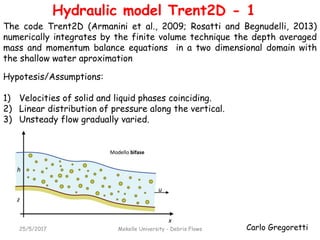
Hydraulic model Trent2D - 1
Hypotesis/Assumptions:
1) Velocities of solid and liquid phases coinciding.
2) Linear distribution of pressure along the vertical.
3) Unsteady flow gradually varied.
The code Trent2D (Armanini et al., 2009; Rosatti and Begnudelli, 2013)
numerically integrates by the finite volume technique the depth averaged
mass and momentum balance equations in a two dimensional domain with
the shallow water aproximation
Carlo Gregoretti25/5/2017 Mekelle University - Debris Flows
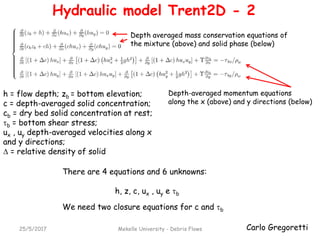
Depth averaged mass conservation equations of
the mixture (above) and solid phase (below)
Depth-averaged momentum equations
along the x (above) and y directions (below)
There are 4 equations and 6 unknowns:
h, z, c, ux , uy e b
We need two closure equations for c and b
Hydraulic model Trent2D - 2
h = flow depth; zb = bottom elevation;
c = depth-averaged solid concentration;
cb = dry bed solid concentration at rest;
b = bottom shear stress;
ux , uy depth-averaged velocities along x
and y directions;
 = relative density of solid
Carlo Gregoretti25/5/2017 Mekelle University - Debris Flows
The linear concentration  depends on c. The quantities Y and D are the
two parameters of TRENT2D and rule the flow resistance of the mixture.
They vary in the following range:
The bottom shear stress is obtained through the rheological law proposed
by Bagnold (1954) for the grain-inertial regime.
15  Y  25 e 30  D  40°
Closure equation for the bottom shear stress
Hydraulic model Trent2D - 3
 = 1/[(cb/ c) 1/3 – 1];
Y = h/(d a 1/3);
D = dynamic friction angle;
a = constant of the collisional shear stress
expression provided by Bagnold (1954).
Carlo Gregoretti25/5/2017 Mekelle University - Debris Flows
The solid concentration is computed by means of a transport capacity
equation:
Closure equation for the solid concentration
 = transport dimensionless parameter
The parameter  is computed by the code according to the following
equation depending on the two parameters, Y and D, theoretically valid
only in uniform flow conditions:
transport capacity:
solid concentration or discharge
in uniform flow conditions
Hydraulic model Trent2D - 4
 = 1/[(cb/ c) 1/3 – 1]; Y = h/(d a 1/3); D = dynamic friction angle; ib = bed slope; cb =
dry bed solid concentration at rest; a = constant of the collisional shear stress
expression provided by Bagnold (1954);  = (s - w)/w.
Carlo Gregoretti25/5/2017 Mekelle University - Debris Flows
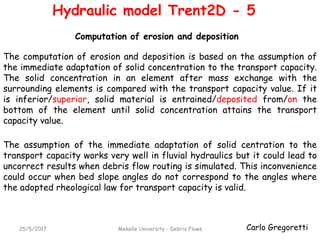
The computation of erosion and deposition is based on the assumption of
the immediate adaptation of solid concentration to the transport capacity.
The solid concentration in an element after mass exchange with the
surrounding elements is compared with the transport capacity value. If it
is inferior/superior, solid material is entrained/deposited from/on the
bottom of the element until solid concentration attains the transport
capacity value.
Computation of erosion and deposition
Hydraulic model Trent2D - 5
The assumption of the immediate adaptation of solid centration to the
transport capacity works very well in fluvial hydraulics but it could lead to
uncorrect results when debris flow routing is simulated. This inconvenience
could occur when bed slope angles do not correspond to the angles where
the adopted rheological law for transport capacity is valid.
Carlo Gregoretti
Cell models
25/5/2017 Mekelle University - Debris Flows
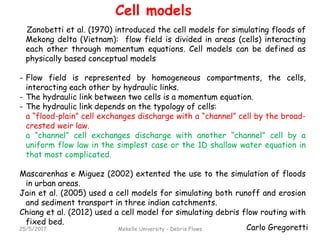
Zanobetti et al. (1970) introduced the cell models for simulating floods of
Mekong delta (Vietnam): flow field is divided in areas (cells) interacting
each other through momentum equations. Cell models can be defined as
physically based conceptual models
- Flow field is represented by homogeneous compartments, the cells,
interacting each other by hydraulic links.
- The hydraulic link between two cells is a momentum equation.
- The hydraulic link depends on the typology of cells:
a “flood-plain” cell exchanges discharge with a “channel” cell by the broad-
crested weir law.
a “channel” cell exchanges discharge with another “channel” cell by a
uniform flow law in the simplest case or the 1D shallow water equation in
that most complicated.
Mascarenhas e Miguez (2002) extented the use to the simulation of floods
in urban areas.
Jain et al. (2005) used a cell models for simulating both runoff and erosion
and sediment transport in three indian catchments.
Chiang et al. (2012) used a cell model for simulating debris flow routing with
fixed bed.
Carlo Gregoretti
Cell model for debris flow - 1
25/5/2017 Mekelle University - Debris Flows
• Flow pattern is discretized through the cells of the DEM (digital
elevation model).
• Bi-phasic continuum hypothesis
• Each cell is linked to those (8) surrounding it
• Two hydraulic links are assumed to connect a cell with those
surrounding it, depending on the surface and bottom gradients:
Uniform and weir flow equations
Carlo Gregoretti25/5/2017 Mekelle University - Debris Flows
h
h
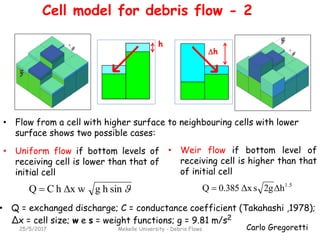
• Q = exchanged discharge; C = conductance coefficient (Takahashi ,1978);
∆x = cell size; w e s = weight functions; g = 9.81 m/s2
• Weir flow if bottom level of
receiving cell is higher than that
of initial cell
sinhgx whCQ 
• Uniform flow if bottom levels of
receiving cell is lower than that of
initial cell
1.5
h2gsΔx0.385Q 
• Flow from a cell with higher surface to neighbouring cells with lower
surface shows two possible cases:
Cell model for debris flow - 2
Carlo Gregoretti25/5/2017 Mekelle University - Debris Flows
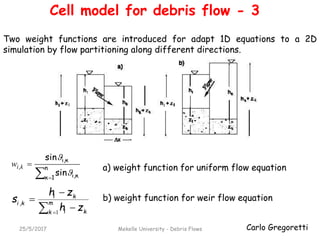
 
 n
1κ κι,
κι,
,
sin
sin


kiw a) weight function for uniform flow equation
b) weight function for weir flow equation
 


 m
k ki
ki
ki
zh
zh
s
1
,
Two weight functions are introduced for adapt 1D equations to a 2D
simulation by flow partitioning along different directions.
Cell model for debris flow - 3
Carlo Gregoretti
0Q
dt
z)d(h
A
8
1k k 

 
0cQ
dt
ch)zd(c
A
8
1k k
*


 
1.5
kkk )z(h2gsΔx0.385Q 
kkk sinhgΔx whCQ  kzz 
kzz 
b
i
dt
dz

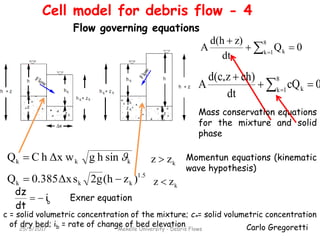
Mass conservation equations
for the mixture and solid
phase
Momentun equations (kinematic
wave hypothesis)
Exner equation
c = solid volumetric concentration of the mixture; c*= solid volumetric concentration
of dry bed; ib = rate of change of bed elevation
25/5/2017 Mekelle University - Debris Flows
Cell model for debris flow - 4
Flow governing equations
Carlo Gregoretti25/5/2017 Mekelle University - Debris Flows
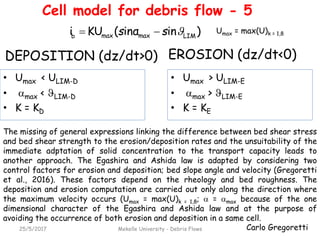
EROSION (dz/dt<0)
• Umax < ULIM-D
• max < LIM-D
• K = KD
DEPOSITION (dz/dt>0)
The missing of general expressions linking the difference between bed shear stress
and bed shear strength to the erosion/deposition rates and the unsuitability of the
immediate adptation of solid concentration to the transport capacity leads to
another approach. The Egashira and Ashida law is adapted by considering two
control factors for erosion and deposition; bed slope angle and velocity (Gregoretti
et al., 2016). These factors depend on the rheology and bed roughness. The
deposition and erosion computation are carried out only along the direction where
the maximum velocity occurs (Umax = max(U)k = 1,8;  = max because of the one
dimensional character of the Egashira and Ashida law and at the purpose of
avoiding the occurrence of both erosion and deposition in a same cell.
)ininα(KUi LIMmaxmaxb
ss 
• Umax > ULIM-E
• max > LIM-E
• K = KE
Umax = max(U)k = 1,8
Cell model for debris flow - 5
Carlo Gregoretti
25/5/2017 Mekelle University - Debris Flows
i
k
sinhgwΔxhCQ iiki, 
1.5
1ki1ki, )z(h2gsΔx0.385Q  
K+1
Δx
 

8
1k kiib QAi
dt
dh
A ,,
tQ
A
ihh k
t
ki
i
t
ib
t
i
tt
i 





  
 8
1
1
,,
A = ∆x2
)(senUKi DE,ki,DE,ib,  
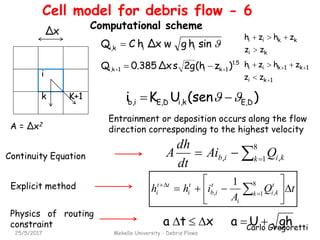
Continuity Equation
Explicit method
ghUaxta 
Physics of routing
constraint
kkii zhzh 
1k1kii zhzh  
ki zz 
1ki zz 
Entrainment or deposition occurs along the flow
direction corresponding to the highest velocity
Cell model for debris flow - 6
Computational scheme
Carlo Gregoretti25/5/2017 Mekelle University - Debris Flows
Cell model for debris flow - 6
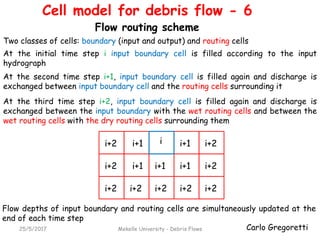
Two classes of cells: boundary (input and output) and routing cells
ii+1
i+1 i+1
i+1
i+1
i+2 i+2
i+2
At the initial time step i input boundary cell is filled according to the input
hydrograph
At the second time step i+1, input boundary cell is filled again and discharge is
exchanged between input boundary cell and the routing cells surrounding it
At the third time step i+2, input boundary cell is filled again and discharge is
exchanged between the input boundary with the wet routing cells and between the
wet routing cells with the dry routing cells surrounding them
i+2i+2i+2
i+2
i+2 i+2
Flow depths of input boundary and routing cells are simultaneously updated at the
end of each time step
Flow routing scheme
Carlo Gregoretti25/5/2017 Mekelle University - Debris Flows
Inconveniences due to unreliability of models -1
The reliability of an hydraulic model depends on its capability
of simulating both routing and erosion/depositional processes.
This depends both on the adopted rheological law for
estimating flow resistance and on the mechanism used for
simulating both erosion and depositional processes. If
rheological law or the mechanism for simulating the erosion
and depositional processes are not physically suitable the
simulations lead to uncorrect results.
Carlo Gregoretti25/5/2017 Mekelle University - Debris Flows
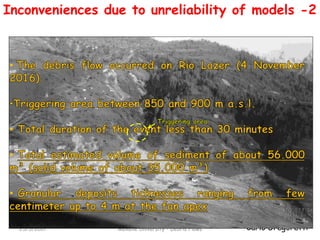
•
•
•
•
Inconveniences due to unreliability of models -2
Carlo Gregoretti25/5/2017 Mekelle University - Debris Flows
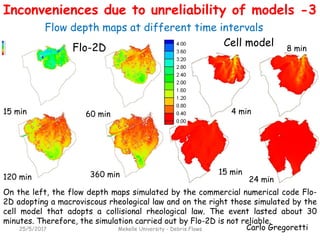
15 min 60 min
120 min 360 min
8 min
4 min
24 min
15 min
Flo-2D Cell model
Flow depth maps at different time intervals
On the left, the flow depth maps simulated by the commercial numerical code Flo-
2D adopting a macroviscous rheological law and on the right those simulated by the
cell model that adopts a collisional rheological law. The event lasted about 30
minutes. Therefore, the simulation carried out by Flo-2D is not reliable.
Inconveniences due to unreliability of models -3
Carlo Gregoretti25/5/2017 Mekelle University - Debris Flows
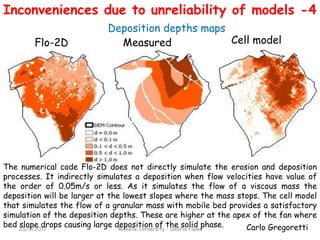
Flo-2D Cell model
Deposition depths maps
The numerical code Flo-2D does not directly simulate the erosion and deposition
processes. It indirectly simulates a deposition when flow velocities have value of
the order of 0.05m/s or less. As it simulates the flow of a viscous mass the
deposition will be larger at the lowest slopes where the mass stops. The cell model
that simulates the flow of a granular mass with mobile bed provides a satisfactory
simulation of the deposition depths. These are higher at the apex of the fan where
bed slope drops causing large deposition of the solid phase.
Measured
Inconveniences due to unreliability of models -4
Carlo Gregoretti25/5/2017 Mekelle University - Debris Flows
DFEM model
Deposition maps
The HB model (French) that adopts the Herschel-Bulkeley rheological law
simulates the deposition depths with the opposite behaviour of those
observed (they increase downstream instead of decreasing) while the
DFEM (Switzerland) that adopts the Voelmy law (granular-inertial type)
coupled with a frictional law (Coulombian type) close to the bottom
simulates larger deposition depths also in the upper part.
MeasuredHB model
Inconveniences due to unreliability of models -5
Carlo Gregoretti25/5/2017 Mekelle University - Debris Flows
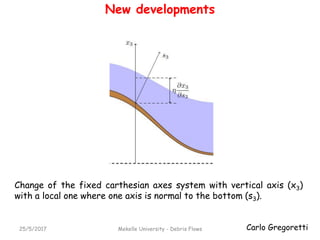
New developments
Change of the fixed carthesian axes system with vertical axis (x3)
with a local one where one axis is normal to the bottom (s3).
Carlo Gregoretti25/5/2017 Mekelle University - Debris Flows
References
Armanini, A., , Fraccarollo, L., and Rosatti, G., (2009). Two-dimensional simulation of debris
flows in erodible channels. Computers and Geosciences. 35(5), 993 – 1006
Chiang, S.H., Chang, K.T., Mondini, A.C., Tsai, B.W., Chen, C.Y., 2012. Simulation of event-based
landslides and debris flows at watershed level. Geomorphology. 138, 306-318
.
.Gregoretti, C., M. Degetto and M. Boreggio (2016) GIS-based cell model for simulating debris
flow runout on a fan Journal of Hydrology, 534, 326-340, doi:10.1016/j.jhydrol.2015.12.054
Jain, M.K., Kothyari, U.C., Ranga Raju, K.G., 2005. GIS based distributed model for soil erosion
and rate of sediment outflow fromcatchments. Journal of Hydraulic Engineering. ASCE. 131,
9, 755-769.
Mascarenhas, F.C.B., Miguez, M.G., 2002. Urban flood control through a mathematical cell
model. Water International IWRA. 27(2),208-218.
Rickenmann, D., Laigle, D., McArdell, B.W., Hubl, J. 2006. Comparison of 2D debris-flow
simulation models with field events. Computational Geosciences. 10., 2, 241-264
Rosatti, G., Begnudelli L. 2013. Two dimensional simulations of debris flows over mobile beds:
Enhancing the TRENT2D model by using a well-balanced generalized Roe-type solver.
Computers and Fluids. 71, 179-185, doi10.1016/j.compfluid2012.10.006
Zanobetti, D., Lorgere, H., Preissman A., Cunge, J.A. 1970. Mekong Delta mathematical
program construction. Journal of Waterways and Harbour Division ASCE. 96(2), 181-199

08 modelli idraulici_colata_en

  • 1.
    Carlo Gregoretti25/5/2017 MekelleUniversity - Debris Flows Models for simulating routing and/or deposition of a debris flow
  • 2.
    Carlo Gregoretti25/5/2017 MekelleUniversity - Debris Flows Overview of models Model based on the numerical integration of the depth- averaged mass and momentum balance in a two dimensional domain Empirical-statistical model of the inundated areas Cellular automata model Cell model  SPH model SPH (Smooth Particle Hydrodynamics) 5 typologies Only the model based on the numerical integration of the 2D flow governing equations and the cell model will be detailed presented.
  • 3.
    Carlo Gregoretti25/5/2017 MekelleUniversity - Debris Flows Hydraulic model Trent2D - 1 Hypotesis/Assumptions: 1) Velocities of solid and liquid phases coinciding. 2) Linear distribution of pressure along the vertical. 3) Unsteady flow gradually varied. The code Trent2D (Armanini et al., 2009; Rosatti and Begnudelli, 2013) numerically integrates by the finite volume technique the depth averaged mass and momentum balance equations in a two dimensional domain with the shallow water aproximation
  • 4.
    Carlo Gregoretti25/5/2017 MekelleUniversity - Debris Flows Depth averaged mass conservation equations of the mixture (above) and solid phase (below) Depth-averaged momentum equations along the x (above) and y directions (below) There are 4 equations and 6 unknowns: h, z, c, ux , uy e b We need two closure equations for c and b Hydraulic model Trent2D - 2 h = flow depth; zb = bottom elevation; c = depth-averaged solid concentration; cb = dry bed solid concentration at rest; b = bottom shear stress; ux , uy depth-averaged velocities along x and y directions;  = relative density of solid
  • 5.
    Carlo Gregoretti25/5/2017 MekelleUniversity - Debris Flows The linear concentration  depends on c. The quantities Y and D are the two parameters of TRENT2D and rule the flow resistance of the mixture. They vary in the following range: The bottom shear stress is obtained through the rheological law proposed by Bagnold (1954) for the grain-inertial regime. 15  Y  25 e 30  D  40° Closure equation for the bottom shear stress Hydraulic model Trent2D - 3  = 1/[(cb/ c) 1/3 – 1]; Y = h/(d a 1/3); D = dynamic friction angle; a = constant of the collisional shear stress expression provided by Bagnold (1954).
  • 6.
    Carlo Gregoretti25/5/2017 MekelleUniversity - Debris Flows The solid concentration is computed by means of a transport capacity equation: Closure equation for the solid concentration  = transport dimensionless parameter The parameter  is computed by the code according to the following equation depending on the two parameters, Y and D, theoretically valid only in uniform flow conditions: transport capacity: solid concentration or discharge in uniform flow conditions Hydraulic model Trent2D - 4  = 1/[(cb/ c) 1/3 – 1]; Y = h/(d a 1/3); D = dynamic friction angle; ib = bed slope; cb = dry bed solid concentration at rest; a = constant of the collisional shear stress expression provided by Bagnold (1954);  = (s - w)/w.
  • 7.
    Carlo Gregoretti25/5/2017 MekelleUniversity - Debris Flows The computation of erosion and deposition is based on the assumption of the immediate adaptation of solid concentration to the transport capacity. The solid concentration in an element after mass exchange with the surrounding elements is compared with the transport capacity value. If it is inferior/superior, solid material is entrained/deposited from/on the bottom of the element until solid concentration attains the transport capacity value. Computation of erosion and deposition Hydraulic model Trent2D - 5 The assumption of the immediate adaptation of solid centration to the transport capacity works very well in fluvial hydraulics but it could lead to uncorrect results when debris flow routing is simulated. This inconvenience could occur when bed slope angles do not correspond to the angles where the adopted rheological law for transport capacity is valid.
  • 8.
    Carlo Gregoretti Cell models 25/5/2017Mekelle University - Debris Flows Zanobetti et al. (1970) introduced the cell models for simulating floods of Mekong delta (Vietnam): flow field is divided in areas (cells) interacting each other through momentum equations. Cell models can be defined as physically based conceptual models - Flow field is represented by homogeneous compartments, the cells, interacting each other by hydraulic links. - The hydraulic link between two cells is a momentum equation. - The hydraulic link depends on the typology of cells: a “flood-plain” cell exchanges discharge with a “channel” cell by the broad- crested weir law. a “channel” cell exchanges discharge with another “channel” cell by a uniform flow law in the simplest case or the 1D shallow water equation in that most complicated. Mascarenhas e Miguez (2002) extented the use to the simulation of floods in urban areas. Jain et al. (2005) used a cell models for simulating both runoff and erosion and sediment transport in three indian catchments. Chiang et al. (2012) used a cell model for simulating debris flow routing with fixed bed.
  • 9.
    Carlo Gregoretti Cell modelfor debris flow - 1 25/5/2017 Mekelle University - Debris Flows • Flow pattern is discretized through the cells of the DEM (digital elevation model). • Bi-phasic continuum hypothesis • Each cell is linked to those (8) surrounding it • Two hydraulic links are assumed to connect a cell with those surrounding it, depending on the surface and bottom gradients: Uniform and weir flow equations
  • 10.
    Carlo Gregoretti25/5/2017 MekelleUniversity - Debris Flows h h • Q = exchanged discharge; C = conductance coefficient (Takahashi ,1978); ∆x = cell size; w e s = weight functions; g = 9.81 m/s2 • Weir flow if bottom level of receiving cell is higher than that of initial cell sinhgx whCQ  • Uniform flow if bottom levels of receiving cell is lower than that of initial cell 1.5 h2gsΔx0.385Q  • Flow from a cell with higher surface to neighbouring cells with lower surface shows two possible cases: Cell model for debris flow - 2
  • 11.
    Carlo Gregoretti25/5/2017 MekelleUniversity - Debris Flows    n 1κ κι, κι, , sin sin   kiw a) weight function for uniform flow equation b) weight function for weir flow equation      m k ki ki ki zh zh s 1 , Two weight functions are introduced for adapt 1D equations to a 2D simulation by flow partitioning along different directions. Cell model for debris flow - 3
  • 12.
    Carlo Gregoretti 0Q dt z)d(h A 8 1k k    0cQ dt ch)zd(c A 8 1k k *     1.5 kkk )z(h2gsΔx0.385Q  kkk sinhgΔx whCQ  kzz  kzz  b i dt dz  Mass conservation equations for the mixture and solid phase Momentun equations (kinematic wave hypothesis) Exner equation c = solid volumetric concentration of the mixture; c*= solid volumetric concentration of dry bed; ib = rate of change of bed elevation 25/5/2017 Mekelle University - Debris Flows Cell model for debris flow - 4 Flow governing equations
  • 13.
    Carlo Gregoretti25/5/2017 MekelleUniversity - Debris Flows EROSION (dz/dt<0) • Umax < ULIM-D • max < LIM-D • K = KD DEPOSITION (dz/dt>0) The missing of general expressions linking the difference between bed shear stress and bed shear strength to the erosion/deposition rates and the unsuitability of the immediate adptation of solid concentration to the transport capacity leads to another approach. The Egashira and Ashida law is adapted by considering two control factors for erosion and deposition; bed slope angle and velocity (Gregoretti et al., 2016). These factors depend on the rheology and bed roughness. The deposition and erosion computation are carried out only along the direction where the maximum velocity occurs (Umax = max(U)k = 1,8;  = max because of the one dimensional character of the Egashira and Ashida law and at the purpose of avoiding the occurrence of both erosion and deposition in a same cell. )ininα(KUi LIMmaxmaxb ss  • Umax > ULIM-E • max > LIM-E • K = KE Umax = max(U)k = 1,8 Cell model for debris flow - 5
  • 14.
    Carlo Gregoretti 25/5/2017 MekelleUniversity - Debris Flows i k sinhgwΔxhCQ iiki,  1.5 1ki1ki, )z(h2gsΔx0.385Q   K+1 Δx    8 1k kiib QAi dt dh A ,, tQ A ihh k t ki i t ib t i tt i           8 1 1 ,, A = ∆x2 )(senUKi DE,ki,DE,ib,   Continuity Equation Explicit method ghUaxta  Physics of routing constraint kkii zhzh  1k1kii zhzh   ki zz  1ki zz  Entrainment or deposition occurs along the flow direction corresponding to the highest velocity Cell model for debris flow - 6 Computational scheme
  • 15.
    Carlo Gregoretti25/5/2017 MekelleUniversity - Debris Flows Cell model for debris flow - 6 Two classes of cells: boundary (input and output) and routing cells ii+1 i+1 i+1 i+1 i+1 i+2 i+2 i+2 At the initial time step i input boundary cell is filled according to the input hydrograph At the second time step i+1, input boundary cell is filled again and discharge is exchanged between input boundary cell and the routing cells surrounding it At the third time step i+2, input boundary cell is filled again and discharge is exchanged between the input boundary with the wet routing cells and between the wet routing cells with the dry routing cells surrounding them i+2i+2i+2 i+2 i+2 i+2 Flow depths of input boundary and routing cells are simultaneously updated at the end of each time step Flow routing scheme
  • 16.
    Carlo Gregoretti25/5/2017 MekelleUniversity - Debris Flows Inconveniences due to unreliability of models -1 The reliability of an hydraulic model depends on its capability of simulating both routing and erosion/depositional processes. This depends both on the adopted rheological law for estimating flow resistance and on the mechanism used for simulating both erosion and depositional processes. If rheological law or the mechanism for simulating the erosion and depositional processes are not physically suitable the simulations lead to uncorrect results.
  • 17.
    Carlo Gregoretti25/5/2017 MekelleUniversity - Debris Flows • • • • Inconveniences due to unreliability of models -2
  • 18.
    Carlo Gregoretti25/5/2017 MekelleUniversity - Debris Flows 15 min 60 min 120 min 360 min 8 min 4 min 24 min 15 min Flo-2D Cell model Flow depth maps at different time intervals On the left, the flow depth maps simulated by the commercial numerical code Flo- 2D adopting a macroviscous rheological law and on the right those simulated by the cell model that adopts a collisional rheological law. The event lasted about 30 minutes. Therefore, the simulation carried out by Flo-2D is not reliable. Inconveniences due to unreliability of models -3
  • 19.
    Carlo Gregoretti25/5/2017 MekelleUniversity - Debris Flows Flo-2D Cell model Deposition depths maps The numerical code Flo-2D does not directly simulate the erosion and deposition processes. It indirectly simulates a deposition when flow velocities have value of the order of 0.05m/s or less. As it simulates the flow of a viscous mass the deposition will be larger at the lowest slopes where the mass stops. The cell model that simulates the flow of a granular mass with mobile bed provides a satisfactory simulation of the deposition depths. These are higher at the apex of the fan where bed slope drops causing large deposition of the solid phase. Measured Inconveniences due to unreliability of models -4
  • 20.
    Carlo Gregoretti25/5/2017 MekelleUniversity - Debris Flows DFEM model Deposition maps The HB model (French) that adopts the Herschel-Bulkeley rheological law simulates the deposition depths with the opposite behaviour of those observed (they increase downstream instead of decreasing) while the DFEM (Switzerland) that adopts the Voelmy law (granular-inertial type) coupled with a frictional law (Coulombian type) close to the bottom simulates larger deposition depths also in the upper part. MeasuredHB model Inconveniences due to unreliability of models -5
  • 21.
    Carlo Gregoretti25/5/2017 MekelleUniversity - Debris Flows New developments Change of the fixed carthesian axes system with vertical axis (x3) with a local one where one axis is normal to the bottom (s3).
  • 22.
    Carlo Gregoretti25/5/2017 MekelleUniversity - Debris Flows References Armanini, A., , Fraccarollo, L., and Rosatti, G., (2009). Two-dimensional simulation of debris flows in erodible channels. Computers and Geosciences. 35(5), 993 – 1006 Chiang, S.H., Chang, K.T., Mondini, A.C., Tsai, B.W., Chen, C.Y., 2012. Simulation of event-based landslides and debris flows at watershed level. Geomorphology. 138, 306-318 . .Gregoretti, C., M. Degetto and M. Boreggio (2016) GIS-based cell model for simulating debris flow runout on a fan Journal of Hydrology, 534, 326-340, doi:10.1016/j.jhydrol.2015.12.054 Jain, M.K., Kothyari, U.C., Ranga Raju, K.G., 2005. GIS based distributed model for soil erosion and rate of sediment outflow fromcatchments. Journal of Hydraulic Engineering. ASCE. 131, 9, 755-769. Mascarenhas, F.C.B., Miguez, M.G., 2002. Urban flood control through a mathematical cell model. Water International IWRA. 27(2),208-218. Rickenmann, D., Laigle, D., McArdell, B.W., Hubl, J. 2006. Comparison of 2D debris-flow simulation models with field events. Computational Geosciences. 10., 2, 241-264 Rosatti, G., Begnudelli L. 2013. Two dimensional simulations of debris flows over mobile beds: Enhancing the TRENT2D model by using a well-balanced generalized Roe-type solver. Computers and Fluids. 71, 179-185, doi10.1016/j.compfluid2012.10.006 Zanobetti, D., Lorgere, H., Preissman A., Cunge, J.A. 1970. Mekong Delta mathematical program construction. Journal of Waterways and Harbour Division ASCE. 96(2), 181-199