Chapter 6 Objects and Classes
OO Programming Concepts
Creating Objects and Object Reference Variables
– Differences between primitive data type and object type
– Automatic garbage collection
Constructors
Modifiers (public, private and static)
Instance and Class Variables and Methods
Scope of Variables
Use the this Keyword
Case Studies (Mortgage class and Count class)
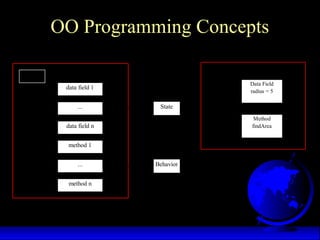
OO Programming Concepts
data field 1
method n
data field n
method 1
An object
...
...
State
Behavior
Data Field
radius = 5
Method
findArea
A Circle object
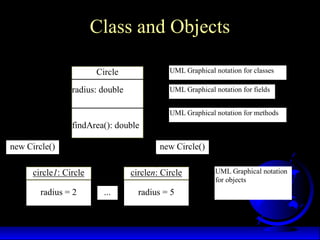
Class and Objects
circle1: Circle
radius = 2
new Circle()
circlen: Circle
radius = 5
new Circle()
...
UML Graphical notation for classes
UML Graphical notation
for objects
Circle
radius: double
findArea(): double
UML Graphical notation for fields
UML Graphical notation for methods
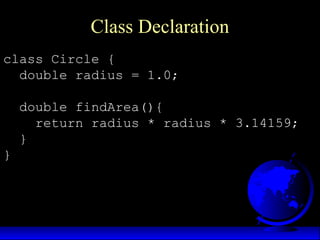
Class Declaration
class Circle {
double radius = 1.0;
double findArea(){
return radius * radius * 3.14159;
}
}
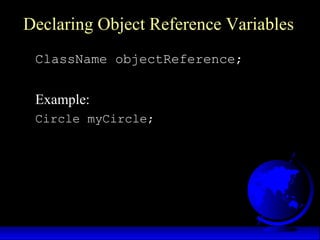
Declaring Object Reference Variables
ClassName objectReference;
Example:
Circle myCircle;
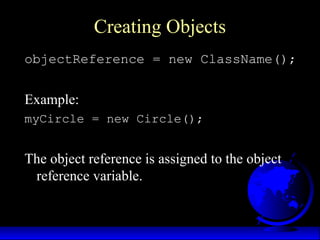
Creating Objects
objectReference = new ClassName();
Example:
myCircle = new Circle();
The object reference is assigned to the object
reference variable.
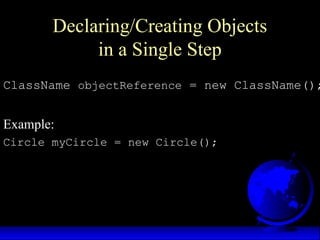
Declaring/Creating Objects
in a Single Step
ClassName objectReference = new ClassName();
Example:
Circle myCircle = new Circle();
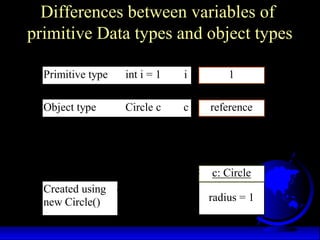
Differences between variables of
primitive Data types and object types
1
c: Circle
radius = 1
Primitive type int i = 1 i
Object type Circle c c reference
Created using
new Circle()
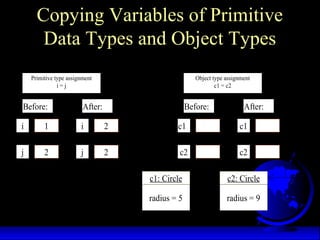
Copying Variables of Primitive
Data Types and Object Types
1
c1: Circle
radius = 5
Primitive type assignment
i = j
Before:
i
2j
2
After:
i
2j
Object type assignment
c1 = c2
Before:
c1
c2
After:
c1
c2
c2: Circle
radius = 9
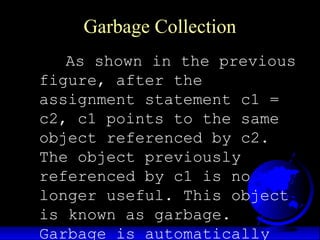
Garbage Collection
As shown in the previous
figure, after the
assignment statement c1 =
c2, c1 points to the same
object referenced by c2.
The object previously
referenced by c1 is no
longer useful. This object
is known as garbage.
Garbage is automatically
Garbage Collection, cont
TIP: If you know that an
object is no longer needed,
you can explicitly assign
null to a reference
variable for the object.
The Java VM will
automatically collect the
space if the object is not
referenced by any variable.
Accessing Objects
Referencing the object’s data:
objectReference.data
myCircle.radius
Invoking the object’s method:
objectReference.method
myCircle.findArea()
Example 6.1 Using Objects
Objective: Demonstrate creating objects,
accessing data, and using methods.
TestCircleTestCircle RunRun
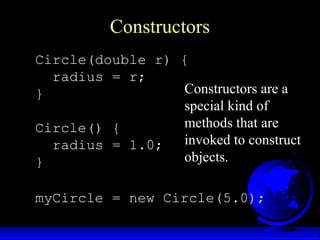
Constructors
Circle(double r) {
radius = r;
}
Circle() {
radius = 1.0;
}
myCircle = new Circle(5.0);
Constructors are a
special kind of
methods that are
invoked to construct
objects.
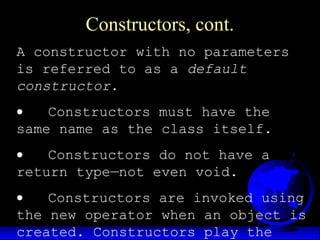
Constructors, cont.
A constructor with no parameters
is referred to as a default
constructor.
• Constructors must have the
same name as the class itself.
• Constructors do not have a
return type—not even void.
• Constructors are invoked using
the new operator when an object is
created. Constructors play the
Example 6.2 Using Classes from
the Java Library
Objective: Demonstrate using classes from the
Java library. Use the JFrame class in
the javax.swing package to
create two frames; use the
methods in the JFrame class to
set the title, size and location
of the frames and to display the
frames. TestFrameTestFrame RunRun
Example 6.3 Using Constructors
Objective: Demonstrate the role of
constructors and use them to create
objects.
TestCircleWithConstructorsTestCircleWithConstructors RunRun
Visibility Modifiers and
Accessor Methods
By default, the class, variable, or data can be
accessed by any class in the same package.
public
The class, data, or method is visible to any class in any
package.
private
The data or methods can be accessed only by the declaring
class.
The get and set methods are used to read and modify private
properties.
Example 6.4
Using the private Modifier
and Accessor Methods
TestCircleWithAccessorsTestCircleWithAccessors RunRun
In this example, private data are used for the radius
and the accessor methods getRadius and setRadius
are provided for the clients to retrieve and modify
the radius.
Passing Objects to Methods
Passing by value (the value is the reference
to the object)
Example 6.5 Passing Objects as Arguments
TestPassingObjectTestPassingObject RunRun
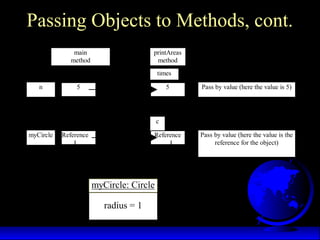
Passing Objects to Methods, cont.
main
method
ReferencemyCircle
5n 5
times
printAreas
method
Reference
c
myCircle: Circle
radius = 1
Pass by value (here the value is 5)
Pass by value (here the value is the
reference for the object)
Instance
Variables, and Methods
Instance variables belong to a specific instance.
Instance methods are invoked by an instance of
the class.
Class Variables, Constants,
and Methods
Class variables are shared by all the instances of the
class.
Class methods are not tied to a specific object.
Class constants are final variables shared by all the
instances of the class.
Class Variables, Constants,
and Methods, cont.
To declare class variables, constants, and methods,
use the static modifier.
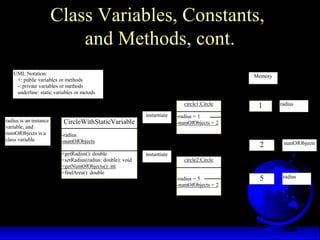
Class Variables, Constants,
and Methods, cont.
CircleWithStaticVariable
-radius
-numOfObjects
+getRadius(): double
+setRadius(radius: double): void
+getNumOfObjects(): int
+findArea(): double
1 radiuscircle1:Circle
-radius = 1
-numOfObjects = 2
instantiate
instantiate
Memory
2
5 radius
numOfObjects
radius is an instance
variable, and
numOfObjects is a
class variable
UML Notation:
+: public variables or methods
-: private variables or methods
underline: static variables or metods
circle2:Circle
-radius = 5
-numOfObjects = 2
Example 6.6
Using Instance and Class Variables
and Method
Objective: Demonstrate the roles of
instance and class variables and their
uses. This example adds a class variable
numOfObjects to track the number of
Circle objects created.
TestCircleWithStaticVariableTestCircleWithStaticVariable RunRun
Scope of Variables
The scope of instance and class variables is the
entire class. They can be declared anywhere inside
a class.
The scope of a local variable starts from its
declaration and continues to the end of the block
that contains the variable. A local variable must be
declared before it can be used.
The Keyword this
Use this to refer to the current object.
Use this to invoke other constructors of the
object.
Array of Objects
Circle[] circleArray = new
Circle[10];
An array of objects is
actually an array of
reference variables. So
invoking
circleArray[1].findArea()
involves two levels of
referencing as shown in the
Array of Objects, cont.
reference Circle object 0circleArray[0]
…
circleArray
circleArray[1]
circleArray[9] Circle object 9
Circle object 1
Circle[] circleArray = new
Circle[10];
Array of Objects, cont.
Example 6.7: Summarizing the areas
of the circles
TotalAreaTotalArea RunRun
Class Abstraction
Class abstraction means to separate class
implementation from the use of the class. The
creator of the class provides a description of the
class and let the user know how the class can be
used. The user of the class does not need to
know how the class is implemented. The detail
of implementation is encapsulated and hidden
from the user.
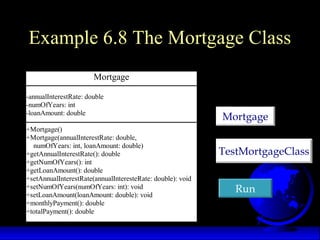
Example 6.8 The Mortgage Class
Mortgage
-annualInterestRate: double
-numOfYears: int
-loanAmount: double
+Mortgage()
+Mortgage(annualInterestRate: double,
numOfYears: int, loanAmount: double)
+getAnnualInterestRate(): double
+getNumOfYears(): int
+getLoanAmount(): double
+setAnnualInterestRate(annualInteresteRate: double): void
+setNumOfYears(numOfYears: int): void
+setLoanAmount(loanAmount: double): void
+monthlyPayment(): double
+totalPayment(): double
TestMortgageClassTestMortgageClass
RunRun
MortgageMortgage
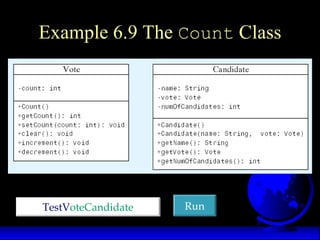
Example 6.9 The Count Class
RunRunTestVoteCandidateTestVoteCandidate
Java API and Core Java classes
java.lang
Contains core Java classes, such as numeric
classes, strings, and objects. This package is
implicitly imported to every Java program.
java.awt
Contains classes for graphics.
java.applet
Contains classes for supporting applets.
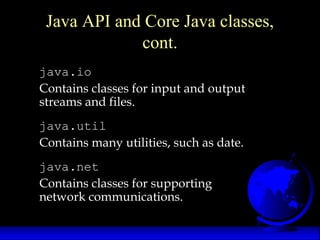
java.io
Contains classes for input and output
streams and files.
java.util
Contains many utilities, such as date.
java.net
Contains classes for supporting
network communications.
Java API and Core Java classes,
cont.
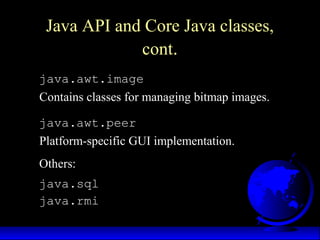
java.awt.image
Contains classes for managing bitmap images.
java.awt.peer
Platform-specific GUI implementation.
Others:
java.sql
java.rmi
Java API and Core Java classes,
cont.

06slide

  • 1.
    Chapter 6 Objectsand Classes OO Programming Concepts Creating Objects and Object Reference Variables – Differences between primitive data type and object type – Automatic garbage collection Constructors Modifiers (public, private and static) Instance and Class Variables and Methods Scope of Variables Use the this Keyword Case Studies (Mortgage class and Count class)
  • 2.
    OO Programming Concepts datafield 1 method n data field n method 1 An object ... ... State Behavior Data Field radius = 5 Method findArea A Circle object
  • 3.
    Class and Objects circle1:Circle radius = 2 new Circle() circlen: Circle radius = 5 new Circle() ... UML Graphical notation for classes UML Graphical notation for objects Circle radius: double findArea(): double UML Graphical notation for fields UML Graphical notation for methods
  • 4.
    Class Declaration class Circle{ double radius = 1.0; double findArea(){ return radius * radius * 3.14159; } }
  • 5.
    Declaring Object ReferenceVariables ClassName objectReference; Example: Circle myCircle;
  • 6.
    Creating Objects objectReference =new ClassName(); Example: myCircle = new Circle(); The object reference is assigned to the object reference variable.
  • 7.
    Declaring/Creating Objects in aSingle Step ClassName objectReference = new ClassName(); Example: Circle myCircle = new Circle();
  • 8.
    Differences between variablesof primitive Data types and object types 1 c: Circle radius = 1 Primitive type int i = 1 i Object type Circle c c reference Created using new Circle()
  • 9.
    Copying Variables ofPrimitive Data Types and Object Types 1 c1: Circle radius = 5 Primitive type assignment i = j Before: i 2j 2 After: i 2j Object type assignment c1 = c2 Before: c1 c2 After: c1 c2 c2: Circle radius = 9
  • 10.
    Garbage Collection As shownin the previous figure, after the assignment statement c1 = c2, c1 points to the same object referenced by c2. The object previously referenced by c1 is no longer useful. This object is known as garbage. Garbage is automatically
  • 11.
    Garbage Collection, cont TIP:If you know that an object is no longer needed, you can explicitly assign null to a reference variable for the object. The Java VM will automatically collect the space if the object is not referenced by any variable.
  • 12.
    Accessing Objects Referencing theobject’s data: objectReference.data myCircle.radius Invoking the object’s method: objectReference.method myCircle.findArea()
  • 13.
    Example 6.1 UsingObjects Objective: Demonstrate creating objects, accessing data, and using methods. TestCircleTestCircle RunRun
  • 14.
    Constructors Circle(double r) { radius= r; } Circle() { radius = 1.0; } myCircle = new Circle(5.0); Constructors are a special kind of methods that are invoked to construct objects.
  • 15.
    Constructors, cont. A constructorwith no parameters is referred to as a default constructor. • Constructors must have the same name as the class itself. • Constructors do not have a return type—not even void. • Constructors are invoked using the new operator when an object is created. Constructors play the
  • 16.
    Example 6.2 UsingClasses from the Java Library Objective: Demonstrate using classes from the Java library. Use the JFrame class in the javax.swing package to create two frames; use the methods in the JFrame class to set the title, size and location of the frames and to display the frames. TestFrameTestFrame RunRun
  • 17.
    Example 6.3 UsingConstructors Objective: Demonstrate the role of constructors and use them to create objects. TestCircleWithConstructorsTestCircleWithConstructors RunRun
  • 18.
    Visibility Modifiers and AccessorMethods By default, the class, variable, or data can be accessed by any class in the same package. public The class, data, or method is visible to any class in any package. private The data or methods can be accessed only by the declaring class. The get and set methods are used to read and modify private properties.
  • 19.
    Example 6.4 Using theprivate Modifier and Accessor Methods TestCircleWithAccessorsTestCircleWithAccessors RunRun In this example, private data are used for the radius and the accessor methods getRadius and setRadius are provided for the clients to retrieve and modify the radius.
  • 20.
    Passing Objects toMethods Passing by value (the value is the reference to the object) Example 6.5 Passing Objects as Arguments TestPassingObjectTestPassingObject RunRun
  • 21.
    Passing Objects toMethods, cont. main method ReferencemyCircle 5n 5 times printAreas method Reference c myCircle: Circle radius = 1 Pass by value (here the value is 5) Pass by value (here the value is the reference for the object)
  • 22.
    Instance Variables, and Methods Instancevariables belong to a specific instance. Instance methods are invoked by an instance of the class.
  • 23.
    Class Variables, Constants, andMethods Class variables are shared by all the instances of the class. Class methods are not tied to a specific object. Class constants are final variables shared by all the instances of the class.
  • 24.
    Class Variables, Constants, andMethods, cont. To declare class variables, constants, and methods, use the static modifier.
  • 25.
    Class Variables, Constants, andMethods, cont. CircleWithStaticVariable -radius -numOfObjects +getRadius(): double +setRadius(radius: double): void +getNumOfObjects(): int +findArea(): double 1 radiuscircle1:Circle -radius = 1 -numOfObjects = 2 instantiate instantiate Memory 2 5 radius numOfObjects radius is an instance variable, and numOfObjects is a class variable UML Notation: +: public variables or methods -: private variables or methods underline: static variables or metods circle2:Circle -radius = 5 -numOfObjects = 2
  • 26.
    Example 6.6 Using Instanceand Class Variables and Method Objective: Demonstrate the roles of instance and class variables and their uses. This example adds a class variable numOfObjects to track the number of Circle objects created. TestCircleWithStaticVariableTestCircleWithStaticVariable RunRun
  • 27.
    Scope of Variables Thescope of instance and class variables is the entire class. They can be declared anywhere inside a class. The scope of a local variable starts from its declaration and continues to the end of the block that contains the variable. A local variable must be declared before it can be used.
  • 28.
    The Keyword this Usethis to refer to the current object. Use this to invoke other constructors of the object.
  • 29.
    Array of Objects Circle[]circleArray = new Circle[10]; An array of objects is actually an array of reference variables. So invoking circleArray[1].findArea() involves two levels of referencing as shown in the
  • 30.
    Array of Objects,cont. reference Circle object 0circleArray[0] … circleArray circleArray[1] circleArray[9] Circle object 9 Circle object 1 Circle[] circleArray = new Circle[10];
  • 31.
    Array of Objects,cont. Example 6.7: Summarizing the areas of the circles TotalAreaTotalArea RunRun
  • 32.
    Class Abstraction Class abstractionmeans to separate class implementation from the use of the class. The creator of the class provides a description of the class and let the user know how the class can be used. The user of the class does not need to know how the class is implemented. The detail of implementation is encapsulated and hidden from the user.
  • 33.
    Example 6.8 TheMortgage Class Mortgage -annualInterestRate: double -numOfYears: int -loanAmount: double +Mortgage() +Mortgage(annualInterestRate: double, numOfYears: int, loanAmount: double) +getAnnualInterestRate(): double +getNumOfYears(): int +getLoanAmount(): double +setAnnualInterestRate(annualInteresteRate: double): void +setNumOfYears(numOfYears: int): void +setLoanAmount(loanAmount: double): void +monthlyPayment(): double +totalPayment(): double TestMortgageClassTestMortgageClass RunRun MortgageMortgage
  • 34.
    Example 6.9 TheCount Class RunRunTestVoteCandidateTestVoteCandidate
  • 35.
    Java API andCore Java classes java.lang Contains core Java classes, such as numeric classes, strings, and objects. This package is implicitly imported to every Java program. java.awt Contains classes for graphics. java.applet Contains classes for supporting applets.
  • 36.
    java.io Contains classes forinput and output streams and files. java.util Contains many utilities, such as date. java.net Contains classes for supporting network communications. Java API and Core Java classes, cont.
  • 37.
    java.awt.image Contains classes formanaging bitmap images. java.awt.peer Platform-specific GUI implementation. Others: java.sql java.rmi Java API and Core Java classes, cont.