Weather PPT PortfolioReview
Aviation Weather Research Program, A11.k
By: Danny Sims
Date: September 12, 2017
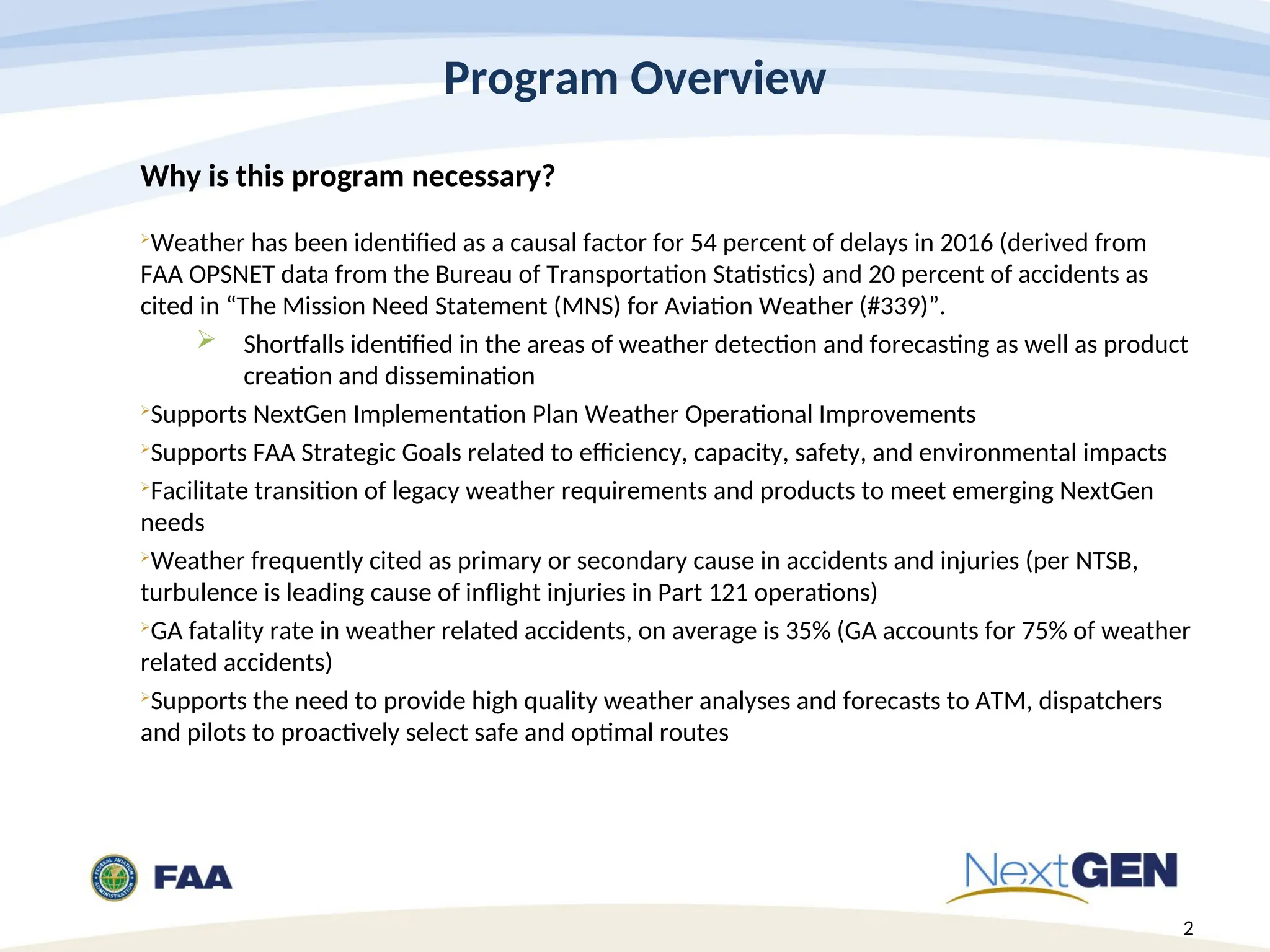
2.
Program Overview
Why isthis program necessary?
Weather has been identified as a causal factor for 54 percent of delays in 2016 (derived from
FAA OPSNET data from the Bureau of Transportation Statistics) and 20 percent of accidents as
cited in “The Mission Need Statement (MNS) for Aviation Weather (#339)”.
Shortfalls identified in the areas of weather detection and forecasting as well as product
creation and dissemination
Supports NextGen Implementation Plan Weather Operational Improvements
Supports FAA Strategic Goals related to efficiency, capacity, safety, and environmental impacts
Facilitate transition of legacy weather requirements and products to meet emerging NextGen
needs
Weather frequently cited as primary or secondary cause in accidents and injuries (per NTSB,
turbulence is leading cause of inflight injuries in Part 121 operations)
GA fatality rate in weather related accidents, on average is 35% (GA accounts for 75% of weather
related accidents)
Supports the need to provide high quality weather analyses and forecasts to ATM, dispatchers
and pilots to proactively select safe and optimal routes
2
3.
Program Overview (cont.)
Whatis this program?
Purpose
• Applied research to minimize the impact of weather on the NAS
Specific initiatives to support NextGen weather Operational Improvements
contained in the NextGen Implementation Plan
Collaborative, complimentary initiatives with NWS to transition legacy
capabilities to meet NextGen requirements
Focused initiatives to help mitigate safety and/or efficiency issues associated
with well documented weather problems
Benefits
• Increased NAS capacity/efficiency and safety and reduced environmental impacts
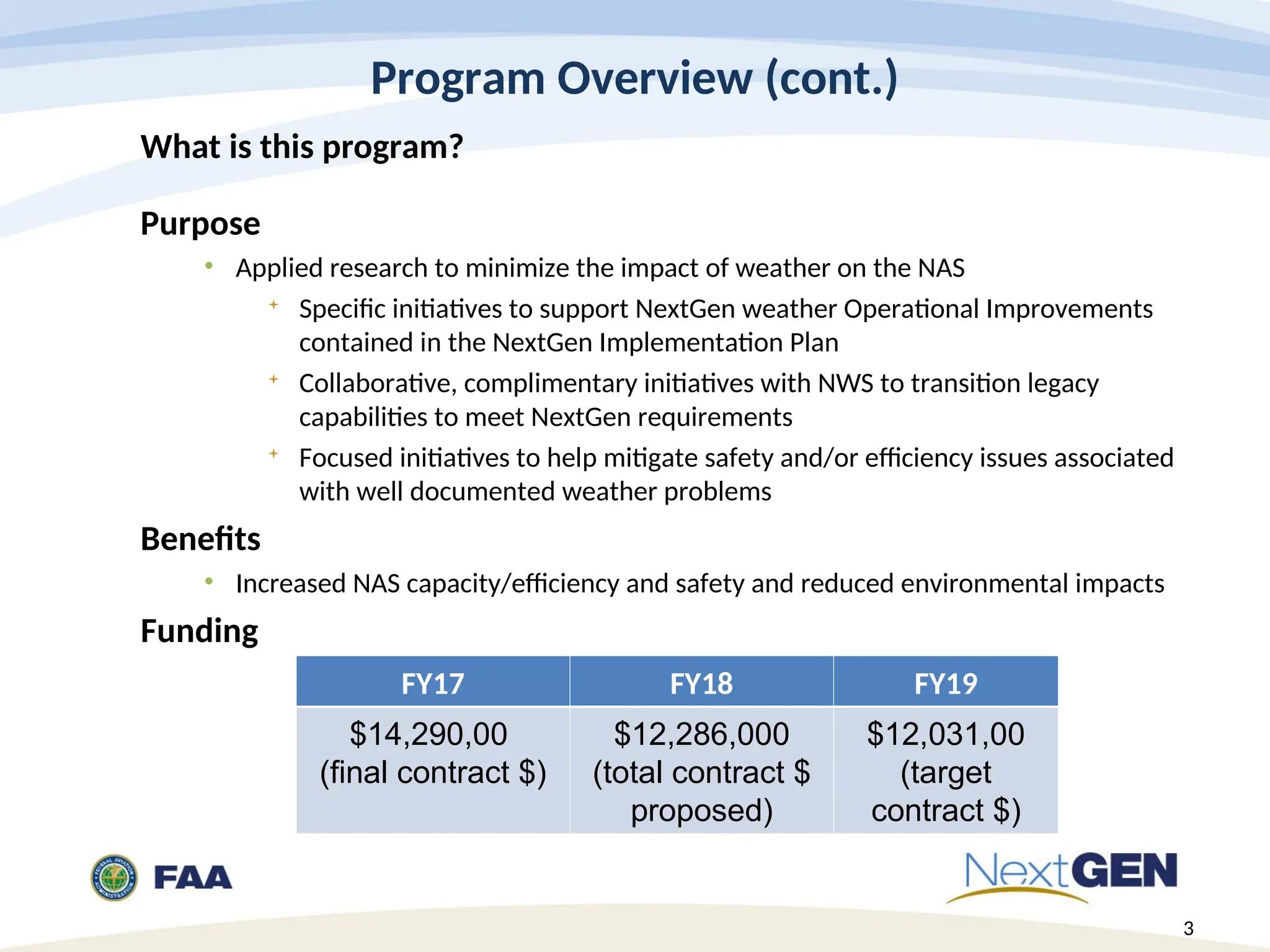
Funding
FY17 FY18 FY19
$14,290,00
(final contract $)
$12,286,000
(total contract $
proposed)
$12,031,00
(target
contract $)
3
4.
Recent Accomplishments
•Developed enhancementsto LAMP which provides
more rapid updates to C&V forecast information
over the CONUS
•Transitioned Alaska IFI forecast and diagnosis
capability to NWS Testbed
•Achieved IOC for the OPC; established interim
operations status at Houston, Miami, New York and
San Juan ATC facilities as well the FAA Command
Center
•Developed prototype deterministic global TRB
forecast capability (successfully tested in their UPP
environment)
Future Plans
• Continue collaborative research with NWS to integrate C&V
improvements into the HEMS tool, TAFs, & TRACON area
forecasts
• Transition probabilistic C&V capability into NWS operations
• Upgrade CONUS IFI forecast and analysis capability, that
contains liquid water content, drop-size distribution, and
temperature to define icing conditions residing within and
outside aircraft certification envelopes
• Integrate GOES-R satellite data into the OPC
• Begin transition to the NextGen Weather Processor of updated
blending techniques for CIWS & CoSPA to improve storm
location, timing and intensity accuracy in the 1-4 hour period
• Transfer OPC technology to USAF for global development
• Complete development of HI-Res turbulence forecast capability
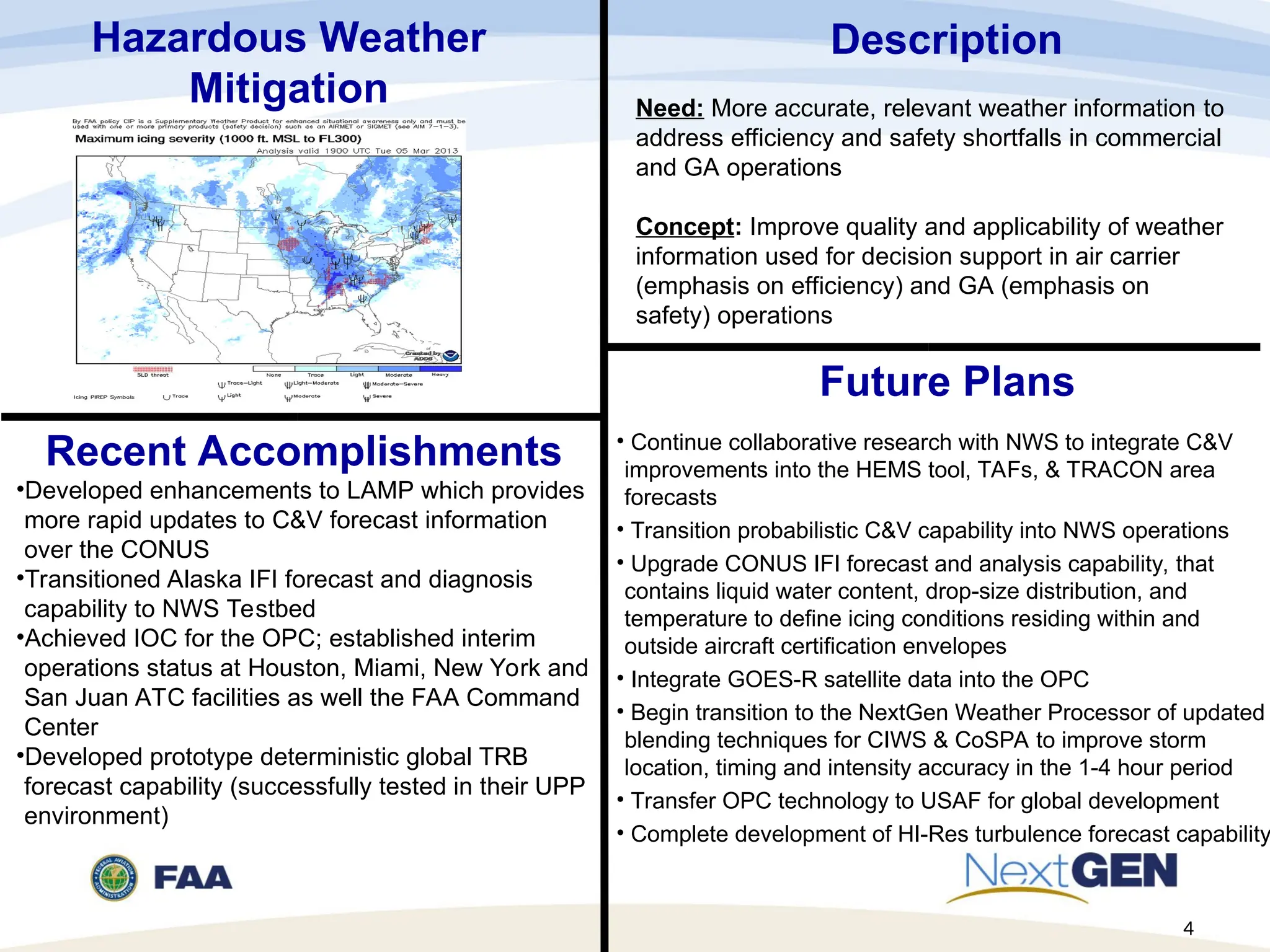
Hazardous Weather
Mitigation
Description
Need: More accurate, relevant weather information to
address efficiency and safety shortfalls in commercial
and GA operations
Concept: Improve quality and applicability of weather
information used for decision support in air carrier
(emphasis on efficiency) and GA (emphasis on
safety) operations
4
5.
Future Plans
• Implementexisting image processing technology to
estimate the visibility at a sub-set of FAA Alaska
weather cameras and explore the utility of the
information displayed directly on the weather camera
website (AvCamsPlus.faa.gov)
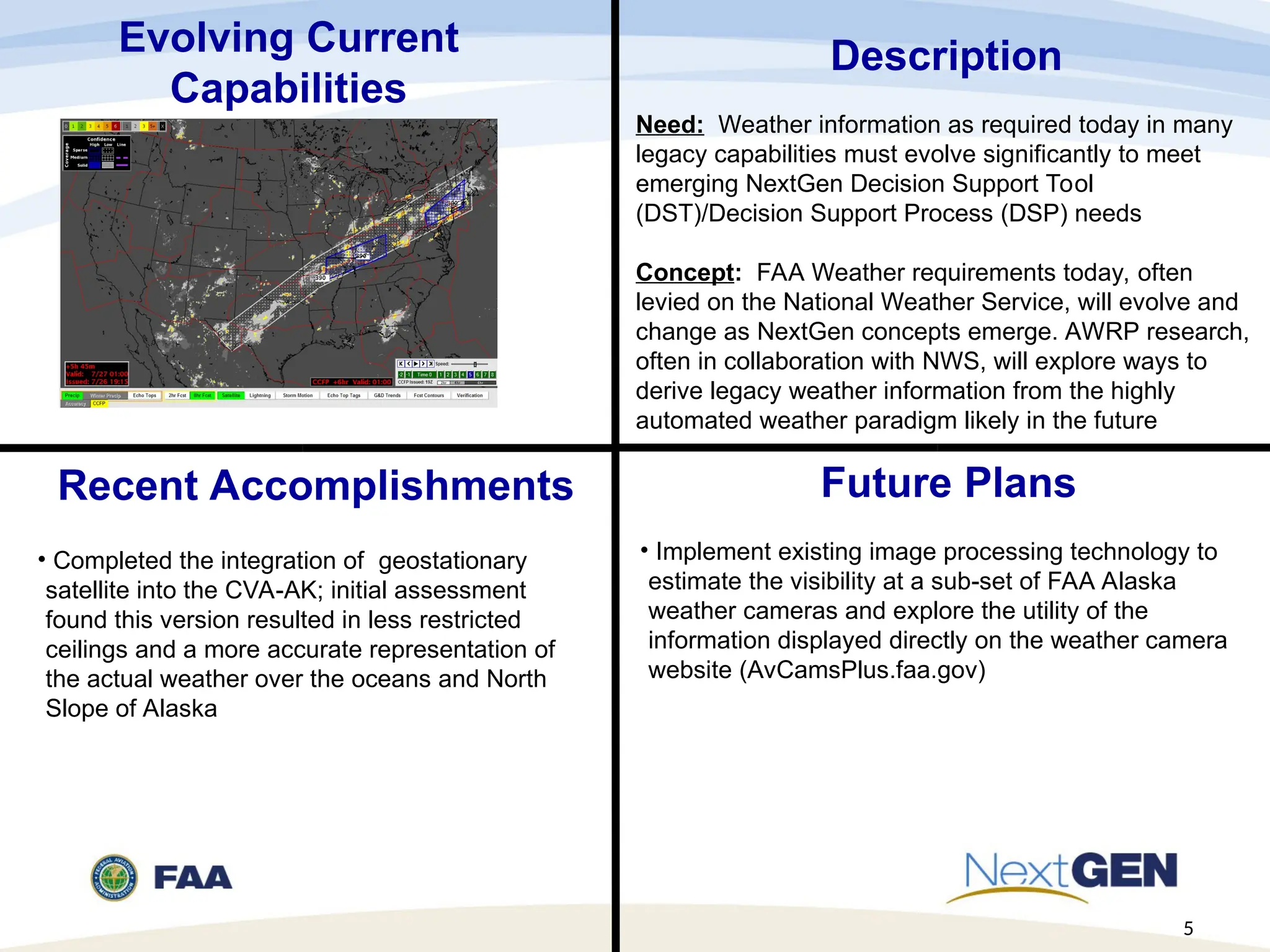
Evolving Current
Capabilities
Description
Need: Weather information as required today in many
legacy capabilities must evolve significantly to meet
emerging NextGen Decision Support Tool
(DST)/Decision Support Process (DSP) needs
Concept: FAA Weather requirements today, often
levied on the National Weather Service, will evolve and
change as NextGen concepts emerge. AWRP research,
often in collaboration with NWS, will explore ways to
derive legacy weather information from the highly
automated weather paradigm likely in the future
Recent Accomplishments
• Completed the integration of geostationary
satellite into the CVA-AK; initial assessment
found this version resulted in less restricted
ceilings and a more accurate representation of
the actual weather over the oceans and North
Slope of Alaska
5
6.
Future Plans
• Establisha steady feed of TDWR data in real-time
from the FAA to NSSL for future integration into MRMS
• Development of enhanced RAP and HRRR models
with improvements focused on clouds and convective
forecasts with transfer to NWS in FY19
• Develop HRRR ensembles to support probabilistic
forecast products with transfer to NWS in FY19
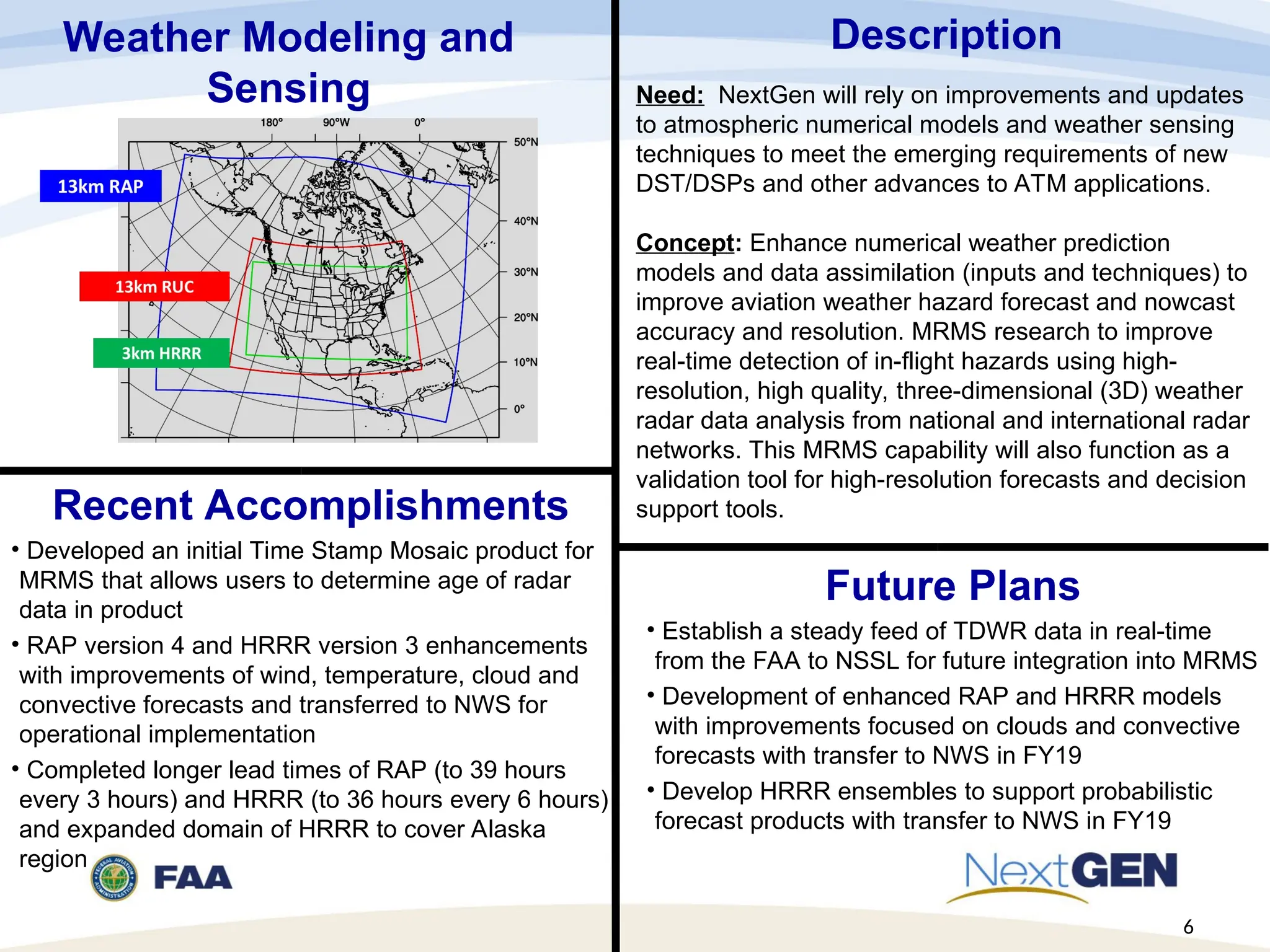
Weather Modeling and
Sensing
Description
Need: NextGen will rely on improvements and updates
to atmospheric numerical models and weather sensing
techniques to meet the emerging requirements of new
DST/DSPs and other advances to ATM applications.
Concept: Enhance numerical weather prediction
models and data assimilation (inputs and techniques) to
improve aviation weather hazard forecast and nowcast
accuracy and resolution. MRMS research to improve
real-time detection of in-flight hazards using high-
resolution, high quality, three-dimensional (3D) weather
radar data analysis from national and international radar
networks. This MRMS capability will also function as a
validation tool for high-resolution forecasts and decision
support tools.
Recent Accomplishments
• Developed an initial Time Stamp Mosaic product for
MRMS that allows users to determine age of radar
data in product
• RAP version 4 and HRRR version 3 enhancements
with improvements of wind, temperature, cloud and
convective forecasts and transferred to NWS for
operational implementation
• Completed longer lead times of RAP (to 39 hours
every 3 hours) and HRRR (to 36 hours every 6 hours)
and expanded domain of HRRR to cover Alaska
region
6
7.
Recent Accomplishments
• Completedanalysis and report for the CAWS
Operational Suitability Evaluation.
• Completed planning and conduct of the Weather
Uncertainty Operational Assessment
• Conducted a probabilistic C&V user assessment
evaluation
• Completed assessment of Icing Product Alaska –
Diagnosis
• Completed impact-based assessment of Auto CCFP
Future Plans
• Plan, coordinate, and implement user-based
assessment of an advanced icing forecast capability.
• Conduct operational user assessment of new aviation
weather concepts in collaboration with NWS' winter
and summer "experiments" that evaluate user
feedback on new weather forecast capabilities &
procedures
• GTG-Global capability quality assessment
• Global probabilistic convective weather forecast
product quality assessment
• C&V Forecast for CONUS and Alaska quality
assessment
Ensuring Effective
Research
Description
Need: To insure the relevancy of weather research,
strict processes are adhered to with regard to
prioritization, quality assurance, and operational
evaluation
Concept: All AWRP projects are subject to:
• Prioritization with respect to operational needs
• Quality assessment for scientific goodliness
• Evaluation and demonstration for operation relevancy
7
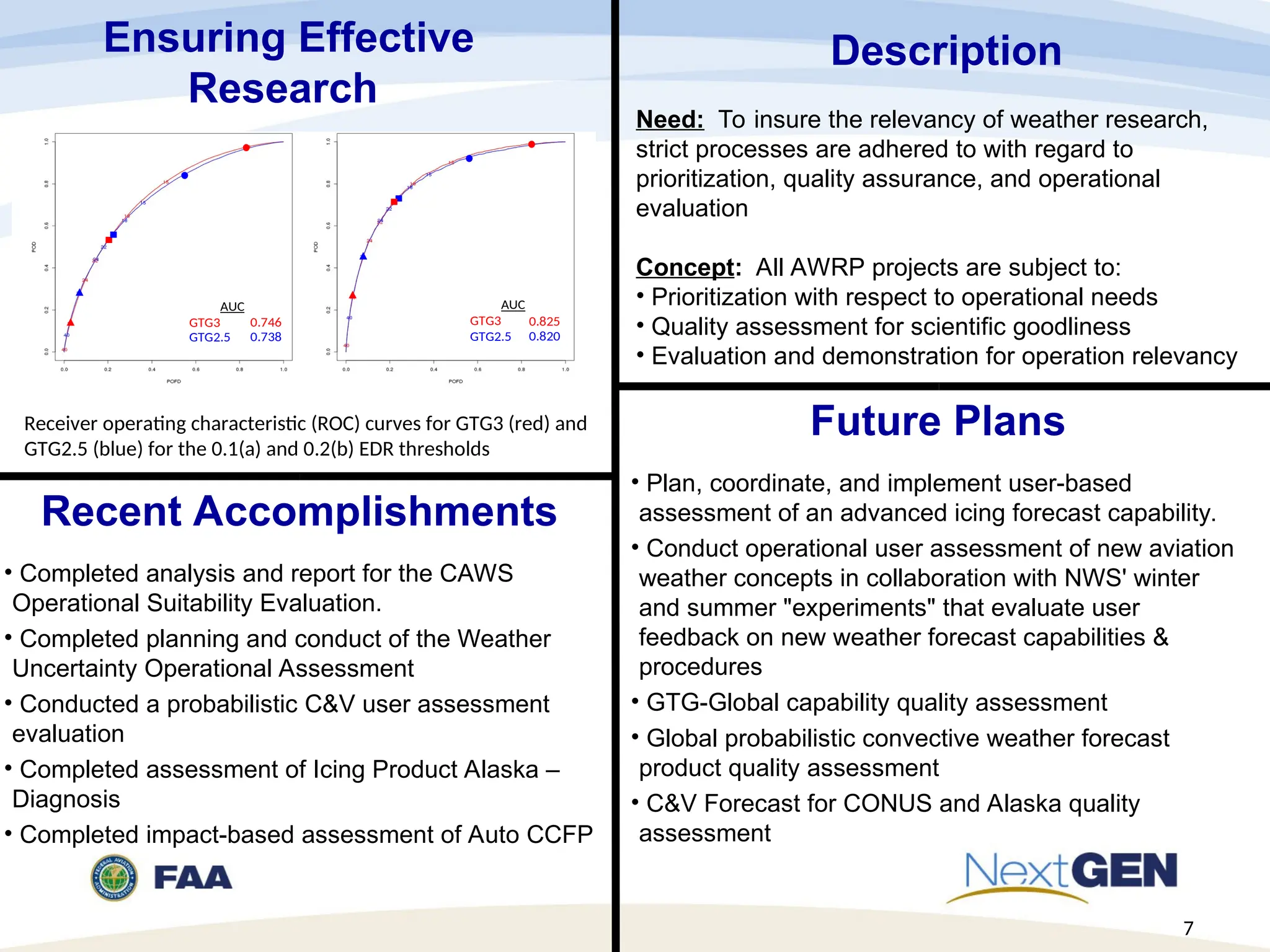
AUC
GTG3
GTG2.5
0.825
0.820
AUC
GTG3
GTG2.5
0.746
0.738
Receiver operating characteristic (ROC) curves for GTG3 (red) and
GTG2.5 (blue) for the 0.1(a) and 0.2(b) EDR thresholds
8.
Aviation Weather Research
ProgramAVS “Wedge”
Description
Need: AVS sponsored and prioritized research
initiatives to address select safety concerns in the short
and mid-term time horizon, but consistent with current
and future requirements
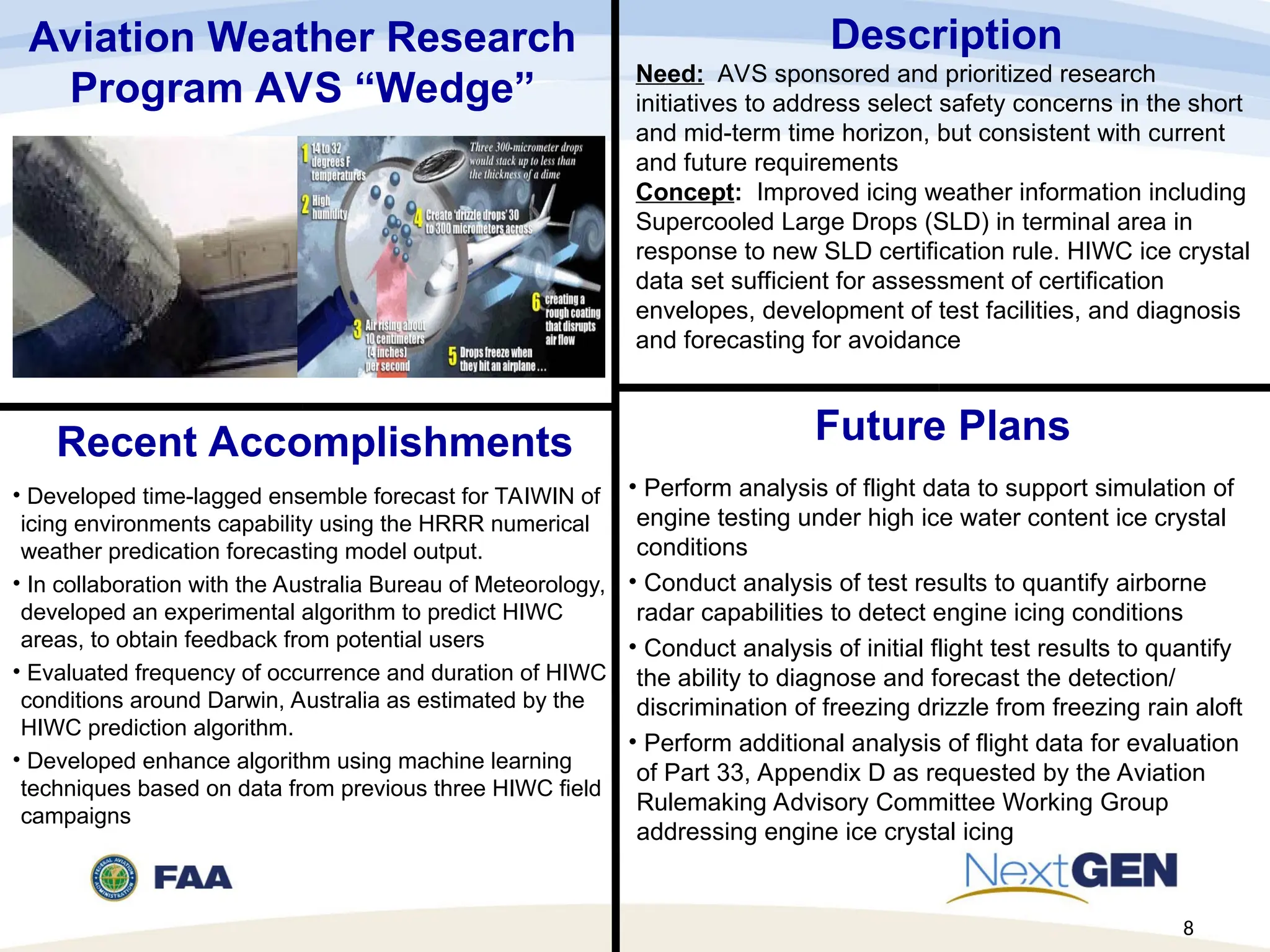
Concept: Improved icing weather information including
Supercooled Large Drops (SLD) in terminal area in
response to new SLD certification rule. HIWC ice crystal
data set sufficient for assessment of certification
envelopes, development of test facilities, and diagnosis
and forecasting for avoidance
Recent Accomplishments
• Developed time-lagged ensemble forecast for TAIWIN of
icing environments capability using the HRRR numerical
weather predication forecasting model output.
• In collaboration with the Australia Bureau of Meteorology,
developed an experimental algorithm to predict HIWC
areas, to obtain feedback from potential users
• Evaluated frequency of occurrence and duration of HIWC
conditions around Darwin, Australia as estimated by the
HIWC prediction algorithm.
• Developed enhance algorithm using machine learning
techniques based on data from previous three HIWC field
campaigns
Future Plans
• Perform analysis of flight data to support simulation of
engine testing under high ice water content ice crystal
conditions
• Conduct analysis of test results to quantify airborne
radar capabilities to detect engine icing conditions
• Conduct analysis of initial flight test results to quantify
the ability to diagnose and forecast the detection/
discrimination of freezing drizzle from freezing rain aloft
• Perform additional analysis of flight data for evaluation
of Part 33, Appendix D as requested by the Aviation
Rulemaking Advisory Committee Working Group
addressing engine ice crystal icing
8
9.
Acronyms
• AVS: AviationSafety
• C&V: Ceiling and Visibility
• CVA-AK: Ceiling and Visibility Analysis for Alaska
• CAWS: Collaborative Aviation Weather Statement
• CDM: Collaborative Decision Making
• CIWS: Corridor Integrated Weather System
• CONUS: Contiguous United States
• CCFP: CDM Convective Forecast Product
• CoSPA: Consolidated Storm Prediction for Aviation
• GA: General Aviation
• GOES-R: Geostationary Operational Environmental
Satellite-Replacement
• GTG-Global: Graphical Turbulence Guidance global
• HEMS: Helicopter Emergency Medical Service
• HIWC: High Ice Water Content
• HRRR: High-Resolution Rapid Refresh
• IFI: In-flight Icing
• IPA-D: Icing Product Alaska – Diagnosis
• IOC: Initial Operational Capability
• LAMP: Localized Aviation MOS Program
• MRMS: Multi-Radar/Multi-Sensor
• NSSL: NOAA National Severe Storms
Laboratory
• NWS: National Weather Service
• OPC: Offshore Precipitation Capability
• OPSNET: Operations Network
• RAP: Rapid Refresh
• TAFs: Terminal Area Forecast
• TAIWIN: Terminal Area Icing Weather
Information for NextGen
• TDWR: Terminal Doppler Weather Radar
• TFM: Traffic Flow Management
• TRACONs: Terminal Radar Approach
Control Facilities
• UPP: Unified Post Processor