CHAPTER 05
Money and Credit
The primary objective of monetary policy is to
control the money supply, contain inflation,
stabilize the exchange rate, and maintain the
equilibrium in balance of payments. Monetary
policy has a key role in the macroeconomic
stability of a country.
The global economic activity is still fragile on the
back of slow and subdued economic growth in
emerging and developing economies. However,
advanced economies have witnessed a modest
recovery. Over the year 2016, the global
economic outlook has deteriorated in the wake of
growing risks from the slowdown and rebalancing
of economic activity in China away from
investment and manufacturing towards
consumption and services, a decline in oil and
commodity prices and a gradual tightening of
monetary policy in the United States. As a result,
risks to global financial stability have increased.
Keeping in view these developments and risks, the
World Economic Outlook (WEO) in April 2016
has revised down the global growth projection to
3.2 percent for 2016 from 3.4 percent, and for
2017 to 3.5 percent against 3.6 percent earlier
estimated in January 2016.
While emerging economies are facing much
slower economic growth, Pakistan’s economy did
reasonably well. The economy after witnessing
subdued growth since FY2009 improved to 4.04
percent in FY2015 and 4.71 in FY2016, an eight
years high level underpinned by the robust growth
in Industrial and services sectors.
The external sector has been more stable on the
back of continued growth in remittances, IFIs
inflows, stable exchange rate, high foreign
exchange reserves, stable outlook of inflation and
balance of payments even allowed policymakers
to implement pro-growth strategies. SBP cut its
policy rate significantly which is the lowest in 44
year. The flows of Credit to Private Sector (CPS)
has seen expansion of Rs.311.7 billion during
Jul-06th
May, FY2016 against Rs.171.2 billion in
the same period of last year. It witnessed
expansion of 82.0 percent during the period under
review compared to the contraction of 41.5
percent during same period last year. This
expansion is helping manufacturing sector which
in turn will help in improving the industrial sector.
A welcome development is the gradual rise in net
credit disbursement for fixed investment. It
appeared that many firms are expanding their
operations by availing fixed investment loan.
The overall performance of the banking sector
during the last couple of years has been quite
impressive. The momentum continued in the
current fiscal year 2016 with asset base reaching
to Rs.14.3 trillion by end March, 2016 (Rs.12.1
trillion as of end March, 2015). Similarly, asset
quality has also improved and gross NPLs to loans
ratio reduced from 12.3 percent in CY14 to 11.4
percent in CY15, while it stood at 11.7 percent as
of end March, 2016 against 12.8 percent in the
comparable period last year. Whereas, Capital
Adequacy Ratio (CAR) increased to 16.3 percent
by end March, 2016 that is much strong and
higher than the minimum required level of 10.25
percent.
Monetary Policy Stance
Despite several challenges during the initial
months of FY 2015, the macroeconomic indicator
showed marked improvement and this trend is
continued during current FY2016. The main
driving force was favorable macroeconomic
environment, which included uptick in real GDP
growth, a sharp decline in headline CPI inflation,
stability in external sector including all time high
level of the country’s FX reserves and contained
fiscal deficit due to remarkable revenue
mobilization alongwith government efforts to
substitute its borrowing from SBP to commercial
banks and successful completion of eleven
Pakistan Economic Survey 2015-16
80
reviews under Extended Fund Facility (EFF).
International rating agencies have also upgraded
the Pakistan’s credit ratings by observing these
macroeconomic developments.
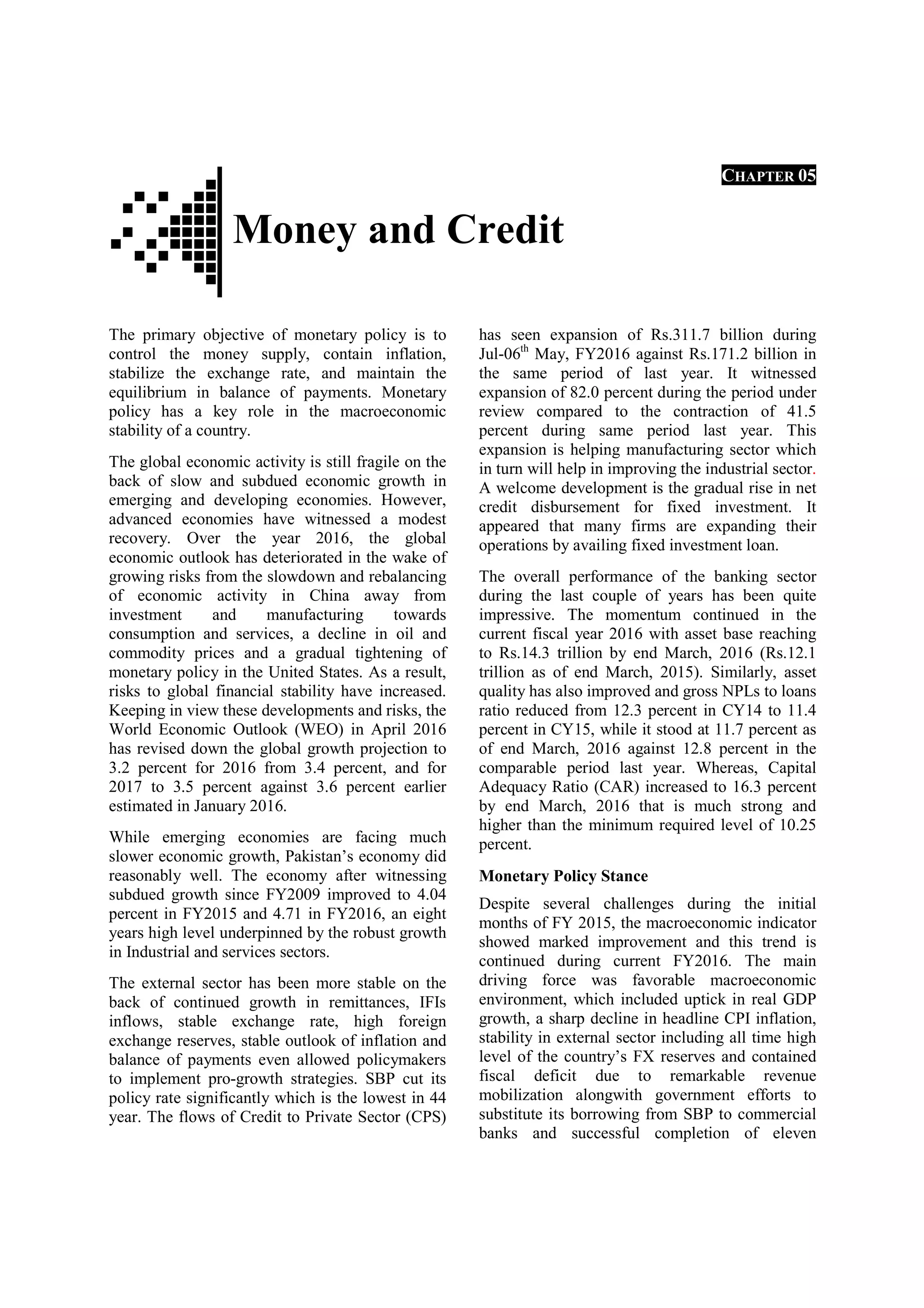
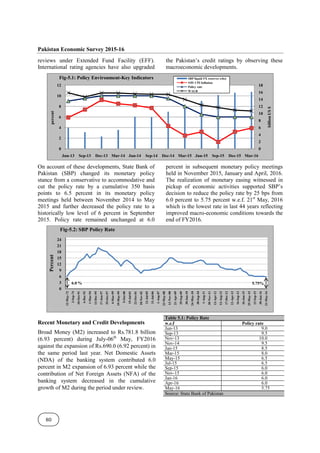
On account of these developments, State Bank of
Pakistan (SBP) changed its monetary policy
stance from a conservative to accommodative and
cut the policy rate by a cumulative 350 basis
points to 6.5 percent in its monetary policy
meetings held between November 2014 to May
2015 and further decreased the policy rate to a
historically low level of 6 percent in September
2015. Policy rate remained unchanged at 6.0
percent in subsequent monetary policy meetings
held in November 2015, January and April, 2016.
The realization of monetary easing witnessed in
pickup of economic activities supported SBP’s
decision to reduce the policy rate by 25 bps from
6.0 percent to 5.75 percent w.e.f. 21st
May, 2016
which is the lowest rate in last 44 years reflecting
improved macro-economic conditions towards the
end of FY2016.
Recent Monetary and Credit Developments
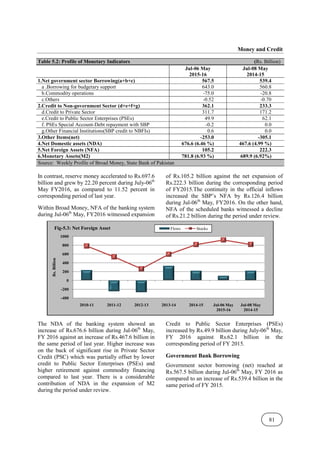
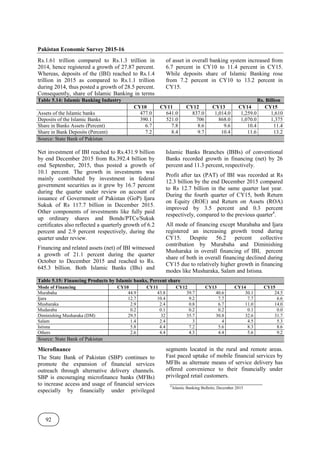
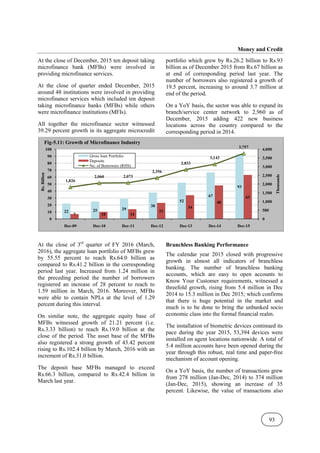
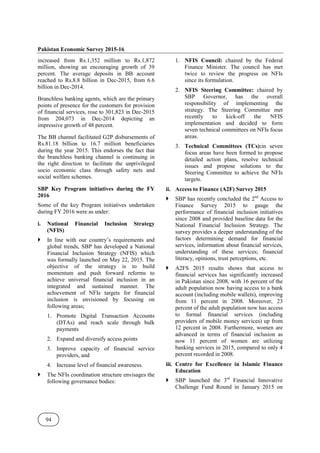
Broad Money (M2) increased to Rs.781.8 billion
(6.93 percent) during July-06th
May, FY2016
against the expansion of Rs.690.0 (6.92 percent) in
the same period last year. Net Domestic Assets
(NDA) of the banking system contributed 6.0
percent in M2 expansion of 6.93 percent while the
contribution of Net Foreign Assets (NFA) of the
banking system decreased in the cumulative
growth of M2 during the period under review.
Table 5.1: Policy Rate
w.e.f Policy rate
Jun-13 9.0
Sep-13 9.5
Nov-13 10.0
Nov-14 9.5
Jan-15 8.5
Mar-15 8.0
May-15 6.5
Jul-15 6.5
Sep-15 6.0
Nov-15 6.0
Jan-16 6.0
Apr-16 6.0
May-16 5.75
Source: State Bank of Pakistan
0
2
4
6
8
10
12
14
16
18
0
2
4
6
8
10
12
Jun-13 Sep-13 Dec-13 Mar-14 Jun-14 Sep-14 Dec-14 Mar-15 Jun-15 Sep-15 Dec-15 Mar-16
billion
US
$
percent
Fig-5.1: Policy Environment-Key Indicators SBP liquid FX reserves (rhs)
Y0Y CPI Inflation
Policy rate
WALR
0
3
6
9
12
15
18
21
24
12-May-72
3-Sep-74
10-Oct-91
6-Dec-92
1-Mar-94
13-Dec-95
17-Jun-97
29-Oct-97
4-Mar-99
19-May-99
5-Oct-00
19-Jul-01
22-Oct-01
18-Nov-02
21-Jul-05
31-Jul-06
1-Aug-07
23-May-08
13-Nov-08
21-Apr-09
29-Sep-09
30-Jan-10
24-May-10
30-Sep-10
1-Aug-11
30-Nov-11
13-Apr-12
13-Aug-12
17-Dec-12
12-Apr-13
16-Sep-13
26-Jan-15
25-May-15
12-Sep-15
30-Jan-16
21-May-16
Percent
Fig-5.2: SBP Policy Rate
5.75%
6.0 %
Table 5.2: Profile of Monetary Indicators
1.Net government sector Borrowing(a+b+c)
a .Borrowing for budgetary support
b.Commodity operations
c.Others
2.Credit to Non-government Sector (d+e+f+g)
d.Credit to Private Sector
e.Credit to Public Sector Enterprises (PSEs)
f. PSEs Special Account-Debt repayment with SBP
g.Other Financial Institutions(SBP credit to NBFIs)
3.Other Items(net)
4.Net Domestic assets (NDA)
5.Net Foreign Assets (NFA)
6.Monetary Assets(M2)
Source: Weekly Profile of Broad Money, State Bank of Pakistan
In contrast, reserve money accelerated to Rs.697.6
billion and grew by 22.20 percent during July
May FY2016, as compared to 11.52 percent in
corresponding period of last year.
Within Broad Money, NFA of the banking system
during Jul-06th
May, FY2016 witnessed expansion
The NDA of the banking system showed an
increase of Rs.676.6 billion during Jul
FY 2016 against an increase of Rs.467.6 billion in
the same period of last year. Higher increase was
on the back of significant rise in Private Sector
Credit (PSC) which was partially offset by lower
credit to Public Sector Enterprises (PSEs) and
higher retirement against commodity financing
compared to last year. There is a considerable
contribution of NDA in the expansion of M2
during the period under review.
-400
-200
0
200
400
600
800
1000
2010-11 2011
Rs.
Billion
Fig-5.3: Net Foreign Asset
Profile of Monetary Indicators
Jul-06 May
2015-16
1.Net government sector Borrowing(a+b+c) 567.5
a .Borrowing for budgetary support 643.0
-75.0
-0.52
government Sector (d+e+f+g) 362.1
311.7
e.Credit to Public Sector Enterprises (PSEs) 49.9
Debt repayment with SBP -0.2
g.Other Financial Institutions(SBP credit to NBFIs) 0.6
-253.0
676.6 (6.46 %)
105.2
781.8 (6.93 %)
Weekly Profile of Broad Money, State Bank of Pakistan
In contrast, reserve money accelerated to Rs.697.6
billion and grew by 22.20 percent during July-06th
May FY2016, as compared to 11.52 percent in
corresponding period of last year.
thin Broad Money, NFA of the banking system
May, FY2016 witnessed expansion
of Rs.105.2 billion against the net expansion of
Rs.222.3 billion during the corresponding period
of FY2015.The continuity in the official inflows
increased the SBP’s NFA by Rs.126.4 billion
during Jul-06th
May, FY2016. On the other hand,
NFA of the scheduled banks witnessed a decline
of Rs.21.2 billion during the period under review.
The NDA of the banking system showed an
of Rs.676.6 billion during Jul-06th
May,
FY 2016 against an increase of Rs.467.6 billion in
the same period of last year. Higher increase was
on the back of significant rise in Private Sector
Credit (PSC) which was partially offset by lower
credit to Public Sector Enterprises (PSEs) and
her retirement against commodity financing
compared to last year. There is a considerable
contribution of NDA in the expansion of M2
Credit to Public Sector Enterprises (PSEs)
increased by Rs.49.9 billion during July
FY 2016 against Rs.62.1 billion in the
corresponding period of FY 2015.
Government Bank Borrowing
Government sector borrowing (net) reached at
Rs.567.5 billion during Jul
compared to an increase of Rs.539.4 billion in the
same period of FY 2015.
2011-12 2012-13 2013-14 2014-15 Jul-06 May
2015-
Flows Stocks
Money and Credit
81
(Rs. Billion)
Jul-08 May
2014-15
539.4
560.8
-20.8
-0.70
233.3
171.2
62.1
0.0
0.0
-305.1
467.6 (4.99 %)
222.3
689.9 (6.92%)
of Rs.105.2 billion against the net expansion of
.3 billion during the corresponding period
of FY2015.The continuity in the official inflows
’s NFA by Rs.126.4 billion
May, FY2016. On the other hand,
NFA of the scheduled banks witnessed a decline
of Rs.21.2 billion during the period under review.
Credit to Public Sector Enterprises (PSEs)
increased by Rs.49.9 billion during July-06th
May,
FY 2016 against Rs.62.1 billion in the
corresponding period of FY 2015.
Government Bank Borrowing
Government sector borrowing (net) reached at
Rs.567.5 billion during Jul-06th
May, FY 2016 as
compared to an increase of Rs.539.4 billion in the
06 May
-16
Jul-08 May
2014-15
Pakistan Economic Survey 2015
82
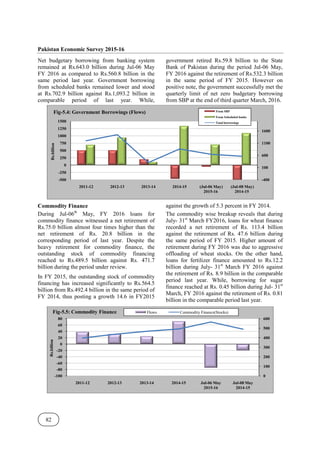
Net budgetary borrowing from banking system
remained at Rs.643.0 billion during Jul
FY 2016 as compared to Rs.560.8 billion in the
same period last year. Government borrowing
from scheduled banks remained lower and stood
at Rs.702.9 billion against Rs.1,093.2 billion in
comparable period of last year. While,
Commodity Finance
During Jul-06th
May, FY 2016 loans for
commodity finance witnessed a net retirement of
Rs.75.0 billion almost four times higher than the
net retirement of Rs. 20.8 billion in the
corresponding period of last year. Despite the
heavy retirement for commodity finance, the
outstanding stock of commodit
reached to Rs.489.5 billion against Rs. 471.7
billion during the period under review.
In FY 2015, the outstanding stock of commodity
financing has increased significantly to Rs.564.5
billion from Rs.492.4 billion in the same period of
FY 2014, thus posting a growth 14.6 in FY2015
-500
-250
0
250
500
750
1000
1250
1500
2011-12 2012
Rs.billion
Fig-5.4: Government Borrowings (Flows)
-100
-80
-60
-40
-20
0
20
40
60
80
2011-12 2012
Rs.billion
Fig-5.5: Commodity Finance
Pakistan Economic Survey 2015-16
Net budgetary borrowing from banking system
remained at Rs.643.0 billion during Jul-06 May
FY 2016 as compared to Rs.560.8 billion in the
same period last year. Government borrowing
from scheduled banks remained lower and stood
billion against Rs.1,093.2 billion in
comparable period of last year. While,
government retired Rs.59.8 billion to the State
Bank of Pakistan during the period Jul
FY 2016 against the retirement of Rs.532.3 billion
in the same period of FY 2015. Ho
positive note, the government successfully met the
quarterly limit of net zero budgetary borrowing
from SBP at the end of third quarter March, 2016.
May, FY 2016 loans for
odity finance witnessed a net retirement of
Rs.75.0 billion almost four times higher than the
net retirement of Rs. 20.8 billion in the
corresponding period of last year. Despite the
heavy retirement for commodity finance, the
outstanding stock of commodity financing
reached to Rs.489.5 billion against Rs. 471.7
billion during the period under review.
In FY 2015, the outstanding stock of commodity
financing has increased significantly to Rs.564.5
billion from Rs.492.4 billion in the same period of
thus posting a growth 14.6 in FY2015
against the growth of 5.3 percent in FY 2014.
The commodity wise breakup reveals that during
July- 31st
March FY2016, loans for wheat finance
recorded a net retirement of Rs. 113.4 billion
against the retirement of Rs
the same period of FY 2015. Higher amount of
retirement during FY 2016 was due to aggressive
offloading of wheat stocks. On the other hand,
loans for fertilizer finance amounted to Rs.12.2
billion during July- 31st
the retirement of Rs. 8.9 billion in the comparable
period last year. While, borrowing for sugar
finance reached at Rs. 0.45 billion during Jul
March, FY 2016 against the retirement of Rs. 0.81
billion in the comparable period last year.
2012-13 2013-14 2014-15 (Jul-06 May)
2015-16
5.4: Government Borrowings (Flows) From SBP
From Scheduled banks
Total borrowings
2012-13 2013-14 2014-15 Jul-06 May
2015-16
5.5: Commodity Finance Flows Commodity Finance(Stocks)
government retired Rs.59.8 billion to the State
Bank of Pakistan during the period Jul-06 May,
FY 2016 against the retirement of Rs.532.3 billion
in the same period of FY 2015. However on
positive note, the government successfully met the
quarterly limit of net zero budgetary borrowing
from SBP at the end of third quarter March, 2016.
against the growth of 5.3 percent in FY 2014.
The commodity wise breakup reveals that during
March FY2016, loans for wheat finance
recorded a net retirement of Rs. 113.4 billion
against the retirement of Rs. 47.6 billion during
the same period of FY 2015. Higher amount of
retirement during FY 2016 was due to aggressive
offloading of wheat stocks. On the other hand,
loans for fertilizer finance amounted to Rs.12.2
March FY 2016 against
the retirement of Rs. 8.9 billion in the comparable
period last year. While, borrowing for sugar
finance reached at Rs. 0.45 billion during Jul- 31st
March, FY 2016 against the retirement of Rs. 0.81
billion in the comparable period last year.
-400
100
600
1100
1600
(Jul-08 May)
2014-15
From SBP
From Scheduled banks
Total borrowings
0
100
200
300
400
500
600
Jul-08 May
2014-15
Commodity Finance(Stocks)
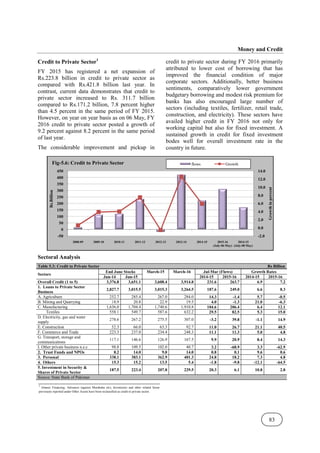
Credit to Private Sector1
FY 2015 has registered a net expansion of
Rs.223.8 billion in credit to private sector as
compared with Rs.421.8 billion last year. In
contrast, current data demonstrates that credit to
private sector increased to Rs. 311.7 billion
compared to Rs.171.2 billion, 7.8 percent higher
than 4.5 percent in the same period of FY 2015.
However, on year on year basis as on 06 May, FY
2016 credit to private sector posted a growth of
9.2 percent against 8.2 percent in the same period
of last year.
The considerable improvement and pickup in
Sectoral Analysis
Table 5.3: Credit to Private Sector
Sectors
End June Stocks
Jun-14
Overall Credit (1 to 5) 3,376.8
1. Loans to Private Sector
Business
2,827.7
A. Agriculture 252.7
B. Mining and Quarrying 18.9
C. Manufacturing 1,636.0
Textiles 558.1
D. Electricity, gas and water
supply
278.6
E. Construction 52.3
F. Commerce and Trade 223.3
G. Transport, storage and
communications
117.1
I. Other private business n.e.c 98.8
2. Trust Funds and NPOs
3. Personal 338.1
4. Others 15.3
5. Investment in Security &
Shares of Private Sector
187.5
Source: State Bank of Pakistan
-50
0
50
100
150
200
250
300
350
400
450
2008-09 2009-10
Rs.Billion
Fig-5.6: Credit to Private Sector
1
Islamic Financing, Advances (against Murabaha etc), Inventories and other related Items
previously reported under Other Assets have been reclassified as credit to private sector.
FY 2015 has registered a net expansion of
Rs.223.8 billion in credit to private sector as
compared with Rs.421.8 billion last year. In
contrast, current data demonstrates that credit to
private sector increased to Rs. 311.7 billion
compared to Rs.171.2 billion, 7.8 percent higher
than 4.5 percent in the same period of FY 2015.
However, on year on year basis as on 06 May, FY
2016 credit to private sector posted a growth of
nst 8.2 percent in the same period
The considerable improvement and pickup in
credit to private sector during FY 2016 primarily
attributed to lower cost of borrowing that has
improved the financial condition of major
corporate sectors. Addit
sentiments, comparatively lower government
budgetary borrowing and modest risk premium for
banks has also encouraged large number of
sectors (including textiles, fertilizer, retail trade,
construction, and electricity). These secto
availed higher credit in FY 2016 not only for
working capital but also for fixed investment. A
sustained growth in credit for fixed investment
bodes well for overall investment rate in the
country in future.
End June Stocks March-15 March-16 Jul-Mar (Flows)
14 Jun-15 2014-15 2015
3,376.8 3,651.1 3,608.4 3,914.8 231.6
2,827.7 3,015.5 3,015.3 3,264.5 187.6
252.7 285.4 267.0 284.0 14.3
18.9 20.8 22.9 19.5 4.0
1,636.0 1,704.4 1,740.6 1,910.8 104.6
558.1 549.7 587.6 632.2 29.5
278.6 267.2 275.5 307.0 -3.2
52.3 66.0 63.3 92.7 11.0
223.3 237.0 234.4 248.3 11.1
117.1 146.6 126.9 167.5 9.9
98.8 109.5 102.0 40.7 3.2
8.2 14.0 9.0 14.0 0.8
338.1 383.1 362.9 401.3 24.8
15.3 15.2 13.5 5.4 -1.8
187.5 223.4 207.8 229.5 20.3
2010-11 2011-12 2012-13 2013-14 2014-15 2015-16
(July-06 May)
5.6: Credit to Private Sector flows
etc), Inventories and other related Items
previously reported under Other Assets have been reclassified as credit to private sector.
Money and Credit
83
credit to private sector during FY 2016 primarily
attributed to lower cost of borrowing that has
improved the financial condition of major
corporate sectors. Additionally, better business
sentiments, comparatively lower government
budgetary borrowing and modest risk premium for
banks has also encouraged large number of
sectors (including textiles, fertilizer, retail trade,
construction, and electricity). These sectors have
availed higher credit in FY 2016 not only for
working capital but also for fixed investment. A
sustained growth in credit for fixed investment
bodes well for overall investment rate in the
Rs Billion
Mar (Flows) Growth Rates
2015-16 2014-15 2015-16
263.7 6.9 7.2
249.0 6.6 8.3
-1.4 5.7 -0.5
-1.3 21.0 -6.3
206.4 6.4 12.1
82.5 5.3 15.0
39.8 -1.1 14.9
26.7 21.1 40.5
11.3 5.0 4.8
20.9 8.4 14.3
-68.9 3.3 -62.9
0.1 9.6 0.6
18.2 7.3 4.8
-9.8 -12.1 -64.5
6.1 10.8 2.8
-2.0
0.0
2.0
4.0
6.0
8.0
10.0
12.0
14.0
16
06 May)
2014-15
(July-08 May)
Growth
in
percent
Growth
Pakistan Economic Survey 2015-16
84
Overall credit grew by 7.2 percent during Jul-Mar,
FY2016 as compared to 6.9 percent during the
comparable period of last year FY2015.Sector
wise growth demonstrates that loans to private
sector business witnessed a significant growth of
8.3 percent during Jul-Mar, FY2016 against 6.6
percent in same period of last year.
In flow terms, credit expansion to private business
reached to Rs.249.0 billion during July-March,
FY2016 as compared to Rs.187.6 billion in the
corresponding period of FY 2015.The expansion
in credit to private sector is broad based during
FY 2016 and mainly came from construction
(40.5 percent), followed by Electricity, Gas and
Water supply (14.9 percent), Transport, Storage
and Communication (14.3 percent),
Manufacturing (12.1 percent) of which Textile by
(15.0 percent).The expansion in private sectors
loans during Jul-Mar, FY2016 primarily in
Manufacturing sector that received share 82.9
percent of private sector loan (Rs. 206.4 billion),
followed by textile (33.1 percent or Rs. 82.5
billion), Electricity, Gas and Water supply (16.0
percent or Rs.39.8 billion), construction (10.7
percent or Rs.26.7 billion) and transport, storage
and communication (8.4 percent or Rs. 20.9
billion).
Table 5.4: Loans to Private Sector Businesses [Jul-Mar (Flows)] Rs. Billion
Total Credit Working Capital Fixed investment Trade financing
FY15 FY16 FY15 FY16 FY15 FY16 FY15 FY16
Total 185.1 319.8 50.6 119.2 84.4 150.1 50.2 50.4
Agriculture 14.3 -1.4 6.8 -7.4 8.2 6.1 -0.7 -0.1
Manufacturing 104.6 206.4 26.7 116.5 44.0 34.1 34.0 55.7
Food & beverages 56.8 68.7 24.2 42.9 17.2 11.9 15.4 13.9
Textiles 29.5 82.5 15.9 58.0 1.8 9.3 11.8 15.1
Coke & petroleum 18.0 10.4 10.7 1.9 9.1 -5.9 -1.7 14.4
Chemicals 1.9 33.1 -8.1 22.1 11.4 7.5 -1.4 3.5
Electricity -3.2 39.8 1.0 13.0 -6.0 31.9 1.9 -5.1
Construction 11.0 26.7 -2.0 -2.6 11.3 28.1 1.8 1.3
Commerce and trade 11.1 11.3 -0.4 4.0 7.8 7.1 3.7 0.1
Transport & comm. 9.9 20.9 7.1 -9.2 2.6 30.2 0.2 0.0
Real estate 17.8 7.1 6.3 3.2 11.7 1.0 -0.2 3.0
Others -1.8 -9.8 2.4 -1.9 -1.3 3.3 -0.4 0.5
Source: State Bank of Pakistan
The credit to private sector has witnessed
significant growth by type of finance during Jul-
Mar, FY2016 for working capital, fixed
investment and trade financing categories as
compared to same period of last year. The gradual
increase in credit disbursement for all categories
mainly used by major sectors of the economy and
particularly notable in production, transmission
and distribution of electricity; road transport;
construction of roads; telecommunications; sugar;
manufacturers of electricity distribution
machinery; cement; fertilizer; and pharmaceutical
sectors. Credit for fixed investment reached to
Rs.150.1 billion (increase by 78.0 percent) during
Jul-Mar, FY2016 against Rs.84.4 billion in
comparable period of FY2015, working capital
credit amounted to Rs.119.2 billion (grew by
135.8 percent) during the Jul-Mar, of FY2016 as
compared to Rs.50.6 billion in same period of last
year, similarly trade financing increased to
Rs.50.4 billion (grew by marginally 0.44 percent)
in Jul-Mar, FY2016 from Rs.50.2 billion in the
corresponding period of last year FY2015.
A continuation of credit demand requires
favourable monetary conditions and improvement
in performance of manufacturing and services
sectors. Realization of this could augur well for
growth in private sector going forward2
.
2
2nd
Quarterly Report FY16, SBP
Money and Credit
85
Table 5.5: Consumer Financing Rs Billion
July-March (Flows) Growth(%)
Description 2014-15 2015-16 2014-15 2015-16
Consumer Financing 16.9 17.3 6.7 6.1
1) For house building 0.1 5.1 0.2 12.8
2) For transport i.e. purchase of car 13.7 17.3 21.3 20.4
3) Credit cards -0.5 0.9 -2.0 3.6
4) Consumers durable -0.1 0.4 -14.4 110.8
5) Personal loans 4.9 -4.2 4.2 -3.3
6) Other -1.1 -2.3 -13.8 -27.3
Source: State Bank of Pakistan
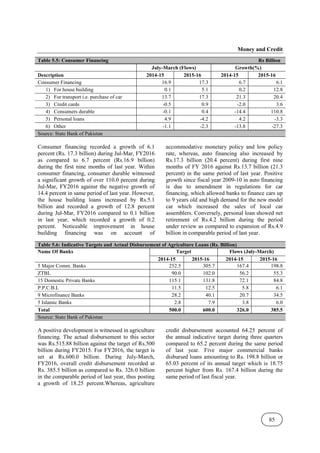
Consumer financing recorded a growth of 6.1
percent (Rs. 17.3 billion) during Jul-Mar, FY2016
as compared to 6.7 percent (Rs.16.9 billion)
during the first nine months of last year. Within
consumer financing, consumer durable witnessed
a significant growth of over 110.0 percent during
Jul-Mar, FY2016 against the negative growth of
14.4 percent in same period of last year. However,
the house building loans increased by Rs.5.1
billion and recorded a growth of 12.8 percent
during Jul-Mar, FY2016 compared to 0.1 billion
in last year, which recorded a growth of 0.2
percent. Noticeable improvement in house
building financing was on account of
accommodative monetary policy and low policy
rate, whereas, auto financing also increased by
Rs.17.3 billion (20.4 percent) during first nine
months of FY 2016 against Rs.13.7 billion (21.3
percent) in the same period of last year. Positive
growth since fiscal year 2009-10 in auto financing
is due to amendment in regulations for car
financing, which allowed banks to finance cars up
to 9 years old and high demand for the new model
car which increased the sales of local car
assemblers. Conversely, personal loan showed net
retirement of Rs.4.2 billion during the period
under review as compared to expansion of Rs.4.9
billion in comparable period of last year.
Table 5.6: Indicative Targets and Actual Disbursement of Agriculture Loans (Rs. Billion)
Name Of Banks Target Flows (July-March)
2014-15 2015-16 2014-15 2015-16
5 Major Comm. Banks 252.5 305.7 167.4 198.8
ZTBL 90.0 102.0 56.2 55.3
15 Domestic Private Banks 115.1 131.8 72.1 84.8
P.P.C.B.L 11.5 12.5 5.8 6.1
9 Microfinance Banks 28.2 40.1 20.7 34.5
5 Islamic Banks 2.8 7.9 3.8 6.0
Total 500.0 600.0 326.0 385.5
Source: State Bank of Pakistan
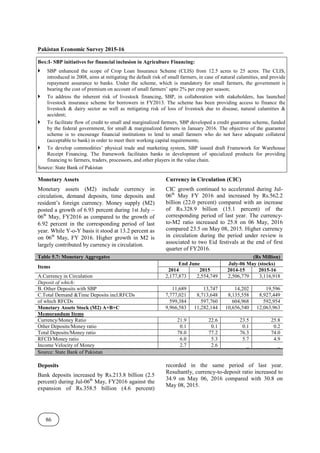
A positive development is witnessed in agriculture
financing. The actual disbursement to this sector
was Rs.515.88 billion against the target of Rs.500
billion during FY2015. For FY2016, the target is
set at Rs.600.0 billion. During July-March,
FY2016, overall credit disbursement recorded at
Rs. 385.5 billion as compared to Rs. 326.0 billion
in the comparable period of last year, thus posting
a growth of 18.25 percent.Whereas, agriculture
credit disbursement accounted 64.25 percent of
the annual indicative target during three quarters
compared to 65.2 percent during the same period
of last year. Five major commercial banks
disbursed loans amounting to Rs. 198.8 billion or
65.03 percent of its annual target which is 18.75
percent higher from Rs. 167.4 billion during the
same period of last fiscal year.
Pakistan Economic Survey 2015-16
86
Box:I- SBP initiatives for financial inclusion in Agriculture Financing:
SBP enhanced the scope of Crop Loan Insurance Scheme (CLIS) from 12.5 acres to 25 acres. The CLIS,
introduced in 2008, aims at mitigating the default risk of small farmers, in case of natural calamities, and provide
repayment assurance to banks. Under the scheme, which is mandatory for small farmers, the government is
bearing the cost of premium on account of small farmers’ upto 2% per crop per season;
To address the inherent risk of livestock financing, SBP, in collaboration with stakeholders, has launched
livestock insurance scheme for borrowers in FY2013. The scheme has been providing access to finance the
livestock & dairy sector as well as mitigating risk of loss of livestock due to disease, natural calamities &
accident;
To facilitate flow of credit to small and marginalized farmers, SBP developed a credit guarantee scheme, funded
by the federal government, for small & marginalized farmers in January 2016. The objective of the guarantee
scheme is to encourage financial institutions to lend to small farmers who do not have adequate collateral
(acceptable to bank) in order to meet their working capital requirements;
To develop commodities’ physical trade and marketing system, SBP issued draft Framework for Warehouse
Receipt Financing. The framework facilitates banks in development of specialized products for providing
financing to farmers, traders, processors, and other players in the value chain.
Source: State Bank of Pakistan
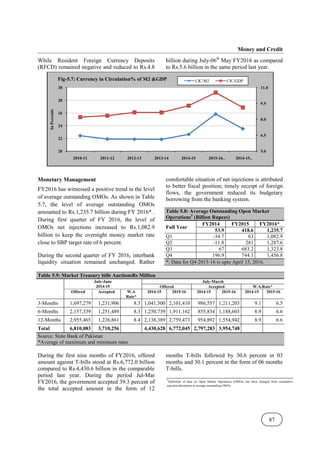
Monetary Assets
Monetary assets (M2) include currency in
circulation, demand deposits, time deposits and
resident’s foreign currency. Money supply (M2)
posted a growth of 6.93 percent during 1st July –
06th
May, FY2016 as compared to the growth of
6.92 percent in the corresponding period of last
year. While Y-o-Y basis it stood at 13.2 percent as
on 06th
May, FY 2016. Higher growth in M2 is
largely contributed by currency in circulation.
Currency in Circulation (CIC)
CIC growth continued to accelerated during Jul-
06th
May FY 2016 and increased by Rs.562.2
billion (22.0 percent) compared with an increase
of Rs.328.9 billion (15.1 percent) of the
corresponding period of last year. The currency-
to-M2 ratio increased to 25.8 on 06 May, 2016
compared 23.5 on May 08, 2015. Higher currency
in circulation during the period under review is
associated to two Eid festivals at the end of first
quarter of FY2016.
Table 5.7: Monetary Aggregates (Rs Million)
Items
End June July-06 May (stocks)
2014 2015 2014-15 2015-16
A.Currency in Circulation 2,177,873 2,554,749 2,506,779 3,116,918
Deposit of which:
B. Other Deposits with SBP 11,689 13,747 14,202 19,596
C.Total Demand &Time Deposits incl.RFCDs 7,777,021 8,713,648 8,135,558 8,927,449
of which RFCDs 599,384 597,760 604,968 592,954
Monetary Assets Stock (M2) A+B+C 9,966,583 11,282,144 10,656,540 12,063,963
Memorandum Items
Currency/Money Ratio 21.9 22.6 23.5 25.8
Other Deposits/Money ratio 0.1 0.1 0.1 0.2
Total Deposits/Money ratio 78.0 77.2 76.3 74.0
RFCD/Money ratio 6.0 5.3 5.7 4.9
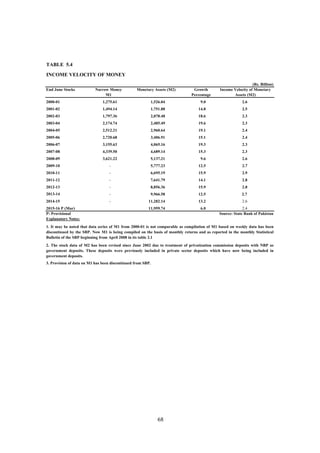
Income Velocity of Money 2.7 2.6 _ _
Source: State Bank of Pakistan
Deposits
Bank deposits increased by Rs.213.8 billion (2.5
percent) during Jul-06th
May, FY2016 against the
expansion of Rs.358.5 billion (4.6 percent)
recorded in the same period of last year.
Resultantly, currency-to-deposit ratio increased to
34.9 on May 06, 2016 compared with 30.8 on
May 08, 2015.
Money and Credit
87
While Resident Foreign Currency Deposits
(RFCD) remained negative and reduced to Rs.4.8
billion during July-06th
May FY2016 as compared
to Rs.5.6 billion in the same period last year.
Monetary Management
FY2016 has witnessed a positive trend in the level
of average outstanding OMOs. As shown in Table
5.7, the level of average outstanding OMOs
amounted to Rs.1,235.7 billion during FY 2016* .
During first quarter of FY 2016, the level of
OMOs net injections increased to Rs.1,082.9
billion to keep the overnight money market rate
close to SBP target rate of 6 percent.
During the second quarter of FY 2016, interbank
liquidity situation remained unchanged. Rather
comfortable situation of net injections is attributed
to better fiscal position; timely receipt of foreign
flows, the government reduced its budgetary
borrowing from the banking system.
Table 5.8: Average Outstanding Open Market
Operations3
(Billion Rupees)
Full Year
FY2014 FY2015 FY2016*
53.9 418.6 1,235.7
Q1 -34.7 63 1,082.9
Q2 -11.8 281 1,287.6
Q3 67 683.2 1,323.8
Q4 196.9 744.1 1,456.8
*: Data for Q4-2015-16 is upto April 15, 2016.
Table 5.9: Market Treasury bills AuctionsRs Million
July-June
2014-15
July-March
Offered Accepted W.A.Rate*
Offered Accepted W.A
Rate*
2014-15 2015-16 2014-15 2015-16 2014-15 2015-16
3-Months 1,697,279 1,231,906 8.3 1,041,500 2,101,410 986,557 1,211,203 9.1 6.5
6-Months 2,157,339 1,251,489 8.3 1,250,739 1,911,162 855,834 1,188,603 8.9 6.6
12-Months 2,955,465 1,226,861 8.4 2,138,389 2,759,473 954,892 1,554,942 8.9 6.6
Total 6,810,083 3,710,256 4,430,628 6,772,045 2,797,283 3,954,748
Source: State Bank of Pakistan
*Average of maximum and minimum rates
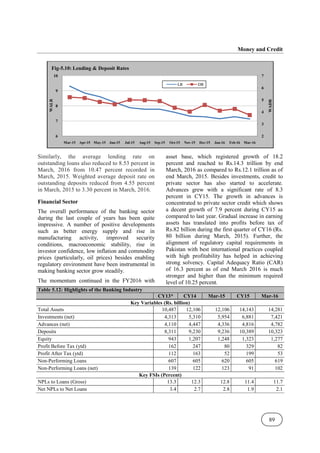
During the first nine months of FY2016, offered
amount against T-bills stood at Rs.6,772.0 billion
compared to Rs.4,430.6 billion in the comparable
period last year. During the period Jul-Mar
FY2016, the government accepted 39.3 percent of
the total accepted amount in the form of 12
months T-bills followed by 30.6 percent in 03
months and 30.1 percent in the form of 06 months
T-bills.
5.0
6.5
8.0
9.5
11.0
20
22
24
26
28
30
2010-11 2011-12 2012-13 2013-14 2014-15 2015-16… 2014-15…
In
Percents
Fig-5.7: Currency in Circulation% of M2 &GDP CIC/M2 CIC/GDP
3
Definition of data on Open Market Operations (OMOs) has been changed from cumulative
injection/absorption to average outstanding OMOs.
Pakistan Economic Survey 2015
88
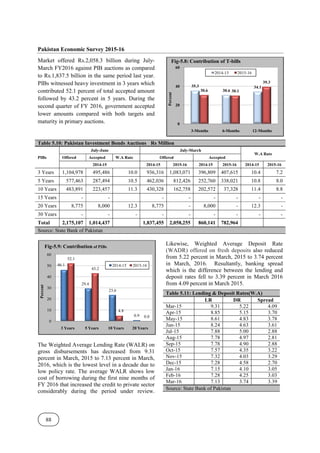
Market offered Rs.2,058.3 billion during July
March FY2016 against PIB auctions as compared
to Rs.1,837.5 billion in the same period last year.
PIBs witnessed heavy investment in 3 years
contributed 52.1 percent of total accepted amount
followed by 43.2 percent in 5 years. During the
second quarter of FY 2016, government accepted
lower amounts compared with
maturity in primary auctions.
Table 5.10: Pakistan Investment Bonds Auctions
PIBs
July-June
Offered Accepted
2014-15
3 Years 1,104,978 495,486
5 Years 577,463 287,494
10 Years 483,891 223,457
15 Years - -
20 Years 8,775 8,000
30 Years - -
Total 2,175,107 1,014,437
Source: State Bank of Pakistan
The Weighted Average Lending Rate (WALR) on
gross disbursements has decreased from 9.31
percent in March, 2015 to 7.13 percent in March,
2016, which is the lowest level in a decade due to
low policy rate. The average WALR shows low
cost of borrowing during the first nine months of
FY 2016 that increased the credit to private sector
considerably during the period under review.
46.1
29.4
23.6
52.1
43.2
0
10
20
30
40
50
60
3 Years 5 Years 10 Years
Percent
Fig-5.9: Contribution of PIBs
2014
Pakistan Economic Survey 2015-16
Market offered Rs.2,058.3 billion during July-
PIB auctions as compared
to Rs.1,837.5 billion in the same period last year.
PIBs witnessed heavy investment in 3 years which
total accepted amount
followed by 43.2 percent in 5 years. During the
second quarter of FY 2016, government accepted
compared with both targets and
Pakistan Investment Bonds Auctions Rs Million
July-March
W.A Rate Offered Accepted
2014-15 2015-16 2014-15 2015
10.0 936,316 1,083,071 396,809 407,615
10.5 462,036 812,426 252,760 338,021
11.3 430,328 162,758 202,572 37,328
- - -
12.3 8,775 - 8,000
- - - -
1,837,455 2,058,255 860,141 782,964
The Weighted Average Lending Rate (WALR) on
gross disbursements has decreased from 9.31
percent in March, 2015 to 7.13 percent in March,
2016, which is the lowest level in a decade due to
low policy rate. The average WALR shows low
the first nine months of
FY 2016 that increased the credit to private sector
considerably during the period under review.
Likewise, Weighted Average Deposit Rate
(WADR) offered on fresh deposits
from 5.22 percent in March, 2015 to 3.74 percen
in March, 2016. Resultantly, banking spread
which is the difference between the lending and
deposit rates fell to 3.39 percent in March 2016
from 4.09 percent in March 2015.
Table 5.11: Lending & Deposit Rates(W.A)
LR
Mar-15 9.31
Apr-15 8.85
May-15 8.61
Jun-15 8.24
Jul-15 7.88
Aug-15 7.78
Sep-15 7.78
Oct-15 7.57
Nov-15 7.32
Dec-15 7.28
Jan-16 7.15
Feb-16 7.28
Mar-16 7.13
Source: State Bank of Pakistan
35.3
30.6
30.6
0
20
40
60
3-Months 6-
Percent
Fig-5.8: Contribution of T
2014-15
23.6
0.9
4.8
0.0
10 Years 20 Years
2014-15 2015-16
W.A Rate
2015-16 2014-15 2015-16
407,615 10.4 7.2
338,021 10.8 8.0
37,328 11.4 8.8
- - -
- 12.3 -
- - -
782,964
Likewise, Weighted Average Deposit Rate
(WADR) offered on fresh deposits also reduced
from 5.22 percent in March, 2015 to 3.74 percent
in March, 2016. Resultantly, banking spread
which is the difference between the lending and
deposit rates fell to 3.39 percent in March 2016
from 4.09 percent in March 2015.
Lending & Deposit Rates(W.A)
DR Spread
5.22 4.09
5.15 3.70
4.83 3.78
4.63 3.61
5.00 2.88
4.97 2.81
4.90 2.88
4.35 3.22
4.03 3.29
4.58 2.70
4.10 3.05
4.25 3.03
3.74 3.39
Source: State Bank of Pakistan
30.6
34.1
30.1
39.3
-Months 12-Months
5.8: Contribution of T-bills
15 2015-16
Money and Credit
89
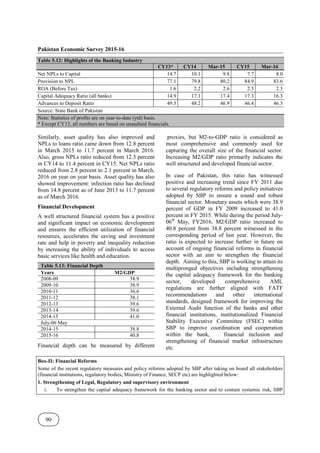
Similarly, the average lending rate on
outstanding loans also reduced to 8.53 percent in
March, 2016 from 10.47 percent recorded in
March, 2015. Weighted average deposit rate on
outstanding deposits reduced from 4.55 percent
in March, 2015 to 3.30 percent in March, 2016.
Financial Sector
The overall performance of the banking sector
during the last couple of years has been quite
impressive. A number of positive developments
such as better energy supply and rise in
manufacturing activity, improved security
conditions, macroeconomic stability, rise in
investor confidence, low inflation and commodity
prices (particularly, oil prices) besides enabling
regulatory environment have been instrumental in
making banking sector grow steadily.
The momentum continued in the FY2016 with
asset base, which registered growth of 18.2
percent and reached to Rs.14.3 trillion by end
March, 2016 as compared to Rs.12.1 trillion as of
end March, 2015. Besides investments, credit to
private sector has also started to accelerate.
Advances grew with a significant rate of 8.3
percent in CY15. The growth in advances is
concentrated to private sector credit which shows
a decent growth of 7.9 percent during CY15 as
compared to last year. Gradual increase in earning
assets has translated into profits before tax of
Rs.82 billion during the first quarter of CY16 (Rs.
80 billion during March, 2015). Further, the
alignment of regulatory capital requirements in
Pakistan with best international practices coupled
with high profitability has helped in achieving
strong solvency. Capital Adequacy Ratio (CAR)
of 16.3 percent as of end March 2016 is much
stronger and higher than the minimum required
level of 10.25 percent.
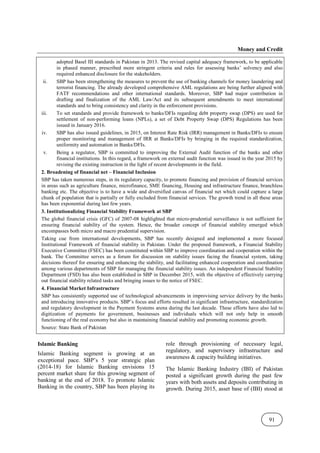
Table 5.12: Highlights of the Banking Industry
CY13* CY14 Mar-15 CY15 Mar-16
Key Variables (Rs. billion)
Total Assets 10,487 12,106 12,106 14,143 14,281
Investments (net) 4,313 5,310 5,954 6,881 7,421
Advances (net) 4,110 4,447 4,336 4,816 4,782
Deposits 8,311 9,230 9,236 10,389 10,323
Equity 943 1,207 1,248 1,323 1,277
Profit Before Tax (ytd) 162 247 80 329 82
Profit After Tax (ytd) 112 163 52 199 53
Non-Performing Loans 607 605 620 605 619
Non-Performing Loans (net) 139 122 123 91 102
Key FSIs (Percent)
NPLs to Loans (Gross) 13.3 12.3 12.8 11.4 11.7
Net NPLs to Net Loans 3.4 2.7 2.8 1.9 2.1
2
3
4
5
6
7
6
7
8
9
10
Mar-15 Apr-15 May-15 Jun-15 Jul-15 Aug-15 Sep-15 Oct-15 Nov-15 Dec-15 Jan-16 Feb-16 Mar-16
WADR
WALR
Fig-5.10: Lending & Deposit Rates
LR DR
Pakistan Economic Survey 2015-16
90
Table 5.12: Highlights of the Banking Industry
CY13* CY14 Mar-15 CY15 Mar-16
Net NPLs to Capital 14.7 10.1 9.8 7.7 8.0
Provision to NPL 77.1 79.8 80.2 84.9 83.6
ROA (Before Tax) 1.6 2.2 2.6 2.5 2.3
Capital Adequacy Ratio (all banks) 14.9 17.1 17.4 17.3 16.3
Advances to Deposit Ratio 49.5 48.2 46.9 46.4 46.3
Source: State Bank of Pakistan
Note: Statistics of profits are on year-to-date (ytd) basis.
* Except CY13, all numbers are based on unaudited financials.
Similarly, asset quality has also improved and
NPLs to loans ratio came down from 12.8 percent
in March 2015 to 11.7 percent in March 2016.
Also, gross NPLs ratio reduced from 12.3 percent
in CY14 to 11.4 percent in CY15. Net NPLs ratio
reduced from 2.8 percent to 2.1 percent in March,
2016 on year on year basis. Asset quality has also
showed improvement: infection ratio has declined
from 14.8 percent as of June 2013 to 11.7 percent
as of March 2016.
Financial Development
A well structured financial system has a positive
and significant impact on economic development
and ensures the efficient utilization of financial
resources, accelerates the saving and investment
rate and help in poverty and inequality reduction
by increasing the ability of individuals to access
basic services like health and education.
Table 5.13: Financial Depth
Years M2/GDP
2008-09 38.9
2009-10 38.9
2010-11 36.6
2011-12 38.1
2012-13 39.6
2013-14 39.6
2014-15 41.0
July-06 May
2014-15 38.8
2015-16 40.8
Financial depth can be measured by different
proxies, but M2-to-GDP ratio is considered as
most comprehensive and commonly used for
capturing the overall size of the financial sector.
Increasing M2/GDP ratio primarily indicates the
well structured and developed financial sector.
In case of Pakistan, this ratio has witnessed
positive and increasing trend since FY 2011 due
to several regulatory reforms and policy initiatives
adopted by SBP to ensure a sound and robust
financial sector. Monetary assets which were 38.9
percent of GDP in FY 2009 increased to 41.0
percent in FY 2015. While during the period July-
06th
May, FY2016, M2/GDP ratio increased to
40.8 percent from 38.8 percent witnessed in the
corresponding period of last year. However, the
ratio is expected to increase further in future on
account of ongoing financial reforms in financial
sector with an aim to strengthen the financial
depth. Aiming to this, SBP is working to attain its
multipronged objectives including strengthening
the capital adequacy framework for the banking
sector, developed comprehensive AML
regulations are further aligned with FATF
recommendations and other international
standards, designed framework for improving the
External Audit function of the banks and other
financial institutions, institutionalized Financial
Stability Executive Committee (FSEC) within
SBP to improve coordination and cooperation
within the bank, financial inclusion and
strengthening of financial market infrastructure
etc.
Box-II: Financial Reforms
Some of the recent regulatory measures and policy reforms adopted by SBP after taking on board all stakeholders
(financial institutions, regulatory bodies, Ministry of Finance, SECP etc) are highlighted below:
1. Strengthening of Legal, Regulatory and supervisory environment
i. To strengthen the capital adequacy framework for the banking sector and to contain systemic risk, SBP
Money and Credit
91
adopted Basel III standards in Pakistan in 2013. The revised capital adequacy framework, to be applicable
in phased manner, prescribed more stringent criteria and rules for assessing banks’ solvency and also
required enhanced disclosure for the stakeholders.
ii. SBP has been strengthening the measures to prevent the use of banking channels for money laundering and
terrorist financing. The already developed comprehensive AML regulations are being further aligned with
FATF recommendations and other international standards. Moreover, SBP had major contribution in
drafting and finalization of the AML Law/Act and its subsequent amendments to meet international
standards and to bring consistency and clarity in the enforcement provisions.
iii. To set standards and provide framework to banks/DFIs regarding debt property swap (DPS) are used for
settlement of non-performing loans (NPLs), a set of Debt Property Swap (DPS) Regulations has been
issued in January 2016.
iv. SBP has also issued guidelines, in 2015, on Interest Rate Risk (IRR) management in Banks/DFIs to ensure
proper monitoring and management of IRR at Banks/DFIs by bringing in the required standardization,
uniformity and automation in Banks/DFIs.
v. Being a regulator, SBP is committed to improving the External Audit function of the banks and other
financial institutions. In this regard, a framework on external audit function was issued in the year 2015 by
revising the existing instruction in the light of recent developments in the field.
2. Broadening of financial net – Financial Inclusion
SBP has taken numerous steps, in its regulatory capacity, to promote financing and provision of financial services
in areas such as agriculture finance, microfinance, SME financing, Housing and infrastructure finance, branchless
banking etc. The objective is to have a wide and diversified canvas of financial net which could capture a large
chunk of population that is partially or fully excluded from financial services. The growth trend in all these areas
has been exponential during last few years.
3. Institutionalizing Financial Stability Framework at SBP
The global financial crisis (GFC) of 2007-08 highlighted that micro-prudential surveillance is not sufficient for
ensuring financial stability of the system. Hence, the broader concept of financial stability emerged which
encompasses both micro and macro prudential supervision.
Taking cue from international developments, SBP has recently designed and implemented a more focused
Institutional Framework of financial stability in Pakistan. Under the proposed framework, a Financial Stability
Executive Committee (FSEC) has been constituted within SBP to improve coordination and cooperation within the
bank. The Committee serves as a forum for discussion on stability issues facing the financial system, taking
decisions thereof for ensuring and enhancing the stability, and facilitating enhanced cooperation and coordination
among various departments of SBP for managing the financial stability issues. An independent Financial Stability
Department (FSD) has also been established in SBP in December 2015, with the objective of effectively carrying
out financial stability related tasks and bringing issues to the notice of FSEC.
4. Financial Market Infrastructure
SBP has consistently supported use of technological advancements in improvising service delivery by the banks
and introducing innovative products. SBP’s focus and efforts resulted in significant infrastructure, standardization
and regulatory development in the Payment Systems arena during the last decade. These efforts have also led to
digitization of payments for government, businesses and individuals which will not only help in smooth
functioning of the real economy but also in maintaining financial stability and promoting economic growth.
Source: State Bank of Pakistan
Islamic Banking
Islamic Banking segment is growing at an
exceptional pace. SBP’s 5 year strategic plan
(2014-18) for Islamic Banking envisions 15
percent market share for this growing segment of
banking at the end of 2018. To promote Islamic
Banking in the country, SBP has been playing its
role through provisioning of necessary legal,
regulatory, and supervisory infrastructure and
awareness & capacity building initiatives.
The Islamic Banking Industry (IBI) of Pakistan
posted a significant growth during the past few
years with both assets and deposits contributing in
growth. During 2015, asset base of (IBI) stood at
Pakistan Economic Survey 2015-16
92
Rs.1.61 trillion compared to Rs.1.3 trillion in
2014, hence registered a growth of 27.87 percent.
Whereas, deposits of the (IBI) reached to Rs.1.4
trillion in 2015 as compared to Rs.1.1 trillion
during 2014, thus posted a growth of 28.5 percent.
Consequently, share of Islamic Banking in terms
of asset in overall banking system increased from
6.7 percent in CY10 to 11.4 percent in CY15.
While deposits share of Islamic Banking rose
from 7.2 percent in CY10 to 13.2 percent in
CY15.
Table 5.14: Islamic Banking Industry Rs. Billion
CY10 CY11 CY12 CY13 CY14 CY15
Assets of the Islamic banks 477.0 641.0 837.0 1,014.0 1,259.0 1,610
Deposits of the Islamic Banks 390.1 521.0 706 868.0 1,070.0 1,375
Share in Banks Assets (Percent) 6.7 7.8 8.6 9.6 10.4 11.4
Share in Bank Deposits (Percent) 7.2 8.4 9.7 10.4 11.6 13.2
Source: State Bank of Pakistan
Net investment of IBI reached to Rs.431.9 billion
by end December 2015 from Rs.392.4 billion by
end September, 2015, thus posted a growth of
10.1 percent. The growth in investments was
mainly contributed by investment in federal
government securities as it grew by 16.7 percent
during the quarter under review on account of
issuance of Government of Pakistan (GoP) Ijara
Sukuk of Rs 117.7 billion in December 2015.
Other components of investments like fully paid
up ordinary shares and Bonds/PTCs/Sukuk
certificates also reflected a quarterly growth of 6.2
percent and 2.9 percent respectively, during the
quarter under review.
Financing and related assets (net) of IBI witnessed
a growth of 21.1 percent during the quarter
October to December 2015 and reached to Rs.
645.3 billion. Both Islamic Banks (IBs) and
Islamic Banks Branches (IBBs) of conventional
Banks recorded growth in financing (net) by 26
percent and 11.3 percent, respectively.
Profit after tax (PAT) of IBI was recorded at Rs
12.3 billion by the end December 2015 compared
to Rs 12.7 billion in the same quarter last year.
During the fourth quarter of CY15, both Return
on Equity (ROE) and Return on Assets (ROA)
improved by 3.5 percent and 0.3 percent
respectively, compared to the previous quarter4
.
All mode of financing except Murabaha and Ijara
registered an increasing growth trend during
CY15. Despite 56.2 percent collective
contribution by Murabaha and Diminishing
Musharaka in overall financing of IBI, percent
share of both in overall financing declined during
CY15 due to relatively higher growth in financing
modes like Musharaka, Salam and Istisna.
Table 5.15: Financing Products by Islamic banks, Percent share
Mode of Financing CY10 CY11 CY12 CY13 CY14 CY15
Murabaha 44.9 43.8 39.7 40.6 30.1 24.5
Ijara 12.7 10.4 9.2 7.7 7.7 6.6
Musharaka 2.9 2.4 0.8 6.7 11.0 14.0
Mudaraba 0.2 0.1 0.2 0.2 0.1 0.0
Diminishing Musharaka (DM) 29.5 32 35.7 30.8 32.6 31.7
Salam 1.4 2.4 3 4 4.5 5.3
Istisna 5.8 4.4 7.2 5.6 8.3 8.6
Others 2.6 4.4 4.3 4.4 5.6 9.2
Source: State Bank of Pakistan
Microfinance
The State Bank of Pakistan (SBP) continues to
promote the expansion of financial services
outreach through alternative delivery channels.
SBP is encouraging microfinance banks (MFBs)
to increase access and usage of financial services
especially by financially under privileged
segments located in the rural and remote areas.
Fast paced uptake of mobile financial services by
MFBs as alternate means of service delivery has
offered convenience to their financially under
privileged retail customers.
4
Islamic Banking Bulletin, December 2015
Money and Credit
93
At the close of December, 2015 ten deposit taking
microfinance bank (MFBs) were involved in
providing microfinance services.
At the close of quarter ended December, 2015
around 48 institutions were involved in providing
microfinance services which included ten deposit
taking microfinance banks (MFBs) while others
were microfinance institutions (MFIs).
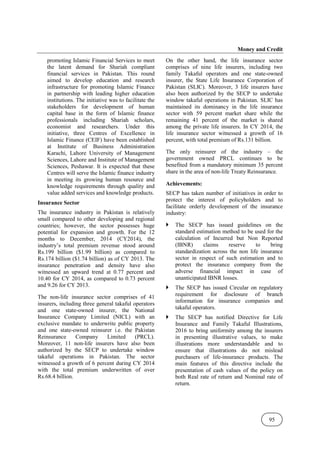
All together the microfinance sector witnessed
39.29 percent growth in its aggregate microcredit
portfolio which grew by Rs.26.2 billion to Rs.93
billion as of December 2015 from Rs.67 billion as
at end of corresponding period last year. The
number of borrowers also registered a growth of
19.5 percent, increasing to around 3.7 million at
end of the period.
On a YoY basis, the sector was able to expand its
branch/service center network to 2,960 as of
December, 2015 adding 422 new business
locations across the country compared to the
corresponding period in 2014.
At the close of 3rd
quarter of FY 2016 (March,
2016), the aggregate loan portfolio of MFBs grew
by 55.55 percent to reach Rs.64.0 billion as
compared to Rs.41.2 billion in the corresponding
period last year. Increased from 1.24 million in
the preceding period the number of borrowers
registered an increase of 28 percent to reach to
1.59 million in March, 2016. Moreover, MFBs
were able to contain NPLs at the level of 1.29
percent during this interval.
On similar note, the aggregate equity base of
MFBs witnessed growth of 21.21 percent (i.e.
Rs.3.33 billion) to reach Rs.19.0 billion at the
close of the period. The asset base of the MFBs
also registered a strong growth of 43.42 percent
rising to Rs.102.4 billion by March, 2016 with an
increment of Rs.31.0 billion.
The deposit base MFBs managed to exceed
Rs.66.3 billion, compared to Rs.42.4 billion in
March last year.
Branchless Banking Performance
The calendar year 2015 closed with progressive
growth in almost all indicators of branchless
banking. The number of branchless banking
accounts, which are easy to open accounts to
Know Your Customer requirements, witnessed a
threefold growth, rising from 5.4 million in Dec
2014 to 15.3 million in Dec 2015; which confirms
that there is huge potential in the market and
much is to be done to bring the unbanked socio
economic class into the formal financial realm.
The installation of biometric devices continued its
pace during the year 2015, 53,394 devices were
installed on agent locations nationwide. A total of
5.4 million accounts have been opened during the
year through this robust, real time and paper-free
mechanism of account opening.
On a YoY basis, the number of transactions grew
from 278 million (Jan-Dec, 2014) to 374 million
(Jan-Dec, 2015), showing an increase of 35
percent. Likewise, the value of transactions also
22 25 29
38
52
67
93
7 10 14
23
34
48
63
1,826
2,060 2,073
2,356
2,833
3,143
3,757
0
500
1,000
1,500
2,000
2,500
3,000
3,500
4,000
0
10
20
30
40
50
60
70
80
90
100
Dec-09 Dec-10 Dec-11 Dec-12 Dec-13 Dec-14 Dec-15
Thousands
Rs.
Billion
Fig-5.11: Growth of Microfinance Industry
Gross loan Portfolio
Deposits
No. of Borrowers (RHS)
Pakistan Economic Survey 2015-16
94
increased from Rs.1,352 million to Rs.1,872
million, showing an encouraging growth of 39
percent. The average deposits in BB account
reached to Rs.8.8 billion in Dec-2015, from 6.6
billion in Dec-2014.
Branchless banking agents, which are the primary
points of presence for the customers for provision
of financial services, rose to 301,823 in Dec-2015
from 204,073 in Dec-2014 depicting an
impressive growth of 48 percent.
The BB channel facilitated G2P disbursements of
Rs.81.18 billion to 16.7 million beneficiaries
during the year 2015. This endorses the fact that
the branchless banking channel is continuing in
the right direction to facilitate the unprivileged
socio economic class through safety nets and
social welfare schemes.
SBP Key Program initiatives during the FY
2016
Some of the key Program initiatives undertaken
during FY 2016 were as under:
i. National Financial Inclusion Strategy
(NFIS)
In line with our country’s requirements and
global trends, SBP has developed a National
Financial Inclusion Strategy (NFIS) which
was formally launched on May 22, 2015. The
objective of the strategy is to build
momentum and push forward reforms to
achieve universal financial inclusion in an
integrated and sustained manner. The
achievement of NFIs targets for financial
inclusion is envisioned by focusing on
following areas;
1. Promote Digital Transaction Accounts
(DTAs) and reach scale through bulk
payments
2. Expand and diversify access points
3. Improve capacity of financial service
providers, and
4. Increase level of financial awareness.
The NFIs coordination structure envisages the
following governance bodies:
1. NFIS Council: chaired by the Federal
Finance Minister. The council has met
twice to review the progress on NFIs
since its formulation.
2. NFIS Steering Committee: chaired by
SBP Governor, has the overall
responsibility of implementing the
strategy. The Steering Committee met
recently to kick-off the NFIS
implementation and decided to form
seven technical committees on NFIs focus
areas.
3. Technical Committees (TCs):in seven
focus areas have been formed to propose
detailed action plans, resolve technical
issues and propose solutions to the
Steering Committee to achieve the NFIs
targets.
ii. Access to Finance (A2F) Survey 2015
SBP has recently concluded the 2nd
Access to
Finance Survey 2015 to gauge the
performance of financial inclusion initiatives
since 2008 and provided baseline data for the
National Financial Inclusion Strategy. The
survey provides a deeper understanding of the
factors determining demand for financial
services, information about financial services,
understanding of these services; financial
literacy, opinions, trust perceptions, etc.
A2FS 2015 results shows that access to
financial services has significantly increased
in Pakistan since 2008, with 16 percent of the
adult population now having access to a bank
account (including mobile wallets), improving
from 11 percent in 2008. Moreover, 23
percent of the adult population now has access
to formal financial services (including
providers of mobile money services) up from
12 percent in 2008. Furthermore, women are
advanced in terms of financial inclusion as
now 11 percent of women are utilizing
banking services in 2015, compared to only 4
percent recorded in 2008.
iii. Centre for Excellence in Islamic Finance
Education
SBP launched the 3rd
Financial Innovative
Challenge Fund Round in January 2015 on
Money and Credit
95
promoting Islamic Financial Services to meet
the latent demand for Shariah compliant
financial services in Pakistan. This round
aimed to develop education and research
infrastructure for promoting Islamic Finance
in partnership with leading higher education
institutions. The initiative was to facilitate the
stakeholders for development of human
capital base in the form of Islamic finance
professionals including Shariah scholars,
economist and researchers. Under this
initiative, three Centres of Excellence in
Islamic Finance (CEIF) have been established
at Institute of Business Administration
Karachi, Lahore University of Management
Sciences, Lahore and Institute of Management
Sciences, Peshawar. It is expected that these
Centres will serve the Islamic finance industry
in meeting its growing human resource and
knowledge requirements through quality and
value added services and knowledge products.
Insurance Sector
The insurance industry in Pakistan is relatively
small compared to other developing and regional
countries; however, the sector possesses huge
potential for expansion and growth. For the 12
months to December, 2014 (CY2014), the
industry’s total premium revenue stood around
Rs.199 billion ($1.99 billion) as compared to
Rs.174 billion ($1.74 billion) as of CY 2013. The
insurance penetration and density have also
witnessed an upward trend at 0.77 percent and
10.40 for CY 2014, as compared to 0.73 percent
and 9.26 for CY 2013.
The non-life insurance sector comprises of 41
insurers, including three general takaful operators
and one state-owned insurer, the National
Insurance Company Limited (NICL) with an
exclusive mandate to underwrite public property
and one state-owned reinsurer i.e. the Pakistan
Reinsurance Company Limited (PRCL).
Moreover, 11 non-life insurers have also been
authorized by the SECP to undertake window
takaful operations in Pakistan. The sector
witnessed a growth of 6 percent during CY 2014
with the total premium underwritten of over
Rs.68.4 billion.
On the other hand, the life insurance sector
comprises of nine life insurers, including two
family Takaful operators and one state-owned
insurer, the State Life Insurance Corporation of
Pakistan (SLIC). Moreover, 3 life insurers have
also been authorized by the SECP to undertake
window takaful operations in Pakistan. SLIC has
maintained its dominancy in the life insurance
sector with 59 percent market share while the
remaining 41 percent of the market is shared
among the private life insurers. In CY 2014, the
life insurance sector witnessed a growth of 16
percent, with total premium of Rs.131 billion.
The only reinsurer of the industry – the
government owned PRCL continues to be
benefited from a mandatory minimum 35 percent
share in the area of non-life Treaty Reinsurance.
Achievements:
SECP has taken number of initiatives in order to
protect the interest of policyholders and to
facilitate orderly development of the insurance
industry:
The SECP has issued guidelines on the
standard estimation method to be used for the
calculation of Incurred but Non Reported
(IBNR) claims reserve to bring
standardization across the non life insurance
sector in respect of such estimation and to
protect the insurance company from the
adverse financial impact in case of
unanticipated IBNR losses.
The SECP has issued Circular on regulatory
requirement for disclosure of branch
information for insurance companies and
takaful operators.
The SECP has notified Directive for Life
Insurance and Family Takaful Illustrations,
2016 to bring uniformity among the insurers
in presenting illustrative values, to make
illustrations more understandable and to
ensure that illustrations do not mislead
purchasers of life-insurance products. The
main features of this directive include the
presentation of cash values of the policy on
both Real rate of return and Nominal rate of
return.
Pakistan Economic Survey 2015-16
96
SECP with the approval of the Policy Board
published the Bancassurance Regulations,
2015. This new regulatory framework has
introduced various, regulatory measures such
as rationalization of bank’s remuneration
structure, minimum financial protection,
introduction of commission claw-back
provision, minimum surrender values,
minimum financial underwriting parameters,
mandatory after sale call back requirements
and introduction of a need analysis document.
The SECP through inserting Rule 9 in the
SEC (Insurance) Rules 2002, increased the
minimum paid up capital requirements for the
insurers, as Rs.500 million for non-life
insurers and Rs.700 million for life insurers
by the year 2017.This increase in the paid up
capital requirement will improve the insurers’
capacity to underwrite larger risk, retain
sizable portion of these risks and will
ultimately contribute towards better solvency
of the insurers.
The SECP initiated a process to raise the
requirements on the governance of the
insurance companies. The SECP has issued
the Draft Code of Corporate Governance for
Insurers, 2016 and has invited suggestions and
comments of the stakeholders affected by the
Code. The provisions of this Code will apply
in addition to the provision imposed by SECP
through the Code of Corporate Governance
2012 (for listed insurance companies) or the
Public Sector Companies (Corporate
Governance) Rules, 2013 (for public sector
insurance companies).
The SECP, in collaboration with the insurance
Sub-Committee of ICAP, has formulated the
Accounting Regulations and Formats for
General Takaful/Window Takaful Operators,
aimed to provide formats and accounting
regulations for the financial statements to be
prepared and reported and prescribing the
treatments to be made for their different
assets, liabilities, revenues and expenses.
During the period, the SECP, after
consultation with the Pakistan Society of
Actuaries (PSOA), specified growth rate
scenarios for life insurance and family takaful
illustration for the year 2016. By using these
growth rate scenarios, operators demonstrate
projected benefits to the potential life
insurance or family takaful policyholders.
These specified growth rates are based on
long term interest rate outlook prevalent in
Pakistan.
Till date the SECP granted window takaful
authorization under the Takaful Rules, 2012
to 15 conventional insurers. This increase in
window takaful operators shows an
encouraging trend in the Takaful industry and
further expected to increase in the
forthcoming years.
During the period, the SECP has issued fresh
license to one insurance broker, which has
raised the total number of registered direct
insurance brokers to 13. This indeed is an
encouraging trend, especially in the non-life
insurance industry. The licenses of 3 brokers
were also renewed during the period.
Conclusion
Significant improvement in key macroeconomic
indicators, expansion in credit to private sector of
which a welcome development is the gradual rise
in net credit disbursement for fixed investment,
strong banking performance bode well for a stable
monetary management.
MONEY AND CREDIT
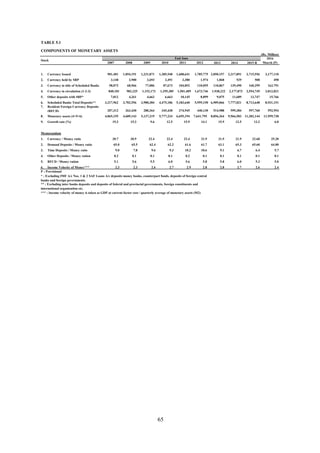
TABLE 5.1
COMPONENTS OF MONETARY ASSETS
(Rs. Million)
2007 2008 2009 2010 2011 2012 2013 2014 2015 R
1. Currency Issued 901,401 1,054,191 1,231,871 1,385,548 1,608,641 1,785,775 2,050,157 2,317,891 2,715,556 3,177,110
2. Currency held by SBP 3,148 2,900 2,693 2,491 2,380 1,974 1,068 529 508 498
3. Currency in title of Scheduled Banks 58,072 68,966 77,006 87,673 104,852 110,055 110,867 139,490 160,299 163,791
4. Currency in circulation (1-2-3) 840,181 982,325 1,152,173 1,295,385 1,501,409 1,673,746 1,938,222 2,177,873 2,554,749 3,012,821
5. Other deposits with SBP* 7,012 4,261 4,662 6,663 10,145 8,899 9,075 11,689 13,747 15,766
6. Scheduled Banks Total Deposits** 3,217,962 3,702,556 3,980,384 4,475,186 5,183,640 5,959,150 6,909,066 7,777,021 8,713,648 8,931,151
7. Resident Foreign Currency Deposits
(RFCD) 207,312 263,430 280,364 345,438 374,945 440,130 514,988 599,384 597,760 592,954
8. Monetary assets (4+5+6) 4,065,155 4,689,143 5,137,219 5,777,234 6,695,194 7,641,795 8,856,364 9,966,583 11,282,144 11,959,738
9. Growth rate (%) 19.3 15.3 9.6 12.5 15.9 14.1 15.9 12.5 13.2 6.0
Memorandum
1. Currency / Money ratio 20.7 20.9 22.4 22.4 22.4 21.9 21.9 21.9 22.60 25.20
2. Demand Deposits / Money ratio 65.0 65.5 62.4 62.2 61.6 61.7 63.1 65.3 65.60 64.00
3. Time Deposits / Money ratio 9.0 7.8 9.6 9.3 10.2 10.6 9.1 6.7 6.4 5.7
4. Other Deposits / Money ration 0.2 0.1 0.1 0.1 0.2 0.1 0.1 0.1 0.1 0.1
5. RFCD / Money ration 5.1 5.6 5.5 6.0 5.6 5.8 5.8 6.0 5.3 5.0
6. Income Velocity of Money*** 2.3 2.3 2.6 2.7 2.9 2.8 2.8 2.7 2.6 2.4
P : Provisional
*** : Income velocity of money is taken as GDP at current factor cost / quarterly average of monetary assets (M2)
2016
March (P)
End June
Stock
* : Excluding IMF A/c Nos. 1 & 2 SAF Loans A/c deposits money banks, counterpart funds, deposits of foreign central
banks and foreign governments.
** : Excluding inter banks deposits and deposits of federal and provincial governments, foreign constituents and
international organization etc.
65
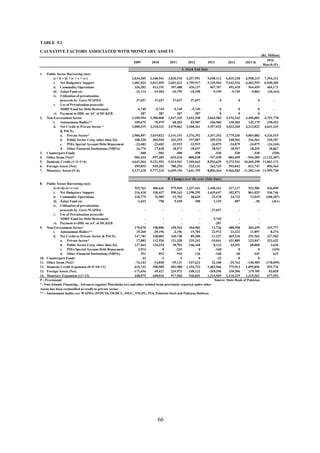
TABLE 5.2
CAUSATIVE FACTORS ASSOCIATED WITH MONETARY ASSETS
(Rs. Million)
2009 2010 2011 2012 2013 2014 2015 R
2016
March (P)
1. Public Sector Borrowing (net)
(i + ii + iii + iv + v + vi ) 2,034,305 2,440,941 3,020,510 4,257,951 5,698,112 6,025,228 6,958,215 7,394,312
i. Net Budgetary Support 1,681,022 2,011,459 2,601,622 3,799,917 5,239,564 5,542,534 6,403,559 6,940,305
ii. Commodity Operations 336,202 413,191 397,488 436,137 467,707 492,439 564,459 464,171
iii. Zakat Fund etc. -15,114 -15,904 -10,795 -10,298 -9,159 -9,745 -9,803 (10,164)
iv. Utilization of privatization
proceeds by Govt./WAPDA 37,657 37,657 37,657 37,657 0 0 0 -
v. Use of Privatization proceeds/
NDRP Fund for Debt Retirement -5,749 -5,749 -5,749 -5,749 0 0 0 -
vi. Payment to HBL on A/C of HC&EB 287 287 287 287 0 0 0 -
2. Non-Government Sector 3,189,994 3,388,800 3,547,345 3,652,248 3,663,984 4,152,542 4,456,001 4,791,778
i. Autonomous Bodies** 109,675 70,479 68,283 83,987 106,960 130,283 142,179 150,453
ii. Net Credit to Private Sector * 3,080,319 3,318,321 3,479,062 3,568,261 3,557,024 4,022,260 4,313,822 4,641,325
& PSCEs
a. Private Sector* 2,906,897 3,019,822 3,141,151 3,376,392 3,357,352 3,779,236 4,003,083 4,326,515
b. Public Sector Corp. other than 2(i) 180,330 304,554 343,255 197,087 205,210 248,501 316,561 320,187
c. PSEs Special Account Debt Repayment -23,683 -23,683 -23,915 -23,915 -24,075 -24,075 -24,075 (24,244)
d. Other Financial Institutions (NBFIs) 16,776 17,628 18,571 18,697 18,537 18,597 18,252 18,867
3. Counterpart Funds -500 -503 -498 -498 -530 -530 -530 (530)
4. Other Items (Net)* -582,434 -597,285 -652,416 -800,038 -767,938 -803,699 -944,289 (1,122,387)
5. Domestic Credit (1+2+3+4) 4,641,364 5,231,953 5,914,941 7,109,663 8,593,629 9,373,541 10,469,398 11,063,173
6. Foreign Assets (Net) 495,855 545,281 780,253 532,131 262,735 593,042 812,747 896,564
7. Monetary Assets (5+6) 5,137,218 5,777,234 6,695,194 7,641,795 8,856,364 9,966,583 11,282,144 11,959,738
8. Public Sector Borrowing (net)
(i+ii+iii+iv+v+vi) 525,763 406,636 579,569 1,237,441 1,440,161 327,117 932,986 436,098
i. Net Budgetary Support 316,418 330,437 590,163 1,198,295 1,439,647 302,971 861,025 536,746
ii. Commodity Operations 210,779 76,989 -15,703 38,649 31,570 24,733 72,019 (100,287)
iii. Zakat Fund etc. -1,433 -790 5,109 498 1,139 -587 -58 (361)
iv. Utilization of privatization
proceeds by Govt./WAPDA - - - - -37,657 - -
v. Use of Privatization proceeds/
NDRP Fund for Debt Retirement - - - - 5,749 - -
vi. Payment to HBL on A/C of HC&EB - - - - -287 - -
9. Non-Government Sector* 170,070 198,806 158,544 104,903 11,736 488,558 303,459 335,777
i. Autonomous Bodies** 25,260 -39,196 -2,196 15,704 22,973 23,322 11,897 8,274
ii. Net Credit to Private Sector & PSCEs 147,783 238,002 160,740 89,200 -11,237 465,236 291,562 327,503
a. Private Sector* 17,083 112,926 121,328 235,242 -19,041 421,885 223,847 323,432
b. Public Sector Corp. other than 2(i) 127,464 124,224 38,701 -146,168 8,123 43,291 68,060 3,626
c. PSEs Special Account Debt Repayment 3,914 0 -232 0 -160 0 0 (169)
d. Other Financial Institutions (NBFIs) 351 852 943 126 -160 60 -345 615
10. Counterpart Funds 43 -3 5 0 -32 0 0 -
11. Other Items (Net)* -76,143 -14,850 -55,131 -147,622 32,100 -35,762 -140,589 (178,099)
12. Domestic Credit Expansion (8+9+10+11) 619,733 590,589 682,988 1,194,723 1,483,966 779,913 1,095,856 593,776
13. Foreign Assets (Net) -171,656 49,427 234,972 -248,122 -269,396 330,306 219,705 83,818
14. Monetary Expansion (12+13) 448,075 640,016 917,960 946,601 1,214,569 1,110,219 1,315,561 677,593
P : Provisional Source: State Bank of Pakistan
** : Autonomous bodies are WAPDA (PEPCO), OGDCL, SSGC, SNGPL, PIA, Pakistan Steel and Pakistan Railway.
A. Stock End June
B. Changes over the year (July-June)
*: Note:Islamic Financing , Advances (against Murabaha etc) and other related items previously reported under other
Assets has been reclassified as credit to private sector.
66
TABLE 5.3
(Rs. Million)
Outstanding Amount at end June 2009 2010 2011 2012 2013 2014 2015 R
2016
March (P)
LIABILITIES
1. Capital (paid-up) and Reserves 639,098 669,863 724,112 813,555 932,906 984,863 1,277,273 1,285,120
DEMAND LIABILITIES IN PAKISTAN
2. Inter-banks Demand Liabilities 60,235 69,679 88,478 107,332 120,419 129,222 132,589 111,903
2.1 Borrowing 0 0 0 0 0 0 0 0
2.2 Deposits 60,235 69,679 88,478 107,332 120,419 129,222 132,589 111,903
3. Deposits (General) 3,473,440 3,965,680 4,601,452 5,251,360 6,147,750 7,148,706 8,161,800 8,496,281
4. Other Liabilities 218,283 227,436 251,625 291,216 328,249 384,936 367,968 341,929
5. Total Demand Liabilities (2+3+4) 3,751,958 4,262,795 4,941,556 5,649,908 6,596,418 7,662,865 8,662,357 8,950,113
TIME LIABILITIES IN PAKISTAN
6. Inter-banks Time Liabilities 17,470 11,883 3,817 660 4,883 625 466 9,015
6.1 Borrowing 0 0 0 0 0 0 0 0
6.2 Deposits 17,470 11,883 3,817 660 4,883 625 466 9,015
7. Time Deposits (General) 684,685 770,992 905,350 1,043,383 1,055,019 1,002,053 1,073,549 1,107,765
8. Other Liabilities 86,659 93,947 105,214 108,105 113,607 106,009 137,495 152,503
9. Total Time Liabilities (6+7+8) 788,814 876,823 1,014,381 1,152,148 1,173,509 1,108,687 1,211,509 1,269,283
10. Total Demand and Time Liabilities 4,540,772 5,139,617 5,955,937 6,802,056 7,769,926 8,771,552 9,873,867 10,219,397
11. Borrowing From SBP 293,641 321,127 359,278 378,714 483,931 272,436 918,222 1,622,630
12. Borrowing from Banks Abroad 9,139 9,211 14,403 15,446 43,219 70,309 101,329 99,863
13. Money at Call and Short Notice in Pakistan 192,979 218,179 174,488 96,165 277,425 340,538 266,903 159,167
14. Other Liabilities 323,587 423,774 458,099 521,701 499,920 521,906 513,135 589,751
15. Total Liabilities 5,999,217 6,781,771 7,686,317 8,627,638 10,007,328 10,961,604 12,950,729 13,975,929
16. Total Statutory Reserves 187,598 213,140 247,078 282,495 329,821 383,143 433,118 447,506
16.1 On Demand Liabilities 187,598 213,140 247,078 282,495 329,821 383,143 433,118 447,506
16.2 On Time Liabilities Assets 0 0 0 0 0 0 0 0
ASSETS
17. Cash in Pakistan 77,006 87,673 104,852 110,055 110,867 139,490 160,299 163,791
18. Balances with SBP 278,432 288,067 342,501 393,631 489,765 525,303 406,616 377,245
19. Other Balances 80,986 80,458 103,921 116,871 133,064 162,657 164,176 112,523
20. Money at Call and Short Notice in Pakistan 185,049 228,906 162,696 102,968 252,298 319,058 408,195 197,585
21. 17+18+19+20 as % of Total Demand
and Time Liabilities 13.7 13.3 12.0 10.6 12.7 13.1 11.5 8.3
FOREIGN CURRENCY
22. Foreign Currency held in Pakistan 13,518 15,482 14,797 19,024 19,365 24,468 24,688 28,412
23. Balances with Banks Abroad 149,837 110,694 98,656 95,290 89,011 88,353 102,479 102,069
24. Total Foreign Currency 163,356 126,176 113,453 114,315 108,376 112,821 127,168 130,481
BANK CREDIT ADVANCES
25. To Banks 0 0 0 0 0 0 0 0
26. To Others* 3,085,495 3,233,176 3,340,283 3,566,978 3,673,730 4,164,034 4,535,839 4,766,067
27. Total Advances* 3,085,495 3,233,176 3,340,283 3,566,978 3,673,730 4,164,034 4,535,839 4,766,067
28. Bills Purchased and Discounted 148,693 158,269 193,307 204,982 219,048 224,842 201,228 170,185
29. Total Bank Credit 3,234,188 3,391,445 3,533,590 3,771,960 3,892,778 4,388,875 4,737,067 4,936,251
29 a. Total Credit as % of Total Demand
and Time Liabilities 71.2 66.0 59.0 55.5 50.1 49.5 47.3 48.3
INVESTMENT IN SECURITIES AND SHARES
30. Central Government Securities 214,164 248,753 464,936 829,485 1,117,115 2,413,134 3,295,052 4,088,460
31. Provincial Government Securities 0 0 0 0 0 0 0 0
32. Treasury Bills 756,955 1,105,957 1,577,897 1,928,287 2,611,512 1,550,476 2,164,055 2,563,494
33. Other Investment in Securities & Shares 385,035 506,303 530,571 435,647 367,692 375,968 390,468 409,014
34. Total Investment in Securities and Shares 1,356,154 1,861,013 2,573,404 3,193,419 4,096,319 4,339,578 5,849,576 7,060,969
35. 35 as % of 10 29.9 36.2 43.0 46.9 52.7 49.5 59.2 69.1
36. Other Assets * 349,537 423,040 455,531 510,637 609,017 640,249 735,456 626,197
37. Advance Tax Paid 47,136 58,459 71,091 75,114 67,450 72,314 58,375 57,334
38. Fixed Assets 227,373 236,534 225,277 238,669 247,394 261,258 303,801 313,553
39. Total Assets 5,999,217 6,781,771 7,686,317 8,627,638 10,007,328 10,961,604 12,950,729 13,975,929
40. Excess Reserves (18-16) 90,834 74,928 95,423 111,136 159,944 142,159 (26,502) (70,261)
P : Provisional Source: State Bank of Pakistan
Note:
*: Note:Islamic Financing , Advances (against Murabaha etc) and other related items previously reported under other Assets has been
reclassified as credit to private sector.
SCHEDULED BANKS POSITION BASED ON WEEKLY RETURNS:
LIABILITIES AND ASSETS
1 : Effective from 22 July 2006, demand & time deposits have been re-classified in accordance with Banking Surveillance Department circular
no. 9, 2006 dated 18 July 2006. The time deposits of less than 6 months are included in demand deposits for the purpose of Cash Reserve
Requirement and Statutory Liquid Requirements.
2 : Definition of time & demand liabilities as mentioned in BSD circular no 9th
dated 18th
July 2008 have been revised. As per new definition,
time liabilities include deposits with tenor of one year and above. Accordingly, time deposits with tenor of less than one year will become part of
demand deposits.
67
TABLE 5.4
(Rs. Billion)
End June Stocks Narrow Money Monetary Assets (M2) Growth Income Velocity of Monetary
M1 Percentage Assets (M2)
2000-01 1,275.61 1,526.04 9.0 2.6
2001-02 1,494.14 1,751.88 14.8 2.5
2002-03 1,797.36 2,078.48 18.6 2.3
2003-04 2,174.74 2,485.49 19.6 2.3
2004-05 2,512.21 2,960.64 19.1 2.4
2005-06 2,720.68 3,406.91 15.1 2.4
2006-07 3,155.63 4,065.16 19.3 2.3
2007-08 4,339.50 4,689.14 15.3 2.3
2008-09 3,621.22 5,137.21 9.6 2.6
2009-10 - 5,777.23 12.5 2.7
2010-11 - 6,695.19 15.9 2.9
2011-12 - 7,641.79 14.1 2.8
2012-13 - 8,856.36 15.9 2.8
2013-14 - 9,966.58 12.5 2.7
2014-15 - 11,282.14 13.2 2.6
2015-16 P (Mar) 11,959.74 6.0 2.4
P: Provisional Source: State Bank of Pakistan
Explanatory Notes:
3. Provision of data on M1 has been discontinued from SBP.
INCOME VELOCITY OF MONEY
1. It may be noted that data series of M1 from 2000-01 is not comparable as compilation of M1 based on weekly data has been
discontinued by the SBP. Now M1 is being compiled on the basis of monthly returns and as reported in the monthly Statistical
Bulletin of the SBP beginning from April 2008 in its table 2.1
2. The stock data of M2 has been revised since June 2002 due to treatment of privatization commission deposits with NBP as
government deposits. These deposits were previously included in private sector deposits which have now being included in
government deposits.
68
TABLE 5.5
LIST OF DOMESTIC, FOREIGN BANKS AND DFIs (As on 31-12-2015)
Public Sector Commercial Banks 20. Standard Chartered Bank (Pakistan) Limited
1. First Women Bank Ltd. 21. Summit Bank Limited
2. National Bank of Pakistan 22. United Bank Limited
3. Sindh Bank Limited
4. The Bank of Khyber Foreign Banks
5. The Bank of Punjab 1. Citibank N.A.
2. Deutshe Bank A.G.
Specialized Scheduled Banks 3. Industrial and Commercial Bank of China Limited
1. The Punjab Provincial Co-operative Bank 4. The Bank of Tokyo - Mitsubishi UFJ Limited
2. Industrial Development Bank Limited (IDBL)
3. SME Bank Limited Development Financial Institutions
4. Zarai Taraqiati Bank Limited 1. House Building Finance Corporation
2. Pak-Brunai Investment Company Ltd
Private Local Banks 3. Pak-China Investment Co. Ltd
1. Allied Bank Limited 4. Pak-Iran Joint Investment Co.Ltd
2. Albarka Bank Pakistan Limited 5. Pak Kuwait Investment Company of Pakistan (Pvt) Limited
3. Askari Bank Limited 6. Pak Labya Holding Company (Pvt) Limited
4. Bank Al Falah Limited 7. Pak Oman Investment Company (Pvt) Limited
5. Bank Al Habib Limited 8. Saudi Pak Industrial & Agricultural Investment Company
6. Bank Islami Pakistan Limited (Pvt) Limited
7. Burj Bank Ltd
8. Dubai Islamic Bank Pakistan Limited Micro Finance Banks
9. Faysal Bank Limited 1. Advans Pakistan Micro Finance Bank
10. Habib Bank Limited 2. FINCA Microfinance Bank Ltd
11. Habib Metropolitan Bank Limited 3. First Micro Finance Bank Limited
12. JS Bank Limited 4. Khushhali Bank
13. MCB Bank Limited 5. APNA Microfinance Bank Limited
14. MCB Islamic Bank 6. NRSP Micro Finance Bank Ltd
15. Meezan Bank Limited 7. Pak Oman Micro Finance Bank Limited
16. NIB Bank Limited 8. Tameer Micro Finance Bank Limited
17. Samba Bank Limited 9. U Micro Finance Bank Ltd
18. Silk Bank Limited 10. Waseela Micro Finance Bank
19. Soneri Bank Limited 11. Sindh Micrifinance Bank Limited
Source: State Bank of Pakistan
69
TABLE 5.6
(in Percentage)
As at the Precious Stock Merchan- Machinery Real Financial Others Total
End of Metal Exchange dise Estate Obli- Advances*
Securities gations
I. INTEREST BEARING
2000 Jun 11.10 13.76 13.67 13.15 12.23 13.65 13.34 13.25
(11.81) (13.45) (13.83) (13.15) (13.73) (14.03) (13.98) (13.77)
Dec 11.53 13.57 12.88 13.82 12.90 13.49 12.93 13.08
(12.73) (12.82) (13.68) (13.74) (13.62) (13.56) (13.36) (13.58)
2001 Jun 11.75 13.54 13.69 13.50 12.84 13.07 12.05 13.07
(13.87) (14.06) (13.59) (13.55) (13.86) (13.00) (13.87) (13.64)
2002 Jun 8.10 11.27 13.12 13.56 12.72 13.88 12.47 13.00
(8.14) (11.70) (13.13) (13.67) (12.98) (13.81) (13.39) (13.29)
2003 Jun 12.01 11.97 9.39 15.66 12.63 7.74 10.66 11.87
(12.01) (11.82) (9.67) (15.68) (12.86) (7.66) (11.49) (12.35)
2004 Jun 9.20 6.01 6.89 11.21 9.08 7.08 9.04 8.41
(9.20) (6.01) (7.08) (11.77) (9.08) (7.03) (9.05) (8.54)
2005 Jun 8.51 6.86 6.09 4.59 6.68 6.76 8.86 7.01
(8.51) (8.29) (6.01) (4.07) (6.68) (6.70) (9.02) (7.01)
2006 Jun 11.58 14.84 8.68 8.55 10.23 10.31 9.59 9.71
(11.58) (14.09) (8.51) (8.55) (10.23) (10.31) (9.99) (9.66)
2007 Jun 10.87 11.37 10.73 11.07 12.30 11.05 10.76 11.25
(10.87) (12.11) (10.68) (11.06) (12.30) (11.05) (10.81) (11.30)
Dec 11.45 10.36 9.82 11.09 12.85 10.02 11.93 11.64
(11.45) (10.42) (9.82) (11.09) (12.85) (10.02) (11.98) (11.66)
2008 Jun 13.62 12.37 11.78 13.16 12.21 13.32 13.02 12.53
(13.62) (12.60) (11.77) (13.16) (12.21) (13.32) (13.14) (12.57)
Dec 14.64 13.88 13.83 12.05 13.60 16.55 13.74 13.60
(14.64) (14.11) (13.83) (12.04) (13.60) (16.55) (13.52) (13.66)
2009 Jun 14.86 12.15 13.45 11.91 14.14 15.30 13.21 13.54
(14.86) (10.11) (13.07) (11.91) (13.75) (15.27) (13.10) (13.54)
Dec 14.07 11.62 12.38 12.78 13.70 12.43 12.35 12.66
(14.07) (10.28) (12.17) (12.78) (13.70) (11.87) (11.99) (12.48)
2010 Jun 14.85 13.86 10.90 9.63 12.77 12.07 13.02 12.20
(14.85) (14.30) (9.77) (9.63) (12.77) (12.07) (13.20) (12.03)
Dec 14.72 13.36 11.69 12.02 12.48 13.45 12.92 12.36
(14.72) (12.30) (11.32) (11.95) (12.47) (13.45) (12.81) (12.19)
2011 Jun 15.78 12.42 11.33 11.11 12.01 11.04 12.85 12.01
(15.78) (13.26) (10.50) (11.11) (12.01) (11.04) (12.69) (11.72)
Dec 14.78 10.20 11.53 8.89 11.46 13.12 12.90 11.81
(14.78) (9.95) (11.27) (8.85) (11.46) (13.12) (12.88) (11.68)
2012 Jun 12.80 12.86 11.89 11.07 12.49 12.30 13.29 12.43
(12.80) (15.01) (11.48) (11.02) (12.49) (12.30) (13.24) (12.28)
Dec 15.40 12.28 10.55 8.31 10.20 8.40 11.41 10.77
(15.40) (12.25) (10.15) (8.28) (10.20) (8.40) (11.92) (10.81)
2013 Jun 14.86 11.72 8.71 8.45 10.80 9.40 10.64 9.97
(14.86) (11.95) (8.61) (8.42) (10.80) (9.40) (10.58) (9.89)
Dec 9.66 11.65 10.77 9.67 11.11 7.79 11.49 10.91
(9.66) (11.97) (10.50) (9.66) (11.11) (7.79) (12.22) (11.04)
2014 Jun 15.46 12.03 10.11 9.92 11.61 7.10 11.72 11.20
(15.46) (12.49) (9.66) (9.92) (11.61) (7.10) (11.72) (11.10)
Dec 15.32 11.93 9.58 9.64 11.65 7.39 12.33 11.30
(15.32) (12.73) (9.07) (9.64) (11.65) (7.39) (12.33) (11.20)
2015 Jun 12.99 11.15 9.13 8.64 9.91 7.32 11.51 10.27
(12.99) (11.06) (8.73) (8.64) (9.91) (7.32) (11.51) 10.14
Dec 14.45 9.44 8.69 8.79 9.29 6.65 11.38 9.90
(14.45) (10.49) (8.92) (8.79) (9.29) (6.65) (11.38) (10.07)
* : Weighted average rates shown in parentheses represent Private Sector. (Contd.)
SCHEDULED BANKS IN PAKISTAN (Weighted Average Rates of Return on Advances)
70
TABLE 5.6
(in Percentage)
As at the Precious Stock Merchan- Machinery Real Financial Others Total
End of Metal Exchange dise Estate Obli- Advances*
Securities gations
II. ISLAMIC MODES OF FINANCING
2000 Jun 10.61 13.12 13.48 14.31 13.08 13.42 13.83 13.54
(11.10) (13.48) (14.07) (14.39) (14.39) (13.40) (14.94) (14.27)
Dec 11.24 13.51 13.54 14.48 12.97 13.15 14.07 13.59
(11.32) (13.68) 14.01 (14.53) (14.24) (13.09) (15.09) (14.24)
2001 Jun 11.02 13.47 13.39 14.53 13.31 13.84 14.03 13.65
(11.28) (13.57) (13.88) (14.42) (14.52) (13.86) (14.78) (14.24)
2002 Jun 9.30 13.09 12.85 13.70 13.47 13.32 13.32 13.20
(9.50) (13.33) (12.73) (13.81) (14.05) (13.22) (14.00) (13.52)
2003 Jun 11.43 5.92 7.50 9.39 11.47 7.79 10.31 9.19
(11.43) (5.77) (7.95) (9.54) (12.08) (8.62) (10.84) (9.71)
2004 Jun 10.86 4.86 5.73 6.61 9.27 5.88 8.34 7.19
(10.86) (5.28) (5.96) (6.81) (9.68) (5.82) (9.01) (7.60)
2005 Jun 9.03 7.15 7.93 7.80 10.16 8.21 10.15 8.94
(9.03) (7.17) (7.95) (7.88) (10.22) (8.19) (10.67) (9.13)
2006 Jun 10.66 10.03 9.63 9.14 11.23 9.25 12.37 10.68
(10.66) (10.20) (9.66) (9.20) (11.26) (9.25) (12.90) (10.83)
2007 Jun 12.04 11.26 10.11 10.80 11.92 10.43 13.02 11.57
(12.04) (11.34) (10.03) (10.84) (11.92) (10.49) (13.40) (11.68)
Dec 9.70 11.27 10.26 10.76 11.80 10.58 12.93 11.55
(9.70) (11.41) (10.23) (10.82) (11.79) (10.62) (13.26) (11.65)
2008 Jun 11.75 12.87 11.53 12.26 12.11 11.23 13.90 12.48
(11.75) (12.93) (11.55) (12.22) (12.12) (11.23) (14.21) (12.55)
Dec 15.02 15.76 14.42 14.62 13.51 15.00 15.89 14.72
(15.02) (15.66) (14.19) (14.67) (13.49) (15.02) (15.96) (14.72)
2009 Jun 14.18 15.01 14.19 14.20 13.27 15.83 15.08 14.31
(14.18) (15.03) (13.73) (14.10) (13.30) (16.79) (15.20) (14.30)
Dec 14.18 13.61 12.10 12.72 12.71 11.93 14.88 13.22
(14.14) (14.02) (12.18) (12.70) (12.71) (11.55) (14.96) (13.10)
2010 Jun 15.08 14.26 13.16 13.81 12.25 13.59 14.83 13.73
(15.74) (14.34) (12.80) (13.79) (12.24) (13.67) (14.94) (13.52)
Dec 15.20 13.80 13.01 13.10 12.24 12.86 14.59 13.43
(15.20) (13.59) (12.69) (13.18) (12.23) (12.79) (14.82) (13.23)
2011 Jun 16.24 11.04 12.81 13.74 12.57 12.81 14.73 13.55
(16.24) (14.41) (12.36) (14.22) (12.53) (12.83) (14.43) (13.32)
Dec 13.50 13.06 13.40 14.18 12.46 12.42 15.04 13.83
(13.50) (13.21) (13.17) (14.14) (12.46) (12.51) (14.92) (13.62)
2012 Jun 9.46 11.63 12.84 12.51 11.84 14.11 13.68 12.84
(9.63) (12.89) (12.43) (13.17) (11.81) (14.10) (13.52) (12.72)
Dec 9.53 11.10 11.19 12.10 12.43 13.30 12.80 12.02
(9.53) (11.67) (10.91) (12.03) (12.40) (13.21) (13.02) (11.93)
2013 Jun 12.80 11.65 11.02 11.74 12.05 13.80 12.20 11.78
(13.69) (11.44) (10.92) (11.46) (12.04) (12.57) (12.88) (11.81)
Dec 14.20 10.80 10.52 11.14 11.23 9.10 11.79 11.20
(15.26) (10.99) (10.48) (11.03) (11.29) (10.67) (12.59) (11.37)
2014 Jun 14.22 11.27 10.12 9.48 12.03 10.65 12.29 11.18
(15.12) (11.25) (10.44) (11.16) (11.71) (10.65) (12.90) (11.58)
Dec 13.73 11.00 10.35 10.72 11.50 10.22 11.94 11.11
(15.03) (11.01) (10.31) (11.04) (11.50) (10.19) (12.91) (11.28)
2015 Jun 11.59 8.83 8.48 8.22 10.49 10.19 10.02 9.30
(12.22) (8.79) (8.68) (8.62) (10.56) (9.58) (11.42) (9.77)
Dec 13.15 8.42 7.32 8.16 9.12 9.70 8.80 8.34
(13.85) (7.94) (7.43) (8.18) (9.20) (8.57) (10.12) (8.66)
* : Weighted average rates shown in parentheses represent Private Sector Source: State Bank of Pakistan
SCHEDULED BANKS IN PAKISTAN (Weighted Average Rates of Return on Advances)
71
TABLE 5.7
SALE OF GOVERNMENT SECURITIES THROUGH AUCTION (MTBs)
(Rs. Million)
No. Securities 2007-08 2008-09 2009-10 2010-11 2011-12 2012-13 2013-14 2014-15
2015-16
March (P)
Market Treasury Bills*
A. Three Months Maturity
Amount Offered
i) Face value 157,946 1,413,218 571,993 2,837,276 1,658,923 1,592,616 5,555,952 1,697,279 2,101,410
ii) Discounted value 154,340 1,372,004 556,452 2,742,436 1,611,411 1,554,179 5,435,437 1,658,957 2,070,876
Amount Accepted
i) Face value 139,771 975,798 239,467 1,668,408 1,114,157 1,155,404 5,031,692 1,231,906 1,211,203
ii) Discounted value 136,574 947,622 232,985 1,619,861 1,084,374 1,130,378 4,922,517 1,206,378 1,193,527
Weighted Average Yield
i) Minimum % p.a. 8.687 11.451 11.306 12.084 11.562 8.932 8.887 6.606 6.152
ii) Maximum % p.a. 11.316 13.855 12.968 13.577 13.518 11.873 9.974 9.970 6.931
B. Six Months Maturity
Amount Offered
i) Face value 91,476 272,584 868,334 2,226,878 1,719,456 3,597,169 1,024,910 2,157,339 1,911,162
ii) Discounted value 87,279 255,885 818,516 2,087,195 1,619,284 3,425,863 973,520 2,071,487 1,851,577
Amount Accepted
i) Face value 78,242 176,401 406,896 1,614,552 1,058,185 2,434,463 950,189 1,251,489 1,188,603
ii) Discounted value 74,673 165,626 383,593 1,538,590 996,796 2,319,355 906,276 1,200,353 1,151,228
Weighted Average Yield
i) Minimum % p.a. 8.902 11.668 11.381 12.316 11.626 8.916 8.944 6.635 6.166
ii) Maximum % p.a. 11.472 14.011 12.597 13.736 13.762 11.920 9.979 9.979 6.951
C. Twelve Months Maturity
Amount Offered
i) Face value 658,709 931,293 1,765,589 908,194 2,154,137 2,963,751 915,273 2,955,465 2,759,473
ii) Discounted value 598,425 823,027 1,572,033 799,172 1,910,366 2,691,500 830,313 2,725,976 2,591,960
Amount Accepted
i) Face value 441,130 332,008 931,787 599,015 1,283,676 2,017,987 894,465 1,226,861 1,554,942
ii) Discounted value 402,784 294,106 830,606 527,018 1,139,954 1,833,775 813,625 1,130,052 1,460,652
Weighted Average Yield
i) Minimum % p.a. 9.16 11.778 11.464 12.431 11.690 8.956 8.957 6.717 6.170
ii) Maximum % p.a. 11.688 14.261 12.609 13.907 13.907 11.930 9.990 9.990 6.971
P : Provisional Source: State Bank of Pakistan
* : MTBs were introduced in 1998-99
Note : Amount includes Non-competitive Bids as well
72
TABLE 5.8
SALE OF GOVERNMENT SECURITIES THROUGH AUCTION (PIBs)
(Rs. Million)
No. Securities 2007-08 2008-09 2009-10 2010-11 2011-12 2012-13 2013-14 2014-15
2015-16
March (P)
Pakistan Investment Bonds*
A. Amount Offered 141,853 12,640 140,520 321,936 331,683 647,257 2,232,571 2,175,106 2,058,255
03 Years Maturity 11,260 9,523 21,163 81,960 98,271 319,735 1,231,992 1,104,978 1,083,071
05 Years Maturity 21,311 4,410 13,427 33,306 74,798 173,909 465,286 577,463 812,426
07 Years Maturity - - 5,900 6,576 1,650 - - - -
10 Years Maturity 61,593 25,254 69,800 176,840 149,418 147,403 512,925 483,891 162,758
15 Years Maturity 16,138 2,536 3,560 2,966 2,446 - - - -
20 Years Maturity 11,750 3,500 12,120 7,875 4,890 6,210 22,368 8,775
30 Years Maturity 19,800 7,000 14,550 12,413 210 - - - -
B. Amount Accepted 73,584 25868 64,732 169,295 226,095 278,357 2,038,994 1,014,437 782,964
3 Years Maturity
(i) Amount Accepted 5,169 4,165 11,645 49,712 72,207 139,300 1,171,806 495,486 407,615
(ii) Weighted Average Yield
Minimum % p.a. 9.619 13.697 12.208 13.898 12.080 9.607 10.326 7.365 6.295
Maximum % p.a. 12.296 13.883 13.551 14.200 13.431 12.639 12.086 12.539 8.065
5 Years Maturity
(i) Amount Accepted 10,777 3,023 7,177 16,668 55,897 80,492 426,111 287,494 338,021
(ii) Weighted Average Yield
Minimum % p.a. 9.796 14.335 12.294 12.276 12.108 10.050 10.776 8.011 6.968
Maximum % p.a. 10.800 14.336 12.563 14.277 13.474 13.050 12.559 12.965 8.965
7 Years Maturity
(i) Amount Accepted - 2,935 2,175 Bids - - - - -
(ii) Weighted Average Yield Rejected
Minimum % p.a. - 14.3273 12.4159 0 0 - - - -
Maximum % p.a. - 14.7041 12.696 0 0 - - - -
10 Years Maturity
(i) Amount Accepted 23,875 8,509 39,399 101,355 92,049 53,368 420,755 223,457 37,328
(ii) Weighted Average Yield
Minimum % p.a. 10.179 14.472 12.426 14.017 12.156 10.962 11.527 9.137 8.221
Maximum % p.a. 13.411 14.864 12.705 14.249 13.499 13.327 12.921 13.439 9.401
15 Years Maturity
(i) Amount Accepted 8,613 1,236 1,035 460 2,262 - - - -
(ii) Weighted Average Yield
Minimum % p.a. 11.108 14.750 12.293 14.098 13.501 - - - -
Maximum % p.a. 13.441 15.356 12.923 14.108 13.501 - - - -
20 Years Maturity
(i) Amount Accepted 9,050 1,500 1,525 875 3,680 5,197 20,323 8,000 -
(ii) Weighted Average Yield
Minimum % p.a. 11.373 15.700 13.099 14.138 13.350 13.350 12.900 11.000 -
Maximum % p.a. 13.855 15.700 13.922 14.199 13.350 13.350 13.289 13.591 -
30 Years Maturity
(i) Amount Accepted 16,100 4,500 1,775 225 0 - - - -
(ii) Weighted Average Yield
Minimum % p.a. 11.588 14.608 13.551 14.186 0 - - - -
Maximum % p.a. 14.118 16.225 13.749 14.187 0 - - - -
P : Provisional Source: State Bank of Pakistan
* : PIBs were introduced in 2000-01
Note : Amounts includes non-competitive bids & short sale accomodation as well.
73

05 money and_credit

  • 1.
    CHAPTER 05 Money andCredit The primary objective of monetary policy is to control the money supply, contain inflation, stabilize the exchange rate, and maintain the equilibrium in balance of payments. Monetary policy has a key role in the macroeconomic stability of a country. The global economic activity is still fragile on the back of slow and subdued economic growth in emerging and developing economies. However, advanced economies have witnessed a modest recovery. Over the year 2016, the global economic outlook has deteriorated in the wake of growing risks from the slowdown and rebalancing of economic activity in China away from investment and manufacturing towards consumption and services, a decline in oil and commodity prices and a gradual tightening of monetary policy in the United States. As a result, risks to global financial stability have increased. Keeping in view these developments and risks, the World Economic Outlook (WEO) in April 2016 has revised down the global growth projection to 3.2 percent for 2016 from 3.4 percent, and for 2017 to 3.5 percent against 3.6 percent earlier estimated in January 2016. While emerging economies are facing much slower economic growth, Pakistan’s economy did reasonably well. The economy after witnessing subdued growth since FY2009 improved to 4.04 percent in FY2015 and 4.71 in FY2016, an eight years high level underpinned by the robust growth in Industrial and services sectors. The external sector has been more stable on the back of continued growth in remittances, IFIs inflows, stable exchange rate, high foreign exchange reserves, stable outlook of inflation and balance of payments even allowed policymakers to implement pro-growth strategies. SBP cut its policy rate significantly which is the lowest in 44 year. The flows of Credit to Private Sector (CPS) has seen expansion of Rs.311.7 billion during Jul-06th May, FY2016 against Rs.171.2 billion in the same period of last year. It witnessed expansion of 82.0 percent during the period under review compared to the contraction of 41.5 percent during same period last year. This expansion is helping manufacturing sector which in turn will help in improving the industrial sector. A welcome development is the gradual rise in net credit disbursement for fixed investment. It appeared that many firms are expanding their operations by availing fixed investment loan. The overall performance of the banking sector during the last couple of years has been quite impressive. The momentum continued in the current fiscal year 2016 with asset base reaching to Rs.14.3 trillion by end March, 2016 (Rs.12.1 trillion as of end March, 2015). Similarly, asset quality has also improved and gross NPLs to loans ratio reduced from 12.3 percent in CY14 to 11.4 percent in CY15, while it stood at 11.7 percent as of end March, 2016 against 12.8 percent in the comparable period last year. Whereas, Capital Adequacy Ratio (CAR) increased to 16.3 percent by end March, 2016 that is much strong and higher than the minimum required level of 10.25 percent. Monetary Policy Stance Despite several challenges during the initial months of FY 2015, the macroeconomic indicator showed marked improvement and this trend is continued during current FY2016. The main driving force was favorable macroeconomic environment, which included uptick in real GDP growth, a sharp decline in headline CPI inflation, stability in external sector including all time high level of the country’s FX reserves and contained fiscal deficit due to remarkable revenue mobilization alongwith government efforts to substitute its borrowing from SBP to commercial banks and successful completion of eleven
  • 2.
    Pakistan Economic Survey2015-16 80 reviews under Extended Fund Facility (EFF). International rating agencies have also upgraded the Pakistan’s credit ratings by observing these macroeconomic developments. On account of these developments, State Bank of Pakistan (SBP) changed its monetary policy stance from a conservative to accommodative and cut the policy rate by a cumulative 350 basis points to 6.5 percent in its monetary policy meetings held between November 2014 to May 2015 and further decreased the policy rate to a historically low level of 6 percent in September 2015. Policy rate remained unchanged at 6.0 percent in subsequent monetary policy meetings held in November 2015, January and April, 2016. The realization of monetary easing witnessed in pickup of economic activities supported SBP’s decision to reduce the policy rate by 25 bps from 6.0 percent to 5.75 percent w.e.f. 21st May, 2016 which is the lowest rate in last 44 years reflecting improved macro-economic conditions towards the end of FY2016. Recent Monetary and Credit Developments Broad Money (M2) increased to Rs.781.8 billion (6.93 percent) during July-06th May, FY2016 against the expansion of Rs.690.0 (6.92 percent) in the same period last year. Net Domestic Assets (NDA) of the banking system contributed 6.0 percent in M2 expansion of 6.93 percent while the contribution of Net Foreign Assets (NFA) of the banking system decreased in the cumulative growth of M2 during the period under review. Table 5.1: Policy Rate w.e.f Policy rate Jun-13 9.0 Sep-13 9.5 Nov-13 10.0 Nov-14 9.5 Jan-15 8.5 Mar-15 8.0 May-15 6.5 Jul-15 6.5 Sep-15 6.0 Nov-15 6.0 Jan-16 6.0 Apr-16 6.0 May-16 5.75 Source: State Bank of Pakistan 0 2 4 6 8 10 12 14 16 18 0 2 4 6 8 10 12 Jun-13 Sep-13 Dec-13 Mar-14 Jun-14 Sep-14 Dec-14 Mar-15 Jun-15 Sep-15 Dec-15 Mar-16 billion US $ percent Fig-5.1: Policy Environment-Key Indicators SBP liquid FX reserves (rhs) Y0Y CPI Inflation Policy rate WALR 0 3 6 9 12 15 18 21 24 12-May-72 3-Sep-74 10-Oct-91 6-Dec-92 1-Mar-94 13-Dec-95 17-Jun-97 29-Oct-97 4-Mar-99 19-May-99 5-Oct-00 19-Jul-01 22-Oct-01 18-Nov-02 21-Jul-05 31-Jul-06 1-Aug-07 23-May-08 13-Nov-08 21-Apr-09 29-Sep-09 30-Jan-10 24-May-10 30-Sep-10 1-Aug-11 30-Nov-11 13-Apr-12 13-Aug-12 17-Dec-12 12-Apr-13 16-Sep-13 26-Jan-15 25-May-15 12-Sep-15 30-Jan-16 21-May-16 Percent Fig-5.2: SBP Policy Rate 5.75% 6.0 %
  • 3.
    Table 5.2: Profileof Monetary Indicators 1.Net government sector Borrowing(a+b+c) a .Borrowing for budgetary support b.Commodity operations c.Others 2.Credit to Non-government Sector (d+e+f+g) d.Credit to Private Sector e.Credit to Public Sector Enterprises (PSEs) f. PSEs Special Account-Debt repayment with SBP g.Other Financial Institutions(SBP credit to NBFIs) 3.Other Items(net) 4.Net Domestic assets (NDA) 5.Net Foreign Assets (NFA) 6.Monetary Assets(M2) Source: Weekly Profile of Broad Money, State Bank of Pakistan In contrast, reserve money accelerated to Rs.697.6 billion and grew by 22.20 percent during July May FY2016, as compared to 11.52 percent in corresponding period of last year. Within Broad Money, NFA of the banking system during Jul-06th May, FY2016 witnessed expansion The NDA of the banking system showed an increase of Rs.676.6 billion during Jul FY 2016 against an increase of Rs.467.6 billion in the same period of last year. Higher increase was on the back of significant rise in Private Sector Credit (PSC) which was partially offset by lower credit to Public Sector Enterprises (PSEs) and higher retirement against commodity financing compared to last year. There is a considerable contribution of NDA in the expansion of M2 during the period under review. -400 -200 0 200 400 600 800 1000 2010-11 2011 Rs. Billion Fig-5.3: Net Foreign Asset Profile of Monetary Indicators Jul-06 May 2015-16 1.Net government sector Borrowing(a+b+c) 567.5 a .Borrowing for budgetary support 643.0 -75.0 -0.52 government Sector (d+e+f+g) 362.1 311.7 e.Credit to Public Sector Enterprises (PSEs) 49.9 Debt repayment with SBP -0.2 g.Other Financial Institutions(SBP credit to NBFIs) 0.6 -253.0 676.6 (6.46 %) 105.2 781.8 (6.93 %) Weekly Profile of Broad Money, State Bank of Pakistan In contrast, reserve money accelerated to Rs.697.6 billion and grew by 22.20 percent during July-06th May FY2016, as compared to 11.52 percent in corresponding period of last year. thin Broad Money, NFA of the banking system May, FY2016 witnessed expansion of Rs.105.2 billion against the net expansion of Rs.222.3 billion during the corresponding period of FY2015.The continuity in the official inflows increased the SBP’s NFA by Rs.126.4 billion during Jul-06th May, FY2016. On the other hand, NFA of the scheduled banks witnessed a decline of Rs.21.2 billion during the period under review. The NDA of the banking system showed an of Rs.676.6 billion during Jul-06th May, FY 2016 against an increase of Rs.467.6 billion in the same period of last year. Higher increase was on the back of significant rise in Private Sector Credit (PSC) which was partially offset by lower credit to Public Sector Enterprises (PSEs) and her retirement against commodity financing compared to last year. There is a considerable contribution of NDA in the expansion of M2 Credit to Public Sector Enterprises (PSEs) increased by Rs.49.9 billion during July FY 2016 against Rs.62.1 billion in the corresponding period of FY 2015. Government Bank Borrowing Government sector borrowing (net) reached at Rs.567.5 billion during Jul compared to an increase of Rs.539.4 billion in the same period of FY 2015. 2011-12 2012-13 2013-14 2014-15 Jul-06 May 2015- Flows Stocks Money and Credit 81 (Rs. Billion) Jul-08 May 2014-15 539.4 560.8 -20.8 -0.70 233.3 171.2 62.1 0.0 0.0 -305.1 467.6 (4.99 %) 222.3 689.9 (6.92%) of Rs.105.2 billion against the net expansion of .3 billion during the corresponding period of FY2015.The continuity in the official inflows ’s NFA by Rs.126.4 billion May, FY2016. On the other hand, NFA of the scheduled banks witnessed a decline of Rs.21.2 billion during the period under review. Credit to Public Sector Enterprises (PSEs) increased by Rs.49.9 billion during July-06th May, FY 2016 against Rs.62.1 billion in the corresponding period of FY 2015. Government Bank Borrowing Government sector borrowing (net) reached at Rs.567.5 billion during Jul-06th May, FY 2016 as compared to an increase of Rs.539.4 billion in the 06 May -16 Jul-08 May 2014-15
  • 4.
    Pakistan Economic Survey2015 82 Net budgetary borrowing from banking system remained at Rs.643.0 billion during Jul FY 2016 as compared to Rs.560.8 billion in the same period last year. Government borrowing from scheduled banks remained lower and stood at Rs.702.9 billion against Rs.1,093.2 billion in comparable period of last year. While, Commodity Finance During Jul-06th May, FY 2016 loans for commodity finance witnessed a net retirement of Rs.75.0 billion almost four times higher than the net retirement of Rs. 20.8 billion in the corresponding period of last year. Despite the heavy retirement for commodity finance, the outstanding stock of commodit reached to Rs.489.5 billion against Rs. 471.7 billion during the period under review. In FY 2015, the outstanding stock of commodity financing has increased significantly to Rs.564.5 billion from Rs.492.4 billion in the same period of FY 2014, thus posting a growth 14.6 in FY2015 -500 -250 0 250 500 750 1000 1250 1500 2011-12 2012 Rs.billion Fig-5.4: Government Borrowings (Flows) -100 -80 -60 -40 -20 0 20 40 60 80 2011-12 2012 Rs.billion Fig-5.5: Commodity Finance Pakistan Economic Survey 2015-16 Net budgetary borrowing from banking system remained at Rs.643.0 billion during Jul-06 May FY 2016 as compared to Rs.560.8 billion in the same period last year. Government borrowing from scheduled banks remained lower and stood billion against Rs.1,093.2 billion in comparable period of last year. While, government retired Rs.59.8 billion to the State Bank of Pakistan during the period Jul FY 2016 against the retirement of Rs.532.3 billion in the same period of FY 2015. Ho positive note, the government successfully met the quarterly limit of net zero budgetary borrowing from SBP at the end of third quarter March, 2016. May, FY 2016 loans for odity finance witnessed a net retirement of Rs.75.0 billion almost four times higher than the net retirement of Rs. 20.8 billion in the corresponding period of last year. Despite the heavy retirement for commodity finance, the outstanding stock of commodity financing reached to Rs.489.5 billion against Rs. 471.7 billion during the period under review. In FY 2015, the outstanding stock of commodity financing has increased significantly to Rs.564.5 billion from Rs.492.4 billion in the same period of thus posting a growth 14.6 in FY2015 against the growth of 5.3 percent in FY 2014. The commodity wise breakup reveals that during July- 31st March FY2016, loans for wheat finance recorded a net retirement of Rs. 113.4 billion against the retirement of Rs the same period of FY 2015. Higher amount of retirement during FY 2016 was due to aggressive offloading of wheat stocks. On the other hand, loans for fertilizer finance amounted to Rs.12.2 billion during July- 31st the retirement of Rs. 8.9 billion in the comparable period last year. While, borrowing for sugar finance reached at Rs. 0.45 billion during Jul March, FY 2016 against the retirement of Rs. 0.81 billion in the comparable period last year. 2012-13 2013-14 2014-15 (Jul-06 May) 2015-16 5.4: Government Borrowings (Flows) From SBP From Scheduled banks Total borrowings 2012-13 2013-14 2014-15 Jul-06 May 2015-16 5.5: Commodity Finance Flows Commodity Finance(Stocks) government retired Rs.59.8 billion to the State Bank of Pakistan during the period Jul-06 May, FY 2016 against the retirement of Rs.532.3 billion in the same period of FY 2015. However on positive note, the government successfully met the quarterly limit of net zero budgetary borrowing from SBP at the end of third quarter March, 2016. against the growth of 5.3 percent in FY 2014. The commodity wise breakup reveals that during March FY2016, loans for wheat finance recorded a net retirement of Rs. 113.4 billion against the retirement of Rs. 47.6 billion during the same period of FY 2015. Higher amount of retirement during FY 2016 was due to aggressive offloading of wheat stocks. On the other hand, loans for fertilizer finance amounted to Rs.12.2 March FY 2016 against the retirement of Rs. 8.9 billion in the comparable period last year. While, borrowing for sugar finance reached at Rs. 0.45 billion during Jul- 31st March, FY 2016 against the retirement of Rs. 0.81 billion in the comparable period last year. -400 100 600 1100 1600 (Jul-08 May) 2014-15 From SBP From Scheduled banks Total borrowings 0 100 200 300 400 500 600 Jul-08 May 2014-15 Commodity Finance(Stocks)
  • 5.
    Credit to PrivateSector1 FY 2015 has registered a net expansion of Rs.223.8 billion in credit to private sector as compared with Rs.421.8 billion last year. In contrast, current data demonstrates that credit to private sector increased to Rs. 311.7 billion compared to Rs.171.2 billion, 7.8 percent higher than 4.5 percent in the same period of FY 2015. However, on year on year basis as on 06 May, FY 2016 credit to private sector posted a growth of 9.2 percent against 8.2 percent in the same period of last year. The considerable improvement and pickup in Sectoral Analysis Table 5.3: Credit to Private Sector Sectors End June Stocks Jun-14 Overall Credit (1 to 5) 3,376.8 1. Loans to Private Sector Business 2,827.7 A. Agriculture 252.7 B. Mining and Quarrying 18.9 C. Manufacturing 1,636.0 Textiles 558.1 D. Electricity, gas and water supply 278.6 E. Construction 52.3 F. Commerce and Trade 223.3 G. Transport, storage and communications 117.1 I. Other private business n.e.c 98.8 2. Trust Funds and NPOs 3. Personal 338.1 4. Others 15.3 5. Investment in Security & Shares of Private Sector 187.5 Source: State Bank of Pakistan -50 0 50 100 150 200 250 300 350 400 450 2008-09 2009-10 Rs.Billion Fig-5.6: Credit to Private Sector 1 Islamic Financing, Advances (against Murabaha etc), Inventories and other related Items previously reported under Other Assets have been reclassified as credit to private sector. FY 2015 has registered a net expansion of Rs.223.8 billion in credit to private sector as compared with Rs.421.8 billion last year. In contrast, current data demonstrates that credit to private sector increased to Rs. 311.7 billion compared to Rs.171.2 billion, 7.8 percent higher than 4.5 percent in the same period of FY 2015. However, on year on year basis as on 06 May, FY 2016 credit to private sector posted a growth of nst 8.2 percent in the same period The considerable improvement and pickup in credit to private sector during FY 2016 primarily attributed to lower cost of borrowing that has improved the financial condition of major corporate sectors. Addit sentiments, comparatively lower government budgetary borrowing and modest risk premium for banks has also encouraged large number of sectors (including textiles, fertilizer, retail trade, construction, and electricity). These secto availed higher credit in FY 2016 not only for working capital but also for fixed investment. A sustained growth in credit for fixed investment bodes well for overall investment rate in the country in future. End June Stocks March-15 March-16 Jul-Mar (Flows) 14 Jun-15 2014-15 2015 3,376.8 3,651.1 3,608.4 3,914.8 231.6 2,827.7 3,015.5 3,015.3 3,264.5 187.6 252.7 285.4 267.0 284.0 14.3 18.9 20.8 22.9 19.5 4.0 1,636.0 1,704.4 1,740.6 1,910.8 104.6 558.1 549.7 587.6 632.2 29.5 278.6 267.2 275.5 307.0 -3.2 52.3 66.0 63.3 92.7 11.0 223.3 237.0 234.4 248.3 11.1 117.1 146.6 126.9 167.5 9.9 98.8 109.5 102.0 40.7 3.2 8.2 14.0 9.0 14.0 0.8 338.1 383.1 362.9 401.3 24.8 15.3 15.2 13.5 5.4 -1.8 187.5 223.4 207.8 229.5 20.3 2010-11 2011-12 2012-13 2013-14 2014-15 2015-16 (July-06 May) 5.6: Credit to Private Sector flows etc), Inventories and other related Items previously reported under Other Assets have been reclassified as credit to private sector. Money and Credit 83 credit to private sector during FY 2016 primarily attributed to lower cost of borrowing that has improved the financial condition of major corporate sectors. Additionally, better business sentiments, comparatively lower government budgetary borrowing and modest risk premium for banks has also encouraged large number of sectors (including textiles, fertilizer, retail trade, construction, and electricity). These sectors have availed higher credit in FY 2016 not only for working capital but also for fixed investment. A sustained growth in credit for fixed investment bodes well for overall investment rate in the Rs Billion Mar (Flows) Growth Rates 2015-16 2014-15 2015-16 263.7 6.9 7.2 249.0 6.6 8.3 -1.4 5.7 -0.5 -1.3 21.0 -6.3 206.4 6.4 12.1 82.5 5.3 15.0 39.8 -1.1 14.9 26.7 21.1 40.5 11.3 5.0 4.8 20.9 8.4 14.3 -68.9 3.3 -62.9 0.1 9.6 0.6 18.2 7.3 4.8 -9.8 -12.1 -64.5 6.1 10.8 2.8 -2.0 0.0 2.0 4.0 6.0 8.0 10.0 12.0 14.0 16 06 May) 2014-15 (July-08 May) Growth in percent Growth
  • 6.
    Pakistan Economic Survey2015-16 84 Overall credit grew by 7.2 percent during Jul-Mar, FY2016 as compared to 6.9 percent during the comparable period of last year FY2015.Sector wise growth demonstrates that loans to private sector business witnessed a significant growth of 8.3 percent during Jul-Mar, FY2016 against 6.6 percent in same period of last year. In flow terms, credit expansion to private business reached to Rs.249.0 billion during July-March, FY2016 as compared to Rs.187.6 billion in the corresponding period of FY 2015.The expansion in credit to private sector is broad based during FY 2016 and mainly came from construction (40.5 percent), followed by Electricity, Gas and Water supply (14.9 percent), Transport, Storage and Communication (14.3 percent), Manufacturing (12.1 percent) of which Textile by (15.0 percent).The expansion in private sectors loans during Jul-Mar, FY2016 primarily in Manufacturing sector that received share 82.9 percent of private sector loan (Rs. 206.4 billion), followed by textile (33.1 percent or Rs. 82.5 billion), Electricity, Gas and Water supply (16.0 percent or Rs.39.8 billion), construction (10.7 percent or Rs.26.7 billion) and transport, storage and communication (8.4 percent or Rs. 20.9 billion). Table 5.4: Loans to Private Sector Businesses [Jul-Mar (Flows)] Rs. Billion Total Credit Working Capital Fixed investment Trade financing FY15 FY16 FY15 FY16 FY15 FY16 FY15 FY16 Total 185.1 319.8 50.6 119.2 84.4 150.1 50.2 50.4 Agriculture 14.3 -1.4 6.8 -7.4 8.2 6.1 -0.7 -0.1 Manufacturing 104.6 206.4 26.7 116.5 44.0 34.1 34.0 55.7 Food & beverages 56.8 68.7 24.2 42.9 17.2 11.9 15.4 13.9 Textiles 29.5 82.5 15.9 58.0 1.8 9.3 11.8 15.1 Coke & petroleum 18.0 10.4 10.7 1.9 9.1 -5.9 -1.7 14.4 Chemicals 1.9 33.1 -8.1 22.1 11.4 7.5 -1.4 3.5 Electricity -3.2 39.8 1.0 13.0 -6.0 31.9 1.9 -5.1 Construction 11.0 26.7 -2.0 -2.6 11.3 28.1 1.8 1.3 Commerce and trade 11.1 11.3 -0.4 4.0 7.8 7.1 3.7 0.1 Transport & comm. 9.9 20.9 7.1 -9.2 2.6 30.2 0.2 0.0 Real estate 17.8 7.1 6.3 3.2 11.7 1.0 -0.2 3.0 Others -1.8 -9.8 2.4 -1.9 -1.3 3.3 -0.4 0.5 Source: State Bank of Pakistan The credit to private sector has witnessed significant growth by type of finance during Jul- Mar, FY2016 for working capital, fixed investment and trade financing categories as compared to same period of last year. The gradual increase in credit disbursement for all categories mainly used by major sectors of the economy and particularly notable in production, transmission and distribution of electricity; road transport; construction of roads; telecommunications; sugar; manufacturers of electricity distribution machinery; cement; fertilizer; and pharmaceutical sectors. Credit for fixed investment reached to Rs.150.1 billion (increase by 78.0 percent) during Jul-Mar, FY2016 against Rs.84.4 billion in comparable period of FY2015, working capital credit amounted to Rs.119.2 billion (grew by 135.8 percent) during the Jul-Mar, of FY2016 as compared to Rs.50.6 billion in same period of last year, similarly trade financing increased to Rs.50.4 billion (grew by marginally 0.44 percent) in Jul-Mar, FY2016 from Rs.50.2 billion in the corresponding period of last year FY2015. A continuation of credit demand requires favourable monetary conditions and improvement in performance of manufacturing and services sectors. Realization of this could augur well for growth in private sector going forward2 . 2 2nd Quarterly Report FY16, SBP
  • 7.
    Money and Credit 85 Table5.5: Consumer Financing Rs Billion July-March (Flows) Growth(%) Description 2014-15 2015-16 2014-15 2015-16 Consumer Financing 16.9 17.3 6.7 6.1 1) For house building 0.1 5.1 0.2 12.8 2) For transport i.e. purchase of car 13.7 17.3 21.3 20.4 3) Credit cards -0.5 0.9 -2.0 3.6 4) Consumers durable -0.1 0.4 -14.4 110.8 5) Personal loans 4.9 -4.2 4.2 -3.3 6) Other -1.1 -2.3 -13.8 -27.3 Source: State Bank of Pakistan Consumer financing recorded a growth of 6.1 percent (Rs. 17.3 billion) during Jul-Mar, FY2016 as compared to 6.7 percent (Rs.16.9 billion) during the first nine months of last year. Within consumer financing, consumer durable witnessed a significant growth of over 110.0 percent during Jul-Mar, FY2016 against the negative growth of 14.4 percent in same period of last year. However, the house building loans increased by Rs.5.1 billion and recorded a growth of 12.8 percent during Jul-Mar, FY2016 compared to 0.1 billion in last year, which recorded a growth of 0.2 percent. Noticeable improvement in house building financing was on account of accommodative monetary policy and low policy rate, whereas, auto financing also increased by Rs.17.3 billion (20.4 percent) during first nine months of FY 2016 against Rs.13.7 billion (21.3 percent) in the same period of last year. Positive growth since fiscal year 2009-10 in auto financing is due to amendment in regulations for car financing, which allowed banks to finance cars up to 9 years old and high demand for the new model car which increased the sales of local car assemblers. Conversely, personal loan showed net retirement of Rs.4.2 billion during the period under review as compared to expansion of Rs.4.9 billion in comparable period of last year. Table 5.6: Indicative Targets and Actual Disbursement of Agriculture Loans (Rs. Billion) Name Of Banks Target Flows (July-March) 2014-15 2015-16 2014-15 2015-16 5 Major Comm. Banks 252.5 305.7 167.4 198.8 ZTBL 90.0 102.0 56.2 55.3 15 Domestic Private Banks 115.1 131.8 72.1 84.8 P.P.C.B.L 11.5 12.5 5.8 6.1 9 Microfinance Banks 28.2 40.1 20.7 34.5 5 Islamic Banks 2.8 7.9 3.8 6.0 Total 500.0 600.0 326.0 385.5 Source: State Bank of Pakistan A positive development is witnessed in agriculture financing. The actual disbursement to this sector was Rs.515.88 billion against the target of Rs.500 billion during FY2015. For FY2016, the target is set at Rs.600.0 billion. During July-March, FY2016, overall credit disbursement recorded at Rs. 385.5 billion as compared to Rs. 326.0 billion in the comparable period of last year, thus posting a growth of 18.25 percent.Whereas, agriculture credit disbursement accounted 64.25 percent of the annual indicative target during three quarters compared to 65.2 percent during the same period of last year. Five major commercial banks disbursed loans amounting to Rs. 198.8 billion or 65.03 percent of its annual target which is 18.75 percent higher from Rs. 167.4 billion during the same period of last fiscal year.
  • 8.
    Pakistan Economic Survey2015-16 86 Box:I- SBP initiatives for financial inclusion in Agriculture Financing: SBP enhanced the scope of Crop Loan Insurance Scheme (CLIS) from 12.5 acres to 25 acres. The CLIS, introduced in 2008, aims at mitigating the default risk of small farmers, in case of natural calamities, and provide repayment assurance to banks. Under the scheme, which is mandatory for small farmers, the government is bearing the cost of premium on account of small farmers’ upto 2% per crop per season; To address the inherent risk of livestock financing, SBP, in collaboration with stakeholders, has launched livestock insurance scheme for borrowers in FY2013. The scheme has been providing access to finance the livestock & dairy sector as well as mitigating risk of loss of livestock due to disease, natural calamities & accident; To facilitate flow of credit to small and marginalized farmers, SBP developed a credit guarantee scheme, funded by the federal government, for small & marginalized farmers in January 2016. The objective of the guarantee scheme is to encourage financial institutions to lend to small farmers who do not have adequate collateral (acceptable to bank) in order to meet their working capital requirements; To develop commodities’ physical trade and marketing system, SBP issued draft Framework for Warehouse Receipt Financing. The framework facilitates banks in development of specialized products for providing financing to farmers, traders, processors, and other players in the value chain. Source: State Bank of Pakistan Monetary Assets Monetary assets (M2) include currency in circulation, demand deposits, time deposits and resident’s foreign currency. Money supply (M2) posted a growth of 6.93 percent during 1st July – 06th May, FY2016 as compared to the growth of 6.92 percent in the corresponding period of last year. While Y-o-Y basis it stood at 13.2 percent as on 06th May, FY 2016. Higher growth in M2 is largely contributed by currency in circulation. Currency in Circulation (CIC) CIC growth continued to accelerated during Jul- 06th May FY 2016 and increased by Rs.562.2 billion (22.0 percent) compared with an increase of Rs.328.9 billion (15.1 percent) of the corresponding period of last year. The currency- to-M2 ratio increased to 25.8 on 06 May, 2016 compared 23.5 on May 08, 2015. Higher currency in circulation during the period under review is associated to two Eid festivals at the end of first quarter of FY2016. Table 5.7: Monetary Aggregates (Rs Million) Items End June July-06 May (stocks) 2014 2015 2014-15 2015-16 A.Currency in Circulation 2,177,873 2,554,749 2,506,779 3,116,918 Deposit of which: B. Other Deposits with SBP 11,689 13,747 14,202 19,596 C.Total Demand &Time Deposits incl.RFCDs 7,777,021 8,713,648 8,135,558 8,927,449 of which RFCDs 599,384 597,760 604,968 592,954 Monetary Assets Stock (M2) A+B+C 9,966,583 11,282,144 10,656,540 12,063,963 Memorandum Items Currency/Money Ratio 21.9 22.6 23.5 25.8 Other Deposits/Money ratio 0.1 0.1 0.1 0.2 Total Deposits/Money ratio 78.0 77.2 76.3 74.0 RFCD/Money ratio 6.0 5.3 5.7 4.9 Income Velocity of Money 2.7 2.6 _ _ Source: State Bank of Pakistan Deposits Bank deposits increased by Rs.213.8 billion (2.5 percent) during Jul-06th May, FY2016 against the expansion of Rs.358.5 billion (4.6 percent) recorded in the same period of last year. Resultantly, currency-to-deposit ratio increased to 34.9 on May 06, 2016 compared with 30.8 on May 08, 2015.
  • 9.
    Money and Credit 87 WhileResident Foreign Currency Deposits (RFCD) remained negative and reduced to Rs.4.8 billion during July-06th May FY2016 as compared to Rs.5.6 billion in the same period last year. Monetary Management FY2016 has witnessed a positive trend in the level of average outstanding OMOs. As shown in Table 5.7, the level of average outstanding OMOs amounted to Rs.1,235.7 billion during FY 2016* . During first quarter of FY 2016, the level of OMOs net injections increased to Rs.1,082.9 billion to keep the overnight money market rate close to SBP target rate of 6 percent. During the second quarter of FY 2016, interbank liquidity situation remained unchanged. Rather comfortable situation of net injections is attributed to better fiscal position; timely receipt of foreign flows, the government reduced its budgetary borrowing from the banking system. Table 5.8: Average Outstanding Open Market Operations3 (Billion Rupees) Full Year FY2014 FY2015 FY2016* 53.9 418.6 1,235.7 Q1 -34.7 63 1,082.9 Q2 -11.8 281 1,287.6 Q3 67 683.2 1,323.8 Q4 196.9 744.1 1,456.8 *: Data for Q4-2015-16 is upto April 15, 2016. Table 5.9: Market Treasury bills AuctionsRs Million July-June 2014-15 July-March Offered Accepted W.A.Rate* Offered Accepted W.A Rate* 2014-15 2015-16 2014-15 2015-16 2014-15 2015-16 3-Months 1,697,279 1,231,906 8.3 1,041,500 2,101,410 986,557 1,211,203 9.1 6.5 6-Months 2,157,339 1,251,489 8.3 1,250,739 1,911,162 855,834 1,188,603 8.9 6.6 12-Months 2,955,465 1,226,861 8.4 2,138,389 2,759,473 954,892 1,554,942 8.9 6.6 Total 6,810,083 3,710,256 4,430,628 6,772,045 2,797,283 3,954,748 Source: State Bank of Pakistan *Average of maximum and minimum rates During the first nine months of FY2016, offered amount against T-bills stood at Rs.6,772.0 billion compared to Rs.4,430.6 billion in the comparable period last year. During the period Jul-Mar FY2016, the government accepted 39.3 percent of the total accepted amount in the form of 12 months T-bills followed by 30.6 percent in 03 months and 30.1 percent in the form of 06 months T-bills. 5.0 6.5 8.0 9.5 11.0 20 22 24 26 28 30 2010-11 2011-12 2012-13 2013-14 2014-15 2015-16… 2014-15… In Percents Fig-5.7: Currency in Circulation% of M2 &GDP CIC/M2 CIC/GDP 3 Definition of data on Open Market Operations (OMOs) has been changed from cumulative injection/absorption to average outstanding OMOs.
  • 10.
    Pakistan Economic Survey2015 88 Market offered Rs.2,058.3 billion during July March FY2016 against PIB auctions as compared to Rs.1,837.5 billion in the same period last year. PIBs witnessed heavy investment in 3 years contributed 52.1 percent of total accepted amount followed by 43.2 percent in 5 years. During the second quarter of FY 2016, government accepted lower amounts compared with maturity in primary auctions. Table 5.10: Pakistan Investment Bonds Auctions PIBs July-June Offered Accepted 2014-15 3 Years 1,104,978 495,486 5 Years 577,463 287,494 10 Years 483,891 223,457 15 Years - - 20 Years 8,775 8,000 30 Years - - Total 2,175,107 1,014,437 Source: State Bank of Pakistan The Weighted Average Lending Rate (WALR) on gross disbursements has decreased from 9.31 percent in March, 2015 to 7.13 percent in March, 2016, which is the lowest level in a decade due to low policy rate. The average WALR shows low cost of borrowing during the first nine months of FY 2016 that increased the credit to private sector considerably during the period under review. 46.1 29.4 23.6 52.1 43.2 0 10 20 30 40 50 60 3 Years 5 Years 10 Years Percent Fig-5.9: Contribution of PIBs 2014 Pakistan Economic Survey 2015-16 Market offered Rs.2,058.3 billion during July- PIB auctions as compared to Rs.1,837.5 billion in the same period last year. PIBs witnessed heavy investment in 3 years which total accepted amount followed by 43.2 percent in 5 years. During the second quarter of FY 2016, government accepted compared with both targets and Pakistan Investment Bonds Auctions Rs Million July-March W.A Rate Offered Accepted 2014-15 2015-16 2014-15 2015 10.0 936,316 1,083,071 396,809 407,615 10.5 462,036 812,426 252,760 338,021 11.3 430,328 162,758 202,572 37,328 - - - 12.3 8,775 - 8,000 - - - - 1,837,455 2,058,255 860,141 782,964 The Weighted Average Lending Rate (WALR) on gross disbursements has decreased from 9.31 percent in March, 2015 to 7.13 percent in March, 2016, which is the lowest level in a decade due to low policy rate. The average WALR shows low the first nine months of FY 2016 that increased the credit to private sector considerably during the period under review. Likewise, Weighted Average Deposit Rate (WADR) offered on fresh deposits from 5.22 percent in March, 2015 to 3.74 percen in March, 2016. Resultantly, banking spread which is the difference between the lending and deposit rates fell to 3.39 percent in March 2016 from 4.09 percent in March 2015. Table 5.11: Lending & Deposit Rates(W.A) LR Mar-15 9.31 Apr-15 8.85 May-15 8.61 Jun-15 8.24 Jul-15 7.88 Aug-15 7.78 Sep-15 7.78 Oct-15 7.57 Nov-15 7.32 Dec-15 7.28 Jan-16 7.15 Feb-16 7.28 Mar-16 7.13 Source: State Bank of Pakistan 35.3 30.6 30.6 0 20 40 60 3-Months 6- Percent Fig-5.8: Contribution of T 2014-15 23.6 0.9 4.8 0.0 10 Years 20 Years 2014-15 2015-16 W.A Rate 2015-16 2014-15 2015-16 407,615 10.4 7.2 338,021 10.8 8.0 37,328 11.4 8.8 - - - - 12.3 - - - - 782,964 Likewise, Weighted Average Deposit Rate (WADR) offered on fresh deposits also reduced from 5.22 percent in March, 2015 to 3.74 percent in March, 2016. Resultantly, banking spread which is the difference between the lending and deposit rates fell to 3.39 percent in March 2016 from 4.09 percent in March 2015. Lending & Deposit Rates(W.A) DR Spread 5.22 4.09 5.15 3.70 4.83 3.78 4.63 3.61 5.00 2.88 4.97 2.81 4.90 2.88 4.35 3.22 4.03 3.29 4.58 2.70 4.10 3.05 4.25 3.03 3.74 3.39 Source: State Bank of Pakistan 30.6 34.1 30.1 39.3 -Months 12-Months 5.8: Contribution of T-bills 15 2015-16
  • 11.
    Money and Credit 89 Similarly,the average lending rate on outstanding loans also reduced to 8.53 percent in March, 2016 from 10.47 percent recorded in March, 2015. Weighted average deposit rate on outstanding deposits reduced from 4.55 percent in March, 2015 to 3.30 percent in March, 2016. Financial Sector The overall performance of the banking sector during the last couple of years has been quite impressive. A number of positive developments such as better energy supply and rise in manufacturing activity, improved security conditions, macroeconomic stability, rise in investor confidence, low inflation and commodity prices (particularly, oil prices) besides enabling regulatory environment have been instrumental in making banking sector grow steadily. The momentum continued in the FY2016 with asset base, which registered growth of 18.2 percent and reached to Rs.14.3 trillion by end March, 2016 as compared to Rs.12.1 trillion as of end March, 2015. Besides investments, credit to private sector has also started to accelerate. Advances grew with a significant rate of 8.3 percent in CY15. The growth in advances is concentrated to private sector credit which shows a decent growth of 7.9 percent during CY15 as compared to last year. Gradual increase in earning assets has translated into profits before tax of Rs.82 billion during the first quarter of CY16 (Rs. 80 billion during March, 2015). Further, the alignment of regulatory capital requirements in Pakistan with best international practices coupled with high profitability has helped in achieving strong solvency. Capital Adequacy Ratio (CAR) of 16.3 percent as of end March 2016 is much stronger and higher than the minimum required level of 10.25 percent. Table 5.12: Highlights of the Banking Industry CY13* CY14 Mar-15 CY15 Mar-16 Key Variables (Rs. billion) Total Assets 10,487 12,106 12,106 14,143 14,281 Investments (net) 4,313 5,310 5,954 6,881 7,421 Advances (net) 4,110 4,447 4,336 4,816 4,782 Deposits 8,311 9,230 9,236 10,389 10,323 Equity 943 1,207 1,248 1,323 1,277 Profit Before Tax (ytd) 162 247 80 329 82 Profit After Tax (ytd) 112 163 52 199 53 Non-Performing Loans 607 605 620 605 619 Non-Performing Loans (net) 139 122 123 91 102 Key FSIs (Percent) NPLs to Loans (Gross) 13.3 12.3 12.8 11.4 11.7 Net NPLs to Net Loans 3.4 2.7 2.8 1.9 2.1 2 3 4 5 6 7 6 7 8 9 10 Mar-15 Apr-15 May-15 Jun-15 Jul-15 Aug-15 Sep-15 Oct-15 Nov-15 Dec-15 Jan-16 Feb-16 Mar-16 WADR WALR Fig-5.10: Lending & Deposit Rates LR DR
  • 12.
    Pakistan Economic Survey2015-16 90 Table 5.12: Highlights of the Banking Industry CY13* CY14 Mar-15 CY15 Mar-16 Net NPLs to Capital 14.7 10.1 9.8 7.7 8.0 Provision to NPL 77.1 79.8 80.2 84.9 83.6 ROA (Before Tax) 1.6 2.2 2.6 2.5 2.3 Capital Adequacy Ratio (all banks) 14.9 17.1 17.4 17.3 16.3 Advances to Deposit Ratio 49.5 48.2 46.9 46.4 46.3 Source: State Bank of Pakistan Note: Statistics of profits are on year-to-date (ytd) basis. * Except CY13, all numbers are based on unaudited financials. Similarly, asset quality has also improved and NPLs to loans ratio came down from 12.8 percent in March 2015 to 11.7 percent in March 2016. Also, gross NPLs ratio reduced from 12.3 percent in CY14 to 11.4 percent in CY15. Net NPLs ratio reduced from 2.8 percent to 2.1 percent in March, 2016 on year on year basis. Asset quality has also showed improvement: infection ratio has declined from 14.8 percent as of June 2013 to 11.7 percent as of March 2016. Financial Development A well structured financial system has a positive and significant impact on economic development and ensures the efficient utilization of financial resources, accelerates the saving and investment rate and help in poverty and inequality reduction by increasing the ability of individuals to access basic services like health and education. Table 5.13: Financial Depth Years M2/GDP 2008-09 38.9 2009-10 38.9 2010-11 36.6 2011-12 38.1 2012-13 39.6 2013-14 39.6 2014-15 41.0 July-06 May 2014-15 38.8 2015-16 40.8 Financial depth can be measured by different proxies, but M2-to-GDP ratio is considered as most comprehensive and commonly used for capturing the overall size of the financial sector. Increasing M2/GDP ratio primarily indicates the well structured and developed financial sector. In case of Pakistan, this ratio has witnessed positive and increasing trend since FY 2011 due to several regulatory reforms and policy initiatives adopted by SBP to ensure a sound and robust financial sector. Monetary assets which were 38.9 percent of GDP in FY 2009 increased to 41.0 percent in FY 2015. While during the period July- 06th May, FY2016, M2/GDP ratio increased to 40.8 percent from 38.8 percent witnessed in the corresponding period of last year. However, the ratio is expected to increase further in future on account of ongoing financial reforms in financial sector with an aim to strengthen the financial depth. Aiming to this, SBP is working to attain its multipronged objectives including strengthening the capital adequacy framework for the banking sector, developed comprehensive AML regulations are further aligned with FATF recommendations and other international standards, designed framework for improving the External Audit function of the banks and other financial institutions, institutionalized Financial Stability Executive Committee (FSEC) within SBP to improve coordination and cooperation within the bank, financial inclusion and strengthening of financial market infrastructure etc. Box-II: Financial Reforms Some of the recent regulatory measures and policy reforms adopted by SBP after taking on board all stakeholders (financial institutions, regulatory bodies, Ministry of Finance, SECP etc) are highlighted below: 1. Strengthening of Legal, Regulatory and supervisory environment i. To strengthen the capital adequacy framework for the banking sector and to contain systemic risk, SBP
  • 13.
    Money and Credit 91 adoptedBasel III standards in Pakistan in 2013. The revised capital adequacy framework, to be applicable in phased manner, prescribed more stringent criteria and rules for assessing banks’ solvency and also required enhanced disclosure for the stakeholders. ii. SBP has been strengthening the measures to prevent the use of banking channels for money laundering and terrorist financing. The already developed comprehensive AML regulations are being further aligned with FATF recommendations and other international standards. Moreover, SBP had major contribution in drafting and finalization of the AML Law/Act and its subsequent amendments to meet international standards and to bring consistency and clarity in the enforcement provisions. iii. To set standards and provide framework to banks/DFIs regarding debt property swap (DPS) are used for settlement of non-performing loans (NPLs), a set of Debt Property Swap (DPS) Regulations has been issued in January 2016. iv. SBP has also issued guidelines, in 2015, on Interest Rate Risk (IRR) management in Banks/DFIs to ensure proper monitoring and management of IRR at Banks/DFIs by bringing in the required standardization, uniformity and automation in Banks/DFIs. v. Being a regulator, SBP is committed to improving the External Audit function of the banks and other financial institutions. In this regard, a framework on external audit function was issued in the year 2015 by revising the existing instruction in the light of recent developments in the field. 2. Broadening of financial net – Financial Inclusion SBP has taken numerous steps, in its regulatory capacity, to promote financing and provision of financial services in areas such as agriculture finance, microfinance, SME financing, Housing and infrastructure finance, branchless banking etc. The objective is to have a wide and diversified canvas of financial net which could capture a large chunk of population that is partially or fully excluded from financial services. The growth trend in all these areas has been exponential during last few years. 3. Institutionalizing Financial Stability Framework at SBP The global financial crisis (GFC) of 2007-08 highlighted that micro-prudential surveillance is not sufficient for ensuring financial stability of the system. Hence, the broader concept of financial stability emerged which encompasses both micro and macro prudential supervision. Taking cue from international developments, SBP has recently designed and implemented a more focused Institutional Framework of financial stability in Pakistan. Under the proposed framework, a Financial Stability Executive Committee (FSEC) has been constituted within SBP to improve coordination and cooperation within the bank. The Committee serves as a forum for discussion on stability issues facing the financial system, taking decisions thereof for ensuring and enhancing the stability, and facilitating enhanced cooperation and coordination among various departments of SBP for managing the financial stability issues. An independent Financial Stability Department (FSD) has also been established in SBP in December 2015, with the objective of effectively carrying out financial stability related tasks and bringing issues to the notice of FSEC. 4. Financial Market Infrastructure SBP has consistently supported use of technological advancements in improvising service delivery by the banks and introducing innovative products. SBP’s focus and efforts resulted in significant infrastructure, standardization and regulatory development in the Payment Systems arena during the last decade. These efforts have also led to digitization of payments for government, businesses and individuals which will not only help in smooth functioning of the real economy but also in maintaining financial stability and promoting economic growth. Source: State Bank of Pakistan Islamic Banking Islamic Banking segment is growing at an exceptional pace. SBP’s 5 year strategic plan (2014-18) for Islamic Banking envisions 15 percent market share for this growing segment of banking at the end of 2018. To promote Islamic Banking in the country, SBP has been playing its role through provisioning of necessary legal, regulatory, and supervisory infrastructure and awareness & capacity building initiatives. The Islamic Banking Industry (IBI) of Pakistan posted a significant growth during the past few years with both assets and deposits contributing in growth. During 2015, asset base of (IBI) stood at
  • 14.
    Pakistan Economic Survey2015-16 92 Rs.1.61 trillion compared to Rs.1.3 trillion in 2014, hence registered a growth of 27.87 percent. Whereas, deposits of the (IBI) reached to Rs.1.4 trillion in 2015 as compared to Rs.1.1 trillion during 2014, thus posted a growth of 28.5 percent. Consequently, share of Islamic Banking in terms of asset in overall banking system increased from 6.7 percent in CY10 to 11.4 percent in CY15. While deposits share of Islamic Banking rose from 7.2 percent in CY10 to 13.2 percent in CY15. Table 5.14: Islamic Banking Industry Rs. Billion CY10 CY11 CY12 CY13 CY14 CY15 Assets of the Islamic banks 477.0 641.0 837.0 1,014.0 1,259.0 1,610 Deposits of the Islamic Banks 390.1 521.0 706 868.0 1,070.0 1,375 Share in Banks Assets (Percent) 6.7 7.8 8.6 9.6 10.4 11.4 Share in Bank Deposits (Percent) 7.2 8.4 9.7 10.4 11.6 13.2 Source: State Bank of Pakistan Net investment of IBI reached to Rs.431.9 billion by end December 2015 from Rs.392.4 billion by end September, 2015, thus posted a growth of 10.1 percent. The growth in investments was mainly contributed by investment in federal government securities as it grew by 16.7 percent during the quarter under review on account of issuance of Government of Pakistan (GoP) Ijara Sukuk of Rs 117.7 billion in December 2015. Other components of investments like fully paid up ordinary shares and Bonds/PTCs/Sukuk certificates also reflected a quarterly growth of 6.2 percent and 2.9 percent respectively, during the quarter under review. Financing and related assets (net) of IBI witnessed a growth of 21.1 percent during the quarter October to December 2015 and reached to Rs. 645.3 billion. Both Islamic Banks (IBs) and Islamic Banks Branches (IBBs) of conventional Banks recorded growth in financing (net) by 26 percent and 11.3 percent, respectively. Profit after tax (PAT) of IBI was recorded at Rs 12.3 billion by the end December 2015 compared to Rs 12.7 billion in the same quarter last year. During the fourth quarter of CY15, both Return on Equity (ROE) and Return on Assets (ROA) improved by 3.5 percent and 0.3 percent respectively, compared to the previous quarter4 . All mode of financing except Murabaha and Ijara registered an increasing growth trend during CY15. Despite 56.2 percent collective contribution by Murabaha and Diminishing Musharaka in overall financing of IBI, percent share of both in overall financing declined during CY15 due to relatively higher growth in financing modes like Musharaka, Salam and Istisna. Table 5.15: Financing Products by Islamic banks, Percent share Mode of Financing CY10 CY11 CY12 CY13 CY14 CY15 Murabaha 44.9 43.8 39.7 40.6 30.1 24.5 Ijara 12.7 10.4 9.2 7.7 7.7 6.6 Musharaka 2.9 2.4 0.8 6.7 11.0 14.0 Mudaraba 0.2 0.1 0.2 0.2 0.1 0.0 Diminishing Musharaka (DM) 29.5 32 35.7 30.8 32.6 31.7 Salam 1.4 2.4 3 4 4.5 5.3 Istisna 5.8 4.4 7.2 5.6 8.3 8.6 Others 2.6 4.4 4.3 4.4 5.6 9.2 Source: State Bank of Pakistan Microfinance The State Bank of Pakistan (SBP) continues to promote the expansion of financial services outreach through alternative delivery channels. SBP is encouraging microfinance banks (MFBs) to increase access and usage of financial services especially by financially under privileged segments located in the rural and remote areas. Fast paced uptake of mobile financial services by MFBs as alternate means of service delivery has offered convenience to their financially under privileged retail customers. 4 Islamic Banking Bulletin, December 2015
  • 15.
    Money and Credit 93 Atthe close of December, 2015 ten deposit taking microfinance bank (MFBs) were involved in providing microfinance services. At the close of quarter ended December, 2015 around 48 institutions were involved in providing microfinance services which included ten deposit taking microfinance banks (MFBs) while others were microfinance institutions (MFIs). All together the microfinance sector witnessed 39.29 percent growth in its aggregate microcredit portfolio which grew by Rs.26.2 billion to Rs.93 billion as of December 2015 from Rs.67 billion as at end of corresponding period last year. The number of borrowers also registered a growth of 19.5 percent, increasing to around 3.7 million at end of the period. On a YoY basis, the sector was able to expand its branch/service center network to 2,960 as of December, 2015 adding 422 new business locations across the country compared to the corresponding period in 2014. At the close of 3rd quarter of FY 2016 (March, 2016), the aggregate loan portfolio of MFBs grew by 55.55 percent to reach Rs.64.0 billion as compared to Rs.41.2 billion in the corresponding period last year. Increased from 1.24 million in the preceding period the number of borrowers registered an increase of 28 percent to reach to 1.59 million in March, 2016. Moreover, MFBs were able to contain NPLs at the level of 1.29 percent during this interval. On similar note, the aggregate equity base of MFBs witnessed growth of 21.21 percent (i.e. Rs.3.33 billion) to reach Rs.19.0 billion at the close of the period. The asset base of the MFBs also registered a strong growth of 43.42 percent rising to Rs.102.4 billion by March, 2016 with an increment of Rs.31.0 billion. The deposit base MFBs managed to exceed Rs.66.3 billion, compared to Rs.42.4 billion in March last year. Branchless Banking Performance The calendar year 2015 closed with progressive growth in almost all indicators of branchless banking. The number of branchless banking accounts, which are easy to open accounts to Know Your Customer requirements, witnessed a threefold growth, rising from 5.4 million in Dec 2014 to 15.3 million in Dec 2015; which confirms that there is huge potential in the market and much is to be done to bring the unbanked socio economic class into the formal financial realm. The installation of biometric devices continued its pace during the year 2015, 53,394 devices were installed on agent locations nationwide. A total of 5.4 million accounts have been opened during the year through this robust, real time and paper-free mechanism of account opening. On a YoY basis, the number of transactions grew from 278 million (Jan-Dec, 2014) to 374 million (Jan-Dec, 2015), showing an increase of 35 percent. Likewise, the value of transactions also 22 25 29 38 52 67 93 7 10 14 23 34 48 63 1,826 2,060 2,073 2,356 2,833 3,143 3,757 0 500 1,000 1,500 2,000 2,500 3,000 3,500 4,000 0 10 20 30 40 50 60 70 80 90 100 Dec-09 Dec-10 Dec-11 Dec-12 Dec-13 Dec-14 Dec-15 Thousands Rs. Billion Fig-5.11: Growth of Microfinance Industry Gross loan Portfolio Deposits No. of Borrowers (RHS)
  • 16.
    Pakistan Economic Survey2015-16 94 increased from Rs.1,352 million to Rs.1,872 million, showing an encouraging growth of 39 percent. The average deposits in BB account reached to Rs.8.8 billion in Dec-2015, from 6.6 billion in Dec-2014. Branchless banking agents, which are the primary points of presence for the customers for provision of financial services, rose to 301,823 in Dec-2015 from 204,073 in Dec-2014 depicting an impressive growth of 48 percent. The BB channel facilitated G2P disbursements of Rs.81.18 billion to 16.7 million beneficiaries during the year 2015. This endorses the fact that the branchless banking channel is continuing in the right direction to facilitate the unprivileged socio economic class through safety nets and social welfare schemes. SBP Key Program initiatives during the FY 2016 Some of the key Program initiatives undertaken during FY 2016 were as under: i. National Financial Inclusion Strategy (NFIS) In line with our country’s requirements and global trends, SBP has developed a National Financial Inclusion Strategy (NFIS) which was formally launched on May 22, 2015. The objective of the strategy is to build momentum and push forward reforms to achieve universal financial inclusion in an integrated and sustained manner. The achievement of NFIs targets for financial inclusion is envisioned by focusing on following areas; 1. Promote Digital Transaction Accounts (DTAs) and reach scale through bulk payments 2. Expand and diversify access points 3. Improve capacity of financial service providers, and 4. Increase level of financial awareness. The NFIs coordination structure envisages the following governance bodies: 1. NFIS Council: chaired by the Federal Finance Minister. The council has met twice to review the progress on NFIs since its formulation. 2. NFIS Steering Committee: chaired by SBP Governor, has the overall responsibility of implementing the strategy. The Steering Committee met recently to kick-off the NFIS implementation and decided to form seven technical committees on NFIs focus areas. 3. Technical Committees (TCs):in seven focus areas have been formed to propose detailed action plans, resolve technical issues and propose solutions to the Steering Committee to achieve the NFIs targets. ii. Access to Finance (A2F) Survey 2015 SBP has recently concluded the 2nd Access to Finance Survey 2015 to gauge the performance of financial inclusion initiatives since 2008 and provided baseline data for the National Financial Inclusion Strategy. The survey provides a deeper understanding of the factors determining demand for financial services, information about financial services, understanding of these services; financial literacy, opinions, trust perceptions, etc. A2FS 2015 results shows that access to financial services has significantly increased in Pakistan since 2008, with 16 percent of the adult population now having access to a bank account (including mobile wallets), improving from 11 percent in 2008. Moreover, 23 percent of the adult population now has access to formal financial services (including providers of mobile money services) up from 12 percent in 2008. Furthermore, women are advanced in terms of financial inclusion as now 11 percent of women are utilizing banking services in 2015, compared to only 4 percent recorded in 2008. iii. Centre for Excellence in Islamic Finance Education SBP launched the 3rd Financial Innovative Challenge Fund Round in January 2015 on
  • 17.
    Money and Credit 95 promotingIslamic Financial Services to meet the latent demand for Shariah compliant financial services in Pakistan. This round aimed to develop education and research infrastructure for promoting Islamic Finance in partnership with leading higher education institutions. The initiative was to facilitate the stakeholders for development of human capital base in the form of Islamic finance professionals including Shariah scholars, economist and researchers. Under this initiative, three Centres of Excellence in Islamic Finance (CEIF) have been established at Institute of Business Administration Karachi, Lahore University of Management Sciences, Lahore and Institute of Management Sciences, Peshawar. It is expected that these Centres will serve the Islamic finance industry in meeting its growing human resource and knowledge requirements through quality and value added services and knowledge products. Insurance Sector The insurance industry in Pakistan is relatively small compared to other developing and regional countries; however, the sector possesses huge potential for expansion and growth. For the 12 months to December, 2014 (CY2014), the industry’s total premium revenue stood around Rs.199 billion ($1.99 billion) as compared to Rs.174 billion ($1.74 billion) as of CY 2013. The insurance penetration and density have also witnessed an upward trend at 0.77 percent and 10.40 for CY 2014, as compared to 0.73 percent and 9.26 for CY 2013. The non-life insurance sector comprises of 41 insurers, including three general takaful operators and one state-owned insurer, the National Insurance Company Limited (NICL) with an exclusive mandate to underwrite public property and one state-owned reinsurer i.e. the Pakistan Reinsurance Company Limited (PRCL). Moreover, 11 non-life insurers have also been authorized by the SECP to undertake window takaful operations in Pakistan. The sector witnessed a growth of 6 percent during CY 2014 with the total premium underwritten of over Rs.68.4 billion. On the other hand, the life insurance sector comprises of nine life insurers, including two family Takaful operators and one state-owned insurer, the State Life Insurance Corporation of Pakistan (SLIC). Moreover, 3 life insurers have also been authorized by the SECP to undertake window takaful operations in Pakistan. SLIC has maintained its dominancy in the life insurance sector with 59 percent market share while the remaining 41 percent of the market is shared among the private life insurers. In CY 2014, the life insurance sector witnessed a growth of 16 percent, with total premium of Rs.131 billion. The only reinsurer of the industry – the government owned PRCL continues to be benefited from a mandatory minimum 35 percent share in the area of non-life Treaty Reinsurance. Achievements: SECP has taken number of initiatives in order to protect the interest of policyholders and to facilitate orderly development of the insurance industry: The SECP has issued guidelines on the standard estimation method to be used for the calculation of Incurred but Non Reported (IBNR) claims reserve to bring standardization across the non life insurance sector in respect of such estimation and to protect the insurance company from the adverse financial impact in case of unanticipated IBNR losses. The SECP has issued Circular on regulatory requirement for disclosure of branch information for insurance companies and takaful operators. The SECP has notified Directive for Life Insurance and Family Takaful Illustrations, 2016 to bring uniformity among the insurers in presenting illustrative values, to make illustrations more understandable and to ensure that illustrations do not mislead purchasers of life-insurance products. The main features of this directive include the presentation of cash values of the policy on both Real rate of return and Nominal rate of return.
  • 18.
    Pakistan Economic Survey2015-16 96 SECP with the approval of the Policy Board published the Bancassurance Regulations, 2015. This new regulatory framework has introduced various, regulatory measures such as rationalization of bank’s remuneration structure, minimum financial protection, introduction of commission claw-back provision, minimum surrender values, minimum financial underwriting parameters, mandatory after sale call back requirements and introduction of a need analysis document. The SECP through inserting Rule 9 in the SEC (Insurance) Rules 2002, increased the minimum paid up capital requirements for the insurers, as Rs.500 million for non-life insurers and Rs.700 million for life insurers by the year 2017.This increase in the paid up capital requirement will improve the insurers’ capacity to underwrite larger risk, retain sizable portion of these risks and will ultimately contribute towards better solvency of the insurers. The SECP initiated a process to raise the requirements on the governance of the insurance companies. The SECP has issued the Draft Code of Corporate Governance for Insurers, 2016 and has invited suggestions and comments of the stakeholders affected by the Code. The provisions of this Code will apply in addition to the provision imposed by SECP through the Code of Corporate Governance 2012 (for listed insurance companies) or the Public Sector Companies (Corporate Governance) Rules, 2013 (for public sector insurance companies). The SECP, in collaboration with the insurance Sub-Committee of ICAP, has formulated the Accounting Regulations and Formats for General Takaful/Window Takaful Operators, aimed to provide formats and accounting regulations for the financial statements to be prepared and reported and prescribing the treatments to be made for their different assets, liabilities, revenues and expenses. During the period, the SECP, after consultation with the Pakistan Society of Actuaries (PSOA), specified growth rate scenarios for life insurance and family takaful illustration for the year 2016. By using these growth rate scenarios, operators demonstrate projected benefits to the potential life insurance or family takaful policyholders. These specified growth rates are based on long term interest rate outlook prevalent in Pakistan. Till date the SECP granted window takaful authorization under the Takaful Rules, 2012 to 15 conventional insurers. This increase in window takaful operators shows an encouraging trend in the Takaful industry and further expected to increase in the forthcoming years. During the period, the SECP has issued fresh license to one insurance broker, which has raised the total number of registered direct insurance brokers to 13. This indeed is an encouraging trend, especially in the non-life insurance industry. The licenses of 3 brokers were also renewed during the period. Conclusion Significant improvement in key macroeconomic indicators, expansion in credit to private sector of which a welcome development is the gradual rise in net credit disbursement for fixed investment, strong banking performance bode well for a stable monetary management.
  • 19.
  • 20.
    TABLE 5.1 COMPONENTS OFMONETARY ASSETS (Rs. Million) 2007 2008 2009 2010 2011 2012 2013 2014 2015 R 1. Currency Issued 901,401 1,054,191 1,231,871 1,385,548 1,608,641 1,785,775 2,050,157 2,317,891 2,715,556 3,177,110 2. Currency held by SBP 3,148 2,900 2,693 2,491 2,380 1,974 1,068 529 508 498 3. Currency in title of Scheduled Banks 58,072 68,966 77,006 87,673 104,852 110,055 110,867 139,490 160,299 163,791 4. Currency in circulation (1-2-3) 840,181 982,325 1,152,173 1,295,385 1,501,409 1,673,746 1,938,222 2,177,873 2,554,749 3,012,821 5. Other deposits with SBP* 7,012 4,261 4,662 6,663 10,145 8,899 9,075 11,689 13,747 15,766 6. Scheduled Banks Total Deposits** 3,217,962 3,702,556 3,980,384 4,475,186 5,183,640 5,959,150 6,909,066 7,777,021 8,713,648 8,931,151 7. Resident Foreign Currency Deposits (RFCD) 207,312 263,430 280,364 345,438 374,945 440,130 514,988 599,384 597,760 592,954 8. Monetary assets (4+5+6) 4,065,155 4,689,143 5,137,219 5,777,234 6,695,194 7,641,795 8,856,364 9,966,583 11,282,144 11,959,738 9. Growth rate (%) 19.3 15.3 9.6 12.5 15.9 14.1 15.9 12.5 13.2 6.0 Memorandum 1. Currency / Money ratio 20.7 20.9 22.4 22.4 22.4 21.9 21.9 21.9 22.60 25.20 2. Demand Deposits / Money ratio 65.0 65.5 62.4 62.2 61.6 61.7 63.1 65.3 65.60 64.00 3. Time Deposits / Money ratio 9.0 7.8 9.6 9.3 10.2 10.6 9.1 6.7 6.4 5.7 4. Other Deposits / Money ration 0.2 0.1 0.1 0.1 0.2 0.1 0.1 0.1 0.1 0.1 5. RFCD / Money ration 5.1 5.6 5.5 6.0 5.6 5.8 5.8 6.0 5.3 5.0 6. Income Velocity of Money*** 2.3 2.3 2.6 2.7 2.9 2.8 2.8 2.7 2.6 2.4 P : Provisional *** : Income velocity of money is taken as GDP at current factor cost / quarterly average of monetary assets (M2) 2016 March (P) End June Stock * : Excluding IMF A/c Nos. 1 & 2 SAF Loans A/c deposits money banks, counterpart funds, deposits of foreign central banks and foreign governments. ** : Excluding inter banks deposits and deposits of federal and provincial governments, foreign constituents and international organization etc. 65
  • 21.
    TABLE 5.2 CAUSATIVE FACTORSASSOCIATED WITH MONETARY ASSETS (Rs. Million) 2009 2010 2011 2012 2013 2014 2015 R 2016 March (P) 1. Public Sector Borrowing (net) (i + ii + iii + iv + v + vi ) 2,034,305 2,440,941 3,020,510 4,257,951 5,698,112 6,025,228 6,958,215 7,394,312 i. Net Budgetary Support 1,681,022 2,011,459 2,601,622 3,799,917 5,239,564 5,542,534 6,403,559 6,940,305 ii. Commodity Operations 336,202 413,191 397,488 436,137 467,707 492,439 564,459 464,171 iii. Zakat Fund etc. -15,114 -15,904 -10,795 -10,298 -9,159 -9,745 -9,803 (10,164) iv. Utilization of privatization proceeds by Govt./WAPDA 37,657 37,657 37,657 37,657 0 0 0 - v. Use of Privatization proceeds/ NDRP Fund for Debt Retirement -5,749 -5,749 -5,749 -5,749 0 0 0 - vi. Payment to HBL on A/C of HC&EB 287 287 287 287 0 0 0 - 2. Non-Government Sector 3,189,994 3,388,800 3,547,345 3,652,248 3,663,984 4,152,542 4,456,001 4,791,778 i. Autonomous Bodies** 109,675 70,479 68,283 83,987 106,960 130,283 142,179 150,453 ii. Net Credit to Private Sector * 3,080,319 3,318,321 3,479,062 3,568,261 3,557,024 4,022,260 4,313,822 4,641,325 & PSCEs a. Private Sector* 2,906,897 3,019,822 3,141,151 3,376,392 3,357,352 3,779,236 4,003,083 4,326,515 b. Public Sector Corp. other than 2(i) 180,330 304,554 343,255 197,087 205,210 248,501 316,561 320,187 c. PSEs Special Account Debt Repayment -23,683 -23,683 -23,915 -23,915 -24,075 -24,075 -24,075 (24,244) d. Other Financial Institutions (NBFIs) 16,776 17,628 18,571 18,697 18,537 18,597 18,252 18,867 3. Counterpart Funds -500 -503 -498 -498 -530 -530 -530 (530) 4. Other Items (Net)* -582,434 -597,285 -652,416 -800,038 -767,938 -803,699 -944,289 (1,122,387) 5. Domestic Credit (1+2+3+4) 4,641,364 5,231,953 5,914,941 7,109,663 8,593,629 9,373,541 10,469,398 11,063,173 6. Foreign Assets (Net) 495,855 545,281 780,253 532,131 262,735 593,042 812,747 896,564 7. Monetary Assets (5+6) 5,137,218 5,777,234 6,695,194 7,641,795 8,856,364 9,966,583 11,282,144 11,959,738 8. Public Sector Borrowing (net) (i+ii+iii+iv+v+vi) 525,763 406,636 579,569 1,237,441 1,440,161 327,117 932,986 436,098 i. Net Budgetary Support 316,418 330,437 590,163 1,198,295 1,439,647 302,971 861,025 536,746 ii. Commodity Operations 210,779 76,989 -15,703 38,649 31,570 24,733 72,019 (100,287) iii. Zakat Fund etc. -1,433 -790 5,109 498 1,139 -587 -58 (361) iv. Utilization of privatization proceeds by Govt./WAPDA - - - - -37,657 - - v. Use of Privatization proceeds/ NDRP Fund for Debt Retirement - - - - 5,749 - - vi. Payment to HBL on A/C of HC&EB - - - - -287 - - 9. Non-Government Sector* 170,070 198,806 158,544 104,903 11,736 488,558 303,459 335,777 i. Autonomous Bodies** 25,260 -39,196 -2,196 15,704 22,973 23,322 11,897 8,274 ii. Net Credit to Private Sector & PSCEs 147,783 238,002 160,740 89,200 -11,237 465,236 291,562 327,503 a. Private Sector* 17,083 112,926 121,328 235,242 -19,041 421,885 223,847 323,432 b. Public Sector Corp. other than 2(i) 127,464 124,224 38,701 -146,168 8,123 43,291 68,060 3,626 c. PSEs Special Account Debt Repayment 3,914 0 -232 0 -160 0 0 (169) d. Other Financial Institutions (NBFIs) 351 852 943 126 -160 60 -345 615 10. Counterpart Funds 43 -3 5 0 -32 0 0 - 11. Other Items (Net)* -76,143 -14,850 -55,131 -147,622 32,100 -35,762 -140,589 (178,099) 12. Domestic Credit Expansion (8+9+10+11) 619,733 590,589 682,988 1,194,723 1,483,966 779,913 1,095,856 593,776 13. Foreign Assets (Net) -171,656 49,427 234,972 -248,122 -269,396 330,306 219,705 83,818 14. Monetary Expansion (12+13) 448,075 640,016 917,960 946,601 1,214,569 1,110,219 1,315,561 677,593 P : Provisional Source: State Bank of Pakistan ** : Autonomous bodies are WAPDA (PEPCO), OGDCL, SSGC, SNGPL, PIA, Pakistan Steel and Pakistan Railway. A. Stock End June B. Changes over the year (July-June) *: Note:Islamic Financing , Advances (against Murabaha etc) and other related items previously reported under other Assets has been reclassified as credit to private sector. 66
  • 22.
    TABLE 5.3 (Rs. Million) OutstandingAmount at end June 2009 2010 2011 2012 2013 2014 2015 R 2016 March (P) LIABILITIES 1. Capital (paid-up) and Reserves 639,098 669,863 724,112 813,555 932,906 984,863 1,277,273 1,285,120 DEMAND LIABILITIES IN PAKISTAN 2. Inter-banks Demand Liabilities 60,235 69,679 88,478 107,332 120,419 129,222 132,589 111,903 2.1 Borrowing 0 0 0 0 0 0 0 0 2.2 Deposits 60,235 69,679 88,478 107,332 120,419 129,222 132,589 111,903 3. Deposits (General) 3,473,440 3,965,680 4,601,452 5,251,360 6,147,750 7,148,706 8,161,800 8,496,281 4. Other Liabilities 218,283 227,436 251,625 291,216 328,249 384,936 367,968 341,929 5. Total Demand Liabilities (2+3+4) 3,751,958 4,262,795 4,941,556 5,649,908 6,596,418 7,662,865 8,662,357 8,950,113 TIME LIABILITIES IN PAKISTAN 6. Inter-banks Time Liabilities 17,470 11,883 3,817 660 4,883 625 466 9,015 6.1 Borrowing 0 0 0 0 0 0 0 0 6.2 Deposits 17,470 11,883 3,817 660 4,883 625 466 9,015 7. Time Deposits (General) 684,685 770,992 905,350 1,043,383 1,055,019 1,002,053 1,073,549 1,107,765 8. Other Liabilities 86,659 93,947 105,214 108,105 113,607 106,009 137,495 152,503 9. Total Time Liabilities (6+7+8) 788,814 876,823 1,014,381 1,152,148 1,173,509 1,108,687 1,211,509 1,269,283 10. Total Demand and Time Liabilities 4,540,772 5,139,617 5,955,937 6,802,056 7,769,926 8,771,552 9,873,867 10,219,397 11. Borrowing From SBP 293,641 321,127 359,278 378,714 483,931 272,436 918,222 1,622,630 12. Borrowing from Banks Abroad 9,139 9,211 14,403 15,446 43,219 70,309 101,329 99,863 13. Money at Call and Short Notice in Pakistan 192,979 218,179 174,488 96,165 277,425 340,538 266,903 159,167 14. Other Liabilities 323,587 423,774 458,099 521,701 499,920 521,906 513,135 589,751 15. Total Liabilities 5,999,217 6,781,771 7,686,317 8,627,638 10,007,328 10,961,604 12,950,729 13,975,929 16. Total Statutory Reserves 187,598 213,140 247,078 282,495 329,821 383,143 433,118 447,506 16.1 On Demand Liabilities 187,598 213,140 247,078 282,495 329,821 383,143 433,118 447,506 16.2 On Time Liabilities Assets 0 0 0 0 0 0 0 0 ASSETS 17. Cash in Pakistan 77,006 87,673 104,852 110,055 110,867 139,490 160,299 163,791 18. Balances with SBP 278,432 288,067 342,501 393,631 489,765 525,303 406,616 377,245 19. Other Balances 80,986 80,458 103,921 116,871 133,064 162,657 164,176 112,523 20. Money at Call and Short Notice in Pakistan 185,049 228,906 162,696 102,968 252,298 319,058 408,195 197,585 21. 17+18+19+20 as % of Total Demand and Time Liabilities 13.7 13.3 12.0 10.6 12.7 13.1 11.5 8.3 FOREIGN CURRENCY 22. Foreign Currency held in Pakistan 13,518 15,482 14,797 19,024 19,365 24,468 24,688 28,412 23. Balances with Banks Abroad 149,837 110,694 98,656 95,290 89,011 88,353 102,479 102,069 24. Total Foreign Currency 163,356 126,176 113,453 114,315 108,376 112,821 127,168 130,481 BANK CREDIT ADVANCES 25. To Banks 0 0 0 0 0 0 0 0 26. To Others* 3,085,495 3,233,176 3,340,283 3,566,978 3,673,730 4,164,034 4,535,839 4,766,067 27. Total Advances* 3,085,495 3,233,176 3,340,283 3,566,978 3,673,730 4,164,034 4,535,839 4,766,067 28. Bills Purchased and Discounted 148,693 158,269 193,307 204,982 219,048 224,842 201,228 170,185 29. Total Bank Credit 3,234,188 3,391,445 3,533,590 3,771,960 3,892,778 4,388,875 4,737,067 4,936,251 29 a. Total Credit as % of Total Demand and Time Liabilities 71.2 66.0 59.0 55.5 50.1 49.5 47.3 48.3 INVESTMENT IN SECURITIES AND SHARES 30. Central Government Securities 214,164 248,753 464,936 829,485 1,117,115 2,413,134 3,295,052 4,088,460 31. Provincial Government Securities 0 0 0 0 0 0 0 0 32. Treasury Bills 756,955 1,105,957 1,577,897 1,928,287 2,611,512 1,550,476 2,164,055 2,563,494 33. Other Investment in Securities & Shares 385,035 506,303 530,571 435,647 367,692 375,968 390,468 409,014 34. Total Investment in Securities and Shares 1,356,154 1,861,013 2,573,404 3,193,419 4,096,319 4,339,578 5,849,576 7,060,969 35. 35 as % of 10 29.9 36.2 43.0 46.9 52.7 49.5 59.2 69.1 36. Other Assets * 349,537 423,040 455,531 510,637 609,017 640,249 735,456 626,197 37. Advance Tax Paid 47,136 58,459 71,091 75,114 67,450 72,314 58,375 57,334 38. Fixed Assets 227,373 236,534 225,277 238,669 247,394 261,258 303,801 313,553 39. Total Assets 5,999,217 6,781,771 7,686,317 8,627,638 10,007,328 10,961,604 12,950,729 13,975,929 40. Excess Reserves (18-16) 90,834 74,928 95,423 111,136 159,944 142,159 (26,502) (70,261) P : Provisional Source: State Bank of Pakistan Note: *: Note:Islamic Financing , Advances (against Murabaha etc) and other related items previously reported under other Assets has been reclassified as credit to private sector. SCHEDULED BANKS POSITION BASED ON WEEKLY RETURNS: LIABILITIES AND ASSETS 1 : Effective from 22 July 2006, demand & time deposits have been re-classified in accordance with Banking Surveillance Department circular no. 9, 2006 dated 18 July 2006. The time deposits of less than 6 months are included in demand deposits for the purpose of Cash Reserve Requirement and Statutory Liquid Requirements. 2 : Definition of time & demand liabilities as mentioned in BSD circular no 9th dated 18th July 2008 have been revised. As per new definition, time liabilities include deposits with tenor of one year and above. Accordingly, time deposits with tenor of less than one year will become part of demand deposits. 67
  • 23.
    TABLE 5.4 (Rs. Billion) EndJune Stocks Narrow Money Monetary Assets (M2) Growth Income Velocity of Monetary M1 Percentage Assets (M2) 2000-01 1,275.61 1,526.04 9.0 2.6 2001-02 1,494.14 1,751.88 14.8 2.5 2002-03 1,797.36 2,078.48 18.6 2.3 2003-04 2,174.74 2,485.49 19.6 2.3 2004-05 2,512.21 2,960.64 19.1 2.4 2005-06 2,720.68 3,406.91 15.1 2.4 2006-07 3,155.63 4,065.16 19.3 2.3 2007-08 4,339.50 4,689.14 15.3 2.3 2008-09 3,621.22 5,137.21 9.6 2.6 2009-10 - 5,777.23 12.5 2.7 2010-11 - 6,695.19 15.9 2.9 2011-12 - 7,641.79 14.1 2.8 2012-13 - 8,856.36 15.9 2.8 2013-14 - 9,966.58 12.5 2.7 2014-15 - 11,282.14 13.2 2.6 2015-16 P (Mar) 11,959.74 6.0 2.4 P: Provisional Source: State Bank of Pakistan Explanatory Notes: 3. Provision of data on M1 has been discontinued from SBP. INCOME VELOCITY OF MONEY 1. It may be noted that data series of M1 from 2000-01 is not comparable as compilation of M1 based on weekly data has been discontinued by the SBP. Now M1 is being compiled on the basis of monthly returns and as reported in the monthly Statistical Bulletin of the SBP beginning from April 2008 in its table 2.1 2. The stock data of M2 has been revised since June 2002 due to treatment of privatization commission deposits with NBP as government deposits. These deposits were previously included in private sector deposits which have now being included in government deposits. 68
  • 24.
    TABLE 5.5 LIST OFDOMESTIC, FOREIGN BANKS AND DFIs (As on 31-12-2015) Public Sector Commercial Banks 20. Standard Chartered Bank (Pakistan) Limited 1. First Women Bank Ltd. 21. Summit Bank Limited 2. National Bank of Pakistan 22. United Bank Limited 3. Sindh Bank Limited 4. The Bank of Khyber Foreign Banks 5. The Bank of Punjab 1. Citibank N.A. 2. Deutshe Bank A.G. Specialized Scheduled Banks 3. Industrial and Commercial Bank of China Limited 1. The Punjab Provincial Co-operative Bank 4. The Bank of Tokyo - Mitsubishi UFJ Limited 2. Industrial Development Bank Limited (IDBL) 3. SME Bank Limited Development Financial Institutions 4. Zarai Taraqiati Bank Limited 1. House Building Finance Corporation 2. Pak-Brunai Investment Company Ltd Private Local Banks 3. Pak-China Investment Co. Ltd 1. Allied Bank Limited 4. Pak-Iran Joint Investment Co.Ltd 2. Albarka Bank Pakistan Limited 5. Pak Kuwait Investment Company of Pakistan (Pvt) Limited 3. Askari Bank Limited 6. Pak Labya Holding Company (Pvt) Limited 4. Bank Al Falah Limited 7. Pak Oman Investment Company (Pvt) Limited 5. Bank Al Habib Limited 8. Saudi Pak Industrial & Agricultural Investment Company 6. Bank Islami Pakistan Limited (Pvt) Limited 7. Burj Bank Ltd 8. Dubai Islamic Bank Pakistan Limited Micro Finance Banks 9. Faysal Bank Limited 1. Advans Pakistan Micro Finance Bank 10. Habib Bank Limited 2. FINCA Microfinance Bank Ltd 11. Habib Metropolitan Bank Limited 3. First Micro Finance Bank Limited 12. JS Bank Limited 4. Khushhali Bank 13. MCB Bank Limited 5. APNA Microfinance Bank Limited 14. MCB Islamic Bank 6. NRSP Micro Finance Bank Ltd 15. Meezan Bank Limited 7. Pak Oman Micro Finance Bank Limited 16. NIB Bank Limited 8. Tameer Micro Finance Bank Limited 17. Samba Bank Limited 9. U Micro Finance Bank Ltd 18. Silk Bank Limited 10. Waseela Micro Finance Bank 19. Soneri Bank Limited 11. Sindh Micrifinance Bank Limited Source: State Bank of Pakistan 69
  • 25.
    TABLE 5.6 (in Percentage) Asat the Precious Stock Merchan- Machinery Real Financial Others Total End of Metal Exchange dise Estate Obli- Advances* Securities gations I. INTEREST BEARING 2000 Jun 11.10 13.76 13.67 13.15 12.23 13.65 13.34 13.25 (11.81) (13.45) (13.83) (13.15) (13.73) (14.03) (13.98) (13.77) Dec 11.53 13.57 12.88 13.82 12.90 13.49 12.93 13.08 (12.73) (12.82) (13.68) (13.74) (13.62) (13.56) (13.36) (13.58) 2001 Jun 11.75 13.54 13.69 13.50 12.84 13.07 12.05 13.07 (13.87) (14.06) (13.59) (13.55) (13.86) (13.00) (13.87) (13.64) 2002 Jun 8.10 11.27 13.12 13.56 12.72 13.88 12.47 13.00 (8.14) (11.70) (13.13) (13.67) (12.98) (13.81) (13.39) (13.29) 2003 Jun 12.01 11.97 9.39 15.66 12.63 7.74 10.66 11.87 (12.01) (11.82) (9.67) (15.68) (12.86) (7.66) (11.49) (12.35) 2004 Jun 9.20 6.01 6.89 11.21 9.08 7.08 9.04 8.41 (9.20) (6.01) (7.08) (11.77) (9.08) (7.03) (9.05) (8.54) 2005 Jun 8.51 6.86 6.09 4.59 6.68 6.76 8.86 7.01 (8.51) (8.29) (6.01) (4.07) (6.68) (6.70) (9.02) (7.01) 2006 Jun 11.58 14.84 8.68 8.55 10.23 10.31 9.59 9.71 (11.58) (14.09) (8.51) (8.55) (10.23) (10.31) (9.99) (9.66) 2007 Jun 10.87 11.37 10.73 11.07 12.30 11.05 10.76 11.25 (10.87) (12.11) (10.68) (11.06) (12.30) (11.05) (10.81) (11.30) Dec 11.45 10.36 9.82 11.09 12.85 10.02 11.93 11.64 (11.45) (10.42) (9.82) (11.09) (12.85) (10.02) (11.98) (11.66) 2008 Jun 13.62 12.37 11.78 13.16 12.21 13.32 13.02 12.53 (13.62) (12.60) (11.77) (13.16) (12.21) (13.32) (13.14) (12.57) Dec 14.64 13.88 13.83 12.05 13.60 16.55 13.74 13.60 (14.64) (14.11) (13.83) (12.04) (13.60) (16.55) (13.52) (13.66) 2009 Jun 14.86 12.15 13.45 11.91 14.14 15.30 13.21 13.54 (14.86) (10.11) (13.07) (11.91) (13.75) (15.27) (13.10) (13.54) Dec 14.07 11.62 12.38 12.78 13.70 12.43 12.35 12.66 (14.07) (10.28) (12.17) (12.78) (13.70) (11.87) (11.99) (12.48) 2010 Jun 14.85 13.86 10.90 9.63 12.77 12.07 13.02 12.20 (14.85) (14.30) (9.77) (9.63) (12.77) (12.07) (13.20) (12.03) Dec 14.72 13.36 11.69 12.02 12.48 13.45 12.92 12.36 (14.72) (12.30) (11.32) (11.95) (12.47) (13.45) (12.81) (12.19) 2011 Jun 15.78 12.42 11.33 11.11 12.01 11.04 12.85 12.01 (15.78) (13.26) (10.50) (11.11) (12.01) (11.04) (12.69) (11.72) Dec 14.78 10.20 11.53 8.89 11.46 13.12 12.90 11.81 (14.78) (9.95) (11.27) (8.85) (11.46) (13.12) (12.88) (11.68) 2012 Jun 12.80 12.86 11.89 11.07 12.49 12.30 13.29 12.43 (12.80) (15.01) (11.48) (11.02) (12.49) (12.30) (13.24) (12.28) Dec 15.40 12.28 10.55 8.31 10.20 8.40 11.41 10.77 (15.40) (12.25) (10.15) (8.28) (10.20) (8.40) (11.92) (10.81) 2013 Jun 14.86 11.72 8.71 8.45 10.80 9.40 10.64 9.97 (14.86) (11.95) (8.61) (8.42) (10.80) (9.40) (10.58) (9.89) Dec 9.66 11.65 10.77 9.67 11.11 7.79 11.49 10.91 (9.66) (11.97) (10.50) (9.66) (11.11) (7.79) (12.22) (11.04) 2014 Jun 15.46 12.03 10.11 9.92 11.61 7.10 11.72 11.20 (15.46) (12.49) (9.66) (9.92) (11.61) (7.10) (11.72) (11.10) Dec 15.32 11.93 9.58 9.64 11.65 7.39 12.33 11.30 (15.32) (12.73) (9.07) (9.64) (11.65) (7.39) (12.33) (11.20) 2015 Jun 12.99 11.15 9.13 8.64 9.91 7.32 11.51 10.27 (12.99) (11.06) (8.73) (8.64) (9.91) (7.32) (11.51) 10.14 Dec 14.45 9.44 8.69 8.79 9.29 6.65 11.38 9.90 (14.45) (10.49) (8.92) (8.79) (9.29) (6.65) (11.38) (10.07) * : Weighted average rates shown in parentheses represent Private Sector. (Contd.) SCHEDULED BANKS IN PAKISTAN (Weighted Average Rates of Return on Advances) 70
  • 26.
    TABLE 5.6 (in Percentage) Asat the Precious Stock Merchan- Machinery Real Financial Others Total End of Metal Exchange dise Estate Obli- Advances* Securities gations II. ISLAMIC MODES OF FINANCING 2000 Jun 10.61 13.12 13.48 14.31 13.08 13.42 13.83 13.54 (11.10) (13.48) (14.07) (14.39) (14.39) (13.40) (14.94) (14.27) Dec 11.24 13.51 13.54 14.48 12.97 13.15 14.07 13.59 (11.32) (13.68) 14.01 (14.53) (14.24) (13.09) (15.09) (14.24) 2001 Jun 11.02 13.47 13.39 14.53 13.31 13.84 14.03 13.65 (11.28) (13.57) (13.88) (14.42) (14.52) (13.86) (14.78) (14.24) 2002 Jun 9.30 13.09 12.85 13.70 13.47 13.32 13.32 13.20 (9.50) (13.33) (12.73) (13.81) (14.05) (13.22) (14.00) (13.52) 2003 Jun 11.43 5.92 7.50 9.39 11.47 7.79 10.31 9.19 (11.43) (5.77) (7.95) (9.54) (12.08) (8.62) (10.84) (9.71) 2004 Jun 10.86 4.86 5.73 6.61 9.27 5.88 8.34 7.19 (10.86) (5.28) (5.96) (6.81) (9.68) (5.82) (9.01) (7.60) 2005 Jun 9.03 7.15 7.93 7.80 10.16 8.21 10.15 8.94 (9.03) (7.17) (7.95) (7.88) (10.22) (8.19) (10.67) (9.13) 2006 Jun 10.66 10.03 9.63 9.14 11.23 9.25 12.37 10.68 (10.66) (10.20) (9.66) (9.20) (11.26) (9.25) (12.90) (10.83) 2007 Jun 12.04 11.26 10.11 10.80 11.92 10.43 13.02 11.57 (12.04) (11.34) (10.03) (10.84) (11.92) (10.49) (13.40) (11.68) Dec 9.70 11.27 10.26 10.76 11.80 10.58 12.93 11.55 (9.70) (11.41) (10.23) (10.82) (11.79) (10.62) (13.26) (11.65) 2008 Jun 11.75 12.87 11.53 12.26 12.11 11.23 13.90 12.48 (11.75) (12.93) (11.55) (12.22) (12.12) (11.23) (14.21) (12.55) Dec 15.02 15.76 14.42 14.62 13.51 15.00 15.89 14.72 (15.02) (15.66) (14.19) (14.67) (13.49) (15.02) (15.96) (14.72) 2009 Jun 14.18 15.01 14.19 14.20 13.27 15.83 15.08 14.31 (14.18) (15.03) (13.73) (14.10) (13.30) (16.79) (15.20) (14.30) Dec 14.18 13.61 12.10 12.72 12.71 11.93 14.88 13.22 (14.14) (14.02) (12.18) (12.70) (12.71) (11.55) (14.96) (13.10) 2010 Jun 15.08 14.26 13.16 13.81 12.25 13.59 14.83 13.73 (15.74) (14.34) (12.80) (13.79) (12.24) (13.67) (14.94) (13.52) Dec 15.20 13.80 13.01 13.10 12.24 12.86 14.59 13.43 (15.20) (13.59) (12.69) (13.18) (12.23) (12.79) (14.82) (13.23) 2011 Jun 16.24 11.04 12.81 13.74 12.57 12.81 14.73 13.55 (16.24) (14.41) (12.36) (14.22) (12.53) (12.83) (14.43) (13.32) Dec 13.50 13.06 13.40 14.18 12.46 12.42 15.04 13.83 (13.50) (13.21) (13.17) (14.14) (12.46) (12.51) (14.92) (13.62) 2012 Jun 9.46 11.63 12.84 12.51 11.84 14.11 13.68 12.84 (9.63) (12.89) (12.43) (13.17) (11.81) (14.10) (13.52) (12.72) Dec 9.53 11.10 11.19 12.10 12.43 13.30 12.80 12.02 (9.53) (11.67) (10.91) (12.03) (12.40) (13.21) (13.02) (11.93) 2013 Jun 12.80 11.65 11.02 11.74 12.05 13.80 12.20 11.78 (13.69) (11.44) (10.92) (11.46) (12.04) (12.57) (12.88) (11.81) Dec 14.20 10.80 10.52 11.14 11.23 9.10 11.79 11.20 (15.26) (10.99) (10.48) (11.03) (11.29) (10.67) (12.59) (11.37) 2014 Jun 14.22 11.27 10.12 9.48 12.03 10.65 12.29 11.18 (15.12) (11.25) (10.44) (11.16) (11.71) (10.65) (12.90) (11.58) Dec 13.73 11.00 10.35 10.72 11.50 10.22 11.94 11.11 (15.03) (11.01) (10.31) (11.04) (11.50) (10.19) (12.91) (11.28) 2015 Jun 11.59 8.83 8.48 8.22 10.49 10.19 10.02 9.30 (12.22) (8.79) (8.68) (8.62) (10.56) (9.58) (11.42) (9.77) Dec 13.15 8.42 7.32 8.16 9.12 9.70 8.80 8.34 (13.85) (7.94) (7.43) (8.18) (9.20) (8.57) (10.12) (8.66) * : Weighted average rates shown in parentheses represent Private Sector Source: State Bank of Pakistan SCHEDULED BANKS IN PAKISTAN (Weighted Average Rates of Return on Advances) 71
  • 27.
    TABLE 5.7 SALE OFGOVERNMENT SECURITIES THROUGH AUCTION (MTBs) (Rs. Million) No. Securities 2007-08 2008-09 2009-10 2010-11 2011-12 2012-13 2013-14 2014-15 2015-16 March (P) Market Treasury Bills* A. Three Months Maturity Amount Offered i) Face value 157,946 1,413,218 571,993 2,837,276 1,658,923 1,592,616 5,555,952 1,697,279 2,101,410 ii) Discounted value 154,340 1,372,004 556,452 2,742,436 1,611,411 1,554,179 5,435,437 1,658,957 2,070,876 Amount Accepted i) Face value 139,771 975,798 239,467 1,668,408 1,114,157 1,155,404 5,031,692 1,231,906 1,211,203 ii) Discounted value 136,574 947,622 232,985 1,619,861 1,084,374 1,130,378 4,922,517 1,206,378 1,193,527 Weighted Average Yield i) Minimum % p.a. 8.687 11.451 11.306 12.084 11.562 8.932 8.887 6.606 6.152 ii) Maximum % p.a. 11.316 13.855 12.968 13.577 13.518 11.873 9.974 9.970 6.931 B. Six Months Maturity Amount Offered i) Face value 91,476 272,584 868,334 2,226,878 1,719,456 3,597,169 1,024,910 2,157,339 1,911,162 ii) Discounted value 87,279 255,885 818,516 2,087,195 1,619,284 3,425,863 973,520 2,071,487 1,851,577 Amount Accepted i) Face value 78,242 176,401 406,896 1,614,552 1,058,185 2,434,463 950,189 1,251,489 1,188,603 ii) Discounted value 74,673 165,626 383,593 1,538,590 996,796 2,319,355 906,276 1,200,353 1,151,228 Weighted Average Yield i) Minimum % p.a. 8.902 11.668 11.381 12.316 11.626 8.916 8.944 6.635 6.166 ii) Maximum % p.a. 11.472 14.011 12.597 13.736 13.762 11.920 9.979 9.979 6.951 C. Twelve Months Maturity Amount Offered i) Face value 658,709 931,293 1,765,589 908,194 2,154,137 2,963,751 915,273 2,955,465 2,759,473 ii) Discounted value 598,425 823,027 1,572,033 799,172 1,910,366 2,691,500 830,313 2,725,976 2,591,960 Amount Accepted i) Face value 441,130 332,008 931,787 599,015 1,283,676 2,017,987 894,465 1,226,861 1,554,942 ii) Discounted value 402,784 294,106 830,606 527,018 1,139,954 1,833,775 813,625 1,130,052 1,460,652 Weighted Average Yield i) Minimum % p.a. 9.16 11.778 11.464 12.431 11.690 8.956 8.957 6.717 6.170 ii) Maximum % p.a. 11.688 14.261 12.609 13.907 13.907 11.930 9.990 9.990 6.971 P : Provisional Source: State Bank of Pakistan * : MTBs were introduced in 1998-99 Note : Amount includes Non-competitive Bids as well 72
  • 28.
    TABLE 5.8 SALE OFGOVERNMENT SECURITIES THROUGH AUCTION (PIBs) (Rs. Million) No. Securities 2007-08 2008-09 2009-10 2010-11 2011-12 2012-13 2013-14 2014-15 2015-16 March (P) Pakistan Investment Bonds* A. Amount Offered 141,853 12,640 140,520 321,936 331,683 647,257 2,232,571 2,175,106 2,058,255 03 Years Maturity 11,260 9,523 21,163 81,960 98,271 319,735 1,231,992 1,104,978 1,083,071 05 Years Maturity 21,311 4,410 13,427 33,306 74,798 173,909 465,286 577,463 812,426 07 Years Maturity - - 5,900 6,576 1,650 - - - - 10 Years Maturity 61,593 25,254 69,800 176,840 149,418 147,403 512,925 483,891 162,758 15 Years Maturity 16,138 2,536 3,560 2,966 2,446 - - - - 20 Years Maturity 11,750 3,500 12,120 7,875 4,890 6,210 22,368 8,775 30 Years Maturity 19,800 7,000 14,550 12,413 210 - - - - B. Amount Accepted 73,584 25868 64,732 169,295 226,095 278,357 2,038,994 1,014,437 782,964 3 Years Maturity (i) Amount Accepted 5,169 4,165 11,645 49,712 72,207 139,300 1,171,806 495,486 407,615 (ii) Weighted Average Yield Minimum % p.a. 9.619 13.697 12.208 13.898 12.080 9.607 10.326 7.365 6.295 Maximum % p.a. 12.296 13.883 13.551 14.200 13.431 12.639 12.086 12.539 8.065 5 Years Maturity (i) Amount Accepted 10,777 3,023 7,177 16,668 55,897 80,492 426,111 287,494 338,021 (ii) Weighted Average Yield Minimum % p.a. 9.796 14.335 12.294 12.276 12.108 10.050 10.776 8.011 6.968 Maximum % p.a. 10.800 14.336 12.563 14.277 13.474 13.050 12.559 12.965 8.965 7 Years Maturity (i) Amount Accepted - 2,935 2,175 Bids - - - - - (ii) Weighted Average Yield Rejected Minimum % p.a. - 14.3273 12.4159 0 0 - - - - Maximum % p.a. - 14.7041 12.696 0 0 - - - - 10 Years Maturity (i) Amount Accepted 23,875 8,509 39,399 101,355 92,049 53,368 420,755 223,457 37,328 (ii) Weighted Average Yield Minimum % p.a. 10.179 14.472 12.426 14.017 12.156 10.962 11.527 9.137 8.221 Maximum % p.a. 13.411 14.864 12.705 14.249 13.499 13.327 12.921 13.439 9.401 15 Years Maturity (i) Amount Accepted 8,613 1,236 1,035 460 2,262 - - - - (ii) Weighted Average Yield Minimum % p.a. 11.108 14.750 12.293 14.098 13.501 - - - - Maximum % p.a. 13.441 15.356 12.923 14.108 13.501 - - - - 20 Years Maturity (i) Amount Accepted 9,050 1,500 1,525 875 3,680 5,197 20,323 8,000 - (ii) Weighted Average Yield Minimum % p.a. 11.373 15.700 13.099 14.138 13.350 13.350 12.900 11.000 - Maximum % p.a. 13.855 15.700 13.922 14.199 13.350 13.350 13.289 13.591 - 30 Years Maturity (i) Amount Accepted 16,100 4,500 1,775 225 0 - - - - (ii) Weighted Average Yield Minimum % p.a. 11.588 14.608 13.551 14.186 0 - - - - Maximum % p.a. 14.118 16.225 13.749 14.187 0 - - - - P : Provisional Source: State Bank of Pakistan * : PIBs were introduced in 2000-01 Note : Amounts includes non-competitive bids & short sale accomodation as well. 73