The Stolen Child
          W.B. Yeats
        Written 1886.
Published in ‘Crossways’ (1889)
The Stolen Child (1886)

WHERE dips the rocky highland           1
Of Sleuth Wood in the lake,
There lies a leafy island
Where flapping herons wake
The drowsy water rats;
There we've hid our faery vats,
Full of berries
And of reddest stolen cherries.
Come away, O human child!
To the waters and the wild              10
With a faery, hand in hand,
For the world's more full of weeping than you can
understand.
Where the wave of moonlight glosses
The dim grey sands with light,
Far off by furthest Rosses
We foot it all the night,
Weaving olden dances
Mingling hands and mingling glances
Till the moon has taken flight;
To and fro we leap                      20
And chase the frothy bubbles,
While the world is full of troubles
And anxious in its sleep.
Come away, O human child!
To the waters and the wild
With a faery, hand in hand,
For the world's more full of weeping than you can
understand.
Where the wandering water gushes
From the hills above Glen-Car,
In pools among the rushes               30
That scarce could bathe a star,
We seek for slumbering trout
And whispering in their ears
Give them unquiet dreams;
Leaning softly out
From ferns that drop their tears
Over the young streams.
Come away, O human child!
To the waters and the wild
With a faery, hand in hand,             40
For the world's more full of weeping than you can
understand.
Away with us he's going,
The solemn-eyed:
He'll hear no more the lowing
Of the calves on the warm hillside
Or the kettle on the hob
Sing peace into his breast,
Or see the brown mice bob
Round and round the oatmeal chest.
For he comes, the human child,                   50
To the waters and the wild
With a faery, hand in hand,
For the world's more full of weeping than he can
understand.
‘The place that has really influenced my life most is Sligo.’
WB Yeats

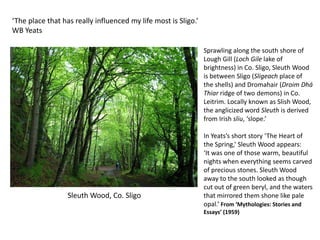
                                                                Sprawling along the south shore of
                                                                Lough Gill (Loch Gile lake of
                                                                brightness) in Co. Sligo, Sleuth Wood
                                                                is between Sligo (Sligeach place of
                                                                the shells) and Dromahair (Droim Dhá
                                                                Thiar ridge of two demons) in Co.
                                                                Leitrim. Locally known as Slish Wood,
                                                                the anglicized word Sleuth is derived
                                                                from Irish sliu, ‘slope.’

                                                                In Yeats’s short story ‘The Heart of
                                                                the Spring,’ Sleuth Wood appears:
                                                                ‘It was one of those warm, beautiful
                                                                nights when everything seems carved
                                                                of precious stones. Sleuth Wood
                                                                away to the south looked as though
                                                                cut out of green beryl, and the waters
                  Sleuth Wood, Co. Sligo                        that mirrored them shone like pale
                                                                opal.’ From ‘Mythologies: Stories and
                                                                Essays’ (1959)
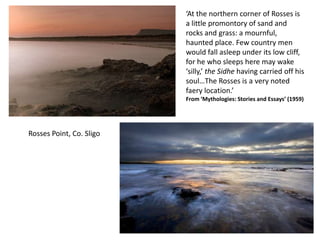
‘At the northern corner of Rosses is
                          a little promontory of sand and
                          rocks and grass: a mournful,
                          haunted place. Few country men
                          would fall asleep under its low cliff,
                          for he who sleeps here may wake
                          ‘silly,’ the Sidhe having carried off his
                          soul…The Rosses is a very noted
                          faery location.’
                          From ‘Mythologies: Stories and Essays’ (1959)


Rosses Point, Co. Sligo
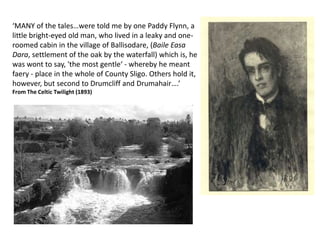
‘MANY of the tales…were told me by one Paddy Flynn, a
little bright-eyed old man, who lived in a leaky and one-
roomed cabin in the village of Ballisodare, (Baile Easa
Dara, settlement of the oak by the waterfall) which is, he
was wont to say, 'the most gentle‘ - whereby he meant
faery - place in the whole of County Sligo. Others hold it,
however, but second to Drumcliff and Drumahair….’
From The Celtic Twilight (1893)
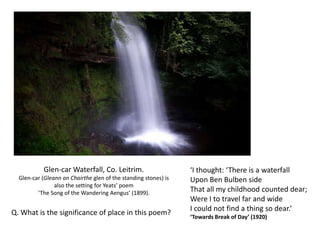
Glen-car Waterfall, Co. Leitrim.                      ‘I thought: ‘There is a waterfall
  Glen-car (Gleann an Chairthe glen of the standing stones) is   Upon Ben Bulben side
                also the setting for Yeats’ poem
         ‘The Song of the Wandering Aengus’ (1899).
                                                                 That all my childhood counted dear;
                                                                 Were I to travel far and wide
                                                                 I could not find a thing so dear.’
Q. What is the significance of place in this poem?               ‘Towards Break of Day’ (1920)
In Clonmel, Co. Tipperary in 1895 the
                                                      dressmaker Bridget Cleary was murdered
                                                      by her husband Michael who believed her
                                                      to be a changeling.


‘A little girl who was at service in the village of Grange, close under the seaward slopes of
Ben Bulben, suddenly disappeared one night about three years ago. There was at once
great excitement in the neighbourhood, because it was rumoured that the faeries had
taken her...The local constable was applied to, and he at once instituted a house-to-house
search, and at the same time advised the people to burn all the bucalauns (ragweed) on
the field she vanished from, because bucalauns are sacred to the faeries. They spent the
whole night burning them, the constable repeating spells the while. In the morning the
little girl was found, the story goes, wandering in the field. She said the faeries had taken
her away a great distance, riding on a faery horse. At last she saw a big river, and the man
who had tried to keep her from being carried off was drifting down it - such are the topsy-
turvydoms of faery glamour - in a cockleshell.’
From The Celtic Twilight (1893)

Q. What does this extract reveal about the nature of the people of rural Ireland at the turn of the
century?
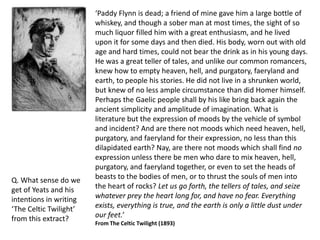
‘Paddy Flynn is dead; a friend of mine gave him a large bottle of
                        whiskey, and though a sober man at most times, the sight of so
                        much liquor filled him with a great enthusiasm, and he lived
                        upon it for some days and then died. His body, worn out with old
                        age and hard times, could not bear the drink as in his young days.
                        He was a great teller of tales, and unlike our common romancers,
                        knew how to empty heaven, hell, and purgatory, faeryland and
                        earth, to people his stories. He did not live in a shrunken world,
                        but knew of no less ample circumstance than did Homer himself.
                        Perhaps the Gaelic people shall by his like bring back again the
                        ancient simplicity and amplitude of imagination. What is
                        literature but the expression of moods by the vehicle of symbol
                        and incident? And are there not moods which need heaven, hell,
                        purgatory, and faeryland for their expression, no less than this
                        dilapidated earth? Nay, are there not moods which shall find no
                        expression unless there be men who dare to mix heaven, hell,
                        purgatory, and faeryland together, or even to set the heads of
Q. What sense do we     beasts to the bodies of men, or to thrust the souls of men into
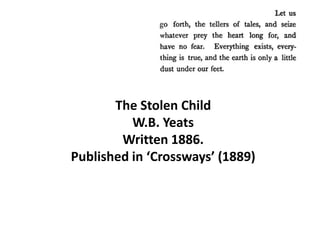
get of Yeats and his    the heart of rocks? Let us go forth, the tellers of tales, and seize
intentions in writing   whatever prey the heart long for, and have no fear. Everything
‘The Celtic Twilight’   exists, everything is true, and the earth is only a little dust under
from this extract?      our feet.’
                        From The Celtic Twilight (1893)
Connections - Biography
‘The Stolen Child’ references the belief in Ireland at the time that missing children
were sometimes taken by ever-present faeries (aes sídhe, people of the mounds)

In a letter written two years after the poem was completed Yeats observed:

‘I have noticed some things about my poetry, I did not know before, in this process of
correction, for instance that it is almost all a flight into faeryland, from the real world,
and a summons to that flight. The chorus to the ‘stollen *sic+ child’ sums it up --- That it
is not the poetry of insight and knowledge but of longing and complaint --- the cry of
the heart against necessity. I hope some day to alter that and write poetry of insight
and knowledge.’
(March 14, 1888, ‘Collected Letters of W.B. Yeats Volume I: 1865-1895’)


Q. To what extent is this a poem of ‘longing and complaint’? ‘The cry of the heart
against necessity’?
Connections – Wider Contexts
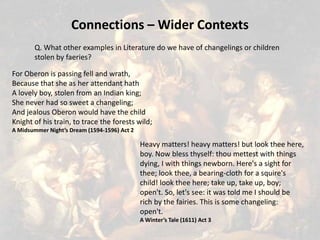
       Q. What other examples in Literature do we have of changelings or children
       stolen by faeries?

For Oberon is passing fell and wrath,
Because that she as her attendant hath
A lovely boy, stolen from an Indian king;
She never had so sweet a changeling;
And jealous Oberon would have the child
Knight of his train, to trace the forests wild;
A Midsummer Night’s Dream (1594-1596) Act 2

                                              Heavy matters! heavy matters! but look thee here,
                                              boy. Now bless thyself: thou mettest with things
                                              dying, I with things newborn. Here's a sight for
                                              thee; look thee, a bearing-cloth for a squire's
                                              child! look thee here; take up, take up, boy;
                                              open't. So, let's see: it was told me I should be
                                              rich by the fairies. This is some changeling:
                                              open't.
                                              A Winter’s Tale (1611) Act 3
Connections – Yeats’s Poetry
The woods of Arcady are dead,
And over is their antique joy;
Of old the world on dreaming fed;
Grey Truth is now her painted toy;
Yet still she turns her restless head:
But O, sick children of the world,
Of all the many changing things
In dreary dancing past us whirled,
To the cracked tune that Chronos sings,
Words alone are certain good.
The Song of the Happy Shepherd (1889)

                                          All things can tempt me from this craft of verse:
                                          One time it was a woman’s face, or worse —
                                          The seeming needs of my fool-driven land.
                                          All Things Can Tempt Me (1912)


Q. How do these two excerpts highlight Yeats’s shift towards ‘poetry of insight and
knowledge’?
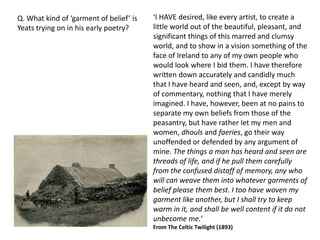
Q. What kind of ‘garment of belief’ is   ‘I HAVE desired, like every artist, to create a
Yeats trying on in his early poetry?     little world out of the beautiful, pleasant, and
                                         significant things of this marred and clumsy
                                         world, and to show in a vision something of the
                                         face of Ireland to any of my own people who
                                         would look where I bid them. I have therefore
                                         written down accurately and candidly much
                                         that I have heard and seen, and, except by way
                                         of commentary, nothing that I have merely
                                         imagined. I have, however, been at no pains to
                                         separate my own beliefs from those of the
                                         peasantry, but have rather let my men and
                                         women, dhouls and faeries, go their way
                                         unoffended or defended by any argument of
                                         mine. The things a man has heard and seen are
                                         threads of life, and if he pull them carefully
                                         from the confused distaff of memory, any who
                                         will can weave them into whatever garments of
                                         belief please them best. I too have woven my
                                         garment like another, but I shall try to keep
                                         warm in it, and shall be well content if it do not
                                         unbecome me.’
                                         From The Celtic Twilight (1893)
Connections – Yeats’s Poetry

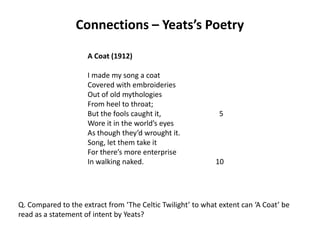
                     A Coat (1912)

                     I made my song a coat
                     Covered with embroideries
                     Out of old mythologies
                     From heel to throat;
                     But the fools caught it,                 5
                     Wore it in the world’s eyes
                     As though they’d wrought it.
                     Song, let them take it
                     For there’s more enterprise
                     In walking naked.                       10


Q. Compared to the extract from ‘The Celtic Twilight’ to what extent can ‘A Coat’ be
read as a statement of intent by Yeats?
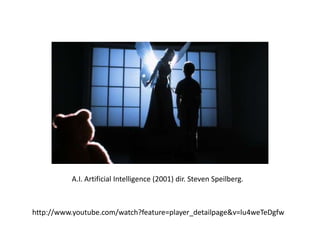
A.I. Artificial Intelligence (2001) dir. Steven Speilberg.


http://www.youtube.com/watch?feature=player_detailpage&v=lu4weTeDgfw
‘Myths are public dreams, dreams are
private myths.’
Joseph Campbell ‘The Power of Myth’ (1949)


Yeats’s early poems are ‘utterly unIrish [coming from] a vast murmurous gloom of dreams.’
Charles Johnson


                                                                  ‘An alluring but also
  The poems in ‘Crossways’                                         threatening poem.’
  were written when Yeats                                             (Hunt 2006)
 was trying ‘many pathways.’
        (Jeffares 2000)


  Q. Write a short paragraph explaining how each of these quotes relates (or doesn’t
  relate) to your understanding of the poem ‘The Stolen Child’.

03 yeats stolen child

  • 1.
    The Stolen Child W.B. Yeats Written 1886. Published in ‘Crossways’ (1889)
  • 2.
    The Stolen Child(1886) WHERE dips the rocky highland 1 Of Sleuth Wood in the lake, There lies a leafy island Where flapping herons wake The drowsy water rats; There we've hid our faery vats, Full of berries And of reddest stolen cherries. Come away, O human child! To the waters and the wild 10 With a faery, hand in hand, For the world's more full of weeping than you can understand.
  • 3.
    Where the waveof moonlight glosses The dim grey sands with light, Far off by furthest Rosses We foot it all the night, Weaving olden dances Mingling hands and mingling glances Till the moon has taken flight; To and fro we leap 20 And chase the frothy bubbles, While the world is full of troubles And anxious in its sleep. Come away, O human child! To the waters and the wild With a faery, hand in hand, For the world's more full of weeping than you can understand.
  • 4.
    Where the wanderingwater gushes From the hills above Glen-Car, In pools among the rushes 30 That scarce could bathe a star, We seek for slumbering trout And whispering in their ears Give them unquiet dreams; Leaning softly out From ferns that drop their tears Over the young streams. Come away, O human child! To the waters and the wild With a faery, hand in hand, 40 For the world's more full of weeping than you can understand.
  • 5.
    Away with ushe's going, The solemn-eyed: He'll hear no more the lowing Of the calves on the warm hillside Or the kettle on the hob Sing peace into his breast, Or see the brown mice bob Round and round the oatmeal chest. For he comes, the human child, 50 To the waters and the wild With a faery, hand in hand, For the world's more full of weeping than he can understand.
  • 6.
    ‘The place thathas really influenced my life most is Sligo.’ WB Yeats Sprawling along the south shore of Lough Gill (Loch Gile lake of brightness) in Co. Sligo, Sleuth Wood is between Sligo (Sligeach place of the shells) and Dromahair (Droim Dhá Thiar ridge of two demons) in Co. Leitrim. Locally known as Slish Wood, the anglicized word Sleuth is derived from Irish sliu, ‘slope.’ In Yeats’s short story ‘The Heart of the Spring,’ Sleuth Wood appears: ‘It was one of those warm, beautiful nights when everything seems carved of precious stones. Sleuth Wood away to the south looked as though cut out of green beryl, and the waters Sleuth Wood, Co. Sligo that mirrored them shone like pale opal.’ From ‘Mythologies: Stories and Essays’ (1959)
  • 7.
    ‘At the northerncorner of Rosses is a little promontory of sand and rocks and grass: a mournful, haunted place. Few country men would fall asleep under its low cliff, for he who sleeps here may wake ‘silly,’ the Sidhe having carried off his soul…The Rosses is a very noted faery location.’ From ‘Mythologies: Stories and Essays’ (1959) Rosses Point, Co. Sligo
  • 8.
    ‘MANY of thetales…were told me by one Paddy Flynn, a little bright-eyed old man, who lived in a leaky and one- roomed cabin in the village of Ballisodare, (Baile Easa Dara, settlement of the oak by the waterfall) which is, he was wont to say, 'the most gentle‘ - whereby he meant faery - place in the whole of County Sligo. Others hold it, however, but second to Drumcliff and Drumahair….’ From The Celtic Twilight (1893)
  • 9.
    Glen-car Waterfall, Co.Leitrim. ‘I thought: ‘There is a waterfall Glen-car (Gleann an Chairthe glen of the standing stones) is Upon Ben Bulben side also the setting for Yeats’ poem ‘The Song of the Wandering Aengus’ (1899). That all my childhood counted dear; Were I to travel far and wide I could not find a thing so dear.’ Q. What is the significance of place in this poem? ‘Towards Break of Day’ (1920)
  • 10.
    In Clonmel, Co.Tipperary in 1895 the dressmaker Bridget Cleary was murdered by her husband Michael who believed her to be a changeling. ‘A little girl who was at service in the village of Grange, close under the seaward slopes of Ben Bulben, suddenly disappeared one night about three years ago. There was at once great excitement in the neighbourhood, because it was rumoured that the faeries had taken her...The local constable was applied to, and he at once instituted a house-to-house search, and at the same time advised the people to burn all the bucalauns (ragweed) on the field she vanished from, because bucalauns are sacred to the faeries. They spent the whole night burning them, the constable repeating spells the while. In the morning the little girl was found, the story goes, wandering in the field. She said the faeries had taken her away a great distance, riding on a faery horse. At last she saw a big river, and the man who had tried to keep her from being carried off was drifting down it - such are the topsy- turvydoms of faery glamour - in a cockleshell.’ From The Celtic Twilight (1893) Q. What does this extract reveal about the nature of the people of rural Ireland at the turn of the century?
  • 11.
    ‘Paddy Flynn isdead; a friend of mine gave him a large bottle of whiskey, and though a sober man at most times, the sight of so much liquor filled him with a great enthusiasm, and he lived upon it for some days and then died. His body, worn out with old age and hard times, could not bear the drink as in his young days. He was a great teller of tales, and unlike our common romancers, knew how to empty heaven, hell, and purgatory, faeryland and earth, to people his stories. He did not live in a shrunken world, but knew of no less ample circumstance than did Homer himself. Perhaps the Gaelic people shall by his like bring back again the ancient simplicity and amplitude of imagination. What is literature but the expression of moods by the vehicle of symbol and incident? And are there not moods which need heaven, hell, purgatory, and faeryland for their expression, no less than this dilapidated earth? Nay, are there not moods which shall find no expression unless there be men who dare to mix heaven, hell, purgatory, and faeryland together, or even to set the heads of Q. What sense do we beasts to the bodies of men, or to thrust the souls of men into get of Yeats and his the heart of rocks? Let us go forth, the tellers of tales, and seize intentions in writing whatever prey the heart long for, and have no fear. Everything ‘The Celtic Twilight’ exists, everything is true, and the earth is only a little dust under from this extract? our feet.’ From The Celtic Twilight (1893)
  • 12.
    Connections - Biography ‘TheStolen Child’ references the belief in Ireland at the time that missing children were sometimes taken by ever-present faeries (aes sídhe, people of the mounds) In a letter written two years after the poem was completed Yeats observed: ‘I have noticed some things about my poetry, I did not know before, in this process of correction, for instance that it is almost all a flight into faeryland, from the real world, and a summons to that flight. The chorus to the ‘stollen *sic+ child’ sums it up --- That it is not the poetry of insight and knowledge but of longing and complaint --- the cry of the heart against necessity. I hope some day to alter that and write poetry of insight and knowledge.’ (March 14, 1888, ‘Collected Letters of W.B. Yeats Volume I: 1865-1895’) Q. To what extent is this a poem of ‘longing and complaint’? ‘The cry of the heart against necessity’?
  • 13.
    Connections – WiderContexts Q. What other examples in Literature do we have of changelings or children stolen by faeries? For Oberon is passing fell and wrath, Because that she as her attendant hath A lovely boy, stolen from an Indian king; She never had so sweet a changeling; And jealous Oberon would have the child Knight of his train, to trace the forests wild; A Midsummer Night’s Dream (1594-1596) Act 2 Heavy matters! heavy matters! but look thee here, boy. Now bless thyself: thou mettest with things dying, I with things newborn. Here's a sight for thee; look thee, a bearing-cloth for a squire's child! look thee here; take up, take up, boy; open't. So, let's see: it was told me I should be rich by the fairies. This is some changeling: open't. A Winter’s Tale (1611) Act 3
  • 14.
    Connections – Yeats’sPoetry The woods of Arcady are dead, And over is their antique joy; Of old the world on dreaming fed; Grey Truth is now her painted toy; Yet still she turns her restless head: But O, sick children of the world, Of all the many changing things In dreary dancing past us whirled, To the cracked tune that Chronos sings, Words alone are certain good. The Song of the Happy Shepherd (1889) All things can tempt me from this craft of verse: One time it was a woman’s face, or worse — The seeming needs of my fool-driven land. All Things Can Tempt Me (1912) Q. How do these two excerpts highlight Yeats’s shift towards ‘poetry of insight and knowledge’?
  • 15.
    Q. What kindof ‘garment of belief’ is ‘I HAVE desired, like every artist, to create a Yeats trying on in his early poetry? little world out of the beautiful, pleasant, and significant things of this marred and clumsy world, and to show in a vision something of the face of Ireland to any of my own people who would look where I bid them. I have therefore written down accurately and candidly much that I have heard and seen, and, except by way of commentary, nothing that I have merely imagined. I have, however, been at no pains to separate my own beliefs from those of the peasantry, but have rather let my men and women, dhouls and faeries, go their way unoffended or defended by any argument of mine. The things a man has heard and seen are threads of life, and if he pull them carefully from the confused distaff of memory, any who will can weave them into whatever garments of belief please them best. I too have woven my garment like another, but I shall try to keep warm in it, and shall be well content if it do not unbecome me.’ From The Celtic Twilight (1893)
  • 16.
    Connections – Yeats’sPoetry A Coat (1912) I made my song a coat Covered with embroideries Out of old mythologies From heel to throat; But the fools caught it, 5 Wore it in the world’s eyes As though they’d wrought it. Song, let them take it For there’s more enterprise In walking naked. 10 Q. Compared to the extract from ‘The Celtic Twilight’ to what extent can ‘A Coat’ be read as a statement of intent by Yeats?
  • 17.
    A.I. Artificial Intelligence(2001) dir. Steven Speilberg. http://www.youtube.com/watch?feature=player_detailpage&v=lu4weTeDgfw
  • 18.
    ‘Myths are publicdreams, dreams are private myths.’ Joseph Campbell ‘The Power of Myth’ (1949) Yeats’s early poems are ‘utterly unIrish [coming from] a vast murmurous gloom of dreams.’ Charles Johnson ‘An alluring but also The poems in ‘Crossways’ threatening poem.’ were written when Yeats (Hunt 2006) was trying ‘many pathways.’ (Jeffares 2000) Q. Write a short paragraph explaining how each of these quotes relates (or doesn’t relate) to your understanding of the poem ‘The Stolen Child’.