Dan Boneh
Symmetric Ciphers:definition
Def: a cipher defined over
is a pair of “efficient” algs (E, D) where
• E is often randomized. D is always deterministic.
3.
Dan Boneh
The OneTime Pad (Vernam 1917)
First example of a “secure” cipher
key = (random bit string as long the message)
4.
Dan Boneh
The OneTime Pad (Vernam 1917)
msg: 0 1 1 0 1 1 1
key: 1 0 1 1 0 1 0
CT:
⊕
5.
Dan Boneh
You aregiven a message (m) and its OTP encryption (c).
Can you compute the OTP key from m and c ?
No, I cannot compute the key.
Yes, the key is k = m ⊕ c.
I can only compute half the bits of the key.
Yes, the key is k = m ⊕ m.
6.
Dan Boneh
The OneTime Pad (Vernam 1917)
Very fast enc/dec !!
… but long keys (as long as plaintext)
Is the OTP secure? What is a secure cipher?
7.
Dan Boneh
What isa secure cipher?
Attacker’s abilities: CT only attack (for now)
Possible security requirements:
attempt #1: attacker cannot recover secret key
attempt #2: attacker cannot recover all of plaintext
Shannon’s idea:
CT should reveal no “info” about PT
Dan Boneh
Information TheoreticSecurity
R
Def: A cipher (E,D) over (K,M,C) has perfect secrecy if
∀m0, m1 M ( |m
∈ 0| = |m1| ) and c C
∀ ∈
Pr[ E(k,m0)=c ] = Pr[ E(k,m1)=c ] where k K
⟵
Dan Boneh
Review
Cipher over(K,M,C): a pair of “efficient” algs (E, D) s.t.
∀ m M, k K:
∈ ∈ D(k, E(k, m) ) = m
Weak ciphers: subs. cipher, Vigener, …
A good cipher: OTP M=C=K={0,1}n
E(k, m) = k m , D(k, c) = k c
⊕ ⊕
Lemma: OTP has perfect secrecy (i.e. no CT only attacks)
Bad news: perfect-secrecy key-len ≥ msg-len
⇒
Can a streamcipher have perfect secrecy?
Yes, if the PRG is really “secure”
No, there are no ciphers with perfect secrecy
No, since the key is shorter than the message
Yes, every cipher has perfect secrecy
20.
Dan Boneh
Stream Ciphers:making OTP practical
Stream ciphers cannot have perfect secrecy !!
• Need a different definition of security
• Security will depend on specific PRG
Dan Boneh
PRG mustbe unpredictable
We say that G: K {0,1}
⟶ n
is predictable if:
Def: PRG is unpredictable if it is not predictable
⇒ ∀i: no “eff” adv. can predict bit (i+1) for “non-neg” ε
23.
Dan Boneh
Suppose G:K{0,1}
⟶
n
is such that for all k: XOR(G(k)) = 1
Is G predictable ??
Yes, given the first bit I can predict the second
No, G is unpredictable
Yes, given the first (n-1) bits I can predict the n’th bit
It depends
24.
Dan Boneh
Weak PRGs(do not use for crypto)
glibc random():
r[i] ← ( r[i-3] + r[i-31] ) % 232
output r[i] >> 1
Dan Boneh
Negligible andnon-negligible
• In practice: ε is a scalar and
– ε non-neg: ε ≥ 1/230
(likely to happen over 1GB of data)
– ε negligible: ε ≤ 1/280
(won’t happen over life of key)
• In theory: ε is a function ε: Z≥0
R
⟶ ≥0
and
– ε non-neg: ∃d: ε(λ) ≥ 1/λd
inf. often (ε ≥ 1/poly, for many λ)
– ε negligible: d,
∀ λ≥λd: ε(λ) ≤ 1/λd
(ε ≤ 1/poly, for large λ)
28.
Dan Boneh
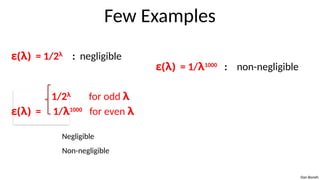
Few Examples
ε(λ)= 1/2λ
: negligible
1/2λ
for odd λ
ε(λ) = 1/λ1000
for even λ
Negligible
Non-negligible
ε(λ) = 1/λ1000
: non-negligible
29.
Dan Boneh
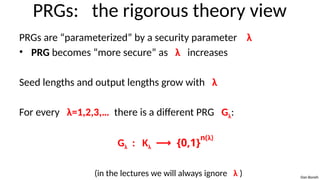
PRGs: therigorous theory view
PRGs are “parameterized” by a security parameter λ
• PRG becomes “more secure” as λ increases
Seed lengths and output lengths grow with λ
For every λ=1,2,3,… there is a different PRG Gλ:
Gλ : Kλ {0,1}
⟶
n(λ)
(in the lectures we will always ignore λ )
30.
Dan Boneh
An exampleasymptotic definition
We say that Gλ : Kλ {0,1}
⟶
n(λ)
is predictable at position i if:
thereexists a polynomial time (in λ) algorithm A s.t.
Prk K
⟵ λ
[ A(λ, Gλ(k)
1,…,i
)= Gλ(k)
i+1
] > 1/2 + ε(λ)
for some non-negligible function ε(λ)
Dan Boneh
Review
OTP: E(k,m)= m k , D(k,c) = c k
⊕ ⊕
Making OTP practical using a PRG: G: K {0,1}
⟶ n
Stream cipher: E(k,m) = m G(k) , D(k,c) = c G(k)
⊕ ⊕
Security: PRG must be unpredictable (better def in two segments)
34.
Dan Boneh
Attack 1:two time pad is insecure !!
Never use stream cipher key more than once !!
C1 m1 PRG(k)
C2 m2 PRG(k)
Eavesdropper does:
C1 C2 m1 m2
Enough redundancy in English and ASCII encoding that:
35.
Dan Boneh
Real worldexamples
• Project Venona
• MS-PPTP (windows NT):
k k
Need different keys for C S and S C
⟶ ⟶
36.
Dan Boneh
Real worldexamples
802.11b WEP:
Length of IV: 24 bits
• Repeated IV after 224
≈ 16M frames
• On some 802.11 cards: IV resets to 0 after power cycle
k k
m CRC(m)
PRG( IV ll k )
ciphetext
IV
37.
Dan Boneh
Avoid relatedkeys
802.11b WEP:
key for frame #1: (1 ll k)
key for frame #2: (2 ll k)
k k
m CRC(m)
PRG( IV ll k )
ciphetext
IV
⋮
38.
Dan Boneh
A betterconstruction
k k
PRG
⇒ now each frame has a pseudorandom key
better solution: use stronger encryption method (as in WPA2)
Dan Boneh
Two timepad: summary
Never use stream cipher key more than once !!
• Network traffic: negotiate new key for every session (e.g. TLS)
• Disk encryption: typically do not use a stream cipher
41.
Dan Boneh
Attack 2:no integrity (OTP is malleable)
Modifications to ciphertext are undetected and
have predictable impact on plaintext
m
enc ( k )
⊕
m⊕k
dec ( k )
⊕
m p
⊕
p
(m k) p
⊕ ⊕
⊕
42.
Dan Boneh
Attack 2:no integrity (OTP is malleable)
Modifications to ciphertext are undetected and
have predictable impact on plaintext
From: Bob
enc ( k )
⊕
From: Bob
⋯
From: Eve
dec ( k )
⊕
From: Eve
⊕
Dan Boneh
Old example(software): RC4 (1987)
• Used in HTTPS and WEP
• Weaknesses:
1. Bias in initial output: Pr[ 2nd
byte = 0 ] = 2/256
2. Prob. of (0,0) is 1/2562
+ 1/2563
3. Related key attacks
2048 bits
128 bits
seed
1 byte
per round
46.
Dan Boneh
Old example(hardware): CSS (badly broken)
Linear feedback shift register (LFSR):
DVD encryption (CSS): 2 LFSRs
GSM encryption (A5/1,2): 3 LFSRs
Bluetooth (E0): 4 LFSRs
all broken
Dan Boneh
Cryptanalysis ofCSS (217
time attack)
For all possible initial settings of 17-bit LFSR do:
• Run 17-bit LFSR to get 20 bytes of output
• Subtract from CSS prefix candidate 20 bytes output of 25-bit LFSR
⇒
• If consistent with 25-bit LFSR, found correct initial settings of both !!
Using key, generate entire CSS output
17-bit LFSR
25-bit LFSR
+ (mod 256)
8
8
8
encrypted movie
prefix
CSS prefix
⊕
49.
Dan Boneh
Modern streamciphers: eStream
PRG: {0,1}s
× R {0,1}
⟶ n
Nonce: a non-repeating value for a given key.
E(k, m ; r) = m ⊕ PRG(k ; r)
The pair (k,r) is never used more than once.
50.
Dan Boneh
eStream: Salsa20 (SW+HW)
Salsa20: {0,1}128 or 256
× {0,1}64
{0,1}
⟶ n
(max n = 273
bits)
Salsa20( k ; r) := H( k , (r, 0)) ll H( k , (r, 1)) ll …
h: invertible function. designed to be fast on x86 (SSE2)
τ0
k
τ1
r
i
τ2
k
τ3 64 bytes
k
r
i
32 bytes
64 byte
output
⊕
h
(10 rounds)
64 bytes
51.
Dan Boneh
Is Salsa20secure (unpredictable) ?
• Unknown: no known provably secure PRGs
• In reality: no known attacks better than exhaustive search
Dan Boneh
Advantage
Let G:K{0,1}
⟶ n
be a PRG and A a stat. test on {0,1}n
Define:
A silly example: A(x) = 0 Adv
⇒ PRG [A,G] = 0
60.
Dan Boneh
Suppose G:K{0,1}
⟶
n
satisfies msb(G(k)) = 1 for 2/3 of keys in K
Define stat. test A(x) as:
if [ msb(x)=1 ] output “1” else output “0”
Then
AdvPRG [A,G] = | Pr[ A(G(k))=1] - Pr[ A(r)=1 ] | =
| 2/3 – 1/2 | = 1/6
61.
Dan Boneh
Secure PRGs:crypto definition
Def: We say that G:K {0,1}
⟶ n
is a secure PRG if
Are there provably secure PRGs?
but we have heuristic candidates.
62.
Dan Boneh
Easy fact:a secure PRG is unpredictable
We show: PRG predictable PRG is insecure
⇒
Suppose A is an efficient algorithm s.t.
for non-negligible ε (e.g. ε = 1/1000)
Dan Boneh
Thm (Yao’82):an unpredictable PRG is secure
Let G:K {0,1}
⟶ n
be PRG
“Thm”: if i {0, … , n-1} PRG G is unpredictable at pos. i
∀ ∈
then G is a secure PRG.
If next-bit predictors cannot distinguish G from random
then no statistical test can !!
65.
Let G:K {0,1}
⟶n
be a PRG such that
from the last n/2 bits of G(k)
it is easy to compute the first n/2 bits.
Is G predictable for some i {0, … , n-1} ?
∈
Yes
No
66.
Dan Boneh
More Generally
LetP1 and P2 be two distributions over {0,1}n
Def: We say that P1 and P2 are
computationally indistinguishable (denoted )
Example: a PRG is secure if { k K : G(k)
⟵ } ≈p uniform({0,1}n
)
R
Dan Boneh
What isa secure cipher?
Attacker’s abilities: obtains one ciphertext (for now)
Possible security requirements:
attempt #1: attacker cannot recover secret key
attempt #2: attacker cannot recover all of plaintext
Recall Shannon’s idea:
CT should reveal no “info” about PT
70.
Dan Boneh
Recall Shannon’sperfect secrecy
Let (E,D) be a cipher over (K,M,C)
(E,D) has perfect secrecy if m
∀ 0, m1 M ( |m
∈ 0| = |m1| )
{ E(k,m0) } = { E(k,m1) } where k K
⟵
(E,D) has perfect secrecy if m
∀ 0, m1 M ( |m
∈ 0| = |m1| )
{ E(k,m0) } ≈p { E(k,m1) } where k K
⟵
… but also need adversary to exhibit m0, m1 M explicitly
∈
71.
Dan Boneh
Semantic Security(one-time key)
For b=0,1 define experiments EXP(0) and EXP(1) as:
for b=0,1: Wb := [ event that EXP(b)=1 ]
AdvSS[A,E] := |Pr[ W0 ] − Pr[ W1 ] | [0,1]
∈
Chal.
b
Adv. A
kK
m0 , m1 M : |m0| = |m1|
c E(k, mb)
b’
{0,1}
72.
Dan Boneh
Semantic Security(one-time key)
Def: E is semantically secure if for all efficient A
AdvSS[A,E] is negligible.
⇒ for all explicit m0 , m1 M : { E(k,m0) } ≈p { E(k,m1) }
73.
Dan Boneh
Adv. B(us)
Examples
Suppose efficient A can always deduce LSB of PT from CT.
⇒ E = (E,D) is not semantically secure.
Chal.
b{0,1}
Adv. A
(given)
kK
C E(k, mb)
m0, LSB(m0)=0
m1, LSB(m1)=1
C
LSB(mb)=b
Then AdvSS[B, E] = |Pr[ EXP(0)=1 ] − Pr[ EXP(1)=1 ] |= |0 – 1| = 1
74.
Dan Boneh
identical distributions
OTPis semantically secure
For all A: AdvSS[A,OTP] = |Pr[ A(k⊕m0)=1 ] − Pr[ A(k⊕m1)=1 ] |= 0
Chal. Adv. A
kK
m0 , m1 M : |m0| = |m1|
c k⊕m0 b’
{0,1}
EXP(0):
Chal. Adv. A
kK
m0 , m1 M : |m0| = |m1|
c k⊕m1 b’
{0,1}
EXP(1):
Dan Boneh
Stream ciphers
Streamciphers are
semantically secure
Online Cryptography Course Dan Boneh
Goal: secure PRG semantically secure stream cipher
⇒
77.
Dan Boneh
Stream ciphersare semantically secure
Thm: G:K {0,1}
⟶
n
is a secure PRG ⇒
stream cipher E derived from G is sem. sec.
∀ sem. sec. adversary A , a PRG adversary B s.t.
∃
AdvSS[A,E] ≤ 2 Adv
∙ PRG[B,G]
78.
Dan Boneh
Proof: intuition
chal.adv. A
kK
m0 , m1
c m0 G(k)
⊕
b’≟1
chal. adv. A
kK
m0 , m1
c m1 G(k)
⊕
b’≟1
≈p
≈p
≈p
chal. adv. A
r{0,1}n
m0 , m1
c m0 r
⊕
b’≟1
chal. adv. A
r{0,1}n
m0 , m1
c m1 r
⊕
b’≟1
79.
Dan Boneh
Proof: LetA be a sem. sec. adversary.
For b=0,1: Wb := [ event that b’=1 ].
AdvSS[A,E] = | Pr[ W0 ] − Pr[ W1 ] |
Chal.
b
Adv. A
kK
m0 , m1 M : |m0| = |m1|
c mb G(k)
⊕
b’
{0,1}
r{0,1}n
80.
Dan Boneh
Proof: LetA be a sem. sec. adversary.
For b=0,1: Wb := [ event that b’=1 ].
AdvSS[A,E] = | Pr[ W0 ] − Pr[ W1 ] |
For b=0,1: Rb := [ event that b’=1 ]
Chal.
b
Adv. A
kK
m0 , m1 M : |m0| = |m1|
c mb r
⊕
b’
{0,1}
r{0,1}n
81.
Dan Boneh
Proof: LetA be a sem. sec. adversary.
Claim 1: |Pr[R0] – Pr[R1]| =
Claim 2: B:
∃ |Pr[Wb] – Pr[Rb]| =
⇒ AdvSS[A,E] = |Pr[W0] – Pr[W1]| ≤ 2 Adv
∙ PRG[B,G]
0 1
Pr[W0] Pr[W1]
Pr[Rb]
82.
Dan Boneh
Proof ofclaim 2: B:
∃ |Pr[W0] – Pr[R0]| = AdvPRG[B,G]
Algorithm B:
AdvPRG[B,G] =
PRG adv. B (us)
Adv. A
(given)
c m0 y
⊕
y {0,1}
∈ n
m0, m1
b’ {0,1}
∈
#50 Xor is actually word-wise addition. τi fixed constant.
#55 In the next three segments we will change gears a little bit and talk about the definition of a PRG. This definition is a good way to think of a PRG and we will see many applications of t later on.


![Dan Boneh
Information Theoretic Security
R
Def: A cipher (E,D) over (K,M,C) has perfect secrecy if
∀m0, m1 M ( |m
∈ 0| = |m1| ) and c C
∀ ∈
Pr[ E(k,m0)=c ] = Pr[ E(k,m1)=c ] where k K
⟵](https://image.slidesharecdn.com/02-stream-v2-annotated-251005025048-2bb9a413/85/02-stream-v2-annotatedstream-v2-annotated-pptx-9-320.jpg)


![Dan Boneh
Weak PRGs (do not use for crypto)
glibc random():
r[i] ← ( r[i-3] + r[i-31] ) % 232
output r[i] >> 1](https://image.slidesharecdn.com/02-stream-v2-annotated-251005025048-2bb9a413/85/02-stream-v2-annotatedstream-v2-annotated-pptx-24-320.jpg)


![Dan Boneh
An example asymptotic definition
We say that Gλ : Kλ {0,1}
⟶
n(λ)
is predictable at position i if:
thereexists a polynomial time (in λ) algorithm A s.t.
Prk K
⟵ λ
[ A(λ, Gλ(k)
1,…,i
)= Gλ(k)
i+1
] > 1/2 + ε(λ)
for some non-negligible function ε(λ)](https://image.slidesharecdn.com/02-stream-v2-annotated-251005025048-2bb9a413/85/02-stream-v2-annotatedstream-v2-annotated-pptx-30-320.jpg)


![Dan Boneh
Old example (software): RC4 (1987)
• Used in HTTPS and WEP
• Weaknesses:
1. Bias in initial output: Pr[ 2nd
byte = 0 ] = 2/256
2. Prob. of (0,0) is 1/2562
+ 1/2563
3. Related key attacks
2048 bits
128 bits
seed
1 byte
per round](https://image.slidesharecdn.com/02-stream-v2-annotated-251005025048-2bb9a413/85/02-stream-v2-annotatedstream-v2-annotated-pptx-45-320.jpg)


![Dan Boneh
Performance: Crypto++ 5.6.0 [ Wei Dai ]
AMD Opteron, 2.2 GHz ( Linux)
PRG Speed (MB/sec)
RC4 126
Salsa20/12 643
Sosemanuk 727
eStream](https://image.slidesharecdn.com/02-stream-v2-annotated-251005025048-2bb9a413/85/02-stream-v2-annotatedstream-v2-annotated-pptx-52-320.jpg)


![Dan Boneh
Advantage
Let G:K {0,1}
⟶ n
be a PRG and A a stat. test on {0,1}n
Define:
A silly example: A(x) = 0 Adv
⇒ PRG [A,G] = 0](https://image.slidesharecdn.com/02-stream-v2-annotated-251005025048-2bb9a413/85/02-stream-v2-annotatedstream-v2-annotated-pptx-59-320.jpg)
![Dan Boneh
Suppose G:K {0,1}
⟶
n
satisfies msb(G(k)) = 1 for 2/3 of keys in K
Define stat. test A(x) as:
if [ msb(x)=1 ] output “1” else output “0”
Then
AdvPRG [A,G] = | Pr[ A(G(k))=1] - Pr[ A(r)=1 ] | =
| 2/3 – 1/2 | = 1/6](https://image.slidesharecdn.com/02-stream-v2-annotated-251005025048-2bb9a413/85/02-stream-v2-annotatedstream-v2-annotated-pptx-60-320.jpg)




![Dan Boneh
Semantic Security (one-time key)
For b=0,1 define experiments EXP(0) and EXP(1) as:
for b=0,1: Wb := [ event that EXP(b)=1 ]
AdvSS[A,E] := |Pr[ W0 ] − Pr[ W1 ] | [0,1]
∈
Chal.
b
Adv. A
kK
m0 , m1 M : |m0| = |m1|
c E(k, mb)
b’
{0,1}](https://image.slidesharecdn.com/02-stream-v2-annotated-251005025048-2bb9a413/85/02-stream-v2-annotatedstream-v2-annotated-pptx-71-320.jpg)
![Dan Boneh
Semantic Security (one-time key)
Def: E is semantically secure if for all efficient A
AdvSS[A,E] is negligible.
⇒ for all explicit m0 , m1 M : { E(k,m0) } ≈p { E(k,m1) }](https://image.slidesharecdn.com/02-stream-v2-annotated-251005025048-2bb9a413/85/02-stream-v2-annotatedstream-v2-annotated-pptx-72-320.jpg)
![Dan Boneh
Adv. B (us)
Examples
Suppose efficient A can always deduce LSB of PT from CT.
⇒ E = (E,D) is not semantically secure.
Chal.
b{0,1}
Adv. A
(given)
kK
C E(k, mb)
m0, LSB(m0)=0
m1, LSB(m1)=1
C
LSB(mb)=b
Then AdvSS[B, E] = |Pr[ EXP(0)=1 ] − Pr[ EXP(1)=1 ] |= |0 – 1| = 1](https://image.slidesharecdn.com/02-stream-v2-annotated-251005025048-2bb9a413/85/02-stream-v2-annotatedstream-v2-annotated-pptx-73-320.jpg)
![Dan Boneh
identical distributions
OTP is semantically secure
For all A: AdvSS[A,OTP] = |Pr[ A(k⊕m0)=1 ] − Pr[ A(k⊕m1)=1 ] |= 0
Chal. Adv. A
kK
m0 , m1 M : |m0| = |m1|
c k⊕m0 b’
{0,1}
EXP(0):
Chal. Adv. A
kK
m0 , m1 M : |m0| = |m1|
c k⊕m1 b’
{0,1}
EXP(1):](https://image.slidesharecdn.com/02-stream-v2-annotated-251005025048-2bb9a413/85/02-stream-v2-annotatedstream-v2-annotated-pptx-74-320.jpg)


![Dan Boneh
Stream ciphers are semantically secure
Thm: G:K {0,1}
⟶
n
is a secure PRG ⇒
stream cipher E derived from G is sem. sec.
∀ sem. sec. adversary A , a PRG adversary B s.t.
∃
AdvSS[A,E] ≤ 2 Adv
∙ PRG[B,G]](https://image.slidesharecdn.com/02-stream-v2-annotated-251005025048-2bb9a413/85/02-stream-v2-annotatedstream-v2-annotated-pptx-77-320.jpg)

![Dan Boneh
Proof: Let A be a sem. sec. adversary.
For b=0,1: Wb := [ event that b’=1 ].
AdvSS[A,E] = | Pr[ W0 ] − Pr[ W1 ] |
Chal.
b
Adv. A
kK
m0 , m1 M : |m0| = |m1|
c mb G(k)
⊕
b’
{0,1}
r{0,1}n](https://image.slidesharecdn.com/02-stream-v2-annotated-251005025048-2bb9a413/85/02-stream-v2-annotatedstream-v2-annotated-pptx-79-320.jpg)
![Dan Boneh
Proof: Let A be a sem. sec. adversary.
For b=0,1: Wb := [ event that b’=1 ].
AdvSS[A,E] = | Pr[ W0 ] − Pr[ W1 ] |
For b=0,1: Rb := [ event that b’=1 ]
Chal.
b
Adv. A
kK
m0 , m1 M : |m0| = |m1|
c mb r
⊕
b’
{0,1}
r{0,1}n](https://image.slidesharecdn.com/02-stream-v2-annotated-251005025048-2bb9a413/85/02-stream-v2-annotatedstream-v2-annotated-pptx-80-320.jpg)
![Dan Boneh
Proof: Let A be a sem. sec. adversary.
Claim 1: |Pr[R0] – Pr[R1]| =
Claim 2: B:
∃ |Pr[Wb] – Pr[Rb]| =
⇒ AdvSS[A,E] = |Pr[W0] – Pr[W1]| ≤ 2 Adv
∙ PRG[B,G]
0 1
Pr[W0] Pr[W1]
Pr[Rb]](https://image.slidesharecdn.com/02-stream-v2-annotated-251005025048-2bb9a413/85/02-stream-v2-annotatedstream-v2-annotated-pptx-81-320.jpg)
![Dan Boneh
Proof of claim 2: B:
∃ |Pr[W0] – Pr[R0]| = AdvPRG[B,G]
Algorithm B:
AdvPRG[B,G] =
PRG adv. B (us)
Adv. A
(given)
c m0 y
⊕
y {0,1}
∈ n
m0, m1
b’ {0,1}
∈](https://image.slidesharecdn.com/02-stream-v2-annotated-251005025048-2bb9a413/85/02-stream-v2-annotatedstream-v2-annotated-pptx-82-320.jpg)


