BLUEPRINT FOR
A BETTER WORLD
Lesson 2
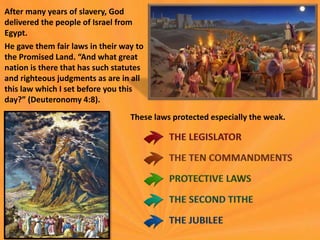
After many years of slavery, God
delivered the people of Israel from
Egypt.
He gave them fair laws in their way to
the Promised Land. “And what great
nation is there that has such statutes
and righteous judgments as are in all
this law which I set before you this
day?” (Deuteronomy 4:8).
These laws protected especially the weak.
“So the people believed; and when they heard that the
Lord had visited the children of Israel and that He had
looked on their affliction, then they bowed their heads
and worshiped.” (Exodus 4:31)
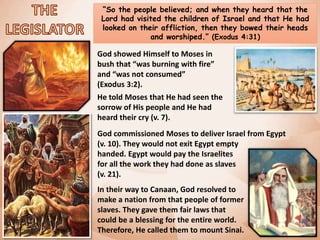
God showed Himself to Moses in
bush that “was burning with fire”
and “was not consumed”
(Exodus 3:2).
He told Moses that He had seen the
sorrow of His people and He had
heard their cry (v. 7).
God commissioned Moses to deliver Israel from Egypt
(v. 10). They would not exit Egypt empty
handed. Egypt would pay the Israelites
for all the work they had done as slaves
(v. 21).
In their way to Canaan, God resolved to
make a nation from that people of former
slaves. They gave them fair laws that
could be a blessing for the entire world.
Therefore, He called them to mount Sinai.
E.G.W. (Patriarchs and Prophets, cp. 27, p. 305)
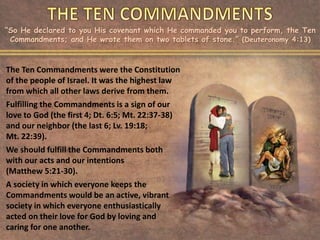
“So He declared to you His covenant which He commanded you to perform, the Ten
Commandments; and He wrote them on two tablets of stone.” (Deuteronomy 4:13)
The Ten Commandments were the Constitution
of the people of Israel. It was the highest law
from which all other laws derive from them.
Fulfilling the Commandments is a sign of our
love to God (the first 4; Dt. 6:5; Mt. 22:37-38)
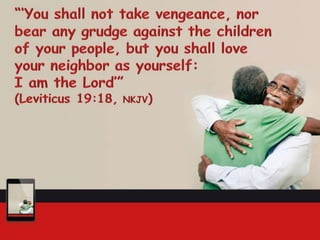
and our neighbor (the last 6; Lv. 19:18;
Mt. 22:39).
We should fulfill the Commandments both
with our acts and our intentions
(Matthew 5:21-30).
A society in which everyone keeps the
Commandments would be an active, vibrant
society in which everyone enthusiastically
acted on their love for God by loving and
caring for one another.
E.G.W. (Counsels to Parents, Teachers, and Students, cp. 64, p. 454)
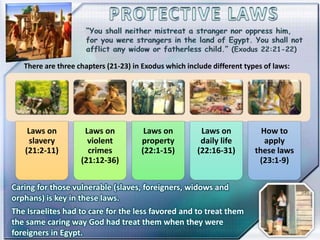
There are three chapters (21-23) in Exodus which include different types of laws:
Laws on
slavery
(21:2-11)
Laws on
violent
crimes
(21:12-36)
Laws on
property
(22:1-15)
Laws on
daily life
(22:16-31)
How to
apply
these laws
(23:1-9)
Caring for those vulnerable (slaves, foreigners, widows and
orphans) is key in these laws.
The Israelites had to care for the less favored and to treat them
the same caring way God had treat them when they were
foreigners in Egypt.
E.G.W. (Patriarchs and Prophets, cp. 42, p. 465)
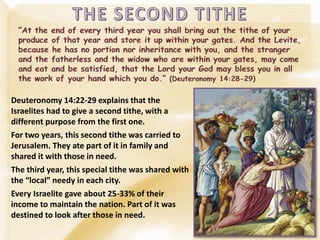
Deuteronomy 14:22-29 explains that the
Israelites had to give a second tithe, with a
different purpose from the first one.
For two years, this second tithe was carried to
Jerusalem. They ate part of it in family and
shared it with those in need.
The third year, this special tithe was shared with
the “local” needy in each city.
Every Israelite gave about 25-33% of their
income to maintain the nation. Part of it was
destined to look after those in need.
E.G.W. (Education, cp. 5, p. 44)
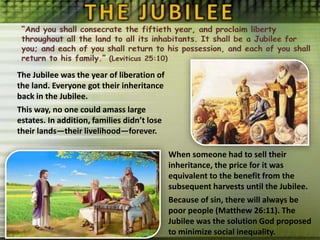
The Jubilee was the year of liberation of
the land. Everyone got their inheritance
back in the Jubilee.
This way, no one could amass large
estates. In addition, families didn’t lose
their lands—their livelihood—forever.
When someone had to sell their
inheritance, the price for it was
equivalent to the benefit from the
subsequent harvests until the Jubilee.
Because of sin, there will always be
poor people (Matthew 26:11). The
Jubilee was the solution God proposed
to minimize social inequality.
E.G.W.(Education,cp.5,p.43)
“Where shall we find laws more noble,
pure, and just than are exhibited on the
statute books wherein is recorded the
instruction given to Moses for the
children of Israel? From what other
source can we gather such strength or
learn such noble science? What other
book will teach men so well how to love,
fear, and obey God? What other book
presents to students more ennobling
science, more wonderful history? It
clearly portrays righteousness and
foretells the consequence of disloyalty to
the law of Jehovah.”
E.G.W. (Counsels to Parents, Teachers, and Students, p. 428)
Slideshare.net/chucho1943
We invite you to
download and study
each one of the 13
lessons about this
serie:
THIS SERVICE IS FREE AND
YOU CAN USE IT

02 blueprint for a better world

  • 1.
    BLUEPRINT FOR A BETTERWORLD Lesson 2
  • 3.
    After many yearsof slavery, God delivered the people of Israel from Egypt. He gave them fair laws in their way to the Promised Land. “And what great nation is there that has such statutes and righteous judgments as are in all this law which I set before you this day?” (Deuteronomy 4:8). These laws protected especially the weak.
  • 4.
    “So the peoplebelieved; and when they heard that the Lord had visited the children of Israel and that He had looked on their affliction, then they bowed their heads and worshiped.” (Exodus 4:31) God showed Himself to Moses in bush that “was burning with fire” and “was not consumed” (Exodus 3:2). He told Moses that He had seen the sorrow of His people and He had heard their cry (v. 7). God commissioned Moses to deliver Israel from Egypt (v. 10). They would not exit Egypt empty handed. Egypt would pay the Israelites for all the work they had done as slaves (v. 21). In their way to Canaan, God resolved to make a nation from that people of former slaves. They gave them fair laws that could be a blessing for the entire world. Therefore, He called them to mount Sinai.
  • 5.
    E.G.W. (Patriarchs andProphets, cp. 27, p. 305)
  • 6.
    “So He declaredto you His covenant which He commanded you to perform, the Ten Commandments; and He wrote them on two tablets of stone.” (Deuteronomy 4:13) The Ten Commandments were the Constitution of the people of Israel. It was the highest law from which all other laws derive from them. Fulfilling the Commandments is a sign of our love to God (the first 4; Dt. 6:5; Mt. 22:37-38) and our neighbor (the last 6; Lv. 19:18; Mt. 22:39). We should fulfill the Commandments both with our acts and our intentions (Matthew 5:21-30). A society in which everyone keeps the Commandments would be an active, vibrant society in which everyone enthusiastically acted on their love for God by loving and caring for one another.
  • 7.
    E.G.W. (Counsels toParents, Teachers, and Students, cp. 64, p. 454)
  • 8.
    There are threechapters (21-23) in Exodus which include different types of laws: Laws on slavery (21:2-11) Laws on violent crimes (21:12-36) Laws on property (22:1-15) Laws on daily life (22:16-31) How to apply these laws (23:1-9) Caring for those vulnerable (slaves, foreigners, widows and orphans) is key in these laws. The Israelites had to care for the less favored and to treat them the same caring way God had treat them when they were foreigners in Egypt.
  • 9.
    E.G.W. (Patriarchs andProphets, cp. 42, p. 465)
  • 10.
    Deuteronomy 14:22-29 explainsthat the Israelites had to give a second tithe, with a different purpose from the first one. For two years, this second tithe was carried to Jerusalem. They ate part of it in family and shared it with those in need. The third year, this special tithe was shared with the “local” needy in each city. Every Israelite gave about 25-33% of their income to maintain the nation. Part of it was destined to look after those in need.
  • 11.
  • 12.
    The Jubilee wasthe year of liberation of the land. Everyone got their inheritance back in the Jubilee. This way, no one could amass large estates. In addition, families didn’t lose their lands—their livelihood—forever. When someone had to sell their inheritance, the price for it was equivalent to the benefit from the subsequent harvests until the Jubilee. Because of sin, there will always be poor people (Matthew 26:11). The Jubilee was the solution God proposed to minimize social inequality.
  • 13.
  • 14.
    “Where shall wefind laws more noble, pure, and just than are exhibited on the statute books wherein is recorded the instruction given to Moses for the children of Israel? From what other source can we gather such strength or learn such noble science? What other book will teach men so well how to love, fear, and obey God? What other book presents to students more ennobling science, more wonderful history? It clearly portrays righteousness and foretells the consequence of disloyalty to the law of Jehovah.” E.G.W. (Counsels to Parents, Teachers, and Students, p. 428)
  • 15.
    Slideshare.net/chucho1943 We invite youto download and study each one of the 13 lessons about this serie: THIS SERVICE IS FREE AND YOU CAN USE IT