Workflow
What we’re going to cover
A PyTorch workflow
(one of many)
Where can you get help?
•Follow along with the code
•Try it for yourself
•Press SHIFT + CMD + SPACE to read the docstring
•Search for it
•Try again
•Ask
Motto #1: “If in doubt, run the code”
https://www.github.com/mrdbourke/pytorch-deep-learning/discussions
Let’s code!
Machine learning: a game of two parts
[[116, 78, 15],
[117, 43, 96],
[125, 87, 23],
…,
[[0.983, 0.004, 0.013],
[0.110, 0.889, 0.001],
[0.023, 0.027, 0.985],
…,
Inputs
Numerical
encoding
Learns
representation
(patterns/features/
weights)
Representation
outputs Outputs
Ramen,
Spaghetti
Not spam
“Hey Siri, what’s
the weather
today?”
[[116, 78, 15],
[117, 43, 96],
[125, 87, 23],
…,
[[0.983, 0.004, 0.013],
[0.110, 0.889, 0.001],
[0.023, 0.027, 0.985],
…,
Inputs
Numerical
encoding
Learns
representation
(patterns/features/weights)
Representation
outputs Outputs
Ramen,
Spaghetti
Not spam
“Hey Siri, what’s
the weather
today?”
Part 1: Turn data into numbers Part 2: Build model to learn patterns in numbers
Three datasets
(possibly the most important
concept in machine learning…)
Final exam
(test set)
Course materials
(training set)
Practice exam
(validation set)
Generalization
The ability for a machine learning model to perform well on data it hasn’t seen
before.
Model learns patterns from here
Tune model patterns See if the model is ready for the
wild
Subclass nn.Module
(this contains all the building blocks for neural networks)
Any subclass of nn.Module needs to override forward()
(this de
fi
nes the forward computation of the model)
Initialise model parameters to be used in various
computations (these could be di
ff
erent layers from
torch.nn, single parameters, hard-coded values or
functions)
requires_grad=True means PyTorch will track the
gradients of this speci
fi
c parameter for use with
torch.autograd and gradient descent (for many
torch.nn modules, requires_grad=True is set by
default)
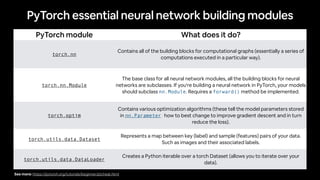
PyTorch essential neural network building modules
PyTorch module What does it do?
torch.nn
Contains all of the building blocks for computational graphs (essentially a series of
computations executed in a particular way).
torch.nn.Module
The base class for all neural network modules, all the building blocks for neural
networks are subclasses. If you're building a neural network in PyTorch, your models
should subclass nn.Module. Requires a forward() method be implemented.
torch.optim
Contains various optimization algorithms (these tell the model parameters stored
in nn.Parameter how to best change to improve gradient descent and in turn
reduce the loss).
torch.utils.data.Dataset
Represents a map between key (label) and sample (features) pairs of your data.
Such as images and their associated labels.
torch.utils.data.DataLoader
Creates a Python iterable over a torch Dataset (allows you to iterate over your
data).
See more: https://pytorch.org/tutorials/beginner/ptcheat.html
torch.optim torch.nn
torch.nn.Module
torchvision.models
torchmetrics
See more: https://pytorch.org/tutorials/beginner/ptcheat.html
torch.utils.data.Dataset
torch.utils.data.DataLoader
torchvision.transforms
torch.utils.tensorboard
Di
ff
erence (y_pred[0] - y_test[0]) = 0.4618
MAE_loss = torch.mean(torch.abs(y_pred-y_test))
or
MAE_loss = torch.nn.L1Loss
Mean absolute error (MAE)
Mean absolute error (MAE) = Repeat for all and take the mean
See more: https://pytorch.org/tutorials/beginner/ptcheat.html#loss-functions
Source: @mrdbourke Twitter & see the video version on YouTube.
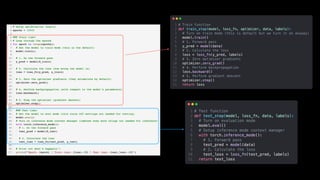
PyTorch training loop
Pass the data through the model for a number of epochs
(e.g. 100 for 100 passes of the data)
Zero the optimizer gradients (they accumulate every
epoch, zero them to start fresh each forward pass)
Pass the data through the model, this will perform the
forward() method located within the model object
Calculate the loss value (how wrong the model’s
predictions are)
Perform backpropagation on the loss function (compute
the gradient of every parameter with
requires_grad=True)
Step the optimizer to update the model’s parameters with
respect to the gradients calculated by loss.backward()
Note: all of this can be turned into a function
PyTorch testing loop
Create empty lists for storing useful values (helpful for
tracking model progress)
Pass the test data through the model (this will call the
model’s implemented forward() method)
Tell the model we want to evaluate rather than train (this
turns o
ff
functionality used for training but not
evaluation)
Turn on torch.inference_mode() context manager to
disable functionality such as gradient tracking for
inference (gradient tracking not needed for inference)
Calculate the test loss value (how wrong the model’s
predictions are on the test dataset, lower is better)
Display information outputs for how the model is doing
during training/testing every ~10 epochs (note: what gets
printed out here can be adjusted for speci
fi
c problems)
See more: https://discuss.pytorch.org/t/model-eval-vs-with-torch-no-grad/19615 & PyTorch Twitter announcement of torch.inference_mode()
Note: all of this can be turned into a function
(faster performance!)
Linear regression model with nn.Parameter
Linear regression model with nn.Linear
[[116, 78, 15],
[117, 43, 96],
[125, 87, 23],
…,
[[0.983, 0.004, 0.013],
[0.110, 0.889, 0.001],
[0.023, 0.027, 0.985],
…,
Inputs
Numerical
encoding
Learns
representation
(patterns/features/weights)
Representation
outputs
Outputs
Ramen,
Spaghetti
[[0.092, 0.210, 0.415],
[0.778, 0.929, 0.030],
[0.019, 0.182, 0.555],
…,
1. Initialise with random
weights (only at beginning)
2. Show examples
3. Update representation
outputs
4. Repeat with more
examples
Supervised
learning
(overview)
Neural Networks
[[116, 78, 15],
[117, 43, 96],
[125, 87, 23],
…,
[[0.983, 0.004, 0.013],
[0.110, 0.889, 0.001],
[0.023, 0.027, 0.985],
…,
Inputs
Numerical
encoding
Learns
representation
(patterns/features/weights)
Representation
outputs
Outputs
(a human can
understand these)
Ramen,
Spaghetti
Not spam
“Hey Siri, what’s
the weather
today?”
(choose the appropriate
neural network for your
problem)
(before data gets used
with an algorithm, it
needs to be turned into
numbers)
These are tensors!
[[116, 78, 15],
[117, 43, 96],
[125, 87, 23],
…,
[[0.983, 0.004, 0.013],
[0.110, 0.889, 0.001],
[0.023, 0.027, 0.985],
…,
Inputs
Numerical
encoding
Learns
representation
(patterns/features/weights)
Representation
outputs
Outputs
Ramen,
Spaghetti
These are tensors!
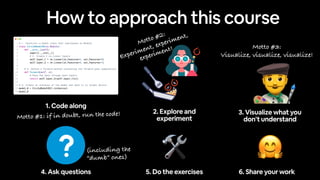
How to approach this course
1. Code along
Motto #1: if in doubt, run the code! 2. Explore and
experiment
Motto #2:
Experiment, experiment,
experiment!
3. Visualize what you
don’t understand
Motto #3:
Visualize, visualize, visualize!
4. Ask questions
🛠
5. Do the exercises
🤗
6. Share your work
(including the
“dumb” ones)
How not to approach this course
Avoid:
🧠
🔥
🔥
🔥 “I can’t learn
______”
Resources
https://www.github.com/mrdbourke/pytorch-deep-learning
https://www.github.com/mrdbourke/pytorch-deep-learning/
discussions
https://learnpytorch.io
Course materials Course Q&A Course online book
PyTorch website &
forums
This course
All things PyTorch
Di
ff
erence (y_pred[0] - y_test[0]) = 0.4618

01_pytorch_workflow jutedssd huge hhgggdf

  • 1.
  • 2.
    What we’re goingto cover A PyTorch workflow (one of many)
  • 3.
    Where can youget help? •Follow along with the code •Try it for yourself •Press SHIFT + CMD + SPACE to read the docstring •Search for it •Try again •Ask Motto #1: “If in doubt, run the code” https://www.github.com/mrdbourke/pytorch-deep-learning/discussions
  • 4.
  • 5.
    Machine learning: agame of two parts [[116, 78, 15], [117, 43, 96], [125, 87, 23], …, [[0.983, 0.004, 0.013], [0.110, 0.889, 0.001], [0.023, 0.027, 0.985], …, Inputs Numerical encoding Learns representation (patterns/features/ weights) Representation outputs Outputs Ramen, Spaghetti Not spam “Hey Siri, what’s the weather today?”
  • 6.
    [[116, 78, 15], [117,43, 96], [125, 87, 23], …, [[0.983, 0.004, 0.013], [0.110, 0.889, 0.001], [0.023, 0.027, 0.985], …, Inputs Numerical encoding Learns representation (patterns/features/weights) Representation outputs Outputs Ramen, Spaghetti Not spam “Hey Siri, what’s the weather today?” Part 1: Turn data into numbers Part 2: Build model to learn patterns in numbers
  • 7.
    Three datasets (possibly themost important concept in machine learning…) Final exam (test set) Course materials (training set) Practice exam (validation set) Generalization The ability for a machine learning model to perform well on data it hasn’t seen before. Model learns patterns from here Tune model patterns See if the model is ready for the wild
  • 8.
    Subclass nn.Module (this containsall the building blocks for neural networks) Any subclass of nn.Module needs to override forward() (this de fi nes the forward computation of the model) Initialise model parameters to be used in various computations (these could be di ff erent layers from torch.nn, single parameters, hard-coded values or functions) requires_grad=True means PyTorch will track the gradients of this speci fi c parameter for use with torch.autograd and gradient descent (for many torch.nn modules, requires_grad=True is set by default)
  • 9.
    PyTorch essential neuralnetwork building modules PyTorch module What does it do? torch.nn Contains all of the building blocks for computational graphs (essentially a series of computations executed in a particular way). torch.nn.Module The base class for all neural network modules, all the building blocks for neural networks are subclasses. If you're building a neural network in PyTorch, your models should subclass nn.Module. Requires a forward() method be implemented. torch.optim Contains various optimization algorithms (these tell the model parameters stored in nn.Parameter how to best change to improve gradient descent and in turn reduce the loss). torch.utils.data.Dataset Represents a map between key (label) and sample (features) pairs of your data. Such as images and their associated labels. torch.utils.data.DataLoader Creates a Python iterable over a torch Dataset (allows you to iterate over your data). See more: https://pytorch.org/tutorials/beginner/ptcheat.html
  • 10.
    torch.optim torch.nn torch.nn.Module torchvision.models torchmetrics See more:https://pytorch.org/tutorials/beginner/ptcheat.html torch.utils.data.Dataset torch.utils.data.DataLoader torchvision.transforms torch.utils.tensorboard
  • 11.
    Di ff erence (y_pred[0] -y_test[0]) = 0.4618 MAE_loss = torch.mean(torch.abs(y_pred-y_test)) or MAE_loss = torch.nn.L1Loss Mean absolute error (MAE) Mean absolute error (MAE) = Repeat for all and take the mean See more: https://pytorch.org/tutorials/beginner/ptcheat.html#loss-functions
  • 12.
    Source: @mrdbourke Twitter& see the video version on YouTube.
  • 13.
    PyTorch training loop Passthe data through the model for a number of epochs (e.g. 100 for 100 passes of the data) Zero the optimizer gradients (they accumulate every epoch, zero them to start fresh each forward pass) Pass the data through the model, this will perform the forward() method located within the model object Calculate the loss value (how wrong the model’s predictions are) Perform backpropagation on the loss function (compute the gradient of every parameter with requires_grad=True) Step the optimizer to update the model’s parameters with respect to the gradients calculated by loss.backward() Note: all of this can be turned into a function
  • 14.
    PyTorch testing loop Createempty lists for storing useful values (helpful for tracking model progress) Pass the test data through the model (this will call the model’s implemented forward() method) Tell the model we want to evaluate rather than train (this turns o ff functionality used for training but not evaluation) Turn on torch.inference_mode() context manager to disable functionality such as gradient tracking for inference (gradient tracking not needed for inference) Calculate the test loss value (how wrong the model’s predictions are on the test dataset, lower is better) Display information outputs for how the model is doing during training/testing every ~10 epochs (note: what gets printed out here can be adjusted for speci fi c problems) See more: https://discuss.pytorch.org/t/model-eval-vs-with-torch-no-grad/19615 & PyTorch Twitter announcement of torch.inference_mode() Note: all of this can be turned into a function (faster performance!)
  • 16.
    Linear regression modelwith nn.Parameter Linear regression model with nn.Linear
  • 17.
    [[116, 78, 15], [117,43, 96], [125, 87, 23], …, [[0.983, 0.004, 0.013], [0.110, 0.889, 0.001], [0.023, 0.027, 0.985], …, Inputs Numerical encoding Learns representation (patterns/features/weights) Representation outputs Outputs Ramen, Spaghetti [[0.092, 0.210, 0.415], [0.778, 0.929, 0.030], [0.019, 0.182, 0.555], …, 1. Initialise with random weights (only at beginning) 2. Show examples 3. Update representation outputs 4. Repeat with more examples Supervised learning (overview)
  • 18.
    Neural Networks [[116, 78,15], [117, 43, 96], [125, 87, 23], …, [[0.983, 0.004, 0.013], [0.110, 0.889, 0.001], [0.023, 0.027, 0.985], …, Inputs Numerical encoding Learns representation (patterns/features/weights) Representation outputs Outputs (a human can understand these) Ramen, Spaghetti Not spam “Hey Siri, what’s the weather today?” (choose the appropriate neural network for your problem) (before data gets used with an algorithm, it needs to be turned into numbers) These are tensors!
  • 19.
    [[116, 78, 15], [117,43, 96], [125, 87, 23], …, [[0.983, 0.004, 0.013], [0.110, 0.889, 0.001], [0.023, 0.027, 0.985], …, Inputs Numerical encoding Learns representation (patterns/features/weights) Representation outputs Outputs Ramen, Spaghetti These are tensors!
  • 20.
    How to approachthis course 1. Code along Motto #1: if in doubt, run the code! 2. Explore and experiment Motto #2: Experiment, experiment, experiment! 3. Visualize what you don’t understand Motto #3: Visualize, visualize, visualize! 4. Ask questions 🛠 5. Do the exercises 🤗 6. Share your work (including the “dumb” ones)
  • 21.
    How not toapproach this course Avoid: 🧠 🔥 🔥 🔥 “I can’t learn ______”
  • 22.
  • 23.
    Di ff erence (y_pred[0] -y_test[0]) = 0.4618