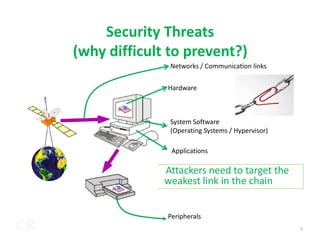
Security Threats
(why difficultto prevent?)
Networks / Communication links
Hardware
System Software
CR
Attackers need to target the
weakest link in the chain
Peripherals
System Software
(Operating Systems / Hypervisor)
Applications
5
6.
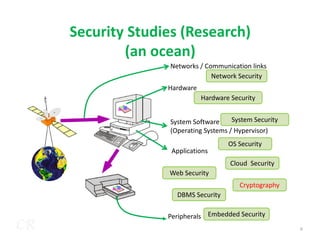
Security Studies (Research)
(anocean)
Networks / Communication links
Hardware
System Software
Network Security
Hardware Security
System Security
CR
Peripherals
System Software
(Operating Systems / Hypervisor)
Applications
System Security
OS Security
Cloud Security
Web Security
DBMS Security
Embedded Security
Cryptography
6
7.
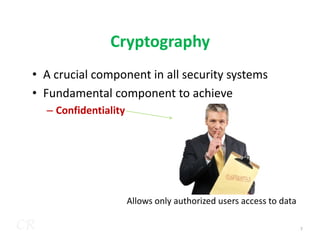
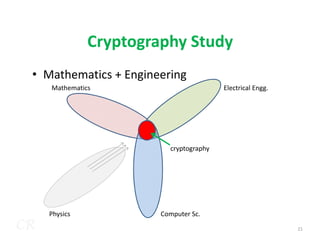
Cryptography
• A crucialcomponent in all security systems
• Fundamental component to achieve
– Confidentiality
CR
Allows only authorized users access to data
7
8.
Cryptography
(its use)
• Acrucial component in all security systems
• Fundamental component to achieve
– Confidentiality
– Data Integrity
CR
– Data Integrity
Cryptography can be used to ensure that only
authorized users can make modifications
(for instance to a bank account number)
8
9.
Cryptography
(its use)
• Acrucial component in all security systems
• Fundamental component to achieve
– Confidentiality
– Data Integrity
CR
– Data Integrity
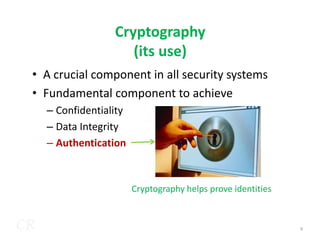
– Authentication
Cryptography helps prove identities
9
10.
Cryptography
(its use)
• Acrucial component in all security systems
• Fundamental component to achieve
– Confidentiality
– Data Integrity
I did not
send that
CR
– Data Integrity
– Authentication
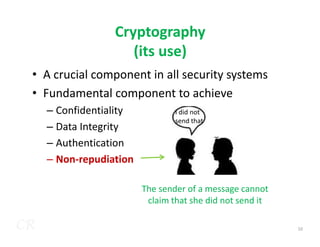
– Non-repudiation
The sender of a message cannot
claim that she did not send it
send that
10
11.
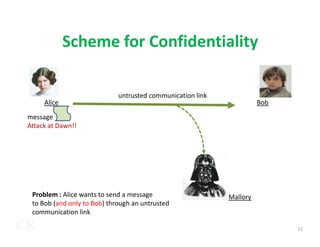
Scheme for Confidentiality
AliceBob
message
Attack at Dawn!!
untrusted communication link
CR
Attack at Dawn!!
Mallory
Problem : Alice wants to send a message
to Bob (and only to Bob) through an untrusted
communication link
11
12.
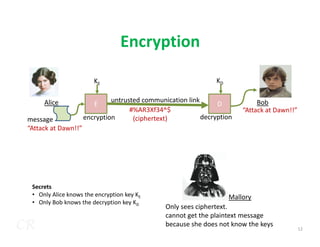
Encryption
Alice Bob
message
untrusted communicationlink
E D
KE KD
“Attack at Dawn!!”
encryption decryption
#%AR3Xf34^$
(ciphertext)
CR
message
“Attack at Dawn!!”
Mallory
Secrets
• Only Alice knows the encryption key KE
• Only Bob knows the decryption key KD
Only sees ciphertext.
cannot get the plaintext message
because she does not know the keys
12
13.
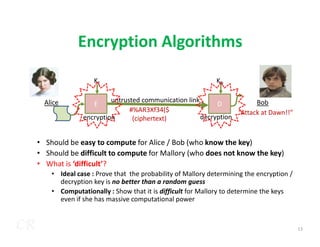
Encryption Algorithms
Alice Bob
untrustedcommunication link
E D
KE KD
“Attack at Dawn!!”
encryption decryption
#%AR3Xf34($
(ciphertext)
CR
• Should be easy to compute for Alice / Bob (who know the key)
• Should be difficult to compute for Mallory (who does not know the key)
• What is ‘difficult’?
• Ideal case : Prove that the probability of Mallory determining the encryption /
decryption key is no better than a random guess
• Computationally : Show that it is difficult for Mallory to determine the keys
even if she has massive computational power
13
14.
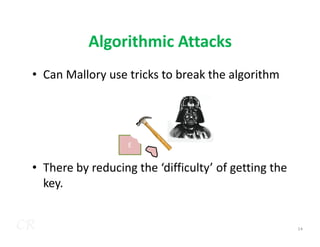
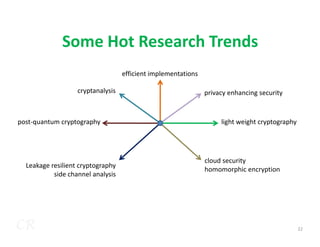
Algorithmic Attacks
• CanMallory use tricks to break the algorithm
CR
• There by reducing the ‘difficulty’ of getting the
key.
14
E
15.
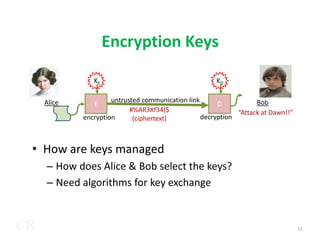
Encryption Keys
Alice Bob
untrustedcommunication link
E D
KE KD
“Attack at Dawn!!”
encryption decryption
#%AR3Xf34($
(ciphertext)
CR
• How are keys managed
– How does Alice & Bob select the keys?
– Need algorithms for key exchange
15
16.
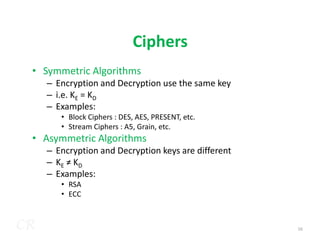
Ciphers
• Symmetric Algorithms
–Encryption and Decryption use the same key
– i.e. KE = KD
– Examples:
• Block Ciphers : DES, AES, PRESENT, etc.
• Stream Ciphers : A5, Grain, etc.
CR
• Stream Ciphers : A5, Grain, etc.
• Asymmetric Algorithms
– Encryption and Decryption keys are different
– KE ≠ KD
– Examples:
• RSA
• ECC
16
17.
Cipher Implementations
Cryptography isalways an overhead !!
• For security, the algorithms need to be computation
intensive.
CR
intensive.
• Often require large numbers, complex mathematical
operations.
• Design Challenges: Performance, Size, Power.
• Algorithms to achieve this
17
18.
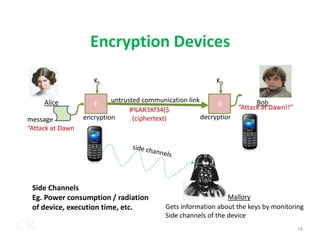
Encryption Devices
Alice Bob
message
untrustedcommunication link
E D
KE KD
“Attack at Dawn!!”
encryption decryption
#%AR3Xf34($
(ciphertext)
CR
message
“Attack at Dawn!!”
Mallory
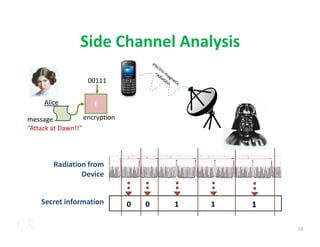
Side Channels
Eg. Power consumption / radiation
of device, execution time, etc. Gets information about the keys by monitoring
Side channels of the device
18
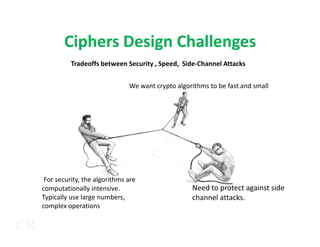
Ciphers Design Challenges
Wewant crypto algorithms to be fast and small
Tradeoffs between Security , Speed, Side-Channel Attacks
CR
For security, the algorithms are
computationally intensive.
Typically use large numbers,
complex operations
Need to protect against side
channel attacks.
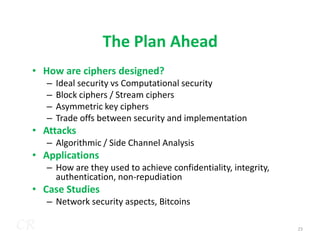
The Plan Ahead
•How are ciphers designed?
– Ideal security vs Computational security
– Block ciphers / Stream ciphers
– Asymmetric key ciphers
– Trade offs between security and implementation
CR
– Trade offs between security and implementation
• Attacks
– Algorithmic / Side Channel Analysis
• Applications
– How are they used to achieve confidentiality, integrity,
authentication, non-repudiation
• Case Studies
– Network security aspects, Bitcoins
23
24.
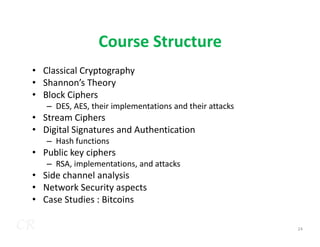
Course Structure
• ClassicalCryptography
• Shannon’s Theory
• Block Ciphers
– DES, AES, their implementations and their attacks
• Stream Ciphers
CR
Stream Ciphers
• Digital Signatures and Authentication
– Hash functions
• Public key ciphers
– RSA, implementations, and attacks
• Side channel analysis
• Network Security aspects
• Case Studies : Bitcoins
24
25.
Expected Learning Outcomes
•What you would learn by the end of the course
Distinguish between cipher algorithms
- Where to use what algorithm?
Evaluate ciphers and their implementations for security
CR 25
Evaluate ciphers and their implementations for security
- Mathematical cryptanalysis of some algorithms
- Side channel based attacks on cipher implementations
Apply algorithms to solve security problems in networks
and real-world systems
26.
Books / References
Textbooks
(STINSON)''Cryptography: Theory and Practice", Third Edition, by Douglas R.
Stinson, CRC Press, Taylor and Francis Group
References
CR 26
References
(STALLINGS) ''Cryptography and Network Security: Principles and Practices'',
Sixth Edition, by William Stallings
(HANDBOOK) ''Handbook of Applied Cryptography'', Fifth Printing, by Alfred J.
Menezes, Paul C. van Oorschot, and Scott A. Vanstone, CRC Press
(HARDSEC) ''Hardware Security : Design, Threats, and Safeguards", by
Debdeep Mukhopadhyay and Rajat Subhra Chakraborty, CRC Press, Taylor
and Francis Group
27.
Grading
• Quiz 1: 20%
• Quiz 2 : 20%
• End semester : 40%
• Assignments : 20%
CR
• Assignments : 20%
– Surprise tests / Tutorials / Programming assignments /
minute papers / Google groups / etc.
27
Self Study vs Attending Classes
• Same tutorials / assignments / quizzes / etc.
• Grading policy is different
28.
Course Webpages
• Forslides / syllabus / schedule etc.
• For discussions / announcements / submissions
http://www.cse.iitm.ac.in/~chester/courses/16e_cns/index.html
CR
• For discussions / announcements / submissions
CSE Moodle
Google Groups (cnsiitm_2016)
28