Quantitative Applications in Business - I
A Review of Probability Theory
2
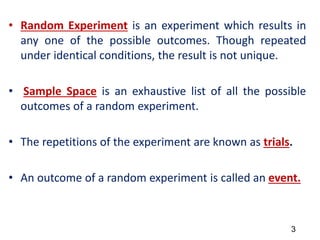
• Random Experiment is an experiment which results in
any one of the possible outcomes. Though repeated
under identical conditions, the result is not unique.
• Sample Space is an exhaustive list of all the possible
outcomes of a random experiment.
• The repetitions of the experiment are known as trials.
• An outcome of a random experiment is called an event.
3
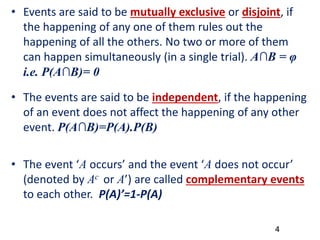
• Events are said to be mutually exclusive or disjoint, if
the happening of any one of them rules out the
happening of all the others. No two or more of them
can happen simultaneously (in a single trial). A∩B = φ
i.e. P(A∩B)= 0
• The events are said to be independent, if the happening
of an event does not affect the happening of any other
event. P(A∩B)=P(A).P(B)
• The event ‘A occurs’ and the event ‘A does not occur’
(denoted by Ac or A’) are called complementary events
to each other. P(A)’=1-P(A)
4
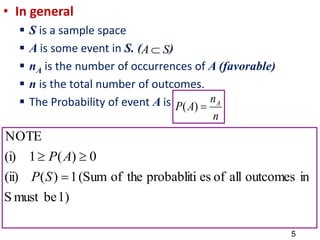
• In general
 S is a sample space
 A is some event in S. ( )
 nA is the number of occurrences of A (favorable)
 n is the total number of outcomes.
 The Probability of event A is
S
A 
n
n
A
P A

)
(
1)
be
must
S
in
outcomes
all
of
es
probabliti
the
of
(Sum
1
)
(
(ii)
0
)
(
1
(i)
NOTE



S
P
A
P
5
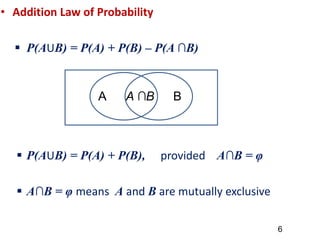
• Addition Law of Probability
 P(AUB) = P(A) + P(B) – P(A ∩B)
 P(AUB) = P(A) + P(B), provided A∩B = φ
 A∩B = φ means A and B are mutually exclusive
A B
A ∩B
6
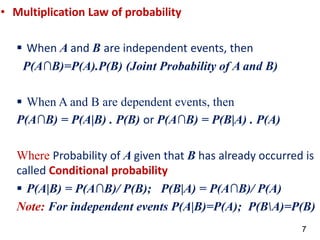
• Multiplication Law of probability
 When A and B are independent events, then
P(A∩B)=P(A).P(B) (Joint Probability of A and B)
 When A and B are dependent events, then
P(A∩B) = P(A|B) . P(B) or P(A∩B) = P(B|A) . P(A)
Where Probability of A given that B has already occurred is
called Conditional probability
 P(A|B) = P(A∩B)/ P(B); P(B|A) = P(A∩B)/ P(A)
Note: For independent events P(A|B)=P(A); P(BA)=P(B)
7
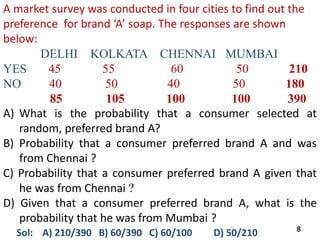
A market survey was conducted in four cities to find out the
preference for brand ‘A’ soap. The responses are shown
below:
DELHI KOLKATA CHENNAI MUMBAI
YES 45 55 60 50 210
NO 40 50 40 50 180
85 105 100 100 390
A) What is the probability that a consumer selected at
random, preferred brand A?
B) Probability that a consumer preferred brand A and was
from Chennai ?
C) Probability that a consumer preferred brand A given that
he was from Chennai ?
D) Given that a consumer preferred brand A, what is the
probability that he was from Mumbai ?
Sol: A) 210/390 B) 60/390 C) 60/100 D) 50/210 8
Joint Probability Distribution
9
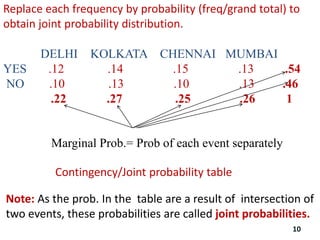
Replace each frequency by probability (freq/grand total) to
obtain joint probability distribution.
DELHI KOLKATA CHENNAI MUMBAI
YES .12 .14 .15 .13 .54
NO .10 .13 .10 .13 .46
.22 .27 .25 .26 1
Marginal Prob.= Prob of each event separately
Contingency/Joint probability table
Note: As the prob. In the table are a result of intersection of
two events, these probabilities are called joint probabilities.
10
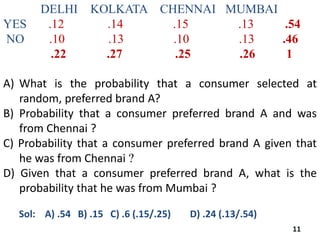
DELHI KOLKATA CHENNAI MUMBAI
YES .12 .14 .15 .13 .54
NO .10 .13 .10 .13 .46
.22 .27 .25 .26 1
A) What is the probability that a consumer selected at
random, preferred brand A?
B) Probability that a consumer preferred brand A and was
from Chennai ?
C) Probability that a consumer preferred brand A given that
he was from Chennai ?
D) Given that a consumer preferred brand A, what is the
probability that he was from Mumbai ?
Sol: A) .54 B) .15 C) .6 (.15/.25) D) .24 (.13/.54)
11
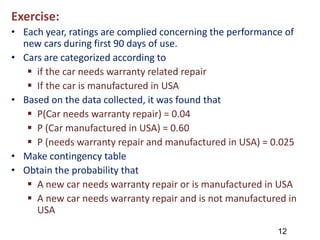
Exercise:
• Each year, ratings are complied concerning the performance of
new cars during first 90 days of use.
• Cars are categorized according to
 if the car needs warranty related repair
 If the car is manufactured in USA
• Based on the data collected, it was found that
 P(Car needs warranty repair) = 0.04
 P (Car manufactured in USA) = 0.60
 P (needs warranty repair and manufactured in USA) = 0.025
• Make contingency table
• Obtain the probability that
 A new car needs warranty repair or is manufactured in USA
 A new car needs warranty repair and is not manufactured in
USA
12
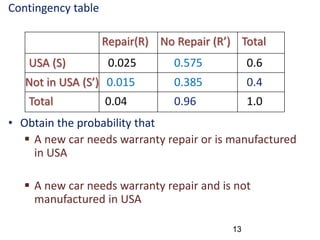
Contingency table
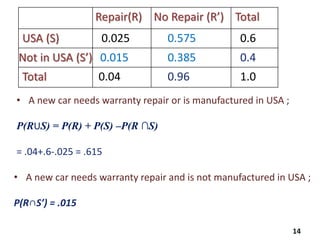
• Obtain the probability that
 A new car needs warranty repair or is manufactured
in USA
 A new car needs warranty repair and is not
manufactured in USA
Repair(R) No Repair (R’) Total
USA (S) 0.025 0.575 0.6
Not in USA (S’) 0.015 0.385 0.4
Total 0.04 0.96 1.0
13
• A new car needs warranty repair and is not manufactured in USA ;
P(R∩S’) = .015
• A new car needs warranty repair or is manufactured in USA ;
P(RUS) = P(R) + P(S) –P(R ∩S)
= .04+.6-.025 = .615
Repair(R) No Repair (R’) Total
USA (S) 0.025 0.575 0.6
Not in USA (S’) 0.015 0.385 0.4
Total 0.04 0.96 1.0
14
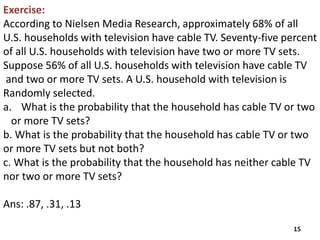
Exercise:
According to Nielsen Media Research, approximately 68% of all
U.S. households with television have cable TV. Seventy-five percent
of all U.S. households with television have two or more TV sets.
Suppose 56% of all U.S. households with television have cable TV
and two or more TV sets. A U.S. household with television is
Randomly selected.
a. What is the probability that the household has cable TV or two
or more TV sets?
b. What is the probability that the household has cable TV or two
or more TV sets but not both?
c. What is the probability that the household has neither cable TV
nor two or more TV sets?
Ans: .87, .31, .13
15
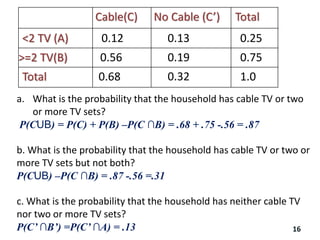
Cable(C) No Cable (C’) Total
<2 TV (A) 0.12 0.13 0.25
>=2 TV(B) 0.56 0.19 0.75
Total 0.68 0.32 1.0
a. What is the probability that the household has cable TV or two
or more TV sets?
P(CUB) = P(C) + P(B) –P(C ∩B) = .68 + .75 -.56 = .87
b. What is the probability that the household has cable TV or two or
more TV sets but not both?
P(CUB) –P(C ∩B) = .87 -.56 =.31
c. What is the probability that the household has neither cable TV
nor two or more TV sets?
P(C’ ∩B’) =P(C’ ∩A) = .13 16
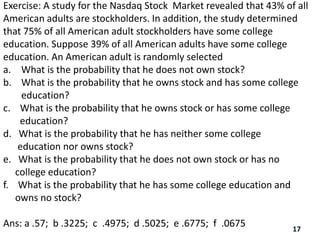
Exercise: A study for the Nasdaq Stock Market revealed that 43% of all
American adults are stockholders. In addition, the study determined
that 75% of all American adult stockholders have some college
education. Suppose 39% of all American adults have some college
education. An American adult is randomly selected
a. What is the probability that he does not own stock?
b. What is the probability that he owns stock and has some college
education?
c. What is the probability that he owns stock or has some college
education?
d. What is the probability that he has neither some college
education nor owns stock?
e. What is the probability that he does not own stock or has no
college education?
f. What is the probability that he has some college education and
owns no stock?
Ans: a .57; b .3225; c .4975; d .5025; e .6775; f .0675 17
Stk Stk’ Total
Ed 0.3225 0.0675 0.39
Ed’ 0.1075 0.5025 0.61
Total 0.43 0.57 1.0
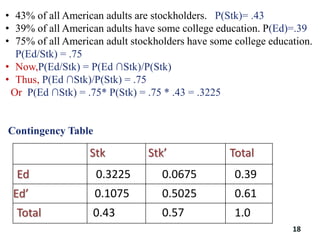
• 43% of all American adults are stockholders. P(Stk)= .43
• 39% of all American adults have some college education. P(Ed)=.39
• 75% of all American adult stockholders have some college education.
P(Ed/Stk) = .75
• Now,P(Ed/Stk) = P(Ed ∩Stk)/P(Stk)
• Thus, P(Ed ∩Stk)/P(Stk) = .75
Or P(Ed ∩Stk) = .75* P(Stk) = .75 * .43 = .3225
Contingency Table
18
Stk Stk’ Total
Ed 0.3225 0.0675 0.39
Ed’ 0.1075 0.5025 0.61
Total 0.43 0.57 1.0
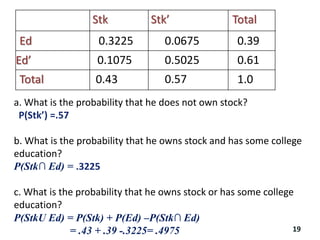
a. What is the probability that he does not own stock?
P(Stk’) =.57
b. What is the probability that he owns stock and has some college
education?
P(Stk∩ Ed) = .3225
c. What is the probability that he owns stock or has some college
education?
P(StkU Ed) = P(Stk) + P(Ed) –P(Stk∩ Ed)
= .43 + .39 -.3225= .4975 19
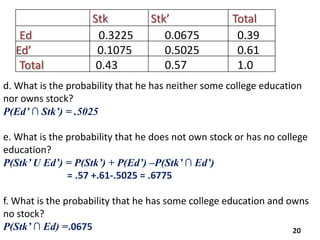
d. What is the probability that he has neither some college education
nor owns stock?
P(Ed’ ∩ Stk’) = .5025
e. What is the probability that he does not own stock or has no college
education?
P(Stk’ U Ed’) = P(Stk’) + P(Ed’) –P(Stk’ ∩ Ed’)
= .57 +.61-.5025 = .6775
f. What is the probability that he has some college education and owns
no stock?
P(Stk’ ∩ Ed) =.0675
Stk Stk’ Total
Ed 0.3225 0.0675 0.39
Ed’ 0.1075 0.5025 0.61
Total 0.43 0.57 1.0
20
21
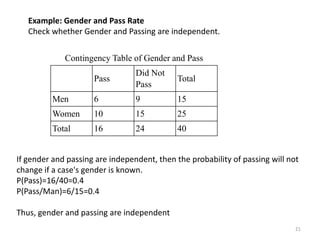
Contingency Table of Gender and Pass
Pass
Did Not
Pass
Total
Men 6 9 15
Women 10 15 25
Total 16 24 40
Example: Gender and Pass Rate
Check whether Gender and Passing are independent.
If gender and passing are independent, then the probability of passing will not
change if a case's gender is known.
P(Pass)=16/40=0.4
P(Pass/Man)=6/15=0.4
Thus, gender and passing are independent
Revision of Probabilities: Bayes’ Rule
22
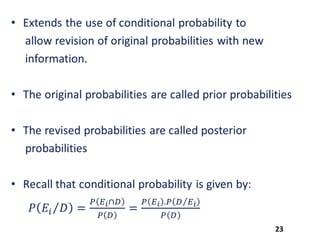
23
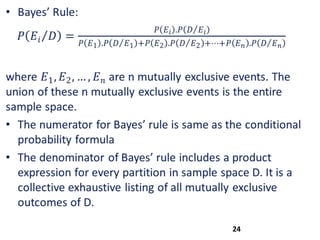
24
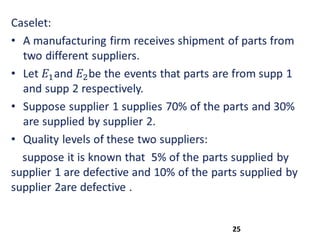
25
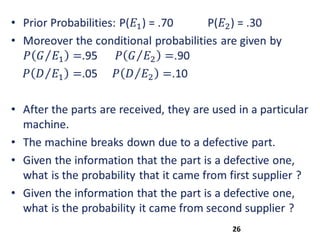
26
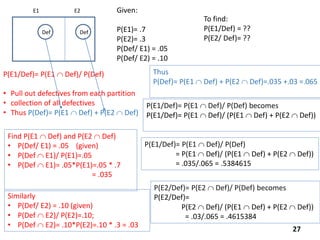
E1 E2
Def Def
Given:
P(E1)= .7
P(E2)= .3
P(Def/ E1) = .05
P(Def/ E2) = .10
To find:
P(E1/Def) = ??
P(E2/ Def)= ??
P(E1/Def)= P(E1  Def)/ P(Def)
• Pull out defectives from each partition
• collection of all defectives
• Thus P(Def)= P(E1  Def) + P(E2  Def)
P(E1/Def)= P(E1  Def)/ P(Def) becomes
P(E1/Def)= P(E1  Def)/ (P(E1  Def) + P(E2  Def))
Find P(E1  Def) and P(E2  Def)
• P(Def/ E1) = .05 (given)
• P(Def  E1)/ P(E1)=.05
• P(Def  E1)= .05*P(E1)=.05 * .7
= .035
Thus
P(Def)= P(E1  Def) + P(E2  Def)=.035 +.03 =.065
P(E1/Def)= P(E1  Def)/ P(Def)
= P(E1  Def)/ (P(E1  Def) + P(E2  Def))
= .035/.065 = .5384615
P(E2/Def)= P(E2  Def)/ P(Def) becomes
P(E2/Def)=
P(E2  Def)/ (P(E1  Def) + P(E2  Def))
= .03/.065 = .4615384
Similarly
• P(Def/ E2) = .10 (given)
• P(Def  E2)/ P(E2)=.10;
• P(Def  E2)= .10*P(E2)=.10 * .3 = .03
27
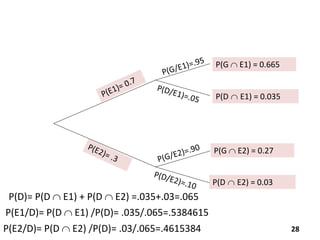
P(G  E1) = 0.665
P(D  E1) = 0.035
P(G  E2) = 0.27
P(D  E2) = 0.03
P(D)= P(D  E1) + P(D  E2) =.035+.03=.065
P(E1/D)= P(D  E1) /P(D)= .035/.065=.5384615
P(E2/D)= P(D  E2) /P(D)= .03/.065=.4615384 28
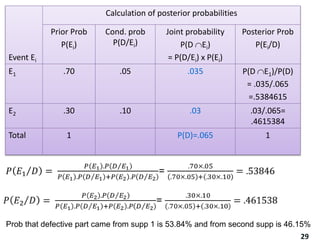
Event Ei
Calculation of posterior probabilities
Prior Prob
P(Ei)
Cond. prob
P(D/Ei)
Joint probability
P(D Ei)
= P(D/Ei) x P(Ei)
Posterior Prob
P(Ei/D)
E1 .70 .05 .035 P(D E1)/P(D)
= .035/.065
=.5384615
E2 .30 .10 .03 .03/.065=
.4615384
Total 1 P(D)=.065 1
Prob that defective part came from supp 1 is 53.84% and from second supp is 46.15%
29
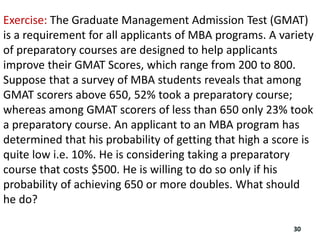
Exercise: The Graduate Management Admission Test (GMAT)
is a requirement for all applicants of MBA programs. A variety
of preparatory courses are designed to help applicants
improve their GMAT Scores, which range from 200 to 800.
Suppose that a survey of MBA students reveals that among
GMAT scorers above 650, 52% took a preparatory course;
whereas among GMAT scorers of less than 650 only 23% took
a preparatory course. An applicant to an MBA program has
determined that his probability of getting that high a score is
quite low i.e. 10%. He is considering taking a preparatory
course that costs $500. He is willing to do so only if his
probability of achieving 650 or more doubles. What should
he do?
30
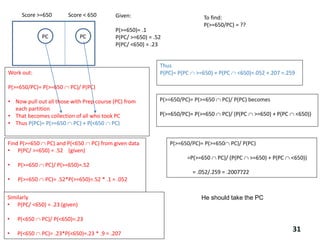
Score >=650 Score < 650
PC PC
Given:
P(>=650)= .1
P(PC/ >=650) = .52
P(PC/ <650) = .23
To find:
P(>=650/PC) = ??
Work out:
P(>=650/PC)= P(>=650  PC)/ P(PC)
• Now pull out all those with Prep course (PC) from
each partition
• That becomes collection of all who took PC
• Thus P(PC)= P(>=650  PC) + P(<650  PC)
P(>=650/PC)= P(>=650  PC)/ P(PC) becomes
P(>=650/PC)= P(>=650  PC)/ (P(PC  >=650) + P(PC  <650))
Find P(>=650  PC) and P(<650  PC) from given data
• P(PC/ >=650) = .52 (given)
• P(>=650  PC)/ P(>=650)=.52
• P(>=650  PC)= .52*P(>=650)=.52 * .1 = .052
Thus
P(PC)= P(PC  >=650) + P(PC  <650)=.052 +.207 =.259
P(>=650/PC)= P(>=650 PC)/ P(PC)
=P(>=650  PC)/ (P(PC  >=650) + P(PC  <650))
= .052/.259 = .2007722
Similarly
• P(PC/ <650) = .23 (given)
• P(<650  PC)/ P(<650)=.23
• P(<650  PC)= .23*P(<650)=.23 * .9 = .207
He should take the PC
31

01_2 Probability (1).pptx of the quant course

  • 1.
  • 2.
    A Review ofProbability Theory 2
  • 3.
    • Random Experimentis an experiment which results in any one of the possible outcomes. Though repeated under identical conditions, the result is not unique. • Sample Space is an exhaustive list of all the possible outcomes of a random experiment. • The repetitions of the experiment are known as trials. • An outcome of a random experiment is called an event. 3
  • 4.
    • Events aresaid to be mutually exclusive or disjoint, if the happening of any one of them rules out the happening of all the others. No two or more of them can happen simultaneously (in a single trial). A∩B = φ i.e. P(A∩B)= 0 • The events are said to be independent, if the happening of an event does not affect the happening of any other event. P(A∩B)=P(A).P(B) • The event ‘A occurs’ and the event ‘A does not occur’ (denoted by Ac or A’) are called complementary events to each other. P(A)’=1-P(A) 4
  • 5.
    • In general S is a sample space  A is some event in S. ( )  nA is the number of occurrences of A (favorable)  n is the total number of outcomes.  The Probability of event A is S A  n n A P A  ) ( 1) be must S in outcomes all of es probabliti the of (Sum 1 ) ( (ii) 0 ) ( 1 (i) NOTE    S P A P 5
  • 6.
    • Addition Lawof Probability  P(AUB) = P(A) + P(B) – P(A ∩B)  P(AUB) = P(A) + P(B), provided A∩B = φ  A∩B = φ means A and B are mutually exclusive A B A ∩B 6
  • 7.
    • Multiplication Lawof probability  When A and B are independent events, then P(A∩B)=P(A).P(B) (Joint Probability of A and B)  When A and B are dependent events, then P(A∩B) = P(A|B) . P(B) or P(A∩B) = P(B|A) . P(A) Where Probability of A given that B has already occurred is called Conditional probability  P(A|B) = P(A∩B)/ P(B); P(B|A) = P(A∩B)/ P(A) Note: For independent events P(A|B)=P(A); P(BA)=P(B) 7
  • 8.
    A market surveywas conducted in four cities to find out the preference for brand ‘A’ soap. The responses are shown below: DELHI KOLKATA CHENNAI MUMBAI YES 45 55 60 50 210 NO 40 50 40 50 180 85 105 100 100 390 A) What is the probability that a consumer selected at random, preferred brand A? B) Probability that a consumer preferred brand A and was from Chennai ? C) Probability that a consumer preferred brand A given that he was from Chennai ? D) Given that a consumer preferred brand A, what is the probability that he was from Mumbai ? Sol: A) 210/390 B) 60/390 C) 60/100 D) 50/210 8
  • 9.
  • 10.
    Replace each frequencyby probability (freq/grand total) to obtain joint probability distribution. DELHI KOLKATA CHENNAI MUMBAI YES .12 .14 .15 .13 .54 NO .10 .13 .10 .13 .46 .22 .27 .25 .26 1 Marginal Prob.= Prob of each event separately Contingency/Joint probability table Note: As the prob. In the table are a result of intersection of two events, these probabilities are called joint probabilities. 10
  • 11.
    DELHI KOLKATA CHENNAIMUMBAI YES .12 .14 .15 .13 .54 NO .10 .13 .10 .13 .46 .22 .27 .25 .26 1 A) What is the probability that a consumer selected at random, preferred brand A? B) Probability that a consumer preferred brand A and was from Chennai ? C) Probability that a consumer preferred brand A given that he was from Chennai ? D) Given that a consumer preferred brand A, what is the probability that he was from Mumbai ? Sol: A) .54 B) .15 C) .6 (.15/.25) D) .24 (.13/.54) 11
  • 12.
    Exercise: • Each year,ratings are complied concerning the performance of new cars during first 90 days of use. • Cars are categorized according to  if the car needs warranty related repair  If the car is manufactured in USA • Based on the data collected, it was found that  P(Car needs warranty repair) = 0.04  P (Car manufactured in USA) = 0.60  P (needs warranty repair and manufactured in USA) = 0.025 • Make contingency table • Obtain the probability that  A new car needs warranty repair or is manufactured in USA  A new car needs warranty repair and is not manufactured in USA 12
  • 13.
    Contingency table • Obtainthe probability that  A new car needs warranty repair or is manufactured in USA  A new car needs warranty repair and is not manufactured in USA Repair(R) No Repair (R’) Total USA (S) 0.025 0.575 0.6 Not in USA (S’) 0.015 0.385 0.4 Total 0.04 0.96 1.0 13
  • 14.
    • A newcar needs warranty repair and is not manufactured in USA ; P(R∩S’) = .015 • A new car needs warranty repair or is manufactured in USA ; P(RUS) = P(R) + P(S) –P(R ∩S) = .04+.6-.025 = .615 Repair(R) No Repair (R’) Total USA (S) 0.025 0.575 0.6 Not in USA (S’) 0.015 0.385 0.4 Total 0.04 0.96 1.0 14
  • 15.
    Exercise: According to NielsenMedia Research, approximately 68% of all U.S. households with television have cable TV. Seventy-five percent of all U.S. households with television have two or more TV sets. Suppose 56% of all U.S. households with television have cable TV and two or more TV sets. A U.S. household with television is Randomly selected. a. What is the probability that the household has cable TV or two or more TV sets? b. What is the probability that the household has cable TV or two or more TV sets but not both? c. What is the probability that the household has neither cable TV nor two or more TV sets? Ans: .87, .31, .13 15
  • 16.
    Cable(C) No Cable(C’) Total <2 TV (A) 0.12 0.13 0.25 >=2 TV(B) 0.56 0.19 0.75 Total 0.68 0.32 1.0 a. What is the probability that the household has cable TV or two or more TV sets? P(CUB) = P(C) + P(B) –P(C ∩B) = .68 + .75 -.56 = .87 b. What is the probability that the household has cable TV or two or more TV sets but not both? P(CUB) –P(C ∩B) = .87 -.56 =.31 c. What is the probability that the household has neither cable TV nor two or more TV sets? P(C’ ∩B’) =P(C’ ∩A) = .13 16
  • 17.
    Exercise: A studyfor the Nasdaq Stock Market revealed that 43% of all American adults are stockholders. In addition, the study determined that 75% of all American adult stockholders have some college education. Suppose 39% of all American adults have some college education. An American adult is randomly selected a. What is the probability that he does not own stock? b. What is the probability that he owns stock and has some college education? c. What is the probability that he owns stock or has some college education? d. What is the probability that he has neither some college education nor owns stock? e. What is the probability that he does not own stock or has no college education? f. What is the probability that he has some college education and owns no stock? Ans: a .57; b .3225; c .4975; d .5025; e .6775; f .0675 17
  • 18.
    Stk Stk’ Total Ed0.3225 0.0675 0.39 Ed’ 0.1075 0.5025 0.61 Total 0.43 0.57 1.0 • 43% of all American adults are stockholders. P(Stk)= .43 • 39% of all American adults have some college education. P(Ed)=.39 • 75% of all American adult stockholders have some college education. P(Ed/Stk) = .75 • Now,P(Ed/Stk) = P(Ed ∩Stk)/P(Stk) • Thus, P(Ed ∩Stk)/P(Stk) = .75 Or P(Ed ∩Stk) = .75* P(Stk) = .75 * .43 = .3225 Contingency Table 18
  • 19.
    Stk Stk’ Total Ed0.3225 0.0675 0.39 Ed’ 0.1075 0.5025 0.61 Total 0.43 0.57 1.0 a. What is the probability that he does not own stock? P(Stk’) =.57 b. What is the probability that he owns stock and has some college education? P(Stk∩ Ed) = .3225 c. What is the probability that he owns stock or has some college education? P(StkU Ed) = P(Stk) + P(Ed) –P(Stk∩ Ed) = .43 + .39 -.3225= .4975 19
  • 20.
    d. What isthe probability that he has neither some college education nor owns stock? P(Ed’ ∩ Stk’) = .5025 e. What is the probability that he does not own stock or has no college education? P(Stk’ U Ed’) = P(Stk’) + P(Ed’) –P(Stk’ ∩ Ed’) = .57 +.61-.5025 = .6775 f. What is the probability that he has some college education and owns no stock? P(Stk’ ∩ Ed) =.0675 Stk Stk’ Total Ed 0.3225 0.0675 0.39 Ed’ 0.1075 0.5025 0.61 Total 0.43 0.57 1.0 20
  • 21.
    21 Contingency Table ofGender and Pass Pass Did Not Pass Total Men 6 9 15 Women 10 15 25 Total 16 24 40 Example: Gender and Pass Rate Check whether Gender and Passing are independent. If gender and passing are independent, then the probability of passing will not change if a case's gender is known. P(Pass)=16/40=0.4 P(Pass/Man)=6/15=0.4 Thus, gender and passing are independent
  • 22.
  • 23.
  • 24.
  • 25.
  • 26.
  • 27.
    E1 E2 Def Def Given: P(E1)=.7 P(E2)= .3 P(Def/ E1) = .05 P(Def/ E2) = .10 To find: P(E1/Def) = ?? P(E2/ Def)= ?? P(E1/Def)= P(E1  Def)/ P(Def) • Pull out defectives from each partition • collection of all defectives • Thus P(Def)= P(E1  Def) + P(E2  Def) P(E1/Def)= P(E1  Def)/ P(Def) becomes P(E1/Def)= P(E1  Def)/ (P(E1  Def) + P(E2  Def)) Find P(E1  Def) and P(E2  Def) • P(Def/ E1) = .05 (given) • P(Def  E1)/ P(E1)=.05 • P(Def  E1)= .05*P(E1)=.05 * .7 = .035 Thus P(Def)= P(E1  Def) + P(E2  Def)=.035 +.03 =.065 P(E1/Def)= P(E1  Def)/ P(Def) = P(E1  Def)/ (P(E1  Def) + P(E2  Def)) = .035/.065 = .5384615 P(E2/Def)= P(E2  Def)/ P(Def) becomes P(E2/Def)= P(E2  Def)/ (P(E1  Def) + P(E2  Def)) = .03/.065 = .4615384 Similarly • P(Def/ E2) = .10 (given) • P(Def  E2)/ P(E2)=.10; • P(Def  E2)= .10*P(E2)=.10 * .3 = .03 27
  • 28.
    P(G  E1)= 0.665 P(D  E1) = 0.035 P(G  E2) = 0.27 P(D  E2) = 0.03 P(D)= P(D  E1) + P(D  E2) =.035+.03=.065 P(E1/D)= P(D  E1) /P(D)= .035/.065=.5384615 P(E2/D)= P(D  E2) /P(D)= .03/.065=.4615384 28
  • 29.
    Event Ei Calculation ofposterior probabilities Prior Prob P(Ei) Cond. prob P(D/Ei) Joint probability P(D Ei) = P(D/Ei) x P(Ei) Posterior Prob P(Ei/D) E1 .70 .05 .035 P(D E1)/P(D) = .035/.065 =.5384615 E2 .30 .10 .03 .03/.065= .4615384 Total 1 P(D)=.065 1 Prob that defective part came from supp 1 is 53.84% and from second supp is 46.15% 29
  • 30.
    Exercise: The GraduateManagement Admission Test (GMAT) is a requirement for all applicants of MBA programs. A variety of preparatory courses are designed to help applicants improve their GMAT Scores, which range from 200 to 800. Suppose that a survey of MBA students reveals that among GMAT scorers above 650, 52% took a preparatory course; whereas among GMAT scorers of less than 650 only 23% took a preparatory course. An applicant to an MBA program has determined that his probability of getting that high a score is quite low i.e. 10%. He is considering taking a preparatory course that costs $500. He is willing to do so only if his probability of achieving 650 or more doubles. What should he do? 30
  • 31.
    Score >=650 Score< 650 PC PC Given: P(>=650)= .1 P(PC/ >=650) = .52 P(PC/ <650) = .23 To find: P(>=650/PC) = ?? Work out: P(>=650/PC)= P(>=650  PC)/ P(PC) • Now pull out all those with Prep course (PC) from each partition • That becomes collection of all who took PC • Thus P(PC)= P(>=650  PC) + P(<650  PC) P(>=650/PC)= P(>=650  PC)/ P(PC) becomes P(>=650/PC)= P(>=650  PC)/ (P(PC  >=650) + P(PC  <650)) Find P(>=650  PC) and P(<650  PC) from given data • P(PC/ >=650) = .52 (given) • P(>=650  PC)/ P(>=650)=.52 • P(>=650  PC)= .52*P(>=650)=.52 * .1 = .052 Thus P(PC)= P(PC  >=650) + P(PC  <650)=.052 +.207 =.259 P(>=650/PC)= P(>=650 PC)/ P(PC) =P(>=650  PC)/ (P(PC  >=650) + P(PC  <650)) = .052/.259 = .2007722 Similarly • P(PC/ <650) = .23 (given) • P(<650  PC)/ P(<650)=.23 • P(<650  PC)= .23*P(<650)=.23 * .9 = .207 He should take the PC 31