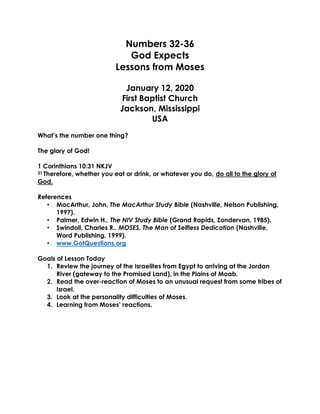
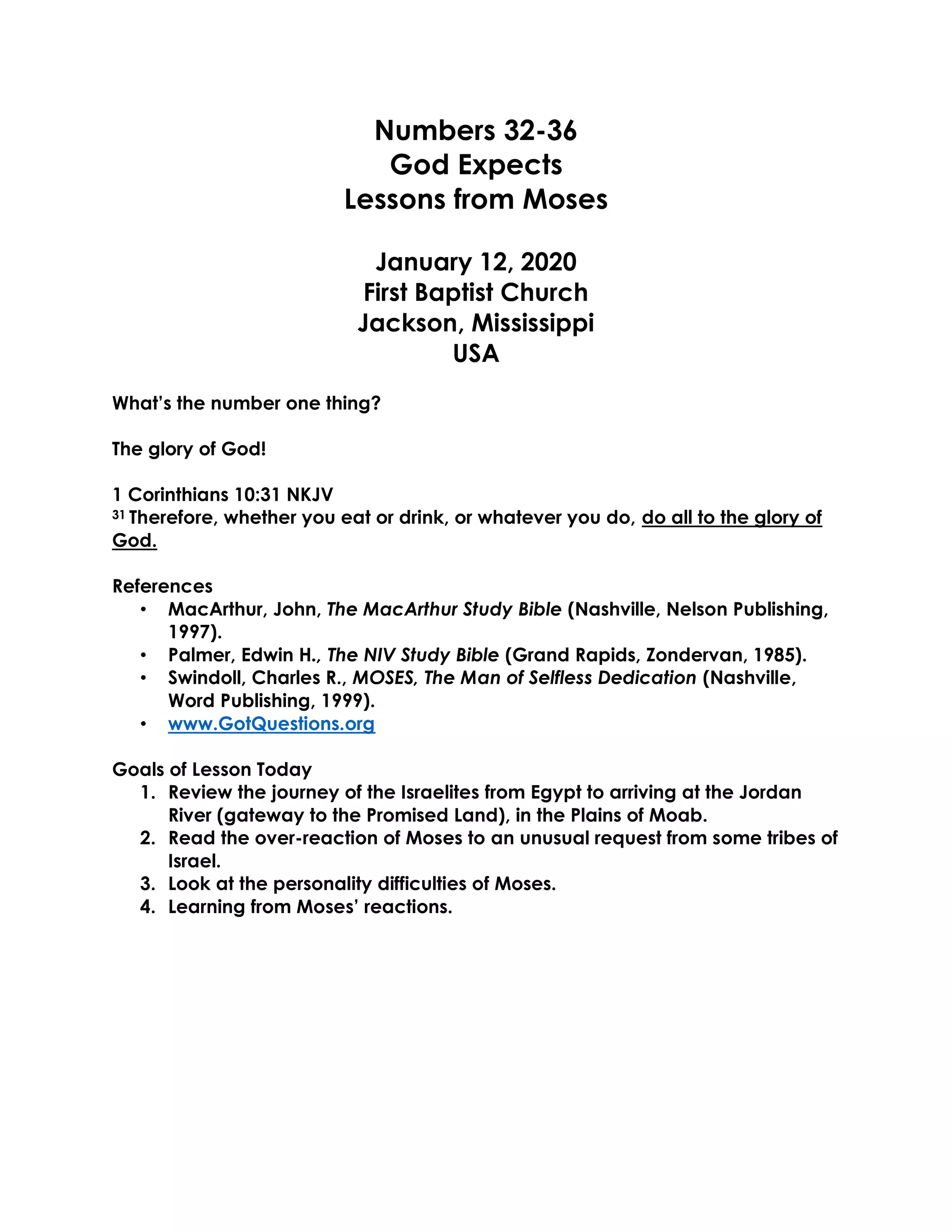
Numbers 32-36
God Expects
Lessons from Moses
January 12, 2020
First Baptist Church
Jackson, Mississippi
USA
What’s the number one thing?
The glory of God!
1 Corinthians 10:31 NKJV
31 Therefore, whether you eat or drink, or whatever you do, do all to the glory of
God.
References
• MacArthur, John, The MacArthur Study Bible (Nashville, Nelson Publishing,
1997).
• Palmer, Edwin H., The NIV Study Bible (Grand Rapids, Zondervan, 1985).
• Swindoll, Charles R., MOSES, The Man of Selfless Dedication (Nashville,
Word Publishing, 1999).
• www.GotQuestions.org
Goals of Lesson Today
1. Review the journey of the Israelites from Egypt to arriving at the Jordan
River (gateway to the Promised Land), in the Plains of Moab.
2. Read the over-reaction of Moses to an unusual request from some tribes of
Israel.
3. Look at the personality difficulties of Moses.
4. Learning from Moses’ reactions.
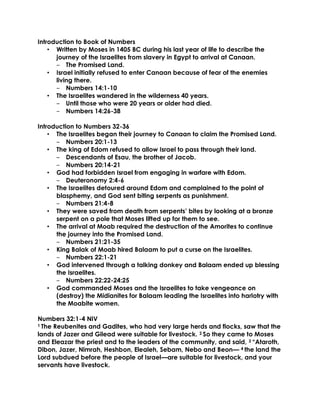
Introduction to Book of Numbers
• Written by Moses in 1405 BC during his last year of life to describe the
journey of the Israelites from slavery in Egypt to arrival at Canaan.
‒ The Promised Land.
• Israel initially refused to enter Canaan because of fear of the enemies
living there.
‒ Numbers 14:1-10
• The Israelites wandered in the wilderness 40 years.
‒ Until those who were 20 years or older had died.
‒ Numbers 14:26-38
Introduction to Numbers 32-36
• The Israelites began their journey to Canaan to claim the Promised Land.
‒ Numbers 20:1-13
• The king of Edom refused to allow Israel to pass through their land.
‒ Descendants of Esau, the brother of Jacob.
‒ Numbers 20:14-21
• God had forbidden Israel from engaging in warfare with Edom.
‒ Deuteronomy 2:4-6
• The Israelites detoured around Edom and complained to the point of
blasphemy, and God sent biting serpents as punishment.
‒ Numbers 21:4-8
• They were saved from death from serpents’ bites by looking at a bronze
serpent on a pole that Moses lifted up for them to see.
• The arrival at Moab required the destruction of the Amorites to continue
the journey into the Promised Land.
‒ Numbers 21:21-35
• King Balak of Moab hired Balaam to put a curse on the Israelites.
‒ Numbers 22:1-21
• God intervened through a talking donkey and Balaam ended up blessing
the Israelites.
‒ Numbers 22:22-24:25
• God commanded Moses and the Israelites to take vengeance on
(destroy) the Midianites for Balaam leading the Israelites into harlotry with
the Moabite women.
Numbers 32:1-4 NIV
1 The Reubenites and Gadites, who had very large herds and flocks, saw that the
lands of Jazer and Gilead were suitable for livestock. 2 So they came to Moses
and Eleazar the priest and to the leaders of the community, and said, 3 “Ataroth,
Dibon, Jazer, Nimrah, Heshbon, Elealeh, Sebam, Nebo and Beon— 4 the land the
Lord subdued before the people of Israel—are suitable for livestock, and your
servants have livestock.
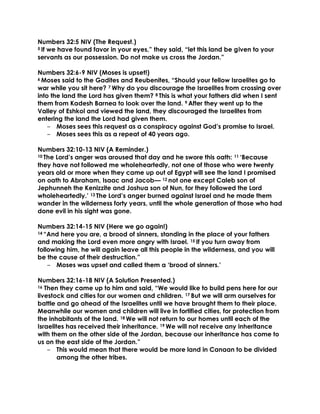
Numbers 32:5 NIV (The Request.)
5 If we have found favor in your eyes,” they said, “let this land be given to your
servants as our possession. Do not make us cross the Jordan.”
Numbers 32:6-9 NIV (Moses is upset!)
6 Moses said to the Gadites and Reubenites, “Should your fellow Israelites go to
war while you sit here? 7 Why do you discourage the Israelites from crossing over
into the land the Lord has given them? 8 This is what your fathers did when I sent
them from Kadesh Barnea to look over the land. 9 After they went up to the
Valley of Eshkol and viewed the land, they discouraged the Israelites from
entering the land the Lord had given them.
‒ Moses sees this request as a conspiracy against God’s promise to Israel.
‒ Moses sees this as a repeat of 40 years ago.
Numbers 32:10-13 NIV (A Reminder.)
10 The Lord’s anger was aroused that day and he swore this oath: 11 ‘Because
they have not followed me wholeheartedly, not one of those who were twenty
years old or more when they came up out of Egypt will see the land I promised
on oath to Abraham, Isaac and Jacob— 12 not one except Caleb son of
Jephunneh the Kenizzite and Joshua son of Nun, for they followed the Lord
wholeheartedly.’ 13 The Lord’s anger burned against Israel and he made them
wander in the wilderness forty years, until the whole generation of those who had
done evil in his sight was gone.
Numbers 32:14-15 NIV (Here we go again!)
14 “And here you are, a brood of sinners, standing in the place of your fathers
and making the Lord even more angry with Israel. 15 If you turn away from
following him, he will again leave all this people in the wilderness, and you will
be the cause of their destruction.”
‒ Moses was upset and called them a ‘brood of sinners.’
Numbers 32:16-18 NIV (A Solution Presented.)
16 Then they came up to him and said, “We would like to build pens here for our
livestock and cities for our women and children. 17 But we will arm ourselves for
battle and go ahead of the Israelites until we have brought them to their place.
Meanwhile our women and children will live in fortified cities, for protection from
the inhabitants of the land. 18 We will not return to our homes until each of the
Israelites has received their inheritance. 19 We will not receive any inheritance
with them on the other side of the Jordan, because our inheritance has come to
us on the east side of the Jordan.”
‒ This would mean that there would be more land in Canaan to be divided
among the other tribes.
Numbers 32:20-22 NIV (Moses Agrees!)
20 Then Moses said to them, “If you will do this—if you will arm yourselves before
the Lord for battle 21 and if all of you who are armed cross over the Jordan before
the Lord until he has driven his enemies out before him— 22 then when the land is
subdued before the Lord, you may return and be free from your obligation to the
Lord and to Israel. And this land will be your possession before the Lord.
Numbers 32:23 NIV (A Warning.)
23 “But if you fail to do this, you will be sinning against the Lord; and you may be
sure that your sin will find you out.
‒ Verse 23 is often quoted to demonstrate that secret sins will eventually
come to light, but it really means that the sin of unfulfilled promises to God
and others will be known eventually.
‒ Your past sins will eventually be the cause of your present troubles.
‒ “Chickens come home to roost.”
Numbers 32:24-33 NIV
24 Build cities for your women and children, and pens for your flocks, but do what
you have promised.”
25 The Gadites and Reubenites said to Moses, “We your servants will do as our
lord commands. 26 Our children and wives, our flocks and herds will remain here
in the cities of Gilead. 27 But your servants, every man who is armed for battle,
will cross over to fight before the Lord, just as our lord says.”
28 Then Moses gave orders about them to Eleazar the priest and Joshua son of
Nun and to the family heads of the Israelite tribes. 29 He said to them, “If the
Gadites and Reubenites, every man armed for battle, cross over the Jordan with
you before the Lord, then when the land is subdued before you, you must give
them the land of Gilead as their possession. 30 But if they do not cross over with
you armed, they must accept their possession with you in Canaan.”
31 The Gadites and Reubenites answered, “Your servants will do what the Lord
has said. 32 We will cross over before the Lord into Canaan armed, but the
property we inherit will be on this side of the Jordan.”
33 Then Moses gave to the Gadites, the Reubenites and the half-tribe of
Manasseh son of Joseph the kingdom of Sihon king of the Amorites and the
kingdom of Og king of Bashan—the whole land with its cities and the territory
around them.
Numbers 33:1-49 Summary
• The Lord commanded Moses to write a list of Israel’s encampments
between Egypt and the Plains of Moab.
• Moses lists 40 places reflecting the 40 years in the wilderness.
• Some sites mentioned in other scriptures are not listed here and others are
only mentioned here.
• This chapter is more symbolic than historical.
Numbers 33:50-53 NIV (God’s Instructions for Conquest of Canaan.)
50 On the plains of Moab by the Jordan across from Jericho the Lord said to
Moses, 51 “Speak to the Israelites and say to them: ‘When you cross the Jordan
into Canaan, 52 drive out all the inhabitants of the land before you. Destroy all
their carved images and their cast idols, and demolish all their high places.
53 Take possession of the land and settle in it, for I have given you the land to
possess.
Numbers 33:54 NIV (Proportionate Distribution)
54 Distribute the land by lot, according to your clans. To a larger group give a
larger inheritance, and to a smaller group a smaller one. Whatever falls to them
by lot will be theirs. Distribute it according to your ancestral tribes.
Numbers 33:55-56 NIV (A Warning.)
55 “‘But if you do not drive out the inhabitants of the land, those you allow to
remain will become barbs in your eyes and thorns in your sides. They will give
you trouble in the land where you will live. 56 And then I will do to you what I plan
to do to them.’”
‒ We are all influenced by the culture and those around us.
Summary of Numbers 34:1-15 (God gives Moses the boundaries.)
Summary of Numbers 34:16-29 (Leaders are appointed to divide the land.)
Summary of Numbers 35:1-9 (Cities for the Levites.)
• The Levites were the priests and leaders of worship for Israel.
• The tribe of Levi did not receive a tribal allotment of land but lived among
the other tribes.
• 48 cities throughout the land were allocated to the Levites and grazing
lands surrounding the cities were designated for grazing their animals.
‒ Joshua 21:1-42
Summary of Numbers 35:9-34 (Cities of Refuge.)
• Six of the Levitical cities were to be established as “cities of refuge.”
‒ Deuteronomy 19:1-13
• These cities were havens given for protection to any person who
accidently killed another person.
• The congregation judged the motive of the offender, whether with or
without hostility.
• The manslayer lived in the refugee city until the death of the High Priest.
Summary of Numbers 36:1-13 (Marriage of Female Heirs.)
• Numbers 27:1-11
‒ Inheritance laws were provided that if there were no male heirs in a
tribe then the land could pass to the female heirs.
• Numbers 36 states a tribe would lose allotted inheritance in the year of
Jubilee if an inheriting woman married into another tribe.
• The woman of any tribe who inherited land must marry within her own
tribe.
Year of Jubilee in Leviticus 25:1-4, 8-10
• The year after 7 cycles of 7 years.
‒ The 50th year.
• All prisoners, captives and slaves were freed.
• All debts were forgiven.
• All property returned to the original owners.
• All labor ceased for one year to allow rest.
• Christ provides this freedom, forgiveness, mercy and rest for believers.
What are some lessons from Moses?
• God creates each person with the distinct personality traits needed to
accomplish His purposes for our lives.
• Some of Moses’ personality traits displayed in Scripture:
‒ Faith.
‒ Endurance & Patience.
‒ Obedience.
‒ Courage.
‒ Anger & Impulsive.
‒ What we will study today.
Moses’ faith described in Hebrews:
Hebrews 11:24-27 NKJV
24 By faith Moses, when he became of age, refused to be called the son of
Pharaoh’s daughter, 25 choosing rather to suffer affliction with the people of God
than to enjoy the passing pleasures of sin, 26 esteeming the reproach of Christ
greater riches than the treasures in Egypt; for he looked to the reward.
27 By faith he forsook Egypt, not fearing the wrath of the king; for he endured as
seeing Him who is invisible.
Moses’ episode of anger results in murder.
Exodus 2:11-12 NKJV
11 Now it came to pass in those days, when Moses was grown, that he went out
to his brethren and looked at their burdens. And he saw an Egyptian beating a
Hebrew, one of his brethren. 12 So he looked this way and that way, and when he
saw no one, he killed the Egyptian and hid him in the sand.
What happened here?
• Moses did not control his anger and took the law into his own hands.
• Moses fled and was in hiding until God called him back to Egypt to
approach Pharaoh and lead the Israelites out of Egypt.
• God forgiving Moses for this murder is not presented in scriptures.
‒ A private encounter between Moses and God.
Moses’ episode of anger at Kadesh:
Numbers 20:7-12 NIV
7 The Lord said to Moses, 8 “Take the staff, and you and your brother Aaron
gather the assembly together. Speak to that rock before their eyes and it will
pour out its water. You will bring water out of the rock for the community so they
and their livestock can drink.
9 So Moses took the staff from the Lord’s presence, just as he commanded him.
10 He and Aaron gathered the assembly together in front of the rock and Moses
said to them, “Listen, you rebels, must we bring you water out of this rock?”
11 Then Moses raised his arm and struck the rock twice with his staff. Water
gushed out, and the community and their livestock drank.
12 But the Lord said to Moses and Aaron, “Because you did not trust in me
enough to honor me as holy in the sight of the Israelites, you will not bring this
community into the land I give them.”
What happened here?
• Moses’ anger caused him to disobey through his rash action, for he did
not show proper deference to God’s presence.
• Moses struck the rock (a physical expression of anger) instead of
speaking as God commanded.
• Moses failed to trust God’s provisions for water just as Israel did not trust
God 40 years earlier to capture the enemies in the Promised Land.
Moses’ episode of anger: (Today’s Scripture)
• Moses is approached about settling in the lands already conquered that
are east of the Jordan River.
• Numbers 32:6-7 NIV
6 Moses said to the Gadites and Reubenites, “Should your fellow Israelites
go to war while you sit here? 7 Why do you discourage the Israelites from
crossing over into the land the Lord has given them?”
• Numbers 32:14-15 NIV
14 “And here you are, a brood of sinners, standing in the place of your
fathers and making the Lord even more angry with Israel. 15 If you turn
away from following him, he will again leave all this people in the
wilderness, and you will be the cause of their destruction.”
What happened here?
• Moses’ language and analogy in his reply indicates he is angry and does
not want to have any exceptions to the plan.
• Moses was unwilling to “think outside the box”
• 40 years of desert life with complaining people could do this to you!!
A lesson from the Gadities and Rubenites:
• They offered to go with the other tribes to conquer the land and not return
home until the job was finished.
• Remember:
‒ When you present someone with a problem, also present a reasonable
solution.
‒ If you present someone with choices, make sure all choices are
acceptable to you!
Reacting to situations and making decisions:
• The HALT Principle can help here.
• Guard your reactions or decisions when you are:
‒ H – Hungry or sick.
‒ A - Angry, emotional or in a bad mood.
‒ L – Lonely or vulnerable.
‒ T - Tired, sleepy, not awake yet or need to think.
Proverbs: 14-29 NIV
29 Whoever is patient has great understanding,
but one who is quick-tempered displays folly.
The Plan of Hope & Salvation:
John 3:16-17 NKJV
16 “For God so loved the world that He gave His only begotten Son, that whoever
believes in Him should not perish but have everlasting life. 17 For God did not
send His Son into the world to condemn the world, but that the world through Him
might be saved.”
John 14:6 NKJV
6 Jesus said to him, “I am the way, the truth, and the life. No one comes to the
Father except through Me.”
Romans 3:23 NKJV
23 for all have sinned and fall short of the glory of God,
Romans 6:23a NKJV
23a For the wages of sin is death,
• Death in this life (the first death) is 100%.
• Even Jesus, the only one who doesn’t deserve death, died in this life to
pay the penalty for our sin.
• The death referred to in Romans 6:23a is the “second death” explained in
Revelation 21:8.
Revelation 21:8 NKJV
8 “But the cowardly, unbelieving, abominable, murderers, sexually immoral,
sorcerers, idolaters, and all liars shall have their part in the lake which burns with
fire and brimstone, which is the second death.”
• Anyone who’s lifestyle is one or more of the sins listed in Revelation 21:8,
will experience the “second death,” if they do not repent.
• To Repent means to turn around, to go in the opposite direction, to turn
away from sin and believe in Jesus.
Romans 5:8 NKJV
8 But God demonstrates His own love toward us, in that while we were still sinners,
Christ died for us.
Romans 6:23b NKJV
23b but the gift of God is eternal life in Christ Jesus our Lord.
Revelation 21:7 NKJV
7 “He who overcomes shall inherit all things, and I will be his God and he shall be
My son.”
• Romans 10:9-10 explain to us how to be overcomers.
Romans 10:9-10 NKJV
9 that if you confess with your mouth the Lord Jesus and believe in your heart that
God has raised Him from the dead, you will be saved. 10 For with the heart one
believes unto righteousness, and with the mouth confession is made unto
salvation.
Romans 10:13 NKJV
13 For “whoever calls on the name of the Lord shall be saved.”
Do you have questions?
Would you like to know more?
Please, contact First Baptist Church Jackson at 601-949-1900 or
http://firstbaptistjackson.org/contact/

01-12-20, Numbers 32-36, Lessons From Moses

  • 1.
    Numbers 32-36 God Expects Lessonsfrom Moses January 12, 2020 First Baptist Church Jackson, Mississippi USA What’s the number one thing? The glory of God! 1 Corinthians 10:31 NKJV 31 Therefore, whether you eat or drink, or whatever you do, do all to the glory of God. References • MacArthur, John, The MacArthur Study Bible (Nashville, Nelson Publishing, 1997). • Palmer, Edwin H., The NIV Study Bible (Grand Rapids, Zondervan, 1985). • Swindoll, Charles R., MOSES, The Man of Selfless Dedication (Nashville, Word Publishing, 1999). • www.GotQuestions.org Goals of Lesson Today 1. Review the journey of the Israelites from Egypt to arriving at the Jordan River (gateway to the Promised Land), in the Plains of Moab. 2. Read the over-reaction of Moses to an unusual request from some tribes of Israel. 3. Look at the personality difficulties of Moses. 4. Learning from Moses’ reactions.
  • 2.
    Introduction to Bookof Numbers • Written by Moses in 1405 BC during his last year of life to describe the journey of the Israelites from slavery in Egypt to arrival at Canaan. ‒ The Promised Land. • Israel initially refused to enter Canaan because of fear of the enemies living there. ‒ Numbers 14:1-10 • The Israelites wandered in the wilderness 40 years. ‒ Until those who were 20 years or older had died. ‒ Numbers 14:26-38 Introduction to Numbers 32-36 • The Israelites began their journey to Canaan to claim the Promised Land. ‒ Numbers 20:1-13 • The king of Edom refused to allow Israel to pass through their land. ‒ Descendants of Esau, the brother of Jacob. ‒ Numbers 20:14-21 • God had forbidden Israel from engaging in warfare with Edom. ‒ Deuteronomy 2:4-6 • The Israelites detoured around Edom and complained to the point of blasphemy, and God sent biting serpents as punishment. ‒ Numbers 21:4-8 • They were saved from death from serpents’ bites by looking at a bronze serpent on a pole that Moses lifted up for them to see. • The arrival at Moab required the destruction of the Amorites to continue the journey into the Promised Land. ‒ Numbers 21:21-35 • King Balak of Moab hired Balaam to put a curse on the Israelites. ‒ Numbers 22:1-21 • God intervened through a talking donkey and Balaam ended up blessing the Israelites. ‒ Numbers 22:22-24:25 • God commanded Moses and the Israelites to take vengeance on (destroy) the Midianites for Balaam leading the Israelites into harlotry with the Moabite women. Numbers 32:1-4 NIV 1 The Reubenites and Gadites, who had very large herds and flocks, saw that the lands of Jazer and Gilead were suitable for livestock. 2 So they came to Moses and Eleazar the priest and to the leaders of the community, and said, 3 “Ataroth, Dibon, Jazer, Nimrah, Heshbon, Elealeh, Sebam, Nebo and Beon— 4 the land the Lord subdued before the people of Israel—are suitable for livestock, and your servants have livestock.
  • 3.
    Numbers 32:5 NIV(The Request.) 5 If we have found favor in your eyes,” they said, “let this land be given to your servants as our possession. Do not make us cross the Jordan.” Numbers 32:6-9 NIV (Moses is upset!) 6 Moses said to the Gadites and Reubenites, “Should your fellow Israelites go to war while you sit here? 7 Why do you discourage the Israelites from crossing over into the land the Lord has given them? 8 This is what your fathers did when I sent them from Kadesh Barnea to look over the land. 9 After they went up to the Valley of Eshkol and viewed the land, they discouraged the Israelites from entering the land the Lord had given them. ‒ Moses sees this request as a conspiracy against God’s promise to Israel. ‒ Moses sees this as a repeat of 40 years ago. Numbers 32:10-13 NIV (A Reminder.) 10 The Lord’s anger was aroused that day and he swore this oath: 11 ‘Because they have not followed me wholeheartedly, not one of those who were twenty years old or more when they came up out of Egypt will see the land I promised on oath to Abraham, Isaac and Jacob— 12 not one except Caleb son of Jephunneh the Kenizzite and Joshua son of Nun, for they followed the Lord wholeheartedly.’ 13 The Lord’s anger burned against Israel and he made them wander in the wilderness forty years, until the whole generation of those who had done evil in his sight was gone. Numbers 32:14-15 NIV (Here we go again!) 14 “And here you are, a brood of sinners, standing in the place of your fathers and making the Lord even more angry with Israel. 15 If you turn away from following him, he will again leave all this people in the wilderness, and you will be the cause of their destruction.” ‒ Moses was upset and called them a ‘brood of sinners.’ Numbers 32:16-18 NIV (A Solution Presented.) 16 Then they came up to him and said, “We would like to build pens here for our livestock and cities for our women and children. 17 But we will arm ourselves for battle and go ahead of the Israelites until we have brought them to their place. Meanwhile our women and children will live in fortified cities, for protection from the inhabitants of the land. 18 We will not return to our homes until each of the Israelites has received their inheritance. 19 We will not receive any inheritance with them on the other side of the Jordan, because our inheritance has come to us on the east side of the Jordan.” ‒ This would mean that there would be more land in Canaan to be divided among the other tribes.
  • 4.
    Numbers 32:20-22 NIV(Moses Agrees!) 20 Then Moses said to them, “If you will do this—if you will arm yourselves before the Lord for battle 21 and if all of you who are armed cross over the Jordan before the Lord until he has driven his enemies out before him— 22 then when the land is subdued before the Lord, you may return and be free from your obligation to the Lord and to Israel. And this land will be your possession before the Lord. Numbers 32:23 NIV (A Warning.) 23 “But if you fail to do this, you will be sinning against the Lord; and you may be sure that your sin will find you out. ‒ Verse 23 is often quoted to demonstrate that secret sins will eventually come to light, but it really means that the sin of unfulfilled promises to God and others will be known eventually. ‒ Your past sins will eventually be the cause of your present troubles. ‒ “Chickens come home to roost.” Numbers 32:24-33 NIV 24 Build cities for your women and children, and pens for your flocks, but do what you have promised.” 25 The Gadites and Reubenites said to Moses, “We your servants will do as our lord commands. 26 Our children and wives, our flocks and herds will remain here in the cities of Gilead. 27 But your servants, every man who is armed for battle, will cross over to fight before the Lord, just as our lord says.” 28 Then Moses gave orders about them to Eleazar the priest and Joshua son of Nun and to the family heads of the Israelite tribes. 29 He said to them, “If the Gadites and Reubenites, every man armed for battle, cross over the Jordan with you before the Lord, then when the land is subdued before you, you must give them the land of Gilead as their possession. 30 But if they do not cross over with you armed, they must accept their possession with you in Canaan.” 31 The Gadites and Reubenites answered, “Your servants will do what the Lord has said. 32 We will cross over before the Lord into Canaan armed, but the property we inherit will be on this side of the Jordan.” 33 Then Moses gave to the Gadites, the Reubenites and the half-tribe of Manasseh son of Joseph the kingdom of Sihon king of the Amorites and the kingdom of Og king of Bashan—the whole land with its cities and the territory around them.
  • 5.
    Numbers 33:1-49 Summary •The Lord commanded Moses to write a list of Israel’s encampments between Egypt and the Plains of Moab. • Moses lists 40 places reflecting the 40 years in the wilderness. • Some sites mentioned in other scriptures are not listed here and others are only mentioned here. • This chapter is more symbolic than historical. Numbers 33:50-53 NIV (God’s Instructions for Conquest of Canaan.) 50 On the plains of Moab by the Jordan across from Jericho the Lord said to Moses, 51 “Speak to the Israelites and say to them: ‘When you cross the Jordan into Canaan, 52 drive out all the inhabitants of the land before you. Destroy all their carved images and their cast idols, and demolish all their high places. 53 Take possession of the land and settle in it, for I have given you the land to possess. Numbers 33:54 NIV (Proportionate Distribution) 54 Distribute the land by lot, according to your clans. To a larger group give a larger inheritance, and to a smaller group a smaller one. Whatever falls to them by lot will be theirs. Distribute it according to your ancestral tribes. Numbers 33:55-56 NIV (A Warning.) 55 “‘But if you do not drive out the inhabitants of the land, those you allow to remain will become barbs in your eyes and thorns in your sides. They will give you trouble in the land where you will live. 56 And then I will do to you what I plan to do to them.’” ‒ We are all influenced by the culture and those around us. Summary of Numbers 34:1-15 (God gives Moses the boundaries.) Summary of Numbers 34:16-29 (Leaders are appointed to divide the land.) Summary of Numbers 35:1-9 (Cities for the Levites.) • The Levites were the priests and leaders of worship for Israel. • The tribe of Levi did not receive a tribal allotment of land but lived among the other tribes. • 48 cities throughout the land were allocated to the Levites and grazing lands surrounding the cities were designated for grazing their animals. ‒ Joshua 21:1-42
  • 6.
    Summary of Numbers35:9-34 (Cities of Refuge.) • Six of the Levitical cities were to be established as “cities of refuge.” ‒ Deuteronomy 19:1-13 • These cities were havens given for protection to any person who accidently killed another person. • The congregation judged the motive of the offender, whether with or without hostility. • The manslayer lived in the refugee city until the death of the High Priest. Summary of Numbers 36:1-13 (Marriage of Female Heirs.) • Numbers 27:1-11 ‒ Inheritance laws were provided that if there were no male heirs in a tribe then the land could pass to the female heirs. • Numbers 36 states a tribe would lose allotted inheritance in the year of Jubilee if an inheriting woman married into another tribe. • The woman of any tribe who inherited land must marry within her own tribe. Year of Jubilee in Leviticus 25:1-4, 8-10 • The year after 7 cycles of 7 years. ‒ The 50th year. • All prisoners, captives and slaves were freed. • All debts were forgiven. • All property returned to the original owners. • All labor ceased for one year to allow rest. • Christ provides this freedom, forgiveness, mercy and rest for believers. What are some lessons from Moses? • God creates each person with the distinct personality traits needed to accomplish His purposes for our lives. • Some of Moses’ personality traits displayed in Scripture: ‒ Faith. ‒ Endurance & Patience. ‒ Obedience. ‒ Courage. ‒ Anger & Impulsive. ‒ What we will study today.
  • 7.
    Moses’ faith describedin Hebrews: Hebrews 11:24-27 NKJV 24 By faith Moses, when he became of age, refused to be called the son of Pharaoh’s daughter, 25 choosing rather to suffer affliction with the people of God than to enjoy the passing pleasures of sin, 26 esteeming the reproach of Christ greater riches than the treasures in Egypt; for he looked to the reward. 27 By faith he forsook Egypt, not fearing the wrath of the king; for he endured as seeing Him who is invisible. Moses’ episode of anger results in murder. Exodus 2:11-12 NKJV 11 Now it came to pass in those days, when Moses was grown, that he went out to his brethren and looked at their burdens. And he saw an Egyptian beating a Hebrew, one of his brethren. 12 So he looked this way and that way, and when he saw no one, he killed the Egyptian and hid him in the sand. What happened here? • Moses did not control his anger and took the law into his own hands. • Moses fled and was in hiding until God called him back to Egypt to approach Pharaoh and lead the Israelites out of Egypt. • God forgiving Moses for this murder is not presented in scriptures. ‒ A private encounter between Moses and God. Moses’ episode of anger at Kadesh: Numbers 20:7-12 NIV 7 The Lord said to Moses, 8 “Take the staff, and you and your brother Aaron gather the assembly together. Speak to that rock before their eyes and it will pour out its water. You will bring water out of the rock for the community so they and their livestock can drink. 9 So Moses took the staff from the Lord’s presence, just as he commanded him. 10 He and Aaron gathered the assembly together in front of the rock and Moses said to them, “Listen, you rebels, must we bring you water out of this rock?” 11 Then Moses raised his arm and struck the rock twice with his staff. Water gushed out, and the community and their livestock drank. 12 But the Lord said to Moses and Aaron, “Because you did not trust in me enough to honor me as holy in the sight of the Israelites, you will not bring this community into the land I give them.”
  • 8.
    What happened here? •Moses’ anger caused him to disobey through his rash action, for he did not show proper deference to God’s presence. • Moses struck the rock (a physical expression of anger) instead of speaking as God commanded. • Moses failed to trust God’s provisions for water just as Israel did not trust God 40 years earlier to capture the enemies in the Promised Land. Moses’ episode of anger: (Today’s Scripture) • Moses is approached about settling in the lands already conquered that are east of the Jordan River. • Numbers 32:6-7 NIV 6 Moses said to the Gadites and Reubenites, “Should your fellow Israelites go to war while you sit here? 7 Why do you discourage the Israelites from crossing over into the land the Lord has given them?” • Numbers 32:14-15 NIV 14 “And here you are, a brood of sinners, standing in the place of your fathers and making the Lord even more angry with Israel. 15 If you turn away from following him, he will again leave all this people in the wilderness, and you will be the cause of their destruction.” What happened here? • Moses’ language and analogy in his reply indicates he is angry and does not want to have any exceptions to the plan. • Moses was unwilling to “think outside the box” • 40 years of desert life with complaining people could do this to you!! A lesson from the Gadities and Rubenites: • They offered to go with the other tribes to conquer the land and not return home until the job was finished. • Remember: ‒ When you present someone with a problem, also present a reasonable solution. ‒ If you present someone with choices, make sure all choices are acceptable to you! Reacting to situations and making decisions: • The HALT Principle can help here. • Guard your reactions or decisions when you are: ‒ H – Hungry or sick. ‒ A - Angry, emotional or in a bad mood. ‒ L – Lonely or vulnerable. ‒ T - Tired, sleepy, not awake yet or need to think.
  • 9.
    Proverbs: 14-29 NIV 29Whoever is patient has great understanding, but one who is quick-tempered displays folly. The Plan of Hope & Salvation: John 3:16-17 NKJV 16 “For God so loved the world that He gave His only begotten Son, that whoever believes in Him should not perish but have everlasting life. 17 For God did not send His Son into the world to condemn the world, but that the world through Him might be saved.” John 14:6 NKJV 6 Jesus said to him, “I am the way, the truth, and the life. No one comes to the Father except through Me.” Romans 3:23 NKJV 23 for all have sinned and fall short of the glory of God, Romans 6:23a NKJV 23a For the wages of sin is death, • Death in this life (the first death) is 100%. • Even Jesus, the only one who doesn’t deserve death, died in this life to pay the penalty for our sin. • The death referred to in Romans 6:23a is the “second death” explained in Revelation 21:8. Revelation 21:8 NKJV 8 “But the cowardly, unbelieving, abominable, murderers, sexually immoral, sorcerers, idolaters, and all liars shall have their part in the lake which burns with fire and brimstone, which is the second death.” • Anyone who’s lifestyle is one or more of the sins listed in Revelation 21:8, will experience the “second death,” if they do not repent. • To Repent means to turn around, to go in the opposite direction, to turn away from sin and believe in Jesus. Romans 5:8 NKJV 8 But God demonstrates His own love toward us, in that while we were still sinners, Christ died for us. Romans 6:23b NKJV 23b but the gift of God is eternal life in Christ Jesus our Lord.
  • 10.
    Revelation 21:7 NKJV 7“He who overcomes shall inherit all things, and I will be his God and he shall be My son.” • Romans 10:9-10 explain to us how to be overcomers. Romans 10:9-10 NKJV 9 that if you confess with your mouth the Lord Jesus and believe in your heart that God has raised Him from the dead, you will be saved. 10 For with the heart one believes unto righteousness, and with the mouth confession is made unto salvation. Romans 10:13 NKJV 13 For “whoever calls on the name of the Lord shall be saved.” Do you have questions? Would you like to know more? Please, contact First Baptist Church Jackson at 601-949-1900 or http://firstbaptistjackson.org/contact/