TOEFL Reading, Video 1
READING COMPREHENSION SECTION, OVERVIEW QUESTIONS,
FACTUAL QUESTIONS
TOEFL ITP Reading
Comprehension Section
OVERVIEW, GENERAL STRATEGIES
Reading Comprehension Section
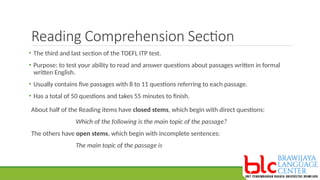
• The third and last section of the TOEFL ITP test.
• Purpose: to test your ability to read and answer questions about passages written in formal
written English.
• Usually contains five passages with 8 to 11 questions referring to each passage.
• Has a total of 50 questions and takes 55 minutes to finish.
About half of the Reading items have closed stems, which begin with direct questions:
Which of the following is the main topic of the passage?
The others have open stems, which begin with incomplete sentences:
The main topic of the passage is
General Strategies
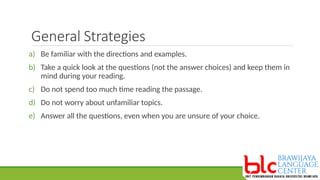
a) Be familiar with the directions and examples.
b) Take a quick look at the questions (not the answer choices) and keep them in
mind during your reading.
c) Do not spend too much time reading the passage.
d) Do not worry about unfamiliar topics.
e) Answer all the questions, even when you are unsure of your choice.
The learning video will cover several TOEFL Reading Comprehension question
types, such as
1. Overview questions
2. Factual questions
3. Inference questions
4. Vocabulary questions
5. Reference + scanning questions
Overview Questions
MAIN IDEA QUESTIONS, MAIN TOPIC QUESTIONS,
MAIN PURPOSE QUESTIONS
Overview Questions (Main Idea)
The main idea questions are given in the form of complete sentences and ask
you to identify the most important thought in the passage.
Sample Questions:
What is the main idea of the passage?
The primary idea of the passage is …
Which of the following best summarizes the author’s main idea?
Overview Questions (Main Topic)
The main topic questions are given in the form of noun phrases and ask you
what the passage is generally “about”.
It may be asked when there is not a single, readily identified main idea.
Sample Questions:
The main topic of the passage is …
What does the passage mainly discuss?
The passage is primarily concerned with …
Overview Questions (Main Purpose)
The main purpose questions ask why an author wrote a passage.
The answer choices usually begin with infinitives.
Sample Questions:
The author’s purpose in writing is to …
What is the author’s main purpose in the passage?
The main point of this passage is to …
Why did the author write the passage?
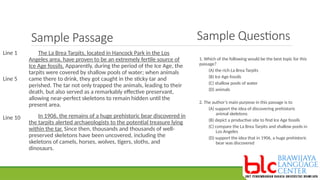
Sample Passage
The La Brea Tarpits, located in Hancock Park in the Los
Angeles area, have proven to be an extremely fertile source of
Ice Age fossils. Apparently, during the period of the Ice Age, the
tarpits were covered by shallow pools of water; when animals
came there to drink, they got caught in the sticky tar and
perished. The tar not only trapped the animals, leading to their
death, but also served as a remarkably effective preservant,
allowing near-perfect skeletons to remain hidden until the
present area.
In 1906, the remains of a huge prehistoric bear discovered in
the tarpits alerted archaeologists to the potential treasure lying
within the tar. Since then, thousands and thousands of well-
preserved skeletons have been uncovered, including the
skeletons of camels, horses, wolves, tigers, sloths, and
dinosaurs.
Line 1
Line 5
Line 10
1. Which of the following would be the best topic for this
passage?
(A) the rich La Brea Tarpits
(B) Ice Age fossils
(C) shallow pools of water
(D) animals
2. The author’s main purpose in this passage is to
(A) support the idea of discovering prehistoric
animal skeletons
(B) depict a productive site to find Ice Age fossils
(C) compare the La Brea Tarpits and shallow pools in
Los Angeles
(D) support the idea that in 1906, a huge prehistoric
bear was discovered
Sample Questions
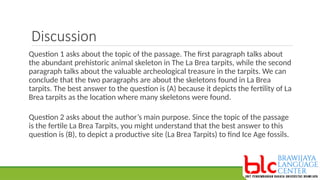
Discussion
Question 1 asks about the topic of the passage. The first paragraph talks about
the abundant prehistoric animal skeleton in The La Brea tarpits, while the second
paragraph talks about the valuable archeological treasure in the tarpits. We can
conclude that the two paragraphs are about the skeletons found in La Brea
tarpits. The best answer to the question is (A) because it depicts the fertility of La
Brea tarpits as the location where many skeletons were found.
Question 2 asks about the author’s main purpose. Since the topic of the passage
is the fertile La Brea Tarpits, you might understand that the best answer to this
question is (B), to depict a productive site (La Brea Tarpits) to find Ice Age fossils.
Factual Questions
STATED FACTUAL QUESTIONS, UNSTATED FACTUAL QUESTIONS
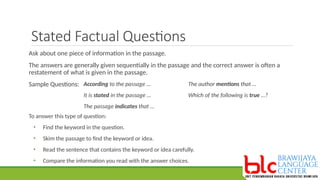
Stated Factual Questions
Ask about one piece of information in the passage.
The answers are generally given sequentially in the passage and the correct answer is often a
restatement of what is given in the passage.
Sample Questions: According to the passage …
It is stated in the passage …
The passage indicates that …
The author mentions that …
Which of the following is true …?
To answer this type of question:
• Find the keyword in the question.
• Skim the passage to find the keyword or idea.
• Read the sentence that contains the keyword or idea carefully.
• Compare the information you read with the answer choices.
Sample Passage
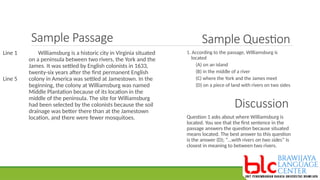
Williamsburg is a historic city in Virginia situated
on a peninsula between two rivers, the York and the
James. It was settled by English colonists in 1633,
twenty-six years after the first permanent English
colony in America was settled at Jamestown. In the
beginning, the colony at Williamsburg was named
Middle Plantation because of its location in the
middle of the peninsula. The site for Williamsburg
had been selected by the colonists because the soil
drainage was better there than at the Jamestown
location, and there were fewer mosquitoes.
Line 1
Line 5
1. According to the passage, Williamsburg is
located
(A) on an island
(B) in the middle of a river
(C) where the York and the James meet
(D) on a piece of land with rivers on two sides
Sample Question
Question 1 asks about where Williamsburg is
located. You see that the first sentence in the
passage answers the question because situated
means located. The best answer to this question
is the answer (D); “…with rivers on two sides” is
closest in meaning to between two rivers.
Discussion
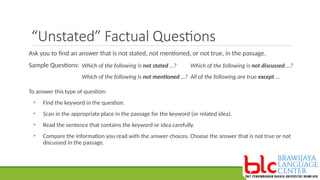
“Unstated” Factual Questions
Ask you to find an answer that is not stated, not mentioned, or not true, in the passage.
Sample Questions: Which of the following is not stated …?
Which of the following is not mentioned …?
Which of the following is not discussed …?
All of the following are true except …
To answer this type of question:
• Find the keyword in the question.
• Scan in the appropriate place in the passage for the keyword (or related idea).
• Read the sentence that contains the keyword or idea carefully.
• Compare the information you read with the answer choices. Choose the answer that is not true or not
discussed in the passage.
Sample Passage
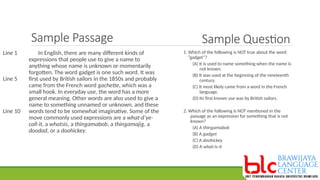
In English, there are many different kinds of
expressions that people use to give a name to
anything whose name is unknown or momentarily
forgotten. The word gadget is one such word. It was
first used by British sailors in the 1850s and probably
came from the French word gachette, which was a
small hook. In everyday use, the word has a more
general meaning. Other words are also used to give a
name to something unnamed or unknown, and these
words tend to be somewhat imaginative. Some of the
move commonly used expressions are a what-d’ye-
call-it, a whatsis, a thingamabob, a thingamajig, a
doodad, or a doohickey.
Line 1
Line 5
Line 10
Sample Question
1. Which of the following is NOT true about the word
“gadget”?
(A) It is used to name something when the name is
not known.
(B) It was used at the beginning of the nineteenth
century.
(C) It most likely came from a word in the French
language.
(D) Its first known use was by British sailors.
2. Which of the following is NOT mentioned in the
passage as an expression for something that is not
known?
(A) A thingamabob
(B) A gadget
(C) A doohickey
(D) A what-is-it
Discussion
Question 1 asks for the one answer that is not true, so three of the answers are
true and one answer is not. Answer (B) is the one answer that is not true: the
word gadget was first used in 1850, which is the middle of the nineteenth
century, so answer (B) is the best answer.
Question 2 asks for the one answer that is not mentioned, so three of the
answers are listed in the passage and one is not. Since a what-is-it is not listed in
the passage, so answer (D) is the best answer to this question.
Reading Exercise
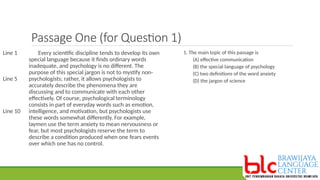
Passage One (for Question 1)
Every scientific discipline tends to develop its own
special language because it finds ordinary words
inadequate, and psychology is no different. The
purpose of this special jargon is not to mystify non-
psychologists; rather, it allows psychologists to
accurately describe the phenomena they are
discussing and to communicate with each other
effectively. Of course, psychological terminology
consists in part of everyday words such as emotion,
intelligence, and motivation, but psychologists use
these words somewhat differently. For example,
laymen use the term anxiety to mean nervousness or
fear, but most psychologists reserve the term to
describe a condition produced when one fears events
over which one has no control.
Line 1
Line 5
Line 10
1. The main topic of this passage is
(A) effective communication
(B) the special language of psychology
(C) two definitions of the word anxiety
(D) the jargon of science
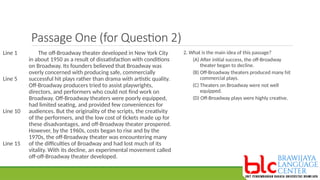
Passage One (for Question 2)
The off-Broadway theater developed in New York City
in about 1950 as a result of dissatisfaction with conditions
on Broadway. Its founders believed that Broadway was
overly concerned with producing safe, commercially
successful hit plays rather than drama with artistic quality.
Off-Broadway producers tried to assist playwrights,
directors, and performers who could not find work on
Broadway. Off-Broadway theaters were poorly equipped,
had limited seating, and provided few conveniences for
audiences. But the originality of the scripts, the creativity
of the performers, and the low cost of tickets made up for
these disadvantages, and off-Broadway theater prospered.
However, by the 1960s, costs began to rise and by the
1970s, the off-Broadway theater was encountering many
of the difficulties of Broadway and had lost much of its
vitality. With its decline, an experimental movement called
off-off-Broadway theater developed.
Line 1
Line 5
Line 10
Line 15
2. What is the main idea of this passage?
(A) After initial success, the off-Broadway
theater began to decline.
(B) Off-Broadway theaters produced many hit
commercial plays.
(C) Theaters on Broadway were not well
equipped.
(D) Off-Broadway plays were highly creative.
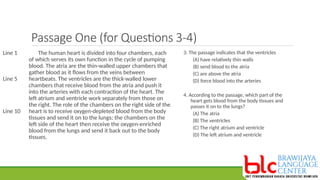
Passage One (for Questions 3-4)
The human heart is divided into four chambers, each
of which serves its own function in the cycle of pumping
blood. The atria are the thin-walled upper chambers that
gather blood as it flows from the veins between
heartbeats. The ventricles are the thick-walled lower
chambers that receive blood from the atria and push it
into the arteries with each contraction of the heart. The
left atrium and ventricle work separately from those on
the right. The role of the chambers on the right side of the
heart is to receive oxygen-depleted blood from the body
tissues and send it on to the lungs; the chambers on the
left side of the heart then receive the oxygen-enriched
blood from the lungs and send it back out to the body
tissues.
Line 1
Line 5
Line 10
3. The passage indicates that the ventricles
(A) have relatively thin walls
(B) send blood to the atria
(C) are above the atria
(D) force blood into the arteries
4. According to the passage, which part of the
heart gets blood from the body tissues and
passes it on to the lungs?
(A) The atria
(B) The ventricles
(C) The right atrium and ventricle
(D) The left atrium and ventricle
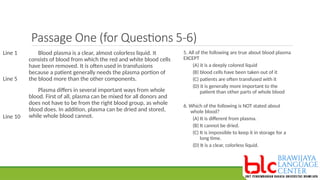
Passage One (for Questions 5-6)
Blood plasma is a clear, almost colorless liquid. It
consists of blood from which the red and white blood cells
have been removed. It is often used in transfusions
because a patient generally needs the plasma portion of
the blood more than the other components.
Plasma differs in several important ways from whole
blood. First of all, plasma can be mixed for all donors and
does not have to be from the right blood group, as whole
blood does. In addition, plasma can be dried and stored,
while whole blood cannot.
Line 1
Line 5
Line 10
5. All of the following are true about blood plasma
EXCEPT
(A) it is a deeply colored liquid
(B) blood cells have been taken out of it
(C) patients are often transfused with it
(D) it is generally more important to the
patient than other parts of whole blood
6. Which of the following is NOT stated about
whole blood?
(A) It is different from plasma.
(B) It cannot be dried.
(C) It is impossible to keep it in storage for a
long time.
(D) It is a clear, colorless liquid.
Discussion
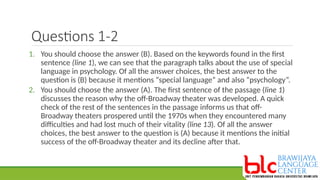
Questions 1-2
1. You should choose the answer (B). Based on the keywords found in the first
sentence (line 1), we can see that the paragraph talks about the use of special
language in psychology. Of all the answer choices, the best answer to the
question is (B) because it mentions “special language” and also “psychology”.
2. You should choose the answer (A). The first sentence of the passage (line 1)
discusses the reason why the off-Broadway theater was developed. A quick
check of the rest of the sentences in the passage informs us that off-
Broadway theaters prospered until the 1970s when they encountered many
difficulties and had lost much of their vitality (line 13). Of all the answer
choices, the best answer to the question is (A) because it mentions the initial
success of the off-Broadway theater and its decline after that.
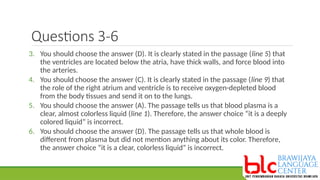
Questions 3-6
3. You should choose the answer (D). It is clearly stated in the passage (line 5) that
the ventricles are located below the atria, have thick walls, and force blood into
the arteries.
4. You should choose the answer (C). It is clearly stated in the passage (line 9) that
the role of the right atrium and ventricle is to receive oxygen-depleted blood
from the body tissues and send it on to the lungs.
5. You should choose the answer (A). The passage tells us that blood plasma is a
clear, almost colorless liquid (line 1). Therefore, the answer choice “it is a deeply
colored liquid” is incorrect.
6. You should choose the answer (D). The passage tells us that whole blood is
different from plasma but did not mention anything about its color. Therefore,
the answer choice “it is a clear, colorless liquid” is incorrect.
Thank You

01. TOEFL Project PPT Reading v3 abcd.pptx

  • 1.
    TOEFL Reading, Video1 READING COMPREHENSION SECTION, OVERVIEW QUESTIONS, FACTUAL QUESTIONS
  • 2.
    TOEFL ITP Reading ComprehensionSection OVERVIEW, GENERAL STRATEGIES
  • 3.
    Reading Comprehension Section •The third and last section of the TOEFL ITP test. • Purpose: to test your ability to read and answer questions about passages written in formal written English. • Usually contains five passages with 8 to 11 questions referring to each passage. • Has a total of 50 questions and takes 55 minutes to finish. About half of the Reading items have closed stems, which begin with direct questions: Which of the following is the main topic of the passage? The others have open stems, which begin with incomplete sentences: The main topic of the passage is
  • 4.
    General Strategies a) Befamiliar with the directions and examples. b) Take a quick look at the questions (not the answer choices) and keep them in mind during your reading. c) Do not spend too much time reading the passage. d) Do not worry about unfamiliar topics. e) Answer all the questions, even when you are unsure of your choice.
  • 5.
    The learning videowill cover several TOEFL Reading Comprehension question types, such as 1. Overview questions 2. Factual questions 3. Inference questions 4. Vocabulary questions 5. Reference + scanning questions
  • 6.
    Overview Questions MAIN IDEAQUESTIONS, MAIN TOPIC QUESTIONS, MAIN PURPOSE QUESTIONS
  • 7.
    Overview Questions (MainIdea) The main idea questions are given in the form of complete sentences and ask you to identify the most important thought in the passage. Sample Questions: What is the main idea of the passage? The primary idea of the passage is … Which of the following best summarizes the author’s main idea?
  • 8.
    Overview Questions (MainTopic) The main topic questions are given in the form of noun phrases and ask you what the passage is generally “about”. It may be asked when there is not a single, readily identified main idea. Sample Questions: The main topic of the passage is … What does the passage mainly discuss? The passage is primarily concerned with …
  • 9.
    Overview Questions (MainPurpose) The main purpose questions ask why an author wrote a passage. The answer choices usually begin with infinitives. Sample Questions: The author’s purpose in writing is to … What is the author’s main purpose in the passage? The main point of this passage is to … Why did the author write the passage?
  • 10.
    Sample Passage The LaBrea Tarpits, located in Hancock Park in the Los Angeles area, have proven to be an extremely fertile source of Ice Age fossils. Apparently, during the period of the Ice Age, the tarpits were covered by shallow pools of water; when animals came there to drink, they got caught in the sticky tar and perished. The tar not only trapped the animals, leading to their death, but also served as a remarkably effective preservant, allowing near-perfect skeletons to remain hidden until the present area. In 1906, the remains of a huge prehistoric bear discovered in the tarpits alerted archaeologists to the potential treasure lying within the tar. Since then, thousands and thousands of well- preserved skeletons have been uncovered, including the skeletons of camels, horses, wolves, tigers, sloths, and dinosaurs. Line 1 Line 5 Line 10 1. Which of the following would be the best topic for this passage? (A) the rich La Brea Tarpits (B) Ice Age fossils (C) shallow pools of water (D) animals 2. The author’s main purpose in this passage is to (A) support the idea of discovering prehistoric animal skeletons (B) depict a productive site to find Ice Age fossils (C) compare the La Brea Tarpits and shallow pools in Los Angeles (D) support the idea that in 1906, a huge prehistoric bear was discovered Sample Questions
  • 11.
    Discussion Question 1 asksabout the topic of the passage. The first paragraph talks about the abundant prehistoric animal skeleton in The La Brea tarpits, while the second paragraph talks about the valuable archeological treasure in the tarpits. We can conclude that the two paragraphs are about the skeletons found in La Brea tarpits. The best answer to the question is (A) because it depicts the fertility of La Brea tarpits as the location where many skeletons were found. Question 2 asks about the author’s main purpose. Since the topic of the passage is the fertile La Brea Tarpits, you might understand that the best answer to this question is (B), to depict a productive site (La Brea Tarpits) to find Ice Age fossils.
  • 12.
    Factual Questions STATED FACTUALQUESTIONS, UNSTATED FACTUAL QUESTIONS
  • 13.
    Stated Factual Questions Askabout one piece of information in the passage. The answers are generally given sequentially in the passage and the correct answer is often a restatement of what is given in the passage. Sample Questions: According to the passage … It is stated in the passage … The passage indicates that … The author mentions that … Which of the following is true …? To answer this type of question: • Find the keyword in the question. • Skim the passage to find the keyword or idea. • Read the sentence that contains the keyword or idea carefully. • Compare the information you read with the answer choices.
  • 14.
    Sample Passage Williamsburg isa historic city in Virginia situated on a peninsula between two rivers, the York and the James. It was settled by English colonists in 1633, twenty-six years after the first permanent English colony in America was settled at Jamestown. In the beginning, the colony at Williamsburg was named Middle Plantation because of its location in the middle of the peninsula. The site for Williamsburg had been selected by the colonists because the soil drainage was better there than at the Jamestown location, and there were fewer mosquitoes. Line 1 Line 5 1. According to the passage, Williamsburg is located (A) on an island (B) in the middle of a river (C) where the York and the James meet (D) on a piece of land with rivers on two sides Sample Question Question 1 asks about where Williamsburg is located. You see that the first sentence in the passage answers the question because situated means located. The best answer to this question is the answer (D); “…with rivers on two sides” is closest in meaning to between two rivers. Discussion
  • 15.
    “Unstated” Factual Questions Askyou to find an answer that is not stated, not mentioned, or not true, in the passage. Sample Questions: Which of the following is not stated …? Which of the following is not mentioned …? Which of the following is not discussed …? All of the following are true except … To answer this type of question: • Find the keyword in the question. • Scan in the appropriate place in the passage for the keyword (or related idea). • Read the sentence that contains the keyword or idea carefully. • Compare the information you read with the answer choices. Choose the answer that is not true or not discussed in the passage.
  • 16.
    Sample Passage In English,there are many different kinds of expressions that people use to give a name to anything whose name is unknown or momentarily forgotten. The word gadget is one such word. It was first used by British sailors in the 1850s and probably came from the French word gachette, which was a small hook. In everyday use, the word has a more general meaning. Other words are also used to give a name to something unnamed or unknown, and these words tend to be somewhat imaginative. Some of the move commonly used expressions are a what-d’ye- call-it, a whatsis, a thingamabob, a thingamajig, a doodad, or a doohickey. Line 1 Line 5 Line 10 Sample Question 1. Which of the following is NOT true about the word “gadget”? (A) It is used to name something when the name is not known. (B) It was used at the beginning of the nineteenth century. (C) It most likely came from a word in the French language. (D) Its first known use was by British sailors. 2. Which of the following is NOT mentioned in the passage as an expression for something that is not known? (A) A thingamabob (B) A gadget (C) A doohickey (D) A what-is-it
  • 17.
    Discussion Question 1 asksfor the one answer that is not true, so three of the answers are true and one answer is not. Answer (B) is the one answer that is not true: the word gadget was first used in 1850, which is the middle of the nineteenth century, so answer (B) is the best answer. Question 2 asks for the one answer that is not mentioned, so three of the answers are listed in the passage and one is not. Since a what-is-it is not listed in the passage, so answer (D) is the best answer to this question.
  • 18.
  • 19.
    Passage One (forQuestion 1) Every scientific discipline tends to develop its own special language because it finds ordinary words inadequate, and psychology is no different. The purpose of this special jargon is not to mystify non- psychologists; rather, it allows psychologists to accurately describe the phenomena they are discussing and to communicate with each other effectively. Of course, psychological terminology consists in part of everyday words such as emotion, intelligence, and motivation, but psychologists use these words somewhat differently. For example, laymen use the term anxiety to mean nervousness or fear, but most psychologists reserve the term to describe a condition produced when one fears events over which one has no control. Line 1 Line 5 Line 10 1. The main topic of this passage is (A) effective communication (B) the special language of psychology (C) two definitions of the word anxiety (D) the jargon of science
  • 20.
    Passage One (forQuestion 2) The off-Broadway theater developed in New York City in about 1950 as a result of dissatisfaction with conditions on Broadway. Its founders believed that Broadway was overly concerned with producing safe, commercially successful hit plays rather than drama with artistic quality. Off-Broadway producers tried to assist playwrights, directors, and performers who could not find work on Broadway. Off-Broadway theaters were poorly equipped, had limited seating, and provided few conveniences for audiences. But the originality of the scripts, the creativity of the performers, and the low cost of tickets made up for these disadvantages, and off-Broadway theater prospered. However, by the 1960s, costs began to rise and by the 1970s, the off-Broadway theater was encountering many of the difficulties of Broadway and had lost much of its vitality. With its decline, an experimental movement called off-off-Broadway theater developed. Line 1 Line 5 Line 10 Line 15 2. What is the main idea of this passage? (A) After initial success, the off-Broadway theater began to decline. (B) Off-Broadway theaters produced many hit commercial plays. (C) Theaters on Broadway were not well equipped. (D) Off-Broadway plays were highly creative.
  • 21.
    Passage One (forQuestions 3-4) The human heart is divided into four chambers, each of which serves its own function in the cycle of pumping blood. The atria are the thin-walled upper chambers that gather blood as it flows from the veins between heartbeats. The ventricles are the thick-walled lower chambers that receive blood from the atria and push it into the arteries with each contraction of the heart. The left atrium and ventricle work separately from those on the right. The role of the chambers on the right side of the heart is to receive oxygen-depleted blood from the body tissues and send it on to the lungs; the chambers on the left side of the heart then receive the oxygen-enriched blood from the lungs and send it back out to the body tissues. Line 1 Line 5 Line 10 3. The passage indicates that the ventricles (A) have relatively thin walls (B) send blood to the atria (C) are above the atria (D) force blood into the arteries 4. According to the passage, which part of the heart gets blood from the body tissues and passes it on to the lungs? (A) The atria (B) The ventricles (C) The right atrium and ventricle (D) The left atrium and ventricle
  • 22.
    Passage One (forQuestions 5-6) Blood plasma is a clear, almost colorless liquid. It consists of blood from which the red and white blood cells have been removed. It is often used in transfusions because a patient generally needs the plasma portion of the blood more than the other components. Plasma differs in several important ways from whole blood. First of all, plasma can be mixed for all donors and does not have to be from the right blood group, as whole blood does. In addition, plasma can be dried and stored, while whole blood cannot. Line 1 Line 5 Line 10 5. All of the following are true about blood plasma EXCEPT (A) it is a deeply colored liquid (B) blood cells have been taken out of it (C) patients are often transfused with it (D) it is generally more important to the patient than other parts of whole blood 6. Which of the following is NOT stated about whole blood? (A) It is different from plasma. (B) It cannot be dried. (C) It is impossible to keep it in storage for a long time. (D) It is a clear, colorless liquid.
  • 23.
  • 24.
    Questions 1-2 1. Youshould choose the answer (B). Based on the keywords found in the first sentence (line 1), we can see that the paragraph talks about the use of special language in psychology. Of all the answer choices, the best answer to the question is (B) because it mentions “special language” and also “psychology”. 2. You should choose the answer (A). The first sentence of the passage (line 1) discusses the reason why the off-Broadway theater was developed. A quick check of the rest of the sentences in the passage informs us that off- Broadway theaters prospered until the 1970s when they encountered many difficulties and had lost much of their vitality (line 13). Of all the answer choices, the best answer to the question is (A) because it mentions the initial success of the off-Broadway theater and its decline after that.
  • 25.
    Questions 3-6 3. Youshould choose the answer (D). It is clearly stated in the passage (line 5) that the ventricles are located below the atria, have thick walls, and force blood into the arteries. 4. You should choose the answer (C). It is clearly stated in the passage (line 9) that the role of the right atrium and ventricle is to receive oxygen-depleted blood from the body tissues and send it on to the lungs. 5. You should choose the answer (A). The passage tells us that blood plasma is a clear, almost colorless liquid (line 1). Therefore, the answer choice “it is a deeply colored liquid” is incorrect. 6. You should choose the answer (D). The passage tells us that whole blood is different from plasma but did not mention anything about its color. Therefore, the answer choice “it is a clear, colorless liquid” is incorrect.
  • 26.