Programming Languages
1. Introduction
Prof. O. Nierstrasz
Spring Semester 2010
© O. Nierstrasz
PS — Introduction
1.2
Programming Languages
Lecturer: Oscar Nierstrasz
Assistants: Toon Verwaest, Camillo Bruni
WWW: http://scg.unibe.ch/teaching/pl
© O. Nierstrasz
PS — Introduction
1.3
Roadmap
> Course Schedule
> Programming Paradigms
> A Quick Tour of Programming Language History
© O. Nierstrasz
PS — Introduction
1.4
Roadmap
> Course Schedule
> Programming Paradigms
> A Quick Tour of Programming Language History
© O. Nierstrasz
PS — Introduction
1.5
Sources
Text:
> Kenneth C. Louden, Programming Languages: Principles and
Practice, PWS Publishing (Boston), 1993.
Other Sources:
> Paul Hudak, “Conception, Evolution, and Application of Functional
Programming Languages,” ACM Computing Surveys 21/3, 1989, pp
359-411.
> Clocksin and Mellish, Programming in Prolog, Springer Verlag,
1987.
© O. Nierstrasz
PS — Introduction
1.6
Schedule
1. Introduction
2. Stack-based programming
3. Scheme (guest lecture)
4. Functional programming
5. Types and polymorphism
6. Lambda calculus
7. Fixed points
8. Programming language semantics
9. Objects and types
10. Logic programming
11. Applications of logic programming
12. Visual programming
13. Final exam
© O. Nierstrasz
PS — Introduction
1.7
Roadmap
> Course Schedule
> Programming Paradigms
> A Quick Tour of Programming Language History
What is a Programming Language?
© O. Nierstrasz
PS — Introduction
1.8
> A formal language for describing computation?
> A “user interface” to a computer?
> Syntax + semantics?
> Compiler, or interpreter, or translator?
> A tool to support a programming paradigm?
A programming language is a notational
system for describing computation in a
machine-readable and human-readable form.
— Louden
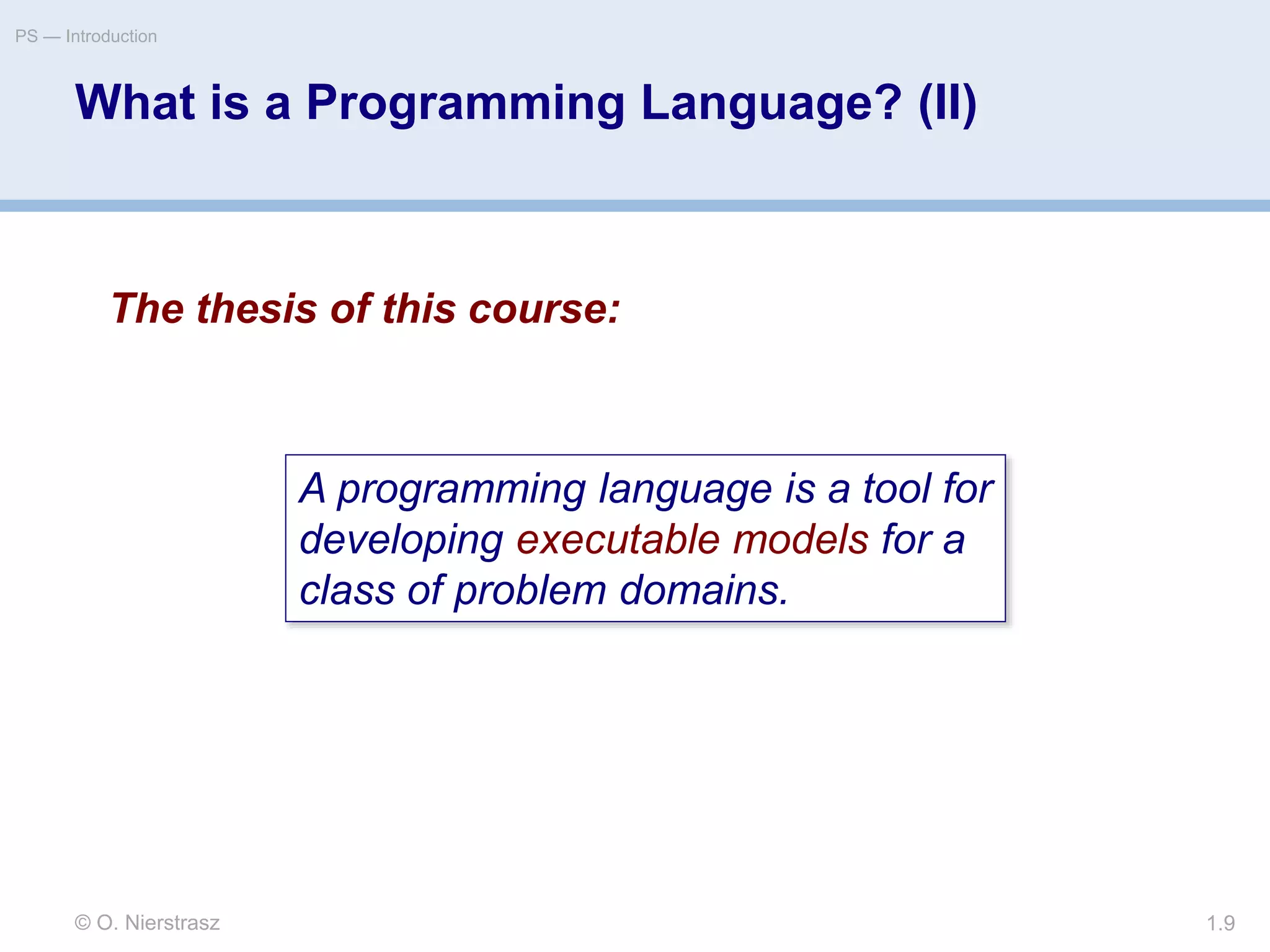
What is a Programming Language? (II)
© O. Nierstrasz
PS — Introduction
1.9
A programming language is a tool for
developing executable models for a
class of problem domains.
The thesis of this course:
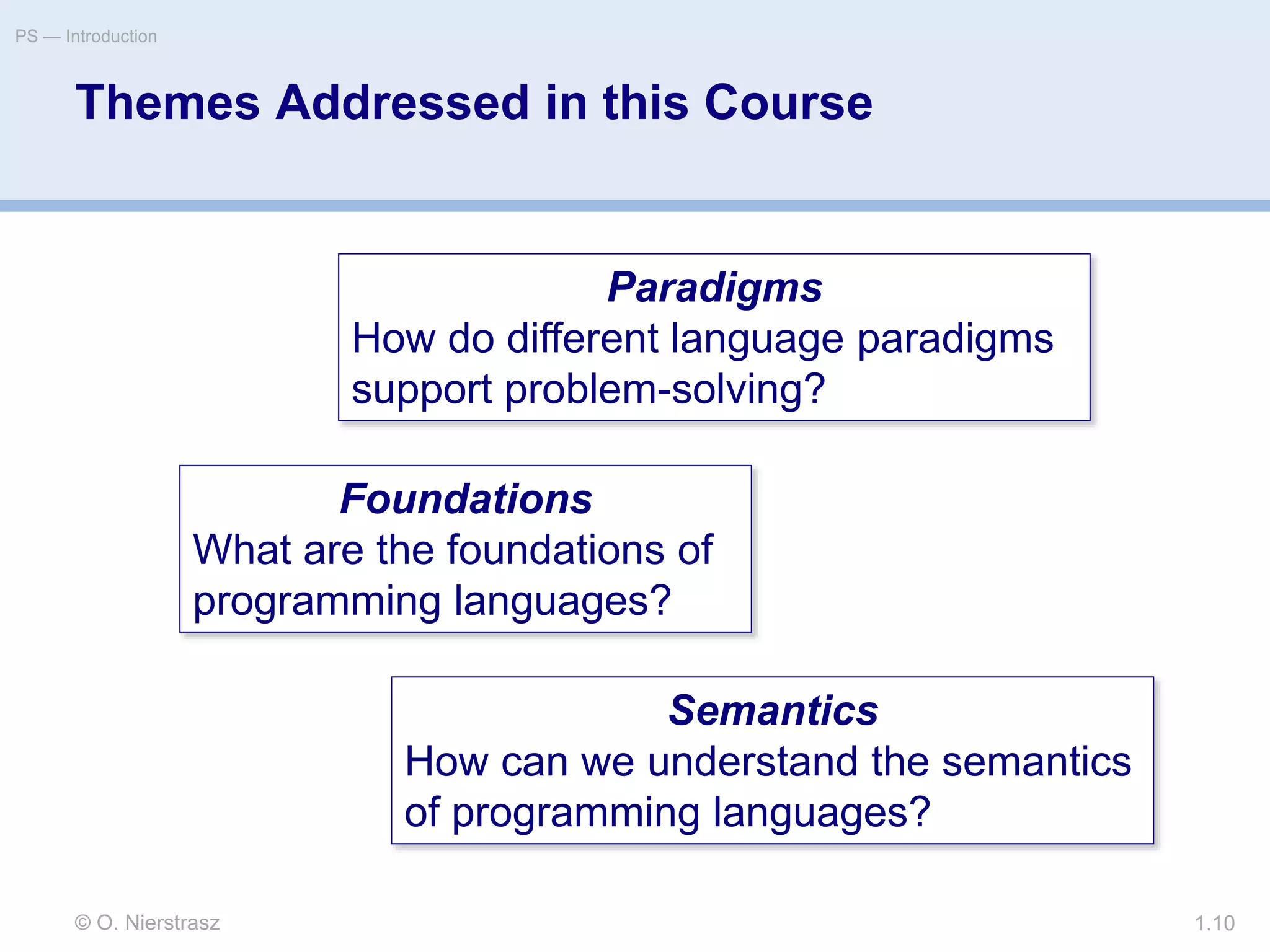
Themes Addressed in this Course
© O. Nierstrasz
PS — Introduction
1.10
Paradigms
How do different language paradigms
support problem-solving?
Semantics
How can we understand the semantics
of programming languages?
Foundations
What are the foundations of
programming languages?
© O. Nierstrasz
PS — Introduction
1.11
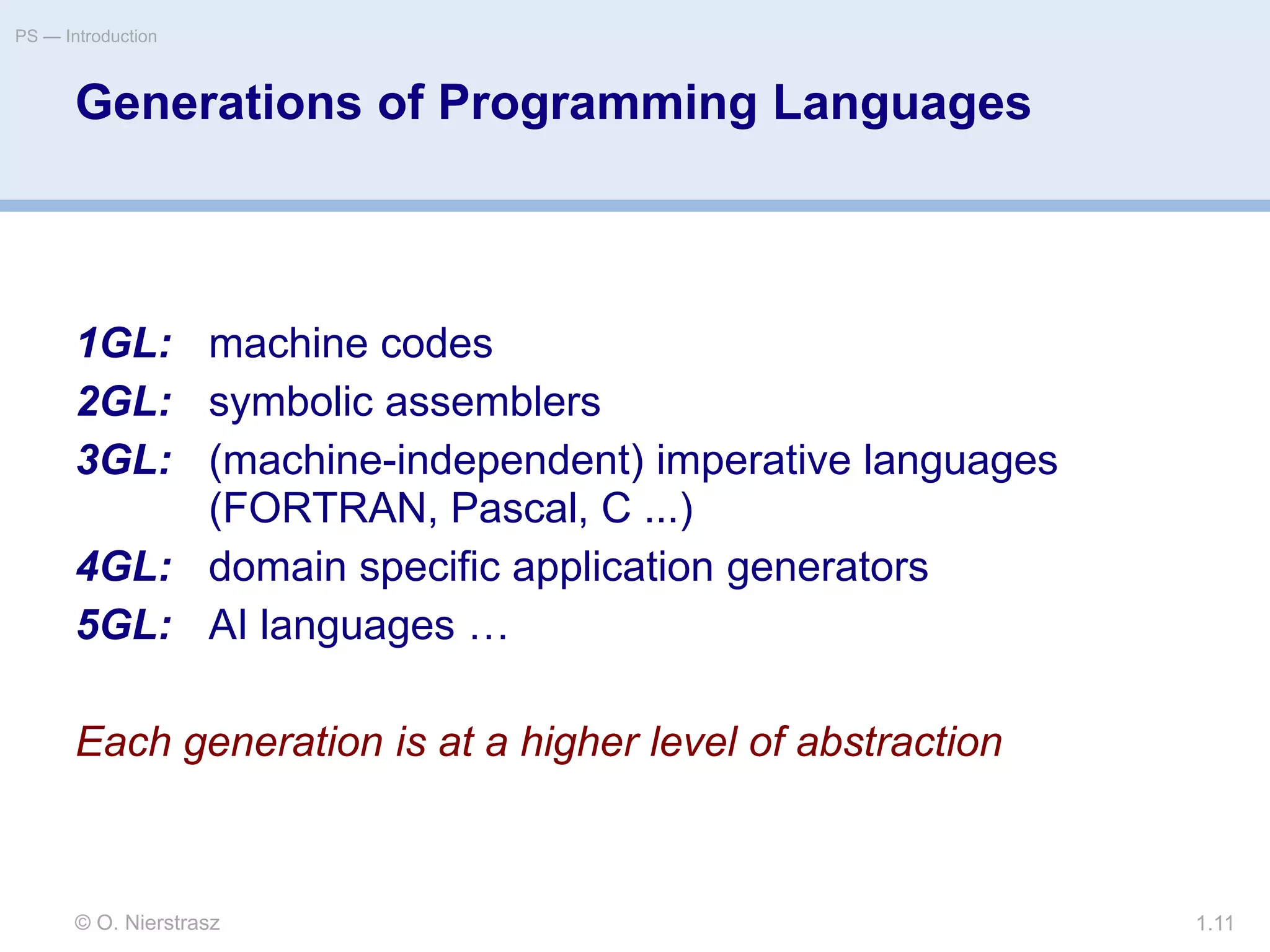
Generations of Programming Languages
1GL: machine codes
2GL: symbolic assemblers
3GL: (machine-independent) imperative languages
(FORTRAN, Pascal, C ...)
4GL: domain specific application generators
5GL: AI languages …
Each generation is at a higher level of abstraction
© O. Nierstrasz
PS — Introduction
1.12
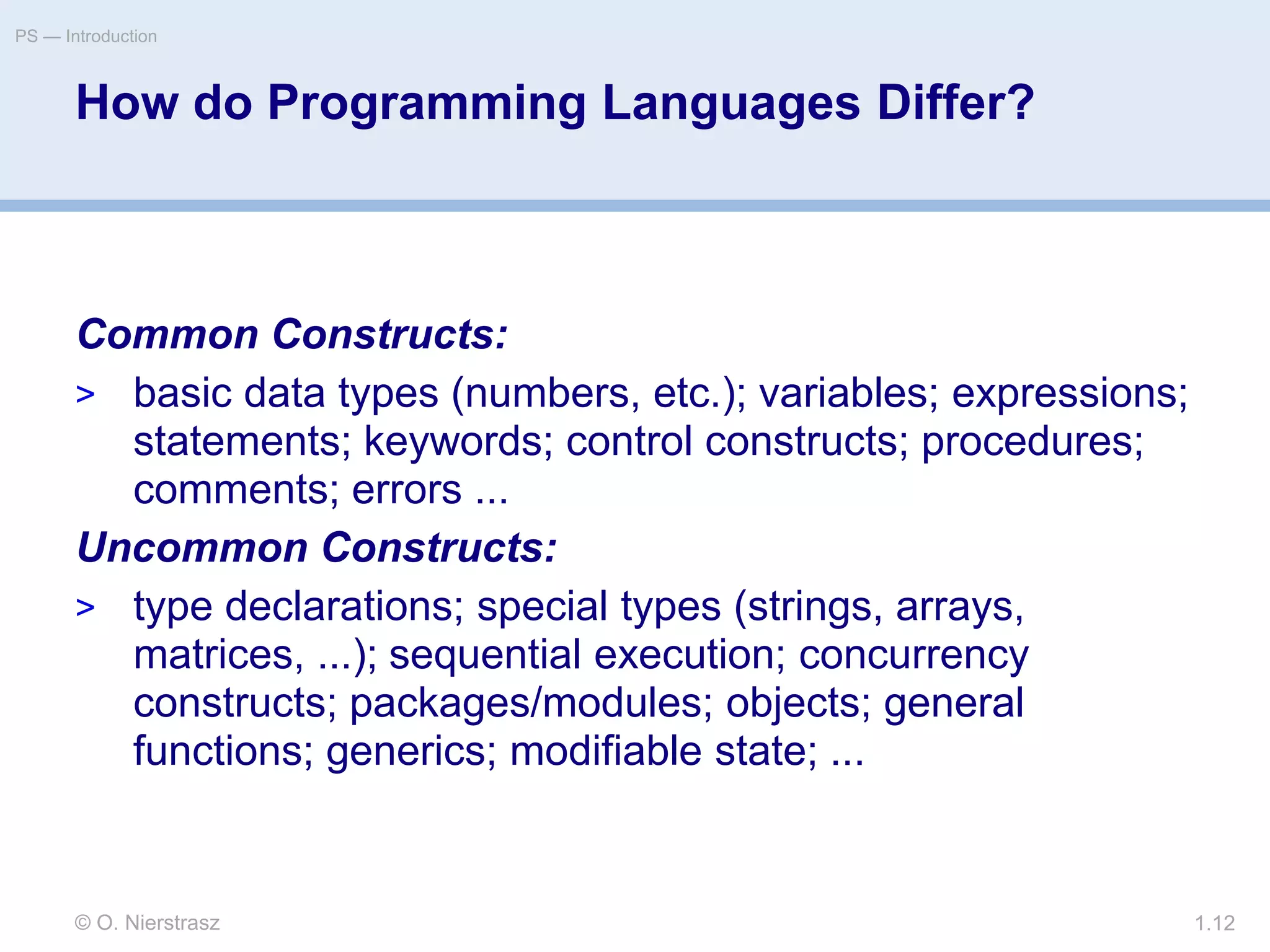
How do Programming Languages Differ?
Common Constructs:
> basic data types (numbers, etc.); variables; expressions;
statements; keywords; control constructs; procedures;
comments; errors ...
Uncommon Constructs:
> type declarations; special types (strings, arrays,
matrices, ...); sequential execution; concurrency
constructs; packages/modules; objects; general
functions; generics; modifiable state; ...
© O. Nierstrasz
PS — Introduction
1.13
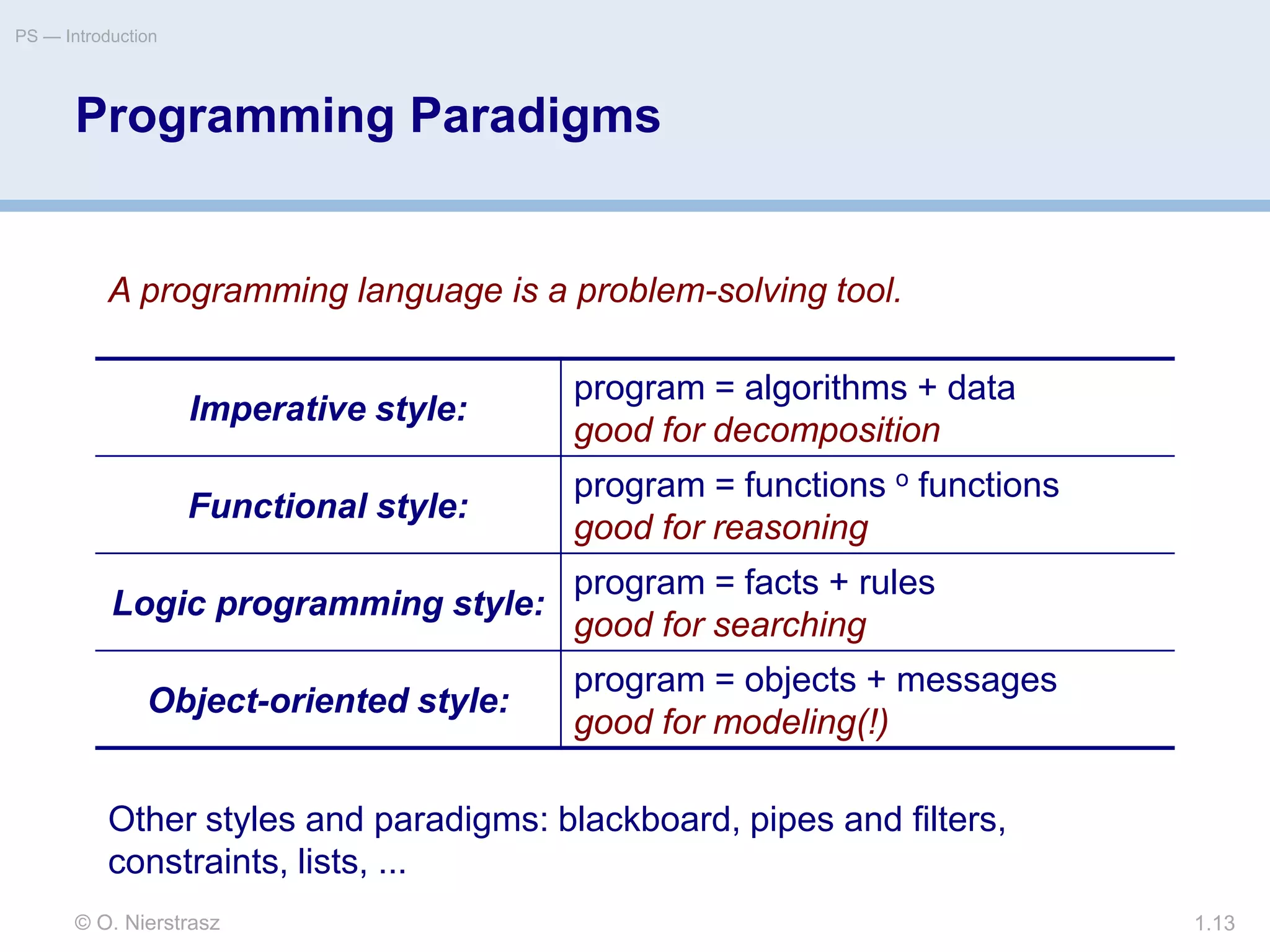
Programming Paradigms
A programming language is a problem-solving tool.
Imperative style:
program = algorithms + data
good for decomposition
Functional style:
program = functions o functions
good for reasoning
Logic programming style:
program = facts + rules
good for searching
Object-oriented style:
program = objects + messages
good for modeling(!)
Other styles and paradigms: blackboard, pipes and filters,
constraints, lists, ...
© O. Nierstrasz
PS — Introduction
1.14
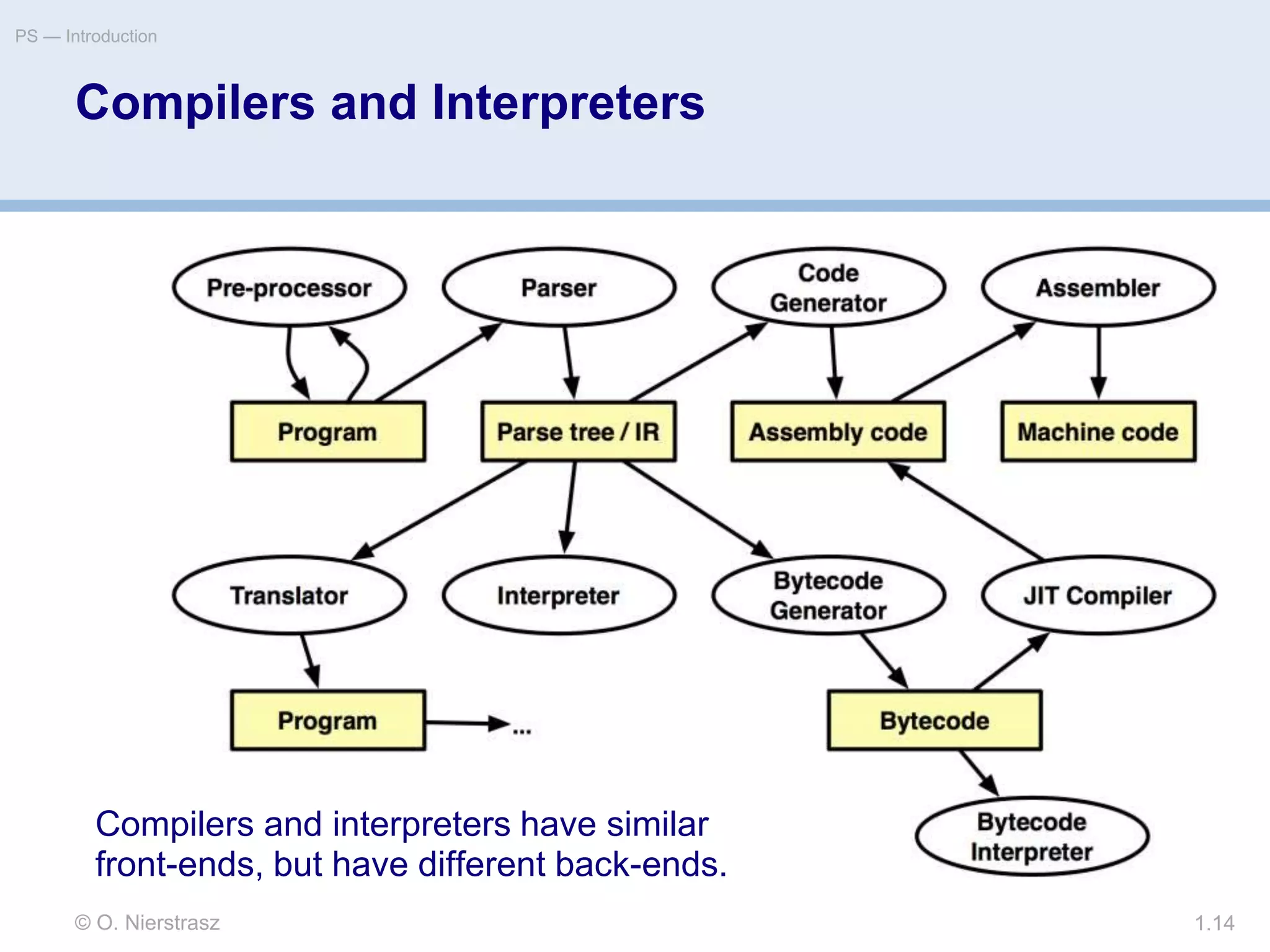
Compilers and Interpreters
Compilers and interpreters have similar
front-ends, but have different back-ends.
© O. Nierstrasz
PS — Introduction
1.15
Roadmap
> Course Schedule
> Programming Paradigms
> A Quick Tour of Programming Language History
© O. Nierstrasz
PS — Introduction
1.16
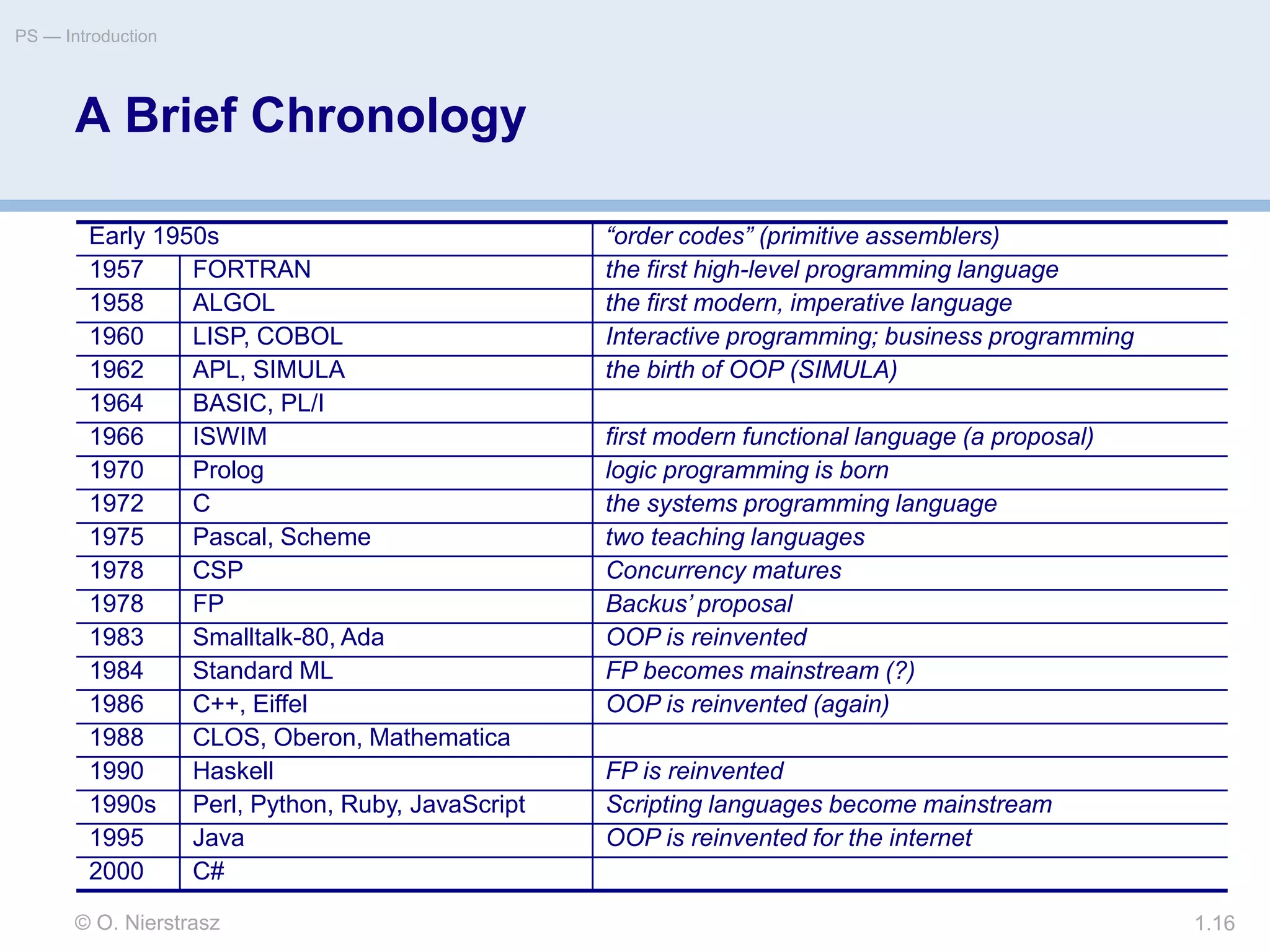
A Brief Chronology
Early 1950s “order codes” (primitive assemblers)
1957 FORTRAN the first high-level programming language
1958 ALGOL the first modern, imperative language
1960 LISP, COBOL Interactive programming; business programming
1962 APL, SIMULA the birth of OOP (SIMULA)
1964 BASIC, PL/I
1966 ISWIM first modern functional language (a proposal)
1970 Prolog logic programming is born
1972 C the systems programming language
1975 Pascal, Scheme two teaching languages
1978 CSP Concurrency matures
1978 FP Backus’ proposal
1983 Smalltalk-80, Ada OOP is reinvented
1984 Standard ML FP becomes mainstream (?)
1986 C++, Eiffel OOP is reinvented (again)
1988 CLOS, Oberon, Mathematica
1990 Haskell FP is reinvented
1990s Perl, Python, Ruby, JavaScript Scripting languages become mainstream
1995 Java OOP is reinvented for the internet
2000 C#
© O. Nierstrasz
PS — Introduction
1.17
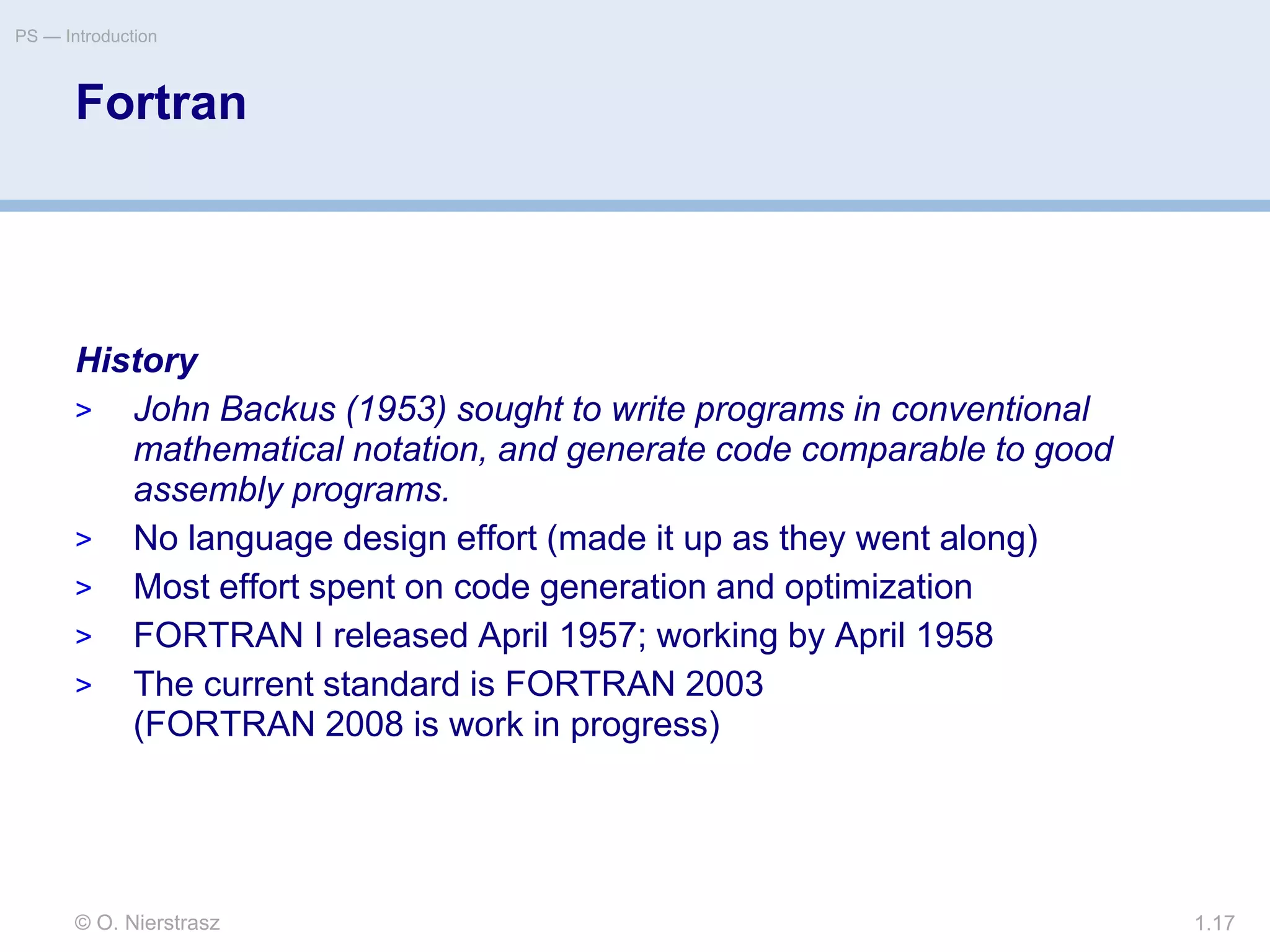
Fortran
History
> John Backus (1953) sought to write programs in conventional
mathematical notation, and generate code comparable to good
assembly programs.
> No language design effort (made it up as they went along)
> Most effort spent on code generation and optimization
> FORTRAN I released April 1957; working by April 1958
> The current standard is FORTRAN 2003
(FORTRAN 2008 is work in progress)
© O. Nierstrasz
PS — Introduction
1.18
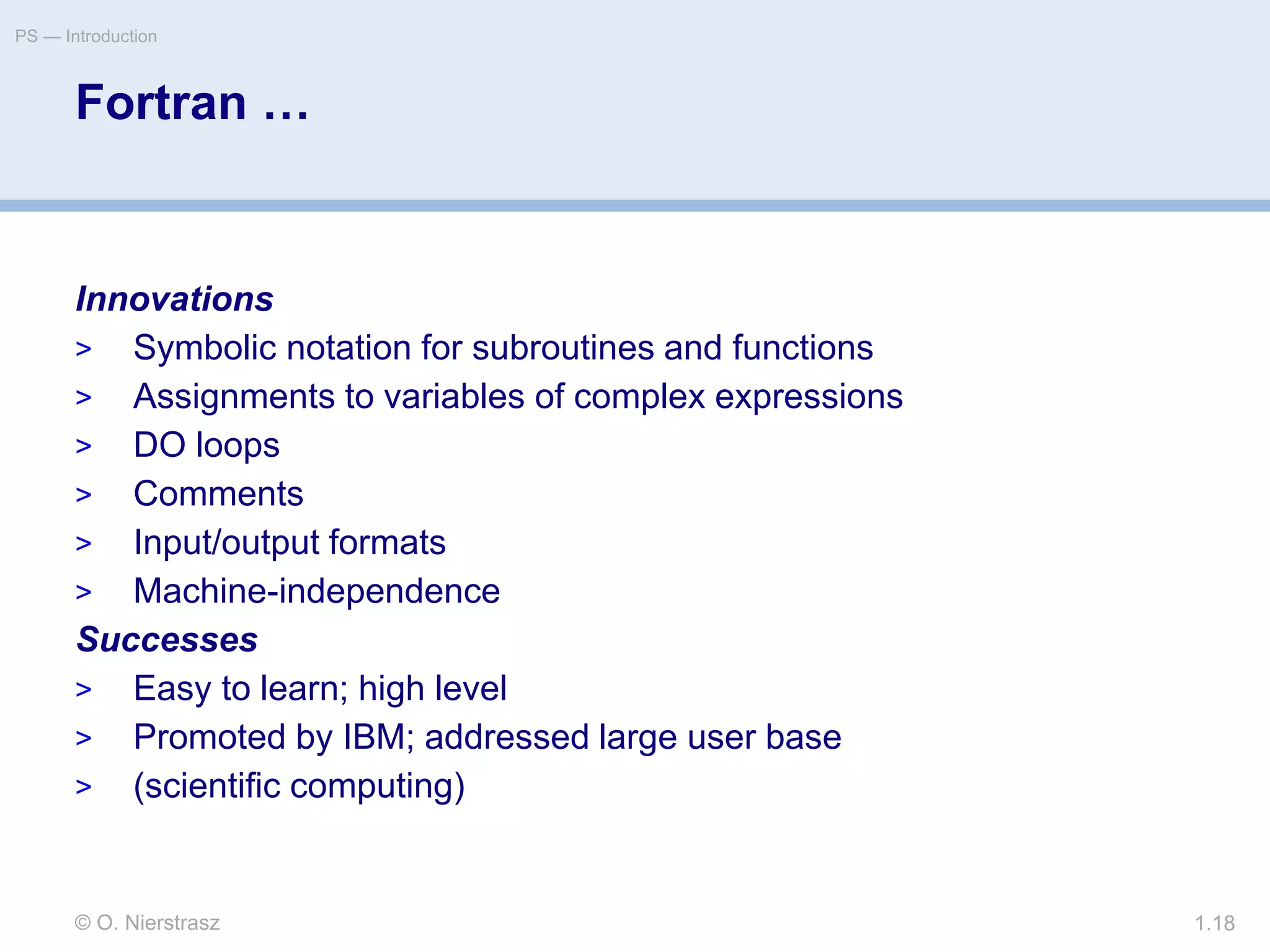
Fortran …
Innovations
> Symbolic notation for subroutines and functions
> Assignments to variables of complex expressions
> DO loops
> Comments
> Input/output formats
> Machine-independence
Successes
> Easy to learn; high level
> Promoted by IBM; addressed large user base
> (scientific computing)
© O. Nierstrasz
PS — Introduction
1.19
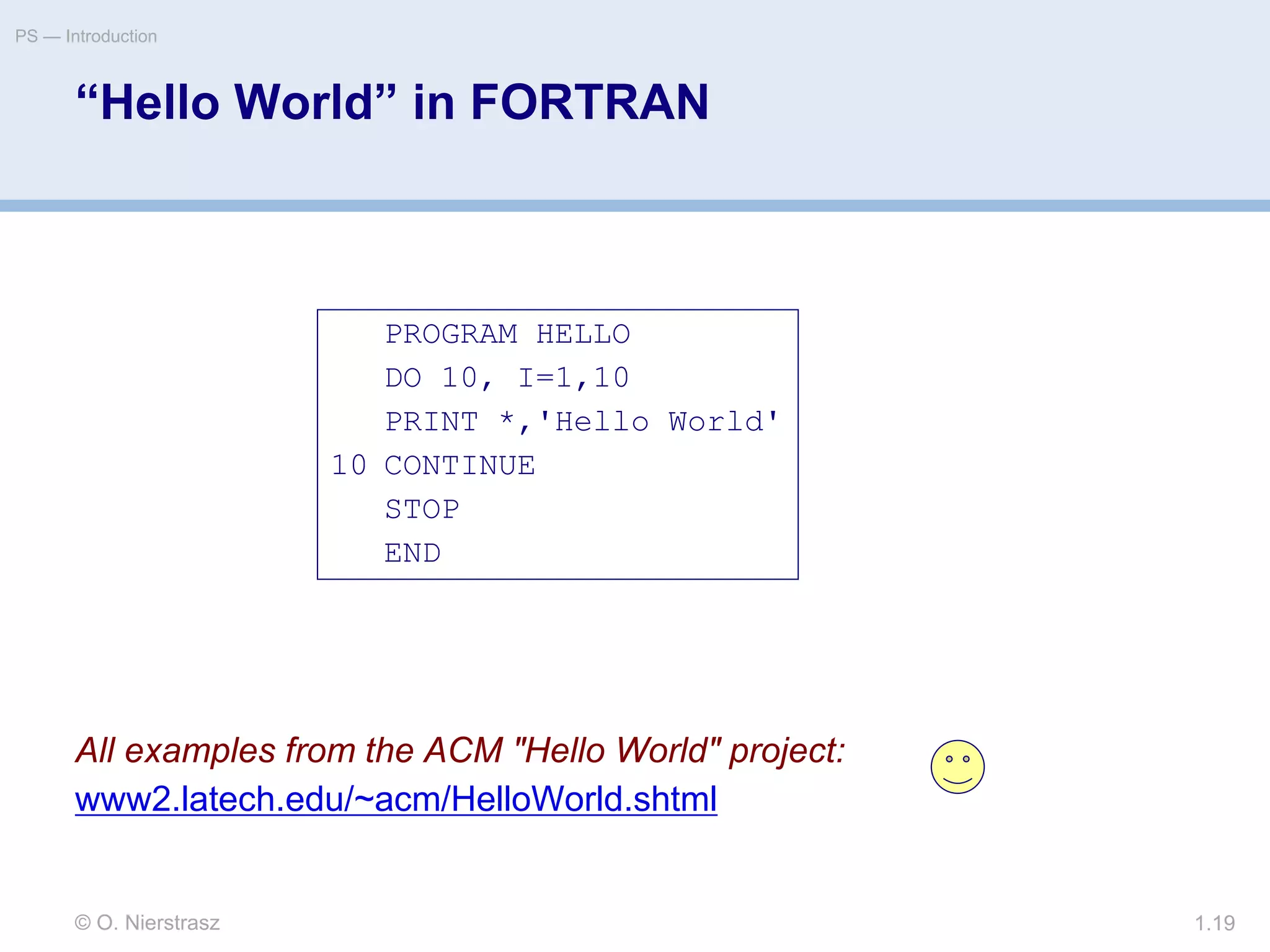
“Hello World” in FORTRAN
All examples from the ACM "Hello World" project:
www2.latech.edu/~acm/HelloWorld.shtml
PROGRAM HELLO
DO 10, I=1,10
PRINT *,'Hello World'
10 CONTINUE
STOP
END
© O. Nierstrasz
PS — Introduction
1.20
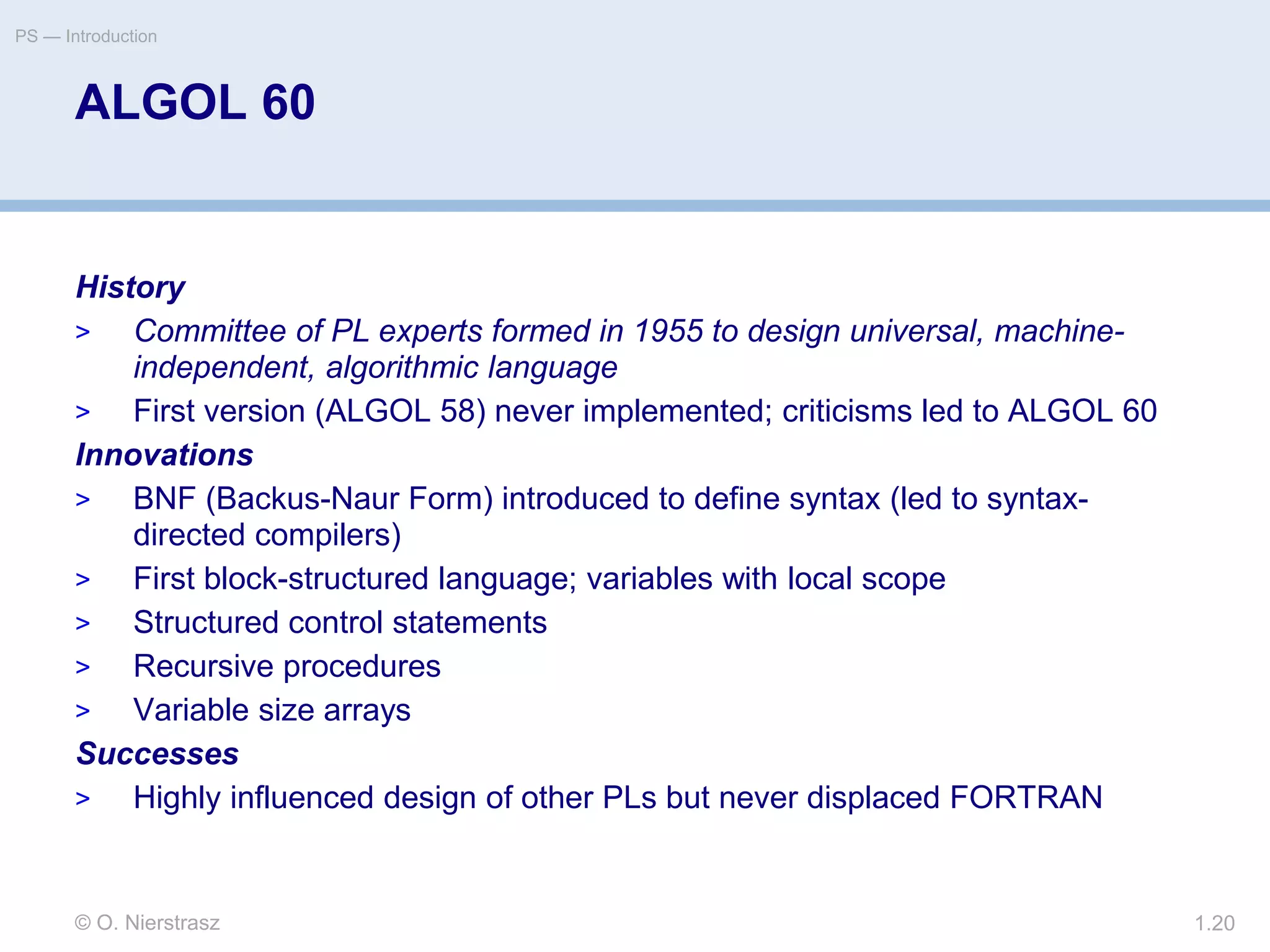
ALGOL 60
History
> Committee of PL experts formed in 1955 to design universal, machine-
independent, algorithmic language
> First version (ALGOL 58) never implemented; criticisms led to ALGOL 60
Innovations
> BNF (Backus-Naur Form) introduced to define syntax (led to syntax-
directed compilers)
> First block-structured language; variables with local scope
> Structured control statements
> Recursive procedures
> Variable size arrays
Successes
> Highly influenced design of other PLs but never displaced FORTRAN
© O. Nierstrasz
PS — Introduction
1.21
“Hello World” in BEALGOL
BEGIN
FILE F (KIND=REMOTE);
EBCDIC ARRAY E [0:11];
REPLACE E BY "HELLO WORLD!";
WHILE TRUE DO
BEGIN
WRITE (F, *, E);
END;
END.
© O. Nierstrasz
PS — Introduction
1.22
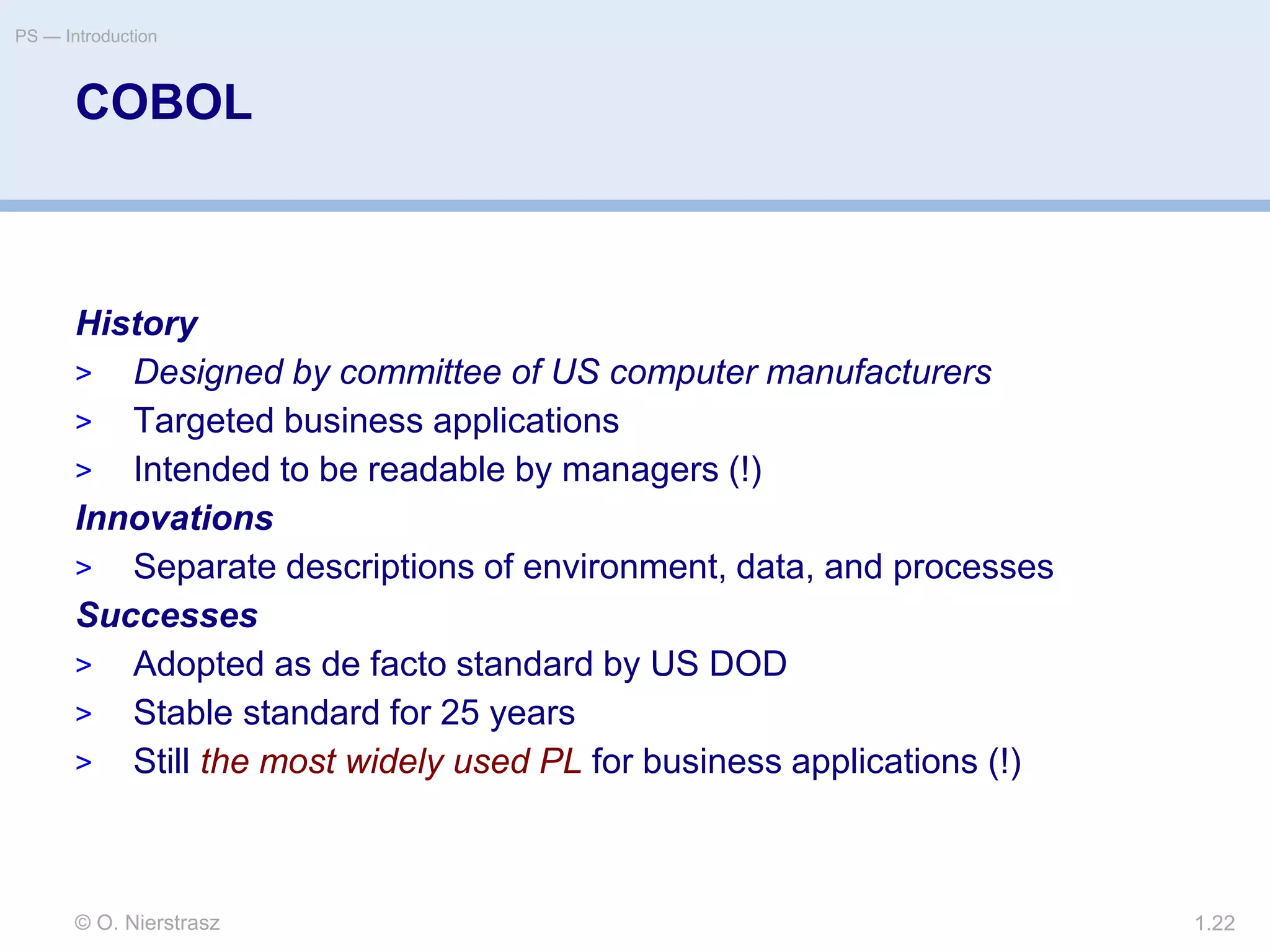
COBOL
History
> Designed by committee of US computer manufacturers
> Targeted business applications
> Intended to be readable by managers (!)
Innovations
> Separate descriptions of environment, data, and processes
Successes
> Adopted as de facto standard by US DOD
> Stable standard for 25 years
> Still the most widely used PL for business applications (!)
© O. Nierstrasz
PS — Introduction
1.23
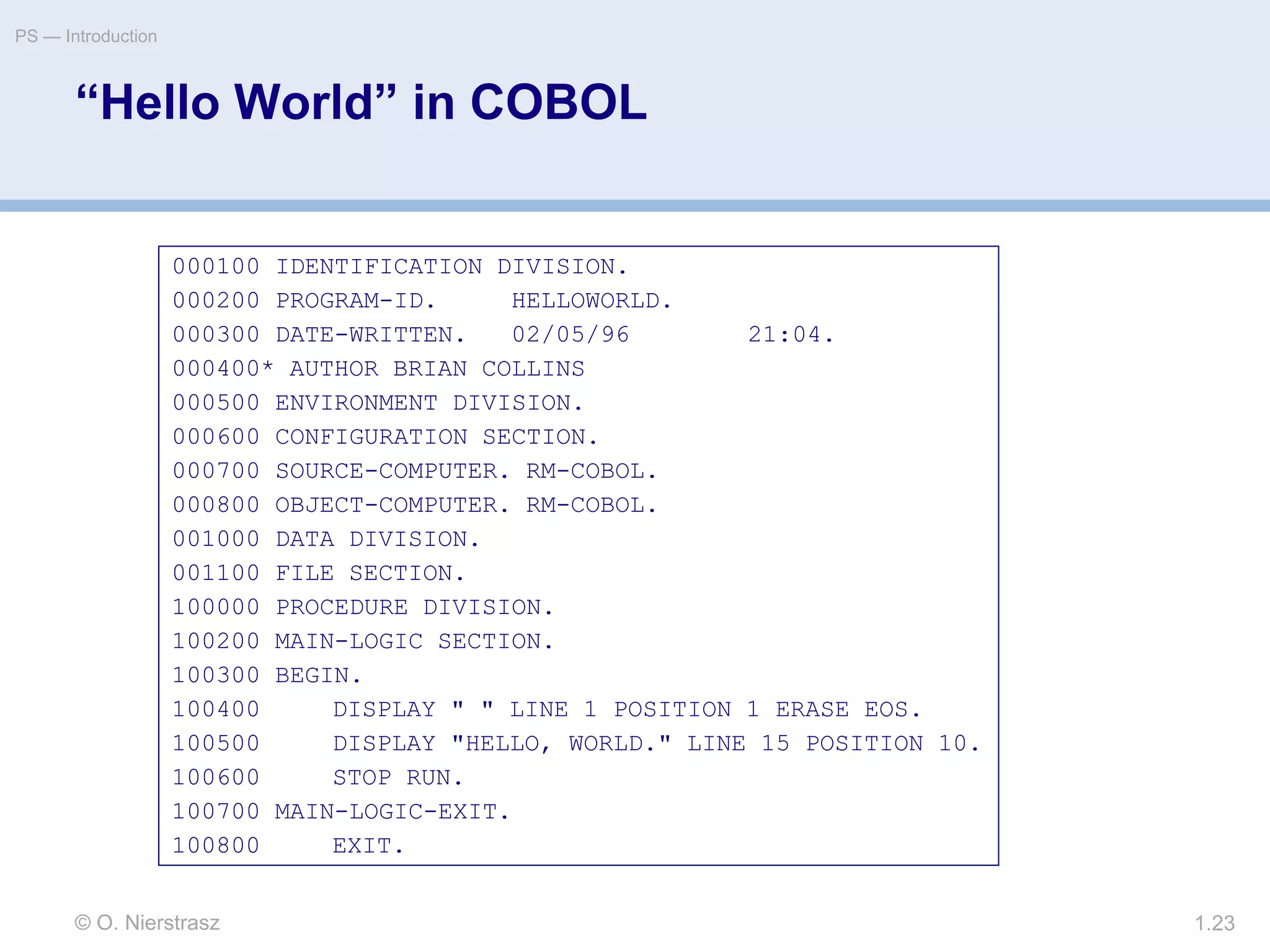
“Hello World” in COBOL
000100 IDENTIFICATION DIVISION.
000200 PROGRAM-ID. HELLOWORLD.
000300 DATE-WRITTEN. 02/05/96 21:04.
000400* AUTHOR BRIAN COLLINS
000500 ENVIRONMENT DIVISION.
000600 CONFIGURATION SECTION.
000700 SOURCE-COMPUTER. RM-COBOL.
000800 OBJECT-COMPUTER. RM-COBOL.
001000 DATA DIVISION.
001100 FILE SECTION.
100000 PROCEDURE DIVISION.
100200 MAIN-LOGIC SECTION.
100300 BEGIN.
100400 DISPLAY " " LINE 1 POSITION 1 ERASE EOS.
100500 DISPLAY "HELLO, WORLD." LINE 15 POSITION 10.
100600 STOP RUN.
100700 MAIN-LOGIC-EXIT.
100800 EXIT.
© O. Nierstrasz
PS — Introduction
1.24
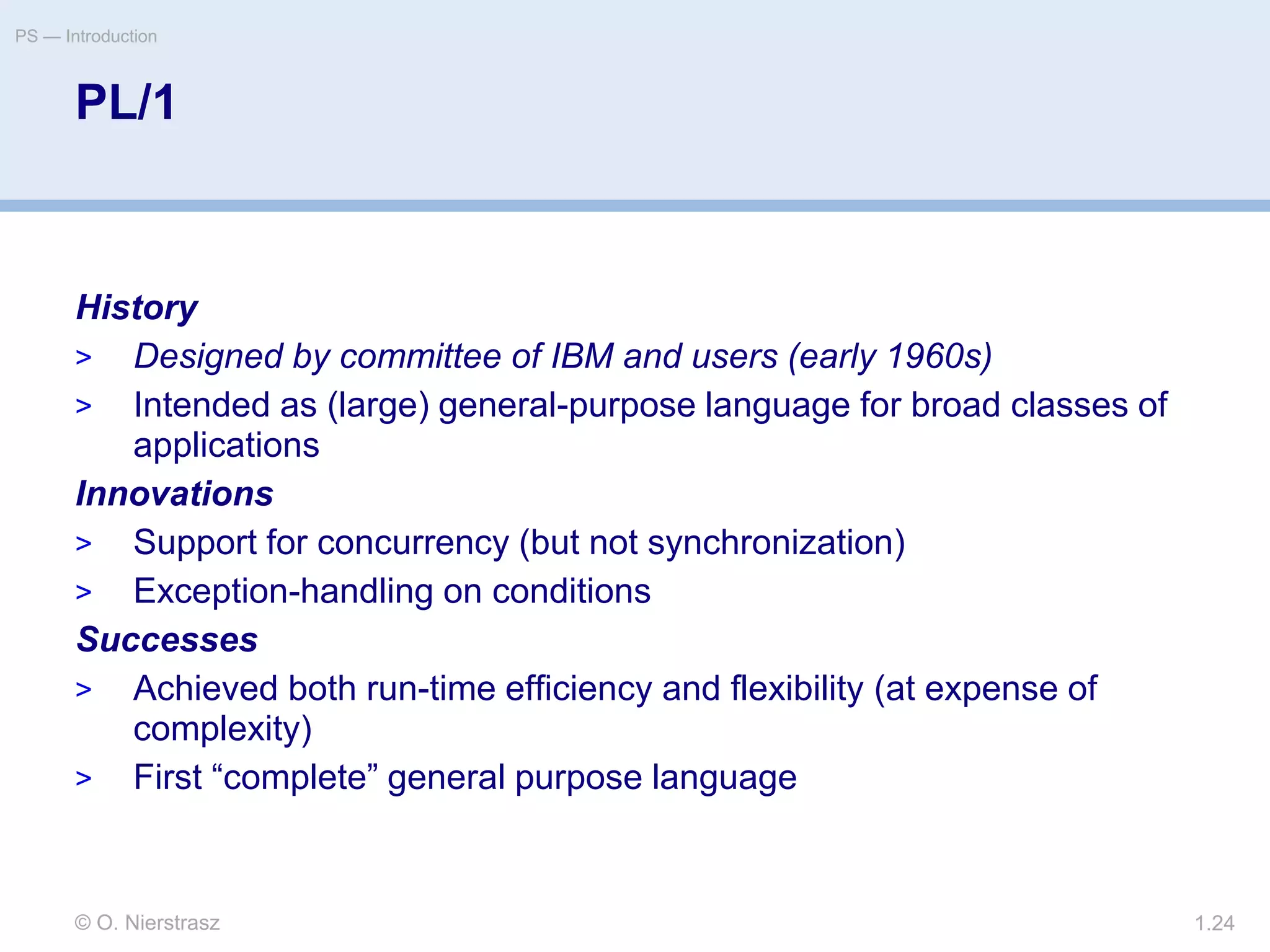
PL/1
History
> Designed by committee of IBM and users (early 1960s)
> Intended as (large) general-purpose language for broad classes of
applications
Innovations
> Support for concurrency (but not synchronization)
> Exception-handling on conditions
Successes
> Achieved both run-time efficiency and flexibility (at expense of
complexity)
> First “complete” general purpose language
© O. Nierstrasz
PS — Introduction
1.25
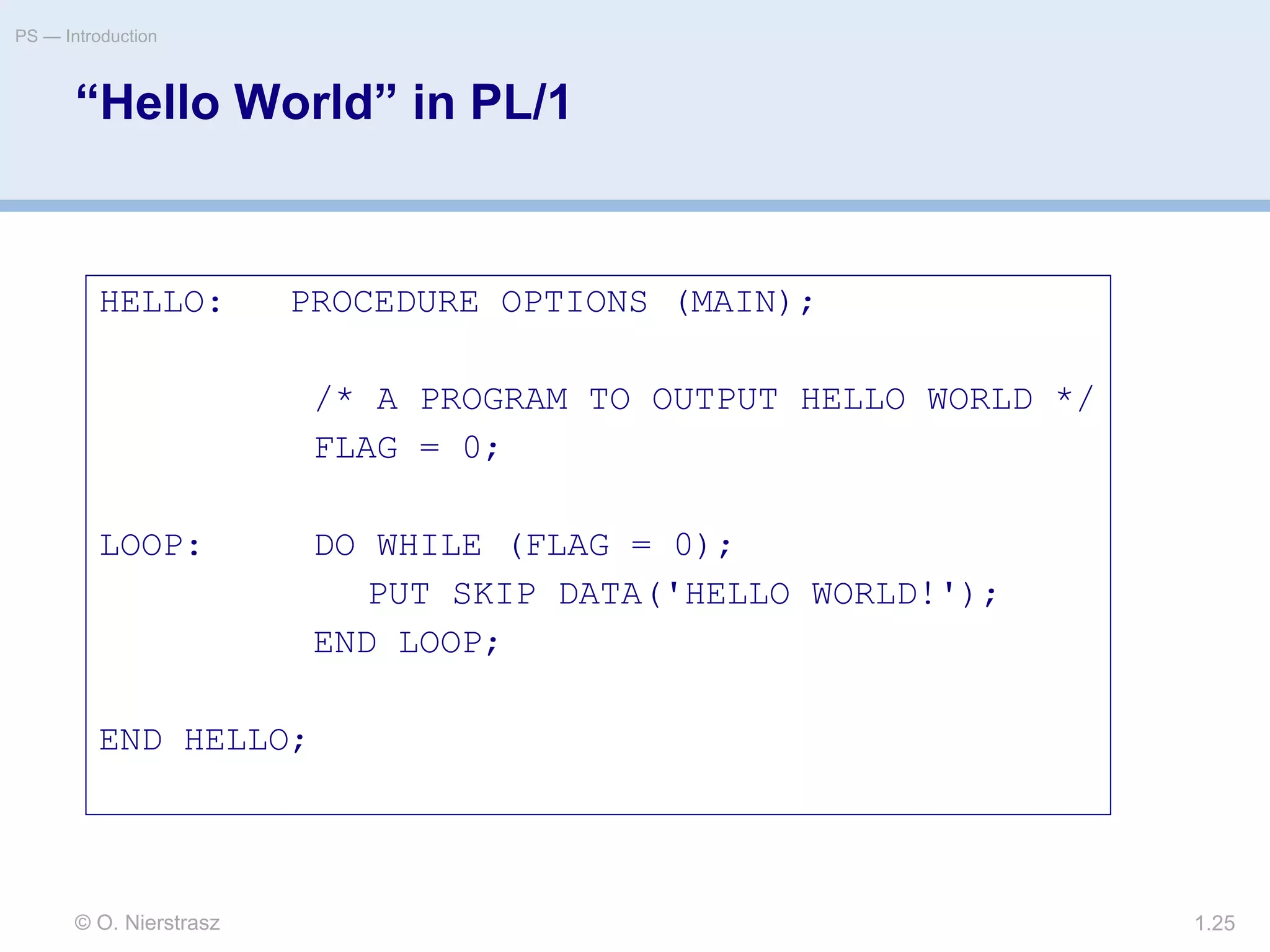
“Hello World” in PL/1
HELLO: PROCEDURE OPTIONS (MAIN);
/* A PROGRAM TO OUTPUT HELLO WORLD */
FLAG = 0;
LOOP: DO WHILE (FLAG = 0);
PUT SKIP DATA('HELLO WORLD!');
END LOOP;
END HELLO;
© O. Nierstrasz
PS — Introduction
1.26
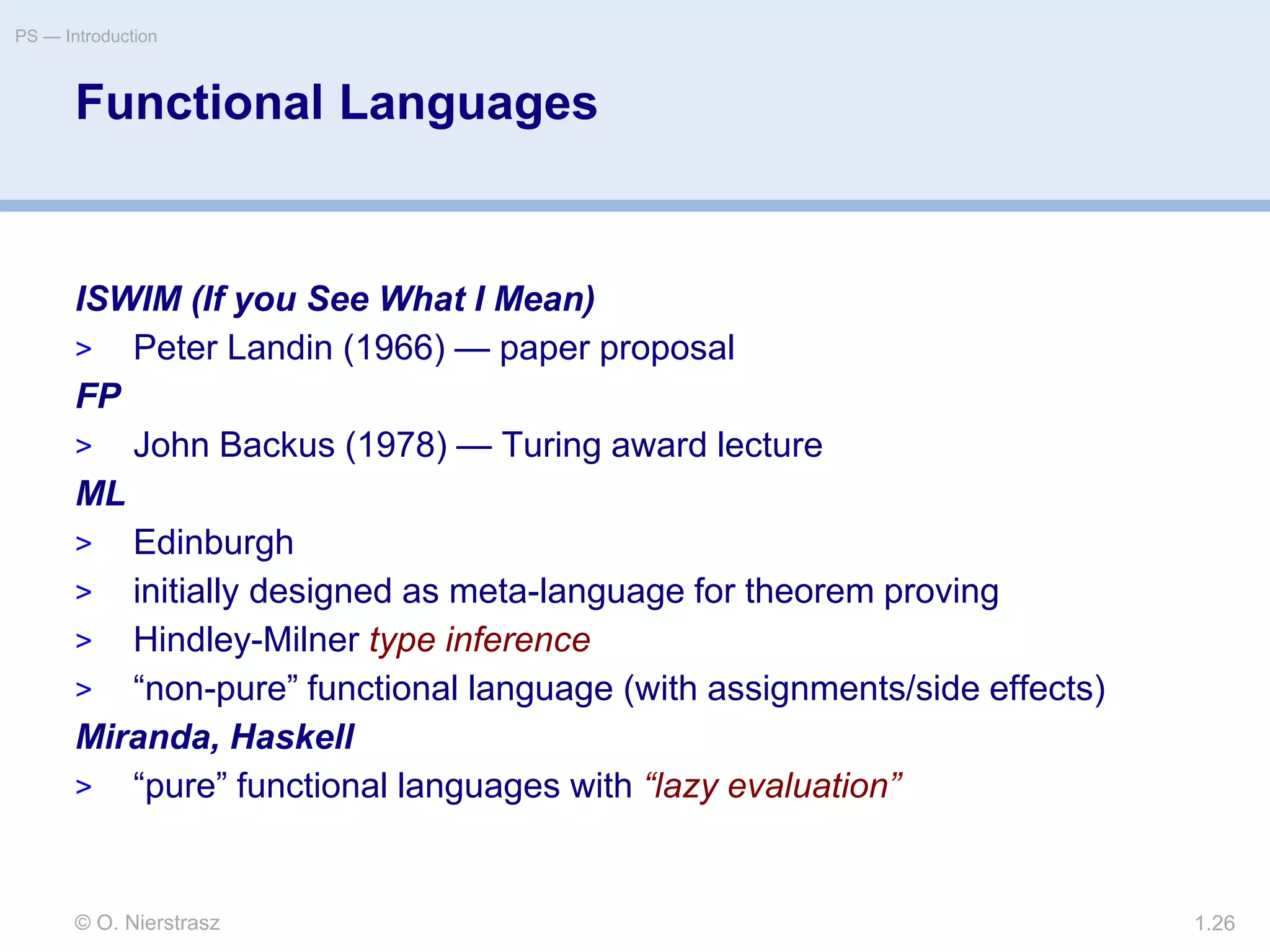
Functional Languages
ISWIM (If you See What I Mean)
> Peter Landin (1966) — paper proposal
FP
> John Backus (1978) — Turing award lecture
ML
> Edinburgh
> initially designed as meta-language for theorem proving
> Hindley-Milner type inference
> “non-pure” functional language (with assignments/side effects)
Miranda, Haskell
> “pure” functional languages with “lazy evaluation”
© O. Nierstrasz
PS — Introduction
1.27
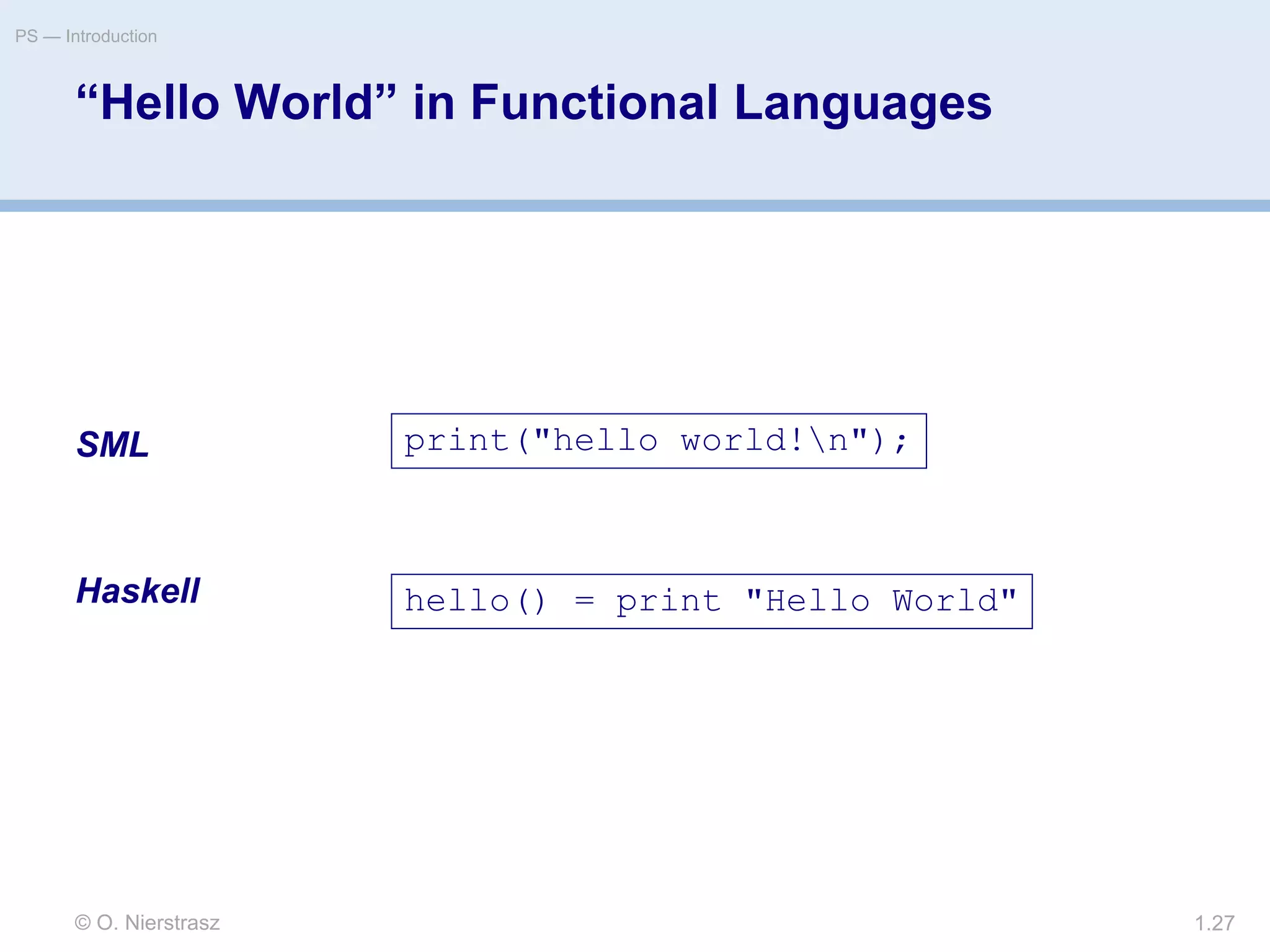
“Hello World” in Functional Languages
SML
Haskell
print("hello world!n");
hello() = print "Hello World"
© O. Nierstrasz
PS — Introduction
1.28
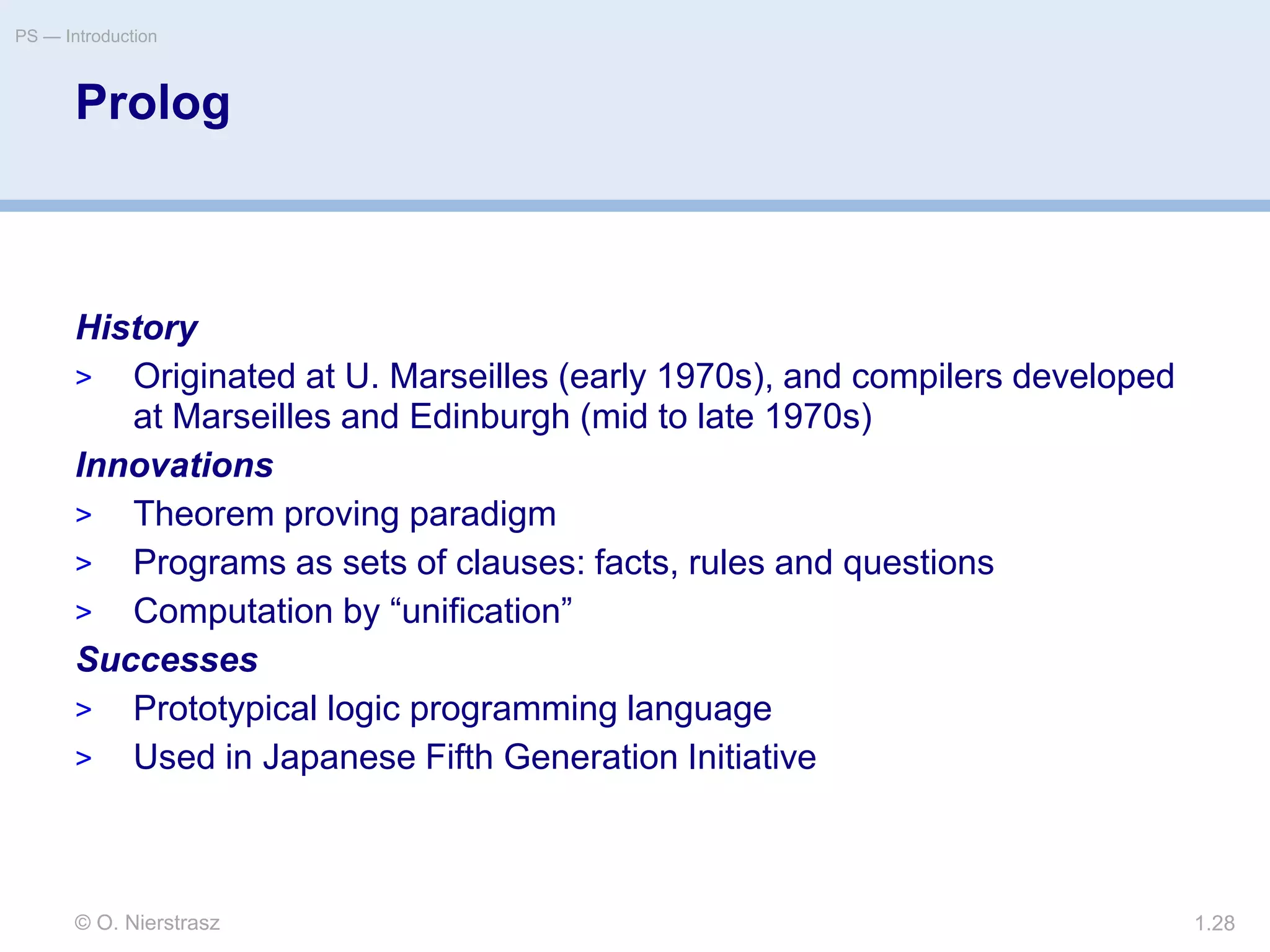
Prolog
History
> Originated at U. Marseilles (early 1970s), and compilers developed
at Marseilles and Edinburgh (mid to late 1970s)
Innovations
> Theorem proving paradigm
> Programs as sets of clauses: facts, rules and questions
> Computation by “unification”
Successes
> Prototypical logic programming language
> Used in Japanese Fifth Generation Initiative
© O. Nierstrasz
PS — Introduction
1.29
“Hello World” in Prolog
hello :- printstring("HELLO WORLD!!!!").
printstring([]).
printstring([H|T]) :- put(H), printstring(T).
© O. Nierstrasz
PS — Introduction
1.30
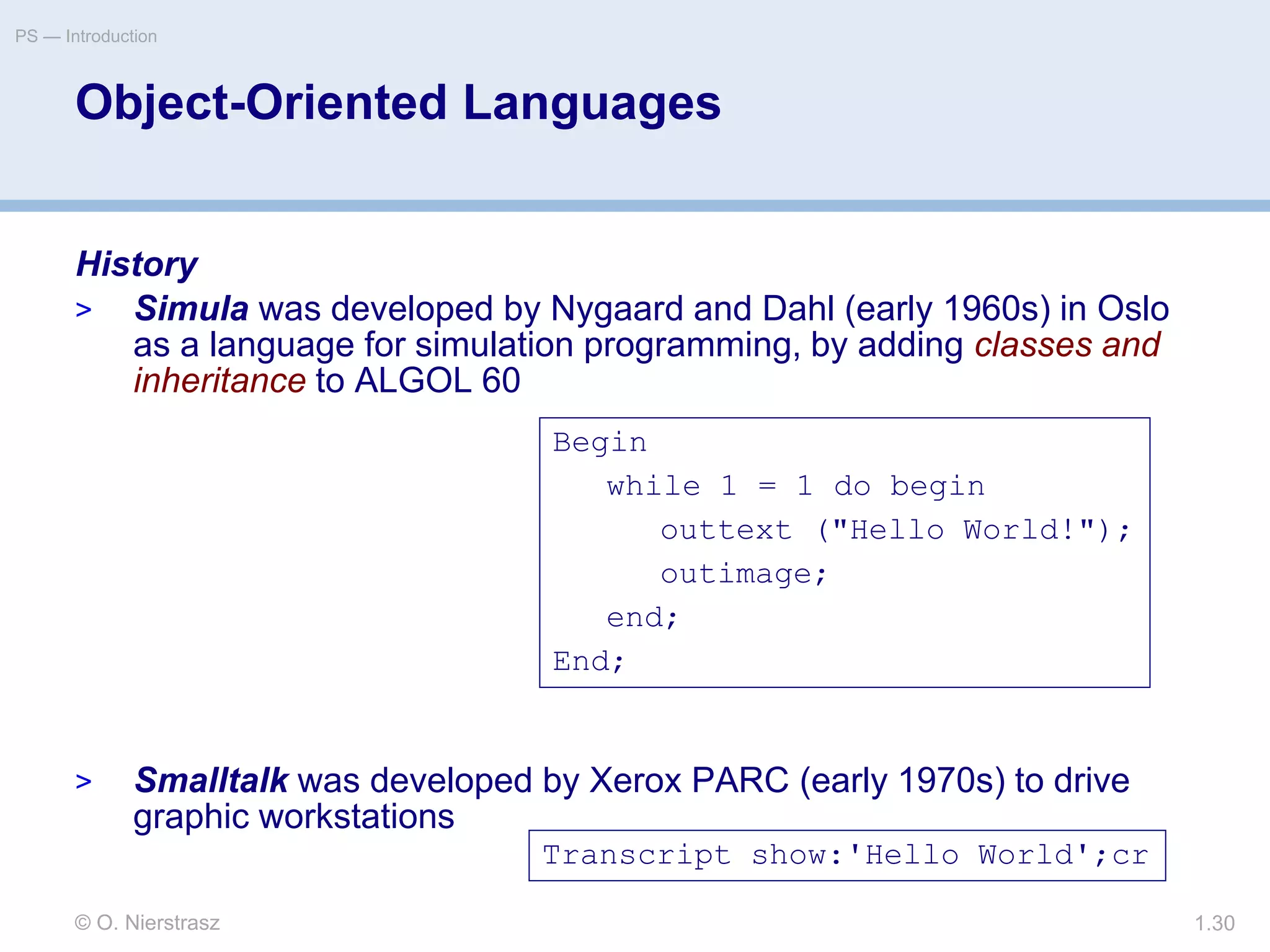
Object-Oriented Languages
History
> Simula was developed by Nygaard and Dahl (early 1960s) in Oslo
as a language for simulation programming, by adding classes and
inheritance to ALGOL 60
> Smalltalk was developed by Xerox PARC (early 1970s) to drive
graphic workstations
Begin
while 1 = 1 do begin
outtext ("Hello World!");
outimage;
end;
End;
Transcript show:'Hello World';cr
© O. Nierstrasz
PS — Introduction
1.31
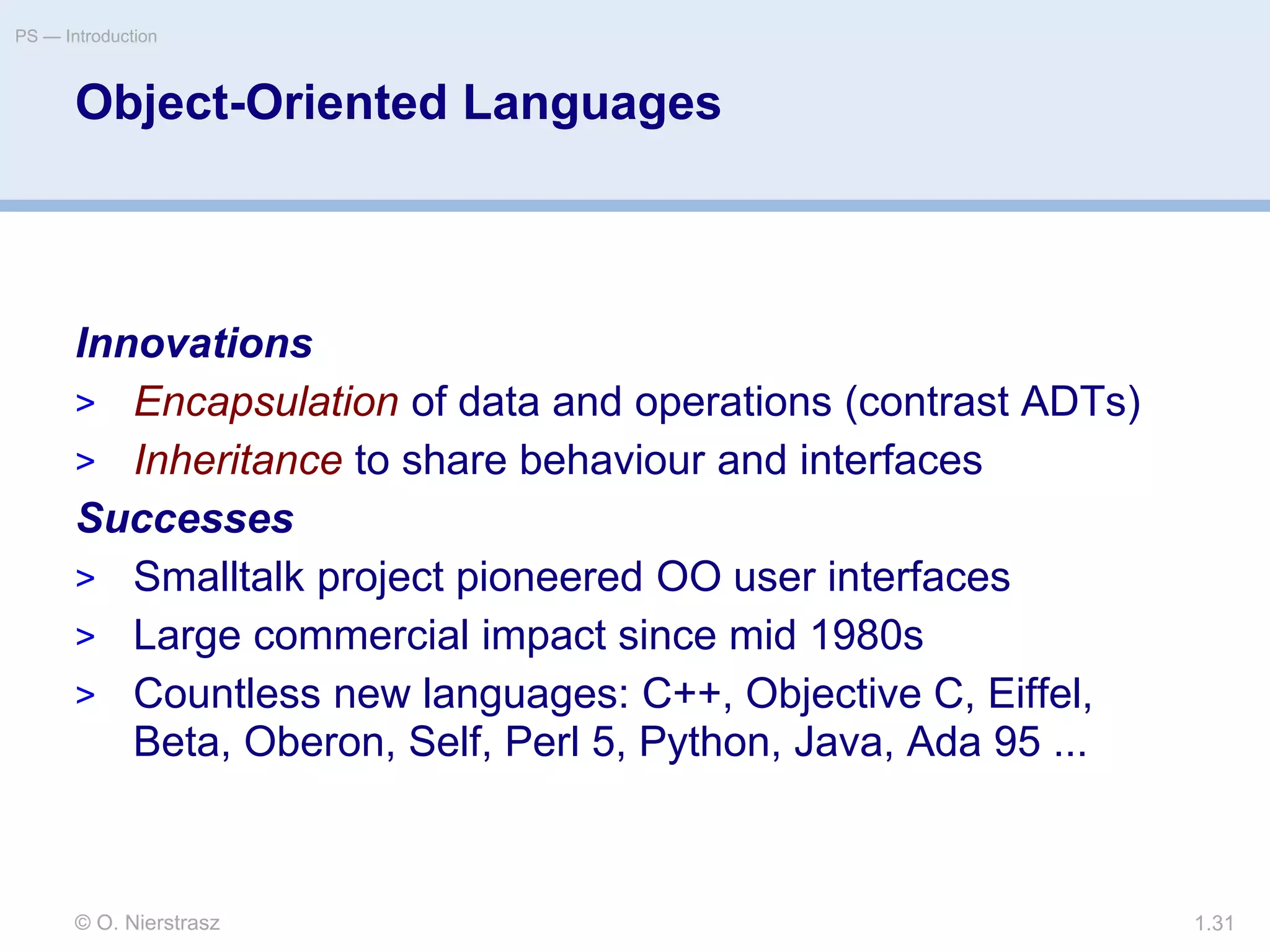
Object-Oriented Languages
Innovations
> Encapsulation of data and operations (contrast ADTs)
> Inheritance to share behaviour and interfaces
Successes
> Smalltalk project pioneered OO user interfaces
> Large commercial impact since mid 1980s
> Countless new languages: C++, Objective C, Eiffel,
Beta, Oberon, Self, Perl 5, Python, Java, Ada 95 ...
© O. Nierstrasz
PS — Introduction
1.32
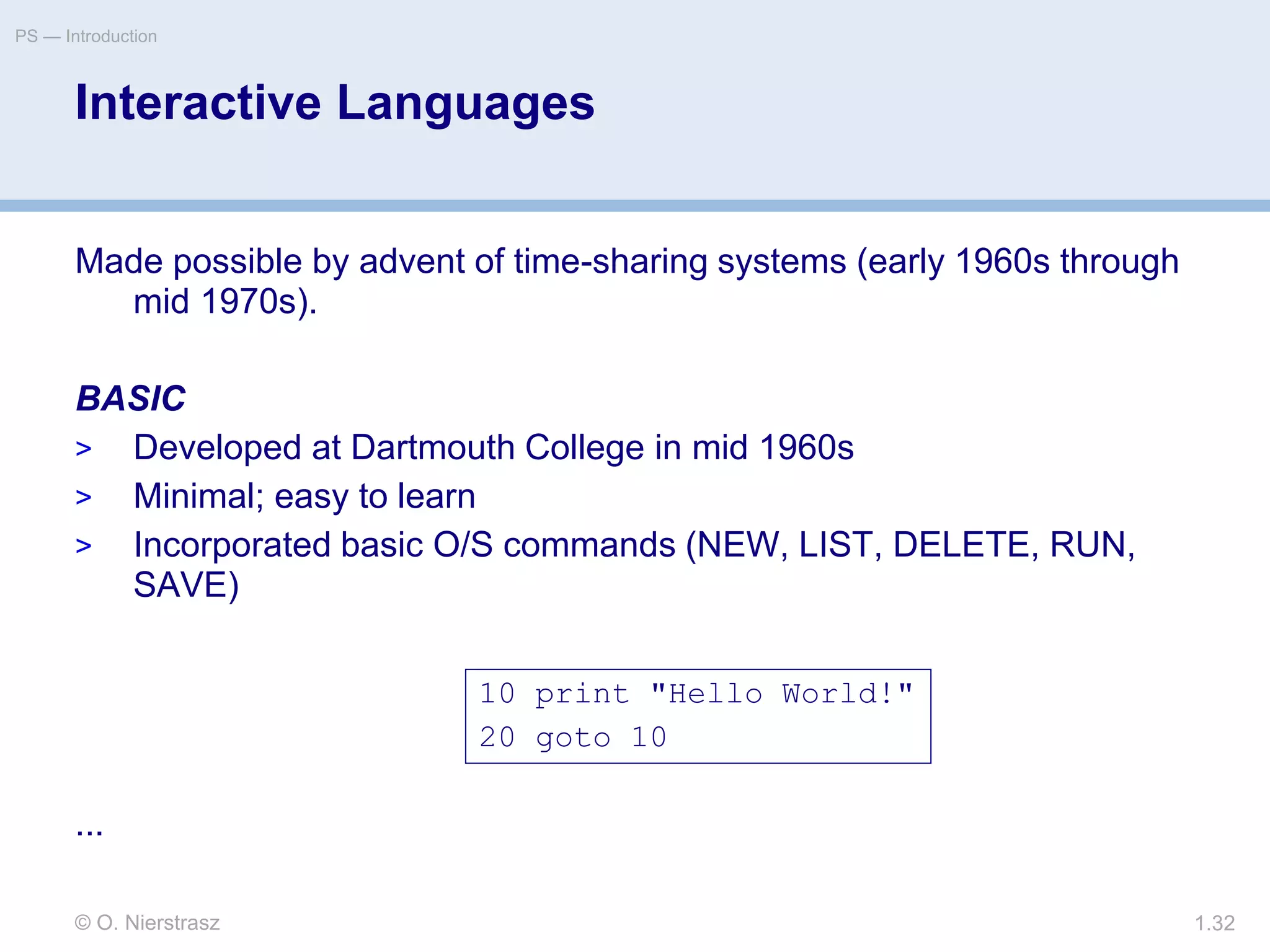
Interactive Languages
Made possible by advent of time-sharing systems (early 1960s through
mid 1970s).
BASIC
> Developed at Dartmouth College in mid 1960s
> Minimal; easy to learn
> Incorporated basic O/S commands (NEW, LIST, DELETE, RUN,
SAVE)
...
10 print "Hello World!"
20 goto 10
© O. Nierstrasz
PS — Introduction
1.33
Interactive Languages ...
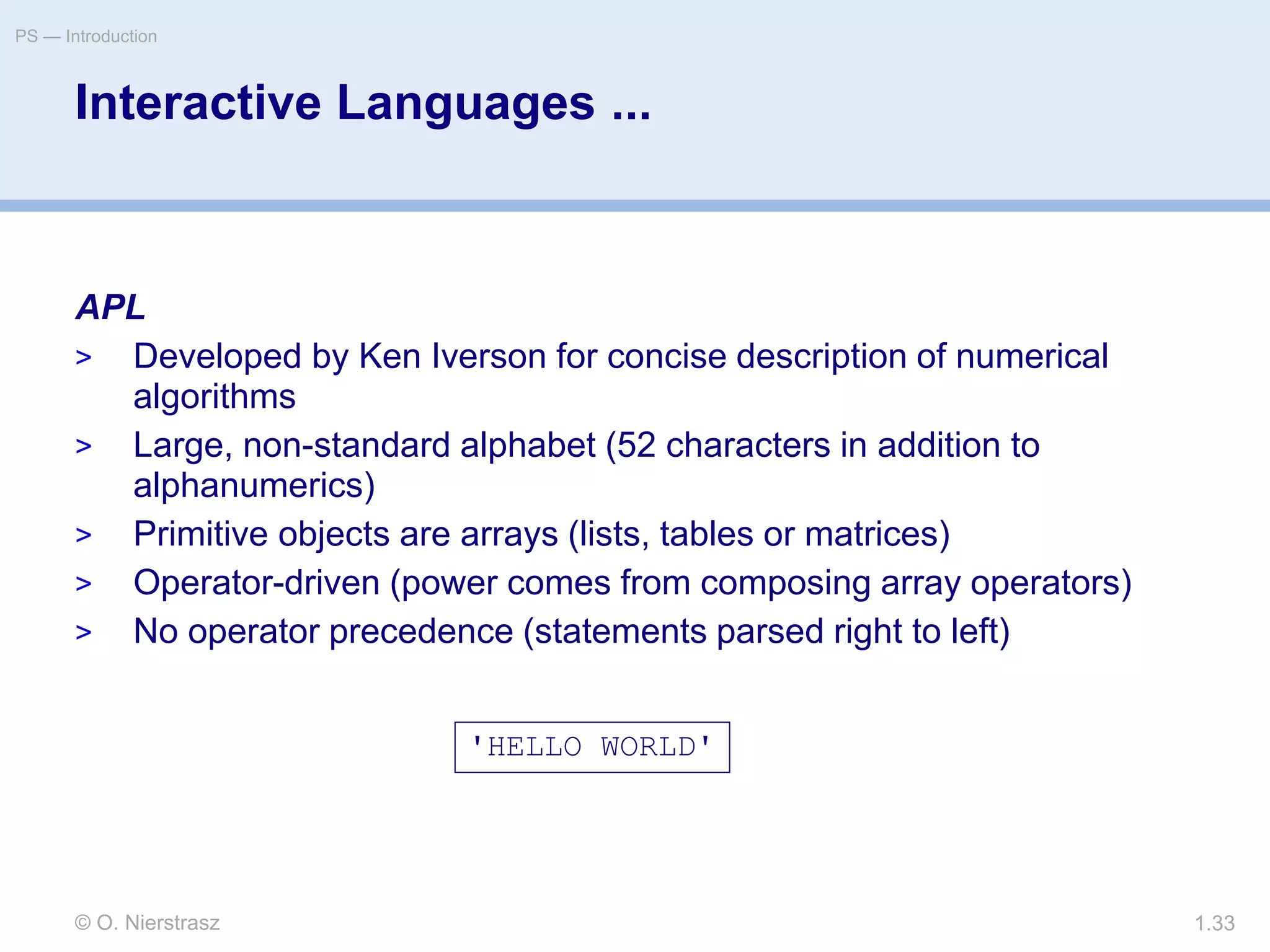
APL
> Developed by Ken Iverson for concise description of numerical
algorithms
> Large, non-standard alphabet (52 characters in addition to
alphanumerics)
> Primitive objects are arrays (lists, tables or matrices)
> Operator-driven (power comes from composing array operators)
> No operator precedence (statements parsed right to left)
'HELLO WORLD'
© O. Nierstrasz
PS — Introduction
1.34
Special-Purpose Languages
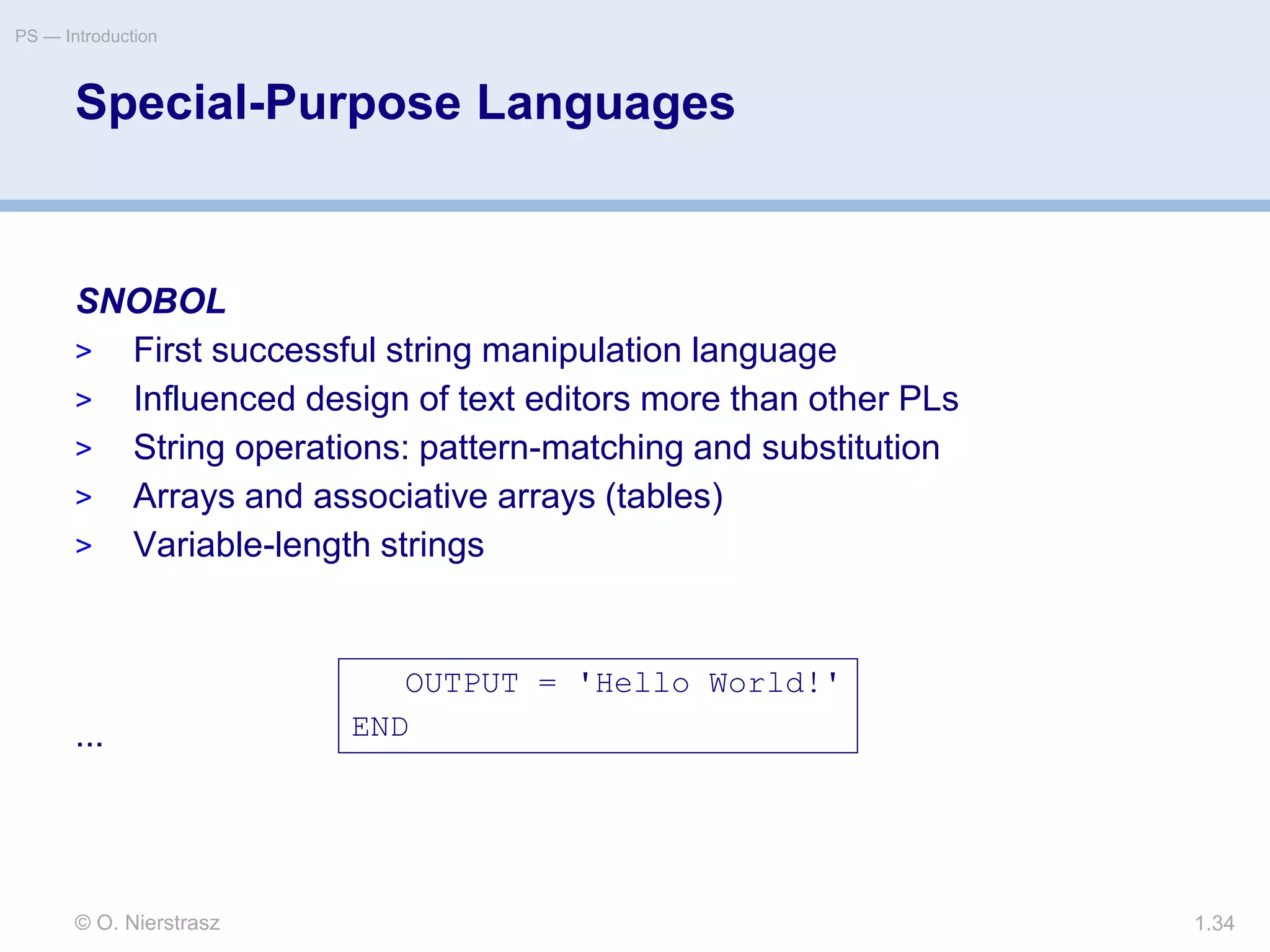
SNOBOL
> First successful string manipulation language
> Influenced design of text editors more than other PLs
> String operations: pattern-matching and substitution
> Arrays and associative arrays (tables)
> Variable-length strings
...
OUTPUT = 'Hello World!'
END
© O. Nierstrasz
PS — Introduction
1.35
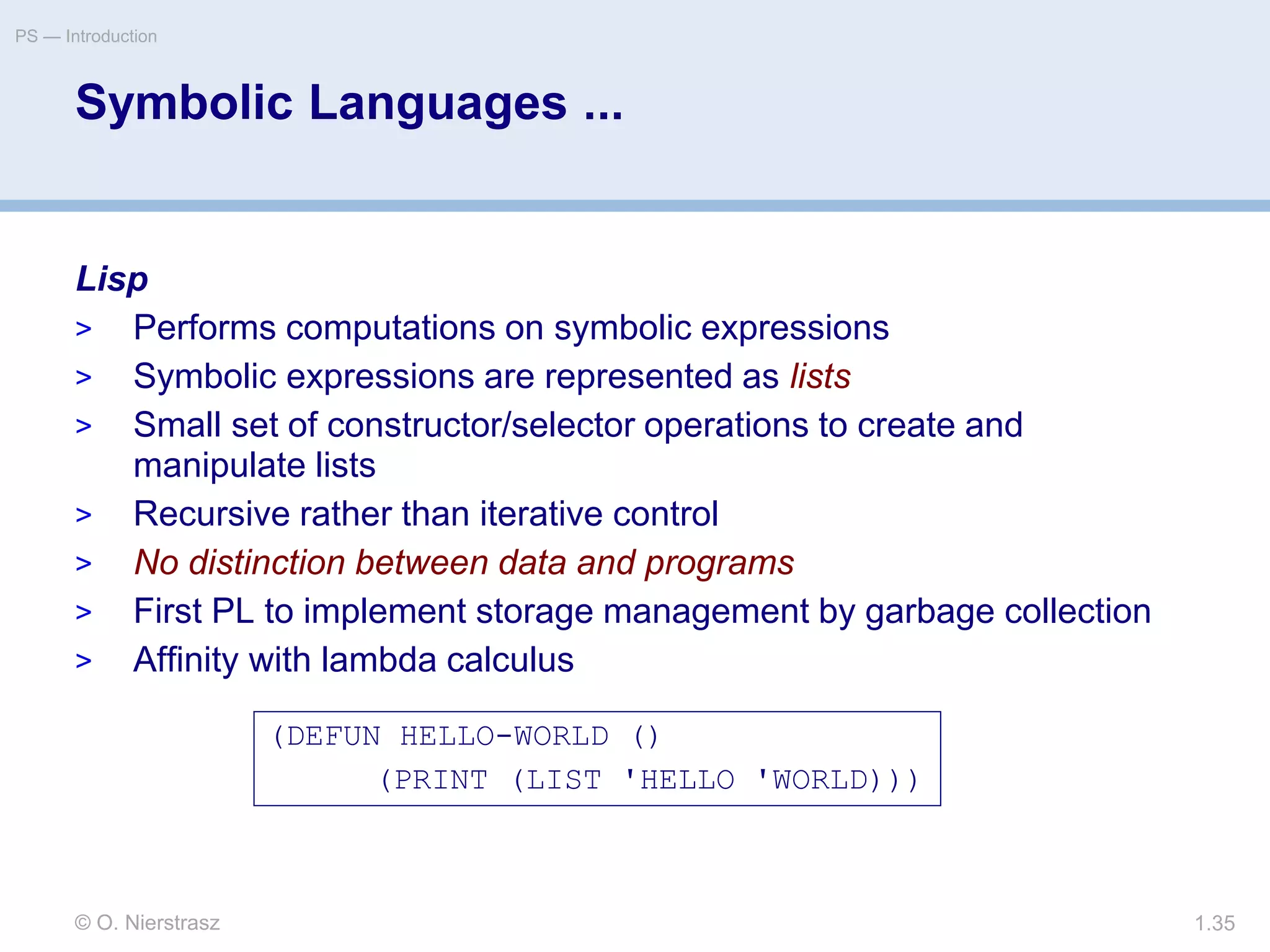
Symbolic Languages ...
Lisp
> Performs computations on symbolic expressions
> Symbolic expressions are represented as lists
> Small set of constructor/selector operations to create and
manipulate lists
> Recursive rather than iterative control
> No distinction between data and programs
> First PL to implement storage management by garbage collection
> Affinity with lambda calculus
(DEFUN HELLO-WORLD ()
(PRINT (LIST 'HELLO 'WORLD)))
© O. Nierstrasz
PS — Introduction
1.36
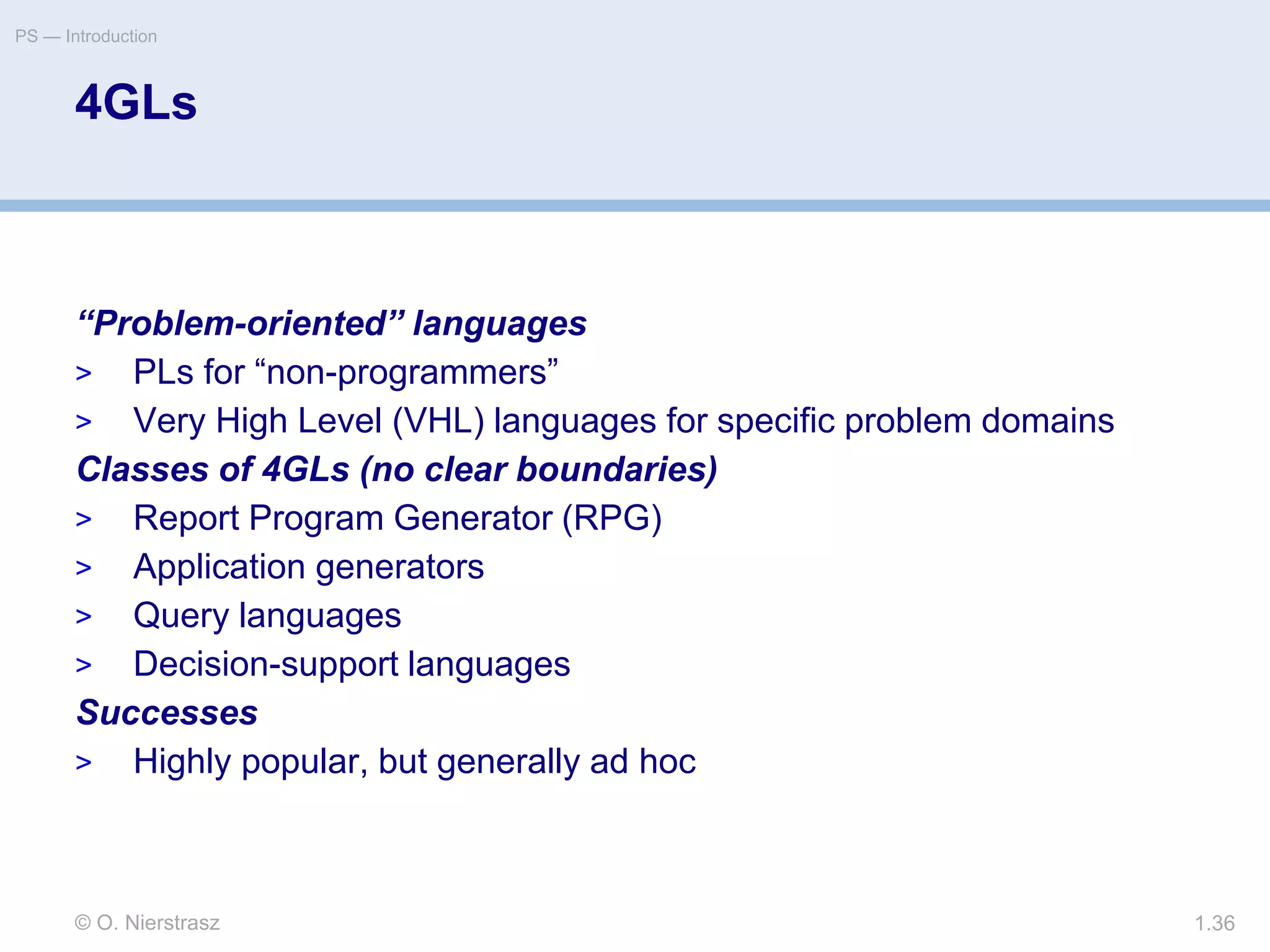
4GLs
“Problem-oriented” languages
> PLs for “non-programmers”
> Very High Level (VHL) languages for specific problem domains
Classes of 4GLs (no clear boundaries)
> Report Program Generator (RPG)
> Application generators
> Query languages
> Decision-support languages
Successes
> Highly popular, but generally ad hoc
© O. Nierstrasz
PS — Introduction
1.37
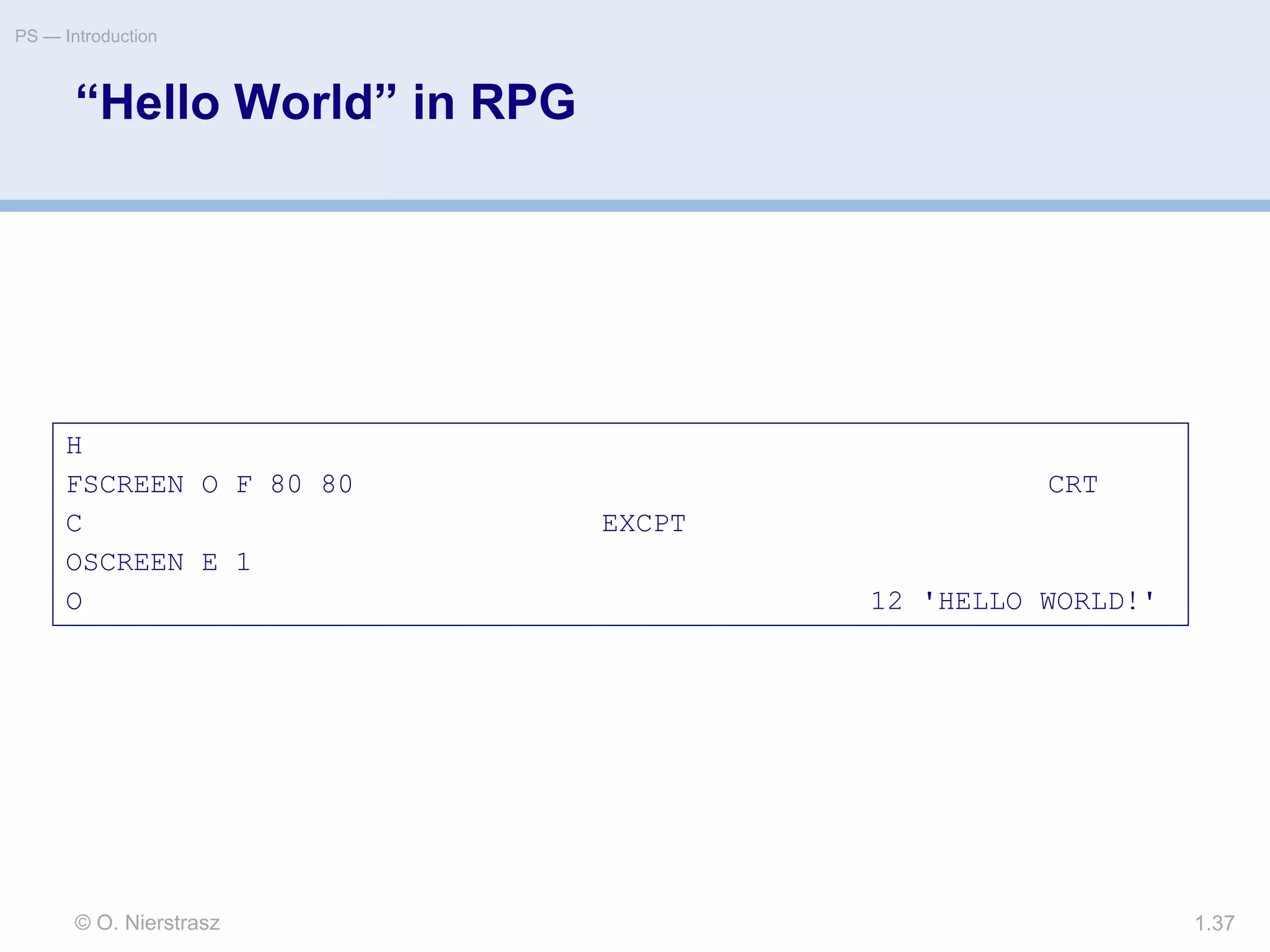
“Hello World” in RPG
H
FSCREEN O F 80 80 CRT
C EXCPT
OSCREEN E 1
O 12 'HELLO WORLD!'
© O. Nierstrasz
PS — Introduction
1.38
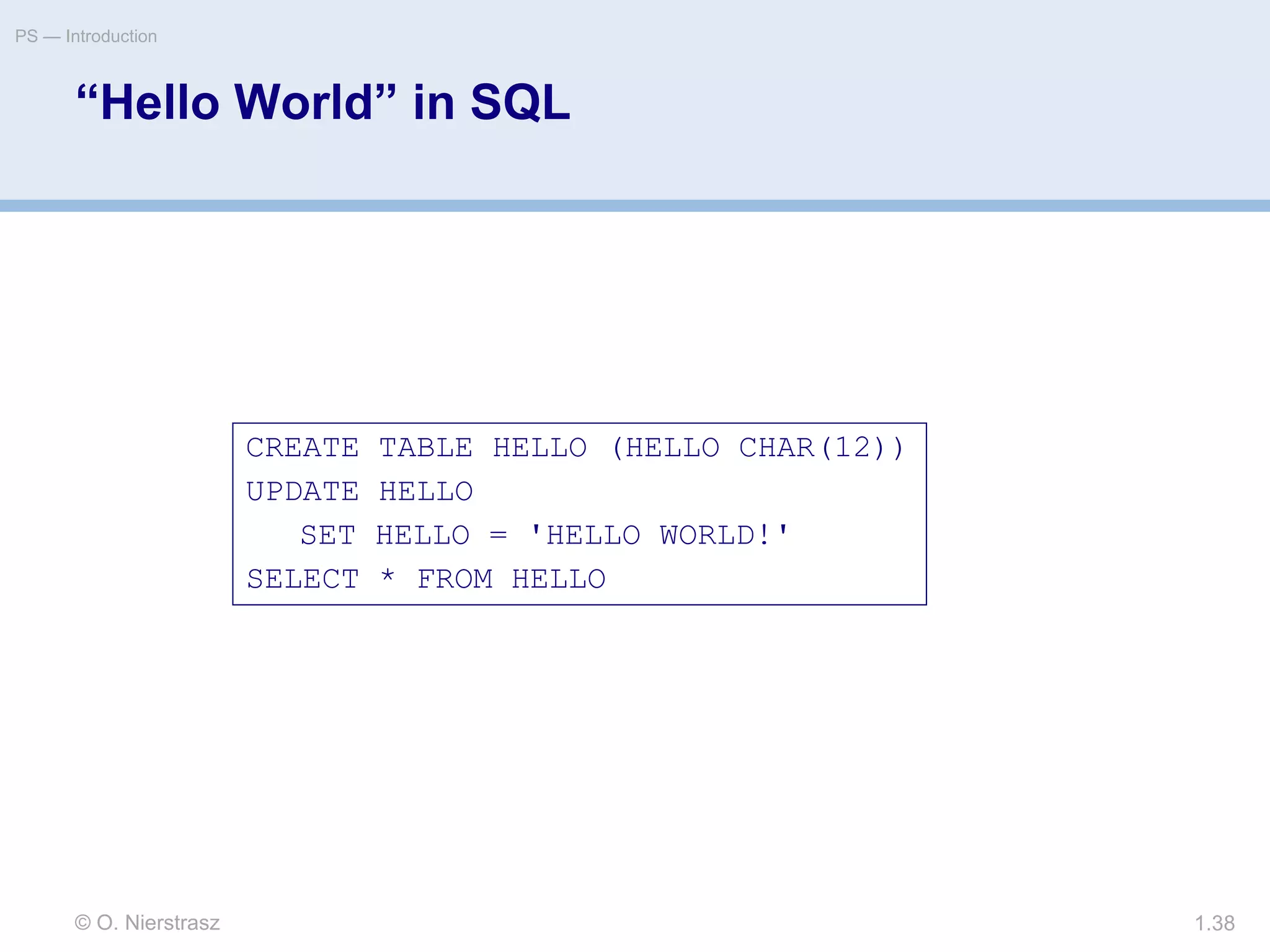
“Hello World” in SQL
CREATE TABLE HELLO (HELLO CHAR(12))
UPDATE HELLO
SET HELLO = 'HELLO WORLD!'
SELECT * FROM HELLO
© O. Nierstrasz
PS — Introduction
1.39
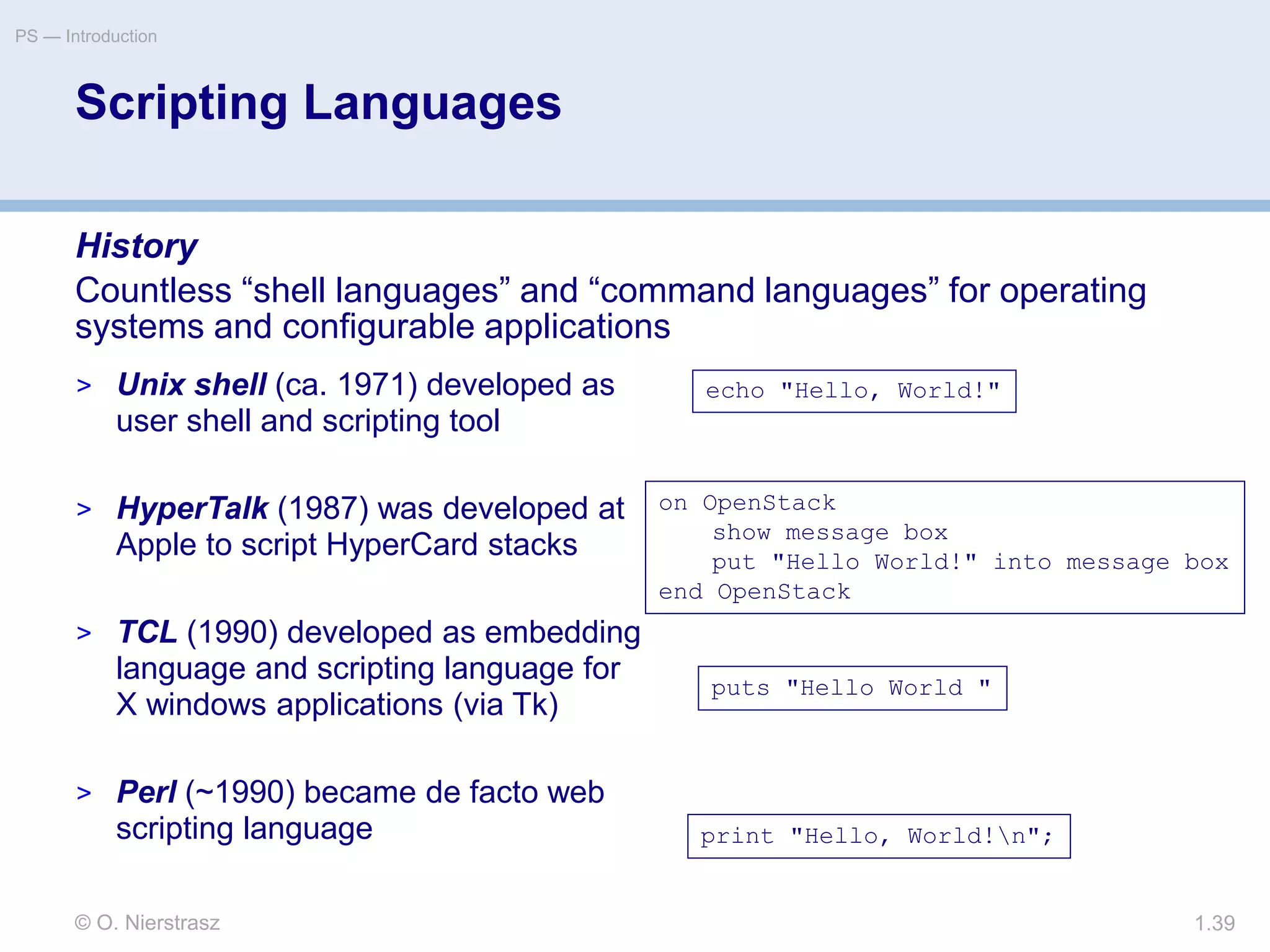
Scripting Languages
History
Countless “shell languages” and “command languages” for operating
systems and configurable applications
echo "Hello, World!"
on OpenStack
show message box
put "Hello World!" into message box
end OpenStack
puts "Hello World "
print "Hello, World!n";
> Unix shell (ca. 1971) developed as
user shell and scripting tool
> HyperTalk (1987) was developed at
Apple to script HyperCard stacks
> TCL (1990) developed as embedding
language and scripting language for
X windows applications (via Tk)
> Perl (~1990) became de facto web
scripting language
© O. Nierstrasz
PS — Introduction
1.40
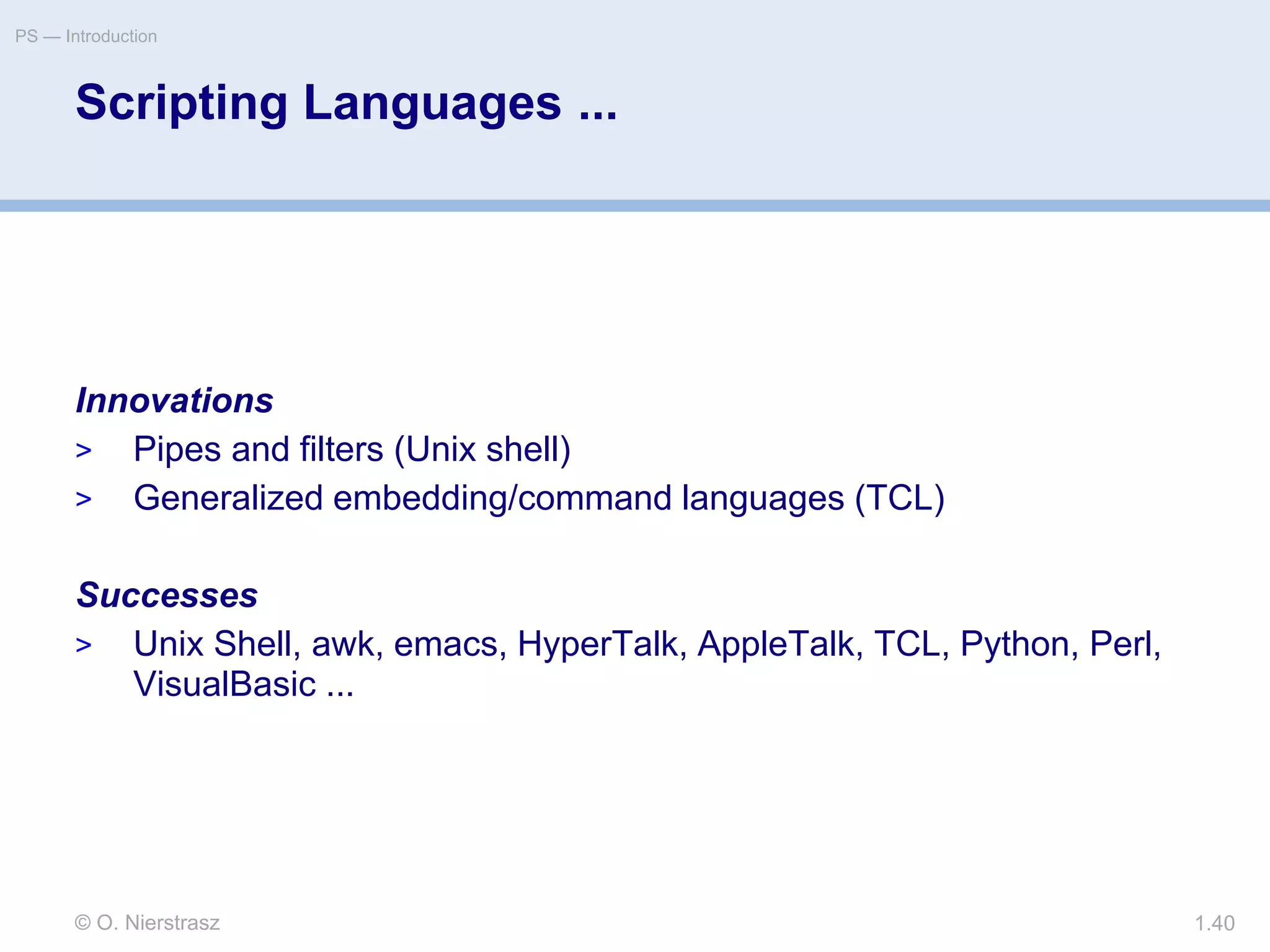
Scripting Languages ...
Innovations
> Pipes and filters (Unix shell)
> Generalized embedding/command languages (TCL)
Successes
> Unix Shell, awk, emacs, HyperTalk, AppleTalk, TCL, Python, Perl,
VisualBasic ...
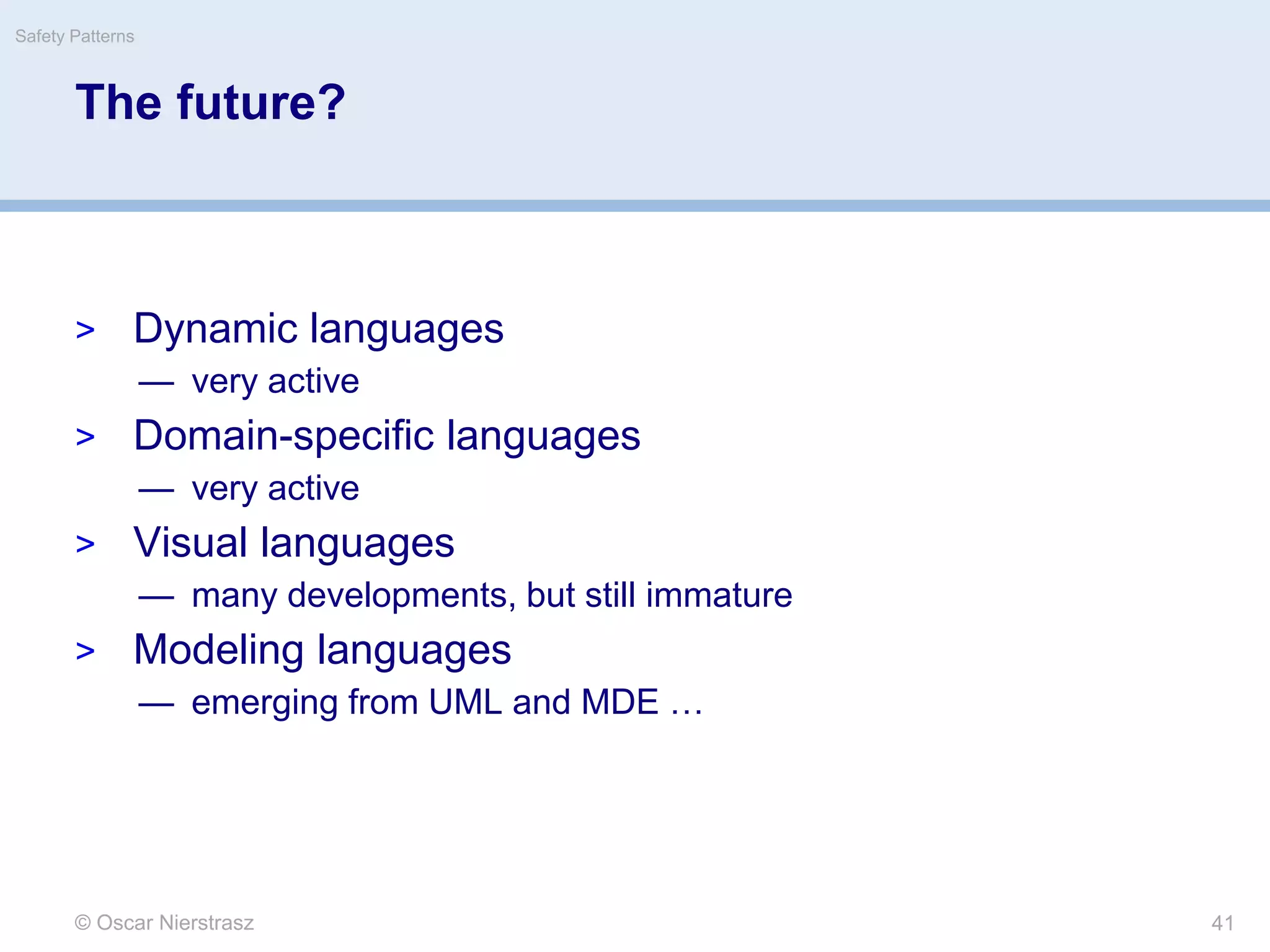
The future?
> Dynamic languages
— very active
> Domain-specific languages
— very active
> Visual languages
— many developments, but still immature
> Modeling languages
— emerging from UML and MDE …
© Oscar Nierstrasz
Safety Patterns
41
© O. Nierstrasz
PS — Introduction
1.42
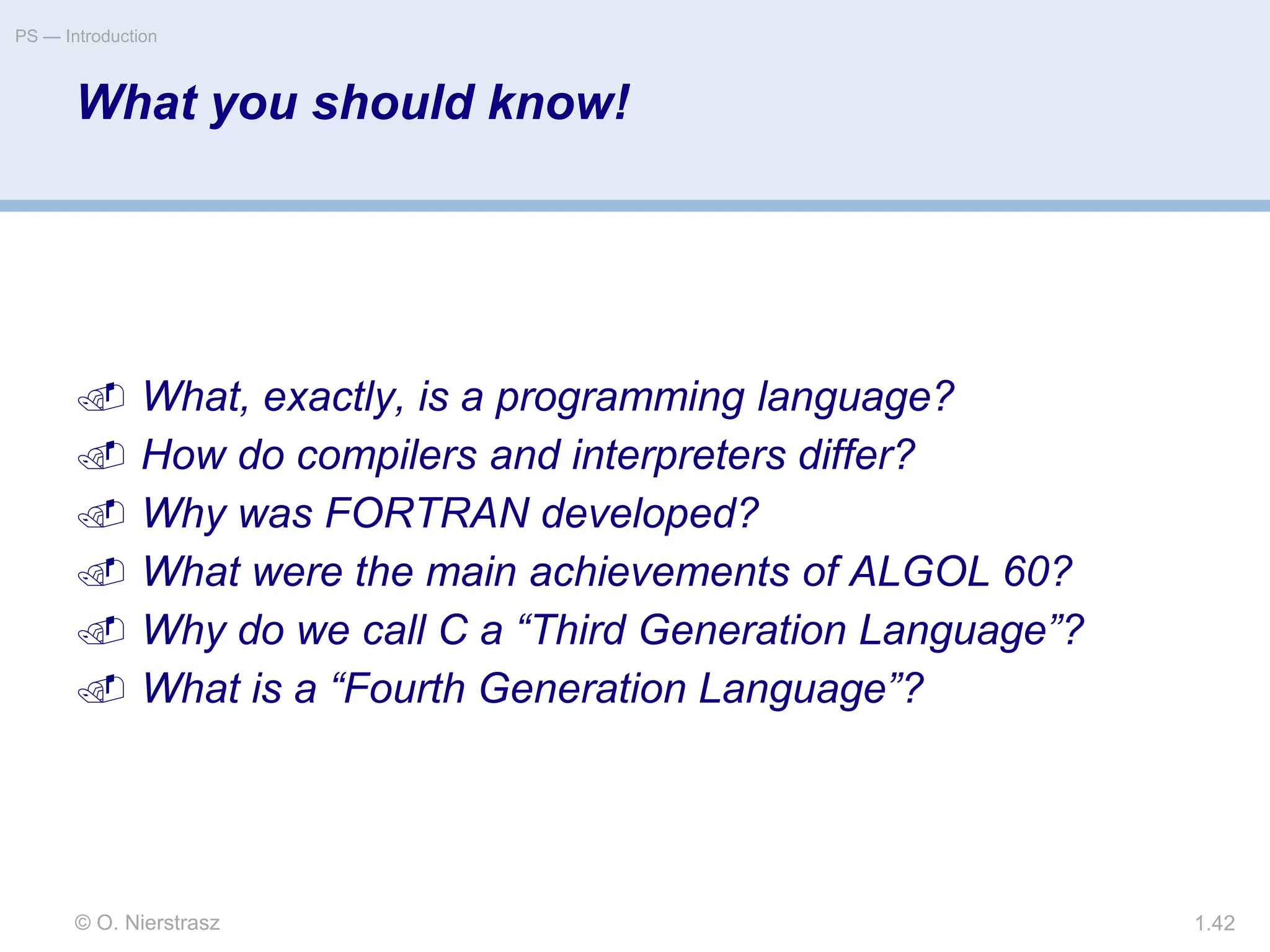
What you should know!
 What, exactly, is a programming language?
 How do compilers and interpreters differ?
 Why was FORTRAN developed?
 What were the main achievements of ALGOL 60?
 Why do we call C a “Third Generation Language”?
 What is a “Fourth Generation Language”?
© O. Nierstrasz
PS — Introduction
1.43
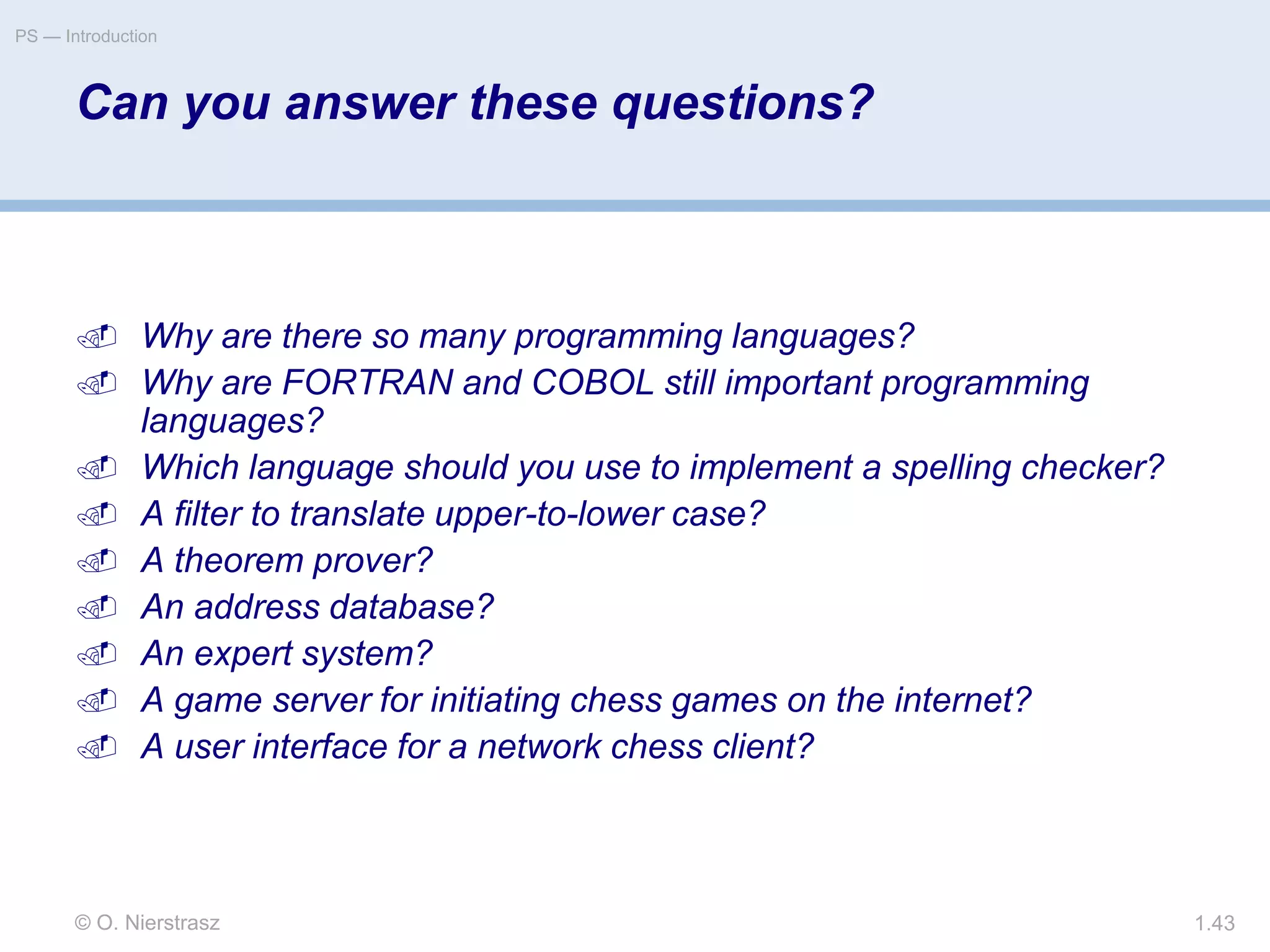
Can you answer these questions?
 Why are there so many programming languages?
 Why are FORTRAN and COBOL still important programming
languages?
 Which language should you use to implement a spelling checker?
 A filter to translate upper-to-lower case?
 A theorem prover?
 An address database?
 An expert system?
 A game server for initiating chess games on the internet?
 A user interface for a network chess client?
© Oscar Nierstrasz
ST — Introduction
1.44
Attribution-ShareAlike 3.0 Unported
You are free:
to Share — to copy, distribute and transmit the work
to Remix — to adapt the work
Under the following conditions:
Attribution. You must attribute the work in the manner specified by the author or licensor
(but not in any way that suggests that they endorse you or your use of the work).
Share Alike. If you alter, transform, or build upon this work, you may distribute the
resulting work only under the same, similar or a compatible license.
For any reuse or distribution, you must make clear to others the license terms of this work. The
best way to do this is with a link to this web page.
Any of the above conditions can be waived if you get permission from the copyright holder.
Nothing in this license impairs or restricts the author's moral rights.
License
http://creativecommons.org/licenses/by-sa/3.0/

01 intro

  • 1.
    Programming Languages 1. Introduction Prof.O. Nierstrasz Spring Semester 2010
  • 2.
    © O. Nierstrasz PS— Introduction 1.2 Programming Languages Lecturer: Oscar Nierstrasz Assistants: Toon Verwaest, Camillo Bruni WWW: http://scg.unibe.ch/teaching/pl
  • 3.
    © O. Nierstrasz PS— Introduction 1.3 Roadmap > Course Schedule > Programming Paradigms > A Quick Tour of Programming Language History
  • 4.
    © O. Nierstrasz PS— Introduction 1.4 Roadmap > Course Schedule > Programming Paradigms > A Quick Tour of Programming Language History
  • 5.
    © O. Nierstrasz PS— Introduction 1.5 Sources Text: > Kenneth C. Louden, Programming Languages: Principles and Practice, PWS Publishing (Boston), 1993. Other Sources: > Paul Hudak, “Conception, Evolution, and Application of Functional Programming Languages,” ACM Computing Surveys 21/3, 1989, pp 359-411. > Clocksin and Mellish, Programming in Prolog, Springer Verlag, 1987.
  • 6.
    © O. Nierstrasz PS— Introduction 1.6 Schedule 1. Introduction 2. Stack-based programming 3. Scheme (guest lecture) 4. Functional programming 5. Types and polymorphism 6. Lambda calculus 7. Fixed points 8. Programming language semantics 9. Objects and types 10. Logic programming 11. Applications of logic programming 12. Visual programming 13. Final exam
  • 7.
    © O. Nierstrasz PS— Introduction 1.7 Roadmap > Course Schedule > Programming Paradigms > A Quick Tour of Programming Language History
  • 8.
    What is aProgramming Language? © O. Nierstrasz PS — Introduction 1.8 > A formal language for describing computation? > A “user interface” to a computer? > Syntax + semantics? > Compiler, or interpreter, or translator? > A tool to support a programming paradigm? A programming language is a notational system for describing computation in a machine-readable and human-readable form. — Louden
  • 9.
    What is aProgramming Language? (II) © O. Nierstrasz PS — Introduction 1.9 A programming language is a tool for developing executable models for a class of problem domains. The thesis of this course:
  • 10.
    Themes Addressed inthis Course © O. Nierstrasz PS — Introduction 1.10 Paradigms How do different language paradigms support problem-solving? Semantics How can we understand the semantics of programming languages? Foundations What are the foundations of programming languages?
  • 11.
    © O. Nierstrasz PS— Introduction 1.11 Generations of Programming Languages 1GL: machine codes 2GL: symbolic assemblers 3GL: (machine-independent) imperative languages (FORTRAN, Pascal, C ...) 4GL: domain specific application generators 5GL: AI languages … Each generation is at a higher level of abstraction
  • 12.
    © O. Nierstrasz PS— Introduction 1.12 How do Programming Languages Differ? Common Constructs: > basic data types (numbers, etc.); variables; expressions; statements; keywords; control constructs; procedures; comments; errors ... Uncommon Constructs: > type declarations; special types (strings, arrays, matrices, ...); sequential execution; concurrency constructs; packages/modules; objects; general functions; generics; modifiable state; ...
  • 13.
    © O. Nierstrasz PS— Introduction 1.13 Programming Paradigms A programming language is a problem-solving tool. Imperative style: program = algorithms + data good for decomposition Functional style: program = functions o functions good for reasoning Logic programming style: program = facts + rules good for searching Object-oriented style: program = objects + messages good for modeling(!) Other styles and paradigms: blackboard, pipes and filters, constraints, lists, ...
  • 14.
    © O. Nierstrasz PS— Introduction 1.14 Compilers and Interpreters Compilers and interpreters have similar front-ends, but have different back-ends.
  • 15.
    © O. Nierstrasz PS— Introduction 1.15 Roadmap > Course Schedule > Programming Paradigms > A Quick Tour of Programming Language History
  • 16.
    © O. Nierstrasz PS— Introduction 1.16 A Brief Chronology Early 1950s “order codes” (primitive assemblers) 1957 FORTRAN the first high-level programming language 1958 ALGOL the first modern, imperative language 1960 LISP, COBOL Interactive programming; business programming 1962 APL, SIMULA the birth of OOP (SIMULA) 1964 BASIC, PL/I 1966 ISWIM first modern functional language (a proposal) 1970 Prolog logic programming is born 1972 C the systems programming language 1975 Pascal, Scheme two teaching languages 1978 CSP Concurrency matures 1978 FP Backus’ proposal 1983 Smalltalk-80, Ada OOP is reinvented 1984 Standard ML FP becomes mainstream (?) 1986 C++, Eiffel OOP is reinvented (again) 1988 CLOS, Oberon, Mathematica 1990 Haskell FP is reinvented 1990s Perl, Python, Ruby, JavaScript Scripting languages become mainstream 1995 Java OOP is reinvented for the internet 2000 C#
  • 17.
    © O. Nierstrasz PS— Introduction 1.17 Fortran History > John Backus (1953) sought to write programs in conventional mathematical notation, and generate code comparable to good assembly programs. > No language design effort (made it up as they went along) > Most effort spent on code generation and optimization > FORTRAN I released April 1957; working by April 1958 > The current standard is FORTRAN 2003 (FORTRAN 2008 is work in progress)
  • 18.
    © O. Nierstrasz PS— Introduction 1.18 Fortran … Innovations > Symbolic notation for subroutines and functions > Assignments to variables of complex expressions > DO loops > Comments > Input/output formats > Machine-independence Successes > Easy to learn; high level > Promoted by IBM; addressed large user base > (scientific computing)
  • 19.
    © O. Nierstrasz PS— Introduction 1.19 “Hello World” in FORTRAN All examples from the ACM "Hello World" project: www2.latech.edu/~acm/HelloWorld.shtml PROGRAM HELLO DO 10, I=1,10 PRINT *,'Hello World' 10 CONTINUE STOP END
  • 20.
    © O. Nierstrasz PS— Introduction 1.20 ALGOL 60 History > Committee of PL experts formed in 1955 to design universal, machine- independent, algorithmic language > First version (ALGOL 58) never implemented; criticisms led to ALGOL 60 Innovations > BNF (Backus-Naur Form) introduced to define syntax (led to syntax- directed compilers) > First block-structured language; variables with local scope > Structured control statements > Recursive procedures > Variable size arrays Successes > Highly influenced design of other PLs but never displaced FORTRAN
  • 21.
    © O. Nierstrasz PS— Introduction 1.21 “Hello World” in BEALGOL BEGIN FILE F (KIND=REMOTE); EBCDIC ARRAY E [0:11]; REPLACE E BY "HELLO WORLD!"; WHILE TRUE DO BEGIN WRITE (F, *, E); END; END.
  • 22.
    © O. Nierstrasz PS— Introduction 1.22 COBOL History > Designed by committee of US computer manufacturers > Targeted business applications > Intended to be readable by managers (!) Innovations > Separate descriptions of environment, data, and processes Successes > Adopted as de facto standard by US DOD > Stable standard for 25 years > Still the most widely used PL for business applications (!)
  • 23.
    © O. Nierstrasz PS— Introduction 1.23 “Hello World” in COBOL 000100 IDENTIFICATION DIVISION. 000200 PROGRAM-ID. HELLOWORLD. 000300 DATE-WRITTEN. 02/05/96 21:04. 000400* AUTHOR BRIAN COLLINS 000500 ENVIRONMENT DIVISION. 000600 CONFIGURATION SECTION. 000700 SOURCE-COMPUTER. RM-COBOL. 000800 OBJECT-COMPUTER. RM-COBOL. 001000 DATA DIVISION. 001100 FILE SECTION. 100000 PROCEDURE DIVISION. 100200 MAIN-LOGIC SECTION. 100300 BEGIN. 100400 DISPLAY " " LINE 1 POSITION 1 ERASE EOS. 100500 DISPLAY "HELLO, WORLD." LINE 15 POSITION 10. 100600 STOP RUN. 100700 MAIN-LOGIC-EXIT. 100800 EXIT.
  • 24.
    © O. Nierstrasz PS— Introduction 1.24 PL/1 History > Designed by committee of IBM and users (early 1960s) > Intended as (large) general-purpose language for broad classes of applications Innovations > Support for concurrency (but not synchronization) > Exception-handling on conditions Successes > Achieved both run-time efficiency and flexibility (at expense of complexity) > First “complete” general purpose language
  • 25.
    © O. Nierstrasz PS— Introduction 1.25 “Hello World” in PL/1 HELLO: PROCEDURE OPTIONS (MAIN); /* A PROGRAM TO OUTPUT HELLO WORLD */ FLAG = 0; LOOP: DO WHILE (FLAG = 0); PUT SKIP DATA('HELLO WORLD!'); END LOOP; END HELLO;
  • 26.
    © O. Nierstrasz PS— Introduction 1.26 Functional Languages ISWIM (If you See What I Mean) > Peter Landin (1966) — paper proposal FP > John Backus (1978) — Turing award lecture ML > Edinburgh > initially designed as meta-language for theorem proving > Hindley-Milner type inference > “non-pure” functional language (with assignments/side effects) Miranda, Haskell > “pure” functional languages with “lazy evaluation”
  • 27.
    © O. Nierstrasz PS— Introduction 1.27 “Hello World” in Functional Languages SML Haskell print("hello world!n"); hello() = print "Hello World"
  • 28.
    © O. Nierstrasz PS— Introduction 1.28 Prolog History > Originated at U. Marseilles (early 1970s), and compilers developed at Marseilles and Edinburgh (mid to late 1970s) Innovations > Theorem proving paradigm > Programs as sets of clauses: facts, rules and questions > Computation by “unification” Successes > Prototypical logic programming language > Used in Japanese Fifth Generation Initiative
  • 29.
    © O. Nierstrasz PS— Introduction 1.29 “Hello World” in Prolog hello :- printstring("HELLO WORLD!!!!"). printstring([]). printstring([H|T]) :- put(H), printstring(T).
  • 30.
    © O. Nierstrasz PS— Introduction 1.30 Object-Oriented Languages History > Simula was developed by Nygaard and Dahl (early 1960s) in Oslo as a language for simulation programming, by adding classes and inheritance to ALGOL 60 > Smalltalk was developed by Xerox PARC (early 1970s) to drive graphic workstations Begin while 1 = 1 do begin outtext ("Hello World!"); outimage; end; End; Transcript show:'Hello World';cr
  • 31.
    © O. Nierstrasz PS— Introduction 1.31 Object-Oriented Languages Innovations > Encapsulation of data and operations (contrast ADTs) > Inheritance to share behaviour and interfaces Successes > Smalltalk project pioneered OO user interfaces > Large commercial impact since mid 1980s > Countless new languages: C++, Objective C, Eiffel, Beta, Oberon, Self, Perl 5, Python, Java, Ada 95 ...
  • 32.
    © O. Nierstrasz PS— Introduction 1.32 Interactive Languages Made possible by advent of time-sharing systems (early 1960s through mid 1970s). BASIC > Developed at Dartmouth College in mid 1960s > Minimal; easy to learn > Incorporated basic O/S commands (NEW, LIST, DELETE, RUN, SAVE) ... 10 print "Hello World!" 20 goto 10
  • 33.
    © O. Nierstrasz PS— Introduction 1.33 Interactive Languages ... APL > Developed by Ken Iverson for concise description of numerical algorithms > Large, non-standard alphabet (52 characters in addition to alphanumerics) > Primitive objects are arrays (lists, tables or matrices) > Operator-driven (power comes from composing array operators) > No operator precedence (statements parsed right to left) 'HELLO WORLD'
  • 34.
    © O. Nierstrasz PS— Introduction 1.34 Special-Purpose Languages SNOBOL > First successful string manipulation language > Influenced design of text editors more than other PLs > String operations: pattern-matching and substitution > Arrays and associative arrays (tables) > Variable-length strings ... OUTPUT = 'Hello World!' END
  • 35.
    © O. Nierstrasz PS— Introduction 1.35 Symbolic Languages ... Lisp > Performs computations on symbolic expressions > Symbolic expressions are represented as lists > Small set of constructor/selector operations to create and manipulate lists > Recursive rather than iterative control > No distinction between data and programs > First PL to implement storage management by garbage collection > Affinity with lambda calculus (DEFUN HELLO-WORLD () (PRINT (LIST 'HELLO 'WORLD)))
  • 36.
    © O. Nierstrasz PS— Introduction 1.36 4GLs “Problem-oriented” languages > PLs for “non-programmers” > Very High Level (VHL) languages for specific problem domains Classes of 4GLs (no clear boundaries) > Report Program Generator (RPG) > Application generators > Query languages > Decision-support languages Successes > Highly popular, but generally ad hoc
  • 37.
    © O. Nierstrasz PS— Introduction 1.37 “Hello World” in RPG H FSCREEN O F 80 80 CRT C EXCPT OSCREEN E 1 O 12 'HELLO WORLD!'
  • 38.
    © O. Nierstrasz PS— Introduction 1.38 “Hello World” in SQL CREATE TABLE HELLO (HELLO CHAR(12)) UPDATE HELLO SET HELLO = 'HELLO WORLD!' SELECT * FROM HELLO
  • 39.
    © O. Nierstrasz PS— Introduction 1.39 Scripting Languages History Countless “shell languages” and “command languages” for operating systems and configurable applications echo "Hello, World!" on OpenStack show message box put "Hello World!" into message box end OpenStack puts "Hello World " print "Hello, World!n"; > Unix shell (ca. 1971) developed as user shell and scripting tool > HyperTalk (1987) was developed at Apple to script HyperCard stacks > TCL (1990) developed as embedding language and scripting language for X windows applications (via Tk) > Perl (~1990) became de facto web scripting language
  • 40.
    © O. Nierstrasz PS— Introduction 1.40 Scripting Languages ... Innovations > Pipes and filters (Unix shell) > Generalized embedding/command languages (TCL) Successes > Unix Shell, awk, emacs, HyperTalk, AppleTalk, TCL, Python, Perl, VisualBasic ...
  • 41.
    The future? > Dynamiclanguages — very active > Domain-specific languages — very active > Visual languages — many developments, but still immature > Modeling languages — emerging from UML and MDE … © Oscar Nierstrasz Safety Patterns 41
  • 42.
    © O. Nierstrasz PS— Introduction 1.42 What you should know!  What, exactly, is a programming language?  How do compilers and interpreters differ?  Why was FORTRAN developed?  What were the main achievements of ALGOL 60?  Why do we call C a “Third Generation Language”?  What is a “Fourth Generation Language”?
  • 43.
    © O. Nierstrasz PS— Introduction 1.43 Can you answer these questions?  Why are there so many programming languages?  Why are FORTRAN and COBOL still important programming languages?  Which language should you use to implement a spelling checker?  A filter to translate upper-to-lower case?  A theorem prover?  An address database?  An expert system?  A game server for initiating chess games on the internet?  A user interface for a network chess client?
  • 44.
    © Oscar Nierstrasz ST— Introduction 1.44 Attribution-ShareAlike 3.0 Unported You are free: to Share — to copy, distribute and transmit the work to Remix — to adapt the work Under the following conditions: Attribution. You must attribute the work in the manner specified by the author or licensor (but not in any way that suggests that they endorse you or your use of the work). Share Alike. If you alter, transform, or build upon this work, you may distribute the resulting work only under the same, similar or a compatible license. For any reuse or distribution, you must make clear to others the license terms of this work. The best way to do this is with a link to this web page. Any of the above conditions can be waived if you get permission from the copyright holder. Nothing in this license impairs or restricts the author's moral rights. License http://creativecommons.org/licenses/by-sa/3.0/