2: Application Layer1
Chapter 2
Application Layer
Computer Networking:
A Top Down Approach,
4th
edition.
Jim Kurose, Keith Ross
Addison-Wesley, July
2007.
A note on the use of these ppt slides:
We’re making these slides freely available to all (faculty, students, readers).
They’re in PowerPoint form so you can add, modify, and delete slides
(including this one) and slide content to suit your needs. They obviously
represent a lot of work on our part. In return for use, we only ask the
following:
If you use these slides (e.g., in a class) in substantially unaltered form,
that you mention their source (after all, we’d like people to use our book!)
If you post any slides in substantially unaltered form on a www site, that
you note that they are adapted from (or perhaps identical to) our slides,
and note our copyright of this material.
Thanks and enjoy! JFK/KWR
All material copyright 1996-2007
J.F Kurose and K.W. Ross, All Rights Reserved
2.
2: Application Layer2
Chapter 2: Application layer
2.1 Principles of network applications
2.2 Web and HTTP
2.3 FTP
2.4 Electronic Mail
SMTP, POP3, IMAP
2.5 DNS
3.
2: Application Layer3
Chapter 2: Application Layer
Our goals:
conceptual,
implementation
aspects of network
application protocols
transport-layer
service models
client-server
paradigm
peer-to-peer
paradigm
learn about protocols
by examining popular
application-level
protocols
HTTP
FTP
SMTP / POP3 / IMAP
DNS
programming network
applications
socket API
4.
2: Application Layer4
Chapter 2: Application layer
2.1 Principles of network applications
app architectures
app requirements
2.2 Web and HTTP
2.4 Electronic Mail
SMTP, POP3, IMAP
2.5 DNS
2.6 P2P file sharing
2.7 Socket programming
with TCP
2.8 Socket programming
with UDP
5.
2: Application Layer5
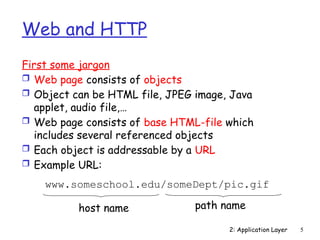
Web and HTTP
First some jargon
Web page consists of objects
Object can be HTML file, JPEG image, Java
applet, audio file,…
Web page consists of base HTML-file which
includes several referenced objects
Each object is addressable by a URL
Example URL:
www.someschool.edu/someDept/pic.gif
host name path name
6.
2: Application Layer6
HTTP overview
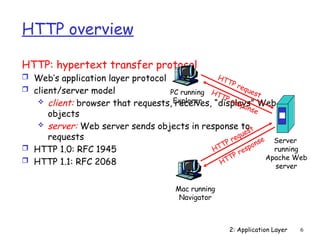
HTTP: hypertext transfer protocol
Web’s application layer protocol
client/server model
client: browser that requests, receives, “displays” Web
objects
server: Web server sends objects in response to
requests
HTTP 1.0: RFC 1945
HTTP 1.1: RFC 2068
PC running
Explorer
Server
running
Apache Web
server
Mac running
Navigator
HTTP request
HTTP request
HTTP response
HTTP response
7.
2: Application Layer7
HTTP overview (continued)
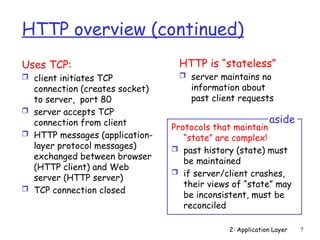
Uses TCP:
client initiates TCP
connection (creates socket)
to server, port 80
server accepts TCP
connection from client
HTTP messages (application-
layer protocol messages)
exchanged between browser
(HTTP client) and Web
server (HTTP server)
TCP connection closed
HTTP is “stateless”
server maintains no
information about
past client requests
Protocols that maintain
“state” are complex!
past history (state) must
be maintained
if server/client crashes,
their views of “state” may
be inconsistent, must be
reconciled
aside
8.
2: Application Layer8
HTTP connections
Nonpersistent HTTP
At most one object is sent over a TCP connection.
HTTP/1.0 uses nonpersistent HTTP
Persistent HTTP
Multiple objects can be sent over single TCP
connection between client and server.
HTTP/1.1 uses persistent connections in default
mode
9.
2: Application Layer9
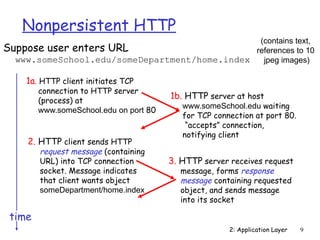
Nonpersistent HTTP
Suppose user enters URL
www.someSchool.edu/someDepartment/home.index
1a. HTTP client initiates TCP
connection to HTTP server
(process) at
www.someSchool.edu on port 80
2. HTTP client sends HTTP
request message (containing
URL) into TCP connection
socket. Message indicates
that client wants object
someDepartment/home.index
1b. HTTP server at host
www.someSchool.edu waiting
for TCP connection at port 80.
“accepts” connection,
notifying client
3. HTTP server receives request
message, forms response
message containing requested
object, and sends message
into its socket
time
(contains text,
references to 10
jpeg images)
10.
2: Application Layer10
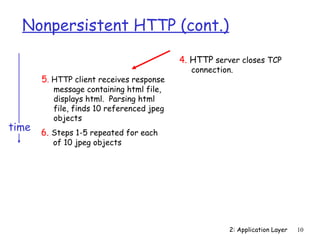
Nonpersistent HTTP (cont.)
5. HTTP client receives response
message containing html file,
displays html. Parsing html
file, finds 10 referenced jpeg
objects
6. Steps 1-5 repeated for each
of 10 jpeg objects
4. HTTP server closes TCP
connection.
time
11.
2: Application Layer11
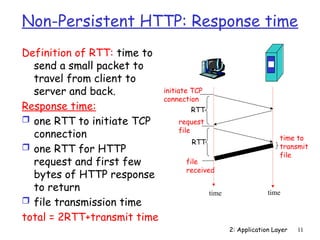
Non-Persistent HTTP: Response time
Definition of RTT: time to
send a small packet to
travel from client to
server and back.
Response time:
one RTT to initiate TCP
connection
one RTT for HTTP
request and first few
bytes of HTTP response
to return
file transmission time
total = 2RTT+transmit time
time to
transmit
file
initiate TCP
connection
RTT
request
file
RTT
file
received
time time
12.
2: Application Layer12
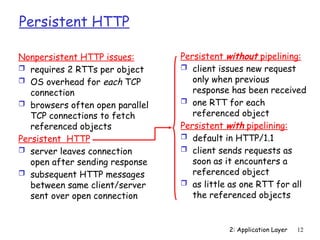
Persistent HTTP
Nonpersistent HTTP issues:
requires 2 RTTs per object
OS overhead for each TCP
connection
browsers often open parallel
TCP connections to fetch
referenced objects
Persistent HTTP
server leaves connection
open after sending response
subsequent HTTP messages
between same client/server
sent over open connection
Persistent without pipelining:
client issues new request
only when previous
response has been received
one RTT for each
referenced object
Persistent with pipelining:
default in HTTP/1.1
client sends requests as
soon as it encounters a
referenced object
as little as one RTT for all
the referenced objects
13.
2: Application Layer13
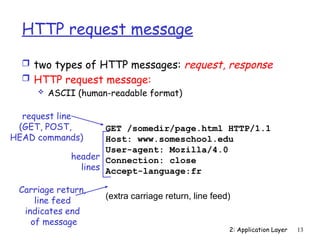
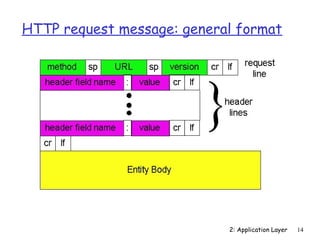
HTTP request message
two types of HTTP messages: request, response
HTTP request message:
ASCII (human-readable format)
GET /somedir/page.html HTTP/1.1
Host: www.someschool.edu
User-agent: Mozilla/4.0
Connection: close
Accept-language:fr
(extra carriage return, line feed)
request line
(GET, POST,
HEAD commands)
header
lines
Carriage return,
line feed
indicates end
of message
2: Application Layer15
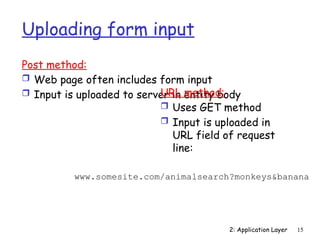
Uploading form input
Post method:
Web page often includes form input
Input is uploaded to server in entity body
URL method:
Uses GET method
Input is uploaded in
URL field of request
line:
www.somesite.com/animalsearch?monkeys&banana
16.
2: Application Layer16
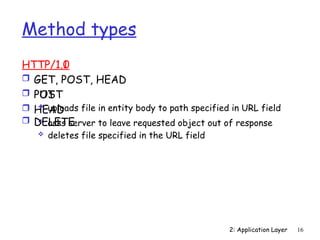
Method types
HTTP/1.0
GET
POST
HEAD
asks server to leave requested object out of response
HTTP/1.1
GET, POST, HEAD
PUT
uploads file in entity body to path specified in URL field
DELETE
deletes file specified in the URL field
17.
2: Application Layer17
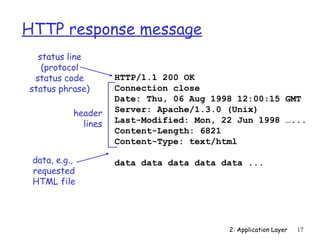
HTTP response message
HTTP/1.1 200 OK
Connection close
Date: Thu, 06 Aug 1998 12:00:15 GMT
Server: Apache/1.3.0 (Unix)
Last-Modified: Mon, 22 Jun 1998 …...
Content-Length: 6821
Content-Type: text/html
data data data data data ...
status line
(protocol
status code
status phrase)
header
lines
data, e.g.,
requested
HTML file
18.
2: Application Layer18
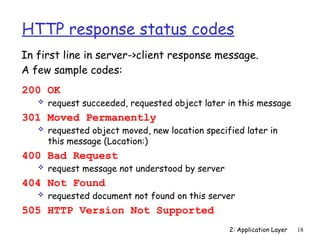
HTTP response status codes
200 OK
request succeeded, requested object later in this message
301 Moved Permanently
requested object moved, new location specified later in
this message (Location:)
400 Bad Request
request message not understood by server
404 Not Found
requested document not found on this server
505 HTTP Version Not Supported
In first line in server->client response message.
A few sample codes:
19.
2: Application Layer19
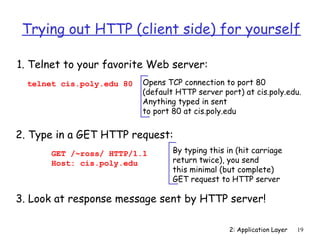
Trying out HTTP (client side) for yourself
1. Telnet to your favorite Web server:
Opens TCP connection to port 80
(default HTTP server port) at cis.poly.edu.
Anything typed in sent
to port 80 at cis.poly.edu
telnet cis.poly.edu 80
2. Type in a GET HTTP request:
GET /~ross/ HTTP/1.1
Host: cis.poly.edu
By typing this in (hit carriage
return twice), you send
this minimal (but complete)
GET request to HTTP server
3. Look at response message sent by HTTP server!
20.
2: Application Layer20
Chapter 2: Application layer
2.1 Principles of network applications
2.2 Web and HTTP
2.3 FTP
2.4 Electronic Mail
SMTP, POP3, IMAP
2.5 DNS
2.6 P2P file sharing
2.7 Socket programming
with TCP
2.8 Socket programming
with UDP
2.9 Building a Web
server
21.
2: Application Layer21
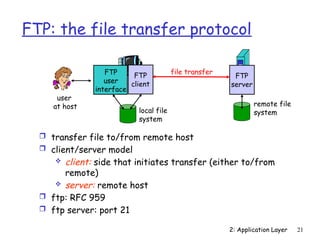
FTP: the file transfer protocol
transfer file to/from remote host
client/server model
client: side that initiates transfer (either to/from
remote)
server: remote host
ftp: RFC 959
ftp server: port 21
file transfer
FTP
server
FTP
user
interface
FTP
client
local file
system
remote file
system
user
at host
22.
2: Application Layer22
FTP: separate control, data connections
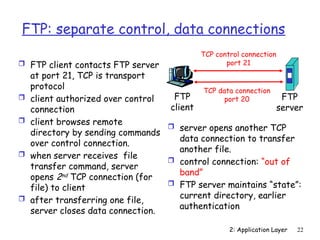
FTP client contacts FTP server
at port 21, TCP is transport
protocol
client authorized over control
connection
client browses remote
directory by sending commands
over control connection.
when server receives file
transfer command, server
opens 2nd
TCP connection (for
file) to client
after transferring one file,
server closes data connection.
FTP
client
FTP
server
TCP control connection
port 21
TCP data connection
port 20
server opens another TCP
data connection to transfer
another file.
control connection: “out of
band”
FTP server maintains “state”:
current directory, earlier
authentication
23.
2: Application Layer23
FTP commands, responses
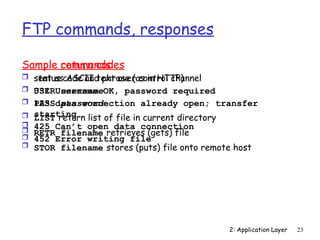
Sample commands:
sent as ASCII text over control channel
USER username
PASS password
LIST return list of file in current directory
RETR filename retrieves (gets) file
STOR filename stores (puts) file onto remote host
Sample return codes
status code and phrase (as in HTTP)
331 Username OK, password required
125 data connection already open; transfer
starting
425 Can’t open data connection
452 Error writing file
24.
2: Application Layer24
Chapter 2: Application layer
2.1 Principles of network applications
2.2 Web and HTTP
2.3 FTP
2.4 Electronic Mail
SMTP, POP3, IMAP
2.5 DNS
2.6 P2P file sharing
2.7 Socket programming
with TCP
2.8 Socket programming
with UDP
2.9 Building a Web
server
25.
2: Application Layer25
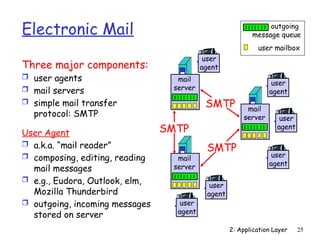
Electronic Mail
Three major components:
user agents
mail servers
simple mail transfer
protocol: SMTP
User Agent
a.k.a. “mail reader”
composing, editing, reading
mail messages
e.g., Eudora, Outlook, elm,
Mozilla Thunderbird
outgoing, incoming messages
stored on server
user mailbox
outgoing
message queue
mail
server
user
agent
user
agent
user
agent
mail
server
user
agent
user
agent
mail
server
user
agent
SMTP
SMTP
SMTP
26.
2: Application Layer26
Electronic Mail: mail servers
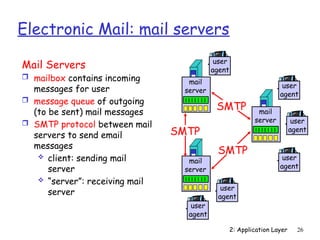
Mail Servers
mailbox contains incoming
messages for user
message queue of outgoing
(to be sent) mail messages
SMTP protocol between mail
servers to send email
messages
client: sending mail
server
“server”: receiving mail
server
mail
server
user
agent
user
agent
user
agent
mail
server
user
agent
user
agent
mail
server
user
agent
SMTP
SMTP
SMTP
27.
2: Application Layer27
Electronic Mail: SMTP [RFC 2821]
uses TCP to reliably transfer email message from client
to server, port 25
direct transfer: sending server to receiving server
three phases of transfer
handshaking (greeting)
transfer of messages
closure
command/response interaction
commands: ASCII text
response: status code and phrase
messages must be in 7-bit ASCII
28.
2: Application Layer28
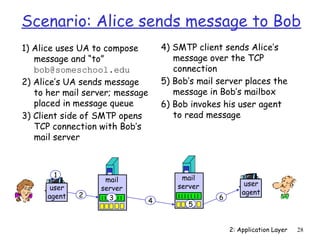
Scenario: Alice sends message to Bob
1) Alice uses UA to compose
message and “to”
bob@someschool.edu
2) Alice’s UA sends message
to her mail server; message
placed in message queue
3) Client side of SMTP opens
TCP connection with Bob’s
mail server
4) SMTP client sends Alice’s
message over the TCP
connection
5) Bob’s mail server places the
message in Bob’s mailbox
6) Bob invokes his user agent
to read message
user
agent
mail
server
mail
server user
agent
1
2 3 4 5
6
29.
2: Application Layer29
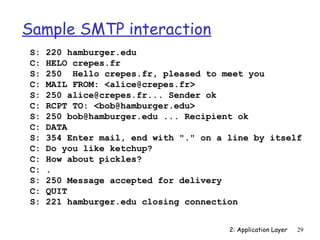
Sample SMTP interaction
S: 220 hamburger.edu
C: HELO crepes.fr
S: 250 Hello crepes.fr, pleased to meet you
C: MAIL FROM: <alice@crepes.fr>
S: 250 alice@crepes.fr... Sender ok
C: RCPT TO: <bob@hamburger.edu>
S: 250 bob@hamburger.edu ... Recipient ok
C: DATA
S: 354 Enter mail, end with "." on a line by itself
C: Do you like ketchup?
C: How about pickles?
C: .
S: 250 Message accepted for delivery
C: QUIT
S: 221 hamburger.edu closing connection
30.
2: Application Layer30
Try SMTP interaction for yourself:
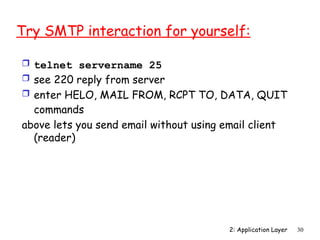
telnet servername 25
see 220 reply from server
enter HELO, MAIL FROM, RCPT TO, DATA, QUIT
commands
above lets you send email without using email client
(reader)
31.
2: Application Layer31
SMTP: final words
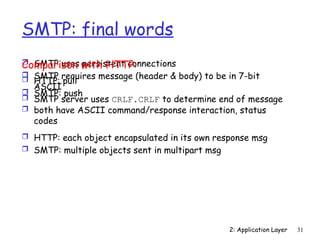
SMTP uses persistent connections
SMTP requires message (header & body) to be in 7-bit
ASCII
SMTP server uses CRLF.CRLF to determine end of message
Comparison with HTTP:
HTTP: pull
SMTP: push
both have ASCII command/response interaction, status
codes
HTTP: each object encapsulated in its own response msg
SMTP: multiple objects sent in multipart msg
32.
2: Application Layer32
Mail message format
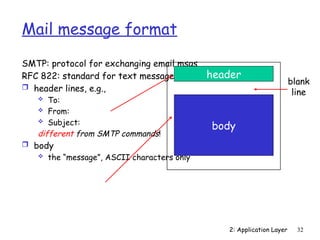
SMTP: protocol for exchanging email msgs
RFC 822: standard for text message format:
header lines, e.g.,
To:
From:
Subject:
different from SMTP commands!
body
the “message”, ASCII characters only
header
body
blank
line
33.
2: Application Layer33
Message format: multimedia extensions
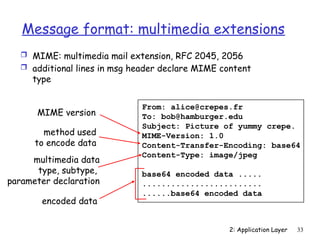
MIME: multimedia mail extension, RFC 2045, 2056
additional lines in msg header declare MIME content
type
From: alice@crepes.fr
To: bob@hamburger.edu
Subject: Picture of yummy crepe.
MIME-Version: 1.0
Content-Transfer-Encoding: base64
Content-Type: image/jpeg
base64 encoded data .....
.........................
......base64 encoded data
multimedia data
type, subtype,
parameter declaration
method used
to encode data
MIME version
encoded data
34.
2: Application Layer34
Mail access protocols
SMTP: delivery/storage to receiver’s server
Mail access protocol: retrieval from server
POP: Post Office Protocol [RFC 1939]
• authorization (agent <-->server) and download
IMAP: Internet Mail Access Protocol [RFC 1730]
• more features (more complex)
• manipulation of stored msgs on server
HTTP: gmail, Hotmail, Yahoo! Mail, etc.
user
agent
sender’s mail
server
user
agent
SMTP SMTP access
protocol
receiver’s mail
server
35.
2: Application Layer35
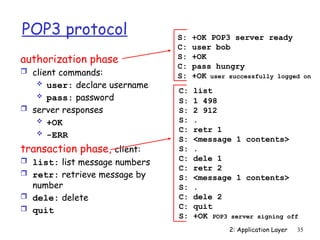
POP3 protocol
authorization phase
client commands:
user: declare username
pass: password
server responses
+OK
-ERR
transaction phase, client:
list: list message numbers
retr: retrieve message by
number
dele: delete
quit
C: list
S: 1 498
S: 2 912
S: .
C: retr 1
S: <message 1 contents>
S: .
C: dele 1
C: retr 2
S: <message 1 contents>
S: .
C: dele 2
C: quit
S: +OK POP3 server signing off
S: +OK POP3 server ready
C: user bob
S: +OK
C: pass hungry
S: +OK user successfully logged on
36.
2: Application Layer36
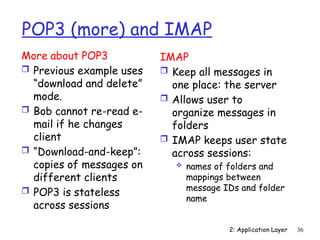
POP3 (more) and IMAP
More about POP3
Previous example uses
“download and delete”
mode.
Bob cannot re-read e-
mail if he changes
client
“Download-and-keep”:
copies of messages on
different clients
POP3 is stateless
across sessions
IMAP
Keep all messages in
one place: the server
Allows user to
organize messages in
folders
IMAP keeps user state
across sessions:
names of folders and
mappings between
message IDs and folder
name
37.
2: Application Layer37
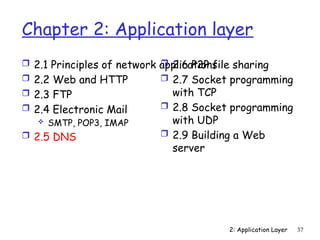
Chapter 2: Application layer
2.1 Principles of network applications
2.2 Web and HTTP
2.3 FTP
2.4 Electronic Mail
SMTP, POP3, IMAP
2.5 DNS
2.6 P2P file sharing
2.7 Socket programming
with TCP
2.8 Socket programming
with UDP
2.9 Building a Web
server
38.
2: Application Layer38
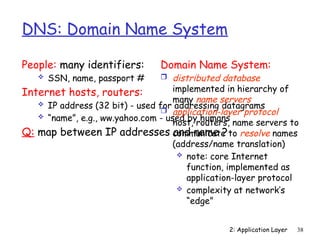
DNS: Domain Name System
People: many identifiers:
SSN, name, passport #
Internet hosts, routers:
IP address (32 bit) - used for addressing datagrams
“name”, e.g., ww.yahoo.com - used by humans
Q: map between IP addresses and name ?
Domain Name System:
distributed database
implemented in hierarchy of
many name servers
application-layer protocol
host, routers, name servers to
communicate to resolve names
(address/name translation)
note: core Internet
function, implemented as
application-layer protocol
complexity at network’s
“edge”
39.
2: Application Layer39
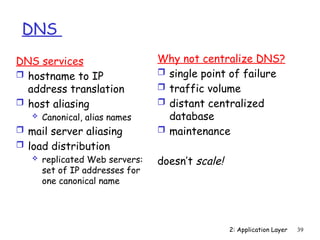
DNS
Why not centralize DNS?
single point of failure
traffic volume
distant centralized
database
maintenance
doesn’t scale!
DNS services
hostname to IP
address translation
host aliasing
Canonical, alias names
mail server aliasing
load distribution
replicated Web servers:
set of IP addresses for
one canonical name
40.
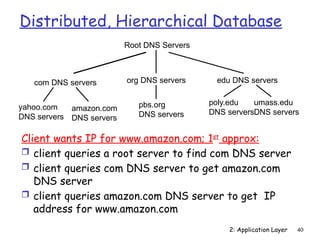
2: Application Layer40
Root DNS Servers
com DNS servers org DNS servers edu DNS servers
poly.edu
DNS servers
umass.edu
DNS servers
yahoo.com
DNS servers
amazon.com
DNS servers
pbs.org
DNS servers
Distributed, Hierarchical Database
Client wants IP for www.amazon.com; 1st
approx:
client queries a root server to find com DNS server
client queries com DNS server to get amazon.com
DNS server
client queries amazon.com DNS server to get IP
address for www.amazon.com
41.
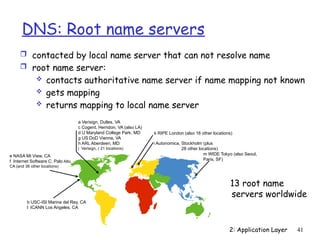
2: Application Layer41
DNS: Root name servers
contacted by local name server that can not resolve name
root name server:
contacts authoritative name server if name mapping not known
gets mapping
returns mapping to local name server
13 root name
servers worldwide
b USC-ISI Marina del Rey, CA
l ICANN Los Angeles, CA
e NASA Mt View, CA
f Internet Software C. Palo Alto,
CA (and 36 other locations)
i Autonomica, Stockholm (plus
28 other locations)
k RIPE London (also 16 other locations)
m WIDE Tokyo (also Seoul,
Paris, SF)
a Verisign, Dulles, VA
c Cogent, Herndon, VA (also LA)
d U Maryland College Park, MD
g US DoD Vienna, VA
h ARL Aberdeen, MD
j Verisign, ( 21 locations)
42.
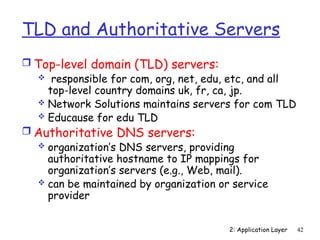
2: Application Layer42
TLD and Authoritative Servers
Top-level domain (TLD) servers:
responsible for com, org, net, edu, etc, and all
top-level country domains uk, fr, ca, jp.
Network Solutions maintains servers for com TLD
Educause for edu TLD
Authoritative DNS servers:
organization’s DNS servers, providing
authoritative hostname to IP mappings for
organization’s servers (e.g., Web, mail).
can be maintained by organization or service
provider
43.
2: Application Layer43
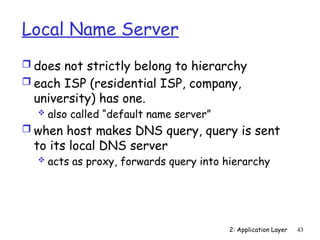
Local Name Server
does not strictly belong to hierarchy
each ISP (residential ISP, company,
university) has one.
also called “default name server”
when host makes DNS query, query is sent
to its local DNS server
acts as proxy, forwards query into hierarchy
44.
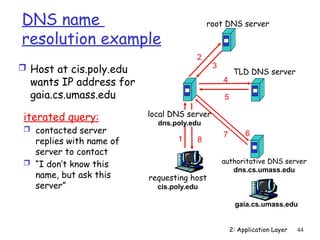
2: Application Layer44
requesting host
cis.poly.edu
gaia.cs.umass.edu
root DNS server
local DNS server
dns.poly.edu
1
2
3
4
5
6
authoritative DNS server
dns.cs.umass.edu
7
8
TLD DNS server
DNS name
resolution example
Host at cis.poly.edu
wants IP address for
gaia.cs.umass.edu
iterated query:
contacted server
replies with name of
server to contact
“I don’t know this
name, but ask this
server”
45.
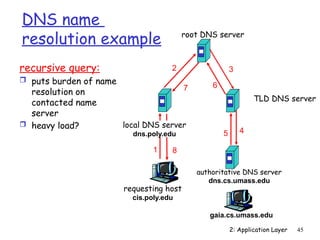
2: Application Layer45
requesting host
cis.poly.edu
gaia.cs.umass.edu
root DNS server
local DNS server
dns.poly.edu
1
2
4
5
6
authoritative DNS server
dns.cs.umass.edu
7
8
TLD DNS server
3
recursive query:
puts burden of name
resolution on
contacted name
server
heavy load?
DNS name
resolution example
46.
2: Application Layer46
DNS: caching and updating records
once (any) name server learns mapping, it caches
mapping
cache entries timeout (disappear) after some
time
TLD servers typically cached in local name
servers
• Thus root name servers not often visited
update/notify mechanisms under design by IETF
RFC 2136
http://www.ietf.org/html.charters/dnsind-charter.html
47.
2: Application Layer47
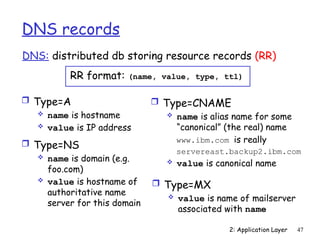
DNS records
DNS: distributed db storing resource records (RR)
Type=NS
name is domain (e.g.
foo.com)
value is hostname of
authoritative name
server for this domain
RR format: (name, value, type, ttl)
Type=A
name is hostname
value is IP address
Type=CNAME
name is alias name for some
“canonical” (the real) name
www.ibm.com is really
servereast.backup2.ibm.com
value is canonical name
Type=MX
value is name of mailserver
associated with name
48.
2: Application Layer48
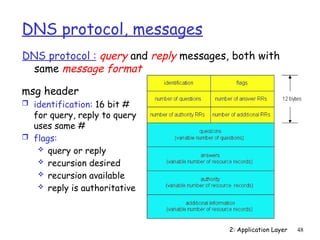
DNS protocol, messages
DNS protocol : query and reply messages, both with
same message format
msg header
identification: 16 bit #
for query, reply to query
uses same #
flags:
query or reply
recursion desired
recursion available
reply is authoritative
49.
2: Application Layer49
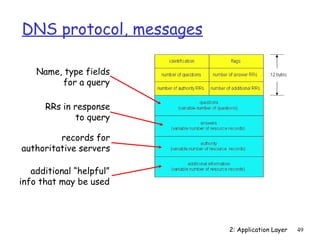
DNS protocol, messages
Name, type fields
for a query
RRs in response
to query
records for
authoritative servers
additional “helpful”
info that may be used
![2: Application Layer 27
Electronic Mail: SMTP [RFC 2821]
uses TCP to reliably transfer email message from client
to server, port 25
direct transfer: sending server to receiving server
three phases of transfer
handshaking (greeting)
transfer of messages
closure
command/response interaction
commands: ASCII text
response: status code and phrase
messages must be in 7-bit ASCII](https://image.slidesharecdn.com/01-251105074214-145a762e/85/01-_Application_Layer_Protocols-1-pptx-27-320.jpg)
![2: Application Layer 34
Mail access protocols
SMTP: delivery/storage to receiver’s server
Mail access protocol: retrieval from server
POP: Post Office Protocol [RFC 1939]
• authorization (agent <-->server) and download
IMAP: Internet Mail Access Protocol [RFC 1730]
• more features (more complex)
• manipulation of stored msgs on server
HTTP: gmail, Hotmail, Yahoo! Mail, etc.
user
agent
sender’s mail
server
user
agent
SMTP SMTP access
protocol
receiver’s mail
server](https://image.slidesharecdn.com/01-251105074214-145a762e/85/01-_Application_Layer_Protocols-1-pptx-34-320.jpg)