 SIMPLE PRESENT
 PAST SIMPLE
 FUTURE SIMPLE
1. THE SIMPLE PRESENT
Definition:
The Simple Present is the tense used:
• when we talk about actions that happen
in the present time,
• When we talk about general or scientific
realities,
• When we have time expressions that
indicate that we are talking about
the present time :
Today, everyday, rarely, usually,
sometimes, often, in a regular way…etc
1.1. Form of the Simple Present
Auxiliaries
to be
I am/ you are/ we are / they are/ he is
/ she is / it is.
to have
I have / you have / we have / they
have / he has / she has / it has.
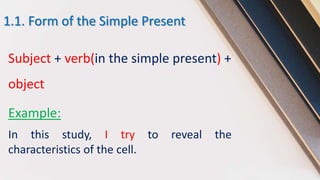
1.1. Form of the Simple Present
Subject + verb(in the simple present) +
object
Example:
In this study, I try to reveal the
characteristics of the cell.
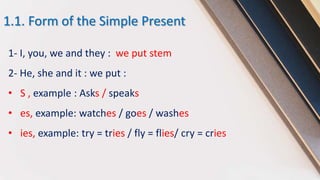
1.1. Form of the Simple Present
1- I, you, we and they : we put stem
2- He, she and it : we put :
• S , example : Asks / speaks
• es, example: watches / goes / washes
• ies, example: try = tries / fly = flies/ cry = cries
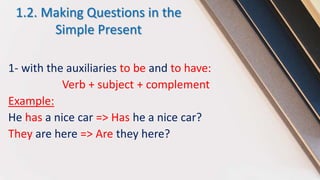
1.2. Making Questions in the
Simple Present
1- with the auxiliaries to be and to have:
Verb + subject + complement
Example:
He has a nice car => Has he a nice car?
They are here => Are they here?
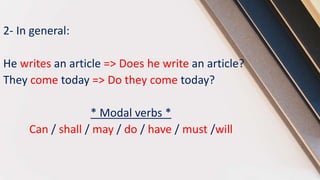
2- In general:
He writes an article => Does he write an article?
They come today => Do they come today?
* Modal verbs *
Can / shall / may / do / have / must /will
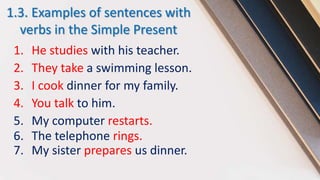
1.3. Examples of sentences with
verbs in the Simple Present
1. He studies with his teacher.
2. They take a swimming lesson.
3. I cook dinner for my family.
4. You talk to him.
5. My computer restarts.
6. The telephone rings.
7. My sister prepares us dinner.
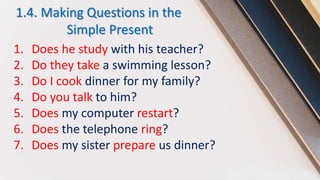
1.4. Making Questions in the
Simple Present
1. Does he study with his teacher?
2. Do they take a swimming lesson?
3. Do I cook dinner for my family?
4. Do you talk to him?
5. Does my computer restart?
6. Does the telephone ring?
7. Does my sister prepare us dinner?
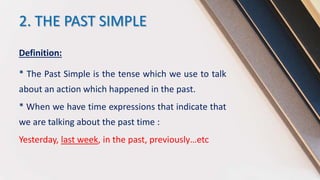
2. THE PAST SIMPLE
Definition:
* The Past Simple is the tense which we use to talk
about an action which happened in the past.
* When we have time expressions that indicate that
we are talking about the past time :
Yesterday, last week, in the past, previously…etc
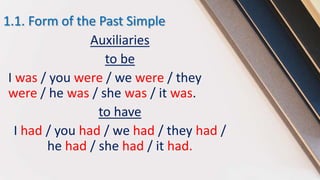
1.1. Form of the Past Simple
Auxiliaries
to be
I was / you were / we were / they
were / he was / she was / it was.
to have
I had / you had / we had / they had /
he had / she had / it had.
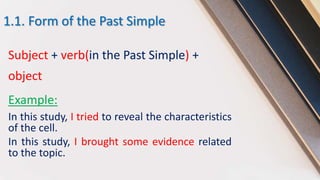
1.1. Form of the Past Simple
Subject + verb(in the Past Simple) +
object
Example:
In this study, I tried to reveal the characteristics
of the cell.
In this study, I brought some evidence related
to the topic.
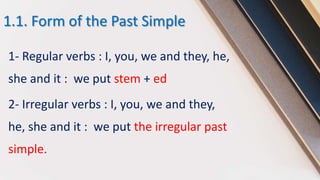
1.1. Form of the Past Simple
1- Regular verbs : I, you, we and they, he,
she and it : we put stem + ed
2- Irregular verbs : I, you, we and they,
he, she and it : we put the irregular past
simple.
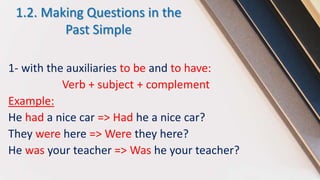
1.2. Making Questions in the
Past Simple
1- with the auxiliaries to be and to have:
Verb + subject + complement
Example:
He had a nice car => Had he a nice car?
They were here => Were they here?
He was your teacher => Was he your teacher?
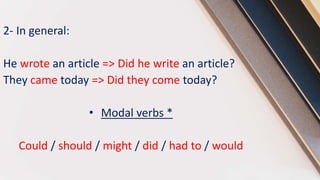
2- In general:
He wrote an article => Did he write an article?
They came today => Did they come today?
• Modal verbs *
Could / should / might / did / had to / would
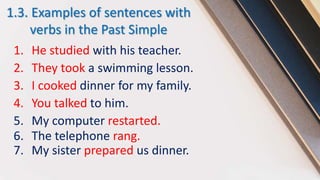
1.3. Examples of sentences with
verbs in the Past Simple
1. He studied with his teacher.
2. They took a swimming lesson.
3. I cooked dinner for my family.
4. You talked to him.
5. My computer restarted.
6. The telephone rang.
7. My sister prepared us dinner.
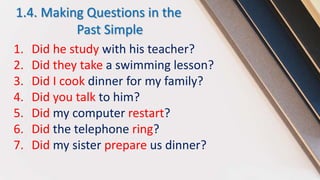
1.4. Making Questions in the
Past Simple
1. Did he study with his teacher?
2. Did they take a swimming lesson?
3. Did I cook dinner for my family?
4. Did you talk to him?
5. Did my computer restart?
6. Did the telephone ring?
7. Did my sister prepare us dinner?
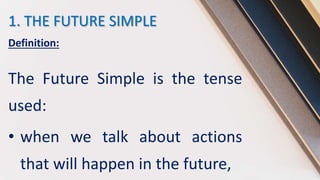
1. THE FUTURE SIMPLE
Definition:
The Future Simple is the tense
used:
• when we talk about actions
that will happen in the future,
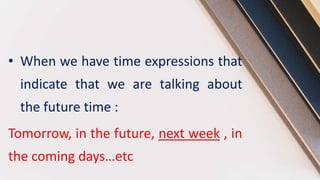
• When we have time expressions that
indicate that we are talking about
the future time :
Tomorrow, in the future, next week , in
the coming days…etc
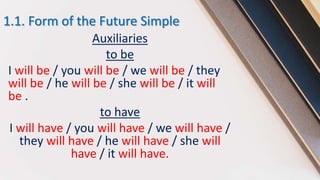
1.1. Form of the Future Simple
Auxiliaries
to be
I will be / you will be / we will be / they
will be / he will be / she will be / it will
be .
to have
I will have / you will have / we will have /
they will have / he will have / she will
have / it will have.
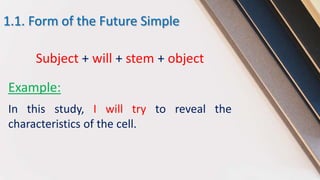
1.1. Form of the Future Simple
Subject + will + stem + object
Example:
In this study, I will try to reveal the
characteristics of the cell.
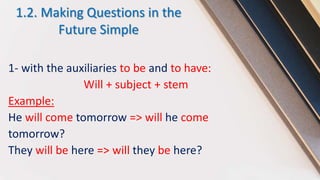
1.2. Making Questions in the
Future Simple
1- with the auxiliaries to be and to have:
Will + subject + stem
Example:
He will come tomorrow => will he come
tomorrow?
They will be here => will they be here?
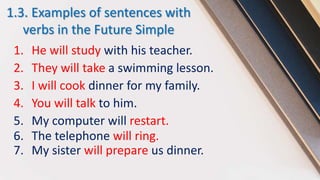
1.3. Examples of sentences with
verbs in the Future Simple
1. He will study with his teacher.
2. They will take a swimming lesson.
3. I will cook dinner for my family.
4. You will talk to him.
5. My computer will restart.
6. The telephone will ring.
7. My sister will prepare us dinner.
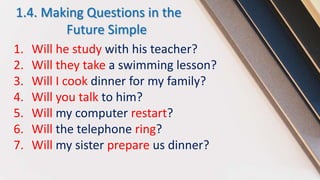
1.4. Making Questions in the
Future Simple
1. Will he study with his teacher?
2. Will they take a swimming lesson?
3. Will I cook dinner for my family?
4. Will you talk to him?
5. Will my computer restart?
6. Will the telephone ring?
7. Will my sister prepare us dinner?
Thank you
for your attention

002- Simple Present + Past Simple + Future Simple..pptx

  • 1.
     SIMPLE PRESENT PAST SIMPLE  FUTURE SIMPLE
  • 2.
    1. THE SIMPLEPRESENT Definition: The Simple Present is the tense used: • when we talk about actions that happen in the present time, • When we talk about general or scientific realities,
  • 3.
    • When wehave time expressions that indicate that we are talking about the present time : Today, everyday, rarely, usually, sometimes, often, in a regular way…etc
  • 4.
    1.1. Form ofthe Simple Present Auxiliaries to be I am/ you are/ we are / they are/ he is / she is / it is. to have I have / you have / we have / they have / he has / she has / it has.
  • 5.
    1.1. Form ofthe Simple Present Subject + verb(in the simple present) + object Example: In this study, I try to reveal the characteristics of the cell.
  • 6.
    1.1. Form ofthe Simple Present 1- I, you, we and they : we put stem 2- He, she and it : we put : • S , example : Asks / speaks • es, example: watches / goes / washes • ies, example: try = tries / fly = flies/ cry = cries
  • 7.
    1.2. Making Questionsin the Simple Present 1- with the auxiliaries to be and to have: Verb + subject + complement Example: He has a nice car => Has he a nice car? They are here => Are they here?
  • 8.
    2- In general: Hewrites an article => Does he write an article? They come today => Do they come today? * Modal verbs * Can / shall / may / do / have / must /will
  • 9.
    1.3. Examples ofsentences with verbs in the Simple Present 1. He studies with his teacher. 2. They take a swimming lesson. 3. I cook dinner for my family. 4. You talk to him. 5. My computer restarts. 6. The telephone rings. 7. My sister prepares us dinner.
  • 10.
    1.4. Making Questionsin the Simple Present 1. Does he study with his teacher? 2. Do they take a swimming lesson? 3. Do I cook dinner for my family? 4. Do you talk to him? 5. Does my computer restart? 6. Does the telephone ring? 7. Does my sister prepare us dinner?
  • 11.
    2. THE PASTSIMPLE Definition: * The Past Simple is the tense which we use to talk about an action which happened in the past. * When we have time expressions that indicate that we are talking about the past time : Yesterday, last week, in the past, previously…etc
  • 12.
    1.1. Form ofthe Past Simple Auxiliaries to be I was / you were / we were / they were / he was / she was / it was. to have I had / you had / we had / they had / he had / she had / it had.
  • 13.
    1.1. Form ofthe Past Simple Subject + verb(in the Past Simple) + object Example: In this study, I tried to reveal the characteristics of the cell. In this study, I brought some evidence related to the topic.
  • 14.
    1.1. Form ofthe Past Simple 1- Regular verbs : I, you, we and they, he, she and it : we put stem + ed 2- Irregular verbs : I, you, we and they, he, she and it : we put the irregular past simple.
  • 15.
    1.2. Making Questionsin the Past Simple 1- with the auxiliaries to be and to have: Verb + subject + complement Example: He had a nice car => Had he a nice car? They were here => Were they here? He was your teacher => Was he your teacher?
  • 16.
    2- In general: Hewrote an article => Did he write an article? They came today => Did they come today? • Modal verbs * Could / should / might / did / had to / would
  • 17.
    1.3. Examples ofsentences with verbs in the Past Simple 1. He studied with his teacher. 2. They took a swimming lesson. 3. I cooked dinner for my family. 4. You talked to him. 5. My computer restarted. 6. The telephone rang. 7. My sister prepared us dinner.
  • 18.
    1.4. Making Questionsin the Past Simple 1. Did he study with his teacher? 2. Did they take a swimming lesson? 3. Did I cook dinner for my family? 4. Did you talk to him? 5. Did my computer restart? 6. Did the telephone ring? 7. Did my sister prepare us dinner?
  • 19.
    1. THE FUTURESIMPLE Definition: The Future Simple is the tense used: • when we talk about actions that will happen in the future,
  • 20.
    • When wehave time expressions that indicate that we are talking about the future time : Tomorrow, in the future, next week , in the coming days…etc
  • 21.
    1.1. Form ofthe Future Simple Auxiliaries to be I will be / you will be / we will be / they will be / he will be / she will be / it will be . to have I will have / you will have / we will have / they will have / he will have / she will have / it will have.
  • 22.
    1.1. Form ofthe Future Simple Subject + will + stem + object Example: In this study, I will try to reveal the characteristics of the cell.
  • 23.
    1.2. Making Questionsin the Future Simple 1- with the auxiliaries to be and to have: Will + subject + stem Example: He will come tomorrow => will he come tomorrow? They will be here => will they be here?
  • 24.
    1.3. Examples ofsentences with verbs in the Future Simple 1. He will study with his teacher. 2. They will take a swimming lesson. 3. I will cook dinner for my family. 4. You will talk to him. 5. My computer will restart. 6. The telephone will ring. 7. My sister will prepare us dinner.
  • 25.
    1.4. Making Questionsin the Future Simple 1. Will he study with his teacher? 2. Will they take a swimming lesson? 3. Will I cook dinner for my family? 4. Will you talk to him? 5. Will my computer restart? 6. Will the telephone ring? 7. Will my sister prepare us dinner?
  • 26.