STRING
MANIPULATION
VINOD KUMARVERMA, PGT(CS), KV OEF KANPUR &
SACHIN BHARDWAJ, PGT(CS), KV NO.1 TEZPUR
for more updates visit: www.python4csip.com
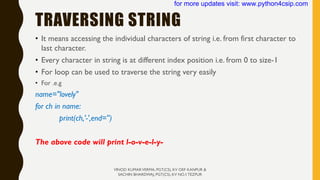
TRAVERSING STRING
• It means accessing the individual characters of string i.e. from first character to
last character.
• Every character in string is at different index position i.e. from 0 to size-1
• For loop can be used to traverse the string very easily
• For .e.g
name="lovely"
for ch in name:
print(ch,'-',end='')
The above code will print l-o-v-e-l-y-
VINOD KUMARVERMA, PGT(CS), KV OEF KANPUR &
SACHIN BHARDWAJ, PGT(CS), KV NO.1 TEZPUR
for more updates visit: www.python4csip.com
PROGRAM TO READ STRING AND
PRINT IN REVERSE ORDER
string1 = input("Enter any string ")
print("The Reverse of ", string1 , " is :")
length=len(string1)
for ch in range(-1,(-length-1),-1):
print(string1[ch])
The above code will print
Enter any string: karan
n
a
r
a
k VINOD KUMARVERMA, PGT(CS), KV OEF KANPUR &
SACHIN BHARDWAJ, PGT(CS), KV NO.1 TEZPUR
for more updates visit: www.python4csip.com
PROGRAM TO INPUT STRING AND
PRINT SHORT FORM
string=input("Enter any string ")
print(string[0],".",end='')
for ch in range(1,len(string)):
if string[ch]==' ':
print(string[ch+1],".",end='')
VINOD KUMARVERMA, PGT(CS), KV OEF KANPUR &
SACHIN BHARDWAJ, PGT(CS), KV NO.1 TEZPUR
for more updates visit: www.python4csip.com
PROGRAM TO INPUT ANY STRING AND
COUNT HOW MANY VOWELS IN IT
VINOD KUMARVERMA, PGT(CS), KV OEF KANPUR &
SACHIN BHARDWAJ, PGT(CS), KV NO.1 TEZPUR
for more updates visit: www.python4csip.com
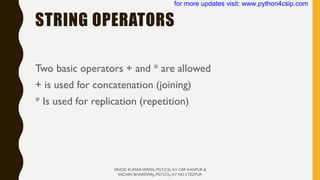
STRING OPERATORS
Two basic operators + and * are allowed
+ is used for concatenation (joining)
* Is used for replication (repetition)
VINOD KUMARVERMA, PGT(CS), KV OEF KANPUR &
SACHIN BHARDWAJ, PGT(CS), KV NO.1 TEZPUR
for more updates visit: www.python4csip.com
EXAMPLE
A=“Tom”
B=“Jerry”
C=A+” & ”+B
print(C)
Note: you cannot add number and string using +
VINOD KUMARVERMA, PGT(CS), KV OEF KANPUR &
SACHIN BHARDWAJ, PGT(CS), KV NO.1 TEZPUR
for more updates visit: www.python4csip.com
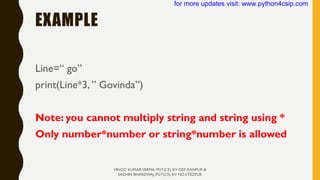
EXAMPLE
Line=“ go”
print(Line*3, ” Govinda”)
Note: you cannot multiply string and string using *
Only number*number or string*number is allowed
VINOD KUMARVERMA, PGT(CS), KV OEF KANPUR &
SACHIN BHARDWAJ, PGT(CS), KV NO.1 TEZPUR
for more updates visit: www.python4csip.com
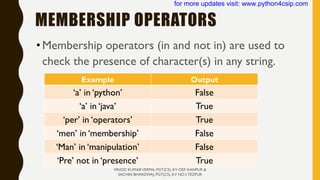
MEMBERSHIP OPERATORS
•Membership operators (in and not in) are used to
check the presence of character(s) in any string.
Example Output
„a‟ in „python‟ False
„a‟ in „java‟ True
„per‟ in „operators‟ True
„men‟ in „membership‟ False
„Man‟ in „manipulation‟ False
„Pre‟ not in „presence‟ True
VINOD KUMARVERMA, PGT(CS), KV OEF KANPUR &
SACHIN BHARDWAJ, PGT(CS), KV NO.1 TEZPUR
for more updates visit: www.python4csip.com
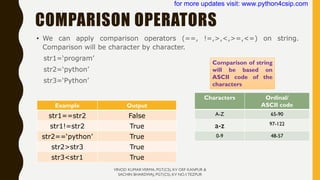
COMPARISON OPERATORS
• We can apply comparison operators (==, !=,>,<,>=,<=) on string.
Comparison will be character by character.
str1=„program‟
str2=„python‟
str3=„Python‟
Example Output
str1==str2 False
str1!=str2 True
str2==„python‟ True
str2>str3 True
str3<str1 True
Comparison of string
will be based on
ASCII code of the
characters
Characters Ordinal/
ASCII code
A-Z 65-90
a-z 97-122
0-9 48-57
VINOD KUMARVERMA, PGT(CS), KV OEF KANPUR &
SACHIN BHARDWAJ, PGT(CS), KV NO.1 TEZPUR
for more updates visit: www.python4csip.com
DETERMINING ORDINAL / UNICODE OF
A SINGLE CHARACTER
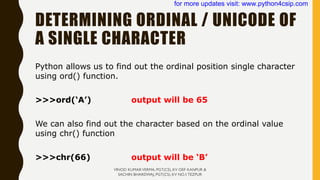
Python allows us to find out the ordinal position single character
using ord() function.
>>>ord(‘A’) output will be 65
We can also find out the character based on the ordinal value
using chr() function
>>>chr(66) output will be ‘B’
VINOD KUMARVERMA, PGT(CS), KV OEF KANPUR &
SACHIN BHARDWAJ, PGT(CS), KV NO.1 TEZPUR
for more updates visit: www.python4csip.com
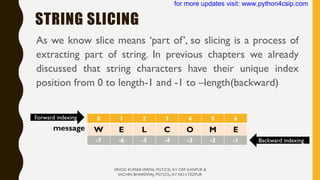
STRING SLICING
As we know slice means „part of‟, so slicing is a process of
extracting part of string. In previous chapters we already
discussed that string characters have their unique index
position from 0 to length-1 and -1 to –length(backward)
0 1 2 3 4 5 6
W E L C O M E
-7 -6 -5 -4 -3 -2 -1
Forward indexing
message
Backward indexing
VINOD KUMARVERMA, PGT(CS), KV OEF KANPUR &
SACHIN BHARDWAJ, PGT(CS), KV NO.1 TEZPUR
for more updates visit: www.python4csip.com
STRING SLICING
>>> str1="wonderful"
>>> str1[0:6]
'wonder'
>>> str1[0:3]
'won'
>>> str1[3:6]
'der'
>>> str1[-1:-3]
''
>>> str1[-3:-1]
'fu'
>>> str1[-3:0]
'‘
>>>str1[0::2]
‘Wnefl’
>>> str1[3:3]
''
>>> str1[3:4]
'd'
>>> str1[-5:-2]
'erf'
>>> str1[:-2]
'wonderf'
>>> str1[:4]
'wond‘
>>> str1[-3:]
'ful‘
>>>str1[::-1]
lufrednow
Reverse
of string
VINOD KUMARVERMA, PGT(CS), KV OEF KANPUR &
SACHIN BHARDWAJ, PGT(CS), KV NO.1 TEZPUR
for more updates visit: www.python4csip.com
INTERESTING STRING SLICING
For any index position n: str1[:n]+str1[n:] will give you the
original string
>>>str1=“wonderful”
>>>str1[:n]+str[n:] output will be wonderful
String slicing will never return error even if you pass index
which is not in the string . For e.g.
>>>str1[10] will give error, but
>>>str1[10:15] will not give error but return empty
string
VINOD KUMARVERMA, PGT(CS), KV OEF KANPUR &
SACHIN BHARDWAJ, PGT(CS), KV NO.1 TEZPUR
for more updates visit: www.python4csip.com
PROGRAMS
Program to print the pattern
@
@@
@@@
@@@@
@@@@@
string='#'
pattern=''
for i in range(5):
pattern+=string
print(pattern)
Program to input name and print
as (if name is ‘AAMIR’), output
A
AA
AAM
AAMI
AAMIR
name=input("Enter any name")
for i in range(0,len(name)+1):
print(name[0:i])
VINOD KUMARVERMA, PGT(CS), KV OEF KANPUR &
SACHIN BHARDWAJ, PGT(CS), KV NO.1 TEZPUR
for more updates visit: www.python4csip.com
STRING FUNCTIONS AND METHODS
Python offers many built-in function for string manipulation. One
method len() we have already used. Let us understand other
methods also.
To use string manipulation function the syntax is:
String_Object.functionName()
VINOD KUMARVERMA, PGT(CS), KV OEF KANPUR &
SACHIN BHARDWAJ, PGT(CS), KV NO.1 TEZPUR
for more updates visit: www.python4csip.com
STRING FUNCTIONS/METHODS
• len(string) : this function returns the number of characters in any string
including spaces.
• capitalize() : this function is used to convert the first letter of sentence in
capital letter.
• title() : this function is used to convert first letter of every word in string in
capital letters.
• upper() : this function is used to convert the entire string in capital letter.
VINOD KUMARVERMA, PGT(CS), KV OEF KANPUR &
SACHIN BHARDWAJ, PGT(CS), KV NO.1 TEZPUR
for more updates visit: www.python4csip.com
STRING FUNCTIONS/METHODS
• lower() : this function is used to convert the entire string in small letter.
• count(substring, [start,[end]]) : this function is used to find the number of
occurrence of substring in our string. We can give optional starting index from
where searching begin and also end index i.e. upto what index in string it will
search and count. It return 0 if substring not found.
• find(substring,[start,[end]]) : this function returns the index position of
substring in the given string. We can also specify start and end index just like
count() to modify search criteria. It return -1 if substring not found/
VINOD KUMARVERMA, PGT(CS), KV OEF KANPUR &
SACHIN BHARDWAJ, PGT(CS), KV NO.1 TEZPUR
for more updates visit: www.python4csip.com
STRING FUNCTIONS/METHODS
• index(substring) : this function return index position of substring. If
substring not it returns error ‘substring not found’
• isalnum() : this function is used to check where string contain all character
as alphanumeric or not. Its return is either True or False.
• islower(): this function return True if all the characters in string is in small
letters
• isupper() : this function return True if all the characters in string is in capital
letters. Both islower() and isupper() will check the case only for letter, if any
symbol present in string it will be ignored.
VINOD KUMARVERMA, PGT(CS), KV OEF KANPUR &
SACHIN BHARDWAJ, PGT(CS), KV NO.1 TEZPUR
for more updates visit: www.python4csip.com
STRING FUNCTIONS/METHODS
• isspace() :.it return True if the string contains only space.
• isalpha() : it return True if all the characters in string is alphabet.
• isdigit() : it returns True if all the characters in string is digit.
VINOD KUMARVERMA, PGT(CS), KV OEF KANPUR &
SACHIN BHARDWAJ, PGT(CS), KV NO.1 TEZPUR
for more updates visit: www.python4csip.com
STRING FUNCTIONS/METHODS
• split() : this function is used to split the string based on delimiter and store
the result in the form of list. Default delimiter is space.
• partition(sep) : this function divides the string in the form of tuples of 3
elements known as head, sep and tail. All the string before sep becomes
head and all the string after sep becomes tail. If sep is not present in the
string then everything will becomes head, sep and tail will be empty.
VINOD KUMARVERMA, PGT(CS), KV OEF KANPUR &
SACHIN BHARDWAJ, PGT(CS), KV NO.1 TEZPUR
for more updates visit: www.python4csip.com
STRING FUNCTIONS/METHODS
• strip([chars]) : it return a copy of string with leading and trailing whitespaces
removed. If chars is given, it remove characters instead.
• lstrip([chars]) : it return a copy of string with leading whitespaces removed. If
chars is given, it remove characters instead.
• rstrip([chars]) : it return a copy of string with trailing whitespaces removed. If
chars is given, it remove characters instead.
• Note: if chars is given in any strip() function, the chars are checked for all the
possible combination that can be formed with the given chars. For e.g. if NOT
is passed as char then NOT, OTN, TON, TNO, ONT,NT like this every possible
combination will be checked.
VINOD KUMARVERMA, PGT(CS), KV OEF KANPUR &
SACHIN BHARDWAJ, PGT(CS), KV NO.1 TEZPUR
for more updates visit: www.python4csip.com
STRING FUNCTION / METHODS
• replace(old, new) : this function is used to replace old text inside the string
with new text.
for more updates visit: www.python4csip.com
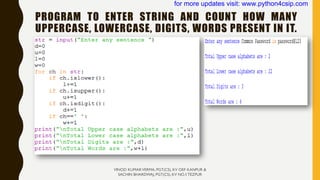
PROGRAM TO ENTER STRING AND COUNT HOW MANY
UPPERCASE, LOWERCASE, DIGITS, WORDS PRESENT IN IT.
VINOD KUMARVERMA, PGT(CS), KV OEF KANPUR &
SACHIN BHARDWAJ, PGT(CS), KV NO.1 TEZPUR
for more updates visit: www.python4csip.com
PROGRAM TO ENTER STRING AND FIND THE NUMBER OF
OCCURANCE OF ANY WORD
VINOD KUMARVERMA, PGT(CS), KV OEF KANPUR &
SACHIN BHARDWAJ, PGT(CS), KV NO.1 TEZPUR
for more updates visit: www.python4csip.com
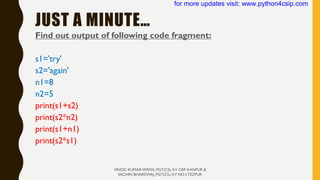
JUST A MINUTE…
Find out output of following code fragment:
s1='try'
s2='again'
n1=8
n2=5
print(s1+s2)
print(s2*n2)
print(s1+n1)
print(s2*s1)
VINOD KUMARVERMA, PGT(CS), KV OEF KANPUR &
SACHIN BHARDWAJ, PGT(CS), KV NO.1 TEZPUR
for more updates visit: www.python4csip.com
CONSIDER THE FOLLOWING CODE: WHAT WILL BE THE
OUTPUT IF INPUT IS
string = input("Enter a string :")
count=3
whileTrue:
if string[0]=='a':
string = string[2:]
elif string[-1] == 'b':
string=string[:2]
else:
count+=1
break
print(string)
print(count)
(i) aabbcc (ii) aaccbb (iii) abcc
VINOD KUMARVERMA, PGT(CS), KV OEF KANPUR &
SACHIN BHARDWAJ, PGT(CS), KV NO.1 TEZPUR
for more updates visit: www.python4csip.com
CONSIDER THE FOLLOWING CODE: WHAT WILL BE THE
OUTPUT IF INPUT IS
string = input("Enter a string :")
count=3
whileTrue:
if string[0]=='a':
string = string[2:]
elif string[-1] == 'b':
string=string[:2]
else:
count+=1
break
print(string)
print(count)
(i) aabbcc (ii) aaccbb (iii) abcc
If input is aabbcc, output will be
bbcc
4
If input is aaccbb, output will be
cc
4
If input is abcc, output will be
cc
4
VINOD KUMARVERMA, PGT(CS), KV OEF KANPUR &
SACHIN BHARDWAJ, PGT(CS), KV NO.1 TEZPUR
for more updates visit: www.python4csip.com
WHAT WOULD FOLLOWING EXPRESSION RETURN?
a) “HelloWorld”.upper().lower()
b) “HelloWorld”.lower().upper()
c) “HelloWorld”.find(“Wor”,1,6)
d) “HelloWorld”.find(„Wor‟)
e) “HelloWorld”.find(„wor‟)
f) “HelloWorld”.isalpha()
g) “HelloWorld”.isalnum()
h) “1234”.isdigit()
i) “123GH”.isdigit()
VINOD KUMARVERMA, PGT(CS), KV OEF KANPUR &
SACHIN BHARDWAJ, PGT(CS), KV NO.1 TEZPUR
for more updates visit: www.python4csip.com
OUTPUT?
(a)
s="0123456789"
print(s[3],',',s[0:3],'-',s[2:5])
print(s[:3],',',s[3:],'-',s[3:100])
print(s[20:],',',s[2:1],'-',s[1:1])
(b)
y=str(123)
x="hello"*3
print(x,y)
x = "hello" + "world"
y=len(x)
print(y,x)
VINOD KUMARVERMA, PGT(CS), KV OEF KANPUR &
SACHIN BHARDWAJ, PGT(CS), KV NO.1 TEZPUR
for more updates visit: www.python4csip.com

00012.PYTHON - STRING MANIPULATION SLIDES

  • 1.
    STRING MANIPULATION VINOD KUMARVERMA, PGT(CS),KV OEF KANPUR & SACHIN BHARDWAJ, PGT(CS), KV NO.1 TEZPUR for more updates visit: www.python4csip.com
  • 2.
    TRAVERSING STRING • Itmeans accessing the individual characters of string i.e. from first character to last character. • Every character in string is at different index position i.e. from 0 to size-1 • For loop can be used to traverse the string very easily • For .e.g name="lovely" for ch in name: print(ch,'-',end='') The above code will print l-o-v-e-l-y- VINOD KUMARVERMA, PGT(CS), KV OEF KANPUR & SACHIN BHARDWAJ, PGT(CS), KV NO.1 TEZPUR for more updates visit: www.python4csip.com
  • 3.
    PROGRAM TO READSTRING AND PRINT IN REVERSE ORDER string1 = input("Enter any string ") print("The Reverse of ", string1 , " is :") length=len(string1) for ch in range(-1,(-length-1),-1): print(string1[ch]) The above code will print Enter any string: karan n a r a k VINOD KUMARVERMA, PGT(CS), KV OEF KANPUR & SACHIN BHARDWAJ, PGT(CS), KV NO.1 TEZPUR for more updates visit: www.python4csip.com
  • 4.
    PROGRAM TO INPUTSTRING AND PRINT SHORT FORM string=input("Enter any string ") print(string[0],".",end='') for ch in range(1,len(string)): if string[ch]==' ': print(string[ch+1],".",end='') VINOD KUMARVERMA, PGT(CS), KV OEF KANPUR & SACHIN BHARDWAJ, PGT(CS), KV NO.1 TEZPUR for more updates visit: www.python4csip.com
  • 5.
    PROGRAM TO INPUTANY STRING AND COUNT HOW MANY VOWELS IN IT VINOD KUMARVERMA, PGT(CS), KV OEF KANPUR & SACHIN BHARDWAJ, PGT(CS), KV NO.1 TEZPUR for more updates visit: www.python4csip.com
  • 6.
    STRING OPERATORS Two basicoperators + and * are allowed + is used for concatenation (joining) * Is used for replication (repetition) VINOD KUMARVERMA, PGT(CS), KV OEF KANPUR & SACHIN BHARDWAJ, PGT(CS), KV NO.1 TEZPUR for more updates visit: www.python4csip.com
  • 7.
    EXAMPLE A=“Tom” B=“Jerry” C=A+” & ”+B print(C) Note:you cannot add number and string using + VINOD KUMARVERMA, PGT(CS), KV OEF KANPUR & SACHIN BHARDWAJ, PGT(CS), KV NO.1 TEZPUR for more updates visit: www.python4csip.com
  • 8.
    EXAMPLE Line=“ go” print(Line*3, ”Govinda”) Note: you cannot multiply string and string using * Only number*number or string*number is allowed VINOD KUMARVERMA, PGT(CS), KV OEF KANPUR & SACHIN BHARDWAJ, PGT(CS), KV NO.1 TEZPUR for more updates visit: www.python4csip.com
  • 9.
    MEMBERSHIP OPERATORS •Membership operators(in and not in) are used to check the presence of character(s) in any string. Example Output „a‟ in „python‟ False „a‟ in „java‟ True „per‟ in „operators‟ True „men‟ in „membership‟ False „Man‟ in „manipulation‟ False „Pre‟ not in „presence‟ True VINOD KUMARVERMA, PGT(CS), KV OEF KANPUR & SACHIN BHARDWAJ, PGT(CS), KV NO.1 TEZPUR for more updates visit: www.python4csip.com
  • 10.
    COMPARISON OPERATORS • Wecan apply comparison operators (==, !=,>,<,>=,<=) on string. Comparison will be character by character. str1=„program‟ str2=„python‟ str3=„Python‟ Example Output str1==str2 False str1!=str2 True str2==„python‟ True str2>str3 True str3<str1 True Comparison of string will be based on ASCII code of the characters Characters Ordinal/ ASCII code A-Z 65-90 a-z 97-122 0-9 48-57 VINOD KUMARVERMA, PGT(CS), KV OEF KANPUR & SACHIN BHARDWAJ, PGT(CS), KV NO.1 TEZPUR for more updates visit: www.python4csip.com
  • 11.
    DETERMINING ORDINAL /UNICODE OF A SINGLE CHARACTER Python allows us to find out the ordinal position single character using ord() function. >>>ord(‘A’) output will be 65 We can also find out the character based on the ordinal value using chr() function >>>chr(66) output will be ‘B’ VINOD KUMARVERMA, PGT(CS), KV OEF KANPUR & SACHIN BHARDWAJ, PGT(CS), KV NO.1 TEZPUR for more updates visit: www.python4csip.com
  • 12.
    STRING SLICING As weknow slice means „part of‟, so slicing is a process of extracting part of string. In previous chapters we already discussed that string characters have their unique index position from 0 to length-1 and -1 to –length(backward) 0 1 2 3 4 5 6 W E L C O M E -7 -6 -5 -4 -3 -2 -1 Forward indexing message Backward indexing VINOD KUMARVERMA, PGT(CS), KV OEF KANPUR & SACHIN BHARDWAJ, PGT(CS), KV NO.1 TEZPUR for more updates visit: www.python4csip.com
  • 13.
    STRING SLICING >>> str1="wonderful" >>>str1[0:6] 'wonder' >>> str1[0:3] 'won' >>> str1[3:6] 'der' >>> str1[-1:-3] '' >>> str1[-3:-1] 'fu' >>> str1[-3:0] '‘ >>>str1[0::2] ‘Wnefl’ >>> str1[3:3] '' >>> str1[3:4] 'd' >>> str1[-5:-2] 'erf' >>> str1[:-2] 'wonderf' >>> str1[:4] 'wond‘ >>> str1[-3:] 'ful‘ >>>str1[::-1] lufrednow Reverse of string VINOD KUMARVERMA, PGT(CS), KV OEF KANPUR & SACHIN BHARDWAJ, PGT(CS), KV NO.1 TEZPUR for more updates visit: www.python4csip.com
  • 14.
    INTERESTING STRING SLICING Forany index position n: str1[:n]+str1[n:] will give you the original string >>>str1=“wonderful” >>>str1[:n]+str[n:] output will be wonderful String slicing will never return error even if you pass index which is not in the string . For e.g. >>>str1[10] will give error, but >>>str1[10:15] will not give error but return empty string VINOD KUMARVERMA, PGT(CS), KV OEF KANPUR & SACHIN BHARDWAJ, PGT(CS), KV NO.1 TEZPUR for more updates visit: www.python4csip.com
  • 15.
    PROGRAMS Program to printthe pattern @ @@ @@@ @@@@ @@@@@ string='#' pattern='' for i in range(5): pattern+=string print(pattern) Program to input name and print as (if name is ‘AAMIR’), output A AA AAM AAMI AAMIR name=input("Enter any name") for i in range(0,len(name)+1): print(name[0:i]) VINOD KUMARVERMA, PGT(CS), KV OEF KANPUR & SACHIN BHARDWAJ, PGT(CS), KV NO.1 TEZPUR for more updates visit: www.python4csip.com
  • 16.
    STRING FUNCTIONS ANDMETHODS Python offers many built-in function for string manipulation. One method len() we have already used. Let us understand other methods also. To use string manipulation function the syntax is: String_Object.functionName() VINOD KUMARVERMA, PGT(CS), KV OEF KANPUR & SACHIN BHARDWAJ, PGT(CS), KV NO.1 TEZPUR for more updates visit: www.python4csip.com
  • 17.
    STRING FUNCTIONS/METHODS • len(string): this function returns the number of characters in any string including spaces. • capitalize() : this function is used to convert the first letter of sentence in capital letter. • title() : this function is used to convert first letter of every word in string in capital letters. • upper() : this function is used to convert the entire string in capital letter. VINOD KUMARVERMA, PGT(CS), KV OEF KANPUR & SACHIN BHARDWAJ, PGT(CS), KV NO.1 TEZPUR for more updates visit: www.python4csip.com
  • 18.
    STRING FUNCTIONS/METHODS • lower(): this function is used to convert the entire string in small letter. • count(substring, [start,[end]]) : this function is used to find the number of occurrence of substring in our string. We can give optional starting index from where searching begin and also end index i.e. upto what index in string it will search and count. It return 0 if substring not found. • find(substring,[start,[end]]) : this function returns the index position of substring in the given string. We can also specify start and end index just like count() to modify search criteria. It return -1 if substring not found/ VINOD KUMARVERMA, PGT(CS), KV OEF KANPUR & SACHIN BHARDWAJ, PGT(CS), KV NO.1 TEZPUR for more updates visit: www.python4csip.com
  • 19.
    STRING FUNCTIONS/METHODS • index(substring): this function return index position of substring. If substring not it returns error ‘substring not found’ • isalnum() : this function is used to check where string contain all character as alphanumeric or not. Its return is either True or False. • islower(): this function return True if all the characters in string is in small letters • isupper() : this function return True if all the characters in string is in capital letters. Both islower() and isupper() will check the case only for letter, if any symbol present in string it will be ignored. VINOD KUMARVERMA, PGT(CS), KV OEF KANPUR & SACHIN BHARDWAJ, PGT(CS), KV NO.1 TEZPUR for more updates visit: www.python4csip.com
  • 20.
    STRING FUNCTIONS/METHODS • isspace():.it return True if the string contains only space. • isalpha() : it return True if all the characters in string is alphabet. • isdigit() : it returns True if all the characters in string is digit. VINOD KUMARVERMA, PGT(CS), KV OEF KANPUR & SACHIN BHARDWAJ, PGT(CS), KV NO.1 TEZPUR for more updates visit: www.python4csip.com
  • 21.
    STRING FUNCTIONS/METHODS • split(): this function is used to split the string based on delimiter and store the result in the form of list. Default delimiter is space. • partition(sep) : this function divides the string in the form of tuples of 3 elements known as head, sep and tail. All the string before sep becomes head and all the string after sep becomes tail. If sep is not present in the string then everything will becomes head, sep and tail will be empty. VINOD KUMARVERMA, PGT(CS), KV OEF KANPUR & SACHIN BHARDWAJ, PGT(CS), KV NO.1 TEZPUR for more updates visit: www.python4csip.com
  • 22.
    STRING FUNCTIONS/METHODS • strip([chars]): it return a copy of string with leading and trailing whitespaces removed. If chars is given, it remove characters instead. • lstrip([chars]) : it return a copy of string with leading whitespaces removed. If chars is given, it remove characters instead. • rstrip([chars]) : it return a copy of string with trailing whitespaces removed. If chars is given, it remove characters instead. • Note: if chars is given in any strip() function, the chars are checked for all the possible combination that can be formed with the given chars. For e.g. if NOT is passed as char then NOT, OTN, TON, TNO, ONT,NT like this every possible combination will be checked. VINOD KUMARVERMA, PGT(CS), KV OEF KANPUR & SACHIN BHARDWAJ, PGT(CS), KV NO.1 TEZPUR for more updates visit: www.python4csip.com
  • 23.
    STRING FUNCTION /METHODS • replace(old, new) : this function is used to replace old text inside the string with new text. for more updates visit: www.python4csip.com
  • 24.
    PROGRAM TO ENTERSTRING AND COUNT HOW MANY UPPERCASE, LOWERCASE, DIGITS, WORDS PRESENT IN IT. VINOD KUMARVERMA, PGT(CS), KV OEF KANPUR & SACHIN BHARDWAJ, PGT(CS), KV NO.1 TEZPUR for more updates visit: www.python4csip.com
  • 25.
    PROGRAM TO ENTERSTRING AND FIND THE NUMBER OF OCCURANCE OF ANY WORD VINOD KUMARVERMA, PGT(CS), KV OEF KANPUR & SACHIN BHARDWAJ, PGT(CS), KV NO.1 TEZPUR for more updates visit: www.python4csip.com
  • 26.
    JUST A MINUTE… Findout output of following code fragment: s1='try' s2='again' n1=8 n2=5 print(s1+s2) print(s2*n2) print(s1+n1) print(s2*s1) VINOD KUMARVERMA, PGT(CS), KV OEF KANPUR & SACHIN BHARDWAJ, PGT(CS), KV NO.1 TEZPUR for more updates visit: www.python4csip.com
  • 27.
    CONSIDER THE FOLLOWINGCODE: WHAT WILL BE THE OUTPUT IF INPUT IS string = input("Enter a string :") count=3 whileTrue: if string[0]=='a': string = string[2:] elif string[-1] == 'b': string=string[:2] else: count+=1 break print(string) print(count) (i) aabbcc (ii) aaccbb (iii) abcc VINOD KUMARVERMA, PGT(CS), KV OEF KANPUR & SACHIN BHARDWAJ, PGT(CS), KV NO.1 TEZPUR for more updates visit: www.python4csip.com
  • 28.
    CONSIDER THE FOLLOWINGCODE: WHAT WILL BE THE OUTPUT IF INPUT IS string = input("Enter a string :") count=3 whileTrue: if string[0]=='a': string = string[2:] elif string[-1] == 'b': string=string[:2] else: count+=1 break print(string) print(count) (i) aabbcc (ii) aaccbb (iii) abcc If input is aabbcc, output will be bbcc 4 If input is aaccbb, output will be cc 4 If input is abcc, output will be cc 4 VINOD KUMARVERMA, PGT(CS), KV OEF KANPUR & SACHIN BHARDWAJ, PGT(CS), KV NO.1 TEZPUR for more updates visit: www.python4csip.com
  • 29.
    WHAT WOULD FOLLOWINGEXPRESSION RETURN? a) “HelloWorld”.upper().lower() b) “HelloWorld”.lower().upper() c) “HelloWorld”.find(“Wor”,1,6) d) “HelloWorld”.find(„Wor‟) e) “HelloWorld”.find(„wor‟) f) “HelloWorld”.isalpha() g) “HelloWorld”.isalnum() h) “1234”.isdigit() i) “123GH”.isdigit() VINOD KUMARVERMA, PGT(CS), KV OEF KANPUR & SACHIN BHARDWAJ, PGT(CS), KV NO.1 TEZPUR for more updates visit: www.python4csip.com
  • 30.
    OUTPUT? (a) s="0123456789" print(s[3],',',s[0:3],'-',s[2:5]) print(s[:3],',',s[3:],'-',s[3:100]) print(s[20:],',',s[2:1],'-',s[1:1]) (b) y=str(123) x="hello"*3 print(x,y) x = "hello"+ "world" y=len(x) print(y,x) VINOD KUMARVERMA, PGT(CS), KV OEF KANPUR & SACHIN BHARDWAJ, PGT(CS), KV NO.1 TEZPUR for more updates visit: www.python4csip.com