Sherrard Ewing
Provider Relations
Analyst
Serials Solutions
Chad Hutchens
Electronic Resources
Librarian
University of Wyoming
Libraries
November 5th, 2010
30th Annual Charleston Conference
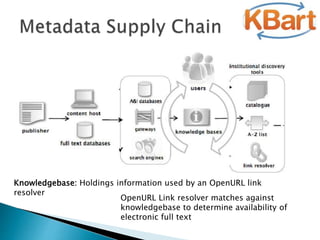
Knowledgebase: Holdings information used by an OpenURL link
resolver
OpenURL Link resolver matches against
knowledgebase to determine availability of
electronic full text
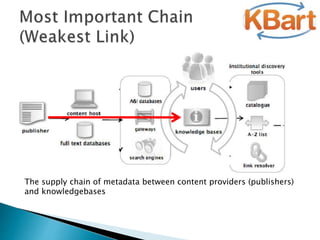
The supply chain of metadata between content providers (publishers)
and knowledgebases
If the holdings information in the knowledgebase is
outdated/incorrect, it impacts the OpenURL link
resolver efficacy and librarian’s decision making-
process.
If the holdings information in the knowledgebase is
outdated/incorrect, it impacts the OpenURL link
resolver efficacy and librarian’s decision making-
process.
In order to expect consistent metadata delivery from
content providers, the requirements need to be
consistent as well.
◦ Who – Publishers, Aggregators, KB vendors, Libraries
◦ What – a universally acceptable holdings data format to
improve the OpenURL Knowledgebase metadata supply
chain
◦ Where – throughout the supply chain & at the UKSG info
hub http://www.uksg.org/kbart
◦ When – Now
 Phase 1 Report – Jan 2010 http://bit.ly/kbartRP
 Endorsement Phase – Began June 2010
 Phase 2 in Development
◦ Why – Better access for users through accurate holdings
data
◦ How can you help?
 Librarians
 Publishers
 Standards organizations
◦ UKSG and NISO
 Working group members (stakeholders):
◦ Knowledgebase vendors
 ExLibris, OCLC, Serials Solutions, EBSCO
◦ Content Provider (Publisher & Aggregators)
 ASP, AIP, Royal Society Publishing
◦ Subscription Agents
◦ Libraries & Consortia
 Full list -- http://www.uksg.org/kbart/members
 KnowledgeBases And Related Tools
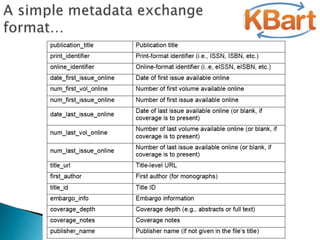
 A NISO recommended practice
 A universally acceptable holdings list format
 Tab-delimited text files
 Delivered via HTTP or FTP
 Guidelines for fields and values
 A single format for sharing holdings data
across the scholarly content supply chain
 Hosted by providers
 Discoverable on the registry
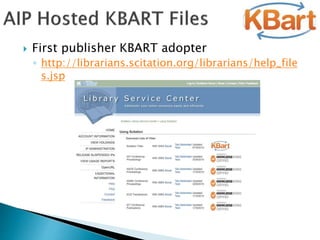
 First publisher KBART adopter
◦ http://librarians.scitation.org/librarians/help_file
s.jsp
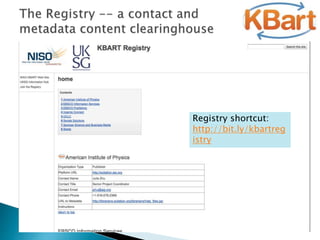
Registry shortcut:
http://bit.ly/kbartreg
istry
www.openurlquality.org/
niso.org/workrooms/piej
 Culling, James. “Link Resolvers and the Metadata
Supply Chain”
 Inconsistent holding list metadata format
◦ Embargo period format
 Example relative vs. absolute embargo?
◦ Date/enumeration formats
 MM-DD-YYYY? / DD-MM-YYYY?
 Inconsistent metadata update procedures
 (See next slide)
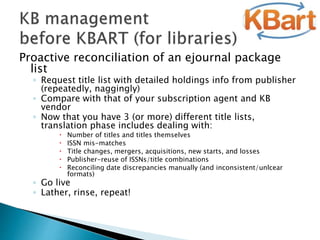
Proactive reconciliation of an ejournal package
list
◦ Request title list with detailed holdings info from publisher
(repeatedly, naggingly)
◦ Compare with that of your subscription agent and KB
vendor
◦ Now that you have 3 (or more) different title lists,
translation phase includes dealing with:
 Number of titles and titles themselves
 ISSN mis-matches
 Title changes, mergers, acquisitions, new starts, and losses
 Publisher-reuse of ISSNs/title combinations
 Reconciling date discrepancies manually (and inconsistent/unlcear
formats)
◦ Go live
◦ Lather, rinse, repeat!
Similar to the library’s process
 Need to contact providers again and again
 Invest a lot of time correcting data
problems
◦ Investigating end-user queries and complaints
 Update procedures vary by provider
 If unable to get data from provider, may
resort less preferable acquisition methods
(web site inspection)
◦ Last resort, not preferred
An end to our role as translators
◦ What would you rather spend your time
on?
◦ Libraries
◦ KB vendors
* 4 collections currently
*
 Phase 1 Successes
◦ 4 content providers currently supplying KBART P1
metadata
◦ More in the works
 Phase 2 Progress
1. Review the requirement:
http://www.uksg.org/kbart/
2. Format your title lists accordingly.
3. Self check to ensure they conform to the
recommended practice
4. Ensure that you have a process in place for
regular data updates
5. Register your organization on the KBART
registry website: http://bit.ly/kbartregistry
◦ READ and INFORM yourself!
 “Link Resolvers and the Serials Supply Chain”
 “KBART Phase 1.0 Summary of Recommendations”
 Uksg.org/kbart
◦ LEARN about what KBART is and what it does
◦ ENABLE publisher sales staff to make the case to their
company and point them to the KBART Registry
◦ FOLLOW UP with continued requests as necessary
 Lobby publishers to adopt the KBART practices
◦ Promote the importance of KBART…
 When vendor and publisher reps visit
 With your consortial managers
◦ INSIST on ‘knowing’ what you are buying!
 Require delivery of a usable holdings list in your
licenses before you pay
 Initially & annually going forward
 When the list is inadequate, point them to KBART
 Only your insistence will make it happen
Phase 1 – Universally accepted standardized
publisher metadata, regularly distributed AND
available on demand
Phase 2 – Broad adoption, Consortia, More
content type coverage (eBooks, conference
proceedings)
Phase 3? – Even more content types, automated
delivery, institutional metadata????
Sherrard Ewing
Provider Relations Analyst
Serials Solutions
sherrard.ewing@serialssolutions.com
Chad Hutchens
Electronic Resources Librarian
University of Wyoming Libraries
chutchen@uwyo.edu
Visit the Information Hub:
http://www.uksg.org/kbart/hub
Questions?

Link Resolvers, Knowledgebases and the KBART Working Group

  • 1.
    Sherrard Ewing Provider Relations Analyst SerialsSolutions Chad Hutchens Electronic Resources Librarian University of Wyoming Libraries November 5th, 2010 30th Annual Charleston Conference
  • 2.
    Knowledgebase: Holdings informationused by an OpenURL link resolver OpenURL Link resolver matches against knowledgebase to determine availability of electronic full text
  • 3.
    The supply chainof metadata between content providers (publishers) and knowledgebases
  • 4.
    If the holdingsinformation in the knowledgebase is outdated/incorrect, it impacts the OpenURL link resolver efficacy and librarian’s decision making- process.
  • 5.
    If the holdingsinformation in the knowledgebase is outdated/incorrect, it impacts the OpenURL link resolver efficacy and librarian’s decision making- process. In order to expect consistent metadata delivery from content providers, the requirements need to be consistent as well.
  • 6.
    ◦ Who –Publishers, Aggregators, KB vendors, Libraries ◦ What – a universally acceptable holdings data format to improve the OpenURL Knowledgebase metadata supply chain ◦ Where – throughout the supply chain & at the UKSG info hub http://www.uksg.org/kbart ◦ When – Now  Phase 1 Report – Jan 2010 http://bit.ly/kbartRP  Endorsement Phase – Began June 2010  Phase 2 in Development ◦ Why – Better access for users through accurate holdings data ◦ How can you help?  Librarians  Publishers
  • 7.
     Standards organizations ◦UKSG and NISO  Working group members (stakeholders): ◦ Knowledgebase vendors  ExLibris, OCLC, Serials Solutions, EBSCO ◦ Content Provider (Publisher & Aggregators)  ASP, AIP, Royal Society Publishing ◦ Subscription Agents ◦ Libraries & Consortia  Full list -- http://www.uksg.org/kbart/members
  • 8.
     KnowledgeBases AndRelated Tools  A NISO recommended practice  A universally acceptable holdings list format  Tab-delimited text files  Delivered via HTTP or FTP  Guidelines for fields and values  A single format for sharing holdings data across the scholarly content supply chain  Hosted by providers  Discoverable on the registry
  • 10.
     First publisherKBART adopter ◦ http://librarians.scitation.org/librarians/help_file s.jsp
  • 11.
  • 12.
  • 13.
     Culling, James.“Link Resolvers and the Metadata Supply Chain”  Inconsistent holding list metadata format ◦ Embargo period format  Example relative vs. absolute embargo? ◦ Date/enumeration formats  MM-DD-YYYY? / DD-MM-YYYY?  Inconsistent metadata update procedures  (See next slide)
  • 14.
    Proactive reconciliation ofan ejournal package list ◦ Request title list with detailed holdings info from publisher (repeatedly, naggingly) ◦ Compare with that of your subscription agent and KB vendor ◦ Now that you have 3 (or more) different title lists, translation phase includes dealing with:  Number of titles and titles themselves  ISSN mis-matches  Title changes, mergers, acquisitions, new starts, and losses  Publisher-reuse of ISSNs/title combinations  Reconciling date discrepancies manually (and inconsistent/unlcear formats) ◦ Go live ◦ Lather, rinse, repeat!
  • 15.
    Similar to thelibrary’s process  Need to contact providers again and again  Invest a lot of time correcting data problems ◦ Investigating end-user queries and complaints  Update procedures vary by provider  If unable to get data from provider, may resort less preferable acquisition methods (web site inspection) ◦ Last resort, not preferred
  • 17.
    An end toour role as translators ◦ What would you rather spend your time on? ◦ Libraries ◦ KB vendors
  • 18.
    * 4 collectionscurrently *  Phase 1 Successes ◦ 4 content providers currently supplying KBART P1 metadata ◦ More in the works  Phase 2 Progress
  • 19.
    1. Review therequirement: http://www.uksg.org/kbart/ 2. Format your title lists accordingly. 3. Self check to ensure they conform to the recommended practice 4. Ensure that you have a process in place for regular data updates 5. Register your organization on the KBART registry website: http://bit.ly/kbartregistry
  • 20.
    ◦ READ andINFORM yourself!  “Link Resolvers and the Serials Supply Chain”  “KBART Phase 1.0 Summary of Recommendations”  Uksg.org/kbart ◦ LEARN about what KBART is and what it does ◦ ENABLE publisher sales staff to make the case to their company and point them to the KBART Registry ◦ FOLLOW UP with continued requests as necessary
  • 21.
     Lobby publishersto adopt the KBART practices ◦ Promote the importance of KBART…  When vendor and publisher reps visit  With your consortial managers ◦ INSIST on ‘knowing’ what you are buying!  Require delivery of a usable holdings list in your licenses before you pay  Initially & annually going forward  When the list is inadequate, point them to KBART  Only your insistence will make it happen
  • 22.
    Phase 1 –Universally accepted standardized publisher metadata, regularly distributed AND available on demand Phase 2 – Broad adoption, Consortia, More content type coverage (eBooks, conference proceedings) Phase 3? – Even more content types, automated delivery, institutional metadata????
  • 23.
    Sherrard Ewing Provider RelationsAnalyst Serials Solutions sherrard.ewing@serialssolutions.com Chad Hutchens Electronic Resources Librarian University of Wyoming Libraries chutchen@uwyo.edu Visit the Information Hub: http://www.uksg.org/kbart/hub Questions?