Employee Provident Fund&
Miscellaneous Provisions
Act, 1952
Aims, Objects and Application
• Provident Fund has come into force w.e.f. November 1951
to give better future to employees on their retirement & his
dependents in case of his death during employment
• The Employees Provident Funds Act 1952 is compulsory
contributory fund for the future of an employee after
retirement or for his dependents in case of his early death
DEFINITIONS
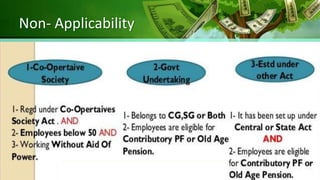
Non- Applicability
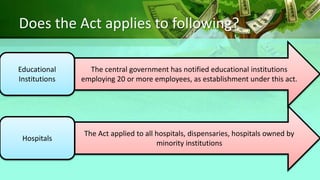
Does the Act applies to following?
The central government has notified educational institutions
employing 20 or more employees, as establishment under this act.
Educational
Institutions
The Act applied to all hospitals, dispensaries, hospitals owned by
minority institutions
Hospitals
Does the Act applies to following?
Yes
Newspaper
Establishment
Claims that is not using power
and employees less than 50
workers, thus it is not liable
Cooperative Bank
(Mansa Nagrik
Sahakari Bank Ltd.
V RFPC 2003)
Cooperative
societies (Pujali
Housing Coop
Society v Union of
India, 2006)
Rejected by court
Society engages contracts for
construction work. No. of workers
exceed 50 but no power.
No
Does the Act applies to following?
Factory which has been closed down but is employing employees to
look after the assets of the establishment
Factory which has been closed down for good and only 4 employees
are retained to look after the assets of the establishment, the act
would not continue to be applicable to the factory (since it is not using
power)
Basic Definitions: Basic Wages (Sec 2(b)
Basic wages
emoluments which are earned by an employee while on
duty or (on) leave or on holidays with wages in either case)
in accordance with the terms of the contract of
employment and which are paid or payable in cash to him
but does not include – (i) The cash value of any food
concession ; (ii) Any dearness allowance, house-rent
allowance, overtime allowance, bonus, commission or any
other similar allowance (iii) Any presents made by the
employer
Mr Mohit is an employee in a Company. The following payments
were made to him during the previous year:
(i) Piece rate wages (ii) Productivity bonus (iii) Additional
dearness allowance (iv) Value of Puja gift (v) Overtime
Allowance (vi) Commission paid on sales (vii) uniform
Allowance (Viii) Travelling Allowance (ix) Interim Advance
Examine as to which of the above payments form part of "Basic
Wage'" of Mohit under the Employees' Provident Funds and
Miscellaneous Provisions Act, 1952.
Question:
Basic Definitions: Employee
Employee
includes any
person
Employed by or through a contractor in or in connection
with work of establishment
Who gets wages directly or indirectly from the employer
Persons employed directly by the employer but employed
through a contractor and not only persons employed at the
factory premises but also employed at the dwelling house of
a home worker
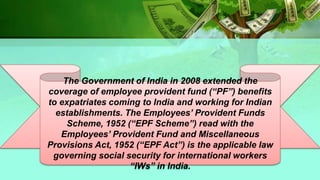
The Government of India in 2008 extended the
coverage of employee provident fund (“PF”) benefits
to expatriates coming to India and working for Indian
establishments. The Employees’ Provident Funds
Scheme, 1952 (“EPF Scheme”) read with the
Employees’ Provident Fund and Miscellaneous
Provisions Act, 1952 (“EPF Act”) is the applicable law
governing social security for international workers
“IWs” in India.
Delhi Public School, Meerut Road, Ghaziabad, is a covered establishment under the provision of the
Employees Provident Fund and Miscellaneous Provisions Act, 1952. During the course of the various
inspection carried out in the institution, the Area Enforcement Officer noticed that contractors
employees including canteen contractor, transport contractor, doctor and cycle stand contractor have
not been covered by the Management for the purpose of extending Provident Fund benefits. The
Management of the institution was asked to remedy the said situation by computing quantum of arrears
dues to be paid in respect of said category of employees on 22.11.1996, No action was taken and
thereafter notice for initiating proceeding under Section 7A(3) of the Act was issued on 22.01.1997.
Petitioners submit that immediately, thereafter reply was filed on 1.3.1997 mentioning therein that they
are employees of Contractors and there does not exist master and servant relationship in between the
Driver and petitioner's institution. Thereafter proceedings under Section 7A(3) of the Act has been
finalized on 7.4.1997 and said amount has been worked out and has been realized from the
establishment by attaching the account of institution under Section 8(F) of the Act. At this juncture
petitioner has approached this Court contending therein that entire proceedings are void and without
jurisdiction.
Delhi Public School Ghaziabad V Enforcement Officer UP EPF
Ghaziabad and Another, 2007
Held that any person who is employed for wages in any
kind of work and who gets his wages directly or indirectly
from the employer or is employed by or through a
contractor in or in connection with the work of the
establishment, is entitled to be enrolled as member
Home workers if Employees?
PM Patel v Union of India (1986)
Held that workers engaged in beedi manufacturing directly
or indirectly through contractors for rolling beedi at home,
are employees under the Act.
Govt of India by notification ha extended the application of
this Act and EPF scheme to beedi industry.
In a decided case, the enforcement officer of PF organization, on January 1, 1991,
found its employees strength to be 22, which included the three Directors getting
remuneration and as such recommended that it shall be covered under the
provisions of the Employees' Provident Funds and Miscellaneous Provisions Act. The
respondent company challenged the case.
Directors of company if Employees?
Union of India v Patna Tyre House (P) Ltd. 2004
Held that Directors cannot be included to calculate the strength of the employees.
Directors are not employees and the establishment is employing less than 20
employees and thus not covered by the provisions of EPF Act.
(Directors although getting remuneration shall not fall within the definition of
“employee”
Partners of a firm if Employees?
SF Tin Printers (P) Ltd. V RPF Commissioner, 2001
Held, a partner of a firm cannot be considered as an
employee, as he cannot be an employer and employee at
the same time
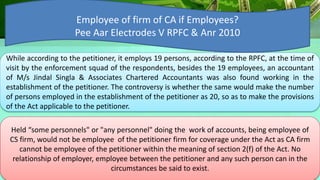
While according to the petitioner, it employs 19 persons, according to the RPFC, at the time of
visit by the enforcement squad of the respondents, besides the 19 employees, an accountant
of M/s Jindal Singla & Associates Chartered Accountants was also found working in the
establishment of the petitioner. The controversy is whether the same would make the number
of persons employed in the establishment of the petitioner as 20, so as to make the provisions
of the Act applicable to the petitioner.
Employee of firm of CA if Employees?
Pee Aar Electrodes V RPFC & Anr 2010
Held “some personnels" or "any personnel" doing the work of accounts, being employee of
CS firm, would not be employee of the petitioner firm for coverage under the Act as CA firm
cannot be employee of the petitioner within the meaning of section 2(f) of the Act. No
relationship of employer, employee between the petitioner and any such person can in the
circumstances be said to exist.
The drivers engaged by managers/ officers of the company whose wages are
reimbursed by the company through the managers and who have been provided with
the uniform footwears, winter clothing and even overtime when their services were
required by their managers beyond working hours
Driver engaged by the manager of the company if Employees?
BASF India Ltd & Anr v RPFC 2004
will be covered under the Act
An employee whose pay at the time when he is
entitled to become a member of the fund exceeds
15000 per month, have been specifically excluded
from the benefit of this scheme
Employee drawing more than Rs. 15000 per month if employee
Non Eligible Employee
Where an establishment consists of different departments
or branches, whether situated in same place or different
places, all such department shall be treated as parts of same
establishment.
Clubbing of employees if permissible (Section 2A)
1) Unity of ownership and control
2) Functional as well as financial integrality
3) Geographical proximity
The appellant is aggrieved by the application of the EPF Act, 1952. The appellant-institution
is run by Baptist Union North India (which runs around 30 schools), a registered Society
under the Registration of Societies Act, 1860. The said Society runs two schools at 17, Darya
Ganj, Delhi, namely, Francis Girls Higher Secondary School which was established in 1916
and the appellant-school which runs nursery classes. The appellant-school was started in the
year 1971. The claim of the appellant-school is that Francis Girls Higher Secondary School
and the appellant-school, Noor Niwas Nursery Public School, are two different institutions
having separate and independent accounts and are managed by two different Managing
Committees. The appellant has four employees, namely, 1 Head Mistress, 1 Teacher, 1 Peon
and 1 Aaya and it being a separate establishment is not covered by the provisions of the Act.
The Head Clerk, Mrs. Wadhavan was found to have been in possession of the particulars of
the appellant-school when Inspector visited the school. However, it is contended that
Francis Girls Higher Secondary School and the appellant-school cannot be treated as one
establishment for the purpose of the Act.
NOOR NIWAS NURSERY PUBLIC SCHOOL Vs. REGIONAL PROVIDENT
FUND COMMR. & ORS., 2001
In the present case, when two units are located adjacent to one another and there are only two
Teachers with an Aaya, a Clerk and a Peon, it is difficult to believe that the Society which runs 30
schools would run a separate school consisting of such a small number of staff. If the unit of the
appellant-school was not part of the unit of Francis Girls Higher Secondary School, the Head
Clerk, Mrs. Wadhavan could not have been in possession of the particulars of the appellant-
school and could not have furnished such particulars to the Inspector when he visited the school
in connection with the grant of a code number. Undisputably, the two units are run by the same
Society and they are located in one and the same address thereby establishing geographical
proximity . Held, both the schools will be clubbed together for coverage under the Act.
Schemes
• Employee’s Provident Fund Scheme Sec 5
Employer’s
contribution
12% (10%) of basic wages, DA and
retaining allowance payable to
employee. out of which 8.33% is
credited to Employee Pension Fund
and the balance 3.67% is transferred
to PF A/c of the employee
Employee’s
contribution Shall be equal
10% rate is applicable for
Any establishment in which less than 20 employees are employed.
Any sick industrial company and which has been declared as such by
the Board for Industrial and Financial Reconstruction
Any establishment which has at the end of any financial year,
accumulated losses equal to or exceeding its entire net worth and
Any establishment in following industries:-
(a) Jute (b) Beedi (c) Brick (d) Coir and (e) Guar gum Factories.
Benefits
• Employees can take advances / withdraw the PF in case of
retirement, medical care, housing, family obligation,
education of children & financing of life Insurance Polices
• Upto 90% of the PF amount can be withdrawn at the age of
57 years or before one year of actual retirement
• PF amount of the deceased member is payable to nominees
/ legal heirs
• EEE status
• Interest rate is usually higher than the prevailing market
rate (present interest rate @ 8.55%)
• PF A/c can be transferred if any member changes from one
establishment to other where the PF Scheme is applicable
Schemes
• Employee’s Pension Scheme (section
6A)-wef November 1995
Employer’s
contribution
8.33% of basic wages, DA and
retaining allowance payable to
employee
Employee’s
contribution
Zero
To give long term protection / financial security to
employee upon retirement and his family in case of his pre-
mature death
Application • Scheme is compulsory for all the existing
members who become members of the Employees Provident
Fund Scheme
Eligible • Monthly pension to employees on retirement
• Widows on death of the member
• Children of the member below 25 years age
• Monthly pension to members upon permanent total
disablement during service
Government
contribution
1.16% s.t. marginal limit of
180/month/employee
Schemes
• Employee’s Deposit Linked Insurance Scheme
(Section 6C)- wef August 1976
Employer’s
contribution
0.5% of basic wages, DA and
retaining allowance payable to
employee
Employee’s
contribution
Zero
EDLI scheme is compulsory for all the existing members
who become members of the PF Scheme
Life insurance benefit (death coverage) of the employee is
available under this scheme while in service
It gives insurance coverage subject to a maximum amount of
six lakh (600000) 7,00,000
0.65%
EDLI- 0.5%
Consider an employee is getting 10500/Month. He is
covered under EPF scheme. and his salary is
structured as follows.
Basic 6300 + DA 2400 + HRA 1500 + Uniform Allowance
300 = Total 10500
Question:
Solution:
Contribution
By
EPF EPS
EDLI
Charges
EPF Admin
Charges
EDLI Admin
Charges
Employer
8700 x 3.67%=
319.29
8700 x 8.33%=
724.71
8700 x 0.5%=
43.5
8700 x 0.65%
=56.55
0
Employee
8700 x 12%=
1044
Question:
Example: An employee is getting 20000 /Month. The
break up is as follows.
BASIC 10000+ DA 7000+ HRA 2000+ Conveyance
Allowance 1000= 20000
Solution:
Contribution By EPF EPS
EDLI
Charges
EPF Admin
Charges
EDLI Admin
Charges
Employer
17000x 12%-=
2040-1250 =790
15000 x
8.33%=1249.5
0 rounded up
to 1250
17000 x 0.5%
=85
17000 x 0.65
%=110.5
0
Employee
17000 x 12 % =
2040
Method 2
In this method Employer share is calculated on ceiling limit 15000
where as employee share is calculated on total of 17000.
Contribution By EPF EPS
EDLI
Charges
EPF Admin
Charges
EDLI Admin
Charges
Employer
15000 x 3.67%
=550.5 rounded
up to 551
15000 x
8.33%
=1249.5
rounded up
to 1250
15000 x 0.5
% =75
15000 x
0.65% =
97.50
0
Employee
17000 x 12 % =
2040
Method 3
Both Employee & Employer share is calculated on ceiling limit 15000
Contribution By EPF EPS
EDLI
Charges
EPF Admin
Charges
EDLI Admin
Charges
Employer
15000 x 3.67%
=550.5 rounded
up to 551
15000 x
8.33%
=1249.5
rounded up
to 1250
15000 x 0.5
% =75
15000 x
0.65% =
97.50
0
Employee
15000 x 12%
=1800
Some important Highlights:
• Employees can withdraw full PF balance if he/she is out of
employment for 60 days or more
• Now withdraw up to 75% of Provident Fund after 30 days
without a job
• Govt.to bear 12% employer contribution in EPF for new
employees for 3 years
• EPF contribution by women employees reduced to 8% from
12%
• The importance of 5 years of continuous service
Section 8A
• Recovery of moneys by Principal
Employers
Group 4 Securitas Guarding Ltd (GSGL), which was into the business of providing security
guard services, received a notice from the Regional Provident Fund Commissioner directing
them to pay additional provident fund contributions on allowances such as HRA, conveyance
allowance and washing allowance. GSGL contended that since the security guards were
deputed to the client's establishment, the client (principal employer) was liable to pay the PF
contributions for those employees and not GSGL. The issue before the court therefore was
"whether security guards provided by GSGL to its clients would be its employees or employees
of the establishment to whom they are provided"
Group 4 Securitas Guarding Ltd v Employees Provident Fund
Appellate Tribunal & Ors
The courts observed that since GSGL:
operates as an independent entity and is engaged in the activity of providing security
services to various clients,
issues employment contracts to the security guards,
pays wages and other allowances to the guards after obtaining their signatures on the
register maintained by the contractor,
deputes the guards to the client's establishment on rotation and transfer basis,
is responsible to take disciplinary actions against delinquent guards,
has control rooms in the client's establishment to supervise and regulate the work of the
deputed guards; and
has an independent registration under the PF Act
Group 4 Securitas Guarding Ltd v Employees Provident Fund
Appellate Tribunal & Ors
Therefore, they will be regarded as the employer as per
section 2(e) having ultimate control over its personnel and
its own establishment
epf act ppt.pdf
epf act ppt.pdf
epf act ppt.pdf
epf act ppt.pdf

epf act ppt.pdf

  • 1.
  • 2.
    Aims, Objects andApplication • Provident Fund has come into force w.e.f. November 1951 to give better future to employees on their retirement & his dependents in case of his death during employment • The Employees Provident Funds Act 1952 is compulsory contributory fund for the future of an employee after retirement or for his dependents in case of his early death
  • 3.
  • 4.
  • 5.
    Does the Actapplies to following? The central government has notified educational institutions employing 20 or more employees, as establishment under this act. Educational Institutions The Act applied to all hospitals, dispensaries, hospitals owned by minority institutions Hospitals
  • 6.
    Does the Actapplies to following? Yes Newspaper Establishment Claims that is not using power and employees less than 50 workers, thus it is not liable Cooperative Bank (Mansa Nagrik Sahakari Bank Ltd. V RFPC 2003) Cooperative societies (Pujali Housing Coop Society v Union of India, 2006) Rejected by court Society engages contracts for construction work. No. of workers exceed 50 but no power. No
  • 7.
    Does the Actapplies to following? Factory which has been closed down but is employing employees to look after the assets of the establishment Factory which has been closed down for good and only 4 employees are retained to look after the assets of the establishment, the act would not continue to be applicable to the factory (since it is not using power)
  • 8.
    Basic Definitions: BasicWages (Sec 2(b) Basic wages emoluments which are earned by an employee while on duty or (on) leave or on holidays with wages in either case) in accordance with the terms of the contract of employment and which are paid or payable in cash to him but does not include – (i) The cash value of any food concession ; (ii) Any dearness allowance, house-rent allowance, overtime allowance, bonus, commission or any other similar allowance (iii) Any presents made by the employer
  • 9.
    Mr Mohit isan employee in a Company. The following payments were made to him during the previous year: (i) Piece rate wages (ii) Productivity bonus (iii) Additional dearness allowance (iv) Value of Puja gift (v) Overtime Allowance (vi) Commission paid on sales (vii) uniform Allowance (Viii) Travelling Allowance (ix) Interim Advance Examine as to which of the above payments form part of "Basic Wage'" of Mohit under the Employees' Provident Funds and Miscellaneous Provisions Act, 1952. Question:
  • 10.
    Basic Definitions: Employee Employee includesany person Employed by or through a contractor in or in connection with work of establishment Who gets wages directly or indirectly from the employer Persons employed directly by the employer but employed through a contractor and not only persons employed at the factory premises but also employed at the dwelling house of a home worker
  • 11.
    The Government ofIndia in 2008 extended the coverage of employee provident fund (“PF”) benefits to expatriates coming to India and working for Indian establishments. The Employees’ Provident Funds Scheme, 1952 (“EPF Scheme”) read with the Employees’ Provident Fund and Miscellaneous Provisions Act, 1952 (“EPF Act”) is the applicable law governing social security for international workers “IWs” in India.
  • 12.
    Delhi Public School,Meerut Road, Ghaziabad, is a covered establishment under the provision of the Employees Provident Fund and Miscellaneous Provisions Act, 1952. During the course of the various inspection carried out in the institution, the Area Enforcement Officer noticed that contractors employees including canteen contractor, transport contractor, doctor and cycle stand contractor have not been covered by the Management for the purpose of extending Provident Fund benefits. The Management of the institution was asked to remedy the said situation by computing quantum of arrears dues to be paid in respect of said category of employees on 22.11.1996, No action was taken and thereafter notice for initiating proceeding under Section 7A(3) of the Act was issued on 22.01.1997. Petitioners submit that immediately, thereafter reply was filed on 1.3.1997 mentioning therein that they are employees of Contractors and there does not exist master and servant relationship in between the Driver and petitioner's institution. Thereafter proceedings under Section 7A(3) of the Act has been finalized on 7.4.1997 and said amount has been worked out and has been realized from the establishment by attaching the account of institution under Section 8(F) of the Act. At this juncture petitioner has approached this Court contending therein that entire proceedings are void and without jurisdiction. Delhi Public School Ghaziabad V Enforcement Officer UP EPF Ghaziabad and Another, 2007 Held that any person who is employed for wages in any kind of work and who gets his wages directly or indirectly from the employer or is employed by or through a contractor in or in connection with the work of the establishment, is entitled to be enrolled as member
  • 13.
    Home workers ifEmployees? PM Patel v Union of India (1986) Held that workers engaged in beedi manufacturing directly or indirectly through contractors for rolling beedi at home, are employees under the Act. Govt of India by notification ha extended the application of this Act and EPF scheme to beedi industry.
  • 14.
    In a decidedcase, the enforcement officer of PF organization, on January 1, 1991, found its employees strength to be 22, which included the three Directors getting remuneration and as such recommended that it shall be covered under the provisions of the Employees' Provident Funds and Miscellaneous Provisions Act. The respondent company challenged the case. Directors of company if Employees? Union of India v Patna Tyre House (P) Ltd. 2004 Held that Directors cannot be included to calculate the strength of the employees. Directors are not employees and the establishment is employing less than 20 employees and thus not covered by the provisions of EPF Act. (Directors although getting remuneration shall not fall within the definition of “employee”
  • 15.
    Partners of afirm if Employees? SF Tin Printers (P) Ltd. V RPF Commissioner, 2001 Held, a partner of a firm cannot be considered as an employee, as he cannot be an employer and employee at the same time
  • 16.
    While according tothe petitioner, it employs 19 persons, according to the RPFC, at the time of visit by the enforcement squad of the respondents, besides the 19 employees, an accountant of M/s Jindal Singla & Associates Chartered Accountants was also found working in the establishment of the petitioner. The controversy is whether the same would make the number of persons employed in the establishment of the petitioner as 20, so as to make the provisions of the Act applicable to the petitioner. Employee of firm of CA if Employees? Pee Aar Electrodes V RPFC & Anr 2010 Held “some personnels" or "any personnel" doing the work of accounts, being employee of CS firm, would not be employee of the petitioner firm for coverage under the Act as CA firm cannot be employee of the petitioner within the meaning of section 2(f) of the Act. No relationship of employer, employee between the petitioner and any such person can in the circumstances be said to exist.
  • 17.
    The drivers engagedby managers/ officers of the company whose wages are reimbursed by the company through the managers and who have been provided with the uniform footwears, winter clothing and even overtime when their services were required by their managers beyond working hours Driver engaged by the manager of the company if Employees? BASF India Ltd & Anr v RPFC 2004 will be covered under the Act
  • 18.
    An employee whosepay at the time when he is entitled to become a member of the fund exceeds 15000 per month, have been specifically excluded from the benefit of this scheme Employee drawing more than Rs. 15000 per month if employee Non Eligible Employee
  • 19.
    Where an establishmentconsists of different departments or branches, whether situated in same place or different places, all such department shall be treated as parts of same establishment. Clubbing of employees if permissible (Section 2A) 1) Unity of ownership and control 2) Functional as well as financial integrality 3) Geographical proximity
  • 20.
    The appellant isaggrieved by the application of the EPF Act, 1952. The appellant-institution is run by Baptist Union North India (which runs around 30 schools), a registered Society under the Registration of Societies Act, 1860. The said Society runs two schools at 17, Darya Ganj, Delhi, namely, Francis Girls Higher Secondary School which was established in 1916 and the appellant-school which runs nursery classes. The appellant-school was started in the year 1971. The claim of the appellant-school is that Francis Girls Higher Secondary School and the appellant-school, Noor Niwas Nursery Public School, are two different institutions having separate and independent accounts and are managed by two different Managing Committees. The appellant has four employees, namely, 1 Head Mistress, 1 Teacher, 1 Peon and 1 Aaya and it being a separate establishment is not covered by the provisions of the Act. The Head Clerk, Mrs. Wadhavan was found to have been in possession of the particulars of the appellant-school when Inspector visited the school. However, it is contended that Francis Girls Higher Secondary School and the appellant-school cannot be treated as one establishment for the purpose of the Act. NOOR NIWAS NURSERY PUBLIC SCHOOL Vs. REGIONAL PROVIDENT FUND COMMR. & ORS., 2001 In the present case, when two units are located adjacent to one another and there are only two Teachers with an Aaya, a Clerk and a Peon, it is difficult to believe that the Society which runs 30 schools would run a separate school consisting of such a small number of staff. If the unit of the appellant-school was not part of the unit of Francis Girls Higher Secondary School, the Head Clerk, Mrs. Wadhavan could not have been in possession of the particulars of the appellant- school and could not have furnished such particulars to the Inspector when he visited the school in connection with the grant of a code number. Undisputably, the two units are run by the same Society and they are located in one and the same address thereby establishing geographical proximity . Held, both the schools will be clubbed together for coverage under the Act.
  • 21.
    Schemes • Employee’s ProvidentFund Scheme Sec 5 Employer’s contribution 12% (10%) of basic wages, DA and retaining allowance payable to employee. out of which 8.33% is credited to Employee Pension Fund and the balance 3.67% is transferred to PF A/c of the employee Employee’s contribution Shall be equal 10% rate is applicable for Any establishment in which less than 20 employees are employed. Any sick industrial company and which has been declared as such by the Board for Industrial and Financial Reconstruction Any establishment which has at the end of any financial year, accumulated losses equal to or exceeding its entire net worth and Any establishment in following industries:- (a) Jute (b) Beedi (c) Brick (d) Coir and (e) Guar gum Factories.
  • 22.
    Benefits • Employees cantake advances / withdraw the PF in case of retirement, medical care, housing, family obligation, education of children & financing of life Insurance Polices • Upto 90% of the PF amount can be withdrawn at the age of 57 years or before one year of actual retirement • PF amount of the deceased member is payable to nominees / legal heirs • EEE status • Interest rate is usually higher than the prevailing market rate (present interest rate @ 8.55%) • PF A/c can be transferred if any member changes from one establishment to other where the PF Scheme is applicable
  • 23.
    Schemes • Employee’s PensionScheme (section 6A)-wef November 1995 Employer’s contribution 8.33% of basic wages, DA and retaining allowance payable to employee Employee’s contribution Zero To give long term protection / financial security to employee upon retirement and his family in case of his pre- mature death Application • Scheme is compulsory for all the existing members who become members of the Employees Provident Fund Scheme Eligible • Monthly pension to employees on retirement • Widows on death of the member • Children of the member below 25 years age • Monthly pension to members upon permanent total disablement during service Government contribution 1.16% s.t. marginal limit of 180/month/employee
  • 24.
    Schemes • Employee’s DepositLinked Insurance Scheme (Section 6C)- wef August 1976 Employer’s contribution 0.5% of basic wages, DA and retaining allowance payable to employee Employee’s contribution Zero EDLI scheme is compulsory for all the existing members who become members of the PF Scheme Life insurance benefit (death coverage) of the employee is available under this scheme while in service It gives insurance coverage subject to a maximum amount of six lakh (600000) 7,00,000
  • 25.
  • 26.
    Consider an employeeis getting 10500/Month. He is covered under EPF scheme. and his salary is structured as follows. Basic 6300 + DA 2400 + HRA 1500 + Uniform Allowance 300 = Total 10500 Question:
  • 27.
    Solution: Contribution By EPF EPS EDLI Charges EPF Admin Charges EDLIAdmin Charges Employer 8700 x 3.67%= 319.29 8700 x 8.33%= 724.71 8700 x 0.5%= 43.5 8700 x 0.65% =56.55 0 Employee 8700 x 12%= 1044
  • 28.
    Question: Example: An employeeis getting 20000 /Month. The break up is as follows. BASIC 10000+ DA 7000+ HRA 2000+ Conveyance Allowance 1000= 20000
  • 29.
    Solution: Contribution By EPFEPS EDLI Charges EPF Admin Charges EDLI Admin Charges Employer 17000x 12%-= 2040-1250 =790 15000 x 8.33%=1249.5 0 rounded up to 1250 17000 x 0.5% =85 17000 x 0.65 %=110.5 0 Employee 17000 x 12 % = 2040
  • 30.
    Method 2 In thismethod Employer share is calculated on ceiling limit 15000 where as employee share is calculated on total of 17000. Contribution By EPF EPS EDLI Charges EPF Admin Charges EDLI Admin Charges Employer 15000 x 3.67% =550.5 rounded up to 551 15000 x 8.33% =1249.5 rounded up to 1250 15000 x 0.5 % =75 15000 x 0.65% = 97.50 0 Employee 17000 x 12 % = 2040
  • 31.
    Method 3 Both Employee& Employer share is calculated on ceiling limit 15000 Contribution By EPF EPS EDLI Charges EPF Admin Charges EDLI Admin Charges Employer 15000 x 3.67% =550.5 rounded up to 551 15000 x 8.33% =1249.5 rounded up to 1250 15000 x 0.5 % =75 15000 x 0.65% = 97.50 0 Employee 15000 x 12% =1800
  • 32.
    Some important Highlights: •Employees can withdraw full PF balance if he/she is out of employment for 60 days or more • Now withdraw up to 75% of Provident Fund after 30 days without a job • Govt.to bear 12% employer contribution in EPF for new employees for 3 years • EPF contribution by women employees reduced to 8% from 12% • The importance of 5 years of continuous service
  • 34.
    Section 8A • Recoveryof moneys by Principal Employers
  • 35.
    Group 4 SecuritasGuarding Ltd (GSGL), which was into the business of providing security guard services, received a notice from the Regional Provident Fund Commissioner directing them to pay additional provident fund contributions on allowances such as HRA, conveyance allowance and washing allowance. GSGL contended that since the security guards were deputed to the client's establishment, the client (principal employer) was liable to pay the PF contributions for those employees and not GSGL. The issue before the court therefore was "whether security guards provided by GSGL to its clients would be its employees or employees of the establishment to whom they are provided" Group 4 Securitas Guarding Ltd v Employees Provident Fund Appellate Tribunal & Ors
  • 36.
    The courts observedthat since GSGL: operates as an independent entity and is engaged in the activity of providing security services to various clients, issues employment contracts to the security guards, pays wages and other allowances to the guards after obtaining their signatures on the register maintained by the contractor, deputes the guards to the client's establishment on rotation and transfer basis, is responsible to take disciplinary actions against delinquent guards, has control rooms in the client's establishment to supervise and regulate the work of the deputed guards; and has an independent registration under the PF Act Group 4 Securitas Guarding Ltd v Employees Provident Fund Appellate Tribunal & Ors Therefore, they will be regarded as the employer as per section 2(e) having ultimate control over its personnel and its own establishment