WELCOME!
by: Shane Curcuru,Vice President, Brand Management
The Apache Software Foundation
Up Next: KEEPINGYOUR APACHE®
PROJECT’S INDEPENDENCE
HOWTO KEEPYOUR APACHE® PROJECT’S
INDEPENDENCE
Shane Curcuru
Vice President, Brand Management
The Apache Software Foundation
INTRODUCTION
• Shane Curcuru -VP, Brand Management,The Apache Software Foundation
• Volunteer, appointed by Apache Board of Directors
• Define trademark policy for all 200+ Apache projects
• Provide trademark support for projects
• Involved at Apache since 1999
• Not a lawyer
• Questions? <trademarks@apache.org>
TOPICS
• Apache Project Independence
• Trademark concepts brief overview
• Adjectives, nominative use, consumer confusion, and registration
• PMC Branding Responsibilities
• PolicingThird Party Brand Use
• GrantingThird Party Permissions
• WhenTo Work With trademarks@
• Resources / Q&A
APACHE PROJECT INDEPENDENCE
ACT INDEPENDENTLY
• Apache projects are governed independently
• Treat all participants / contributors fairly
• Apache software products are also independent
• Clearly branded, eg,Apache Foo
• Independence = Apache Foo software performs useful functions,
without additional (proprietary) software
• This is required of all Apache projects
http://community.apache.org/projectIndependence
BE INCLUSIVE
• An inclusive community relies on independence from commercial influence
(a requirement for Apache projects)
• Committer & PMC member diversity is the best way to maintain long-term
independent project governance
• Actively seek out new contributions with “low hanging” bugs; review
patches quickly and thoughtfully
• Encourage positive contributions; mentor new contributors to become
committers and PMC members
• Promote real-world stories of how project software helps end users
TRADEMARK CONCEPTS IN 30 SECONDS
WHAT ARETRADEMARKS
• A trademark is the legal instantiation of your brand
• Your trademark is the specific name or logo a consumer (user of your software)
associates with a downloadable software program
• Trademarks are about preventing consumer confusion as to the source of goods within
a specific field of commerce
• Trademarks protect consumers by ensuring expectations of quality, functionality, etc.
available from a specific vendor
• Trademark vs Brand
• A brand includes many elements – names, logos, look and feel – parts of which are
specific trademarks that signify your product or service
TRADEMARKS ARE
ADJECTIVES
• Trademarks legally are used to describe the actual goods: I buy Kleenex®
brand tissues
• We run Apache CouchDB™ software and Apache Hadoop® software
… but in common usage we just write: we're running Python
• Use as an adjective and marking withTM and (R) is important on your
homepage & download page
… not as important in other places
• Your project name is not necessarily a trademark, although it may be a service
mark
REGISTEREDTRADEMARKS
• In most countries, common law rights accrue from actual use of a name™
or logo™ to identify goods – without any registration
• Trademarks may also be registered® with the USPTO, the EU/Community
Trade Mark, and other individual country governments – improves our rights
• Every country has different registration laws
• Some are “first to file” like China, Korea; most are “first to use”
• Apache PMCs may request registration – recommended!
How-To link below!
http://www.apache.org/foundation/marks/register
NOMINATIVE USE IS OK
• Nominative use for trademarks ~= fair use for copyright == OK
• Other people may use the trademark to describe your goods
• Personal blogs, newspaper articles, technical mailing list discussions are almost always
nominative use
• Nominative use even allows people/companies to post bad reviews of your software
product
• Not OK:
• Infringement is when a third party uses your marks in a way that may mislead
consumers as to the true source of goods, or confuse users as to which company
provides a software product
http://www.apache.org/foundation/marks/reporting
PMC BRANDING RESPONSIBILITIES
BE RESPONSIBLE
• PMCs are responsible for their own brand:
• Have a consistent brand and use it
• Be aware of how your brand is used in the marketplace
• Be respectful of other brands and the Apache brand
http://www.apache.org/foundation/marks/responsibility
BE CONSISTENT
• Your use of your Apache Foo™ brand is the reference implementation
• Annotate your own trademarks (both words and logos) with ™ or ® to make their
status clear to others
• Ensure consistency in your website
• In your documentation, first and most prominent uses
• On your download page: download Apache Foo™ software
• In publicly visible parts of your product UI
• Trademark law is not a compiler: the general consumer perception is what counts,
and that is what you can actively manage
http://www.apache.org/foundation/marks/pmcs
BE AWARE
• Be aware of how other companies use your project brand
• Situations that require your action to protect your brand/trademark:
• Inappropriate third party use of your brand may cause confusion as to the source of
software products
• It is important for the PMC to review and respond here
• Fairness to all users is critical – both with outsiders and with companies who are
contributing to your project
• http://www.apache.org/foundation/marks/reporting
• Unlikely to be a problem: personal blogs, press articles, software reviews, benchmark
reports, forum discussions, emails on dev@...
http://www.apache.org/foundation/marks/reporting
BE RESPECTFUL
• Treat other organizations’ trademarks respectfully
• Charitable or community-based projects have no business
infringing on others’ trademarks
• Be liberal in attribution and giving credit to other communities
or companies
• Respond calmly and professionally if a third party asks for/
demands changes; always cc: trademarks@
http://www.apache.org/foundation/marks/linking
REGISTERYOUR MARK
• Recommended policy is to register your software product
name
• The ASF will register most Apache product names for
software goods in the US, if requested by the PMC
• If your project is very popular, you can can request additional
registrations in other jurisdictions like the EU/CTM
• Justification is required by the board for non-US expenses
http://www.apache.org/foundation/marks/register
POLICING USE OFYOUR BRAND
POLICE BRAND USE
PRIVATELY
• When a third party is improperly using your project's brand, the PMC
needs to take action and ask for corrections!
• Assume ignorance rather than malice
• Use reporting guidelines to determine if the use is (or is not!) a problem
• Always contact third parties privately (but be sure to cc: trademarks@)
• Private, direct contact allows all parties to save face
• Public confrontations often escalate, potentially damaging everyone's
reputation
http://www.apache.org/foundation/marks/reporting
BE PROFESSIONAL AND
POLITE
• Whenever contacting anyone about improper brand use:
• Be professional – you are talking to managers/marketers
• Be polite – many cases are resolved through simple discussion
• Be firm – state the ASF's clear ownership of the marks
• Be specific – quote specific uses that we request to be changed
• Most potential infringements cases are resolved through discussion between private@,
trademarks@, and the other party
• Be patient – discussions take time to resolve
• Legal threats are never the first step
GET LEGAL ADVICE
• The ASF has pro bono corporate counsel from DLAPiper
• Send any legal questions, especially any from outside the ASF, to:
trademarks@ for anything brand-related (private archive)
legal-internal@ for any specific legal question the PMC for the project (private archive)
legal-discuss@ for any general legal questions that can be discussed publicly (public archive)
• Never grant exception to brand policy without trademarks@ approval
• Never give legal advice (unless you actually are an ASF counsel)
• Never respond to an outside lawyer without asking ASF counsel
GRANTINGTHIRD PARTY PERMISSIONS
New and Important!
GRANTINGTHIRD PARTY
PERMISSIONS
• PMCs may directly grant certain third party permissions for specific
uses (events, domains, swag / merchandise) of their project marks
• Best practices / improved how-to guides being rolled out
• Respond promptly: acknowledge the question even if the answer is
not ready yet
• Respond professionally: many requesters are marketers or lawyers,
not coders
• Respond privately: keep on private@ unless OP used dev@
http://www.apache.org/foundation/marks/reporting
RESPONDINGTO REQUESTS
• Only grant specific permissions as noted in policy
• Events; domain names; services; merchandise
• Do not grant exceptions dealing with software product names
• But: you can allow “Powered By” names/icons (For..., Plugin...)
• Be consistent and fair when granting permissions
• Does a use of your project's brand by a third party / other company:
• Maintain clarity about the source of Apache software?
• Help the image, impact, or reach of your project community?
• Ask trademarks@ for help anytime you have a question!
WHENTO WORK WITHTRADEMARKS@
TRADEMARKS@ SETS POLICY
• The ASF owns all Apache trademarks on behalf of the projects
• PMCs are required to comply with trademark policy; PMCs
otherwise define and promote their own brand
• Project brand design, like technical direction, is completely up
to PMCs
• trademarks@, like press@, operations@, infra@, etc. are here to
serve the needs of all Apache projects
http://www.apache.org/foundation/marks/responsibility
DEALING WITH DIFFICULT
PARTIES
• Any time a third party responds negatively, or when another company
lawyer is involved – ask trademarks@ to help craft your reply
• Any difficult negotiations should be done byVP, Brand Management,
with appropriate legal counsel
• Most corporations respond to official titles
• Patience is required: trademark issues are rarely time critical
• Legal threats are never the second step
http://www.apache.org/foundation/marks/reporting
TRADEMARK ENFORCEMENT
• A Cease & Desist (C&D) is considered a last resort, when all other
approaches have failed
• Trademark litigation is expensive and risky
• Consider the public image of “attacking” a third party
• Most issues can be resolved with polite, firm, and private discussion with
the right parties
• A very few serious issues end up being resolved with more visible actions:
making a public case; restricting PMC or commit access; or the board
unilaterally restructuring a project
THANKYOU / RESOURCES
THANKYOU
• Thanks to all Apache committers and PMCs!
• Thank you to companies who respect Apache brands
• Thanks to members of ApacheTrademarks Committee
• Thanks to DLAPiper counsel: Mark Radcliffe, Nikkya Williams,
Carol Anne Bashir
PMC RESOURCES
• Policy for PMC websites
• http://www.apache.org/foundation/marks/pmcs
• Linking to third party sites/products/services
• http://www.apache.org/foundation/marks/linking
• Project Independence is required for PMCs
• http://community.apache.org/projectIndependence
• Questions? <trademarks@apache.org> and relevant
<private@project.apache.org>
EXTERNAL RESOURCES
• Formal policy for third party use
http://www.apache.org/foundation/marks/
• Third party requesting permission for events
http://www.apache.org/foundation/marks/events
• Third party requesting permission for domain names
http://www.apache.org/foundation/marks/domains
• All other questions
http://www.apache.org/foundation/marks/contact
QUESTIONS?
Please feel free to find Shane with any questions this week!
Or, Look for the Ask Me! Buttons, and just ask!
<trademarks@apache.org>
@ShaneCurcuru
http://communityovercode.com/
@SHANECURCURU
VP, Brand Management,ASF
http://communityovercode.com/
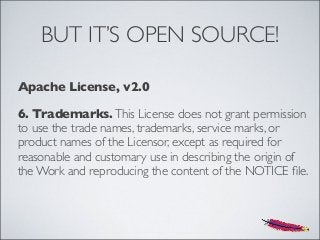
BUT IT’S OPEN SOURCE!
Apache License, v2.0
6. Trademarks.This License does not grant permission
to use the trade names, trademarks, service marks, or
product names of the Licensor, except as required for
reasonable and customary use in describing the origin of
the Work and reproducing the content of the NOTICE file.

Keep Your Apache Project's Independence

  • 1.
    WELCOME! by: Shane Curcuru,VicePresident, Brand Management The Apache Software Foundation Up Next: KEEPINGYOUR APACHE® PROJECT’S INDEPENDENCE
  • 2.
    HOWTO KEEPYOUR APACHE®PROJECT’S INDEPENDENCE Shane Curcuru Vice President, Brand Management The Apache Software Foundation
  • 3.
    INTRODUCTION • Shane Curcuru-VP, Brand Management,The Apache Software Foundation • Volunteer, appointed by Apache Board of Directors • Define trademark policy for all 200+ Apache projects • Provide trademark support for projects • Involved at Apache since 1999 • Not a lawyer • Questions? <trademarks@apache.org>
  • 4.
    TOPICS • Apache ProjectIndependence • Trademark concepts brief overview • Adjectives, nominative use, consumer confusion, and registration • PMC Branding Responsibilities • PolicingThird Party Brand Use • GrantingThird Party Permissions • WhenTo Work With trademarks@ • Resources / Q&A
  • 5.
  • 6.
    ACT INDEPENDENTLY • Apacheprojects are governed independently • Treat all participants / contributors fairly • Apache software products are also independent • Clearly branded, eg,Apache Foo • Independence = Apache Foo software performs useful functions, without additional (proprietary) software • This is required of all Apache projects http://community.apache.org/projectIndependence
  • 7.
    BE INCLUSIVE • Aninclusive community relies on independence from commercial influence (a requirement for Apache projects) • Committer & PMC member diversity is the best way to maintain long-term independent project governance • Actively seek out new contributions with “low hanging” bugs; review patches quickly and thoughtfully • Encourage positive contributions; mentor new contributors to become committers and PMC members • Promote real-world stories of how project software helps end users
  • 8.
  • 9.
    WHAT ARETRADEMARKS • Atrademark is the legal instantiation of your brand • Your trademark is the specific name or logo a consumer (user of your software) associates with a downloadable software program • Trademarks are about preventing consumer confusion as to the source of goods within a specific field of commerce • Trademarks protect consumers by ensuring expectations of quality, functionality, etc. available from a specific vendor • Trademark vs Brand • A brand includes many elements – names, logos, look and feel – parts of which are specific trademarks that signify your product or service
  • 10.
    TRADEMARKS ARE ADJECTIVES • Trademarkslegally are used to describe the actual goods: I buy Kleenex® brand tissues • We run Apache CouchDB™ software and Apache Hadoop® software … but in common usage we just write: we're running Python • Use as an adjective and marking withTM and (R) is important on your homepage & download page … not as important in other places • Your project name is not necessarily a trademark, although it may be a service mark
  • 11.
    REGISTEREDTRADEMARKS • In mostcountries, common law rights accrue from actual use of a name™ or logo™ to identify goods – without any registration • Trademarks may also be registered® with the USPTO, the EU/Community Trade Mark, and other individual country governments – improves our rights • Every country has different registration laws • Some are “first to file” like China, Korea; most are “first to use” • Apache PMCs may request registration – recommended! How-To link below! http://www.apache.org/foundation/marks/register
  • 12.
    NOMINATIVE USE ISOK • Nominative use for trademarks ~= fair use for copyright == OK • Other people may use the trademark to describe your goods • Personal blogs, newspaper articles, technical mailing list discussions are almost always nominative use • Nominative use even allows people/companies to post bad reviews of your software product • Not OK: • Infringement is when a third party uses your marks in a way that may mislead consumers as to the true source of goods, or confuse users as to which company provides a software product http://www.apache.org/foundation/marks/reporting
  • 13.
  • 14.
    BE RESPONSIBLE • PMCsare responsible for their own brand: • Have a consistent brand and use it • Be aware of how your brand is used in the marketplace • Be respectful of other brands and the Apache brand http://www.apache.org/foundation/marks/responsibility
  • 15.
    BE CONSISTENT • Youruse of your Apache Foo™ brand is the reference implementation • Annotate your own trademarks (both words and logos) with ™ or ® to make their status clear to others • Ensure consistency in your website • In your documentation, first and most prominent uses • On your download page: download Apache Foo™ software • In publicly visible parts of your product UI • Trademark law is not a compiler: the general consumer perception is what counts, and that is what you can actively manage http://www.apache.org/foundation/marks/pmcs
  • 16.
    BE AWARE • Beaware of how other companies use your project brand • Situations that require your action to protect your brand/trademark: • Inappropriate third party use of your brand may cause confusion as to the source of software products • It is important for the PMC to review and respond here • Fairness to all users is critical – both with outsiders and with companies who are contributing to your project • http://www.apache.org/foundation/marks/reporting • Unlikely to be a problem: personal blogs, press articles, software reviews, benchmark reports, forum discussions, emails on dev@... http://www.apache.org/foundation/marks/reporting
  • 17.
    BE RESPECTFUL • Treatother organizations’ trademarks respectfully • Charitable or community-based projects have no business infringing on others’ trademarks • Be liberal in attribution and giving credit to other communities or companies • Respond calmly and professionally if a third party asks for/ demands changes; always cc: trademarks@ http://www.apache.org/foundation/marks/linking
  • 18.
    REGISTERYOUR MARK • Recommendedpolicy is to register your software product name • The ASF will register most Apache product names for software goods in the US, if requested by the PMC • If your project is very popular, you can can request additional registrations in other jurisdictions like the EU/CTM • Justification is required by the board for non-US expenses http://www.apache.org/foundation/marks/register
  • 19.
  • 20.
    POLICE BRAND USE PRIVATELY •When a third party is improperly using your project's brand, the PMC needs to take action and ask for corrections! • Assume ignorance rather than malice • Use reporting guidelines to determine if the use is (or is not!) a problem • Always contact third parties privately (but be sure to cc: trademarks@) • Private, direct contact allows all parties to save face • Public confrontations often escalate, potentially damaging everyone's reputation http://www.apache.org/foundation/marks/reporting
  • 21.
    BE PROFESSIONAL AND POLITE •Whenever contacting anyone about improper brand use: • Be professional – you are talking to managers/marketers • Be polite – many cases are resolved through simple discussion • Be firm – state the ASF's clear ownership of the marks • Be specific – quote specific uses that we request to be changed • Most potential infringements cases are resolved through discussion between private@, trademarks@, and the other party • Be patient – discussions take time to resolve • Legal threats are never the first step
  • 22.
    GET LEGAL ADVICE •The ASF has pro bono corporate counsel from DLAPiper • Send any legal questions, especially any from outside the ASF, to: trademarks@ for anything brand-related (private archive) legal-internal@ for any specific legal question the PMC for the project (private archive) legal-discuss@ for any general legal questions that can be discussed publicly (public archive) • Never grant exception to brand policy without trademarks@ approval • Never give legal advice (unless you actually are an ASF counsel) • Never respond to an outside lawyer without asking ASF counsel
  • 23.
  • 24.
    GRANTINGTHIRD PARTY PERMISSIONS • PMCsmay directly grant certain third party permissions for specific uses (events, domains, swag / merchandise) of their project marks • Best practices / improved how-to guides being rolled out • Respond promptly: acknowledge the question even if the answer is not ready yet • Respond professionally: many requesters are marketers or lawyers, not coders • Respond privately: keep on private@ unless OP used dev@ http://www.apache.org/foundation/marks/reporting
  • 25.
    RESPONDINGTO REQUESTS • Onlygrant specific permissions as noted in policy • Events; domain names; services; merchandise • Do not grant exceptions dealing with software product names • But: you can allow “Powered By” names/icons (For..., Plugin...) • Be consistent and fair when granting permissions • Does a use of your project's brand by a third party / other company: • Maintain clarity about the source of Apache software? • Help the image, impact, or reach of your project community? • Ask trademarks@ for help anytime you have a question!
  • 26.
  • 27.
    TRADEMARKS@ SETS POLICY •The ASF owns all Apache trademarks on behalf of the projects • PMCs are required to comply with trademark policy; PMCs otherwise define and promote their own brand • Project brand design, like technical direction, is completely up to PMCs • trademarks@, like press@, operations@, infra@, etc. are here to serve the needs of all Apache projects http://www.apache.org/foundation/marks/responsibility
  • 28.
    DEALING WITH DIFFICULT PARTIES •Any time a third party responds negatively, or when another company lawyer is involved – ask trademarks@ to help craft your reply • Any difficult negotiations should be done byVP, Brand Management, with appropriate legal counsel • Most corporations respond to official titles • Patience is required: trademark issues are rarely time critical • Legal threats are never the second step http://www.apache.org/foundation/marks/reporting
  • 29.
    TRADEMARK ENFORCEMENT • ACease & Desist (C&D) is considered a last resort, when all other approaches have failed • Trademark litigation is expensive and risky • Consider the public image of “attacking” a third party • Most issues can be resolved with polite, firm, and private discussion with the right parties • A very few serious issues end up being resolved with more visible actions: making a public case; restricting PMC or commit access; or the board unilaterally restructuring a project
  • 30.
  • 31.
    THANKYOU • Thanks toall Apache committers and PMCs! • Thank you to companies who respect Apache brands • Thanks to members of ApacheTrademarks Committee • Thanks to DLAPiper counsel: Mark Radcliffe, Nikkya Williams, Carol Anne Bashir
  • 32.
    PMC RESOURCES • Policyfor PMC websites • http://www.apache.org/foundation/marks/pmcs • Linking to third party sites/products/services • http://www.apache.org/foundation/marks/linking • Project Independence is required for PMCs • http://community.apache.org/projectIndependence • Questions? <trademarks@apache.org> and relevant <private@project.apache.org>
  • 33.
    EXTERNAL RESOURCES • Formalpolicy for third party use http://www.apache.org/foundation/marks/ • Third party requesting permission for events http://www.apache.org/foundation/marks/events • Third party requesting permission for domain names http://www.apache.org/foundation/marks/domains • All other questions http://www.apache.org/foundation/marks/contact
  • 34.
    QUESTIONS? Please feel freeto find Shane with any questions this week! Or, Look for the Ask Me! Buttons, and just ask! <trademarks@apache.org> @ShaneCurcuru http://communityovercode.com/
  • 35.
  • 36.
    BUT IT’S OPENSOURCE! Apache License, v2.0 6. Trademarks.This License does not grant permission to use the trade names, trademarks, service marks, or product names of the Licensor, except as required for reasonable and customary use in describing the origin of the Work and reproducing the content of the NOTICE file.