OptEEMAL: Enhancing BIM models with
Semantic Web technologies to plan
building retrofitting at district scale
Gonçal Costa
ARC Engineering and Architecture La Salle
Barcelona, SPAIN
Project Overview
Project founded under the work programme:
HORIZON 2020-WORK PROGRAMME 2014-2015
Leadership in enabling and industrial technologies
H2020-EeB-2014-2015 / H2020-EeB-2015
Topic: Innovative design tools for refurbishment at building and district level
(EeB-05-2015)
Participants: 13 Partners
4 RTO, 2 Universities, 2 IND, 3 SME and 2 Cities
Contact: contact@opteemal.eu
Optimised Energy Efficient Design
Platform for Refurbishment at
District Level
Research topic
• How to provide optimized building-district retrofitting designs
through a consistent integration of semantic representation of
the data from multiples sources: IFC models, CityGML models,
and contextual data (project, weather, occupancy, etc.).
Application of the research: the OptEEmAL platform
• Optimised Energy Efficient Design Platform for Refurbishment
at District Level
Three main components of the platform:
• District Data Model (DDM)
• Energy Conservation Measures Catalogue (ECMs)
• Automated generation of input data for simulation tools.
Project Overview: Context
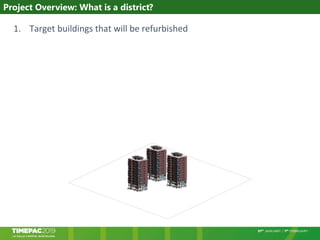
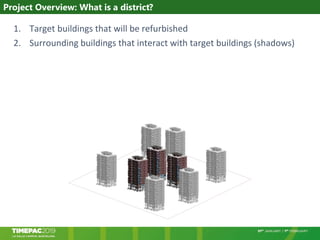
Project Overview: What is a district?
1. Target buildings that will be refurbished
Project Overview: What is a district?
1. Target buildings that will be refurbished
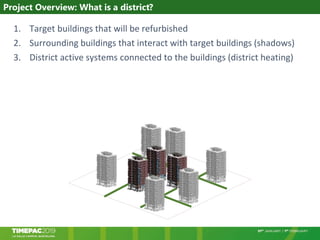
2. Surrounding buildings that interact with target buildings (shadows)
Project Overview: What is a district?
1. Target buildings that will be refurbished
2. Surrounding buildings that interact with target buildings (shadows)
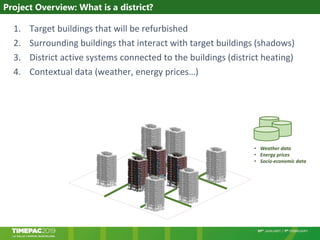
3. District active systems connected to the buildings (district heating)
Project Overview: What is a district?
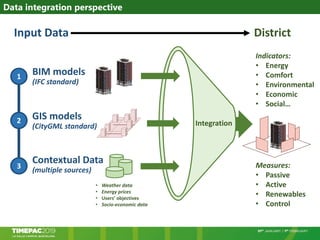
• Weather data
• Energy prices
• Socio-economic data
1. Target buildings that will be refurbished
2. Surrounding buildings that interact with target buildings (shadows)
3. District active systems connected to the buildings (district heating)
4. Contextual data (weather, energy prices…)
Data integration perspective
Input Data District
Integration
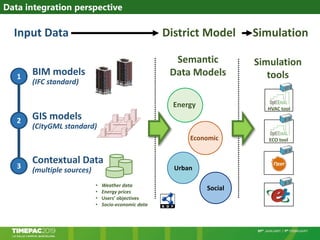
Input Data
BIM models
(IFC standard)
GIS models
(CityGML standard)
Contextual Data
(multiple sources)
1
2
3
• Weather data
• Energy prices
• Users’ objectives
• Socio-economic data
Measures:
• Passive
• Active
• Renewables
• Control
Indicators:
• Energy
• Comfort
• Environmental
• Economic
• Social…
Data integration perspective
BIM models
(IFC standard)
GIS models
(CityGML standard)
Contextual Data
(multiple sources)
1
2
3
Input Data District Model Simulation
• Weather data
• Energy prices
• Users’ objectives
• Socio-economic data
Energy
Economic
Semantic
Data Models
Urban
Social
Simulation
tools
HVAC tool
ECO tool
Data integration perspective
Energy
Economic
Semantic
Data Models
Urban
Social
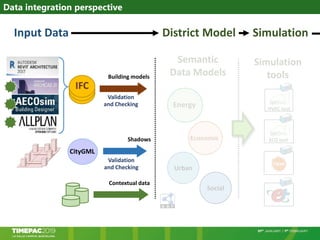
CityGML
Shadows
Validation
and Checking
Contextual data
Simulation
tools
HVAC tool
ECO tool
IFCIFCIFC
Validation
and Checking
Building models
Input Data District Model Simulation
Data integration perspective
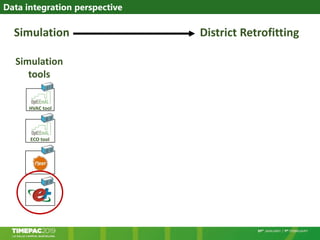
Simulation
tools
HVAC tool
ECO tool
Simulation District Retrofitting
Data integration perspective
Simulation
tools
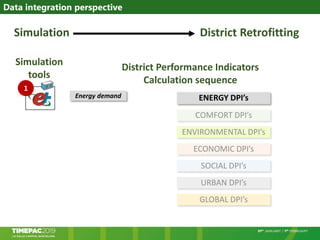
ENERGY DPI’s
COMFORT DPI’s
ENVIRONMENTAL DPI’s
ECONOMIC DPI’s
SOCIAL DPI’s
URBAN DPI’s
GLOBAL DPI’s
District Performance Indicators
Calculation sequence
1
Energy demand
Simulation District Retrofitting
Data integration perspective
Simulation
tools
ENERGY DPI’s
COMFORT DPI’s
ENVIRONMENTAL DPI’s
ECONOMIC DPI’s
SOCIAL DPI’s
URBAN DPI’s
GLOBAL DPI’s
District Performance Indicators
Calculation sequence
HVAC tool
1
2 Energy consumption
Local thermal confort
Simulation District Retrofitting
Data integration perspective
Simulation
tools
ENERGY DPI’s
COMFORT DPI’s
ENVIRONMENTAL DPI’s
ECONOMIC DPI’s
SOCIAL DPI’s
URBAN DPI’s
GLOBAL DPI’s
District Performance Indicators
Calculation sequence
HVAC tool
1
3
2
Global Warming Potential
Simulation District Retrofitting
Data integration perspective
Simulation
tools
ENERGY DPI’s
COMFORT DPI’s
ENVIRONMENTAL DPI’s
ECONOMIC DPI’s
SOCIAL DPI’s
URBAN DPI’s
GLOBAL DPI’s
District Performance Indicators
Calculation sequence
HVAC tool
ECO tool
1
3
4
2
Operational energy cost
Simulation District Retrofitting
Data integration perspective
ENERGY DPI’s
COMFORT DPI’s
ENVIRONMENTAL DPI’s
ECONOMIC DPI’s
SOCIAL DPI’s
URBAN DPI’s
GLOBAL DPI’s
District Performance
Indicators
Current status
of the district
Simulation
tools
HVAC tool
ECO tool
Simulation District Retrofitting
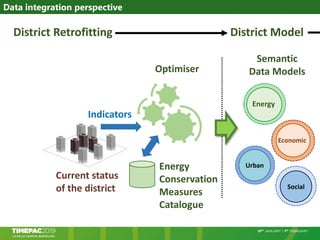
Data integration perspective
Optimiser
Urban
Urban
Energy
Economic
Semantic
Data Models
Urban
Social
Energy
Conservation
Measures
Catalogue
Current status
of the district
District Retrofitting District Model
Indicators
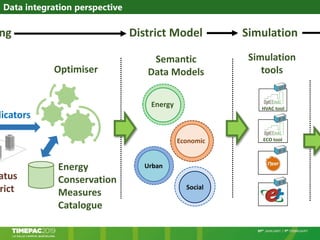
Data integration perspective
Optimiser
Urban
Urban
Energy
Economic
Semantic
Data Models
Urban
Social
Energy
Conservation
Measures
Catalogue
atus
rict
ng District Model Simulation
Simulation
tools
HVAC tool
ECO tool
dicators
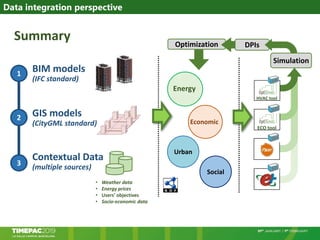
Data integration perspective
Optimization DPIs
Simulation
Energy
Economic
Urban
Social
BIM models
(IFC standard)
GIS models
(CityGML standard)
Contextual Data
(multiple sources)
1
2
3
• Weather data
• Energy prices
• Users’ objectives
• Socio-economic data
HVAC tool
ECO tool
Summary
References
Beetz, J., Van Leeuwen, J., & De Vries, B. 2009. IfcOWL: A case of
transforming EXPRESS schemas into ontologies. Artificial Intelligence for
Engineering Design, Analysis and Manufacturing, 23(01), 89-101.
Bonduel, M., Oraskari, J., Pauwels, P., Vergauwen, M., & Klein, R. (2018). The
IFC to Linked Building Data Converter-Current Status. In 6th Linked Data in
Architecture and Construction Workshop (Vol. 2159, pp. 34-43).
BuildingSMART. (2015). IFC4 Release Summary. http://www.buildingsmart-
tech.org/specifications/ifcreleases/ifc4-release
Costa, G., Sicilia, A., Lilis, G. N., Rovas, D. V., & Izkara, J. (2016). A
comprehensive ontologies-based framework to support retrofitting design of
energy-efficient districts. Ework and Ebusiness in Architecture, Engineering
and Construction; Christodoulou, S., Scherer, R., Eds, 673-681.
Costa, G., Sicilia, Á. (2017). Methodology for data integration using SPARQL
Constructs in the AEC industry. In Proceedings of the 5th Linked Data in
Architecture and Construction Workshop (LDAC2017), Dijon, France, 13–15.
References
O'Donnell, J., See, R., Rose, C., Maile, T., Bazjanac, V., & Haves, P. (2011).
SimModel: A domain data model for whole building energy simulation.
Proceedings of Building Simulation 2011: 12th Conference of International
Building Performance Simulation Association, Sydney.
Pauwels, P., Terkaj, W. (2016). EXPRESS to OWL for construction industry:
Towards a recommendable and usable ifcOWL ontology. Automation in
Construction 63, 100–133. https://doi.org/10.1016/j.autcon.2015.12.003.
Sicilia, Á., & Costa, G. (2017). Energy-Related Data Integration Using
Semantic Data Models for Energy Efficient Retrofitting Projects. In
Multidisciplinary Digital Publishing Institute Proceedings (Vol. 1, No. 7, p.
1099).
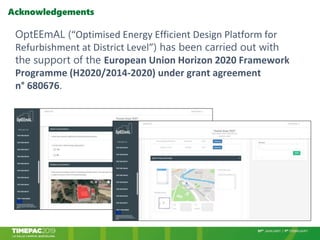
Acknowledgements
OptEEmAL (“Optimised Energy Efficient Design Platform for
Refurbishment at District Level”) has been carried out with
the support of the European Union Horizon 2020 Framework
Programme (H2020/2014-2020) under grant agreement
n° 680676.
https://timepac2019.blogspot.com
If you would like to have more information
about this presentation, please contact
goncal.costa@salle.url.edu
Building data extraction
(Processes, issues, decisions)
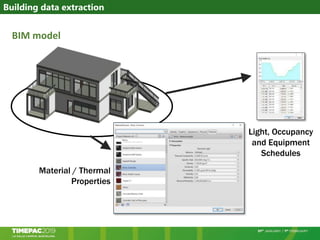
Building data extraction
Light, Occupancy
and Equipment
Schedules
Material / Thermal
Properties
BIM model
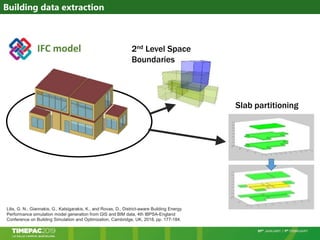
Building data extraction
Lilis, G. N., Giannakis, G., Katsigarakis, K., and Rovas, D., District-aware Building Energy
Performance simulation model generation from GIS and BIM data, 4th IBPSA-England
Conference on Building Simulation and Optimization, Cambridge, UK, 2018, pp. 177-184.
2nd Level Space
Boundaries
Slab partitioning
IFC model
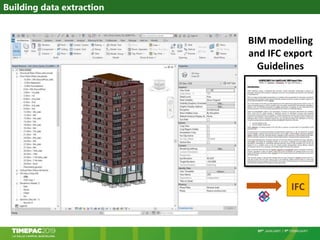
BIM modelling
and IFC export
Guidelines
IFC
Building data extraction

Gonçal Costa, ARC Engineering and Architecture La Salle, Barcelona, Spain.

  • 1.
    OptEEMAL: Enhancing BIMmodels with Semantic Web technologies to plan building retrofitting at district scale Gonçal Costa ARC Engineering and Architecture La Salle Barcelona, SPAIN
  • 2.
    Project Overview Project foundedunder the work programme: HORIZON 2020-WORK PROGRAMME 2014-2015 Leadership in enabling and industrial technologies H2020-EeB-2014-2015 / H2020-EeB-2015 Topic: Innovative design tools for refurbishment at building and district level (EeB-05-2015) Participants: 13 Partners 4 RTO, 2 Universities, 2 IND, 3 SME and 2 Cities Contact: contact@opteemal.eu Optimised Energy Efficient Design Platform for Refurbishment at District Level
  • 3.
    Research topic • Howto provide optimized building-district retrofitting designs through a consistent integration of semantic representation of the data from multiples sources: IFC models, CityGML models, and contextual data (project, weather, occupancy, etc.). Application of the research: the OptEEmAL platform • Optimised Energy Efficient Design Platform for Refurbishment at District Level Three main components of the platform: • District Data Model (DDM) • Energy Conservation Measures Catalogue (ECMs) • Automated generation of input data for simulation tools. Project Overview: Context
  • 4.
    Project Overview: Whatis a district? 1. Target buildings that will be refurbished
  • 5.
    Project Overview: Whatis a district? 1. Target buildings that will be refurbished 2. Surrounding buildings that interact with target buildings (shadows)
  • 6.
    Project Overview: Whatis a district? 1. Target buildings that will be refurbished 2. Surrounding buildings that interact with target buildings (shadows) 3. District active systems connected to the buildings (district heating)
  • 7.
    Project Overview: Whatis a district? • Weather data • Energy prices • Socio-economic data 1. Target buildings that will be refurbished 2. Surrounding buildings that interact with target buildings (shadows) 3. District active systems connected to the buildings (district heating) 4. Contextual data (weather, energy prices…)
  • 8.
    Data integration perspective InputData District Integration Input Data BIM models (IFC standard) GIS models (CityGML standard) Contextual Data (multiple sources) 1 2 3 • Weather data • Energy prices • Users’ objectives • Socio-economic data Measures: • Passive • Active • Renewables • Control Indicators: • Energy • Comfort • Environmental • Economic • Social…
  • 9.
    Data integration perspective BIMmodels (IFC standard) GIS models (CityGML standard) Contextual Data (multiple sources) 1 2 3 Input Data District Model Simulation • Weather data • Energy prices • Users’ objectives • Socio-economic data Energy Economic Semantic Data Models Urban Social Simulation tools HVAC tool ECO tool
  • 10.
    Data integration perspective Energy Economic Semantic DataModels Urban Social CityGML Shadows Validation and Checking Contextual data Simulation tools HVAC tool ECO tool IFCIFCIFC Validation and Checking Building models Input Data District Model Simulation
  • 11.
    Data integration perspective Simulation tools HVACtool ECO tool Simulation District Retrofitting
  • 12.
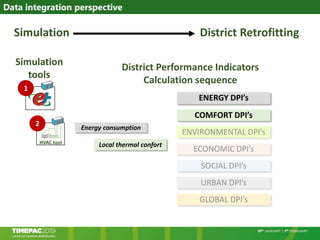
    Data integration perspective Simulation tools ENERGYDPI’s COMFORT DPI’s ENVIRONMENTAL DPI’s ECONOMIC DPI’s SOCIAL DPI’s URBAN DPI’s GLOBAL DPI’s District Performance Indicators Calculation sequence 1 Energy demand Simulation District Retrofitting
  • 13.
    Data integration perspective Simulation tools ENERGYDPI’s COMFORT DPI’s ENVIRONMENTAL DPI’s ECONOMIC DPI’s SOCIAL DPI’s URBAN DPI’s GLOBAL DPI’s District Performance Indicators Calculation sequence HVAC tool 1 2 Energy consumption Local thermal confort Simulation District Retrofitting
  • 14.
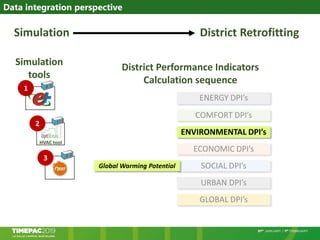
    Data integration perspective Simulation tools ENERGYDPI’s COMFORT DPI’s ENVIRONMENTAL DPI’s ECONOMIC DPI’s SOCIAL DPI’s URBAN DPI’s GLOBAL DPI’s District Performance Indicators Calculation sequence HVAC tool 1 3 2 Global Warming Potential Simulation District Retrofitting
  • 15.
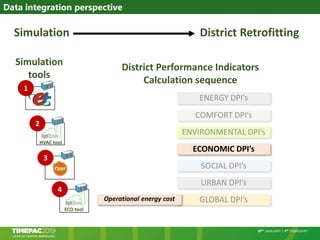
    Data integration perspective Simulation tools ENERGYDPI’s COMFORT DPI’s ENVIRONMENTAL DPI’s ECONOMIC DPI’s SOCIAL DPI’s URBAN DPI’s GLOBAL DPI’s District Performance Indicators Calculation sequence HVAC tool ECO tool 1 3 4 2 Operational energy cost Simulation District Retrofitting
  • 16.
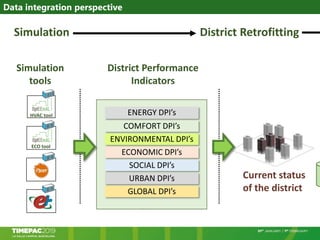
    Data integration perspective ENERGYDPI’s COMFORT DPI’s ENVIRONMENTAL DPI’s ECONOMIC DPI’s SOCIAL DPI’s URBAN DPI’s GLOBAL DPI’s District Performance Indicators Current status of the district Simulation tools HVAC tool ECO tool Simulation District Retrofitting
  • 17.
    Data integration perspective Optimiser Urban Urban Energy Economic Semantic DataModels Urban Social Energy Conservation Measures Catalogue Current status of the district District Retrofitting District Model Indicators
  • 18.
    Data integration perspective Optimiser Urban Urban Energy Economic Semantic DataModels Urban Social Energy Conservation Measures Catalogue atus rict ng District Model Simulation Simulation tools HVAC tool ECO tool dicators
  • 19.
    Data integration perspective OptimizationDPIs Simulation Energy Economic Urban Social BIM models (IFC standard) GIS models (CityGML standard) Contextual Data (multiple sources) 1 2 3 • Weather data • Energy prices • Users’ objectives • Socio-economic data HVAC tool ECO tool Summary
  • 20.
    References Beetz, J., VanLeeuwen, J., & De Vries, B. 2009. IfcOWL: A case of transforming EXPRESS schemas into ontologies. Artificial Intelligence for Engineering Design, Analysis and Manufacturing, 23(01), 89-101. Bonduel, M., Oraskari, J., Pauwels, P., Vergauwen, M., & Klein, R. (2018). The IFC to Linked Building Data Converter-Current Status. In 6th Linked Data in Architecture and Construction Workshop (Vol. 2159, pp. 34-43). BuildingSMART. (2015). IFC4 Release Summary. http://www.buildingsmart- tech.org/specifications/ifcreleases/ifc4-release Costa, G., Sicilia, A., Lilis, G. N., Rovas, D. V., & Izkara, J. (2016). A comprehensive ontologies-based framework to support retrofitting design of energy-efficient districts. Ework and Ebusiness in Architecture, Engineering and Construction; Christodoulou, S., Scherer, R., Eds, 673-681. Costa, G., Sicilia, Á. (2017). Methodology for data integration using SPARQL Constructs in the AEC industry. In Proceedings of the 5th Linked Data in Architecture and Construction Workshop (LDAC2017), Dijon, France, 13–15.
  • 21.
    References O'Donnell, J., See,R., Rose, C., Maile, T., Bazjanac, V., & Haves, P. (2011). SimModel: A domain data model for whole building energy simulation. Proceedings of Building Simulation 2011: 12th Conference of International Building Performance Simulation Association, Sydney. Pauwels, P., Terkaj, W. (2016). EXPRESS to OWL for construction industry: Towards a recommendable and usable ifcOWL ontology. Automation in Construction 63, 100–133. https://doi.org/10.1016/j.autcon.2015.12.003. Sicilia, Á., & Costa, G. (2017). Energy-Related Data Integration Using Semantic Data Models for Energy Efficient Retrofitting Projects. In Multidisciplinary Digital Publishing Institute Proceedings (Vol. 1, No. 7, p. 1099).
  • 22.
    Acknowledgements OptEEmAL (“Optimised EnergyEfficient Design Platform for Refurbishment at District Level”) has been carried out with the support of the European Union Horizon 2020 Framework Programme (H2020/2014-2020) under grant agreement n° 680676.
  • 23.
    https://timepac2019.blogspot.com If you wouldlike to have more information about this presentation, please contact goncal.costa@salle.url.edu
  • 24.
  • 25.
    Building data extraction Light,Occupancy and Equipment Schedules Material / Thermal Properties BIM model
  • 26.
    Building data extraction Lilis,G. N., Giannakis, G., Katsigarakis, K., and Rovas, D., District-aware Building Energy Performance simulation model generation from GIS and BIM data, 4th IBPSA-England Conference on Building Simulation and Optimization, Cambridge, UK, 2018, pp. 177-184. 2nd Level Space Boundaries Slab partitioning IFC model
  • 27.
    BIM modelling and IFCexport Guidelines IFC Building data extraction