SMART FARMING IN REPUBLIC OF MOLDOVA
Ciochina Elena, project expert
Business Advisory Center
Jointlypreparingtheconditionsintheagriculturalandconnected
sectorsintheBSBareaforthedigitaltransformation
WP.T.1.Investigationonthelevelofpreparedness
forSmartfarminginBSBarea
Republic of Moldova background / situation
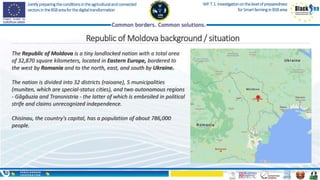
The Republic of Moldova is a tiny landlocked nation with a total area
of 32,870 square kilometers, located in Eastern Europe, bordered to
the west by Romania and to the north, east, and south by Ukraine.
The nation is divided into 32 districts (raioane), 5 municipalities
(muniten, which are special-status cities), and two autonomous regions
- Găgăuzia and Transnistria - the latter of which is embroiled in political
strife and claims unrecognized independence.
Chisinau, the country's capital, has a population of about 786,000
people.
Jointlypreparingtheconditionsintheagriculturalandconnected
sectorsintheBSBareaforthedigitaltransformation
WP.T.1.Investigationonthelevelofpreparedness
forSmartfarminginBSBarea
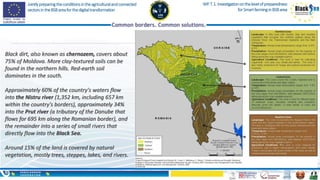
Black dirt, also known as chernozem, covers about
75% of Moldova. More clay-textured soils can be
found in the northern hills. Red-earth soil
dominates in the south.
Approximately 60% of the country's waters flow
into the Nistru river (1,352 km, including 657 km
within the country's borders), approximately 34%
into the Prut river (a tributary of the Danube that
flows for 695 km along the Romanian border), and
the remainder into a series of small rivers that
directly flow into the Black Sea.
Around 15% of the land is covered by natural
vegetation, mostly trees, steppes, lakes, and rivers.
Jointlypreparingtheconditionsintheagriculturalandconnected
sectorsintheBSBareaforthedigitaltransformation
WP.T.1.Investigationonthelevelofpreparedness
forSmartfarminginBSBarea
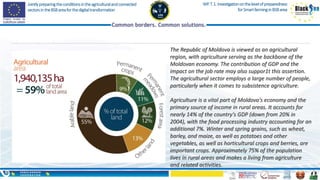
The Republic of Moldova is viewed as an agricultural
region, with agriculture serving as the backbone of the
Moldovan economy. The contribution of GDP and the
impact on the job rate may also suppor1t this assertion.
The agricultural sector employs a large number of people,
particularly when it comes to subsistence agriculture.
Agriculture is a vital part of Moldova's economy and the
primary source of income in rural areas. It accounts for
nearly 14% of the country's GDP (down from 20% in
2004), with the food processing industry accounting for an
additional 7%. Winter and spring grains, such as wheat,
barley, and maize, as well as potatoes and other
vegetables, as well as horticultural crops and berries, are
important crops. Approximately 75% of the population
lives in rural areas and makes a living from agriculture
and related activities.
Jointlypreparingtheconditionsintheagriculturalandconnected
sectorsintheBSBareaforthedigitaltransformation
WP.T.1.Investigationonthelevelofpreparedness
forSmartfarminginBSBarea
Moldova is capitalizing on its agricultural export potential, especially in cereals, sunflowers, fruits, vegetables,
and sugar. Exports of animal origin goods to EU Member States are currently not possible due to
underdeveloped food safety institutions.
Jointlypreparingtheconditionsintheagriculturalandconnected
sectorsintheBSBareaforthedigitaltransformation
WP.T.1.Investigationonthelevelofpreparedness
forSmartfarminginBSBarea
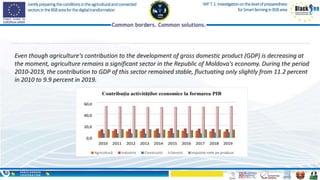
Even though agriculture's contribution to the development of gross domestic product (GDP) is decreasing at
the moment, agriculture remains a significant sector in the Republic of Moldova's economy. During the period
2010-2019, the contribution to GDP of this sector remained stable, fluctuating only slightly from 11.2 percent
in 2010 to 9.9 percent in 2019.
Jointlypreparingtheconditionsintheagriculturalandconnected
sectorsintheBSBareaforthedigitaltransformation
WP.T.1.Investigationonthelevelofpreparedness
forSmartfarminginBSBarea
When it comes to the distribution of gross value added between small and medium-sized enterprises (SMEs)
and large enterprises, we can see that SMEs dominate in the construction sector, with an average of 54.2
percent in support, administrative, educational, technological, and agricultural services.
Jointlypreparingtheconditionsintheagriculturalandconnected
sectorsintheBSBareaforthedigitaltransformation
WP.T.1.Investigationonthelevelofpreparedness
forSmartfarminginBSBarea
Moldova considers itself to be one of those countries committed to boosting the IT industry's growth and
prospects. This is emphasized in strategic documents such as the national strategy for the growth of the
information society, "Digital Moldova 2020," and the Strategy for the development of the information
technology industry and the digital innovation ecosystem for the years 2018–2023, which continue the
government's efforts to grow the field. The Strategy includes a number of initiatives aimed at boosting the
entrepreneurial and IT educational ecosystems, as well as their start-ups and funding mechanisms, as well as
promoting IT goods in niche markets.
Jointlypreparingtheconditionsintheagriculturalandconnected
sectorsintheBSBareaforthedigitaltransformation
WP.T.1.Investigationonthelevelofpreparedness
forSmartfarminginBSBarea
BSB projects
BSB projects in Moldova aim to improve the living standards of people in the riparian regions of the Black Sea
Basin through sustainable economic growth and joint environmental protection. Actions are mainly focused
on the promotion of business and entrepreneurship, the promotion of a coordinated environmental policy and
the reduction of marine litter in the Black Sea Basin through joint actions, thus each project where Republic of
Moldova is part of helps improve the cooperation between the entrepreneurs, farmers, local businesses as
well as make exchange of good practices study cases and learn from the experience of other countries.
Jointlypreparingtheconditionsintheagriculturalandconnected
sectorsintheBSBareaforthedigitaltransformation
WP.T.1.Investigationonthelevelofpreparedness
forSmartfarminginBSBarea
Smart and IoT technologies existent in Republic of moldova
In Republic of Moldova there are a few programmes especially facilitating the process of development,
management and implementation of development policies of the agricultural IoT sector , to be mention in this
regards, such us « e-Agricutlure Strategic Program » , « Export Moldova- Market Assistance website »
, « Agravista »
The results of this research show that Moldova has potential for growth in regards to technical equipment
used in the agriculture sector. The main suplliers of machinaries and tools on the internal market are
presented below. Althought the tehnologies in their inventory is vary and of good quality the IoT in agriculture
are still lacking form their portofolios.
These entities provide such smart technologies as : automatic agricultural weather station, combine
harvesters and tractors, deep plows, sowing equipment, trailers and semi-trailers, drills, feeders, loaders,
compact cultivators, fertilizer harvesters minerals, vegetable seeders, spare parts, grain cleaning and drying
equipment, milling cutters, tractors, soil preparation equipment, sprinklers, headers , driving systems,
telescopic loaders, precision navigation and agriculture systems, vineyard shredder,
As the research showed on the market there are present few companies that provide with drones, integrated
systems, farming OS control systems.
Jointlypreparingtheconditionsintheagriculturalandconnected
sectorsintheBSBareaforthedigitaltransformation
WP.T.1.Investigationonthelevelofpreparedness
forSmartfarminginBSBarea
Qudruple helix approach in agriculture field
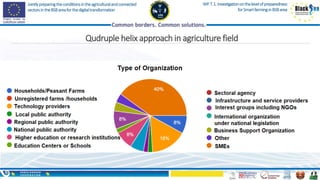
The key stakeholders involved in the questionnaire (50)
Jointlypreparingtheconditionsintheagriculturalandconnected
sectorsintheBSBareaforthedigitaltransformation
WP.T.1.Investigationonthelevelofpreparedness
forSmartfarminginBSBarea
Qudruple helix approach in agriculture field
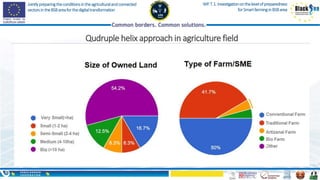
From the interviewed respondents 16 are business entities, 13 are in agriculture, 9 entities are offering tools
and tehnologies for the agriculture, 8 repondents are from social/economic field, and 4 are from education
and academia environment. As asked by the methodology 68% of the interviewers are from
Business/Industry, 12% Society, 10% Government and 10% Academia.
Jointlypreparingtheconditionsintheagriculturalandconnected
sectorsintheBSBareaforthedigitaltransformation
WP.T.1.Investigationonthelevelofpreparedness
forSmartfarminginBSBarea
Qudruple helix approach in agriculture field
Jointlypreparingtheconditionsintheagriculturalandconnected
sectorsintheBSBareaforthedigitaltransformation
WP.T.1.Investigationonthelevelofpreparedness
forSmartfarminginBSBarea
Qudruple helix approach in agriculture field
Jointlypreparingtheconditionsintheagriculturalandconnected
sectorsintheBSBareaforthedigitaltransformation
WP.T.1.Investigationonthelevelofpreparedness
forSmartfarminginBSBarea
Agricultural needs of the rural communities in republic of moldova
Jointlypreparingtheconditionsintheagriculturalandconnected
sectorsintheBSBareaforthedigitaltransformation
WP.T.1.Investigationonthelevelofpreparedness
forSmartfarminginBSBarea
Agricultural needs of the rural communities in republic of moldova
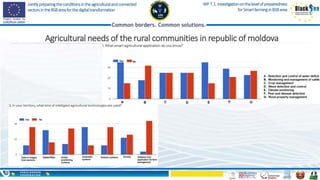
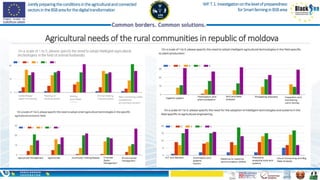
The benefits of using smart agriculture from the point of view of our repondents are increased productivity
(78%), high quality products( 70%), incresead profit (60%) , planning of activities (56%), work efficiency
(56%), reducind the impact on the environment (56%), and cost reduction (52%).
Only 18% of repondents were not sure of the need of smar
farming technologies in their activities and in our country in
general, but the majority (82%) consider this a must.
Jointlypreparingtheconditionsintheagriculturalandconnected
sectorsintheBSBareaforthedigitaltransformation
WP.T.1.Investigationonthelevelofpreparedness
forSmartfarminginBSBarea
Agricultural needs of the rural communities in republic of moldova
Jointlypreparingtheconditionsintheagriculturalandconnected
sectorsintheBSBareaforthedigitaltransformation
WP.T.1.Investigationonthelevelofpreparedness
forSmartfarminginBSBarea
Agricultural needs of the rural communities in republic of moldova
Jointlypreparingtheconditionsintheagriculturalandconnected
sectorsintheBSBareaforthedigitaltransformation
WP.T.1.Investigationonthelevelofpreparedness
forSmartfarminginBSBarea
Jointlypreparingtheconditionsintheagriculturalandconnected
sectorsintheBSBareaforthedigitaltransformation
WP.T.1.Investigationonthelevelofpreparedness
forSmartfarminginBSBarea
Conclusions and recommandations
Governments must be able to express their visions, set strategic goals, determine outcomes, identify trade-offs, develop action
plans, and negotiate and compromise on individual contributions to the plans' implementation. Although individual smallholders
may adopt SA practices, a coordinated response led by a strategic vision incorporating efficiency, connectivity, and conservation
is needed to spread SA across the landscape.
Agriculture has no future without digitalization. The development of the Smart Agriculture (Agricultural Smart Tehnologies)
sector would require new knowledge and skills, which should be implemented in educational institutions.
The Agrarian University should add to their curriculum such a course - technologies already implemented in agriculture.
Despite the significant benefits of Smart Agricultural practices to productivity, resilience, and mitigation objectives, many small-
scale farmers are still reluctant to such investments.
Long-term benefits from investing in Smart Agriculture Technologies are generally unknown to farmers, which makes them
sceptical about new agricultural paradigms, thus there is felt the need to disseminate and inform.
The country analysis of Moldova's ICT-centric innovation environment reveals that existing policies are focused on international
interests and should be refocused on national strengths. Many stakeholders believe that a holistic plan should prioritize particular
ICT regions, other economic sectors, or specialized niches. Nanotechnology, e-agriculture, and the aerospace industry were
among the suggested fields. ICTs, agriculture and food processing, biomedicine, and energy are the smart specialization areas
defined in Moldova (where agriculture also plays a role).
Jointlypreparingtheconditionsintheagriculturalandconnected
sectorsintheBSBareaforthedigitaltransformation
WP.T.1.Investigationonthelevelofpreparedness
forSmartfarminginBSBarea
Acknowledgements
Thank you!
http://bsb-smartfarming.com/
Joint Operational Programme Black Sea Basin 2014-2020
Author/s: Ciochina Elena, Palade Anatolie, Darii Dumitru (PP6
– Business Advisory Center)
March 2021
Joint Operational Programme Black Sea Basin 2014-2020 is co-
financed by the European Union through the European
Neighbourhood Instrument and by the participating countries:
Armenia, Bulgaria, Georgia, Greece, Republic of Moldova,
Romania, Turkey and Ukraine.
This publication has been produced with the financial assistance
of the European Union.
The content of this publication is the sole responsibility of the
authors and can in no way be taken to reflect the views of the
European Union.

01.D.T.1.4.1_PP6