Toward Enhanced Professional Skepticism
ACCA, Brussels, Belgium
October 17, 2017
Prof. Arnold Schilder, IAASB Chairman
Professional Skepticism – Key Observations
1. Increased attention to business acumen is central to the exercise of professional skepticism.
2 Environmental factors can influence the ability to exercise professional skepticism.
3. Awareness of personal traits and biases is essential.
4. Building in professional skepticism from the outset is key.
5. There is more that the three standard-setting boards can do, both in the immediate term and
the longer term.
6. Beyond audit, aspects of the concepts underlying professional skepticism may be relevant to
all professional accountants.
7. Standard setting alone will not be enough.
12
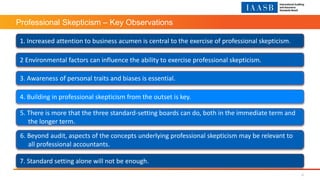
Addressing Fundamental Elements of the Audit
3
High-Quality Audits
in a Changing Business Environment –
Influenced by Technology, Complexity, and Demands
for Continued Relevance
Quality Control
at the
Engagement
Level (ISA 220)
Auditing
Accounting
Estimates,
Including Fair
Values (ISA 540)
Group Audits
(ISA 600)
Risk
Identification and
Assessment
(ISA 315)
Strengthening the Application of Professional Skepticism
Enhancing Firms’ Systems of Quality Control (ISQC 1)
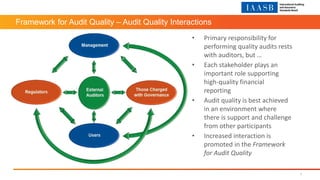
Framework for Audit Quality – Audit Quality Interactions
• Primary responsibility for
performing quality audits rests
with auditors, but …
• Each stakeholder plays an
important role supporting
high-quality financial
reporting
• Audit quality is best achieved
in an environment where
there is support and challenge
from other participants
• Increased interaction is
promoted in the Framework
for Audit Quality
5

Toward Enhanced Professional Skepticism

  • 1.
    Toward Enhanced ProfessionalSkepticism ACCA, Brussels, Belgium October 17, 2017 Prof. Arnold Schilder, IAASB Chairman
  • 2.
    Professional Skepticism –Key Observations 1. Increased attention to business acumen is central to the exercise of professional skepticism. 2 Environmental factors can influence the ability to exercise professional skepticism. 3. Awareness of personal traits and biases is essential. 4. Building in professional skepticism from the outset is key. 5. There is more that the three standard-setting boards can do, both in the immediate term and the longer term. 6. Beyond audit, aspects of the concepts underlying professional skepticism may be relevant to all professional accountants. 7. Standard setting alone will not be enough. 12
  • 3.
    Addressing Fundamental Elementsof the Audit 3 High-Quality Audits in a Changing Business Environment – Influenced by Technology, Complexity, and Demands for Continued Relevance Quality Control at the Engagement Level (ISA 220) Auditing Accounting Estimates, Including Fair Values (ISA 540) Group Audits (ISA 600) Risk Identification and Assessment (ISA 315) Strengthening the Application of Professional Skepticism Enhancing Firms’ Systems of Quality Control (ISQC 1)
  • 4.
    Framework for AuditQuality – Audit Quality Interactions • Primary responsibility for performing quality audits rests with auditors, but … • Each stakeholder plays an important role supporting high-quality financial reporting • Audit quality is best achieved in an environment where there is support and challenge from other participants • Increased interaction is promoted in the Framework for Audit Quality 5