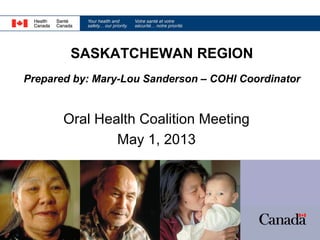
SASKATCHEWAN REGION
Prepared by: Mary-Lou Sanderson – COHI Coordinator

Oral Health Coalition Meeting
May 1, 2013
Children’s Oral
Health Initiative
(COHI) Program
2
Outline of Presentation:
•What is the COHI Program?
•Goals of the COHI Program
•COHI Targets groups and why they were
chosen
•What are the COHI services?
•Roles of the dental therapist and Aide
•COHI Funding Work Plan
•COHI Deliverables
3
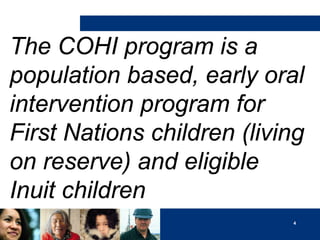
The COHI program is a
population based, early oral
intervention program for
First Nations children (living
on reserve) and eligible
Inuit children
4
What is the Children’s Oral
Health Initiative Program?
A dental program designed
to prevent and control early
childhood tooth decay
5
Rationale: COHI was
developed to focus on the
understanding that tooth
decay is a transmissible
disease and fully
PREVENTABLE
6
Goals of COHI Program
Improve oral health for children, and, in
doing so, improve their overall health
Teach parents and caregivers how to
prevent dental diseases for themselves and
their children
Prevent early childhood tooth decay and
avoid the need for unpleasant dental
treatment
Introduce babies and young children to
dentistry that is successful, painless and fun
7
 A Health Canada dental initiative
that began in September 2004
 In 2004, COHI was introduced on
a limited basis. There were 5 FN
communities involved during
this first year
 COHI officially became a
program in May 2010
8
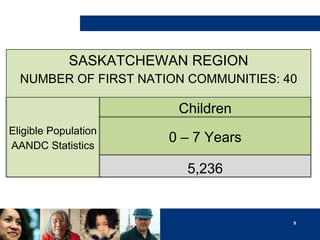
SASKATCHEWAN REGION
NUMBER OF FIRST NATION COMMUNITIES: 40

Children
Eligible Population
AANDC Statistics

0 – 7 Years
5,236

9
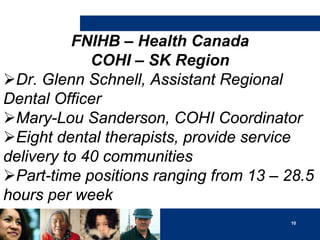
FNIHB – Health Canada
COHI – SK Region
Dr. Glenn Schnell, Assistant Regional
Dental Officer
Mary-Lou Sanderson, COHI Coordinator
Eight dental therapists, provide service
delivery to 40 communities
Part-time positions ranging from 13 – 28.5
hours per week
10
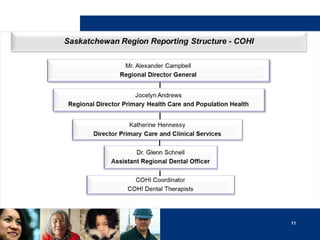
11
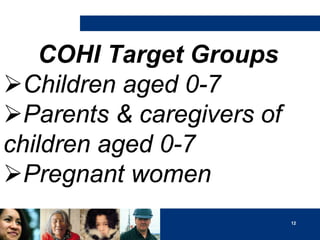
COHI Target Groups
Children aged 0-7
Parents & caregivers of
children aged 0-7
Pregnant women
12
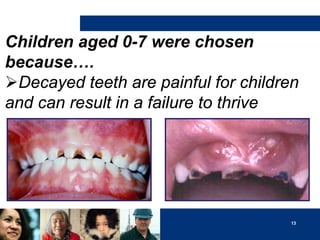
Children aged 0-7 were chosen
because….
Decayed teeth are painful for children
and can result in a failure to thrive

13
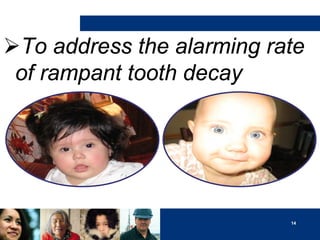
To address the alarming rate
of rampant tooth decay

14
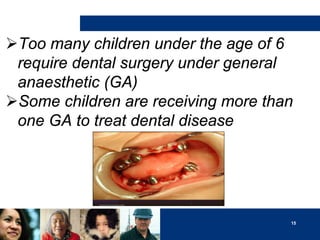
Too many children under the age of 6
require dental surgery under general
anaesthetic (GA)
Some children are receiving more than
one GA to treat dental disease
H e a lt h C a n a d a
F ir s t N a t io n s a n d I n u it H e a lt h B r a n c h

C r e d it : D r . T . K r a w a t

N a t io n a l P r e s e n t a t i o n 2 0 0 2

5

15
Pregnant women, parents, and
caregivers were chosen because….
Tooth decay is caused by a bacterial
infection
When adults don’t care of their own
mouths, they can transmit the bacteria
which causes tooth decay to children
16
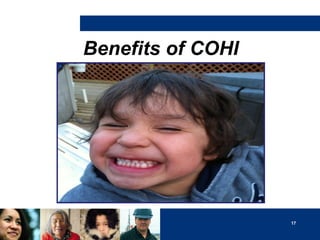
Benefits of COHI

17
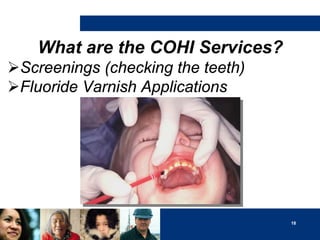
What are the COHI Services?
Screenings (checking the teeth)
Fluoride Varnish Applications

18
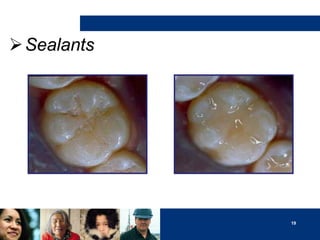
 Sealants

19
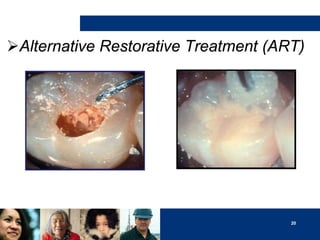
Alternative Restorative Treatment (ART)

20
One on one or small group oral health
sessions
Promotion of xylitol products

 Referrals as required
21
Who provides COHI services?
COHI Dental Therapist – Health
Canada
COHI Aide – Community Member

22
Role of the COHI Dental Therapist
Provides training, guidance and direction
to the COHI Aide
Completes screenings, sealants, and
temporary fillings (ART)
Provides education & information
regarding oral health
Referrals if necessary
23
 Build capacity in the community by
linking with other programs to reach
target groups
 The dental therapist may have to
assume some of the COHI Aide’s
role when necessary
24
Role of the COHI Aide
Provides the very important link between
the community and the dental therapist
Requires training as provided by Health
Canada
Works with the dental therapist when
preforming dental services (screenings,
ART & Sealant clinics)
25
 Collects authorization forms
• No COHI services can be provided
without a signed authorization
• Child is in the program until no longer
eligible
• Regardless if there is a completed
authorization form a child’s medical
history must be updated each COHI year
• COHI Year – September 1 to August 31
26
 Completes medical history
updates
 Application of the all the fluoride
varnishes on the children
 Provides oral health information
sessions (one-on-one)

27
COHI Funding Work Plan
Funding is formula-based, utilizing
population numbers of children aged
birth to 7 years of age
This formula determines the number
of professional days for the dental
therapist and the COHI Aide
28
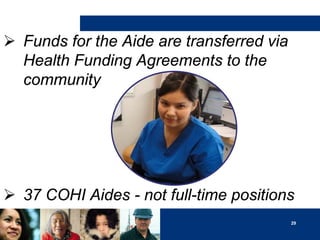
 Funds for the Aide are transferred via
Health Funding Agreements to the
community

 37 COHI Aides - not full-time positions
29
Reporting Requirements for the HFA
Submission of Dental Services Daily
Records (DSDR) at the end of each month
– COHI Aide
Completion of Community-Based
Reporting Template at the end of fiscal year
- Community
Completion of Financial Reporting on as
outlined in the HFA - Community
30
COHI Deliverables
There are target objectives that have been
identified across Canada for the COHI
Program:
1.Enrol a minimum of 40% of the eligible
children aged 0-4 and 70% of the eligible
children aged 5-7
31
2. Complete dental screening for 90% of
all authorized children aged 0-7
(screening done each year)
3. Complete all required fluoride varnish
applications (2) for 70% of all authorized
children aged 0-7
4. A minimum of 40% of prenatal clients
participating in an oral health
information session
32
How is success measured?
Partnerships are developed between
COHI staff and the community, i.e.
with nurses, school staff, day care
providers, health centre staff,
community programs….and
especially with the families
33
COHI needs community support:
A key factor in the success of COHI
is the “community support”….the
dental therapist and the COHI Aide
need the support of the entire
community in delivering the
services and the message!!
34
QUESTIONS?

35

Cohi saskatchewan region

  • 1.
    SASKATCHEWAN REGION Prepared by:Mary-Lou Sanderson – COHI Coordinator Oral Health Coalition Meeting May 1, 2013
  • 2.
  • 3.
    Outline of Presentation: •Whatis the COHI Program? •Goals of the COHI Program •COHI Targets groups and why they were chosen •What are the COHI services? •Roles of the dental therapist and Aide •COHI Funding Work Plan •COHI Deliverables 3
  • 4.
    The COHI programis a population based, early oral intervention program for First Nations children (living on reserve) and eligible Inuit children 4
  • 5.
    What is theChildren’s Oral Health Initiative Program? A dental program designed to prevent and control early childhood tooth decay 5
  • 6.
    Rationale: COHI was developedto focus on the understanding that tooth decay is a transmissible disease and fully PREVENTABLE 6
  • 7.
    Goals of COHIProgram Improve oral health for children, and, in doing so, improve their overall health Teach parents and caregivers how to prevent dental diseases for themselves and their children Prevent early childhood tooth decay and avoid the need for unpleasant dental treatment Introduce babies and young children to dentistry that is successful, painless and fun 7
  • 8.
     A HealthCanada dental initiative that began in September 2004  In 2004, COHI was introduced on a limited basis. There were 5 FN communities involved during this first year  COHI officially became a program in May 2010 8
  • 9.
    SASKATCHEWAN REGION NUMBER OFFIRST NATION COMMUNITIES: 40 Children Eligible Population AANDC Statistics 0 – 7 Years 5,236 9
  • 10.
    FNIHB – HealthCanada COHI – SK Region Dr. Glenn Schnell, Assistant Regional Dental Officer Mary-Lou Sanderson, COHI Coordinator Eight dental therapists, provide service delivery to 40 communities Part-time positions ranging from 13 – 28.5 hours per week 10
  • 11.
  • 12.
    COHI Target Groups Childrenaged 0-7 Parents & caregivers of children aged 0-7 Pregnant women 12
  • 13.
    Children aged 0-7were chosen because…. Decayed teeth are painful for children and can result in a failure to thrive 13
  • 14.
    To address thealarming rate of rampant tooth decay 14
  • 15.
    Too many childrenunder the age of 6 require dental surgery under general anaesthetic (GA) Some children are receiving more than one GA to treat dental disease H e a lt h C a n a d a F ir s t N a t io n s a n d I n u it H e a lt h B r a n c h C r e d it : D r . T . K r a w a t N a t io n a l P r e s e n t a t i o n 2 0 0 2 5 15
  • 16.
    Pregnant women, parents,and caregivers were chosen because…. Tooth decay is caused by a bacterial infection When adults don’t care of their own mouths, they can transmit the bacteria which causes tooth decay to children 16
  • 17.
  • 18.
    What are theCOHI Services? Screenings (checking the teeth) Fluoride Varnish Applications 18
  • 19.
  • 20.
  • 21.
    One on oneor small group oral health sessions Promotion of xylitol products  Referrals as required 21
  • 22.
    Who provides COHIservices? COHI Dental Therapist – Health Canada COHI Aide – Community Member 22
  • 23.
    Role of theCOHI Dental Therapist Provides training, guidance and direction to the COHI Aide Completes screenings, sealants, and temporary fillings (ART) Provides education & information regarding oral health Referrals if necessary 23
  • 24.
     Build capacityin the community by linking with other programs to reach target groups  The dental therapist may have to assume some of the COHI Aide’s role when necessary 24
  • 25.
    Role of theCOHI Aide Provides the very important link between the community and the dental therapist Requires training as provided by Health Canada Works with the dental therapist when preforming dental services (screenings, ART & Sealant clinics) 25
  • 26.
     Collects authorizationforms • No COHI services can be provided without a signed authorization • Child is in the program until no longer eligible • Regardless if there is a completed authorization form a child’s medical history must be updated each COHI year • COHI Year – September 1 to August 31 26
  • 27.
     Completes medicalhistory updates  Application of the all the fluoride varnishes on the children  Provides oral health information sessions (one-on-one) 27
  • 28.
    COHI Funding WorkPlan Funding is formula-based, utilizing population numbers of children aged birth to 7 years of age This formula determines the number of professional days for the dental therapist and the COHI Aide 28
  • 29.
     Funds forthe Aide are transferred via Health Funding Agreements to the community  37 COHI Aides - not full-time positions 29
  • 30.
    Reporting Requirements forthe HFA Submission of Dental Services Daily Records (DSDR) at the end of each month – COHI Aide Completion of Community-Based Reporting Template at the end of fiscal year - Community Completion of Financial Reporting on as outlined in the HFA - Community 30
  • 31.
    COHI Deliverables There aretarget objectives that have been identified across Canada for the COHI Program: 1.Enrol a minimum of 40% of the eligible children aged 0-4 and 70% of the eligible children aged 5-7 31
  • 32.
    2. Complete dentalscreening for 90% of all authorized children aged 0-7 (screening done each year) 3. Complete all required fluoride varnish applications (2) for 70% of all authorized children aged 0-7 4. A minimum of 40% of prenatal clients participating in an oral health information session 32
  • 33.
    How is successmeasured? Partnerships are developed between COHI staff and the community, i.e. with nurses, school staff, day care providers, health centre staff, community programs….and especially with the families 33
  • 34.
    COHI needs communitysupport: A key factor in the success of COHI is the “community support”….the dental therapist and the COHI Aide need the support of the entire community in delivering the services and the message!! 34
  • 35.