Dysnomia: complementing Nix deployments with
state deployment
Sander van der Burg
October 26, 2018
Sander van der Burg Dysnomia
The Nix project: Declarative deployment
Nix – declarative specification of package build procedures
(including their dependencies)
NixOS – declarative specification of system aspects
NixOps – declarative specification of a network of machines
Disnix – declarative specifications of services, machines and
distribution of services over machines
Deployment activities are implicit – a user writes or adapts a deploy-
ment specification, and the tools will carry out the required activities,
such as building, transfering, activating, and deactivating.
Sander van der Burg Dysnomia
The Nix project: Non-functional properties
Automated deployment using declarative specifications with the
following properties:
Generic. Can be used with many programming languages,
component technologies, and operating systems.
Reproducible. (Almost) no impurities – if inputs are the same,
result should be the same regardless of its location
Reliable. Dependency completeness, (almost) atomic
upgrades and rollbacks.
Efficient. Only the required deployment activities are
executed.
Sander van der Burg Dysnomia
Deploying a NixOS configuration
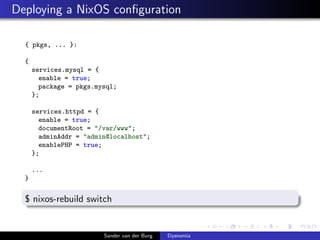
{ pkgs, ... }:
{
services.mysql = {
enable = true;
package = pkgs.mysql;
};
services.httpd = {
enable = true;
documentRoot = "/var/www";
adminAddr = "admin@localhost";
enablePHP = true;
};
...
}
$ nixos-rebuild switch
Sander van der Burg Dysnomia
Deploying a NixOS configuration
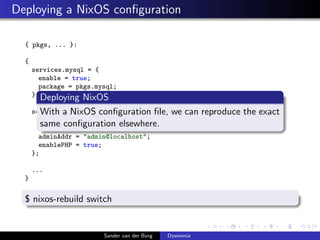
{ pkgs, ... }:
{
services.mysql = {
enable = true;
package = pkgs.mysql;
};
services.httpd = {
enable = true;
documentRoot = "/var/www";
adminAddr = "admin@localhost";
enablePHP = true;
};
...
}
$ nixos-rebuild switch
Sander van der Burg Dysnomia
Deploying NixOS
With a NixOS configuration file, we can reproduce the exact
same configuration elsewhere.
Managing state
But, what about my databases?
Nix only manages the static parts of a system, not any state.
Sander van der Burg Dysnomia
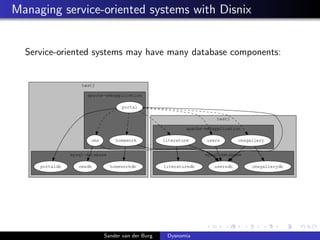
Managing service-oriented systems with Disnix
Service-oriented systems may have many database components:
Sander van der Burg Dysnomia
Managing service-oriented systems with Disnix
To be flexible, we must redeploy regularly respond to events, such
as:
Load increases → distribute services over more machines
Load decreases → consolidate servers and retire obsolete
machines
A machine crashes → redistribute missing services
Sander van der Burg Dysnomia
Managing service-oriented systems with Disnix
To be able to migrate state, automation is required!
Sander van der Burg Dysnomia
Dysnomia: providing complementary state deployment
Sander van der Burg Dysnomia
Dysnomia: Concepts
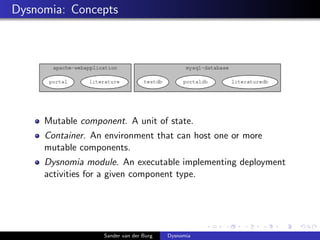
Mutable component. A unit of state.
Container. An environment that can host one or more
mutable components.
Dysnomia module. An executable implementing deployment
activities for a given component type.
Sander van der Burg Dysnomia
Dysnomia: Components
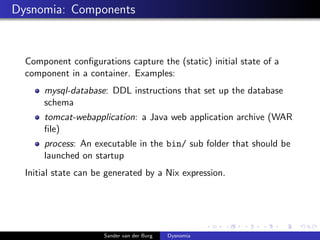
Component configurations capture the (static) initial state of a
component in a container. Examples:
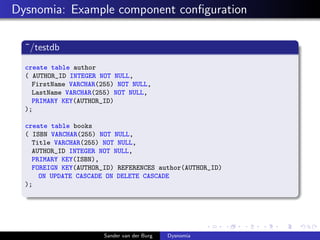
mysql-database: DDL instructions that set up the database
schema
tomcat-webapplication: a Java web application archive (WAR
file)
process: An executable in the bin/ sub folder that should be
launched on startup
Initial state can be generated by a Nix expression.
Sander van der Burg Dysnomia
Dysnomia: Example component configuration
˜/testdb
create table author
( AUTHOR_ID INTEGER NOT NULL,
FirstName VARCHAR(255) NOT NULL,
LastName VARCHAR(255) NOT NULL,
PRIMARY KEY(AUTHOR_ID)
);
create table books
( ISBN VARCHAR(255) NOT NULL,
Title VARCHAR(255) NOT NULL,
AUTHOR_ID INTEGER NOT NULL,
PRIMARY KEY(ISBN),
FOREIGN KEY(AUTHOR_ID) REFERENCES author(AUTHOR_ID)
ON UPDATE CASCADE ON DELETE CASCADE
);
Sander van der Burg Dysnomia
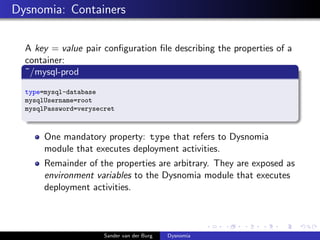
Dysnomia: Containers
A key = value pair configuration file describing the properties of a
container:
˜/mysql-prod
type=mysql-database
mysqlUsername=root
mysqlPassword=verysecret
One mandatory property: type that refers to Dysnomia
module that executes deployment activities.
Remainder of the properties are arbitrary. They are exposed as
environment variables to the Dysnomia module that executes
deployment activities.
Sander van der Burg Dysnomia
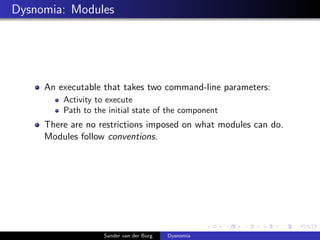
Dysnomia: Modules
An executable that takes two command-line parameters:
Activity to execute
Path to the initial state of the component
There are no restrictions imposed on what modules can do.
Modules follow conventions.
Sander van der Burg Dysnomia
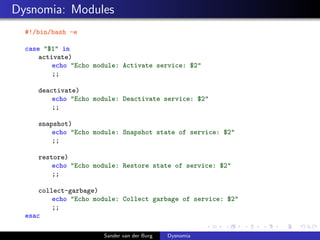
Dysnomia: Modules
#!/bin/bash -e
case "$1" in
activate)
echo "Echo module: Activate service: $2"
;;
deactivate)
echo "Echo module: Deactivate service: $2"
;;
snapshot)
echo "Echo module: Snapshot state of service: $2"
;;
restore)
echo "Echo module: Restore state of service: $2"
;;
collect-garbage)
echo "Echo module: Collect garbage of service: $2"
;;
esac
Sander van der Burg Dysnomia
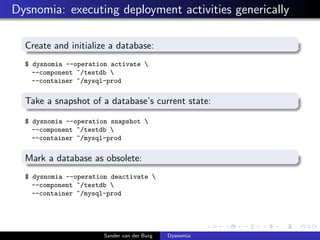
Dysnomia: executing deployment activities generically
Create and initialize a database:
$ dysnomia --operation activate 
--component ~/testdb 
--container ~/mysql-prod
Take a snapshot of a database’s current state:
$ dysnomia --operation snapshot 
--component ~/testdb 
--container ~/mysql-prod
Mark a database as obsolete:
$ dysnomia --operation deactivate 
--component ~/testdb 
--container ~/mysql-prod
Sander van der Burg Dysnomia
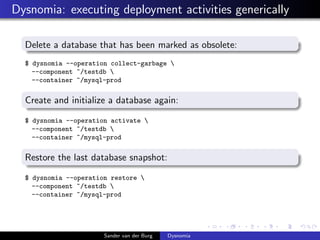
Dysnomia: executing deployment activities generically
Delete a database that has been marked as obsolete:
$ dysnomia --operation collect-garbage 
--component ~/testdb 
--container ~/mysql-prod
Create and initialize a database again:
$ dysnomia --operation activate 
--component ~/testdb 
--container ~/mysql-prod
Restore the last database snapshot:
$ dysnomia --operation restore 
--component ~/testdb 
--container ~/mysql-prod
Sander van der Burg Dysnomia
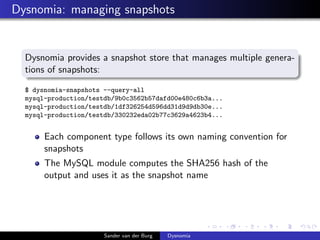
Dysnomia: managing snapshots
Dysnomia provides a snapshot store that manages multiple genera-
tions of snapshots:
$ dysnomia-snapshots --query-all
mysql-production/testdb/9b0c3562b57dafd00e480c6b3a...
mysql-production/testdb/1df326254d596dd31d9d9db30e...
mysql-production/testdb/330232eda02b77c3629a4623b4...
Each component type follows its own naming convention for
snapshots
The MySQL module computes the SHA256 hash of the
output and uses it as the snapshot name
Sander van der Burg Dysnomia
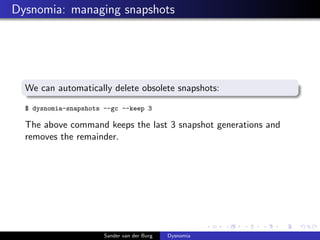
Dysnomia: managing snapshots
We can automatically delete obsolete snapshots:
$ dysnomia-snapshots --gc --keep 3
The above command keeps the last 3 snapshot generations and
removes the remainder.
Sander van der Burg Dysnomia
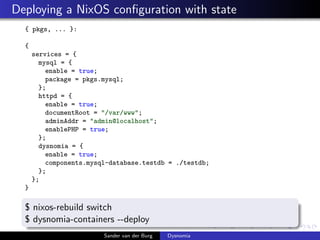
Deploying a NixOS configuration with state
{ pkgs, ... }:
{
services = {
mysql = {
enable = true;
package = pkgs.mysql;
};
httpd = {
enable = true;
documentRoot = "/var/www";
adminAddr = "admin@localhost";
enablePHP = true;
};
dysnomia = {
enable = true;
components.mysql-database.testdb = ./testdb;
};
};
}
$ nixos-rebuild switch
$ dysnomia-containers --deploy
Sander van der Burg Dysnomia
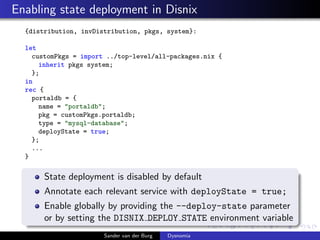
Enabling state deployment in Disnix
{distribution, invDistribution, pkgs, system}:
let
customPkgs = import ../top-level/all-packages.nix {
inherit pkgs system;
};
in
rec {
portaldb = {
name = "portaldb";
pkg = customPkgs.portaldb;
type = "mysql-database";
deployState = true;
};
...
}
State deployment is disabled by default
Annotate each relevant service with deployState = true;
Enable globally by providing the --deploy-state parameter
or by setting the DISNIX DEPLOY STATE environment variable
Sander van der Burg Dysnomia
Migrating databases with Disnix
{infrastructure}:
{
usersdb = [ infrastructure.test1 ];
cmsdb = [ infrastructure.test2 ];
cmsgallerydb = [ infrastructure.test1 ];
homeworkdb = [ infrastructure.test2 ];
literaturedb = [ infrastructure.test1 ];
portaldb = [ infrastructure.test2 ];
}
$ disnix-env -s services.nix -i infrastructure.nix -d distribution.nix
Updating the location of a database in the distribution model and
redeploying the system also migrates state from one machine to
another.
Sander van der Burg Dysnomia
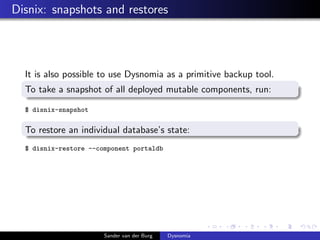
Disnix: snapshots and restores
It is also possible to use Dysnomia as a primitive backup tool.
To take a snapshot of all deployed mutable components, run:
$ disnix-snapshot
To restore an individual database’s state:
$ disnix-restore --component portaldb
Sander van der Burg Dysnomia
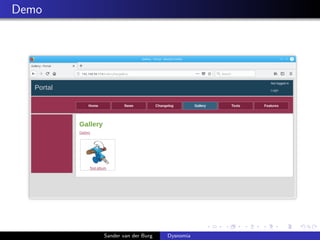
Demo
Sander van der Burg Dysnomia
Is the state deployment problem solved?
Sander van der Burg Dysnomia
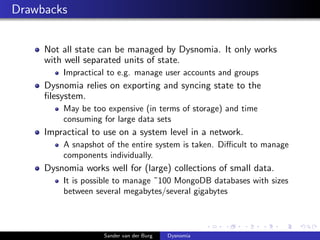
Drawbacks
Not all state can be managed by Dysnomia. It only works
with well separated units of state.
Impractical to e.g. manage user accounts and groups
Dysnomia relies on exporting and syncing state to the
filesystem.
May be too expensive (in terms of storage) and time
consuming for large data sets
Impractical to use on a system level in a network.
A snapshot of the entire system is taken. Difficult to manage
components individually.
Dysnomia works well for (large) collections of small data.
It is possible to manage ˜100 MongoDB databases with sizes
between several megabytes/several gigabytes
Sander van der Burg Dysnomia
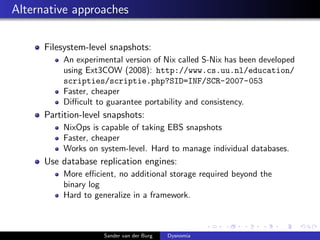
Alternative approaches
Filesystem-level snapshots:
An experimental version of Nix called S-Nix has been developed
using Ext3COW (2008): http://www.cs.uu.nl/education/
scripties/scriptie.php?SID=INF/SCR-2007-053
Faster, cheaper
Difficult to guarantee portability and consistency.
Partition-level snapshots:
NixOps is capable of taking EBS snapshots
Faster, cheaper
Works on system-level. Hard to manage individual databases.
Use database replication engines:
More efficient, no additional storage required beyond the
binary log
Hard to generalize in a framework.
Sander van der Burg Dysnomia
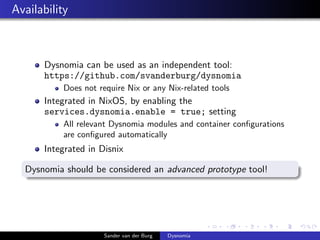
Availability
Dysnomia can be used as an independent tool:
https://github.com/svanderburg/dysnomia
Does not require Nix or any Nix-related tools
Integrated in NixOS, by enabling the
services.dysnomia.enable = true; setting
All relevant Dysnomia modules and container configurations
are configured automatically
Integrated in Disnix
Dysnomia should be considered an advanced prototype tool!
Sander van der Burg Dysnomia
Questions
Sander van der Burg Dysnomia

Dysnomia: complementing Nix deployments with state deployment

  • 1.
    Dysnomia: complementing Nixdeployments with state deployment Sander van der Burg October 26, 2018 Sander van der Burg Dysnomia
  • 2.
    The Nix project:Declarative deployment Nix – declarative specification of package build procedures (including their dependencies) NixOS – declarative specification of system aspects NixOps – declarative specification of a network of machines Disnix – declarative specifications of services, machines and distribution of services over machines Deployment activities are implicit – a user writes or adapts a deploy- ment specification, and the tools will carry out the required activities, such as building, transfering, activating, and deactivating. Sander van der Burg Dysnomia
  • 3.
    The Nix project:Non-functional properties Automated deployment using declarative specifications with the following properties: Generic. Can be used with many programming languages, component technologies, and operating systems. Reproducible. (Almost) no impurities – if inputs are the same, result should be the same regardless of its location Reliable. Dependency completeness, (almost) atomic upgrades and rollbacks. Efficient. Only the required deployment activities are executed. Sander van der Burg Dysnomia
  • 4.
    Deploying a NixOSconfiguration { pkgs, ... }: { services.mysql = { enable = true; package = pkgs.mysql; }; services.httpd = { enable = true; documentRoot = "/var/www"; adminAddr = "admin@localhost"; enablePHP = true; }; ... } $ nixos-rebuild switch Sander van der Burg Dysnomia
  • 5.
    Deploying a NixOSconfiguration { pkgs, ... }: { services.mysql = { enable = true; package = pkgs.mysql; }; services.httpd = { enable = true; documentRoot = "/var/www"; adminAddr = "admin@localhost"; enablePHP = true; }; ... } $ nixos-rebuild switch Sander van der Burg Dysnomia Deploying NixOS With a NixOS configuration file, we can reproduce the exact same configuration elsewhere.
  • 6.
    Managing state But, whatabout my databases? Nix only manages the static parts of a system, not any state. Sander van der Burg Dysnomia
  • 7.
    Managing service-oriented systemswith Disnix Service-oriented systems may have many database components: Sander van der Burg Dysnomia
  • 8.
    Managing service-oriented systemswith Disnix To be flexible, we must redeploy regularly respond to events, such as: Load increases → distribute services over more machines Load decreases → consolidate servers and retire obsolete machines A machine crashes → redistribute missing services Sander van der Burg Dysnomia
  • 9.
    Managing service-oriented systemswith Disnix To be able to migrate state, automation is required! Sander van der Burg Dysnomia
  • 10.
    Dysnomia: providing complementarystate deployment Sander van der Burg Dysnomia
  • 11.
    Dysnomia: Concepts Mutable component.A unit of state. Container. An environment that can host one or more mutable components. Dysnomia module. An executable implementing deployment activities for a given component type. Sander van der Burg Dysnomia
  • 12.
    Dysnomia: Components Component configurationscapture the (static) initial state of a component in a container. Examples: mysql-database: DDL instructions that set up the database schema tomcat-webapplication: a Java web application archive (WAR file) process: An executable in the bin/ sub folder that should be launched on startup Initial state can be generated by a Nix expression. Sander van der Burg Dysnomia
  • 13.
    Dysnomia: Example componentconfiguration ˜/testdb create table author ( AUTHOR_ID INTEGER NOT NULL, FirstName VARCHAR(255) NOT NULL, LastName VARCHAR(255) NOT NULL, PRIMARY KEY(AUTHOR_ID) ); create table books ( ISBN VARCHAR(255) NOT NULL, Title VARCHAR(255) NOT NULL, AUTHOR_ID INTEGER NOT NULL, PRIMARY KEY(ISBN), FOREIGN KEY(AUTHOR_ID) REFERENCES author(AUTHOR_ID) ON UPDATE CASCADE ON DELETE CASCADE ); Sander van der Burg Dysnomia
  • 14.
    Dysnomia: Containers A key= value pair configuration file describing the properties of a container: ˜/mysql-prod type=mysql-database mysqlUsername=root mysqlPassword=verysecret One mandatory property: type that refers to Dysnomia module that executes deployment activities. Remainder of the properties are arbitrary. They are exposed as environment variables to the Dysnomia module that executes deployment activities. Sander van der Burg Dysnomia
  • 15.
    Dysnomia: Modules An executablethat takes two command-line parameters: Activity to execute Path to the initial state of the component There are no restrictions imposed on what modules can do. Modules follow conventions. Sander van der Burg Dysnomia
  • 16.
    Dysnomia: Modules #!/bin/bash -e case"$1" in activate) echo "Echo module: Activate service: $2" ;; deactivate) echo "Echo module: Deactivate service: $2" ;; snapshot) echo "Echo module: Snapshot state of service: $2" ;; restore) echo "Echo module: Restore state of service: $2" ;; collect-garbage) echo "Echo module: Collect garbage of service: $2" ;; esac Sander van der Burg Dysnomia
  • 17.
    Dysnomia: executing deploymentactivities generically Create and initialize a database: $ dysnomia --operation activate --component ~/testdb --container ~/mysql-prod Take a snapshot of a database’s current state: $ dysnomia --operation snapshot --component ~/testdb --container ~/mysql-prod Mark a database as obsolete: $ dysnomia --operation deactivate --component ~/testdb --container ~/mysql-prod Sander van der Burg Dysnomia
  • 18.
    Dysnomia: executing deploymentactivities generically Delete a database that has been marked as obsolete: $ dysnomia --operation collect-garbage --component ~/testdb --container ~/mysql-prod Create and initialize a database again: $ dysnomia --operation activate --component ~/testdb --container ~/mysql-prod Restore the last database snapshot: $ dysnomia --operation restore --component ~/testdb --container ~/mysql-prod Sander van der Burg Dysnomia
  • 19.
    Dysnomia: managing snapshots Dysnomiaprovides a snapshot store that manages multiple genera- tions of snapshots: $ dysnomia-snapshots --query-all mysql-production/testdb/9b0c3562b57dafd00e480c6b3a... mysql-production/testdb/1df326254d596dd31d9d9db30e... mysql-production/testdb/330232eda02b77c3629a4623b4... Each component type follows its own naming convention for snapshots The MySQL module computes the SHA256 hash of the output and uses it as the snapshot name Sander van der Burg Dysnomia
  • 20.
    Dysnomia: managing snapshots Wecan automatically delete obsolete snapshots: $ dysnomia-snapshots --gc --keep 3 The above command keeps the last 3 snapshot generations and removes the remainder. Sander van der Burg Dysnomia
  • 21.
    Deploying a NixOSconfiguration with state { pkgs, ... }: { services = { mysql = { enable = true; package = pkgs.mysql; }; httpd = { enable = true; documentRoot = "/var/www"; adminAddr = "admin@localhost"; enablePHP = true; }; dysnomia = { enable = true; components.mysql-database.testdb = ./testdb; }; }; } $ nixos-rebuild switch $ dysnomia-containers --deploy Sander van der Burg Dysnomia
  • 22.
    Enabling state deploymentin Disnix {distribution, invDistribution, pkgs, system}: let customPkgs = import ../top-level/all-packages.nix { inherit pkgs system; }; in rec { portaldb = { name = "portaldb"; pkg = customPkgs.portaldb; type = "mysql-database"; deployState = true; }; ... } State deployment is disabled by default Annotate each relevant service with deployState = true; Enable globally by providing the --deploy-state parameter or by setting the DISNIX DEPLOY STATE environment variable Sander van der Burg Dysnomia
  • 23.
    Migrating databases withDisnix {infrastructure}: { usersdb = [ infrastructure.test1 ]; cmsdb = [ infrastructure.test2 ]; cmsgallerydb = [ infrastructure.test1 ]; homeworkdb = [ infrastructure.test2 ]; literaturedb = [ infrastructure.test1 ]; portaldb = [ infrastructure.test2 ]; } $ disnix-env -s services.nix -i infrastructure.nix -d distribution.nix Updating the location of a database in the distribution model and redeploying the system also migrates state from one machine to another. Sander van der Burg Dysnomia
  • 24.
    Disnix: snapshots andrestores It is also possible to use Dysnomia as a primitive backup tool. To take a snapshot of all deployed mutable components, run: $ disnix-snapshot To restore an individual database’s state: $ disnix-restore --component portaldb Sander van der Burg Dysnomia
  • 25.
    Demo Sander van derBurg Dysnomia
  • 26.
    Is the statedeployment problem solved? Sander van der Burg Dysnomia
  • 27.
    Drawbacks Not all statecan be managed by Dysnomia. It only works with well separated units of state. Impractical to e.g. manage user accounts and groups Dysnomia relies on exporting and syncing state to the filesystem. May be too expensive (in terms of storage) and time consuming for large data sets Impractical to use on a system level in a network. A snapshot of the entire system is taken. Difficult to manage components individually. Dysnomia works well for (large) collections of small data. It is possible to manage ˜100 MongoDB databases with sizes between several megabytes/several gigabytes Sander van der Burg Dysnomia
  • 28.
    Alternative approaches Filesystem-level snapshots: Anexperimental version of Nix called S-Nix has been developed using Ext3COW (2008): http://www.cs.uu.nl/education/ scripties/scriptie.php?SID=INF/SCR-2007-053 Faster, cheaper Difficult to guarantee portability and consistency. Partition-level snapshots: NixOps is capable of taking EBS snapshots Faster, cheaper Works on system-level. Hard to manage individual databases. Use database replication engines: More efficient, no additional storage required beyond the binary log Hard to generalize in a framework. Sander van der Burg Dysnomia
  • 29.
    Availability Dysnomia can beused as an independent tool: https://github.com/svanderburg/dysnomia Does not require Nix or any Nix-related tools Integrated in NixOS, by enabling the services.dysnomia.enable = true; setting All relevant Dysnomia modules and container configurations are configured automatically Integrated in Disnix Dysnomia should be considered an advanced prototype tool! Sander van der Burg Dysnomia
  • 30.