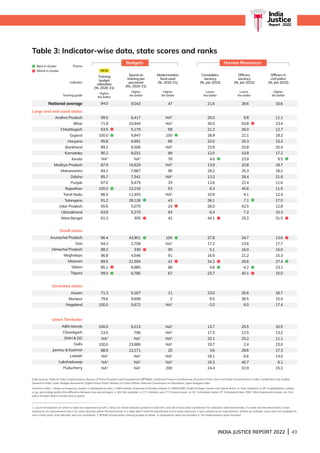
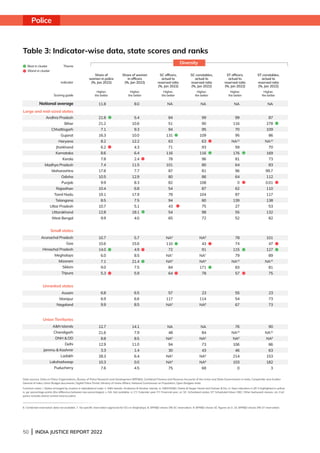
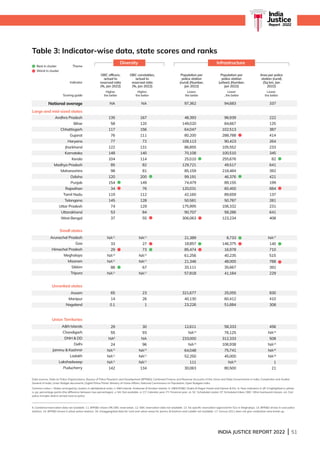
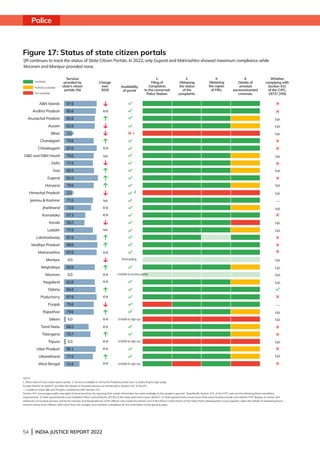
INDIA JUSTICE REPORT 2022 | i
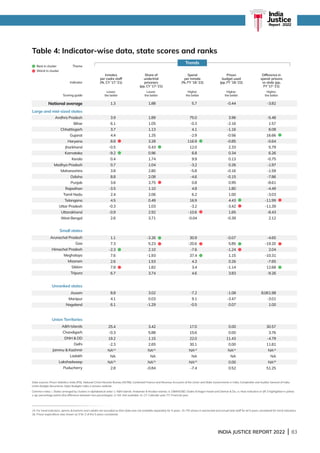
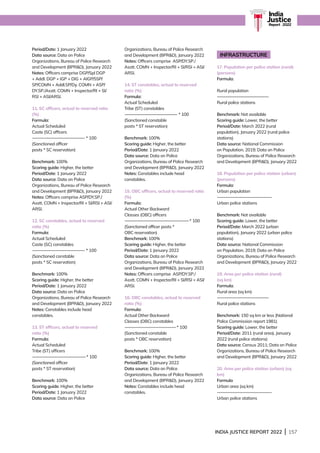
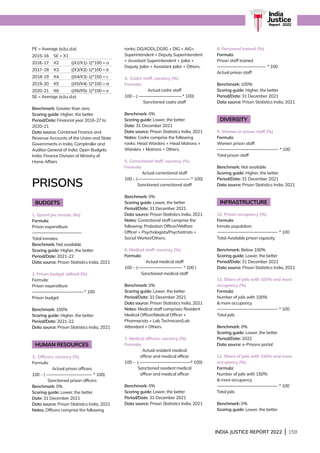
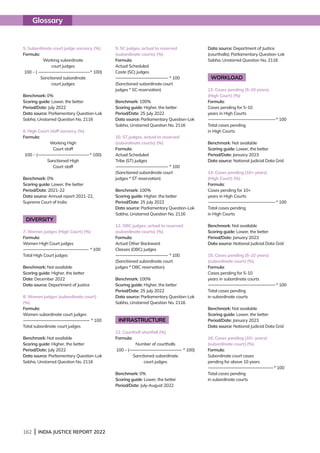
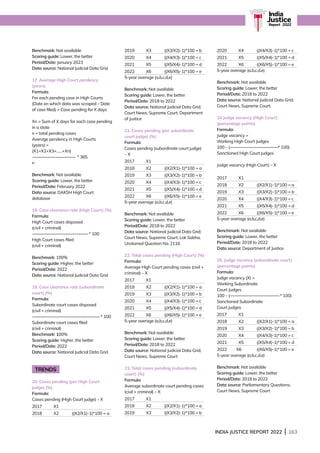
INDIAJUSTICEREPORT
Ranking States on Police,
Judiciary, Prisons & Legal Aid
ndia
Justice
Report | 2022
ii | INDIA JUSTICE REPORT 2022
Published in April 2023
The India Justice Report is a first of its kind national periodic reporting that ranks the capacity of states to
deliver justice.
Through the filters of human resources, infrastructure, budgets, workload and diversity it assesses the capacity
of 4 core pillars of the justice system to deliver to mandate: police, prisons, judiciary and legal aid. Importantly,
by comparing data over a five-year period, the IJR assesses efforts governments make year on year to improve
the administration of justice. This ‘trend’ analysis helps discern each state’s intention to improve the delivery of
justice and match it with the needs on the ground.
By bringing previously siloed data all in one place the IJR provides policy makers with an easy but comprehensive
tool. On the one hand having the data all in one place, provides a jumping off point on which to base holistic policy
frameworks while on the other hand, the itemisation of the data into budgets, human resources, infrastructure,
workload and diversity helps to pinpoint low hanging fruit which, if tackled early on can set up a chain reaction
reformative of the whole.
Thefindingsofthereportareimportantforgovernments,civilsocietyandthebusinesscommunityaswellbecause
it provides important stakeholders with objective data around which to fashion their own recommendations.
It allows for participatory dialogues between governments and active citizens of disparate ideologies to be
underpinned by objective facts rather than premised in opinion. This enhances the chances for reforms through
consensus building.
After all, justice is the business of us all.
© Sir Dorabji Tata Trust, 2023
This report is based on publicly available data of different government entities and the judiciary. All efforts were
made to verify that the information presented herein is correct to the best of our knowledge. The Tata Trusts
and the authors disclaim any responsibility for the correctness or accuracy of the references, information, data
or their sources used in this report generally and/or in support of the rankings.
All rights reserved. Any part of this report, including design, may be reproduced in any form or by any means,
electronic or mechanical, including photo copy, recording or any other information storage and retrieval system,
using the citation provided below.
Suggested citation: 'India Justice Report: Ranking States on Police, Judiciary, Prisons and Legal Aid (2022)'
For more information, please visit
https://indiajusticereport.org
Cover design by Niyati Singh
Report designed by How India Lives
Printed by PrintWorld
Address: 1743 Udaychand Marg, Ist & UGF, Kotla Mubarakpur Near South Ex. Part I, New Delhi-110003
India Justice Report: Ranking States on Police,
Judiciary, Prisons and Legal Aid
Scan this code to
view the report online
and explore the web
interactive
INDIA JUSTICE REPORT 2022 | iii
Ranking States
on Police, Judiciary, Prisons
and Legal Aid
India
Justice
Report | 2022
iv | INDIA JUSTICE REPORT 2022
INDIA JUSTICE REPORT 2022
The India Justice Report (IJR) 2022 remains the only comprehensive quantitative index using the
government’s own statistics to rank the capacity of the formal justice system operating in various states.
This IJR is a collaborative effort undertaken in partnership with DAKSH, Commonwealth Human Rights
Initiative, Common Cause, Centre for Social Justice, Vidhi Centre for Legal Policy and TISS-Prayas.
First published in 2019, the third edition of the IJR adds an assessment of the capacity of State Human
Rights Commissions. It continues to track improvements and persisting deficits in each state’s structural
and financial capacity to deliver justice based on quantitative measurements of budgets, human resources,
infrastructure, workload, and diversity across police, judiciary, prisons and legal aid for all 36 states and UTs.
Steering Committee
à Dr. Arghya Sengupta, Founder, Vidhi Centre for Legal Policy
à Gagan Sethi, Co-founder and Vice-Chair, Centre for Social Justice
à Harish Narasappa, Co-founder, DAKSH
à Maja Daruwala, Chief Editor, India Justice Report
à Valay Singh, Project Lead, India Justice Report
à Ventakesh Nayak, Director, Commonwealth Human Rights Initiative, India
à Prof. Vijay Raghavan, TISS-Prayas
à Vipul Mudgal, Director, Common Cause
India Justice Report Team
à Maja Daruwala, Chief Editor
à Valay Singh, Project Lead
à Dr. Rehana Manzoor, Senior Researcher
à Nayanika Singhal, Research Associate
à Lakhwinder Kaur, Statistical Officer
Authors
à Nupur, Centre for Social Justice
à Radhika Jha, Common Cause
à Venkatesh Nayak, Director, Commonwealth Human Rights Initiative, India
à Devyani Srivastava, Commonwealth Human Rights Initiative
à Devika Prasad, Independent Researcher
à Madhurima Dhanuka, Commonwealth Human Rights Initiative
à Sugandha Mathur, Commonwealth Human Rights Initiative
à Sandhya R, DAKSH
à Leah Verghese, DAKSH
à Smita Mutt, DAKSH
à Prof. Vijay Raghavan, TISS-Prayas
à Apoorva, Vidhi Centre for Legal Policy
à Deepika Kinhal, Vidhi Centre for Legal Policy
à Valay Singh, India Justice Report
à Dr. Rehana Manzoor, India Justice Report
à Nayanika Singhal, India Justice Report
à Lakhwinder Kaur, India Justice Report
Data and design partner
How India Lives (www.howindialives.com)
INDIA JUSTICE REPORT 2022 | v
India
Justice
Report | 2022
à	
Centre for Social Justice (IDEAL) is an
organisation fighting for the rights of the
marginalised and the vulnerable, principally
in the sphere of access to justice. Inspired
by Freirean thought, CSJ has been active in
more than eight states across India, creating
human rights interventions, using law as a
key strategy through an intimate engagement
with grassroot realities. Central to CSJ’s efforts
are its institutional interventions in legal reform
and research, which bridge and symbiotically
combine grassroots activism, law and policy-
making on a wide gamut of issues concerning
the rights of women, Dalits, Adivasis, minorities
and other socially vulnerable groups.
à	
Common Cause is dedicated to championing
public causes, campaigning for probity in
public life and the integrity of institutions. It
seeks to promote democracy, good governance
and public policy reforms through advocacy
and democratic interventions. Common
Cause is especially known for the difference
it has made through a large number of Public
Interest Litigations (PILs), such as recent
ones on the cancellation of the entire telecom
spectrum; cancellation of arbitrarily allocated
coal blocks; and the Apex Court’s recognition
of an individual’s right to die with dignity.
à	
Commonwealth Human Rights Initiative
(CHRI) is an independent, non-governmental,
non-profit organisation working for the
practical realisation of human rights through
research, strategic advocacy and capacity
building within the Commonwealth. CHRI
specialises in the areas of access to justice
(police and prison reforms) and access to
information. It also works to advance freedom
of expression, media rights and the eradication
of contemporary forms of slavery. CHRI is a
Commonwealth Accredited Organisation and
has a Special Consultative Status with the UN
ECOSOC.
à	
DAKSH is a Bengaluru based civil society
organisation working on judicial reforms
at the intersection of data science, public
policy, and operations research. Under the
Rule of Law Project initiated in 2014 they
undertake research and activities to promote
accountability and better governance in India.
à	
TISS–Prayas is a social work demonstration
project of the Center for Criminology and
Justice, Tata Institute of Social Sciences,
established in 1990. Prayas’s focus is on
service delivery, networking, training, research
and documentation, and policy change with
respect to the custodial/institutional rights
and rehabilitation of socio-economically
vulnerable individuals and groups. Their
mission is to contribute knowledge and insight
to the current understanding of aspects of the
criminal justice system policy and process,
with specific reference to socio-economically
vulnerable and excluded communities, groups
and individuals who are at greater risk of
being criminalised or exposed to trafficking for
the purpose of sexual exploitation.
à	
VidhiCentreforLegalPolicyisanindependent
think-tank doing legal research to make better
laws, and improve governance for the public
good. Vidhi engages with ministries and
departments of the Indian government, as well
as state governments, and also collaborates
with other relevant stakeholders within public
institutions, and civil society members, to
assist and better inform the laws and policies
being effectuated. The Centre also undertakes,
and freely disseminates, independent research
in the areas of legal reform, which it believes is
critical to India’s future.
About the Partners
vi | INDIA JUSTICE REPORT 2022
Foreword
I
t is my honour to write this foreword to the 3rd edition
of the India Justice Report. The IJR, as it has come to
be known, is an eagerly awaited assessment of the
capacity of Indian states to deliver justice. It is brought
to us by a collective of dedicated researchers, advocates,
and specialists committed to improving the justice
delivery system. It serves as a valuable resource for active
citizens, the media and most importantly for government
agencies tasked with the onerous responsibility of
delivering justice effectively to all.
By deconstructing the data on budgets, infrastructure,
human resources, workload and by measuring changes
across time in each sub-system in each state and
bringing it all together in one place, the IJR provides us
an important tool for evaluating the delivery of justice
holistically.
In recent times, technology has helped in putting out
more data into the public domain and the report’s
periodic ranking of states’ performance and progress
relies entirely on the government’s own data. This self-
imposed restriction lends authenticity to the report even
as it holds up a mirror to justice delivery mechanisms.
Yet, even while it evidences the value of data as an
objective foundation for analysis it unconsciously brings
out many imperfections that plague analysis based on
government data alone.
One of the attributes of the report is that it consciously
abjures making judgments about performance or even
about why chronic frailties and easy to repair elements
remain unaddressed over decades. It lets the time series
data—such as the slow pace of inclusion of women and
traditionally discriminated segments of society to find a
place within the system—speak for itself. But the truth of
its finding compels early measures to repair.
This third edition of the India Justice Report (IJR) comes
at a time when the need for justice—both in the sense
of accessible dispute resolution and fostering equity and
equality in society—is outpacing the capacity to deliver it
to the satisfaction of our people.
I would like to urge all agencies involved in the justice
system to take heed of the IJR’s findings and insights.
Report like this are a testament to our democratic ways
of participatory functioning and must be welcomed as
contributions of active citizens to their own governance.
[Uday Umesh Lalit]
14 February 2023
INDIA JUSTICE REPORT 2022 | vii
India
Justice
Report | 2022
Acknowledgements
T
he third India Justice Report is the result of
continuous and sustained cooperation between
members of the collective and the founding team
at Tata Trusts. As a founding member it is a matter of
great pride and delight that this group stuck together
through the choppy waters of the pandemic. Without the
steadfast support of each member of the collective this
report wouldn’t have been possible. Profound thanks are
due to Gagan Sethi, Centre for Social Justice, Dr Arghya
Sengupta, Vidhi Centre for Legal Policy, Vipul Mudgal,
Common Cause, Harish Narasappa, DAKSH, Dr Vijay
Raghavan, Tata Institute of Social Sciences-PRAYAS,
and Venkatesh Nayak and his predecessor, Sanjoy
Hazarika, at Commonwealth Human Rights Initiative. To
our Vidhi colleagues who have been most generous and
helpful, a special thank you.
Equally important has been the generous contribution
of colleagues from our partner organisations—Radhika
Jha, Devyani Srivastava, Devika Prasad, Madhurima
Dhanuka, Sugandha Shankar, Nupur, Apoorva, Deepika
Kinhal, Sandhya P. R., Smita Mutt, Leah Verghese, and B.
S. Suryaprakash.
It is an honour to have Justice Uday Umesh Lalit write the
anchoring piece for this report.
The IJR has benefited enormously from the long years of
experience and insights of our subject matter advisors—
Ish Kumar (former DG, NCRB), Jayanto Choudhury (DG,
NSG), Ms Meeran Borwankar, (former DG, BPRD), Sunil
Chauhan, Former Director, NALSA, Avinash Rajvanshi,
N. Ramachandran (IPF), Dr Vineet Kapoor, Riva Pocha,
Prof Murali Karnam, and Transparency International
India’s Ramnath Jha and Prof Madhu Bhalla.
We remain indebted to Justice Madan B. Lokur—a
constant guide at every step, a rare patron saint to the
report, without whose counsel and wisdom the IJR would
have been much poorer.
Our grateful thanks to Mr Pradeep Sharma (NALSA)
for collating and sharing responses to State Legal Aid
Authorities, as well as Sangeeta Mukherjee, CHRI for
helping us collate RTI replies.
We would like to thank our data and design partner
How India Lives. We would also like to thank Rushabh
Mehta, Faris Ansari and the Frappe team for creating the
India Justice Report website pro bono.
Heartfelt thanks to our fellow travellers since the
beginning: Debasis Ray, Nayantara Dutta, Anirudh
Menon, as well as Niyati Singh, for her creative inputs
and counsel.
We have benefitted from the support and counsel of
Jayant Banthia, Alok Prasanna Kumar, Rishabh Lalani,
Smita Gupta, Nikunj, Udita Singh, Prof Ved Kumari, Prof
G. S. Bajpai, Ankit Kaushik, Ivneet Walia and Gautam
Misra.
Our talented interns—Ritika Goyal, Ananya Giri
Upadhyay, Niveditha Prasad, Aviral Mishra, Sneha
Bhambhri, Kartik Bhardwaj, Vaishnavi Gaur, Kaushik
Chandrashekhar, Alevoor Shreyas Rao—deserve a
special thanks.
We are hugely grateful for the support of our donors—
Rohini Nilekani Philanthropies, Tree of Life Foundation,
Lal Family Foundation, Fiona and Louis Miranda, Cyrus
Guzder, Swayam Charitable Trusts and Frappe.
Lastly, but perhaps most importantly, I would like to
thank the core team who worked tirelessly and around
the clock. Our Senior Advisor and Chief Editor, Maja
Daruwala, who holds us to the highest standards
of quality and rigour. Lakhwinder Kaur, our inhouse
statistics expert, whose perseverance and eye for detail
ensures that the report remains not only free of errors
but also improves with each iteration. Nayanika Singhal
and Rehana Manzoor for anchoring the research and the
writing of the report.
Valay Singh
Project Lead, India Justice Report
viii | INDIA JUSTICE REPORT 2022
INDIA JUSTICE REPORT 2022 | ix
Addl. DGP Additional Director General of Police
Addl. SP Additional Superintendent of Police
AFSPA Armed Forces Special Powers Act
AIGP Assistant Inspector General of Police
AIMO All India Manufacturers Organisation
ASI Assistant Sub-Inspector of Police
ASP Assistant Superintendent of Police
A  N Islands Andaman and Nicobar Islands
BPRD	
Bureau of Police Research and
Development
BRICS	
Brazil, Russia, India, China and
South Africa
CAG	
Comptroller and Auditor General of
India
CCR Case Clearance Rate
CCTNS	
Crime and Criminal Tracking
Network  Systems
CCTV Cameras Closed circuit television cameras
CrPC Code of Criminal Procedure
DGP Director General of Police
DIG Deputy Inspector General
DLSA District Legal Service Authority
DNH  DD 	
Dadra and Nagar Haveli
and Daman and Diu
Dy. SP Deputy Superintendent of Police
FY Financial Year
HPC High Powered Committee
IGP Inspector General of Police
ILO International Labour Organization
LSI Legal Services Institution
MHA Ministry of Home Affairs
MPF	
Modernisation of State Police Forces
Scheme
MSME	
Ministry of Micro, Small and Medium
Enterprises
NALSA National Legal Services Authority
NCRB National Crime Records Bureau
NJDG National Judicial Data Grid
NPC National Police Commission
NRC National Register of Citizens
OBC Other Backward Classes
PHRA 1993 Protection of Human Rights Act, 1993
PLA Permanent Lok Adalat
PLV Paralegal Volunteer
PP Percentage Points
PSI Prison Statistics India
RTI Right to Information
SC Scheduled Caste
SHRC State Human Rights Commission
SI Sub-Inspector
SLSA State Legal Services Authority
SP Superintendent of Police
Spl. DGP Special Director General of Police
SSP Senior Superintendent of Police
ST Scheduled Tribe
UNODC 	
United Nations Office on Drugs
and Crime
UT Union Territory
UTP Undertrial Prisoner
UTRC Under Trial Review Committees
Abbreviations
India
Justice
Report | 2022
Contents Copyright and citation ii
Title page iii
About and team members iv
About our partners v
Foreword by Justice (retd.) Uday Umesh Lalit vi
Acknowledgments vii
Abbreviations ix
India in the World 1
National Deficits 2
Introduction by Maja Daruwala 4
Overall ranking 10
Rank and scores of states across pillars 11
Improvement scorecard between 12
IJR 2020 and IJR 2022
Performance over IJR 2019, IJR 2020 and IJR 2022 13
Ranking diversity 14
Share of women across pillars 15
How long will it take for women's 16
share to reach 33%
The curious case of 'others' in police 17
Ranking human resources 18
Judge to population ratio 19
Vacancies across pillars 20
Ranking intention 22
Budget for the justice system 23
State share in legal aid budget 24
Share of overcrowded jails in a state 25
Cases pending for more than 5 years 26
in subordinate courts
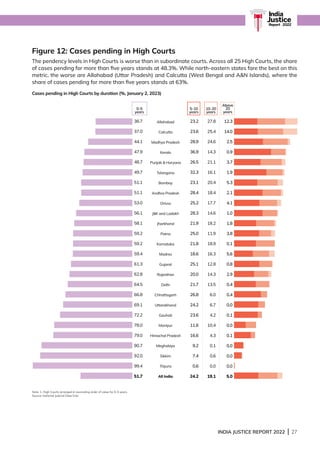
Cases pending in high courts 27
Police ranking 32
Pushing expectations 33
Police: Incapacity, a continuing challenge 34
SC, ST, OBC vacancies in police 38
Policewomen: Numbers growing but still too few 40
India: Police training budget (2020-21) 43
Police presence: Rural-urban divide 44
Indicator wise data, state scores and ranks 48
Status of state citizen portals 54
CCTV in police stations: a compliance report 58
Prison ranking 62
Pushing expectations 63
Dire straits to breaking point 64
Occupancy rate in Indian prisons 66
National
Findings
Police
Prisons
INDIA JUSTICE REPORT 2022 | xi
India
Justice
Report | 2022
Judiciary
Prisons
Legal Aid
State Human
Rights
Commissions
(SHRC)
Overcrowding in jails 67
Undertrials by detention period 68
Educational Profile of Inmates and facilities provided 70
Meeting benchmarks 71
National trend of prison budget utilisation over the last decade 74
Daily spend per inmate 76
Reforming Prisons in Karnataka 77
Indicator wise data, state scores and ranks 78
Judiciary ranking 86
Pushing expectations 87
Judiciary: Judging the numbers 88
Judge vacancies and case clearance rates 90
The Judge Dilemma 91
SC, ST, OBC judges vacancy in Subordinate Courts 93
Women judges 94
Cases pending per judge 97
Case Clearance Rate 99
Gram Nyayalayas: An Unrealised Vision 100
Indicator wise data, state scores and ranks 102
Legal aid ranking 110
Pushing expectations 111
Legal Aid: Justice for all, a distant dream 112
Paralegal Volunteers: Mapping the numbers 114
Budget utilisation 116
Villages per legal aid clinic 118
Performance of lok adalats 120
Victim Compensation 122
Checking unnecessary pre-trial detention 123
Performance of Undertrial Review Committee 124
Indicator wise data, state scores and ranks 125
SHRC ranking 130
Indicator wise data, state scores and ranks 131
SHRCs: Struggling with capacity deficits 132
Vacancies in the Commissions 134
Cases received and disposed by SHRCs over three years 136
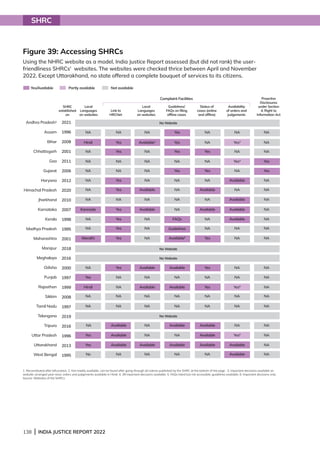
Accessing SHRCs: An analysis of websites 138
The Experience of Using RTI for Data Collection for IJR 2022: A note 142
Challenges in data 147
Methodology 150
Recommendations 155
Glossary 156
References 166
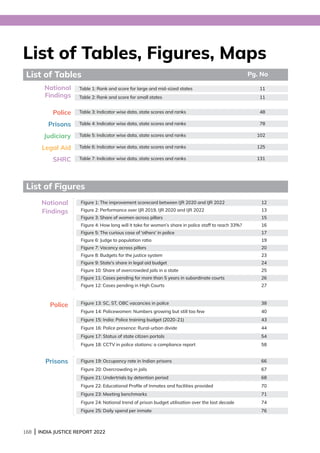
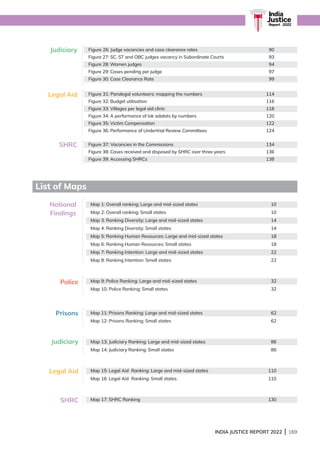
List of Tables, Maps and Figures 168
xii | INDIA JUSTICE REPORT 2022
INDIA JUSTICE REPORT 2022 | 1
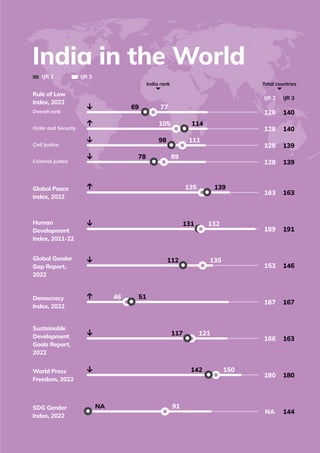
India in the World
IJR 2 IJR 3
IJR 3
IJR 2
Overall rank
Order and Security
Civil Justice
Criminal Justice
India rank Total countries
Rule of Law
Index, 2022
128 140
128 140
128 139
128 139
69 77
114
105
98 111
78 89
Global Peace
Index, 2022
163 163
139
135
Human
Development
Index, 2021-22
189 191
131 132
Global Gender
Gap Report,
2022
153 146
112 135
Democracy
Index, 2022
167 167
51
46
Sustainable
Development
Goals Report,
2022
166 163
117 121
World Press
Freedom, 2022
180 180
142 150
SDG Gender
Index, 2022
NA 144
NA 91
2 | INDIA JUSTICE REPORT 2022
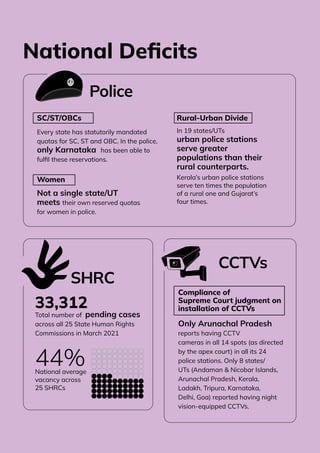
Police
SC/ST/OBCs
Every state has statutorily mandated
quotas for SC, ST and OBC. In the police,
only Karnataka has been able to
fulfil these reservations.
Women
Not a single state/UT
meets their own reserved quotas
for women in police.
33,312
Total number of pending cases
across all 25 State Human Rights
Commissions in March 2021
44%
National average
vacancy across
25 SHRCs
SHRC
CCTVs
Compliance of
Supreme Court judgment on
installation of CCTVs
Only Arunachal Pradesh
reports having CCTV
cameras in all 14 spots (as directed
by the apex court) in all its 24
police stations. Only 8 states/
UTs (Andaman  Nicobar Islands,
Arunachal Pradesh, Kerala,
Ladakh, Tripura, Karnataka,
Delhi, Goa) reported having night
vision-equipped CCTVs.
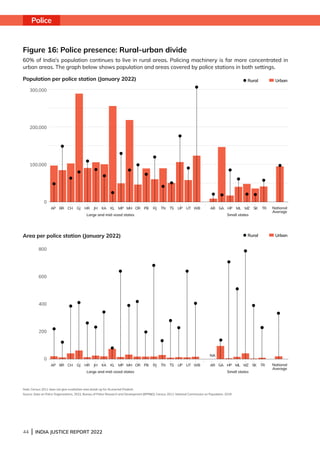
Rural-Urban Divide
In 19 states/UTs
urban police stations
serve greater
populations than their
rural counterparts.
Kerala’s urban police stations
serve ten times the population
of a rural one and Gujarat’s
four times.
National Deficits
INDIA JUSTICE REPORT 2022 | 3
India
Justice
Report | 2022
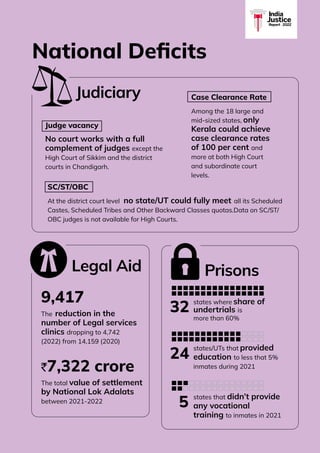
32
24
states/UTs that provided
education to less that 5%
inmates during 2021
states where share of
undertrials is
more than 60%
Judiciary
Legal Aid
9,417
The reduction in the
number of Legal services
clinics dropping to 4,742
(2022) from 14,159 (2020)
`7,322 crore
The total value of settlement
by National Lok Adalats
between 2021-2022
Prisons
Judge vacancy
No court works with a full
complement of judges except the
High Court of Sikkim and the district
courts in Chandigarh.
National Deficits
Case Clearance Rate
Among the 18 large and
mid-sized states, only
Kerala could achieve
case clearance rates
of 100 per cent and
more at both High Court
and subordinate court
levels.
SC/ST/OBC
At the district court level no state/UT could fully meet all its Scheduled
Castes, Scheduled Tribes and Other Backward Classes quotas.Data on SC/ST/
OBC judges is not available for High Courts.
states that didn’t provide
any vocational
training to inmates in 2021
5
4 | INDIA JUSTICE REPORT 2022
Introduction
Every system is
perfectly designed to
get the results it gets.
W. Edwards Deming
T
he 2022 India Justice Report continues to assess
and rank each state’s progress in capacitating its
major justice delivery mechanisms—the judiciary,
police, prisons and legal aid—to deliver justice to all. A
new section in the report measures the capacity of State
Human Rights Commissions, which are a specialised
means of accessing justice and exist in 25 states.
Thousands access them every day. How well-equipped
they are to satisfy their mandates merits attention. The
report also deepens its 4 pillar assessments with the
addition of 17 new indicators.1
This 3rd edition comes after 24 months in which the entire
justice system has had to grapple with exceptional and
unprecedented circumstances created by the Covid-19
pandemic and consequent lockdown. Together, the
pandemic and lockdown created severe disruptions
where both access and delivery of justice suffered.
Each subsystem across every geography entered this
unforeseen time with chronic infirmities: long-standing
underfunding, human resource and infrastructural
deficits, and workloads that evidence the challenge of
delivering to reasonable standards of public service.
Nevertheless, a much pared down force, despite their
own lack of experience in dealing with this scale of
adversity, ill health, family concerns and fatalities,
functioned as best they could. During this period, 2.35
crore cases were heard online.2
Decongestion efforts could bring down prison occupancy
in most states.3
Despite a faltering beginning, police
personnel gained public appreciation for their assistance
and legal aid authorities went beyond their traditional
mandates to provide humanitarian assistance to
thousands.
Rankings
Pulling out from this extraordinary time, several states
have seen dramatic changes in rank. Some for the
better, others for the worse. Karnataka, 14th in 2020,
jumped thirteen spots to the top. Madhya Pradesh went
from 16th to 8th and Andhra Pradesh from 12th to 5th.
Among small states, Sikkim moved from 2nd to 1st place
and Arunachal Pradesh from 5th to 2nd.
Contrary wise, Maharashtra lost out, moving from top
position in both IJR 2019 and IJR 2020 to 11th. Punjab
dropped eight ranks from 4th to 12th. Rajasthan five
places to 15th and Goa dropped from 3rd to last place
amongst small states. While Tamil Nadu and Telangana
maintained second and third place amongst large and
mid-sized states, Uttar Pradesh remained at the bottom
of the table for the third time in a row.
A close examination of place change once again
demonstrates that even small yet consistent
improvements can lead to quite dramatic rises.
Improvements in one indicator, such as filling a vacancy
or building more diversity into a system, have a positive
ripple effect on other indicators and cumulatively affect
overall rankings. Illustratively, Gujarat’s rise in the prison
pillar is attributable to its efforts to reduce vacancies and
improve caste and gender diversity. This had the knock-
on effect of reducing workloads and increased utilisation
of allocated budgets, all of which contributed to the
state’s rise in rank.
Downward shifts, though, are not necessarily
attributable to in-state deterioration but can come about
because other states have improved and positions
shifted relative one to the other. Equally, retaining a
1 Refer to the essay on methodology for more information.
2 Newsletter, e-Committee, Supreme Court of India, December 2020 and November 2021:
3 Commonwealth Human Rights Initiative, Responding to the Pandemic: Prisons and Overcrowding, (States’ Decongestion Efforts), 2020. Available at
https://humanrightsinitiative.org/download/Responding%20to%20the%20Pandemic%20Prisons%20%20Overcrowding%20Vol%201.pdf
INDIA JUSTICE REPORT 2022 | 5
India
Justice
Report | 2022
positive rank sometimes has to do not only with a state’s
own improvements but also on the slow pace of capacity
improvement in the other states.
Overall, on a scale of 1 to 10, scores across the board
improved. Maharashtra, the best scoring state in IJR
2020, came in with a score of 5.77 while Karnataka, top
of the table in IJR 2022, has scored 6.38. Even the worst
scorers showed improvements, going from 3.15 to 3.78.
Nevertheless, decades of continuing disrepair is
intensifying the justice delivery system’s incapability to
deliver timely justice—with the heaviest toll falling on
the justice user.
Budgets
States’ expenditure on police and judiciary has kept
pace with overall state expenditure. Prisons, the poor
child of the neighbourhood, which had earlier seen a dip
in allocations, saw an improvement in funds between
2020 and 2021. Legal aid too recently saw increased
infusions from the Centre and state exchequers.
If funds are tight, what is available is frequently left
underutilized. In 2020-2021 only 47 per cent of the
Centre’s modernisation grant could be used. Too often
the coils of procedure, conditionality, timing, over-
centralisation in planning, and mismatch between need
and grant ensure that what there is, cannot be rationally
spent or fully utilised. While looking at underutilization
in the context of central allocations the 123rd report of
the Departmental Standing Committee on Personnel,
Public Grievances, Law and Justice emphasized the need
to identify bottlenecks and develop measures that have
long needed the “rationalisation of systems that have
outlasted their usefulness.”4
The decentralized planning
at the level of local self-government practiced in Kerala
can serve as a useful example of dealing with some of
these issues.5
Human Resources
Vacancies continue to plague all areas of the justice
system and can touch 83 per cent, as among prison staff
in Ladakh. No jurisdiction has the benefit of working
with full judge strength in both high court and district
courts. The actual number of judges now stands at 15
per million (ten lakh) population.6
Gaps between “sanctioned strength” and actual
personnel availability remain a perennial problem.
Though sanctioned strength ought to be readjusted
every year to chime with the needs on the ground, it
changes little from year to year and often lags behind
reality. Illustratively, though sanctioned police strength
between January 2021 and January 2022 increased from
26.3 lakh to 26.9 lakh, there were 20.9 lakh personnel on
the ground.7
Attempts to fill vacancies are mixed. DLSAs made
considerable headway filling secretary vacancies and
some like Bihar reduced prison officer vacancies quite
dramatically, from 66 per cent to 26 per cent. But
others like Punjab which had more medical staff than
sanctioned in 2019, increased vacancies in this critical
area to 37 per cent.
Diversity
Diversity and representation in all spheres of state
endeavour is an essential feature of our plural
democracy. The justice sector in particular has an ethical
duty to showcase this principle.
4	
Department related parliamentary standing committee report on Personnel, Public Grievances, Law and Justice. Available at: https://rajyasabha.nic.in/rsnew/Committee_site/Committee_File/
ReportFile/18/171/123_2022_12_12.pdf , page 15, Para 2.1
5 ‘Budgeting for the police’, Live Mint, 11 April 2017. Available at: https://www.livemint.com/Opinion/DR8kPY8VKUDyMlkR2OHUfM/Budgeting-for-the-police.html
6	
Refer to the essay on judiciary.
7 Bureau of Police Research and Development, Data on Police Organisation, 2021 and 2022.
Left unaddressed, chronic shortages in critical
areas become dangerously acute and a far
cry from the ideal. Between 2020 and 2021
the actual numbers of prison doctors dropped
drastically, taking vacancies to nearly 50 per
cent or one doctor for 842 inmates, instead of
the one for 300 inmates’ benchmark. These
vacancies are not evenly distributed. National
statistics do not indicate whether medical
officers are permanent, resident, full-time or
exclusive to just one jail, or whether they are
available only on contract or available on a
periodic or part-time basis, or only in attendance
when called.
6 | INDIA JUSTICE REPORT 2022
Available data indicates levels of commitment to
implementing this. Traditionally, data takes account
only of caste and gender diversities. Years of advocacy
by active citizens has seen a welcome enumeration of
disabled and transgender persons. But the diversity
listing still abjures enumeration of religious, language
or regional diversities. Official data also restricts itself to
assessing caste and gender more readily at the lower
echelons rather than parsing it across all levels of the
hierarchy.
Each state has its benchmarks and its realities—the IJR
captures what the data allows. Whether it is caste or
gender, everywhere there is a shortfall in inclusion and
the pace of repair remains glacial. Despite decades of
heated debate, while individual states may meet one or
other category, no state meets all three quotas across all
subsystems. Nor are women anywhere near parity. It has
taken fifteen years, from January 2007 to January 2022,
for the share of women personnel in police to move from
3.3 per cent8
to 11.8 per cent.
The distance from the principles of representation and
equality is perhaps best exemplified by the composition
of states’ human rights commissions. Women make up
just 17 per cent of the entire SHRC cohort. Only 3 of 25
commissions have one woman member each. The others
have none.
Infrastructure
Over the past decade and even between reports,
infrastructure to support justice delivery has slowly but
steadily improved, particularly for the judiciary and police
and perhaps more at the upper reaches than at the first-
responder level. Even though local shortages persist,9
at present there are enough court halls for judges
nationwide. The decade has added nearly a quarter more
police stations across the country, though on average 1
serves just over 78,000 people with a coverage of 187
sq km. In 72 per cent of all police stations, there are now
women’s help desks.
Prison infrastructure though remains wholly inadequate.
Of the 1,314 prisons 391 are overcrowded by more
than 50 per cent. Facilities for mandated educational
improvement, vocational training and assistance in
rehabilitation remain rudimentary. After a short hiatus
of efforts at rapid decongestion during the pandemic,
prisons have been allowed to get overfull again —mostly
with undertrials.
Ways of accessing and delivering justice through
technology, connectivity, computerisation, digitisation
are being strongly relied on to make up for shortfalls in
physical infrastructure and personnel, and these efforts
have gained pace as never before. There is also a steady
rise in online access to information and services through
a variety of citizen centric portals, including e-payments
and e-sewa kendras.
Courts have adopted new technologies via video
conferencing facilities, electronic summons and tracking
apps like National Service and Tracking of Electronic
Processes (NSTEP). More prisons have increased video
conferencing facilities and after the Paramvir judgement,
CCTVs to monitor activities inside police stations are
making an appearance.
There remain issues of purpose, security, privatisation,
localisation, integration, up-skilling, rationalisation
of old environments, formats and forms, resistance
8 
January 2007 figures do not include Andhra Pradesh, Jammu  Kashmir, Madhya Pradesh, Maharashtra, Tamil Nadu and Puducherry. As actual police personnel data was not provided by
states/UTs.
9 Refer to the essay on judiciary.
Both caste and gender hit up against the glass
ceiling. Illustratively, there are 35 per cent
women in subordinate courts while just 13
per cent in high courts. Similarly, the share of
women in police at the officer level is 8 per cent
as opposed to 12 per cent at the constabulary
level. The share of SC, ST and OBC police at the
officer level is 15 per cent, 10 per cent and 27
per cent respectively, much lower than the 16
per cent, 12 per cent and 32 per cent within the
constabulary.
INDIA JUSTICE REPORT 2022 | 7
India
Justice
Report | 2022
and acceptance of changes. Not least is the question
of reach—whether technology will widen the justice
availability gap or create more enclaves of privilege and
exclusion.
In Conclusion
Five-year assessments of subsystems have thrown
up trends and patterns. Too many, like vacancies
and accumulations of court cases, consistently point
downwards, but others like better case clearance rates
and the achingly slow but constant improvements in
gender ratios and response, signpost determination
to improve against all odds. Overall, financing has
grown modestly. Significant financial infusions and
experimentation into legal aid promise an uptick in legal
representation to the needy.
Overcrowding went up from 120 per cent to 130 per
cent. At 77 per cent, more undertrial prisoners make up
the inmate population than ever before—on average
spending more time incarcerated than ever before.
Legal aid institutions, even with best efforts, could reach
only a fraction of their potential clientele. Beneath the
eye-watering figure of nearly 5 crore (50 million) total
pending cases lies the dismaying one that records the
ever-increasing length of time it takes to reach resolution.
Clearly this state of permacrisis, where functionaries are
expected to deliver at impossible levels and from which
justice seekers need have little expectation, cries out for
urgent repair.
With its comparisons and trend analyses the report
is intended to urge those with their hands on the tiller
to discern from it directions for immediate repair,
set priorities, examine the possibility of strategic
reinvestment and redeployment of resources, and
assess their own efforts in delivering justice speedily
and inexpensively, especially into the most remote and
vulnerable communities. Every month of delay makes
solutions harder.
In its international commitments under Goal 16 of the
Sustainable Development Goals, India is committed to
“promoting peaceful and inclusive societies, providing
access to justice for all and building effective, accountable
and inclusive institutions at all levels.” The deadline is
2030. Much more importantly, the promise of abiding
democracy at home is underpinned by the assurance that
quality justice—fair and accessible—will be unfailingly to
hand for everyone. There is little time to lose.
Maja Daruwala
Editor and Convenor, India Justice Report
During the pandemic, the challenge before the
justice delivery system was to find ways of
working through an unprecedented situation
and evolve innovative responses even as every
subsystem was under tremendous strain.
Post-pandemic, this challenge continues in
exacerbated form.
8 | INDIA JUSTICE REPORT 2022
INDIA JUSTICE REPORT 2022 | 9
National
Findings
10 | INDIA JUSTICE REPORT 2022
3
1
5
6
7
2
4
7
13
1
10
14
15
16
18
5
9
12
11
8
3
6
17
4
2
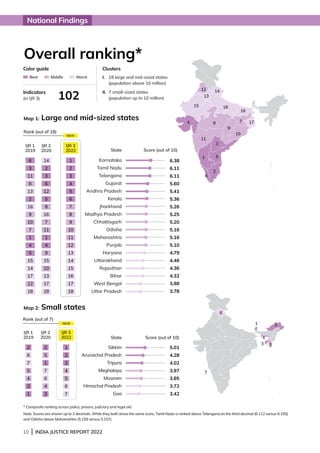
Overall ranking*
Map 1: Large and mid-sized states
6.38
6.11
6.11
5.60
5.41
5.36
5.26
5.25
5.20
5.16
5.16
5.10
4.79
4.46
4.36
4.32
3.88
3.78
State Score (out of 10)
Map 2: Small states
5.01
4.28
4.02
3.97
3.85
3.72
3.42
State Score (out of 10)
Sikkim
Arunachal Pradesh
Tripura
Meghalaya
Mizoram
Himachal Pradesh
Goa
Karnataka
Tamil Nadu
Telangana
Gujarat
Andhra Pradesh
Kerala
Jharkhand
Madhya Pradesh
Chhattisgarh
Odisha
Maharashtra
Punjab
Haryana
Uttarakhand
Rajasthan
Bihar
West Bengal
Uttar Pradesh
102
Color guide
Indicators
(in IJR 3)
Clusters
Best Middle Worst I.	
18 large and mid-sized states
(population above 10 million)
II.	
7 small-sized states
(population up to 10 million)
Rank (out of 18)
IJR 1
2019
IJR 2
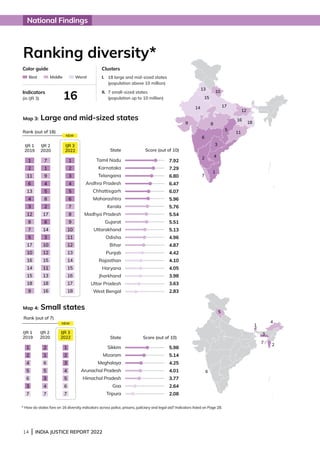
2020
14
2
3
6
12
5
8
16
7
11
1
4
9
15
10
13
17
18
IJR 3
2022
1
2
3
4
5
6
7
8
9
10
11
12
13
14
15
16
17
18
NEW
6
3
11
8
13
2
16
9
10
7
1
4
5
15
14
17
12
18
Rank (out of 7)
IJR 2
2020
2
5
1
7
6
4
3
IJR 3
2022
1
2
3
4
5
6
7
IJR 1
2019
2
6
7
5
4
3
1
NEW
* Composite ranking across police, prisons, judiciary and legal aid
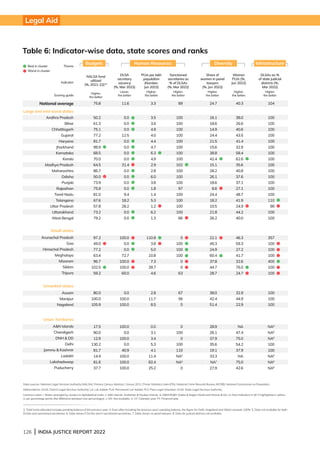
Note: Scores are shown up to 2 decimals. While they both show the same score, Tamil Nadu is ranked above Telangana on the third decimal (6.112 versus 6.105)
and Odisha above Maharashtra (5.159 versus 5.157).
National Findings
INDIA JUSTICE REPORT 2022 | 11
Table 2: Rank and score for small states
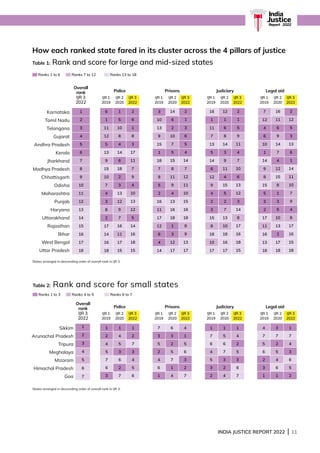
How each ranked state fared in its cluster across the 4 pillars of justice
Table 1: Rank and score for large and mid-sized states
Karnataka
Tamil Nadu
Telangana
Gujarat
Andhra Pradesh
Kerala
Jharkhand
Madhya Pradesh
Chhattisgarh
Odisha
Maharashtra
Punjab
Haryana
Uttarakhand
Rajasthan
Bihar
West Bengal
Uttar Pradesh
Sikkim
Arunachal Pradesh
Tripura
Meghalaya
Mizoram
Himachal Pradesh
Goa
States arranged in descending order of overall rank in IJR 3.
States arranged in descending order of overall rank in IJR 3.		
Ranks 1 to 6 Ranks 7 to 12 Ranks 13 to 18
Ranks 1 to 3 Ranks 4 to 5 Ranks 6 to 7
Overall
rank
IJR 3
2022
1
2
3
4
5
6
7
8
9
10
11
12
13
14
15
16
17
18
Police Prisons Judiciary Legal aid
IJR 1
2019
IJR 1
2019
IJR 1
2019
IJR 1
2019
IJR 2
2020
IJR 2
2020
IJR 2
2020
IJR 2
2020
IJR 3
2022
IJR 3
2022
IJR 3
2022
IJR 3
2022
Overall
rank
IJR 3
2022
Police Prisons Judiciary Legal aid
IJR 1
2019
IJR 1
2019
IJR 1
2019
IJR 1
2019
IJR 2
2020
IJR 2
2020
IJR 2
2020
IJR 2
2020
IJR 3
2022
IJR 3
2022
IJR 3
2022
IJR 3
2022
6
1
11
12
5
13
9
15
10
7
4
3
8
2
17
14
16
18
3
10
13
9
15
1
18
7
8
5
2
16
11
17
12
6
4
14
16
1
11
7
13
5
14
6
12
9
4
2
3
15
8
18
10
17
7
12
4
6
10
1
14
9
8
15
5
3
2
17
11
16
13
18
1
5
10
8
4
14
6
18
2
3
13
12
9
7
16
11
17
15
14
6
2
10
7
5
15
8
11
9
4
13
16
18
1
3
12
17
12
1
6
8
14
3
9
11
4
15
5
2
7
13
10
18
16
17
16
11
6
9
14
7
4
12
15
8
1
3
5
10
13
2
17
18
2
6
1
8
3
17
11
7
9
4
10
13
12
5
14
16
18
15
2
1
3
6
5
4
14
7
12
11
10
15
16
18
8
9
13
17
2
1
5
9
11
4
7
10
6
13
12
3
14
8
17
16
18
15
2
12
5
3
13
6
1
14
11
10
7
9
4
8
17
16
15
18
1
2
3
4
5
6
7
1
2
4
5
7
6
3
1
4
5
3
6
2
7
1
2
7
3
4
5
6
7
3
5
2
4
6
1
6
3
2
5
7
1
4
4
1
5
6
3
2
7
1
7
6
4
5
3
2
1
5
6
7
3
2
4
1
4
2
5
3
6
7
4
7
5
6
2
3
1
3
7
2
5
4
6
1
1
7
4
3
6
5
2
India
Justice
Report | 2022
12 | INDIA JUSTICE REPORT 2022
Of the 60 static indicators common to this and IJR 2020, in how many did a state/UT improve?
Figure 1: The improvement scorecard between IJR 2020 and IJR 2022
Karnataka
Gujarat
Tamil Nadu
Odisha
Punjab
Kerala
Uttar Pradesh
Telangana
Madhya Pradesh
Uttarakhand
Andhra Pradesh
Chhattisgarh
Haryana
Maharashtra
West Bengal
Bihar
Jharkhand
Rajasthan
Meghalaya
Sikkim
Arunachal Pradesh
Goa
Himachal Pradesh
Tripura
Mizoram
Large and
mid-sized states
Small states
Police
21 indicators
Prisons
14 indicators
Judiciary
13 indicators
Legal aid
12 indicators
Total
60 indicators
Methodology: Count of indicators on which a state has improved over IJR 2. Only non-trend and comparable indicators present in both IJR 2 and IJR 3 have been considered. For indicators with
benchmarks, if a state met the benchmark, it was marked as an improvement even if its value declined within the benchmark. If a state didn’t meet the benchmark but its value improved, it was
marked as an improvement. Where an indicator value was not available for one or both years, that indicator was not considered. Given the change in their administrative status, values for Dadra 
Nagar Haveli and Daman  Diu, Jammu  Kashmir and Ladakh are not comparable with those from IJR 2, and hence they have not been considered here.
43
42
41
39
39
38
36
34
33
33
31
30
30
30
30
29
28
26
10
8
9
9
7
6
9
4
7
8
5
10
6
7
7
6
9
7
8
7
6
5
9
3
3
30
29
28
28
28
24
20
9
5
6
4
7
7
6
5
3
7
6
3
7
7
8
14
9
13
9
7
4
5
8
8
9
10
8
9
9
6
6
7
5
6
4
6
8
9
4
12
10
9
6
7
11
7
6
4
5
9
4
7
6
7
5
4
2
16
16
15
15
15
13
11
15
16
14
10
11
11
13
10
10
6
13
Delhi
Chandigarh
Puducherry
AN Islands
Lakshadweep
Union Territories
12
9
10
10
6
9
13
8
8
1
7
7
6
7
6
9
6
4
2
4
37
35
28
27
17
Assam
Nagaland
Manipur
Unranked states
8
7
7
3
8
8
8
4
4
7
6
3
26
25
22
National Findings
INDIA JUSTICE REPORT 2022 | 13
India
Justice
Report | 2022
India
Justice
Report | 2022
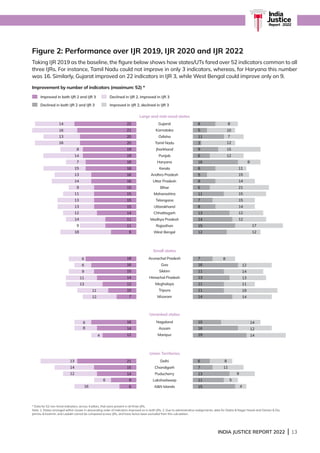
Figure 2: Performance over IJR 2019, IJR 2020 and IJR 2022
Taking IJR 2019 as the baseline, the figure below shows how states/UTs fared over 52 indicators common to all
three IJRs. For instance, Tamil Nadu could not improve in only 3 indicators, whereas, for Haryana this number
was 16. Similarly, Gujarat improved on 22 indicators in IJR 3, while West Bengal could improve only on 9.
* Data for 52 non-trend indicators, across 4 pillars, that were present in all three IJRs.				
Note: 1. States arranged within cluster in descending order of indicators improved on in both IJRs. 2. Due to administrative realignments, data for Dadra  Nagar Haveli and Daman  Diu,
Jammu  Kashmir, and Ladakh cannot be compared across IJRs, and have hence been excluded from this calculation.
Improvement by number of indicators (maximum: 52) *
Arunachal Pradesh
Goa
Sikkim
Himachal Pradesh
Meghalaya
Tripura
Mizoram
Nagaland
Assam
Manipur
Delhi
Chandigarh
Puducherry
Lakshadweep
AN Islands
Large and mid-sized states
Small states
Unranked states
Union Territories
22
21
20
20
19
19
18
18
16
16
15
15
15
15
14
11
11
9
14 8
16 10
13 7
16 12
8 15
14 12
7 8
15 11
13 15
14 14
9 21
6 8
12 12
13 11
12 9
6 14
11 15
6 12
14 12
11 19
6 5
8 12
13 15
9 14
13 8
9 17
12 14
16 4
4 14
13 14
11 13
14 11
18 12
8
5
11
3
9
6
16
8
5
8
6
11
7
8
13
14
15
12
18
16
15
14
12
10
7
7
16
11
13
11
11
14
16
14
12
10
16
19
21
15
14
9
6
6
7
13
11
15
Improved in both IJR 2 and IJR 3 Declined in IJR 2, improved in IJR 3
Declined in both IJR 2 and IJR 3 Improved in IJR 2, declined in IJR 3
Gujarat
Karnataka
Odisha
Tamil Nadu
Jharkhand
Punjab
Haryana
Kerala
Andhra Pradesh
Uttar Pradesh
Bihar
Maharashtra
Telangana
Uttarakhand
Chhattisgarh
Madhya Pradesh
Rajasthan
West Bengal
14 | INDIA JUSTICE REPORT 2022
6
5
1
3
7
2
4
14
10
1
8
7
15
12
5
13
9
4
3
2
17
6
11
16
18
Ranking diversity*
* How do states fare on 16 diversity indicators across police, prisons, judiciary and legal aid? Indicators listed on Page 28.
Map 3: Large and mid-sized states
7.92
7.29
6.80
6.47
6.07
5.96
5.76
5.54
5.51
5.13
4.96
4.87
4.42
4.10
4.05
3.98
3.63
2.83
Rank (out of 18)
Rank (out of 7)
State Score (out of 10)
IJR 1
2019
IJR 2
2020
IJR 3
2022
Map 4: Small states
5.98
5.14
4.25
4.01
3.77
2.64
2.08
State Score (out of 10)
Sikkim
Mizoram
Meghalaya
Arunachal Pradesh
Himachal Pradesh
Goa
Tripura
IJR 2
2020
IJR 3
2022
IJR 1
2019
Tamil Nadu
Karnataka
Telangana
Andhra Pradesh
Chhattisgarh
Maharashtra
Kerala
Madhya Pradesh
Gujarat
Uttarakhand
Odisha
Bihar
Punjab
Rajasthan
Haryana
Jharkhand
Uttar Pradesh
West Bengal
NEW
NEW
16
Color guide
Indicators
(in IJR 3)
Clusters
Best Middle Worst I.	
18 large and mid-sized states
(population above 10 million)
II.	
7 small-sized states
(population up to 10 million)
1
2
11
6
13
4
3
12
8
7
5
17
10
16
14
15
18
9
7
1
9
4
5
8
2
17
6
14
3
10
12
15
11
13
18
16
1
2
3
4
5
6
7
8
9
10
11
12
13
14
15
16
17
18
2
1
6
5
3
4
7
1
2
3
4
5
6
7
1
2
4
5
6
3
7
National Findings
INDIA JUSTICE REPORT 2022 | 15
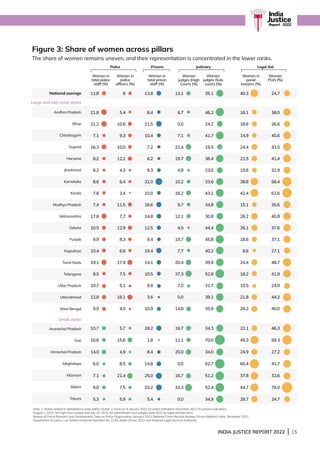
Figure 3: Share of women across pillars		
The share of women remains uneven, and their representation is concentrated in the lower ranks.
Large and mid-sized states
National average 11.8 8 13.8 13.1 35.1 40.3 24.7
Andhra Pradesh
Bihar
Chhattisgarh
Gujarat
Haryana
Jharkhand
Karnataka
Kerala
Madhya Pradesh
Maharashtra
Odisha
Punjab
Rajasthan
Tamil Nadu
Telangana
Uttar Pradesh
Uttarakhand
West Bengal
Arunachal Pradesh
Goa
Himachal Pradesh
Meghalaya
Mizoram
Sikkim
Tripura
Small states
Women in
total police
staff (%)
Women
judges (High
Court) (%)
Women in
panel
lawyers (%)
Police Judiciary Legal Aid
Prisons
Women in
police
officers (%)
Women
judges (Sub.
court) (%)
Women
PLVs (%)
Women in
total prison
staff (%)
21.8
21.2
7.1
16.3
8.2
6.2
8.6
7.8
7.4
17.8
10.5
9.9
10.4
19.1
8.5
10.7
12.8
9.9
5.4
10.6
9.3
10.0
12.2
4.3
6.4
2.4
11.5
7.7
12.9
8.3
6.8
17.9
7.5
5.1
18.1
4.0
8.4
21.5
10.4
7.2
6.2
9.3
32.0
10.0
18.6
14.8
12.5
9.4
19.4
14.1
10.5
9.9
3.6
10.9
6.7
0.0
7.1
21.4
19.7
4.8
10.2
16.2
9.7
12.1
4.5
19.7
7.7
20.4
27.3
7.0
0.0
14.8
46.2
24.2
41.7
19.5
38.4
23.0
33.6
43.1
34.8
30.8
44.4
45.8
40.2
39.9
52.8
31.7
39.1
35.9
16.1
18.6
14.9
24.4
21.5
15.6
38.8
42.4
15.1
28.2
26.1
18.6
8.6
24.4
18.2
10.5
21.8
26.2
38.0
26.6
40.6
43.5
41.4
32.9
58.4
62.6
35.6
40.8
37.6
37.1
27.1
48.7
41.9
24.9
44.2
40.0
10.7
10.6
14.0
6.0
7.1
9.0
5.3
5.7
15.6
4.9
8.5
21.4
7.5
5.9
18.2
1.8
8.4
14.8
25.0
23.2
5.4
16.7
12.1
20.0
0.0
16.7
33.3
0.0
34.3
70.0
34.0
62.7
51.2
52.4
34.9
22.1
45.3
24.9
60.4
37.8
44.7
28.7
46.3
59.3
27.2
41.7
32.6
76.0
24.7
Note: 1. States ranked in alphabetical order within cluster. 2. Data as of January 2022 for police indicators; December 2021 for prisons indicators;
August 1, 2022, for High Court judges and July 25, 2022, for subordinate court judges; June 2022 for legal aid indicators.
Bureau of Police Research and Development, Data on Police Organisation, January 2022; National Crime Records Bureau, Prison Statistics India, December 2021;
Department of Justice; Lok Sabha Unstarred Question No. 2116, dated 29 July 2022 and National Legal Services Authority.
India
Justice
Report | 2022
16 | INDIA JUSTICE REPORT 2022
National Findings
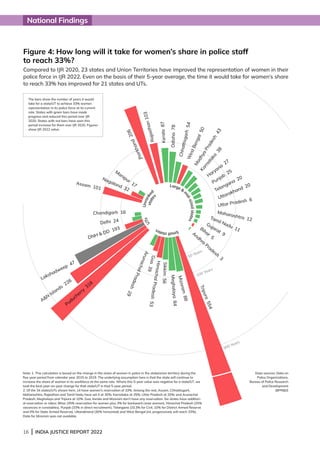
Figure 4: How long will it take for women’s share in police staff
to reach 33%?
Compared to IJR 2020, 23 states and Union Territories have improved the representation of women in their
police force in IJR 2022. Even on the basis of their 5-year average, the time it would take for women’s share
to reach 33% has improved for 21 states and UTs.
Data sources: Data on
Police Organizations,
Bureau of Police Research
and Development
(BPRD)
The bars show the number of years it would
take for a state/UT to achieve 33% women
representation in its police force at its current
rate. States with green bars have made
progress and reduced this period over IJR
2020. States with red bars have seen this
period increase for them over IJR 2020. Figures
show IJR 2022 value.
Large 
m
i
d
-
s
i
z
e
d
s
t
a
t
e
s
S
m
a
l
l
s
t
a
t
e
s
U
T
s
J
h
a
r
k
h
a
n
d
2
0
6
R
a
ja
s
t
h
a
n
1
0
3
Ke
ra
la
87
Odisha
78
C
h
h
a
t
t
is
g
a
r
h
5
4
Punjab
25
W
e
s
t
B
e
n
g
a
l
5
0
Telangana 20
M
a
d
h
y
a
P
r
a
d
e
s
h
4
3
Uttarakhand 20
K
a
r
n
a
t
a
k
a
3
8
Uttar Pradesh 6
Haryana
27
Maharashtra 12
Tamil Nadu 11
Gujarat 9
Bihar
5
Andhra
Pradesh
3
T
r
i
p
u
r
a
5
5
4
M
iz
o
r
a
m
8
8
M
eg
ha
la
ya
84
Sikk
im
56
H
im
a
c
h
a
l
P
r
a
d
e
s
h
5
3
G
o
a
3
9
A
r
u
n
a
c
h
a
l
P
r
a
d
e
s
h
2
9
Puducherry
318
AN
Islands
226
DNH  DD 193
Lakshadweep 47
Assam 101
Delhi 24
Nagaland 32
Chandigarh 16
M
anipur
17
50 Years
100 Years
300 Years
U
n
r
a
n
k
e
d
s
t
a
t
e
s
Note: 1. This calculation is based on the change in the share of women in police in the state/union territory during the
five-year period from calendar year 2015 to 2019. The underlying assumption here is that the state will continue to
increase the share of women in its workforce at the same rate. Where this 5-year value was negative for a state/UT, we
took the best year-on-year change for that state/UT in that 5-year period.
2. Of the 34 states/UTs shown here, 14 have women’s reservation of 33%. Among the rest, Assam, Chhattisgarh,
Maharashtra, Rajasthan and Tamil Nadu have set it at 30%; Karnataka at 25%; Uttar Pradesh at 20%; and Arunachal
Pradesh, Meghalaya and Tripura at 10%. Goa, Kerala and Mizoram don’t have any reservation. Six states have addition-
al reservation or riders: Bihar (35% reservation for women plus 3% for backward caste women), Himachal Pradesh (25%
vacancies in constables), Punjab (33% in direct recruitment), Telangana (33.3% for Civil, 10% for District Armed Reserve
and 0% for State Armed Reserve), Uttarakhand (30% horizontal) and West Bengal (nil, progressively will reach 33%).
Data for Mizoram was not available.
INDIA JUSTICE REPORT 2022 | 17
Figure 5: The curious case of 'others' in police
BPRD provides details of data of personnel by rank and includes an undefined column of others if any.
Since 2019, the share of others has increased from 1.2% to 5% in 2022.
January 2019 January 2020 January 2021 January 2022
Share of 'others' in police staff (%)
Note: 1. States ranked in alphabetical order within cluster. 				
Bureau of Police Research and Development, Data on Police Organisation
Andhra Pradesh
Bihar
Chhattisgarh
Gujarat
Haryana
Jharkhand
Karnataka
Kerala
Madhya Pradesh
Maharashtra
Odisha
Punjab
Rajasthan
Tamil Nadu
Telangana
Uttar Pradesh
Uttarakhand
West Bengal
Arunachal Pradesh
Goa
Himachal Pradesh
Meghalaya
Mizoram
Sikkim
Tripura
Assam
Manipur
Nagaland
AN Islands
Chandigarh
DNH/DD
Delhi
Jammu  Kashmir
Ladakh
Lakshadweep
Puducherry
All India
Large and mid-sized states
Small states
Unranked states
Union Territories
0.0
0.0
7.1
0.0
0.0
0.0
0.0
0.0
0.0
0.0
0.0
0.0
0.0
0.0
0.0
0.0
7.3
5.5
5.9
9.5
0.0
3.2
14.9
8.1
7.3
0.9
0.0
0.0
9.8
0.0
6.6
1.7
6.0
NA
0.0
3.2
1.2 2.9 2.8 5.0
0.0
0.3
5.7
0.0
0.0
0.0
18.1
7.5
0.3
0.0
0.0
1.4
0.0
0.0
0.0
0.0
7.3
15.4
5.7
12.2
0.0
18.6
13.8
7.9
16.2
4.5
0.0
0.2
10.9
2.6
7.1
1.6
6.4
2.7
0.0
2.7
0.0
0.5
6.4
0.0
0.0
0.4
6.2
7.2
0.3
0.2
0.0
1.6
0.0
3.6
0.0
4.3
5.6
2.7
5.8
14.6
0.0
4.4
15.6
9.1
14.8
5.5
0.0
0.0
9.9
2.9
4.5
1.9
7.8
3.3
0.0
2.6
32.9
0.5
6.2
0.0
13.9
1.9
5.6
7.2
4.6
1.5
0.0
1.5
0.0
3.6
0.0
5.6
5.3
2.7
10.5
14.1
0.0
4.4
14.0
11.0
14.8
5.1
0.0
0.0
9.8
3.8
4.9
1.9
6.4
32.6
0.0
2.6
India
Justice
Report | 2022
18 | INDIA JUSTICE REPORT 2022
6
7
1
2 5
3
4
14
10
1
8
7 15
12
5
13
9
4
3
2
17
6
11
16
18
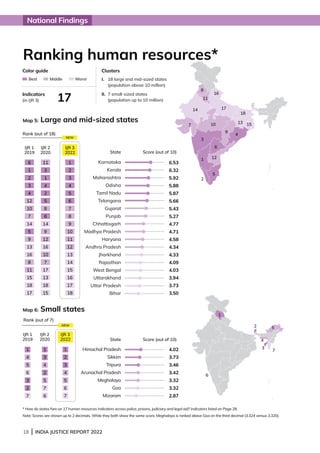
Ranking human resources*
* How do states fare on 17 human resources indicators across police, prisons, judiciary and legal aid? Indicators listed on Page 28.
Note: Scores are shown up to 2 decimals. While they both show the same score, Meghalaya is ranked above Goa on the third decimal (3.324 versus 3.320).
Map 5: Large and mid-sized states
6.53
6.32
5.92
5.88
5.87
5.66
5.43
5.27
4.77
4.71
4.58
4.34
4.33
4.09
4.03
3.94
3.73
3.50
Rank (out of 18)
Rank (out of 7)
State Score (out of 10)
IJR 1
2019
IJR 2
2020
IJR 3
2022
Map 6: Small states
4.02
3.73
3.46
3.42
3.32
3.32
2.87
State Score (out of 10)
Himachal Pradesh
Sikkim
Tripura
Arunachal Pradesh
Meghalaya
Goa
Mizoram
IJR 2
2020
IJR 3
2022
IJR 1
2019
Karnataka
Kerala
Maharashtra
Odisha
Tamil Nadu
Telangana
Gujarat
Punjab
Chhattisgarh
Madhya Pradesh
Haryana
Andhra Pradesh
Jharkhand
Rajasthan
West Bengal
Uttarakhand
Uttar Pradesh
Bihar
NEW
NEW
17
Color guide
Indicators
(in IJR 3)
Clusters
Best Middle Worst I.	
18 large and mid-sized states
(population above 10 million)
II.	
7 small-sized states
(population up to 10 million)
6
1
2
3
4
12
10
7
14
5
9
13
16
8
11
15
18
17
11
3
1
4
2
5
8
6
14
9
12
16
10
7
17
13
18
15
1
2
3
4
5
6
7
8
9
10
11
12
13
14
15
16
17
18
1
3
4
2
5
7
6
1
2
3
4
5
6
7
1
4
5
6
3
2
7
National Findings
INDIA JUSTICE REPORT 2022 | 19
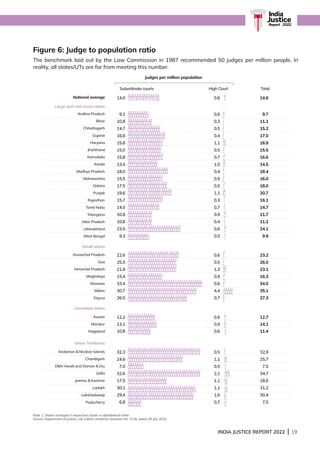
Figure 6: Judge to population ratio				
The benchmark laid out by the Law Commission in 1987 recommended 50 judges per million people. In
reality, all states/UTs are far from meeting this number.
Andhra Pradesh
Bihar
Chhattisgarh
Gujarat
Haryana
Jharkhand
Karnataka
Kerala
Madhya Pradesh
Maharashtra
Odisha
Punjab
Rajasthan
Tamil Nadu
Telangana
Uttar Pradesh
Uttarakhand
West Bengal
Arunachal Pradesh
Goa
Himachal Pradesh
Meghalaya
Mizoram
Sikkim
Tripura
Andaman  Nicobar Islands
Chandigarh
DN Haveli and Daman  Diu
Delhi
Jammu  Kashmir
Ladakh
Lakshadweep
Puducherry
Assam
Manipur
Nagaland
9.1
10.8
14.7
16.6
15.8
15.0
15.8
13.4
18.0
15.5
17.5
19.6
15.7
14.0
10.8
10.8
23.5
9.3
22.6
25.5
21.8
15.4
33.4
30.7
26.5
32.3
24.6
7.0
32.6
17.5
30.1
29.4
6.8
12.2
13.1
10.8
0.6
0.3
0.5
0.4
1.1
0.5
0.7
1.0
0.4
0.5
0.5
1.1
0.3
0.7
0.9
0.4
0.6
0.5
0.6
0.5
1.3
0.9
0.6
4.4
0.7
0.5
1.1
0.5
2.1
1.1
1.1
1.0
0.7
0.6
0.9
0.6
Large and mid-sized states
National average
Small states
Unranked states
Union Territories
Judges per million population
Subordinate courts High Court
9.7
11.1
15.2
17.0
16.9
15.5
16.6
14.5
18.4
16.0
18.0
20.7
16.1
14.7
11.7
11.2
24.1
9.9
23.2
26.0
23.1
16.3
34.0
35.1
27.3
32.9
25.7
7.5
34.7
18.6
31.2
30.4
7.5
12.7
14.1
11.4
Total
Note: 1. States arranged in respective cluster in alphabetical order.		
Source: Department of Justice; Lok Sabha Unstarred Question No. 2116, dated 29 July 2022.
India
Justice
Report | 2022
14.0 0.6 14.6
20 | INDIA JUSTICE REPORT 2022
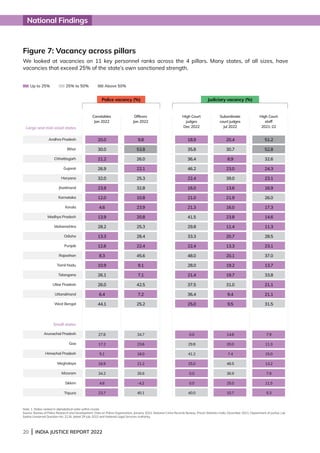
Figure 7: Vacancy across pillars
We looked at vacancies on 11 key personnel ranks across the 4 pillars. Many states, of all sizes, have
vacancies that exceed 25% of the state’s own sanctioned strength.
Up to 25% 25% to 50% Above 50%
Police vacancy (%)
Note: 1. States ranked in alphabetical order within cluster.
Source: Bureau of Police Research and Development, Data on Police Organisation, January 2022; National Crime Records Bureau, Prison Statistics India, December 2021; Department of Justice; Lok
Sabha Unstarred Question No. 2116, dated 29 July 2022 and National Legal Services Authority.
Andhra Pradesh
Bihar
Chhattisgarh
Gujarat
Haryana
Jharkhand
Karnataka
Kerala
Madhya Pradesh
Maharashtra
Odisha
Punjab
Rajasthan
Tamil Nadu
Telangana
Uttar Pradesh
Uttarakhand
West Bengal
Arunachal Pradesh
Goa
Himachal Pradesh
Meghalaya
Mizoram
Sikkim
Tripura
Large and mid-sized states
Small states
Constables
Jan 2022
Officers
Jan 2022
High Court
judges
Dec 2022
Subordinate
court judges
Jul 2022
High Court
staff
2021-22
20.0
30.0
21.2
26.9
32.0
23.9
12.0
4.6
13.9
28.2
13.3
12.6
8.3
10.9
26.1
26.0
6.4
44.1
27.8
17.2
5.1
16.9
34.2
4.6
23.7
9.8
53.8
26.0
22.1
25.3
32.8
10.8
23.9
20.8
25.3
28.4
22.4
45.6
9.1
7.1
42.5
7.2
25.2
34.7
23.6
16.0
21.2
26.6
-4.2
40.1
18.9
35.8
36.4
46.2
22.4
16.0
21.0
21.3
41.5
29.8
33.3
22.4
48.0
28.0
21.4
37.5
36.4
25.0
0.0
29.8
41.2
25.0
0.0
0.0
40.0
20.4
30.7
8.9
23.0
39.0
13.6
21.9
16.0
23.8
11.4
20.7
13.3
20.1
19.2
19.7
31.0
9.4
9.5
14.6
20.0
7.4
48.5
36.9
25.0
10.7
51.2
52.8
32.6
24.3
23.1
16.9
26.0
17.3
14.6
11.3
28.5
23.1
37.0
13.7
33.8
21.1
21.1
31.5
7.9
11.3
15.0
13.2
7.9
11.5
5.3
National Findings
Judiciary vacancy (%)
INDIA JUSTICE REPORT 2022 | 21
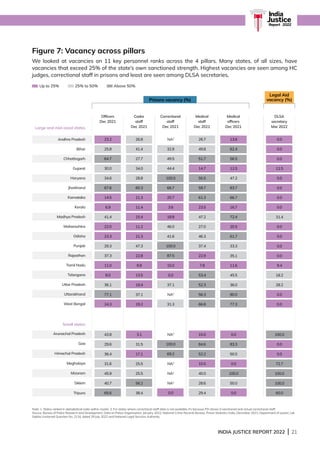
Figure 7: Vacancy across pillars
We looked at vacancies on 11 key personnel ranks across the 4 pillars. Many states, of all sizes, have
vacancies that exceed 25% of the state’s own sanctioned strength. Highest vacancies are seen among HC
judges, correctional staff in prisons and least are seen among DLSA secretaries.
Up to 25% 25% to 50% Above 50%
Note: 1. States ranked in alphabetical order within cluster. 2. For states where correctional staff data is not available, it's because PSI shows 0 sanctioned and actual correctional staff.
Source: Bureau of Police Research and Development, Data on Police Organisation, January 2022; National Crime Records Bureau, Prison Statistics India, December 2021; Department of Justice; Lok
Sabha Unstarred Question No. 2116, dated 29 July 2022 and National Legal Services Authority.
			
Andhra Pradesh
Bihar
Chhattisgarh
Gujarat
Haryana
Jharkhand
Karnataka
Kerala
Madhya Pradesh
Maharashtra
Odisha
Punjab
Rajasthan
Tamil Nadu
Telangana
Uttar Pradesh
Uttarakhand
West Bengal
Arunachal Pradesh
Goa
Himachal Pradesh
Meghalaya
Mizoram
Sikkim
Tripura
Large and mid-sized states
Small states
Officers
Dec 2021
Cadre
staff
Dec 2021
Correctional
staff
Dec 2021
Medical
staff
Dec 2021
Medical
officers
Dec 2021
DLSA
secretary
Mar 2022
23.2
25.8
64.7
30.0
34.6
67.6
14.5
6.9
41.4
22.0
23.3
29.3
37.3
11.0
8.0
36.1
77.1
24.3
43.8
29.6
36.4
31.6
45.9
40.7
65.6
26.8
41.4
27.7
34.0
28.8
60.3
21.3
11.4
15.4
11.2
21.3
47.3
22.8
9.8
13.5
19.4
37.1
19.2
3.1
31.5
17.1
25.5
25.5
56.2
38.4
NA2
32.9
49.5
44.4
100.0
66.7
20.7
3.6
18.8
46.0
41.6
100.0
87.5
15.0
0.0
37.1
NA2
31.3
NA2
100.0
69.2
NA2
NA2
NA2
0.0
26.7
49.8
51.7
14.7
50.5
59.7
61.3
23.5
47.2
27.0
46.3
37.4
22.9
7.8
53.4
52.3
56.3
66.8
10.0
84.6
52.2
10.0
40.0
28.6
29.4
13.6
62.4
56.5
12.5
47.2
83.7
66.7
16.7
72.4
20.5
61.7
33.3
35.1
11.6
45.5
36.0
90.0
77.3
0.0
83.3
50.0
0.0
100.0
50.0
0.0
0.0
0.0
0.0
12.5
0.0
0.0
0.0
0.0
31.4
0.0
0.0
0.0
0.0
9.4
18.2
28.2
0.0
0.0
100.0
0.0
0.0
72.7
100.0
100.0
60.0
Legal Aid
vacancy (%)
India
Justice
Report | 2022
Prisons vacancy (%)
22 | INDIA JUSTICE REPORT 2022
6
7
1
2
5
3
4
14
10
1
7
8
15
12
5
13
9
4
3
2
17
6
11
16
18
Ranking intention*
* What the trends show based on 5-year data for 23 indicators across police, prisons and judiciary. Indicators listed on Page 28.
Note: Andhra Pradesh and Telangana were not included in 2019 as 5-year data for these states was not available separately.
Map 7: Large and mid-sized states
6.29
6.09
5.67
5.52
5.26
5.14
5.13
5.08
4.93
4.68
4.53
4.48
4.26
4.04
3.97
3.96
3.69
3.34
Rank (out of 18)
Rank (out of 7)
State Score (out of 10)
IJR 1
2019
IJR 2
2020
IJR 3
2022
Map 8: Small states
5.05
4.87
4.36
4.33
3.95
3.93
3.02
State Score (out of 10)
Meghalaya
Arunachal Pradesh
Sikkim
Mizoram
Tripura
Himachal Pradesh
Goa
IJR 2
2020
IJR 3
2022
IJR 1
2019
Karnataka
Jharkhand
Bihar
Gujarat
Andhra Pradesh
Tamil Nadu
Madhya Pradesh
Uttar Pradesh
Telangana
Chhattisgarh
Odisha
Kerala
West Bengal
Rajasthan
Punjab
Uttarakhand
Maharashtra
Haryana
NEW
NEW
23
Color guide
Indicators
(in IJR 3)
Clusters
Best Middle Worst I.	
18 large and mid-sized states
(population above 10 million)
II.	
7 small-sized states
(population up to 10 million)
14
15
13
3
NA
7
11
9
NA
6
8
12
1
10
5
16
2
4
16
7
4
3
6
1
17
12
18
2
11
15
10
5
8
13
9
14
1
2
3
4
5
6
7
8
9
10
11
12
13
14
15
16
17
18
7
4
5
6
3
1
2
1
2
3
4
5
6
7
2
7
4
6
5
3
1
National Findings
INDIA JUSTICE REPORT 2022 | 23
Figure 8: Budgets for the justice system
The graphic below shows the 5-year average growth in budgetary allocations to police, prisons and
judiciary, and whether they have kept pace with the increase in the total state spend. Among the 25
ranked states, the increase in police budgets trails the increase in total budget in 12 states, prisons in 17
states and judiciary in 10 states.
Andhra Pradesh
Bihar
Chhattisgarh
Gujarat
Haryana
Jharkhand
Karnataka
Kerala
Madhya Pradesh
Maharashtra
Odisha
Punjab
Rajasthan
Tamil Nadu
Telangana
Uttar Pradesh
Uttarakhand
West Bengal
-2.7
0.9
1.7
1.3
2.1
3.9
-0.5
-4.2
-1.3
0.1
-0.8
-5.5
1.5
-2.8
-4.1
6.0
0.2
4.6
12.6
8.2
9.1
8.2
8.0
9.1
10.1
9.9
11.1
9.9
8.6
11.6
8.7
11.1
10.9
5.2
9.8
7.9
9.9
9.1
10.8
9.6
10.1
13.0
9.5
5.7
9.8
10.0
7.8
6.2
10.2
8.2
6.8
11.2
10.0
12.5
8.5
10.0
9.4
8.4
9.4
8.5
18.3
6.4
12.3
9.3
9.3
8.3
12.9
10.0
4.5
10.1
11.2
9.3
-8.6
1.6
6.1
16.7
-0.6
5.8
6.3
-0.8
-2.0
-1.6
-7.9
-8.6
-4.5
-3.0
-13.2
-11.4
-8.3
2.1
-4.1
1.8
0.3
0.2
1.4
-0.6
8.2
-3.6
1.3
-0.6
0.7
-3.3
4.2
-1.1
-6.4
5.0
1.4
1.4
-4.6
3.4
1.0
-1.9
-2.8
-1.7
3.5
13.1
7.3
9.1
13.4
9.6
13.2
6.7
8.5
10.8
10.2
11.5
6.8
11.5
10.2
23.6
9.3
8.3
18.7
9.3
10.4
15.5
-4.6
-19.2
2.0
-10.3
-7.6
12.7
-9.3
10.6
2.0
-0.8
5.3
-0.4
-2.8
8.8
Arunachal Pradesh
Goa
Himachal Pradesh
Meghalaya
Mizoram
Sikkim
Tripura
Large and mid-sized states
Small states
Total state Police Prisons Judiciary Police Prisons Judiciary
Note: States arranged in alphabetical order within cluster.						
Source: Combined Finance and Revenue Accounts of the Union and State Governments in India, Comptroller and Auditor General of India					
Pillar outpaces growth in state budget
Pillar trails growth in state budget
Average change in expenditure
between 2015-16 and 2020-21 (%)
Difference in spend:
pillar vs state (percentage points)
4.0
9.8
15.2
24.9
7.4
14.9
16.3
9.2
9.1
8.3
0.7
3.0
4.3
8.0
1.5
10.0
-6.2
-11.9
-2.6
8.4
11.2
3.1
2.0
25.9
India
Justice
Report | 2022
-2.3
24 | INDIA JUSTICE REPORT 2022
Figure 9: State's share in legal aid budget			
A state’s legal aid budget comprises two sources: the National Legal Services Authority (NALSA) at the
Centre and the state itself. Between 2017-18 and 2021-22, the contribution of states to their legal aid budget
has progressively increased. In 13 of the 18 large and mid-sized states, and in 5 of the 7 small states, the
state’s share increased in both follow-up time periods.
Andhra Pradesh
Bihar
Chhattisgarh
Gujarat
Haryana
Jharkhand
Karnataka
Kerala
Madhya Pradesh
Maharashtra
Odisha
Punjab
Rajasthan
Tamil Nadu
Telangana
Uttar Pradesh
Uttarakhand
West Bengal
Arunachal Pradesh
Goa
Himachal Pradesh
Meghalaya
Mizoram
Sikkim
Tripura
Large and mid-sized states
Small states
State's share in legal aid budget (%)
80
65
79
80
63
0
45
34
74
61
63
57
71
66
74
89
68
59
85
74
76
84
68
59
49
34
86
77
75
71
90
82
86
96
77
18
13
43
46
23
38
48
19
11
68
69
33
26
66
38
IJR 1 (2017-18) IJR 2 (2019-20) IJR 3 (2021-22)
84
81
85
88
83
64
77
78
92
78
88
77
85
84
84
96
78
63
NA
96
72
79
70
92
70
Note: 1. States arranged in respective cluster in alphabetical order.		
Source: State budget documents and National Legal Services Authority
Change
IJR 2 IJR 3
National Findings
INDIA JUSTICE REPORT 2022 | 25
Figure 10: Share of overcrowded jails in a state
The United Nations Office on Drugs and Crime classifies 120% overcrowding as ‘critical’ and 150% as
‘extreme.’ At the end of 2021, the average occupancy rates in 13 states/UTs were critical. In six, it had
crossed 150%. Averages, however, disguise the fact that in several prisons, overcrowding crosses 150%.
Share of jails with
150%  more
occupancy (%, 2022)
Source: e-Prisons portal				
AN Islands
Chandigarh
Goa
Ladakh
Lakshadweep
Manipur
Nagaland
Tamil Nadu
DNH  DD
Tripura
Telangana
Himachal Pradesh
Andhra Pradesh
Rajasthan
Meghalaya
Karnataka
Odisha
Punjab
Puducherry
Jharkhand
Gujarat
Madhya Pradesh
Arunachal Pradesh
Maharashtra
Bihar
Kerala
Jammu  Kashmir
Chhattisgarh
Sikkim
Mizoram
Haryana
West Bengal
Delhi
Uttarakhand
Assam
Uttar Pradesh
0
0
0
0
0
0
0
1
7
7
12
13
16
19
20
22
23
23
25
26
28
31
33
37
41
43
47
47
50
56
60
60
67
73
74
77
0%
Up to 25%
25% to 50%
Above 50%
India
Justice
Report | 2022
26 | INDIA JUSTICE REPORT 2022
Figure 11: Cases pending for more than 5 years in subordinate courts
In 23 of the 25 ranked states, cases pending in subordinate courts for above 5 years have increased in the
last 2 years. In 8 states, such cases amount to over 25% of pending cases. The green and red bars signify
the extent to which the share of cases pending over 5 years in subordinate courts have either reduced or
increased in states, compared to IJR 2020.
Note: 1. States arranged in respective cluster in descending order of IJR 3 value. 2. Data for Arunachal Pradesh (small state) not available.				
Source: National Judicial Data Grid
W
es
t
Be
ng
al
(3
6.8
,
48
.4)
B
ih
a
r
(
3
6
.7
,
4
7
.
7
)
O
d
i
s
h
a
(
3
5
.
0
,
4
2
.
3
)
U
t
t
a
r
P
r
a
d
e
s
h
(
3
5
.
8
,
3
5
.
5
)
Jharkhand
(21.2, 29.7)
Maharashtra (20.8, 29.0)
Rajasthan (18.8, 27.0)
Tamil Nadu (15.3, 21.1)
Gujarat (22.2, 21.0)
Karnataka (13.4, 19.6)
Kerala (6.8, 1 9.5)
Madhya Pradesh
(9.3, 17.9)
Telangana
(8.3, 15.2)
U
t
t
a
r
a
k
h
a
n
d
(
1
0
.
2
,
1
3
.
0
)
A
n
d
h
r
a
P
r
a
d
e
s
h
(
6
.
3
,
1
3
.
0
)
C
h
h
a
t
t
i
s
g
a
r
h
(
3
.
9
,
1
0
.
5
)
H
a
r
y
a
n
a
(1
.0
,
7
.1
)
Pun
jab
(1.8
,
6.1)
Goa (13.6, 23.9)
Himachal Pradesh (9.6, 13.6)
Meghalaya (25.1, 37.3)
Mizoram (7.9, 12.2)
Sikkim (0.1, 0.8)
Tripura (10.9, 11.3)
IJR 2 (Jul 2020)
IJR 3 (Jan 2023) (Declined)
IJR 3 (Jan 2023) (Improved)
Cases pending in subordinate courts
for more than 5 years (%)
20
30
40
10
National Findings
Large

m
i
d
-
s
i
z
e
d
s
t
a
t
e
s
S
m
a
l
l
s
t
a
t
e
s
INDIA JUSTICE REPORT 2022 | 27
Figure 12: Cases pending in High Courts
The pendency levels in High Courts is worse than in subordinate courts. Across all 25 High Courts, the share
of cases pending for more than five years stands at 48.3%. While north-eastern states fare the best on this
metric, the worse are Allahabad (Uttar Pradesh) and Calcutta (West Bengal and AN Islands), where the
share of cases pending for more than five years stands at 63%.
Note: 1. High Courts arranged in ascending order of value for 0-5 years.			
Source: National Judicial Data Grid
Cases pending in High Courts by duration (%, January 2, 2023)
5-10
years
10-20
years
Above
20
years
Allahabad
Calcutta
Madhya Pradesh
Kerala
Punjab  Haryana
Telangana
Bombay
Andhra Pradesh
Orissa
JK and Ladakh
Jharkhand
Patna
Karnataka
Madras
Gujarat
Rajasthan
Delhi
Chhattisgarh
Uttarakhand
Gauhati
Manipur
Himachal Pradesh
Meghalaya
Sikkim
Tripura
All India
36.7
37.0
44.1
47.9
48.7
49.7
51.1
51.1
53.0
56.1
58.1
59.2
59.2
59.4
61.3
62.8
64.5
66.8
69.1
72.2
78.0
79.0
90.7
92.0
99.4
51.7
23.2
23.6
28.9
36.9
26.5
32.3
23.1
28.4
25.2
28.3
21.9
25.0
21.8
18.6
25.1
20.0
21.7
26.8
24.2
23.6
11.6
16.6
9.2
7.4
0.6
24.2
27.8
25.4
24.6
14.3
21.1
16.1
20.4
18.4
17.7
14.6
18.2
11.9
18.9
16.3
12.8
14.3
13.5
6.0
6.7
4.2
10.4
4.3
0.1
0.6
0.0
19.1
12.3
14.0
2.5
0.9
3.7
1.9
5.3
2.1
4.1
1.0
1.8
3.8
0.1
5.6
0.8
2.9
0.4
0.4
0.0
0.1
0.0
0.1
0.0
0.0
0.0
5.0
0-5
years
India
Justice
Report | 2022
28 | INDIA JUSTICE REPORT 2022
National Findings
List of indicators on preceding
map pages
Ranking Intention
Police
Women in total police (pp, CY ’17-’21)
Women officers in total officers (pp, CY ’17-’21)
Constable vacancy (pp, CY ’17-’21)
Officer vacancy (pp, CY ’17-’21)
Difference in spend: police vs state (pp, FY ’17-’21)
Prisons
Officer vacancy (pp, CY ’17-’21)
Cadre staff vacancy (pp, CY ’17-’21)
Share of women in prison staff (pp, CY ’17-’21)
Inmates per prison officer (%, CY ’17-’21)
Inmates per cadre staff (%, CY ’17-’21)
Share of undertrial prisoners (pp, CY ’17-’21)
Spend per inmate (%, FY ’18-’22)
Prison budget used (pp, FY ’18-’22)
Difference in spend: prisons vs state (pp, FY ’17-’21)
Judiciary
Cases pending (per High Court judge) (%,’18-’22)
Cases pending (per sub. court judge) (%,’18-’22)
Total cases pending (High Court) (%,’18-’22)
Total cases pending (sub. court) (%,’18-’22)
Judge vacancy (High Court) (pp,’18-’22)
Judge vacancy (sub. court) (pp,’18-’22)
Case clearance rate (High Court) (pp,’18-’22)
Case clearance rate (sub. court) (pp,’18-’22)
Difference in spend: judiciary vs state (pp, FY ’17-’21)
Ranking Human Resources
Police
Constables, vacancy (%, Jan 2022)
Officers, vacancy (%, Jan 2022)
Officers in civil police (%, Jan 2022)
Prisons
Officers, vacancy (%, Dec 2021)
Cadre staff, vacancy (%, Dec 2021)
Correctional staff, vacancy (%, Dec 2021)
Medical staff, vacancy (%, Dec 2021)
Medical officers, vacancy (%, Dec 2021)
Personnel trained (%, Dec 2021)
Judiciary
Population per High Court judge (Number, Dec 2022)
Population per sub. court judge (Number, Jul 2022)
High Court judge vacancy (%, Dec 2022)
Sub. court judge vacancy (%, Jul 2022)
High Court staff vacancy (%, 2021-22)
Legal aid
DLSA secretary vacancy (%, Mar 2022)
PLVs per lakh population (Number, Jun 2022)
Sanctioned secretaries as % of DLSAs (%, Mar 2022)
Ranking Diversity
Police
Share of women in police (%, Jan 2022)
Share of women in officers (%, Jan 2022)
SC officers, actual to reserved ratio (%, Jan 2022)
SC constables, actual to reserved ratio (%, Jan 2022)
ST officers, actual to reserved ratio (%, Jan 2022)
ST constables, actual to reserved ratio (%, Jan 2022)
OBC officers, actual to reserved ratio (%, Jan 2022)
OBC constables, actual to reserved ratio (%, Jan 2022)
Prisons
Women in prison staff (%, Dec 2021)
Judiciary
Women judges (High Court) (%, Dec 2022)
Women judges (sub. court) (%, Jul 2022)
SC judges, actual to reserved (sub. court) (%, Jul 2022)
ST judges, actual to reserved (sub. court) (%, Jul 2022)
OBC judges, actual to reserved (sub. court) (%, Jul 2022)
Legal aid
Share of women in panel lawyers (%, Jun 2022)
Women PLVs (%, Jun 2022)
INDIA JUSTICE REPORT 2022 | 29
India
Justice
Report | 2022
List of indicators on preceding
improvement pages
Improvement between IJR 2 and IJR
3 (Indicator, unit, latest IJR period)
Police
Budget
1. Modernisation fund used (%, 2020-21)
2. Spend on police per person (Rs, 2020-21)
3. Spend on training per personnel (Rs, 2020-21)
Human Resources
4. Constables, vacancy (%, Jan 2022)
5. Officers, vacancy (%, Jan 2022)
6. Officers in civil police (%, Jan 2022)
Diversity
7. Share of women in police (%, Jan 2022)
8. Share of women in officers (%, Jan 2022)
9. SC officers, actual to reserved ratio (%, Jan 2022)
10. SC constables, actual to reserved ratio (%, Jan 2022)
11. ST officers, actual to reserved ratio (%, Jan 2022)
12. ST constables, actual to reserved ratio (%, Jan 2022)
13. OBC officers, actual to reserved ratio (%, Jan 2022)
14. OBC constables, actual to reserved ratio (%, Jan 2022)
Infrastructure
15. Population per police station (rural) (Number, Jan 2022)
16. Population per police station (urban) (Number, Jan 2022)
17. Area per police station (rural) (Sq km, Jan 2022)
18. Area per police station (urban) (Sq km, Jan 2022)
19. Services provided by state's citizen portals (%, 2022)
20. Personnel per training institute (Number, Jan 2022)
Workload
21. Population per civil police (Number, Jan 2022)
Prisons
Budget
22. Spend per inmate (Rs, 2021-22)
23. Prison budget utilized (%, 2021-22)
Human Resources
24. Officers, vacancy (%, Dec 2021)
25. Cadre staff, vacancy (%, Dec 2021)
26. Correctional staff, vacancy (%, Dec 2021)
27. Medical staff, vacancy (%, Dec 2021)
28. Medical officers, vacancy (%, Dec 2021)
29. Personnel trained (%, Dec 2021)
Diversity
30. Women in prison staff (%, Dec 2021)
Infrastructure
31. Prison occupancy (%, Dec 2021)
32. Jails with V-C facility (%, Dec 2021)
Workload
33. Inmates per officer (Number, Dec 2021)
34. Inmates per cadre staff (Number, Dec 2021)
35. Inmates per correctional staff (Number, Dec 2021)
Judiciary
Budget
36. Per capita spend on judiciary (Rs, 2020-21)
Human Resources
37. Population per High Court judge (Number, Dec 2022)
38 Population per sub. court judge (Number, Jul 2022)
39. High Court judge vacancy (%, Dec 2022)
40. Sub. court judge vacancy (%, Jul 2022)
41. High Court staff vacancy (%, 2021-22)
Diversity
42. Women judges (High Court) (%, Dec 2022)
43. Women judges (sub. court) (%, Jul 2022)
Infrastructure
44. Courthall shortfall (%, Jul 2022)
Workload
45. Cases pending (5-10 years) (sub. court) (%, Jan 2023)
46. Cases pending (10+ years) (sub. court) (%, Jan 2023)
47. Case clearance rate (High Court) (%, 2022)
48. Case clearance rate (sub. court) (%, 2022)
Legal Aid
Budget
49. State's share in legal aid budget (%, 2021-22)
Human Resources
50. DLSA secretary vacancy (%, Mar 2022)
51. PLVs per lakh population (Number, Jun 2022)
52. Sanctioned secretaries as % of DLSAs (%, Mar 2022)
Diversity
53. Share of women in panel lawyers (%, Jun 2022)
54. Women PLVs (%, Jun 2022)
Infrastructure
55. DLSAs as % of state judicial districts (%, Mar 2022)
56. Legal services clinic per jail (Number, 2021-22)
57. Villages per legal services clinic (Number, 2021-22)
Workload
58. PLA cases: settled as % of received (%, 2021-22)
59. Total LAs: Pre-litigation cases disposed (%, 2021-22)
60. SLSA LAs: Pre-litigation in cases taken up (%, 2021-22)
Improvement across all 3 IJRs
We considered 52 non-trend indicators present in all
three IJRs. For this exercise, from the list of 60
indicators given above, the following eight were
excluded: 3, 10, 12, 14, 19, 20, 29 and 32.
30 | INDIA JUSTICE REPORT 2022
INDIA JUSTICE REPORT 2022 | 31
Police
32 | INDIA JUSTICE REPORT 2022
6
5
1
3
7
4
2
14
10
1
8 7
15
12
5
13
9
4
3
2
17
6
11
16
18
Police Ranking
Note: Scores are shown up to 2 decimals. While they both show the same score, Andhra Pradesh is ranked above Odisha on the third decimal (6.218 versus
6.217) and Madhya Pradesh above Gujarat on the fourth decimal (5.8762 versus 5.8758).
Map 9: Large and mid-sized states
6.92
6.61
6.22
6.22
6.11
6.04
5.88
5.88
5.70
5.53
5.37
5.19
5.10
4.38
4.37
4.34
4.22
3.59
Rank (out of 18)
Rank (out of 7)
State Score (out of 10)
IJR 1
2019
11
6
5
7
2
1
15
12
10
4
9
8
3
17
18
14
13
16
IJR 2
2020
10
1
4
3
7
5
18
8
2
13
6
9
12
16
15
11
14
17
IJR 3
2022
Map 10: Small states
5.64
4.84
4.52
4.07
3.93
3.89
3.47
State Score (out of 10)
Sikkim
Arunachal Pradesh
Meghalaya
Mizoram
Himachal Pradesh
Goa
Tripura
IJR 2
2020
1
4
3
6
2
7
5
IJR 3
2022
1
2
3
4
5
6
7
IJR 1
2019
1
2
5
7
6
3
4
Telangana
Karnataka
Andhra Pradesh
Odisha
Uttarakhand
Tamil Nadu
Madhya Pradesh
Gujarat
Chhattisgarh
Maharashtra
Jharkhand
Haryana
Punjab
Rajasthan
Uttar Pradesh
Bihar
Kerala
West Bengal
NEW
NEW
30
Color guide
Indicators
(in IJR 3)
Clusters
Best Middle Worst I.	
18 large and mid-sized states
(population above 10 million)
II.	
7 small-sized states
(population up to 10 million)
Police
1
2
3
4
5
6
7
8
9
10
11
12
13
14
15
16
17
18
INDIA JUSTICE REPORT 2022 | 33
PUSHING EXPECTATIONS
Infrastructure
Training
'Others' in police
CCTVs
Women help desks
5%
Share of ‘others if
any’ in total police.
1.3%
All-India share of
training budget in total
police budget. It is more
than 2% in only 5 states.
3 in 10
Police stations do not
have women help desks.
1 in 4
Police stations does not
have a single CCTV camera.
In Andhra Pradesh,
33%
of police personnel
are under ‘others if
any’ category
IJR 1: 22% IJR 2: 20% IJR 3: 22%
* Number of states/UTs (out of 36) for which data was available.
Budgets
Number of states/UTs whose police expenditure grew more than
their state expenditure, over 5 years.
IJR 1 (2019)
IJR 2 (2020)
IJR 3 (2022)
14 33
9 34
21 34
Total states*
Modernisation fund
Number of states/UTs that fully utilized their modernization fund.
IJR 1 (2019)
IJR 2 (2020)
IJR 3 (2022)
1 22
3 29
3 30
Area coverage
The number of states/UTs that meet the 1981 benchmark of 150 sq. km.
for one police station in rural areas.
IJR 1 (2019)
IJR 2 (2020)
IJR 3 (2022)
4 32
6 30
6 31
SC/ST/OBC quota
Number of states/UTs that have met at least 80% of their declared quotas.
IJR 1 (2019)
IJR 2 (2020)
IJR 3 (2022)
2 31
2 31
3 31
Women staff
Number of states/UTs where women account for more than 10% of the police force.
IJR 1 (2019)
IJR 2 (2020)
IJR 3 (2022)
8 36
13 36
17 36
Vacancy in police force
India
Justice
Report | 2022
34 | INDIA JUSTICE REPORT 2022
Introduction
Over the past decade the total sanctioned strength
of police across the country increased from 22.84 to
26.89 lakh (an increase of 18 per cent) while actual
police numbers grew from 17.23 lakh to 20.94 lakh (an
increase of 22 per cent). The per capita spend on police
grew nearly threefold from Rs. 445 to Rs. 1,151. Despite
considerable improvements in money and manpower,
policing across the country continues to be impeded by
long-term malaises.
Demonstrating improvements in capacity Telangana
moved from tenth to first rank. Fewer vacancies,
an increase in the share of women and per capita
expenditure, as well as spend on training per personnel—
all contributed to pushing it up nine places.
Bihar dropped six places from eleventh to seventeenth
place, largely due to decreases in spend on training per
personnel, share of women and SC and OBC officers, and
increases in constable and officer vacancies. A decline
in the services provided by the state citizens portal, too,
contributed to the drop in rank. Uttar Pradesh dropped
one place from fifteenth to sixteenth, due to an increase
in constable and officer vacancy and poor performance
on caste diversity.
Other states, however, registered steeper drops, notably
Chhattisgarh (from second to ninth) and Bihar (from
eleventh to seventeenth), largely due to increases
in vacancies at both constable and officer level and
decreases in the share of women in the total police force.
Among the 7 small states, Sikkim retained the top slot
while Tripura slipped to the bottom from the fifth position.
Sikkim increased its per capita spend, ensured there were
no vacancies at the officer level, and improved its gender
diversity. In Tripura, vacancies at both the constable and
officer level increased. The deficit between sanctioned
and actual strength grew across SC and ST at both the
constable and officer level and the population per police
station increased in both rural and urban areas.
Human Resources1
The gulf between sanctioned and actual strength
remains worryingly large. Between January 2020 and
January 2022, the overall vacancies rose from 20.3
per cent to 22.1 per cent respectively; constabulary
vacancies rose from 17.7 per cent to 21.6 per cent, while
officer vacancies dropped slightly from 29.1 per cent to
28.6 per cent in the same period. While the sanctioned
strength between 2020 and 2022 was increased by 2.5
per cent, the actual number of police personnel on the
ground increased by only 0.1 per cent.2
Officer vacancies: Nationally, on average, officers3
make up 16.6 per cent of the combined working strength
of the civil police and District Armed Reserve police
(1,646,061).4
While eighteen states/UTs5
improved
1	
Unless otherwise stated all annual statistics are as of January 2022. Five-year trends refer to 2017-22. For comparisons, DNH  DD, and Jammu  Kashmir are not taken into account.
2 Actual strength decreased by 21,926 (from 20,91,488 to 20,69,562) and sanctioned strength increased by 8,665 (from 26,23,225 to 26,31,890).
3 Officers comprise DGP/Spl DGP + Addl DGP + IGP + DIG + AIGP/SSP/SP/COMN + Addl SP/Dy COMN + ASP/Dy SP + Inspector + SI + ASI.
4 Bureau of Police Research  Development, Data on Police Organisation, 2022. Available at:
https://bprd.nic.in/WriteReadData/userfiles/file/202301110504030641146DataonPoliceOrganizations.pdf
5 
Gujarat, Assam, Punjab, Uttarakhand, Arunachal Pradesh, Rajasthan, Odisha, Delhi, Tamil Nadu, Nagaland, Madhya Pradesh, Chandigarh, Maharashtra, Tripura, Puducherry, Karnataka, West
Bengal, Goa.
Police
Police: Incapacity, a
Continuing Challenge
Chapter 1
Constables Vacancy (%, Jan 2022)
Constable Vacancies (pp, CY'17-'21)
Officers Vacancy (%, Jan 2022)
Officer vacancies (pp, CY'17-'21)
Officers in civil police (%, Jan 2022)
Population per civil police (persons,
Jan 2022) (workload)
INDIA JUSTICE REPORT 2022 | 35
their percentage of officers, in fourteen6
it decreased.
Uttarakhand and Kerala police have around 10 per cent
officers. West Bengal (31.5 per cent), Jharkhand (25.4
per cent) and Bihar (23.4 per cent) have the highest
share of officers among 18 large and mid-sized states.
Interestingly, this is despite Bihar having more than 50
per cent officer vacancy: against a sanctioned strength
of 37,351 the state has only 17,274 officers.
Nationally, the average vacancy at officer level stands at
28.6 per cent (the largest shortfalls being among sub-
inspectors 35 per cent), followed by IGPs at 30 per cent,
Inspectors at 27 per cent and ASIs at 24 per cent.7
These
numbers are concerning as they impinge on investigative
capacity and the supervision of a large constabulary.
Around 19 states/UTs,8
including 9 large states, had 25
per cent or more vacant officer posts. Bihar (with 53.8
per cent) had the most vacancies, followed by Rajasthan
(45.6 per cent).
Between January 2020 and January 2022, 28 states/
UTs,9
including Uttar Pradesh, West Bengal and
Rajasthan increased their sanctioned strength while in 5
states/UTs it came down.10
Maharashtra and Chandigarh,11
despite decreasing
sanctioned strength, saw increases in vacancy levels—
from 22 per cent to 25 per cent and 8 per cent to 12 per
cent respectively in the same period. Madhya Pradesh
(49 per cent to 21 per cent), Puducherry (47 per cent
to 33 per cent), Karnataka (19 per cent to 11 per cent)
and Telangana (14 per cent to 7 per cent) improved their
situation considerably. Since 2014, Sikkim has been the
only state to have more officers than sanctioned. Looked
at over five years, from 2017 to 2021, vacancies in the
officer ranks increased in 17 states/UTs.12
Constabulary Vacancies: Only 7 states/UTs, including
Telangana, Madhya Pradesh and Karnataka, reduced
their shortfall15
while 26 states/UTs could not.16
In West
Bengal vacancies reached 44.1 per cent. Over the five-
yearperiodbetween2017and2021,constablevacancies
in 25 states/UTs increased; 17
with the most, an increase
of 4.81 percentage points, in Maharashtra. Nagaland—
where the Armed Forces Special Powers Act, 1958 is in
force—continues to be the only state which maintains 2
per cent more constabulary than sanctioned.
6 
Himachal Pradesh, Chhattisgarh, Mizoram, Uttar Pradesh, Kerala, Bihar, Telangana, Manipur, Sikkim, Meghalaya, Lakshadweep, Jharkhand, Haryana, Andhra Pradesh, AN Islands.
7 As of January 2022, sub-inspector vacancies were at 38 per cent, while ASIs and SIs vacancies were at 28 per cent each.
8 
Bihar, Rajasthan, Uttar Pradesh, Lakshadweep, Tripura, Manipur, Arunachal Pradesh, Puducherry, Jharkhand, Odisha, Assam, Mizoram, Chhattisgarh, Andaman  Nicobar Islands, Maharashtra,
Haryana, West Bengal, Dadra and Nagar Haveli and Daman and Diu, Jammu  Kashmir.
9 
Uttar Pradesh, West Bengal, Rajasthan, Karnataka, Tamil Nadu, Jammu  Kashmir, Gujarat, Telangana, Haryana, Odisha, Andhra Pradesh, Bihar, Goa, Delhi, Tripura, Chhattisgarh, Sikkim,
Meghalaya, Himachal Pradesh, Kerala, Assam, Punjab, Andaman  Nicobar Islands, Nagaland, Mizoram, Uttarakhand, Manipur, Jharkhand.
10	
Madhya Pradesh, Maharashtra, Chandigarh, Ladakh, Puducherry.
11 
Sanctioned strength of officers in Maharashtra decreased from 39,985 to 37,647 and in Chandigarh from 707 to 609.
12 
Tripura, Maharashtra, Arunachal Pradesh, Bihar, Rajasthan, Meghalaya, Punjab, Mizoram, Manipur,
Assam, 
Sikkim, Himachal Pradesh, Goa, Chandigarh, Madhya Pradesh, Andhra Pradesh, Odisha
13	
Bureau of Police Research  Development, Data on Police Organisation, 2022.
Available at: https://bprd.nic.in/WriteReadData/userfiles/file/202301110504030641146DataonPoliceOrganizations.pdf
14	
Commonwealth Human Rights Initiative, Summary of Recommendations made by the
Padmanabhaiah Committee on Police Reforms. Available at: https://www.humanrightsinitiative.org/programs/aj/police/india/initiatives/summary_padmanabhaiah.pdf
15 
Telangana, Sikkim, Madhya Pradesh, Karnataka, Kerala, Rajasthan, Andaman  Nicobar Islands.
16 
Manipur, Lakshadweep, Assam, Himachal Pradesh, Tamil Nadu, Jharkhand, Andhra Pradesh, Uttar Pradesh, Bihar, Tripura, Chhattisgarh, Puducherry, Uttarakhand, Haryana, Chandigarh, West
Bengal, Mizoram, Meghalaya, Arunachal Pradesh, Punjab, Gujarat, Odisha, Delhi, Goa, Nagaland, Maharashtra.
17 
Maharashtra, Delhi, Andaman  Nicobar Islands, Arunachal Pradesh, Tamil Nadu, Puducherry, Mizoram, West Bengal, Chhattisgarh, Goa, Nagaland, Kerala, Tripura, Odisha, Haryana,
Chandigarh, Madhya Pradesh, Punjab, Sikkim, Assam, Himachal Pradesh, Meghalaya, Telangana, Andhra Pradesh.
India
Justice
Report | 2022
Teeth-to-tail ratio is considered an important
determinant for the proper composition of
a police force. It is the ratio between the
strength of officers and constabulary.13
The
Padmanabhaiah Committee on Police Reforms
recommends a teeth-to-tail ratio14
of 1:4.
Uttar Pradesh was able to bring down its
vacancies from 62% in 2017 to 40% in 2020
with a marginal increase to 42% in 2022. In
Madhya Pradesh, vacancies jumped from 8% in
2017 to 48% in 2020 to 21% in 2022.
A typical recruitment cycle—from job notices
being put out to the time when new recruits
qualify for deployment—may take anything up
to two years. Irregular recruitment cycles lead to
drastic year-on-year fluctuations. Illustratively,
in January 2017, Maharashtra had 8% officers’
vacancy; by 2020 this had increased to 22%.
In 2021, within just one year, the number had
nearly doubled to 42%. In 2022 it has come
down to 25%.
36 | INDIA JUSTICE REPORT 2022
Police
‘Mahila Police’ in
Andhra Pradesh
When enumerating the number of police personnel,
the Data on Police Organisation 2022-the Bureau
of Police Research and Development tabulates
categories of personnel by rank. In addition, there
is an undefined column titled “Others if any”.
Together these make up the total police in a state.
“Others if any” usually indicates the category of
people employed in roles that aid police work in
ancillary capacities. This can range from short-
term typists and machine operators to messenger
boys, informers, sweepers and other temporary or
contractual ministerial and menial staff.
As of January 2022, the total sanctioned strength
of the ‘Others’ category is around 1.3 lakh, while
the actual strength is 1.1 lakh. The strength of this
category ranges from none in Odisha, Telangana,
Gujarat and Rajasthan to 29,179 in Andhra Pradesh
and 17,295 in Uttar Pradesh. Nationally, the actual
numbers amount to 5% of the total (20.9 lakh).
For Andhra Pradesh, there are 547 women officers,
3172 constables and the ‘Others if any’ category
adds 15,580 women inducted as ‘Mahila Police’.18
This has contributed significantly to the share of
women in total police, increasing it to 21.8% in
January 2022 from 5.8 per cent in January 2020.
Yet whether the ‘Mahila Police’ contingent can be
considered police personnel or are village-level
workers at the mandal level remains uncertain and
contested.
A government order dated 10.10.2019 created a
class of personnel known as Grama Mahila
Samrakshna Karyadarsi /Ward Mahila
Samrakshana Karyadarsi with functions that
included assisting SHOs with investigation of
cases and protecting the scene of offence before
the IOs arrival and the like. Later, an amendment
notification G.O.Ms.No 59 dated 23.06.2021
substituted Grama Mahila Samrakshna Karyadarsi
/Ward Mahila Samrakshana Karyadarsi with
‘Mahila Police.’ This order provided for their training
as ‘in vogue’, uniforms similar to those of women
constables and similar authorities and power under
different acts that have been given to constables.
Head constables’ posts and promotional avenues
were also provided for.
A public interest litigation (PIL) challenged
the constitutionality of this government order.
Challenges to the description of 15,000 women
being police personnel range from the way in which
they were inducted (without adherence to the strict
rules that govern entry into the force), to concerns
about the freewheeling interventions which their
functions, name as ‘police’ and presence in uniform
imply.
Faced with questioning from the Andhra Pradesh
High Court, in December 2021 the government of
Andhra Pradesh withdrew the offending order and
instead revised it with the Andhra Pradesh Mahila
Police (Subordinate Service Rules, 2021) dated
12.01.2022. This time re-confirming the position
that these were going to be a separate vertical
within the police department. The name of the now
auxiliary personnel was changed to Mahila Police.
The GO detailed their distinct uniform and insignia;
defined their powers and functions; laid down the
appointing body and procedures; and outlined
periods of training, probation, specifies ranks,
avenues for promotion and supervision hierarchies.
The PIL had not, at the time of writing, come to
any conclusion about whether the Mahila Police
are or are not to be considered police personnel.
However, the Andhra scheme and the growing
numbers of ‘Others’ enumerated in other states
indicates a growing national trend of augmenting
policing functions through extraneous recruiting,
which does not meet police recruitment discipline
and accountability standards, yet seems to function
under the mantle of ‘policing’ set out in the Police
Act.
18 
‘Govt notifies rules for AP Mahila police wing’, The Hindu, 13 January 2022. Available at: https://www.thehindu.com/news/national/andhra-pradesh/govt-notifies-rules-for-ap-mahila-police-wing/
article38261660.ece
INDIA JUSTICE REPORT 2022 | 37
India
Justice
Report | 2022
19 Andhra Pradesh, Uttar Pradesh, Telangana, Madhya Pradesh, Karnataka, Haryana, Gujarat, Sikkim, Tamil Nadu, Himachal Pradesh, Chhattisgarh.
20 From January 2020 to January 2022.
21 PRS legislative research, Police Reforms in India. Available at: https://prsindia.org/policy/analytical-reports/police-reforms-india
22 
Janaagraha centre for citizenship and democracy, Manpower Requirement Study, Bangalore City Police, 2014. Available at: https://www.janaagraha.org/files/publications/Manpower-
Requirements-Study-March-2014.pdf
23 Bureau of Police Research  Development, Data on Police Organisation, National Requirement of Manpower for 8-hour Shifts in Police Stations; August 2014.
24 
Police-per-lakh-of-population ratio (PPR) against the total actual police strength (Civil + DAR + Special Armed + IRB), Data on police organisation, 2022, p. 76.
25 Diversity covers Scheduled Castes, Scheduled Tribes, Other Backward Classes and women.
26 The BPRD data on reservations calculates data for six ranks: ASP/Dy. SP/Asst. Commandant, Inspector/Reserve Inspector, S.I/Reserve Sub-Inspector (RSI),ASI/ARSI, Head Constable, Constable.
27 
Office of the Registrar General and Census Commissioner of India, Ministry of Home Affairs, Census of India, 2011. Available at: https://censusindia.gov.in/census.website/data/census-tables
28 
NALSA v. Union of India, 2014, ‘[T]he Supreme Court granted legal recognition to transgender and other gender non-conforming persons in. It directed union and state governments to
allow transgender persons to access reservations in public education and employment.’ Available at: https://scobserver-production.s3.amazonaws.com/uploads/case_document/document_
upload/1286/NALSA_v_UoI_WPC_400_2012.pdf
Population/civil police: As of January 2022, there was
one police person available (with civil and district armed
police taken together) to serve 831 people nationwide.
This is a slight improvement from 858 in January 2020.
In 11 states and UTs,19
including Andhra Pradesh and
Uttar Pradesh, the police-to-population ratio decreased
(see box on ‘Other’ to understand this reduction). Punjab
with one for every 500 people has the best ratio while
Bihar’s ratio—worsening by 146—brought the ratio to
one police personnel for every 1,695 people.
Diversity25
Scheduled Castes, Scheduled Tribes and Other
Backward Classes Reservations26
: Constitutional
equality mandates all states to reserve caste quotas.
The aspiration behind the standard is to repair the gulf in
representation of consistently underrepresented groups
in all spheres—with governments leading the way.
As of January 2022, Scheduled Castes make up 15.99
per cent27
of the total working police strength (against
16 per cent share in population), Scheduled Tribes
11.77 per cent, Other Backward Classes 30.79 per cent
and women 11.75 per cent. Data on representation
of various religious groups remains unavailable since
2014. Following the Supreme Court’s directions,28
police departments have started recruiting transgender
persons, but detailed state-wise data is not yet publicly
available.
SC officers, actual to reserved ratio
(%, Jan 2022)
SC constables, actual to reserved ratio
(%, Jan 2022)
ST officers, actual to reserved ratio
(%, Jan 2022)
ST constables, actual to reserved ratio
(%, Jan 2022)
OBC officers, actual to reserved ratio
(%, Jan 2022)
OBC constables, actual to reserved ratio
(%, Jan 2022)
Share of women in police (%, Jan 2022)
Share of women in officers (%, Jan 2022)
Women in total police (pp, CY'17-'21)
Women officers in total officers (pp, CY'17-'21)
Sanctioned strength
The vexed question of vacancies dogs the
justice system. A reduction in sanctioned
strength can appear to reduce vacancy levels.
Illustratively, over two years20
Kerala reduced
the sanctioned strength of civil police by 239
personnel. Consequently, vacancies appear
to have reduced (from 10% to 8.8%) but
‘workload’ (population-to-police ratio) has
increased (from 773 persons to 776 persons).
Administrations periodically revise
the sanctioned strength, however the
‘ideal’ remains uncertain. The suggested
international standard is 222 per lakh
population.21
Official and civil society studies
at the state and city level have attempted to
set down criteria for determining optimum
human resource requirements that suggest
increases ranging from 457% to 621% over
present strength.22
A 2014 Bureau of Police
Research  Development study based on
three shift policing calculated that 61% more
personnel were required.23
From 1982 Kerala
has set a norm of 1SI:1 ASI: 5HC: 25 PC as
the minimum strength of a police station,
but an increase in police stations coupled
with financial constraints pose a challenge
to maintaining this norm make keeping to the
norm a challenge. India—the second most
populous nation in the world—has 152.8
police persons per lakh population.24
38 | INDIA JUSTICE REPORT 2022
Notes: 1. Combined SC/ST/OBC reservation figures for Dadra  Nagar Haveli and Daman  Diu not available. 2. SC reservation data not available for Andaman  Nicobar Islands. 3. No specific
reservation approved for SCs in Meghalaya. 4. BPRD shows 0% SC reservation for Arunachal Pradesh, Lakshadweep, Mizoram and Nagaland. 5. BPRD shows 0 SC officer figures for Ladakh.
6. BPRD shows 0% ST reservation for Mizoram, Chandigarh and Haryana. 7. BPRD shows 0% OBC reservation for Arunachal Pradesh, Ladakh, Lakshadweep, Mizoram and Tripura. 8. OBC
reservation data not available for Jammu  Kashmir. 9. No specific reservation approved for OBCs in Meghalaya.
Source: Data on Police Organizations, 2020, Bureau of Police Research and Development (BPRD)
Figure 13: SC, ST, OBC vacancies in police				
			
Karnataka remains the only state to consistently meet
its quota for SC, ST and OBC, both among officers and
the constabulary. All other states/UTs continue to fall
short of their targets in at least one or the other reserved
category despite decades of reservations.
SC officers
OBC officers
ST officers
OBC constables
Police
SC constables
ST constables
Above 50%
25% to 50%
Others
Vacancy
INDIA JUSTICE REPORT 2022 | 39
Gujarat and Manipur stand out for meeting their SC
quotas at both the officer and constabulary levels
whereas Bihar, Telangana and Himachal Pradesh for
fulfilling their ST quotas. States fare relatively better
when it comes to OBCs. At least 9 states (Karnataka,
Chhattisgarh, Telangana, Andhra Pradesh, Punjab,
Odisha, Jharkhand, Tamil Nadu and Kerala) met their
OBC quotas.
In some states, the percentage share of reserved groups
varies greatly between the officer and constabulary
levels. In Uttarakhand, against the SC reservation of 19
per cent, at the constabulary level 98 per cent of posts
reserved for SCs have been filled, while for officers it is
just 54 per cent. In Uttarakhand, against the quota of 4
per cent for STs, 132 per cent of the constabulary posts
were filled but only 55 per cent of officers. Conversely,
Goa has a much higher SC share at the officer level (110
per cent) than in the constabulary (43 per cent).
Assam and Jammu  Kashmir fare the worst in meeting
reservation targets.
Gender: Most states have their own specific quotas for
how many women there should be in the police force.
While 6 UTs35
and 9 states36
have a target of 33 per
cent, elsewhere, targets range from Bihar’s 35 per cent37
to 10 per cent in Arunachal Pradesh, Meghalaya and
Tripura. Five states/UTs,38
including Kerala and Mizoram,
have no reservations. Himachal Pradesh has recently
notified 25 per cent vacancies reserved for women at the
constabulary level.
As of January 2022, no state or Union Territory had
reached their set target. Andhra Pradesh, with 21.8 per
cent, has the highest share of women. This is mainly
because it recently created a 15,000 women-strong
auxiliary force called ‘Mahila Police’. The actual number of
More states are able to meet
quotas within the constabulary
rather than at the officer level.
While 6 states/UTs29
met their
SC constable quota, only 5 met
the SC officers’ quota.30
Twelve
states31
met the ST constable
quota, while only 7 met their
officer quota.32
OBC quotas
were filled by 10 states/UTs33
at the officer level and 13 at
the constabulary level.34
29 Sikkim, Karnataka, Manipur, Gujarat, Punjab, Tamil Nadu.
30 Gujarat, Manipur, Karnataka, Goa, Madhya Pradesh.
31 
Bihar, Lakshadweep, Karnataka, Ladakh, Telangana, Uttarakhand, Himachal Pradesh,
Tamil Nadu, Odisha, Rajasthan, Chhattisgarh, Arunachal Pradesh.
32 Ladakh, Karnataka, Telangana, Bihar, Himachal Pradesh, Delhi, Lakshadweep.
33 
Punjab, Karnataka, Telangana, Puducherry, Andhra Pradesh, Jharkhand, Odisha, Tamil
Nadu, Chhattisgarh, Kerala.
34	
Odisha, Andhra Pradesh, Chhattisgarh, Punjab, Karnataka, Puducherry, Jharkhand, Uttar
Pradesh, Telangana, Bihar, Kerala, Tamil Nadu, Gujarat.
35 AN Islands, Lakshadweep, DNH  DD, Puducherry, Delhi, Chandigarh.
36	
Andhra Pradesh, Gujarat, Haryana, Jharkhand, Madhya Pradesh, Odisha, Nagaland,
Sikkim, Punjab.
37 According to the Bihar government rule there is 35 per cent reservation for women and 3
per cent reservation for Backward Caste women.
38 Jammu  Kashmir, Kerala, Mizoram, Goa, Ladakh.
39 Rajya Sabha Unstarred Question No. 701 dated 8 February 2023. Available at: https://
pqars.nic.in/annex/259/AU701.pdf
40 Presuming that all women who are in the force are stationed at police stations only,
which is often not the case.
41	
Maharashtra, Uttar Pradesh, Bihar, Delhi, Gujarat, West Bengal, Punjab, Nagaland,
Chandigarh, Himachal Pradesh, Manipur, Uttarakhand, Assam, Ladakh, Tripura,
Andaman  Nicobar Islands, Sikkim, DNH  DD.
India
Justice
Report | 2022
Enough women for women?
“The Ministry of Home Affairs has issued
advisories dated 22.04.2013, 21.05.2014,
12.05.2015, 21.06.2019, 22.06.2021 and
13.04.2022 to all the state governments to
increase the representation of women police
to 33% of the total strength. All the state
governments have been requested to create
additional posts of women Constables/Sub-
Inspectors by converting the vacant posts of
Constables/Sub-Inspectors. The aim is that
each police station should have at least 3
women Sub-Inspectors and 10 women police
Constables, so that a women help desk is
manned round the clock.”39
In January 2022, there were 17,535 police
stations in the country and 13,146 women
SIs. Fulfilling targets would require another
39,459 women SIs. Currently, only Delhi, with
225 police stations and 1,086 women SIs, and
Mizoram, with 44 police stations and 119 SIs,
have the capacity to meet the requirement.40
As of January 2022 the country had 180,685
female constables on record. If these are
evenly deployed in all states/UTs, 18 would
have enough women constables41
to meet the
advisory benchmark.
40 | INDIA JUSTICE REPORT 2022
Police
Note: States/Union Territories arranged in alphabetical order within category.
Source: Data on Police Organizations, 2022, Bureau of Police Research and Development (BPRD)
Figure 14: Policewomen: Numbers growing but still too few
Multiple MHA advisories have recommended that there be women Sub-Inspectors (SI) and 10 women
constables in each police station. Except Delhi, no state/UT meets this benchmark for SIs.
Benchmark 3.0
National average 10.3
National average 0.7 Benchmark 10.0
Women SIs per police station Women constables per police station
Andhra Pradesh
Bihar
Chhattisgarh
Gujarat
Haryana
Jharkhand
Karnataka
Kerala
Madhya Pradesh
Maharashtra
Odisha
Punjab
Rajasthan
Tamil Nadu
Telangana
Uttar Pradesh
Uttarakhand
West Bengal
0.2
1.5
0.4
0.6
0.7
0.4
0.6
0.1
0.9
1.3
0.8
0.9
0.3
0.5
0.5
0.7
1.7
0.7
Arunachal Pradesh
Goa
Himachal Pradesh
Meghalaya
Mizoram
Sikkim
Tripura
0.2
1.4
0.2
1.2
2.7
0.2
0.9
Andaman  Nicobar Islands
Chandigarh
DN Haveli and Daman  Diu
Delhi
Jammu  Kashmir
Ladakh
Lakshadweep
Puducherry
0.7
0.6
1.1
4.8
0.3
2.0
0.0
0.2
Assam
Manipur
Nagaland
0.8
1.4
1.0
Large and mid-sized states
Small states
Unranked states
Union Territories
2.8
16.7
7.5
16.1
7.5
4.7
5.5
6.9
3.5
21.0
7.1
12.8
9.6
6.0
5.1
16.4
13.6
13.3
9.8
9.7
14.4
8.7
3.2
12.6
12.0
11.3
17.8
22.5
16.9
61.5
10.3
32.9
5.9
37.3
1.3
3.5
Meeting benchmark
Not meeting benchmark
INDIA JUSTICE REPORT 2022 | 41
India
Justice
Report | 2022
women constables in the state is 3,172 (See box ‘Other if
any’). But AP is still unable to meet its reservation target
of 33 per cent. Bihar (21.2 per cent) and Tamil Nadu (19.1
per cent), too, have a relatively high share of women but
don’t meet their stated targets of 35 per cent and 30 per
cent respectively. Jharkhand has a 33 per cent quota, but,
with 6.2 per cent, has the lowest share of women, closely
followed by Chhattisgarh (7.1 per cent) and Madhya
Pradesh (7.4 per cent). Women remain clustered in the
lower rungs of police hierarchy. Women officers make
up only 8 per cent of that cadre: Mizoram with 21.4 per
cent, closely followed by Uttarakhand with 18.1 per cent,
bring up the national average. Jammu and Kashmir have
the least share with 1.4 per cent. Lakshadweep, which
has 16 police officers, does not have any women officers
in its police force.
Budget
Effective governance and optimal functioning capabilities
rely to a large degree on adequate financial resources
and planning. Both these factors have a significant
impact on how change progresses. Between 2016-
17 and 2020-21, the national expenditure on police
increased by 35 per cent. For most states growth in
police expenditure tends to outpace the growth in state
expenditure. Between 2016-17 and 2020-21, for 20
states/UTs42
increase in police expenditure outpaced the
overall increase in total state expenditure. Illustratively,
the total state expenditure of Uttar Pradesh increased by
5.16 percentage points but expenditure on police went
up by 11.16 percentage points. Delhi police, which is
administered by the Ministry of Home Affairs, increased
its budget by 37 per cent. The largest five-year budget
expenditure increase on policing was seen in Jharkhand
(with 70 per cent) and West Bengal with (67 per cent).
Spend on police per person: In 2020-21 all states/
UTs43
except Kerala registered an increase in spend per
police person. The national average stood at Rs. 1,151—
an increase from Rs. 911.5 last year. Eleven44
of the 18
large and mid-sized states spend less than the national
average. Interestingly, of the 10 states/UTs45
that have
the highest per capita spend, 5 are UTs, 2 are AFSPA-
states and the remaining 3 are small states. The average
spend per police person also varies dramatically; among
the large and mid-sized states, while Punjab spends
Rs. 2,055 per person, Bihar spends just Rs. 641. A small
state like Sikkim (Rs. 6,559) spends significantly more on
police than its populous neighbour West Bengal, which
spends only Rs. 909.
Modernisation fund used: Since 1969–1970, states
have been eligible for conditional financial aid from
the central government to meet capital expenditures,
mainly for the acquisition of cutting-edge weaponry
and communication/forensic equipment, training aids,
cyber policing, etc. States also make their own financial
contributions. Ratios range from 90:10 (for North eastern
states, Sikkim, JK) to 60:40 for other geographies.46
Between 2016-17 and 2020-21, the total central fund
allocation to states reduced by 46 per cent from Rs.
2,066.27 crore to Rs. 1,123.05 crore, and utilisation
decreased from 75 per cent47
to 47 per cent.48
Utilisation remains a challenge. As of 2020-2021, of 22
states/UTs for which data was available, only Gujarat,
Arunachal Pradesh and Puducherry reported utilising
their entire modernisation grant. Eight states/UTs49
utilised less than 50 per cent. Amongst the states using
the least were Manipur (1.5 per cent), Assam (11.5 per
cent) and Uttar Pradesh (24.5 per cent).
Spend on police per person (₹, 2020-21)
Modernisation fund used
(%, 2020-21) (Revised)
Spend on training per personnel
(₹, 2020-21) (Revised)
Share of training budget in total police
budget (per cent, 2020-21) (Revised)
Training budget utilisation
(%,₹, 2020-21) (Revised)
Difference in spend: Police vs State
(pp, FY ’17-21)
42 
Uttar Pradesh, Delhi, West Bengal, Andaman  Nicobar Islands, Jharkhand, Tripura, Goa, Puducherry, Haryana, Chhattisgarh, Lakshadweep, Rajasthan, Gujarat, Himachal Pradesh, Bihar,
Nagaland, Manipur, Chandigarh, Andhra Pradesh, Maharashtra.
43 DNH  DD, Jammu  Kashmir and Ladakh not compared.
44 
Bihar, Gujarat, Odisha, Rajasthan, Madhya Pradesh, Uttar Pradesh, West Bengal, Kerala, Karnataka, Tamil Nadu, Andhra Pradesh.
45 
Lakshadweep, Andaman  Nicobar Islands, Nagaland, Sikkim, Arunachal Pradesh, Ladakh, Manipur, Jammu  Kashmir, Mizoram, Chandigarh.
46	
Ministry of Home Affairs, Modernisation of State Police Forces. Available at: https://www.mha.gov.in/division_of_mha/Police%20Modernisation%20Division/modernisation-of-state-police-forces-
mpf-scheme
47	
Bureau of Police Research and Development, Data on Police Organisation, 2017.
48 Bureau of Police Research and Development, Data on Police Organisation, 2022.
49 Telangana,West Bengal, Mizoram, Punjab, Jammu  Kashmir, Uttar Pradesh, Assam, Manipur
42 | INDIA JUSTICE REPORT 2022
Police
Training Budgets and Utilisation: Taken cumulatively,
across the country, only 1.3 per cent (2020-21)50
of the
total police budgets (Rs. 1.78 lakh crore) was allocated
to training. Of the training budget of Rs. 2,253.09 crore,
only 84 per cent was utilised, bringing the actual spend
to 1.1 per cent or in other words, just over Rs. 9,000 per
police person per year.
Nineteen states/UTs51
spent less than the national
average. Since 2016-1752
allocations for training have
increased but haven’t reached 2 per cent. States that
have steadily increased their allocation on training
include Uttar Pradesh—where it grew from Rs. 144.9
crore (2016-17) to Rs. 283.46 crore (2020-21)—a jump
of 96 per cent, making this the largest increase over a
period of four years. In the same period Tamil Nadu,
Tripura and West Bengal have in fact decreased their
budgets by 9.8 per cent, 35 per cent and 52.9 per cent
respectively53
.
Fourteen states and UTs,54
allocated less than 1 per
cent of their overall police budget for training, of which
only Gujarat was able to use the full amount. Arunachal
Pradesh, with the highest allocation of 5.4 per cent,
utilised 96 per cent of its training budget. West Bengal
and Himachal Pradesh had the least training budget
with 0.04 and 0.05 per cent respectively.
Infrastructure
Population per Police Station: Police station locations
are dictated by population, crime profile, topography,
and many other considerations including finance and
human resource availability. Between 2012 and 2022,
the number of police stations increased by 23 per cent.
Nationwide, 17,535 police stations serve a population
of 1.37 billion and an area of 3,287,469 sq km. This
averages roughly to one police station for 78,344 people
and coverage of 187 sq km.
Overall, even though 60 per cent of India’s population
continues to live in rural areas, area-wise policing
machinery is far more concentrated in urban areas. On
average, a rural police station covers an area of 337.4
sq km—this translates as 16.7 times the area covered by
the urban ones (20.2 sq km).
In all thirty states/UTs55
for which data is available police
stations in rural areas serve larger areas than urban.
For example, rural police stations of Himachal Pradesh
cover areas 118 times more than urban police stations.
In Madhya Pradesh and Rajasthan it is 41 and 36
times respectively. Kerala and Puducherry are the only
geographies where the difference is marginal.56
Among
the large and mid-sized states, Rajasthan serves the
largest area per rural police station (684 sq km per PS)
and Kerala the largest per urban police station (74 sq km
per PS).
On average, rural police stations also serve slightly
larger—and perhaps more scattered—populations
(97,362) than urban ones (94,683). However, because
of the concentrated nature of populations in cities and
towns, in 19 states/UTs57
urban police stations serve
greater populations than their rural counterparts: Kerala’s
urban police stations serve ten times the population of a
50 Data on Police Organizations, 2022, Bureau of Police Research and Development (BPRD)
51 
Karnataka, Maharashtra, Odisha, Haryana, Sikkim, Tripura, Jharkhand, Andhra Pradesh, Gujarat, Nagaland, Uttarakhand, Chhattisgarh, Assam, Uttar Pradesh, Meghalaya, Goa, Chandigarh,
Himachal Pradesh, West Bengal.
52 BPRD started providing data on the police training budget from the DoPO 2018 report.
53 
Tamil Nadu from Rs. 174.76 crore to 157.72 crore, Tripura from Rs. 23.08 crore to 15 crore and West Bengal from Rs. 10.15 crore to 4.78 crore
54 Kerala, West Bengal, Himachal Pradesh, Goa, Chandigarh, Meghalaya, Uttarakhand, Haryana, Assam, Tripura, Jharkhand, Maharashtra, Sikkim, Gujarat.
55 Data not available for Arunachal Pradesh, Delhi, Chandigarh, Ladakh, Jammu  Kashmir, Lakshadweep.
56 
Kerala’s urban and rural police stations serve almost similar areas, (74 sq km) in urban and (82 sq km) in rural. Similarly, Puducherry’s urban police station also serves an area marginally smaller
(11 sq km) than rural ones (21 sq km).
57 
Telangana, Jammu  Kashmir, Punjab, Sikkim, Jharkhand, Manipur, Mizoram, Nagaland, Karnataka, Chhattisgarh, Andaman  Nicobar Islands, Tamil Nadu, Andhra Pradesh, Puducherry, DNH 
DD, Goa, Maharashtra, Gujarat, Kerala.
Population per police station
(rural) (Jan 2022)
Population per police station (urban)
(Jan 2022)
Area per police station (rural)
(sq km, Jan 2022)
Area per police station (urban)
(sq km, Jan 2022)
Police personnel per training institute
(number, Jan 2022)
Services provided by states’ citizen portal
(%, 2022)
Share of police stations with CCTVs
(%, Jan 2022)
Share of police stations with Women help
desks (%, Jan 2022)
INDIA JUSTICE REPORT 2022 | 43
India
Justice
Report | 2022
Figure 15: India: Police training budget (2020-21)
		
The total spend on training amounts to Rs 2,253 crore for a force of nearly 21 lakh. This means that the
national annual average spend per police personnel is a meagre Rs 9,000.
Large and mid-sized states
Andhra Pradesh
Bihar
Chhattisgarh
Gujarat
Haryana
Jharkhand
Karnataka
Kerala
Madhya Pradesh
Maharashtra
Odisha
Punjab
Rajasthan
Tamil Nadu
Telangana
Uttar Pradesh
Uttarakhand
West Bengal
Small states
Arunachal Pradesh
Goa
Himachal Pradesh
Meghalaya
Mizoram
Sikkim
Tripura
Unranked states
Assam
Manipur
Nagaland
Union Territories
AN Islands
Chandigarh
DNH/DD
Delhi
Jammu  Kashmir
Ladakh
Lakshadweep
Puducherry
All India
5,490.62
9,991.23
4,897.61
5,379.80
5,043.11
5,003.19
6,934.31
3,780.53
7,451.94
16,996.90
4,130.66
6,387.42
6,621.30
8,434.30
7,260.52
27,285.74
2,038.13
11,403.54
1,021.73
653.17
1,414.74
1,067.79
708.60
495.37
1,634.27
5,004.71
2,119.49
1,457.71
398.90
499.10
69.08
8,273.48
8,419.26
279.58
32.00
258.65
178,338.47
57.21
142.17
62.46
52.53
43.12
46.00
85.05
0.00
184.18
159.86
49.46
78.68
126.95
157.72
193.48
283.46
16.78
4.78
55.10
2.27
0.65
6.52
18.25
4.75
15.00
44.83
34.54
14.86
3.99
2.00
-
190.76
117.67
-
-
-
2,253.09
88,689
93,313
64,573
89,846
59,078
63,077
95,516
53,216
103,642
170,570
56,227
72,210
96,058
118,057
62,731
310,955
20,359
96,104
12,100
7,903
17,133
13,881
7,567
5,868
21,990
61,868
28,631
26,201
4,331
5,903
1,179
79,489
79,464
2,452
262
3,390
2,093,833
1.04
1.42
1.28
0.98
0.86
0.92
1.23
NA2
2.47
0.94
1.20
1.23
1.92
1.87
2.66
1.04
0.82
0.04
5.39
0.35
0.05
0.61
2.58
0.96
0.92
0.90
1.63
1.02
1.00
0.40
NA1
2.31
1.40
NA1
NA1
NA1
1.26
99.5
71.8
53.5
100.0
95.8
89.2
90.2
NA2
87.9
84.2
85.7
87.0
100.0
86.0
91.2
55.6
63.9
61.3
96.4
94.3
89.2
96.8
89.5
85.1
99.5
71.3
79.6
100.0
100.0
23.5
NA1
100.0
88.9
NA1
NA1
NA1
84.0
6,417
10,944
5,179
5,847
6,991
6,506
8,031
NA2
15,629
7,887
7,541
9,479
13,216
11,493
28,126
5,070
5,270
305
43,901
2,708
339
4,546
21,594
6,885
6,785
5,167
9,608
5,672
9,213
796
NA1
23,989
13,171
NA1
NA1
NA1
9,043
Police budget
(Rs crore)
Police
training budget
(Rs crore)
Total
police (actual
strength)
Share of training
budget in total police
budget (%)
Training budget
utilisation (%)
Spend on
training per
personnel (Rs)
General notes: Budgets data for 2020-21, personnel figures for January 2022. For each of the metrics shown in the last three columns, different scales have been used.
State notes: 1. BPRD shows police training budget as blank. 2. BPRD shows zero police training budget.
Source: Data on Police Organizations, 2022, Bureau of Police Research and Development (BPRD)
44 | INDIA JUSTICE REPORT 2022
Police
Figure 16: Police presence: Rural-urban divide
60% of India’s population continues to live in rural areas. Policing machinery is far more concentrated in
urban areas. The graph below shows population and areas covered by police stations in both settings.
Note: Census 2011 does not give rural/urban area break-up for Arunachal Pradesh.					
Source: Data on Police Organizations, 2022, Bureau of Police Research and Development (BPRD); Census 2011; National Commission on Population, 2019
Population per police station (January 2022)
Area per police station (January 2022)
AP BR CH GJ HR JH KA KL MP MH OR PB RJ TN TS UP UT WB
AR GA HP ML MZ SK TR
Small states
Small states
NA
National
Average
National
Average
Large and mid-sized states
300,000
200,000
100,000
0
800
600
400
200
0
Rural Urban
Rural Urban
INDIA JUSTICE REPORT 2022 | 45
India
Justice
Report | 2022
rural one, Gujarat’s four times. In Telangana, both rural
and urban stations serve almost the same numbers.
Among the large and mid-sized states, the largest
population per rural police station is in West Bengal
(321,677), while the largest for urban police stations is
Gujarat (288,788).
Police personnel per training institutes58
: The world
over organisational wisdom stresses that beyond
induction or basic training a significant portion of
institutional time should be spent on training and
manpower development. BPRD suggests “for police the
requirement would definitely be more than 5 per cent
of the service period however for the moment let us
benchmark it at 5 per cent only.59
”
This translates to having institutional capacities on
hand for preparing personnel for new promotional
responsibilities; refreshers on institutional norms,
adherence to constitutional imperatives, mandated
procedures and custodial supervision; courses for
specialisation, keeping abreast of changes in law, new
types of crime and technology; building psychological
acuity and community trust; dealing with vulnerable
groups and emergent situations; and upskilling in
the many more aspects that day-to-day policing in a
democracy demands of the institution.
The general state of training schools and academies is
that they have meagre resources and an overload of
work. As of January 2022, the average workload60
per
training institute stood at 12,744 persons. For 26.88 lakh
sanctioned police personnel, India has a total of 211
training institutes, an increase of 8 from January 2020.
Kerala increased from 2 to 3, Haryana 3 to 4, Tamil Nadu
from 23 to 24, and West Bengal from 10 to 16. Uttar
Pradesh’s training workload for 11 training institutes
averaged 38,382 per institution, which is around thrice
the national average. Manipur’s lone training institute
continues to deal with a workload of around 35,000
police personnel. Tamil Nadu’s 24 institutes train an
average of 5,480 personnel each.
Share of police stations with CCTV cameras: In 2020,
the Supreme Court in Paramvir Singh Saini v Baljit Singh
(2020)61
passed a series of directions regarding the
installation of CCTV cameras inside all police stations.
As of January 2022, nationally, of the 17,535 police
stations only 73.5 per cent (12,893) had installed at least
one CCTV camera.62
Eight states/UTs63
including West Bengal, Telangana and
Karnataka had at least one CCTV in all police stations.
But it is unclear how many or whether they are located
at the specific locations the apex court required they be
installed.
Four states/UTs (Rajasthan, Manipur, Puducherry,
Lakshadweep) reported that less than 1 per cent of their
police stations have CCTVs. Rajasthan had managed
only one in an urban police station; Manipur, Puducherry
and Lakshadweep reported none.
Nine states/UTs64
do not have CCTVs in half of their rural
police stations. Only 7 states/UTs65
have installed CCTVs
in all special purpose police stations.66
Women help desks: Given the degree of violence
against women coupled with the socio-economic and
cultural barriers to access to justice, there has been an
ongoing effort to improve response systems in the police.
Periodic advisories from the Ministry of Home Affairs
have provided guidance for setting up women’s help
desks in every police station.67
Only 6 states/UTs—Goa (140), Tamil Nadu (137),
Bihar (125), Kerala (82), Puducherry (21) and
Lakshadweep (1)—meet the National Police
Commission’s 1981 recommended area coverage
of 150 sq km for a rural police station.
58 Present BPRD data does not disaggregate training into induction, mid-career or promotion training, nor the time spent on each.
59 Bureau of Police Research and Development, Training Master Plan, 2009. Available at: https://bprd.nic.in/WriteReadData/CMS/File1336.pdf
60 The workload is calculated by dividing the total sanctioned strength of police to the number of training institutes.
61 Paramvir Singh Saini v Baljit Singh (2020) https://main.sci.gov.in/supremecourt/2020/13346/13346_2020_33_1501_24909_Judgement_02-Dec-2020.pdf
62 Data on Police Organizations, 2022, Bureau of Police Research and Development (BPRD)
63 Karnataka, Telangana, Ladakh, DNH  DD, Andaman  Nicobar Islands, Assam, Goa, West Bengal
64 Rajasthan, Lakshadweep, Manipur, Puducherry, Jharkhand, Jammu Kashmir, Nagaland, Meghalaya, Sikkim.
65 Telangana, West Bengal, Assam, Goa, Andaman Nicobar Islands, Ladakh, DNH DD.
66 
Special purpose police stations are the ones set up to deal with special crimes like crime against SCs/STs/ weaker sections, crime against children, anti-corruption/vigilance, coastal security, crime
investigation department, economic offences, cyber-crime, narcotics, drug trafficking, etc.
67 Ministry of Home Affairs, Women Safety Division, 19 August 2021. Available at https://www.mha.gov.in/sites/default/files/advisory_21052021_0_1.pdf
46 | INDIA JUSTICE REPORT 2022
As of January 2022, 72 per cent of all police stations
across the country reported having these special
facilities. Arunachal Pradesh, Tripura and West Bengal
have women help desks in all their police stations. Bihar
has women help desks in 47 per cent of all police stations.
Meghalaya has no women help desk.
Jharkhand, Tamil Nadu and Nagaland, too, have women
help desks in less than 50 per cent of their police
stations. Twenty-one states and UTs68
report having set
up women help desks inside all police stations in urban
areas; in rural areas only 17 have.69
Twenty-six per cent
of special purpose police stations include an assistance
desk for women.
In addition, many states have set up all female police
stations. Illustratively, out of a total of 745 women police
stations, Tamil Nadu with 202 has the maximum while
Uttarakhand has just 2.
Services provided by states’ citizen portals: State-
level citizen portals are required to provide nine basic
online services for easy accessibility (See box in next
column). The compliance of each state citizen portal70
was assessed by checking these nine services twice—
from September 2022 to November 2022—to evaluate
improvements in the working of the portals.
Eight states/UTs71
did worse than last year in terms
of compliance, while 12 states/UTs72
increased the
percentage of services provided. Five states73
had
defunct citizen service portals: in 2020 there were 9.74
No
state provided all the services, in contrast to the Pragati
Dashboard status which indicates that 97% of the
states do. Gujarat with 91 per cent and Madhya Pradesh
with 90 per cent show the maximum compliance while
Mizoram and Manipur provide no service.75
Some states like Himachal Pradesh, Sikkim and Tripura
display most of the services, yet are inaccessible owing
to technical errors like problems with logins and sign up.
The portal for Jharkhand could only be accessed after
multiple login attempts.
While some states like Meghalaya have improved
their portals by adding more services this year, others
like Kerala have removed some features. Most sites
were available in English or Hindi, but not necessarily
in the state language; Odisha’s site, for instance, is in
English and not in Odia. Kerala has added Malayalam.
Rajasthan’s website is the only one that does not provide
an option for English.
68 
Nagaland, Manipur, Chhattisgarh, Mizoram, Kerala, Puducherry, Goa, Maharashtra, Punjab, Sikkim, Andaman  Nicobar Islands, Uttarakhand, Rajasthan, Arunachal Pradesh, West Bengal,
Ladakh, DNH DD, Tripura, Himachal Pradesh, Chandigarh, Odisha.
69 
Assam, Puducherry, Goa, Maharashtra, Punjab, Sikkim, Andaman  Nicobar Islands, Uttarakhand, Rajasthan, Arunachal Pradesh, West Bengal, Ladakh, DNH  DD, Tripura, Lakshadweep,
Himachal Pradesh, Odisha.
70 Under the SMART Policing initiative of the Ministry of Home Affairs advises states to provide services to citizens online through the state citizen portal: https://digitalpolice.gov.in/
71 Assam, Andaman Nicobar Islands, Delhi, Punjab, Bihar, Kerala, Himachal Pradesh.
72 Haryana, Chandigarh, Odisha, Goa, Telangana, Madhya Pradesh, Gujarat, Meghalaya, Uttarakhand, Arunachal Pradesh, Rajasthan, Lakshadweep.
73 Manipur, Mizoram, Sikkim, Tripura, West Bengal.
74 Arunachal Pradesh, Lakshadweep, Manipur, Mizoram Rajasthan, Sikkim, Tripura, Uttarakhand, West Bengal  
75 Website for both states not loading: https://mnpcitizenportal.gov.in/ and  http://www.cctns.mizoram.gov.in/
Services provided by states’
citizen portals
1.	
Filing of complaints to the concerned
police station.
2. Obtaining the status of the complaints.
3.	
Obtaining the copies of FIRs.
4.	
Details of arrested persons/wanted
criminals.
5.	
Details of missing/kidnapped persons
and their matching with arrested.
6.	
Details of stolen/recovered vehicles, arms
and other properties.
7.	
Submission of requests for issue/renewal
of various NOCs.
8.	
Verification requests for servants,
employment, passport, senior citizen
registrations etc.
9.	
Portal for sharing information and
enabling citizens to download required
forms.
Global tourist hub Goa
listed 133 languages,
including their state
language (Konkani) which
wasn't there last year.
Police
INDIA JUSTICE REPORT 2022 | 47
Devika Prasad, Independent Researcher;
Devyani Srivastava, Commonwealth Human
Rights Initiative;
Radhika Jha, Common Cause;
Dr. Rehana Manzoor, India Justice Report;
Lakhwinder Kaur, India Justice Report
76 National Crime Records Bureau, Crime in India, 2021.
77 Kerala Police Cybercrime statistics.
78 Order by the Government of Kerala, dated 22 August 2014. Available at:
https://keralapolice.gov.in/storage/pages/custom/ckFiles/file/Cp8ecECJSSmrtRBaCj0qQO47NSOZKO1yc4tvEiFG.pdf
79 Kerala Police, Cyberdome Volunteer Framework. Available at: https://www.cyberdome.kerala.gov.in/assets/policy/cyberdome_volunteer_framework.pdf
80	
‘Kerala Police Cyberdome alerts against WannaCry ransomware attack’, Indian Express, 15 May 2017. Available at: https://indianexpress.com/article/technology/tech-news-technology/kerala-
cyberdome-alerts-against-ransomware-attack-4656902/
Cybercrime: Kerala Model
Over the past 2 years cybercrime across India has
grown by 6%.76
Crimes range from defrauding folks
of money (60%) to identity theft, child pornography,
malicious system’s disruptions, terrorist
communications, illegal surveillance, industrial
espionage, social media, and emerging threats from
the marketplaces of the darknet and cyberwarfare.
In 2016, the ever-changing threat of cybercrime77
prompted the Research and Development Division
of the Kerala Police to set up Cyberdome,78
an
integrated ecosystem to prevent, shield against
and detect cybercrime; foster the capabilities
and expertise of Kerala Police; as well as develop
strategies to deal with the dynamic, challenging
environment of technology; and train the police and
public to recognise, report and respond to it.
Moving beyond traditional self-contained law
enforcement methods, it actively provides forensic
support to police investigations and coordinates
with other state agencies to help recognise and
eliminate cyber threats. It seeks out public-private
partnerships and encourages contributions from
outside academic research groups, non-profits,
individual experts, and ethical hackers to ensure
that the Kerala Police are equipped and abreast with
latest technologies to respond to crimes unheard
of a decade ago. Quite uniquely, its Cyberdome
Volunteer Framework Document79
makes plain that
contributions and collaborations—even with for-
profit enterprises—must be on a strictly voluntary
basis. Learnings and jointly developed innovations
can later be put to commercial use. This has brought
the police varied expertise and a ‘proud’ cohort of
law enforcement helpers. In recognition of the border
traversing nature of cybercrime the Cyberdome has
linked up with many national and international
cyber security and law enforcement.
Now 6 years old, the Cyberdome’s worth has been
demonstrated through several interventions, it
was notably able to warn the government of an
impending ransomware attack before it happened80
and, on another occasion, exposed the chinks in
the security vulnerability of the state’s integrated
Financial Management System which handles
substantial amounts of public funds including tax
remittances.
India
Justice
Report | 2022
48 | INDIA JUSTICE REPORT 2022
Police
Andhra Pradesh
Bihar
Chhattisgarh
Gujarat
Haryana
Jharkhand
Karnataka
Kerala
Madhya Pradesh
Maharashtra
Odisha
Punjab
Rajasthan
Tamil Nadu
Telangana
Uttar Pradesh
Uttarakhand
West Bengal
Arunachal Pradesh
Goa
Himachal Pradesh
Meghalaya
Mizoram
Sikkim
Tripura
Assam
Manipur
Nagaland
AN Islands
Chandigarh
DNH  DD
Delhi
Jammu  Kashmir
Ladakh
Lakshadweep
Puducherry
Large and mid-sized states
Small states
Unranked states
Union Territories
National average
IJR 1
2019
IJR 2
2020
IJR 3
2022
Budgets
Table 3: Indicator-wise data, state scores and ranks			
Rank in cluster
Best
Middle
Worst
6.22
4.34
5.70
5.88
5.19
5.37
6.61
4.22
5.88
5.53
6.22
5.10
4.38
6.04
6.92
4.37
6.11
3.59
4.84
3.89
3.93
4.52
4.07
5.64
3.47
Not ranked
Not ranked
Not ranked
Not ranked
Not ranked
Not ranked
Not ranked
Not ranked
Not ranked
Not ranked
Not ranked
5
14
10
12
8
9
6
13
15
4
7
3
17
1
11
18
2
16
4
11
2
8
9
6
1
14
18
13
3
12
16
5
10
15
7
17
3
16
9
8
12
11
2
17
7
10
4
13
14
6
1
15
5
18
2
3
6
5
7
1
4
4
7
2
3
6
1
5
2
6
5
3
4
1
7
10
10
11
16
11
6
16
13
16
13
15
15
13
15
15
11
14
10
9
13
9
8
4
14
7
8
7
7
10
9
NA
12
NA
NA
6
10
Data sources: Data on Police Organizations, Bureau of Police Research and Development (BPRD); Combined Finance and Revenue Accounts of the Union and State Governments in India, Comptroller and Auditor
General of India; Union Budget documents; Digital Police Portal, Ministry of Home Affairs; National Commission on Population; Open Budgets India.
Common notes: i. States arranged by clusters in alphabetical order. ii. AN Islands: Andaman  Nicobar Islands. iii. DNH/DD: Dadra  Nagar Haveli and Daman  Diu. iii. New indicators in IJR 3 highlighted in yellow.
iv. pp: percentage points (the difference between two percentages). v. NA: Not available. vi. CY: Calendar year; FY: Financial year. vii. SC: Scheduled castes; ST: Scheduled tribes; OBC: Other backward classes. viii. Civil
police includes district armed reserve police. viii. For reasons of readability, scores are shown up to 2 decimals. While they both show the same score, Andhra Pradesh is ranked above Odisha on the third decimal (6.218
versus 6.217) and Madhya Pradesh above Gujarat on the fourth decimal (5.8762 versus 5.8758).
1. Count of indicators on which a state has improved over IJR 2. Only non-trend indicators present in both IJR 2 and IJR 3 have been considered. For indicators with benchmarks, if a state met the benchmark, it was
marked as an improvement even if its value declined within the benchmark. If a state didn’t meet the benchmark but its value improved, it was marked as an improvement. DNH/DD, JK and Ladakh values are not
comparable with IJR 2, and so have not been considered. 2. BPRD shows police training budget as blank. 3. BPRD shows zero police training budget.
Best in cluster
Worst in cluster
1.26
Higher,
the better
Share of training
budget in police
budget
(%, 2020-21)
1.04
1.42
1.28
0.98
0.86
0.92
1.23
0.003
2.47
0.94
1.20
1.23
1.92
1.87
2.66
1.04
0.82
0.04
5.39
0.35
0.05
0.61
2.58
0.96
0.92
0.90
1.63
1.02
1.00
0.40
NA2
2.31
1.40
NA2
NA2
NA2
NEW
1,151
Spend on
police per
person
(Rs, 2020-21)
Higher,
the better
1,133
641
1,362
761
1,621
1,432
943
936
816
1,234
763
2,055
813
1,009
1,601
857
1,607
909
6,552
3,615
1,641
2,864
5,193
6,559
3,416
1,169
5,936
7,989
8,798
4,458
796
4,041
5,427
6,437
9,406
1,501
Indicator
Theme
Scoring
guide
IJR 3
Score
(out of
10)
Indicators
improved on
(out of 21)1
INDIA JUSTICE REPORT 2022 | 49
Andhra Pradesh
Bihar
Chhattisgarh
Gujarat
Haryana
Jharkhand
Karnataka
Kerala
Madhya Pradesh
Maharashtra
Odisha
Punjab
Rajasthan
Tamil Nadu
Telangana
Uttar Pradesh
Uttarakhand
West Bengal
Arunachal Pradesh
Goa
Himachal Pradesh
Meghalaya
Mizoram
Sikkim
Tripura
Assam
Manipur
Nagaland
AN Islands
Chandigarh
DNH  DD
Delhi
Jammu  Kashmir
Ladakh
Lakshadweep
Puducherry
Large and mid-sized states
Small states
Unranked states
Union Territories
Indicator
Theme
Scoring guide
National average
Budgets Human Resources
Table 3: Indicator-wise data, state scores and ranks			
Data sources: Data on Police Organizations, Bureau of Police Research and Development (BPRD); Combined Finance and Revenue Accounts of the Union and State Governments in India, Comptroller and Auditor
General of India; Union Budget documents; Digital Police Portal, Ministry of Home Affairs; National Commission on Population; Open Budgets India.
Common notes: i. States arranged by clusters in alphabetical order. ii. AN Islands: Andaman  Nicobar Islands. iii. DNH/DD: Dadra  Nagar Haveli and Daman  Diu. iii. New indicators in IJR 3 highlighted in yellow.
iv. pp: percentage points (the difference between two percentages). v. NA: Not available. vi. CY: Calendar year; FY: Financial year. vii. SC: Scheduled castes; ST: Scheduled tribes; OBC: Other backward classes. viii. Civil
police includes district armed reserve police.
1. Count of indicators on which a state has improved over IJR 2. Only non-trend indicators present in both IJR 2 and IJR 3 have been considered. For indicators with benchmarks, if a state met the benchmark, it was
marked as an improvement even if its value declined within the benchmark. If a state didn’t meet the benchmark but its value improved, it was marked as an improvement. Where an indicator value was not available for
one or both years, that indicator was not considered. 2. BPRD shows police training budget as blank. 4. Expenditure data not provided. 5. No modernisation grant received.
India
Justice
Report | 2022
Best in cluster
Worst in cluster
84.0
Training
budget
utilization
(%, 2020-21)
Higher,
the better
99.5
71.8
53.5
100.0
95.8
89.2
90.2
NA3
87.9
84.2
85.7
87.0
100.0
86.0
91.2
55.6
63.9
61.3
96.4
94.3
89.2
96.8
89.5
85.1
99.5
71.3
79.6
100.0
100.0
23.5
NA2
100.0
88.9
NA2
NA2
NA2
NEW
9,043
Spend on
training per
personnel
(Rs, 2020-21)
Higher,
the better
6,417
10,944
5,179
5,847
6,991
6,506
8,031
NA3
15,629
7,887
7,541
9,479
13,216
11,493
28,126
5,070
5,270
305
43,901
2,708
339
4,546
21,594
6,885
6,785
5,167
9,608
5,672
9,213
796
NA2
23,989
13,171
NA2
NA2
NA2
21.6
Constables,
vacancy
(%, Jan 2022)
Lower,
the better
20.0
30.0
21.2
26.9
32.0
23.9
12.0
4.6
13.9
28.2
13.3
12.6
8.3
10.9
26.1
26.0
6.4
44.1
27.8
17.2
5.1
16.9
34.2
4.6
23.7
23.0
9.5
-2.0
13.7
17.3
20.1
19.7
3.6
29.1
16.3
24.4
28.6
Officers,
vacancy
(%, Jan 2022)
Lower,
the better
9.8
53.8
26.0
22.1
25.3
32.8
10.8
23.9
20.8
25.3
28.4
22.4
45.6
9.1
7.1
42.5
7.2
25.2
34.7
23.6
16.0
21.2
26.6
-4.2
40.1
26.6
36.5
6.0
25.5
12.5
25.2
2.4
28.6
6.6
40.7
32.9
16.6
Officers in
civil police
(%, Jan 2022)
Higher,
the better
11.1
23.4
12.7
18.2
15.3
25.4
17.2
9.5
19.7
18.2
21.8
11.6
11.5
12.4
17.0
12.8
10.3
31.5
13.6
17.7
15.0
15.3
27.4
23.1
15.0
16.7
15.4
17.4
10.5
13.2
11.1
23.0
17.3
14.0
6.1
15.2
47
Modernisation
fund used
(%, 2020-21)
Higher,
the better
NA4
NA4
58
100
85
NA5
99
76
NA5
96
NA5
33
53
NA5
43
24
93
42
100
NA4
90
91
42
88
67
11
2
NA5
NA5
NA5
NA5
NA5
25
NA5
NA5
200
50 | INDIA JUSTICE REPORT 2022
Police
Andhra Pradesh
Bihar
Chhattisgarh
Gujarat
Haryana
Jharkhand
Karnataka
Kerala
Madhya Pradesh
Maharashtra
Odisha
Punjab
Rajasthan
Tamil Nadu
Telangana
Uttar Pradesh
Uttarakhand
West Bengal
Arunachal Pradesh
Goa
Himachal Pradesh
Meghalaya
Mizoram
Sikkim
Tripura
Assam
Manipur
Nagaland
AN Islands
Chandigarh
DNH  DD
Delhi
Jammu  Kashmir
Ladakh
Lakshadweep
Puducherry
Large and mid-sized states
Small states
Unranked states
Union Territories
Indicator
Theme
Scoring guide
Table 3: Indicator-wise data, state scores and ranks			
Data sources: Data on Police Organizations, Bureau of Police Research and Development (BPRD); Combined Finance and Revenue Accounts of the Union and State Governments in India, Comptroller and Auditor
General of India; Union Budget documents; Digital Police Portal, Ministry of Home Affairs; National Commission on Population; Open Budgets India.
Common notes: i. States arranged by clusters in alphabetical order. ii. AN Islands: Andaman  Nicobar Islands. iii. DNH/DD: Dadra  Nagar Haveli and Daman  Diu. iii. New indicators in IJR 3 highlighted in yellow.
iv. pp: percentage points (the difference between two percentages). v. NA: Not available. vi. CY: Calendar year; FY: Financial year. vii. SC: Scheduled castes; ST: Scheduled tribes; OBC: Other backward classes. viii. Civil
police includes district armed reserve police.
6. Combined reservation data not available. 7. No specific reservation approved for SCs in Meghalaya. 8. BPRD shows 0% SC reservation. 9. BPRD shows SC figures as 0. 10. BPRD shows 0% ST reservation.
Diversity
11.8
Share of
women in police
(%, Jan 2022)
Higher,
the better
21.8
21.2
7.1
16.3
8.2
6.2
8.6
7.8
7.4
17.8
10.5
9.9
10.4
19.1
8.5
10.7
12.8
9.9
10.7
10.6
14.0
6.0
7.1
9.0
5.3
6.8
6.9
9.9
12.7
21.6
8.8
12.9
3.3
28.3
10.3
7.6
8.0
Share of women
in officers
(%, Jan 2022)
Higher,
the better
5.4
10.6
9.3
10.0
12.2
4.3
6.4
2.4
11.5
7.7
12.9
8.3
6.8
17.9
7.5
5.1
18.1
4.0
5.7
15.6
4.9
8.5
21.4
7.5
5.9
6.5
6.6
8.5
14.1
7.9
8.5
11.0
1.4
6.4
0.0
4.5
NA
SC officers,
actual to
reserved ratio
(%, Jan 2022)
Higher,
the better
84
51
94
131
63
71
116
78
101
87
80
82
54
78
94
43
54
65
NA9
110
72
NA7
NA8
84
64
57
117
NA8
NA
48
NA6
94
30
NA9
NA8
75
NA
SC constables,
actual to
reserved ratio
(%, Jan 2022)
Higher,
the better
99
90
95
109
63
93
116
96
80
81
86
108
87
104
80
75
98
72
NA9
43
91
NA7
NA8
171
78
23
114
NA8
NA
84
NA6
73
43
NA9
NA8
68
NA
ST officers,
actual to
reserved ratio
(%, Jan 2022)
Higher,
the better
99
116
70
95
NA10
59
176
81
64
96
64
0
62
87
139
27
55
52
78
74
115
79
NA10
83
57
55
54
67
76
NA10
NA6
106
46
214
103
0
NA
ST constables,
actual to
reserved ratio
(%, Jan 2022)
Higher,
the better
87
278
109
86
NA10
70
169
73
83
99.7
112
0.01
110
117
138
53
132
82
101
47
127
89
NA10
81
75
23
73
73
90
NA10
NA6
86
63
153
182
3
Best in cluster
Worst in cluster
National average
INDIA JUSTICE REPORT 2022 | 51
Andhra Pradesh
Bihar
Chhattisgarh
Gujarat
Haryana
Jharkhand
Karnataka
Kerala
Madhya Pradesh
Maharashtra
Odisha
Punjab
Rajasthan
Tamil Nadu
Telangana
Uttar Pradesh
Uttarakhand
West Bengal
Arunachal Pradesh
Goa
Himachal Pradesh
Meghalaya
Mizoram
Sikkim
Tripura
Assam
Manipur
Nagaland
AN Islands
Chandigarh
DNH  DD
Delhi
Jammu  Kashmir
Ladakh
Lakshadweep
Puducherry
Large and mid-sized states
Small states
Unranked states
Union Territories
Indicator
Theme
Scoring guide
Table 3: Indicator-wise data, state scores and ranks			
Data sources: Data on Police Organizations, Bureau of Police Research and Development (BPRD); Combined Finance and Revenue Accounts of the Union and State Governments in India, Comptroller and Auditor
General of India; Union Budget documents; Digital Police Portal, Ministry of Home Affairs; National Commission on Population; Open Budgets India.
Common notes: i. States arranged by clusters in alphabetical order. ii. AN Islands: Andaman  Nicobar Islands. iii. DNH/DD: Dadra  Nagar Haveli and Daman  Diu. iii. New indicators in IJR 3 highlighted in yellow.
iv. pp: percentage points (the difference between two percentages). v. NA: Not available. vi. CY: Calendar year; FY: Financial year. vii. SC: Scheduled castes; ST: Scheduled tribes; OBC: Other backward classes. viii. Civil
police includes district armed reserve police.
6. Combined reservation data not available. 11. BPRD shows 0% OBC reservation. 12. OBC reservation data not available. 13. No specific reservation approved for SCs in Meghalaya. 14. BPRD shows 0 rural police
stations. 15. BPRD shows 0 urban police stations. 16. Disaggregated data for rural and urban areas for Jammu  Kashmir and Ladakh not available. 17. Census 2011 does not give rural/urban area break-up.
Diversity
NA
OBC officers,
actual to
reserved ratio
(%, Jan 2022)
Higher,
the better
135
58
117
76
77
122
148
104
85
98
120
154
34
119
145
74
53
37
NA11
33
29
NA13
NA11
88
NA11
65
14
0.1
29
55
NA6
24
NA12
NA11
NA11
142
NA
OBC constables,
actual to
reserved ratio
(%, Jan 2022)
Higher,
the better
167
120
156
111
72
131
140
114
82
81
200
149
76
112
128
129
84
55
NA11
27
73
NA13
NA11
67
NA11
23
26
1
30
93
NA
96
NA12
NA11
NA11
134
Infrastructure
97,362
Population per
police station
(rural) (Number,
Jan 2022)
Lower,
the better
48,393
149,020
64,047
80,200
109,113
86,855
70,108
25,010
129,721
85,159
99,191
74,479
120,031
42,160
50,581
175,995
90,707
306,063
21,389
18,857
85,474
61,256
21,346
20,111
57,818
321,677
40,130
23,226
12,611
NA14
233,000
NA14
64,048
52,250
111
30,063
94,683
Population per
police station
(urban) (Number,
Jan 2022)
Lower
, the better
96,939
84,667
102,513
288,788
90,423
105,552
100,510
255,676
49,517
218,484
46,376
89,155
60,450
89,659
50,787
106,332
58,286
123,234
8,733
146,375
16,978
40,235
48,000
35,667
41,184
25,055
60,412
51,684
58,333
76,125
312,333
106,938
75,741
45,000
NA15
80,500
337
Area per police
station (rural)
(Sq km, Jan
2022)
Lower,
the better
222
125
387
414
264
233
345
82
641
392
421
199
684
137
281
231
641
408
NA17
140
710
515
788
392
229
830
410
308
456
NA14
508
NA14
NA16
NA16
1
21
India
Justice
Report | 2022
Best in cluster
Worst in cluster
National average
52 | INDIA JUSTICE REPORT 2022
Police
Andhra Pradesh
Bihar
Chhattisgarh
Gujarat
Haryana
Jharkhand
Karnataka
Kerala
Madhya Pradesh
Maharashtra
Odisha
Punjab
Rajasthan
Tamil Nadu
Telangana
Uttar Pradesh
Uttarakhand
West Bengal
Arunachal Pradesh
Goa
Himachal Pradesh
Meghalaya
Mizoram
Sikkim
Tripura
Assam
Manipur
Nagaland
AN Islands
Chandigarh
DNH  DD
Delhi
Jammu  Kashmir
Ladakh
Lakshadweep
Puducherry
Large and mid-sized states
Small states
Unranked states
Union Territories
Indicator
Theme
Scoring guide
Table 3: Indicator-wise data, state scores and ranks			
Data sources: Data on Police Organizations, Bureau of Police Research and Development (BPRD); Combined Finance and Revenue Accounts of the Union and State Governments in India, Comptroller and Auditor
General of India; Union Budget documents; Digital Police Portal, Ministry of Home Affairs; National Commission on Population; Open Budgets India.
Common notes: i. States arranged by clusters in alphabetical order. ii. AN Islands: Andaman  Nicobar Islands. iii. DNH/DD: Dadra  Nagar Haveli and Daman  Diu. iii. New indicators in IJR 3 highlighted in yellow.
iv. pp: percentage points (the difference between two percentages). v. NA: Not available. vi. CY: Calendar year; FY: Financial year. vii. SC: Scheduled castes; ST: Scheduled tribes; OBC: Other backward classes. viii. Civil
police includes district armed reserve police.
15. BPRD shows 0 urban police stations. 16. Disaggregated data for rural and urban areas for Jammu  Kashmir and Ladakh not available. 17. Census 2011 does not give rural/urban area break-up. 18. Quantitative
assessment of state police citizen portals on 10 counts: whether they include each of the 9 services listed by the Ministry of Home Affairs and whether the portal was available in a state language (other than English).
19. BPRD shows 0 training institutes.
20.2
Area per police
station (urban)
(Sq km, Jan
2022)
Lower,
the better
21.0
12.9
41.7
62.8
14.4
25.2
20.5
74.5
15.5
32.8
18.8
17.7
18.9
30.0
10.6
14.4
12.9
17.6
NA17
95.6
6.0
16.6
41.9
4.3
10.3
5.8
10.6
12.8
12.6
6.8
31.4
5.9
NA16
NA16
NA15
11.0
NA
Services
provided by state's
citizen portals
(%, 2022)18
Higher,
the better
85.6
21.6
87.6
91.0
79.6
72.6
57.3
55.0
89.6
87.6
84.6
79.6
79.6
66.0
70.7
85.1
77.6
41.6
82.6
80.6
22.0
82.6
0.0
5.0
5.0
82.6
0.0
82.6
87.6
79.6
79.6
77.6
77.6
77.6
87.6
87.6
12,744
Personnel per
training institute
(Number,
Jan 2022)
Lower,
the better
26,519
35,718
6,558
24,516
20,848
13,809
7,905
20,491
6,962
19,414
5,647
14,222
10,141
5,484
13,770
38,382
5,601
9,887
15,287
10,749
19,300
5,508
11,301
3,532
7,402
16,344
35,099
8,903
5,078
7,010
1,396
15,709
13,029
NA19
NA19
4,462
74
Police stations
with CCTVs
(%, Jan 2022)
Higher,
the better
58
91
97
83
96
22
99.7
95
74
57
91
99
0.1
69
99.9
86
98
100
93
100
90
33
91
43
89
100
0
33
100
94
100
88
20
100
0
0
72.2
Police stations
with women
help desks
(%, Jan 2022)
Higher,
the better
83.3
47.0
80.5
67.1
61.0
42.6
75.8
94.5
60.4
89.0
94.6
90.7
99.5
34.9
77.1
88.8
98.8
100.0
100.0
72.7
92.1
0.0
81.8
93.3
100.0
60.8
66.7
32.6
95.8
94.4
100.0
85.8
60.0
100.0
56.3
60.0
835
Population
per civil police
(Number,
Jan 2022)
Lower,
the better
661
1,695
756
991
565
874
823
776
1,051
813
1,227
500
1,006
739
712
864
740
1,331
264
274
625
422
386
233
448
1,306
211
268
118
302
1,688
299
280
166
260
826
Infrastructure Workload
NEW
NEW
Best in cluster
Worst in cluster
National average
INDIA JUSTICE REPORT 2022 | 53
Andhra Pradesh
Bihar
Chhattisgarh
Gujarat
Haryana
Jharkhand
Karnataka
Kerala
Madhya Pradesh
Maharashtra
Odisha
Punjab
Rajasthan
Tamil Nadu
Telangana
Uttar Pradesh
Uttarakhand
West Bengal
Arunachal Pradesh
Goa
Himachal Pradesh
Meghalaya
Mizoram
Sikkim
Tripura
Assam
Manipur
Nagaland
AN Islands
Chandigarh
DNH  DD
Delhi
Jammu  Kashmir
Ladakh
Lakshadweep
Puducherry
Large and mid-sized states
Small states
Unranked states
Union Territories
Indicator
Theme
Scoring guide
Table 3: Indicator-wise data, state scores and ranks			
Data sources: Data on Police Organizations, Bureau of Police Research and Development (BPRD); Combined Finance and Revenue Accounts of the Union and State Governments in India, Comptroller and Auditor
General of India; Union Budget documents; Digital Police Portal, Ministry of Home Affairs; National Commission on Population; Open Budgets India.
Common notes: i. States arranged by clusters in alphabetical order. ii. AN Islands: Andaman  Nicobar Islands. iii. DNH/DD: Dadra  Nagar Haveli and Daman  Diu. iii. New indicators in IJR 3 highlighted in yellow.
iv. pp: percentage points (the difference between two percentages). v. NA: Not available. vi. CY: Calendar year; FY: Financial year. vii. SC: Scheduled castes; ST: Scheduled tribes; OBC: Other backward classes. viii. Civil
police includes district armed reserve police.
20. For trend indicators, Jammu  Kashmir and Ladakh are excluded as their data was not available separately for 5 years.
Trends
0.90
Women in total
police (pp,
CY ’17-’21)
Higher,
the better
3.52
2.47
0.48
1.82
-0.19
0.13
0.65
0.29
0.59
1.24
0.29
0.92
0.22
1.24
1.21
1.39
1.02
0.46
0.78
-0.05
0.36
0.32
-0.12
0.43
0.05
0.26
-0.25
0.72
0.09
0.71
-0.90
0.85
NA20
NA20
0.48
0.08
0.49
Women officers
in total officers
(pp, CY ’17-’21)
Higher, the
better
0.35
1.58
1.00
0.90
0.53
0.26
0.48
0.07
1.02
0.45
0.91
0.81
0.38
-0.35
1.21
0.40
1.83
0.18
0.08
0.60
0.29
0.58
0.25
0.00
-0.03
0.62
-0.19
0.16
0.07
0.43
-1.68
0.23
NA20
NA20
-0.63
0.03
0.07
Constable
vacancy
(pp, CY ’17-’21)
Lower,
the better
0.17
-0.04
2.49
-0.94
1.06
-1.51
-1.71
1.57
0.75
4.81
1.22
0.63
-1.09
3.55
0.27
-5.40
-0.16
2.56
3.65
2.18
0.37
0.27
2.75
0.54
1.41
0.49
-5.72
2.11
3.99
0.98
1.20
4.32
NA20
NA20
-0.87
3.17
0.21
Officer vacancy
(pp, CY ’17-’21)
Lower,
the better
0.25
3.06
-1.21
-0.92
-1.93
-2.34
-0.68
-0.03
0.39
3.42
0.21
2.46
3.06
-1.82
-1.28
-4.02
-1.53
-0.17
3.37
0.59
0.90
2.46
2.32
1.39
3.71
2.04
2.16
-0.02
-6.18
0.58
0.00
-1.23
NA20
NA20
-4.97
-1.06
0.75
Difference in
spend: police
vs state (pp,
FY ’17-’21)
Higher,
the better
0.40
0.87
1.71
1.33
2.12
3.94
-0.54
-4.20
-1.26
0.06
-0.76
-5.47
1.46
-2.84
-2.92
6.01
-0.02
4.63
-4.61
3.42
1.04
-1.85
-2.82
-1.73
3.51
-3.58
0.50
0.53
4.01
0.43
7.38
5.28
NA20
NA20
1.68
2.36
India
Justice
Report | 2022
Best in cluster
Worst in cluster
National average
54 | INDIA JUSTICE REPORT 2022
NOTE:
1. Bihar doesn't have citizen police portal. 2. Services available in Himachal Pradesh portal, but it is redirecting to login page.
Except Odisha no state/UT provides the details of Arrested persons as mentioned in Section 41C of the IPC.
— Unable to check JK and Punjab's compliance with Section 41C.										
Section 41C encourages public oversight of arrest practices by requiring that certain information be made available to the people in general.  Specifically, Section 41C of the CrPC sets out the following three mandatory
requirements: 1) State governments must establish Police Control Rooms (PCRs) at the state level and in each district7; 2) State governments must ensure that notice boards outside each district PCR display: a) names and
addresses of arrested persons and b) the name(s) and designation(s) of the officers who made the arrests; and 3) the Police Control Room at the State Police Headquarters must regularly collect the details of arrested persons
and the nature of the offence with which they are charged, and maintain a database for the information of the general public.
Availability
of portal
Services
provided by
state's citizen
portals (%)
1.
Filing of
Complaints
to the concerned
Police Station.
2.
Obtaining
the status
of the
complaints.
3.
Obtaining
the copies
of FIRs.
4.
Details of
arrested
persons/wanted
criminals.
Whether
complying with
Section 41C
of the CrPC,
1973? (Y/N)
Figure 17: Status of state citizen portals
Available
Partially available
Not available
Notloading
Unabletosignup
Unabletosignup
Unabletosignup
Unabletoaccessportal
NA
NA
NA
NA
NA
NA
NA
NA
NA
—
NA
NA
NA
NA
NA
NA
—
NA
NA
NA
IJR continues to track the status of State Citizen Portals. In 2022, only Gujarat and Mahrashtra showed maximum compliance while
Mizoram and Manipur provided none.
2
1
87.6
85.6
82.6
82.6
21.6
79.6
87.6
79.6
77.6
80.6
91.0
79.6
22.0
77.6
72.6
57.3
55.0
77.6
87.6
89.6
87.6
0.0
82.6
0.0
82.6
84.6
87.6
79.6
79.6
5.0
66.0
70.7
5.0
85.1
77.6
41.6
Police
AN Islands
Andhra Pradesh
Arunachal Pradesh
Assam
Bihar
Chandigarh
Chhattisgarh
DD and DN Haveli
Delhi
Goa
Gujarat
Haryana
Himachal Pradesh
Jammu  Kashmir
Jharkhand
Karnataka
Kerala
Ladakh
Lakshadweep
Madhya Pradesh
Maharashtra
Manipur
Meghalaya
Mizoram
Nagaland
Odisha
Puducherry
Punjab
Rajasthan
Sikkim
Tamil Nadu
Telangana
Tripura
Uttar Pradesh
Uttarakhand
West Bengal
Change
over
2020
NA
NA
NA
INDIA JUSTICE REPORT 2022 | 55
Figure 17: Status of state citizen portals
IJR continues to track the status of State Citizen Portals. In 2022, only Gujarat and Mahrashtra showed maximum compliance while
Mizoram and Manipur provided none.
NOTE:
1. Bihar doesn't have citizen police portal. 2. Services available in Himachal Pradesh portal, but it is redirecting to login page.
Except Odisha no state/UT provides the details of Arrested persons as mentioned in Section 41C of the IPC.
— Unable to check JK and Punjab's compliance with Section 41C.										
Section 41C encourages public oversight of arrest practices by requiring that certain information be made available to the people in general.  Specifically, Section 41C of the CrPC sets out the following three mandatory
requirements: 1) State governments must establish Police Control Rooms (PCRs) at the state level and in each district7; 2) State governments must ensure that notice boards outside each district PCR display: a) names and
addresses of arrested persons and b) the name(s) and designation(s) of the officers who made the arrests; and 3) the Police Control Room at the State Police Headquarters must regularly collect the details of arrested persons
and the nature of the offence with which they are charged, and maintain a database for the information of the general public.
AN Islands
Andhra Pradesh
Arunachal Pradesh
Assam
Bihar
Chandigarh
Chhattisgarh
DD and DN Haveli
Delhi
Goa
Gujarat
Haryana
Himachal Pradesh
JK
Jharkhand
Karnataka
Kerala
Ladakh
Lakshadweep
Madhya Pradesh
Maharashtra
Manipur
Meghalaya
Mizoram
Nagaland
Odisha
Puducherry
Punjab
Rajasthan
Sikkim
Tamil Nadu
Telangana
Tripura
Uttar Pradesh
Uttarakhand
West Bengal
5.
Details of missing/
kidnapped persons and
their matching with
arrested, unidentified
persons and dead
bodies.
6.
Details of stolen/
recovered vehicles,
arms and other
properties.
7.
Submission
of requests
for issue/
renewal of various
NOCs.
8.
Verification
requests for servants,
employment, passport,
senior citizen
registrations etc.
9.
Portal for sharing
information and
enabling citizens to
download required
forms.
Available
Partially available
Not available
Unabletoaccesstheportal
India
Justice
Report | 2022
56 | INDIA JUSTICE REPORT 2022
1 
Andaman  Nicobar Islands, Arunachal Pradesh, Ladakh, Madhya Pradesh, Tripura , Karnataka, Goa.
2 Andaman  Nicobar Islands, Arunachal Pradesh, Kerala, Ladakh, Tripura, Karnataka, Delhi, Goa.
3 Tamil Nadu, Rajasthan, Bihar, Jammu  Kashmir, Tripura, Sikkim, Delhi, Mizoram, Assam, Maharashtra, Kerala,
Madhya Pradesh, Arunachal Pradesh, Puducherry, Karnataka.
4 Andaman  Nicobar Islands, Arunachal Pradesh, Assam, Jammu  Kashmir, Kerala, Ladakh, Madhya Pradesh, Maharashtra, Mizoram, Rajasthan, Tamil Nadu, Tripura, Andhra Pradesh, Himachal
Pradesh, Telangana, Uttarakhand, Chandigarh, Karnataka, Jharkhand, West Bengal.
5	
Karnataka, Jharkhand, West Bengal, Puducherry, Chhattisgarh, DNH  DD, Uttar Pradesh, Andaman  Nicobar Islands, Arunachal Pradesh, Assam, Jammu  Kashmir, Kerala, Ladakh, Madhya
Pradesh, Maharashtra, Mizoram, Rajasthan, Tamil Nadu, Tripura, Andhra Pradesh, Himachal Pradesh, Telangana, Uttarakhand.
6	
Shafhi Mohammad vs State of Himachal Pradesh (2018). Available at: https://main.sci.gov.in/supremecourt/2017/6212/6212_2017_Judgement_30-Jan-2018.pdf
7 239th Law Commission of India, 2012. Available at: https://indiankanoon.org/doc/39463074/
8 Paramvir Singh Saini v Baljit Singh (2020). https://main.sci.gov.in/supremecourt/2020/13346/13346_2020_33_1501_24909_Judgement_02-Dec-2020.pdf
CCTVs in police stations
Supreme Court: “Install CCTVs
in all Police Stations”
Findings of RTI study on compliance of Supreme Court’s
directions on installation of CCTVs in all police stations
in the country
Key findings
Only Arunachal Pradesh and Andaman  Nicobar
Islands reported having a storage capacity of 18 months
in all installed CCTVs.
à 7 states/UTs1
reported having audio and video 		
capacity in all installed CCTVs
à	
8 states/UTs2
reported having night vision facility
in all installed CCTVs
à	
17 states/UTs3
: Number of states/UTs that made
budget allocation towards CCTVs
à	
20 states/UTs4
: Number of states/UTs that formed
District Level Oversight Committees (DLOCs)
à 23 states/UTs5
: Number of states/UTs that formed
State Level Oversight Committees (SLOCs)
Following on earlier judgements6
and the 239th
Law
Commission’s recommendation7
the Supreme Court,
in Paramvir Singh Saini vs Baljit Singh,8
ordered the
installation of CCTV cameras in all police stations.
Timeline
The Supreme Court in Shafhi
Mohammad vs State of Himachal
Pradesh orders the Ministry of Home
Affairs to create a Central Oversight
Body to oversee plan of action for
crime scene videography.
MHA constitutes COB and
directs states/UTs to implement
effective use of photography
and videography at the crime
scene and to furnish action
taken report.
SC issues notice to MHA
on the question of audio-
video recordings by police
at the crime scene and
installation of CCTVs in
police stations.
14 states filed incomplete
compliance affidavits and action
taken reports as per SC’s Shafhi
Mohammad vs State of Himachal
Pradesh directions.
In Paramvir Singh Saini vs. Baljit Singh and Others the
SC orders all states/UTs to file complete and detailed
compliance affidavits within 6 weeks (i.e. by 13 January
2021) and orders the constitution of a state and district
level oversight committee (SLOC) and (DLOC).
SC impleads all
states/UTs to find
out exact position
of CCTV cameras
qua each police
station and for
the constitution
of oversight
committees.
3 April 2018 9 May 2018 16 July 2020
By 24 November 2020
2 December 2020
16
September
2020
Police: CCTVs
INDIA JUSTICE REPORT 2022 | 57
India
Justice
Report | 2022
India
Justice
Report | 2022
The Court required audio-visual and night-vision
cameras with 12 to 18 months’ storage capacity to be
installed in fourteen places, including entry points, lock-
ups, corridors, inside inspector and sub-inspector rooms,
and the backs of all police stations: all jurisdictions to
report status in six weeks from the date of order (i.e,
by 13 January 2021). The judgement further laid down
specific norms to be complied with like setting up of:
1. State Level Oversight Committee comprising:
(i)	
Secretary/Additional Secretary, Finance
Department
(ii) 	
The Director General/Inspector General of Police;
and
(iii) 
The Chairperson/member of the State Women’s
Commission.
2. District Level Oversight Committee comprising:
(i) 
The Divisional Commissioner/ Commissioner
of Divisions/ Regional Commissioner/ Revenue
Commissioner Division of the District (by whatever
name called)
(ii) 
The District Magistrate of the District
(iii) A Superintendent of Police of that District
(iv) 
A mayor of a municipality within the District/ a
Head of the Zilla Panchayat in rural areas.
On 2 December 2020, in the Paramvir Singh Saini vs
Baljit Singh judgement the Supreme Court again asked
for detailed information on cameras and their placement
in police stations. It also inquired whether oversight
committees—state level oversight committee (SLOC)
and district level oversight committee (DLOC)—were set
up.
In April 2022, in order to monitor the compliance of the
Supreme Court’s directions, the India Justice Report
team filed applications seeking pertinent information
under the Right to Information Act, 2005 to all 36 states
and UTs. Information about the number, placement and
technical capacity of CCTVs inside police stations and
the constitution of SLOCs and DLOCs was requested.
Until 31 August 2022, a total of 426 responses had been
received. All 36 jurisdictions barring Manipur responded,
but with varying degrees of incompleteness. Certain
states like Haryana, Odisha and Punjab responded,
but provided no information. In states like Himachal
Pradesh, Jammu  Kashmir and Telangana RTIs were
forwarded by the DGP’s office to PIOs in various district
police headquarters. Illustratively, in Himachal Pradesh
the RTIs were sent further down the administrative chain
to sub-divisions and police stations. The responses from
such states correspond to only those districts, sub-
divisions and police stations that responded to the RTIs.
Responses from 58 police stations have been included
from across the country. Only Arunachal Pradesh
provided all information at the state headquarters.
58 | INDIA JUSTICE REPORT 2022
Figure 18: CCTV in police stations: a compliance report
Yes Information not provided
The grid attempts to show compliance of specific norms laid out by the Supreme Court in the Paramvir Singh Saini vs Baljit Singh and others
in 2020. It is based on RTIs responses from DGPs and Chief Secretaries of 36 states and Union Territories. In several cases RTI replies were
received from districts and those have been indicated as well.
State Level
Oversight
Committee
District Level
Oversight
Committee
Constituted
Budget
allocated for
2021-22 Responses received from
Yes
Yes
Yes
Yes
NP
Yes
NP
NP
NP
NP
NP
NP
Yes
Yes
Yes1
Yes1
Yes
Yes
NP
Yes
Yes
NP
NP
Yes
NP
NP
NP
NP
Yes
NP
Yes
Yes
Yes
NP
Yes
Yes1
Yes
NP
Yes
Yes
Yes
NP
NP
Yes2
NP
NP
NP
NP
NP
Yes
NP
Yes
Yes
Yes
NP
Yes
Yes
NP
NP
Yes
NP
NP
Yes
NP
Yes
Yes
Yes
NP
Yes
NP
NP
NP
Police HQ: 1; Districts: 3/3
Home dept: 1; Districts: 26/26
Police HQ: 1; Districts: 27/27
Police HQ: 1; Districts: 14/31
DIGP; Districts: 38/38
SP Chandigarh; 1/1
HQ: 1
PIO logistics and provisional; Districts: 14/15
PIO home dept
Sub Divisions: 6/8; Districts: 2/2
Home Dept: 1; Districts:33/33
HQ: 1; Districts: 22/22
HQ: 1; Districts: 12/12
HQ: 1; Districts: 19/20
Districts: 5/24
Home dept: 1; Districts: 31/31
Home dept: 1; Districts: 14/14
Home dept: 1; Districts: 2/2
0
PHQ: 1; Districts: 50/50
HQ: 1; Districts: 35/35
0
Addl.DGP: 1; Home dept: 1; Districts: 1/12
Home dept: 1; Districts: 11/11
DGP Police: 1; Districts: 12/16
DSP: 1; Districts: 30/30
PHQ: 1
0
Police SCRB: 2; Asst commissioner Jaipur: 1; Districts: 1/33
PHQ-1; Secretariat finance dept: 1; Districts:6/6
Police HQ planning: 1; Districts: 38/38
Home dept: 1; Districts: 24/33
Home dept: 1; District Magistrate: 1; Districts: 8/8
Home dept: 1; Districts: 75/75
Home dept: 1; DGP office: 1; Districts: 13/13
Police directorate: 1: Asst. IGP: 1; Districts: 23/23
AN Islands
Andhra Pradesh
Arunachal Pradesh
Assam
Bihar
Chandigarh
Chhattisgarh
Delhi
DNH  DD
Goa
Gujarat
Haryana
Himachal Pradesh
Jammu and Kashmir
Jharkhand
Karnataka
Kerala
Ladakh
Lakshadweep
Madhya Pradesh
Maharashtra
Manipur
Meghalaya
Mizoram
Nagaland
Odisha
Puducherry
Punjab
Rajasthan
Sikkim
Tamil Nadu
Telangana
Tripura
Uttar Pradesh
Uttarakhand
West Bengal
Abbreviations: NP: Not provided. NR: Not required.
Notes: 1. Information not from RTI, but from compliance affidavits procured by IJR team. 2. Expenditure of Rs 9.68 crore incurred. 3. Under process. 4. In East Khasi Hills. 5. As per responses from districts (2,959
on 21.1.2021). 6. Will be ensured.
Yes
Yes
Yes
Yes
NP
NR
Yes
NP
Yes
NP
NP
NP
Yes
Yes
Yes1
Yes1
Yes
Yes
NP
Yes
Yes
NP
NP
Yes
NP
NP
Yes
NP
Yes
NP
Yes
Yes
Yes
Yes
Yes
Yes1
Police: CCTVs
INDIA JUSTICE REPORT 2022 | 59
India
Justice
Report | 2022
India
Justice
Report | 2022
Total CCTV
cameras Storage capacity by number of cameras
Police
stations with
at least one
CCTV
DoPO 2022 data
CCTV information, as per RTI responses
Police
stations with
at least one
CCTV
Total
police
stations
CCTV
cameras
with audio
and video
CCTV
cameras
with night
vision
Figure 18: CCTV in police stations: a compliance report
The grid attempts to show compliance of specific norms laid out by the Supreme Court in the Paramvir Singh Saini vs Baljit Singh and others
in 2020. It is based on RTIs responses from DGPs and Chief Secretaries of 36 states and Union Territories. In several cases RTI replies were
received from districts and those have been indicated as well.
AN Islands
Andhra Pradesh
Arunachal Pradesh
Assam
Bihar
Chandigarh
Chhattisgarh
Delhi
DNH  DD
Goa
Gujarat
Haryana
Himachal Pradesh
Jammu and Kashmir
Jharkhand
Karnataka
Kerala
Ladakh
Lakshadweep
Madhya Pradesh
Maharashtra
Manipur
Meghalaya
Mizoram
Nagaland
Odisha
Puducherry
Punjab
Rajasthan
Sikkim
Tamil Nadu
Telangana
Tripura
Uttar Pradesh
Uttarakhand
West Bengal
24
599
99
329
957
17
443
197
8
44
622
381
136
51
126
1,052
538
7
0
859
663
0
25
40
28
584
0
425
1
13
1,578
842
73
1,533
159
637
Abbreviations: NP: Not provided. NR: Not required.
Notes: 1. Information not from RTI, but from compliance affidavits procured by IJR team. 2. Expenditure of Rs 9.68 crore incurred. 3. Under process. 4. In East Khasi Hills. 5. As per responses from districts (2,959
on 21.1.2021). 6. Will be ensured.
24
NP
99
125
952
17
443
197
7
17
NP
NP
NP
112
113
1049*
523
7
0
NP
NP
NP
NP
1113
29
NP
1,578
14
567
40
72
66 replied, 43
have CCTVs
NP
NP
160
NP
24
1,027
107
329
1,056
18
456
225
8
44
745
397
151
250
564
1,055
564
7
55
16
431
1,159
917
1,168
30
84
2,292
76
843
44
82
86
1,783
643
162
637
527
NP
1,485
63
NP
115
(video only)
NP3
NP
NA6
259
NP
NP
711
NP
4 (video only),
8 (audio only)
4,1761
1,936
(video only)
56
NP
NP
NP
3,436
NP
NP
23
NP
All cameras in
1,327 PS
6
NP
430
308
36 (video only)
NP
NP
632
NP
527
NP
1,485
299
11,081
5101
1,772
1,941
18
259
7,354
NP3
1,530
306
169
4,1761
1,936
56
0
NP
NP
3,436
33
6,363
317
0
8,748
444
3,8495
465
308
70
NP
NP
960
2,623
527
1,485
112
0
1,941
NA6
259
NP
NP
838
55
69
4,1761
1,936
56
NP
NP
NP
3,436
NP
NP
325
NP
All cameras in
1,578 PS
27
NP
430
308
58
NP
NP
632
No night
vision
NP
NP
NP3
527: 18 months
1,485: 18 months
103: below 12 months
66: 40-45 days; 16: 15-20 , 33: about 30 days
1,941: 12 months
DNH: 25 days; Daman: 30 days; Diu: Nil
236: 18 months; 23: below 12 months
NP
NP
525: 18 months; 298: 12 months; 223: below 12 months
112: below 12 months
8: 12 months; 62: below 12 months
4,176: one year1
15-20 days to 45 days
56: 12-18 months
NP
NP
NP
3,436: below 12 months
NP
NP
145: 18 months; 75: 12 months; 41: below 12 months; 64: NP
NP
1,578 PS: below 12 months
27: 12 months; 4: below 12 months; 6: 1 month
NP
430: 12 months; 35: below 12 months
308: above 1 month
41: below 12 months; 1: 2 months
NP
NP
632: 12 months
12 months
NP
NP
NP3
60 | INDIA JUSTICE REPORT 2022
INDIA JUSTICE REPORT 2022 | 61
Prisons
62 | INDIA JUSTICE REPORT 2022
7
2
4
6
5
3
1
8
10
3
6 7
17
16
18
15
12
11
5
2
4
1
14
9
13
Prisons Ranking
Map 11: Large and mid-sized states
6.24
6.01
5.35
5.23
5.02
4.93
4.78
4.71
4.53
4.32
4.13
3.91
3.75
3.69
3.61
3.57
3.55
2.05
Rank (out of 18)
Rank (out of 7)
State Score (out of 10)
IJR 1
2019
IJR 2
2020
IJR 3
2022
1
2
3
4
5
6
7
8
9
10
11
12
13
14
15
16
17
18
Map 12: Small states
5.32
4.23
3.76
3.73
3.67
3.49
2.62
State Score (out of 10)
Arunachal Pradesh
Himachal Pradesh
Mizoram
Sikkim
Tripura
Meghalaya
Goa
IJR 2
2020
3
1
7
6
2
4
5
IJR 3
2022
IJR 1
2019
3
6
4
7
5
1
2
Tamil Nadu
Karnataka
Telangana
Kerala
Andhra Pradesh
Gujarat
Madhya Pradesh
Rajasthan
Bihar
Maharashtra
Odisha
Chhattisgarh
West Bengal
Jharkhand
Punjab
Haryana
Uttar Pradesh
Uttarakhand
NEW
NEW
29
Color guide
Indicators
(in IJR 3)
Clusters
Best Middle Worst I.	
18 large and mid-sized states
(population above 10 million)
II.	
7 small-sized states
(population up to 10 million)
1
2
3
4
5
6
7
Prisons
10
3
13
1
15
9
7
12
6
2
5
8
4
18
16
11
14
17
6
14
2
5
7
10
8
1
3
4
9
11
12
15
13
16
17
18
INDIA JUSTICE REPORT 2022 | 63
India
Justice
Report | 2022
PUSHING EXPECTATIONS
Infrastructure
Medical Officers
National prisons occupancy
Uttarakhand, with
6,921 inmates across
11 jails, records only
1 doctor against
10 sanctioned posts.
11 states/UTs
have not sanctioned any
post for correctional staff
Uttarakhand prisons
have capacity for 3,741
inmates. As of Decem-
ber 2021, there were
6,921 inmates, or, 185%
occupancy.
Jails in India are
overcrowded.
54%
Overcrowding
Number of states/UTs where prison occupancy was below 100%.
IJR 1 (2019)
IJR 2 (2020)
IJR 3 (2022)
17 36
15 36
17 36
Spending on inmates
Number of states/UTs that spent, on average, more than ₹30,000 a year— ₹2,500
a month—per inmate on food, clothing, medical, vocational and welfare activities.
IJR 1 (2019)
IJR 2 (2020)
IJR 3 (2022)
19 35
22 36
24 36
Correctional staff
Number of states/UTs where the correctional staff vacancy was below 20%.
IJR 1 (2019)
IJR 2 (2020)
IJR 3 (2022)
5 23
5 27
8 25
Video-conferencing in jails
Women staff
Number of states/UTs where the share of women in prison staff was above 10%.
IJR 1 (2019)
IJR 2 (2020)
IJR 3 (2022)
17 34
17 34
19 35
Medical officer
IJR 1 (2019)
IJR 2 (2020)
IJR 3 (2022)
13 32
11 32
12 33
Number of states/UTs where the medical officer vacancy was below 20%.
130%
118%
December 2021
December 2020
Nationally, the share of jails
with a video-conferencing
facility has increased from
60% in December 2019 to
84% in December 2021.
* Number of states/UTs (out of 36) for which data was available.
Total states*
64 | INDIA JUSTICE REPORT 2022
Introduction
In 2021, more than 11.5 million (1.15 crore) people
worldwide were estimated to be in prisons—the highest
ever and a 24 per cent increase since 2000.1
India reflects
this trend. Between 2010 and 2021, the prison population
in India nearly doubled, from 3.7 lakh to 5.5 lakh. National
occupancy rates touched 130 per cent in 2021—a 12
percentage point2
increase from the year before.
Assessing the capacity of prison3
administrations against
various benchmarks, the IJR adds 5 new parameters and
finds considerable movement in rankings. Critical levels
of overcrowding, stagnant or increasing vacancies, and
worsening budget utilisations have contributed to the
drop in rankings.
Tamil Nadu ranks first, a consistent rise from the tenth
place in 2019, to the sixth in 2020. Karnataka records
the highest jump, moving from the fourteenth to second
place by performing best in 5 indicators. Rajasthan,
which was number one in 2020, fell seven positions
down to eighth, while Haryana, Uttar Pradesh and
Uttarakhand continued to remain in the bottom three.
Maharashtra too fell from the fourth to tenth position
owing to its decline in budget utilisation and increased
levels of vacancy.
Amongst the seven small states, Goa continued its
decline from first in 2019, fourth in 2020, to now seventh
place. Mizoram, however, moved from the seventh to
third and Arunachal Pradesh from the third to first
position in 2019 and 2020.
Infrastructure
Occupancy: Across the country, overcrowding is a
universal and persistent condition. The latest data from
Prison Statistics India (as of 31 December 2021) pegs the
average national occupancy rate at 130 per cent. This
increase goes against the trend of earlier years which
saw occupancy decline, even if marginally, from 120 per
cent in 2019 to 118 per cent in 2020. Increased levels
of occupancy are a natural follow-on from increases in
prison population. Prison populations have risen steadily
from 4.81 lakh (2019) to 4.89 lakh (2020), and 5.54 lakh
in 2021: while the number of people admitted to 1,319
prisons during 2021 increased by 10.8 per cent to 18.1
lakh from 16.3 lakh the year before.
1 Penal Reform International’s Global Prison Trends, 2022. Available at: https://cdn.penalreform.org/wp-content/uploads/2022/05/GPT2022.pdf
2 The difference between two percentages that highlights an increase or decrease.
3 
The terms prison and jail constitute two different concepts. In the US, the fundamental difference between jail and prison is in terms of the length of stay, where jail is a short-term facility and
prisons are for longer sentences. IJR uses the term prison and jail interchangeably.
Prisons: Dire Straits
to Breaking Point
Chapter 2
Prison occupancy (%, December 2021)
Share of jails with 100%  more
occupancy (%, 2022)
Share of jails with 150%  more
occupancy (%, 2022)
Undertrial Prisoners detained for
1-3 years (%, December 2021)
Jails with V-C facility (%, December 2021)
Inmates benefitted by educational
facilities (%, December 2021)
Inmates Imparted Training under Vocational
Course (%, December 2021)
Share of undertrial prisoners (pp, CY '17-'21)
Prisons
INDIA JUSTICE REPORT 2022 | 65
Sixteen states and 3 Union Territories housed more
prisoners than their overall capacity.7
Fifteen states/
UTs posted increases over the year before8
with Bihar
recording the highest increase from 113 per cent in 2020
to 140 per cent in 2021. At 185 per cent Uttarakhand
had the highest average occupancy rates.
Even taking account of the distortions of the COVID period
(2020–2021), the 5-year data from 2017 to 2021 shows
a consistent worsening of overcrowding across states.
The increase in prison populations, despite the release of
prisoners on temporary bail or emergency parole, may be
attributed to two factors—an increase in arrests and the
courts not functioning (except for urgent bail hearings).
Overcrowding in prisons: Examined against the United
Nations Office on Drugs and Crime’s (UNODC) definition
of ‘critical’ and ‘extreme’ overcrowding, this report
assesses the share of prisons with more than 150 per
cent occupancy rates in each state/UT through data
available on the e-Prison portal over a three-month
period of July to October 2022.
Nationally, roughly 30 per cent (391 prisons) record
occupancy rates of 150 per cent and above, and 54 per
cent (709 prisons) run above 100 per cent capacity.15
More
thanhalfoftheprisonsin23states/UTsareovercrowded.16
Illustratively, among the 18 large and mid-sized states,
Haryana has the highest share of overcrowded prisons.
Eighteen of its 20 prisons run at over 100 per cent
capacity: twelve or 60 per cent record an occupancy rate
of more than 150 per cent. In Tamil Nadu, 15 of the total
139 prisons show overcrowding beyond 100 per cent—
and 2 show an occupancy beyond 150 per cent.
Among the small states, 4 of Meghalaya’s 5 prisons are
overcrowded, followed by Himachal Pradesh with 14 of
23 of all its prisons running beyond 100 per cent capacity.
Goa’s single prison, too, was 33 per cent above capacity.
4 In Re: Contagion of COVID 19 Virus in Prisons (Suo Motu Writ Petition (Civil) No. 1/2020) vide order dated 23 March 2020.
5	
Commonwealth Human Rights Initiative’s Responding to the Pandemic: Prisons and Overcrowding, 2020; States’ Decongestion Efforts. Available at:
https://humanrightsinitiative.org/download/Responding%20to%20the%20Pandemic%20Prisons%20%20Overcrowding%20Vol%201.pdf
6 Ibid.
7	
Assam, Bihar, Chhattisgarh, Dadra  Nagar Haveli and Daman  Diu (DNH  DD), Delhi, Gujarat, Haryana, Himachal Pradesh, Jammu  Kashmir, Jharkhand, Karnataka, Madhya Pradesh,
Maharashtra, Meghalaya, Rajasthan, Sikkim, Uttar Pradesh, Uttarakhand and West Bengal.
8	
Assam, Bihar, Chhattisgarh, Delhi, Gujarat, Haryana, Himachal Pradesh, Jammu  Kashmir, Karnataka, Madhya Pradesh, Maharashtra, Meghalaya, Rajasthan, Uttar Pradesh and Uttarakhand.
9 
E/Cn.15/2016/10, United Nations Office on Drugs and Crime, Twenty-fifth Session of the Commission on Crime Prevention and Criminal Justice, 2016. Available at: https://www.unodc.org/unodc/
en/commissions/CCPCJ/session/25_Session_2016/session-25-of-the-ccpcj.html
10	
Bihar, Chhattisgarh, Delhi, Haryana, Jammu  Kashmir, Jharkhand, Madhya Pradesh, Maharashtra, Meghalaya, Sikkim, Uttar Pradesh, Uttarakhand and West Bengal.
11	
Delhi, Madhya Pradesh, Meghalaya, Sikkim, Uttar Pradesh and Uttarakhand.
12	
Prison Statistics India, 2021
13 
The report analysed data on prison capacity and populations across 1,314 prisons recorded on the e-Prison portal over a three-month period (July-October 2022). Available at: https://eprisons.
nic.in/public/ePrisonsLiveStatus
14 Ibid.
15 
For the indicators on overcrowded prisons, the report analysed a total of 1,314 prisons recorded on the e-Prison portal. The portal lists 1,367 prisons out of which 53 prisons were not considered
in the total number, as they are not functional or had no information regarding the prisons available with the respective prison departments, or are covered under the Revenue Department.
16	
Arunachal Pradesh, Assam, Bihar, Chandigarh, Chhattisgarh, DNH  Daman  Diu, Goa, Gujarat, Haryana, Himachal Pradesh, Jammu  Kashmir, Jharkhand, Kerala, Madhya Pradesh,
Maharashtra, Meghalaya, Mizoram, Odisha, Punjab, Rajasthan, Telangana, Tripura, Uttar Pradesh, Uttar Pradesh, Uttarakhand, Uttarakhand and West Bengal.
The Pandemic and Prisons
In March 2020, the Supreme Court directed
states/UTs to set up special High-Powered
Committees4
to recommend the release of
various categories of prisoners on interim bail
and parole. Subsequently, the Supreme Court
and various high courts passed further orders
aimedatpushingUnderTrialReviewCommittees
to undertake measures to decongest prisons.
In the four months between April and June 2020,
the overall prison occupancy rate in 20 states
and 2 UTs came down to 93.3%.5
The largest
reductions occurred in Punjab, which reduced
its average occupancy rate from 91.5% to 74%,
and Maharashtra where occupancy came down
to 118% from 150%.6
Chronic Overcrowding
The United Nations Office on Drugs and Crime
classifies 120% overcrowding as ‘critical’ and
150% as ‘extreme.’9
At the end of 2021, the
average occupancy rates in thirteen10
states/
UTs were critical. In six11
it had crossed 150%.12
Averages, however, disguise the fact that in
several prisons, overcrowding crosses 150%.
Twenty-two prisons recorded occupancy rates
of more than 500%.13
Individual prisons reflect
more dire prison conditions: the district jail in
Dantewada, Chhattisgarh has an average of
4,963% occupancy—nearly 50 times more than
its capacity. Similarly, the district jail in Nalbari,
Assam holds 4,500 inmates on average against
the available capacity of 155.14
India
Justice
Report | 2022
66 | INDIA JUSTICE REPORT 2022
Figure 19: Occupancy rate in Indian prisons		
The following graphs shows the rising prison populations across states and the inevitably rising national
occupancy rates over the decade.
Total inmate population
Total available prisons capacity
Occupancy rate (%)
2010 2011 2012 2013 2014 2015 2016 2017 2018 2019 2020 2021
368,998
320,450
425,609
366,781
419,623
554,034
2010 2011 2012 2013 2014 2015 2016 2017 2018 2019 2020 2021
115.0
114.0
130.2
Covid
period
Covid
period
19a. India: Prisons capacity and population
19c. Prison occupancy and undertrials as of December 2021		
The United Nations Office on Drugs and Crime (UNODC) classifies 120% overcrowding as ‘critical’ and 150% as ‘extreme.’ This table maps the
occupancy across prisons in the country. The bars below reflect the high share of undertrials in the the different ranges of occupancy across states.
Graphic shows occupancy at the upper end of the band.
19b. National prison occupancy
Within limits
Up to 100% occupancy
AN Islands
Andhra
Pradesh
Arunachal
Pradesh
Chandigarh
Goa
Kerala
Ladakh
Lakshadweep
Manipur
Mizoram
Nagaland
Odisha
Puducherry
Punjab
Tamil Nadu
Telangana
Tripura
High
100% to 120% occupancy
Assam
DN Haveli and DD
Gujarat
Himachal Pradesh
Karnataka
Rajasthan
West Bengal
Very high
120% to 150% occupancy
Bihar
Chhattisgarh
Haryana
Jammu  Kashmir
Jharkhand
Maharashtra
Severe
150% to 185% occupancy
17States/UTs 7 States/UTs 6 States/UTs 6 States/UTs
Delhi
Madhya Pradesh
Meghalaya
Sikkim
Uttar Pradesh
Uttarakhand
Note: States/Union Territories arranged in alphabetical order within category.
Source: Prison Statistics India			
70% to 96% 61% to 91% 60% to 91%
48% to 100%
Share of undertrials in inmate population
Prisons
INDIA JUSTICE REPORT 2022 | 67
Figure 20: Overcrowding in jails
More than half jails in the country are overcrowded. The figure below shows the percentage
of overcrowded jails across states.
Of the 1,314 prisons in India, as many as 391 prisons had an occupancy above 150% in 2022. There were
13 states where this number was in double digits. The graph below shows the number of prisons with occupancy
above 150% against the total number of jails in the state.
20a. Share of jails in state/UT with 100% or more occupancy (%, 2022)
20b. Number of prisons with occupancy above 150% in 2022
				
India
Justice
Report | 2022
Note: 2 unranked states (Manipur and Nagaland) and 3 Union Territories (Andaman  Nicobar
Islands, Ladakh and Lakshadweep) had no jails with 100% or more occupancy.
Uttar Pradesh
Madhya Pradesh
West Bengal
Rajasthan
Bihar
Kerala
Assam
Maharashtra
Odisha
Chhattisgarh
Andhra Pradesh
Karnataka
Haryana
57/74
40/131
36/60
27/143
24/59
24/56
23/31
22/60
20/87
15/32
14/87
13/60
12/20
Source: e-prisons portal
Assam
81
Madhya Pradesh
56
Maharashtra
53
Haryana
90
Odisha
62
Uttarakhand
82
West Bengal
80
Kerala
75
Gujarat
72
Jharkhand
71
Chhattisgarh
63
Bihar
73
Punjab
73
Uttar Pradesh
85
Andhra Pradesh
25
Tamil Nadu
11
Telangana
32
Karnataka
48
Rajasthan
59
Tripura
14
Himachal
Pradesh
61
Chandigarh
100
Sikkim
50
Mizoram
56
Arunachal
Pradesh
56
Goa
100
Meghalaya
80
Jammu  Kashmir
87
Delhi
67
Puducherry
25
DN Haveli and Daman  Diu
13
0-25
25-50
50-75
75-100
68 | INDIA JUSTICE REPORT 2022
Undertrial population: Only 22 per cent of the prison
population are convicts while 77 per cent are ‘undertrials’
or people awaiting the completion of investigation or
trial. The number of undertrials is the highest it’s been
since 2010, having nearly doubled from 2.4 lakh in 2010
to 4.3 lakh in 2021: an increase of 78 per cent. With the
exception of Andaman  Nicobar Islands, Arunachal
Pradesh, Mizoram, Tripura, and Madhya Pradesh, the
undertrial population of all states and Union Territories
exceeds 60 per cent.
Between 2017 and 2021, all states/UTs, with the
exception of Arunachal Pradesh, Meghalaya, Nagaland
and Puducherry, showed an increase in undertrial
population. Among the 18 large and mid-sized states,
Punjab recorded the highest increase, at 3.75 percentage
points, while among the seven small states, Goa showed
the highest increase of 5.23 percentage points.
Period of Detention: Prolonged detention of undertrials
is an indication that trials are taking a longer time to
complete. This increases administrative workload, puts
further strain on meagre budgets and impinges on
spend per prisoner. IJR’s new indicator records the period
undertrials are detained for between 1 to 3 years.
PSI, 2021 shows that nationally, 88,725 (20.8 per cent)
undertrials spent 1 to 3 years in prison. In ten states/
UTs more than 25 per cent had been detained20
for 1
to 3 years. Among the 18 large and mid-sized states,
Rajasthan—with 28 per cent—had the highest share
whereas in the small states, Goa at 47 per cent had
the highest share. Going by absolute numbers, Uttar
Pradesh (21,244 inmates) recorded the highest number,
followed by Bihar (8,365), Maharashtra (7,599) and
Madhya Pradesh (6,778).
At the end of 2021, a large number (11,490) of prisoners
across the country had been incarcerated for more than
5 years, considerably higher than 7,128 in 2020 and
5,011 in 2019. However, of the total undertrials released
during the year, 96.7 per cent left prison within one year,
either on bail or on acquittal/ discharge, or got converted
into convicts on completion of trial.21
17 
Penal Reform International’s Global Prison Trends, 2022. Available at:  https://cdn.penalreform.org/wp-content/uploads/2022/05/GPT2022.pdf
18 World Prison Brief’s database on prison systems across the world. Available at: https://www.prisonstudies.org/highest-to-lowest/pre-trial-detainees?field_region_taxonomy_tid=16
19 Ibid.
20 Andaman  Nicobar Islands, Chandigarh, Chhattisgarh, DNH  DD, Goa, Himachal Pradesh, Jammu  Kashmir, Meghalaya, Rajasthan and Sikkim.
21 Prison Statistics India, 2021, p 172. Available at: https://ncrb.gov.in/sites/default/files/PSI-2021/PSI_2021_as_on_31-12-2021.pdf
Number of undertrial prisoners has consistently increased over the years. In 2021, undertrials accounted for 77% of the
entire prison population. The figure below shows the different durations undertrials spent in jails over five years.
Figure 21: Undertrials by detention period
Source: Prison Statistics India		
Dec 2017 Dec 2018 Dec 2019 Dec 2020 Dec 2021
59,061
13,143
4,876
62,576
14,316
5,104
66,586
14,049
5,011
83,481
16,603
7,128
88,725
24,033
11,490
1-3 years 3-5 years above 5 years
Number of undertrials by detention period
Undertrials across
the world
Globally, approximately 1 in 3 incarcerated
people are being held in pre-trial detention.
Since 2000, Asia and Africa continue to
have the highest share of people in pre-trial
detention.17
India ranks fourth after China, USA
and Brazil.18
Among its South Asian neighbours,
only Bangladesh, with 80% inmates awaiting
trial, has more undertrials than India, followed
by Pakistan (70%), Sri Lanka (60%) and Nepal
(54%). India also houses the highest percentage
amongst its BRICS partners—South Africa
(32.9%), Brazil (27.2%), Russia (24.6%) and
China (12.7%).19
Prisons
INDIA JUSTICE REPORT 2022 | 69
Video-conferencing: The use of video-conferencing (VC)
has long been championed as a tool to reduce the cost
and human resources expended on escorting prisoners
back and forth from court during remand and trial. Its
effective utilisation has resulted in reducing delays,
particularly at the remand stage, where otherwise courts
prefer physical production once trial begins. Despite the
considerable increase in this facility, there is little data on
the number of hearings held using video-conferencing,
or on the production costs saved. Just prior to the onset
of the pandemic, in 2019, only 60 per cent of prisons had
video-conferencing facilities. Between 2019 and 2021,
video-conference facilities increased from 808 prisons to
1,102, or 84 per cent.22
Thirteen states/UTs recorded 100
per cent coverage,23
but only 4 states/UTs could cover
less than half.24
None of Lakshadweep’s 4 prisons are
equipped with this facility. Punjab, Jharkhand, Telangana
and Himachal Pradesh recorded a drop in video-
conferencing coverage.25
Educational Facilities provided to inmates: In 2011,
in an effort to promote literacy among prisoners, the
Ministry of Home Affairs advised states to establish
special study centres in prisons and organise workshops
to popularise educational programmes offered by the
National Open School, Distance Education Board and
Indira Gandhi National Open University (IGNOU).26
The
Model Prison Manual, 2016 makes education for illiterate
young offenders and adult prisoners compulsory and
requires every prison to have adequately trained
educational staff and basic facilities like classrooms
and libraries. It also makes provisions for educational
classes for undertrials.27
The IJR measures the number of
prisoners admitted during the year who were provided
educational and vocational training.
Given that 65 per cent of the prison population is
poorly educated,28
literacy and up-skilling facilities are
an invaluable reformatory and rehabilitative measure.
There remains a lack of granular data about education
facilities offered by various state prison departments
in the annual Prison Statistics India report, as well as
what gets categorized as education facilities. The range
of educational facilities spans literacy campaigns run
with the help of educated prisoners or a skeletal literacy
staff, ad-hoc classes run by NGOs, and access to open
schooling and open universities through study centres
established in some of the central prisons. Similarly,
vocational training facilities can include ‘learning by
doing’ in the kitchen, carpentry, textiles, carpet making
and other such industries, as well as short-term courses
like wiring, plumbing, basic computer skills, etc. which
are run with the help of NGOs or government agencies.
The absence of clear standards about what constitutes
education or vocational training programmes does not
allow assessment of their efficacy in equipping inmates
to do better in the outside world.
Vocational Training: The Model Prison Manual, 2016
mentions vocational training programmes as an essential
feature of correctional programmes that must be imparted
in every central and district prison for employable convicts
and undertrials who volunteer.29
The primary aim of
vocational training for inmates is to “strengthen their will
to work and their sense of economic security.”30
22 Prison Statistics India, 2021.
23 Arunachal Pradesh, Assam, Chandigarh, DNH  DD, Delhi, Goa, Haryana, Meghalaya, Puducherry, Sikkim, Tripura, Uttarakhand and West Bengal.
24 Andaman  Nicobar Islands, Lakshadweep, Manipur and Nagaland.
25 With the exception of Telangana, Jharkhand, Punjab and Himachal Pradesh recorded a drop in VC coverage due to the increase in number of prisons in these states.
26 Government of India, Ministry of Home Affairs, Advisory No. V-17013/01/2011-PR. Available at: https://www.mha.gov.in/sites/default/files/AdvEducationProg15062011.pdf
27 Ministry of Home Affairs, Government of India, Model Prison Manual, 2016, Chapter XIV. Available at: https://www.mha.gov.in/sites/default/files/PrisonManual2016.pdf
28 
Prison Statistics India captures the educational profiles of inmates under Illiterate, Below Class 10th, Class 10th and above but below graduation, Graduates, Postgraduates, Holding
tech degrees/diplomas, and Others.
29 Ibid.
30	
Ministry of Home Affairs, Government of India, Model Prison Manual, 2016, Chapter XV. Available at: https://www.mha.gov.in/sites/default/files/PrisonManual2016.pdf
Video-conferencing is justified on grounds of
administrative efficiency and cost reduction.
However, critics point out that, used mainly to
extend remand, it has been at the cost of fair
trial rights.
Although there are provisions in the prison
manuals to facilitate meetings between
prisoners and their families, as well as their
lawyers, in practice, security concerns and
restrictive environments mean that such
opportunities are very limited. Lawyers seldom
visit prisons to take instructions from clients and
the right to effective legal representation suffers.
As a result, often undertrials—a majority of
whom are socio-economically disadvantaged—
are faced with a court whose proceedings are
opaque to them and/or are unable to brief their
lawyers when they are produced through video-
conferencing.
India
Justice
Report | 2022
70 | INDIA JUSTICE REPORT 2022
Vocational training is classified into agriculture, carpentry,
tailoring, making soap and phenyl, handloom and ‘others’,
and is available to convicts and undertrials who volunteer.
No state/UT with the exception of Sikkim (29 per cent)
could provide training to more than 20 per cent of inmates
during 2021. A majority could not skill up more than 10
per cent. West Bengal could not reach even one percent
(0.14 per cent) while Goa, Arunachal Pradesh, Ladakh,
Lakshadweep and Daman  Diu provided no training.
Human Resources  Workload
Prison staff are documented as: officers, cadre staff,
correctional staff, medical and ministerial staff. Staff
vacancies are measured against sanctioned strength.
Historically, sanctioned strength remains static or
changes very little over the years and may often lag
behind present needs. Looked at across the last decade,
overall vacancies hover around 30 per cent. In this
situation convicted prisoners earning wages are routinely
appointed as convict warders, watchmen, etc. and paid
to manage everyday chores. At the end of 2021, the
national average vacancies stood at 28 per cent. Half the
states/UTs were functioning with one-fourth of their staff
As of December 2021, about 65% of the 5.5 lakh prisoners were either illiterate or had studied up to Class X.
Yet, calculated against the 18 lakh inmates admitted across prisons during 2021, only 89,761 or 5% received
some form of education.
Figure 22: Educational Profile of Inmates and facilities provided
Educational profile of inmates
Illiterate or studied up to Class X on 31 December 2021
Educational facilities received in prison
Number of inmates who received education against 18 lakh inmates admitted during the year
Convicts 25.1 42.8 22.0 6.8 1.3 1.9
Undertrials 25.3 39.4 24.6 7.7 1.2 1.8
Detenues 19.2 39.2 28.8 6.6 3.5 2.7
Other Prisoners 33.6 34.9 24.3 5.7 0.2 1.3
Illiterate
Below
Class X
Class X 
above but below
Graduation
Holding
Tech. Degree/
Diploma
Post
Graduate
Graduate
65%
5%
Elementary Education
Adult Education
Higher Education
Computer Course
38,784
32,544
14,083
4,350
Number of inmates
Note: Data for 2021.
Source: Prison Statistics India
Breakup by educational level (%)
Medical staff vacancy (%,
December 2021)
Medical officer vacancy (%, December 2021)
Cadre staff vacancy (%, December 2021)
Correctional staff vacancy (%, December 2021)
Officers vacancy (%, December 2021)
Personnel trained (%, December 2021)
Inmates per officer (persons, December 2021)
Inmates per cadre staff (persons,
December 2021)
Inmates per correctional staff (persons,
December 2021)
Inmates per medical officer (persons,
December 2021)
Officer vacancy (pp, CY '17-'21)
Cadre staff vacancy (pp, CY '17-21)
Inmates per prison officer (%, CY '17-'21)
Inmates per cadre staff (%, CY '17-'21)
Prisons
INDIA JUSTICE REPORT 2022 | 71
Note: States/Union Territories arranged in alphabetical order within category.
Source: Prison Statistics India
Figure 23: Meeting benchmarks
The Model Prison Manual, 2016 aims to bring uniformity in the administration of prisons and the management
of prisoners. Most states have fallen short of meeting the benchmarks as mandated.
Andhra Pradesh
Bihar
Chhattisgarh
Gujarat
Haryana
Jharkhand
Karnataka
Kerala
Madhya Pradesh
Maharashtra
Odisha
Punjab
Rajasthan
Tamil Nadu
Telangana
Uttar Pradesh
Uttarakhand
West Bengal
6.0
18.8
14.2
9.4
10.9
24.7
6.1
4.2
10.2
11.5
14.1
14.3
8.4
6.1
7.8
15.6
13.3
8.5
418
787
1,003
593
1,271
2,657
1,719
711
3,032
1,053
578
934
956
474
610
1,323
6,921
1,031
Arunachal Pradesh
Goa
Himachal Pradesh
Meghalaya
Mizoram
Sikkim
Tripura
2.0
4.5
5.9
7.6
5.0
6.5
3.1
126
551
1,438
218
NA
434
344
Andaman  Nicobar Islands
Chandigarh
DN Haveli and Daman  Diu
Delhi
Jammu  Kashmir
Ladakh
Lakshadweep
Puducherry
5.0
7.7
18.5
10.6
9.2
2.2
NA
3.6
267
449
NA
166
414
NA
NA
305
Assam
Manipur
Nagaland
19.0
2.1
1.3
1,260
76
NA
Large and mid-sized states
Small states
Unranked states
Union Territories
Benchmark: 6 inmates per cadre staff Benchmark: 300 inmates per medical officer
Cadre staff Medical officer
India
Justice
Report | 2022
Meeting benchmark
Not meeting benchmark
72 | INDIA JUSTICE REPORT 2022
positions lying vacant. Among large states, Jharkhand
recorded the highest vacancy level (59.3 per cent) and
among small states and UTs, it was Ladakh (83.1 per
cent) and Sikkim (52.3 per cent).
Medical Staff: Prison health personnel are categorised
as medical officers, meaning qualified doctors, as well as
medical staff which includes lab technicians, pharmacists
and compounders. The Model Prison Manual, 2016
requires one doctor for every 300 prisoners. Over the
years, the chronic unaddressed shortage of qualified
doctors has only become more acute. Nationally,
vacancies increased sharply from 34 per cent in 2020
to 48.2 per cent in 2021. Against a sanctioned strength
of 1,270, the already low number of 797 in service in
2020 decreased further to 658. Against a population of
554,034 inmates this averages to one qualified doctor for
842 inmates, indicating that not every prison has a doctor
and must rely on any available district health professional
for medical emergencies and general healthcare.
The shortage of medical staff other than doctors is even
more acute. With only 2,080 actual medical staff against
3,497 sanctioned nationally, vacancies increased to
40.5 per cent in 2021 from 32.7 per cent in 2020. Fifteen
states/UTs show more than 40 per cent vacancies,31
with
Goa (84.6 per cent), West Bengal (66.8 per cent) and
Karnataka (61.3 per cent) recording the highest levels.
Thirteen states32
showed an increase in vacancies over
the last year and only 3 states/UTs (Nagaland, AN
Islands, Puducherry) showed no vacancy.
Cadre Staff: The Model Prison Manual, 2016 provides
that there be 1 guarding/cadre staff for every 6
prisoners.33
The everyday management of prisons rests with cadre
staff: warders, matrons and security personnel, working
directly with inmates in three shifts. Their tasks include
guarding and sentry duties, roll calls three times a day,
purchasing,accountinganddistributingthecommissariat,
preparing inmates to leave for court, maintaining registers
of those who come in or go out, supervising cleanliness,
distributing work and household activities.34
Nineteen states/UTs have 1 in 4 cadre staff missing.35
There is a marginal decrease in vacancies from 29 per
cent in 2020 to 26 per cent in 2021. Nationally, Ladakh (80
per cent) records the highest vacancies while Nagaland
(0.3 per cent) the lowest. Among the 18 large and mid-
sized states, Jharkhand (60 per cent) records the highest
while Tamil Nadu (9.8 per cent) the lowest vacancies.
Over a three-year period (2019–2021), Jharkhand and
Sikkim continued to work with less than 40 per cent and
44 per cent staff respectively. Punjab (47.3 per cent), Bihar
(41.4 per cent) and Gujarat (34 per cent) have shown a
substantial increase in vacancies since 2019. Only four
states—Arunachal Pradesh (3.1 per cent), Manipur (4.8
per cent), Nagaland (0.3 per cent) and Tamil Nadu (9.8
per cent)—record vacancies less than 10 per cent.
Only twelve36
out of 36 states/UTs have met the
benchmark of one cadre staff for every six inmates
nationally. Jharkhand—with an inmate population of
over 21,000 inmates—has the workload of 25 inmates
per cadre staff, which is the highest nationally.
Correctional Staff: The Manual lays down a benchmark
of 1 correctional officer for every 200 prisoners and 1
psychologist/counsellor for every 500.
Given that the guiding philosophy of incarceration is
being directed into rehabilitation rather than retribution,37
the absence of correctional staff—a cohort of probation
Simple Division
At the end of 2021, 658 doctors across 1,319
prisons indicates half a doctor per prison. Taken
against the incarcerated prison population
of 554,034 at the end of the year there was
1 doctor for every 842 inmates and 1 woman
doctor for 266 women prisoners.
31 Assam, Bihar, Chhattisgarh, Goa, Haryana, Himachal Pradesh, Jharkhand, Karnataka, Ladakh, Madhya Pradesh, Odisha, Telangana, Uttar Pradesh, Uttarakhand and West Bengal.
32 Assam, Bihar, Chhattisgarh, Himachal Pradesh, Jharkhand, Madhya Pradesh, Meghalaya, Punjab, Rajasthan, Telangana, Tripura, Uttar Pradesh and West Bengal.
33 Ministry of Home Affairs, Government of India, Model Prison Manual, 2016. Available at: https://www.mha.gov.in/sites/default/files/PrisonManual2016.pdf
34 Model Prison Manual, 2016, Chapter IV, op. cit., p 42.
35	
Andaman  Nicobar Islands, Andhra Pradesh, Assam, Bihar, Chandigarh, Chhattisgarh, DNH  DD, Goa, Gujarat, Haryana, Jammu and Kashmir, Jharkhand, Ladakh, Meghalaya,
Mizoram, Punjab, Sikkim, Tripura and Uttarakhand.
36 Andaman  Nicobar Islands, Andhra Pradesh, Arunachal Pradesh, Goa, Himachal Pradesh, Kerala, Ladakh, Manipur, Mizoram, Nagaland, Puducherry and Tripura.
37	
“Not all convicts lodged in jail are criminals by nature, and there should be a way to rehabilitate them back into society” in ‘Centre to bring Model Prisons Act: Amit Shah’, Hindustan
Times, 5 September 2022. Available at:  https://www.hindustantimes.com/india-news/centre-to-bring-model-prisons-act-amit-shah-101662315982981.html
Prisons
INDIA JUSTICE REPORT 2022 | 73
or welfare officers, psychologists and social workers
primarily concerned with the mental and physical well-
being of prisoners and their integration into society—is
particularly stark. Over the years, vacancies remain
severe, the workload excessive and institutional
capacities remain nugatory.
To meet the benchmark of 1 correctional officer for
every 200 prisoners, there need to be at least 2,770
sanctioned posts of correctional staff across the country.
In reality, in 2021, there were only 886 correctional staff
against 1,391 sanctioned posts. Nationally, on average,
1 correctional staff member serves 625 inmates; and
vacancies stood at 36 per cent, a slight decrease from
40 per cent in 2020 and 42 per cent in 2019.
With the exception of Tamil Nadu and Chandigarh, no
other state/UT meets the benchmark of 1 correctional
officer for 200 inmates.38
Rajasthan with 1 staff member
for 22,938 inmates and Jharkhand with 1 for 21,257,
record the highest workloads. Telangana and Tripura,
with inmate populations of 7,316 and 1,033 respectively,
have sanctioned only 1 correctional officer across their
prisons. Punjab, Haryana and Goa continue to have 100
per cent vacancies since 2017.
Diversity
Although the Model Prison Manual doesn’t provide
a benchmark, policy documents suggest 33 per cent
reservation for women. As of 2021, no state fulfilled this
quota. Nationally, women accounted for only 13.8 per
cent of the total staff, a marginal increase from 13.7 per
cent in 2020 and 12.8 per cent in 2019. The glass ceiling
remains in place and the gender disparity increases as
ranks rise. Nationally, women accounted for only 9.6 per
cent among officers.
Karnataka was the only state where women constituted
32 per cent of total prison staff. In seventeen states/
UTs the share of women does not cross 10 per cent.39
Looked at over five years (2017–2021), twenty-one
states/UTs40
made slow but steady changes with Bihar
recording the biggest improvement with 3.26 percentage
points among the 18 large and mid-sized states while
Uttarakhand showed a negative growth.
The Model Prison Manual provides for lady medical
officers for the care of women inmates who constitute
4 per cent (22,918) of the total inmate population.
Although there is no specific provision for the recruitment
of women medical officers, the Manual mandates
prison administrations to engage part-time women
medical officers from the concerned district government
hospitals.41
Seventeen states/UTs42
do not record any
female medical officers. Uttar Pradesh with the most
women prisoners (4,995), for instance, records just 3
female medical officers across all the state’s prisons.43
Budget
Budgets  spend per prisoner: In 2020–21, the overall
sanctioned budget for prisons across the country rose
from 6740.6 crore (₹67.4 billion) to 7619.2 crore (₹76.19
billion), a 13.03 per cent increase from the year before.44
All states/UTs with the exception of seven45
recorded an
38 
The Model Prison Manual, 2016 states that there should be one correctional officer for every 200 prisoners. However, the PSI disaggregates data on correctional staff to include
probation officers/welfare officers, psychologists/psychiatrists and social workers. This report has measured inmates per total correctional staff as recorded in PSI against the benchmark
laid down in the Model Prison Manual.
39	
Andaman  Nicobar Islands, Andhra Pradesh, Chandigarh, DNH  DD, Goa, Gujarat, Haryana, Himachal Pradesh, Jammu  Kashmir, Jharkhand, Kerala, Ladakh, Puducherry, Punjab,
Tripura, Uttar Pradesh and Uttarakhand.
40 
Andhra Pradesh, Arunachal Pradesh, Assam, Bihar, Chhattisgarh, Gujarat, Haryana, Himachal Pradesh, Jharkhand, Karnataka, Madhya Pradesh, Maharashtra, Mizoram, Odisha,
Puducherry, Punjab, Rajasthan, Sikkim, Telangana, Uttar Pradesh and West Bengal.
41	
Ministry of Home Affairs, Government of India, Model Prison Manual, 2016; Chapter 26, Rule 26.25, p.243. Available at: https://www.mha.gov.in/sites/default/files/PrisonManual2016.pdf
42 
Andaman  Nicobar Islands, Arunachal Pradesh, Assam, DNH  DD, Goa, Haryana, Jharkhand, Madhya Pradesh, Meghalaya, Mizoram, Ladakh, Lakshadweep, Nagaland, Puducherry,
Sikkim, Tripura and Uttarakhand.
43	
Prison Statistics India, op. cit., p. 261.
44 Prison India Statistics, 2021; Table 12.2, p. 274.
45 Andhra Pradesh, Assam, Chhattisgarh, Puducherry, Telangana, Uttarakhand and West Bengal
India
Justice
Report | 2022
Women in prison staff (%,
December 2021)
Share of women in prison staff
(pp, CY 2017-2021)
Budgets and Expenditure
Difference in spend: prisons vs state
(pp, FY '17-'21)
Prison budget utilised (%, 2021-22)
Budget used (pp, FY '18-'22)
Spend per inmate (Rs, 2021-22)
Spend per inmate (%, FY '18-'22)
74 | INDIA JUSTICE REPORT 2022
Figure 24: National trend of prison budget utilisation over the last decade
All-India prisons budget All-India prisons expenditure Utilisation (%)
Amount (Rs lakh)
Source: Prison Statistics India
2009-10
2010-11
2011-12
2012-13
2013-14
2014-15
2015-16
2016-17
2017-18
2018-19
2019-20
2020-21
2021-22
212,455
269,727
275,142
303,434
332,838
383,938
462,860
494,470
475,340
530,810
605,810
581,440
672,730
235,496
299,243
323,721
327,512
374,497
427,881
515,760
546,340
525,370
609,340
694,230
674,060
761,920
90
90
85
93
89
90
90
91
90
87
87
86
88
increase in their sanctioned budgets. Tripura’s sanctioned
budget grew by 162 per cent, increasing from 13.7 crore
in 2020–21 to 35.9 crore while Uttarakhand plummeted
to 4.6 crore from 31.2 crore or by 85 per cent.
Of their overall sanctioned budgets, nationally, on
average, states utilized 88 per cent—a marginal increase
from 86 per cent in 2020. A majority of states utilised
more than 90 per cent. Ladakh (61 per cent), Jammu and
Kashmir (71 per cent) and Bihar (74 per cent) record
the least utilisation while Lakshadweep reports no
utilisation.46
Only five states/UTs—Andaman  Nicobar
Islands, Chandigarh, Dadra  Nagar Haveli and Daman
 Diu, Mizoram and Tamil Nadu—utilised their entire
budget. Telangana utilised 14 per cent over and above
its allocated sum.
Between 2020 and 2021, twenty states/UTs, including
ten large and mid-sized states, showed an increase in
budget utilisation.47
Over the five-year period of 2018
to 2022, Telangana (4.43 percentage points), Andhra
Pradesh (3.96 percentage points) and Jharkhand
(2.33 percentage points) recorded an increase, while
Uttar Pradesh (-3.42 percentage points), Bihar (-2.16
46 
Prison Statistics India, 2021 records budgets to state prison departments in crores and while Lakshadweep records a sanctioned budget of 0.1 crores, it records no expenditure. This
may be due to the expenditure amounting in lakhs.
47	
Andaman  Nicobar Islands, Andhra Pradesh, Arunachal Pradesh, Assam, Chhattisgarh, DNH  DD, Gujarat, Jharkhand, Karnataka, Kerala, Ladakh, Maharashtra, Meghalaya,
Nagaland, Odisha, Puducherry, Sikkim, Telangana, Uttar Pradesh and West Bengal.
Prisons
INDIA JUSTICE REPORT 2022 | 75
percentage points) and Chhattisgarh (-1.16 percentage
points) showed a decline in budget utilisation.
Spend per Inmate: Of the 7,619.2 crore budget allocated
for prisons in 2021–22, states could utilise 6,727.3 crore
(67.27 billion) or 88 per cent. The India Justice Report
defines ‘spend per inmate’ as the expenditure made
per inmate on meeting the expenses of food, clothing,
medical needs, vocational training, education and
welfare activities.
Of this, 31 per cent or 2,106.86 crore was spent on food,
clothing, medical needs, vocational training, education
and other welfare activities, nationally.
Nationally, 16 states/UTs48
spent less than Rs. 35,000 on
inmates annually or less than Rs. 100 per day. Among
the large and mid-sized states, Andhra Pradesh—with
106 prisons and 7,950 inmates—spent the most (nearly
Rs. 580 per day), while Uttarakhand (Rs. 6,112), with 11
prisons housing 6,921 inmates, spent the least at Rs.
17 per day. Over five years (2018–22) twenty states/
UTs49
show increased spend per inmate. Haryana
with 20 prisons increased its spend per inmate by 117
percentage points between 2018–22, the highest rate,
followed by Andhra Pradesh with a 75 percentage
points increase. Assam (-7.2 pp), Himachal Pradesh
(-7.6 pp), Maharashtra (-5.8 pp), Puducherry (-7.4 pp),
Uttarakhand (-10.6 pp) and Goa (-20.6 pp) decreased
their average spend per inmate.
The average five-year change in expenditure on
prisons indicates the priority each state extends to this
subsystem.
In nineteen states/UTs prison expenditure trailed the
overall state budget expenditure,50
over a five-year
period between 2015–16 and 2020–21. For instance,
Goa’s overall state budget grew at 7.33 percentage
points on average, while its prison budget recorded a
negative growth at 11.87 percentage points; implying
that the prison budgets did not grow at the same pace
as the overall state budget. Similarly, Telangana’s overall
state budget showed an average growth rate of 9.74
percentage points, whereas the prison budget recorded
a negative growth rate at 2.25 percentage points in the
same period.
In 14 states/UTs,51
including Bihar (1.57 pp), West Bengal
(2.12 pp), Gujarat (16.66 pp), Karnataka (6.26 pp),
Chhattisgarh (6.08 pp) and Jharkhand (5.79 pp), prison
budget utilisation has kept pace with the overall state
budget expenditure. Goa (-19.20 percentage points) and
Telangana (-11.99 percentage points) record the highest
decreases in prison budget utilisation when compared to
overall utilisation of state budgets over five years.
Prof. Vijay Raghavan, TISS-Prayas;
Madhurima Dhanuka, Commonwealth
Human Rights Initiative;
Sugandha Mathur, Commonwealth
Human Rights Initiative;
Nayanika Singhal, India Justice Report;
Lakhwinder Kaur, India Justice Report
48 Assam, Bihar, Goa, Gujarat, Himachal Pradesh, Madhya Pradesh, Maharashtra, Mizoram, Odisha, Puducherry, Punjab, Rajasthan, Tripura, Uttar Pradesh, Uttarakhand and West Bengal.
49 
Andaman  Nicobar Islands, Andhra Pradesh, Arunachal Pradesh, Chandigarh, Chhattisgarh, Delhi, DNH  DD, Haryana, Jharkhand, Karnataka, Kerala, Manipur, Meghalaya, Mizoram,
Punjab, Rajasthan, Sikkim, Tamil Nadu, Telangana and Tripura.
50 
Arunachal Pradesh, Andhra Pradesh, DNH  DD, Goa, Haryana, Kerala, Madhya Pradesh, Maharashtra, Manipur, Meghalaya, Mizoram, Odisha, Punjab, Rajasthan, Tamil Nadu,
Telangana, Tripura, Uttar Pradesh and Uttarakhand.
51	
Andaman  Nicobar Islands, Assam, Bihar, Chandigarh, Chhattisgarh, Delhi, Gujarat, Himachal Pradesh, Jharkhand, Karnataka, Nagaland, Puducherry, Sikkim and West Bengal.
India
Justice
Report | 2022
76 | INDIA JUSTICE REPORT 2022
Figure 25: Daily spend per inmate
Over five years (2018-2022) fifteen states show an increase in the expenditure on food, medical
needs, and vocational and educational facilities of inmates. The following figure shows the daily
spend per inmate state-wise.
Large and mid-sized states Small states
Union Territories Unranked states
Spend on food, medical and educational/
vocational training per inmate per day (Rs)
Andh
ra
Prade
sh
579
H
a
ry
a
n
a
3
9
7
K
e
r
a
la
1
5
9
J
h
a
r
k
h
a
n
d
1
4
0
K
a
r
n
a
t
a
k
a
1
0
5
T
a
m
i
l
N
a
d
u
1
0
3
v
C
h
h
a
t
t
i
s
g
a
r
h
1
0
0
T
e
l
a
n
g
a
n
a
9
9
W
est Bengal
95
Bihar
92
Madhya Pradesh
77
Odisha 62
Gujarat 57
Uttar Pradesh 51
Rajasthan
49
Maharashtra 47
Punjab
47
Uttarakhand
17
A
r
u
n
a
c
h
a
l
P
r
a
d
e
s
h
2
4
9
S
i
k
k
i
m
1
2
8
M
e
g
h
a
l
a
y
a
1
1
4
T
r
ip
u
r
a
8
9
Miz
ora
m
89
G
o
a
6
9
H
i
m
a
c
h
a
l
P
r
a
d
e
s
h
3
8
Delhi
325
Chandigarh
291
DN
Haveli and
Dam
an 
Diu
227
Ladakh
192
Jammu  Kashmir 165
Lakshadweep 164
Andaman  Nicobar Islands 142
Puducherry 64
Nagaland
177
M
a
n
i
p
u
r
1
4
8
A
s
s
a
m
5
5
100
0
200
400
600
Note: States/Union Territories arranged in descending order of spend within cluster.
Source: Prison Statistics India
Prisons
Large 
m
i
d
-
s
i
z
e
d
s
t
a
t
e
s
S
m
a
l
l
s
t
a
t
e
s
U
T
s
U
n
r
a
nked
s
t
a
tes
INDIA JUSTICE REPORT 2022 | 77
Reforming Prisons in Karnataka
CHRI’s 2019 study52
on 51 operational prisons in Karnataka demonstrates that a coordinated effort by the
state mechanisms—in this case the prison department, State Legal Services Authority and the Karnataka High
Court—can indeed catalyse reform.
1.	
The Karnataka Prison Manual and Rules
does not govern revenue prisons. Conditions
here are extremely poor and prisoners’ rights
neglected.
2. 
After 2000 only 18 of 51 prisons were
constructed. Buildings need upgrading
and designs that accommodate new
requirements, like legal-aid clinics, video-
conferencing systems, CCTV cameras and
western toilets.
3.	
Non-compliance of the Model Prison Manual
2016 standards limiting access to adequate
sanitation facilities. The toilet-prisoner ratio
was 1:200 in two sub-prisons.
4.	
A dearth of regular doctors, specialists,
nurses and lab technicians resulting in one
medical personnel, including visiting medical
officers, for every 250-300 inmates.
5.	
Training for vocations such as weaving
and carpentry without any survey of their
usefulness limits opportunities for prisoners
once released. Further, securing wages was
difficult for prisoners with no documents to
open bank accounts.
1.	
Inmates in revenue prisons were shifted to
nearby facilities. A proposal to transfer all
revenue prisons to the Department of Prisons and
Correctional Services is pending.
2.	
Karnataka’s prison department has undertaken
the creation of additional prisoner capacity of
5,500 at a cost of Rs. 450 crore with plans to
construct new prisons and renovate the older
ones.
3.	
By April 2022, Rs. 5.55 crore was sanctioned by
the state government to construct 60 additional
toilets and 322 bathrooms, at par with the Model
Prison Manual, 2016 standards.
4.	
A proposal to transfer healthcare facilities to
the Department of Health and Family is under
consideration by the state government.
5.	
Karnataka is among the few states in the country
to have enacted the Prison Development Board
Act in October 2021. Jan Dhan accounts have
been opened for all convicts in all prisons and a
proposal to increase the wages of prisoners is
currently pending with the state government.
Finding Impact
52 Commonwealth Human Rights Initiative, Inside Karnataka’s Prisons, 2019. Available at: https://kslsa.kar.nic.in/library.html
India
Justice
Report | 2022
78 | INDIA JUSTICE REPORT 2022
Andhra Pradesh
Bihar
Chhattisgarh
Gujarat
Haryana
Jharkhand
Karnataka
Kerala
Madhya Pradesh
Maharashtra
Odisha
Punjab
Rajasthan
Tamil Nadu
Telangana
Uttar Pradesh
Uttarakhand
West Bengal
Arunachal Pradesh
Goa
Himachal Pradesh
Meghalaya
Mizoram
Sikkim
Tripura
Assam
Manipur
Nagaland
AN Islands
Chandigarh
DNH  DD
Delhi
Jammu  Kashmir
Ladakh
Lakshadweep
Puducherry
Large and mid-sized states
Small states
Unranked states
Union Territories
IJR 1
2019
IJR 2
2020
IJR 3
2022
Budgets
Table 4: Indicator-wise data, state scores and ranks			
Rank in cluster IJR 3
Score
(out of
10)
Indicators
improved on
(out of 14)1
5.02
4.53
3.91
4.93
3.57
3.69
6.01
5.23
4.78
4.32
4.13
3.91
4.71
6.24
5.35
3.55
2.05
3.75
5.32
2.62
4.23
3.49
3.76
3.73
3.67
Not ranked
Not ranked
Not ranked
Not ranked
Not ranked
Not ranked
Not ranked
Not ranked
Not ranked
Not ranked
Not ranked
15
6
8
9
11
18
3
1
7
2
5
16
12
10
13
14
17
4
7
3
11
10
16
15
14
5
8
4
9
13
1
6
2
17
18
12
5
9
12
6
16
14
2
4
7
10
11
15
8
1
3
17
18
13
3
1
6
2
4
7
5
3
4
1
5
7
6
2
1
7
2
6
3
4
5
9
5
4
10
7
4
12
11
4
6
6
7
2
9
6
7
5
7
7
6
3
5
7
3
7
3
8
8
8
13
NA
9
NA
NA
1
8
Data sources: Prison Statistics India (PSI), National Crime Records Bureau (NCRB); Combined Finance and Revenue Accounts of the Union and State Governments in India, Comptroller and Auditor General of India;
Union Budget documents; Open Budgets India; e-prisons website.
Common notes: i. States arranged by clusters in alphabetical order. ii. AN Islands: Andaman  Nicobar Islands. iii. DNH/DD: Dadra  Nagar Haveli and Daman  Diu. iv. New indicators in IJR 3 highlighted in
yellow. v. pp: percentage points (the difference between two percentages). vi. NA: Not available. vii. CY: Calendar year; FY: Financial year.
1. Count of indicators on which a state has improved over IJR 2. Only non-trend indicators present in both IJR 2 and IJR 3 have been considered. For indicators with benchmarks, if a state met the benchmark, it was
marked as an improvement even if its value declined within the benchmark. If a state didn’t meet the benchmark but its value improved, it was marked as an improvement. DNH/DD, JK and Ladakh values are not
comparable with IJR 2, and so have not been considered.
Best
Middle
Worst
Best in cluster
Worst in cluster
38,028
Spend per
inmate
(Rs, 2021-22)
Higher,
the better
211,157
33,460
36,519
20,962
145,008
51,211
38,454
58,192
28,036
17,187
22,779
17,115
17,735
37,474
36,249
18,550
6,112
34,813
90,837
25,045
13,978
41,690
32,348
46,544
32,430
20,121
54,173
64,600
51,685
106,243
82,703
118,737
60,201
70,000
60,000
23,279
88.3
Higher,
the better
Prison budget
utilized
(%, 2021-22)
97.2
74.0
80.7
91.8
89.3
95.5
98.9
98.8
90.0
89.0
88.9
93.1
86.0
100.0
114.0
77.1
95.7
96.7
99.7
84.5
93.8
93.4
100.0
94.3
94.4
81.0
80.0
99.8
100.0
100.0
100.0
95.8
71.0
60.9
0.0
93.2
Best in cluster
Worst in cluster
Indicator
Theme
Scoring
guide
National average
Prisons
INDIA JUSTICE REPORT 2022 | 79
Andhra Pradesh
Bihar
Chhattisgarh
Gujarat
Haryana
Jharkhand
Karnataka
Kerala
Madhya Pradesh
Maharashtra
Odisha
Punjab
Rajasthan
Tamil Nadu
Telangana
Uttar Pradesh
Uttarakhand
West Bengal
Arunachal Pradesh
Goa
Himachal Pradesh
Meghalaya
Mizoram
Sikkim
Tripura
Assam
Manipur
Nagaland
AN Islands
Chandigarh
DNH  DD
Delhi
Jammu  Kashmir
Ladakh
Lakshadweep
Puducherry
Large and mid-sized states
Small states
Unranked states
Union Territories
Indicator
Theme
Scoring guide
Human Resources
Table 4: Indicator-wise data, state scores and ranks			
25.3
Cadre
staff, vacancy
(%, Dec 2021)
Lower,
the better
26.8
41.4
27.7
34.0
28.8
60.3
21.3
11.4
15.4
11.2
21.3
47.3
22.8
9.8
13.5
19.4
37.1
19.2
3.1
31.5
17.1
25.5
25.5
56.2
38.4
39.9
4.8
0.3
38.4
25.0
37.5
16.6
41.3
80.4
NA2
12.5
Data sources: Prison Statistics India (PSI), National Crime Records Bureau (NCRB); Combined Finance and Revenue Accounts of the Union and State Governments in India, Comptroller and Auditor General of India;
Union Budget documents; Open Budgets India; e-prisons website.
Common notes: i. States arranged by clusters in alphabetical order. ii. AN Islands: Andaman  Nicobar Islands. iii. DNH/DD: Dadra  Nagar Haveli and Daman  Diu. iv. New indicators in IJR 3 highlighted in yellow. v.
pp: percentage points (the difference between two percentages). vi. NA: Not available. vii. CY: Calendar year; FY: Financial year.
2. PSI shows 0 sanctioned and actual officers and cadre staff. 3. PSI shows 0 sanctioned and actual correctional staff. 4. PSI shows 0 sanctioned and actual medical staff. 5. PSI shows 0 sanctioned and actual medical
officers. 6. PSI shows 0 sanctioned and actual total staff.
India
Justice
Report | 2022
27.9
Officers,
vacancy
(%, Dec 2021)
Lower,
the better
23.2
25.8
64.7
30.0
34.6
67.6
14.5
6.9
41.4
22.0
23.3
29.3
37.3
11.0
8.0
36.1
77.1
24.3
43.8
29.6
36.4
31.6
45.9
40.7
65.6
27.3
38.8
0.0
33.3
0.0
-200.0
29.5
43.3
80.0
NA2
16.7
36.3
Correctional
staff, vacancy
(%, Dec 2021)
Lower,
the better
NA3
32.9
49.5
44.4
100.0
66.7
20.7
3.6
18.8
46.0
41.6
100.0
87.5
15.0
0.0
37.1
NA3
31.3
NA3
100.0
69.2
NA3
NA3
NA3
0.0
10.5
NA3
33.3
0.0
0.0
NA3
47.6
63.5
NA3
NA3
NA3
40.5
Medical
staff, vacancy
(%, Dec 2021)
Lower,
the better
26.7
49.8
51.7
14.7
50.5
59.7
61.3
23.5
47.2
27.0
46.3
37.4
22.9
7.8
53.4
52.3
56.3
66.8
10.0
84.6
52.2
10.0
40.0
28.6
29.4
45.9
22.5
0.0
0.0
14.3
NA4
12.3
30.3
85.7
NA4
0.0
48.2
Medical
officers, vacancy
(%, Dec 2021)
Lower,
the better
13.6
62.4
56.5
12.5
47.2
83.7
66.7
16.7
72.4
20.5
61.7
33.3
35.1
11.6
45.5
36.0
90.0
77.3
0.0
83.3
50.0
0.0
100.0
50.0
0.0
74.2
11.1
NA5
0.0
0.0
NA5
15.4
40.0
100.0
NA5
0.0
20.0
Personnel
trained
(%, Dec 2021)
Higher,
the better
12.5
9.0
3.5
28.1
18.5
2.8
155.1
6.7
28.0
4.8
15.2
20.2
15.0
6.4
11.1
8.0
0.2
14.4
0.6
10.5
3.4
4.8
14.9
0.0
0.7
8.1
2.8
6.4
9.9
21.0
0.0
29.0
11.1
0.0
NA6
0.0
Best in cluster
Worst in cluster
National average
80 | INDIA JUSTICE REPORT 2022
Andhra Pradesh
Bihar
Chhattisgarh
Gujarat
Haryana
Jharkhand
Karnataka
Kerala
Madhya Pradesh
Maharashtra
Odisha
Punjab
Rajasthan
Tamil Nadu
Telangana
Uttar Pradesh
Uttarakhand
West Bengal
Arunachal Pradesh
Goa
Himachal Pradesh
Meghalaya
Mizoram
Sikkim
Tripura
Assam
Manipur
Nagaland
AN Islands
Chandigarh
DNH  DD
Delhi
Jammu  Kashmir
Ladakh
Lakshadweep
Puducherry
Large and mid-sized states
Small states
Unranked states
Union Territories
Indicator
Theme
Scoring guide
Table 4: Indicator-wise data, state scores and ranks			
13.8
Women in
prison staff
(%, Dec 2021)
Higher, the
better
8.4
21.5
10.4
7.2
6.2
9.3
32.0
10.0
18.6
14.8
12.5
9.4
19.4
14.1
10.5
9.9
3.6
10.9
18.2
1.8
8.4
14.8
25.0
23.2
5.4
12.8
10.7
22.5
6.9
6.4
0.0
12.5
8.1
8.3
NA6
9.5
130.2
Prison
occupancy
(%, Dec 2021)
Lower, the
better
90.7
140.1
148.6
118.6
120.8
121.5
100.6
89.8
164.1
148.8
99.1
98.5
100.2
76.4
91.5
184.8
185.0
120.0
75.4
88.3
119.0
160.1
78.6
166.9
46.9
112.8
48.0
34.5
83.7
80.1
108.8
182.5
138.6
12.9
7.8
73.3
54
Share of jails
with 100% and
more occupancy
(%, 2022)
Lower, the
better
25
73
63
72
90
71
48
75
56
53
62
73
59
11
32
85
82
80
56
100
61
80
56
50
14
81
07
0
0
100
67
13
87
0
08
25
30
Share of jails
with 150% and
more occupancy
(%, 2022)
Lower, the
better
16
41
47
28
60
26
22
43
31
37
23
23
19
1
12
77
73
60
33
0
13
20
56
50
7
74
07
0
0
0
67
7
47
0
08
25
20.8
Undertrials
detained for
1-3 years
(%, Dec 2021)
Lower, the
better
5.2
14.0
26.9
23.5
23.4
21.9
20.4
7.2
23.3
23.9
22.1
20.5
27.5
6.8
6.7
23.4
22.9
24.6
19.0
47.2
30.2
27.5
11.4
37.1
11.5
4.0
16.8
14.7
41.8
26.6
35.0
22.7
27.2
25.0
0.0
8.6
4.97
Inmates (admitted)
availed educational
course
(%, Dec 2021)
Higher, the
better
2.21
6.40
5.86
3.84
7.46
5.97
8.07
1.83
4.76
2.34
2.49
0.48
2.08
7.88
21.52
5.18
0.52
1.46
0.00
0.78
0.11
0.00
0.10
0.25
0.00
10.04
0.00
0.00
0.90
6.81
0.00
6.17
8.68
0.00
0.00
0.00
Data sources: Prison Statistics India (PSI), National Crime Records Bureau (NCRB); Combined Finance and Revenue Accounts of the Union and State Governments in India, Comptroller and Auditor General of India;
Union Budget documents; Open Budgets India; e-prisons website.
Common notes: i. States arranged by clusters in alphabetical order. ii. AN Islands: Andaman  Nicobar Islands. iii. DNH/DD: Dadra  Nagar Haveli and Daman  Diu. iv. New indicators in IJR 3 highlighted in yellow. v.
pp: percentage points (the difference between two percentages). vi. NA: Not available. vii. CY: Calendar year; FY: Financial year.
6. PSI shows 0 sanctioned and actual total staff. 7. The e-prisons website does not provide capacity of the 5 prisons in Manipur. But as per PSI, these 5 prisons are not overcrowded, and hence we have assumed no jail
is overcrowded. 8. The e-prisons website does not provide capacity of the 4 prisons in Lakshadweep. But as per PSI, these have an occupancy of 8%, and hence we have assumed no jail is overcrowded.
Infrastructure
Diversity
NEW NEW NEW NEW
Best in cluster
Worst in cluster
National average
Prisons
INDIA JUSTICE REPORT 2022 | 81
Andhra Pradesh
Bihar
Chhattisgarh
Gujarat
Haryana
Jharkhand
Karnataka
Kerala
Madhya Pradesh
Maharashtra
Odisha
Punjab
Rajasthan
Tamil Nadu
Telangana
Uttar Pradesh
Uttarakhand
West Bengal
Arunachal Pradesh
Goa
Himachal Pradesh
Meghalaya
Mizoram
Sikkim
Tripura
Assam
Manipur
Nagaland
AN Islands
Chandigarh
DNH  DD
Delhi
Jammu  Kashmir
Ladakh
Lakshadweep
Puducherry
Large and mid-sized states
Small states
Unranked states
Union Territories
Indicator
Theme
Scoring guide
Table 4: Indicator-wise data, state scores and ranks			
2.18
Inmates (admitted)
availed vocational
training
(%, Dec 2021)
Higher,
the better
0.83
1.09
2.57
1.78
5.14
7.67
2.88
4.01
1.63
0.55
1.19
1.42
4.53
1.05
2.26
2.65
2.00
0.14
0.00
0.00
5.05
3.99
0.62
28.78
1.13
1.53
1.94
5.69
13.85
19.74
0.00
5.10
5.23
0.00
0.00
1.14
84
Jails with
V-C facility
(%, Dec
2021)
Higher,
the better
74
97
94
94
100
91
68
96
94
75
83
92
64
82
57
96
100
100
100
100
94
100
70
100
100
100
40
45
25
100
100
100
93
50
0
100
105
Inmates per
officer (Number,
Dec 2021)
Lower,
the better
33
253
264
55
163
443
49
31
199
72
83
168
112
21
46
287
532
134
28
32
115
99
62
31
103
88
15
14
53
90
46
58
155
20
NA9
34
11.2
Inmates per cadre
staff (Number,
Dec 2021)
Lower,
the better
6.0
18.8
14.2
9.4
10.9
24.7
6.1
4.2
10.2
11.5
14.1
14.3
8.4
6.1
7.8
15.6
13.3
8.5
2.0
4.5
5.9
7.6
5.0
6.5
3.1
19.0
2.1
1.3
5.0
7.7
18.5
10.6
9.2
2.2
NA9
3.6
625
Inmates per
correctional staff
(Number,
Dec 2021)
Lower,
the better
NA10
256
436
3,319
NA11
21,257
673
263
746
365
221
NA11
22,938
198
7,316
2,677
NA10
560
NA10
NA11
719
NA10
NA10
NA10
1,033
593
NA10
250
267
64
NA10
832
262
NA10
NA10
NA10
Data sources: Prison Statistics India (PSI), National Crime Records Bureau (NCRB); Combined Finance and Revenue Accounts of the Union and State Governments in India, Comptroller and Auditor General of India;
Union Budget documents; Open Budgets India; e-prisons website.
Common notes: i. States arranged by clusters in alphabetical order. ii. AN Islands: Andaman  Nicobar Islands. iii. DNH/DD: Dadra  Nagar Haveli and Daman  Diu. iv. New indicators in IJR 3 highlighted in yellow. v.
pp: percentage points (the difference between two percentages). vi. NA: Not available. vii. CY: Calendar year; FY: Financial year.
9. PSI shows 0 sanctioned and actual officers and cadre staff. 10. PSI shows 0 sanctioned and actual correctional staff. 11. PSI shows 0 correctional staff
Infrastructure Workload
NEW
India
Justice
Report | 2022
Best in cluster
Worst in cluster
National average
82 | INDIA JUSTICE REPORT 2022
Andhra Pradesh
Bihar
Chhattisgarh
Gujarat
Haryana
Jharkhand
Karnataka
Kerala
Madhya Pradesh
Maharashtra
Odisha
Punjab
Rajasthan
Tamil Nadu
Telangana
Uttar Pradesh
Uttarakhand
West Bengal
Arunachal Pradesh
Goa
Himachal Pradesh
Meghalaya
Mizoram
Sikkim
Tripura
Assam
Manipur
Nagaland
AN Islands
Chandigarh
DNH  DD
Delhi
Jammu  Kashmir
Ladakh
Lakshadweep
Puducherry
Large and mid-sized states
Small states
Unranked states
Union Territories
Indicator
Theme
Scoring guide
Table 4: Indicator-wise data, state scores and ranks			
842
Inmates per
medical officer
(Number, Dec
2021)
Lower,
the better
418
787
1,003
593
1,271
2,657
1,719
711
3,032
1,053
578
934
956
474
610
1,323
6,921
1,031
126
551
1,438
218
NA13
434
344
1,260
76
NA12
267
449
NA12
166
414
NA13
NA12
305
-2.13
Officer
vacancy (pp,
CY ’17-’21)
Lower,
the better
-0.84
-5.38
0.53
-1.65
2.30
-0.50
-2.24
1.48
1.27
0.63
-2.72
-2.02
-4.45
-7.95
-1.49
-2.75
1.82
1.24
-1.25
3.70
-0.73
3.16
1.62
1.01
3.71
0.88
-2.88
-1.00
6.67
0.00
-100.00
-5.20
NA14
NA
NA15
-5.00
-1.55
Cadre staff
vacancy (pp,
CY ’17-’21)
Lower,
the better
0.53
-4.91
1.86
0.36
2.40
-1.72
1.35
2.05
-2.91
0.39
1.87
0.74
-4.37
-3.82
-1.14
-3.82
-6.91
-0.18
-2.00
3.56
-1.95
3.35
-0.10
6.08
2.02
4.19
-4.97
0.003
3.07
5.00
5.96
-6.33
NA14
NA
NA15
-3.21
0.83
Share of women
in prison staff
(pp, CY ’17-’21)
Higher,
the better
0.53
3.26
0.06
0.34
0.11
0.39
2.65
-0.19
1.70
0.56
0.06
0.46
1.77
-0.16
1.64
0.80
-0.61
0.15
0.01
-0.09
0.09
-0.45
2.14
0.87
-0.37
0.00
-0.68
-0.06
-0.42
-0.29
-1.18
-0.54
NA14
NA
NA15
0.77
-1.9
Inmates per
prison officer
(%, CY ’17-’21)
Lower,
the better
-0.8
9.4
3.4
-10.8
8.4
7.7
-15.0
-2.5
7.0
4.2
8.7
-0.8
-6.2
-12.5
0.0
-0.9
23.0
2.7
3.0
10.1
4.3
10.8
4.5
-2.7
17.0
6.0
-8.9
5.2
8.1
-6.6
17.2
-4.0
NA14
NA
NA15
-1.6
Data sources: Prison Statistics India (PSI), National Crime Records Bureau (NCRB); Combined Finance and Revenue Accounts of the Union and State Governments in India, Comptroller and Auditor General of India;
Union Budget documents; Open Budgets India; e-prisons website.
Common notes: i. States arranged by clusters in alphabetical order. ii. AN Islands: Andaman  Nicobar Islands. iii. DNH/DD: Dadra  Nagar Haveli and Daman  Diu. iv. New indicators in IJR 3 highlighted in yellow. v.
pp: percentage points (the difference between two percentages). vi. NA: Not available. vii. CY: Calendar year; FY: Financial year.
12. PSI shows 0 sanctioned and actual medical officer. 13. PSI shows 0 actual medical officer. 14. For trend indicators, Jammu  Kashmir and Ladakh are excluded as their data was not available separately for 5 years.
15. PSI shows 0 sanctioned and actual total staff for all 5 years considered for trend indicators.
Workload Trends
NEW
Best in cluster
Worst in cluster
National average
Prisons
INDIA JUSTICE REPORT 2022 | 83
Andhra Pradesh
Bihar
Chhattisgarh
Gujarat
Haryana
Jharkhand
Karnataka
Kerala
Madhya Pradesh
Maharashtra
Odisha
Punjab
Rajasthan
Tamil Nadu
Telangana
Uttar Pradesh
Uttarakhand
West Bengal
Arunachal Pradesh
Goa
Himachal Pradesh
Meghalaya
Mizoram
Sikkim
Tripura
Assam
Manipur
Nagaland
AN Islands
Chandigarh
DNH  DD
Delhi
Jammu  Kashmir
Ladakh
Lakshadweep
Puducherry
Large and mid-sized states
Small states
Unranked states
Union Territories
Indicator
Theme
Scoring guide
Table 4: Indicator-wise data, state scores and ranks			
1.3
Inmates
per cadre staff
(%, CY ’17-’21)
Lower,
the better
3.9
6.1
3.7
4.4
8.8
-0.5
-9.2
0.4
0.7
3.8
8.8
3.6
-3.5
2.4
4.5
-0.3
-0.9
2.6
1.1
7.3
-2.3
7.6
2.6
7.8
6.7
8.8
4.1
6.1
25.4
-0.3
19.2
-2.3
NA14
NA
NA15
2.8
1.88
Share of
undertrial
prisoners
(pp, CY ’17-’21)
Lower,
the better
1.89
1.05
1.13
1.25
3.28
0.43
0.96
1.74
1.04
2.80
2.08
3.75
1.10
2.06
0.49
1.03
2.92
3.71
-3.26
5.23
2.10
-1.93
1.53
1.82
3.74
3.02
0.03
-1.29
3.42
5.88
1.15
2.65
NA14
NA
NA15
-0.84
5.7
Spend
per inmate
(%, FY ’18-’22)
Higher,
the better
75.0
-0.3
4.1
-2.9
116.9
12.0
6.8
9.9
-3.2
-5.8
-4.6
0.8
4.8
6.2
16.9
-3.2
-10.6
-0.04
30.9
-20.6
-7.6
37.4
4.3
3.4
4.6
-7.2
9.1
-0.5
17.0
15.6
22.0
30.1
NA14
NA
NA15
-7.4
-0.44
Prison
budget used
(pp, FY ’18-’22)
Higher,
the better
3.96
-2.16
-1.16
-0.56
-0.85
2.33
0.34
0.13
0.26
-0.16
-0.15
0.95
1.80
1.00
4.43
-3.42
1.65
-0.39
-0.07
5.85
-1.24
1.15
0.26
-1.14
3.83
-1.08
-3.47
0.07
0.00
0.00
11.43
0.00
NA14
NA
0.00
0.52
-3.82
Difference in
spend: prisons
vs state (pp,
FY ’17-’21)
Higher,
the better
-5.48
1.57
6.08
16.66
-0.64
5.79
6.26
-0.75
-1.97
-1.59
-7.86
-8.61
-4.49
-3.03
-11.99
-11.39
-8.43
2.12
-4.65
-19.20
2.04
-10.31
-7.65
12.68
-9.26
8,061.98
-3.01
1.00
30.57
3.76
-4.79
11.81
NA14
NA
NA16
51.25
Data sources: Prison Statistics India (PSI), National Crime Records Bureau (NCRB); Combined Finance and Revenue Accounts of the Union and State Governments in India, Comptroller and Auditor General of India;
Union Budget documents; Open Budgets India; e-prisons website.
Common notes: i. States arranged by clusters in alphabetical order. ii. AN Islands: Andaman  Nicobar Islands. iii. DNH/DD: Dadra  Nagar Haveli and Daman  Diu. iv. New indicators in IJR 3 highlighted in yellow.
v. pp: percentage points (the difference between two percentages). vi. NA: Not available. vii. CY: Calendar year; FY: Financial year.
14. For trend indicators, Jammu  Kashmir and Ladakh are excluded as their data was not available separately for 5 years. 15. PSI shows 0 sanctioned and actual total staff for all 5 years considered for trend indicators.
16. Prison expenditure was shown as 0 for 2 of the 5 years considered.
Trends
India
Justice
Report | 2022
Best in cluster
Worst in cluster
National average
84 | INDIA JUSTICE REPORT 2022
INDIA JUSTICE REPORT 2022 | 85
Judiciary
86 | INDIA JUSTICE REPORT 2022
7
6
1
5
2
3
4
17
12
5
9 10
15
14
8
3
6
13
11
2
4
1
7
16
18
Judiciary Ranking
Map 13: Large and mid-sized states
6.96
6.79
6.55
6.38
6.34
6.16
6.14
5.63
5.54
5.40
5.21
5.16
5.06
4.72
4.05
4.03
4.01
3.46
Rank (out of 18)
Rank (out of 7)
State Score (out of 10)
IJR 1
2019
1
16
2
5
11
12
14
15
7
6
13
4
9
3
17
18
8
10
IJR 2
2020
1
12
2
3
6
4
9
13
8
11
14
5
15
7
17
18
10
16
IJR 3
2022
1
2
3
4
5
6
7
8
9
10
11
12
13
14
15
16
17
18
Map 14: Small states
6.06
5.54
4.29
4.21
3.79
3.17
3.03
State Score (out of 10)
Sikkim
Tripura
Mizoram
Arunachal Pradesh
Meghalaya
Himachal Pradesh
Goa
IJR 2
2020
1
6
3
5
7
2
4
IJR 3
2022
1
2
3
4
5
6
7
IJR 1
2019
1
6
5
7
4
3
2
Tamil Nadu
Karnataka
Punjab
Kerala
Telangana
Chhattisgarh
Jharkhand
Uttarakhand
Gujarat
Madhya Pradesh
Andhra Pradesh
Maharashtra
Odisha
Haryana
Uttar Pradesh
Bihar
Rajasthan
West Bengal
NEW
NEW
28
Color guide
Indicators
(in IJR 3)
Clusters
Best Middle Worst I.	
18 large and mid-sized states
(population above 10 million)
II.	
7 small-sized states
(population up to 10 million)
Judiciary
INDIA JUSTICE REPORT 2022 | 87
India
Justice
Report | 2022
PUSHING EXPECTATIONS
Vacancy: National Averages
Subordinate
courts
High
Courts
Judge vacancy: High Courts
Number of High Courts where judge vacancy is below 20%.
IJR 1 (2019)
IJR 2 (2020)
IJR 3 (2022)
1 25
2 25
5 25
Case clearance rate
Number of states/UTs with case clearance rate above 100% in both High Court
and subordinate court levels.
IJR 1 (2019)
IJR 2 (2020)
IJR 3 (2022)
2 36
2 36
5 36
Courthalls
Number of states and UTs where shortage in courthalls against sanctioned
judges is below 10%.
IJR 1 (2019)
IJR 2 (2020)
IJR 3 (2022)
11 30
16 30
13 35
Judge vacancy: Subordinate courts
Number of states and UTs where judge vacancy in subordinate courts is below 20%.
IJR 1 (2019)
IJR 2 (2020)
IJR 3 (2022)
16 36
19 36
15 35
Budgets
IJR 1 (2019)
IJR 2 (2020)
IJR 3 (2022)
7 29
11 29
22 34
Number of states and UTs where the increase in spending by the judiciary
exceeded the increase in the overall state expenditure.
Women
Share of women
judges in high courts
(December 2022)
Five states (Bihar,
Tripura, Uttarakhand,
Manipur, Meghalaya)
have no women judge
in their High Courts.
About 3 in 10 cases in
subordinate courts and 5 in 10
cases in High Courts have been
pending for over 5 years.
High Court judges
(1st December 2022)
Subordinate
court judges
(25th July 2022)
High Court staff
(2021-22)
29.8%
21.7%
25.6%
3/10
5/10
13.1%
Caste Diversity
No state/UT has met all three
SC, ST and OBC quotas.
* Number of states/UTs (out of 36) for which data was available.
Total states*
88 | INDIA JUSTICE REPORT 2022
At the end of 2022, the overall ability of courts to deliver
justice remained impeded for want of capacity. On
average, across states, judicial vacancies at the high
court level stood at 29.8 per cent and high court staff
vacancies at 25.6 per cent. In the district courts, 21.7 per
cent of judicial positions were not filled. Between 2020
and 2022, the number of pending cases rose from 4.1
to 4.9 crore, of which 69 per cent were criminal cases.
In district courts, on average, the case clearance rate1
slowed by 3.6 percentage points2
—and measured
against the sanctioned number of judges, court halls
were short by 14.7 per cent.3
On the upside, the per
capita expenditure on the judiciary improved slightly,
high courts improved average case clearance rates by
6.1 percentage points4
and diversity and inclusiveness
showed a welcome if slow uptick.
Rankings
For the third time in a row, Tamil Nadu retained its
top position among the large and mid-sized states.
Karnataka improved the most, ascending from the
twelfth to the second rank. Improvements in the state
included reducing high court judge vacancies from 50
per cent to 21 per cent, raising the share of women
judges in subordinate courts and improving per capita
spend. Rajasthan, on the other hand, went down seven
ranks from the tenth to seventeenth place, owing to
persisting judge vacancies at the high court and district
court levels, compounded by a court hall shortage; while
Punjab slipped one place, from the second to third rank,
because of an increase in high court staff vacancies.
Among the seven small states, Sikkim too retained its
top position. Tripura climbed from sixth to second due
to the state’s efforts in filling up judge vacancies in
district courts and staff vacancies in high courts, a rise
in the number of women judges in district courts, and
an increasing high court case clearance rate. Meghalaya
too improved its rank from seventh to fifth by improving
its per capita spend, filling up judge vacancies, and
increasing the share of women in district courts.
Contrariwise, increased judge and staff vacancies in the
high court along with decreased clearance rates and a
shortage of court halls pushed Himachal Pradesh from
second to sixth place, while Goa slipped from fourth to
seventh place due to an increase in judge vacancies at
both the high court and district court level, a decrease
in the share of women judges and a decrease in case
clearance rate at the high court level.
Budget
Ameliorating shortfalls requires money. The lion’s share
of this financial obligation rests with the states while
the Centre contributes just about 10 per cent to state
judiciary budgets.5
Except for two union territories, Delhi
and Chandigarh, no state spends more than 1 per cent
of its total annual expenditure on the judiciary. The share
of expenditure on the judiciary as a percentage of total
state expenditure varies considerably across states. For
instance, Punjab (0.8 per cent), Uttar Pradesh (0.6 per
cent) and Jharkhand (0.6 per cent) spend two or three
times what Chhattisgarh spends (0.37 per cent).6
1 Case clearance rate is the number of cases disposed in a year, measured against the number filed in that year.
2 93.0 per cent to 89.4 per cent.
3	
Nyaya Vikas Portal, Statement of State-wise availability of Court Halls as on 31.08.2022, 2022. Available at: https://bhuvan-nyayavikas.nrsc.gov.in/assets/files/ch_info.pdf
4 94.76 from 88.5 per cent.
5	
Centre for Budget and Governance Accountability and DAKSH, Memorandum to the Fifteenth Finance Commission on Budgeting for the Judiciary in India, 2019. Available at: https://www.
dakshindia.org/wp-content/uploads/2019/06/Memorandum-on-Budgeting-for-Judiciary-in-India-from-CBGA-Website.pdf
6	
Combined Finance and Revenue Accounts of the Union and State Governments in India, Comptroller and Auditor General of India;, Expenditure of Administration of Justice to the Total State
Expenditure, 2020-2021.
Judiciary: Judging
the Numbers
Chapter 3
Per capita spend on judiciary
(Rs. 2020-21)
Difference in spend: judiciary vs state
(pp, FY ’17-’21)
Judiciary
INDIA JUSTICE REPORT 2022 | 89
India
Justice
Report | 2022
Difference in spend: judiciary vs state: Between FY
2017-2021, in 22 states and UTs12
, the increase in
expenditure on the judiciary kept up with the increase
in overall state expenditure. Arunachal Pradesh and
Tripura show the biggest improvements with increases
of 10.57 and 8.8 percentage points respectively. But in
12 states/UTs,13
the expenditure on the judiciary was
found lagging. In newly formed states like Telangana
and Andhra Pradesh, the growth in judiciary expenditure
lagged by 5.2 and 0.97 percentage points respectively.
In 2022, the overall national spend on judiciary averages
Rs. 146 in per capita terms, an increase of Rs. 42
since 2015-16. Eleven states/UTs14
spent less than the
national average. Sikkim, which already had a high per
capita spend last year—(Rs. 496)—increased it further
(by Rs. 139) to Rs. 635. This is more than eight times
what West Bengal spends (Rs. 75). Andhra Pradesh (Rs.
145) and Bihar (Rs. 83) only increased their spend by Rs.
24 and Rs. 16 respectively.
Human Resources
Judge vacancies remain endemic. Looked at over five
years, vacancies in 6 high courts15
and in the district
courts of 14 states/UTs16
have increased. From 2018-
2019 to 2022, nationally, high court vacancies decreased
8 percentage points from 37.8 per cent to 29.8 per
7 Supreme Court of India, Notification dated 13.03.2020, 2020. Available at: https://main.sci.gov.in/pdf/Notification/13032020_120544.pdf
8 Vidhi Centre for Legal Policy, Data Speak: A Look at District Courts’ Performance During the Pandemic, 2022. Available at: https://vidhilegalpolicy.in/research/data-speak/
9 Ibid.
10 Supreme Court of India, E-committee Newsletter, June 2020. Available at: https://cdnbbsr.s3waas.gov.in/s388ef51f0bf911e452e8dbb1d807a81ab/uploads/2020/08/2020081415.pdf
11 Supreme Court of India, Annual Report 2020-21. Available at: https://main.sci.gov.in/pdf/AnnualReports/12012022_114003.pdf
12	
Manipur, Gujarat, Chhattisgarh, Odisha, Lakshadweep, Uttarakhand, Madhya Pradesh, Haryana, 
West Bengal, Bihar, Goa, Nagaland, Puducherry, Rajasthan, Uttar Pradesh, Meghalaya, Delhi,

Andaman  Nicobar Islands, Karnataka, Tripura, Arunachal Pradesh, DNHDD
13 
Telangana, Kerala, Punjab, Sikkim, Assam, Chandigarh, Tamil Nadu, Andhra Pradesh, Himachal Pradesh, Maharashtra, Jharkhand, Mizoram.
14 Andhra Pradesh, Gujarat, Madhya Pradesh, Odisha, Jharkhand, Uttar Pradesh, Chhattisgarh, Assam, Bihar, West Bengal, DNH  DD.
15 Patna, Gujarat, Madhya Pradesh, Bombay, Uttarakhand, Rajasthan.
16 Kerala, Himachal Pradesh, Telangana, Tamil Nadu, Goa, Sikkim, Puducherry, Maharashtra, Mizoram, Manipur, Rajasthan, Haryana, Andhra Pradesh (3-year trend ), DNH  DD
Population per High Court judge
(1 Dec 2022)
Population per Subordinate Court judge
(25 Jul 2022)
High Court judge vacancy
(%, 1 Dec 2022)
Subordinate Court judge vacancy
(%, 25 Jul 2022)
High Court staff vacancy (%, 2021-22)
Judge vacancy (High Court) (pp, FY ’18-’22)
Judge vacancy (Sub. Court) (pp, FY ’18-’22)
COVID-19 Impact
“I am deeply distressed by this attitude… All
the money which we have spent, they are just
disbanding the infrastructure we have created for
virtual hearing… You as Chief Justice of a High Court
may or may not take interest in technology, you
may understand nothing about it, but you are duty
bound to spend the public funds made available
by the Government of India to foster the mission to
access justice… Sorry, technology is not something
for the pandemic. Technology is here to stay for the
future, forever.”
—D.Y. Chandrachud, Chief Justice of India,
February 2023
The COVID-19 pandemic and lockdown of 2020
and 2021 caused major disruptions to court systems
throughout India. In mid-March 2020, the Supreme
Court7
directed that courts take up only urgent
matters. Restricted access to justice at every level
resulted in reduced filings, as well as a sharp rise
in existing backlogs. Illustratively, the institution of
cases in district courts dropped by 32 per cent and
disposal by 42 per cent compared to earlier years.8
Of the 642 district courts analysed only 40 courts did
not see a reduction in the number of cases disposed
of during the pandemic years.9
On the upside, the
pandemic pushed the judiciary to use technology:
model e-filing rules were drafted by the e-courts
committee in May 2020 and communicated to High
CourtsforadoptioninJune2020.10
From1March2020
to 21 May 2021, the number of cases e-filed through
district court and high court e-filing applications
was 90,190 and 11,810 cases respectively.11
E-payments, electronic summons and tracking apps
like National Service and Tracking of Electronic
Processes(NSTEP)showpotentiallynewefficiencies,
and urgent hearings were enabled through video
conferencing. As with all sudden innovation
though, the uptake was uneven. The bar and bench
were unfamiliar with new modes of process and
representation, and their access relied on internet
penetration, connectivity, and regular power supply.
90 | INDIA JUSTICE REPORT 2022
Judiciary
Figure 26: Judge vacancies and case clearance rates
Indian courts are jammed with cases—and are seeing pendency increase by the day. At the same time, they
are also functioning with fewer judges than the sanctioned number. Across both subordinate courts and
High Courts, courts that are recording increasing pendency are doing so regardless of their vacancy levels.
1a. Subordinate courts
1b. High Courts
States and Union Territories that share a High Court will have the same value. In the graphic, only the principal state is shown. Thus, Assam is shown (but not Arunachal Pradesh, Mizoram and Nagaland),
Kerala (Lakshadweep), Maharashtra (Goa, DN Haveli  Daman  Diu); Punjab and Haryana (Chandigarh); Tamil Nadu (Puducherry); West Bengal (Andaman  Nicobar Islands); Jammu  Kashmir (Ladakh).
Source: Department of Justice and Lok Sabha Unstarred Question No. 2116, dated 29th July, 2022
Sikkim
Assam
Tamil Nadu
Telangana Maharashtra
Tripura
Manipur
Uttar Pradesh
Gujarat
Rajasthan
Himachal Pradesh
Andhra Pradesh
Punjab, Haryana
High CCR, low judge vacancy Low CCR, regardless of judge vacancy levels
Tripura
Himachal Pradesh
Maharashtra
Chandigarh
0
50
70
90
110
10 20 30 40 50 60 70
Assam
Punjab
Tamil Nadu
Gujarat
Sikkim
Karnataka
Rajasthan
Manipur
Mizoram
Madhya Pradesh
Jammu  Kashmir
Telangana
Delhi
Uttar Pradesh
Haryana
Bihar
Nagaland
Odisha
Meghalaya
Puducherry
5-year
average
case
clearance
rate
(%),
2018-2022
Judge vacancy (%), Jul 2022
Judge vacancy (%), Dec 2022
West Bengal
160
150
140
130
120
110
100
90
80
70
60
5-year
average
case
clearance
rate
(%),
2018-2022
West Bengal
0 10 20 30 40 50 60
Jharkhand
Karnataka
Madhya Pradesh
Bihar
Odisha
INDIA JUSTICE REPORT 2022 | 91
India
Justice
Report | 2022
INDIA JUSTICE REPORT 2022 | 91
17 
West Bengal, Andaman  Nicobar Islands, Meghalaya, Delhi, Tamil Nadu, Puducherry, Maharashtra, Goa, Odisha, Bihar, Uttarakhand, Chhattisgarh, Uttar Pradesh, Tripura, Manipur, Himachal
Pradesh, Madhya Pradesh, Gujarat, Rajasthan.
18 Puducherry, Meghalaya, Haryana, Mizoram, Lakshadweep, Uttar Pradesh, Bihar, Nagaland, Manipur, Sikkim
19	LawCommissionofIndia,OneHundredTwentiethReportonManpowerPlanninginJudiciary:ABlueprint,1987.Availableat:https://cdnbbsr.s3waas.gov.in/s3ca0daec69b5adc880fb464895726dbdf/
uploads/2022/08/2022080852.pdf
20	
Department-Related Parliamentary Standing Committee on Home Affairs, 85th Report on Law’s Delays: Arrears in Courts, 2002. Available at: http://164.100.47.5/rs/book2/reports/home_
aff/85threport%20.htm
21	
Imtiyaz Ahmad vs State of UP  Ors., Criminal Appeal Nos. 254-262 of 2012 (43, 36).
22	
Law Commission of India, Arrears and Backlog: Creating Additional Judicial (wo)manpower, 2014, Report Number 245, p. 20. Available at: https://cdnbbsr.s3waas.gov.in/
s3ca0daec69b5adc880fb464895726dbdf/uploads/2022/08/2022081643.pdf
23 National Court Management Systems Committee, Note for Calculating Required Judge Strength for Subordinate Courts, 2016.
Available at:https://districts.ecourts.gov.in/sites/default/files/NCMs_1.pdf
24	
Law Commission of India, 120th Report: Manpower Planning in India: A Judicial Blueprint, 1987. Available at: https://cdnbbsr.s3waas.gov.in/s3ca0daec69b5adc880fb464895726dbdf/
uploads/2022/08/2022080852.pdf
25 Ibid.
26	
Ministry of Health and Family Welfare, Population projection for India and states (2011 to 2036) for July 2020 in Report of the technical group on population projections, November 2019.
Available at: https://main.mohfw.gov.in/sites/default/files/Population%20Projection%20Report%202011-2036%20-%20upload_compressed_0.pdf
cent, but still hovered around 30 per cent. District court
vacancies reduced only marginally—from 22.3 to 21.7
per cent. State wise, the trend was not uniform. At the
high court level Sikkim could fill up all its vacancies
while Andhra Pradesh brought down its vacancies from
70.3 per cent to 18.9 per cent. The vacancies in Tripura
and Uttarakhand, however, increased by 15 and 11.4
percentage points respectively. In 19 states/UTs17
high
courts were functioning without one-fourth of their
sanctioned bench strength, while both Rajasthan and
Gujarat— with a shortfall of 48 per cent and 46.2 per
cent respectively—functioned with just over half.
Vacancies in district courts, too, remain chronic. In 10
states/UTs, 25 per cent of the sanctioned strength of
judges had not been appointed,18
the highest vacancies
being in Puducherry (57.7 per cent), Meghalaya (48.5 per
cent) and Haryana (39 per cent).
The Judge Dilemma
The question of how many judges are needed has
been extensively debated for decades.
1987:	
120th Law Commission Report19
proposes
judge-to-population ratio as a method to
calculate judge strength.
2002: 	
85th Report of the Parliamentary Standing
Committee20
recommends an increase of
judges based on the judge-to-population
ratio.
2012: 	
In Imtiyaz Ahmad v. State of UP,21
the
Supreme Court asks the Law Commission to
give recommendations about the basis on
which judge strength should be increased
to tackle accumulating backlog.
2014: 	
The 245th Report of the Law Commission22
proposes the rate of disposal method.
2016: 	
National Court Management Systems
(NCMS)23
proposes an interim model based
on the unit system as a method to calculate
judge strength.
2017: 	
Supreme Court rejects the 245th Report of
the Law Commission and directs the interim
implementation of the NCMS unit system-
based model.
Since 1987, when the Law Commission of India
first proposed24
population as an essential metric
to arrive at adequate judge strength, the ‘judge-to-
population ratio’ has generally been accepted as the
norm in determining the number of judges required.
In 1987, the Commission recommended that the
10.5 judges per 10 lakh (1 million) population be
increased to 50 judges per 10 lakh population in the
next five to ten years.25
As of December 2022, based
on population projections for March 202226
India
had 15 judges per 10 lakh population and 18 judges
per 10 lakh, when calculated against sanctioned
strength and a backlog of 4.8 crore cases.
Note: Different scales have been used for each court type and metric.
Source: Department of Justice and Lok Sabha Unstarred Question No. 2116, dated 29th July, 2022
Total Judges, Sanctioned and Actual
Sanctioned
Actual
Supreme Court
(December 2022)
34
27
0.02
0.02
High Court
(December 2022)
1,108
778
0.81
0.57
District Court
(July 2022)
24,631
19,288
18.93
14.04
Sanctioned
Actual
Number of judges per
10 lakh population
Number of
judges
92 | INDIA JUSTICE REPORT 2022
27 Telangana, Andhra Pradesh, Goa, Maharashtra.
28 Chandigarh, DNH  DD, Lakshadweep, Puducherry.
29 Uttar Pradesh, Haryana, Sikkim, Delhi, Tripura, Manipur, Mizoram, Arunachal Pradesh, Meghalaya, Jammu  Kashmir, Ladakh
30 Lok Sabha Replies, Budget Session –Third Session of 17th Lok Sabha, 2020. Available at:
https://cdnbbsr.s3waas.gov.in/s35d6646aad9bcc0be55b2c82f69750387/uploads/2022/09/2022090116.pdf
31 Nyaya Vikas Portal, Statement of State-wise Availability of Court Halls as on 31.08.2022, 2022. Available at: https://bhuvan-nyayavikas.nrsc.gov.in/assets/files/ch_info.pdf
32 
Press Trust of India, ‘Only 15 pc judges appointed to HCs in last 5 years from backward communities: Dept of Justice to Par Panel’, Economic Times, 2023. Available at:
	
https://economictimes.indiatimes.com/news/india/only-15-pc-judges-appointed-to-hcs-in-last-5-yrs-from-backward-communities-dept-of-justice-to-par-panel/articleshow/96661214.cms?utm_
source
Court staff are indispensable for smooth judicial
functioning and vacancies impede judicial capacity
significantly. The national average vacancy among court
staff across high courts ran at 25.6 per cent—a steady
rise from 23.8 per cent in 2018-19 and 22.9 per cent in
2016-17. Andhra Pradesh, which got a new high court
in 2019, has a 51.2 per cent vacancy. Bihar’s high court
staff vacancies have doubled from 26.3 per cent to 52.8
per cent between 2018-19 and 2021-2022.
Infrastructure
Ideally, for each judge there must be a court hall. In
August 2022, there were 21,014 court halls for the
24,631 judges’ posts sanctioned at the time—a shortfall
of 14.7 per cent, albeit an improvement from 2016-
17’s 18.2 per cent. If every state appointed each of its
sanctioned judges, only 4 states27
and 4 UTs28
would
have enough court halls. In 11 states/UTs29
there would
be a shortfall of more than 25 per cent. In Arunachal
Pradesh (21 per cent to 37 per cent), Haryana (16 per
cent to 28 per cent) and Tamil Nadu (2 per cent to 9
per cent), the shortages rose mainly due to an increase
in the number of sanctioned judges. At 46.5 per cent
Meghalaya had the highest shortfall.
Nationally, the number of court halls appears sufficient
for the number of actual judges. However, space will
become a problem if all the sanctioned posts are filled. In
Delhi, West Bengal, and Uttarakhand there were no court
halls for the 86, 82, and 35 serving judges respectively.
Diversity
Laws and policies across states prescribe reservations
in public institutions based on gender and caste and,
more recently, for persons with disabilities. Caste-
based reservations vary from state to state, and policy
prescriptions suggest an incremental inclusion of women
to an aspirational minimum of 33 per cent.
State-wise data on caste diversity in high courts remains
unavailable. However, a Department of Justice Report to
the Parliamentary Standing Committee on Personnel,
Public Grievances, Law and Justice32
is reported to have
stated that, “from 2018 to December 2022, a total of 537
judges were appointed to the high courts, of whom 1.3
per cent were Scheduled Tribes, 2.8 per cent Scheduled
Judiciary
No court works with a full complement of judges,
except the high court of Sikkim and Gauhati and
the district courts in Chandigarh. On average,
there is one high court judge for 17.7 lakh (1.77
million) people and one subordinate court
judge for 71,000 people. While the Punjab and
Haryana High Court has one judge for 9.3 lakh
population, the Patna High Court has one for
36.7 lakh.
Mismatches
In January 202030
Sikkim had 25 court halls
against 23 sanctioned lower court judges but in
August 2022 there were 28 sanctioned judges,
but the number of court halls reduced to 20.31
Similarly, in 2020 Himachal Pradesh had 160
court halls for 162 judges. By mid-2022, the
number of sanctioned judges rose to 175 but
the number of court halls went down to 151.
Court Hall shortfall (%, 25 Jul 2022,
31 Aug 2022)
SC Judges, actual to reserved
(Subordinate Court; 25 Jul 2022)
ST Judges, actual to reserved
(Subordinate Court; 25 Jul 2022)
OBC Judges, actual to reserved
(Subordinate Court; 25 Jul 2022)
Women judges (High Court) (%, 1 Dec 2022)
Women judges (Subordinate Court)
(%, 25 Jul 2022)
INDIA JUSTICE REPORT 2022 | 93
India
Justice
Report | 2022
Figure 27: SC, ST and OBC judges vacancy in subordinate courts
Andhra Pradesh
Bihar
Chhattisgarh
Gujarat
Haryana
Jharkhand
Karnataka
Kerala
Madhya Pradesh
Maharashtra
Odisha
Punjab
Rajasthan
Tamil Nadu
Telangana
Uttar Pradesh
Uttarakhand
West Bengal
91
313
58
107
154
68
205
46
323
285
156
173
253
239
77
763
57
223
36
20
154
228
0
182
41
11
404
153
225
173
189
13
31
73
12
61
152
645
67
411
208
95
436
228
283
416
107
83
332
665
148
981
42
172
NA
5
0
133
31
0
0
4
0
0
2
66
25
8
1
0
0
8
1
239
NA
0
0
9
0
1
39
NA
0
1
21
33
6
9
84
0
11
38
0
14
32
NA
0
12
0
34
1
0
73
18
34
131
10
34
Arunachal Pradesh
Goa
Himachal Pradesh
Meghalaya
Mizoram
Sikkim
Tripura
AN Islands
Chandigarh
DNH and DD
Delhi
Jammu  Kashmir
Ladakh
Lakshadweep
Puducherry
Assam
Manipur
Nagaland
Large and mid-sized states
Small states
Unranked states
Union Territories
SC ST OBC
Notes:
SC judges: 1. Reservation data not available for AN Islands. 2. No reservation and no SC judges in Arunachal Pradesh, Nagaland, Lakshadweep and Mizoram. 3. No specific reservation approved for SCs in Meghalaya.
ST judges: 1. No ST Judges in AN Islands. 2. No ST reservation in Mizoram. 3. No reservation and no ST Judges in Chandigarh and Haryana. 4. ST judges data taken from Department of Justice website for Nagaland.
OBC judges: 1. No OBC reservation in Arunachal Pradesh. 2. No reservation and no OBC judges in Mizoram, Ladakh, Lakshadweep and Tripura. 3. No OBC judges in AN Islands. 4. In Jammu  Kashmir, no such
category is available. 4. No specific reservation approved for OBCs in Meghalaya.
DNH and DD: Reservation for SC, ST, OBC in Dadra and Nagar Haveli is 2%, 43% and 5%, respectively. Reservation for SC, ST, OBC in Daman and Diu is 3%, 9% and 27%, respectively.
Source: Lok Sabha Unstarred Question No. 2116, dated 29th July, 2022
Vacancy (%) 0% and below (meets standard) Up to 25% 25% to 50% 50% to 100%
15
16
12
7
20
10
15
8
16
13
16
25
16
18
15
21
19
22
6
1
32
15
0
27
3
2
20
7
23
25
12
1
6
2
4
6
25
33
14
27
27
14
32
40
14
19
11
12
21
50
29
27
14
17
NA
18
NA
15
10
1
0
16
8
0
NA
7.5
8
45
45
1
38
27
NA
27
NA
0
0
33
0
2
22
NA
0
4
17
80
12
5
85
0
38
31
0
27
18
NA
0
43
0
7
2
0
15
31
100
27
17
100
SC ST OBC
Reservation in
subordinate courts (%)
No. of sanctioned judges
9
32
-28
-8
44
61
15
21
27
20
89
17
37
7
18
36
17
100
31
23
21
98
NA
65
34
91
44
95
100
100
42
32
-17
55
-25
100
-19
49
-23
45
67
64
25
-6
10
-20
52
0
6
-22
-25
17
4
100
NA
26
0
46
33
-488
NA
100
NA
NA
0
88
40
22
26
100
NA
75
-144
100
NA
NA
NA
7
NA
100
43
NA
NA
100
37
-4
67
9
43
NA
34
39
NA
85
62
NA
NA
-16
NA
35
-154
NA
48
29
24
100
30
100
SC ST OBC
Vacancy (%)
94 | INDIA JUSTICE REPORT 2022
Judiciary
Notes: 1. Data for IJR 1 for June 2018 for High Court judges and July 2017 for subordinate court judges. Data for IJR 3 for December 2022 for High Court judges and July 2022 for subordinate court
judges. 2. States arranged within respective cluster in descending value of share in subordinate courts. 3. Dadra  Nagar Haveli and Daman  Diu not shown.				
Source: Department of Justice and Lok Sabha Unstarred Question No. 2116, dated 29th July, 2022
Figure 28: Women judges
Representation of women judges is steadly rising in subordinate courts. In High Courts, the share of women
judges remains low. The highest is in Sikkim at 33.3%.
Telangana
Andhra Pradesh
Punjab
Odisha
Kerala
Chhattisgarh
Rajasthan
Tamil Nadu
Uttarakhand
Haryana
West Bengal
Madhya Pradesh
Karnataka
Uttar Pradesh
Maharashtra
Bihar
Jharkhand
Gujarat
Goa
Meghalaya
Sikkim
Mizoram
Tripura
Arunachal Pradesh
Himachal Pradesh
Puducherry
Delhi
Chandigarh
Ladakh
Jammu  Kashmir
AN Islands
Lakshadweep
Large and mid-sized states
Small states
Nagaland
Assam
Manipur
Unranked states
Union Territories
Women judges in
subordinate courts (%)
Women judges
in High Courts (%)
19.5
37.9
26.9
IJR 1
44.0
37.5
39.1
35.5
33.3
33.3
26.5
36.5
34.8
34.4
28.5
24.9
28.2
21.4
27.4
11.5
14.5
15.1
65.9
73.8
64.7
20.8
34.0
0.0
27.5
41.7
33.8
30.0
18.6
0.0
0.0
IJR 3
52.8
46.2
45.8
44.4
43.1
41.7
40.2
39.9
39.1
38.4
35.9
34.8
33.6
31.7
30.8
24.2
23.0
19.5
62.5
47.0
45.2
70.0
62.7
52.4
51.2
34.9
34.3
34.0
45.5
41.1
36.7
33.3
29.2
0.0
0.0
IJR 3
Change
27.3
6.7
19.7
4.5
16.2
7.1
7.7
20.4
0.0
19.7
14.8
9.7
10.2
7.0
12.1
0.0
4.8
21.4
16.7
16.7
0.0
12.1
0.0
33.3
16.7
0.0
16.7
20.0
20.4
22.2
19.7
13.3
13.3
14.8
16.2
Subordinate
courts
High
courts
0 20 40 60 80
IJR 1
9.7
9.7
12.2
6.3
14.3
0.0
6.1
19.6
0.0
12.2
17.9
9.7
10.3
6.1
12.7
6.3
5.3
9.4
5.9
5.9
0.0
12.7
0.0
33.3
5.9
0.0
5.9
0.0
19.6
20.5
12.2
0.0
17.9
14.3
0 20 40 60 80
INDIA JUSTICE REPORT 2022 | 95
India
Justice
Report | 2022
33 The six communities notified as minority communities under Section 2(c) of the National Commission for Minorities (NCM) Act, 1992 are Christians, Sikhs, Muslims, Buddhists, Parsis and Jains.
34 DNH  DD, Telangana, Chhattisgarh, Tamil Nadu, Maharashtra, Andhra Pradesh, Sikkim, Kerala, Punjab.
35 Nagaland, Odisha, Punjab, West Bengal, Gujarat, Maharashtra, Kerala, DNH  DD
36 Chandigarh, Haryana, Mizoram.
37 Law Commission of India, 245th Law Commission Report, 2014. Available at: https://satyamevajayate.info/wp-content/uploads/2017/08/Law-Commission-report-245.pdf
38	
Supreme Court of India, Conference Proceedings of National Initiative to Reduce Pendency and Delay in Judicial System, 2018. Available at: https://districts.ecourts.gov.in/sites/default/files/
Proceeding_Book_SupremeCourt1.pdf
39 
An e-filing system rolled out by the Department of Justice is for the electronic filing of legal papers. This allows the lawyers to access and upload documents related to the cases from any location
24x7.
40 
Under Nyaya Bandhu, practising advocates interested in volunteering their time and services are connected (via mobile technology) with eligible marginalised beneficiaries.
41 
Tele-Law is an e-interface system for seeking legal advice and consultation at the pre-litigation stage. It connects needy and marginalised people with panel lawyers for legal aid through video
conferencing / telephonic facilities.
Castes, 11 per cent were from the Other Backward
Classes category and 2.6 per cent were from minority
communities.”33
At the district-court level no state/UT could fully meet
all its Scheduled Castes, Scheduled Tribes and Other
Backward Classes quotas. Nine states/UTs34
met their
Other Backward Classes quotas. At 50 per cent, Tamil
Nadu has the second highest percentage of reservation in
this category, fulfilling its quota completely. Chhattisgarh
fulfilled its quotas for Scheduled Castes and Other
Backward Classes and Telangana fully met its quota for
Scheduled Tribes and Other Backward Classes. Ladakh,
Manipur, Chhattisgarh and Gujarat exceeded their
Scheduled Castes quota.
Uttarakhand, Telangana and Arunachal Pradesh filled
their Scheduled Tribes quotas. Himachal Pradesh (91
per cent) is closest to fulfilling its Scheduled Tribes quota
requirements, while Gujarat could only fill 2 per cent of
its Scheduled Tribes quota. Eight states/UTs35
have less
than 10 per cent Scheduled Tribe judges and 3 states/
UTs36
have no reservations for Scheduled Tribes.
Between 2020 and 2022 the high courts’ saw a little
less than 2 percentage points increase in women’s
representation, with Telangana increasing from 7.1 to
27.3 per cent. However, in some states, the percentage
of women in the high courts dropped: Andhra Pradesh
went from 19 to 6.7 per cent followed by Chhattisgarh
that slumped from 14.3 to 7.1 per cent). Bihar, Tripura,
Manipur, Meghalaya and Uttarakhand continued to have
no women judges in their high courts.
Emblematic of the glass ceiling, there are more women
judges at the district court level than at the high court
level. Nationally, women account for 35 per cent of the
total number of judges at this level. But distribution
across states is uneven. Among the small states Goa,
with 70 per cent, has the highest percentage, followed
by Meghalaya (63 per cent) and Nagaland (63 per cent).
Among 18 large and mid-sized states, Gujarat (19.5 per
cent) has the least and Telangana (52.8 per cent) the
largest share of women judges. In other large states like
Jharkhand and Bihar, women judges accounted for 23
per cent and 24 per cent of all judges respectively.
Workload
For decades, numerous attempts have been made to
tackle issues of pendency which the Law Commission’s
245th Report defines as “all cases instituted but
not disposed of, regardless of when the case was
instituted.”37
In 2018, the Supreme Court-led conference
on ‘National initiative to reduce pendency and delay in
judicial system’38
deliberated solutions like better case
and court management systems, alternative dispute
resolution mechanisms and the use of technology. Half a
decade later, some efforts such as e-filing39
and schemes
like Nyaya Bandhu,40
tele-law41
have been initiated, yet
positive outcomes remain elusive.
Cases pending (5-10 years, High
Court, %, Jan 2023)
Cases pending (10+ years, High Court,
%, Jan 2023)
Cases pending (5-10 years, Sub. court,
%, Jan 2023)
Cases pending (10+ years, Sub. court,
%, Jan 2023)
Cases pending (per High Court judge)
(%, FY ’18-’22)
Cases pending (per Sub. Court judge)
(%, FY ’18-’22)
Total cases pending (High Court) (%, FY ’18-’22)
Total cases pending (Sub. Court) (%, FY ’18-’22)
Case clearance rate (High Court) (%, 2022)
Case clearance rate (Sub. Court) (%, 2022)
Average High Court pendency (February 2022)
Case clearance rate (High Court) (pp, FY ’18-’22)
Case clearance rate (Sub. Court) (pp, FY ‘’18-’22)
96 | INDIA JUSTICE REPORT 2022
42 Ministry of Social Justice and Empowerment, The Rights of Persons with Disabilities Act, 2016. Available at: https://disabilityaffairs.gov.in/content/page/acts.php
43 https://dashboard.doj.gov.in/sanctiondata/working_strength
44 
Andaman  Nicobar Islands, Ladakh, Meghalaya, Jammu  Kashmir, Arunachal Pradesh, Manipur, Tripura, Sikkim, Uttarakhand, West Bengal, Nagaland, Tamil Nadu, Kerala, Gujarat,
Lakshadweep, Chandigarh, Goa, Maharashtra, DNH  DD, Puducherry, Uttar Pradesh, Karnataka, Andhra Pradesh, Haryana, Odisha, Telangana, Bihar, Madhya Pradesh, Jharkhand,
Chhattisgarh, Rajasthan.
45 
Andaman  Nicobar Islands, Ladakh, Meghalaya, Jammu  Kashmir, Arunachal Pradesh, Manipur, Tripura, Sikkim, Uttarakhand, West Bengal, Nagaland, Tamil Nadu, Kerala, Gujarat,
Lakshadweep, Chandigarh, Goa, Maharashtra, DNH  DD, Puducherry.
46 
Puducherry, DNH  DD , West Bengal, Lakshadweep, Assam, Chandigarh, Jammu and Kashmir, Himachal Pradesh, Gujarat, Maharashtra, Tripura, Nagaland, Uttarakhand, Jharkhand, Punjab,
Goa, Delhi, Karnataka, Telangana, Odisha, Andhra Pradesh, Haryana, Bihar, Madhya Pradesh, Rajasthan, Chhattisgarh, Kerala, Uttar Pradesh, Meghalaya, Manipur.
47 Arunachal Pradesh, Sikkim, Ladakh, Mizoram, Tamil Nadu, Manipur.
Data Disabled
The Right of Persons with Disabilities Act 2016
creates a new 4 per cent reservation42
in government
jobs. The statute covers specific disabilities,
including physical (like locomotive, visual, or hearing
impairment, speech and language disabilities),
intellectual disability and mental behaviour. The
Department of Justice has made state-wise data
in district courts available.43
The accuracy of this
data, however, remains debatable. Two data sets
collected between August and December 2022
show significant discrepancies.
Curiously, the number of specially abled judges
increased more than a hundred times within
five months from 60 in August 2022 to 6,690 in
December 2022. In August 2022, no state/UT
except Assam met the benchmark of 4 per cent, and
31 states/UTs44
had less than 1 per cent of specially
abled judges and 20 states45
had not appointed any.
In contrast, as per the data in December 2022, 30
states/UTs46
fulfil the 4 per cent quota, only 6 states/
UTs47
have less than 1 per cent and Arunachal
Pradesh, Sikkim, Ladakh and Mizoram have none.
The data also brings forth several inconsistencies—
perhaps due to wrong data entry. Illustratively,
Puducherry has a total sanctioned strength of 26
judges and a working strength of 11, but reports
244 specially abled judges. In August 2022, no
state had more than 10 specially abled judges while
in December 2022, Maharashtra and West Bengal
reported as many as 848 and 678. Gujarat which
had zero in August increased the number to 599.
Judiciary
INDIA JUSTICE REPORT 2022 | 97
India
Justice
Report | 2022
INDIA JUSTICE REPORT 2022 | 97
As of December 2022, a total of 4.9 crore cases remained
pending across high courts and district courts in the
country. As many as 1.9 lakh cases have been pending
for over 30 years and 56 lakh cases for more than 10
years. On average, 49 per cent and 29 per cent of these
cases are pending for more than 5 years48
in the high
courts and lower courts respectively. In addition, there
are around 70,000 cases pending in the Supreme Court.
Figure 29: Cases pending per judge		
Number of cases pending per judge is rising in most states over last 5 years while the sanctioned strength
has remained more or less the same.
5b. Average number of cases pending per High Court judge
Cases pending per judge (subordinate courts)
AP BR CH GJ HR JH KA KL MP MH OR PB RJ TN TS UP UT WB
AN GA HP MG MZ SK TR
Small states
Small states
Large and mid-sized states
4500
4000
3500
3000
2500
2000
1500
1000
500
0
24000
22500
21000
19500
18000
16500
15000
13500
12000
10500
9000
7500
6000
4500
3000
1500
0
2022 2017
2022 2017
Note: States that share a High Court have been assigned the same value.			
Source: National Judicial Data Grid
98 | INDIA JUSTICE REPORT 2022
49 
Uttar Pradesh, West Bengal, AN Islands, Madhya Pradesh, Kerala, Lakshadweep, Chandigarh, Punjab, Haryana, Telangana, Goa, Maharashtra, Andhra Pradesh, Odisha, Jharkhand, Bihar,
Karnataka, Tamil Nadu, Puducherry, Gujarat, Rajasthan, Delhi, Chhattisgarh, Uttarakhand, Mizoram, Assam, Nagaland, Arunachal Pradesh, DNH  DD,Jammu  Kashmir, Ladakh.
50 
Rajasthan, Himachal Pradesh, Uttarakhand, Goa, Maharashtra, Bihar, Madhya Pradesh, Gujarat, Delhi, Meghalaya, Chhattisgarh, Nagaland, Arunachal Pradesh, Mizoram, Assam, Chandigarh,
Haryana, Punjab, Uttar Pradesh, Kerala, Lakshadweep, DNH  DD.
51 Andaman  Nicobar Islands,West Bengal, Bihar, Odisha,Meghalaya, Uttar Pradesh, Jharkhand, Maharashtra, Rajasthan, Puducherry, Nagaland.
52 The total pending cases in these states is 24 lakh and 32 lakh cases respectively.
53 Tripura, Meghalaya, Andaman  Nicobar Island and Jharkhand.
54 No data available for Lakshadweep and Arunachal Pradesh’ subordinate courts.
55 DAKSH, Deconstructing delay: Analysis of Delays in High courts and Subordinate Courts. Available at: https://www.dakshindia.org/Daksh_Justice_in_India/19_chapter_01.xhtml
56	
Jharkhand, Madras, Orissa , Manipur.
57 Sikkim, Madras, Jharkhand, Patna, Calcutta, Tripura, Orissa, Meghalaya, Jammu  Kashmir and Ladakh, Kerala, Punjab  Haryana, Telangana.
58 Gujarat, Madras, Tripura, Karnataka, Andhra Pradesh, Calcutta, Sikkim, Patna, Jharkhand, Manipur, Orissa, Meghalaya, Jammu  Kashmir and Ladakh, Telangana, Kerala, Punjab  Haryana.
59 Rajasthan, Uttarakhand, Bombay, Himachal Pradesh, Chhattisgarh, Allahabad, Gauhati, Delhi, Madhya Pradesh.
60 Punjab, Meghalaya, Manipur, Tripura, Mizoram, Goa, Kerala, Puducherry, Gujarat.
61 
Chhattisgarh, Jharkhand, Lakshadweep, Meghalaya, Sikkim, Gujarat, Manipur, Arunachal Pradesh, Nagaland, Tripura.
62 Karnataka, Goa, Puducherry, Punjab, Odisha, Mizoram, Bihar, Telangana (3-year trend), Kerala.
63 
West Bengal, Tripura, Nagaland, Assam, Chandigarh, Andaman  Nicobar Islands, Chhattisgarh, Uttar Pradesh, Delhi, Gujarat, Uttarakhand, Jharkhand, Himachal Pradesh, Maharashtra, Sikkim,
Haryana, Tamil Nadu, Madhya Pradesh, Meghalaya, Andhra Pradesh (3-year trend), Manipur, Rajasthan, DNHDD
64 Kerala, Telangana, Odisha, Andhra Pradesh, Meghalaya, Punjab  Haryana, Patna , Karnataka and Gujarat
65 Karnataka, Goa, Puducherry, Punjab, Odisha, Mizoram , Bihar, Telangana, Kerala
At high court level, Uttar Pradesh has the highest
average pendency; cases remain pending for an average
of 11.34 years, and in West Bengal for 9.9 years. The
lowest average high court pendency is in Tripura (1
years), Sikkim (1.9 years) and Meghalaya (2.1 years).
In 30 states/UTs49
one in every four high court cases is
pending for more than 5 years: Allahabad High Court
being the highest (with 63.3 per cent) and Tripura
(0.6 per cent) the lowest in this category. The number
of cases a judge has to deal with has also steadily
increased. Between 2018 and 2022, the caseload per
judge increased in 22 states/UTs.50
In the district courts of 11 states/UTs51
one in every four
cases is pending for more than 5 years. The highest
share of such cases in the country is in remote Andaman
 Nicobar Islands (53 per cent), and the lowest in Sikkim
(0.8 per cent). Among the large and mid-sized states,
West Bengal has 48.4 per cent of such cases and Bihar
47.7 per cent.52
Over five years (2018-2022), barring a
very few jurisdictions,53
judge caseloads have increased
in all subordinate courts.54
The case clearance rate (CCR), or the number of cases
disposed of in a year, measured against the number filed
in that year is a common metric used to determine the
rate at which cases are disposed of.55
A CCR of more
than 100% indicates that the number of pending cases
is reducing. Between 2018-19 and 2022, the national
average improved by six percentage points (88.5 per
cent to 94.6 per cent) in high courts, but declined by 3.6
points in lower courts (93 per cent to 89.4 per cent).
Between 2018 and 2022, Tripura is the only state where
the CCR in district courts remained above 100 per cent;
with the exception of 2020, the year of the pandemic,
when it dropped to 40 per cent. In Tripura High Court too,
CCRs remained above 100 since 2019.
High courts increasingly appear to clear more cases
annually than subordinate courts. In 2018-19 only 4
high courts56
had a CCR of 100 per cent or more. In 2022
this more than doubled to 12 high courts.57
The high
courts of Kerala and Odisha have higher case clearance
rates—156 per cent and 131 per cent respectively—
while the high courts of Rajasthan (65 per cent) and
Bombay (72 per cent ) have the lowest case clearance
rates. Over five years, the case clearance rate increased
in 16 high courts58
and decreased in 9.59
In 2022, only 9 states/UTs60
could achieve a CCR rate
of 100 per cent or more in their subordinate courts,
compared to 10 states/UTs in 2018-19.61
Uttar Pradesh
has the lowest CCR, at 72 per cent, and Gujarat the
highest at 117 per cent, among the large and mid-
sized states. Over five years, 9 states/UTs62
improved
their case clearance rates, with the highest increase in
Kerala which saw a jump of 5.12 percentage points. The
case clearance rate decreased in 23 states/UTs,63
with
the highest decrease being in West Bengal at 13.67
percentage points.
Among the large and mid-sized states, Kerala 
Punjab are the only states where courts at both
levels could achieve case clearance rates of 100
per cent and more.
Over five years 9 high courts64
showed an
increase in clearance rates as well as pendency
of cases. A similar trend was also seen in the
subordinate courts of 9 states/UTs65
where,
irrespective of an increase in CCR, the number
of cases pending have also increased.
Judiciary
INDIA JUSTICE REPORT 2022 | 99
India
Justice
Report | 2022
Figure 30: Case Clearance Rate
Of every 100 cases the courts receive in India in a year, how many do they dispose of? That, simply put, is
the case clearance rate (CCR). If the courts clear less than 100 of every 100 cases received, the shortfall gets
added to the backlog—and correspondingly adds to their pendency. In the last five years, most courts at the
level of both subordinate courts and High Courts, have registered a CCR of less than 100%, especially during
the Covid-19 pandemic, and thus added to their pendency.
AN Islands
Andhra Pradesh
Arunachal Pradesh
Assam
Bihar
Chandigarh
Chhattisgarh
DN Haveli and Daman  Diu
Delhi
Goa
Gujarat
Haryana
Himachal Pradesh
Jammu  Kashmir and
Ladakh
Jammu  Kashmir
Jharkhand
Karnataka
Kerala
Ladakh
Lakshadweep
Madhya Pradesh
Maharashtra
Manipur
Meghalaya
Mizoram
Nagaland
Odisha
Puducherry
Punjab
Rajasthan
Sikkim
Tamil Nadu
Telangana
Tripura
Uttar Pradesh
Uttarakhand
West Bengal
All India
1
2
3
4
5
6
7
8
9
10
11
12
13
14
15
16
17
18
19
20
21
22
23
24
25
26
27
28
29
30
31
32
33
34
35
36
37
38
85
69
142
142
90
85
90
87
91
87
75
85
83
88
NA
102
75
85
NA
85
82
87
132
90
142
142
101
106
85
82
78
106
69
92
91
83
85
88
88
96
108
95
73
90
105
96
90
91
114
88
94
NA
99
106
95
97
NA
96
98
92
115
116
93
96
64
98
96
94
109
98
96
163
85
93
87
93
110
54
83
83
86
87
87
83
87
83
82
87
61
76
NA
110
94
94
NA
94
81
83
130
100
83
83
114
99
87
86
111
99
64
113
94
93
110
108
91
90
NA
96
73
91
95
106
77
86
105
83
92
NA
87
100
98
95
85
NA
89
84
98
85
74
97
69
91
94
93
99
96
81
101
81
120
89
89
83
74
79
79
88
73
78
69
66
69
75
73
53
287
NA
88
89
76
NA
76
75
69
66
69
79
79
73
93
73
59
96
93
58
111
72
88
83
77
117
68
NA
48
47
50
66
69
68
59
55
52
58
NA
64
78
84
39
77
NA
62
48
89
62
76
28
42
80
60
70
92
84
49
40
66
60
66
62
111
69
84
84
57
73
86
69
73
69
82
73
79
194
NA
100
107
107
NA
107
80
69
83
90
84
84
82
98
73
71
138
98
70
127
82
83
111
83
317
66
NA
68
67
60
81
96
70
99
96
72
90
NA
85
77
96
100
90
NA
78
79
82
92
88
56
67
102
87
81
92
94
71
107
69
80
63
80
121
73
90
90
113
103
77
72
88
72
92
103
80
127
NA
101
82
156
NA
156
84
72
99
128
90
90
131
107
103
65
111
107
103
107
96
81
121
95
76
90
NA
72
93
76
89
97
71
113
117
82
95
NA
74
96
95
113
81
NA
91
92
103
103
111
63
90
114
100
96
97
98
95
104
72
86
80
89
States/Union Territories
Case clearance rate (%)
Case clearance rate
(High Court)
Case clearance rate
(Subordinate courts)
2018 2019 2020 2021 2022 2018 2019 2020 2021 2022
Note: States that share a High Court have been assigned the same value.				
Source: National Judicial Data Grid				
Below 70% 70% to 100% Above 100%
100 | INDIA JUSTICE REPORT 2022
Gram Nyayalayas:
An Unrealised Vision
As early as 1986,66
Gram Nyayalayas were
envisaged to make justice delivery more accessible
and affordable for communities where they
lived. The Gram Nyayalaya Act came into effect
in 2009. However, after more than a decade,
Gram Nyayalayas are yet to take off as a useful
localised forum for dispute resolution. Only 15
states have notified them. As of 24 January 2023,
there are 476 notified Gram Nyayalayas, of which
only 264 are operational.67
Reviewing the causes
for the slow growth of these institutions, the
Parliamentary Standing Committee on Personnel,
Public Grievances, Law and Justice68
mentioned the
main challenges as being: the non-obligatory nature
of setting them up by state governments, lack of
basic infrastructure, vacancies of independent
‘nyayadhikaris’ or adjudicators, a lack of mobile
courts, and the general reluctance of police and
other functionaries to appear before them.
Setting up a Gram Nyayalaya is the primary
responsibility of a state government in consultation
with the state’s high court. As a hand holding
exercise, the central government provides Rs. 27.60
lakh69
per Gram Nyayalaya and up to Rs. 3.2 lakh
per year for three years after its operationalisation,
after which state governments must bear the cost
of provisioning these institutions. A total of Rs 8,340
lakh has been released by the Department of Justice
for Gram Nayayalas since the inception of the
scheme, of which Madhya Pradesh has received the
maximum amount or Rs. 2,456 lakh, and Karnataka,
Goa, Punjab and Haryana have only received Rs. 25
lakh each. In 2021-22, Odisha, with 19 operational
Gram Nyayalayas received Rs. 107 lakh and
Telangana with zero operational Gram Nayalayas
(55 notified) received Rs. 693 lakh.
As of 24 January 2023, of the total 2.16 lakh cases
received (civil and criminal), just 6289 had been
disposed of. A natural progression of this trend
suggests that without much more manpower,
finances, and regular functioning, these institutions
will soon be overwhelmed and unable to fulfil their
purpose as a means of doorstep justice to reduce
the burden on subordinate and high courts.
66 Law Commission of India, One hundred and fourteenth report, 1986. Available at: :https://cdnbbsr.s3waas.gov.in/s3ca0daec69b5adc880fb464895726dbdf/uploads/2022/08/2022080883.pdf
67 Department of Justice, Dashboard. Available at: https://dashboard.doj.gov.in/gn/operational_gram_nyayalaya
68	
Ministry of Law and Justice, 123rd Report by Parliamentary Standing Committee on Personnel, Public Grievances, Law and Justice, 2022. Available at: https://rajyasabha.nic.in/rsnew/
Committee_site/Committee_File/ReportFile/18/171/123_2022_12_14.pdf
69 Rs. 18 lakh (Rs. 10 lakh for office building + Rs. 5 lakh for vehicle + Rs. 3 lakh for furnishing the office).
Judiciary
Leah Verghese, DAKSH
Sandhya R, DAKSH
Smita Mutt, DAKSH;
Dr. Rehana Manzoor, India Justice Report;
Lakhwinder Kaur, India Justice Report
INDIA JUSTICE REPORT 2022 | 101
India
Justice
Report | 2022
102 | INDIA JUSTICE REPORT 2022
Judiciary
Andhra Pradesh
Bihar
Chhattisgarh
Gujarat
Haryana
Jharkhand
Karnataka
Kerala
Madhya Pradesh
Maharashtra
Odisha
Punjab
Rajasthan
Tamil Nadu
Telangana
Uttar Pradesh
Uttarakhand
West Bengal
Arunachal Pradesh
Goa
Himachal Pradesh
Meghalaya
Mizoram
Sikkim
Tripura
Assam
Manipur
Nagaland
AN Islands
Chandigarh
DNH  DD
Delhi
Jammu  Kashmir
Ladakh
Lakshadweep
Puducherry
Large and mid-sized states
Small states
Unranked states
Union Territories
IJR 1
2019
IJR 2
2020
IJR 3
2022
Budgets
Human
Resources
Table 5: Indicator-wise data, state scores and ranks			
Rank in cluster
5.21
4.03
6.16
5.54
4.72
6.14
6.79
6.38
5.40
5.16
5.06
6.55
4.01
6.96
6.34
4.05
5.63
3.46
4.21
3.03
3.17
3.79
4.29
6.06
5.54
Not ranked
Not ranked
Not ranked
Not ranked
Not ranked
Not ranked
Not ranked
Not ranked
Not ranked
Not ranked
Not ranked
13
18
12
7
3
14
16
5
6
4
9
2
8
1
11
17
15
10
14
18
4
8
7
9
12
3
11
5
15
2
10
1
6
17
13
16
11
16
6
9
14
7
2
4
10
12
13
3
17
1
5
15
8
18
7
2
3
4
5
1
6
5
4
2
7
3
1
6
4
7
6
5
3
1
2
7
8
5
8
6
9
5
8
6
4
9
10
4
8
9
9
6
6
6
4
7
9
6
5
7
8
4
4
7
7
NA
7
NA
NA
6
6
Data sources: Court News, Supreme Court of India; National Judicial Data Grid; eCourts Services; Websites of High Courts; Approaches to Justice in India: A Report by DAKSH; Combined Finance and Revenue Accounts
of the Union and State Governments in India, Comptroller and Auditor General of India; National Commission on Population, 2019; Open Budgets India; Department of Justice.
Common notes: i. States arranged by clusters in alphabetical order. ii. AN Islands: Andaman  Nicobar Islands. iii. DNH/DD: Dadra  Nagar Haveli and Daman  Diu. iii. New indicators in IJR 3 highlighted in yellow.
iv. Sub. court: subordinate court. v. pp: percentage points (the difference between two percentages). vi. NA: Not available. vii. CY: Calendar year; FY: Financial year. viii. SC: Scheduled castes; ST: Scheduled tribes;
OBC: Other backward classes. ix. States and UTs that share a High Court have been assigned identical values for High Court indicators. These are Assam, Arunachal Pradesh Mizoram and Nagaland; Kerala and
Lakshadweep; Maharashtra, Goa, DN Haveli  Daman  Diu; Punjab, Haryana and Chandigarh; Tamil Nadu and Puducherry; West Bengal and Andaman  Nicobar Islands; Jammu  Kashmir and Ladakh.
1. Count of indicators on which a state has improved over IJR 2. Only non-trend indicators present in both IJR 2 and IJR 3 have been considered. For indicators with benchmarks, if a state met the benchmark, it was
marked as an improvement even if its value declined within the benchmark. If a state didn’t meet the benchmark but its value improved, it was marked as an improvement. DNH/DD, JK and Ladakh values are not
comparable with IJR 2, and so have not been considered. 2. Population of states and UTs that share a High Court has been combined. Hence, they show an identical value.
146
Per capita spend
on judiciary
(Rs, 2020-21)
Higher,
the better
145
83
99
139
270
115
193
233
129
172
118
251
147
165
157
104
193
75
199
498
278
192
298
635
238
99
150
187
337
517
50
581
190
313
302
152
1,681,917
1,064,667
1,681,917
1,833,444
933,333
1,941,636
465,889
920,267
920,267
964,892
1,448,870
1,765,760
Lower,
the better
Population per
High Court judge
(Number,
Dec 2022)2
1,765,733
3,674,088
2,131,143
2,523,143
933,333
1,855,667
1,372,816
964,892
2,759,613
1,941,636
2,007,364
933,333
3,082,808
1,448,870
1,148,697
2,332,970
1,645,429
1,833,444
1,681,917
1,941,636
743,100
1,106,000
1,681,917
227,667
1,369,667
Best
Middle
Worst
Best in cluster
Worst in cluster
Indicator
Theme
Scoring
guide
National average
IJR 3
Score
(out of
10)
Indicators
improved on
(out of 13)1
INDIA JUSTICE REPORT 2022 | 103
Andhra Pradesh
Bihar
Chhattisgarh
Gujarat
Haryana
Jharkhand
Karnataka
Kerala
Madhya Pradesh
Maharashtra
Odisha
Punjab
Rajasthan
Tamil Nadu
Telangana
Uttar Pradesh
Uttarakhand
West Bengal
Arunachal Pradesh
Goa
Himachal Pradesh
Meghalaya
Mizoram
Sikkim
Tripura
Assam
Manipur
Nagaland
AN Islands
Chandigarh
DNH  DD
Delhi
Jammu  Kashmir
Ladakh
Lakshadweep
Puducherry
Large and mid-sized states
Small states
Unranked states
Union Territories
Indicator
Theme
Scoring guide
Human Resources Diversity
Table 5: Indicator-wise data, state scores and ranks			
Data sources: Court News, Supreme Court of India; National Judicial Data Grid; eCourts Services; Websites of High Courts; Approaches to Justice in India: A Report by DAKSH; Combined Finance and Revenue Accounts
of the Union and State Governments in India, Comptroller and Auditor General of India; National Commission on Population, 2019; Open Budgets India; Department of Justice.
Common notes: i. States arranged by clusters in alphabetical order. ii. AN Islands: Andaman  Nicobar Islands. iii. DNH/DD: Dadra  Nagar Haveli and Daman  Diu. iii. New indicators in IJR 3 highlighted in
yellow. iv. Sub. court: subordinate court. v. pp: percentage points (the difference between two percentages). vi. NA: Not available. vii. CY: Calendar year; FY: Financial year. viii. SC: Scheduled castes; ST: Scheduled tribes;
OBC: Other backward classes. ix. States and UTs that share a High Court have been assigned identical values for High Court indicators. These are Assam, Arunachal Pradesh Mizoram and Nagaland; Kerala and
Lakshadweep; Maharashtra, Goa, DN Haveli  Daman  Diu; Punjab, Haryana and Chandigarh; Tamil Nadu and Puducherry; West Bengal and Andaman  Nicobar Islands; Jammu  Kashmir and Ladakh.
3. Parliament question shows 0 sanctioned and 13 actual subordinate court judges. 4. Data taken from Department of Justice website.
India
Justice
Report | 2022
29.8
High Court
judge vacancy
(%, Dec 2022)
Lower,
the better
18.9
35.8
36.4
46.2
22.4
16.0
21.0
21.3
41.5
29.8
33.3
22.4
48.0
28.0
21.4
37.5
36.4
25.0
0.0
29.8
41.2
25.0
0.0
0.0
40.0
0.0
40.0
0.0
25.0
22.4
29.8
25.0
11.8
11.8
21.3
28.0
21.7
Sub. court
judge vacancy
(%, Jul 2022)
Lower,
the better
20.4
30.7
8.9
23.0
39.0
13.6
21.9
16.0
23.8
11.4
20.7
13.3
20.1
19.2
19.7
31.0
9.4
9.5
14.6
20.0
7.4
48.5
36.9
25.0
10.7
11.2
28.8
29.4
NA3
0.0
14.3
22.7
24.8
47.1
33.3
57.7
25.6
High Court
staff vacancy
(%, 2021-22)
Lower,
the better
51.2
52.8
32.6
24.3
23.1
16.9
26.0
17.3
14.6
11.3
28.5
23.1
37.0
13.7
33.8
21.1
21.1
31.5
7.9
11.3
15.0
13.2
7.9
11.5
5.3
7.0
20.2
7.0
31.5
23.1
11.3
37.1
17.4
17.4
17.3
13.7
13.1
Women judges
(High Court)
(%, Dec 2022)
Higher,
the better
6.7
0.0
7.1
21.4
19.7
4.8
10.2
16.2
9.7
12.1
4.5
19.7
7.7
20.4
27.3
7.0
0.0
14.8
16.7
12.1
20.0
0.0
16.7
33.3
0.0
16.7
0.0
16.7
14.8
19.7
12.1
22.2
13.3
13.3
16.2
20.4
35.1
Women judges
(sub. court)
(%, Jul 2022)
Higher,
the better
46.2
24.2
41.7
19.5
38.4
23.0
33.6
43.1
34.8
30.8
44.4
45.8
40.2
39.9
52.8
31.7
39.1
35.9
34.3
70.0
34.0
62.7
51.2
52.44
34.9
47.0
45.2
62.5
0.0
36.7
0.0
41.1
29.2
33.3
0.0
45.5
71,224
Population
per sub. court
judge (Number,
Jul 2022)
Lower,
the better
109,673
92,259
67,964
60,280
63,367
66,842
63,162
74,546
55,587
64,645
56,983
50,892
63,513
71,351
92,231
93,021
42,502
107,412
44,229
39,175
45,870
65,059
29,927
32,524
37,697
82,274
76,048
92,208
30,923
40,633
195,000
30,695
57,225
33,222
34,000
146,182
Best in cluster
Worst in cluster
National average
104 | INDIA JUSTICE REPORT 2022
Judiciary
Andhra Pradesh
Bihar
Chhattisgarh
Gujarat
Haryana
Jharkhand
Karnataka
Kerala
Madhya Pradesh
Maharashtra
Odisha
Punjab
Rajasthan
Tamil Nadu
Telangana
Uttar Pradesh
Uttarakhand
West Bengal
Arunachal Pradesh
Goa
Himachal Pradesh
Meghalaya
Mizoram
Sikkim
Tripura
Assam
Manipur
Nagaland
AN Islands
Chandigarh
DNH  DD
Delhi
Jammu  Kashmir
Ladakh
Lakshadweep
Puducherry
Large and mid-sized states
Small states
Unranked states
Union Territories
Indicator
Theme
Scoring guide
Diversity Infrastructure Workload
Table 5: Indicator-wise data, state scores and ranks			
NA
SC judges, actual
to reserved (sub.
court) (%, Jul 2022)
Higher,
the better
91
68
128
108
56
39
85
79
73
80
11
83
63
93
82
64
83
0
NA5
0
57
NA6
NA5
0
63
65
254
NA5
NA7
74
0
54
67
588
NA5
0
NA
ST judges, actual
to reserved (sub.
court) (%, Jul 2022)
Higher,
the better
69
77
79
2
NA8
35
66
9
56
5
0
0
58
68
117
45
125
0
104
33
91
57
NA9
66
61
52
71
7610
NA11
NA8
0
12
60
78
74
0
NA
OBC judges, actual
to reserved (sub.
court) (%, Jul 2022)
Higher,
the better
119
51
123
55
33
36
75
106
90
120
48
99.95
94
122
125
83
96
0
NA12
15
38
NA13
NA14
116
NA14
0
70
0
NA15
25
244
0
NA16
NA14
NA14
93
14.7
Courthall
shortfall
(%, Aug 2022)
Lower,
the better
-4.0
20.2
2.7
1.1
27.7
4.6
14.3
5.8
24.0
-7.3
16.9
14.9
15.9
9.3
-3.1
25.4
21.1
17.6
36.6
-6.0
13.7
46.5
35.4
28.6
32.8
13.4
33.9
11.8
NA3
-3.3
-14.3
32.5
38.2
47.1
0.0
-38.5
24.18
Cases pending (5-10
years) (High Court)
(%, Jan 2023)
Lower,
the better
28.40
25.04
26.79
25.09
26.48
21.90
21.81
36.90
28.87
23.14
25.25
26.48
19.97
18.62
32.28
23.20
24.18
23.59
23.55
23.14
16.60
9.23
23.55
7.36
0.56
23.55
11.59
23.55
23.59
26.48
23.14
21.66
28.34
28.34
36.90
18.62
Data sources: Court News, Supreme Court of India; National Judicial Data Grid; eCourts Services; Websites of High Courts; Approaches to Justice in India: A Report by DAKSH; Combined Finance and Revenue Accounts
of the Union and State Governments in India, Comptroller and Auditor General of India; National Commission on Population, 2019; Open Budgets India; Department of Justice.
Common notes: i. States arranged by clusters in alphabetical order. ii. AN Islands: Andaman  Nicobar Islands. iii. DNH/DD: Dadra  Nagar Haveli and Daman  Diu. iii. New indicators in IJR 3 highlighted in
yellow. iv. Sub. court: subordinate court. v. pp: percentage points (the difference between two percentages). vi. NA: Not available. vii. CY: Calendar year; FY: Financial year. viii. SC: Scheduled castes; ST: Scheduled tribes;
OBC: Other backward classes. ix. States and UTs that share a High Court have been assigned identical values for High Court indicators. These are Assam, Arunachal Pradesh Mizoram and Nagaland; Kerala and
Lakshadweep; Maharashtra, Goa, DN Haveli  Daman  Diu; Punjab, Haryana and Chandigarh; Tamil Nadu and Puducherry; West Bengal and Andaman  Nicobar Islands; Jammu  Kashmir and Ladakh.
3. Parliament question shows 0 sanctioned and 13 actual subordinate court judges. 5. No SC reservation and no SC Judges. 6. No specific reservation approved for SCs. 7. SC reservation data not available.
8. No ST reservation and no ST Judges. 9. No ST reservation. 10. ST judges data from Department of Justice website. 11. No ST judges. 12. No OBC reservation. 13. No specific reservation approved for OBCs. 14. No
OBC reservation and no OBC Judges. 15. No OBC judges. 16. No OBC category given.
NEW NEW NEW NEW
Best in cluster
Worst in cluster
National average
INDIA JUSTICE REPORT 2022 | 105
Andhra Pradesh
Bihar
Chhattisgarh
Gujarat
Haryana
Jharkhand
Karnataka
Kerala
Madhya Pradesh
Maharashtra
Odisha
Punjab
Rajasthan
Tamil Nadu
Telangana
Uttar Pradesh
Uttarakhand
West Bengal
Arunachal Pradesh
Goa
Himachal Pradesh
Meghalaya
Mizoram
Sikkim
Tripura
Assam
Manipur
Nagaland
AN Islands
Chandigarh
DNH  DD
Delhi
Jammu  Kashmir
Ladakh
Lakshadweep
Puducherry
Large and mid-sized states
Small states
Unranked states
Union Territories
Indicator
Theme
Scoring guide
Workload
Table 5: Indicator-wise data, state scores and ranks			
24.07
Cases pending (10+
years) (High Court)
(%, Jan 2023)
Lower,
the better
20.47
15.77
6.46
13.60
24.80
20.00
18.95
15.21
27.08
25.76
21.75
24.80
17.22
21.95
18.01
40.07
6.72
39.46
4.27
25.76
4.37
0.09
4.27
0.61
0.00
4.27
10.40
4.27
39.46
24.80
25.76
13.83
15.52
15.52
15.21
21.95
19.09
Cases pending (5-10
years) (sub. court)
(%, Jan 2023)
Lower,
the better
11.65
28.45
10.12
13.43
6.84
23.66
16.51
18.47
16.84
20.64
25.83
5.78
22.10
16.80
13.72
19.16
11.07
28.64
NA17
18.54
12.44
26.85
9.94
0.65
7.52
12.69
16.90
20.97
39.69
5.72
18.03
14.17
18.14
6.76
NA17
20.54
9.73
Cases pending (10+
years) (sub. court)
(%, Jan 2023)
Lower,
the better
1.33
19.29
0.36
7.54
0.24
6.02
3.09
1.03
1.01
8.41
16.51
0.31
4.87
4.32
1.48
16.35
1.97
19.73
NA17
5.38
1.16
10.49
2.24
0.16
3.73
1.61
2.75
5.70
13.23
0.26
3.91
1.35
4.31
0.35
NA17
6.34
NA
Average High Court
pendency (Years,
Feb 2022)
Lower,
the better
7.48
4.96
4.08
4.90
6.75
6.60
5.23
6.50
NA18
NA18
6.05
6.75
5.46
6.38
6.85
11.34
3.58
9.89
3.61
NA18
3.10
2.09
3.61
1.85
0.99
3.61
3.38
3.61
9.89
6.75
NA18
NA18
5.71
5.71
6.50
6.38
95
Case clearance
rate (High Court)
(%, 2022)
Higher,
the better
73
113
77
92
103
101
82
156
84
72
131
103
65
107
103
96
81
121
90
72
80
128
90
111
107
90
99
90
121
103
72
88
127
127
156
107
Data sources: Court News, Supreme Court of India; National Judicial Data Grid; eCourts Services; Websites of High Courts; Approaches to Justice in India: A Report by DAKSH; Combined Finance and Revenue Accounts
of the Union and State Governments in India, Comptroller and Auditor General of India; National Commission on Population, 2019; Open Budgets India; Department of Justice.
Common notes: i. States arranged by clusters in alphabetical order. ii. AN Islands: Andaman  Nicobar Islands. iii. DNH/DD: Dadra  Nagar Haveli and Daman  Diu. iii. New indicators in IJR 3 highlighted in
yellow. iv. Sub. court: subordinate court. v. pp: percentage points (the difference between two percentages). vi. NA: Not available. vii. CY: Calendar year; FY: Financial year. viii. SC: Scheduled castes; ST: Scheduled tribes;
OBC: Other backward classes. ix. States and UTs that share a High Court have been assigned identical values for High Court indicators. These are Assam, Arunachal Pradesh Mizoram and Nagaland; Kerala and
Lakshadweep; Maharashtra, Goa, DN Haveli  Daman  Diu; Punjab, Haryana and Chandigarh; Tamil Nadu and Puducherry; West Bengal and Andaman  Nicobar Islands; Jammu  Kashmir and Ladakh.
17. Data not available on National Judicial Data Grid. 18. Data could not be computed.
India
Justice
Report | 2022
NEW
Best in cluster
Worst in cluster
National average
106 | INDIA JUSTICE REPORT 2022
Judiciary
Andhra Pradesh19
Bihar
Chhattisgarh
Gujarat
Haryana
Jharkhand
Karnataka
Kerala
Madhya Pradesh
Maharashtra
Odisha
Punjab
Rajasthan
Tamil Nadu
Telangana19
Uttar Pradesh
Uttarakhand
West Bengal
Arunachal Pradesh
Goa
Himachal Pradesh
Meghalaya
Mizoram
Sikkim
Tripura
Assam
Manipur
Nagaland
AN Islands
Chandigarh
DNH  DD
Delhi
Jammu  Kashmir
Ladakh
Lakshadweep
Puducherry
Large and mid-sized states
Small states
Unranked states
Union Territories
Indicator
Theme
Scoring guide
Workload Trends
Table 5: Indicator-wise data, state scores and ranks			
89
Case clearance
rate (sub. court)
(%, 2022)
Higher,
the better
90
93
89
117
82
96
95
113
91
92
90
100
96
98
95
72
86
80
NA17
113
95
103
111
97
104
72
103
63
76
76
97
71
74
81
NA17
114
1.7
Cases pending (per
High Court judge)
(%, CY ’18-’22)
Higher,
the better
-14.0
12.2
6.6
8.6
3.6
-7.3
-5.4
1.4
9.4
12.6
-1.1
3.6
31.3
-1.5
-15.5
2.5
14.4
-4.7
4.8
12.6
21.3
7.5
4.8
-7.2
-21.4
4.8
-3.0
4.8
-4.7
3.6
12.6
8.3
-13.2
-13.2
1.4
-1.5
5.8
Cases pending (per
sub. court judge)
(%, CY ’18-’22)20
Lower,
the better
17.5
1.6
2.9
0.4
19.4
-0.01
3.6
4.3
5.5
11.2
3.8
8.2
4.6
2.4
9.0
5.7
5.8
7.4
NA17
11.5
13.5
-2.4
12.8
3.4
-10.5
8.5
5.6
4.2
-1.3
17.7
7.7
6.2
NA21
NA21
NA17
3.8
3.6
Total cases pending
(High Court) (%,
CY ’18-’22)
Lower,
the better
7.2
8.4
8.9
7.6
4.4
-0.6
3.3
2.3
6.9
9.4
0.2
4.4
20.8
-0.7
5.0
3.2
7.8
-1.0
10.0
9.4
24.7
6.7
10.0
-4.2
-10.2
10.0
-0.1
10.0
-1.0
4.4
9.4
8.6
-8.8
-8.8
2.3
-0.7
8.4
Total cases
pending (sub. court)
(%, CY ’18-’22)20
Lower,
the better
14.0
7.7
8.1
0.9
18.3
6.5
5.2
5.6
8.8
8.2
7.2
10.6
7.1
5.5
16.1
11.5
9.7
3.3
NA17
7.5
15.8
2.7
10.3
6.4
-4.6
12.4
6.7
5.8
2.4
17.4
4.3
13.4
NA21
NA21
NA17
1.8
Data sources: Court News, Supreme Court of India; National Judicial Data Grid; eCourts Services; Websites of High Courts; Approaches to Justice in India: A Report by DAKSH; Combined Finance and Revenue Accounts
of the Union and State Governments in India, Comptroller and Auditor General of India; National Commission on Population, 2019; Open Budgets India; Department of Justice.
Common notes: i. States arranged by clusters in alphabetical order. ii. AN Islands: Andaman  Nicobar Islands. iii. DNH/DD: Dadra  Nagar Haveli and Daman  Diu. iii. New indicators in IJR 3 highlighted in yellow.
iv. Sub. court: subordinate court. v. pp: percentage points (the difference between two percentages). vi. NA: Not available. vii. CY: Calendar year; FY: Financial year. viii. SC: Scheduled castes; ST: Scheduled tribes;
OBC: Other backward classes. ix. States and UTs that share a High Court have been assigned identical values for High Court indicators. These are Assam, Arunachal Pradesh Mizoram and Nagaland; Kerala and
Lakshadweep; Maharashtra, Goa, DN Haveli  Daman  Diu; Punjab, Haryana and Chandigarh; Tamil Nadu and Puducherry; West Bengal and Andaman  Nicobar Islands; Jammu  Kashmir and Ladakh.
17. Data not available on National Judicial Data Grid. 19. Separate data for Andhra Pradesh and Telangana was not available for all 5 years considered for trend indicators. Hence, a 3-year trend has been computed
for them. 20. Separate data for judges not available for Andaman  Nicobar Islands and West Bengal for all 5 years considered. Hence, a 3-year trend has been computed. 21. Jammu  Kashmir and Ladakh are not
included in this indicator as their 5-year data was not available separately.
Best in cluster
Worst in cluster
National average
INDIA JUSTICE REPORT 2022 | 107
Andhra Pradesh
Bihar
Chhattisgarh
Gujarat
Haryana
Jharkhand
Karnataka
Kerala
Madhya Pradesh
Maharashtra
Odisha
Punjab
Rajasthan
Tamil Nadu
Telangana
Uttar Pradesh
Uttarakhand
West Bengal
Arunachal Pradesh
Goa
Himachal Pradesh
Meghalaya
Mizoram
Sikkim
Tripura
Assam
Manipur
Nagaland
AN Islands
Chandigarh
DNH  DD
Delhi
Jammu  Kashmir
Ladakh
Lakshadweep
Puducherry
Large and mid-sized states
Small states
Unranked states
Union Territories
Indicator
Theme
Scoring guide
Trends
Table 5: Indicator-wise data, state scores and ranks			
-0.99
Judge vacancy
(High Court)
(pp, CY ’18-’22)
Lower,
the better
-12.01
0.35
-1.44
0.51
-0.75
-5.47
-5.65
-0.71
1.19
1.83
-0.22
-0.75
3.37
-0.82
-4.53
-0.53
3.33
-2.92
-4.24
1.83
-0.15
-0.42
-4.24
-2.78
-6.42
-4.24
-4.00
-4.24
-2.92
-0.75
1.83
-1.06
-5.20
-5.20
-0.71
-0.82
-0.66
Judge vacancy
(sub. court)
(pp, CY ’18-’22)20
Lower,
the better
3.01
-2.99
-1.38
-0.40
3.18
-4.80
-0.64
0.10
-2.43
1.72
-0.60
-1.38
2.33
0.23
0.20
-2.22
-2.32
0.00
-4.93
0.49
0.10
-2.26
1.99
0.65
-3.66
-1.32
2.09
-1.18
NA22
0.00
6.67
-3.39
NA21
NA21
NA17
0.77
1.03
Case clearance rate
(High Court)
(pp, CY ’18-’22)
Higher,
the better
6.23
4.48
-2.53
1.08
4.93
3.02
2.72
13.56
-0.52
-3.20
6.34
4.93
-5.78
1.67
13.03
-1.38
-5.69
5.20
-1.37
-3.20
-2.71
5.53
-1.37
5.73
0.25
-1.37
4.32
-1.37
5.20
4.93
-3.20
-1.34
8.11
8.11
13.56
1.67
-1.65
Case clearance
rate (sub. court)
(pp, CY ’18-’22)
Higher, the
better
-0.23
2.98
-3.46
-1.43
-0.68
-1.12
0.18
5.12
-0.61
-0.85
2.35
1.79
-0.07
-0.62
4.85
-3.30
-1.39
-13.67
NA17
0.76
-1.06
-0.26
2.87
-0.77
-5.53
-4.41
-0.17
-5.39
-3.61
-4.32
-1.89
-3.11
NA21
NA21
NA17
1.15
0.94
Difference in spend:
judiciary vs state
(pp, FY ’17-’21)
Higher,
the better
-0.97
1.83
0.30
0.16
1.40
-0.55
8.24
-3.59
1.25
-0.57
0.65
-3.32
4.19
-1.08
-5.20
4.96
1.20
1.40
10.57
1.97
-0.79
5.30
-0.36
-2.83
8.81
-1.69
0.13
2.01
8.17
-1.15
12.62
6.32
NA21
NA21
0.91
3.58
Data sources: Court News, Supreme Court of India; National Judicial Data Grid; eCourts Services; Websites of High Courts; Approaches to Justice in India: A Report by DAKSH; Combined Finance and Revenue Accounts
of the Union and State Governments in India, Comptroller and Auditor General of India; National Commission on Population, 2019; Open Budgets India; Department of Justice.
Common notes: i. States arranged by clusters in alphabetical order. ii. AN Islands: Andaman  Nicobar Islands. iii. DNH/DD: Dadra  Nagar Haveli and Daman  Diu. iii. New indicators in IJR 3 highlighted in yellow.
iv. Sub. court: subordinate court. v. pp: percentage points (the difference between two percentages). vi. NA: Not available. vii. CY: Calendar year; FY: Financial year. viii. SC: Scheduled castes; ST: Scheduled tribes;
OBC: Other backward classes. ix. States and UTs that share a High Court have been assigned identical values for High Court indicators. These are Assam, Arunachal Pradesh Mizoram and Nagaland; Kerala and
Lakshadweep; Maharashtra, Goa, DN Haveli  Daman  Diu; Punjab, Haryana and Chandigarh; Tamil Nadu and Puducherry; West Bengal and Andaman  Nicobar Islands; Jammu  Kashmir and Ladakh.
17. Data not available on National Judicial Data Grid. 20. Separate data for judges not available for Andaman  Nicobar Islands and West Bengal for all 5 years considered. Hence, a 3-year trend has been computed.
21. Jammu  Kashmir and Ladakh are not included in this indicator as their 5-year data was not available separately. 22. Data shows 0 sanctioned subordinate court judges for last 4 years.
India
Justice
Report | 2022
Best in cluster
Worst in cluster
National average
108 | INDIA JUSTICE REPORT 2022
INDIA JUSTICE REPORT 2022 | 109
Legal Aid
110 | INDIA JUSTICE REPORT 2022
4
1
6
5
2
7
3
1
4
2
10
8
17
16
18
13
11
9
7
14
5
6
15
3
12
Legal Aid Ranking
Map 15: Large and mid-sized states
6.31
6.13
6.10
6.02
5.92
5.85
5.73
5.63
5.59
5.44
5.33
5.32
5.27
5.01
4.88
4.41
4.36
3.24
State Score (out of 10)
Map 16: Small states
4.96
4.41
4.15
3.70
3.62
3.33
3.10
State Score (out of 10)
Sikkim
Goa
Meghalaya
Tripura
Himachal Pradesh
Mizoram
Arunachal Pradesh
Jharkhand
Karnataka
Gujarat
Haryana
Telangana
Kerala
Maharashtra
Uttarakhand
Punjab
Odisha
Chhattisgarh
Tamil Nadu
Andhra Pradesh
Madhya Pradesh
West Bengal
Bihar
Rajasthan
Uttar Pradesh
15
Color guide
Indicators
(in IJR 3)
Clusters
Best Middle Worst I.	
18 large and mid-sized states
(population above 10 million)
II.	
7 small-sized states
(population up to 10 million)
Rank (out of 18)
IJR 1
2019
IJR 2
2020
4
16
9
5
6
7
1
10
3
8
15
11
14
12
17
2
13
18
IJR 3
2022
1
2
3
4
5
6
7
8
9
10
11
12
13
14
15
16
17
18
NEW
14
7
6
2
4
1
5
17
3
15
8
12
10
9
13
16
11
18
Rank (out of 7)
IJR 2
2020
1
6
3
5
7
2
4
IJR 3
2022
1
2
3
4
5
6
7
IJR 1
2019
1
6
5
7
4
3
2
NEW
Legal Aid
INDIA JUSTICE REPORT 2022 | 111
India
Justice
Report | 2022
PUSHING EXPECTATIONS
Per capita spend
on legal aid
`0.73
NALSA
`3.84
States/UTs
`4.57
States/UTs
+ NALSA
Budget data for 2020-21, population data for March 2021
Infrastructure
Number of states/UTs where at least one legal service clinic serves one jail.
IJR 1 (2019)
IJR 2 (2020)
IJR 3 (2022)
17 36
14 36
16 36
Dispute resolution
Number of states/UTs where Lok Adalats settled more than 50% of the
pre-litigation cases they took up.
IJR 1 (2019)
IJR 2 (2020)
IJR 3 (2022)
15 36
15 36
12 36
Women
Number of states/UTs where the share of women among panel lawyers
is above 20%.
IJR 1 (2019)
IJR 2 (2020)
IJR 3 (2022)
20 36
19 36
25 35
State budgets
Number of states/UTs contributing above 50% to their legal aid budget.
IJR 1 (2019)
IJR 2 (2020)
IJR 3 (2022)
16 36
21 36
30 32
Rural coverage
IJR 1 (2019)
IJR 2 (2020)
IJR 3 (2022)
27 32
27 32
19 31
Number of states/UTs where the average number of villages covered
by a legal aid clinic is less than 150.
Budgets
No state/UT
used up its entire state budget
allocation for legal aid.
Rural coverage
The average number
of villages serviced by
a legal service clinic
increased from
42 to 127.
Of the
42,486
inmates
recommended by
UTRCs for bail in
2021, only 39%
were released.
Undertrial review
committee
* Number of states/UTs (out of 36) for which data was available.
Total states*
112 | INDIA JUSTICE REPORT 2022
Introduction
It is widely acknowledged that free legal aid is an
essential element of a functioning criminal justice system
based on the rule of law.2 Free and easily accessed legal
aid—whether it is representation, counselling, mediation,
raising awareness or referrals—enables the ideal of
equal access to justice for all to become a reality.
The third IJR adds two new indicators on budgets and
the presence of front offices in District Legal Services
Authorities (DLSAs) and finds major shifts in positions
in both large and small states since 2020, due mainly
to improvements in budget utilisation, case disposals by
Lok Adalats, and gender diversity.
Jharkhand, demonstrated consistent improvements,
from fourteenth in 2019 and fourth in 2020, ranks first
this year. Improving on allocation of budgets by the state
and representation of women among panel lawyers and
paralegal volunteers, Karnataka climbed 14 places, the
highest jump among the large and mid-sized states, to
rank second. Gujarat ranked sixth in 2019 and ninth in
2020,andcameinthirdthisyear.Elsewhere,Maharashtra
fell six spots from first in 2020 to seventh, primarily due
to a decline in the number of legal aid clinics and poor
utilisation of funds. Bihar that had ranked second fell to
the sixteenth position and Uttar Pradesh remained at
eighteenth between 2019 and 2022.
Among small states, Sikkim rose from third in 2020 to first
Nearly 5.1 billion people across the world lack meaningful access to justice.1
1 
Pathfinders for Peaceful, Just and Inclusive Societies, Justice for All - The Report of the Task Force on Justice; April 2019. Available at: https://www.hiil.org/wp-content/uploads/2019/06/Justice-for-
All-report-1.pdf
2 Principle 1, UN Principles and Guidelines for Access to Legal Aid in Criminal Justice Systems, 2012.
3	
Commonwealth Human Rights Initiative, Responding to the Pandemic: Documenting Services by Legal Services Institutions, 2021. Available at: https://www.humanrightsinitiative.org/download/
CHRI%20Responding%20to%20the%20Pandemic%20Vol%20I.pdf
4 NALSA’s Statistical Snapshot, 2020. Available at: https://nalsa.gov.in/library/statistical-snapshot/statistical-snapshot-2020
5	
Commonwealth Human Rights Initiative, Study on Functioning of Undertrial Review Committees (from April to June 2020). Available at: https://www.humanrightsinitiative.org/publication/study-
on-functioning-of-undertrial-review-committees
Legal Aid: Justice for All,
a Distant Dream
Chapter 4
Legal Aid
Helping Hand
At a time of acute disarray (March to June
2020), legal aid institutions augmented their
traditional canvas of work beyond the legal
to play a crucial role in providing both legal
and humanitarian assistance, impacting
more than 71 lakh beneficiaries, in this four-
month period.3
DLSAs also coordinated with
prisons and the judiciary to release 42,772
undertrials and 16,391 convicts on interim
bail and parole. They also facilitated food,
medicine and the transit of the flood of
migrants travelling homewards.4
COVID-19 and Undertrial
Review Committees (UTRCs)
The Commonwealth Human Rights Initiative’s
study on the functioning of UTRCs in 18 State
Legal Aid Authorities between April and June
2020 shows that UTRCs were formed in only
231 of 284 districts. Only 78% of them met
weekly. Four states—Manipur, Meghalaya,
Mizoram and Nagaland—held less than half of
the mandated meetings.5
INDIA JUSTICE REPORT 2022 | 113
India
Justice
Report | 2022
in 2022 while Goa came in second after being in top spot
in 2019 and 2020. Showing consistent improvements,
Meghalaya moved from sixth in 2019, fifth in 2020 to
third place this year, while Mizoram fell from second in
2019, fourth in 2020 to come in sixth this year. Arunachal
Pradesh remained at the seventh position.
Human Resources
‘Legal aid providers’ include lawyers (panel, retainer,
remand), jail-visiting lawyers and, more recently, full-
time offices of legal aid defence counsels. Paralegal
volunteers deployed across the country act as a bridge
between the community and legal service institutions.
Their functions include spreading legal literacy, giving
legal advice, and facilitating basic dispute resolution at
the source itself.6
Vacancies among full-time secretaries: The availability
of a full complement of staff remains a continuing
challenge to the optimal delivery of legal aid and
assistance. Each District Legal Aid Authority is required
to be chaired by the district and sessions judge, with
a judicial officer assigned as secretary, in addition to
a cohort of support staff. In addition to administrative
officers, each DLSA is also required to have empanelled
lawyers and paralegal volunteers.
To ensure its smooth functioning, the need for the
secretary to be full-time has been emphasised since
2012.7
Sanctioning posts and deputing legal officers
to legal aid authorities is the prerogative of the state
government. By March 2022, the number of DLSAs
increased from 669 in 2020 to 676.8
But the number of
sanctioned posts for full-time secretaries stood at 603—
a deficit of 73. Against this sanctioned strength, only 533
full-time secretaries were appointed—a vacancy of 143
against the number of existing DLSAs.
Vacancies in 6 states/UTs saw an increase.9
Eighteen
states/UTs, including Bihar, Himachal Pradesh,
Jharkhand, Maharashtra and Odisha, could boast full-
time secretaries in all their districts.10
But others fell
short. Meghalaya (73 per cent), Tripura (60 per cent),
Jammu  Kashmir (41 per cent), Madhya Pradesh (31
per cent), Uttar Pradesh (28 per cent) and Telangana (18
per cent) recorded the highest vacancies. Nine states/
UTs had not sanctioned or appointed even a single full-
time secretary.11
Uttar Pradesh (71/74) sanctioned fewer
DLSAs than its judicial districts, while Telangana (11/10),
Arunachal Pradesh (25/7) and Mizoram (8/2) had more
DLSAs than there are judicial districts.12
Lawyers and Paralegal Volunteers: Legal aid and
assistance is delivered mainly through empanelled
lawyers who may be asked to represent clients, render
legal advice, visit prisons, or assist with Lok Adalats. As
of June 2022, there are 50,316 lawyers across 36 states/
UTs to provide free legal aid to those who might need it.
This is a reduction from 59,591 in 202013
which is a drop
of 16 per cent.
Although NALSA regulations14
outline the process
of empanelment, there exists no uniform policy that
stipulates the number of lawyers to be appointed.
However, some states/UTs have very large cohorts while
others much fewer. Illustratively, Tamil Nadu with 32
districts had 4,438 lawyers empanelled across all legal
service institutions, while Bihar with 37 districts and
a larger population had only 2,129. Maharashtra has
5,461 empanelled lawyers, the highest in the country,
while Uttar Pradesh, a much larger jurisdiction has only
6	
NALSA (Free and Competent Legal Services) Regulations 2010, NALSA SOP on Representation of Persons in Custody 2011 and NALSA’s Scheme for Paralegal Volunteers, 2009 which provide
guidance on the appointment and functioning of these legal-aid providers.
7 
Guidelines issued by the National Legal Services Authority for the State Legal Services Authorities, District Legal Services Authorities, Taluk Legal Services Committees and High Court Legal
Services Committees. (In light of the working groups’ discussions held at the National Judicial Academy on 17–19 December 2011).
8 
Data on the number of District Legal Services Authority is from NALSA’s State Profiles: Detailed representation of Data (up to 31 March 2022). Available at: https://nalsa.gov.in/library/state-
profiles-2021-22
9 
Madhya Pradesh, Manipur, Meghalaya, Tamil Nadu, Tripura and Uttar Pradesh.
10	
Andhra Pradesh, Assam, Bihar, Chandigarh, Chhattisgarh, Delhi, Goa, Haryana, Himachal Pradesh, Jharkhand, Karnataka, Kerala, Maharashtra, Odisha, Punjab, Rajasthan, Uttarakhand and
West Bengal.
11 Andaman  Nicobar Islands, Arunachal Pradesh, DNH  DD, Ladakh, Lakshadweep, Mizoram, Nagaland, Puducherry and Sikkim.
12 
Data on the number of judicial districts in each state is from NALSA’s State Profiles: Detailed representation of Data (up to 31 March 2022). Available at: https://nalsa.gov.in/library/state-
profiles-2021-22
13 Figures for Andaman  Nicobar Islands and Lakshadweep are as of January 2019.
14 NALSA (Free and Competent Legal Services) Regulations, 2010.
DLSA secretary vacancy
(%, 31 Mar, 2022)
PLVs per lakh population
(number, 30 Jun, 2022)
Sanctioned secretaries as % of DLSAs
(%, 31 Mar, 2022)
114 | INDIA JUSTICE REPORT 2022
Legal Aid
Figure 31: Paralegal volunteers: mapping the numbers
Paralegal volunteers (PLVs) serve as the bridge between people and the legal aid system. Despite the
NALSA benchmark of 50 active PLVs per DLSA, the distribution remains scattered. 26 of 36 states and Union
Territories reduced the number of PLVs between 2020 and 2022.
Paralegal volunteers (PLVs)
per lakh population
IJR 1
Jan 2019
IJR 2
Mar 2020
IJR 3
June 2022
Change
between IJR 1
and IJR 3
Source: National Legal Services Authority (NALSA)
AN Islands
Andhra Pradesh
Arunachal Pradesh
Assam
Bihar
Chandigarh
Chhattisgarh
DNH  DD
Delhi
Goa
Gujarat
Haryana
Himachal Pradesh
Jammu  Kashmir
Jharkhand
Karnataka
Kerala
Ladakh
Lakshadweep
Madhya Pradesh
Maharashtra
Manipur
Meghalaya
Mizoram
Nagaland
Odisha
Puducherry
Punjab
Rajasthan
Sikkim
Tamil Nadu
Telangana
Tripura
Uttar Pradesh
Uttarakhand
West Bengal
25.2
4.7
77.0
2.6
4.2
2.9
13.8
NA
7.6
13.6
4.8
6.1
84.3
4.5
4.1
4.9
7.4
NA
69.8
8.7
4.5
31.6
14.3
28.7
8.3
11.9
21.3
7.2
6.1
70.3
5.4
7.5
13.4
1.6
9.4
2.0
25.2
4.1
79.8
3.2
3.2
2.7
8.4
NA
4.2
5.2
4.8
4.9
3.7
4.2
7.3
3.2
7.4
NA
69.8
5.6
4.6
23.7
8.5
18.1
7.3
5.3
26.8
5.4
1.8
29.6
3.7
8.0
12.0
1.0
7.3
2.0
0.0
3.5
110.8
2.8
3.6
3.1
4.9
3.4
5.3
3.8
4.0
4.4
5.0
4.1
4.7
6.3
4.9
11.4
82.4
2.9
2.8
11.7
10.8
7.3
8.5
6.0
25.2
3.8
1.8
28.7
1.4
5.3
4.6
1.2
6.2
1.3
Paralegal
volunteers (PLVs)
per lakh population
0 to 5
5 to 10
10 to 25
25 to 111
INDIA JUSTICE REPORT 2022 | 115
India
Justice
Report | 2022
15 
Arunachal Pradesh, Bihar, Goa, Haryana, Himachal Pradesh, Jharkhand, Karnataka, Lakshadweep, Madhya Pradesh, Punjab, Rajasthan, Tamil Nadu, Tripura, West Bengal.
16 NALSA’s Paralegal Volunteer Scheme. Available at:
https://nalsa.gov.in/acts-rules/preventive-strategic-legal-services-schemes/scheme-for-para-legal-volunteers
17 
Andaman  Nicobar Islands, Andhra Pradesh, Assam, Chhattisgarh, Goa, Gujarat, Haryana, Jharkhand, Kerala, Madhya Pradesh, Maharashtra, Manipur, Mizoram, Punjab, Sikkim, Tamil Nadu,
Telangana, Tripura, Uttarakhand and West Bengal.
18	
Figures for Andaman  Nicobar Islands, Kerala and Lakshadweep as of January 2019.
19 
This figure is from the India Justice Report, 2020 and does not include data from Kerala, West Bengal, Andaman  Nicobar Islands (not ranked), Lakshadweep (not ranked) as the report repeated
figures from March 2017 due to unavailability of data from these states.
20 Ibid.
21 National Legal Services Authority v. Union of India [Writ Petition (Civil) No. 400 of 2012].
22 
Andaman  Nicobar Islands, Arunachal Pradesh, DNH  DD, Delhi, Goa, Haryana, Jharkhand, Lakshadweep, Ladakh, Meghalaya, Mizoram, Nagaland, Puducherry, Rajasthan, Sikkim, Tripura and
Uttarakhand.
2,405. Fourteen states/UTs15
record a fall in the numbers
of lawyers.
The issue of appropriate numbers is also reflected in the
paralegal volunteer scheme. NALSA suggests 50 active
paralegals in each DLSA.16
However, in 2022 states/
UTs like Bihar (4,446/1,850), Delhi (1,104/550), Gujarat
(2,812/1,600) appointed more PLVs than required, while
others like Goa (59/100), Himachal Pradesh (368/550),
Rajasthan (1,449/1,800) and Uttar Pradesh (2,863/3,550)
appointed fewer than the required numbers. Paralegals
are intended to be embedded community legal resources
responsible for spreading awareness, counselling, and
bridging the distance between community and the
formal legal system. Thirteen years into the PLV scheme,
their potential as agents of legal empowerment remains
only partially realised. Twenty states/UTs reduced their
numbers.17
Nationally, the number of PLVs has dropped
15 per cent,18
from 53,679 in 2020 to 45,636 in 2022.
Diversity
Women panel lawyers: Government services at all
tiers are required to be representative of the population
they serve. Though there continues to be a dearth of
publicly available data in terms of caste composition of
stakeholders across the legal aid system, gender diversity
is captured. Between 2020 and 2022, a majority of
states/UTs increased the share of women panel lawyers.
Nationally, their share increased by 6 percentage points
from 18 per cent19
to 25 per cent. Meghalaya had the
highest share at 60.4 per cent followed by Nagaland
(51.4 per cent), Goa (45.3 per cent), Sikkim (44.7 per
cent) and Kerala (42.4 per cent). Rajasthan (8.6 per cent)
followed by Uttar Pradesh (10.5 per cent) had the lowest
share of women among panel lawyers.
Women Paralegal Volunteers: Nationally, the share
of women paralegals increased from 35 per cent20
in
March 2020 to 40 per cent as of June 2022. Four states/
UTs including Karnataka, Goa, Kerala, and Delhi, among
others, recorded more than 50 per cent women PLVs.
Ladakh at 82 per cent had the highest share, followed
by Sikkim at 76 per cent. Nagaland (23 per cent), Tripura
(25 per cent), Uttar Pradesh (25 per cent) and Bihar (27
per cent) recorded the lowest.
Budgets
Both NALSA (a central body) and states contribute
finances towards providing free legal aid. NALSA’s funds
are typically for activities that include conducting Lok
Adalats, mediation, training programs and honorariums
to lawyers, paralegals, mediators and judges presiding
over Lok Adalats, while state contributions primarily go
towards infrastructure, personnel and administrative
expenses. States also contribute to the Victim
Compensation Fund as mandated under Section 357-A
CrPC.
Share of women in panel lawyers
(%, 30 Jun 2022)
Women PLVs (%, 30 Jun 2022)
Transgenders: A long way to go
In 2014, the Supreme Court recognised
transgendersasalegalidentity.21
Asof2022,only
587 paralegals are transgender. Maharashtra
employs the most at 183 followed by Karnataka
(137) while seventeen states/UTs22
employ none.
Data on their presence among legal aid lawyers
and secretaries is not publicly available.
NALSA Fund utilised (%, 2021-22)
State's share in legal aid budget
(%, 2021-22)
State legal-aid budget utilised
(%, 2020-21)
116 | INDIA JUSTICE REPORT 2022 INDIA JUSTICE REPORT 2022 | 116
23 Grants to State Legal Services Authorities in 2021–22. Available at:https://nalsa.gov.in/grants-and-accounts/grands/grants-2021-2022
24 Grants to State Legal Services Authorities in 2020–21. Available at: https://nalsa.gov.in/grants-and-accounts/grands/grants-2020-2021
25 Jharkhand, Assam, Andaman  Nicobar Islands, DNH  DD and Lakshadweep.
26 India Justice Report, 2019, p. 85. Available at: https://www.tatatrusts.org/upload/pdf/overall-report-single.pdf
27 Data for Andaman  Nicobar Islands, Arunachal Pradesh, DNH  DD, Lakshadweep was unavailable.
28 
This report includes the pending balance from the previous year in the total allocation of NALSA funds to states/UTs. Data on allocation by NALSA to states/UTs is from NALSA’s state profile
document. Available at: https://nalsa.gov.in/library/state-profiles-2021-22
29 
This indicator excludes Sikkim from the ranking as it recorded more utilisation than was allotted to the state in 2021-22. Among unranked states, Delhi and Nagaland recorded more utilisation
than allotted.
30	
Andhra Pradesh, Assam, Bihar, Chhattisgarh, Delhi, Goa, Gujarat.
Over the last two years, the overall allocation for
legal services has increased substantially. NALSA’s
disbursement to states increased by 46 per cent to 144.3
crore in 2021–2223
(from Rs. 99 crore in 2020–21).24
For the most part, state contributions to the legal aid
budgets also increased. For example, in 2019–20, the
Haryana government contributed 68 per cent to the
total legal aid budget and the remaining 32 per cent
came from NALSA. In 2021–22, Haryana’s state share
shot up to 83 per cent, with only Rs. 6.5 crore (65 million)
being provided by NALSA to the total legal aid budget of
Rs. 38.6 crore (386 million).
Historically, state spend on legal aid has been uneven
and low. In 2017–18, 6 states/UTs25
had not contributed
towards legal services at all.26
As of 2021–2227
all states/
UTs contributed towards their legal aid budgets. The
increased willingness to contribute suggests two things:
growing awareness of and demand for legal aid, which
must be met, and an increasing recognition of the value of
providing better and more widely spread legal services.
With the exception of Nagaland and Chandigarh, all
states/UTs contributed more than 60 per cent to their
legal aid budgets. Four states—Goa, Madhya Pradesh,
Sikkim and Uttar Pradesh—contributed more than 90 per
cent. Allocations by Assam, Andhra Pradesh, Rajasthan
and Telangana reduced marginally.
Curiously, the overall utilisation of NALSA funds reduced
in 2021–22, and of the Rs. 183 crore (1.83 billion)
allotted to states, Rs. 138 crore (1.38 billion) remained
unutilised.28
Only Jharkhand and Manipur utilised 100
per cent, followed by Arunachal Pradesh and Mizoram
(97 per cent each), while Odisha and Andhra Pradesh
could manage only 50 per cent. Goa with 49 per cent
utilised the least.29
State Legal Aid Budget Utilisation (2020–21): Of their
respective allocated budgets, a majority utilised more
than 50 per cent,30
although others like Chandigarh
(38.5 per cent), Meghalaya (49 per cent) and Uttar
Pradesh (35 per cent) fell short. For UP this meant that
of its allocation of Rs. 133 crore (1.33 billion) the state
Figure 32: Budget utilisation
National Legal Services Authority (NALSA), States' budget documents
A state’s legal aid spend comprises what it gets
from the Centre (via NALSA) and what it provides.
The following figure depicts how well states are
utilising the two respective funds.
Large  mid-sized states
Andhra Pradesh
Bihar
Chhattisgarh
Gujarat
Haryana
Jharkhand
Karnataka
Kerala
Madhya Pradesh
Maharashtra
Odisha
Punjab
Rajasthan
Tamil Nadu
Telangana
Uttar Pradesh
Uttarakhand
West Bengal
Small states
Arunachal Pradesh
Goa
Himachal Pradesh
Meghalaya
Mizoram
Sikkim
Tripura
NALSA fund
utilised
(%, 2021-22)
State legal aid
budget utilised
(%, 2020-21)
50
61
75
77
82
100
69
70
65
87
50
74
76
81
68
57
73
67
97
49
77
63
97
125
59
100
70
54
93
78
51
100
69
94
83
81
96
99
57
86
35
72
89
NA
81
99
49
92
75
96
Below 60 60 to 75 75 to 90 Above 90
Utilisation (%)
Legal Aid
INDIA JUSTICE REPORT 2022 | 117
India
Justice
Report | 2022
31 Goa, Gujarat, Himachal Pradesh, Madhya Pradesh, Maharashtra, Mizoram, Odisha, Punjab, Rajasthan, Telangana, Tripura and West Bengal.
32 NALSA (Free and Competent Legal Services) Regulations, 2010
33 NALSA Competent Legal Services Regulations, 2010
34 NALSA Guidelines on Front Offices.
35 NALSA (Legal Services Clinics) Regulations, 2011.
36 Ibid.
37	
NALSA’s Statistical Information with respect to Legal Service Clinics between April 2017 and March 2018. Available at: https://nalsa.gov.in/statistics/legal-service-clinics-april-2017-to-
march-2018
could not utilise Rs. 87 crore (0.87 billion). Karnataka and
Andhra Pradesh used their entire amounts while only
twelve states utilised more than 80 per cent.31
Infrastructure
Set up in 1995 under the Legal Services Authorities Act,
1987, the National Legal Services Authority (NALSA)
helms a network of legal service institutions at state (37),
district (676) and sub-divisional or taluk (2,361) levels,
as well as in appellate courts i.e., the Supreme Court and
high courts.
Between March 2020 and 2022, a time encompassing
the disruptions of the pandemic, the network of legal
services institutions (LSIs) grew considerably; adding 7
new District Legal Services Authorities (DLSAs) and 82
more Taluka Legal Service Committees (TLSCs), bringing
the total to 676 and 2,361 respectively.
Front Offices: To enable easy access, every legal service
institution including DLSAs is required to have a “front
office.”32
Manned by a retainer lawyer and/ or paralegal
volunteers, 33
front offices render services that include not
only legal assistance and advice but also liaise between
lawyers and clients about case status.34
For the third edition of this report, the authors requested
NALSA for information on the number of front offices set
up with LSIs in states. NALSA could provide data only
for front offices at DLSAs and hence the report captures
the front offices at the district level only. A majority of
states/UTs had front offices set up in all the DLSAs.
Chhattisgarh had 25 front offices across 23 DLSAs; Delhi
had 12 across 11 DLSAs; Sikkim had 8 across 4 DLSAs
and Puducherry had 2 front offices at 1 DLSA. All states
recorded a presence of front offices at all DLSAs with the
exception of Meghalaya, which had 9 front offices across
11 DLSAs, and Arunachal Pradesh, with 15 front offices
across 25 DLSAs.
Legal aid clinics: Access to justice for all requires legal
services to be present within the communities they serve.
Legalaidclinicsaresupposedtoprovidelegalcounselling,
referral, and representational and awareness services in
areas where people face “geographical, social and other
barriers”.35
While the number and location of clinics is not
stipulated, NALSA regulations require a legal aid clinic to
“serve a village or a cluster of villages.”36
Between March 2020 and March 2022, legal aid clinics
across India’s nearly 6 lakh villages reduced by 66.6
per cent—from 14,159 to 4,723. This means that the
national average for villages per legal aid clinic went
up from 42 to 127. Most states and Union Territories
recorded a decline in the number of legal service clinics
across villages. According to legal aid functionaries the
dramatic drop in numbers of legal aid clinics is part of
optimization efforts.
However, in the absence of thorough performance audits
it is difficult to assess the usefulness of legal aid clinics.
According to NALSA, between April 2021 and March
2022, the number of persons who visited such clinics
was 11.9 lakh, of which 7.3 lakh were provided some
form of assistance. This has been the highest number
of visits by people to these clinics since 2017–18, when
only 6.9 lakh people visited and 5.6 lakh were provided
with some sort of assistance.37
Only Kerala and Tripua have 1 clinic covering less than
10 villages and among Union Territories—Chandigarh,
Dadra  Nagar Haveli and Daman  Diu, and Puducherry
have 1 clinic, on average, covering less than 10 villages.
Among the rest of the large and mid-sized states,
the coverage is poor. Jharkhand had 1 clinic for 2,107
villages followed by Uttar Pradesh with 1 clinic for 1,019
villages; Bihar had 1 for 814 villages and Rajasthan 1
for 475 villages. Chhattisgarh's sole legal service clinic
covered all villages (19,567) in the state.
DLSAs as % of state judicial districts
(%, 31 Mar 2022)
Villages per legal services clinic (number, 2021-22)
Legal services clinic per jail (number, 2021-22)
Presence of front offices in DLSAs
(%, 30 Jun 2022)
118 | INDIA JUSTICE REPORT 2022
Figure 33: Villages per legal aid clinic		
NALSA regulations require a clinic to serve a village or a cluster of villages. However, the national average
of villages per legal service clinic has increased from 42 in 2020 to 127 in 2022 due to the drastic fall in the
number of legal service clinics across the country.
Legal Aid
Note: 1. States arranged within cluster in descending order of number of villages in IJR 3. 2. Arunachal Pradesh (small state) has villages but no legal service clinics in villages.		
Source: National Legal Services Authority (NALSA)
IJR 2 (Mar 2020)
IJR 3 (Mar 2022)
Ch
ha
ttis
ga
rh
(90
.2,
19
,56
7.0
)
J
h
a
r
k
h
a
n
d
(
5
7
.5
,
2
1
0
6
.6
)
U
t
t
a
r
P
r
a
d
e
s
h
(
5
2
0
.
3
,
1
,
0
1
8
.
9
)
B
i
h
a
r
(
2
1
0
.
1
,
8
1
4
.
0
)
R
a
j
a
s
t
h
a
n
(
6
.
6
,
4
7
5
.
4
)
O
d
i
s
h
a
(
3
0
1
.
8
,
3
0
1
.
7
)
Maharashtra (94.8, 178.9)
Karnataka (180.2, 174.5)
Punjab (35.3, 154.0)
Madhya Pradesh (98.7, 153.2)
Andhra Pradesh (35.0, 104.9)
Uttarakhand (89.5, 90.0)
Gujarat (39.0, 84.6)
W
est Bengal (50.6, 55.3)
Telangana
(40.8, 48.0)
T
a
m
i
l
N
a
d
u
(
2
7
.
1
,
2
7
.
1
)
H
a
r
y
a
n
a
(
2
0
.
6
,
2
0
.
6
)
K
e
r
a
l
a
(
2
.
2
,
2
.
8
)
G
o
a
(
2
2
3
.
5
,
2
2
3
.
5
)
H
i
m
a
c
h
a
l
P
r
a
d
e
s
h
(
4
7
.
8
,
7
6
.
9
)
M
eghalaya
(4.9, 50.3)
M
izoram
(35.4, 35.4)
Sikkim
(6.5, 10.0)
Tripura (2.2, 5.5)
100
200
300
400
500
Assam
(147.5, 162.6)
Manipur (23.7, 64.5)
N
agaland
(15.7, 15.7)
Large

m
i
d
-
s
i
z
e
d
s
t
a
t
e
s
S
m
a
l
l
s
t
a
t
e
s
U
n
r
a
n
k
ed
s
t
a
t
e
s
INDIA JUSTICE REPORT 2022 | 119
India
Justice
Report | 2022
38	
NALSA’s Standard Operating Procedure (SOP) for Representation of Persons in Custody, 2016. Available at: https://nalsa.gov.in/acts-rules/guidelines/standard-operating-procedure-for-
representation-of-persons-in-custody. NALSA has revised this scheme in 2022 mandating DLSAs in every district to establish a Prison Legal Aid Clinic (PLAC) within the premises of every
prison in furtherance of the NALSA (Legal Services Clinics) Regulations, 2011 and SOP for Representation of Persons in Custody, 2016.
39 NALSA’s Standard Operating Procedure (SOP) for Representation of Persons in Custody, 2016.
40 
Andaman  Nicobar Islands, Andhra Pradesh, Bihar, Himachal Pradesh, Jharkhand, Karnataka, Kerala, Ladakh, Lakshadweep, Madhya Pradesh, Maharashtra, Manipur, Mizoram, Odisha,
Rajasthan, Tamil Nadu, Telangana, Tripura, Uttar Pradesh and Uttarakhand.
41 
Andaman  Nicobar Islands, Andhra Pradesh, Bihar, Himachal Pradesh, Jharkhand, Karnataka, Kerala, Ladakh, Lakshadweep, Madhya Pradesh, Maharashtra, Manipur, Mizoram, Odisha,
Rajasthan, Tamil Nadu, Telangana, Tripura, Uttar Pradesh and Uttarakhand.
42 Arunachal Pradesh, Chhattisgarh, Delhi, Gujarat, Punjab and West Bengal.
43 In some cases, prisons serve more than one judicial district. In such cases, each DLSA sets up a clinic in the same jail.
44	
Section 10, NALSA Lok Adalat Regulations, 2009. Available at: https://nalsa.gov.in/acts-rules/regulations/national-legal-services-authority-lok-adalat-regulations-2009
45 
Section 22B–22E of the Legal Services Authorities Act, 1987: ‘State Authority shall, by notification, establish Permanent Lok Adalats at such places and for exercising such jurisdiction in respect
of one or more public utility services and for such areas as may be specified in the notification’.
46	
Section 22-B of the Legal Services Authority Act, 1987. Available at: https://nalsa.gov.in/acts-rules/the-legal-services-authorities-act-1987
47	
Andaman  Nicobar Islands, Arunachal Pradesh, DNH  DD, Jammu  Kashmir, Ladakh, Lakshadweep, Manipur, Meghalaya, Nagaland, Puducherry, Sikkim and West Bengal.
48	
NALSA Statistics on Permanent Lok Adalats from April 2021 to March 2022. Available at: https://nalsa.gov.in/statistics/permanent-lok-adalat-april-2021-to-march-2022
49 NALSA Statistics on Permanent Lok Adalats from April 2018 to March 2019. Available at: https://nalsa.gov.in/statistics/permanent-lok-adalat-april-2018-to-march-2019
50 Chhattisgarh, Delhi, Gujarat, Haryana, Himachal Pradesh, Jharkhand and Punjab.
51 India Justice Report, 2019, op. cit., p. 86.
Legal aid clinics in jails: NALSA (Legal Services Clinics)
Regulations, 2011 mandate legal aid clinics in jails. The
guidelines for representation for persons in custody38
state that some of the empanelled lawyers must be
designated ‘jail-visiting lawyers’ and must visit at least
twice a week.39
Ideally, every jail should have a legal
aid clinic of its own. However, 20 states/UTs40
are yet to
meet this criterion.41
Six states/UTs,42
including Gujarat
and West Bengal, have more clinics than the number of
jails.43
Gujarat, with 58 clinics in 32 jails, has the most
jail legal services clinics, followed by West Bengal with
72 clinics in 60 jails; Punjab with 27 clinics in 26 jails;
and Chhattisgarh with 34 clinics in 33 jails. Among the
small states, Arunachal Pradesh has more clinics than
prisons—5 clinics for 2 prisons while Meghalaya, Goa
and Sikkim have clinics in every jail. Tripura, Himachal
Pradesh and Mizoram are yet to have clinics in all jails.
Workload
Lok Adalats: Alternative dispute resolution mechanisms
have their fair share of critics, however, with increasing
pendency in courts, they have the potential to ameliorate
an overburdened judicial system and provide a low cost
and time efficient way of resolving disputes amicably.
Lok Adalats, or ‘Peoples’ Courts’, are the principal mode
of alternative dispute resolution. They are held both
under the aegis of state legal service institutions and by
NALSA and deal with two kinds of cases:
l Any case pending before any court.
l 
Any dispute which has not been brought before any
court and is likely to be filed before the court, or a case
at the pre-litigative stage.44
Permanent Lok Adalats45
have also been established
to provide compulsory pre-litigation conciliation and
settlement to disputes with public utility services like
transport services, postal services, telephone services
etc. The Legal Services Authority Act, 1987 mandates
every state authority to establish Permanent Lok Adalats
exercising jurisdiction over one or more public utility
services and in other areas as deemed necessary.46
As
of March 2022, 12 states/UTs did not have a functioning
permanent Lok Adalat.47
In 2021–22, they disposed of
118,136 cases across 29,153 sittings, with the total
value of settlement being about 466 crore (4.66 billion).48
This is an increase from 2018-19, when the Lok Adalats
disposed of 102,625 cases across 26,615 sittings.49
Only 7 states/UTs cleared more than 50 per cent cases
as received.50
Gujarat cleared all the cases it received.
Maharashtra’s clearances dropped from 83 per cent in
2019–20 to 36 per cent in 2021–22. Kerala cleared just
4 per cent, followed by Uttar Pradesh (8 per cent) and
Bihar (11 per cent).
Pre-litigation cases
Pre-litigation cases disposed of by National Lok
Adalats: The efficiency with which Lok Adalats dispose
of pre-litigation cases assumes importance in the larger
canvas of judicial functioning. While the process itself
is not free from criticism, it does offer some relief to
an overburdened judicial system and litigants. In this
context, the percentage of pre-litigation cases disposed
of, and the total cases disposed of and taken up is an
important measure.51
PLA cases: settled as % of received
(%, 2021-22)
SLSA LAs: Pre-litigation cases disposed as
% of total cases taken up (%, 2021-22)
Total LAs NLAs + SLSA LAs: Share of pre-
litigation cases in disposed cases (%, 2021-22)
120 | INDIA JUSTICE REPORT 2022
Figure 34: Performance of lok adalats
The following table shows the state-wise number of pre-litigation cases disposed by National
Lok Adalats and those organised by State Legal Service Authorities.
Andhra Pradesh
Bihar
Chhattisgarh
Gujarat
Haryana
Jharkhand
Karnataka
Kerala
Madhya Pradesh
Maharashtra
Odisha
Punjab
Rajasthan
Tamil Nadu
Telengana
Uttar Pradesh
Uttarakhand
West Bengal
100,828
1,619,511
481,462
684,495
115,349
540,222
286,268
120,363
1,970,848
18,072,798
257,100
219,112
654,802
127,932
102,418
11,842,568
27,511
164,907
63,271
173,734
256,225
92,563
45,945
366,866
108,199
25,422
343,195
3,908,090
10,733
25,264
146,809
31,159
95,270
6,571,895
5,927
33,245
6,775
4,506
63,405
3,445
6,976
172
11,367
531
264
22,047
628
1,589
109
1,690
Arunachal Pradesh
Goa
Himachal Pradesh
Meghalaya
Mizoram
Sikkim
Tripura
AN Islands
Chandigarh
DNH  DD
Delhi
Jammu  Kashmir
Ladakh
Lakshadweep
Puducherry
Large and mid-sized states
Small states
Assam
Manipur
Nagaland
Unranked states
Union Territories
National Lok Adalats (2021-22)
Pre-litigation
cases
taken up
Pre-litigation
cases
disposed
SLSA Lok Adalats (2021-22)
Pre-litigation
cases
taken up
Pre-litigation
cases
disposed
Total
Case:
Taken Up
Notes: 1. NLAs + SLSA LAs: Share of pre-litigation cases in disposed cases. 2. SLSA LAs: Pre-litigation cases disposed as % of total cases taken up
Source: National Legal Services Authority (NALSA)
1,490
25,846
1,784
104,453
147,288
674
106
4,200
404
145
82
87,776
109,019
478
59
184
391,148
1,280
3,144
34,920
940
1,098
38,166,553
All India 12,565,775
7,395
1,241
10
19,456
0
20,741
175
27,738
3,925
15
0
374
985
57,398
2,803
46,978
12
58,340
1,657
6
10
255
0
19,289
23
4,858
47
1
0
18
84
7,517
1,605
24,010
12
42,179
211
312
0
316
464
1,157
7,908
91
47
0
34
169
492
1,280
0
681
0
9,127
999
1
0
4,512
0
37
0
8,769
547
0
0
190
2,033
0
0
1,051
0
0
275,307 114,278
19,558
1,260
1,511
50,840
183,542
25,336
5,221
184,575
17,282
45
1,770
6,294
17,182
76,747
9,043
65,708
19,190
93,743
211
1,857
73,822
619
551
1,590
29,317
35,117
0
0
0
822
0
149,500
5,191
43
0
4,728
1,082,215
8.5
0.5
0.7
0.5
0.0
76.1
0.4
2.6
0.3
2.2
0.0
0.3
0.5
9.8
17.7
36.5
0.1
45.0
43.1
2.5
0.0
5.5
30.7
30.9
4.4
Total LAs:
Pre-litigation
cases
disposed
(%)1
SLSA LAs:
Pre-litigation
in cases
taken up
(%)2
0.0
4.5
0.0
5.9
10.5
0.0
0.0
4.0
3.0
0.0
0.0
10.6
25.1
74.0
70.7
9.1
13.1
78.9
6.6
16.8
71.7
93.2
22.0
11.4
29.7
11.9
14.0
74.6
15.8
20.6
44.8
5.4
29.3
57.0
88.4
75.4
21.7
8.8
1.0
20.4
22.8
45.2
25.8
92.2
5.6
47.9
88.3
92.3
60.0
Legal Aid
INDIA JUSTICE REPORT 2022 | 121
India
Justice
Report | 2022
52 Andhra Pradesh, Chhattisgarh, Delhi, Jammu  Kashmir, Jharkhand, Ladakh, Lakshadweep, Manipur, Sikkim, Telangana and Uttar Pradesh.
53 Assam, Arunachal Pradesh, DNH  DD, Chandigarh, Goa, Puducherry and Odisha.
54 Bihar, Chhattisgarh, Jharkhand, Lakshadweep, Madhya Pradesh, Maharashtra, Meghalaya, Manipur, Mizoram, Nagaland, Sikkim, Uttar Pradesh.
55 Andaman  Nicobar Islands, Chandigarh, Goa, Gujarat, Karnataka and Puducherry.
56 Andaman  Nicobar Islands, Arunachal Pradesh, Chhattisgarh, Goa, Jammu  Kashmir, Kerala, Manipur, Meghalaya, Mizoram, Puducherry, Tamil Nadu and Uttarakhand.
The five National Lok Adalats that were organised
between April 2021 and March 2022, disposed of
2.06 crore (20,583,396) cases of which 1.26 crore
(12,565,775) were pre-litigation cases with the total
value of settlement amounting to 7,322 crore. This is
an increase from 2018-19 where the same number of
national Lok Adalats were held and disposed of total 0.59
crore (5,908,612) cases of which 0.33 crore (3,294,463)
were pre-litigation cases. Uttar Pradesh (65.7 lakh cases)
disposed of the most pre-litigation cases, followed by
Maharashtra (39.1 lakh) and Jharkhand (3.7 lakh). When
compared with the number of pre-litigation cases taken
up, 11 states/UTs cleared more than 50 per cent of the
cases it received. 52
Telangana (93 per cent) cleared the
most cases against the number taken up while Odisha (4
per cent) and Goa (6 per cent) cleared the least. Seven
states/UTs cleared less than 10 per cent cases it received
at the pre-litigation stage.53
Pre-litigation cases taken up by Lok Adalats organised
by States: Of the 74,480 Lok Adalats held by SLSAs
over 2021–22, Haryana (54,762) conducted the most
followed by Gujarat (5,157). Nationally, these Lok
Adalats took up a total of 10 lakh cases, of which they
disposed of only 11 per cent at the pre-litigation stage.
Jharkhand is the notable exception as the only state
that cleared more than 50 per cent pre-litigation cases
that it received. A majority of states cleared less than 10
per cent cases received at the pre-litigation stage and
4 states/UTs—Himachal Pradesh, Haryana, Ladakh and
Odisha cleared no cases.
Pre-litigation cases taken up by National and State
Lok Adalats: Taken together, the National Lok Adalats
and those by SLSAs, disposed of 1.27 crore cases at the
pre litigation stage. Nationally, 12 states/UTs54
disposed
of more than 50 per cent cases at the pre-litigation stage
while 6 states/UTs cleared less than 10 per cent cases.55
Among large and mid-sized states, the highest number
of cases disposed of at pre-litigation stages was in
Maharashtra (93 per cent) followed by Jharkhand at 79
per cent. The lowest disposal was seen in Karnataka at
6.6 per cent, followed by Gujarat (9.1 per cent). Among
the small states, Mizoram (88 per cent) cleared the most
pre-litigation cases while Goa (5 per cent) cleared the
least.
Victim Compensation Schemes: One of the core
priorities of the legal aid system is victim compensation
schemes that provide financial support to victims or
dependents who have suffered loss or injury as a result
of a crime and who require rehabilitation. Despite
comprehensive guidelines, the implementation of
various victim compensation schemes remains sub-par.
Between 2016–17 and 2021–22, State Legal Aid Service
Authorities altogether received 97,037 applications
seeking compensation. Of these, they disposed of only
64,333 (66 per cent) applications across all states.
In 2021–22, Delhi (2,421), Chhattisgarh (2,195), Odisha
(1,898), Rajasthan (1,517) and Gujarat (1,188) received
the most number of applications. With Rs. 123 crore (1.23
billion) disbursed over a total of 8,363 applications that
were decided, these states accounted for 55 per cent of
all awarded compensation. Nationally, all states and UTs
awarded approximately Rs. 222 crore (2.22 billion) over
15,173 applications that were decided. Among the large
and mid-sized states, Andhra Pradesh, Telangana and
Uttarakhand awarded the least compensation. Andhra
Pradesh awarded Rs 86.4 lakh with 62 cases decided,
Telangana Rs. 87.7 lakh over 69 cases and Uttarakhand
Rs 1.05 crore to 46 applications decided. Compensation
amounts are decided by the court taking into account
multiple factors such as the gravity of crime, and the
socio-economic background of the victim.
Nationally, Goa awarded the least amount of
compensation, only Rs. 2,50,000 against 34 applications
that were decided.
Across the country, 89 per cent of cases received were
disposed of by legal service institutions. Twelve states/
UTs56
disposed of less than 60 per cent of the cases they
received. Arunachal Pradesh and Kerala disposed of only
10 per cent and 25 per cent of cases received. Among
the small states, Mizoram disposed of the least—only 5
per cent of the cases it received; and Sikkim resolved all
the cases they received.
Additionally, the lack of awareness surrounding
compensation as a mode of restitution is evident from
data. In its 2018 order, the Supreme Court had directed
all states to adhere to NALSA’s guidelines on victim
122 | INDIA JUSTICE REPORT 2022
compensation57
specifically for victims of sexual assault.
However, compared with 121,161 sexual assault cases58
registered across the country in 2021; the number of
applications received (12,815) for compensation in
2020–21 accounted for only 10.5 per cent.
Looked at over five years (2016-17 to 2021-22), the
number of cases received by the courts and directly by
the legal services authority was yet to touch 20,000
nationally. Since 2016, nationally, a total of 97,037
applications have been received, of which only 66 per
cent (64,333) were decided. Not all applications that are
‘decided’ are necessarily awarded compensation.
57 Order dated 11 May 2018 in Nipun Saxena v. Union of India (W.P. (C) No. 565/2012). Available at: https://indiankanoon.org/doc/134824430/
58	
Sexual assault cases include cases registered under Sections 376A-E (rape) and Sections 354A-D (assault with intent to outrage modesty) of the Indian Penal Code, 1860. Data taken from
Crime in India, 2021. Available at: https://ncrb.gov.in/en/Crime-in-India-2021
59 LADC adopted at the 17th All India Meet, 2019. NALSA Legal Aid Defence Counsel Scheme, 2022. Available at: https://nalsa.gov.in/acts-rules/guidelines/legal-aid-defense-counsel-system-2
* Applications decided of every 100 applications received.		
Source: National Legal Services Authority (NALSA)
Compensation
awarded (Rs crore)
Figure 35: Victim Compensation
Despite comprehensive guidelines, nationally, the implementation of various victim compensation
schemes remains subpar.
2016-17 to 2021-22
Applications received
97,037
Applications decided
64,333
Compensation
awarded
Rs 965 crore
2016-17 2017-18 2018-19 2019-20 2020-21 2021-22
17,951
7,337
15,855
8,861
17,080
12,423
12,815
9,786
16,982
15,173
16,354
10,753
Applications received Applications decided
90 123 215 146 222
168
Case clearance
rate (%)*
41%
56% 73% 76% 89%
66%
Legal Aid Defence
Counsel System
The need to improve and expand the reach of free
and quality representation for 80% of the population
who are entitled to it has spurred the system to
innovate to find new and more accountable efficient
legal representation in criminal cases.
In 2019, NALSA piloted the Legal Aid Defence
Counsel Scheme in 13 districts.59
It hires full-time
lawyers dedicated to providing legal representation
advice and referral in criminal cases from pre-arrest
to appellate stages in all Sessions, Special and
Magistrate Courts. NALSA recommends that each
such unit should have a maximum of 14 lawyers
and 5 support staff. The unit would operate from
DLSA premises and is to be selected by a committee
under the chairmanship of the Principal District and
Sessions Judge based on merit, knowledge and
experience of the criminal law and procedure.
In July 2022 the project was extended to 350
districts. Presently nascent, its value will only
be discerned when its clientele expands and
satisfaction of both counsel and client is assessed.
Legal Aid
INDIA JUSTICE REPORT 2022 | 123
India
Justice
Report | 2022
Checking Unnecessary
Pre-trial Detention
Concerned with the unabated growth of prison
populations, in 2013, the Supreme Court 'In Re-
Inhuman Conditions in 1382 Prisons',60
directed the
National Legal Services Authority (NALSA), along
with the Ministry of Home Affairs and State Legal
Services Authorities (SLSAs), to constitute Undertrial
Review Committees (UTRCs). The district-level
committee was tasked with periodically reviewing
cases of all prisoners and recommending eligible
ones for release.
The District and Sessions Judge heads and convenes
the UTRC. The District Magistrate, Superintendent of
Police, Officer-in-Charge of Prisons and Secretary,
District Legal Services Authority are members. The
Secretary, DLSA draws up the list of eligible prisoners
for consideration, as shared by jail authorities.61
Earlier, UTRCs were to meet every quarter62
and
limited to reviewing eligible cases under Section
436-A CrPC63
and those unable to furnish surety for
bail. Later, this expanded to include 14 categories of
prisoners.64
At the outset of the pandemic in March
2020, to hasten decongestion, the Supreme Court
directed that UTRCs meet once a week. 65
NALSA’s data shows that between January and
December 2021, 665 DLSAs across the country
convened 10,028 UTRC meetings. In 26 states/UTs66
they met at least once in a quarter. Only Sikkim, with
13 meetings in a quarter, met once a week, closely
followed by Himachal Pradesh (12 meetings). Dadra
 Nagar Haveli and Daman  Diu, Lakshadweep
and Mizoram, though, did not convene a single
meeting throughout the year.
Sikkim, with 452 inmates,67
conducted the most
meetings; it recommended only 2 undertrials for
release against which only one was released.
Nationally, 42,486 prisoners were recommended
for release, but only 16,743 or 39% were actually
released. Goa and Jammu  Kashmir released all
those recommended for release. Thirteen states/
UTs68
released more than 50% while five69
released
less than 20%.
NALSA’s nationwide campaign70
to identify
undertrial prisoners eligible for release by UTRCs
between July and August 2022 saw 47,618
undertrial prisoners recommended for release71
nationally; of which 24,789 prisoners were released.
Overall, 5.8% of the total undertrial population was
released during the campaign which resulted in
the reduction of the overall occupancy rates by 5.7
percentage points72
(from 130% to 124.3%) in the
country. Uttar Pradesh (8,409) released the highest
number of prisoners followed by West Bengal
(2,107), Maharashtra (1,717) and Punjab (1,531).
Given that 77% of the prison population are
undertrial prisoners, the UTRCs remain a valuable
mechanism toward reducing prison populations. In
addition, the 2016 Supreme Court mandate directs
them to deal with “issues raised in the Model Prison
Manual, 2016 including regular jail visits.” This
makes it a powerful district-level oversight body
that can improve prison management, conditions,
and inmate access to justice.
60 In Re Inhuman Conditions in 1382 Prisons (W.P. (Civil) No. 406/2013).
61	
NALSA’s Standard Operating Procedure for Undertrial Review Committees.
Available at: https://nalsa.gov.in/acts-rules/guidelines/standard-operating-procedure-sop-guidelines-for-utrcs
62 The Supreme Court vide order dated 5 February 2016 in Re Inhuman Conditions in 1382 Prisons (W.P. (Civil) No. 406/2013) directed UTRCs to meet at least once every quarter.
63 Section 436-A, Code of Criminal Procedure, 1973 provides the maximum period for which an undertrial can be detained. It provides that where a person has undergone detention for a period
extending up to one-half of the maximum period of imprisonment specified for that offence, he shall be released by the Court on his personal bond with or without sureties.
64 The Supreme Court vide order dated 6 May 2016 in In Re Inhuman Conditions in 1382 Prisons (W.P. (Civil) No. 406/2013) enhanced the purview of UTRCs to include 14 categories of inmates to
be considered for early release.
65 On 23 March 2020, the Supreme Court in In Re: Contagion of COVID 19 Virus in Prisons (Suo Motu Writ Petition (Civil) No. 1/2020) all UTRCs were directed to meet weekly in tandem with the
newly set up High Powered Committees and the local legal service institutions to enable decongestion.
66 Andhra Pradesh, Arunachal Pradesh, Assam, Bihar, Chhattisgarh, Chandigarh, Delhi, Goa, Gujarat, Haryana, Himachal Pradesh, Jharkhand, Karnataka, Ladakh, Madhya Pradesh, Maharashtra,
Meghalaya, Nagaland, Odisha, Punjab, Rajasthan Sikkim, Telangana, Tripura, Uttar Pradesh and West Bengal.
67 Prison Statistics India, 2020. p. 45. Available at: https://ncrb.gov.in/sites/default/files/PSI_2020_as_on_27-12-2021_0.pdf
68 Assam, Bihar, Goa, Jammu  Kashmir, Jharkhand, Karnataka, Nagaland, Odisha, Punjab, Tamil Nadu, Tripura, Uttar Pradesh and Uttarakhand.
69 Chhattisgarh, Himachal Pradesh, Kerala, Madhya Pradesh and Maharashtra.
70 
NALSA’s Release_UTRC@75, a campaign for the release of prisoners by UTRCs to commemorate the 75th Independence Day of India. Available at: https://nalsa.gov.in/library/report-2/a-
campaign-for-the-release-of-prisoners-by-the-under-trial-review-committees-to-commemorate-the-75th-independence-day-of-india-release-utrc-75
71	
NALSA’s report records 14,162 undertrial prisoners were released during the period of the campaign (16 July–13 August 2022) and 24,789 undertrial prisoners were released between 16 July
till the release of the report in September 2022.
72 
This figure is calculated based on prison occupancy rates recorded by Prison Statistics India as on 31 December 2021.
Prof. Vijay Raghavan, TISS-Prayas;
Nupur, Centre for Social Justice;
Madhurima Dhanuka, Commonwealth Human Rights Initiative;
Nayanika Singhal, India Justice Report;
Lakhwinder Kaur, India Justice Report
124 | INDIA JUSTICE REPORT 2022
Figure 36: Performance of Undertrial Review Committees
UTRCs are district-level committees mandated to periodically review cases of all prisoners and
recommend those eligible for release. The following figure charts the performance of UTRCs
between January and December 2021.
Assam
Manipur
Nagaland
Unranked states
NALSA’s SOP on Undertrial Review Committees includes both undertrials and convicts in its eligibility criteria for recommendation for release. Some states may include convicts in the numbers recommended
for release and those released. Available at: https://nalsa.gov.in/acts-rules/guidelines/standard-operating-procedure-sop-guidelines-for-utrcs
Source: National Legal Services Authority (NALSA)
Andhra Pradesh
Bihar
Chhattisgarh
Gujarat
Haryana
Jharkhand
Karnataka
Kerala
Madhya Pradesh
Maharashtra
Odisha
Punjab
Rajasthan
Tamil Nadu
Telangana
Uttar Pradesh
Uttarakhand
West Bengal
Arunachal Pradesh
Goa
Himachal Pradesh
Meghalaya
Mizoram
Sikkim
Tripura
AN Islands
Chandigarh
DNH  DD
Delhi
Jammu  Kashmir
Ladakh
Lakshadweep
Puducherry
Large and
mid-sized states
Small states
Union Territories
Number of
undertrials
(Dec 2020)
Number of
undertrials
recommended
for release by
UTRCs from Jan
2021 to Dec
2021
Number of
undertrials
released
on the
recommendation
of UTRCs
Share of undertrials
recommended
for release by
UTRCs from Jan
2021 to
Dec 2021
Share of
undertrials
released
on the
recommendation
of UTRCs
5,001
44,187
11,963
10,195
14,951
17,103
10,577
3,569
31,712
26,171
15,619
15,643
16,930
8,709
3,946
80,557
3,906
20,144
127
419
1,574
821
609
328
472
194
619
138
14,506
3,717
21
2
156
6,495
506
261
428
480
68
177
83
283
562
6
449
1,466
1,936
658
1,276
1,566
56
1,354
1,541
933
90
47
2
143
0
1
160
0
0
0
906
15
0
0
0
1,970
18
69
26.5
2.0
4.2
5.9
2.2
2.8
6.8
5.8
8.2
38.0
24.7
7.7
26.7
23.1
3.2
3.0
62.9
9.9
168.5
11.2
2.5
37.3
0.0
0.6
51.3
0.0
0.0
0.0
13.5
0.4
0.0
0.0
0.0
51.0
15.6
33.7
8.6
1.1
0.6
1.7
0.6
1.7
5.3
0.2
1.4
5.6
12.4
4.2
7.5
18.0
1.4
1.7
39.5
4.6
70.9
11.2
0.1
17.4
0.0
0.3
33.9
0.0
0.0
0.0
6.2
0.4
0.0
0.0
0.0
30.3
3.6
26.4
1,323
865
501
602
334
481
719
207
2,606
9,958
3,865
1,206
4,517
2,012
125
2,411
2,458
1,985
214
47
40
306
0
2
242
0
0
0
1,964
15
0
0
0
3,314
79
88
Legal Aid
INDIA JUSTICE REPORT 2022 | 125
India
Justice
Report | 2022
Andhra Pradesh
Bihar
Chhattisgarh
Gujarat
Haryana
Jharkhand
Karnataka
Kerala
Madhya Pradesh
Maharashtra
Odisha
Punjab
Rajasthan
Tamil Nadu
Telangana
Uttar Pradesh
Uttarakhand
West Bengal
Arunachal Pradesh
Goa
Himachal Pradesh
Meghalaya
Mizoram
Sikkim
Tripura
Assam
Manipur
Nagaland
AN Islands
Chandigarh
DNH  DD
Delhi
Jammu  Kashmir
Ladakh
Lakshadweep
Puducherry
Large and mid-sized states
Small states
Unranked states
Union Territories
IJR 1
2019
IJR 2
2020
IJR 3
2022
Budgets
Table 6: Indicator-wise data, state scores and ranks			
Rank in cluster
5.27
4.41
5.33
6.10
6.02
6.31
6.13
5.85
5.01
5.73
5.44
5.59
4.36
5.32
5.92
3.24
5.63
4.88
3.10
4.41
3.62
4.15
3.33
4.96
3.70
Not ranked
Not ranked
Not ranked
Not ranked
Not ranked
Not ranked
Not ranked
Not ranked
Not ranked
Not ranked
Not ranked
10
16
8
6
2
14
7
1
9
5
15
3
11
12
4
18
17
13
14
2
15
9
5
4
16
7
12
1
8
3
13
11
6
18
10
17
13
16
11
3
4
1
2
6
14
7
10
9
17
12
5
18
8
15
7
1
3
6
2
4
5
7
1
6
5
4
3
2
7
2
5
3
6
1
4
5
6
10
8
6
9
10
6
7
7
9
7
7
9
4
9
8
7
6
5
9
8
3
7
3
7
3
6
2
6
NA
9
NA
NA
4
4
Data sources: National Legal Services Authority (NALSA); Primary Census Abstract, Census 2011; Prison Statistics India (PSI), National Crime Records Bureau (NCRB); National Commission on Population.
Abbreviations: DLSA: District Legal Services Authority; LA: Lok Adalat; PLA: Permanent Lok Adalat; PLV: Para-Legal Volunteer; SLSA: State Legal Services Authority.
Common notes: i. States arranged by clusters in alphabetical order. ii. AN Islands: Andaman  Nicobar Islands. iii. DNH/DD: Dadra  Nagar Haveli and Daman  Diu. iii. New indicators in IJR 3 highlighted in yellow.
iv. pp: percentage points (the difference between two percentages). v. NA: Not available. vi. CY: Calendar year; FY: Financial year.
1. Count of indicators on which a state has improved over IJR 2. Only non-trend indicators present in both IJR 2 and IJR 3 have been considered. For indicators with benchmarks, if a state met the benchmark, it was
marked as an improvement even if its value declined within the benchmark. If a state didn’t meet the benchmark but its value improved, it was marked as an improvement. DNH/DD, JK and Ladakh values are not
comparable with IJR 2, and so have not been considered. 2. Data for state legal aid budget not available.
Best
Middle
Worst
83.6
State's share in
legal aid budget
(%, 2021-22)
Higher,
the better
83.6
80.6
85.0
88.5
83.1
63.8
76.7
78.3
91.9
77.6
87.8
76.5
85.0
84.0
84.3
96.1
77.9
62.6
NA2
95.7
71.8
78.7
69.7
92.3
69.9
73.8
80.2
35.6
NA2
49.5
NA2
77.0
77.0
69.8
100.0
89.5
72
Higher,
the better
State legal aid
budget utilized
(%, 2020-21)
99.93
70
54
93
78
51
99.97
69
94
83
81
96
99
57
86
35
72
89
NA2
81
99
49
92
75
96
65
57
76
NA2
38
NA2
80
71
0
0
93
NEW
Best in cluster
Worst in cluster
Indicator
Theme
Scoring
guide
National average
IJR 3
Score
(out of
10)
Indicators
improved on
(out of 12)1
126 | INDIA JUSTICE REPORT 2022
Legal Aid
Andhra Pradesh
Bihar
Chhattisgarh
Gujarat
Haryana
Jharkhand
Karnataka
Kerala
Madhya Pradesh
Maharashtra
Odisha
Punjab
Rajasthan
Tamil Nadu
Telangana
Uttar Pradesh
Uttarakhand
West Bengal
Arunachal Pradesh
Goa
Himachal Pradesh
Meghalaya
Mizoram
Sikkim
Tripura
Assam
Manipur
Nagaland
AN Islands
Chandigarh
DNH  DD
Delhi
Jammu  Kashmir
Ladakh
Lakshadweep
Puducherry
Large and mid-sized states
Small states
Unranked states
Union Territories
Indicator
Theme
Scoring guide
Budgets Human Resources Diversity Infrastructure
Table 6: Indicator-wise data, state scores and ranks			
Data sources: National Legal Services Authority (NALSA); Primary Census Abstract, Census 2011; Prison Statistics India (PSI), National Crime Records Bureau (NCRB); National Commission on Population.
Abbreviations: DLSA: District Legal Services Authority; LA: Lok Adalat; PLA: Permanent Lok Adalat; PLV: Para-Legal Volunteer; SLSA: State Legal Services Authority.
Common notes: i. States arranged by clusters in alphabetical order. ii. AN Islands: Andaman  Nicobar Islands. iii. DNH/DD: Dadra  Nagar Haveli and Daman  Diu. iii. New indicators in IJR 3 highlighted in yellow.
iv. pp: percentage points (the difference between two percentages). v. NA: Not available. vi. CY: Calendar year; FY: Financial year.
3. Total funds allocated includes pending balance of the previous year. 4. Even after including the previous year’s pending balance, the figure for Delhi, Nagaland and Sikkim exceeds 100%. 5. Data not available for both
DLSAs and sanctioned secretaries. 6. Data shows 0 DLSAs and 0 sanctioned secretaries. 7. Data shows no panel lawyers. 8. Data for judicial districts not available.
11.6
DLSA
secretary
vacancy
(%, Mar 2022)
Lower,
the better
0.0
0.0
0.0
12.5
0.0
0.0
0.0
0.0
31.4
0.0
0.0
0.0
0.0
9.4
18.2
28.2
0.0
0.0
100.0
0.0
0.0
72.7
100.0
100.0
60.0
0.0
100.0
100.0
100.0
0.0
100.0
0.0
40.9
100.0
100.0
100.0
3.3
PLVs per lakh
population
(Number,
Jun 2022)
Higher,
the better
3.5
3.6
4.9
4.0
4.4
4.7
6.3
4.9
2.9
2.8
6.0
3.8
1.8
1.4
5.3
1.2
6.2
1.3
110.8
3.8
5.0
10.8
7.3
28.7
4.6
2.8
11.7
8.5
0.0
3.1
3.4
5.3
4.1
11.4
82.4
25.2
89
Sanctioned
secretaries as
% of DLSAs
(%, Mar 2022)
Higher,
the better
100
100
100
100
100
100
100
100
102
100
100
100
97
100
100
100
100
86
0
100
100
100
0
0
63
67
56
0
0
100
0
100
110
NA5
NA6
0
24.7
Share of
women in panel
lawyers
(%, Jun 2022)
Higher,
the better
16.1
18.6
14.9
24.4
21.5
15.6
38.8
42.4
15.1
28.2
26.1
18.6
8.6
24.4
18.2
10.5
21.8
26.2
22.1
45.3
24.9
60.4
37.8
44.7
28.7
38.0
42.4
51.4
28.9
26.1
37.9
35.6
19.1
33.3
NA7
27.9
40.3
Women
PLVs (%,
Jun 2022)
Higher,
the better
38.0
26.6
40.6
43.5
41.4
32.9
58.4
62.6
35.6
40.8
37.6
37.1
27.1
48.7
41.9
24.9
44.2
40.0
46.3
59.3
27.2
41.7
32.6
76.0
24.7
32.9
44.9
22.9
NA
47.4
75.0
54.2
37.9
NA
75.0
42.6
104
DLSAs as %
of state judicial
districts (%,
Mar 2022)
Higher,
the better
100
100
100
100
100
100
100
100
100
100
100
100
100
100
110
96
100
100
357
100
100
100
400
100
100
100
100
100
NA8
NA8
NA8
100
100
NA8
NA8
NA8
75.8
NALSA fund
utilized
(%, 2021-22)3,4
Higher,
the better
50.2
61.3
75.1
77.2
81.7
99.9
68.5
70.0
64.5
86.7
50.0
73.9
75.9
81.0
67.6
57.8
73.2
79.2
97.2
49.0
77.2
63.4
96.7
102.5
59.2
80.0
100.0
105.9
17.5
90.0
12.9
130.2
81.7
14.4
81.6
37.7
Best in cluster
Worst in cluster
National average
INDIA JUSTICE REPORT 2022 | 127
India
Justice
Report | 2022
Andhra Pradesh
Bihar
Chhattisgarh
Gujarat
Haryana
Jharkhand
Karnataka
Kerala
Madhya Pradesh
Maharashtra
Odisha
Punjab
Rajasthan
Tamil Nadu
Telangana
Uttar Pradesh
Uttarakhand
West Bengal
Arunachal Pradesh
Goa
Himachal Pradesh
Meghalaya
Mizoram
Sikkim
Tripura
Assam
Manipur
Nagaland
AN Islands
Chandigarh
DNH  DD
Delhi
Jammu  Kashmir
Ladakh
Lakshadweep
Puducherry
Large and mid-sized states
Small states
Unranked states
Union Territories
Indicator
Theme
Scoring guide
Infrastructure Workload
Table 6: Indicator-wise data, state scores and ranks			
99.4
Presence of front
offices in DLSAs
(%, Jun 2022)9
Higher,
the better
100
100
109
100
100
100
100
100
100
100
100
100
100
100
100
100
100
100
60
100
100
82
100
200
100
100
100
100
100
100
100
109
100
NA10
NA11
200
0.90
Legal services
clinic per
jail (Number,
2021-22)
Higher,
the better
0.78
0.61
1.03
1.81
1.00
0.91
0.91
0.93
0.93
0.63
0.95
1.04
0.69
0.88
0.95
0.96
0.91
1.20
2.50
1.00
0.75
1.00
0.70
1.00
0.92
1.00
0.40
1.00
0.00
1.00
1.00
1.13
1.00
0.50
0.00
1.00
126.5
Villages per
legal services
clinic (Number,
2021-22)
Lower,
the better
104.9
814.0
19,567.0
84.6
20.6
2,106.6
174.5
2.8
153.2
178.9
301.7
154.0
475.4
27.1
48.0
1,018.9
90.0
55.3
NA12
10.0
223.5
76.9
50.3
35.4
5.5
162.6
64.5
15.7
NA12
0.4
4.4
12.9
NA13
NA13
NA12
1.6
54.7
PLA cases:
settled as %
of received
(%, 2021-22)
Higher,
the better
48.1
11.5
68.4
99.7
63.7
60.2
39.9
4.1
35.3
36.0
33.1
49.9
23.6
44.9
42.7
7.9
21.1
0.0
0.0
0.0
100.0
0.0
0.0
0.0
28.4
25.3
0.0
0.0
0.0
42.0
0.0
94.7
0.0
0.0
0.0
0.0
60.0
Total LAs: Pre-
litigation cases
disposed
(%, 2021-22)
Higher,
the better
25.1
74.0
70.7
9.1
13.1
78.9
6.6
16.8
71.7
93.2
22.0
11.4
29.7
11.9
14.0
74.6
15.8
20.6
44.8
5.4
29.3
57.0
88.4
75.4
21.7
47.9
88.3
92.3
8.8
1.0
20.4
22.8
45.2
25.8
92.2
5.6
10.6
SLSA LAs:
Pre-litigation in
cases taken up
(%, 2021-22)
Higher,
the better
8.5
0.5
0.7
0.5
0.0
76.1
0.4
2.6
0.3
2.2
0.0
0.3
0.5
9.8
17.7
36.5
0.1
45.0
43.1
2.5
0.0
5.5
30.7
30.9
4.4
3.0
0.0
0.0
0.0
4.5
0.0
5.9
10.5
0.0
0.0
4.0
Data sources: National Legal Services Authority (NALSA); Primary Census Abstract, Census 2011; Prison Statistics India (PSI), National Crime Records Bureau (NCRB); National Commission on Population.
Abbreviations: DLSA: District Legal Services Authority; LA: Lok Adalat; PLA: Permanent Lok Adalat; PLV: Para-Legal Volunteer; SLSA: State Legal Services Authority.
Common notes: i. States arranged by clusters in alphabetical order. ii. AN Islands: Andaman  Nicobar Islands. iii. DNH/DD: Dadra  Nagar Haveli and Daman  Diu. iii. New indicators in IJR 3 highlighted in yellow.
iv. pp: percentage points (the difference between two percentages). v. NA: Not available. vi. CY: Calendar year; FY: Financial year.
9. Excludes Ladakh. 10. Data not available. 11. Data shows 0 DLSAs and 0 front offices. 12. States/UTs have villages but no legal service clinics in villages. 13. Data for villages not available.
NEW
Best in cluster
Worst in cluster
National average
128 | INDIA JUSTICE REPORT 2022
INDIA JUSTICE REPORT 2022 | 129
State
Human Rights
Commissions
(SHRC)
130 | INDIA JUSTICE REPORT 2022
Map 17: SHRC Ranking
5.99
5.83
5.75
5.70
5.52
5.51
5.35
5.33
5.31
5.23
4.89
4.44
4.40
3.79
3.64
3.43
3.39
3.28
3.16
2.94
2.46
2.45
2.10
Rank State Score (out of 10)
Karnataka
Tripura
Kerala
Goa
Sikkim
Meghalaya
Haryana
Bihar
Tamil Nadu
Madhya Pradesh
Telangana
Odisha
Himachal Pradesh
Jharkhand
Punjab
Gujarat
Maharashtra
Uttarakhand
Andhra Pradesh
Uttar Pradesh
Chhattisgarh
Rajasthan
West Bengal
7
Color guide
Indicators
Best (Ranks 1 to 8)
Middle (Ranks 9 to 16)
Worst (Ranks 17 to 23)
1
2
3
4
5
6
7
8
9
10
11
12
13
14
15
16
17
18
19
20
21
22
23
22
18
2
10
3
7
8
21
15
16
19
11
1
20
17
12
14
23
4
5
13
6
9
9 states working
with 50% and more
vacancies among
members.
Only 6 states
have women in their
executive staff.
In 2020-21, budget
for protection of
human rights was
Rs 105 crore.
50% SHRCs
have only 1-5
maximum as
investigative staff.
SHRC
INDIA JUSTICE REPORT 2022 | 131
India
Justice
Report | 2022
Table 7: Indicator-wise data, state scores and ranks			
Notes: 1. AP SHRC, Kurnool constituted w.e.f. 21.03.2021. 2. Data not provided (RTI + website). 3. No response from state. 4. SHRC does not maintain separate consolidated data on women staff. 5.
Started functioning w.e.f. July 2020. 6. T SHRC started functioning w.e.f. 19.12.2019.
		
Source: RTI applications filed by the India Justice Report team
Rank Score
Lower, the
better
Higher, the
better
Lower, the
better
Higher, the
better
SHRC
total staff
vacancy
(%,
2020-21)
SHRC
women
staff
(%,
2020-21)
SHRC
executive staff
vacancy
(%,
Mar 2022)
Share of
women in
executive staff
(%,
March 2022)
Human Resources Diversity
Higher, the
better
Higher, the
better
Budget
utilised
(%,
2020-21)
Budget
utilised
(pp,
FY '16-'20)
Budget
Higher, the
better
Average CCR
rate (%,
2018-19,
2019-20,
2020-21)
Workload
Andhra Pradesh1
Bihar
Chhattisgarh
Goa
Gujarat
Haryana
Himachal Pradesh
Jharkhand
Karnataka
Kerala
Madhya Pradesh
Maharashtra
Meghalaya
Odisha
Punjab
Rajasthan
Sikkim
Tamil Nadu
Telangana
Tripura
Uttar Pradesh
Uttarakhand
West Bengal
19
8
21
4
16
7
13
14
1
3
10
17
6
12
15
22
5
9
11
2
20
18
23
3.16
5.33
2.46
5.70
3.43
5.35
4.40
3.79
5.99
5.75
5.23
3.39
5.51
4.44
3.64
2.45
5.52
5.31
4.89
5.83
2.94
3.28
2.10
NA
29.0
NA2
23.5
71.3
33.0
66.7
36.4
21.6
4.8
12.4
40.0
6.5
31.9
94.0
59.4
-61.5
13.6
15.3
31.3
62.4
91.5
17.0
NA
8.5
NA3
3.8
13.0
18.5
8.3
14.3
43.7
NA4
7.6
16.7
34.5
14.9
9.1
10.7
33.3
21.4
24.1
18.2
NA3
0.0
12.8
0
0.0
50.0
0.0
0.0
0.0
0.0
50.0
0.0
0.0
0.0
25.0
0.0
25.0
50.0
25.0
25.0
0.0
25.0
0.0
50.0
0.0
50.0
0
0.0
0.0
25.0
0.0
0.0
0.0
0.0
0.0
25.0
0.0
0.0
25.0
0.0
50.0
0.0
0.0
0.0
0.0
0.0
50.0
0.0
0.0
NA
119
106
85
95
94
81
88
86
109
100
50
65
76
99
48
75
100
101
95
100
100
32
NA
3.84
2.21
2.69
0.97
-1.28
14.42
4.37
-1.33
3.06
0.00
-5.70
-7.79
-1.44
-0.29
-10.21
4.73
-0.01
NA6
13.41
0.00
0.00
-10.20
NA
100
98
73
NA3
99
NA5
89
118
80
105
61
61
86
79
52
90
71
NA6
86
45
82
74
Indicator
Scoring
guide
Theme
132 | INDIA JUSTICE REPORT 2022
Governments across the country, whether at the
Centre or in the states, are bound to promote and
protect human rights. The compulsion for this is written
into the basic structure of our Constitution. It aligns
with India’s commitment to realising the rights and
freedoms enshrined in the United Nations Declaration
of Human Rights and accords with the obligations in
the international treaty agreements that the country
has undertaken as a member of the comity of nations.
At home, all agencies of state are required to function
within these boundaries.
Toensuretheeffectiverealisationofhumanrights,in1993
India set up its first dedicated human rights institution,
the National Human Rights Commission (NHRC) under
the Protection of Human Rights Act (PHRA), 1993. Since
then, 25 State Human Rights Commissions (SHRCs)
have been established along the lines of the NHRC.
As quasi-judicial bodies, human rights commissions are
tasked with scrutinising complaints they receive from
individuals, their representatives, third parties, non-
governmental organisations or any other representative
body. They also have the power to initiate inquiries into
suspected human rights violations on their own volition
and are mandated to visit any jail, hospital, juvenile
or welfare home run by the government and make
recommendations for improvement in living conditions;
review safeguards provided under the Constitution for the
protection of human rights and recommend measures for
their implementation. As part of their function to promote
a culture and understanding of human rights, they are
required to undertake research and awareness activities.
As they are provided with all the powers of a civil court,
they can summon and examine witnesses under oath,
receive evidence on affidavits, order discovery and
production of any document and requisition any public
record from any court or office.
On receipt of a complaint, the SHRC must evaluate
whether it falls under its terms of reference and makes a
reasonablecaseofrightsviolationandafterconsideration,
SHRCs: Struggling with
Capacity Deficits
Chapter 5
SHRC
Timeline of development of international standards
The Commission on Human
Rights drafts guidelines for the
structure and functioning of
human rights institutions.
The first international workshop
on National Institutions for the
Promotion and Protection of
Human Rights that drafted the
Paris Principles.
Paris Principles are
broadly accepted as the
test of a human rights
institution’s legitimacy and
credibility.
The International
Coordinating
Committee (ICC)
of the national
institutions for
protection and
promotion of human
rights set up.
India sets up the National
Human Rights Commission
(NHRC) under the Protection
of Human Rights Act.
ICC changes its name to Global
Alliance of National Human
Rights Institutions (GANHRI)
1978 1991 1993
1993
1993
2016
By 2022:
India has set
up 25
SHRCs
INDIA JUSTICE REPORT 2022 | 133
India
Justice
Report | 2022
either dismiss the complaint or make recommendations
on the action to be taken under Section 18 of the PHRA.
However, despite being set up as a quasi-judicial body,
commission recommendations are predominantly not
binding on parties and this remains, arguably, one of the
primary flaws in the design of these bodies.
As recently as 2021, the Madras High Court6
observed
that the perception that “the recommendations of the
Commissions lack legal sanctity, and hence can be
trifled with, does not augur well towards addressing the
complaints of human rights violation in the country where
the written Constitution reigns supreme” and adjudged
that the SHRC’s recommendations under Section 18
of the PHRA are binding and legally enforceable on
government authorities.
Composition of a SHRC
State commissions may be chaired by a former Chief
Justice or a judge of a high court. Two members—a
former high court or district court judge and the other
an expert “with knowledge and practical experience in
matters related to human rights”—along with a secretary
make up the executive staff.7
The chair and members
form the adjudicating body able to issue directions/
recommendations for compliance. The secretary, who
is also the chief executive officer (CEO), not below the
rank of a secretary to the state government, exercises all
administrative and financial functions.
Human resources
In 2020-21,8
13 states worked with more than 25 per cent
vacancies in their overall staff.9
Only Assam and Sikkim
SHRCs had more staff than sanctioned.10
Nationally,
vacancies across 25 commissions stood at 44.3 per cent.
An SHRC is required to have two members—judicial
and non-judicial—in addition to the chairperson. As
of 2022, all SHRCs except Punjab had chairpersons
in place; Chhattisgarh, Jharkhand and Manipur were
carrying on under acting chairs and in 6 states one out
of two members was missing.11
Uttar Pradesh, Manipur
and Jharkhand functioned without any members.
Set up in 2010 Jharkhand’s Commission has, since
2018, functioned with only an acting chairperson and
secretary, and the Chhattisgarh Commission, set up in
1 
The Global Alliance of National Human Rights Institutions (GANHRI) is the member-based global alliance that represents the largest human rights network worldwide. It works in accordance
with the Paris Principles to support NHRIs and conducts a peer-review based accreditation process to ensure NHRIs’ compliance with the Paris Principles. See: https://ganhri.org/
2	
GANHRI brings together and supports national human rights institutions to promote and protect human rights. See: https://ganhri.org/
3	
Paris Principles, Global Alliance of National Human Rights Institutions (GANHRI). Available at: https://ganhri.org/paris-principles/
4 
Office of the United Nations High Commissioner for Human Rights, National Human Rights Institutions—History, Principles, Roles and Responsibilities, 2010. Available at https://www.ohchr.org/
sites/default/files/Documents/Publications/PTS-4Rev1-NHRI_en.pdf
5	
GANHRI’s accreditation process is a peer review to accredit NHRIs in relation to their compliance to the Paris Principles. India has been granted ‘A’ status for being fully compliant with the Paris
Principles. See: https://ganhri.org/membership/
6	
Order dated 5 February 2021 in the case Abdul Sathar vs The Principal Secretary to Government and 5 others, W.P. No. 41791 of 2006. Available at: https://www.mhc.tn.gov.in/judis/index.php/
casestatus/viewpdf/590370
7	
Section 21 of the Protection of the Human Rights Act. Available at: https://nhrc.nic.in/sites/default/files/PHRAct_2021_0.pdf
8 Data is based on RTI responses received from the state commissions.
9 Bihar, Gujarat, Haryana, Himachal Pradesh, Jharkhand, Maharashtra, Manipur, Odisha, Punjab, Rajasthan, Tripura, Uttar Pradesh and Uttarakhand.
10 
Data for Bihar, Haryana, Kerala, Odisha and Uttar Pradesh is as of 2022. Chhattisgarh and Gujarat SHRCs provided partial information with regard to staff strengths. Consequently, they have
been scored 0.
11 Chhattisgarh, Odisha, Punjab, Rajasthan, Sikkim and West Bengal.
SHRC, total staff vacancy (%, 2020-21)
SHRC executive staff vacancy (%, 2022)
GANHRI and the Paris Principles
Representing more than 110 National Human
Rights Institutions (NHRIs), their members and staff
across all regions, the Global Alliance of National
Human Rights Institutions (GANHRI)1
is one of
the largest human rights networks worldwide—
of which India is also a member.2
In 1991, the first
International Workshop on National Institutions
for the Promotion and Protection of Human
Rights drafted and adopted the Paris Principles
that set out the minimum standards for NHRIs
to function effectively.3
Endorsed by the Vienna
World Conference on Human Rights in 1993, these
principles are accepted as the test of an institution’s
legitimacy and credibility.4
India has committed to
upholding the Paris Principles.5
134 | INDIA JUSTICE REPORT 2022
2001, has been functioning with an acting chairperson
and one member since 2020. Chhattisgarh, Maharashtra,
Telangana and West Bengal commissions worked
without secretaries/CEOs.
Independent investigation into rights violations is central
to any commission’s effectiveness. The capacity for this
rests on the presence of investigative staff. The statute
provides for “such police and investigative staff under
an officer not below the rank of an Inspector General
of Police and such other officers and staff as may be
necessary.”12
In the absence of a cadre of their own,
commissions must rely on staff drawn from within the
government and from amongst people with experience
of administration or the courts.13
In practice, along with
a senior police officer of the rank of an Inspector General
or Deputy Inspector General, two officers of the rank of
Superintendent of Police (SP), Additional Superintendent
(ASP) or Deputy Superintendent (Dy. SP) and one
inspector on deputation to the commission make up the
investigative arm of state commissions.
Sanctioned investigative staff varied from state to
state, some included the number of constables in their
response,14
while others like Maharashtra, Odisha, Sikkim
and Tamil Nadu did not. All except Himachal Pradesh,
Rajasthan and Uttarakhand, reported a shortfall. Eleven
Commissions functioned with an investigative staff
SHRC
12 Section 27(1)(b) of the Protection of Human Rights Act, 1993. Available at: https://nhrc.nic.in/sites/default/files/PHRAct_2021_0.pdf
13 Commonwealth Human Rights Initiative, Human Rights Commissions: A Citizen’s Handbook, 2004.
14 Bihar, Madhya Pradesh, Telangana, West Bengal.
Figure 37: Vacancies in the Commissions
Across India’s 25 SHRCs, vacancy is a serious issue. Nationally on average, nearly 1 in 2 positions are vacant,
the highest in Punjab with 94%
Note: 1. States arranged in alphabetical order. 2. Data on actual staff not provided either through RTIs or on its website.
NA: Not available.				
Source: RTI applications filed by the IJR team
Executive staff (March 2022) Total staff (2020-21)
Sanctioned Sanctioned
Appointed Actual Vacancy (%)
All India 100 83 1,629 921 43
NA
Extra staff
29
NA
24
71
33
67
36
22
5
12
40
76
6
32
94
59
Extra staff
14
15
31
62
91
17
Andhra Pradesh
Assam
Bihar
Chhattisgarh
Goa
Gujarat
Haryana
Himachal Pradesh
Jharkhand
Karnataka
Kerala
Madhya Pradesh
Maharashtra
Manipur
Meghalaya
Odisha
Punjab
Rajasthan
Sikkim
Tamil Nadu
Telangana
Tripura
Uttar Pradesh
Uttarakhand
West Bengal
4
4
4
4
4
4
4
4
4
4
4
4
4
4
4
4
4
4
4
4
4
4
4
4
4
NA
32
100
98
34
80
97
36
22
111
42
105
30
41
31
69
182
69
13
81
98
32
85
47
94
4
4
4
2
4
4
4
4
2
4
4
4
3
2
4
3
2
3
3
4
3
4
2
4
2
NA
38
71
NP2
26
23
65
12
14
87
40
92
18
10
29
47
11
28
21
70
83
22
32
4
78
INDIA JUSTICE REPORT 2022 | 135
India
Justice
Report | 2022
INDIA JUSTICE REPORT 2022 | 135
strength ranging from one to five in 2022.15
The Assam,
Jharkhand, Manipur and Sikkim commissions reported
no investigative staff.
Workload
In the absence of a full cohort to investigate and decide
on whether there have been human rights violations
delays and year-on-year pile ups become inevitable.
Each year, thousands of victims approach human rights
commissions. In 2020-21 alone complaints across all
SHRCs stood at 1,02,608. Eight SHRCs disposed of less
than 60 per cent of complaints received,16
with Meghalaya
(28 per cent) clearing the least, followed by Maharashtra
(29 per cent), Rajasthan (30 per cent) and Odisha (48 per
cent). Bihar (99 per cent) and Chhattisgarh (94 per cent)
cleared almost all the cases they received. Cumulative
arrears at the end of 2020-21 stood at 33,312.
Between 2018-19 and 2020-21, 3 commissions—
Manipur (28 per cent), Rajasthan (52 per cent) and
Uttar Pradesh (45 per cent)—recorded an average case
clearance rate lower than 60 per cent. Assam (122 per
cent), Karnataka (118 per cent) and Madhya Pradesh
(105 per cent) cleared more than they received during
this period, while Bihar recorded a 100 per cent case
clearance rate.
It is unclear how many complaints were rejected outright
because they were not within a commission’s mandate
or went on to being finally investigated, adjudicated and
recommended for corrective measures.
Diversity
The Paris Principles provide for the composition of
NHRIs and appointment of its members in accordance
with procedure “that guarantees to ensure the pluralist
representation of civil society.”17
Consequently, to align
with the Principles, the Protection of Human Rights Act,
1993 was amended in 2019 to statutorily include one
woman among five members of the National Human
Rights Commission. However, in the two and a half
decades of its existence, the NHRC has never had a
female chairperson, has only ever had three women
members, and never two women members serving at
the same time.
Despite the emphasis on pluralism, the PHRA
amendment, however, does not extend to the state
commissions. Nationally, the share of women in overall
staff across commissions, as of 2020-21, stood at
17.1 per cent. Neither available annual reports nor
websites of SHRCs document diversity nor make
mention of caste, religion, or gender compositions. As
of 2022, only 6 commissions had women as members
or as secretaries.18
There were no women chairpersons
and only Kerala, Meghalaya and Punjab had one woman
member each. Only Assam, Goa and Uttar Pradesh had
women at the secretary level.
Budgets and Expenditure
Budget Utilised between 2016-17 and 2020-21:
Human rights commissions depend on funding from
the state governments, which in turn depend on the
states’ own priorities and resources available to them.
A five-year (2016-2020) assessment of sanctioned
and utilised funds signals the low priority afforded
to these institutions. Between 2016 and 2020, nine
commissions19
recorded an increase in utilisation, with
Himachal Pradesh (14.42 percentage points) recording
the highest increase in utilisation followed by Sikkim
(4.73 percentage points) and Jharkhand (4.37 percentage
points).Butnine20
recordedadecrease:Rajasthan(-10.21
percentage points) recorded the biggest fall, followed by
WestBengal(-10.20percentagepoints)andMaharashtra
(-5.70 percentage points). Four states—Assam, Madhya
15 Data on sanctioned and working strength of investigative staff is based on RTI replies received from state commissions. This has not been ranked as an indicator for this report.
16 Goa, Maharashtra, Manipur, Meghalaya, Odisha, Punjab, Rajasthan and Uttar Pradesh.
17 Paris Principles, ‘Composition and guarantees of independence and pluralism’. Available at: https://ganhri.org/paris-principles/
18 Assam, Goa, Kerala, Meghalaya, Punjab and Uttar Pradesh.
19 Bihar, Chhattisgarh, Goa, Gujarat, Himachal Pradesh, Jharkhand, Kerala, Sikkim and Tripura.
20 Haryana, Karnataka, Maharashtra, Meghalaya, Odisha, Punjab, Rajasthan, Tamil Nadu and West Bengal.
Average case clearance rate
(%, 2018-19, 2019-20, 2020-21 )
Share of women in total staff
(%, 2020-21)
Share of women in executive staff (%, 2022)
Budget utilised (%, 2020-21)
Budget utilised
(pp, FY 2016-17 - 2020-21)
136 | INDIA JUSTICE REPORT 2022
SHRC
Figure 38: Cases received and disposed by SHRC over three years
Information provided by states was patchy. The average national case clearance rate over three years
(2018-2021) stands at 75% while in 2020-21 it stands at 68%.
Notes: 1. AP SHRC, Kurnool constituted w.e.f. 21.03.2021. 2. SHRC constituted w.e.f. 01.07.2020. 3. T 3. SHRC was constituted and started functioning w.e.f. 19.12.2019. 4. Cases disposed for every
100 cases received. 			
NA: Not available. NR: No response.									
Source: RTI applications filed by the IJR team
100% and above 70% to 100% Below 70%
Case clearance rate
Pradesh, Uttar Pradesh and Uttarakhand—utilised
their entire sanctioned budgets between 2016-17 and
2020-21.
Budget Utilised in 2020-21: In 2020-21, sanctioned
budgets ranged from Rs. 64 lakh to 8 crore. Haryana’s
Commission, which received 2,500 complaints in 2020-
21, was sanctioned the most (Rs. 8 crore), followed by
Telangana which received 4,319 complaints and was
sanctioned Rs. 7.6 crore. Himachal Pradesh with 1,381
complaints, was sanctioned the least—Rs. 64 lakh.
The total allocation across 25 SHRCs stood at Rs. 105
crore in 2020-21. Eleven commissions,21
recorded an
Cases received Case clearance rate4
2020-21 2018-19 2019-20 2020-21
Cases disposed
2018-19 2019-20 2020-21
2019-20
Andhra Pradesh1
Assam
Bihar
Chhattisgarh
Goa
Gujarat
Haryana
Himachal Pradesh2
Jharkhand
Karnataka
Kerala
Madhya Pradesh
Maharashtra
Manipur
Meghalaya
Odisha
Punjab
Rajasthan
Sikkim
Tamil Nadu
Telangana3
Tripura
Uttar Pradesh
Uttarakhand
West Bengal
All India 120,562 105,053 102,608
NA
476
7,676
1,425
286
3,201
1,939
NA
838
6,527
10,379
10,291
5,368
31
16
2,633
10,987
3,846
11
10,429
NA
64
13,995
2,068
1,877
NA
370
6,475
1,046
97
3,031
3,707
NA
608
6,547
7,536
9,842
3,559
21
18
5,191
10,193
3,199
6
10,311
NA
53
7,672
1,594
2,858
NA
270
6,777
1,219
163
NR
2,109
1,300
594
4,429
5,868
9,014
1,083
67
9
2,137
5,884
652
5
7,253
2,873
43
12,023
1,290
4,234
94,363 83,934 69,296 78 80 68
NA
158
95
107
99
100
81
NA
89
117
96
109
79
35
76
62
91
68
100
76
NA
98
48
94
47
NA
119
106
93
61
98
131
NA
95
144
78
102
76
17
78
147
92
58
86
77
NA
80
34
83
73
NA
89
99
94
58
NA
84
94
83
94
67
104
29
31
28
48
53
30
83
60
67
78
52
68
103
2018-19
NA
304
6,828
1,294
279
NR
2,501
1,381
719
4,704
8,803
8,677
3,763
216
32
4,442
11,121
2,154
6
11,999
4,319
55
22,989
1,893
4,129
NA
310
6,105
1,120
159
3,087
2,823
NA
639
4,545
9,689
9,651
4,659
126
23
3,540
11,100
5,544
7
13,408
NA
66
22,635
1,921
3,896
NA
302
8,062
1,326
289
3,210
2,405
NA
944
5,570
10,847
9,422
6,770
89
21
4,246
12,046
5,647
11
13,701
NA
65
29,375
2,201
4,013
INDIA JUSTICE REPORT 2022 | 137
India
Justice
Report | 2022
increase in budget allocation between 2019-20 and
2020-21 while 10 recorded a decrease.22
Manipur’s
budget grew by 66 per cent, increasing from Rs. 83 lakh
in 2019-20 to 1.3 crore in 2020-21; while Uttarakhand
plummeted 67 per cent from Rs. 3 crore to 1 crore.
A majority of SHRCs utilised more than 60 per cent in
2020-21.23
West Bengal (32.2 per cent), Manipur (45.1
per cent) and Rajasthan (48.3 per cent) recorded the
least utilisation. Only 5 commissions—Assam, Madhya
Pradesh, Tamil Nadu, Uttar Pradesh and Uttarakhand—
utilised their entire budget. The commissions of Bihar
(119 per cent), Kerala (109 per cent) Chhattisgarh (106
per cent) and Telangana (101 per cent) record utilising
more than their allocated budgets.
Between 2019-20 and 2020-21, 10 commissions
showed an increase in budget utilisation.24
Nationally, on
average, states utilised 86 per cent—an increase from
80 per cent in 2019-20.
Status of Websites of State
Human Rights Commissions
Considering the NHRC’s website as a representation of
the services provided and how accessible these services
should be, the India Justice Report assessed (but did
not rank) the user-friendliness of the websites of the
commissions in ensuring the availability of guidelines
for filing complaints, the status of complaints and
judgments, as well as the availability of information
in local languages. The websites were checked thrice
between April and November 2022.
Only 4 of the 25 currently functioning commissions—
namely Andhra Pradesh, Manipur, Meghalaya and
Telangana—did not have a functioning website. With the
exception of Uttarakhand, no state offered a complete
bouquet of services to its citizens. Only 11 commissions
provided guidelines to citizens on filing complaints, while
only 6 commissions uploaded judgments of complaints
regularly on their websites.
Most websites were available only in English and not
necessarily in state languages. For instance, Madhya
Pradesh’s website was available only in English while
in Karnataka, Maharashtra, Bihar and Uttar Pradesh,
information was available in Kannada, Marathi and
Hindi respectively. For Kerala, there was an option to
view the website in Malayalam, however, this feature
was not active.
Methodology
This study captures the capacity of 25 human rights
commissions on seven indicators across four themes—
human resources, diversity, workload and budgets.
Each theme represents a precondition necessary for
the commissions to function effectively and the seven
indicators represent information available evenly across
all states. This allows for a fair comparison against the
benchmarks the states have set for themselves. The
performance of an SHRC on each indicator is added
up to derive the total score which allows comparative
ranking.
Excluded states: The IJR omits Assam and Manipur
where the long-term presence of the Armed Forces
(Special Powers) Act (AFSPA) has significantly affected
the administration of justice and hence does not allow
for comparisons with states that do not have these
laws. After the enactment of the Jammu and Kashmir
Reorganisation Act, 2019 the SHRC in the state was
closed.
Benchmarks: The Protection of Human Rights Act,
1993 outlines the establishment, powers and functions
of the state human rights commissions, and has been
used as the benchmark to assess their performance.
International standards set up under the Global Alliance
of National Human Rights Institutions (GANHRI) and the
Paris Principles have also been referred to.
Scoring and ranking: For states whose values were
missing for certain indicators, we did the following. If
21 Haryana, Himachal Pradesh, Jharkhand, Madhya Pradesh, Maharashtra, Manipur, Meghalaya, Punjab, Rajasthan, Sikkim and Tamil Nadu.
22 Assam, Chhattisgarh, Gujarat, Karnataka, Kerala, Odisha, Tripura, Uttar Pradesh, Uttarakhand and West Bengal.
23 Data on utilisation of budgets does not include utilisation by Andhra Pradesh as the commission was constituted in 2021.
24 Bihar, Chhattisgarh, Goa, Gujarat, Himachal Pradesh, Karnataka, Kerala, Meghalaya, Punjab and Tripura.
Uttar Pradesh, with a projected population of
23.48 crore in 2021, had the highest number of
cases—22,989 in 2020-21—and received ₹5.7
crore during the same year.
138 | INDIA JUSTICE REPORT 2022
SHRC
Figure 39: Accessing SHRCs
Using the NHRC website as a model, India Justice Report assessed (but did not rank) the user-
friendliness SHRCs' websites. The websites were checked thrice between April and November
2022. Except Uttarakhand, no state offered a complete bouquet of services to its citizens.
1. Reconstituted after bifurcation. 2. Not readily available, can be found after going through all notices published by the SHRC at the bottom of the page. 3. Important decisions available on
website; arranged year-wise; orders and judgements available in Hindi. 4. 39 important decisions available. 5. FAQs listed but not accessible; guidelines available. 6. Important decisions only.
Source: Websites of the SHRCs
SHRC
established
on
Local
Languages
on websites
Guidelines/
FAQs on filing
offline cases
Local
Languages
on websites
Proactive
Disclosures
under Section
4, Right to
Information Act
Availability
of orders and
judgements
Link to
HRCNet
Status of
cases (online
and offline)
Yes/Available Not available
Complaint Facilities
Partly available
Andhra Pradesh1
Assam
Bihar
Chhattisgarh
Goa
Gujarat
Haryana
Himachal Pradesh
Jharkhand
Karnataka
Kerala
Madhya Pradesh
Maharashtra
Manipur
Meghalaya
Odisha
Punjab
Rajasthan
Sikkim
Tamil Nadu
Telangana
Tripura
Uttar Pradesh
Uttarakhand
West Bengal
2021
1996
2008
2001
2011
2006
2012
2020
2010
2007
1998
1995
2001
2018
2016
2000
1997
1999
2008
1997
2019
2016
1996
2013
1995
No Website
No Website
No Website
No Website
NA
Hindi
NA
NA
NA
NA
NA
NA
Kannada
NA
NA
Marathi
NA
Yes
Hindi
NA
NA
NA
Yes
Yes
No
NA
Yes
Yes
NA
NA
Yes
Yes
NA
Yes
Yes
Yes
Yes
Yes
NA
NA
NA
NA
Available
Available
Available
NA
NA
Available2
NA
NA
NA
NA
Available
NA
Available
NA
NA
NA
Available
NA
Available
NA
NA
NA
NA
Available
NA
NA
NA
Yes
NA
Yes
NA
Available
NA
Available
NA
NA
Yes
Yes
NA
Yes
NA
NA
Available
Available
Available
NA
NA
Yes3
NA
Yes4
NA
Available
NA
Available
Available
Available
NA
NA
NA
NA
Yes6
NA
NA
NA
Yes6
Available
Available
NA
NA
NA
Yes
Yes
NA
NA
NA
NA
NA
NA
NA
NA
NA
NA
NA
NA
NA
NA
NA
NA
Yes
Yes
Yes
NA
Yes
NA
NA
NA
NA
FAQs
Guidelines
Available5
Available
NA
Available
NA
NA
Available
NA
Available
NA
INDIA JUSTICE REPORT 2022 | 139
India
Justice
Report | 2022
the value was missing because there was an objective
circumstance for the data to be missing, such as
commissions set up less than five years ago, we reduced
the number of parameters while working out its pillar
score. However, if the value was missing because the
state did not provide data or provided partial data,
the scoring continued to take account of parameters
common to all states.
Sources of data: Departmental websites and annual
reports were the first choice for accessing data. However,
as websites were frequently out of date, incomplete and
did not proactively disclose information under Section 4,
RTI Act; detailed information about human resources,
gender diversity, workload and budgets pertaining to
periods between 2016 to 2022 was sought through
145 Right to Information applications. We also used
data published by Transparency International India in
its report.25
All data sought was within the statutory
definition of what is to be proactively disclosed without
any request from the public under Section 4 of the RTI
Act, 2005. State budget documents were relied on for
data related to budgets.
Maja Daruwala, India Justice Report;
Nayanika Singhal, India Justice Report
25 
Transparency International India, 2019, Protection of Human Rights in India: Working of NHRC/SHRC (1993-2018). Available at: https://transparencyindia.org/wp-content/uploads/2019/12/
Protection-of-Human-R%E2%81%ACights-in-India-as-on-9th-Dec-2019.pdf
140 | INDIA JUSTICE REPORT 2022
INDIA JUSTICE REPORT 2022 | 141
Other
Sections
RTI
Data challenges
Methodology
Conclusion
142 | INDIA JUSTICE REPORT 2022
T
he 3rd IJR records here our experience of using
India’s primary transparency law, namely, the
Right to Information Act, 2005 (RTI Act) to
gather information and data from across the states and
Union Territories (UTs).
We sought only numerical or statistical information—
none of which, in our view, is exempt from disclosure
under sections 8, 9, 11 and 24 of the RTI Act, which
specify the grounds on which access to information may
be legitimately denied. While several public authorities
were forthcoming with the information, others used the
transfer clause to shunt the information requests from
office to office or simply rejected our requests, thereby
avoiding the statutory obligation of transparency. Some
did not bother to respond to our RTI applications despite
receiving reminders and appeals. A numerical overview
of our RTI interventions is given below, followed by
specific examples of good and bad practices adopted
by public authorities while responding to information
requests.
Numerical Overview
Between March and December 2022, the IJR Team
submitted a total of 313 RTI applications across all
states and UTs.
1) Police Department (72 requests)2
2) Office of the Chief Secretary (36 requests)3
3) Forensics Department (32 requests)4
4) State Legal Services Authority (37 requests)5
and
5)	
State Human Rights Commission(136 requests,
wherever established)6
We received a total of 839 replies—some providing the
information fully or partially, some seeking additional
fees and a handful refusing the information on various
grounds, such as information is not held in police
headquarters (Uttarakhand) or seeking exemption on
the basis of internal security and investigation under
Sec 24(4) of the RTI Act 2005 (Tripura). The information
on CCTV installation does not impinge on the internal
security or investigation of the state.
Transfers
More than 100 replies from police departments in
Telangana, Himachal Pradesh, Assam, Delhi, Jharkhand,
Madhya Pradesh and Odisha indicated the applications
about the installation of CCTV cameras in police stations
and staffing and working of police training institutions
had been transferred to various other offices. In almost
all states, the RTIs were transferred to other government
authorities like district level police administration, sub-
divisional officers and further to police stations to send
us the information directly. Many State Legal Services
Authorities transferred our RTI applications to the District
Legal Services Authorities. In some cases, those who
RTI
The Experience of Using
RTI for Data Collection
for IJR 2022: A Note1
Chapter 6
1 Note prepared for IJR by Venkatesh Nayak, Director, Commonwealth Human Rights Initiative, March 2023.
2 
On CCTV installation in all police stations; number of CCTVs in all police stations, their positioning and functioning and budgetary allocations as per Paramvir Singh Saini vs Baljit Singh
judgement.
3 
Filing of compliance affidavits and setting up of state and district level oversight committees, composition of SLOCs and DLOcs, and number of meetings held.
4 
On state forensic labs; annual reports, human resource available (vacancies of scientific staff and other staff), budgets (sanctioned and utilised), workload (cases received, disposed and pending),
(number of divisions in each lab and their infrastructure and equipment.
5	
Capacity of state legal services authority and district legal services authority in terms of human resource (staff, secretaries, chairperson, panel lawyers), budget and expenditure, diversity in
paralegal volunteers (women, SCs, STs, OBCs), legal aid beneficiaries, victim compensation and undertrial review committees.
6	
Capacity of human rights commissions in terms of human resources (sanctioned and actual staff), budget (sanctioned and actual expenditure), workload (cases pending and disposed of),
diversity (women staff), suo moto cases and annual reports.
INDIA JUSTICE REPORT 2022 | 143
received the transferred applications did not respond
at all. For example, the RTI application submitted to the
office of the Chief Secretary, Government of Punjab on
CCTVs (as the Hon. Supreme Court had issued these
directions to the Chief Secretaries of all states and
UTs) was transferred to the Chief Minister’s Office as
the incumbent also holds the Home Affairs and Justice
portfolios.
Lack of any response
The statutory time limit for responding to RTI applications
in ordinary cases is 30 calendar days. However, a handful
of the public authorities did not respond at all. For example,
the Uttar Pradesh State Human Rights Commission
(SHRC) did not respond, despite repeated phone enquiries
and a specific letter addressed to the chairperson
drawing his attention to the lack of a response. The police
departments of Manipur and Lakshadweep also did not
provide any response regarding the installation of CCTV
cameras at police stations. The forensics departments of
West Bengal, Madhya Pradesh, Rajasthan and Himachal
Pradesh made no response at all to queries on their
structure, organisation, finances, annual reports and
other related matters.
Expenditure on fees
Put together we spent a total of Rs. 17,202 on fee
payments. This includes both application fee and
additional fees also known as copying or reproduction
charges. Some of the Public Information Officers (PIOs)
required us to pay postal charges also. The category-
wise breakup of fees paid is given below:
The payment of application fee is a statutory requirement
unless the applicant can legitimately claim to belong
to below the poverty line category in which case the
applicant is entitled to seek and receive information
free of cost. However, the information IJR sought from
all categories of public authorities ought to have been
disclosed voluntarily as part of the statutory obligation
under Section 4(1) of the RTI Act (please see https://
indiajusticereport.org/ for the text of RTI applications
submitted to various public authorities). A great deal of
the information sought is so fundamental that it ought
to have been published on the website of the concerned
agencies as per the Government of India Guidelines for
Websites even if one were to keep the RTI Act out of the
picture.7
According to Section 4(2) of the RTI Act, the
purpose of voluntary disclosures under Section 4(1) of
the RTI Act is to reduce people’s need to seek information
through formal RTI applications.
Exorbitant fee demands and
unreasonable expectations
Despite the elementary nature of the information sought,
some public authorities resorted to charging exorbitant
fees for supplying information they ought to have
published voluntarily on their websites. For example, the
Kerala SHRC sent a bill of Rs. 3,000 for furnishing copies
of its Annual Reports. The IJR Team decided against
making this fee payment. Similarly, the Madhya Pradesh
SHRC demanded additional fees of Rs. 1,010 to supply
its annual reports.
The most unique fee-related responses came from Goa
and Tamil Nadu. The office of the Director General of
Police of Goa demanded payment of the princely sum of
Rs. 2 for obtaining information about budgetary allocation
for installing CCTV cameras in police stations! The PIO of
the office of the Sub-Divisional Police Officer at Pernem,
Goa wanted Rs. 4 to be paid while the Mapusa office
demanded Rs. 6. The Mapusa PIO also demanded identity
proof of being Indian citizens. All three PIOs insisted that
we pay in person without advising us about the alternative
methods of fee payment permissible under Goa’s RTI
Rules. The amount of public funds spent on preparing the
reply and sending it to us by post would far exceed the
demands the PIOs were making. Instead, the information
could have been furnished forthwith, avoiding wasteful
expenditure of public resources and time.
India
Justice
Report | 2022
7 See Guidelines for Government Websites 3.0 on the dedicated website of the Government of India at: Exorbitant fee demands https://guidelines.india.gov.in/introduction/ accessed on 03/03/2023.
Public Authorities Fees Paid

Police Departments ₹ 8,260
(DGP and Chief Secretaries)
Forensics Departments ₹ 1,517
Legal Services Authorities ₹ 380
State Human Rights Commissions ₹ 7,045
144 | INDIA JUSTICE REPORT 2022
Despite attaching a bank draft towards payment of the
Rs. 10 application fee, the PIO of Tamil Nadu’s Forensic
Sciences Department returned our application stating
that he could not find it in the envelope. These experiences
indicate a clear intention of public authorities not wanting
to part with requested information and their attempts to
escape the duty of transparency when exemptions could
not be invoked to reject the RTI application outrightly.
Gateway problems
A few state governments have launched convenient
online facilities to submit RTI applications from anywhere
in the country. Citizens sitting in any corner of the
country may use this facility and payments can be made
immediately by credit or debit card. The RTI application
is delivered to the PIO instantaneously, avoiding delays
caused by postal transit which was the preferred mode
of submission in the initial years.
Haryana is one such state that has adopted this
convenience. However, our online RTI application to the
Haryana SHRC never received a response. Even the first
appeal submitted through this facility against the PIO’s
lack of response remained pending beyond the statutory
deadline of 45 days. This, despite the website’s claim that
SHRC is one of only 12 public authorities to which RTI
applications may be submitted through its portal. Calls
and letters to its chairperson yielded no response either.
The Team then submitted the same queries afresh by
post, attaching an IPO (Indian Postal Order) for fees. The
PIO returned the application stating that the IPO was not
attached. A third RTI application was filed in December
2022 and a reply was awaited at the time of publication.
Missing PIOs
The forensic science laboratory of Puducherry returned
our RTI application explaining that PIOs has not been
appointed. Not appointing a PIO even after 17 years of
the enforcement of the RTI Act is a clear violation of the
statutory obligation placed on the heads of these bodies.
A combined reading of various provisions of the RTI Act
makes clear that it is the obligation of the public authority
to receive and decide upon information requests. The PIO
is the point person of the public authority who performs
these duties. Non-appointment of a PIO does not absolve
public authorities like forensic science laboratories—that
are 100-per cent government-controlled and funded—
from their duty to furnish access to information from their
records.
One question per RTI query rule
The SHRCs of Himachal Pradesh (HP) and Chhattisgarh
returned the initial RTI applications raising technical
issues. The HP SHRC cited the 2006 RTI Rules notified
by the state government which restrict every RTI
application to one subject and for one year only. The
IJR team perforce then filed 37 more RTI applications
seeking information about their vacancies, staffing,
budgets, annual reports and caseload, etc. Again, all
this information ought to have been disclosed voluntarily
on their website under various clauses of Section 4(1)
of the RTI Act. The absence of such disclosure is what
compelled us to seek information formally. By rejecting
one RTI application and insisting upon splitting up the
RTI applications subject and year-wise, the SHRC not
only expanded its workload 37 times, but also violated
the express provision contained in Section 7(1) of the
RTI Act that all information requests be disposed of as
expeditiously as possible.
Similarly, the Chhattisgarh and Bihar SHRCs also cited
the one subject matter and 150-word limit imposed in the
RTI Rules notified by their respective state governments
to reject initial applications for basic information about
their organisation. We then submitted 9 separate RTI
applications to each of them seeking information that
couldeasilyhavebeendisclosedatfirstgo.Despiteabiding
by their insistence on the word limit and subject matter
restriction, the Bihar SHRC is yet to disclose information
about their staff composition, gender diversity in staffing,
budgets allocated, as well as expenditure incurred
over the years. The Maharashtra State Legal Services
Authority rejected the RTI application for exceeding the
150-word limit. However the PIO could have responded to
the questions constituted in the first 150-words.
An RTI application may be rejected only for reasons
mentioned in sections 8 or 9 which contain the exemption
clauses,8
and none other. While some states impose
RTI
8	
An exemption clause can be invoked in cases where (i) information sought affects the sovereignty and integrity of India (ii) if disclosure is expressly forbidden by court of law, (iii) causes a
breach of privilege of parliament or state legislature (iv) information including commercial confidence, trade secrets, or intellectual property (v) information available to a person is his fiduciary
relationship (vi) information received in confidence from foreign government (vii) disclosure would endanger the life or physical safety of any person, (viii) could impede process of investigation (ix)
cabinet papers including records of deliberations of council ministers, secretaries and other officers (x)personal information which has no relationship to any public activity.
INDIA JUSTICE REPORT 2022 | 145
word limits and subject matter restrictions, these cannot
be used as a pretext for rejecting an RTI application or
simply ignoring it.
It must be pointed out that an RTI application to a
public authority is an exercise of the fundamental right
to speech and expression which includes expression of
views in writing. This right is guaranteed under Article
19(1) of the Constitution. Nothing in Article 19(2) of the
Constitution—which lists reasonable restrictions that
may be imposed on this important fundamental right—
indicates that citizens may be legitimately restricted to
word limits and subject matter boundaries when they
express themselves. If this principle is applied to the RTI
Rules of these states, they might not successfully pass
judicial scrutiny.
Questionable rejection of
requests and related anecdotes
In order to escape the duty of disclosure, a handful of
other PIOs took cover under the exemptions listed in
Section 8(1) of the RTI Act or the notifications issued
by their respective governments exempting entire
organisations from the purview of the RTI Act. For
example, the PIO of the Arunachal Pradesh Forensic
Science Laboratory cited a 2005 notification of the state
government placing it under the list of security and
intelligence organisations that are excluded from the
ordinary obligations of transparency under the RTI Act.
Similar exclusions were pleaded by the forensic science
laboratories of Odisha, Punjab, Telangana and Gujarat.
The PIO of Tripura’s Police Department and the PIO of
the office of the Superintendent of Police, Dhubri district,
Assam also refused to disclose information about CCTV
cameras citing exclusion under Section 24 of the Act.
While their replies cannot be faulted because of the
existence of such exclusion notifications, the actions of
the respective state governments in keeping them out of
the purview of the RTI Act are problematic.
Section 24 of the RTI Act permits both union and state
governments to exclude “security and intelligence”
organisations under their jurisdictions from the ordinary
obligations of transparency under the RTI Act. They
are obligated to disclose only such information as may
be related to allegations of corruption or human rights
violations which they may hold in their files.
Pursuit of information on CCTVs
in police stations as per SC order
Some PIOs invoked statutory exemptions listed under
Section 8(1) of the RTI Act to refuse access to information
about CCTV camera installations and/or police training
institutions. In Gujarat, this included information about
the training provided to police personnel in the use
of CCTV cameras and extraction of video footage for
forensic investigation purposes by citing instructions
issued by the state’s Home Department. Unlike Arunachal
Pradesh’s FSL which furnished a copy of the government
notification exempting it under Section 24 of the RTI
Act, the Gujarat CPIO did not provide any document to
substantiate his claim.
The PIO of the Hyderabad City Police Commissioner
also rejected the RTI application with regard to CCTV
camera installation citing Section 8(1)(g) of the RTI Act.
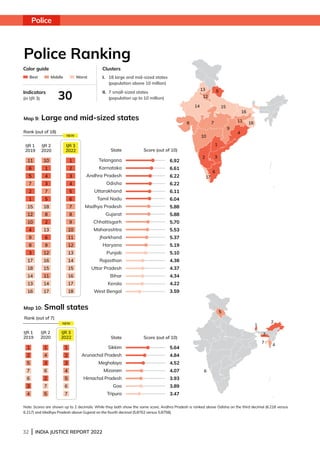
The section permits information to be treated as being
confidential if its disclosure would endanger the life or
safety of a person or reveal the source of information
provided secretly to law enforcement agencies. A cursory
reading of the contents of the sample RTI application
regarding CCTV camera installation pursuant to the Hon.
Supreme Court’s directions will indicate that it does not
fall under any ground for exemption mentioned under
Section 8(1)(g) as explained above.
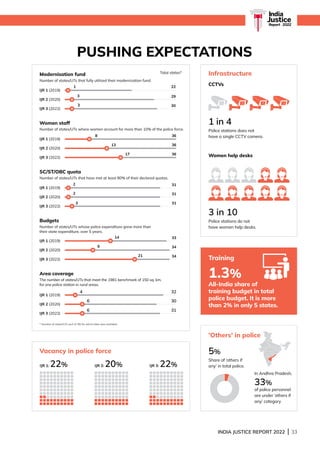
Nevertheless, the PIO appears to have rejected the
application by mechanically invoking the exemption
without adequately applying his mind to the fact that
the RTI application only seeks to ascertain the steps
taken to implement the Hon. Supreme Court’s directions.
Even if one were to momentarily agree with the PIO,
there is immense public interest in disclosing even such
supposedly ‘exempt’ information under Section 8(2) of
the RTI Act, because the larger public interest outweighs
any harm to the interests protected under Section 8(1)(g).
After all, the Hon. Supreme Court directed the installation
of CCTV cameras to protect life and limb from custodial
violence.
Interestingly, the PIO of the office of the Chief Secretary
of Bihar replied that information about the installation
of CCTV cameras did not fall under their jurisdiction—
this, despite the fact that the primary responsibility
of implementing the Hon. Supreme Court’s directions
falls on them. The Police Directorate of West Bengal
India
Justice
Report | 2022
146 | INDIA JUSTICE REPORT 2022
replied that budgetary allocation and fund utilisation
with regard to CCTV cameras installation are matters
pertaining to the state government. The PIO of the
Uttarakhand Police advised us to approach the PIOs
in each district individually for information about the
number of police stations that have installed CCTV
cameras, the number of police personnel trained in their
use, and details regarding the number and working of
district oversight committees set up for the purpose
of ensuring compliance with the directives of the Hon.
Supreme Court.
Conclusion
Even among the public authorities that furnished
information either free of cost or upon payment of
additional fees, none supplied complete information in
response to every question. In some cases, it was not
possible to make much sense of the data provided. For
example, Delhi Police supplied budgetary information
about the installation of CCTV cameras as a whole,
over a five-year period, instead of providing a year-
wise breakup. Budgetary figures supplied by Jammu 
Kashmir Police did not indicate whether the figures were
in thousands, lakhs or crores. Bihar Police Department
provided budgetary figures for only two years—from the
beginning and the ending of the period for which we had
sought information. While Meghalaya Police went out of
its way to furnish more information than we requested.
However, it did not provide the information that was
asked for. The PIO sent us the entire correspondence
between the police department and the vendor selected
to install the CCTV cameras. The purchase order along
with item-wise quotes submitted to the police were
also shared with us. Moreover, Meghalaya’s response
indicates that all the information was available with the
authorities and none of that required to be sequestered
or held away from the public domain.
Venkatesh Nayak,
Commonwealth Human Rights Initiative, India
RTI
INDIA JUSTICE REPORT 2022 | 147
India
Justice
Report | 2022
The India Justice Report’s rankings—whether pillar wise
or overall—rely entirely on quantitative data maintained
by states, UTs and the central government: numbers and
statistics. The more accurate the data, the fairer are its
conclusions. Inaccurate, imprecise, and outdated data
not only paints a false and often unfair picture, but also
impedes pathways to repair and reform. To address this,
it is important to approach data with a critical lens and
work to mitigate pitfalls.
In the main, the IJR has used the Bureau of Police
Research and Development’s (BPRD) Data on Police
Organisation (DoPO), National Crime Record Bureau’s
(NCRB) Prison Statistics India (PSI) report, the National
Judicial Data Grid (NJDG) and National Legal Services
Authority’s (NALSA) website and dashboard. These
are national aggregations of state provided data. In
addition, the IJR has relied on parliamentary questions,
state budget documents and, finally, responses to RTI
queries. Data sets show up many hard to reconcile
discrepancies that relate to the same subject in the
records of different agencies and publications. Some
challenges are illustrated below.
l	
In July 2022, an answer to a parliamentary question
in the Lok Sabha1
gave the number of women judges
in Tamil Nadu’s subordinate courts as 428. A month
later, the Department of Justice (DoJ) portal on human
resources and diversity in district courts2
showed the
figure at nil.
l	
For the same period (2021-22), three official
publications—the PSI, the E-prisons portal3
and the
state’s own prison website—recorded that Mizoram
has 1 women jail and no open jails; no women’s jail
and 1 prison HQ classified as an open jail; and 1
women’s jail but no open jail respectively.
l	
Similarly, NALSA website’s section on victim
compensation schemes4
records several anomalies.
For instance, the number of applications pending
from the previous year (Column B), applications
received in the current year (Column C), and those
disposed during the current year (Column E) do not
add up with the applications pending at the end of
the current year (Column F). As illustrated in the table
below:
1 Lok Sabha Unstarred Question No. 2116, dated 29 July 2022. Available at: http://164.100.24.220/loksabhaquestions/annex/179/AU2116.pdf
2 Department of Justice portal on strength of judges. Available at https://dashboard.doj.gov.in/sanctiondata/index.php
3 E-prisons portal developed by the National Informatics Centre. Available at: https://eprisons.nic.in/public/DashBoard
4	
NALSA’s website records statistics related to legal service clinics, cases settled through mediation, permanent Lok Adalats, national Lok Adalats and applications received under victim
compensation schemes. Available at: https://nalsa.gov.in/statistics
Challenges in Data
Chapter 7
A B C D E F G
Arunachal Pradesh 0 42 42 4 7 38
Bihar 654 1,002 1,656 785 348 871
Chhattisgarh 617 2,195 2,812 1,253 1,267 1,559
Kerala 81 560 641 139 123 502
Meghalaya 79 158 237 75 23 162
West Bengal 33 356 389 246 38 143
State Applications
pending at the
end of 2020-21
Applications
received in
2021-22
Total
applications
(B+C)
Applications
disposed in
2021-22
Applications
pending at the
end of 2021-22
Actual pendency
at the end of
2021-22 [(B+C)-E]
148 | INDIA JUSTICE REPORT 2022
Challenges in Data
Dashboards
Open government data not only allows citizens to track
the efficiency of government data but also facilitates
data sharing between government departments to break
silos and ensure increased collaborations. With data
emerging as a key resource in an increasingly digitised
economy, there has been a proliferation of a wide range
of government initiatives creating IT platforms and
dashboards to provide citizen-centric services.
One of the primary e-governance initiatives in improving
justice delivery is the e-Courts Integrated Mission Mode
Project by the Department of Justice (DoJ), Ministry of
Law and Justice. Currently in its third phase, this initiative
has made available the data of 3,256 court complexes,
established individual websites of 688 district courts,
and created a robust court management system through
e-filings and e-payment infrastructures.5
This project has
also implemented the National Judicial Data Grid (NJDG),
national repository of data relating to cases pending and
disposed of in all courts.6
In addition to the NJDG, the India Justice Report made
use of other portals introduced by the Department of
Justice, including portals that capture human resources
and diversity at the district judiciary level,7
as well as the
distribution of Gram Nyayalayas.8
Further, the report
captured data from the e-prisons portal developed by
the National Informatics Centre (NIC) as well as the
NALSA Dashboard.
While the push for digitisation is a welcome move,
the government is yet to maximise the potential of
data collected. Problems like missing data points,
discrepancies in different datasets as well as limited
access to archival data restrict the full use of such portals.
In analysing data captured from these portals, the India
Justice Report also faced challenges as illustrated below:
l	
The E-prisons portal is a positive move towards
integrating all activities related to prisons and
prisoner management. However, the interface
provides real time data at the moment and archival
data is not yet accessible. There is also a significant
lack of granular and disaggregated information.
For instance, it provides no classification of prison
populations as undertrials and convicts nor does it
provide a breakdown of inmates by the nature of
offences.
l	
The DoJ portal on Gram Nyayalayas, capturing data
on the distribution of these bodies across the country
as well as case disposal, does not store data for more
than a month.
l	
Similarly, the DoJ portal shows discrepancies in
numbers in its data that captures human resources
and diversity at the district judiciary level. For
instance, for Chhattisgarh, the dashboard shows the
sanctioned strength for judges as 482 in one place
but 526 in another.9
Lack of Standardisation
The absence of a specific time period for capturing and
publishing data diminishes the ability to present a holistic
picture. To illustrate, the BPRD publishes the ‘Data on
Police Organisation’ with data as of January of every
year. The latest report available is as of 1 January 2022.
Similarly, the NCRB’s ‘Prison Statistics India’ brings out
data as of December of every year on prisons across
the country, and the latest available report is as of 31st
December, 2021. Both these organisations are under the
Ministry of Home Affairs.
Judiciary data is maintained at different tiers, beginning
at the district courts, data for which is collected and
published on multiple platforms and reports such as
e-courts, NJDG as well as individual high courts’ annual
reports. Data, however, is collected and made available
to the public at different times. For instance, the latest
available annual report on the Gujarat High Court
website is as of 2019 while on the Delhi High Court
website has the annual report from 2006.
Some agencies capture statistics for the financial year
while others use the calendar year. The Supreme Court’s
2020-21 annual report uses the financial year format
5 
E-Committee of the Supreme Court of India showcasing the Information and Communication Technology (ICT) initiatives adopted by the judicial system.
Available at: https://ecommitteesci.gov.in/significant-achievements/
6 
The National Judicial Data Grid. Available at: https://njdg.ecourts.gov.in/njdgnew/index.php
7 Department of Justice Portal on strength of judges. Available at https://dashboard.doj.gov.in/sanctiondata/index.php
8	
Gram Nyayalayas Portal of the Department of Justice. Available at: https://dashboard.doj.gov.in/gn/notified_gram_nyayalaya
9 For ranking, the IJR uses the data provided in the Lok Sabha Unstarred Question No. 2116, dated 29 July 2022. Available at: http://164.100.24.220/loksabhaquestions/annex/179/AU2116.pdf
INDIA JUSTICE REPORT 2022 | 149
India
Justice
Report | 2022
while the National Judicial Data Grid (NJDG) records in
calendar year format.10
Some high courts provide data
monthly, others quarterly and others annually. Some use
the financial year format while others use the calendar
year. The Rajasthan State Human Rights Commission’s
annual reports have come in both calendar and financial
year formats. NALSA’s dashboard is yet to be updated
after March 2019. Annual reports by State Human
Rights Commissions—17 of 25 states have not uploaded
annual reports. Other Commissions publish irregularly or
not at all.
Changes in category
and collection
Improving its formats to add more detail, in 2018, the
BPRD’s DoPO aggregated traffic/specialised police
stations with the total number of police stations. Next
year the same police stations were clubbed with railway
police stations also and in 2020 the categorisation
was completely changed to rural, urban and special
purpose police stations and traffic police stations were
given their own chapter. Additionally, till 2016, BPRD
provided caste data for 6 out of 12 ranks. For CY 2017
and 2018, this was reduced to 4 ranks and reverted to 6
ranks again in 2019 and 2020. While data on women is
disaggregated for each rank the same disaggregation is
not available for SC/ST/OBC.
Data on Police Organisation (DoPO) reported in-service
training provided to police personnel in 2017. This has
not been continued after 2017. Similarly, while data on
caste and gender is provided for district court judges
and state police, there is no such breakdown provided
for high court judges or IPS officer posts. Religious data
available for police till 2013 is no longer available.
The ‘Other’ data
Too often the implications of an otherwise detailed data
set are foregone by the presence of an indeterminate
category “Other or Others if any”. These columns
that often hold residuary and undefined information
are present in NCRB and BPRD’s national data sets.
Frequently they are unaccompanied by explanatory
notes to indicate what they capture and obscure an
otherwise detailed and clear picture. To illustrate, after
listing sanctioned, actual and vacant police posts the
BPRD lists ‘other if any’ police personnel. Often these
are a considerable number.
PSI details expenditure on inmates under food, clothing,
medical facilities, education, vocational training
and ‘others’. The ‘others’ category often shows high
expenditure. For example, Haryana’s ‘other’ category
shows expenditures of Rs. 306.5 crore or 87.5 per cent of
their total expenditure. The explanatory note points out
that the spend on this category ‘may include expenses
incurred on sanitation, hygiene, transport facilities for
movement of prisoners during remand, trials, transfers,
hospitals etc.’11
PSI also classifies types of prisoners as convicts,
undertrials, detenues and ‘others’. The number of ‘other’
inmates across the country is 547. Another unexplained
category relates to deaths in prison. PSI records inmates'
deaths as being due to ‘natural’ and ‘unnatural’ causes
and ‘others’. Natural causes include deaths due to
ageing and illness. While natural causes are classified
with considerable detail into ailments like types of organ
failure or diseases like HIV or Cancer and unnatural
deaths include suicide, deaths due to negligence,
accidents and ‘others’. This category of deaths, whatever
their number, remain unexplained.
Undoubtedly more and more data is being put out,
digitised and being integrated to present a more holistic
picture of the criminal justice system. This is a work
in progress that will benefit from standard operating
protocols, consistency and ever-increasing granularity.
10 National Judicial Data Grid Dashboard. Available at: https://njdg.ecourts.gov.in/njdgnew/?p=main/pend_dashboard
11 Prison Statistics India, 2021, Table 12.4, p. 276. Available at: https://ncrb.gov.in/en/prison-statistics-india-2021
150 | INDIA JUSTICE REPORT 2022
M
easurements—by allowing us to study,
compare, assess, and draw conclusions about
growth—assist us in making policy decisions.
The assessment of attributes through assignment of
numbers is at the core of all scientific inferences. With
the 2022 edition of India Justice Report, we continue to
map the scope of improvements as well as stagnancies
in justice capacity across states through four core pillars
of the justice system, namely the police, judiciary, prisons
and legal aid and a standalone pillar state human rights
commission. As with the previous two editions, new
indicators have been added with an aim to deepen and
broaden our assessments. Seventeen new indicators
across the four core pillars have been added, bringing
the total number of indicators to 102.
This IJR assesses the capacity and performance of State
Human Rights Commissions (SHRCs) separately and not
as part of the overall ranking of a state.
All pillars are measured on the basis of six themes:
budget, infrastructure, human resource, workload,
diversity and trends (or intention to improve).
The indicators across the pillars cover the following
themes:
1. Infrastructure
2. Human Resources
3. Diversity (Gender, SC/ST/OBC)
4. Budgets
5. Workload
6. Trends (Change over last five years)
Each theme represents a precondition necessary for
the functioning of a pillar. Budgets measure the funds
received, utilised, and spent per functionary or per capita;
infrastructure, the basic physical resources available;
human resources looks into personnel sanctioned and
available on the ground; workload is the weight of service
delivery upon a functionary within a particular subsystem;
and diversity assesses how representative these systems
are of the populations they are set up to serve. A sixth
theme, ‘trends’, is used where possible to assess whether
there has been improvement or deterioration over five
years in a particular theme. This too is taken account of
when arriving at the overall ranking.
Step 2: Clustering
The vast variations across India in terms of both
demography and geography make comparisons difficult.
For example, the police capacity in a state like Rajasthan
or Madhya Pradesh is incomparable to that of Goa or
Sikkim. To undertake fair comparisons between states,
the report divides states and UTs into four clusters:
Cluster I (ranked)
Eighteen large and mid-sized states or states with a
population of 10 million and above.
Cluster II (ranked)
Seven small-sized states with a population of up to
10 million, namely Arunachal Pradesh, Goa, Himachal
Step 1: Outline
Data indicators of four pillars:
Pillars Total New
		 Indicators Indicators
1. Police 30 4
2. Prisons 29 6
3. Judiciary 28 5
4. Legal Aid 15 2
Total 102 17
Methodology
Methodology
Chapter 8
INDIA JUSTICE REPORT 2022 | 151
Pradesh, Meghalaya, Mizoram, Sikkim, and Tripura.
Cluster III (not ranked)
Data for 8 UTs is provided but they are not ranked.
These include Andaman  Nicobar Islands, Chandigarh,
Dadra  Nagar Haveli and Daman  Diu (DNH 
DD), Jammu  Kashmir1
, Ladakh, Lakshadweep, and
Puducherry.
Cluster IV (not ranked)
Three states where the Armed Forces Special Powers
Act, 1958 (AFSPA) is in force, namely Manipur, Assam
and Nagaland. The report provides data on these but
does not rank them.
Step 3: Filtering
All indicators are chosen based on government data
availability and comparability across states. Benchmarks
are taken from hard laws, policy pronouncements
and Supreme Court judgements, wherever available.
Government recommendations are also used. There are
seventeen new indicators across pillars, some of which
are indicators measuring diversity in subordinate courts
in case of judiciary, presence of CCTV cameras in police
stations, women help desks in police stations and share
of overcrowded jails in a state.
Baseline
The IJR 2022 uses the latest official data available at the
time of going to press. These are:
Comptroller and Auditor General of Accounts (CAG)
documents were preferred over state budget documents
due to the uneven availability of budget documents
and variations in the way each records budget heads.
However, for legal aid, state budget documents were
used because the budgetary data was not available in
CAG documents.
E-prisons portal
For the two indicators on overcrowded prisons—the
share of overcrowded jails in a state and the share of jails
with more than 150 per cent occupancy—the report used
data available on the e-prisons portal. The portal lists
1,367 prisons, of which 53 prisons were not considered in
the total number, as they are not functional or there was
no information regarding the prisons available with the
respective prison departments, or are covered under the
Revenue Department. This report analysed e-prisons’
data over a three-month period—July to October 2022.
Cases pending at the end of the year
For the ‘cases pending at the end of the year’ indicator
under the judiciary pillar, data from the National Judicial
Data Grid (NJDG) has been used. The data for cases
pending at the beginning/end of the year is not available
with NJDG, hence, the older data from court news has
been carried forward for certain calculations. This might
result in slight variations if compared with figures from
various high court websites. For an illustration see
example of Madhya Pradesh High Court below:
India
Justice
Report | 2022
Pillar/theme
Police
Prisons
Judiciary
Date/Period
1 January 2022
31 December
2021
2022, December
2022, July 2022,
August 2022,
January 2023
Source
Data on Police
Organizations 2022
Prisons Statistics
India 2021
National Judicial
Data Grid, Supreme
Court, Court News,
Department of
Justice, Parliamentary
Questions
1 
In the earlier report, Jammu  Kashmir was included in Cluster IV. Since August 2019, it has become a Union Territory, hence shifted to Cluster III. Either way, as a UT or AFSPA state it is not
ranked. Dadra  Nagar Haveli and Daman  Diu were two different UTs. The merger of these two UTs took place in 2020. The data for these two UTs is merged wherever used.
Pillar/theme
Legal Aid
Budget
Figures
Population
Figures
Date/Period
2020-21, 2021-22,
March 2022,
June 2022
March 2020,
March 2021
2020-21
Source
National Legal
Service Authority
National Commission
on Population 2019
Comptroller and
Auditor General,
States' budget
documents
152 | INDIA JUSTICE REPORT 2022
State Citizen Portals
These state-wise portals are expected to offer nine basic
services. They were assessed for accessibility, language
and completeness of services. The compliance of the
state citizen portal2
was assessed by checking these nine
services twice from September 2022 to November 2022
to evaluate improvements in the working of the portals.
One mark was given for the portal being available in
more than one language; and one mark was given per
service for completeness of content. Where a service
was disaggregated into various sub-parts that mark
was also subdivided. Illustratively, if the service sought
to provide details on stolen/ recovered vehicles, arms
and other properties, each of the three sub-categories
was allocated a maximum score of 0.3. Partial marks
were therefore still accorded to ‘incomplete’ services.
State Human Rights Commissions
In order to collect data related to the existing 25 SHRCs,
136 RTI applications were filed, as the complete data
for SHRCs has neither been collected nor published, or
proactively disclosed to the public. The performance on
each of the seven indicators was calculated using the
same methods as in Step 4 and 5. Assam and Manipur
are excluded from ranking due to the presence of Armed
Forces Special Powers Act (AFSPA). Jammu  Kashmir
is excluded since after the enactment of the Jammu
and Kashmir Reorganisation Act, 2019 the SHRC was
disbanded. The Protection of Human Rights Act, 1993
provides for the establishment, powers and functions
of the SHRCs, and has been used as the benchmark to
assess their performance. International standards set
up under the Global Alliance of National Human Rights
Institutions (GANHRI) and the Paris Principles have also
been referred to.
Step 4: Scoring Method
As with IJR 2019 and 2020, raw data was rebased on
a common scale so that every indicator could be scored
on a scale of 1 to 10, with 1 being the lowest or least
desirable status, and 10 indicating the highest or best
score. The scores in-between were calibrated to show
where a state stood in relation to the best and the
lowest. Where a state met or exceeded the benchmark it
had set for itself it received a score of 10. In cases where
there were no benchmarks available, a state received a
‘top’ score of 10. This does not mean that the state has
reached an ideal capacity, merely that it is best in class.
The scores of every indicator were aggregated and
averaged to arrive at a pillar score, also scored on a scale
of 1 to 10. Averages were arrived at using geometric
mean because the method is less prone to distortion by
extreme outlying figures. Thus, for each pillar every state
got a score out of 10, and a rank in its cluster. The pillar
scores were then averaged to arrive at the overall score,
also out of 10.
Step 5: Scoring and Ranking
For each cluster, the report applied the methodology
outlined in Step 4 to every indicator in the pillar. For states
whose values were missing for certain indicators due to
an unavoidable reason— for example, in Haryana where
there is no reservation for Scheduled Tribes—the number
Source Calendar
Year
Cases pending at
the beginning of
the year (A)
Cases instituted
during the
year (B)
Cases disposed
during the
year (C)
Cases pending
at the end of the
year (D=A+B-C)
Court News
Court News
NJDG
NJDG
NJDG
NJDG
2017
2018
2019
2020
2021
2022
2,89,445
3,07,420
3,31,388
3,57,174
3,81,534
4,06,662
1,38,285
1,33,734
1,33,704
98,566
1,23,289
1,37,741
1,20,310
1,09,766
1,07,918
74,206
98,161
1,16,249
3,07,420
3,31,388
3,57,174
3,81,534
4,06,662
4,28,154
2   The SMART Policing initiative of the Ministry of Home Affairs advises states to provide services to citizens online through the state citizen portal. https://digitalpolice.gov.in/
Methodology
INDIA JUSTICE REPORT 2022 | 153
of indicators was reduced. Certain states have not
received the grant for modernisation funds, the number
of indicators in such states has also been accordingly
reduced while working out their scores. In assessing
judiciary for Andhra Pradesh and Telangana only three-
year trends have been used due to unavailability of
separate data prior to their bifurcation.
Step 6: Uniformity in Indicator
Counts Across Themes and
Weights
Each indicator, theme, and pillar has been assigned
equal weightage so as not to privilege any one aspect
over another. The study avoids subjectivity by giving any
one element higher or lower weightage, since every data
point influences the whole outcome.
Step 7: Data Checks
The data was checked down to source data at two
points in time: after the preliminary set of rankings
was generated, and after the final set of rankings
was generated (in other words, before web and print
outputs). A third round of checking was carried out on
the final outputs.
Other Points
Rounding off decimals
The report looked at decimals through the ease of
reading the data. Where the numbers were large, it did
not include decimals and where they were small and the
variance was in fractions, decimals were included—one
or two places as needed.
Use of percentage points
The report uses percentage points as a unit of
measurement for the trend or change indicators. This is
calculated as the difference between two percentages to
highlight an increase or decrease.
Union Territories and states
UTs and AFSPA states are not ranked as already
mentioned in Step 2. As of August 2019, the state of
Jammu  Kashmir was reorganized into two Union
Territories: Jammu  Kashmir, and Ladakh. Separate data
for these two UTs is not available for trend indicators,
hence these two are not included in trend indicators.
Similarly, the UTs of Dadra  Nagar Haveli and Daman 
Diu were merged on 26 January 2020. Separate data for
these two is combined.
Geometric mean over arithmetic mean
In a scenario where a state scores high or low in a pillar
because it is doing extremely well or extremely poorly
in a handful of variables, the geometric mean tends to
normalize outliers i.e. extreme variables, better.
Shared court jurisdictions
For states that share court jurisdictions, the report used
the same data where justifiable. For example, population
per high court judge was calculated by combining the
population of Punjab, Haryana and Chandigarh since
the two states and the UT are serviced by the same high
court.
Strengths and limitations
Ranking of states on the basis of justice capacity is an
unprecedented exercise in the context of our country
with an aim to bring together disparate and hitherto
siloed information. The capacity of 7 small states and
18 large states to deliver justice is once again ranked in
this year’s India Justice Report. We examine the systems
more thoroughly with each report and, as usual, only
use the most accurate official data. The processing of
so much data enables the precise location of potential
intervention and remediation sites. Not only that, but
even internal gaps caused by unequal data availability
indicate how urgent it is to establish reliable, consistent,
timely, and publicly accessible data systems across the
country that facilitate collaborative internal planning for
success in the future.
The report benefits from ongoing assessments and
recommendations from government organisations,
judges, retired DGPs, police, and other experts in various
sub-systems because it is a partnership between
numerous specialised civil society groups. The inclusion
of thus many different viewpoints confirms the selection
of indicators and rating.
India
Justice
Report | 2022
154 | INDIA JUSTICE REPORT 2022
The report is a purely quantitative exercise on selected
aspects of the justice system. Its assessment is often
limited by the unavailability and paucity of data and its
inconsistencies. It does not aspire to capture the views
of the duty holder or functionary and stakeholder that
relate to the qualitative performance and functioning
of each sub-system as perception studies and surveys
do. Nevertheless, the assessment of the structures
involved in the administration of justice point to levels of
service and response. The data delineation here is also
a necessary supplement to other qualitative studies and
helps indicate possible solutions to many entrenched
problems. We hope that the report will encourage others
to strive to go deeper in evaluating the structure of the
justice delivery system holistically and in ever more detail.
Methodology
INDIA JUSTICE REPORT 2022 | 155
India
Justice
Report | 2022
3
5
Recommendations
Fill vacancies on an
urgent footing.
Prioritise increased
resources for first
responders.
Increase diversity of
caste, gender and the
specially abled across
subsystems.
1
2
4
6
8
10
7
9
Ensure 24*7 legal
guidance and representation
at police stations and courts
at first instance.
Fully implement the
Supreme Court's Paramvir
Singh Saini judgement,
mandating every police station
to be equipped with CCTV
cameras to check abuse.
Ensure UTRCs guidelines of
14 categories of prisoners to
be considered for release.
UTRCs and all those
officially mandated to visit
jails, including judges, must be
made accountable and their
visits must be linked to their
own performance review.
SHRCs must be full-
resourced and reach out to
the community proactively.
Designate the justice delivery
system as an essential service
and enhance, enlarge and equip
it as a first responder able
to provide effective justice
delivery at all times.
Give training pride of place
and prioritise human and
financial resources in all
training facilities.
156 | INDIA JUSTICE REPORT 2022
POLICE
BUDGETS
1. Spend on police per person (Rs)
Formula:
Police expenditure
--------------------------------------------
State population
Benchmark: Not available
Scoring guide: Higher, the better
Period/Date: March 2021 (State
population), 2020-21 (Police expenditure)
Data source: Combined Finance and
Revenue Accounts of the Union and
State Governments in India, Comptroller
and Auditor General of India; National
Commission on Population, 2019; Finance
Division of Ministry of Home Affairs
2. Share of training budget in police
budget (%)
Formula:
Training budget
--------------------------------------------* 100
Police budget
Benchmark: Not available
Scoring guide: Higher, the better
Period/Date: 2020-21
Data source: Data on Police
Organizations, Bureau of Police Research
and Development (BPRD), January 2022
3. Training budget utilization (%)
Formula:
Training budget utilized
--------------------------------------------* 100
Training budget
Benchmark: 100%
Scoring guide: Higher, the better
Period/Date: 2020-21
Data source: Data on Police
Organizations, Bureau of Police Research
and Development (BPRD), January 2022
4. Spend on training per personnel (Rs)
Formula:
Training expenditure
--------------------------------------------
Total police
Benchmark: Not available
Scoring guide: Higher, the better
Period/Date: 2020-21
Data source: Data on Police
Organizations, Bureau of Police Research
and Development (BPRD), January 2022
5. Modernisation fund used (%)
Formula:
Central + state expenditure
on modernisation
-------------------------------------------------------------- * 100
Central + state allocation
on modernisation
Benchmark: 100%
Scoring guide: Higher, the better
Period/Date: 2020-21
Data source: Data on Police
Organizations, Bureau of Police Research
and Development (BPRD), January 2022
HUMAN RESOURCES
6. Constables, vacancy (%)
Formula:
Actual Head
Constables + Constables
100 - ( ------------------------------------------------ * 100)
Sanctioned Head
Constables + Constables
Benchmark: 0%
Scoring guide: Lower, the better
Period/Date: 1 January 2022
Data source: Data on Police
Organizations, Bureau of Police Research
and Development (BPRD), January 2022
Notes: Includes civil police and district
armed reserve police.
7. Officers, vacancy (%)
Formula:
Actual officer strength
100 – ( ----------------------------------------------- * 100)
Sanctioned officer strength
Benchmark: 0%
Scoring guide: Lower, the better
Period/Date: 1 January 2022
Data source: Data on Police
Organizations, Bureau of Police Research
and Development (BPRD), January 2022
Notes: Includes civil police and district
armed reserve police. Officers comprise
DGP/Spl DGP + Addl. DGP + IGP + DIG +
AIGP/SSP/SP/COMN + Addl.SP/Dy. COMN
+ ASP/DY.SP./Asstt. COMN + Inspector/RI
+ SI/RSI + ASI/ARSI.
8. Officers in civil police (%)
Formula:
Officers in civil police
-------------------------------------------------- * 100
Total civil police
Benchmark: Not available
Scoring guide: Higher, the better
Period/Date: 1 January 2022
Data source: Data on Police
Organizations, Bureau of Police Research
and Development (BPRD), January 2022
Notes: Civil police includes district armed
reserve police. Officers comprise DGP/
Spl DGP + Addl. DGP + IGP + DIG + AIGP/
SSP/SP/COMN + Addl.SP/Dy. COMN +
ASP/DY.SP./Asstt. COMN + Inspector/RI +
SI/RSI + ASI/ARSI.
DIVERSITY
9. Share of women in police (%)
Formula:
Women in police
----------------------------------------- * 100
Total police
Benchmark: Not available
Scoring guide: Higher, the better
Period/Date: 1 January 2022
Data source: Data on Police
Organizations, Bureau of Police Research
and Development (BPRD), January 2022
10. Share of women in officers (%)
Formula:
Women police officers
---------------------------------------------------------* 100
Total police officers
Benchmark: Not available
Scoring guide: Higher, the better
Glossary
Glossary
INDIA JUSTICE REPORT 2022 | 157
Period/Date: 1 January 2022
Data source: Data on Police
Organizations, Bureau of Police Research
and Development (BPRD), January 2022
Notes: Officers comprise DGP/Spl DGP
+ Addl. DGP + IGP + DIG + AIGP/SSP/
SP/COMN + Addl.SP/Dy. COMN + ASP/
DY.SP./Asstt. COMN + Inspector/RI + SI/
RSI + ASI/ARSI.
11. SC officers, actual to reserved ratio
(%)
Formula:
Actual Scheduled
Caste (SC) officers
------------------------------------------------- * 100
(Sanctioned officer
posts * SC reservation)
Benchmark: 100%
Scoring guide: Higher, the better
Period/Date: 1 January 2022
Data source: Data on Police
Organizations, Bureau of Police Research
and Development (BPRD), January 2022
Notes: Officers comprise ASP/DY.SP./
Asstt. COMN + Inspector/RI + SI/RSI + ASI/
ARSI.
12. SC constables, actual to reserved
ratio (%)
Formula:
Actual Scheduled
Caste (SC) constables
------------------------------------------------- * 100
(Sanctioned constable
posts * SC reservation)
Benchmark: 100%
Scoring guide: Higher, the better
Period/Date: 1 January 2022
Data source: Data on Police
Organizations, Bureau of Police Research
and Development (BPRD), January 2022
Notes: Constables include head
constables.
13. ST officers, actual to reserved
ratio (%)
Formula:
Actual Scheduled
Tribe (ST) officers
--------------------------------------------------* 100
(Sanctioned officer
posts * ST reservation)
Benchmark: 100%
Scoring guide: Higher, the better
Period/Date: 1 January 2022
Data source: Data on Police
Organizations, Bureau of Police Research
and Development (BPRD), January 2022
Notes: Officers comprise ASP/DY.SP./
Asstt. COMN + Inspector/RI + SI/RSI + ASI/
ARSI.
14. ST constables, actual to reserved
ratio (%)
Formula:
Actual Scheduled
Tribe (ST) constables
------------------------------------------------- * 100
(Sanctioned constable
posts * ST reservation)
Benchmark: 100%
Scoring guide: Higher, the better
Period/Date: 1 January 2022
Data source: Data on Police
Organizations, Bureau of Police Research
and Development (BPRD), January 2022
Notes: Constables include head
constables.
15. OBC officers, actual to reserved ratio
(%)
Formula:
Actual Other Backward
Classes (OBC) officers
------------------------------------------------------------* 100
(Sanctioned officer posts *
OBC reservation)
Benchmark: 100%
Scoring guide: Higher, the better
Period/Date: 1 January 2022
Data source: Data on Police
Organizations, Bureau of Police Research
and Development (BPRD), January 2022
Notes: Officers comprise ASP/DY.SP./
Asstt. COMN + Inspector/RI + SI/RSI + ASI/
ARSI.
16. OBC constables, actual to reserved
ratio (%)
Formula:
Actual Other Backward
Classes (OBC) constables
------------------------------------------------* 100
(Sanctioned constable
posts * OBC reservation)
Benchmark: 100%
Scoring guide: Higher, the better
Period/Date: 1 January 2022
Data source: Data on Police
Organizations, Bureau of Police Research
and Development (BPRD), January 2022
Notes: Constables include head
constables.
INFRASTRUCTURE
17. Population per police station (rural)
(persons)
Formula:
Rural population
------------------------------------------------
Rural police stations
Benchmark: Not available
Scoring guide: Lower, the better
Period/Date: March 2022 (rural
population), January 2022 (rural police
stations)
Data source: National Commission
on Population, 2019; Data on Police
Organizations, Bureau of Police Research
and Development (BPRD), January 2022
18. Population per police station (urban)
(persons)
Formula:
Urban population
---------------------------------------------------
Urban police stations
Benchmark: Not available
Scoring guide: Lower, the better
Period/Date: March 2022 (urban
population), January 2022 (urban police
stations)
Data source: National Commission
on Population, 2019; Data on Police
Organizations, Bureau of Police Research
and Development (BPRD), January 2022
19. Area per police station (rural)
(sq km)
Formula:
Rural area (sq km)
------------------------------------------------
Rural police stations
Benchmark: 150 sq km or less (National
Police Commission report 1981)
Scoring guide: Lower, the better
Period/Date: 2011 (rural area), January
2022 (rural police stations)
Data source: Census 2011; Data on Police
Organizations, Bureau of Police Research
and Development (BPRD), January 2022
20. Area per police station (urban) (sq
km)
Formula
Urban area (sq km)
---------------------------------------------------
Urban police stations
India
Justice
Report | 2022
India
Justice
Report | 2022
158 | INDIA JUSTICE REPORT 2022
Benchmark: Not available
Scoring guide: Lower, the better
Period/Date: 2011 (urban area), January
2022 (urban police stations)
Data source: Census 2011; Data on Police
Organizations, Bureau of Police Research
and Development (BPRD), January 2022
21. Services provided by state police
citizen portals (%)
Formula
Services provided (out of 10)
---------------------------------------------* 100
10
Benchmark: 100%
Scoring guide: Higher, the better
Period/Date: 2022
Data source: https://digitalpolice.gov.in/
Notes: Quantitative assessment of
state police citizen portals on 10 counts:
whether they include each of the 9
services listed by the Ministry of Home
Affairs and whether the portal was
available in a state language (other than
English).
22. Personnel per training institute
(number)
Formula:
Sanctioned total police
--------------------------------------------
Number of training institutes
Benchmark: Not available
Scoring guide: Lower, the better
Period/Date: January 2022
Data source: Data on Police
Organizations, Bureau of Police Research
and Development (BPRD), January 2022
23. Share of police stations with CCTVs
(%)
Formula:
Police stations with CCTVs
--------------------------------------------* 100
Total police stations
Benchmark: 100%
Scoring guide: Higher, the better
Period/Date: January 2022
Data source: Data on Police
Organizations, Bureau of Police Research
and Development (BPRD), January 2022
24. Share of Police Stations with women
help desks (%)
Formula:
Police stations with women help desks
--------------------------------------------* 100
Total police stations
Benchmark: 100%
Scoring guide: Higher, the better
Period/Date: January 2022
Data source: Data on Police
Organizations, Bureau of Police Research
and Development (BPRD), January 2022
WORKLOAD
25. Population per civil police (persons)
Formula:
State population
----------------------------------------
Total civil police
Benchmark: Not available
Scoring guide: Lower, the better
Period/Date: March 2022 (state
population), January 2022 (civil police)
Data source: National Commission
on Population, 2019; Data on Police
Organizations, Bureau of Police Research
and Development (BPRD), January 2022
Notes: Civil police includes district armed
reserve police.
TRENDS
26. Women in total police (percentage
points)
Formula:
Women in total police – X
2016 X1
2017 X2 ((X2/X1)-1)*100 = a
2018 X3 ((X3/X2)-1)*100 = b
2019 X4 ((X4/X3)-1)*100 = c
2020 X5 ((X5/X4)-1)*100 = d
2021 X6 ((X6/X5)-1)*100 = e
5-year average (a,b,c,d,e)
Benchmark: Not available
Scoring guide: Higher, the better
Period/Date: Calendar year 2017 to 2021
Data source: Data on Police
Organizations, Bureau of Police Research
and Development (BPRD)
27. Women officers in total officers
(percentage points)
Formula:
Women officers in total officers – X
2016 X1
2017 X2 ((X2/X1)-1)*100 = a
2018 X3 ((X3/X2)-1)*100 = b
2019 X4 ((X4/X3)-1)*100 = c
2020 X5 ((X5/X4)-1)*100 = d
2011 X6 ((X6/X5)-1)*100 = e
5-year average (a,b,c,d,e)
Benchmark: Not available
Scoring guide: Higher, the better
Period/Date: Calendar year 2017 to 2021
Data source: Data on Police
Organizations, Bureau of Police Research
and Development (BPRD)
Notes: Calculation for 2016 is repeated
for 2017 as BPRD did not provide
rank-wise data for women district armed
reserve police for 2017.
28. Constable vacancy (percentage
points)
Formula:
Constable vacancy – X
2016 X1
2017 X2 ((X2/X1)-1)*100 = a
2018 X3 ((X3/X2)-1)*100 = b
2019 X4 ((X4/X3)-1)*100 = c
2020 X5 ((X5/X4)-1)*100 = d
2021 X6 ((X6/X5)-1)*100 = e
5-year average (a,b,c,d,e)
Benchmark: Not available
Scoring guide: Lower, the better
Period/Date: Calendar year 2017 to 2021
Data source: Data on Police
Organizations, Bureau of Police Research
and Development (BPRD)
29. Officer vacancy (percentage points)
Officer vacancy – X
2016 X1
2017 X2 ((X2/X1)-1)*100 = a
2018 X3 ((X3/X2)-1)*100 = b
2019 X4 ((X4/X3)-1)*100 = c
2020 X5 ((X5/X4)-1)*100 = d
2021 X6 ((X6/X5)-1)*100 = e
5-year average (a,b,c,d,e)
Benchmark: Not available
Scoring guide: Lower, the better
Period/Date: Calendar year 2017 to 2021
Data source: Data on Police
Organizations, Bureau of Police Research
and Development (BPRD)
30. Difference in spend: police vs state
(percentage points)
Formula:
[5-year annual average of police
expenditure (PE) – 5-year annual average
of state expenditure (SE)]
2015-16 PE = X1
2016-17 X2 ((X2/X1)-1)*100 = a
2017-18 X3 ((X3/X2)-1)*100 = b
2018-19 X4 ((X4/X3)-1)*100 = c
2019-20 X5 ((X5/X4)-1)*100 = d
2020-21 X6 ((X6/X5)-1)*100 = e
Glossary
INDIA JUSTICE REPORT 2022 | 159
PE = Average (a,b,c,d,e)
2015-16 SE = X1
2016-17 X2 ((X2/X1)-1)*100 = a
2017-18 X3 ((X3/X2)-1)*100 = b
2018-19 X4 ((X4/X3)-1)*100 = c
2019-20 X5 ((X5/X4)-1)*100 = d
2020-21 X6 ((X6/X5)-1)*100 = e
SE = Average (a,b,c,d,e)
Benchmark: Greater than zero
Scoring guide: Higher, the better
Period/Date: Financial year 2016-27 to
2020-21
Data source: Combined Finance and
Revenue Accounts of the Union and State
Governments in India, Comptroller and
Auditor General of India; Open Budgets
India; Finance Division of Ministry of
Home Affairs
PRISONS
BUDGETS
1. Spend per inmate (Rs)
Formula:
Prison expenditure
----------------------------------------------
Total inmates
Benchmark: Not available
Scoring guide: Higher, the better
Period/Date: 2021-22
Data source: Prison Statistics India, 2021
2. Prison budget utilised (%)
Formula:
Prison expenditure
------------------------------------------------* 100
Prison budget
Benchmark: 100%
Scoring guide: Higher, the better
Period/Date: 2021-22
Data source: Prison Statistics India, 2021
HUMAN RESOURCES
3. Officers, vacancy (%)
Formula:
Actual prison officers
100 – ( ------------------------------------------ * 100)
Sanctioned prison officers
Benchmark: 0%
Scoring guide: Lower, the better
Date: 31 December 2021
Data source: Prison Statistics India, 2021
Notes: Officers comprise the following
ranks: DG/ADDL.DG/IG + DIG + AIG+
Superintendent + Deputy Superintendent
+ Assistant Superintendent + Jailor +
Deputy Jailor + Assistant Jailor + Others.
4. Cadre staff, vacancy (%)
Formula:
Actual cadre staff
100 – ( ----------------------------------------* 100)
Sanctioned cadre staff
Benchmark: 0%
Scoring guide: Lower, the better
Date: 31 December 2021
Data source: Prison Statistics India, 2021
Notes: Cadre comprise the following
ranks: Head Warders + Head Matrons +
Warders + Matrons + Others.
5. Correctional staff, vacancy (%)
Formula:
Actual correctional staff
100 – (-------------------------------------------------* 100)
Sanctioned correctional staff
Benchmark: 0%
Scoring guide: Lower, the better
Period/Date: 31 December 2021
Data source: Prison Statistics India, 2021
Notes: Correctional staff comprise the
following: Probation Officer/Welfare
Officer + Psychologists/Psychiatrists +
Social Worker/Others.
6. Medical staff, vacancy (%)
Formula:
Actual medical staff
100 – (----------------------------------------- * 100 )
Sanctioned medical staff
Benchmark: 0%
Scoring guide: Lower, the better
Period/Date: 31 December 2021
Data source: Prison Statistics India, 2021
Notes: Medical staff comprises Resident
Medical Officer/Medical Officer +
Pharmacists + Lab Technician/Lab
Attendant + Others.
7. Medical officers, vacancy (%)
Formula:
Actual resident medical
officer and medical officer
100 – ( ------------------------------------------------
* 100)
Sanctioned resident medical
officer and medical officer
Benchmark: 0%
Scoring guide: Lower, the better
Period/Date: 31 December 2021
Data source: Prison Statistics India, 2021
8. Personnel trained (%)
Formula:
Prison staff trained
--------------------------------------------- * 100
Actual prison staff
Benchmark: 100%
Scoring guide: Higher, the better
Period/Date: 31 December 2021
Data source: Prison Statistics India, 2021
DIVERSITY
9. Women in prison staff (%)
Formula:
Women prison staff
--------------------------------------------------------- * 100
Total prison staff
Benchmark: Not available
Scoring guide: Higher, the better
Period/Date: 31 December 2021
Data source: Prison Statistics India, 2021
INFRASTRUCTURE
10. Prison occupancy (%)
Formula:
Inmate population
-------------------------------------------------------- * 100
Total Available prison capacity
Benchmark: Below 100%
Scoring guide: Lower, the better
Period/Date: 31 December 2021
Data source: Prison Statistics India, 2021
11. Share of jails with 100% and more
occupancy (%)
Formula:
Number of jails with 100%
 more occupancy
-------------------------------------------------------- * 100
Total jails
Benchmark: 0%
Scoring guide: Lower, the better
Period/Date: 2022
Data source: e-Prisons portal
12. Share of jails with 150% and more
occupancy (%)
Formula:
Number of jails with 150%
 more occupancy
-------------------------------------------------------- * 100
Total jails
Benchmark: 0%
Scoring guide: Lower, the better
India
Justice
Report | 2022
India
Justice
Report | 2022
160 | INDIA JUSTICE REPORT 2022
Period/Date: 2022
Data source: e-Prisons portal
13. Undertrials detained for 1-3 years
(%)
Formula:
Undertrials detained for 1-3 years
-------------------------------------------------------- * 100
Total undertrials
Benchmark: Not available
Scoring guide: Lower, the better
Period/Date: 31 December 2021
Data source: Prison Statistics India, 2021
14. Inmates (admitted) availed
educational course (%)
Formula:
Inmates availed educational facilities
-------------------------------------------------------- * 100
Inmates admitted during the year
Benchmark: Not available
Scoring guide: Higher, the better
Period/Date: 31 December 2021
Data source: Prison Statistics India, 2021
15. Inmates (admitted) availed
vocational training (%)
Formula:
Inmates availed vocational training
-------------------------------------------------------- * 100
Inmates admitted during the year
Benchmark: Not available
Scoring guide: Higher, the better
Period/Date: 31 December 2021
Data source: Prison Statistics India, 2021
16. Jails with video-conferencing
facilities (%)
Formula:
Jails with V-C facility
------------------------------------------------------ * 100
Total jails
Benchmark: 100%
Scoring guide: Higher, the better
Period/Date: 31 December 2021
Data source: Prison Statistics India, 2021
WORKLOAD
17. Inmates per officer (persons)
Formula:
Inmate population
----------------------------------------------
Officer
Benchmark: Not available
Scoring guide: Lower, the better
Period/Date: 31 December 2021
Data source: Prison Statistics India, 2021
Notes: Officer comprises Superintendent
+ Deputy Superintendent + Assistant
Superintendent + Jailor + Deputy Jailor +
Assistant Jailor + Other Officers.
18. Inmates per cadre staff (persons)
Formula:
Inmate population
---------------------------------------------
Cadre staff
Benchmark: Up to 6
Scoring guide: Lower, the better
Period/Date: 31 December 2021
Data source: Prison Statistics India, 2021
Notes: Cadre staff comprises Head
Warder/Head Matron + Warder/Matron
+ Others.
19. Inmates per correctional staff
(persons)
Formula:
Inmate population
----------------------------------------------
Correctional staff
Benchmark: Not available
Scoring guide: Lower, the better
Period/Date: 31 December 2021
Data source: Prison Statistics India, 2021
Notes: Correctional staff comprises
Probation officer/Welfare Officer +
Psychologists/Psychiatrists + Social
Worker/Others).
20. Inmates per medical offcer (persons)
Formula:
Inmate population
----------------------------------------------
Medical officer
Benchmark: 300 inmates per medical
officer
Scoring guide: Lower, the better
Period/Date: 31 December 2021
Data source: Prison Statistics India, 2021
TRENDS
21. Officer vacancy (percentage points)
Formula:
Officer vacancy (%) – X
2016 X1
2017 X2 ((X2/X1)-1)*100 = a
2018 X3 ((X3/X2)-1)*100 = b
2019 X4 ((X4/X3)-1)*100 = c
2020 X5 ((X5/X4)-1)*100 = d
2021 X6 ((X6/X5)-1)*100 = e
5-year average (a,b,c,d,e)
Benchmark: Not available
Scoring guide: Lower, the better
Period/Date: Calendar year 2017 to 2021
Data source: Prison Statistics India
22. Cadre staff vacancy (percentage
points)
Formula:
Cadre staff vacancy (%) – X
2016 X1
2017 X2 ((X2/X1)-1)*100 = a
2018 X3 ((X3/X2)-1)*100 = b
2019 X4 ((X4/X3)-1)*100 = c
2020 X5 ((X5/X4)-1)*100 = d
2021 X6 ((X6/X5)-1)*100 = e
5-year average (a,b,c,d,e)
Benchmark: Not available
Scoring guide: Lower, the better
Period/Date: Calendar year 2017 to 2021
Data source: Prison Statistics India
23. Share of women in prison staff
(percentage points)
Formula:
Share of women in prison staff (%) = X
2016 X1
2017 X2 ((X2/X1)-1)*100 = a
2018 X3 ((X3/X2)-1)*100 = b
2019 X4 ((X4/X3)-1)*100 = c
2020 X5 ((X5/X4)-1)*100 = d
2021 X6 ((X6/X5)-1)*100 = e
5-year average (a,b,c,d,e)
Benchmark: Not available
Scoring guide: Higher, the better
Period/Date: Calendar year 2017 to 2021
Data source: Prison Statistics India
24. Inmates per prison officer (%)
Formula:
Inmates per prison officer = X
2016 X1
2017 X2 ((X2/X1)-1)*100 = a
2018 X3 ((X3/X2)-1)*100 = b
2019 X4 ((X4/X3)-1)*100 = c
2020 X5 ((X5/X4)-1)*100 = d
2021 X6 ((X6/X5)-1)*100 = e
5-year average (a,b,c,d,e)
Benchmark: Not available
Scoring guide: Lower, the better
Period/Date: Calendar year 2017 to 2021
Data source: Prison Statistics India
Notes: Officer comprises Superintendent
+ Deputy Superintendent + Assistant
Superintendent + Jailor + Deputy Jailor +
Assistant Jailor + Other Officers.
Glossary
INDIA JUSTICE REPORT 2022 | 161
25. Inmates per cadre staff (%)
Formula:
Inmates per cadre staff = X
2016 X1
2017 X2 ((X2/X1)-1)*100 = a
2018 X3 ((X3/X2)-1)*100 = b
2019 X4 ((X4/X3)-1)*100 = c
2020 X5 ((X5/X4)-1)*100 = d
2021 X6 ((X6/X5)-1)*100 = e
5-year average (a,b,c,d,e)
Benchmark: Not available
Scoring guide: Lower, the better
Period/Date: Calendar year 2017 to 2021
Data source: Prison Statistics India
26. Share of undertrial prisoners
(percentage points)
Formula:
Share of UTPs (%) (X) = (UTPs/total
inmates*100)
2016 X1
2017 X2 ((X2/X1)-1)*100 = a
2018 X3 ((X3/X2)-1)*100 = b
2019 X4 ((X4/X3)-1)*100 = c
2020 X5 ((X5/X4)-1)*100 = d
2021 X6 ((X6/X5)-1)*100 = e
5-year average (a,b,c,d,e)
Benchmark: Not available
Scoring guide: Lower, the better
Period/Date: Calendar year 2017 to 2021
Data source: Prison Statistics India
27. Spend per inmate (%)
Formula:
Spend per inmate = X
2016-17 X1
2017-18 X2 ((X2/X1)-1)*100 = a
2018-19 X3 ((X3/X2)-1)*100 = b
2019-20 X4 ((X4/X3)-1)*100 = c
2020-21 X5 ((X5/X4)-1)*100 = d
2021-22 X6 ((X6/X5)-1)*100 = e
5-year average (a,b,c,d,e)
Benchmark: Not available
Scoring guide: Higher, the better
Period/Date: Financial year 2017-18 to
2021-22
Data source: Prison Statistics India
28. Prison budget used (percentage
points)
Formula:
Budget used = X
2016-17 X1
2017-18 X2 ((X2/X1)-1)*100 = a
2018-19 X3 ((X3/X2)-1)*100 = b
2019-20 X4 ((X4/X3)-1)*100 = c
2020-21 X5 ((X5/X4)-1)*100 = d
2021-22 X6 ((X6/X5)-1)*100 = e
5-year average (a,b,c,d,e)
Benchmark: Not available
Scoring guide: Higher, the better
Period/Date: Financial year 2017-18 to
2021-22
Data source: Prison Statistics India
29. Difference in spend: prisons vs state
(percentage points)
Formula: [5-year annual average of
prisons expenditure (PE) – 5-year annual
average of state expenditure (SE)]
2015-16 PE = X1
2016-17 X2 ((X2/X1)-1)*100 = a
2017-18 X3 ((X3/X2)-1)*100 = b
2018-19 X4 ((X4/X3)-1)*100 = c
2019-20 X5 ((X5/X4)-1)*100 = d
2020-21 X6 ((X6/X5)-1)*100 = e
PE = Average (a,b,c,d,e)
2015-16 SE = X1
2016-17 X2 ((X2/X1)-1)*100 = a
2017-18 X3 ((X3/X2)-1)*100 = b
2018-19 X4 ((X4/X3)-1)*100 = c
2019-20 X5 ((X5/X4)-1)*100 = d
2020-21 X6 ((X6/X5)-1)*100 = e
SE = Average (a,b,c,d,e)
Benchmark: Greater than zero
Scoring guide: Higher, the better
Period/Date: Financial year 2016-17 to
2020-21
Data source: Combined Finance and
Revenue Accounts of the Union and State
Governments in India, Comptroller and
Auditor General of India; Open Budgets
India; Finance Division of Ministry of
Home Affairs; Prison Statistics India
JUDICIARY
BUDGETS
1. Per capita spend on judiciary (Rs)
Formula:
Judiciary expenditure (Rs)
-----------------------------------------------------------------
State Population
Benchmark: Not available
Scoring guide: Higher, the better
Period/Date: March 2021 (population),
2020-21 (judiciary expenditure)
Data source: National Commission on
Population, 2019; Combined Finance
and Revenue Accounts of the Union and
State Governments in India for 2020-21,
Comptroller and Auditor General of India;
Finance Division of Ministry of Home
Affairs
HUMAN RESOURCES
2. Population per High Court judge
(Persons)
Formula:
State population
--------------------------------------------
High Court judges
Benchmark: Not available
Scoring guide: Lower, the better
Period/Date: March 2022 (population);
December 2022 (High Court judges)
Data source: National Commission on
Population, 2019; Department of Justice
Notes: Population of states and UTs that
share a High Court have been combined,
and hence they share the same value.
These are Kerala and Lakshadweep;
West Bengal and Andaman 
Nicobar Islands; Punjab, Haryana and
Chandigarh; Assam, Mizoram, Nagaland
and Arunachal Pradesh; Maharashtra,
Goa, Dadra  Nagar Haveli, Daman 
Diu; Tamil Nadu and Puducherry.
3. Population per subordinate court
judge (Persons)
Formula:
State population
-------------------------------------------------------------
Subordinate court judges
Benchmark: Not available
Scoring guide: Lower, the better
Period/Date: March 2022 (State
population); July 2022 (Subordinate court
judges)
Data source: National Commission
on Population, 2019; Parliamentary
Question-Lok Sabha, Unstarred Question
No. 2116
4. High Court judge vacancy (%)
Formula:
Working High
Court Judges
100 – ( ------------------------------------------------ * 100)
Sanctioned High
Court judges
Benchmark: 0%
Scoring guide: Lower, the better
Period/Date: December 2022
Data source: Department of Justice
India
Justice
Report | 2022
India
Justice
Report | 2022
162 | INDIA JUSTICE REPORT 2022
5. Subordinate court judge vacancy (%)
Formula:
Working subordinate
court judges
100 – ( ------------------------------------------------* 100)
Sanctioned subordinate
court judges
Benchmark: 0%
Scoring guide: Lower, the better
Period/Date: July 2022
Data source: Parliamentary Question-Lok
Sabha, Unstarred Question No. 2116
6. High Court staff vacancy (%)
Formula:
Working High
Court staff
100 – (------------------------------------------------* 100)
Sanctioned High
Court staff
Benchmark: 0%
Scoring guide: Lower, the better
Period/Date: 2021-22
Data source: Annual report 2021-22,
Supreme Court of India
DIVERSITY
7. Women judges (High Court) (%)
Formula:
Women High Court judges
------------------------------------------------------------- * 100
Total High Court judges
Benchmark: Not available
Scoring guide: Higher, the better
Date: December 2022
Data source: Department of Justice
8. Women judges (subordinate court)
(%)
Formula:
Women subordinate court judges
-------------------------------------------------------------- * 100
Total subordinate court judges
Benchmark: Not available
Scoring guide: Higher, the better
Period/Date: July 2022
Data source: Parliamentary Question-Lok
Sabha, Unstarred Question No. 2116
9. SC judges, actual to reserved
(subordinate courts) (%)
Formula:
Actual Scheduled
Caste (SC) judges
------------------------------------------------- * 100
(Sanctioned subordinate court
judges * SC reservation)
Benchmark: 100%
Scoring guide: Higher, the better
Period/Date: 25 July 2022
Data source: Parliamentary Question-Lok
Sabha, Unstarred Question No. 2116
10. ST judges, actual to reserved
(subordinate courts) (%)
Formula:
Actual Scheduled
Tribe (ST) judges
------------------------------------------------- * 100
(Sanctioned subordinate court
judges * ST reservation)
Benchmark: 100%
Scoring guide: Higher, the better
Period/Date: 25 July 2022
Data source: Parliamentary Question-Lok
Sabha, Unstarred Question No. 2116
11. OBC judges, actual to reserved
(subordinate courts) (%)
Formula:
Actual Other Backward
Classes (OBC) judges
------------------------------------------------- * 100
(Sanctioned subordinate court
judges * OBC reservation)
Benchmark: 100%
Scoring guide: Higher, the better
Period/Date: 25 July 2022
Data source: Parliamentary Question-Lok
Sabha, Unstarred Question No. 2116
INFRASTRUCTURE
12. Courthall shortfall (%)
Formula:
Number of courthalls
100 – (------------------------------------------------- * 100)
Sanctioned subordinate
court judges
Benchmark: 0%
Scoring guide: Lower, the better
Period/Date: July-August 2022
Data source: Department of Justice
(courthalls); Parliamentary Question-Lok
Sabha, Unstarred Question No. 2116
WORKLOAD
13. Cases pending (5-10 years)
(High Court) (%)
Formula:
Cases pending for 5-10
years in High Courts
---------------------------------------------------------------* 100
Total cases pending
in High Courts
Benchmark: Not available
Scoring guide: Lower, the better
Period/Date: January 2023
Data source: National Judicial Data Grid
14. Cases pending (10+ years)
(High Court) (%)
Formula:
Cases pending for 10+
years in High Courts
---------------------------------------------------------------* 100
Total cases pending
in High Courts
Benchmark: Not available
Scoring guide: Lower, the better
Period/Date: January 2023
Data source: National Judicial Data Grid
15. Cases pending (5-10 years)
(subordinate court) (%)
Formula:
Cases pending for 5-10
years in subordinate courts
---------------------------------------------------------------* 100
Total cases pending
in subordinate courts
Benchmark: Not available
Scoring guide: Lower, the better
Period/Date: January 2023
Data source: National Judicial Data Grid
16. Cases pending (10+ years)
(subordinate court) (%)
Formula:
Subordinate court cases
pending for above 10 years
-------------------------------------------------------------* 100
Total cases pending
in subordinate courts
Glossary
INDIA JUSTICE REPORT 2022 | 163
Benchmark: Not available
Scoring guide: Lower, the better
Period/Date: January 2023
Data source: National Judicial Data Grid
17. Average High Court pendency
(years)
Formula:
For each pending case in High Courts
(Date on which data was scraped – Date
of case filed) = Case pending for X days
Xn = Sum of X days for each case pending
in a state
n = total pending cases
Average pendency in High Courts
(years) =
(X1+X2+X3+……+Xn)
---------------------------------------- * 365
n
Benchmark: Not available
Scoring guide: Lower, the better
Period/Date: February 2022
Data source: DAKSH High Court
database
18. Case clearance rate (High Court) (%)
Formula:
High Court cases disposed
(civil + criminal)
----------------------------------------------------* 100
High Court cases filed
(civil + criminal)
Benchmark: 100%
Scoring guide: Higher, the better
Period/Date: 2022
Data source: National Judicial Data Grid
19. Case clearance rate (subordinate
court) (%)
Formula:
Subordinate court cases disposed
(civil + criminal)
---------------------------------------------------------------* 100
Subordinate court cases filed
(civil + criminal)
Benchmark: 100%
Scoring guide: Higher, the better
Period/Date: 2022
Data source: National Judicial Data Grid
TRENDS
20. Cases pending (per High Court
judge) (%)
Formula:
Cases pending (High Court judge) – X
2017 X1
2018 X2 ((X2/X1)-1)*100 = a
2019 X3 ((X3/X2)-1)*100 = b
2020 X4 ((X4/X3)-1)*100 = c
2021 X5 ((X5/X4)-1)*100 = d
2022 X6 ((X6/X5)-1)*100 = e
5-year average (a,b,c,d,e)
Benchmark: Not available
Scoring guide: Lower, the better
Period/Date: 2018 to 2022
Data source: National Judicial Data Grid;
Court News, Supreme Court; Department
of Justice
21. Cases pending (per subordinate
court judge) (%)
Formula:
Cases pending (subordinate court judge)
– X
2017 X1
2018 X2 ((X2/X1)-1)*100 = a
2019 X3 ((X3/X2)-1)*100 = b
2020 X4 ((X4/X3)-1)*100 = c
2021 X5 ((X5/X4)-1)*100 = d
2022 X6 ((X6/X5)-1)*100 = e
5-year average (a,b,c,d,e)
Benchmark: Not available
Scoring guide: Lower, the better
Period/Date: 2018 to 2022
Data source: National Judicial Data Grid;
Court News, Supreme Court; Lok Sabha,
Unstarred Question No. 2116
22. Total cases pending (High Court) (%)
Formula:
Average High Court pending cases (civil +
criminal) – X
2017 X1
2018 X2 ((X2/X1)-1)*100 = a
2019 X3 ((X3/X2)-1)*100 = b
2020 X4 ((X4/X3)-1)*100 = c
2021 X5 ((X5/X4)-1)*100 = d
2022 X6 ((X6/X5)-1)*100 = e
5-year average (a,b,c,d,e)
Benchmark: Not available
Scoring guide: Lower, the better
Period/Date: 2018 to 2022
Data source: National Judicial Data Grid;
Court News, Supreme Court
23. Total cases pending (subordinate
court) (%)
Formula:
Average subordinate court pending cases
(civil + criminal) – X
2017 X1
2018 X2 ((X2/X1)-1)*100 = a
2019 X3 ((X3/X2)-1)*100 = b
2020 X4 ((X4/X3)-1)*100 = c
2021 X5 ((X5/X4)-1)*100 = d
2022 X6 ((X6/X5)-1)*100 = e
5-year average (a,b,c,d,e)
Benchmark: Not available
Scoring guide: Lower, the better
Period/Date: 2018 to 2022
Data source: National Judicial Data Grid;
Court News, Supreme Court;
24 Judge vacancy (High Court)
(percentage points)
Formula:
Judge vacancy =
Working High Court Judges
100 – (---------------------------------------------
* 100)
Sanctioned High Court judges
Judge vacancy (High Court) – X
2017 X1
2018 X2 ((X2/X1)-1)*100 = a
2019 X3 ((X3/X2)-1)*100 = b
2020 X4 ((X4/X3)-1)*100 = c
2021 X5 ((X5/X4)-1)*100 = d
2022 X6 ((X6/X5)-1)*100 = e
5-year average (a,b,c,d,e)
Benchmark: Not available
Scoring guide: Lower, the better
Period/Date: 2018 to 2022
Data source: Department of Justice
25. Judge vacancy (subordinate court)
(percentage points)
Formula:
Judge vacancy (X) =
Working Subordinate
Court Judges
100 – (----------------------------------------------* 100)
Sanctioned Subordinate
Court judges
2017 X1
2018 X2 ((X2/X1)-1)*100 = a
2019 X3 ((X3/X2)-1)*100 = b
2020 X4 ((X4/X3)-1)*100 = c
2021 X5 ((X5/X4)-1)*100 = d
2022 X6 ((X6/X5)-1)*100 = e
5-year average (a,b,c,d,e)
Benchmark: Not available
Scoring guide: Lower, the better
Period/Date: 2018 to 2022
Data source: Parliamentary Questions;
Court News, Supreme Court
India
Justice
Report | 2022
India
Justice
Report | 2022
164 | INDIA JUSTICE REPORT 2022
26. Case clearance rate (High Court)
(percentage points)
Formula:
Case clearance rate (X) =
High Court cases disposed
(civil + criminal)
------------------------------------------------------------* 100
High Court cases filed
(civil + criminal)
2017 X1
2018 X2 ((X2/X1)-1)*100 = a
2019 X3 ((X3/X2)-1)*100 = b
2020 X4 ((X4/X3)-1)*100 = c
2021 X5 ((X5/X4)-1)*100 = d
2022 X6 ((X6/X5)-1)*100 = e
5-year average (a,b,c,d,e)
Benchmark: Not available
Scoring guide: Higher, the better
Period/Date: 2018 to 2022
Data source: National Judicial Data Grid;
Court News, Supreme Court
27. Case clearance rate (subordinate
court) (percentage points)
Formula:
Case clearance rate (X) =
Subordinate court cases disposed
(civil + criminal)
---------------------------------------------------------------* 100
Subordinate court cases filed
(civil + criminal)
2017 X1
2018 X2 ((X2/X1)-1)*100 = a
2019 X3 ((X3/X2)-1)*100 = b
2020 X4 ((X4/X3)-1)*100 = c
2021 X5 ((X5/X4)-1)*100 = d
2022 X6 ((X6/X5)-1)*100 = e
5-year average (a,b,c,d,e)
Benchmark: Not available
Scoring guide: Higher, the better
Period/Date: 2018 to 2022
Data source: National Judicial Data Grid;
Court News, Supreme Court
28. Difference in spend: judiciary vs state
(percentage points)
Formula: [5-year annual average of
judiciary expenditure (JE)] – [(5-year
annual average of state expenditure (SE)]
2015-16 JE = X1
2016-17 X2 ((X2/X1)-1)*100 = a
2017-18 X3 ((X3/X2)-1)*100 = b
2018-19 X4 ((X4/X3)-1)*100 = c
2019-20 X5 ((X5/X4)-1)*100 = d
2020-21 X6 ((X6/X5)-1)*100 = e
PE = Average (a,b,c,d,e)
2015-16 JE = X1
2016-17 X2 ((X2/X1)-1)*100 = a
2017-18 X3 ((X3/X2)-1)*100 = b
2018-19 X4 ((X4/X3)-1)*100 = c
2019-20 X5 ((X5/X4)-1)*100 = d
2020-21 X6 ((X6/X5)-1)*100 = e
SE = Average (a,b,c,d,e)
Benchmark: Greater than zero
Scoring guide: Higher, the better
Period/Date: Financial year 2015-16 to
2020-21
Data source: Combined Finance and
Revenue Accounts of the Union and State
Governments in India, Comptroller and
Auditor General of India; Open Budgets
India; Finance Division of Ministry of
Home Affairs
LEGAL AID
BUDGETS
1. State's share in legal aid budget (%)
Formula:
Allocation by state for legal aid
---------------------------------------------------------* 100
Allocation by state for legal aid +
Allocation by NALSA
Benchmark: Not available
Scoring guide: Higher, the better
Period/Date: 2021-22
Data source: National Legal Services
Authority (NALSA); State budget
documents
2. State legal aid budget utilised
(%)
Formula:
Allocation by state for legal aid
---------------------------------------------------------* 100
Allocation by state for legal aid +
Allocation by NALSA
Benchmark: 100%
Scoring guide: Higher, the better
Period/Date: 2020-21
Data source: State budget documents
3. NALSA fund utilised (%)
Formula:
NALSA funds utilised
-------------------------------------------------------------* 100
NALSA funds carried forward from
previous year + received this year
Benchmark: 100%
Scoring guide: Higher, the better
Period/Date: 2021-22
Data source: National Legal Services
Authority (NALSA)
HUMAN RESOURCES
4. DLSA secretary vacancy (%)
Formula:
Actual DLSA secretaries
100 - ---------------------------------------------------* 100)
Sanctioned DLSA secretaries
Benchmark: 0%
Scoring guide: Lower, the better
Period/Date: March 2022
Data source: National Legal Services
Authority (NALSA)
Note: DLSA is District Legal Services
Authority
5. PLVs per lakh population (persons)
Formula:
Para legal volunteers (PLVs)
---------------------------------------------------------------
State population
Benchmark: Not available
Scoring guide: Higher, the better
Period/Date: March 2022 (Population);
June 2022 (PLVs)
Data source: National Commission on
Population, 2019; National Legal Services
Authority (NALSA)
6. Sanctioned secretaries as % of DLSAs
(%)
Formula:
Sanctioned DLSA secretaries
------------------------------------------------ * 100
Total sanctioned DLSAs
Benchmark: 100%
Scoring guide: Higher, the better
Period/Date: March 2022
Data source: National Legal Services
Authority (NALSA)
Note: DLSA is District Legal Services
Authority
DIVERSITY
7. Women panel lawyers (%)
Formula:
Women panel lawyers
--------------------------------------------------------- * 100
Total panel lawyers
Benchmark: Not available
Scoring guide: Higher, the better
Period/Date: June 2022
Data source: National Legal Services
Authority (NALSA)
Glossary
INDIA JUSTICE REPORT 2022 | 165
8. Women PLVs (%)
Formula:
Women para legal volunteers (PLVs)
---------------------------------------------------* 100
Total para legal volunteers
Benchmark: Not available
Scoring guide: Higher, the better
Period/Date: June 2022
Data source: National Legal Services
Authority (NALSA)
INFRASTRUCTURE
9. DLSAs as % of state judicial districts
(%)
Formula:
Total DLSAs
---------------------------------------* 100
Judicial districts
Benchmark: 100%
Scoring guide: Higher, the better
Period/Date: March 2022
Data source: National Legal Services
Authority (NALSA)
Note: DLSA is District Legal Services
Authority
10. Presence of front offices in DLSAs
(%)
Formula:
Total front offices in DLSAs
-------------------------------------------------- * 100
Total DLSAs
Benchmark: 100%
Scoring guide: Higher, the better
Period/Date: June 2022
Data source: National Legal Services
Authority (NALSA)
Note: DLSA is District Legal Services
Authority
11. Legal services clinic per jail (number)
Formula:
Legal service clinics in jails
---------------------------------------------------------------
Total jails
Benchmark: 1 per jail
Scoring guide: Higher, the better
Period/Date: December 2021 (total jails),
2021-22 (legal service clinics)
Data source: Prison Statistics India,
2021; National Legal Services Authority
(NALSA)
12. Villages per legal services clinic
(number)
Formula:
Inhabited villages
---------------------------------------------------------------------
Legal service clinics in villages
Benchmark: Not available
Scoring guide: Lower, the better
Period/Date: 2011 (villages), 2021-22
(legal service clinics)
Data source: Primary Census Abstract,
Census 2011; National Legal Services
Authority (NALSA)
WORKLOAD
13. PLA cases: settled as % of received
(%)
Formula:
Cases settled by Permanent
Lok Adalats (PLAs)
------------------------------------------------------------------*
100
Cases received by Permanent
Lok Adalats
Benchmark: Not available
Scoring guide: Higher, the better
Period/Date: 2021-22
Data source: National Legal Services
Authority (NALSA)
14. Total Lok Adalats: Share of pre-
litigation cases in disposed cases (%)
Formula:
Pre-litigation cases disposed
by Lok Adalats
----------------------------------------------------------* 100
Total cases disposed by Lok Adalats
Benchmark: Not available
Scoring guide: Higher, the better
Period/Date: 2021-22
Data source: National Legal Services
Authority (NALSA)
Notes: Lok Adalats comprise National
Lok Adalats and those run by State Legal
Services Authorities (SLSAs)
15. SLSA Lok Adalats: Pre-litigation
cases disposed as % of total cases taken
up (%)
Formula:
Pre-litigation cases disposed by State
Legal Services Authority (SLSA)
-------------------------------------------------- * 100
Total cases taken up by State Legal
Services Authority (SLSA)
Benchmark: Not available
Scoring guide: Higher, the better
Period/Date: 2021-22
Data source: National Legal Services
Authority (NALSA)
India
Justice
Report | 2022
India
Justice
Report | 2022
166 | INDIA JUSTICE REPORT 2022
References
Articles – author, title ‘’,
newspaper, date study
1.	
Responding to the Pandemic: Prisons and
Overcrowding, (States’ Decongestion Efforts),
Commonwealth Human Rights Initiative, 2020.
2.	
Department related parliamentary standing
committee report on Personnel, Public Grievances,
Law and Justice.
3.	
Renuka Sane, Neha Sane, ‘Budgeting for the police’,
Live Mint, 11 April 2017.
Police
1.	
Padmanabhaiah Committee for Police Reforms,
2000.
2.	
Data on Police Organisation, 2022, Bureau of Police
Research  Development.
3.	
‘Govt notifies rules for AP Mahila police wing’, The
Hindu, 13 January 2022
4.	
Manpower Requirement Study, Bangalore City
Police, Janaagraha centre for citizenship and
democracy, 2014
5.	
Data on Police Organisation, National Requirement
of Manpower for 8-hour Shifts in Police Stations;
Bureau of Police Research  Development, August
2014
6.	
Census of India, 2011
7.	
NALSA v. Union of India, [Writ Petition Civil) Number
400 of 2012]
8.	
Rajya Sabha, Unstarred Question No. 701, 8
February 2023
9.	
Modernisation of State Police Forces; Ministry of
Home Affairs, Government of India,
10.	
Training Master Plan, Bureau of Police Research
and Development, 2009
11.	
Paramvir Singh Saini vs Baljit Singh [Special Leave
Petition (Criminal) No. 3543 of 2020].
12.	
Crime in India, 2021, National Crime Records
Bureau
13.	
Order G.O(Ms.) No. 167/2014/Home, 2014, Home
Department, Government of Kerala,
14.	
‘Kerala Police Cyberdome alerts against WannaCry
ransomware attack’, Indian Express, 15 May 2017
15.	
Shafi Mohammad vs State of Himachal Pradesh
[Special Leave Petition (Crl.) No. 2302 of 2017]
Prisons
1.	
Global Prison Trends, 2022, Penal Reform
International
2.	
Re: Contagion of COVID 19 Virus in Prisons [Suo
Motu Writ Petition (Civil) No. 1/2020]
3.	
E/Cn.15/2016/10, United Nations Office on Drugs
and Crime, Twenty-fifth Session of the Commission
on Crime Prevention and Criminal Justice, 2016
4.	
Prison Statistics India, 2021, National Crime
Records Bureau
5.	
Government of India, Ministry of Home Affairs,
Advisory No. V-17013/01/2011-PR
6.	
Model Prison Manual, 2016, Ministry of Home
Affairs, Government of India
7.	
‘Not all convicts lodged in jail are criminals by nature,
and there should be a way to rehabilitate them back
into society” in ‘Centre to bring Model Prisons Act:
Amit Shah’, Hindustan Times, 5 September 2022.
8.	
Inside Karnataka’s Prisons, 2019, Commonwealth
Human Rights Initiative,
Judiciary
1.	
Nyaya Vikas Portal, Statement of State-wise
availability of Court Halls as on 31.08.2022,
2.	
Centre for Budget and Governance Accountability
and DAKSH, Memorandum to the Fifteenth Finance
Commission on Budgeting for the Judiciary in India,
2019
3.	
Combined Finance and Revenue Accounts of the
Union and State Governments in India, Comptroller
and Auditor General of India, 2020-21
4.	
Data Speak: A Look at District Courts’ Performance
During the Pandemic, 2022; Vidhi Centre for Legal
Policy
INDIA JUSTICE REPORT 2022 | 167
India
Justice
Report | 2022
5.	
E-committee Newsletter, June 2020; Supreme Court
of India,
6.	
Annual Report 2020-21; Supreme Court of India
7.	
One Hundred Twentieth Report on Manpower
Planning in Judiciary: A Blueprint, 1987; Law
Commission of India
8.	
85th Report on Law’s Delays: Arrears in Courts,
2002; Department-Related Parliamentary Standing
Committee on Home Affairs
9. 
Imtiyaz Ahmad vs State of UP  Ors. [Criminal
Appeal Nos. 254-262 of 2012]
10.	
Arrears and Backlog: Creating Additional Judicial
(wo)manpower, 2014; Law Commission of India,
11.	
Note for Calculating Required Judge Strength
for Subordinate Courts, 2016; National Court
Management Systems Committee,
12.	
Lok Sabha Replies, Budget Session –Third Session
of 17th Lok Sabha, 2020.
13.	
Press Trust of India, ‘Only 15 pc judges appointed
to HCs in last 5 years from backward communities:
Dept of Justice to Par Panel’, Economic Times, 2023.
14.	
Law Commission of India, 245th Law Commission
Report, 2014
15.	
Supreme Court of India, Conference Proceedings of
National Initiative to Reduce Pendency and Delay in
Judicial System, 2018
16.	
Ministry of Social Justice and Empowerment, The
Rights of Persons with Disabilities Act, 2016
17.	
Deconstructing delay: Analysis of Delays in High
courts and Subordinate Courts; DAKSH,
18.	
Ministry of Law and Justice, 123rd Report by
Parliamentary Standing Committee on Personnel,
Public Grievances, Law and Justice, 2022
Legal Aid
1.	
Justice for All - The Report of the Task Force on
Justice; Pathfinders for Peaceful, Just and Inclusive
Societies, April 2019
2. NALSA’s Statistical Snapshot, 2020
3.	
Study on Functioning of Undertrial Review
Committees (from April to June 2020);
4.	
Commonwealth Human Rights Initiative,
5.	
NALSA (Free and Competent Legal Services)
Regulations 2010
6. NALSA (Legal Services Clinics) Regulations, 2011
7.	
NALSA SOP on Representation of Persons in
Custody 2011
8. NALSA’s Scheme for Paralegal Volunteers, 2009
9.	
National Legal Services Authority v. Union of India
[Writ Petition (Civil) No. 400 of 2012].
10.	
NALSA Guidelines on Front Offices
11. Section 10, NALSA Lok Adalat Regulations, 2009
12.	
Section 22B–22E of the Legal Services Authorities
Act, 1987:
13. 
Nipun Saxena v. Union of India [W.P. (C) No.
565/2012]
14.	
Crime in India, 2021.
15. NALSA Legal Aid Defence Counsel Scheme, 2022
16.	
NALSA’s Standard Operating Procedure for
Undertrial Review Committees
17. 
Re Inhuman Conditions in 1382 Prisons [W.P. (Civil)
No. 406/2013]
18.	
NALSA’s Release_UTRC@75 Campaign
State Human Rights
Commissions
1.	
Abdul Sathar vs The Principal Secretary to
Government and 5 others [W.P. No. 41791 of 2006]
2.	
Section 21, Protection of the Human Rights Act,
1993
3.	
Human Rights Commissions: A Citizen’s Handbook,
2004; Commonwealth Human Rights Initiative,
4.	
Paris Principles, ‘Composition and guarantees of
independence and pluralism
5.	
Protection of Human Rights in India: Working
of NHRC/SHRC (1993-2018); Transparency
International India, 2019,
168 | INDIA JUSTICE REPORT 2022
List of Tables, Figures, Maps
List of Tables
List of Figures
Pg. No
Table 1: Rank and score for large and mid-sized states 11
Table 2: Rank and score for small states 11
Table 3: Indicator wise data, state scores and ranks 48
Table 4: Indicator wise data, state scores and ranks 78
Table 5: Indicator wise data, state scores and ranks 102
Table 6: Indicator wise data, state scores and ranks 125
Table 7: Indicator wise data, state scores and ranks 131
National
Findings
Police
Prisons
Judiciary
Legal Aid
SHRC
Figure 1: The improvement scorecard between IJR 2020 and IJR 2022 12
Figure 2: Performance over IJR 2019, IJR 2020 and IJR 2022 13
Figure 3: Share of women across pillars 15
Figure 4: How long will it take for women’s share in police staff to reach 33%? 16
Figure 5: The curious case of 'others' in police 17
Figure 6: Judge to population ratio 19
Figure 7: Vacancy across pillars 20
Figure 8: Budgets for the justice system 23
Figure 9: State's share in legal aid budget 24
Figure 10: Share of overcrowded jails in a state 25
Figure 11: Cases pending for more than 5 years in subordinate courts 26
Figure 12: Cases pending in High Courts 27
Figure 13: SC, ST, OBC vacancies in police 38
Figure 14: Policewomen: Numbers growing but still too few 40
Figure 15: India: Police training budget (2020-21) 43
Figure 16: Police presence: Rural-urban divide 44
Figure 17: Status of state citizen portals 54
Figure 18: CCTV in police stations: a compliance report 58
National
Findings
Police
Figure 19: Occupancy rate in Indian prisons 66
Figure 20: Overcrowding in jails 67
Figure 21: Undertrials by detention period 68
Figure 22: Educational Profile of Inmates and facilities provided 70
Figure 23: Meeting benchmarks 71
Figure 24: National trend of prison budget utilisation over the last decade 74
Figure 25: Daily spend per inmate 76
Prisons
INDIA JUSTICE REPORT 2022 | 169
India
Justice
Report | 2022
List of Maps
Figure 26: Judge vacancies and case clearance rates 90
Figure 27: SC, ST and OBC judges vacancy in Subordinate Courts 93
Figure 28: Women judges 94
Figure 29: Cases pending per judge 97
Figure 30: Case Clearance Rate 99
Figure 31: Paralegal volunteers: mapping the numbers 114
Figure 32: Budget utilisation 116
Figure 33: Villages per legal aid clinic 118
Figure 34: A performance of lok adalats by numbers 120
Figure 35: Victim Compensation 122
Figure 36: Performance of Undertrial Review Committees 124
Figure 37: Vacancies in the Commissions 134
Figure 38: Cases received and disposed by SHRC over three years 136
Figure 39: Accessing SHRCs 138
Judiciary
Legal Aid
SHRC
Police
Prisons
Judiciary
Legal Aid
SHRC
Map 1: Overall ranking; Large and mid-sized states 10
Map 2: Overall ranking; Small states 10
Map 3: Ranking Diversity; Large and mid-sized states 14
Map 4: Ranking Diversity; Small states 14
Map 5: Ranking Human Resources: Large and mid-sized states 18
Map 6: Ranking Human Resources: Small states 18
Map 7: Ranking Intention: Large and mid-sized states 22
Map 8: Ranking Intention: Small states 22
Map 9: Police Ranking: Large and mid-sized states 32
Map 10: Police Ranking: Small states 32
Map 11: Prisons Ranking: Large and mid-sized states 62
Map 12: Prisons Ranking; Small states 62
Map 13: Judiciary Ranking: Large and mid-sized states 86
Map 14: Judiciary Ranking: Small states 86
Map 15: Legal Aid Ranking: Large and mid-sized states 110
Map 16: Legal Aid Ranking: Small states 110
Map 17: SHRC Ranking 130
National
Findings
172 | INDIA JUSTICE REPORT 2022
About India Justice Report 2022
The India Justice Report (IJR) 2022 remains the only
comprehensive quantitative index using government’s own
statistics to rank the capacity of the formal justice system
operating in various states. This IJR is a collaborative effort
undertaken in partnership with DAKSH, Commonwealth
Human Rights Initiative, Common Cause, Centre for Social
Justice, Vidhi Centre for Legal Policy and TISS-Prayas.
First published in 2019, the third edition of the IJR adds
an assessment of the capacity of State Human Rights
Commissions. It continues to track improvements
and persisting deficits in each state’s structural and
financial capacity to deliver justice based on quantitative
measurements of budgets, human resources, infrastructure,
workload, and diversity across police, judiciary, prisons and
legal aid for all 36 states and UTs.
Visit https://indiajusticereport.org
for the main report, data explorer and more.
Email ID: indiajusticereport@gmail.com
Phone No.: 9717676026 / 7837144403
Data/design
partner
Cyrus
Guzder
Fiona  Louis
Miranda
Supported by:

INDIA JUSTICE REPORT 2022

  • 1.
    INDIA JUSTICE REPORT2022 | i INDIAJUSTICEREPORT Ranking States on Police, Judiciary, Prisons & Legal Aid ndia Justice Report | 2022
  • 2.
    ii | INDIAJUSTICE REPORT 2022 Published in April 2023 The India Justice Report is a first of its kind national periodic reporting that ranks the capacity of states to deliver justice. Through the filters of human resources, infrastructure, budgets, workload and diversity it assesses the capacity of 4 core pillars of the justice system to deliver to mandate: police, prisons, judiciary and legal aid. Importantly, by comparing data over a five-year period, the IJR assesses efforts governments make year on year to improve the administration of justice. This ‘trend’ analysis helps discern each state’s intention to improve the delivery of justice and match it with the needs on the ground. By bringing previously siloed data all in one place the IJR provides policy makers with an easy but comprehensive tool. On the one hand having the data all in one place, provides a jumping off point on which to base holistic policy frameworks while on the other hand, the itemisation of the data into budgets, human resources, infrastructure, workload and diversity helps to pinpoint low hanging fruit which, if tackled early on can set up a chain reaction reformative of the whole. Thefindingsofthereportareimportantforgovernments,civilsocietyandthebusinesscommunityaswellbecause it provides important stakeholders with objective data around which to fashion their own recommendations. It allows for participatory dialogues between governments and active citizens of disparate ideologies to be underpinned by objective facts rather than premised in opinion. This enhances the chances for reforms through consensus building. After all, justice is the business of us all. © Sir Dorabji Tata Trust, 2023 This report is based on publicly available data of different government entities and the judiciary. All efforts were made to verify that the information presented herein is correct to the best of our knowledge. The Tata Trusts and the authors disclaim any responsibility for the correctness or accuracy of the references, information, data or their sources used in this report generally and/or in support of the rankings. All rights reserved. Any part of this report, including design, may be reproduced in any form or by any means, electronic or mechanical, including photo copy, recording or any other information storage and retrieval system, using the citation provided below. Suggested citation: 'India Justice Report: Ranking States on Police, Judiciary, Prisons and Legal Aid (2022)' For more information, please visit https://indiajusticereport.org Cover design by Niyati Singh Report designed by How India Lives Printed by PrintWorld Address: 1743 Udaychand Marg, Ist & UGF, Kotla Mubarakpur Near South Ex. Part I, New Delhi-110003 India Justice Report: Ranking States on Police, Judiciary, Prisons and Legal Aid Scan this code to view the report online and explore the web interactive
  • 3.
    INDIA JUSTICE REPORT2022 | iii Ranking States on Police, Judiciary, Prisons and Legal Aid India Justice Report | 2022
  • 4.
    iv | INDIAJUSTICE REPORT 2022 INDIA JUSTICE REPORT 2022 The India Justice Report (IJR) 2022 remains the only comprehensive quantitative index using the government’s own statistics to rank the capacity of the formal justice system operating in various states. This IJR is a collaborative effort undertaken in partnership with DAKSH, Commonwealth Human Rights Initiative, Common Cause, Centre for Social Justice, Vidhi Centre for Legal Policy and TISS-Prayas. First published in 2019, the third edition of the IJR adds an assessment of the capacity of State Human Rights Commissions. It continues to track improvements and persisting deficits in each state’s structural and financial capacity to deliver justice based on quantitative measurements of budgets, human resources, infrastructure, workload, and diversity across police, judiciary, prisons and legal aid for all 36 states and UTs. Steering Committee à Dr. Arghya Sengupta, Founder, Vidhi Centre for Legal Policy à Gagan Sethi, Co-founder and Vice-Chair, Centre for Social Justice à Harish Narasappa, Co-founder, DAKSH à Maja Daruwala, Chief Editor, India Justice Report à Valay Singh, Project Lead, India Justice Report à Ventakesh Nayak, Director, Commonwealth Human Rights Initiative, India à Prof. Vijay Raghavan, TISS-Prayas à Vipul Mudgal, Director, Common Cause India Justice Report Team à Maja Daruwala, Chief Editor à Valay Singh, Project Lead à Dr. Rehana Manzoor, Senior Researcher à Nayanika Singhal, Research Associate à Lakhwinder Kaur, Statistical Officer Authors à Nupur, Centre for Social Justice à Radhika Jha, Common Cause à Venkatesh Nayak, Director, Commonwealth Human Rights Initiative, India à Devyani Srivastava, Commonwealth Human Rights Initiative à Devika Prasad, Independent Researcher à Madhurima Dhanuka, Commonwealth Human Rights Initiative à Sugandha Mathur, Commonwealth Human Rights Initiative à Sandhya R, DAKSH à Leah Verghese, DAKSH à Smita Mutt, DAKSH à Prof. Vijay Raghavan, TISS-Prayas à Apoorva, Vidhi Centre for Legal Policy à Deepika Kinhal, Vidhi Centre for Legal Policy à Valay Singh, India Justice Report à Dr. Rehana Manzoor, India Justice Report à Nayanika Singhal, India Justice Report à Lakhwinder Kaur, India Justice Report Data and design partner How India Lives (www.howindialives.com)
  • 5.
    INDIA JUSTICE REPORT2022 | v India Justice Report | 2022 à Centre for Social Justice (IDEAL) is an organisation fighting for the rights of the marginalised and the vulnerable, principally in the sphere of access to justice. Inspired by Freirean thought, CSJ has been active in more than eight states across India, creating human rights interventions, using law as a key strategy through an intimate engagement with grassroot realities. Central to CSJ’s efforts are its institutional interventions in legal reform and research, which bridge and symbiotically combine grassroots activism, law and policy- making on a wide gamut of issues concerning the rights of women, Dalits, Adivasis, minorities and other socially vulnerable groups. à Common Cause is dedicated to championing public causes, campaigning for probity in public life and the integrity of institutions. It seeks to promote democracy, good governance and public policy reforms through advocacy and democratic interventions. Common Cause is especially known for the difference it has made through a large number of Public Interest Litigations (PILs), such as recent ones on the cancellation of the entire telecom spectrum; cancellation of arbitrarily allocated coal blocks; and the Apex Court’s recognition of an individual’s right to die with dignity. à Commonwealth Human Rights Initiative (CHRI) is an independent, non-governmental, non-profit organisation working for the practical realisation of human rights through research, strategic advocacy and capacity building within the Commonwealth. CHRI specialises in the areas of access to justice (police and prison reforms) and access to information. It also works to advance freedom of expression, media rights and the eradication of contemporary forms of slavery. CHRI is a Commonwealth Accredited Organisation and has a Special Consultative Status with the UN ECOSOC. à DAKSH is a Bengaluru based civil society organisation working on judicial reforms at the intersection of data science, public policy, and operations research. Under the Rule of Law Project initiated in 2014 they undertake research and activities to promote accountability and better governance in India. à TISS–Prayas is a social work demonstration project of the Center for Criminology and Justice, Tata Institute of Social Sciences, established in 1990. Prayas’s focus is on service delivery, networking, training, research and documentation, and policy change with respect to the custodial/institutional rights and rehabilitation of socio-economically vulnerable individuals and groups. Their mission is to contribute knowledge and insight to the current understanding of aspects of the criminal justice system policy and process, with specific reference to socio-economically vulnerable and excluded communities, groups and individuals who are at greater risk of being criminalised or exposed to trafficking for the purpose of sexual exploitation. à VidhiCentreforLegalPolicyisanindependent think-tank doing legal research to make better laws, and improve governance for the public good. Vidhi engages with ministries and departments of the Indian government, as well as state governments, and also collaborates with other relevant stakeholders within public institutions, and civil society members, to assist and better inform the laws and policies being effectuated. The Centre also undertakes, and freely disseminates, independent research in the areas of legal reform, which it believes is critical to India’s future. About the Partners
  • 6.
    vi | INDIAJUSTICE REPORT 2022 Foreword I t is my honour to write this foreword to the 3rd edition of the India Justice Report. The IJR, as it has come to be known, is an eagerly awaited assessment of the capacity of Indian states to deliver justice. It is brought to us by a collective of dedicated researchers, advocates, and specialists committed to improving the justice delivery system. It serves as a valuable resource for active citizens, the media and most importantly for government agencies tasked with the onerous responsibility of delivering justice effectively to all. By deconstructing the data on budgets, infrastructure, human resources, workload and by measuring changes across time in each sub-system in each state and bringing it all together in one place, the IJR provides us an important tool for evaluating the delivery of justice holistically. In recent times, technology has helped in putting out more data into the public domain and the report’s periodic ranking of states’ performance and progress relies entirely on the government’s own data. This self- imposed restriction lends authenticity to the report even as it holds up a mirror to justice delivery mechanisms. Yet, even while it evidences the value of data as an objective foundation for analysis it unconsciously brings out many imperfections that plague analysis based on government data alone. One of the attributes of the report is that it consciously abjures making judgments about performance or even about why chronic frailties and easy to repair elements remain unaddressed over decades. It lets the time series data—such as the slow pace of inclusion of women and traditionally discriminated segments of society to find a place within the system—speak for itself. But the truth of its finding compels early measures to repair. This third edition of the India Justice Report (IJR) comes at a time when the need for justice—both in the sense of accessible dispute resolution and fostering equity and equality in society—is outpacing the capacity to deliver it to the satisfaction of our people. I would like to urge all agencies involved in the justice system to take heed of the IJR’s findings and insights. Report like this are a testament to our democratic ways of participatory functioning and must be welcomed as contributions of active citizens to their own governance. [Uday Umesh Lalit] 14 February 2023
  • 7.
    INDIA JUSTICE REPORT2022 | vii India Justice Report | 2022 Acknowledgements T he third India Justice Report is the result of continuous and sustained cooperation between members of the collective and the founding team at Tata Trusts. As a founding member it is a matter of great pride and delight that this group stuck together through the choppy waters of the pandemic. Without the steadfast support of each member of the collective this report wouldn’t have been possible. Profound thanks are due to Gagan Sethi, Centre for Social Justice, Dr Arghya Sengupta, Vidhi Centre for Legal Policy, Vipul Mudgal, Common Cause, Harish Narasappa, DAKSH, Dr Vijay Raghavan, Tata Institute of Social Sciences-PRAYAS, and Venkatesh Nayak and his predecessor, Sanjoy Hazarika, at Commonwealth Human Rights Initiative. To our Vidhi colleagues who have been most generous and helpful, a special thank you. Equally important has been the generous contribution of colleagues from our partner organisations—Radhika Jha, Devyani Srivastava, Devika Prasad, Madhurima Dhanuka, Sugandha Shankar, Nupur, Apoorva, Deepika Kinhal, Sandhya P. R., Smita Mutt, Leah Verghese, and B. S. Suryaprakash. It is an honour to have Justice Uday Umesh Lalit write the anchoring piece for this report. The IJR has benefited enormously from the long years of experience and insights of our subject matter advisors— Ish Kumar (former DG, NCRB), Jayanto Choudhury (DG, NSG), Ms Meeran Borwankar, (former DG, BPRD), Sunil Chauhan, Former Director, NALSA, Avinash Rajvanshi, N. Ramachandran (IPF), Dr Vineet Kapoor, Riva Pocha, Prof Murali Karnam, and Transparency International India’s Ramnath Jha and Prof Madhu Bhalla. We remain indebted to Justice Madan B. Lokur—a constant guide at every step, a rare patron saint to the report, without whose counsel and wisdom the IJR would have been much poorer. Our grateful thanks to Mr Pradeep Sharma (NALSA) for collating and sharing responses to State Legal Aid Authorities, as well as Sangeeta Mukherjee, CHRI for helping us collate RTI replies. We would like to thank our data and design partner How India Lives. We would also like to thank Rushabh Mehta, Faris Ansari and the Frappe team for creating the India Justice Report website pro bono. Heartfelt thanks to our fellow travellers since the beginning: Debasis Ray, Nayantara Dutta, Anirudh Menon, as well as Niyati Singh, for her creative inputs and counsel. We have benefitted from the support and counsel of Jayant Banthia, Alok Prasanna Kumar, Rishabh Lalani, Smita Gupta, Nikunj, Udita Singh, Prof Ved Kumari, Prof G. S. Bajpai, Ankit Kaushik, Ivneet Walia and Gautam Misra. Our talented interns—Ritika Goyal, Ananya Giri Upadhyay, Niveditha Prasad, Aviral Mishra, Sneha Bhambhri, Kartik Bhardwaj, Vaishnavi Gaur, Kaushik Chandrashekhar, Alevoor Shreyas Rao—deserve a special thanks. We are hugely grateful for the support of our donors— Rohini Nilekani Philanthropies, Tree of Life Foundation, Lal Family Foundation, Fiona and Louis Miranda, Cyrus Guzder, Swayam Charitable Trusts and Frappe. Lastly, but perhaps most importantly, I would like to thank the core team who worked tirelessly and around the clock. Our Senior Advisor and Chief Editor, Maja Daruwala, who holds us to the highest standards of quality and rigour. Lakhwinder Kaur, our inhouse statistics expert, whose perseverance and eye for detail ensures that the report remains not only free of errors but also improves with each iteration. Nayanika Singhal and Rehana Manzoor for anchoring the research and the writing of the report. Valay Singh Project Lead, India Justice Report
  • 8.
    viii | INDIAJUSTICE REPORT 2022
  • 9.
    INDIA JUSTICE REPORT2022 | ix Addl. DGP Additional Director General of Police Addl. SP Additional Superintendent of Police AFSPA Armed Forces Special Powers Act AIGP Assistant Inspector General of Police AIMO All India Manufacturers Organisation ASI Assistant Sub-Inspector of Police ASP Assistant Superintendent of Police A N Islands Andaman and Nicobar Islands BPRD Bureau of Police Research and Development BRICS Brazil, Russia, India, China and South Africa CAG Comptroller and Auditor General of India CCR Case Clearance Rate CCTNS Crime and Criminal Tracking Network Systems CCTV Cameras Closed circuit television cameras CrPC Code of Criminal Procedure DGP Director General of Police DIG Deputy Inspector General DLSA District Legal Service Authority DNH DD Dadra and Nagar Haveli and Daman and Diu Dy. SP Deputy Superintendent of Police FY Financial Year HPC High Powered Committee IGP Inspector General of Police ILO International Labour Organization LSI Legal Services Institution MHA Ministry of Home Affairs MPF Modernisation of State Police Forces Scheme MSME Ministry of Micro, Small and Medium Enterprises NALSA National Legal Services Authority NCRB National Crime Records Bureau NJDG National Judicial Data Grid NPC National Police Commission NRC National Register of Citizens OBC Other Backward Classes PHRA 1993 Protection of Human Rights Act, 1993 PLA Permanent Lok Adalat PLV Paralegal Volunteer PP Percentage Points PSI Prison Statistics India RTI Right to Information SC Scheduled Caste SHRC State Human Rights Commission SI Sub-Inspector SLSA State Legal Services Authority SP Superintendent of Police Spl. DGP Special Director General of Police SSP Senior Superintendent of Police ST Scheduled Tribe UNODC United Nations Office on Drugs and Crime UT Union Territory UTP Undertrial Prisoner UTRC Under Trial Review Committees Abbreviations India Justice Report | 2022
  • 10.
    Contents Copyright andcitation ii Title page iii About and team members iv About our partners v Foreword by Justice (retd.) Uday Umesh Lalit vi Acknowledgments vii Abbreviations ix India in the World 1 National Deficits 2 Introduction by Maja Daruwala 4 Overall ranking 10 Rank and scores of states across pillars 11 Improvement scorecard between 12 IJR 2020 and IJR 2022 Performance over IJR 2019, IJR 2020 and IJR 2022 13 Ranking diversity 14 Share of women across pillars 15 How long will it take for women's 16 share to reach 33% The curious case of 'others' in police 17 Ranking human resources 18 Judge to population ratio 19 Vacancies across pillars 20 Ranking intention 22 Budget for the justice system 23 State share in legal aid budget 24 Share of overcrowded jails in a state 25 Cases pending for more than 5 years 26 in subordinate courts Cases pending in high courts 27 Police ranking 32 Pushing expectations 33 Police: Incapacity, a continuing challenge 34 SC, ST, OBC vacancies in police 38 Policewomen: Numbers growing but still too few 40 India: Police training budget (2020-21) 43 Police presence: Rural-urban divide 44 Indicator wise data, state scores and ranks 48 Status of state citizen portals 54 CCTV in police stations: a compliance report 58 Prison ranking 62 Pushing expectations 63 Dire straits to breaking point 64 Occupancy rate in Indian prisons 66 National Findings Police Prisons
  • 11.
    INDIA JUSTICE REPORT2022 | xi India Justice Report | 2022 Judiciary Prisons Legal Aid State Human Rights Commissions (SHRC) Overcrowding in jails 67 Undertrials by detention period 68 Educational Profile of Inmates and facilities provided 70 Meeting benchmarks 71 National trend of prison budget utilisation over the last decade 74 Daily spend per inmate 76 Reforming Prisons in Karnataka 77 Indicator wise data, state scores and ranks 78 Judiciary ranking 86 Pushing expectations 87 Judiciary: Judging the numbers 88 Judge vacancies and case clearance rates 90 The Judge Dilemma 91 SC, ST, OBC judges vacancy in Subordinate Courts 93 Women judges 94 Cases pending per judge 97 Case Clearance Rate 99 Gram Nyayalayas: An Unrealised Vision 100 Indicator wise data, state scores and ranks 102 Legal aid ranking 110 Pushing expectations 111 Legal Aid: Justice for all, a distant dream 112 Paralegal Volunteers: Mapping the numbers 114 Budget utilisation 116 Villages per legal aid clinic 118 Performance of lok adalats 120 Victim Compensation 122 Checking unnecessary pre-trial detention 123 Performance of Undertrial Review Committee 124 Indicator wise data, state scores and ranks 125 SHRC ranking 130 Indicator wise data, state scores and ranks 131 SHRCs: Struggling with capacity deficits 132 Vacancies in the Commissions 134 Cases received and disposed by SHRCs over three years 136 Accessing SHRCs: An analysis of websites 138 The Experience of Using RTI for Data Collection for IJR 2022: A note 142 Challenges in data 147 Methodology 150 Recommendations 155 Glossary 156 References 166 List of Tables, Maps and Figures 168
  • 12.
    xii | INDIAJUSTICE REPORT 2022
  • 13.
    INDIA JUSTICE REPORT2022 | 1 India in the World IJR 2 IJR 3 IJR 3 IJR 2 Overall rank Order and Security Civil Justice Criminal Justice India rank Total countries Rule of Law Index, 2022 128 140 128 140 128 139 128 139 69 77 114 105 98 111 78 89 Global Peace Index, 2022 163 163 139 135 Human Development Index, 2021-22 189 191 131 132 Global Gender Gap Report, 2022 153 146 112 135 Democracy Index, 2022 167 167 51 46 Sustainable Development Goals Report, 2022 166 163 117 121 World Press Freedom, 2022 180 180 142 150 SDG Gender Index, 2022 NA 144 NA 91
  • 14.
    2 | INDIAJUSTICE REPORT 2022 Police SC/ST/OBCs Every state has statutorily mandated quotas for SC, ST and OBC. In the police, only Karnataka has been able to fulfil these reservations. Women Not a single state/UT meets their own reserved quotas for women in police. 33,312 Total number of pending cases across all 25 State Human Rights Commissions in March 2021 44% National average vacancy across 25 SHRCs SHRC CCTVs Compliance of Supreme Court judgment on installation of CCTVs Only Arunachal Pradesh reports having CCTV cameras in all 14 spots (as directed by the apex court) in all its 24 police stations. Only 8 states/ UTs (Andaman Nicobar Islands, Arunachal Pradesh, Kerala, Ladakh, Tripura, Karnataka, Delhi, Goa) reported having night vision-equipped CCTVs. Rural-Urban Divide In 19 states/UTs urban police stations serve greater populations than their rural counterparts. Kerala’s urban police stations serve ten times the population of a rural one and Gujarat’s four times. National Deficits
  • 15.
    INDIA JUSTICE REPORT2022 | 3 India Justice Report | 2022 32 24 states/UTs that provided education to less that 5% inmates during 2021 states where share of undertrials is more than 60% Judiciary Legal Aid 9,417 The reduction in the number of Legal services clinics dropping to 4,742 (2022) from 14,159 (2020) `7,322 crore The total value of settlement by National Lok Adalats between 2021-2022 Prisons Judge vacancy No court works with a full complement of judges except the High Court of Sikkim and the district courts in Chandigarh. National Deficits Case Clearance Rate Among the 18 large and mid-sized states, only Kerala could achieve case clearance rates of 100 per cent and more at both High Court and subordinate court levels. SC/ST/OBC At the district court level no state/UT could fully meet all its Scheduled Castes, Scheduled Tribes and Other Backward Classes quotas.Data on SC/ST/ OBC judges is not available for High Courts. states that didn’t provide any vocational training to inmates in 2021 5
  • 16.
    4 | INDIAJUSTICE REPORT 2022 Introduction Every system is perfectly designed to get the results it gets. W. Edwards Deming T he 2022 India Justice Report continues to assess and rank each state’s progress in capacitating its major justice delivery mechanisms—the judiciary, police, prisons and legal aid—to deliver justice to all. A new section in the report measures the capacity of State Human Rights Commissions, which are a specialised means of accessing justice and exist in 25 states. Thousands access them every day. How well-equipped they are to satisfy their mandates merits attention. The report also deepens its 4 pillar assessments with the addition of 17 new indicators.1 This 3rd edition comes after 24 months in which the entire justice system has had to grapple with exceptional and unprecedented circumstances created by the Covid-19 pandemic and consequent lockdown. Together, the pandemic and lockdown created severe disruptions where both access and delivery of justice suffered. Each subsystem across every geography entered this unforeseen time with chronic infirmities: long-standing underfunding, human resource and infrastructural deficits, and workloads that evidence the challenge of delivering to reasonable standards of public service. Nevertheless, a much pared down force, despite their own lack of experience in dealing with this scale of adversity, ill health, family concerns and fatalities, functioned as best they could. During this period, 2.35 crore cases were heard online.2 Decongestion efforts could bring down prison occupancy in most states.3 Despite a faltering beginning, police personnel gained public appreciation for their assistance and legal aid authorities went beyond their traditional mandates to provide humanitarian assistance to thousands. Rankings Pulling out from this extraordinary time, several states have seen dramatic changes in rank. Some for the better, others for the worse. Karnataka, 14th in 2020, jumped thirteen spots to the top. Madhya Pradesh went from 16th to 8th and Andhra Pradesh from 12th to 5th. Among small states, Sikkim moved from 2nd to 1st place and Arunachal Pradesh from 5th to 2nd. Contrary wise, Maharashtra lost out, moving from top position in both IJR 2019 and IJR 2020 to 11th. Punjab dropped eight ranks from 4th to 12th. Rajasthan five places to 15th and Goa dropped from 3rd to last place amongst small states. While Tamil Nadu and Telangana maintained second and third place amongst large and mid-sized states, Uttar Pradesh remained at the bottom of the table for the third time in a row. A close examination of place change once again demonstrates that even small yet consistent improvements can lead to quite dramatic rises. Improvements in one indicator, such as filling a vacancy or building more diversity into a system, have a positive ripple effect on other indicators and cumulatively affect overall rankings. Illustratively, Gujarat’s rise in the prison pillar is attributable to its efforts to reduce vacancies and improve caste and gender diversity. This had the knock- on effect of reducing workloads and increased utilisation of allocated budgets, all of which contributed to the state’s rise in rank. Downward shifts, though, are not necessarily attributable to in-state deterioration but can come about because other states have improved and positions shifted relative one to the other. Equally, retaining a 1 Refer to the essay on methodology for more information. 2 Newsletter, e-Committee, Supreme Court of India, December 2020 and November 2021: 3 Commonwealth Human Rights Initiative, Responding to the Pandemic: Prisons and Overcrowding, (States’ Decongestion Efforts), 2020. Available at https://humanrightsinitiative.org/download/Responding%20to%20the%20Pandemic%20Prisons%20%20Overcrowding%20Vol%201.pdf
  • 17.
    INDIA JUSTICE REPORT2022 | 5 India Justice Report | 2022 positive rank sometimes has to do not only with a state’s own improvements but also on the slow pace of capacity improvement in the other states. Overall, on a scale of 1 to 10, scores across the board improved. Maharashtra, the best scoring state in IJR 2020, came in with a score of 5.77 while Karnataka, top of the table in IJR 2022, has scored 6.38. Even the worst scorers showed improvements, going from 3.15 to 3.78. Nevertheless, decades of continuing disrepair is intensifying the justice delivery system’s incapability to deliver timely justice—with the heaviest toll falling on the justice user. Budgets States’ expenditure on police and judiciary has kept pace with overall state expenditure. Prisons, the poor child of the neighbourhood, which had earlier seen a dip in allocations, saw an improvement in funds between 2020 and 2021. Legal aid too recently saw increased infusions from the Centre and state exchequers. If funds are tight, what is available is frequently left underutilized. In 2020-2021 only 47 per cent of the Centre’s modernisation grant could be used. Too often the coils of procedure, conditionality, timing, over- centralisation in planning, and mismatch between need and grant ensure that what there is, cannot be rationally spent or fully utilised. While looking at underutilization in the context of central allocations the 123rd report of the Departmental Standing Committee on Personnel, Public Grievances, Law and Justice emphasized the need to identify bottlenecks and develop measures that have long needed the “rationalisation of systems that have outlasted their usefulness.”4 The decentralized planning at the level of local self-government practiced in Kerala can serve as a useful example of dealing with some of these issues.5 Human Resources Vacancies continue to plague all areas of the justice system and can touch 83 per cent, as among prison staff in Ladakh. No jurisdiction has the benefit of working with full judge strength in both high court and district courts. The actual number of judges now stands at 15 per million (ten lakh) population.6 Gaps between “sanctioned strength” and actual personnel availability remain a perennial problem. Though sanctioned strength ought to be readjusted every year to chime with the needs on the ground, it changes little from year to year and often lags behind reality. Illustratively, though sanctioned police strength between January 2021 and January 2022 increased from 26.3 lakh to 26.9 lakh, there were 20.9 lakh personnel on the ground.7 Attempts to fill vacancies are mixed. DLSAs made considerable headway filling secretary vacancies and some like Bihar reduced prison officer vacancies quite dramatically, from 66 per cent to 26 per cent. But others like Punjab which had more medical staff than sanctioned in 2019, increased vacancies in this critical area to 37 per cent. Diversity Diversity and representation in all spheres of state endeavour is an essential feature of our plural democracy. The justice sector in particular has an ethical duty to showcase this principle. 4 Department related parliamentary standing committee report on Personnel, Public Grievances, Law and Justice. Available at: https://rajyasabha.nic.in/rsnew/Committee_site/Committee_File/ ReportFile/18/171/123_2022_12_12.pdf , page 15, Para 2.1 5 ‘Budgeting for the police’, Live Mint, 11 April 2017. Available at: https://www.livemint.com/Opinion/DR8kPY8VKUDyMlkR2OHUfM/Budgeting-for-the-police.html 6 Refer to the essay on judiciary. 7 Bureau of Police Research and Development, Data on Police Organisation, 2021 and 2022. Left unaddressed, chronic shortages in critical areas become dangerously acute and a far cry from the ideal. Between 2020 and 2021 the actual numbers of prison doctors dropped drastically, taking vacancies to nearly 50 per cent or one doctor for 842 inmates, instead of the one for 300 inmates’ benchmark. These vacancies are not evenly distributed. National statistics do not indicate whether medical officers are permanent, resident, full-time or exclusive to just one jail, or whether they are available only on contract or available on a periodic or part-time basis, or only in attendance when called.
  • 18.
    6 | INDIAJUSTICE REPORT 2022 Available data indicates levels of commitment to implementing this. Traditionally, data takes account only of caste and gender diversities. Years of advocacy by active citizens has seen a welcome enumeration of disabled and transgender persons. But the diversity listing still abjures enumeration of religious, language or regional diversities. Official data also restricts itself to assessing caste and gender more readily at the lower echelons rather than parsing it across all levels of the hierarchy. Each state has its benchmarks and its realities—the IJR captures what the data allows. Whether it is caste or gender, everywhere there is a shortfall in inclusion and the pace of repair remains glacial. Despite decades of heated debate, while individual states may meet one or other category, no state meets all three quotas across all subsystems. Nor are women anywhere near parity. It has taken fifteen years, from January 2007 to January 2022, for the share of women personnel in police to move from 3.3 per cent8 to 11.8 per cent. The distance from the principles of representation and equality is perhaps best exemplified by the composition of states’ human rights commissions. Women make up just 17 per cent of the entire SHRC cohort. Only 3 of 25 commissions have one woman member each. The others have none. Infrastructure Over the past decade and even between reports, infrastructure to support justice delivery has slowly but steadily improved, particularly for the judiciary and police and perhaps more at the upper reaches than at the first- responder level. Even though local shortages persist,9 at present there are enough court halls for judges nationwide. The decade has added nearly a quarter more police stations across the country, though on average 1 serves just over 78,000 people with a coverage of 187 sq km. In 72 per cent of all police stations, there are now women’s help desks. Prison infrastructure though remains wholly inadequate. Of the 1,314 prisons 391 are overcrowded by more than 50 per cent. Facilities for mandated educational improvement, vocational training and assistance in rehabilitation remain rudimentary. After a short hiatus of efforts at rapid decongestion during the pandemic, prisons have been allowed to get overfull again —mostly with undertrials. Ways of accessing and delivering justice through technology, connectivity, computerisation, digitisation are being strongly relied on to make up for shortfalls in physical infrastructure and personnel, and these efforts have gained pace as never before. There is also a steady rise in online access to information and services through a variety of citizen centric portals, including e-payments and e-sewa kendras. Courts have adopted new technologies via video conferencing facilities, electronic summons and tracking apps like National Service and Tracking of Electronic Processes (NSTEP). More prisons have increased video conferencing facilities and after the Paramvir judgement, CCTVs to monitor activities inside police stations are making an appearance. There remain issues of purpose, security, privatisation, localisation, integration, up-skilling, rationalisation of old environments, formats and forms, resistance 8 January 2007 figures do not include Andhra Pradesh, Jammu Kashmir, Madhya Pradesh, Maharashtra, Tamil Nadu and Puducherry. As actual police personnel data was not provided by states/UTs. 9 Refer to the essay on judiciary. Both caste and gender hit up against the glass ceiling. Illustratively, there are 35 per cent women in subordinate courts while just 13 per cent in high courts. Similarly, the share of women in police at the officer level is 8 per cent as opposed to 12 per cent at the constabulary level. The share of SC, ST and OBC police at the officer level is 15 per cent, 10 per cent and 27 per cent respectively, much lower than the 16 per cent, 12 per cent and 32 per cent within the constabulary.
  • 19.
    INDIA JUSTICE REPORT2022 | 7 India Justice Report | 2022 and acceptance of changes. Not least is the question of reach—whether technology will widen the justice availability gap or create more enclaves of privilege and exclusion. In Conclusion Five-year assessments of subsystems have thrown up trends and patterns. Too many, like vacancies and accumulations of court cases, consistently point downwards, but others like better case clearance rates and the achingly slow but constant improvements in gender ratios and response, signpost determination to improve against all odds. Overall, financing has grown modestly. Significant financial infusions and experimentation into legal aid promise an uptick in legal representation to the needy. Overcrowding went up from 120 per cent to 130 per cent. At 77 per cent, more undertrial prisoners make up the inmate population than ever before—on average spending more time incarcerated than ever before. Legal aid institutions, even with best efforts, could reach only a fraction of their potential clientele. Beneath the eye-watering figure of nearly 5 crore (50 million) total pending cases lies the dismaying one that records the ever-increasing length of time it takes to reach resolution. Clearly this state of permacrisis, where functionaries are expected to deliver at impossible levels and from which justice seekers need have little expectation, cries out for urgent repair. With its comparisons and trend analyses the report is intended to urge those with their hands on the tiller to discern from it directions for immediate repair, set priorities, examine the possibility of strategic reinvestment and redeployment of resources, and assess their own efforts in delivering justice speedily and inexpensively, especially into the most remote and vulnerable communities. Every month of delay makes solutions harder. In its international commitments under Goal 16 of the Sustainable Development Goals, India is committed to “promoting peaceful and inclusive societies, providing access to justice for all and building effective, accountable and inclusive institutions at all levels.” The deadline is 2030. Much more importantly, the promise of abiding democracy at home is underpinned by the assurance that quality justice—fair and accessible—will be unfailingly to hand for everyone. There is little time to lose. Maja Daruwala Editor and Convenor, India Justice Report During the pandemic, the challenge before the justice delivery system was to find ways of working through an unprecedented situation and evolve innovative responses even as every subsystem was under tremendous strain. Post-pandemic, this challenge continues in exacerbated form.
  • 20.
    8 | INDIAJUSTICE REPORT 2022
  • 21.
    INDIA JUSTICE REPORT2022 | 9 National Findings
  • 22.
    10 | INDIAJUSTICE REPORT 2022 3 1 5 6 7 2 4 7 13 1 10 14 15 16 18 5 9 12 11 8 3 6 17 4 2 Overall ranking* Map 1: Large and mid-sized states 6.38 6.11 6.11 5.60 5.41 5.36 5.26 5.25 5.20 5.16 5.16 5.10 4.79 4.46 4.36 4.32 3.88 3.78 State Score (out of 10) Map 2: Small states 5.01 4.28 4.02 3.97 3.85 3.72 3.42 State Score (out of 10) Sikkim Arunachal Pradesh Tripura Meghalaya Mizoram Himachal Pradesh Goa Karnataka Tamil Nadu Telangana Gujarat Andhra Pradesh Kerala Jharkhand Madhya Pradesh Chhattisgarh Odisha Maharashtra Punjab Haryana Uttarakhand Rajasthan Bihar West Bengal Uttar Pradesh 102 Color guide Indicators (in IJR 3) Clusters Best Middle Worst I. 18 large and mid-sized states (population above 10 million) II. 7 small-sized states (population up to 10 million) Rank (out of 18) IJR 1 2019 IJR 2 2020 14 2 3 6 12 5 8 16 7 11 1 4 9 15 10 13 17 18 IJR 3 2022 1 2 3 4 5 6 7 8 9 10 11 12 13 14 15 16 17 18 NEW 6 3 11 8 13 2 16 9 10 7 1 4 5 15 14 17 12 18 Rank (out of 7) IJR 2 2020 2 5 1 7 6 4 3 IJR 3 2022 1 2 3 4 5 6 7 IJR 1 2019 2 6 7 5 4 3 1 NEW * Composite ranking across police, prisons, judiciary and legal aid Note: Scores are shown up to 2 decimals. While they both show the same score, Tamil Nadu is ranked above Telangana on the third decimal (6.112 versus 6.105) and Odisha above Maharashtra (5.159 versus 5.157). National Findings
  • 23.
    INDIA JUSTICE REPORT2022 | 11 Table 2: Rank and score for small states How each ranked state fared in its cluster across the 4 pillars of justice Table 1: Rank and score for large and mid-sized states Karnataka Tamil Nadu Telangana Gujarat Andhra Pradesh Kerala Jharkhand Madhya Pradesh Chhattisgarh Odisha Maharashtra Punjab Haryana Uttarakhand Rajasthan Bihar West Bengal Uttar Pradesh Sikkim Arunachal Pradesh Tripura Meghalaya Mizoram Himachal Pradesh Goa States arranged in descending order of overall rank in IJR 3. States arranged in descending order of overall rank in IJR 3. Ranks 1 to 6 Ranks 7 to 12 Ranks 13 to 18 Ranks 1 to 3 Ranks 4 to 5 Ranks 6 to 7 Overall rank IJR 3 2022 1 2 3 4 5 6 7 8 9 10 11 12 13 14 15 16 17 18 Police Prisons Judiciary Legal aid IJR 1 2019 IJR 1 2019 IJR 1 2019 IJR 1 2019 IJR 2 2020 IJR 2 2020 IJR 2 2020 IJR 2 2020 IJR 3 2022 IJR 3 2022 IJR 3 2022 IJR 3 2022 Overall rank IJR 3 2022 Police Prisons Judiciary Legal aid IJR 1 2019 IJR 1 2019 IJR 1 2019 IJR 1 2019 IJR 2 2020 IJR 2 2020 IJR 2 2020 IJR 2 2020 IJR 3 2022 IJR 3 2022 IJR 3 2022 IJR 3 2022 6 1 11 12 5 13 9 15 10 7 4 3 8 2 17 14 16 18 3 10 13 9 15 1 18 7 8 5 2 16 11 17 12 6 4 14 16 1 11 7 13 5 14 6 12 9 4 2 3 15 8 18 10 17 7 12 4 6 10 1 14 9 8 15 5 3 2 17 11 16 13 18 1 5 10 8 4 14 6 18 2 3 13 12 9 7 16 11 17 15 14 6 2 10 7 5 15 8 11 9 4 13 16 18 1 3 12 17 12 1 6 8 14 3 9 11 4 15 5 2 7 13 10 18 16 17 16 11 6 9 14 7 4 12 15 8 1 3 5 10 13 2 17 18 2 6 1 8 3 17 11 7 9 4 10 13 12 5 14 16 18 15 2 1 3 6 5 4 14 7 12 11 10 15 16 18 8 9 13 17 2 1 5 9 11 4 7 10 6 13 12 3 14 8 17 16 18 15 2 12 5 3 13 6 1 14 11 10 7 9 4 8 17 16 15 18 1 2 3 4 5 6 7 1 2 4 5 7 6 3 1 4 5 3 6 2 7 1 2 7 3 4 5 6 7 3 5 2 4 6 1 6 3 2 5 7 1 4 4 1 5 6 3 2 7 1 7 6 4 5 3 2 1 5 6 7 3 2 4 1 4 2 5 3 6 7 4 7 5 6 2 3 1 3 7 2 5 4 6 1 1 7 4 3 6 5 2 India Justice Report | 2022
  • 24.
    12 | INDIAJUSTICE REPORT 2022 Of the 60 static indicators common to this and IJR 2020, in how many did a state/UT improve? Figure 1: The improvement scorecard between IJR 2020 and IJR 2022 Karnataka Gujarat Tamil Nadu Odisha Punjab Kerala Uttar Pradesh Telangana Madhya Pradesh Uttarakhand Andhra Pradesh Chhattisgarh Haryana Maharashtra West Bengal Bihar Jharkhand Rajasthan Meghalaya Sikkim Arunachal Pradesh Goa Himachal Pradesh Tripura Mizoram Large and mid-sized states Small states Police 21 indicators Prisons 14 indicators Judiciary 13 indicators Legal aid 12 indicators Total 60 indicators Methodology: Count of indicators on which a state has improved over IJR 2. Only non-trend and comparable indicators present in both IJR 2 and IJR 3 have been considered. For indicators with benchmarks, if a state met the benchmark, it was marked as an improvement even if its value declined within the benchmark. If a state didn’t meet the benchmark but its value improved, it was marked as an improvement. Where an indicator value was not available for one or both years, that indicator was not considered. Given the change in their administrative status, values for Dadra Nagar Haveli and Daman Diu, Jammu Kashmir and Ladakh are not comparable with those from IJR 2, and hence they have not been considered here. 43 42 41 39 39 38 36 34 33 33 31 30 30 30 30 29 28 26 10 8 9 9 7 6 9 4 7 8 5 10 6 7 7 6 9 7 8 7 6 5 9 3 3 30 29 28 28 28 24 20 9 5 6 4 7 7 6 5 3 7 6 3 7 7 8 14 9 13 9 7 4 5 8 8 9 10 8 9 9 6 6 7 5 6 4 6 8 9 4 12 10 9 6 7 11 7 6 4 5 9 4 7 6 7 5 4 2 16 16 15 15 15 13 11 15 16 14 10 11 11 13 10 10 6 13 Delhi Chandigarh Puducherry AN Islands Lakshadweep Union Territories 12 9 10 10 6 9 13 8 8 1 7 7 6 7 6 9 6 4 2 4 37 35 28 27 17 Assam Nagaland Manipur Unranked states 8 7 7 3 8 8 8 4 4 7 6 3 26 25 22 National Findings
  • 25.
    INDIA JUSTICE REPORT2022 | 13 India Justice Report | 2022 India Justice Report | 2022 Figure 2: Performance over IJR 2019, IJR 2020 and IJR 2022 Taking IJR 2019 as the baseline, the figure below shows how states/UTs fared over 52 indicators common to all three IJRs. For instance, Tamil Nadu could not improve in only 3 indicators, whereas, for Haryana this number was 16. Similarly, Gujarat improved on 22 indicators in IJR 3, while West Bengal could improve only on 9. * Data for 52 non-trend indicators, across 4 pillars, that were present in all three IJRs. Note: 1. States arranged within cluster in descending order of indicators improved on in both IJRs. 2. Due to administrative realignments, data for Dadra Nagar Haveli and Daman Diu, Jammu Kashmir, and Ladakh cannot be compared across IJRs, and have hence been excluded from this calculation. Improvement by number of indicators (maximum: 52) * Arunachal Pradesh Goa Sikkim Himachal Pradesh Meghalaya Tripura Mizoram Nagaland Assam Manipur Delhi Chandigarh Puducherry Lakshadweep AN Islands Large and mid-sized states Small states Unranked states Union Territories 22 21 20 20 19 19 18 18 16 16 15 15 15 15 14 11 11 9 14 8 16 10 13 7 16 12 8 15 14 12 7 8 15 11 13 15 14 14 9 21 6 8 12 12 13 11 12 9 6 14 11 15 6 12 14 12 11 19 6 5 8 12 13 15 9 14 13 8 9 17 12 14 16 4 4 14 13 14 11 13 14 11 18 12 8 5 11 3 9 6 16 8 5 8 6 11 7 8 13 14 15 12 18 16 15 14 12 10 7 7 16 11 13 11 11 14 16 14 12 10 16 19 21 15 14 9 6 6 7 13 11 15 Improved in both IJR 2 and IJR 3 Declined in IJR 2, improved in IJR 3 Declined in both IJR 2 and IJR 3 Improved in IJR 2, declined in IJR 3 Gujarat Karnataka Odisha Tamil Nadu Jharkhand Punjab Haryana Kerala Andhra Pradesh Uttar Pradesh Bihar Maharashtra Telangana Uttarakhand Chhattisgarh Madhya Pradesh Rajasthan West Bengal
  • 26.
    14 | INDIAJUSTICE REPORT 2022 6 5 1 3 7 2 4 14 10 1 8 7 15 12 5 13 9 4 3 2 17 6 11 16 18 Ranking diversity* * How do states fare on 16 diversity indicators across police, prisons, judiciary and legal aid? Indicators listed on Page 28. Map 3: Large and mid-sized states 7.92 7.29 6.80 6.47 6.07 5.96 5.76 5.54 5.51 5.13 4.96 4.87 4.42 4.10 4.05 3.98 3.63 2.83 Rank (out of 18) Rank (out of 7) State Score (out of 10) IJR 1 2019 IJR 2 2020 IJR 3 2022 Map 4: Small states 5.98 5.14 4.25 4.01 3.77 2.64 2.08 State Score (out of 10) Sikkim Mizoram Meghalaya Arunachal Pradesh Himachal Pradesh Goa Tripura IJR 2 2020 IJR 3 2022 IJR 1 2019 Tamil Nadu Karnataka Telangana Andhra Pradesh Chhattisgarh Maharashtra Kerala Madhya Pradesh Gujarat Uttarakhand Odisha Bihar Punjab Rajasthan Haryana Jharkhand Uttar Pradesh West Bengal NEW NEW 16 Color guide Indicators (in IJR 3) Clusters Best Middle Worst I. 18 large and mid-sized states (population above 10 million) II. 7 small-sized states (population up to 10 million) 1 2 11 6 13 4 3 12 8 7 5 17 10 16 14 15 18 9 7 1 9 4 5 8 2 17 6 14 3 10 12 15 11 13 18 16 1 2 3 4 5 6 7 8 9 10 11 12 13 14 15 16 17 18 2 1 6 5 3 4 7 1 2 3 4 5 6 7 1 2 4 5 6 3 7 National Findings
  • 27.
    INDIA JUSTICE REPORT2022 | 15 Figure 3: Share of women across pillars The share of women remains uneven, and their representation is concentrated in the lower ranks. Large and mid-sized states National average 11.8 8 13.8 13.1 35.1 40.3 24.7 Andhra Pradesh Bihar Chhattisgarh Gujarat Haryana Jharkhand Karnataka Kerala Madhya Pradesh Maharashtra Odisha Punjab Rajasthan Tamil Nadu Telangana Uttar Pradesh Uttarakhand West Bengal Arunachal Pradesh Goa Himachal Pradesh Meghalaya Mizoram Sikkim Tripura Small states Women in total police staff (%) Women judges (High Court) (%) Women in panel lawyers (%) Police Judiciary Legal Aid Prisons Women in police officers (%) Women judges (Sub. court) (%) Women PLVs (%) Women in total prison staff (%) 21.8 21.2 7.1 16.3 8.2 6.2 8.6 7.8 7.4 17.8 10.5 9.9 10.4 19.1 8.5 10.7 12.8 9.9 5.4 10.6 9.3 10.0 12.2 4.3 6.4 2.4 11.5 7.7 12.9 8.3 6.8 17.9 7.5 5.1 18.1 4.0 8.4 21.5 10.4 7.2 6.2 9.3 32.0 10.0 18.6 14.8 12.5 9.4 19.4 14.1 10.5 9.9 3.6 10.9 6.7 0.0 7.1 21.4 19.7 4.8 10.2 16.2 9.7 12.1 4.5 19.7 7.7 20.4 27.3 7.0 0.0 14.8 46.2 24.2 41.7 19.5 38.4 23.0 33.6 43.1 34.8 30.8 44.4 45.8 40.2 39.9 52.8 31.7 39.1 35.9 16.1 18.6 14.9 24.4 21.5 15.6 38.8 42.4 15.1 28.2 26.1 18.6 8.6 24.4 18.2 10.5 21.8 26.2 38.0 26.6 40.6 43.5 41.4 32.9 58.4 62.6 35.6 40.8 37.6 37.1 27.1 48.7 41.9 24.9 44.2 40.0 10.7 10.6 14.0 6.0 7.1 9.0 5.3 5.7 15.6 4.9 8.5 21.4 7.5 5.9 18.2 1.8 8.4 14.8 25.0 23.2 5.4 16.7 12.1 20.0 0.0 16.7 33.3 0.0 34.3 70.0 34.0 62.7 51.2 52.4 34.9 22.1 45.3 24.9 60.4 37.8 44.7 28.7 46.3 59.3 27.2 41.7 32.6 76.0 24.7 Note: 1. States ranked in alphabetical order within cluster. 2. Data as of January 2022 for police indicators; December 2021 for prisons indicators; August 1, 2022, for High Court judges and July 25, 2022, for subordinate court judges; June 2022 for legal aid indicators. Bureau of Police Research and Development, Data on Police Organisation, January 2022; National Crime Records Bureau, Prison Statistics India, December 2021; Department of Justice; Lok Sabha Unstarred Question No. 2116, dated 29 July 2022 and National Legal Services Authority. India Justice Report | 2022
  • 28.
    16 | INDIAJUSTICE REPORT 2022 National Findings Figure 4: How long will it take for women’s share in police staff to reach 33%? Compared to IJR 2020, 23 states and Union Territories have improved the representation of women in their police force in IJR 2022. Even on the basis of their 5-year average, the time it would take for women’s share to reach 33% has improved for 21 states and UTs. Data sources: Data on Police Organizations, Bureau of Police Research and Development (BPRD) The bars show the number of years it would take for a state/UT to achieve 33% women representation in its police force at its current rate. States with green bars have made progress and reduced this period over IJR 2020. States with red bars have seen this period increase for them over IJR 2020. Figures show IJR 2022 value. Large m i d - s i z e d s t a t e s S m a l l s t a t e s U T s J h a r k h a n d 2 0 6 R a ja s t h a n 1 0 3 Ke ra la 87 Odisha 78 C h h a t t is g a r h 5 4 Punjab 25 W e s t B e n g a l 5 0 Telangana 20 M a d h y a P r a d e s h 4 3 Uttarakhand 20 K a r n a t a k a 3 8 Uttar Pradesh 6 Haryana 27 Maharashtra 12 Tamil Nadu 11 Gujarat 9 Bihar 5 Andhra Pradesh 3 T r i p u r a 5 5 4 M iz o r a m 8 8 M eg ha la ya 84 Sikk im 56 H im a c h a l P r a d e s h 5 3 G o a 3 9 A r u n a c h a l P r a d e s h 2 9 Puducherry 318 AN Islands 226 DNH DD 193 Lakshadweep 47 Assam 101 Delhi 24 Nagaland 32 Chandigarh 16 M anipur 17 50 Years 100 Years 300 Years U n r a n k e d s t a t e s Note: 1. This calculation is based on the change in the share of women in police in the state/union territory during the five-year period from calendar year 2015 to 2019. The underlying assumption here is that the state will continue to increase the share of women in its workforce at the same rate. Where this 5-year value was negative for a state/UT, we took the best year-on-year change for that state/UT in that 5-year period. 2. Of the 34 states/UTs shown here, 14 have women’s reservation of 33%. Among the rest, Assam, Chhattisgarh, Maharashtra, Rajasthan and Tamil Nadu have set it at 30%; Karnataka at 25%; Uttar Pradesh at 20%; and Arunachal Pradesh, Meghalaya and Tripura at 10%. Goa, Kerala and Mizoram don’t have any reservation. Six states have addition- al reservation or riders: Bihar (35% reservation for women plus 3% for backward caste women), Himachal Pradesh (25% vacancies in constables), Punjab (33% in direct recruitment), Telangana (33.3% for Civil, 10% for District Armed Reserve and 0% for State Armed Reserve), Uttarakhand (30% horizontal) and West Bengal (nil, progressively will reach 33%). Data for Mizoram was not available.
  • 29.
    INDIA JUSTICE REPORT2022 | 17 Figure 5: The curious case of 'others' in police BPRD provides details of data of personnel by rank and includes an undefined column of others if any. Since 2019, the share of others has increased from 1.2% to 5% in 2022. January 2019 January 2020 January 2021 January 2022 Share of 'others' in police staff (%) Note: 1. States ranked in alphabetical order within cluster. Bureau of Police Research and Development, Data on Police Organisation Andhra Pradesh Bihar Chhattisgarh Gujarat Haryana Jharkhand Karnataka Kerala Madhya Pradesh Maharashtra Odisha Punjab Rajasthan Tamil Nadu Telangana Uttar Pradesh Uttarakhand West Bengal Arunachal Pradesh Goa Himachal Pradesh Meghalaya Mizoram Sikkim Tripura Assam Manipur Nagaland AN Islands Chandigarh DNH/DD Delhi Jammu Kashmir Ladakh Lakshadweep Puducherry All India Large and mid-sized states Small states Unranked states Union Territories 0.0 0.0 7.1 0.0 0.0 0.0 0.0 0.0 0.0 0.0 0.0 0.0 0.0 0.0 0.0 0.0 7.3 5.5 5.9 9.5 0.0 3.2 14.9 8.1 7.3 0.9 0.0 0.0 9.8 0.0 6.6 1.7 6.0 NA 0.0 3.2 1.2 2.9 2.8 5.0 0.0 0.3 5.7 0.0 0.0 0.0 18.1 7.5 0.3 0.0 0.0 1.4 0.0 0.0 0.0 0.0 7.3 15.4 5.7 12.2 0.0 18.6 13.8 7.9 16.2 4.5 0.0 0.2 10.9 2.6 7.1 1.6 6.4 2.7 0.0 2.7 0.0 0.5 6.4 0.0 0.0 0.4 6.2 7.2 0.3 0.2 0.0 1.6 0.0 3.6 0.0 4.3 5.6 2.7 5.8 14.6 0.0 4.4 15.6 9.1 14.8 5.5 0.0 0.0 9.9 2.9 4.5 1.9 7.8 3.3 0.0 2.6 32.9 0.5 6.2 0.0 13.9 1.9 5.6 7.2 4.6 1.5 0.0 1.5 0.0 3.6 0.0 5.6 5.3 2.7 10.5 14.1 0.0 4.4 14.0 11.0 14.8 5.1 0.0 0.0 9.8 3.8 4.9 1.9 6.4 32.6 0.0 2.6 India Justice Report | 2022
  • 30.
    18 | INDIAJUSTICE REPORT 2022 6 7 1 2 5 3 4 14 10 1 8 7 15 12 5 13 9 4 3 2 17 6 11 16 18 Ranking human resources* * How do states fare on 17 human resources indicators across police, prisons, judiciary and legal aid? Indicators listed on Page 28. Note: Scores are shown up to 2 decimals. While they both show the same score, Meghalaya is ranked above Goa on the third decimal (3.324 versus 3.320). Map 5: Large and mid-sized states 6.53 6.32 5.92 5.88 5.87 5.66 5.43 5.27 4.77 4.71 4.58 4.34 4.33 4.09 4.03 3.94 3.73 3.50 Rank (out of 18) Rank (out of 7) State Score (out of 10) IJR 1 2019 IJR 2 2020 IJR 3 2022 Map 6: Small states 4.02 3.73 3.46 3.42 3.32 3.32 2.87 State Score (out of 10) Himachal Pradesh Sikkim Tripura Arunachal Pradesh Meghalaya Goa Mizoram IJR 2 2020 IJR 3 2022 IJR 1 2019 Karnataka Kerala Maharashtra Odisha Tamil Nadu Telangana Gujarat Punjab Chhattisgarh Madhya Pradesh Haryana Andhra Pradesh Jharkhand Rajasthan West Bengal Uttarakhand Uttar Pradesh Bihar NEW NEW 17 Color guide Indicators (in IJR 3) Clusters Best Middle Worst I. 18 large and mid-sized states (population above 10 million) II. 7 small-sized states (population up to 10 million) 6 1 2 3 4 12 10 7 14 5 9 13 16 8 11 15 18 17 11 3 1 4 2 5 8 6 14 9 12 16 10 7 17 13 18 15 1 2 3 4 5 6 7 8 9 10 11 12 13 14 15 16 17 18 1 3 4 2 5 7 6 1 2 3 4 5 6 7 1 4 5 6 3 2 7 National Findings
  • 31.
    INDIA JUSTICE REPORT2022 | 19 Figure 6: Judge to population ratio The benchmark laid out by the Law Commission in 1987 recommended 50 judges per million people. In reality, all states/UTs are far from meeting this number. Andhra Pradesh Bihar Chhattisgarh Gujarat Haryana Jharkhand Karnataka Kerala Madhya Pradesh Maharashtra Odisha Punjab Rajasthan Tamil Nadu Telangana Uttar Pradesh Uttarakhand West Bengal Arunachal Pradesh Goa Himachal Pradesh Meghalaya Mizoram Sikkim Tripura Andaman Nicobar Islands Chandigarh DN Haveli and Daman Diu Delhi Jammu Kashmir Ladakh Lakshadweep Puducherry Assam Manipur Nagaland 9.1 10.8 14.7 16.6 15.8 15.0 15.8 13.4 18.0 15.5 17.5 19.6 15.7 14.0 10.8 10.8 23.5 9.3 22.6 25.5 21.8 15.4 33.4 30.7 26.5 32.3 24.6 7.0 32.6 17.5 30.1 29.4 6.8 12.2 13.1 10.8 0.6 0.3 0.5 0.4 1.1 0.5 0.7 1.0 0.4 0.5 0.5 1.1 0.3 0.7 0.9 0.4 0.6 0.5 0.6 0.5 1.3 0.9 0.6 4.4 0.7 0.5 1.1 0.5 2.1 1.1 1.1 1.0 0.7 0.6 0.9 0.6 Large and mid-sized states National average Small states Unranked states Union Territories Judges per million population Subordinate courts High Court 9.7 11.1 15.2 17.0 16.9 15.5 16.6 14.5 18.4 16.0 18.0 20.7 16.1 14.7 11.7 11.2 24.1 9.9 23.2 26.0 23.1 16.3 34.0 35.1 27.3 32.9 25.7 7.5 34.7 18.6 31.2 30.4 7.5 12.7 14.1 11.4 Total Note: 1. States arranged in respective cluster in alphabetical order. Source: Department of Justice; Lok Sabha Unstarred Question No. 2116, dated 29 July 2022. India Justice Report | 2022 14.0 0.6 14.6
  • 32.
    20 | INDIAJUSTICE REPORT 2022 Figure 7: Vacancy across pillars We looked at vacancies on 11 key personnel ranks across the 4 pillars. Many states, of all sizes, have vacancies that exceed 25% of the state’s own sanctioned strength. Up to 25% 25% to 50% Above 50% Police vacancy (%) Note: 1. States ranked in alphabetical order within cluster. Source: Bureau of Police Research and Development, Data on Police Organisation, January 2022; National Crime Records Bureau, Prison Statistics India, December 2021; Department of Justice; Lok Sabha Unstarred Question No. 2116, dated 29 July 2022 and National Legal Services Authority. Andhra Pradesh Bihar Chhattisgarh Gujarat Haryana Jharkhand Karnataka Kerala Madhya Pradesh Maharashtra Odisha Punjab Rajasthan Tamil Nadu Telangana Uttar Pradesh Uttarakhand West Bengal Arunachal Pradesh Goa Himachal Pradesh Meghalaya Mizoram Sikkim Tripura Large and mid-sized states Small states Constables Jan 2022 Officers Jan 2022 High Court judges Dec 2022 Subordinate court judges Jul 2022 High Court staff 2021-22 20.0 30.0 21.2 26.9 32.0 23.9 12.0 4.6 13.9 28.2 13.3 12.6 8.3 10.9 26.1 26.0 6.4 44.1 27.8 17.2 5.1 16.9 34.2 4.6 23.7 9.8 53.8 26.0 22.1 25.3 32.8 10.8 23.9 20.8 25.3 28.4 22.4 45.6 9.1 7.1 42.5 7.2 25.2 34.7 23.6 16.0 21.2 26.6 -4.2 40.1 18.9 35.8 36.4 46.2 22.4 16.0 21.0 21.3 41.5 29.8 33.3 22.4 48.0 28.0 21.4 37.5 36.4 25.0 0.0 29.8 41.2 25.0 0.0 0.0 40.0 20.4 30.7 8.9 23.0 39.0 13.6 21.9 16.0 23.8 11.4 20.7 13.3 20.1 19.2 19.7 31.0 9.4 9.5 14.6 20.0 7.4 48.5 36.9 25.0 10.7 51.2 52.8 32.6 24.3 23.1 16.9 26.0 17.3 14.6 11.3 28.5 23.1 37.0 13.7 33.8 21.1 21.1 31.5 7.9 11.3 15.0 13.2 7.9 11.5 5.3 National Findings Judiciary vacancy (%)
  • 33.
    INDIA JUSTICE REPORT2022 | 21 Figure 7: Vacancy across pillars We looked at vacancies on 11 key personnel ranks across the 4 pillars. Many states, of all sizes, have vacancies that exceed 25% of the state’s own sanctioned strength. Highest vacancies are seen among HC judges, correctional staff in prisons and least are seen among DLSA secretaries. Up to 25% 25% to 50% Above 50% Note: 1. States ranked in alphabetical order within cluster. 2. For states where correctional staff data is not available, it's because PSI shows 0 sanctioned and actual correctional staff. Source: Bureau of Police Research and Development, Data on Police Organisation, January 2022; National Crime Records Bureau, Prison Statistics India, December 2021; Department of Justice; Lok Sabha Unstarred Question No. 2116, dated 29 July 2022 and National Legal Services Authority. Andhra Pradesh Bihar Chhattisgarh Gujarat Haryana Jharkhand Karnataka Kerala Madhya Pradesh Maharashtra Odisha Punjab Rajasthan Tamil Nadu Telangana Uttar Pradesh Uttarakhand West Bengal Arunachal Pradesh Goa Himachal Pradesh Meghalaya Mizoram Sikkim Tripura Large and mid-sized states Small states Officers Dec 2021 Cadre staff Dec 2021 Correctional staff Dec 2021 Medical staff Dec 2021 Medical officers Dec 2021 DLSA secretary Mar 2022 23.2 25.8 64.7 30.0 34.6 67.6 14.5 6.9 41.4 22.0 23.3 29.3 37.3 11.0 8.0 36.1 77.1 24.3 43.8 29.6 36.4 31.6 45.9 40.7 65.6 26.8 41.4 27.7 34.0 28.8 60.3 21.3 11.4 15.4 11.2 21.3 47.3 22.8 9.8 13.5 19.4 37.1 19.2 3.1 31.5 17.1 25.5 25.5 56.2 38.4 NA2 32.9 49.5 44.4 100.0 66.7 20.7 3.6 18.8 46.0 41.6 100.0 87.5 15.0 0.0 37.1 NA2 31.3 NA2 100.0 69.2 NA2 NA2 NA2 0.0 26.7 49.8 51.7 14.7 50.5 59.7 61.3 23.5 47.2 27.0 46.3 37.4 22.9 7.8 53.4 52.3 56.3 66.8 10.0 84.6 52.2 10.0 40.0 28.6 29.4 13.6 62.4 56.5 12.5 47.2 83.7 66.7 16.7 72.4 20.5 61.7 33.3 35.1 11.6 45.5 36.0 90.0 77.3 0.0 83.3 50.0 0.0 100.0 50.0 0.0 0.0 0.0 0.0 12.5 0.0 0.0 0.0 0.0 31.4 0.0 0.0 0.0 0.0 9.4 18.2 28.2 0.0 0.0 100.0 0.0 0.0 72.7 100.0 100.0 60.0 Legal Aid vacancy (%) India Justice Report | 2022 Prisons vacancy (%)
  • 34.
    22 | INDIAJUSTICE REPORT 2022 6 7 1 2 5 3 4 14 10 1 7 8 15 12 5 13 9 4 3 2 17 6 11 16 18 Ranking intention* * What the trends show based on 5-year data for 23 indicators across police, prisons and judiciary. Indicators listed on Page 28. Note: Andhra Pradesh and Telangana were not included in 2019 as 5-year data for these states was not available separately. Map 7: Large and mid-sized states 6.29 6.09 5.67 5.52 5.26 5.14 5.13 5.08 4.93 4.68 4.53 4.48 4.26 4.04 3.97 3.96 3.69 3.34 Rank (out of 18) Rank (out of 7) State Score (out of 10) IJR 1 2019 IJR 2 2020 IJR 3 2022 Map 8: Small states 5.05 4.87 4.36 4.33 3.95 3.93 3.02 State Score (out of 10) Meghalaya Arunachal Pradesh Sikkim Mizoram Tripura Himachal Pradesh Goa IJR 2 2020 IJR 3 2022 IJR 1 2019 Karnataka Jharkhand Bihar Gujarat Andhra Pradesh Tamil Nadu Madhya Pradesh Uttar Pradesh Telangana Chhattisgarh Odisha Kerala West Bengal Rajasthan Punjab Uttarakhand Maharashtra Haryana NEW NEW 23 Color guide Indicators (in IJR 3) Clusters Best Middle Worst I. 18 large and mid-sized states (population above 10 million) II. 7 small-sized states (population up to 10 million) 14 15 13 3 NA 7 11 9 NA 6 8 12 1 10 5 16 2 4 16 7 4 3 6 1 17 12 18 2 11 15 10 5 8 13 9 14 1 2 3 4 5 6 7 8 9 10 11 12 13 14 15 16 17 18 7 4 5 6 3 1 2 1 2 3 4 5 6 7 2 7 4 6 5 3 1 National Findings
  • 35.
    INDIA JUSTICE REPORT2022 | 23 Figure 8: Budgets for the justice system The graphic below shows the 5-year average growth in budgetary allocations to police, prisons and judiciary, and whether they have kept pace with the increase in the total state spend. Among the 25 ranked states, the increase in police budgets trails the increase in total budget in 12 states, prisons in 17 states and judiciary in 10 states. Andhra Pradesh Bihar Chhattisgarh Gujarat Haryana Jharkhand Karnataka Kerala Madhya Pradesh Maharashtra Odisha Punjab Rajasthan Tamil Nadu Telangana Uttar Pradesh Uttarakhand West Bengal -2.7 0.9 1.7 1.3 2.1 3.9 -0.5 -4.2 -1.3 0.1 -0.8 -5.5 1.5 -2.8 -4.1 6.0 0.2 4.6 12.6 8.2 9.1 8.2 8.0 9.1 10.1 9.9 11.1 9.9 8.6 11.6 8.7 11.1 10.9 5.2 9.8 7.9 9.9 9.1 10.8 9.6 10.1 13.0 9.5 5.7 9.8 10.0 7.8 6.2 10.2 8.2 6.8 11.2 10.0 12.5 8.5 10.0 9.4 8.4 9.4 8.5 18.3 6.4 12.3 9.3 9.3 8.3 12.9 10.0 4.5 10.1 11.2 9.3 -8.6 1.6 6.1 16.7 -0.6 5.8 6.3 -0.8 -2.0 -1.6 -7.9 -8.6 -4.5 -3.0 -13.2 -11.4 -8.3 2.1 -4.1 1.8 0.3 0.2 1.4 -0.6 8.2 -3.6 1.3 -0.6 0.7 -3.3 4.2 -1.1 -6.4 5.0 1.4 1.4 -4.6 3.4 1.0 -1.9 -2.8 -1.7 3.5 13.1 7.3 9.1 13.4 9.6 13.2 6.7 8.5 10.8 10.2 11.5 6.8 11.5 10.2 23.6 9.3 8.3 18.7 9.3 10.4 15.5 -4.6 -19.2 2.0 -10.3 -7.6 12.7 -9.3 10.6 2.0 -0.8 5.3 -0.4 -2.8 8.8 Arunachal Pradesh Goa Himachal Pradesh Meghalaya Mizoram Sikkim Tripura Large and mid-sized states Small states Total state Police Prisons Judiciary Police Prisons Judiciary Note: States arranged in alphabetical order within cluster. Source: Combined Finance and Revenue Accounts of the Union and State Governments in India, Comptroller and Auditor General of India Pillar outpaces growth in state budget Pillar trails growth in state budget Average change in expenditure between 2015-16 and 2020-21 (%) Difference in spend: pillar vs state (percentage points) 4.0 9.8 15.2 24.9 7.4 14.9 16.3 9.2 9.1 8.3 0.7 3.0 4.3 8.0 1.5 10.0 -6.2 -11.9 -2.6 8.4 11.2 3.1 2.0 25.9 India Justice Report | 2022 -2.3
  • 36.
    24 | INDIAJUSTICE REPORT 2022 Figure 9: State's share in legal aid budget A state’s legal aid budget comprises two sources: the National Legal Services Authority (NALSA) at the Centre and the state itself. Between 2017-18 and 2021-22, the contribution of states to their legal aid budget has progressively increased. In 13 of the 18 large and mid-sized states, and in 5 of the 7 small states, the state’s share increased in both follow-up time periods. Andhra Pradesh Bihar Chhattisgarh Gujarat Haryana Jharkhand Karnataka Kerala Madhya Pradesh Maharashtra Odisha Punjab Rajasthan Tamil Nadu Telangana Uttar Pradesh Uttarakhand West Bengal Arunachal Pradesh Goa Himachal Pradesh Meghalaya Mizoram Sikkim Tripura Large and mid-sized states Small states State's share in legal aid budget (%) 80 65 79 80 63 0 45 34 74 61 63 57 71 66 74 89 68 59 85 74 76 84 68 59 49 34 86 77 75 71 90 82 86 96 77 18 13 43 46 23 38 48 19 11 68 69 33 26 66 38 IJR 1 (2017-18) IJR 2 (2019-20) IJR 3 (2021-22) 84 81 85 88 83 64 77 78 92 78 88 77 85 84 84 96 78 63 NA 96 72 79 70 92 70 Note: 1. States arranged in respective cluster in alphabetical order. Source: State budget documents and National Legal Services Authority Change IJR 2 IJR 3 National Findings
  • 37.
    INDIA JUSTICE REPORT2022 | 25 Figure 10: Share of overcrowded jails in a state The United Nations Office on Drugs and Crime classifies 120% overcrowding as ‘critical’ and 150% as ‘extreme.’ At the end of 2021, the average occupancy rates in 13 states/UTs were critical. In six, it had crossed 150%. Averages, however, disguise the fact that in several prisons, overcrowding crosses 150%. Share of jails with 150% more occupancy (%, 2022) Source: e-Prisons portal AN Islands Chandigarh Goa Ladakh Lakshadweep Manipur Nagaland Tamil Nadu DNH DD Tripura Telangana Himachal Pradesh Andhra Pradesh Rajasthan Meghalaya Karnataka Odisha Punjab Puducherry Jharkhand Gujarat Madhya Pradesh Arunachal Pradesh Maharashtra Bihar Kerala Jammu Kashmir Chhattisgarh Sikkim Mizoram Haryana West Bengal Delhi Uttarakhand Assam Uttar Pradesh 0 0 0 0 0 0 0 1 7 7 12 13 16 19 20 22 23 23 25 26 28 31 33 37 41 43 47 47 50 56 60 60 67 73 74 77 0% Up to 25% 25% to 50% Above 50% India Justice Report | 2022
  • 38.
    26 | INDIAJUSTICE REPORT 2022 Figure 11: Cases pending for more than 5 years in subordinate courts In 23 of the 25 ranked states, cases pending in subordinate courts for above 5 years have increased in the last 2 years. In 8 states, such cases amount to over 25% of pending cases. The green and red bars signify the extent to which the share of cases pending over 5 years in subordinate courts have either reduced or increased in states, compared to IJR 2020. Note: 1. States arranged in respective cluster in descending order of IJR 3 value. 2. Data for Arunachal Pradesh (small state) not available. Source: National Judicial Data Grid W es t Be ng al (3 6.8 , 48 .4) B ih a r ( 3 6 .7 , 4 7 . 7 ) O d i s h a ( 3 5 . 0 , 4 2 . 3 ) U t t a r P r a d e s h ( 3 5 . 8 , 3 5 . 5 ) Jharkhand (21.2, 29.7) Maharashtra (20.8, 29.0) Rajasthan (18.8, 27.0) Tamil Nadu (15.3, 21.1) Gujarat (22.2, 21.0) Karnataka (13.4, 19.6) Kerala (6.8, 1 9.5) Madhya Pradesh (9.3, 17.9) Telangana (8.3, 15.2) U t t a r a k h a n d ( 1 0 . 2 , 1 3 . 0 ) A n d h r a P r a d e s h ( 6 . 3 , 1 3 . 0 ) C h h a t t i s g a r h ( 3 . 9 , 1 0 . 5 ) H a r y a n a (1 .0 , 7 .1 ) Pun jab (1.8 , 6.1) Goa (13.6, 23.9) Himachal Pradesh (9.6, 13.6) Meghalaya (25.1, 37.3) Mizoram (7.9, 12.2) Sikkim (0.1, 0.8) Tripura (10.9, 11.3) IJR 2 (Jul 2020) IJR 3 (Jan 2023) (Declined) IJR 3 (Jan 2023) (Improved) Cases pending in subordinate courts for more than 5 years (%) 20 30 40 10 National Findings Large m i d - s i z e d s t a t e s S m a l l s t a t e s
  • 39.
    INDIA JUSTICE REPORT2022 | 27 Figure 12: Cases pending in High Courts The pendency levels in High Courts is worse than in subordinate courts. Across all 25 High Courts, the share of cases pending for more than five years stands at 48.3%. While north-eastern states fare the best on this metric, the worse are Allahabad (Uttar Pradesh) and Calcutta (West Bengal and AN Islands), where the share of cases pending for more than five years stands at 63%. Note: 1. High Courts arranged in ascending order of value for 0-5 years. Source: National Judicial Data Grid Cases pending in High Courts by duration (%, January 2, 2023) 5-10 years 10-20 years Above 20 years Allahabad Calcutta Madhya Pradesh Kerala Punjab Haryana Telangana Bombay Andhra Pradesh Orissa JK and Ladakh Jharkhand Patna Karnataka Madras Gujarat Rajasthan Delhi Chhattisgarh Uttarakhand Gauhati Manipur Himachal Pradesh Meghalaya Sikkim Tripura All India 36.7 37.0 44.1 47.9 48.7 49.7 51.1 51.1 53.0 56.1 58.1 59.2 59.2 59.4 61.3 62.8 64.5 66.8 69.1 72.2 78.0 79.0 90.7 92.0 99.4 51.7 23.2 23.6 28.9 36.9 26.5 32.3 23.1 28.4 25.2 28.3 21.9 25.0 21.8 18.6 25.1 20.0 21.7 26.8 24.2 23.6 11.6 16.6 9.2 7.4 0.6 24.2 27.8 25.4 24.6 14.3 21.1 16.1 20.4 18.4 17.7 14.6 18.2 11.9 18.9 16.3 12.8 14.3 13.5 6.0 6.7 4.2 10.4 4.3 0.1 0.6 0.0 19.1 12.3 14.0 2.5 0.9 3.7 1.9 5.3 2.1 4.1 1.0 1.8 3.8 0.1 5.6 0.8 2.9 0.4 0.4 0.0 0.1 0.0 0.1 0.0 0.0 0.0 5.0 0-5 years India Justice Report | 2022
  • 40.
    28 | INDIAJUSTICE REPORT 2022 National Findings List of indicators on preceding map pages Ranking Intention Police Women in total police (pp, CY ’17-’21) Women officers in total officers (pp, CY ’17-’21) Constable vacancy (pp, CY ’17-’21) Officer vacancy (pp, CY ’17-’21) Difference in spend: police vs state (pp, FY ’17-’21) Prisons Officer vacancy (pp, CY ’17-’21) Cadre staff vacancy (pp, CY ’17-’21) Share of women in prison staff (pp, CY ’17-’21) Inmates per prison officer (%, CY ’17-’21) Inmates per cadre staff (%, CY ’17-’21) Share of undertrial prisoners (pp, CY ’17-’21) Spend per inmate (%, FY ’18-’22) Prison budget used (pp, FY ’18-’22) Difference in spend: prisons vs state (pp, FY ’17-’21) Judiciary Cases pending (per High Court judge) (%,’18-’22) Cases pending (per sub. court judge) (%,’18-’22) Total cases pending (High Court) (%,’18-’22) Total cases pending (sub. court) (%,’18-’22) Judge vacancy (High Court) (pp,’18-’22) Judge vacancy (sub. court) (pp,’18-’22) Case clearance rate (High Court) (pp,’18-’22) Case clearance rate (sub. court) (pp,’18-’22) Difference in spend: judiciary vs state (pp, FY ’17-’21) Ranking Human Resources Police Constables, vacancy (%, Jan 2022) Officers, vacancy (%, Jan 2022) Officers in civil police (%, Jan 2022) Prisons Officers, vacancy (%, Dec 2021) Cadre staff, vacancy (%, Dec 2021) Correctional staff, vacancy (%, Dec 2021) Medical staff, vacancy (%, Dec 2021) Medical officers, vacancy (%, Dec 2021) Personnel trained (%, Dec 2021) Judiciary Population per High Court judge (Number, Dec 2022) Population per sub. court judge (Number, Jul 2022) High Court judge vacancy (%, Dec 2022) Sub. court judge vacancy (%, Jul 2022) High Court staff vacancy (%, 2021-22) Legal aid DLSA secretary vacancy (%, Mar 2022) PLVs per lakh population (Number, Jun 2022) Sanctioned secretaries as % of DLSAs (%, Mar 2022) Ranking Diversity Police Share of women in police (%, Jan 2022) Share of women in officers (%, Jan 2022) SC officers, actual to reserved ratio (%, Jan 2022) SC constables, actual to reserved ratio (%, Jan 2022) ST officers, actual to reserved ratio (%, Jan 2022) ST constables, actual to reserved ratio (%, Jan 2022) OBC officers, actual to reserved ratio (%, Jan 2022) OBC constables, actual to reserved ratio (%, Jan 2022) Prisons Women in prison staff (%, Dec 2021) Judiciary Women judges (High Court) (%, Dec 2022) Women judges (sub. court) (%, Jul 2022) SC judges, actual to reserved (sub. court) (%, Jul 2022) ST judges, actual to reserved (sub. court) (%, Jul 2022) OBC judges, actual to reserved (sub. court) (%, Jul 2022) Legal aid Share of women in panel lawyers (%, Jun 2022) Women PLVs (%, Jun 2022)
  • 41.
    INDIA JUSTICE REPORT2022 | 29 India Justice Report | 2022 List of indicators on preceding improvement pages Improvement between IJR 2 and IJR 3 (Indicator, unit, latest IJR period) Police Budget 1. Modernisation fund used (%, 2020-21) 2. Spend on police per person (Rs, 2020-21) 3. Spend on training per personnel (Rs, 2020-21) Human Resources 4. Constables, vacancy (%, Jan 2022) 5. Officers, vacancy (%, Jan 2022) 6. Officers in civil police (%, Jan 2022) Diversity 7. Share of women in police (%, Jan 2022) 8. Share of women in officers (%, Jan 2022) 9. SC officers, actual to reserved ratio (%, Jan 2022) 10. SC constables, actual to reserved ratio (%, Jan 2022) 11. ST officers, actual to reserved ratio (%, Jan 2022) 12. ST constables, actual to reserved ratio (%, Jan 2022) 13. OBC officers, actual to reserved ratio (%, Jan 2022) 14. OBC constables, actual to reserved ratio (%, Jan 2022) Infrastructure 15. Population per police station (rural) (Number, Jan 2022) 16. Population per police station (urban) (Number, Jan 2022) 17. Area per police station (rural) (Sq km, Jan 2022) 18. Area per police station (urban) (Sq km, Jan 2022) 19. Services provided by state's citizen portals (%, 2022) 20. Personnel per training institute (Number, Jan 2022) Workload 21. Population per civil police (Number, Jan 2022) Prisons Budget 22. Spend per inmate (Rs, 2021-22) 23. Prison budget utilized (%, 2021-22) Human Resources 24. Officers, vacancy (%, Dec 2021) 25. Cadre staff, vacancy (%, Dec 2021) 26. Correctional staff, vacancy (%, Dec 2021) 27. Medical staff, vacancy (%, Dec 2021) 28. Medical officers, vacancy (%, Dec 2021) 29. Personnel trained (%, Dec 2021) Diversity 30. Women in prison staff (%, Dec 2021) Infrastructure 31. Prison occupancy (%, Dec 2021) 32. Jails with V-C facility (%, Dec 2021) Workload 33. Inmates per officer (Number, Dec 2021) 34. Inmates per cadre staff (Number, Dec 2021) 35. Inmates per correctional staff (Number, Dec 2021) Judiciary Budget 36. Per capita spend on judiciary (Rs, 2020-21) Human Resources 37. Population per High Court judge (Number, Dec 2022) 38 Population per sub. court judge (Number, Jul 2022) 39. High Court judge vacancy (%, Dec 2022) 40. Sub. court judge vacancy (%, Jul 2022) 41. High Court staff vacancy (%, 2021-22) Diversity 42. Women judges (High Court) (%, Dec 2022) 43. Women judges (sub. court) (%, Jul 2022) Infrastructure 44. Courthall shortfall (%, Jul 2022) Workload 45. Cases pending (5-10 years) (sub. court) (%, Jan 2023) 46. Cases pending (10+ years) (sub. court) (%, Jan 2023) 47. Case clearance rate (High Court) (%, 2022) 48. Case clearance rate (sub. court) (%, 2022) Legal Aid Budget 49. State's share in legal aid budget (%, 2021-22) Human Resources 50. DLSA secretary vacancy (%, Mar 2022) 51. PLVs per lakh population (Number, Jun 2022) 52. Sanctioned secretaries as % of DLSAs (%, Mar 2022) Diversity 53. Share of women in panel lawyers (%, Jun 2022) 54. Women PLVs (%, Jun 2022) Infrastructure 55. DLSAs as % of state judicial districts (%, Mar 2022) 56. Legal services clinic per jail (Number, 2021-22) 57. Villages per legal services clinic (Number, 2021-22) Workload 58. PLA cases: settled as % of received (%, 2021-22) 59. Total LAs: Pre-litigation cases disposed (%, 2021-22) 60. SLSA LAs: Pre-litigation in cases taken up (%, 2021-22) Improvement across all 3 IJRs We considered 52 non-trend indicators present in all three IJRs. For this exercise, from the list of 60 indicators given above, the following eight were excluded: 3, 10, 12, 14, 19, 20, 29 and 32.
  • 42.
    30 | INDIAJUSTICE REPORT 2022
  • 43.
    INDIA JUSTICE REPORT2022 | 31 Police
  • 44.
    32 | INDIAJUSTICE REPORT 2022 6 5 1 3 7 4 2 14 10 1 8 7 15 12 5 13 9 4 3 2 17 6 11 16 18 Police Ranking Note: Scores are shown up to 2 decimals. While they both show the same score, Andhra Pradesh is ranked above Odisha on the third decimal (6.218 versus 6.217) and Madhya Pradesh above Gujarat on the fourth decimal (5.8762 versus 5.8758). Map 9: Large and mid-sized states 6.92 6.61 6.22 6.22 6.11 6.04 5.88 5.88 5.70 5.53 5.37 5.19 5.10 4.38 4.37 4.34 4.22 3.59 Rank (out of 18) Rank (out of 7) State Score (out of 10) IJR 1 2019 11 6 5 7 2 1 15 12 10 4 9 8 3 17 18 14 13 16 IJR 2 2020 10 1 4 3 7 5 18 8 2 13 6 9 12 16 15 11 14 17 IJR 3 2022 Map 10: Small states 5.64 4.84 4.52 4.07 3.93 3.89 3.47 State Score (out of 10) Sikkim Arunachal Pradesh Meghalaya Mizoram Himachal Pradesh Goa Tripura IJR 2 2020 1 4 3 6 2 7 5 IJR 3 2022 1 2 3 4 5 6 7 IJR 1 2019 1 2 5 7 6 3 4 Telangana Karnataka Andhra Pradesh Odisha Uttarakhand Tamil Nadu Madhya Pradesh Gujarat Chhattisgarh Maharashtra Jharkhand Haryana Punjab Rajasthan Uttar Pradesh Bihar Kerala West Bengal NEW NEW 30 Color guide Indicators (in IJR 3) Clusters Best Middle Worst I. 18 large and mid-sized states (population above 10 million) II. 7 small-sized states (population up to 10 million) Police 1 2 3 4 5 6 7 8 9 10 11 12 13 14 15 16 17 18
  • 45.
    INDIA JUSTICE REPORT2022 | 33 PUSHING EXPECTATIONS Infrastructure Training 'Others' in police CCTVs Women help desks 5% Share of ‘others if any’ in total police. 1.3% All-India share of training budget in total police budget. It is more than 2% in only 5 states. 3 in 10 Police stations do not have women help desks. 1 in 4 Police stations does not have a single CCTV camera. In Andhra Pradesh, 33% of police personnel are under ‘others if any’ category IJR 1: 22% IJR 2: 20% IJR 3: 22% * Number of states/UTs (out of 36) for which data was available. Budgets Number of states/UTs whose police expenditure grew more than their state expenditure, over 5 years. IJR 1 (2019) IJR 2 (2020) IJR 3 (2022) 14 33 9 34 21 34 Total states* Modernisation fund Number of states/UTs that fully utilized their modernization fund. IJR 1 (2019) IJR 2 (2020) IJR 3 (2022) 1 22 3 29 3 30 Area coverage The number of states/UTs that meet the 1981 benchmark of 150 sq. km. for one police station in rural areas. IJR 1 (2019) IJR 2 (2020) IJR 3 (2022) 4 32 6 30 6 31 SC/ST/OBC quota Number of states/UTs that have met at least 80% of their declared quotas. IJR 1 (2019) IJR 2 (2020) IJR 3 (2022) 2 31 2 31 3 31 Women staff Number of states/UTs where women account for more than 10% of the police force. IJR 1 (2019) IJR 2 (2020) IJR 3 (2022) 8 36 13 36 17 36 Vacancy in police force India Justice Report | 2022
  • 46.
    34 | INDIAJUSTICE REPORT 2022 Introduction Over the past decade the total sanctioned strength of police across the country increased from 22.84 to 26.89 lakh (an increase of 18 per cent) while actual police numbers grew from 17.23 lakh to 20.94 lakh (an increase of 22 per cent). The per capita spend on police grew nearly threefold from Rs. 445 to Rs. 1,151. Despite considerable improvements in money and manpower, policing across the country continues to be impeded by long-term malaises. Demonstrating improvements in capacity Telangana moved from tenth to first rank. Fewer vacancies, an increase in the share of women and per capita expenditure, as well as spend on training per personnel— all contributed to pushing it up nine places. Bihar dropped six places from eleventh to seventeenth place, largely due to decreases in spend on training per personnel, share of women and SC and OBC officers, and increases in constable and officer vacancies. A decline in the services provided by the state citizens portal, too, contributed to the drop in rank. Uttar Pradesh dropped one place from fifteenth to sixteenth, due to an increase in constable and officer vacancy and poor performance on caste diversity. Other states, however, registered steeper drops, notably Chhattisgarh (from second to ninth) and Bihar (from eleventh to seventeenth), largely due to increases in vacancies at both constable and officer level and decreases in the share of women in the total police force. Among the 7 small states, Sikkim retained the top slot while Tripura slipped to the bottom from the fifth position. Sikkim increased its per capita spend, ensured there were no vacancies at the officer level, and improved its gender diversity. In Tripura, vacancies at both the constable and officer level increased. The deficit between sanctioned and actual strength grew across SC and ST at both the constable and officer level and the population per police station increased in both rural and urban areas. Human Resources1 The gulf between sanctioned and actual strength remains worryingly large. Between January 2020 and January 2022, the overall vacancies rose from 20.3 per cent to 22.1 per cent respectively; constabulary vacancies rose from 17.7 per cent to 21.6 per cent, while officer vacancies dropped slightly from 29.1 per cent to 28.6 per cent in the same period. While the sanctioned strength between 2020 and 2022 was increased by 2.5 per cent, the actual number of police personnel on the ground increased by only 0.1 per cent.2 Officer vacancies: Nationally, on average, officers3 make up 16.6 per cent of the combined working strength of the civil police and District Armed Reserve police (1,646,061).4 While eighteen states/UTs5 improved 1 Unless otherwise stated all annual statistics are as of January 2022. Five-year trends refer to 2017-22. For comparisons, DNH DD, and Jammu Kashmir are not taken into account. 2 Actual strength decreased by 21,926 (from 20,91,488 to 20,69,562) and sanctioned strength increased by 8,665 (from 26,23,225 to 26,31,890). 3 Officers comprise DGP/Spl DGP + Addl DGP + IGP + DIG + AIGP/SSP/SP/COMN + Addl SP/Dy COMN + ASP/Dy SP + Inspector + SI + ASI. 4 Bureau of Police Research Development, Data on Police Organisation, 2022. Available at: https://bprd.nic.in/WriteReadData/userfiles/file/202301110504030641146DataonPoliceOrganizations.pdf 5 Gujarat, Assam, Punjab, Uttarakhand, Arunachal Pradesh, Rajasthan, Odisha, Delhi, Tamil Nadu, Nagaland, Madhya Pradesh, Chandigarh, Maharashtra, Tripura, Puducherry, Karnataka, West Bengal, Goa. Police Police: Incapacity, a Continuing Challenge Chapter 1 Constables Vacancy (%, Jan 2022) Constable Vacancies (pp, CY'17-'21) Officers Vacancy (%, Jan 2022) Officer vacancies (pp, CY'17-'21) Officers in civil police (%, Jan 2022) Population per civil police (persons, Jan 2022) (workload)
  • 47.
    INDIA JUSTICE REPORT2022 | 35 their percentage of officers, in fourteen6 it decreased. Uttarakhand and Kerala police have around 10 per cent officers. West Bengal (31.5 per cent), Jharkhand (25.4 per cent) and Bihar (23.4 per cent) have the highest share of officers among 18 large and mid-sized states. Interestingly, this is despite Bihar having more than 50 per cent officer vacancy: against a sanctioned strength of 37,351 the state has only 17,274 officers. Nationally, the average vacancy at officer level stands at 28.6 per cent (the largest shortfalls being among sub- inspectors 35 per cent), followed by IGPs at 30 per cent, Inspectors at 27 per cent and ASIs at 24 per cent.7 These numbers are concerning as they impinge on investigative capacity and the supervision of a large constabulary. Around 19 states/UTs,8 including 9 large states, had 25 per cent or more vacant officer posts. Bihar (with 53.8 per cent) had the most vacancies, followed by Rajasthan (45.6 per cent). Between January 2020 and January 2022, 28 states/ UTs,9 including Uttar Pradesh, West Bengal and Rajasthan increased their sanctioned strength while in 5 states/UTs it came down.10 Maharashtra and Chandigarh,11 despite decreasing sanctioned strength, saw increases in vacancy levels— from 22 per cent to 25 per cent and 8 per cent to 12 per cent respectively in the same period. Madhya Pradesh (49 per cent to 21 per cent), Puducherry (47 per cent to 33 per cent), Karnataka (19 per cent to 11 per cent) and Telangana (14 per cent to 7 per cent) improved their situation considerably. Since 2014, Sikkim has been the only state to have more officers than sanctioned. Looked at over five years, from 2017 to 2021, vacancies in the officer ranks increased in 17 states/UTs.12 Constabulary Vacancies: Only 7 states/UTs, including Telangana, Madhya Pradesh and Karnataka, reduced their shortfall15 while 26 states/UTs could not.16 In West Bengal vacancies reached 44.1 per cent. Over the five- yearperiodbetween2017and2021,constablevacancies in 25 states/UTs increased; 17 with the most, an increase of 4.81 percentage points, in Maharashtra. Nagaland— where the Armed Forces Special Powers Act, 1958 is in force—continues to be the only state which maintains 2 per cent more constabulary than sanctioned. 6 Himachal Pradesh, Chhattisgarh, Mizoram, Uttar Pradesh, Kerala, Bihar, Telangana, Manipur, Sikkim, Meghalaya, Lakshadweep, Jharkhand, Haryana, Andhra Pradesh, AN Islands. 7 As of January 2022, sub-inspector vacancies were at 38 per cent, while ASIs and SIs vacancies were at 28 per cent each. 8 Bihar, Rajasthan, Uttar Pradesh, Lakshadweep, Tripura, Manipur, Arunachal Pradesh, Puducherry, Jharkhand, Odisha, Assam, Mizoram, Chhattisgarh, Andaman Nicobar Islands, Maharashtra, Haryana, West Bengal, Dadra and Nagar Haveli and Daman and Diu, Jammu Kashmir. 9 Uttar Pradesh, West Bengal, Rajasthan, Karnataka, Tamil Nadu, Jammu Kashmir, Gujarat, Telangana, Haryana, Odisha, Andhra Pradesh, Bihar, Goa, Delhi, Tripura, Chhattisgarh, Sikkim, Meghalaya, Himachal Pradesh, Kerala, Assam, Punjab, Andaman Nicobar Islands, Nagaland, Mizoram, Uttarakhand, Manipur, Jharkhand. 10 Madhya Pradesh, Maharashtra, Chandigarh, Ladakh, Puducherry. 11 Sanctioned strength of officers in Maharashtra decreased from 39,985 to 37,647 and in Chandigarh from 707 to 609. 12 Tripura, Maharashtra, Arunachal Pradesh, Bihar, Rajasthan, Meghalaya, Punjab, Mizoram, Manipur, Assam, Sikkim, Himachal Pradesh, Goa, Chandigarh, Madhya Pradesh, Andhra Pradesh, Odisha 13 Bureau of Police Research Development, Data on Police Organisation, 2022. Available at: https://bprd.nic.in/WriteReadData/userfiles/file/202301110504030641146DataonPoliceOrganizations.pdf 14 Commonwealth Human Rights Initiative, Summary of Recommendations made by the Padmanabhaiah Committee on Police Reforms. Available at: https://www.humanrightsinitiative.org/programs/aj/police/india/initiatives/summary_padmanabhaiah.pdf 15 Telangana, Sikkim, Madhya Pradesh, Karnataka, Kerala, Rajasthan, Andaman Nicobar Islands. 16 Manipur, Lakshadweep, Assam, Himachal Pradesh, Tamil Nadu, Jharkhand, Andhra Pradesh, Uttar Pradesh, Bihar, Tripura, Chhattisgarh, Puducherry, Uttarakhand, Haryana, Chandigarh, West Bengal, Mizoram, Meghalaya, Arunachal Pradesh, Punjab, Gujarat, Odisha, Delhi, Goa, Nagaland, Maharashtra. 17 Maharashtra, Delhi, Andaman Nicobar Islands, Arunachal Pradesh, Tamil Nadu, Puducherry, Mizoram, West Bengal, Chhattisgarh, Goa, Nagaland, Kerala, Tripura, Odisha, Haryana, Chandigarh, Madhya Pradesh, Punjab, Sikkim, Assam, Himachal Pradesh, Meghalaya, Telangana, Andhra Pradesh. India Justice Report | 2022 Teeth-to-tail ratio is considered an important determinant for the proper composition of a police force. It is the ratio between the strength of officers and constabulary.13 The Padmanabhaiah Committee on Police Reforms recommends a teeth-to-tail ratio14 of 1:4. Uttar Pradesh was able to bring down its vacancies from 62% in 2017 to 40% in 2020 with a marginal increase to 42% in 2022. In Madhya Pradesh, vacancies jumped from 8% in 2017 to 48% in 2020 to 21% in 2022. A typical recruitment cycle—from job notices being put out to the time when new recruits qualify for deployment—may take anything up to two years. Irregular recruitment cycles lead to drastic year-on-year fluctuations. Illustratively, in January 2017, Maharashtra had 8% officers’ vacancy; by 2020 this had increased to 22%. In 2021, within just one year, the number had nearly doubled to 42%. In 2022 it has come down to 25%.
  • 48.
    36 | INDIAJUSTICE REPORT 2022 Police ‘Mahila Police’ in Andhra Pradesh When enumerating the number of police personnel, the Data on Police Organisation 2022-the Bureau of Police Research and Development tabulates categories of personnel by rank. In addition, there is an undefined column titled “Others if any”. Together these make up the total police in a state. “Others if any” usually indicates the category of people employed in roles that aid police work in ancillary capacities. This can range from short- term typists and machine operators to messenger boys, informers, sweepers and other temporary or contractual ministerial and menial staff. As of January 2022, the total sanctioned strength of the ‘Others’ category is around 1.3 lakh, while the actual strength is 1.1 lakh. The strength of this category ranges from none in Odisha, Telangana, Gujarat and Rajasthan to 29,179 in Andhra Pradesh and 17,295 in Uttar Pradesh. Nationally, the actual numbers amount to 5% of the total (20.9 lakh). For Andhra Pradesh, there are 547 women officers, 3172 constables and the ‘Others if any’ category adds 15,580 women inducted as ‘Mahila Police’.18 This has contributed significantly to the share of women in total police, increasing it to 21.8% in January 2022 from 5.8 per cent in January 2020. Yet whether the ‘Mahila Police’ contingent can be considered police personnel or are village-level workers at the mandal level remains uncertain and contested. A government order dated 10.10.2019 created a class of personnel known as Grama Mahila Samrakshna Karyadarsi /Ward Mahila Samrakshana Karyadarsi with functions that included assisting SHOs with investigation of cases and protecting the scene of offence before the IOs arrival and the like. Later, an amendment notification G.O.Ms.No 59 dated 23.06.2021 substituted Grama Mahila Samrakshna Karyadarsi /Ward Mahila Samrakshana Karyadarsi with ‘Mahila Police.’ This order provided for their training as ‘in vogue’, uniforms similar to those of women constables and similar authorities and power under different acts that have been given to constables. Head constables’ posts and promotional avenues were also provided for. A public interest litigation (PIL) challenged the constitutionality of this government order. Challenges to the description of 15,000 women being police personnel range from the way in which they were inducted (without adherence to the strict rules that govern entry into the force), to concerns about the freewheeling interventions which their functions, name as ‘police’ and presence in uniform imply. Faced with questioning from the Andhra Pradesh High Court, in December 2021 the government of Andhra Pradesh withdrew the offending order and instead revised it with the Andhra Pradesh Mahila Police (Subordinate Service Rules, 2021) dated 12.01.2022. This time re-confirming the position that these were going to be a separate vertical within the police department. The name of the now auxiliary personnel was changed to Mahila Police. The GO detailed their distinct uniform and insignia; defined their powers and functions; laid down the appointing body and procedures; and outlined periods of training, probation, specifies ranks, avenues for promotion and supervision hierarchies. The PIL had not, at the time of writing, come to any conclusion about whether the Mahila Police are or are not to be considered police personnel. However, the Andhra scheme and the growing numbers of ‘Others’ enumerated in other states indicates a growing national trend of augmenting policing functions through extraneous recruiting, which does not meet police recruitment discipline and accountability standards, yet seems to function under the mantle of ‘policing’ set out in the Police Act. 18 ‘Govt notifies rules for AP Mahila police wing’, The Hindu, 13 January 2022. Available at: https://www.thehindu.com/news/national/andhra-pradesh/govt-notifies-rules-for-ap-mahila-police-wing/ article38261660.ece
  • 49.
    INDIA JUSTICE REPORT2022 | 37 India Justice Report | 2022 19 Andhra Pradesh, Uttar Pradesh, Telangana, Madhya Pradesh, Karnataka, Haryana, Gujarat, Sikkim, Tamil Nadu, Himachal Pradesh, Chhattisgarh. 20 From January 2020 to January 2022. 21 PRS legislative research, Police Reforms in India. Available at: https://prsindia.org/policy/analytical-reports/police-reforms-india 22 Janaagraha centre for citizenship and democracy, Manpower Requirement Study, Bangalore City Police, 2014. Available at: https://www.janaagraha.org/files/publications/Manpower- Requirements-Study-March-2014.pdf 23 Bureau of Police Research Development, Data on Police Organisation, National Requirement of Manpower for 8-hour Shifts in Police Stations; August 2014. 24 Police-per-lakh-of-population ratio (PPR) against the total actual police strength (Civil + DAR + Special Armed + IRB), Data on police organisation, 2022, p. 76. 25 Diversity covers Scheduled Castes, Scheduled Tribes, Other Backward Classes and women. 26 The BPRD data on reservations calculates data for six ranks: ASP/Dy. SP/Asst. Commandant, Inspector/Reserve Inspector, S.I/Reserve Sub-Inspector (RSI),ASI/ARSI, Head Constable, Constable. 27 Office of the Registrar General and Census Commissioner of India, Ministry of Home Affairs, Census of India, 2011. Available at: https://censusindia.gov.in/census.website/data/census-tables 28 NALSA v. Union of India, 2014, ‘[T]he Supreme Court granted legal recognition to transgender and other gender non-conforming persons in. It directed union and state governments to allow transgender persons to access reservations in public education and employment.’ Available at: https://scobserver-production.s3.amazonaws.com/uploads/case_document/document_ upload/1286/NALSA_v_UoI_WPC_400_2012.pdf Population/civil police: As of January 2022, there was one police person available (with civil and district armed police taken together) to serve 831 people nationwide. This is a slight improvement from 858 in January 2020. In 11 states and UTs,19 including Andhra Pradesh and Uttar Pradesh, the police-to-population ratio decreased (see box on ‘Other’ to understand this reduction). Punjab with one for every 500 people has the best ratio while Bihar’s ratio—worsening by 146—brought the ratio to one police personnel for every 1,695 people. Diversity25 Scheduled Castes, Scheduled Tribes and Other Backward Classes Reservations26 : Constitutional equality mandates all states to reserve caste quotas. The aspiration behind the standard is to repair the gulf in representation of consistently underrepresented groups in all spheres—with governments leading the way. As of January 2022, Scheduled Castes make up 15.99 per cent27 of the total working police strength (against 16 per cent share in population), Scheduled Tribes 11.77 per cent, Other Backward Classes 30.79 per cent and women 11.75 per cent. Data on representation of various religious groups remains unavailable since 2014. Following the Supreme Court’s directions,28 police departments have started recruiting transgender persons, but detailed state-wise data is not yet publicly available. SC officers, actual to reserved ratio (%, Jan 2022) SC constables, actual to reserved ratio (%, Jan 2022) ST officers, actual to reserved ratio (%, Jan 2022) ST constables, actual to reserved ratio (%, Jan 2022) OBC officers, actual to reserved ratio (%, Jan 2022) OBC constables, actual to reserved ratio (%, Jan 2022) Share of women in police (%, Jan 2022) Share of women in officers (%, Jan 2022) Women in total police (pp, CY'17-'21) Women officers in total officers (pp, CY'17-'21) Sanctioned strength The vexed question of vacancies dogs the justice system. A reduction in sanctioned strength can appear to reduce vacancy levels. Illustratively, over two years20 Kerala reduced the sanctioned strength of civil police by 239 personnel. Consequently, vacancies appear to have reduced (from 10% to 8.8%) but ‘workload’ (population-to-police ratio) has increased (from 773 persons to 776 persons). Administrations periodically revise the sanctioned strength, however the ‘ideal’ remains uncertain. The suggested international standard is 222 per lakh population.21 Official and civil society studies at the state and city level have attempted to set down criteria for determining optimum human resource requirements that suggest increases ranging from 457% to 621% over present strength.22 A 2014 Bureau of Police Research Development study based on three shift policing calculated that 61% more personnel were required.23 From 1982 Kerala has set a norm of 1SI:1 ASI: 5HC: 25 PC as the minimum strength of a police station, but an increase in police stations coupled with financial constraints pose a challenge to maintaining this norm make keeping to the norm a challenge. India—the second most populous nation in the world—has 152.8 police persons per lakh population.24
  • 50.
    38 | INDIAJUSTICE REPORT 2022 Notes: 1. Combined SC/ST/OBC reservation figures for Dadra Nagar Haveli and Daman Diu not available. 2. SC reservation data not available for Andaman Nicobar Islands. 3. No specific reservation approved for SCs in Meghalaya. 4. BPRD shows 0% SC reservation for Arunachal Pradesh, Lakshadweep, Mizoram and Nagaland. 5. BPRD shows 0 SC officer figures for Ladakh. 6. BPRD shows 0% ST reservation for Mizoram, Chandigarh and Haryana. 7. BPRD shows 0% OBC reservation for Arunachal Pradesh, Ladakh, Lakshadweep, Mizoram and Tripura. 8. OBC reservation data not available for Jammu Kashmir. 9. No specific reservation approved for OBCs in Meghalaya. Source: Data on Police Organizations, 2020, Bureau of Police Research and Development (BPRD) Figure 13: SC, ST, OBC vacancies in police Karnataka remains the only state to consistently meet its quota for SC, ST and OBC, both among officers and the constabulary. All other states/UTs continue to fall short of their targets in at least one or the other reserved category despite decades of reservations. SC officers OBC officers ST officers OBC constables Police SC constables ST constables Above 50% 25% to 50% Others Vacancy
  • 51.
    INDIA JUSTICE REPORT2022 | 39 Gujarat and Manipur stand out for meeting their SC quotas at both the officer and constabulary levels whereas Bihar, Telangana and Himachal Pradesh for fulfilling their ST quotas. States fare relatively better when it comes to OBCs. At least 9 states (Karnataka, Chhattisgarh, Telangana, Andhra Pradesh, Punjab, Odisha, Jharkhand, Tamil Nadu and Kerala) met their OBC quotas. In some states, the percentage share of reserved groups varies greatly between the officer and constabulary levels. In Uttarakhand, against the SC reservation of 19 per cent, at the constabulary level 98 per cent of posts reserved for SCs have been filled, while for officers it is just 54 per cent. In Uttarakhand, against the quota of 4 per cent for STs, 132 per cent of the constabulary posts were filled but only 55 per cent of officers. Conversely, Goa has a much higher SC share at the officer level (110 per cent) than in the constabulary (43 per cent). Assam and Jammu Kashmir fare the worst in meeting reservation targets. Gender: Most states have their own specific quotas for how many women there should be in the police force. While 6 UTs35 and 9 states36 have a target of 33 per cent, elsewhere, targets range from Bihar’s 35 per cent37 to 10 per cent in Arunachal Pradesh, Meghalaya and Tripura. Five states/UTs,38 including Kerala and Mizoram, have no reservations. Himachal Pradesh has recently notified 25 per cent vacancies reserved for women at the constabulary level. As of January 2022, no state or Union Territory had reached their set target. Andhra Pradesh, with 21.8 per cent, has the highest share of women. This is mainly because it recently created a 15,000 women-strong auxiliary force called ‘Mahila Police’. The actual number of More states are able to meet quotas within the constabulary rather than at the officer level. While 6 states/UTs29 met their SC constable quota, only 5 met the SC officers’ quota.30 Twelve states31 met the ST constable quota, while only 7 met their officer quota.32 OBC quotas were filled by 10 states/UTs33 at the officer level and 13 at the constabulary level.34 29 Sikkim, Karnataka, Manipur, Gujarat, Punjab, Tamil Nadu. 30 Gujarat, Manipur, Karnataka, Goa, Madhya Pradesh. 31 Bihar, Lakshadweep, Karnataka, Ladakh, Telangana, Uttarakhand, Himachal Pradesh, Tamil Nadu, Odisha, Rajasthan, Chhattisgarh, Arunachal Pradesh. 32 Ladakh, Karnataka, Telangana, Bihar, Himachal Pradesh, Delhi, Lakshadweep. 33 Punjab, Karnataka, Telangana, Puducherry, Andhra Pradesh, Jharkhand, Odisha, Tamil Nadu, Chhattisgarh, Kerala. 34 Odisha, Andhra Pradesh, Chhattisgarh, Punjab, Karnataka, Puducherry, Jharkhand, Uttar Pradesh, Telangana, Bihar, Kerala, Tamil Nadu, Gujarat. 35 AN Islands, Lakshadweep, DNH DD, Puducherry, Delhi, Chandigarh. 36 Andhra Pradesh, Gujarat, Haryana, Jharkhand, Madhya Pradesh, Odisha, Nagaland, Sikkim, Punjab. 37 According to the Bihar government rule there is 35 per cent reservation for women and 3 per cent reservation for Backward Caste women. 38 Jammu Kashmir, Kerala, Mizoram, Goa, Ladakh. 39 Rajya Sabha Unstarred Question No. 701 dated 8 February 2023. Available at: https:// pqars.nic.in/annex/259/AU701.pdf 40 Presuming that all women who are in the force are stationed at police stations only, which is often not the case. 41 Maharashtra, Uttar Pradesh, Bihar, Delhi, Gujarat, West Bengal, Punjab, Nagaland, Chandigarh, Himachal Pradesh, Manipur, Uttarakhand, Assam, Ladakh, Tripura, Andaman Nicobar Islands, Sikkim, DNH DD. India Justice Report | 2022 Enough women for women? “The Ministry of Home Affairs has issued advisories dated 22.04.2013, 21.05.2014, 12.05.2015, 21.06.2019, 22.06.2021 and 13.04.2022 to all the state governments to increase the representation of women police to 33% of the total strength. All the state governments have been requested to create additional posts of women Constables/Sub- Inspectors by converting the vacant posts of Constables/Sub-Inspectors. The aim is that each police station should have at least 3 women Sub-Inspectors and 10 women police Constables, so that a women help desk is manned round the clock.”39 In January 2022, there were 17,535 police stations in the country and 13,146 women SIs. Fulfilling targets would require another 39,459 women SIs. Currently, only Delhi, with 225 police stations and 1,086 women SIs, and Mizoram, with 44 police stations and 119 SIs, have the capacity to meet the requirement.40 As of January 2022 the country had 180,685 female constables on record. If these are evenly deployed in all states/UTs, 18 would have enough women constables41 to meet the advisory benchmark.
  • 52.
    40 | INDIAJUSTICE REPORT 2022 Police Note: States/Union Territories arranged in alphabetical order within category. Source: Data on Police Organizations, 2022, Bureau of Police Research and Development (BPRD) Figure 14: Policewomen: Numbers growing but still too few Multiple MHA advisories have recommended that there be women Sub-Inspectors (SI) and 10 women constables in each police station. Except Delhi, no state/UT meets this benchmark for SIs. Benchmark 3.0 National average 10.3 National average 0.7 Benchmark 10.0 Women SIs per police station Women constables per police station Andhra Pradesh Bihar Chhattisgarh Gujarat Haryana Jharkhand Karnataka Kerala Madhya Pradesh Maharashtra Odisha Punjab Rajasthan Tamil Nadu Telangana Uttar Pradesh Uttarakhand West Bengal 0.2 1.5 0.4 0.6 0.7 0.4 0.6 0.1 0.9 1.3 0.8 0.9 0.3 0.5 0.5 0.7 1.7 0.7 Arunachal Pradesh Goa Himachal Pradesh Meghalaya Mizoram Sikkim Tripura 0.2 1.4 0.2 1.2 2.7 0.2 0.9 Andaman Nicobar Islands Chandigarh DN Haveli and Daman Diu Delhi Jammu Kashmir Ladakh Lakshadweep Puducherry 0.7 0.6 1.1 4.8 0.3 2.0 0.0 0.2 Assam Manipur Nagaland 0.8 1.4 1.0 Large and mid-sized states Small states Unranked states Union Territories 2.8 16.7 7.5 16.1 7.5 4.7 5.5 6.9 3.5 21.0 7.1 12.8 9.6 6.0 5.1 16.4 13.6 13.3 9.8 9.7 14.4 8.7 3.2 12.6 12.0 11.3 17.8 22.5 16.9 61.5 10.3 32.9 5.9 37.3 1.3 3.5 Meeting benchmark Not meeting benchmark
  • 53.
    INDIA JUSTICE REPORT2022 | 41 India Justice Report | 2022 women constables in the state is 3,172 (See box ‘Other if any’). But AP is still unable to meet its reservation target of 33 per cent. Bihar (21.2 per cent) and Tamil Nadu (19.1 per cent), too, have a relatively high share of women but don’t meet their stated targets of 35 per cent and 30 per cent respectively. Jharkhand has a 33 per cent quota, but, with 6.2 per cent, has the lowest share of women, closely followed by Chhattisgarh (7.1 per cent) and Madhya Pradesh (7.4 per cent). Women remain clustered in the lower rungs of police hierarchy. Women officers make up only 8 per cent of that cadre: Mizoram with 21.4 per cent, closely followed by Uttarakhand with 18.1 per cent, bring up the national average. Jammu and Kashmir have the least share with 1.4 per cent. Lakshadweep, which has 16 police officers, does not have any women officers in its police force. Budget Effective governance and optimal functioning capabilities rely to a large degree on adequate financial resources and planning. Both these factors have a significant impact on how change progresses. Between 2016- 17 and 2020-21, the national expenditure on police increased by 35 per cent. For most states growth in police expenditure tends to outpace the growth in state expenditure. Between 2016-17 and 2020-21, for 20 states/UTs42 increase in police expenditure outpaced the overall increase in total state expenditure. Illustratively, the total state expenditure of Uttar Pradesh increased by 5.16 percentage points but expenditure on police went up by 11.16 percentage points. Delhi police, which is administered by the Ministry of Home Affairs, increased its budget by 37 per cent. The largest five-year budget expenditure increase on policing was seen in Jharkhand (with 70 per cent) and West Bengal with (67 per cent). Spend on police per person: In 2020-21 all states/ UTs43 except Kerala registered an increase in spend per police person. The national average stood at Rs. 1,151— an increase from Rs. 911.5 last year. Eleven44 of the 18 large and mid-sized states spend less than the national average. Interestingly, of the 10 states/UTs45 that have the highest per capita spend, 5 are UTs, 2 are AFSPA- states and the remaining 3 are small states. The average spend per police person also varies dramatically; among the large and mid-sized states, while Punjab spends Rs. 2,055 per person, Bihar spends just Rs. 641. A small state like Sikkim (Rs. 6,559) spends significantly more on police than its populous neighbour West Bengal, which spends only Rs. 909. Modernisation fund used: Since 1969–1970, states have been eligible for conditional financial aid from the central government to meet capital expenditures, mainly for the acquisition of cutting-edge weaponry and communication/forensic equipment, training aids, cyber policing, etc. States also make their own financial contributions. Ratios range from 90:10 (for North eastern states, Sikkim, JK) to 60:40 for other geographies.46 Between 2016-17 and 2020-21, the total central fund allocation to states reduced by 46 per cent from Rs. 2,066.27 crore to Rs. 1,123.05 crore, and utilisation decreased from 75 per cent47 to 47 per cent.48 Utilisation remains a challenge. As of 2020-2021, of 22 states/UTs for which data was available, only Gujarat, Arunachal Pradesh and Puducherry reported utilising their entire modernisation grant. Eight states/UTs49 utilised less than 50 per cent. Amongst the states using the least were Manipur (1.5 per cent), Assam (11.5 per cent) and Uttar Pradesh (24.5 per cent). Spend on police per person (₹, 2020-21) Modernisation fund used (%, 2020-21) (Revised) Spend on training per personnel (₹, 2020-21) (Revised) Share of training budget in total police budget (per cent, 2020-21) (Revised) Training budget utilisation (%,₹, 2020-21) (Revised) Difference in spend: Police vs State (pp, FY ’17-21) 42 Uttar Pradesh, Delhi, West Bengal, Andaman Nicobar Islands, Jharkhand, Tripura, Goa, Puducherry, Haryana, Chhattisgarh, Lakshadweep, Rajasthan, Gujarat, Himachal Pradesh, Bihar, Nagaland, Manipur, Chandigarh, Andhra Pradesh, Maharashtra. 43 DNH DD, Jammu Kashmir and Ladakh not compared. 44 Bihar, Gujarat, Odisha, Rajasthan, Madhya Pradesh, Uttar Pradesh, West Bengal, Kerala, Karnataka, Tamil Nadu, Andhra Pradesh. 45 Lakshadweep, Andaman Nicobar Islands, Nagaland, Sikkim, Arunachal Pradesh, Ladakh, Manipur, Jammu Kashmir, Mizoram, Chandigarh. 46 Ministry of Home Affairs, Modernisation of State Police Forces. Available at: https://www.mha.gov.in/division_of_mha/Police%20Modernisation%20Division/modernisation-of-state-police-forces- mpf-scheme 47 Bureau of Police Research and Development, Data on Police Organisation, 2017. 48 Bureau of Police Research and Development, Data on Police Organisation, 2022. 49 Telangana,West Bengal, Mizoram, Punjab, Jammu Kashmir, Uttar Pradesh, Assam, Manipur
  • 54.
    42 | INDIAJUSTICE REPORT 2022 Police Training Budgets and Utilisation: Taken cumulatively, across the country, only 1.3 per cent (2020-21)50 of the total police budgets (Rs. 1.78 lakh crore) was allocated to training. Of the training budget of Rs. 2,253.09 crore, only 84 per cent was utilised, bringing the actual spend to 1.1 per cent or in other words, just over Rs. 9,000 per police person per year. Nineteen states/UTs51 spent less than the national average. Since 2016-1752 allocations for training have increased but haven’t reached 2 per cent. States that have steadily increased their allocation on training include Uttar Pradesh—where it grew from Rs. 144.9 crore (2016-17) to Rs. 283.46 crore (2020-21)—a jump of 96 per cent, making this the largest increase over a period of four years. In the same period Tamil Nadu, Tripura and West Bengal have in fact decreased their budgets by 9.8 per cent, 35 per cent and 52.9 per cent respectively53 . Fourteen states and UTs,54 allocated less than 1 per cent of their overall police budget for training, of which only Gujarat was able to use the full amount. Arunachal Pradesh, with the highest allocation of 5.4 per cent, utilised 96 per cent of its training budget. West Bengal and Himachal Pradesh had the least training budget with 0.04 and 0.05 per cent respectively. Infrastructure Population per Police Station: Police station locations are dictated by population, crime profile, topography, and many other considerations including finance and human resource availability. Between 2012 and 2022, the number of police stations increased by 23 per cent. Nationwide, 17,535 police stations serve a population of 1.37 billion and an area of 3,287,469 sq km. This averages roughly to one police station for 78,344 people and coverage of 187 sq km. Overall, even though 60 per cent of India’s population continues to live in rural areas, area-wise policing machinery is far more concentrated in urban areas. On average, a rural police station covers an area of 337.4 sq km—this translates as 16.7 times the area covered by the urban ones (20.2 sq km). In all thirty states/UTs55 for which data is available police stations in rural areas serve larger areas than urban. For example, rural police stations of Himachal Pradesh cover areas 118 times more than urban police stations. In Madhya Pradesh and Rajasthan it is 41 and 36 times respectively. Kerala and Puducherry are the only geographies where the difference is marginal.56 Among the large and mid-sized states, Rajasthan serves the largest area per rural police station (684 sq km per PS) and Kerala the largest per urban police station (74 sq km per PS). On average, rural police stations also serve slightly larger—and perhaps more scattered—populations (97,362) than urban ones (94,683). However, because of the concentrated nature of populations in cities and towns, in 19 states/UTs57 urban police stations serve greater populations than their rural counterparts: Kerala’s urban police stations serve ten times the population of a 50 Data on Police Organizations, 2022, Bureau of Police Research and Development (BPRD) 51 Karnataka, Maharashtra, Odisha, Haryana, Sikkim, Tripura, Jharkhand, Andhra Pradesh, Gujarat, Nagaland, Uttarakhand, Chhattisgarh, Assam, Uttar Pradesh, Meghalaya, Goa, Chandigarh, Himachal Pradesh, West Bengal. 52 BPRD started providing data on the police training budget from the DoPO 2018 report. 53 Tamil Nadu from Rs. 174.76 crore to 157.72 crore, Tripura from Rs. 23.08 crore to 15 crore and West Bengal from Rs. 10.15 crore to 4.78 crore 54 Kerala, West Bengal, Himachal Pradesh, Goa, Chandigarh, Meghalaya, Uttarakhand, Haryana, Assam, Tripura, Jharkhand, Maharashtra, Sikkim, Gujarat. 55 Data not available for Arunachal Pradesh, Delhi, Chandigarh, Ladakh, Jammu Kashmir, Lakshadweep. 56 Kerala’s urban and rural police stations serve almost similar areas, (74 sq km) in urban and (82 sq km) in rural. Similarly, Puducherry’s urban police station also serves an area marginally smaller (11 sq km) than rural ones (21 sq km). 57 Telangana, Jammu Kashmir, Punjab, Sikkim, Jharkhand, Manipur, Mizoram, Nagaland, Karnataka, Chhattisgarh, Andaman Nicobar Islands, Tamil Nadu, Andhra Pradesh, Puducherry, DNH DD, Goa, Maharashtra, Gujarat, Kerala. Population per police station (rural) (Jan 2022) Population per police station (urban) (Jan 2022) Area per police station (rural) (sq km, Jan 2022) Area per police station (urban) (sq km, Jan 2022) Police personnel per training institute (number, Jan 2022) Services provided by states’ citizen portal (%, 2022) Share of police stations with CCTVs (%, Jan 2022) Share of police stations with Women help desks (%, Jan 2022)
  • 55.
    INDIA JUSTICE REPORT2022 | 43 India Justice Report | 2022 Figure 15: India: Police training budget (2020-21) The total spend on training amounts to Rs 2,253 crore for a force of nearly 21 lakh. This means that the national annual average spend per police personnel is a meagre Rs 9,000. Large and mid-sized states Andhra Pradesh Bihar Chhattisgarh Gujarat Haryana Jharkhand Karnataka Kerala Madhya Pradesh Maharashtra Odisha Punjab Rajasthan Tamil Nadu Telangana Uttar Pradesh Uttarakhand West Bengal Small states Arunachal Pradesh Goa Himachal Pradesh Meghalaya Mizoram Sikkim Tripura Unranked states Assam Manipur Nagaland Union Territories AN Islands Chandigarh DNH/DD Delhi Jammu Kashmir Ladakh Lakshadweep Puducherry All India 5,490.62 9,991.23 4,897.61 5,379.80 5,043.11 5,003.19 6,934.31 3,780.53 7,451.94 16,996.90 4,130.66 6,387.42 6,621.30 8,434.30 7,260.52 27,285.74 2,038.13 11,403.54 1,021.73 653.17 1,414.74 1,067.79 708.60 495.37 1,634.27 5,004.71 2,119.49 1,457.71 398.90 499.10 69.08 8,273.48 8,419.26 279.58 32.00 258.65 178,338.47 57.21 142.17 62.46 52.53 43.12 46.00 85.05 0.00 184.18 159.86 49.46 78.68 126.95 157.72 193.48 283.46 16.78 4.78 55.10 2.27 0.65 6.52 18.25 4.75 15.00 44.83 34.54 14.86 3.99 2.00 - 190.76 117.67 - - - 2,253.09 88,689 93,313 64,573 89,846 59,078 63,077 95,516 53,216 103,642 170,570 56,227 72,210 96,058 118,057 62,731 310,955 20,359 96,104 12,100 7,903 17,133 13,881 7,567 5,868 21,990 61,868 28,631 26,201 4,331 5,903 1,179 79,489 79,464 2,452 262 3,390 2,093,833 1.04 1.42 1.28 0.98 0.86 0.92 1.23 NA2 2.47 0.94 1.20 1.23 1.92 1.87 2.66 1.04 0.82 0.04 5.39 0.35 0.05 0.61 2.58 0.96 0.92 0.90 1.63 1.02 1.00 0.40 NA1 2.31 1.40 NA1 NA1 NA1 1.26 99.5 71.8 53.5 100.0 95.8 89.2 90.2 NA2 87.9 84.2 85.7 87.0 100.0 86.0 91.2 55.6 63.9 61.3 96.4 94.3 89.2 96.8 89.5 85.1 99.5 71.3 79.6 100.0 100.0 23.5 NA1 100.0 88.9 NA1 NA1 NA1 84.0 6,417 10,944 5,179 5,847 6,991 6,506 8,031 NA2 15,629 7,887 7,541 9,479 13,216 11,493 28,126 5,070 5,270 305 43,901 2,708 339 4,546 21,594 6,885 6,785 5,167 9,608 5,672 9,213 796 NA1 23,989 13,171 NA1 NA1 NA1 9,043 Police budget (Rs crore) Police training budget (Rs crore) Total police (actual strength) Share of training budget in total police budget (%) Training budget utilisation (%) Spend on training per personnel (Rs) General notes: Budgets data for 2020-21, personnel figures for January 2022. For each of the metrics shown in the last three columns, different scales have been used. State notes: 1. BPRD shows police training budget as blank. 2. BPRD shows zero police training budget. Source: Data on Police Organizations, 2022, Bureau of Police Research and Development (BPRD)
  • 56.
    44 | INDIAJUSTICE REPORT 2022 Police Figure 16: Police presence: Rural-urban divide 60% of India’s population continues to live in rural areas. Policing machinery is far more concentrated in urban areas. The graph below shows population and areas covered by police stations in both settings. Note: Census 2011 does not give rural/urban area break-up for Arunachal Pradesh. Source: Data on Police Organizations, 2022, Bureau of Police Research and Development (BPRD); Census 2011; National Commission on Population, 2019 Population per police station (January 2022) Area per police station (January 2022) AP BR CH GJ HR JH KA KL MP MH OR PB RJ TN TS UP UT WB AP BR CH GJ HR JH KA KL MP MH OR PB RJ TN TS UP UT WB AR GA HP ML MZ SK TR AR GA HP ML MZ SK TR Small states Small states NA National Average National Average Large and mid-sized states Large and mid-sized states 300,000 200,000 100,000 0 800 600 400 200 0 Rural Urban Rural Urban
  • 57.
    INDIA JUSTICE REPORT2022 | 45 India Justice Report | 2022 rural one, Gujarat’s four times. In Telangana, both rural and urban stations serve almost the same numbers. Among the large and mid-sized states, the largest population per rural police station is in West Bengal (321,677), while the largest for urban police stations is Gujarat (288,788). Police personnel per training institutes58 : The world over organisational wisdom stresses that beyond induction or basic training a significant portion of institutional time should be spent on training and manpower development. BPRD suggests “for police the requirement would definitely be more than 5 per cent of the service period however for the moment let us benchmark it at 5 per cent only.59 ” This translates to having institutional capacities on hand for preparing personnel for new promotional responsibilities; refreshers on institutional norms, adherence to constitutional imperatives, mandated procedures and custodial supervision; courses for specialisation, keeping abreast of changes in law, new types of crime and technology; building psychological acuity and community trust; dealing with vulnerable groups and emergent situations; and upskilling in the many more aspects that day-to-day policing in a democracy demands of the institution. The general state of training schools and academies is that they have meagre resources and an overload of work. As of January 2022, the average workload60 per training institute stood at 12,744 persons. For 26.88 lakh sanctioned police personnel, India has a total of 211 training institutes, an increase of 8 from January 2020. Kerala increased from 2 to 3, Haryana 3 to 4, Tamil Nadu from 23 to 24, and West Bengal from 10 to 16. Uttar Pradesh’s training workload for 11 training institutes averaged 38,382 per institution, which is around thrice the national average. Manipur’s lone training institute continues to deal with a workload of around 35,000 police personnel. Tamil Nadu’s 24 institutes train an average of 5,480 personnel each. Share of police stations with CCTV cameras: In 2020, the Supreme Court in Paramvir Singh Saini v Baljit Singh (2020)61 passed a series of directions regarding the installation of CCTV cameras inside all police stations. As of January 2022, nationally, of the 17,535 police stations only 73.5 per cent (12,893) had installed at least one CCTV camera.62 Eight states/UTs63 including West Bengal, Telangana and Karnataka had at least one CCTV in all police stations. But it is unclear how many or whether they are located at the specific locations the apex court required they be installed. Four states/UTs (Rajasthan, Manipur, Puducherry, Lakshadweep) reported that less than 1 per cent of their police stations have CCTVs. Rajasthan had managed only one in an urban police station; Manipur, Puducherry and Lakshadweep reported none. Nine states/UTs64 do not have CCTVs in half of their rural police stations. Only 7 states/UTs65 have installed CCTVs in all special purpose police stations.66 Women help desks: Given the degree of violence against women coupled with the socio-economic and cultural barriers to access to justice, there has been an ongoing effort to improve response systems in the police. Periodic advisories from the Ministry of Home Affairs have provided guidance for setting up women’s help desks in every police station.67 Only 6 states/UTs—Goa (140), Tamil Nadu (137), Bihar (125), Kerala (82), Puducherry (21) and Lakshadweep (1)—meet the National Police Commission’s 1981 recommended area coverage of 150 sq km for a rural police station. 58 Present BPRD data does not disaggregate training into induction, mid-career or promotion training, nor the time spent on each. 59 Bureau of Police Research and Development, Training Master Plan, 2009. Available at: https://bprd.nic.in/WriteReadData/CMS/File1336.pdf 60 The workload is calculated by dividing the total sanctioned strength of police to the number of training institutes. 61 Paramvir Singh Saini v Baljit Singh (2020) https://main.sci.gov.in/supremecourt/2020/13346/13346_2020_33_1501_24909_Judgement_02-Dec-2020.pdf 62 Data on Police Organizations, 2022, Bureau of Police Research and Development (BPRD) 63 Karnataka, Telangana, Ladakh, DNH DD, Andaman Nicobar Islands, Assam, Goa, West Bengal 64 Rajasthan, Lakshadweep, Manipur, Puducherry, Jharkhand, Jammu Kashmir, Nagaland, Meghalaya, Sikkim. 65 Telangana, West Bengal, Assam, Goa, Andaman Nicobar Islands, Ladakh, DNH DD. 66 Special purpose police stations are the ones set up to deal with special crimes like crime against SCs/STs/ weaker sections, crime against children, anti-corruption/vigilance, coastal security, crime investigation department, economic offences, cyber-crime, narcotics, drug trafficking, etc. 67 Ministry of Home Affairs, Women Safety Division, 19 August 2021. Available at https://www.mha.gov.in/sites/default/files/advisory_21052021_0_1.pdf
  • 58.
    46 | INDIAJUSTICE REPORT 2022 As of January 2022, 72 per cent of all police stations across the country reported having these special facilities. Arunachal Pradesh, Tripura and West Bengal have women help desks in all their police stations. Bihar has women help desks in 47 per cent of all police stations. Meghalaya has no women help desk. Jharkhand, Tamil Nadu and Nagaland, too, have women help desks in less than 50 per cent of their police stations. Twenty-one states and UTs68 report having set up women help desks inside all police stations in urban areas; in rural areas only 17 have.69 Twenty-six per cent of special purpose police stations include an assistance desk for women. In addition, many states have set up all female police stations. Illustratively, out of a total of 745 women police stations, Tamil Nadu with 202 has the maximum while Uttarakhand has just 2. Services provided by states’ citizen portals: State- level citizen portals are required to provide nine basic online services for easy accessibility (See box in next column). The compliance of each state citizen portal70 was assessed by checking these nine services twice— from September 2022 to November 2022—to evaluate improvements in the working of the portals. Eight states/UTs71 did worse than last year in terms of compliance, while 12 states/UTs72 increased the percentage of services provided. Five states73 had defunct citizen service portals: in 2020 there were 9.74 No state provided all the services, in contrast to the Pragati Dashboard status which indicates that 97% of the states do. Gujarat with 91 per cent and Madhya Pradesh with 90 per cent show the maximum compliance while Mizoram and Manipur provide no service.75 Some states like Himachal Pradesh, Sikkim and Tripura display most of the services, yet are inaccessible owing to technical errors like problems with logins and sign up. The portal for Jharkhand could only be accessed after multiple login attempts. While some states like Meghalaya have improved their portals by adding more services this year, others like Kerala have removed some features. Most sites were available in English or Hindi, but not necessarily in the state language; Odisha’s site, for instance, is in English and not in Odia. Kerala has added Malayalam. Rajasthan’s website is the only one that does not provide an option for English. 68 Nagaland, Manipur, Chhattisgarh, Mizoram, Kerala, Puducherry, Goa, Maharashtra, Punjab, Sikkim, Andaman Nicobar Islands, Uttarakhand, Rajasthan, Arunachal Pradesh, West Bengal, Ladakh, DNH DD, Tripura, Himachal Pradesh, Chandigarh, Odisha. 69 Assam, Puducherry, Goa, Maharashtra, Punjab, Sikkim, Andaman Nicobar Islands, Uttarakhand, Rajasthan, Arunachal Pradesh, West Bengal, Ladakh, DNH DD, Tripura, Lakshadweep, Himachal Pradesh, Odisha. 70 Under the SMART Policing initiative of the Ministry of Home Affairs advises states to provide services to citizens online through the state citizen portal: https://digitalpolice.gov.in/ 71 Assam, Andaman Nicobar Islands, Delhi, Punjab, Bihar, Kerala, Himachal Pradesh. 72 Haryana, Chandigarh, Odisha, Goa, Telangana, Madhya Pradesh, Gujarat, Meghalaya, Uttarakhand, Arunachal Pradesh, Rajasthan, Lakshadweep. 73 Manipur, Mizoram, Sikkim, Tripura, West Bengal. 74 Arunachal Pradesh, Lakshadweep, Manipur, Mizoram Rajasthan, Sikkim, Tripura, Uttarakhand, West Bengal 75 Website for both states not loading: https://mnpcitizenportal.gov.in/ and http://www.cctns.mizoram.gov.in/ Services provided by states’ citizen portals 1. Filing of complaints to the concerned police station. 2. Obtaining the status of the complaints. 3. Obtaining the copies of FIRs. 4. Details of arrested persons/wanted criminals. 5. Details of missing/kidnapped persons and their matching with arrested. 6. Details of stolen/recovered vehicles, arms and other properties. 7. Submission of requests for issue/renewal of various NOCs. 8. Verification requests for servants, employment, passport, senior citizen registrations etc. 9. Portal for sharing information and enabling citizens to download required forms. Global tourist hub Goa listed 133 languages, including their state language (Konkani) which wasn't there last year. Police
  • 59.
    INDIA JUSTICE REPORT2022 | 47 Devika Prasad, Independent Researcher; Devyani Srivastava, Commonwealth Human Rights Initiative; Radhika Jha, Common Cause; Dr. Rehana Manzoor, India Justice Report; Lakhwinder Kaur, India Justice Report 76 National Crime Records Bureau, Crime in India, 2021. 77 Kerala Police Cybercrime statistics. 78 Order by the Government of Kerala, dated 22 August 2014. Available at: https://keralapolice.gov.in/storage/pages/custom/ckFiles/file/Cp8ecECJSSmrtRBaCj0qQO47NSOZKO1yc4tvEiFG.pdf 79 Kerala Police, Cyberdome Volunteer Framework. Available at: https://www.cyberdome.kerala.gov.in/assets/policy/cyberdome_volunteer_framework.pdf 80 ‘Kerala Police Cyberdome alerts against WannaCry ransomware attack’, Indian Express, 15 May 2017. Available at: https://indianexpress.com/article/technology/tech-news-technology/kerala- cyberdome-alerts-against-ransomware-attack-4656902/ Cybercrime: Kerala Model Over the past 2 years cybercrime across India has grown by 6%.76 Crimes range from defrauding folks of money (60%) to identity theft, child pornography, malicious system’s disruptions, terrorist communications, illegal surveillance, industrial espionage, social media, and emerging threats from the marketplaces of the darknet and cyberwarfare. In 2016, the ever-changing threat of cybercrime77 prompted the Research and Development Division of the Kerala Police to set up Cyberdome,78 an integrated ecosystem to prevent, shield against and detect cybercrime; foster the capabilities and expertise of Kerala Police; as well as develop strategies to deal with the dynamic, challenging environment of technology; and train the police and public to recognise, report and respond to it. Moving beyond traditional self-contained law enforcement methods, it actively provides forensic support to police investigations and coordinates with other state agencies to help recognise and eliminate cyber threats. It seeks out public-private partnerships and encourages contributions from outside academic research groups, non-profits, individual experts, and ethical hackers to ensure that the Kerala Police are equipped and abreast with latest technologies to respond to crimes unheard of a decade ago. Quite uniquely, its Cyberdome Volunteer Framework Document79 makes plain that contributions and collaborations—even with for- profit enterprises—must be on a strictly voluntary basis. Learnings and jointly developed innovations can later be put to commercial use. This has brought the police varied expertise and a ‘proud’ cohort of law enforcement helpers. In recognition of the border traversing nature of cybercrime the Cyberdome has linked up with many national and international cyber security and law enforcement. Now 6 years old, the Cyberdome’s worth has been demonstrated through several interventions, it was notably able to warn the government of an impending ransomware attack before it happened80 and, on another occasion, exposed the chinks in the security vulnerability of the state’s integrated Financial Management System which handles substantial amounts of public funds including tax remittances. India Justice Report | 2022
  • 60.
    48 | INDIAJUSTICE REPORT 2022 Police Andhra Pradesh Bihar Chhattisgarh Gujarat Haryana Jharkhand Karnataka Kerala Madhya Pradesh Maharashtra Odisha Punjab Rajasthan Tamil Nadu Telangana Uttar Pradesh Uttarakhand West Bengal Arunachal Pradesh Goa Himachal Pradesh Meghalaya Mizoram Sikkim Tripura Assam Manipur Nagaland AN Islands Chandigarh DNH DD Delhi Jammu Kashmir Ladakh Lakshadweep Puducherry Large and mid-sized states Small states Unranked states Union Territories National average IJR 1 2019 IJR 2 2020 IJR 3 2022 Budgets Table 3: Indicator-wise data, state scores and ranks Rank in cluster Best Middle Worst 6.22 4.34 5.70 5.88 5.19 5.37 6.61 4.22 5.88 5.53 6.22 5.10 4.38 6.04 6.92 4.37 6.11 3.59 4.84 3.89 3.93 4.52 4.07 5.64 3.47 Not ranked Not ranked Not ranked Not ranked Not ranked Not ranked Not ranked Not ranked Not ranked Not ranked Not ranked 5 14 10 12 8 9 6 13 15 4 7 3 17 1 11 18 2 16 4 11 2 8 9 6 1 14 18 13 3 12 16 5 10 15 7 17 3 16 9 8 12 11 2 17 7 10 4 13 14 6 1 15 5 18 2 3 6 5 7 1 4 4 7 2 3 6 1 5 2 6 5 3 4 1 7 10 10 11 16 11 6 16 13 16 13 15 15 13 15 15 11 14 10 9 13 9 8 4 14 7 8 7 7 10 9 NA 12 NA NA 6 10 Data sources: Data on Police Organizations, Bureau of Police Research and Development (BPRD); Combined Finance and Revenue Accounts of the Union and State Governments in India, Comptroller and Auditor General of India; Union Budget documents; Digital Police Portal, Ministry of Home Affairs; National Commission on Population; Open Budgets India. Common notes: i. States arranged by clusters in alphabetical order. ii. AN Islands: Andaman Nicobar Islands. iii. DNH/DD: Dadra Nagar Haveli and Daman Diu. iii. New indicators in IJR 3 highlighted in yellow. iv. pp: percentage points (the difference between two percentages). v. NA: Not available. vi. CY: Calendar year; FY: Financial year. vii. SC: Scheduled castes; ST: Scheduled tribes; OBC: Other backward classes. viii. Civil police includes district armed reserve police. viii. For reasons of readability, scores are shown up to 2 decimals. While they both show the same score, Andhra Pradesh is ranked above Odisha on the third decimal (6.218 versus 6.217) and Madhya Pradesh above Gujarat on the fourth decimal (5.8762 versus 5.8758). 1. Count of indicators on which a state has improved over IJR 2. Only non-trend indicators present in both IJR 2 and IJR 3 have been considered. For indicators with benchmarks, if a state met the benchmark, it was marked as an improvement even if its value declined within the benchmark. If a state didn’t meet the benchmark but its value improved, it was marked as an improvement. DNH/DD, JK and Ladakh values are not comparable with IJR 2, and so have not been considered. 2. BPRD shows police training budget as blank. 3. BPRD shows zero police training budget. Best in cluster Worst in cluster 1.26 Higher, the better Share of training budget in police budget (%, 2020-21) 1.04 1.42 1.28 0.98 0.86 0.92 1.23 0.003 2.47 0.94 1.20 1.23 1.92 1.87 2.66 1.04 0.82 0.04 5.39 0.35 0.05 0.61 2.58 0.96 0.92 0.90 1.63 1.02 1.00 0.40 NA2 2.31 1.40 NA2 NA2 NA2 NEW 1,151 Spend on police per person (Rs, 2020-21) Higher, the better 1,133 641 1,362 761 1,621 1,432 943 936 816 1,234 763 2,055 813 1,009 1,601 857 1,607 909 6,552 3,615 1,641 2,864 5,193 6,559 3,416 1,169 5,936 7,989 8,798 4,458 796 4,041 5,427 6,437 9,406 1,501 Indicator Theme Scoring guide IJR 3 Score (out of 10) Indicators improved on (out of 21)1
  • 61.
    INDIA JUSTICE REPORT2022 | 49 Andhra Pradesh Bihar Chhattisgarh Gujarat Haryana Jharkhand Karnataka Kerala Madhya Pradesh Maharashtra Odisha Punjab Rajasthan Tamil Nadu Telangana Uttar Pradesh Uttarakhand West Bengal Arunachal Pradesh Goa Himachal Pradesh Meghalaya Mizoram Sikkim Tripura Assam Manipur Nagaland AN Islands Chandigarh DNH DD Delhi Jammu Kashmir Ladakh Lakshadweep Puducherry Large and mid-sized states Small states Unranked states Union Territories Indicator Theme Scoring guide National average Budgets Human Resources Table 3: Indicator-wise data, state scores and ranks Data sources: Data on Police Organizations, Bureau of Police Research and Development (BPRD); Combined Finance and Revenue Accounts of the Union and State Governments in India, Comptroller and Auditor General of India; Union Budget documents; Digital Police Portal, Ministry of Home Affairs; National Commission on Population; Open Budgets India. Common notes: i. States arranged by clusters in alphabetical order. ii. AN Islands: Andaman Nicobar Islands. iii. DNH/DD: Dadra Nagar Haveli and Daman Diu. iii. New indicators in IJR 3 highlighted in yellow. iv. pp: percentage points (the difference between two percentages). v. NA: Not available. vi. CY: Calendar year; FY: Financial year. vii. SC: Scheduled castes; ST: Scheduled tribes; OBC: Other backward classes. viii. Civil police includes district armed reserve police. 1. Count of indicators on which a state has improved over IJR 2. Only non-trend indicators present in both IJR 2 and IJR 3 have been considered. For indicators with benchmarks, if a state met the benchmark, it was marked as an improvement even if its value declined within the benchmark. If a state didn’t meet the benchmark but its value improved, it was marked as an improvement. Where an indicator value was not available for one or both years, that indicator was not considered. 2. BPRD shows police training budget as blank. 4. Expenditure data not provided. 5. No modernisation grant received. India Justice Report | 2022 Best in cluster Worst in cluster 84.0 Training budget utilization (%, 2020-21) Higher, the better 99.5 71.8 53.5 100.0 95.8 89.2 90.2 NA3 87.9 84.2 85.7 87.0 100.0 86.0 91.2 55.6 63.9 61.3 96.4 94.3 89.2 96.8 89.5 85.1 99.5 71.3 79.6 100.0 100.0 23.5 NA2 100.0 88.9 NA2 NA2 NA2 NEW 9,043 Spend on training per personnel (Rs, 2020-21) Higher, the better 6,417 10,944 5,179 5,847 6,991 6,506 8,031 NA3 15,629 7,887 7,541 9,479 13,216 11,493 28,126 5,070 5,270 305 43,901 2,708 339 4,546 21,594 6,885 6,785 5,167 9,608 5,672 9,213 796 NA2 23,989 13,171 NA2 NA2 NA2 21.6 Constables, vacancy (%, Jan 2022) Lower, the better 20.0 30.0 21.2 26.9 32.0 23.9 12.0 4.6 13.9 28.2 13.3 12.6 8.3 10.9 26.1 26.0 6.4 44.1 27.8 17.2 5.1 16.9 34.2 4.6 23.7 23.0 9.5 -2.0 13.7 17.3 20.1 19.7 3.6 29.1 16.3 24.4 28.6 Officers, vacancy (%, Jan 2022) Lower, the better 9.8 53.8 26.0 22.1 25.3 32.8 10.8 23.9 20.8 25.3 28.4 22.4 45.6 9.1 7.1 42.5 7.2 25.2 34.7 23.6 16.0 21.2 26.6 -4.2 40.1 26.6 36.5 6.0 25.5 12.5 25.2 2.4 28.6 6.6 40.7 32.9 16.6 Officers in civil police (%, Jan 2022) Higher, the better 11.1 23.4 12.7 18.2 15.3 25.4 17.2 9.5 19.7 18.2 21.8 11.6 11.5 12.4 17.0 12.8 10.3 31.5 13.6 17.7 15.0 15.3 27.4 23.1 15.0 16.7 15.4 17.4 10.5 13.2 11.1 23.0 17.3 14.0 6.1 15.2 47 Modernisation fund used (%, 2020-21) Higher, the better NA4 NA4 58 100 85 NA5 99 76 NA5 96 NA5 33 53 NA5 43 24 93 42 100 NA4 90 91 42 88 67 11 2 NA5 NA5 NA5 NA5 NA5 25 NA5 NA5 200
  • 62.
    50 | INDIAJUSTICE REPORT 2022 Police Andhra Pradesh Bihar Chhattisgarh Gujarat Haryana Jharkhand Karnataka Kerala Madhya Pradesh Maharashtra Odisha Punjab Rajasthan Tamil Nadu Telangana Uttar Pradesh Uttarakhand West Bengal Arunachal Pradesh Goa Himachal Pradesh Meghalaya Mizoram Sikkim Tripura Assam Manipur Nagaland AN Islands Chandigarh DNH DD Delhi Jammu Kashmir Ladakh Lakshadweep Puducherry Large and mid-sized states Small states Unranked states Union Territories Indicator Theme Scoring guide Table 3: Indicator-wise data, state scores and ranks Data sources: Data on Police Organizations, Bureau of Police Research and Development (BPRD); Combined Finance and Revenue Accounts of the Union and State Governments in India, Comptroller and Auditor General of India; Union Budget documents; Digital Police Portal, Ministry of Home Affairs; National Commission on Population; Open Budgets India. Common notes: i. States arranged by clusters in alphabetical order. ii. AN Islands: Andaman Nicobar Islands. iii. DNH/DD: Dadra Nagar Haveli and Daman Diu. iii. New indicators in IJR 3 highlighted in yellow. iv. pp: percentage points (the difference between two percentages). v. NA: Not available. vi. CY: Calendar year; FY: Financial year. vii. SC: Scheduled castes; ST: Scheduled tribes; OBC: Other backward classes. viii. Civil police includes district armed reserve police. 6. Combined reservation data not available. 7. No specific reservation approved for SCs in Meghalaya. 8. BPRD shows 0% SC reservation. 9. BPRD shows SC figures as 0. 10. BPRD shows 0% ST reservation. Diversity 11.8 Share of women in police (%, Jan 2022) Higher, the better 21.8 21.2 7.1 16.3 8.2 6.2 8.6 7.8 7.4 17.8 10.5 9.9 10.4 19.1 8.5 10.7 12.8 9.9 10.7 10.6 14.0 6.0 7.1 9.0 5.3 6.8 6.9 9.9 12.7 21.6 8.8 12.9 3.3 28.3 10.3 7.6 8.0 Share of women in officers (%, Jan 2022) Higher, the better 5.4 10.6 9.3 10.0 12.2 4.3 6.4 2.4 11.5 7.7 12.9 8.3 6.8 17.9 7.5 5.1 18.1 4.0 5.7 15.6 4.9 8.5 21.4 7.5 5.9 6.5 6.6 8.5 14.1 7.9 8.5 11.0 1.4 6.4 0.0 4.5 NA SC officers, actual to reserved ratio (%, Jan 2022) Higher, the better 84 51 94 131 63 71 116 78 101 87 80 82 54 78 94 43 54 65 NA9 110 72 NA7 NA8 84 64 57 117 NA8 NA 48 NA6 94 30 NA9 NA8 75 NA SC constables, actual to reserved ratio (%, Jan 2022) Higher, the better 99 90 95 109 63 93 116 96 80 81 86 108 87 104 80 75 98 72 NA9 43 91 NA7 NA8 171 78 23 114 NA8 NA 84 NA6 73 43 NA9 NA8 68 NA ST officers, actual to reserved ratio (%, Jan 2022) Higher, the better 99 116 70 95 NA10 59 176 81 64 96 64 0 62 87 139 27 55 52 78 74 115 79 NA10 83 57 55 54 67 76 NA10 NA6 106 46 214 103 0 NA ST constables, actual to reserved ratio (%, Jan 2022) Higher, the better 87 278 109 86 NA10 70 169 73 83 99.7 112 0.01 110 117 138 53 132 82 101 47 127 89 NA10 81 75 23 73 73 90 NA10 NA6 86 63 153 182 3 Best in cluster Worst in cluster National average
  • 63.
    INDIA JUSTICE REPORT2022 | 51 Andhra Pradesh Bihar Chhattisgarh Gujarat Haryana Jharkhand Karnataka Kerala Madhya Pradesh Maharashtra Odisha Punjab Rajasthan Tamil Nadu Telangana Uttar Pradesh Uttarakhand West Bengal Arunachal Pradesh Goa Himachal Pradesh Meghalaya Mizoram Sikkim Tripura Assam Manipur Nagaland AN Islands Chandigarh DNH DD Delhi Jammu Kashmir Ladakh Lakshadweep Puducherry Large and mid-sized states Small states Unranked states Union Territories Indicator Theme Scoring guide Table 3: Indicator-wise data, state scores and ranks Data sources: Data on Police Organizations, Bureau of Police Research and Development (BPRD); Combined Finance and Revenue Accounts of the Union and State Governments in India, Comptroller and Auditor General of India; Union Budget documents; Digital Police Portal, Ministry of Home Affairs; National Commission on Population; Open Budgets India. Common notes: i. States arranged by clusters in alphabetical order. ii. AN Islands: Andaman Nicobar Islands. iii. DNH/DD: Dadra Nagar Haveli and Daman Diu. iii. New indicators in IJR 3 highlighted in yellow. iv. pp: percentage points (the difference between two percentages). v. NA: Not available. vi. CY: Calendar year; FY: Financial year. vii. SC: Scheduled castes; ST: Scheduled tribes; OBC: Other backward classes. viii. Civil police includes district armed reserve police. 6. Combined reservation data not available. 11. BPRD shows 0% OBC reservation. 12. OBC reservation data not available. 13. No specific reservation approved for SCs in Meghalaya. 14. BPRD shows 0 rural police stations. 15. BPRD shows 0 urban police stations. 16. Disaggregated data for rural and urban areas for Jammu Kashmir and Ladakh not available. 17. Census 2011 does not give rural/urban area break-up. Diversity NA OBC officers, actual to reserved ratio (%, Jan 2022) Higher, the better 135 58 117 76 77 122 148 104 85 98 120 154 34 119 145 74 53 37 NA11 33 29 NA13 NA11 88 NA11 65 14 0.1 29 55 NA6 24 NA12 NA11 NA11 142 NA OBC constables, actual to reserved ratio (%, Jan 2022) Higher, the better 167 120 156 111 72 131 140 114 82 81 200 149 76 112 128 129 84 55 NA11 27 73 NA13 NA11 67 NA11 23 26 1 30 93 NA 96 NA12 NA11 NA11 134 Infrastructure 97,362 Population per police station (rural) (Number, Jan 2022) Lower, the better 48,393 149,020 64,047 80,200 109,113 86,855 70,108 25,010 129,721 85,159 99,191 74,479 120,031 42,160 50,581 175,995 90,707 306,063 21,389 18,857 85,474 61,256 21,346 20,111 57,818 321,677 40,130 23,226 12,611 NA14 233,000 NA14 64,048 52,250 111 30,063 94,683 Population per police station (urban) (Number, Jan 2022) Lower , the better 96,939 84,667 102,513 288,788 90,423 105,552 100,510 255,676 49,517 218,484 46,376 89,155 60,450 89,659 50,787 106,332 58,286 123,234 8,733 146,375 16,978 40,235 48,000 35,667 41,184 25,055 60,412 51,684 58,333 76,125 312,333 106,938 75,741 45,000 NA15 80,500 337 Area per police station (rural) (Sq km, Jan 2022) Lower, the better 222 125 387 414 264 233 345 82 641 392 421 199 684 137 281 231 641 408 NA17 140 710 515 788 392 229 830 410 308 456 NA14 508 NA14 NA16 NA16 1 21 India Justice Report | 2022 Best in cluster Worst in cluster National average
  • 64.
    52 | INDIAJUSTICE REPORT 2022 Police Andhra Pradesh Bihar Chhattisgarh Gujarat Haryana Jharkhand Karnataka Kerala Madhya Pradesh Maharashtra Odisha Punjab Rajasthan Tamil Nadu Telangana Uttar Pradesh Uttarakhand West Bengal Arunachal Pradesh Goa Himachal Pradesh Meghalaya Mizoram Sikkim Tripura Assam Manipur Nagaland AN Islands Chandigarh DNH DD Delhi Jammu Kashmir Ladakh Lakshadweep Puducherry Large and mid-sized states Small states Unranked states Union Territories Indicator Theme Scoring guide Table 3: Indicator-wise data, state scores and ranks Data sources: Data on Police Organizations, Bureau of Police Research and Development (BPRD); Combined Finance and Revenue Accounts of the Union and State Governments in India, Comptroller and Auditor General of India; Union Budget documents; Digital Police Portal, Ministry of Home Affairs; National Commission on Population; Open Budgets India. Common notes: i. States arranged by clusters in alphabetical order. ii. AN Islands: Andaman Nicobar Islands. iii. DNH/DD: Dadra Nagar Haveli and Daman Diu. iii. New indicators in IJR 3 highlighted in yellow. iv. pp: percentage points (the difference between two percentages). v. NA: Not available. vi. CY: Calendar year; FY: Financial year. vii. SC: Scheduled castes; ST: Scheduled tribes; OBC: Other backward classes. viii. Civil police includes district armed reserve police. 15. BPRD shows 0 urban police stations. 16. Disaggregated data for rural and urban areas for Jammu Kashmir and Ladakh not available. 17. Census 2011 does not give rural/urban area break-up. 18. Quantitative assessment of state police citizen portals on 10 counts: whether they include each of the 9 services listed by the Ministry of Home Affairs and whether the portal was available in a state language (other than English). 19. BPRD shows 0 training institutes. 20.2 Area per police station (urban) (Sq km, Jan 2022) Lower, the better 21.0 12.9 41.7 62.8 14.4 25.2 20.5 74.5 15.5 32.8 18.8 17.7 18.9 30.0 10.6 14.4 12.9 17.6 NA17 95.6 6.0 16.6 41.9 4.3 10.3 5.8 10.6 12.8 12.6 6.8 31.4 5.9 NA16 NA16 NA15 11.0 NA Services provided by state's citizen portals (%, 2022)18 Higher, the better 85.6 21.6 87.6 91.0 79.6 72.6 57.3 55.0 89.6 87.6 84.6 79.6 79.6 66.0 70.7 85.1 77.6 41.6 82.6 80.6 22.0 82.6 0.0 5.0 5.0 82.6 0.0 82.6 87.6 79.6 79.6 77.6 77.6 77.6 87.6 87.6 12,744 Personnel per training institute (Number, Jan 2022) Lower, the better 26,519 35,718 6,558 24,516 20,848 13,809 7,905 20,491 6,962 19,414 5,647 14,222 10,141 5,484 13,770 38,382 5,601 9,887 15,287 10,749 19,300 5,508 11,301 3,532 7,402 16,344 35,099 8,903 5,078 7,010 1,396 15,709 13,029 NA19 NA19 4,462 74 Police stations with CCTVs (%, Jan 2022) Higher, the better 58 91 97 83 96 22 99.7 95 74 57 91 99 0.1 69 99.9 86 98 100 93 100 90 33 91 43 89 100 0 33 100 94 100 88 20 100 0 0 72.2 Police stations with women help desks (%, Jan 2022) Higher, the better 83.3 47.0 80.5 67.1 61.0 42.6 75.8 94.5 60.4 89.0 94.6 90.7 99.5 34.9 77.1 88.8 98.8 100.0 100.0 72.7 92.1 0.0 81.8 93.3 100.0 60.8 66.7 32.6 95.8 94.4 100.0 85.8 60.0 100.0 56.3 60.0 835 Population per civil police (Number, Jan 2022) Lower, the better 661 1,695 756 991 565 874 823 776 1,051 813 1,227 500 1,006 739 712 864 740 1,331 264 274 625 422 386 233 448 1,306 211 268 118 302 1,688 299 280 166 260 826 Infrastructure Workload NEW NEW Best in cluster Worst in cluster National average
  • 65.
    INDIA JUSTICE REPORT2022 | 53 Andhra Pradesh Bihar Chhattisgarh Gujarat Haryana Jharkhand Karnataka Kerala Madhya Pradesh Maharashtra Odisha Punjab Rajasthan Tamil Nadu Telangana Uttar Pradesh Uttarakhand West Bengal Arunachal Pradesh Goa Himachal Pradesh Meghalaya Mizoram Sikkim Tripura Assam Manipur Nagaland AN Islands Chandigarh DNH DD Delhi Jammu Kashmir Ladakh Lakshadweep Puducherry Large and mid-sized states Small states Unranked states Union Territories Indicator Theme Scoring guide Table 3: Indicator-wise data, state scores and ranks Data sources: Data on Police Organizations, Bureau of Police Research and Development (BPRD); Combined Finance and Revenue Accounts of the Union and State Governments in India, Comptroller and Auditor General of India; Union Budget documents; Digital Police Portal, Ministry of Home Affairs; National Commission on Population; Open Budgets India. Common notes: i. States arranged by clusters in alphabetical order. ii. AN Islands: Andaman Nicobar Islands. iii. DNH/DD: Dadra Nagar Haveli and Daman Diu. iii. New indicators in IJR 3 highlighted in yellow. iv. pp: percentage points (the difference between two percentages). v. NA: Not available. vi. CY: Calendar year; FY: Financial year. vii. SC: Scheduled castes; ST: Scheduled tribes; OBC: Other backward classes. viii. Civil police includes district armed reserve police. 20. For trend indicators, Jammu Kashmir and Ladakh are excluded as their data was not available separately for 5 years. Trends 0.90 Women in total police (pp, CY ’17-’21) Higher, the better 3.52 2.47 0.48 1.82 -0.19 0.13 0.65 0.29 0.59 1.24 0.29 0.92 0.22 1.24 1.21 1.39 1.02 0.46 0.78 -0.05 0.36 0.32 -0.12 0.43 0.05 0.26 -0.25 0.72 0.09 0.71 -0.90 0.85 NA20 NA20 0.48 0.08 0.49 Women officers in total officers (pp, CY ’17-’21) Higher, the better 0.35 1.58 1.00 0.90 0.53 0.26 0.48 0.07 1.02 0.45 0.91 0.81 0.38 -0.35 1.21 0.40 1.83 0.18 0.08 0.60 0.29 0.58 0.25 0.00 -0.03 0.62 -0.19 0.16 0.07 0.43 -1.68 0.23 NA20 NA20 -0.63 0.03 0.07 Constable vacancy (pp, CY ’17-’21) Lower, the better 0.17 -0.04 2.49 -0.94 1.06 -1.51 -1.71 1.57 0.75 4.81 1.22 0.63 -1.09 3.55 0.27 -5.40 -0.16 2.56 3.65 2.18 0.37 0.27 2.75 0.54 1.41 0.49 -5.72 2.11 3.99 0.98 1.20 4.32 NA20 NA20 -0.87 3.17 0.21 Officer vacancy (pp, CY ’17-’21) Lower, the better 0.25 3.06 -1.21 -0.92 -1.93 -2.34 -0.68 -0.03 0.39 3.42 0.21 2.46 3.06 -1.82 -1.28 -4.02 -1.53 -0.17 3.37 0.59 0.90 2.46 2.32 1.39 3.71 2.04 2.16 -0.02 -6.18 0.58 0.00 -1.23 NA20 NA20 -4.97 -1.06 0.75 Difference in spend: police vs state (pp, FY ’17-’21) Higher, the better 0.40 0.87 1.71 1.33 2.12 3.94 -0.54 -4.20 -1.26 0.06 -0.76 -5.47 1.46 -2.84 -2.92 6.01 -0.02 4.63 -4.61 3.42 1.04 -1.85 -2.82 -1.73 3.51 -3.58 0.50 0.53 4.01 0.43 7.38 5.28 NA20 NA20 1.68 2.36 India Justice Report | 2022 Best in cluster Worst in cluster National average
  • 66.
    54 | INDIAJUSTICE REPORT 2022 NOTE: 1. Bihar doesn't have citizen police portal. 2. Services available in Himachal Pradesh portal, but it is redirecting to login page. Except Odisha no state/UT provides the details of Arrested persons as mentioned in Section 41C of the IPC. — Unable to check JK and Punjab's compliance with Section 41C. Section 41C encourages public oversight of arrest practices by requiring that certain information be made available to the people in general. Specifically, Section 41C of the CrPC sets out the following three mandatory requirements: 1) State governments must establish Police Control Rooms (PCRs) at the state level and in each district7; 2) State governments must ensure that notice boards outside each district PCR display: a) names and addresses of arrested persons and b) the name(s) and designation(s) of the officers who made the arrests; and 3) the Police Control Room at the State Police Headquarters must regularly collect the details of arrested persons and the nature of the offence with which they are charged, and maintain a database for the information of the general public. Availability of portal Services provided by state's citizen portals (%) 1. Filing of Complaints to the concerned Police Station. 2. Obtaining the status of the complaints. 3. Obtaining the copies of FIRs. 4. Details of arrested persons/wanted criminals. Whether complying with Section 41C of the CrPC, 1973? (Y/N) Figure 17: Status of state citizen portals Available Partially available Not available Notloading Unabletosignup Unabletosignup Unabletosignup Unabletoaccessportal NA NA NA NA NA NA NA NA NA — NA NA NA NA NA NA — NA NA NA IJR continues to track the status of State Citizen Portals. In 2022, only Gujarat and Mahrashtra showed maximum compliance while Mizoram and Manipur provided none. 2 1 87.6 85.6 82.6 82.6 21.6 79.6 87.6 79.6 77.6 80.6 91.0 79.6 22.0 77.6 72.6 57.3 55.0 77.6 87.6 89.6 87.6 0.0 82.6 0.0 82.6 84.6 87.6 79.6 79.6 5.0 66.0 70.7 5.0 85.1 77.6 41.6 Police AN Islands Andhra Pradesh Arunachal Pradesh Assam Bihar Chandigarh Chhattisgarh DD and DN Haveli Delhi Goa Gujarat Haryana Himachal Pradesh Jammu Kashmir Jharkhand Karnataka Kerala Ladakh Lakshadweep Madhya Pradesh Maharashtra Manipur Meghalaya Mizoram Nagaland Odisha Puducherry Punjab Rajasthan Sikkim Tamil Nadu Telangana Tripura Uttar Pradesh Uttarakhand West Bengal Change over 2020 NA NA NA
  • 67.
    INDIA JUSTICE REPORT2022 | 55 Figure 17: Status of state citizen portals IJR continues to track the status of State Citizen Portals. In 2022, only Gujarat and Mahrashtra showed maximum compliance while Mizoram and Manipur provided none. NOTE: 1. Bihar doesn't have citizen police portal. 2. Services available in Himachal Pradesh portal, but it is redirecting to login page. Except Odisha no state/UT provides the details of Arrested persons as mentioned in Section 41C of the IPC. — Unable to check JK and Punjab's compliance with Section 41C. Section 41C encourages public oversight of arrest practices by requiring that certain information be made available to the people in general. Specifically, Section 41C of the CrPC sets out the following three mandatory requirements: 1) State governments must establish Police Control Rooms (PCRs) at the state level and in each district7; 2) State governments must ensure that notice boards outside each district PCR display: a) names and addresses of arrested persons and b) the name(s) and designation(s) of the officers who made the arrests; and 3) the Police Control Room at the State Police Headquarters must regularly collect the details of arrested persons and the nature of the offence with which they are charged, and maintain a database for the information of the general public. AN Islands Andhra Pradesh Arunachal Pradesh Assam Bihar Chandigarh Chhattisgarh DD and DN Haveli Delhi Goa Gujarat Haryana Himachal Pradesh JK Jharkhand Karnataka Kerala Ladakh Lakshadweep Madhya Pradesh Maharashtra Manipur Meghalaya Mizoram Nagaland Odisha Puducherry Punjab Rajasthan Sikkim Tamil Nadu Telangana Tripura Uttar Pradesh Uttarakhand West Bengal 5. Details of missing/ kidnapped persons and their matching with arrested, unidentified persons and dead bodies. 6. Details of stolen/ recovered vehicles, arms and other properties. 7. Submission of requests for issue/ renewal of various NOCs. 8. Verification requests for servants, employment, passport, senior citizen registrations etc. 9. Portal for sharing information and enabling citizens to download required forms. Available Partially available Not available Unabletoaccesstheportal Unabletoaccesstheportal India Justice Report | 2022
  • 68.
    56 | INDIAJUSTICE REPORT 2022 1 Andaman Nicobar Islands, Arunachal Pradesh, Ladakh, Madhya Pradesh, Tripura , Karnataka, Goa. 2 Andaman Nicobar Islands, Arunachal Pradesh, Kerala, Ladakh, Tripura, Karnataka, Delhi, Goa. 3 Tamil Nadu, Rajasthan, Bihar, Jammu Kashmir, Tripura, Sikkim, Delhi, Mizoram, Assam, Maharashtra, Kerala, Madhya Pradesh, Arunachal Pradesh, Puducherry, Karnataka. 4 Andaman Nicobar Islands, Arunachal Pradesh, Assam, Jammu Kashmir, Kerala, Ladakh, Madhya Pradesh, Maharashtra, Mizoram, Rajasthan, Tamil Nadu, Tripura, Andhra Pradesh, Himachal Pradesh, Telangana, Uttarakhand, Chandigarh, Karnataka, Jharkhand, West Bengal. 5 Karnataka, Jharkhand, West Bengal, Puducherry, Chhattisgarh, DNH DD, Uttar Pradesh, Andaman Nicobar Islands, Arunachal Pradesh, Assam, Jammu Kashmir, Kerala, Ladakh, Madhya Pradesh, Maharashtra, Mizoram, Rajasthan, Tamil Nadu, Tripura, Andhra Pradesh, Himachal Pradesh, Telangana, Uttarakhand. 6 Shafhi Mohammad vs State of Himachal Pradesh (2018). Available at: https://main.sci.gov.in/supremecourt/2017/6212/6212_2017_Judgement_30-Jan-2018.pdf 7 239th Law Commission of India, 2012. Available at: https://indiankanoon.org/doc/39463074/ 8 Paramvir Singh Saini v Baljit Singh (2020). https://main.sci.gov.in/supremecourt/2020/13346/13346_2020_33_1501_24909_Judgement_02-Dec-2020.pdf CCTVs in police stations Supreme Court: “Install CCTVs in all Police Stations” Findings of RTI study on compliance of Supreme Court’s directions on installation of CCTVs in all police stations in the country Key findings Only Arunachal Pradesh and Andaman Nicobar Islands reported having a storage capacity of 18 months in all installed CCTVs. à 7 states/UTs1 reported having audio and video capacity in all installed CCTVs à 8 states/UTs2 reported having night vision facility in all installed CCTVs à 17 states/UTs3 : Number of states/UTs that made budget allocation towards CCTVs à 20 states/UTs4 : Number of states/UTs that formed District Level Oversight Committees (DLOCs) à 23 states/UTs5 : Number of states/UTs that formed State Level Oversight Committees (SLOCs) Following on earlier judgements6 and the 239th Law Commission’s recommendation7 the Supreme Court, in Paramvir Singh Saini vs Baljit Singh,8 ordered the installation of CCTV cameras in all police stations. Timeline The Supreme Court in Shafhi Mohammad vs State of Himachal Pradesh orders the Ministry of Home Affairs to create a Central Oversight Body to oversee plan of action for crime scene videography. MHA constitutes COB and directs states/UTs to implement effective use of photography and videography at the crime scene and to furnish action taken report. SC issues notice to MHA on the question of audio- video recordings by police at the crime scene and installation of CCTVs in police stations. 14 states filed incomplete compliance affidavits and action taken reports as per SC’s Shafhi Mohammad vs State of Himachal Pradesh directions. In Paramvir Singh Saini vs. Baljit Singh and Others the SC orders all states/UTs to file complete and detailed compliance affidavits within 6 weeks (i.e. by 13 January 2021) and orders the constitution of a state and district level oversight committee (SLOC) and (DLOC). SC impleads all states/UTs to find out exact position of CCTV cameras qua each police station and for the constitution of oversight committees. 3 April 2018 9 May 2018 16 July 2020 By 24 November 2020 2 December 2020 16 September 2020 Police: CCTVs
  • 69.
    INDIA JUSTICE REPORT2022 | 57 India Justice Report | 2022 India Justice Report | 2022 The Court required audio-visual and night-vision cameras with 12 to 18 months’ storage capacity to be installed in fourteen places, including entry points, lock- ups, corridors, inside inspector and sub-inspector rooms, and the backs of all police stations: all jurisdictions to report status in six weeks from the date of order (i.e, by 13 January 2021). The judgement further laid down specific norms to be complied with like setting up of: 1. State Level Oversight Committee comprising: (i) Secretary/Additional Secretary, Finance Department (ii) The Director General/Inspector General of Police; and (iii) The Chairperson/member of the State Women’s Commission. 2. District Level Oversight Committee comprising: (i) The Divisional Commissioner/ Commissioner of Divisions/ Regional Commissioner/ Revenue Commissioner Division of the District (by whatever name called) (ii) The District Magistrate of the District (iii) A Superintendent of Police of that District (iv) A mayor of a municipality within the District/ a Head of the Zilla Panchayat in rural areas. On 2 December 2020, in the Paramvir Singh Saini vs Baljit Singh judgement the Supreme Court again asked for detailed information on cameras and their placement in police stations. It also inquired whether oversight committees—state level oversight committee (SLOC) and district level oversight committee (DLOC)—were set up. In April 2022, in order to monitor the compliance of the Supreme Court’s directions, the India Justice Report team filed applications seeking pertinent information under the Right to Information Act, 2005 to all 36 states and UTs. Information about the number, placement and technical capacity of CCTVs inside police stations and the constitution of SLOCs and DLOCs was requested. Until 31 August 2022, a total of 426 responses had been received. All 36 jurisdictions barring Manipur responded, but with varying degrees of incompleteness. Certain states like Haryana, Odisha and Punjab responded, but provided no information. In states like Himachal Pradesh, Jammu Kashmir and Telangana RTIs were forwarded by the DGP’s office to PIOs in various district police headquarters. Illustratively, in Himachal Pradesh the RTIs were sent further down the administrative chain to sub-divisions and police stations. The responses from such states correspond to only those districts, sub- divisions and police stations that responded to the RTIs. Responses from 58 police stations have been included from across the country. Only Arunachal Pradesh provided all information at the state headquarters.
  • 70.
    58 | INDIAJUSTICE REPORT 2022 Figure 18: CCTV in police stations: a compliance report Yes Information not provided The grid attempts to show compliance of specific norms laid out by the Supreme Court in the Paramvir Singh Saini vs Baljit Singh and others in 2020. It is based on RTIs responses from DGPs and Chief Secretaries of 36 states and Union Territories. In several cases RTI replies were received from districts and those have been indicated as well. State Level Oversight Committee District Level Oversight Committee Constituted Budget allocated for 2021-22 Responses received from Yes Yes Yes Yes NP Yes NP NP NP NP NP NP Yes Yes Yes1 Yes1 Yes Yes NP Yes Yes NP NP Yes NP NP NP NP Yes NP Yes Yes Yes NP Yes Yes1 Yes NP Yes Yes Yes NP NP Yes2 NP NP NP NP NP Yes NP Yes Yes Yes NP Yes Yes NP NP Yes NP NP Yes NP Yes Yes Yes NP Yes NP NP NP Police HQ: 1; Districts: 3/3 Home dept: 1; Districts: 26/26 Police HQ: 1; Districts: 27/27 Police HQ: 1; Districts: 14/31 DIGP; Districts: 38/38 SP Chandigarh; 1/1 HQ: 1 PIO logistics and provisional; Districts: 14/15 PIO home dept Sub Divisions: 6/8; Districts: 2/2 Home Dept: 1; Districts:33/33 HQ: 1; Districts: 22/22 HQ: 1; Districts: 12/12 HQ: 1; Districts: 19/20 Districts: 5/24 Home dept: 1; Districts: 31/31 Home dept: 1; Districts: 14/14 Home dept: 1; Districts: 2/2 0 PHQ: 1; Districts: 50/50 HQ: 1; Districts: 35/35 0 Addl.DGP: 1; Home dept: 1; Districts: 1/12 Home dept: 1; Districts: 11/11 DGP Police: 1; Districts: 12/16 DSP: 1; Districts: 30/30 PHQ: 1 0 Police SCRB: 2; Asst commissioner Jaipur: 1; Districts: 1/33 PHQ-1; Secretariat finance dept: 1; Districts:6/6 Police HQ planning: 1; Districts: 38/38 Home dept: 1; Districts: 24/33 Home dept: 1; District Magistrate: 1; Districts: 8/8 Home dept: 1; Districts: 75/75 Home dept: 1; DGP office: 1; Districts: 13/13 Police directorate: 1: Asst. IGP: 1; Districts: 23/23 AN Islands Andhra Pradesh Arunachal Pradesh Assam Bihar Chandigarh Chhattisgarh Delhi DNH DD Goa Gujarat Haryana Himachal Pradesh Jammu and Kashmir Jharkhand Karnataka Kerala Ladakh Lakshadweep Madhya Pradesh Maharashtra Manipur Meghalaya Mizoram Nagaland Odisha Puducherry Punjab Rajasthan Sikkim Tamil Nadu Telangana Tripura Uttar Pradesh Uttarakhand West Bengal Abbreviations: NP: Not provided. NR: Not required. Notes: 1. Information not from RTI, but from compliance affidavits procured by IJR team. 2. Expenditure of Rs 9.68 crore incurred. 3. Under process. 4. In East Khasi Hills. 5. As per responses from districts (2,959 on 21.1.2021). 6. Will be ensured. Yes Yes Yes Yes NP NR Yes NP Yes NP NP NP Yes Yes Yes1 Yes1 Yes Yes NP Yes Yes NP NP Yes NP NP Yes NP Yes NP Yes Yes Yes Yes Yes Yes1 Police: CCTVs
  • 71.
    INDIA JUSTICE REPORT2022 | 59 India Justice Report | 2022 India Justice Report | 2022 Total CCTV cameras Storage capacity by number of cameras Police stations with at least one CCTV DoPO 2022 data CCTV information, as per RTI responses Police stations with at least one CCTV Total police stations CCTV cameras with audio and video CCTV cameras with night vision Figure 18: CCTV in police stations: a compliance report The grid attempts to show compliance of specific norms laid out by the Supreme Court in the Paramvir Singh Saini vs Baljit Singh and others in 2020. It is based on RTIs responses from DGPs and Chief Secretaries of 36 states and Union Territories. In several cases RTI replies were received from districts and those have been indicated as well. AN Islands Andhra Pradesh Arunachal Pradesh Assam Bihar Chandigarh Chhattisgarh Delhi DNH DD Goa Gujarat Haryana Himachal Pradesh Jammu and Kashmir Jharkhand Karnataka Kerala Ladakh Lakshadweep Madhya Pradesh Maharashtra Manipur Meghalaya Mizoram Nagaland Odisha Puducherry Punjab Rajasthan Sikkim Tamil Nadu Telangana Tripura Uttar Pradesh Uttarakhand West Bengal 24 599 99 329 957 17 443 197 8 44 622 381 136 51 126 1,052 538 7 0 859 663 0 25 40 28 584 0 425 1 13 1,578 842 73 1,533 159 637 Abbreviations: NP: Not provided. NR: Not required. Notes: 1. Information not from RTI, but from compliance affidavits procured by IJR team. 2. Expenditure of Rs 9.68 crore incurred. 3. Under process. 4. In East Khasi Hills. 5. As per responses from districts (2,959 on 21.1.2021). 6. Will be ensured. 24 NP 99 125 952 17 443 197 7 17 NP NP NP 112 113 1049* 523 7 0 NP NP NP NP 1113 29 NP 1,578 14 567 40 72 66 replied, 43 have CCTVs NP NP 160 NP 24 1,027 107 329 1,056 18 456 225 8 44 745 397 151 250 564 1,055 564 7 55 16 431 1,159 917 1,168 30 84 2,292 76 843 44 82 86 1,783 643 162 637 527 NP 1,485 63 NP 115 (video only) NP3 NP NA6 259 NP NP 711 NP 4 (video only), 8 (audio only) 4,1761 1,936 (video only) 56 NP NP NP 3,436 NP NP 23 NP All cameras in 1,327 PS 6 NP 430 308 36 (video only) NP NP 632 NP 527 NP 1,485 299 11,081 5101 1,772 1,941 18 259 7,354 NP3 1,530 306 169 4,1761 1,936 56 0 NP NP 3,436 33 6,363 317 0 8,748 444 3,8495 465 308 70 NP NP 960 2,623 527 1,485 112 0 1,941 NA6 259 NP NP 838 55 69 4,1761 1,936 56 NP NP NP 3,436 NP NP 325 NP All cameras in 1,578 PS 27 NP 430 308 58 NP NP 632 No night vision NP NP NP3 527: 18 months 1,485: 18 months 103: below 12 months 66: 40-45 days; 16: 15-20 , 33: about 30 days 1,941: 12 months DNH: 25 days; Daman: 30 days; Diu: Nil 236: 18 months; 23: below 12 months NP NP 525: 18 months; 298: 12 months; 223: below 12 months 112: below 12 months 8: 12 months; 62: below 12 months 4,176: one year1 15-20 days to 45 days 56: 12-18 months NP NP NP 3,436: below 12 months NP NP 145: 18 months; 75: 12 months; 41: below 12 months; 64: NP NP 1,578 PS: below 12 months 27: 12 months; 4: below 12 months; 6: 1 month NP 430: 12 months; 35: below 12 months 308: above 1 month 41: below 12 months; 1: 2 months NP NP 632: 12 months 12 months NP NP NP3
  • 72.
    60 | INDIAJUSTICE REPORT 2022
  • 73.
    INDIA JUSTICE REPORT2022 | 61 Prisons
  • 74.
    62 | INDIAJUSTICE REPORT 2022 7 2 4 6 5 3 1 8 10 3 6 7 17 16 18 15 12 11 5 2 4 1 14 9 13 Prisons Ranking Map 11: Large and mid-sized states 6.24 6.01 5.35 5.23 5.02 4.93 4.78 4.71 4.53 4.32 4.13 3.91 3.75 3.69 3.61 3.57 3.55 2.05 Rank (out of 18) Rank (out of 7) State Score (out of 10) IJR 1 2019 IJR 2 2020 IJR 3 2022 1 2 3 4 5 6 7 8 9 10 11 12 13 14 15 16 17 18 Map 12: Small states 5.32 4.23 3.76 3.73 3.67 3.49 2.62 State Score (out of 10) Arunachal Pradesh Himachal Pradesh Mizoram Sikkim Tripura Meghalaya Goa IJR 2 2020 3 1 7 6 2 4 5 IJR 3 2022 IJR 1 2019 3 6 4 7 5 1 2 Tamil Nadu Karnataka Telangana Kerala Andhra Pradesh Gujarat Madhya Pradesh Rajasthan Bihar Maharashtra Odisha Chhattisgarh West Bengal Jharkhand Punjab Haryana Uttar Pradesh Uttarakhand NEW NEW 29 Color guide Indicators (in IJR 3) Clusters Best Middle Worst I. 18 large and mid-sized states (population above 10 million) II. 7 small-sized states (population up to 10 million) 1 2 3 4 5 6 7 Prisons 10 3 13 1 15 9 7 12 6 2 5 8 4 18 16 11 14 17 6 14 2 5 7 10 8 1 3 4 9 11 12 15 13 16 17 18
  • 75.
    INDIA JUSTICE REPORT2022 | 63 India Justice Report | 2022 PUSHING EXPECTATIONS Infrastructure Medical Officers National prisons occupancy Uttarakhand, with 6,921 inmates across 11 jails, records only 1 doctor against 10 sanctioned posts. 11 states/UTs have not sanctioned any post for correctional staff Uttarakhand prisons have capacity for 3,741 inmates. As of Decem- ber 2021, there were 6,921 inmates, or, 185% occupancy. Jails in India are overcrowded. 54% Overcrowding Number of states/UTs where prison occupancy was below 100%. IJR 1 (2019) IJR 2 (2020) IJR 3 (2022) 17 36 15 36 17 36 Spending on inmates Number of states/UTs that spent, on average, more than ₹30,000 a year— ₹2,500 a month—per inmate on food, clothing, medical, vocational and welfare activities. IJR 1 (2019) IJR 2 (2020) IJR 3 (2022) 19 35 22 36 24 36 Correctional staff Number of states/UTs where the correctional staff vacancy was below 20%. IJR 1 (2019) IJR 2 (2020) IJR 3 (2022) 5 23 5 27 8 25 Video-conferencing in jails Women staff Number of states/UTs where the share of women in prison staff was above 10%. IJR 1 (2019) IJR 2 (2020) IJR 3 (2022) 17 34 17 34 19 35 Medical officer IJR 1 (2019) IJR 2 (2020) IJR 3 (2022) 13 32 11 32 12 33 Number of states/UTs where the medical officer vacancy was below 20%. 130% 118% December 2021 December 2020 Nationally, the share of jails with a video-conferencing facility has increased from 60% in December 2019 to 84% in December 2021. * Number of states/UTs (out of 36) for which data was available. Total states*
  • 76.
    64 | INDIAJUSTICE REPORT 2022 Introduction In 2021, more than 11.5 million (1.15 crore) people worldwide were estimated to be in prisons—the highest ever and a 24 per cent increase since 2000.1 India reflects this trend. Between 2010 and 2021, the prison population in India nearly doubled, from 3.7 lakh to 5.5 lakh. National occupancy rates touched 130 per cent in 2021—a 12 percentage point2 increase from the year before. Assessing the capacity of prison3 administrations against various benchmarks, the IJR adds 5 new parameters and finds considerable movement in rankings. Critical levels of overcrowding, stagnant or increasing vacancies, and worsening budget utilisations have contributed to the drop in rankings. Tamil Nadu ranks first, a consistent rise from the tenth place in 2019, to the sixth in 2020. Karnataka records the highest jump, moving from the fourteenth to second place by performing best in 5 indicators. Rajasthan, which was number one in 2020, fell seven positions down to eighth, while Haryana, Uttar Pradesh and Uttarakhand continued to remain in the bottom three. Maharashtra too fell from the fourth to tenth position owing to its decline in budget utilisation and increased levels of vacancy. Amongst the seven small states, Goa continued its decline from first in 2019, fourth in 2020, to now seventh place. Mizoram, however, moved from the seventh to third and Arunachal Pradesh from the third to first position in 2019 and 2020. Infrastructure Occupancy: Across the country, overcrowding is a universal and persistent condition. The latest data from Prison Statistics India (as of 31 December 2021) pegs the average national occupancy rate at 130 per cent. This increase goes against the trend of earlier years which saw occupancy decline, even if marginally, from 120 per cent in 2019 to 118 per cent in 2020. Increased levels of occupancy are a natural follow-on from increases in prison population. Prison populations have risen steadily from 4.81 lakh (2019) to 4.89 lakh (2020), and 5.54 lakh in 2021: while the number of people admitted to 1,319 prisons during 2021 increased by 10.8 per cent to 18.1 lakh from 16.3 lakh the year before. 1 Penal Reform International’s Global Prison Trends, 2022. Available at: https://cdn.penalreform.org/wp-content/uploads/2022/05/GPT2022.pdf 2 The difference between two percentages that highlights an increase or decrease. 3 The terms prison and jail constitute two different concepts. In the US, the fundamental difference between jail and prison is in terms of the length of stay, where jail is a short-term facility and prisons are for longer sentences. IJR uses the term prison and jail interchangeably. Prisons: Dire Straits to Breaking Point Chapter 2 Prison occupancy (%, December 2021) Share of jails with 100% more occupancy (%, 2022) Share of jails with 150% more occupancy (%, 2022) Undertrial Prisoners detained for 1-3 years (%, December 2021) Jails with V-C facility (%, December 2021) Inmates benefitted by educational facilities (%, December 2021) Inmates Imparted Training under Vocational Course (%, December 2021) Share of undertrial prisoners (pp, CY '17-'21) Prisons
  • 77.
    INDIA JUSTICE REPORT2022 | 65 Sixteen states and 3 Union Territories housed more prisoners than their overall capacity.7 Fifteen states/ UTs posted increases over the year before8 with Bihar recording the highest increase from 113 per cent in 2020 to 140 per cent in 2021. At 185 per cent Uttarakhand had the highest average occupancy rates. Even taking account of the distortions of the COVID period (2020–2021), the 5-year data from 2017 to 2021 shows a consistent worsening of overcrowding across states. The increase in prison populations, despite the release of prisoners on temporary bail or emergency parole, may be attributed to two factors—an increase in arrests and the courts not functioning (except for urgent bail hearings). Overcrowding in prisons: Examined against the United Nations Office on Drugs and Crime’s (UNODC) definition of ‘critical’ and ‘extreme’ overcrowding, this report assesses the share of prisons with more than 150 per cent occupancy rates in each state/UT through data available on the e-Prison portal over a three-month period of July to October 2022. Nationally, roughly 30 per cent (391 prisons) record occupancy rates of 150 per cent and above, and 54 per cent (709 prisons) run above 100 per cent capacity.15 More thanhalfoftheprisonsin23states/UTsareovercrowded.16 Illustratively, among the 18 large and mid-sized states, Haryana has the highest share of overcrowded prisons. Eighteen of its 20 prisons run at over 100 per cent capacity: twelve or 60 per cent record an occupancy rate of more than 150 per cent. In Tamil Nadu, 15 of the total 139 prisons show overcrowding beyond 100 per cent— and 2 show an occupancy beyond 150 per cent. Among the small states, 4 of Meghalaya’s 5 prisons are overcrowded, followed by Himachal Pradesh with 14 of 23 of all its prisons running beyond 100 per cent capacity. Goa’s single prison, too, was 33 per cent above capacity. 4 In Re: Contagion of COVID 19 Virus in Prisons (Suo Motu Writ Petition (Civil) No. 1/2020) vide order dated 23 March 2020. 5 Commonwealth Human Rights Initiative’s Responding to the Pandemic: Prisons and Overcrowding, 2020; States’ Decongestion Efforts. Available at: https://humanrightsinitiative.org/download/Responding%20to%20the%20Pandemic%20Prisons%20%20Overcrowding%20Vol%201.pdf 6 Ibid. 7 Assam, Bihar, Chhattisgarh, Dadra Nagar Haveli and Daman Diu (DNH DD), Delhi, Gujarat, Haryana, Himachal Pradesh, Jammu Kashmir, Jharkhand, Karnataka, Madhya Pradesh, Maharashtra, Meghalaya, Rajasthan, Sikkim, Uttar Pradesh, Uttarakhand and West Bengal. 8 Assam, Bihar, Chhattisgarh, Delhi, Gujarat, Haryana, Himachal Pradesh, Jammu Kashmir, Karnataka, Madhya Pradesh, Maharashtra, Meghalaya, Rajasthan, Uttar Pradesh and Uttarakhand. 9 E/Cn.15/2016/10, United Nations Office on Drugs and Crime, Twenty-fifth Session of the Commission on Crime Prevention and Criminal Justice, 2016. Available at: https://www.unodc.org/unodc/ en/commissions/CCPCJ/session/25_Session_2016/session-25-of-the-ccpcj.html 10 Bihar, Chhattisgarh, Delhi, Haryana, Jammu Kashmir, Jharkhand, Madhya Pradesh, Maharashtra, Meghalaya, Sikkim, Uttar Pradesh, Uttarakhand and West Bengal. 11 Delhi, Madhya Pradesh, Meghalaya, Sikkim, Uttar Pradesh and Uttarakhand. 12 Prison Statistics India, 2021 13 The report analysed data on prison capacity and populations across 1,314 prisons recorded on the e-Prison portal over a three-month period (July-October 2022). Available at: https://eprisons. nic.in/public/ePrisonsLiveStatus 14 Ibid. 15 For the indicators on overcrowded prisons, the report analysed a total of 1,314 prisons recorded on the e-Prison portal. The portal lists 1,367 prisons out of which 53 prisons were not considered in the total number, as they are not functional or had no information regarding the prisons available with the respective prison departments, or are covered under the Revenue Department. 16 Arunachal Pradesh, Assam, Bihar, Chandigarh, Chhattisgarh, DNH Daman Diu, Goa, Gujarat, Haryana, Himachal Pradesh, Jammu Kashmir, Jharkhand, Kerala, Madhya Pradesh, Maharashtra, Meghalaya, Mizoram, Odisha, Punjab, Rajasthan, Telangana, Tripura, Uttar Pradesh, Uttar Pradesh, Uttarakhand, Uttarakhand and West Bengal. The Pandemic and Prisons In March 2020, the Supreme Court directed states/UTs to set up special High-Powered Committees4 to recommend the release of various categories of prisoners on interim bail and parole. Subsequently, the Supreme Court and various high courts passed further orders aimedatpushingUnderTrialReviewCommittees to undertake measures to decongest prisons. In the four months between April and June 2020, the overall prison occupancy rate in 20 states and 2 UTs came down to 93.3%.5 The largest reductions occurred in Punjab, which reduced its average occupancy rate from 91.5% to 74%, and Maharashtra where occupancy came down to 118% from 150%.6 Chronic Overcrowding The United Nations Office on Drugs and Crime classifies 120% overcrowding as ‘critical’ and 150% as ‘extreme.’9 At the end of 2021, the average occupancy rates in thirteen10 states/ UTs were critical. In six11 it had crossed 150%.12 Averages, however, disguise the fact that in several prisons, overcrowding crosses 150%. Twenty-two prisons recorded occupancy rates of more than 500%.13 Individual prisons reflect more dire prison conditions: the district jail in Dantewada, Chhattisgarh has an average of 4,963% occupancy—nearly 50 times more than its capacity. Similarly, the district jail in Nalbari, Assam holds 4,500 inmates on average against the available capacity of 155.14 India Justice Report | 2022
  • 78.
    66 | INDIAJUSTICE REPORT 2022 Figure 19: Occupancy rate in Indian prisons The following graphs shows the rising prison populations across states and the inevitably rising national occupancy rates over the decade. Total inmate population Total available prisons capacity Occupancy rate (%) 2010 2011 2012 2013 2014 2015 2016 2017 2018 2019 2020 2021 368,998 320,450 425,609 366,781 419,623 554,034 2010 2011 2012 2013 2014 2015 2016 2017 2018 2019 2020 2021 115.0 114.0 130.2 Covid period Covid period 19a. India: Prisons capacity and population 19c. Prison occupancy and undertrials as of December 2021 The United Nations Office on Drugs and Crime (UNODC) classifies 120% overcrowding as ‘critical’ and 150% as ‘extreme.’ This table maps the occupancy across prisons in the country. The bars below reflect the high share of undertrials in the the different ranges of occupancy across states. Graphic shows occupancy at the upper end of the band. 19b. National prison occupancy Within limits Up to 100% occupancy AN Islands Andhra Pradesh Arunachal Pradesh Chandigarh Goa Kerala Ladakh Lakshadweep Manipur Mizoram Nagaland Odisha Puducherry Punjab Tamil Nadu Telangana Tripura High 100% to 120% occupancy Assam DN Haveli and DD Gujarat Himachal Pradesh Karnataka Rajasthan West Bengal Very high 120% to 150% occupancy Bihar Chhattisgarh Haryana Jammu Kashmir Jharkhand Maharashtra Severe 150% to 185% occupancy 17States/UTs 7 States/UTs 6 States/UTs 6 States/UTs Delhi Madhya Pradesh Meghalaya Sikkim Uttar Pradesh Uttarakhand Note: States/Union Territories arranged in alphabetical order within category. Source: Prison Statistics India 70% to 96% 61% to 91% 60% to 91% 48% to 100% Share of undertrials in inmate population Prisons
  • 79.
    INDIA JUSTICE REPORT2022 | 67 Figure 20: Overcrowding in jails More than half jails in the country are overcrowded. The figure below shows the percentage of overcrowded jails across states. Of the 1,314 prisons in India, as many as 391 prisons had an occupancy above 150% in 2022. There were 13 states where this number was in double digits. The graph below shows the number of prisons with occupancy above 150% against the total number of jails in the state. 20a. Share of jails in state/UT with 100% or more occupancy (%, 2022) 20b. Number of prisons with occupancy above 150% in 2022 India Justice Report | 2022 Note: 2 unranked states (Manipur and Nagaland) and 3 Union Territories (Andaman Nicobar Islands, Ladakh and Lakshadweep) had no jails with 100% or more occupancy. Uttar Pradesh Madhya Pradesh West Bengal Rajasthan Bihar Kerala Assam Maharashtra Odisha Chhattisgarh Andhra Pradesh Karnataka Haryana 57/74 40/131 36/60 27/143 24/59 24/56 23/31 22/60 20/87 15/32 14/87 13/60 12/20 Source: e-prisons portal Assam 81 Madhya Pradesh 56 Maharashtra 53 Haryana 90 Odisha 62 Uttarakhand 82 West Bengal 80 Kerala 75 Gujarat 72 Jharkhand 71 Chhattisgarh 63 Bihar 73 Punjab 73 Uttar Pradesh 85 Andhra Pradesh 25 Tamil Nadu 11 Telangana 32 Karnataka 48 Rajasthan 59 Tripura 14 Himachal Pradesh 61 Chandigarh 100 Sikkim 50 Mizoram 56 Arunachal Pradesh 56 Goa 100 Meghalaya 80 Jammu Kashmir 87 Delhi 67 Puducherry 25 DN Haveli and Daman Diu 13 0-25 25-50 50-75 75-100
  • 80.
    68 | INDIAJUSTICE REPORT 2022 Undertrial population: Only 22 per cent of the prison population are convicts while 77 per cent are ‘undertrials’ or people awaiting the completion of investigation or trial. The number of undertrials is the highest it’s been since 2010, having nearly doubled from 2.4 lakh in 2010 to 4.3 lakh in 2021: an increase of 78 per cent. With the exception of Andaman Nicobar Islands, Arunachal Pradesh, Mizoram, Tripura, and Madhya Pradesh, the undertrial population of all states and Union Territories exceeds 60 per cent. Between 2017 and 2021, all states/UTs, with the exception of Arunachal Pradesh, Meghalaya, Nagaland and Puducherry, showed an increase in undertrial population. Among the 18 large and mid-sized states, Punjab recorded the highest increase, at 3.75 percentage points, while among the seven small states, Goa showed the highest increase of 5.23 percentage points. Period of Detention: Prolonged detention of undertrials is an indication that trials are taking a longer time to complete. This increases administrative workload, puts further strain on meagre budgets and impinges on spend per prisoner. IJR’s new indicator records the period undertrials are detained for between 1 to 3 years. PSI, 2021 shows that nationally, 88,725 (20.8 per cent) undertrials spent 1 to 3 years in prison. In ten states/ UTs more than 25 per cent had been detained20 for 1 to 3 years. Among the 18 large and mid-sized states, Rajasthan—with 28 per cent—had the highest share whereas in the small states, Goa at 47 per cent had the highest share. Going by absolute numbers, Uttar Pradesh (21,244 inmates) recorded the highest number, followed by Bihar (8,365), Maharashtra (7,599) and Madhya Pradesh (6,778). At the end of 2021, a large number (11,490) of prisoners across the country had been incarcerated for more than 5 years, considerably higher than 7,128 in 2020 and 5,011 in 2019. However, of the total undertrials released during the year, 96.7 per cent left prison within one year, either on bail or on acquittal/ discharge, or got converted into convicts on completion of trial.21 17 Penal Reform International’s Global Prison Trends, 2022. Available at: https://cdn.penalreform.org/wp-content/uploads/2022/05/GPT2022.pdf 18 World Prison Brief’s database on prison systems across the world. Available at: https://www.prisonstudies.org/highest-to-lowest/pre-trial-detainees?field_region_taxonomy_tid=16 19 Ibid. 20 Andaman Nicobar Islands, Chandigarh, Chhattisgarh, DNH DD, Goa, Himachal Pradesh, Jammu Kashmir, Meghalaya, Rajasthan and Sikkim. 21 Prison Statistics India, 2021, p 172. Available at: https://ncrb.gov.in/sites/default/files/PSI-2021/PSI_2021_as_on_31-12-2021.pdf Number of undertrial prisoners has consistently increased over the years. In 2021, undertrials accounted for 77% of the entire prison population. The figure below shows the different durations undertrials spent in jails over five years. Figure 21: Undertrials by detention period Source: Prison Statistics India Dec 2017 Dec 2018 Dec 2019 Dec 2020 Dec 2021 59,061 13,143 4,876 62,576 14,316 5,104 66,586 14,049 5,011 83,481 16,603 7,128 88,725 24,033 11,490 1-3 years 3-5 years above 5 years Number of undertrials by detention period Undertrials across the world Globally, approximately 1 in 3 incarcerated people are being held in pre-trial detention. Since 2000, Asia and Africa continue to have the highest share of people in pre-trial detention.17 India ranks fourth after China, USA and Brazil.18 Among its South Asian neighbours, only Bangladesh, with 80% inmates awaiting trial, has more undertrials than India, followed by Pakistan (70%), Sri Lanka (60%) and Nepal (54%). India also houses the highest percentage amongst its BRICS partners—South Africa (32.9%), Brazil (27.2%), Russia (24.6%) and China (12.7%).19 Prisons
  • 81.
    INDIA JUSTICE REPORT2022 | 69 Video-conferencing: The use of video-conferencing (VC) has long been championed as a tool to reduce the cost and human resources expended on escorting prisoners back and forth from court during remand and trial. Its effective utilisation has resulted in reducing delays, particularly at the remand stage, where otherwise courts prefer physical production once trial begins. Despite the considerable increase in this facility, there is little data on the number of hearings held using video-conferencing, or on the production costs saved. Just prior to the onset of the pandemic, in 2019, only 60 per cent of prisons had video-conferencing facilities. Between 2019 and 2021, video-conference facilities increased from 808 prisons to 1,102, or 84 per cent.22 Thirteen states/UTs recorded 100 per cent coverage,23 but only 4 states/UTs could cover less than half.24 None of Lakshadweep’s 4 prisons are equipped with this facility. Punjab, Jharkhand, Telangana and Himachal Pradesh recorded a drop in video- conferencing coverage.25 Educational Facilities provided to inmates: In 2011, in an effort to promote literacy among prisoners, the Ministry of Home Affairs advised states to establish special study centres in prisons and organise workshops to popularise educational programmes offered by the National Open School, Distance Education Board and Indira Gandhi National Open University (IGNOU).26 The Model Prison Manual, 2016 makes education for illiterate young offenders and adult prisoners compulsory and requires every prison to have adequately trained educational staff and basic facilities like classrooms and libraries. It also makes provisions for educational classes for undertrials.27 The IJR measures the number of prisoners admitted during the year who were provided educational and vocational training. Given that 65 per cent of the prison population is poorly educated,28 literacy and up-skilling facilities are an invaluable reformatory and rehabilitative measure. There remains a lack of granular data about education facilities offered by various state prison departments in the annual Prison Statistics India report, as well as what gets categorized as education facilities. The range of educational facilities spans literacy campaigns run with the help of educated prisoners or a skeletal literacy staff, ad-hoc classes run by NGOs, and access to open schooling and open universities through study centres established in some of the central prisons. Similarly, vocational training facilities can include ‘learning by doing’ in the kitchen, carpentry, textiles, carpet making and other such industries, as well as short-term courses like wiring, plumbing, basic computer skills, etc. which are run with the help of NGOs or government agencies. The absence of clear standards about what constitutes education or vocational training programmes does not allow assessment of their efficacy in equipping inmates to do better in the outside world. Vocational Training: The Model Prison Manual, 2016 mentions vocational training programmes as an essential feature of correctional programmes that must be imparted in every central and district prison for employable convicts and undertrials who volunteer.29 The primary aim of vocational training for inmates is to “strengthen their will to work and their sense of economic security.”30 22 Prison Statistics India, 2021. 23 Arunachal Pradesh, Assam, Chandigarh, DNH DD, Delhi, Goa, Haryana, Meghalaya, Puducherry, Sikkim, Tripura, Uttarakhand and West Bengal. 24 Andaman Nicobar Islands, Lakshadweep, Manipur and Nagaland. 25 With the exception of Telangana, Jharkhand, Punjab and Himachal Pradesh recorded a drop in VC coverage due to the increase in number of prisons in these states. 26 Government of India, Ministry of Home Affairs, Advisory No. V-17013/01/2011-PR. Available at: https://www.mha.gov.in/sites/default/files/AdvEducationProg15062011.pdf 27 Ministry of Home Affairs, Government of India, Model Prison Manual, 2016, Chapter XIV. Available at: https://www.mha.gov.in/sites/default/files/PrisonManual2016.pdf 28 Prison Statistics India captures the educational profiles of inmates under Illiterate, Below Class 10th, Class 10th and above but below graduation, Graduates, Postgraduates, Holding tech degrees/diplomas, and Others. 29 Ibid. 30 Ministry of Home Affairs, Government of India, Model Prison Manual, 2016, Chapter XV. Available at: https://www.mha.gov.in/sites/default/files/PrisonManual2016.pdf Video-conferencing is justified on grounds of administrative efficiency and cost reduction. However, critics point out that, used mainly to extend remand, it has been at the cost of fair trial rights. Although there are provisions in the prison manuals to facilitate meetings between prisoners and their families, as well as their lawyers, in practice, security concerns and restrictive environments mean that such opportunities are very limited. Lawyers seldom visit prisons to take instructions from clients and the right to effective legal representation suffers. As a result, often undertrials—a majority of whom are socio-economically disadvantaged— are faced with a court whose proceedings are opaque to them and/or are unable to brief their lawyers when they are produced through video- conferencing. India Justice Report | 2022
  • 82.
    70 | INDIAJUSTICE REPORT 2022 Vocational training is classified into agriculture, carpentry, tailoring, making soap and phenyl, handloom and ‘others’, and is available to convicts and undertrials who volunteer. No state/UT with the exception of Sikkim (29 per cent) could provide training to more than 20 per cent of inmates during 2021. A majority could not skill up more than 10 per cent. West Bengal could not reach even one percent (0.14 per cent) while Goa, Arunachal Pradesh, Ladakh, Lakshadweep and Daman Diu provided no training. Human Resources Workload Prison staff are documented as: officers, cadre staff, correctional staff, medical and ministerial staff. Staff vacancies are measured against sanctioned strength. Historically, sanctioned strength remains static or changes very little over the years and may often lag behind present needs. Looked at across the last decade, overall vacancies hover around 30 per cent. In this situation convicted prisoners earning wages are routinely appointed as convict warders, watchmen, etc. and paid to manage everyday chores. At the end of 2021, the national average vacancies stood at 28 per cent. Half the states/UTs were functioning with one-fourth of their staff As of December 2021, about 65% of the 5.5 lakh prisoners were either illiterate or had studied up to Class X. Yet, calculated against the 18 lakh inmates admitted across prisons during 2021, only 89,761 or 5% received some form of education. Figure 22: Educational Profile of Inmates and facilities provided Educational profile of inmates Illiterate or studied up to Class X on 31 December 2021 Educational facilities received in prison Number of inmates who received education against 18 lakh inmates admitted during the year Convicts 25.1 42.8 22.0 6.8 1.3 1.9 Undertrials 25.3 39.4 24.6 7.7 1.2 1.8 Detenues 19.2 39.2 28.8 6.6 3.5 2.7 Other Prisoners 33.6 34.9 24.3 5.7 0.2 1.3 Illiterate Below Class X Class X above but below Graduation Holding Tech. Degree/ Diploma Post Graduate Graduate 65% 5% Elementary Education Adult Education Higher Education Computer Course 38,784 32,544 14,083 4,350 Number of inmates Note: Data for 2021. Source: Prison Statistics India Breakup by educational level (%) Medical staff vacancy (%, December 2021) Medical officer vacancy (%, December 2021) Cadre staff vacancy (%, December 2021) Correctional staff vacancy (%, December 2021) Officers vacancy (%, December 2021) Personnel trained (%, December 2021) Inmates per officer (persons, December 2021) Inmates per cadre staff (persons, December 2021) Inmates per correctional staff (persons, December 2021) Inmates per medical officer (persons, December 2021) Officer vacancy (pp, CY '17-'21) Cadre staff vacancy (pp, CY '17-21) Inmates per prison officer (%, CY '17-'21) Inmates per cadre staff (%, CY '17-'21) Prisons
  • 83.
    INDIA JUSTICE REPORT2022 | 71 Note: States/Union Territories arranged in alphabetical order within category. Source: Prison Statistics India Figure 23: Meeting benchmarks The Model Prison Manual, 2016 aims to bring uniformity in the administration of prisons and the management of prisoners. Most states have fallen short of meeting the benchmarks as mandated. Andhra Pradesh Bihar Chhattisgarh Gujarat Haryana Jharkhand Karnataka Kerala Madhya Pradesh Maharashtra Odisha Punjab Rajasthan Tamil Nadu Telangana Uttar Pradesh Uttarakhand West Bengal 6.0 18.8 14.2 9.4 10.9 24.7 6.1 4.2 10.2 11.5 14.1 14.3 8.4 6.1 7.8 15.6 13.3 8.5 418 787 1,003 593 1,271 2,657 1,719 711 3,032 1,053 578 934 956 474 610 1,323 6,921 1,031 Arunachal Pradesh Goa Himachal Pradesh Meghalaya Mizoram Sikkim Tripura 2.0 4.5 5.9 7.6 5.0 6.5 3.1 126 551 1,438 218 NA 434 344 Andaman Nicobar Islands Chandigarh DN Haveli and Daman Diu Delhi Jammu Kashmir Ladakh Lakshadweep Puducherry 5.0 7.7 18.5 10.6 9.2 2.2 NA 3.6 267 449 NA 166 414 NA NA 305 Assam Manipur Nagaland 19.0 2.1 1.3 1,260 76 NA Large and mid-sized states Small states Unranked states Union Territories Benchmark: 6 inmates per cadre staff Benchmark: 300 inmates per medical officer Cadre staff Medical officer India Justice Report | 2022 Meeting benchmark Not meeting benchmark
  • 84.
    72 | INDIAJUSTICE REPORT 2022 positions lying vacant. Among large states, Jharkhand recorded the highest vacancy level (59.3 per cent) and among small states and UTs, it was Ladakh (83.1 per cent) and Sikkim (52.3 per cent). Medical Staff: Prison health personnel are categorised as medical officers, meaning qualified doctors, as well as medical staff which includes lab technicians, pharmacists and compounders. The Model Prison Manual, 2016 requires one doctor for every 300 prisoners. Over the years, the chronic unaddressed shortage of qualified doctors has only become more acute. Nationally, vacancies increased sharply from 34 per cent in 2020 to 48.2 per cent in 2021. Against a sanctioned strength of 1,270, the already low number of 797 in service in 2020 decreased further to 658. Against a population of 554,034 inmates this averages to one qualified doctor for 842 inmates, indicating that not every prison has a doctor and must rely on any available district health professional for medical emergencies and general healthcare. The shortage of medical staff other than doctors is even more acute. With only 2,080 actual medical staff against 3,497 sanctioned nationally, vacancies increased to 40.5 per cent in 2021 from 32.7 per cent in 2020. Fifteen states/UTs show more than 40 per cent vacancies,31 with Goa (84.6 per cent), West Bengal (66.8 per cent) and Karnataka (61.3 per cent) recording the highest levels. Thirteen states32 showed an increase in vacancies over the last year and only 3 states/UTs (Nagaland, AN Islands, Puducherry) showed no vacancy. Cadre Staff: The Model Prison Manual, 2016 provides that there be 1 guarding/cadre staff for every 6 prisoners.33 The everyday management of prisons rests with cadre staff: warders, matrons and security personnel, working directly with inmates in three shifts. Their tasks include guarding and sentry duties, roll calls three times a day, purchasing,accountinganddistributingthecommissariat, preparing inmates to leave for court, maintaining registers of those who come in or go out, supervising cleanliness, distributing work and household activities.34 Nineteen states/UTs have 1 in 4 cadre staff missing.35 There is a marginal decrease in vacancies from 29 per cent in 2020 to 26 per cent in 2021. Nationally, Ladakh (80 per cent) records the highest vacancies while Nagaland (0.3 per cent) the lowest. Among the 18 large and mid- sized states, Jharkhand (60 per cent) records the highest while Tamil Nadu (9.8 per cent) the lowest vacancies. Over a three-year period (2019–2021), Jharkhand and Sikkim continued to work with less than 40 per cent and 44 per cent staff respectively. Punjab (47.3 per cent), Bihar (41.4 per cent) and Gujarat (34 per cent) have shown a substantial increase in vacancies since 2019. Only four states—Arunachal Pradesh (3.1 per cent), Manipur (4.8 per cent), Nagaland (0.3 per cent) and Tamil Nadu (9.8 per cent)—record vacancies less than 10 per cent. Only twelve36 out of 36 states/UTs have met the benchmark of one cadre staff for every six inmates nationally. Jharkhand—with an inmate population of over 21,000 inmates—has the workload of 25 inmates per cadre staff, which is the highest nationally. Correctional Staff: The Manual lays down a benchmark of 1 correctional officer for every 200 prisoners and 1 psychologist/counsellor for every 500. Given that the guiding philosophy of incarceration is being directed into rehabilitation rather than retribution,37 the absence of correctional staff—a cohort of probation Simple Division At the end of 2021, 658 doctors across 1,319 prisons indicates half a doctor per prison. Taken against the incarcerated prison population of 554,034 at the end of the year there was 1 doctor for every 842 inmates and 1 woman doctor for 266 women prisoners. 31 Assam, Bihar, Chhattisgarh, Goa, Haryana, Himachal Pradesh, Jharkhand, Karnataka, Ladakh, Madhya Pradesh, Odisha, Telangana, Uttar Pradesh, Uttarakhand and West Bengal. 32 Assam, Bihar, Chhattisgarh, Himachal Pradesh, Jharkhand, Madhya Pradesh, Meghalaya, Punjab, Rajasthan, Telangana, Tripura, Uttar Pradesh and West Bengal. 33 Ministry of Home Affairs, Government of India, Model Prison Manual, 2016. Available at: https://www.mha.gov.in/sites/default/files/PrisonManual2016.pdf 34 Model Prison Manual, 2016, Chapter IV, op. cit., p 42. 35 Andaman Nicobar Islands, Andhra Pradesh, Assam, Bihar, Chandigarh, Chhattisgarh, DNH DD, Goa, Gujarat, Haryana, Jammu and Kashmir, Jharkhand, Ladakh, Meghalaya, Mizoram, Punjab, Sikkim, Tripura and Uttarakhand. 36 Andaman Nicobar Islands, Andhra Pradesh, Arunachal Pradesh, Goa, Himachal Pradesh, Kerala, Ladakh, Manipur, Mizoram, Nagaland, Puducherry and Tripura. 37 “Not all convicts lodged in jail are criminals by nature, and there should be a way to rehabilitate them back into society” in ‘Centre to bring Model Prisons Act: Amit Shah’, Hindustan Times, 5 September 2022. Available at: https://www.hindustantimes.com/india-news/centre-to-bring-model-prisons-act-amit-shah-101662315982981.html Prisons
  • 85.
    INDIA JUSTICE REPORT2022 | 73 or welfare officers, psychologists and social workers primarily concerned with the mental and physical well- being of prisoners and their integration into society—is particularly stark. Over the years, vacancies remain severe, the workload excessive and institutional capacities remain nugatory. To meet the benchmark of 1 correctional officer for every 200 prisoners, there need to be at least 2,770 sanctioned posts of correctional staff across the country. In reality, in 2021, there were only 886 correctional staff against 1,391 sanctioned posts. Nationally, on average, 1 correctional staff member serves 625 inmates; and vacancies stood at 36 per cent, a slight decrease from 40 per cent in 2020 and 42 per cent in 2019. With the exception of Tamil Nadu and Chandigarh, no other state/UT meets the benchmark of 1 correctional officer for 200 inmates.38 Rajasthan with 1 staff member for 22,938 inmates and Jharkhand with 1 for 21,257, record the highest workloads. Telangana and Tripura, with inmate populations of 7,316 and 1,033 respectively, have sanctioned only 1 correctional officer across their prisons. Punjab, Haryana and Goa continue to have 100 per cent vacancies since 2017. Diversity Although the Model Prison Manual doesn’t provide a benchmark, policy documents suggest 33 per cent reservation for women. As of 2021, no state fulfilled this quota. Nationally, women accounted for only 13.8 per cent of the total staff, a marginal increase from 13.7 per cent in 2020 and 12.8 per cent in 2019. The glass ceiling remains in place and the gender disparity increases as ranks rise. Nationally, women accounted for only 9.6 per cent among officers. Karnataka was the only state where women constituted 32 per cent of total prison staff. In seventeen states/ UTs the share of women does not cross 10 per cent.39 Looked at over five years (2017–2021), twenty-one states/UTs40 made slow but steady changes with Bihar recording the biggest improvement with 3.26 percentage points among the 18 large and mid-sized states while Uttarakhand showed a negative growth. The Model Prison Manual provides for lady medical officers for the care of women inmates who constitute 4 per cent (22,918) of the total inmate population. Although there is no specific provision for the recruitment of women medical officers, the Manual mandates prison administrations to engage part-time women medical officers from the concerned district government hospitals.41 Seventeen states/UTs42 do not record any female medical officers. Uttar Pradesh with the most women prisoners (4,995), for instance, records just 3 female medical officers across all the state’s prisons.43 Budget Budgets spend per prisoner: In 2020–21, the overall sanctioned budget for prisons across the country rose from 6740.6 crore (₹67.4 billion) to 7619.2 crore (₹76.19 billion), a 13.03 per cent increase from the year before.44 All states/UTs with the exception of seven45 recorded an 38 The Model Prison Manual, 2016 states that there should be one correctional officer for every 200 prisoners. However, the PSI disaggregates data on correctional staff to include probation officers/welfare officers, psychologists/psychiatrists and social workers. This report has measured inmates per total correctional staff as recorded in PSI against the benchmark laid down in the Model Prison Manual. 39 Andaman Nicobar Islands, Andhra Pradesh, Chandigarh, DNH DD, Goa, Gujarat, Haryana, Himachal Pradesh, Jammu Kashmir, Jharkhand, Kerala, Ladakh, Puducherry, Punjab, Tripura, Uttar Pradesh and Uttarakhand. 40 Andhra Pradesh, Arunachal Pradesh, Assam, Bihar, Chhattisgarh, Gujarat, Haryana, Himachal Pradesh, Jharkhand, Karnataka, Madhya Pradesh, Maharashtra, Mizoram, Odisha, Puducherry, Punjab, Rajasthan, Sikkim, Telangana, Uttar Pradesh and West Bengal. 41 Ministry of Home Affairs, Government of India, Model Prison Manual, 2016; Chapter 26, Rule 26.25, p.243. Available at: https://www.mha.gov.in/sites/default/files/PrisonManual2016.pdf 42 Andaman Nicobar Islands, Arunachal Pradesh, Assam, DNH DD, Goa, Haryana, Jharkhand, Madhya Pradesh, Meghalaya, Mizoram, Ladakh, Lakshadweep, Nagaland, Puducherry, Sikkim, Tripura and Uttarakhand. 43 Prison Statistics India, op. cit., p. 261. 44 Prison India Statistics, 2021; Table 12.2, p. 274. 45 Andhra Pradesh, Assam, Chhattisgarh, Puducherry, Telangana, Uttarakhand and West Bengal India Justice Report | 2022 Women in prison staff (%, December 2021) Share of women in prison staff (pp, CY 2017-2021) Budgets and Expenditure Difference in spend: prisons vs state (pp, FY '17-'21) Prison budget utilised (%, 2021-22) Budget used (pp, FY '18-'22) Spend per inmate (Rs, 2021-22) Spend per inmate (%, FY '18-'22)
  • 86.
    74 | INDIAJUSTICE REPORT 2022 Figure 24: National trend of prison budget utilisation over the last decade All-India prisons budget All-India prisons expenditure Utilisation (%) Amount (Rs lakh) Source: Prison Statistics India 2009-10 2010-11 2011-12 2012-13 2013-14 2014-15 2015-16 2016-17 2017-18 2018-19 2019-20 2020-21 2021-22 212,455 269,727 275,142 303,434 332,838 383,938 462,860 494,470 475,340 530,810 605,810 581,440 672,730 235,496 299,243 323,721 327,512 374,497 427,881 515,760 546,340 525,370 609,340 694,230 674,060 761,920 90 90 85 93 89 90 90 91 90 87 87 86 88 increase in their sanctioned budgets. Tripura’s sanctioned budget grew by 162 per cent, increasing from 13.7 crore in 2020–21 to 35.9 crore while Uttarakhand plummeted to 4.6 crore from 31.2 crore or by 85 per cent. Of their overall sanctioned budgets, nationally, on average, states utilized 88 per cent—a marginal increase from 86 per cent in 2020. A majority of states utilised more than 90 per cent. Ladakh (61 per cent), Jammu and Kashmir (71 per cent) and Bihar (74 per cent) record the least utilisation while Lakshadweep reports no utilisation.46 Only five states/UTs—Andaman Nicobar Islands, Chandigarh, Dadra Nagar Haveli and Daman Diu, Mizoram and Tamil Nadu—utilised their entire budget. Telangana utilised 14 per cent over and above its allocated sum. Between 2020 and 2021, twenty states/UTs, including ten large and mid-sized states, showed an increase in budget utilisation.47 Over the five-year period of 2018 to 2022, Telangana (4.43 percentage points), Andhra Pradesh (3.96 percentage points) and Jharkhand (2.33 percentage points) recorded an increase, while Uttar Pradesh (-3.42 percentage points), Bihar (-2.16 46 Prison Statistics India, 2021 records budgets to state prison departments in crores and while Lakshadweep records a sanctioned budget of 0.1 crores, it records no expenditure. This may be due to the expenditure amounting in lakhs. 47 Andaman Nicobar Islands, Andhra Pradesh, Arunachal Pradesh, Assam, Chhattisgarh, DNH DD, Gujarat, Jharkhand, Karnataka, Kerala, Ladakh, Maharashtra, Meghalaya, Nagaland, Odisha, Puducherry, Sikkim, Telangana, Uttar Pradesh and West Bengal. Prisons
  • 87.
    INDIA JUSTICE REPORT2022 | 75 percentage points) and Chhattisgarh (-1.16 percentage points) showed a decline in budget utilisation. Spend per Inmate: Of the 7,619.2 crore budget allocated for prisons in 2021–22, states could utilise 6,727.3 crore (67.27 billion) or 88 per cent. The India Justice Report defines ‘spend per inmate’ as the expenditure made per inmate on meeting the expenses of food, clothing, medical needs, vocational training, education and welfare activities. Of this, 31 per cent or 2,106.86 crore was spent on food, clothing, medical needs, vocational training, education and other welfare activities, nationally. Nationally, 16 states/UTs48 spent less than Rs. 35,000 on inmates annually or less than Rs. 100 per day. Among the large and mid-sized states, Andhra Pradesh—with 106 prisons and 7,950 inmates—spent the most (nearly Rs. 580 per day), while Uttarakhand (Rs. 6,112), with 11 prisons housing 6,921 inmates, spent the least at Rs. 17 per day. Over five years (2018–22) twenty states/ UTs49 show increased spend per inmate. Haryana with 20 prisons increased its spend per inmate by 117 percentage points between 2018–22, the highest rate, followed by Andhra Pradesh with a 75 percentage points increase. Assam (-7.2 pp), Himachal Pradesh (-7.6 pp), Maharashtra (-5.8 pp), Puducherry (-7.4 pp), Uttarakhand (-10.6 pp) and Goa (-20.6 pp) decreased their average spend per inmate. The average five-year change in expenditure on prisons indicates the priority each state extends to this subsystem. In nineteen states/UTs prison expenditure trailed the overall state budget expenditure,50 over a five-year period between 2015–16 and 2020–21. For instance, Goa’s overall state budget grew at 7.33 percentage points on average, while its prison budget recorded a negative growth at 11.87 percentage points; implying that the prison budgets did not grow at the same pace as the overall state budget. Similarly, Telangana’s overall state budget showed an average growth rate of 9.74 percentage points, whereas the prison budget recorded a negative growth rate at 2.25 percentage points in the same period. In 14 states/UTs,51 including Bihar (1.57 pp), West Bengal (2.12 pp), Gujarat (16.66 pp), Karnataka (6.26 pp), Chhattisgarh (6.08 pp) and Jharkhand (5.79 pp), prison budget utilisation has kept pace with the overall state budget expenditure. Goa (-19.20 percentage points) and Telangana (-11.99 percentage points) record the highest decreases in prison budget utilisation when compared to overall utilisation of state budgets over five years. Prof. Vijay Raghavan, TISS-Prayas; Madhurima Dhanuka, Commonwealth Human Rights Initiative; Sugandha Mathur, Commonwealth Human Rights Initiative; Nayanika Singhal, India Justice Report; Lakhwinder Kaur, India Justice Report 48 Assam, Bihar, Goa, Gujarat, Himachal Pradesh, Madhya Pradesh, Maharashtra, Mizoram, Odisha, Puducherry, Punjab, Rajasthan, Tripura, Uttar Pradesh, Uttarakhand and West Bengal. 49 Andaman Nicobar Islands, Andhra Pradesh, Arunachal Pradesh, Chandigarh, Chhattisgarh, Delhi, DNH DD, Haryana, Jharkhand, Karnataka, Kerala, Manipur, Meghalaya, Mizoram, Punjab, Rajasthan, Sikkim, Tamil Nadu, Telangana and Tripura. 50 Arunachal Pradesh, Andhra Pradesh, DNH DD, Goa, Haryana, Kerala, Madhya Pradesh, Maharashtra, Manipur, Meghalaya, Mizoram, Odisha, Punjab, Rajasthan, Tamil Nadu, Telangana, Tripura, Uttar Pradesh and Uttarakhand. 51 Andaman Nicobar Islands, Assam, Bihar, Chandigarh, Chhattisgarh, Delhi, Gujarat, Himachal Pradesh, Jharkhand, Karnataka, Nagaland, Puducherry, Sikkim and West Bengal. India Justice Report | 2022
  • 88.
    76 | INDIAJUSTICE REPORT 2022 Figure 25: Daily spend per inmate Over five years (2018-2022) fifteen states show an increase in the expenditure on food, medical needs, and vocational and educational facilities of inmates. The following figure shows the daily spend per inmate state-wise. Large and mid-sized states Small states Union Territories Unranked states Spend on food, medical and educational/ vocational training per inmate per day (Rs) Andh ra Prade sh 579 H a ry a n a 3 9 7 K e r a la 1 5 9 J h a r k h a n d 1 4 0 K a r n a t a k a 1 0 5 T a m i l N a d u 1 0 3 v C h h a t t i s g a r h 1 0 0 T e l a n g a n a 9 9 W est Bengal 95 Bihar 92 Madhya Pradesh 77 Odisha 62 Gujarat 57 Uttar Pradesh 51 Rajasthan 49 Maharashtra 47 Punjab 47 Uttarakhand 17 A r u n a c h a l P r a d e s h 2 4 9 S i k k i m 1 2 8 M e g h a l a y a 1 1 4 T r ip u r a 8 9 Miz ora m 89 G o a 6 9 H i m a c h a l P r a d e s h 3 8 Delhi 325 Chandigarh 291 DN Haveli and Dam an Diu 227 Ladakh 192 Jammu Kashmir 165 Lakshadweep 164 Andaman Nicobar Islands 142 Puducherry 64 Nagaland 177 M a n i p u r 1 4 8 A s s a m 5 5 100 0 200 400 600 Note: States/Union Territories arranged in descending order of spend within cluster. Source: Prison Statistics India Prisons Large m i d - s i z e d s t a t e s S m a l l s t a t e s U T s U n r a nked s t a tes
  • 89.
    INDIA JUSTICE REPORT2022 | 77 Reforming Prisons in Karnataka CHRI’s 2019 study52 on 51 operational prisons in Karnataka demonstrates that a coordinated effort by the state mechanisms—in this case the prison department, State Legal Services Authority and the Karnataka High Court—can indeed catalyse reform. 1. The Karnataka Prison Manual and Rules does not govern revenue prisons. Conditions here are extremely poor and prisoners’ rights neglected. 2. After 2000 only 18 of 51 prisons were constructed. Buildings need upgrading and designs that accommodate new requirements, like legal-aid clinics, video- conferencing systems, CCTV cameras and western toilets. 3. Non-compliance of the Model Prison Manual 2016 standards limiting access to adequate sanitation facilities. The toilet-prisoner ratio was 1:200 in two sub-prisons. 4. A dearth of regular doctors, specialists, nurses and lab technicians resulting in one medical personnel, including visiting medical officers, for every 250-300 inmates. 5. Training for vocations such as weaving and carpentry without any survey of their usefulness limits opportunities for prisoners once released. Further, securing wages was difficult for prisoners with no documents to open bank accounts. 1. Inmates in revenue prisons were shifted to nearby facilities. A proposal to transfer all revenue prisons to the Department of Prisons and Correctional Services is pending. 2. Karnataka’s prison department has undertaken the creation of additional prisoner capacity of 5,500 at a cost of Rs. 450 crore with plans to construct new prisons and renovate the older ones. 3. By April 2022, Rs. 5.55 crore was sanctioned by the state government to construct 60 additional toilets and 322 bathrooms, at par with the Model Prison Manual, 2016 standards. 4. A proposal to transfer healthcare facilities to the Department of Health and Family is under consideration by the state government. 5. Karnataka is among the few states in the country to have enacted the Prison Development Board Act in October 2021. Jan Dhan accounts have been opened for all convicts in all prisons and a proposal to increase the wages of prisoners is currently pending with the state government. Finding Impact 52 Commonwealth Human Rights Initiative, Inside Karnataka’s Prisons, 2019. Available at: https://kslsa.kar.nic.in/library.html India Justice Report | 2022
  • 90.
    78 | INDIAJUSTICE REPORT 2022 Andhra Pradesh Bihar Chhattisgarh Gujarat Haryana Jharkhand Karnataka Kerala Madhya Pradesh Maharashtra Odisha Punjab Rajasthan Tamil Nadu Telangana Uttar Pradesh Uttarakhand West Bengal Arunachal Pradesh Goa Himachal Pradesh Meghalaya Mizoram Sikkim Tripura Assam Manipur Nagaland AN Islands Chandigarh DNH DD Delhi Jammu Kashmir Ladakh Lakshadweep Puducherry Large and mid-sized states Small states Unranked states Union Territories IJR 1 2019 IJR 2 2020 IJR 3 2022 Budgets Table 4: Indicator-wise data, state scores and ranks Rank in cluster IJR 3 Score (out of 10) Indicators improved on (out of 14)1 5.02 4.53 3.91 4.93 3.57 3.69 6.01 5.23 4.78 4.32 4.13 3.91 4.71 6.24 5.35 3.55 2.05 3.75 5.32 2.62 4.23 3.49 3.76 3.73 3.67 Not ranked Not ranked Not ranked Not ranked Not ranked Not ranked Not ranked Not ranked Not ranked Not ranked Not ranked 15 6 8 9 11 18 3 1 7 2 5 16 12 10 13 14 17 4 7 3 11 10 16 15 14 5 8 4 9 13 1 6 2 17 18 12 5 9 12 6 16 14 2 4 7 10 11 15 8 1 3 17 18 13 3 1 6 2 4 7 5 3 4 1 5 7 6 2 1 7 2 6 3 4 5 9 5 4 10 7 4 12 11 4 6 6 7 2 9 6 7 5 7 7 6 3 5 7 3 7 3 8 8 8 13 NA 9 NA NA 1 8 Data sources: Prison Statistics India (PSI), National Crime Records Bureau (NCRB); Combined Finance and Revenue Accounts of the Union and State Governments in India, Comptroller and Auditor General of India; Union Budget documents; Open Budgets India; e-prisons website. Common notes: i. States arranged by clusters in alphabetical order. ii. AN Islands: Andaman Nicobar Islands. iii. DNH/DD: Dadra Nagar Haveli and Daman Diu. iv. New indicators in IJR 3 highlighted in yellow. v. pp: percentage points (the difference between two percentages). vi. NA: Not available. vii. CY: Calendar year; FY: Financial year. 1. Count of indicators on which a state has improved over IJR 2. Only non-trend indicators present in both IJR 2 and IJR 3 have been considered. For indicators with benchmarks, if a state met the benchmark, it was marked as an improvement even if its value declined within the benchmark. If a state didn’t meet the benchmark but its value improved, it was marked as an improvement. DNH/DD, JK and Ladakh values are not comparable with IJR 2, and so have not been considered. Best Middle Worst Best in cluster Worst in cluster 38,028 Spend per inmate (Rs, 2021-22) Higher, the better 211,157 33,460 36,519 20,962 145,008 51,211 38,454 58,192 28,036 17,187 22,779 17,115 17,735 37,474 36,249 18,550 6,112 34,813 90,837 25,045 13,978 41,690 32,348 46,544 32,430 20,121 54,173 64,600 51,685 106,243 82,703 118,737 60,201 70,000 60,000 23,279 88.3 Higher, the better Prison budget utilized (%, 2021-22) 97.2 74.0 80.7 91.8 89.3 95.5 98.9 98.8 90.0 89.0 88.9 93.1 86.0 100.0 114.0 77.1 95.7 96.7 99.7 84.5 93.8 93.4 100.0 94.3 94.4 81.0 80.0 99.8 100.0 100.0 100.0 95.8 71.0 60.9 0.0 93.2 Best in cluster Worst in cluster Indicator Theme Scoring guide National average Prisons
  • 91.
    INDIA JUSTICE REPORT2022 | 79 Andhra Pradesh Bihar Chhattisgarh Gujarat Haryana Jharkhand Karnataka Kerala Madhya Pradesh Maharashtra Odisha Punjab Rajasthan Tamil Nadu Telangana Uttar Pradesh Uttarakhand West Bengal Arunachal Pradesh Goa Himachal Pradesh Meghalaya Mizoram Sikkim Tripura Assam Manipur Nagaland AN Islands Chandigarh DNH DD Delhi Jammu Kashmir Ladakh Lakshadweep Puducherry Large and mid-sized states Small states Unranked states Union Territories Indicator Theme Scoring guide Human Resources Table 4: Indicator-wise data, state scores and ranks 25.3 Cadre staff, vacancy (%, Dec 2021) Lower, the better 26.8 41.4 27.7 34.0 28.8 60.3 21.3 11.4 15.4 11.2 21.3 47.3 22.8 9.8 13.5 19.4 37.1 19.2 3.1 31.5 17.1 25.5 25.5 56.2 38.4 39.9 4.8 0.3 38.4 25.0 37.5 16.6 41.3 80.4 NA2 12.5 Data sources: Prison Statistics India (PSI), National Crime Records Bureau (NCRB); Combined Finance and Revenue Accounts of the Union and State Governments in India, Comptroller and Auditor General of India; Union Budget documents; Open Budgets India; e-prisons website. Common notes: i. States arranged by clusters in alphabetical order. ii. AN Islands: Andaman Nicobar Islands. iii. DNH/DD: Dadra Nagar Haveli and Daman Diu. iv. New indicators in IJR 3 highlighted in yellow. v. pp: percentage points (the difference between two percentages). vi. NA: Not available. vii. CY: Calendar year; FY: Financial year. 2. PSI shows 0 sanctioned and actual officers and cadre staff. 3. PSI shows 0 sanctioned and actual correctional staff. 4. PSI shows 0 sanctioned and actual medical staff. 5. PSI shows 0 sanctioned and actual medical officers. 6. PSI shows 0 sanctioned and actual total staff. India Justice Report | 2022 27.9 Officers, vacancy (%, Dec 2021) Lower, the better 23.2 25.8 64.7 30.0 34.6 67.6 14.5 6.9 41.4 22.0 23.3 29.3 37.3 11.0 8.0 36.1 77.1 24.3 43.8 29.6 36.4 31.6 45.9 40.7 65.6 27.3 38.8 0.0 33.3 0.0 -200.0 29.5 43.3 80.0 NA2 16.7 36.3 Correctional staff, vacancy (%, Dec 2021) Lower, the better NA3 32.9 49.5 44.4 100.0 66.7 20.7 3.6 18.8 46.0 41.6 100.0 87.5 15.0 0.0 37.1 NA3 31.3 NA3 100.0 69.2 NA3 NA3 NA3 0.0 10.5 NA3 33.3 0.0 0.0 NA3 47.6 63.5 NA3 NA3 NA3 40.5 Medical staff, vacancy (%, Dec 2021) Lower, the better 26.7 49.8 51.7 14.7 50.5 59.7 61.3 23.5 47.2 27.0 46.3 37.4 22.9 7.8 53.4 52.3 56.3 66.8 10.0 84.6 52.2 10.0 40.0 28.6 29.4 45.9 22.5 0.0 0.0 14.3 NA4 12.3 30.3 85.7 NA4 0.0 48.2 Medical officers, vacancy (%, Dec 2021) Lower, the better 13.6 62.4 56.5 12.5 47.2 83.7 66.7 16.7 72.4 20.5 61.7 33.3 35.1 11.6 45.5 36.0 90.0 77.3 0.0 83.3 50.0 0.0 100.0 50.0 0.0 74.2 11.1 NA5 0.0 0.0 NA5 15.4 40.0 100.0 NA5 0.0 20.0 Personnel trained (%, Dec 2021) Higher, the better 12.5 9.0 3.5 28.1 18.5 2.8 155.1 6.7 28.0 4.8 15.2 20.2 15.0 6.4 11.1 8.0 0.2 14.4 0.6 10.5 3.4 4.8 14.9 0.0 0.7 8.1 2.8 6.4 9.9 21.0 0.0 29.0 11.1 0.0 NA6 0.0 Best in cluster Worst in cluster National average
  • 92.
    80 | INDIAJUSTICE REPORT 2022 Andhra Pradesh Bihar Chhattisgarh Gujarat Haryana Jharkhand Karnataka Kerala Madhya Pradesh Maharashtra Odisha Punjab Rajasthan Tamil Nadu Telangana Uttar Pradesh Uttarakhand West Bengal Arunachal Pradesh Goa Himachal Pradesh Meghalaya Mizoram Sikkim Tripura Assam Manipur Nagaland AN Islands Chandigarh DNH DD Delhi Jammu Kashmir Ladakh Lakshadweep Puducherry Large and mid-sized states Small states Unranked states Union Territories Indicator Theme Scoring guide Table 4: Indicator-wise data, state scores and ranks 13.8 Women in prison staff (%, Dec 2021) Higher, the better 8.4 21.5 10.4 7.2 6.2 9.3 32.0 10.0 18.6 14.8 12.5 9.4 19.4 14.1 10.5 9.9 3.6 10.9 18.2 1.8 8.4 14.8 25.0 23.2 5.4 12.8 10.7 22.5 6.9 6.4 0.0 12.5 8.1 8.3 NA6 9.5 130.2 Prison occupancy (%, Dec 2021) Lower, the better 90.7 140.1 148.6 118.6 120.8 121.5 100.6 89.8 164.1 148.8 99.1 98.5 100.2 76.4 91.5 184.8 185.0 120.0 75.4 88.3 119.0 160.1 78.6 166.9 46.9 112.8 48.0 34.5 83.7 80.1 108.8 182.5 138.6 12.9 7.8 73.3 54 Share of jails with 100% and more occupancy (%, 2022) Lower, the better 25 73 63 72 90 71 48 75 56 53 62 73 59 11 32 85 82 80 56 100 61 80 56 50 14 81 07 0 0 100 67 13 87 0 08 25 30 Share of jails with 150% and more occupancy (%, 2022) Lower, the better 16 41 47 28 60 26 22 43 31 37 23 23 19 1 12 77 73 60 33 0 13 20 56 50 7 74 07 0 0 0 67 7 47 0 08 25 20.8 Undertrials detained for 1-3 years (%, Dec 2021) Lower, the better 5.2 14.0 26.9 23.5 23.4 21.9 20.4 7.2 23.3 23.9 22.1 20.5 27.5 6.8 6.7 23.4 22.9 24.6 19.0 47.2 30.2 27.5 11.4 37.1 11.5 4.0 16.8 14.7 41.8 26.6 35.0 22.7 27.2 25.0 0.0 8.6 4.97 Inmates (admitted) availed educational course (%, Dec 2021) Higher, the better 2.21 6.40 5.86 3.84 7.46 5.97 8.07 1.83 4.76 2.34 2.49 0.48 2.08 7.88 21.52 5.18 0.52 1.46 0.00 0.78 0.11 0.00 0.10 0.25 0.00 10.04 0.00 0.00 0.90 6.81 0.00 6.17 8.68 0.00 0.00 0.00 Data sources: Prison Statistics India (PSI), National Crime Records Bureau (NCRB); Combined Finance and Revenue Accounts of the Union and State Governments in India, Comptroller and Auditor General of India; Union Budget documents; Open Budgets India; e-prisons website. Common notes: i. States arranged by clusters in alphabetical order. ii. AN Islands: Andaman Nicobar Islands. iii. DNH/DD: Dadra Nagar Haveli and Daman Diu. iv. New indicators in IJR 3 highlighted in yellow. v. pp: percentage points (the difference between two percentages). vi. NA: Not available. vii. CY: Calendar year; FY: Financial year. 6. PSI shows 0 sanctioned and actual total staff. 7. The e-prisons website does not provide capacity of the 5 prisons in Manipur. But as per PSI, these 5 prisons are not overcrowded, and hence we have assumed no jail is overcrowded. 8. The e-prisons website does not provide capacity of the 4 prisons in Lakshadweep. But as per PSI, these have an occupancy of 8%, and hence we have assumed no jail is overcrowded. Infrastructure Diversity NEW NEW NEW NEW Best in cluster Worst in cluster National average Prisons
  • 93.
    INDIA JUSTICE REPORT2022 | 81 Andhra Pradesh Bihar Chhattisgarh Gujarat Haryana Jharkhand Karnataka Kerala Madhya Pradesh Maharashtra Odisha Punjab Rajasthan Tamil Nadu Telangana Uttar Pradesh Uttarakhand West Bengal Arunachal Pradesh Goa Himachal Pradesh Meghalaya Mizoram Sikkim Tripura Assam Manipur Nagaland AN Islands Chandigarh DNH DD Delhi Jammu Kashmir Ladakh Lakshadweep Puducherry Large and mid-sized states Small states Unranked states Union Territories Indicator Theme Scoring guide Table 4: Indicator-wise data, state scores and ranks 2.18 Inmates (admitted) availed vocational training (%, Dec 2021) Higher, the better 0.83 1.09 2.57 1.78 5.14 7.67 2.88 4.01 1.63 0.55 1.19 1.42 4.53 1.05 2.26 2.65 2.00 0.14 0.00 0.00 5.05 3.99 0.62 28.78 1.13 1.53 1.94 5.69 13.85 19.74 0.00 5.10 5.23 0.00 0.00 1.14 84 Jails with V-C facility (%, Dec 2021) Higher, the better 74 97 94 94 100 91 68 96 94 75 83 92 64 82 57 96 100 100 100 100 94 100 70 100 100 100 40 45 25 100 100 100 93 50 0 100 105 Inmates per officer (Number, Dec 2021) Lower, the better 33 253 264 55 163 443 49 31 199 72 83 168 112 21 46 287 532 134 28 32 115 99 62 31 103 88 15 14 53 90 46 58 155 20 NA9 34 11.2 Inmates per cadre staff (Number, Dec 2021) Lower, the better 6.0 18.8 14.2 9.4 10.9 24.7 6.1 4.2 10.2 11.5 14.1 14.3 8.4 6.1 7.8 15.6 13.3 8.5 2.0 4.5 5.9 7.6 5.0 6.5 3.1 19.0 2.1 1.3 5.0 7.7 18.5 10.6 9.2 2.2 NA9 3.6 625 Inmates per correctional staff (Number, Dec 2021) Lower, the better NA10 256 436 3,319 NA11 21,257 673 263 746 365 221 NA11 22,938 198 7,316 2,677 NA10 560 NA10 NA11 719 NA10 NA10 NA10 1,033 593 NA10 250 267 64 NA10 832 262 NA10 NA10 NA10 Data sources: Prison Statistics India (PSI), National Crime Records Bureau (NCRB); Combined Finance and Revenue Accounts of the Union and State Governments in India, Comptroller and Auditor General of India; Union Budget documents; Open Budgets India; e-prisons website. Common notes: i. States arranged by clusters in alphabetical order. ii. AN Islands: Andaman Nicobar Islands. iii. DNH/DD: Dadra Nagar Haveli and Daman Diu. iv. New indicators in IJR 3 highlighted in yellow. v. pp: percentage points (the difference between two percentages). vi. NA: Not available. vii. CY: Calendar year; FY: Financial year. 9. PSI shows 0 sanctioned and actual officers and cadre staff. 10. PSI shows 0 sanctioned and actual correctional staff. 11. PSI shows 0 correctional staff Infrastructure Workload NEW India Justice Report | 2022 Best in cluster Worst in cluster National average
  • 94.
    82 | INDIAJUSTICE REPORT 2022 Andhra Pradesh Bihar Chhattisgarh Gujarat Haryana Jharkhand Karnataka Kerala Madhya Pradesh Maharashtra Odisha Punjab Rajasthan Tamil Nadu Telangana Uttar Pradesh Uttarakhand West Bengal Arunachal Pradesh Goa Himachal Pradesh Meghalaya Mizoram Sikkim Tripura Assam Manipur Nagaland AN Islands Chandigarh DNH DD Delhi Jammu Kashmir Ladakh Lakshadweep Puducherry Large and mid-sized states Small states Unranked states Union Territories Indicator Theme Scoring guide Table 4: Indicator-wise data, state scores and ranks 842 Inmates per medical officer (Number, Dec 2021) Lower, the better 418 787 1,003 593 1,271 2,657 1,719 711 3,032 1,053 578 934 956 474 610 1,323 6,921 1,031 126 551 1,438 218 NA13 434 344 1,260 76 NA12 267 449 NA12 166 414 NA13 NA12 305 -2.13 Officer vacancy (pp, CY ’17-’21) Lower, the better -0.84 -5.38 0.53 -1.65 2.30 -0.50 -2.24 1.48 1.27 0.63 -2.72 -2.02 -4.45 -7.95 -1.49 -2.75 1.82 1.24 -1.25 3.70 -0.73 3.16 1.62 1.01 3.71 0.88 -2.88 -1.00 6.67 0.00 -100.00 -5.20 NA14 NA NA15 -5.00 -1.55 Cadre staff vacancy (pp, CY ’17-’21) Lower, the better 0.53 -4.91 1.86 0.36 2.40 -1.72 1.35 2.05 -2.91 0.39 1.87 0.74 -4.37 -3.82 -1.14 -3.82 -6.91 -0.18 -2.00 3.56 -1.95 3.35 -0.10 6.08 2.02 4.19 -4.97 0.003 3.07 5.00 5.96 -6.33 NA14 NA NA15 -3.21 0.83 Share of women in prison staff (pp, CY ’17-’21) Higher, the better 0.53 3.26 0.06 0.34 0.11 0.39 2.65 -0.19 1.70 0.56 0.06 0.46 1.77 -0.16 1.64 0.80 -0.61 0.15 0.01 -0.09 0.09 -0.45 2.14 0.87 -0.37 0.00 -0.68 -0.06 -0.42 -0.29 -1.18 -0.54 NA14 NA NA15 0.77 -1.9 Inmates per prison officer (%, CY ’17-’21) Lower, the better -0.8 9.4 3.4 -10.8 8.4 7.7 -15.0 -2.5 7.0 4.2 8.7 -0.8 -6.2 -12.5 0.0 -0.9 23.0 2.7 3.0 10.1 4.3 10.8 4.5 -2.7 17.0 6.0 -8.9 5.2 8.1 -6.6 17.2 -4.0 NA14 NA NA15 -1.6 Data sources: Prison Statistics India (PSI), National Crime Records Bureau (NCRB); Combined Finance and Revenue Accounts of the Union and State Governments in India, Comptroller and Auditor General of India; Union Budget documents; Open Budgets India; e-prisons website. Common notes: i. States arranged by clusters in alphabetical order. ii. AN Islands: Andaman Nicobar Islands. iii. DNH/DD: Dadra Nagar Haveli and Daman Diu. iv. New indicators in IJR 3 highlighted in yellow. v. pp: percentage points (the difference between two percentages). vi. NA: Not available. vii. CY: Calendar year; FY: Financial year. 12. PSI shows 0 sanctioned and actual medical officer. 13. PSI shows 0 actual medical officer. 14. For trend indicators, Jammu Kashmir and Ladakh are excluded as their data was not available separately for 5 years. 15. PSI shows 0 sanctioned and actual total staff for all 5 years considered for trend indicators. Workload Trends NEW Best in cluster Worst in cluster National average Prisons
  • 95.
    INDIA JUSTICE REPORT2022 | 83 Andhra Pradesh Bihar Chhattisgarh Gujarat Haryana Jharkhand Karnataka Kerala Madhya Pradesh Maharashtra Odisha Punjab Rajasthan Tamil Nadu Telangana Uttar Pradesh Uttarakhand West Bengal Arunachal Pradesh Goa Himachal Pradesh Meghalaya Mizoram Sikkim Tripura Assam Manipur Nagaland AN Islands Chandigarh DNH DD Delhi Jammu Kashmir Ladakh Lakshadweep Puducherry Large and mid-sized states Small states Unranked states Union Territories Indicator Theme Scoring guide Table 4: Indicator-wise data, state scores and ranks 1.3 Inmates per cadre staff (%, CY ’17-’21) Lower, the better 3.9 6.1 3.7 4.4 8.8 -0.5 -9.2 0.4 0.7 3.8 8.8 3.6 -3.5 2.4 4.5 -0.3 -0.9 2.6 1.1 7.3 -2.3 7.6 2.6 7.8 6.7 8.8 4.1 6.1 25.4 -0.3 19.2 -2.3 NA14 NA NA15 2.8 1.88 Share of undertrial prisoners (pp, CY ’17-’21) Lower, the better 1.89 1.05 1.13 1.25 3.28 0.43 0.96 1.74 1.04 2.80 2.08 3.75 1.10 2.06 0.49 1.03 2.92 3.71 -3.26 5.23 2.10 -1.93 1.53 1.82 3.74 3.02 0.03 -1.29 3.42 5.88 1.15 2.65 NA14 NA NA15 -0.84 5.7 Spend per inmate (%, FY ’18-’22) Higher, the better 75.0 -0.3 4.1 -2.9 116.9 12.0 6.8 9.9 -3.2 -5.8 -4.6 0.8 4.8 6.2 16.9 -3.2 -10.6 -0.04 30.9 -20.6 -7.6 37.4 4.3 3.4 4.6 -7.2 9.1 -0.5 17.0 15.6 22.0 30.1 NA14 NA NA15 -7.4 -0.44 Prison budget used (pp, FY ’18-’22) Higher, the better 3.96 -2.16 -1.16 -0.56 -0.85 2.33 0.34 0.13 0.26 -0.16 -0.15 0.95 1.80 1.00 4.43 -3.42 1.65 -0.39 -0.07 5.85 -1.24 1.15 0.26 -1.14 3.83 -1.08 -3.47 0.07 0.00 0.00 11.43 0.00 NA14 NA 0.00 0.52 -3.82 Difference in spend: prisons vs state (pp, FY ’17-’21) Higher, the better -5.48 1.57 6.08 16.66 -0.64 5.79 6.26 -0.75 -1.97 -1.59 -7.86 -8.61 -4.49 -3.03 -11.99 -11.39 -8.43 2.12 -4.65 -19.20 2.04 -10.31 -7.65 12.68 -9.26 8,061.98 -3.01 1.00 30.57 3.76 -4.79 11.81 NA14 NA NA16 51.25 Data sources: Prison Statistics India (PSI), National Crime Records Bureau (NCRB); Combined Finance and Revenue Accounts of the Union and State Governments in India, Comptroller and Auditor General of India; Union Budget documents; Open Budgets India; e-prisons website. Common notes: i. States arranged by clusters in alphabetical order. ii. AN Islands: Andaman Nicobar Islands. iii. DNH/DD: Dadra Nagar Haveli and Daman Diu. iv. New indicators in IJR 3 highlighted in yellow. v. pp: percentage points (the difference between two percentages). vi. NA: Not available. vii. CY: Calendar year; FY: Financial year. 14. For trend indicators, Jammu Kashmir and Ladakh are excluded as their data was not available separately for 5 years. 15. PSI shows 0 sanctioned and actual total staff for all 5 years considered for trend indicators. 16. Prison expenditure was shown as 0 for 2 of the 5 years considered. Trends India Justice Report | 2022 Best in cluster Worst in cluster National average
  • 96.
    84 | INDIAJUSTICE REPORT 2022
  • 97.
    INDIA JUSTICE REPORT2022 | 85 Judiciary
  • 98.
    86 | INDIAJUSTICE REPORT 2022 7 6 1 5 2 3 4 17 12 5 9 10 15 14 8 3 6 13 11 2 4 1 7 16 18 Judiciary Ranking Map 13: Large and mid-sized states 6.96 6.79 6.55 6.38 6.34 6.16 6.14 5.63 5.54 5.40 5.21 5.16 5.06 4.72 4.05 4.03 4.01 3.46 Rank (out of 18) Rank (out of 7) State Score (out of 10) IJR 1 2019 1 16 2 5 11 12 14 15 7 6 13 4 9 3 17 18 8 10 IJR 2 2020 1 12 2 3 6 4 9 13 8 11 14 5 15 7 17 18 10 16 IJR 3 2022 1 2 3 4 5 6 7 8 9 10 11 12 13 14 15 16 17 18 Map 14: Small states 6.06 5.54 4.29 4.21 3.79 3.17 3.03 State Score (out of 10) Sikkim Tripura Mizoram Arunachal Pradesh Meghalaya Himachal Pradesh Goa IJR 2 2020 1 6 3 5 7 2 4 IJR 3 2022 1 2 3 4 5 6 7 IJR 1 2019 1 6 5 7 4 3 2 Tamil Nadu Karnataka Punjab Kerala Telangana Chhattisgarh Jharkhand Uttarakhand Gujarat Madhya Pradesh Andhra Pradesh Maharashtra Odisha Haryana Uttar Pradesh Bihar Rajasthan West Bengal NEW NEW 28 Color guide Indicators (in IJR 3) Clusters Best Middle Worst I. 18 large and mid-sized states (population above 10 million) II. 7 small-sized states (population up to 10 million) Judiciary
  • 99.
    INDIA JUSTICE REPORT2022 | 87 India Justice Report | 2022 PUSHING EXPECTATIONS Vacancy: National Averages Subordinate courts High Courts Judge vacancy: High Courts Number of High Courts where judge vacancy is below 20%. IJR 1 (2019) IJR 2 (2020) IJR 3 (2022) 1 25 2 25 5 25 Case clearance rate Number of states/UTs with case clearance rate above 100% in both High Court and subordinate court levels. IJR 1 (2019) IJR 2 (2020) IJR 3 (2022) 2 36 2 36 5 36 Courthalls Number of states and UTs where shortage in courthalls against sanctioned judges is below 10%. IJR 1 (2019) IJR 2 (2020) IJR 3 (2022) 11 30 16 30 13 35 Judge vacancy: Subordinate courts Number of states and UTs where judge vacancy in subordinate courts is below 20%. IJR 1 (2019) IJR 2 (2020) IJR 3 (2022) 16 36 19 36 15 35 Budgets IJR 1 (2019) IJR 2 (2020) IJR 3 (2022) 7 29 11 29 22 34 Number of states and UTs where the increase in spending by the judiciary exceeded the increase in the overall state expenditure. Women Share of women judges in high courts (December 2022) Five states (Bihar, Tripura, Uttarakhand, Manipur, Meghalaya) have no women judge in their High Courts. About 3 in 10 cases in subordinate courts and 5 in 10 cases in High Courts have been pending for over 5 years. High Court judges (1st December 2022) Subordinate court judges (25th July 2022) High Court staff (2021-22) 29.8% 21.7% 25.6% 3/10 5/10 13.1% Caste Diversity No state/UT has met all three SC, ST and OBC quotas. * Number of states/UTs (out of 36) for which data was available. Total states*
  • 100.
    88 | INDIAJUSTICE REPORT 2022 At the end of 2022, the overall ability of courts to deliver justice remained impeded for want of capacity. On average, across states, judicial vacancies at the high court level stood at 29.8 per cent and high court staff vacancies at 25.6 per cent. In the district courts, 21.7 per cent of judicial positions were not filled. Between 2020 and 2022, the number of pending cases rose from 4.1 to 4.9 crore, of which 69 per cent were criminal cases. In district courts, on average, the case clearance rate1 slowed by 3.6 percentage points2 —and measured against the sanctioned number of judges, court halls were short by 14.7 per cent.3 On the upside, the per capita expenditure on the judiciary improved slightly, high courts improved average case clearance rates by 6.1 percentage points4 and diversity and inclusiveness showed a welcome if slow uptick. Rankings For the third time in a row, Tamil Nadu retained its top position among the large and mid-sized states. Karnataka improved the most, ascending from the twelfth to the second rank. Improvements in the state included reducing high court judge vacancies from 50 per cent to 21 per cent, raising the share of women judges in subordinate courts and improving per capita spend. Rajasthan, on the other hand, went down seven ranks from the tenth to seventeenth place, owing to persisting judge vacancies at the high court and district court levels, compounded by a court hall shortage; while Punjab slipped one place, from the second to third rank, because of an increase in high court staff vacancies. Among the seven small states, Sikkim too retained its top position. Tripura climbed from sixth to second due to the state’s efforts in filling up judge vacancies in district courts and staff vacancies in high courts, a rise in the number of women judges in district courts, and an increasing high court case clearance rate. Meghalaya too improved its rank from seventh to fifth by improving its per capita spend, filling up judge vacancies, and increasing the share of women in district courts. Contrariwise, increased judge and staff vacancies in the high court along with decreased clearance rates and a shortage of court halls pushed Himachal Pradesh from second to sixth place, while Goa slipped from fourth to seventh place due to an increase in judge vacancies at both the high court and district court level, a decrease in the share of women judges and a decrease in case clearance rate at the high court level. Budget Ameliorating shortfalls requires money. The lion’s share of this financial obligation rests with the states while the Centre contributes just about 10 per cent to state judiciary budgets.5 Except for two union territories, Delhi and Chandigarh, no state spends more than 1 per cent of its total annual expenditure on the judiciary. The share of expenditure on the judiciary as a percentage of total state expenditure varies considerably across states. For instance, Punjab (0.8 per cent), Uttar Pradesh (0.6 per cent) and Jharkhand (0.6 per cent) spend two or three times what Chhattisgarh spends (0.37 per cent).6 1 Case clearance rate is the number of cases disposed in a year, measured against the number filed in that year. 2 93.0 per cent to 89.4 per cent. 3 Nyaya Vikas Portal, Statement of State-wise availability of Court Halls as on 31.08.2022, 2022. Available at: https://bhuvan-nyayavikas.nrsc.gov.in/assets/files/ch_info.pdf 4 94.76 from 88.5 per cent. 5 Centre for Budget and Governance Accountability and DAKSH, Memorandum to the Fifteenth Finance Commission on Budgeting for the Judiciary in India, 2019. Available at: https://www. dakshindia.org/wp-content/uploads/2019/06/Memorandum-on-Budgeting-for-Judiciary-in-India-from-CBGA-Website.pdf 6 Combined Finance and Revenue Accounts of the Union and State Governments in India, Comptroller and Auditor General of India;, Expenditure of Administration of Justice to the Total State Expenditure, 2020-2021. Judiciary: Judging the Numbers Chapter 3 Per capita spend on judiciary (Rs. 2020-21) Difference in spend: judiciary vs state (pp, FY ’17-’21) Judiciary
  • 101.
    INDIA JUSTICE REPORT2022 | 89 India Justice Report | 2022 Difference in spend: judiciary vs state: Between FY 2017-2021, in 22 states and UTs12 , the increase in expenditure on the judiciary kept up with the increase in overall state expenditure. Arunachal Pradesh and Tripura show the biggest improvements with increases of 10.57 and 8.8 percentage points respectively. But in 12 states/UTs,13 the expenditure on the judiciary was found lagging. In newly formed states like Telangana and Andhra Pradesh, the growth in judiciary expenditure lagged by 5.2 and 0.97 percentage points respectively. In 2022, the overall national spend on judiciary averages Rs. 146 in per capita terms, an increase of Rs. 42 since 2015-16. Eleven states/UTs14 spent less than the national average. Sikkim, which already had a high per capita spend last year—(Rs. 496)—increased it further (by Rs. 139) to Rs. 635. This is more than eight times what West Bengal spends (Rs. 75). Andhra Pradesh (Rs. 145) and Bihar (Rs. 83) only increased their spend by Rs. 24 and Rs. 16 respectively. Human Resources Judge vacancies remain endemic. Looked at over five years, vacancies in 6 high courts15 and in the district courts of 14 states/UTs16 have increased. From 2018- 2019 to 2022, nationally, high court vacancies decreased 8 percentage points from 37.8 per cent to 29.8 per 7 Supreme Court of India, Notification dated 13.03.2020, 2020. Available at: https://main.sci.gov.in/pdf/Notification/13032020_120544.pdf 8 Vidhi Centre for Legal Policy, Data Speak: A Look at District Courts’ Performance During the Pandemic, 2022. Available at: https://vidhilegalpolicy.in/research/data-speak/ 9 Ibid. 10 Supreme Court of India, E-committee Newsletter, June 2020. Available at: https://cdnbbsr.s3waas.gov.in/s388ef51f0bf911e452e8dbb1d807a81ab/uploads/2020/08/2020081415.pdf 11 Supreme Court of India, Annual Report 2020-21. Available at: https://main.sci.gov.in/pdf/AnnualReports/12012022_114003.pdf 12 Manipur, Gujarat, Chhattisgarh, Odisha, Lakshadweep, Uttarakhand, Madhya Pradesh, Haryana, West Bengal, Bihar, Goa, Nagaland, Puducherry, Rajasthan, Uttar Pradesh, Meghalaya, Delhi, Andaman Nicobar Islands, Karnataka, Tripura, Arunachal Pradesh, DNHDD 13 Telangana, Kerala, Punjab, Sikkim, Assam, Chandigarh, Tamil Nadu, Andhra Pradesh, Himachal Pradesh, Maharashtra, Jharkhand, Mizoram. 14 Andhra Pradesh, Gujarat, Madhya Pradesh, Odisha, Jharkhand, Uttar Pradesh, Chhattisgarh, Assam, Bihar, West Bengal, DNH DD. 15 Patna, Gujarat, Madhya Pradesh, Bombay, Uttarakhand, Rajasthan. 16 Kerala, Himachal Pradesh, Telangana, Tamil Nadu, Goa, Sikkim, Puducherry, Maharashtra, Mizoram, Manipur, Rajasthan, Haryana, Andhra Pradesh (3-year trend ), DNH DD Population per High Court judge (1 Dec 2022) Population per Subordinate Court judge (25 Jul 2022) High Court judge vacancy (%, 1 Dec 2022) Subordinate Court judge vacancy (%, 25 Jul 2022) High Court staff vacancy (%, 2021-22) Judge vacancy (High Court) (pp, FY ’18-’22) Judge vacancy (Sub. Court) (pp, FY ’18-’22) COVID-19 Impact “I am deeply distressed by this attitude… All the money which we have spent, they are just disbanding the infrastructure we have created for virtual hearing… You as Chief Justice of a High Court may or may not take interest in technology, you may understand nothing about it, but you are duty bound to spend the public funds made available by the Government of India to foster the mission to access justice… Sorry, technology is not something for the pandemic. Technology is here to stay for the future, forever.” —D.Y. Chandrachud, Chief Justice of India, February 2023 The COVID-19 pandemic and lockdown of 2020 and 2021 caused major disruptions to court systems throughout India. In mid-March 2020, the Supreme Court7 directed that courts take up only urgent matters. Restricted access to justice at every level resulted in reduced filings, as well as a sharp rise in existing backlogs. Illustratively, the institution of cases in district courts dropped by 32 per cent and disposal by 42 per cent compared to earlier years.8 Of the 642 district courts analysed only 40 courts did not see a reduction in the number of cases disposed of during the pandemic years.9 On the upside, the pandemic pushed the judiciary to use technology: model e-filing rules were drafted by the e-courts committee in May 2020 and communicated to High CourtsforadoptioninJune2020.10 From1March2020 to 21 May 2021, the number of cases e-filed through district court and high court e-filing applications was 90,190 and 11,810 cases respectively.11 E-payments, electronic summons and tracking apps like National Service and Tracking of Electronic Processes(NSTEP)showpotentiallynewefficiencies, and urgent hearings were enabled through video conferencing. As with all sudden innovation though, the uptake was uneven. The bar and bench were unfamiliar with new modes of process and representation, and their access relied on internet penetration, connectivity, and regular power supply.
  • 102.
    90 | INDIAJUSTICE REPORT 2022 90 | INDIA JUSTICE REPORT 2022 Judiciary Figure 26: Judge vacancies and case clearance rates Indian courts are jammed with cases—and are seeing pendency increase by the day. At the same time, they are also functioning with fewer judges than the sanctioned number. Across both subordinate courts and High Courts, courts that are recording increasing pendency are doing so regardless of their vacancy levels. 1a. Subordinate courts 1b. High Courts States and Union Territories that share a High Court will have the same value. In the graphic, only the principal state is shown. Thus, Assam is shown (but not Arunachal Pradesh, Mizoram and Nagaland), Kerala (Lakshadweep), Maharashtra (Goa, DN Haveli Daman Diu); Punjab and Haryana (Chandigarh); Tamil Nadu (Puducherry); West Bengal (Andaman Nicobar Islands); Jammu Kashmir (Ladakh). Source: Department of Justice and Lok Sabha Unstarred Question No. 2116, dated 29th July, 2022 Sikkim Assam Tamil Nadu Telangana Maharashtra Tripura Manipur Uttar Pradesh Gujarat Rajasthan Himachal Pradesh Andhra Pradesh Punjab, Haryana High CCR, low judge vacancy Low CCR, regardless of judge vacancy levels High CCR, low judge vacancy Low CCR, regardless of judge vacancy levels Tripura Himachal Pradesh Maharashtra Chandigarh 0 50 70 90 110 10 20 30 40 50 60 70 Assam Punjab Tamil Nadu Gujarat Sikkim Karnataka Rajasthan Manipur Mizoram Madhya Pradesh Jammu Kashmir Telangana Delhi Uttar Pradesh Haryana Bihar Nagaland Odisha Meghalaya Puducherry 5-year average case clearance rate (%), 2018-2022 Judge vacancy (%), Jul 2022 Judge vacancy (%), Dec 2022 West Bengal 160 150 140 130 120 110 100 90 80 70 60 5-year average case clearance rate (%), 2018-2022 West Bengal 0 10 20 30 40 50 60 Jharkhand Karnataka Madhya Pradesh Bihar Odisha
  • 103.
    INDIA JUSTICE REPORT2022 | 91 India Justice Report | 2022 INDIA JUSTICE REPORT 2022 | 91 17 West Bengal, Andaman Nicobar Islands, Meghalaya, Delhi, Tamil Nadu, Puducherry, Maharashtra, Goa, Odisha, Bihar, Uttarakhand, Chhattisgarh, Uttar Pradesh, Tripura, Manipur, Himachal Pradesh, Madhya Pradesh, Gujarat, Rajasthan. 18 Puducherry, Meghalaya, Haryana, Mizoram, Lakshadweep, Uttar Pradesh, Bihar, Nagaland, Manipur, Sikkim 19 LawCommissionofIndia,OneHundredTwentiethReportonManpowerPlanninginJudiciary:ABlueprint,1987.Availableat:https://cdnbbsr.s3waas.gov.in/s3ca0daec69b5adc880fb464895726dbdf/ uploads/2022/08/2022080852.pdf 20 Department-Related Parliamentary Standing Committee on Home Affairs, 85th Report on Law’s Delays: Arrears in Courts, 2002. Available at: http://164.100.47.5/rs/book2/reports/home_ aff/85threport%20.htm 21 Imtiyaz Ahmad vs State of UP Ors., Criminal Appeal Nos. 254-262 of 2012 (43, 36). 22 Law Commission of India, Arrears and Backlog: Creating Additional Judicial (wo)manpower, 2014, Report Number 245, p. 20. Available at: https://cdnbbsr.s3waas.gov.in/ s3ca0daec69b5adc880fb464895726dbdf/uploads/2022/08/2022081643.pdf 23 National Court Management Systems Committee, Note for Calculating Required Judge Strength for Subordinate Courts, 2016. Available at:https://districts.ecourts.gov.in/sites/default/files/NCMs_1.pdf 24 Law Commission of India, 120th Report: Manpower Planning in India: A Judicial Blueprint, 1987. Available at: https://cdnbbsr.s3waas.gov.in/s3ca0daec69b5adc880fb464895726dbdf/ uploads/2022/08/2022080852.pdf 25 Ibid. 26 Ministry of Health and Family Welfare, Population projection for India and states (2011 to 2036) for July 2020 in Report of the technical group on population projections, November 2019. Available at: https://main.mohfw.gov.in/sites/default/files/Population%20Projection%20Report%202011-2036%20-%20upload_compressed_0.pdf cent, but still hovered around 30 per cent. District court vacancies reduced only marginally—from 22.3 to 21.7 per cent. State wise, the trend was not uniform. At the high court level Sikkim could fill up all its vacancies while Andhra Pradesh brought down its vacancies from 70.3 per cent to 18.9 per cent. The vacancies in Tripura and Uttarakhand, however, increased by 15 and 11.4 percentage points respectively. In 19 states/UTs17 high courts were functioning without one-fourth of their sanctioned bench strength, while both Rajasthan and Gujarat— with a shortfall of 48 per cent and 46.2 per cent respectively—functioned with just over half. Vacancies in district courts, too, remain chronic. In 10 states/UTs, 25 per cent of the sanctioned strength of judges had not been appointed,18 the highest vacancies being in Puducherry (57.7 per cent), Meghalaya (48.5 per cent) and Haryana (39 per cent). The Judge Dilemma The question of how many judges are needed has been extensively debated for decades. 1987: 120th Law Commission Report19 proposes judge-to-population ratio as a method to calculate judge strength. 2002: 85th Report of the Parliamentary Standing Committee20 recommends an increase of judges based on the judge-to-population ratio. 2012: In Imtiyaz Ahmad v. State of UP,21 the Supreme Court asks the Law Commission to give recommendations about the basis on which judge strength should be increased to tackle accumulating backlog. 2014: The 245th Report of the Law Commission22 proposes the rate of disposal method. 2016: National Court Management Systems (NCMS)23 proposes an interim model based on the unit system as a method to calculate judge strength. 2017: Supreme Court rejects the 245th Report of the Law Commission and directs the interim implementation of the NCMS unit system- based model. Since 1987, when the Law Commission of India first proposed24 population as an essential metric to arrive at adequate judge strength, the ‘judge-to- population ratio’ has generally been accepted as the norm in determining the number of judges required. In 1987, the Commission recommended that the 10.5 judges per 10 lakh (1 million) population be increased to 50 judges per 10 lakh population in the next five to ten years.25 As of December 2022, based on population projections for March 202226 India had 15 judges per 10 lakh population and 18 judges per 10 lakh, when calculated against sanctioned strength and a backlog of 4.8 crore cases. Note: Different scales have been used for each court type and metric. Source: Department of Justice and Lok Sabha Unstarred Question No. 2116, dated 29th July, 2022 Total Judges, Sanctioned and Actual Sanctioned Actual Supreme Court (December 2022) 34 27 0.02 0.02 High Court (December 2022) 1,108 778 0.81 0.57 District Court (July 2022) 24,631 19,288 18.93 14.04 Sanctioned Actual Number of judges per 10 lakh population Number of judges
  • 104.
    92 | INDIAJUSTICE REPORT 2022 27 Telangana, Andhra Pradesh, Goa, Maharashtra. 28 Chandigarh, DNH DD, Lakshadweep, Puducherry. 29 Uttar Pradesh, Haryana, Sikkim, Delhi, Tripura, Manipur, Mizoram, Arunachal Pradesh, Meghalaya, Jammu Kashmir, Ladakh 30 Lok Sabha Replies, Budget Session –Third Session of 17th Lok Sabha, 2020. Available at: https://cdnbbsr.s3waas.gov.in/s35d6646aad9bcc0be55b2c82f69750387/uploads/2022/09/2022090116.pdf 31 Nyaya Vikas Portal, Statement of State-wise Availability of Court Halls as on 31.08.2022, 2022. Available at: https://bhuvan-nyayavikas.nrsc.gov.in/assets/files/ch_info.pdf 32 Press Trust of India, ‘Only 15 pc judges appointed to HCs in last 5 years from backward communities: Dept of Justice to Par Panel’, Economic Times, 2023. Available at: https://economictimes.indiatimes.com/news/india/only-15-pc-judges-appointed-to-hcs-in-last-5-yrs-from-backward-communities-dept-of-justice-to-par-panel/articleshow/96661214.cms?utm_ source Court staff are indispensable for smooth judicial functioning and vacancies impede judicial capacity significantly. The national average vacancy among court staff across high courts ran at 25.6 per cent—a steady rise from 23.8 per cent in 2018-19 and 22.9 per cent in 2016-17. Andhra Pradesh, which got a new high court in 2019, has a 51.2 per cent vacancy. Bihar’s high court staff vacancies have doubled from 26.3 per cent to 52.8 per cent between 2018-19 and 2021-2022. Infrastructure Ideally, for each judge there must be a court hall. In August 2022, there were 21,014 court halls for the 24,631 judges’ posts sanctioned at the time—a shortfall of 14.7 per cent, albeit an improvement from 2016- 17’s 18.2 per cent. If every state appointed each of its sanctioned judges, only 4 states27 and 4 UTs28 would have enough court halls. In 11 states/UTs29 there would be a shortfall of more than 25 per cent. In Arunachal Pradesh (21 per cent to 37 per cent), Haryana (16 per cent to 28 per cent) and Tamil Nadu (2 per cent to 9 per cent), the shortages rose mainly due to an increase in the number of sanctioned judges. At 46.5 per cent Meghalaya had the highest shortfall. Nationally, the number of court halls appears sufficient for the number of actual judges. However, space will become a problem if all the sanctioned posts are filled. In Delhi, West Bengal, and Uttarakhand there were no court halls for the 86, 82, and 35 serving judges respectively. Diversity Laws and policies across states prescribe reservations in public institutions based on gender and caste and, more recently, for persons with disabilities. Caste- based reservations vary from state to state, and policy prescriptions suggest an incremental inclusion of women to an aspirational minimum of 33 per cent. State-wise data on caste diversity in high courts remains unavailable. However, a Department of Justice Report to the Parliamentary Standing Committee on Personnel, Public Grievances, Law and Justice32 is reported to have stated that, “from 2018 to December 2022, a total of 537 judges were appointed to the high courts, of whom 1.3 per cent were Scheduled Tribes, 2.8 per cent Scheduled Judiciary No court works with a full complement of judges, except the high court of Sikkim and Gauhati and the district courts in Chandigarh. On average, there is one high court judge for 17.7 lakh (1.77 million) people and one subordinate court judge for 71,000 people. While the Punjab and Haryana High Court has one judge for 9.3 lakh population, the Patna High Court has one for 36.7 lakh. Mismatches In January 202030 Sikkim had 25 court halls against 23 sanctioned lower court judges but in August 2022 there were 28 sanctioned judges, but the number of court halls reduced to 20.31 Similarly, in 2020 Himachal Pradesh had 160 court halls for 162 judges. By mid-2022, the number of sanctioned judges rose to 175 but the number of court halls went down to 151. Court Hall shortfall (%, 25 Jul 2022, 31 Aug 2022) SC Judges, actual to reserved (Subordinate Court; 25 Jul 2022) ST Judges, actual to reserved (Subordinate Court; 25 Jul 2022) OBC Judges, actual to reserved (Subordinate Court; 25 Jul 2022) Women judges (High Court) (%, 1 Dec 2022) Women judges (Subordinate Court) (%, 25 Jul 2022)
  • 105.
    INDIA JUSTICE REPORT2022 | 93 India Justice Report | 2022 Figure 27: SC, ST and OBC judges vacancy in subordinate courts Andhra Pradesh Bihar Chhattisgarh Gujarat Haryana Jharkhand Karnataka Kerala Madhya Pradesh Maharashtra Odisha Punjab Rajasthan Tamil Nadu Telangana Uttar Pradesh Uttarakhand West Bengal 91 313 58 107 154 68 205 46 323 285 156 173 253 239 77 763 57 223 36 20 154 228 0 182 41 11 404 153 225 173 189 13 31 73 12 61 152 645 67 411 208 95 436 228 283 416 107 83 332 665 148 981 42 172 NA 5 0 133 31 0 0 4 0 0 2 66 25 8 1 0 0 8 1 239 NA 0 0 9 0 1 39 NA 0 1 21 33 6 9 84 0 11 38 0 14 32 NA 0 12 0 34 1 0 73 18 34 131 10 34 Arunachal Pradesh Goa Himachal Pradesh Meghalaya Mizoram Sikkim Tripura AN Islands Chandigarh DNH and DD Delhi Jammu Kashmir Ladakh Lakshadweep Puducherry Assam Manipur Nagaland Large and mid-sized states Small states Unranked states Union Territories SC ST OBC Notes: SC judges: 1. Reservation data not available for AN Islands. 2. No reservation and no SC judges in Arunachal Pradesh, Nagaland, Lakshadweep and Mizoram. 3. No specific reservation approved for SCs in Meghalaya. ST judges: 1. No ST Judges in AN Islands. 2. No ST reservation in Mizoram. 3. No reservation and no ST Judges in Chandigarh and Haryana. 4. ST judges data taken from Department of Justice website for Nagaland. OBC judges: 1. No OBC reservation in Arunachal Pradesh. 2. No reservation and no OBC judges in Mizoram, Ladakh, Lakshadweep and Tripura. 3. No OBC judges in AN Islands. 4. In Jammu Kashmir, no such category is available. 4. No specific reservation approved for OBCs in Meghalaya. DNH and DD: Reservation for SC, ST, OBC in Dadra and Nagar Haveli is 2%, 43% and 5%, respectively. Reservation for SC, ST, OBC in Daman and Diu is 3%, 9% and 27%, respectively. Source: Lok Sabha Unstarred Question No. 2116, dated 29th July, 2022 Vacancy (%) 0% and below (meets standard) Up to 25% 25% to 50% 50% to 100% 15 16 12 7 20 10 15 8 16 13 16 25 16 18 15 21 19 22 6 1 32 15 0 27 3 2 20 7 23 25 12 1 6 2 4 6 25 33 14 27 27 14 32 40 14 19 11 12 21 50 29 27 14 17 NA 18 NA 15 10 1 0 16 8 0 NA 7.5 8 45 45 1 38 27 NA 27 NA 0 0 33 0 2 22 NA 0 4 17 80 12 5 85 0 38 31 0 27 18 NA 0 43 0 7 2 0 15 31 100 27 17 100 SC ST OBC Reservation in subordinate courts (%) No. of sanctioned judges 9 32 -28 -8 44 61 15 21 27 20 89 17 37 7 18 36 17 100 31 23 21 98 NA 65 34 91 44 95 100 100 42 32 -17 55 -25 100 -19 49 -23 45 67 64 25 -6 10 -20 52 0 6 -22 -25 17 4 100 NA 26 0 46 33 -488 NA 100 NA NA 0 88 40 22 26 100 NA 75 -144 100 NA NA NA 7 NA 100 43 NA NA 100 37 -4 67 9 43 NA 34 39 NA 85 62 NA NA -16 NA 35 -154 NA 48 29 24 100 30 100 SC ST OBC Vacancy (%)
  • 106.
    94 | INDIAJUSTICE REPORT 2022 Judiciary Notes: 1. Data for IJR 1 for June 2018 for High Court judges and July 2017 for subordinate court judges. Data for IJR 3 for December 2022 for High Court judges and July 2022 for subordinate court judges. 2. States arranged within respective cluster in descending value of share in subordinate courts. 3. Dadra Nagar Haveli and Daman Diu not shown. Source: Department of Justice and Lok Sabha Unstarred Question No. 2116, dated 29th July, 2022 Figure 28: Women judges Representation of women judges is steadly rising in subordinate courts. In High Courts, the share of women judges remains low. The highest is in Sikkim at 33.3%. Telangana Andhra Pradesh Punjab Odisha Kerala Chhattisgarh Rajasthan Tamil Nadu Uttarakhand Haryana West Bengal Madhya Pradesh Karnataka Uttar Pradesh Maharashtra Bihar Jharkhand Gujarat Goa Meghalaya Sikkim Mizoram Tripura Arunachal Pradesh Himachal Pradesh Puducherry Delhi Chandigarh Ladakh Jammu Kashmir AN Islands Lakshadweep Large and mid-sized states Small states Nagaland Assam Manipur Unranked states Union Territories Women judges in subordinate courts (%) Women judges in High Courts (%) 19.5 37.9 26.9 IJR 1 44.0 37.5 39.1 35.5 33.3 33.3 26.5 36.5 34.8 34.4 28.5 24.9 28.2 21.4 27.4 11.5 14.5 15.1 65.9 73.8 64.7 20.8 34.0 0.0 27.5 41.7 33.8 30.0 18.6 0.0 0.0 IJR 3 52.8 46.2 45.8 44.4 43.1 41.7 40.2 39.9 39.1 38.4 35.9 34.8 33.6 31.7 30.8 24.2 23.0 19.5 62.5 47.0 45.2 70.0 62.7 52.4 51.2 34.9 34.3 34.0 45.5 41.1 36.7 33.3 29.2 0.0 0.0 IJR 3 Change 27.3 6.7 19.7 4.5 16.2 7.1 7.7 20.4 0.0 19.7 14.8 9.7 10.2 7.0 12.1 0.0 4.8 21.4 16.7 16.7 0.0 12.1 0.0 33.3 16.7 0.0 16.7 20.0 20.4 22.2 19.7 13.3 13.3 14.8 16.2 Subordinate courts High courts 0 20 40 60 80 IJR 1 9.7 9.7 12.2 6.3 14.3 0.0 6.1 19.6 0.0 12.2 17.9 9.7 10.3 6.1 12.7 6.3 5.3 9.4 5.9 5.9 0.0 12.7 0.0 33.3 5.9 0.0 5.9 0.0 19.6 20.5 12.2 0.0 17.9 14.3 0 20 40 60 80
  • 107.
    INDIA JUSTICE REPORT2022 | 95 India Justice Report | 2022 33 The six communities notified as minority communities under Section 2(c) of the National Commission for Minorities (NCM) Act, 1992 are Christians, Sikhs, Muslims, Buddhists, Parsis and Jains. 34 DNH DD, Telangana, Chhattisgarh, Tamil Nadu, Maharashtra, Andhra Pradesh, Sikkim, Kerala, Punjab. 35 Nagaland, Odisha, Punjab, West Bengal, Gujarat, Maharashtra, Kerala, DNH DD 36 Chandigarh, Haryana, Mizoram. 37 Law Commission of India, 245th Law Commission Report, 2014. Available at: https://satyamevajayate.info/wp-content/uploads/2017/08/Law-Commission-report-245.pdf 38 Supreme Court of India, Conference Proceedings of National Initiative to Reduce Pendency and Delay in Judicial System, 2018. Available at: https://districts.ecourts.gov.in/sites/default/files/ Proceeding_Book_SupremeCourt1.pdf 39 An e-filing system rolled out by the Department of Justice is for the electronic filing of legal papers. This allows the lawyers to access and upload documents related to the cases from any location 24x7. 40 Under Nyaya Bandhu, practising advocates interested in volunteering their time and services are connected (via mobile technology) with eligible marginalised beneficiaries. 41 Tele-Law is an e-interface system for seeking legal advice and consultation at the pre-litigation stage. It connects needy and marginalised people with panel lawyers for legal aid through video conferencing / telephonic facilities. Castes, 11 per cent were from the Other Backward Classes category and 2.6 per cent were from minority communities.”33 At the district-court level no state/UT could fully meet all its Scheduled Castes, Scheduled Tribes and Other Backward Classes quotas. Nine states/UTs34 met their Other Backward Classes quotas. At 50 per cent, Tamil Nadu has the second highest percentage of reservation in this category, fulfilling its quota completely. Chhattisgarh fulfilled its quotas for Scheduled Castes and Other Backward Classes and Telangana fully met its quota for Scheduled Tribes and Other Backward Classes. Ladakh, Manipur, Chhattisgarh and Gujarat exceeded their Scheduled Castes quota. Uttarakhand, Telangana and Arunachal Pradesh filled their Scheduled Tribes quotas. Himachal Pradesh (91 per cent) is closest to fulfilling its Scheduled Tribes quota requirements, while Gujarat could only fill 2 per cent of its Scheduled Tribes quota. Eight states/UTs35 have less than 10 per cent Scheduled Tribe judges and 3 states/ UTs36 have no reservations for Scheduled Tribes. Between 2020 and 2022 the high courts’ saw a little less than 2 percentage points increase in women’s representation, with Telangana increasing from 7.1 to 27.3 per cent. However, in some states, the percentage of women in the high courts dropped: Andhra Pradesh went from 19 to 6.7 per cent followed by Chhattisgarh that slumped from 14.3 to 7.1 per cent). Bihar, Tripura, Manipur, Meghalaya and Uttarakhand continued to have no women judges in their high courts. Emblematic of the glass ceiling, there are more women judges at the district court level than at the high court level. Nationally, women account for 35 per cent of the total number of judges at this level. But distribution across states is uneven. Among the small states Goa, with 70 per cent, has the highest percentage, followed by Meghalaya (63 per cent) and Nagaland (63 per cent). Among 18 large and mid-sized states, Gujarat (19.5 per cent) has the least and Telangana (52.8 per cent) the largest share of women judges. In other large states like Jharkhand and Bihar, women judges accounted for 23 per cent and 24 per cent of all judges respectively. Workload For decades, numerous attempts have been made to tackle issues of pendency which the Law Commission’s 245th Report defines as “all cases instituted but not disposed of, regardless of when the case was instituted.”37 In 2018, the Supreme Court-led conference on ‘National initiative to reduce pendency and delay in judicial system’38 deliberated solutions like better case and court management systems, alternative dispute resolution mechanisms and the use of technology. Half a decade later, some efforts such as e-filing39 and schemes like Nyaya Bandhu,40 tele-law41 have been initiated, yet positive outcomes remain elusive. Cases pending (5-10 years, High Court, %, Jan 2023) Cases pending (10+ years, High Court, %, Jan 2023) Cases pending (5-10 years, Sub. court, %, Jan 2023) Cases pending (10+ years, Sub. court, %, Jan 2023) Cases pending (per High Court judge) (%, FY ’18-’22) Cases pending (per Sub. Court judge) (%, FY ’18-’22) Total cases pending (High Court) (%, FY ’18-’22) Total cases pending (Sub. Court) (%, FY ’18-’22) Case clearance rate (High Court) (%, 2022) Case clearance rate (Sub. Court) (%, 2022) Average High Court pendency (February 2022) Case clearance rate (High Court) (pp, FY ’18-’22) Case clearance rate (Sub. Court) (pp, FY ‘’18-’22)
  • 108.
    96 | INDIAJUSTICE REPORT 2022 96 | INDIA JUSTICE REPORT 2022 42 Ministry of Social Justice and Empowerment, The Rights of Persons with Disabilities Act, 2016. Available at: https://disabilityaffairs.gov.in/content/page/acts.php 43 https://dashboard.doj.gov.in/sanctiondata/working_strength 44 Andaman Nicobar Islands, Ladakh, Meghalaya, Jammu Kashmir, Arunachal Pradesh, Manipur, Tripura, Sikkim, Uttarakhand, West Bengal, Nagaland, Tamil Nadu, Kerala, Gujarat, Lakshadweep, Chandigarh, Goa, Maharashtra, DNH DD, Puducherry, Uttar Pradesh, Karnataka, Andhra Pradesh, Haryana, Odisha, Telangana, Bihar, Madhya Pradesh, Jharkhand, Chhattisgarh, Rajasthan. 45 Andaman Nicobar Islands, Ladakh, Meghalaya, Jammu Kashmir, Arunachal Pradesh, Manipur, Tripura, Sikkim, Uttarakhand, West Bengal, Nagaland, Tamil Nadu, Kerala, Gujarat, Lakshadweep, Chandigarh, Goa, Maharashtra, DNH DD, Puducherry. 46 Puducherry, DNH DD , West Bengal, Lakshadweep, Assam, Chandigarh, Jammu and Kashmir, Himachal Pradesh, Gujarat, Maharashtra, Tripura, Nagaland, Uttarakhand, Jharkhand, Punjab, Goa, Delhi, Karnataka, Telangana, Odisha, Andhra Pradesh, Haryana, Bihar, Madhya Pradesh, Rajasthan, Chhattisgarh, Kerala, Uttar Pradesh, Meghalaya, Manipur. 47 Arunachal Pradesh, Sikkim, Ladakh, Mizoram, Tamil Nadu, Manipur. Data Disabled The Right of Persons with Disabilities Act 2016 creates a new 4 per cent reservation42 in government jobs. The statute covers specific disabilities, including physical (like locomotive, visual, or hearing impairment, speech and language disabilities), intellectual disability and mental behaviour. The Department of Justice has made state-wise data in district courts available.43 The accuracy of this data, however, remains debatable. Two data sets collected between August and December 2022 show significant discrepancies. Curiously, the number of specially abled judges increased more than a hundred times within five months from 60 in August 2022 to 6,690 in December 2022. In August 2022, no state/UT except Assam met the benchmark of 4 per cent, and 31 states/UTs44 had less than 1 per cent of specially abled judges and 20 states45 had not appointed any. In contrast, as per the data in December 2022, 30 states/UTs46 fulfil the 4 per cent quota, only 6 states/ UTs47 have less than 1 per cent and Arunachal Pradesh, Sikkim, Ladakh and Mizoram have none. The data also brings forth several inconsistencies— perhaps due to wrong data entry. Illustratively, Puducherry has a total sanctioned strength of 26 judges and a working strength of 11, but reports 244 specially abled judges. In August 2022, no state had more than 10 specially abled judges while in December 2022, Maharashtra and West Bengal reported as many as 848 and 678. Gujarat which had zero in August increased the number to 599. Judiciary
  • 109.
    INDIA JUSTICE REPORT2022 | 97 India Justice Report | 2022 INDIA JUSTICE REPORT 2022 | 97 As of December 2022, a total of 4.9 crore cases remained pending across high courts and district courts in the country. As many as 1.9 lakh cases have been pending for over 30 years and 56 lakh cases for more than 10 years. On average, 49 per cent and 29 per cent of these cases are pending for more than 5 years48 in the high courts and lower courts respectively. In addition, there are around 70,000 cases pending in the Supreme Court. Figure 29: Cases pending per judge Number of cases pending per judge is rising in most states over last 5 years while the sanctioned strength has remained more or less the same. 5b. Average number of cases pending per High Court judge Cases pending per judge (subordinate courts) AP BR CH GJ HR JH KA KL MP MH OR PB RJ TN TS UP UT WB AP BR CH GJ HR JH KA KL MP MH OR PB RJ TN TS UP UT WB AN GA HP MG MZ SK TR AN GA HP MG MZ SK TR Small states Small states Large and mid-sized states Large and mid-sized states 4500 4000 3500 3000 2500 2000 1500 1000 500 0 24000 22500 21000 19500 18000 16500 15000 13500 12000 10500 9000 7500 6000 4500 3000 1500 0 2022 2017 2022 2017 Note: States that share a High Court have been assigned the same value. Source: National Judicial Data Grid
  • 110.
    98 | INDIAJUSTICE REPORT 2022 49 Uttar Pradesh, West Bengal, AN Islands, Madhya Pradesh, Kerala, Lakshadweep, Chandigarh, Punjab, Haryana, Telangana, Goa, Maharashtra, Andhra Pradesh, Odisha, Jharkhand, Bihar, Karnataka, Tamil Nadu, Puducherry, Gujarat, Rajasthan, Delhi, Chhattisgarh, Uttarakhand, Mizoram, Assam, Nagaland, Arunachal Pradesh, DNH DD,Jammu Kashmir, Ladakh. 50 Rajasthan, Himachal Pradesh, Uttarakhand, Goa, Maharashtra, Bihar, Madhya Pradesh, Gujarat, Delhi, Meghalaya, Chhattisgarh, Nagaland, Arunachal Pradesh, Mizoram, Assam, Chandigarh, Haryana, Punjab, Uttar Pradesh, Kerala, Lakshadweep, DNH DD. 51 Andaman Nicobar Islands,West Bengal, Bihar, Odisha,Meghalaya, Uttar Pradesh, Jharkhand, Maharashtra, Rajasthan, Puducherry, Nagaland. 52 The total pending cases in these states is 24 lakh and 32 lakh cases respectively. 53 Tripura, Meghalaya, Andaman Nicobar Island and Jharkhand. 54 No data available for Lakshadweep and Arunachal Pradesh’ subordinate courts. 55 DAKSH, Deconstructing delay: Analysis of Delays in High courts and Subordinate Courts. Available at: https://www.dakshindia.org/Daksh_Justice_in_India/19_chapter_01.xhtml 56 Jharkhand, Madras, Orissa , Manipur. 57 Sikkim, Madras, Jharkhand, Patna, Calcutta, Tripura, Orissa, Meghalaya, Jammu Kashmir and Ladakh, Kerala, Punjab Haryana, Telangana. 58 Gujarat, Madras, Tripura, Karnataka, Andhra Pradesh, Calcutta, Sikkim, Patna, Jharkhand, Manipur, Orissa, Meghalaya, Jammu Kashmir and Ladakh, Telangana, Kerala, Punjab Haryana. 59 Rajasthan, Uttarakhand, Bombay, Himachal Pradesh, Chhattisgarh, Allahabad, Gauhati, Delhi, Madhya Pradesh. 60 Punjab, Meghalaya, Manipur, Tripura, Mizoram, Goa, Kerala, Puducherry, Gujarat. 61 Chhattisgarh, Jharkhand, Lakshadweep, Meghalaya, Sikkim, Gujarat, Manipur, Arunachal Pradesh, Nagaland, Tripura. 62 Karnataka, Goa, Puducherry, Punjab, Odisha, Mizoram, Bihar, Telangana (3-year trend), Kerala. 63 West Bengal, Tripura, Nagaland, Assam, Chandigarh, Andaman Nicobar Islands, Chhattisgarh, Uttar Pradesh, Delhi, Gujarat, Uttarakhand, Jharkhand, Himachal Pradesh, Maharashtra, Sikkim, Haryana, Tamil Nadu, Madhya Pradesh, Meghalaya, Andhra Pradesh (3-year trend), Manipur, Rajasthan, DNHDD 64 Kerala, Telangana, Odisha, Andhra Pradesh, Meghalaya, Punjab Haryana, Patna , Karnataka and Gujarat 65 Karnataka, Goa, Puducherry, Punjab, Odisha, Mizoram , Bihar, Telangana, Kerala At high court level, Uttar Pradesh has the highest average pendency; cases remain pending for an average of 11.34 years, and in West Bengal for 9.9 years. The lowest average high court pendency is in Tripura (1 years), Sikkim (1.9 years) and Meghalaya (2.1 years). In 30 states/UTs49 one in every four high court cases is pending for more than 5 years: Allahabad High Court being the highest (with 63.3 per cent) and Tripura (0.6 per cent) the lowest in this category. The number of cases a judge has to deal with has also steadily increased. Between 2018 and 2022, the caseload per judge increased in 22 states/UTs.50 In the district courts of 11 states/UTs51 one in every four cases is pending for more than 5 years. The highest share of such cases in the country is in remote Andaman Nicobar Islands (53 per cent), and the lowest in Sikkim (0.8 per cent). Among the large and mid-sized states, West Bengal has 48.4 per cent of such cases and Bihar 47.7 per cent.52 Over five years (2018-2022), barring a very few jurisdictions,53 judge caseloads have increased in all subordinate courts.54 The case clearance rate (CCR), or the number of cases disposed of in a year, measured against the number filed in that year is a common metric used to determine the rate at which cases are disposed of.55 A CCR of more than 100% indicates that the number of pending cases is reducing. Between 2018-19 and 2022, the national average improved by six percentage points (88.5 per cent to 94.6 per cent) in high courts, but declined by 3.6 points in lower courts (93 per cent to 89.4 per cent). Between 2018 and 2022, Tripura is the only state where the CCR in district courts remained above 100 per cent; with the exception of 2020, the year of the pandemic, when it dropped to 40 per cent. In Tripura High Court too, CCRs remained above 100 since 2019. High courts increasingly appear to clear more cases annually than subordinate courts. In 2018-19 only 4 high courts56 had a CCR of 100 per cent or more. In 2022 this more than doubled to 12 high courts.57 The high courts of Kerala and Odisha have higher case clearance rates—156 per cent and 131 per cent respectively— while the high courts of Rajasthan (65 per cent) and Bombay (72 per cent ) have the lowest case clearance rates. Over five years, the case clearance rate increased in 16 high courts58 and decreased in 9.59 In 2022, only 9 states/UTs60 could achieve a CCR rate of 100 per cent or more in their subordinate courts, compared to 10 states/UTs in 2018-19.61 Uttar Pradesh has the lowest CCR, at 72 per cent, and Gujarat the highest at 117 per cent, among the large and mid- sized states. Over five years, 9 states/UTs62 improved their case clearance rates, with the highest increase in Kerala which saw a jump of 5.12 percentage points. The case clearance rate decreased in 23 states/UTs,63 with the highest decrease being in West Bengal at 13.67 percentage points. Among the large and mid-sized states, Kerala Punjab are the only states where courts at both levels could achieve case clearance rates of 100 per cent and more. Over five years 9 high courts64 showed an increase in clearance rates as well as pendency of cases. A similar trend was also seen in the subordinate courts of 9 states/UTs65 where, irrespective of an increase in CCR, the number of cases pending have also increased. Judiciary
  • 111.
    INDIA JUSTICE REPORT2022 | 99 India Justice Report | 2022 Figure 30: Case Clearance Rate Of every 100 cases the courts receive in India in a year, how many do they dispose of? That, simply put, is the case clearance rate (CCR). If the courts clear less than 100 of every 100 cases received, the shortfall gets added to the backlog—and correspondingly adds to their pendency. In the last five years, most courts at the level of both subordinate courts and High Courts, have registered a CCR of less than 100%, especially during the Covid-19 pandemic, and thus added to their pendency. AN Islands Andhra Pradesh Arunachal Pradesh Assam Bihar Chandigarh Chhattisgarh DN Haveli and Daman Diu Delhi Goa Gujarat Haryana Himachal Pradesh Jammu Kashmir and Ladakh Jammu Kashmir Jharkhand Karnataka Kerala Ladakh Lakshadweep Madhya Pradesh Maharashtra Manipur Meghalaya Mizoram Nagaland Odisha Puducherry Punjab Rajasthan Sikkim Tamil Nadu Telangana Tripura Uttar Pradesh Uttarakhand West Bengal All India 1 2 3 4 5 6 7 8 9 10 11 12 13 14 15 16 17 18 19 20 21 22 23 24 25 26 27 28 29 30 31 32 33 34 35 36 37 38 85 69 142 142 90 85 90 87 91 87 75 85 83 88 NA 102 75 85 NA 85 82 87 132 90 142 142 101 106 85 82 78 106 69 92 91 83 85 88 88 96 108 95 73 90 105 96 90 91 114 88 94 NA 99 106 95 97 NA 96 98 92 115 116 93 96 64 98 96 94 109 98 96 163 85 93 87 93 110 54 83 83 86 87 87 83 87 83 82 87 61 76 NA 110 94 94 NA 94 81 83 130 100 83 83 114 99 87 86 111 99 64 113 94 93 110 108 91 90 NA 96 73 91 95 106 77 86 105 83 92 NA 87 100 98 95 85 NA 89 84 98 85 74 97 69 91 94 93 99 96 81 101 81 120 89 89 83 74 79 79 88 73 78 69 66 69 75 73 53 287 NA 88 89 76 NA 76 75 69 66 69 79 79 73 93 73 59 96 93 58 111 72 88 83 77 117 68 NA 48 47 50 66 69 68 59 55 52 58 NA 64 78 84 39 77 NA 62 48 89 62 76 28 42 80 60 70 92 84 49 40 66 60 66 62 111 69 84 84 57 73 86 69 73 69 82 73 79 194 NA 100 107 107 NA 107 80 69 83 90 84 84 82 98 73 71 138 98 70 127 82 83 111 83 317 66 NA 68 67 60 81 96 70 99 96 72 90 NA 85 77 96 100 90 NA 78 79 82 92 88 56 67 102 87 81 92 94 71 107 69 80 63 80 121 73 90 90 113 103 77 72 88 72 92 103 80 127 NA 101 82 156 NA 156 84 72 99 128 90 90 131 107 103 65 111 107 103 107 96 81 121 95 76 90 NA 72 93 76 89 97 71 113 117 82 95 NA 74 96 95 113 81 NA 91 92 103 103 111 63 90 114 100 96 97 98 95 104 72 86 80 89 States/Union Territories Case clearance rate (%) Case clearance rate (High Court) Case clearance rate (Subordinate courts) 2018 2019 2020 2021 2022 2018 2019 2020 2021 2022 Note: States that share a High Court have been assigned the same value. Source: National Judicial Data Grid Below 70% 70% to 100% Above 100%
  • 112.
    100 | INDIAJUSTICE REPORT 2022 Gram Nyayalayas: An Unrealised Vision As early as 1986,66 Gram Nyayalayas were envisaged to make justice delivery more accessible and affordable for communities where they lived. The Gram Nyayalaya Act came into effect in 2009. However, after more than a decade, Gram Nyayalayas are yet to take off as a useful localised forum for dispute resolution. Only 15 states have notified them. As of 24 January 2023, there are 476 notified Gram Nyayalayas, of which only 264 are operational.67 Reviewing the causes for the slow growth of these institutions, the Parliamentary Standing Committee on Personnel, Public Grievances, Law and Justice68 mentioned the main challenges as being: the non-obligatory nature of setting them up by state governments, lack of basic infrastructure, vacancies of independent ‘nyayadhikaris’ or adjudicators, a lack of mobile courts, and the general reluctance of police and other functionaries to appear before them. Setting up a Gram Nyayalaya is the primary responsibility of a state government in consultation with the state’s high court. As a hand holding exercise, the central government provides Rs. 27.60 lakh69 per Gram Nyayalaya and up to Rs. 3.2 lakh per year for three years after its operationalisation, after which state governments must bear the cost of provisioning these institutions. A total of Rs 8,340 lakh has been released by the Department of Justice for Gram Nayayalas since the inception of the scheme, of which Madhya Pradesh has received the maximum amount or Rs. 2,456 lakh, and Karnataka, Goa, Punjab and Haryana have only received Rs. 25 lakh each. In 2021-22, Odisha, with 19 operational Gram Nyayalayas received Rs. 107 lakh and Telangana with zero operational Gram Nayalayas (55 notified) received Rs. 693 lakh. As of 24 January 2023, of the total 2.16 lakh cases received (civil and criminal), just 6289 had been disposed of. A natural progression of this trend suggests that without much more manpower, finances, and regular functioning, these institutions will soon be overwhelmed and unable to fulfil their purpose as a means of doorstep justice to reduce the burden on subordinate and high courts. 66 Law Commission of India, One hundred and fourteenth report, 1986. Available at: :https://cdnbbsr.s3waas.gov.in/s3ca0daec69b5adc880fb464895726dbdf/uploads/2022/08/2022080883.pdf 67 Department of Justice, Dashboard. Available at: https://dashboard.doj.gov.in/gn/operational_gram_nyayalaya 68 Ministry of Law and Justice, 123rd Report by Parliamentary Standing Committee on Personnel, Public Grievances, Law and Justice, 2022. Available at: https://rajyasabha.nic.in/rsnew/ Committee_site/Committee_File/ReportFile/18/171/123_2022_12_14.pdf 69 Rs. 18 lakh (Rs. 10 lakh for office building + Rs. 5 lakh for vehicle + Rs. 3 lakh for furnishing the office). Judiciary Leah Verghese, DAKSH Sandhya R, DAKSH Smita Mutt, DAKSH; Dr. Rehana Manzoor, India Justice Report; Lakhwinder Kaur, India Justice Report
  • 113.
    INDIA JUSTICE REPORT2022 | 101 India Justice Report | 2022
  • 114.
    102 | INDIAJUSTICE REPORT 2022 Judiciary Andhra Pradesh Bihar Chhattisgarh Gujarat Haryana Jharkhand Karnataka Kerala Madhya Pradesh Maharashtra Odisha Punjab Rajasthan Tamil Nadu Telangana Uttar Pradesh Uttarakhand West Bengal Arunachal Pradesh Goa Himachal Pradesh Meghalaya Mizoram Sikkim Tripura Assam Manipur Nagaland AN Islands Chandigarh DNH DD Delhi Jammu Kashmir Ladakh Lakshadweep Puducherry Large and mid-sized states Small states Unranked states Union Territories IJR 1 2019 IJR 2 2020 IJR 3 2022 Budgets Human Resources Table 5: Indicator-wise data, state scores and ranks Rank in cluster 5.21 4.03 6.16 5.54 4.72 6.14 6.79 6.38 5.40 5.16 5.06 6.55 4.01 6.96 6.34 4.05 5.63 3.46 4.21 3.03 3.17 3.79 4.29 6.06 5.54 Not ranked Not ranked Not ranked Not ranked Not ranked Not ranked Not ranked Not ranked Not ranked Not ranked Not ranked 13 18 12 7 3 14 16 5 6 4 9 2 8 1 11 17 15 10 14 18 4 8 7 9 12 3 11 5 15 2 10 1 6 17 13 16 11 16 6 9 14 7 2 4 10 12 13 3 17 1 5 15 8 18 7 2 3 4 5 1 6 5 4 2 7 3 1 6 4 7 6 5 3 1 2 7 8 5 8 6 9 5 8 6 4 9 10 4 8 9 9 6 6 6 4 7 9 6 5 7 8 4 4 7 7 NA 7 NA NA 6 6 Data sources: Court News, Supreme Court of India; National Judicial Data Grid; eCourts Services; Websites of High Courts; Approaches to Justice in India: A Report by DAKSH; Combined Finance and Revenue Accounts of the Union and State Governments in India, Comptroller and Auditor General of India; National Commission on Population, 2019; Open Budgets India; Department of Justice. Common notes: i. States arranged by clusters in alphabetical order. ii. AN Islands: Andaman Nicobar Islands. iii. DNH/DD: Dadra Nagar Haveli and Daman Diu. iii. New indicators in IJR 3 highlighted in yellow. iv. Sub. court: subordinate court. v. pp: percentage points (the difference between two percentages). vi. NA: Not available. vii. CY: Calendar year; FY: Financial year. viii. SC: Scheduled castes; ST: Scheduled tribes; OBC: Other backward classes. ix. States and UTs that share a High Court have been assigned identical values for High Court indicators. These are Assam, Arunachal Pradesh Mizoram and Nagaland; Kerala and Lakshadweep; Maharashtra, Goa, DN Haveli Daman Diu; Punjab, Haryana and Chandigarh; Tamil Nadu and Puducherry; West Bengal and Andaman Nicobar Islands; Jammu Kashmir and Ladakh. 1. Count of indicators on which a state has improved over IJR 2. Only non-trend indicators present in both IJR 2 and IJR 3 have been considered. For indicators with benchmarks, if a state met the benchmark, it was marked as an improvement even if its value declined within the benchmark. If a state didn’t meet the benchmark but its value improved, it was marked as an improvement. DNH/DD, JK and Ladakh values are not comparable with IJR 2, and so have not been considered. 2. Population of states and UTs that share a High Court has been combined. Hence, they show an identical value. 146 Per capita spend on judiciary (Rs, 2020-21) Higher, the better 145 83 99 139 270 115 193 233 129 172 118 251 147 165 157 104 193 75 199 498 278 192 298 635 238 99 150 187 337 517 50 581 190 313 302 152 1,681,917 1,064,667 1,681,917 1,833,444 933,333 1,941,636 465,889 920,267 920,267 964,892 1,448,870 1,765,760 Lower, the better Population per High Court judge (Number, Dec 2022)2 1,765,733 3,674,088 2,131,143 2,523,143 933,333 1,855,667 1,372,816 964,892 2,759,613 1,941,636 2,007,364 933,333 3,082,808 1,448,870 1,148,697 2,332,970 1,645,429 1,833,444 1,681,917 1,941,636 743,100 1,106,000 1,681,917 227,667 1,369,667 Best Middle Worst Best in cluster Worst in cluster Indicator Theme Scoring guide National average IJR 3 Score (out of 10) Indicators improved on (out of 13)1
  • 115.
    INDIA JUSTICE REPORT2022 | 103 Andhra Pradesh Bihar Chhattisgarh Gujarat Haryana Jharkhand Karnataka Kerala Madhya Pradesh Maharashtra Odisha Punjab Rajasthan Tamil Nadu Telangana Uttar Pradesh Uttarakhand West Bengal Arunachal Pradesh Goa Himachal Pradesh Meghalaya Mizoram Sikkim Tripura Assam Manipur Nagaland AN Islands Chandigarh DNH DD Delhi Jammu Kashmir Ladakh Lakshadweep Puducherry Large and mid-sized states Small states Unranked states Union Territories Indicator Theme Scoring guide Human Resources Diversity Table 5: Indicator-wise data, state scores and ranks Data sources: Court News, Supreme Court of India; National Judicial Data Grid; eCourts Services; Websites of High Courts; Approaches to Justice in India: A Report by DAKSH; Combined Finance and Revenue Accounts of the Union and State Governments in India, Comptroller and Auditor General of India; National Commission on Population, 2019; Open Budgets India; Department of Justice. Common notes: i. States arranged by clusters in alphabetical order. ii. AN Islands: Andaman Nicobar Islands. iii. DNH/DD: Dadra Nagar Haveli and Daman Diu. iii. New indicators in IJR 3 highlighted in yellow. iv. Sub. court: subordinate court. v. pp: percentage points (the difference between two percentages). vi. NA: Not available. vii. CY: Calendar year; FY: Financial year. viii. SC: Scheduled castes; ST: Scheduled tribes; OBC: Other backward classes. ix. States and UTs that share a High Court have been assigned identical values for High Court indicators. These are Assam, Arunachal Pradesh Mizoram and Nagaland; Kerala and Lakshadweep; Maharashtra, Goa, DN Haveli Daman Diu; Punjab, Haryana and Chandigarh; Tamil Nadu and Puducherry; West Bengal and Andaman Nicobar Islands; Jammu Kashmir and Ladakh. 3. Parliament question shows 0 sanctioned and 13 actual subordinate court judges. 4. Data taken from Department of Justice website. India Justice Report | 2022 29.8 High Court judge vacancy (%, Dec 2022) Lower, the better 18.9 35.8 36.4 46.2 22.4 16.0 21.0 21.3 41.5 29.8 33.3 22.4 48.0 28.0 21.4 37.5 36.4 25.0 0.0 29.8 41.2 25.0 0.0 0.0 40.0 0.0 40.0 0.0 25.0 22.4 29.8 25.0 11.8 11.8 21.3 28.0 21.7 Sub. court judge vacancy (%, Jul 2022) Lower, the better 20.4 30.7 8.9 23.0 39.0 13.6 21.9 16.0 23.8 11.4 20.7 13.3 20.1 19.2 19.7 31.0 9.4 9.5 14.6 20.0 7.4 48.5 36.9 25.0 10.7 11.2 28.8 29.4 NA3 0.0 14.3 22.7 24.8 47.1 33.3 57.7 25.6 High Court staff vacancy (%, 2021-22) Lower, the better 51.2 52.8 32.6 24.3 23.1 16.9 26.0 17.3 14.6 11.3 28.5 23.1 37.0 13.7 33.8 21.1 21.1 31.5 7.9 11.3 15.0 13.2 7.9 11.5 5.3 7.0 20.2 7.0 31.5 23.1 11.3 37.1 17.4 17.4 17.3 13.7 13.1 Women judges (High Court) (%, Dec 2022) Higher, the better 6.7 0.0 7.1 21.4 19.7 4.8 10.2 16.2 9.7 12.1 4.5 19.7 7.7 20.4 27.3 7.0 0.0 14.8 16.7 12.1 20.0 0.0 16.7 33.3 0.0 16.7 0.0 16.7 14.8 19.7 12.1 22.2 13.3 13.3 16.2 20.4 35.1 Women judges (sub. court) (%, Jul 2022) Higher, the better 46.2 24.2 41.7 19.5 38.4 23.0 33.6 43.1 34.8 30.8 44.4 45.8 40.2 39.9 52.8 31.7 39.1 35.9 34.3 70.0 34.0 62.7 51.2 52.44 34.9 47.0 45.2 62.5 0.0 36.7 0.0 41.1 29.2 33.3 0.0 45.5 71,224 Population per sub. court judge (Number, Jul 2022) Lower, the better 109,673 92,259 67,964 60,280 63,367 66,842 63,162 74,546 55,587 64,645 56,983 50,892 63,513 71,351 92,231 93,021 42,502 107,412 44,229 39,175 45,870 65,059 29,927 32,524 37,697 82,274 76,048 92,208 30,923 40,633 195,000 30,695 57,225 33,222 34,000 146,182 Best in cluster Worst in cluster National average
  • 116.
    104 | INDIAJUSTICE REPORT 2022 Judiciary Andhra Pradesh Bihar Chhattisgarh Gujarat Haryana Jharkhand Karnataka Kerala Madhya Pradesh Maharashtra Odisha Punjab Rajasthan Tamil Nadu Telangana Uttar Pradesh Uttarakhand West Bengal Arunachal Pradesh Goa Himachal Pradesh Meghalaya Mizoram Sikkim Tripura Assam Manipur Nagaland AN Islands Chandigarh DNH DD Delhi Jammu Kashmir Ladakh Lakshadweep Puducherry Large and mid-sized states Small states Unranked states Union Territories Indicator Theme Scoring guide Diversity Infrastructure Workload Table 5: Indicator-wise data, state scores and ranks NA SC judges, actual to reserved (sub. court) (%, Jul 2022) Higher, the better 91 68 128 108 56 39 85 79 73 80 11 83 63 93 82 64 83 0 NA5 0 57 NA6 NA5 0 63 65 254 NA5 NA7 74 0 54 67 588 NA5 0 NA ST judges, actual to reserved (sub. court) (%, Jul 2022) Higher, the better 69 77 79 2 NA8 35 66 9 56 5 0 0 58 68 117 45 125 0 104 33 91 57 NA9 66 61 52 71 7610 NA11 NA8 0 12 60 78 74 0 NA OBC judges, actual to reserved (sub. court) (%, Jul 2022) Higher, the better 119 51 123 55 33 36 75 106 90 120 48 99.95 94 122 125 83 96 0 NA12 15 38 NA13 NA14 116 NA14 0 70 0 NA15 25 244 0 NA16 NA14 NA14 93 14.7 Courthall shortfall (%, Aug 2022) Lower, the better -4.0 20.2 2.7 1.1 27.7 4.6 14.3 5.8 24.0 -7.3 16.9 14.9 15.9 9.3 -3.1 25.4 21.1 17.6 36.6 -6.0 13.7 46.5 35.4 28.6 32.8 13.4 33.9 11.8 NA3 -3.3 -14.3 32.5 38.2 47.1 0.0 -38.5 24.18 Cases pending (5-10 years) (High Court) (%, Jan 2023) Lower, the better 28.40 25.04 26.79 25.09 26.48 21.90 21.81 36.90 28.87 23.14 25.25 26.48 19.97 18.62 32.28 23.20 24.18 23.59 23.55 23.14 16.60 9.23 23.55 7.36 0.56 23.55 11.59 23.55 23.59 26.48 23.14 21.66 28.34 28.34 36.90 18.62 Data sources: Court News, Supreme Court of India; National Judicial Data Grid; eCourts Services; Websites of High Courts; Approaches to Justice in India: A Report by DAKSH; Combined Finance and Revenue Accounts of the Union and State Governments in India, Comptroller and Auditor General of India; National Commission on Population, 2019; Open Budgets India; Department of Justice. Common notes: i. States arranged by clusters in alphabetical order. ii. AN Islands: Andaman Nicobar Islands. iii. DNH/DD: Dadra Nagar Haveli and Daman Diu. iii. New indicators in IJR 3 highlighted in yellow. iv. Sub. court: subordinate court. v. pp: percentage points (the difference between two percentages). vi. NA: Not available. vii. CY: Calendar year; FY: Financial year. viii. SC: Scheduled castes; ST: Scheduled tribes; OBC: Other backward classes. ix. States and UTs that share a High Court have been assigned identical values for High Court indicators. These are Assam, Arunachal Pradesh Mizoram and Nagaland; Kerala and Lakshadweep; Maharashtra, Goa, DN Haveli Daman Diu; Punjab, Haryana and Chandigarh; Tamil Nadu and Puducherry; West Bengal and Andaman Nicobar Islands; Jammu Kashmir and Ladakh. 3. Parliament question shows 0 sanctioned and 13 actual subordinate court judges. 5. No SC reservation and no SC Judges. 6. No specific reservation approved for SCs. 7. SC reservation data not available. 8. No ST reservation and no ST Judges. 9. No ST reservation. 10. ST judges data from Department of Justice website. 11. No ST judges. 12. No OBC reservation. 13. No specific reservation approved for OBCs. 14. No OBC reservation and no OBC Judges. 15. No OBC judges. 16. No OBC category given. NEW NEW NEW NEW Best in cluster Worst in cluster National average
  • 117.
    INDIA JUSTICE REPORT2022 | 105 Andhra Pradesh Bihar Chhattisgarh Gujarat Haryana Jharkhand Karnataka Kerala Madhya Pradesh Maharashtra Odisha Punjab Rajasthan Tamil Nadu Telangana Uttar Pradesh Uttarakhand West Bengal Arunachal Pradesh Goa Himachal Pradesh Meghalaya Mizoram Sikkim Tripura Assam Manipur Nagaland AN Islands Chandigarh DNH DD Delhi Jammu Kashmir Ladakh Lakshadweep Puducherry Large and mid-sized states Small states Unranked states Union Territories Indicator Theme Scoring guide Workload Table 5: Indicator-wise data, state scores and ranks 24.07 Cases pending (10+ years) (High Court) (%, Jan 2023) Lower, the better 20.47 15.77 6.46 13.60 24.80 20.00 18.95 15.21 27.08 25.76 21.75 24.80 17.22 21.95 18.01 40.07 6.72 39.46 4.27 25.76 4.37 0.09 4.27 0.61 0.00 4.27 10.40 4.27 39.46 24.80 25.76 13.83 15.52 15.52 15.21 21.95 19.09 Cases pending (5-10 years) (sub. court) (%, Jan 2023) Lower, the better 11.65 28.45 10.12 13.43 6.84 23.66 16.51 18.47 16.84 20.64 25.83 5.78 22.10 16.80 13.72 19.16 11.07 28.64 NA17 18.54 12.44 26.85 9.94 0.65 7.52 12.69 16.90 20.97 39.69 5.72 18.03 14.17 18.14 6.76 NA17 20.54 9.73 Cases pending (10+ years) (sub. court) (%, Jan 2023) Lower, the better 1.33 19.29 0.36 7.54 0.24 6.02 3.09 1.03 1.01 8.41 16.51 0.31 4.87 4.32 1.48 16.35 1.97 19.73 NA17 5.38 1.16 10.49 2.24 0.16 3.73 1.61 2.75 5.70 13.23 0.26 3.91 1.35 4.31 0.35 NA17 6.34 NA Average High Court pendency (Years, Feb 2022) Lower, the better 7.48 4.96 4.08 4.90 6.75 6.60 5.23 6.50 NA18 NA18 6.05 6.75 5.46 6.38 6.85 11.34 3.58 9.89 3.61 NA18 3.10 2.09 3.61 1.85 0.99 3.61 3.38 3.61 9.89 6.75 NA18 NA18 5.71 5.71 6.50 6.38 95 Case clearance rate (High Court) (%, 2022) Higher, the better 73 113 77 92 103 101 82 156 84 72 131 103 65 107 103 96 81 121 90 72 80 128 90 111 107 90 99 90 121 103 72 88 127 127 156 107 Data sources: Court News, Supreme Court of India; National Judicial Data Grid; eCourts Services; Websites of High Courts; Approaches to Justice in India: A Report by DAKSH; Combined Finance and Revenue Accounts of the Union and State Governments in India, Comptroller and Auditor General of India; National Commission on Population, 2019; Open Budgets India; Department of Justice. Common notes: i. States arranged by clusters in alphabetical order. ii. AN Islands: Andaman Nicobar Islands. iii. DNH/DD: Dadra Nagar Haveli and Daman Diu. iii. New indicators in IJR 3 highlighted in yellow. iv. Sub. court: subordinate court. v. pp: percentage points (the difference between two percentages). vi. NA: Not available. vii. CY: Calendar year; FY: Financial year. viii. SC: Scheduled castes; ST: Scheduled tribes; OBC: Other backward classes. ix. States and UTs that share a High Court have been assigned identical values for High Court indicators. These are Assam, Arunachal Pradesh Mizoram and Nagaland; Kerala and Lakshadweep; Maharashtra, Goa, DN Haveli Daman Diu; Punjab, Haryana and Chandigarh; Tamil Nadu and Puducherry; West Bengal and Andaman Nicobar Islands; Jammu Kashmir and Ladakh. 17. Data not available on National Judicial Data Grid. 18. Data could not be computed. India Justice Report | 2022 NEW Best in cluster Worst in cluster National average
  • 118.
    106 | INDIAJUSTICE REPORT 2022 Judiciary Andhra Pradesh19 Bihar Chhattisgarh Gujarat Haryana Jharkhand Karnataka Kerala Madhya Pradesh Maharashtra Odisha Punjab Rajasthan Tamil Nadu Telangana19 Uttar Pradesh Uttarakhand West Bengal Arunachal Pradesh Goa Himachal Pradesh Meghalaya Mizoram Sikkim Tripura Assam Manipur Nagaland AN Islands Chandigarh DNH DD Delhi Jammu Kashmir Ladakh Lakshadweep Puducherry Large and mid-sized states Small states Unranked states Union Territories Indicator Theme Scoring guide Workload Trends Table 5: Indicator-wise data, state scores and ranks 89 Case clearance rate (sub. court) (%, 2022) Higher, the better 90 93 89 117 82 96 95 113 91 92 90 100 96 98 95 72 86 80 NA17 113 95 103 111 97 104 72 103 63 76 76 97 71 74 81 NA17 114 1.7 Cases pending (per High Court judge) (%, CY ’18-’22) Higher, the better -14.0 12.2 6.6 8.6 3.6 -7.3 -5.4 1.4 9.4 12.6 -1.1 3.6 31.3 -1.5 -15.5 2.5 14.4 -4.7 4.8 12.6 21.3 7.5 4.8 -7.2 -21.4 4.8 -3.0 4.8 -4.7 3.6 12.6 8.3 -13.2 -13.2 1.4 -1.5 5.8 Cases pending (per sub. court judge) (%, CY ’18-’22)20 Lower, the better 17.5 1.6 2.9 0.4 19.4 -0.01 3.6 4.3 5.5 11.2 3.8 8.2 4.6 2.4 9.0 5.7 5.8 7.4 NA17 11.5 13.5 -2.4 12.8 3.4 -10.5 8.5 5.6 4.2 -1.3 17.7 7.7 6.2 NA21 NA21 NA17 3.8 3.6 Total cases pending (High Court) (%, CY ’18-’22) Lower, the better 7.2 8.4 8.9 7.6 4.4 -0.6 3.3 2.3 6.9 9.4 0.2 4.4 20.8 -0.7 5.0 3.2 7.8 -1.0 10.0 9.4 24.7 6.7 10.0 -4.2 -10.2 10.0 -0.1 10.0 -1.0 4.4 9.4 8.6 -8.8 -8.8 2.3 -0.7 8.4 Total cases pending (sub. court) (%, CY ’18-’22)20 Lower, the better 14.0 7.7 8.1 0.9 18.3 6.5 5.2 5.6 8.8 8.2 7.2 10.6 7.1 5.5 16.1 11.5 9.7 3.3 NA17 7.5 15.8 2.7 10.3 6.4 -4.6 12.4 6.7 5.8 2.4 17.4 4.3 13.4 NA21 NA21 NA17 1.8 Data sources: Court News, Supreme Court of India; National Judicial Data Grid; eCourts Services; Websites of High Courts; Approaches to Justice in India: A Report by DAKSH; Combined Finance and Revenue Accounts of the Union and State Governments in India, Comptroller and Auditor General of India; National Commission on Population, 2019; Open Budgets India; Department of Justice. Common notes: i. States arranged by clusters in alphabetical order. ii. AN Islands: Andaman Nicobar Islands. iii. DNH/DD: Dadra Nagar Haveli and Daman Diu. iii. New indicators in IJR 3 highlighted in yellow. iv. Sub. court: subordinate court. v. pp: percentage points (the difference between two percentages). vi. NA: Not available. vii. CY: Calendar year; FY: Financial year. viii. SC: Scheduled castes; ST: Scheduled tribes; OBC: Other backward classes. ix. States and UTs that share a High Court have been assigned identical values for High Court indicators. These are Assam, Arunachal Pradesh Mizoram and Nagaland; Kerala and Lakshadweep; Maharashtra, Goa, DN Haveli Daman Diu; Punjab, Haryana and Chandigarh; Tamil Nadu and Puducherry; West Bengal and Andaman Nicobar Islands; Jammu Kashmir and Ladakh. 17. Data not available on National Judicial Data Grid. 19. Separate data for Andhra Pradesh and Telangana was not available for all 5 years considered for trend indicators. Hence, a 3-year trend has been computed for them. 20. Separate data for judges not available for Andaman Nicobar Islands and West Bengal for all 5 years considered. Hence, a 3-year trend has been computed. 21. Jammu Kashmir and Ladakh are not included in this indicator as their 5-year data was not available separately. Best in cluster Worst in cluster National average
  • 119.
    INDIA JUSTICE REPORT2022 | 107 Andhra Pradesh Bihar Chhattisgarh Gujarat Haryana Jharkhand Karnataka Kerala Madhya Pradesh Maharashtra Odisha Punjab Rajasthan Tamil Nadu Telangana Uttar Pradesh Uttarakhand West Bengal Arunachal Pradesh Goa Himachal Pradesh Meghalaya Mizoram Sikkim Tripura Assam Manipur Nagaland AN Islands Chandigarh DNH DD Delhi Jammu Kashmir Ladakh Lakshadweep Puducherry Large and mid-sized states Small states Unranked states Union Territories Indicator Theme Scoring guide Trends Table 5: Indicator-wise data, state scores and ranks -0.99 Judge vacancy (High Court) (pp, CY ’18-’22) Lower, the better -12.01 0.35 -1.44 0.51 -0.75 -5.47 -5.65 -0.71 1.19 1.83 -0.22 -0.75 3.37 -0.82 -4.53 -0.53 3.33 -2.92 -4.24 1.83 -0.15 -0.42 -4.24 -2.78 -6.42 -4.24 -4.00 -4.24 -2.92 -0.75 1.83 -1.06 -5.20 -5.20 -0.71 -0.82 -0.66 Judge vacancy (sub. court) (pp, CY ’18-’22)20 Lower, the better 3.01 -2.99 -1.38 -0.40 3.18 -4.80 -0.64 0.10 -2.43 1.72 -0.60 -1.38 2.33 0.23 0.20 -2.22 -2.32 0.00 -4.93 0.49 0.10 -2.26 1.99 0.65 -3.66 -1.32 2.09 -1.18 NA22 0.00 6.67 -3.39 NA21 NA21 NA17 0.77 1.03 Case clearance rate (High Court) (pp, CY ’18-’22) Higher, the better 6.23 4.48 -2.53 1.08 4.93 3.02 2.72 13.56 -0.52 -3.20 6.34 4.93 -5.78 1.67 13.03 -1.38 -5.69 5.20 -1.37 -3.20 -2.71 5.53 -1.37 5.73 0.25 -1.37 4.32 -1.37 5.20 4.93 -3.20 -1.34 8.11 8.11 13.56 1.67 -1.65 Case clearance rate (sub. court) (pp, CY ’18-’22) Higher, the better -0.23 2.98 -3.46 -1.43 -0.68 -1.12 0.18 5.12 -0.61 -0.85 2.35 1.79 -0.07 -0.62 4.85 -3.30 -1.39 -13.67 NA17 0.76 -1.06 -0.26 2.87 -0.77 -5.53 -4.41 -0.17 -5.39 -3.61 -4.32 -1.89 -3.11 NA21 NA21 NA17 1.15 0.94 Difference in spend: judiciary vs state (pp, FY ’17-’21) Higher, the better -0.97 1.83 0.30 0.16 1.40 -0.55 8.24 -3.59 1.25 -0.57 0.65 -3.32 4.19 -1.08 -5.20 4.96 1.20 1.40 10.57 1.97 -0.79 5.30 -0.36 -2.83 8.81 -1.69 0.13 2.01 8.17 -1.15 12.62 6.32 NA21 NA21 0.91 3.58 Data sources: Court News, Supreme Court of India; National Judicial Data Grid; eCourts Services; Websites of High Courts; Approaches to Justice in India: A Report by DAKSH; Combined Finance and Revenue Accounts of the Union and State Governments in India, Comptroller and Auditor General of India; National Commission on Population, 2019; Open Budgets India; Department of Justice. Common notes: i. States arranged by clusters in alphabetical order. ii. AN Islands: Andaman Nicobar Islands. iii. DNH/DD: Dadra Nagar Haveli and Daman Diu. iii. New indicators in IJR 3 highlighted in yellow. iv. Sub. court: subordinate court. v. pp: percentage points (the difference between two percentages). vi. NA: Not available. vii. CY: Calendar year; FY: Financial year. viii. SC: Scheduled castes; ST: Scheduled tribes; OBC: Other backward classes. ix. States and UTs that share a High Court have been assigned identical values for High Court indicators. These are Assam, Arunachal Pradesh Mizoram and Nagaland; Kerala and Lakshadweep; Maharashtra, Goa, DN Haveli Daman Diu; Punjab, Haryana and Chandigarh; Tamil Nadu and Puducherry; West Bengal and Andaman Nicobar Islands; Jammu Kashmir and Ladakh. 17. Data not available on National Judicial Data Grid. 20. Separate data for judges not available for Andaman Nicobar Islands and West Bengal for all 5 years considered. Hence, a 3-year trend has been computed. 21. Jammu Kashmir and Ladakh are not included in this indicator as their 5-year data was not available separately. 22. Data shows 0 sanctioned subordinate court judges for last 4 years. India Justice Report | 2022 Best in cluster Worst in cluster National average
  • 120.
    108 | INDIAJUSTICE REPORT 2022
  • 121.
    INDIA JUSTICE REPORT2022 | 109 Legal Aid
  • 122.
    110 | INDIAJUSTICE REPORT 2022 4 1 6 5 2 7 3 1 4 2 10 8 17 16 18 13 11 9 7 14 5 6 15 3 12 Legal Aid Ranking Map 15: Large and mid-sized states 6.31 6.13 6.10 6.02 5.92 5.85 5.73 5.63 5.59 5.44 5.33 5.32 5.27 5.01 4.88 4.41 4.36 3.24 State Score (out of 10) Map 16: Small states 4.96 4.41 4.15 3.70 3.62 3.33 3.10 State Score (out of 10) Sikkim Goa Meghalaya Tripura Himachal Pradesh Mizoram Arunachal Pradesh Jharkhand Karnataka Gujarat Haryana Telangana Kerala Maharashtra Uttarakhand Punjab Odisha Chhattisgarh Tamil Nadu Andhra Pradesh Madhya Pradesh West Bengal Bihar Rajasthan Uttar Pradesh 15 Color guide Indicators (in IJR 3) Clusters Best Middle Worst I. 18 large and mid-sized states (population above 10 million) II. 7 small-sized states (population up to 10 million) Rank (out of 18) IJR 1 2019 IJR 2 2020 4 16 9 5 6 7 1 10 3 8 15 11 14 12 17 2 13 18 IJR 3 2022 1 2 3 4 5 6 7 8 9 10 11 12 13 14 15 16 17 18 NEW 14 7 6 2 4 1 5 17 3 15 8 12 10 9 13 16 11 18 Rank (out of 7) IJR 2 2020 1 6 3 5 7 2 4 IJR 3 2022 1 2 3 4 5 6 7 IJR 1 2019 1 6 5 7 4 3 2 NEW Legal Aid
  • 123.
    INDIA JUSTICE REPORT2022 | 111 India Justice Report | 2022 PUSHING EXPECTATIONS Per capita spend on legal aid `0.73 NALSA `3.84 States/UTs `4.57 States/UTs + NALSA Budget data for 2020-21, population data for March 2021 Infrastructure Number of states/UTs where at least one legal service clinic serves one jail. IJR 1 (2019) IJR 2 (2020) IJR 3 (2022) 17 36 14 36 16 36 Dispute resolution Number of states/UTs where Lok Adalats settled more than 50% of the pre-litigation cases they took up. IJR 1 (2019) IJR 2 (2020) IJR 3 (2022) 15 36 15 36 12 36 Women Number of states/UTs where the share of women among panel lawyers is above 20%. IJR 1 (2019) IJR 2 (2020) IJR 3 (2022) 20 36 19 36 25 35 State budgets Number of states/UTs contributing above 50% to their legal aid budget. IJR 1 (2019) IJR 2 (2020) IJR 3 (2022) 16 36 21 36 30 32 Rural coverage IJR 1 (2019) IJR 2 (2020) IJR 3 (2022) 27 32 27 32 19 31 Number of states/UTs where the average number of villages covered by a legal aid clinic is less than 150. Budgets No state/UT used up its entire state budget allocation for legal aid. Rural coverage The average number of villages serviced by a legal service clinic increased from 42 to 127. Of the 42,486 inmates recommended by UTRCs for bail in 2021, only 39% were released. Undertrial review committee * Number of states/UTs (out of 36) for which data was available. Total states*
  • 124.
    112 | INDIAJUSTICE REPORT 2022 Introduction It is widely acknowledged that free legal aid is an essential element of a functioning criminal justice system based on the rule of law.2 Free and easily accessed legal aid—whether it is representation, counselling, mediation, raising awareness or referrals—enables the ideal of equal access to justice for all to become a reality. The third IJR adds two new indicators on budgets and the presence of front offices in District Legal Services Authorities (DLSAs) and finds major shifts in positions in both large and small states since 2020, due mainly to improvements in budget utilisation, case disposals by Lok Adalats, and gender diversity. Jharkhand, demonstrated consistent improvements, from fourteenth in 2019 and fourth in 2020, ranks first this year. Improving on allocation of budgets by the state and representation of women among panel lawyers and paralegal volunteers, Karnataka climbed 14 places, the highest jump among the large and mid-sized states, to rank second. Gujarat ranked sixth in 2019 and ninth in 2020,andcameinthirdthisyear.Elsewhere,Maharashtra fell six spots from first in 2020 to seventh, primarily due to a decline in the number of legal aid clinics and poor utilisation of funds. Bihar that had ranked second fell to the sixteenth position and Uttar Pradesh remained at eighteenth between 2019 and 2022. Among small states, Sikkim rose from third in 2020 to first Nearly 5.1 billion people across the world lack meaningful access to justice.1 1 Pathfinders for Peaceful, Just and Inclusive Societies, Justice for All - The Report of the Task Force on Justice; April 2019. Available at: https://www.hiil.org/wp-content/uploads/2019/06/Justice-for- All-report-1.pdf 2 Principle 1, UN Principles and Guidelines for Access to Legal Aid in Criminal Justice Systems, 2012. 3 Commonwealth Human Rights Initiative, Responding to the Pandemic: Documenting Services by Legal Services Institutions, 2021. Available at: https://www.humanrightsinitiative.org/download/ CHRI%20Responding%20to%20the%20Pandemic%20Vol%20I.pdf 4 NALSA’s Statistical Snapshot, 2020. Available at: https://nalsa.gov.in/library/statistical-snapshot/statistical-snapshot-2020 5 Commonwealth Human Rights Initiative, Study on Functioning of Undertrial Review Committees (from April to June 2020). Available at: https://www.humanrightsinitiative.org/publication/study- on-functioning-of-undertrial-review-committees Legal Aid: Justice for All, a Distant Dream Chapter 4 Legal Aid Helping Hand At a time of acute disarray (March to June 2020), legal aid institutions augmented their traditional canvas of work beyond the legal to play a crucial role in providing both legal and humanitarian assistance, impacting more than 71 lakh beneficiaries, in this four- month period.3 DLSAs also coordinated with prisons and the judiciary to release 42,772 undertrials and 16,391 convicts on interim bail and parole. They also facilitated food, medicine and the transit of the flood of migrants travelling homewards.4 COVID-19 and Undertrial Review Committees (UTRCs) The Commonwealth Human Rights Initiative’s study on the functioning of UTRCs in 18 State Legal Aid Authorities between April and June 2020 shows that UTRCs were formed in only 231 of 284 districts. Only 78% of them met weekly. Four states—Manipur, Meghalaya, Mizoram and Nagaland—held less than half of the mandated meetings.5
  • 125.
    INDIA JUSTICE REPORT2022 | 113 India Justice Report | 2022 in 2022 while Goa came in second after being in top spot in 2019 and 2020. Showing consistent improvements, Meghalaya moved from sixth in 2019, fifth in 2020 to third place this year, while Mizoram fell from second in 2019, fourth in 2020 to come in sixth this year. Arunachal Pradesh remained at the seventh position. Human Resources ‘Legal aid providers’ include lawyers (panel, retainer, remand), jail-visiting lawyers and, more recently, full- time offices of legal aid defence counsels. Paralegal volunteers deployed across the country act as a bridge between the community and legal service institutions. Their functions include spreading legal literacy, giving legal advice, and facilitating basic dispute resolution at the source itself.6 Vacancies among full-time secretaries: The availability of a full complement of staff remains a continuing challenge to the optimal delivery of legal aid and assistance. Each District Legal Aid Authority is required to be chaired by the district and sessions judge, with a judicial officer assigned as secretary, in addition to a cohort of support staff. In addition to administrative officers, each DLSA is also required to have empanelled lawyers and paralegal volunteers. To ensure its smooth functioning, the need for the secretary to be full-time has been emphasised since 2012.7 Sanctioning posts and deputing legal officers to legal aid authorities is the prerogative of the state government. By March 2022, the number of DLSAs increased from 669 in 2020 to 676.8 But the number of sanctioned posts for full-time secretaries stood at 603— a deficit of 73. Against this sanctioned strength, only 533 full-time secretaries were appointed—a vacancy of 143 against the number of existing DLSAs. Vacancies in 6 states/UTs saw an increase.9 Eighteen states/UTs, including Bihar, Himachal Pradesh, Jharkhand, Maharashtra and Odisha, could boast full- time secretaries in all their districts.10 But others fell short. Meghalaya (73 per cent), Tripura (60 per cent), Jammu Kashmir (41 per cent), Madhya Pradesh (31 per cent), Uttar Pradesh (28 per cent) and Telangana (18 per cent) recorded the highest vacancies. Nine states/ UTs had not sanctioned or appointed even a single full- time secretary.11 Uttar Pradesh (71/74) sanctioned fewer DLSAs than its judicial districts, while Telangana (11/10), Arunachal Pradesh (25/7) and Mizoram (8/2) had more DLSAs than there are judicial districts.12 Lawyers and Paralegal Volunteers: Legal aid and assistance is delivered mainly through empanelled lawyers who may be asked to represent clients, render legal advice, visit prisons, or assist with Lok Adalats. As of June 2022, there are 50,316 lawyers across 36 states/ UTs to provide free legal aid to those who might need it. This is a reduction from 59,591 in 202013 which is a drop of 16 per cent. Although NALSA regulations14 outline the process of empanelment, there exists no uniform policy that stipulates the number of lawyers to be appointed. However, some states/UTs have very large cohorts while others much fewer. Illustratively, Tamil Nadu with 32 districts had 4,438 lawyers empanelled across all legal service institutions, while Bihar with 37 districts and a larger population had only 2,129. Maharashtra has 5,461 empanelled lawyers, the highest in the country, while Uttar Pradesh, a much larger jurisdiction has only 6 NALSA (Free and Competent Legal Services) Regulations 2010, NALSA SOP on Representation of Persons in Custody 2011 and NALSA’s Scheme for Paralegal Volunteers, 2009 which provide guidance on the appointment and functioning of these legal-aid providers. 7 Guidelines issued by the National Legal Services Authority for the State Legal Services Authorities, District Legal Services Authorities, Taluk Legal Services Committees and High Court Legal Services Committees. (In light of the working groups’ discussions held at the National Judicial Academy on 17–19 December 2011). 8 Data on the number of District Legal Services Authority is from NALSA’s State Profiles: Detailed representation of Data (up to 31 March 2022). Available at: https://nalsa.gov.in/library/state- profiles-2021-22 9 Madhya Pradesh, Manipur, Meghalaya, Tamil Nadu, Tripura and Uttar Pradesh. 10 Andhra Pradesh, Assam, Bihar, Chandigarh, Chhattisgarh, Delhi, Goa, Haryana, Himachal Pradesh, Jharkhand, Karnataka, Kerala, Maharashtra, Odisha, Punjab, Rajasthan, Uttarakhand and West Bengal. 11 Andaman Nicobar Islands, Arunachal Pradesh, DNH DD, Ladakh, Lakshadweep, Mizoram, Nagaland, Puducherry and Sikkim. 12 Data on the number of judicial districts in each state is from NALSA’s State Profiles: Detailed representation of Data (up to 31 March 2022). Available at: https://nalsa.gov.in/library/state- profiles-2021-22 13 Figures for Andaman Nicobar Islands and Lakshadweep are as of January 2019. 14 NALSA (Free and Competent Legal Services) Regulations, 2010. DLSA secretary vacancy (%, 31 Mar, 2022) PLVs per lakh population (number, 30 Jun, 2022) Sanctioned secretaries as % of DLSAs (%, 31 Mar, 2022)
  • 126.
    114 | INDIAJUSTICE REPORT 2022 Legal Aid Figure 31: Paralegal volunteers: mapping the numbers Paralegal volunteers (PLVs) serve as the bridge between people and the legal aid system. Despite the NALSA benchmark of 50 active PLVs per DLSA, the distribution remains scattered. 26 of 36 states and Union Territories reduced the number of PLVs between 2020 and 2022. Paralegal volunteers (PLVs) per lakh population IJR 1 Jan 2019 IJR 2 Mar 2020 IJR 3 June 2022 Change between IJR 1 and IJR 3 Source: National Legal Services Authority (NALSA) AN Islands Andhra Pradesh Arunachal Pradesh Assam Bihar Chandigarh Chhattisgarh DNH DD Delhi Goa Gujarat Haryana Himachal Pradesh Jammu Kashmir Jharkhand Karnataka Kerala Ladakh Lakshadweep Madhya Pradesh Maharashtra Manipur Meghalaya Mizoram Nagaland Odisha Puducherry Punjab Rajasthan Sikkim Tamil Nadu Telangana Tripura Uttar Pradesh Uttarakhand West Bengal 25.2 4.7 77.0 2.6 4.2 2.9 13.8 NA 7.6 13.6 4.8 6.1 84.3 4.5 4.1 4.9 7.4 NA 69.8 8.7 4.5 31.6 14.3 28.7 8.3 11.9 21.3 7.2 6.1 70.3 5.4 7.5 13.4 1.6 9.4 2.0 25.2 4.1 79.8 3.2 3.2 2.7 8.4 NA 4.2 5.2 4.8 4.9 3.7 4.2 7.3 3.2 7.4 NA 69.8 5.6 4.6 23.7 8.5 18.1 7.3 5.3 26.8 5.4 1.8 29.6 3.7 8.0 12.0 1.0 7.3 2.0 0.0 3.5 110.8 2.8 3.6 3.1 4.9 3.4 5.3 3.8 4.0 4.4 5.0 4.1 4.7 6.3 4.9 11.4 82.4 2.9 2.8 11.7 10.8 7.3 8.5 6.0 25.2 3.8 1.8 28.7 1.4 5.3 4.6 1.2 6.2 1.3 Paralegal volunteers (PLVs) per lakh population 0 to 5 5 to 10 10 to 25 25 to 111
  • 127.
    INDIA JUSTICE REPORT2022 | 115 India Justice Report | 2022 15 Arunachal Pradesh, Bihar, Goa, Haryana, Himachal Pradesh, Jharkhand, Karnataka, Lakshadweep, Madhya Pradesh, Punjab, Rajasthan, Tamil Nadu, Tripura, West Bengal. 16 NALSA’s Paralegal Volunteer Scheme. Available at: https://nalsa.gov.in/acts-rules/preventive-strategic-legal-services-schemes/scheme-for-para-legal-volunteers 17 Andaman Nicobar Islands, Andhra Pradesh, Assam, Chhattisgarh, Goa, Gujarat, Haryana, Jharkhand, Kerala, Madhya Pradesh, Maharashtra, Manipur, Mizoram, Punjab, Sikkim, Tamil Nadu, Telangana, Tripura, Uttarakhand and West Bengal. 18 Figures for Andaman Nicobar Islands, Kerala and Lakshadweep as of January 2019. 19 This figure is from the India Justice Report, 2020 and does not include data from Kerala, West Bengal, Andaman Nicobar Islands (not ranked), Lakshadweep (not ranked) as the report repeated figures from March 2017 due to unavailability of data from these states. 20 Ibid. 21 National Legal Services Authority v. Union of India [Writ Petition (Civil) No. 400 of 2012]. 22 Andaman Nicobar Islands, Arunachal Pradesh, DNH DD, Delhi, Goa, Haryana, Jharkhand, Lakshadweep, Ladakh, Meghalaya, Mizoram, Nagaland, Puducherry, Rajasthan, Sikkim, Tripura and Uttarakhand. 2,405. Fourteen states/UTs15 record a fall in the numbers of lawyers. The issue of appropriate numbers is also reflected in the paralegal volunteer scheme. NALSA suggests 50 active paralegals in each DLSA.16 However, in 2022 states/ UTs like Bihar (4,446/1,850), Delhi (1,104/550), Gujarat (2,812/1,600) appointed more PLVs than required, while others like Goa (59/100), Himachal Pradesh (368/550), Rajasthan (1,449/1,800) and Uttar Pradesh (2,863/3,550) appointed fewer than the required numbers. Paralegals are intended to be embedded community legal resources responsible for spreading awareness, counselling, and bridging the distance between community and the formal legal system. Thirteen years into the PLV scheme, their potential as agents of legal empowerment remains only partially realised. Twenty states/UTs reduced their numbers.17 Nationally, the number of PLVs has dropped 15 per cent,18 from 53,679 in 2020 to 45,636 in 2022. Diversity Women panel lawyers: Government services at all tiers are required to be representative of the population they serve. Though there continues to be a dearth of publicly available data in terms of caste composition of stakeholders across the legal aid system, gender diversity is captured. Between 2020 and 2022, a majority of states/UTs increased the share of women panel lawyers. Nationally, their share increased by 6 percentage points from 18 per cent19 to 25 per cent. Meghalaya had the highest share at 60.4 per cent followed by Nagaland (51.4 per cent), Goa (45.3 per cent), Sikkim (44.7 per cent) and Kerala (42.4 per cent). Rajasthan (8.6 per cent) followed by Uttar Pradesh (10.5 per cent) had the lowest share of women among panel lawyers. Women Paralegal Volunteers: Nationally, the share of women paralegals increased from 35 per cent20 in March 2020 to 40 per cent as of June 2022. Four states/ UTs including Karnataka, Goa, Kerala, and Delhi, among others, recorded more than 50 per cent women PLVs. Ladakh at 82 per cent had the highest share, followed by Sikkim at 76 per cent. Nagaland (23 per cent), Tripura (25 per cent), Uttar Pradesh (25 per cent) and Bihar (27 per cent) recorded the lowest. Budgets Both NALSA (a central body) and states contribute finances towards providing free legal aid. NALSA’s funds are typically for activities that include conducting Lok Adalats, mediation, training programs and honorariums to lawyers, paralegals, mediators and judges presiding over Lok Adalats, while state contributions primarily go towards infrastructure, personnel and administrative expenses. States also contribute to the Victim Compensation Fund as mandated under Section 357-A CrPC. Share of women in panel lawyers (%, 30 Jun 2022) Women PLVs (%, 30 Jun 2022) Transgenders: A long way to go In 2014, the Supreme Court recognised transgendersasalegalidentity.21 Asof2022,only 587 paralegals are transgender. Maharashtra employs the most at 183 followed by Karnataka (137) while seventeen states/UTs22 employ none. Data on their presence among legal aid lawyers and secretaries is not publicly available. NALSA Fund utilised (%, 2021-22) State's share in legal aid budget (%, 2021-22) State legal-aid budget utilised (%, 2020-21)
  • 128.
    116 | INDIAJUSTICE REPORT 2022 INDIA JUSTICE REPORT 2022 | 116 23 Grants to State Legal Services Authorities in 2021–22. Available at:https://nalsa.gov.in/grants-and-accounts/grands/grants-2021-2022 24 Grants to State Legal Services Authorities in 2020–21. Available at: https://nalsa.gov.in/grants-and-accounts/grands/grants-2020-2021 25 Jharkhand, Assam, Andaman Nicobar Islands, DNH DD and Lakshadweep. 26 India Justice Report, 2019, p. 85. Available at: https://www.tatatrusts.org/upload/pdf/overall-report-single.pdf 27 Data for Andaman Nicobar Islands, Arunachal Pradesh, DNH DD, Lakshadweep was unavailable. 28 This report includes the pending balance from the previous year in the total allocation of NALSA funds to states/UTs. Data on allocation by NALSA to states/UTs is from NALSA’s state profile document. Available at: https://nalsa.gov.in/library/state-profiles-2021-22 29 This indicator excludes Sikkim from the ranking as it recorded more utilisation than was allotted to the state in 2021-22. Among unranked states, Delhi and Nagaland recorded more utilisation than allotted. 30 Andhra Pradesh, Assam, Bihar, Chhattisgarh, Delhi, Goa, Gujarat. Over the last two years, the overall allocation for legal services has increased substantially. NALSA’s disbursement to states increased by 46 per cent to 144.3 crore in 2021–2223 (from Rs. 99 crore in 2020–21).24 For the most part, state contributions to the legal aid budgets also increased. For example, in 2019–20, the Haryana government contributed 68 per cent to the total legal aid budget and the remaining 32 per cent came from NALSA. In 2021–22, Haryana’s state share shot up to 83 per cent, with only Rs. 6.5 crore (65 million) being provided by NALSA to the total legal aid budget of Rs. 38.6 crore (386 million). Historically, state spend on legal aid has been uneven and low. In 2017–18, 6 states/UTs25 had not contributed towards legal services at all.26 As of 2021–2227 all states/ UTs contributed towards their legal aid budgets. The increased willingness to contribute suggests two things: growing awareness of and demand for legal aid, which must be met, and an increasing recognition of the value of providing better and more widely spread legal services. With the exception of Nagaland and Chandigarh, all states/UTs contributed more than 60 per cent to their legal aid budgets. Four states—Goa, Madhya Pradesh, Sikkim and Uttar Pradesh—contributed more than 90 per cent. Allocations by Assam, Andhra Pradesh, Rajasthan and Telangana reduced marginally. Curiously, the overall utilisation of NALSA funds reduced in 2021–22, and of the Rs. 183 crore (1.83 billion) allotted to states, Rs. 138 crore (1.38 billion) remained unutilised.28 Only Jharkhand and Manipur utilised 100 per cent, followed by Arunachal Pradesh and Mizoram (97 per cent each), while Odisha and Andhra Pradesh could manage only 50 per cent. Goa with 49 per cent utilised the least.29 State Legal Aid Budget Utilisation (2020–21): Of their respective allocated budgets, a majority utilised more than 50 per cent,30 although others like Chandigarh (38.5 per cent), Meghalaya (49 per cent) and Uttar Pradesh (35 per cent) fell short. For UP this meant that of its allocation of Rs. 133 crore (1.33 billion) the state Figure 32: Budget utilisation National Legal Services Authority (NALSA), States' budget documents A state’s legal aid spend comprises what it gets from the Centre (via NALSA) and what it provides. The following figure depicts how well states are utilising the two respective funds. Large mid-sized states Andhra Pradesh Bihar Chhattisgarh Gujarat Haryana Jharkhand Karnataka Kerala Madhya Pradesh Maharashtra Odisha Punjab Rajasthan Tamil Nadu Telangana Uttar Pradesh Uttarakhand West Bengal Small states Arunachal Pradesh Goa Himachal Pradesh Meghalaya Mizoram Sikkim Tripura NALSA fund utilised (%, 2021-22) State legal aid budget utilised (%, 2020-21) 50 61 75 77 82 100 69 70 65 87 50 74 76 81 68 57 73 67 97 49 77 63 97 125 59 100 70 54 93 78 51 100 69 94 83 81 96 99 57 86 35 72 89 NA 81 99 49 92 75 96 Below 60 60 to 75 75 to 90 Above 90 Utilisation (%) Legal Aid
  • 129.
    INDIA JUSTICE REPORT2022 | 117 India Justice Report | 2022 31 Goa, Gujarat, Himachal Pradesh, Madhya Pradesh, Maharashtra, Mizoram, Odisha, Punjab, Rajasthan, Telangana, Tripura and West Bengal. 32 NALSA (Free and Competent Legal Services) Regulations, 2010 33 NALSA Competent Legal Services Regulations, 2010 34 NALSA Guidelines on Front Offices. 35 NALSA (Legal Services Clinics) Regulations, 2011. 36 Ibid. 37 NALSA’s Statistical Information with respect to Legal Service Clinics between April 2017 and March 2018. Available at: https://nalsa.gov.in/statistics/legal-service-clinics-april-2017-to- march-2018 could not utilise Rs. 87 crore (0.87 billion). Karnataka and Andhra Pradesh used their entire amounts while only twelve states utilised more than 80 per cent.31 Infrastructure Set up in 1995 under the Legal Services Authorities Act, 1987, the National Legal Services Authority (NALSA) helms a network of legal service institutions at state (37), district (676) and sub-divisional or taluk (2,361) levels, as well as in appellate courts i.e., the Supreme Court and high courts. Between March 2020 and 2022, a time encompassing the disruptions of the pandemic, the network of legal services institutions (LSIs) grew considerably; adding 7 new District Legal Services Authorities (DLSAs) and 82 more Taluka Legal Service Committees (TLSCs), bringing the total to 676 and 2,361 respectively. Front Offices: To enable easy access, every legal service institution including DLSAs is required to have a “front office.”32 Manned by a retainer lawyer and/ or paralegal volunteers, 33 front offices render services that include not only legal assistance and advice but also liaise between lawyers and clients about case status.34 For the third edition of this report, the authors requested NALSA for information on the number of front offices set up with LSIs in states. NALSA could provide data only for front offices at DLSAs and hence the report captures the front offices at the district level only. A majority of states/UTs had front offices set up in all the DLSAs. Chhattisgarh had 25 front offices across 23 DLSAs; Delhi had 12 across 11 DLSAs; Sikkim had 8 across 4 DLSAs and Puducherry had 2 front offices at 1 DLSA. All states recorded a presence of front offices at all DLSAs with the exception of Meghalaya, which had 9 front offices across 11 DLSAs, and Arunachal Pradesh, with 15 front offices across 25 DLSAs. Legal aid clinics: Access to justice for all requires legal services to be present within the communities they serve. Legalaidclinicsaresupposedtoprovidelegalcounselling, referral, and representational and awareness services in areas where people face “geographical, social and other barriers”.35 While the number and location of clinics is not stipulated, NALSA regulations require a legal aid clinic to “serve a village or a cluster of villages.”36 Between March 2020 and March 2022, legal aid clinics across India’s nearly 6 lakh villages reduced by 66.6 per cent—from 14,159 to 4,723. This means that the national average for villages per legal aid clinic went up from 42 to 127. Most states and Union Territories recorded a decline in the number of legal service clinics across villages. According to legal aid functionaries the dramatic drop in numbers of legal aid clinics is part of optimization efforts. However, in the absence of thorough performance audits it is difficult to assess the usefulness of legal aid clinics. According to NALSA, between April 2021 and March 2022, the number of persons who visited such clinics was 11.9 lakh, of which 7.3 lakh were provided some form of assistance. This has been the highest number of visits by people to these clinics since 2017–18, when only 6.9 lakh people visited and 5.6 lakh were provided with some sort of assistance.37 Only Kerala and Tripua have 1 clinic covering less than 10 villages and among Union Territories—Chandigarh, Dadra Nagar Haveli and Daman Diu, and Puducherry have 1 clinic, on average, covering less than 10 villages. Among the rest of the large and mid-sized states, the coverage is poor. Jharkhand had 1 clinic for 2,107 villages followed by Uttar Pradesh with 1 clinic for 1,019 villages; Bihar had 1 for 814 villages and Rajasthan 1 for 475 villages. Chhattisgarh's sole legal service clinic covered all villages (19,567) in the state. DLSAs as % of state judicial districts (%, 31 Mar 2022) Villages per legal services clinic (number, 2021-22) Legal services clinic per jail (number, 2021-22) Presence of front offices in DLSAs (%, 30 Jun 2022)
  • 130.
    118 | INDIAJUSTICE REPORT 2022 Figure 33: Villages per legal aid clinic NALSA regulations require a clinic to serve a village or a cluster of villages. However, the national average of villages per legal service clinic has increased from 42 in 2020 to 127 in 2022 due to the drastic fall in the number of legal service clinics across the country. Legal Aid Note: 1. States arranged within cluster in descending order of number of villages in IJR 3. 2. Arunachal Pradesh (small state) has villages but no legal service clinics in villages. Source: National Legal Services Authority (NALSA) IJR 2 (Mar 2020) IJR 3 (Mar 2022) Ch ha ttis ga rh (90 .2, 19 ,56 7.0 ) J h a r k h a n d ( 5 7 .5 , 2 1 0 6 .6 ) U t t a r P r a d e s h ( 5 2 0 . 3 , 1 , 0 1 8 . 9 ) B i h a r ( 2 1 0 . 1 , 8 1 4 . 0 ) R a j a s t h a n ( 6 . 6 , 4 7 5 . 4 ) O d i s h a ( 3 0 1 . 8 , 3 0 1 . 7 ) Maharashtra (94.8, 178.9) Karnataka (180.2, 174.5) Punjab (35.3, 154.0) Madhya Pradesh (98.7, 153.2) Andhra Pradesh (35.0, 104.9) Uttarakhand (89.5, 90.0) Gujarat (39.0, 84.6) W est Bengal (50.6, 55.3) Telangana (40.8, 48.0) T a m i l N a d u ( 2 7 . 1 , 2 7 . 1 ) H a r y a n a ( 2 0 . 6 , 2 0 . 6 ) K e r a l a ( 2 . 2 , 2 . 8 ) G o a ( 2 2 3 . 5 , 2 2 3 . 5 ) H i m a c h a l P r a d e s h ( 4 7 . 8 , 7 6 . 9 ) M eghalaya (4.9, 50.3) M izoram (35.4, 35.4) Sikkim (6.5, 10.0) Tripura (2.2, 5.5) 100 200 300 400 500 Assam (147.5, 162.6) Manipur (23.7, 64.5) N agaland (15.7, 15.7) Large m i d - s i z e d s t a t e s S m a l l s t a t e s U n r a n k ed s t a t e s
  • 131.
    INDIA JUSTICE REPORT2022 | 119 India Justice Report | 2022 38 NALSA’s Standard Operating Procedure (SOP) for Representation of Persons in Custody, 2016. Available at: https://nalsa.gov.in/acts-rules/guidelines/standard-operating-procedure-for- representation-of-persons-in-custody. NALSA has revised this scheme in 2022 mandating DLSAs in every district to establish a Prison Legal Aid Clinic (PLAC) within the premises of every prison in furtherance of the NALSA (Legal Services Clinics) Regulations, 2011 and SOP for Representation of Persons in Custody, 2016. 39 NALSA’s Standard Operating Procedure (SOP) for Representation of Persons in Custody, 2016. 40 Andaman Nicobar Islands, Andhra Pradesh, Bihar, Himachal Pradesh, Jharkhand, Karnataka, Kerala, Ladakh, Lakshadweep, Madhya Pradesh, Maharashtra, Manipur, Mizoram, Odisha, Rajasthan, Tamil Nadu, Telangana, Tripura, Uttar Pradesh and Uttarakhand. 41 Andaman Nicobar Islands, Andhra Pradesh, Bihar, Himachal Pradesh, Jharkhand, Karnataka, Kerala, Ladakh, Lakshadweep, Madhya Pradesh, Maharashtra, Manipur, Mizoram, Odisha, Rajasthan, Tamil Nadu, Telangana, Tripura, Uttar Pradesh and Uttarakhand. 42 Arunachal Pradesh, Chhattisgarh, Delhi, Gujarat, Punjab and West Bengal. 43 In some cases, prisons serve more than one judicial district. In such cases, each DLSA sets up a clinic in the same jail. 44 Section 10, NALSA Lok Adalat Regulations, 2009. Available at: https://nalsa.gov.in/acts-rules/regulations/national-legal-services-authority-lok-adalat-regulations-2009 45 Section 22B–22E of the Legal Services Authorities Act, 1987: ‘State Authority shall, by notification, establish Permanent Lok Adalats at such places and for exercising such jurisdiction in respect of one or more public utility services and for such areas as may be specified in the notification’. 46 Section 22-B of the Legal Services Authority Act, 1987. Available at: https://nalsa.gov.in/acts-rules/the-legal-services-authorities-act-1987 47 Andaman Nicobar Islands, Arunachal Pradesh, DNH DD, Jammu Kashmir, Ladakh, Lakshadweep, Manipur, Meghalaya, Nagaland, Puducherry, Sikkim and West Bengal. 48 NALSA Statistics on Permanent Lok Adalats from April 2021 to March 2022. Available at: https://nalsa.gov.in/statistics/permanent-lok-adalat-april-2021-to-march-2022 49 NALSA Statistics on Permanent Lok Adalats from April 2018 to March 2019. Available at: https://nalsa.gov.in/statistics/permanent-lok-adalat-april-2018-to-march-2019 50 Chhattisgarh, Delhi, Gujarat, Haryana, Himachal Pradesh, Jharkhand and Punjab. 51 India Justice Report, 2019, op. cit., p. 86. Legal aid clinics in jails: NALSA (Legal Services Clinics) Regulations, 2011 mandate legal aid clinics in jails. The guidelines for representation for persons in custody38 state that some of the empanelled lawyers must be designated ‘jail-visiting lawyers’ and must visit at least twice a week.39 Ideally, every jail should have a legal aid clinic of its own. However, 20 states/UTs40 are yet to meet this criterion.41 Six states/UTs,42 including Gujarat and West Bengal, have more clinics than the number of jails.43 Gujarat, with 58 clinics in 32 jails, has the most jail legal services clinics, followed by West Bengal with 72 clinics in 60 jails; Punjab with 27 clinics in 26 jails; and Chhattisgarh with 34 clinics in 33 jails. Among the small states, Arunachal Pradesh has more clinics than prisons—5 clinics for 2 prisons while Meghalaya, Goa and Sikkim have clinics in every jail. Tripura, Himachal Pradesh and Mizoram are yet to have clinics in all jails. Workload Lok Adalats: Alternative dispute resolution mechanisms have their fair share of critics, however, with increasing pendency in courts, they have the potential to ameliorate an overburdened judicial system and provide a low cost and time efficient way of resolving disputes amicably. Lok Adalats, or ‘Peoples’ Courts’, are the principal mode of alternative dispute resolution. They are held both under the aegis of state legal service institutions and by NALSA and deal with two kinds of cases: l Any case pending before any court. l Any dispute which has not been brought before any court and is likely to be filed before the court, or a case at the pre-litigative stage.44 Permanent Lok Adalats45 have also been established to provide compulsory pre-litigation conciliation and settlement to disputes with public utility services like transport services, postal services, telephone services etc. The Legal Services Authority Act, 1987 mandates every state authority to establish Permanent Lok Adalats exercising jurisdiction over one or more public utility services and in other areas as deemed necessary.46 As of March 2022, 12 states/UTs did not have a functioning permanent Lok Adalat.47 In 2021–22, they disposed of 118,136 cases across 29,153 sittings, with the total value of settlement being about 466 crore (4.66 billion).48 This is an increase from 2018-19, when the Lok Adalats disposed of 102,625 cases across 26,615 sittings.49 Only 7 states/UTs cleared more than 50 per cent cases as received.50 Gujarat cleared all the cases it received. Maharashtra’s clearances dropped from 83 per cent in 2019–20 to 36 per cent in 2021–22. Kerala cleared just 4 per cent, followed by Uttar Pradesh (8 per cent) and Bihar (11 per cent). Pre-litigation cases Pre-litigation cases disposed of by National Lok Adalats: The efficiency with which Lok Adalats dispose of pre-litigation cases assumes importance in the larger canvas of judicial functioning. While the process itself is not free from criticism, it does offer some relief to an overburdened judicial system and litigants. In this context, the percentage of pre-litigation cases disposed of, and the total cases disposed of and taken up is an important measure.51 PLA cases: settled as % of received (%, 2021-22) SLSA LAs: Pre-litigation cases disposed as % of total cases taken up (%, 2021-22) Total LAs NLAs + SLSA LAs: Share of pre- litigation cases in disposed cases (%, 2021-22)
  • 132.
    120 | INDIAJUSTICE REPORT 2022 Figure 34: Performance of lok adalats The following table shows the state-wise number of pre-litigation cases disposed by National Lok Adalats and those organised by State Legal Service Authorities. Andhra Pradesh Bihar Chhattisgarh Gujarat Haryana Jharkhand Karnataka Kerala Madhya Pradesh Maharashtra Odisha Punjab Rajasthan Tamil Nadu Telengana Uttar Pradesh Uttarakhand West Bengal 100,828 1,619,511 481,462 684,495 115,349 540,222 286,268 120,363 1,970,848 18,072,798 257,100 219,112 654,802 127,932 102,418 11,842,568 27,511 164,907 63,271 173,734 256,225 92,563 45,945 366,866 108,199 25,422 343,195 3,908,090 10,733 25,264 146,809 31,159 95,270 6,571,895 5,927 33,245 6,775 4,506 63,405 3,445 6,976 172 11,367 531 264 22,047 628 1,589 109 1,690 Arunachal Pradesh Goa Himachal Pradesh Meghalaya Mizoram Sikkim Tripura AN Islands Chandigarh DNH DD Delhi Jammu Kashmir Ladakh Lakshadweep Puducherry Large and mid-sized states Small states Assam Manipur Nagaland Unranked states Union Territories National Lok Adalats (2021-22) Pre-litigation cases taken up Pre-litigation cases disposed SLSA Lok Adalats (2021-22) Pre-litigation cases taken up Pre-litigation cases disposed Total Case: Taken Up Notes: 1. NLAs + SLSA LAs: Share of pre-litigation cases in disposed cases. 2. SLSA LAs: Pre-litigation cases disposed as % of total cases taken up Source: National Legal Services Authority (NALSA) 1,490 25,846 1,784 104,453 147,288 674 106 4,200 404 145 82 87,776 109,019 478 59 184 391,148 1,280 3,144 34,920 940 1,098 38,166,553 All India 12,565,775 7,395 1,241 10 19,456 0 20,741 175 27,738 3,925 15 0 374 985 57,398 2,803 46,978 12 58,340 1,657 6 10 255 0 19,289 23 4,858 47 1 0 18 84 7,517 1,605 24,010 12 42,179 211 312 0 316 464 1,157 7,908 91 47 0 34 169 492 1,280 0 681 0 9,127 999 1 0 4,512 0 37 0 8,769 547 0 0 190 2,033 0 0 1,051 0 0 275,307 114,278 19,558 1,260 1,511 50,840 183,542 25,336 5,221 184,575 17,282 45 1,770 6,294 17,182 76,747 9,043 65,708 19,190 93,743 211 1,857 73,822 619 551 1,590 29,317 35,117 0 0 0 822 0 149,500 5,191 43 0 4,728 1,082,215 8.5 0.5 0.7 0.5 0.0 76.1 0.4 2.6 0.3 2.2 0.0 0.3 0.5 9.8 17.7 36.5 0.1 45.0 43.1 2.5 0.0 5.5 30.7 30.9 4.4 Total LAs: Pre-litigation cases disposed (%)1 SLSA LAs: Pre-litigation in cases taken up (%)2 0.0 4.5 0.0 5.9 10.5 0.0 0.0 4.0 3.0 0.0 0.0 10.6 25.1 74.0 70.7 9.1 13.1 78.9 6.6 16.8 71.7 93.2 22.0 11.4 29.7 11.9 14.0 74.6 15.8 20.6 44.8 5.4 29.3 57.0 88.4 75.4 21.7 8.8 1.0 20.4 22.8 45.2 25.8 92.2 5.6 47.9 88.3 92.3 60.0 Legal Aid
  • 133.
    INDIA JUSTICE REPORT2022 | 121 India Justice Report | 2022 52 Andhra Pradesh, Chhattisgarh, Delhi, Jammu Kashmir, Jharkhand, Ladakh, Lakshadweep, Manipur, Sikkim, Telangana and Uttar Pradesh. 53 Assam, Arunachal Pradesh, DNH DD, Chandigarh, Goa, Puducherry and Odisha. 54 Bihar, Chhattisgarh, Jharkhand, Lakshadweep, Madhya Pradesh, Maharashtra, Meghalaya, Manipur, Mizoram, Nagaland, Sikkim, Uttar Pradesh. 55 Andaman Nicobar Islands, Chandigarh, Goa, Gujarat, Karnataka and Puducherry. 56 Andaman Nicobar Islands, Arunachal Pradesh, Chhattisgarh, Goa, Jammu Kashmir, Kerala, Manipur, Meghalaya, Mizoram, Puducherry, Tamil Nadu and Uttarakhand. The five National Lok Adalats that were organised between April 2021 and March 2022, disposed of 2.06 crore (20,583,396) cases of which 1.26 crore (12,565,775) were pre-litigation cases with the total value of settlement amounting to 7,322 crore. This is an increase from 2018-19 where the same number of national Lok Adalats were held and disposed of total 0.59 crore (5,908,612) cases of which 0.33 crore (3,294,463) were pre-litigation cases. Uttar Pradesh (65.7 lakh cases) disposed of the most pre-litigation cases, followed by Maharashtra (39.1 lakh) and Jharkhand (3.7 lakh). When compared with the number of pre-litigation cases taken up, 11 states/UTs cleared more than 50 per cent of the cases it received. 52 Telangana (93 per cent) cleared the most cases against the number taken up while Odisha (4 per cent) and Goa (6 per cent) cleared the least. Seven states/UTs cleared less than 10 per cent cases it received at the pre-litigation stage.53 Pre-litigation cases taken up by Lok Adalats organised by States: Of the 74,480 Lok Adalats held by SLSAs over 2021–22, Haryana (54,762) conducted the most followed by Gujarat (5,157). Nationally, these Lok Adalats took up a total of 10 lakh cases, of which they disposed of only 11 per cent at the pre-litigation stage. Jharkhand is the notable exception as the only state that cleared more than 50 per cent pre-litigation cases that it received. A majority of states cleared less than 10 per cent cases received at the pre-litigation stage and 4 states/UTs—Himachal Pradesh, Haryana, Ladakh and Odisha cleared no cases. Pre-litigation cases taken up by National and State Lok Adalats: Taken together, the National Lok Adalats and those by SLSAs, disposed of 1.27 crore cases at the pre litigation stage. Nationally, 12 states/UTs54 disposed of more than 50 per cent cases at the pre-litigation stage while 6 states/UTs cleared less than 10 per cent cases.55 Among large and mid-sized states, the highest number of cases disposed of at pre-litigation stages was in Maharashtra (93 per cent) followed by Jharkhand at 79 per cent. The lowest disposal was seen in Karnataka at 6.6 per cent, followed by Gujarat (9.1 per cent). Among the small states, Mizoram (88 per cent) cleared the most pre-litigation cases while Goa (5 per cent) cleared the least. Victim Compensation Schemes: One of the core priorities of the legal aid system is victim compensation schemes that provide financial support to victims or dependents who have suffered loss or injury as a result of a crime and who require rehabilitation. Despite comprehensive guidelines, the implementation of various victim compensation schemes remains sub-par. Between 2016–17 and 2021–22, State Legal Aid Service Authorities altogether received 97,037 applications seeking compensation. Of these, they disposed of only 64,333 (66 per cent) applications across all states. In 2021–22, Delhi (2,421), Chhattisgarh (2,195), Odisha (1,898), Rajasthan (1,517) and Gujarat (1,188) received the most number of applications. With Rs. 123 crore (1.23 billion) disbursed over a total of 8,363 applications that were decided, these states accounted for 55 per cent of all awarded compensation. Nationally, all states and UTs awarded approximately Rs. 222 crore (2.22 billion) over 15,173 applications that were decided. Among the large and mid-sized states, Andhra Pradesh, Telangana and Uttarakhand awarded the least compensation. Andhra Pradesh awarded Rs 86.4 lakh with 62 cases decided, Telangana Rs. 87.7 lakh over 69 cases and Uttarakhand Rs 1.05 crore to 46 applications decided. Compensation amounts are decided by the court taking into account multiple factors such as the gravity of crime, and the socio-economic background of the victim. Nationally, Goa awarded the least amount of compensation, only Rs. 2,50,000 against 34 applications that were decided. Across the country, 89 per cent of cases received were disposed of by legal service institutions. Twelve states/ UTs56 disposed of less than 60 per cent of the cases they received. Arunachal Pradesh and Kerala disposed of only 10 per cent and 25 per cent of cases received. Among the small states, Mizoram disposed of the least—only 5 per cent of the cases it received; and Sikkim resolved all the cases they received. Additionally, the lack of awareness surrounding compensation as a mode of restitution is evident from data. In its 2018 order, the Supreme Court had directed all states to adhere to NALSA’s guidelines on victim
  • 134.
    122 | INDIAJUSTICE REPORT 2022 compensation57 specifically for victims of sexual assault. However, compared with 121,161 sexual assault cases58 registered across the country in 2021; the number of applications received (12,815) for compensation in 2020–21 accounted for only 10.5 per cent. Looked at over five years (2016-17 to 2021-22), the number of cases received by the courts and directly by the legal services authority was yet to touch 20,000 nationally. Since 2016, nationally, a total of 97,037 applications have been received, of which only 66 per cent (64,333) were decided. Not all applications that are ‘decided’ are necessarily awarded compensation. 57 Order dated 11 May 2018 in Nipun Saxena v. Union of India (W.P. (C) No. 565/2012). Available at: https://indiankanoon.org/doc/134824430/ 58 Sexual assault cases include cases registered under Sections 376A-E (rape) and Sections 354A-D (assault with intent to outrage modesty) of the Indian Penal Code, 1860. Data taken from Crime in India, 2021. Available at: https://ncrb.gov.in/en/Crime-in-India-2021 59 LADC adopted at the 17th All India Meet, 2019. NALSA Legal Aid Defence Counsel Scheme, 2022. Available at: https://nalsa.gov.in/acts-rules/guidelines/legal-aid-defense-counsel-system-2 * Applications decided of every 100 applications received. Source: National Legal Services Authority (NALSA) Compensation awarded (Rs crore) Figure 35: Victim Compensation Despite comprehensive guidelines, nationally, the implementation of various victim compensation schemes remains subpar. 2016-17 to 2021-22 Applications received 97,037 Applications decided 64,333 Compensation awarded Rs 965 crore 2016-17 2017-18 2018-19 2019-20 2020-21 2021-22 17,951 7,337 15,855 8,861 17,080 12,423 12,815 9,786 16,982 15,173 16,354 10,753 Applications received Applications decided 90 123 215 146 222 168 Case clearance rate (%)* 41% 56% 73% 76% 89% 66% Legal Aid Defence Counsel System The need to improve and expand the reach of free and quality representation for 80% of the population who are entitled to it has spurred the system to innovate to find new and more accountable efficient legal representation in criminal cases. In 2019, NALSA piloted the Legal Aid Defence Counsel Scheme in 13 districts.59 It hires full-time lawyers dedicated to providing legal representation advice and referral in criminal cases from pre-arrest to appellate stages in all Sessions, Special and Magistrate Courts. NALSA recommends that each such unit should have a maximum of 14 lawyers and 5 support staff. The unit would operate from DLSA premises and is to be selected by a committee under the chairmanship of the Principal District and Sessions Judge based on merit, knowledge and experience of the criminal law and procedure. In July 2022 the project was extended to 350 districts. Presently nascent, its value will only be discerned when its clientele expands and satisfaction of both counsel and client is assessed. Legal Aid
  • 135.
    INDIA JUSTICE REPORT2022 | 123 India Justice Report | 2022 Checking Unnecessary Pre-trial Detention Concerned with the unabated growth of prison populations, in 2013, the Supreme Court 'In Re- Inhuman Conditions in 1382 Prisons',60 directed the National Legal Services Authority (NALSA), along with the Ministry of Home Affairs and State Legal Services Authorities (SLSAs), to constitute Undertrial Review Committees (UTRCs). The district-level committee was tasked with periodically reviewing cases of all prisoners and recommending eligible ones for release. The District and Sessions Judge heads and convenes the UTRC. The District Magistrate, Superintendent of Police, Officer-in-Charge of Prisons and Secretary, District Legal Services Authority are members. The Secretary, DLSA draws up the list of eligible prisoners for consideration, as shared by jail authorities.61 Earlier, UTRCs were to meet every quarter62 and limited to reviewing eligible cases under Section 436-A CrPC63 and those unable to furnish surety for bail. Later, this expanded to include 14 categories of prisoners.64 At the outset of the pandemic in March 2020, to hasten decongestion, the Supreme Court directed that UTRCs meet once a week. 65 NALSA’s data shows that between January and December 2021, 665 DLSAs across the country convened 10,028 UTRC meetings. In 26 states/UTs66 they met at least once in a quarter. Only Sikkim, with 13 meetings in a quarter, met once a week, closely followed by Himachal Pradesh (12 meetings). Dadra Nagar Haveli and Daman Diu, Lakshadweep and Mizoram, though, did not convene a single meeting throughout the year. Sikkim, with 452 inmates,67 conducted the most meetings; it recommended only 2 undertrials for release against which only one was released. Nationally, 42,486 prisoners were recommended for release, but only 16,743 or 39% were actually released. Goa and Jammu Kashmir released all those recommended for release. Thirteen states/ UTs68 released more than 50% while five69 released less than 20%. NALSA’s nationwide campaign70 to identify undertrial prisoners eligible for release by UTRCs between July and August 2022 saw 47,618 undertrial prisoners recommended for release71 nationally; of which 24,789 prisoners were released. Overall, 5.8% of the total undertrial population was released during the campaign which resulted in the reduction of the overall occupancy rates by 5.7 percentage points72 (from 130% to 124.3%) in the country. Uttar Pradesh (8,409) released the highest number of prisoners followed by West Bengal (2,107), Maharashtra (1,717) and Punjab (1,531). Given that 77% of the prison population are undertrial prisoners, the UTRCs remain a valuable mechanism toward reducing prison populations. In addition, the 2016 Supreme Court mandate directs them to deal with “issues raised in the Model Prison Manual, 2016 including regular jail visits.” This makes it a powerful district-level oversight body that can improve prison management, conditions, and inmate access to justice. 60 In Re Inhuman Conditions in 1382 Prisons (W.P. (Civil) No. 406/2013). 61 NALSA’s Standard Operating Procedure for Undertrial Review Committees. Available at: https://nalsa.gov.in/acts-rules/guidelines/standard-operating-procedure-sop-guidelines-for-utrcs 62 The Supreme Court vide order dated 5 February 2016 in Re Inhuman Conditions in 1382 Prisons (W.P. (Civil) No. 406/2013) directed UTRCs to meet at least once every quarter. 63 Section 436-A, Code of Criminal Procedure, 1973 provides the maximum period for which an undertrial can be detained. It provides that where a person has undergone detention for a period extending up to one-half of the maximum period of imprisonment specified for that offence, he shall be released by the Court on his personal bond with or without sureties. 64 The Supreme Court vide order dated 6 May 2016 in In Re Inhuman Conditions in 1382 Prisons (W.P. (Civil) No. 406/2013) enhanced the purview of UTRCs to include 14 categories of inmates to be considered for early release. 65 On 23 March 2020, the Supreme Court in In Re: Contagion of COVID 19 Virus in Prisons (Suo Motu Writ Petition (Civil) No. 1/2020) all UTRCs were directed to meet weekly in tandem with the newly set up High Powered Committees and the local legal service institutions to enable decongestion. 66 Andhra Pradesh, Arunachal Pradesh, Assam, Bihar, Chhattisgarh, Chandigarh, Delhi, Goa, Gujarat, Haryana, Himachal Pradesh, Jharkhand, Karnataka, Ladakh, Madhya Pradesh, Maharashtra, Meghalaya, Nagaland, Odisha, Punjab, Rajasthan Sikkim, Telangana, Tripura, Uttar Pradesh and West Bengal. 67 Prison Statistics India, 2020. p. 45. Available at: https://ncrb.gov.in/sites/default/files/PSI_2020_as_on_27-12-2021_0.pdf 68 Assam, Bihar, Goa, Jammu Kashmir, Jharkhand, Karnataka, Nagaland, Odisha, Punjab, Tamil Nadu, Tripura, Uttar Pradesh and Uttarakhand. 69 Chhattisgarh, Himachal Pradesh, Kerala, Madhya Pradesh and Maharashtra. 70 NALSA’s Release_UTRC@75, a campaign for the release of prisoners by UTRCs to commemorate the 75th Independence Day of India. Available at: https://nalsa.gov.in/library/report-2/a- campaign-for-the-release-of-prisoners-by-the-under-trial-review-committees-to-commemorate-the-75th-independence-day-of-india-release-utrc-75 71 NALSA’s report records 14,162 undertrial prisoners were released during the period of the campaign (16 July–13 August 2022) and 24,789 undertrial prisoners were released between 16 July till the release of the report in September 2022. 72 This figure is calculated based on prison occupancy rates recorded by Prison Statistics India as on 31 December 2021. Prof. Vijay Raghavan, TISS-Prayas; Nupur, Centre for Social Justice; Madhurima Dhanuka, Commonwealth Human Rights Initiative; Nayanika Singhal, India Justice Report; Lakhwinder Kaur, India Justice Report
  • 136.
    124 | INDIAJUSTICE REPORT 2022 Figure 36: Performance of Undertrial Review Committees UTRCs are district-level committees mandated to periodically review cases of all prisoners and recommend those eligible for release. The following figure charts the performance of UTRCs between January and December 2021. Assam Manipur Nagaland Unranked states NALSA’s SOP on Undertrial Review Committees includes both undertrials and convicts in its eligibility criteria for recommendation for release. Some states may include convicts in the numbers recommended for release and those released. Available at: https://nalsa.gov.in/acts-rules/guidelines/standard-operating-procedure-sop-guidelines-for-utrcs Source: National Legal Services Authority (NALSA) Andhra Pradesh Bihar Chhattisgarh Gujarat Haryana Jharkhand Karnataka Kerala Madhya Pradesh Maharashtra Odisha Punjab Rajasthan Tamil Nadu Telangana Uttar Pradesh Uttarakhand West Bengal Arunachal Pradesh Goa Himachal Pradesh Meghalaya Mizoram Sikkim Tripura AN Islands Chandigarh DNH DD Delhi Jammu Kashmir Ladakh Lakshadweep Puducherry Large and mid-sized states Small states Union Territories Number of undertrials (Dec 2020) Number of undertrials recommended for release by UTRCs from Jan 2021 to Dec 2021 Number of undertrials released on the recommendation of UTRCs Share of undertrials recommended for release by UTRCs from Jan 2021 to Dec 2021 Share of undertrials released on the recommendation of UTRCs 5,001 44,187 11,963 10,195 14,951 17,103 10,577 3,569 31,712 26,171 15,619 15,643 16,930 8,709 3,946 80,557 3,906 20,144 127 419 1,574 821 609 328 472 194 619 138 14,506 3,717 21 2 156 6,495 506 261 428 480 68 177 83 283 562 6 449 1,466 1,936 658 1,276 1,566 56 1,354 1,541 933 90 47 2 143 0 1 160 0 0 0 906 15 0 0 0 1,970 18 69 26.5 2.0 4.2 5.9 2.2 2.8 6.8 5.8 8.2 38.0 24.7 7.7 26.7 23.1 3.2 3.0 62.9 9.9 168.5 11.2 2.5 37.3 0.0 0.6 51.3 0.0 0.0 0.0 13.5 0.4 0.0 0.0 0.0 51.0 15.6 33.7 8.6 1.1 0.6 1.7 0.6 1.7 5.3 0.2 1.4 5.6 12.4 4.2 7.5 18.0 1.4 1.7 39.5 4.6 70.9 11.2 0.1 17.4 0.0 0.3 33.9 0.0 0.0 0.0 6.2 0.4 0.0 0.0 0.0 30.3 3.6 26.4 1,323 865 501 602 334 481 719 207 2,606 9,958 3,865 1,206 4,517 2,012 125 2,411 2,458 1,985 214 47 40 306 0 2 242 0 0 0 1,964 15 0 0 0 3,314 79 88 Legal Aid
  • 137.
    INDIA JUSTICE REPORT2022 | 125 India Justice Report | 2022 Andhra Pradesh Bihar Chhattisgarh Gujarat Haryana Jharkhand Karnataka Kerala Madhya Pradesh Maharashtra Odisha Punjab Rajasthan Tamil Nadu Telangana Uttar Pradesh Uttarakhand West Bengal Arunachal Pradesh Goa Himachal Pradesh Meghalaya Mizoram Sikkim Tripura Assam Manipur Nagaland AN Islands Chandigarh DNH DD Delhi Jammu Kashmir Ladakh Lakshadweep Puducherry Large and mid-sized states Small states Unranked states Union Territories IJR 1 2019 IJR 2 2020 IJR 3 2022 Budgets Table 6: Indicator-wise data, state scores and ranks Rank in cluster 5.27 4.41 5.33 6.10 6.02 6.31 6.13 5.85 5.01 5.73 5.44 5.59 4.36 5.32 5.92 3.24 5.63 4.88 3.10 4.41 3.62 4.15 3.33 4.96 3.70 Not ranked Not ranked Not ranked Not ranked Not ranked Not ranked Not ranked Not ranked Not ranked Not ranked Not ranked 10 16 8 6 2 14 7 1 9 5 15 3 11 12 4 18 17 13 14 2 15 9 5 4 16 7 12 1 8 3 13 11 6 18 10 17 13 16 11 3 4 1 2 6 14 7 10 9 17 12 5 18 8 15 7 1 3 6 2 4 5 7 1 6 5 4 3 2 7 2 5 3 6 1 4 5 6 10 8 6 9 10 6 7 7 9 7 7 9 4 9 8 7 6 5 9 8 3 7 3 7 3 6 2 6 NA 9 NA NA 4 4 Data sources: National Legal Services Authority (NALSA); Primary Census Abstract, Census 2011; Prison Statistics India (PSI), National Crime Records Bureau (NCRB); National Commission on Population. Abbreviations: DLSA: District Legal Services Authority; LA: Lok Adalat; PLA: Permanent Lok Adalat; PLV: Para-Legal Volunteer; SLSA: State Legal Services Authority. Common notes: i. States arranged by clusters in alphabetical order. ii. AN Islands: Andaman Nicobar Islands. iii. DNH/DD: Dadra Nagar Haveli and Daman Diu. iii. New indicators in IJR 3 highlighted in yellow. iv. pp: percentage points (the difference between two percentages). v. NA: Not available. vi. CY: Calendar year; FY: Financial year. 1. Count of indicators on which a state has improved over IJR 2. Only non-trend indicators present in both IJR 2 and IJR 3 have been considered. For indicators with benchmarks, if a state met the benchmark, it was marked as an improvement even if its value declined within the benchmark. If a state didn’t meet the benchmark but its value improved, it was marked as an improvement. DNH/DD, JK and Ladakh values are not comparable with IJR 2, and so have not been considered. 2. Data for state legal aid budget not available. Best Middle Worst 83.6 State's share in legal aid budget (%, 2021-22) Higher, the better 83.6 80.6 85.0 88.5 83.1 63.8 76.7 78.3 91.9 77.6 87.8 76.5 85.0 84.0 84.3 96.1 77.9 62.6 NA2 95.7 71.8 78.7 69.7 92.3 69.9 73.8 80.2 35.6 NA2 49.5 NA2 77.0 77.0 69.8 100.0 89.5 72 Higher, the better State legal aid budget utilized (%, 2020-21) 99.93 70 54 93 78 51 99.97 69 94 83 81 96 99 57 86 35 72 89 NA2 81 99 49 92 75 96 65 57 76 NA2 38 NA2 80 71 0 0 93 NEW Best in cluster Worst in cluster Indicator Theme Scoring guide National average IJR 3 Score (out of 10) Indicators improved on (out of 12)1
  • 138.
    126 | INDIAJUSTICE REPORT 2022 Legal Aid Andhra Pradesh Bihar Chhattisgarh Gujarat Haryana Jharkhand Karnataka Kerala Madhya Pradesh Maharashtra Odisha Punjab Rajasthan Tamil Nadu Telangana Uttar Pradesh Uttarakhand West Bengal Arunachal Pradesh Goa Himachal Pradesh Meghalaya Mizoram Sikkim Tripura Assam Manipur Nagaland AN Islands Chandigarh DNH DD Delhi Jammu Kashmir Ladakh Lakshadweep Puducherry Large and mid-sized states Small states Unranked states Union Territories Indicator Theme Scoring guide Budgets Human Resources Diversity Infrastructure Table 6: Indicator-wise data, state scores and ranks Data sources: National Legal Services Authority (NALSA); Primary Census Abstract, Census 2011; Prison Statistics India (PSI), National Crime Records Bureau (NCRB); National Commission on Population. Abbreviations: DLSA: District Legal Services Authority; LA: Lok Adalat; PLA: Permanent Lok Adalat; PLV: Para-Legal Volunteer; SLSA: State Legal Services Authority. Common notes: i. States arranged by clusters in alphabetical order. ii. AN Islands: Andaman Nicobar Islands. iii. DNH/DD: Dadra Nagar Haveli and Daman Diu. iii. New indicators in IJR 3 highlighted in yellow. iv. pp: percentage points (the difference between two percentages). v. NA: Not available. vi. CY: Calendar year; FY: Financial year. 3. Total funds allocated includes pending balance of the previous year. 4. Even after including the previous year’s pending balance, the figure for Delhi, Nagaland and Sikkim exceeds 100%. 5. Data not available for both DLSAs and sanctioned secretaries. 6. Data shows 0 DLSAs and 0 sanctioned secretaries. 7. Data shows no panel lawyers. 8. Data for judicial districts not available. 11.6 DLSA secretary vacancy (%, Mar 2022) Lower, the better 0.0 0.0 0.0 12.5 0.0 0.0 0.0 0.0 31.4 0.0 0.0 0.0 0.0 9.4 18.2 28.2 0.0 0.0 100.0 0.0 0.0 72.7 100.0 100.0 60.0 0.0 100.0 100.0 100.0 0.0 100.0 0.0 40.9 100.0 100.0 100.0 3.3 PLVs per lakh population (Number, Jun 2022) Higher, the better 3.5 3.6 4.9 4.0 4.4 4.7 6.3 4.9 2.9 2.8 6.0 3.8 1.8 1.4 5.3 1.2 6.2 1.3 110.8 3.8 5.0 10.8 7.3 28.7 4.6 2.8 11.7 8.5 0.0 3.1 3.4 5.3 4.1 11.4 82.4 25.2 89 Sanctioned secretaries as % of DLSAs (%, Mar 2022) Higher, the better 100 100 100 100 100 100 100 100 102 100 100 100 97 100 100 100 100 86 0 100 100 100 0 0 63 67 56 0 0 100 0 100 110 NA5 NA6 0 24.7 Share of women in panel lawyers (%, Jun 2022) Higher, the better 16.1 18.6 14.9 24.4 21.5 15.6 38.8 42.4 15.1 28.2 26.1 18.6 8.6 24.4 18.2 10.5 21.8 26.2 22.1 45.3 24.9 60.4 37.8 44.7 28.7 38.0 42.4 51.4 28.9 26.1 37.9 35.6 19.1 33.3 NA7 27.9 40.3 Women PLVs (%, Jun 2022) Higher, the better 38.0 26.6 40.6 43.5 41.4 32.9 58.4 62.6 35.6 40.8 37.6 37.1 27.1 48.7 41.9 24.9 44.2 40.0 46.3 59.3 27.2 41.7 32.6 76.0 24.7 32.9 44.9 22.9 NA 47.4 75.0 54.2 37.9 NA 75.0 42.6 104 DLSAs as % of state judicial districts (%, Mar 2022) Higher, the better 100 100 100 100 100 100 100 100 100 100 100 100 100 100 110 96 100 100 357 100 100 100 400 100 100 100 100 100 NA8 NA8 NA8 100 100 NA8 NA8 NA8 75.8 NALSA fund utilized (%, 2021-22)3,4 Higher, the better 50.2 61.3 75.1 77.2 81.7 99.9 68.5 70.0 64.5 86.7 50.0 73.9 75.9 81.0 67.6 57.8 73.2 79.2 97.2 49.0 77.2 63.4 96.7 102.5 59.2 80.0 100.0 105.9 17.5 90.0 12.9 130.2 81.7 14.4 81.6 37.7 Best in cluster Worst in cluster National average
  • 139.
    INDIA JUSTICE REPORT2022 | 127 India Justice Report | 2022 Andhra Pradesh Bihar Chhattisgarh Gujarat Haryana Jharkhand Karnataka Kerala Madhya Pradesh Maharashtra Odisha Punjab Rajasthan Tamil Nadu Telangana Uttar Pradesh Uttarakhand West Bengal Arunachal Pradesh Goa Himachal Pradesh Meghalaya Mizoram Sikkim Tripura Assam Manipur Nagaland AN Islands Chandigarh DNH DD Delhi Jammu Kashmir Ladakh Lakshadweep Puducherry Large and mid-sized states Small states Unranked states Union Territories Indicator Theme Scoring guide Infrastructure Workload Table 6: Indicator-wise data, state scores and ranks 99.4 Presence of front offices in DLSAs (%, Jun 2022)9 Higher, the better 100 100 109 100 100 100 100 100 100 100 100 100 100 100 100 100 100 100 60 100 100 82 100 200 100 100 100 100 100 100 100 109 100 NA10 NA11 200 0.90 Legal services clinic per jail (Number, 2021-22) Higher, the better 0.78 0.61 1.03 1.81 1.00 0.91 0.91 0.93 0.93 0.63 0.95 1.04 0.69 0.88 0.95 0.96 0.91 1.20 2.50 1.00 0.75 1.00 0.70 1.00 0.92 1.00 0.40 1.00 0.00 1.00 1.00 1.13 1.00 0.50 0.00 1.00 126.5 Villages per legal services clinic (Number, 2021-22) Lower, the better 104.9 814.0 19,567.0 84.6 20.6 2,106.6 174.5 2.8 153.2 178.9 301.7 154.0 475.4 27.1 48.0 1,018.9 90.0 55.3 NA12 10.0 223.5 76.9 50.3 35.4 5.5 162.6 64.5 15.7 NA12 0.4 4.4 12.9 NA13 NA13 NA12 1.6 54.7 PLA cases: settled as % of received (%, 2021-22) Higher, the better 48.1 11.5 68.4 99.7 63.7 60.2 39.9 4.1 35.3 36.0 33.1 49.9 23.6 44.9 42.7 7.9 21.1 0.0 0.0 0.0 100.0 0.0 0.0 0.0 28.4 25.3 0.0 0.0 0.0 42.0 0.0 94.7 0.0 0.0 0.0 0.0 60.0 Total LAs: Pre- litigation cases disposed (%, 2021-22) Higher, the better 25.1 74.0 70.7 9.1 13.1 78.9 6.6 16.8 71.7 93.2 22.0 11.4 29.7 11.9 14.0 74.6 15.8 20.6 44.8 5.4 29.3 57.0 88.4 75.4 21.7 47.9 88.3 92.3 8.8 1.0 20.4 22.8 45.2 25.8 92.2 5.6 10.6 SLSA LAs: Pre-litigation in cases taken up (%, 2021-22) Higher, the better 8.5 0.5 0.7 0.5 0.0 76.1 0.4 2.6 0.3 2.2 0.0 0.3 0.5 9.8 17.7 36.5 0.1 45.0 43.1 2.5 0.0 5.5 30.7 30.9 4.4 3.0 0.0 0.0 0.0 4.5 0.0 5.9 10.5 0.0 0.0 4.0 Data sources: National Legal Services Authority (NALSA); Primary Census Abstract, Census 2011; Prison Statistics India (PSI), National Crime Records Bureau (NCRB); National Commission on Population. Abbreviations: DLSA: District Legal Services Authority; LA: Lok Adalat; PLA: Permanent Lok Adalat; PLV: Para-Legal Volunteer; SLSA: State Legal Services Authority. Common notes: i. States arranged by clusters in alphabetical order. ii. AN Islands: Andaman Nicobar Islands. iii. DNH/DD: Dadra Nagar Haveli and Daman Diu. iii. New indicators in IJR 3 highlighted in yellow. iv. pp: percentage points (the difference between two percentages). v. NA: Not available. vi. CY: Calendar year; FY: Financial year. 9. Excludes Ladakh. 10. Data not available. 11. Data shows 0 DLSAs and 0 front offices. 12. States/UTs have villages but no legal service clinics in villages. 13. Data for villages not available. NEW Best in cluster Worst in cluster National average
  • 140.
    128 | INDIAJUSTICE REPORT 2022
  • 141.
    INDIA JUSTICE REPORT2022 | 129 State Human Rights Commissions (SHRC)
  • 142.
    130 | INDIAJUSTICE REPORT 2022 Map 17: SHRC Ranking 5.99 5.83 5.75 5.70 5.52 5.51 5.35 5.33 5.31 5.23 4.89 4.44 4.40 3.79 3.64 3.43 3.39 3.28 3.16 2.94 2.46 2.45 2.10 Rank State Score (out of 10) Karnataka Tripura Kerala Goa Sikkim Meghalaya Haryana Bihar Tamil Nadu Madhya Pradesh Telangana Odisha Himachal Pradesh Jharkhand Punjab Gujarat Maharashtra Uttarakhand Andhra Pradesh Uttar Pradesh Chhattisgarh Rajasthan West Bengal 7 Color guide Indicators Best (Ranks 1 to 8) Middle (Ranks 9 to 16) Worst (Ranks 17 to 23) 1 2 3 4 5 6 7 8 9 10 11 12 13 14 15 16 17 18 19 20 21 22 23 22 18 2 10 3 7 8 21 15 16 19 11 1 20 17 12 14 23 4 5 13 6 9 9 states working with 50% and more vacancies among members. Only 6 states have women in their executive staff. In 2020-21, budget for protection of human rights was Rs 105 crore. 50% SHRCs have only 1-5 maximum as investigative staff. SHRC
  • 143.
    INDIA JUSTICE REPORT2022 | 131 India Justice Report | 2022 Table 7: Indicator-wise data, state scores and ranks Notes: 1. AP SHRC, Kurnool constituted w.e.f. 21.03.2021. 2. Data not provided (RTI + website). 3. No response from state. 4. SHRC does not maintain separate consolidated data on women staff. 5. Started functioning w.e.f. July 2020. 6. T SHRC started functioning w.e.f. 19.12.2019. Source: RTI applications filed by the India Justice Report team Rank Score Lower, the better Higher, the better Lower, the better Higher, the better SHRC total staff vacancy (%, 2020-21) SHRC women staff (%, 2020-21) SHRC executive staff vacancy (%, Mar 2022) Share of women in executive staff (%, March 2022) Human Resources Diversity Higher, the better Higher, the better Budget utilised (%, 2020-21) Budget utilised (pp, FY '16-'20) Budget Higher, the better Average CCR rate (%, 2018-19, 2019-20, 2020-21) Workload Andhra Pradesh1 Bihar Chhattisgarh Goa Gujarat Haryana Himachal Pradesh Jharkhand Karnataka Kerala Madhya Pradesh Maharashtra Meghalaya Odisha Punjab Rajasthan Sikkim Tamil Nadu Telangana Tripura Uttar Pradesh Uttarakhand West Bengal 19 8 21 4 16 7 13 14 1 3 10 17 6 12 15 22 5 9 11 2 20 18 23 3.16 5.33 2.46 5.70 3.43 5.35 4.40 3.79 5.99 5.75 5.23 3.39 5.51 4.44 3.64 2.45 5.52 5.31 4.89 5.83 2.94 3.28 2.10 NA 29.0 NA2 23.5 71.3 33.0 66.7 36.4 21.6 4.8 12.4 40.0 6.5 31.9 94.0 59.4 -61.5 13.6 15.3 31.3 62.4 91.5 17.0 NA 8.5 NA3 3.8 13.0 18.5 8.3 14.3 43.7 NA4 7.6 16.7 34.5 14.9 9.1 10.7 33.3 21.4 24.1 18.2 NA3 0.0 12.8 0 0.0 50.0 0.0 0.0 0.0 0.0 50.0 0.0 0.0 0.0 25.0 0.0 25.0 50.0 25.0 25.0 0.0 25.0 0.0 50.0 0.0 50.0 0 0.0 0.0 25.0 0.0 0.0 0.0 0.0 0.0 25.0 0.0 0.0 25.0 0.0 50.0 0.0 0.0 0.0 0.0 0.0 50.0 0.0 0.0 NA 119 106 85 95 94 81 88 86 109 100 50 65 76 99 48 75 100 101 95 100 100 32 NA 3.84 2.21 2.69 0.97 -1.28 14.42 4.37 -1.33 3.06 0.00 -5.70 -7.79 -1.44 -0.29 -10.21 4.73 -0.01 NA6 13.41 0.00 0.00 -10.20 NA 100 98 73 NA3 99 NA5 89 118 80 105 61 61 86 79 52 90 71 NA6 86 45 82 74 Indicator Scoring guide Theme
  • 144.
    132 | INDIAJUSTICE REPORT 2022 Governments across the country, whether at the Centre or in the states, are bound to promote and protect human rights. The compulsion for this is written into the basic structure of our Constitution. It aligns with India’s commitment to realising the rights and freedoms enshrined in the United Nations Declaration of Human Rights and accords with the obligations in the international treaty agreements that the country has undertaken as a member of the comity of nations. At home, all agencies of state are required to function within these boundaries. Toensuretheeffectiverealisationofhumanrights,in1993 India set up its first dedicated human rights institution, the National Human Rights Commission (NHRC) under the Protection of Human Rights Act (PHRA), 1993. Since then, 25 State Human Rights Commissions (SHRCs) have been established along the lines of the NHRC. As quasi-judicial bodies, human rights commissions are tasked with scrutinising complaints they receive from individuals, their representatives, third parties, non- governmental organisations or any other representative body. They also have the power to initiate inquiries into suspected human rights violations on their own volition and are mandated to visit any jail, hospital, juvenile or welfare home run by the government and make recommendations for improvement in living conditions; review safeguards provided under the Constitution for the protection of human rights and recommend measures for their implementation. As part of their function to promote a culture and understanding of human rights, they are required to undertake research and awareness activities. As they are provided with all the powers of a civil court, they can summon and examine witnesses under oath, receive evidence on affidavits, order discovery and production of any document and requisition any public record from any court or office. On receipt of a complaint, the SHRC must evaluate whether it falls under its terms of reference and makes a reasonablecaseofrightsviolationandafterconsideration, SHRCs: Struggling with Capacity Deficits Chapter 5 SHRC Timeline of development of international standards The Commission on Human Rights drafts guidelines for the structure and functioning of human rights institutions. The first international workshop on National Institutions for the Promotion and Protection of Human Rights that drafted the Paris Principles. Paris Principles are broadly accepted as the test of a human rights institution’s legitimacy and credibility. The International Coordinating Committee (ICC) of the national institutions for protection and promotion of human rights set up. India sets up the National Human Rights Commission (NHRC) under the Protection of Human Rights Act. ICC changes its name to Global Alliance of National Human Rights Institutions (GANHRI) 1978 1991 1993 1993 1993 2016 By 2022: India has set up 25 SHRCs
  • 145.
    INDIA JUSTICE REPORT2022 | 133 India Justice Report | 2022 either dismiss the complaint or make recommendations on the action to be taken under Section 18 of the PHRA. However, despite being set up as a quasi-judicial body, commission recommendations are predominantly not binding on parties and this remains, arguably, one of the primary flaws in the design of these bodies. As recently as 2021, the Madras High Court6 observed that the perception that “the recommendations of the Commissions lack legal sanctity, and hence can be trifled with, does not augur well towards addressing the complaints of human rights violation in the country where the written Constitution reigns supreme” and adjudged that the SHRC’s recommendations under Section 18 of the PHRA are binding and legally enforceable on government authorities. Composition of a SHRC State commissions may be chaired by a former Chief Justice or a judge of a high court. Two members—a former high court or district court judge and the other an expert “with knowledge and practical experience in matters related to human rights”—along with a secretary make up the executive staff.7 The chair and members form the adjudicating body able to issue directions/ recommendations for compliance. The secretary, who is also the chief executive officer (CEO), not below the rank of a secretary to the state government, exercises all administrative and financial functions. Human resources In 2020-21,8 13 states worked with more than 25 per cent vacancies in their overall staff.9 Only Assam and Sikkim SHRCs had more staff than sanctioned.10 Nationally, vacancies across 25 commissions stood at 44.3 per cent. An SHRC is required to have two members—judicial and non-judicial—in addition to the chairperson. As of 2022, all SHRCs except Punjab had chairpersons in place; Chhattisgarh, Jharkhand and Manipur were carrying on under acting chairs and in 6 states one out of two members was missing.11 Uttar Pradesh, Manipur and Jharkhand functioned without any members. Set up in 2010 Jharkhand’s Commission has, since 2018, functioned with only an acting chairperson and secretary, and the Chhattisgarh Commission, set up in 1 The Global Alliance of National Human Rights Institutions (GANHRI) is the member-based global alliance that represents the largest human rights network worldwide. It works in accordance with the Paris Principles to support NHRIs and conducts a peer-review based accreditation process to ensure NHRIs’ compliance with the Paris Principles. See: https://ganhri.org/ 2 GANHRI brings together and supports national human rights institutions to promote and protect human rights. See: https://ganhri.org/ 3 Paris Principles, Global Alliance of National Human Rights Institutions (GANHRI). Available at: https://ganhri.org/paris-principles/ 4 Office of the United Nations High Commissioner for Human Rights, National Human Rights Institutions—History, Principles, Roles and Responsibilities, 2010. Available at https://www.ohchr.org/ sites/default/files/Documents/Publications/PTS-4Rev1-NHRI_en.pdf 5 GANHRI’s accreditation process is a peer review to accredit NHRIs in relation to their compliance to the Paris Principles. India has been granted ‘A’ status for being fully compliant with the Paris Principles. See: https://ganhri.org/membership/ 6 Order dated 5 February 2021 in the case Abdul Sathar vs The Principal Secretary to Government and 5 others, W.P. No. 41791 of 2006. Available at: https://www.mhc.tn.gov.in/judis/index.php/ casestatus/viewpdf/590370 7 Section 21 of the Protection of the Human Rights Act. Available at: https://nhrc.nic.in/sites/default/files/PHRAct_2021_0.pdf 8 Data is based on RTI responses received from the state commissions. 9 Bihar, Gujarat, Haryana, Himachal Pradesh, Jharkhand, Maharashtra, Manipur, Odisha, Punjab, Rajasthan, Tripura, Uttar Pradesh and Uttarakhand. 10 Data for Bihar, Haryana, Kerala, Odisha and Uttar Pradesh is as of 2022. Chhattisgarh and Gujarat SHRCs provided partial information with regard to staff strengths. Consequently, they have been scored 0. 11 Chhattisgarh, Odisha, Punjab, Rajasthan, Sikkim and West Bengal. SHRC, total staff vacancy (%, 2020-21) SHRC executive staff vacancy (%, 2022) GANHRI and the Paris Principles Representing more than 110 National Human Rights Institutions (NHRIs), their members and staff across all regions, the Global Alliance of National Human Rights Institutions (GANHRI)1 is one of the largest human rights networks worldwide— of which India is also a member.2 In 1991, the first International Workshop on National Institutions for the Promotion and Protection of Human Rights drafted and adopted the Paris Principles that set out the minimum standards for NHRIs to function effectively.3 Endorsed by the Vienna World Conference on Human Rights in 1993, these principles are accepted as the test of an institution’s legitimacy and credibility.4 India has committed to upholding the Paris Principles.5
  • 146.
    134 | INDIAJUSTICE REPORT 2022 134 | INDIA JUSTICE REPORT 2022 2001, has been functioning with an acting chairperson and one member since 2020. Chhattisgarh, Maharashtra, Telangana and West Bengal commissions worked without secretaries/CEOs. Independent investigation into rights violations is central to any commission’s effectiveness. The capacity for this rests on the presence of investigative staff. The statute provides for “such police and investigative staff under an officer not below the rank of an Inspector General of Police and such other officers and staff as may be necessary.”12 In the absence of a cadre of their own, commissions must rely on staff drawn from within the government and from amongst people with experience of administration or the courts.13 In practice, along with a senior police officer of the rank of an Inspector General or Deputy Inspector General, two officers of the rank of Superintendent of Police (SP), Additional Superintendent (ASP) or Deputy Superintendent (Dy. SP) and one inspector on deputation to the commission make up the investigative arm of state commissions. Sanctioned investigative staff varied from state to state, some included the number of constables in their response,14 while others like Maharashtra, Odisha, Sikkim and Tamil Nadu did not. All except Himachal Pradesh, Rajasthan and Uttarakhand, reported a shortfall. Eleven Commissions functioned with an investigative staff SHRC 12 Section 27(1)(b) of the Protection of Human Rights Act, 1993. Available at: https://nhrc.nic.in/sites/default/files/PHRAct_2021_0.pdf 13 Commonwealth Human Rights Initiative, Human Rights Commissions: A Citizen’s Handbook, 2004. 14 Bihar, Madhya Pradesh, Telangana, West Bengal. Figure 37: Vacancies in the Commissions Across India’s 25 SHRCs, vacancy is a serious issue. Nationally on average, nearly 1 in 2 positions are vacant, the highest in Punjab with 94% Note: 1. States arranged in alphabetical order. 2. Data on actual staff not provided either through RTIs or on its website. NA: Not available. Source: RTI applications filed by the IJR team Executive staff (March 2022) Total staff (2020-21) Sanctioned Sanctioned Appointed Actual Vacancy (%) All India 100 83 1,629 921 43 NA Extra staff 29 NA 24 71 33 67 36 22 5 12 40 76 6 32 94 59 Extra staff 14 15 31 62 91 17 Andhra Pradesh Assam Bihar Chhattisgarh Goa Gujarat Haryana Himachal Pradesh Jharkhand Karnataka Kerala Madhya Pradesh Maharashtra Manipur Meghalaya Odisha Punjab Rajasthan Sikkim Tamil Nadu Telangana Tripura Uttar Pradesh Uttarakhand West Bengal 4 4 4 4 4 4 4 4 4 4 4 4 4 4 4 4 4 4 4 4 4 4 4 4 4 NA 32 100 98 34 80 97 36 22 111 42 105 30 41 31 69 182 69 13 81 98 32 85 47 94 4 4 4 2 4 4 4 4 2 4 4 4 3 2 4 3 2 3 3 4 3 4 2 4 2 NA 38 71 NP2 26 23 65 12 14 87 40 92 18 10 29 47 11 28 21 70 83 22 32 4 78
  • 147.
    INDIA JUSTICE REPORT2022 | 135 India Justice Report | 2022 INDIA JUSTICE REPORT 2022 | 135 strength ranging from one to five in 2022.15 The Assam, Jharkhand, Manipur and Sikkim commissions reported no investigative staff. Workload In the absence of a full cohort to investigate and decide on whether there have been human rights violations delays and year-on-year pile ups become inevitable. Each year, thousands of victims approach human rights commissions. In 2020-21 alone complaints across all SHRCs stood at 1,02,608. Eight SHRCs disposed of less than 60 per cent of complaints received,16 with Meghalaya (28 per cent) clearing the least, followed by Maharashtra (29 per cent), Rajasthan (30 per cent) and Odisha (48 per cent). Bihar (99 per cent) and Chhattisgarh (94 per cent) cleared almost all the cases they received. Cumulative arrears at the end of 2020-21 stood at 33,312. Between 2018-19 and 2020-21, 3 commissions— Manipur (28 per cent), Rajasthan (52 per cent) and Uttar Pradesh (45 per cent)—recorded an average case clearance rate lower than 60 per cent. Assam (122 per cent), Karnataka (118 per cent) and Madhya Pradesh (105 per cent) cleared more than they received during this period, while Bihar recorded a 100 per cent case clearance rate. It is unclear how many complaints were rejected outright because they were not within a commission’s mandate or went on to being finally investigated, adjudicated and recommended for corrective measures. Diversity The Paris Principles provide for the composition of NHRIs and appointment of its members in accordance with procedure “that guarantees to ensure the pluralist representation of civil society.”17 Consequently, to align with the Principles, the Protection of Human Rights Act, 1993 was amended in 2019 to statutorily include one woman among five members of the National Human Rights Commission. However, in the two and a half decades of its existence, the NHRC has never had a female chairperson, has only ever had three women members, and never two women members serving at the same time. Despite the emphasis on pluralism, the PHRA amendment, however, does not extend to the state commissions. Nationally, the share of women in overall staff across commissions, as of 2020-21, stood at 17.1 per cent. Neither available annual reports nor websites of SHRCs document diversity nor make mention of caste, religion, or gender compositions. As of 2022, only 6 commissions had women as members or as secretaries.18 There were no women chairpersons and only Kerala, Meghalaya and Punjab had one woman member each. Only Assam, Goa and Uttar Pradesh had women at the secretary level. Budgets and Expenditure Budget Utilised between 2016-17 and 2020-21: Human rights commissions depend on funding from the state governments, which in turn depend on the states’ own priorities and resources available to them. A five-year (2016-2020) assessment of sanctioned and utilised funds signals the low priority afforded to these institutions. Between 2016 and 2020, nine commissions19 recorded an increase in utilisation, with Himachal Pradesh (14.42 percentage points) recording the highest increase in utilisation followed by Sikkim (4.73 percentage points) and Jharkhand (4.37 percentage points).Butnine20 recordedadecrease:Rajasthan(-10.21 percentage points) recorded the biggest fall, followed by WestBengal(-10.20percentagepoints)andMaharashtra (-5.70 percentage points). Four states—Assam, Madhya 15 Data on sanctioned and working strength of investigative staff is based on RTI replies received from state commissions. This has not been ranked as an indicator for this report. 16 Goa, Maharashtra, Manipur, Meghalaya, Odisha, Punjab, Rajasthan and Uttar Pradesh. 17 Paris Principles, ‘Composition and guarantees of independence and pluralism’. Available at: https://ganhri.org/paris-principles/ 18 Assam, Goa, Kerala, Meghalaya, Punjab and Uttar Pradesh. 19 Bihar, Chhattisgarh, Goa, Gujarat, Himachal Pradesh, Jharkhand, Kerala, Sikkim and Tripura. 20 Haryana, Karnataka, Maharashtra, Meghalaya, Odisha, Punjab, Rajasthan, Tamil Nadu and West Bengal. Average case clearance rate (%, 2018-19, 2019-20, 2020-21 ) Share of women in total staff (%, 2020-21) Share of women in executive staff (%, 2022) Budget utilised (%, 2020-21) Budget utilised (pp, FY 2016-17 - 2020-21)
  • 148.
    136 | INDIAJUSTICE REPORT 2022 SHRC Figure 38: Cases received and disposed by SHRC over three years Information provided by states was patchy. The average national case clearance rate over three years (2018-2021) stands at 75% while in 2020-21 it stands at 68%. Notes: 1. AP SHRC, Kurnool constituted w.e.f. 21.03.2021. 2. SHRC constituted w.e.f. 01.07.2020. 3. T 3. SHRC was constituted and started functioning w.e.f. 19.12.2019. 4. Cases disposed for every 100 cases received. NA: Not available. NR: No response. Source: RTI applications filed by the IJR team 100% and above 70% to 100% Below 70% Case clearance rate Pradesh, Uttar Pradesh and Uttarakhand—utilised their entire sanctioned budgets between 2016-17 and 2020-21. Budget Utilised in 2020-21: In 2020-21, sanctioned budgets ranged from Rs. 64 lakh to 8 crore. Haryana’s Commission, which received 2,500 complaints in 2020- 21, was sanctioned the most (Rs. 8 crore), followed by Telangana which received 4,319 complaints and was sanctioned Rs. 7.6 crore. Himachal Pradesh with 1,381 complaints, was sanctioned the least—Rs. 64 lakh. The total allocation across 25 SHRCs stood at Rs. 105 crore in 2020-21. Eleven commissions,21 recorded an Cases received Case clearance rate4 2020-21 2018-19 2019-20 2020-21 Cases disposed 2018-19 2019-20 2020-21 2019-20 Andhra Pradesh1 Assam Bihar Chhattisgarh Goa Gujarat Haryana Himachal Pradesh2 Jharkhand Karnataka Kerala Madhya Pradesh Maharashtra Manipur Meghalaya Odisha Punjab Rajasthan Sikkim Tamil Nadu Telangana3 Tripura Uttar Pradesh Uttarakhand West Bengal All India 120,562 105,053 102,608 NA 476 7,676 1,425 286 3,201 1,939 NA 838 6,527 10,379 10,291 5,368 31 16 2,633 10,987 3,846 11 10,429 NA 64 13,995 2,068 1,877 NA 370 6,475 1,046 97 3,031 3,707 NA 608 6,547 7,536 9,842 3,559 21 18 5,191 10,193 3,199 6 10,311 NA 53 7,672 1,594 2,858 NA 270 6,777 1,219 163 NR 2,109 1,300 594 4,429 5,868 9,014 1,083 67 9 2,137 5,884 652 5 7,253 2,873 43 12,023 1,290 4,234 94,363 83,934 69,296 78 80 68 NA 158 95 107 99 100 81 NA 89 117 96 109 79 35 76 62 91 68 100 76 NA 98 48 94 47 NA 119 106 93 61 98 131 NA 95 144 78 102 76 17 78 147 92 58 86 77 NA 80 34 83 73 NA 89 99 94 58 NA 84 94 83 94 67 104 29 31 28 48 53 30 83 60 67 78 52 68 103 2018-19 NA 304 6,828 1,294 279 NR 2,501 1,381 719 4,704 8,803 8,677 3,763 216 32 4,442 11,121 2,154 6 11,999 4,319 55 22,989 1,893 4,129 NA 310 6,105 1,120 159 3,087 2,823 NA 639 4,545 9,689 9,651 4,659 126 23 3,540 11,100 5,544 7 13,408 NA 66 22,635 1,921 3,896 NA 302 8,062 1,326 289 3,210 2,405 NA 944 5,570 10,847 9,422 6,770 89 21 4,246 12,046 5,647 11 13,701 NA 65 29,375 2,201 4,013
  • 149.
    INDIA JUSTICE REPORT2022 | 137 India Justice Report | 2022 increase in budget allocation between 2019-20 and 2020-21 while 10 recorded a decrease.22 Manipur’s budget grew by 66 per cent, increasing from Rs. 83 lakh in 2019-20 to 1.3 crore in 2020-21; while Uttarakhand plummeted 67 per cent from Rs. 3 crore to 1 crore. A majority of SHRCs utilised more than 60 per cent in 2020-21.23 West Bengal (32.2 per cent), Manipur (45.1 per cent) and Rajasthan (48.3 per cent) recorded the least utilisation. Only 5 commissions—Assam, Madhya Pradesh, Tamil Nadu, Uttar Pradesh and Uttarakhand— utilised their entire budget. The commissions of Bihar (119 per cent), Kerala (109 per cent) Chhattisgarh (106 per cent) and Telangana (101 per cent) record utilising more than their allocated budgets. Between 2019-20 and 2020-21, 10 commissions showed an increase in budget utilisation.24 Nationally, on average, states utilised 86 per cent—an increase from 80 per cent in 2019-20. Status of Websites of State Human Rights Commissions Considering the NHRC’s website as a representation of the services provided and how accessible these services should be, the India Justice Report assessed (but did not rank) the user-friendliness of the websites of the commissions in ensuring the availability of guidelines for filing complaints, the status of complaints and judgments, as well as the availability of information in local languages. The websites were checked thrice between April and November 2022. Only 4 of the 25 currently functioning commissions— namely Andhra Pradesh, Manipur, Meghalaya and Telangana—did not have a functioning website. With the exception of Uttarakhand, no state offered a complete bouquet of services to its citizens. Only 11 commissions provided guidelines to citizens on filing complaints, while only 6 commissions uploaded judgments of complaints regularly on their websites. Most websites were available only in English and not necessarily in state languages. For instance, Madhya Pradesh’s website was available only in English while in Karnataka, Maharashtra, Bihar and Uttar Pradesh, information was available in Kannada, Marathi and Hindi respectively. For Kerala, there was an option to view the website in Malayalam, however, this feature was not active. Methodology This study captures the capacity of 25 human rights commissions on seven indicators across four themes— human resources, diversity, workload and budgets. Each theme represents a precondition necessary for the commissions to function effectively and the seven indicators represent information available evenly across all states. This allows for a fair comparison against the benchmarks the states have set for themselves. The performance of an SHRC on each indicator is added up to derive the total score which allows comparative ranking. Excluded states: The IJR omits Assam and Manipur where the long-term presence of the Armed Forces (Special Powers) Act (AFSPA) has significantly affected the administration of justice and hence does not allow for comparisons with states that do not have these laws. After the enactment of the Jammu and Kashmir Reorganisation Act, 2019 the SHRC in the state was closed. Benchmarks: The Protection of Human Rights Act, 1993 outlines the establishment, powers and functions of the state human rights commissions, and has been used as the benchmark to assess their performance. International standards set up under the Global Alliance of National Human Rights Institutions (GANHRI) and the Paris Principles have also been referred to. Scoring and ranking: For states whose values were missing for certain indicators, we did the following. If 21 Haryana, Himachal Pradesh, Jharkhand, Madhya Pradesh, Maharashtra, Manipur, Meghalaya, Punjab, Rajasthan, Sikkim and Tamil Nadu. 22 Assam, Chhattisgarh, Gujarat, Karnataka, Kerala, Odisha, Tripura, Uttar Pradesh, Uttarakhand and West Bengal. 23 Data on utilisation of budgets does not include utilisation by Andhra Pradesh as the commission was constituted in 2021. 24 Bihar, Chhattisgarh, Goa, Gujarat, Himachal Pradesh, Karnataka, Kerala, Meghalaya, Punjab and Tripura. Uttar Pradesh, with a projected population of 23.48 crore in 2021, had the highest number of cases—22,989 in 2020-21—and received ₹5.7 crore during the same year.
  • 150.
    138 | INDIAJUSTICE REPORT 2022 138 | INDIA JUSTICE REPORT 2022 SHRC Figure 39: Accessing SHRCs Using the NHRC website as a model, India Justice Report assessed (but did not rank) the user- friendliness SHRCs' websites. The websites were checked thrice between April and November 2022. Except Uttarakhand, no state offered a complete bouquet of services to its citizens. 1. Reconstituted after bifurcation. 2. Not readily available, can be found after going through all notices published by the SHRC at the bottom of the page. 3. Important decisions available on website; arranged year-wise; orders and judgements available in Hindi. 4. 39 important decisions available. 5. FAQs listed but not accessible; guidelines available. 6. Important decisions only. Source: Websites of the SHRCs SHRC established on Local Languages on websites Guidelines/ FAQs on filing offline cases Local Languages on websites Proactive Disclosures under Section 4, Right to Information Act Availability of orders and judgements Link to HRCNet Status of cases (online and offline) Yes/Available Not available Complaint Facilities Partly available Andhra Pradesh1 Assam Bihar Chhattisgarh Goa Gujarat Haryana Himachal Pradesh Jharkhand Karnataka Kerala Madhya Pradesh Maharashtra Manipur Meghalaya Odisha Punjab Rajasthan Sikkim Tamil Nadu Telangana Tripura Uttar Pradesh Uttarakhand West Bengal 2021 1996 2008 2001 2011 2006 2012 2020 2010 2007 1998 1995 2001 2018 2016 2000 1997 1999 2008 1997 2019 2016 1996 2013 1995 No Website No Website No Website No Website NA Hindi NA NA NA NA NA NA Kannada NA NA Marathi NA Yes Hindi NA NA NA Yes Yes No NA Yes Yes NA NA Yes Yes NA Yes Yes Yes Yes Yes NA NA NA NA Available Available Available NA NA Available2 NA NA NA NA Available NA Available NA NA NA Available NA Available NA NA NA NA Available NA NA NA Yes NA Yes NA Available NA Available NA NA Yes Yes NA Yes NA NA Available Available Available NA NA Yes3 NA Yes4 NA Available NA Available Available Available NA NA NA NA Yes6 NA NA NA Yes6 Available Available NA NA NA Yes Yes NA NA NA NA NA NA NA NA NA NA NA NA NA NA NA NA Yes Yes Yes NA Yes NA NA NA NA FAQs Guidelines Available5 Available NA Available NA NA Available NA Available NA
  • 151.
    INDIA JUSTICE REPORT2022 | 139 India Justice Report | 2022 the value was missing because there was an objective circumstance for the data to be missing, such as commissions set up less than five years ago, we reduced the number of parameters while working out its pillar score. However, if the value was missing because the state did not provide data or provided partial data, the scoring continued to take account of parameters common to all states. Sources of data: Departmental websites and annual reports were the first choice for accessing data. However, as websites were frequently out of date, incomplete and did not proactively disclose information under Section 4, RTI Act; detailed information about human resources, gender diversity, workload and budgets pertaining to periods between 2016 to 2022 was sought through 145 Right to Information applications. We also used data published by Transparency International India in its report.25 All data sought was within the statutory definition of what is to be proactively disclosed without any request from the public under Section 4 of the RTI Act, 2005. State budget documents were relied on for data related to budgets. Maja Daruwala, India Justice Report; Nayanika Singhal, India Justice Report 25 Transparency International India, 2019, Protection of Human Rights in India: Working of NHRC/SHRC (1993-2018). Available at: https://transparencyindia.org/wp-content/uploads/2019/12/ Protection-of-Human-R%E2%81%ACights-in-India-as-on-9th-Dec-2019.pdf
  • 152.
    140 | INDIAJUSTICE REPORT 2022
  • 153.
    INDIA JUSTICE REPORT2022 | 141 Other Sections RTI Data challenges Methodology Conclusion
  • 154.
    142 | INDIAJUSTICE REPORT 2022 T he 3rd IJR records here our experience of using India’s primary transparency law, namely, the Right to Information Act, 2005 (RTI Act) to gather information and data from across the states and Union Territories (UTs). We sought only numerical or statistical information— none of which, in our view, is exempt from disclosure under sections 8, 9, 11 and 24 of the RTI Act, which specify the grounds on which access to information may be legitimately denied. While several public authorities were forthcoming with the information, others used the transfer clause to shunt the information requests from office to office or simply rejected our requests, thereby avoiding the statutory obligation of transparency. Some did not bother to respond to our RTI applications despite receiving reminders and appeals. A numerical overview of our RTI interventions is given below, followed by specific examples of good and bad practices adopted by public authorities while responding to information requests. Numerical Overview Between March and December 2022, the IJR Team submitted a total of 313 RTI applications across all states and UTs. 1) Police Department (72 requests)2 2) Office of the Chief Secretary (36 requests)3 3) Forensics Department (32 requests)4 4) State Legal Services Authority (37 requests)5 and 5) State Human Rights Commission(136 requests, wherever established)6 We received a total of 839 replies—some providing the information fully or partially, some seeking additional fees and a handful refusing the information on various grounds, such as information is not held in police headquarters (Uttarakhand) or seeking exemption on the basis of internal security and investigation under Sec 24(4) of the RTI Act 2005 (Tripura). The information on CCTV installation does not impinge on the internal security or investigation of the state. Transfers More than 100 replies from police departments in Telangana, Himachal Pradesh, Assam, Delhi, Jharkhand, Madhya Pradesh and Odisha indicated the applications about the installation of CCTV cameras in police stations and staffing and working of police training institutions had been transferred to various other offices. In almost all states, the RTIs were transferred to other government authorities like district level police administration, sub- divisional officers and further to police stations to send us the information directly. Many State Legal Services Authorities transferred our RTI applications to the District Legal Services Authorities. In some cases, those who RTI The Experience of Using RTI for Data Collection for IJR 2022: A Note1 Chapter 6 1 Note prepared for IJR by Venkatesh Nayak, Director, Commonwealth Human Rights Initiative, March 2023. 2 On CCTV installation in all police stations; number of CCTVs in all police stations, their positioning and functioning and budgetary allocations as per Paramvir Singh Saini vs Baljit Singh judgement. 3 Filing of compliance affidavits and setting up of state and district level oversight committees, composition of SLOCs and DLOcs, and number of meetings held. 4 On state forensic labs; annual reports, human resource available (vacancies of scientific staff and other staff), budgets (sanctioned and utilised), workload (cases received, disposed and pending), (number of divisions in each lab and their infrastructure and equipment. 5 Capacity of state legal services authority and district legal services authority in terms of human resource (staff, secretaries, chairperson, panel lawyers), budget and expenditure, diversity in paralegal volunteers (women, SCs, STs, OBCs), legal aid beneficiaries, victim compensation and undertrial review committees. 6 Capacity of human rights commissions in terms of human resources (sanctioned and actual staff), budget (sanctioned and actual expenditure), workload (cases pending and disposed of), diversity (women staff), suo moto cases and annual reports.
  • 155.
    INDIA JUSTICE REPORT2022 | 143 received the transferred applications did not respond at all. For example, the RTI application submitted to the office of the Chief Secretary, Government of Punjab on CCTVs (as the Hon. Supreme Court had issued these directions to the Chief Secretaries of all states and UTs) was transferred to the Chief Minister’s Office as the incumbent also holds the Home Affairs and Justice portfolios. Lack of any response The statutory time limit for responding to RTI applications in ordinary cases is 30 calendar days. However, a handful of the public authorities did not respond at all. For example, the Uttar Pradesh State Human Rights Commission (SHRC) did not respond, despite repeated phone enquiries and a specific letter addressed to the chairperson drawing his attention to the lack of a response. The police departments of Manipur and Lakshadweep also did not provide any response regarding the installation of CCTV cameras at police stations. The forensics departments of West Bengal, Madhya Pradesh, Rajasthan and Himachal Pradesh made no response at all to queries on their structure, organisation, finances, annual reports and other related matters. Expenditure on fees Put together we spent a total of Rs. 17,202 on fee payments. This includes both application fee and additional fees also known as copying or reproduction charges. Some of the Public Information Officers (PIOs) required us to pay postal charges also. The category- wise breakup of fees paid is given below: The payment of application fee is a statutory requirement unless the applicant can legitimately claim to belong to below the poverty line category in which case the applicant is entitled to seek and receive information free of cost. However, the information IJR sought from all categories of public authorities ought to have been disclosed voluntarily as part of the statutory obligation under Section 4(1) of the RTI Act (please see https:// indiajusticereport.org/ for the text of RTI applications submitted to various public authorities). A great deal of the information sought is so fundamental that it ought to have been published on the website of the concerned agencies as per the Government of India Guidelines for Websites even if one were to keep the RTI Act out of the picture.7 According to Section 4(2) of the RTI Act, the purpose of voluntary disclosures under Section 4(1) of the RTI Act is to reduce people’s need to seek information through formal RTI applications. Exorbitant fee demands and unreasonable expectations Despite the elementary nature of the information sought, some public authorities resorted to charging exorbitant fees for supplying information they ought to have published voluntarily on their websites. For example, the Kerala SHRC sent a bill of Rs. 3,000 for furnishing copies of its Annual Reports. The IJR Team decided against making this fee payment. Similarly, the Madhya Pradesh SHRC demanded additional fees of Rs. 1,010 to supply its annual reports. The most unique fee-related responses came from Goa and Tamil Nadu. The office of the Director General of Police of Goa demanded payment of the princely sum of Rs. 2 for obtaining information about budgetary allocation for installing CCTV cameras in police stations! The PIO of the office of the Sub-Divisional Police Officer at Pernem, Goa wanted Rs. 4 to be paid while the Mapusa office demanded Rs. 6. The Mapusa PIO also demanded identity proof of being Indian citizens. All three PIOs insisted that we pay in person without advising us about the alternative methods of fee payment permissible under Goa’s RTI Rules. The amount of public funds spent on preparing the reply and sending it to us by post would far exceed the demands the PIOs were making. Instead, the information could have been furnished forthwith, avoiding wasteful expenditure of public resources and time. India Justice Report | 2022 7 See Guidelines for Government Websites 3.0 on the dedicated website of the Government of India at: Exorbitant fee demands https://guidelines.india.gov.in/introduction/ accessed on 03/03/2023. Public Authorities Fees Paid Police Departments ₹ 8,260 (DGP and Chief Secretaries) Forensics Departments ₹ 1,517 Legal Services Authorities ₹ 380 State Human Rights Commissions ₹ 7,045
  • 156.
    144 | INDIAJUSTICE REPORT 2022 Despite attaching a bank draft towards payment of the Rs. 10 application fee, the PIO of Tamil Nadu’s Forensic Sciences Department returned our application stating that he could not find it in the envelope. These experiences indicate a clear intention of public authorities not wanting to part with requested information and their attempts to escape the duty of transparency when exemptions could not be invoked to reject the RTI application outrightly. Gateway problems A few state governments have launched convenient online facilities to submit RTI applications from anywhere in the country. Citizens sitting in any corner of the country may use this facility and payments can be made immediately by credit or debit card. The RTI application is delivered to the PIO instantaneously, avoiding delays caused by postal transit which was the preferred mode of submission in the initial years. Haryana is one such state that has adopted this convenience. However, our online RTI application to the Haryana SHRC never received a response. Even the first appeal submitted through this facility against the PIO’s lack of response remained pending beyond the statutory deadline of 45 days. This, despite the website’s claim that SHRC is one of only 12 public authorities to which RTI applications may be submitted through its portal. Calls and letters to its chairperson yielded no response either. The Team then submitted the same queries afresh by post, attaching an IPO (Indian Postal Order) for fees. The PIO returned the application stating that the IPO was not attached. A third RTI application was filed in December 2022 and a reply was awaited at the time of publication. Missing PIOs The forensic science laboratory of Puducherry returned our RTI application explaining that PIOs has not been appointed. Not appointing a PIO even after 17 years of the enforcement of the RTI Act is a clear violation of the statutory obligation placed on the heads of these bodies. A combined reading of various provisions of the RTI Act makes clear that it is the obligation of the public authority to receive and decide upon information requests. The PIO is the point person of the public authority who performs these duties. Non-appointment of a PIO does not absolve public authorities like forensic science laboratories—that are 100-per cent government-controlled and funded— from their duty to furnish access to information from their records. One question per RTI query rule The SHRCs of Himachal Pradesh (HP) and Chhattisgarh returned the initial RTI applications raising technical issues. The HP SHRC cited the 2006 RTI Rules notified by the state government which restrict every RTI application to one subject and for one year only. The IJR team perforce then filed 37 more RTI applications seeking information about their vacancies, staffing, budgets, annual reports and caseload, etc. Again, all this information ought to have been disclosed voluntarily on their website under various clauses of Section 4(1) of the RTI Act. The absence of such disclosure is what compelled us to seek information formally. By rejecting one RTI application and insisting upon splitting up the RTI applications subject and year-wise, the SHRC not only expanded its workload 37 times, but also violated the express provision contained in Section 7(1) of the RTI Act that all information requests be disposed of as expeditiously as possible. Similarly, the Chhattisgarh and Bihar SHRCs also cited the one subject matter and 150-word limit imposed in the RTI Rules notified by their respective state governments to reject initial applications for basic information about their organisation. We then submitted 9 separate RTI applications to each of them seeking information that couldeasilyhavebeendisclosedatfirstgo.Despiteabiding by their insistence on the word limit and subject matter restriction, the Bihar SHRC is yet to disclose information about their staff composition, gender diversity in staffing, budgets allocated, as well as expenditure incurred over the years. The Maharashtra State Legal Services Authority rejected the RTI application for exceeding the 150-word limit. However the PIO could have responded to the questions constituted in the first 150-words. An RTI application may be rejected only for reasons mentioned in sections 8 or 9 which contain the exemption clauses,8 and none other. While some states impose RTI 8 An exemption clause can be invoked in cases where (i) information sought affects the sovereignty and integrity of India (ii) if disclosure is expressly forbidden by court of law, (iii) causes a breach of privilege of parliament or state legislature (iv) information including commercial confidence, trade secrets, or intellectual property (v) information available to a person is his fiduciary relationship (vi) information received in confidence from foreign government (vii) disclosure would endanger the life or physical safety of any person, (viii) could impede process of investigation (ix) cabinet papers including records of deliberations of council ministers, secretaries and other officers (x)personal information which has no relationship to any public activity.
  • 157.
    INDIA JUSTICE REPORT2022 | 145 word limits and subject matter restrictions, these cannot be used as a pretext for rejecting an RTI application or simply ignoring it. It must be pointed out that an RTI application to a public authority is an exercise of the fundamental right to speech and expression which includes expression of views in writing. This right is guaranteed under Article 19(1) of the Constitution. Nothing in Article 19(2) of the Constitution—which lists reasonable restrictions that may be imposed on this important fundamental right— indicates that citizens may be legitimately restricted to word limits and subject matter boundaries when they express themselves. If this principle is applied to the RTI Rules of these states, they might not successfully pass judicial scrutiny. Questionable rejection of requests and related anecdotes In order to escape the duty of disclosure, a handful of other PIOs took cover under the exemptions listed in Section 8(1) of the RTI Act or the notifications issued by their respective governments exempting entire organisations from the purview of the RTI Act. For example, the PIO of the Arunachal Pradesh Forensic Science Laboratory cited a 2005 notification of the state government placing it under the list of security and intelligence organisations that are excluded from the ordinary obligations of transparency under the RTI Act. Similar exclusions were pleaded by the forensic science laboratories of Odisha, Punjab, Telangana and Gujarat. The PIO of Tripura’s Police Department and the PIO of the office of the Superintendent of Police, Dhubri district, Assam also refused to disclose information about CCTV cameras citing exclusion under Section 24 of the Act. While their replies cannot be faulted because of the existence of such exclusion notifications, the actions of the respective state governments in keeping them out of the purview of the RTI Act are problematic. Section 24 of the RTI Act permits both union and state governments to exclude “security and intelligence” organisations under their jurisdictions from the ordinary obligations of transparency under the RTI Act. They are obligated to disclose only such information as may be related to allegations of corruption or human rights violations which they may hold in their files. Pursuit of information on CCTVs in police stations as per SC order Some PIOs invoked statutory exemptions listed under Section 8(1) of the RTI Act to refuse access to information about CCTV camera installations and/or police training institutions. In Gujarat, this included information about the training provided to police personnel in the use of CCTV cameras and extraction of video footage for forensic investigation purposes by citing instructions issued by the state’s Home Department. Unlike Arunachal Pradesh’s FSL which furnished a copy of the government notification exempting it under Section 24 of the RTI Act, the Gujarat CPIO did not provide any document to substantiate his claim. The PIO of the Hyderabad City Police Commissioner also rejected the RTI application with regard to CCTV camera installation citing Section 8(1)(g) of the RTI Act. The section permits information to be treated as being confidential if its disclosure would endanger the life or safety of a person or reveal the source of information provided secretly to law enforcement agencies. A cursory reading of the contents of the sample RTI application regarding CCTV camera installation pursuant to the Hon. Supreme Court’s directions will indicate that it does not fall under any ground for exemption mentioned under Section 8(1)(g) as explained above. Nevertheless, the PIO appears to have rejected the application by mechanically invoking the exemption without adequately applying his mind to the fact that the RTI application only seeks to ascertain the steps taken to implement the Hon. Supreme Court’s directions. Even if one were to momentarily agree with the PIO, there is immense public interest in disclosing even such supposedly ‘exempt’ information under Section 8(2) of the RTI Act, because the larger public interest outweighs any harm to the interests protected under Section 8(1)(g). After all, the Hon. Supreme Court directed the installation of CCTV cameras to protect life and limb from custodial violence. Interestingly, the PIO of the office of the Chief Secretary of Bihar replied that information about the installation of CCTV cameras did not fall under their jurisdiction— this, despite the fact that the primary responsibility of implementing the Hon. Supreme Court’s directions falls on them. The Police Directorate of West Bengal India Justice Report | 2022
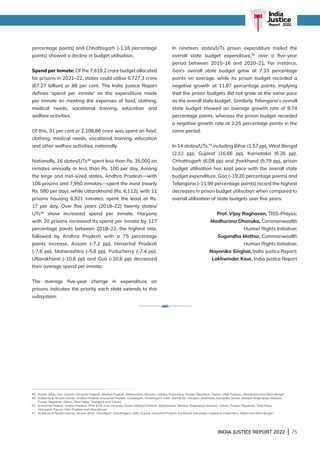
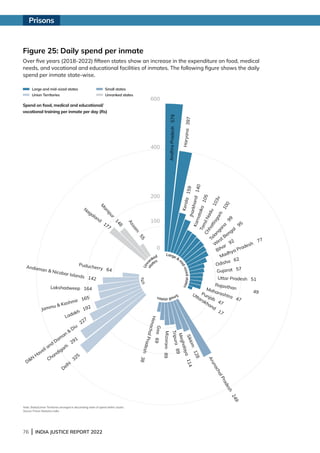
  • 158.
    146 | INDIAJUSTICE REPORT 2022 replied that budgetary allocation and fund utilisation with regard to CCTV cameras installation are matters pertaining to the state government. The PIO of the Uttarakhand Police advised us to approach the PIOs in each district individually for information about the number of police stations that have installed CCTV cameras, the number of police personnel trained in their use, and details regarding the number and working of district oversight committees set up for the purpose of ensuring compliance with the directives of the Hon. Supreme Court. Conclusion Even among the public authorities that furnished information either free of cost or upon payment of additional fees, none supplied complete information in response to every question. In some cases, it was not possible to make much sense of the data provided. For example, Delhi Police supplied budgetary information about the installation of CCTV cameras as a whole, over a five-year period, instead of providing a year- wise breakup. Budgetary figures supplied by Jammu Kashmir Police did not indicate whether the figures were in thousands, lakhs or crores. Bihar Police Department provided budgetary figures for only two years—from the beginning and the ending of the period for which we had sought information. While Meghalaya Police went out of its way to furnish more information than we requested. However, it did not provide the information that was asked for. The PIO sent us the entire correspondence between the police department and the vendor selected to install the CCTV cameras. The purchase order along with item-wise quotes submitted to the police were also shared with us. Moreover, Meghalaya’s response indicates that all the information was available with the authorities and none of that required to be sequestered or held away from the public domain. Venkatesh Nayak, Commonwealth Human Rights Initiative, India RTI
  • 159.
    INDIA JUSTICE REPORT2022 | 147 India Justice Report | 2022 The India Justice Report’s rankings—whether pillar wise or overall—rely entirely on quantitative data maintained by states, UTs and the central government: numbers and statistics. The more accurate the data, the fairer are its conclusions. Inaccurate, imprecise, and outdated data not only paints a false and often unfair picture, but also impedes pathways to repair and reform. To address this, it is important to approach data with a critical lens and work to mitigate pitfalls. In the main, the IJR has used the Bureau of Police Research and Development’s (BPRD) Data on Police Organisation (DoPO), National Crime Record Bureau’s (NCRB) Prison Statistics India (PSI) report, the National Judicial Data Grid (NJDG) and National Legal Services Authority’s (NALSA) website and dashboard. These are national aggregations of state provided data. In addition, the IJR has relied on parliamentary questions, state budget documents and, finally, responses to RTI queries. Data sets show up many hard to reconcile discrepancies that relate to the same subject in the records of different agencies and publications. Some challenges are illustrated below. l In July 2022, an answer to a parliamentary question in the Lok Sabha1 gave the number of women judges in Tamil Nadu’s subordinate courts as 428. A month later, the Department of Justice (DoJ) portal on human resources and diversity in district courts2 showed the figure at nil. l For the same period (2021-22), three official publications—the PSI, the E-prisons portal3 and the state’s own prison website—recorded that Mizoram has 1 women jail and no open jails; no women’s jail and 1 prison HQ classified as an open jail; and 1 women’s jail but no open jail respectively. l Similarly, NALSA website’s section on victim compensation schemes4 records several anomalies. For instance, the number of applications pending from the previous year (Column B), applications received in the current year (Column C), and those disposed during the current year (Column E) do not add up with the applications pending at the end of the current year (Column F). As illustrated in the table below: 1 Lok Sabha Unstarred Question No. 2116, dated 29 July 2022. Available at: http://164.100.24.220/loksabhaquestions/annex/179/AU2116.pdf 2 Department of Justice portal on strength of judges. Available at https://dashboard.doj.gov.in/sanctiondata/index.php 3 E-prisons portal developed by the National Informatics Centre. Available at: https://eprisons.nic.in/public/DashBoard 4 NALSA’s website records statistics related to legal service clinics, cases settled through mediation, permanent Lok Adalats, national Lok Adalats and applications received under victim compensation schemes. Available at: https://nalsa.gov.in/statistics Challenges in Data Chapter 7 A B C D E F G Arunachal Pradesh 0 42 42 4 7 38 Bihar 654 1,002 1,656 785 348 871 Chhattisgarh 617 2,195 2,812 1,253 1,267 1,559 Kerala 81 560 641 139 123 502 Meghalaya 79 158 237 75 23 162 West Bengal 33 356 389 246 38 143 State Applications pending at the end of 2020-21 Applications received in 2021-22 Total applications (B+C) Applications disposed in 2021-22 Applications pending at the end of 2021-22 Actual pendency at the end of 2021-22 [(B+C)-E]
  • 160.
    148 | INDIAJUSTICE REPORT 2022 Challenges in Data Dashboards Open government data not only allows citizens to track the efficiency of government data but also facilitates data sharing between government departments to break silos and ensure increased collaborations. With data emerging as a key resource in an increasingly digitised economy, there has been a proliferation of a wide range of government initiatives creating IT platforms and dashboards to provide citizen-centric services. One of the primary e-governance initiatives in improving justice delivery is the e-Courts Integrated Mission Mode Project by the Department of Justice (DoJ), Ministry of Law and Justice. Currently in its third phase, this initiative has made available the data of 3,256 court complexes, established individual websites of 688 district courts, and created a robust court management system through e-filings and e-payment infrastructures.5 This project has also implemented the National Judicial Data Grid (NJDG), national repository of data relating to cases pending and disposed of in all courts.6 In addition to the NJDG, the India Justice Report made use of other portals introduced by the Department of Justice, including portals that capture human resources and diversity at the district judiciary level,7 as well as the distribution of Gram Nyayalayas.8 Further, the report captured data from the e-prisons portal developed by the National Informatics Centre (NIC) as well as the NALSA Dashboard. While the push for digitisation is a welcome move, the government is yet to maximise the potential of data collected. Problems like missing data points, discrepancies in different datasets as well as limited access to archival data restrict the full use of such portals. In analysing data captured from these portals, the India Justice Report also faced challenges as illustrated below: l The E-prisons portal is a positive move towards integrating all activities related to prisons and prisoner management. However, the interface provides real time data at the moment and archival data is not yet accessible. There is also a significant lack of granular and disaggregated information. For instance, it provides no classification of prison populations as undertrials and convicts nor does it provide a breakdown of inmates by the nature of offences. l The DoJ portal on Gram Nyayalayas, capturing data on the distribution of these bodies across the country as well as case disposal, does not store data for more than a month. l Similarly, the DoJ portal shows discrepancies in numbers in its data that captures human resources and diversity at the district judiciary level. For instance, for Chhattisgarh, the dashboard shows the sanctioned strength for judges as 482 in one place but 526 in another.9 Lack of Standardisation The absence of a specific time period for capturing and publishing data diminishes the ability to present a holistic picture. To illustrate, the BPRD publishes the ‘Data on Police Organisation’ with data as of January of every year. The latest report available is as of 1 January 2022. Similarly, the NCRB’s ‘Prison Statistics India’ brings out data as of December of every year on prisons across the country, and the latest available report is as of 31st December, 2021. Both these organisations are under the Ministry of Home Affairs. Judiciary data is maintained at different tiers, beginning at the district courts, data for which is collected and published on multiple platforms and reports such as e-courts, NJDG as well as individual high courts’ annual reports. Data, however, is collected and made available to the public at different times. For instance, the latest available annual report on the Gujarat High Court website is as of 2019 while on the Delhi High Court website has the annual report from 2006. Some agencies capture statistics for the financial year while others use the calendar year. The Supreme Court’s 2020-21 annual report uses the financial year format 5 E-Committee of the Supreme Court of India showcasing the Information and Communication Technology (ICT) initiatives adopted by the judicial system. Available at: https://ecommitteesci.gov.in/significant-achievements/ 6 The National Judicial Data Grid. Available at: https://njdg.ecourts.gov.in/njdgnew/index.php 7 Department of Justice Portal on strength of judges. Available at https://dashboard.doj.gov.in/sanctiondata/index.php 8 Gram Nyayalayas Portal of the Department of Justice. Available at: https://dashboard.doj.gov.in/gn/notified_gram_nyayalaya 9 For ranking, the IJR uses the data provided in the Lok Sabha Unstarred Question No. 2116, dated 29 July 2022. Available at: http://164.100.24.220/loksabhaquestions/annex/179/AU2116.pdf
  • 161.
    INDIA JUSTICE REPORT2022 | 149 India Justice Report | 2022 while the National Judicial Data Grid (NJDG) records in calendar year format.10 Some high courts provide data monthly, others quarterly and others annually. Some use the financial year format while others use the calendar year. The Rajasthan State Human Rights Commission’s annual reports have come in both calendar and financial year formats. NALSA’s dashboard is yet to be updated after March 2019. Annual reports by State Human Rights Commissions—17 of 25 states have not uploaded annual reports. Other Commissions publish irregularly or not at all. Changes in category and collection Improving its formats to add more detail, in 2018, the BPRD’s DoPO aggregated traffic/specialised police stations with the total number of police stations. Next year the same police stations were clubbed with railway police stations also and in 2020 the categorisation was completely changed to rural, urban and special purpose police stations and traffic police stations were given their own chapter. Additionally, till 2016, BPRD provided caste data for 6 out of 12 ranks. For CY 2017 and 2018, this was reduced to 4 ranks and reverted to 6 ranks again in 2019 and 2020. While data on women is disaggregated for each rank the same disaggregation is not available for SC/ST/OBC. Data on Police Organisation (DoPO) reported in-service training provided to police personnel in 2017. This has not been continued after 2017. Similarly, while data on caste and gender is provided for district court judges and state police, there is no such breakdown provided for high court judges or IPS officer posts. Religious data available for police till 2013 is no longer available. The ‘Other’ data Too often the implications of an otherwise detailed data set are foregone by the presence of an indeterminate category “Other or Others if any”. These columns that often hold residuary and undefined information are present in NCRB and BPRD’s national data sets. Frequently they are unaccompanied by explanatory notes to indicate what they capture and obscure an otherwise detailed and clear picture. To illustrate, after listing sanctioned, actual and vacant police posts the BPRD lists ‘other if any’ police personnel. Often these are a considerable number. PSI details expenditure on inmates under food, clothing, medical facilities, education, vocational training and ‘others’. The ‘others’ category often shows high expenditure. For example, Haryana’s ‘other’ category shows expenditures of Rs. 306.5 crore or 87.5 per cent of their total expenditure. The explanatory note points out that the spend on this category ‘may include expenses incurred on sanitation, hygiene, transport facilities for movement of prisoners during remand, trials, transfers, hospitals etc.’11 PSI also classifies types of prisoners as convicts, undertrials, detenues and ‘others’. The number of ‘other’ inmates across the country is 547. Another unexplained category relates to deaths in prison. PSI records inmates' deaths as being due to ‘natural’ and ‘unnatural’ causes and ‘others’. Natural causes include deaths due to ageing and illness. While natural causes are classified with considerable detail into ailments like types of organ failure or diseases like HIV or Cancer and unnatural deaths include suicide, deaths due to negligence, accidents and ‘others’. This category of deaths, whatever their number, remain unexplained. Undoubtedly more and more data is being put out, digitised and being integrated to present a more holistic picture of the criminal justice system. This is a work in progress that will benefit from standard operating protocols, consistency and ever-increasing granularity. 10 National Judicial Data Grid Dashboard. Available at: https://njdg.ecourts.gov.in/njdgnew/?p=main/pend_dashboard 11 Prison Statistics India, 2021, Table 12.4, p. 276. Available at: https://ncrb.gov.in/en/prison-statistics-india-2021
  • 162.
    150 | INDIAJUSTICE REPORT 2022 M easurements—by allowing us to study, compare, assess, and draw conclusions about growth—assist us in making policy decisions. The assessment of attributes through assignment of numbers is at the core of all scientific inferences. With the 2022 edition of India Justice Report, we continue to map the scope of improvements as well as stagnancies in justice capacity across states through four core pillars of the justice system, namely the police, judiciary, prisons and legal aid and a standalone pillar state human rights commission. As with the previous two editions, new indicators have been added with an aim to deepen and broaden our assessments. Seventeen new indicators across the four core pillars have been added, bringing the total number of indicators to 102. This IJR assesses the capacity and performance of State Human Rights Commissions (SHRCs) separately and not as part of the overall ranking of a state. All pillars are measured on the basis of six themes: budget, infrastructure, human resource, workload, diversity and trends (or intention to improve). The indicators across the pillars cover the following themes: 1. Infrastructure 2. Human Resources 3. Diversity (Gender, SC/ST/OBC) 4. Budgets 5. Workload 6. Trends (Change over last five years) Each theme represents a precondition necessary for the functioning of a pillar. Budgets measure the funds received, utilised, and spent per functionary or per capita; infrastructure, the basic physical resources available; human resources looks into personnel sanctioned and available on the ground; workload is the weight of service delivery upon a functionary within a particular subsystem; and diversity assesses how representative these systems are of the populations they are set up to serve. A sixth theme, ‘trends’, is used where possible to assess whether there has been improvement or deterioration over five years in a particular theme. This too is taken account of when arriving at the overall ranking. Step 2: Clustering The vast variations across India in terms of both demography and geography make comparisons difficult. For example, the police capacity in a state like Rajasthan or Madhya Pradesh is incomparable to that of Goa or Sikkim. To undertake fair comparisons between states, the report divides states and UTs into four clusters: Cluster I (ranked) Eighteen large and mid-sized states or states with a population of 10 million and above. Cluster II (ranked) Seven small-sized states with a population of up to 10 million, namely Arunachal Pradesh, Goa, Himachal Step 1: Outline Data indicators of four pillars: Pillars Total New Indicators Indicators 1. Police 30 4 2. Prisons 29 6 3. Judiciary 28 5 4. Legal Aid 15 2 Total 102 17 Methodology Methodology Chapter 8
  • 163.
    INDIA JUSTICE REPORT2022 | 151 Pradesh, Meghalaya, Mizoram, Sikkim, and Tripura. Cluster III (not ranked) Data for 8 UTs is provided but they are not ranked. These include Andaman Nicobar Islands, Chandigarh, Dadra Nagar Haveli and Daman Diu (DNH DD), Jammu Kashmir1 , Ladakh, Lakshadweep, and Puducherry. Cluster IV (not ranked) Three states where the Armed Forces Special Powers Act, 1958 (AFSPA) is in force, namely Manipur, Assam and Nagaland. The report provides data on these but does not rank them. Step 3: Filtering All indicators are chosen based on government data availability and comparability across states. Benchmarks are taken from hard laws, policy pronouncements and Supreme Court judgements, wherever available. Government recommendations are also used. There are seventeen new indicators across pillars, some of which are indicators measuring diversity in subordinate courts in case of judiciary, presence of CCTV cameras in police stations, women help desks in police stations and share of overcrowded jails in a state. Baseline The IJR 2022 uses the latest official data available at the time of going to press. These are: Comptroller and Auditor General of Accounts (CAG) documents were preferred over state budget documents due to the uneven availability of budget documents and variations in the way each records budget heads. However, for legal aid, state budget documents were used because the budgetary data was not available in CAG documents. E-prisons portal For the two indicators on overcrowded prisons—the share of overcrowded jails in a state and the share of jails with more than 150 per cent occupancy—the report used data available on the e-prisons portal. The portal lists 1,367 prisons, of which 53 prisons were not considered in the total number, as they are not functional or there was no information regarding the prisons available with the respective prison departments, or are covered under the Revenue Department. This report analysed e-prisons’ data over a three-month period—July to October 2022. Cases pending at the end of the year For the ‘cases pending at the end of the year’ indicator under the judiciary pillar, data from the National Judicial Data Grid (NJDG) has been used. The data for cases pending at the beginning/end of the year is not available with NJDG, hence, the older data from court news has been carried forward for certain calculations. This might result in slight variations if compared with figures from various high court websites. For an illustration see example of Madhya Pradesh High Court below: India Justice Report | 2022 Pillar/theme Police Prisons Judiciary Date/Period 1 January 2022 31 December 2021 2022, December 2022, July 2022, August 2022, January 2023 Source Data on Police Organizations 2022 Prisons Statistics India 2021 National Judicial Data Grid, Supreme Court, Court News, Department of Justice, Parliamentary Questions 1 In the earlier report, Jammu Kashmir was included in Cluster IV. Since August 2019, it has become a Union Territory, hence shifted to Cluster III. Either way, as a UT or AFSPA state it is not ranked. Dadra Nagar Haveli and Daman Diu were two different UTs. The merger of these two UTs took place in 2020. The data for these two UTs is merged wherever used. Pillar/theme Legal Aid Budget Figures Population Figures Date/Period 2020-21, 2021-22, March 2022, June 2022 March 2020, March 2021 2020-21 Source National Legal Service Authority National Commission on Population 2019 Comptroller and Auditor General, States' budget documents
  • 164.
    152 | INDIAJUSTICE REPORT 2022 State Citizen Portals These state-wise portals are expected to offer nine basic services. They were assessed for accessibility, language and completeness of services. The compliance of the state citizen portal2 was assessed by checking these nine services twice from September 2022 to November 2022 to evaluate improvements in the working of the portals. One mark was given for the portal being available in more than one language; and one mark was given per service for completeness of content. Where a service was disaggregated into various sub-parts that mark was also subdivided. Illustratively, if the service sought to provide details on stolen/ recovered vehicles, arms and other properties, each of the three sub-categories was allocated a maximum score of 0.3. Partial marks were therefore still accorded to ‘incomplete’ services. State Human Rights Commissions In order to collect data related to the existing 25 SHRCs, 136 RTI applications were filed, as the complete data for SHRCs has neither been collected nor published, or proactively disclosed to the public. The performance on each of the seven indicators was calculated using the same methods as in Step 4 and 5. Assam and Manipur are excluded from ranking due to the presence of Armed Forces Special Powers Act (AFSPA). Jammu Kashmir is excluded since after the enactment of the Jammu and Kashmir Reorganisation Act, 2019 the SHRC was disbanded. The Protection of Human Rights Act, 1993 provides for the establishment, powers and functions of the SHRCs, and has been used as the benchmark to assess their performance. International standards set up under the Global Alliance of National Human Rights Institutions (GANHRI) and the Paris Principles have also been referred to. Step 4: Scoring Method As with IJR 2019 and 2020, raw data was rebased on a common scale so that every indicator could be scored on a scale of 1 to 10, with 1 being the lowest or least desirable status, and 10 indicating the highest or best score. The scores in-between were calibrated to show where a state stood in relation to the best and the lowest. Where a state met or exceeded the benchmark it had set for itself it received a score of 10. In cases where there were no benchmarks available, a state received a ‘top’ score of 10. This does not mean that the state has reached an ideal capacity, merely that it is best in class. The scores of every indicator were aggregated and averaged to arrive at a pillar score, also scored on a scale of 1 to 10. Averages were arrived at using geometric mean because the method is less prone to distortion by extreme outlying figures. Thus, for each pillar every state got a score out of 10, and a rank in its cluster. The pillar scores were then averaged to arrive at the overall score, also out of 10. Step 5: Scoring and Ranking For each cluster, the report applied the methodology outlined in Step 4 to every indicator in the pillar. For states whose values were missing for certain indicators due to an unavoidable reason— for example, in Haryana where there is no reservation for Scheduled Tribes—the number Source Calendar Year Cases pending at the beginning of the year (A) Cases instituted during the year (B) Cases disposed during the year (C) Cases pending at the end of the year (D=A+B-C) Court News Court News NJDG NJDG NJDG NJDG 2017 2018 2019 2020 2021 2022 2,89,445 3,07,420 3,31,388 3,57,174 3,81,534 4,06,662 1,38,285 1,33,734 1,33,704 98,566 1,23,289 1,37,741 1,20,310 1,09,766 1,07,918 74,206 98,161 1,16,249 3,07,420 3,31,388 3,57,174 3,81,534 4,06,662 4,28,154 2 The SMART Policing initiative of the Ministry of Home Affairs advises states to provide services to citizens online through the state citizen portal. https://digitalpolice.gov.in/ Methodology
  • 165.
    INDIA JUSTICE REPORT2022 | 153 of indicators was reduced. Certain states have not received the grant for modernisation funds, the number of indicators in such states has also been accordingly reduced while working out their scores. In assessing judiciary for Andhra Pradesh and Telangana only three- year trends have been used due to unavailability of separate data prior to their bifurcation. Step 6: Uniformity in Indicator Counts Across Themes and Weights Each indicator, theme, and pillar has been assigned equal weightage so as not to privilege any one aspect over another. The study avoids subjectivity by giving any one element higher or lower weightage, since every data point influences the whole outcome. Step 7: Data Checks The data was checked down to source data at two points in time: after the preliminary set of rankings was generated, and after the final set of rankings was generated (in other words, before web and print outputs). A third round of checking was carried out on the final outputs. Other Points Rounding off decimals The report looked at decimals through the ease of reading the data. Where the numbers were large, it did not include decimals and where they were small and the variance was in fractions, decimals were included—one or two places as needed. Use of percentage points The report uses percentage points as a unit of measurement for the trend or change indicators. This is calculated as the difference between two percentages to highlight an increase or decrease. Union Territories and states UTs and AFSPA states are not ranked as already mentioned in Step 2. As of August 2019, the state of Jammu Kashmir was reorganized into two Union Territories: Jammu Kashmir, and Ladakh. Separate data for these two UTs is not available for trend indicators, hence these two are not included in trend indicators. Similarly, the UTs of Dadra Nagar Haveli and Daman Diu were merged on 26 January 2020. Separate data for these two is combined. Geometric mean over arithmetic mean In a scenario where a state scores high or low in a pillar because it is doing extremely well or extremely poorly in a handful of variables, the geometric mean tends to normalize outliers i.e. extreme variables, better. Shared court jurisdictions For states that share court jurisdictions, the report used the same data where justifiable. For example, population per high court judge was calculated by combining the population of Punjab, Haryana and Chandigarh since the two states and the UT are serviced by the same high court. Strengths and limitations Ranking of states on the basis of justice capacity is an unprecedented exercise in the context of our country with an aim to bring together disparate and hitherto siloed information. The capacity of 7 small states and 18 large states to deliver justice is once again ranked in this year’s India Justice Report. We examine the systems more thoroughly with each report and, as usual, only use the most accurate official data. The processing of so much data enables the precise location of potential intervention and remediation sites. Not only that, but even internal gaps caused by unequal data availability indicate how urgent it is to establish reliable, consistent, timely, and publicly accessible data systems across the country that facilitate collaborative internal planning for success in the future. The report benefits from ongoing assessments and recommendations from government organisations, judges, retired DGPs, police, and other experts in various sub-systems because it is a partnership between numerous specialised civil society groups. The inclusion of thus many different viewpoints confirms the selection of indicators and rating. India Justice Report | 2022
  • 166.
    154 | INDIAJUSTICE REPORT 2022 The report is a purely quantitative exercise on selected aspects of the justice system. Its assessment is often limited by the unavailability and paucity of data and its inconsistencies. It does not aspire to capture the views of the duty holder or functionary and stakeholder that relate to the qualitative performance and functioning of each sub-system as perception studies and surveys do. Nevertheless, the assessment of the structures involved in the administration of justice point to levels of service and response. The data delineation here is also a necessary supplement to other qualitative studies and helps indicate possible solutions to many entrenched problems. We hope that the report will encourage others to strive to go deeper in evaluating the structure of the justice delivery system holistically and in ever more detail. Methodology
  • 167.
    INDIA JUSTICE REPORT2022 | 155 India Justice Report | 2022 3 5 Recommendations Fill vacancies on an urgent footing. Prioritise increased resources for first responders. Increase diversity of caste, gender and the specially abled across subsystems. 1 2 4 6 8 10 7 9 Ensure 24*7 legal guidance and representation at police stations and courts at first instance. Fully implement the Supreme Court's Paramvir Singh Saini judgement, mandating every police station to be equipped with CCTV cameras to check abuse. Ensure UTRCs guidelines of 14 categories of prisoners to be considered for release. UTRCs and all those officially mandated to visit jails, including judges, must be made accountable and their visits must be linked to their own performance review. SHRCs must be full- resourced and reach out to the community proactively. Designate the justice delivery system as an essential service and enhance, enlarge and equip it as a first responder able to provide effective justice delivery at all times. Give training pride of place and prioritise human and financial resources in all training facilities.
  • 168.
    156 | INDIAJUSTICE REPORT 2022 POLICE BUDGETS 1. Spend on police per person (Rs) Formula: Police expenditure -------------------------------------------- State population Benchmark: Not available Scoring guide: Higher, the better Period/Date: March 2021 (State population), 2020-21 (Police expenditure) Data source: Combined Finance and Revenue Accounts of the Union and State Governments in India, Comptroller and Auditor General of India; National Commission on Population, 2019; Finance Division of Ministry of Home Affairs 2. Share of training budget in police budget (%) Formula: Training budget --------------------------------------------* 100 Police budget Benchmark: Not available Scoring guide: Higher, the better Period/Date: 2020-21 Data source: Data on Police Organizations, Bureau of Police Research and Development (BPRD), January 2022 3. Training budget utilization (%) Formula: Training budget utilized --------------------------------------------* 100 Training budget Benchmark: 100% Scoring guide: Higher, the better Period/Date: 2020-21 Data source: Data on Police Organizations, Bureau of Police Research and Development (BPRD), January 2022 4. Spend on training per personnel (Rs) Formula: Training expenditure -------------------------------------------- Total police Benchmark: Not available Scoring guide: Higher, the better Period/Date: 2020-21 Data source: Data on Police Organizations, Bureau of Police Research and Development (BPRD), January 2022 5. Modernisation fund used (%) Formula: Central + state expenditure on modernisation -------------------------------------------------------------- * 100 Central + state allocation on modernisation Benchmark: 100% Scoring guide: Higher, the better Period/Date: 2020-21 Data source: Data on Police Organizations, Bureau of Police Research and Development (BPRD), January 2022 HUMAN RESOURCES 6. Constables, vacancy (%) Formula: Actual Head Constables + Constables 100 - ( ------------------------------------------------ * 100) Sanctioned Head Constables + Constables Benchmark: 0% Scoring guide: Lower, the better Period/Date: 1 January 2022 Data source: Data on Police Organizations, Bureau of Police Research and Development (BPRD), January 2022 Notes: Includes civil police and district armed reserve police. 7. Officers, vacancy (%) Formula: Actual officer strength 100 – ( ----------------------------------------------- * 100) Sanctioned officer strength Benchmark: 0% Scoring guide: Lower, the better Period/Date: 1 January 2022 Data source: Data on Police Organizations, Bureau of Police Research and Development (BPRD), January 2022 Notes: Includes civil police and district armed reserve police. Officers comprise DGP/Spl DGP + Addl. DGP + IGP + DIG + AIGP/SSP/SP/COMN + Addl.SP/Dy. COMN + ASP/DY.SP./Asstt. COMN + Inspector/RI + SI/RSI + ASI/ARSI. 8. Officers in civil police (%) Formula: Officers in civil police -------------------------------------------------- * 100 Total civil police Benchmark: Not available Scoring guide: Higher, the better Period/Date: 1 January 2022 Data source: Data on Police Organizations, Bureau of Police Research and Development (BPRD), January 2022 Notes: Civil police includes district armed reserve police. Officers comprise DGP/ Spl DGP + Addl. DGP + IGP + DIG + AIGP/ SSP/SP/COMN + Addl.SP/Dy. COMN + ASP/DY.SP./Asstt. COMN + Inspector/RI + SI/RSI + ASI/ARSI. DIVERSITY 9. Share of women in police (%) Formula: Women in police ----------------------------------------- * 100 Total police Benchmark: Not available Scoring guide: Higher, the better Period/Date: 1 January 2022 Data source: Data on Police Organizations, Bureau of Police Research and Development (BPRD), January 2022 10. Share of women in officers (%) Formula: Women police officers ---------------------------------------------------------* 100 Total police officers Benchmark: Not available Scoring guide: Higher, the better Glossary Glossary
  • 169.
    INDIA JUSTICE REPORT2022 | 157 Period/Date: 1 January 2022 Data source: Data on Police Organizations, Bureau of Police Research and Development (BPRD), January 2022 Notes: Officers comprise DGP/Spl DGP + Addl. DGP + IGP + DIG + AIGP/SSP/ SP/COMN + Addl.SP/Dy. COMN + ASP/ DY.SP./Asstt. COMN + Inspector/RI + SI/ RSI + ASI/ARSI. 11. SC officers, actual to reserved ratio (%) Formula: Actual Scheduled Caste (SC) officers ------------------------------------------------- * 100 (Sanctioned officer posts * SC reservation) Benchmark: 100% Scoring guide: Higher, the better Period/Date: 1 January 2022 Data source: Data on Police Organizations, Bureau of Police Research and Development (BPRD), January 2022 Notes: Officers comprise ASP/DY.SP./ Asstt. COMN + Inspector/RI + SI/RSI + ASI/ ARSI. 12. SC constables, actual to reserved ratio (%) Formula: Actual Scheduled Caste (SC) constables ------------------------------------------------- * 100 (Sanctioned constable posts * SC reservation) Benchmark: 100% Scoring guide: Higher, the better Period/Date: 1 January 2022 Data source: Data on Police Organizations, Bureau of Police Research and Development (BPRD), January 2022 Notes: Constables include head constables. 13. ST officers, actual to reserved ratio (%) Formula: Actual Scheduled Tribe (ST) officers --------------------------------------------------* 100 (Sanctioned officer posts * ST reservation) Benchmark: 100% Scoring guide: Higher, the better Period/Date: 1 January 2022 Data source: Data on Police Organizations, Bureau of Police Research and Development (BPRD), January 2022 Notes: Officers comprise ASP/DY.SP./ Asstt. COMN + Inspector/RI + SI/RSI + ASI/ ARSI. 14. ST constables, actual to reserved ratio (%) Formula: Actual Scheduled Tribe (ST) constables ------------------------------------------------- * 100 (Sanctioned constable posts * ST reservation) Benchmark: 100% Scoring guide: Higher, the better Period/Date: 1 January 2022 Data source: Data on Police Organizations, Bureau of Police Research and Development (BPRD), January 2022 Notes: Constables include head constables. 15. OBC officers, actual to reserved ratio (%) Formula: Actual Other Backward Classes (OBC) officers ------------------------------------------------------------* 100 (Sanctioned officer posts * OBC reservation) Benchmark: 100% Scoring guide: Higher, the better Period/Date: 1 January 2022 Data source: Data on Police Organizations, Bureau of Police Research and Development (BPRD), January 2022 Notes: Officers comprise ASP/DY.SP./ Asstt. COMN + Inspector/RI + SI/RSI + ASI/ ARSI. 16. OBC constables, actual to reserved ratio (%) Formula: Actual Other Backward Classes (OBC) constables ------------------------------------------------* 100 (Sanctioned constable posts * OBC reservation) Benchmark: 100% Scoring guide: Higher, the better Period/Date: 1 January 2022 Data source: Data on Police Organizations, Bureau of Police Research and Development (BPRD), January 2022 Notes: Constables include head constables. INFRASTRUCTURE 17. Population per police station (rural) (persons) Formula: Rural population ------------------------------------------------ Rural police stations Benchmark: Not available Scoring guide: Lower, the better Period/Date: March 2022 (rural population), January 2022 (rural police stations) Data source: National Commission on Population, 2019; Data on Police Organizations, Bureau of Police Research and Development (BPRD), January 2022 18. Population per police station (urban) (persons) Formula: Urban population --------------------------------------------------- Urban police stations Benchmark: Not available Scoring guide: Lower, the better Period/Date: March 2022 (urban population), January 2022 (urban police stations) Data source: National Commission on Population, 2019; Data on Police Organizations, Bureau of Police Research and Development (BPRD), January 2022 19. Area per police station (rural) (sq km) Formula: Rural area (sq km) ------------------------------------------------ Rural police stations Benchmark: 150 sq km or less (National Police Commission report 1981) Scoring guide: Lower, the better Period/Date: 2011 (rural area), January 2022 (rural police stations) Data source: Census 2011; Data on Police Organizations, Bureau of Police Research and Development (BPRD), January 2022 20. Area per police station (urban) (sq km) Formula Urban area (sq km) --------------------------------------------------- Urban police stations India Justice Report | 2022 India Justice Report | 2022
  • 170.
    158 | INDIAJUSTICE REPORT 2022 Benchmark: Not available Scoring guide: Lower, the better Period/Date: 2011 (urban area), January 2022 (urban police stations) Data source: Census 2011; Data on Police Organizations, Bureau of Police Research and Development (BPRD), January 2022 21. Services provided by state police citizen portals (%) Formula Services provided (out of 10) ---------------------------------------------* 100 10 Benchmark: 100% Scoring guide: Higher, the better Period/Date: 2022 Data source: https://digitalpolice.gov.in/ Notes: Quantitative assessment of state police citizen portals on 10 counts: whether they include each of the 9 services listed by the Ministry of Home Affairs and whether the portal was available in a state language (other than English). 22. Personnel per training institute (number) Formula: Sanctioned total police -------------------------------------------- Number of training institutes Benchmark: Not available Scoring guide: Lower, the better Period/Date: January 2022 Data source: Data on Police Organizations, Bureau of Police Research and Development (BPRD), January 2022 23. Share of police stations with CCTVs (%) Formula: Police stations with CCTVs --------------------------------------------* 100 Total police stations Benchmark: 100% Scoring guide: Higher, the better Period/Date: January 2022 Data source: Data on Police Organizations, Bureau of Police Research and Development (BPRD), January 2022 24. Share of Police Stations with women help desks (%) Formula: Police stations with women help desks --------------------------------------------* 100 Total police stations Benchmark: 100% Scoring guide: Higher, the better Period/Date: January 2022 Data source: Data on Police Organizations, Bureau of Police Research and Development (BPRD), January 2022 WORKLOAD 25. Population per civil police (persons) Formula: State population ---------------------------------------- Total civil police Benchmark: Not available Scoring guide: Lower, the better Period/Date: March 2022 (state population), January 2022 (civil police) Data source: National Commission on Population, 2019; Data on Police Organizations, Bureau of Police Research and Development (BPRD), January 2022 Notes: Civil police includes district armed reserve police. TRENDS 26. Women in total police (percentage points) Formula: Women in total police – X 2016 X1 2017 X2 ((X2/X1)-1)*100 = a 2018 X3 ((X3/X2)-1)*100 = b 2019 X4 ((X4/X3)-1)*100 = c 2020 X5 ((X5/X4)-1)*100 = d 2021 X6 ((X6/X5)-1)*100 = e 5-year average (a,b,c,d,e) Benchmark: Not available Scoring guide: Higher, the better Period/Date: Calendar year 2017 to 2021 Data source: Data on Police Organizations, Bureau of Police Research and Development (BPRD) 27. Women officers in total officers (percentage points) Formula: Women officers in total officers – X 2016 X1 2017 X2 ((X2/X1)-1)*100 = a 2018 X3 ((X3/X2)-1)*100 = b 2019 X4 ((X4/X3)-1)*100 = c 2020 X5 ((X5/X4)-1)*100 = d 2011 X6 ((X6/X5)-1)*100 = e 5-year average (a,b,c,d,e) Benchmark: Not available Scoring guide: Higher, the better Period/Date: Calendar year 2017 to 2021 Data source: Data on Police Organizations, Bureau of Police Research and Development (BPRD) Notes: Calculation for 2016 is repeated for 2017 as BPRD did not provide rank-wise data for women district armed reserve police for 2017. 28. Constable vacancy (percentage points) Formula: Constable vacancy – X 2016 X1 2017 X2 ((X2/X1)-1)*100 = a 2018 X3 ((X3/X2)-1)*100 = b 2019 X4 ((X4/X3)-1)*100 = c 2020 X5 ((X5/X4)-1)*100 = d 2021 X6 ((X6/X5)-1)*100 = e 5-year average (a,b,c,d,e) Benchmark: Not available Scoring guide: Lower, the better Period/Date: Calendar year 2017 to 2021 Data source: Data on Police Organizations, Bureau of Police Research and Development (BPRD) 29. Officer vacancy (percentage points) Officer vacancy – X 2016 X1 2017 X2 ((X2/X1)-1)*100 = a 2018 X3 ((X3/X2)-1)*100 = b 2019 X4 ((X4/X3)-1)*100 = c 2020 X5 ((X5/X4)-1)*100 = d 2021 X6 ((X6/X5)-1)*100 = e 5-year average (a,b,c,d,e) Benchmark: Not available Scoring guide: Lower, the better Period/Date: Calendar year 2017 to 2021 Data source: Data on Police Organizations, Bureau of Police Research and Development (BPRD) 30. Difference in spend: police vs state (percentage points) Formula: [5-year annual average of police expenditure (PE) – 5-year annual average of state expenditure (SE)] 2015-16 PE = X1 2016-17 X2 ((X2/X1)-1)*100 = a 2017-18 X3 ((X3/X2)-1)*100 = b 2018-19 X4 ((X4/X3)-1)*100 = c 2019-20 X5 ((X5/X4)-1)*100 = d 2020-21 X6 ((X6/X5)-1)*100 = e Glossary
  • 171.
    INDIA JUSTICE REPORT2022 | 159 PE = Average (a,b,c,d,e) 2015-16 SE = X1 2016-17 X2 ((X2/X1)-1)*100 = a 2017-18 X3 ((X3/X2)-1)*100 = b 2018-19 X4 ((X4/X3)-1)*100 = c 2019-20 X5 ((X5/X4)-1)*100 = d 2020-21 X6 ((X6/X5)-1)*100 = e SE = Average (a,b,c,d,e) Benchmark: Greater than zero Scoring guide: Higher, the better Period/Date: Financial year 2016-27 to 2020-21 Data source: Combined Finance and Revenue Accounts of the Union and State Governments in India, Comptroller and Auditor General of India; Open Budgets India; Finance Division of Ministry of Home Affairs PRISONS BUDGETS 1. Spend per inmate (Rs) Formula: Prison expenditure ---------------------------------------------- Total inmates Benchmark: Not available Scoring guide: Higher, the better Period/Date: 2021-22 Data source: Prison Statistics India, 2021 2. Prison budget utilised (%) Formula: Prison expenditure ------------------------------------------------* 100 Prison budget Benchmark: 100% Scoring guide: Higher, the better Period/Date: 2021-22 Data source: Prison Statistics India, 2021 HUMAN RESOURCES 3. Officers, vacancy (%) Formula: Actual prison officers 100 – ( ------------------------------------------ * 100) Sanctioned prison officers Benchmark: 0% Scoring guide: Lower, the better Date: 31 December 2021 Data source: Prison Statistics India, 2021 Notes: Officers comprise the following ranks: DG/ADDL.DG/IG + DIG + AIG+ Superintendent + Deputy Superintendent + Assistant Superintendent + Jailor + Deputy Jailor + Assistant Jailor + Others. 4. Cadre staff, vacancy (%) Formula: Actual cadre staff 100 – ( ----------------------------------------* 100) Sanctioned cadre staff Benchmark: 0% Scoring guide: Lower, the better Date: 31 December 2021 Data source: Prison Statistics India, 2021 Notes: Cadre comprise the following ranks: Head Warders + Head Matrons + Warders + Matrons + Others. 5. Correctional staff, vacancy (%) Formula: Actual correctional staff 100 – (-------------------------------------------------* 100) Sanctioned correctional staff Benchmark: 0% Scoring guide: Lower, the better Period/Date: 31 December 2021 Data source: Prison Statistics India, 2021 Notes: Correctional staff comprise the following: Probation Officer/Welfare Officer + Psychologists/Psychiatrists + Social Worker/Others. 6. Medical staff, vacancy (%) Formula: Actual medical staff 100 – (----------------------------------------- * 100 ) Sanctioned medical staff Benchmark: 0% Scoring guide: Lower, the better Period/Date: 31 December 2021 Data source: Prison Statistics India, 2021 Notes: Medical staff comprises Resident Medical Officer/Medical Officer + Pharmacists + Lab Technician/Lab Attendant + Others. 7. Medical officers, vacancy (%) Formula: Actual resident medical officer and medical officer 100 – ( ------------------------------------------------ * 100) Sanctioned resident medical officer and medical officer Benchmark: 0% Scoring guide: Lower, the better Period/Date: 31 December 2021 Data source: Prison Statistics India, 2021 8. Personnel trained (%) Formula: Prison staff trained --------------------------------------------- * 100 Actual prison staff Benchmark: 100% Scoring guide: Higher, the better Period/Date: 31 December 2021 Data source: Prison Statistics India, 2021 DIVERSITY 9. Women in prison staff (%) Formula: Women prison staff --------------------------------------------------------- * 100 Total prison staff Benchmark: Not available Scoring guide: Higher, the better Period/Date: 31 December 2021 Data source: Prison Statistics India, 2021 INFRASTRUCTURE 10. Prison occupancy (%) Formula: Inmate population -------------------------------------------------------- * 100 Total Available prison capacity Benchmark: Below 100% Scoring guide: Lower, the better Period/Date: 31 December 2021 Data source: Prison Statistics India, 2021 11. Share of jails with 100% and more occupancy (%) Formula: Number of jails with 100% more occupancy -------------------------------------------------------- * 100 Total jails Benchmark: 0% Scoring guide: Lower, the better Period/Date: 2022 Data source: e-Prisons portal 12. Share of jails with 150% and more occupancy (%) Formula: Number of jails with 150% more occupancy -------------------------------------------------------- * 100 Total jails Benchmark: 0% Scoring guide: Lower, the better India Justice Report | 2022 India Justice Report | 2022
  • 172.
    160 | INDIAJUSTICE REPORT 2022 Period/Date: 2022 Data source: e-Prisons portal 13. Undertrials detained for 1-3 years (%) Formula: Undertrials detained for 1-3 years -------------------------------------------------------- * 100 Total undertrials Benchmark: Not available Scoring guide: Lower, the better Period/Date: 31 December 2021 Data source: Prison Statistics India, 2021 14. Inmates (admitted) availed educational course (%) Formula: Inmates availed educational facilities -------------------------------------------------------- * 100 Inmates admitted during the year Benchmark: Not available Scoring guide: Higher, the better Period/Date: 31 December 2021 Data source: Prison Statistics India, 2021 15. Inmates (admitted) availed vocational training (%) Formula: Inmates availed vocational training -------------------------------------------------------- * 100 Inmates admitted during the year Benchmark: Not available Scoring guide: Higher, the better Period/Date: 31 December 2021 Data source: Prison Statistics India, 2021 16. Jails with video-conferencing facilities (%) Formula: Jails with V-C facility ------------------------------------------------------ * 100 Total jails Benchmark: 100% Scoring guide: Higher, the better Period/Date: 31 December 2021 Data source: Prison Statistics India, 2021 WORKLOAD 17. Inmates per officer (persons) Formula: Inmate population ---------------------------------------------- Officer Benchmark: Not available Scoring guide: Lower, the better Period/Date: 31 December 2021 Data source: Prison Statistics India, 2021 Notes: Officer comprises Superintendent + Deputy Superintendent + Assistant Superintendent + Jailor + Deputy Jailor + Assistant Jailor + Other Officers. 18. Inmates per cadre staff (persons) Formula: Inmate population --------------------------------------------- Cadre staff Benchmark: Up to 6 Scoring guide: Lower, the better Period/Date: 31 December 2021 Data source: Prison Statistics India, 2021 Notes: Cadre staff comprises Head Warder/Head Matron + Warder/Matron + Others. 19. Inmates per correctional staff (persons) Formula: Inmate population ---------------------------------------------- Correctional staff Benchmark: Not available Scoring guide: Lower, the better Period/Date: 31 December 2021 Data source: Prison Statistics India, 2021 Notes: Correctional staff comprises Probation officer/Welfare Officer + Psychologists/Psychiatrists + Social Worker/Others). 20. Inmates per medical offcer (persons) Formula: Inmate population ---------------------------------------------- Medical officer Benchmark: 300 inmates per medical officer Scoring guide: Lower, the better Period/Date: 31 December 2021 Data source: Prison Statistics India, 2021 TRENDS 21. Officer vacancy (percentage points) Formula: Officer vacancy (%) – X 2016 X1 2017 X2 ((X2/X1)-1)*100 = a 2018 X3 ((X3/X2)-1)*100 = b 2019 X4 ((X4/X3)-1)*100 = c 2020 X5 ((X5/X4)-1)*100 = d 2021 X6 ((X6/X5)-1)*100 = e 5-year average (a,b,c,d,e) Benchmark: Not available Scoring guide: Lower, the better Period/Date: Calendar year 2017 to 2021 Data source: Prison Statistics India 22. Cadre staff vacancy (percentage points) Formula: Cadre staff vacancy (%) – X 2016 X1 2017 X2 ((X2/X1)-1)*100 = a 2018 X3 ((X3/X2)-1)*100 = b 2019 X4 ((X4/X3)-1)*100 = c 2020 X5 ((X5/X4)-1)*100 = d 2021 X6 ((X6/X5)-1)*100 = e 5-year average (a,b,c,d,e) Benchmark: Not available Scoring guide: Lower, the better Period/Date: Calendar year 2017 to 2021 Data source: Prison Statistics India 23. Share of women in prison staff (percentage points) Formula: Share of women in prison staff (%) = X 2016 X1 2017 X2 ((X2/X1)-1)*100 = a 2018 X3 ((X3/X2)-1)*100 = b 2019 X4 ((X4/X3)-1)*100 = c 2020 X5 ((X5/X4)-1)*100 = d 2021 X6 ((X6/X5)-1)*100 = e 5-year average (a,b,c,d,e) Benchmark: Not available Scoring guide: Higher, the better Period/Date: Calendar year 2017 to 2021 Data source: Prison Statistics India 24. Inmates per prison officer (%) Formula: Inmates per prison officer = X 2016 X1 2017 X2 ((X2/X1)-1)*100 = a 2018 X3 ((X3/X2)-1)*100 = b 2019 X4 ((X4/X3)-1)*100 = c 2020 X5 ((X5/X4)-1)*100 = d 2021 X6 ((X6/X5)-1)*100 = e 5-year average (a,b,c,d,e) Benchmark: Not available Scoring guide: Lower, the better Period/Date: Calendar year 2017 to 2021 Data source: Prison Statistics India Notes: Officer comprises Superintendent + Deputy Superintendent + Assistant Superintendent + Jailor + Deputy Jailor + Assistant Jailor + Other Officers. Glossary
  • 173.
    INDIA JUSTICE REPORT2022 | 161 25. Inmates per cadre staff (%) Formula: Inmates per cadre staff = X 2016 X1 2017 X2 ((X2/X1)-1)*100 = a 2018 X3 ((X3/X2)-1)*100 = b 2019 X4 ((X4/X3)-1)*100 = c 2020 X5 ((X5/X4)-1)*100 = d 2021 X6 ((X6/X5)-1)*100 = e 5-year average (a,b,c,d,e) Benchmark: Not available Scoring guide: Lower, the better Period/Date: Calendar year 2017 to 2021 Data source: Prison Statistics India 26. Share of undertrial prisoners (percentage points) Formula: Share of UTPs (%) (X) = (UTPs/total inmates*100) 2016 X1 2017 X2 ((X2/X1)-1)*100 = a 2018 X3 ((X3/X2)-1)*100 = b 2019 X4 ((X4/X3)-1)*100 = c 2020 X5 ((X5/X4)-1)*100 = d 2021 X6 ((X6/X5)-1)*100 = e 5-year average (a,b,c,d,e) Benchmark: Not available Scoring guide: Lower, the better Period/Date: Calendar year 2017 to 2021 Data source: Prison Statistics India 27. Spend per inmate (%) Formula: Spend per inmate = X 2016-17 X1 2017-18 X2 ((X2/X1)-1)*100 = a 2018-19 X3 ((X3/X2)-1)*100 = b 2019-20 X4 ((X4/X3)-1)*100 = c 2020-21 X5 ((X5/X4)-1)*100 = d 2021-22 X6 ((X6/X5)-1)*100 = e 5-year average (a,b,c,d,e) Benchmark: Not available Scoring guide: Higher, the better Period/Date: Financial year 2017-18 to 2021-22 Data source: Prison Statistics India 28. Prison budget used (percentage points) Formula: Budget used = X 2016-17 X1 2017-18 X2 ((X2/X1)-1)*100 = a 2018-19 X3 ((X3/X2)-1)*100 = b 2019-20 X4 ((X4/X3)-1)*100 = c 2020-21 X5 ((X5/X4)-1)*100 = d 2021-22 X6 ((X6/X5)-1)*100 = e 5-year average (a,b,c,d,e) Benchmark: Not available Scoring guide: Higher, the better Period/Date: Financial year 2017-18 to 2021-22 Data source: Prison Statistics India 29. Difference in spend: prisons vs state (percentage points) Formula: [5-year annual average of prisons expenditure (PE) – 5-year annual average of state expenditure (SE)] 2015-16 PE = X1 2016-17 X2 ((X2/X1)-1)*100 = a 2017-18 X3 ((X3/X2)-1)*100 = b 2018-19 X4 ((X4/X3)-1)*100 = c 2019-20 X5 ((X5/X4)-1)*100 = d 2020-21 X6 ((X6/X5)-1)*100 = e PE = Average (a,b,c,d,e) 2015-16 SE = X1 2016-17 X2 ((X2/X1)-1)*100 = a 2017-18 X3 ((X3/X2)-1)*100 = b 2018-19 X4 ((X4/X3)-1)*100 = c 2019-20 X5 ((X5/X4)-1)*100 = d 2020-21 X6 ((X6/X5)-1)*100 = e SE = Average (a,b,c,d,e) Benchmark: Greater than zero Scoring guide: Higher, the better Period/Date: Financial year 2016-17 to 2020-21 Data source: Combined Finance and Revenue Accounts of the Union and State Governments in India, Comptroller and Auditor General of India; Open Budgets India; Finance Division of Ministry of Home Affairs; Prison Statistics India JUDICIARY BUDGETS 1. Per capita spend on judiciary (Rs) Formula: Judiciary expenditure (Rs) ----------------------------------------------------------------- State Population Benchmark: Not available Scoring guide: Higher, the better Period/Date: March 2021 (population), 2020-21 (judiciary expenditure) Data source: National Commission on Population, 2019; Combined Finance and Revenue Accounts of the Union and State Governments in India for 2020-21, Comptroller and Auditor General of India; Finance Division of Ministry of Home Affairs HUMAN RESOURCES 2. Population per High Court judge (Persons) Formula: State population -------------------------------------------- High Court judges Benchmark: Not available Scoring guide: Lower, the better Period/Date: March 2022 (population); December 2022 (High Court judges) Data source: National Commission on Population, 2019; Department of Justice Notes: Population of states and UTs that share a High Court have been combined, and hence they share the same value. These are Kerala and Lakshadweep; West Bengal and Andaman Nicobar Islands; Punjab, Haryana and Chandigarh; Assam, Mizoram, Nagaland and Arunachal Pradesh; Maharashtra, Goa, Dadra Nagar Haveli, Daman Diu; Tamil Nadu and Puducherry. 3. Population per subordinate court judge (Persons) Formula: State population ------------------------------------------------------------- Subordinate court judges Benchmark: Not available Scoring guide: Lower, the better Period/Date: March 2022 (State population); July 2022 (Subordinate court judges) Data source: National Commission on Population, 2019; Parliamentary Question-Lok Sabha, Unstarred Question No. 2116 4. High Court judge vacancy (%) Formula: Working High Court Judges 100 – ( ------------------------------------------------ * 100) Sanctioned High Court judges Benchmark: 0% Scoring guide: Lower, the better Period/Date: December 2022 Data source: Department of Justice India Justice Report | 2022 India Justice Report | 2022
  • 174.
    162 | INDIAJUSTICE REPORT 2022 5. Subordinate court judge vacancy (%) Formula: Working subordinate court judges 100 – ( ------------------------------------------------* 100) Sanctioned subordinate court judges Benchmark: 0% Scoring guide: Lower, the better Period/Date: July 2022 Data source: Parliamentary Question-Lok Sabha, Unstarred Question No. 2116 6. High Court staff vacancy (%) Formula: Working High Court staff 100 – (------------------------------------------------* 100) Sanctioned High Court staff Benchmark: 0% Scoring guide: Lower, the better Period/Date: 2021-22 Data source: Annual report 2021-22, Supreme Court of India DIVERSITY 7. Women judges (High Court) (%) Formula: Women High Court judges ------------------------------------------------------------- * 100 Total High Court judges Benchmark: Not available Scoring guide: Higher, the better Date: December 2022 Data source: Department of Justice 8. Women judges (subordinate court) (%) Formula: Women subordinate court judges -------------------------------------------------------------- * 100 Total subordinate court judges Benchmark: Not available Scoring guide: Higher, the better Period/Date: July 2022 Data source: Parliamentary Question-Lok Sabha, Unstarred Question No. 2116 9. SC judges, actual to reserved (subordinate courts) (%) Formula: Actual Scheduled Caste (SC) judges ------------------------------------------------- * 100 (Sanctioned subordinate court judges * SC reservation) Benchmark: 100% Scoring guide: Higher, the better Period/Date: 25 July 2022 Data source: Parliamentary Question-Lok Sabha, Unstarred Question No. 2116 10. ST judges, actual to reserved (subordinate courts) (%) Formula: Actual Scheduled Tribe (ST) judges ------------------------------------------------- * 100 (Sanctioned subordinate court judges * ST reservation) Benchmark: 100% Scoring guide: Higher, the better Period/Date: 25 July 2022 Data source: Parliamentary Question-Lok Sabha, Unstarred Question No. 2116 11. OBC judges, actual to reserved (subordinate courts) (%) Formula: Actual Other Backward Classes (OBC) judges ------------------------------------------------- * 100 (Sanctioned subordinate court judges * OBC reservation) Benchmark: 100% Scoring guide: Higher, the better Period/Date: 25 July 2022 Data source: Parliamentary Question-Lok Sabha, Unstarred Question No. 2116 INFRASTRUCTURE 12. Courthall shortfall (%) Formula: Number of courthalls 100 – (------------------------------------------------- * 100) Sanctioned subordinate court judges Benchmark: 0% Scoring guide: Lower, the better Period/Date: July-August 2022 Data source: Department of Justice (courthalls); Parliamentary Question-Lok Sabha, Unstarred Question No. 2116 WORKLOAD 13. Cases pending (5-10 years) (High Court) (%) Formula: Cases pending for 5-10 years in High Courts ---------------------------------------------------------------* 100 Total cases pending in High Courts Benchmark: Not available Scoring guide: Lower, the better Period/Date: January 2023 Data source: National Judicial Data Grid 14. Cases pending (10+ years) (High Court) (%) Formula: Cases pending for 10+ years in High Courts ---------------------------------------------------------------* 100 Total cases pending in High Courts Benchmark: Not available Scoring guide: Lower, the better Period/Date: January 2023 Data source: National Judicial Data Grid 15. Cases pending (5-10 years) (subordinate court) (%) Formula: Cases pending for 5-10 years in subordinate courts ---------------------------------------------------------------* 100 Total cases pending in subordinate courts Benchmark: Not available Scoring guide: Lower, the better Period/Date: January 2023 Data source: National Judicial Data Grid 16. Cases pending (10+ years) (subordinate court) (%) Formula: Subordinate court cases pending for above 10 years -------------------------------------------------------------* 100 Total cases pending in subordinate courts Glossary
  • 175.
    INDIA JUSTICE REPORT2022 | 163 Benchmark: Not available Scoring guide: Lower, the better Period/Date: January 2023 Data source: National Judicial Data Grid 17. Average High Court pendency (years) Formula: For each pending case in High Courts (Date on which data was scraped – Date of case filed) = Case pending for X days Xn = Sum of X days for each case pending in a state n = total pending cases Average pendency in High Courts (years) = (X1+X2+X3+……+Xn) ---------------------------------------- * 365 n Benchmark: Not available Scoring guide: Lower, the better Period/Date: February 2022 Data source: DAKSH High Court database 18. Case clearance rate (High Court) (%) Formula: High Court cases disposed (civil + criminal) ----------------------------------------------------* 100 High Court cases filed (civil + criminal) Benchmark: 100% Scoring guide: Higher, the better Period/Date: 2022 Data source: National Judicial Data Grid 19. Case clearance rate (subordinate court) (%) Formula: Subordinate court cases disposed (civil + criminal) ---------------------------------------------------------------* 100 Subordinate court cases filed (civil + criminal) Benchmark: 100% Scoring guide: Higher, the better Period/Date: 2022 Data source: National Judicial Data Grid TRENDS 20. Cases pending (per High Court judge) (%) Formula: Cases pending (High Court judge) – X 2017 X1 2018 X2 ((X2/X1)-1)*100 = a 2019 X3 ((X3/X2)-1)*100 = b 2020 X4 ((X4/X3)-1)*100 = c 2021 X5 ((X5/X4)-1)*100 = d 2022 X6 ((X6/X5)-1)*100 = e 5-year average (a,b,c,d,e) Benchmark: Not available Scoring guide: Lower, the better Period/Date: 2018 to 2022 Data source: National Judicial Data Grid; Court News, Supreme Court; Department of Justice 21. Cases pending (per subordinate court judge) (%) Formula: Cases pending (subordinate court judge) – X 2017 X1 2018 X2 ((X2/X1)-1)*100 = a 2019 X3 ((X3/X2)-1)*100 = b 2020 X4 ((X4/X3)-1)*100 = c 2021 X5 ((X5/X4)-1)*100 = d 2022 X6 ((X6/X5)-1)*100 = e 5-year average (a,b,c,d,e) Benchmark: Not available Scoring guide: Lower, the better Period/Date: 2018 to 2022 Data source: National Judicial Data Grid; Court News, Supreme Court; Lok Sabha, Unstarred Question No. 2116 22. Total cases pending (High Court) (%) Formula: Average High Court pending cases (civil + criminal) – X 2017 X1 2018 X2 ((X2/X1)-1)*100 = a 2019 X3 ((X3/X2)-1)*100 = b 2020 X4 ((X4/X3)-1)*100 = c 2021 X5 ((X5/X4)-1)*100 = d 2022 X6 ((X6/X5)-1)*100 = e 5-year average (a,b,c,d,e) Benchmark: Not available Scoring guide: Lower, the better Period/Date: 2018 to 2022 Data source: National Judicial Data Grid; Court News, Supreme Court 23. Total cases pending (subordinate court) (%) Formula: Average subordinate court pending cases (civil + criminal) – X 2017 X1 2018 X2 ((X2/X1)-1)*100 = a 2019 X3 ((X3/X2)-1)*100 = b 2020 X4 ((X4/X3)-1)*100 = c 2021 X5 ((X5/X4)-1)*100 = d 2022 X6 ((X6/X5)-1)*100 = e 5-year average (a,b,c,d,e) Benchmark: Not available Scoring guide: Lower, the better Period/Date: 2018 to 2022 Data source: National Judicial Data Grid; Court News, Supreme Court; 24 Judge vacancy (High Court) (percentage points) Formula: Judge vacancy = Working High Court Judges 100 – (--------------------------------------------- * 100) Sanctioned High Court judges Judge vacancy (High Court) – X 2017 X1 2018 X2 ((X2/X1)-1)*100 = a 2019 X3 ((X3/X2)-1)*100 = b 2020 X4 ((X4/X3)-1)*100 = c 2021 X5 ((X5/X4)-1)*100 = d 2022 X6 ((X6/X5)-1)*100 = e 5-year average (a,b,c,d,e) Benchmark: Not available Scoring guide: Lower, the better Period/Date: 2018 to 2022 Data source: Department of Justice 25. Judge vacancy (subordinate court) (percentage points) Formula: Judge vacancy (X) = Working Subordinate Court Judges 100 – (----------------------------------------------* 100) Sanctioned Subordinate Court judges 2017 X1 2018 X2 ((X2/X1)-1)*100 = a 2019 X3 ((X3/X2)-1)*100 = b 2020 X4 ((X4/X3)-1)*100 = c 2021 X5 ((X5/X4)-1)*100 = d 2022 X6 ((X6/X5)-1)*100 = e 5-year average (a,b,c,d,e) Benchmark: Not available Scoring guide: Lower, the better Period/Date: 2018 to 2022 Data source: Parliamentary Questions; Court News, Supreme Court India Justice Report | 2022 India Justice Report | 2022
  • 176.
    164 | INDIAJUSTICE REPORT 2022 26. Case clearance rate (High Court) (percentage points) Formula: Case clearance rate (X) = High Court cases disposed (civil + criminal) ------------------------------------------------------------* 100 High Court cases filed (civil + criminal) 2017 X1 2018 X2 ((X2/X1)-1)*100 = a 2019 X3 ((X3/X2)-1)*100 = b 2020 X4 ((X4/X3)-1)*100 = c 2021 X5 ((X5/X4)-1)*100 = d 2022 X6 ((X6/X5)-1)*100 = e 5-year average (a,b,c,d,e) Benchmark: Not available Scoring guide: Higher, the better Period/Date: 2018 to 2022 Data source: National Judicial Data Grid; Court News, Supreme Court 27. Case clearance rate (subordinate court) (percentage points) Formula: Case clearance rate (X) = Subordinate court cases disposed (civil + criminal) ---------------------------------------------------------------* 100 Subordinate court cases filed (civil + criminal) 2017 X1 2018 X2 ((X2/X1)-1)*100 = a 2019 X3 ((X3/X2)-1)*100 = b 2020 X4 ((X4/X3)-1)*100 = c 2021 X5 ((X5/X4)-1)*100 = d 2022 X6 ((X6/X5)-1)*100 = e 5-year average (a,b,c,d,e) Benchmark: Not available Scoring guide: Higher, the better Period/Date: 2018 to 2022 Data source: National Judicial Data Grid; Court News, Supreme Court 28. Difference in spend: judiciary vs state (percentage points) Formula: [5-year annual average of judiciary expenditure (JE)] – [(5-year annual average of state expenditure (SE)] 2015-16 JE = X1 2016-17 X2 ((X2/X1)-1)*100 = a 2017-18 X3 ((X3/X2)-1)*100 = b 2018-19 X4 ((X4/X3)-1)*100 = c 2019-20 X5 ((X5/X4)-1)*100 = d 2020-21 X6 ((X6/X5)-1)*100 = e PE = Average (a,b,c,d,e) 2015-16 JE = X1 2016-17 X2 ((X2/X1)-1)*100 = a 2017-18 X3 ((X3/X2)-1)*100 = b 2018-19 X4 ((X4/X3)-1)*100 = c 2019-20 X5 ((X5/X4)-1)*100 = d 2020-21 X6 ((X6/X5)-1)*100 = e SE = Average (a,b,c,d,e) Benchmark: Greater than zero Scoring guide: Higher, the better Period/Date: Financial year 2015-16 to 2020-21 Data source: Combined Finance and Revenue Accounts of the Union and State Governments in India, Comptroller and Auditor General of India; Open Budgets India; Finance Division of Ministry of Home Affairs LEGAL AID BUDGETS 1. State's share in legal aid budget (%) Formula: Allocation by state for legal aid ---------------------------------------------------------* 100 Allocation by state for legal aid + Allocation by NALSA Benchmark: Not available Scoring guide: Higher, the better Period/Date: 2021-22 Data source: National Legal Services Authority (NALSA); State budget documents 2. State legal aid budget utilised (%) Formula: Allocation by state for legal aid ---------------------------------------------------------* 100 Allocation by state for legal aid + Allocation by NALSA Benchmark: 100% Scoring guide: Higher, the better Period/Date: 2020-21 Data source: State budget documents 3. NALSA fund utilised (%) Formula: NALSA funds utilised -------------------------------------------------------------* 100 NALSA funds carried forward from previous year + received this year Benchmark: 100% Scoring guide: Higher, the better Period/Date: 2021-22 Data source: National Legal Services Authority (NALSA) HUMAN RESOURCES 4. DLSA secretary vacancy (%) Formula: Actual DLSA secretaries 100 - ---------------------------------------------------* 100) Sanctioned DLSA secretaries Benchmark: 0% Scoring guide: Lower, the better Period/Date: March 2022 Data source: National Legal Services Authority (NALSA) Note: DLSA is District Legal Services Authority 5. PLVs per lakh population (persons) Formula: Para legal volunteers (PLVs) --------------------------------------------------------------- State population Benchmark: Not available Scoring guide: Higher, the better Period/Date: March 2022 (Population); June 2022 (PLVs) Data source: National Commission on Population, 2019; National Legal Services Authority (NALSA) 6. Sanctioned secretaries as % of DLSAs (%) Formula: Sanctioned DLSA secretaries ------------------------------------------------ * 100 Total sanctioned DLSAs Benchmark: 100% Scoring guide: Higher, the better Period/Date: March 2022 Data source: National Legal Services Authority (NALSA) Note: DLSA is District Legal Services Authority DIVERSITY 7. Women panel lawyers (%) Formula: Women panel lawyers --------------------------------------------------------- * 100 Total panel lawyers Benchmark: Not available Scoring guide: Higher, the better Period/Date: June 2022 Data source: National Legal Services Authority (NALSA) Glossary
  • 177.
    INDIA JUSTICE REPORT2022 | 165 8. Women PLVs (%) Formula: Women para legal volunteers (PLVs) ---------------------------------------------------* 100 Total para legal volunteers Benchmark: Not available Scoring guide: Higher, the better Period/Date: June 2022 Data source: National Legal Services Authority (NALSA) INFRASTRUCTURE 9. DLSAs as % of state judicial districts (%) Formula: Total DLSAs ---------------------------------------* 100 Judicial districts Benchmark: 100% Scoring guide: Higher, the better Period/Date: March 2022 Data source: National Legal Services Authority (NALSA) Note: DLSA is District Legal Services Authority 10. Presence of front offices in DLSAs (%) Formula: Total front offices in DLSAs -------------------------------------------------- * 100 Total DLSAs Benchmark: 100% Scoring guide: Higher, the better Period/Date: June 2022 Data source: National Legal Services Authority (NALSA) Note: DLSA is District Legal Services Authority 11. Legal services clinic per jail (number) Formula: Legal service clinics in jails --------------------------------------------------------------- Total jails Benchmark: 1 per jail Scoring guide: Higher, the better Period/Date: December 2021 (total jails), 2021-22 (legal service clinics) Data source: Prison Statistics India, 2021; National Legal Services Authority (NALSA) 12. Villages per legal services clinic (number) Formula: Inhabited villages --------------------------------------------------------------------- Legal service clinics in villages Benchmark: Not available Scoring guide: Lower, the better Period/Date: 2011 (villages), 2021-22 (legal service clinics) Data source: Primary Census Abstract, Census 2011; National Legal Services Authority (NALSA) WORKLOAD 13. PLA cases: settled as % of received (%) Formula: Cases settled by Permanent Lok Adalats (PLAs) ------------------------------------------------------------------* 100 Cases received by Permanent Lok Adalats Benchmark: Not available Scoring guide: Higher, the better Period/Date: 2021-22 Data source: National Legal Services Authority (NALSA) 14. Total Lok Adalats: Share of pre- litigation cases in disposed cases (%) Formula: Pre-litigation cases disposed by Lok Adalats ----------------------------------------------------------* 100 Total cases disposed by Lok Adalats Benchmark: Not available Scoring guide: Higher, the better Period/Date: 2021-22 Data source: National Legal Services Authority (NALSA) Notes: Lok Adalats comprise National Lok Adalats and those run by State Legal Services Authorities (SLSAs) 15. SLSA Lok Adalats: Pre-litigation cases disposed as % of total cases taken up (%) Formula: Pre-litigation cases disposed by State Legal Services Authority (SLSA) -------------------------------------------------- * 100 Total cases taken up by State Legal Services Authority (SLSA) Benchmark: Not available Scoring guide: Higher, the better Period/Date: 2021-22 Data source: National Legal Services Authority (NALSA) India Justice Report | 2022 India Justice Report | 2022
  • 178.
    166 | INDIAJUSTICE REPORT 2022 References Articles – author, title ‘’, newspaper, date study 1. Responding to the Pandemic: Prisons and Overcrowding, (States’ Decongestion Efforts), Commonwealth Human Rights Initiative, 2020. 2. Department related parliamentary standing committee report on Personnel, Public Grievances, Law and Justice. 3. Renuka Sane, Neha Sane, ‘Budgeting for the police’, Live Mint, 11 April 2017. Police 1. Padmanabhaiah Committee for Police Reforms, 2000. 2. Data on Police Organisation, 2022, Bureau of Police Research Development. 3. ‘Govt notifies rules for AP Mahila police wing’, The Hindu, 13 January 2022 4. Manpower Requirement Study, Bangalore City Police, Janaagraha centre for citizenship and democracy, 2014 5. Data on Police Organisation, National Requirement of Manpower for 8-hour Shifts in Police Stations; Bureau of Police Research Development, August 2014 6. Census of India, 2011 7. NALSA v. Union of India, [Writ Petition Civil) Number 400 of 2012] 8. Rajya Sabha, Unstarred Question No. 701, 8 February 2023 9. Modernisation of State Police Forces; Ministry of Home Affairs, Government of India, 10. Training Master Plan, Bureau of Police Research and Development, 2009 11. Paramvir Singh Saini vs Baljit Singh [Special Leave Petition (Criminal) No. 3543 of 2020]. 12. Crime in India, 2021, National Crime Records Bureau 13. Order G.O(Ms.) No. 167/2014/Home, 2014, Home Department, Government of Kerala, 14. ‘Kerala Police Cyberdome alerts against WannaCry ransomware attack’, Indian Express, 15 May 2017 15. Shafi Mohammad vs State of Himachal Pradesh [Special Leave Petition (Crl.) No. 2302 of 2017] Prisons 1. Global Prison Trends, 2022, Penal Reform International 2. Re: Contagion of COVID 19 Virus in Prisons [Suo Motu Writ Petition (Civil) No. 1/2020] 3. E/Cn.15/2016/10, United Nations Office on Drugs and Crime, Twenty-fifth Session of the Commission on Crime Prevention and Criminal Justice, 2016 4. Prison Statistics India, 2021, National Crime Records Bureau 5. Government of India, Ministry of Home Affairs, Advisory No. V-17013/01/2011-PR 6. Model Prison Manual, 2016, Ministry of Home Affairs, Government of India 7. ‘Not all convicts lodged in jail are criminals by nature, and there should be a way to rehabilitate them back into society” in ‘Centre to bring Model Prisons Act: Amit Shah’, Hindustan Times, 5 September 2022. 8. Inside Karnataka’s Prisons, 2019, Commonwealth Human Rights Initiative, Judiciary 1. Nyaya Vikas Portal, Statement of State-wise availability of Court Halls as on 31.08.2022, 2. Centre for Budget and Governance Accountability and DAKSH, Memorandum to the Fifteenth Finance Commission on Budgeting for the Judiciary in India, 2019 3. Combined Finance and Revenue Accounts of the Union and State Governments in India, Comptroller and Auditor General of India, 2020-21 4. Data Speak: A Look at District Courts’ Performance During the Pandemic, 2022; Vidhi Centre for Legal Policy
  • 179.
    INDIA JUSTICE REPORT2022 | 167 India Justice Report | 2022 5. E-committee Newsletter, June 2020; Supreme Court of India, 6. Annual Report 2020-21; Supreme Court of India 7. One Hundred Twentieth Report on Manpower Planning in Judiciary: A Blueprint, 1987; Law Commission of India 8. 85th Report on Law’s Delays: Arrears in Courts, 2002; Department-Related Parliamentary Standing Committee on Home Affairs 9. Imtiyaz Ahmad vs State of UP Ors. [Criminal Appeal Nos. 254-262 of 2012] 10. Arrears and Backlog: Creating Additional Judicial (wo)manpower, 2014; Law Commission of India, 11. Note for Calculating Required Judge Strength for Subordinate Courts, 2016; National Court Management Systems Committee, 12. Lok Sabha Replies, Budget Session –Third Session of 17th Lok Sabha, 2020. 13. Press Trust of India, ‘Only 15 pc judges appointed to HCs in last 5 years from backward communities: Dept of Justice to Par Panel’, Economic Times, 2023. 14. Law Commission of India, 245th Law Commission Report, 2014 15. Supreme Court of India, Conference Proceedings of National Initiative to Reduce Pendency and Delay in Judicial System, 2018 16. Ministry of Social Justice and Empowerment, The Rights of Persons with Disabilities Act, 2016 17. Deconstructing delay: Analysis of Delays in High courts and Subordinate Courts; DAKSH, 18. Ministry of Law and Justice, 123rd Report by Parliamentary Standing Committee on Personnel, Public Grievances, Law and Justice, 2022 Legal Aid 1. Justice for All - The Report of the Task Force on Justice; Pathfinders for Peaceful, Just and Inclusive Societies, April 2019 2. NALSA’s Statistical Snapshot, 2020 3. Study on Functioning of Undertrial Review Committees (from April to June 2020); 4. Commonwealth Human Rights Initiative, 5. NALSA (Free and Competent Legal Services) Regulations 2010 6. NALSA (Legal Services Clinics) Regulations, 2011 7. NALSA SOP on Representation of Persons in Custody 2011 8. NALSA’s Scheme for Paralegal Volunteers, 2009 9. National Legal Services Authority v. Union of India [Writ Petition (Civil) No. 400 of 2012]. 10. NALSA Guidelines on Front Offices 11. Section 10, NALSA Lok Adalat Regulations, 2009 12. Section 22B–22E of the Legal Services Authorities Act, 1987: 13. Nipun Saxena v. Union of India [W.P. (C) No. 565/2012] 14. Crime in India, 2021. 15. NALSA Legal Aid Defence Counsel Scheme, 2022 16. NALSA’s Standard Operating Procedure for Undertrial Review Committees 17. Re Inhuman Conditions in 1382 Prisons [W.P. (Civil) No. 406/2013] 18. NALSA’s Release_UTRC@75 Campaign State Human Rights Commissions 1. Abdul Sathar vs The Principal Secretary to Government and 5 others [W.P. No. 41791 of 2006] 2. Section 21, Protection of the Human Rights Act, 1993 3. Human Rights Commissions: A Citizen’s Handbook, 2004; Commonwealth Human Rights Initiative, 4. Paris Principles, ‘Composition and guarantees of independence and pluralism 5. Protection of Human Rights in India: Working of NHRC/SHRC (1993-2018); Transparency International India, 2019,
  • 180.
    168 | INDIAJUSTICE REPORT 2022 List of Tables, Figures, Maps List of Tables List of Figures Pg. No Table 1: Rank and score for large and mid-sized states 11 Table 2: Rank and score for small states 11 Table 3: Indicator wise data, state scores and ranks 48 Table 4: Indicator wise data, state scores and ranks 78 Table 5: Indicator wise data, state scores and ranks 102 Table 6: Indicator wise data, state scores and ranks 125 Table 7: Indicator wise data, state scores and ranks 131 National Findings Police Prisons Judiciary Legal Aid SHRC Figure 1: The improvement scorecard between IJR 2020 and IJR 2022 12 Figure 2: Performance over IJR 2019, IJR 2020 and IJR 2022 13 Figure 3: Share of women across pillars 15 Figure 4: How long will it take for women’s share in police staff to reach 33%? 16 Figure 5: The curious case of 'others' in police 17 Figure 6: Judge to population ratio 19 Figure 7: Vacancy across pillars 20 Figure 8: Budgets for the justice system 23 Figure 9: State's share in legal aid budget 24 Figure 10: Share of overcrowded jails in a state 25 Figure 11: Cases pending for more than 5 years in subordinate courts 26 Figure 12: Cases pending in High Courts 27 Figure 13: SC, ST, OBC vacancies in police 38 Figure 14: Policewomen: Numbers growing but still too few 40 Figure 15: India: Police training budget (2020-21) 43 Figure 16: Police presence: Rural-urban divide 44 Figure 17: Status of state citizen portals 54 Figure 18: CCTV in police stations: a compliance report 58 National Findings Police Figure 19: Occupancy rate in Indian prisons 66 Figure 20: Overcrowding in jails 67 Figure 21: Undertrials by detention period 68 Figure 22: Educational Profile of Inmates and facilities provided 70 Figure 23: Meeting benchmarks 71 Figure 24: National trend of prison budget utilisation over the last decade 74 Figure 25: Daily spend per inmate 76 Prisons
  • 181.
    INDIA JUSTICE REPORT2022 | 169 India Justice Report | 2022 List of Maps Figure 26: Judge vacancies and case clearance rates 90 Figure 27: SC, ST and OBC judges vacancy in Subordinate Courts 93 Figure 28: Women judges 94 Figure 29: Cases pending per judge 97 Figure 30: Case Clearance Rate 99 Figure 31: Paralegal volunteers: mapping the numbers 114 Figure 32: Budget utilisation 116 Figure 33: Villages per legal aid clinic 118 Figure 34: A performance of lok adalats by numbers 120 Figure 35: Victim Compensation 122 Figure 36: Performance of Undertrial Review Committees 124 Figure 37: Vacancies in the Commissions 134 Figure 38: Cases received and disposed by SHRC over three years 136 Figure 39: Accessing SHRCs 138 Judiciary Legal Aid SHRC Police Prisons Judiciary Legal Aid SHRC Map 1: Overall ranking; Large and mid-sized states 10 Map 2: Overall ranking; Small states 10 Map 3: Ranking Diversity; Large and mid-sized states 14 Map 4: Ranking Diversity; Small states 14 Map 5: Ranking Human Resources: Large and mid-sized states 18 Map 6: Ranking Human Resources: Small states 18 Map 7: Ranking Intention: Large and mid-sized states 22 Map 8: Ranking Intention: Small states 22 Map 9: Police Ranking: Large and mid-sized states 32 Map 10: Police Ranking: Small states 32 Map 11: Prisons Ranking: Large and mid-sized states 62 Map 12: Prisons Ranking; Small states 62 Map 13: Judiciary Ranking: Large and mid-sized states 86 Map 14: Judiciary Ranking: Small states 86 Map 15: Legal Aid Ranking: Large and mid-sized states 110 Map 16: Legal Aid Ranking: Small states 110 Map 17: SHRC Ranking 130 National Findings
  • 184.
    172 | INDIAJUSTICE REPORT 2022 About India Justice Report 2022 The India Justice Report (IJR) 2022 remains the only comprehensive quantitative index using government’s own statistics to rank the capacity of the formal justice system operating in various states. This IJR is a collaborative effort undertaken in partnership with DAKSH, Commonwealth Human Rights Initiative, Common Cause, Centre for Social Justice, Vidhi Centre for Legal Policy and TISS-Prayas. First published in 2019, the third edition of the IJR adds an assessment of the capacity of State Human Rights Commissions. It continues to track improvements and persisting deficits in each state’s structural and financial capacity to deliver justice based on quantitative measurements of budgets, human resources, infrastructure, workload, and diversity across police, judiciary, prisons and legal aid for all 36 states and UTs. Visit https://indiajusticereport.org for the main report, data explorer and more. Email ID: indiajusticereport@gmail.com Phone No.: 9717676026 / 7837144403 Data/design partner Cyrus Guzder Fiona Louis Miranda Supported by: