WHITE PAPER
Data Governance:
Embracing Security and Privacy
Executive summary
We live in a global world where most online brands have an international
footprint, but different regions you do business in require different
approaches to data protection and privacy. Even if your business is
headquartered and operating in the US, international data privacy laws
should be a major concern.
In July 2016, the EU-US Privacy Shield took effect replacing Safe Harbor. The
General Data Protection Regulation (GDPR) will enforce all organizations
to abide by specific protocols. While the principles of accountability and
transparency have previously been implicit requirements of data protection
law, the GDPR’s new legal framework will be critical for both businesses
and consumers operating across borders in today’s digital economy to fully
understand.
How will you balance providing a seamless customer experience with the
increasing responsibilities in data privacy and security? Vigilance is key–
not just because of the legal ramifications of these new guidelines, but
the effect that leakage and security events have on the brand itself. As an
industry we owe it to end customers to be transparent and ethical with
data, ensuring that what is collected and known is used for the purposes of
better experiences for those end customers. By investing time to perform
the proper analysis and planning, you can be confident in implementing a
program that will minimize risk, build trust, and protect your brand.
The precursors to massive change in our space are clear. Now we, as an
industry, need to adapt before we are forced to. From the vendors you
choose to work with, to the policies and procedures in place, this whitepaper
discusses steps to take today for building an effective data governance
strategy. Learn to make sense of the current legal landscape, ensure
successful integration across your organization, and how to provide these
safeguards to your customers.
Data Governance: Embracing Security and Privacy
2
Data Governance: Embracing Security and Privacy 3
Overview of current environment...............................................................................4
Key implications..................................................................................................................5
Value proposition ..............................................................................................................6
The Tealium solution.........................................................................................................6
Summary...............................................................................................................................8
Data governance package .............................................................................................8
Data governance checklist ...........................................................................................10
Table of Contents
Data Governance: Embracing Security and Privacy
4
1. 	Overview of current environment
A significant legislative shift in data governance is taking place in Europe
and leading the way towards global change.
	 The rapidly-growing number of digital marketing vendors, channels,
and customer touchpoints, along with a shifting global data privacy
environment, is creating a serious data governance problem in the
digital space. With Safe Harbor1
being ruled invalid in October of 2015,
the EU-US Privacy Shield approved to take its place in July of 2016 and
more stringent regulations with GDPR, companies now face the risk of a
severe penalties should they be found non-compliant with these new
regulations
	 The EU-US Privacy Shield, which replaced Safe Harbor, is a framework
for transatlantic exchanges of personal data for business purposes
between the EU and the US. It is a more prescriptive set of guidelines that
is intended to provide a higher level of protection for EU citizens, and
includes General Data Protection Regulation (“GDPR”) for how penalties
are enforced. The GDPR will become law in May 2018.
	 There are a number of key factors that companies should understand
regarding these new guidelines on the horizon. First, the GDPR applies
if you are processing personal data in connection with the provision of
goods and services to EU citizens (even if the goods or services are free),
or if you are monitoring EU citizens’ behavior. Second, it is important
to note that the regulations apply regardless of where the data
controller (you) is located and is not limited to businesses just in the EU.
	 The penalties for non-compliance with Privacy Shield and the GDPR are
severe. For major infractions, such as simply not providing an explicit
opt-in for visitors, the penalty is EUR 20 million or four percent of annual
revenue, whichever is greater. Minor infractions can result in penalties of
up to EUR 10 million or two percent of annual revenue.
The EU ePrivacy directive, also known as the ‘cookie directive’, has
resurfaced as of late since updates are needed in order to ensure it aligns
well with the GDPR. Currently, the ePrivacy directive regulates how a
company’s digital properties collect an EU citizen’s data and requires
them to obtain consent to store or retrieve their personal data. While
updates to the directive have not been finalized, suggested revisions
could make this process even more complex and confusing for brands.
1
This US-based legal framework built on seven principles for allowing data transfer from EU to US was abolished in 2015.
Data Governance: Embracing Security and Privacy 5
2.	Key implications
With GDPR, it is your organization that could face penalties of non-
compliance with regulations, even if it is your vendors who are at fault.
Although the GDPR has established clear responsibility and accountability
around the handling of personal data by controllers (you) and processors
(vendors), the burden for data protection still rests predominantly with
you.
	 As brand and data controllers, your organization will be held responsible
for ensuring direct, as well as third-party, vendor compliance with both
the EU US Privacy Shield and GDPR.
	 What is happening in Europe is believed to be the canary in the coal mine
for the US and elsewhere, potentially impacting your business in the near
future wherever your customers are located.
	 And while Europe has been at the forefront of this regulatory shift around
protecting EU citizen’s data, changes are taking place in the US, as well, to
protect US citizen’s data.
	 A US telecommunications firm began using unique, undeletable
identifiers, or supercookies, called UIDH (unique identifier header) to
track mobile customers for ad-targeting purposes in 2012. They had
made limited disclosures in its privacy policy, but did not update its
privacy policy to include information on its use of supercookies until
March 2015.
	 Meanwhile, an online advertising company began to use the
supercookies – meaning the vendor could restore a cookie ID that a
user has cleared from his/her browser if it is associated with a UIDH.
	 The FCC said that the telecommunications company’s failure to
disclose accurate and adequate information to consumers about
the supercookies violated the transparency requirements from the
FCC’s 2010 net neutrality rules. They now have to implement a 3-year
compliance plan and obtain customers’ opt-in consent before sharing
UIDH with third parties.
Data Governance: Embracing Security and Privacy
6
3. 	Value proposition
Given our unique position in the data supply chain, having Tealium as a
trusted partner builds confidence in your business’ ability to appropriately
and legally manage data, while significantly reducing your reliance on your
digital marketing and analytics vendors to adhere to privacy standards. In
particular, Tealium can support your efforts in setting proper consent and
providing clear transparency around data collection and usage; both key
aspects of the ePrivacy directive.
	 Country-Specific Compliance
Some countries have very specific laws about what types of information
organizations can collect about their online visitors, and what sort of
privacy options must be enabled – this includes any tags collecting data,
all of which must be compliant with local in-country privacy regulations.
Tealium iQ Tag Management supports geography-based privacy
compliance, allowing organizations to apply standards by country and
giving precise control over the data collection practices of each vendor.
Tealium’s flexibility in this offering is especially important in regards to the
ePrivacy directive as each country can take on the aspects selectively.
	 Client-Side Decision-Making Capabilities
Our unique depth and breadth of experience across clients facilitates our
understanding of how to ensure explicit opt-in compliance on the front
end for visitors.
	 Geographical Data Restrictions
Our automated regionalized data collection and storage for server-to-
server data governance serves as a key competitive edge over our peers.
	 Support for ‘Right to be Forgotten’
Tealium’s unique position as the data supplier to your marketing
technology ecosystem enables it to be an ideal place to handle user opt
out across all your marketing channels. Tealium’s server side connectors
will trigger ‘delete’ directives through APIs whenever a user has selected
the right to be forgotten. This is a start to providing support for GDPR’s
‘Right to be Forgotten’ stipulation.
4. 	The Tealium solution
When it comes to the new legislation around data security and privacy,
Tealium is ahead of the curve helping businesses manage evolving
privacy and data protection expectations. It has become increasingly
important to understand how your data is being collected, where your
data is going and who is using that data. Our approach empowers users
to securely control and manage your data at the source– across web,
mobile IoT and connected devices. Tealium offers a number of robust
privacy control features and granular vendor management capabilities
to support your Data Governance needs– such as our Tag Marketplace
Policy, Resource Locks, Versions, multiple deployment environments,
individual user based permissions, workflow management and privacy
manager.
	 The Tealium iQ privacy manager is the core of the Data Governance
Package, and enables our customers to easily offer opt-in or opt-out
choices to their online visitors, providing total control over which third-
party vendors or cookies those visitors want to allow while browsing that
customer’s web properties.
Data Governance: Embracing Security and Privacy 7
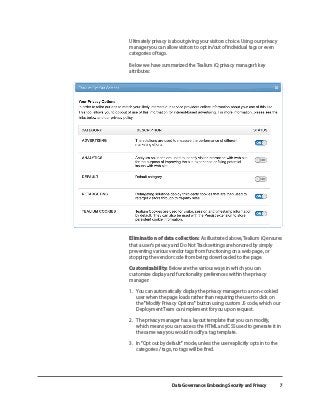
	 Ultimately privacy is about giving your visitors choice. Using our privacy
manager you can allow visitors to opt in/out of individual tags or even
categories of tags.
Below we have summarized the Tealium iQ privacy manager’s key
attributes:
	 Elimination of data collection: As illustrated above, Tealium iQ ensures
that a user’s privacy and Do Not Track settings are honored by simply
preventing various vendor tags from functioning on a web page, or
stopping the vendor code from being downloaded to the page.
	Customizability: Below are the various ways in which you can
customize display and functionality preferences within the privacy
manager:
	 1. 	 You can automatically display the privacy manager to a non-cookied 	
	 user when the page loads rather than requiring the user to click on 	
	 the "Modify Privacy Options" button using custom JS code, which our 	
	 Deployment Team can implement for you upon request.
	 2. 	 The privacy manager has a layout template that you can modify, 		
	 which means you can access the HTML and CSS used to generate it in 	
	 the same way you would modify a tag template.
	 3. 	 In “Opt out by default” mode, unless the user explicitly opts in to the 	
	 categories / tags, no tags will be fired.
Data Governance: Embracing Security and Privacy
8
Summary
How well are you protecting your data?
Tealium’s Data Governance Package helps customers manage their implementation of Tealium’s software to facilitate
their data governance and privacy controls. Tealium will assist customers in configuring and monitoring Tealium iQ
Tag Management, AudienceStream and verify according to industry best practices.*
Data Governance Package
Configuration (One-Time)
•	 Privacy Manager for up to five (5) Digital Properties
Enables Visitors within the Digital Properties where Tealium iQ is deployed and the Privacy Manager enabled,
to opt-in or opt-out accordingly for technology tags (and in some cases potentially dropping cookies) that
subsequently load in Visitors’ web browsers.
•	 Opt-In Notification for up to five (5) profiles
Configuration of a Consent Modal Window (or perhaps a Banner) to inform Visitors that cookies, tracking
mechanisms, and advertising technologies will be used on the website. In addition to this contextual window,
selection option gears are configured for consent policies of these items. For example, the Visitor can choose to
accept cookies but disallow specific marketing technologies such as a DSP.
•	 Tag Marketplace Policy for up to five (5) profiles
Configuration and limiting of vendors available in the tag marketplace policy to only provide specified tag
templates in the Tealium iQ interface. This allows for only those tag vendor templates that Customer’s InfoSec team
has deemed safe and acceptable to be accessible for any Tealium iQ administrator, thereby minimizing the risk that
unwanted tags will operate on Customer’s Digital Properties.
•	 Configure security-focused Extensions and/or Resource Locks and Labels
Encryption Extensions and Resource Locks and Labels will assign specific data definitions and Tag Logic to specific
Customer users, and prevent unauthorized editing or changes to those data variables, load rules, and tags. This
configuration applies to these elements for up to five (5) profiles.
•	 Review and configuration of user roles and permissions in accordance with least access best practices for
up to five (5) profiles
User roles and permissions are configured in an enterprise-class role-based access control approach that explicitly
activates environmental privileges for several areas of the Tealium iQ interface. For example the ability to publish to
one or more environments (Dev, QA, and Prod) and the ability to implement Tealium iQ extensions.
•	 Configuration of tag reports that summarize data collection.
Tealium deployment services will create reports that summarize the data collected throughout a designated time
period and provide those reports to Customer.
•	 Configuration of five (5) major user funnels for proper data layer configuration
Tealium deployment services will configure the funnel(s) that will confirm the required data is in fact on the Digital
Property in question.
•	 Configuration of Opt-Out Audience
This configuration will ensure that when users choose to opt-out of tracking (via the Consent modal), they are
scheduled for purge from the AudienceStream solution. This is delivered by configuring an “Opt Out” Audience.
*For AudienceStream enabled customers only.
Data Governance: Embracing Security and Privacy 9
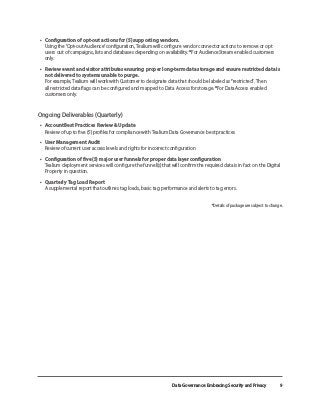
•	 Configuration of opt-out actions for (5) supporting vendors.
Using the ‘Opt-out Audience’ configuration, Tealium will configure vendor connector actions to remove or opt
users out of campaigns, lists and databases depending on availability. *For AudienceStream enabled customers
only.
•	 Review event and visitor attributes ensuring proper long-term data storage and ensure restricted data is
not delivered to systems unable to purge.
For example, Tealium will work with Customer to designate data that should be labeled as “restricted”. Then
all restricted data flags can be configured and mapped to Data Access for storage. *For DataAccess enabled
customers only.
Ongoing Deliverables (Quarterly)
•	 Account Best Practices Review & Update
Review of up to five (5) profiles for compliance with Tealium Data Governance best practices
•	 User Management Audit
Review of current user access levels and rights for incorrect configuration
•	 Configuration of five (5) major user funnels for proper data layer configuration
Tealium deployment services will configure the funnel(s) that will confirm the required data is in fact on the Digital
Property in question.
•	 Quarterly Tag Load Report
A supplemental report that outlines tag loads, basic tag performance and alerts to tag errors.
*Details of package are subject to change.
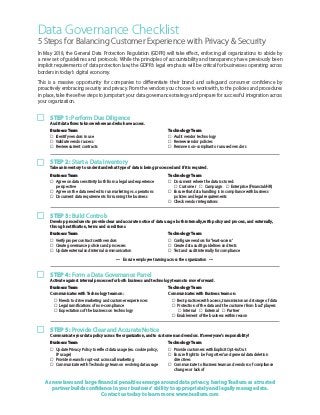
Data Governance Checklist
5 Steps for Balancing Customer Experience with Privacy & Security
In May 2018, the General Data Protection Regulation (GDPR) will take effect, enforcing all organizations to abide by
a new set of guidelines and protocols. While the principles of accountability and transparency have previously been
implicit requirements of data protection law, the GDPR’s legal emphasis will be critical for businesses operating across
borders in today’s digital economy.
This is a massive opportunity for companies to differentiate their brand and safeguard consumer confidence by
proactively embracing security and privacy. From the vendors you choose to work with, to the policies and procedures
in place, take these five steps to jumpstart your data governance strategy and prepare for successful integration across
your organization.
STEP 1: Perform Due Diligence
Audit data flows to know where and who have access.
STEP 3: Build Controls
Develop procedures to provide clear and accurate notice of data usage both internally, with policy and process, and externally,
through notification, terms and conditions.
STEP 2: Start a Data Inventory
Take an inventory to understand what type of data is being processed and if it is required.
STEP 4: Form a Data Governance Panel
Activate against internal processes for both business and technology teams to move forward.
STEP 5: Provide Clear and Accurate Notice
Communicate your data policy across the organization, and to customers and vendors. It’s everyone’s responsibility!
Business Team
 Identify vendors in use
 Validate vendor access
 Review current contracts
Business Team
 Verify proper contracts with vendors
 Create governance policies and processes
 Update external and internal communication
Business Team
 Agree on data sensitivity both from a legal and experience
	perspective
 Agree on the data needed to run marketing vs. operations
 Document data requirements for running the business
Business Team
Communicates with Technology team on:
	  Needs to drive marketing and customer experiences
	  Legal ramifications of non-compliance
	  Expectations of the business on technology
Business Team
 Update Privacy Policy to reflect data usage (ex. cookie policy, 	
	 IP usage)
 Provide means for opt-out across all marketing
 Communicate with Technology team on evolving data usage
Technology Team
 Audit vendor technology
 Review vendor policies
 Remove non-compliant or unused vendors
Technology Team
 Configure vendors for ‘least-access’
 Create data audit guidelines and tests
 Test and audit internally for compliance
Technology Team
 Document where the data is stored:
	  Customer  Campaign  Enterprise (Financial/HR)
 Ensure that data handling is in compliance with business 	
	 policies and legal requirements
 Check vendor integrations
Technology Team
Communicates with Business team on:
	  Best practices with access, transmission and storage of data
	  Protection of the data and the customer from ‘bad’ players 	
		  Internal  External  Partner
	  Enablement of the business within reason
Technology Team
 Provide customers with Explicit Opt-In/Out
 Ensure ‘Right to be Forgotten’ and general data deletion
	directives
 Communicate to Business team and vendors of compliance 	
	 changes or lack of





 Ensure employee training across the organization 
As new laws and large financial penalties emerge around data privacy, having Tealium as a trusted
partner builds confidence in your business’ ability to appropriately and legally manage data.
Contact us today to learn more: www.tealium.com
©2018 Tealium Inc. All rights reserved. Tealium, Tealium iQ, AudienceStream, and all other Tealium marks
contained herein are trademarks or service marks of Tealium. All other marks are the property of their
respective owners. Rev. 050118
Tealium has offices worldwide. Phone numbers and addresses are listed on the
Tealium website at tealium.com/contact.
Global Headquarters
11095 Torreyana Road
San Diego, CA 92121
(858) 779-1344
tealium.com

Data Governance: Embracing Security and Privacy

  • 1.
  • 2.
    Executive summary We livein a global world where most online brands have an international footprint, but different regions you do business in require different approaches to data protection and privacy. Even if your business is headquartered and operating in the US, international data privacy laws should be a major concern. In July 2016, the EU-US Privacy Shield took effect replacing Safe Harbor. The General Data Protection Regulation (GDPR) will enforce all organizations to abide by specific protocols. While the principles of accountability and transparency have previously been implicit requirements of data protection law, the GDPR’s new legal framework will be critical for both businesses and consumers operating across borders in today’s digital economy to fully understand. How will you balance providing a seamless customer experience with the increasing responsibilities in data privacy and security? Vigilance is key– not just because of the legal ramifications of these new guidelines, but the effect that leakage and security events have on the brand itself. As an industry we owe it to end customers to be transparent and ethical with data, ensuring that what is collected and known is used for the purposes of better experiences for those end customers. By investing time to perform the proper analysis and planning, you can be confident in implementing a program that will minimize risk, build trust, and protect your brand. The precursors to massive change in our space are clear. Now we, as an industry, need to adapt before we are forced to. From the vendors you choose to work with, to the policies and procedures in place, this whitepaper discusses steps to take today for building an effective data governance strategy. Learn to make sense of the current legal landscape, ensure successful integration across your organization, and how to provide these safeguards to your customers. Data Governance: Embracing Security and Privacy 2
  • 3.
    Data Governance: EmbracingSecurity and Privacy 3 Overview of current environment...............................................................................4 Key implications..................................................................................................................5 Value proposition ..............................................................................................................6 The Tealium solution.........................................................................................................6 Summary...............................................................................................................................8 Data governance package .............................................................................................8 Data governance checklist ...........................................................................................10 Table of Contents
  • 4.
    Data Governance: EmbracingSecurity and Privacy 4 1. Overview of current environment A significant legislative shift in data governance is taking place in Europe and leading the way towards global change. The rapidly-growing number of digital marketing vendors, channels, and customer touchpoints, along with a shifting global data privacy environment, is creating a serious data governance problem in the digital space. With Safe Harbor1 being ruled invalid in October of 2015, the EU-US Privacy Shield approved to take its place in July of 2016 and more stringent regulations with GDPR, companies now face the risk of a severe penalties should they be found non-compliant with these new regulations The EU-US Privacy Shield, which replaced Safe Harbor, is a framework for transatlantic exchanges of personal data for business purposes between the EU and the US. It is a more prescriptive set of guidelines that is intended to provide a higher level of protection for EU citizens, and includes General Data Protection Regulation (“GDPR”) for how penalties are enforced. The GDPR will become law in May 2018. There are a number of key factors that companies should understand regarding these new guidelines on the horizon. First, the GDPR applies if you are processing personal data in connection with the provision of goods and services to EU citizens (even if the goods or services are free), or if you are monitoring EU citizens’ behavior. Second, it is important to note that the regulations apply regardless of where the data controller (you) is located and is not limited to businesses just in the EU. The penalties for non-compliance with Privacy Shield and the GDPR are severe. For major infractions, such as simply not providing an explicit opt-in for visitors, the penalty is EUR 20 million or four percent of annual revenue, whichever is greater. Minor infractions can result in penalties of up to EUR 10 million or two percent of annual revenue. The EU ePrivacy directive, also known as the ‘cookie directive’, has resurfaced as of late since updates are needed in order to ensure it aligns well with the GDPR. Currently, the ePrivacy directive regulates how a company’s digital properties collect an EU citizen’s data and requires them to obtain consent to store or retrieve their personal data. While updates to the directive have not been finalized, suggested revisions could make this process even more complex and confusing for brands. 1 This US-based legal framework built on seven principles for allowing data transfer from EU to US was abolished in 2015.
  • 5.
    Data Governance: EmbracingSecurity and Privacy 5 2. Key implications With GDPR, it is your organization that could face penalties of non- compliance with regulations, even if it is your vendors who are at fault. Although the GDPR has established clear responsibility and accountability around the handling of personal data by controllers (you) and processors (vendors), the burden for data protection still rests predominantly with you. As brand and data controllers, your organization will be held responsible for ensuring direct, as well as third-party, vendor compliance with both the EU US Privacy Shield and GDPR. What is happening in Europe is believed to be the canary in the coal mine for the US and elsewhere, potentially impacting your business in the near future wherever your customers are located. And while Europe has been at the forefront of this regulatory shift around protecting EU citizen’s data, changes are taking place in the US, as well, to protect US citizen’s data. A US telecommunications firm began using unique, undeletable identifiers, or supercookies, called UIDH (unique identifier header) to track mobile customers for ad-targeting purposes in 2012. They had made limited disclosures in its privacy policy, but did not update its privacy policy to include information on its use of supercookies until March 2015. Meanwhile, an online advertising company began to use the supercookies – meaning the vendor could restore a cookie ID that a user has cleared from his/her browser if it is associated with a UIDH. The FCC said that the telecommunications company’s failure to disclose accurate and adequate information to consumers about the supercookies violated the transparency requirements from the FCC’s 2010 net neutrality rules. They now have to implement a 3-year compliance plan and obtain customers’ opt-in consent before sharing UIDH with third parties.
  • 6.
    Data Governance: EmbracingSecurity and Privacy 6 3. Value proposition Given our unique position in the data supply chain, having Tealium as a trusted partner builds confidence in your business’ ability to appropriately and legally manage data, while significantly reducing your reliance on your digital marketing and analytics vendors to adhere to privacy standards. In particular, Tealium can support your efforts in setting proper consent and providing clear transparency around data collection and usage; both key aspects of the ePrivacy directive. Country-Specific Compliance Some countries have very specific laws about what types of information organizations can collect about their online visitors, and what sort of privacy options must be enabled – this includes any tags collecting data, all of which must be compliant with local in-country privacy regulations. Tealium iQ Tag Management supports geography-based privacy compliance, allowing organizations to apply standards by country and giving precise control over the data collection practices of each vendor. Tealium’s flexibility in this offering is especially important in regards to the ePrivacy directive as each country can take on the aspects selectively. Client-Side Decision-Making Capabilities Our unique depth and breadth of experience across clients facilitates our understanding of how to ensure explicit opt-in compliance on the front end for visitors. Geographical Data Restrictions Our automated regionalized data collection and storage for server-to- server data governance serves as a key competitive edge over our peers. Support for ‘Right to be Forgotten’ Tealium’s unique position as the data supplier to your marketing technology ecosystem enables it to be an ideal place to handle user opt out across all your marketing channels. Tealium’s server side connectors will trigger ‘delete’ directives through APIs whenever a user has selected the right to be forgotten. This is a start to providing support for GDPR’s ‘Right to be Forgotten’ stipulation. 4. The Tealium solution When it comes to the new legislation around data security and privacy, Tealium is ahead of the curve helping businesses manage evolving privacy and data protection expectations. It has become increasingly important to understand how your data is being collected, where your data is going and who is using that data. Our approach empowers users to securely control and manage your data at the source– across web, mobile IoT and connected devices. Tealium offers a number of robust privacy control features and granular vendor management capabilities to support your Data Governance needs– such as our Tag Marketplace Policy, Resource Locks, Versions, multiple deployment environments, individual user based permissions, workflow management and privacy manager. The Tealium iQ privacy manager is the core of the Data Governance Package, and enables our customers to easily offer opt-in or opt-out choices to their online visitors, providing total control over which third- party vendors or cookies those visitors want to allow while browsing that customer’s web properties.
  • 7.
    Data Governance: EmbracingSecurity and Privacy 7 Ultimately privacy is about giving your visitors choice. Using our privacy manager you can allow visitors to opt in/out of individual tags or even categories of tags. Below we have summarized the Tealium iQ privacy manager’s key attributes: Elimination of data collection: As illustrated above, Tealium iQ ensures that a user’s privacy and Do Not Track settings are honored by simply preventing various vendor tags from functioning on a web page, or stopping the vendor code from being downloaded to the page. Customizability: Below are the various ways in which you can customize display and functionality preferences within the privacy manager: 1. You can automatically display the privacy manager to a non-cookied user when the page loads rather than requiring the user to click on the "Modify Privacy Options" button using custom JS code, which our Deployment Team can implement for you upon request. 2. The privacy manager has a layout template that you can modify, which means you can access the HTML and CSS used to generate it in the same way you would modify a tag template. 3. In “Opt out by default” mode, unless the user explicitly opts in to the categories / tags, no tags will be fired.
  • 8.
    Data Governance: EmbracingSecurity and Privacy 8 Summary How well are you protecting your data? Tealium’s Data Governance Package helps customers manage their implementation of Tealium’s software to facilitate their data governance and privacy controls. Tealium will assist customers in configuring and monitoring Tealium iQ Tag Management, AudienceStream and verify according to industry best practices.* Data Governance Package Configuration (One-Time) • Privacy Manager for up to five (5) Digital Properties Enables Visitors within the Digital Properties where Tealium iQ is deployed and the Privacy Manager enabled, to opt-in or opt-out accordingly for technology tags (and in some cases potentially dropping cookies) that subsequently load in Visitors’ web browsers. • Opt-In Notification for up to five (5) profiles Configuration of a Consent Modal Window (or perhaps a Banner) to inform Visitors that cookies, tracking mechanisms, and advertising technologies will be used on the website. In addition to this contextual window, selection option gears are configured for consent policies of these items. For example, the Visitor can choose to accept cookies but disallow specific marketing technologies such as a DSP. • Tag Marketplace Policy for up to five (5) profiles Configuration and limiting of vendors available in the tag marketplace policy to only provide specified tag templates in the Tealium iQ interface. This allows for only those tag vendor templates that Customer’s InfoSec team has deemed safe and acceptable to be accessible for any Tealium iQ administrator, thereby minimizing the risk that unwanted tags will operate on Customer’s Digital Properties. • Configure security-focused Extensions and/or Resource Locks and Labels Encryption Extensions and Resource Locks and Labels will assign specific data definitions and Tag Logic to specific Customer users, and prevent unauthorized editing or changes to those data variables, load rules, and tags. This configuration applies to these elements for up to five (5) profiles. • Review and configuration of user roles and permissions in accordance with least access best practices for up to five (5) profiles User roles and permissions are configured in an enterprise-class role-based access control approach that explicitly activates environmental privileges for several areas of the Tealium iQ interface. For example the ability to publish to one or more environments (Dev, QA, and Prod) and the ability to implement Tealium iQ extensions. • Configuration of tag reports that summarize data collection. Tealium deployment services will create reports that summarize the data collected throughout a designated time period and provide those reports to Customer. • Configuration of five (5) major user funnels for proper data layer configuration Tealium deployment services will configure the funnel(s) that will confirm the required data is in fact on the Digital Property in question. • Configuration of Opt-Out Audience This configuration will ensure that when users choose to opt-out of tracking (via the Consent modal), they are scheduled for purge from the AudienceStream solution. This is delivered by configuring an “Opt Out” Audience. *For AudienceStream enabled customers only.
  • 9.
    Data Governance: EmbracingSecurity and Privacy 9 • Configuration of opt-out actions for (5) supporting vendors. Using the ‘Opt-out Audience’ configuration, Tealium will configure vendor connector actions to remove or opt users out of campaigns, lists and databases depending on availability. *For AudienceStream enabled customers only. • Review event and visitor attributes ensuring proper long-term data storage and ensure restricted data is not delivered to systems unable to purge. For example, Tealium will work with Customer to designate data that should be labeled as “restricted”. Then all restricted data flags can be configured and mapped to Data Access for storage. *For DataAccess enabled customers only. Ongoing Deliverables (Quarterly) • Account Best Practices Review & Update Review of up to five (5) profiles for compliance with Tealium Data Governance best practices • User Management Audit Review of current user access levels and rights for incorrect configuration • Configuration of five (5) major user funnels for proper data layer configuration Tealium deployment services will configure the funnel(s) that will confirm the required data is in fact on the Digital Property in question. • Quarterly Tag Load Report A supplemental report that outlines tag loads, basic tag performance and alerts to tag errors. *Details of package are subject to change.
  • 10.
    Data Governance Checklist 5Steps for Balancing Customer Experience with Privacy & Security In May 2018, the General Data Protection Regulation (GDPR) will take effect, enforcing all organizations to abide by a new set of guidelines and protocols. While the principles of accountability and transparency have previously been implicit requirements of data protection law, the GDPR’s legal emphasis will be critical for businesses operating across borders in today’s digital economy. This is a massive opportunity for companies to differentiate their brand and safeguard consumer confidence by proactively embracing security and privacy. From the vendors you choose to work with, to the policies and procedures in place, take these five steps to jumpstart your data governance strategy and prepare for successful integration across your organization. STEP 1: Perform Due Diligence Audit data flows to know where and who have access. STEP 3: Build Controls Develop procedures to provide clear and accurate notice of data usage both internally, with policy and process, and externally, through notification, terms and conditions. STEP 2: Start a Data Inventory Take an inventory to understand what type of data is being processed and if it is required. STEP 4: Form a Data Governance Panel Activate against internal processes for both business and technology teams to move forward. STEP 5: Provide Clear and Accurate Notice Communicate your data policy across the organization, and to customers and vendors. It’s everyone’s responsibility! Business Team  Identify vendors in use  Validate vendor access  Review current contracts Business Team  Verify proper contracts with vendors  Create governance policies and processes  Update external and internal communication Business Team  Agree on data sensitivity both from a legal and experience perspective  Agree on the data needed to run marketing vs. operations  Document data requirements for running the business Business Team Communicates with Technology team on:  Needs to drive marketing and customer experiences  Legal ramifications of non-compliance  Expectations of the business on technology Business Team  Update Privacy Policy to reflect data usage (ex. cookie policy, IP usage)  Provide means for opt-out across all marketing  Communicate with Technology team on evolving data usage Technology Team  Audit vendor technology  Review vendor policies  Remove non-compliant or unused vendors Technology Team  Configure vendors for ‘least-access’  Create data audit guidelines and tests  Test and audit internally for compliance Technology Team  Document where the data is stored:  Customer  Campaign  Enterprise (Financial/HR)  Ensure that data handling is in compliance with business policies and legal requirements  Check vendor integrations Technology Team Communicates with Business team on:  Best practices with access, transmission and storage of data  Protection of the data and the customer from ‘bad’ players  Internal  External  Partner  Enablement of the business within reason Technology Team  Provide customers with Explicit Opt-In/Out  Ensure ‘Right to be Forgotten’ and general data deletion directives  Communicate to Business team and vendors of compliance changes or lack of       Ensure employee training across the organization  As new laws and large financial penalties emerge around data privacy, having Tealium as a trusted partner builds confidence in your business’ ability to appropriately and legally manage data. Contact us today to learn more: www.tealium.com
  • 11.
    ©2018 Tealium Inc.All rights reserved. Tealium, Tealium iQ, AudienceStream, and all other Tealium marks contained herein are trademarks or service marks of Tealium. All other marks are the property of their respective owners. Rev. 050118 Tealium has offices worldwide. Phone numbers and addresses are listed on the Tealium website at tealium.com/contact. Global Headquarters 11095 Torreyana Road San Diego, CA 92121 (858) 779-1344 tealium.com