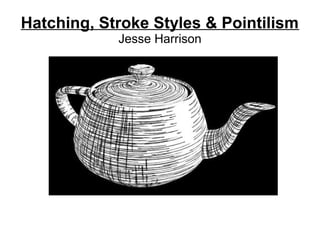
Hatching, Stroke Styles & Pointilism
Jesse Harrison
What is hatching?
●

●

●

Hatching is an artistic technique used to
create a tonal or shading effect.
The effect is created by drawing closely
spaced parallel lines.
A common variation of hatching is to draw the
lines at an angle to each other, this is simply
called crosshatching.
Objective
●

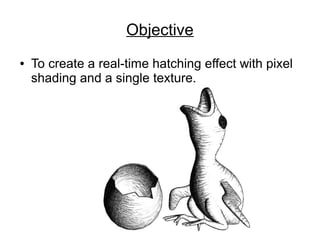
To create a real-time hatching effect with pixel
shading and a single texture.
Creating Stroke Textures
●

●

Typically four different stroke textures are
loaded to represent overlapping strokes. Two
horizontal and two vertical.
One of the first suggestions this paper makes
is to use only one texture and rotate the
texture coordinates accordingly to obtain the
original effect of four different strokes.
Creating Stroke Textures
●

So you would start with a texture
of strokes that looks similar to
this and this will give you all you
need.

●

The four different types of strokes, our stroke
colors (stored in rgb channels) and our
intensity threshold value (stored in alpha
channel)
Threshold Scheme
●

●

●

Utilizing the threshold t of the alpha channel we
can control stroke intensity by modulating
between the stroke color and the background
color.
To do this we give each stroke an intensity
interval [start,end] and map t to this interval by
start + t/(end-start)
After computing a desired intensity we can
modulate the stroke color with the background
Varying the line style
●

For this method we do not encode stokes themselves
into a texture, but instead encode lookups into a
single-stroke textures called Stroke-Lookup Textures.

●

(a) is the r-channel with lookup in s

●

(b) is the g-channel with lookup in t

●

(c) is the b-channel which contains the threshold

●

(d) is the a-channel which is used as a stencil
Varying the line style
●

●

●

For achieving a uniform screen width of the
strokes we use mip-map levels with strokes of
the same texel size.
Generation of mip-map levels would halve the
texel width of a stroke each level. I.E. further
away strokes are smaller
For correct interpolation between mip-map
levels the stroke-lookup coordinates are
expanded from [0,1] to [-0.5,1.5]
Varying the line style
Specular Highlights
●

●

Specular Highlighting: Lighter strokes can be
drawn on the assumption that there is not a
white background.
Once a certain threshold is reached we can
draw a lighter stroke, instead of just white,
using the same dark stroke textures and
taking 1-previous_threshold to maintain stroke
priority.
Lighting Hand Drawn Illustrations
●

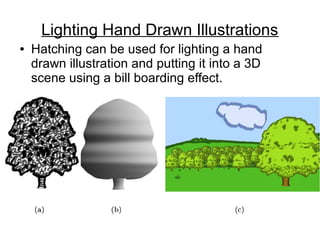
Hatching can be used for lighting a hand
drawn illustration and putting it into a 3D
scene using a bill boarding effect.
Stroke Colors & Pointillism
●

●

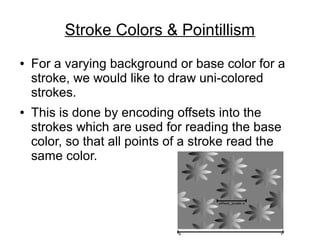
For a varying background or base color for a
stroke, we would like to draw uni-colored
strokes.
This is done by encoding offsets into the
strokes which are used for reading the base
color, so that all points of a stroke read the
same color.
Conclusion
●

●

Utilizing pixel shaders we are provided with
many stroke based rendering techniques.
The main one being the hatching scheme and
the many extensions it has.

Hatching

  • 1.
    Hatching, Stroke Styles& Pointilism Jesse Harrison
  • 2.
    What is hatching? ● ● ● Hatchingis an artistic technique used to create a tonal or shading effect. The effect is created by drawing closely spaced parallel lines. A common variation of hatching is to draw the lines at an angle to each other, this is simply called crosshatching.
  • 3.
    Objective ● To create areal-time hatching effect with pixel shading and a single texture.
  • 4.
    Creating Stroke Textures ● ● Typicallyfour different stroke textures are loaded to represent overlapping strokes. Two horizontal and two vertical. One of the first suggestions this paper makes is to use only one texture and rotate the texture coordinates accordingly to obtain the original effect of four different strokes.
  • 5.
    Creating Stroke Textures ● Soyou would start with a texture of strokes that looks similar to this and this will give you all you need. ● The four different types of strokes, our stroke colors (stored in rgb channels) and our intensity threshold value (stored in alpha channel)
  • 6.
    Threshold Scheme ● ● ● Utilizing thethreshold t of the alpha channel we can control stroke intensity by modulating between the stroke color and the background color. To do this we give each stroke an intensity interval [start,end] and map t to this interval by start + t/(end-start) After computing a desired intensity we can modulate the stroke color with the background
  • 7.
    Varying the linestyle ● For this method we do not encode stokes themselves into a texture, but instead encode lookups into a single-stroke textures called Stroke-Lookup Textures. ● (a) is the r-channel with lookup in s ● (b) is the g-channel with lookup in t ● (c) is the b-channel which contains the threshold ● (d) is the a-channel which is used as a stencil
  • 8.
    Varying the linestyle ● ● ● For achieving a uniform screen width of the strokes we use mip-map levels with strokes of the same texel size. Generation of mip-map levels would halve the texel width of a stroke each level. I.E. further away strokes are smaller For correct interpolation between mip-map levels the stroke-lookup coordinates are expanded from [0,1] to [-0.5,1.5]
  • 9.
  • 10.
    Specular Highlights ● ● Specular Highlighting:Lighter strokes can be drawn on the assumption that there is not a white background. Once a certain threshold is reached we can draw a lighter stroke, instead of just white, using the same dark stroke textures and taking 1-previous_threshold to maintain stroke priority.
  • 11.
    Lighting Hand DrawnIllustrations ● Hatching can be used for lighting a hand drawn illustration and putting it into a 3D scene using a bill boarding effect.
  • 12.
    Stroke Colors &Pointillism ● ● For a varying background or base color for a stroke, we would like to draw uni-colored strokes. This is done by encoding offsets into the strokes which are used for reading the base color, so that all points of a stroke read the same color.
  • 13.
    Conclusion ● ● Utilizing pixel shaderswe are provided with many stroke based rendering techniques. The main one being the hatching scheme and the many extensions it has.

Editor's Notes

  • #2 {"1":"<number>\n"}