Knowledge Graph: Google is Stealing Your Traffic. Steal it Back!
Google's knowledge graph may be great for users, but it very often hurts sites. This presentation will show the extent of that damage, and how to fight against the knowledge graph, or even use it to your advantage.
About This Presentation
•What is the Knowledge
Graph?
• How is it affecting you?
• Not all sites are created
equal
• How the Knowledge Graph
can actually help you.
3.
About Me
• EliFeldblum
• CTO & Founder of
RankAbove
• eli@rankabove.com
• @FeldBum
• 050-333-0915 (Israel)
• 201-815-9467 (US)
4.
What is theKnowledge Graph?
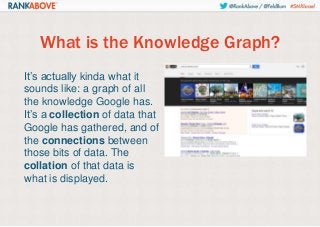
It’s actually kinda what it
sounds like: a graph of all
the knowledge Google has.
It’s a collection of data that
Google has gathered, and of
the connections between
those bits of data. The
collation of that data is
what is displayed.
5.
What is theKnowledge Graph?
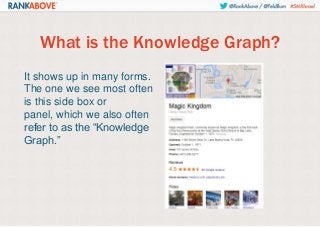
It shows up in many forms.
The one we see most often
is this side box or
panel, which we also often
refer to as the ―Knowledge
Graph.‖
6.
What is theKnowledge Graph?
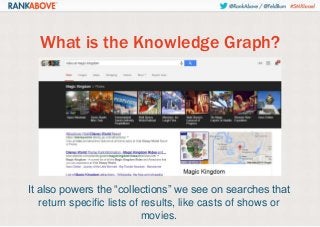
It also powers the ―collections‖ we see on searches that
return specific lists of results, like casts of shows or
movies.
7.
What is theKnowledge Graph?
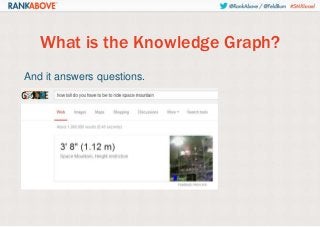
And it answers questions.
8.
What is theKnowledge Graph?
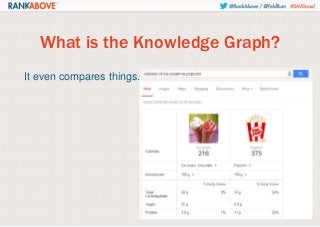
It even compares things.
9.
How Does itAffect Sites?
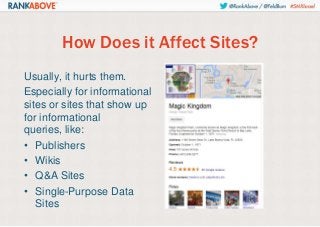
Usually, it hurts them.
Especially for informational
sites or sites that show up
for informational
queries, like:
• Publishers
• Wikis
• Q&A Sites
• Single-Purpose Data
Sites
10.
How Does itAffect Sites?
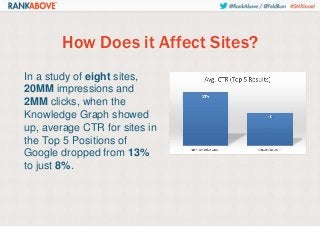
In a study of eight sites,
20MM impressions and
2MM clicks, when the
Knowledge Graph showed
up, average CTR for sites in
the Top 5 Positions of
Google dropped from 13%
to just 8%.
11.
How Does itAffect Sites?
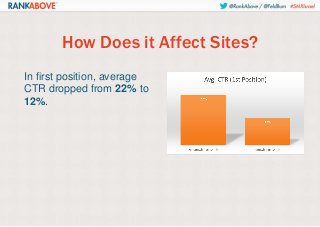
In first position, average
CTR dropped from 22% to
12%.
12.
How Does itAffect Sites?
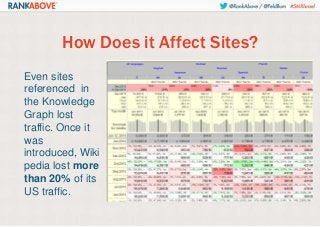
Even sites
referenced in
the Knowledge
Graph lost
traffic. Once it
was
introduced, Wiki
pedia lost more
than 20% of its
US traffic.
13.
But!
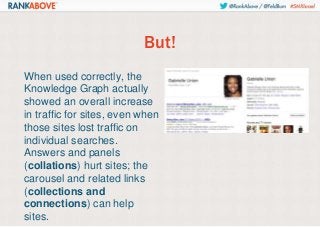
When used correctly,the
Knowledge Graph actually
showed an overall increase
in traffic for sites, even when
those sites lost traffic on
individual searches.
Answers and panels
(collations) hurt sites; the
carousel and related links
(collections and
connections) can help
sites.
14.
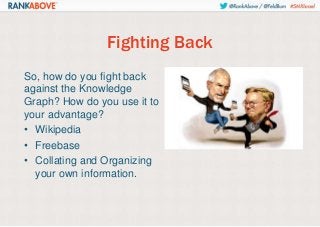
Fighting Back
So, howdo you fight back
against the Knowledge
Graph? How do you use it to
your advantage?
• Wikipedia
• Freebase
• Collating and Organizing
your own information.
15.
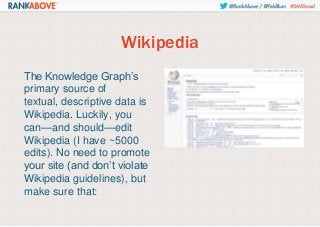
Wikipedia
The Knowledge Graph’s
primarysource of
textual, descriptive data is
Wikipedia. Luckily, you
can—and should—edit
Wikipedia (I have ~5000
edits). No need to promote
your site (and don’t violate
Wikipedia guidelines), but
make sure that:
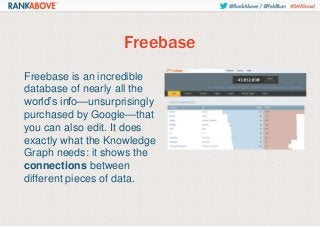
Freebase
Freebase is anincredible
database of nearly all the
world’s info—unsurprisingly
purchased by Google—that
you can also edit. It does
exactly what the Knowledge
Graph needs: it shows the
connections between
different pieces of data.
18.
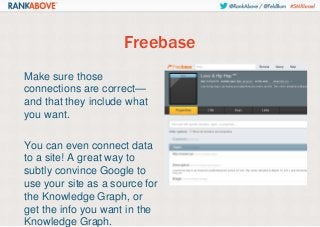
Freebase
Make sure those
connectionsare correct—
and that they include what
you want.
You can even connect data
to a site! A great way to
subtly convince Google to
use your site as a source for
the Knowledge Graph, or
get the info you want in the
Knowledge Graph.
19.
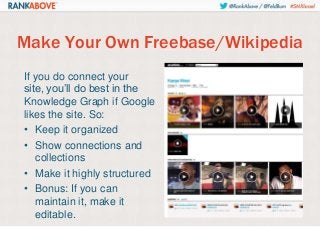
Make Your OwnFreebase/Wikipedia
If you do connect your
site, you’ll do best in the
Knowledge Graph if Google
likes the site. So:
• Keep it organized
• Show connections and
collections
• Make it highly structured
• Bonus: If you can
maintain it, make it
editable.
20.
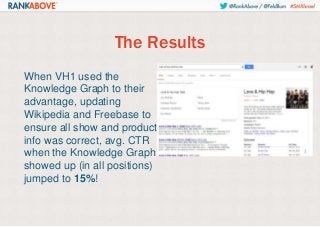
The Results
When VH1used the
Knowledge Graph to their
advantage, updating
Wikipedia and Freebase to
ensure all show and product
info was correct, avg. CTR
when the Knowledge Graph
showed up (in all positions)
jumped to 15%!
21.
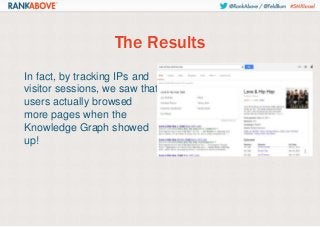
The Results
In fact,by tracking IPs and
visitor sessions, we saw that
users actually browsed
more pages when the
Knowledge Graph showed
up!
22.
The Results
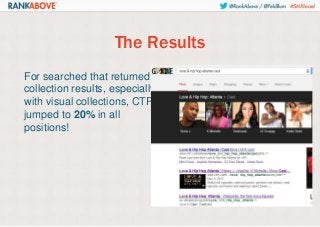
For searchedthat returned
collection results, especially
with visual collections, CTR
jumped to 20% in all
positions!
23.
One Last Thing!
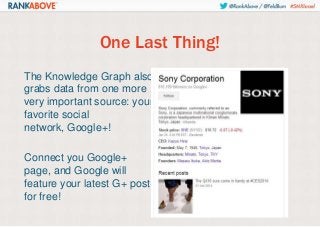
TheKnowledge Graph also
grabs data from one more
very important source: your
favorite social
network, Google+!
Connect you Google+
page, and Google will
feature your latest G+ post
for free!




![[EN].CleverGroup Vietnam Profile 20251202](https://cdn.slidesharecdn.com/ss_thumbnails/en-260120091417-fe6f88ec-thumbnail.jpg?width=640&height=640&fit=bounds)


