Time Value of Money The chief value of money lies in the fact that one lives in a world in which it is overestimated. HL Mencken
A firm is contemplating investing one lakh rupees in a project that is expected to pay rupees twenty thousands per annum over the next seven years. Should the firm accept the proposal?
Sale of land Two offers  10,000 11424 next year Bank interest rate =12% 10000 grows to 11200 Invest 10200 today at 12% to get 11424 next year.
Time Value of Money Money has a time value associated with it and therefore, a rupee received today is worth more than a rupee received in the future. The future value and present value of a rupee are based on the number of periods involved and the interest rate applicable.
The Manhattan Islands The Indians have always been ridiculed for selling the Manhattan Island for dollars 24 in 1624. Was it really ridiculous? If the Indians had invested dollars 24 at 6 per cent per annum, they would have had …….. If the Indians had been a little more astute and invested dollars 24 at 7.5%, they would now have had ……..
1000 crores 20,00,000 crores
Applications Value maximisation  Value a stream of cashflows Mortgage payments on a housing loan Periodical savings required to accumulate a certain sum Effective rate of borrowing for a car Return on investment Investment required to ensure pension after retirement Capital budgeting and financing decisions Valuation of bonds
Required Rate of Return Postponing consumption Inflation Risk  Cost to the company
Simple Interest Interest paid or earned only on the original amount Simple interest = Principle* Interest rate*    No of Periods Future value =Interest + Principle
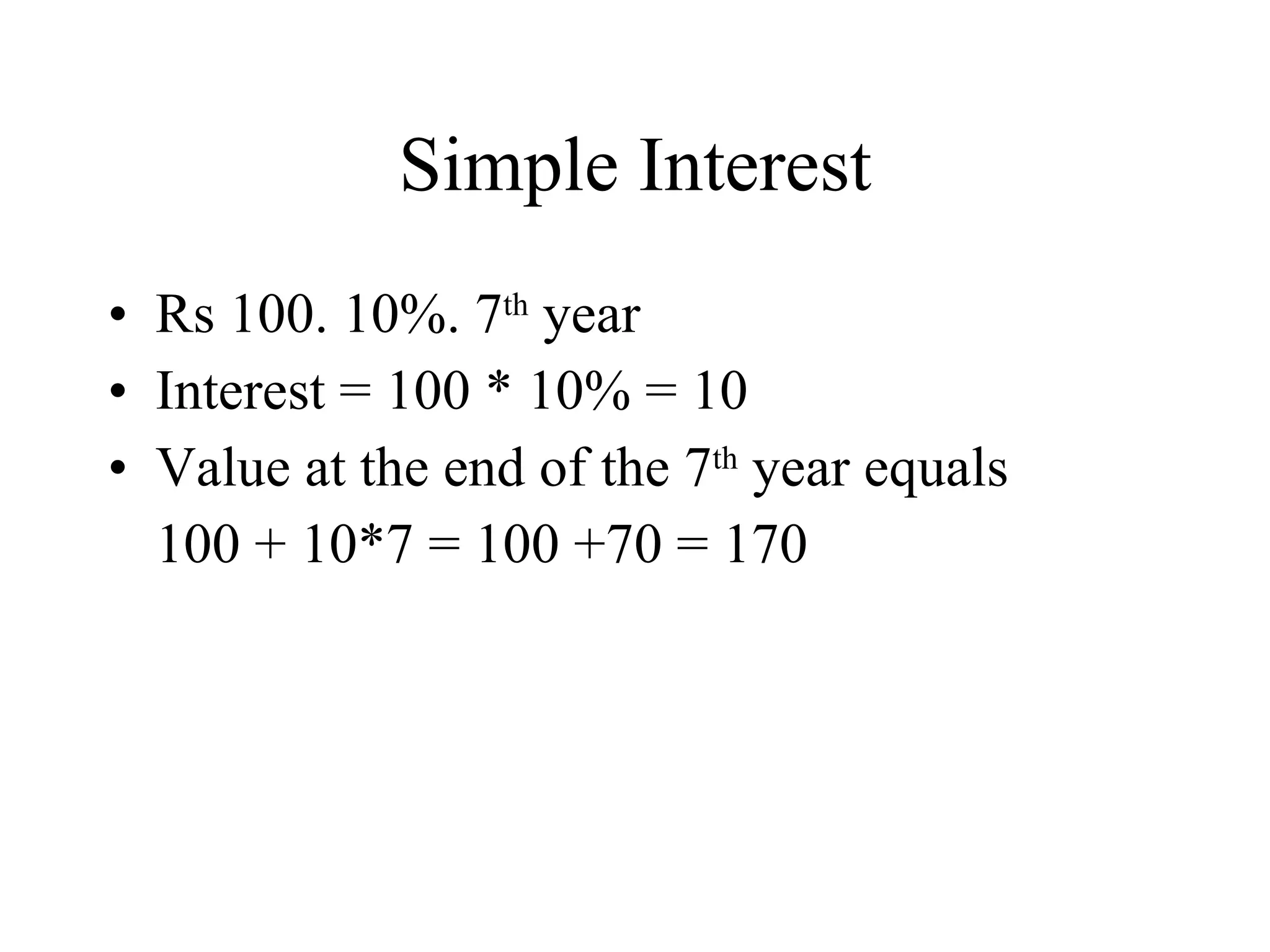
Simple Interest Rs 100. 10%. 7 th  year Interest = 100 * 10% = 10 Value at the end of the 7 th  year equals 100 + 10*7 = 100 +70 = 170
Compound Interest Interest earned during a period is added to the original principle to get the amount on which interest will be calculated in the next period. Interest earned during a period on the principle as well as the previous periods’ interest.
Compound Interest Rs 100. 10%. 7 th  year 100 (1+0.10) 7-1  * 0.1 =17.72 Value  = 100 (1+0.1) 7  = 194.87 Future Value Interest Factor (FVIF) = (1+r) n FVIF 10% 7Years = 1.949 Future Value = 100 * 1.949 = 194.90 FV n  = PV 0  * FVIF r,n
Benjamin Franklin Money makes money and the money that money makes, makes more money.
Ibbotson & Sinquefield Stock market return from 1926 $1 invested in 1926 grows to $2279 in 2001 10.71% compounded annually
The power of compounding can explain why well to do families bequeath their wealth to their grandchildren rather than their children. Parents would rather make their grandchildren very rich than make their children moderately rich. In these families, the grandchildren have a more positive view of the power of compounding than do the children.
Four Values Future value of a single amount Present value of a single amount Future value of an annuity Present value of an annuity
Future Value of a Single Amount What is an amount equal to in future FV = P 0  (1+r) n (1+r) n  is the Future Value Interest Factor FV n  = PV 0  * FVIF r,n
 
Present Value Present worth of a future cashflow Amount today that will grow to the specified amount at the end of the specified period Calculate present value of a future cashflow to make it comparable Calculation of present value of a future amount is called discounting.  The rate at which it is discounted is the discount rate or the capitalisation rate.
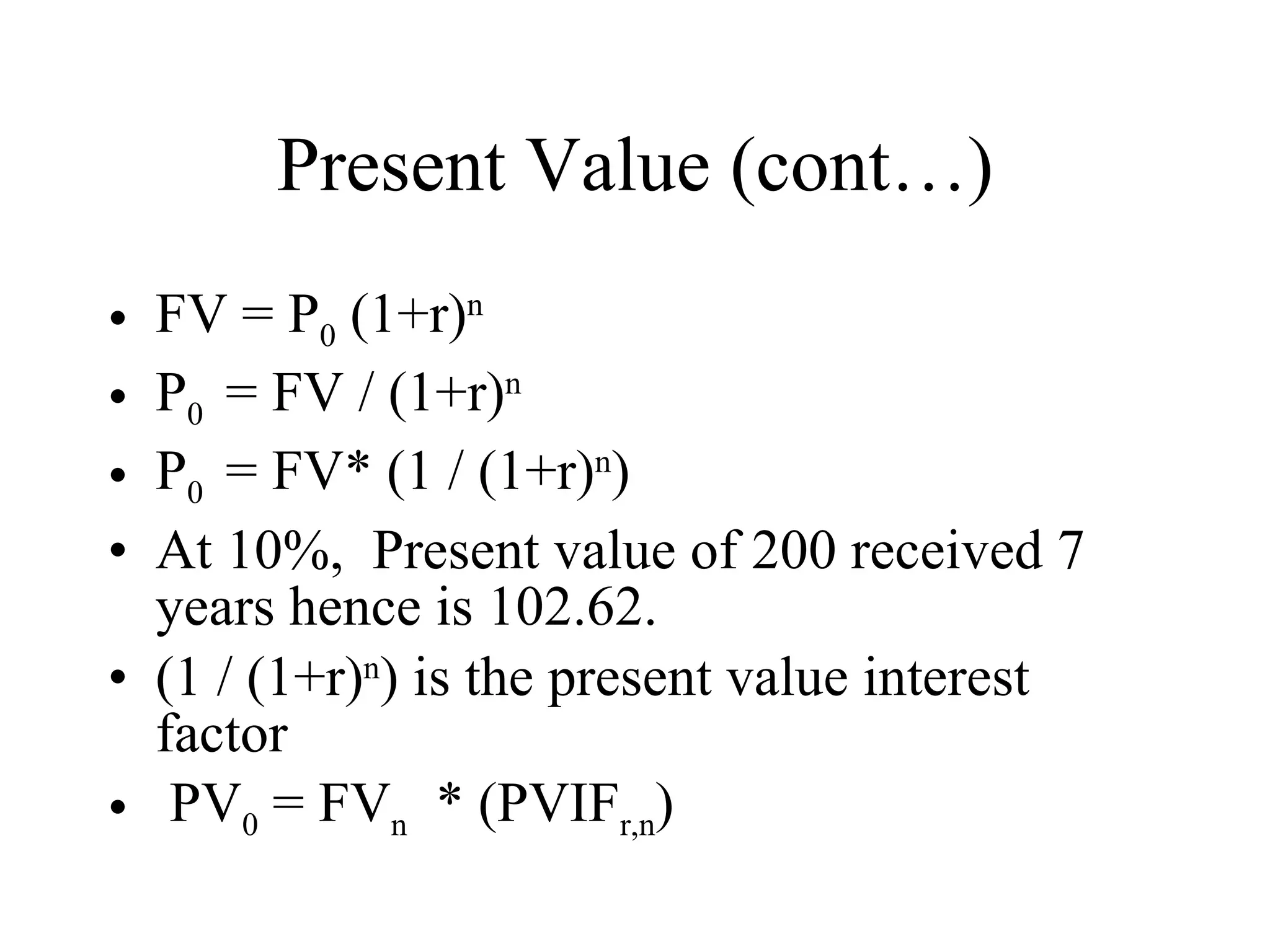
Present Value (cont…) FV = P 0  (1+r) n P 0  = FV / (1+r) n P 0  = FV* (1 / (1+r) n ) At 10%,  Present value of 200 received 7 years hence is 102.62. (1 / (1+r) n ) is the present value interest factor PV 0  = FV n   * (PVIF r,n )
Four Key Parameters Present value Future value Discount rate Periods
The Multiperiod Case: Future Value Suppose that Jay Ritter invested in the initial public offering of the Modigliani company. Modigliani pays a current dividend of $1.10, which is expected to grow at 40-percent per year for the next five years. What will the dividend be in five years? FV  = P 0 ×(1 +  r ) n $5.92 =  $1.10×(1.40) 5
Present Value and Compounding How much would an investor have to set aside today in order to have $20,000 five years from now if the current rate is 15%? 0 1 2 3 4 5 $20,000 PV
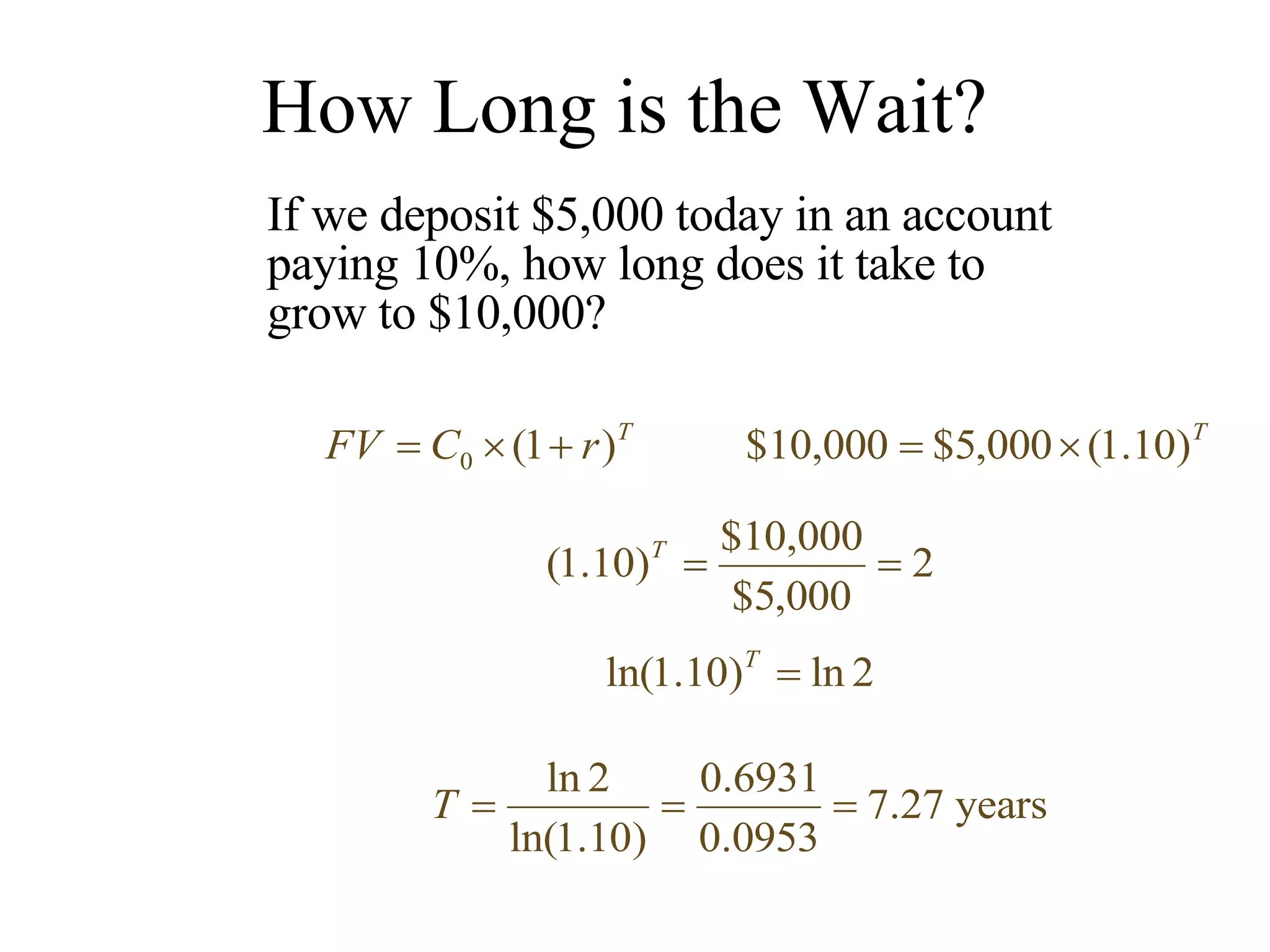
If we deposit $5,000 today in an account paying 10%, how long does it take to grow to $10,000? How Long is the Wait?
Assume the total cost of a college education will be $50,000 when your child enters college in 12 years. You have $5,000 to invest today. What rate of interest must you earn on your investment to cover the cost of your child’s education?  What Rate Is Enough? About 21.15%.
Special Considerations in TVM Annuity Perpetuity Growing perpetuity Intra year compounding
Annuities A series of equal cashflows over a specified number of periods Ordinary annuities : Payments start at the end of the current period.  Future value of an annuity (FVIFA i,n ) Present value of an annuity (PVIFA i,n )
Perpetuity  Equal cashflows which continue forever Perpetual bonds British railroad bonds
Growing Perpetuity A perpetuity that grows at a constant rate per annum Growth rate of companies
Perpetuity A constant stream of cash flows that lasts forever. … The formula for the present value of a perpetuity is: 0 1 C 2 C 3 C
Perpetuity What is the value of a British consol that promises to pay  £15 each year, every year until the sun turns into a red giant and burns the planet to a crisp?  The interest rate is 10-percent . … 0 1 £15 2 £15 3 £15
Growing Perpetuity A growing stream of cash flows that lasts forever. … The formula for the present value of a growing perpetuity is: 0 1 C 2 C ×(1+ g ) 3 C  ×(1+ g ) 2
Growing Perpetuity The expected dividend next year is $1.30 and dividends are expected to grow at 5% forever.  If the discount rate is 10%, what is the value of this promised dividend stream? 0 … 1 $1.30 2 $1.30 ×(1.05) 3 $1.30  ×(1.05) 2
Annuity A constant stream of cash flows with a fixed maturity. The formula for the present value of an annuity is: 0 1 C 2 C 3 C T C
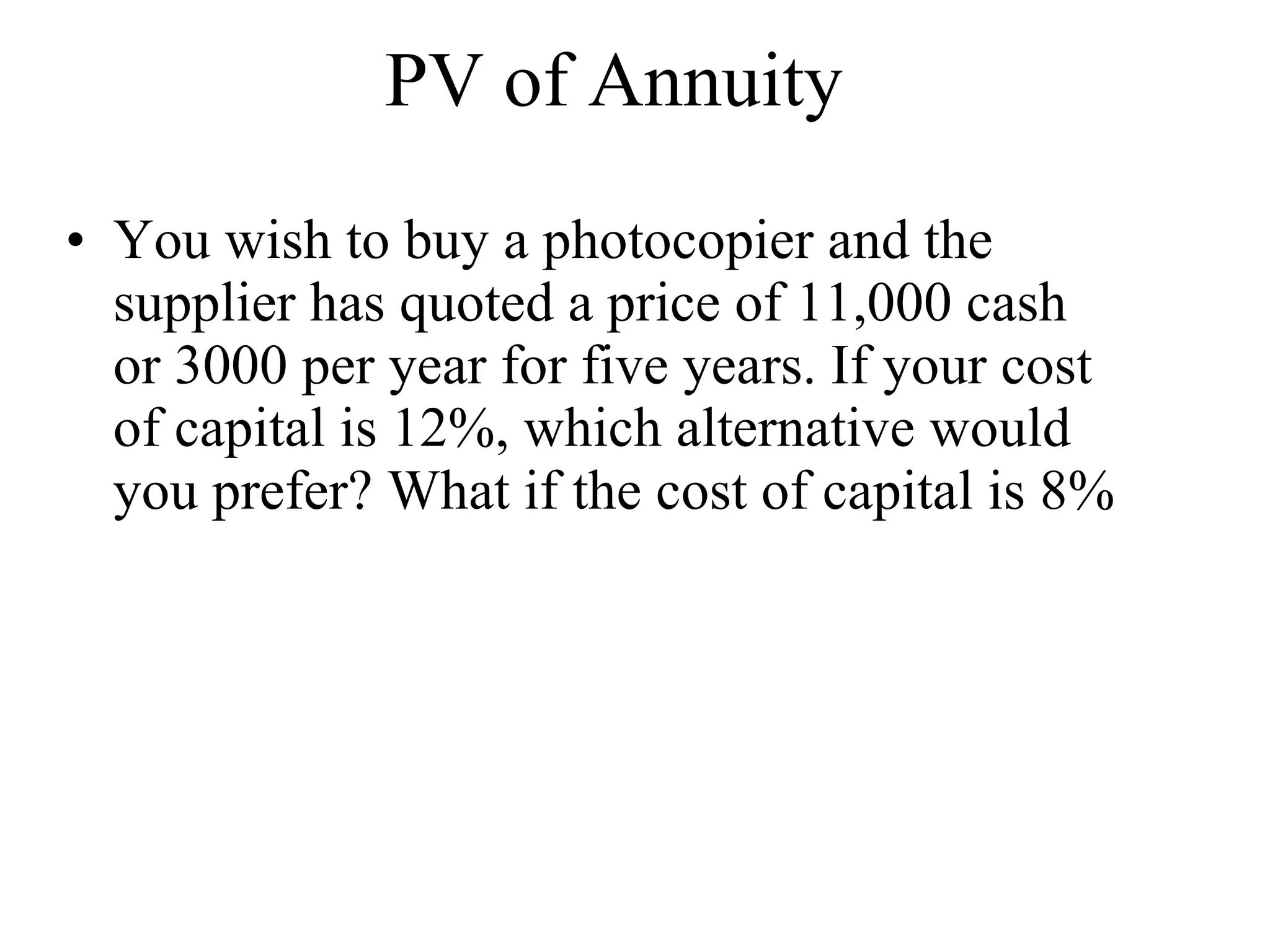
Annuity If you can afford a $400 monthly car payment, what value of car can you afford if interest rates are 7% on 36-month loans? 0 1 $400 2 $400 3 $400 36 $400
What is the present value of a four-year annuity of $100 per year that makes its first payment two years from today if the discount rate is 9%?    0   1   2   3  4  5 $100   $100   $100  $100 $327.97 $297.22
PV of Annuity You wish to buy a photocopier and the supplier has quoted a price of 11,000 cash or 3000 per year for five years. If your cost of capital is 12%, which alternative would you prefer? What if the cost of capital is 8%
Lottery New York State has started a lottery scheme wherin it will give away 40 million (2million per year for the next 20 years) to the winner. It plans to donate 50% of the collections of 36 million to charities. If the discount rate is 10%, will it save anything from the scheme or will it have to fund the charity donations from other sources?
Retirement Benefit Savings in pension fund up to 2000 per annum are tax free. You are starting your career at 25 years. You plan to retire at 65 years. Your investments are likely to yield 8% per annum. How much money will you have at retirement? What amount will you have if your annual returns are taxed at 25%.
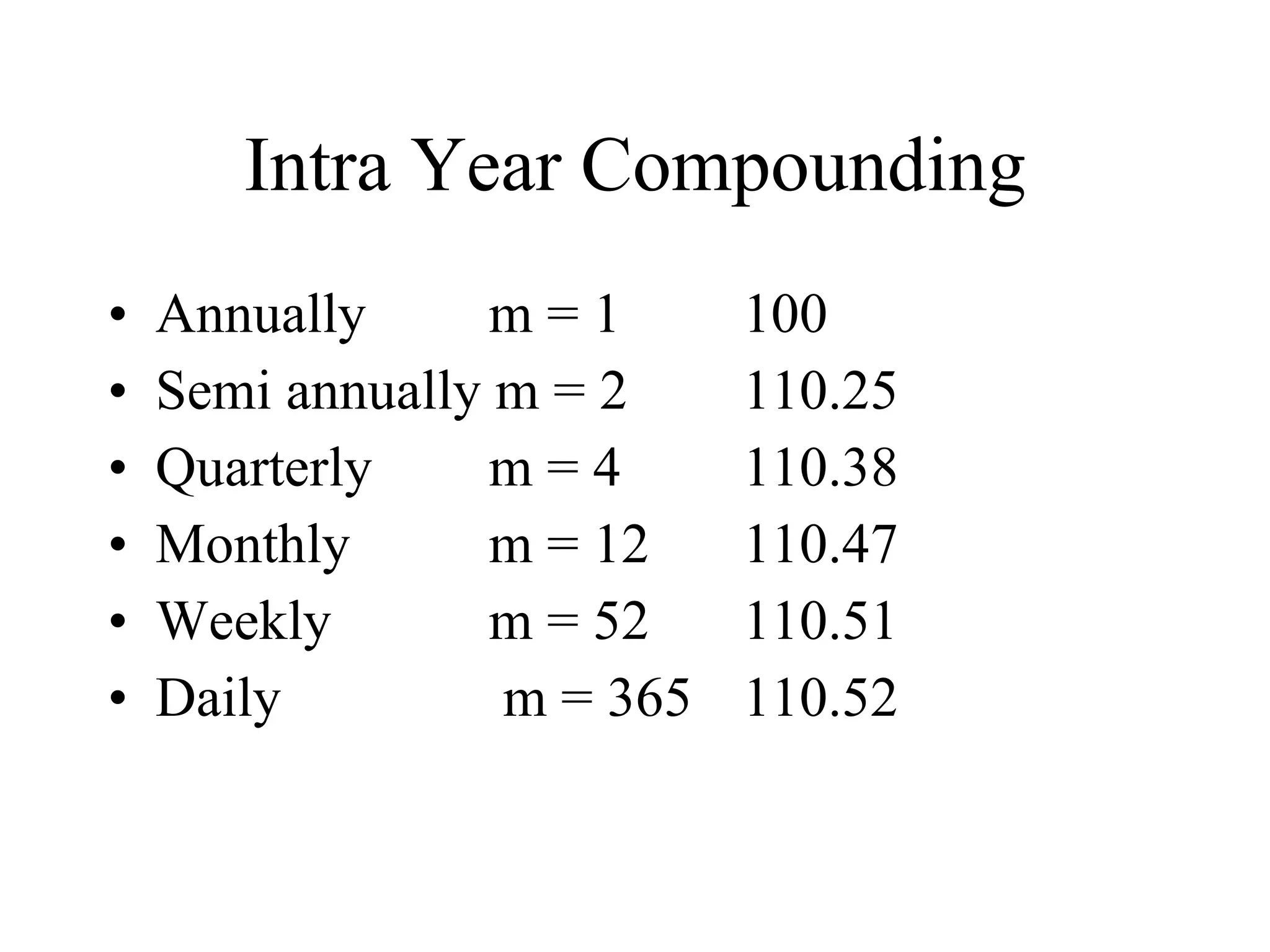
Intra Year Compounding Annually  m = 1 100 Semi annually m = 2 110.25 Quarterly  m = 4 110.38 Monthly  m = 12 110.47 Weekly  m = 52 110.51 Daily  m = 365  110.52
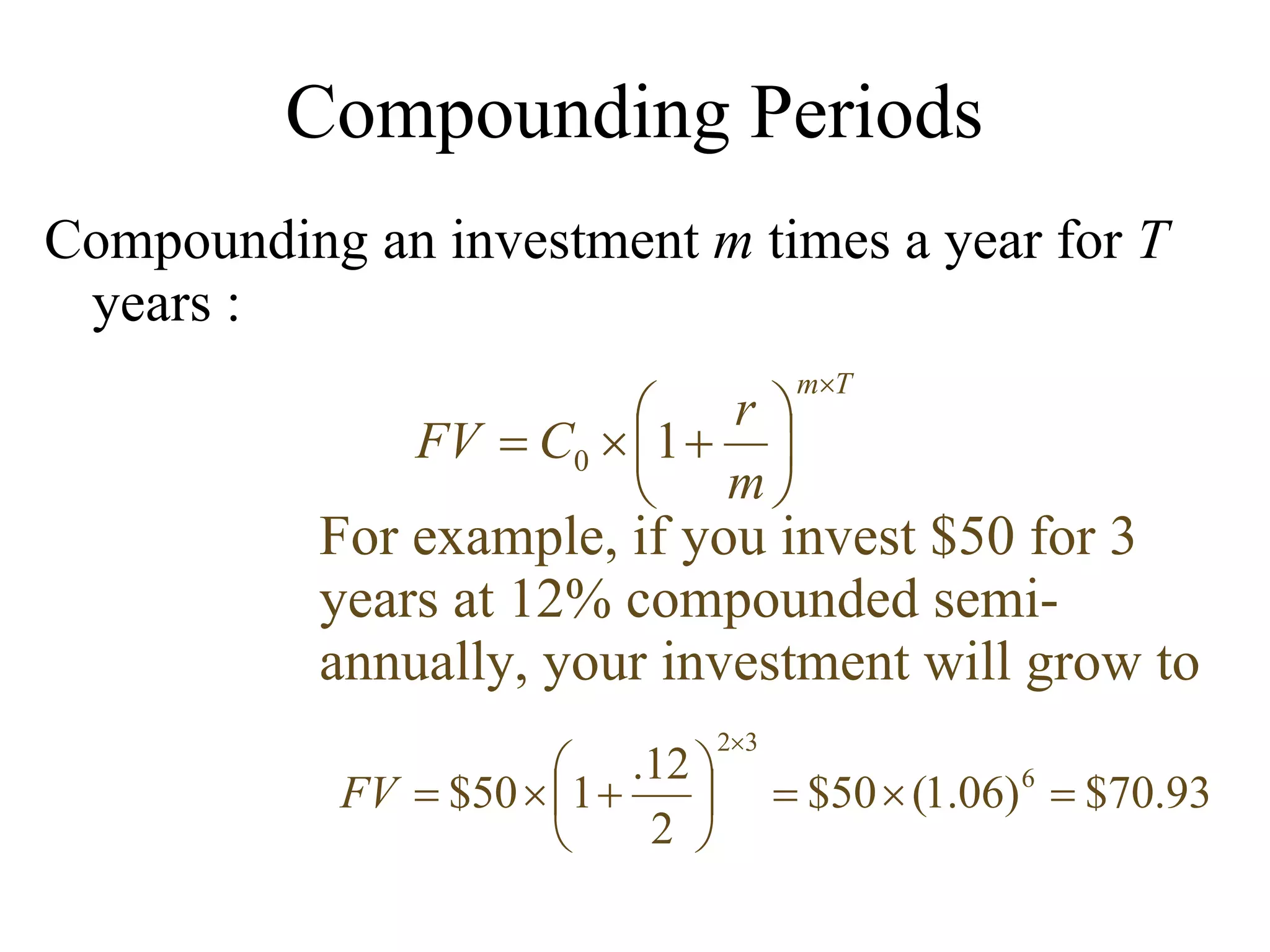
Compounding Periods Compounding an investment  m  times a year for  T  years : For example, if you invest $50 for 3 years at 12% compounded semi-annually, your investment will grow to
Effective Annual Interest Rates A reasonable question to ask in the above example is what is the effective  annual  rate of interest on that investment? The Effective Annual Interest Rate (EAR) is the annual rate that would give us the same end-of-investment wealth after 3 years:
Effective Annual Interest Rates (continued) Find the Effective Annual Rate (EAR) of an 18% APR loan that is compounded monthly. What we have is a loan with a monthly interest rate rate of 1½  percent. This is equivalent to a loan with an annual interest rate of 19.56 percent
Continuous Compounding A = P ( 1+ r )  n In case of intra year compounding* A = P ( 1 + r/m )  nm The limit as m tends to infinity is known as continuous compounding. A = P e  r n
Amortising a Loan Repayment in Equated Monthly Installment Principal and interest payment Mortgage. Auto. Consumer loans
Key Concept Managers should use the present value of cashflows to compare and evaluate cash payments made and received at different times.
Corporate Finance Lessons A rupee today is worth more than a rupee tomorrow and a rupee today cannot be worth more than a rupee yesterday. A safe rupee is worth more than a risky one.
Concepts Time value of money Present and Future value. Compounding and Discounting. Amortisation  Annuity
Start Saving! 21 years. $1million on retirement at 65. 10% return Annual investments= $1532.24 8% return = $2801.52 12% return = $825.21 Age 40 = $10168 per annum If Inflation = 5%, $1 million = $116861
 

Iii A Time Value Of Money

  • 1.
    Time Value ofMoney The chief value of money lies in the fact that one lives in a world in which it is overestimated. HL Mencken
  • 2.
    A firm iscontemplating investing one lakh rupees in a project that is expected to pay rupees twenty thousands per annum over the next seven years. Should the firm accept the proposal?
  • 3.
    Sale of landTwo offers 10,000 11424 next year Bank interest rate =12% 10000 grows to 11200 Invest 10200 today at 12% to get 11424 next year.
  • 4.
    Time Value ofMoney Money has a time value associated with it and therefore, a rupee received today is worth more than a rupee received in the future. The future value and present value of a rupee are based on the number of periods involved and the interest rate applicable.
  • 5.
    The Manhattan IslandsThe Indians have always been ridiculed for selling the Manhattan Island for dollars 24 in 1624. Was it really ridiculous? If the Indians had invested dollars 24 at 6 per cent per annum, they would have had …….. If the Indians had been a little more astute and invested dollars 24 at 7.5%, they would now have had ……..
  • 6.
  • 7.
    Applications Value maximisation Value a stream of cashflows Mortgage payments on a housing loan Periodical savings required to accumulate a certain sum Effective rate of borrowing for a car Return on investment Investment required to ensure pension after retirement Capital budgeting and financing decisions Valuation of bonds
  • 8.
    Required Rate ofReturn Postponing consumption Inflation Risk Cost to the company
  • 9.
    Simple Interest Interestpaid or earned only on the original amount Simple interest = Principle* Interest rate* No of Periods Future value =Interest + Principle
  • 10.
    Simple Interest Rs100. 10%. 7 th year Interest = 100 * 10% = 10 Value at the end of the 7 th year equals 100 + 10*7 = 100 +70 = 170
  • 11.
    Compound Interest Interestearned during a period is added to the original principle to get the amount on which interest will be calculated in the next period. Interest earned during a period on the principle as well as the previous periods’ interest.
  • 12.
    Compound Interest Rs100. 10%. 7 th year 100 (1+0.10) 7-1 * 0.1 =17.72 Value = 100 (1+0.1) 7 = 194.87 Future Value Interest Factor (FVIF) = (1+r) n FVIF 10% 7Years = 1.949 Future Value = 100 * 1.949 = 194.90 FV n = PV 0 * FVIF r,n
  • 13.
    Benjamin Franklin Moneymakes money and the money that money makes, makes more money.
  • 14.
    Ibbotson & SinquefieldStock market return from 1926 $1 invested in 1926 grows to $2279 in 2001 10.71% compounded annually
  • 15.
    The power ofcompounding can explain why well to do families bequeath their wealth to their grandchildren rather than their children. Parents would rather make their grandchildren very rich than make their children moderately rich. In these families, the grandchildren have a more positive view of the power of compounding than do the children.
  • 16.
    Four Values Futurevalue of a single amount Present value of a single amount Future value of an annuity Present value of an annuity
  • 17.
    Future Value ofa Single Amount What is an amount equal to in future FV = P 0 (1+r) n (1+r) n is the Future Value Interest Factor FV n = PV 0 * FVIF r,n
  • 18.
  • 19.
    Present Value Presentworth of a future cashflow Amount today that will grow to the specified amount at the end of the specified period Calculate present value of a future cashflow to make it comparable Calculation of present value of a future amount is called discounting. The rate at which it is discounted is the discount rate or the capitalisation rate.
  • 20.
    Present Value (cont…)FV = P 0 (1+r) n P 0 = FV / (1+r) n P 0 = FV* (1 / (1+r) n ) At 10%, Present value of 200 received 7 years hence is 102.62. (1 / (1+r) n ) is the present value interest factor PV 0 = FV n * (PVIF r,n )
  • 21.
    Four Key ParametersPresent value Future value Discount rate Periods
  • 22.
    The Multiperiod Case:Future Value Suppose that Jay Ritter invested in the initial public offering of the Modigliani company. Modigliani pays a current dividend of $1.10, which is expected to grow at 40-percent per year for the next five years. What will the dividend be in five years? FV = P 0 ×(1 + r ) n $5.92 = $1.10×(1.40) 5
  • 23.
    Present Value andCompounding How much would an investor have to set aside today in order to have $20,000 five years from now if the current rate is 15%? 0 1 2 3 4 5 $20,000 PV
  • 24.
    If we deposit$5,000 today in an account paying 10%, how long does it take to grow to $10,000? How Long is the Wait?
  • 25.
    Assume the totalcost of a college education will be $50,000 when your child enters college in 12 years. You have $5,000 to invest today. What rate of interest must you earn on your investment to cover the cost of your child’s education? What Rate Is Enough? About 21.15%.
  • 26.
    Special Considerations inTVM Annuity Perpetuity Growing perpetuity Intra year compounding
  • 27.
    Annuities A seriesof equal cashflows over a specified number of periods Ordinary annuities : Payments start at the end of the current period. Future value of an annuity (FVIFA i,n ) Present value of an annuity (PVIFA i,n )
  • 28.
    Perpetuity Equalcashflows which continue forever Perpetual bonds British railroad bonds
  • 29.
    Growing Perpetuity Aperpetuity that grows at a constant rate per annum Growth rate of companies
  • 30.
    Perpetuity A constantstream of cash flows that lasts forever. … The formula for the present value of a perpetuity is: 0 1 C 2 C 3 C
  • 31.
    Perpetuity What isthe value of a British consol that promises to pay £15 each year, every year until the sun turns into a red giant and burns the planet to a crisp? The interest rate is 10-percent . … 0 1 £15 2 £15 3 £15
  • 32.
    Growing Perpetuity Agrowing stream of cash flows that lasts forever. … The formula for the present value of a growing perpetuity is: 0 1 C 2 C ×(1+ g ) 3 C ×(1+ g ) 2
  • 33.
    Growing Perpetuity Theexpected dividend next year is $1.30 and dividends are expected to grow at 5% forever. If the discount rate is 10%, what is the value of this promised dividend stream? 0 … 1 $1.30 2 $1.30 ×(1.05) 3 $1.30 ×(1.05) 2
  • 34.
    Annuity A constantstream of cash flows with a fixed maturity. The formula for the present value of an annuity is: 0 1 C 2 C 3 C T C
  • 35.
    Annuity If youcan afford a $400 monthly car payment, what value of car can you afford if interest rates are 7% on 36-month loans? 0 1 $400 2 $400 3 $400 36 $400
  • 36.
    What is thepresent value of a four-year annuity of $100 per year that makes its first payment two years from today if the discount rate is 9%?   0 1 2 3 4 5 $100 $100 $100 $100 $327.97 $297.22
  • 37.
    PV of AnnuityYou wish to buy a photocopier and the supplier has quoted a price of 11,000 cash or 3000 per year for five years. If your cost of capital is 12%, which alternative would you prefer? What if the cost of capital is 8%
  • 38.
    Lottery New YorkState has started a lottery scheme wherin it will give away 40 million (2million per year for the next 20 years) to the winner. It plans to donate 50% of the collections of 36 million to charities. If the discount rate is 10%, will it save anything from the scheme or will it have to fund the charity donations from other sources?
  • 39.
    Retirement Benefit Savingsin pension fund up to 2000 per annum are tax free. You are starting your career at 25 years. You plan to retire at 65 years. Your investments are likely to yield 8% per annum. How much money will you have at retirement? What amount will you have if your annual returns are taxed at 25%.
  • 40.
    Intra Year CompoundingAnnually m = 1 100 Semi annually m = 2 110.25 Quarterly m = 4 110.38 Monthly m = 12 110.47 Weekly m = 52 110.51 Daily m = 365 110.52
  • 41.
    Compounding Periods Compoundingan investment m times a year for T years : For example, if you invest $50 for 3 years at 12% compounded semi-annually, your investment will grow to
  • 42.
    Effective Annual InterestRates A reasonable question to ask in the above example is what is the effective annual rate of interest on that investment? The Effective Annual Interest Rate (EAR) is the annual rate that would give us the same end-of-investment wealth after 3 years:
  • 43.
    Effective Annual InterestRates (continued) Find the Effective Annual Rate (EAR) of an 18% APR loan that is compounded monthly. What we have is a loan with a monthly interest rate rate of 1½ percent. This is equivalent to a loan with an annual interest rate of 19.56 percent
  • 44.
    Continuous Compounding A= P ( 1+ r ) n In case of intra year compounding* A = P ( 1 + r/m ) nm The limit as m tends to infinity is known as continuous compounding. A = P e r n
  • 45.
    Amortising a LoanRepayment in Equated Monthly Installment Principal and interest payment Mortgage. Auto. Consumer loans
  • 46.
    Key Concept Managersshould use the present value of cashflows to compare and evaluate cash payments made and received at different times.
  • 47.
    Corporate Finance LessonsA rupee today is worth more than a rupee tomorrow and a rupee today cannot be worth more than a rupee yesterday. A safe rupee is worth more than a risky one.
  • 48.
    Concepts Time valueof money Present and Future value. Compounding and Discounting. Amortisation Annuity
  • 49.
    Start Saving! 21years. $1million on retirement at 65. 10% return Annual investments= $1532.24 8% return = $2801.52 12% return = $825.21 Age 40 = $10168 per annum If Inflation = 5%, $1 million = $116861
  • 50.