Quantum Computing:
Technology, Market and Ecosystem Overview
1
Raffaele Mauro
Managing Director
Endeavor Italy
KFP– Class 22
Knowledge Sharing Session
San Francisco, October 2017
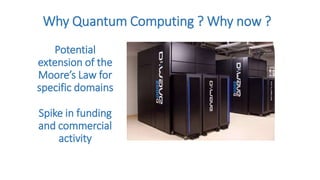
Why Quantum Computing ? Why now ?
Potential
extension of the
Moore’s Law for
specific domains
Spike in funding
and commercial
activity
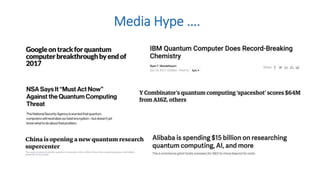
Media Hype ….
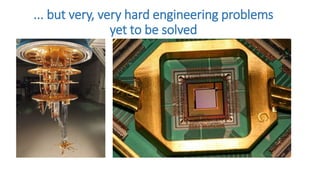
... but very, very hard engineering problems
yet to be solved
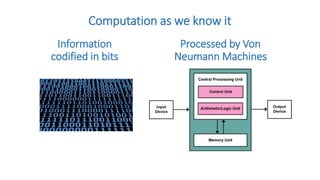
Computation as we know it
Information
codified in bits
Processed by Von
Neumann Machines
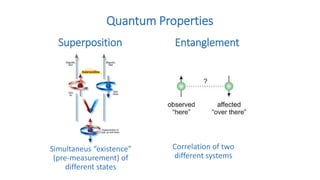
Quantum Properties
Superposition Entanglement
Correlation of two
different systems
Simultaneus “existence”
(pre-measurement) of
different states
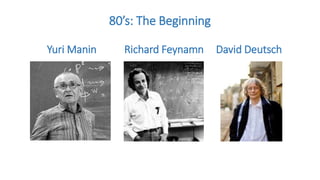
80’s: The Beginning
David DeutschRichard FeynamnYuri Manin
Qubits
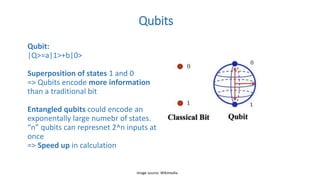
Qubit:
|Q>=a|1>+b|0>
Superposition of states 1 and 0
=> Qubits encode more information
than a traditional bit
Entangled qubits could encode an
exponentally large numebr of states.
“n” qubits can represnet 2^n inputs at
once
=> Speed up in calculation
Image source: Wikimedia
Solving complex problems
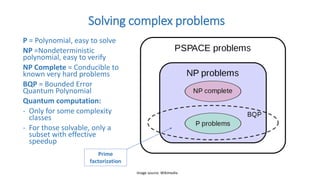
P = Polynomial, easy to solve
NP =Nondeterministic
polynomial, easy to verify
NP Complete = Conducible to
known very hard problems
BQP = Bounded Error
Quantum Polynomial
Quantum computation:
- Only for some complexity
classes
- For those solvable, only a
subset with effective
speedup
Prime
factorization
Image source: Wikimedia
90’s: Quantum Computing and
Theoretical Computer Science
1994: Factorization problems
• Shor algorithm
• Potential application in cryptography
• Exponential speedup (in comparison with classical computing)
1996: Search problems
• Grover algorithm
• Applications in software engineering / databases
• Quadratic speedup
00’s & 10’s: Technical Infrastructure
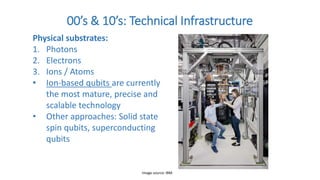
Physical substrates:
1. Photons
2. Electrons
3. Ions / Atoms
• Ion-based qubits are currently
the most mature, precise and
scalable technology
• Other approaches: Solid state
spin qubits, superconducting
qubits
Image source: IBM
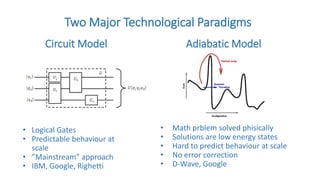
Two Major Technological Paradigms
Circuit Model Adiabatic Model
• Logical Gates
• Predictable behaviour at
scale
• ”Mainstream” approach
• IBM, Google, Righetti
• Math prblem solved phisically
• Solutions are low energy states
• Hard to predict behaviour at scale
• No error correction
• D-Wave, Google
2017-18: Quantum Supremacy ?
Quantum supremacy
= Quantum algorithms faster than classical ones
• Today -> Potential empirical demonstration
not only theory
• Likely to attract media coverage, hype and
more funding
• Google, IBM, Intel, Righetti are in pole
position
• Probable infrastructure: Circuit model with
weak error correction
• Which applications ?
Issues
Hardware:
• Decoherence / instability / noise
• Almost zero-temperature for some architectures
• Protection from electrical noise, radiation, etc.
• Focus of Ist generation quantum computers
Software:
• Error correction
• Millions of qubits needed for some applications
• Focus of IInd generation quantum computers
Timing:
• Real commercial applications probably far in time
Potential Applications
Short run
• Simulations & Chemistry:
• Applications in pharmaceutical research, material science, energy, agrifood
• Error correction less relevant
• Doable with only + 50 qubits
• Attracting investments
• Non-computing applications: Quantum key distribution and communication
Long run – Theoretically demonstrated
• Fault tolerant quantum computations with thousands or millions of qubits
• Cryptography / cryptoanalysis: Applications in finance and defence
• NSA already updating standards for “post-quantum” scenario
• Search problems
Long run - Speculative
• Machine learning
• Faster training of neural networks
• Optimization problems
• Solving linear systems with exponential speedup
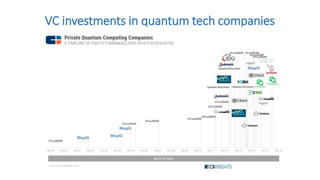
VC investments in quantum tech companies
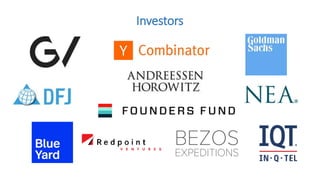
Investors
Vision Fund next ?
Masayoshi Son’s - Softbank $ 100 Bn
“Vision Fund” actively scouting
investments in quantum computing
“We are happy to invest enough to
create that standard around which the
whole industry can coalesce”
Shu Nyatta, Vision Fund
Startups: Examples - 1
• $ 70 M raised
• 80 Employees
• Investors goup includes
Andresseen Horowitz, Funders
Fund, Y Combinator, Bloomberg
Beta
• Building 50 qubit device
• Circuit approach
• Quantum chemistry team
• $ 157 M raised
• 160 Employees
• Sold devices to Nasa, Google, Lockeed,
Wolkswagen, Los Alamos National Lab.
• Strong IP portfolio
• Investors group includes DJF, Goldman
Sachs, Bezos Expeditions, Fidelity
• Government/Defense support
• Controversial adiabatic approach
• Issues: non-universal devices (only
specific functions), no error correction.
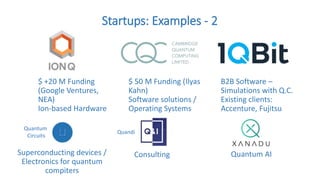
Startups: Examples - 2
$ 50 M Funding (Ilyas
Kahn)
Software solutions /
Operating Systems
$ +20 M Funding
(Google Ventures,
NEA)
Ion-based Hardware
B2B Software –
Simulations with Q.C.
Existing clients:
Accenture, Fujitsu
ConsultingSuperconducting devices /
Electronics for quantum
compiters
Quantum AI
Quandi
Quantum
Circuits
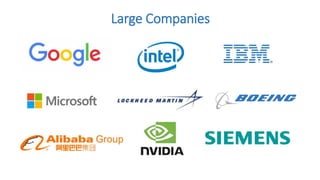
Large Companies
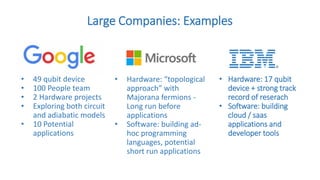
Large Companies: Examples
• Hardware: “topological
approach” with
Majorana fermions -
Long run before
applications
• Software: building ad-
hoc programming
languages, potential
short run applications
• 49 qubit device
• 100 People team
• 2 Hardware projects
• Exploring both circuit
and adiabatic models
• 10 Potential
applications
• Hardware: 17 qubit
device + strong track
record of reserach
• Software: building
cloud / saas
applications and
developer tools
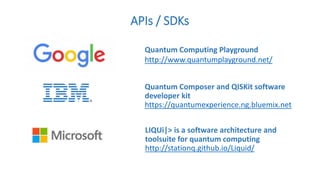
APIs / SDKs
Quantum Computing Playground
http://www.quantumplayground.net/
Quantum Composer and QISKit software
developer kit
https://quantumexperience.ng.bluemix.net
LIQUi|> is a software architecture and
toolsuite for quantum computing
http://stationq.github.io/Liquid/
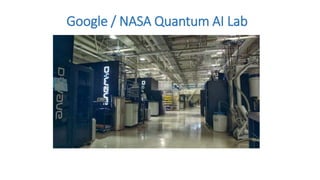
Google / NASA Quantum AI Lab
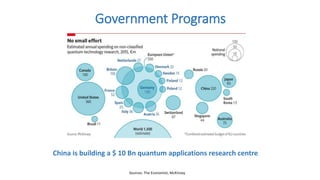
Government Programs
China is building a $ 10 Bn quantum applications research centre
Sources: The Economist, McKinsey
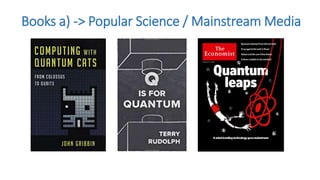
Books a) -> Popular Science / Mainstream Media
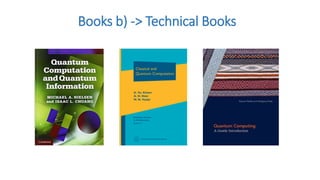
Books b) -> Technical Books
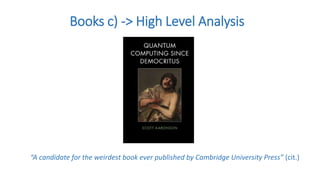
Books c) -> High Level Analysis
“A candidate for the weirdest book ever published by Cambridge University Press” (cit.)
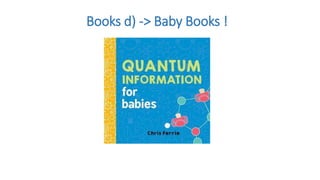
Books d) -> Baby Books !
raffaele.mauro@endeavor.org
raffa.mauro@gmail.com
Thank you !
Special thanks to Andrea Rocchetto (Oxford University) for inspiration and review
Raffaele Mauro, Ph.D.
Raffaele Mauro is passionate about technology, policy and global finance.
Now Managing Director at Endeavor Italy, he is focused on high-impact entrepreneurship and
venture capital, providing companies access to smart capital, talent and markets.
Previously he was Head of Finance for Innovation & Entrepreneurship at Intesa Sanpaolo and
worked at venture capital funds such as United Ventures (formerly Annapurna Ventures), P101 and
OltreVenture.
Raffaele is a Kauffman Fellow and holds an MPA from Harvard University, a Ph.D. from Bocconi and
is alumnus of the Singularity University Graduate Studies Program at NASA Ames.
Raffaele co-authored the book “Hacking Finance”, an essay on Bitcoin, blockchain and
cryptocurrencies, and was invited speaker at EY EMEIA Accelerate, Wired Money and the
Bundesbank. He invested and advised several companies including Multiply Labs (YC 2016).
Raffaele is also Junior Fellow at the Aspen Institute, member of the Young Leaders group of the US-
Italy Council, member of the “Young European Leaders – 40 under 40” cohort of 2011, member of
the scientific committee at Blockchainlab.it and member of the executive committee at the Global
Shapers Hub - Milano, a World Economic Forum community.
Twitter: @rafr
31

Quantum Computing: Technology, Market and Ecosystem Overview

  • 1.
    Quantum Computing: Technology, Marketand Ecosystem Overview 1 Raffaele Mauro Managing Director Endeavor Italy KFP– Class 22 Knowledge Sharing Session San Francisco, October 2017
  • 2.
    Why Quantum Computing? Why now ? Potential extension of the Moore’s Law for specific domains Spike in funding and commercial activity
  • 3.
  • 4.
    ... but very,very hard engineering problems yet to be solved
  • 5.
    Computation as weknow it Information codified in bits Processed by Von Neumann Machines
  • 6.
    Quantum Properties Superposition Entanglement Correlationof two different systems Simultaneus “existence” (pre-measurement) of different states
  • 7.
    80’s: The Beginning DavidDeutschRichard FeynamnYuri Manin
  • 8.
    Qubits Qubit: |Q>=a|1>+b|0> Superposition of states1 and 0 => Qubits encode more information than a traditional bit Entangled qubits could encode an exponentally large numebr of states. “n” qubits can represnet 2^n inputs at once => Speed up in calculation Image source: Wikimedia
  • 9.
    Solving complex problems P= Polynomial, easy to solve NP =Nondeterministic polynomial, easy to verify NP Complete = Conducible to known very hard problems BQP = Bounded Error Quantum Polynomial Quantum computation: - Only for some complexity classes - For those solvable, only a subset with effective speedup Prime factorization Image source: Wikimedia
  • 10.
    90’s: Quantum Computingand Theoretical Computer Science 1994: Factorization problems • Shor algorithm • Potential application in cryptography • Exponential speedup (in comparison with classical computing) 1996: Search problems • Grover algorithm • Applications in software engineering / databases • Quadratic speedup
  • 11.
    00’s & 10’s:Technical Infrastructure Physical substrates: 1. Photons 2. Electrons 3. Ions / Atoms • Ion-based qubits are currently the most mature, precise and scalable technology • Other approaches: Solid state spin qubits, superconducting qubits Image source: IBM
  • 12.
    Two Major TechnologicalParadigms Circuit Model Adiabatic Model • Logical Gates • Predictable behaviour at scale • ”Mainstream” approach • IBM, Google, Righetti • Math prblem solved phisically • Solutions are low energy states • Hard to predict behaviour at scale • No error correction • D-Wave, Google
  • 13.
    2017-18: Quantum Supremacy? Quantum supremacy = Quantum algorithms faster than classical ones • Today -> Potential empirical demonstration not only theory • Likely to attract media coverage, hype and more funding • Google, IBM, Intel, Righetti are in pole position • Probable infrastructure: Circuit model with weak error correction • Which applications ?
  • 14.
    Issues Hardware: • Decoherence /instability / noise • Almost zero-temperature for some architectures • Protection from electrical noise, radiation, etc. • Focus of Ist generation quantum computers Software: • Error correction • Millions of qubits needed for some applications • Focus of IInd generation quantum computers Timing: • Real commercial applications probably far in time
  • 15.
    Potential Applications Short run •Simulations & Chemistry: • Applications in pharmaceutical research, material science, energy, agrifood • Error correction less relevant • Doable with only + 50 qubits • Attracting investments • Non-computing applications: Quantum key distribution and communication Long run – Theoretically demonstrated • Fault tolerant quantum computations with thousands or millions of qubits • Cryptography / cryptoanalysis: Applications in finance and defence • NSA already updating standards for “post-quantum” scenario • Search problems Long run - Speculative • Machine learning • Faster training of neural networks • Optimization problems • Solving linear systems with exponential speedup
  • 16.
    VC investments inquantum tech companies
  • 17.
  • 18.
    Vision Fund next? Masayoshi Son’s - Softbank $ 100 Bn “Vision Fund” actively scouting investments in quantum computing “We are happy to invest enough to create that standard around which the whole industry can coalesce” Shu Nyatta, Vision Fund
  • 19.
    Startups: Examples -1 • $ 70 M raised • 80 Employees • Investors goup includes Andresseen Horowitz, Funders Fund, Y Combinator, Bloomberg Beta • Building 50 qubit device • Circuit approach • Quantum chemistry team • $ 157 M raised • 160 Employees • Sold devices to Nasa, Google, Lockeed, Wolkswagen, Los Alamos National Lab. • Strong IP portfolio • Investors group includes DJF, Goldman Sachs, Bezos Expeditions, Fidelity • Government/Defense support • Controversial adiabatic approach • Issues: non-universal devices (only specific functions), no error correction.
  • 20.
    Startups: Examples -2 $ 50 M Funding (Ilyas Kahn) Software solutions / Operating Systems $ +20 M Funding (Google Ventures, NEA) Ion-based Hardware B2B Software – Simulations with Q.C. Existing clients: Accenture, Fujitsu ConsultingSuperconducting devices / Electronics for quantum compiters Quantum AI Quandi Quantum Circuits
  • 21.
  • 22.
    Large Companies: Examples •Hardware: “topological approach” with Majorana fermions - Long run before applications • Software: building ad- hoc programming languages, potential short run applications • 49 qubit device • 100 People team • 2 Hardware projects • Exploring both circuit and adiabatic models • 10 Potential applications • Hardware: 17 qubit device + strong track record of reserach • Software: building cloud / saas applications and developer tools
  • 23.
    APIs / SDKs QuantumComputing Playground http://www.quantumplayground.net/ Quantum Composer and QISKit software developer kit https://quantumexperience.ng.bluemix.net LIQUi|> is a software architecture and toolsuite for quantum computing http://stationq.github.io/Liquid/
  • 24.
    Google / NASAQuantum AI Lab
  • 25.
    Government Programs China isbuilding a $ 10 Bn quantum applications research centre Sources: The Economist, McKinsey
  • 26.
    Books a) ->Popular Science / Mainstream Media
  • 27.
    Books b) ->Technical Books
  • 28.
    Books c) ->High Level Analysis “A candidate for the weirdest book ever published by Cambridge University Press” (cit.)
  • 29.
    Books d) ->Baby Books !
  • 30.
    raffaele.mauro@endeavor.org raffa.mauro@gmail.com Thank you ! Specialthanks to Andrea Rocchetto (Oxford University) for inspiration and review
  • 31.
    Raffaele Mauro, Ph.D. RaffaeleMauro is passionate about technology, policy and global finance. Now Managing Director at Endeavor Italy, he is focused on high-impact entrepreneurship and venture capital, providing companies access to smart capital, talent and markets. Previously he was Head of Finance for Innovation & Entrepreneurship at Intesa Sanpaolo and worked at venture capital funds such as United Ventures (formerly Annapurna Ventures), P101 and OltreVenture. Raffaele is a Kauffman Fellow and holds an MPA from Harvard University, a Ph.D. from Bocconi and is alumnus of the Singularity University Graduate Studies Program at NASA Ames. Raffaele co-authored the book “Hacking Finance”, an essay on Bitcoin, blockchain and cryptocurrencies, and was invited speaker at EY EMEIA Accelerate, Wired Money and the Bundesbank. He invested and advised several companies including Multiply Labs (YC 2016). Raffaele is also Junior Fellow at the Aspen Institute, member of the Young Leaders group of the US- Italy Council, member of the “Young European Leaders – 40 under 40” cohort of 2011, member of the scientific committee at Blockchainlab.it and member of the executive committee at the Global Shapers Hub - Milano, a World Economic Forum community. Twitter: @rafr 31