CHAP 3 B POVERTY
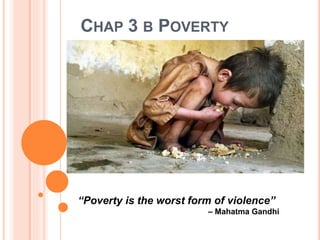
“Poverty is the worst form of violence”
– Mahatma Gandhi
NATURE OF POVERTY IN INDIA
 Meaning:-
 It is the situation in which an individual fails to fulfill
his basic minimum needs like food, clothing,
shelter, health and education.
 It is an age old problem in India.
 Even today there are many people who are unable
to live a decent standard of living.
 Definition:-
 “ Poverty may be defined as inability to secure
minimum human needs concerning food, clothing,
housing, education and health.”
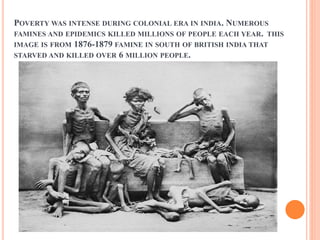
POVERTY WAS INTENSE DURING COLONIAL ERA IN INDIA. NUMEROUS
FAMINES AND EPIDEMICS KILLED MILLIONS OF PEOPLE EACH YEAR. THIS
IMAGE IS FROM 1876-1879 FAMINE IN SOUTH OF BRITISH INDIA THAT
STARVED AND KILLED OVER 6 MILLION PEOPLE.
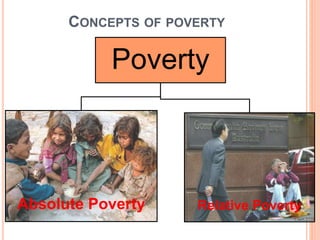
CONCEPTS OF POVERTY
Poverty
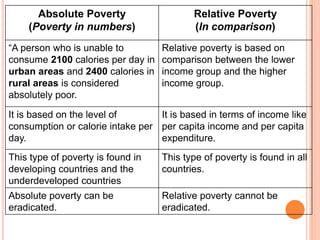
Absolute Poverty Relative Poverty
Absolute Poverty
(Poverty in numbers)
Relative Poverty
(In comparison)
“A person who is unable to
consume 2100 calories per day in
urban areas and 2400 calories in
rural areas is considered
absolutely poor.
Relative poverty is based on
comparison between the lower
income group and the higher
income group.
It is based on the level of
consumption or calorie intake per
day.
It is based in terms of income like
per capita income and per capita
expenditure.
This type of poverty is found in
developing countries and the
underdeveloped countries
This type of poverty is found in all
countries.
Absolute poverty can be
eradicated.
Relative poverty cannot be
eradicated.
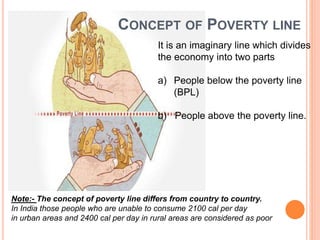
CONCEPT OF POVERTY LINE
It is an imaginary line which divides
the economy into two parts
a) People below the poverty line
(BPL)
b) People above the poverty line.
Note:- The concept of poverty line differs from country to country.
In India those people who are unable to consume 2100 cal per day
in urban areas and 2400 cal per day in rural areas are considered as poor
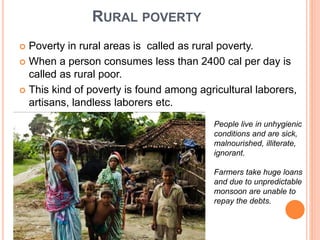
RURAL POVERTY
 Poverty in rural areas is called as rural poverty.
 When a person consumes less than 2400 cal per day is
called as rural poor.
 This kind of poverty is found among agricultural laborers,
artisans, landless laborers etc.
People live in unhygienic
conditions and are sick,
malnourished, illiterate,
ignorant.
Farmers take huge loans
and due to unpredictable
monsoon are unable to
repay the debts.
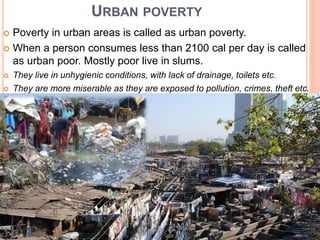
URBAN POVERTY
 Poverty in urban areas is called as urban poverty.
 When a person consumes less than 2100 cal per day is called
as urban poor. Mostly poor live in slums.
 They live in unhygienic conditions, with lack of drainage, toilets etc.
 They are more miserable as they are exposed to pollution, crimes, theft etc.
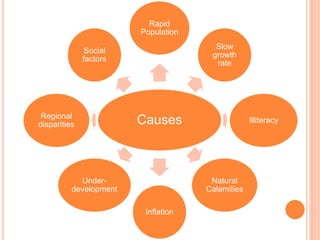
Causes
Rapid
Population
Slow
growth
rate
Illiteracy
Natural
Calamities
Inflation
Under-
development
Regional
disparities
Social
factors
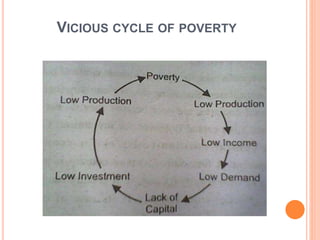
VICIOUS CYCLE OF POVERTY
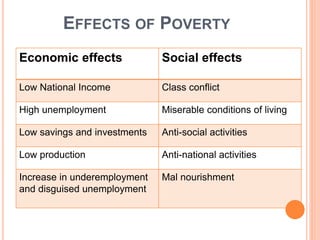
EFFECTS OF POVERTY
Economic effects Social effects
Low National Income Class conflict
High unemployment Miserable conditions of living
Low savings and investments Anti-social activities
Low production Anti-national activities
Increase in underemployment
and disguised unemployment
Mal nourishment
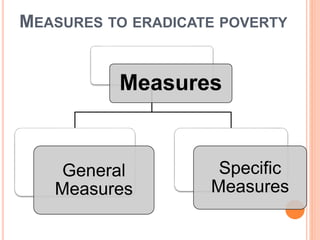
MEASURES TO ERADICATE POVERTY
Measures
General
Measures
Specific
Measures
GENERAL MEASURES:-
 Accelerate the growth of the economy
 Control of population
 Increase in employment opportunities
 Reduce economic inequalities
 Land reforms
 Balanced regional development
 Rural Industrialization
 Provision of social security measures.
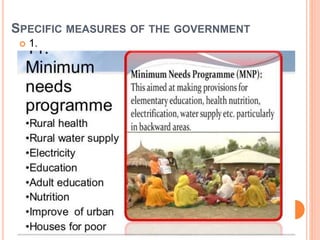
SPECIFIC MEASURES OF THE GOVERNMENT
 1.
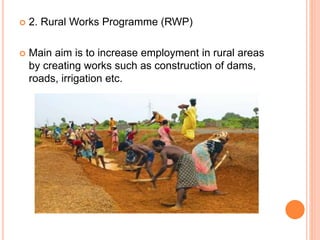
 2. Rural Works Programme (RWP)
 Main aim is to increase employment in rural areas
by creating works such as construction of dams,
roads, irrigation etc.
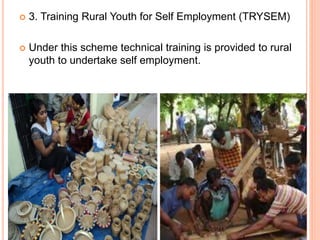
 3. Training Rural Youth for Self Employment (TRYSEM)
 Under this scheme technical training is provided to rural
youth to undertake self employment.
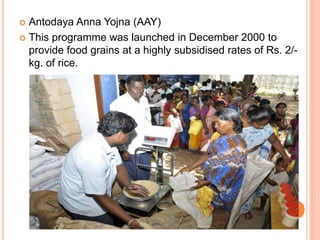
 Antodaya Anna Yojna (AAY)
 This programme was launched in December 2000 to
provide food grains at a highly subsidised rates of Rs. 2/-
kg. of rice.
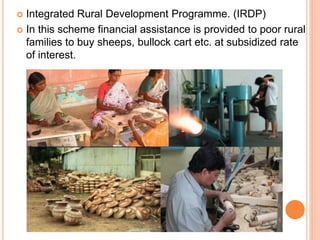
 Integrated Rural Development Programme. (IRDP)
 In this scheme financial assistance is provided to poor rural
families to buy sheeps, bullock cart etc. at subsidized rate
of interest.
THE END

Poverty

  • 1.
    CHAP 3 BPOVERTY “Poverty is the worst form of violence” – Mahatma Gandhi
  • 2.
    NATURE OF POVERTYIN INDIA  Meaning:-  It is the situation in which an individual fails to fulfill his basic minimum needs like food, clothing, shelter, health and education.  It is an age old problem in India.  Even today there are many people who are unable to live a decent standard of living.  Definition:-  “ Poverty may be defined as inability to secure minimum human needs concerning food, clothing, housing, education and health.”
  • 3.
    POVERTY WAS INTENSEDURING COLONIAL ERA IN INDIA. NUMEROUS FAMINES AND EPIDEMICS KILLED MILLIONS OF PEOPLE EACH YEAR. THIS IMAGE IS FROM 1876-1879 FAMINE IN SOUTH OF BRITISH INDIA THAT STARVED AND KILLED OVER 6 MILLION PEOPLE.
  • 4.
    CONCEPTS OF POVERTY Poverty AbsolutePoverty Relative Poverty
  • 5.
    Absolute Poverty (Poverty innumbers) Relative Poverty (In comparison) “A person who is unable to consume 2100 calories per day in urban areas and 2400 calories in rural areas is considered absolutely poor. Relative poverty is based on comparison between the lower income group and the higher income group. It is based on the level of consumption or calorie intake per day. It is based in terms of income like per capita income and per capita expenditure. This type of poverty is found in developing countries and the underdeveloped countries This type of poverty is found in all countries. Absolute poverty can be eradicated. Relative poverty cannot be eradicated.
  • 6.
    CONCEPT OF POVERTYLINE It is an imaginary line which divides the economy into two parts a) People below the poverty line (BPL) b) People above the poverty line. Note:- The concept of poverty line differs from country to country. In India those people who are unable to consume 2100 cal per day in urban areas and 2400 cal per day in rural areas are considered as poor
  • 7.
    RURAL POVERTY  Povertyin rural areas is called as rural poverty.  When a person consumes less than 2400 cal per day is called as rural poor.  This kind of poverty is found among agricultural laborers, artisans, landless laborers etc. People live in unhygienic conditions and are sick, malnourished, illiterate, ignorant. Farmers take huge loans and due to unpredictable monsoon are unable to repay the debts.
  • 8.
    URBAN POVERTY  Povertyin urban areas is called as urban poverty.  When a person consumes less than 2100 cal per day is called as urban poor. Mostly poor live in slums.  They live in unhygienic conditions, with lack of drainage, toilets etc.  They are more miserable as they are exposed to pollution, crimes, theft etc.
  • 9.
  • 10.
  • 11.
    EFFECTS OF POVERTY Economiceffects Social effects Low National Income Class conflict High unemployment Miserable conditions of living Low savings and investments Anti-social activities Low production Anti-national activities Increase in underemployment and disguised unemployment Mal nourishment
  • 12.
    MEASURES TO ERADICATEPOVERTY Measures General Measures Specific Measures
  • 13.
    GENERAL MEASURES:-  Acceleratethe growth of the economy  Control of population  Increase in employment opportunities  Reduce economic inequalities  Land reforms  Balanced regional development  Rural Industrialization  Provision of social security measures.
  • 14.
    SPECIFIC MEASURES OFTHE GOVERNMENT  1.
  • 15.
     2. RuralWorks Programme (RWP)  Main aim is to increase employment in rural areas by creating works such as construction of dams, roads, irrigation etc.
  • 16.
     3. TrainingRural Youth for Self Employment (TRYSEM)  Under this scheme technical training is provided to rural youth to undertake self employment.
  • 17.
     Antodaya AnnaYojna (AAY)  This programme was launched in December 2000 to provide food grains at a highly subsidised rates of Rs. 2/- kg. of rice.
  • 18.
     Integrated RuralDevelopment Programme. (IRDP)  In this scheme financial assistance is provided to poor rural families to buy sheeps, bullock cart etc. at subsidized rate of interest.
  • 19.